
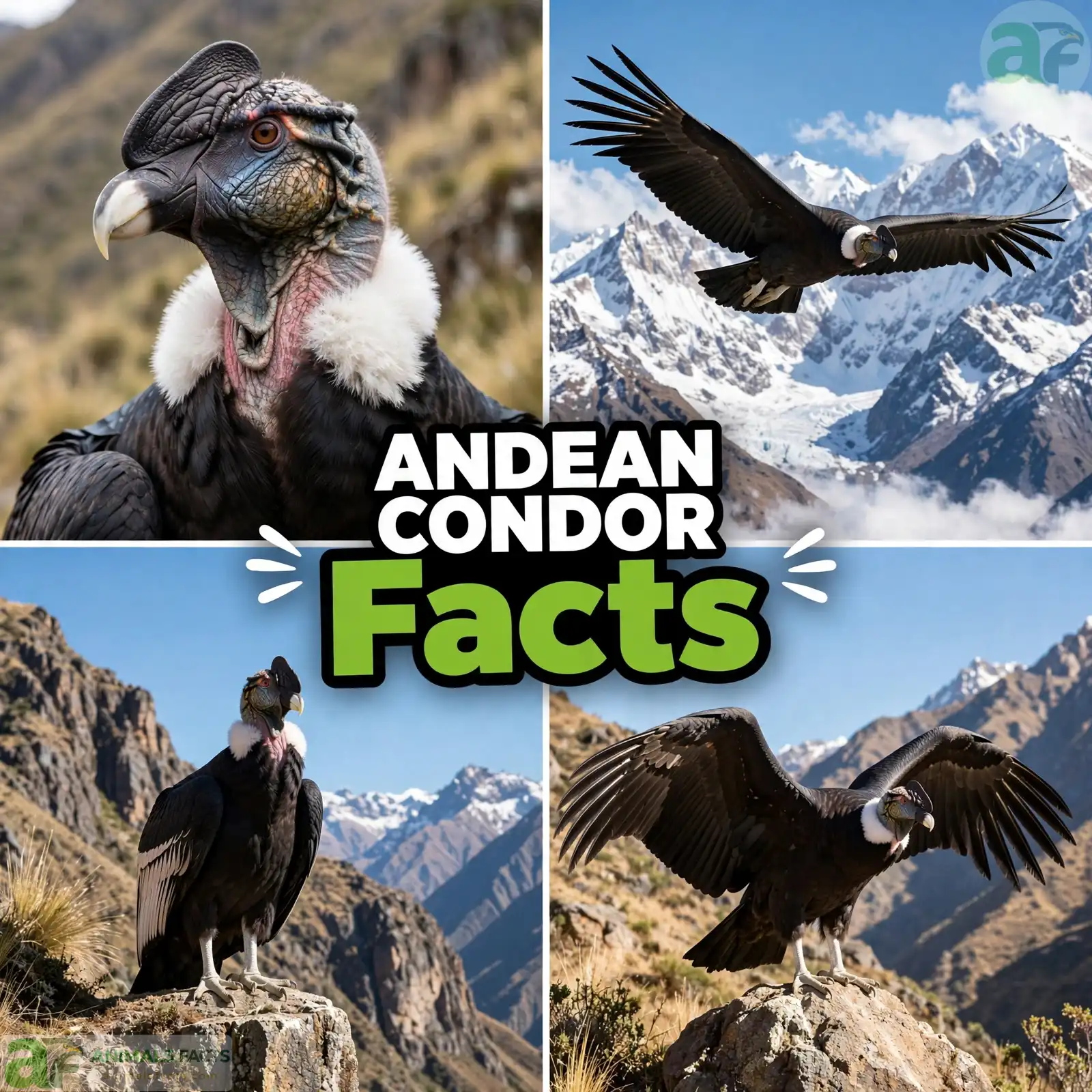
Andean Condor Facts
| Feature | Details |
|---|---|
| Scientific Name | Vultur gryphus (Linnaeus, 1758) |
| Kingdom | Animalia |
| Phylum | Chordata |
| Class | Aves |
| Order | Cathartiformes |
| Family | Cathartidae |
| Common Names | Andean condor; condor de los Andes; kuntur (Quechua) |
| Native Range | The Andes mountain range from Venezuela and Colombia south to Tierra del Fuego; also Pacific coast of South America |
| Habitat | High-altitude Andean grassland (puna), mountain cliffs, desert coast, Patagonian steppe — wherever large carcasses occur near soaring terrain |
| Lifespan | 50–70 years (wild estimate); 79 years documented (captivity) — one of the longest-lived birds on Earth |
| Diet | Primarily large mammal carcasses — wild ungulates, domestic livestock, marine mammals on Pacific coast |
| Body Length | 100–130 cm |
| Wingspan | 274–340 cm — one of the widest wingspans of any living bird |
| Weight | Males 11–15 kg; females 8–11 kg — one of the heaviest flying birds on Earth |
| Conservation Status | Vulnerable (IUCN) — declining; estimated 6,700 mature individuals remaining |
| Defining Feature | The combination of enormous size, white neck ruff, bald head with caruncle (males), and the ability to soar for hours without a single wing flap makes the Andean condor the most physically imposing bird in South America |
| National Symbol | National symbol of Argentina, Bolivia, Chile, Colombia, Ecuador, and Peru — more countries than any other single bird species |
| Closest Relative | California condor (Gymnogyps californianus) — both in family Cathartidae; both Critically Endangered or Vulnerable |
| Cosmological Role | Supreme ruler of the upper world (hanan pacha) in Andean cosmology — one of the most sacred animals in any living indigenous tradition |
 1. Introduction: What is a Andean Condor?
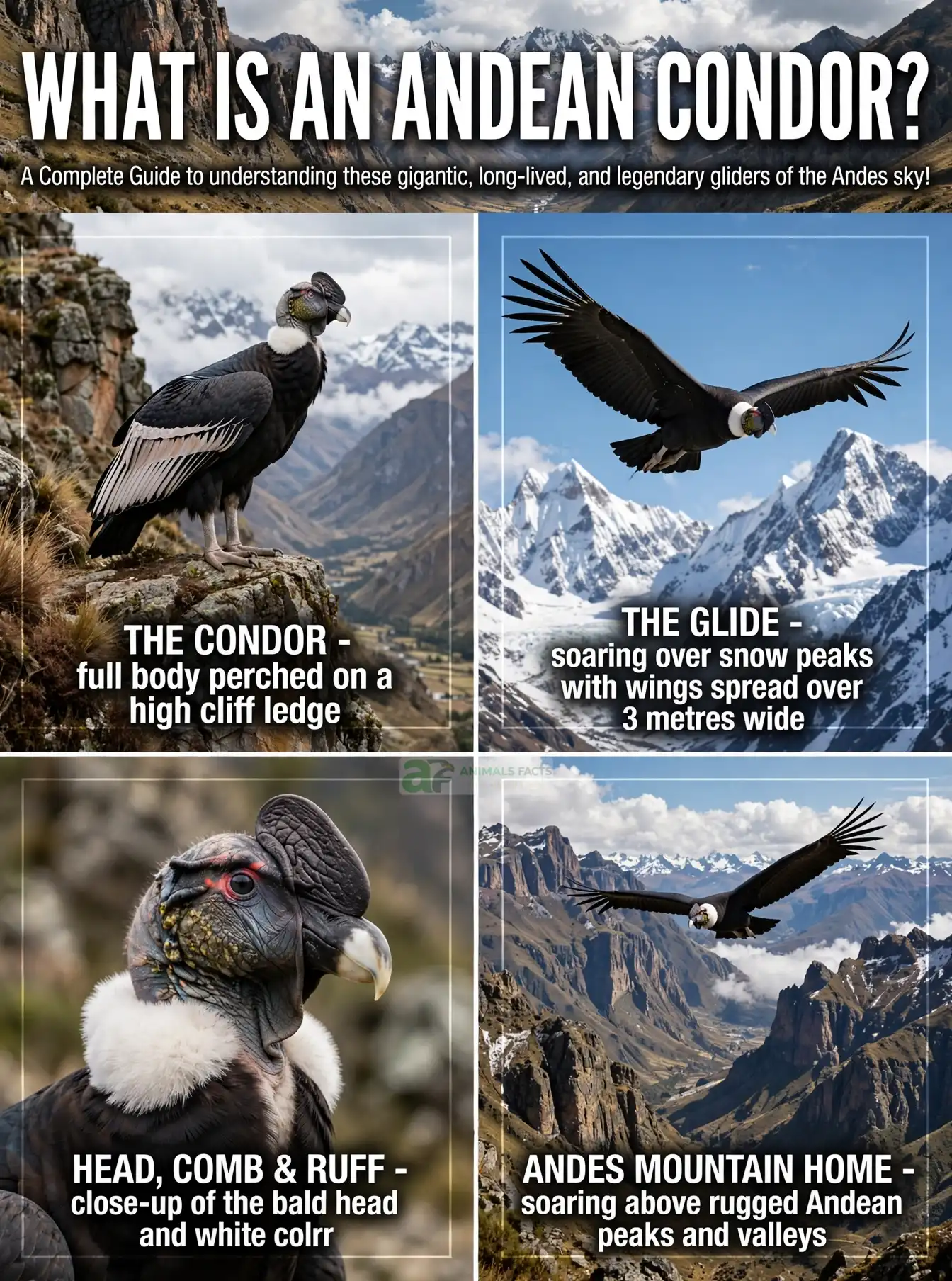
At the Cruz del Condor viewpoint in Peru’s Colca Canyon — one of the deepest canyons on Earth, its walls dropping nearly four kilometers from rim to river — the first hour after dawn belongs to the cloud. The canyon is filled with it, the white mass obscuring everything below the rim, and the visitors who have risen before first light and driven the cold mountain roads stand at the railing in the thin air at 3,200 meters and wait. Then, from the cloud, the first shape emerges — enormous, unhurried, riding a thermal column with the absolute economy of an animal that has been perfecting this particular physical skill for 25 million years. The wingspan stretches to perhaps three and a half meters. The white neck ruff catches the first direct sun. The bald head turns — once, twice — scanning the canyon below with eyes that can resolve the shape of a dead llama from a distance that would render it invisible to a human observer. The Andean condor circles once above the viewpoint, so close that individual primary feathers are visible against the pale morning sky, and then banks southward along the canyon rim and is gone, the thermal having delivered it to working altitude for the day. Andean condor facts begin with this moment — the specific intersection of extreme physical scale, extreme ecological specialization, and extreme cultural weight that makes this bird unlike any other on Earth.
The Andean condor (Vultur gryphus) is a bird of superlatives assembled into a single extraordinary animal. It holds a wingspan reaching 340 centimeters — among the widest of any living bird. It achieves a body weight of up to 15 kilograms — making it one of the heaviest flying birds on Earth, a mass that requires the most efficient soaring system of any bird to remain airborne without prohibitive energy expenditure. It is documented living to 79 years in captivity and estimated to live 50–70 years in the wild — one of the longest-lived birds ever recorded and a longevity that reflects its position as the apex scavenger of a vast and challenging mountain ecosystem. It is the national symbol of six South American countries — Argentina, Bolivia, Chile, Colombia, Ecuador, and Peru — more countries than any other single bird species on Earth, a political geography of reverence that reflects the condor’s supreme position in Andean cultural consciousness across 10,000 years of human civilization in the Andes. And in Andean indigenous cosmology — the living spiritual traditions of millions of Quechua, Aymara, and other Andean peoples — the condor is the ruler of the upper world (hanan pacha), the celestial realm of the sun and the divine, the supreme being of the sky whose appearance is simultaneously an ecological event, a cultural experience, and for many observers, a genuinely spiritual encounter.
Interesting facts about Andean condors reveal an animal of breathtaking biological and cultural complexity — the male’s elaborate caruncle (the fleshy crest on the forehead) that has no equivalent in any other New World bird; the two-year breeding cycle that makes each chick the most heavily invested offspring of any bird in the Americas; the soaring physics that allow a 15-kilogram bird to remain airborne for hours in mountain air currents without a single active wing beat; the remarkable fact that the Andean condor is more closely related to a stork than to the Old World vultures it resembles — the convergent evolution story embedded in its very existence; the colonial vocalizations that reveal a bird capable of social communication despite having no syrinx; and the conservation situation that places the Andean condor in the Vulnerable category and trending downward despite its cultural status as the most revered bird in South America. This is your comprehensive guide to the sacred sky ruler of the Andes.
2. Andean Condor Species Overview & Classification
The Andean condor occupies a taxonomically unique position as the largest member of the New World vulture family — and as one of only two surviving members of its immediate evolutionary lineage.
Species Classification Table
| Taxonomic Rank | Classification |
|---|---|
| Kingdom | Animalia |
| Phylum | Chordata |
| Class | Aves |
| Order | Cathartiformes |
| Family | Cathartidae |
| Genus | Vultur (Linnaeus, 1758) |
| Species | V. gryphus (Linnaeus, 1758) |
| Common Names | Andean condor; kuntur (Quechua); cóndor andino (Spanish); condor de los Andes |
| Etymology | Vultur = “vulture” (Latin); gryphus = “griffin” (Latin/Greek) — named for the mythological griffin, a creature combining eagle and lion, reflecting the bird’s extraordinary physical presence. The common name “condor” derives from the Quechua kuntur — the indigenous name for this bird used across the Andean region for thousands of years |
The Genus Vultur — A Genus of One
Like the Philippine eagle’s monotypic genus Pithecophaga, the Andean condor is the sole living member of the genus Vultur — a monotypic genus containing no other extant species:
The extinct relative — The closest relative within the genus was the prehistoric Argentavis magnificens — a now-extinct South American condor-like bird that is the largest flying bird in the fossil record, with an estimated wingspan of 6–7 meters and a body mass of approximately 70–72 kg. Argentavis flew the South American skies approximately 6–8 million years ago — the Andean condor is therefore the living representative of one of the most ancient and most spectacular soaring bird lineages in Earth’s history.
The California condor relationship — The Andean condor’s closest living relative is the California condor (Gymnogyps californianus) — the two condors sharing common ancestry within the Cathartidae family and representing the largest surviving members of the New World vulture group:
| Feature | Andean Condor | California Condor |
|---|---|---|
| Scientific name | Vultur gryphus | Gymnogyps californianus |
| Max wingspan | 340 cm | 290 cm |
| Max weight | 15 kg | 11.5 kg |
| IUCN status | Vulnerable | Critically Endangered |
| Wild population | ~6,700 | ~350 |
| Range | Andes, South America | Western USA, Mexico |
| Head caruncle | Males have prominent caruncle | No caruncle |
| Recovery status | Declining | Recovering from 27-individual nadir |
| National symbol | 6 South American countries | USA (bald eagle is national bird) |
| Key threat | Persecution, lead, habitat | Lead poisoning from ammunition |
The Cathartidae Family — New World Vultures
| Species | Scientific Name | Weight | Conservation |
|---|---|---|---|
| Andean condor | Vultur gryphus | Up to 15 kg | Vulnerable |
| California condor | Gymnogyps californianus | Up to 11.5 kg | Critically Endangered |
| King vulture | Sarcoramphus papa | Up to 3.8 kg | Least Concern |
| Black vulture | Coragyps atratus | Up to 2.3 kg | Least Concern |
| Turkey vulture | Cathartes aura | Up to 2.3 kg | Least Concern |
| Greater yellow-headed vulture | Cathartes melambrotus | Up to 1.6 kg | Least Concern |
| Lesser yellow-headed vulture | Cathartes burrovianus | Up to 1.5 kg | Least Concern |
Evolutionary Position — The Stork Connection
As discussed in the vulture article, New World vultures including the Andean condor are more closely related to storks (Ciconiidae) than to Old World vultures. The Andean condor’s evolutionary lineage diverged from stork-like ancestors approximately 65 million years ago — the condor’s scavenging behavior, massive wingspan, and bare-headed appearance all evolved independently from the convergent Old World vulture lineage. This extraordinary evolutionary independence is one of the most remarkable stories in the Andean condor’s biology.
Andean Condor Evolution & Discovery Timeline
~25 million years ago (Oligocene-Miocene) — The Cathartidae lineage begins its radiation in South America — establishing the condor group that will eventually produce both the Andean condor and, 65 million years after the stork divergence, its most spectacular living representative.
~6–8 million years ago (Miocene) — Argentavis magnificens — the giant predecessor with 6–7 meter wingspan — soars above South America; the Andean condor’s lineage diverges toward the modern form.
~2–3 million years ago (Pliocene-Pleistocene) — The modern Vultur gryphus lineage achieves its current form — contemporary Andean condors essentially identical to Pleistocene fossil specimens.
~12,000 years ago — The Andean condor’s prehistoric range extended across North America alongside the California condor; the Pleistocene megafauna extinction (mammoths, mastodons, ground sloths, giant horses) removes the condor’s primary large-carcass prey base from North America, contracting the range southward to the Andes.
~3,000–5,000 BCE — Andean condor imagery begins appearing in pre-Inca cultures across the Andes — ceramic, textile, and stone representations documenting the bird’s supreme cultural significance across the entire span of Andean civilization.
~1400–1532 CE — The Inca Empire integrates the condor into the most elaborate cosmological system in the pre-Columbian Americas — the condor as ruler of the upper world becoming one of the foundational symbols of Inca civilization.
1758 — Carl Linnaeus formally describes Vultur gryphus in the 10th edition of Systema Naturae.
1973 — Convention on International Trade in Endangered Species (CITES) lists the Andean condor on Appendix I — prohibiting international commercial trade.
1994 — A small captive-bred Andean condor reintroduction program begins in Colombia — the first of several reintroduction initiatives across the condor’s range.
2020 — IUCN reclassifies the Andean condor from Near Threatened to Vulnerable — reflecting documented population declines across the range.
2024–2026 — The Andean condor’s conservation situation continues to deteriorate in northern parts of the range (Colombia, Ecuador, Venezuela) while remaining relatively stable in southern strongholds (Patagonia, coastal Peru and Chile).
“The Andean condor is not merely a bird. It is the embodiment of the Andean sky — the physical manifestation of the upper world’s power made visible to human eyes. When indigenous Andean communities see a condor overhead, they are not simply observing a large bird. They are receiving a message from the upper realm. The condor’s conservation is therefore not merely an ecological imperative — it is a cultural and spiritual emergency of the first order.”
— Dr. Sergio Lambertucci, National University of Comahue, Argentina — leading Andean condor behavioral ecologist
3. Andean Condor Physical Description & Unique Features
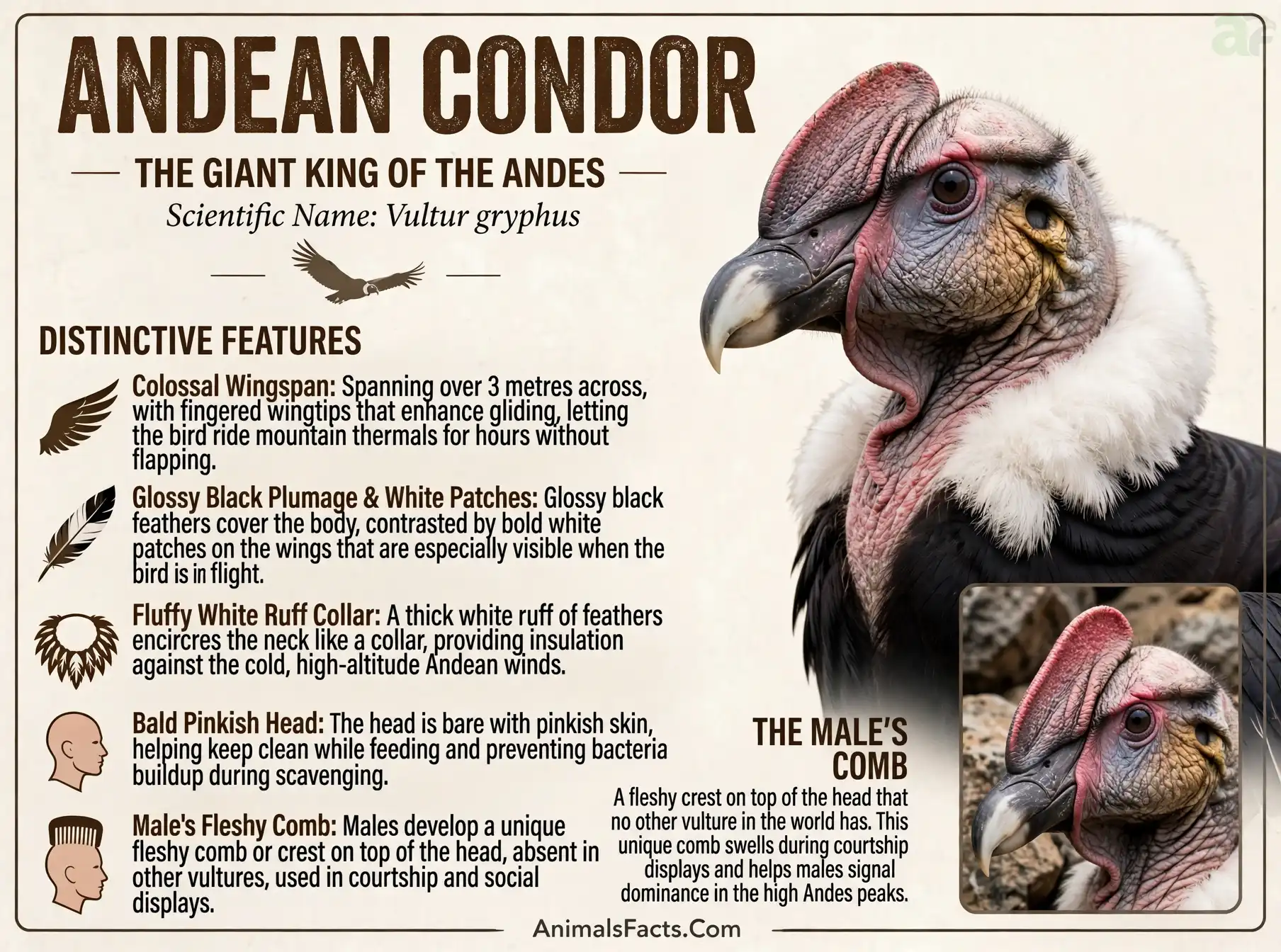
The Andean condor’s physical presence is unlike that of any other bird — the combination of extreme size, the dramatic contrast of black and white plumage, the elaborate bare head, and the effortless soaring flight creating an encounter that virtually every observer describes as overwhelming.
The Size — Numbers That Require Context
Wingspan of 340 cm — To appreciate what this means:
- The Andean condor’s maximum wingspan of 340 cm is wider than a compact car is long (standard compact car length approximately 420 cm)
- Three adult humans lying head-to-toe would barely span the same width
- The condor’s wingspan exceeds the height of most single-story buildings
- Only the wandering albatross (Diomedea exulans) — at a maximum of approximately 370 cm — is documented with a wider wingspan among living birds
Weight of 15 kg — For a flying bird, this weight requires extraordinary aerodynamic engineering:
- A large domestic cat weighs approximately 4–5 kg — the condor weighs three times that
- The condor’s weight approaches the physical upper limit for powered and soaring flight in birds — the combination of large wing area, low wing loading, and Andean thermal conditions allows sustained flight at this mass
- Male condors are significantly heavier than females — an unusual departure from the reverse sexual dimorphism seen in most raptors
The Plumage — Dramatic Black and White
Adult male plumage:
- Black body and wings — the primary body and wing feathers are glossy black — reflecting blue in bright sunlight
- White wing patches — the secondary coverts (the feathers covering the bases of the secondary flight feathers on the upper wing surface) are brilliant white — creating a striking white patch visible from enormous distances when the bird is in flight above
- White neck ruff — a ring of white downy feathers encircles the base of the neck — the most immediately striking plumage feature at close range; the ruff gives the bird the appearance of wearing an Elizabethan collar
Adult female plumage:
- Similar to male but lacking some of the male’s white upperwing extent — the female’s white wing patches are present but less extensive
- No caruncle (see below) — the most reliable sex distinction
- Smaller body size overall
Juvenile plumage:
- Brown-grey body with mottled brown upperwing — completely different from the striking adult pattern
- Dark head — the juvenile’s head is feathered rather than bare, covered in grey-brown down
- Gradual molt — the transition from juvenile to adult plumage takes approximately 6–8 years — one of the longest plumage development periods of any bird
The Male’s Caruncle — The Unique Ornamental Feature
The most distinctive and most biologically extraordinary feature of the adult male Andean condor:
What it is — A fleshy, laterally compressed crest rising from the forehead and bill base — a structure with no equivalent in any other New World bird. The caruncle is composed of soft tissue richly supplied with blood vessels.
Color variation — The caruncle’s color changes with the bird’s emotional state — ranging from pale cream or yellow when relaxed to deep red or orange when aroused, excited, or during social interactions. This color change is controlled by vascular blood flow changes — analogous to human blushing but far more dramatic.
Social function — The caruncle appears to function primarily in sexual selection and social signaling — larger, more developed caruncles likely signaling dominance and quality to both female condors assessing potential mates and to rival males assessing competitive threat.
Development — The caruncle does not reach full development until approximately 5–6 years of age — the same period during which the bird reaches sexual maturity and adult plumage. The caruncle’s progressive development through this period may provide an honest age and quality signal.
The Bare Head — Hygienic Perfection
Like all vultures, the Andean condor’s head is largely bare of feathers — the functional rationale being the hygiene advantage of bare skin over feathers when feeding inside large carcasses:
Adult head color — The bare head skin is dull red to pink in females and yellowish-orange in males — changing to deep red or bright orange during emotional arousal (the same vascular flushing mechanism as the caruncle color change).
The iris color — Adult males have brownish-red eyes; adult females have deep red eyes — the red eye of the female is one of the most reliable sex-determination characters in the species.
The wattle — Males have an additional small wattle (a hanging skin fold) at the base of the throat — further distinguishing the sexes at close range.
The Wings — The Soaring Masterpiece
The aspect ratio — The Andean condor’s wing shape optimizes soaring efficiency:
- Long, broad wings with deeply fingered primary feathers at the tip
- Low wing loading (large wing area relative to body mass) — generating lift at minimal air speeds
- The deep primary “fingers” — the separated outer primary feathers create individual winglet effects that reduce induced drag at the wingtip during soaring
The wing area — The Andean condor’s total wing area is approximately 1.0–1.2 square meters — one of the largest wing areas of any bird. This enormous lifting surface allows soaring in relatively weak thermals that would not sustain smaller-winged birds.
The flight mechanics — Research using GPS tracking devices attached to free-flying Andean condors has revealed extraordinary statistics:
- In one landmark study published in 2020, researchers found that tracked condors spent 99% of their flight time soaring without a single wing flap
- In five hours of continuous flight, one studied condor flapped its wings for a total of only 1 minute and 15 seconds
- The average soaring efficiency — distance covered per energy unit — makes the Andean condor the most thermally efficient large bird ever studied
💡 Did You Know? A 2020 study published in the journal PNAS attached GPS and accelerometer devices to eight free-flying Andean condors in Patagonia and tracked their flight behavior in extraordinary detail. The findings were astonishing even to the researchers: the condors spent 99% of their flight time soaring without flapping their wings — one bird covered 172 kilometers in a single flight without a single powered wing flap. The researchers discovered that the condors used five specific behavioral strategies to minimize wing flapping: they took off by running along cliff edges into headwinds rather than from still air; they gained altitude on orographic lift (air deflected upward by mountains and cliffs) before transitioning to thermals; they used slope soaring along cliff faces; they used thermal soaring in rising warm air columns; and they used dynamic soaring (extracting energy from wind speed gradients over the ocean surface) during coastal flight. The study concluded that the condor’s wing morphology and flight behavior have co-evolved to solve a specific physical challenge: how does a 15-kilogram bird remain airborne for hours at a time without expending prohibitive energy on powered flight? The answer — developed over 25 million years of evolution — is the most sophisticated soaring flight system of any bird.
4. Top 25 Amazing Andean Condor Facts
Here is your definitive collection of the most extraordinary, scientifically verified, and genuinely astonishing Andean condor facts as of 2026:
- The Andean condor’s wingspan reaches 340 centimeters — among the widest of any living bird on Earth, wider than a compact car is long, and approaching the physical upper limit of what aerodynamics allows for a soaring bird in Earth’s atmosphere.
- In a landmark 2020 study, GPS-tracked Andean condors spent 99% of their flight time soaring without flapping their wings — one individual covering 172 kilometers in a single flight without a single powered wing beat. The condor has essentially solved the problem of large-scale aerial movement through thermal and orographic soaring with an efficiency unmatched by any other bird.
- The Andean condor is the national symbol of six South American countries — Argentina, Bolivia, Chile, Colombia, Ecuador, and Peru — more countries than any other single bird species on Earth. In Peru and Bolivia, the condor appears on the national coat of arms; in Chile, it appears on the national flag’s coat of arms.
- A documented captive Andean condor lived to 79 years of age — one of the longest verified lifespans of any bird. Wild Andean condors are estimated to live 50–70 years — a longevity that makes each individual’s conservation value extraordinary and each death an amplified population setback.
- The Andean condor is the supreme ruler of the upper world (hanan pacha) in Andean indigenous cosmology — one of the most culturally significant animal roles in any living indigenous tradition. For Quechua, Aymara, and other Andean peoples, the condor’s appearance overhead is a cosmological event, not merely a wildlife encounter.
- Male Andean condors have a unique caruncle — a fleshy crest rising from the forehead that changes color from pale yellow when relaxed to deep red or orange when excited or aroused. No other New World vulture has this ornamental feature, and the caruncle’s size and development serve as an honest signal of age and reproductive quality.
- The Andean condor is the only member of the genus Vultur — a monotypic genus with no other living species. The condor’s closest extinct relative is Argentavis magnificens — an ancient South American condor with a 6–7 meter wingspan that was the largest flying bird in the fossil record.
- The Andean condor is more closely related to storks (Ciconiidae) than to Old World vultures — the New World vulture family Cathartidae having diverged from stork-like ancestors approximately 65 million years ago, completely independently from the hawk/eagle lineage that produced Old World vultures.
- The Yawar Fiesta — a traditional Andean festival practiced in remote Peruvian communities — involves tying a live condor to the back of a bull during a bullfighting event. The condor, representing Andean indigenous culture, pecks at the bull, representing Spanish colonial power. The condor is released unharmed after the event — the festival symbolizing the ultimate survival and triumph of indigenous Andean identity.
- Andean condors can go without food for two weeks — storing enormous quantities of fat reserves against periods of carcass scarcity in the high Andean landscape. When food is found, they may consume up to 5 kilograms in a single feeding session — gorging against future scarcity in a feast-or-famine metabolic strategy.
- The Colca Canyon viewpoint (Cruz del Condor) in Peru is positioned specifically above a thermal column that condors use every morning — the viewpoint allowing visitors to watch condors rise from the canyon depths on morning thermals and pass within meters of the viewing platform. It is the most reliable and most dramatic condor viewing experience in the world.
- Female Andean condors have distinctive deep red eyes — one of the most reliable field sex determination characters in the species. Males have brownish-red eyes. Combined with the male’s caruncle, the eye color difference makes sex determination reliable at close range even without measurements.
- Andean condors perform a remarkable courtship dance — the male approaches the female while hissing, spreading wings, and displaying his caruncle; the pair then engage in extended aerial soaring side by side, flying in close formation for hours as a primary courtship behavior. The aerial courtship demonstrates the male’s soaring capability and endurance directly to the female.
- The Andean condor’s range once extended through North America — Pleistocene fossil condor remains have been found from British Columbia to New York to Florida. The extinction of North American megafauna (mammoths, mastodons, giant sloths) approximately 12,000 years ago eliminated the condor’s large-carcass prey base in North America, contracting its range to the South American Andes.
- In Andean communities, the condor is believed to have the power to cure illness — condor fat and feathers are used in traditional medicine (kallawaya healing tradition in Bolivia) for various ailments, and the condor’s appearance near a sick person is interpreted as a healing sign. This medicinal use creates conservation complexity — the same cultural reverence that protects the condor also drives some demand for condor body parts.
- The Andean condor’s social hierarchy at carcasses is one of the most complex of any vulture — adult males with fully developed caruncles dominate; adult females are subordinate to dominant males; subadults and juveniles feed last or not at all until dominant birds have finished. The hierarchy is enforced through hissing, wing spreading, and posture rather than physical contact.
- Research in Patagonia has documented Andean condors following Patagonian pumas (Puma concolor patagonica) — the condors learning to locate the pumas and waiting for them to make kills. The condors then descend to feed after the puma has eaten. This learned association with a specific predator species represents sophisticated ecological knowledge acquired through individual experience and potentially social learning.
- The Andean condor’s crop — a food storage organ in the upper digestive tract — can hold up to 1.5 kilograms of food in a single meal. After gorging at a large carcass, a condor may carry this food store aloft and fly kilometers back to a roosting site, where it digests before the next foraging flight.
- Multiple South American countries have implemented condor reintroduction programs using captive-bred birds — Colombia’s program (beginning 1994) having successfully established a small breeding population in the Colombian Andes where the species had been reduced to near-extinction. The reintroduction programs represent the primary active conservation intervention for the species.
- The Andean condor is documented using oceanic updrafts off the Pacific coast of Peru and Chile — soaring above the cold Humboldt Current waters where upwelling creates consistent onshore winds and dynamic soaring opportunities. Coastal condors exploit marine mammal carcasses (sea lions, whales) that provide a predictable large-carcass resource supplementing the inland ungulate carcasses of the high Andes.
- Despite being the most revered bird in South America and the national symbol of six countries, the Andean condor is declining across most of its range — the contradiction between cultural reverence and conservation action representing one of the most significant conservation policy failures in the Americas.
- The Andean condor’s preening behavior is elaborate and time-consuming — the bird spending hours using its bill to maintain the approximately 1.5 square meters of wing feathers that constitute its primary ecological tool. Condors cannot fly effectively with damaged or dirty feathers — the wing surface precision required for efficient soaring making feather condition a functional, not merely cosmetic, concern.
- Research has documented Andean condors making foraging flights of up to 200 kilometers from their roost sites in a single day — the enormous soaring range covering a landscape larger than many European countries in a single daily excursion.
- The Andean condor has been observed at altitudes of up to 5,500 meters in the high Andes — soaring above the permanent snowline and navigating the extreme weather systems of the high Andean peaks in flight conditions that would ground most aircraft.
- As of 2026, the estimated global Andean condor population is approximately 6,700 mature individuals — classified as Vulnerable with a decreasing population trend. The most threatened populations are in the northern Andes (Colombia, Ecuador, Venezuela) where deforestation, persecution, and poisoning have reduced numbers to the lowest in recorded history.
5. Fun Facts About Andean Condors
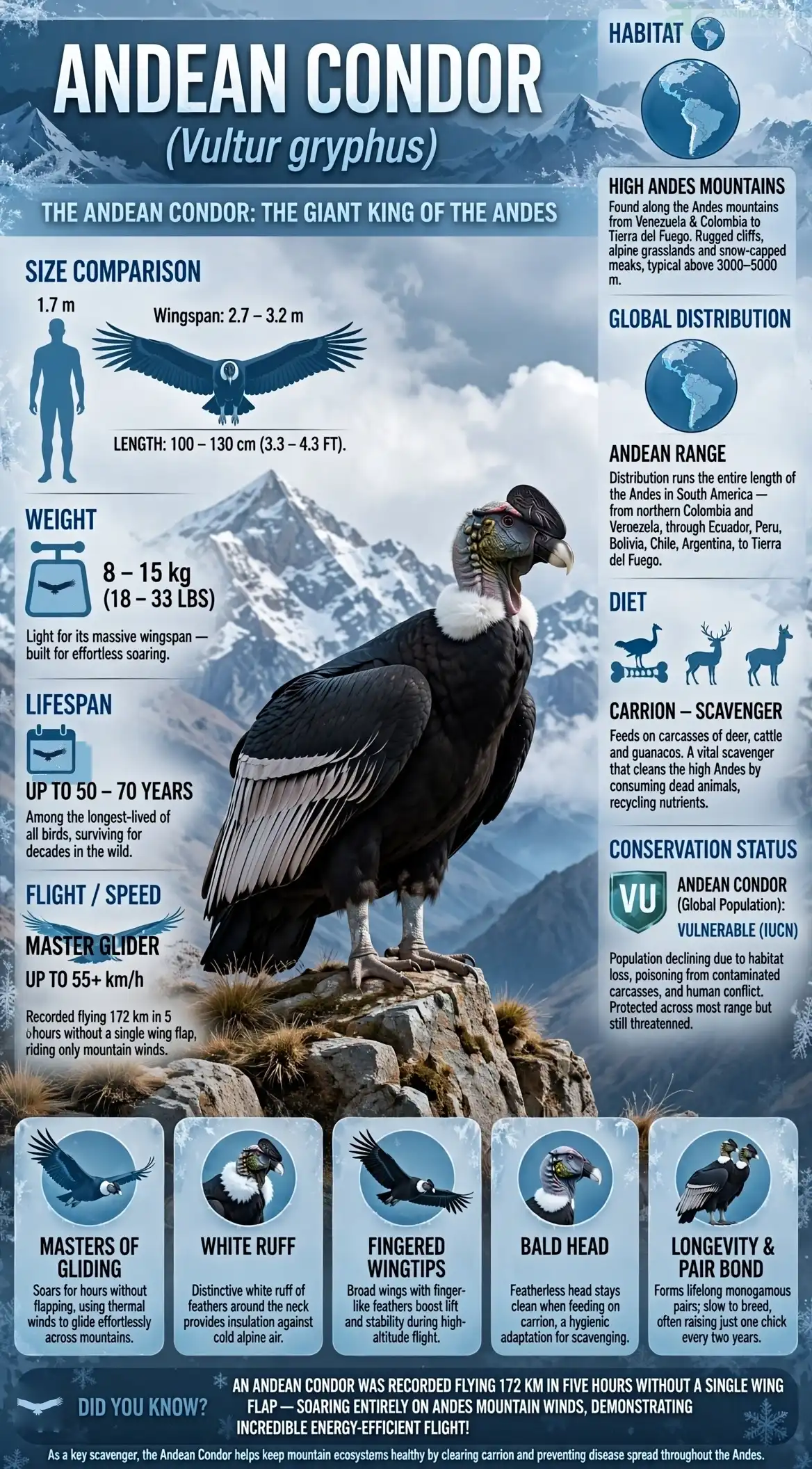
- Wingspan up to 340 cm — among the widest of any living bird
- Spends 99% of flight time soaring — without flapping
- Covered 172 km in one flight without a single wing flap
- National symbol of SIX countries — more than any other bird
- Lives up to 79 years in captivity
- Only member of genus Vultur — monotypic genus
- Closer relative of the stork than of Old World vultures
- Male has unique color-changing caruncle — no other New World vulture has this
- Can go two weeks without eating
- Eats up to 5 kg in one feeding session
- Range once included North America — Pleistocene megafauna extinction ended it
- Flies at altitudes up to 5,500 meters
6. Andean Condor Habitat & Geographic Range
Andean condor habitat follows the distribution of two things simultaneously: large carcasses (the condor’s food supply) and thermal updrafts (the condor’s transport system). Where these two requirements are met — along the Andes mountain range and the Pacific coast — the Andean condor occurs.
Primary Habitat Types
High-altitude Andean puna (grassland):
The Andean condor’s archetypal habitat — the vast, cold, open puna grassland of the high Andes at 3,000–5,000 meters elevation:
- Bolivia and Peru — the altiplano and surrounding mountain valleys supporting significant condor populations
- Ecuador and Colombia — northern range; smaller, more threatened populations
- Argentina and Chile — the Andean cordillera from the northern Andes south to Patagonia
The puna habitat provides:
- Thermal columns generated by sun-heated grassland surfaces
- Orographic lift along cliff and ridge faces
- Visibility across open terrain for carcass detection
- Wild guanaco (Lama guanicoe), vicuña (Vicugna vicugna), and domestic livestock as carcass sources
Patagonian steppe:
The southernmost condor habitat — the cold, windswept steppe of Argentine and Chilean Patagonia:
- Abundant guanaco populations provide reliable large-carcass resource
- Strong, consistent winds from the Southern Ocean provide exceptional soaring conditions without requiring thermal development
- The Patagonian condor population is considered among the healthiest and best-studied in the species’ range
Pacific coastal desert:
An often overlooked but ecologically important condor habitat — the hyperarid Atacama coastal zone of Peru and Chile:
- Condors descend from the Andean highlands to the coast to exploit marine mammal carcasses — dead sea lions, elephant seals, and occasionally whale carcasses
- The Humboldt Current’s productivity drives high sea lion populations that produce reliable beachcast carcasses
- Onshore winds along the coastal cliffs provide excellent soaring conditions
Andean valley forest margins:
At lower elevations (below approximately 2,000 meters), condors occasionally forage in:
- Montane cloud forest margins — particularly in Colombia and Ecuador where Andean forest extends to higher elevations
- River valleys — following river corridors between mountain ranges
Geographic Distribution
| Country | Population Status | Key Areas | Trend |
|---|---|---|---|
| Colombia | Very small — near-extirpated; reintroduced | Andes of Cundinamarca, Boyacá | Slight recovery via reintroduction |
| Venezuela | Very small | Mérida Andes | Declining |
| Ecuador | Small — declining | Chimborazo, El Cajas | Declining |
| Peru | Moderate — core population | Colca Canyon, Majes Valley, Arequipa | Stable in south; declining in north |
| Bolivia | Moderate | Sajama, Cotapata, Apolobamba | Declining |
| Chile | Good — recovering | Atacama coast; Andes broadly | Relatively stable |
| Argentina | Best — largest population | Patagonia, Mendoza, Neuquén | Relatively stable in Patagonia |
The Colca Canyon Special Case
Colca Canyon, Arequipa Region, Peru — The most famous and most visited Andean condor habitat in the world:
Why Colca? — The canyon’s specific geometry creates exceptional condor soaring conditions:
- The canyon depth (approximately 3,270 meters from rim to river at its deepest) creates dramatic thermal columns as cold canyon-bottom air is heated by the sun
- The canyon orientation channels prevailing winds to create consistent orographic lift along the cliff walls
- The semi-arid puna surrounding the canyon supports populations of wild and domestic camelids that provide carcass resources
- The elevation (Cruz del Condor viewpoint at approximately 3,270 meters) places observers at the condors’ soaring altitude
Population at Colca — Approximately 80–100 condors are associated with the Colca Canyon and surrounding Majes Valley — one of the highest local densities in the species’ range.
7. Andean Condor Diet & Feeding Behavior
Andean condor diet is entirely composed of carrion — the bird having no prey capture capability (its feet are too weak to grip live prey) and no physiological mechanism for killing. Everything the condor eats was already dead when the condor found it.
Primary Food Sources
| Food Type | Proportion | Notes |
|---|---|---|
| Wild ungulate carcasses | ~40–50% | Guanaco, vicuña, deer — primary inland prey |
| Domestic livestock carcasses | ~30–40% | Cattle, horses, llamas, sheep — major food source near human settlement |
| Marine mammal carcasses | ~10–20% | Sea lions, fur seals, elephant seals, whale strandings — coastal populations |
| Smaller mammals | ~5–10% | Foxes, armadillos, various smaller species |
| Bird carcasses | ~2–5% | Flamingos, waterfowl — opportunistic |
| Eggs | Rare | Primarily flamingo eggs in some areas |
The Carcass Detection System
The Andean condor finds food through visual detection — both direct visual scanning and social observation of other condors’ behavior:
Direct visual scanning — From soaring altitude (typically 1,000–3,000 meters above the ground surface), the condor scans the landscape below for:
- Stationary large animals that may be dead or dying
- Concentrations of other scavengers (corvids, foxes, other condors) that signal a feeding opportunity
- Exposed carcasses visible against the open puna or steppe background
Social cascade detection — The condor’s most powerful carcass-finding mechanism — watching other condors:
- A condor descending steeply toward a distant valley triggers following behavior in other soaring condors that observe the descent
- Within hours, a single carcass detection can cascade through a network of soaring condors spread across hundreds of kilometers
- This information cascade allows carcasses to attract dozens of condors even when located far from regular soaring corridors
Following predators — As noted above, Andean condors in Patagonia and other areas learn to follow pumas, jaguars, and other large predators — anticipating kills and positioning themselves to feed after the predator has eaten.
The Feeding Event
Arrival and dominance hierarchy:
- First arrivals are typically scouts — one or two birds descend to confirm carcass quality
- Additional birds rapidly follow as the cascade detection system operates
- At the carcass, the dominance hierarchy determines access order:
- Adult males with developed caruncles feed first
- Adult females feed alongside dominant males or after
- Subadults wait at the periphery until dominant adults have fed
- Juveniles may not feed at all at competitive carcasses
The feeding mechanics:
- The condor’s powerful hooked bill tears through tough hide and tendons
- The long, flexible neck reaches deep into body cavities without contaminating the head and neck feathers (the bald head hygiene advantage)
- The expanded crop — capable of holding up to 1.5 kg — allows rapid food storage and continuation of feeding while digesting
- A single condor may consume up to 5 kg in one feeding session
Post-feeding behavior:
After gorging, condors:
- Retire to a nearby cliff ledge or tree
- Sun their wings — spreading them wide to expose the wing feather surfaces to direct UV radiation (bactericidal sunning)
- Preen extensively — maintaining the wing feather condition critical for soaring flight
- Digest for 12–24 hours before the next foraging flight
The Starvation Resistance Adaptation
The Andean condor’s physiological ability to survive up to two weeks without food is one of its most important ecological adaptations:
Why starvation resistance matters — Carcasses in the high Andes are unpredictably distributed — a condor may soar for days without locating food. The ability to maintain metabolic function during extended food-free periods allows the condor to survive periods of carcass scarcity that would be fatal to less physiologically flexible species.
The fat reserve system — When food is available, condors deposit substantial subcutaneous and visceral fat reserves — storing energy in chemical form that can be mobilized during starvation periods.
The energy calculation — A 15-kilogram condor spending 99% of flight time soaring (rather than powered flapping) has an extraordinarily low daily energy expenditure for its body size — the soaring lifestyle reducing the metabolic cost of daily movement to a fraction of what powered flight would require, extending the effective starvation survival period.
8. Andean Condor Reproduction & Life Cycle
Andean condor reproduction is the slowest of any South American bird — the combination of single-egg clutches, extended incubation, prolonged nestling periods, and multi-year post-fledging dependency creating population dynamics of extraordinary fragility.
Pair Bond and Territory
Lifelong pair bonds — Andean condors form lifelong monogamous pair bonds — the same individuals returning to the same nesting territory year after year across a potential lifetime of 50–70 years. Pair bonds may therefore span decades — the male and female potentially together for the entire adult life of both birds.
Territory and home range — Andean condors maintain a nesting territory around the cliff ledge or cave selected for nesting — the defended area relatively small (the immediate nest site vicinity). The foraging range extends far beyond any defended territory — the condor’s soaring capability making defense of a large foraging area unnecessary and impractical.
The Two-Year Breeding Cycle
The Andean condor breeds at most once every two years — and in practice, many pairs breed at even longer intervals when breeding fails:
The cycle breakdown:
- Incubation: approximately 54–58 days
- Nestling period: approximately 180–240 days (6–8 months)
- Post-fledging dependency: approximately 12–24 months — the young condor remains with the parents, receiving food and protection
- Recovery period before next attempt: several months minimum
The cumulative consequence — A condor pair beginning to breed at age 6 and breeding successfully every other year until age 65 could theoretically raise approximately 29 chicks in a lifetime. With realistic breeding failure rates (approximately 30–40% of breeding attempts fail), the actual lifetime output is probably 15–20 successful fledglings — an extremely low lifetime reproductive output for a bird of this longevity.
Courtship
The aerial courtship — The primary condor courtship behavior — the pair soars together for extended periods, the male and female flying in close formation, their wingspans almost overlapping:
- The male may perform gentle swooping approaches toward the female during aerial courtship
- The pair may soar in synchrony for hours at a time — the extended aerial partnership demonstrating mutual commitment and soaring capability
The ground display — During close-range courtship on cliff ledges or the ground near the nest site:
- The male spreads and raises his wings in a dramatic display
- The caruncle flushes deeply — turning from pale to vivid red or orange
- The male hisses repeatedly while approaching the female
- The male may perform head-bobbing movements that display the caruncle from multiple angles
The duration — Andean condor pair formation and courtship may extend over months to years before breeding begins — the long pair bond formation process reflecting the lifetime commitment that successful pairing represents.
Nest Site Selection
Cliff ledges and caves — The Andean condor does not build a nest — it selects a cliff ledge, rocky overhang, or cave on an inaccessible cliff face:
- Typical cliff height: 50–200 meters or more above the valley floor
- The elevated position provides protection from terrestrial predators and launch conditions for the parent’s soaring departures
- The same nest site may be used across multiple decades — the condor pair returning to the same cliff location year after year
No nest construction — Like most New World vultures, the Andean condor brings no nest materials — the egg is laid directly on the bare rock or accumulated debris of the cliff ledge.
Geographic distribution of nests — Condor nests have been documented from sea level (Pacific coastal cliffs) to approximately 4,500 meters in the high Andes — the bird’s tolerance for diverse elevations reflecting its fundamental habitat flexibility.
Incubation and Chick Development
The single egg — The Andean condor lays one egg per breeding attempt — a large, pale greenish-white egg approximately 124 × 82 mm in size:
- Incubation period: approximately 54–58 days
- Both parents share incubation — relieving each other at roughly daily intervals
- Incubating adults are extraordinarily still — detected by researchers only through patient observation at great distance
The chick’s development:
- Hatching to 2 months — covered in white down; thermoregulation entirely parental; both parents brood
- 2–4 months — second grey down coat; developing brown-grey juvenile feathers beginning to emerge; increasingly mobile within the nest
- 4–6 months — approaching adult size (though not adult weight); primary flight feathers approaching full development
- 6–8 months — fledging — first flights from the nest cliff; remains near the cliff face initially
Post-fledging dependency — the extraordinary commitment:
After fledging, the young condor remains associated with its parents’ territory and receives food provisioning for up to 24 months — one of the longest post-fledging dependency periods of any bird anywhere:
- The young condor accompanies its parents to carcass feeding sites
- Parents appear to allow the juvenile priority access at some carcasses — parental investment continuing long after fledging
- The juvenile gradually develops independent soaring capability and carcass-detection skills during this extended dependency period
The consequence — A pair that successfully fledges a chick in Year 1 cannot breed again until Year 3 at the earliest — the post-fledging dependency of the Year 1 chick preventing the pair from initiating the next breeding cycle.
Sexual Maturity and the Long Road to First Breeding
Age at sexual maturity — Andean condors do not breed until approximately 5–8 years of age:
- Juvenile plumage persists until approximately 6–8 years
- The caruncle does not reach full development in males until approximately 5–6 years
- Territory establishment and pair bond formation may take additional years after reaching physiological sexual maturity
The implication — A condor hatched in 2026 will not breed until approximately 2032–2034. Any condor killed before reaching sexual maturity — through lead poisoning, electrocution, persecution, or other human-caused mortality — represents a complete loss of its lifetime reproductive contribution.
9. Social Behavior & Communication
Andean condor social behavior is more complex than the largely solitary lifestyle of most raptors — the unpredictable, patchy distribution of carcasses creating strong selective pressure for social information sharing, and the condor’s long lifespan creating opportunities for the development of complex individual relationships.
The Social Hierarchy at Carcasses
The Andean condor’s social hierarchy at feeding sites is the most studied aspect of the species’ social behavior:
Dominance determinants:
- Age — adult birds dominate subadults; subadults dominate juveniles
- Sex — adult males generally dominate adult females (unusual among New World vultures where size differences might predict female dominance)
- Caruncle size — males with larger, more developed caruncles appear to dominate males with smaller caruncles
- Individual familiarity — long-established individuals in an area appear to hold higher status than newly arrived birds
Enforcement mechanisms:
- Hissing — the primary vocalization; produced during competitive displacement interactions
- Wing spreading — the bird raises and spreads wings to appear larger to a subordinate
- Approaching walk — dominant birds walk directly toward subordinates, which typically retreat
- Physical contact — direct physical altercations are rare; the hierarchy is maintained primarily through threat display
Communal Roosting
Like many vulture species, Andean condors use communal roost sites — cliff faces, tall dead trees, or exposed ridges where multiple individuals congregate for overnight roosting:
Roost function — Beyond simple overnight shelter, communal roosts serve as:
- Information centers — birds observing the condition, departure direction, and behavior of well-fed individuals can gain information about food location
- Social bonding sites — extended proximity at roosts may maintain social relationships used in competitive and cooperative contexts
- Thermal launch sites — the exposed cliff faces used for roosting are also optimal thermal and orographic lift launch points for the morning soaring departure
Roost size — Documented Andean condor roosts range from 2–3 individuals (isolated cliff faces) to 30–50+ individuals at major traditional roost sites in areas of high condor density.
Communication
The voiceless limitation — Like all New World vultures, Andean condors lack a syrinx and are therefore essentially voiceless — incapable of the complex vocalizations that characterize songbirds, parrots, and many other bird groups:
Available sounds:
- Hissing — the primary competitive vocalization; produced by forcing air through the glottis during threat interactions
- Clucking and grunting — lower-intensity social sounds produced during close-range pair interactions and parent-chick interactions
- Bill-snapping — producing mechanical sounds during threat displays
- Wing sounds — the audible whoosh of the condor’s enormous wings during takeoff and low-level flight provides acoustic information about the bird’s position and movement
Visual communication:
- Caruncle flushing — the male’s rapid color change from pale to deep red during arousal is visible at considerable distance and serves as a primary status signal
- Wing posture — the position and extension of the wings communicates emotional state and dominance
- Head skin flushing — both sexes change head skin color during arousal and social interaction
- Body orientation — facing toward or away from another condor communicates dominance and submission
10. Predators & Defense Mechanisms
The adult Andean condor has essentially no natural predators — its size, soaring ability, and elevated nest sites placing it outside the practical prey range of any native South American predator. However, the nest and chick face specific vulnerabilities.
Natural Threats to Chicks and Eggs
Pumas (Puma concolor) — The primary natural predator of Andean condor chicks; pumas can access cliff ledges accessible to climbing and have been documented at condor nest sites.
Andean spectacled bear (Tremarctos ornatus) — The only bear native to South America; documented approaching condor nest sites in some areas; climbing ability allows access to some nest ledges.
Large raptors — Andean condors have been observed in competitive interactions with harpy eagles and other large raptors; while unlikely to prey specifically on adult condors, large raptors may take chicks at unattended nests.
Corvids — Andean corvids (various crow species) investigate condor nests and may take eggs when adults are absent.
Defense Mechanisms
The vomiting defense — When threatened or captured, condors — like all New World vultures — projectile vomit digested carrion:
- The sour, highly acidic stomach contents are expelled with force and accurate direction
- The weight reduction facilitates faster escape
- The smell and acidity of condor vomit creates a powerful deterrent to most would-be attackers
- Researchers capturing condors for banding or medical treatment routinely receive vomit as the bird’s primary defensive response
Nest site inaccessibility — The condor’s choice of inaccessible cliff ledges — typically requiring technical climbing skills to approach — provides the most fundamental protection against terrestrial predators.
Size and bill — The adult condor’s 15 kg body mass and powerful hooked bill provide direct physical defense that most predators do not challenge.
Parental nest defense — Both parents vigorously defend the nest against approach — hissing, wing-spreading, and bill-snapping at approaching humans and other large animals. The parents’ size makes this defense convincing.
The two-parent system — The alternating incubation and brooding of both parents means that the nest is almost never completely unattended during the vulnerable egg and early chick period — the parent relief system providing continuous protection.
11. Andean Condor Facts for Kids
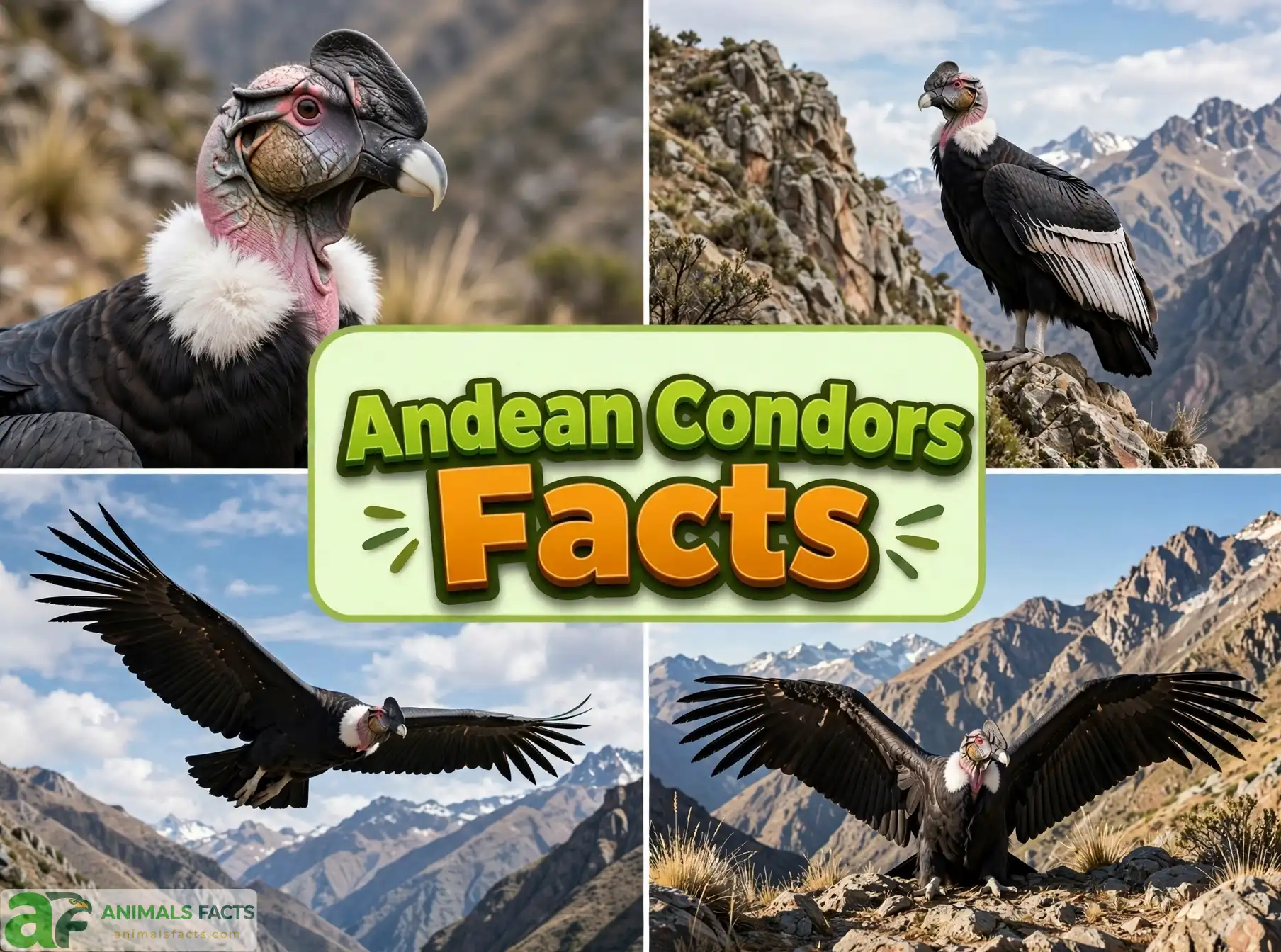
Hey amazing young wildlife scientists, conservation heroes, and nature enthusiasts! Here are some truly extraordinary Andean condor facts for kids that will make you the most fascinating wildlife expert in any conversation:
- 🦅 The Andean condor has wings WIDER THAN A CAR IS LONG! The wingspan of a large Andean condor reaches 340 centimeters — that is 3 meters and 40 centimeters! The average compact car is about 420 centimeters long. So when a condor spreads its wings, you could fit most of a car’s length in that wingspan! It is one of the widest wingspans of any bird alive on Earth today!
- 🦅 One condor flew 172 KILOMETERS without moving its wings even once! Scientists put tiny GPS trackers and movement sensors on Andean condors and discovered something incredible — the birds spend 99% of their flying time just gliding without flapping. In one trip, a single condor traveled 172 kilometers — that is like flying from one side of a large country to the other — without a single wing flap! The condor just rides the warm air currents that rise from the mountains and coasts!
- 🦅 The Andean condor is the national symbol of SIX countries! Argentina, Bolivia, Chile, Colombia, Ecuador, and Peru all use the Andean condor as their national symbol or include it on their national seal. No other bird on Earth is the national symbol of more countries. In some countries, the condor appears on the national flag’s coat of arms — flying above everything else!
- 🦅 Andean condors can live for almost 80 YEARS! A condor in captivity lived to 79 years old — that is longer than many human beings! In the wild, condors are estimated to live 50 to 70 years. This makes each individual condor incredibly valuable to conservationists — losing one condor means losing potentially DECADES of chick-raising that would have helped grow the population!
- 🦅 The male condor has a special head decoration that changes COLOR! Male Andean condors have a fleshy crest on their forehead called a caruncle. When the male is calm, this caruncle is pale yellow. But when he gets excited — during courtship or competition — it flushes to a vivid orange-red! No other vulture in the Americas has this feature, and the bigger the caruncle, the more dominant the male!
- 🦅 Condors can go TWO WHOLE WEEKS without eating! In the high Andes, food can be hard to find. So condors have evolved to store enormous amounts of fat when food is available. When they find a carcass, they eat up to 5 kilograms in one meal — like eating five full bags of sugar at once! Then they can live on those reserves for up to 14 days while soaring the mountains searching for the next meal!
- 🦅 In Andean tradition, the condor rules the SKY WORLD! For millions of indigenous Quechua and Aymara people in the Andes — and for their ancestors going back thousands of years — the condor is the supreme being of the upper world. When a condor appears overhead, it is not just a bird sighting. For these communities, it is a connection between the human world and the divine realm. This makes the condor one of the most spiritually significant animals in any living human cultural tradition!
- 🦅 The condor is related to STORKS, not hawks! Despite looking like a giant hawk or eagle, the Andean condor’s closest relatives are actually storks — those long-legged wading birds you might see at the zoo! Scientists discovered this by studying condor DNA. Both Old World vultures (like griffon vultures) and New World vultures (like condors) evolved their similar body shape and scavenging lifestyle completely separately — one of the most extraordinary coincidences in the history of life on Earth!
12. Relationship with Humans
The Andean condor’s relationship with humans spans 10,000 years of indigenous reverence that placed it at the pinnacle of Andean cosmological systems, a post-colonial period of persecution and poisoning, the modern conservation crisis that has placed it in the Vulnerable category despite its status as the most revered bird in South America, and a growing ecotourism economy centered on the Colca Canyon viewing experience that gives the condor genuine economic value as a living wildlife resource.
The 10,000-Year Indigenous Relationship
The Andean condor’s relationship with Andean indigenous peoples is the longest documented continuous human-bird relationship in the Americas — spanning from the earliest Andean civilizations to living indigenous communities today:
The pre-Inca civilizations — Condor imagery appears in the art, ceramics, and textiles of every major pre-Inca culture of the Andes:
- Chavín culture (1200–200 BCE) — the Lanzon monolith at Chavín de Huantar incorporates condor imagery in its complex theomorphic design; condor wings appear in various Chavín stone carvings
- Nazca culture (200 BCE–600 CE) — the famous Nazca Lines include a condor geoglyph approximately 130 meters in length, drawn into the desert surface of southern Peru — one of the most famous examples of ancient condor cultural significance
- Tiwanaku culture (200–1000 CE) — condor imagery appears extensively in Tiwanaku stone sculpture and ceramics from the Lake Titicaca basin
- Wari culture — condor imagery in textile designs from this major Andean state
The Inca Empire (1400–1532 CE) — The Inca incorporated the condor into the most elaborate cosmological system of pre-Columbian South America:
- The condor as ruler of hanan pacha (upper world) — the celestial realm of the sun god Inti and the other major Inca deities
- The puma as ruler of kay pacha (middle world) — the earthly realm
- The serpent as ruler of ukhu pacha (lower world) — the underworld of ancestors
The Inca messenger role — In Inca cosmology, the condor carried communications between the living and the dead — the bird’s ability to soar to extraordinary altitudes allowing it to reach the celestial realm where the ancestors resided. This messenger role made the condor both cosmologically essential and personally significant — the condor seen overhead potentially carrying a message from a deceased relative.
Contemporary indigenous traditions — These cosmological traditions are not merely historical — they are living spiritual practices maintained by millions of Quechua, Aymara, and other Andean indigenous peoples today:
- The condor’s appearance is interpreted as a message from the divine realm or from ancestors
- Condor feathers are used in healing ceremonies by Bolivian Kallawaya healers
- The condor’s health is understood as directly linked to the health of the Andean community — a sick or declining condor population is read as a cosmological warning
- Various Andean communities maintain prohibitions on harming condors based on traditional law — though these prohibitions have not always been effectively enforced
The Colonial Period — Persecution and Decline
European introduction of negative mythology — The arriving Spanish colonizers brought European cultural associations of vultures with death and disease that conflicted fundamentally with Andean reverence for the condor:
The livestock conflict — As European cattle, sheep, and horses were introduced across the Andes, the condor’s consumption of dead livestock (which it had always done) became associated in European settlers’ minds with the condor killing livestock (which it very rarely did). This misattribution drove active persecution — condors shot, trapped, and poisoned by ranchers throughout the colonial and post-colonial period.
The persecution events — Historical accounts from colonial and 19th-century South America describe organized condor killing events — groups of ranchers killing dozens of condors at a time. The reduction of the condor from its historical abundance to the current Vulnerable status reflects the cumulative effect of centuries of persecution alongside habitat change.
The gladiatorial tradition (Yawar Fiesta) — The most complex expression of post-colonial human-condor relationship; in certain communities of highland Peru (particularly Apurímac), the Yawar Fiesta (“Festival of Blood”) involves a living condor tied to the back of a bull:
- The condor represents indigenous Andean culture — specifically the Inca nation
- The bull represents Spanish colonial power
- The condor pecks at the bull’s back during the bullfighting event
- At the conclusion, the condor is released — if it flies away healthy, it is interpreted as a sign that indigenous culture will ultimately triumph over colonialism
The conservation complexity of the Yawar Fiesta — The festival is simultaneously an expression of indigenous resistance, cultural continuity, and pro-condor symbolism AND an event that causes stress and occasionally injury to individual condors. This tension between cultural significance and conservation welfare has made the festival one of the most debated conservation-culture intersections in South American wildlife management.
The Modern Conservation Framework
Legal protection — The Andean condor is protected by law in all countries within its range:
- CITES Appendix I (1973) — international commercial trade prohibited
- Argentina — National Law 22.421 (Fauna Conservation) protects the condor; provincial laws provide additional protection
- Chile — protected under the Hunting Law
- Peru — protected under Supreme Decree 034-2004-AG
- Colombia, Bolivia, Ecuador, Venezuela — similar national wildlife protection legislation
The contradiction — Despite comprehensive legal protection, illegal killing continues across the range — reflecting the gap between legal frameworks and on-the-ground enforcement in the remote areas where condors live.
Reintroduction programs — Multiple countries have implemented condor reintroduction using captive-bred birds:
- Colombia — the most active reintroduction program; birds from US zoos (San Diego, New York, Los Angeles) used to restore the nearly-extirpated Colombian population
- Argentina (Buenos Aires province) — condors reintroduced to areas from which the species had been extirpated
- Venezuela — small reintroduction program
- Peru — supplemental releases in northern Peru where populations are most depleted
Captive breeding facilities — Several facilities maintain Andean condors for conservation programs:
- San Diego Wild Animal Park, USA — major breeding facility supporting reintroduction programs
- Los Angeles Zoo, USA — breeding and conservation program
- Buenos Aires Zoo, Argentina — regional facility supporting South American programs
- Zoológico de Barranquilla, Colombia — supporting the Colombian reintroduction
- Various Andean facilities — Peru, Bolivia, Chile, Ecuador
The Ecotourism Value
The Cruz del Condor viewpoint in Peru’s Colca Canyon has become one of the most economically important single wildlife viewing sites in South America:
Visitor numbers — The Colca Canyon region receives approximately 200,000–300,000 visitors per year — making it one of the most visited wildlife destinations in South America. The condor viewing is the primary attraction.
Economic impact — The condor-based ecotourism economy of the Colca region generates tens of millions of dollars annually in direct and indirect economic benefits — employing guides, accommodation providers, transportation operators, and food service workers across the region.
The conservation argument — The economic value of living condors at Colca Canyon provides the most powerful locally relevant argument for condor conservation — a condor killed by a farmer responding to perceived livestock threat costs the regional economy far more in lost ecotourism revenue than the livestock the condor never killed.
13. Andean Condor Conservation Status & Threats
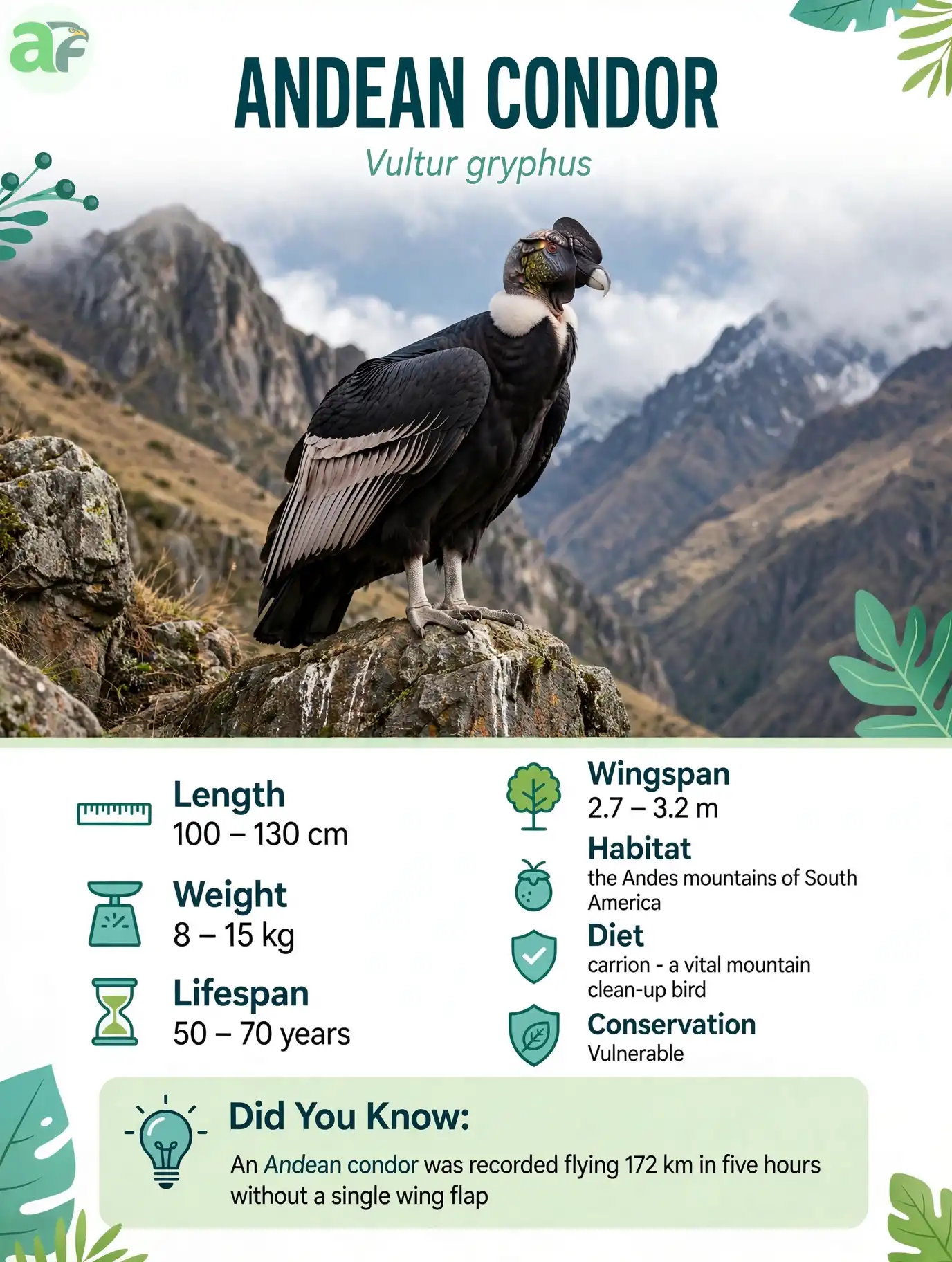
Conservation Status Overview
| Feature | Details |
|---|---|
| IUCN Status | Vulnerable (VU) — upgraded from Near Threatened in 2020 |
| Population Trend | Decreasing |
| Estimated Mature Individuals | Approximately 6,700 — declining |
| Most Threatened Populations | Colombia (<100 individuals), Venezuela (<100), Ecuador (<200) |
| Relatively Stable Populations | Patagonian Argentina; coastal Peru and Chile |
| CITES Listing | Appendix I — international commercial trade prohibited |
| Legal Status (Peru) | Critically Endangered on Peruvian Red List; fully protected |
| Legal Status (Argentina) | National monument species; fully protected |
| Breeding Rate | Maximum one chick every two years — population extremely sensitive to adult mortality |
Major Threats
| Threat | Description | Impact Level |
|---|---|---|
| Lead poisoning | Lead ammunition fragments in carcasses of hunted animals | High — primary mortality cause |
| Deliberate poisoning | Strychnine, carbofuran, and other poisons placed in carcasses by ranchers | High |
| Persecution (shooting) | Direct shooting by farmers who blame condors for livestock death | High — ongoing across range |
| Power line electrocution | Contact with high-voltage electricity lines | High — particularly in Argentina |
| Collision with wind turbines | Blade strikes during soaring in windy Andean terrain | Medium-High — increasing concern |
| Habitat loss | Reduction of wild prey (guanaco, vicuña) through hunting and habitat change | Medium-High |
| Microtrash ingestion | Condors feeding nestlings plastic and other non-food items found in carcasses | Medium — affecting chick survival |
| Nest disturbance | Human disturbance at cliff nest sites; mining and infrastructure near nests | Medium |
| Traditional medicine demand | Condor body parts used in some Andean healing traditions | Low — localized |
| Tourism disturbance | Drone flights near roosting and nesting condors | Low-Medium — increasing |
The Lead Poisoning Crisis
Lead poisoning from ammunition is the most significant documented mortality cause for free-flying Andean condors — directly paralleling the California condor’s lead poisoning problem:
The mechanism — Hunters shooting guanaco, deer, and other wild ungulates with lead ammunition leave carcasses and gut piles containing lead bullet fragments. Condors consuming these fragments ingest sub-lethal to lethal quantities of lead — the acidic condor digestive system dissolving lead fragments and absorbing the toxic metal.
The documented scale — Multiple blood-lead monitoring programs across the range have found elevated blood lead levels in significant proportions of sampled wild condors. In some populations, the majority of tested birds show lead exposure above safe thresholds.
The Argentina lead problem — In Patagonian Argentina — the healthiest remaining condor population — sport and subsistence hunting of guanaco and other prey with lead ammunition creates the most significant lead exposure in the species’ range. Argentina has not enacted the comprehensive lead ammunition restrictions implemented in California and some other jurisdictions.
The solution — Transition to copper (non-lead) ammunition for all hunting in condor range areas eliminates the primary lead exposure pathway. The California condor experience demonstrates that lead exposure in wild condors declines measurably when lead ammunition use decreases in the surrounding landscape.
The Deliberate Poisoning Problem
Strychnine and carbofuran — The most significant direct persecution tools:
The livestock death attribution problem — Across the Andean range, when livestock is found dead, condors feeding on the carcass are often misidentified as the cause of death — the condor’s presence at the carcass being interpreted as evidence of killing. This incorrect attribution motivates ranchers to poison the carcass to kill the “livestock-killing” condors.
The scale — Documented poisoning events have killed multiple condors simultaneously at individual sites across Argentina, Chile, and Peru. While individual events may kill only a few birds, the cumulative impact across the range is believed to be substantial.
The conservation paradox — In communities where the condor is simultaneously revered culturally and perceived as an economic threat, the poisoning motivation reflects a conflict between cultural values and perceived economic interest that education and economic incentive programs must address.
The Power Line Electrocution Problem
Infrastructure expansion — The expansion of electrical transmission infrastructure across the Andean range has created a significant condor mortality source — the condor’s large wingspan making it particularly vulnerable to simultaneously contacting two conductors or a conductor and a grounded structure:
Argentina’s specific problem — Mendoza, Neuquén, and other Argentine Andean provinces with active condor populations also have expanding electrical grid infrastructure. Power line electrocution is documented as a significant mortality cause in Argentine condor populations.
The solution — Power line modification (insulation of conductors, installation of perch discouragers, replacement of dangerous pole designs) is one of the most cost-effective condor mortality reduction interventions available — and has been successfully implemented in California for condor conservation.
14. Famous Andean Condors in History & Pop Culture
Famous Individual Condors
“Tina” — The Longest-Lived Documented Condor — A female Andean condor held at the Moscow Zoo who died in 2010 at the documented age of 79 years — the oldest verified condor and one of the oldest birds ever documented. Tina’s extraordinary longevity established the upper limit of condor lifespan and provided essential data on condor aging that informs wild population management.
“Rupay” — The Colombian Reintroduction Pioneer — One of the first condors reintroduced to Colombia’s Andes from captive breeding — Rupay (a Quechua word for “sun”) was among the birds that established the reintroduced Colombian condor population in the late 1990s. Rupay’s successful establishment and the subsequent natural breeding of reintroduced birds in Colombia was celebrated as one of the most significant conservation achievements in Colombian wildlife history.
“Olga” — The San Diego Conservation Ambassador — A female Andean condor at the San Diego Wild Animal Park who became the most important individual in demonstrating that Andean condors could be successfully bred in captivity — her offspring entering the reintroduction programs for Colombia and other countries. Olga’s breeding success was essential to proving the conservation technique that has been applied to condor recovery across the range.
The Nazca Lines Condor — The most famous “image” of an individual condor in human history — the condor geoglyph at Nasca, Peru, approximately 130 meters in length, drawn into the Nazca desert surface by the Nazca culture approximately 2,000 years ago. The geoglyph represents the most ancient and most geographically significant individual condor artistic representation in the Americas — visible in its entirety only from altitude.
Historical and Cultural Significance
The Inca Capital Layout — The city of Cusco — the capital of the Inca Empire — was reportedly laid out in the plan of a puma or condor when viewed from altitude, with different city districts corresponding to different body parts. Whether the condor or the puma was the intended design is debated by archaeologists, but the tradition reflects the condor’s supreme cultural significance in Inca urban planning.
The Chilean Coat of Arms — The Andean condor appears on the Chilean coat of arms holding a branch of the laurel (Laurus nobilis) — one of the most important national symbols in Chilean political and cultural life. The condor’s appearance on the Chilean flag’s heraldic device makes it one of the most widely reproduced bird images in South American political symbolism.
The Colombian Condor Stamp — The Andean condor appears on numerous Colombian postage stamp series — the bird’s national symbol status making it one of the most recurring subjects in Colombian philately and one of the most recognizable images in Colombian visual culture.
15. Role in Ecosystem & Food Chain
The Apex Scavenger Role
The Andean condor occupies the apex scavenger position in Andean and Pacific coastal ecosystems — the largest and most ecologically significant carcass processor across a vast geographic range:
Carcass processing scale — A single Andean condor can strip approximately 1.5–3 kg of soft tissue from a large carcass in a single feeding session. A group of 10–20 condors at a large carcass (dead horse, cattle, guanaco) can complete soft tissue removal within 2–4 hours — eliminating the disease reservoir that the carcass represents.
The disease prevention function — The condor’s stomach acid (pH approximately 1.0–2.0) destroys the same suite of pathogens that other vultures eliminate:
- Anthrax spores — destroyed by the acidic digestive system
- Clostridium species — destroyed
- Various bacterial pathogens — significantly reduced or eliminated
The nutrient cycling function — Condor defecation at roost sites concentrates nitrogen and phosphorus from wide foraging areas into specific roost localities — creating localized soil nutrient enrichment that supports distinctive plant communities at traditional roost cliff faces.
The Puma-Condor Partnership
The documented following behavior — Andean condors following Patagonian pumas to feeding sites — represents one of the most ecologically interesting interspecies relationships in the South American ecosystem:
The puma’s role — The puma is the primary large predator across the Andean condor’s range — killing guanaco, vicuña, deer, and other prey that the condor cannot kill. The puma’s kills create the concentrated, accessible carcasses that provide the condor’s most reliable food source in some habitats.
The condor’s advantage — By following known individual pumas, condors gain access to fresh, reliably located carcasses without the energy cost of independent carcass searching across vast landscapes.
The puma’s disadvantage — The condor’s presence signals the kill location to other condors and potentially to human observers (puma hunters and livestock ranchers targeting pumas). The puma-condor relationship therefore potentially creates a conflict between the condor’s food-finding advantage and the puma’s survival interests.
The Indicator Function
The Andean condor functions as the most sensitive indicator of large mammal ecosystem health in the Andes:
- Condor abundance directly reflects the availability of large mammal carcasses — which in turn reflects the health of wild and domestic ungulate populations
- Condor breeding success reflects the food availability and disturbance levels across entire mountain landscapes
- Condor population decline serves as an early warning of ecosystem disruption affecting large mammals across vast Andean landscapes
The Coastal Ecosystem Function
Along the Pacific coast, the condor’s consumption of marine mammal carcasses links the Andean terrestrial ecosystem to the Pacific marine ecosystem:
- Sea lion and elephant seal carcasses on Pacific beaches provide high-lipid food sources that supplement the more variable inland carcass supply
- Condor consumption of marine mammal carcasses and subsequent defecation inland transfers marine-derived nutrients (particularly phosphorus and nitrogen from marine food chains) to terrestrial Andean ecosystems — a nutrient subsidy pathway with no parallel among other terrestrial birds
16. Myths, Folklore & Cultural Significance
The Three-World Cosmological System
The most elaborate and most culturally significant mythology associated with any vulture — or arguably with any bird — globally:
The Andean three-world system:
- Hanan pacha (upper world) — the celestial realm of the sun (Inti), moon (Mama Quilla), stars, and other divine powers; ruled by the condor
- Kay pacha (middle world) — the earthly realm of human life and the natural world; ruled by the puma
- Ukhu pacha (lower world) — the underworld realm of the ancestors, the dead, and chthonic powers; ruled by the serpent (amaru)
The condor’s specific role:
- The condor is the living embodiment of the upper world’s power — not merely a symbol but the actual physical manifestation of divine energy in the earthly realm
- The condor’s soaring altitude — rising above the mountains into the celestial zone — gives it literal access to the upper world that no other being can achieve
- The condor is the messenger between the living and the dead — carrying communications to deceased ancestors in the celestial realm and returning with their responses
- The condor’s appearance is therefore simultaneously an ecological event and a spiritual communication — an experience that exists in both the natural and the supernatural simultaneously
Living tradition — These beliefs are not merely historical artifacts. They are actively maintained by millions of Quechua and Aymara people across Peru, Bolivia, Ecuador, Colombia, Chile, and Argentina. When a Quechua elder sees a condor circle overhead, the experience is one of spiritual contact — a loved ancestor’s message arriving in the form that Andean cosmology has recognized for thousands of years.
The Mythology of the Condor’s Renewal
One of the most extraordinary Andean condor myths — and one of the most biologically interesting in all of Andean mythology:
The myth — When a condor grows old and weak, it flies to the top of the highest Andean mountain, folds its wings around itself, and falls. It hits the rocky ground below and shatters — and from the remains, a new, young condor emerges reborn.
The biological resonance — The myth’s emphasis on the condor’s renewal parallels several actual condor biological realities:
- The condor’s gradual molt — the annual replacement of flight feathers maintaining wing surface integrity
- The condor’s extraordinary longevity — a 70-year-old condor appearing to renew its feathers repeatedly across a human lifetime
- The condor’s plumage transformation from juvenile to adult — the grey juvenile bird becoming the black-and-white adult over 6–8 years, a transformation that from a distance resembles replacement by a different, more beautiful bird
The Yawar Fiesta in Detail
Origin — The Yawar Fiesta (Quechua for “Bloody Festival”) developed in colonial Peru as an expression of indigenous resistance to Spanish colonial power — the symbolic pairing of condor (indigenous Andean identity) and bull (Spanish colonial introduction) expressing the fundamental cultural conflict of the colonial experience.
Geographic distribution — Practiced in highland communities of Apurímac, Huancavelica, Ayacucho, and other Peruvian Andean departments — primarily in areas with strong indigenous cultural continuity.
The symbolic meaning — Multiple interpretations exist:
- The condor’s survival of the encounter with the bull symbolizes the survival of indigenous Andean culture against colonial destruction
- The condor’s pecking at the bull’s back symbolizes the active resistance of indigenous identity against imposed colonial culture
- The condor’s flight at the conclusion symbolizes freedom and regeneration — the condor returning to the upper world having prevailed over the earthly struggle
The conservation-culture tension — Wildlife conservationists have raised animal welfare concerns about individual condors stressed during the event. Indigenous cultural advocates respond that the tradition expresses a cosmological relationship with the condor that is itself a form of condor conservation — the community that celebrates the condor symbolically is the same community most likely to protect wild condors. The tension between these positions remains unresolved and represents one of the most nuanced conservation-cultural debates in South American wildlife management.
The Condor in National Identity Construction
The Andean condor’s role in the construction of South American national identities following independence from Spain (1810s–1820s) is one of the most important political ornithology stories in world history:
The choice of the condor — When newly independent South American nations constructed national symbols in the early 19th century, the Andean condor’s associations — indigenous authenticity, Andean grandeur, freedom, power — made it an obvious choice for nations seeking to distinguish themselves both from European colonialism and from the United States (which had adopted the bald eagle):
- The condor’s exclusively South American distribution made it a symbol of South American distinctiveness
- Its indigenous cultural significance linked the new nations to pre-colonial Andean civilization — establishing historical legitimacy beyond the colonial period
- Its physical grandeur — the largest flying bird in South America — provided the visual impact appropriate for a supreme national symbol
Six countries’ simultaneous choice — The fact that six different countries independently chose the same bird as their national symbol reflects both the condor’s universal cultural significance across the Andean region and the shared post-colonial identity project of the newly independent South American states.
17. Andean Condors in Pop Culture
“Condorito” — The most beloved South American comic strip character in history — a fictional Andean condor created by Chilean cartoonist Pepo (René Ríos Boettiger) in 1949. Condorito is a working-class condor character living in the fictional town of Pelotillehue, facing the challenges of everyday life with humor and resilience. The strip is published in newspapers across Latin America and has been translated into multiple languages; it has been described as “the most widely read comic in Latin American history” and remains in active publication as of 2026. The 2017 animated film “Condorito: The Movie” brought the character to international audiences.
The Nazca Condor Geoglyph — The most famous visual representation of the condor in ancient American culture; the 130-meter condor figure etched into the Nazca desert of southern Peru approximately 2,000 years ago is one of the most reproduced Peruvian cultural images globally — appearing in documentaries, tourism materials, and popular culture references associated with the Nazca Lines.
Peruvian Tourism Branding — The Andean condor — particularly the Cruz del Condor viewpoint image — is central to Peruvian international tourism marketing. The condor appears in PromPerú (Peruvian Tourism Board) materials, airline advertising, and international travel publications as one of the defining wildlife images of Peru.
“The Motorcycle Diaries” (Walter Salles, 2004) — The landmark film chronicling the young Ernesto Guevara’s journey through South America features Andean landscapes and imagery — the condor appearing as a visual motif representing Andean grandeur and freedom in the film’s visual language.
Simon & Garfunkel — “El Cóndor Pasa” — The most widely known musical reference to the Andean condor in global popular music — based on a 1913 Peruvian zarzuela by Daniel Alomía Robles incorporating traditional Andean melody, the song was adapted by Paul Simon and released on the “Bridge Over Troubled Water” album (1970). The song’s evocation of freedom and transcendence — “I’d rather be a sparrow than a snail… I’d rather feel the earth beneath my feet, yes I would, if I could, I surely would…” — connects
18. Andean Condor Facts vs. Common Myths
| Common Myth | The Real Fact |
|---|---|
| “Andean condors kill livestock” | False — condors are physiologically incapable of killing prey. Their feet are weak and flat — more like a chicken’s than a hawk’s — with no ability to grip and pierce living flesh. Every animal a condor eats was already dead when the condor arrived. The persistent myth that condors kill calves and lambs has driven centuries of persecution based entirely on the misattribution of natural livestock death to condor scavenging |
| “Condors are eagles or hawks” | False — the Andean condor is a New World vulture (family Cathartidae) bearing no close evolutionary relationship to eagles or hawks. It is more closely related to storks than to any raptor. The condor’s superficial resemblance to large raptors is the product of convergent evolution — two completely separate lineages independently evolving large, soaring scavengers |
| “The Andean condor is the largest bird in the world” | Partially false — the Andean condor has one of the largest wingspans of any living bird (up to 340 cm), but the wandering albatross (Diomedea exulans) has a slightly larger maximum wingspan (approximately 370 cm). By body mass, the Dalmatian pelican and the Kori bustard may equal or slightly exceed the condor. The condor is the largest flying bird in South America and among the largest flying birds globally — but not definitively the single largest on any measure |
| “Condors circle dying animals waiting to kill them” | Completely false — condors locate already-dead animals through visual scanning from altitude and by watching other condors’ behavior. They cannot detect dying animals in advance with any special sensory capability, and they have no physical ability to kill prey even if they wanted to |
| “Condors are endangered and nearly extinct” | Partially misleading — the Andean condor is classified as Vulnerable (not Critically Endangered) with approximately 6,700 mature individuals remaining. This is a serious conservation situation — declining and requiring urgent intervention — but not equivalent to the California condor’s Critically Endangered status (approximately 350 wild individuals). Some northern populations (Colombia, Venezuela) are genuinely near-extirpated; the Patagonian population is relatively stable |
| “The condor is dirty and spreads disease” | The opposite is true — the condor’s stomach acid (pH 1.0) destroys anthrax, botulinum toxin, cholera bacteria, and other pathogens. The condor is one of the most effective disease prevention mechanisms in the Andean ecosystem — its removal from ecosystems increases disease burden rather than reducing it |
| “Condors can carry off children or small adults” | Completely false — the Andean condor’s feet are incapable of grasping prey, and the bird has no killing mechanism. The maximum weight a condor can carry in flight is approximately 2–3 kg — far less than any child. The myth conflates the condor’s large size with predatory capability it does not possess |
| “Condors only live in the high Andes mountains” | Partially false — while the high-altitude Andean puna is the condor’s primary habitat, the species also occurs at sea level along the Pacific coast of Peru and Chile, where it feeds on marine mammal carcasses. Some populations use relatively low-elevation Andean valleys. The condor’s range is defined by the availability of thermal soaring conditions and large carcasses, not by elevation alone |
| “The condor is saved because it’s protected by law” | False — legal protection exists across the entire range but is insufficiently enforced in remote areas. Illegal poisoning, shooting, and lead poisoning continue to cause significant mortality despite comprehensive legal frameworks. The gap between legislative protection and on-the-ground enforcement is the central conservation challenge for the species |
| “Condors only eat the freshest carrion” | False — condors consume carrion at various stages of decomposition, including highly putrefied flesh that most other scavengers refuse. The extraordinary acidity of the condor’s stomach allows digestion and pathogen destruction of material that would sicken or kill most other scavengers. The condor’s tolerance for decomposed flesh is a specific ecological adaptation, not a preference for fresh carrion |
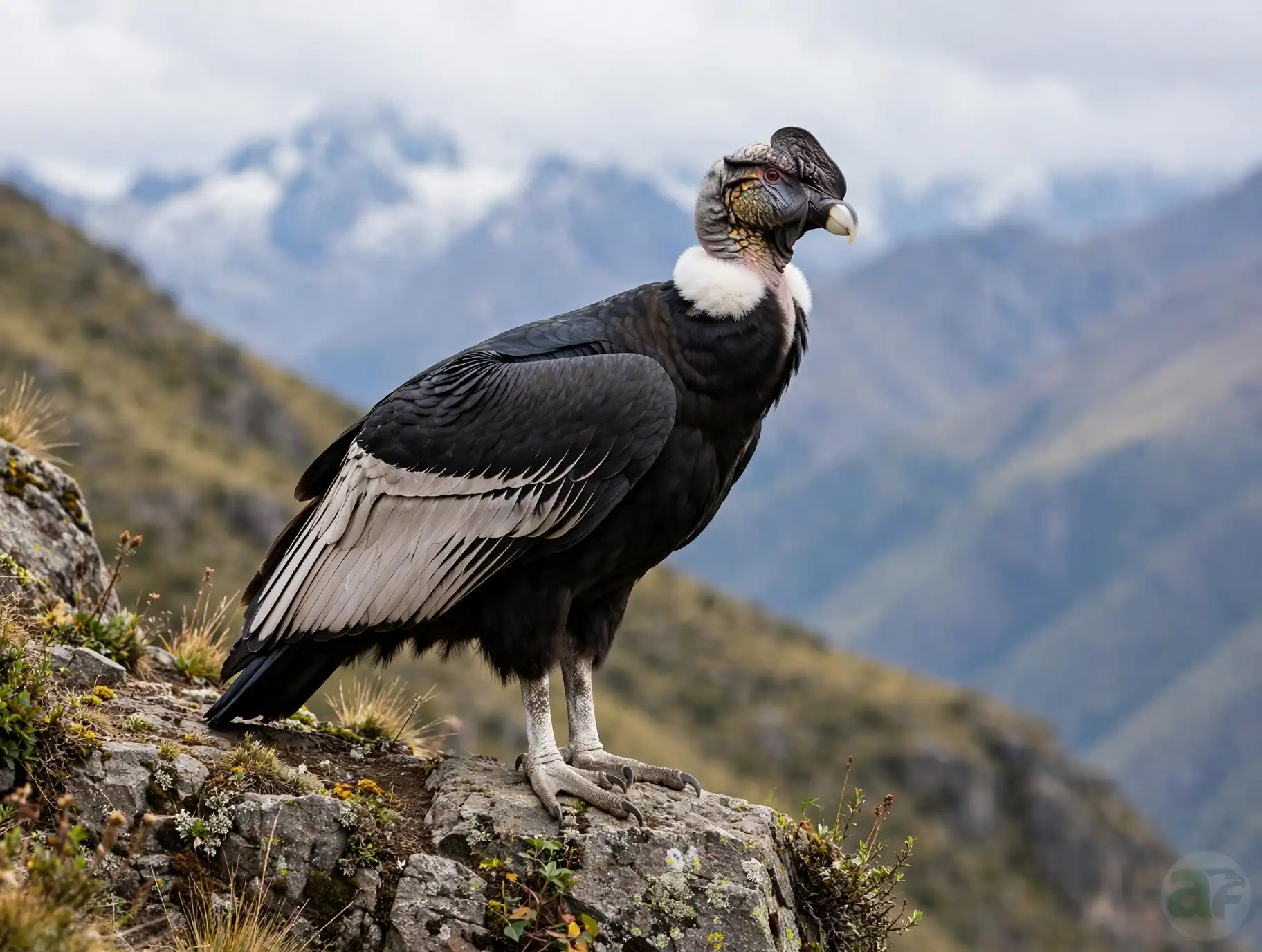
19. Best Places to See Andean Condors in the Wild
Peru — The Most Reliable and Most Dramatic Experiences
1. Cruz del Condor Viewpoint, Colca Canyon, Arequipa, Peru
The single most reliable condor viewing site in the world — and one of the most extraordinary wildlife experiences available anywhere in South America. The viewpoint sits on the canyon rim at approximately 3,270 meters elevation, directly above a thermal column that condors use every morning for their ascent from overnight roosting altitude to daily soaring altitude.
What to expect — Arriving at the viewpoint before 8:00 AM is essential; condors typically begin rising from the canyon depths between 8:00 and 10:00 AM as morning thermals develop. On a typical morning, visitors may see 10–30 individual condors — adults, subadults, and juveniles — rising past the viewpoint within arm’s-reach distance, circling above the rim, and soaring away along the canyon. On exceptional mornings, 50+ condors have been counted from this single viewpoint.
Practical logistics — The viewpoint is accessible from Chivay town (approximately 1.5 hours by road) or from Arequipa (approximately 5–6 hours). Multiple tour operators run day trips and overnight tours from Arequipa. The viewpoint has basic facilities including toilets and a small café. The experience is weather-dependent — on heavily overcast mornings, thermal development may be delayed or absent.
The honest assessment — Cruz del Condor is the world’s best condor viewing site and one of the most reliable large bird viewing experiences in the Americas. On a clear morning between June and September (the optimal season), condor sightings are essentially guaranteed for any visitor who arrives before 9 AM.
2. Majes Valley and Cabanaconde, Colca Region, Peru
The broader Colca-Majes valley system beyond the Cruz del Condor viewpoint supports the same condor population across a larger landscape — alternative viewing points accessible from Cabanaconde village provide less crowded but equally reliable condor viewing with different canyon perspectives.
3. Paracas National Reserve, Ica Region, Peru
The Pacific coastal desert of Paracas hosts condors that descend from the Andean highlands to exploit marine mammal carcasses on the Pacific beaches — a completely different habitat context from the Colca Canyon experience. Condors are seen less reliably here than at Colca but in a spectacular coastal setting alongside sea lions, Humboldt penguins, and Peruvian pelicans.
Argentina — The Patagonian Experience
4. Parque Nacional Los Glaciares, Santa Cruz Province, Argentina
The spectacular Patagonian landscape of Los Glaciares — including the famous Perito Moreno Glacier — supports a healthy Andean condor population that uses the Andean ridge systems for soaring. Condors are regularly seen soaring above the glacier and the surrounding moraines — providing the rare experience of watching condors against a backdrop of blue glacier ice.
Best viewing — The condors are most reliably seen in the early morning when thermals begin developing along the Andean ridge faces east of the glacier. The El Chaltén and El Calafate areas both provide reliable condor viewing opportunities for hikers and vehicle-based visitors.
5. Parque Nacional Nahuel Huapi, Neuquén/Río Negro Province, Argentina
The Lake District national park of Nahuel Huapi — accessible from the tourist city of Bariloche — hosts Andean condors in its mountain and lake landscapes. The area’s combination of Andean ridges, extensive lake system, and accessible trail network provides excellent condor viewing opportunities alongside outstanding general wildlife and scenery.
6. Mendoza Province Andes, Argentina
The Andes above Mendoza — accessible from Argentina’s wine capital — support condor populations visible from various mountain roads and the access route to Aconcagua Provincial Park (site of the Western Hemisphere’s highest mountain). The condor viewing here combines naturally with Aconcagua trekking and the famous Mendoza wine country experience.
Chile — Coastal and Mountain Experiences
7. Parque Nacional La Campana, Valparaíso Region, Chile
Located in the coastal mountain range north of Santiago — La Campana National Park (named by Charles Darwin, who visited in 1834) hosts a small Andean condor population visible from the park’s ridge trails. The condors here use the coastal mountain thermals and occasionally descend to the Pacific coast. The park’s accessibility from Santiago (approximately 2 hours) makes it one of the most accessible condor viewing destinations for international visitors.
8. Atacama Desert Coastal Area, Antofagasta Region, Chile
The Pacific coastal cliffs of the Atacama region host condors feeding on marine mammal carcasses — the combination of reliable onshore wind for soaring and abundant sea lion carcasses creating a productive coastal condor habitat. Condors are seen from coastal cliff viewpoints along the Pan-American Highway coastal route.
Bolivia and Ecuador — The Northern Range
9. Parque Nacional Sajama, Oruro Department, Bolivia
Bolivia’s oldest national park — surrounding the Nevado Sajama (6,542 meters, Bolivia’s highest peak) — hosts Andean condors in spectacular high-altitude landscape. The park’s remoteness and limited tourist infrastructure mean condor encounters are less predictable than at Colca Canyon but in an extraordinarily dramatic volcanic Andean setting.
10. Parque Nacional El Cajas, Azuay Province, Ecuador
The cloud forest and páramo landscape of El Cajas — accessible from the city of Cuenca — hosts a small condor population that uses the park’s lake-studded high plateau and surrounding ridges. Condor sightings here are less reliable than in Peru or Argentina but represent one of the best opportunities to see the species in the northern part of its range.
The Viewing Advice Summary
Best months overall — June through October (Southern Hemisphere winter/dry season) provides the best condor viewing across most of the range:
- Clearer skies mean better thermal development and more reliable soaring activity
- Dry season reduces cloud cover that can obscure high-altitude viewing
- Colca Canyon is particularly productive in July–September
Best time of day — 7:00 AM – 11:00 AM — the first hours after dawn when thermals begin developing. By midday, condors may be soaring at altitudes too high for easy observation; they descend again in late afternoon but morning remains the most reliable period.
Essential equipment — Binoculars (8×42 or 10×42) dramatically improve the condor viewing experience — allowing observation of plumage detail, caruncle color, and wing feather condition at distances where the naked eye sees only silhouette. At Cruz del Condor, some individual condors pass close enough that binoculars are actually too powerful for comfortable viewing — which gives an indication of the remarkable proximity possible at this site.
20. How You Can Help
Supporting Andean condor conservation requires differentiated action — from pharmaceutical advocacy to hunting practice changes to direct organizational support — reflecting the diverse threats across the vast Andean range.
Support these organizations:
- The Peregrine Fund — peregrinefund.org — operates Andean condor conservation programs in Colombia and other countries; a primary funding destination for Andean condor recovery work
- WCS (Wildlife Conservation Society) Andes Program — wcs.org — comprehensive Andean conservation including condor monitoring in Argentina and other countries
- Tompkins Conservation — tompkinsconservation.org — land protection in Patagonia protecting condor habitat; the late Doug and Kristine Tompkins’ conservation legacy includes some of the most important condor habitat in Argentina and Chile
- Asociación Condor Andino (Argentina) — local Argentine organization focused specifically on Andean condor monitoring, lead poisoning research, and community education
- CORBIDI (Centro de Ornitología y Biodiversidad, Peru) — corbidi.org — Peruvian bird conservation including condor population monitoring
- San Diego Wildlife Alliance — sandiegowildlifealliance.org — the San Diego facilities that breed Andean condors for reintroduction programs, particularly the Colombian recovery effort
- Asociación Ecosistemas Andinos (ECOAN, Peru) — ecoanperu.org — Andean ecosystem conservation including condor habitat protection
Critical individual actions:
Switch to non-lead ammunition — The single most impactful action for hunters in condor range countries (particularly Argentina and Chile where sport hunting of guanaco and other ungulates is significant). Copper ammunition performs comparably to lead and eliminates the primary lead poisoning exposure pathway. Advocating for lead ammunition phase-out in Argentine and Chilean hunting regulations directly benefits the Patagonian condor population.
Report condor poisoning incidents — If you witness or learn of condors being poisoned, contact national wildlife enforcement authorities immediately:
- Argentina: Dirección Nacional de Biodiversidad (biodiversidad@ambiente.gob.ar)
- Chile: Servicio Agrícola y Ganadero (SAG) — sag.gob.cl
- Peru: SERNANP (Servicio Nacional de Áreas Naturales Protegidas) — sernanp.gob.pe
Participate in responsible ecotourism — Visiting Cruz del Condor and other condor sites through responsible operators generates the economic value that provides the strongest locally relevant argument for condor protection. When booking tours, choose operators that maintain appropriate distances from roosting and nesting sites and do not use drones near condors.
Avoid drones near condors — The proliferation of recreational drones at condor viewing sites — particularly Cruz del Condor — represents an emerging and significant disturbance threat. Condors flushed from thermal columns by drones expend energy that may be critical during food-scarce periods. Check and follow local regulations regarding drone use at wildlife sites; choose not to fly drones near condors even when legally permitted.
Support Andean community livelihoods — The communities living alongside condors in the Colca Canyon, Patagonian Andes, and other condor habitats need economic alternatives to livestock-based agriculture that reduces the livestock-condor conflict. Supporting community-based ecotourism, fair-trade Andean products, and artisan cooperatives from condor-range communities contributes to the economic foundation that makes condor conservation locally viable.
Spread condor awareness — The Andean condor’s conservation situation is not widely understood outside South America and specialist conservation communities. The bird’s extraordinary biology, its supreme cultural significance across six nations, and the contrast between its revered status and its declining population represent a compelling and shareable conservation story. Sharing accurate information about the condor’s actual behavior (it cannot kill livestock) directly addresses the primary motivation for illegal persecution.
21. Top Documentaries & Books
Must-Watch Documentaries
“El Cóndor Pasa” (various Andean documentary productions) — Multiple Latin American documentary productions dedicated to the Andean condor’s biology, cultural significance, and conservation situation. Various Peruvian and Argentine national broadcasters have produced comprehensive condor documentaries; searching streaming platforms for “cóndor andino documental” will locate the most recent high-quality Spanish-language productions.
“Planet Earth II — Mountains” (BBC, David Attenborough, 2016) — The mountain episode of the landmark BBC series features Andean condor soaring footage of extraordinary quality — some of the finest aerial footage of the species ever captured, including close-range shots of condors rising from the Andean valleys on morning thermals. Essential viewing for understanding the condor’s relationship with Andean mountain airspace.
“The Andes: The Dragon’s Back” (BBC Natural World) — Comprehensive treatment of Andean wildlife including significant condor content; the most geographically comprehensive documentary treatment of the Andean ecosystem in which the condor operates.
“Condor: Wings of the Inca” (National Geographic, various years) — Multiple National Geographic documentary productions have featured Andean condor content as central subjects or significant components of broader Andean wildlife coverage. The National Geographic documentary library contains the most extensive publicly accessible English-language Andean condor footage.
“Return of the Condor” — While primarily focused on the California condor, various documentary productions covering the North American condor recovery story provide essential comparative context for understanding the Andean condor’s conservation situation and the conservation techniques potentially applicable to Andean condor management.
Cruz del Condor webcam and time-lapse footage — Multiple YouTube channels maintained by Peruvian tourism operators and conservation organizations provide extraordinary condor soaring footage from the Cruz del Condor viewpoint — some of the most accessible and most dramatic condor video content available.
Must-Read Books
Condor: To the Brink and Back by John Nielsen (2006) — While primarily focused on the California condor’s recovery from 27 individuals, this book provides essential context for understanding the Andean condor’s conservation situation and the conservation science applicable to both species. Arguably the finest single-volume popular account of condor biology and conservation.
Birds of Peru by Thomas Schulenberg, Douglas Stotz, Daniel Lane, John O’Neill, and Theodore Parker III — The definitive field guide to Peruvian birds including comprehensive Andean condor coverage; essential for any visitor to Peru planning condor viewing at Colca Canyon or other sites.
The World of the Condor by Jerry McGahan (National Geographic Society) — Classic natural history treatment of the Andean condor in its Andean and Pacific coastal habitats; though dated, it remains one of the most comprehensive popular natural history accounts of the species.
Feathers: The Evolution of a Natural Miracle by Thor Hanson — While not specifically about condors, this comprehensive treatment of feather evolution and function provides essential context for understanding the flight feather engineering that allows the condor’s extraordinary soaring performance.
Andean Ecology (various academic sources) — Multiple academic papers and review articles on Andean condor biology, published in journals including The Condor, Bird Conservation International, and Oryx, represent the most current scientific knowledge; many are accessible through Google Scholar and provide the most up-to-date population data and conservation assessments.
22. Comparison with Other Large Soaring Birds
| Feature | Andean Condor | California Condor | Wandering Albatross | White-tailed Eagle | Lammergeier | Marabou Stork |
|---|---|---|---|---|---|---|
| Scientific name | Vultur gryphus | Gymnogyps californianus | Diomedea exulans | Haliaeetus albicilla | Gypaetus barbatus | Leptoptilos crumeniferus |
| Max wingspan | 340 cm | 290 cm | 370 cm | 244 cm | 283 cm | 287 cm |
| Max weight | 15 kg | 11.5 kg | 12 kg | 7.5 kg | 7.5 kg | 9 kg |
| Primary diet | Large mammal carrion | Large mammal carrion | Squid, fish | Fish; waterfowl | Bone (80–90%) | Carrion; offal |
| Flight style | Thermal + orographic soaring | Thermal soaring | Dynamic soaring | Thermal soaring; powered | Thermal soaring | Thermal soaring |
| Time soaring | 99% of flight time | Very high | Very high | Moderate | Very high | High |
| Head feathering | Bare (largely) | Bare | Fully feathered | Fully feathered | Fully feathered | Bare |
| Conservation | Vulnerable | Critically Endangered | Least Concern | Least Concern | Near Threatened | Least Concern |
| Range | Andes + Pacific coast | Western USA, Mexico | Southern oceans | Eurasia | Europe, Africa, Asia | Africa, South Asia |
| National symbol | 6 South American nations | — | — | Germany, Poland | — | — |
| Lifespan | ~70 years (wild est.) | ~60 years (wild est.) | ~50+ years | ~25 years | ~40 years | ~25 years |
| Famous for | Widest wingspan; 6 national symbols; Andean cosmology | Recovery from 27 individuals | Widest wingspan any bird | European recovery | Self-dyeing feathers; bone eating | Largest flying bird Africa |
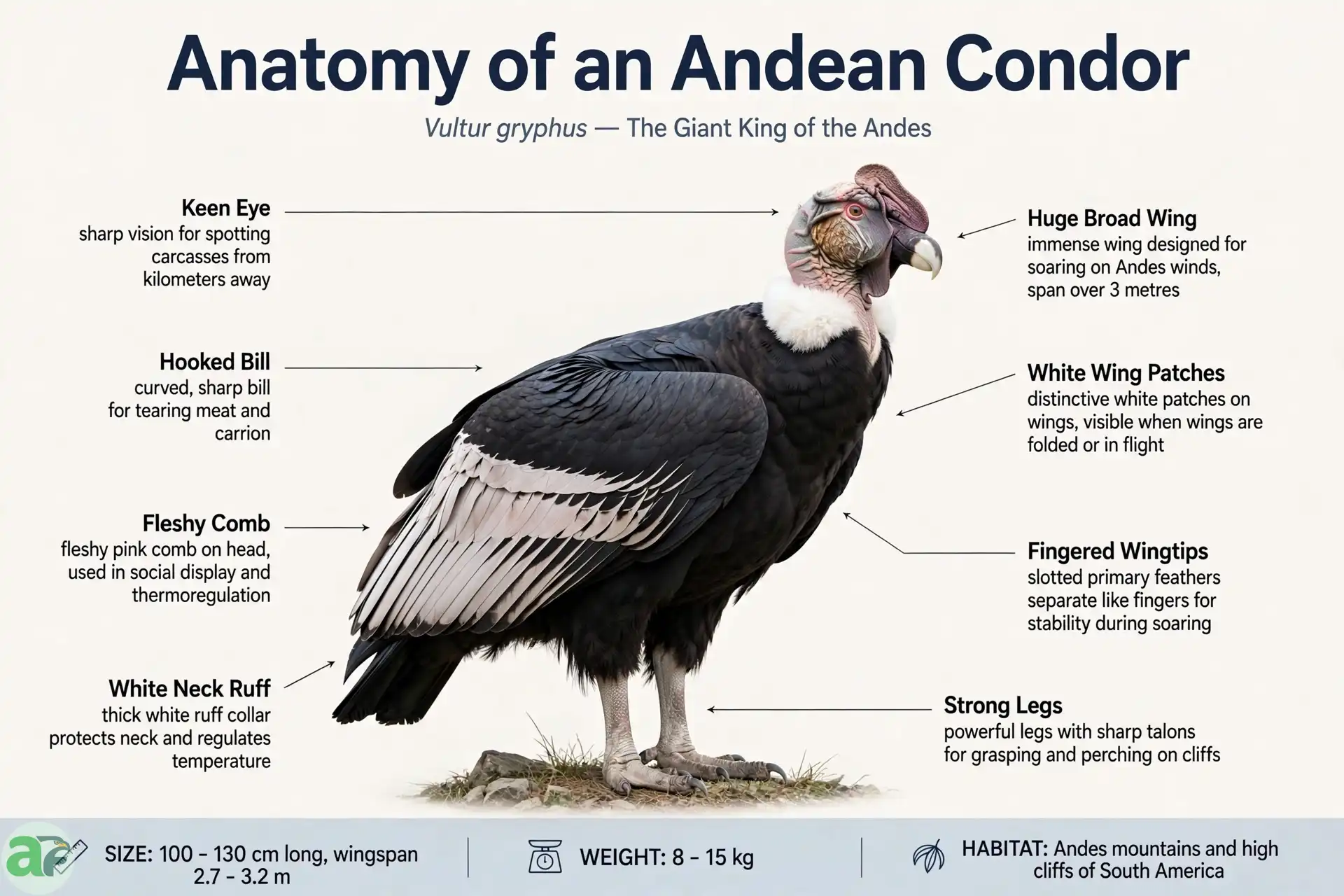
23. Frequently Asked Questions About Andean Condors
Q1. What is the scientific name of the Andean condor?
The Andean condor’s scientific name is Vultur gryphus (Linnaeus, 1758). The genus name Vultur is the Latin word for “vulture” — the fundamental term from which the condor’s family classification derives. The species name gryphus is Latin derived from the Greek gryps — meaning “griffin” — the mythological creature combining the body of a lion with the wings and head of an eagle. When Linnaeus named the Andean condor in 1758, the choice of gryphus reflected the extraordinary impression the bird made on European naturalists encountering it for the first time — an animal so physically imposing, with its enormous wingspan, massive body, and fierce hooked bill, that the mythological griffin seemed an appropriate reference for comparison. The Andean condor is the sole living member of the genus Vultur — a monotypic genus with no other extant species. The closest extinct relative within the Vultur genus is Argentavis magnificens — the Miocene South American giant with an estimated 6–7 meter wingspan and 70+ kg body mass that is the largest flying bird in the fossil record. The common name “condor” derives directly from the Quechua word kuntur — the name applied to this bird by Andean indigenous peoples for thousands of years before European contact, making it one of the very few bird species whose most widely used common name in Western languages derives from an indigenous American word rather than a European or Latin source.
Q2. Is the Andean condor the largest bird in the world?
The Andean condor is one of the largest flying birds in the world — but whether it holds the absolute record depends on the measurement used. By wingspan, the Andean condor’s maximum of approximately 340 cm is exceeded slightly by the wandering albatross (Diomedea exulans) whose maximum documented wingspan reaches approximately 370 cm — making the albatross the widest-winged living bird. By body mass, the Andean condor (maximum approximately 15 kg in large males) is comparable to the largest Steller’s sea eagles and large female harpy eagles but is rivaled or slightly exceeded by the Dalmatian pelican (Pelecanus crispus, up to approximately 15 kg) and the Kori bustard (Ardeotis kori, up to approximately 19 kg in flying individuals). The Andean condor is definitively the largest flying bird in South America and the largest New World vulture by all measurements. When both wingspan AND body mass are considered together — the combination of factors that creates the most physically imposing flying bird — the Andean condor makes a strong case for the title of most impressive flying bird, even if it does not hold the absolute record on either metric individually. The condor’s combination of near-record wingspan (340 cm), substantial body mass (up to 15 kg), and the extraordinary soaring efficiency it achieves with this combination makes it the most aerodynamically remarkable large bird by most assessments.
Q3. Why is the Andean condor the national symbol of so many countries?
The Andean condor’s designation as the national symbol of six South American countries — Argentina, Bolivia, Chile, Colombia, Ecuador, and Peru — reflects a convergence of factors unique to this species in this geographic and cultural context. First, the condor is found across all six countries — its Andean range spanning the entire cordillera from Colombia to Tierra del Fuego, making it a genuinely shared natural heritage of the continent. Second, the condor occupies the supreme position in Andean indigenous cosmology across all six nations — the Quechua and Aymara traditions that place the condor as ruler of the upper world are not restricted to any single nation’s territory but span the entire Andean cultural zone. Third, when these nations achieved independence from Spain in the early 19th century, political leaders sought national symbols that emphasized indigenous Andean identity rather than European colonial heritage — the condor’s deep pre-Columbian cultural significance made it an obvious choice for nations constructing post-colonial identities. Fourth, the condor’s physical grandeur — the largest flying bird in South America, soaring above the highest mountains on the continent — provided the visual and symbolic power appropriate for a supreme national symbol. The coincidence of natural distribution (present across all six nations), cultural significance (revered across all six nations’ Andean cultural traditions), political utility (useful for post-colonial identity construction), and physical impressiveness (undeniably the most imposing bird in South America) makes the Andean condor’s six-nation national symbol status a uniquely logical outcome rather than a coincidence.
Q4. How does the Andean condor fly for so long without flapping its wings?
The Andean condor’s extraordinary soaring efficiency — documented in the landmark 2020 PNAS study as 99% of flight time without wing flapping — is achieved through a combination of anatomical adaptations and behavioral exploitation of atmospheric physics that have co-evolved over 25 million years. The anatomical foundation is a wing designed for maximum soaring efficiency: an enormous total wing area (approximately 1.0–1.2 square meters) creating very low wing loading (weight per unit wing area), the lowest of any large bird; deeply fingered primary feathers at the wingtip that reduce induced drag through winglet-like aerodynamic effects; and a wing aspect ratio optimized for soaring rather than powered flight. The behavioral exploitation of available atmospheric energy involves five specific strategies documented in the 2020 study: slope soaring (using air deflected upward by cliffs and ridges); thermal soaring (using rising columns of air heated by sun-warmed ground); dynamic soaring (extracting energy from wind speed gradients, particularly over the ocean surface); orographic lift (air forced upward as it crosses mountain ridges); and strategic takeoff (launching into headwinds from cliff edges rather than from still air to minimize energy expenditure at takeoff). The condor selects its flight path to maximize time in lift-generating air and minimize time in sinking or neutral air — a flight planning capability that requires both sophisticated environmental sensing and learned knowledge of local terrain and atmospheric patterns accumulated over years of experience in a specific landscape. The consequence of this extreme soaring efficiency is that the condor can cover 200+ kilometers per day at an energy cost far lower than any powered-flight equivalent — the soaring lifestyle enabling a 15-kilogram bird to sustain foraging over a vast landscape without the prohibitive metabolic costs that powered flight at this body mass would require.
Q5. What is the biggest threat to the Andean condor?
As of 2026, the primary documented mortality cause for free-flying Andean condors is lead poisoning from ammunition fragments ingested through the consumption of hunted animal carcasses. Condors consuming deer, guanaco, or other prey animals shot by hunters with lead ammunition ingest fragments of lead bullet that have fragmented upon impact — the condor’s highly acidic stomach dissolves these fragments and absorbs the toxic metal, causing neurological damage, organ failure, and death at sufficient concentrations. Multiple blood-lead monitoring programs across the Andean range have found elevated lead levels in significant proportions of tested birds, and lead poisoning is the primary cause of condor mortality at recovery sites where individual birds are tracked and recovered for examination. The second major threat is deliberate poisoning by ranchers — carbofuran, strychnine, and other agricultural poisons placed in livestock carcasses to kill the condors incorrectly blamed for livestock death. This poisoning, while illegal across the entire range, continues because enforcement in remote Andean areas is extremely limited and the cultural myth that condors kill livestock persists despite being factually incorrect. Power line electrocution, habitat loss through guanaco and vicuña hunting that reduces wild prey populations, and shooting by uninformed or hostile landowners represent additional significant mortality sources. The combined effect of these threats on a species that breeds only once every two years, does not reach sexual maturity until age 6–8, and lives 50–70 years creates population dynamics where even a relatively small increase in adult mortality above natural background levels can push the population toward decline — which is precisely what the IUCN’s 2020 upgrade from Near Threatened to Vulnerable documents.
24. Sources & References
- Wikipedia — Vultur gryphus, Cathartidae, Argentavis magnificens, Andean cosmology, Yawar Fiesta, Nazca Lines
- IUCN Red List — iucnredlist.org (2020 Vulnerable assessment for Vultur gryphus)
- BirdLife International — birdlife.org (species factsheet; 2020 reclassification documentation)
- Shepard Jr., E.L.C. and colleagues — “Energy landscapes shape the flight strategies of birds across the annual cycle” PNAS (2020) — the landmark soaring efficiency study
- Lambertucci, S.A. and colleagues — published research on Andean condor foraging ecology, lead poisoning, and conservation in Argentina
- The Peregrine Fund — peregrinefund.org (Colombia reintroduction program documentation)
- Donázar, J.A. and colleagues — foundational Andean condor ecology research in Patagonia
- Wallace, M.P. — captive breeding and reintroduction research
- Schulenberg, T.S. et al. (2010) — Birds of Peru. Princeton University Press
- National Geographic — nationalgeographic.com
- BBC Wildlife / BBC Earth — bbcearth.com
- Britannica — britannica.com/animal/Andean-condor
- Cornell Lab of Ornithology — allaboutbirds.org (species account; Macaulay Library)
- SERNANP Peru — sernanp.gob.pe (Colca Canyon protected area documentation)
- WCS Andes Program — wcs.org (South American condor conservation documentation)