
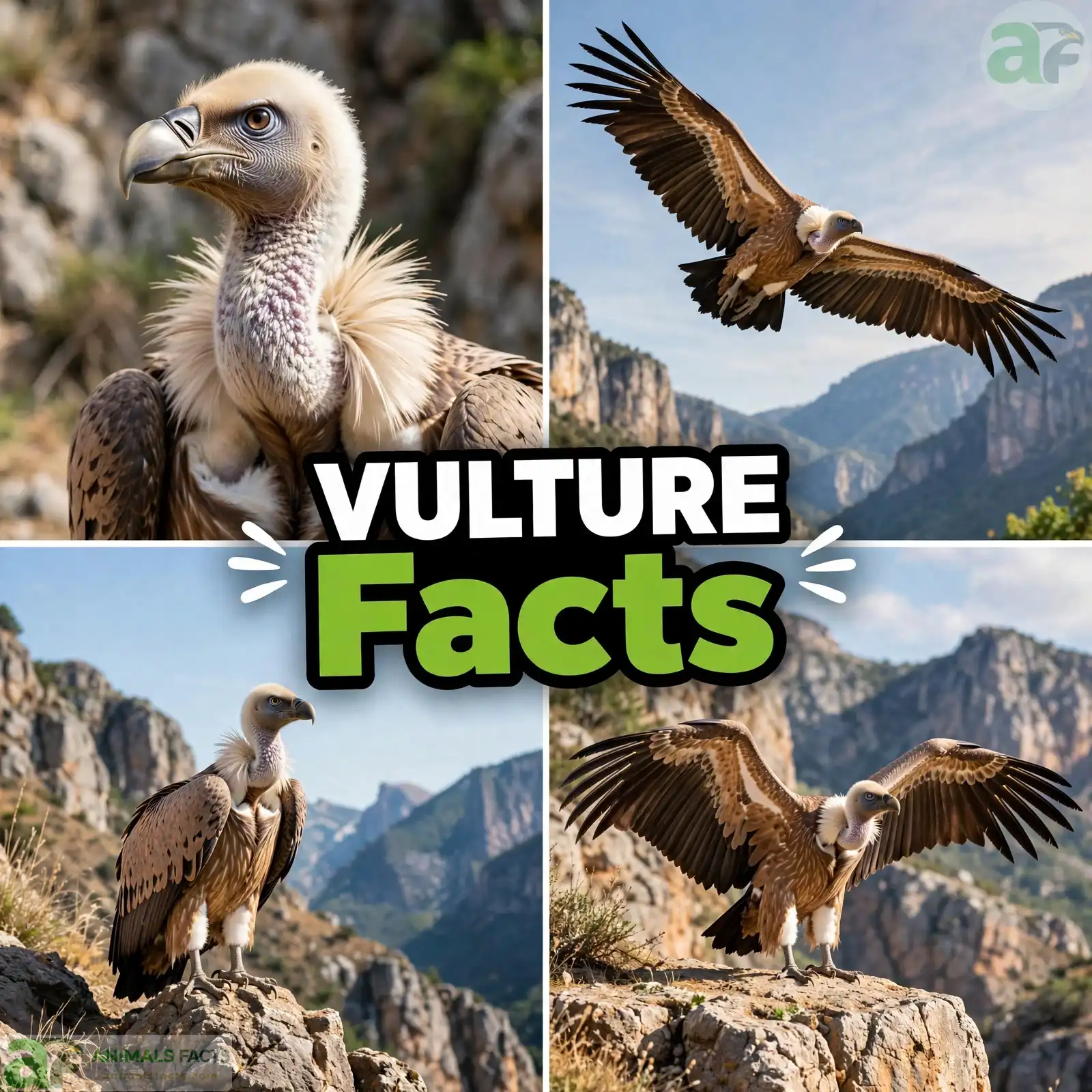
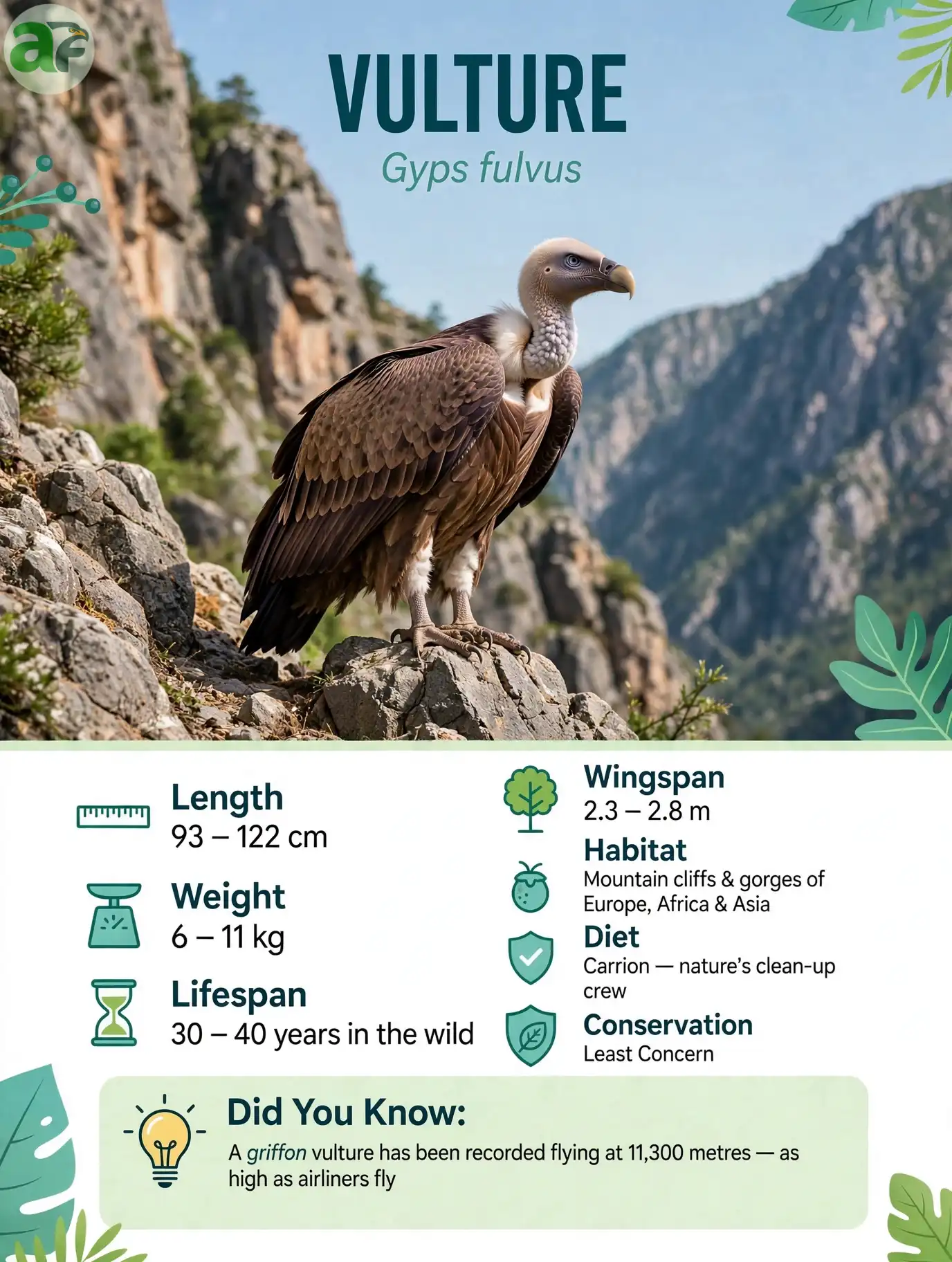
Vulture Facts
| Feature | Details |
|---|---|
| Primary Scientific Groups | Old World vultures: family Accipitridae (genera Gyps, Aegypius, Gypaetus, others); New World vultures: family Cathartidae (genera Cathartes, Coragyps, Gymnogyps, others) |
| Kingdom | Animalia |
| Phylum | Chordata |
| Class | Aves |
| Order | Old World: Accipitriformes; New World: Cathartiformes |
| Family | Accipitridae (Old World); Cathartidae (New World) |
| Common Names | Vulture; condor; griffon; lammergeier; turkey vulture; black vulture; California condor; Andean condor |
| Native Range | Every continent except Australia and Antarctica — extraordinarily wide distribution |
| Habitat | Open country, savanna, mountain, desert, coast — wherever large animal carcasses occur |
| Lifespan | 25–50 years (wild, varies by species); up to 118 years (captivity — Andean condor) |
| Diet | Primarily carrion — animal carcasses; the most specialized scavengers among birds |
| Body Length | 56–150 cm — from small Egyptian vulture to massive condors |
| Wingspan | 120–340 cm — condors among the widest-winged birds on Earth |
| Weight | 0.9–15 kg — from Egyptian vulture to Andean condor |
| Conservation Status | CRITICAL — 14 of 23 vulture species are threatened; Old World vultures experiencing the most severe declines of any bird group globally |
| Defining Feature | Bald or sparsely feathered head (most species) — evolved for hygiene when feeding inside carcasses; stomach acid up to 100 times more acidic than human stomach acid — destroys pathogens including anthrax, cholera, and botulinum toxin |
| Most Famous Species | California condor (Gymnogyps californianus) — reduced to 27 wild individuals in 1987; now 500+; greatest endangered species recovery story in US history |
| Shocking Relationship | New World vultures are more closely related to storks than to Old World vultures — one of the most dramatic convergent evolution examples in the bird world |
 1. Introduction: What is a Vulture?
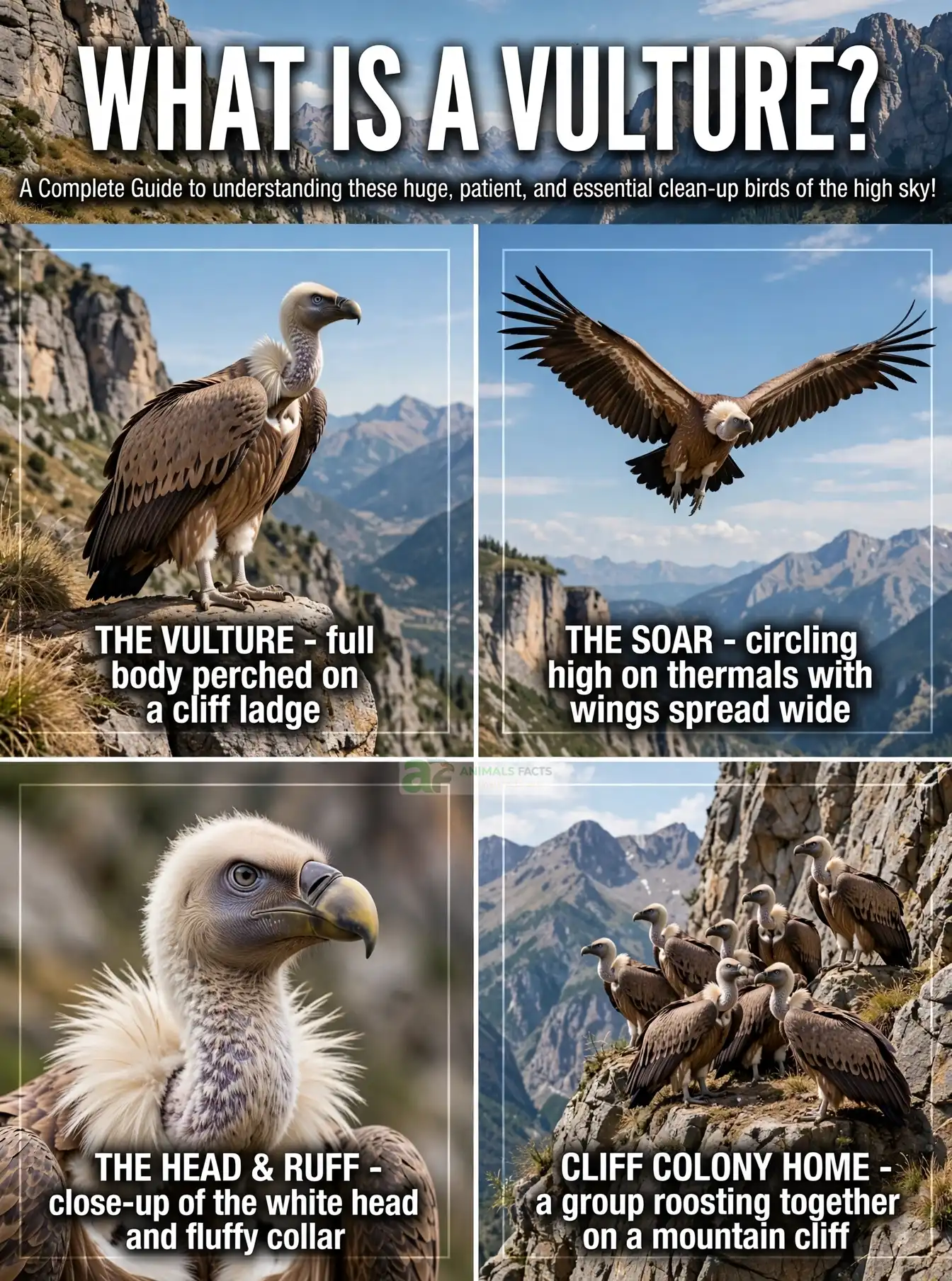
On the sun-bleached plains of the Serengeti, where a wildebeest has fallen and the vultures are arriving — first one, then a dozen, then a hundred — the scene appears, to a human observer conditioned by decades of cultural messaging about these birds, to confirm every negative association: the hunched postures, the naked pink heads, the jostling at the carcass, the sounds of tearing meat, the sheer density of bodies pressing toward the same resource in a display that has struck human observers as macabre since the first human being watched the first vulture descend to the first carcass and felt the primal discomfort of seeing one’s own mortality serviced so efficiently. Vulture facts begin with the recognition that every element of that instinctive human discomfort is wrong — or rather, that it reflects a failure to understand what is actually happening. What is actually happening on the Serengeti plain, when a hundred vultures converge on a wildebeest carcass and complete their work within hours, is one of the most extraordinary and most essential ecological services that any animal provides to any ecosystem anywhere on Earth. The vultures are not symbols of death — they are the machinery of life continuation, destroying pathogens that would otherwise persist for months in decaying flesh, returning nutrients to the soil, preventing the spread of diseases including anthrax, botulinum toxin, cholera, and rabies through a digestive system so acidic that it destroys biological material that nothing else can safely process.
The vultures — comprising the Old World vultures of the family Accipitridae (Africa, Europe, and Asia) and the New World vultures of the family Cathartidae (the Americas) — collectively represent one of the most biologically extraordinary and most ecologically essential bird groups on Earth. They are defined by a suite of adaptations to the scavenging lifestyle that are among the most extreme specializations in the bird world: the bald or sparsely feathered head that prevents feather contamination when feeding inside carcasses; the stomach acid up to 100 times more concentrated than human stomach acid that destroys anthrax spores, cholera bacteria, botulinum toxin, and rabies virus with the efficiency of a biological incinerator; the social information network that allows a vulture in flight to locate a carcass from tens of kilometers by watching the behavior of other vultures; the soaring flight system that allows a Rüppell’s vulture to soar at 11,300 meters altitude — higher than any other bird ever recorded; and the stomach-contents vomiting defense in which a threatened vulture projectile-vomits digested carrion with sufficient accuracy and force to deter most would-be attackers while simultaneously reducing weight for flight escape.
The vulture conservation situation in 2026 is the most acute of any bird group globally — 14 of 23 vulture species are threatened with extinction, and multiple Old World vulture species are experiencing population declines more severe than any other bird group on Earth. The Indian subcontinent has lost approximately 99% of its vulture population since the 1990s — the most catastrophic bird population collapse ever documented in modern ornithology — driven by a single veterinary drug (diclofenac) that proved fatally toxic to vultures at concentrations present in the carcasses of treated livestock. The consequence of this collapse was the proliferation of feral dog and rat populations that have driven increases in rabies transmission and other public health threats across India, Pakistan, and Bangladesh — a direct demonstration of vulture ecological service whose economic value has been calculated at $34 billion annually for the Indian subcontinent alone.
Interesting facts about vultures reveal animals of breathtaking biological sophistication — the bearded vulture (lammergeier) that dyes its own feathers with iron-rich soil as a social signal; the Turkey vulture that can smell carrion from over 1.5 kilometers in an atmospheric detection feat unique among birds; the California condor that was reduced to 27 wild individuals in 1987 and whose recovery to 500+ birds represents the greatest endangered species conservation triumph in American history; the Andean condor with a wingspan reaching 340 centimeters — one of the widest wingspans of any living bird; and the Egyptian vulture that uses rocks as tools to break open ostrich eggs — one of the very few documented tool-using behaviors in any bird species. This is your comprehensive guide to the birds that clean the world.
2. Vulture Species Overview & Classification
Vultures occupy one of the most taxonomically fascinating positions in the bird world — the Old World and New World vultures are not closely related despite their remarkable similarity in appearance and ecological role, representing one of the most extraordinary examples of convergent evolution in vertebrate biology.
The Two Completely Separate Vulture Lineages
| Feature | Old World Vultures | New World Vultures |
|---|---|---|
| Family | Accipitridae | Cathartidae |
| Order | Accipitriformes | Cathartiformes |
| Closest relatives | Hawks, eagles, kites | Storks (Ciconiidae) |
| Species count | 16 species | 7 species |
| Range | Africa, Europe, Asia | Americas |
| Primary sense used | Sight | Sight AND smell |
| Feet | Relatively powerful; somewhat raptorial | Weak, chicken-like — cannot grasp or kill |
| Urohidrosis | No | Yes — urinate on own legs to cool down |
| Nasal septum | Complete | Perforated — you can see through the nostrils |
| Voice | Hisses, grunts — some species have calls | Essentially voiceless — no syrinx; only hisses |
| Evolution | Descended from hawk/eagle ancestors | Descended from stork-like ancestors |
The Shocking Evolutionary Truth
New World vultures are more closely related to storks than to Old World vultures — one of the most dramatic examples of convergent evolution in the bird world. The turkey vulture, black vulture, California condor, and Andean condor share a more recent common ancestor with white storks (Ciconia ciconia) than with griffon vultures or white-backed vultures. The remarkable similarities between Old World and New World vultures — bald heads, scavenging behavior, soaring flight, similar body shape — evolved entirely independently in two lineages that have been separate for 65+ million years.
Old World Vulture Species
| Species | Scientific Name | Range | IUCN Status |
|---|---|---|---|
| Griffon vulture | Gyps fulvus | Europe, Middle East, N. Africa | Least Concern |
| White-backed vulture | Gyps africanus | Sub-Saharan Africa | Critically Endangered |
| Rüppell’s vulture | Gyps rueppelli | East and Central Africa | Critically Endangered |
| Cape vulture | Gyps coprotheres | Southern Africa | Vulnerable |
| Himalayan vulture | Gyps himalayensis | Central Asia, Himalayas | Least Concern |
| White-rumped vulture | Gyps bengalensis | South and Southeast Asia | Critically Endangered |
| Indian vulture | Gyps indicus | South Asia | Critically Endangered |
| Slender-billed vulture | Gyps tenuirostris | South and Southeast Asia | Critically Endangered |
| Lappet-faced vulture | Torgos tracheliotos | Africa, Middle East | Endangered |
| White-headed vulture | Trigonoceps occipitalis | Sub-Saharan Africa | Critically Endangered |
| Hooded vulture | Necrosyrtes monachus | Sub-Saharan Africa | Critically Endangered |
| Bearded vulture (Lammergeier) | Gypaetus barbatus | Europe, Africa, Asia | Near Threatened |
| Egyptian vulture | Neophron percnopterus | Europe, Africa, Asia | Endangered |
| Palm-nut vulture | Gypohierax angolensis | Sub-Saharan Africa | Least Concern |
| Cinereous vulture | Aegypius monachus | Europe, Asia | Near Threatened |
| Red-headed vulture | Sarcogyps calvus | South and Southeast Asia | Critically Endangered |
New World Vulture Species
| Species | Scientific Name | Range | IUCN Status |
|---|---|---|---|
| Turkey vulture | Cathartes aura | Canada to Tierra del Fuego | Least Concern |
| Black vulture | Coragyps atratus | USA to Argentina | Least Concern |
| Lesser yellow-headed vulture | Cathartes burrovianus | Mexico to Argentina | Least Concern |
| Greater yellow-headed vulture | Cathartes melambrotus | South America | Least Concern |
| King vulture | Sarcoramphus papa | Mexico to Argentina | Least Concern |
| California condor | Gymnogyps californianus | Western USA, Mexico | Critically Endangered |
| Andean condor | Vultur gryphus | Andes of South America | Vulnerable |
Evolution & Discovery Timeline
~65 million years ago (Paleocene) — The Cathartidae (New World vulture) lineage diverges from the stork ancestor group; independently, the Accipitridae (hawk/eagle) lineage begins its radiation that will eventually produce Old World vultures.
~40 million years ago (Eocene) — Fossil evidence of large soaring vulture-like birds from both Old and New World deposits — establishing the vulture ecological role across both hemispheres.
~10,000 years ago — The California condor’s prehistoric range extends across North America from British Columbia to Florida; the Great Plains megafauna extinction (mammoths, mastodons, ground sloths) that the condor depended on drives contraction to the western coastline range.
~4,000 BCE — Parsi (Zoroastrian) tradition develops the practice of sky burial — placing human dead on elevated platforms (Towers of Silence) for vultures to consume. This tradition, still practiced by some Parsi communities today, represents one of the most profound human-vulture relationships in any culture.
1758 — Linnaeus formally describes multiple vulture species in Systema Naturae.
1987 — The California condor population reaches its absolute nadir — 27 individuals remaining, all in the wild. The US Fish and Wildlife Service makes the controversial decision to capture all remaining wild birds for captive breeding.
1992 — First captive-bred California condors released back into the wild in California.
1996 — Diclofenac — a veterinary anti-inflammatory drug — begins widespread use across the Indian subcontinent; vulture populations begin catastrophic collapse.
2000 — Indian white-backed vulture population has declined by approximately 97% — the fastest population collapse ever documented for any bird species.
2006 — India bans diclofenac for veterinary use; Pakistan follows; Nepal follows.
2016 — UNESCO recognizes traditional eagle hunting; the broader cultural recognition of human-raptor relationships contributes to growing vulture cultural protection advocacy.
2024 — California condor population reaches 537 individuals (wild and captive combined); African vulture populations continue to decline; the global vulture conservation crisis is the most acute in the history of wildlife conservation.
“Vultures are the most important birds on Earth that most people have never thought about. When we lose vultures — and we are losing them faster than any other bird group — we are not losing a charismatic animal that people admire. We are losing the biological system that has kept our environment clean of disease for millions of years. The public health consequences of vulture extinction will be felt by human populations before they are felt by ecosystems.”
— Dr. Munir Virani, The Peregrine Fund — leading vulture conservation researcher in Africa and Asia
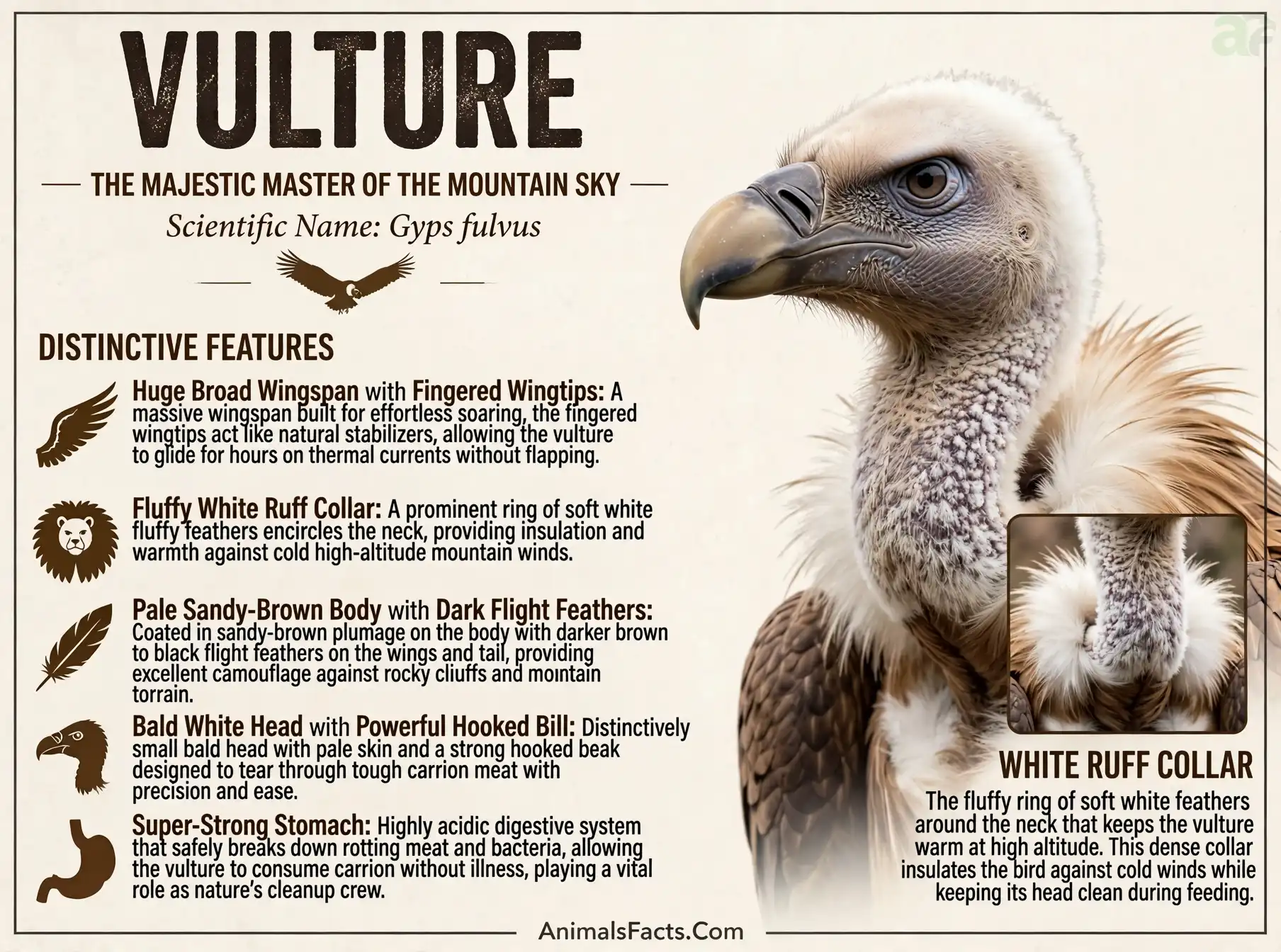
3. Vulture Physical Description & Unique Features
Vultures’ physical design is optimized for a specific ecological role — efficient location and processing of large animal carcasses — and every distinctive physical feature reflects this optimization with extraordinary precision.
The Bald Head — The Most Distinctive Vulture Feature
The most immediately recognizable vulture characteristic — the bare or sparsely feathered head — is one of the most functionally elegant adaptations in the bird world:
The hygiene function — A vulture feeding inside a large carcass (particularly the body cavity of a large ungulate) inserts its head deeply into decomposing material. Feathers in this context would rapidly become matted with blood, tissue, and bacteria — creating a permanent bacterial culture medium on the bird’s head. The bare skin dries quickly in sunlight, killing bacteria through desiccation and UV exposure.
The thermoregulation function — Some researchers have proposed an additional or alternative explanation — the bare head skin may function in thermoregulation, allowing blood vessels close to the surface to radiate heat in the high-temperature environments where most vulture species live.
Variation in bald head extent — The degree of head nakedness varies significantly across species:
- Rüppell’s vulture, white-backed vulture, griffon vulture — extensively bare pink or white head and upper neck
- Turkey vulture — bare red head
- California condor — bare orange-pink head with elaborate skin coloration patterns used in social signaling
- Bearded vulture (lammergeier) — relatively well-feathered head — the species that breaks the pattern; the lammergeier feeds on bones rather than flesh and therefore does not require the same degree of head-feather hygiene adaptation
- Egyptian vulture — partly feathered; yellow bare facial skin
- King vulture — elaborate bare head skin with multi-colored wattles and caruncles — the most ornate head of any vulture
The Stomach Acid System — The Biological Hazmat System
The vulture’s digestive system is the most extreme in any bird — and possibly in any vertebrate:
pH measurement — Vulture stomach acid has been measured at a pH of 1.0–2.0 — the most acidic gastric environment documented in any bird. By comparison:
- Human stomach acid: approximately pH 1.5–3.5 (similar lower range but less consistently maintained at extreme acidity)
- Most birds: pH 3.0–4.5
- Herbivorous birds: pH 4.5–6.0
What the acid destroys — The extreme acidity combined with the vulture’s powerful digestive enzymes destroys biological material that would persist through the digestive system of most other animals:
- Anthrax spores (Bacillus anthracis) — destroyed; anthrax-infected carcasses are safely consumed by vultures
- Cholera (Vibrio cholerae) — destroyed
- Botulinum toxin (Clostridium botulinum) — destroyed
- Rabies virus — destroyed (vultures are immune to rabies infection through this route)
- Clostridium species generally — destroyed
- Tuberculosis bacteria — significantly reduced if not entirely eliminated
The practical consequence — A vulture consuming an anthrax-infected wildebeest does not become a vector for anthrax transmission — the pathogen is destroyed before reaching the intestines. Without vulture processing, anthrax-infected carcasses persist for months, with spore release from the decomposing tissue creating environmental contamination that infects other herbivores.
The Wings — Engineering for Soaring Efficiency
Vulture wings are designed for maximum soaring efficiency with minimum energy expenditure — the fundamental requirement for a species that must cover enormous areas searching for unpredictably distributed carcasses:
High wing area — All large vultures have very large wings relative to body mass (low wing loading) — generating lift in minimal wind and thermal conditions. The Andean condor’s wingspan of up to 340 cm and relatively modest body weight of approximately 11–15 kg creates one of the lowest wing loadings of any large bird.
The fingered wingtip — Like eagles, large vultures have distinctly separated primary feathers at the wingtip — the “fingers” that reduce induced drag at soaring speeds and allow thermal soaring in relatively weak thermals.
The dihedral posture — Turkey vultures hold their wings in a distinctive V-shape (dihedral) when soaring — tilting from side to side as they ride air currents. This posture makes turkey vultures among the most easily identifiable North American raptors in flight.
Altitude records — The Rüppell’s vulture holds the verified record for the highest bird flight ever documented — a bird struck by a commercial aircraft at 11,300 meters altitude (37,000 feet) over Côte d’Ivoire in 1973. The bird was identified from feathers recovered from the aircraft’s engine. The capacity to soar at 11,300 meters reflects adaptations to low-oxygen environments including modified hemoglobin with extremely high oxygen affinity.
The Turkey Vulture’s Smell — Unique in the Bird World
The turkey vulture (Cathartes aura) possesses one of the most extraordinary olfactory systems of any bird — representing a significant evolutionary departure from most birds, which have relatively limited smell capability:
The olfactory bulb — The turkey vulture’s olfactory bulb (the brain region processing smell) is proportionally larger relative to total brain size than in any other North American bird — a structural adaptation reflecting heavy reliance on olfactory prey detection.
Detection distance — Research has documented turkey vultures detecting carrion from distances of up to 1.5 km through smell alone — following downwind odor plumes to locate hidden carcasses beneath closed-canopy forest where aerial visual detection would be impossible.
The ethyl mercaptan key — Decomposing flesh produces ethyl mercaptan (the same chemical added to natural gas to give it its distinctive odor) as an early breakdown product — appearing within the first 12–24 hours of decomposition. Turkey vultures are particularly sensitive to ethyl mercaptan — responding to concentrations as low as a few parts per trillion.
The pipeline leak discovery — Union Gas Company in the USA exploited the turkey vulture’s ethyl mercaptan sensitivity to locate pipeline leaks — releasing ethyl mercaptan into gas pipelines and then watching for concentrations of turkey vultures above ground to identify leak points.
The Urohidrosis — The Unique Cooling System
New World vultures practice urohidrosis — urinating on their own legs as a thermoregulatory mechanism:
The mechanism — Evaporation of urine from the leg skin cools the blood in the leg blood vessels — cooling the blood returning to the core body and reducing core temperature. The leg feathers of New World vultures are significantly shorter than those of comparably sized birds — partly because chronic urine contact degrades feather structure.
The white-legged appearance — In black vultures and turkey vultures, the accumulation of dried urine salts on the dark legs creates a distinctive white-legged appearance — a characteristic visible in close observation of these species.
The antibacterial secondary function — Urine has some antibacterial properties; urohidrosis may provide a secondary function of reducing bacterial colonization of the leg skin and feet that contact carcasses during feeding.
💡 Did You Know? The bearded vulture (Gypaetus barbatus) — also called the lammergeier or ossifrage (“bone-breaker”) — is the only bird on Earth known to deliberately dye its own feathers as a social signal. The adult bearded vulture has pale cream to orange-red feathers on its breast and neck — a color that is not naturally produced by the feather pigments but is acquired by the bird bathing in iron-rich red soil and spring water. The orange-red coloring appears to be a status signal — more intensely colored birds are typically dominant over paler birds at carcasses, and research has documented that dominant birds actively seek out iron-rich bathing sites to maintain their coloration. The bearded vulture is therefore the only known bird that creates and applies a cosmetic coloring to its feathers — a behavior that has no parallel in the rest of the bird world. The intensity of the orange-red coloring accurately indicates the bird’s dominance status and access to the best iron-rich bathing sites — making it an honest signal of individual quality in the bearded vulture’s social system. This extraordinary behavior was not fully documented and understood by scientists until the 1980s, and it remains one of the most remarkable examples of purposeful self-decoration in any animal species.
4. Top 25 Amazing Vulture Facts
Here is your definitive collection of the most extraordinary, scientifically verified, and genuinely astonishing vulture facts as of 2026:
- Vulture stomach acid has been measured at pH 1.0 — equal to battery acid and up to 100 times more acidic than human stomach acid. This extreme acidity destroys anthrax spores, botulinum toxin, cholera bacteria, and rabies virus that would persist through the digestive systems of all other animals.
- New World vultures (turkey vulture, black vulture, California condor, Andean condor) are more closely related to storks than to Old World vultures — one of the most dramatic convergent evolution examples in vertebrate biology. The two vulture groups independently evolved virtually identical ecological roles, body forms, and behaviors across 65 million years of completely separate evolutionary history.
- The Rüppell’s vulture holds the verified record for the highest bird flight ever documented — a bird struck by a commercial aircraft at 11,300 meters (37,000 feet) altitude over Côte d’Ivoire in 1973. The bird was flying at the same altitude as commercial jet aircraft.
- The turkey vulture is one of the very few birds that locates food primarily through smell — its proportionally enormous olfactory bulb detecting the ethyl mercaptan produced by decomposing flesh from distances of up to 1.5 km. Gas pipeline companies have exploited this capability by watching turkey vulture concentrations above ground to identify underground gas leak points.
- The California condor was reduced to just 27 individuals in 1987 — the smallest wild population of any bird species in the modern conservation era. All 27 were captured for captive breeding. The population has since recovered to over 500 individuals (wild and captive combined) as of 2026 — the greatest endangered species recovery achievement in American history.
- The bearded vulture (lammergeier) is the only bird known to deliberately dye its own feathers — bathing in iron-rich red soil to turn its pale breast feathers orange-red as a social status signal. More dominant birds are more intensely colored — making it the only animal known to apply a cosmetic coloring for social purposes.
- The Egyptian vulture (Neophron percnopterus) is one of the very few birds known to use tools — carrying rocks in its bill and throwing them at ostrich eggs to break them open. This rock-throwing tool use is one of the best-documented examples of tool use in any bird species.
- The bearded vulture is the only animal whose diet is approximately 80–90% bone — the bird dropping large bones from heights of 50–80 meters onto specific rocky platforms (called ossaries) to shatter them, then consuming the bone fragments and bone marrow. This bone-eating specialization allows it to access a food source that no other predator can efficiently utilize.
- The Indian subcontinent has lost approximately 99% of its vulture population since the 1990s — the most catastrophic bird population collapse ever documented — driven by a single veterinary anti-inflammatory drug (diclofenac) that proved fatally toxic to vultures at concentrations present in treated livestock carcasses.
- The economic value of the vulture’s ecological service has been calculated — the Indian subcontinent’s vulture population, before its collapse, provided $34 billion worth of waste disposal and disease prevention services annually. This figure represents the cost of replacing vulture scavenging with other disposal methods plus the disease burden reduction value.
- The Andean condor (Vultur gryphus) has a wingspan reaching 340 cm — making it one of the widest-winged birds on Earth alongside the wandering albatross. Despite this enormous wingspan, the condor weighs only approximately 11–15 kg — creating an extraordinarily low wing loading that allows soaring in minimal thermal conditions.
- Vultures defecate on their own legs (New World vultures — urohidrosis) as a thermoregulation mechanism — the evaporation of urine cooling the blood in the leg vessels. The accumulated dried urine gives North American vultures their characteristic white-legged appearance.
- A group of vultures feeding on a carcass is called a “wake” — a group in flight is called a “kettle” (shared with hawks) — and a group circling in the air is called a “venue.” The “wake” designation reflects the bird’s association with death in human culture.
- The hooded vulture (Necrosyrtes monachus) in Africa has been documented following human fishing operations — birds learned that fishermen’s nets, when hauled in, concentrate fish scraps on the waterfront that the vultures can exploit. This learned association with human fishing activity represents sophisticated behavioral flexibility.
- A vulture restaurant — a feeding station where livestock carcasses are provided for vultures — is one of the most effective vulture conservation interventions; by providing carcasses free from veterinary drug contamination, vulture restaurants simultaneously provide clean food and supplement population nutrition during periods of prey scarcity.
- Vultures lack a syrinx (the vocal organ of birds) — most species are essentially voiceless, capable only of hisses, grunts, and bill-clapping sounds. This absence of song reflects the vultures’ evolutionary divergence from songbirds and their lack of the selective pressure to develop complex vocal communication.
- The black vulture (Coragyps atratus) has developed a sophisticated social network for carcass location — individuals that have failed to find food follow birds that appear well-fed (by their behavior and posture) from communal roosts to feeding sites, creating an information cascade that concentrates hundreds of birds at productive carcasses within hours.
- White-backed vultures (Gyps africanus) can consume up to 1 kg of meat in a single minute — and a group of white-backed vultures can strip a large carcass (wildebeest, zebra) of all soft tissue within 30 minutes at a productive African savanna feeding event.
- The California condor was extinct as a species in the wild for five years — from the capture of the last wild individual in 1987 to the first releases of captive-bred birds in 1992. During this period, the entire species existed only in captivity at the San Diego Wild Animal Park and the Los Angeles Zoo.
- Vulture nest success is one of the lowest of any large bird — the combination of slow reproduction (one egg every 1–2 years in condors), long chick dependency, and the mounting threats from poisoning, power line collision, and habitat loss creates population dynamics where the loss of even a small number of breeding adults can drive population decline.
- The king vulture (Sarcoramphus papa) of the Neotropics has an extraordinary multi-colored head — orange, purple, red, yellow, and black skin patches on the bare head combined with caruncles (fleshy projections) above the bill, creating the most elaborate facial ornamentation of any vulture species and one of the most colorful bird faces in the Americas.
- Multiple African vulture species are deliberately poisoned by poachers — the large concentrations of vultures circling above a poached elephant or rhino carcass alert anti-poaching rangers to the location. Poachers now routinely lace carcasses with carbofuran and other pesticides to kill vultures that would reveal their activities — a practice that has killed hundreds of thousands of vultures across Africa in recent decades.
- The lammergeier’s (bearded vulture’s) name comes from the German Lämmergeier — “lamb vulture” — reflecting the historical (largely false) belief that the bird carried off lambs. It is also called the ossifrage — “bone-breaker” — in various languages, accurately reflecting its bone-eating specialization.
- Vultures perform sunning behavior — spreading their wings and orienting toward the sun in a posture that appears to serve multiple functions including bactericidal UV exposure (killing bacteria on wing surfaces), feather drying, and thermoregulation. Morning sunning is one of the most characteristic and visually striking vulture behaviors.
- As of 2026, the African vulture conservation situation is assessed as a continental-scale crisis — populations of multiple species have declined by 80–97% over the past three decades. If current trends continue, multiple African vulture species are projected to face functional extinction within 20–30 years, with catastrophic consequences for African ecosystem health and public disease management.
5. Fun Facts About Vultures
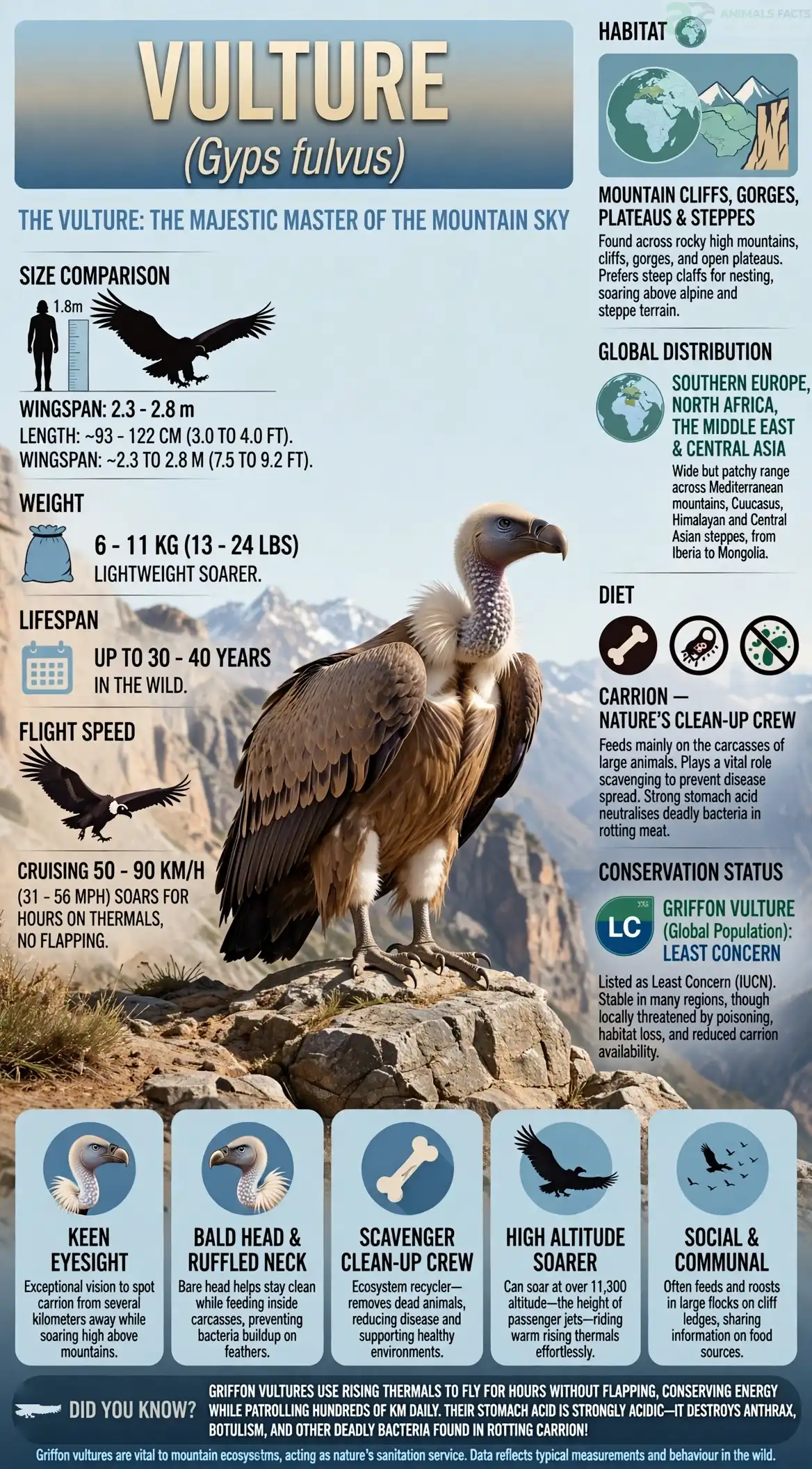
- Stomach acid at pH 1.0 — destroys anthrax and botulinum toxin
- New World vultures more closely related to storks than to hawks
- Rüppell’s vulture flew at 11,300 meters — altitude of commercial jets
- Turkey vulture smells carrion from 1.5 km away
- California condor reduced to 27 individuals in 1987
- Bearded vulture dyes its own feathers — only bird to do so
- Egyptian vulture throws rocks to break ostrich eggs — tool use
- Bearded vulture diet is 80–90% bone
- Indian subcontinent lost 99% of vultures from one drug
- Vulture ecological service worth $34 billion/year in India
- Andean condor wingspan 340 cm — one of widest on Earth
- Vultures are essentially voiceless — no syrinx
6. Vultures Habitat & Geographic Range
Vulture habitat is defined by the distribution of large animal carcasses — the resource the vulture group has specialized to exploit. This resource dependency links vulture distribution to the presence of large mammal communities, which in turn links vulture conservation to the conservation of large mammal prey and the pastoralist and wildlife management practices that determine carcass availability.
Old World Vulture Habitats
African savanna and grassland:
The richest vulture habitat on Earth — the large ungulate communities of the African savanna (wildebeest, zebra, buffalo, giraffe, elephant) provide the carcass base that supports the world’s most spectacular vulture communities:
- East African savanna (Serengeti, Masai Mara) — white-backed vulture, Rüppell’s vulture, lappet-faced vulture, hooded vulture
- Southern African bushveld (Kruger, Etosha) — white-backed vulture, Cape vulture, lappet-faced vulture
- West African savanna — hooded vulture, white-backed vulture (both declining severely)
Mountain ranges and cliff habitats:
Several vulture species are specifically associated with mountain terrain that provides the thermal uplift needed for efficient soaring and the cliff ledges needed for nesting:
- Pyrenees, Alps, Apennines — griffon vulture (recovering); bearded vulture (rare but increasing)
- Himalayas and Tibetan Plateau — Himalayan vulture; bearded vulture
- Caucasus and Central Asia — griffon vulture; cinereous vulture
- Drakensberg and Cape ranges (South Africa) — Cape vulture colonies
South Asian forests and agricultural land:
The most devastated vulture habitat on Earth — the Indian subcontinent’s vast agricultural and semi-wild landscapes once supported the world’s highest vulture densities but have been catastrophically depleted by diclofenac:
- Indo-Gangetic Plain (India, Pakistan, Bangladesh) — white-rumped vulture, Indian vulture, slender-billed vulture (all Critically Endangered)
- Nepalese lowland (Terai) — remnant populations with some recovery following diclofenac ban
New World Vulture Habitats
North American open country:
The turkey vulture is one of the most habitat-flexible large birds in North America — occurring in virtually every open and semi-open habitat type:
- Agricultural land (ubiquitous across rural North America)
- Open woodland and forest edge
- Desert and semi-arid scrub (western USA and Mexico)
- Coastal areas (beaches and coastal forests)
South American Andes:
The Andean condor’s primary habitat — the dramatic high-altitude landscape of the Andes from Venezuela to Tierra del Fuego:
- High-altitude puna grassland (above 3,000 m)
- Patagonian steppe (southern Andes; important condor population)
- Coastal Peru and Chile (condors feeding on marine mammal carcasses)
California coast and inland:
The California condor’s recovered range:
- Big Sur coast, California — coastal cliff nesters; marine mammal carcass feeding
- Grand Canyon area, Arizona — reintroduced population; one of the largest free-flying groups
- Baja California, Mexico — reintroduced population
- Pacific Northwest (Utah, Nevada) — expanding restored range
The Migration Dimension
Most vultures are non-migratory — their large body size and thermal soaring dependence making long-distance migration energetically costly. However, several species perform significant movements:
Turkey vulture migration — Strongly migratory in North America — northern populations migrate to Central and South America for winter. Turkey vulture autumn migration produces spectacular concentrations at flyway bottlenecks:
- Veracruz, Mexico — millions of migrating turkey vultures pass through each autumn in one of the most spectacular bird migration events in the Americas
- Panama — major bottleneck for southbound migrants
European griffon vulture — Pyrenean and Iberian populations make seasonal movements related to food availability; some individuals dispersing widely.
Egyptian vulture — Long-distance migrant; European breeding birds winter in Sub-Saharan Africa, crossing the Sahara Desert twice annually.
Bearded vulture — Primarily sedentary; young birds make exploratory movements across mountain ranges.
7. Vulture Diet & Feeding Behavior
Vulture diet is the most specialized in the bird world — the group collectively representing the most complete specialization on carrion (dead animal flesh) of any bird family.
Diet by Species
| Species | Primary Food | Secondary Food | Notable Specialization |
|---|---|---|---|
| White-backed vulture | Soft tissue of large ungulate carcasses | Bone scraps | Speed feeder — eats 1 kg/minute |
| Griffon vulture | Soft tissue of large carcasses | Bone scraps | Colonial forager — follows others to food |
| Rüppell’s vulture | Soft tissue; tendons | Bone scraps | Highest-flying bird |
| Lappet-faced vulture | Tough skin, tendons, bone fragments | Occasionally kills small prey | Dominates carcasses; opens tough skin |
| Hooded vulture | Small scraps; human food waste | Insects | Generalist urban scavenger |
| Egyptian vulture | Carrion scraps; ostrich eggs (tool use); feces | Insects | Rock-throwing tool user |
| Bearded vulture | Bones (80–90% of diet) | Marrow from dropped bones | Only bone-specialist animal |
| Palm-nut vulture | Palm nuts (60% of diet) | Fish, carrion | Only frugivorous vulture |
| King vulture | Large carcasses — arrives after opening | Scraps | Uses powerful bill to open tough carcasses |
| Turkey vulture | Carrion of all sizes | Occasionally vegetation | Primary smell detector |
| Black vulture | Carrion; human garbage | Small live prey (weak animals) | Urban scavenger; occasionally kills |
| California condor | Large mammal carcasses; marine mammals | Bone fragments | Lead poisoning from carcasses critical threat |
| Andean condor | Large mammal carcasses; marine mammals | — | Largest New World vulture |
The Carcass Feeding Hierarchy
At large African savanna carcasses, a complex dominance hierarchy determines feeding order — typically organized by species body size and bill strength:
1. First arrivals — small species and first-chance feeders:
- Hooded vultures — small, subordinate; arrive quickly but feed on scraps when larger species are present
- Egyptian vultures — small; feed on scraps
2. The main feeding event — medium to large Gyps vultures:
- White-backed vultures — arrive in large numbers; primary soft tissue consumers; their long necks reach deep into body cavities
- Rüppell’s vultures — larger than white-backed; feed alongside or dominate
3. Dominants — the largest species:
- Lappet-faced vulture — the dominant African vulture; its massive, powerful bill can open tough skin that smaller vultures cannot breach; lappet-faced vultures arrive and displace smaller species
4. Bone specialists — after soft tissue is gone:
- Bearded vultures — arrive after other vultures have consumed soft tissue; collect remaining bones for transport and dropping
The Bearded Vulture’s Bone-Eating System
The most extraordinary dietary specialization of any vulture — and arguably of any bird:
The bone collection — Bearded vultures collect large bones from carcasses after other scavengers have consumed the soft tissue. The bones selected are typically long bones of large ungulates (femur, tibia, humerus) — the bones with the richest marrow content.
The drop site (ossary) — The bearded vulture transports bones to a specific rocky platform — called an ossary — that the bird uses consistently over months to years. The same ossary site may be used across multiple generations of bearded vultures.
The drop technique — From a height of 50–80 meters above the ossary, the vulture releases the bone, which shatters on impact with the rock surface. The bird descends to consume the bone fragments and the marrow exposed by shattering.
The acid advantage — The bearded vulture’s extremely acidic stomach can dissolve bone fragments of substantial size — adult birds consuming bone fragments up to 25–30 cm in length, which are digested over approximately 24 hours in the strongly acidic stomach.
Why bone? — Bone represents a high-calorie, high-mineral food source (particularly calcium, phosphorus, and marrow fat) that no other predator can efficiently exploit. The bearded vulture’s bone specialization gives it exclusive access to a rich food source in a competitive environment.
The Egyptian Vulture’s Tool Use
One of the best-documented examples of tool use in any bird:
The behavior — The Egyptian vulture picks up rocks — sometimes weighing several hundred grams — in its bill and throws them repeatedly at ostrich eggs (Struthio camelus) until the egg cracks. The bird then feeds on the egg contents.
The cognitive requirement — This behavior requires understanding that an object (the rock) can be used to affect another object (the egg) — a causal understanding that is rare in non-human animals. The behavior appears to be at least partially culturally transmitted — young Egyptian vultures learn the behavior by watching adults, and populations with no access to ostrich eggs do not show the behavior even when presented with eggs in experimental conditions.
The tool selection — Egyptian vultures preferentially select rounded rocks of appropriate weight for egg-throwing — showing some discrimination in tool selection that parallels the tool-use sophistication documented in New Caledonian crows and other bird species recognized for high-level tool use.
8. Vulture Reproduction & Life Cycle
Vulture reproduction is the slowest of any bird group — the combination of single-egg clutches (most species), long incubation periods, extended nestling periods, and multi-year post-fledging development creating population dynamics of extraordinary fragility where the loss of a small number of breeding adults can drive species toward extinction.
Pair Bond and Territory
Long-term pair bonds — Vultures form long-term pair bonds — the same individuals breeding together across many seasons at the same nest site. Pair bonds in condors and large Old World vultures may last decades — potentially the entire adult life of both birds.
Nest site fidelity — Vultures show extraordinary nest site fidelity — returning to the same cliff ledge, cave, or tree year after year, adding material to the existing nest structure with each breeding attempt.
Territory size — Vulture territories (the area around the nest site defended against conspecifics) are relatively small — the foraging range (where the bird actually hunts) extends far beyond the defended territory. A Rüppell’s vulture may defend a nest territory of a few kilometers radius but forage across hundreds of kilometers from the nest.
Breeding Season and Clutch
Egg laying timing — Varies dramatically by species and region:
- African vultures — typically breed in the dry season when carcasses are more concentrated
- European griffon vulture — breeds February–May; mountain nest sites in the Pyrenees and Spain
- Bearded vulture — one of Europe’s earliest breeders; eggs laid December–February in some areas
- California condor — breeds January–August in California
- Andean condor — breeds every other year; two-year breeding cycle
Clutch size — Most vulture species lay one egg per breeding attempt:
| Species | Eggs | Incubation Days | Nestling Days | Breeding Interval |
|---|---|---|---|---|
| White-backed vulture | 1 | ~56 | ~120–130 | Annual |
| Griffon vulture | 1 | ~52–58 | ~110–115 | Annual |
| Bearded vulture | 1–2 (1 raised) | ~53–60 | ~100–130 | Annual |
| Egyptian vulture | 1–2 | ~42 | ~70–90 | Annual |
| California condor | 1 | ~56 | ~150–185 | Every 2 years |
| Andean condor | 1 | ~54–58 | ~180–240 | Every 2 years |
| Turkey vulture | 1–3 | ~38–41 | ~60–80 | Annual |
| Black vulture | 2 | ~37–41 | ~75–80 | Annual |
Condor Reproduction — The Slowest of All
The California and Andean condors have the slowest reproductive rates of any New World bird — creating population dynamics of extraordinary fragility:
The two-year cycle — California condors breed at most every two years — the combination of single-egg clutches, 56-day incubation, 150–185 day nestling period, and extended post-fledging dependency creates a cycle in which a successful pair can raise at most one chick every two years under optimal conditions.
The captive breeding trick — “double-clutching” — Conservationists discovered that removing the single egg shortly after laying causes the female to lay a replacement egg within a few weeks. By removing first eggs for artificial incubation (and, if hatching succeeds, hand-raising), and allowing the female to raise the replacement egg naturally, it is possible to obtain two chicks per pair per year rather than one — effectively doubling the captive breeding output. Double-clutching has been critical to the California condor recovery program.
First breeding age — California condors do not breed until approximately 6–8 years of age — the long developmental period before first breeding amplifying the population impact of adult mortality.
The Development Journey
The condor chick — California condor chicks develop extraordinarily slowly:
- Weeks 1–8 — helpless; continuously brooded by parents; white down
- Weeks 8–16 — developing dark feathers; increasingly mobile; parents begin leaving for longer periods
- Months 4–6 — approaching adult size; wing development continuing
- Months 5–6 — fledging — first flights; remains near nest
- Months 6–18 — post-fledging dependency — receiving food from parents while developing independent foraging
The adult plumage timeline — California condors do not acquire full adult plumage (including the characteristic orange-pink bare head) until approximately 5–6 years of age — the slow development trajectory meaning that the bird is visible as a juvenile for many years.
9. Social Behavior & Communication
Vulture social behavior is more complex than the solitary lifestyle of most raptors — the unpredictable, patchy distribution of carcasses creates selective pressure for social information sharing about food location.
The Carcass Information Network
The “information center” hypothesis — Vulture communal roosts function as information centers — birds that have located food the previous day show behavioral signs (full crops, alert posture, directional orientation) that naive birds can read and follow to productive areas. Research has confirmed this function in multiple vulture species.
The follow-the-leader system — Individual vultures scanning from altitude watch the behavior of other distant vultures — a distant bird descending steeply and others converging on its location signals a carcass find. This cascade following can bring hundreds of vultures to a carcass within hours of the first discovery, even when the carcass is not directly visible to most birds.
The New World vs. Old World system — The turkey vulture’s smell-based detection feeds into a social information cascade when it descends to a carcass — black vultures follow turkey vultures to carcasses that they detect visually. The turkey vulture is therefore a keystone detector species in New World vulture communities — the black vulture’s lack of smell capability means it depends partly on turkey vulture detection for locating hidden carcasses.
The Feeding Hierarchy in Practice
At large carcasses, the species-level dominance hierarchy is overlaid by individual-level dominance relationships within species:
Within-species dominance — Larger, older, and more intensely colored individuals (particularly in the bearded vulture where orange coloration signals dominance) have priority access at carcasses. Subordinate birds wait at the periphery.
Displacement behaviors — Dominant individuals displace subordinates through threat postures — spreading wings, lowering head, and advancing toward the subordinate — without necessarily requiring physical contact. Physical fights at carcasses are rare relative to the number of displacement interactions.
The gorging strategy — When food is available, vultures gorge — consuming as much as possible as quickly as possible, then retiring to digest. A white-backed vulture after gorging may have consumed up to 20% of its own body weight in a single feeding session — the distended crop visible as a bulge on the chest.
The Condor Social System
California condors show a more complex social system than most Old World vultures — the small population and individually identifiable birds (through colored wing tags used in the conservation program) allowing detailed behavioral study:
Individual recognition — Condors recognize individual conspecifics — dominant-subordinate relationships between specific named individuals are documented across years of observation.
Social play — Young California condors engage in social play behavior — wing-spreading, chasing, and mock fighting — that may develop the social skills needed for adult competitive feeding.
The tag-based monitoring system — The individually colored wing tags applied to all captive-bred condors have transformed our understanding of condor social behavior — each numbered tag allowing identification from hundreds of meters away, enabling systematic behavioral observation of identified individuals across years.
Communication
Visual signals — The most important vulture communication system:
- Bald head coloration changes — California condors change head skin color (from pink to deep orange-red) during social interactions — flushing brighter when dominant or aroused
- Wing posture — wings spread vs. folded signals arousal and threat
- Neck ruff display — some species (lappet-faced vulture) erect neck feathers in threat displays
Acoustic communication — Extremely limited in most species:
- Hisses — the most common vocalization across all vulture species; produced during threat interactions at carcasses
- Grunts and bill-clapping — secondary sounds
- Bill-snapping — producing mechanical sounds during threat interactions
New World vultures — essentially voiceless — The Cathartidae lack a syrinx entirely — the vocal organ of all other birds — and can produce only hisses and grunts. This absence of vocalization means that New World vulture communication is almost entirely visual and postural.
10. Predators & Defense Mechanisms
Adult vultures have few natural predators — their large size, group living, and often elevated or remote nest sites providing substantial protection. However, the nest and chicks face specific vulnerabilities.
Natural Predators
Large eagles — The most significant natural predators of vultures:
- Martial eagle (Polemaetus bellicosus) — documented killing adult white-backed vultures in Africa
- Verreaux’s eagle — occasionally takes vulture-sized prey
- Golden eagle — documented taking Egyptian vulture and bearded vulture chicks and occasionally adults
- Bald eagle — occasional conflicts with California condors at feeding sites
Leopard (Panthera pardus) — Documented killing roosting and nesting vultures in Africa — climbing to nests and killing adults and chicks.
Lion (Panthera leo) and spotted hyena (Crocuta crocuta) — Displacing vultures from carcasses; occasionally catching vultures distracted by feeding.
Threats to Nests and Chicks
Climbing predators — Mongooses, genets, and various other climbing carnivores reach accessible vulture nests.
Ravens — Documented egg and chick predation at unattended vulture nests.
Humans — The most significant threat to both adults and nests in contemporary context — shooting, poisoning, and human disturbance at nests.
Defense Mechanisms
The vomiting defense — When threatened or captured, vultures projectile vomit digested carrion — the sour, acid-rich contents of the crop expelled with considerable force and accuracy. This defense:
- Reduces the bird’s weight for flight escape
- Creates a powerful deterrent — the smell and acidity of vulture vomit are extremely unpleasant
- May directly deter predators from further pursuit
Group roosting — Communal roosting in large groups provides collective predator detection — multiple pairs of eyes watching for approaching threats.
Nest site selection — Most large vultures nest on inaccessible cliff ledges or in the crowns of large trees — the elevated, exposed position providing protection from most terrestrial predators while the large nest size and defensive capacity of adult vultures deters aerial predators.
The urohidrosis defense — New World vulture urohidrosis may provide a secondary defense function — the combination of strong odor and wet, acidic leg surfaces making the bird less palatable.
California condor head-flushing — The California condor’s ability to rapidly change head skin color from pink to deep orange-red during stress may function as an alarm signal to conspecifics at the nest site.
Size and bill — The large vultures’ size and powerful bill provide direct physical defense — a lappet-faced vulture’s bill is capable of inflicting serious injury on a persistent attacker.
11. Vulture Facts for Kids
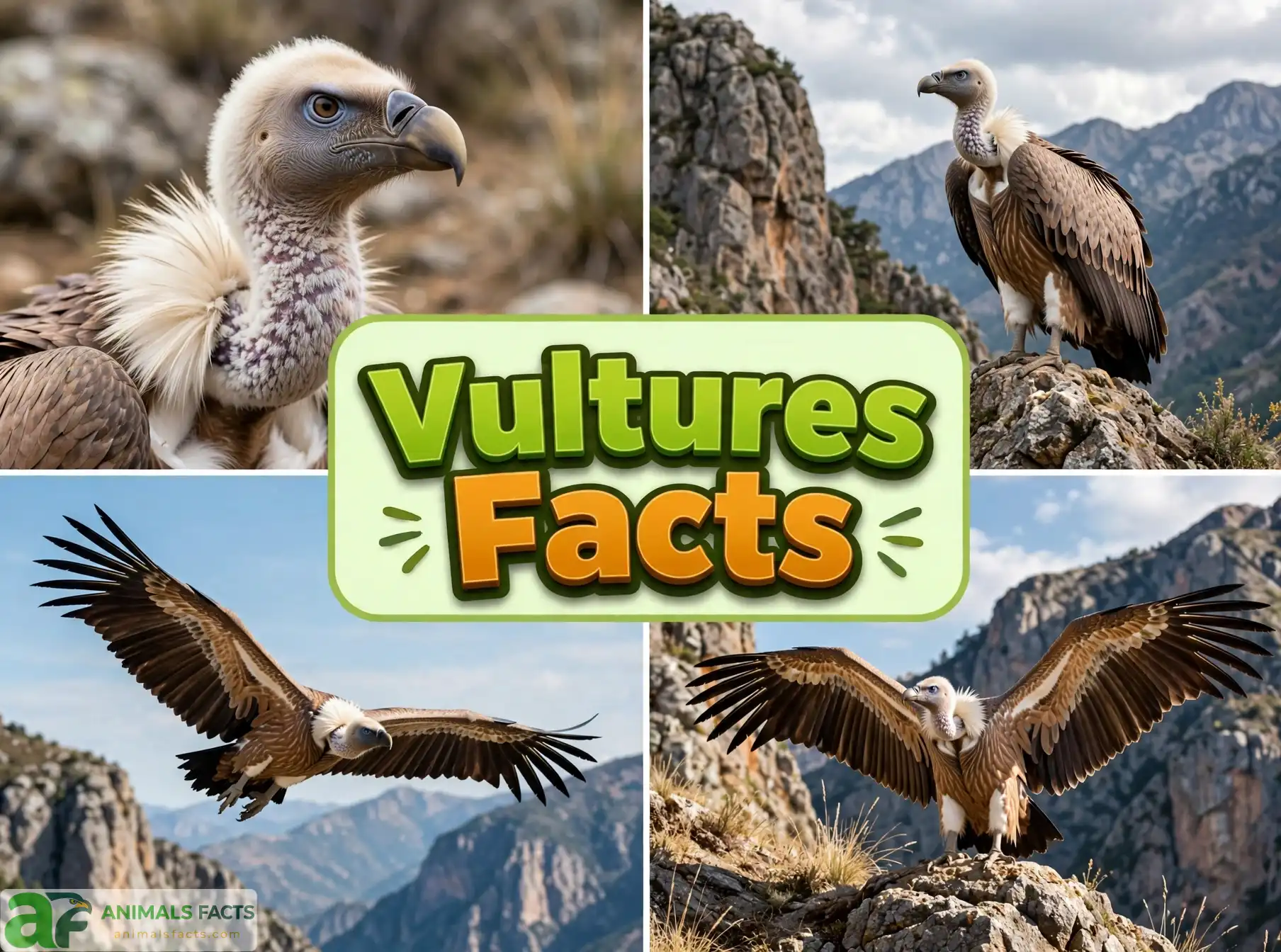
Hey amazing young wildlife scientists, conservation heroes, and animal enthusiasts! Here are some truly extraordinary vulture facts for kids that will completely change how you think about these extraordinary birds:
- 🦅 Vultures have STOMACH ACID AS STRONG AS BATTERY ACID! A vulture’s stomach is so incredibly acidic that it can destroy anthrax — one of the deadliest bacterial diseases on Earth. When a vulture eats an animal that died of anthrax or other terrible diseases, the acid in its stomach destroys every last germ before it can pass through. No other animal can safely eat diseased carcasses like this. Vultures are basically living hazmat disposal systems!
- 🦅 A vulture flies HIGHER than a commercial airplane! In 1973, a Rüppell’s vulture was struck by an airplane flying at 11,300 meters — that is 37,000 feet, the same altitude that passenger jets cruise at. No other bird has ever been confirmed flying that high. The vulture’s blood has special adaptations that allow it to extract enough oxygen to survive at altitudes where most other animals would pass out from lack of oxygen!
- 🦅 Turkey vultures can SMELL dead animals from over a kilometer away! Most birds cannot smell at all — or only very poorly. But the turkey vulture has an enormous smell-detecting brain region and can detect the scent of a dead animal from more than a kilometer and a half away. Gas companies actually USE turkey vultures to find underground gas leaks — they release a smelly chemical into gas pipes and then watch where turkey vultures gather above the ground to find where the gas is escaping!
- 🦅 There was ONE type of vulture reduced to just 27 birds in the ENTIRE WORLD! In 1987, the California condor — the largest flying bird in North America — had only 27 individuals left alive anywhere on Earth. Scientists captured all 27 and bred them in zoos. Today there are over 500 condors alive! The California condor is one of the greatest wildlife comeback stories in history — going from 27 birds to 500+ through decades of dedicated conservation work!
- 🦅 One vulture deliberately DYES ITS OWN FEATHERS as a fashion statement! The bearded vulture bathes in iron-rich red mud to turn its white and cream feathers orange-red. Scientists have discovered this is a social signal — the more brightly colored a bird’s feathers are, the more dominant it is. The bearded vulture is the ONLY bird in the world known to deliberately color its own feathers for social communication — essentially applying its own natural dye!
- 🦅 One vulture uses ROCKS AS TOOLS to crack open eggs! The Egyptian vulture picks up stones in its beak and throws them repeatedly at ostrich eggs until the egg cracks open. This makes it one of only a tiny number of bird species on Earth that uses tools! The rock-throwing is learned by watching other vultures — young Egyptian vultures that have never seen an ostrich egg do not know how to use stones until they observe adults doing it!
- 🦅 Vultures clean up diseases that would KILL THOUSANDS OF PEOPLE! When India’s vulture population crashed because of a single veterinary drug, feral dog populations exploded — because there were suddenly millions of dog-food-sized animal carcasses sitting around that the vultures used to eat. The extra dogs spread more rabies. Scientists calculated that the vanishing vultures cost India’s public health system the equivalent of 34 BILLION DOLLARS per year — that is how valuable these birds are to keeping us safe from disease!
- 🦅 New World vultures are more closely related to STORKS than to hawks! Scientists were shocked to discover that turkey vultures, black vultures, and condors are not actually close relatives of Old World vultures (griffons, Egyptian vultures) — despite looking so similar. DNA analysis revealed that New World vultures evolved from stork-like ancestors completely separately. They look like Old World vultures because they do the same job, not because they are related. It is one of the most remarkable coincidences of evolution!
12. Relationship with Humans
The vulture’s relationship with humans is one of the most complex and most consequential in the animal kingdom — spanning ancient spiritual traditions that placed vultures at the center of cosmological systems, a lengthy persecution history that drove multiple species to near-extinction, the most catastrophic accidental poisoning event in the history of wildlife conservation, and a growing recognition of the vulture’s essential ecological and public health role that is driving increasingly urgent conservation responses.
Ancient Human-Vulture Relationships
Parsi sky burial (Tower of Silence) — The Zoroastrian Parsi community’s practice of sky burial — exposing human dead on elevated platforms called Dakhmas (Towers of Silence) for vultures to consume — represents one of the most profound human-vulture relationships in any culture:
The theological basis — In Zoroastrian theology, the four elements (fire, earth, water, air) are sacred and must not be contaminated by the decomposing dead. Burial contaminates earth; cremation contaminates fire and air; water burial contaminates water. The exposure of the dead to vultures — which consume the flesh efficiently and quickly, with the bones subsequently dried and collected — avoids contaminating any of the four sacred elements.
The practice — In traditional practice, the Parsi dead are brought to the Tower of Silence, placed on the elevated circular platform, and rapidly consumed by vultures — typically within minutes to hours. The bleached bones are subsequently gathered and placed in a central pit.
The diclofenac catastrophe — When the vulture population of the Indian subcontinent collapsed following diclofenac introduction in the 1990s, the Parsi community’s sky burial practice was directly affected — without vultures, the bodies placed on the Towers of Silence did not decompose efficiently, creating hygiene problems and profound theological and cultural distress for the Parsi community.
The conservation consequence — The Parsi community’s urgent need for vulture restoration made them a powerful ally in the campaign to ban diclofenac — their religious and cultural interest in vulture conservation providing a uniquely compelling argument for regulatory action.
Egyptian sun worship and Nekhbet — In ancient Egyptian religion, the vulture goddess Nekhbet — depicted as a white vulture — was one of the most important protective deities of the pharaoh. Nekhbet was the patron of Upper Egypt and one of the “Two Ladies” that protected the pharaoh — the vulture crown (hedjet) worn by pharaohs as one of the fundamental symbols of royal authority.
Pre-Columbian Mesoamerican traditions — Various Mesoamerican civilizations, including the Maya and Aztec, incorporated vulture imagery into religious and cosmological systems — the king vulture (Sarcoramphus papa) appearing in Maya codices and the turkey vulture associated with death and transformation in various Mesoamerican mythologies.
African traditional beliefs — Across sub-Saharan Africa, vultures occupy complex positions in traditional belief systems — simultaneously revered as powerful spiritual beings (their ability to locate distant carcasses interpreted as supernatural vision or precognition) and feared as symbols of death and misfortune. The same cultural associations that create reverence also drive persecution in some contexts.
The Diclofenac Catastrophe — The Most Important Vulture-Human Story
The collapse of South Asian vulture populations following the introduction of diclofenac in the 1990s is the most important and most consequential event in the history of vulture-human interaction:
What is diclofenac? — A non-steroidal anti-inflammatory drug (NSAID) used in human medicine for decades as a pain reliever and anti-inflammatory. In the early 1990s, diclofenac was approved for veterinary use on the Indian subcontinent — used extensively in cattle and water buffalo to treat arthritis, fever, and post-surgical pain.
The toxicity mechanism — Vultures that consume the carcasses of animals treated with diclofenac shortly before death experience visceral gout — the drug interferes with uric acid excretion, causing uric acid crystals to deposit in the organs. Death typically occurs within days of consuming a single diclofenac-treated carcass, and the minimum toxic dose is extremely small relative to the concentrations present in treated livestock.
The population collapse timeline:
- ~1994 — First documented vulture mortality events linked to diclofenac
- 1996–2000 — Population collapse accelerates; surveys document 97%+ decline in white-rumped vulture, Indian vulture, and slender-billed vulture populations
- 2000 — The scientific community recognizes the scale of the crisis; research confirms diclofenac as the primary cause
- 2006 — India bans veterinary diclofenac; Pakistan and Nepal follow
- 2008 — Some signs of stabilization in areas where meloxicam (a safe alternative NSAID) replaces diclofenac
- 2013 — European veterinary diclofenac formulations appear on the market; concern that the South Asian disaster may be replicated in Europe where griffon vultures feed on livestock carcasses
The public health consequences — The vulture population collapse has had directly measurable public health consequences in South Asia:
- Feral dog population increase — with millions of livestock carcasses suddenly available for dog exploitation rather than vulture consumption, feral dog populations in India increased by an estimated 5–7 million dogs in the decade following the vulture collapse
- Rabies increase — the feral dog population increase drove increased rabies transmission; India has the world’s highest rabies death toll (approximately 20,000 deaths per year), and the increase in feral dog populations attributable to vulture loss has contributed to this burden
- Other diseases — rates of anthrax, cholera, and other diseases have been modeled to have increased in areas of greatest vulture loss, though direct attribution is complex
The $34 billion calculation — A comprehensive economic analysis published in Ecological Economics estimated the annual ecosystem services value of the Indian subcontinent’s pre-collapse vulture population at approximately $34 billion — including waste disposal value (cost of replacing vulture carcass processing with other disposal methods), disease prevention value (reduction in infectious disease burden), and other services.
The Poisoning Crisis in Africa
While the South Asian crisis was driven by a pharmaceutical compound, African vulture populations are being decimated by deliberate poisoning:
The poaching connection — Vultures circling above a poached elephant or rhinoceros carcass provide a visible beacon to anti-poaching rangers and aerial surveillance — the concentration of vultures makes poached carcasses visible from aircraft at distances far beyond direct visual detection. Poachers increasingly lace elephant and rhino carcasses with carbofuran (a highly toxic agricultural pesticide) to kill the vultures and prevent detection.
The scale — Single poisoning events at poached elephant carcasses have been documented killing 100–600 vultures. Multiple documented poisoning events across southern and East Africa have collectively killed an estimated hundreds of thousands of vultures over the past decade.
The collateral effects — Carbofuran poisoning at vulture poisoning events also kills other scavengers — hyenas, jackals, lions, and various other species that may share the poisoned carcass.
The traditional medicine demand — Vulture body parts (particularly the brain) are used in traditional medicine (muti) across parts of southern Africa — the belief that consuming vulture brain confers the bird’s supposed precognitive abilities (its “ability to see the future” in locating carcasses before death) creating a demand that drives targeted vulture killing. This trade, combined with poaching-related poisoning, is devastating southern African vulture populations.
13. Vulture Conservation Status & Threats
Conservation Status Overview — The Most Acute Bird Conservation Crisis in the World
| Species | IUCN Status | Population Trend | Est. Population Change (50 years) |
|---|---|---|---|
| White-backed vulture | Critically Endangered | Decreasing | -80% |
| White-rumped vulture | Critically Endangered | Decreasing | -99% |
| Indian vulture | Critically Endangered | Decreasing | -97% |
| Slender-billed vulture | Critically Endangered | Decreasing | -97% |
| Hooded vulture | Critically Endangered | Decreasing | -80% |
| White-headed vulture | Critically Endangered | Decreasing | -70% |
| Red-headed vulture | Critically Endangered | Decreasing | -90% |
| Rüppell’s vulture | Critically Endangered | Decreasing | -50% |
| Lappet-faced vulture | Endangered | Decreasing | -60% |
| Egyptian vulture | Endangered | Decreasing | -50% |
| Cape vulture | Vulnerable | Decreasing | -30% |
| Cinereous vulture | Near Threatened | Increasing (Europe) | Recovery in progress |
| Bearded vulture | Near Threatened | Increasing (Europe) | Recovery in progress |
| Griffon vulture | Least Concern | Stable/Increasing | Recovery in Europe |
| California condor | Critically Endangered | Increasing | Recovery from 27 → 537 |
| Andean condor | Vulnerable | Decreasing | -20% |
| Turkey vulture | Least Concern | Stable | Stable/slight increase |
| Black vulture | Least Concern | Stable/Increasing | Increasing |
Major Threats
| Threat | Description | Affected Species | Geographic Focus |
|---|---|---|---|
| Diclofenac and NSAIDs | Veterinary drug toxicity from treated livestock carcasses | All South Asian Gyps; emerging threat in Europe | South Asia; Mediterranean Europe |
| Deliberate poisoning by poachers | Carbofuran-laced carcasses to prevent vulture detection | All African species | Sub-Saharan Africa |
| Traditional medicine demand | Vulture brain and body parts used in muti | African species; some Asian | Southern Africa; South Asia |
| Lead poisoning | Lead ammunition fragments in carcasses | California condor (critical); Old World species | North America; global |
| Power line electrocution | Contact with high-voltage lines | All species; particularly large vultures | Global — all inhabited continents |
| Collision with wind turbines | Blade strikes during soaring | Griffon vulture; California condor | Europe; USA |
| Habitat loss | Loss of large mammal prey populations; agricultural expansion | All species | Global |
| Food scarcity | Decline of large wild ungulate populations; sanitary disposal regulations | Old World species especially | Europe; Asia; Africa |
| Persecution | Shooting by farmers who blame vultures for livestock death | Various species | Global; particularly Middle East and Africa |
| Nest disturbance | Human disturbance at cliff nesting colonies | Colonial species (griffon, Cape vulture) | Europe; Africa |
The European Griffon Vulture — A Success Story
In contrast to the catastrophic declines across Africa and Asia, the European griffon vulture (Gyps fulvus) represents one of the great vulture conservation successes:
The population low — European griffon vulture populations reached their lowest point in the mid-20th century — persecution, poisoning, and food scarcity reducing the species to a few hundred pairs in the Pyrenees and isolated Mediterranean populations.
The recovery — Legal protection, reduced persecution, the establishment of vulture restaurants (feeding stations providing clean carcasses), and reintroduction programs in France, Switzerland, Germany, and Italy have driven extraordinary recovery:
- Spain — the European stronghold; population recovered from approximately 3,000 pairs in 1980 to approximately 25,000 pairs by 2024
- France (Pyrenees) — from near-extinction to several hundred pairs
- Reintroductions in central Europe — successful breeding populations established in France, Switzerland, Austria, and Germany
The sanitary regulation problem — European Union regulations requiring the disposal of livestock carcasses (to prevent disease transmission) have reduced the food available to vultures — a conservation concern that has been partially addressed by exemptions allowing carcass provision to vultures in designated areas.
The California Condor — The Greatest Conservation Achievement
The California condor’s recovery from 27 individuals to 537 as of 2026 is the most dramatic endangered species recovery in American history:
The lead poisoning ongoing challenge — Despite the population recovery, lead poisoning from ammunition fragments in carcasses remains the primary mortality cause for free-flying California condors. Condors consuming deer, elk, and other carcasses shot with lead ammunition ingest lethal quantities of lead from bullet fragments. Condor populations in California, Arizona, and Baja California require regular blood lead monitoring and chelation therapy (lead removal treatment) for birds with elevated blood lead.
The California lead ammunition ban — California enacted a statewide ban on lead ammunition for all hunting in 2019 — the most comprehensive lead ammunition ban of any state or country. The ban’s impact on condor lead exposure is being monitored as the 2024–2026 hunting seasons proceed under the new regulations.
The reintroduction sites — Free-flying California condors now exist at multiple sites:
- Big Sur/Pinnacles, California — the original reintroduction site; largest free-flying group
- Grand Canyon/Vermilion Cliffs, Arizona — second major reintroduction; natural breeding now occurring
- Baja California, Mexico — international reintroduction program
- Pacific Northwest (Nevada, Utah) — range expanding as population grows
14. Famous Vultures in History & Pop Culture
Famous Individual Vultures
Condor AC-9 — The Last Wild California Condor — AC-9 (Adult Condor Number 9, also known as “Igor”) was the last wild California condor captured for the captive breeding program on April 19, 1987 — the moment when the wild California condor ceased to exist as a wild population for the first time in approximately 10,000 years. Igor’s capture was a moment of enormous emotional significance in American conservation — the necessary act that would lead to the species’ recovery, simultaneously representing the nadir of a species’ history. Igor survived in captivity until 2002 and produced captive-bred offspring that are ancestors of current free-flying condors.
Condor 305 — The First Wild-Hatched Condor Since 1987 — Condor 305 — hatched in the Grand Canyon area in 2003 — was the first California condor to hatch in the wild since the captive breeding program began, representing the moment when the condor’s recovery transitioned from a captive-breeding success to a genuine wild population restoration. The news of Condor 305’s successful wild hatching generated national media coverage and was celebrated by conservationists as one of the most significant positive wildlife events in American history.
The Parsi Community’s Sacred Vultures — The vultures that for centuries consumed the Parsi community’s dead at the Towers of Silence in Mumbai — particularly Doongerwadi (the Tower of Silence on Malabar Hill) — are not individually famous but collectively constitute the most culturally significant vulture population in human history. The disappearance of these birds following the diclofenac collapse of the 1990s caused genuine spiritual and cultural crisis in the Parsi community and was one of the most emotionally significant wildlife losses associated with the South Asian vulture collapse.
“Condorito” — The most famous vulture in South American popular culture — a fictional Andean condor character created by Chilean cartoonist Pepo (René Ríos Boettiger) in 1949. Condorito is one of the most widely read comic strip characters in Latin American history — the condor character combining elements of the Andean cultural significance of the real condor with a comedic, everyman personality. Condorito appears in newspapers across Latin America and has been adapted into various animated productions.
Historical and Cultural Significance
Nekhbet — The Vulture Goddess — The Egyptian vulture goddess Nekhbet was among the most important protective deities in the Egyptian pantheon — appearing on the pschent (double crown of Egypt) worn by pharaohs, on temple walls, and in royal tomb decorations across thousands of years of Egyptian civilization. The vulture crown (hedjet) is one of the most fundamental symbols of Upper Egyptian kingship. Nekhbet’s association with maternity and protection — the vulture spreading its wings over the pharaoh as a mother spreads wings over her chicks — makes the vulture one of the foundational protective symbols of ancient Egyptian civilization.
The Andean Condor in Inca Culture — The Andean condor occupied a supreme position in Inca cosmology — representing the upper world (hanan pacha) in the Andean three-world cosmological system. The condor’s ability to fly at extraordinary altitudes connected it to the celestial realm and the supreme Inca deity Inti (the sun god). The condor appears extensively in Inca textile, ceramic, and stone carving traditions, and remains the most important animal symbol across the Andean cultures of Peru, Bolivia, Ecuador, Colombia, Chile, and Argentina.
15. Role in Ecosystem & Food Chain
The Ecosystem Service — Nature’s Most Essential Cleanup Crew
The vulture’s ecosystem function is more essential to ecosystem health than that of any other bird — and possibly more essential than that of any other vertebrate group:
Carcass removal speed — Research in the East African savanna has documented the extraordinary speed of vulture carcass processing:
- Small carcass (impala, ~60 kg) — complete soft tissue removal in 2–4 hours with 50–100 vultures present
- Medium carcass (wildebeest, ~220 kg) — complete soft tissue removal in 6–12 hours
- Large carcass (zebra, ~350 kg) — complete soft tissue removal in 12–24 hours
- Very large carcass (elephant, ~3,000 kg) — multiple days, but vulture processing rate dramatically exceeds decomposition rate
Without vultures — Where vultures are absent (as in South Asia following the diclofenac collapse), carcasses persist for days to weeks, creating:
- Persistent disease reservoirs — anthrax spores released from decomposing carcasses
- Attraction of and resource support for feral dogs, rats, and other disease vectors
- Nutrient concentration rather than dispersal
- Odor and aesthetic impacts in human-adjacent areas
The disease control function — The most critical ecosystem service:
- Anthrax (Bacillus anthracis) — vultures are immune; consuming anthrax-infected carcasses destroys spores that would otherwise persist in soil for decades, reducing environmental anthrax burden
- Rabies — vultures cannot be infected by rabies through the oral route; their consumption of rabid animal carcasses reduces the persistence of rabies virus in the environment
- Cholera, typhoid, botulism — destroyed by vulture stomach acid; vulture consumption reduces environmental pathogen loads across a range of waterborne and soil-borne diseases
The nutrient cycling function — Vulture defecation at roost sites concentrates nutrients (nitrogen, phosphorus) from wide areas into specific locations — creating localized soil nutrient enrichment at roost trees and cliff faces that supports distinctive plant communities.
The Ecological Cascade From Vulture Loss
Research following the South Asian vulture collapse has provided direct evidence of the cascading ecological effects of removing vultures from an ecosystem:
The dog-rabies cascade — Feral dog population increase → increased dog-to-dog rabies transmission → increased dog-to-human rabies transmission → increased human rabies deaths. This cascade has been directly modeled using population data from India, Pakistan, and Bangladesh.
The disease persistence cascade — Reduced anthrax carcass removal → increased anthrax spore persistence in soil → increased anthrax outbreaks in subsequent years → additional carcasses → further disease spread.
The economic cascade — Increased disease burden → increased medical costs → increased livestock losses → reduced agricultural productivity → broader economic costs. The $34 billion annual service value estimate encompasses these cascading economic effects.
16. Myths, Folklore & Cultural Significance
The Death Omen Myth — The Most Harmful Vulture Myth
The most culturally damaging vulture myth — and the one most responsible for historical and ongoing vulture persecution — is the association of vultures with death and misfortune as causative rather than consequential:
The myth — Vultures cause death; their presence foretells or brings misfortune; they should be killed or driven away to prevent the death they foretell.
The reality — Vultures detect death (already-dead animals) — they do not cause it. The myth confuses correlation with causation — the vulture arrives where death has occurred, not before.
The consequence — This cultural mythology has driven vulture persecution across Africa, the Middle East, and parts of South and Southeast Asia — contributing to the population declines that make vultures the most threatened bird group globally.
Egyptian and Mediterranean Traditions
Nekhbet — As discussed above, the most significant positive vulture cultural role — the Egyptian vulture goddess as supreme royal protector. The ancient Egyptian association of the vulture with maternal protection (rather than death) represents a culturally sophisticated understanding of the vulture’s ecological role as a preserver of health.
Roman augury — The vulture played a role in Roman augury — the practice of divining the future from bird behavior. Vultures were among the birds whose flight patterns were interpreted by Roman augurs (augures) for military and political decisions. The founding of Rome itself, according to tradition, was settled by vulture augury — Romulus counting 12 vultures versus Remus’s 6, with the larger count deciding in Romulus’s favor.
The Zoroastrian reverence — The Parsi sky burial tradition represents the most sophisticated cultural understanding of vulture ecological function in any historical culture — the vulture’s role in disposing of the dead understood as spiritually essential rather than repugnant.
The Andean Condor in Indigenous Cosmology
The three worlds — The Andean condor’s cosmological position in Andean indigenous traditions is among the most elevated of any animal in any culture:
- The condor represents the upper world (hanan pacha) — the realm of the sun, stars, and divine power
- The puma represents the middle world (kay pacha) — the earthly realm of human life
- The snake represents the lower world (ukhu pacha) — the underworld realm of the ancestors
The condor as divine messenger — In various Andean traditions, the condor’s extraordinary soaring altitude allows it to carry messages between the human world and the divine realm — the condor acting as intermediary between living humans and the celestial powers.
The Yawar Fiesta (Peru) — A controversial Andean festival in which a condor is tied to the back of a bull — the condor pecking at the bull while traditional bullfighting occurs. The condor, after the event, is released back to the wild. The festival represents a synthesis of indigenous Andean condor reverence and post-colonial Spanish bullfighting culture, and has been the subject of significant debate regarding animal welfare and cultural preservation.
17. Vultures in Pop Culture
“Vulture” as a character type in fiction — The vulture’s cultural association with opportunistic exploitation of others’ misfortune has made “vulture” a standard metaphorical character type in fiction — the journalist, lawyer, or businessman who arrives at a scene of disaster to exploit it being described as “vulture-like” across Western literature and film.
Disney’s “The Jungle Book” (1967) — The four vultures who befriend Mowgli in the original Disney animated film — Buzzie, Flaps, Dizzy, and Ziggy — are among the most famous fictional vulture characters in American animation history. The vultures were designed to resemble The Beatles (with Liverpudlian accents), and the project initially approached the band to provide voices (they declined). The vultures are notable for being depicted positively — as friendly, if melancholy, characters rather than villains.
“The Lion King” (Disney, 1994) — Vultures appear as minor characters in The Lion King in their typical cultural role as death symbols — circling above the scene of Mufasa’s death and appearing in other dark contexts. This depiction reinforces the negative cultural association that contributes to vulture persecution.
“Vulture” — Marvel Comics villain — The Vulture (Adrian Toomes) is one of Spider-Man’s oldest and most persistent antagonists — a winged villain whose wing design is modeled on vulture wings. The character has appeared in multiple Spider-Man films including the MCU’s Spider-Man: Homecoming (2017) where he is portrayed by Michael Keaton.
Real-life conservation social media — The California condor’s extraordinary recovery story — particularly the dramatic images of individually tagged condors at Big Sur and the Grand Canyon, and the dramatic contrast between the 27-individual low of 1987 and the 500+ population of 2026 — has made the California condor one of the most effective conservation communication subjects in social media. The individual identification (through wing tags and recently through facial recognition software) of specific condors allows conservation organizations to tell individual stories that generate extraordinary public emotional engagement.
Nature documentaries — Multiple landmark BBC and National Geographic productions have featured vulture content — including “Planet Earth” (BBC, 2006), “Africa” (BBC, David Attenborough, 2013), and various dedicated vulture documentary productions. The footage of African vulture feeding events — hundreds of birds converging on a carcass, the boiling activity of mass feeding — is among the most frequently used and most immediately recognizable footage in nature documentary history.
18. Vulture Facts vs. Common Myths
| Common Myth | The Real Fact |
|---|---|
| “Vultures circle dying animals waiting for them to die” | False — vultures locate already-dead animals through sight (most species) or smell (turkey vulture). They do not circle living animals waiting for death — they arrive after death has occurred |
| “Vultures spread disease” | The opposite is true — vultures are the most effective disease prevention mechanism in the terrestrial ecosystem. Their stomach acid destroys anthrax, cholera, botulism, and rabies — removing these pathogens from the environment rather than spreading them |
| “Vultures are related to hawks and eagles” | Only Old World vultures (Accipitridae) are related to hawks and eagles. New World vultures (Cathartidae) are more closely related to storks than to any raptor |
| “Vultures are lazy birds that never hunt” | Partially false — while most vultures are primarily scavengers, some species (including the black vulture and lappet-faced vulture) occasionally kill weak, sick, or very young animals. The Egyptian vulture actively uses tools. The accusation of “laziness” fundamentally misunderstands ecological specialization |
| “Vultures kill livestock” | Largely false — vultures overwhelmingly consume already-dead animals. While black vultures have been documented taking very weak or dying animals, their role in livestock loss is minuscule compared to the farm losses they prevent through disease control. The perception drives persecution that harms populations performing essential services |
| “Vultures are dirty birds” | The opposite is true — vultures are among the most hygienic birds in the world. Their stomach acid destroys pathogens; they sun their wings to kill bacteria; their urine has antibacterial properties. A vulture’s feeding activities clean the environment of dangerous biological material |
| “The California condor is saved” | Partially false — the California condor has been saved from immediate extinction but remains Critically Endangered. Lead poisoning from ammunition continues to cause significant mortality; the wild population cannot yet sustain itself without captive breeding support and regular medical intervention |
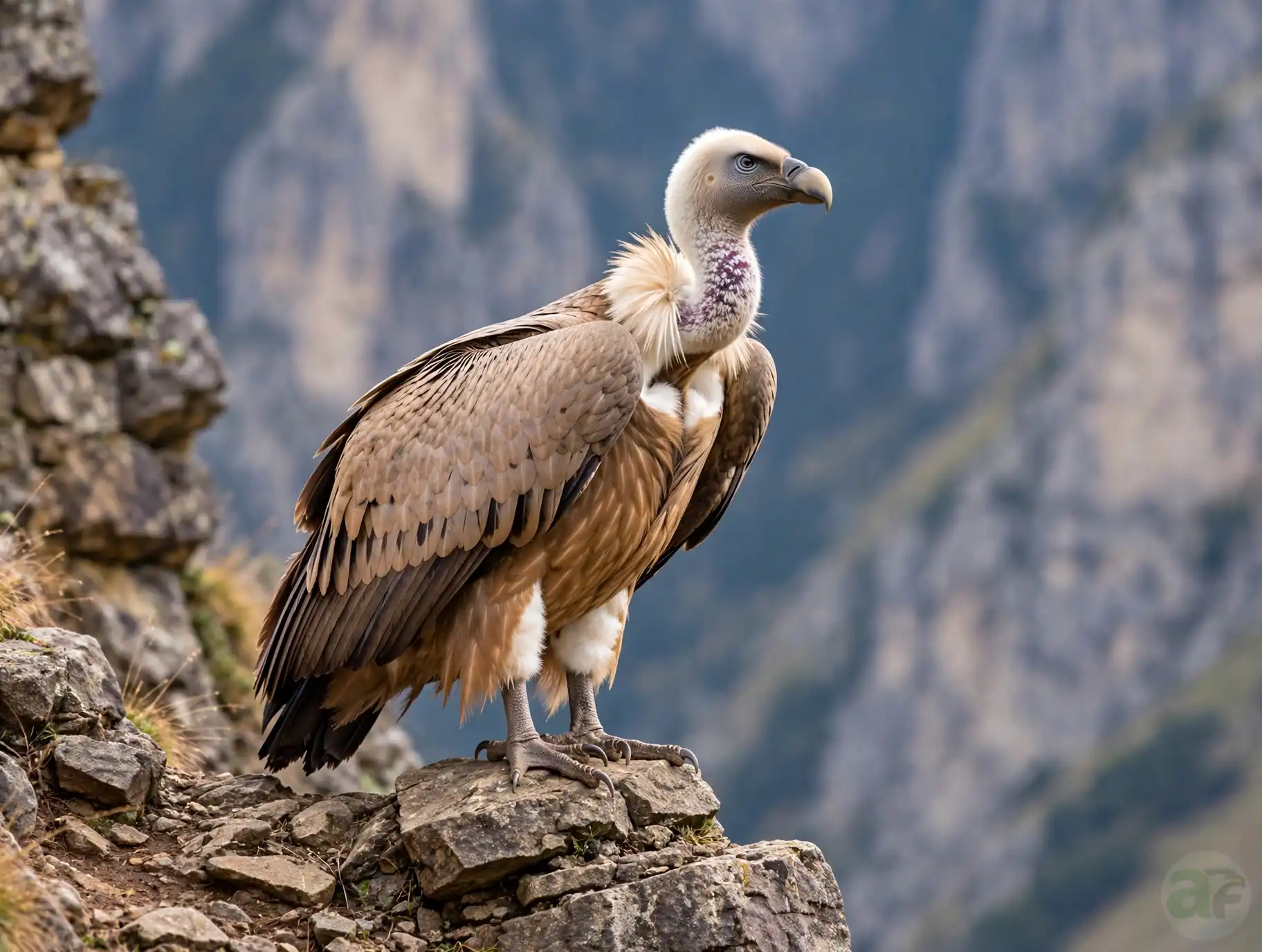
19. Best Places to See Vultures in the Wild
Africa — The Most Spectacular Vulture Experiences
1. Masai Mara National Reserve, Kenya / Serengeti National Park, Tanzania — The African savanna vulture experience par excellence; during the Great Migration (July–October), the concentration of wildebeest, zebra, and various predators creates abundant carcasses that attract extraordinary concentrations of white-backed vultures, Rüppell’s vultures, lappet-faced vultures, and hooded vultures. Witnessing a hundred vultures descend on a fresh carcass within minutes of a lion kill is one of the most powerful wildlife experiences available anywhere in the world.
2. Kruger National Park, South Africa — Year-round vulture viewing in one of Africa’s best-managed protected areas; white-backed vultures, Cape vultures, and occasionally lappet-faced vultures visible at carcasses and soaring above the bushveld. The combination of excellent road infrastructure, abundant wildlife, and high vulture density makes Kruger one of the most accessible African vulture viewing destinations.
3. Etosha National Park, Namibia — Particularly productive in the dry season (May–October) when water holes concentrate wildlife and create carcass opportunities for vultures. The open, pale terrain of Etosha makes vultures visible from great distances.
Europe — The Recovering Vulture Populations
4. Pyrenees, Spain/France — The most important European vulture watching destination; the gorges of Ordesa, Riglos, and Riglos Canyon in the Spanish Pyrenees host griffon vultures in extraordinary concentrations — hundreds of birds visible soaring above the gorge walls on good thermal days. Bearded vultures — one of Europe’s rarest raptors — are also present and increasingly visible following decades of recovery.
5. Coto Doñana and the Extremadura plateau, Spain — Spain’s premier vulture watching region outside the Pyrenees; griffon vultures in extraordinary numbers in the dehesa (cork oak savanna) landscape of Extremadura. Vulture restaurants (feeding stations providing carcasses to vultures in designated areas) in various Extremadura locations provide close-range views of multiple species.
6. Sardinia and Sicily (Italy) — Griffon vulture populations on both large Mediterranean islands; the dramatic cliff coastlines providing excellent soaring observation conditions.
Americas — Condors and Turkey Vultures
7. Big Sur Coast, California, USA — California condors are regularly seen soaring above the dramatic coastal cliffs of Big Sur — the combination of marine thermal uplift and the condors’ use of coastal carcasses (sea lions, whales) making this one of the most reliable California condor viewing locations accessible to general visitors. Viewing from McWay Falls and Bixby Creek Bridge areas produces reliable sightings.
8. Grand Canyon National Park, Arizona, USA — One of the most reliably productive California condor viewing sites in the United States; condors regularly soar above the canyon rim and are visible from multiple rim viewpoints. The canyon thermals are particularly productive for condor soaring and the birds are relatively habituated to human presence.
9. Colca Canyon, Peru — The most dramatic Andean condor viewing site in South America; the Cruz del Condor viewpoint on the canyon rim is specifically positioned above a thermal column that condors use every morning — visitors arriving before 9 AM can watch condors rise from the canyon depths on morning thermals, passing within meters of the viewpoint. Reliably one of the most spectacular wildlife experiences in South America.
10. Turkey vulture roosts — Any rural North America — For the most accessible vulture experience in North America; turkey vultures roost communally in trees and on structures across rural areas throughout the eastern and central United States. Finding an active roost (which can contain dozens to hundreds of birds) and watching the morning departure as birds sun their wings and gradually launch into the thermals is easily accessible and genuinely impressive.
20. How You Can Help
Supporting vulture conservation requires action differentiated by geographic context and threat type — from pharmaceutical reform advocacy to lead ammunition transition to direct funding of conservation programs.
Support these organizations:
- The Peregrine Fund — peregrinefund.org — comprehensive vulture conservation programs in Africa and Asia; African vulture monitoring; California condor program
- Vulture Conservation Foundation (VCF) — 4vultures.org — dedicated European vulture conservation; bearded vulture reintroduction; policy advocacy
- BirdLife International — birdlife.org — coordinates global vulture conservation through the African-Eurasian Vulture Platform and other programs
- SAVE (Saving Asia’s Vultures from Extinction) — save-vultures.org — coordinating South Asian vulture conservation and diclofenac phase-out monitoring
- Endangered Wildlife Trust (EWT) — ewt.org.za — South African vulture conservation including Cape vulture colony monitoring and poisoning response
- California Condor Recovery Program / US Fish and Wildlife Service — fws.gov/condor — the governmental program managing condor recovery
- Hawk Mountain Sanctuary — hawkmountain.org — vulture migration monitoring and education
Critical individual actions:
- Switch to non-lead ammunition — the single most important action for California condor conservation; condor lead poisoning from ammunition fragments in carcasses is the primary mortality cause for free-flying birds. Copper ammunition is widely available and performs comparably to lead; California’s statewide lead ammunition ban provides a model for other states and countries
- Support diclofenac-free NSAID policies — advocating for complete bans on veterinary diclofenac and related toxic NSAIDs (ketoprofen, nimesulide) in areas where Old World vultures feed on livestock carcasses directly prevents the South Asian disaster from being replicated in Europe and other areas
- Oppose traditional medicine demand — reducing demand for vulture body parts through education and advocacy; supporting campaigns in South Africa, Nigeria, and other countries where muti trade drives vulture killing
- Power line safety advocacy — supporting utility company programs to insulate or modify dangerous power line structures that cause vulture electrocution; one of the most cost-effective vulture mortality reductions available
- Visit vulture watching sites — ecotourism revenue at Colca Canyon, the Spanish Pyrenees, and other vulture sites provides economic arguments for conservation and funds local protection programs
- Spread vulture awareness — the vulture’s cultural reputation as a death symbol rather than an ecological hero is the single most significant barrier to the public support that vulture conservation requires; sharing accurate information about vulture ecological service is the most accessible individual contribution to changing this perception
21. Top Documentaries & Books
Must-Watch Documentaries
- “Africa” (BBC, David Attenborough, 2013) — Multiple episodes featuring African vulture ecology; among the most visually spectacular vulture documentary content available
- “The Condor’s Shadow” (various US productions) — Documentary treatments of the California condor recovery program
- “Return of the Condor” (various) — Multiple documentary productions covering the California condor captive breeding and reintroduction story; the most important conservation story in North American wildlife documentary
- “Vulture: Beauty in the Beast” (various wildlife channel productions) — Dedicated vulture documentary treatments addressing ecology and conservation
- “Planet Earth — From Pole to Pole” (BBC, 2006) — Features African vulture feeding sequences among the most widely seen vulture documentary footage in history
- VulPro educational videos — Vulture Programme South Africa’s YouTube channel provides excellent South African vulture conservation documentation
Must-Read Books
- The Condor Question by David Phillips and Hugh Nash — The controversy surrounding the California condor captive breeding decision
- Return of the Condor by John Moir — Narrative account of the California condor’s recovery program; among the best popular accounts of the conservation effort
- Vultures by Darcy Ogada et al. — The most comprehensive popular treatment of African vulture conservation crisis; essential for understanding the current emergency
- The Vulture by various ornithological authors — Multiple technical treatments of vulture ecology and conservation in scientific literature
- Condor: To the Brink and Back by John Nielsen — Definitive popular history of the California condor crisis and recovery
22. Comparison of Major Vulture Species
| Feature | Griffon vulture | White-backed vulture | Bearded vulture | Turkey vulture | California condor | Andean condor |
|---|---|---|---|---|---|---|
| Scientific name | Gyps fulvus | Gyps africanus | Gypaetus barbatus | Cathartes aura | Gymnogyps californianus | Vultur gryphus |
| Max wingspan | 280 cm | 218 cm | 283 cm | 183 cm | 290 cm | 340 cm |
| Max weight | 11 kg | 7 kg | 7.5 kg | 2.3 kg | 11.5 kg | 15 kg |
| Primary food | Soft tissue | Soft tissue | Bone (80–90%) | Carrion (all sizes) | Large carcasses | Large carcasses |
| Hunting/finding method | Visual (social) | Visual (social) | Visual (follows others) | Smell AND sight | Visual (social) | Visual (social) |
| Head feathering | Sparsely feathered | Sparsely feathered | Well-feathered | Bare red | Bare orange-pink | Bare with wattles |
| Conservation | Least Concern | Critically Endangered | Near Threatened | Least Concern | Critically Endangered | Vulnerable |
| Range | Europe, Middle East, N. Africa | Sub-Saharan Africa | Europe, Africa, Asia | Americas (widespread) | Western USA, Mexico | Andes (S. America) |
| Famous for | European recovery | Most common African vulture | Dyes feathers; eats bones | Smells carrion; UV detection | 27 → 537 recovery | Largest wingspan |
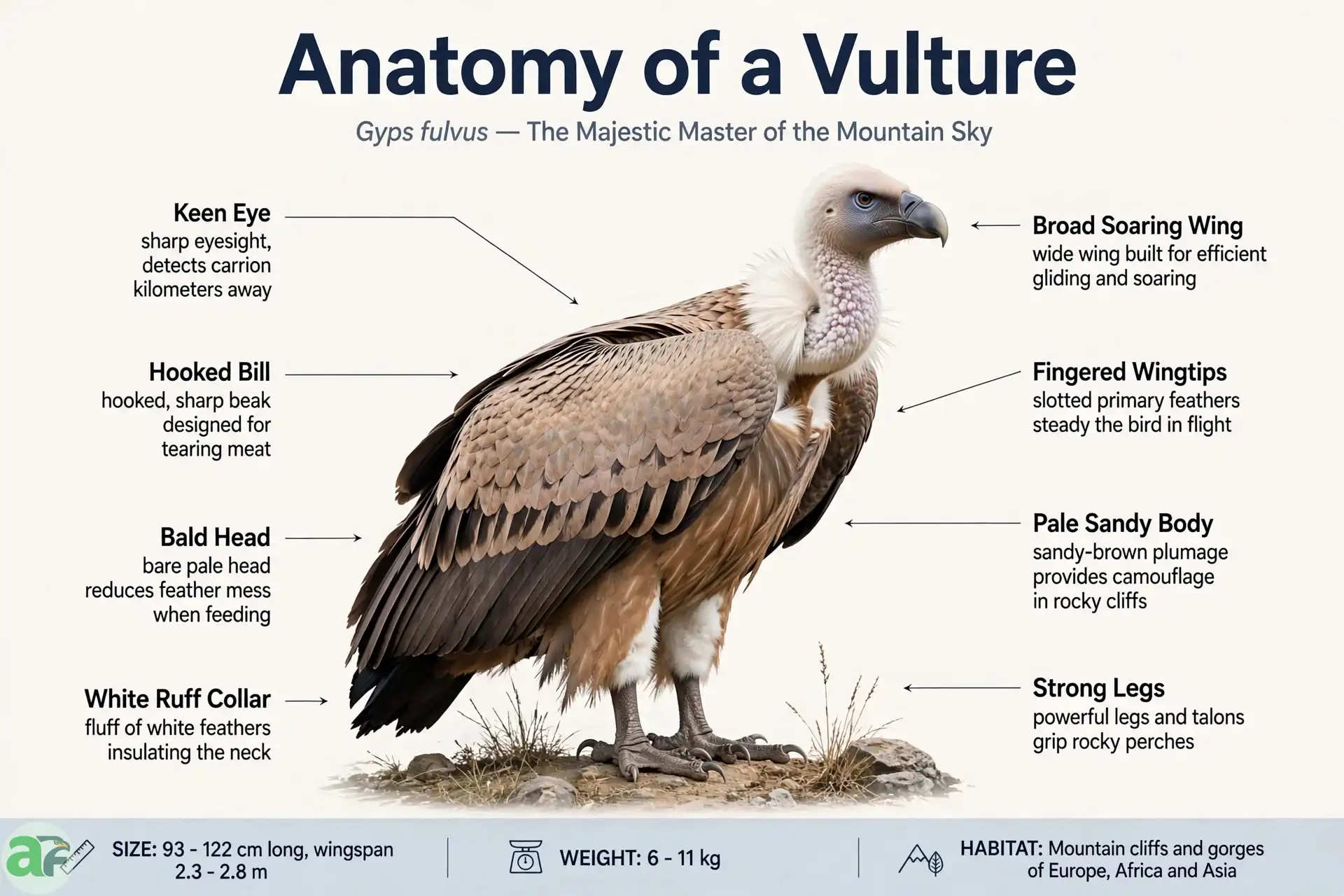
23. Frequently Asked Questions About Vultures
Q1. What is the difference between Old World and New World vultures?
Old World and New World vultures are not closely related despite their similar appearance and ecological role — they represent one of the most dramatic examples of convergent evolution in vertebrate biology. Old World vultures (family Accipitridae, found in Africa, Europe, and Asia) are related to hawks, eagles, and kites — they evolved from a raptor ancestor and share various anatomical features with these birds including complete nasal septums, relatively powerful feet, and no olfactory capability for locating food. They find carcasses primarily by sight — either directly spotting carcasses from altitude or following other vultures that have located food. New World vultures (family Cathartidae, found in the Americas) are more closely related to storks (Ciconiidae) — they evolved from a stork-like ancestor entirely independently. New World vultures have perforated nasal septums (you can see through their nostrils from side to side), weak, chicken-like feet that cannot grasp or kill prey, the unique urohidrosis cooling system (urinating on their own legs), no syrinx (voiceless except for hisses), and — in the turkey vulture group — a sophisticated olfactory system for locating hidden carrion. The similarities between the two groups — bald or sparsely feathered heads, large wingspans, scavenging behavior, soaring flight — all evolved independently as solutions to the same ecological challenge.
Q2. Why is the California condor still endangered if there are now 500+ individuals?
The California condor population’s recovery from 27 individuals in 1987 to over 537 individuals in 2026 is genuinely extraordinary — but the species remains Critically Endangered because the wild population cannot yet sustain itself without ongoing human intervention. The primary reasons: Lead poisoning from ammunition fragments in carcasses is the primary mortality cause for free-flying condors — the birds require regular blood monitoring and medical treatment (chelation therapy to remove lead) to survive. Without this ongoing veterinary intervention, adult mortality would significantly exceed reproductive output. Reproductive rate — condors breed at most every two years and don’t breed until age 6–8, meaning even a modest increase in adult mortality exceeds the population’s capacity to compensate through reproduction. Small population vulnerability — at 537 total individuals (wild and captive combined), the California condor remains highly vulnerable to catastrophic events — a disease outbreak, a major poisoning event, or a series of bad breeding seasons could rapidly reverse decades of progress. California’s statewide lead ammunition ban (fully implemented in 2019) is the most important recent conservation intervention, and monitoring of its impact on condor lead exposure levels will be a critical conservation metric through the late 2020s.
Q3. How did vultures cause a public health crisis in India?
The collapse of Indian subcontinent vulture populations in the 1990s–2000s, caused by the veterinary anti-inflammatory drug diclofenac, created a cascading public health disaster through a chain of ecological consequences. When approximately 99% of the white-rumped, Indian, and slender-billed vulture populations died from consuming carcasses of diclofenac-treated livestock within 15 years, the 150+ million livestock that die annually on the Indian subcontinent suddenly had no efficient biological disposal mechanism. The carcasses that vultures previously removed within hours now persisted for days to weeks. Feral dog populations — which had been limited by competition with vultures for carcass resources — expanded dramatically, with estimates suggesting an additional 5–7 million feral dogs in India in the decade following the vulture collapse. These additional dogs increased dog-to-dog and dog-to-human rabies transmission — India already has the world’s highest rabies death toll (approximately 20,000 deaths per year), and the increased feral dog population has contributed to this burden. Additionally, persistent carcasses increased anthrax, cholera, and other pathogen persistence in the environment. The total economic value of the lost vulture service — combining disease prevention, waste disposal, and related ecological services — was calculated at approximately $34 billion annually for the Indian subcontinent, making the diclofenac-driven vulture collapse one of the most economically costly wildlife losses ever quantified.
Q4. What is the bearded vulture’s extraordinary diet?
The bearded vulture (Gypaetus barbatus) is the only animal whose diet consists of approximately 80–90% bone — a dietary specialization with no parallel in any other vertebrate. The bearded vulture collects large bones from carcasses after other scavengers have removed the soft tissue. It then carries these bones to a specific rocky area called an ossary — a traditional platform the bird uses consistently over many months or years — and drops them from heights of 50–80 meters above the rocks below. The impact shatters the bones, exposing the bone marrow — the fat-rich tissue inside long bones — that the bird then consumes along with the bone fragments themselves. The bearded vulture’s stomach acid is sufficiently concentrated to dissolve bone fragments up to 25–30 cm in length, extracting the calcium and fat content. This extraordinary dietary specialization gives the bearded vulture exclusive access to a food resource that no other predator can efficiently exploit — the bones that all other scavengers leave behind. The dietary specialization is reflected in the bird’s anatomy — a very wide gape (for swallowing large bone fragments), an unusually muscular and acid-tolerant digestive system, and a behavioral repertoire centered entirely around bone collection, transport, and breaking. The bearded vulture’s extraordinary diet is the most complete dietary specialization of any large bird.
Q5. Where is the best place to see vultures in the wild?
The answer depends on geographic location and what type of vulture experience you want. For the most spectacular Old World vulture spectacle, the East African savanna — particularly Masai Mara National Reserve (Kenya) or Serengeti National Park (Tanzania) during or after the Great Migration (July–October) — provides the most extraordinary vulture watching available anywhere in the world. During a lion or cheetah kill, hundreds of vultures can descend from the sky within minutes, creating one of wildlife observation’s most powerful experiences. For European vultures, the Spanish Pyrenees — particularly the Ordesa National Park area and various gorge viewpoints — provides reliable close-range observation of griffon vultures and increasingly frequent bearded vulture sightings following decades of recovery. For California condors, the Colca Canyon in Peru is the world’s most reliable Andean condor viewing site (the Cruz del Condor viewpoint is specifically positioned above a daily thermal condor flight path), while Big Sur coast in California and Grand Canyon National Park in Arizona provide reliable California condor sightings for North American visitors. For everyday vulture watching in North America, turkey vultures at communal roosts across rural eastern and central USA provide readily accessible and genuinely impressive vulture experiences.
24. Sources & References
- Wikipedia — Cathartidae, Accipitridae, Gyps africanus, Gymnogyps californianus, Vultur gryphus, Gypaetus barbatus, Cathartes aura, Neophron percnopterus, diclofenac toxicity in vultures
- IUCN Red List — iucnredlist.org (current assessments for all major vulture species)
- BirdLife International — birdlife.org (species factsheets; population assessments; African-Eurasian Vulture Platform)
- The Peregrine Fund — peregrinefund.org (California condor program documentation; African vulture research)
- Vulture Conservation Foundation — 4vultures.org (European vulture conservation documentation)
- SAVE (Saving Asia’s Vultures from Extinction) — save-vultures.org (South Asian vulture diclofenac crisis documentation)
- Ogada, D. and colleagues — published research on African vulture poisoning and population declines
- Prakash, V. and colleagues — foundational research documenting the diclofenac-vulture toxicity link
- Green, R.E. and colleagues — economic valuation of Indian subcontinent vulture services
- Bildstein, K.L. — vulture ecology and migration research
- National Geographic — nationalgeographic.com
- BBC Wildlife / BBC Earth — bbcearth.com
- Britannica — britannica.com/animal/vulture
- Cornell Lab of Ornithology — allaboutbirds.org (species accounts; eBird data)
- US Fish and Wildlife Service — fws.gov/condor (California condor recovery program documentation)