
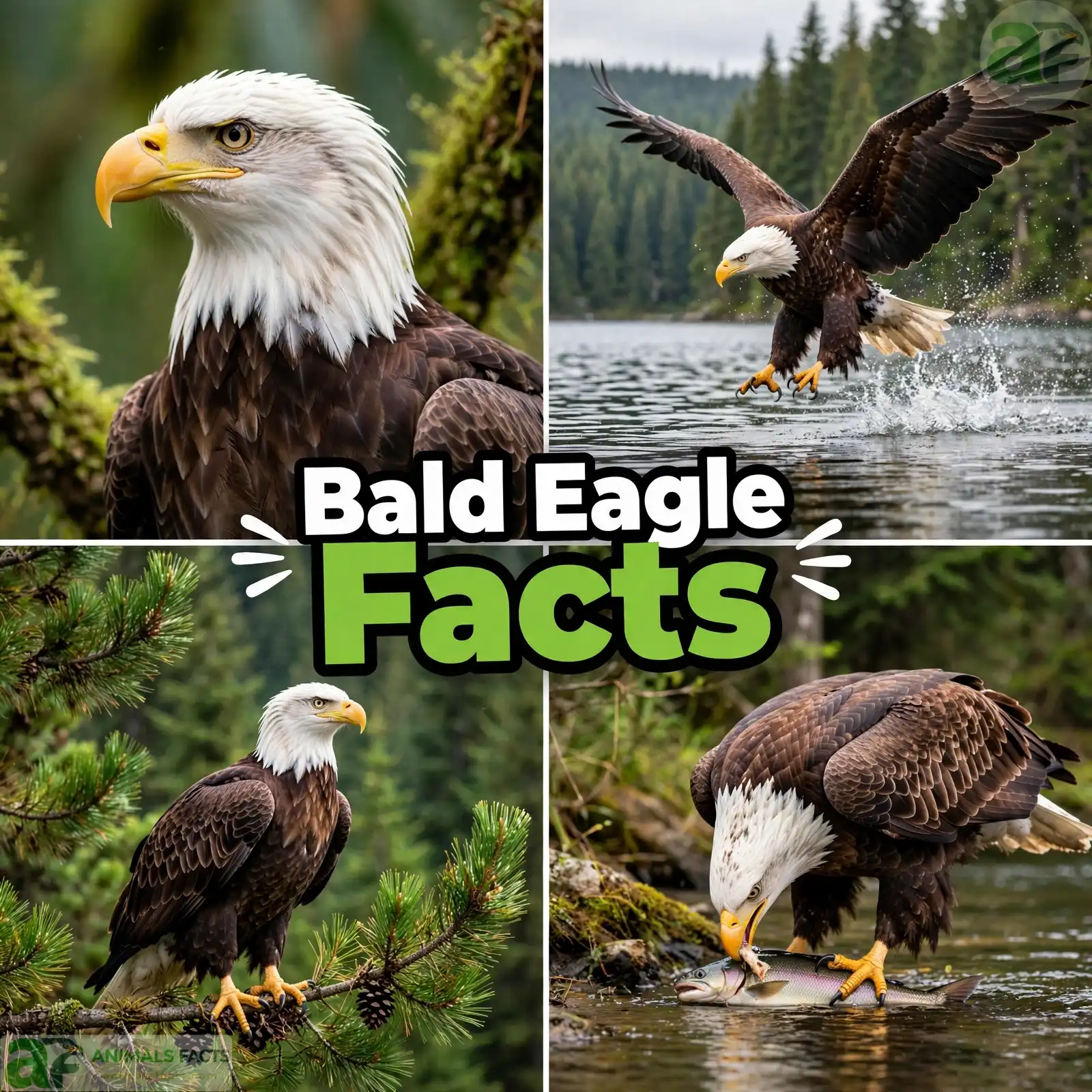
Bald Eagle Facts
| Feature | Details |
|---|---|
| Scientific Name | Haliaeetus leucocephalus (Linnaeus, 1766) |
| Kingdom | Animalia |
| Phylum | Chordata |
| Class | Aves |
| Order | Accipitriformes |
| Family | Accipitridae |
| Common Names | Bald eagle; American eagle; white-headed eagle |
| Native Range | North America — from Alaska and Canada through the contiguous United States to northern Mexico |
| Habitat | Large bodies of open water with abundant fish, adjacent to old-growth forest with large trees for nesting and roosting |
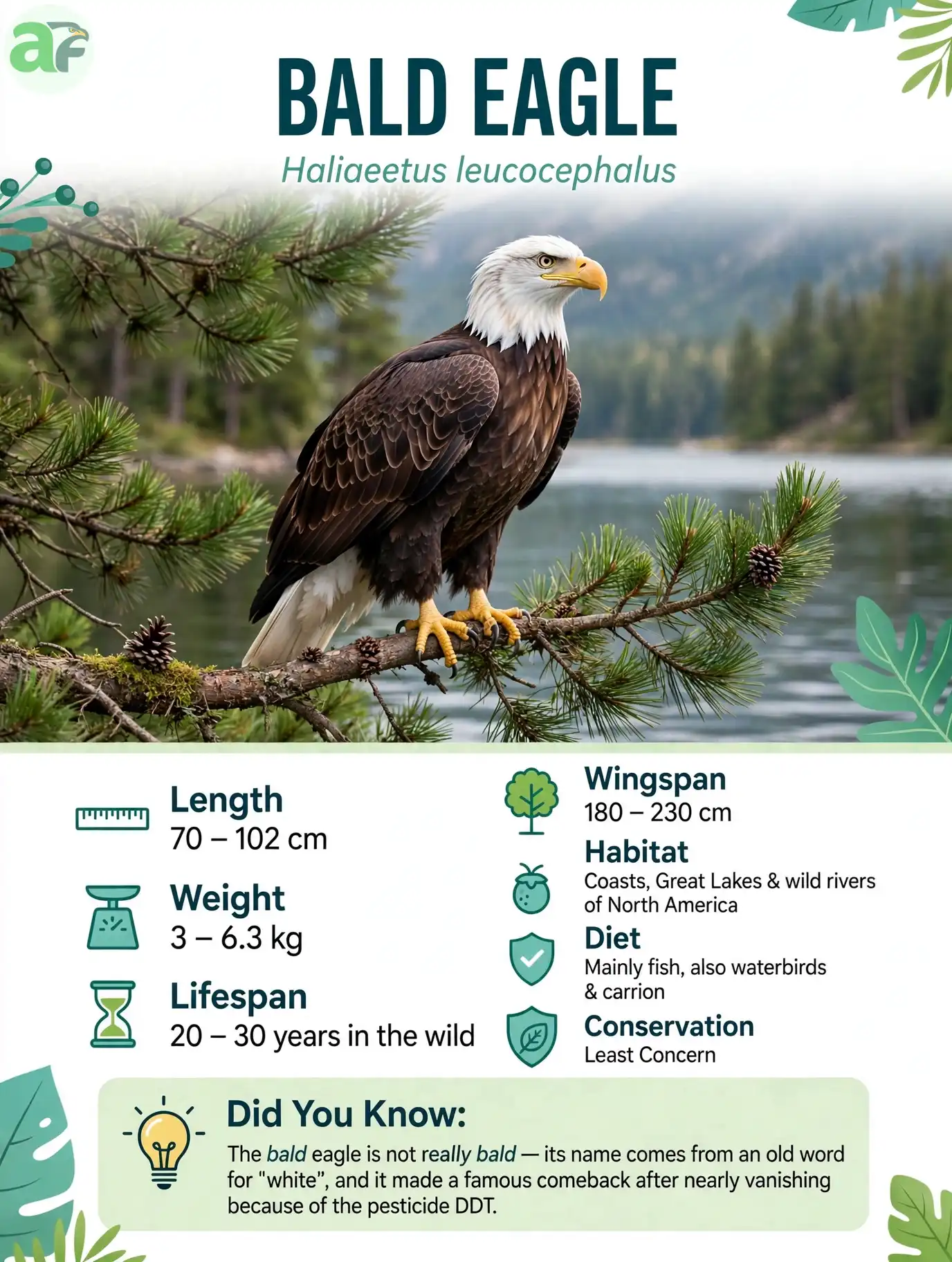
| Lifespan | 20–25 years (wild); up to 50 years (captivity) |
| Diet | Primarily fish — also waterfowl, small mammals, carrion |
| Body Length | 70–102 cm |
| Wingspan | 180–244 cm — one of the largest wingspans of any North American bird |
| Weight | Males 3–4.5 kg; females 4–6.3 kg — females significantly larger |
| Conservation Status | Least Concern (IUCN) — one of conservation’s greatest recovery success stories; removed from US Endangered Species List in 2007 |
| Defining Feature | Distinctive white head and tail contrasting with dark brown body — acquired at approximately 5 years of age |
| National Symbol | National bird and symbol of the United States since 1782 |
| Closest Relatives | Other sea eagles — including the white-tailed eagle (Haliaeetus albicilla) of Eurasia; the bald eagle’s closest relative |
| Nest Size | The largest bird nest in North America — up to 4 meters deep, 2.5 meters wide, 1,000+ kg |
 1. Introduction: What is a Bald Eagle?
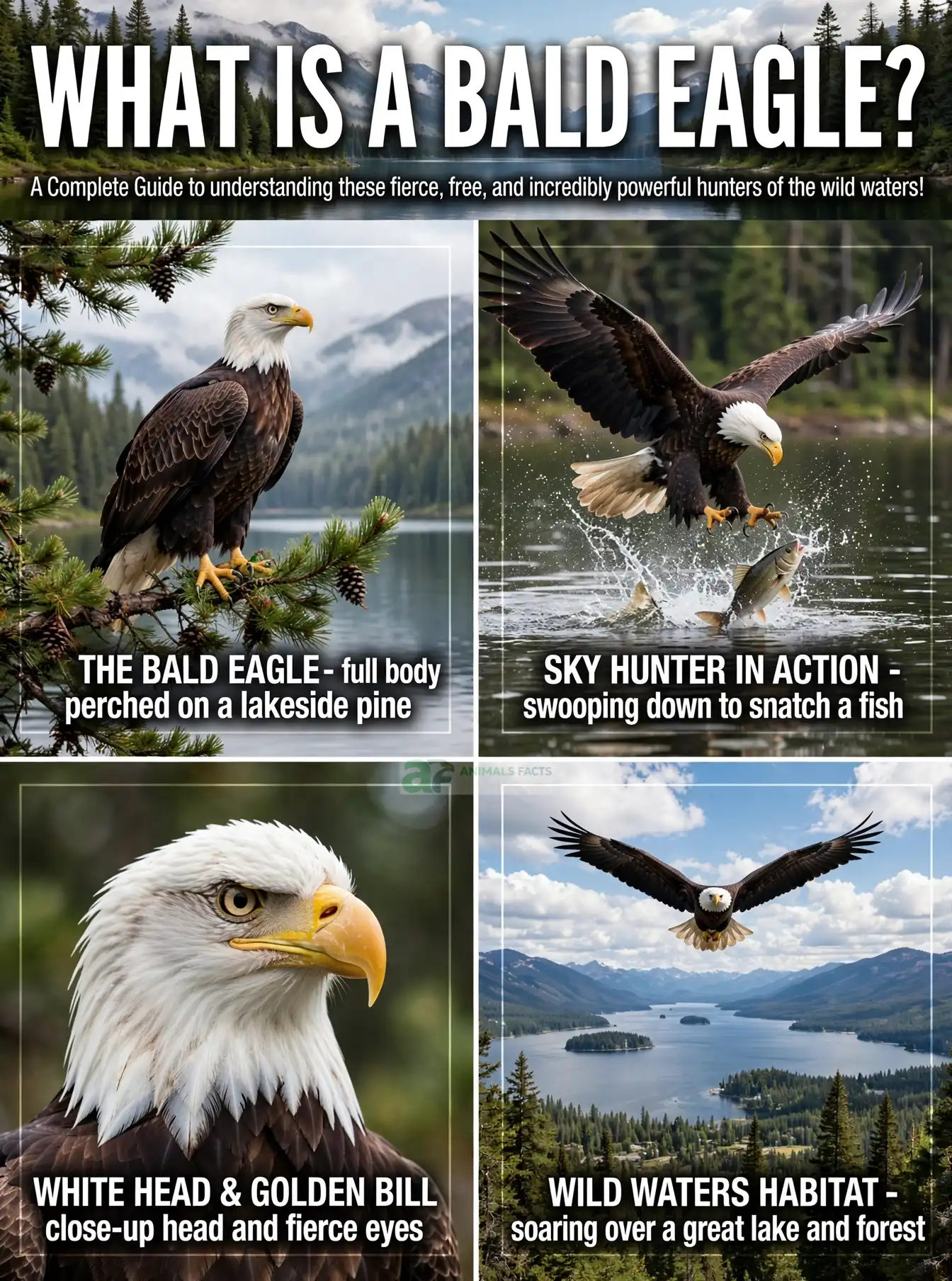
On a grey January morning along the Chilkat River in Alaska, where the valley floor is white with snow and the mountains rise steeply on both sides into cloud, the cottonwood trees along the river are doing something that seems, at first glance, entirely impossible — they appear to have grown thousands of large, dark fruit overnight. Then one moves, and another, and gradually the eye resolves the impossible fruit into the most extraordinary congregation of large raptors in North America: 3,000 to 4,000 bald eagles gathered along a five-mile stretch of river to exploit the late salmon run that the Chilkat’s warm upwelling springs keep ice-free while every other river in the region has frozen. They sit in every cottonwood and spruce within sight, crowd the gravel bars where salmon carcasses attract them in clusters, soar in spiraling groups above the valley, and produce a continuous background noise of harsh, descending calls that fills the cold air with sound. Bald eagle facts begin with this image — not the single bird of the postage stamp or the coin, not the solitary sentinel of American patriotic imagery, but the genuine ecological reality of a species that, at appropriate places and times, gathers in numbers that make the ordinary superlatives of natural history description seem inadequate.
The bald eagle (Haliaeetus leucocephalus) is simultaneously the most symbolically loaded bird in American history and one of the most remarkable conservation stories in the history of wildlife management. It is the national symbol of the United States — chosen by the Continental Congress in 1782 and placed on the Great Seal where it has appeared ever since as the emblem of American sovereignty and ideals. It is the bird that Benjamin Franklin allegedly preferred to replace with the turkey, that American presidents invoke in speeches about strength and freedom, that appears on the dollar bill, the presidential seal, the military insignia of every branch of the US Armed Forces, and thousands of official government documents every day. And it is a bird that, by the 1960s, had been driven to the edge of extinction in the contiguous United States by the combination of hunting, habitat destruction, and the catastrophic reproductive failure caused by DDT pesticide poisoning — reduced from an estimated historical population of 300,000–500,000 birds to fewer than 417 nesting pairs in the contiguous United States by 1963. The recovery from that near-extinction — through the ban of DDT in 1972, the passage of the Endangered Species Act, systematic protection and management, and the extraordinary resilience of the species itself — to the current population of approximately 316,700 individuals in the contiguous United States alone represents one of the greatest wildlife conservation achievements in American history.
Interesting facts about bald eagles reveal an animal of breathtaking biological sophistication — the eyesight four to eight times more powerful than human vision, capable of detecting a fish below the water’s surface from 30 meters of altitude; the nests that grow for decades until they become the largest bird nests in North America — one documented nest weighing over a metric ton; the extraordinary aerial courtship display in which a bonded pair locks talons at altitude and tumbles together in a spiraling free-fall — releasing only moments before striking the ground; the paradox of a national symbol that is also a dedicated kleptoparasite (stealing food from other birds), a behavior that so offended Benjamin Franklin that he mounted his famous preference for the turkey; and the extraordinary vocal paradox — the sound everyone associates with the bald eagle’s call in American films and television is not actually the bald eagle’s call but the red-tailed hawk’s, substituted because the bald eagle’s actual voice — a thin, high-pitched series of whistles and chatters — was deemed insufficiently impressive for such a majestic bird. Whether you are searching for bald eagle facts for kids to explore the biology and conservation story of America’s national symbol, a wildlife enthusiast planning a trip to one of North America’s premier eagle-viewing sites, a conservation researcher interested in the DDT recovery story as a model for pollutant-driven species recovery, or simply someone who looked up from a lakeshore one morning and saw a bald eagle pass overhead and needed to understand everything about this extraordinary bird — this is your comprehensive guide. America’s national symbol has an extraordinary story to tell.
2. Bald Eagle Species Overview & Classification
The bald eagle belongs to the genus Haliaeetus — the sea eagles — a group of large, fish-eating raptors distributed across every inhabited continent, and is the largest bird of prey native to North America.
Species Classification Table
| Taxonomic Rank | Classification |
|---|---|
| Kingdom | Animalia |
| Phylum | Chordata |
| Class | Aves |
| Order | Accipitriformes |
| Family | Accipitridae (Vigors, 1824) |
| Genus | Haliaeetus (Savigny, 1809) |
| Species | H. leucocephalus (Linnaeus, 1766) |
| Common Names | Bald eagle; American eagle; white-headed eagle |
| Etymology | Haliaeetus = “sea eagle” (Greek: hals = sea + aetos = eagle); leucocephalus = “white-headed” (Greek: leukos = white + kephale = head); “bald” from archaic English balde = “white” — not “hairless” |
Two Subspecies
Two subspecies are recognized — distinguished primarily by size, with the northern subspecies larger than the southern:
| Subspecies | Common Name | Range | Notes |
|---|---|---|---|
| H. l. washingtoniensis | Northern bald eagle | Alaska, Canada, northern US | Larger — females up to 6.3 kg |
| H. l. leucocephalus | Southern bald eagle | Contiguous United States, northern Mexico | Smaller than northern |
The Genus Haliaeetus — The Sea Eagles
The bald eagle’s genus Haliaeetus contains 8 species of sea eagles — among the largest and most powerful raptors in the world:
| Species | Common Name | Range | IUCN Status |
|---|---|---|---|
| Haliaeetus leucocephalus | Bald eagle | North America | Least Concern |
| Haliaeetus albicilla | White-tailed eagle | Eurasia | Least Concern |
| Haliaeetus vocifer | African fish eagle | Sub-Saharan Africa | Least Concern |
| Haliaeetus leucoryphus | Pallas’s fish eagle | Central Asia | Endangered |
| Haliaeetus leucogaster | White-bellied sea eagle | S/SE Asia, Australia | Least Concern |
| Haliaeetus sanfordi | Sanford’s sea eagle | Solomon Islands | Vulnerable |
| Haliaeetus pelagicus | Steller’s sea eagle | Russia, Japan | Vulnerable |
| Haliaeetus humilis | Lesser fish eagle | S/SE Asia | Least Concern |
The Closest Relative — The White-Tailed Eagle
The bald eagle’s closest living relative is the white-tailed eagle (Haliaeetus albicilla) of Eurasia — a connection with significant implications for understanding the bald eagle’s evolutionary history:
The relationship — Molecular genetic analysis confirms that the bald eagle and white-tailed eagle are sister species — more closely related to each other than either is to other Haliaeetus species. The two species share a common ancestor that diverged when ancestral sea eagle populations became separated between North America and Eurasia.
The physical similarities — The white-tailed eagle shares the bald eagle’s general body plan — large size, yellow bill, brown body — but has a shorter, wedge-shaped white tail rather than the full white tail of the bald eagle, and lacks the white head.
The conservation parallel — Like the bald eagle, the white-tailed eagle was severely persecuted and reduced in numbers through the 19th and 20th centuries — and like the bald eagle, has undergone successful recovery through protection and reintroduction programs in Europe.
Evolution & Discovery Timeline
~30 million years ago (Oligocene) — The ancestral Haliaeetus lineage diverges within the raptor radiation — establishing the sea eagle lineage that will produce the bald eagle and its relatives across the world’s major water bodies.
~1–2 million years ago (Pleistocene) — The ancestral bald eagle population establishes in North America — the species evolving in the extraordinarily fish-rich environment of the North American continent’s extensive river, lake, and coastal systems.
Pre-Columbian era — The bald eagle is estimated at 300,000–500,000 individuals across North America — abundant from Alaska to Florida, and deeply integrated into the ecological and cultural life of indigenous North American peoples.
1766 — Carl Linnaeus formally describes the bald eagle as Falco leucocephalus in the 12th edition of Systema Naturae — the species subsequently reclassified to the genus Haliaeetus.
June 20, 1782 — The Continental Congress of the United States adopts the Great Seal of the United States, featuring the bald eagle — establishing the species as the national symbol of the new republic.
1918 — The Migratory Bird Treaty Act provides the first legal protection for bald eagles in the United States — though enforcement is limited and persecution continues.
1940 — The Bald Eagle Protection Act passes — making it illegal to pursue, shoot, shoot at, poison, wound, kill, capture, trap, collect, molest or disturb bald eagles or their eggs and nests. The act significantly reduces direct persecution.
1947–1972 — DDT pesticide use causes catastrophic bald eagle reproductive failure across the contiguous United States — the chemical accumulating in fish (the eagle’s primary prey) and causing thin eggshells that break during incubation. The contiguous US population collapses from pre-DDT levels to approximately 417 nesting pairs by 1963.
1963 — Bald eagle breeding pairs in the contiguous United States reach their documented population low of 417 pairs — the species on the brink of extinction outside Alaska and Canada.
1972 — DDT is banned in the United States by the newly established Environmental Protection Agency — the single most important conservation intervention for the bald eagle.
1973 — The Endangered Species Act is passed — providing the strongest legal protection framework for the bald eagle and other threatened species in US history.
1978 — The bald eagle is listed as Endangered in 43 of the contiguous US states and Threatened in the remaining 5 — the full weight of the Endangered Species Act brought to bear on bald eagle recovery.
1995 — The bald eagle’s status is downlisted from Endangered to Threatened across the contiguous United States — the first major milestone of recovery.
2007 — The bald eagle is removed from the Endangered Species List — one of the most celebrated conservation delisting events in US history. The contiguous US nesting pair count had risen from 417 pairs in 1963 to approximately 9,789 pairs by 2006.
2024 — The US Fish and Wildlife Service estimates the contiguous US bald eagle population at approximately 316,700 individuals — including approximately 71,400 nesting pairs. The recovery continues.
“The recovery of the bald eagle is the single greatest achievement of the American conservation movement. It is what happens when a society decides that an animal matters, passes the laws to protect it, and then actually enforces those laws. Every bald eagle soaring over an American lake today is a living monument to that decision.”
— Dr. Richard Nye, US Fish and Wildlife Service — bald eagle recovery program coordinator
3. Bald Eagle Physical Description & Unique Features
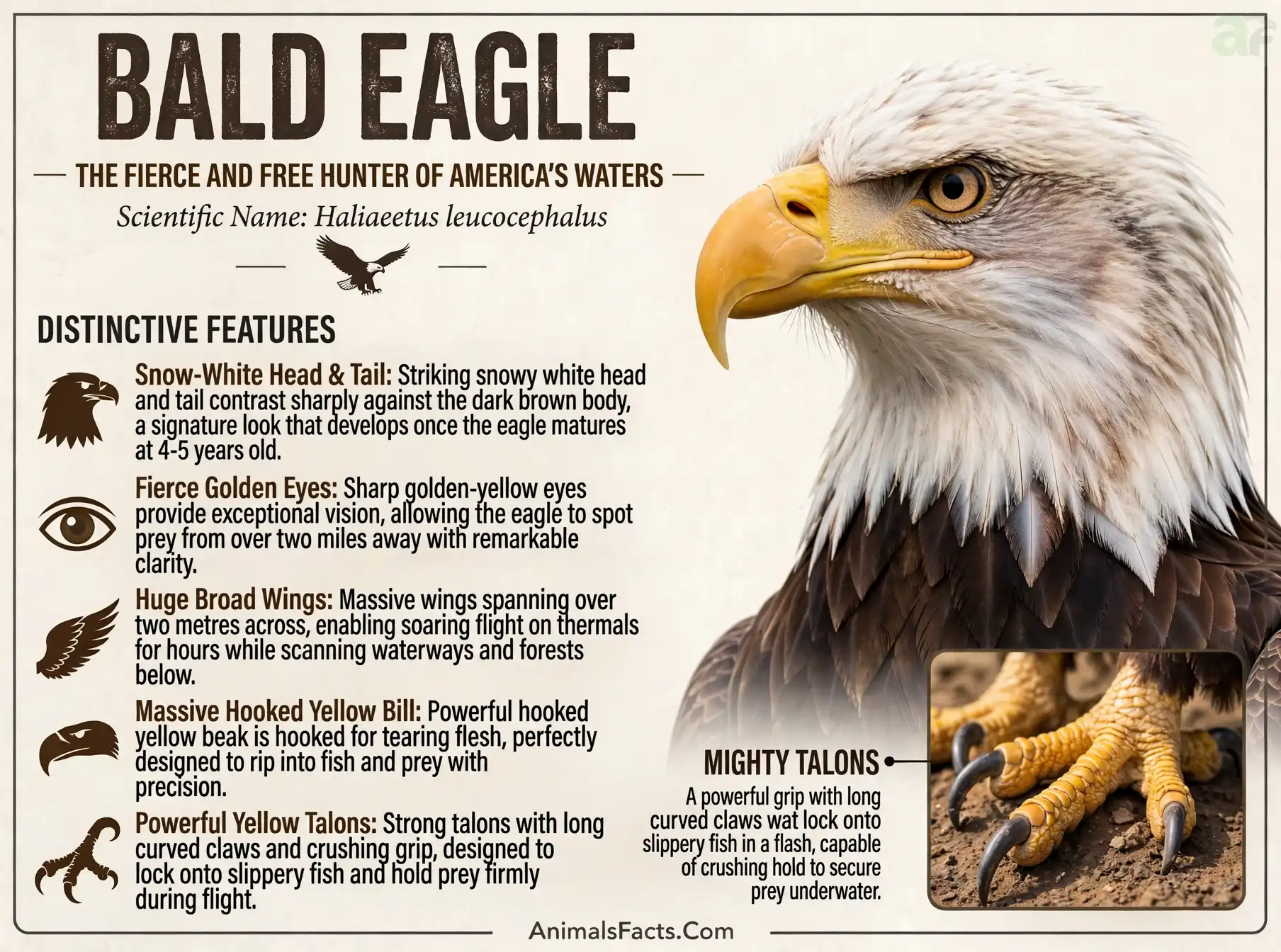
The bald eagle is one of the most immediately recognizable birds in the world — the combination of the white head, white tail, dark brown body, and massive yellow bill creating an appearance of such distinctive impact that identification is essentially instant even at considerable distances.
The Adult Plumage — The Iconic Appearance
The fully adult bald eagle’s plumage is defined by three elements of striking contrast:
The white head — The entire head from bill base to nape is brilliant white — each individual feather pure white, creating a striking contrast with the dark body below. The white head is produced by white feather pigmentation rather than structural coloration or the absence of pigment. The head white is acquired progressively from the dark juvenile plumage through a series of molts over the first five years of life.
The white tail — The tail feathers are similarly brilliant white — the short, fan-shaped tail appearing as a bright white patch above the dark body when the bird is viewed from above in soaring flight, and as a distinctive white fan when the bird lands and the tail is briefly spread.
The dark brown body — The body, back, and wings are a uniform dark chocolate brown — providing the maximum contrast with both the white head above and the white tail behind. The brown plumage is produced by eumelanin in the feather barbules.
The yellow bill — The massive, deeply hooked bill is vivid yellow-orange in adults — a large, powerful structure designed for tearing flesh from fish and other prey. The yellow bill color provides another vivid contrast element in the overall plumage — and its intensity varies with age and condition.
The yellow eyes — Adult bald eagles have bright yellow irises — the eye color shifting from the dark brown of juveniles through progressively paler shades to the adult yellow. The yellow eye color creates a piercing visual impression that contributes to the bald eagle’s dominant appearance.
The yellow feet and talons — The powerful feet are yellow with black talons — large, curved, and extraordinarily sharp for gripping slippery fish.
The Immature Plumage — Five Years to Adult Appearance
One of the most significant and most frequently misunderstood aspects of bald eagle biology is the time required for young birds to acquire the iconic adult plumage:
Year 1 (juvenile) — Entirely dark brown — body, head, and tail all dark. The yellow bill, white head, and white tail are entirely absent. First-year birds are frequently misidentified as golden eagles by inexperienced observers.
Years 2–3 — Progressive variable brown and white mottling — patches of white appearing irregularly on the body, underwing linings, and belly; the head developing irregular white streaking; the tail beginning to show some pale mottling.
Year 4 — More extensive and more consistently patterned white — the head increasingly white with brown streaking; the tail more extensively whitened but not yet clean white.
Year 5 (adult) — The full adult plumage — clean white head, clean white tail, uniform dark brown body — is typically achieved at approximately 5 years of age. This delayed plumage maturation means that at any bald eagle viewing site, a substantial proportion of the birds visible are immatures showing various intermediate plumages.
The Eyes — Vision of Extraordinary Acuity
The bald eagle’s eyes are among the most powerful in the bird world — and the bird world collectively has the most acute vision of any vertebrate group:
Visual acuity — Bald eagle visual acuity is estimated at 4–8 times greater than human visual acuity — the eagle able to resolve detail at distances that appear as undifferentiated blur to human eyes. A bald eagle soaring at 30 meters altitude can detect and resolve a fish below the surface of water.
The foveal density — The exceptional acuity arises from the extraordinary density of photoreceptors (cones) in the eagle’s fovea — the high-resolution region of the retina. Eagle retinas contain approximately 1 million cones per square millimeter — compared to approximately 200,000 per square millimeter in human foveas.
Two foveas — Like many birds of prey, bald eagles have two foveas in each eye — one for forward binocular vision (used for precise distance estimation during the final dive at prey) and one for lateral monocular vision (used for wide-field surveillance while soaring).
UV and color vision — Bald eagles can see into the ultraviolet spectrum — UV wavelengths invisible to humans. Fish scales and mucus reflect UV light — making fish potentially more visible to eagle eyes than to human eyes. The eagle also has exceptional color discrimination across the visible spectrum.
The nictitating membrane — A translucent third eyelid (nictitating membrane) sweeps across the eye from front to back — protecting the eye from wind, debris, and the struggling movements of prey during capture, while maintaining partial visual function.
The Bill and Talons — The Capture and Killing Tools
The bill — The bald eagle’s deeply hooked yellow bill is designed for tearing flesh rather than killing — prey is typically killed by the talons, and the bill tears the carcass into pieces for consumption or feeding to chicks.
Bill dimensions — The bill is approximately 5–6 cm from base to tip — substantial for a bird of this size and providing the leverage needed to tear through the tough skin of large fish and waterfowl.
The talons — Four talons on each foot — the hallux talon (rear talon) is the largest and most powerful, approximately 4–5 cm in length in adult birds. The talons are designed to penetrate and grip slippery prey — the curved shape allowing the talon to pierce deep into fish flesh while the leg muscles maintain a powerful grip.
Grip strength — Bald eagle foot grip strength is estimated at approximately 10 times the grip strength of a human hand — the leg and foot muscles generating sufficient force to compress the vital organs of prey and maintain grip on struggling fish in strong currents.
Size and the Reverse Sexual Size Dimorphism
The bald eagle shows pronounced reverse sexual size dimorphism — females are significantly larger than males:
| Measurement | Male | Female |
|---|---|---|
| Body length | 70–86 cm | 86–102 cm |
| Wingspan | 180–213 cm | 200–244 cm |
| Weight | 3.0–4.5 kg | 4.0–6.3 kg |
Why females are larger — Reverse sexual size dimorphism is common in raptors — the prevailing hypothesis being that larger females can better protect eggs and young chicks while smaller, more agile males are more effective at aerial prey pursuit. In the bald eagle, the larger female size provides greater incubation coverage and thermal mass for protecting eggs in the cold temperatures of early spring nesting.
💡 Did You Know? The sound universally associated with the bald eagle in American films, television, and popular culture — the fierce, descending scream that perfectly matches the bird’s powerful, dominant image — is not the bald eagle’s actual call. It is the call of the red-tailed hawk (Buteo jamaicensis), substituted by sound designers because the bald eagle’s real vocalization — a series of high-pitched, thin, stuttering whistles and chatters — was deemed insufficiently impressive for the national symbol. The actual bald eagle call has been described variously as “cackling,” “squeaky,” “chattering,” and “surprisingly wimpy” relative to the bird’s size and cultural gravitas. This widespread audio substitution is one of the most enduring ornithological inaccuracies in American popular culture — the vast majority of Americans have seen thousands of bald eagle images and heard the red-tailed hawk’s call as the soundtrack, never knowing that the actual sound their national symbol makes is quite different. Wildlife documentaries that use actual bald eagle vocalizations frequently generate viewer surprise and disbelief.
4. Top 25 Amazing Bald Eagle Facts
Here is your definitive collection of the most extraordinary, scientifically verified, and genuinely astonishing bald eagle facts as of 2026:
- The bald eagle’s population collapsed to just 417 nesting pairs in the contiguous United States by 1963 — down from an estimated historical population of 300,000–500,000. The recovery to the current estimated 316,700 individuals represents one of the greatest wildlife conservation successes in history.
- The word “bald” in “bald eagle” does not mean hairless — it derives from the archaic English word balde or bald meaning “white” — referring to the white head. The bald eagle is the “white-headed eagle” — a name that accurately describes the adult plumage.
- The sound everyone thinks is the bald eagle’s call — the fierce, descending scream heard in virtually every American film and television production — is actually the call of the red-tailed hawk. The bald eagle’s real call is a series of thin, high-pitched stuttering whistles and chatters frequently described as surprisingly unimpressive for such a large and powerful bird.
- Bald eagle pairs perform one of the most spectacular courtship displays in North American birds — locking talons in mid-air at altitude and tumbling together in a cartwheeling free-fall, spiraling toward the ground before releasing at the last moment and pulling out of the dive. This display is called the “cartwheel courtship display” or “death spiral.”
- The bald eagle can reach speeds of approximately 120–160 km/h during a hunting dive (stoop) — and sustained flight speeds of approximately 56–70 km/h during level flight. The combination of speed, size, and the element of surprise from aerial approach makes bald eagles highly effective fish predators.
- The bald eagle is the only sea eagle native to North America — though the closely related Steller’s sea eagle (Haliaeetus pelagicus) occasionally wanders from Russia to Alaska.
- A bald eagle nest (called an eyrie) documented in Vermilion, Ohio accumulated material for 34 years — eventually measuring 2.9 meters wide and 6 meters deep and estimated to weigh over 2 metric tons before the tree supporting it collapsed. It remains one of the largest bird nests ever documented.
- DDT — dichlorodiphenyltrichloroethane — was the primary cause of the bald eagle’s near-extinction in the contiguous United States. DDT accumulated through the food chain (a process called biomagnification) — reaching its highest concentrations in large fish-eating birds like the bald eagle, where it interfered with calcium metabolism and caused eggshells so thin they broke under the weight of incubating adults.
- Young bald eagles do not develop the distinctive white head and tail until approximately 5 years of age — spending the first four years of life in a complex series of intermediate, mottled brown-and-white plumages that make them difficult to identify as bald eagles for inexperienced observers.
- The bald eagle was adopted as the national symbol of the United States on June 20, 1782 — when the Continental Congress approved the design of the Great Seal of the United States. The eagle appears on the Great Seal, the presidential seal, dollar bills, passports, military insignia, and thousands of other official symbols.
- Benjamin Franklin is often cited as opposing the bald eagle’s selection as national symbol — preferring the turkey because he considered the bald eagle of “bad moral character” for stealing food from other birds. Franklin’s famous letter making this argument was private correspondence, not a formal objection, and it remains one of the most quoted passages in American natural history.
- The bald eagle is a dedicated kleptoparasite — regularly stealing food from other birds, particularly ospreys (Pandion haliaetus). An eagle will pursue an osprey carrying a fish, forcing it to drop the prey, then catching the falling fish in mid-air. Franklin cited this behavior specifically as evidence of the eagle’s bad character.
- The Chilkat Bald Eagle Preserve near Haines, Alaska hosts the world’s largest documented annual bald eagle congregation — 3,000–4,000 eagles gathering along a five-mile stretch of the Chilkat River in November and December to exploit a late salmon run kept ice-free by warm upwelling springs.
- Bald eagle eyesight is estimated at 4–8 times more acute than human vision — the eagle capable of spotting a fish below the water’s surface from 30 meters altitude and resolving detail at distances that appear as undifferentiated blur to human observers.
- The bald eagle maintains lifelong pair bonds — the same male and female returning to the same nest territory year after year for potentially decades. The death of one partner typically results in the surviving bird seeking a new mate within the same season.
- The Bald and Golden Eagle Protection Act of 1940 — amended in 1962 to add the golden eagle — makes it illegal to possess bald eagle feathers, eggs, nests, or body parts without specific federal permits. Even naturally shed feathers cannot be legally possessed by non-Native Americans.
- Bald eagles at the Chilkat Preserve and other salmon river congregations consume salmon at extraordinary rates during the autumn aggregation — individual eagles consuming up to 1 kilogram of fish per day during peak salmon availability, building fat reserves for winter.
- The bald eagle’s grip strength is estimated at approximately 10 times the grip force of a human hand — sufficient to compress the vital organs of fish and hold struggling prey against the force of water currents during the fishing stoop.
- Bald eagles are documented thermoregulating in cold weather through a behavior called mantling — spreading their wings over their prey or over themselves in cold conditions — and through behavioral adaptations including roosting in dense conifers that reduce convective heat loss.
- During breeding season, the bald eagle’s pair adds material to the nest each year — the accumulation of sticks, grass, and other material over many years produces the largest bird nests in North America. A nest added to annually for 20+ years can reach 4 meters in depth and 2.5 meters in width.
- The bald eagle’s marine and freshwater habitat association means it is an important monitor of aquatic ecosystem health — the species’ susceptibility to bioaccumulated pollutants (demonstrated dramatically by DDT) makes it an effective sentinel species for aquatic pollutant contamination.
- Despite being primarily a fish specialist, bald eagles show remarkable dietary opportunism — documented consuming waterfowl, rabbits, squirrels, turtles, snakes, deer carrion, and virtually any other protein source available when fish are scarce. This dietary flexibility contributed to the species’ survival through the DDT population crash.
- Bald eagles soar on thermal updrafts — rising columns of warm air that allow the eagle to gain altitude with minimal energy expenditure. A bald eagle can soar for hours covering enormous distances with essentially no wing-flapping — the large wingspan generating sufficient lift to maintain altitude in weak thermals.
- The US Fish and Wildlife Service 2020 population survey — the most comprehensive survey of bald eagles ever conducted in the United States — estimated 316,700 individuals including 71,400 nesting pairs in the contiguous United States — a more than 700% increase from the 2009 population estimate and a more than 17,000% increase from the 1963 low.
- As of 2026, the bald eagle population in North America continues to grow — the combination of legal protection, habitat availability, and the elimination of DDT creating conditions for sustained recovery. The species is now classified as Least Concern globally — but remains protected under multiple US federal laws including the Bald and Golden Eagle Protection Act and the Migratory Bird Treaty Act.
5. Fun Facts About Bald Eagles
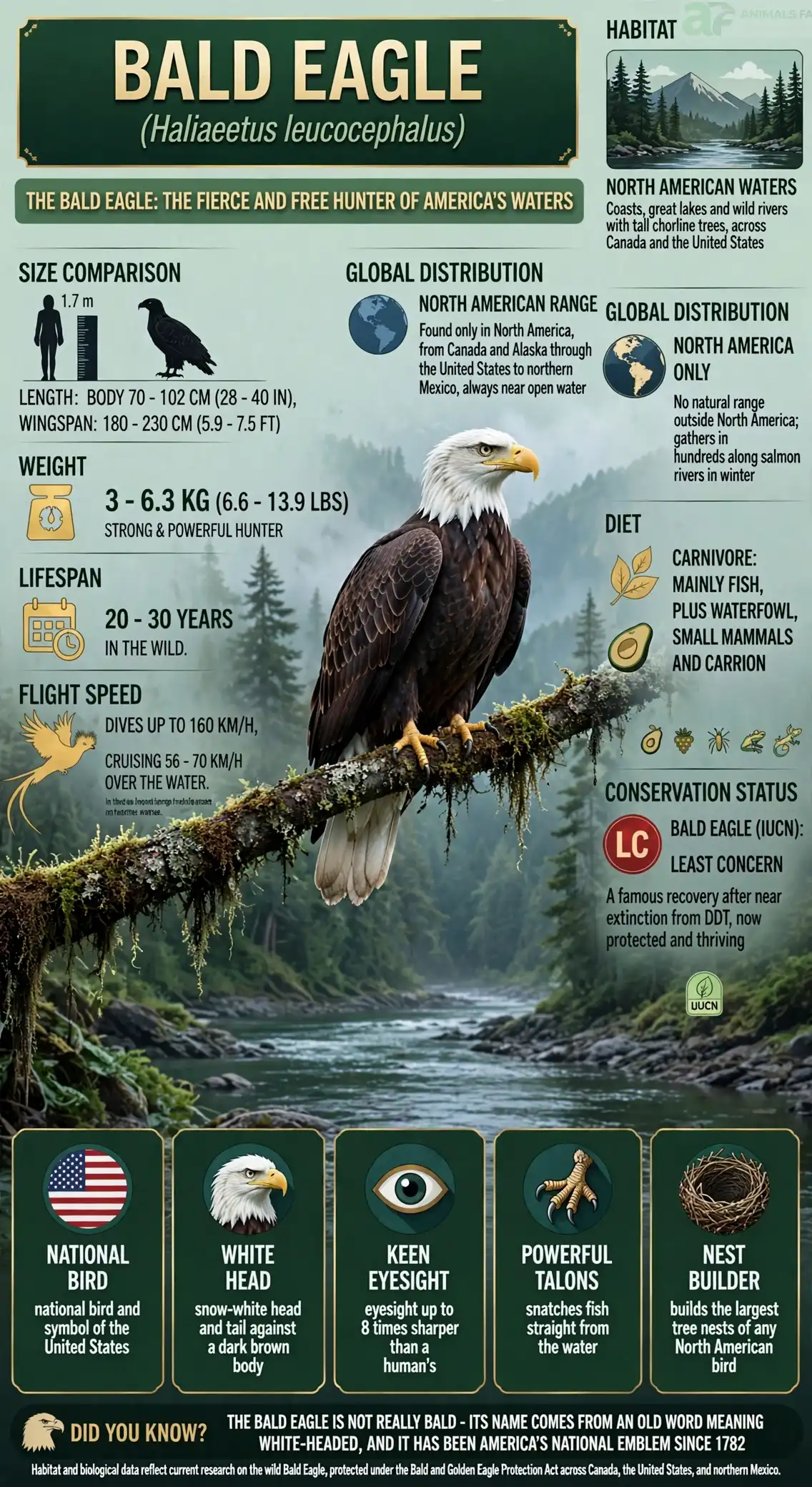
- Population recovered from 417 pairs to 316,700 individuals
- “Bald” means “white” — not “hairless”
- Famous eagle scream is actually a red-tailed hawk
- Pairs do a death spiral courtship display at altitude
- Dive speeds of 120–160 km/h
- Young birds take 5 years to get white head and tail
- One nest grew for 34 years and weighed 2+ metric tons
- DDT caused eggshells to thin and break — nearly causing extinction
- 3,000–4,000 eagles gather at Chilkat River each winter
- Vision 4–8 times more acute than human vision
- Steals food from ospreys — Benjamin Franklin’s objection
- Grip strength 10 times that of a human hand
6. Bald Eagle Natural Habitat & Geographic Range
Bald eagle habitat is defined by the combination of large open water bodies with abundant fish and mature forest with large trees suitable for nesting — a combination that occurs across a broad latitudinal range from Alaska and northern Canada to Florida and the Gulf Coast.
Primary Habitat Requirements
Large open water with fish — The bald eagle’s primary habitat requirement is access to water bodies with sufficient fish resources to support year-round or seasonal occupation. The specific water type varies enormously:
- Large rivers — particularly salmon and trout rivers in Alaska and the Pacific Northwest; the Mississippi and Missouri systems in the interior; Florida’s river systems
- Large lakes — the Great Lakes system; large prairie lakes; mountain reservoirs
- Coastal habitats — estuaries, bays, and sheltered coastal waters where marine fish species are accessible
- Reservoirs — the creation of large reservoirs across the United States has actually expanded bald eagle habitat by creating large, fish-rich water bodies in areas that previously lacked suitable open water
Mature forest for nesting — The bald eagle requires large, mature trees with structural integrity sufficient to support the enormous weight of the nest and the eagles themselves:
- Old-growth conifers — Douglas fir, Sitka spruce, and ponderosa pine in the Pacific and Rocky Mountain regions
- Large hardwoods — cottonwood, sycamore, and various oak species in the interior and eastern regions
- Old-growth cypress — in Florida and the Gulf Coast, bald cypress trees provide important nest sites
The proximity requirement — Perhaps the most critical habitat parameter is the proximity of large water to large trees — both elements must occur within a reasonable distance (typically less than a kilometer) because eagles cannot carry heavy fish long distances.
Geographic Distribution
Year-Round Resident Range
| Region | Status | Key Areas | Population Significance |
|---|---|---|---|
| Alaska | Highest density globally | Southeast Alaska coast; Chilkat Valley; Kodiak Island | Estimated 30,000+ birds |
| Pacific Northwest | Abundant | Columbia River; Puget Sound; Oregon coast | Major breeding population |
| Florida | Year-round resident | Statewide — especially lakes and Gulf Coast | One of highest contiguous US densities |
| Gulf Coast states | Resident and wintering | Mississippi Delta; Texas coast | Significant wintering and breeding |
| Great Lakes region | Abundant | All five Great Lakes; connected rivers | Rapidly expanding breeding population |
| Chesapeake Bay | Abundant | Bay watershed; Potomac and Susquehanna rivers | Historical core population; now thriving |
Migratory Range
| Region | Season | Notes |
|---|---|---|
| Canada | Breeding (April–August) | Breeding across boreal forest; winters south |
| Northern Great Plains | Wintering | Large concentrations at open-water reservoirs |
| Mississippi River | Wintering | Significant wintering concentrations at open water |
| Atlantic Coast | Year-round; wintering concentrations | Major flyway corridor |
The Alaska Population — The Global Core
Alaska supports the world’s largest bald eagle population — estimated at 30,000 or more individuals — approximately one-third of the global total:
Why Alaska? — Alaska’s combination of extraordinarily productive marine and freshwater fish resources (primarily Pacific salmon, halibut, and various other species), extensive old-growth coastal forest providing nesting habitat, and historically very low human density creating minimal disturbance has allowed bald eagles to maintain near-historical population densities.
The southeast Alaska coast — The rainforest coast of southeast Alaska — from Ketchikan to Yakutat — is the global epicenter of bald eagle abundance, supporting one of the highest densities of large raptors of any temperate region on Earth.
The Chilkat River — Within Alaska’s extraordinary bald eagle landscape, the Chilkat River valley near Haines achieves the peak of bald eagle congregation — the late salmon run exploited by thousands of eagles creating a spectacle without parallel in the raptor world.
The Contiguous US Recovery and Distribution
The recovery of the bald eagle in the contiguous United States has produced a distribution that now encompasses virtually the entire historical range:
Florida — The state with the highest breeding density in the contiguous US — Florida’s mild climate, extensive lake system, and year-round fish availability support year-round residence rather than the migratory patterns of northern populations.
Chesapeake Bay watershed — Historically one of the most important bald eagle populations in the eastern US; the Chesapeake population was severely reduced by DDT but has recovered dramatically — the Bay watershed now supporting hundreds of nesting pairs.
Great Lakes — The Great Lakes region has seen extraordinary population expansion since the 1980s — the combination of clean water restoration (following the Clean Water Act) and fish population recovery providing the food base that supports a rapidly growing eagle population.
7. Bald Eagles Diet & Feeding Behavior
Bald eagle diet is centered on fish — the species is primarily a fish specialist whose entire ecological design (habitat selection, nest site requirements, seasonal movements) is organized around fish availability. However, the bald eagle is one of the most opportunistic large raptors in North America — supplementing the fish diet with waterfowl, mammals, and carrion whenever profitable.
Diet Breakdown Table
| Food Type | Estimated % of Diet | Season | Notes |
|---|---|---|---|
| Fish (various species) | ~60–90% | Year-round; varies by location | Primary prey across most of range |
| Waterfowl | ~5–20% | Winter peak — waterfowl concentration | Ducks, coots, gulls; often injured birds |
| Small mammals | ~5–10% | Year-round | Rabbits, squirrels, muskrats |
| Carrion | ~5–15% | Winter peak | Deer, fish carcasses, beached marine mammals |
| Stolen prey (kleptoparasitism) | ~3–8% | Year-round | Primarily from ospreys and other eagles |
| Reptiles and amphibians | ~1–3% | Spring/Summer | Turtles, snakes, frogs |
| Seabirds and colonial birds | ~1–3% | Coastal populations | Gulls, cormorants, herons |
The Fishing System
Detection — A bald eagle hunting fish typically soars at altitude — the extraordinary visual acuity allowing fish detection at the water surface or just below from heights of 30–100 meters. The eagle may soar for extended periods scanning the water surface before committing to a dive.
The stoop — When a fish is detected at or near the water surface, the eagle commits to a stoop — a steep, increasingly rapid dive toward the surface. The wings are partially folded during the initial dive to reduce drag, then spread for speed control and direction adjustment in the final approach.
The capture — In the final moments before the water surface, the eagle swings the feet forward and extends the talons for the capture attempt. At the moment of impact, the talons penetrate the fish — the eagle typically barely wetting its body, grabbing the fish with a skimming contact rather than fully submerging.
The carry — Fish up to approximately 3 kg can be carried in flight. Larger fish that cannot be lifted are sometimes dragged to shore by the eagle using its wings for propulsion across the water surface — the eagle in effect “rowing” to shore with its wings while maintaining talon grip on the fish.
Prey concentration exploitation — The bald eagle’s most effective fishing strategy is not individual hunting but exploitation of concentrated prey — salmon spawning aggregations, fish schooling at surface during cold weather, fish stunned by cold or low oxygen conditions. The Chilkat River congregation is the most spectacular example of this strategy — thousands of eagles exploiting a salmon concentration that provides easy pickings compared to the energetic demands of individual hunting.
Kleptoparasitism — The “Bad Moral Character” Behavior
The bald eagle’s food-stealing behavior — observed by Benjamin Franklin and cited in his letter as evidence of bad moral character — is one of the most studied aspects of bald eagle foraging ecology:
The osprey target — The osprey (Pandion haliaetus) is the most frequent victim of bald eagle kleptoparasitism — the osprey’s exceptional fishing success (catch rate approximately 70% of attempts) and its habit of carrying fish in a distinctive head-forward orientation make it easily identified as a successful fisher. A bald eagle pursuing an osprey will give chase until the osprey drops the fish, then catch the falling fish in mid-air.
The economics — Kleptoparasitism is energetically profitable when the energy obtained from the stolen food exceeds the energy cost of the pursuit. Research has confirmed that food theft from ospreys is frequently energetically profitable for bald eagles — particularly when fish are large and the pursuit is short.
Frequency — Kleptoparasitism is not the bald eagle’s primary foraging strategy — it supplements the fishing diet opportunistically. Eagles in areas with abundant ospreys steal food more frequently; eagles in areas without abundant kleptoparasitism opportunities develop more refined individual fishing strategies.
Carrion Use
The bald eagle’s willingness to consume carrion — dead animals including fish, deer, elk, sea mammals, and various other vertebrates — is one of the behavioral characteristics that most effectively demonstrates the species’ ecological opportunism:
The salmon carcass dimension — In the Pacific Northwest and Alaska, spent salmon carcasses (fish that have spawned and died) represent an enormous seasonal food resource — the bald eagle’s autumn concentration at salmon rivers is partly directed at live fish and partly at the abundant, easily accessible dead fish that litter river banks after spawning.
Winter carrion — During winter when live prey is less accessible, carrion becomes proportionally more important in the bald eagle’s diet — the species readily consuming deer and elk carrion at road-kill sites, wintering areas, and hunting areas.
The lead poisoning risk — Carrion consumption creates the most significant current mortality risk for bald eagles — deer and elk carcasses left by hunters containing lead ammunition fragments are ingested by carrion-feeding eagles, causing lead poisoning. This issue is discussed in detail in the conservation section.
8. Bald Eagle’s Reproduction & Life Cycle
Bald eagle reproduction combines extraordinary nest investment, lifelong pair fidelity, and a slow reproductive rate — the characteristics of a long-lived, K-selected species whose population dynamics are driven by adult survival rather than high reproductive output.
Pair Bond — Together Until Death
Lifelong monogamy — Bald eagles maintain documented lifelong pair bonds — the same male and female returning to the same nest territory year after year for potentially 20+ years. Studies using individually banded and radio-tagged birds have confirmed multi-decade pair bonds at the same nests.
Territory fidelity — Both pair members show extraordinarily high fidelity to the specific nest site — returning to the same tree, the same nest, the same territory across their entire reproductive lives.
The re-pairing dynamic — When a partner dies, the surviving bird typically acquires a new mate within the same breeding season — the strong selective pressure for successful breeding driving rapid re-pairing despite the loss. New pairs require several years to develop the coordinated breeding efficiency of established pairs.
Courtship and the Death Spiral
Aerial courtship display — The bald eagle’s most dramatic courtship behavior is the cartwheel display or death spiral:
The sequence — Two eagles rise together to altitude on soaring wings — then one locks talons with the other, and the two birds begin a tumbling, spiraling free-fall toward the ground. The spiral may cover hundreds of meters of altitude before the pair releases talon grip and pulls out of the dive — often releasing with startlingly little margin above the ground or water surface.
Repeat performances — The cartwheel display may be performed multiple times in a courtship sequence — the duration and intensity of the display reflecting pair bond strength and breeding readiness.
Scientific debate — Whether the cartwheel display is exclusively a courtship behavior or also functions in territorial defense has been debated — aggressive encounters between rival eagles can also involve talon-locking, and it is not always clear whether a cartwheel display represents courtship or combat.
Nest-building displays — In addition to aerial displays, courting pairs engage in mutual nest-building — adding material to the nest together during the pre-breeding period, the cooperative construction reinforcing the pair bond.
Nesting — The Largest Nests in North America
Nest selection — The pair returns to the same nest each year — the nest is maintained, added to, and repaired during each breeding season. New pairs establish a new nest in a suitable tree; established pairs add to existing structures.
Nest tree requirements — The ideal nest tree is:
- Large — sufficient structural strength to support the increasingly heavy nest over years
- Tall — providing clear aerial access and good visibility of the surrounding area
- Close to water — within practical fish-carrying distance
- Sturdy branching — with a main fork or crown structure that provides a natural platform
Nest construction material — Sticks form the primary structural material — the pair collecting sticks of various sizes from the surrounding area and assembling them into the platform structure. The nest interior is lined with softer materials including grass, moss, pine needles, feathers, and occasionally unusual items.
Annual additions — Each breeding season, the pair adds a layer of new material to the nest — the accumulation over years creates the enormous structures for which bald eagle nests are famous. A nest added to for 20 consecutive years may add 30–50 cm of new material per year, accumulating a total depth of several meters.
The record nest — The most famous record nest — documented in Vermilion, Ohio — accumulated material for 34 years, reaching a documented depth of 6 meters and width of 2.9 meters before the supporting tree collapsed under the weight. It remains one of the largest bird nests ever documented globally.
Egg-Laying and Incubation
Egg laying timing — Varies significantly by latitude:
- Alaska and northern Canada — April–May
- Contiguous United States (interior) — January–March
- Florida — October–January — among the earliest breeding birds in North America
Clutch size — Typically 1–3 eggs — most commonly 2. A complete clutch of 3 eggs is produced more commonly by older, established pairs in good condition.
Egg description — Dull white to pale bluish-white — unmarked. Each egg approximately 73 × 55 mm — substantially larger than chicken eggs.
Incubation period — 35–46 days — both parents incubate, taking turns during the day while the other hunts. The female typically incubates at night.
The DDT connection — The DDT-induced reproductive failure that nearly caused the bald eagle’s extinction in the contiguous United States operated through eggshell thinning. DDE (a breakdown product of DDT) interferes with calcium deposition during eggshell formation — producing shells so thin (sometimes nearly transparent) that they collapsed under the weight of incubating parents. Even a 10–15% reduction in eggshell thickness can cause complete reproductive failure.
Chick Development and the Eaglet Period
At hatching — Eaglets hatch covered in pale grey down — altricial, dependent on parental brooding for warmth and on parental provisioning for food.
Sibling competition — In nests with 2–3 eaglets, sibling competition for food is intense — the first-hatched and typically largest eaglet monopolizes parental feeding attention, and in years of poor food availability, younger siblings may starve. Sibling rivalry in raptors (called Cainism in the most extreme forms) is a well-documented feature of bald eagle breeding.
Brooding period — Parents brood (cover) chicks continuously for the first 2–3 weeks — the eaglets unable to thermoregulate independently during this period.
Growth rate — Eaglets grow rapidly — from approximately 85 grams at hatching to near-adult size by 8–10 weeks. The primary feathers (flight feathers) emerge progressively from approximately 5 weeks.
Fledging — Young bald eagles take their first flight at approximately 10–12 weeks of age — the long nestling period reflecting both the complexity of the plumage and the need to develop flight musculature before leaving the nest.
Post-fledging — Fledglings remain in the vicinity of the nest and dependent on parental provisioning for 4–6 weeks after fledging — gradually developing independent hunting capability while parents continue to supplement their food supply.
Independence and dispersal — Young bald eagles typically disperse from the natal territory by autumn of their first year — beginning a 4–5 year period of nomadic wandering through suitable habitat before acquiring the adult plumage and settling in a breeding territory.
Sexual maturity — 4–5 years — coinciding with the acquisition of full adult plumage. First breeding attempts at 4–5 years are often unsuccessful as birds develop the behavioral repertoire and habitat knowledge needed for successful nesting.
9. Social Behavior & Communication
Bald eagle social behavior ranges from the solitary pair bond of the breeding season to the extraordinary congregations of winter roosting and salmon-run aggregation — reflecting the species’ combination of territorial breeding behavior and opportunistic concentration at rich food sources.
Territorial Behavior
Breeding territory — During the breeding season, bald eagle pairs maintain and defend a territory around the nest — the defended area varying from approximately 1–2 km radius around the nest in high-density nesting areas to larger exclusion zones in low-density areas.
Territorial defense — Territory defense involves:
- Aerial pursuit and chase — intruding eagles are pursued and driven from the territory in aerial chases that can be spectacular
- Display flights — the pair soaring together over the territory and producing calling sequences that advertise occupancy
- Nest defense calling — loud calling from the nest tree when intruders approach
Non-breeding tolerance — Outside the breeding season, bald eagles are considerably more socially tolerant — the winter congregations at salmon rivers and communal roosts demonstrating the species’ capacity for social aggregation when food resources make it profitable.
Winter Congregations and Communal Roosting
The congregation phenomenon — Bald eagle winter congregations at fish-rich open-water sites are among the most spectacular raptor aggregations on Earth:
Chilkat River, Alaska — The most spectacular: 3,000–4,000 eagles along a five-mile stretch.
Lock and Dam sites, Mississippi River — Winter concentrations of hundreds of eagles at the open water below river dams where turbulence prevents ice formation and concentrates fish.
Skagit River, Washington — Major winter congregation at salmon carcasses.
Various Colorado and Utah reservoirs — Significant winter concentrations at open-water reservoir sites.
Communal roosting — During winter, bald eagles often roost communally — large numbers gathering in the same grove of large conifers each evening. Roosting together provides:
- Predator detection — collective vigilance
- Information sharing — birds that found food yesterday may be followed to productive sites
- Thermal regulation — dense conifer groves providing windbreak that reduces heat loss
Communication
The actual bald eagle call — The bald eagle’s real vocalization consists of:
- A rapid, high-pitched chattering — a series of 5–7 syllables descending in pitch: kwit-kwit-kwick-kwick-kwick
- A longer, pulsed call — a series of evenly spaced notes used in territory advertisement and pair communication
- Alarm calls — sharper, more urgent versions of the basic call
- Begging calls — eaglets and recently independent young producing distinctive pleading calls that stimulate parental provisioning
The red-tailed hawk substitution — As previously noted, the fierce descending scream universally used in American media as the bald eagle’s call is actually the red-tailed hawk’s call — a cultural inaccuracy so pervasive that it has been included in nature documentaries, news footage, and wildlife films worldwide.
10. Predators & Defense Mechanisms
The adult bald eagle is an apex predator — not regularly preyed upon by any North American species. However, eggs, chicks, and juvenile birds face meaningful predation, and even adults are vulnerable to specific threats.
Predators of Eggs and Chicks
Raccoon (Procyon lotor) — The most significant nest predator in many parts of the range; raccoons climb to nests and consume eggs and small chicks. The elevated nest positions of most bald eagle nests reduce but do not eliminate raccoon predation risk.
Great horned owl (Bubo virginianus) — The great horned owl is one of the few North American birds large enough and aggressive enough to threaten bald eagle eggs and small chicks — owls beginning nesting earlier than eagles and occasionally usurping nest sites.
Humans — Historical and current human disturbance at nest sites causes nest abandonment — adults flushed from nests in cold weather leave eggs and small chicks vulnerable to fatal chilling. Protected buffer zones around active nests are a standard conservation management tool.
Common ravens (Corvus corax) — Documented nest predators — ravens investigate unguarded nests and consume eggs when adults are absent.
Predators of Adults
Golden eagle (Aquila chrysaetos) — Competition and occasionally agonistic encounters with golden eagles occur in areas of range overlap — golden eagles are occasionally documented killing bald eagles, particularly juvenile birds.
Humans — Lead poisoning from ingested ammunition fragments is the most significant current adult mortality cause — discussed in detail in the conservation section. Historical shooting, electrocution on power lines, and vehicle strikes are additional human-caused mortality sources.
Other bald eagles — Intraspecific killing (bald eagles killing other bald eagles) is documented — territorial encounters occasionally escalating to fatal combat, and food-competition conflicts causing mortality particularly in winter congregations.
Defense Mechanisms
Nest elevation — Nesting in the crowns of large trees typically 5–30 meters above ground reduces terrestrial predator access to eggs and small chicks. The height, combined with the adult eagle’s vigilance and defensive capability, makes the nest one of the more secure nest sites available to any North American bird.
Active nest defense — Adult bald eagles vigorously defend nests against approaching predators — diving at intruders, vocalizing loudly, and physically striking persistent threats. Even large intruders including humans are occasionally physically struck by dive-bombing defending eagles.
The size advantage — The adult bald eagle’s large size, powerful talons, and aggressive disposition make it effectively immune to predation by most North American predators — the combination of size, weapon capability, and vigilance in open habitat placing adult birds outside the practical predation ability of native predators.
Vigilance — Bald eagles are highly vigilant — the extraordinary visual acuity and the elevated perching positions typically occupied provide excellent early predator detection.
11. Bald Eagle Facts for Kids
Hey amazing young wildlife scientists, bird enthusiasts, and conservation heroes! Here are some truly extraordinary bald eagle facts for kids that will make every nature conversation instantly more exciting:
- 🦅 The bald eagle almost WENT EXTINCT in the lower 48 states! In 1963, there were only 417 nesting pairs of bald eagles left in the entire contiguous United States — down from hundreds of thousands. A chemical called DDT was poisoning them by making their eggshells so thin that the eggs crushed when the parents sat on them. When DDT was banned in 1972, the eagles started recovering — and today there are over 316,000 bald eagles in the contiguous US. That is one of the greatest wildlife recoveries EVER!
- 🦅 “Bald” does NOT mean the eagle has no hair on its head! The word “bald” in “bald eagle” comes from an old English word meaning WHITE — so the bald eagle is actually the “white-headed eagle.” The young eagles are completely dark brown and do not get the white head until they are about 5 YEARS OLD. Young bald eagles look so different from adults that people sometimes think they are completely different species!
- 🦅 The famous eagle scream you hear in movies is NOT the bald eagle’s real call! Every time you see a bald eagle in a movie or on TV and hear that fierce, impressive scream — that sound actually belongs to a completely different bird called the red-tailed hawk. Someone decided long ago that the bald eagle’s real call — a series of thin, high-pitched chattering whistles — was not impressive enough for America’s national symbol. So they used the hawk’s call instead. The real bald eagle call sounds surprisingly squeaky for such a huge, powerful bird!
- 🦅 Bald eagle pairs do a DEATH SPIRAL together as part of their courtship! When bald eagles want to show they are serious about becoming partners, they fly up to a great height together — and then LOCK TALONS and fall together in a spiraling tumble toward the ground! They spin and fall together until the very last moment, then release and pull out of the dive just before hitting the ground or water. It is called the cartwheel display — and it is one of the most spectacular courtship performances of any bird in North America!
- 🦅 Their nests can weigh MORE THAN A CAR! Bald eagle pairs add new material to their nest every single year. One famous nest in Ohio was added to for 34 YEARS — and it ended up being 6 meters deep and weighing over 2 metric tons. That is heavier than most cars! The tree eventually collapsed under the weight. This is why bald eagle nests — called eyries — are the LARGEST bird nests in all of North America!
- 🦅 They can see fish UNDERWATER from 30 meters in the air! The bald eagle’s eyes are 4 to 8 times more powerful than human eyes. While soaring high above a lake or river, they can spot a fish swimming below the surface from as high as a 10-story building — and then dive at over 100 kilometers per hour to catch it! Their eyes even see ultraviolet light that humans cannot see, which makes fish scales glow and stand out even more clearly in the water!
- 🦅 Benjamin Franklin did NOT want the bald eagle as America’s national symbol — he preferred the TURKEY! Franklin wrote in a private letter that the bald eagle was a bird of “bad moral character” because it steals food from other birds — particularly the osprey. He thought the turkey was a more respectable, more honest American bird. Luckily for the bald eagle, his preference for the turkey was not adopted — and the bald eagle has been America’s national symbol since 1782!
- 🦅 The world’s biggest bald eagle gathering has over 4,000 eagles in ONE VALLEY! Every November and December, between 3,000 and 4,000 bald eagles gather along just 8 kilometers of the Chilkat River near Haines in Alaska. They come to catch the late salmon that the river’s warm springs keep accessible even after other rivers have frozen. Imagine 4,000 bald eagles all in the same valley — sitting in every tree, lining the riverbanks, and soaring overhead. It is one of the most spectacular wildlife events in the world!
12. Relationship with Humans
The bald eagle’s relationship with humans spans thousands of years of indigenous reverence, the political symbolism of the new American republic, the catastrophic persecution and poisoning of the 19th and 20th centuries, and the extraordinary conservation recovery that has made the bald eagle one of the most celebrated wildlife success stories in history.
Indigenous North American Relationships
The bald eagle’s cultural significance for indigenous North American peoples predates European contact by thousands of years — representing one of the deepest and most sustained human-bird relationships in North American history:
The pan-tribal significance — Across the extraordinarily diverse linguistic and cultural landscape of indigenous North America, the bald eagle holds a position of spiritual significance and ceremonial importance that transcends individual tribal traditions. While specific practices and beliefs vary enormously between nations, the general pattern of eagle reverence — as a messenger between the human and spiritual worlds, as a symbol of strength and vision, as a being of exceptional spiritual power — appears across virtually all indigenous traditions within the bald eagle’s range.
Eagle feathers in ceremony — Bald eagle feathers are the most spiritually significant feathers in many indigenous ceremonial traditions — their use in headdresses, prayer fans, regalia, and ceremonial objects is documented across hundreds of tribal nations. The feathers’ significance is not merely symbolic but spiritual — the feathers are understood as carrying the eagle’s power and its connection to the divine realm.
The Eagle Dance — Various Eagle Dance traditions exist across indigenous North America — ceremonial dances that honor the eagle’s spiritual power and invoke its qualities of vision, strength, and connection to the divine. These dances are among the most sacred ceremonial traditions in many nations.
The Bald and Golden Eagle Protection Act carve-out — The US federal law that makes it illegal for non-Native Americans to possess bald eagle feathers or parts contains a specific exemption for enrolled members of federally recognized tribes — recognizing the fundamental importance of eagle feathers to indigenous ceremonial practice. The US Fish and Wildlife Service maintains a National Eagle Repository in Colorado that distributes naturally shed feathers and parts of eagles that die of natural causes or accidents to tribal members for ceremonial use — the demand consistently exceeding supply.
Named tribes and eagle significance — Multiple tribal nations have eagle-specific cultural significance:
- Lakota Sioux — The spotted eagle (Aquila chrysaetos) is the most sacred bird, but bald eagles are also revered; eagle feathers crown the warbonnet
- Cherokee — The eagle is one of the most important ceremonial birds; specific eagle ceremonies are among the most sacred traditions
- Plains peoples broadly — Eagle feathers are the mark of war honors; each feather representing a specific act of bravery
- Pacific Northwest nations — The eagle is one of the primary crest animals; eagle imagery appears in totem poles, potlatch ceremonies, and clan traditions across northwest coast cultures
The National Symbol Story — From 1782 to the Present
The Great Seal debate (1776–1782) — The selection of the bald eagle for the Great Seal of the United States followed six years of debate and multiple rejected designs:
- First committee (1776) — Benjamin Franklin, John Adams, and Thomas Jefferson were assigned to design the seal but could not agree. No eagle was in their proposals.
- Second and third committees — Various designs proposed but rejected
- Final design (1782) — Secretary of Congress Charles Thomson and William Barton produced the final design incorporating the bald eagle — the design approved on June 20, 1782
Franklin’s letter — The famous Benjamin Franklin letter expressing preference for the turkey appears in a January 1784 private letter to his daughter Sarah — written after the Great Seal had already been adopted. Franklin was commenting on a Society of the Cincinnati badge design, not formally objecting to the national symbol. The letter has been extensively quoted but its context is frequently misrepresented.
The official design — The Great Seal depicts a bald eagle with:
- Olive branch in the right talon — representing peace
- Bundle of 13 arrows in the left talon — representing war
- Shield on the breast — the American flag
- Ribbon in the bill bearing the motto E Pluribus Unum (“Out of Many, One”)
- 13 stars above the head representing the original colonies
Subsequent appearances — The bald eagle subsequently appeared on:
- The presidential seal — adopted 1945 in its current form
- US currency — the quarter (reverse), the dollar bill (reverse of the Great Seal)
- Military insignia — all branches of the US Armed Forces incorporate eagle imagery
- Federal agency seals — the seal of virtually every major US government department features eagle imagery
The DDT Catastrophe — The Conservation Nadir
The mid-20th century DDT crisis is the most important chapter in the bald eagle’s modern history — the story that gave the conservation movement its most powerful and most iconic example of chemical pollution’s ecological damage:
The DDT timeline — DDT was introduced as a broad-spectrum insecticide after World War II — initially celebrated as a miracle pesticide and widely applied across American agriculture, mosquito control programs, and various other applications beginning in the late 1940s.
The biomagnification process — DDT does not readily break down in the environment — it persists in soil, water, and biological tissue. In aquatic ecosystems, DDT concentrates progressively through the food chain:
- Plankton accumulate low concentrations from water
- Small fish eating plankton accumulate higher concentrations in body fat
- Large fish eating small fish accumulate still higher concentrations
- Bald eagles eating large fish accumulate the highest concentrations — up to 25 million times the original water concentration in some measured eagle tissues
The reproductive consequence — DDE (the primary breakdown product of DDT) interferes with calcium deposition in eggshell formation — producing shells typically 10–30% thinner than normal. Shells this thin collapse under the weight of incubating adults.
The population crash — Between the late 1940s and 1963, the contiguous US bald eagle population fell from an estimated several thousand nesting pairs to 417 pairs — an approximately 80%+ decline in fewer than 20 years.
Rachel Carson and Silent Spring — The 1962 publication of Silent Spring by Rachel Carson — documenting the environmental damage of pesticides including DDT’s effects on birds — is the most important single piece of environmental writing in American history. Carson’s book directly triggered public and political action that led to the DDT ban.
The DDT ban (1972) — Following the establishment of the Environmental Protection Agency (EPA) under the Nixon administration, EPA Administrator William Ruckelshaus banned DDT use in the United States effective December 31, 1972 — the single most consequential conservation decision for the bald eagle.
The recovery trajectory — Following the DDT ban and the passage of the Endangered Species Act (1973):
- 1963 — 417 nesting pairs (historical low)
- 1974 — First signs of recovery in nest success rates
- 1984 — Approximately 1,757 nesting pairs in contiguous US
- 1994 — Approximately 4,449 nesting pairs
- 2006 — Approximately 9,789 nesting pairs — the basis for delisting
- 2020 — Estimated 71,400+ nesting pairs in contiguous US
The Lead Poisoning Problem — The Remaining Conservation Challenge
Despite the extraordinary DDT recovery, bald eagles face a significant ongoing mortality threat from lead poisoning:
The mechanism — Bald eagles consuming deer, elk, and other carcasses left by hunters are exposed to lead ammunition fragments — tiny pieces of lead bullet that fragment extensively throughout the body cavity during impact. The eagles ingesting these fragments develop lead poisoning.
The scale — Lead poisoning is now estimated to be the most significant source of preventable bald eagle mortality in the contiguous United States — multiple studies documenting elevated blood lead levels in substantial proportions of sampled eagle populations, with acute lead poisoning responsible for significant annual mortality.
The solution — Transition to non-lead (copper) ammunition is the most effective solution — copper bullets do not fragment in the way lead bullets do, eliminating the primary contamination route. Various states and federal areas have adopted non-lead ammunition requirements; advocacy for broader adoption continues.
13. Bald Eagle Conservation Status & Threats
Conservation Status Overview
| Feature | Details |
|---|---|
| IUCN Status | Least Concern (LC) |
| US ESA Status | Delisted from Endangered Species List in 2007 — but still protected under Bald and Golden Eagle Protection Act and Migratory Bird Treaty Act |
| Population Trend | Increasing |
| US Population (2020 survey) | 316,700 individuals including 71,400+ nesting pairs in contiguous US |
| Alaska Population | 30,000+ individuals |
| Canada Population | Estimated 20,000+ individuals |
| Recovery Assessment | One of the greatest conservation success stories in US history |
Current Threats
| Threat | Description | Impact Level |
|---|---|---|
| Lead poisoning | Ingestion of lead fragments from ammunition in carrion | High — most significant current mortality cause |
| Electrocution | Contact with power line infrastructure | Medium-High |
| Vehicle collision | Road strikes — particularly at carrion sites near roads | Medium |
| Wind energy collision | Strike with wind turbine blades | Medium and increasing |
| Habitat loss | Loss of mature forest nest trees; waterway development | Medium |
| Human disturbance at nests | Flushing of nesting adults causing abandonment | Medium — specifically managed |
| Rodenticide poisoning | Secondary poisoning from prey consuming rodenticides | Low-Medium |
| Mercury contamination | Aquatic mercury contamination in fish — neurological effects | Medium in specific areas |
| Climate change | Altered fish availability; habitat change | Long-term increasing concern |
The Lead Poisoning Crisis in Detail
Lead poisoning deserves particular attention as the most significant current conservation challenge for bald eagles:
National Wildlife Health Center data — The USGS National Wildlife Health Center documents bald eagle mortality causes annually — lead poisoning consistently ranks among the top mortality causes for bald eagles admitted to wildlife rehabilitation facilities, and many eagles die in the field before reaching rehabilitators.
The exposure pathway — The primary exposure pathway is consumption of gut piles and carcasses from big-game hunting — the body cavity of a deer shot with lead ammunition contains hundreds to thousands of tiny lead fragments that X-ray studies have demonstrated scatter extensively from the impact point. An eagle feeding on such a carcass ingests multiple fragments.
Sub-lethal effects — Even sub-lethal lead exposure that does not cause acute poisoning has documented effects including:
- Impaired neurological function — reducing hunting efficiency
- Reproductive effects — potentially reducing egg production and chick survival
- Immune suppression — increasing vulnerability to disease and parasites
The policy response — Various US national parks, wildlife refuges, and state hunting areas have adopted non-lead ammunition requirements — demonstrating that lead reduction is practically achievable. The California Condor recovery program has demonstrated that non-lead ammunition requirements can dramatically reduce lead exposure in avian scavengers. Broader adoption across American hunting culture remains the most important remaining conservation challenge for bald eagles.
The Incredible Recovery — By the Numbers
The scale of the bald eagle’s recovery warrants explicit documentation — it is genuinely one of the most impressive wildlife conservation achievements in history:
| Year | Nesting Pairs (Contiguous US) | Status |
|---|---|---|
| 1963 | 417 (historical low) | Near-extinction |
| 1974 | ~791 | Early recovery |
| 1984 | ~1,757 | ESA protection producing results |
| 1994 | ~4,449 | Continued strong recovery |
| 2006 | ~9,789 | Basis for ESA delisting |
| 2009 | ~11,040 | Post-delisting continued growth |
| 2020 | ~71,400 | Survey shows extraordinary recovery |
This represents a 17,000%+ increase from the 1963 low — in fewer than 60 years.
14. Famous Bald Eagles in History & Pop Culture
Famous Individual Bald Eagles
“Old Abe” — The most famous individual bald eagle in American history — Old Abe was a bald eagle who served as the mascot of the 8th Wisconsin Volunteer Infantry Regiment during the American Civil War (1861–1865). Named after President Abraham Lincoln, Old Abe traveled with the regiment through approximately 36 battles and skirmishes — carried on a special perch beside the regimental flag. Old Abe became nationally famous during and after the war — the subject of photographs, paintings, and public appearances. He survived the war, lived at the Wisconsin State Capitol until 1881, and died from smoke inhalation during a capitol fire. Old Abe’s image was subsequently adopted by the 101st Airborne Division (“Screaming Eagles”) as its divisional emblem.
“Freedom” (Seattle, Washington) — A female bald eagle who has lived at the Woodland Park Zoo in Seattle since 2000 after being rescued as an injured bird — one of the most visible individual bald eagles in the Pacific Northwest, participating in public education programs and appearing at numerous public events.
“Challenger” (American Eagle Foundation) — Perhaps the most widely seen captive bald eagle in American history — Challenger is a non-releasable bald eagle maintained by the American Eagle Foundation in Pigeon Forge, Tennessee. He has performed free-flight demonstrations at major sporting events including Super Bowls, World Series games, and presidential inaugurations — free-flown before crowds of tens of thousands of people and making more than 300 public appearances at major events.
The Chilkat Valley Eagles — While no individual Chilkat eagle is named or specifically tracked, the collective 3,000–4,000 eagle population that gathers annually in the Chilkat Valley near Haines, Alaska represents the most famous wildlife aggregation associated with bald eagles — the subject of innumerable wildlife documentaries, photographs, and news features that have introduced the species’ winter congregation behavior to global audiences.
Rachel Carson’s DDT Documentation — While Rachel Carson was not a bald eagle but a human, her 1962 documentation of DDT’s effects on bald eagles in Silent Spring makes her the most important individual in bald eagle conservation history — without Carson’s documentation and the public response it triggered, the bald eagle’s extinction in the contiguous United States was arguably probable.
Historical Significance
The Great Seal design — The bald eagle appearing on the Great Seal of the United States — adopted June 20, 1782 — is the founding cultural moment of the species’ national significance. The specific eagle on the seal, designed by William Barton and Charles Thomson, has appeared in essentially unchanged form on American official documents, currency, and government materials for 240+ years.
Audubon’s illustration — John James Audubon’s bald eagle plate in Birds of America (published 1827–1838) — one of the most ambitious and most celebrated natural history illustration projects in history — is among the most recognized bird illustrations in American art. Audubon’s plate depicts an adult bald eagle in dramatic posture with a catfish — a compositional choice that emphasizes both the eagle’s power and its fishing ecology.
15. Role in Ecosystem & Food Chain
The Apex Predator Role
The bald eagle occupies the apex predator position in aquatic food webs across its North American range — a position with significant ecological implications for the fish, waterfowl, and small mammal communities it preys upon:
Fish population regulation — Bald eagle predation on various fish species contributes to the regulation of fish population structure — the eagle’s preference for large, accessible fish (particularly those near the surface or in shallow water) creates size-selective predation pressure that can influence fish population age structure.
Waterfowl and colonial bird effects — Bald eagle predation on waterfowl and colonial waterbirds (herons, egrets, cormorants) at nesting colonies creates disturbance effects that influence colonial nesting bird distribution and behavior — eagles nesting near heron colonies can suppress the colony or force its relocation.
The keystone predator hypothesis — Research has proposed that bald eagles function as keystone predators in certain lake ecosystems — their predation on large fish releasing smaller fish from predation pressure and influencing the balance between piscivorous and planktivorous fish communities with cascading effects on water quality through the food web.
The Ecosystem Engineer Function Through Nutrient Transfer
The bald eagle’s most ecologically significant function — beyond individual predation — may be its role in transferring marine-derived nutrients inland through salmon consumption:
The salmon-to-land nutrient pipeline — Pacific salmon are oceanic fish that return to freshwater rivers to spawn and die — bringing with them marine-derived nutrients (nitrogen, phosphorus, and other elements) accumulated during their oceanic phase. When bald eagles consume salmon and deposit waste materials on the surrounding land, they transfer these marine-derived nutrients into the riparian forest ecosystem — contributing to the extraordinary productivity of Pacific Northwest riparian forest.
The scale of the effect — Research in Alaska and British Columbia has documented that eagle-deposited salmon nutrients contribute measurably to the nitrogen content of riparian vegetation, supporting higher plant growth rates and contributing to the productivity of the entire riparian food web.
The Carrion Processing Function
Bald eagle consumption of carrion contributes to nutrient cycling and carcass processing that accelerates decomposition and returns nutrients to the ecosystem:
Winter deer and elk carrion — Bald eagles processing deer and elk carcasses during winter accelerate carcass decomposition, reduce scent signals that might attract disease-spreading flies, and make nutrients available for recycling into the ecosystem at a time when cold temperatures would otherwise slow decomposition.
The Ecological Indicator Role
The bald eagle’s sensitivity to aquatic pollutants — demonstrated dramatically by the DDT crisis — makes it one of the most important ecological indicator species for aquatic ecosystem health in North America:
Monitoring significance — Bald eagle breeding success rates, eggshell thickness measurements, and tissue pollutant concentrations provide sensitive early warning of emerging aquatic contamination — the eagle’s position at the top of the aquatic food web means it accumulates and concentrates pollutants from throughout the food chain.
The sentinel species function — Multiple ongoing monitoring programs track bald eagle populations, breeding success, and tissue chemistry specifically because the species functions as a sensitive indicator of ecosystem-wide aquatic health — what affects the fish affects the eagle, and what affects the eagle reflects what is happening throughout the aquatic food chain.
16. Myths, Folklore & Cultural Significance
Indigenous North American Mythology and Ceremony
The messenger to the divine — Across indigenous North American traditions, the eagle’s ability to soar to extraordinary heights — closer to the sun and sky realm than any other creature — makes it the natural intermediary between the human and spiritual worlds. The eagle is understood as a messenger that carries human prayers upward to the Creator and brings divine responses back to earth.
The Eagle and the Wolf — Complementary powers — In various Lakota and broader Plains traditions, the eagle and the wolf represent complementary spiritual powers — the eagle as the power of the sky, the visionary, the far-seeing; the wolf as the power of the earth, the communal, the persistent. Together they symbolize the complete range of power needed for a good life.
The Sun Dance connection — Eagle feathers are central to the most sacred ceremonies of Plains peoples, including the Sun Dance — the feathers’ connection to the sky realm and the eagle’s solar associations (the eagle flies toward the sun, the supreme source of life and power) making them the most spiritually potent ceremonial objects available.
Pacific Northwest crest traditions — In the complex crest and clan system of Pacific Northwest coast peoples, the eagle is one of the primary crest animals — appearing on totem poles, house fronts, ceremonial objects, and personal regalia of families and clans whose ancestral connection to the eagle is documented in oral traditions extending back to the beginning of human time.
The two-headed eagle — Various indigenous traditions reference a mythological two-headed eagle of supernatural power — a being distinct from the natural bald eagle but related to it as the supernatural version of the eagle form. This two-headed eagle appears in ceremonial contexts and artistic traditions across multiple nations.
American National Mythology
The eagle as freedom — In American national mythology, the bald eagle has become the supreme symbol of freedom, independence, and national sovereignty — the connection originating in the eagle’s natural characteristic of free, powerful soaring and reinforced through two centuries of repeated association with American democratic ideals.
The recovery narrative as American story — The bald eagle’s recovery from near-extinction has itself become an American mythology — the story of DDT’s threat, Rachel Carson’s documentation, the DDT ban, and the subsequent extraordinary recovery told as a national conservation success that reflects American values of recognizing problems, implementing solutions, and restoring what was lost.
17. Bald Eagles in Pop Culture
“The Colbert Report” — Blam! (Stephen Colbert’s Bald Eagle) — The bald eagle’s central role in American patriotic culture was satirized — with considerable affection — throughout the run of The Colbert Report on Comedy Central (2005–2014). The show’s logo featured a bald eagle, and Stephen Colbert’s persona’s relationship with the eagle (named “Blam!” informally by fans) generated some of the most culturally significant comedic treatment of the bald eagle’s national symbol status in American popular culture.
Silent Spring (Rachel Carson, 1962) — While not a pop culture artifact in the entertainment sense, Rachel Carson’s book — documenting DDT’s devastating effects on bald eagles and other wildlife — is the most important cultural document in bald eagle history. Silent Spring directly triggered the environmental movement, led to the DDT ban, and saved the bald eagle from extinction. Its publication is one of the most consequential events in American environmental history.
“American Eagle” (various uses) — The bald eagle’s alternative common name “American Eagle” appears across American commercial culture — the American Eagle Outfitters retail chain, the American Eagle credit card, the American Eagle aircraft livery of various airlines, and numerous other commercial applications reflect the species’ role as a generic symbol of Americanness.
NASA and the Apollo program — The Apollo 11 mission — the first crewed Moon landing (July 1969) — chose the lunar module call sign “Eagle” and the landing confirmation message “The Eagle has landed” — possibly the most famous radio communication in history, invoking the bald eagle symbol at the moment of humanity’s greatest exploration achievement.
US military — The bald eagle appears in the insignia and traditions of all branches of the US military:
- Army — the eagle appears on the service coat of arms
- Navy — the eagle appears on various command insignia
- Air Force — eagle imagery central to Air Force heraldry
- 101st Airborne Division — “Screaming Eagles” — the divisional patch featuring a screaming eagle head referencing Old Abe’s Civil War service
BBC and David Attenborough productions — The bald eagle has been featured in multiple BBC natural history productions — particularly covering Alaska’s extraordinary eagle populations. The Chilkat River congregation has been filmed by BBC and National Geographic teams producing some of the most spectacular raptor documentary footage available.
American currency and documents — The bald eagle appears on:
- The US dollar bill (reverse of the Great Seal)
- The US quarter (reverse) — most common circulation coin in the United States
- US passports — eagle imagery throughout
- All official US government seals — the eagle is the most reproduced bird image in human history by virtue of its presence on American currency alone
18. Bald Eagle Facts vs. Common Myths
| Common Myth | The Real Fact |
|---|---|
| “The bald eagle’s call is that fierce, descending scream” | False — the fierce scream universally used in media is the red-tailed hawk’s call. The bald eagle’s real call is a series of high-pitched, thin whistles and chattering notes frequently described as surprisingly unimpressive for such a large bird |
| “Bald eagles are bald — they have no feathers on their heads” | False — “bald” derives from the old English word balde meaning “white” — adult bald eagles have white feathers on the head; they are not featherless |
| “Young bald eagles look like adults with white heads” | False — juvenile bald eagles are entirely dark brown and don’t acquire the white head and tail until approximately 5 years of age |
| “Benjamin Franklin formally proposed the turkey as national symbol” | Misleading — Franklin expressed his turkey preference in a private letter to his daughter written in 1784 — after the eagle had already been adopted as the national symbol in 1782. He never formally objected to the eagle selection |
| “Bald eagles mate for life regardless of what happens” | Partially misleading — bald eagles maintain lifelong pair bonds as long as both birds live, but re-pair rapidly after a partner’s death — sometimes within the same breeding season |
| “The bald eagle is only found in Alaska” | False — the bald eagle is found across the contiguous United States, Canada, and northern Mexico — the 2020 survey documented over 71,000 nesting pairs in the contiguous US alone |
| “The bald eagle’s recovery means it no longer needs protection” | Partially false — while the eagle was delisted from the Endangered Species List in 2007, it remains fully protected under the Bald and Golden Eagle Protection Act and the Migratory Bird Treaty Act — it is still illegal to harm, harass, or possess bald eagles or their parts without specific federal permits |
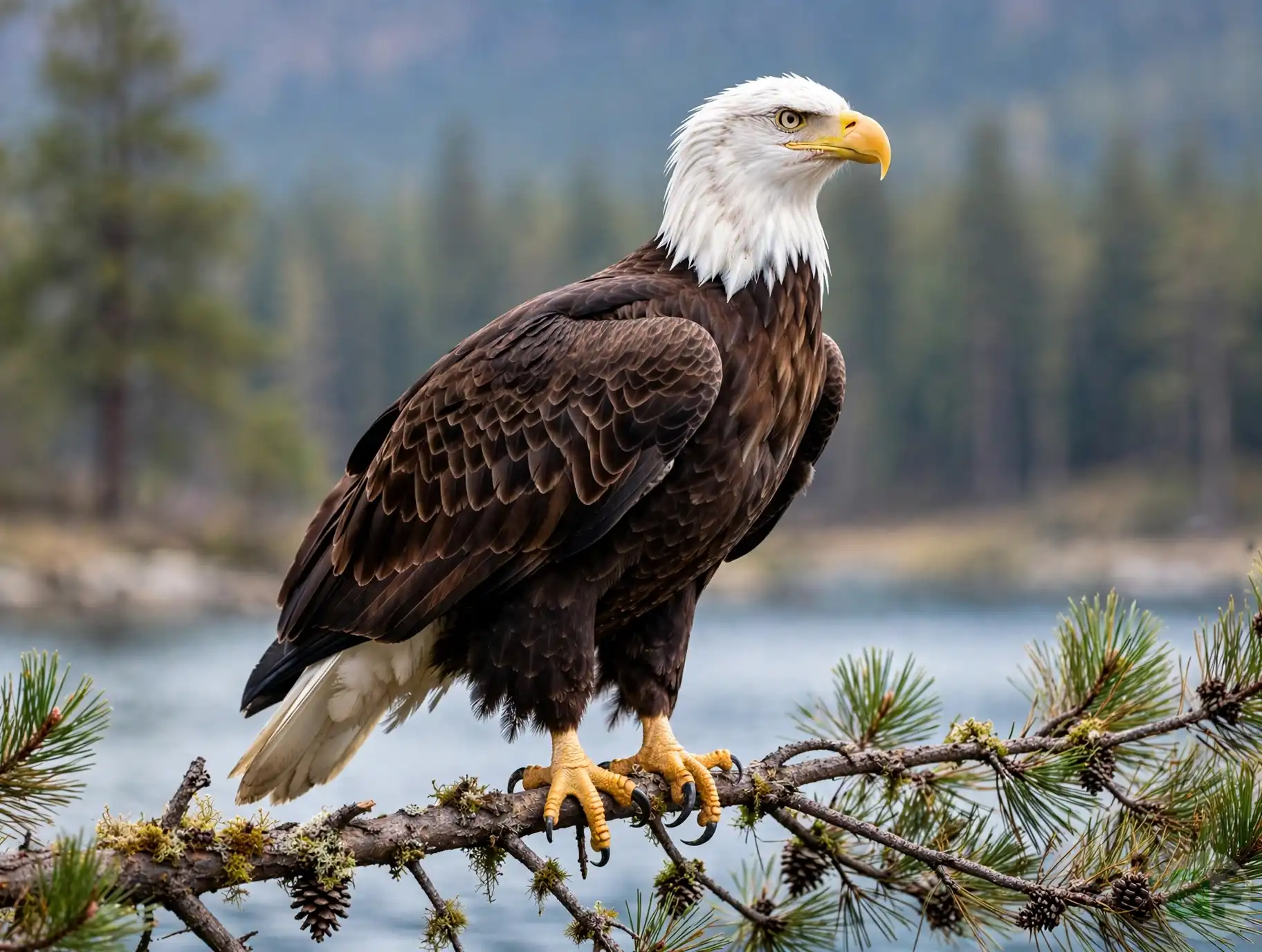
19. Best Places to See Bald Eagles in the Wild
Winter Congregations — The Most Spectacular Viewing
1. Chilkat Bald Eagle Preserve, Haines, Alaska — The most spectacular bald eagle viewing location in the world — 3,000–4,000 eagles gather along the Chilkat River valley from October through February (peak November–December). The American Bald Eagle Foundation in Haines provides excellent educational resources and guided viewing. The preserve is accessible by road from Haines or by ferry from the Alaska Marine Highway System. Standing on the river banks surrounded by thousands of eagles — in the trees, on the gravel bars, soaring overhead — is an experience without parallel in the North American raptor world.
2. Skagit River Bald Eagle Natural Area, Washington — One of the finest bald eagle viewing sites in the contiguous United States — hundreds of eagles congregate along the Skagit River in the North Cascades of Washington State from November through February to feed on chum salmon. The Washington Department of Fish and Wildlife and Skagit Land Trust cooperatively manage public viewing areas. Peak counts of 500+ eagles have been documented at prime sites.
3. Mississippi River — Lock and Dam sites (Illinois, Iowa, Missouri) — Multiple sites along the Mississippi River where lock and dam structures create open water below the dam provide major winter bald eagle congregations when the river is otherwise frozen. Alton, Illinois; Keokuk, Iowa; Clarksville, Missouri are among the most consistently productive sites with public viewing access. The Midwest Bald Eagle Conference coordinates public eagle watching events at multiple sites each winter.
4. Conowingo Dam, Maryland — The most accessible major eagle congregation site on the East Coast — hundreds of bald eagles gather at the Conowingo Dam on the Susquehanna River (approximately 60 km northeast of Baltimore) from October through January to catch fish disturbed by the dam outflow. The site is within easy day-trip distance of Baltimore, Philadelphia, and Washington DC — making it one of the most heavily visited eagle viewing sites in the eastern United States.
5. Klamath Basin, California/Oregon — The Klamath Basin National Wildlife Refuges complex hosts one of the largest winter bald eagle concentrations in the contiguous United States — 300–1,000 eagles wintering in the refuge system from November through February, roosting in old-growth ponderosa pine groves.
6. Glacier National Park, Montana — Year-round bald eagle presence with particularly good viewing in autumn when eagles concentrate along the park’s lakes and rivers to exploit spawning kokanee salmon. The McDonald Creek area is particularly productive.
Year-Round Viewing in Breeding Areas
7. Chesapeake Bay, Maryland/Virginia — One of the highest bald eagle densities in the eastern United States — hundreds of pairs nest throughout the Bay watershed. Blackwater National Wildlife Refuge on Maryland’s Eastern Shore maintains an exceptional resident eagle population visible year-round.
8. Florida — The state with the highest breeding eagle density in the contiguous US; eagles are visible year-round across Florida — particularly at large lakes, river systems, and coastal areas. Lake Kissimmee State Park, Paynes Prairie State Preserve, and various other state parks provide reliable eagle viewing.
9. Upper Mississippi River National Wildlife and Fish Refuge — Year-round presence with winter concentrations; the refuge encompasses 260 miles of the Upper Mississippi River corridor in Illinois, Iowa, Minnesota, and Wisconsin.
20. How You Can Help
Supporting bald eagle conservation in 2026 means addressing the remaining threats to a species that has already achieved extraordinary recovery — particularly the lead poisoning crisis and the habitat protection needed to sustain the recovered population.
Support these organizations:
- American Eagle Foundation — eagles.org — the primary US organization specifically dedicated to bald eagle education, conservation, and free-flight demonstration programs
- HawkWatch International — hawkwatch.org — raptor monitoring and conservation including bald eagle population trends
- National Wildlife Federation — nwf.org — broad US wildlife conservation advocacy including bald eagle habitat protection
- National Audubon Society — audubon.org — bird conservation advocacy including continued bald eagle protection and habitat preservation
- The Peregrine Fund — peregrinefund.org — raptor conservation organization whose DDT research contributed to the eagle recovery; continues raptor conservation globally
- Nature Conservancy — nature.org — land protection programs preserving bald eagle nesting and foraging habitat
Critical individual actions:
- Switch to non-lead ammunition — if you hunt, choosing copper or other non-lead ammunition eliminates the primary current cause of preventable bald eagle mortality. Non-lead ammunition is now available for virtually all calibers and performs comparably to lead ammunition in field conditions
- Support non-lead ammunition advocacy — supporting organizations and legislation that encourage or require non-lead ammunition use in wildlife areas directly reduces eagle lead poisoning
- Protect old trees — advocating for the retention of large, mature trees in land-use planning preserves the nest sites that bald eagles require — old trees with structural integrity take decades to centuries to develop and cannot be quickly replaced
- Keep waterways clean — supporting clean water advocacy and reporting water pollution to appropriate authorities protects the fish communities that bald eagles depend on
- Report eagle sightings to eBird — citizen science occurrence records from across the range contribute to population monitoring and habitat use research
- Reduce secondary rodenticide exposure — avoiding second-generation anticoagulant rodenticides around homes and farms reduces secondary poisoning risk for eagles consuming dead rodents
21. Top Documentaries & Books
Must-Watch Documentaries
- “American Eagle” (National Geographic, various productions) — Multiple National Geographic treatments of bald eagle natural history; among the most comprehensive documentary coverage available
- “Eagles of the Wild” (BBC/PBS) — Detailed natural history documentary on bald eagle ecology and behavior
- “Chilkat Bald Eagle Preserve — Wings over Winter” (various productions) — Multiple documentary treatments of the extraordinary Chilkat River congregation
- “The American Eagle: Our National Symbol” (Smithsonian Channel) — Comprehensive treatment combining natural history and cultural significance
- “Our Planet — Freshwater” (Netflix, David Attenborough, 2019) — North American freshwater sequences include bald eagle content
- “American Experience: Rachel Carson” (PBS) — The story of Silent Spring and the DDT ban essential context for understanding bald eagle conservation history
Must-Read Books
- The Bald Eagle: Haunts and Habits of a Wilderness Monarch by Mark Stalmaster — The most comprehensive natural history of the bald eagle in book form
- Silent Spring by Rachel Carson (1962) — The foundational environmental text documenting DDT’s effects on bald eagles; essential reading for understanding the conservation story
- The Eagle Bird by Charles F. Wilkinson — Legal and cultural history of the bald eagle’s significance in American law and indigenous tradition
- American Eagle by David Crane — Popular natural history and cultural history of the national symbol
- Hawks, Eagles, and Falcons of North America by Paul Johnsgard — Comprehensive treatment of North American raptors including detailed bald eagle natural history
- Return of the Eagle by Charlie Broley — The story of bald eagle banding research in Florida that documented the DDT reproductive failure; historically essential
22. Bald Eagle Comparison with Other Large Eagles
| Feature | Bald Eagle | Golden Eagle | Harpy Eagle | Steller’s Sea Eagle | White-tailed Eagle |
|---|---|---|---|---|---|
| Scientific name | Haliaeetus leucocephalus | Aquila chrysaetos | Harpia harpyja | Haliaeetus pelagicus | Haliaeetus albicilla |
| Max wingspan | 244 cm | 234 cm | 224 cm | 250 cm | 244 cm |
| Max weight | 6.3 kg | 7.7 kg | 9 kg | 9 kg | 7.5 kg |
| Primary prey | Fish; waterfowl | Mammals; rabbits | Primates; sloths | Fish; waterfowl | Fish; waterfowl |
| Habitat | Water/forest | Open mountain/plain | Tropical rainforest | Coastal Russia/Japan | Water/forest — Eurasia |
| Conservation | Least Concern | Least Concern | Vulnerable | Vulnerable | Least Concern |
| Range | North America | Northern Hemisphere | C./S. America | Russia, Japan | Eurasia |
| National symbol | USA | Germany, Mexico, others | — | — | Various European nations |
| Famous for | US national symbol; DDT recovery story | Most widespread eagle | Most powerful raptor in Americas | Largest eagle by mass | European eagle recovery |
| Pair bond | Lifelong | Lifelong | Lifelong | Lifelong | Lifelong |
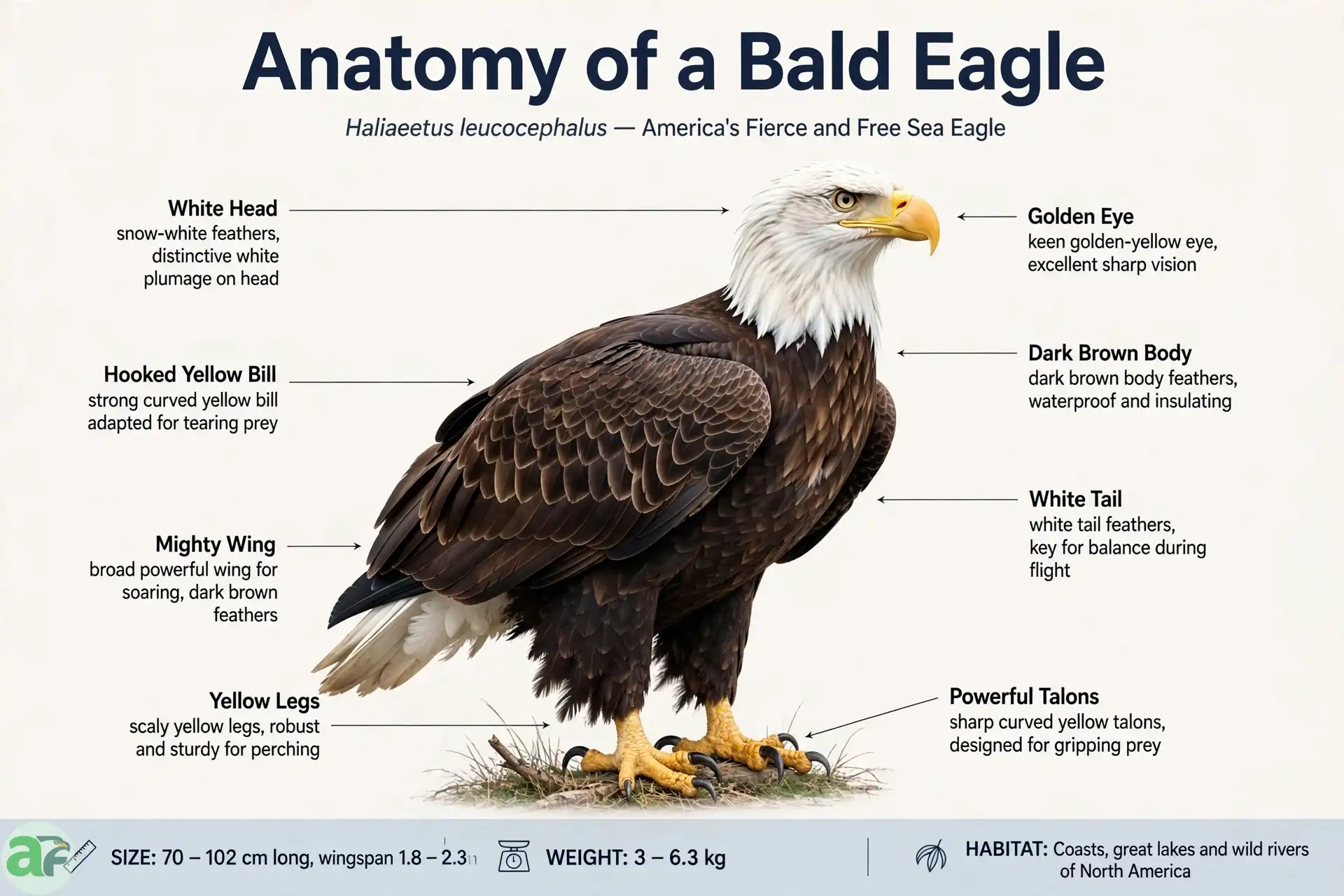
23. Frequently Asked Questions About Bald Eagles
Q1. What is the scientific name of the bald eagle?
The bald eagle’s scientific name is Haliaeetus leucocephalus (Linnaeus, 1766). The genus name Haliaeetus derives from the Greek hals (sea) and aetos (eagle) — meaning “sea eagle” — reflecting the genus’s association with aquatic habitats and fish-based diets that characterizes all Haliaeetus species. The species name leucocephalus derives from the Greek leukos (white) and kephale (head) — meaning “white-headed” — a direct description of the adult bird’s most immediately distinctive feature. The species was formally described by Carl Linnaeus in the 12th edition of Systema Naturae in 1766 — originally placed in the genus Falco and subsequently moved to Haliaeetus. Two subspecies are recognized: the larger northern subspecies H. l. washingtoniensis (Alaska and Canada) and the slightly smaller nominate H. l. leucocephalus of the contiguous United States and northern Mexico. The common name “bald eagle” derives not from the bird being featherless but from the archaic English word balde or bald meaning “white” — making the bald eagle the “white-headed eagle,” which accurately describes the adult’s distinctive appearance. The eagle has been the national bird of the United States since June 20, 1782, when the Continental Congress adopted the Great Seal of the United States.
Q2. Why did the bald eagle almost go extinct?
The bald eagle’s near-extinction in the contiguous United States by the early 1960s resulted from two primary causes acting simultaneously. The first was direct persecution — shooting, trapping, and poisoning of eagles by hunters, farmers, and fishermen who incorrectly believed eagles posed significant threats to fish and livestock populations. This persecution was effectively unchecked until the Bald Eagle Protection Act of 1940 provided the first meaningful legal protection. The second and ultimately more devastating cause was DDT pesticide poisoning — specifically a process called biomagnification in which DDT accumulated through the aquatic food chain, reaching its highest concentrations in the fish-eating birds at the top of the chain. DDT’s breakdown product DDE interfered with calcium metabolism in bald eagles, causing them to produce eggshells 10–30% thinner than normal — so thin that eggs collapsed under the weight of incubating adults. The result was near-total reproductive failure across the contiguous United States — adults nesting but failing to produce surviving chicks year after year. The population fell from an estimated several thousand pairs to just 417 pairs by 1963 — the most severe population crash of any major American wildlife species in the 20th century. The recovery began following the DDT ban in 1972 and the passage of the Endangered Species Act in 1973, and has produced one of the most extraordinary wildlife population recoveries in history — from 417 pairs in 1963 to an estimated 71,400+ nesting pairs in the 2020 survey.
Q3. How big is a bald eagle’s nest?
Bald eagle nests — called eyries — are the largest bird nests in North America and among the largest in the world. A newly built nest typically measures approximately 1.5–1.8 meters in diameter and 0.5–1 meter in depth — substantial for a first-year structure. However, bald eagle pairs return to the same nest year after year, adding new material each breeding season, and the cumulative additions over multiple years produce progressively larger structures. An established nest used for 10 years may measure 2 meters in diameter and 2 meters in depth. The most extraordinary nests — used for decades — can reach truly remarkable dimensions. The most famous record nest, documented at Vermilion, Ohio, accumulated material for 34 years and eventually measured 2.9 meters wide and approximately 6 meters deep — estimated to weigh over 2 metric tons before the supporting tree collapsed. A typical nest used for 5–10 years weighs 400–600 kg; exceptional long-used nests may exceed 1,000 kg. The nest interior is lined with soft materials — grass, moss, pine needles, feathers — refreshed each breeding season. Nest building and maintenance is carried out by both members of the pair, with material collection occurring throughout the breeding season.
Q4. Is the bald eagle’s famous call really the bald eagle?
No — the fierce, descending scream universally used as the bald eagle’s call in American films, television, advertising, and popular culture is actually the call of the red-tailed hawk (Buteo jamaicensis). The red-tailed hawk’s call — a drawn-out, descending kreeeee-ar lasting approximately two seconds — was deemed more impressive than the bald eagle’s actual vocalization and has been substituted in virtually every media context where a “bald eagle sound” is required. The bald eagle’s actual call consists of a series of high-pitched, thin, stuttering whistles and chattering notes typically described as a rapid kwit-kwit-kwick-kwick-kwick sequence — descending in pitch and considerably shorter and thinner in quality than the dramatic hawk scream. Experienced birdwatchers sometimes describe the actual bald eagle call as “surprisingly wimpy” or “squeaky” relative to the bird’s size and cultural gravitas. This acoustic substitution is one of the most widespread ornithological inaccuracies in American popular culture — the vast majority of Americans have seen thousands of bald eagle images and heard the red-tailed hawk’s call as the “eagle sound,” never encountering the bird’s actual vocalization. Wildlife documentaries that use accurate bald eagle vocalizations frequently generate viewer surprise — audiences expecting the hawk’s scream and receiving instead the eagle’s chattering whistle.
Q5. Where is the best place to see bald eagles in the wild?
The single most spectacular bald eagle viewing location in the world is the Chilkat Bald Eagle Preserve near Haines, Alaska — particularly during the peak congregation period from mid-November through December. The five-mile stretch of the Chilkat River kept ice-free by warm upwelling springs hosts 3,000–4,000 bald eagles simultaneously — the largest documented eagle gathering in the world. The American Bald Eagle Foundation in Haines provides educational resources and guided viewing opportunities. For visitors who cannot reach Alaska, the best contiguous United States options include: Conowingo Dam on the Susquehanna River in Maryland (October–January; hundreds of eagles; accessible from Baltimore, Philadelphia, and Washington DC); Skagit River in Washington State (November–February; hundreds of eagles; accessible from Seattle); Mississippi River lock and dam sites in Illinois, Iowa, and Missouri (winter; major congregations accessible to Midwest visitors); and Blackwater National Wildlife Refuge in Maryland (year-round breeding eagles; excellent visitor infrastructure). For year-round viewing with virtually guaranteed sightings, Florida — with the highest breeding eagle density in the contiguous United States — provides reliable bald eagle encounters at most large lakes and river systems throughout the state in every season.
24. Sources & Refernces
- Wikipedia — Haliaeetus leucocephalus, Haliaeetus, Accipitridae, DDT, Bald Eagle Protection Act
- IUCN Red List — iucnredlist.org (current Least Concern assessment for Haliaeetus leucocephalus)
- US Fish and Wildlife Service — fws.gov (2020 bald eagle population survey; recovery history; legal protection documentation)
- American Eagle Foundation — eagles.org
- National Audubon Society — audubon.org
- Carson, R. (1962). Silent Spring. Houghton Mifflin — the foundational DDT documentation
- Stalmaster, M. (1987). The Bald Eagle. Universe Books — the comprehensive natural history reference
- National Geographic — nationalgeographic.com
- Smithsonian National Museum of Natural History — naturalhistory.si.edu
- BBC Wildlife / BBC Earth — bbcearth.com
- Britannica — britannica.com/animal/bald-eagle
- Cornell Lab of Ornithology — allaboutbirds.org (species account; Macaulay Library)
- USGS National Wildlife Health Center — nwhc.usgs.gov (lead poisoning mortality data)
- Environmental Protection Agency — epa.gov (DDT historical documentation)