
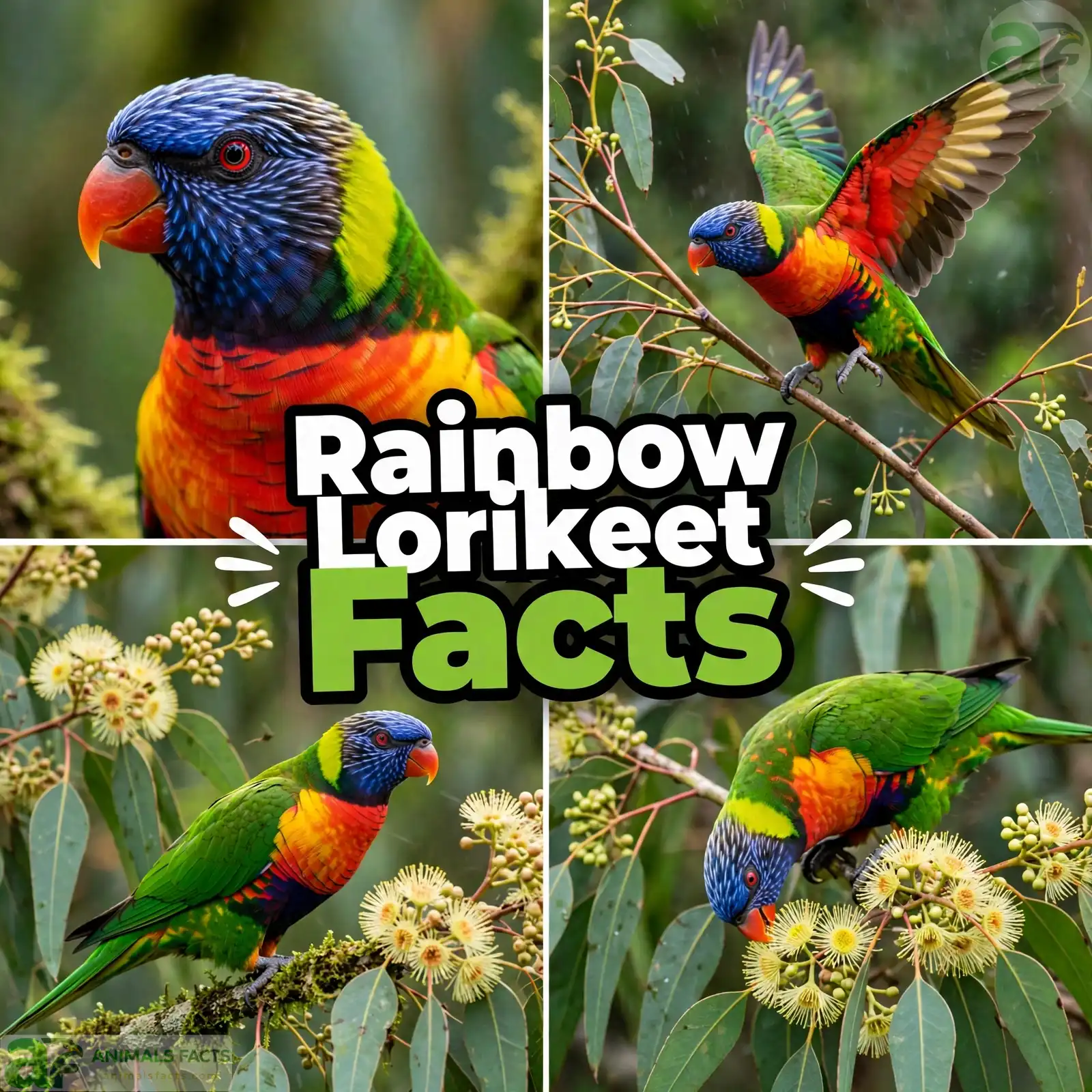
Rainbow Lorikeet Facts
| Feature | Details |
|---|---|
| Scientific Name | Trichoglossus moluccanus (Gmelin, 1788) |
| Kingdom | Animalia |
| Phylum | Chordata |
| Class | Aves |
| Order | Psittaciformes |
| Family | Psittaculidae |
| Common Names | Rainbow lorikeet; rainbow lory |
| Native Range | Eastern and northern Australia — Queensland, New South Wales, Victoria, South Australia, Northern Territory; also eastern Indonesia, Papua New Guinea, and islands |
| Habitat | Rainforest, woodland, coastal heath, urban parks and gardens — one of the most habitat-flexible Australian parrots |
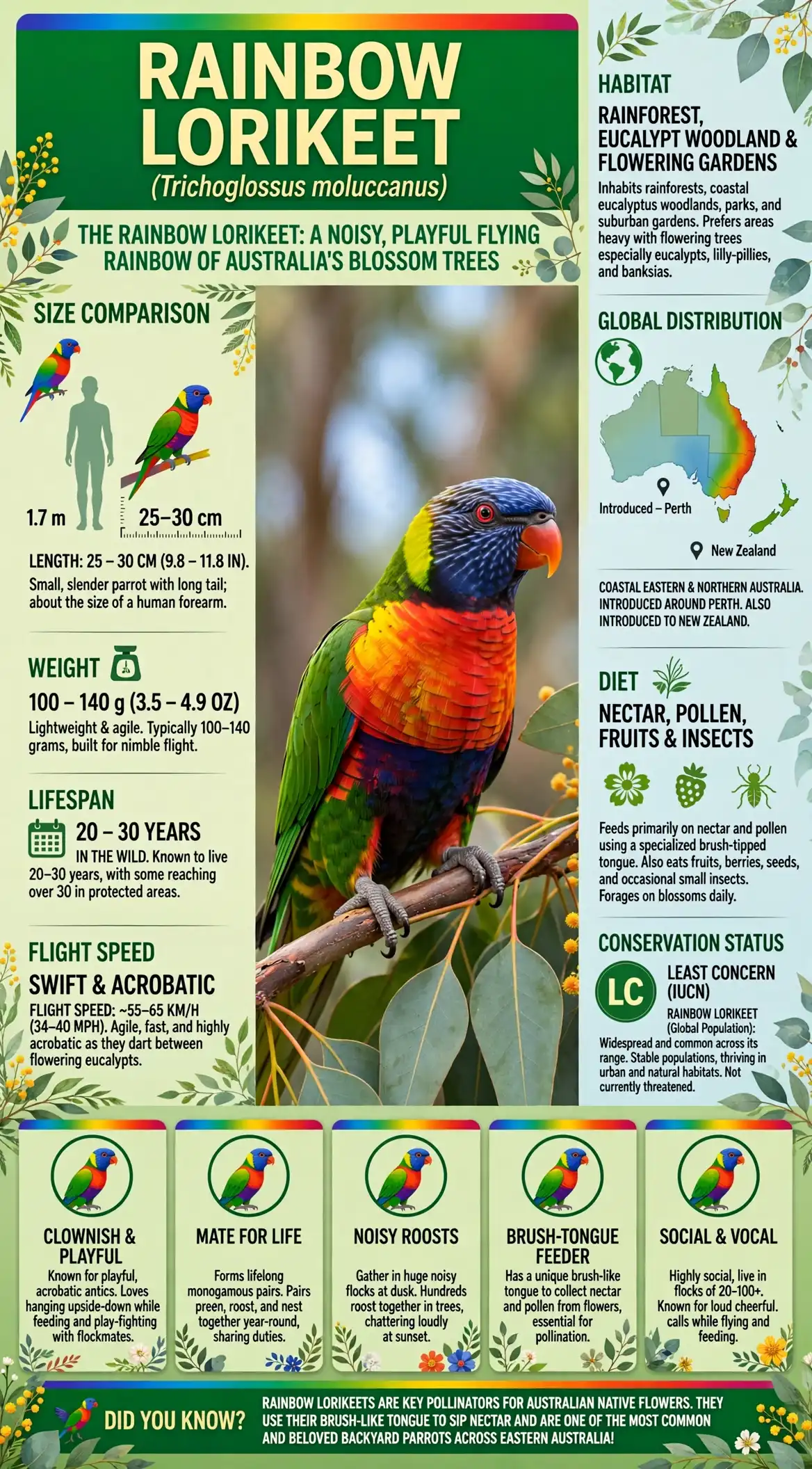
| Lifespan | 15–20 years (wild); up to 30 years (captivity) |
| Diet | Nectar and pollen — the most specialized nectar-feeding parrot in Australia; also soft fruits, seeds |
| Body Length | 25–30 cm |
| Weight | 75–157 grams |
| Conservation Status | Least Concern (IUCN) — abundant and expanding in native range; invasive in southwestern Australia, New Zealand, and Hong Kong |
| Defining Feature | Six-color plumage — blue head, orange-red breast, yellow-green collar, green back and wings, purple-blue belly, orange bill — the most vivid parrot coloration in Australia |
| Tongue | Specialized brush-tipped tongue — unique among Australian parrots; adapted exclusively for nectar and pollen collection |
| Closest Relatives | Other lorikeets — Trichoglossus genus; broader lorikeet tribe Lorini |
| Invasive Status | Listed as a pest species in Perth (Western Australia), New Zealand’s North Island, and Hong Kong — one of the most ecologically damaging introduced parrots globally |
 1. Introduction: What is a Rainbow Lorikeet?
At dusk on the Gold Coast, as the subtropical sky turns through pink to deep purple, a sound builds from the fig trees in a suburban park that would be extraordinary if it weren’t so entirely familiar to the millions of Australians for whom it is simply the sound of evening — a building, overlapping, intensifying torrent of chattering, screaming, whistling calls from hundreds of rainbow lorikeets converging on their communal roost. The noise is staggering. The visual spectacle matches it — the trees exploding in constant movement as birds arrive from every compass direction, each individual a living demonstration of what happens when evolution abandons any commitment to subtlety and commits entirely to the most vivid possible combination of blue, orange, yellow-green, purple, and scarlet in a 100-gram package. A roosting tree full of rainbow lorikeets in the fading light looks like an animated piece of Fauvism — every branch occupied by multiple birds, constantly displacing each other, constant calling, constant movement, the colors shifting as they move. Rainbow lorikeet facts begin with this scene — one of Australia’s most familiar wildlife spectacles, an animal so common in urban eastern Australia that most Australians take it entirely for granted, yet one of the most biologically extraordinary parrots in the world.
The rainbow lorikeet (Trichoglossus moluccanus) is simultaneously one of Australia’s most abundant and most visible birds and one of its most biologically distinctive — the possessor of a brush-tipped tongue found in no other Australian parrot, a dietary specialization on nectar and pollen so complete that it has driven the development of an entirely unique digestive system, a color combination so extreme that it was described by early European naturalists as implausible until living specimens confirmed what preserved skins had suggested, and a social and behavioral complexity that has made it one of the most studied parrots in urban ecology research. It is also, in a biological paradox that reflects the complexity of modern conservation, simultaneously a conservation success story (abundant, expanding, thriving in modified landscapes) and a conservation problem — an invasive species causing documented ecological damage in southwestern Australia where it was introduced, in New Zealand where feral populations threaten native wildlife, and in Hong Kong where it has established self-sustaining populations that compete with native species.
Interesting facts about rainbow lorikeets reveal an animal of breathtaking biological sophistication beneath the spectacular plumage — the brush-tipped tongue that acts as a biological paintbrush collecting pollen and nectar from flowers with an efficiency that has made the rainbow lorikeet the most important pollinator among Australian parrots; the complex social hierarchy of feeding flocks in which dominant individuals monopolize the best feeding positions while subordinate birds use stealth and speed to exploit the gaps; the extraordinarily loud and complex vocalization repertoire that allows individual recognition within large, raucous flocks; the paradox of a bird that is simultaneously one of Australia’s most beloved wildlife symbols and one of its most problematic invasive species depending on geography; and the urban ecology dimension in which the rainbow lorikeet has adapted to human-modified landscapes so successfully that it may be more abundant in suburban eastern Australia than in any natural habitat. Whether you are searching for rainbow lorikeet facts for kids to explore the biology of Australia’s most colorful parrot, a wildlife enthusiast wanting to understand the ecology and conservation complexity of this extraordinary species, a Perth or New Zealand resident dealing with the invasive population, or simply someone captivated by the image of hundreds of vividly colored parrots descending on a flowering eucalyptus tree — this is your comprehensive guide. Australia’s most spectacular small parrot has an extraordinary story to tell.
2. Rainbow Lorikeet Species Overview & Classification
The rainbow lorikeet belongs to the tribe Lorini — the lorikeets — a group of nectar-specialist parrots distributed across the Australasian region, and is the most widely distributed and most studied member of the genus Trichoglossus.
Species Classification Table
| Taxonomic Rank | Classification |
|---|---|
| Kingdom | Animalia |
| Phylum | Chordata |
| Class | Aves |
| Order | Psittaciformes |
| Family | Psittaculidae (Vigors, 1825) |
| Tribe | Lorini |
| Genus | Trichoglossus (Vigors & Horsfield, 1827) |
| Species | T. moluccanus (Gmelin, 1788) |
| Common Names | Rainbow lorikeet; rainbow lory |
| Etymology | Trichoglossus = “hair-tongue” (Greek: trichos = hair + glossa = tongue) — referring to the brush-tipped tongue; moluccanus = “of the Moluccas” (referring to the Maluku Islands of Indonesia); “lorikeet” from Malay luri (a parrot) + English diminutive -keet |
Recent Taxonomic Revision — From One Species to Several
One of the most significant recent developments in rainbow lorikeet taxonomy has been the splitting of the formerly broad Trichoglossus haematodus species complex into multiple separate species:
The historical situation — For most of the 20th century, the “rainbow lorikeet” was treated as a single, wide-ranging species (Trichoglossus haematodus) with numerous subspecies across Australia, eastern Indonesia, Papua New Guinea, and the Pacific islands.
The 2021 revision — Following genetic and morphological analysis, the major taxonomic authorities (including IOC World Bird List and HBW/BirdLife) split the complex into multiple species. The Australian rainbow lorikeet became Trichoglossus moluccanus — a species restricted to Australia and adjacent islands, separate from:
| Species (post-split) | Common Name | Range |
|---|---|---|
| Trichoglossus moluccanus | Rainbow lorikeet | Australia (focus of this article) |
| Trichoglossus haematodus | Coconut lorikeet | Moluccas, Lesser Sunda Islands |
| Trichoglossus forsteni | Scarlet-breasted lorikeet | Sumbawa and Lombok |
| Trichoglossus capistratus | Marigold lorikeet | Timor and nearby islands |
| Trichoglossus weberi | Flores lorikeet | Flores |
| Trichoglossus flavoviridis | Yellow-and-green lorikeet | Sulawesi |
Six Recognized Subspecies of T. moluccanus
Within the Australian rainbow lorikeet, six subspecies are recognized — varying in the extent and intensity of specific color regions:
| Subspecies | Common Name | Range | Key Difference |
|---|---|---|---|
| T. m. moluccanus | Rainbow lorikeet | SE Australia (core range) | Nominate form; deepest color |
| T. m. septentrionalis | Northern rainbow lorikeet | N. Queensland, N. Territory | Smaller; slightly paler |
| T. m. eyrei | Eyre’s lorikeet | S. Australia, western Victoria | Slightly paler breast |
| T. m. nesophilus | Uncertain | Kai Islands (Indonesia) | Island form |
| T. m. rubritorquis | Red-collared lorikeet | N. Territory (inland) | Distinctive orange collar — sometimes treated as full species |
| T. m. intermedius | Intermediate lorikeet | NE Queensland coast | Intermediate between forms |
The Lorikeet Tribe — Australia’s Nectar Specialists
The broader tribe Lorini contains approximately 55 species of lorikeets distributed across Australasia — all sharing the fundamental adaptation of nectar and pollen specialization:
Australian lorikeet diversity — Australia is home to multiple lorikeet species alongside the rainbow lorikeet:
- Scaly-breasted lorikeet (Trichoglossus chlorolepidotus) — eastern Australia
- Musk lorikeet (Glossopsitta concinna) — southeastern Australia
- Little lorikeet (Glossopsitta pusilla) — eastern Australia
- Purple-crowned lorikeet (Parvipsitta porphyrocephala) — southwestern and southern Australia
- Swift parrot (Lathamus discolor) — Tasmania and SE mainland; Critically Endangered
Evolution & Discovery Timeline
~20–25 million years ago (Oligocene-Miocene) — The ancestral lorikeet lineage diverges within the broader parrot radiation — establishing in the Australasian region and beginning the evolutionary specialization toward nectar feeding that will define the entire tribe.
~5–10 million years ago — The Trichoglossus genus diversifies — multiple lineages adapting to different island and mainland environments across Australasia.
Pre-European contact — Rainbow lorikeets are abundant across eastern Australia and deeply embedded in the ecological and cultural life of indigenous Australian peoples across their range.
1788 — German naturalist Johann Friedrich Gmelin formally describes the rainbow lorikeet in the 13th edition of Systema Naturae — giving it the species name moluccanus based on specimens from the Indonesian Moluccas region (the taxonomic situation subsequently revised to apply the name to the Australian form).
Late 19th century — Rainbow lorikeets are brought to Europe in increasing numbers by traders and naturalists — the species becoming one of the most sought-after exotic parrots in European avicultural collections.
20th century — The rainbow lorikeet establishes as an invasive species in Perth (Western Australia) — escaped and released pet birds establishing self-sustaining populations in habitat outside the species’ natural Australian range.
Late 20th century — Rainbow lorikeets establish invasive populations in New Zealand (particularly Auckland and the North Island) and Hong Kong — international pet trade escapees founding populations that become conservation concerns.
2021 — Major taxonomic revision splits the former T. haematodus complex into multiple species — the Australian birds formally becoming T. moluccanus.
2024 — Trichoglossus moluccanus maintains its Least Concern IUCN status — abundant across its native range and continuing urban expansion.
“The rainbow lorikeet is the parrot that Australia takes for granted and the rest of the world can barely believe is real. It is simultaneously one of the most spectacular and one of the most ecologically important birds on the continent — a pollinator whose contribution to Australian forest and woodland ecology rivals that of honeybees. And in the cities, it has become something entirely new — a wild animal that has figured out how to thrive in human-built environments in ways that reveal as much about urban ecological opportunity as about the bird itself.”
— Dr. Darryl Jones, Griffith University — leading researcher on urban wildlife feeding and rainbow lorikeet ecology
3. Rainbow Lorikeet Physical Description & Unique Features
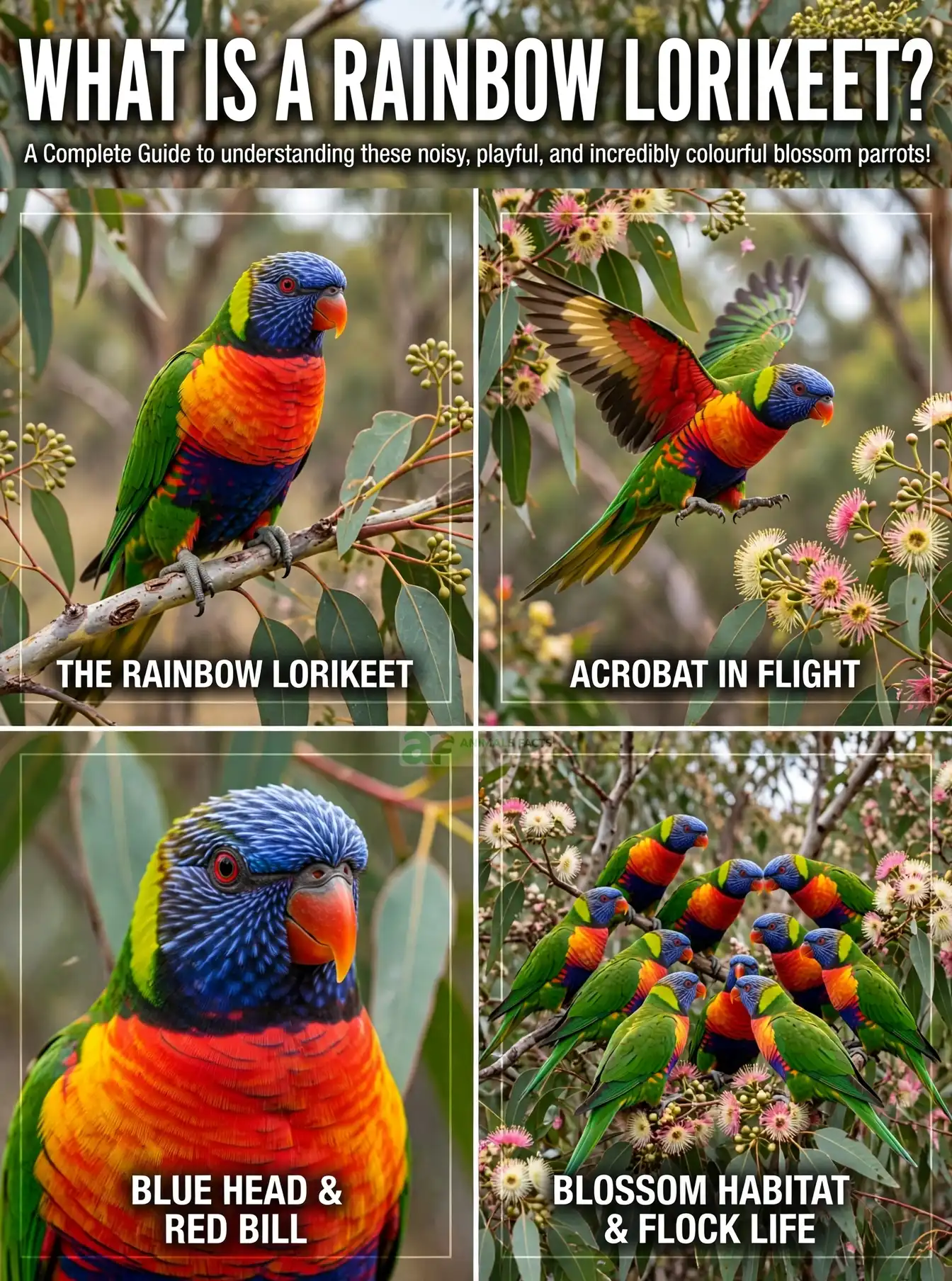
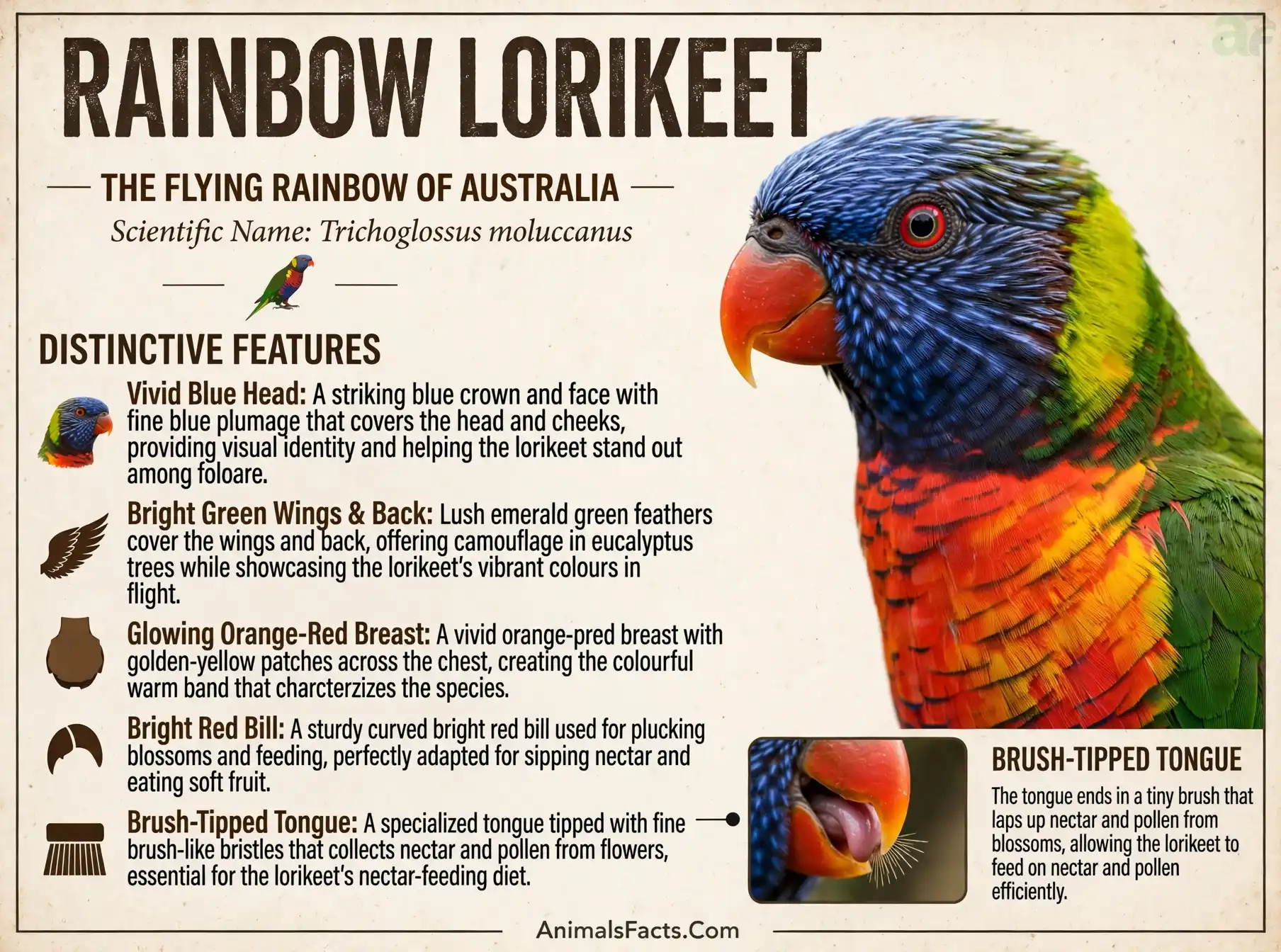
The rainbow lorikeet’s plumage is the most polychromatic of any Australian parrot — combining six distinct vivid colors into a coherent pattern that has made it immediately recognizable to anyone who has ever seen one and unforgettable to anyone who sees one for the first time.
The Six-Color Plumage — A Region-by-Region Description
Unlike many colorful birds where the colors blend or transition gradually, the rainbow lorikeet’s plumage is organized into sharply defined, strongly contrasting color regions that produce an effect of extraordinary visual complexity:
The blue head — The entire head, from bill base to nape, is a vivid cobalt to violet-blue — one of the most immediately striking features when the bird is seen face-on. The blue is produced by structural coloration — nanostructure in the feather barbules reflecting short-wavelength light — and shifts slightly with viewing angle, appearing more violet or more cobalt depending on the light.
The orange-red breast — The upper breast is a vivid orange-scarlet — sharply demarcated from the blue of the head above and the yellow-green collar at the sides. The orange-red color is produced by carotenoid pigments and its vividness reflects dietary quality — making it a potential honest signal of individual condition.
The yellow-green collar — A band of yellow-green crosses the nape and wraps around the sides of the neck — creating a visual separation between the blue head and the green back, and a warm accent at the transition between the scarlet breast and the green body.
The green back and wings — The upperparts — back, wings, and tail — are bright green — the most extensive color region in the plumage. The green is produced by a combination of structural blue and yellow carotenoid (the same additive mechanism as the paradise tanager’s green head), creating a vivid, warm green distinct from the darker greens of vegetation.
The purple-blue belly — Below the orange breast, the lower breast and belly are purple to violet-blue — a different tone from the cobalt of the head, creating a second blue region that enriches the overall color complexity. This purple-blue belly is one of the most distinctive identification features separating the rainbow lorikeet from the scaly-breasted lorikeet in field observation.
The orange bill — The bill is a vivid orange-red — the same general color family as the breast but in a different structural context. Bill color intensity varies with age (young birds have darker bills that brighten with age and condition) and may function as an age and condition signal in social interactions.
The Brush-Tipped Tongue — The Most Distinctive Anatomical Feature
The rainbow lorikeet’s brush-tipped tongue is the most anatomically distinctive feature of the entire lorikeet tribe — and the adaptation that most clearly distinguishes lorikeets from all other parrots:
The structure — The tongue tip is covered with papillae — tiny, hair-like projections that create a brush-like surface when the tongue is extended. Under magnification, the papillae appear as elongated, flexible filaments arranged in a regular array across the tongue tip.
The function — When the lorikeet inserts its tongue into a flower, the papillae trap nectar and pollen in the spaces between them — the tongue tip acting simultaneously as a nectar collector and a pollen brush. The tongue is rapidly inserted and withdrawn from flowers — lapping nectar and gathering pollen with each extension.
The tongue-tip extension rate — Rainbow lorikeets have been documented extending the tongue at rates of up to 10 times per second during rapid nectar lapping — the extraordinary rate of tongue extension and withdrawal being one of the most efficient nectar extraction systems in any bird species.
Uniqueness — The brush-tipped tongue is found throughout the lorikeet tribe (Lorini) but not in any other parrot group. It represents a convergent evolution of tongue modification with the brush-tipped tongues of honey possums (Tarsipes rostratus) and nectarivorous bats — different animals independently evolving similar solutions to the challenge of efficient nectar extraction.
The digestive system consequence — The nectar and pollen diet facilitated by the brush tongue has driven the evolution of a modified digestive system in lorikeets — the proventriculus (first stomach chamber) is reduced in lorikeets compared to seed-eating parrots, as the soft, liquid diet of nectar requires less mechanical processing than hard seeds. The intestine is also modified to process the high-sugar content of nectar efficiently.
Size and Physical Proportions
Body length — 25–30 cm — a medium-small parrot; larger than a budgerigar but smaller than a cockatiel
Weight — 75–157 grams — lightweight relative to body length; the energetic demands of nectar feeding select for efficient body mass
Wingspan — approximately 17 cm per wing
Tail — Relatively long and pointed — the graduated tail typical of Trichoglossus lorikeets
Sexual Dimorphism — The Absence Thereof
Like the paradise tanager, the rainbow lorikeet shows virtually no sexual dimorphism — males and females are essentially identical in plumage. This absence of visual sex differentiation in a spectacularly colored species suggests that the plumage functions in species recognition and social signaling rather than purely in mate attraction through female choice of spectacular males.
The Red-Collared Subspecies
The red-collared lorikeet (T. m. rubritorquis) — sometimes treated as a separate species — differs from the nominate form primarily in having:
- A vivid orange-red collar completely encircling the neck (vs. the yellow-green collar of the nominate form)
- A black abdomen (vs. the purple-blue belly of the nominate form)
- Overall darker, more richly colored plumage
These differences are sufficiently dramatic that many ornithologists treat the red-collared form as a full species — the debate remains active in Australian ornithology.
💡 Did You Know? The rainbow lorikeet’s brush-tipped tongue operates at such extraordinary speed — up to 10 tongue extensions per second — that the lapping action cannot be followed by the human eye during active nectar feeding. High-speed video documentation has revealed the tongue mechanics in detail: the tongue is extended, the papillae splay outward and trap nectar and pollen, the tongue retracts drawing the collected material into the mouth, and the cycle immediately repeats — the entire sequence in approximately 100 milliseconds. Research by Don Brightsmith and colleagues has calculated that a foraging rainbow lorikeet can visit up to 3,000 individual flowers per day using this high-speed extraction system — a foraging rate that makes the lorikeet one of the most efficient floral visitors of any bird species, and explains how rainbow lorikeets maintain the high caloric intake needed despite the relatively low caloric density of nectar compared to seeds. The same research documented that a rainbow lorikeet foraging on Banksia inflorescences can extract all available nectar from a single Banksia cone in approximately 2–3 minutes — the tongue speed and mobility allowing access to every individual floret in the dense inflorescence more efficiently than any other floral visitor.
4. Top 25 Amazing Rainbow Lorikeet Facts
Here is your definitive collection of the most extraordinary, scientifically verified, and genuinely astonishing rainbow lorikeet facts as of 2026:
- The rainbow lorikeet’s brush-tipped tongue is unlike the tongue of any other Australian parrot — covered with hair-like papillae that trap nectar and pollen from flowers with extraordinary efficiency. The tongue can be extended up to 10 times per second during active nectar feeding.
- The rainbow lorikeet is classified as a pest species in Perth, Western Australia — an extraordinary situation where the same bird is simultaneously one of Australia’s most beloved wildlife icons in eastern Australia and an officially declared pest causing ecological damage in the southwest. The Perth population originates from escaped and released pet birds.
- Rainbow lorikeets established an invasive feral population in New Zealand — primarily in Auckland and the North Island — from escaped pet birds. The New Zealand Department of Conservation lists the rainbow lorikeet as a threat to native wildlife, including native New Zealand parrots and nectar-feeding birds, and actively manages the population through culling and trapping programs.
- A single rainbow lorikeet can visit up to 3,000 individual flowers per day during active nectar foraging — a foraging rate that makes lorikeets among the most efficient floral visitors of any bird species in the world.
- Rainbow lorikeets produce the loudest and most persistent communal roost noise of any Australian parrot — flocks of several hundred to several thousand birds roosting together in urban trees produce noise levels that have been measured at over 80 decibels — comparable to a running lawnmower — generating significant human-wildlife conflict in urban areas.
- The rainbow lorikeet cannot efficiently digest seed — unlike virtually all other parrots, lorikeets have a modified digestive system designed for nectar and soft food processing. Offering sunflower seeds and other hard seeds to wild lorikeets can cause malnutrition and digestive problems — a significant issue with the Australian practice of supplementary feeding of wild lorikeets.
- Rainbow lorikeets are documented drunk on fermented nectar — when nectar in certain flowers begins to ferment naturally, lorikeets consuming the fermented nectar can become temporarily intoxicated, showing symptoms of disorientation, falling from branches, and inability to fly. This phenomenon — documented in Darwin, Northern Territory and other locations — has resulted in wildlife carers establishing temporary recovery facilities for affected birds.
- The rainbow lorikeet is considered one of the most intelligent Australian parrots — demonstrating problem-solving capability, individual learning, social learning from flock members, and the capacity to modify behavior rapidly in response to novel challenges and opportunities. Urban rainbow lorikeets show dramatically different and more flexible behavioral repertoires than rural populations.
- Rainbow lorikeets maintain pair bonds for life — one of the few Australian parrots with documented long-term pair fidelity. The pair remains together year-round, roosting and foraging together even outside the breeding season.
- The rainbow lorikeet is among the most significant pollinators in the Australian botanical system — visiting and cross-pollinating flowering plants including eucalypts, grevilleas, banksias, and melaleucas across the eastern Australian landscape. The loss of rainbow lorikeets from an area would reduce pollination services for multiple plant species.
- Rainbow lorikeets have been documented displacing native species in both their introduced range and in areas of urban eastern Australia where their abundance has increased dramatically — aggressive competitive behavior at feeding sites giving dominant lorikeets priority access at the expense of smaller or less aggressive native species.
- The rainbow lorikeet’s remarkable color combination — six distinct vivid colors — is produced by a combination of structural coloration (the blue head and purple-blue belly), carotenoid pigment (the orange breast), and carotenoid-structural combination (the green back) — the same suite of color mechanisms seen in the paradise tanager but in an entirely different taxonomic group.
- Wild rainbow lorikeets in urban eastern Australia have developed the practice of visiting supplementary feeding stations provided by residents — a behavioral adaptation to urban environments that has expanded the species’ food resources but created public health concerns around the risk of disease transmission at communal feeding sites.
- The rainbow lorikeet is one of the most vocal Australian parrots — possessing a repertoire of approximately 20–25 distinct call types, including contact calls, alarm calls, aggression calls, and various social vocalizations used in pair bond maintenance. Individual birds can be distinguished by subtle differences in call character.
- The rainbow lorikeet nests in tree hollows — requiring large, old trees with suitable cavities. The loss of old growth trees with hollows is one of the few habitat constraints on rainbow lorikeet populations even in the species’ thriving urban populations — competition for hollows with other hollow-nesting species (including introduced common starlings) is a significant urban ecology issue.
- Rainbow lorikeet drunkenness events in Darwin, Northern Territory are sufficiently regular that the Darwin wildlife rescue organization (Ark Animal Hospital) established specific protocols for treating temporarily intoxicated lorikeets — the birds typically recovering fully within 24 hours of fermented nectar exposure.
- The rainbow lorikeet’s urban population boom in eastern Australia has been linked to the proliferation of garden flowering plants — the widespread planting of non-native flowering plants (including exotic Grevillea cultivars and other Proteaceae) providing year-round nectar resources that extend the food base beyond what native vegetation alone would support.
- Rainbow lorikeets travel up to 50 kilometers per day between roosting sites and foraging areas during periods of reduced local food availability — one of the longest daily foraging movements documented in any Australian parrot species, reflecting the patchy and temporally variable nature of nectar resources.
- A communal rainbow lorikeet roost can contain up to 30,000 individuals — one of the largest bird roosts in urban Australia. The Brisbane and Gold Coast communal roosts are among the most spectacular urban wildlife aggregations in the Southern Hemisphere.
- The rainbow lorikeet’s social learning capability allows it to acquire new feeding techniques by watching other individuals — wild lorikeets observed to learn how to exploit novel food sources (new garden plants, food offered at supplementary feeding stations, novel flower species) through watching other flock members rather than individual trial-and-error learning.
- Rainbow lorikeets are obligate cavity nesters — requiring pre-existing tree hollows that take 100–200 years to form in mature eucalyptus trees. In urban areas, the competition for these limited hollows with other hollow-nesting species including common starlings (Sturnus vulgaris) and common mynas (Acridotheres tristis) represents one of the most significant urban wildlife competition dynamics in Australian cities.
- The rainbow lorikeet has been shown to experience color vision across a broader spectrum than humans — including sensitivity into the ultraviolet range. The UV-reflective properties of the plumage may therefore carry visual information between lorikeets that is entirely invisible to human observers.
- Rainbow lorikeets at supplementary feeding stations have been documented engaging in food caching behavior — hiding pieces of fruit in crevices and bark for later consumption — an unusual behavior for a species whose primary diet (nectar) cannot be cached. The caching behavior with fruit suggests greater behavioral flexibility than the dietary specialization on liquid nectar would suggest.
- The disease risk associated with supplementary feeding of rainbow lorikeets is well-documented — communal feeding stations concentrate birds and facilitate transmission of avian diseases including psittacosis (Chlamydia psittaci) and lorikeet paralysis syndrome, a poorly understood neurological disease whose prevalence appears linked to supplementary feeding practices.
- As of 2026, the rainbow lorikeet population in eastern Australia is estimated at several million individuals and is believed to be increasing — driven by urban expansion, garden planting of flowering species, and the species’ exceptional adaptability to human-modified environments. In contrast, the invasive Perth and New Zealand populations are subject to active management programs attempting to reduce their numbers and prevent further range expansion.
5. Fun Facts About Rainbow Lorikeets
- Tongue extends 10 times per second — fastest nectar lapper in Australia
- Visits 3,000 flowers per day during foraging
- Gets genuinely drunk on fermented nectar
- A pest species in Perth — but beloved in eastern Australia
- Invasive in New Zealand and Hong Kong
- Communal roosts of up to 30,000 individuals
- Cannot digest hard seeds — unlike most parrots
- One of the most significant pollinators in Australian ecosystems
- Travels up to 50 km per day to find food
- Pair bonds for life — unusual among Australian parrots
- Can see ultraviolet light invisible to humans
- Nests in hollows that take 100–200 years to form
6. Rainbow Lorikeet Habitat & Geographic Range
Rainbow lorikeet habitat spans an extraordinary range of vegetation types across eastern and northern Australia — from dense tropical rainforest to open coastal heath, suburban garden, and urban park — reflecting the species’ exceptional habitat flexibility.
Primary Habitat Types
Eucalyptus woodland and open forest — The fundamental native habitat of the rainbow lorikeet; the flowering eucalypts (Eucalyptus and Corymbia species) that dominate much of eastern Australian woodland provide the primary nectar resource around which the rainbow lorikeet’s ecology is organized. The coincidence of eucalyptus flowering times with the lorikeet breeding season is not accidental — the lorikeet’s breeding is timed to exploit peak eucalyptus nectar availability.
Coastal heath and banksia scrub — Coastal heathlands dominated by Banksia, Hakea, Grevillea, and related Proteaceae species provide exceptional lorikeet habitat — the dense, complex inflorescences of Proteaceae being particularly productive nectar sources that rainbow lorikeets exploit intensively when in flower.
Rainforest edges and margins — While the closed canopy interior of dense rainforest provides fewer nectar resources than open woodland, rainforest margins and gaps support rainbow lorikeet populations through the flowering trees that colonize disturbed areas and forest edges.
Urban and suburban environments — Perhaps the most significant habitat expansion of the 20th and 21st centuries; the planting of flowering garden species (particularly exotic Grevillea cultivars, Callistemon, Melaleuca, and other Myrtaceae and Proteaceae) across suburban eastern Australia has created a year-round nectar bonanza that supports rainbow lorikeet populations at densities impossible in unmodified natural vegetation.
Monsoon forest and tropical woodland — In northern Australia (Northern Territory and northern Queensland), rainbow lorikeets occupy monsoon forest, paperbark woodland, and tropical savanna — the monsoon-season flowering of tropical trees providing the primary food resource.
Geographic Distribution
Native Range
| State/Territory | Status | Key Habitats | Population Trend |
|---|---|---|---|
| Queensland | Abundant | Coastal forest, urban areas | Increasing |
| New South Wales | Abundant | Coastal and inland woodland; urban areas | Increasing |
| Victoria | Abundant | Coastal heath, woodland, urban Melbourne | Increasing and expanding |
| South Australia | Present and expanding | Adelaide Hills, Fleurieu Peninsula | Expanding westward |
| Northern Territory | Present | Darwin coastal areas; monsoon forest | Stable |
| Western Australia (Kimberley) | Present (natural range limit) | Northern Kimberley | Stable |
| Western Australia (Perth region) | Invasive pest population | Urban Perth; Swan Coastal Plain | Managed — target for eradication |
Introduced/Invasive Range
| Location | Status | Establishment | Management Response |
|---|---|---|---|
| Perth, Western Australia | Invasive pest — active management | ~1968 from escaped pet birds | Official pest status; trapping and culling programs |
| New Zealand (Auckland, North Island) | Invasive — active management | ~1990s from escaped pet birds | DOC culling and trapping programs |
| Hong Kong | Established feral population | Late 20th century | Monitoring; some management |
| Kai Islands, Indonesia | Native or naturalized | Historical | No management |
The Urban Ecology Dimension
One of the most significant aspects of rainbow lorikeet habitat use is the urbanization trajectory — the species has adapted to urban environments more completely than almost any other Australian parrot:
Urban advantages — Urban environments in eastern Australia provide rainbow lorikeets with:
- Year-round food — garden flowering plants providing nectar across all seasons, eliminating the seasonal food shortages that constrain natural populations
- Reduced predator pressure — the loss of natural predators (particularly goshawks and brown falcons) from dense urban areas reduces predation mortality
- Shelter from extreme weather — urban heat island effects and building sheltering reducing thermal stress during extreme cold or heat events
- Nest hollow availability — while competition for hollows is intense in urban areas, the persistence of old street trees and park trees provides some hollow availability
Urban challenges — Urban environments also create challenges:
- Supplementary feeding risks — unhealthy food offerings (bread, sugar water, processed foods) and disease transmission at crowded feeding stations
- Vehicle collisions — urban traffic creating mortality for ground-foraging birds and low-flying birds crossing roads
- Domestic cat predation — concentrated domestic cat populations in urban areas creating predation pressure
- Window strikes — glass building strikes creating mortality
The Perth Invasive Population — A Conservation Crisis
The rainbow lorikeet’s establishment as an invasive species in Perth represents one of Australia’s most significant bird introduction problems:
The establishment — The Perth population began from escaped and released pet birds in the late 1960s — the first breeding records from approximately 1968. The founding population found ideal conditions in Perth’s suburban gardens, rich in flowering plants.
The ecological problem — The rainbow lorikeet in Perth competes directly with native southwestern Australian bird species — particularly purple-crowned lorikeets, musk lorikeets, and various nectar-feeding honeyeaters — for nectar resources. The southwestern Australian biodiversity hotspot contains many endemic and threatened species not evolved with rainbow lorikeet competition.
The management response — The Western Australian government has declared the rainbow lorikeet a pest species in the southwestern part of the state — implementing trapping, culling, and public education programs to prevent further population growth and range expansion.
7. Rainbow Lorikeet Diet & Feeding Behavior
Rainbow lorikeet diet is the most nectar-specialized of any Australian parrot — the species’ entire biological system organized around the collection and processing of floral nectar and pollen.
Diet Breakdown Table
| Food Type | Estimated % of Diet | Season | Notes |
|---|---|---|---|
| Nectar | ~50–60% | Year-round | Primary energy source; collected with brush tongue |
| Pollen | ~20–30% | Year-round | Primary protein source; critical for breeding |
| Soft fruits | ~10–15% | Seasonal | Figs, berry-like fruits; supplementary |
| Flowers (petals, flower parts) | ~5% | Seasonal | Consumed along with nectar |
| Insects and larvae | ~2–3% | Breeding season peak | Protein supplement for chick rearing |
| Cultivated fruit | ~2–5% | Variable — urban areas | Orchards; supplementary feeding stations |
The Nectar Foraging System
Primary plant species — The rainbow lorikeet’s most important native nectar plants include:
- Eucalyptus and Corymbia species — the most important overall; flowering eucalypts provide the bulk of nectar input across the range
- Banksia species — coastal heathland; dense inflorescences providing concentrated nectar
- Grevillea species — including both native species and the exotic garden cultivars that have expanded the urban food base
- Melaleuca species — paperbark and tea-tree; important in coastal and riparian areas
- Callistemon species — bottle-brush; important urban garden plants
- Hakea species — heathland nectar source
The foraging movement — Rainbow lorikeets are highly mobile foragers — tracking the flowering phenology of their primary food plants across the landscape. During periods of abundant local flowering, birds may remain within a small area for days or weeks. When local resources are depleted, flocks move over long distances to locate new flowering trees — the movements sometimes covering 30–50 kilometers in a single day.
Flock foraging dynamics — Within foraging flocks, dominant individuals monopolize the best feeding positions — typically the most productive flower clusters on the highest, most exposed branches. Subordinate individuals use several strategies to access food:
- Speed and stealth — moving rapidly to briefly exploit feeding positions while dominants are distracted
- Alternative plant species — using less-preferred plant species avoided by dominants
- Peripheral positions — foraging on the outer, less productive parts of inflorescences while dominants monopolize the central productive zone
The pollen protein dimension — While nectar provides energy, pollen provides protein — the protein content of pollen being essential for egg production, chick development, and molt. Rainbow lorikeets’ foraging behavior shifts toward more pollen-focused visiting during the breeding season — preferring flowers with abundant accessible pollen over purely nectar-rich flowers that offer limited pollen.
The Fermented Nectar Problem
The fermented nectar intoxication phenomenon documented in Darwin and other locations reveals an unexpected vulnerability of the nectar diet:
The fermentation process — In hot, humid conditions (particularly in the Darwin wet season), nectar in certain flowers can begin natural yeast fermentation — the sugars in nectar converting to alcohol. Lorikeets consuming nectar from such flowers ingest ethanol as well as sugar.
The intoxication symptoms — Affected birds show symptoms including:
- Loss of balance — stumbling, falling from branches
- Disorientation — confusion, difficulty flying
- Reduced alertness — unresponsiveness to disturbance that would normally trigger flight
- Inability to fly — temporary loss of coordinated flight muscle control
The recovery — Most affected birds recover fully within 12–24 hours once exposure to fermented nectar ends. Wildlife carers place affected birds in safe, sheltered enclosures with fresh water until recovery.
Supplementary Feeding — The Public Health Problem
The widespread Australian practice of offering food to wild rainbow lorikeets has created significant wildlife welfare and public health concerns:
The feeding tradition — Offering food to rainbow lorikeets is one of the most common wildlife-human interactions in urban eastern Australia — millions of residents regularly offer food at their backdoors, balconies, or garden feeding stations.
The appropriate foods — Fresh nectar-bearing flowers and dilute nectar solutions (commercially produced lorikeet nectar mixes) are the appropriate supplementary offerings.
The problematic foods — Many commonly offered foods are harmful:
- Bread — nutritionally inappropriate; cannot be processed by the lorikeet digestive system
- Honey and sugar water — too high in simple sugars; causes nutritional imbalance and promotes bacterial growth in the beak and crop
- Sunflower seeds — hard seeds that the lorikeet cannot digest properly; causes crop impaction
- Fruit juice — too high in simple sugars
Disease transmission at feeding stations — Communal feeding stations concentrate lorikeets from multiple flock areas — creating ideal conditions for disease transmission. Lorikeet paralysis syndrome — a poorly understood neurological disease producing progressive weakness and paralysis — appears to be more prevalent in birds that use supplementary feeding stations.
8. Rainbow Lorikeet Reproduction & Life Cycle
Rainbow lorikeet reproduction follows the monogamous, cavity-nesting pattern typical of Australian parrots — with the specific timing closely linked to eucalyptus flowering phenology.
Pair Bond — A Lifetime Partnership
Lifelong monogamy — The rainbow lorikeet is one of the few Australian parrots documented to maintain lifelong pair bonds — the male and female remaining together year-round, foraging and roosting together outside the breeding season as well as during it.
Pair bond maintenance behaviors — The pair bond is maintained through:
- Mutual preening — allopreening of the head and face feathers that the individual cannot reach itself
- Coordinated foraging — the pair typically foraging close together within feeding flocks
- Shared roosting position — pair members roosting together within the communal roost, maintaining proximity through the roosting night
- Duet calling — pairs produce coordinated vocalizations during social interactions
Breeding Season and Timing
Breeding seasonality — Rainbow lorikeets show considerable geographic variation in breeding timing — the season broadly spanning September–January in southeastern Australia, with different timing across the northern and tropical parts of the range. The timing correlates closely with eucalyptus flowering peaks in each region — breeding timed so that maximum chick nutritional demand coincides with peak local nectar and pollen availability.
The pollen-breeding connection — Research has confirmed that breeding initiation in rainbow lorikeets is influenced by pollen availability — the protein content of pollen being critical for egg production. Female lorikeets with access to abundant pollen resources come into breeding condition earlier and produce larger clutches than those in pollen-limited environments.
Nesting
Nest site selection — The female selects the nest hollow — investigating multiple candidates over days or weeks before committing. Key requirements:
- Entrance diameter approximately 5–8 cm — allowing the lorikeet to enter while excluding larger predators
- Internal depth of at least 25 cm — providing security for eggs and chicks
- Height — typically 5–20 meters above ground, though lower hollows in urban trees are used where higher options are unavailable
- Orientation — preference for hollows facing away from prevailing weather direction
Competition for hollows — The most significant nesting constraint in many areas; rainbow lorikeets compete aggressively for suitable hollows with:
- Common starlings — particularly intense competition from this highly aggressive introduced species
- Common mynas — introduced Indian mynas competing for urban tree hollows
- Other hollow-nesting native species — including other parrots, cockatoos, and various birds
Nest preparation — The hollow interior is lined with wood dust — the female chewing the hollow walls to produce a soft, absorbent lining for the eggs. No external material is carried to the nest.
Clutch size — Typically 2 eggs — occasionally 1 or 3. The small clutch typical of cavity-nesting parrots reflects the high parental investment per chick and the relatively low predation rate achievable in a secure cavity.
Incubation period — 25–26 days — both parents incubate, with the female typically taking the night shift and longer daytime periods.
Chick Development
At hatching — Chicks hatch altricial — essentially naked, eyes closed, and completely dependent on parental brooding and provisioning.
Early feeding — Parents initially feed chicks regurgitated semi-digested nectar and pollen — the liquid consistency of the lorikeet diet facilitating regurgitative feeding of very young chicks.
Growth — Chicks develop rapidly — first feather sheaths appearing at approximately 10 days, eyes opening at approximately 14 days, and the characteristic rainbow lorikeet coloration developing progressively through the nestling period.
Nestling period — approximately 60–65 days — relatively long for a bird of this size, reflecting both the developmental complexity of the plumage and the nutritional limitations of the nectar-based diet.
Post-fledging — Fledglings remain with the parents for 4–6 weeks after leaving the nest — the family group foraging together and the parents continuing to provision the young birds as they develop independent foraging capability.
Sexual maturity — Approximately 1 year for both sexes — most birds attempt first breeding in their second year.
9. Social Behavior & Communication
Rainbow lorikeet social behavior is organized around the large foraging flock and the communal roost as the fundamental social units — within which the permanent pair bond is maintained as a stable sub-unit.
Flock Structure and Dynamics
Flock sizes — Rainbow lorikeet foraging flocks range from small groups of 5–20 birds at isolated flowering trees to aggregations of several hundred birds at highly productive or widespread food sources. Communal roosts can contain thousands to tens of thousands of individuals.
Flock composition — Rainbow lorikeet flocks are relatively species-specific — unlike the mixed-species flocks of Amazonian tanagers, rainbow lorikeet flocks are predominantly composed of rainbow lorikeets, though in areas where scaly-breasted lorikeets occur, the two species frequently flock and forage together.
The dominance hierarchy — Within feeding flocks, a loose dominance hierarchy determines priority access to the best feeding positions:
- Larger, older birds typically dominate younger birds
- Pair-bonded birds may show coordinated dominance — a bonded pair together occupying feeding positions that either bird alone could not defend
- Resident birds (familiar with a specific tree or feeding area) typically dominate visiting birds unfamiliar with the resource
Displacement and stealth — Subordinate birds use two primary strategies at feeding sites: active displacement (attempting to displace a dominant bird from a feeding position through approach and contact) and stealth foraging (moving quietly to an adjacent position while the dominant bird’s attention is directed elsewhere).
Communication — The Most Vocal Small Australian Parrot
Vocalization repertoire — Rainbow lorikeets possess one of the most extensive vocalization repertoires of any small Australian parrot — approximately 20–25 distinct call types identified in behavioral studies:
Contact calls — High-pitched, rolling calls produced during flight and at rest — maintaining contact between pair members and between flock members moving through vegetation. The contact call is the most frequently heard rainbow lorikeet vocalization.
Alarm calls — Sharp, urgent calls produced when predators or threatening stimuli are detected — triggering immediate flight or freeze responses in all nearby individuals.
Aggression calls — Harsh, chattering calls produced during competitive interactions at feeding sites — the call accompanying physical displacement attempts and establishing dominance priority.
Pair bond calls — Soft, rolling calls exchanged between pair members during close contact — preening, roosting, and coordinated foraging. These calls are distinctly quieter and more intimate than the social flock vocalizations.
Begging calls — The distinctive calls of fledgling birds begging for food from parents — recognizable as a variant on adult contact calls but with a distinctive pleading quality.
The roost noise — The collective noise of a large rainbow lorikeet roost — thousands of birds simultaneously producing contact and social calls while jockeying for roosting positions — is one of the most distinctive and most overwhelming wildlife soundscapes in urban Australia.
Intelligence and Problem-Solving
Rainbow lorikeets demonstrate cognitive capabilities that rank among the highest documented in Australian parrots:
Novel problem-solving — Urban rainbow lorikeets regularly solve novel problems — including how to access novel food sources, how to exploit new garden plant species, and how to navigate urban obstacles. The speed with which urban lorikeet populations adapt to new food opportunities suggests rapid individual learning capability.
Social learning — Documented in multiple studies — individuals learning new foraging techniques and food source locations by observing other flock members rather than through individual trial-and-error.
Individual recognition — Rainbow lorikeets recognize individual conspecifics — distinguishing their permanent pair partner from hundreds of similar birds in a large foraging flock through a combination of visual and vocal cues.
10. Predators & Defense Mechanisms
The rainbow lorikeet faces predation from multiple native and introduced predators across its range — the combination of vivid coloration and noisy social behavior creating particular vulnerabilities that the species compensates for through flock vigilance and agile flight.
Natural Predators
Brown goshawk (Accipiter fasciatus) — The most significant aerial predator of rainbow lorikeets across the range; goshawks pursue lorikeets through forest and woodland with remarkable agility. Rainbow lorikeets show specific alarm behavior to goshawks — the alarm call triggering immediate scatter response that breaks up the flock into individually less vulnerable birds.
Grey goshawk (Accipiter novaehollandiae) — A forest-interior raptor documented as a lorikeet predator.
Peregrine falcon (Falco peregrinus) — Urban peregrine falcons — whose populations have expanded significantly in Australian cities over the past two decades — take rainbow lorikeets in aerial pursuit, particularly at roost dispersal when large numbers of birds are in flight simultaneously.
Black falcon (Falco subniger) — Documented rainbow lorikeet predator in open country.
Laughing kookaburra (Dacelo novaeguineae) — Documented taking rainbow lorikeet fledglings and occasionally adults from exposed perches.
Lace monitor (Varanus varius) — The large goanna climbs to nest hollows and raids eggs and chicks.
Carpet python (Morelia spilota) — Documented nest predator — entering tree hollows to consume eggs and chicks.
Domestic and feral cats — Significant urban predators — catching lorikeets feeding at ground level or on low vegetation.
Defense Mechanisms
Flock alarm system — The most important defense; the large, vigilant flock provides collective predator detection — any individual detecting a predator produces the alarm call, immediately triggering escape behavior across the entire flock. The noise level of a rainbow lorikeet flock actually functions as a collective alarm system — any unusual silence in a previously noisy flock signals to experienced observers that a predator is nearby.
The scatter response — When a predator strikes a flock, the immediate response is explosive scatter — the flock dispersing in all directions simultaneously, making it difficult for the predator to maintain focus on a single target. The vivid colors of individual birds may contribute to visual confusion during scatter.
Agile maneuvering flight — Rainbow lorikeets are rapid, highly maneuverable fliers — capable of tight turns and rapid direction changes that make aerial pursuit difficult. The long, pointed tail assists in aerial maneuverability.
Hollow nest security — Nesting in tree hollows removes eggs and chicks from most predators — the narrow entrance preventing access by predators larger than the lorikeet itself.
Mobbing behavior — Rainbow lorikeets mob predators — approaching perched hawks and other predators in groups while calling loudly, harassing the predator until it moves away. This mobbing behavior is particularly intense against perched goshawks near roosting or nesting areas.
11. Rainbow Lorikeet Facts for Kids
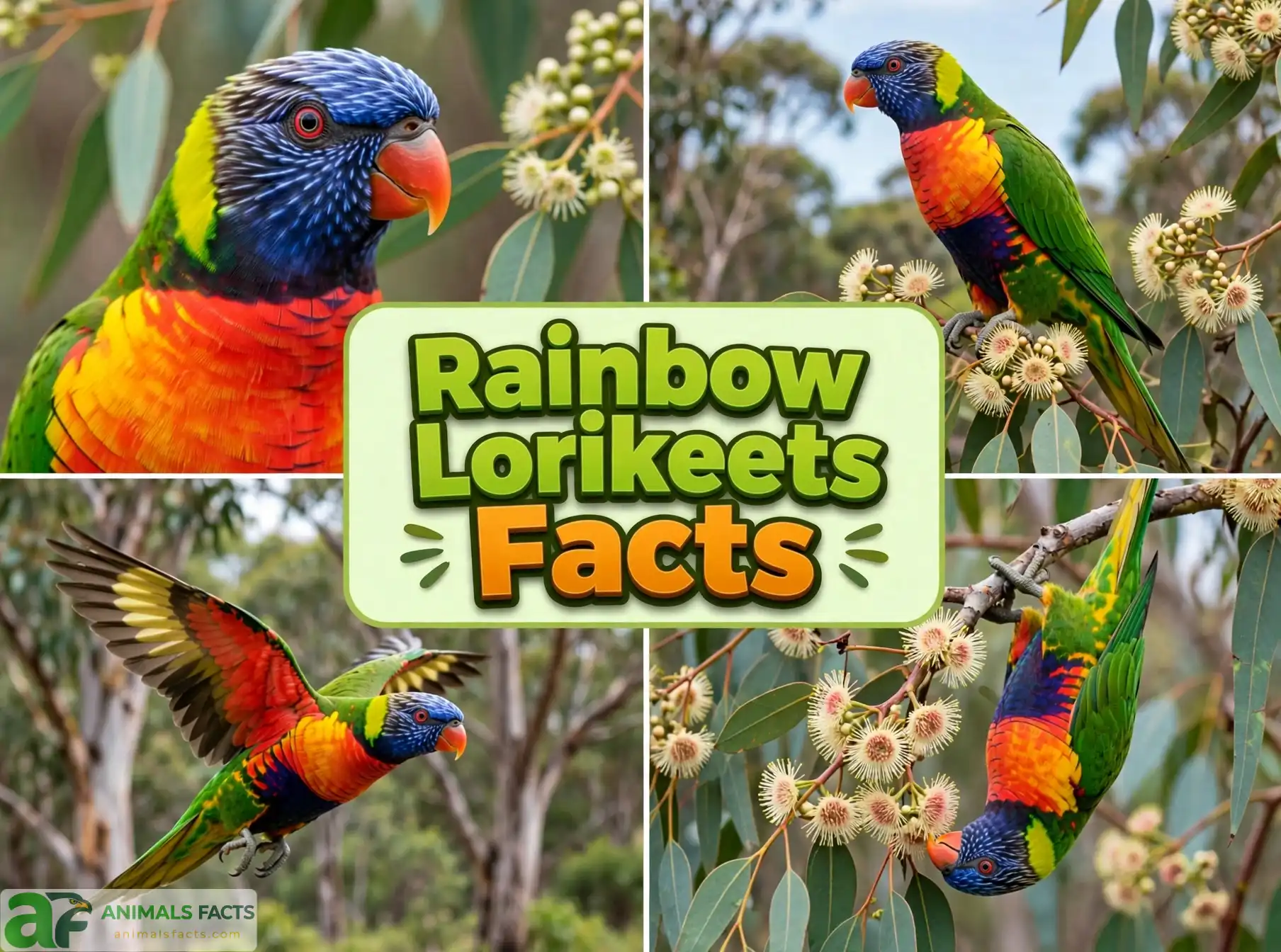
Hey amazing young wildlife scientists and bird enthusiasts! Here are some absolutely extraordinary rainbow lorikeet facts for kids that will make every bird conversation infinitely more exciting:
- 🦜 The rainbow lorikeet has a BRUSH on the end of its tongue! Most birds have ordinary smooth tongues. The rainbow lorikeet has a special brush-tipped tongue covered in tiny hair-like bristles. When it pushes this brush into a flower, the bristles soak up nectar and collect pollen — like the world’s most specialized biological paintbrush. The tongue can do this up to 10 times per SECOND — so fast you cannot see it happening!
- 🦜 Some rainbow lorikeets get DRUNK on fermented flower nectar! This actually happens! When nectar inside flowers starts to ferment naturally in hot weather, it contains a little bit of alcohol — just like fermented fruit juice. Lorikeets that drink too much of this fermented nectar become wobbly, fall off branches, and cannot fly properly. Wildlife carers in Darwin have set up special “drunk bird recovery centers” where affected lorikeets can sober up safely before being released!
- 🦜 In the same country, the rainbow lorikeet is BELOVED in one city and a declared PEST in another! In Sydney, Melbourne, and Brisbane in eastern Australia, the rainbow lorikeet is one of the most beloved and celebrated wild birds. But in Perth in western Australia, it is an official declared PEST species that the government is trying to remove — because it was accidentally introduced there and is causing problems for native wildlife. Same bird, completely opposite reactions in different parts of Australia!
- 🦜 A single rainbow lorikeet visits up to 3,000 FLOWERS every day! During its active foraging time, a rainbow lorikeet zips from flower to flower at incredible speed, quickly lapping up the nectar from each one with its brush tongue before moving to the next. Scientists have counted and estimated that in a full day of foraging, one lorikeet can visit THREE THOUSAND individual flowers — that is one very busy bird!
- 🦜 Rainbow lorikeet roosts can contain 30,000 BIRDS in one tree! Every evening, rainbow lorikeets fly from their daytime feeding areas to their communal sleeping roosts — and sometimes thousands or tens of thousands of birds all try to sleep in the same small area of trees. The noise from a large roost has been measured at the same level as a lawnmower — loud enough that nearby human residents sometimes need earplugs!
- 🦜 Rainbow lorikeets CANNOT properly digest sunflower seeds! Most parrots LOVE sunflower seeds. But rainbow lorikeets evolved specifically to eat nectar, not seeds — their digestive system is modified for liquid food and cannot process hard seeds properly. If you feed a wild rainbow lorikeet sunflower seeds (which many well-meaning people do), it can actually make the bird sick! They need nectar-bearing flowers, not seeds!
- 🦜 Rainbow lorikeets travel up to 50 KILOMETERS per day looking for flowers! When the flowers in their local area run out of nectar, rainbow lorikeets do not just sit and wait — they fly to find more flowers, sometimes traveling 50 kilometers from their sleeping roost to find a new flowering tree. That is like flying from one end of a large city to the other and back — every single day!
- 🦜 The rainbow lorikeet has SIX different colors — and they can see ULTRAVIOLET light that humans cannot see! You can count six vivid colors on a rainbow lorikeet: blue head, orange breast, yellow-green collar, green back, purple-blue belly, and orange bill. But other rainbow lorikeets can ALSO see ultraviolet patterns on each other’s feathers that are completely invisible to human eyes — which means the birds might look even more spectacular to each other than they do to us!
12. Relationship with Humans
The rainbow lorikeet’s relationship with humans is one of the most complex and most contradictory of any Australian bird — simultaneously a beloved urban wildlife icon, a declared agricultural pest, an invasive ecological threat, a popular pet species, a public health concern through supplementary feeding risks, and one of the most photographed birds in Australia.
Indigenous Australian Relationships
Traditional ecological knowledge — Indigenous Australians across the rainbow lorikeet’s range developed extensive traditional knowledge of the species — understanding its movements in relation to flowering trees, its habitat associations, and its behavioral patterns. The lorikeet’s close relationship with flowering trees made it a reliable indicator of flowering plant location — following lorikeets to locate productive flowering trees was a practical tracking strategy.
Food use — Rainbow lorikeets were consumed as food by various indigenous Australian groups — the birds’ abundance and the attractiveness of nectar-feeding birds to traditional hunters making them an accessible food resource. Methods including the use of flowering trees as ambush sites (where birds concentrated predictably) made rainbow lorikeets relatively easy to catch compared to more dispersed species.
Cultural significance — The rainbow lorikeet appears in the artistic and ceremonial traditions of various Aboriginal groups across its range — the vivid colors making it a visually significant species in rock art, body painting traditions, and various ceremonial contexts in communities where the species is ecologically prominent.
The Australian Urban Wildlife Feeding Culture
The practice of feeding wild rainbow lorikeets is one of the most widespread urban wildlife behaviors in Australia — and one of the most contested from a wildlife welfare and conservation management perspective:
The scale — Millions of Australian urban residents offer food to wild rainbow lorikeets — the practice ranging from occasional hand-feeding in backyard gardens to systematic daily feeding at dedicated stations. The scale of supplementary feeding is sufficient to meaningfully supplement natural food resources and influence local rainbow lorikeet population dynamics.
The welfare debate — Australian wildlife management authorities consistently advise against supplementary feeding of wild rainbow lorikeets — citing:
- Disease transmission risk at communal feeding stations
- Nutritional harm from inappropriate foods
- Behavioral changes reducing birds’ natural foraging ability
- Increased agonistic behavior (aggression) at concentrated feeding sites
The public attachment — Despite official advice against feeding, the practice continues at enormous scale — reflecting the depth of Australian public attachment to garden wildlife and the genuine pleasure that feeding interactions with rainbow lorikeets provide. The management challenge is not unlike the global debate about supplementary feeding of garden birds.
Lorikeet paralysis syndrome — A particularly concerning disease that disproportionately affects rainbow lorikeets that use supplementary feeding stations; the disease produces progressive hindlimb paralysis and is frequently fatal. While the exact cause remains unclear, the strong statistical association with supplementary feeding suggests it may involve nutritional imbalance, infectious agent transmission, or both.
Agricultural Pest Status
In certain agricultural contexts, rainbow lorikeets are significant crop pests:
Fruit orchards — Rainbow lorikeets cause significant damage to soft fruit crops — particularly stone fruits (peaches, plums, cherries) and grapes. The combination of the species’ abundance, intelligence, and flock-foraging behavior means that a rainbow lorikeet flock can cause substantial orchard damage in a short time.
The pest control challenge — Lorikeets are protected native species across most of their range — the standard responses to crop damage (netting, auditory deterrents, scare devices) are more expensive than lethal control but are the legally required approach outside specific licensed pest management situations.
The Perth invasion agricultural dimension — The invasive Perth population causes agricultural damage in addition to ecological damage — the declared pest status in Western Australia allows more intensive management responses than in the native range.
The Pet Trade
Rainbow lorikeets are popular pet parrots globally — maintained in captivity on every inhabited continent:
Captive care requirements — The nectar diet requirement makes rainbow lorikeets more demanding as pets than seed-eating parrots — owners must provide fresh nectar mixes, fruit, and vegetables rather than simple seed mixes. The dietary demands and the species’ noise level make it a challenging pet for inexperienced parrot keepers.
The invasive species connection — Many of the global invasive rainbow lorikeet populations — including Perth, New Zealand, and Hong Kong — originated from escaped or released pet birds. The global pet trade therefore directly created the invasive populations that are now significant conservation management problems.
CITES regulation — Rainbow lorikeets are listed on CITES Appendix II — international trade regulated but not prohibited. The primary impact of the pet trade on wild populations is through escape and release creating invasive populations rather than through depletion of wild populations.
13. Rainbow Lorikeet Conservation Status & Threats
Conservation Status Overview
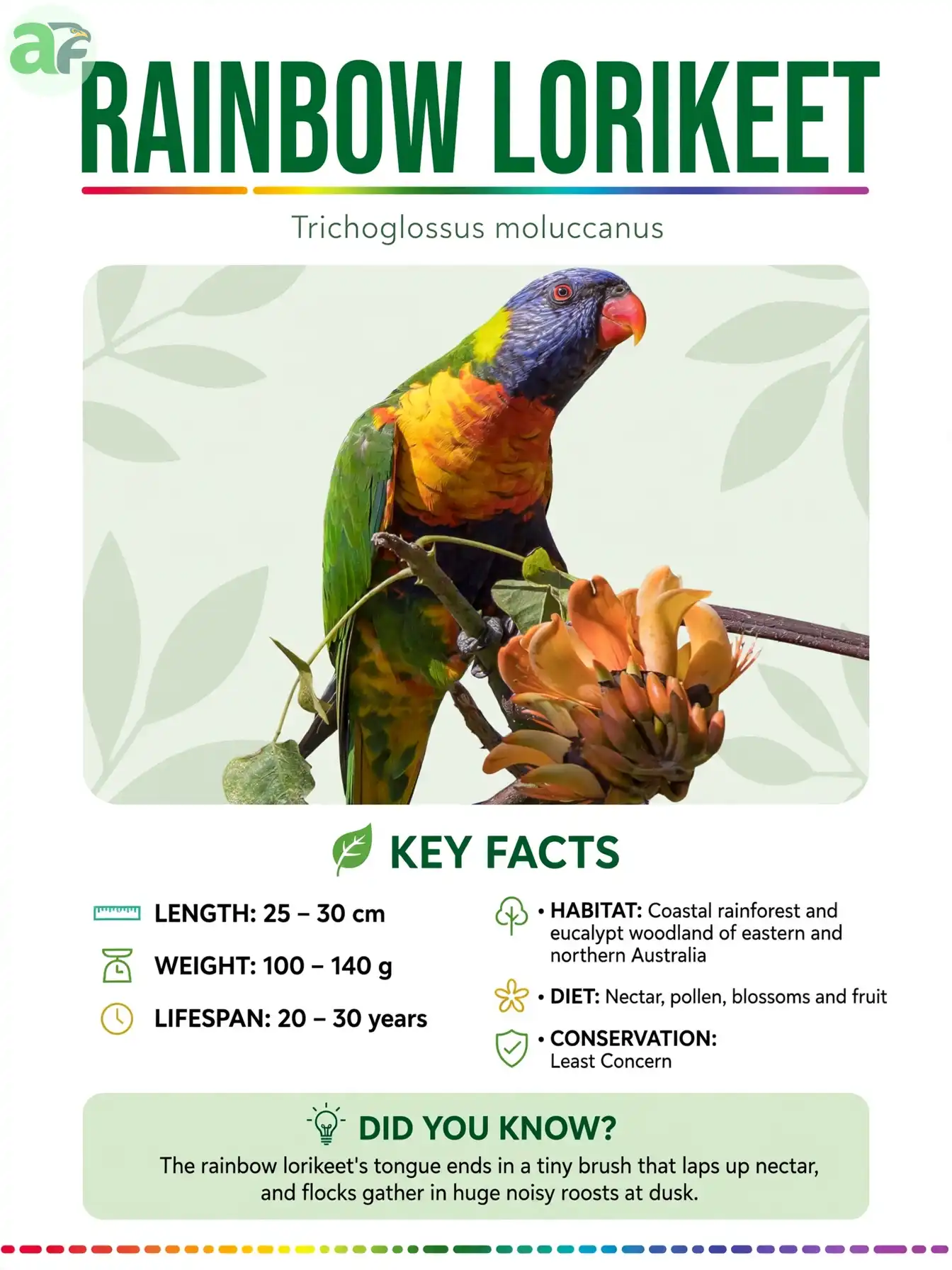
| Feature | Details |
|---|---|
| IUCN Status | Least Concern (LC) |
| Population Trend | Increasing (native range) |
| Estimated Global Population | Several million individuals (no precise estimate) |
| Australian Legal Status | Protected native species across most of native range; declared pest in WA |
| CITES Listing | Appendix II |
| New Zealand Status | Pest species — active management program |
| Perth Status | Declared pest — active eradication/management program |
The Conservation Paradox
The rainbow lorikeet presents conservation managers with an extraordinary paradox — a species whose native population is thriving and increasing while its introduced populations are causing ecological damage that requires expensive management responses:
Native range perspective — From the perspective of the species’ overall conservation status, the rainbow lorikeet is one of Australia’s most successful birds — abundant, increasing, highly adaptable, and not facing any immediate population-level threats in its natural range.
Invaded range perspective — From the perspective of the ecosystems into which it has been introduced, the rainbow lorikeet is one of Australia’s most damaging invasive species — competing with threatened endemic species, displacing native wildlife from food resources, and causing agricultural damage.
Major Threats in the Native Range
| Threat | Description | Impact Level |
|---|---|---|
| Hollow loss | Loss of mature trees with suitable nest hollows | Medium — primarily urban areas |
| Supplementary feeding disease | Lorikeet paralysis syndrome and other diseases at feeding stations | Medium |
| Vehicle collisions | Urban traffic mortality | Low-medium |
| Domestic cat predation | Urban cat predation | Medium in urban areas |
| Agricultural persecution | Lethal control at orchards (where licensed) | Low — specific locations |
| Climate change | Potential alteration of flowering phenology | Long-term concern |
Major Ecological Impacts in the Invasive Range
Perth, Western Australia:
- Competition with purple-crowned lorikeets, musk lorikeets, and multiple honeyeater species for nectar resources
- Hollow competition with native hollow-nesting species
- Potential hybridization with native lorikeet populations at range margins
- Agricultural crop damage
New Zealand:
- Competition with native nectar-feeding birds including tūī (Prosthemadera novaeseelandiae), bellbird/korimako (Anthornis melanura), and kākā (Nestor meridionalis)
- Competition with kākāriki (New Zealand parakeets) for nest hollows
- Disruption of native plant-pollinator relationships
Hong Kong:
- Competition with native bird species at supplementary feeding sites and natural food sources
Conservation Management Responses
Perth eradication program — The Western Australian government has maintained an ongoing capture, sterilization, and removal program targeting the Perth rainbow lorikeet population — the program aiming to reduce the population to zero through a combination of:
- Live trapping at feeding sites
- Egg oiling (rendering eggs infertile without removing them) to reduce recruitment
- Public education to stop supplementary feeding that concentrates birds at trappable locations
- Licensing of lethal control in specific high-impact situations
New Zealand management — The New Zealand Department of Conservation maintains an active rainbow lorikeet management program — primarily through trapping and shooting at known population centers, combined with public education about the risks of releasing or purchasing rainbow lorikeets in New Zealand (where it is now illegal to keep them without a permit).
Australian native range hollow protection — Programs to protect old trees with existing hollows and to install artificial nest hollows (providing additional nesting sites to reduce hollow competition) benefit rainbow lorikeets alongside other hollow-nesting species.
14. Famous Rainbow Lorikeets in History & Pop Culture
Famous Individual Rainbow Lorikeets and Cultural Moments
The “Drunk Lorikeet” Phenomenon, Darwin — While no individual bird is famous, the collectively documented phenomenon of drunk rainbow lorikeets in Darwin has generated repeated media attention — becoming one of Australia’s most beloved wildlife news stories. The Darwin lorikeet drunk events have been reported by the ABC, BBC, CNN, and virtually every Australian media outlet multiple times — the combination of vivid bird, amusing behavioral symptoms, and wildlife rescue response creating irresistible popular media content.
Currumbin Wildlife Sanctuary Feeding, Gold Coast — The Currumbin Wildlife Sanctuary feeding of wild rainbow lorikeets — where visitors can hold feeding dishes of lorikeet nectar and be surrounded by dozens of wild birds landing on arms, heads, and shoulders — is one of Australia’s most famous wildlife tourism experiences. Since the sanctuary began facilitating wild lorikeet feeding in the 1940s, millions of visitors have experienced close contact with wild rainbow lorikeets at this site. The experience has been featured in virtually every significant piece of Australia tourism promotion from the 1960s onward.
The Currumbin founding — Alex Griffiths (1946) — The Currumbin lorikeet feeding tradition began when local beekeeper Alex Griffiths began feeding honey to wild lorikeets in 1946 to stop them from raiding his beehives. The practice attracted increasing numbers of birds and eventually evolved into the internationally famous wildlife sanctuary visitation experience — making Griffiths inadvertently responsible for what became one of Australia’s most celebrated wildlife tourism attractions.
“The Dish” and Australian natural heritage marketing — Rainbow lorikeet imagery has been central to Australian tourism marketing for decades — appearing in Tourism Australia campaigns, state tourism promotions, and wildlife experience marketing globally. The species’ visual impact and the accessibility of close wildlife encounters in urban settings have made it one of Australia’s most-used wildlife ambassador species in international marketing.
Historical Significance
First European descriptions (1788) — The formal scientific description of the rainbow lorikeet by Johann Friedrich Gmelin in 1788 — based on specimens collected during the voyages of exploration that were transforming European understanding of Australian biology — was one of the early formal scientific accounts of Australian bird life, contributing to the European fascination with the extraordinary diversity of Australian wildlife in the post-First Fleet period.
John Gould’s illustrations — The extraordinary rainbow lorikeet illustrations in John Gould’s Birds of Australia (1840–1848) — among the most celebrated natural history illustration works in history — introduced the species to a broad European scientific and public audience. Gould’s illustrations, based on live birds and fresh specimens, captured the intensity of the rainbow lorikeet’s colors with exceptional accuracy for the period.
15. Role in Ecosystem & Food Chain
The Pollinator Role — The Most Important Ecological Function
The rainbow lorikeet’s most significant ecological role is as one of the most important bird pollinators in eastern and northern Australia:
The mechanism — As the rainbow lorikeet moves from flower to flower collecting nectar with its brush tongue, pollen adheres to the head, face, and bill feathers. When the bird visits the next flower, this pollen is transferred to the stigma — completing pollination. The combination of the brush tongue (maximizing pollen collection from each flower) and the high foraging mobility (moving pollen between widely separated flowers) makes the rainbow lorikeet an extremely efficient cross-pollinator.
Key plant-pollinator relationships:
Eucalyptus — The rainbow lorikeet is one of the most important pollinators of various eucalyptus species — the birds’ size, abundance, and foraging behavior facilitating pollen transfer between trees at distances that bees and other small pollinators cannot achieve as effectively.
Banksia — Banksia species depend on multiple animal pollinators including lorikeets — the concentrated dense inflorescences of Banksia providing substantial nectar rewards that attract and retain lorikeets for extended foraging visits, during which substantial pollen transfer occurs.
Grevillea — Both native grevillea species and the exotic cultivars widespread in urban gardens depend on lorikeets as important pollinators.
Melaleuca and Callistemon — The paperbark and bottlebrush species important in coastal and riparian habitats are significant lorikeet food plants where lorikeet pollination is documented.
The pollination service value — Research has estimated the economic and ecological value of rainbow lorikeet pollination services to be substantial — the species contributing to the regeneration of multiple commercially and ecologically important plant species. In a landscape where honey bee populations face threats from varroa mite and other pressures, the contribution of lorikeets to pollination services has gained increased recognition.
The Seed Dispersal Role
Soft fruit consumption — Rainbow lorikeets consume soft fruits as a dietary supplement — depositing seeds in their feces at distances from the parent plant that facilitate forest regeneration. While not the primary seed dispersal agent for most plant species (most Eucalyptus and Proteaceae use wind dispersal rather than animal dispersal for seed), the lorikeet contributes to the dispersal of various soft-fruited rainforest species.
The Prey Role
Supporting aerial predators — Rainbow lorikeets constitute significant prey for the urban and peri-urban raptor community — goshawks, peregrines, and various falcons all include lorikeets in their diets. The extraordinary abundance of rainbow lorikeets in eastern Australian cities has supported the establishment and expansion of urban peregrine falcon populations — the lorikeet providing a reliable, abundant food base that other urban bird species alone could not sustain.
The Invasive Ecological Impact
In the invasive range, the rainbow lorikeet’s ecological role reverses from beneficial to damaging:
Competitive displacement — At nectar-rich flowering plants in Perth and New Zealand, rainbow lorikeets aggressively displace native nectar-feeders — the larger size and greater aggression of lorikeets allowing them to monopolize food resources that native species depend on.
Pollination disruption — By monopolizing flowers and excluding native specialist pollinators (particularly honeyeaters in Australia and tūī in New Zealand), rainbow lorikeets may disrupt the native plant-pollinator relationships that have co-evolved over millions of years.
16. Myths, Folklore & Cultural Significance
Aboriginal Australian Traditions
The flowering tree indicator — In multiple Aboriginal Australian traditions across the lorikeet’s range, the arrival of flocks of rainbow lorikeets (and other lorikeets) at particular trees was understood as an indicator of flowering and the associated seasonal food availability. Following lorikeet movements was a practical ecological knowledge strategy embedded in traditional seasonal calendars.
The noise mythology — The extraordinary noise of large lorikeet flocks is referenced in the oral traditions of various Aboriginal groups — the loud, persistent calling of a large flock interpreted in different cultural contexts as communication, warning, or celebration. The specific interpretation varies significantly between different language groups and cultural traditions.
Ceremonial and artistic significance — The rainbow lorikeet’s vivid colors appear in various Aboriginal artistic traditions — the specific use of lorikeet imagery varying between cultural groups. In Arnhem Land and other areas of the Top End, lorikeet imagery appears in bark paintings and body painting traditions associated with specific ceremonial contexts.
Contemporary Australian Cultural Significance
The urban wildlife ambassador — The rainbow lorikeet has become one of the most powerful symbols of Australian urban wildlife — the species’ visibility, abundance, and extraordinary visual impact in suburban gardens and urban parks creating a deep public attachment that extends beyond committed wildlife enthusiasts to the general Australian public.
The “authentic Australia” symbol — In Australian tourism marketing, the rainbow lorikeet serves as one of the symbols of authentic Australian wildlife experience — the accessibility of wild encounters with rainbow lorikeets (particularly at Currumbin and similar sites, but also simply in suburban backyards) providing international visitors with a wildlife interaction that requires no special journey or expertise.
The schoolyard naturalist gateway — The rainbow lorikeet’s presence in urban schoolyards and gardens across eastern Australia makes it one of the most common first wildlife experiences for Australian children — its extraordinary appearance and noisy behavior creating memorable wildlife encounters that have initiated many Australian naturalists’ lifelong interest in wildlife.
17. Rainbow Lorikeets in Pop Culture
Currumbin Wildlife Sanctuary, Queensland — The Currumbin lorikeet feeding experience — now over 75 years old — is one of Australia’s most famous and most enduring wildlife tourism experiences. Photographs and video footage from Currumbin, showing visitors surrounded by dozens of wild lorikeets landing on arms and shoulders, have appeared in virtually every significant Australian wildlife documentary and tourism publication. The experience has been seen by over 15 million visitors to the sanctuary since its establishment.
Australian wildlife photography — The rainbow lorikeet is among the most photographed Australian birds — the combination of extraordinary color, urban accessibility, and engaging behavior creating ideal wildlife photography subjects. Rainbow lorikeet images dominate Australian wildlife photography social media and appear consistently in international wildlife photography competitions in the “urban wildlife” and “garden birds” categories.
BBC and ABC natural history productions — Multiple BBC Natural History Unit and ABC television productions covering Australian wildlife have featured rainbow lorikeet content — including coverage of the drunk lorikeet phenomenon in Darwin, the Currumbin feeding experience, and the Perth invasive population management challenges. The drunk lorikeet story in particular has been featured in BBC News, CNN, The Guardian, and virtually every major international news outlet multiple times.
Tourism Australia marketing — Tourism Australia has featured rainbow lorikeet imagery in international promotional campaigns for decades — the species’ extraordinary visual impact and the accessibility of wild encounters making it one of the most effective Australian wildlife marketing subjects. The “hold a lorikeet” experience at Currumbin and similar sites is specifically marketed to international visitors as a distinctively Australian wildlife encounter.
Australian stamp and currency appearances — The rainbow lorikeet has appeared on multiple Australian postage stamp issues — including the iconic bird series stamps that are among the most collected Australian philatelic items. The species’ national recognition and extraordinary appearance make it a natural choice for commemorative stamp issues featuring Australian wildlife.
Wildlife documentary drunk lorikeet coverage — The Darwin drunk lorikeet phenomenon has been featured in wildlife documentaries specifically examining unusual animal behavior — the combination of the apparently comical symptoms and the genuine wildlife welfare dimension creating compelling documentary content that has been broadcast internationally.
18. Rainbow Lorikeet Facts vs. Common Myths
| Common Myth | The Real Fact |
|---|---|
| “You can feed rainbow lorikeets honey and bread” | False and harmful — honey is too high in simple sugars and can promote dangerous bacterial growth in the crop and bill; bread is nutritionally inappropriate for any wild bird. Commercial lorikeet nectar mixes or dilute fresh nectar solutions are the only appropriate supplementary offerings |
| “Rainbow lorikeets are found naturally all over Australia” | False — the natural range is restricted to eastern and northern Australia; the Perth population is invasive and represents an ecological problem, not a natural distribution |
| “Rainbow lorikeets are harmless introduced birds in New Zealand” | False — the New Zealand Department of Conservation classifies rainbow lorikeets as a threat to native wildlife and actively manages the population through culling and trapping; they are legally prohibited as pets in New Zealand |
| “The drunk lorikeet phenomenon is a joke — it doesn’t really happen” | True — lorikeet intoxication from fermented nectar is a genuine, documented wildlife phenomenon that wildlife carers deal with regularly in Darwin and other tropical areas |
| “Rainbow lorikeets eat sunflower seeds like other parrots” | False — rainbow lorikeets cannot properly digest hard seeds; their digestive system is specialized for liquid nectar and soft food. Offering sunflower seeds can cause crop impaction and malnutrition |
| “Rainbow lorikeets are too common to be important for conservation” | Misleading — while the species is not threatened, rainbow lorikeets perform critical ecological functions including pollination of eucalypts, banksias, and grevilleas; their removal from an ecosystem would have significant consequences for plant community regeneration |
| “The rainbow lorikeet’s colors are painted on — no bird is really that colorful” | False — the colors are entirely natural, produced by structural coloration (blues and purples) and carotenoid pigments (orange and yellow-greens); the intensity of the colors in life typically exceeds what photographs can capture |
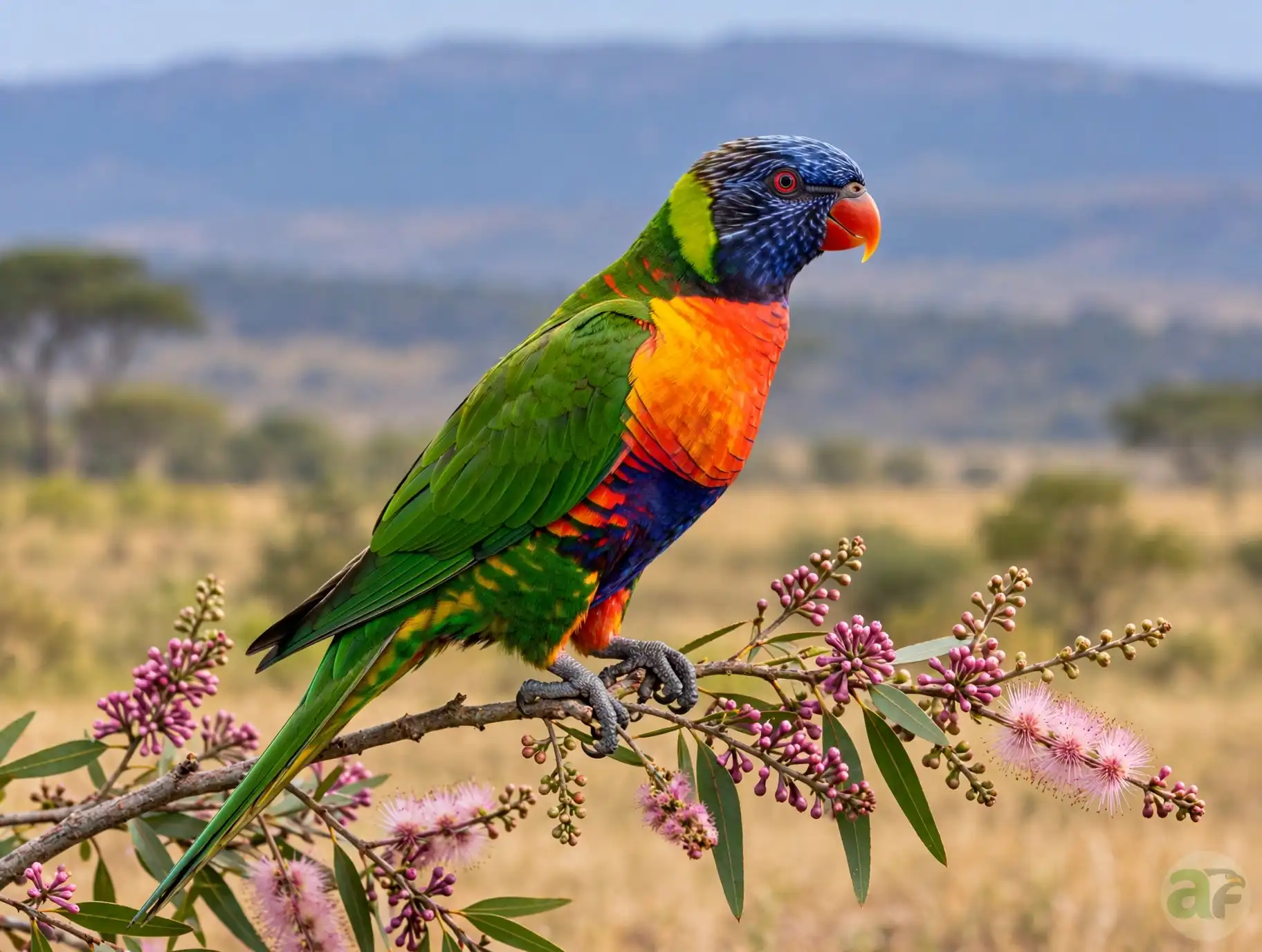
19. Rainbow Lorikeet Viewing – Best Places to See Them
In the Native Range – Eastern Australia
1. Currumbin Wildlife Sanctuary, Gold Coast, Queensland — The most famous and most reliable rainbow lorikeet experience in Australia — wild lorikeets arrive twice daily (approximately 8:00 AM and 4:00 PM) to be fed at the sanctuary grounds, creating an extraordinary spectacle of hundreds of wild birds landing on visitors holding feeding dishes. The experience provides close, intimate contact with wild rainbow lorikeets in a managed but genuine wildlife encounter. Admission to the sanctuary includes participation in the lorikeet feeding.
2. Any suburban garden in Brisbane, Sydney, or Melbourne — Rainbow lorikeets are so abundant in urban eastern Australia that the most reliable viewing requires simply being in the right suburb at the right time of day. Early morning and late afternoon are the most productive — birds are most active during these periods, and flocks visiting garden flowering plants can be reliably watched from a few meters. Planting Grevillea, Callistemon, and Melaleuca species in suburban gardens virtually guarantees regular rainbow lorikeet visits.
3. Royal Botanic Gardens, Sydney — The botanic gardens support a large resident and visiting rainbow lorikeet population — the gardens’ extensive collection of flowering trees providing excellent foraging habitat and the open park setting facilitating close observation. The gardens at dawn are particularly spectacular — large numbers of lorikeets arriving at flowering trees as the light improves.
4. Gold Coast Hinterland (Tamborine Mountain area), Queensland — The subtropical mountain hinterland of the Gold Coast supports excellent rainbow lorikeet populations in natural forest habitat — the combination of natural vegetation and rural gardens providing close to natural foraging behavior in a scenic natural setting.
5. Daintree Rainforest and Cape Tribulation, North Queensland — For rainbow lorikeet observation in genuine tropical rainforest habitat — the combination of rainforest and flowering trees in the Daintree provides some of the finest north Queensland lorikeet viewing.
6. Kakadu National Park, Northern Territory — For the red-collared lorikeet subspecies (T. m. rubritorquis) — the savanna woodland of Kakadu supports populations of this distinctive and visually striking northern form. The distinctive orange collar makes the red-collared form immediately identifiable.
Urban Communal Roost Viewing
7. Various Gold Coast and Brisbane roost sites — The evening arrival of large rainbow lorikeet roosts in urban fig trees and other roost trees across the Gold Coast and Brisbane provides one of the most extraordinary urban wildlife spectacles in Australia. The combination of tens of thousands of brightly colored birds, the progressive noise build as they arrive, and the theatrical quality of the massed aerial movement before settling is unforgettable. Ask locally for current roost locations — roost sites shift over years as trees change.
Viewing the Invasive Population (For Educational Purposes)
8. Identified Perth locations, Western Australia — For visitors specifically interested in understanding the invasive wildlife management challenge, observing the Perth rainbow lorikeet population in its suburban habitat demonstrates both the species’ ecological impact on native wildlife and the management responses being applied.
20. How You Can Help
Supporting rainbow lorikeet conservation requires differentiated action — protecting native populations and ecosystem function in the natural range while supporting invasive population management in Western Australia and New Zealand.
Support these organizations:
- Birds Australia / BirdLife Australia — birdlife.org.au — the primary Australian bird conservation organization; monitors rainbow lorikeet populations and advocates for native habitat protection
- WIRES (NSW Wildlife Information, Rescue and Education Service) — wires.org.au — rehabilitates injured and sick rainbow lorikeets including those affected by lorikeet paralysis syndrome
- Wildlife Queensland — wildlife.org.au — Queensland wildlife conservation including lorikeet-relevant habitat protection
- New Zealand Department of Conservation — doc.govt.nz — manages the invasive rainbow lorikeet population in New Zealand; donations support management programs
- Wildlife Rescue WA — wildliferescuewa.org.au — supports wildlife care including management of the invasive Perth population
Critical individual actions in Australia:
- Stop supplementary feeding — or switch exclusively to appropriate commercial lorikeet nectar mixes; eliminate bread, honey, and seeds from any lorikeet feeding
- Plant appropriate garden plants — Grevillea, Callistemon, Melaleuca, and native eucalypts provide safe, natural food sources that do not carry the disease risks of supplementary feeding stations
- Protect old trees — advocating for the retention of old trees with natural hollows in urban planning decisions directly benefits rainbow lorikeets and dozens of other hollow-dependent species
- Keep cats indoors — particularly at dawn and dusk when lorikeets are most active near ground level
- Report lorikeet sightings in Perth — if you observe rainbow lorikeets in the Perth metropolitan area, reporting to the WA Department of Biodiversity, Conservation and Attractions contributes to population monitoring
In New Zealand:
- Never release captive rainbow lorikeets — releasing lorikeets in New Zealand is illegal and ecologically damaging; if you can no longer keep a lorikeet, contact the DOC or a licensed wildlife facility
- Report rainbow lorikeet sightings to the New Zealand DOC — occurrence records assist population management
21. Top Documentaries & Books
Must-Watch Documentaries
- “Wild Australia” (BBC/ABC, various productions) — Multiple treatments of Australian wildlife including excellent rainbow lorikeet content; the drunk lorikeet phenomenon has been covered by BBC News and ABC television multiple times
- “Australia’s First 4 Billion Years” (PBS Nova, 2013) — Australian natural history context including bird evolution and ecology
- “Wild Cities” (BBC, 2020s) — Urban wildlife series covering Australian cities includes rainbow lorikeet urban ecology content
- “David Attenborough’s Parrots” and various BBC parrot-focused productions — Lorikeet content within broader parrot natural history treatments
- “Lorikeet Life” (ABC Australia) — Various ABC Australia natural history segments covering rainbow lorikeet ecology, the drunk phenomenon, and urban wildlife dynamics
Must-Read Books
- The Parrots of Australia by Joseph Forshaw — The comprehensive reference for Australian parrot natural history; detailed rainbow lorikeet species account
- Wildlife of Greater Brisbane by Queensland Museum — Excellent urban wildlife guide covering rainbow lorikeet ecology in the urban context
- Wild City by Darryl Jones — The most accessible treatment of urban wildlife ecology in Australia; Darryl Jones’s research on supplementary feeding is directly relevant to rainbow lorikeet urban ecology
- A Photographic Field Guide to the Birds of Australia by various authors — Standard field identification guide with rainbow lorikeet coverage
- Australia’s Birdlife (BirdLife Australia publications) — Various popular natural history treatments of Australian birds including rainbow lorikeet natural history
22. Rainbow Lorikeet Comparison with Other Spectacular Lorikeets and Parrots
| Feature | Rainbow Lorikeet | Scaly-Breasted Lorikeet | Swift Parrot | Galah | Eclectus Parrot |
|---|---|---|---|---|---|
| Scientific name | Trichoglossus moluccanus | Trichoglossus chlorolepidotus | Lathamus discolor | Eolophus roseicapilla | Eclectus roratus |
| Weight | 75–157 g | 77–109 g | 48–71 g | 270–350 g | 381–550 g |
| Primary color | Six colors | Green + yellow scaling | Green + orange bill | Pink and grey | Males green; females red |
| Diet | Nectar specialist | Nectar specialist | Nectar specialist | Seeds and grain | Fruit and seeds |
| Tongue | Brush-tipped | Brush-tipped | Brush-tipped | Standard | Standard |
| Conservation | Least Concern | Least Concern | Critically Endangered | Least Concern | Least Concern |
| Range | E. and N. Australia | E. Australia | Tasmania + SE mainland | Australia-wide | N. Australia, New Guinea |
| Invasive elsewhere | Yes — Perth, NZ, HK | No | No | No | No |
| Famous for | Most colorful Australian parrot | Scaly breast pattern | Australia’s most endangered parrot | Most recognizable Australian parrot | Extreme sexual dichromatism |
| Urban success | Exceptional | Moderate | No | Moderate | Limited |
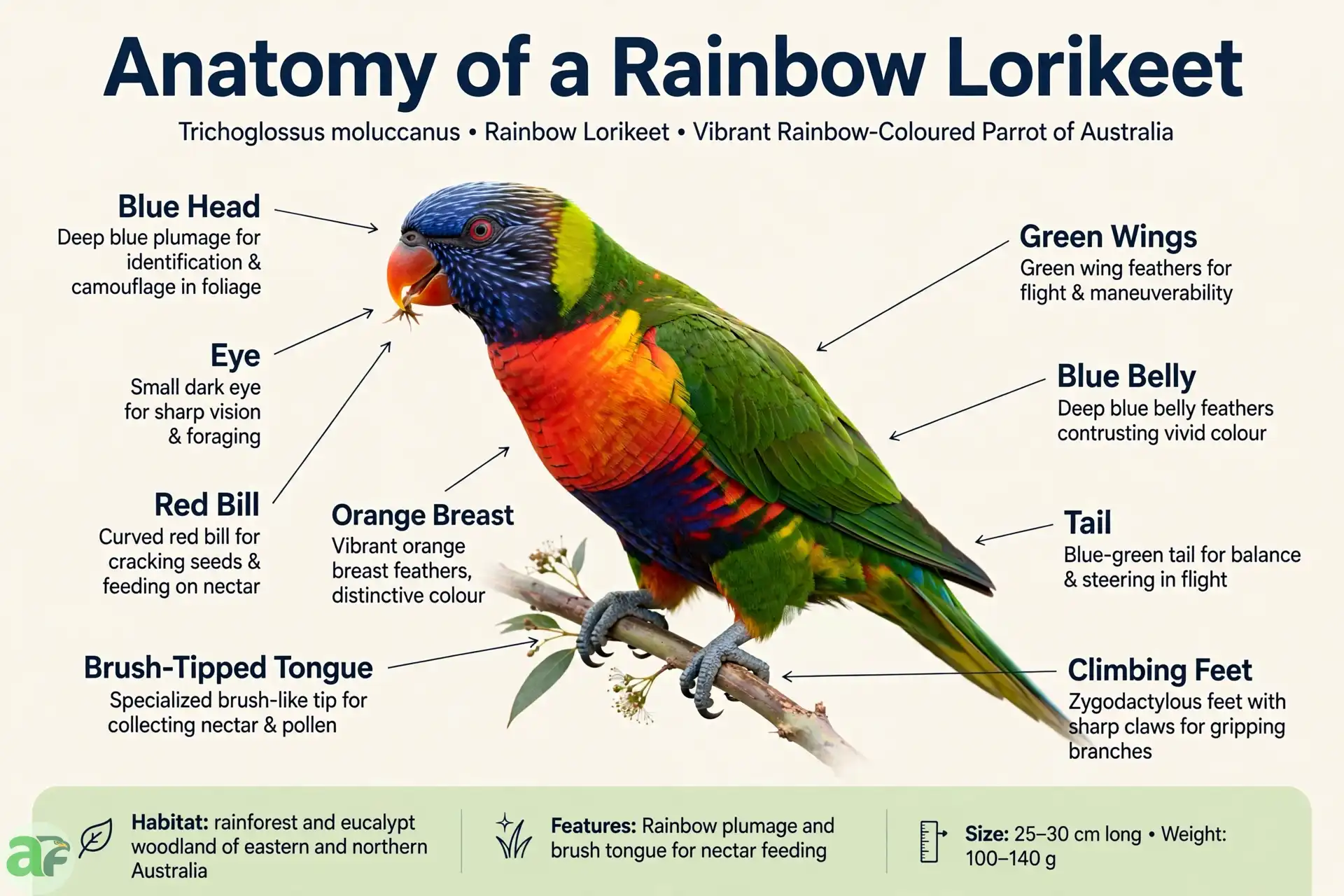
23. Frequently Asked Questions About Rainbow Lorikeets
Q1. What is the scientific name of the rainbow lorikeet?
The rainbow lorikeet’s scientific name is Trichoglossus moluccanus (Gmelin, 1788). The genus name Trichoglossus derives from the Greek trichos (hair) and glossa (tongue) — meaning “hair-tongue” — a direct reference to the brush-tipped tongue that is the most anatomically distinctive feature of all lorikeets and the characteristic that most clearly defines the species’ ecological niche as a nectar specialist. The species name moluccanus refers to the Maluku Islands (Moluccas) of eastern Indonesia — where the species’ closest relatives occur, and which was mistakenly applied to the Australian birds by Gmelin based on specimens from the broader Indo-Pacific region. Following the 2021 taxonomic revision that split the former Trichoglossus haematodus complex, the Australian birds were formally assigned to T. moluccanus — separating them from the Indonesian coconut lorikeet (T. haematodus) and other island forms that were previously grouped together. The species belongs to the family Psittaculidae within the order Psittaciformes (parrots), and to the lorikeet tribe Lorini — a group of approximately 55 nectar-specialist parrot species found across Australasia.
Q2. Why is the rainbow lorikeet a pest in Perth but protected elsewhere?
The rainbow lorikeet is simultaneously a protected native species in eastern and northern Australia and a declared pest in Western Australia’s south-west — an extraordinary conservation policy paradox explained entirely by geography and introduction history. In eastern Australia, the rainbow lorikeet is a native species that evolved in and belongs to the eastern Australian ecosystem — its presence is ecologically appropriate and its conservation is legally mandated. In Perth and the southwestern corner of Western Australia, the rainbow lorikeet does not naturally occur — the species’ natural western range limit is in the Kimberley region of northern WA, thousands of kilometers from Perth. The Perth population began from escaped and released pet birds in the late 1960s and has grown to several thousand individuals that compete directly with the southwestern Australian flora-specific native bird community — particularly the native nectar-feeding birds adapted to the southwestern Australian biodiversity hotspot, which contains many endemic and threatened species. The southwestern corner of Australia is one of the world’s 35 biodiversity hotspots — an area of extraordinary endemic biodiversity that evolved without rainbow lorikeet presence and is not adapted to rainbow lorikeet competition. The declaration of pest status and the active management program reflect the ecological reality that an abundant, aggressive, non-native bird competing with threatened native species requires management intervention regardless of the species’ protected status in its native range.
Q3. What does the rainbow lorikeet eat and why can’t you feed it seeds?
The rainbow lorikeet’s diet is centered on nectar and pollen — the species is the most nectar-specialized parrot in Australia, with its entire biological system — tongue, digestive system, behavior, and social ecology — organized around efficient nectar and pollen collection. The brush-tipped tongue collects nectar and pollen from flowers with extraordinary efficiency; the modified digestive system processes high-sugar liquid food rapidly; the daily movement patterns track flowering trees across the landscape. Seeds cannot be properly processed by rainbow lorikeets because the species’ digestive system has been evolutionarily modified away from the seed-processing capability retained by most other parrots. Specifically, the muscular gizzard (which in seed-eating parrots powerfully grinds hard seeds) is reduced in rainbow lorikeets — insufficient to crack hard seed coats. The intestinal enzymatic complement is optimized for nectar sugars rather than seed starches. Offering hard seeds (particularly sunflower seeds — the most commonly offered seed to wild lorikeets) can cause crop impaction (seeds blocking the crop), nutritional imbalance (the high fat content of sunflower seeds being incompatible with the lorikeet’s nutrient processing system), and over time, significant health deterioration. The appropriate supplementary foods for rainbow lorikeets, if feeding is undertaken despite official advice against it, are commercial lorikeet nectar mixes (available from wildlife stores) diluted according to instructions, or fresh fruit. Honey should also be avoided — despite its seemingly natural nectar-like quality, the concentration of simple sugars in honey promotes bacterial and fungal growth in the lorikeet’s crop and bill.
Q4. Are rainbow lorikeets endangered?
No — the rainbow lorikeet is classified as Least Concern by the IUCN and is considered one of Australia’s most abundant birds, with a population estimated in the millions and a trend that is increasing across most of the native range. The species is thriving — urban expansion and the proliferation of garden flowering plants have expanded and enriched its food base, allowing populations to grow in human-modified environments. However, “Least Concern” does not mean “without conservation concern” — the species faces local threats from hollow loss, supplementary feeding disease, and urban hazards, and its ecological role as a major pollinator means that maintaining healthy lorikeet populations contributes to broader ecosystem function. The conservation complexity surrounding the species arises not from threats to the rainbow lorikeet itself but from the damage its invasive populations cause to the native ecosystems of Western Australia and New Zealand — a situation that requires management of the introduced populations while the native populations continue to thrive.
Q5. Where is the best place to see rainbow lorikeets in Australia?
The most famous and most reliably extraordinary rainbow lorikeet experience in Australia is the wild lorikeet feeding at Currumbin Wildlife Sanctuary on the Gold Coast, Queensland — wild lorikeets arrive twice daily (approximately 8:00 AM and 4:00 PM) in numbers of hundreds to thousands, landing on visitors holding feeding dishes in one of the most intimate and most spectacular wildlife encounters available anywhere in Australia. However, for visitors to any major eastern Australian city, rainbow lorikeets require essentially no effort to find — simply being outdoors in a suburban garden with flowering plants in Brisbane, Sydney, Melbourne, or the Gold Coast between dawn and mid-morning will reliably produce rainbow lorikeet encounters. Early morning (6:30–9:00 AM) is consistently the most productive time — birds are most active and most vocal during this period, and foraging flocks visiting garden flowering plants are easily found. The evening roost arrival — watching and hearing thousands of lorikeets converging on an urban roost tree at dusk — is one of the most spectacular urban wildlife experiences in Australia and requires only knowledge of a current roost location (ask locally in any Queensland or NSW coastal city).Q.
24. Sources & References
- Wikipedia — Trichoglossus moluccanus, Lorini, Psittaculidae
- IUCN Red List — iucnredlist.org (current Least Concern assessment for Trichoglossus moluccanus)
- BirdLife International — birdlife.org (species factsheet; 2021 taxonomic revision)
- BirdLife Australia — birdlife.org.au (Australian population data)
- Jones, D. — published research on urban wildlife supplementary feeding and rainbow lorikeet urban ecology; Griffith University
- Department of Biodiversity, Conservation and Attractions WA — dbca.wa.gov.au (Perth invasive population management)
- New Zealand Department of Conservation — doc.govt.nz (NZ management program documentation)
- WIRES — wires.org.au
- Forshaw, J.M. (2002). Parrots of the World. Princeton University Press
- Gould, J. (1840–1848). Birds of Australia. Published by the author — the foundational historical illustration reference
- National Geographic — nationalgeographic.com
- ABC Australia — abc.net.au (drunk lorikeet reporting; urban wildlife coverage)
- Britannica — britannica.com/animal/rainbow-lorikeet
- Cornell Lab of Ornithology — allaboutbirds.org; Macaulay Library