
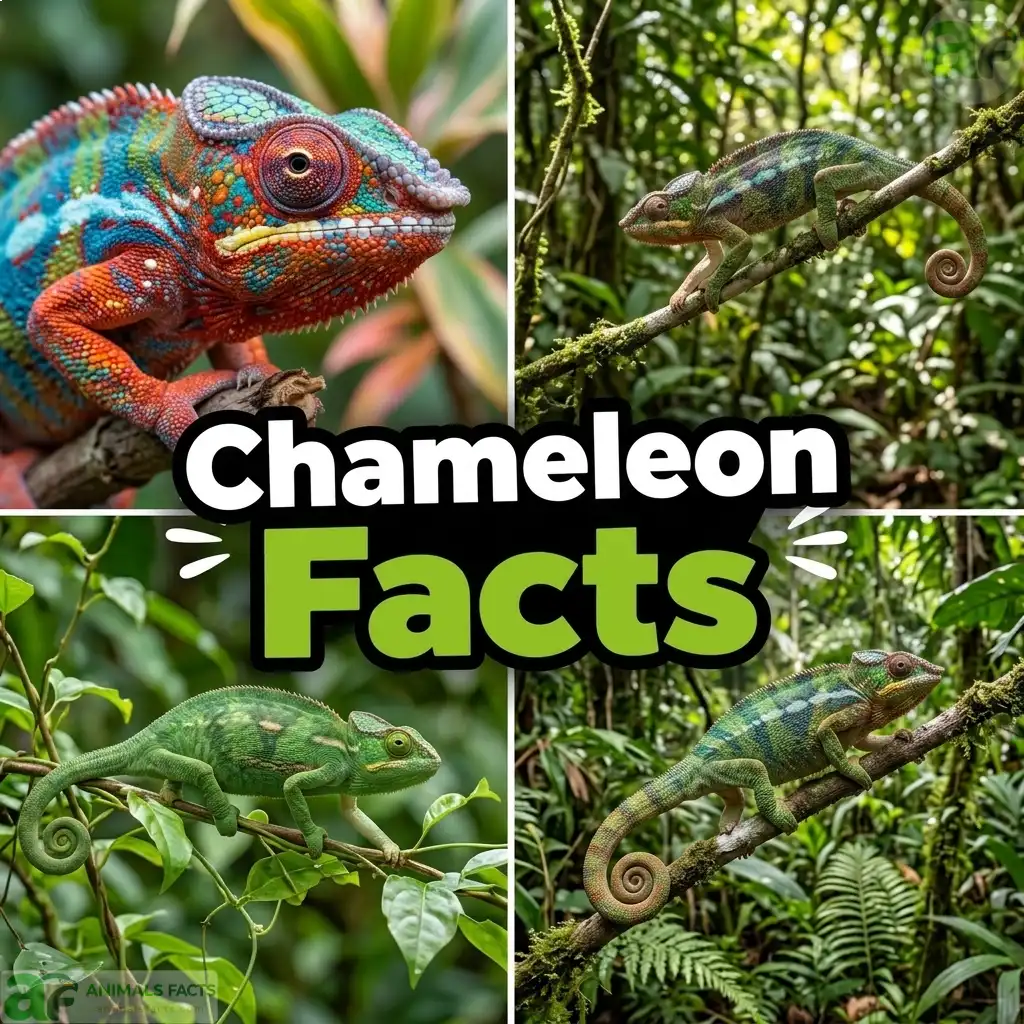
Chameleon Facts
| Feature | Details |
|---|---|
| Scientific Name | Family Chamaeleonidae; focus species Veiled chameleon — Chamaeleo calyptratus (Duméril & Bibron, 1851) |
| Kingdom | Animalia |
| Phylum | Chordata |
| Class | Reptilia |
| Order | Squamata |
| Family | Chamaeleonidae |
| Common Names | Chameleon; true chameleon |
| Native Range | Africa (primary); Madagascar (extraordinary diversity); Middle East; southern Europe; South Asia |
| Habitat | Rainforest, dry forest, savanna, desert, montane forest — extraordinary habitat range |
| Lifespan | 2–10 years (wild, highly variable by species); up to 10 years (captivity) |
| Diet | Primarily insects and invertebrates; larger species eat small vertebrates |
| Body Size | 15 mm (Brookesia micra) to 68 cm (Furcifer oustaleti) — largest size range of any lizard family |
| Weight | 0.1 gram (smallest) to 600+ grams (largest) |
| Conservation Status | Ranges from Least Concern to Critically Endangered; Madagascar species most threatened |
| Number of Species | Over 200 recognized species — with new species still being described |
| Defining Feature | Active color change through structural nanocrystal rearrangement — not pigment |
| Tongue Speed | Tongue acceleration exceeds 2,590 m/s² — the fastest muscle movement of any vertebrate |
| Closest Relatives | Agamids (dragon lizards); together forming the Acrodonta within Iguania |
 1. Introduction: What is a Chameleon?
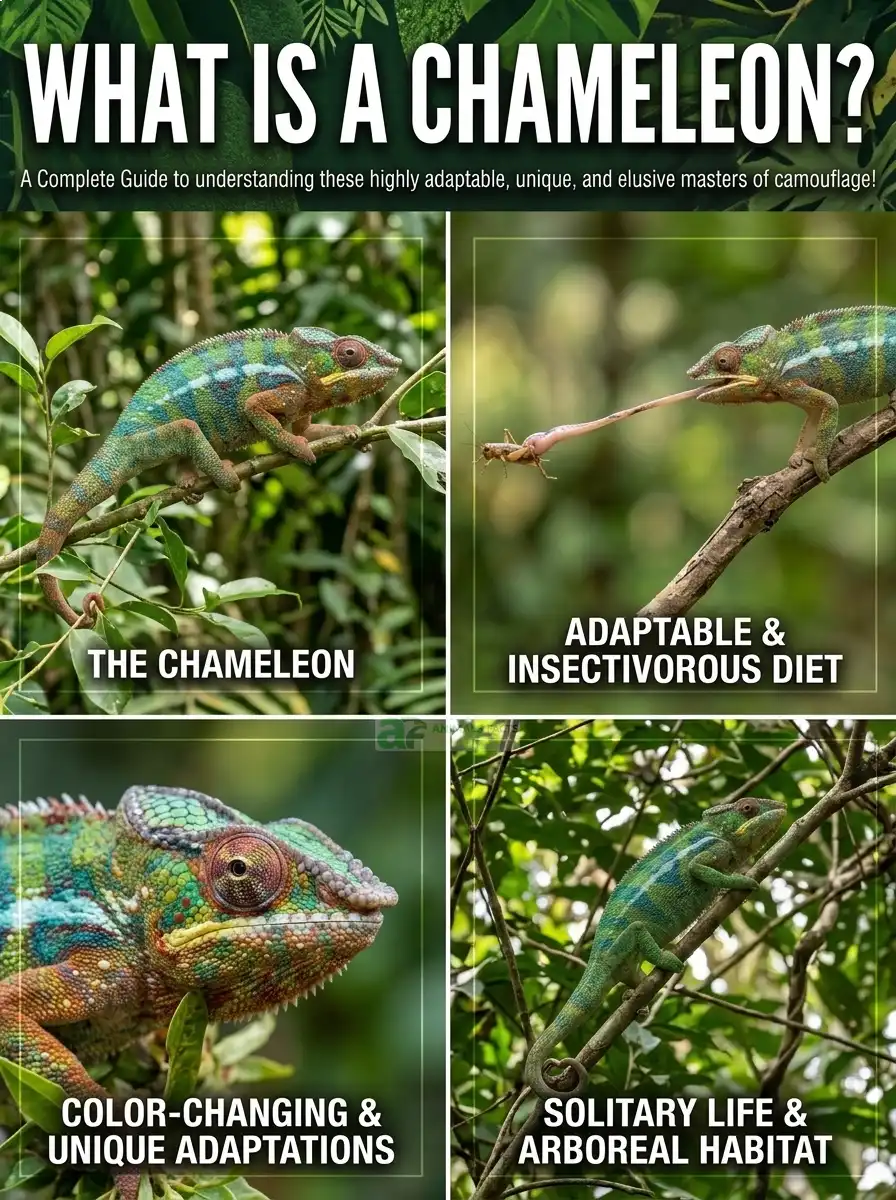
In the rainforest of Madagascar, on a slender branch deep in the leaf canopy, an animal that was invisible thirty seconds ago is now, suddenly, extraordinarily visible — and the transformation from invisibility to visibility has happened not gradually but instantaneously, as if a switch has been thrown in a biological lighting system. The chameleon has detected a rival male and the response is immediate and total: from the grey-green of resting camouflage, the skin erupts into vivid yellow and blue and orange and red — the colors appearing in seconds across the body surface like a living canvas being rapidly painted. Simultaneously, the body compresses laterally into an aggressive profile, the casque on the head rises, and the animal advances along the branch with the slow-motion deliberateness of a creature that has never needed to hurry. Chameleon facts begin with this image — the most extraordinary color-change performance in the animal kingdom, produced not by pigment rearrangement or blood flow changes, but by a molecular architecture of iridescent nanocrystals embedded in the skin that rearrange their spacing in response to nerve signals, producing the full spectrum of visible light through structural coloration — one of the most sophisticated biological optical systems on Earth.
The chameleons — family Chamaeleonidae, comprising over 200 recognized species — are simultaneously the most instantly recognizable lizard family in the world and the most biologically extraordinary. They are famous for color change; what is less widely known is that color change is perhaps not even the most astonishing thing about them. The chameleon’s tongue — launched at prey with an acceleration exceeding 2,590 meters per second squared — is the fastest muscle-powered movement in any vertebrate on Earth. Its eyes — capable of independent 360-degree rotation without head movement — provide simultaneous visual coverage of essentially the entire surrounding sphere while each eye independently focuses on different objects. Its feet — modified into opposite-facing tongs — grip branches with a precision and security that allows the chameleon to navigate the most vertiginous branch architecture of the forest canopy without ever losing its grip. And its thermal regulation system — so precisely tuned to the specific thermal environment of its habitat that even small temperature changes can trigger immediate behavioral thermoregulation — makes the chameleon one of the most ecophysiologically sophisticated of all reptiles.
Interesting facts about chameleons extend into territory that challenges human understanding of what biology can achieve — the world’s smallest reptile weighing 0.1 grams (Brookesia micra of Madagascar) and the world’s fastest tongue both belong to this family; new chameleon species are still being described from Madagascar at a rate of several per year; the color-change mechanism involves physics rather than chemistry, turning out to be more similar to structural coloration in butterfly wings than to pigment-based color change in any other animal; and the chameleon’s reproductive strategies include both egg-laying and live birth, with certain species completing their entire life cycle in less than five months — the shortest known life cycle of any tetrapod vertebrate. Whether you are searching for chameleon facts for kids to explore the most spectacular color-changing biology in the natural world, a wildlife enthusiast wanting to understand the ecological diversity of this extraordinary family, a pet owner seeking accurate chameleon husbandry information, or simply someone who saw a chameleon change color and needed to understand everything about this remarkable phenomenon — this is your comprehensive guide. The world’s most extraordinary color-changers have an extraordinary story to tell.
2. Chameleon Species Overview & Classification
The chameleons constitute a highly distinctive family within the broader lizard evolutionary tree — sufficiently distinctive in morphology and ecology to be immediately recognized but sharing deep evolutionary roots with the agamid lizards (dragon lizards) of the Old World.
Species Classification Table — Veiled Chameleon (Focus Species)
| Taxonomic Rank | Classification |
|---|---|
| Kingdom | Animalia |
| Phylum | Chordata |
| Class | Reptilia |
| Order | Squamata |
| Suborder | Lacertilia |
| Infraorder | Acrodonta |
| Family | Chamaeleonidae (Rafinesque, 1815) |
| Genus | Chamaeleo (Laurenti, 1768) |
| Species | C. calyptratus (Duméril & Bibron, 1851) |
| Common Name | Veiled chameleon; Yemen chameleon |
| Etymology | Chamaeleon = “ground lion” (Greek: chamai = on the ground + leon = lion); calyptratus = “with a veil or hood” (Latin) — referring to the casque |
Major Chameleon Genera
| Genus | Common Name | Species Count | Range | Notable Feature |
|---|---|---|---|---|
| Chamaeleo | True chameleons | ~15 species | Africa, Middle East, S. Europe | Classic chameleon form; most studied |
| Trioceros | Horned chameleons | ~40 species | E. and C. Africa | Multiple elaborate horn structures |
| Furcifer | Madagascar chameleons | ~21 species | Madagascar primarily | Largest Malagasy species |
| Calumma | Madagascar chameleons | ~35 species | Madagascar | Most diverse Malagasy genus |
| Brookesia | Leaf chameleons | ~35+ species | Madagascar | World’s smallest reptiles |
| Rhampholeon | Pygmy chameleons | ~17 species | E. and C. Africa | Small; leaf-litter specialists |
| Bradypodion | Dwarf chameleons | ~18 species | South Africa | Viviparous; Cape region endemic |
| Kinyongia | Kinyongia chameleons | ~19 species | E. Africa | Recently described genus |
The Madagascar Radiation — The World’s Chameleon Capital
Madagascar is home to approximately 50% of all chameleon species — more chameleon species than any other single country in the world:
Why Madagascar? — Madagascar’s extraordinary diversity of habitats (rainforest, dry forest, spiny forest, montane forest, mangrove) combined with its long isolation (the island separated from Africa approximately 90 million years ago) created the conditions for exceptional chameleon diversification. A single ancestral chameleon colonization event approximately 65 million years ago gave rise to the extraordinary Malagasy chameleon radiation.
New species rate — New chameleon species are being described from Madagascar at a rate of several per year — reflecting both the extraordinary actual diversity of the island and the intensity of recent survey effort. As of 2026, over 100 chameleon species have been described from Madagascar.
The Brookesia challenge — The Brookesia genus of Madagascar leaf chameleons — tiny, cryptic, leaf-litter dwelling species — continues to yield new species through combined morphological and genetic analysis of populations previously considered single species. The 2021 description of Brookesia nana — potentially the world’s smallest reptile at 13.5 mm for the adult male — exemplifies the ongoing rate of discovery.
Evolution & Discovery Timeline
~80–100 million years ago — The ancestral chameleon lineage diverges from agamid lizards — establishing the independent evolutionary trajectory that will produce the modern chameleon family.
~65 million years ago — The chameleon ancestor colonizes Madagascar — a single transoceanic rafting event establishing the founding population from which all Malagasy species descended. This colonization coincides roughly with the Cretaceous-Paleogene boundary.
~40–50 million years ago — Chameleons colonize Africa from Madagascar — a counterintuitive dispersal direction (from island to mainland rather than the reverse) confirmed by molecular genetic analysis. Africa then becomes the site of a secondary radiation producing the diverse African chameleon fauna.
~15–20 million years ago — Chameleons colonize the Middle East and southern Europe — establishing the northern range limits of the family.
1758 — Carl Linnaeus formally describes the common chameleon (Chamaeleo chamaeleon) in Systema Naturae — establishing the first formally described chameleon species.
1851 — The veiled chameleon (Chamaeleo calyptratus) is formally described by Duméril and Bibron — the species that will become the most widely kept chameleon in captivity globally.
2012 — Research by Michel Milinkovitch and colleagues at the University of Geneva publishes the landmark paper revealing that chameleon color change involves structural coloration through iridophore nanocrystal rearrangement — overturning the previous understanding that color change was purely pigment-based.
2021 — Brookesia nana — the world’s smallest reptile (adult male 13.5 mm total length) — is formally described from northern Madagascar.
2024 — Over 200 chameleon species recognized; new species continue to be described particularly from Madagascar and East Africa.
“The chameleon’s color change mechanism is one of the most beautiful examples in nature of how physics and biology can combine to produce something that transcends what either could achieve alone. It is not chemistry — it is optics. Not pigment — but nanocrystal photonic architecture. Understanding it required us to think about light differently, and that is perhaps the most extraordinary thing a small lizard has ever done for physics.”
— Dr. Michel Milinkovitch, University of Geneva — discoverer of the chameleon nanocrystal color change mechanism
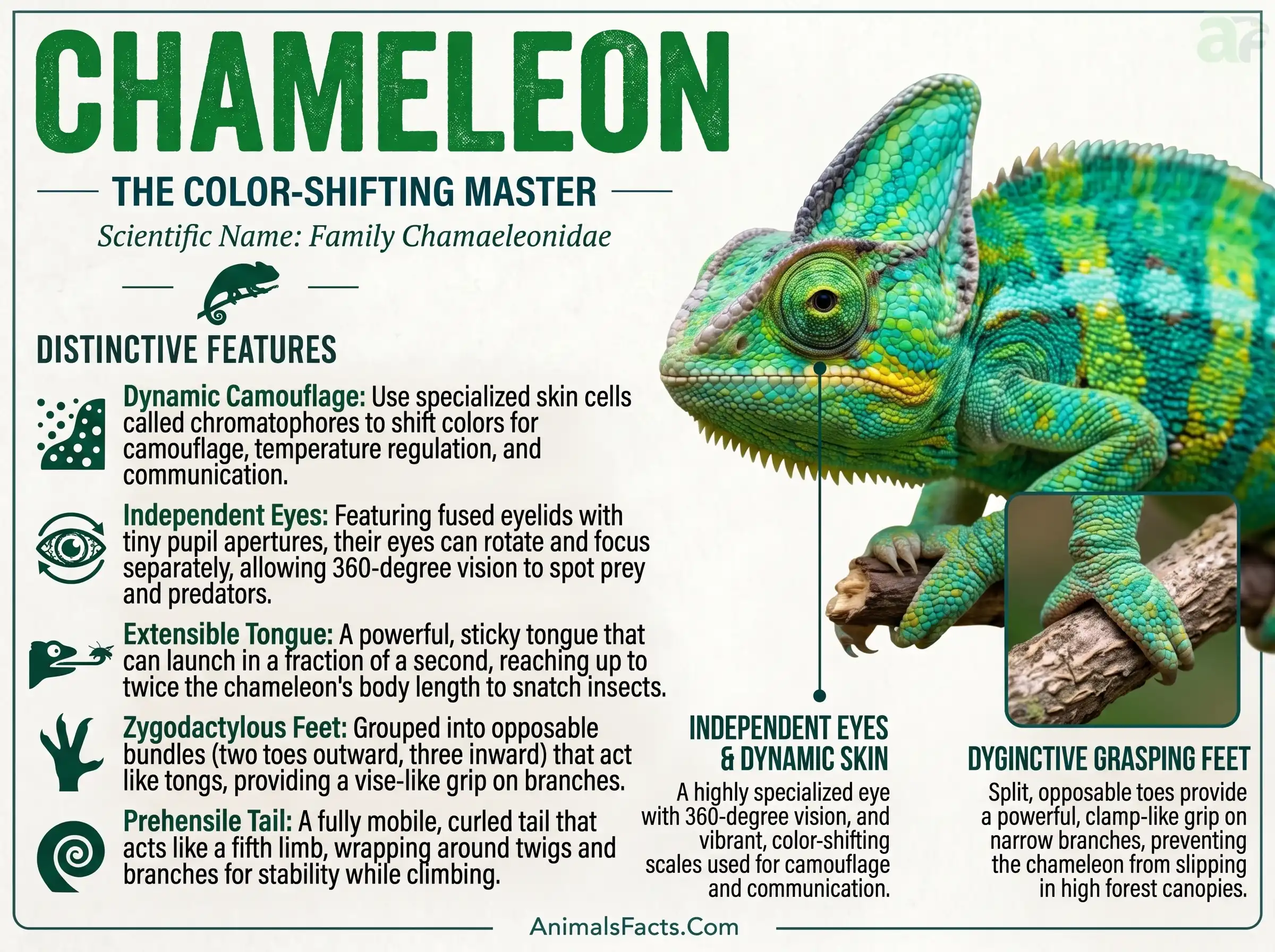
3. Chameleons Physical Description & Unique Features
The chameleon body plan is one of the most distinctive and most functionally specialized in the lizard world — every major anatomical feature representing a specific adaptation to the arboreal, visually-hunting, independently-moving ecological strategy that defines the family.
The Color Change System — The Biology of Structural Coloration
The chameleon’s color change mechanism is the most sophisticated biological optical system of any vertebrate — and the mechanism by which it operates was not correctly understood by science until 2012:
The pre-2012 understanding — Before 2012, the scientific consensus held that chameleons changed color by moving pigment granules within pigment cells (chromatophores) — the same mechanism used by octopuses, cuttlefish, and some other color-changing animals. In this model, dispersal of colored pigment granules toward the skin surface would darken the color; aggregation toward the cell center would lighten it.
The 2012 revolution — Research published by Michel Milinkovitch and colleagues demonstrated through electron microscopy and photonic modeling that the primary color change mechanism in chameleons involves a fundamentally different physics — structural coloration through iridophore nanocrystal rearrangement:
Iridophores — Specialized cells in the upper layer of the chameleon’s dermis containing guanine nanocrystals — tiny crystalline structures of approximately 100–300 nanometers in size, arranged in a precise geometric lattice within the cell.
The lattice spacing principle — The spacing between the nanocrystals in the lattice determines which wavelengths of light are reflected — following the physics of photonic crystals. When the nanocrystals are closely packed (small lattice spacing), short wavelengths (blue, violet) are reflected. When the lattice relaxes and spacing increases, longer wavelengths (green, yellow, orange, red) are reflected.
Neural control — The lattice spacing is controlled by nerve signals that cause the iridophore cells to contract or relax — changing the spacing and therefore the color reflected, within 1–2 seconds.
The layered system — Below the iridophore layer, a second layer of larger iridophores reflects near-infrared radiation — potentially contributing to thermoregulation by controlling infrared reflection.
Pigment layer — Below the iridophore layers, a pigment layer (containing yellow, red, and dark pigments) modifies the final color appearance by selectively absorbing some reflected wavelengths — the overall color is the combination of structural coloration from the nanocrystals and pigment absorption from the underlying layer.
Why the nanocrystal mechanism matters — The structural coloration mechanism is significantly more sophisticated than pigment-based color change in several respects:
- It can produce the full visible spectrum from a single cell type by varying lattice spacing
- The color change is instantly reversible — lattice relaxation is as fast as lattice contraction
- The mechanism produces more vivid, more saturated colors than pigment-based systems
- The underlying physics connects chameleon color change to the structural coloration of butterfly wings, opal gemstones, and morpho butterfly iridescence — a biological example of photonic engineering
The Eyes — Independent Turret Vision
The chameleon’s eyes are the second most immediately striking feature after color change — and represent one of the most unusual visual systems of any vertebrate:
Turret eyes — The eyes are housed in conical protrusions that can rotate independently in all directions — each eye capable of rotating 360 degrees both horizontally and vertically, independently of the other eye.
Independent visual fields — The two eyes can look in completely different directions simultaneously — one eye focused on a prey item to the left while the other eye monitors for predators to the right. This independent tracking provides simultaneous visual coverage of essentially the entire surrounding sphere.
The hunting switch — When prey has been located and identified, both eyes converge on the target — providing binocular depth perception for the precise distance calculation needed for the tongue strike. The transition from independent to convergent eye tracking is immediate and observable in chameleons hunting live prey.
High-acuity fovea — Each eye contains a high-acuity foveal region providing exceptional detail vision for close-range prey identification and distance estimation.
UV sensitivity — Chameleons can see into the ultraviolet (UV) range — the UV patterning of chameleon skin (invisible to humans) is visible to other chameleons and may encode information not visible to human observers. Some chameleon skin patterns that appear plain to human eyes show complex UV patterning when photographed under UV illumination.
The Tongue — The Fastest Muscle in Vertebrate Biology
The chameleon tongue is one of the most extraordinary anatomical structures in any vertebrate — an integrated biological ballistic system of exceptional performance:
Acceleration — Research by Christopher Anderson at Brown University published in 2016 documented that chameleon tongue acceleration reaches 2,590 meters per second squared (264 times the acceleration of gravity) — establishing chameleon tongue projection as the fastest muscle-powered movement of any vertebrate.
Small species advantage — The extraordinary finding from Anderson’s research was that smaller chameleon species have proportionally faster tongues than larger species — pygmy chameleons achieving higher accelerations than large chameleons despite smaller absolute muscle mass. This reversal of the typical size-performance relationship reflects optimization of the tongue system for the ecological niche of each species.
The ballistic mechanism — The tongue extends through a ballistic mechanism — energy is stored in elastic connective tissue surrounding the tongue bone (hyoid) before release, rather than being generated by muscle contraction during the strike. The muscle loads the elastic elements (like compressing a spring), and the elastic recoil projects the tongue with the stored energy — achieving accelerations beyond what muscle contraction alone could produce.
Tongue length — The tongue can extend to 1.5–2 times the chameleon’s body length — a reach that allows prey capture at distances significantly beyond the apparent striking range.
The sticky tip — The tongue tip contains a powerful suction cup structure and a highly viscous mucus — the combination providing an adhesive force sufficient to capture prey weighing up to 30% of the chameleon’s body mass.
Strike accuracy — Research has documented that chameleon tongue strikes achieve direct contact accuracy at distances of up to 2.5 body lengths — the depth perception provided by binocular convergence allowing precise distance estimation and trajectory calculation for the ballistic strike.
The Feet — Zygodactyl Gripping Tongs
The chameleon’s feet are anatomically unique among lizards — modified into opposite-facing groups of fused toes:
Zygodactyly — Each foot has the toes fused into two opposing groups — typically two toes on the inside and three on the outside, or three on the inside and two on the outside, depending on whether it is a fore or hind foot. These opposing toe groups grip branches like a pair of tongs.
Grip security — The zygodactyl grip is extraordinarily secure on branches of the appropriate diameter — the opposing groups of toes can apply very high clamping force without active muscle effort through a passive locking mechanism.
Climbing trade-off — The zygodactyl foot provides exceptional grip security but poor mobility for flat surfaces — chameleons are dramatically more capable on branches than on the ground, reflecting the complete commitment to arboreal life.
The Smallest Reptile — Brookesia nana
Brookesia nana — formally described in 2021 from northern Madagascar — is the world’s smallest reptile by adult male body size:
Adult male size — 13.5 mm total length (snout to vent length 6.3 mm) — smaller than a typical thumbnail
Adult female size — 19.2 mm total length — significantly larger than the male, an unusual reversal of typical vertebrate sexual size dimorphism
Discovery context — B. nana was discovered in a single rainforest patch in northern Madagascar — the extremely restricted known range immediately qualifying it as a species of conservation concern even as it was being described
The miniaturization question — The extraordinary miniaturization of Brookesia species raises fascinating evolutionary questions about the selection pressures that drive size reduction — the leading hypothesis involves niche partitioning in diverse leaf-litter communities where smaller body size allows exploitation of microhabitats (between-leaf spaces, tiny crevices) inaccessible to larger competitors
💡 Did You Know? The chameleon’s color change is completely invisible to most human observers in the ultraviolet spectrum — chameleons possess UV-reflective skin patterns that are visible to other chameleons (which have UV-sensitive photoreceptors) but completely invisible to human eyes. When chameleon skin is photographed under UV illumination, complex patterns emerge that are absent in standard visible-light photographs — stripes, spots, and other UV-specific markings that encode information about species identity, sex, and individual identity that human observers cannot access. Research published in Nature Communications in 2013 by Devi Stuart-Fox and Adnan Moussalli documented these UV patterns in African dwarf chameleons — suggesting that the chameleon’s communication system operates across a broader electromagnetic spectrum than human observers can perceive. The “social display” function of chameleon color change — which humans can observe in visible light — may therefore represent only a portion of the actual information being communicated between chameleons, with the UV channel encoding additional information invisible to human observers.
4. Top 25 Amazing Chameleon Facts
Here is your definitive collection of the most extraordinary, scientifically verified, and genuinely astonishing chameleon facts as of 2026:
- Chameleon color change is produced by structural coloration through nanocrystal rearrangement — not by pigment movement. The iridophore cells in the skin contain guanine nanocrystals arranged in a precise lattice; nerve signals change the lattice spacing, shifting which wavelengths are reflected. This mechanism was only discovered in 2012.
- The chameleon tongue achieves an acceleration of 2,590 meters per second squared — 264 times the acceleration due to gravity — making it the fastest muscle-powered movement of any vertebrate on Earth. The strike is powered by elastic energy storage, not direct muscle contraction during the launch.
- The world’s smallest known reptile is a chameleon — Brookesia nana, described from Madagascar in 2021, with adult males measuring just 13.5 mm total length. The adult male is so small that its hemipenes (paired reproductive organs) are proportionally the largest known relative to body size of any amniote vertebrate.
- Chameleons can see ultraviolet light — and possess UV-reflective skin patterns visible to other chameleons but invisible to human observers. These UV patterns encode species and individual identity information that human researchers observing chameleon social behavior cannot perceive without UV photography.
- The chameleon’s primary function of color change is NOT camouflage — it is social communication. Research has demonstrated that color change is most intense and most rapid during social encounters between males and during courtship — not during predator avoidance when the chameleon typically relies on freezing and cryptic coloration instead.
- The Labord’s chameleon (Furcifer labordi) of Madagascar has the shortest known life cycle of any tetrapod vertebrate — the entire population dies each year before the next generation hatches from eggs, meaning that for several months each year, the species exists only as eggs underground, with no living adults.
- Chameleon eyes can rotate independently in all directions — each eye providing a complete hemispherical visual field. When hunting, both eyes converge on the target simultaneously to provide the binocular depth perception needed for accurate tongue strike distance calculation.
- Over 50% of all chameleon species occur in Madagascar — the island hosting more chameleon species than any other territory in the world, as a result of the extraordinary diversification from a single ancestral colonization event approximately 65 million years ago.
- The tongue can extend to 1.5–2 times the chameleon’s body length — meaning a chameleon can capture prey at distances significantly greater than its apparent reach. The tongue tip generates adhesive force through suction and viscous mucus sufficient to capture prey weighing up to 30% of the chameleon’s body mass.
- New chameleon species are discovered at a rate of several per year — particularly from Madagascar — reflecting both the island’s extraordinary actual diversity and the intensity of recent survey effort. Multiple new species have been formally described in each year from 2010 to 2026.
- Chameleons evolved in Madagascar and subsequently colonized Africa — not the other way around as was previously assumed. Molecular genetic analysis of the chameleon family tree demonstrates that the oldest chameleon lineages are Malagasy, with African chameleons representing a secondary radiation from a Malagasy ancestor approximately 40–50 million years ago.
- The smaller the chameleon species, the faster the tongue proportionally — pygmy chameleons achieving higher tongue accelerations than large chameleons, according to research published by Christopher Anderson in 2016. This reversal of typical size-performance relationships reflects ecological optimization for different prey sizes.
- Chameleon color change includes a rapid darkening response to cold temperatures — the dark coloration absorbs more solar radiation and warms the animal faster. This thermoregulatory color change is distinct from the social color change and is controlled by different neural pathways.
- The panther chameleon (Furcifer pardalis) of Madagascar is one of the most colorful tetrapods on Earth — males displaying an extraordinary range of vivid colors including bright red, electric blue, orange, and green, with the specific color combination varying by geographic population (locale). The color pattern is so location-specific that experienced chameleon enthusiasts can identify which region of Madagascar an individual came from based on color pattern alone.
- Chameleons drink water by licking droplets from leaves and branches — specialized tongue behavior adapted to the arboreal environment where standing water is not available. In captivity, chameleons typically will not drink from standing water dishes and must be provided water through misting or dripping systems.
- The common chameleon (Chamaeleo chamaeleon) is the only chameleon native to Europe — found in southern Spain, Portugal, Malta, Crete, and various other Mediterranean locations. It represents the northernmost natural occurrence of any chameleon species.
- Chameleons have a remarkable fetal development system in egg-laying species — the eggs are deposited before the embryo has completed development, and the embryo then undergoes a period of developmental arrest (diapause) within the egg before resuming development. This allows precise timing of hatching to coincide with optimal environmental conditions.
- The Jackson’s chameleon (Trioceros jacksonii) of East Africa — with three prominent horns on the male’s snout and forehead — was introduced to Hawaii in 1972 when a pet dealer released approximately 36 individuals in Oahu. The species has since established substantial feral populations across several Hawaiian islands, where it is now classified as an invasive species.
- Chameleon calcium regulation is extraordinary — the calcium stored in a specialized structure on the lingual process (tongue bone) represents a calcium reserve that is mobilized during periods of dietary calcium shortage, particularly important for egg-producing females whose calcium demands are extreme.
- The Namaqua chameleon (Chamaeleo namaquensis) of the Namib Desert runs bipedally across hot sand — lifting alternating diagonal pairs of feet off the hot sand surface simultaneously to minimize contact time and heat gain from the substrate, then sprinting to the next shade patch. This is one of the most unusual thermoregulatory behaviors documented in any chameleon.
- The skeleton of chameleons contains bones that fluoresce under UV light — research published in 2018 documented that the skull bones of multiple Calumma chameleon species from Madagascar produce brilliant blue fluorescence when exposed to UV light. This fluorescence is visible through the thin skin of the head and may constitute a previously unknown visual signal between individuals.
- Chameleon parental investment extends beyond egg deposition in some species — females of several Bradypodion dwarf chameleon species have been observed in behaviors suggesting active nest site selection and potentially brief post-parturition care of live-born young, though the extent of parental care remains incompletely documented.
- The two-banded chameleon (Furcifer balteatus) of Madagascar exemplifies the conservation crisis facing many chameleon species — restricted to a small area of eastern Malagasy rainforest, the species faces severe habitat loss with its forest habitat reduced to fragments that are rapidly declining. As of 2024, it is classified as Critically Endangered.
- Chameleons produce infrasonic vibrations — low-frequency sounds below human hearing — that travel through the substrate (branches and leaves) and may constitute a communication channel invisible to both predators and human observers. Research has documented these substrate-borne vibrations in several species, suggesting chameleon communication may be more multisensory than previously recognized.
- As of 2026, approximately 37% of chameleon species are classified as threatened by the IUCN — with Madagascar species disproportionately represented among the threatened proportion, reflecting the ongoing destruction of Malagasy forest that is the primary threat to both individual species and the extraordinary Malagasy chameleon radiation as a whole.
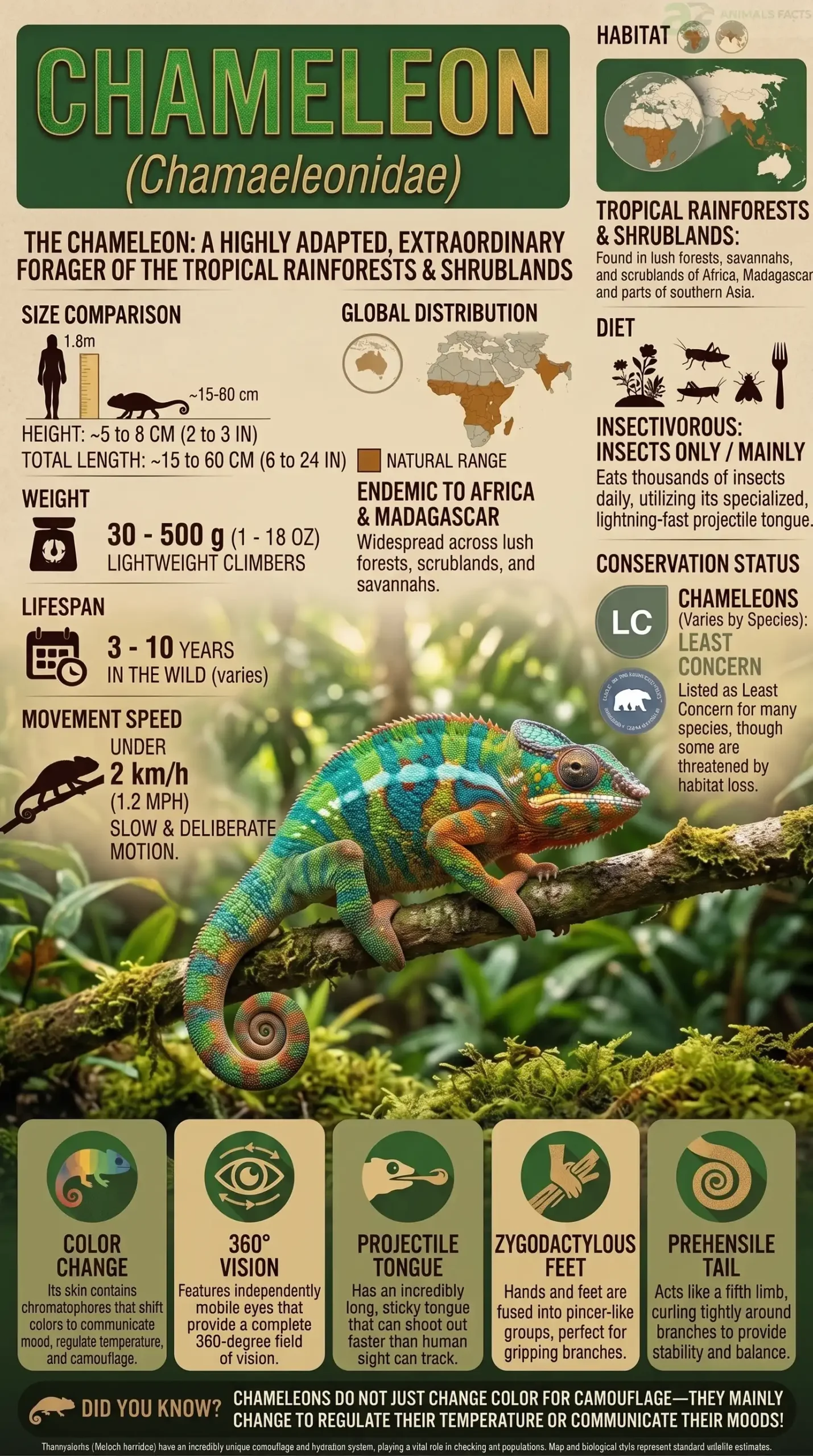
5. Fun Facts About Chameleons
- Color change is structural — not pigment — discovered only in 2012
- Tongue accelerates at 2,590 m/s² — fastest vertebrate muscle movement
- World’s smallest reptile is a chameleon — Brookesia nana at 13.5 mm
- Can see ultraviolet light — patterns invisible to humans
- Color change is primarily social communication — NOT camouflage
- One species exists only as eggs for part of each year
- Eyes rotate independently in all directions
- 50%+ of all species are from Madagascar alone
- Tongue extends 1.5–2× body length
- Chameleons evolved in Madagascar then spread to Africa
- Skull bones fluoresce under UV light in some species
- 37% of species currently threatened with extinction
6. Chameleon Natural Habitat & Geographic Range
Chameleon habitat spans an extraordinary environmental range — from Malagasy rainforest to African desert, from Mediterranean scrub to Himalayan forest — reflecting the family’s long evolutionary history of diversification across different environments.
Primary Habitat Types
Rainforest — The primary habitat for most chameleon species, particularly in Madagascar; the complex three-dimensional branch architecture of rainforest provides the arboreal environment the chameleon body plan is optimized for, while the high insect diversity provides abundant prey.
Montane forest — Multiple species specialized for high-elevation forest environments — the Jackson’s chameleon of East Africa occurring above 1,500 meters, and various Malagasy species occupying the island’s central highland forests above 1,000 meters.
Dry forest and dry deciduous forest — Several Malagasy species are specialists of the western dry deciduous forests and southern spiny forests — the Labord’s chameleon (Furcifer labordi) completing its extraordinary rapid life cycle in the highly seasonal environment of southwestern Madagascar.
Desert and semi-arid scrub — The Namaqua chameleon (Chamaeleo namaquensis) is a specialist of the Namib Desert — one of the world’s driest environments. The veiled chameleon (Chamaeleo calyptratus) of Yemen and Saudi Arabia occupies wadis and drainage systems in an otherwise arid landscape.
Mediterranean scrub (maquis) — The common chameleon (Chamaeleo chamaeleon) occupies Mediterranean scrubland in southern Europe and North Africa — the only chameleon genus to have colonized Europe.
Savanna and woodland — Several African species occupy savanna, woodland, and forest margin habitats — the flap-necked chameleon (Chamaeleo dilepis) being one of the most widespread and habitat-flexible African species.
Geographic Range
| Region | Species Diversity | Notable Species | Notes |
|---|---|---|---|
| Madagascar | ~100+ species | Furcifer, Calumma, Brookesia | Global diversity center |
| Sub-Saharan Africa | ~60+ species | Jackson’s, flap-necked, namaqua | Secondary diversity center |
| Eastern Africa | High | Jackson’s, Trioceros species | Montane specialists |
| Southern Africa | Moderate | Bradypodion species | Cape region endemics |
| Middle East | Low | Veiled, Arabian chameleons | Arid specialists |
| South Asia | Very low | Indian chameleon (C. zeylanicus) | Westernmost Asian range |
| Southern Europe | 1 species | Common chameleon | Mediterranean scrub |
| Comoros Islands | Several | Furcifer species | Island endemics |
💡 Did You Know? Chameleons evolved in Madagascar and colonized Africa from there — not the other direction as was assumed for most of the 20th century. This counterintuitive biogeographic conclusion emerged from molecular phylogenetic analysis of the chameleon family tree — the oldest chameleon lineages are all Malagasy, with African chameleons representing a derived group that colonized the mainland from Madagascar approximately 40–50 million years ago. The implication is that a relatively small island was the evolutionary origin point for a family that subsequently colonized an entire continent — one of the most surprising biogeographic reversals documented in vertebrate evolution. The colonization direction may have been facilitated by the same oceanic current patterns that allow transoceanic rafting from Africa to Madagascar — the currents that flow from Madagascar toward Africa during certain seasons could have carried vegetated rafts bearing ancestral chameleons from Madagascar to the African coast during the Eocene.
7. Chameleon Diet & Feeding Behavior
Chameleon diet is primarily insectivorous — the family’s arboreal, sit-and-wait foraging strategy with ballistic tongue capture is optimized for hunting invertebrate prey from the forest branch.
Diet Breakdown Table
| Food Type | Species | Estimated % of Diet | Notes |
|---|---|---|---|
| Insects (flies, locusts, crickets, beetles) | Most species | ~60–80% | Primary prey for most species |
| Other invertebrates (worms, snails, spiders) | Most species | ~10–20% | Secondary prey |
| Small vertebrates (small lizards, birds, rodents) | Larger species | ~5–15% | F. oustaleti, T. jacksonii |
| Plant material (leaves, flowers, fruit) | Herbivory supplement | ~5–10% | Documented in veiled chameleon and others |
| Water | All species | Essential | Primarily from licking droplets |
The Sit-and-Wait Hunting System
The chameleon’s hunting strategy is one of the most energy-efficient in any lizard — the sit-and-wait predator approach minimizes the energy expenditure of prey pursuit while the ballistic tongue provides the explosive reach needed to capture prey at distance:
Detection phase — The chameleon sits motionless on a branch, its independently rotating eyes scanning the surrounding environment for prey movement. The exceptional acuity of the foveal region and the wide visual field provided by the rotating eyes make the stationary chameleon an extraordinarily effective visual hunter.
Tracking phase — When prey is detected by one eye, the other eye continues monitoring the broader environment. The detecting eye tracks the prey while the chameleon slowly orients its body toward the target through slow, deliberate movement — the swaying locomotion that mimics leaf movement in the breeze provides cover for this orientation.
Convergence phase — At appropriate strike range (typically within 1–2 body lengths), both eyes converge on the prey — the transition from independent to binocular tracking marking the commitment to the strike.
Strike phase — The tongue launches with its extraordinary acceleration — reaching maximum extension in approximately 20 milliseconds. The sticky tip contacts the prey; the high viscosity mucus and suction create adhesion; and the prey is pulled back to the mouth.
Consumption — Prey is manipulated in the mouth and swallowed whole — the robust jaw structure providing the crushing force needed for harder-bodied insects.
The Veiled Chameleon’s Herbivory
The veiled chameleon (Chamaeleo calyptratus) is notable among chameleons for its significant plant material consumption — consuming leaves, flowers, and fruit in quantities that supplement the primarily insectivorous diet:
Adaptive significance — The veiled chameleon’s native Yemen habitat has irregular insect availability — plant material consumption during periods of low insect abundance provides both energy and water from plant moisture content.
Water from plants — In the arid Yemen habitat, plant material consumption provides a significant water source — the moisture content of leaves and fruit supplementing water obtained from dew licking.
Captive implications — The herbivorous tendency of veiled chameleons in captivity has important husbandry implications — plant material should be provided as part of the diet and as environmental enrichment.
8. Chameleon Reproduction & Life Cycle
Chameleon reproduction spans a remarkable range of strategies — from egg-laying species with long incubation periods to live-bearing species, and from species with multi-year lifespans to the extraordinary Labord’s chameleon with its unique annual life cycle.
The Labord’s Chameleon — The Fastest Life Cycle of Any Tetrapod
The biological wonder — Furcifer labordi of southwestern Madagascar has a life cycle unlike any other known tetrapod vertebrate:
The annual cycle — Adults breed in November–December of each year; all adult animals die by January–February; eggs overwinter underground; a new generation hatches in October–November. The population therefore exists as exclusively eggs for approximately 3 months each year — no living adult animal of any age is present.
Post-hatching growth — Hatchlings grow extremely rapidly — reaching sexual maturity and full adult size within approximately 4 months of hatching. This is the fastest growth to sexual maturity of any tetrapod.
Total lifespan — The maximum lifespan of Labord’s chameleon is approximately 4–5 months from hatching to death — the shortest known lifespan of any tetrapod vertebrate.
Why this strategy? — The extreme seasonality of southwestern Madagascar — with a hot, dry season when surface conditions are lethal and a shorter wet season when conditions are suitable — appears to have driven the evolution of the annual cycle. Surviving as eggs through the dry season is metabolically much less costly than maintaining adult metabolic demands through adverse conditions.
Egg-Laying Species — The Incubation Challenge
Clutch sizes — Range from 2–3 eggs (small species) to 60–80 eggs (large species like the Malagasy giant chameleon Furcifer oustaleti)
Nesting behavior — Female egg-laying chameleons descend from the arboreal environment specifically to deposit eggs in soil — excavating burrows of appropriate depth, depositing the eggs, filling the burrow, and then returning to the canopy. This brief terrestrial excursion is one of the most dangerous periods in a chameleon’s life.
Incubation periods — Some of the longest incubation periods of any lizard:
- Most species: 6–18 months
- Labord’s chameleon: 8–9 months (the entire non-adult part of the species’ life cycle)
- Some Furcifer species: up to 24 months
Diapause — Many chameleon eggs undergo developmental diapause — a period of arrested development within the egg. The trigger for resuming development may be temperature change, rainfall, or the completion of a minimum dormancy period.
Live-Bearing Species
Several chameleon genera produce live young (viviparity) rather than eggs:
- Bradypodion (South African dwarf chameleons) — primarily viviparous
- Trioceros (some species) — mixed; some species egg-laying, some viviparous
- Chamaeleo — primarily egg-laying with some exceptions
Live birth advantages — In high-elevation or seasonally cold environments, live birth may be advantageous because the mother can thermoregulate more effectively than a buried egg can — providing more consistent temperatures for embryo development.
Reproductive Strategies and Lifespan Table
| Species | Reproductive Mode | Clutch/Litter | Lifespan | Notable Feature |
|---|---|---|---|---|
| Veiled chameleon | Egg-laying | 20–85 eggs | 5–8 years | Large clutch; partial herbivore |
| Jackson’s chameleon | Viviparous | 8–35 young | 5–10 years | Live birth; three horns |
| Panther chameleon | Egg-laying | 12–46 eggs | ~3 years (wild) | Short-lived; vivid color |
| Labord’s chameleon | Egg-laying | ~20 eggs | 4–5 months | Shortest tetrapod lifespan |
| Pygmy leaf chameleon (Brookesia) | Egg-laying | 2 eggs | 3–5 years | Smallest clutch |
| Common chameleon | Egg-laying | 10–40 eggs | 5–7 years | Only European chameleon |
9. Social Behavior & Communication
Chameleon social behavior is far more complex than their reputation as solitary, minimally communicative animals would suggest — the color change system constitutes one of the most sophisticated visual communication systems of any reptile.
The Color Change Communication System
The primary function — Research has established that color change in chameleons functions primarily as social communication rather than camouflage:
Male-male territorial interactions — When two males encounter each other, the more dominant individual typically produces more vivid, rapidly changing color displays — the color intensity correlating with winning probability in subsequent contests. Color display allows assessment of relative dominance without physical contact in many cases.
Female-male courtship — Males display vivid coloration toward females during courtship. Receptive females signal receptivity through muted colors and passive posture — unreceptive females signal rejection through dark, aposematic coloration and aggressive behavior.
Female status signaling — Gravid (pregnant/egg-bearing) females signal their reproductive status through specific dark coloration patterns — typically black with orange, blue, or white markings — that signal to males that mating attempts will be rejected. This mate rejection signal reduces the energetic and physical cost of repeated male harassment.
The speed of display — Dominant males in confrontations produce more rapidly changing color displays — the rate of color change encoding information about individual quality alongside the specific colors produced.
Communication Beyond Color
Head-bobbing — Like agamid lizards, chameleons produce stereotyped head-bob sequences — the timing and pattern encoding species identity and individual status information.
Substrate vibration — As noted in the Top 25 facts, chameleons produce infrasonic vibrations through the substrate — a communication channel that has only recently been recognized and remains incompletely characterized.
UV patterning — The UV skin patterns visible to other chameleons but not to humans may encode individual identity and status information in a channel inaccessible to predators that lack UV vision.
Postural signals — Body compression (making the body appear thinner or larger from different angles), casque orientation, and tail coiling provide additional visual information during social interactions.
Solitary Nature and Territory
Despite the sophisticated communication system, chameleons are predominantly asocial outside of mating interactions:
- Adults maintain individual home ranges that overlap minimally with same-sex individuals
- Social tolerance is low — prolonged proximity between adult males typically results in escalating display and potentially physical combat
- Female-female interactions are also agonistic — females compete for the best foraging positions
- The color-change communication system is well-suited to a largely solitary lifestyle — it allows rapid information exchange during brief encounters without requiring sustained social association
10. Predators & Defense Mechanisms
Chameleons face predation from a range of aerial, arboreal, and terrestrial predators — their defense system is primarily passive and cryptic rather than active and confrontational.
Natural Predators
Raptors — The most significant predator group; bateleur eagles, gymnogene hawks, boomslang snakes in trees, various owls and other birds of prey are documented chameleon predators across Africa. The forest canopy habitat provides limited protection against aerial predators.
Arboreal snakes — Boomslang (Dispholidus typus), green mamba (Dendroaspis angusticeps), and various other arboreal snakes are significant chameleon predators — their arboreal capability allowing access to the branch environments where chameleons feel most secure.
Mammals — Various omnivorous mammals — mongooses, civets, wild pigs — predate chameleons when encountered on the ground during nesting excursions or other terrestrial movements.
Other chameleons — Larger chameleon species predate smaller species — chameleon cannibalism is documented in both wild and captive settings.
Introduced predators — In Madagascar, introduced rats, cats, and dogs represent significant predation threats to chameleons not evolved with mammalian predation pressure.
Defense Mechanisms
Cryptic coloration — the resting state — When not socially engaged, chameleons typically maintain their resting coloration — grey-green to brown tones that match the bark, lichen, and leaf color of their arboreal environment. The lateral compression of the body reduces the shadow profile when viewed against a branch.
Freezing — The primary behavioral defense when a predator is detected; the chameleon freezes completely — relying on cryptic coloration and immobility to prevent detection. The sway behavior (slow rocking resembling a leaf in the breeze) is maintained during walking but ceases immediately when a predator is detected nearby.
Darkening — Threatened chameleons may rapidly darken — the dark coloration potentially serving an aposematic function (warning the predator that the chameleon is not a favorable prey item) or simply reducing the lizard’s visibility against dark bark surfaces.
The drop defense — When seized from a branch, many chameleon species drop from the branch and attempt to escape through the vegetation below — the falling chameleon presenting a moving target that is difficult for an aerial predator to maintain grip on.
Inflation — Chameleons inflate their bodies when threatened — lateral compression allows rapid apparent body size increase that may deter some predators.
Biting — The bite of large chameleons can be painful and can break skin — though not venomous, a defensive bite from a large species like the Malagasy giant chameleon is a meaningful deterrent.
The color confusion hypothesis — Some researchers have proposed that the rapid, dramatic color changes of a threatened chameleon may serve to confuse predators — the unexpected transition from cryptic to vivid coloration creating momentary hesitation that allows escape. This hypothesis remains unproven experimentally.
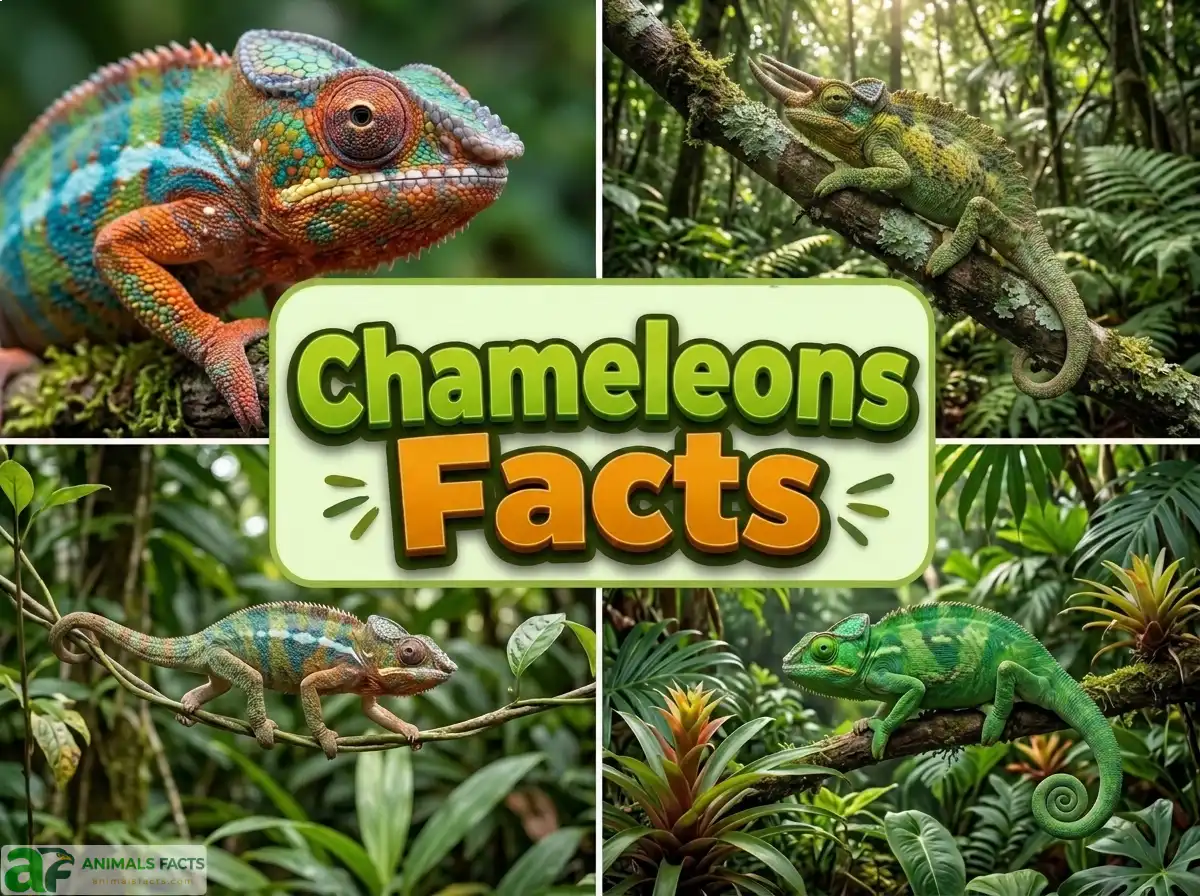
11. Chameleon Facts for Kids
Hey amazing young wildlife scientists and reptile enthusiasts! Here are some absolutely extraordinary chameleon facts for kids that will make every science conversation immediately more fascinating:
- 🦎 Chameleons change color using NANOCRYSTALS — not paint! Scientists only discovered in 2012 how chameleons actually change color. It is not like a paint job — tiny crystal structures in their skin are packed together in precise arrangements. When the chameleon’s brain sends a signal, these crystals move apart or closer together — and the change in spacing changes which color of light bounces off them. It is physics, not chemistry!
- 🦎 The chameleon tongue is the FASTEST MUSCLE MOVEMENT of any vertebrate on Earth! A chameleon’s tongue launches from its mouth with an acceleration 264 times the force of gravity — faster than any other muscle movement measured in any vertebrate animal ever. The secret is that the tongue stores energy in elastic tissue, like a compressed spring, and then RELEASES all that energy at once — similar to how a catapult works!
- 🦎 The world’s smallest REPTILE is a chameleon! Brookesia nana, discovered in Madagascar in 2021, has adult males that are only 13.5 millimeters long — about the length of a thumbnail. The male is so tiny that its reproductive organs are proportionally the largest of any amniote vertebrate — which is quite a lot to carry around when you are barely bigger than an ant!
- 🦎 Each of a chameleon’s eyes can look in a COMPLETELY DIFFERENT DIRECTION at the same time! One eye can look forward while the other looks backward. One can look up while the other looks down. The eyes spin around in their cone-shaped sockets completely independently. When the chameleon spots an insect to catch, both eyes swivel to look at exactly the same spot — like two cameras focusing on the same target!
- 🦎 Chameleon color change is mainly for TALKING TO OTHER CHAMELEONS — not for hiding! Most people think chameleons change color to hide from predators. But research shows the most dramatic color changes happen when two chameleons meet each other — it is like a visual conversation. The chameleon communicates dominance, readiness to mate, and how angry it is all through color!
- 🦎 One chameleon species exists ONLY AS EGGS for part of each year! The Labord’s chameleon of Madagascar has the shortest life cycle of any land vertebrate. All the adults die, the eggs stay underground through the dry season, and when the rains come, they all hatch at once. For a few months every year, every single Labord’s chameleon on Earth exists ONLY inside an egg — there are no living adults anywhere!
- 🦎 Chameleons evolved in MADAGASCAR and then spread to AFRICA — not the other way around! Scientists used to think chameleons started in Africa and reached Madagascar. But DNA studies proved the opposite — the oldest chameleons are from Madagascar, and African chameleons actually came FROM Madagascar. A tiny island was the birthplace of an entire family that conquered a whole continent!
- 🦎 Some chameleons have GLOWING BONES! Scientists discovered in 2018 that some Madagascar chameleons have skull bones that glow bright BLUE under ultraviolet light — and the glow shows through their thin skin! Other chameleons can apparently see this glow as a secret signal invisible to predators and to human observers. Chameleons might be having entire conversations in a light spectrum we cannot even see!
12. Relationship with Humans
The chameleon’s relationship with humans spans ancient cultural traditions from Africa to the Middle East, the global pet trade that removes millions of animals from wild populations, a medical and scientific research significance that extends into nanotechnology and materials science, and the urgent conservation crisis facing Madagascar’s extraordinary chameleon radiation.
Ancient Cultural Traditions
African traditions — The chameleon occupies a significant cultural position across multiple African societies — its unusual appearance, slow movement, color change, and independently moving eyes generating rich mythological associations:
West African oral traditions — The chameleon appears in creation mythology across multiple West African cultures — in Yoruba tradition, the chameleon (Alagemo) was the first creature sent by the deity Obatala to test the earth before creation was complete. The chameleon’s cautious, slow movement is the origin story of deliberateness and careful testing.
East and Southern African traditions — Chameleons appear across the folklore of Zulu, Swahili, Kikuyu, and many other East and Southern African peoples — frequently associated with messages between the divine and human realms. In various traditions, the chameleon’s late delivery of a divine message (slowed by its careful movement) explains why humans are mortal — the message of immortality arrived late, and death arrived first via a faster messenger.
The slow messenger mythology — This narrative structure — the chameleon as a slow but important messenger whose delay has consequences — appears in remarkably similar forms across widely separated African cultures, suggesting either common origin or independent convergence on similar interpretations of the chameleon’s distinctive slow-motion locomotion.
Middle Eastern traditions — In the Arabic and Islamic world, the chameleon’s color-changing ability has generated associations with inconstancy and unreliability — describing a changeable or untrustworthy person as a “chameleon” reflects cultural associations with the animal’s perceived lack of fixed identity.
The Pet Trade — Scale and Problems
The chameleon pet trade is one of the most significant human-chameleon interactions globally — and one of the most problematic from both conservation and animal welfare perspectives:
Trade volumes — Tens of thousands of chameleons are legally traded internationally each year — with additional significant illegal trade. The most commonly traded species include the veiled chameleon, panther chameleon (Furcifer pardalis), and Jackson’s chameleon — predominantly captive-bred for the legal trade, though wild collection for export remains a significant problem for less commonly kept species.
The husbandry challenge — Chameleons are among the most demanding reptile pets and have extremely high mortality rates in captivity due to improper husbandry:
- They require precise temperature gradients — different body temperatures for different activities
- They need full-spectrum UV-B lighting — metabolic bone disease from inadequate UV-B is a primary cause of captive chameleon death
- They must be provided water through misting or dripping — most will not drink from standing water
- Many species are highly stressed by handling — frequent handling causes chronic stress that compromises immune function
- They need specific humidity levels — either too dry or too wet causes respiratory problems and other health issues
Wild collection impact — For less commonly kept species, wild collection for the pet trade represents a meaningful conservation threat — populations at easily accessible locations being serially collected by local traders.
The Madagascar export problem — Madagascar has historically exported large numbers of wild-caught chameleons — CITES regulations have progressively restricted this trade, but illegal export continues. The combination of wild collection and habitat loss creates compound pressure on already restricted populations.
Scientific Research Significance
The chameleon’s extraordinary biology has made it a significant subject for scientific research across multiple disciplines:
Materials science — The nanocrystal color change mechanism has inspired significant research into biomimetic color-changing materials — artificial surfaces that replicate the structural coloration principle for applications in smart displays, sensors, and camouflage technology.
Robotics — The chameleon tongue mechanism — achieving extraordinary acceleration through elastic energy storage — has been studied as a model for high-acceleration robotic actuators in soft robotics research.
Optics — The photonic crystal structure of chameleon iridophores has contributed to understanding of photonic bandgap materials — engineered optical materials that control light through periodic nanostructure rather than chemical absorption.
Neuroscience — The independent eye movement system of chameleons provides a model for studying neural control of independent motor systems — how the brain coordinates multiple independently operating sensory and motor systems.
13. Chameleon Conservation Status & Threats
Conservation Status Overview
| Category | Number of Chameleon Species | Percentage |
|---|---|---|
| Critically Endangered | 11 species | ~5% |
| Endangered | 35 species | ~17% |
| Vulnerable | 27 species | ~13% |
| Near Threatened | 11 species | ~5% |
| Least Concern | 87 species | ~42% |
| Data Deficient / Not Assessed | ~30+ species | ~18% |
| Total Threatened | ~73 species | ~35% |
Major Threats
| Threat | Affected Species | Impact Level |
|---|---|---|
| Deforestation (Madagascar) | All Malagasy species | Critical — primary threat |
| Slash-and-burn agriculture | Madagascar species | Critical |
| Illegal wildlife collection | Pet-trade species; all accessible species | High |
| Legal wildlife trade | Commonly kept species | Medium-High |
| Climate change | Temperature-sensitive species | High and increasing |
| Introduced predators | Madagascar species (rats, cats) | High |
| Road mortality | Ground-active species | Medium |
| Charcoal production | Malagasy forest species | High |
The Madagascar Crisis
Madagascar has lost approximately 90% of its original forest cover — the same deforestation crisis that threatens lemurs, fossas, and every other Madagascar endemic also drives the collapse of chameleon populations. Several chameleon species are known from single mountain ridges or forest fragments — a restricted range that means a single clearance event could eliminate an entire species.
The unique vulnerability of endemic island species — Species restricted to single small areas of a rapidly deforested island face extinction dynamics that differ fundamentally from species with broad continental ranges. For Madagascar’s most range-restricted chameleon species, the forest patches they inhabit are shrinking faster than any adaptation can compensate for.
Conservation Responses
Malagasy protected area network — Protected areas in Madagascar provide formal habitat protection for chameleon populations — though enforcement capacity is severely limited and illegal forest clearance continues within formally protected areas.
CITES trade regulation — CITES Appendix II listing of most chameleon species regulates international trade — requiring documentation of legal origin and sustainable harvest for all legal exports.
Captive breeding programs — For the most commonly kept species, the development of self-sustaining captive breeding populations reduces pressure on wild populations — the veiled chameleon and panther chameleon are primarily captive-bred in the legal trade.
Community conservation programs — Programs engaging local Malagasy communities in chameleon conservation — providing alternative livelihoods and building local awareness of the ecological value of forest — represent the most promising approach to long-term chameleon conservation.
14. Famous Chameleons in History & Pop Culture
Famous Individual Chameleons and Historical Moments
Darwin’s Chameleon Observation — Charles Darwin’s observation of chameleon color change during his naturalist’s career contributed to his understanding of animal communication and sexual selection — the chameleon’s visual display system being one of the examples in his thinking about how visual signals evolve through sexual selection.
The 2012 Nanocrystal Discovery — The research by Michel Milinkovitch and colleagues at the University of Geneva published in Nature Communications in 2012 — revealing the structural coloration mechanism — was one of the most widely reported biological discoveries of the decade. The discovery that chameleon color change was a fundamentally different physical process than previously understood was reported in every major science media outlet globally.
The 2021 Brookesia nana Description — The formal description of the world’s smallest reptile in Scientific Reports in January 2021 generated global media coverage — the extraordinary size of this tiny Madagascar chameleon and the photographic documentation of its relative reproductive organ size generating one of the most widely read herpetology papers of recent years.
“Pascal” (Tangled, 2010) — The Disney animated film Tangled features Pascal, a veiled chameleon companion to the protagonist Rapunzel — one of the most culturally significant fictional chameleon characters in animation history. Pascal’s color changes in the film — while exaggerated for dramatic effect — introduced the concept of chameleon color change as communication to a global audience of children.
“Herb” and various zoo ambassador chameleons — Chameleons maintained at major zoos as public education ambassadors have introduced millions of zoo visitors to the chameleon’s extraordinary biology — the color change behavior and tongue demonstration being among the most memorable and most educational wildlife encounters in zoo settings.
15. Role in Ecosystem & Food Chain
The Insectivore Role
Chameleons are important insectivore predators in their forest ecosystems — consuming significant quantities of insects and contributing to the regulation of insect populations:
Insect population regulation — Chameleons are abundant in many forest ecosystems where they collectively consume large insect quantities. The combination of their effective hunting system and their high density in productive habitats creates meaningful predation pressure on insect communities.
Selective predation — The chameleon’s visual hunting system creates selective pressure toward crypsis and rapid movement in prey insects — the ecological arms race between visually hunting predators and their prey has driven significant evolutionary innovation in insect camouflage and escape behavior.
The Seed Dispersal Role
Several chameleon species that consume fruit provide seed dispersal services — depositing seeds in their feces at distances from the parent plant. This seed dispersal role, while secondary to the insectivore function, contributes to forest regeneration in chameleon-inhabited ecosystems.
The Prey Role
Chameleons are consumed by multiple predator types — supporting higher trophic level predators:
Raptor food base — Chameleons constitute a significant prey resource for forest raptors in Africa and Madagascar — their arboreal habitat making them accessible to aerial predators while their relatively slow movement makes them easier to capture than faster lizard prey.
Snake prey — Arboreal snake populations in chameleon habitat benefit from chameleon prey — the chameleon’s relative immobility making it a predictable prey resource for ambush-hunting arboreal snakes.
The Indicator Role
Chameleons are increasingly recognized as ecological indicators of forest quality:
- Chameleon species richness correlates strongly with forest intactness — areas of high chameleon diversity reliably indicate structurally intact, biologically diverse forest
- The presence of rare or specialized chameleon species indicates habitat quality beyond what simple vegetation cover assessments reveal
- Chameleon population monitoring has been proposed as a cost-effective biodiversity monitoring tool for Madagascar’s forests
16. Myths, Folklore & Cultural Significance
African Oral Traditions — The Slow Messenger
As described in the Relationship with Humans section, the chameleon’s role as a slow messenger in African creation mythology is one of the most widespread and most culturally significant animal mythology associations on the continent:
The Zulu tradition — In Zulu mythology, the creator god uNkulunkulu sent the chameleon (unwabu) to deliver the message of immortality to humans. The chameleon moved slowly, stopped to eat berries along the way, and arrived late. Another messenger — the lizard — arrived first with the message of mortality. Because the lizard arrived first, humans are mortal. The chameleon’s slowness doomed humanity to death.
Variations across cultures — Nearly identical narrative structures appear in the mythology of the Swahili, Kikuyu, Ndebele, Sotho, and dozens of other African peoples — the chameleon invariably serving as the delayed messenger of life whose tardiness allows death to arrive first. The structural similarity across widely separated cultures suggests either ancient common origin of the myth or independent convergence on the same interpretation of the chameleon’s distinctive slow-motion movement.
The cultural consequence — In several African traditions, this mythology generates a negative cultural attitude toward chameleons — the animals blamed for human mortality and therefore considered bad luck or harbingers of misfortune. This cultural association has conservation implications — chameleons killed on sight in some communities due to fear or negative cultural associations.
Middle Eastern and Islamic Traditions
The chameleon (hirba’ or aqbat in Arabic) appears in Islamic literature and tradition primarily as a symbol of inconstancy and unreliability — the color-changing ability interpreted as indicative of an animal without fixed identity or principles. This metaphorical use of the chameleon — as a symbol of changing, unreliable character — has influenced the use of “chameleon” as a metaphor for inconsistency in Arabic literary tradition.
The Universal “Chameleon” Metaphor
In virtually every language with significant chameleon cultural contact, the word for chameleon has become a metaphor for adaptability and inconsistency — “being a chameleon” implying either:
- Positive adaptability — the ability to fit into different situations and environments
- Negative inconsistency — the lack of fixed principles or identity
This dual cultural meaning — simultaneously admirable and suspicious — reflects the fundamental ambiguity of the chameleon’s color-changing ability from a human cultural perspective.
17. Chameleons in Pop Culture
Tangled (Disney, 2010) — The character Pascal — Rapunzel’s veiled chameleon companion — is the most culturally significant fictional chameleon in animation history. Pascal’s color changes (exaggerated for emotional emphasis) and his silent but expressive communication made him one of the most popular animal companions in Disney animation. The film introduced the concept of chameleon color change as emotional communication to a global audience of hundreds of millions.
Rango (Paramount, 2011) — The animated film’s protagonist — a pet chameleon who becomes an unlikely Western hero — is the most fully realized fictional chameleon character in any animated film. The film’s sophisticated treatment of chameleon identity and color change (the protagonist’s identity changes as radically as his color) received critical acclaim and contributed to a broader cultural moment of chameleon-centered storytelling.
“Life in Cold Blood” (BBC, David Attenborough, 2008) — The definitive documentary treatment of chameleon biology; the color change and tongue strike sequences produced in this series remain the most widely viewed documentary footage of chameleon biology. The slow-motion tongue strike footage in particular has been reproduced in countless educational contexts.
“Planet Earth” and “Planet Earth II” (BBC) — Various sequences in BBC’s landmark documentary series feature chameleons — particularly Madagascar species — in contexts that have introduced chameleon diversity and the Madagascar conservation crisis to global audiences.
The 2012 nanocrystal discovery in popular media — The discovery of chameleon color change physics received coverage in virtually every major popular science outlet — Wired, Popular Science, Scientific American, BBC Science — introducing the structural coloration mechanism to a global science-interested public.
Social media chameleon content — Chameleons are among the most shared reptile content on social media platforms — color change videos, tongue strike slow-motion footage, and the extraordinary appearance of various species generating consistently high engagement across Instagram, YouTube, and TikTok wildlife content.
18. Chameleon Facts vs. Common Myths
| Common Myth | The Real Fact |
|---|---|
| “Chameleons change color to camouflage themselves” | Primarily false — the primary function of color change is social communication; during predator avoidance chameleons typically rely on freezing and cryptic resting coloration rather than rapid color change |
| “Chameleons change color by moving pigment” | False — the mechanism involves structural coloration through iridophore nanocrystal rearrangement; this was only discovered in 2012 and overturned the previous pigment-movement consensus |
| “Chameleons can turn any color to match any background” | Partially false — chameleons can produce a range of colors but are limited by their specific iridophore system; they cannot produce all possible colors or precisely match arbitrary backgrounds |
| “The tongue is faster than the eye can follow” | True — at 264G acceleration, the tongue strike is completed in approximately 20 milliseconds — far too fast for human visual tracking without high-speed camera assistance |
| “Chameleons are good beginner pets” | False — chameleons are among the most demanding reptile pets; they require precise temperature gradients, UV-B lighting, dripping water sources, and low handling stress; chameleon mortality in captivity is extremely high due to inadequate husbandry |
| “All chameleons are from Africa” | False — chameleons are from multiple continents (Africa, Madagascar, Middle East, southern Europe, South Asia) and evolved in Madagascar before colonizing Africa |
| “Chameleons are slow because they are lazy” | False — chameleons’ slow movement is a highly evolved predator avoidance strategy — the swaying, deliberate movement mimics leaf movement in the wind, while extreme stillness minimizes detection by visually-hunting predators |
19. Best Places to See Chameleons in the Wild
1. Ranomafana National Park, Madagascar — One of the finest chameleon viewing locations in the world; the rainforest of Ranomafana supports exceptional chameleon diversity — typically 10+ species including the spectacular panther chameleon, Parson’s chameleon (Calumma parsonii), and various other Malagasy endemics. Experienced local guides with spotlight capabilities for nocturnal surveys provide access to species invisible during daylight hours.
2. Andasibe-Mantadia National Park, Madagascar — The most accessible chameleon-rich rainforest from Antananarivo — supporting impressive chameleon diversity including the impressive Parson’s chameleon and various smaller Calumma species. The park’s well-developed guide infrastructure makes it one of the most accessible Madagascar wildlife experiences.
3. Masoala National Park, Madagascar — Madagascar’s largest protected area; excellent panther chameleon populations visible from the park’s coastal forest trails; extremely diverse chameleon fauna in the forest interior accessible to visitors staying at the park’s lodges.
4. Mount Meru and Arusha National Park, Tanzania — The lush montane forest of Mount Meru supports excellent populations of Meller’s chameleon (Trioceros melleri) and Jackson’s chameleon — large, spectacular species in accessible highland forest.
5. Bwindi Impenetrable Forest, Uganda — This UNESCO World Heritage Site famous for mountain gorillas also supports excellent chameleon populations — Rwenzori side-striped chameleon, Johnston’s chameleon, and other montane East African species visible on guided walks.
6. Knysna Forest, South Africa — The Cape Fold Mountains and associated forests of South Africa’s Garden Route support the extraordinary dwarf chameleons (Bradypodion species) — small, viviparous chameleons unique to the Cape region and among the most accessible chameleon populations for visitors to South Africa.
7. Oman and Yemen — For the veiled chameleon in its native range — the wadis and vegetation areas of the Arabian Peninsula provide the opportunity to observe this species in its natural habitat rather than the captive settings where most people encounter it globally.
20. How You Can Help
Supporting chameleon conservation requires action focused primarily on Madagascar forest protection, illegal wildlife trade prevention, responsible pet ownership, and climate change advocacy.
Support these organizations:
- Chameleon Conservation Fund — chameleonconservation.org — specifically dedicated to chameleon conservation research and Madagascar forest protection
- Madagascar Fauna and Flora Group — madagascarfaunaflora.org — broad Madagascar conservation including chameleon habitat
- Rainforest Trust — rainforesttrust.org — funds purchase and protection of Madagascar forest protecting chameleon habitat
- Wildlife Conservation Society Madagascar — wcs.org — comprehensive Madagascar conservation programs
- TRAFFIC — traffic.org — monitors and advocates against illegal wildlife trade affecting chameleons
- Lemur Conservation Network — lemurconservationnetwork.org — chameleon and lemur habitats largely overlap; lemur conservation benefits chameleons
Critical individual actions:
- Research before acquiring a pet chameleon — the high captive mortality rate of chameleons reflects inadequate husbandry; responsible ownership requires thorough preparation, appropriate setup, and realistic assessment of commitment
- Only purchase captive-bred chameleons — insisting on captive-bred animals from reputable breeders removes demand for wild-caught individuals
- Support Madagascar conservation organizations — the forest protection needed for chameleon conservation is the same forest protection needed for all Madagascar endemics
- Never release captive chameleons into the wild — Jackson’s chameleons established in Hawaii through pet releases are now an invasive species
- Spread accurate information about chameleon biology — the color-change-as-camouflage misconception drives inadequate understanding of chameleon communication; sharing accurate information builds appreciation for the actual extraordinary biology
21. Top Documentaries & Books
Must-Watch Documentaries
- “Life in Cold Blood” (BBC, David Attenborough, 2008) — The definitive chameleon documentary sequences; essential viewing
- “Madagascar” (BBC, 2011) — Comprehensive Madagascar natural history including exceptional chameleon content
- “Island of Lemurs: Madagascar” (IMAX, 2014) — Madagascar conservation context including chameleon content
- “Our Planet — Forests” (Netflix, 2019) — Madagascar and African forest content including chameleon species
- “Spy in the Wild” (BBC, 2017) — Features extraordinary close-range chameleon behavioral footage obtained through robotic camera systems
Must-Read Books
- Chameleons: Nature’s Hidden Jewels by Peter Necas — The comprehensive popular science reference for chameleon natural history; beautifully illustrated
- The Veiled Chameleon by various husbandry authors — The most comprehensive captive care guide for the most commonly kept chameleon species
- Geckos and Chameleons (various natural history volumes) — Popular natural history treatments
- Madagascar: A Natural History — Comprehensive natural history providing essential context for Madagascar chameleon diversity
- Milinkovitch, M. et al. (2015) “Photonic crystals cause active colour change in chameleons” — Nature Communications — the landmark scientific paper; freely accessible online and essential for understanding the color change mechanism
22. Comparison of Major Chameleon Species
| Feature | Veiled Chameleon | Panther Chameleon | Jackson’s Chameleon | Parson’s Chameleon | Brookesia micra |
|---|---|---|---|---|---|
| Scientific name | Chamaeleo calyptratus | Furcifer pardalis | Trioceros jacksonii | Calumma parsonii | Brookesia micra |
| Total length | Up to 61 cm | Up to 52 cm | Up to 38 cm | Up to 68 cm | ~3.5 cm |
| Weight | Up to 200 g | Up to 180 g | Up to 150 g | Up to 600 g | ~0.1 g |
| Color change | Moderate | Extraordinary | Moderate | Moderate | Minimal |
| Horns | Casque only | Minor projections | 3 prominent horns | Minor projections | None |
| Reproduction | Egg-laying | Egg-laying | Viviparous | Egg-laying | Egg-laying |
| Lifespan | 5–8 years | ~3 years | 5–10 years | 12+ years | 3–5 years |
| Habitat | Arid; Yemen/Saudi Arabia | Rainforest; Madagascar | Montane; E. Africa | Rainforest; Madagascar | Leaf litter; Madagascar |
| Conservation | Least Concern | Least Concern | Least Concern | Near Threatened | Data Deficient |
| Pet trade | Most common pet | Second most common | Third most common | Rarely kept | Not in trade |
| Notable feature | Casque; partial herbivory | Locale-specific color | Three horns; live birth | Largest chameleon | World’s smallest reptile |
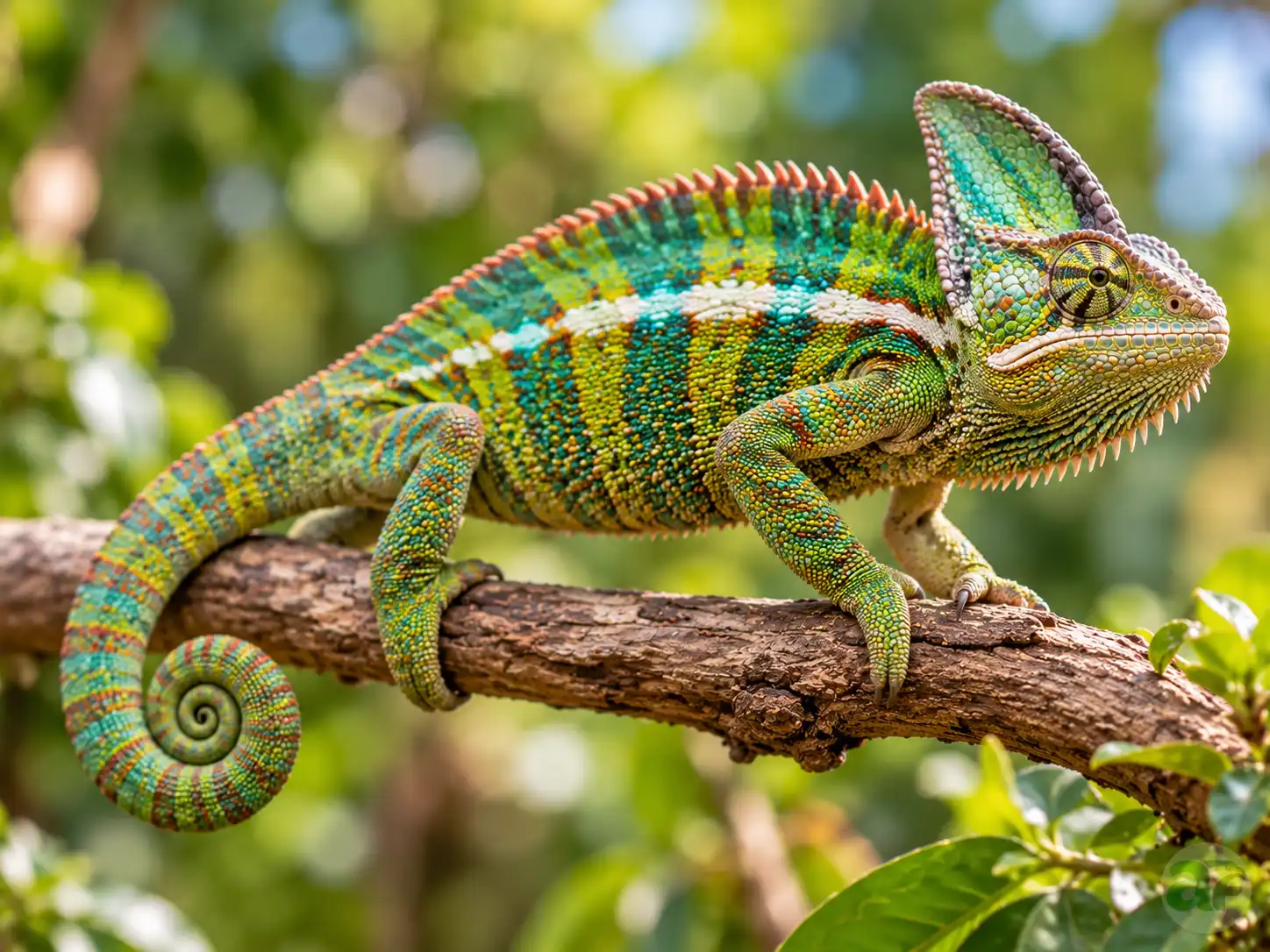
23. Frequently Asked Questions About Chameleons
Q1. What is the scientific name of the chameleon?
Chameleons belong to the family Chamaeleonidae — a family containing over 200 recognized species across multiple genera. The family name derives from the Greek Chamaeleon — combining chamai (on the ground) and leon (lion) — meaning “ground lion.” The most familiar species — the veiled chameleon — has the scientific name Chamaeleo calyptratus (Duméril & Bibron, 1851); the panther chameleon is Furcifer pardalis (Cuvier, 1829); the Jackson’s chameleon is Trioceros jacksonii (Boulenger, 1896); and the world’s largest chameleon — the Malagasy giant chameleon — is Furcifer oustaleti (Mocquard, 1894). The family Chamaeleonidae belongs to the infraorder Acrodonta within the suborder Lacertilia — the same broader group as the agamid lizards (bearded dragons, frilled-neck lizards) with which chameleons share a deep evolutionary ancestor.
Q2. How do chameleons change color?
Chameleon color change operates through structural coloration — a physical mechanism discovered in 2012 by Michel Milinkovitch and colleagues at the University of Geneva that fundamentally overturned previous understanding. The skin contains specialized cells called iridophores that house guanine nanocrystals — tiny crystalline structures approximately 100–300 nanometers in size arranged in a precise geometric lattice within the cell. The key principle is that the spacing between nanocrystals determines which wavelengths of light are reflected: closely packed crystals (small spacing) reflect short wavelengths producing blue colors; relaxed crystals (larger spacing) reflect longer wavelengths producing yellow, orange, and red. When nerve signals cause the iridophore cells to contract or relax, the nanocrystal lattice changes its spacing — shifting the reflected color across the visible spectrum within 1–2 seconds. This structural coloration mechanism is fundamentally different from pigment-based color change (used by octopuses and some other animals) and is more similar physically to the color of butterfly wings, opal gemstones, and certain beetle elytra — making chameleon color change as much a physics phenomenon as a biology one.
Q3. Is color change in chameleons used for camouflage?
Primarily no — this is the most significant misconception in popular understanding of chameleon biology. Research has established that social communication is the primary function of rapid, dramatic color change in chameleons. The most intense and most rapid color changes occur during male-male confrontations (both animals displaying vivid colors to assess relative dominance), courtship (males displaying vivid colors to females), and female mate rejection (gravid females displaying dark colors with bright spots to signal non-receptivity). During predator avoidance, chameleons typically employ a completely different strategy — freezing completely in their resting coloration (grey-green tones that match bark and leaf surfaces) rather than changing color. The “chameleons change color to hide from predators” narrative appears to have originated from casual observation and was reinforced by popular media before behavioral research established the actual primary function. The resting coloration IS cryptic — but it is a fixed state, not an active dynamic response to different backgrounds.
Q4. What is the world’s smallest reptile?
The world’s smallest known reptile is Brookesia nana — a nano-chameleon from northern Madagascar formally described in Scientific Reports in January 2021. Adult males of this species measure just 13.5 mm in total body length (with a snout-to-vent length of 6.3 mm) — smaller than a typical human thumbnail. Adult females are significantly larger at 19.2 mm — an unusual reversal of typical vertebrate sexual size dimorphism. The species was discovered in a single small rainforest patch in northern Madagascar — the extraordinarily restricted known range immediately qualifying it as a species of conservation concern. Perhaps most remarkably, the adult male’s hemipenes (paired reproductive organs) are proportionally among the largest relative to body size of any amniote vertebrate — a biological puzzle that has attracted significant scientific interest alongside the size record itself. Prior to B. nana‘s description, the title of world’s smallest reptile was also held by a chameleon — Brookesia micra, described in 2012.
Q5. Are chameleons good pets?
Chameleons are among the most challenging and most commonly mistreated reptile pets — despite their visual appeal and cultural recognition. The specific care requirements that make them demanding include: specialized temperature gradients (different temperatures for basking, ambient, and sleeping zones must be maintained); full-spectrum UV-B lighting (metabolic bone disease from inadequate UV-B is a primary cause of premature captive death); dripping or misting water systems (most species will not drink from standing water — they must have water moving on leaf surfaces); low-stress handling protocols (many species are highly stressed by frequent handling, with chronic stress compromising immune function and lifespan); and correct diet with supplementation (calcium and vitamin supplementation on feeder insects is essential). Mortality rates of pet chameleons in their first year are extremely high in the hands of inexperienced keepers. The veiled chameleon (Chamaeleo calyptratus) and panther chameleon (Furcifer pardalis) are the most commonly recommended species for committed, well-prepared keepers — both are primarily captive-bred in the legal trade and are more robust than some other species. Anyone considering a chameleon as a pet should thoroughly research the specific requirements before acquisition and honestly assess their capacity for the long-term commitment involved.
24. Sources & Rreferences
- Wikipedia — Chamaeleonidae, Chamaeleo calyptratus, Furcifer pardalis, Brookesia micra, Brookesia nana
- IUCN Red List — iucnredlist.org (current assessments for all chameleon species)
- Milinkovitch, M.C. et al. (2015). “Photonic crystals cause active colour change in chameleons.” Nature Communications — the landmark nanocrystal discovery paper
- Anderson, C.V. (2016). “Off like a shot: scaling of ballistic tongue projection reveals extremely high performance in smaller chameleons.” Scientific Reports — the tongue speed research
- Stuart-Fox, D. and Moussalli, A. — multiple published papers on chameleon color change and communication
- Glaw, F. et al. (2021). “Extreme miniaturization of a new amniote vertebrate and insights into the evolution of genital size in nano-chameleons.” Scientific Reports — the Brookesia nana description paper
- National Geographic — nationalgeographic.com
- Smithsonian National Museum of Natural History — naturalhistory.si.edu
- BBC Wildlife / BBC Earth — bbcearth.com
- Britannica — britannica.com/animal/chameleon
- Madagascar Fauna and Flora Group — madagascarfaunaflora.org
- Rainforest Trust — rainforesttrust.org