
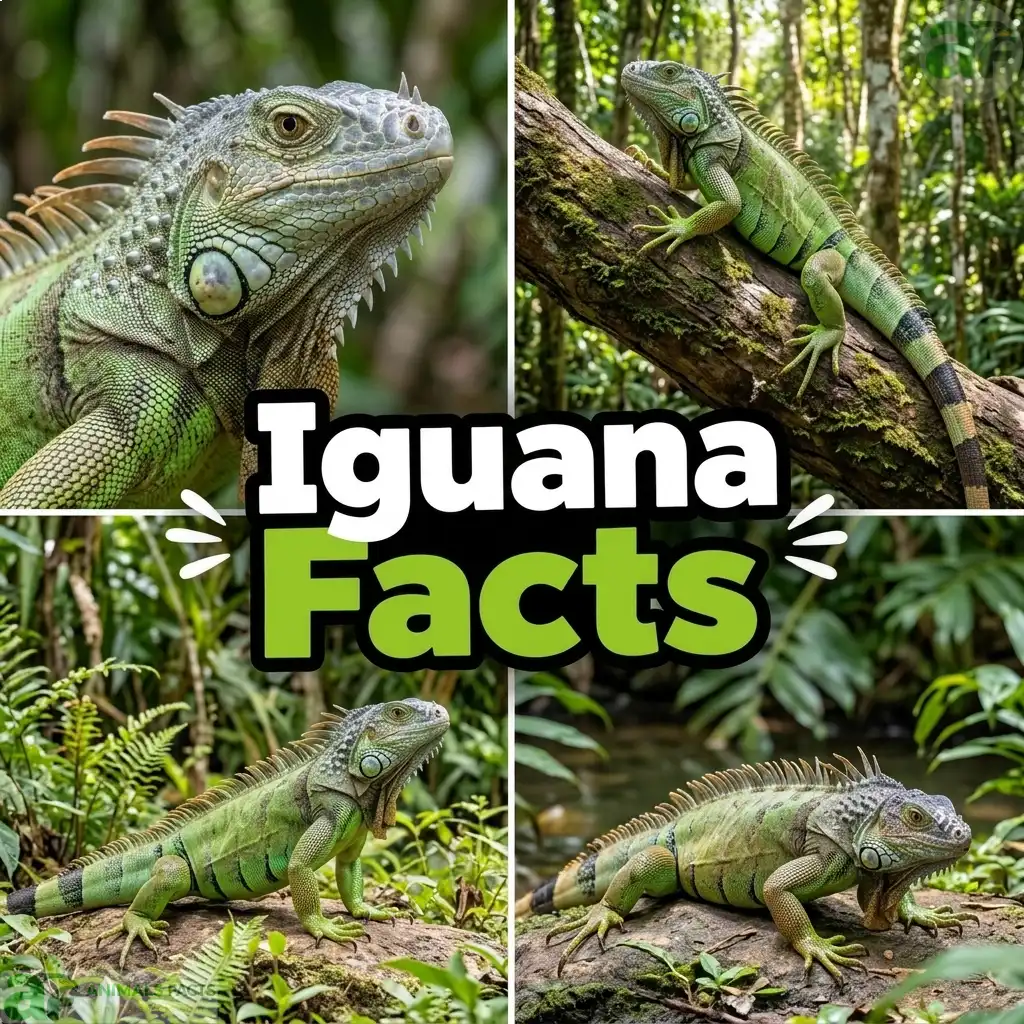
Iguana Facts
| Feature | Details |
|---|---|
| Scientific Name | Family Iguanidae; focus species Green iguana — Iguana iguana (Linnaeus, 1758) |
| Kingdom | Animalia |
| Phylum | Chordata |
| Class | Reptilia |
| Order | Squamata |
| Family | Iguanidae |
| Common Names | Iguana; green iguana; common iguana; American iguana |
| Native Range | Central America, South America, Caribbean — Iguana iguana; broader family from North America to Galapagos |
| Habitat | Tropical and subtropical forest, coastal scrub, mangrove, desert (by species) |
| Lifespan | 10–20 years (wild); up to 29 years (captivity) — I. iguana |
| Diet | Primarily herbivorous — leaves, flowers, fruit; juveniles more insectivorous |
| Body Length | Up to 2 meters total length (including tail) — I. iguana |
| Weight | Up to 8 kg — I. iguana; highly variable across family |
| Top Speed | Up to 34 km/h on land; strong swimmers |
| Conservation Status | I. iguana — Least Concern globally; CITES Appendix II; other species range to Critically Endangered |
| Defining Feature | Dewlap, dorsal spines, and the most spectacular lizard body plan in the Americas |
| Family Diversity | Approximately 40+ species across 8 genera in the strict Iguanidae |
| Closest Relatives | Corytophanids (basilisks), Crotaphytids (collared lizards), broader Iguania |
| Medical Significance | Salmonella reservoir; significant public health relevance as pets |
 1. Introduction: What is an Iguana?
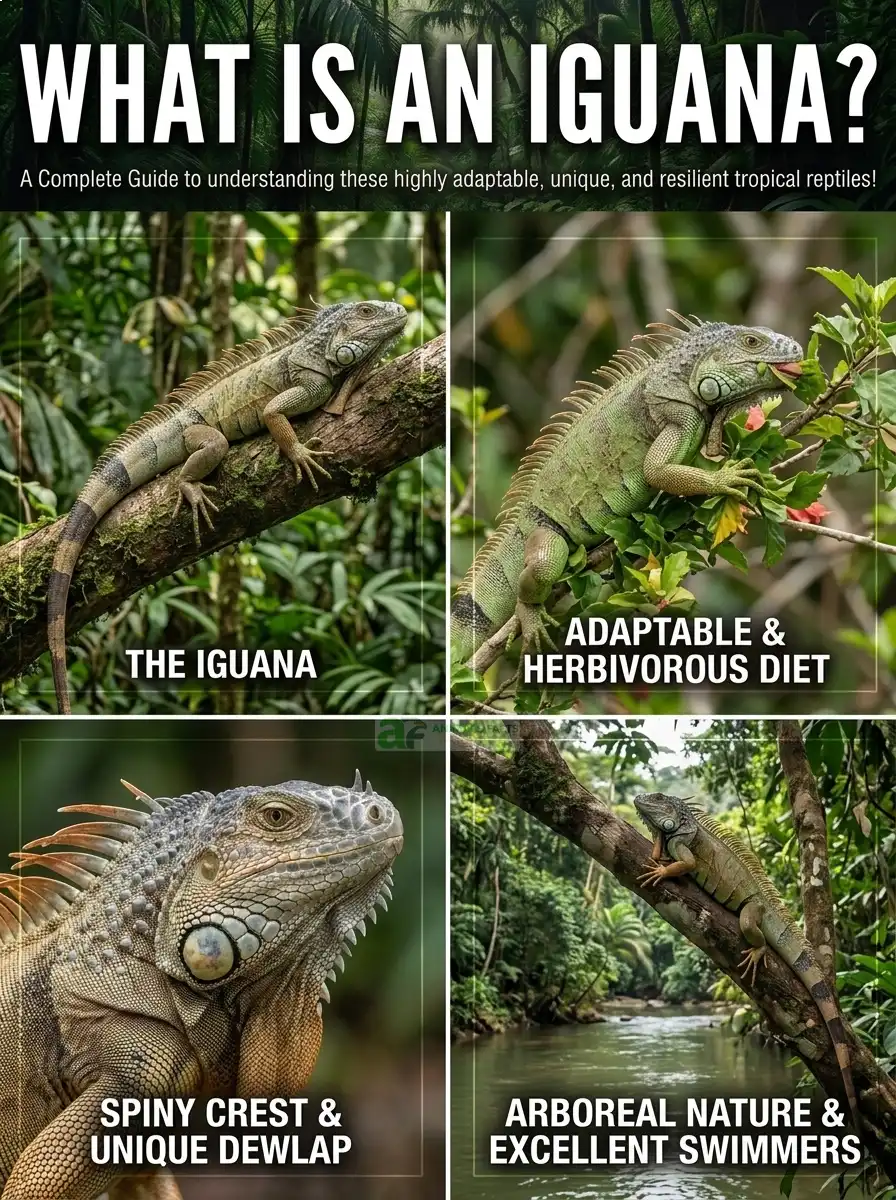
On a riverbank in Costa Rica, in the canopy of a cecropia tree overhanging the slow brown water of a tropical river, a large green lizard sprawls across a branch with the complete ownership of an animal that has occupied this precise ecological position for millions of years. It is nearly two meters long from nose tip to tail tip. Its dorsal spines catch the equatorial sunlight. Its dewlap — the large flap of skin beneath the chin — hangs loose in the heat of the afternoon. A boat motor approaches from downstream, and in a single movement of extraordinary precision, the iguana drops from the branch thirty feet above the water, hits the surface with a flat smack, and is gone — swimming strongly across the current and disappearing into the vegetation on the far bank before the boat has traveled another twenty meters. Iguana facts begin with this image — one of the most spectacular lizards in the Americas, combining the size of a monitor lizard with the dietary preferences of a herbivore, the social complexity of a primate colony on the breeding grounds, and the breathtaking capability to drop from heights that would injure most comparably sized animals and walk away perfectly unhurt.
The iguanas — family Iguanidae in the strict sense, or the broader Iguania superfamily depending on taxonomic scheme — are the most spectacular lizard radiation of the New World, a group whose diversity spans the massive green iguana (Iguana iguana) of tropical American rainforests to the extraordinary marine iguana (Amblyrhynchus cristatus) of the Galapagos — the world’s only seafaring lizard — to the land iguanas of the Galapagos, the desert iguanas of North America, the rock iguanas of the Caribbean, and the Fiji banded iguana whose presence in the Pacific raises fascinating questions about how iguanas colonized islands so remote from the Americas. Interesting facts about iguanas reveal an animal group of breathtaking biological diversity — remarkable herbivory in a lizard lineage that includes many insectivorous relatives; a salt-excreting nasal gland that allows marine iguanas to drink seawater; the capacity to fall 15 meters from a tree without injury; an immune system that hosts significant Salmonella populations; a social hierarchy among breeding males so intense that dominant males control territories visible from hundreds of meters away; and a global pet trade so vast that the green iguana may be the most widely traded reptile in the world outside of the ball python.
Whether you are searching for iguana facts for kids to explore the extraordinary biology of the Americas’ most spectacular lizards, a wildlife enthusiast wanting to understand the ecological diversity of the iguana family, a pet owner seeking accurate information about green iguana husbandry, a conservation researcher concerned about the Caribbean rock iguanas facing extinction, or simply someone captivated by the magnificent spectacle of a large green iguana in a tropical forest — this is your comprehensive guide. The Americas’ most spectacular lizard family has an extraordinary story to tell.
2. Iguana Species Overview & Classification
The iguanas represent a complex taxonomic group — the family Iguanidae in the strict sense contains approximately 40+ species across 8 genera, while the broader superfamily Iguania encompasses hundreds of additional species including agamids, chameleons, and related groups.
Species Classification Table — Green Iguana (Focus Species)
| Taxonomic Rank | Classification |
|---|---|
| Kingdom | Animalia |
| Phylum | Chordata |
| Class | Reptilia |
| Order | Squamata |
| Suborder | Lacertilia |
| Superfamily | Iguania |
| Family | Iguanidae (Gray, 1827) |
| Genus | Iguana (Laurenti, 1768) |
| Species | I. iguana (Linnaeus, 1758) |
| Common Name | Green iguana; common iguana; American iguana |
| Etymology | Iguana — from the Arawakan word iwana — the indigenous Caribbean name for the animal; iguana = self-referential species name |
The Iguanidae Family — Major Genera
| Genus | Common Name | Species Count | Range | Notable Feature |
|---|---|---|---|---|
| Iguana | Green iguanas | 2 species | C/S America, Caribbean | Largest; most widespread |
| Amblyrhynchus | Marine iguana | 1 species | Galapagos only | Only seafaring lizard |
| Conolophus | Galapagos land iguanas | 3 species | Galapagos only | Darwin’s inspiration |
| Cyclura | Rock iguanas | 9 species | Caribbean islands | Most threatened iguanas |
| Ctenosaura | Spiny-tailed iguanas | 16+ species | C. America, Mexico | World’s fastest lizard |
| Dipsosaurus | Desert iguana | 1 species | Sonoran/Mojave Desert | Heat tolerance specialist |
| Sauromalus | Chuckwalla | 5 species | SW North America | Rock-crevice specialist |
| Brachylophus | Fiji iguanas | 3 species | Fiji, Tonga | Pacific mystery species |
Two Iguana Species
The genus Iguana contains two species — one of which is the most widely recognized and most widely traded lizard in the world:
| Species | Common Name | Range | Weight | IUCN Status |
|---|---|---|---|---|
| Iguana iguana | Green iguana | C/S America, Caribbean, introduced widely | Up to 8 kg | Least Concern |
| Iguana delicatissima | Lesser Antillean iguana | Eastern Caribbean islands | Up to 4 kg | Critically Endangered |
The Pacific Mystery — Fiji Iguanas
The Fiji banded iguanas (Brachylophus species) represent one of the most biogeographically puzzling groups in the lizard world:
The puzzle — True iguanas (family Iguanidae) are otherwise restricted to the Americas and the Galapagos. How did iguanas reach Fiji — approximately 9,000 km from the nearest Americas population — across the open Pacific Ocean?
The proposed explanation — The most widely accepted hypothesis is that ancestral iguanas reached the Pacific islands via transoceanic rafting — floating on large masses of vegetation carried by ocean currents from the Americas. Molecular genetic analysis suggests the colonization occurred approximately 30–60 million years ago — an extraordinary oceanic crossing that established the only Pacific iguana population.
Evolution & Discovery Timeline
~100 million years ago — The ancestral iguanian lizard lineage diverges from other squamates — establishing the superfamily that will eventually produce iguanas, agamids, chameleons, and related groups.
~65–80 million years ago — The Iguanidae family diverges within Iguania — establishing the American iguana lineage that will produce the modern iguanid radiation.
~30–60 million years ago — Iguanas colonize the Pacific islands (Fiji, Tonga) via transoceanic rafting — one of the most remarkable natural colonization events in lizard biogeography.
~5–10 million years ago — The genus Iguana diverges from related genera — the lineage that will produce the green iguana and lesser Antillean iguana establishing its distinctive large-bodied, arboreal herbivore ecology.
1758 — Carl Linnaeus formally describes the green iguana as Lacerta iguana in his Systema Naturae — subsequently reclassified to Iguana iguana.
1835 — Charles Darwin encounters Galapagos marine and land iguanas during the voyage of the Beagle — the iguanas contributing to Darwin’s developing thinking about the relationship between geographic isolation and species differentiation.
1970s–present — The green iguana becomes one of the most widely traded exotic pets in the world — tens of millions of animals entering the global pet trade, primarily farm-bred in Central America but with significant wild collection also occurring.
2024 — The green iguana maintains Least Concern IUCN status globally; the lesser Antillean iguana remains Critically Endangered; multiple Caribbean rock iguana species face imminent extinction.
“Iguanas are one of the great evolutionary success stories of the Americas — a lineage that has filled the large herbivore lizard niche across an extraordinary range of environments from Caribbean island beaches to Andean forest to Galapagos volcanic rock. Understanding why some iguana species flourish while others teeter on extinction is one of the central challenges of American reptile conservation.”
— Dr. Allison Alberts, Chief Conservation and Research Officer, San Diego Zoo Wildlife Alliance — leading iguana conservation researcher
3. Iguana Physical Description & Unique Features
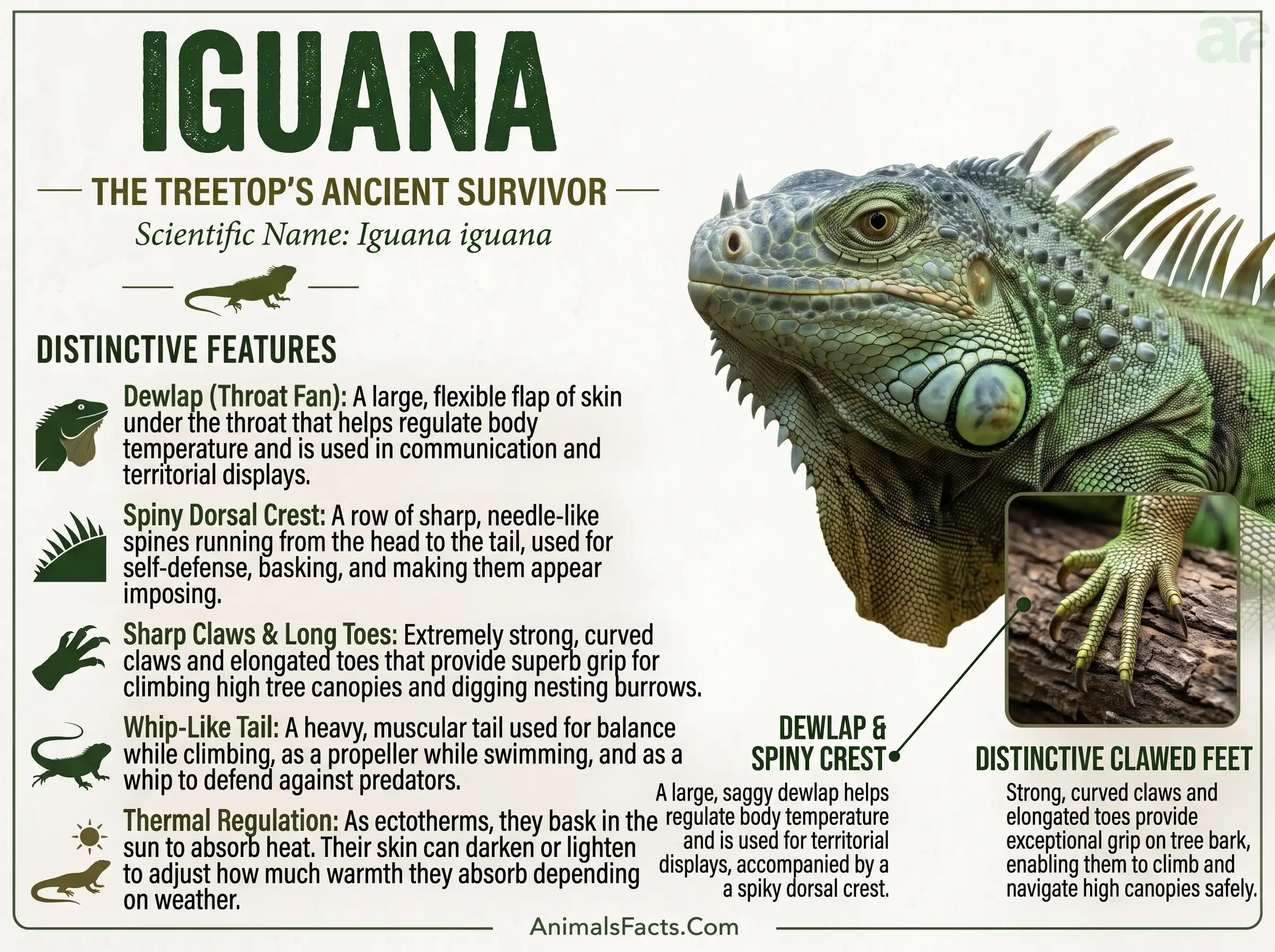
Iguana size and weight vary enormously across the family — from the massive green iguana at up to 2 meters and 8 kg to the compact desert iguana at approximately 40 cm and 100 grams. The following description focuses primarily on the green iguana as the family’s most familiar member, with comparative notes on other important species.
The Green Iguana Body Plan — The Classic Iguanid Form
The green iguana (Iguana iguana) exemplifies the classic iguanid body plan — one of the most recognizable lizard silhouettes in the world:
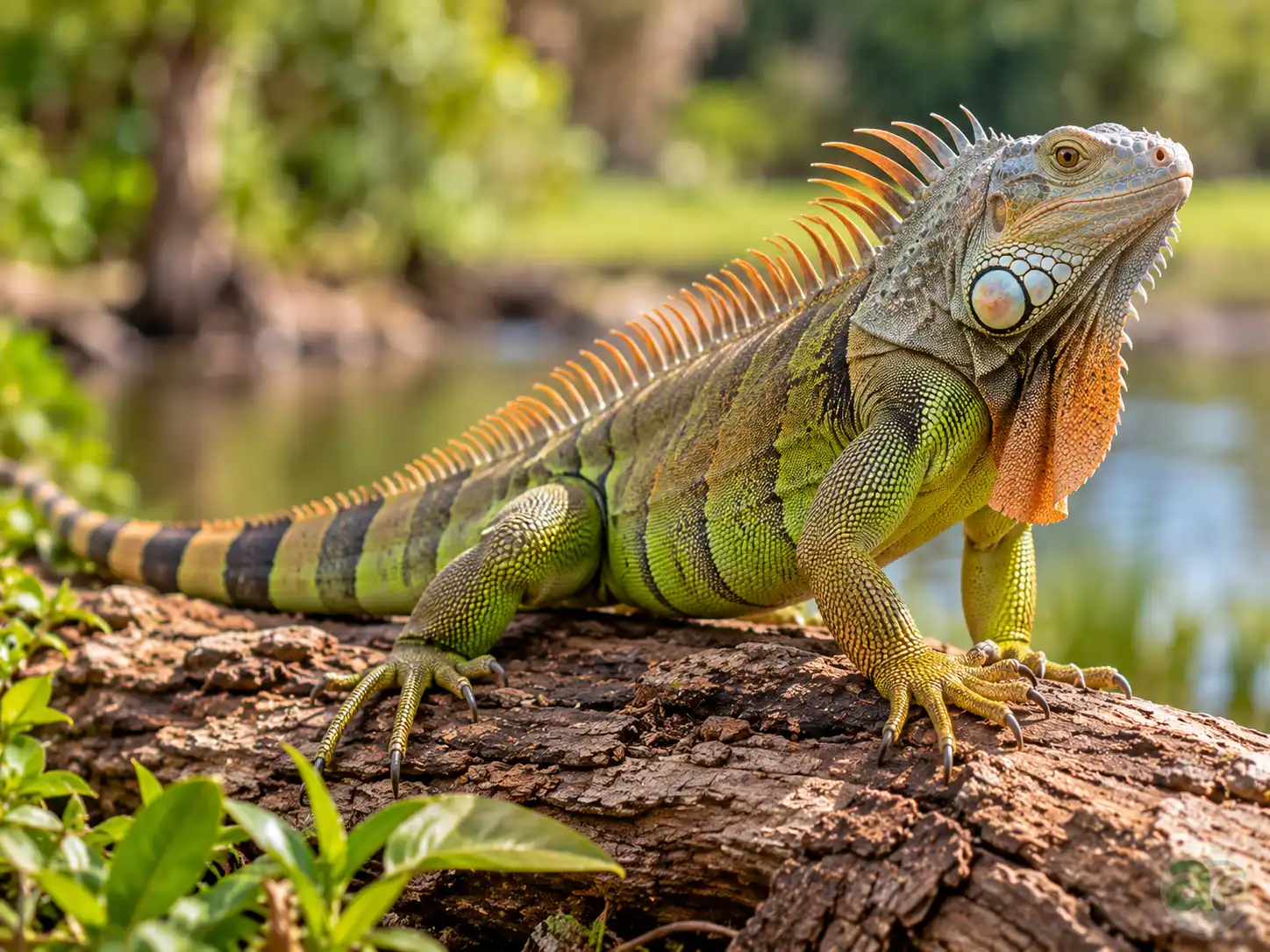
Dorsal spines — A row of enlarged, elongated scales running from the nape of the neck along the back to the tail — the signature visual feature of iguanas. In adult males, these spines can reach 7–8 cm in height — providing a spectacular visual profile that functions in both display and species recognition.
The dewlap — A large, pendulous flap of skin beneath the chin and throat — significantly larger in males than females. The dewlap is supported by an extension of the hyoid bone and can be rapidly erected and lowered through muscle action. Functions include:
- Thermoregulation — the dewlap’s large surface area exchanges heat with the environment efficiently
- Social display — males extend the dewlap in territorial and courtship displays
- Species recognition — dewlap coloration and size are species-specific signals
Lateral compression — The body is somewhat laterally compressed (flattened side-to-side) — a common feature of arboreal lizards that improves grip on branches and reduces the wind profile during arboreal movement.
The tail — The tail comprises approximately two-thirds of total body length in the green iguana — a remarkably long structure that functions in balance, swimming, and defense (the tail whip is the iguana’s primary active defense mechanism).
Coloration — More Than Just Green
Despite the “green iguana” name, the species’ coloration is far more complex and variable than the name implies:
Juvenile coloration — Hatchlings and young juveniles are bright green — a vivid coloration that provides camouflage in the leaf canopy and is distinct from the more muted adult color.
Adult coloration variation — Adult coloration varies significantly by:
- Geographic population — some populations more orange, brown, grey, or bluish
- Sex — males often more colorful, particularly during breeding season
- Age — older animals often become greyer or more brownish
- Health and temperature — color varies with body temperature and physiological state
- Social status — dominant males may display more vivid coloration
Regional color forms — The “green iguana” is not always green:
- Mexican populations — often more orange to brownish
- Central American populations — more vividly green with blue or turquoise highlights
- South American populations — variable; some grey-blue morph populations
- Caribbean introduced populations — typically bright green
The Third Eye — The Parietal Eye
One of the iguana’s most remarkable anatomical features is the parietal eye — a photoreceptive organ on the top of the skull:
Structure — A small, pale, scale-like structure on the top of the head between the two primary eyes — often described as looking like a small, pale scale or spot. The parietal eye contains a rudimentary lens and retina but cannot form images.
Function — The parietal eye is sensitive to light and shadow changes — functioning primarily as a predator detection system (detecting shadows passing overhead) and as a photoperiod detector (sensing day length for circadian rhythm and seasonal reproductive timing).
The “third eye” across iguanians — The parietal eye is found across the iguanian lineage and in various other lizard groups — a broadly distributed feature whose presence in iguanas connects them to their deep evolutionary history within the reptile lineage.
The Marine Iguana — The Most Extreme Physical Adaptation
The marine iguana (Amblyrhynchus cristatus) of the Galapagos represents the most extreme physical adaptation within the Iguanidae:
The salt-excreting nasal gland — Marine iguanas feed on marine algae in the cold Galapagos waters — consuming seawater in the process. Specialized nasal salt glands excrete the excess salt through the nostrils — marine iguanas are frequently observed “sneezing” salt crystals that coat their heads in white. This is one of the most visible physiological adaptations to marine life in any reptile.
Body size variation by island — Marine iguana body size varies dramatically between Galapagos islands — with males from Isabela Island reaching 1.7 meters and weighing up to 12 kg, while males from Genovesa Island are significantly smaller. This inter-island size variation reflects local food availability and has been studied extensively as an example of rapid morphological evolution.
Cold-water diving — Marine iguanas dive into the cold Galapagos waters (12–23°C) to graze algae — remaining submerged for up to 30 minutes while their body temperature drops dramatically. They return to shore and bask in the sun to rewarm — the alternation between cold diving and solar basking creating a distinctive daily activity pattern.
Shrinkage capability — In a finding that surprised researchers when documented in 2000 by Martin Wikelski and Corinna Thom, marine iguanas are capable of reversibly shrinking their skeleton during El Niño years when food is scarce — reducing body length by up to 20% through bone reabsorption and rebuilding bone during recovery years. This reversible skeletal change is unique among any adult vertebrate.
💡 Did You Know? The green iguana can fall from heights of 15 meters (50 feet) without sustaining injury — a capability that has been studied by herpetologists for the insights it might provide into impact absorption in biological systems. When dropping from branches, the iguana spreads its legs wide and flattens its body — increasing air resistance and distributing the impact force over a larger surface area on landing. The combination of the flattened landing posture, the flexible skeletal structure, and the muscular body wall that distributes impact forces allows the iguana to survive falls that would cause serious injury to a mammal of equivalent body mass. This capability is not incidental — iguanas regularly escape predators by dropping from trees, the drop into water or onto the forest floor being the fastest escape route from an arboreal threat. Natural selection has therefore favored the anatomical and postural features that allow this escape tactic to be executed without injury.
4. Top 25 Amazing Iguana Facts
Here is your definitive collection of the most extraordinary, scientifically verified, and genuinely astonishing iguana facts as of 2026:
- The green iguana can fall from heights of 15 meters (50 feet) without injury — landing on the ground or entering water from heights that would injure most comparably sized animals. This capability is a deliberate escape strategy from arboreal predators.
- The marine iguana (Amblyrhynchus cristatus) is the world’s only seafaring lizard — the only lizard species in the world that regularly forages in the ocean, diving to depths of up to 9 meters to graze marine algae from submerged rocks.
- Marine iguanas can reversibly shrink their skeletons by up to 20% during El Niño food scarcity events — absorbing bone material to reduce body size and therefore metabolic requirements. The skeleton is rebuilt when food returns. This reversible skeletal shrinkage in an adult vertebrate is unique in the animal kingdom.
- The spiny-tailed iguana (Ctenosaura similis) holds the record as the world’s fastest lizard — capable of running at 34.9 km/h — faster than any other lizard species documented. This speed record was established through timed runway trials by herpetologist Raymond Hut in studies on Costa Rican populations.
- The green iguana is primarily herbivorous — consuming predominantly leaves, flowers, and fruit — an unusual dietary strategy for a lizard of its size in a family where many relatives are insectivorous. Juvenile green iguanas consume more insects before transitioning to predominantly plant material as they grow.
- Fiji banded iguanas (Brachylophus species) are found approximately 9,000 km from the nearest other iguana populations in the Americas — reaching the Pacific islands via transoceanic rafting on vegetation mats approximately 30–60 million years ago. Their presence in Fiji is one of the most remarkable natural colonization events in lizard biogeography.
- The green iguana is one of the most widely traded reptiles in the world — an estimated 150,000–800,000 green iguanas are legally imported to the US alone in peak years of the pet trade, making it one of the most commercially significant reptile species globally.
- The lesser Antillean iguana (Iguana delicatissima) is Critically Endangered — hybridization with introduced green iguanas is one of its most significant threats, as genetic swamping by the more numerous introduced species progressively dilutes the pure lesser Antillean iguana gene pool.
- Iguanas have a parietal eye — a light-sensitive “third eye” on the top of the skull that detects changes in light and shadow, functioning as a predator detection system and photoperiod detector. It cannot form images but is a genuine photoreceptive organ.
- Female green iguanas show extraordinary natal philopatry — returning to the same nesting sites year after year, sometimes traveling significant distances to reach a preferred nesting area where they and their mothers before them have nested. This fidelity to specific nesting sites creates traditional nesting aggregations that can be observed at the same locations for decades.
- The Galapagos marine iguana sneezes salt — specialized nasal salt glands excrete excess sea salt consumed during marine algae feeding, producing a distinctive white coating on the head and the characteristic forceful “sneeze” that ejects salt crystals through the nostrils.
- The green iguana has been introduced and established feral populations across Florida, Texas, Hawaii, Puerto Rico and numerous Caribbean islands where it is not native — the escaped and released pet trade creating invasive populations that damage native vegetation and compete with native wildlife.
- Iguanas are important seed dispersers in tropical American ecosystems — consuming large quantities of fruit and dispersing viable seeds in their feces across the forest, contributing to forest regeneration and plant community composition.
- The green iguana communicates through head-bobbing sequences — the rate, amplitude, and pattern of vertical head movements encoding species identity, sex, dominance status, and territorial information in a visual signal system analogous to Morse code.
- Male green iguanas defend territories on nesting beaches and forest areas — the dominant male controlling a central territory and having priority mating access to females nesting within his range. This territorial system creates a dominance hierarchy of unusual complexity for a reptile.
- The land iguana (Conolophus subcristatus) of the Galapagos was described by Charles Darwin as “ugly animals, of a yellowish orange beneath, and of a brownish red colour above” — one of Darwin’s less flattering species descriptions, from a naturalist who was otherwise remarkably observant about the Galapagos fauna.
- Iguanas can regrow their tails — the severed tail continues to wriggle, distracting the predator, while the iguana escapes. The regenerated tail differs in scale texture and coloration from the original but functions adequately for balance and swimming.
- The rock iguanas (Cyclura species) of the Caribbean are among the most threatened lizards in the world — nine species spread across Caribbean islands, all facing threats from introduced predators, habitat loss, and hunting. Several species have wild populations of fewer than 100 individuals.
- Green iguanas are strong swimmers — capable of crossing substantial bodies of water including rivers, lagoons, and inter-island straits. Swimming iguanas hold their legs flat against the body and propel themselves with lateral body and tail undulation, achieving speeds sufficient to cross strong river currents.
- The Galapagos marine iguana population size varies dramatically with El Niño events — the warm water El Niño brings reduces algae growth, causing widespread starvation. Marine iguana populations can lose 60–80% of their individuals during strong El Niño events, recovering when cold water and algae return.
- Iguanas have a four-chambered heart — an unusual feature in reptiles, which typically have three-chambered hearts. While the chamber separation is not as complete as in birds and mammals, the four-chambered configuration provides more efficient blood circulation and contributes to the iguana’s higher activity levels compared to many reptile relatives.
- The lesser Antillean iguana male turns brilliant pale blue during the breeding season — one of the most striking seasonal color changes of any iguana species, the blue coloration serving as a visual advertisement of reproductive condition to females and a warning to rival males.
- Green iguana eggs must be incubated at approximately 30°C to produce female offspring — temperature-dependent sex determination means that cooler nests produce more males while warmer nests produce more females. Climate change may therefore shift iguana sex ratios by changing nest temperatures.
- The chuckwalla (Sauromalus species) of the North American desert has a unique defense mechanism — when threatened, it retreats into a rock crevice and inflates its body by gulping air, wedging itself so tightly into the crevice that it cannot be extracted by most predators.
- As of 2026, the green iguana is an invasive species in parts of Florida so abundant that it causes significant agricultural and infrastructure damage — estimated annual damage to Florida’s agriculture and infrastructure from introduced iguanas reaches tens of millions of dollars — while simultaneously being Critically Endangered in parts of its native range in the Eastern Caribbean.
5. Fun Facts About Iguanas
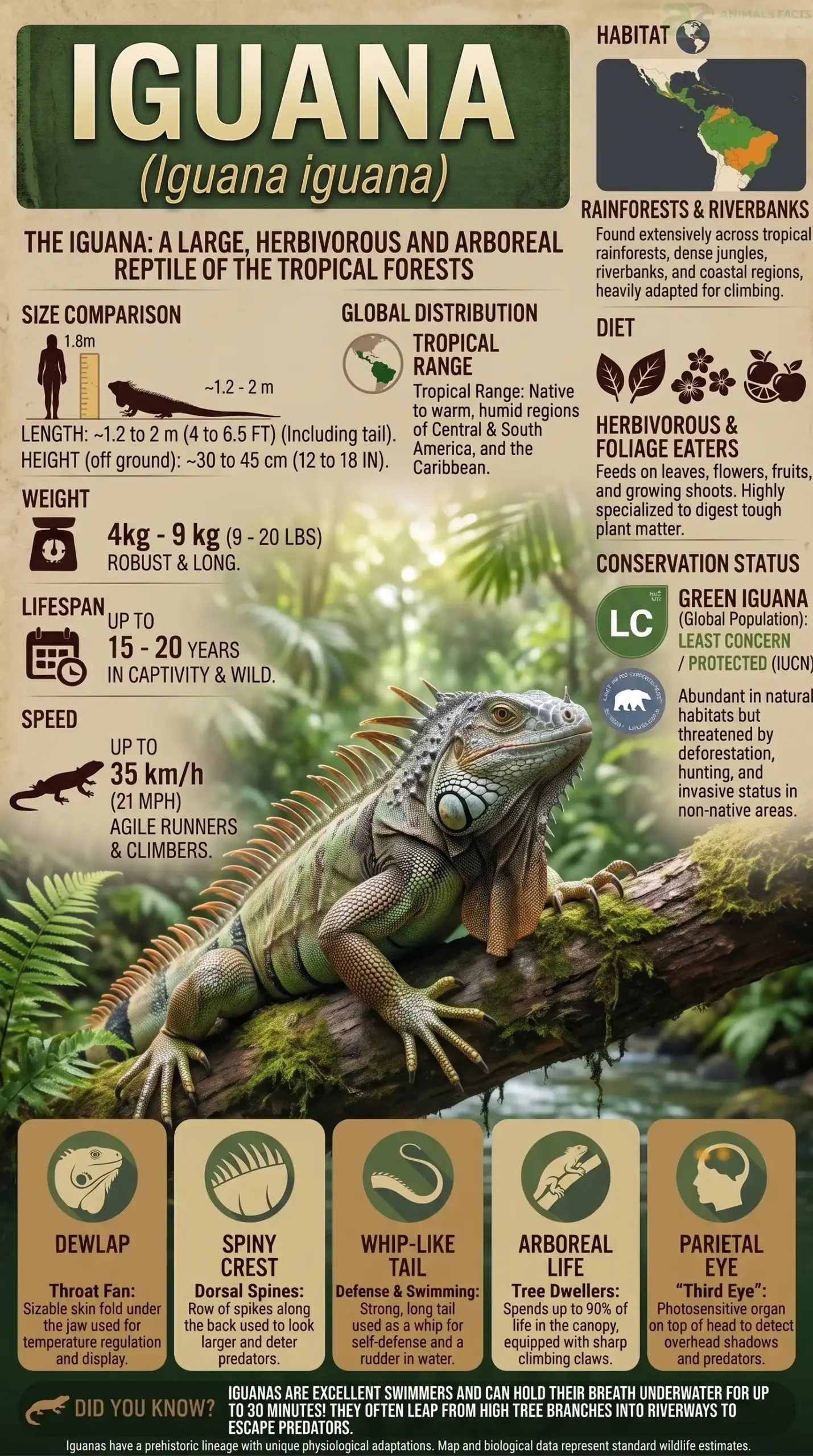
- Can fall 15 meters without injury
- Marine iguana is the only seafaring lizard on Earth
- Marine iguanas can shrink their skeletons by 20%
- Spiny-tailed iguana is the world’s fastest lizard — 34.9 km/h
- Green iguanas are primarily herbivorous — unusual for large lizards
- Fiji iguanas floated 9,000 km across the Pacific Ocean
- 150,000–800,000 green iguanas legally imported to the US in peak years
- The lesser Antillean iguana turns pale blue in breeding season
- Can regrow their tails after losing them to predators
- Florida feral iguanas cause tens of millions in annual damage
- Have a parietal “third eye” on top of their skull
- Some Caribbean rock iguanas have fewer than 100 individuals remaining
6. Iguana Habitat & Geographic Range
Iguana habitat spans an extraordinary geographic and environmental range across the Americas and Pacific — from the tropical rainforests of the Amazon basin to the volcanic lava fields of the Galapagos to the Sonoran Desert to the coral rock of Caribbean islands.
Green Iguana Habitat
Riparian forest — The primary habitat of the green iguana; the species is most abundant and most consistently found in forest along rivers and streams — the riverside canopy providing both foraging habitat (abundant leaf growth) and the water escape route the iguana exploits when threatened.
Tropical forest — Present throughout tropical and subtropical forest from Mexico through Central America and across northern South America — the species ranges from sea level to approximately 1,000 meters elevation.
Mangrove — Green iguanas are abundant in coastal mangrove forests — the tangled root systems and dense canopy providing excellent habitat.
Secondary vegetation and disturbed areas — The green iguana has proven remarkably adaptable to disturbed habitats — thriving in secondary forest, agricultural margins, urban parks, and suburban gardens across its range and in its introduced range.
Marine Iguana Habitat
Volcanic rocky coastline — The marine iguana is restricted to the rocky volcanic shores of the Galapagos Islands — the basalt rock coast providing basking sites and the adjacent ocean providing foraging habitat.
Shallow subtidal zone — The foraging habitat; marine iguanas graze algae from rocks in the shallow subtidal zone — depths of 1–9 meters depending on the individual’s size and the local tidal conditions.
Rock Iguana Habitat
Caribbean island dry forest and coastal scrub — Rock iguanas (Cyclura species) inhabit the dry forest, coastal scrub, and rocky terrain of Caribbean islands — each species restricted to specific islands or island groups.
Vulnerability of island habitat — The island habitats of rock iguanas are particularly vulnerable to introduced predators, human development, and hurricane impacts — creating the conservation crisis that threatens multiple species with imminent extinction.
Galapagos Land Iguana Habitat
Volcanic interior and dry lowland — Galapagos land iguanas (Conolophus species) inhabit the dry interior and coastal lowland of the Galapagos Islands — feeding primarily on cactus pads (Opuntia) and various other vegetation.
Geographic Distribution — Green Iguana
| Region | Status | Notes |
|---|---|---|
| Mexico (Pacific coast, Gulf coast) | Native — common | Coastal lowland to moderate elevation |
| Central America | Native — abundant | Core range; highest densities |
| Colombia, Venezuela, Ecuador, Peru, Brazil | Native | Wide South American distribution |
| Caribbean islands | Native in many; invasive in others | Complex native/introduced history |
| Florida, USA | Invasive — abundant | Escaped/released pets; established population |
| Hawaii, USA | Invasive | Smaller established populations |
| Puerto Rico | Invasive | Very abundant invasive population |
💡 Did You Know? The green iguana’s colonization of Florida — initially through escaped and released pets beginning in the 1960s — has produced one of the most economically significant invasive reptile situations in North American history. By the 2020s, the Florida green iguana population has grown to an estimated hundreds of thousands to over a million individuals in South Florida alone — concentrated in Miami-Dade, Broward, and Palm Beach counties where the subtropical climate matches the species’ native tropical requirements. The iguanas damage native vegetation, burrowing infrastructure (undermining seawalls, sidewalks, and canal banks with their extensive burrow systems), airport safety (burrowing under runways and taxiways), and agricultural crops (particularly flowering plants and vegetables). The Florida Fish and Wildlife Conservation Commission explicitly encourages landowners to humanely kill green iguanas on their property — an extraordinary reversal of the typical wildlife protection stance that reflects the genuine ecological and economic damage of this invasive population.
7. Iguana Diet & Feeding Behavior
Iguana diet varies significantly across the family — from the predominantly herbivorous green iguana to the marine algae specialist marine iguana to the more omnivorous rock iguanas — but herbivory represents the dietary theme that most distinguishes iguanas from other large lizard groups.
Green Iguana Diet — The Herbivore Specialist
Adult diet — Adult green iguanas are primarily herbivorous — consuming predominantly:
- Leaves (~60–70% of diet) — particularly young, tender leaves with higher protein and lower fiber content
- Fruit (~15–25% of diet) — seasonally important; significant caloric source
- Flowers (~10–15% of diet) — high in protein; particularly important during dry season when leaves may be less available
- Invertebrates (~5%) — occasionally consumed opportunistically by adults
Juvenile diet — Juveniles consume significantly more invertebrates than adults — the protein from insects supporting the rapid growth rate of the juvenile period. As iguanas grow, the proportion of plant material in the diet increases and insectivory declines.
Leaf selection — Green iguanas are not generalist leaf consumers — they select young leaves of specific plant species in preference to older, tougher, more chemically defended leaves. The foraging iguana tests leaf chemical composition through tongue-flicking before committing to consumption.
Coprophagy in juveniles — Young green iguanas consume the feces of adult iguanas — obtaining the gut bacteria necessary for efficient cellulose digestion. Adult iguanas harbor specialized hindgut bacteria that allow fermentation of plant cellulose — without these bacteria, juveniles cannot efficiently extract nutrition from plant material.
Marine Iguana Diet — The Ocean Farmer
The marine iguana’s diet is one of the most extreme dietary specializations of any lizard:
Marine algae exclusively — Marine iguanas feed exclusively on marine algae — grazing from submerged rocks in the subtidal zone. The primary species consumed include red algae, green algae, and various brown algae — selected by the iguana based on both availability and nutritional content.
Diving behavior — To access deeper algae resources, larger marine iguanas perform sustained dives — remaining submerged for up to 30 minutes and diving to depths of up to 9 meters. During these cold dives, the body temperature drops and heart rate slows dramatically — a form of dive-response thermoregulation that conserves oxygen.
The cold-water challenge — The Galapagos waters are cold relative to typical tropical ocean temperatures — Humboldt Current upwelling maintains temperatures of 12–23°C throughout the year. Marine iguanas must cope with the severe heat loss of diving in cold water — managing cold through the basking behavior between dives that is one of the most distinctive features of marine iguana behavior.
Rock Iguana Diet — Omnivores of Island Ecosystems
Rock iguanas (Cyclura species) are more omnivorous than green iguanas — consuming a broader range of plant and animal material:
- Leaves, fruit, and flowers (primary plant diet)
- Invertebrates — beetles, snails, crabs
- Carrion — opportunistically
- Small vertebrates — occasionally
This broader dietary base reflects the island environments where rock iguanas occur — food resources are more variable and unpredictable on small islands, selecting for dietary flexibility.
7. Iguana Reproduction & Life Cycle
Iguana reproduction combines the elaborate courtship displays characteristic of sexually selected lizards with the practical requirements of nesting in appropriate thermal environments — creating a breeding system of considerable behavioral complexity.
Green Iguana Mating System
Mating season — January through March in most of the Central American range — the dry season, when vegetation is less dense and iguana movement is facilitated.
Male territorial display — During the breeding season, male green iguanas establish and defend territories through an elaborate visual display system:
- Head bobbing — rapid vertical head movements encoding dominance status
- Dewlap extension — the large dewlap erected for maximum visual impact
- Color intensification — males become more orange or yellow during breeding season
- Physical confrontation — when display fails to deter rivals; biting and tail-whipping occur
The lekking system — In areas of high iguana density, male territories cluster in lekking aggregations — males competing in close proximity on traditional display sites that females visit to assess and select mates. The female selects the male that wins territorial contests — typically the largest and most vigorous male with the central, most contested territory.
Copulation — The male grasps the female by the neck with his jaws and positions one hemipenis for intromission. Mating duration is typically several minutes.
Nesting
Nesting season — Approximately 60–65 days after mating — the female’s eggs develop internally before she lays them.
Nest site selection — Female green iguanas are extremely selective about nest site choice — preferring sandy, well-drained, sun-exposed soil with appropriate thermal properties for egg development. Females may travel several kilometers from their home ranges to traditional nesting sites.
Communal nesting — Where suitable nesting habitat is limited, green iguanas nest in extraordinary aggregations — dozens to hundreds of females using the same beach or sandy area simultaneously, creating one of the most dramatic reptile nesting spectacles in the Americas.
Clutch size — typically 20–70 eggs per clutch — one of the largest clutch sizes of any iguanid lizard. The large clutch reflects the high hatchling mortality rate and the selective pressure for maximum reproductive output per nesting event.
Incubation — approximately 60–120 days depending on nest temperature — the temperature-dependent sex determination means that nest temperature directly determines offspring sex ratios.
Hatchling Biology
Hatching — Hatchlings emerge synchronously from communal nests — the simultaneous emergence of dozens of hatchlings from the same nest area creating a brief “explosion” of small iguanas that may overwhelm predators through numbers.
Hatchling size — approximately 17–25 cm total length at hatching — fully independent from birth
Juvenile life — Hatchlings are immediately independent — dispersing from the nesting site into vegetation where their bright green coloration provides camouflage in the canopy.
Sexual maturity — approximately 2–3 years in the wild
Iguana Lifespan Comparison Table
| Species | Wild Lifespan | Max Captive | Clutch Size |
|---|---|---|---|
| Green iguana | 10–20 years | 29 years | 20–70 eggs |
| Marine iguana | 12–30 years | 25 years | 1–6 eggs |
| Galapagos land iguana | 60–70 years | 69 years | 7–23 eggs |
| Rhinoceros iguana (Cyclura cornuta) | 20–40 years | 40+ years | 2–34 eggs |
| Desert iguana | 8–10 years | 15 years | 3–8 eggs |
9. Social Behavior & Communication
Iguana social behavior is more complex than the “solitary reptile” stereotype suggests — the species shows elaborate territorial systems, sophisticated visual communication, and in some contexts, remarkable social tolerance.
The Green Iguana Social System
Adult male territorial behavior — Adult males maintain territories defended through visual displays that encode the male’s identity and status at long range:
Head-bobbing — The primary communication signal; different rates, amplitudes, and patterns of vertical head movement encode different messages. Territorial males produce specific bobbing sequences that other male iguanas recognize and assess — a visual communication system whose complexity has been compared by researchers to a basic visual language.
The dewlap — Extended during display to maximize visual impact; the large orange or red dewlap is visible at considerable distances and functions as a species-identification signal as well as a status advertisement.
Orange coloration — Males intensify in color during the breeding season — the orange-yellow color of breeding males functioning as a distance advertisement of reproductive condition.
Female choice — Female green iguanas actively choose among displaying males — preferring males with larger dewlaps, more vigorous display behavior, and central territory positions. This female choice creates the selection pressure that has driven the evolution of elaborate male display structures.
Aggregation Tolerance
Despite the territorial behavior of breeding males, green iguanas show considerable social tolerance in non-breeding contexts:
Basking aggregations — Multiple individuals of different sexes and ages commonly bask together on the same branch or rock surface — the thermal benefits of basking outweighing the competitive costs of proximity.
Communal roosting — Individuals often sleep in the same trees — the group providing collective predator detection capability through multiple vigilant individuals.
Marine Iguana Social Behavior
Marine iguana social behavior is dominated by male territorial competition on the basking rocks:
Lek territories — Males establish small territories on the basking rocks — territories that are contested through head-bobbing displays and occasional physical combat. The best basking positions (warmest, most centrally located) are controlled by dominant males.
Female aggregation — Female marine iguanas aggregate on nesting beaches without the territorial competition seen among males — communal nesting without spatial exclusion.
Post-dive crowding — After cold-water dives, marine iguanas crowd together on the warm rocks — the social aggregation providing collective thermoregulation benefit through reduced surface area exposed to convective cooling.
10. Predators & Defense Mechanisms
The green iguana faces a range of predators at every life stage — and has evolved a defense system appropriate to an arboreal herbivore that is large enough to pose a challenge but not immune to predation.
Natural Predators
Predators of adults:
- Boa constrictor (Boa constrictor) — Ambush predation in arboreal habitats; drops on iguanas from above or approaches along branches
- Caimans and crocodilians — Aquatic and riverbank predation; significant threat to swimming iguanas
- Harpy eagle (Harpia harpyja) and other large raptors — Aerial strikes on arboreal iguanas
- Ocelot, jaguar, and other large felids — Terrestrial predation
- Large constrictors — Various python and boa species
Predators of eggs and hatchlings:
- Coatis (Nasua species) — Major nest predators; excavate iguana nests
- Raccoons — Nest predation
- Snakes — Various snake species consuming eggs and hatchlings
- Hawks and other raptors — Significant hatchling predation
- Tegus (Tupinambis species) — Major egg predators where ranges overlap
Defense Mechanisms
The arboreal drop — The primary rapid escape from arboreal predators; the iguana drops from the branch, potentially falling 15+ meters without injury, and either hits the water for a swimming escape or lands on the ground and sprints to cover.
The tail whip — The primary active defense when flight is impossible; the long, powerful tail is swung with considerable force — a full-force tail whip from a large iguana can cause significant pain and injury to a predator or human handler. The tail whip is delivered with the speed and force of a bullwhip.
Claw defense — The powerful, sharp claws are used in defensive scratching when restrained — capable of inflicting significant lacerations on a predator’s face or paws.
Bite — The jaws, while not venomous, are capable of delivering a powerful bite — adult green iguanas can bite through a human finger and inflict serious lacerations on attacking predators.
Cryptic coloration — The green coloration of adults, while not as perfectly camouflaging as in some lizards, provides reasonable concealment in the dense green vegetation of the tropical forest canopy.
The chuckwalla’s inflation defense — Among the most unusual defensive behaviors in the iguana family; chuckwallas inflate their bodies with air when threatened — wedging themselves into rock crevices so tightly that extraction is impossible for most predators.
11. Iguana Facts for Kids
Hey amazing young wildlife scientists and reptile enthusiasts! Here are some incredible iguana facts for kids that will make every science class instantly more exciting:
- 🦎 The green iguana can fall from a FIVE-STORY BUILDING and walk away fine! If a predator approaches on a tree branch, the iguana’s fastest escape route is simply to DROP — and they can fall up to 15 meters onto the ground or into water without getting hurt. They spread their legs wide to slow down and land in a way that spreads the impact. Scientists are still studying exactly how they do this!
- 🦎 There is a lizard that swims in the OCEAN and sneezes SALT! The marine iguana of the Galapagos Islands dives into the cold Pacific Ocean to eat seaweed — and then sneezes the salt out through its nostrils. The salt crystals build up as a white coating on its head. It is the only lizard in the whole world that regularly goes into the sea for food!
- 🦎 Marine iguanas can SHRINK THEIR BONES when food is scarce! During years when warm El Niño water reduces their food supply, marine iguanas can actually SHRINK — their bones get reabsorbed and their body length can decrease by up to 20%. When good food returns, they grow back to full size. No other adult vertebrate animal can do this!
- 🦎 The spiny-tailed iguana is the FASTEST LIZARD IN THE WORLD! It can run at nearly 35 kilometers per hour — faster than many humans can sprint over short distances. Scientists actually set up timed races to measure exactly how fast these lizards can run!
- 🦎 Iguanas have a THIRD EYE on the top of their head! It is not an eye that sees images — it is a special light sensor under a scale on top of the skull. This “parietal eye” detects shadows passing overhead, helping the iguana notice when a bird of prey is approaching from above. How useful is that!
- 🦎 Baby iguanas eat POOP to get the bacteria they need! Young green iguanas eat the droppings of adult iguanas — but not because they are being disgusting. They need the special gut bacteria that adult iguanas have to digest leaves properly. By eating adult poop, the babies acquire those bacteria. Without this, they cannot digest plants!
- 🦎 Some iguana species can only be found on islands they reached by RAFTING across the ocean! Fiji banded iguanas are found 9,000 kilometers from the nearest other iguanas in the Americas. Scientists believe their ancestors floated across the Pacific Ocean on floating mats of vegetation millions of years ago. That is one of the longest ocean crossings ever made by any animal on a natural raft!
- 🦎 The Galapagos land iguana can live for SIXTY TO SEVENTY YEARS! The Galapagos land iguana is one of the longest-living lizards known — some individuals in the wild may live for six or seven DECADES. That means a land iguana alive today might have been hatched around the time your grandparents were born!
12. Relationship with Humans
The iguana’s relationship with humans is one of the most complex and most contradictory in the reptile world — simultaneously one of the most traded exotic pets, an invasive disaster in Florida, a critically endangered species in the Caribbean, a traditional food source across Central America, and an ecological model system that contributed to Darwin’s development of evolutionary theory.
Traditional Cultural Relationships
The “chicken of the trees” — Across Central America and the northern Caribbean, green iguanas have been consumed as food for thousands of years — known in Spanish as gallina de palo (“stick chicken”) or iguana carne in various regional traditions. The white meat of iguana — particularly the tail and hind legs — is reportedly similar in flavor and texture to chicken, making it a valued protein source in rural communities.
Traditional egg consumption — Green iguana eggs — soft-shelled, high in fat and protein — are considered a delicacy in parts of Central America. The communal nesting aggregations of green iguanas historically provided a predictable and abundant egg resource for indigenous communities.
Pre-Columbian importance — Archaeological evidence documents iguana consumption across Mesoamerican cultures — iguana bones are found in middens (ancient refuse heaps) across the green iguana’s range, confirming the species’ dietary importance to pre-Columbian peoples.
Iguana farming — In Costa Rica and Panama, iguana farming programs have been developed as sustainable protein alternatives to cattle ranching in tropical forest areas — iguanas convert plant material to protein more efficiently than cattle, require less land, and their farming can be compatible with forest conservation. These programs have had mixed success in terms of sustainability and market development.
The Pet Trade — A Double-Edged Relationship
The green iguana is one of the most widely traded reptiles in the world — with significant implications for both wild populations and the animals themselves:
Trade volumes — In peak years, an estimated 150,000–800,000 green iguanas have been legally imported to the United States alone — with additional substantial trade to Europe, Japan, and other markets. The vast majority of these animals are farm-bred in Central American countries (particularly El Salvador, Honduras, and Colombia) under CITES permit systems.
The pet trade problems — Despite the large-scale trade, green iguanas prove challenging pets:
- They require specialized large enclosures (adult iguanas need 2+ meter tall enclosures)
- They need UV-B lighting for vitamin D synthesis and calcium metabolism
- Their bite and tail whip can cause serious injury
- They carry Salmonella bacteria — a public health concern particularly for children and immunocompromised individuals
- Many pet iguanas are chronically malnourished — owners failing to provide the correct diet and husbandry
The release problem — The inevitable result of inadequate husbandry is that many pet iguanas are released into the environment when owners cannot manage them — the primary mechanism by which feral populations became established in Florida, Hawaii, and other subtropical locations.
The Florida Invasion
The Florida green iguana invasion represents one of the most economically significant iguana-human conflicts globally:
Origin — Escaped and deliberately released pet green iguanas beginning in the 1960s established a feral breeding population that has grown exponentially over decades.
Population estimate — By the 2020s, the South Florida green iguana population is estimated at hundreds of thousands to over a million individuals — though precise population counts are difficult given the species’ cryptic behavior.
Economic damage — The Florida Fish and Wildlife Conservation Commission estimates annual economic damage from green iguanas at tens of millions of dollars including:
- Burrowing damage to seawalls, canal banks, sidewalks, and airport infrastructure
- Agricultural damage to ornamental plants, vegetables, and landscaping
- Native plant consumption — iguanas feeding on rare and protected native plant species in natural areas
- Endangered species impacts — predation on eggs of threatened birds and contamination of nesting areas
Control programs — Florida FWC encourages humane lethal control and maintains trapping programs — the invasive iguana management situation illustrating the conflict between the species’ ecological success in its introduced range and the damage this success causes.
Darwin’s Iguanas — The Scientific Legacy
The Galapagos iguanas — both marine and land species — played a significant role in Darwin’s developing understanding of evolution:
The Beagle voyage encounter (1835) — Darwin encountered Galapagos iguanas during the Beagle’s visit and noted the remarkable differences between island populations in both the marine iguana (different sizes on different islands) and the land iguana (island-specific variations).
The competitive observation — Darwin documented his observations of marine and land iguanas on James Island occupying different ecological niches — the marine iguana in the sea, the land iguana in the interior vegetation. This ecological partitioning contributed to his thinking about how species occupy distinct ecological roles.
The “ugly” assessment — Darwin famously described the Galapagos iguanas as “ugly animals” — a characterization that subsequent generations of naturalists and wildlife enthusiasts have enthusiastically disagreed with.
13. Iguana Conservation Status & Threats
Conservation Status Overview by Species
| Species | IUCN Status | Wild Population | Primary Threat |
|---|---|---|---|
| Green iguana (I. iguana) | Least Concern | Millions globally | Habitat loss in native range; invasive in introduced range |
| Lesser Antillean iguana (I. delicatissima) | Critically Endangered | <10,000 | Hybridization with introduced green iguanas |
| Marine iguana (A. cristatus) | Vulnerable | ~200,000–300,000 | El Niño events; introduced predators; climate change |
| Anegada iguana (Cyclura pinguis) | Critically Endangered | ~2,000 | Introduced predators; habitat loss |
| Jamaican iguana (Cyclura collei) | Critically Endangered | ~100–200 | Introduced predators; habitat loss |
| Grand Cayman iguana (Cyclura lewisi) | Endangered | ~1,000 | Habitat loss; roads; hybridization with introduced iguanas |
| Galapagos land iguana (C. subcristatus) | Vulnerable | ~10,000 | Introduced predators; habitat modification |
| Fiji banded iguana (B. fasciatus) | Endangered | <12,000 | Habitat loss; introduced predators |
Major Threats Across the Family
| Threat | Affected Species | Impact Level |
|---|---|---|
| Introduced predators (cats, rats, mongooses) | Rock iguanas; marine iguana; Galapagos species; Fiji iguanas | Critical for island species |
| Habitat loss | All species in modified landscapes | High |
| Hybridization | Lesser Antillean iguana (with introduced green iguana) | Critical — genetic extinction |
| Hunting and collection | Green iguana (food/pet); rock iguanas | High in some areas |
| Climate change | Marine iguana (El Niño); temperature-dependent sex determination | High and increasing |
| Invasive species (as the invasive) | Green iguana in Florida, Caribbean | High ecological impact |
| Road mortality | Caribbean rock iguanas on road-crossed islands | High for some island species |
| Tourism disturbance | Marine iguana; Galapagos species | Medium |
The Caribbean Rock Iguana Crisis
The nine Cyclura rock iguana species of the Caribbean represent the most acute iguana conservation emergency — collectively constituting some of the most threatened lizards in the world:
Why so threatened — Island species are inherently vulnerable because:
- Small geographic range means any local threat affects the entire global population
- Island ecosystems offer no refuge populations if a threat eliminates the primary population
- Island species evolved without mammalian predators — making them behaviorally naive toward introduced cats, rats, and mongooses
- Small island habitats are disproportionately impacted by human development
The smallest populations — Several rock iguana species have wild populations of fewer than a few hundred individuals — the Jamaican iguana (Cyclura collei) with approximately 100–200 wild individuals being among the most critical.
Conservation responses — The rock iguana conservation programs represent some of the most intensive reptile conservation efforts in the world — including captive breeding at Caribbean zoos, predator control programs on critical islands, and translocation to predator-free islands.
14. Famous Iguanas in History & Pop Culture
Famous Individual Iguanas
Darwin’s Galapagos iguanas (1835) — The Galapagos marine and land iguanas encountered and documented by Charles Darwin during the Beagle voyage are among the most historically significant individual animals in the history of biological science — their island-specific variations contributing to Darwin’s developing understanding of how geographic isolation drives species differentiation.
“Godzilla” — The marine iguana population of Fernandina Island in the Galapagos, whose males reach the largest recorded body sizes of any marine iguana, has become associated with the nickname “Godzilla iguanas” in wildlife media — particularly after a spectacular documentary sequence showing a baby marine iguana escaping a mass of racer snakes became viral in 2016.
“Iggy” — Various captive green iguanas maintained at major North American and European zoos under the name “Iggy” have served as public education ambassadors for the species — the name’s cultural resonance with the iguana’s common name making it a recurring choice for captive individuals in zoo educational programs.
Historical and Cultural Significance
The 2016 BBC “Planet Earth II” iguana-snake sequence — One of the most viewed and most discussed wildlife documentary sequences of the decade — a baby marine iguana on Fernandina Island attempts to reach the sea while dozens of racer snakes attempt to intercept it. The sequence generated extraordinary global social media engagement and introduced the marine iguana to audiences who had not previously known the species existed.
The Arawakan naming legacy — The word “iguana” itself derives from the Arawakan word iwana — the indigenous Caribbean peoples’ name for the animal. This naming — one of the few American indigenous animal names directly incorporated into English and international scientific nomenclature — reflects the deep cultural history between Caribbean peoples and the iguana that predates European contact by thousands of years.
15. Role in Ecosystem & Food Chain
The Herbivore Role
Green iguanas play a critical role as large herbivores in tropical American forest ecosystems:
Leaf consumption effects — The iguana’s selective consumption of young leaves from specific plant species creates pruning pressure that stimulates compensatory plant growth — a pattern of herbivory that can actually increase plant productivity through the same mechanism that browsing by deer stimulates plant growth in temperate forests.
Seed dispersal — The iguana’s consumption of large quantities of fruit and subsequent defecation across the forest provides seed dispersal services for plant species whose seeds can pass through the iguana’s digestive system intact. This seed dispersal role — moving seeds from fruiting trees to new locations where they can germinate — contributes directly to forest regeneration and plant community diversity.
The native herbivore guild — Green iguanas occupy the large herbivore niche in many Central American riparian forest ecosystems — filling the ecological role that in other systems is filled by deer, rabbits, and other mammalian herbivores.
The Marine Algae Gardener
Marine iguanas perform an extraordinary algae gardening function in the Galapagos marine ecosystem:
Algae regulation — The intensive grazing of marine iguanas on subtidal algae regulates algae community composition — preventing the dominance of fast-growing algae species that would otherwise competitively exclude slower-growing but ecologically important algae species.
The “lawn-mowing” effect — Research has documented that regularly grazed areas support more diverse algae communities than ungrazed areas — the regular removal of dominant species allowing less competitive species to persist.
The Prey Role
Iguanas are important prey for multiple predator species across their range:
Raptor food base — Harpy eagles, crested eagles, and various other large raptors include iguanas in their diet — the large body mass of adult green iguanas representing a significant caloric package for these top predators.
Large reptile prey — Boa constrictors, caiman, and large tropical snakes regularly consume iguanas — the iguana’s abundance in riparian habitats making it a predictable and important prey resource for these predators.
16. Myths, Folklore & Cultural Significance
Central American and Caribbean Indigenous Traditions
The Maya tradition — Iguanas appear in Maya artistic traditions — depicted on ceramics, stone carvings, and other artifacts. The Maya recognized multiple iguana species and incorporated them into artistic and cultural traditions reflecting deep knowledge of the natural history of these animals.
The Aztec tradition — In Aztec mythology, the earth deity Cipactli was depicted as a sea monster with iguana-like features — the large, dorsal-spined body of the iguana providing the visual template for this mythological figure.
The “gallina de palo” tradition — The “chicken of the trees” food tradition across Central America and the Caribbean reflects a deep and practical cultural relationship — the iguana as a valued, accessible protein source for rural communities, embedded in traditional cooking practices and seasonal eating patterns.
Caribbean island traditions — On Caribbean islands where rock iguanas (Cyclura species) are native, indigenous traditions documented by early European observers described the iguana as a culturally significant food animal — the large body size and relative ease of capture making rock iguanas particularly important in island subsistence cultures.
Contemporary Cultural Meanings
The Galapagos symbol — The marine iguana has become one of the most powerful symbols of Galapagos conservation — its distinctive appearance, dramatic basking aggregations, and vulnerability to climate change effects (documented El Niño population crashes) making it an effective flagship species for climate change conservation messaging.
The Florida controversy — The green iguana invasion of Florida has generated a distinctive cultural discourse — the iguana simultaneously familiar as a pet trade species, novel as an invasive wildlife hazard, and controversial as a target of lethal control programs. This discourse reflects broader American tensions about wildlife, pet ownership responsibility, and invasive species management.
17. Iguanas in Pop Culture
“Planet Earth II — Islands” (BBC, 2016) — The marine iguana-versus-racer-snake sequence from Fernandina Island is one of the most watched and most discussed wildlife documentary sequences in the history of the genre. Described by multiple critics as the “most edge-of-seat wildlife footage ever filmed,” the sequence generated extraordinary social media engagement and introduced the Galapagos marine iguana to a global audience that far exceeded the dedicated wildlife documentary viewership.
Jurassic Park franchise — Various iguanid lizards have contributed to the design of dinosaur characters across the Jurassic Park franchise — the general body plan of large iguanids informing the visual design of multiple fictional dinosaur species.
Disney’s “Enchanto” and broader Latin American animated media — Iguanas appear as background and featured characters in animated content reflecting Central American and Caribbean settings — their cultural ubiquity in tropical American environments making them natural inclusions in culturally authentic animated depictions of these regions.
David Attenborough BBC documentaries — Multiple BBC natural history productions have featured iguanas — including “Life in Cold Blood” (2008), “Planet Earth” (2006), and various BBC Natural World productions covering the Galapagos and Central American ecosystems.
The Florida iguana media moment — Florida’s green iguana invasion has generated significant media coverage — particularly during cold snap events when iguanas falling from trees in freezing temperatures make national news. The image of a frozen, apparently dead iguana falling from a Florida palm tree into a swimming pool has become a recurring American news moment during winter cold snaps in South Florida.
Social media wildlife photography — Green iguanas are among the most photographed reptiles in wildlife photography social media — their large size, diurnal activity, relative docility around observers, and spectacular appearance combining to make them ideal wildlife photography subjects for visitors to Central America and the Caribbean.
18. Iguana Facts vs. Common Myths
| Common Myth | The Real Fact |
|---|---|
| “Iguanas are easy, low-maintenance pets” | False — adult green iguanas require large specialized enclosures, correct UV-B lighting, carefully managed diet, and regular veterinary care; they are among the most demanding and most commonly mistreated reptile pets |
| “Iguanas are vegetarians that eat only salad” | Partially false — while adults are primarily herbivorous, juveniles consume significant proportions of invertebrates; adults also consume flowers and fruit, not only leaves; and the specific plants consumed matter greatly for nutrition |
| “Iguanas are harmless and non-aggressive” | Partially false — iguanas can inflict serious injuries through biting and tail-whipping; large adults can break human bones with tail strikes and bite through fingers |
| “Iguanas are good beginner reptile pets” | False — their size (adults to 2 meters), specific care requirements, defensive capabilities, and Salmonella carrier status make them inappropriate for inexperienced reptile keepers |
| “The marine iguana can breathe underwater” | False — marine iguanas are air-breathing reptiles that hold their breath while diving; they can remain submerged for up to 30 minutes but must surface to breathe |
| “All iguanas are green” | False — iguanas include bright blue breeding males (lesser Antillean iguana), orange-red animals (some land iguanas and male green iguanas), grey-black animals (marine iguana), and various other colors depending on species, sex, age, and condition |
| “Frozen iguanas falling in Florida cold snaps are dead” | False — iguanas that go into cold-induced torpor during Florida winter cold snaps and fall from trees are typically not dead — they are in torpor and will recover when temperatures rise; the “fallen iguana” phenomenon has generated significant misinformation about iguana biology |
19. Best Places to See Iguanas in the Wild
1. Tortuguero National Park, Costa Rica — One of the finest green iguana viewing locations in Central America; the park’s riverine forest supports extraordinary iguana density, and boat tours along the park’s canals regularly pass within meters of large, completely relaxed green iguanas basking and foraging in the riverside vegetation. The combination of exceptional green iguana viewing with sea turtle nesting makes Tortuguero one of the premier wildlife destinations in the Americas.
2. Manuel Antonio National Park, Costa Rica — Small but exceptionally biodiverse; green iguanas are abundant and habituated to human presence throughout the park’s trails and beaches — among the most reliably encountered and most closely observed wild iguanas in the Americas.
3. Galapagos Islands, Ecuador — For marine iguana and land iguana viewing — the Galapagos provides wildlife encounters simply unavailable anywhere else on Earth. Marine iguana basking aggregations on the volcanic rocks of Fernandina, Espanola, and Santa Cruz Islands are among the most spectacular reptile spectacles in the world; Galapagos land iguanas can be closely observed on Santa Cruz, Isabela, and South Plaza Islands.
4. Belize (various locations) — Belize’s extensive riverine and coastal habitats support excellent green iguana populations; the Belize Zoo (which houses the largest collection of native Belizean wildlife) provides close-range iguana observation, while natural areas including Lamanai and the Belize River provide outstanding wild encounters.
5. Anegada Island, British Virgin Islands — For the extraordinary Anegada iguana (Cyclura pinguis) — one of the Critically Endangered Caribbean rock iguanas. The island’s conservation programs have produced a modest recovery, and wildlife enthusiasts can observe these magnificent but desperately threatened lizards in a context that combines wildlife viewing with direct conservation support.
6. Florida (Coconut Grove, Key Biscayne, South Beach), USA — For visitors who want guaranteed close iguana encounters without international travel; South Florida’s feral green iguana population — while ecologically problematic — creates opportunities for remarkably close observation of large, wild (if invasive) green iguanas in parks, along waterways, and in coastal areas.
7. Curaçao, Aruba, Bonaire, ABC Islands — The Netherlands Antilles islands support excellent wild green iguana populations in arid island habitats — accessible from the main tourism infrastructure of these popular Caribbean destinations.
20. How You Can Help
Supporting iguana conservation requires differentiated action — protecting critically threatened Caribbean rock iguanas and lesser Antillean iguanas while managing the invasive damage caused by green iguanas in their introduced range.
Support these organizations:
- International Iguana Foundation — iguanafoundation.org — specifically dedicated to iguana conservation globally; funds Caribbean rock iguana conservation programs
- San Diego Zoo Wildlife Alliance — sandiegozoo.org — leads rock iguana captive breeding and Caribbean conservation programs
- Galapagos Conservancy — galapagos.org — funds Galapagos iguana conservation including marine iguana monitoring
- WWF — wwf.org — supports Caribbean island conservation including rock iguana habitat
- Wildlife Conservation Society — wcs.org — Caribbean and Central American conservation programs
- Jersey Zoo (Durrell Wildlife Conservation Trust) — durrell.org — Caribbean iguana captive breeding and reintroduction programs
Critical individual actions:
- Never release pet iguanas into the wild — pet release is the primary mechanism by which invasive iguana populations became established in Florida and elsewhere; iguanas that cannot be kept must be surrendered to reptile rescue organizations
- Research before acquiring a green iguana as a pet — the pet trade drives wild collection and results in millions of iguanas suffering from improper care; understanding the actual care requirements before acquisition prevents both animal suffering and contribution to the abandonment problem
- Support responsible wildlife tourism — visiting Galapagos, Caribbean rock iguana sites, and Central American parks through responsible operators generates conservation revenue
- Donate to the International Iguana Foundation — direct funding of Caribbean rock iguana conservation programs
21. Top Documentaries & Books
Must-Watch Documentaries
- “Planet Earth II — Islands” (BBC, David Attenborough, 2016) — Features the legendary marine iguana-racer snake sequence; essential viewing
- “Life in Cold Blood” (BBC, David Attenborough, 2008) — The definitive reptile natural history documentary; excellent iguana content
- “Galapagos” (BBC, 2006) — Dedicated Galapagos natural history documentary with exceptional iguana content
- “Wild Caribbean” (BBC Natural World) — Caribbean ecosystem documentary including rock iguana content
- “Blue Planet II” and “Our Planet” — Various sequences covering the Galapagos marine ecosystem including marine iguana content
Must-Read Books
- Iguanas of the World by Gordon Burghardt and A. Stanley Rand — The comprehensive scientific reference for iguana biology
- The Green Iguana Manual by Philippe de Vosjoli — The most widely used practical guide to green iguana captive care
- Galapagos: A Natural History by Michael H. Jackson — Comprehensive Galapagos natural history including iguana ecology
- Caribbean Reef Fishes and Iguanas — Various regional natural history guides covering Caribbean iguana species
- The Voyage of the Beagle by Charles Darwin — Darwin’s own account of the Galapagos encounter; the original description of Galapagos iguanas by the naturalist who changed biological science
22. Comparison of Major Iguana Species
| Feature | Green Iguana | Marine Iguana | Galapagos Land Iguana | Rhinoceros Iguana | Fiji Banded Iguana |
|---|---|---|---|---|---|
| Scientific name | Iguana iguana | Amblyrhynchus cristatus | Conolophus subcristatus | Cyclura cornuta | Brachylophus fasciatus |
| Max length | 2 m | 1.7 m | 1.5 m | 1.36 m | 1 m |
| Max weight | 8 kg | 12 kg | 13 kg | 9 kg | 0.5 kg |
| Diet | Herbivorous | Marine algae | Plants; cactus | Omnivorous | Herbivorous |
| Habitat | Arboreal forest | Rocky volcanic coast | Arid volcanic island | Caribbean island scrub | Pacific island forest |
| Activity | Diurnal | Diurnal | Diurnal | Diurnal | Diurnal |
| Conservation | Least Concern | Vulnerable | Vulnerable | Vulnerable | Endangered |
| Range | C/S America, Caribbean | Galapagos only | Galapagos only | Caribbean islands | Fiji, Tonga only |
| Lifespan | 10–20 years | 12–30 years | 60–70 years | 20–40 years | 15–25 years |
| Famous for | Pet trade; invasive Florida | Only seafaring lizard | Darwin’s inspiration | Prehistoric appearance | Pacific mystery |
23. Frequently Asked Questions About Iguanas
Q1. What is the scientific name of the iguana?
The most familiar iguana — the green iguana — has the scientific name Iguana iguana (Linnaeus, 1758). The genus and species names are both derived from the Arawakan word iwana — the indigenous Caribbean name for this animal — making Iguana iguana one of the few scientific names derived from an indigenous American language directly incorporated into formal biological nomenclature. The green iguana belongs to the family Iguanidae, the order Squamata, and the class Reptilia. The broader iguana family contains approximately 40+ species across 8 genera — including the marine iguana (Amblyrhynchus cristatus), Galapagos land iguanas (Conolophus species), Caribbean rock iguanas (Cyclura species, 9 species), spiny-tailed iguanas (Ctenosaura species, 16+ species), and the mysterious Pacific Fiji banded iguanas (Brachylophus species).
Q2. How big do iguanas get?
Green iguana size varies significantly between sexes and across the species’ range. Males are substantially larger than females — adult males typically reaching 1.5–2 meters total length (including tail) and weighing 4–8 kg, with exceptional individuals potentially exceeding 2 meters and 8 kg. Females typically reach 1–1.5 meters and 1.5–3 kg. The tail constitutes approximately two-thirds of total body length in both sexes. Within the broader iguana family, body sizes range from the Fiji banded iguana (approximately 1 meter and under 500 grams) to the Galapagos marine iguana (up to 1.7 meters and 12 kg in the largest island populations) to the Galapagos land iguana (up to 1.5 meters and 13 kg — the heaviest iguana species). The spiny-tailed iguana (Ctenosaura species), while not the largest, holds the record as the world’s fastest lizard at 34.9 km/h.
Q3. Are green iguanas good pets?
Green iguanas are among the most demanding and most commonly mistreated reptile pets — despite being widely sold as “beginner” reptiles in many pet stores. The reality is that adult green iguanas require large specialized enclosures (minimum 2 meters tall for an adult), correct full-spectrum UV-B lighting (essential for vitamin D synthesis and calcium metabolism), carefully managed diet (predominantly appropriate leafy greens with specific nutrient balance), regular veterinary care from a reptile-experienced veterinarian, and significant time investment for handling and socialization. Their tail whip can break bones; their bite can cause serious lacerations; and they carry Salmonella bacteria that present genuine public health risks, particularly to children and immunocompromised individuals. The typical lifespan of 10–20 years means commitment spans potentially two decades. Many green iguanas in captivity suffer from metabolic bone disease (calcium deficiency from inadequate UV-B), malnutrition (incorrect diet), and psychological stress (inadequate space and enrichment). Prospective owners should research thoroughly and honestly assess their capacity for long-term commitment before acquiring a green iguana.
Q4. Why is the green iguana invasive in Florida?
The green iguana became established as an invasive species in South Florida primarily through the release and escape of pet iguanas — beginning with escaped individuals from importers and pet stores in the 1960s and compounded over subsequent decades by owners releasing iguanas they could no longer manage. The subtropical climate of South Florida — warm year-round with summer temperatures and humidity matching the green iguana’s native tropical American range — proved ideal for the species, which established self-sustaining breeding populations. The Florida invasive population has grown to an estimated hundreds of thousands to over a million individuals in Miami-Dade, Broward, and Palm Beach counties. The ecological and economic damage includes burrowing that undermines seawalls, canal banks, and infrastructure; consumption of native and ornamental vegetation; impacts on native wildlife through competition and nest predation; and airport safety concerns from burrowing under runways. The Florida FWC now explicitly encourages humanely killing green iguanas on private property and maintains trapping programs — an extraordinary reversal of typical wildlife protection stances that reflects the genuine impact of this invasive population.
Q5. What is the world’s only sea lizard?
The marine iguana (Amblyrhynchus cristatus) of the Galapagos Islands is the world’s only lizard that regularly forages in the ocean — making it the world’s only seafaring lizard. Marine iguanas dive into the cold Galapagos Pacific waters to graze marine algae from submerged rocks, diving to depths of up to 9 meters and remaining submerged for up to 30 minutes. They are restricted to the Galapagos Islands of Ecuador — found on no other islands or mainland coastline. Marine iguana populations differ significantly in size between islands — with the largest males found on Isabela Island and the smallest on Genovesa Island. The species was classified as Vulnerable by the IUCN due to the devastating effects of El Niño warming events on their marine algae food supply — strong El Niño events can reduce local marine iguana populations by 60–80% through starvation. The remarkable discovery that marine iguanas can reversibly shrink their skeletons during food scarcity — reducing body length by up to 20% by reabsorbing bone material — is one of the most extraordinary physiological discoveries in recent vertebrate biology.
24. Sources & References
- Wikipedia — Iguana iguana, Amblyrhynchus cristatus, Cyclura, Brachylophus, Iguanidae
- IUCN Red List — iucnredlist.org (current assessments for all iguana species)
- International Iguana Foundation — iguanafoundation.org
- Galapagos Conservancy — galapagos.org
- Florida Fish and Wildlife Conservation Commission — myfwc.com (green iguana management)
- Wikelski, M. and Thom, C. (2000). “Marine iguanas shrink to survive El Niño.” Nature — the landmark skeletal shrinkage paper
- San Diego Zoo Wildlife Alliance — sandiegozoo.org
- National Geographic — nationalgeographic.com
- Smithsonian National Museum of Natural History — naturalhistory.si.edu
- BBC Wildlife / BBC Earth — bbcearth.com
- Britannica — britannica.com/animal/iguana
- Darwin, C. (1839). The Voyage of the Beagle — the historical Galapagos iguana accounts
- Hut, R.A. — published research on spiny-tailed iguana speed records