
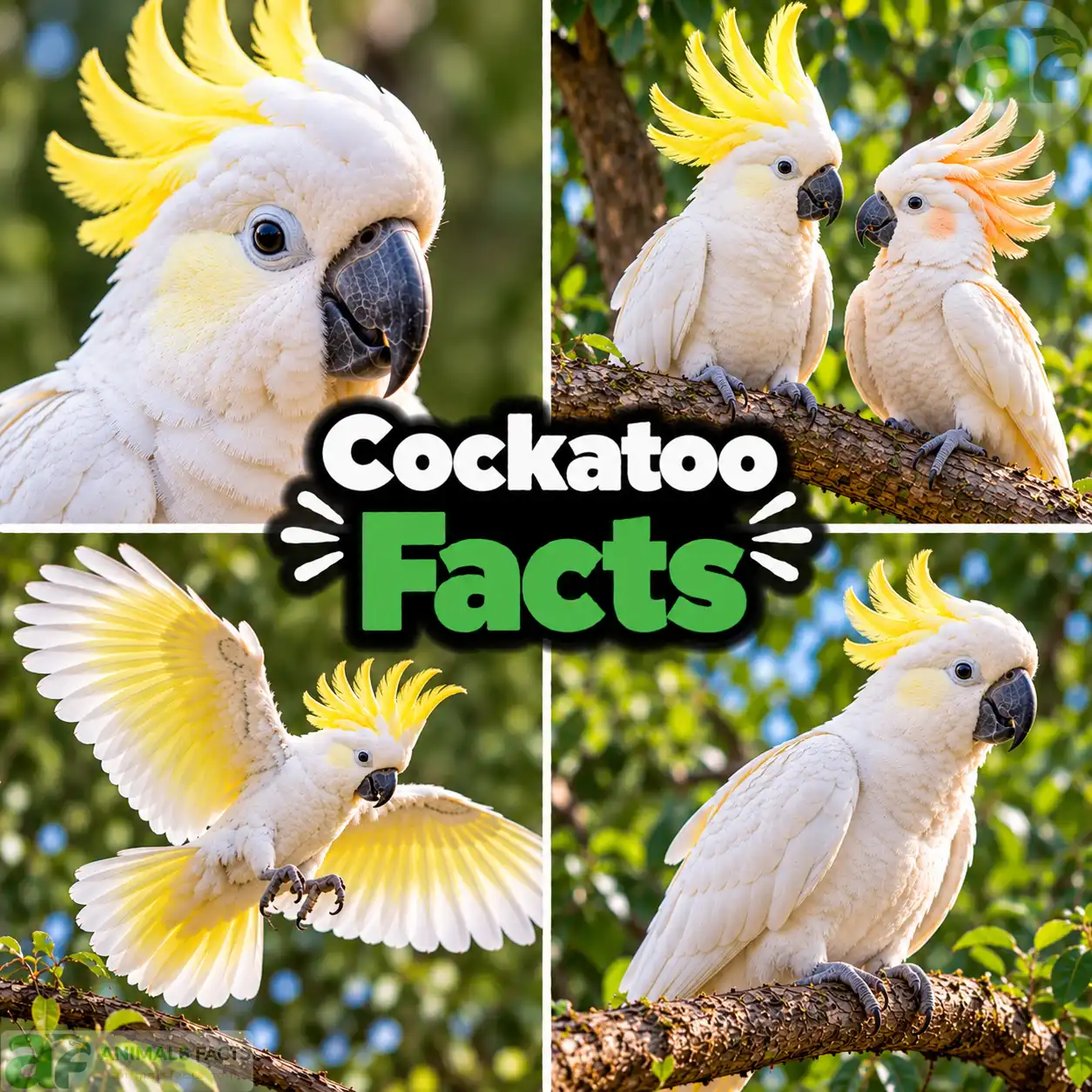
Cockatoo Facts
| Feature | Details |
|---|---|
| Scientific Name | Family Cacatuidae; 21 living species across 7 genera |
| Kingdom | Animalia |
| Phylum | Chordata |
| Class | Aves |
| Order | Psittaciformes |
| Family | Cacatuidae (Gray, 1840) |
| Common Names | Cockatoo, cockie (informal Australian) |
| Native Range | Australia, New Guinea, Indonesia, Philippines, Solomon Islands |
| Habitat | Tropical and subtropical forest, woodland, savanna, scrubland, agricultural land |
| Lifespan | 20–40 years (wild, species dependent); up to 80+ years (large species, captivity) |
| Diet | Seeds, nuts, tubers, berries, flowers, insects — highly varied |
| Body Length | 30–60 cm depending on species |
| Weight | 80 grams to 1.2 kg depending on species |
| Top Speed | Up to 70 km/h in flight |
| Conservation Status | Ranges from Least Concern to Critically Endangered — several species under severe threat |
| Number of Species | 21 living species in 7 genera |
| Defining Feature | Erectile crest — the most elaborate movable head crest of any bird — combined with exceptional emotional expressiveness |
| Unique Anatomy | Produce powder down from specialized feathers — no oil gland (unique among parrots) |
| Famous Behavior | Snowball the cockatoo — first non-human animal documented dancing spontaneously to music |
 1. Introduction: What is a Cockatoo?
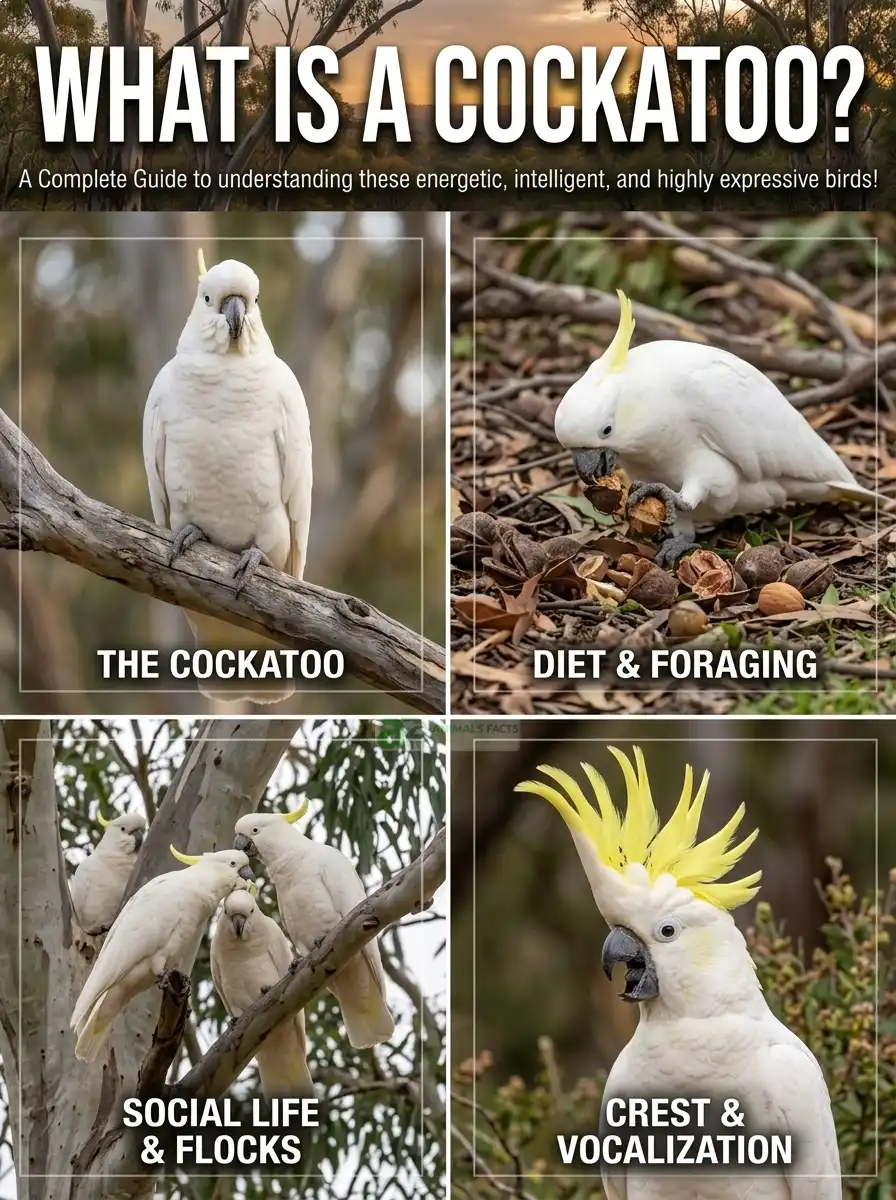
In a eucalyptus woodland at dawn in southeastern Australia, a flock of sulphur-crested cockatoos erupts from the canopy in a cacophony of white wings and raucous screaming that seems entirely disproportionate to the size of the birds producing it. They wheel in tight formation against the pale morning sky — a hundred birds moving with the fluid coordination of a single organism — then settle back into the trees with an immediate resumption of the conversation that their alarm apparently interrupted. Watch one closely as it lands, and you see something that stops you — a bird whose face is doing something. The crest rises and fans as it calls, flattens as it settles, rises again as a neighbor lands too close. The dark eyes track everything. The expression — and there is an expression, unmistakably — communicates something that any mammal observer instantly recognizes as emotional content. Cockatoo facts begin with this single, extraordinary observation: a bird that wears its feelings on its face.
Cockatoos are the most emotionally expressive birds on Earth — and possibly the most emotionally complex. Their erectile crest — the most elaborate movable head ornamentation of any bird — functions as a real-time emotional display visible from a considerable distance, communicating excitement, alarm, curiosity, submission, and social engagement with a nuance and speed that makes the cockatoo’s emotional state as readable as a dog’s tail. Interesting facts about cockatoos reveal birds whose cognitive and emotional sophistication has surprised researchers — a cockatoo named Snowball became the first non-human animal scientifically documented to dance spontaneously to music, demonstrating beat synchronization previously thought unique to vocal learning animals; cockatoos demonstrate tool manufacture — crafting tools from materials they have modified specifically for a particular task; cockatoos show social transmission of novel behaviors — a cultural spread of learned behaviors through populations in ways that parallel human cultural learning.
Whether you are searching for cockatoo facts for kids to explore the science of avian intelligence and emotional expression, a prospective owner researching cockatoo habitat needs and care requirements, an Australian wildlife enthusiast who encounters these birds daily and wants to understand them more deeply, or simply someone who witnessed a cockatoo’s crest rise in alarm and needed to understand the full story behind that moment — this is your comprehensive guide. We cover cockatoo scientific name, cockatoo diet, cockatoo size and weight, cockatoo behavior, the extraordinary crest biology, the dancing discovery, tool manufacture, conservation threats, cultural significance, and the profound ecological roles these extraordinary birds play across Australasian ecosystems. The most emotionally expressive birds in the world have an extraordinary story to tell.
2. Cockatoo Species Overview & Classification
Cockatoos belong to the family Cacatuidae — a bird family entirely distinct from other parrots despite superficial similarities — containing 21 living species in 7 genera distributed across Australasia.
Species Classification Table
| Taxonomic Rank | Classification |
|---|---|
| Kingdom | Animalia |
| Phylum | Chordata |
| Class | Aves |
| Order | Psittaciformes |
| Family | Cacatuidae (Gray, 1840) |
| Number of Genera | 7 genera |
| Number of Living Species | 21 species |
| Geographic Range | Australia, New Guinea, Indonesia, Philippines, Solomon Islands |
| Closest Family | Psittacidae (true parrots) — sister family within Psittaciformes |
Major Genera and Representative Species
Genus Cacatua (White cockatoos):
| Species | Common Name | IUCN Status | Notable Feature |
|---|---|---|---|
| Cacatua galerita | Sulphur-crested cockatoo | Least Concern | Most recognizable; abundant in Australia |
| Cacatua alba | White (umbrella) cockatoo | Endangered | Indonesia; popular pet; declining |
| Cacatua moluccensis | Salmon-crested (Moluccan) cockatoo | Vulnerable | Largest Cacatua; deep emotional bonding |
| Cacatua leadbeateri | Major Mitchell’s (pink) cockatoo | Least Concern | Most spectacularly colored cockatoo |
| Cacatua tenuirostris | Long-billed corella | Least Concern | Extremely loud; agricultural impact |
| Cacatua sanguinea | Little corella | Least Concern | Enormous flocks; pest species in areas |
Genus Calyptorhynchus (Black cockatoos):
| Species | Common Name | IUCN Status | Notable Feature |
|---|---|---|---|
| Calyptorhynchus banksii | Red-tailed black cockatoo | Least Concern (but subspecies threatened) | Spectacular; slow reproduction |
| Calyptorhynchus baudinii | Baudin’s black cockatoo | Endangered | SW Australia; 15,000 remaining |
| Calyptorhynchus latirostris | Carnaby’s black cockatoo | Endangered | SW Australia; severely declining |
| Calyptorhynchus funereus | Yellow-tailed black cockatoo | Least Concern | Mournful call; southeastern Australia |
Other Significant Species:
| Species | Common Name | IUCN Status | Notable Feature |
|---|---|---|---|
| Eolophus roseicapilla | Galah | Least Concern | Pink and grey; most abundant cockatoo |
| Probosciger aterrimus | Palm cockatoo | Least Concern | Drumming behavior; largest Australian parrot |
| Nymphicus hollandicus | Cockatiel | Least Concern | Smallest cockatoo; most popular pet bird globally |
| Callocephalon fimbriatum | Gang-gang cockatoo | Endangered | Most distinctive call; Canberra symbol |
Cockatoos vs. Other Parrots — The Critical Distinctions
Cockatoos differ from all other parrots in several fundamental ways that justify their placement in a separate family:
| Feature | Cockatoos (Cacatuidae) | True Parrots (Psittacidae) |
|---|---|---|
| Crest | Erectile crest present in all species | Absent or rudimentary in most |
| Powder down | Specialized powder-down feathers; no preen oil gland | Oil gland present; no powder down |
| Feather pigments | Lack psittacofulvins — no red, orange, or yellow pigment production | Psittacofulvins present — full color range |
| Gall bladder | Absent in all cockatoos | Present in most parrots |
| Color range | White, grey, black, pink — limited palette | Full spectrum including bright reds and greens |
| Bill structure | Slightly different bill musculature and mobility | Standard parrot bill pattern |
Cockatoo Evolution & Discovery Timeline
~50–60 million years ago — The Cacatuidae diverge from other Psittaciformes — an ancient split that occurred in Gondwana as Australia separated from the other southern continents.
~30 million years ago — The major cockatoo lineages (black cockatoos, white cockatoos, palm cockatoo, cockatiel) diverge from each other — with the cockatiel lineage being the earliest to diverge and representing the most basal member of the family.
~50,000 years ago — Indigenous Australians develop relationships with cockatoos that are embedded in cultural traditions, Dreamtime stories, and practical ecological knowledge accumulated over tens of thousands of years.
1788 — European settlement of Australia begins; the sulphur-crested cockatoo becomes one of the first Australian birds systematically documented by European naturalists.
1840 — George Robert Gray formally establishes the family Cacatuidae — recognizing the cockatoos as a distinct bird family separate from other parrots.
1970s–1980s — The Indonesian cockatoo species (umbrella cockatoo, Moluccan cockatoo) are severely impacted by the international pet trade — hundreds of thousands captured for export before CITES restrictions tighten.
2009 — Snowball, a sulphur-crested cockatoo owned by a New Jersey bird enthusiast, becomes the subject of a landmark scientific study confirming that he spontaneously dances to music in synchrony with the beat — the first scientifically documented non-human beat synchronization. The paper, published in Current Biology, transforms understanding of the relationship between vocal learning and rhythmic entrainment.
2021 — Research published in Science documents Goffin’s cockatoos (Cacatua goffiniana) manufacturing multi-component tools — crafting sets of different tools used sequentially to accomplish a food access task. This was the first documentation of sequential multi-tool use in any bird species.
2023 — A social learning study in Australian sulphur-crested cockatoos documents a novel bin-opening behavior spreading through a population via direct social observation — a cultural transmission pattern analogous to human cultural learning.
2024 — Updated population surveys for Carnaby’s and Baudin’s black cockatoos in southwestern Australia confirm continuing population declines despite conservation interventions — both species remaining Endangered.
“When I first saw Snowball dancing, I thought there must be an explanation that didn’t involve genuine beat synchronization. Every test we ran said otherwise. This bird was doing something that we thought only humans and perhaps some great apes could do — and it was doing it with visible, genuine enthusiasm. It changed how I think about animal minds.”
— Dr. Aniruddh Patel, Professor of Psychology, Tufts University, lead author of the 2009 Snowball dancing study

3. Cockatoo Physical Description & Unique Features
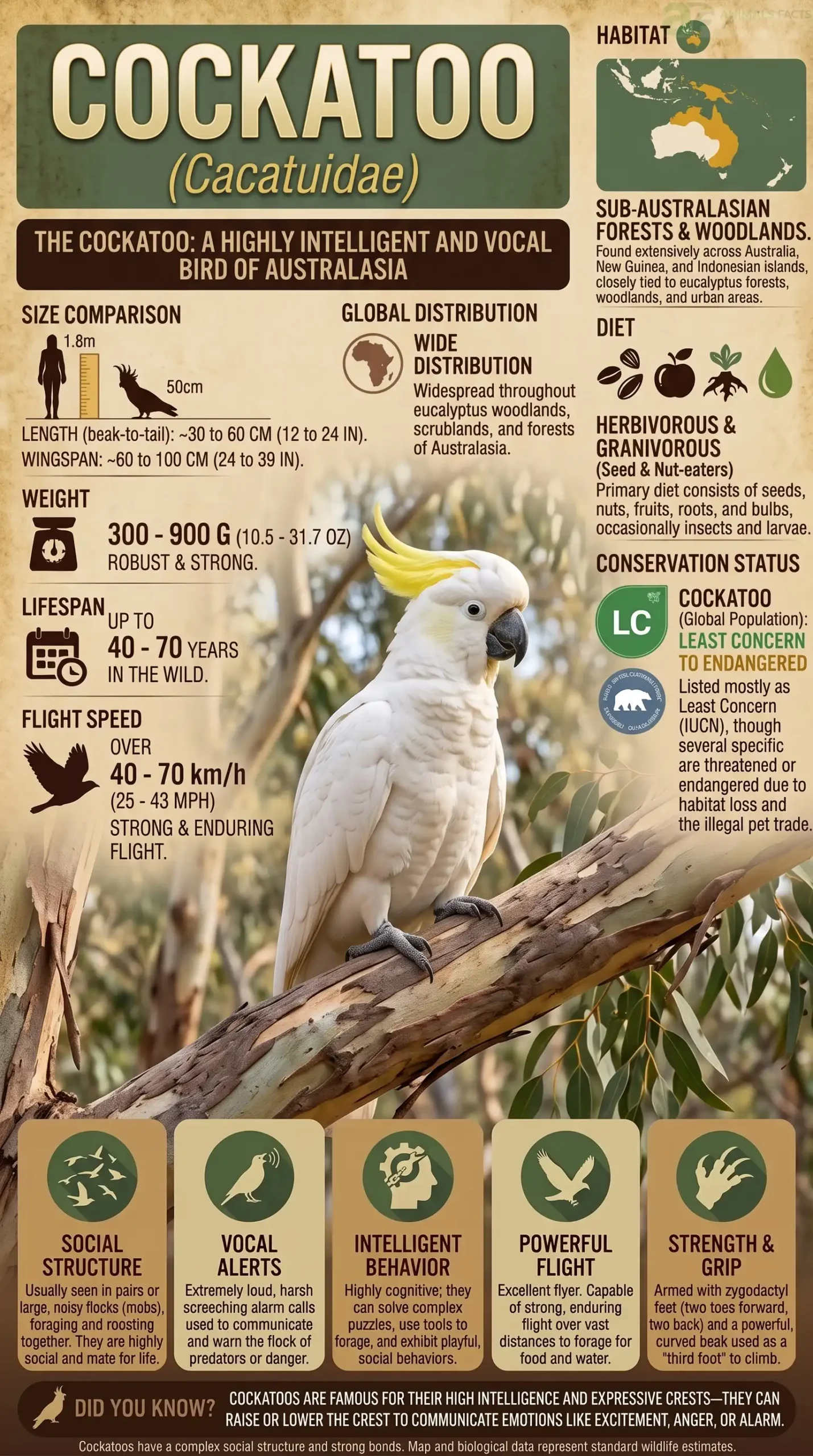
Cockatoo size and weight span a considerable range — from the tiny cockatiel at approximately 80–100 grams and 30 cm to the palm cockatoo at up to 1.2 kg and 60 cm. But across all species, the defining physical features of the cockatoo family are unmistakable.
The Crest — The Cockatoo’s Signature Structure
The cockatoo’s erectile crest is the most elaborate movable head ornamentation of any bird species — a fan of specialized feathers on the crown that can be fully erected, fully flattened, or held at any position between these extremes through precise muscular control:
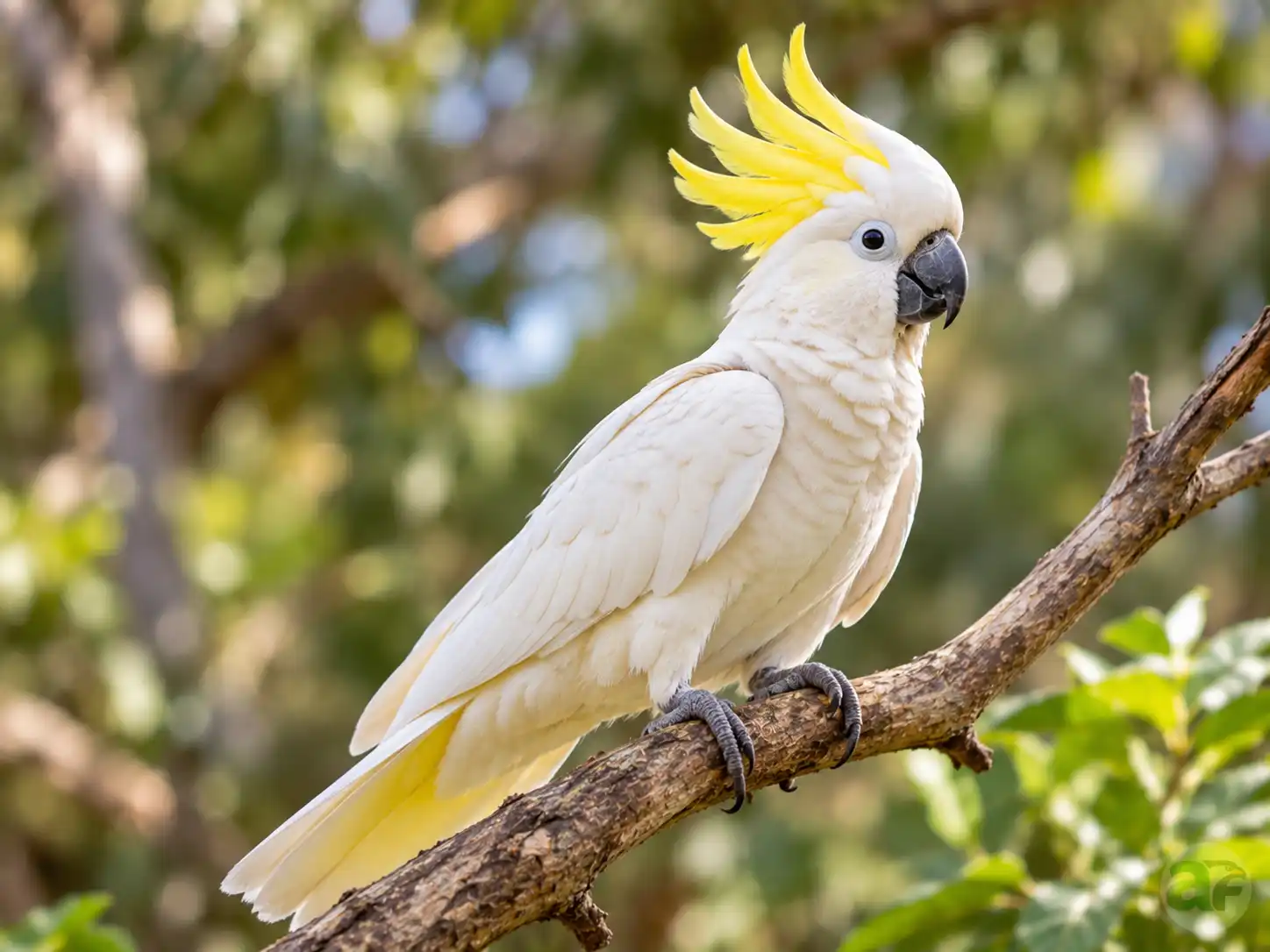
Structure — The crest consists of a set of elongated, specialized feathers emerging from the crown — the specific shape, length, color, and curvature varying dramatically between species. The sulphur-crested cockatoo has a narrow, forward-curving crest of bright yellow feathers that fans into a dramatic arc when erected. The Major Mitchell’s cockatoo has a multi-banded crest of white, yellow, and pink that spreads into an extraordinary fan of layered color. The palm cockatoo has a shaggy, backwards-curving red-tipped black crest. The Moluccan cockatoo has a salmon-pink crest that becomes a spectacular sunset-colored fan.
Muscular control — The crest is controlled by a set of specialized muscles at the base of the feathers — allowing the bird to raise the crest rapidly (in less than a second from fully flat to fully erect), hold any intermediate position, and move individual sections of the crest independently.
The emotional display function — The primary function of the crest is emotional communication:
- Fully erect — High arousal state: alarm, extreme excitement, strong social engagement, or aggressive display
- Slightly raised — Moderate excitement, curiosity, or alert interest
- Flat against the head — Resting state, submission, contentment, or fearful concealment
- Rapidly cycling erect-flat-erect — Intense emotional state; sexual display or high-intensity social engagement
Species recognition — The shape, color, and display pattern of the crest is species-specific — serving as an identification signal for conspecifics and facilitating species recognition in environments where multiple cockatoo species may co-occur.
The Powder Down System
One of the cockatoo’s most unusual anatomical features is its powder down system — unique among parrots and representing one of the most significant distinctions between cockatoos and all other Psittaciformes:
What it is — Specialized feathers distributed throughout the plumage continuously shed a fine, talcum-like powder composed of keratin particles from the feather structure. This powder is produced continuously and distributed through the plumage during preening.
What it does — The powder functions as a waterproofing and feather conditioning agent — replacing the function of the preen oil gland found in most other birds (including other parrots). The powder provides water resistance, structural support to the feather vanes, and may have antimicrobial properties.
The practical consequence — A cockatoo in good feather condition produces visible clouds of fine white powder when the plumage is disturbed — and over time, every surface in the cockatoo’s environment becomes coated with this fine dust. The powder is a significant allergen for some people — making cockatoos one of the most common causes of bird-associated allergic respiratory disease.
The Bill
The cockatoo bill is specifically adapted for the species’ dietary requirements — with some variation between species reflecting different food specializations:
General structure — Strongly hooked upper mandible; powerful, precise crushing force; highly maneuverable lower mandible for seed husking and manipulation.
Palm cockatoo exception — The palm cockatoo has an extraordinary elongated upper mandible uniquely adapted for extracting seeds from the extraordinarily hard fruits of Pandanus palms — a bill so specialized that it represents a distinct functional type within the family.
The precision grip — The cockatoo bill’s articulation allows it to function as a precision tool — husking seeds, manipulating objects, and in the case of tool-using Goffin’s cockatoos, crafting and holding manufactured tools with bill and tongue working in coordination.
💡 Did You Know? The cockatiel — the smallest cockatoo and the world’s most popular pet bird — is not merely a small version of a large cockatoo. It is the most evolutionarily basal member of the cockatoo family — the lineage that diverged earliest from the ancestral cockatoo stock, approximately 30 million years ago. All other living cockatoo species are more closely related to each other than any of them is to the cockatiel. This means that when you look at a cockatiel, you are looking at what the cockatoo family looked like tens of millions of years ago — a glimpse of the ancestral cockatoo form from which the spectacular diversity of sulphur-crested cockatoos, black cockatoos, and palm cockatoos all evolved. The cockatiel is therefore simultaneously the most humble and the most historically significant member of its family.
4. Top 25 Amazing Cockatoo Facts
Here is your definitive collection of the most extraordinary, scientifically verified, and genuinely astonishing cockatoo facts as of 2026:
- Snowball — a sulphur-crested cockatoo in New Jersey — became the first non-human animal scientifically documented to dance spontaneously to music, demonstrated through a peer-reviewed study in Current Biology in 2009. Subsequent research documented Snowball using 14 distinct dance moves — including head-banging, foot-lifting, and body rolling synchronized to beat.
- Goffin’s cockatoos have been documented manufacturing and using multi-component tool sets — crafting a set of up to three different tools from wood, which they use sequentially in a specific order to accomplish a food access task. This was the first documentation of sequential multi-tool use in any bird species when published in Science in 2021.
- The palm cockatoo (Probosciger aterrimus) is the only bird known to deliberately create and use percussive musical instruments — males fashion drumsticks from sticks and seed pods and use them to drum rhythmically on hollow trees during courtship display. This is one of the closest parallels to human musicianship documented in any non-human animal.
- Cockatoos lack the preen oil gland present in virtually all other birds — instead producing a continuous supply of fine keratin powder from specialized powder-down feathers that conditions their plumage. A healthy cockatoo in good feather condition produces visible puffs of white dust when the plumage is disturbed.
- The Major Mitchell’s cockatoo (Cacatua leadbeateri) has one of the most elaborate territorial social systems of any cockatoo — mated pairs maintain exclusive territories that they defend aggressively, with the territory size directly linked to food availability. Pairs in resource-poor areas maintain territories so large that they effectively exclude any other Major Mitchell’s pairs from the surrounding landscape.
- A 2023 study documented novel bin-opening behavior spreading through a wild sulphur-crested cockatoo population in suburban Sydney — individual birds learning to open residential waste bins by observing other birds, with the behavior spreading through social learning in a pattern directly analogous to human cultural transmission. The study was published in Science and generated global media coverage.
- Cockatoos are not capable of producing red, orange, or yellow pigments — the vibrant psittacofulvin pigments that give macaws and other parrots their brilliant reds and greens are absent from all cockatoo species. Cockatoo color is limited to white (structural coloration), grey, black (melanin), and the pink and salmon tones produced by modified melanins. The sulphur-crested cockatoo’s yellow crest is one of the only yellow pigment expressions in the family.
- The cockatiel is the world’s most popular pet bird — with estimates suggesting that tens of millions of cockatiels are maintained in captivity globally, substantially outnumbering any other pet bird species.
- Cockatoos demonstrate an extraordinary capacity for emotional bonding with human companions — bond intensities documented in Moluccan and umbrella cockatoos have been described by researchers as among the most intense inter-species bonds documented outside of human-dog relationships.
- The gang-gang cockatoo (Callocephalon fimbriatum) was listed as Endangered in Australia following the 2019–2020 Black Summer bushfires — which burned an estimated 30% of the species’ range and killed or displaced hundreds of thousands of individuals. The gang-gang is the faunal emblem of the Australian Capital Territory (Canberra).
- Wild Goffin’s cockatoos in the Tanimbar Islands of Indonesia have been documented using tools in the wild as well as in captivity — the first documentation of spontaneous tool use in a wild cockatoo population, published in 2023.
- Cockatoos have extraordinarily loud vocalizations relative to body size — the sulphur-crested cockatoo produces calls reaching 130 decibels — as loud as a pneumatic drill — making it one of the loudest birds relative to body size of any species.
- The Carnaby’s black cockatoo (Calyptorhynchus latirostris) of southwestern Australia has declined by an estimated 50% in the past 45 years — making it one of the most rapidly declining large birds in Australia. The species’ recovery plan represents one of the most expensive bird conservation programs in Australian history.
- Cockatoos demonstrate deliberate self-medication — selecting and consuming specific plant materials including bark, leaves, and clay that appear to provide medicinal benefits — including anti-parasitic compounds that reduce gut parasite loads documented in behavioral ecology studies.
- The red-tailed black cockatoo (Calyptorhynchus banksii) has a mating system that combines long-term pair bonds with complex social structures — pairs remain together for life but nest in loose colonies where complex social negotiations determine access to the limited hollow nesting sites.
- Research on wild cockatoos has documented mathematical abilities — including the ability to match quantities and show sensitivity to numerical differences — that were previously assumed to require cortical brain structures absent in birds. The finding contributed to the broader scientific revision of understanding avian cognition.
- The powder produced by cockatoo powder-down feathers is so fine — particles averaging approximately 1 micrometer in diameter — that it penetrates deep into the respiratory system of sensitive individuals, making cockatoos a significant avian allergen source and one of the most common causes of bird fancier’s lung (extrinsic allergic alveolitis).
- Cockatoo pairs engage in mutual preening (allopreening) with extraordinary frequency — with mated pairs spending more time in physical contact grooming each other than most comparable bird species spend in all physical contact combined. This intensive physical bonding is the behavioral foundation of the pair bond that may last decades.
- The sulphur-crested cockatoo has expanded its range dramatically over the past century following European agricultural development — moving into agricultural areas across eastern Australia where previously absent, and establishing populations in urban environments including Sydney and Melbourne where it now ranks among the most commonly encountered wild birds.
- Cockatoos demonstrate episodic-like memory — the ability to remember specific events in context (what happened, where, and when) — a cognitive capacity previously considered uniquely mammalian that has been documented in several cockatoo species in controlled experimental settings.
- The Moluccan cockatoo (Cacatua moluccensis) produces a contact call so loud and so specific to individual identity that researchers have documented mated pairs maintaining contact across distances exceeding 5 km in dense forest — one of the longest documented acoustic contact ranges of any non-colonial bird species.
- Australian cockatoos have been documented deliberately damaging crops, structures, and other human property — not for food but apparently as a form of play or exploratory behavior — including stripping insulation from electrical cables, destroying antenna installations, and systematically removing rubber seals from vehicles. Insurance claims for cockatoo property damage in Australia amount to millions of dollars annually.
- Cockatoos show attachment behavior that closely parallels the human-infant attachment described in developmental psychology — including proximity seeking, separation distress, and a safe base effect (the bonded partner’s presence reduces fear responses in novel situations). These behavioral parallels have made cockatoos subjects of study in comparative attachment research.
- The black palm cockatoo drumming behavior — the only documented regular musical instrument use in a non-human animal — appears to be individually variable in style, with different males developing distinctive rhythmic patterns that may function as individual signature displays. The behavior was first formally documented by Robert Heinsohn and colleagues at the Australian National University.
- As of 2026, multiple Australian cockatoo species face conservation emergencies — with Carnaby’s and Baudin’s black cockatoos in southwestern Australia, the gang-gang cockatoo, and the glossy black cockatoo representing the most severely threatened — while common species including the sulphur-crested cockatoo and galah remain abundant, creating a stark conservation paradox within the same bird family.
5. Fun Facts About Cockatoos
- Snowball the cockatoo was the first non-human proven to dance to music
- Goffin’s cockatoos manufacture multi-piece tool sets — first ever in any bird
- The palm cockatoo plays percussion instruments it builds itself
- Cockatoos have no preen oil gland — they use powder instead
- The cockatiel is the world’s most popular pet bird
- Cockatoos can be 130 decibels loud — as loud as a pneumatic drill
- They can live 80+ years in captivity
- The sulphur-crested cockatoo’s calls spread through populations as cultural learning
- Cockatoos cause millions of dollars in property damage in Australia annually
- The gang-gang cockatoo lost 30% of its habitat in the 2019–20 bushfires
- Carnaby’s black cockatoo has declined by 50% in 45 years
- The crest communicates exact emotional states in real time
6. Cockatoo Natural Habitat & Geographic Range
Cockatoo habitat spans an extraordinary range of environments across Australasia — from the dense tropical rainforests of New Guinea to the arid interior of Australia, and from sea-level coastal woodland to montane forest at 2,000+ meters.
Habitat Types
Eucalyptus woodland and open forest — The primary habitat for most Australian cockatoo species; provides both food (seeds of eucalyptus, acacia, and associated plants) and nesting hollows in old growth trees. The sulphur-crested cockatoo, galah, red-tailed black cockatoo, and multiple other species are primarily eucalyptus woodland birds.
Tropical rainforest — The habitat of the palm cockatoo and several Indonesian species — dense, high-canopy tropical forest providing the Pandanus seeds, fig fruits, and other forest food resources these species require.
Semi-arid and arid inland — The remarkable adaptations of corellas, Major Mitchell’s cockatoos, and several other species allow persistence in some of Australia’s most arid environments — finding food through extensive foraging ranges and accessing water at limited sources.
Coastal heath and banksia woodland — The critical habitat for Carnaby’s and Baudin’s black cockatoos in southwestern Australia — the banksia and marri woodland providing the primary food trees whose seeds sustain these threatened species.
Agricultural and suburban — Multiple species — particularly sulphur-crested cockatoos, galahs, and corellas — have significantly expanded their ranges into agricultural and suburban environments, exploiting crops, garden plants, and human-modified water sources.
Montane forest — Gang-gang and yellow-tailed black cockatoos use montane forest up to 2,000+ meters — making seasonal altitudinal movements between lowland and highland habitat.
Geographic Range
| Species Group | Primary Countries | Notable Range Features |
|---|---|---|
| Sulphur-crested cockatoo | Australia, New Guinea, Indonesia | Introduced to New Zealand, Singapore |
| Black cockatoos | Australia (mainland and Tasmania) | SW Australia species most threatened |
| Galah | Australia-wide | Expanding range with agriculture |
| Major Mitchell’s | Arid interior Australia | Strict territory system limits density |
| Palm cockatoo | Cape York Peninsula, New Guinea | Australia’s northernmost rainforest |
| Indonesian species (umbrella, Moluccan, Goffin’s) | Maluku Islands, Tanimbar Islands | Severely impacted by pet trade |
| Philippine cockatoo | Philippines (Palawan) | Critically Endangered |
| Cockatiel | Arid and semi-arid interior Australia | Nomadic; follows rainfall |
The Remarkable Australian Suburban Adaptation
One of the most ecologically significant recent developments in cockatoo natural history is the dramatic expansion of multiple species into suburban Australian environments — creating one of the world’s most unusual urban wildlife phenomena:
Sydney sulphur-crested cockatoos — Sulphur-crested cockatoos are now among the most commonly encountered wild birds in suburban Sydney, Melbourne, and many other Australian cities — roosting in large flocks in urban parks, foraging in gardens, and exploiting suburban food sources with remarkable behavioral flexibility.
Cultural behavior spread — The bin-opening behavior documented spreading through suburban Sydney cockatoo populations (the 2023 Science paper) represents the cockatoo’s behavioral flexibility expressed in its most culturally significant form — individual innovation spreading through social learning in urban environments represents a form of animal culture directly analogous to human urban knowledge transmission.
💡 Did You Know? The Carnaby’s black cockatoo (Calyptorhynchus latirostris) of southwestern Australia has a dietary dependency on a specific set of food tree species — primarily marri (Corymbia calophylla), wandoo (Eucalyptus wandoo), sheoak (Allocasuarina species), and various Banksia species — that makes its conservation directly dependent on the conservation of these specific plant communities. In areas where these food trees have been cleared for agriculture (southwestern Australia has lost approximately 93% of its original native vegetation), Carnaby’s black cockatoos cannot persist regardless of how much other habitat remains. The species faces a situation where habitat quantity and habitat quality (in terms of the specific food species present) are both in severe decline — making its conservation one of the most complex and most expensive bird recovery programs in Australia.
7. Cockatoo Diet & Feeding Behavior
Cockatoo diet is primarily seeds, nuts, and plant matter — but extends across a remarkable range of food types that varies considerably between species and reflects the diverse environments cockatoos inhabit.
Diet Breakdown Table
| Food Type | Estimated % of Diet | Species Variation | Notes |
|---|---|---|---|
| Seeds (grass seeds, eucalyptus, acacia, banksia) | ~40–60% | All species; primary category | Proportion varies dramatically by species |
| Nuts and hard seeds (palm nuts, macadamia) | ~10–20% | Palm cockatoo; some large species | Most extreme bill specialization |
| Tubers and roots | ~10–20% | Corellas; some ground-feeding species | Excavated with bill; important during drought |
| Berries and soft fruits | ~10–15% | Black cockatoos; many others | Seasonally important |
| Flowers and nectar | ~5–10% | Many species opportunistically | Supplements diet during flowering season |
| Insects and larvae | ~3–8% | Black cockatoos especially; cockatiel | Wood-boring larvae from dead wood important |
| Bark and wood tissue | ~2–5% | Various species | Mineral and micronutrient source |
| Agricultural crops | ~5–20% (where available) | Corellas; sulphur-crested; galah | Major human-wildlife conflict driver |
The Black Cockatoo Seed Specialist Strategy
The black cockatoos (Calyptorhynchus species) represent the most extreme seed specialization within the family — and the dietary requirements that drive their conservation vulnerability:
Carnaby’s black cockatoo — Feeds primarily on the seeds of marri, banksia, and sheoak — species whose distribution in southwestern Australia has been dramatically reduced by land clearing. Individual birds travel up to 30 km per day to access adequate food — and the clearing of food trees even in areas where the birds can still access nesting sites makes the habitat functionally unsuitable.
Yellow-tailed black cockatoo — Shows a remarkable dietary adaptation to wood-boring insect larvae — using its powerful bill to excavate larvae from dead timber in a way that resembles a woodpecker’s foraging strategy rather than typical parrot feeding.
Red-tailed black cockatoo — Different subspecies show different food specializations — the southwestern subspecies depending on marri and sheoak seeds while northern subspecies focus more on eucalyptus and acacia seeds. This subspecies-level dietary variation creates different conservation challenges for different populations of the same species.
The Palm Cockatoo Pandanus Specialization
The palm cockatoo’s bill is specifically shaped to extract seeds from the extraordinarily hard fruits of Pandanus palms — a food source that no other bird can access. This dietary specialization:
- Makes the palm cockatoo the dominant seed predator of Pandanus palms in its range
- Creates complete dietary dependence on the continued availability of these trees
- Has driven the evolution of the most powerful and most elongated bill in the Australian parrot family
The Cocktatoo Agricultural Pest Problem
Multiple cockatoo species have become significant agricultural pests across Australia — creating one of the continent’s most persistent human-wildlife conflicts:
The damage types:
- Crop depredation — Corellas and sulphur-crested cockatoos feeding on grain, sunflower, and other crops cause estimated losses of tens of millions of dollars annually across Australian agriculture
- Infrastructure damage — Cockatoos chewing rubber seals, insulation, and structural timber cause substantial property damage beyond agricultural settings
- Play/exploratory damage — Some cockatoo property damage appears not to be food-seeking but rather the expression of a curious, tool-using cognitive style in an environment full of novel manipulable objects
The management dilemma — Australian cockatoos are protected native wildlife in most states — lethal control is restricted and requires permits. Non-lethal deterrence methods (noise cannons, reflective tape, netting) have limited effectiveness against intelligent birds that quickly habituate to deterrents. The conflict remains one of the most challenging human-native wildlife management problems in Australia.
8. Cockatoos Reproduction & Life Cycle
Cockatoo reproduction reflects the family’s extraordinary longevity — slow, careful reproductive strategies characterized by small clutches, extensive biparental care, and reproductive lifespans that can extend for decades.
Pair Bonds and Mating Systems
Monogamous pair bonds are the standard across all cockatoo species — with bonds that are genuinely lifelong in most large species:
Bond formation — Young cockatoos form pair bonds during their second to fourth year — the formation process involving extended periods of mutual assessment, feeding, mutual preening, and coordinated movement before the bond is consolidated.
Bond strength — Cockatoo pair bonds are among the strongest documented in any bird species — paired birds spend virtually all time in each other’s company year-round, not just during breeding season.
Bond disruption — The loss of a mate produces behavioral changes in the surviving bird consistent with grief — reduced foraging, increased vocalization, altered social behavior, and sometimes extended periods of apparent social withdrawal before a new bond is formed.
Mating system variation — While all cockatoos are essentially monogamous, the Major Mitchell’s cockatoo practices a uniquely strict territorial monogamy — pairs defend territories so large that they cannot be simultaneously occupied by multiple pairs, making the Major Mitchell’s one of the most spatially exclusive birds in Australia relative to available habitat.
Nesting
All cockatoos are cavity nesters — requiring hollow trees or rock crevices for nesting:
Tree hollow requirement — The requirement for large, old tree hollows is the single most important habitat constraint for most cockatoo species — large hollows develop in trees that are typically 100–300 years old, and their destruction through logging, land clearing, and fire is the primary reason for cockatoo population declines across Australia.
Competition for hollows — Competition for suitable nesting hollows is intense — with pairs often occupying the same hollow for multiple successive breeding seasons and defending it against competitors year-round. The loss of a hollow-bearing tree is therefore an immediate threat to nest site availability.
Nest preparation — Both sexes participate in nest preparation — lining the hollow base with chewed wood chips and leaves.
Clutch and Development
- Clutch size: typically 1–3 eggs (most large species: 1–2; cockatiel: up to 7)
- Incubation period: 23–30 days (shared between both parents in most species)
- Nestling period: 50–100 days (varies considerably by species size)
- Fledging: large species fledge at approximately 10–12 weeks; smaller species at 5–7 weeks
- Post-fledging dependency: 4–12 months (varies by species)
- Sexual maturity: 2–5 years depending on species
- First breeding: often 3–7 years for large species
The Palm Cockatoo’s Extraordinary Nesting Behavior
The palm cockatoo’s nesting is remarkable in multiple respects:
Single egg — Palm cockatoos lay a single egg and raise at most one chick per year — one of the lowest reproductive rates of any bird
Extended development — The chick remains in the hollow for approximately 100 days before fledging — an extraordinarily long nestling period
Very slow maturation — Palm cockatoos do not breed until approximately 6–8 years of age
The consequence — This extremely slow reproductive rate means that any significant increase in adult mortality immediately produces population decline that cannot be quickly compensated by increased reproduction. Palm cockatoos need every adult to survive and breed successfully for many years — making the species acutely sensitive to any mortality pressure.
Cockatoo Lifespan Comparison Table
| Species | Wild Lifespan | Max Captive | First Breeding |
|---|---|---|---|
| Palm cockatoo | ~40–60 years | ~80 years | 6–8 years |
| Sulphur-crested cockatoo | ~40–60 years | 80+ years | 3–4 years |
| Moluccan cockatoo | ~40–60 years | 80+ years | 3–5 years |
| Major Mitchell’s | ~30–40 years | 80+ years | 3–4 years |
| Galah | ~25–30 years | 70+ years | 3–4 years |
| Gang-gang cockatoo | ~25–30 years | 40+ years | 3–4 years |
| Cockatiel | ~10–15 years | 25–30 years | 1–2 years |
9. Social Behavior & Communication
Cockatoo social behavior is among the most complex in the avian world — combining lifelong pair bonds with extended family associations, large flock dynamics, sophisticated cultural transmission, and a communication system of remarkable expressiveness.
Social Structure
Cockatoo social organization operates at multiple levels simultaneously:
The mated pair — The fundamental and most enduring social unit; paired cockatoos are essentially constant companions.
The flock — Most cockatoo species aggregate in flocks outside the breeding season — ranging from small groups of a few dozen to enormous flocks of tens of thousands (sulphur-crested cockatoos and corellas).
The cultural group — Within flocks, social learning creates culturally coherent subgroups — birds that have learned the same food sources, foraging techniques, and behavioral innovations from common social teachers.
Communal roosting — Most cockatoo species share communal roost sites — sometimes involving hundreds or thousands of birds in a single roost tree or grove.
The Crest as Communication System
The cockatoo crest is the most sophisticated visual communication signal in the avian world — functioning as a real-time emotional display visible across substantial distances:
Speed — Crest movement is rapid enough to track rapid emotional state changes — the crest can transition from fully flat to fully erect in under one second.
Resolution — Multiple intermediate positions communicate graduated levels of arousal — a slightly raised crest communicates mild interest, a half-erect crest moderate excitement, a full erect crest maximum arousal.
Context specificity — The same crest position means different things in different behavioral contexts — a fully erect crest during aggressive display communicates threat, while the same position during greeting communicates excitement and affiliation.
Reading the crest — The cockatoo’s emotional state is so transparently communicated by the crest that experienced cockatoo observers can predict behavior — aggression, fear, sexual display, curiosity — with high accuracy from crest position alone, even before any overt behavior occurs.
Vocal Communication
Cockatoo vocalization is extraordinarily loud, diverse, and contextually specific:
Contact calls — The primary function; maintaining contact with flockmates and partners across distances. Each individual’s contact call is recognizably different — serving as an individual identifier.
Alarm calls — Species-specific alarm calls communicate threat type and urgency. Sulphur-crested cockatoos produce dramatically different calls for aerial predators versus terrestrial threats — and flock members respond appropriately even without directly observing the threat.
Social calls — Repertoires of calls used during social interactions — including calls specific to allopreening, feeding with others, and play behavior.
Mimicry — Many cockatoo species learn and produce sounds from their environment — including human speech in captive birds.
Cultural Transmission — The Bin-Opening Discovery
The 2023 documentation of bin-opening behavior spreading through Sydney suburban cockatoos represented a landmark in the study of animal culture:
- Individual cockatoos had independently discovered or learned to open residential waste bins by lifting the lid with the bill
- The behavior spread through the population via direct social observation and copying
- Different regions of Sydney showed different bin-opening techniques — suggesting that the behavior had been independently invented multiple times and that regional cultural variants had developed
- The spread pattern was directly analogous to human cultural diffusion — a behavior spreading geographically through social networks, with local cultural variants
The study, published in Science by Lucy Aplin and colleagues at the Max Planck Institute, was described as one of the most significant demonstrations of animal culture outside of primate research.
10. Predators & Defense Mechanisms
Natural Predators
Peregrine falcon (Falco peregrinus) — The most significant aerial predator of cockatoos — the peregrine’s extraordinary speed in the stoop (dive) presents a threat to birds in open flight. Large flock formation in cockatoos provides collective anti-predator defense through confusion and early detection.
Wedge-tailed eagle (Aquila audax) — Australia’s largest raptor; capable of taking large cockatoos. Particularly significant for isolated individuals rather than flock members.
Brown tree snake (Boiga irregularis) — Nest predator across the range overlapping species — responsible for egg and chick losses in hollow nests.
Lace monitors (Varanus varius) — Large monitor lizards that climb trees to access hollow nests — documented nest predators of multiple cockatoo species.
Feral cats and foxes — Ground-level nest predators for species that nest at or near ground level; and predators of fledglings during the vulnerable post-fledging period.
Defense Mechanisms
Flock vigilance — The primary defense of all social cockatoo species; multiple individuals scanning simultaneously provide dramatically earlier threat detection than individual vigilance. Alarm calls propagate instantly through flocks — the entire flock responding to a single individual’s alarm within seconds.
Sentinel behavior — Cockatoos at feeding and roosting sites maintain sentinel individuals — birds that cease foraging to watch for threats while other flock members feed. Sentinel rotation occurs in some populations — ensuring continuous vigilance without penalizing specific individuals through excessive foraging time loss.
The crest threat display — Fully erecting the crest while facing a threat simultaneously communicates aggressive intent to potential competitors and signals alarm to flock members.
Loud alarm calling — The cockatoo’s extraordinary vocal volume — sulphur-crested calls reaching 130 decibels — makes the alarm call audible across substantial distances, alerting both nearby flock members and distant conspecifics to potential threats.
Nest hollow security — Nesting within deep tree hollows provides protection from most predators — the narrow entrance restricting access to predators large enough to threaten adults.
💡 Did You Know? The sulphur-crested cockatoo’s loudness — at up to 130 decibels — is not merely an impressive statistic. It represents a level of sound pressure that exceeds the threshold for hearing damage in humans at close range, and that is produced by a bird weighing less than 900 grams. The acoustic physics of how such a small animal produces such intense sound involves a combination of the cockatoo’s syrinx (the avian vocal organ), resonance chambers in the skull, and behavioral amplification through open bill posture and head orientation. The loudness serves multiple functions — contact calling across large distances in Australian woodland, alarm communication across extensive flocks, and competitive display in which the loudest call-producer may demonstrate physical fitness. The practical consequence for humans who live with cockatoos is that indoor cockatoo vocalizations can exceed safe exposure limits — cockatoo owners in close quarters are advised to use hearing protection during extended vocal displays.

11. Cockatoo Facts for Kids
Hey amazing young wildlife adventurers! Here are some absolutely incredible cockatoo facts for kids that will make you the most interesting animal expert in your whole class:
- 🦜 A cockatoo named Snowball DANCES to music — really! Scientists proved in a proper published study that a sulphur-crested cockatoo named Snowball bobs his head, lifts his feet, and waves his wings in time to the beat of music — completely spontaneously. He invented 14 different dance moves on his own. Snowball is genuinely the world’s first scientifically proven animal dancer!
- 🦜 They BUILD their own musical instruments! The palm cockatoo — a large black cockatoo from northern Australia — fashions drumsticks from sticks and seed pods, then uses them to drum rhythmically on hollow logs during courtship. This is the ONLY non-human animal known to regularly make and use a musical instrument. The palm cockatoo is basically nature’s drummer!
- 🦜 Goffin’s cockatoos make TOOL KITS! Scientists discovered that these small Indonesian cockatoos manufacture sets of different tools — making one tool to wedge food open, another to scoop it out, and another to position it — and using all three in sequence. This was the first time any bird had been caught making and using a multi-piece tool kit!
- 🦜 Their crest tells you EXACTLY how they feel! Every cockatoo has a crest of feathers on its head that goes up and down depending on its emotions. Crest up high means excited or alarmed. Crest flat means calm and relaxed. Half-raised means curious. You can read a cockatoo’s mood instantly just by watching its head!
- 🦜 They spread new skills by watching each other! When one cockatoo in Sydney figured out how to open rubbish bin lids, others watched and learned how to do it too. The skill then spread to other cockatoos all across the city — exactly like how a new trend spreads through people! Scientists actually published a study about this in one of the world’s most important science journals.
- 🦜 They can be louder than a PNEUMATIC DRILL! The sulphur-crested cockatoo can screech at 130 decibels — which is as loud as a drill used to dig up roads. That is amazingly loud for a bird that weighs less than a bag of sugar!
- 🦜 The smallest cockatoo is the world’s MOST POPULAR PET BIRD! The cockatiel — the smallest member of the cockatoo family — is kept as a pet by more people than any other bird in the entire world. Tens of millions of cockatiels live in homes from Brazil to Japan. And they were the FIRST cockatoos to split off from the cockatoo family tree, 30 million years ago!
- 🦜 They can live for EIGHTY YEARS or more! Large cockatoos in captivity can outlive most of their owners. A cockatoo given to someone as a teenager might still be alive when that person is 90 years old. This is why responsible cockatoo ownership includes writing the bird into your will!
12. Relationship with Humans
The relationship between cockatoos and humans is one of the most complex, most intimate, and most culturally rich in the bird world — spanning tens of thousands of years of Indigenous Australian coexistence, centuries of European natural history documentation, a modern pet trade that has devastated several species, and a growing urban wildlife dynamic unique to Australia.
Indigenous Australian Relationships
Aboriginal Australians have coexisted with cockatoos for at least 50,000–65,000 years — developing relationships embedded in Dreamtime narratives, ceremonial practices, ecological knowledge, and subsistence use that reflect the full depth of human cultural engagement with a wild species:
Dreamtime significance — Cockatoos appear prominently in the Dreamtime narratives of multiple Aboriginal language groups across Australia — the sulphur-crested cockatoo, galah, and black cockatoos all featuring in creation stories that explain aspects of the natural world and encode ecological knowledge in culturally transmissible form. The distinctive calls and behaviors of cockatoos — their noisy alarm calls, their social organization, their predictable seasonal movements — made them valuable ecological indicators that Aboriginal peoples incorporated into their understanding of the environment.
Seasonal indicators — The movements and behavior of various cockatoo species served as indicators of seasonal conditions, food availability, and weather patterns for Aboriginal communities — the appearance of specific cockatoo species in specific locations signaling the arrival of particular seasons or food resources.
Subsistence use — Cockatoos were hunted for food by some Aboriginal language groups — their large body size and accessibility in flocks making them a significant protein source in some environments.
Ceremonial use — Cockatoo feathers — particularly the striking feathers of the Major Mitchell’s cockatoo, red-tailed black cockatoo, and white-crested species — were used in ceremonial objects and adornments across multiple Aboriginal cultural traditions.
The Canberra connection — The gang-gang cockatoo is the official faunal emblem of the Australian Capital Territory — its distinctive churring call and presence in the mountain forests surrounding Canberra making it a symbol of the region’s wildlife heritage. The species’ listing as Endangered following the 2019–2020 bushfires has given this cultural relationship a conservation dimension.
The Pet Trade Crisis
The global demand for cockatoos as pets — driven by their spectacular appearance, extraordinary lifespan, emotional expressiveness, and cognitive ability — created one of the most destructive avian wildlife trades in the history of the Indonesian archipelago:
The Indonesian species collapse — The umbrella cockatoo (Cacatua alba) of Halmahera Island, the Moluccan cockatoo (Cacatua moluccensis) of Seram and nearby islands, and the Goffin’s cockatoo (Cacatua goffiniana) of the Tanimbar Islands were all heavily targeted by international wildlife traders from the 1970s onward — with hundreds of thousands of birds captured and exported before CITES restrictions began taking effect. The Moluccan cockatoo population declined by an estimated 80% from its historical abundance during this period. The umbrella cockatoo is now classified as Endangered.
The welfare crisis in captivity — The cockatoo’s extraordinary social complexity — evolved for lifelong pair bonding and flock membership — creates profound welfare challenges in captive settings. Cockatoos that are kept alone, given inadequate space, or deprived of sufficient social interaction and cognitive stimulation develop severe psychological problems including feather-destructive behavior (pulling out their own feathers), stereotypic movements, self-mutilation, and severe aggression. Animal welfare organizations consider cockatoos among the most inappropriate pet species for most owners — the care requirements being so demanding that even experienced bird keepers struggle to provide adequate environments.
The rescue crisis — Thousands of cockatoos are surrendered to wildlife sanctuaries and rescue organizations annually in both Australia and internationally — reflecting the reality that many purchasers are unable to provide the 60–80+ year commitment that a cockatoo purchase may entail.
Australian Urban Cockatoos
The expansion of common cockatoo species into Australian suburban and urban environments has created a unique human-wildlife dynamic:
The suburban relationship — Sulphur-crested cockatoos, galahs, and corellas in Australian cities are neither fully wild nor domesticated — they are habituated wild birds that have learned to exploit suburban food and water sources while maintaining wild flock behavior. Their proximity to human populations has facilitated the research that documented cultural transmission of bin-opening behavior — and has generated millions of Australians with daily close-range cockatoo encounters that have produced genuine public affection for the species.
The property damage conflict — This affection is regularly tested by cockatoo property damage — insulation stripped from wires, rubber seals removed from car windows, timber structures chewed, and antennas systematically dismantled. The combination of intelligence, curiosity, powerful bills, and apparent need for environmental manipulation creates conflict that generates both amusement and genuine frustration for Australian property owners.
13. Conservation Status & Threats
Conservation Status Overview
| Species | IUCN Status | Wild Population | Primary Threat |
|---|---|---|---|
| Philippine cockatoo | Critically Endangered | ~1,000 | Trapping; habitat loss |
| Yellow-crested cockatoo | Critically Endangered | <7,000 | Pet trade; habitat loss |
| Umbrella (white) cockatoo | Endangered | <40,000 | Past pet trade; habitat |
| Baudin’s black cockatoo | Endangered | ~15,000 | Habitat loss SW Australia |
| Carnaby’s black cockatoo | Endangered | ~40,000 | Habitat loss SW Australia |
| Gang-gang cockatoo | Endangered | Unknown; declining | 2019–20 bushfires; habitat |
| Glossy black cockatoo | Near Threatened | ~10,000 | Habitat; food tree loss |
| Moluccan cockatoo | Vulnerable | Unknown; declining | Past pet trade; habitat |
| Sulphur-crested cockatoo | Least Concern | Large | Locally problematic overabundance |
| Galah | Least Concern | Very large | Expanding; agricultural conflict |
| Cockatiel | Least Concern | Very large | Nomadic; drought sensitive |
Major Threats
| Threat | Description | Impact Level |
|---|---|---|
| Habitat loss (land clearing, logging) | Removal of food trees and hollow-bearing trees | Critical — primary long-term threat |
| Illegal pet trade | Wild capture for international markets (especially Indonesian species) | Critical for Indonesian species |
| Catastrophic bushfire | 2019–20 fires burned 30% of gang-gang range; black cockatoo habitat | High — increasing with climate change |
| Loss of hollow-bearing trees | Old-growth clearing eliminates nesting; 100–300 years to develop | Critical |
| Drought and food tree decline | Black cockatoo food species declining under climate stress | High and increasing |
| Agricultural conflict | Lethal control as pests; crop exclusion nets as entanglement hazard | Medium |
| Road kills | Low-flying birds struck by vehicles | Medium |
| Introduced predators | Cats and foxes taking ground-foraging individuals and fledglings | Medium |
| Climate change | Altered food phenology; increased fire; drought stress | High and increasing |
The Southwestern Australian Black Cockatoo Emergency
The conservation situation of Carnaby’s and Baudin’s black cockatoos in southwestern Australia represents one of Australia’s most urgent bird conservation emergencies:
The habitat context — The Southwest Australian Floristic Region — where these birds live — is recognized as one of the world’s 36 biodiversity hotspots. It has also lost approximately 93% of its original native vegetation through agricultural clearing since European settlement — one of the most extreme habitat losses of any biodiversity hotspot globally.
The food tree dependency — Both species depend on specific food trees — primarily marri, wandoo, sheoak, and banksia — that have been extensively cleared. Even in areas where some native vegetation remains, the specific food tree species may have been removed.
The nesting hollow crisis — Both species need very large, deep hollows in old-growth trees — hollows that take 150–300 years to develop. The clearing of old-growth timber in southwestern Australia has eliminated the majority of available nesting sites.
The recovery program — The Carnaby’s Black Cockatoo Recovery Team coordinates Australia’s most expensive single-species bird conservation program — involving artificial nest box programs, food tree planting, captive breeding components, and extensive monitoring. Despite this investment, populations continue to decline.
14. Famous Cockatoos in History & Pop Culture
Famous Cockatoo Individuals
“Snowball” — The sulphur-crested cockatoo whose spontaneous musical dancing was documented in a landmark 2009 Current Biology paper by Aniruddh Patel and colleagues — becoming the most famous cockatoo in scientific history and one of the most famous animals in cognitive science. Snowball’s videos — released by his owner Irena Schulz before the scientific study — had accumulated millions of YouTube views before the study was published. Subsequent research documented Snowball independently inventing 14 distinct dance moves — published in Current Biology in 2019. Snowball remains alive as of 2026 and continues to attract scientific attention.
“Cocky Bennett” — A yellow-crested cockatoo (Cacatua sulphurea) who became famous in colonial Sydney, Australia in the 19th century — reportedly reaching an age of over 100 years and becoming something of a local celebrity. While the precise age cannot be verified, Cocky Bennett represents the cultural tradition of individual famous cockatoos that has existed since European contact with Australia.
“Pirate” — A sulphur-crested cockatoo who became a mascot of the Australian Parliament in the late 20th century — appearing in news coverage and providing one of Australia’s most recognizable examples of a political-setting wild bird.
The Goffin’s Research Subjects — The Goffin’s cockatoos maintained and studied by Alice Auersperg and colleagues at the University of Vienna and Messerli Research Institute — including the individual birds whose tool manufacture was documented in the landmark 2021 Science paper — represent the most scientifically significant cockatoos in modern cognitive research. Their tool-making behavior transformed understanding of avian cognitive capability.
Historical Significance
First European encounters — When Portuguese explorer Antonio de Abreu reached the Maluku Islands in 1512, he encountered white cockatoos — the umbrella and Moluccan species — and established the first European documentation of these birds. Portuguese traders subsequently brought live cockatoos back to Europe, where they became exotic rarities maintained by wealthy collectors.
The Duke of York’s cockatoo — Historical records from the early colonial period of Australia document sulphur-crested cockatoos being sent to European courts as living curiosities — individual birds achieving celebrity status among European nobility in the 17th and 18th centuries.
15. Role in Ecosystem & Food Chain
The Seed Predator and Disperser Role
Cockatoos play a complex dual role in forest and woodland ecosystems as both seed predators (destroying seeds) and occasional seed dispersers (moving seeds to new locations):
Seed predation effects — By cracking and consuming seeds before they can germinate, cockatoos reduce the density of their food tree species’ offspring — a top-down regulation of plant reproduction that shapes forest composition over time.
Seed dispersal — Seeds dropped during feeding or lost from cached stores represent genuine seed dispersal — moving seeds from parent trees to new locations where they can germinate.
The Dead Wood Ecosystem Engineers
Yellow-tailed black cockatoos and several other species that extract wood-boring larvae from dead timber perform an important dead wood processing function — accelerating the decomposition of dead wood and creating access points for fungal and bacterial decomposers. The excavations created by cockatoo bill work create habitat for secondary cavity users — small birds, reptiles, and invertebrates that colonize the bill-created crevices and cavities.
The Hollow-Maintaining Ecosystem Service
Cockatoos’ extensive use of hollow-bearing trees for nesting maintains awareness of and behavioral orientation toward these trees that inadvertently functions as a conservation service — the presence of cockatoos in an area reliably identifies the presence of the old-growth hollow-bearing trees that dozens of other hollow-dependent species require. The cockatoo is therefore a practical indicator of ecosystem quality as well as a hollow user.
The Prey Role
Cockatoos represent an important prey resource for aerial predators across Australian ecosystems:
- Wedge-tailed eagles — Important prey for Australia’s apex aerial predator
- Peregrine falcons — Regular prey in open country
- Powerful owls — Take sleeping cockatoos from roosting sites at night
The abundance of common cockatoo species — particularly sulphur-crested cockatoos and galahs — maintains predator populations at levels that benefit the broader ecosystem.
16. Myths, Folklore & Cultural Significance
Aboriginal Australian Dreamtime
Cockatoos appear in the Dreamtime narratives of multiple Aboriginal language groups across Australia — with the different species often having distinct cultural significances:
The sulphur-crested cockatoo — In several southeastern Australian Aboriginal traditions, the sulphur-crested cockatoo’s noisy, mob-like flock behavior and its alarm calls are associated with warning, communication, and the transmission of important information. The cockatoo as messenger or alarm-giver appears in stories that encode the ecological observation that cockatoo alarm behavior reliably signals the presence of threats.
The black cockatoos — In multiple Australian Aboriginal traditions, the calls of black cockatoos — particularly the mournful, haunting calls of the yellow-tailed black cockatoo and the churring of the gang-gang — are associated with approaching rain. This association is not merely mythological — it reflects genuine ecological observation that black cockatoo movements in some landscapes do correlate with weather patterns and seasonal changes. The cry of the black cockatoo as a rain predictor is one of the most widely distributed pieces of traditional ecological knowledge across Aboriginal Australia.
The galah — The galah (Eolophus roseicapilla) has entered Australian popular culture as a synonym for a fool or a foolish person — “you galah!” being a standard Australian colloquial expression. This reputation for foolishness likely reflects the galah’s apparently impulsive, flock-following behavior and its tendency to engage in what appears to be pointless activity. The expression has become so embedded in Australian English that the bird’s cultural significance extends well beyond wildlife observation.
European Symbolism
In European tradition — where cockatoos arrived as exotic import birds from the 17th century onward — the white cockatoo became associated with purity, exoticism, and the wealth required to maintain such an unusual creature. Paintings featuring white cockatoos — including several famous Dutch Golden Age still life paintings that include cockatoos as status symbols — reflect the bird’s cultural significance as a luxury object.
17. Cockatoos in Pop Culture
“Baretta’s Bird” Fred — The television series Baretta (1975–1978) featured a sulphur-crested cockatoo named Fred as a recurring character — one of the earliest and most culturally significant cockatoo appearances in American television. Fred the cockatoo contributed significantly to the popularization of cockatoos as pets in the United States during the late 1970s.
“Doctor Dolittle” tradition — The talking cockatoo as a character appears across multiple adaptations of Hugh Lofting’s Doctor Dolittle stories — and in numerous subsequent fictional works featuring talking birds. The cockatoo’s combination of vocal mimicry and distinctive appearance makes it a natural fictional choice.
“Snowball” YouTube phenomenon — Snowball’s dancing videos accumulated tens of millions of YouTube views before the scientific study was published — and continue to accumulate views as arguably the most famous animal dancing video in internet history. The videos generated coverage in virtually every major international media outlet and introduced millions of people to the scientific questions raised by animal musicality.
“Sulphur-Crested Cockatoo” Australian cultural icon — The sulphur-crested cockatoo appears so frequently in Australian wildlife media, advertising, tourism promotion, and popular culture that it functions as an unofficial avian ambassador for Australia internationally — alongside the kangaroo, koala, and emu as the most internationally recognized Australian animals.
David Attenborough and BBC Natural World — Multiple BBC Natural World and other documentary productions have featured Australian cockatoo behavior — including the palm cockatoo drumming, the bin-opening cultural transmission, and the emotional expressiveness of the crest. These sequences have reached global audiences and generated sustained interest in cockatoo cognition.
18. Cockatoo Facts vs. Common Myths
| Common Myth | The Real Fact |
|---|---|
| “Cockatoos are just colorful birds that copy sounds” | False — cockatoos demonstrate music beat synchronization, tool manufacture, cultural transmission, problem-solving, and emotional bonding that place them among the most cognitively sophisticated animals |
| “Cockatoos make good pets because they love people” | Nuanced and problematic — cockatoos’ intense bonding creates profound welfare problems in captivity when their complex social and cognitive needs are not met; welfare organizations widely consider them unsuitable pets for most owners |
| “The sulphur-crested cockatoo is Australia’s most threatened bird” | False — it is one of Australia’s most abundant birds; the black cockatoos (Carnaby’s, Baudin’s, gang-gang) are the threatened Australian cockatoos |
| “Cockatoos are parrots” | Technically complex — cockatoos are in the order Psittaciformes (parrots broadly) but in a separate family (Cacatuidae) from true parrots (Psittacidae); they are parrot relatives but with important biological differences |
| “White cockatoos are all the same species” | False — multiple distinct species including the sulphur-crested, umbrella, Moluccan, Major Mitchell’s, and corellas are all white or pale-colored but represent entirely separate species |
| “A crest up always means an angry bird” | False — crest erection communicates general high arousal — which can mean excitement, alarm, curiosity, or sexual display depending on context. Crest flat does not mean sad — it means relaxed and calm |
| “Cockatoos in Australia are not threatened” | Partially false — common species are not threatened, but multiple black cockatoo species are Endangered and declining; the same family contains both the most abundant and some of the most threatened birds in Australia |
| “Wild cockatoos that eat your garden are pests that should be removed” | False — in Australia, all cockatoo species are protected native wildlife; lethal removal requires permits and is generally not available for common species regardless of property damage caused |
19. Best Places to See Cockatoos in the Wild
1. Royal Botanic Garden, Sydney, New South Wales — Sulphur-crested cockatoos are essentially guaranteed wildlife encounters in Sydney’s Royal Botanic Garden — large, habituated flocks roost and forage in the garden’s old fig trees year-round, providing close-range observation of wild birds exhibiting full natural behavior.
2. Kakadu National Park, Northern Territory — Multiple cockatoo species including the red-tailed black cockatoo and red-winged parrot in the monsoonal woodland; the most wildlife-rich national park in Australia provides excellent cockatoo watching in spectacular natural landscapes.
3. Cape York Peninsula, Queensland — The only Australian location for the palm cockatoo — Australia’s largest parrot and the world’s musical instrument-making bird. Wilderness lodges on Cape York provide guided wildlife experiences with reasonable palm cockatoo encounter probability.
4. Dryandra Woodland, Western Australia — Critical habitat for both Carnaby’s black cockatoo and the iconic numbat — one of the most important remaining patches of wandoo woodland in southwestern Australia. Carnaby’s black cockatoos can be encountered at significant locations within the woodland with patience.
5. Tidbinbilla Nature Reserve, Australian Capital Territory — The best location for encountering gang-gang cockatoos — the ACT’s faunal emblem and an Endangered species. The reserve’s mountain forest supports resident gang-gang populations accessible on walking tracks.
6. Grampians (Gariwerd) National Park, Victoria — The dramatic sandstone ranges of the Grampians support excellent populations of yellow-tailed black cockatoos, sulphur-crested cockatoos, galahs, and gang-gangs — providing multiple cockatoo species in a spectacular landscape setting.
7. Halmahera, Indonesia — For the committed wildlife traveler, the umbrella cockatoo in its native Indonesian habitat — now Endangered and far less common than in the past — can be observed in the forests of Halmahera Island. Wildlife tours from Ternate provide access.
8. Cape Hillsborough National Park, Queensland — Spectacularly accessible wildlife encounters including sulphur-crested cockatoos, red-tailed black cockatoos, and galahs against the backdrop of the park’s beach and forest interface — one of Australia’s most photogenic wildlife settings.
20. How You Can Help
Supporting cockatoo conservation requires action across multiple levels — from individual decisions about pet ownership to advocacy for Australian forest protection.
Support these organizations:
- World Parrot Trust Australia — worldparrottrust.org — dedicated parrot welfare and conservation; supports multiple Australian cockatoo conservation programs
- Black Cockatoo Conservation — blackcockatoos.net — specifically focused on southwestern Australian black cockatoo recovery
- BirdLife Australia — birdlife.org.au — Australia’s leading bird conservation organization; coordinates gang-gang and black cockatoo recovery programs
- Australian Wildlife Conservancy — australianwildlife.org — habitat protection and management including cockatoo habitat reserves
- Humane Society International Australia — supports wildlife protection policy including cockatoo welfare advocacy
Critical individual actions in Australia:
- Plant food trees for black cockatoos — marri, banksia, sheoak, and wandoo planted in southwestern Australian gardens and farms directly support Carnaby’s and Baudin’s black cockatoos; BirdLife Australia provides specific planting guides
- Install and maintain nest boxes — artificial nest boxes for sulphur-crested cockatoos and black cockatoos supplement the loss of natural hollows; specific designs and placement guidance available through BirdLife Australia
- Reduce wildfire risk around cockatoo habitat — supporting prescribed burning programs and reducing fire risk near gang-gang and black cockatoo habitat
- Drive carefully in areas with cockatoo populations — road kills are a significant mortality source
- Reconsider cockatoo ownership — the welfare challenges of providing adequate environments for cockatoos in captivity are genuine and substantial; supporting rescue organizations rather than purchasing new birds addresses the existing welfare crisis without creating new demand
21. Top Documentaries & Books
Must-Watch Documentaries
- “Australia” (BBC Earth, 2020) — David Attenborough’s landmark Australian wildlife documentary includes palm cockatoo drumming sequences and sulphur-crested cockatoo behavior in exceptional quality
- “Spy in the Wild” (BBC, 2017) — Uses robot cameras to film wild cockatoo social behavior at extraordinary close range; the cockatoo sequences are among the most revealing in any wildlife documentary
- “Snowball Dancing” (original YouTube video) — The original video of Snowball dancing to the Backstreet Boys and Cyndi Lauper, posted by his owner before the scientific study, remains one of the most viewed animal videos in internet history and is essential viewing for understanding the discovery
- “Wild Australia” (ABC/BBC) — Multiple episodes covering Australian bird ecology include excellent black cockatoo and sulphur-crested cockatoo content
- “Australia’s First 4 Billion Years” (PBS Nova) — Places Australian birds including cockatoos in the context of Australia’s extraordinary evolutionary history
Must-Read Books
- “Cockatoos: Revised Edition” by various specialist authors — Comprehensive popular natural history and care guide covering all cockatoo species
- “Parrots of the World” by Joseph Forshaw — The definitive ornithological reference including comprehensive cockatoo species accounts with exceptional illustrations
- “The Genius of Birds” by Jennifer Ackerman — Popular science account of avian intelligence that contextualizes the cockatoo cognitive research within the broader field of bird cognition
- “Birds of Australia” by Ken Simpson and Nicolas Day — The standard field guide for Australian birds including all cockatoo species with distribution maps and field identification notes
- “What the Robin Knows” by Jon Young — Popular account of bird behavior and language that provides framework for understanding cockatoo communication
22. Comparison of Major Cockatoo Species
| Feature | Sulphur-crested | Palm Cockatoo | Moluccan Cockatoo | Major Mitchell’s | Carnaby’s Black | Cockatiel |
|---|---|---|---|---|---|---|
| Scientific name | Cacatua galerita | Probosciger aterrimus | Cacatua moluccensis | Cacatua leadbeateri | Calyptorhynchus latirostris | Nymphicus hollandicus |
| Weight | 700–900 g | 800–1,200 g | 700–900 g | 300–480 g | 520–790 g | 80–100 g |
| Length | 44–55 cm | 55–60 cm | 46–52 cm | 33–40 cm | 53–58 cm | 30–33 cm |
| Crest color | Yellow | Dark red/black | Salmon-pink | White-yellow-pink | Red-orange | Yellow |
| Body color | White | Black | White-salmon | White-pink | Black | Grey/yellow |
| IUCN Status | Least Concern | Least Concern | Vulnerable | Least Concern | Endangered | Least Concern |
| Famous for | Bin-opening; noise; Sydney suburbs | Drumming tool use | Emotional bonding | Most colorful crest | SW Australia decline | World’s most popular pet bird |
| Eggs per clutch | 2–3 | 1 | 2 | 2–3 | 1–2 | Up to 7 |
| Captive lifespan | 80+ years | 80+ years | 80+ years | 80+ years | ~50 years | 25–30 years |
23. Frequently Asked Questions About Cockatoos
Q1. What is the scientific name of the cockatoo?
Cockatoos belong to the family Cacatuidae (Gray, 1840) — a distinct family within the order Psittaciformes containing 21 living species across 7 genera. The most species-rich genus is Cacatua — containing most of the white cockatoos including the sulphur-crested (C. galerita), umbrella (C. alba), Moluccan (C. moluccensis), and Major Mitchell’s (C. leadbeateri). Black cockatoos belong primarily to the genus Calyptorhynchus — including Carnaby’s (C. latirostris), Baudin’s (C. baudinii), yellow-tailed (C. funereus), and red-tailed (C. banksii). The palm cockatoo is the sole member of the genus Probosciger (P. aterrimus), the cockatiel the sole member of Nymphicus (N. hollandicus), and the galah belongs to Eolophus (E. roseicapilla).
Q2. Did Snowball the cockatoo really dance to music?
Yes — the scientific documentation of Snowball’s dancing is genuine and peer-reviewed. The 2009 study published in Current Biology by Aniruddh Patel and colleagues at the Neurosciences Institute confirmed that Snowball — a sulphur-crested cockatoo — spontaneously synchronizes his body movements to the beat of music in a way that cannot be explained by conditioning, involuntary responses, or coincidence. The study included controls for the possibility that Snowball was simply moving randomly or responding to human movements nearby. A 2019 follow-up study in Current Biology by Patel’s group documented Snowball independently inventing 14 distinct dance moves — demonstrating that his response to music includes genuine creative variation rather than a stereotyped response. The theoretical significance is that beat synchronization — previously thought to require the ability to learn vocalizations from others — may be a byproduct of vocal learning neural architecture present in cockatoos.
Q3. Are cockatoos good pets?
The honest welfare assessment from animal behavior and veterinary specialists is that most cockatoos are not suitable pets for most owners — despite their popularity. The reasons are multiple and serious: cockatoos form bonds of extraordinary intensity that, in captivity, are directed toward their human keeper — creating a dependency so severe that inadequate social contact causes severe psychological distress manifest as feather-destructive behavior, self-mutilation, and stereotypic behavior; cockatoos produce extraordinarily loud vocalizations that are difficult or impossible to suppress; their powder down is a significant allergen causing serious respiratory disease in sensitive individuals; their longevity (50–80+ years in large species) creates a lifetime commitment that outlasts most owners’ ability to care for them; and their cognitive complexity creates needs for stimulation and enrichment that standard cages cannot provide. Animal welfare organizations including the World Parrot Trust advocate strongly against cockatoo ownership by inexperienced owners, and recommend that prospective owners thoroughly research welfare requirements and make contingency plans for the bird’s care for its entire potential lifespan before acquiring any large cockatoo species.
Q4. What makes cockatoos different from other parrots?
Cockatoos differ from all other parrots in several significant ways that justify their placement in the separate family Cacatuidae: they possess erectile crests (absent or rudimentary in true parrots); they produce powder down from specialized feathers rather than using a preen oil gland (present in all other parrots); they lack psittacofulvins — the red, orange, and yellow pigments found in virtually all other parrots — limiting their color palette to whites, greys, blacks, and pinks; they lack a gall bladder (present in most other parrots); and their syrinx and bill anatomy differs in specific ways from true parrots. These differences reflect the ancient evolutionary divergence of the Cacatuidae from other Psittaciformes approximately 50–60 million years ago.
Q5. How long do cockatoos live?
Cockatoos are among the longest-lived birds in the world — with large species routinely living 40–60 years in the wild and 60–80+ years in captivity with adequate care. Multiple individuals in captivity have been reliably documented reaching ages of 70–80 years, and some disputed claims suggest ages exceeding 100 years. The cockatiel — the smallest cockatoo — has a more modest lifespan of approximately 10–15 years in the wild and 25–30 years in captivity. This extraordinary longevity has important implications for both conservation (slow-reproducing species cannot quickly compensate for adult mortality) and pet ownership (purchasing a large cockatoo as a young adult is a 60+ year commitment that will outlast most human-pet relationships of any other kind).
Q6. Why are some Australian black cockatoos endangered?
The black cockatoos of southwestern Australia — particularly Carnaby’s black cockatoo and Baudin’s black cockatoo — are endangered due to a combination of factors that have converged to create one of Australia’s most severe bird conservation emergencies. The Southwest Australian Floristic Region has lost approximately 93% of its original native vegetation since European settlement — removing both the food trees (marri, banksia, sheoak, wandoo) that sustain these species and the old-growth hollow-bearing trees they require for nesting. Both species require tree hollows that take 150–300 years to develop — hollows that have been systematically eliminated by logging and agricultural clearing. The slow reproductive rate of black cockatoos — raising typically one chick per year, with some years producing no chick — means populations cannot rapidly recover from losses. Climate change is further stressing the remaining food tree populations through drought and altered conditions. The gang-gang cockatoo was listed as Endangered following the 2019–2020 Black Summer bushfires that burned approximately 30% of its habitat range — an event that killed or displaced hundreds of thousands of birds.
Q7. Do cockatoos really make tools?
Yes — tool use in cockatoos is scientifically documented at multiple levels of sophistication. Goffin’s cockatoos (Cacatua goffiniana) have demonstrated the most impressive tool behavior documented in any bird: a 2021 study in Science showed captive Goffin’s cockatoos manufacturing sets of three distinct tools from wooden sticks — a wedge tool, a scooping tool, and a positioning tool — and using them sequentially in a specific order to extract food from a puzzle device. This sequential multi-tool use was the first ever documented in any bird species. Subsequent research documented wild Goffin’s cockatoos using tools spontaneously in their native Tanimbar Islands habitat — confirming that the behavior is not merely a captive response. Individual tool-making behavior has also been documented in other cockatoo species in various experimental and opportunistic field contexts.
24. Sources & References
- Wikipedia — Cacatuidae, Cacatua galerita, Probosciger aterrimus, Nymphicus hollandicus, Calyptorhynchus latirostris
- IUCN Red List — iucnredlist.org (current assessments for all cockatoo species)
- BirdLife Australia — birdlife.org.au
- World Parrot Trust — worldparrottrust.org
- Black Cockatoo Conservation — blackcockatoos.net
- National Geographic — nationalgeographic.com
- Smithsonian National Museum of Natural History — naturalhistory.si.edu
- BBC Wildlife / BBC Earth — bbcearth.com
- Britannica — britannica.com/animal/cockatoo
- Live Science — livescience.com
- Patel, A.D. et al. (2009). “Experimental evidence for synchronization to a musical beat in a nonhuman animal.” Current Biology
- Auersperg, A.M.I. et al. (2021). “Tool crafting in wild and captive Goffin’s cockatoos.” Science
- Aplin, L. et al. (2023). “Social spread of novel behavior in cockatoos.” Science
- Heinsohn, R. et al. — published research on palm cockatoo drumming; Australian National University