
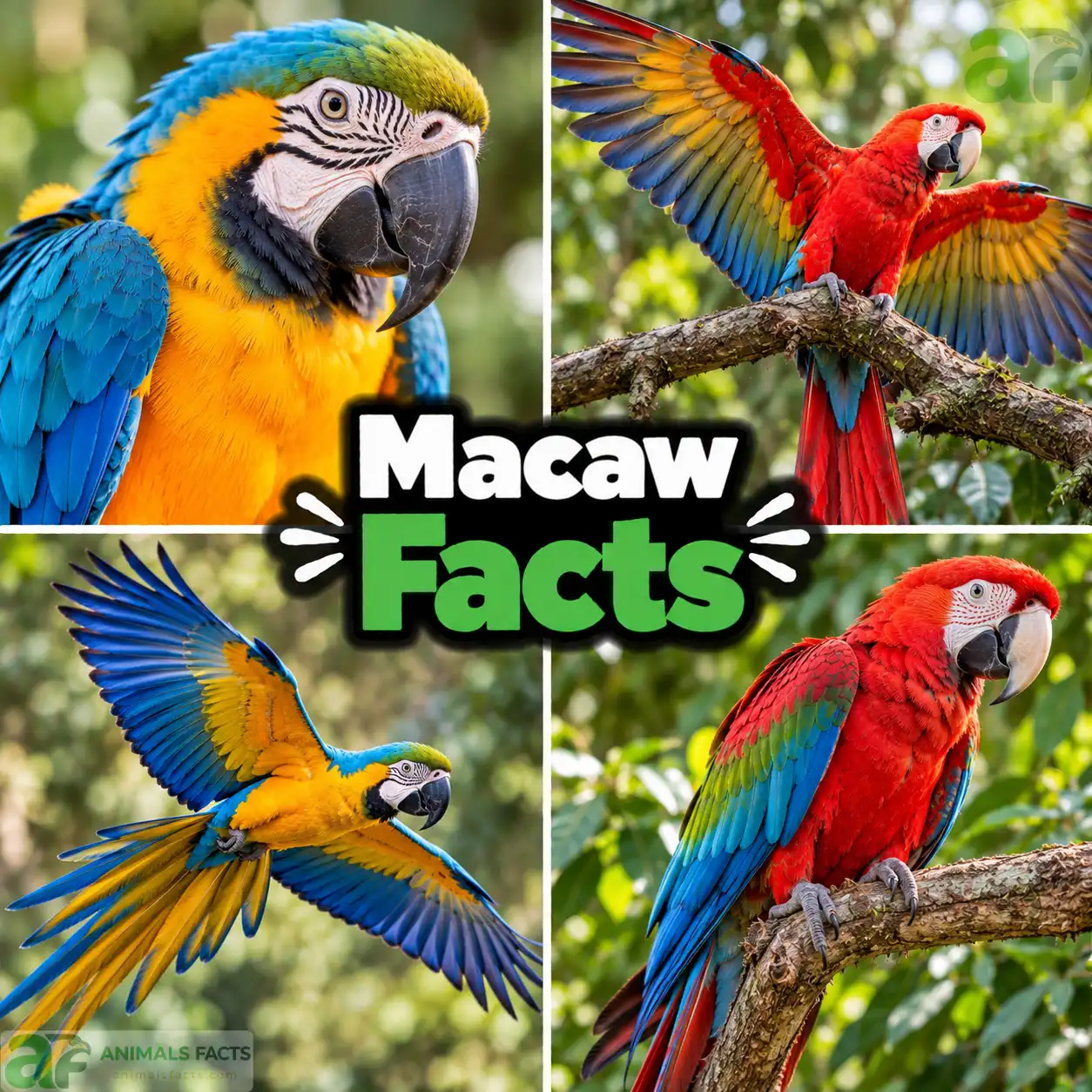
Macaw Facts
| Feature | Details |
|---|---|
| Scientific Name | Tribe Arini; multiple genera including Ara, Anodorhynchus, Primolius, Orthopsittaca, Cyanopsitta |
| Kingdom | Animalia |
| Phylum | Chordata |
| Class | Aves |
| Order | Psittaciformes |
| Family | Psittacidae |
| Common Names | Macaw; large macaw; mini macaw |
| Native Range | Mexico, Central America, South America — tropical and subtropical zones |
| Habitat | Tropical rainforest, woodland, savanna, mangrove, cliff faces |
| Lifespan | 30–60 years (large species wild); up to 80+ years (captivity) |
| Diet | Seeds, nuts, fruits, flowers, clay — highly varied |
| Body Length | 30–100 cm depending on species — hyacinth macaw is the largest parrot by length |
| Wingspan | Up to 130 cm in hyacinth macaw |
| Weight | 130 grams to 1.7 kg depending on species |
| Top Speed | Up to 56 km/h in flight |
| Conservation Status | Ranges from Least Concern to Extinct — several species extinct; multiple Critically Endangered |
| Number of Species | 18 living species — plus at least 5 extinct species |
| Defining Feature | Spectacular plumage; exceptionally long tail; bare facial patch; cognitive intelligence |
| Vocal Ability | Among the most complex vocal learners of any bird — capable of mimicking speech and complex sounds |
 1. Introduction: What is a Macaw?
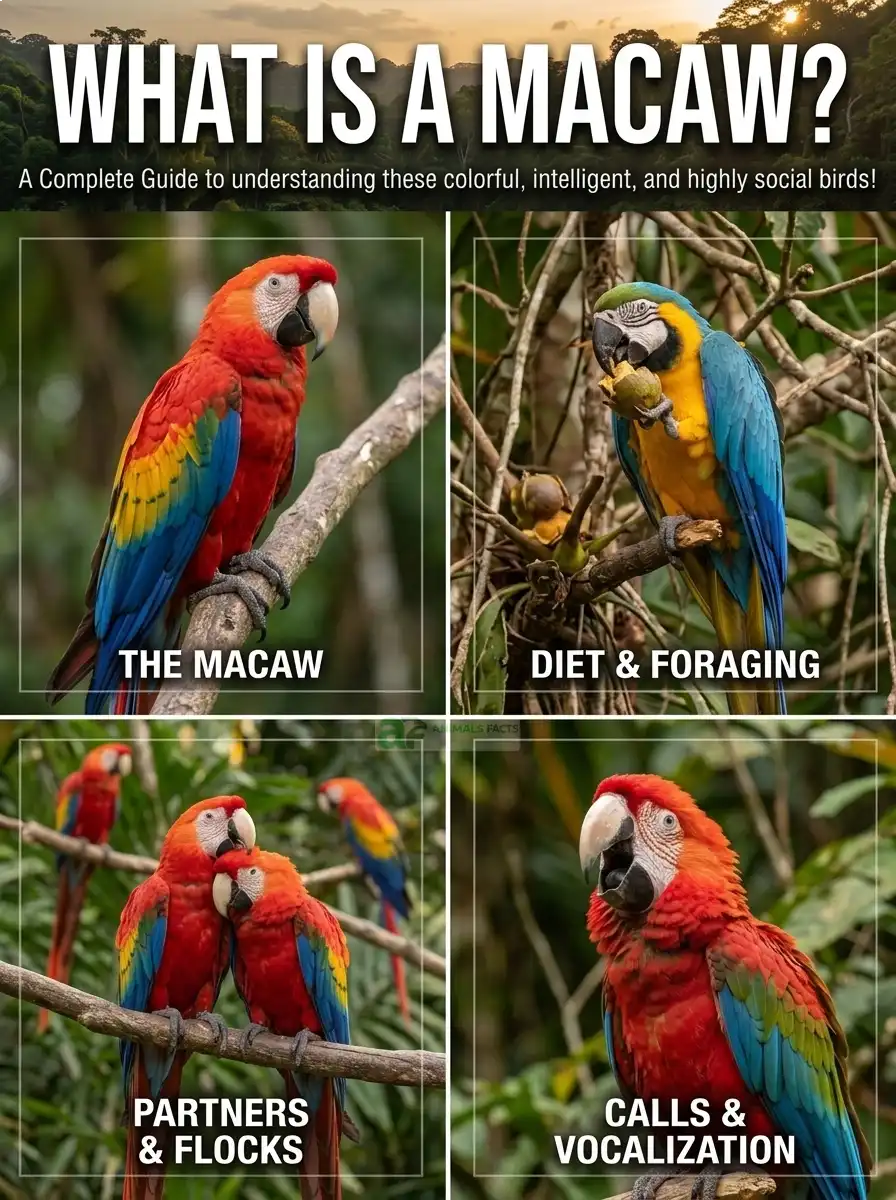
High above the Amazon rainforest canopy — in a sky brilliant with equatorial light — a flock of scarlet macaws erupts from a riverside cliff face in an explosion of crimson and gold and electric blue that seems, for a moment, to rival the sun itself. Their calls — loud, raucous, carrying for kilometers across the forest — announce their departure with the confident authority of animals that have few natural enemies capable of catching them in open air. They arc across the river in a loose, sweeping formation, their extraordinarily long tails streaming behind them, and land in a fig tree with the casual precision of birds who have been navigating this forest for decades — because that is exactly what they are. Macaw facts begin with this single, breathtaking image — the most visually spectacular birds on Earth, the largest members of the parrot family, animals that combine extraordinary physical beauty with cognitive abilities that place them among the most intelligent non-human creatures in the natural world.
Macaws are simultaneously the most beloved and the most threatened of all parrots — a paradox that defines the central tension of their relationship with humans. Their spectacular appearance has made them among the most sought-after birds in the global pet trade, while their forest habitat has been systematically destroyed across Latin America. The same beauty that makes them globally iconic has made them globally targeted. Interesting facts about macaws reveal birds of breathtaking biological complexity — a pair bond so strong that mated macaws spend virtually their entire lives together, separating only reluctantly; a clay-lick feeding behavior that represents one of the most extraordinary wildlife spectacles in the Americas; a cognitive intelligence that allows macaws to solve multi-step puzzles, use tools, demonstrate self-recognition, and produce vocalizations so complex that the boundary between macaw communication and language remains an active area of scientific debate.
Whether you are searching for macaw facts for kids to explore the science of avian intelligence and tropical ecology, a prospective owner researching macaw habitat needs and care requirements, a wildlife traveler planning a visit to the Amazon or Pantanal, or simply someone captivated by photographs of these magnificent birds and needing to understand them completely — this is your comprehensive guide. We cover macaw scientific name, macaw diet, macaw size and weight, macaw behavior, the extraordinary clay-lick phenomenon, intelligence and communication, conservation crises, cultural significance, and the ecological roles these irreplaceable birds play. The most spectacular birds in the world have an extraordinary story to tell.
2. Macaw Species Overview & Classification
Macaws belong to the tribe Arini within the family Psittacidae — a group that includes not only the large macaws but also smaller parrot relatives. The term “macaw” is applied to the larger members of this group, though the boundary between “macaw” and “parrot” is somewhat informal.
Species Classification Table
| Taxonomic Rank | Classification |
|---|---|
| Kingdom | Animalia |
| Phylum | Chordata |
| Class | Aves |
| Order | Psittaciformes |
| Family | Psittacidae |
| Tribe | Arini |
| Primary Genera | Ara (large macaws); Anodorhynchus (blue macaws); Primolius (mini macaws); Orthopsittaca; Cyanopsitta |
| Living Species | 18 recognized species |
| Extinct Species | At least 5 confirmed extinct species |
Major Macaw Species
Large Macaws (Genus Ara):
| Species | Common Name | IUCN Status | Notable Feature |
|---|---|---|---|
| Ara macao | Scarlet macaw | Least Concern | Most widespread; crimson and gold |
| Ara ararauna | Blue-and-yellow macaw | Least Concern | Most common in captivity |
| Ara chloropterus | Green-winged (red-and-green) macaw | Least Concern | Largest Ara species |
| Ara militaris | Military macaw | Vulnerable | Green; range-restricted |
| Ara ambiguus | Great green macaw | Critically Endangered | Severely threatened |
| Ara rubrogenys | Red-fronted macaw | Endangered | Bolivia endemic |
| Ara severus | Chestnut-fronted macaw | Least Concern | Smaller large macaw |
Blue Macaws (Genus Anodorhynchus):
| Species | Common Name | IUCN Status | Notable Feature |
|---|---|---|---|
| Anodorhynchus hyacinthinus | Hyacinth macaw | Vulnerable | World’s largest parrot by length |
| Anodorhynchus leari | Lear’s macaw | Endangered | Only ~1,400 individuals |
| Anodorhynchus glaucus | Glaucous macaw | Critically Endangered (possibly Extinct) | Last confirmed record 1960s |
Critically Endangered and Extinct:
| Species | Common Name | Status | Notes |
|---|---|---|---|
| Cyanopsitta spixii | Spix’s macaw | Extinct in Wild | Likely 0 in wild; ~180 in captivity |
| Ara tricolor | Cuban macaw | Extinct | Last seen ~1864 |
| Ara glaucogularis | Blue-throated macaw | Critically Endangered | ~400 individuals remaining |
Evolution & Discovery Timeline
~65 million years ago — The parrot lineage (Psittaciformes) is estimated to have originated in the Southern Hemisphere — with the earliest fossil evidence placing the order’s origins near the Cretaceous-Paleogene boundary.
~20–30 million years ago — The Arini tribe — the New World parrots including macaws — diverges from Old World parrot lineages as the continents separate.
~10–15 million years ago — The major macaw genera begin to diverge as South American habitats diversify during the Miocene.
~1500 CE — European contact with the Americas introduces macaws to global awareness — indigenous peoples of the Americas had maintained macaws in captivity and used their feathers ceremonially for thousands of years before European contact.
1758 — Carl Linnaeus formally describes the scarlet macaw as Psittacus macao — establishing the first formal scientific description of a macaw species.
1894 — The Cuban macaw (Ara tricolor) is confirmed extinct — the first macaw species to be lost in the modern era.
1987 — The last known wild Spix’s macaw is caught for captive breeding; the species’ wild population never recovers.
2000 — Spix’s macaw declared Extinct in the Wild — one of the most high-profile bird extinctions in recent history.
2022 — A reintroduction program releases captive-bred Spix’s macaws into restored habitat in Bahia, Brazil — the first attempt to restore a wild population from captive stock.
2024 — The Spix’s macaw reintroduction program achieves initial milestones — with some released birds surviving and establishing territories, though wild breeding has not yet been confirmed at scale.
“Macaws are the most visually astonishing birds in the world — and quite possibly the most cognitively sophisticated non-primate animals I have encountered in a lifetime of animal behavior research. When you look into a macaw’s eyes, you have the genuine sensation of looking at something that is looking back with real comprehension.”
— Dr. Irene Pepperberg, Professor of Psychology, Harvard University, and pioneer of avian cognitive research
3. Macaw Physical Description & Unique Features
Macaw size and weight vary enormously across the 18 living species — from the hyacinth macaw at up to 100 cm in length and 1.7 kg in weight — the world’s largest parrot by length — to the smaller red-shouldered macaw (Diopsittaca nobilis) at approximately 30 cm. But across all species, macaws share the distinctive physical features that make them immediately recognizable.
The Plumage — Nature’s Most Spectacular Colors
Macaw plumage represents the most spectacular sustained color display of any bird group — combining multiple brilliant colors in arrangements that seem designed to challenge belief in what evolution can produce:
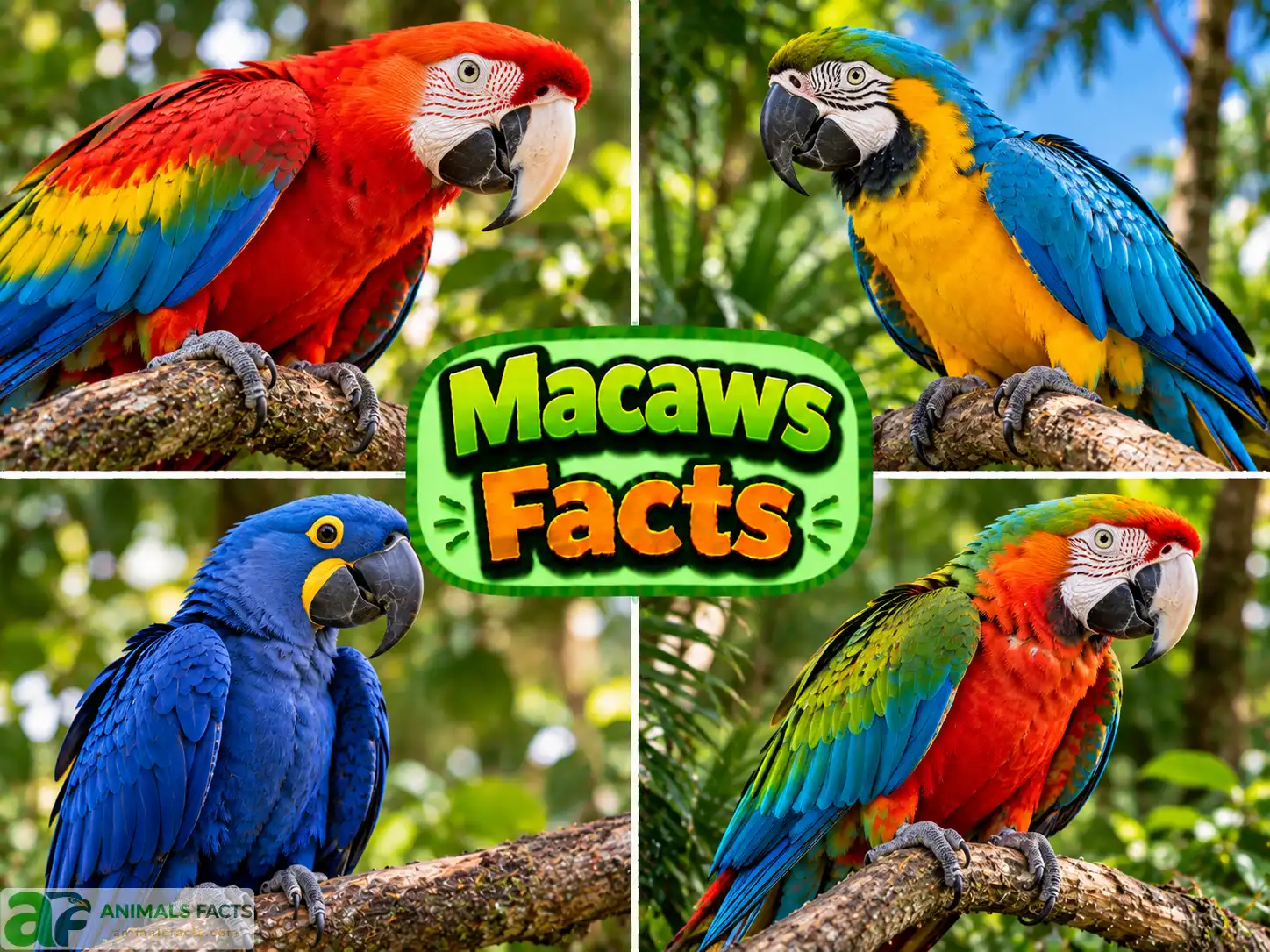
Scarlet macaw — Brilliant crimson body with bright yellow and electric blue wing markings; the combination of these three primary colors creates an almost impossibly vivid visual effect in natural light.
Blue-and-yellow macaw — The upper body a deep cobalt blue; the underside a brilliant golden yellow; the facial stripe a striking green. One of the most recognized bird color patterns in the world.
Hyacinth macaw — An extraordinary, uniform deep cobalt blue — one of the purest and most saturated blue pigments in the avian world — with yellow bare skin around the eye and at the base of the lower mandible providing a vivid contrast.
Green-winged macaw — Deep crimson with iridescent green wing panels and brilliant blue rump and tail — three-color combination of extraordinary richness.
The physics of macaw color — Macaw colors are produced by a combination of pigment-based color (psittacofulvins — yellow, orange, and red pigments found only in parrots; melanins for dark colors) and structural color (microscopic nanostructures in feather barbules that scatter light to produce blue colors through a physical mechanism rather than pigment). The combination of these two color production mechanisms allows the extraordinary color saturation and range seen in macaw plumage.
The Bare Facial Patch
All macaws have a distinctive bare patch of skin on the face — surrounding the eye and extending to the base of the bill in most species. This bare patch:
- Is white to cream in color in most species — providing a stark contrast against the colored plumage
- May contain fine lines of small dark feathers that create species-specific patterns
- Flushes red or pink when the bird is excited, threatened, or displaying — functioning as a mood indicator visible to other macaws and observers
- The pattern of feather lines within the bare patch is unique to each individual — functioning as a fingerprint for individual identification
The Bill
The macaw’s bill is one of the most powerful in the avian world relative to body size:
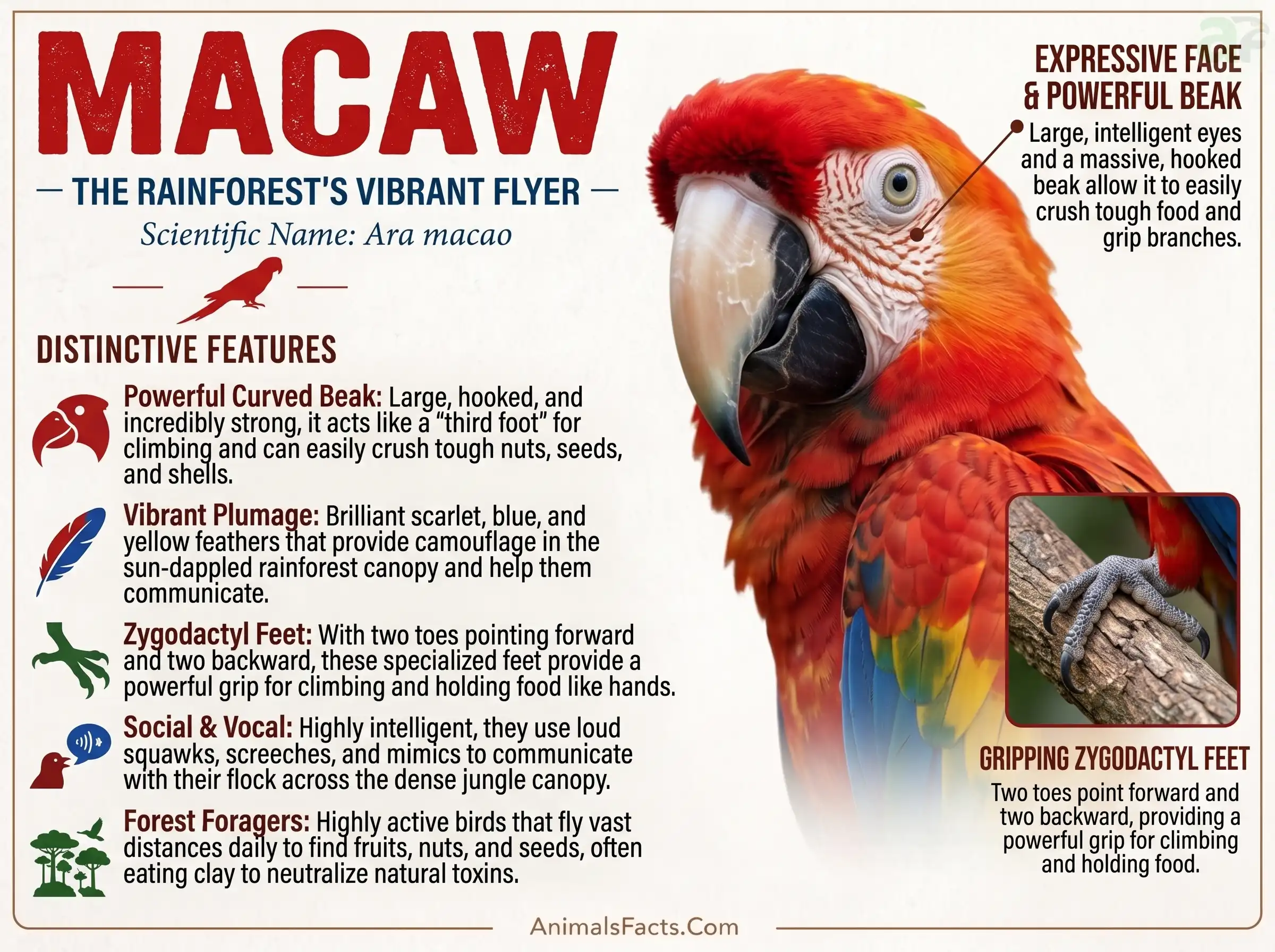
Massive, strongly hooked upper mandible — The primary tool for seed cracking, nut opening, and food manipulation. The bill of a large macaw can exert enough force to crack the hardest tropical nuts — including macadamia nuts and the seeds of Scheelea palms that require mechanical forces exceeding the strength of human hands.
Grip and manipulation — The bill functions in combination with the zygodactyl feet (two toes pointing forward, two pointing backward) as a versatile manipulation system — the macaw using bill and feet together to hold, rotate, and process food items with a dexterity that rivals primate hand use.
Climbing tool — The bill is used as a third limb during climbing — gripping branches and surfaces to support the bird’s weight while the feet reposition.
The Tail
The macaw’s extraordinarily long tail is one of its most visually distinctive features — in the hyacinth macaw, the tail feathers alone may exceed 50 cm in length, representing more than half the bird’s total body length:
Function — The long tail provides aerodynamic stability in flight — acting as a rudder during the rapid, direct flight that characterizes macaw movement through forest and open country.
Display — Tail feathers are spread and fanned during courtship, threat, and social display — the colors and patterns of the tail feathers contributing to visual communication.
💡 Did You Know? Macaw plumage has been found to be fluorescent under ultraviolet light — emitting UV fluorescence that is invisible to human eyes but potentially visible to other macaws, whose vision extends into the near-ultraviolet spectrum. Research on macaw UV fluorescence suggests that the visual signals macaws send to each other are considerably more complex than what human observers see — the UV component potentially communicating information about individual health, reproductive condition, and genetic quality that the visible spectrum alone cannot encode. The macaw’s spectacular colors are therefore not merely decorative for human appreciation — they are complex multimodal communication signals whose full information content we are only beginning to understand.
4. Top 25 Amazing Macaw Facts
Here is your definitive collection of the most extraordinary, scientifically verified, and genuinely astonishing macaw facts as of 2026:
- The hyacinth macaw (Anodorhynchus hyacinthinus) is the world’s longest parrot — reaching up to 100 cm from bill tip to tail tip — and has a wingspan of up to 130 cm.
- Macaws are among the longest-lived birds in the world — large species routinely live 50–60 years in the wild and up to 80+ years in captivity. A macaw purchased as a pet today may outlive its owner.
- Macaw pairs form lifelong monogamous bonds — mated pairs stay together year-round, not just during breeding season, spending virtually their entire lives in each other’s constant company. Widowed macaws often show behavioral changes consistent with grief.
- The clay lick (collpa) behavior — in which hundreds of macaws descend simultaneously to eat mineral-rich clay from riverbanks — is one of the most spectacular wildlife events in the Americas and remains only partially explained by science. The leading hypothesis is that clay neutralizes the toxins in the seeds and unripe fruits macaws consume.
- Macaws can crack nuts that require 300+ pounds per square inch of force — the hyacinth macaw’s bill can crack the extraordinarily hard seeds of the Acrocomia aculeata palm that no other bird and few mammals can access.
- Macaws demonstrate mirror self-recognition — passing the mirror test that is considered a marker of self-awareness in animal cognition research — joining great apes, dolphins, elephants, and a very small number of other species in this cognitive category.
- Spix’s macaw (Cyanopsitta spixii) — the inspiration for the movie character “Blu” in the animated film Rio — was declared Extinct in the Wild in 2000, making it one of the most famous extinct-in-the-wild bird species. A reintroduction program released captive-bred birds in Brazil in 2022.
- Macaw vocalizations are so complex that researchers studying macaw communication have identified what appear to be individual names — specific calls that individual macaws use to address specific other macaws — a finding with profound implications for understanding the evolution of language.
- The scarlet macaw was the first bird to have its entire genome sequenced among the parrot family — the 2014 sequencing project revealing genetic adaptations for longevity and vocal learning that are providing insights into aging biology and language neuroscience.
- Macaws have four color receptors in their eyes — compared to three in humans — allowing them to see ultraviolet light. Their perception of their own plumage includes UV components entirely invisible to human observers.
- A macaw’s zygodactyl feet — two toes forward, two backward — give them a grip strength and manual dexterity that allows them to manipulate food items, open containers, and even use simple tools with a versatility unmatched among birds.
- The great green macaw (Ara ambiguus) is Critically Endangered with fewer than 2,500 individuals remaining — its survival critically dependent on the continued existence of mountain almond trees (Dipteryx panamensis) whose seeds are its primary food source.
- Macaws produce psittacofulvins — bright yellow, orange, and red pigments that are found only in parrots among all birds. These pigments have been shown to have antimicrobial properties — the feathers containing them resist bacterial degradation better than feathers without psittacofulvins.
- The blue-throated macaw (Ara glaucogularis) has a total wild population of approximately 400 individuals — restricted to a tiny area of Beni savanna in Bolivia and representing one of the most critically endangered birds in the Western Hemisphere.
- Macaws at clay licks demonstrate sophisticated social dynamics — dominant individuals access the clay first while subordinates wait, and the assemblage can include hundreds of birds of multiple species — representing one of the most complex multi-species social gatherings of any bird group.
- Young macaws undergo an extended period of parental dependency — remaining with parents for 1–2 years after fledging, during which they learn the food resources, movement routes, and social behaviors of their natal group. This extended learning period is one reason macaws are so cognitively sophisticated.
- Macaw feathers were among the most valuable trade goods in pre-Columbian Mesoamerica — Aztec and Maya rulers used macaw feathers in ceremonial headdresses and regalia, and the feather trade extended thousands of kilometers from macaw range to consuming civilizations.
- The hyacinth macaw feeds almost exclusively on the nuts of just two palm species (Acrocomia aculeata and Attalea phalerata) in the Pantanal — a dietary specialization so extreme that its conservation is directly linked to the conservation of these specific trees.
- Macaws demonstrate vocal dialects — populations in different geographic areas produce recognizably different calls for the same communicative purposes, paralleling the regional dialect phenomenon in human language.
- The military macaw (Ara militaris) is known to make seasonal altitudinal migrations — moving between lowland and highland habitats across an elevation range of several thousand meters — one of the most dramatic migration patterns of any parrot species.
- Macaw pair bonds are so strong that paired birds engage in mutual preening (allopreening) multiple times per day — a behavior that reinforces pair bonds and maintains feather condition in areas the bird cannot reach independently.
- Research at the Tambopata Research Center in Peru has documented macaw clay lick attendance patterns over 30+ years — providing the longest continuous behavioral dataset for any macaw population and revealing complex relationships between rainfall, clay mineral content, food toxin levels, and clay lick visitation rates.
- Macaws have been documented using tools — including using sticks to scratch themselves in areas they cannot reach with the bill, and using leaves to clean their bills after feeding. Tool use in birds was long considered exceptional; its documentation in multiple macaw contexts has contributed to revising understanding of avian cognitive capability.
- The Lear’s macaw (Anodorhynchus leari) — endemic to a tiny area of northeastern Brazil and dependent on the licuri palm (Syagrus coronata) — has recovered from approximately 150 individuals in 1994 to approximately 1,400 in 2024 through intensive conservation intervention — one of the most successful bird conservation recoveries in South American history.
- Macaw populations at major clay licks in Peru and Brazil have been monitored continuously for over three decades — providing behavioral and population data that has revealed long-term population trends, social structure, individual life histories, and the impacts of habitat change on macaw community composition that could not have been obtained through any shorter-term study.
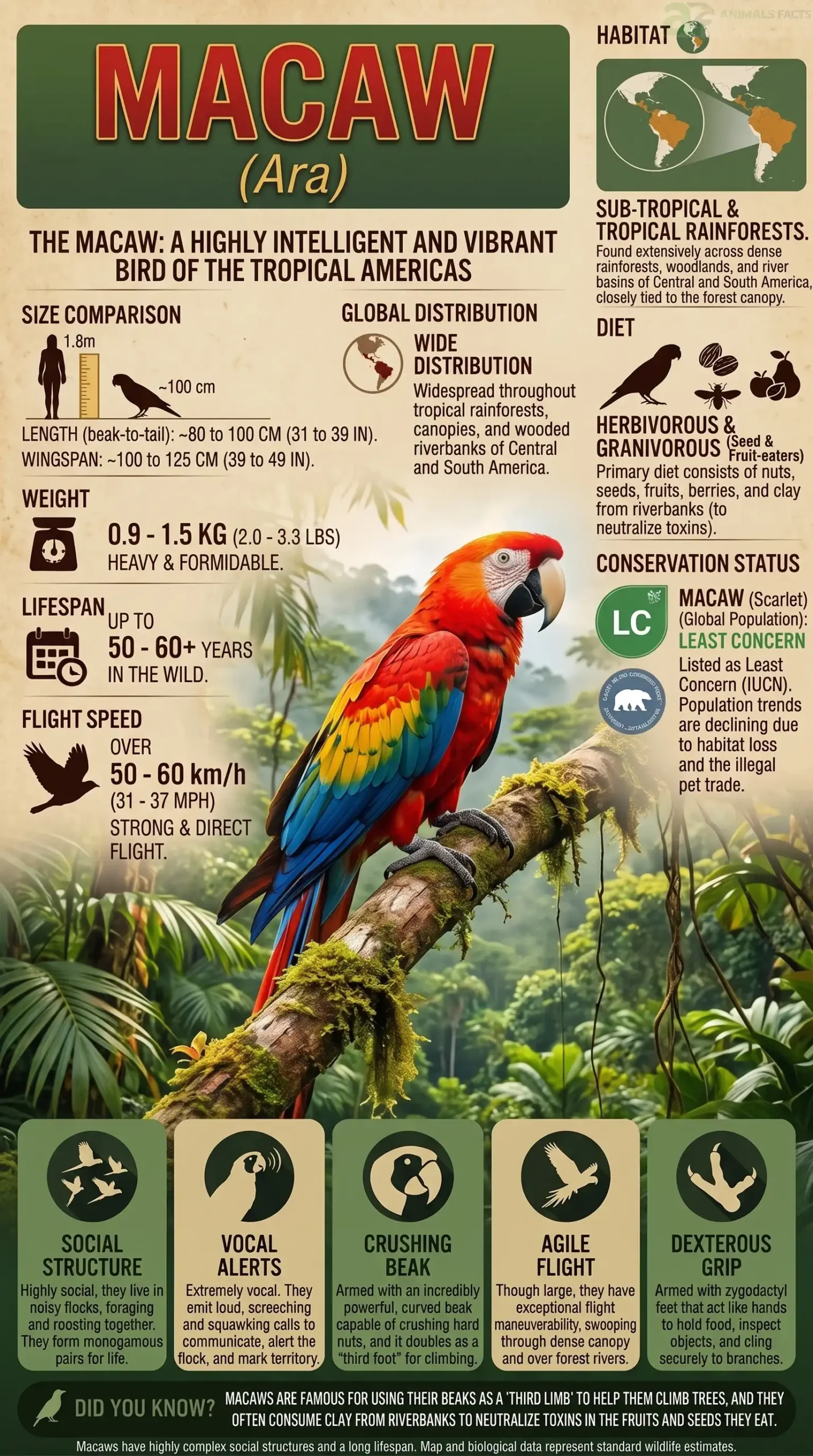
5. Fun Facts About Macaws
- The hyacinth macaw is the world’s longest parrot at 100 cm
- Macaws can live 80+ years in captivity — outliving their owners
- Mated macaws are lifelong partners — they grieve when partners die
- The clay lick spectacle involves hundreds of macaws eating riverbank soil
- Macaw bills can crack nuts requiring 300+ lbs of force
- Macaws can pass the mirror self-recognition test
- Spix’s macaw inspired the movie “Rio” — and is extinct in the wild
- Macaws appear to use individual names to address each other
- They see ultraviolet light — their plumage looks different to them than to us
- The blue-throated macaw has only ~400 wild individuals remaining
- Macaw feathers were more valuable than gold in pre-Columbian trade
- Young macaws stay with parents for 1–2 years learning from them
6. Macaw Natural Habitat & Geographic Range
Macaw habitat spans an enormous range of tropical and subtropical environments across Latin America — from the sea-level rainforests of the Amazon to montane forests at 3,000 meters, and from dense equatorial jungle to open savanna and arid woodland.
Habitat Types
Tropical lowland rainforest — The primary habitat for most large macaw species; tall-canopy rainforest with abundant large-seeded fruiting trees provides both food and nesting sites. The Amazon Basin and Atlantic Forest of Brazil are the most important rainforest habitats for macaw diversity.
Savanna and cerrado — The Brazilian cerrado — the world’s most biodiverse tropical savanna — and the Pantanal wetland system support hyacinth macaws and several other species in an open, palm-dominated landscape quite different from the archetypal rainforest setting.
Montane forest — Military macaws and several other species use montane forest up to 3,000+ meters — navigating dramatic elevation gradients across seasonal migrations.
Mangrove and coastal forest — Several species use coastal mangrove habitats, particularly for roosting.
Cliff faces and rocky outcrops — Critically important nesting habitat for blue macaws and several other species — nesting in rock cavities on cliff faces rather than in tree hollows.
Agricultural margins — Some species show limited tolerance of degraded habitats near forests — though all macaws require forest or woodland for roosting, nesting, and primary foraging.
Geographic Range by Species Group
| Region | Species Present | Status | Notes |
|---|---|---|---|
| Amazon Basin | Scarlet, blue-and-yellow, green-winged, red-and-green, chestnut-fronted | Abundant | Core of macaw diversity |
| Pantanal, Brazil | Hyacinth, blue-and-yellow, red-and-green | Moderate | Critical hyacinth range |
| Atlantic Forest, Brazil | Historically many; now depleted | Severely reduced | Most Atlantic Forest macaws depleted |
| Cerrado, Brazil | Hyacinth, Lear’s, blue-and-yellow | Declining | Cerrado severely threatened |
| Caatinga, NE Brazil | Spix’s (formerly); Lear’s | Critical | Spix’s extinct in wild |
| Central America | Scarlet macaw, great green macaw | Declining | Mexico to Panama |
| Andes and montane | Military, red-fronted | Endangered | Fragmented populations |
| Bolivia | Blue-throated, red-fronted, many others | Critical | Blue-throated ~400 individuals |
💡 Did You Know? The clay lick sites where macaws gather to eat mineral-rich soil are some of the most precisely located and carefully used geographic features in the macaw’s landscape. Research at the Tambopata clay lick in Peru — one of the largest and most-studied in the world — has documented individual macaws visiting the same specific section of the clay lick year after year for over 30 years — with some individuals whose attendance was first recorded in the 1980s still appearing at the same site in the 2010s. These sites are cultural knowledge passed from parent to offspring — young macaws learn clay lick locations from their parents during the extended post-fledging dependency period, and the loss of experienced adults from a population can disrupt clay lick attendance patterns in ways that may take generations to recover. The clay lick is therefore not merely a feeding site but a cultural landmark in the macaw’s learned landscape.
7. Macaw Diet & Feeding Behavior
Macaw diet is centered on seeds, nuts, and fruits — but extends across a remarkable range of plant parts and feeding behaviors that reflect the macaws’ extraordinary bill strength and dietary flexibility.
Diet Breakdown Table
| Food Type | Estimated % of Diet | Notes |
|---|---|---|
| Hard seeds and nuts | ~35–50% | Primary food; hyacinth almost exclusively palm nuts |
| Fruits (pulp and seeds) | ~20–30% | Highly variable by season and species |
| Clay and mineral soil | ~5–10% | Regular consumption at clay licks — dietary supplement |
| Flowers and nectar | ~5–10% | Seasonally important; important pollen source |
| Bark and wood tissue | ~3–5% | Mineral and micronutrient source |
| Unripe fruits | ~5–10% | Consumed before full ripening — often toxic; clay neutralizes |
| Insects and small invertebrates | ~1–3% | Minor; protein supplement particularly for breeding birds |
| Cultivated crops | ~5–15% (where available) | Corn, sunflower — significant human conflict source |
The Clay Lick Phenomenon
The clay lick (Portuguese: barreiro; Spanish: collpa) behavior is one of the most spectacular and most scientifically intriguing feeding behaviors of any bird:
The spectacle — At sites like the Chuncho clay lick near Tambopata in Peru, hundreds of macaws of multiple species — scarlet, blue-and-yellow, red-and-green, chestnut-fronted — descend simultaneously to a vertical clay bank exposed along a river. The noise, color, and social complexity of these gatherings is overwhelming — representing one of the most extraordinary wildlife experiences available anywhere in the Americas.
The leading hypothesis: toxin neutralization — The most widely accepted explanation for clay consumption is that the kaolin and other clay minerals in the soil bind to and neutralize the alkaloids and other secondary metabolites (plant toxins) present in the seeds and unripe fruits that macaws consume. Macaws consume many plant products that contain significant toxin loads — the clay may allow them to access food sources that would otherwise cause digestive distress or toxicosis.
Supporting evidence — Studies have found that macaws visit clay licks more frequently when consuming foods with higher toxin content — a correlation consistent with the detoxification hypothesis. The specific clay minerals at macaw lick sites have higher cation exchange capacities than surrounding soils — consistent with ability to bind positively charged alkaloids.
The mineral hypothesis — An alternative or complementary explanation is that clay consumption provides essential minerals — particularly sodium — that are scarce in the macaw’s predominantly fruit and seed diet. Sodium deficiency is a known limitation in tropical forest herbivore diets.
Multi-species gatherings — Clay licks are visited not only by macaws but by other parrot species, pigeons, and various other birds — and in many areas by tapirs, deer, and other mammals. This multi-species use suggests that the mineral or toxin benefits extend across taxonomic groups.
The Hyacinth Macaw’s Palm Nut Specialization
The hyacinth macaw’s dietary specialization on palm nuts — particularly the extraordinarily hard seeds of Acrocomia aculeata (bocaiuva palm) and Attalea phalerata (acuri palm) in the Pantanal — is one of the most extreme dietary specializations of any large bird:
- The palm nuts are so hard that no other bird can crack them — the hyacinth macaw’s bill is the only avian tool capable of accessing this food source
- Even the hyacinth macaw cannot crack the hardest intact palm nuts — it relies on the giant anteater and cattle to pre-crack them by rolling and trampling, then accesses the fractured seeds
- This dependence on specific palm species for primary nutrition makes hyacinth macaw conservation directly dependent on palm tree conservation — a concrete example of how specialist feeding creates conservation vulnerability
8. Macaws Reproduction & Life Cycle
Macaw reproduction reflects their extraordinary longevity — a slow, careful reproductive strategy characterized by small clutches, extended parental care, and reproductive lifespans that can extend for decades.
The Pair Bond
The foundation of macaw reproduction is the lifelong pair bond — one of the strongest documented pair bonds of any bird species:
Bond formation — Young macaws pair during their second or third year of life — the pair bond forming through extended periods of mutual grooming, coordinated flying, food sharing, and increasingly exclusive association with a specific individual.
Bond maintenance — Paired macaws spend virtually all their time together — flying together, foraging together, roosting together, and engaging in mutual preening multiple times per day. The pair is the fundamental social unit of macaw life.
Bond disruption — When a paired macaw loses its mate through death, the surviving bird typically shows pronounced behavioral changes — reduced foraging, increased vocalizations, and altered social behavior — consistent with grief or distress responses. Widowed macaws may remain unpaired for extended periods before forming a new bond.
Nesting
Macaws are cavity nesters — using tree hollows or rock cavities for nesting:
Tree hollow nesting — Most large macaw species nest in hollows of large, old trees — the same hollow bearing trees that are so critically important for other hollow-dependent wildlife. Competition for suitable hollow sites is intense, and the availability of suitable nesting cavities is a significant limiting factor for macaw populations in many areas.
Cliff nesting — The blue macaws (Anodorhynchus species) and several others nest in cliff face cavities — an adaptation that provides nesting sites inaccessible to most arboreal predators.
Nest box programs — Artificial nest boxes have been successfully used to supplement natural cavity availability in conservation programs for several threatened macaw species — including the hyacinth macaw and blue-throated macaw — with significant positive effects on breeding success.
Clutch and Development
- Clutch size: typically 2–3 eggs in large species; 2–4 in smaller species
- Incubation period: 24–28 days depending on species
- Hatching: asynchronous — eggs hatch at intervals, producing chicks of different ages and sizes
- Nestling period: 70–100 days before fledging
- Post-fledging dependency: 1–2 years with parents
- Sexual maturity: 3–7 years depending on species
- First breeding: typically 5–7 years for large species
The Extended Learning Period
The 1–2 year post-fledging dependency of young macaws with their parents is among the most extended of any bird species and is directly linked to the species’ cognitive complexity:
During this extended period, young macaws learn:
- The locations of reliable food sources including specific fruiting trees and clay licks
- Migration routes and seasonal habitat use patterns
- Social skills and the complex social dynamics of macaw flocks
- Vocalizations — both species-typical calls and the family-group specific calls that constitute individual “names”
- Tool use and food processing techniques for particularly difficult food items
This extended education period is one of the reasons macaws are so cognitively sophisticated — and it explains why the loss of experienced adults from a population can have effects that extend far beyond the individuals killed, disrupting the cultural transmission of knowledge that subsequent generations depend on.
Macaw Lifespan Comparison Table
| Species | Wild Lifespan | Max Captive | First Breeding |
|---|---|---|---|
| Hyacinth macaw | ~50 years | 60+ years | 5–7 years |
| Scarlet macaw | 40–50 years | 75 years | 4–5 years |
| Blue-and-yellow macaw | 40–50 years | 80+ years | 3–4 years |
| Green-winged macaw | 40–50 years | 70+ years | 4–5 years |
| Military macaw | 40–50 years | 60+ years | 4–5 years |
9. Social Behavior & Communication
Macaw social behavior is among the most complex of any bird species — combining long-term pair bonds with extended family associations, large flock membership, and a communication system of extraordinary sophistication.
Social Structure
The macaw’s social world operates at multiple simultaneous levels:
The mated pair — The fundamental social unit; paired macaws are essentially inseparable throughout the year, spending more time together than any other social partner.
The family group — The mated pair plus offspring of recent years — young macaws remain associated with parents through their extended dependency period, creating a multi-generation family unit.
The roost group — Multiple family groups share communal roost sites — sometimes involving dozens to hundreds of birds at large roost trees. Roost sites are traditional — used by the same community for years or decades.
The flock — During foraging, clay lick attendance, and migration, macaws associate in larger groups of variable composition — sometimes comprising mixed species at clay licks and fruiting trees.
The Communication System — Approaching Language
Macaw communication is among the most complex in the avian world — and research over the past three decades has progressively revealed a communication system whose sophistication approaches the boundaries of what researchers are comfortable calling language:
Individual names — Research by Karl Berg and colleagues at Cornell University documented that macaw parents produce specific calls directed at specific individual chicks — and that chicks adopt modified versions of these calls as their individual identity signals. The finding suggests that macaws use learned, arbitrary vocal labels to address specific individuals — a property previously considered unique to human language.
Contact calls — Each macaw pair and family group maintains distinctive contact calls used to maintain cohesion across distances — the calls are individually recognizable and learned rather than innate.
Alarm calls — Specific vocalizations communicate different threat types — aerial predators versus terrestrial predators produce different alarm calls, allowing flock members to respond appropriately without directly observing the threat.
Regional dialects — Populations in different geographic areas show recognizable differences in calls for similar communicative purposes — a dialect phenomenon that parallels human regional language variation.
Mimicry — Macaws’ famous ability to mimic human speech and other sounds is an extension of their general vocal learning capability — the same neural and anatomical adaptations that allow complex communication within macaw society enable the learning of externally produced sounds.
Cognitive Intelligence
Macaw intelligence extends beyond communication into the full suite of cognitive capabilities associated with highly intelligent animals:
Problem solving — Macaws readily solve multi-step food access puzzles — learning to operate locks, levers, and sequential access systems to obtain food rewards in laboratory settings.
Tool use — As noted, macaws use objects as tools — scratching with sticks, cleaning with leaves. Tool use in birds remains remarkable regardless of how many species are documented showing it.
Counting and number concept — Research has documented basic numerical understanding in captive macaws — they can match quantities and show sensitivity to small number differences.
Planning — Some evidence suggests macaws engage in prospective cognition — selecting and transporting tools to locations where they will be needed, rather than finding tools in the moment of use.
10. Predators & Defense Mechanisms
Macaws face a range of predators across their range — and have evolved a combination of behavioral, social, and physical defenses calibrated against both aerial and terrestrial threats.
Natural Predators
Harpy eagle (Harpia harpyja) — The most significant predator of large macaws across the Amazon Basin; the largest eagle in the Americas is capable of taking full-sized adult macaws in flight. Harpy eagles are specifically documented taking scarlet and green-winged macaws as prey items.
Ornate hawk-eagle (Spizaetus ornatus) — Takes macaws across a broad range — one of the most important aerial predators of smaller macaw species.
Peregrine falcon (Falco peregrinus) — The world’s fastest bird presents a threat to macaws in open country during the falcon’s stoop — though macaws’ powerful direct flight may allow escape from all but the fastest approaches.
Ocelots and margays — Arboreal felines represent the primary threat to eggs and nestlings in tree hollow nests — their climbing ability allows them to access nests inaccessible to most terrestrial predators.
Boa constrictors and large snakes — Documented nest predators — entering tree hollows to take eggs and small chicks.
Humans — By far the most significant predator of macaws globally — through habitat destruction, capture for the pet trade, persecution as agricultural pests, and in some areas direct hunting for feathers and food.
Defense Mechanisms
Flock vigilance — The primary anti-predator defense; multiple individuals scanning simultaneously provide earlier threat detection than any individual could achieve alone. Alarm calls spread threat information through the flock instantly.
Aerial agility — Macaws’ powerful, direct flight — up to 56 km/h — combined with the ability to make rapid direction changes makes aerial pursuit difficult for most raptors except the most specialized.
Noisy intimidation — The macaw’s extraordinarily loud vocalization — carrying kilometers in forest — may serve to mob or startle predators and to recruit additional flock members to the threat response.
Cryptic nesting — Despite their brilliantly colored plumage, macaws at the nest entrance are remarkably inconspicuous — their coloration surprisingly effective at breaking up the outline against complex forest vegetation.
Communal roosting — Large roost assemblages provide collective defense — the many-eyes principle reducing individual risk from nocturnal predators.
💡 Did You Know? The harpy eagle and the macaw represent one of the most visually dramatic predator-prey relationships in the Americas — the world’s most powerful eagle versus the world’s most spectacular parrot. Research on harpy eagle diet in the Amazon has found macaws among the most commonly identified bird prey items — and macaw behavior near harpy eagle territories shows measurably elevated vigilance and avoidance of exposed flight paths. The evolutionary pressure of harpy eagle predation may have contributed to the development of the macaw’s extraordinary flock alarm call system — the speed and accuracy with which macaw flocks respond to harpy eagle sightings suggests a long evolutionary history of anti-harpy selection pressure. In areas where harpy eagles have been locally extirpated, macaw behavior in response to aerial threats shows measurably reduced intensity — a behavioral relaxation that may increase vulnerability to other aerial predators.
11. Macaw Facts for Kids
Hey incredible young wildlife explorers and future bird scientists! Here are some absolutely amazing macaw facts for kids that will make you the most fascinating animal expert in your school:
- 🦜 Macaws can live longer than your grandparents! The largest macaws can live for 50 to 60 years in the wild and over 80 years in captivity. A macaw bought as a pet when someone is young might be around when that person’s grandchildren are born. They are one of the longest-lived birds in the world!
- 🦜 They eat DIRT on purpose — and it is brilliant! Hundreds of macaws fly to special riverbank clay sites every day to eat mineral-rich soil. The clay helps neutralize the toxins in the seeds and unripe fruits they eat, which would make most other animals very sick. It is like having a built-in antidote!
- 🦜 Macaw pairs stay together for their ENTIRE lives! Once two macaws choose each other as mates, they spend virtually every moment of the rest of their lives together. They fly together, eat together, sleep together, and groom each other every day. When one dies, the other often seems genuinely sad.
- 🦜 Their bills are so strong they can crack nuts that HUMANS cannot open! The hyacinth macaw — the world’s largest parrot — can crack palm nuts so hard that no other bird can touch them. Even some machines struggle with these nuts. The macaw’s bill is one of the most powerful tools in the animal kingdom.
- 🦜 Macaws might call each other by NAME! Scientists have discovered that macaw parents give their baby chicks specific call sounds that work like names — and the chicks keep and use those name-sounds for their whole lives to call and identify each other. Only humans were previously thought to do this!
- 🦜 The movie “Rio” is based on a REAL bird that went extinct in the wild! The blue macaw “Blu” from Rio is based on the Spix’s macaw — a real species that was declared extinct in the wild in 2000. Scientists are now trying to bring it back by releasing captive-born birds in Brazil!
- 🦜 Macaws can see colors YOU cannot! Macaws have four types of color receptors in their eyes — humans only have three. They can see ultraviolet light, which means their spectacular feathers look even more amazing to other macaws than they do to us. Imagine how much more colorful their world must be!
- 🦜 Young macaws go to SCHOOL for two years! Baby macaws stay with their parents for one to two years after learning to fly — during which time they learn where all the food is, which clay licks to visit, and how to talk to other macaws. It is basically bird school, and it is why macaws are so clever!
12. Relationship with Humans
The relationship between macaws and humans is one of the most ancient, most complex, and most consequential in the human-bird world — spanning from the sacred feather cultures of pre-Columbian civilizations to the modern conservation crisis driven by habitat loss and the global pet trade.
Pre-Columbian Cultural Relationships
Macaws held extraordinary cultural significance across virtually every pre-Columbian civilization that inhabited their range — and in many cases well beyond their range through extensive trade networks:
Aztec and Maya civilizations — Macaw feathers — particularly the brilliant red feathers of the scarlet macaw and the blue-green tail feathers of various species — were among the most valuable objects in Mesoamerican trade networks. The quetzal bird is commonly cited as the most sacred bird of Mesoamerican cultures, but macaws ran a very close second — their feathers used in the ceremonial headdresses, cloaks, and regalia of rulers, priests, and warriors. Aztec rulers maintained royal aviaries housing hundreds of macaws kept specifically for their feathers.
Pueblo cultures of the American Southwest — Archaeological evidence reveals that scarlet macaws were transported live from their natural range in Mexico and Central America to Pueblo settlements in what is now New Mexico and Arizona — a distance of over 2,000 km. Sites including Chaco Canyon and Paquimé (Casas Grandes) contain macaw remains, macaw breeding facilities, and macaw-themed artwork that document an extraordinary long-distance cultural relationship between Pueblo peoples and tropical macaws.
Amazon Basin indigenous peoples — Indigenous communities across the Amazon Basin practiced feather craft — creating elaborate headdresses, capes, and ceremonial objects from macaw feathers that combined aesthetic magnificence with cultural meaning encoding cosmological beliefs, social status, and ceremonial function. These traditions continue in many Amazon communities today.
The Pet Trade Crisis
The global demand for macaws as pets — driven by their spectacular appearance, extraordinary lifespan, and remarkable cognitive abilities — has created one of the most destructive wildlife trades in avian conservation history:
Scale — Before international trade restrictions tightened through CITES in the 1970s and 1980s, hundreds of thousands of wild macaws were captured and exported annually to feed the global pet market. The mortality rates in capture, holding, and transport were extraordinarily high — with estimates suggesting that for every live macaw that reached a pet store, 5–10 died in the capture and trade process.
Population impacts — The combined effect of direct capture, capture-related mortality, and the disruption of breeding and social behavior by nest robbery drove multiple macaw species from common to rare or endangered within decades. The spix’s macaw is the most dramatic example — captured to extinction in the wild.
Current situation — CITES Appendix I listing of all macaws prohibits commercial international trade in wild-caught birds. However, a significant illegal trade continues — particularly in highly sought species. Captive-bred birds are legally traded in most countries, but distinguishing captive-bred from wild-caught birds remains an enforcement challenge.
Macaws as Agricultural Pests
In areas where human agricultural expansion has overlapped with macaw habitat, macaws have become significant agricultural pests — particularly targeting corn, sunflower, and other crops:
- The military macaw is considered an agricultural pest in some parts of its Mexican range — causing significant crop damage that generates local persecution
- Even common species including the scarlet macaw cause crop damage in Central American agricultural areas
- Human-macaw conflict over crops creates local pressure for lethal control that undermines conservation efforts — community engagement and conflict resolution programs are important conservation tools in these contexts
13. Conservation Status & Threats
Conservation Status Overview
| Species | IUCN Status | Wild Population | Primary Threat |
|---|---|---|---|
| Spix’s macaw | Extinct in Wild | ~0 wild; ~180 captive | Habitat loss; capture |
| Blue-throated macaw | Critically Endangered | ~400 | Habitat loss; historic capture |
| Great green macaw | Critically Endangered | <2,500 | Deforestation |
| Lear’s macaw | Endangered | ~1,400 | Habitat; food tree loss |
| Military macaw | Vulnerable | <10,000 | Habitat; pet trade |
| Hyacinth macaw | Vulnerable | ~6,500 | Habitat; pet trade |
| Red-fronted macaw | Endangered | ~1,000 | Small range; habitat |
| Glaucous macaw | Critically Endangered (possibly Extinct) | 0–few | Habitat destruction |
| Scarlet macaw | Least Concern | 20,000–50,000 | Habitat loss in parts of range |
| Blue-and-yellow macaw | Least Concern | Large | Habitat loss locally |
Major Threats
| Threat | Description | Impact Level |
|---|---|---|
| Deforestation | Agricultural expansion; logging; ranching in Amazon and cerrado | Critical — primary long-term threat |
| Illegal pet trade | Wild capture for domestic and international markets | High |
| Nest hollow loss | Old-growth tree removal eliminates nesting cavities | High |
| Agricultural persecution | Crop damage leads to lethal control | Medium-High |
| Climate change | Altered fruiting phenology; drought; forest disruption | Increasing concern |
| Specific food tree loss | Great green macaw/mountain almond; hyacinth/palm trees | Critical for specialist species |
| Hunting (local) | Food and feather use in some range areas | Medium |
| Road construction | Opens forest to hunting and habitat degradation | High |
The Spix’s Macaw Story — From Extinction to Reintroduction
The Spix’s macaw (Cyanopsitta spixii) represents the most dramatic macaw conservation story of the modern era:
The decline — Once found across the Caatinga thorn scrub of northeastern Brazil, the Spix’s macaw was driven toward extinction by a combination of habitat loss (the Caatinga is one of Brazil’s most degraded biomes) and intensive collection for the pet trade — with each captured bird worth tens of thousands of dollars in private collector markets.
The last wild bird — The last confirmed wild Spix’s macaw — a male — was observed associating with a blue-winged macaw (Primolius maracana) in 1990. He was last seen in October 2000 — after which the species was declared Extinct in the Wild.
The Rio connection — The Spix’s macaw became globally famous as the inspiration for the animated film Rio (2011) — the character “Blu” directly based on the species’ story. The film reached audiences of hundreds of millions globally and generated unprecedented public awareness of macaw conservation.
The reintroduction program — A coordinated program involving the Brazilian government, the ACTP (Association for the Conservation of Threatened Parrots), and multiple partner organizations has bred Spix’s macaws in captivity and — in 2022 — released the first cohort of captive-bred birds into restored Caatinga habitat in Bahia, Brazil. As of 2026, released birds have survived and established territories, though confirmed wild breeding remains an ongoing goal.
14. Famous Macaws in History & Pop Culture
Famous Macaw Individuals
“Blu” — The fictional Spix’s macaw protagonist of Pixar/Blue Sky Studios’ Rio (2011) and Rio 2 (2014) — one of the most famous fictional birds in cinema history. Blu’s story — a domesticated macaw discovering his wild heritage and the existence of other members of his species — brought the Spix’s macaw’s real conservation story to global audiences. The Rio franchise grossed over $500 million at the global box office.
“Charlie” — A blue-and-yellow macaw reportedly belonging to Winston Churchill that was still alive in 2004 at an estimated age of 104 years — if authentic, representing one of the longest-lived birds in documented history. The story — while disputed by some Churchill historians — generated enormous media coverage and public awareness of macaw longevity.
“Snowball” — A sulphur-crested cockatoo (not a macaw but often discussed in the same context of avian cognitive intelligence) whose demonstrated ability to synchronize movement to music (dancing) represented a landmark in animal cognition research — research that has directly informed studies of macaw cognitive capabilities.
The Tambopata Research Center Macaws — Individual macaws at the Tambopata Research Center clay lick in Peru — including several whose attendance has been documented for over 30 years — represent some of the most continuously monitored wild birds in history. These individuals, identified through facial patch patterns and color ring combinations, have contributed uniquely to long-term macaw behavioral ecology.
Moctezuma’s Royal Aviary — The Aztec Emperor Moctezuma II maintained a royal aviary at Tenochtitlan reportedly housing hundreds of macaws — the single largest recorded historical macaw collection and a testament to the cultural centrality of macaws in pre-Columbian Mesoamerican civilization.
15. Role in Ecosystem & Food Chain
The Seed Predator Role
Macaws are primarily seed predators — destroying seeds rather than dispersing them as frugivorous birds do. This seed predation role has significant ecological effects:
Hard seed specialization — By cracking and consuming seeds too hard for other animals to access, macaws exploit food resources that would otherwise go unconsumed — potentially reducing the competitive advantage of the hardest-seeded plants in competition with softer-seeded competitors.
Selective seed destruction — Macaws’ preference for specific seed species influences the relative reproductive success of different plant species — a selective pressure that may influence plant community composition over time.
The Seed Disperser Role
While primarily seed predators, macaws also serve as seed dispersers in some contexts:
Cached seeds — Some macaw species cache seeds for later retrieval — and uncached seeds germinate, constituting effective seed dispersal.
Swallowed seeds — Smaller seeds swallowed intact during fruit consumption pass through the digestive system and may be deposited viable at distances from parent plants.
The Pollinator Role
Macaws feeding on flowers and nectar serve as pollinators — transferring pollen between flowers as they feed. This pollination service is particularly important for tree species with large, tough flowers that few other pollinators can access effectively.
The Clay Lick Ecological Linkage
Clay lick attendance creates an ecological linkage between macaws and the soil ecosystem — the disturbance of clay bank surfaces by thousands of visiting birds over years and decades reshaping the physical structure of riverbanks and creating habitat for invertebrates that colonize the exposed clay surfaces.
The Cultural Keystone Species Role
Macaws function as cultural keystone species in multiple rainforest ecosystems — their importance to indigenous forest peoples in terms of cultural, spiritual, and practical value creating a layer of protection that pure biological conservation value alone could not generate. This cultural significance means that macaw conservation simultaneously supports indigenous cultural preservation — an important dimension of the conservation case.
16. Myths, Folklore & Cultural Significance
Mesoamerican Sacred Significance
In Aztec cosmology, macaws held extraordinary sacred significance — connected to the sun, to fire, and to the cardinal directions in ways that made macaw feathers powerful ritual objects:
The Sun connection — The scarlet macaw’s brilliant red plumage was associated with the sun and with fire in Aztec cosmological thinking — the red feathers symbolic of the sun’s heat and light. Macaw feathers incorporated into ceremonial objects were thought to carry solar power.
Huitzilihuitl — The second Aztec emperor was named “Hummingbird Feather” in Nahuatl — but macaw feathers were more commonly used in the featherwork headdresses of Aztec nobility, including the famous Penacho de Moctezuma (Moctezuma’s headdress) now held in Vienna’s Weltmuseum.
The Maya and macaws — In Maya cosmology, the Principal Bird Deity — sometimes identified as a macaw-like being — was one of the most significant supernatural entities. The Popol Vuh — the Maya creation narrative — features a vain, macaw-like character called Seven Macaw (Vucub Caquix) who is defeated by the Hero Twins in one of the narrative’s central episodes.
Amazon Indigenous Traditions
Across the Amazon Basin, macaw feathers and living macaws feature prominently in indigenous ceremonial traditions:
Feather headdresses — Elaborate headdresses made from macaw feathers are among the most important ceremonial objects of numerous Amazonian peoples — the featherwork encoding social status, spiritual authority, and cosmological meaning in visual form.
Macaw keeping — Many Amazonian communities traditionally kept macaws as semi-domesticated companions — particularly maintaining the birds for their feathers, which were regularly plucked without killing the bird. This tradition of feather harvesting from live birds was more sustainable than killing, and maintained long-term relationships between specific families and specific macaws.
Symbolic significance — The macaw’s combination of spectacular color, extraordinary voice, and long life made it a natural symbol of abundance, vitality, and cosmic power across multiple Amazonian cosmological systems.
17. Macaws in Pop Culture
Rio (Blue Sky Studios/Fox, 2011) and Rio 2 (2014) — The animated film featuring Spix’s macaw “Blu” and scarlet macaw “Jewel” became a global cultural phenomenon — grossing over $500 million combined and introducing macaw conservation to audiences that wildlife documentaries could not reach. The films directly increased public awareness of the Spix’s macaw’s real-world conservation status and contributed to fundraising for the reintroduction program.
“Polly wants a cracker” — The cultural archetype of the talking parrot — most commonly depicted as a macaw — is one of the most recognized human-animal communication tropes in Western popular culture. The image of the large, colorful macaw repeating human phrases has been embedded in Western cultural imagination since the first macaws arrived in Europe following the Spanish conquest of the Americas.
Pirates and macaws — The association of pirates with shoulder-perched parrots — almost invariably depicted as macaws — is one of the most enduring animal-human cultural images in popular media. Long John Silver’s parrot in Robert Louis Stevenson’s Treasure Island (1883) is the founding literary instance — and the image has been reproduced in hundreds of subsequent pirate narratives.
David Attenborough BBC coverage — Multiple BBC wildlife productions featuring macaw clay lick sequences — including the Tambopata clay lick footage in several BBC Earth and BBC Natural World productions — have introduced the clay lick spectacle to global audiences. The clay lick is consistently one of the most visually spectacular wildlife sequences in any rainforest documentary.
Social media macaw content — Individual macaws maintained as companion birds have generated significant social media followings — multiple individual macaws have amassed hundreds of thousands of social media followers whose content documents macaw vocalization, problem-solving, and social behavior in captive settings.
18. Macaw Facts vs. Common Myths
| Common Myth | The Real Fact |
|---|---|
| “Macaws are just colorful birds that repeat words” | False — macaws demonstrate complex communication, problem-solving, self-recognition, and cognitive capabilities that place them among the most intelligent non-human animals |
| “Macaws make good pets because they are social” | Nuanced — macaws are extraordinarily socially demanding; their social needs in captivity require hours of daily interaction, and their 50–80 year lifespan makes them lifetime commitments most owners are unprepared for |
| “Wild macaws are abundant everywhere in South America” | False — many species are severely threatened; multiple species are critically endangered with fewer than 400–2,500 individuals remaining |
| “Macaw feathers fall out naturally and can be collected harmlessly” | Partially misleading — feathers do moult naturally, but commercial feather collection drives illegal capture and trade; wild macaw feathers cannot be legally traded |
| “The clay macaws eat is just soil — no real purpose” | False — clay lick behavior is a sophisticated dietary strategy for neutralizing plant toxins and obtaining essential minerals; it is a critical component of macaw nutrition |
| “Macaws in captivity are just as happy as wild macaws” | Generally false — macaws require complex social environments, extensive flight space, diverse diets, and cognitive stimulation that standard captive settings rarely provide; psychological distress is common in inadequately housed macaws |
| “All macaws are the same species of different colors” | False — there are 18 living macaw species with distinct evolutionary histories, ranges, behaviors, and conservation statuses |
| “Macaws eat seeds and nothing else” | False — macaws eat diverse diets including fruits, flowers, clay, bark, and occasionally insects; some species have highly specialized diets but none eat only seeds |
19. Best Places to See Macaws in the Wild
1. Tambopata National Reserve, Peru — Home to the Chuncho clay lick — one of the largest macaw clay licks in the world, where hundreds of blue-and-yellow, scarlet, red-and-green, and chestnut-fronted macaws gather daily on exposed riverbanks. The Tambopata Research Center offers lodge-based wildlife experiences with the clay lick as the signature wildlife event. This is the single best macaw-watching location on Earth for spectacle and species diversity.
2. Manu National Park, Peru — One of the most biodiverse protected areas on Earth; the Blanquillo clay lick in Manu is comparable to Tambopata’s Chuncho lick for macaw spectacle. Manu’s exceptional biodiversity adds extraordinary wildlife context to the macaw watching.
3. Pantanal, Brazil — The world’s largest tropical wetland; the primary range of the hyacinth macaw — the world’s largest parrot. Wildlife lodges along the Transpantaneira road in Mato Grosso and around Porto Jofre provide reliable hyacinth macaw encounters in the macaw’s most important remaining stronghold.
4. Carara National Park, Costa Rica — One of the most accessible locations for wild scarlet macaw observation in Central America — the park’s scarlet macaw population is habituated to humans and regularly visible along forest trails and in the park’s forest-agricultural interface zone.
5. Serra da Cangalha, Maranhão, Brazil — The core range of Lear’s macaw in northeastern Brazil — a remote but accessible location for observing this recovered endangered species in its native licuri palm savanna habitat. Guided tours organized through local conservation organizations provide the best access.
6. Beni Biosphere Reserve, Bolivia — The critical habitat of the blue-throated macaw — one of the world’s rarest birds, with approximately 400 individuals. Conservation tourism programs organized through Asociación Armonía (Bolivia’s leading bird conservation organization) support the species’ conservation while providing extraordinary wildlife encounters.
7. Biosphere Reserve el Cielo, Tamaulipas, Mexico — One of the most reliable locations for observing military macaws in Mexico — the Sierra Madre Oriental montane forest provides dramatic landscape context for macaw watching.
20. How You Can Help
Supporting macaw conservation requires action across multiple levels — from individual consumer choices to international policy advocacy.
Support these organizations:
- World Parrot Trust — parrots.org — the world’s leading organization dedicated to parrot welfare and conservation; supports multiple macaw conservation programs globally
- Panthera and WCS Amazon programs — wcs.org — broad Amazon conservation including macaw habitat protection
- Asociación Armonía (Bolivia) — armoniabolivia.org — Bolivia-focused bird conservation including the critically endangered blue-throated macaw program
- ACTP (Association for the Conservation of Threatened Parrots) — actp.org — leads the Spix’s macaw captive breeding and reintroduction program
- Neotropical Bird Club — supports research and conservation of neotropical birds including macaws
- Rainforest Trust — rainforesttrust.org — funds purchase and protection of rainforest in macaw range countries
Critical individual actions:
- Never purchase wild-caught macaws — demand legal documentation of captive-bred origin for any macaw purchased; support only breeders with documented captive breeding programs
- Reconsider macaw ownership entirely — the welfare challenges of providing adequate social, cognitive, and physical environments for macaws in captivity are genuine; many wildlife organizations advocate against keeping macaws as pets entirely
- Support Amazon deforestation policy — political advocacy for Amazon protection policies in Brazil and other range countries is directly macaw conservation policy
- Choose certified sustainable products — sustainable beef, soy, and coffee reduce pressure on forest conversion in macaw range countries
- Visit macaw conservation tourism sites — wildlife tourism at clay lick sites in Peru and Bolivia generates income that directly funds conservation programs
21. Top Documentaries & Books
Must-Watch Documentaries
- “Planet Earth II — Jungles” (BBC, 2016) — Contains spectacular macaw clay lick footage from the Tambopata region; one of the most visually stunning wildlife sequences ever produced
- “Our Planet — Jungles” (Netflix, 2019) — David Attenborough’s Amazon coverage includes macaw content in the context of the broader forest ecosystem
- “The Parrots of Telegraph Hill” (2003) — Documentary about a flock of wild parrots in San Francisco — while not strictly macaws, provides extraordinary insight into parrot social intelligence and adaptability
- “Ara Project: Saving the Macaws” (various) — Costa Rica-based macaw conservation documentary; covers great green macaw and scarlet macaw conservation in Central America
- “In Search of the Spix’s Macaw” (various) — Multiple documentary treatments of the Spix’s macaw conservation story available through streaming platforms and conservation organization websites
Must-Read Books
- “Macaws: A Complete Guide to Macaws” by various specialist authors — Comprehensive popular guides covering all macaw species biology, behavior, and conservation
- “Parrots of the World” by Joseph Forshaw — The definitive ornithological reference for all parrot species including comprehensive macaw coverage; beautifully illustrated
- “Alex and Me” by Irene Pepperberg — Not specifically about macaws but the definitive popular account of avian cognitive research that contextualizes macaw intelligence
- “The Wild Parrots of Telegraph Hill” by Mark Bittner — Popular account of wild parrot behavior providing insight into parrot social and cognitive life
- “Macaws of the World” — Various popular natural history accounts available through ornithological and wildlife publishers
22. Comparison of Major Macaw Species
| Feature | Hyacinth Macaw | Scarlet Macaw | Blue-and-Yellow Macaw | Green-winged Macaw | Spix’s Macaw |
|---|---|---|---|---|---|
| Scientific name | Anodorhynchus hyacinthinus | Ara macao | Ara ararauna | Ara chloropterus | Cyanopsitta spixii |
| Length | 100 cm | 81–96 cm | 76–86 cm | 90–95 cm | 55–57 cm |
| Weight | 1.2–1.7 kg | 0.9–1.1 kg | 0.9–1.3 kg | 1.25–1.7 kg | ~300 g |
| Primary color | Cobalt blue | Crimson, yellow, blue | Blue above, yellow below | Red, green, blue | Light blue |
| IUCN Status | Vulnerable | Least Concern | Least Concern | Least Concern | Extinct in Wild |
| Wild population | ~6,500 | 20,000–50,000 | Large | Large | ~0 wild |
| Primary habitat | Pantanal/cerrado | Rainforest | Rainforest, savanna | Rainforest | Caatinga |
| Dietary specialty | Palm nuts only (2 spp.) | Generalist | Generalist | Generalist | Licuri palm (formerly) |
| Famous for | World’s longest parrot | Most widespread | Most common pet | Most powerful bill | Inspired Rio |

23. Frequently Asked Questions About Macaw Facts
Q1. What is the scientific name of the macaw?
Macaws belong to the tribe Arini within the family Psittacidae — a group containing multiple genera. The most species-rich genus is Ara — containing most of the large macaws including the scarlet macaw (Ara macao), blue-and-yellow macaw (Ara ararauna), and green-winged macaw (Ara chloropterus). The blue macaws belong to the genus Anodorhynchus — including the hyacinth macaw (Anodorhynchus hyacinthinus) and Lear’s macaw (Anodorhynchus leari). The critically endangered Spix’s macaw belongs to the monotypic genus Cyanopsitta (Cyanopsitta spixii). Smaller macaws include species in the genera Primolius, Orthopsittaca, and Diopsittaca. The term “macaw” is applied informally to the larger members of the tribe Arini rather than representing a single strict taxonomic unit.
Q2. How long do macaws live?
Macaws are among the longest-lived birds in the world — with lifespans that frequently exceed those of most other birds and rival those of some reptiles. Large macaw species in the wild typically live 40–60 years, with some individuals reaching longer ages in favorable conditions. In captivity — with access to veterinary care, consistent nutrition, and absence of predation — large macaws have been documented living 70–80+ years, with some disputed claims of individuals exceeding 100 years. This extraordinary longevity has important implications for pet macaw ownership — a macaw purchased today may need care for longer than its owner expects to live, creating significant responsibility for advance planning of the bird’s future care.
Q3. Why do macaws eat clay?
Macaws eat clay at riverbank clay licks primarily because the clay contains minerals — particularly kaolin and other smectite clays — that appear to neutralize the toxic secondary metabolites (alkaloids, tannins, and other plant toxins) present in the seeds and unripe fruits that macaws consume. The clay minerals bind to these toxins in the digestive system, preventing their absorption into the bloodstream and allowing macaws to safely consume food sources that would poison other animals. The behavior may also supplement dietary sodium — a mineral scarce in the fruit and seed diet of forest-dwelling animals. The clay lick phenomenon creates some of the most spectacular wildlife gatherings in the Americas — with hundreds of macaws of multiple species descending simultaneously to exposed clay banks on Amazonian rivers.
Q4. Are macaws intelligent?
Macaws are among the most cognitively sophisticated animals in the world — demonstrating intelligence that in some domains rivals or exceeds that of great apes. Documented cognitive capabilities include: mirror self-recognition (a marker of self-awareness); complex problem-solving including multi-step sequential puzzles; tool use including object manipulation for scratching and cleaning; vocal learning — the ability to learn new sounds throughout life, including human speech; apparent individual naming — using specific calls to address specific individuals in a way that parallels the use of names in human communication; numerical sensitivity; and prospective cognition — selecting tools in advance of the situations where they will be needed. The neural basis of macaw intelligence involves an enlarged nidopallium — the avian equivalent of the mammalian neocortex — that gives macaws proportionally as much neural processing capacity for complex cognition as many mammals.
Q5. Is Spix’s macaw really extinct?
The Spix’s macaw (Cyanopsitta spixii) was declared Extinct in the Wild by the IUCN in 2000 — following the disappearance of the last known wild individual in October 2000. However, approximately 180 individuals survive in captive collections — primarily in Brazil, Qatar, and Germany — maintained by breeding programs coordinated for eventual reintroduction. In 2022, a coordinated reintroduction program released captive-bred Spix’s macaws into restored Caatinga habitat in the Bahia state of Brazil — the first attempt to restore a wild population of this species from captive stock. As of 2026, released birds have survived and established territories in the reintroduction area, representing cautious progress toward restoring a wild population — though the ultimate success of the reintroduction remains to be determined.
Q6. How do macaws communicate?
Macaw communication is extraordinarily complex — operating across multiple channels and encoding information of considerable sophistication. Vocally, macaws produce contact calls (for maintaining contact between flock members and paired individuals), alarm calls (with different calls for aerial versus terrestrial threats), food calls, and what appears to be a system of individually unique calls functioning as names — with specific calls used to address specific individuals. Research suggests that these “name calls” are learned rather than innate — parents give chicks specific calls that become their individual identifiers, and adults use these identifiers to direct communication at specific individuals in a flock. Visually, macaws communicate through posture, feather erection, tail position, wing spreading, and the flushing of the bare facial patch with blood — creating visible mood signals readable to other macaws. Mimicry — including of human speech — is an extension of the general vocal learning capability used within macaw communication.
Q7. How can I tell macaw species apart?
The most reliable field identification features for the major macaw species are: overall body color (hyacinth — deep cobalt blue overall; scarlet — crimson with yellow and blue wings; blue-and-yellow — blue above, yellow below; green-winged — deep red with green wing panels and blue rump); facial patch pattern (the pattern of small dark feathers within the bare white facial patch is species-specific and often individual-specific); size (ranging from the 100 cm hyacinth to the 30 cm red-shouldered macaw); tail length and color (blue macaws have longer tails relative to body; tail color varies by species); and bill color (black in most species; yellow-tipped lower mandible in hyacinth macaw). Geographic context is also important — knowing which macaw species occur in the area being visited narrows identification considerably.
24. Sources & References
- Wikipedia — Macaw, Ara, Anodorhynchus hyacinthinus, Cyanopsitta spixii, Psittacidae
- IUCN Red List — iucnredlist.org (current assessments for all macaw species)
- World Parrot Trust — parrots.org
- Panthera / Wildlife Conservation Society Amazon programs
- Asociación Armonía — armoniabolivia.org
- ACTP Spix’s macaw reintroduction program
- National Geographic — nationalgeographic.com
- Smithsonian National Museum of Natural History — naturalhistory.si.edu
- BBC Wildlife / BBC Earth — bbcearth.com
- Britannica — britannica.com/animal/macaw
- Live Science — livescience.com
- Pepperberg, I.M. — multiple published papers on parrot cognitive ability; Harvard University
- Berg, K.S. et al. (2012). “Vertical transmission of learned signatures in a wild parrot.” Proceedings of the Royal Society B
- Brightsmith, D.J. — multiple published papers on macaw clay lick behavior; Tambopata Research Center
- Forshaw, J.M. (2006). Parrots of the World. Princeton University Press