
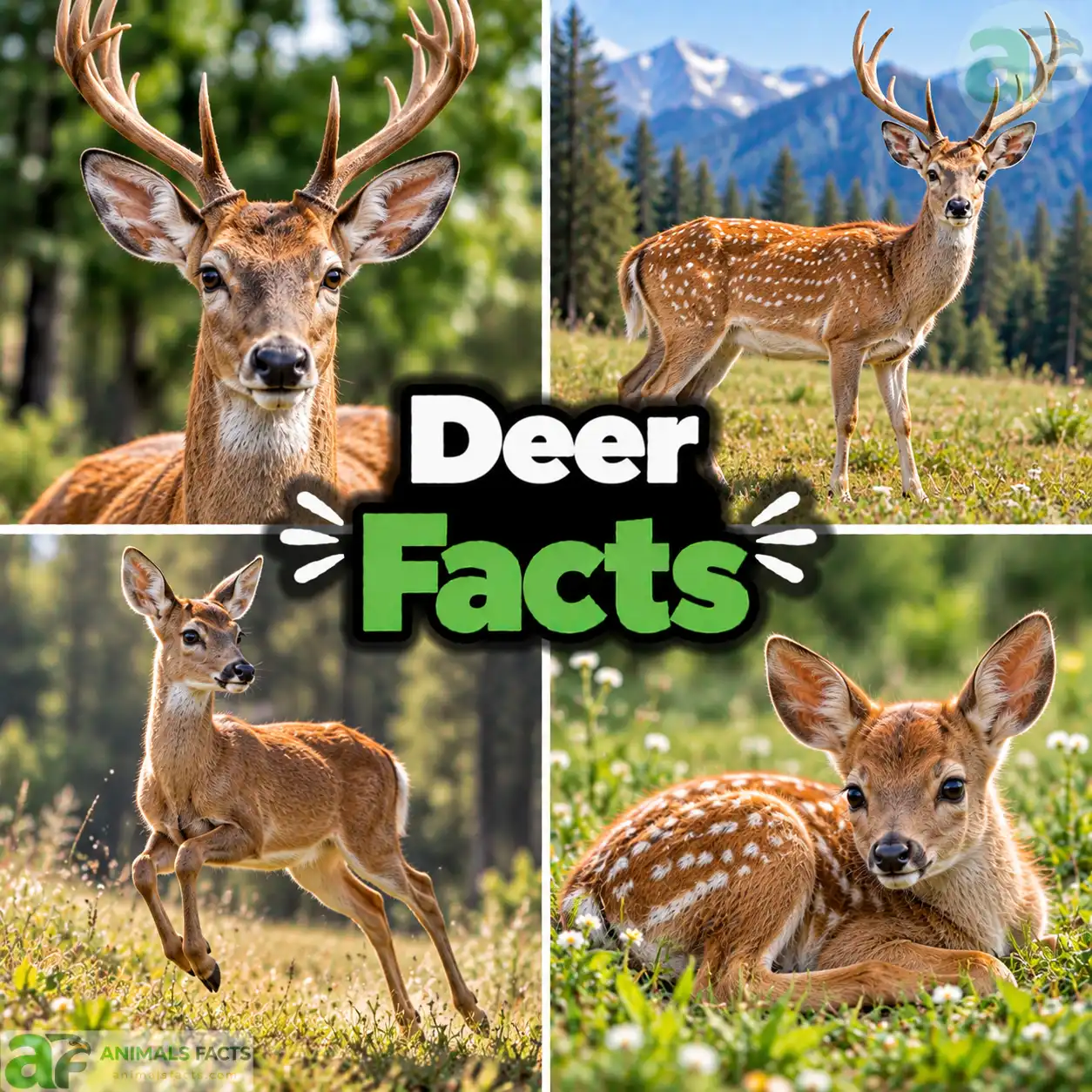
Deer Facts
| Feature | Details |
|---|---|
| Scientific Family | Cervidae |
| Common Species | White-Tailed Deer, Mule Deer, Red Deer, Roe Deer, Elk (Wapiti), Reindeer/Caribou, Fallow Deer, Sika Deer, Sambar Deer, Chital, Muntjac, Pudu, Water Deer |
| Kingdom | Animalia |
| Phylum | Chordata |
| Class | Mammalia |
| Order | Artiodactyla |
| Family | Cervidae |
| Habitat | Forests, grasslands, wetlands, mountains, tundra, and increasingly suburban areas across every continent except Antarctica (and Australia natively) |
| Lifespan | 2–20 years in the wild depending on species; up to 25 years in captivity |
| Diet | Herbivore — grasses, leaves, twigs, bark, fruit, and fungi |
| Weight | 7 kg (pudu) to over 800 kg (moose, the largest cervid) |
| Antlers | Present on males of nearly all species (both sexes in reindeer); shed and regrown annually |
| Top Speed | Up to 80 km/h (50 mph) — white-tailed deer |
| Conservation Status | Varies widely by species — most Least Concern; several (e.g., Père David’s Deer, certain Philippine and South American species) Endangered or Extinct in the Wild |
| Number of Species | Approximately 50–60 recognized species worldwide within family Cervidae |
| Unique Feature | The only mammal family whose males (and in one species, both sexes) grow and completely shed a new set of antlers every single year |
 1. Introduction: What is a Deer?
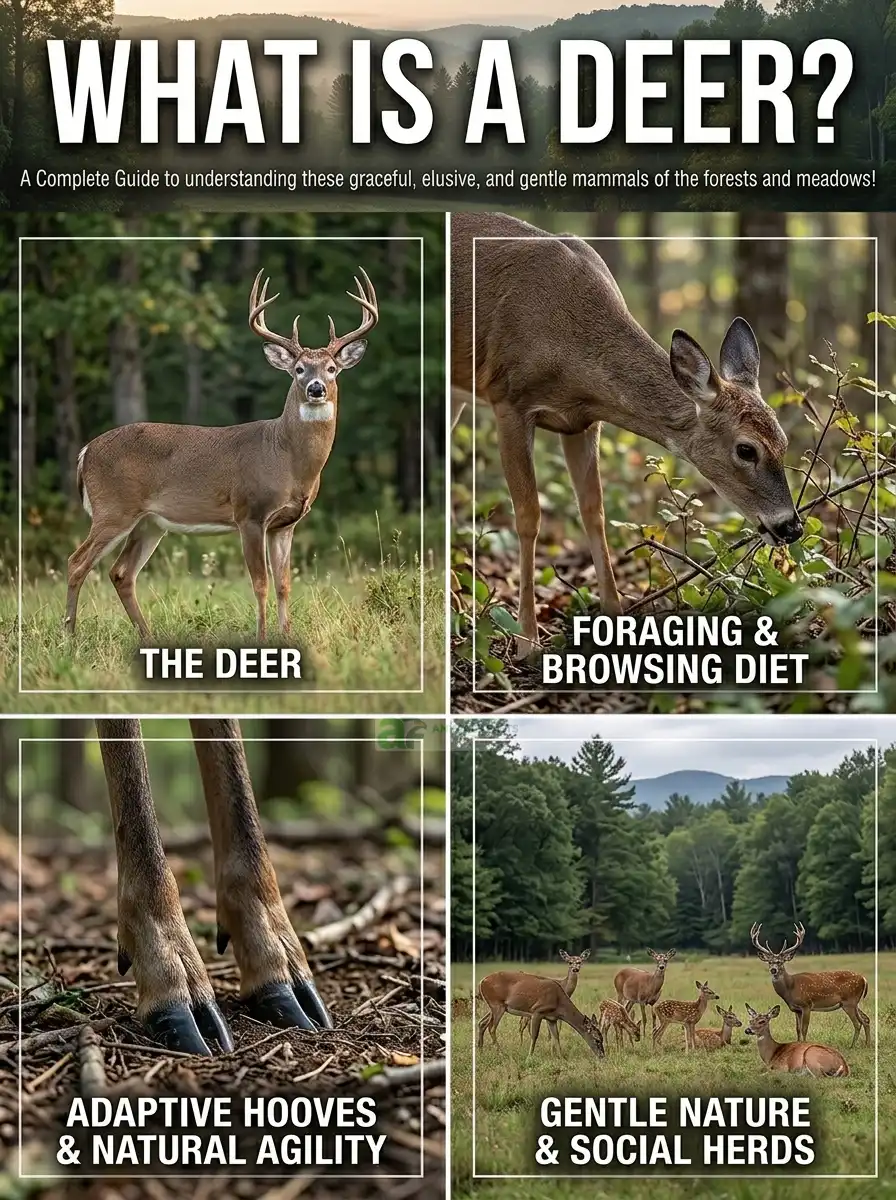
Few animal families are as instantly recognizable, as culturally beloved, or as biologically diverse as the deer. Deer facts span an extraordinary range of scale and adaptation — from the diminutive pudu of South America, standing barely 35 centimeters at the shoulder and weighing less than a housecat, to the towering moose, the largest living deer species, capable of exceeding 700 kilograms and standing taller at the shoulder than most horses. Between these two extremes sits a family of roughly 50–60 species distributed across nearly every continent on Earth, unified by one of the most remarkable anatomical features in the entire animal kingdom: the antler, a bony structure that most male deer — and in one unique species, both sexes — grow from scratch and shed completely every single year, a biological feat no other mammal family on the planet replicates.
The deer family, Cervidae, belongs to the order Artiodactyla (even-toed ungulates), placing deer among the broader evolutionary lineage that also includes cattle, sheep, goats, and even giraffes and hippopotamuses at a more distant remove. Yet deer are set apart from their bovid relatives by their antlers — true bone structures that are entirely regrown annually, in dramatic contrast to the permanent, unshed, keratin-covered horns of cattle and antelope. This single biological quirk, driven by the intense sexual selection pressures of the autumn breeding season, has made deer the subject of fascination across virtually every human culture that has shared territory with them, appearing in Paleolithic cave paintings tens of thousands of years old, in the mythologies of civilizations from Celtic Europe to Shinto Japan, and in some of the most enduringly popular children’s stories and holiday traditions of the modern era.
Beyond their cultural significance, deer occupy a genuinely fascinating and often contradictory position in modern wildlife management. While several deer species — including Père David’s Deer, the pampas deer, and numerous small tropical species — face genuine conservation concern, others, most notably the white-tailed deer of North America, have become so numerous in the absence of natural predators and amid ideal human-altered habitat that overabundance, rather than scarcity, is now the dominant management challenge. This dual reality — a family containing both critically threatened species and locally overabundant ones — makes deer facts a genuinely rich and multifaceted subject, spanning everything from Arctic caribou migrations spanning thousands of kilometers to suburban backyard deer conflicts playing out across millions of American households each year.
The sheer taxonomic breadth of Cervidae also makes it one of the more genuinely surprising mammal families to study closely. Casual observers often assume “deer” describes a fairly uniform kind of animal — four legs, antlers, a graceful bound through the forest — but the family in fact contains species that have abandoned antlers entirely in favor of saber-like tusks, species adapted to permanent Arctic snow cover, species that have thrived for millennia in tropical swamps, and even a species that vanished from the wild altogether and was rescued from the brink of total extinction purely by a single captive herd on an English country estate. Few mammal families offer such a rich case study in adaptive radiation — the process by which a single ancestral lineage diversifies into a wide array of forms suited to dramatically different environments.
Whether you’re a student researching deer facts for a school project, a hunter or wildlife photographer wanting to better understand deer behavior and rutting season dynamics, a driver curious about the very real risk of deer-vehicle collisions on rural roads, a parent looking for deer facts for kids, a gardener frustrated by browsing damage, or simply someone who has always been captivated by the grace and mystery of these animals, this guide covers everything — deer habitat, deer diet, the extraordinary annual antler cycle, reproduction, social behavior, predator relationships, conservation challenges, folklore, pop culture, and much more, across the full diversity of the deer family. This is the most complete guide to deer facts you will find anywhere.
2. Deer Species Overview & Classification
The deer family, Cervidae, is one of the largest and most geographically widespread families of large land mammals on Earth, encompassing an estimated 50–60 recognized species organized into two major subfamilies distinguished largely by antler structure, leg anatomy, and evolutionary lineage. Cervidae is itself part of the larger infraorder Pecora, a group of ruminant, cud-chewing mammals that also includes the bovids (cattle, sheep, goats, antelope), giraffids (giraffes and okapis), and the small, primitive musk deer family, Moschidae, which despite its name is not classified within Cervidae at all.
Classification Table
| Level | Classification |
|---|---|
| Kingdom | Animalia |
| Phylum | Chordata |
| Class | Mammalia |
| Order | Artiodactyla |
| Infraorder | Pecora |
| Family | Cervidae |
| Subfamilies | Cervinae (Old World deer) and Capreolinae (New World deer) |
| Closest Living Relatives | Bovidae (cattle, sheep, goats, antelope), Moschidae (musk deer), Giraffidae (giraffes) |
Major Deer Species Table
| Species | Scientific Name | Region | Notable Trait |
|---|---|---|---|
| White-Tailed Deer | Odocoileus virginianus | North, Central & South America | Most abundant and widespread deer in the Americas |
| Mule Deer | Odocoileus hemionus | Western North America | Named for oversized, mule-like ears |
| Red Deer | Cervus elaphus | Europe, Asia, North Africa | One of the largest Old World deer species |
| Elk (Wapiti) | Cervus canadensis | North America, East Asia | Famous for dramatic autumn “bugling” calls |
| Moose | Alces alces | North America, Europe, Asia | Largest living deer species |
| Reindeer/Caribou | Rangifer tarandus | Arctic/subarctic Northern Hemisphere | Only species where both sexes grow antlers |
| Roe Deer | Capreolus capreolus | Europe, western Asia | Small, common across European farmland |
| Fallow Deer | Dama dama | Europe (widely introduced elsewhere) | Distinctive palmate antlers and spotted coat |
| Sika Deer | Cervus nippon | East Asia | Small, spotted; widely introduced globally |
| Sambar Deer | Rusa unicolor | South & Southeast Asia | One of the largest Asian deer species |
| Pudu | Pudu puda / Pudu mephistophiles | South America | Smallest deer species in the world |
| Père David’s Deer | Elaphurus davidianus | China (historically) | Extinct in the wild; survives only in captive/reintroduced herds |
| Chital (Spotted Deer) | Axis axis | Indian subcontinent | Vividly spotted coat retained into adulthood |
| Muntjac | Muntiacus spp. | South & Southeast Asia | Small, ancient lineage; known as “barking deer” |
| Marsh Deer | Blastocerus dichotomus | South America (wetlands) | Largest deer species in South America |
| Pampas Deer | Ozotoceros bezoarticus | South American grasslands | Near Threatened; declining due to habitat loss |
| Barasingha (Swamp Deer) | Rucervus duvaucelii | Indian subcontinent | Named for distinctive 12-tine mature antlers |
| Water Deer | Hydropotes inermis | China, Korea | Lacks antlers entirely; males have tusk-like canines |
| Huemul | Hippocamelus spp. | Andes Mountains | Endangered; national animal of Chile |
| Tufted Deer | Elaphodus cephalophus | Central China | Small forest species with a black crest of hair |
Subfamily Comparison Table
| Feature | Cervinae (Old World Deer) | Capreolinae (New World Deer) |
|---|---|---|
| Example Species | Red deer, sika deer, fallow deer, chital, sambar | White-tailed deer, moose, caribou, mule deer, pudu |
| Primary Distribution | Europe, Asia, Africa | Americas (with some overlap into Eurasia via moose/caribou) |
| Metatarsal Gland Position | Upper leg | Lower leg |
| Antler Beam Structure | Tends toward more branching from a main beam | Tends toward more dichotomous (forked) branching |
| Typical Social Structure | Often strongly herd-forming | More variable; several solitary species |
A Family of Extremes
Perhaps no other mammal family on Earth showcases quite as extreme a range of body sizes and habitat adaptations under a single unifying taxonomic banner as Cervidae. Within this one family exists an Arctic specialist capable of surviving temperatures below -40°C (reindeer), a species so small it can comfortably walk beneath a dining table (pudu), the largest antlers of any living animal (moose), a species that has entirely lost its antlers in favor of saber-like tusks (water deer), and a species declared extinct in the wild that survives today purely because of a single captive European herd (Père David’s Deer). This extraordinary diversity is a direct product of the deer family’s long evolutionary history and its successful radiation into nearly every temperate and tropical terrestrial habitat across four continents.
Muntjac — Living Fossils of the Deer World
Among the most taxonomically fascinating deer are the muntjacs (genus Muntiacus), a group of small, ancient forest-dwelling species native to South and Southeast Asia often described by biologists as among the most primitive living members of the deer family. Fossil evidence suggests muntjac-like deer have existed in relatively similar form for over 15–35 million years, making them one of the oldest surviving deer lineages on Earth. Muntjacs are famous for two unusual traits: their loud, dog-like alarm bark (earning them the nickname “barking deer”) and their remarkable chromosomal diversity — the Indian muntjac holds the distinction of having the lowest chromosome number of any known mammal, with females possessing just 6 chromosomes and males 7, a genetic curiosity that has made the species a subject of considerable interest in evolutionary genetics research.
The Huemul — Chile’s Endangered National Animal
The huemul, a stocky, short-antlered deer native to the southern Andes Mountains of Chile and Argentina, holds the distinction of being one of the most endangered deer species in the Western Hemisphere, with the South Andean huemul now restricted to small, fragmented populations totaling only a few thousand individuals. Despite its dire conservation status, the huemul holds deep national significance, appearing on Chile’s national coat of arms alongside the Andean condor — making it one of the relatively few deer species to hold official state symbolism despite being critically imperiled in the wild.
Species Evolution & Discovery Timeline
~30 million years ago: The earliest deer-like ancestors appeared in Eurasia during the Oligocene epoch, small hornless forms lacking the antlers that define the modern family, more closely resembling small, hornless forest-dwelling ungulates than the deer familiar today.
~20 million years ago: True antlers began evolving among early cervid lineages during the Miocene, likely driven by sexual selection pressures favoring males with impressive but periodically renewable weaponry and display structures — a genuinely novel evolutionary solution compared to the permanent horns favored by the bovid lineage evolving in parallel.
~15 million years ago: Early muntjac-like deer had already established themselves in Asia, representing one of the oldest continuously recognizable deer lineages still alive today.
~5 million years ago: The Cervidae family had diversified substantially, with early representatives of both the Old World (Cervinae) and New World (Capreolinae) lineages established across their respective continents, setting the stage for the family’s eventual worldwide distribution.
~2–3 million years ago: Ancestral deer crossed into North America via the Bering land bridge during a period of lowered sea levels, eventually giving rise to the diverse array of New World species including white-tailed deer, mule deer, moose, and caribou through subsequent adaptive radiation across the continent’s varied habitats.
Pleistocene epoch: Deer coexisted with a spectacular array of now-extinct megafauna, including the so-called “Irish elk” (Megaloceros giganteus) — not actually a species of elk at all, but rather the largest deer species ever known — which possessed the largest antlers of any known deer species, spanning up to 3.65 meters, and went extinct roughly 7,700 years ago, likely due to a combination of climate change, habitat loss, and human hunting pressure at the end of the last Ice Age.
Pre-modern human history: Deer have been hunted by humans since the Paleolithic era, appearing extensively in cave art across Europe — including the famous painted deer of Lascaux and Chauvet in France, dating back over 17,000 years — and served as a foundational subsistence resource across virtually every culture within the deer’s global range, shaping tool-making traditions built around bone and antler material.
17th–19th centuries: European colonization led to widespread introduction of deer species (particularly red deer, fallow deer, and sika deer) to regions far outside their native range, including Australia, New Zealand, and parts of South America, in several cases creating significant invasive species concerns that persist today, particularly in fragile island and grassland ecosystems lacking natural cervid predators.
1865–1870s: The last wild population of Père David’s Deer in China was largely destroyed following flooding of the Chinese Imperial Hunting Garden and subsequent unrest, with the species surviving only through a small number of individuals previously sent to European zoos and private collections, most critically the herd established at Woburn Abbey in England.
20th century: Unregulated hunting drove several deer species to the edge of extinction, while conservation and hunting regulation efforts allowed other populations, such as white-tailed deer in North America, to recover dramatically from historic lows caused by 19th-century market hunting — a recovery so successful that by the late 20th century, overabundance rather than scarcity had become the primary management concern in much of the eastern United States.
2000s–2026: Deer populations in many developed regions have grown so large in the absence of natural predators that overabundance — rather than scarcity — has become the dominant deer management concern in parts of North America and Europe, generating new categories of human-deer conflict centered on vehicle collisions, agricultural damage, and disease transmission, while Arctic reindeer/caribou populations simultaneously face mounting climate-driven pressure from an entirely different direction, and chronic wasting disease has emerged as an accelerating concern across cervid populations in multiple countries.
3. Deer Physical Description & Unique Features
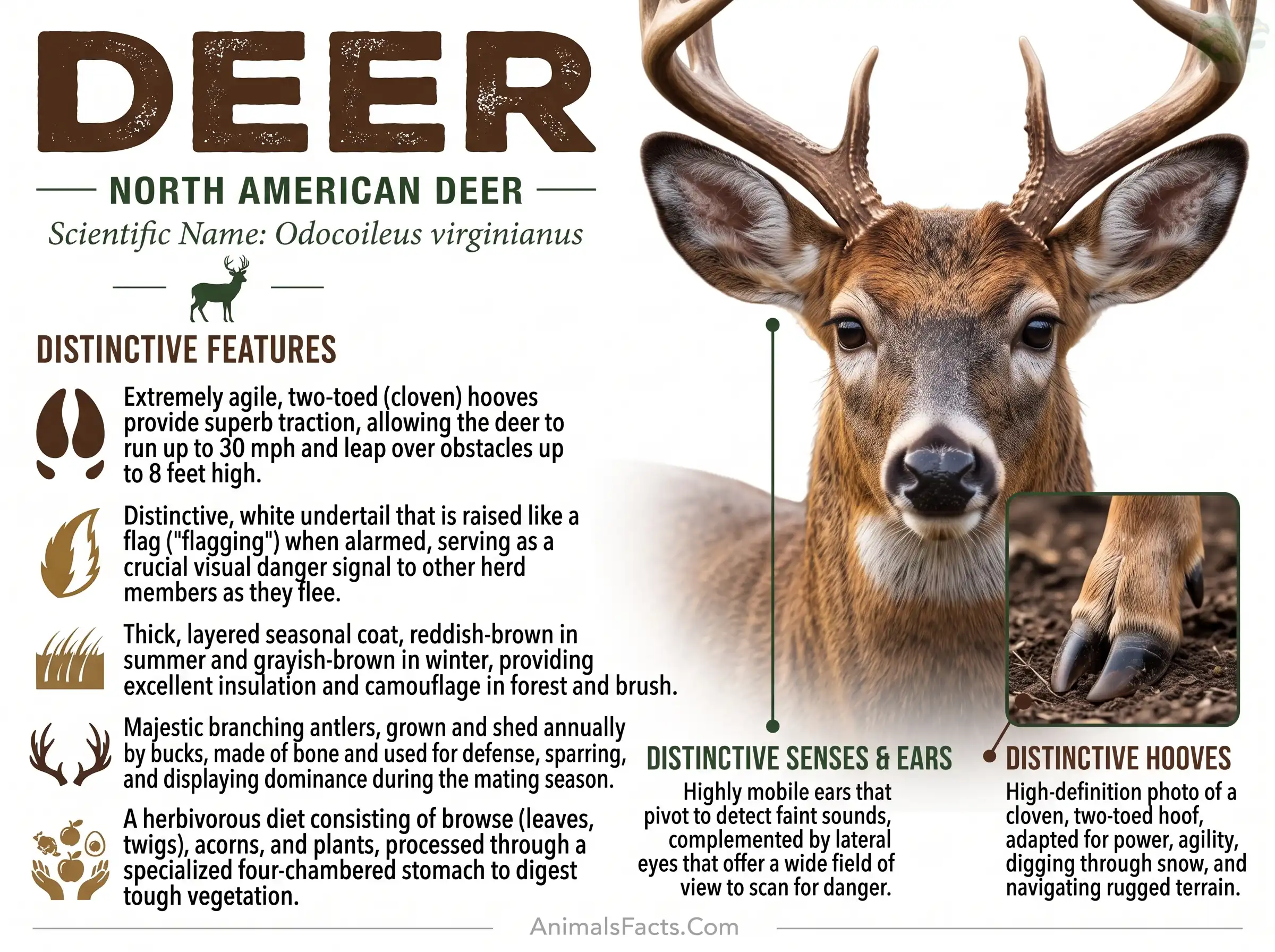
Deer species vary enormously in size, coloration, and antler structure, but share a core set of anatomical features that define the family — most notably the presence of antlers, a trait unique to Cervidae among all mammals, alongside a shared four-chambered ruminant digestive system and a generally graceful, long-legged body plan optimized for both browsing and rapid escape from predators.
Size Range — From the Pudu to the Moose
Few mammal families show as extreme a size range as Cervidae, spanning nearly a hundredfold difference in body weight between the smallest and largest living species:
- Southern Pudu: The smallest deer species in the world, standing just 35–45 cm at the shoulder and weighing as little as 7–13 kg — small enough that an adult could comfortably fit inside a standard airline carry-on suitcase.
- Northern Pudu: A closely related, similarly diminutive species found at higher elevations in the northern Andes, slightly smaller than its southern cousin on average.
- Muntjac: Small forest-dwelling deer weighing typically 10–33 kg, among the most ancient living deer lineages, believed to have changed relatively little in body form over millions of years of evolution.
- Chinese Water Deer: A small, antlerless species weighing 9–15 kg, notable for its unusual saber-tooth-like canines rather than antlers.
- White-Tailed Deer: A mid-sized species, typically 45–150 kg depending on subspecies and region, with northern populations generally larger than southern and tropical populations, following a broader ecological pattern known as Bergmann’s rule.
- Red Deer/Elk: Large-bodied species, with elk bulls reaching 225–450 kg and red deer stags reaching 90–250 kg depending on subspecies and habitat quality.
- Sambar Deer: One of the largest Asian deer species, with mature stags reaching up to 270 kg in exceptional individuals.
- Moose: The largest living deer species, with mature bulls reaching 380–700 kg, occasionally more in exceptional Alaskan individuals — heavier than a grand piano and taller at the shoulder than most riding horses.
Antlers — The Defining Feature of the Family
Antlers are the single most iconic and biologically remarkable feature of the deer family, distinguishing Cervidae from all other mammal groups, including the superficially similar but fundamentally different horns of cattle, sheep, and antelope.
Antlers vs. horns: Unlike horns, which are permanent, keratin-covered bone structures that grow continuously throughout an animal’s life and are never shed, antlers are composed of true bone, grow anew each year from a permanent base called a pedicle, and are shed and completely regrown every single year — a genuinely unique biological cycle among mammals, requiring an enormous annual investment of calcium, phosphorus, and overall metabolic energy.
Growth cycle: Antler growth begins in spring, covered in a soft, blood-vessel-rich tissue known as “velvet” that supplies nutrients to the rapidly developing bone beneath; during peak growth, some larger species can add several centimeters of antler length per day, among the fastest bone growth rates documented in any mammal. By late summer, blood flow to the velvet ceases and the tissue is shed, often assisted by the animal rubbing its antlers against trees and brush — a behavior sometimes called “velvet stripping” — revealing hardened bone in time for the autumn breeding season.
Sexual dimorphism: In the vast majority of deer species, only males grow antlers, used primarily for mate competition and display during the breeding season. The sole exception among all Cervidae is the reindeer/caribou (Rangifer tarandus), in which both males and females grow antlers — a trait believed to assist females in defending limited winter food resources in the harsh Arctic environment, and one that has made reindeer a genuine biological outlier within their own family.
Largest and smallest: The moose produces the largest living antlers, spanning up to 1.8 meters, while smaller species such as muntjac and pudu produce comparatively tiny, simple spike antlers or, in some cases, no antlers at all in favor of elongated upper canine tusks used for territorial combat — an entirely different weapon system that appears to have evolved as an alternative to, rather than alongside, elaborate antler development in certain smaller, more forest-adapted lineages.
Antlers as an honest signal: Because antler growth demands such an enormous nutritional and metabolic investment, biologists widely regard antler size and symmetry as an “honest signal” of a male’s overall health, age, and genetic quality — a poorly nourished or unhealthy male simply cannot produce large, symmetrical antlers regardless of genetic potential, making antlers a genuinely reliable indicator that both rival males and potential mates can assess at a glance.
Palmate versus tined antlers: Antler structure varies considerably across the family. Moose and fallow deer develop broad, flattened “palmate” antlers resembling an open hand, while species like red deer, elk, and white-tailed deer develop more traditional branching, tine-based antler structures — differences believed to reflect both evolutionary lineage and the specific visual display functions antlers serve within each species’ particular mating system.
The Antlerless Exception — Water Deer and Musk Deer
Not every member of the broader deer lineage relies on antlers at all. The Chinese water deer (Hydropotes inermis) is entirely antlerless, with males instead developing elongated, saber-like upper canine teeth — sometimes protruding several centimeters below the lower jaw — used in territorial disputes, giving the species its evocative popular nickname of “vampire deer.” This striking adaptation is a reminder that antler development, while nearly universal across Cervidae, is not an absolute requirement for the family, and that alternative weapon systems have evolved independently in some lineages, closely paralleling the tusk-based combat system of the more distantly related musk deer.
The Tufted Deer’s Distinctive Crest
Another unusual member of the family, the tufted deer of central China, is named for the prominent tuft of dark hair on its forehead, which partially obscures its small antlers, and also possesses small tusk-like canines similar in function, if not scale, to those of the Chinese water deer — another example of the family’s occasional departure from the “classic” antler-dominated body plan.
Coat and Coloration
Deer coat coloration varies significantly by species and season, ranging from the vivid, permanently retained spotted coat of the chital, to the reddish-brown summer coat and greyer winter coat of the red deer, to the countershaded brown-and-white coat of the white-tailed deer, whose namesake tail flashes bright white when raised as an alarm signal while fleeing. Many temperate-zone deer species also undergo a notable seasonal coat change, growing a thicker, often duller-colored winter coat for insulation and shedding it for a lighter, more reddish summer coat as temperatures rise. Reindeer possess perhaps the most cold-adapted coat of any deer species, with dense underfur and hollow guard hairs providing exceptional insulation against Arctic conditions, along with a coat that whitens somewhat in winter to aid camouflage against snow.
Sensory Adaptations
Hearing: Deer possess large, independently rotating ears capable of detecting sound from multiple directions simultaneously without needing to turn the head, an important early-warning adaptation against predators approaching from any angle.
Smell: Most deer species rely heavily on scent for both predator detection and social communication, with well-developed scent glands located near the eyes (preorbital glands), on the legs (tarsal and metatarsal glands), and between the hooves (interdigital glands) used for territorial and social marking, individual recognition, and trail-following between herd members.
Vision: Deer eyes are positioned laterally on the skull, providing an extremely wide field of view — nearly 300 degrees in many species — well-suited to detecting movement and approaching predators from almost any direction, though at some cost to depth perception and fine visual detail directly ahead. Deer vision is also adapted for excellent low-light (crepuscular and nocturnal) sensitivity, though research suggests deer perceive color quite differently from humans, with limited ability to distinguish red and orange tones — a fact of particular practical relevance to hunters selecting blaze-orange safety clothing.
Hooves: Deer hooves are cloven (split into two toes), an adaptation shared broadly across Artiodactyla, with additional small “dewclaws” positioned higher on the leg. Certain wetland-adapted species, such as the marsh deer and Chinese water deer, possess somewhat wider, more splayed hooves that assist movement across soft or waterlogged ground.
Did You Know? The extinct “Irish elk” (Megaloceros giganteus), which roamed Ice Age Europe and Asia until roughly 7,700 years ago, possessed the largest antlers of any deer species ever documented — spanning up to 3.65 meters (12 feet) from tip to tip and weighing as much as 40 kg, making them among the most extraordinary display structures ever evolved by any mammal, and a structure so demanding to grow and carry that some paleontologists have theorized it may have contributed to the species’ eventual extinction as its preferred open habitat contracted at the end of the last Ice Age.
4. Top 25 Surprising & Interesting Deer Facts
- Deer are the only mammal family in which most males — and in one species, both sexes — grow and completely shed a new set of antlers every year.
- The southern pudu is the smallest deer species in the world, standing just 35–45 cm tall at the shoulder.
- The moose is the largest living deer species, with bulls occasionally exceeding 700 kg.
- Antlers are made of true bone and can grow several centimeters per day during peak summer growth in the largest species.
- Reindeer (caribou) are the only deer species in which both males and females grow antlers.
- White-tailed deer can run at speeds of up to 80 km/h (50 mph) and leap horizontally over 9 meters in a single bound.
- The extinct “Irish elk” had the largest antlers ever recorded, spanning up to 3.65 meters.
- Deer have a nearly 300-degree field of vision, allowing them to detect predators approaching from almost any direction.
- A group of deer is called a herd, while a group specifically of roe deer can be called a bevy.
- Deer are excellent swimmers, with several species, including white-tailed deer, documented crossing rivers and even swimming between islands.
- Père David’s Deer is extinct in the wild and survives today only through captive breeding and reintroduction programs originating from a single European royal menagerie population.
- Fawns of many species, including white-tailed deer, are born with almost no scent, an adaptation that helps protect them from predators during their first vulnerable weeks.
- Deer stomachs, like those of cattle, have four chambers, allowing them to digest tough, fibrous plant material through repeated chewing (rumination).
- Some deer species, including muntjac and Chinese water deer, have elongated canine “tusks” instead of, or in addition to, antlers for territorial combat.
- Deer-vehicle collisions cause an estimated 1–2 million crashes annually in the United States alone.
- Male deer of many species lose significant body weight during the autumn breeding season (the “rut”) due to reduced feeding and intense competition for mates.
- Deer are found on every continent except Antarctica, with native populations absent from Australia (though several species have since been introduced there).
- Roe deer are one of the few deer species capable of delayed implantation, in which a fertilized embryo pauses development for several months before continuing gestation.
- A newborn white-tailed deer fawn can stand and walk within just a few hours of birth.
- Some deer species, such as chital, retain their spotted coat pattern into adulthood, unlike most deer species that lose juvenile spots after a few months.
- Deer antlers were historically ground into traditional medicine preparations across parts of Asia, a practice that continues today in some regions, particularly involving young “velvet antler.”
- The word “deer” originally referred broadly to any wild animal in Old English, only narrowing to its current specific meaning over subsequent centuries.
- Fallow deer are known for their unusually variable coat coloration, ranging from spotted to solid black within the same population.
- White-tailed deer populations in parts of North America have grown so large in the absence of natural predators that overabundance is now a significant ecological and agricultural management concern.
- The Indian muntjac has the lowest chromosome count of any known mammal, a remarkable genetic curiosity within an otherwise ordinary-looking small forest deer.
5. Fun Facts About Deers
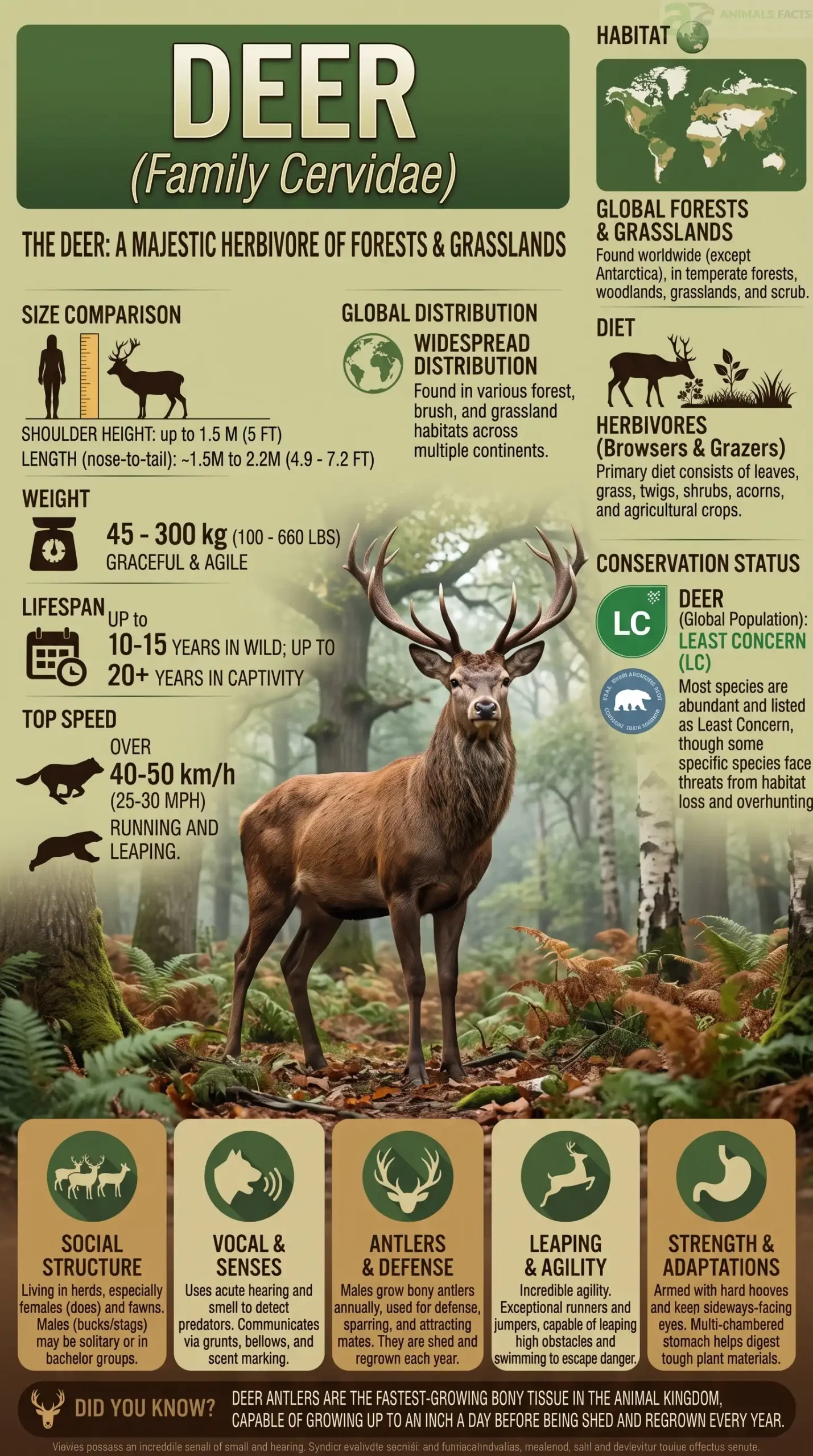
- Deer are the only mammal family with true, annually shed antlers.
- The pudu is the smallest deer species in the world.
- The moose is the largest deer species in the world.
- Only reindeer grow antlers on both males and females.
- White-tailed deer can run up to 80 km/h.
- Deer have nearly a 300-degree field of vision.
- A baby deer is called a fawn.
- Deer stomachs have four chambers for digesting tough plants.
- Some deer species are excellent swimmers.
- Deer are found on every continent except Antarctica (natively).
- Père David’s Deer is extinct in the wild.
- Deer antlers can grow several centimeters per day in the largest species.
- The Chinese water deer has no antlers at all — just tusks!
- Deer have poor red-color vision compared to humans.
- Reindeer herds can number in the tens of thousands during migration.
- Muntjac have the lowest chromosome number of any mammal on Earth.
- The huemul appears on Chile’s national coat of arms.
6. Deer Natural Habitat & Geographic Range
Few mammal families demonstrate the habitat breadth of Cervidae, with different species adapted to environments ranging from Arctic tundra to tropical rainforest to open temperate farmland, and even the fringes of major cities.
Primary Habitat Types Across the Family
Temperate forests: Home to species such as red deer, white-tailed deer, and roe deer, offering both browse vegetation and cover from predators.
Grasslands and farmland edges: Many deer species, including white-tailed deer and fallow deer, thrive at the interface between open feeding areas and forest cover, a habitat type sometimes referred to as “edge habitat” that has expanded significantly due to human agricultural and suburban development.
Arctic tundra: Reindeer/caribou are uniquely adapted to Arctic and subarctic conditions, undertaking some of the longest land migrations of any terrestrial mammal in pursuit of seasonal forage across an otherwise inhospitable landscape.
Tropical and subtropical forest: Species such as sambar deer, chital, and muntjac inhabit dense tropical forest across South and Southeast Asia, often alongside major predators including tigers and leopards.
Wetlands: The marsh deer of South America is specifically adapted to seasonally flooded grassland and wetland habitat, with partially webbed hooves aiding movement through soft, waterlogged ground, while the Chinese water deer similarly favors riverbank and marshland habitat across its native and introduced range.
Mountainous terrain: Mule deer, huemul, and certain red deer populations inhabit steep, high-elevation terrain across western North America, the Andes, and parts of Eurasia, undertaking seasonal elevational migrations between summer alpine range and lower-elevation winter range.
Urban and suburban environments: White-tailed deer, in particular, have adapted remarkably well to suburban landscapes across much of the eastern United States, thriving on ornamental landscaping and lacking significant natural predators within city and suburban limits, while sika deer have similarly colonized suburban and even urban fringe habitat across parts of Japan, the UK, and Maryland’s Chesapeake Bay region following historical introductions.
Geographic Range Table
| Region | Representative Species | Population Status | Notes |
|---|---|---|---|
| North America | White-tailed deer, mule deer, elk, moose | Abundant | White-tailed deer especially overabundant in parts of the eastern US |
| Europe | Red deer, roe deer, fallow deer | Abundant | Widely managed through regulated hunting |
| Asia | Sika deer, sambar, chital, muntjac, water deer | Variable | Some species declining due to habitat loss |
| Arctic/Subarctic | Reindeer/caribou | Declining in parts of range | Climate change significantly affecting migration and calving |
| South America | Pudu, marsh deer, pampas deer, huemul | Variable, some declining | Several species facing significant habitat pressure |
| Australia/New Zealand | Red deer, fallow deer, sambar (introduced) | Invasive/established | No native deer species; all populations introduced |
| Africa (North) | Barbary red deer | Critically limited | Small relict population in Tunisia/Algeria |
Habitat Overlap and Niche Partitioning
In regions where multiple deer species coexist — such as parts of North America hosting both white-tailed and mule deer, or South Asian forests hosting sambar, chital, and muntjac together — species typically partition available habitat and food resources to reduce direct competition, with each species favoring subtly different vegetation zones, elevations, or feeding strategies, a pattern ecologists refer to as niche partitioning and one that has allowed remarkably dense multi-species deer communities to persist across parts of Asia and North America.
The Global Spread of Introduced Deer
Deer species have been introduced by humans to numerous regions well outside their native range, sometimes deliberately for hunting purposes and sometimes accidentally through escapes from captive collections. Red deer, fallow deer, and sambar were all introduced to Australia and New Zealand during the 19th and 20th centuries, where — absent native predators adapted to hunt them — several populations have expanded to the point of significant ecological concern, damaging native vegetation and competing with native wildlife. Similarly, sika deer introduced to parts of the eastern United States, Ireland, and continental Europe have, in several locations, begun hybridizing with native red deer populations, raising genuine conservation concern about the preservation of genetically pure red deer stock in affected regions.
Did You Know? Reindeer/caribou undertake some of the longest land migrations of any terrestrial mammal on Earth, with some North American caribou herds traveling over 5,000 kilometers annually between summer and winter ranges — a journey increasingly disrupted by climate change, industrial development, and shifting vegetation patterns across the Arctic, with several major herds documented experiencing significant population decline directly linked to these migratory disruptions over the past two decades.
7. Deer Diet & Feeding Behavior
Deer are herbivores, but dietary strategy varies meaningfully across the family, generally falling into two broad categories: browsers, which favor woody plants, leaves, and shrubs, and grazers, which favor grasses — with many species falling somewhere in between as dietary generalists capable of shifting strategy based on local vegetation availability.
Diet Breakdown Table (Representative — White-Tailed Deer)
| Food Type | Approximate Percentage | Notes |
|---|---|---|
| Leaves and browse | 30–50% | Primary food source across most of the year |
| Grasses and forbs | 20–30% | More prominent in spring and summer |
| Acorns and other nuts/mast | 10–25% | Critical high-fat autumn food source |
| Agricultural crops | Variable | Significant source of human-deer conflict |
| Fungi and lichen | 5–10% | More significant in certain regions and seasons |
Browsers vs. Grazers
Browsers (e.g., white-tailed deer, roe deer, moose, muntjac) favor woody twigs, leaves, and shrubs, generally inhabiting forested or mixed habitat where such vegetation is abundant, and possess dental and digestive characteristics somewhat better suited to processing more concentrated, less fibrous plant material.
Grazers (e.g., red deer in open habitat, some elk populations, pampas deer) favor grasses in more open terrain, showing dental and digestive adaptations somewhat more suited to processing fibrous grass material, including generally higher-crowned teeth resistant to the abrasive silica content common in grasses.
Mixed feeders: Many deer species shift diet composition seasonally and regionally based on local vegetation availability, demonstrating considerable dietary flexibility that has been a key factor in the family’s broad geographic success.
Reindeer — A Highly Specialized Arctic Diet
Reindeer possess one of the most specialized diets in the entire deer family, relying heavily on lichen, particularly during the long Arctic winter when other vegetation is unavailable beneath deep snow. Reindeer are able to digest lichen — a food source largely indigestible to most mammals — through specialized gut microbiota, and are further adapted with keen senses of smell capable of detecting lichen beneath significant snow depth, alongside broad, shovel-like hooves used to dig through snow to reach buried forage, a behavior known as “cratering.”
Digestive Adaptations
Like cattle and other ruminants, deer possess a four-chambered stomach — comprising the rumen, reticulum, omasum, and abomasum — that allows them to partially digest food, regurgitate it as “cud,” and re-chew it to extract maximum nutritional value from tough, fibrous plant material. This ruminant digestive strategy, shared broadly across the Pecora infraorder, allows deer to thrive on vegetation too nutritionally poor for many other herbivores to efficiently process, extracting energy through microbial fermentation occurring within the rumen chamber.
Seasonal Dietary Shifts
Deer diet composition shifts markedly across the year in temperate-zone species. Spring brings a flush of highly nutritious new growth, critical for antler regrowth in males and for supporting late pregnancy and lactation in females. Summer offers peak forage abundance and diversity. Autumn sees many species shift toward high-fat, calorie-dense foods such as acorns and other nut mast, building fat reserves ahead of winter. Winter represents the most nutritionally challenging period, with deer relying heavily on woody browse, bark, and stored fat reserves, often experiencing significant weight loss during the coldest months, particularly in northern populations facing deep snow and limited forage access.
Did You Know? Deer play a significant, and sometimes controversial, role in seed dispersal, with acorns, seeds, and fruit consumed and later deposited across the landscape through droppings — a genuine ecological service, though in overabundant populations, excessive deer browsing can simultaneously suppress forest regeneration by consuming tree seedlings before they can mature, a dynamic increasingly documented across parts of the northeastern United States where white-tailed deer densities have exceeded what many forest ecosystems can sustainably support.
8. Deer Reproduction & Life Cycle
Deer reproduction centers on an autumn breeding season known across most species as the rut, followed by a gestation period and birth timed to coincide with the emergence of spring vegetation, ensuring newborns arrive when maternal nutrition and available forage are both at their most favorable.
The Rut
Timing: Typically September to November across most temperate-zone deer species, varying by latitude, with more northern populations generally rutting earlier than southern populations of the same species.
Male competition: Males of most species compete for access to females through vocalizations, antler displays, scent marking of territory or “scrapes,” and, when necessary, direct physical combat involving antler-to-antler clashes that can occasionally result in serious injury or, rarely, fatal entanglement of locked antlers.
Elk bugling: Among the most dramatic rutting displays in the entire deer family, bull elk produce a distinctive, far-carrying “bugling” call during the rut — beginning as a deep bellow and rising into a high-pitched, almost eerie whistle before dropping into a series of grunts — used to advertise fitness, attract females, and challenge rival males across considerable distances.
Mating systems: Deer mating systems vary from the harem-based polygyny of red deer and elk, in which a single dominant male may mate with a substantial group of females, to the more solitary, territory-based mating strategies of species like roe deer, in which males defend individual territories rather than groups of females directly.
Gestation and Birth Comparison Table
| Species | Gestation Period | Typical Litter Size |
|---|---|---|
| White-Tailed Deer | ~200 days (6.5 months) | 1–3 fawns |
| Red Deer | ~235 days (7.5 months) | 1 calf |
| Moose | ~231 days (8 months) | 1 calf (twins in 10–30%) |
| Roe Deer | ~300 days (with delayed implantation) | 1–3 fawns |
| Reindeer | ~225 days (7.5 months) | 1 calf |
| Elk (Wapiti) | ~255 days (8.5 months) | 1 calf |
| Fallow Deer | ~230 days (7.5 months) | 1 fawn |
| Pudu | ~200–210 days | 1 fawn |
The Roe Deer’s Unique Delayed Implantation
Among the most biologically unusual reproductive strategies in the entire deer family belongs to the roe deer, which mates in summer (typically July–August) but delays implantation of the fertilized embryo until around December or January, effectively pausing development for several months before active gestation resumes — a reproductive strategy that ensures birth still occurs in the favorable conditions of late spring despite mating occurring many months earlier than in most other deer species.
Growth Stages Table (Representative — White-Tailed Deer)
| Stage | Age | Development |
|---|---|---|
| Birth | Spring (April–June) | 2–4 kg; spotted coat for camouflage |
| First standing/walking | Within hours | Precocial development |
| Weaning | ~2–4 months | Transition to solid vegetation |
| Loss of spotted coat | ~3–4 months | Transition to adult coloration |
| Independence | ~1 year | Young disperse or remain near maternal range |
| Sexual maturity | 1.5–2.5 years | Varies by sex and population density |
| First antler growth (males) | Year 1 | Small “button” or spike antlers appear |
| Peak antler development | 4–7 years | Largest, most symmetrical antler sets |
Deer Lifespan Comparison Table
| Species | Average Wild Lifespan | Maximum Captive Lifespan |
|---|---|---|
| White-Tailed Deer | 4.5–6 years (heavily hunted areas); up to 10+ | ~20 years |
| Red Deer | 10–13 years | ~18 years |
| Moose | 8–12 years | ~25 years |
| Roe Deer | 7–10 years | ~17 years |
| Reindeer | 10–15 years | ~17 years |
| Elk (Wapiti) | 10–13 years | ~20 years |
9. Social Behavior & Communication
Deer social structure varies considerably by species, ranging from the highly gregarious herding behavior of elk and reindeer to the more solitary or small-group tendencies of species such as moose and muntjac, generally reflecting the differing predation pressures, habitat openness, and food distribution patterns each species has adapted to over evolutionary time.
Herding vs. Solitary Species
Herd-forming species: Elk, red deer, and reindeer form substantial herds, particularly outside the breeding season, with reindeer herds during Arctic migration sometimes numbering in the tens of thousands of individuals — among the largest land migration aggregations of any terrestrial mammal on Earth.
Solitary or small-group species: Moose and muntjac are predominantly solitary, while white-tailed deer typically form small, loosely associated matriarchal family groups — usually an adult doe, her most recent fawns, and sometimes offspring from the previous year — outside the rut, with adult bucks often ranging independently or forming small, temporary “bachelor groups” outside the breeding season.
Dominance Hierarchies
Within herd-forming species, particularly during the rut, clear dominance hierarchies typically emerge among competing males, established and reinforced through a combination of visual displays, vocalizations, and, when necessary, direct physical combat — with dominant males typically gaining preferential, though rarely exclusive, access to receptive females during the breeding season.
Vocalizations and Communication
Deer communicate through a combination of vocalizations, body language, and scent marking:
Vocal signals: Range from the alarm snorts and bleats of white-tailed deer to the elaborate, resonant bugling calls of bull elk during the rut, to the surprisingly loud, dog-like barking alarm calls of muntjac, which has earned the species its common nickname of “barking deer.”
Body language: The raised, flashing white tail of a fleeing white-tailed deer — sometimes called “flagging” — serves as both an alarm signal to nearby deer and a visual target that fawns can follow while fleeing through dense cover, an adaptation particularly valuable in low-visibility forest environments.
Scent marking: Facial, leg, and interdigital (between-hoof) scent glands are used extensively for territorial marking and social communication across most deer species, with rutting-season bucks of several species creating distinctive ground “scrapes” and overhead branch “rubs” marked with scent to advertise their presence to both rivals and potential mates.
Deer Intelligence and Learning
Deer demonstrate notable behavioral flexibility and learning capacity, particularly evident in suburban populations that have learned to distinguish between armed hunters and unarmed pedestrians, adjust activity patterns around human schedules, and navigate complex urban and suburban landscapes with considerable skill — behavioral adaptations that have developed within just a few generations in many rapidly suburbanizing regions.
Did You Know? Wildlife biologist and cervid researcher Valerius Geist, one of the foremost authorities on deer family evolution and behavior, has noted that antler size and complexity across deer species closely track the intensity of male-male competition within each species’ particular social structure — heavily polygynous, herd-forming species tend to produce the most elaborate antlers, reflecting decades of research into how social organization shapes cervid evolution across the family’s remarkable diversity.
10. Predators & Defense Mechanisms
Deer face predation pressure from a wide range of carnivores across their global range, and have evolved a correspondingly diverse set of physical and behavioral defenses tailored to their specific predator communities and habitat types.
Natural Predators
Wolves: Significant predators of elk, moose, red deer, and other large cervids across much of the Northern Hemisphere, often hunting cooperatively in packs to bring down prey far larger than any single wolf could manage alone.
Mountain Lions/Cougars: A primary predator of mule deer and white-tailed deer across much of western North America, typically hunting through stealth and ambush rather than extended pursuit.
Bears: Opportunistic predators of deer, particularly fawns and calves, across much of the deer family’s range, with predation risk highest during the vulnerable first weeks of a fawn’s life.
Coyotes: Increasingly significant predators of white-tailed deer fawns across much of North America, particularly in regions where wolves have been extirpated and coyotes have expanded to fill the resulting ecological vacuum.
Tigers and Leopards: Primary predators of sambar deer, chital, and other Asian deer species across the Indian subcontinent and Southeast Asia, with chital in particular forming a critical prey base supporting tiger populations across much of India.
Lynx: A significant predator of roe deer across parts of Europe, particularly in regions where lynx populations have been successfully reintroduced or allowed to recover.
Golden Eagles and other large raptors: Documented predators of small deer species and fawns, including pudu and young muntjac, in regions where large raptor populations remain robust.
Defense Mechanisms
Speed and agility: Deer are generally fast, agile runners, with white-tailed deer capable of reaching 80 km/h and clearing obstacles over 2.5 meters high in a single bound, providing an effective escape strategy against most pursuing predators.
Alarm signaling: Species such as white-tailed deer use tail-flagging and alarm vocalizations — including sharp, explosive snorts produced by forcefully expelling air through the nostrils — to warn nearby individuals of danger.
Camouflage: Spotted fawn coats and countershaded adult coloration provide effective camouflage against dappled forest light and open terrain alike, with many fawns relying on remaining motionless and scent-free rather than fleeing during their first days of life, a strategy called “hiding” that complements their mother’s near-constant vigilance nearby.
Group vigilance: Herd-forming species benefit from multiple individuals simultaneously watching for predators, increasing overall detection likelihood — a phenomenon sometimes called the “many eyes” effect, well documented across numerous herding mammal species.
Aggressive defense (rare): While generally prey rather than predator, deer — particularly protective does with fawns and rutting bucks — are capable of genuine aggressive defense when directly threatened or cornered, occasionally resulting in injury to attacking predators or, rarely, to humans who approach too closely.
Predator-specific alarm responses: Interestingly, research has shown that some deer species can distinguish between different predator types based on scent, sound, or visual cues, adjusting their evasive response accordingly — for example, responding differently to an approaching wolf pack versus a solitary human hunter, reflecting a level of behavioral sophistication in predator assessment that continues to be studied by wildlife biologists.
11. Deer Facts for Kids
Hey kids — get ready to learn about one of the most graceful and fascinating animal families in the whole world!
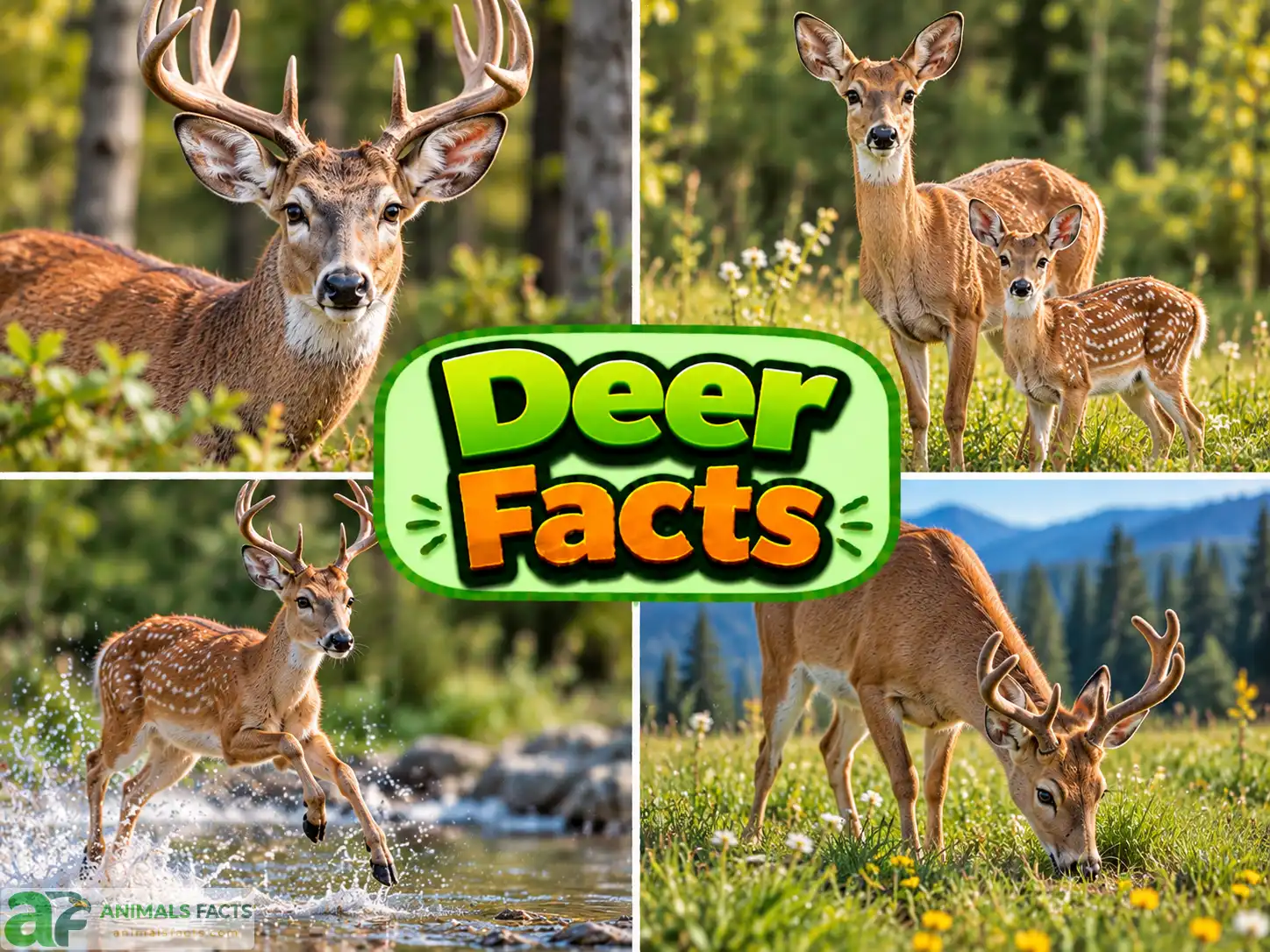
- Deer grow antlers made of real bone — and most kinds lose them every single winter, then grow brand new ones the next year!
- The smallest deer in the world, called a pudu, is barely bigger than a medium-sized dog!
- The biggest deer in the world, the moose, can weigh as much as a small car!
- A baby deer is called a fawn, and it’s born with cute white spots to help it hide in the forest!
- Deer can run super fast — up to 80 km/h — and jump over fences taller than a grown-up!
- Reindeer are the only deer where both the boy and girl reindeer grow antlers!
- Deer have amazing eyesight that lets them see almost all the way around themselves without turning their head!
- When a white-tailed deer runs away, it flips up its tail to show a big flash of white fur — like a warning flag for other deer!
- One kind of deer, called muntjac, actually makes a barking sound like a dog!
- A newborn fawn can already stand up and walk on wobbly legs just a few hours after being born!
- One tiny deer called the water deer doesn’t have antlers at all — it has little tusks instead, like a tiny walrus!
Did You Know? A newborn fawn can stand up and start walking within just a few hours of being born — and its spotted coat is so good at hiding it in sunlight and shadow that predators can walk right past without noticing it lying still in the grass! Baby fawns also have almost no smell at all for their first few days, which helps keep them extra safe from hungry animals sniffing around nearby.
12. Relationship with Humans
Deer have shared a long, complex relationship with humans spanning tens of thousands of years of hunting, domestication attempts, cultural symbolism, and — increasingly in the modern era — genuine conflict driven by overabundant populations in human-altered landscapes.
Historical Hunting and Subsistence
Deer have served as a foundational subsistence resource for human societies across virtually the entire global range of the family, providing meat, hides, and bone/antler material for tools, appearing extensively in Paleolithic cave art across Europe dating back tens of thousands of years, and forming a central component of hunting traditions across dozens of Indigenous and traditional cultures worldwide, from Native American nations across North America to countless communities throughout Europe and Asia.
Domestication — Reindeer as the Exception
While no deer species has been fully domesticated in the way cattle or sheep have, reindeer represent a significant partial exception, having been semi-domesticated by Arctic and subarctic Indigenous peoples, particularly the Sámi of northern Scandinavia, for herding, transportation, milk, and meat for well over a thousand years — a relationship so deeply integrated into traditional Sámi culture and subsistence economy that reindeer herding remains a protected, legally recognized cultural practice in parts of Scandinavia today.
Modern Human-Deer Conflict
Vehicle collisions: Deer-vehicle collisions represent a substantial and costly public safety issue, particularly in North America and parts of Europe, with the United States alone recording an estimated 1–2 million deer-related vehicle collisions annually, resulting in significant property damage, injury, and, in a meaningful number of cases, human fatalities, particularly during the autumn rut when deer movement and road-crossing activity increases substantially.
Agricultural damage: Overabundant deer populations in parts of North America and Europe cause significant crop and garden damage, representing an ongoing economic and management challenge for farmers, orchard operators, and home gardeners alike, driving considerable investment in deer fencing, repellents, and regulated culling programs.
Disease transmission: Deer populations, particularly white-tailed deer, serve as a significant host for disease vectors such as ticks carrying Lyme disease, an ecological dynamic increasingly studied as deer populations and suburban development both expand into closer and more frequent contact, with public health researchers tracking clear correlations between local deer density and regional tick-borne illness rates.
Deer Farming and Velvet Antler Industry
In several countries, particularly New Zealand and parts of China and Korea, commercial deer farming has developed into a significant agricultural industry, raising deer for venison meat and, notably, for velvet antler — the soft, blood-rich antler tissue harvested before hardening, which has been used in traditional Asian medicine for centuries and continues to command significant commercial value today.
Deer in Regulated Hunting Economies
Regulated deer hunting remains a significant cultural and economic activity across much of the family’s range, generating substantial revenue for wildlife management agencies through licensing fees that, in many jurisdictions, directly fund broader conservation efforts, habitat restoration, and population monitoring — with white-tailed deer hunting in particular representing one of the largest wildlife-related recreational economies in North America.
13. Deer Conservation Status & Threats
| Species | IUCN Status | Key Threats |
|---|---|---|
| White-Tailed Deer | Least Concern (locally overabundant) | Minimal — highly adaptable |
| Red Deer | Least Concern | Habitat fragmentation in parts of range |
| Reindeer/Caribou | Vulnerable (regionally variable) | Climate change, industrial development, habitat loss |
| Père David’s Deer | Extinct in the Wild | Historic overhunting; survives only through captive breeding |
| Pampas Deer | Near Threatened | Habitat loss, disease from livestock |
| Southern Pudu | Near Threatened | Habitat fragmentation, domestic dog predation |
| Marsh Deer | Vulnerable | Wetland habitat loss and degradation |
| Barasingha | Vulnerable | Historic habitat loss; recovering in protected areas |
| South Andean Huemul | Endangered | Habitat loss, livestock competition, disease |
Major Ongoing Threats
Habitat loss and fragmentation: Continues to pressure several deer species, particularly in South America and parts of Asia, where forest and wetland conversion for agriculture reduces available range and fragments remaining populations into smaller, more vulnerable groups.
Climate change: A particularly significant threat to reindeer/caribou populations, disrupting traditional migration timing and food availability across the Arctic, with warming temperatures also affecting insect harassment patterns, snow depth, and the timing of critical vegetation “green-up” that calving migrations are traditionally timed around.
Overabundance (a reverse conservation challenge): In parts of North America and Europe, white-tailed deer and other species have grown so numerous in the absence of natural predators that population management, rather than protection, has become the primary conservation and wildlife management focus, requiring regulated hunting seasons and, in some suburban areas, controversial culling programs to bring populations back into ecological balance.
Disease: Chronic wasting disease, a fatal neurological condition affecting deer, elk, and moose, has emerged as a significant and growing conservation concern across parts of North America, with no known cure and significant implications for both wild population health and regulated hunting industries.
Livestock competition and disease spillover: Several endangered South American species, including the huemul and pampas deer, face significant pressure from competition with introduced livestock and disease transmission from domestic cattle and sheep sharing overlapping habitat.
Did You Know? Père David’s Deer (Elaphurus davidianus) is classified as Extinct in the Wild, with every living individual today descended from a small captive population maintained in European zoos and private collections after the species’ original Chinese wild population was lost in the early 20th century — one of the more remarkable conservation recovery stories in the entire deer family, now supporting successful reintroduction efforts back into protected areas of China after being reintroduced there beginning in the 1980s.
14. Famous Deer
Bambi — the iconic Disney film character, arguably the single most culturally influential fictional deer in modern history, based loosely on the European roe deer in the original novel by Felix Salten but portrayed on screen more closely resembling a North American white-tailed deer.
Rudolph the Red-Nosed Reindeer — the beloved Christmas character, cementing reindeer as one of the most globally recognized holiday cultural symbols since the character’s creation in 1939.
The Père David’s Deer of Woburn Abbey — the specific captive herd in England credited with saving the species from total extinction after its disappearance from the wild in China, forming the genetic foundation for every Père David’s Deer alive today.
The Sacred Deer of Nara, Japan — hundreds of free-roaming sika deer inhabiting Nara Park, considered divine messengers in Shinto tradition and one of the most famous and beloved deer populations in the world, drawing millions of visitors annually and even trained to bow for food from tourists.
The White Stags of Richmond Park — rare white-coated red and fallow deer occasionally documented among Richmond Park’s famous London herds, capturing considerable public and media fascination whenever spotted.
15. Role in Ecosystem & Food Chain
As widespread and often abundant herbivores, deer play a substantial and sometimes complex role in shaping the ecosystems they inhabit, functioning as one of the most consequential large-herbivore influences on forest and grassland structure across much of the Northern Hemisphere.
Vegetation shaping: Deer browsing significantly influences forest understory composition and regeneration patterns, with overabundant populations in parts of North America and Europe documented suppressing native tree seedling growth and altering forest structure over time, sometimes shifting forest composition toward species deer find less palatable.
Prey base: Deer represent a critical prey species for large carnivores including wolves, mountain lions, tigers, and leopards across their respective ranges, forming a foundational link in numerous predator-prey food web dynamics, with deer population health and density often directly influencing the viability of predator populations dependent on them.
Seed dispersal: Deer contribute to seed dispersal through consumption and later deposition of fruit and seeds across the landscape, playing a genuine, if sometimes overlooked, role in forest regeneration and plant community dynamics.
Nutrient cycling: Deer carcasses, whether from natural predation, disease, or vehicle collision, provide significant nutrient input for scavenger species ranging from large carnivores to insects and decomposers, contributing meaningfully to local nutrient cycling.
Trophic cascade effects: The reintroduction of wolves to Yellowstone National Park in the 1990s and their subsequent predation on elk provides one of the most widely cited examples of a trophic cascade in modern ecology, with reduced elk browsing pressure linked to measurable recovery of riparian vegetation, which in turn benefited beaver, songbird, and fish populations — a striking illustration of how deer family population dynamics can ripple through an entire ecosystem.
16. Myths, Folklore & Cultural Significance
Deer hold deep symbolic and spiritual significance across an extraordinary range of world cultures and religious traditions, reflecting thousands of years of close human-deer coexistence across nearly every continent.
Celtic traditions: Deer, particularly stags, held significant spiritual symbolism in Celtic mythology, associated with the Otherworld and often depicted alongside deities linked to the natural world, forests, and the hunt.
Native American traditions: Deer appear extensively across dozens of Indigenous nations’ oral traditions and spiritual practices across North America, often symbolizing gentleness, swiftness, and connection to the forest, with deer hunting traditionally accompanied by rituals of respect and gratitude toward the animal across many nations.
East Asian traditions: In Chinese and Japanese culture, deer are frequently associated with longevity and good fortune, and sika deer roaming freely in Nara, Japan, are considered sacred messengers of the Shinto gods, protected and revered within the ancient city for over a thousand years.
Christian symbolism: The stag appears in various Christian iconographic traditions, sometimes symbolizing purity or spiritual thirst, referencing biblical imagery of a deer longing for flowing streams, and appearing prominently in the legend of Saint Hubertus, patron saint of hunters, said to have encountered a stag bearing a glowing crucifix between its antlers.
Scandinavian and Sámi traditions: Reindeer occupy an especially central role in Sámi cultural identity and spiritual tradition across northern Scandinavia, reflecting a relationship between people and animal that spans well over a millennium of shared subsistence and cultural practice.
Greek and Roman mythology: The deer, particularly the stag, was closely associated with Artemis (Diana in Roman tradition), goddess of the hunt and wilderness, who was frequently depicted alongside or transforming hunters into stags in various myths, most famously the tale of Actaeon.
17. Deer in Pop Culture
“Bambi” (1942) — Disney’s landmark animated film remains one of the most culturally significant and emotionally influential depictions of a deer in film history, shaping public perception of deer for generations of viewers worldwide.
“Rudolph the Red-Nosed Reindeer” — an enduring holiday cultural icon since the character’s introduction in 1939, expanding into television specials, songs, and merchandise that remain popular today.
Santa’s Reindeer — reindeer collectively occupy one of the most globally recognized roles in Western holiday mythology and popular culture, appearing in countless adaptations, decorations, and traditions each winter.
Deer in heraldry and branding — stags and deer imagery appear widely in European heraldic tradition and modern commercial branding, including the internationally recognized Jägermeister logo featuring a stag with a glowing cross between its antlers, directly referencing the legend of Saint Hubertus.
Deer in video games and animation — deer characters and imagery appear widely across modern animation and gaming, from woodland-themed adventure titles to nature documentaries aimed at younger audiences, continuing the family’s long-standing role as one of the most approachable and beloved wild animal archetypes in popular storytelling.
18. Deer Facts vs. Common Myths
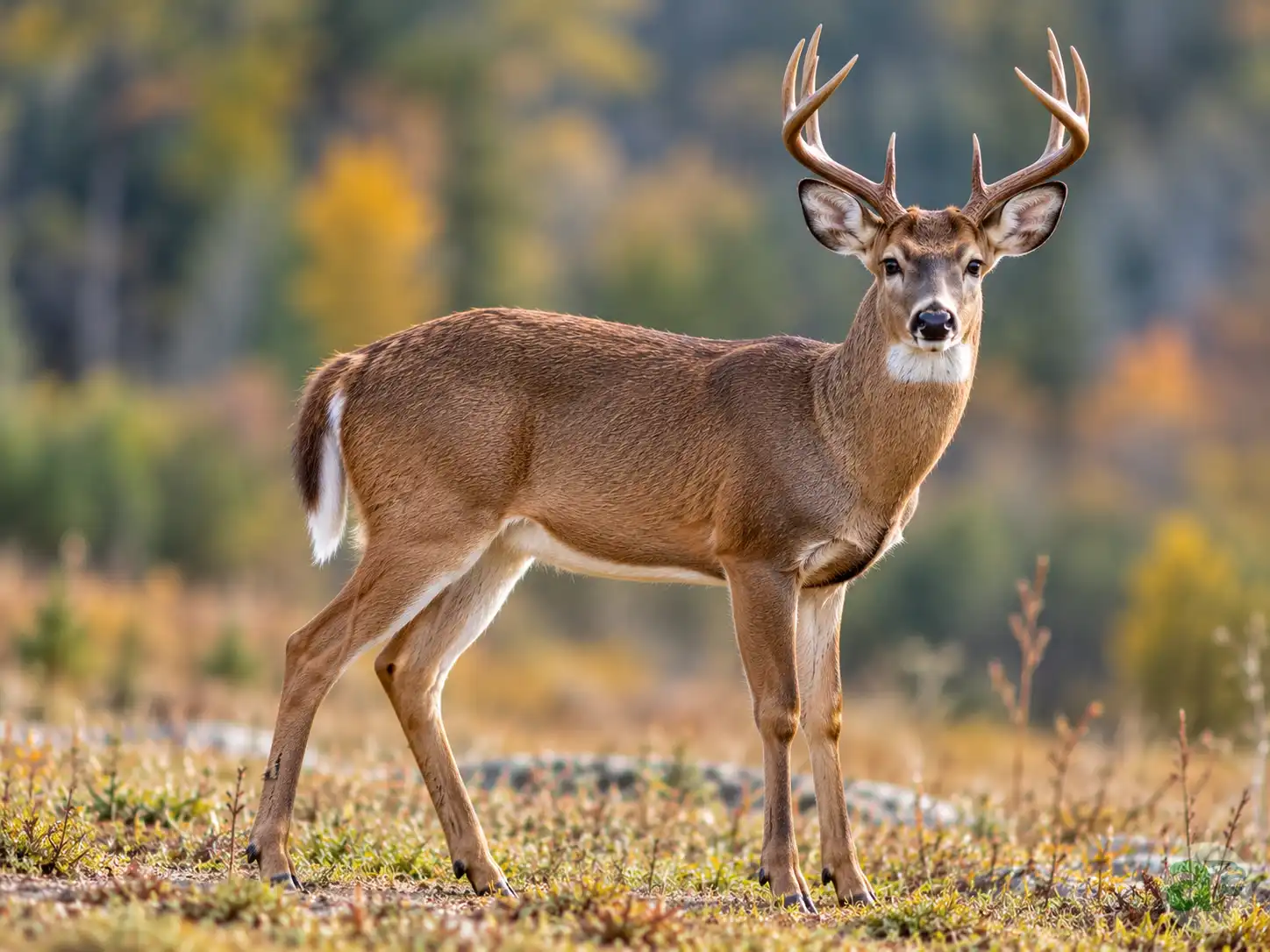
Myth: Deer antlers and horns are the same thing. Fact: Antlers are bone structures shed and regrown annually; horns are permanent, keratin-covered structures found in cattle, sheep, and antelope.
Myth: You can tell a deer’s age by counting antler points. Fact: Antler point count is influenced far more by nutrition, genetics, and age together — a young deer on excellent nutrition can grow more points than an older deer in poor habitat.
Myth: All deer species are endangered. Fact: Most deer species are classified as Least Concern, and several, including white-tailed deer, are considered locally overabundant in parts of their range.
Myth: Deer are silent animals. Fact: Deer produce a range of vocalizations, from alarm snorts to the dramatic bugling calls of bull elk during the rut, and even dog-like barks in muntjac.
Myth: All female deer lack antlers. Fact: While true for most species, female reindeer/caribou also grow antlers, making them the sole exception in the entire deer family.
Myth: Deer are exclusively nocturnal. Fact: Most deer species are actually crepuscular, meaning they’re most active at dawn and dusk rather than strictly at night.
Myth: All deer species live in herds. Fact: Social structure varies widely — moose and muntjac, for example, are predominantly solitary rather than herd-forming.
19. Best Places to See Deer in the Wild
Yellowstone National Park, Wyoming, USA — excellent elk and mule deer viewing, particularly during the autumn rut.
Richmond Park, London, UK — one of the most accessible and famous urban locations to view free-roaming red deer and fallow deer herds.
Nara Park, Japan — home to hundreds of famously tame, freely roaming sika deer considered sacred in local Shinto tradition.
Great Smoky Mountains National Park, USA — reliable white-tailed deer viewing throughout forest and meadow habitat.
Cairngorms National Park, Scotland — excellent red deer viewing, particularly during the dramatic autumn rutting season.
Bandhavgarh National Park, India — outstanding chital and sambar viewing alongside significant tiger populations.
Cape Breton Highlands National Park, Canada — reliable moose sightings alongside white-tailed deer across forested and coastal terrain.
20. Top Documentaries & Books
Various BBC and PBS Nature productions covering red deer rutting behavior and reindeer Arctic migration provide excellent starting points for deeper exploration of deer biology and behavior.
“The Encyclopedia of Deer” — a comprehensive reference resource covering the biology and diversity of the full deer family, useful for readers wanting species-by-species depth beyond general overviews.
“Bambi, A Life in the Woods” by Felix Salten (1923) — the original novel behind the famous Disney adaptation, offering a considerably more naturalistic and somber portrayal of roe deer life than its animated counterpart.
21. Comparison of Deer with Similar Animals
| Feature | White-Tailed Deer | Red Deer | Moose | Elk |
|---|---|---|---|---|
| Scientific Name | Odocoileus virginianus | Cervus elaphus | Alces alces | Cervus canadensis |
| Weight | 45–150 kg | 90–250 kg | 380–700 kg | 225–450 kg |
| Social Structure | Small family groups | Large herds | Solitary | Large herds |
| Diet | Browser | Mixed grazer/browser | Browser | Mixed grazer/browser |
| Conservation Status | Least Concern | Least Concern | Least Concern | Least Concern |
22. How You Can Help
Support organizations conducting deer and cervid conservation research, particularly reindeer/caribou climate adaptation studies through Arctic conservation groups, and drive cautiously in known deer-collision zones, particularly at dawn and dusk during autumn breeding season when deer movement significantly increases.
Practical actions:
Support habitat conservation organizations working to protect wetland habitat critical to threatened species like the marsh deer and pampas deer.
Practice safe driving in deer-collision hotspot regions, reducing speed at dawn and dusk and remaining especially alert during the autumn rut.
Participate in citizen science deer population monitoring programs offered by many state and provincial wildlife agencies.
Support regulated, science-based deer management programs in your region, which play a critical role in maintaining ecological balance in areas with overabundant populations.
23. Frequently Asked Questions About Deer
Q1: How many species of deer are there?
There are approximately 50–60 recognized species within the deer family, Cervidae.
Q2: What is the difference between antlers and horns?
Antlers are bone structures shed and regrown annually; horns are permanent, keratin-covered structures that grow continuously and are never shed.
Q3: What is the biggest deer species?
The moose is the largest living deer species, with bulls occasionally exceeding 700 kg.
Q4: What is the smallest deer species?
The southern pudu, standing just 35–45 cm at the shoulder.
Q5: Do female deer grow antlers?
Generally no — the sole exception is the reindeer/caribou, in which both sexes grow antlers.
Q6: How fast can deer run?
White-tailed deer can reach speeds up to 80 km/h (50 mph).
Q7: Are deer dangerous?
Deer-vehicle collisions pose significant risk, and deer can act defensively, particularly bucks during the rut, though direct attacks on humans are uncommon.
Q8: Are any deer species endangered?
Yes — several, including Père David’s Deer (Extinct in the Wild) and the pampas deer (Near Threatened), face significant conservation concern.
Q9: What do deer eat?
Deer are herbivores, eating leaves, grasses, twigs, bark, fruit, and fungi depending on species and season.
Q10: How long do deer live?
Lifespan varies significantly by species, from roughly 4.5–6 years in heavily hunted white-tailed deer populations to over 15 years in reindeer.
Q11: Which deer species has no antlers?
The Chinese water deer lacks antlers entirely, relying instead on elongated tusk-like canine teeth.
Q12: Why do deer shed their antlers?
Antler shedding conserves energy once the breeding season ends, allowing the body to redirect resources away from maintaining bone tissue that has served its seasonal purpose.
26. Sources & References
Sources
- Wikipedia — Deer: https://en.wikipedia.org/wiki/Deer
- IUCN Red List: https://www.iucnredlist.org/
- National Geographic — Deer: https://www.nationalgeographic.com/animals/mammals/facts/deer
- World Wildlife Fund: https://www.worldwildlife.org/
- Smithsonian’s National Zoo: https://nationalzoo.si.edu/
- Encyclopaedia Britannica — Deer: https://www.britannica.com/animal/deer
- BBC Wildlife: https://www.discoverwildlife.com/
- Live Science: https://www.livescience.com/