
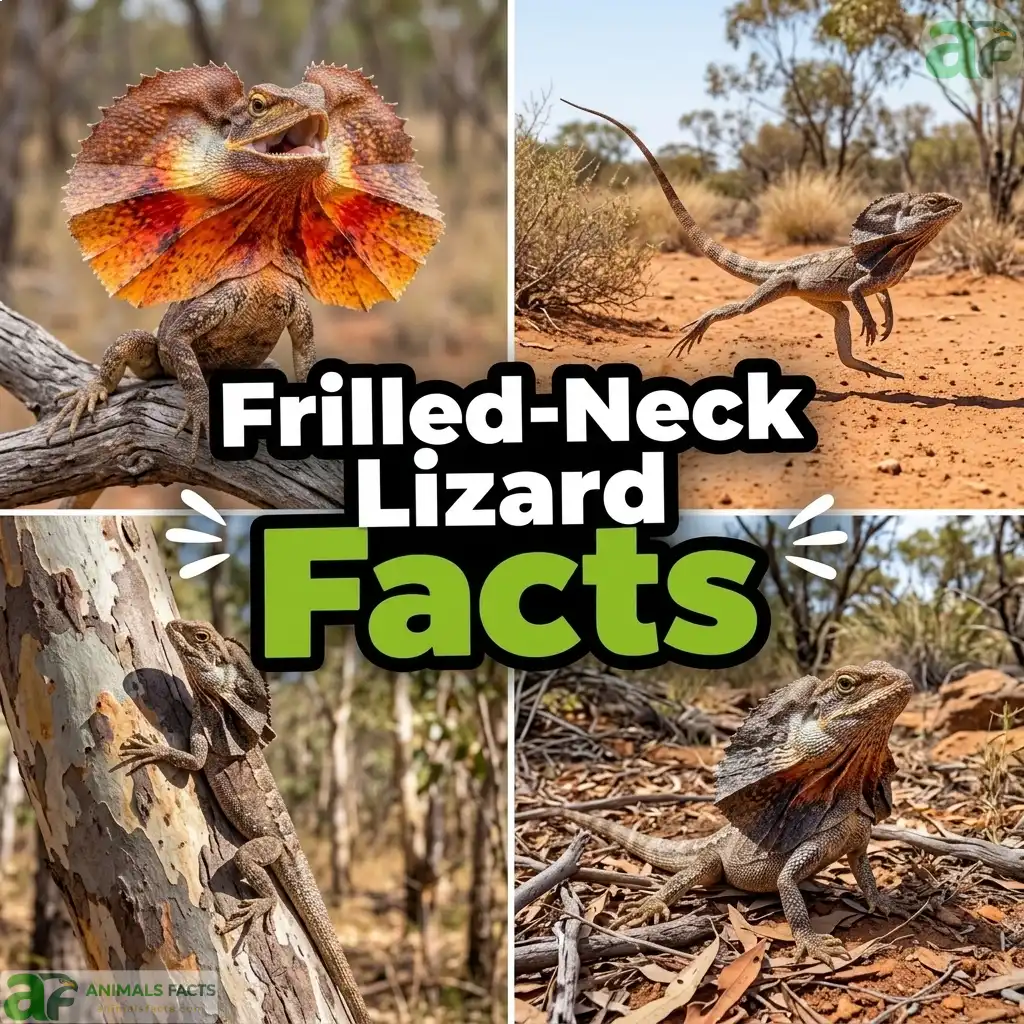
Frilled-Neck Lizard Facts
| Feature | Details |
|---|---|
| Scientific Name | Chlamydosaurus kingii (Gray, 1825) |
| Kingdom | Animalia |
| Phylum | Chordata |
| Class | Reptilia |
| Order | Squamata |
| Family | Agamidae |
| Common Names | Frilled-neck lizard; frilled lizard; frilled dragon; frillneck |
| Native Range | Northern Australia and southern New Guinea |
| Habitat | Tropical and subtropical dry forest, woodland, savanna — predominantly arboreal |
| Lifespan | 10–20 years (wild estimate); up to 20 years (captivity) |
| Diet | Insects, spiders, small lizards, small mammals — predominantly invertebrate prey |
| Body Length | 60–95 cm total length including tail |
| Weight | 0.5 kg (females) to 0.8 kg (males) |
| Top Speed | Up to 30 km/h — runs bipedally on hind legs |
| Conservation Status | Least Concern (IUCN) globally; Vulnerable in South Australia |
| Defining Feature | The extraordinary pleated skin frill around the neck — up to 30 cm diameter when fully erect |
| Closest Relatives | Other agamid lizards — including the water dragon, bearded dragon, and thorny devil |
| Locomotion | One of very few lizards that regularly runs bipedally on hind legs |
| Famous For | The dramatic frill display — and appearing on the Australian 2-cent coin (1966–1991) |
 1. Introduction: What is a Frilled-Neck Lizard?
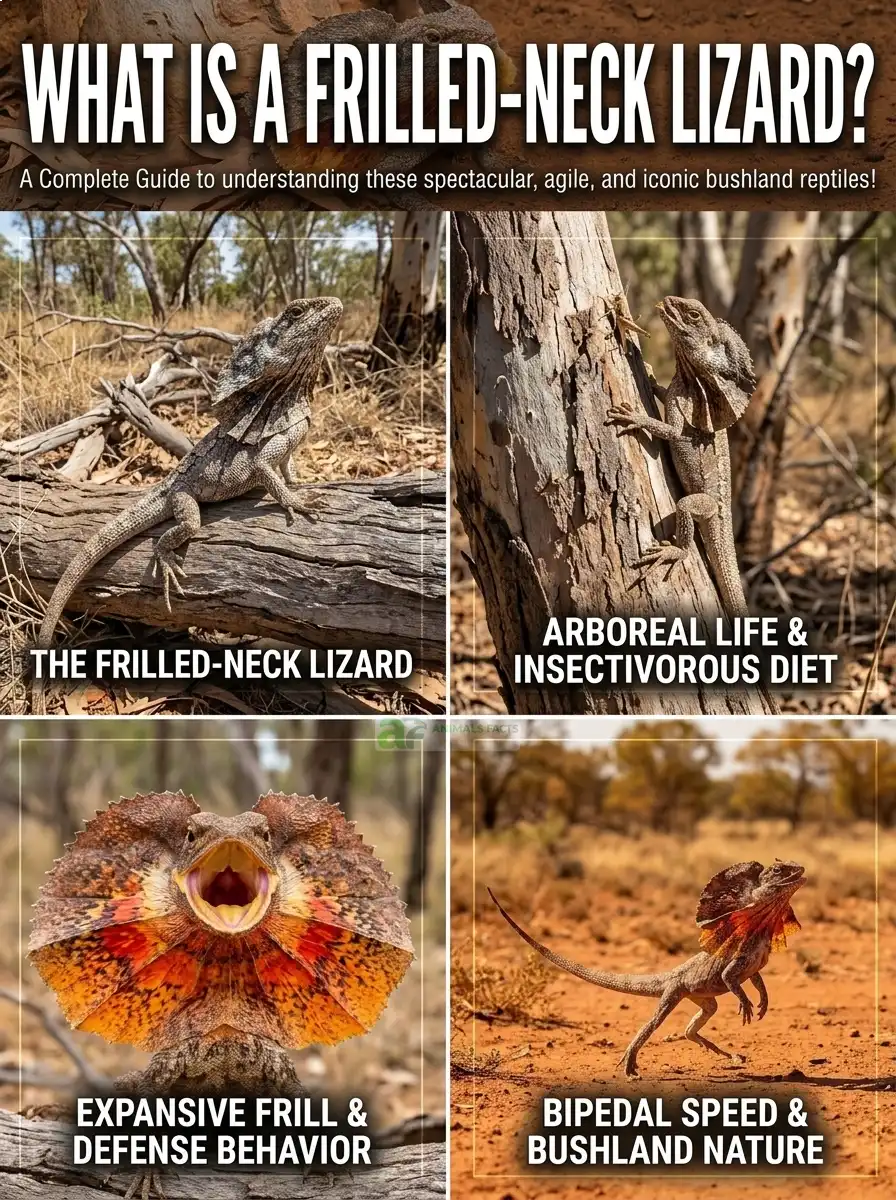
On a sun-bleached eucalyptus trunk in the tropical woodland of Australia’s Northern Territory, a lizard that has been invisible for the past hour — pressed flat against the bark, coloration matching the grey-brown surface with uncanny precision — suddenly transforms. A predator has approached too closely, and what was a flat, grey-brown patch of apparent bark erupts into something that belongs in a fever dream or a natural history museum’s idea of a threat display pushed to its absolute limit. The frill — a pleated membrane of skin that folds flat against the neck and body when at rest — snaps open like a parasol deployed at speed: a disc of orange, yellow, red, and black skin stretching to 30 centimeters in diameter, supported by elongated bones of the hyoid apparatus that spread like the spokes of an umbrella. Simultaneously, the mouth opens wide to expose a vivid yellow interior, the body is compressed laterally to maximize apparent size, and the animal produces a sustained hissing sound that carries the unmistakable quality of a threat that should be taken seriously. Frilled-neck lizard facts begin with this moment — one of the most spectacular defensive displays of any vertebrate on Earth, deployed by an animal that weighs less than a kilogram, against predators that may outweigh it by a factor of fifty.
The frilled-neck lizard (Chlamydosaurus kingii) is Australia’s most theatrically gifted reptile — an animal whose primary survival strategy is not speed, not camouflage, not venom, but performance. The frill display has been refined by millions of years of evolutionary selection into a biological illusion machine — the small lizard transformed, in the predator’s perception, into something larger, more dangerous, and more uncertain as a target than it actually is. Interesting facts about frilled-neck lizards reveal an animal of extraordinary biological sophistication — one of the few lizards that regularly runs bipedally on its hind legs; an arboreal specialist whose cryptic bark-matching coloration makes it effectively invisible when the frill is folded; a thermoregulation system calibrated to the extreme seasonal temperature range of northern Australia; a sexual dimorphism in which the male’s frill is significantly larger than the female’s — reflecting the frill’s role in both predator deterrence and mate competition; and a remarkable behavioral repertoire that extends far beyond the famous display to include complex territorial interactions, sophisticated foraging, and the remarkable ability to assess a predator’s intentions and calibrate the display accordingly.
Whether you are searching for frilled-neck lizard facts for kids captivated by this spectacular display lizard, a wildlife enthusiast wanting to understand the biology behind one of Australia’s most iconic animals, a herpetology researcher interested in the mechanics of lizard display systems, or simply someone who saw the frilled-neck lizard’s famous run in a natural history documentary and needed to understand everything about this extraordinary animal — this is your comprehensive guide. Australia’s most dramatic reptile has an extraordinary story to tell.
2. Frilled-Neck Lizard Species Overview & Classification
The frilled-neck lizard belongs to the family Agamidae — the dragons — one of the most species-rich lizard families globally, and the family that in Australia has diversified into the ecological roles occupied by iguanids on other continents.
Species Classification Table
| Taxonomic Rank | Classification |
|---|---|
| Kingdom | Animalia |
| Phylum | Chordata |
| Class | Reptilia |
| Order | Squamata |
| Suborder | Lacertilia |
| Family | Agamidae (Spix, 1825) |
| Genus | Chlamydosaurus (Gray, 1825) |
| Species | C. kingii (Gray, 1825) |
| Common Names | Frilled-neck lizard; frilled lizard; frilled dragon; frillneck |
| Etymology | Chlamydosaurus = “cloaked lizard” (Greek: chlamys = cloak/mantle + sauros = lizard); kingii — named for Phillip Parker King, the British naval officer and explorer who collected early Australian specimens |
Monotypic Genus
Chlamydosaurus is a monotypic genus — containing only the single species C. kingii. This taxonomic isolation reflects the frilled-neck lizard’s sufficiently distinctive morphology (particularly the unique frill apparatus) to warrant its own genus, while its molecular relationships place it firmly within the broader agamid family.
The Agamidae Family Context
The frilled-neck lizard belongs to a large and ecologically diverse family:
| Species | Common Name | Notable Feature | Range |
|---|---|---|---|
| Chlamydosaurus kingii | Frilled-neck lizard | The frill display | N. Australia, New Guinea |
| Physignathus lesueurii | Eastern water dragon | Semi-aquatic; arboreal | E. Australia |
| Pogona vitticeps | Central bearded dragon | Beard display | Central Australia |
| Moloch horridus | Thorny devil | Thorny skin; ant specialist | Arid Australia |
| Hydrosaurus amboinensis | Sailfin lizard | Sail crest; semi-aquatic | SE Asia |
| Draco volans | Flying dragon | Gliding membrane | SE Asia |
| Calotes versicolor | Garden lizard | Color-changing dewlap | S/SE Asia |
Evolution & Discovery Timeline
~80–100 million years ago — The agamid lizard lineage diverges from other lizard groups — establishing the family that will eventually produce the frilled-neck lizard. The agamid radiation in Australia coincides with the continent’s increasing isolation from Gondwana.
~15–20 million years ago — The Chlamydosaurus lineage becomes established — the frill apparatus evolving within the Australian agamid radiation as a display innovation in a woodland-and-savanna specialist lineage.
1825 — British zoologist John Edward Gray formally describes the species as Chlamydosaurus kingii — naming it for Captain Phillip Parker King, the naval officer and naturalist who collected early Australian specimens during coastal survey expeditions. The same year’s publication establishes both the genus Chlamydosaurus and the species — making this one of the earlier formal descriptions of an Australian reptile.
1840s–1880s — The frilled-neck lizard is documented by various European naturalists and collectors working in northern Australia — its dramatic appearance generating remarkable accounts in natural history literature that reach European audiences.
1964 — The frilled-neck lizard is selected for the Australian 2-cent coin — appearing on the reverse of this coin from its introduction with decimal currency in 1966 until the coin’s discontinuation in 1991, cementing the species as a national natural heritage symbol.
1984 — The frilled-neck lizard’s famous running sequence appears in the Jurassic Park source material discussions and in various natural history documentaries — the bipedal running behavior attracting international scientific and popular interest.
1993 — Steven Spielberg’s Jurassic Park uses the frilled-neck lizard’s frill display as the model for the Dilophosaurus display in the film — arguably the most culturally influential use of the species in popular media globally.
2000s–present — Systematic research using radio-telemetry, camera traps, and behavioral observation at sites including Litchfield National Park and various Northern Territory research stations provides the most comprehensive data on frilled-neck lizard ecology available.
2024 — Chlamydosaurus kingii maintains its Least Concern IUCN global classification — though the South Australian population retains Vulnerable status at state level, and some researchers express concern about populations near expanding agricultural and urban areas in northern Australia.
“The frilled-neck lizard is the finest example in the reptile world of what evolutionary biologists call an ‘honest signal’ pushed to its absolute theatrical extreme. The frill is not a weapon — it cannot hurt anything. But it is an extraordinarily effective lie, told to predators who have learned to be uncertain about what is behind the display. In evolutionary terms, uncertainty is survival.”
— Dr. Martin Whiting, Macquarie University, lizard behavioral ecologist
3. Frilled-Neck Lizard Physical Description & Unique Features
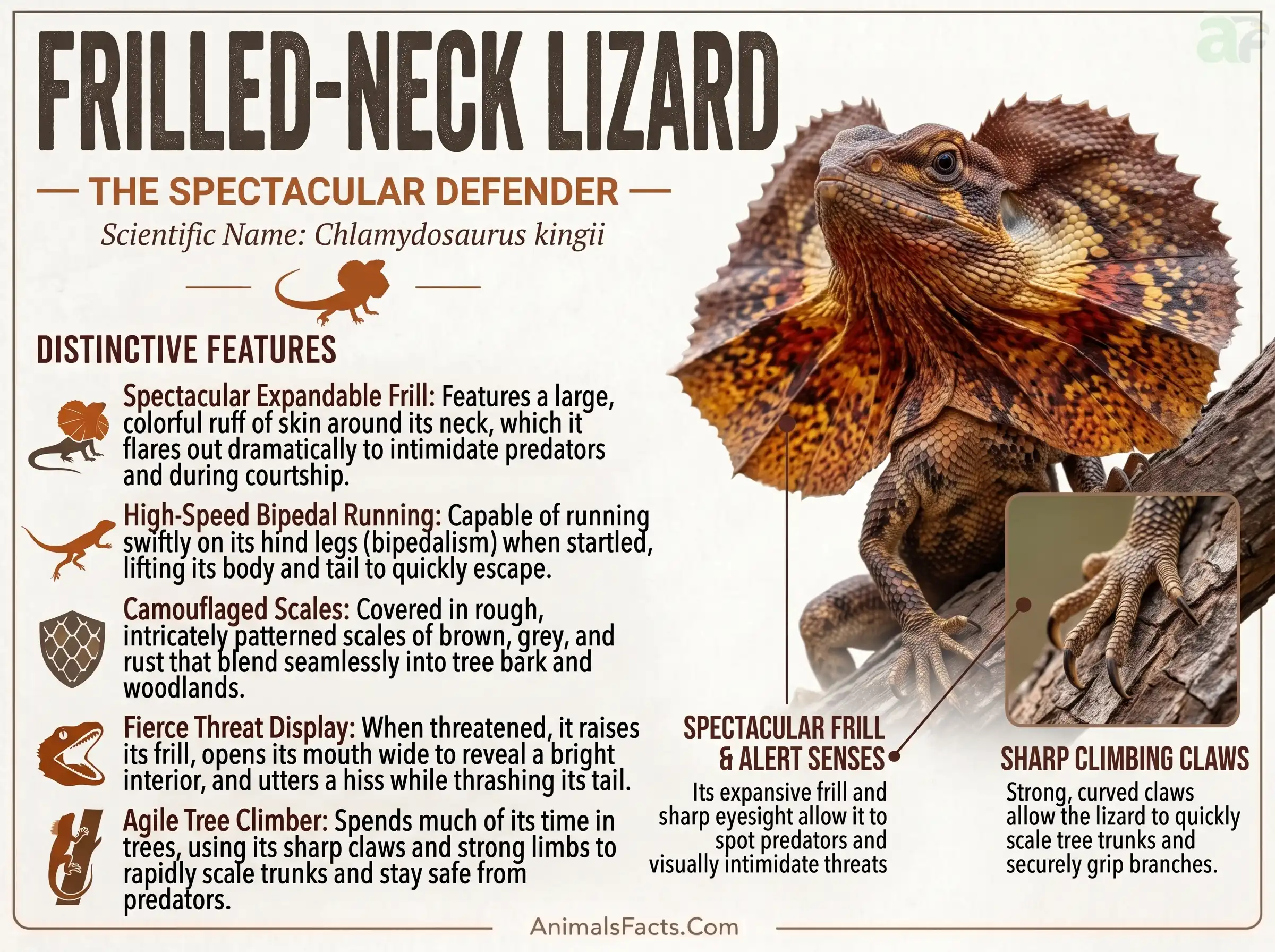
Frilled-neck lizard size and weight place it in the medium-sized lizard category — at 60–95 cm total length (including the long tail, which comprises approximately two-thirds of total length) and 0.5–0.8 kg body weight, it is a substantial lizard by Australian standards.
The Frill — The Defining Biological Structure
The frilled-neck lizard’s frill is the most elaborate display structure of any Australian reptile — and one of the most spectacular of any lizard globally:
The anatomy — The frill is a large flap of skin — the gular fold — that extends from the base of the skull and the neck on both sides. When folded, it lies flat against the body and neck, obscuring both the animal’s profile and its actual width. When erected, it spreads outward and forward, supported by elongated hyoid bones (the throat skeleton) that extend into the frill membrane like the ribs of an umbrella.
The erection mechanism — Frill erection is driven by hyoid bone rotation — the elongated ceratobranchial processes of the hyoid rotate outward and forward when the jaw-opening muscles contract, spreading the frill membrane as they go. This mechanical linkage between jaw opening and frill erection means that the frill cannot be fully erected without simultaneously opening the mouth — the two behaviors are mechanically coupled.
The dimensions — When fully erect, the frill can reach 30 cm in diameter — approximately the same diameter as a dinner plate. On an animal with a body length of approximately 25–30 cm (excluding tail), this represents a frill that is roughly as wide as the animal is long — an extraordinary proportional expansion.
The coloration — The frill’s inner surface is the most visually striking aspect of the display:
- Dominant colors: orange, red, yellow — the warm colors that appear most prominently during threat display
- Dark markings: patches of dark brown, grey, or black that create pattern complexity against the warm ground colors
- The rim: typically edged with darker coloration that creates a framing effect
Coloration variation — Frill coloration varies significantly by geographic origin — populations from different parts of the range show characteristic color patterns:
- Northern Territory: typically orange and black
- Kimberley (Western Australia): more red and yellow
- Queensland: often more yellow-orange with brown margins
Sexual dimorphism in the frill — Male frills are substantially larger than female frills — both in absolute terms and relative to body size. This size difference reflects the frill’s role in male-male competition — larger-frilled males win more territorial disputes without physical combat.
The folded-flat camouflage function — When the frill is folded, it lies flat against the neck and body, virtually invisible. The frill’s outer surface (visible when folded) matches the animal’s overall cryptic coloration — the combined effect of body color and folded frill making the lizard surprisingly difficult to see when pressed against tree bark.
The Body — Bark-Matching Camouflage
The frilled-neck lizard’s body coloration and texture are a study in cryptic design:
Dorsal coloration — Grey-brown to dark brown on the dorsal surface — with irregular patterns of lighter and darker areas that break up the animal’s outline when viewed against tree bark. Individual variation in pattern is substantial — contributing to the effectiveness of the camouflage by preventing predators from forming a single reliable “search image.”
Ventral coloration — Paler — cream to light grey — on the underside. The dorsoventral color gradient reduces the 3D shadow effect that would otherwise make the animal appear more prominent on a flat bark surface.
Scale texture — The scales are small, keeled, and irregular — their texture contributing to the bark-like visual effect of the animal when stationary against a tree trunk.
The Legs — Bipedal Running Capability
The frilled-neck lizard has relatively long hind limbs compared to body size — a proportion that facilitates its unusual bipedal running behavior:
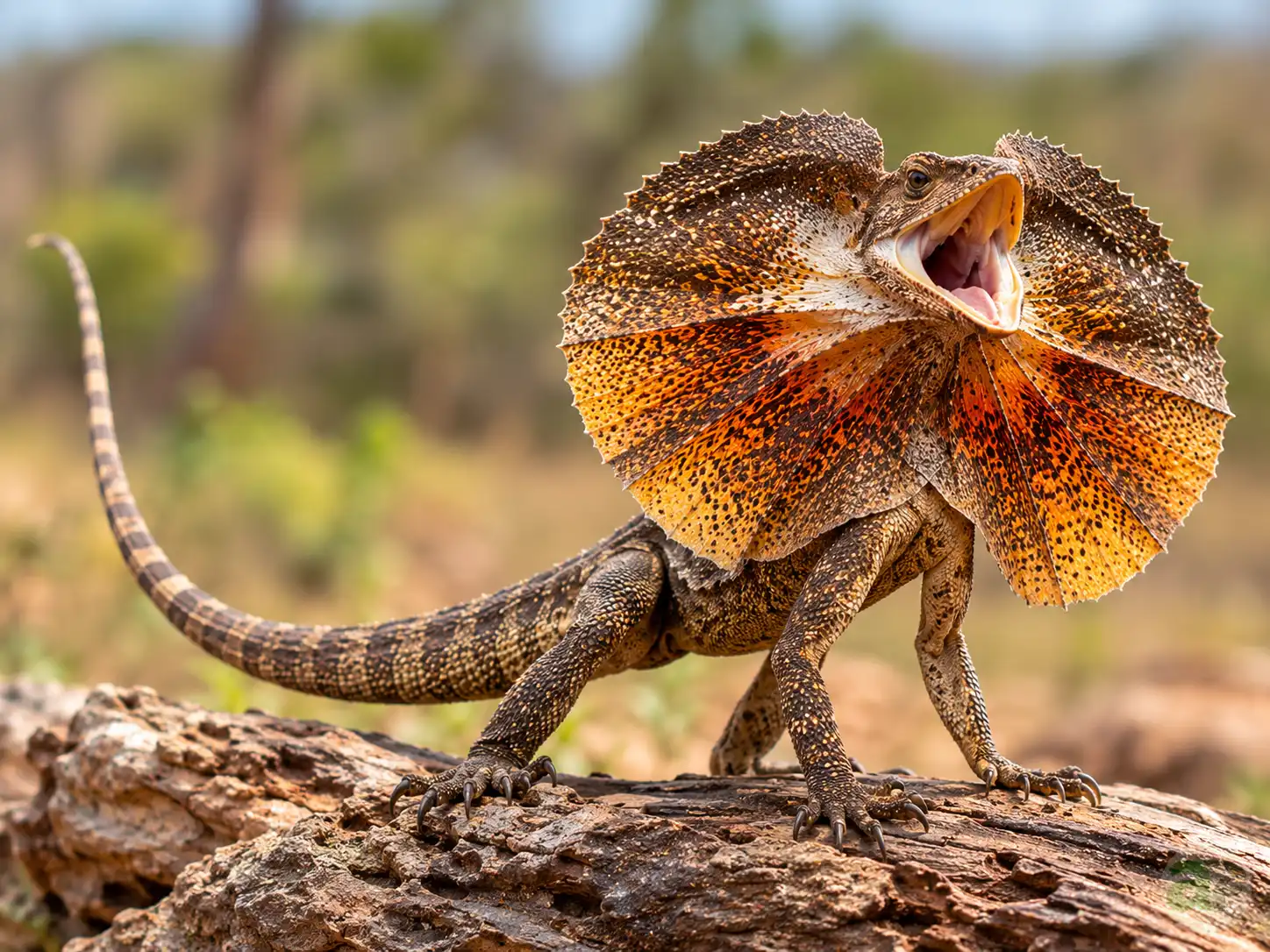
The bipedal run — When fleeing a threat at speed, the frilled-neck lizard rises onto its hind legs and runs bipedally — forelegs raised and held against the body or extended for balance, the tail held aloft as a counterbalance, the hind legs driving the body forward at remarkable speed for a lizard this size.
Speed — During the bipedal run, the frilled-neck lizard can reach speeds of approximately 30 km/h over short distances — fast enough to rapidly reach the base of a tree from several meters away.
The visual effect — The bipedal running frilled-neck lizard — with frill still erect, mouth open, running upright on two legs with its arms raised — is one of the most visually extraordinary sights in Australian wildlife. The combination of the display and the running creates the appearance of a much larger, more threatening animal in rapid motion.
Why bipedal? — Research suggests that bipedal running in frilled-neck lizards and other agamids is not a deliberate choice but an emergent property of fast running — as speed increases, the center of mass shifts backward due to tail inertia, naturally lifting the forelegs from the ground. The lizard’s anatomy then allows it to maintain balance and continue running bipedally.
The Tail — Counterbalance and Autotomy
The tail comprises approximately two-thirds of total body length — providing a significant counterbalance during bipedal running and arboreal locomotion:
The tail function — During bipedal running, the tail is held horizontally or slightly elevated — providing the counterbalance that allows the animal to maintain upright posture without toppling forward.
Autotomy — Like many lizards, frilled-neck lizards can detach their tail (autotomy) when seized by a predator — the detached tail continuing to wriggle, distracting the predator while the lizard escapes. The tail regenerates, though the regenerated portion differs in scale texture and coloration from the original.
💡 Did You Know? The frilled-neck lizard’s frill erection is mechanically linked to its jaw-opening muscles through the hyoid bone apparatus — meaning it is physically impossible for a frilled-neck lizard to fully erect its frill without simultaneously opening its mouth wide. This mechanical coupling is not an incidental association but an evolved feature of the display system: the gaping mouth, exposing the vivid yellow or orange interior, is as important a component of the threat display as the frill itself. The combined visual signal — large frill AND wide-open mouth exposing vivid coloration — is significantly more threatening than either element alone. Research using artificial models with frill-only and mouth-only stimuli versus combined stimuli has confirmed that predators respond most strongly to the combined display, confirming the evolutionary logic of the mechanical coupling. The frilled-neck lizard’s anatomy has been shaped by millions of years of predator responses to ensure that the display is always presented in its most complete and most effective form.
4. Top 25 Amazing Frilled-Neck Lizard Facts
Here is your definitive collection of the most extraordinary, scientifically verified, and genuinely astonishing frilled-neck lizard facts as of 2026:
- The frilled-neck lizard’s frill can reach 30 centimeters in diameter when fully erect — approximately the size of a dinner plate — on an animal whose body length (excluding tail) is only 25–30 centimeters. The frill is wider than the animal is long.
- The frilled-neck lizard appeared on the Australian 2-cent coin from the introduction of decimal currency in 1966 until the coin’s discontinuation in 1991 — one of the most visible and most widely reproduced images of any Australian reptile in history.
- The frilled-neck lizard is one of very few lizards in the world that regularly runs bipedally on its hind legs — rising onto two legs during rapid escape runs, with the forelimbs held off the ground and the tail held aloft for balance. This bipedal gait can be sustained at speeds of approximately 30 km/h.
- The frill display is mechanically linked to jaw opening — when the frilled-neck lizard erects its frill, the hyoid bones that support the frill membrane simultaneously force the jaw open. It is physically impossible to fully erect the frill without opening the mouth wide.
- Stephen Spielberg’s Jurassic Park (1993) used the frilled-neck lizard as the visual model for the Dilophosaurus neck frill display — the scene where the Dilophosaurus erects a frill before spitting on Dennis Nedry. This fictional depiction (Dilophosaurus almost certainly had no such frill) made the frilled-neck lizard display globally famous through one of the most successful films in cinema history.
- Frilled-neck lizards spend most of their time high in trees — they are primarily arboreal, descending to the ground mainly to forage, mate, and lay eggs. When on a tree trunk, they press flat against the bark with remarkable concealment.
- The frill’s coloration is significantly more vivid on the inner surface (displayed during threat display) than on the outer surface (visible when folded flat) — the outer surface matches the cryptic body coloration for camouflage, while the inner surface is optimized for maximum visual impact during the display.
- Male frilled-neck lizards have substantially larger frills than females — both in absolute terms and relative to body size. This sexual dimorphism reflects the frill’s role in male-male territorial competition — the largest-frilled male typically wins encounters without physical contact.
- The frilled-neck lizard is the only species in its genus (Chlamydosaurus) — a monotypic genus reflecting the uniqueness of the frill apparatus as an evolutionary innovation within the agamid family.
- Research has documented that frilled-neck lizards are capable of calibrating their threat display to the nature and persistence of the threat — brief threats may elicit only a partial frill erection and a warning posture, while persistent threats trigger the full display sequence including frill, gaping mouth, hissing, and bipedal retreat.
- In the wet season of northern Australia, frilled-neck lizards descend from the trees significantly more frequently — the cooler, wetter conditions making thermoregulation on tree trunks less efficient and ground-level foraging more productive. Wet season activity represents the species’ most active period for feeding, mating, and territorial behavior.
- Female frilled-neck lizards lay 8–23 eggs per clutch in a self-excavated soil burrow — the eggs incubating for approximately 70–90 days before hatching. Hatching coincides with the beginning of the wet season — the period of maximum insect abundance and most favorable conditions for hatchling growth.
- The frilled-neck lizard’s frill coloration varies geographically — populations from different parts of Australia show characteristic color patterns: Northern Territory populations typically show orange-and-black frills; Kimberley populations show more red and yellow; Queensland populations often show more yellow-orange with brown margins.
- Frilled-neck lizards are thermoregulation specialists — spending significant time basking on tree trunks at the appropriate angle to the sun to achieve and maintain optimal body temperatures. Research has documented that individual lizards select specific trunk aspects and elevations to optimize heat gain at different times of day.
- The frilled-neck lizard was described scientifically in 1825 — making it one of the earlier formally described Australian reptile species, its dramatic appearance having attracted the attention of naturalists accompanying early British coastal survey expeditions.
- Frilled-neck lizards practice head-bobbing communication — a sequence of vertical head movements that encode information about individual identity, dominance status, and territorial ownership. The specific pattern (speed, number, and amplitude of bobs) varies in ways that lizard researchers have begun to characterize as individual-specific signals.
- The frilled-neck lizard’s frill functions in thermoregulation as well as display — when the frill is partially erect and oriented toward the sun, the large surface area absorbs solar radiation efficiently, allowing rapid warming in the cool early morning. This thermoregulatory function may predate the display function in the frill’s evolutionary history.
- Research using radio-telemetry in northern Australia has documented that individual frilled-neck lizards maintain home ranges of 1–3 hectares — returning to the same preferred trees and foraging areas repeatedly across the active season, demonstrating detailed spatial memory of their woodland territories.
- The hatchlings of frilled-neck lizards emerge with fully functional frills — capable of erecting the frill and performing the complete display sequence immediately upon hatching. This immediate display capability suggests the defensive function is present from the first moments of independent life.
- Frilled-neck lizards are documented eating their own shed skin (ecdysis) — consuming the skin that is sloughed during molting. This behavior recycles the protein and mineral content of the old skin — a nutritional recovery strategy that may be particularly important during periods of low food availability.
- The species has a geographic range that extends beyond Australia into southern New Guinea — making it the only widespread Australian agamid with a confirmed natural range extending to New Guinea. The New Guinea populations are less well-studied than Australian populations.
- Frilled-neck lizards show a distinctive refuge-seeking flight pattern — when fleeing a threat, they typically sprint toward the nearest tree and immediately run vertically up the trunk, positioning themselves on the far side of the trunk from the threat and pressing flat against the bark. This sequence — display, sprint, vertical escape — is one of the most consistently documented behavioral sequences in Australian herpetology.
- Research has confirmed that frilled-neck lizards recognize individual predators — they show stronger threat displays to visual models of predators presented repeatedly compared to novel predator models, suggesting habituation to specific individual threats and differential response based on threat history.
- The frilled-neck lizard’s tongue is short and non-forked — unlike the long, forked tongues of monitor lizards — and is used primarily for capturing small insects by a rapid extension-retraction mechanism, and secondarily for chemosensory sampling of the environment.
- As of 2026, the frilled-neck lizard faces increasing pressure from habitat modification in parts of its range — particularly the expansion of agricultural land into tropical woodland and savanna in Queensland and Western Australia. Introduced predators — particularly the cane toad (Rhinella marina) and feral cats — represent growing threats, especially for juvenile lizards.

5. Fun Facts About Frilled-Neck Lizards
- Frill reaches 30 cm diameter — as wide as a dinner plate
- Featured on the Australian 2-cent coin (1966–1991)
- Runs bipedally on two legs at 30 km/h
- Frill erection is mechanically linked to jaw opening — impossible to do separately
- Inspired the Dilophosaurus in Jurassic Park (1993)
- Primarily arboreal — lives most of its life in trees
- Only species in its entire genus — monotypic
- Hatchlings have fully functional frills from birth
- Frill inner surface is vividly colored for display; outer surface is cryptic for camouflage
- Males have larger frills than females — used in competition
- Frill also functions as a solar panel for thermoregulation
- Eats its own shed skin to recycle protein
6. Frilled-Neck Lizard Habitat & Geographic Range
Frilled-neck lizard habitat is restricted to the tropical and subtropical woodland and savanna environments of northern Australia and southern New Guinea — the species is closely associated with dry and semi-arid woodland dominated by eucalyptus and related trees.
Habitat Requirements
Woodland with large trees — The primary habitat requirement; frilled-neck lizards require trees large enough to provide stable arboreal refugia — trunks wide enough for the lizard to press flat against with adequate cryptic concealment, and branches high enough to be out of reach of most terrestrial predators.
Open understory — Areas with relatively open understory below the woodland canopy provide the visual detection capability needed for the lizard to monitor approaching predators from its elevated arboreal position.
Well-drained soil for nesting — Female nesting requires suitable soil — loose, well-drained, and in exposed, sunny positions that provide adequate incubation temperature for eggs.
Adequate insect prey — The tropical and subtropical woodland environments of the species’ range support high insect diversity and abundance — particularly during the wet season when frilled-neck lizard activity is highest.
Minimal dense ground cover — While not strictly required, frilled-neck lizards prefer woodland with limited dense shrubby understory at ground level — the open ground facilitating bipedal running between trees.
Habitat Types
Eucalyptus woodland — The primary habitat; open woodland dominated by various eucalyptus species (Eucalyptus and Corymbia genera) with grass understory — the characteristic “savanna woodland” of northern Australia supporting the highest frilled-neck lizard densities.
Monsoon forest — Frilled-neck lizards are present in the monsoon forest patches that occur along drainage lines and on sheltered slopes in northern Australia — denser vegetation but still providing the arboreal access the species requires.
Savanna woodland — Open grassy woodland transitional between forest and open grassland — a productive habitat with high insect diversity during the wet season.
Rocky woodland — Rocky outcrops within woodland provide additional thermal regulation opportunities and alternative refuge sites.
Geographic Distribution
| Region | Status | Notes |
|---|---|---|
| Northern Territory | Core range — abundant | Best-studied populations; highest density |
| Queensland (north and northeast) | Present — common | Cape York to southeastern Queensland |
| Western Australia (Kimberley) | Present | Kimberley region; distinctive frill coloration |
| South Australia | Vulnerable (state) | Small, isolated population; declining |
| New South Wales (northwest) | Marginal | Near range limits; sparse |
| Southern New Guinea | Present | Less studied; separate population |
The South Australian Population — A Conservation Concern
The South Australian population is the most conservation-significant — classified as Vulnerable at state level:
- Located in the far northeast of South Australia — the Strzelecki and Sturt Desert regions
- Geographically isolated from the main northern Australian populations
- Habitat has been severely modified by pastoralism — overgrazing, feral animal pressure, and altered fire regimes
- Population size unknown but believed small and declining
- Represents the southernmost extent of the species’ range — potentially tracking the southern boundary of suitable climate
💡 Did You Know? The frilled-neck lizard’s arboreal lifestyle makes it one of the relatively rare examples of a lizard that has genuinely shifted its primary activity domain from the ground to the trees — most agamid lizards are primarily terrestrial or rock-dwelling, with arboreal species being a minority. The physical adaptations that support frilled-neck lizard arboreal life are subtle but real: the relatively long, strongly clawed feet provide secure grip on bark; the laterally compressed body reduces air resistance and allows closer contact with vertical surfaces; and the long tail provides a counterbalance for stability on narrow perches. The combination of arboreal specialization with the elaborately frill-display and bipedal-running capabilities creates a behavioral repertoire that cycles through camouflage (on the tree), display (when threatened on the tree), and bipedal ground sprint (fleeing from the tree to the next tree) — a three-phase defensive system found in no other Australian lizard.
7. Frilled-Neck Lizard Diet & Feeding Behavior
Frilled-neck lizard diet is primarily insectivorous — the species is a generalist invertebrate predator supplemented by small vertebrate prey during the productive wet season.
Diet Breakdown Table
| Food Type | Estimated % of Diet | Season | Notes |
|---|---|---|---|
| Insects (beetles, grasshoppers, cicadas) | ~50–60% | Primarily wet season | Most abundant and diverse prey category |
| Ants | ~15–20% | Year-round | Particularly abundant; swallowed in large numbers |
| Spiders | ~8–12% | Year-round | Various species; detected visually |
| Small lizards | ~5–10% | Wet season | Other agamid species; skinks |
| Small mammals | ~2–5% | Wet season | Mice; neonatal rodents |
| Moth and butterfly larvae | ~3–5% | Wet season | Caterpillars; abundant on vegetation |
| Termites | ~3–5% | Year-round | Ground foraging during descent |
| Other invertebrates | ~2–5% | Seasonal | Cockroaches; centipedes; etc. |
Foraging Behavior
Sit-and-wait predation — The primary foraging strategy; the frilled-neck lizard positions itself on a tree trunk or low branch with good visibility of the surrounding ground and vegetation, waiting motionless for prey movement to attract its attention.
Visual detection — Prey is detected primarily by movement — the lizard’s eyes are highly sensitive to motion across the visual field. A moving insect within several meters triggers an immediate orientation response.
The capture sequence — Upon detecting prey, the frilled-neck lizard moves to a position from which a rapid strike is possible — then extends the tongue to capture small insects (for very small prey) or launches a rapid body lunge and jaw snap for larger prey items.
Ground foraging — Frilled-neck lizards descend to the ground for foraging — particularly during the wet season when ground insect activity is high. Ground foraging involves active searching (moving through leaf litter and low vegetation) and opportunistic capture of flushed prey.
Water source exploitation — During the dry season, frilled-neck lizards are occasionally observed near permanent water sources — possibly exploiting the higher prey availability around water.
Seasonal Diet Variation
Wet season (November–April) — The most productive feeding period; the explosive insect emergence associated with the wet season provides abundant prey. Diet is most diverse — all prey categories available, with large insects and small vertebrates most important caloric contributors.
Dry season (May–October) — More restricted diet; insect diversity and abundance reduced; frilled-neck lizards may reduce activity during the dry season’s hottest periods, relying partly on fat reserves accumulated during the wet season.
Drinking Behavior
Frilled-neck lizards drink by lapping water directly from pools and puddles — or by consuming dew from vegetation surfaces. The frill may assist in rain harvesting — when rain falls on the erect frill, water runs down the membrane toward the mouth, potentially allowing the animal to consume significant quantities of rainwater during wet season downpours. This rain-harvesting function of the frill has been proposed but not definitively confirmed through controlled research.
8. Frilled-Neck Lizard Reproduction & Life Cycle
Frilled-neck lizard reproduction is tightly synchronized with the seasonal rainfall patterns of northern Australia — the wet-dry seasonality of the tropical north providing the reproductive timing cues and the resource base that supports successful breeding.
Mating System
Mating season — The period spanning the late dry season through early wet season (approximately September–December) — when males are most actively territorial and females are approaching reproductive condition.
Male territorial behavior — Males establish and defend territories through a combination of visual displays (frill erection, head bobbing, body posturing) and physical wrestling when displays are insufficient to resolve disputes.
The male display competition — Two male frilled-neck lizards encountering each other in contested territory exchange escalating display sequences:
- Head bobbing — rates and patterns encoding status signals
- Partial frill erection — assessing the opponent’s frill size
- Full frill display — the maximum display, with full frill erection and gaping mouth
- Physical combat — if display is insufficient; males bite and wrestle
Frill size determines outcomes — Research confirms that in most display contests between males, the individual with the larger frill wins without escalating to physical combat — larger-frilled males are assessed as more formidable and avoided. This pattern explains the strong sexual selection pressure for large male frills.
Courtship — Males court receptive females through tongue-flickering contact, chin-rubbing, and body alignment. Females signal receptivity through passive posturing; unreceptive females reject males with aggressive displays.
Nesting and Egg-laying
- Nesting season: October–January — corresponding to the late dry season and early wet season
- Nest site selection: the female selects a sunny, open, well-drained soil patch — excavating a burrow 10–30 cm deep in loose soil
- Clutch size: 8–23 eggs — substantial clutch size reflecting the high egg attrition of tropical reptile nesting
- Egg size: approximately 3 × 1.5 cm — relatively small per egg; clutch investment distributed across many smaller eggs
- Incubation period: approximately 70–90 days
- Parental care: none — the female covers the eggs after laying and leaves; no further parental involvement
- Hatching timing: coinciding with the early wet season — the period of maximum insect abundance and most favorable thermal conditions for rapid hatchling growth
Hatchling Biology
Hatchling size: approximately 14–16 cm total length — small but fully equipped:
- Functional frill — immediately capable of the full display sequence
- Fully developed venom-free defensive system — the complete behavioral repertoire is available from hatching
- Independent from birth — no parental care of any kind; hatchlings are immediately self-sufficient
Juvenile growth — Rapid growth during the first wet season; juveniles that hatch at the beginning of the wet season experience several months of high food availability before the dry season imposes dietary restriction.
Sexual maturity — Approximately 2–3 years at typical body size for first reproduction.
Lifespan
- Wild lifespan: estimated 10–20 years — relatively long for a lizard of this size
- Captive maximum: up to 20 years — captive individuals in well-managed facilities achieve the maximum known lifespan
9. Social Behavior & Communication
Frilled-neck lizard social behavior is centered on the visual communication system — the frill and associated displays providing the primary channel for territorial, competitive, and reproductive information exchange.
Social Organization
Primarily solitary — Adult frilled-neck lizards maintain individual home ranges — adult males do not share territories, and female ranges may overlap with male ranges but not extensively with other female ranges.
Dominance hierarchy — Where male ranges overlap, a dominance relationship is established through display contests — the larger-frilled male typically dominant. Once established, dominance relationships are maintained through lower-intensity display rather than repeated full contests.
Seasonal aggregation — During the early wet season mating period, male home ranges expand to encompass multiple female ranges — increasing the probability of male-female encounters. This seasonal expansion creates temporary increases in same-sex encounter rates and the display contests that resolve them.
The Communication System in Detail
The frill display — The primary communication signal; multiple variants serve different functions:
- Threat display — Full frill erection with gaping mouth and hissing; directed at predators and rival males
- Territorial display — Full or partial frill with head bobbing; directed at rival males at range boundaries
- Courtship display — Partial frill with head bobbing and slow approach; directed at potential mates
- Submission signal — Frill folded flat; body lowered; head turned away — signaling non-threat
Head-bobbing sequences — The head-bobbing behavior of frilled-neck lizards and other agamids has been studied as a visual communication system of considerable complexity:
- Different species have distinct bobbing patterns recognizable as species-level signals
- Within the frilled-neck lizard, individual variations in bobbing pattern may encode individual identity
- Dominant males produce more rapid, high-amplitude bobs than subordinate males during display contests
- The information content of head-bobbing sequences has been compared by researchers to the basic structure of Morse code — a timing-based signal system encoding multiple states
Color change — Frilled-neck lizards can modify the saturation and contrast of their skin coloration to some degree — becoming more vivid during arousal states (display, mating) and more cryptic during rest and concealment. This metachrosis (color change) is less dramatic than in chameleons but contributes to the display system.
Chemosensory communication — The tongue-flickering behavior supplements visual communication — the chemical landscape of an area encoding recent presence of other individuals, their identity, and their reproductive state.
10. Predators & Defense Mechanisms
The frilled-neck lizard faces a range of predators across its range — and has evolved a defense system based primarily on theatrical deterrence rather than physical resistance.
Natural Predators
Raptors — The most significant aerial predators; wedge-tailed eagles (Aquila audax), black kites (Milvus migrans), brown falcons (Falco berigora), and various hawk species prey on frilled-neck lizards. Aerial predation is the primary threat to arboreal individuals.
Goannas (monitor lizards) — Lace monitors (Varanus varius) and sand goannas (Varanus gouldii) are effective lizard predators that can climb trees and pursue frilled-neck lizards into arboreal refugia.
Snakes — Brown tree snakes (Boiga irregularis) and various python species prey on frilled-neck lizards — particularly arboreal snakes that can access the elevated refugia the lizards prefer.
Feral cats — One of the most significant introduced threats; feral cats are effective predators of both adult and juvenile frilled-neck lizards and are abundant across the species’ range.
Quolls — Northern quolls (Dasyurus hallucatus) and other native carnivorous marsupials prey on frilled-neck lizards — though declining quoll populations have reduced this predation pressure.
Cane toads — Not predators of adult frilled-neck lizards but a significant indirect threat — juveniles may attempt to eat cane toads and be fatally poisoned. The cane toad’s expansion into northern Australia represents one of the most significant ecological threats to the species’ food web.
The Defense System
Phase 1 — Cryptic concealment — The primary defense; the frilled-neck lizard pressed flat against tree bark is difficult to detect. The combination of bark-matching coloration and the concealing effect of the folded frill makes the lizard visually continuous with the bark surface at distances of more than a few meters.
Phase 2 — The threat display — When detected and approached by a predator, the frilled-neck lizard deploys the full display:
- Frill erection — immediate expansion to full diameter
- Mouth opening — simultaneous with frill erection (mechanically linked)
- Body compression — lateral body flattening increases apparent height
- Hissing — sustained exhalation producing a significant threat sound
- Rocking motion — swaying forward while maintaining display position
Phase 3 — The bipedal flight — If the display fails to deter the predator, the lizard drops from its display position and sprints bipedally toward the nearest tree — the speed and the combination of running-frill-and-gaping-mouth creating a startling visual effect.
Phase 4 — Vertical escape — The bipedal sprint terminates at the base of a tree that the lizard immediately ascends — running vertically to a height beyond typical predator reach, then pressing flat against the bark on the far side of the trunk from the approaching threat.
Tail autotomy — The last resort; when seized, the lizard can detach its tail — the wriggling detached tail distracting the predator while the lizard escapes.
The frill’s honest and dishonest signals — Research on predator responses to frilled-neck lizard displays has raised interesting questions about signal honesty. The frill display implies a level of danger (large size, threat capability) that may not be entirely accurate — the display is partly bluff. However, some component of the signal is honest — the animal’s willingness to stand its ground and the uncertainty it creates in the predator’s decision-making represent genuine costs and genuine risks. The display occupies an interesting position between honest signaling (the frill genuinely signals willingness to fight) and deceptive signaling (the implied size and danger are exaggerated) — a nuanced communication strategy that has been the subject of behavioral ecology research.
11. Frilled-Neck Lizard Facts for Kids
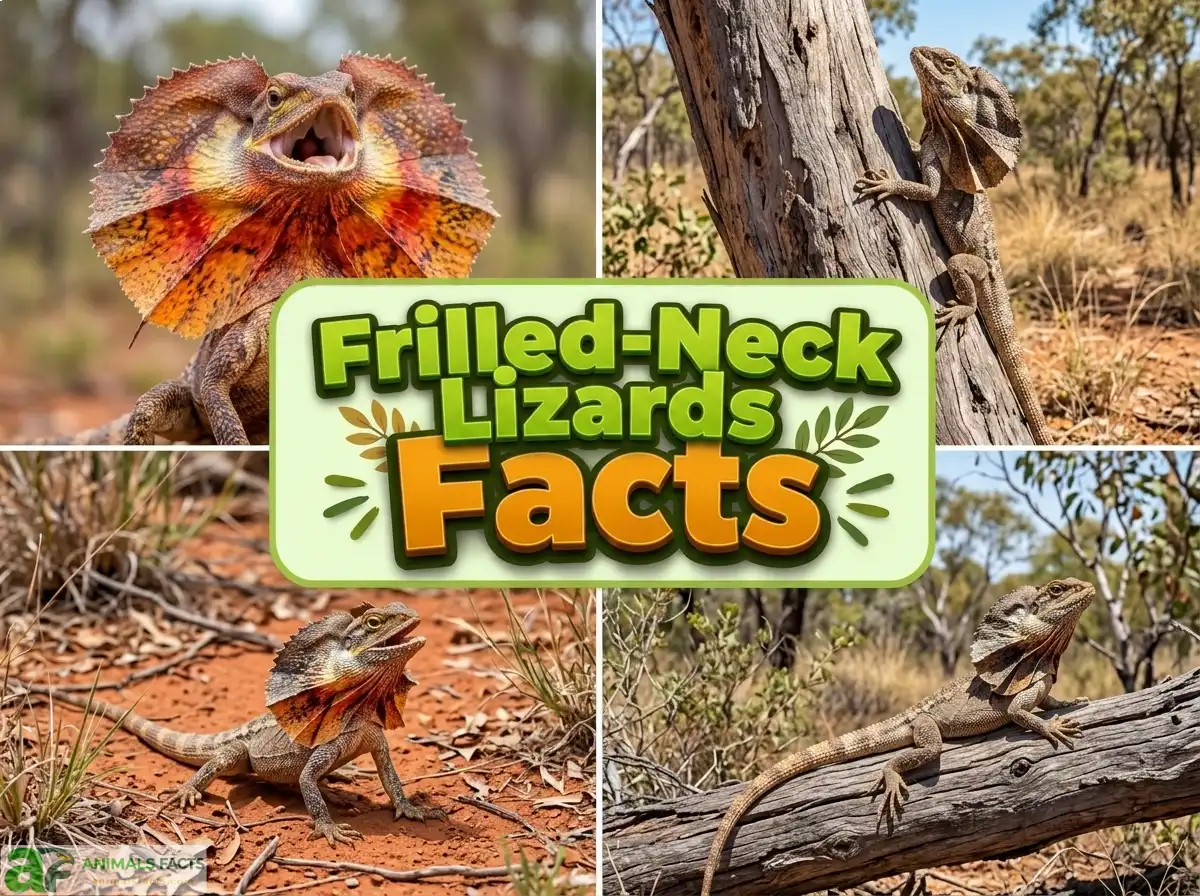
Hey amazing young wildlife scientists, reptile fans, and future herpetologists! Here are some absolutely spectacular frilled-neck lizard facts for kids that will make every wildlife conversation instantly more dramatic:
- The frilled-neck lizard can open a DINNER PLATE-SIZED frill around its neck! The frill around its neck can be up to 30 centimeters across — about the same size as a dinner plate — on an animal whose body is only about 25 centimeters long. When it opens that frill, it instantly looks like a completely different animal — much bigger and much scarier than it actually is!
- It is IMPOSSIBLE to open the frill without also opening the mouth! The bones that hold the frill open are connected to the jaw muscles. So when a frilled-neck lizard erects its frill, its mouth automatically opens at the same time — exposing a vivid yellow or orange interior. Evolution designed this so the threat display is always as complete and dramatic as possible!
- It runs on TWO LEGS — like a tiny dinosaur! When the frilled-neck lizard needs to escape quickly, it rises onto its two back legs and runs bipedally — just like a human, but much faster. It can reach nearly 30 kilometers per hour and looks like a tiny dinosaur sprinting across the Australian savanna!
- The JURASSIC PARK dinosaur that spits was based on the frilled-neck lizard! In the 1993 film Jurassic Park, when the Dilophosaurus opens a frill and spits venom — that frill was inspired by the frilled-neck lizard. The real lizard does NOT spit venom (that was entirely made up for the film), but the dramatic frill display was taken directly from real frilled-neck lizard behavior!
- It was on AUSTRALIAN MONEY for 25 years! The frilled-neck lizard appeared on the back of the Australian 2-cent coin from 1966 until the coin was discontinued in 1991 — meaning for 25 years, anyone in Australia handling loose change was holding a tiny metal portrait of this extraordinary lizard!
- It lives most of its life IN TREES — pressed flat against the bark! The frilled-neck lizard is mostly arboreal — it spends most of its time on tree trunks, pressed flat against the bark, where its colour makes it almost completely invisible. It basically disappears against the tree until something comes too close and the frill explodes open!
- Hatchling frilled-neck lizards can do the FULL DISPLAY immediately after hatching! Baby frilled-neck lizards emerge from their eggs with a completely functional frill — they can open it, hiss, and perform the entire threat display from the very first moment of their lives. Nature programs them with a complete defensive toolkit from day one!
- The frill is ALSO A SOLAR PANEL for warming up! The frill is not just for scaring predators — on cool mornings, frilled-neck lizards partially open their frills and angle them toward the sun. The large surface area catches sunlight and heats up the lizard’s blood much faster than its body alone could. Evolution gave the frill two completely different jobs!
12. Relationship with Humans
The frilled-neck lizard’s relationship with humans spans indigenous Australian traditions of many thousands of years, the European scientific encounter from the early 19th century, the species’ extraordinary symbolic importance in Australian national identity, and the modern challenges of conservation in an increasingly modified landscape.
Indigenous Australian Relationships
The frilled-neck lizard has been part of the cultural landscape of northern Australia’s indigenous peoples for tens of thousands of years:
Traditional food source — Frilled-neck lizards have been consumed as food by numerous Aboriginal communities across their range — forming part of the diverse “bush tucker” food system of northern Australian traditional life. The lizard’s arboreal habits make it accessible to skilled hunters who know where to look.
Cultural and totemic significance — The frilled-neck lizard appears in the totemic systems of various Aboriginal groups across northern Australia — as a totem animal whose spiritual significance varies by clan and country. In some traditions, specific clans are associated with the frilled-neck lizard as their Dreaming animal — a spiritual ancestral figure whose actions shaped the landscape.
Rock art representation — The frilled-neck lizard is depicted in Aboriginal rock art at multiple sites across northern Australia — particularly in the Kakadu and Kimberley regions. These depictions range from naturalistic representations that clearly show the frill to more stylized forms that encode cultural meaning beyond simple natural history.
Traditional ecological knowledge — Aboriginal communities across the species’ range developed detailed traditional ecological knowledge of the frilled-neck lizard — understanding its seasonal movements, behavioral patterns, and habitat preferences with a precision that Western herpetology has only recently begun to replicate through systematic research.
The European Scientific Encounter
The frilled-neck lizard’s formal scientific description in 1825 — relatively early for an Australian reptile — reflects how dramatically this species captured the attention of naturalists accompanying early British survey expeditions:
The specimen collections — Specimens collected by naturalists accompanying Captain Phillip Parker King’s coastal survey expeditions were sent to London for formal description — the dramatic appearance of the frill generating significant scientific interest in an era when the Australian fauna was being systematically documented for the first time.
The Victorian natural history fascination — The frilled-neck lizard became one of the most written-about and most illustrated Australian animals in Victorian natural history publications — its theatrical appearance making it ideal for the dramatic natural history illustration style of the period.
The National Symbol Status
The frilled-neck lizard has achieved a level of national symbolic significance in Australia exceeded by few other reptiles globally:
The 2-cent coin — The decision to feature the frilled-neck lizard on the Australian 2-cent coin at the introduction of decimal currency in 1966 reflected the species’ status as one of Australia’s most recognizable and most distinctively Australian animals. For 25 years, the frilled-neck lizard was the most widely reproduced image of any Australian reptile — present in the pockets of every Australian.
Tourism and national identity — The frilled-neck lizard is a significant component of Australia’s wildlife tourism identity — appearing in tourism promotional material, merchandise, and media representations of Australian wildlife alongside kangaroos, koalas, and platypuses.
Scientific research interest — The species is one of the most studied Australian lizards — a combination of its charismatic appeal, its interesting behavioral biology, and its role as a model species for research on display systems, thermoregulation, and arboreal ecology.
The Captive Trade Issue
The frilled-neck lizard’s dramatic appearance and manageable size have made it desirable in the exotic pet trade:
Legal status — The frilled-neck lizard is protected under Australian wildlife law — it is illegal to collect, export, or possess frilled-neck lizards without appropriate permits. The species is listed on CITES Appendix II — international trade is regulated.
The black market — Despite legal protection, a black market for frilled-neck lizards exists — the species is occasionally illegally exported to overseas markets where demand from exotic reptile enthusiasts creates financial incentive for illegal collection.
The captive-bred alternative — Legitimate captive breeding programs in Australia and internationally provide legally obtained frilled-neck lizards for the pet trade — though distinguishing legally captive-bred individuals from illegally wild-collected individuals can be challenging for enforcement authorities.
13. Frilled-Neck Lizard Conservation Status & Threats
Conservation Status Overview
| Feature | Details |
|---|---|
| Global IUCN Status | Least Concern (LC) |
| South Australia State Status | Vulnerable |
| Population Trend | Stable globally; declining in South Australia and some southern range areas |
| CITES Listing | Appendix II — international trade regulated |
| Australian Legal Protection | Protected under state and federal wildlife law across range |
Major Threats
| Threat | Description | Impact Level |
|---|---|---|
| Habitat modification | Land clearing for agriculture and pastoralism | High in southern range |
| Feral cats | Predation on adults and juveniles | High — widespread |
| Cane toads | Juvenile predation attempts leading to poisoning | High — expanding threat |
| Altered fire regimes | Changed burning patterns affecting woodland structure | Medium-High |
| Illegal collection | Pet trade despite legal protection | Medium |
| Road mortality | Vehicle strikes during ground activity | Medium |
| Climate change | Habitat range shift; temperature extremes | Increasing concern |
| Feral pigs | Habitat degradation; nest predation | Medium |
| Introduced herbivores | Grazing degrading woodland understory | Medium |
The Cane Toad Threat
The expanding range of introduced cane toads (Rhinella marina) across northern Australia represents one of the most significant emerging threats to frilled-neck lizards:
The mechanism — Juvenile frilled-neck lizards — opportunistic insectivores that consume any moving prey item of appropriate size — attempt to eat cane toads, which produce highly toxic bufadienolide compounds in their parotoid glands. Consumption of a cane toad causes rapid cardiac arrest in most native Australian predators.
The expanding overlap — The cane toad’s westward expansion across the Northern Territory and into Western Australia progressively increases the geographic overlap between the toad and frilled-neck lizard populations.
The naive predator problem — Unlike some predator species that have shown behavioral adaptation to avoid cane toads following initial lethal exposures (populations closer to the toad’s original introduction site show some avoidance learning at the population level), naïve populations at the expanding front continue to attempt predation.
Conservation Responses
Protected area coverage — Substantial portions of the frilled-neck lizard’s core range in the Northern Territory fall within Kakadu National Park, Litchfield National Park, and the broader protected area network — providing formal habitat protection and research access.
Feral cat management — Programs to control feral cat populations in protected areas benefit frilled-neck lizards along with the broader native fauna. Methods including aerial baiting, targeted trapping, and exclusion fencing have been implemented at various sites.
Cane toad management — Research into cane toad population control — including biological control approaches, barrier systems, and community-based control — represents an important indirect conservation measure for frilled-neck lizards.
Research programs — Ongoing field research on frilled-neck lizard ecology, behavior, and population dynamics at sites including Litchfield National Park and various university research stations provides the scientific foundation for evidence-based conservation planning.
14. Famous Frilled-Neck Lizards in History & Pop Culture
Famous Individuals and Cultural Moments
The Australian 2-cent coin individual (1966–1991) — The frilled-neck lizard depicted on the reverse of the Australian 2-cent coin — introduced with decimal currency on 14 February 1966 — is arguably the most seen representation of any reptile in Australian history. The coin’s design, by Stuart Devlin, features a naturalistic frilled-neck lizard with fully erect frill. For 25 years, this image was present in millions of Australian pockets daily.
The Jurassic Park connection (1993) — The Dilophosaurus sequence in Steven Spielberg’s Jurassic Park — in which the Dilophosaurus erects a frill around its neck before spitting venom on the character Dennis Nedry — was directly inspired by the frilled-neck lizard. The scene was designed by Stan Winston’s special effects team using the frilled-neck lizard display as the visual model. The resulting character became one of the most culturally recognized dinosaur designs in cinema history — making the frilled-neck lizard indirectly one of the most globally recognized Australian lizards through a fictional dinosaur.
David Attenborough “Life in Cold Blood” (BBC, 2008) — The definitive documentary treatment of the frilled-neck lizard’s threat display and bipedal running — Attenborough’s narration of the display sequence produced one of the most widely viewed sequences of Australian reptile natural history in BBC production history.
“The Life of Reptiles” (BBC) — Earlier BBC natural history productions featuring the frilled-neck lizard’s running behavior introduced the species to global television audiences in some of the earliest widely distributed natural history footage of this behavior.
Museum specimens — London Natural History Museum — The early 19th century specimens sent to the Natural History Museum in London following their collection by naturalists on Phillip Parker King’s expeditions remain among the historically significant natural history specimens connected to the formal description of the species.
15. Role in Ecosystem & Food Chain
The Predator Role
The frilled-neck lizard occupies an important insectivore-predator position in northern Australian woodland food webs:
Insect population regulation — As an abundant and widely distributed insectivore in northern Australian woodland, the frilled-neck lizard collectively consumes enormous quantities of insects during the wet season — contributing to the regulation of insect population dynamics in the woodland ecosystem. Ants, beetles, grasshoppers, and various other insects that are regulated by frilled-neck lizard predation are themselves important ecosystem actors — the lizard’s predation cascading through the invertebrate community.
Small vertebrate predation — The occasional predation on small lizards and mammals during the wet season positions the frilled-neck lizard as a secondary predator in some food web pathways — consuming animals that are themselves predators of smaller invertebrates.
The Prey Role
Frilled-neck lizards are consumed by a range of predators — supporting higher trophic level populations:
Raptor food base — Frilled-neck lizards are a significant prey item for wedge-tailed eagles and other large raptors in northern Australian woodland — their arboreal habits making them accessible to aerial predators that can strike from above. The frilled-neck lizard population’s contribution to raptor food supply is significant in ecosystems where the lizard is abundant.
Goanna prey — The frilled-neck lizard contributes to the energy budget of monitor lizard populations — goannas that consume frilled-neck lizards transfer energy from the insectivore trophic level to the larger carnivore level.
The Thermoregulation Ecology
The frilled-neck lizard’s thermoregulation behavior creates interesting ecological interactions:
Sunbasking habitat structuring — The species’ preference for specific tree trunk aspects and positions for thermoregulation creates predictable patterns of lizard distribution within woodland — which predators learn to exploit and which contributes to the habitat heterogeneity of northern Australian woodland.
The frill as ecological signal — The frill display, visible at distances of tens of meters when erect, functions as a signal not only to predators and rivals but potentially to the broader woodland community — birds and other animals may use frill display events as alarm signals indicating the presence of a threat.
16. Myths, Folklore & Cultural Significance
Aboriginal Australian Traditions
The frilled-neck lizard’s cultural significance in Aboriginal Australian traditions is ancient, diverse, and continues to the present day:
The Dreaming narratives — In various Aboriginal Dreaming traditions across northern Australia, the frilled-neck lizard is a character in the narratives that explain the creation of landscape features, the origin of behavioral traits, and the relationships between animals and Country. These Dreaming stories are not simply mythology in the Western sense — they encode ecological knowledge, ethical guidelines, and spiritual relationships with the natural world.
The display as protection — Some Aboriginal traditions interpret the frilled-neck lizard’s display as a protective gesture — the animal warning others of danger, its dramatic display a selfless act of alarm rather than a selfish act of self-protection. This interpretation reflects a broader ecological understanding of how alarm signals in nature function as community benefits rather than purely individual defensive behaviors.
Totemic relationships — Across the diverse clan groups of northern Australia, certain clans maintain a totemic relationship with the frilled-neck lizard — the animal representing the spiritual essence of those clan members’ connection to particular Country. These totemic relationships impose obligations of care and protection toward the animal that have practical conservation implications.
Rock art symbolism — The frilled-neck lizard’s depictions in Arnhem Land and Kakadu rock art range from naturalistic to highly stylized — the frill rendered in ways that emphasize its symbolic as much as its biological reality. Some rock art scholars believe that specific frill representations encode ceremonial or ritual significance beyond simple natural history depiction.
European and Contemporary Cultural Meanings
The “real dinosaur” narrative — In popular science and tourism contexts, the frilled-neck lizard is frequently presented as a “living dinosaur” — an evocative if technically inaccurate characterization that reflects the genuinely ancient evolutionary lineage of agamid lizards and the visual similarity between the lizard’s display and paleontological reconstructions of some crested dinosaurs.
The “spirit of Australia” — The frilled-neck lizard’s status as a distinctive Australian endemic — found nowhere else in the world outside Australia and New Guinea — makes it a powerful symbol of Australian natural distinctiveness. Like the kangaroo, platypus, and koala, the frilled-neck lizard has become shorthand for the idea that Australia’s natural world is genuinely extraordinary.
17. Frilled-Neck Lizards in Pop Culture
Jurassic Park (Universal/Amblin, 1993) — The most globally significant popular cultural use of the frilled-neck lizard; the Dilophosaurus’ frill display — modeled directly on the frilled-neck lizard — appeared in one of the highest-grossing films in cinema history and introduced the frill display concept to global audiences of hundreds of millions. The scene remains one of the most memorable in the film franchise. The biological inaccuracy (Dilophosaurus almost certainly had no such frill, and the spitting behavior is entirely fictional) has been noted by paleontologists — but the cultural impact on awareness of real frilled-neck lizard behavior has been documented by researchers who report increased public recognition following the film’s release.
“Life in Cold Blood” (BBC, David Attenborough, 2008) — The definitive documentary treatment; Attenborough’s narration of the frilled-neck lizard’s threat display and bipedal run produced sequences that have been widely shared as some of the most spectacular reptile behavioral footage in BBC natural history production history.
Australian tourism marketing — The frilled-neck lizard appears in Australian tourism promotional material for the Northern Territory and northern Australia generally — appearing in Tourism NT campaigns, national park promotional material, and wildlife tourism marketing across multiple decades.
“Dot and the Kangaroo” and related Australian animated productions — Various Australian animated films and television productions have featured the frilled-neck lizard as a character — reflecting its status as one of Australia’s most visually distinctive and most culturally recognized native animals.
Natural history documentaries — Multiple wildlife documentary productions including National Geographic, BBC Earth, and ABC Australia productions have featured frilled-neck lizard content — the species’ dramatic display being consistently compelling wildlife footage.
The 2-cent coin legacy — The discontinued 2-cent coin, while no longer in circulation, continues to generate cultural references — the coin being a frequent subject in discussions of Australian numismatic heritage and the frilled-neck lizard appearing as a nostalgic symbol in media treatments of Australian currency history.
18. Frilled-Neck Lizard Facts vs. Common Myths
| Common Myth | The Real Fact |
|---|---|
| “The frilled-neck lizard can spit venom like in Jurassic Park” | Completely false — the spitting behavior in Jurassic Park was entirely fictional; frilled-neck lizards have no venom and cannot spit any substance |
| “The frill is used primarily for hunting — to startle prey” | False — the frill is a defensive display structure, not a hunting tool; prey capture does not involve frill erection |
| “The frilled-neck lizard is dangerous to humans” | False — the frilled-neck lizard is harmless to humans; it will bite if handled roughly but the bite is not venomous and causes minor injury only |
| “The frill can be erected independently of the mouth” | False — the frill erection mechanism is mechanically linked to jaw opening through the hyoid bones; full frill erection always involves simultaneous mouth opening |
| “All frilled-neck lizards have the same frill coloration” | False — frill coloration varies significantly by geographic population; Northern Territory (orange-black), Kimberley (red-yellow), and Queensland populations show distinct color patterns |
| “The bipedal running is a deliberate behavioral choice” | Partially misleading — bipedal running appears to be an emergent property of high-speed locomotion in this body plan; as speed increases, the center of mass shifts backward and the front legs naturally lift off the ground |
| “The Dilophosaurus in Jurassic Park accurately depicts a real dinosaur’s frill” | False — there is no paleontological evidence that Dilophosaurus possessed a frill; the design was inspired by the frilled-neck lizard, not by fossil evidence |
19. Best Places to See Frilled-Neck Lizards in the Wild
1. Litchfield National Park, Northern Territory, Australia — The most accessible and most reliable location for wild frilled-neck lizard observation in Australia. The park’s eucalyptus woodland habitats support excellent frilled-neck lizard populations, and the species is regularly encountered on park roads and trails during the wet season (November–April). The park’s visitor infrastructure — walking trails, swimming holes, and accommodation — makes extended wildlife observation practical for visitors of all experience levels.
2. Kakadu National Park, Northern Territory, Australia — Australia’s largest national park and a UNESCO World Heritage Site; frilled-neck lizards are present throughout the park’s woodland and savanna habitats. The park’s remarkable biodiversity — including extraordinary Aboriginal rock art sites — makes a Kakadu visit one of the richest wildlife and cultural experiences in Australia regardless of frilled-neck lizard encounters.
3. Keep River National Park, Northern Territory/Western Australia border — An often-overlooked gem; the park’s excellent eucalyptus woodland and red-rock gorge habitats support good frilled-neck lizard populations with lower visitor numbers than the more famous Northern Territory parks.
4. Mitchell Plateau, Kimberley, Western Australia — The Kimberley region hosts the distinctive red-and-yellow frill subspecies; the Mitchell Plateau’s sandstone and eucalyptus woodland habitats are spectacular and support excellent frilled-neck lizard populations — though access requires a 4WD vehicle and significant planning.
5. Undara Volcanic National Park, Queensland — The lava tube and eucalyptus woodland habitat of this remarkable geological site supports frilled-neck lizards; the park’s accessible infrastructure and guided tours make wildlife observation practical.
6. Territory Wildlife Park, Berry Springs, Northern Territory — For guaranteed frilled-neck lizard observation in near-natural conditions; this wildlife park near Darwin maintains exhibits of northern Australian wildlife including habituated frilled-neck lizards in large, naturalistic enclosures that allow excellent close-range observation of display and foraging behavior.
7. The Honest Assessment — Wild frilled-neck lizard sightings require correct timing (wet season for maximum activity; early mornings for thermoregulating individuals on tree trunks), appropriate habitat (eucalyptus woodland with large trees), and patience. The species’ cryptic bark-matching camouflage makes stationary individuals essentially invisible — movement (particularly on roadsides during early morning basking) provides the most reliable detection cue. Driving slowly on park roads in Litchfield during early wet season mornings is probably the single most reliable approach to guaranteed sightings.
20. How You Can Help
Supporting frilled-neck lizard conservation requires action focused on Australian habitat protection, introduced predator management, cane toad control, and climate change advocacy.
Support these organizations:
- Wildlife Conservation Society Australia — Australian wildlife conservation programs
- Australian Wildlife Conservancy — awc.org.au — manages private wildlife sanctuaries across northern Australia; directly protects frilled-neck lizard habitat
- Save the Bilby Fund and broader northern Australian conservation programs — support multiple species conservation in frilled-neck lizard range
- Kakadu National Park Foundation — kakadupark.com.au — supports conservation and research in one of the world’s great national parks
- Northern Territory Land Council — supports indigenous-managed conservation across frilled-neck lizard habitat
- Frogwatch NT and broader herpetological monitoring programs — contribute to monitoring data for Australian reptiles
Critical individual actions:
- Never purchase illegally collected frilled-neck lizards — the illegal pet trade drives wild collection despite legal protection; purchasing captive-bred individuals from licensed Australian breeders only
- Support cane toad control programs — organizations working on cane toad management across northern Australia directly benefit frilled-neck lizard populations
- Support feral cat management — advocacy and financial support for feral cat control programs across northern Australia is one of the most impactful actions for broad northern Australian wildlife conservation
- Maintain natural vegetation on properties — landowners and managers in northern Australia who maintain eucalyptus woodland rather than clearing for pasture directly preserve frilled-neck lizard habitat
- Report sightings to citizen science platforms — iNaturalist and Atlas of Living Australia occurrence records from across the range contribute to population monitoring
21. Top Documentaries & Books
Must-Watch Documentaries
- “Life in Cold Blood” (BBC, David Attenborough, 2008) — The definitive reptile natural history documentary series; the Australian agamid content including frilled-neck lizard is exceptional
- “Australia’s First 4 Billion Years” (PBS Nova, 2013) — Comprehensive Australian natural history including reptile evolution context
- “Wild Australia” (various BBC and ABC productions) — Multiple Australian wildlife documentary treatments including Northern Territory woodland species
- “Territory” (ABC Australia) — Various ABC natural history productions covering Northern Territory wildlife including frilled-neck lizard content
- “David Attenborough’s — Life” (BBC, 2009) — The Reptiles episode includes exceptional Australian agamid content
Must-Read Books
- A Complete Guide to Reptiles of Australia by Steve Wilson and Gerry Swan — The standard comprehensive reference for Australian reptile identification and natural history; essential for anyone seriously interested in the frilled-neck lizard
- Lizards of Australia by Harold Cogger — The most comprehensive scientific treatment of Australian lizard biology
- The Biology of Australian Lizards (various academic texts) — Scientific treatments of Australian agamid biology
- Australia’s Remarkable Wildlife by various naturalists — Popular natural history accounts including frilled-neck lizard content
- Kakadu: A Natural History — Natural history of the national park system that protects the core frilled-neck lizard range
22. Frilled Lizard Comparison with Other Display Lizards
| Feature | Frilled-Neck Lizard | Bearded Dragon | Thorny Devil | Basilisk | Marine Iguana |
|---|---|---|---|---|---|
| Scientific name | Chlamydosaurus kingii | Pogona vitticeps | Moloch horridus | Basiliscus plumifrons | Amblyrhynchus cristatus |
| Family | Agamidae | Agamidae | Agamidae | Corytophanidae | Iguanidae |
| Display structure | Neck frill — 30 cm | Beard darkening | No display structure | Head crest | Head crest |
| Bipedal running | Yes — regularly | Occasional | No | Yes — on water | No |
| Primary defense | Frill display + flight | Beard blackening | Thorny skin | Running/water | Group thermoregulation |
| Lifestyle | Primarily arboreal | Ground/rock | Ground | Arboreal/water edge | Coastal/marine |
| Weight | 0.5–0.8 kg | 0.3–0.5 kg | 70–100 grams | 0.1–0.6 kg | 1–13 kg |
| Range | N. Australia, New Guinea | Central Australia | Arid Australia | Central America | Galapagos only |
| Conservation | Least Concern | Least Concern | Least Concern | Least Concern | Vulnerable |
| Frill/crest function | Display and thermoreg. | Social display | — | Display | Display/thermoreg. |
23. Frequently Asked Questions About Frilled-Neck Lizards
Q1. What is the scientific name of the frilled-neck lizard?
The frilled-neck lizard’s scientific name is Chlamydosaurus kingii (Gray, 1825). The genus name Chlamydosaurus derives from the Greek chlamys (a type of cloak or mantle worn in ancient Greece) and sauros (lizard) — meaning “cloaked lizard” — a beautifully accurate name for an animal whose defining feature is the cloak-like membrane that spreads from its neck. The species name kingii honors Captain Phillip Parker King — the British naval officer and naturalist who conducted extensive coastal surveys of Australia in the 1820s and whose expeditions collected the first specimens that were sent to London for formal scientific description. The species was formally described by British zoologist John Edward Gray in 1825 — making it one of the earlier formally described Australian reptile species. The genus Chlamydosaurus is monotypic — containing only this single species.
Q2. Does the frilled-neck lizard actually spit venom like in Jurassic Park?
No — completely false. The venom-spitting behavior of the Dilophosaurus in Jurassic Park was entirely fictional — invented for the film with no basis in either frilled-neck lizard biology or Dilophosaurus paleontology. The frilled-neck lizard has no venom glands, no venom of any kind, and no spitting capability. The filmmakers used the frilled-neck lizard’s frill display as the visual model for the Dilophosaurus scene but invented the spitting behavior without any biological justification. The real frilled-neck lizard’s defense system relies entirely on the visual and acoustic components of the frill display, the bipedal flight to the nearest tree, and in the absolute last resort, a bite that is mildly painful but causes no venom-related effects. The Jurassic Park depiction, while responsible for global public awareness of the frill display, has also generated widespread misinformation about the species’ actual capabilities.
Q3. Why does the frilled-neck lizard run on two legs?
Bipedal running in the frilled-neck lizard appears to be an emergent property of its high-speed locomotion rather than a deliberate behavioral choice. Research on bipedal running in lizards suggests that as running speed increases in lizards with appropriate body proportions, the center of mass shifts backward — due to the inertia of the long tail — until the front legs naturally lift off the ground. Once the animal is running on its hind legs, the anatomy allows it to maintain balance through tail counterbalancing and continue bipedally. The frilled-neck lizard’s relatively long hind limbs and long tail create body proportions that facilitate this transition at high running speeds. The species has become particularly associated with bipedal running because the combination of the erect frill and the bipedal gait during flight from a predator creates one of the most visually extraordinary locomotion sequences in Australian wildlife — the image of a lizard running upright with a plate-sized frill erect is genuinely remarkable and has been widely captured in wildlife films.
Q4. Where does the frilled-neck lizard live?
The frilled-neck lizard is native to northern Australia and southern New Guinea — with the Australian distribution centered on the Northern Territory and extending into Queensland (north and northeast), the Kimberley region of Western Australia, and marginally into South Australia and New South Wales. Within Australia, the species is most abundant in the tropical woodland and savanna environments of the Top End of the Northern Territory — the eucalyptus woodland communities that characterize the seasonally wet-dry tropics of northern Australia. The species is also present in the Kimberley and Cape York Peninsula woodland systems. A small, isolated population in South Australia is classified as Vulnerable at state level due to habitat modification and small population size. Outside Australia, populations exist in the lowland woodland areas of southern New Guinea — one of the few Australian agamids to naturally occur in New Guinea.
Q5. How big does the frill get?
The frilled-neck lizard’s frill can reach 30 centimeters in diameter when fully erect — approximately the size of a dinner plate. On an animal with a body length (excluding tail) of approximately 25–30 centimeters, this represents a frill that is roughly equal to or greater than the animal’s own body length in diameter. The frill’s size varies between individuals and between sexes — males have significantly larger frills than females, both absolutely and relative to body size, reflecting the frill’s role in male territorial competition as well as predator deterrence. Geographic populations also show some variation in frill size and coloration. The frill’s inner surface — displayed during threat encounters — shows vivid orange, red, yellow, and black coloration, while the outer surface (visible when the frill is folded flat against the neck and body) matches the cryptic brown-grey body coloration for camouflage.
24. Sources & References
- Wikipedia — Chlamydosaurus kingii, Agamidae, Australian reptiles
- IUCN Red List — iucnredlist.org (current Least Concern assessment for Chlamydosaurus kingii)
- Cogger, H.G. (2014). Reptiles and Amphibians of Australia (7th ed.). CSIRO Publishing — the definitive Australian herpetological reference
- Shine, R. — multiple published papers on Australian agamid lizard biology; University of Sydney
- Peters, R.A. and colleagues — published research on agamid head-bobbing communication systems
- Meyers, J.J. et al. — published research on bipedal locomotion in lizards
- Whitaker, P.B. — published field research on frilled-neck lizard ecology
- National Geographic — nationalgeographic.com
- Australian Museum — australianmuseum.net.au
- BBC Wildlife / BBC Earth — bbcearth.com
- Britannica — britannica.com/animal/frill-necked-lizard
- Territory Wildlife Park — territorywildlifepark.com.au
- Australian Government — Department of Climate Change, Energy, the Environment and Water