

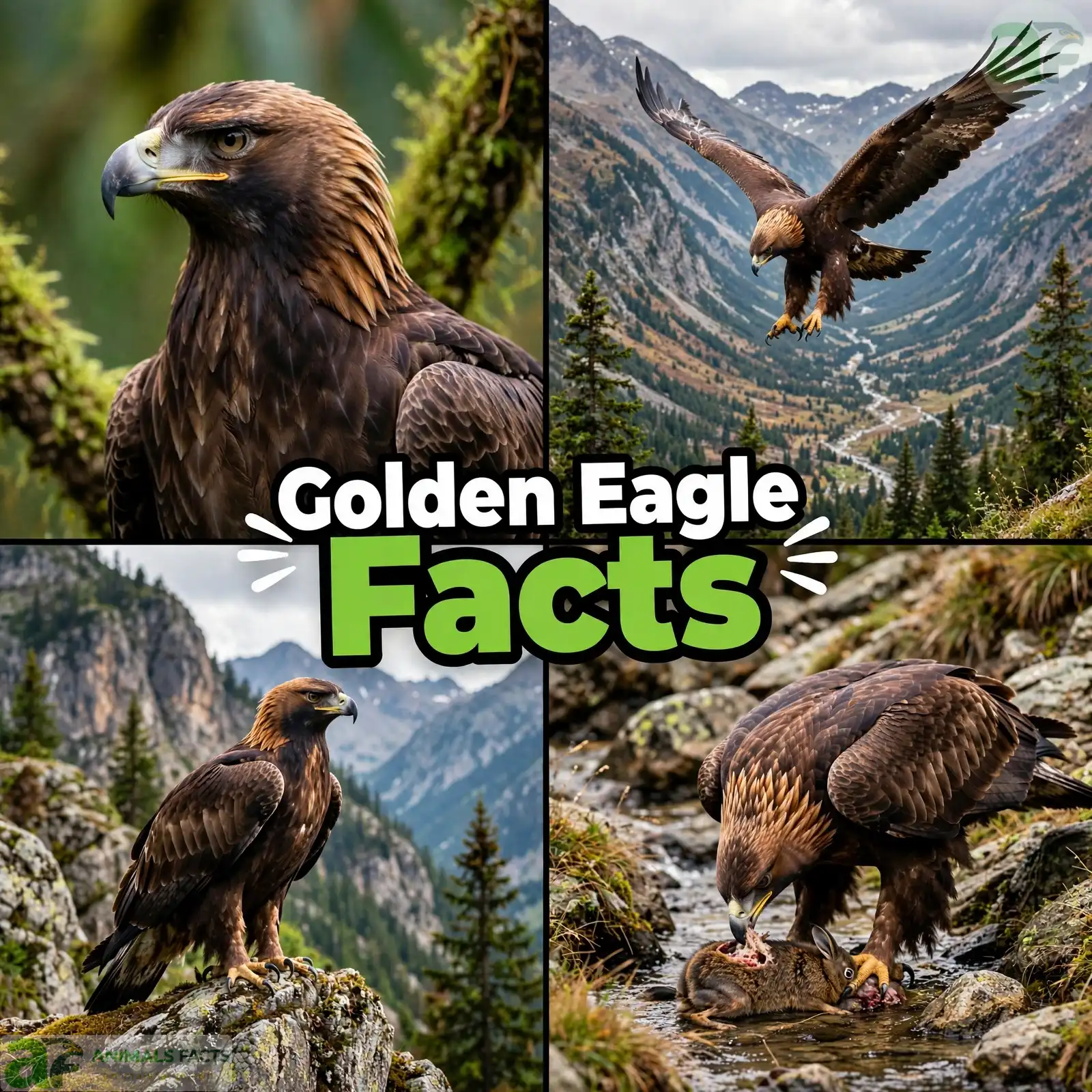
Golden Eagle Facts
| Feature | Details |
|---|---|
| Scientific Name | Aquila chrysaetos (Linnaeus, 1758) |
| Kingdom | Animalia |
| Phylum | Chordata |
| Class | Aves |
| Order | Accipitriformes |
| Family | Accipitridae |
| Common Names | Golden eagle; royal eagle |
| Native Range | The most widely distributed eagle in the world — North America, Europe, Asia, North Africa; the entire Northern Hemisphere |
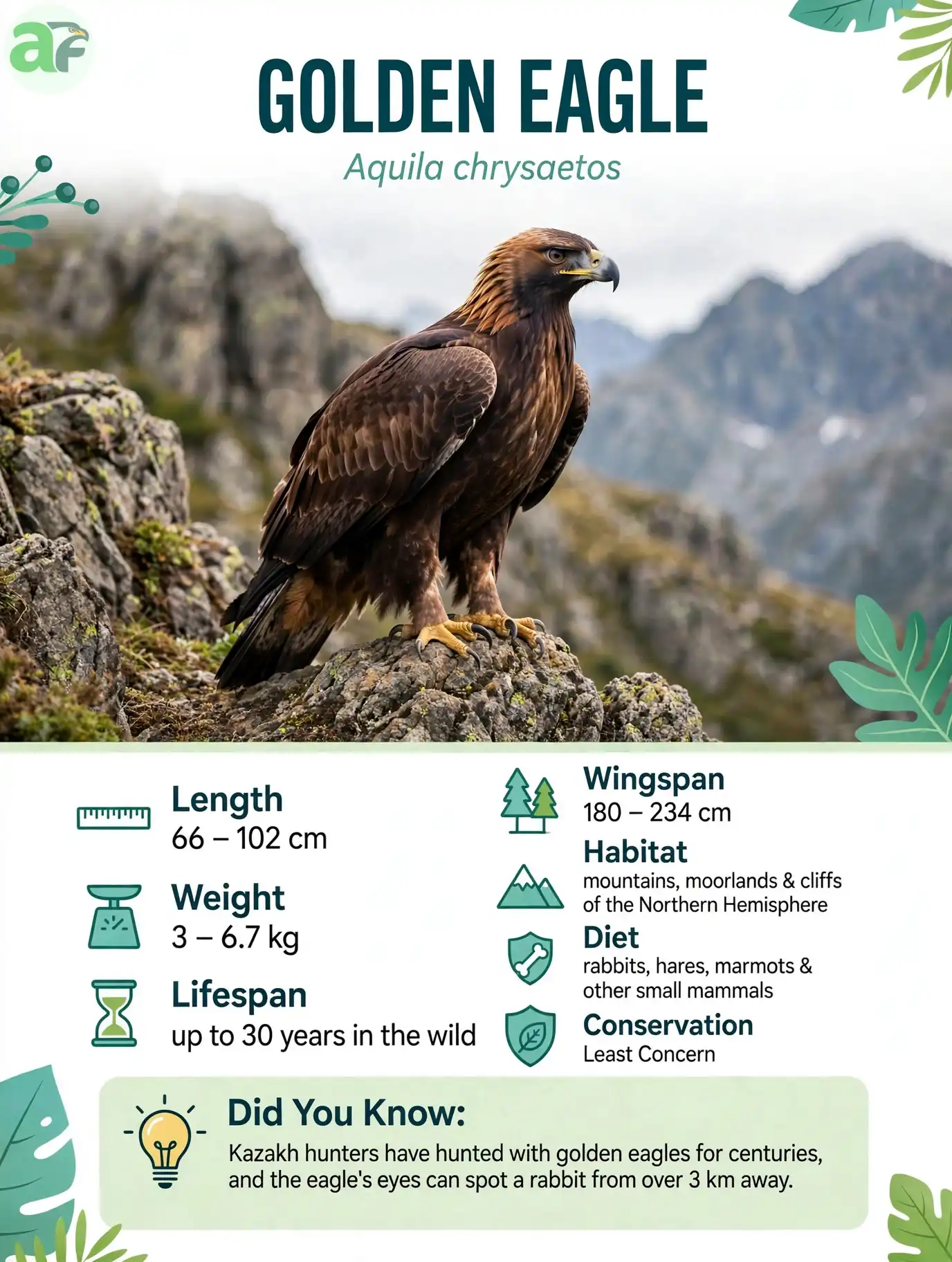
| Habitat | Open and semi-open terrain — mountains, cliffs, moorland, steppe, tundra, desert margins; avoids dense forest and urban areas |
| Lifespan | 18–32 years (wild); up to 50 years (captivity) |
| Diet | Primarily medium-sized mammals — rabbits, hares, ground squirrels; also birds, reptiles, carrion |
| Body Length | 66–102 cm |
| Wingspan | 180–234 cm |
| Weight | Males 2.8–4.6 kg; females 3.8–6.7 kg — significant reverse sexual size dimorphism |
| Dive Speed | Up to 240–320 km/h — among the fastest animals on Earth in a hunting stoop |
| Conservation Status | Least Concern (IUCN) — but declining in parts of range due to persecution, habitat loss, and lead poisoning |
| Defining Feature | Golden-brown nape feathers giving the species its name; the most powerful raptor across the entire Northern Hemisphere by prey-to-body-weight ratio |
| Falconry Significance | Used in traditional falconry for over 4,000 years — the most important falconry bird in Central Asian traditions; used to hunt wolves and foxes |
| Closest Relatives | Other Aquila eagles — including the imperial eagle, Verreaux’s eagle, and wedge-tailed eagle |
| National Symbol | National bird of Mexico, Albania, Germany, Austria, and Kazakhstan |
 1. Introduction: What is a Golden Eagle?
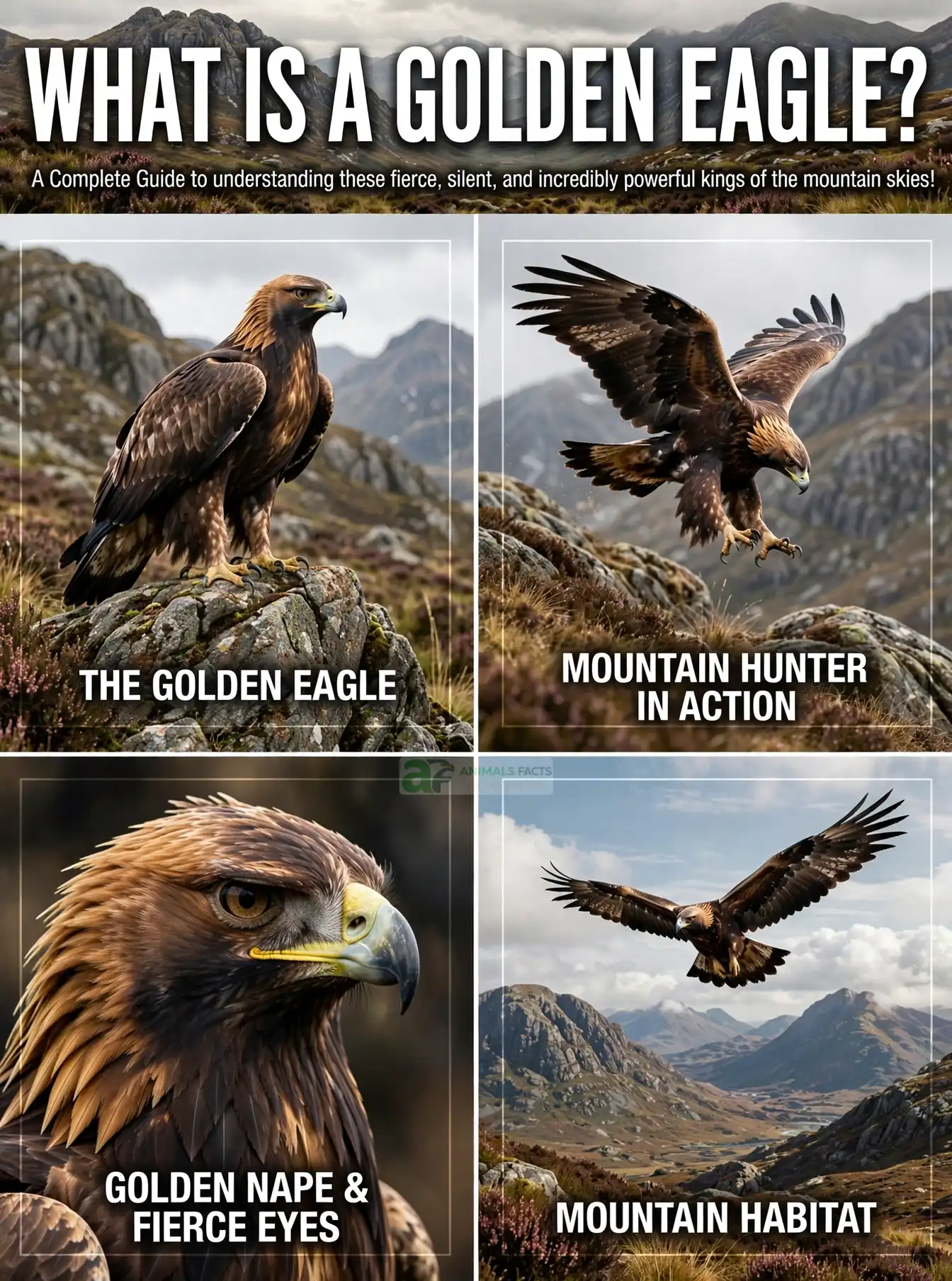
On the bare granite crags of the Scottish Highlands, where the mountain ridgeline drops away into a vast open glen and the wind comes in from the Atlantic cold and constant, a movement at the edge of the sky catches the eye — and then the movement resolves into a shape, and the shape into something unmistakable: a golden eagle, riding the updraft along the ridge face with wings spread to their full two-meter extent, tail fanned, the gold-brown of the nape feathers catching the Highland light for a brief moment before the bird banks and slides away down the glen in a long, effortless glide that carries it a kilometer in the time it takes to raise binoculars. The ease of that movement — the absolute economy of effort, the power held in reserve, the authority of a bird that has hunted these hills since before the crofters’ fields were ploughed — is perhaps the defining quality of golden eagle facts: this is an animal that does not need to hurry, because it is better at everything it does in its environment than anything else sharing that environment. Golden eagle facts begin with this sense of sovereign authority — the most widely distributed eagle in the world, the most powerful bird of prey in the Northern Hemisphere by the measure of what it can catch relative to its own body weight, a species that has been the most important falconry bird in human history for over four thousand years, the national bird of five countries, and an animal so deeply embedded in human mythology, heraldry, and cultural consciousness across the entirety of the Northern Hemisphere that it is difficult to find a human civilization north of the equator that has not made the golden eagle a symbol of its highest aspirations.
The golden eagle (Aquila chrysaetos) achieves superlatives that no other eagle can match across the full scope of the bird’s biology. It is the most widely distributed eagle in the world — the only eagle species found naturally across North America, Europe, Asia, and North Africa simultaneously, a geographic range that encompasses essentially the entire Northern Hemisphere’s temperate and boreal zones. It is the eagle that hunts wolves — documented in traditional Kazakh falconry practice taking adult wolves in cooperative hunts with mounted eagle hunters. It achieves dive speeds of 240–320 km/h during hunting stoops — among the fastest movements of any animal on Earth. It has been formally adopted as a national symbol by five countries — Mexico, Albania, Germany, Austria, and Kazakhstan — more countries than any other eagle species. And it maintains pair bonds and nest territories for potentially 40+ years — some Scottish golden eagle territories have been continuously occupied by nesting pairs for as long as ornithological records have been kept.
Interesting facts about golden eagles reveal an animal of breathtaking biological precision — the talons generating grip force sufficient to break the spinal column of a mountain goat kid; the visual system capable of detecting a rabbit from 3 kilometers; the range of prey taken that extends from earthworms and beetles at the small end to young deer, mountain goats, and chamois at the large end — a prey range so extraordinary that researchers initially struggled to accept that a single species could routinely take prey ranging across three orders of magnitude in body mass; the evolutionary arms race with prey species visible in the behavioral sophistication of mountain hares that have developed specific anti-eagle behaviors not seen in hare populations without eagle predators; and the falconry tradition of Central Asian eagle hunters — the berkutchi of Kazakhstan and Kyrgyzstan — who train golden eagles to hunt foxes and wolves in a practice documented for over 4,000 years and recognized by UNESCO as an Intangible Cultural Heritage of Humanity. Whether you are searching for golden eagle facts for kids to explore the biology of the most powerful Northern Hemisphere raptor, a wildlife enthusiast planning a trip to see golden eagles in the Scottish Highlands, the American West, or the Central Asian steppe, a falconry historian wanting to understand the species at the center of the world’s oldest hunting tradition, or simply someone who saw a golden eagle soaring and experienced the immediate, involuntary recognition of something extraordinary — this is your comprehensive guide. The world’s most widely distributed and most powerful eagle has an extraordinary story to tell.
2. Species Overview & Classification
The golden eagle belongs to the genus Aquila — the “true eagles” — one of the most biologically significant raptor genera in the world, containing some of the largest and most powerful birds of prey.
Species Classification Table
| Taxonomic Rank | Classification |
|---|---|
| Kingdom | Animalia |
| Phylum | Chordata |
| Class | Aves |
| Order | Accipitriformes |
| Family | Accipitridae (Vigors, 1824) |
| Genus | Aquila (Brisson, 1760) |
| Species | A. chrysaetos (Linnaeus, 1758) |
| Common Names | Golden eagle; royal eagle |
| Etymology | Aquila = “eagle” (Latin); chrysaetos = “golden eagle” (Greek: chrysos = gold + aetos = eagle) — the species name itself meaning “golden eagle”; “golden” from the golden-brown nape feathers that give the adult its characteristic warm glow in certain light |
Six Recognized Subspecies — A Hemisphere-Wide Cline
The golden eagle’s extraordinary geographic range encompasses six recognized subspecies — varying primarily in size and overall color tone following Bergmann’s Rule (larger body size at higher latitudes):
| Subspecies | Range | Notes |
|---|---|---|
| A. c. chrysaetos | Europe and Western Asia — Scotland to Siberia | Nominate; medium-sized; most studied |
| A. c. homeyeri | Iberia, North Africa, Middle East | Smaller; paler |
| A. c. daphanea | Central Asia — Kazakhstan to China | Largest subspecies — the falconry eagle of Central Asia |
| A. c. japonica | Japan, Korea | Smaller; darker |
| A. c. canadensis | North America | Medium-large; slightly darker than nominate |
| A. c. kamtschatica | Siberia, Kamchatka | Large; pale |
The Genus Aquila — The True Eagles
The golden eagle shares its genus with some of the most powerful and most threatened raptors in the world:
| Species | Common Name | Range | IUCN Status |
|---|---|---|---|
| Aquila chrysaetos | Golden eagle | Northern Hemisphere broadly | Least Concern |
| Aquila heliaca | Imperial eagle | SE Europe, C. Asia | Vulnerable |
| Aquila adalberti | Spanish imperial eagle | Iberia | Vulnerable |
| Aquila clanga | Greater spotted eagle | Europe, Asia | Vulnerable |
| Aquila pomarina | Lesser spotted eagle | Europe, Asia | Least Concern |
| Aquila nipalensis | Steppe eagle | Asia, Africa | Endangered |
| Aquila verreauxii | Verreaux’s eagle | Africa | Least Concern |
| Aquila audax | Wedge-tailed eagle | Australia | Least Concern |
| Aquila gurneyi | Gurney’s eagle | New Guinea | Vulnerable |
The Most Widely Distributed Eagle on Earth
The golden eagle’s geographic range — spanning essentially the entire Northern Hemisphere from Alaska to Japan, from Scotland to Morocco, from Mexico to Siberia — makes it uniquely cosmopolitan among large eagles:
The coverage — No other eagle species has a natural distribution spanning four major land masses simultaneously (North America, Europe, Asia, and Africa). The golden eagle has achieved this distribution through its extraordinary habitat flexibility — adapting to virtually every open and semi-open landscape type in the Northern Hemisphere’s temperate and boreal zones.
The absence pattern — The golden eagle is largely absent from areas that do not meet its fundamental requirements: closed-canopy dense forest (hunting requires open airspace); tropical zones (where different eagle species have specialized); and oceanic islands without appropriate prey communities.
Evolution & Discovery Timeline
~10–15 million years ago (Miocene) — The ancestral Aquila lineage diverges within the broader raptor radiation — establishing the large, open-country eagle lineage that will produce the golden eagle and its relatives.
~2–5 million years ago (Pliocene-Pleistocene) — The golden eagle diverges within Aquila — establishing across the Northern Hemisphere’s open landscapes as glacial cycles alternately connected and isolated populations across the palearctic and nearctic zones.
Pre-human era — The golden eagle is already one of the most widespread raptors in the Northern Hemisphere — abundant across open mountain, steppe, and moorland landscapes from Alaska to Japan.
~2000+ BCE — The earliest documented evidence of eagle falconry in Central Asia — petroglyphs and archaeological evidence suggesting golden eagle training by steppe peoples in the region of modern Kazakhstan.
~1000 BCE — Eagle falconry is documented in Chinese and Middle Eastern sources — the practice already well-established across Eurasia.
1758 — Carl Linnaeus formally describes the golden eagle as Falco chrysaetos in the 10th edition of Systema Naturae — subsequently reclassified to the genus Aquila.
1782 — When the United States adopts the bald eagle as national symbol, the golden eagle is the more powerful predator but not the American species — the bald eagle’s distinct American identity winning over the cosmopolitan golden eagle.
1800s–early 1900s — Systematic persecution of golden eagles across Europe and North America — gamekeepers, farmers, and ranchers killing eagles at extraordinary rates; poisoning campaigns reduce populations severely in Scotland, Scandinavia, the American West, and other areas.
1940 — The Bald and Golden Eagle Protection Act in the United States — though initially focused on bald eagles, the 1962 amendment adds full protection for golden eagles.
1954 — Scotland passes specific legal protection for golden eagles — the beginning of formal conservation management in the UK.
2016 — UNESCO inscribes traditional eagle hunting (the falconry practice of Kazakh, Kyrgyz, and Mongolian berkutchi) on the Intangible Cultural Heritage of Humanity list — formal global recognition of the oldest human-eagle relationship.
2024 — Aquila chrysaetos maintains its Least Concern IUCN classification globally — but significant population declines continue in parts of the European and American range due to persecution, lead poisoning, and renewable energy infrastructure.
“The golden eagle is the raptor that defines the concept of an apex predator in the open landscapes of the Northern Hemisphere. There is nothing in the mountain, moorland, or steppe ecosystem that is too large for a golden eagle pair to attempt — and very little that is too small to be beneath their interest. The breadth of the golden eagle’s ecological role is matched only by the breadth of its geographic range — this is a bird that has shaped the behavior of prey communities from Alaska to Japan for millions of years.”
— Dr. Jeff Watson, Scottish Natural Heritage — author of the definitive golden eagle monograph The Golden Eagle
3. Physical Description & Unique Features
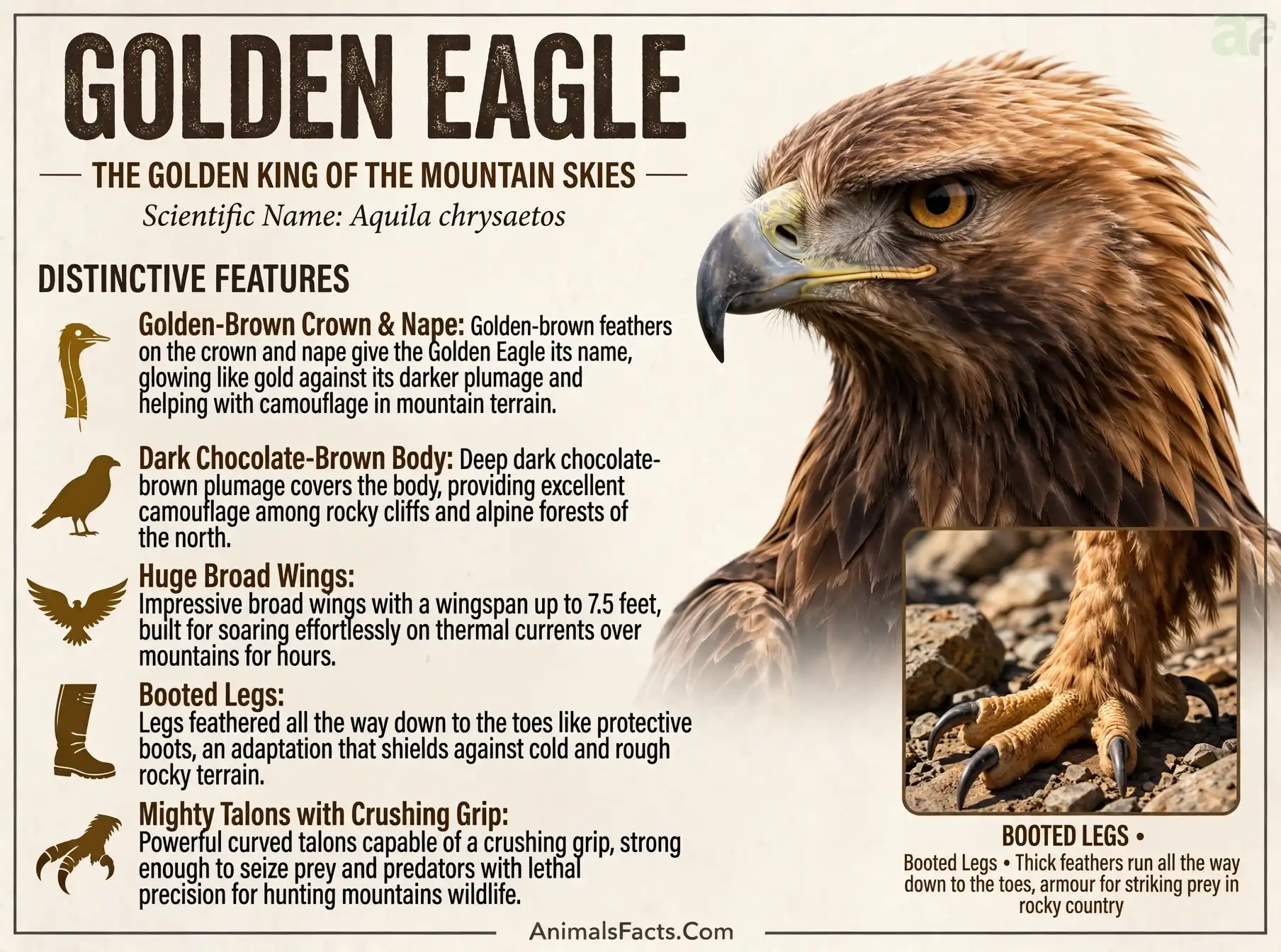
The golden eagle’s physical appearance strikes a different note from the more immediately dramatic plumage contrast of the bald eagle — the golden eagle’s power is expressed not in vivid color contrast but in sheer physical mass, the geometry of open wings, and the distinctive golden-brown nape that gives the species its name and its characteristic warm glow.
The Adult Plumage — Power Expressed in Tone
Overall coloration — Adult golden eagles are predominantly dark brown — the body, wings, and tail in various shades of brown from rich chocolate to pale buff-brown depending on age, sex, and individual variation. The overall impression at distance is of a very large, dark raptor — the uniformity of the dark plumage contrasting with the more complex patterning of immature birds.
The golden nape — The feature that gives the species its name — the feathers of the back of the head and nape are golden-brown to pale buff — distinctly paler and warmer in tone than the dark body feathers. In sunlight, the nape feathers produce a genuine golden glow that is visible at considerable distance — a characteristic that is particularly striking when a soaring eagle banks and the nape catches direct sunlight against the sky or dark mountainside behind it.
The tail — Adult tail feathers are grey-brown with darker terminal banding — a relatively subdued pattern. Immature birds show a distinctly different tail pattern — white at the base with a dark terminal band — that is one of the most reliable identification features for age assessment.
The wing pattern in flight — From below, adult golden eagles show uniformly dark underwings with slightly paler flight feathers at the wing base. From above, the pale carpal patch (a pale area at the base of the primary feathers visible on the upper surface of the wing) is one of the most distinctive in-flight identification features.
The eye color — Adult eyes are mid-brown — neither the bright yellow of bald eagles nor the dark brown of many other raptors. The eye color shifts from very dark brown in nestlings through progressively paler shades to the adult mid-brown.
The cere and feet — The cere (the bare skin at the base of the bill) is yellow, as are the feet and talons — yellow feet contrasting with black talons create a vivid close-range feature.
The Talons — The Killing Tools
The golden eagle’s talons are the most formidable of any Northern Hemisphere raptor — the biological equivalent of a vice with curved, razor-sharp points:
The hallux talon — The most powerful weapon; the rear talon (hallux) of the golden eagle reaches 5–7 cm in length in large females — longer than the talons of many smaller eagles across both feet. The hallux is the primary killing talon — driven into the prey’s vital region (back, neck, or skull) with the force of the eagle’s stoop.
Grip force — Golden eagle grip force has been measured in multiple studies — figures ranging from approximately 400–750 Newtons of foot pressure in large females, sufficient to fracture the skull of a medium-sized mammal or crush the spine of a hare on initial contact.
The hunting stoop delivery — When a golden eagle stoops at full speed and makes contact with prey, the talons are driven into the prey not merely by grip muscle force but by the kinetic energy of the 240+ km/h stoop — the combination of high-speed impact and powerful grip force delivering a total force that no prey of reasonable size can withstand.
Talon length variation — Female golden eagles have significantly larger talons than males — the female’s larger talons allowing hunting of larger prey and reflecting the role of females as the primary large-prey specialists in breeding pairs.
The Eyes — The Precision Targeting System
Detection range — Golden eagle visual acuity allows detection of a rabbit-sized prey animal from approximately 3 kilometers of distance — a figure confirmed through field observation and optical modeling. The eagle’s eyes are not merely powerful telescopes — they are precise targeting systems that allow distance estimation and trajectory calculation for the hunting stoop.
The dual fovea system — Like other eagles, the golden eagle has two foveas in each eye — one for binocular forward vision (prey targeting in the final stoop) and one for lateral monocular vision (wide-field landscape surveillance during soaring). This dual system allows simultaneous wide-field monitoring and precise target tracking.
Flicker fusion rate — Golden eagles process visual information at approximately 80–100 frames per second — compared to the human visual system’s approximately 20–30 frames per second. This higher flicker fusion rate means that prey moving rapidly through complex terrain is tracked more effectively by the eagle than by human observers at the same distance.
The Wings — Engineering for Speed and Soaring
Wing shape — The golden eagle’s wing shape represents a compromise between two flight demands — soaring efficiency (requiring large wing area and high aspect ratio) and high-speed pursuit and maneuvering (requiring more swept-back wings with good control at high speeds). The result is a moderately long, moderately broad wing with distinctly fingered wingtips — the primary feathers spreading into the characteristic “fingers” that increase lift at soaring speeds while allowing high-speed flight when the primaries are partially retracted.
Thermoal soaring — The golden eagle is an expert thermal soarer — the large wing area generating sufficient lift in rising air columns to allow sustained soaring with minimal energy expenditure. A golden eagle searching its territory may cover 100 kilometers per day while soaring, with relatively little active wing-flapping.
The stoop geometry — During a hunting stoop, the wings are swept back progressively — from the full soaring configuration to an increasingly swept-back position as speed builds. At maximum stoop speed (240–320 km/h documented), the wings are swept back tightly against the body, the tail folded, and the entire body profile minimized to reduce drag.
💡 Did You Know? The golden eagle has been documented hunting and killing prey of extraordinary size relative to its own body weight — creating one of the most remarkable prey-to-predator mass ratios of any avian predator. The most extreme documented prey items include young mountain goats (weighing up to 10 kg — more than twice the eagle’s body weight), young deer (fawns up to 8–10 kg), young chamois, and adult foxes (typical weight 4–6 kg — similar to or heavier than a female golden eagle). In traditional Kazakh falconry, trained golden eagles have been documented taking adult wolves (typically 25–45 kg — 6–10 times the eagle’s own body weight) in cooperative hunts where the eagle strikes the wolf from above and either kills it directly or pins it until the hunter arrives. This capacity to take prey dramatically larger than the predator itself is achieved through a combination of the stoop’s kinetic energy (which contributes enormous impact force at the moment of contact), the talon’s penetrating and gripping capability (which maintains hold on struggling prey), and in the case of very large prey, a hunting strategy that targets the spine or skull to immediately disable neurological function. The prey-to-predator mass ratio achieved by large female golden eagles routinely hunting prey at 2–4 times body weight, and occasionally at 5–10 times body weight in exceptional cases, is unmatched by any other regularly documented avian predator in the Northern Hemisphere.
4. Top 25 Amazing Golden Eagle Facts
Here is your definitive collection of the most extraordinary, scientifically verified, and genuinely astonishing golden eagle facts as of 2026:
- The golden eagle is the most widely distributed eagle in the world — found naturally across North America, Europe, Asia, and North Africa — the only eagle species with a natural range spanning all four major Northern Hemisphere land masses simultaneously.
- Golden eagles can achieve dive speeds of 240–320 km/h during a hunting stoop — among the fastest recorded movements of any animal on Earth. At these speeds, the eagle’s talons deliver impact force combining kinetic energy with grip strength that no prey species can withstand.
- The golden eagle has been used in traditional falconry for over 4,000 years — the most ancient and most enduring human-raptor working relationship in history. The Kazakh and Kyrgyz tradition of eagle hunting (berkutchi) is recognized by UNESCO as an Intangible Cultural Heritage of Humanity.
- Kazakh berkutchi (eagle hunters) have documented their golden eagles capturing adult wolves — prey animals that may weigh 25–45 kg, or 6–10 times the eagle’s own body weight. No other bird of prey is documented regularly taking prey of this relative size.
- The golden eagle is the national bird of five countries — Mexico, Albania, Germany, Austria, and Kazakhstan — more countries than any other eagle species and more than almost any other bird species globally.
- A single golden eagle pair may occupy and defend the same nesting territory for 40+ years — some documented Scottish golden eagle territories have been continuously occupied since ornithological records began, with successive pairs maintaining the same traditional nest sites across multiple eagle generations.
- The golden eagle can detect a rabbit-sized prey animal from approximately 3 kilometers of distance — the combination of extraordinary visual acuity, dual-fovea targeting system, and high flicker fusion rate creating one of the most powerful natural optical systems of any vertebrate.
- Golden eagles show reverse sexual size dimorphism in which females are significantly larger than males — large females reaching 6.7 kg and 234 cm wingspan, making them among the most massive birds of prey in the Northern Hemisphere despite the species not being the largest eagle by absolute size.
- The golden eagle occupies the most ecologically diverse prey base of any large eagle — documented prey ranging from earthworms and beetles at the small end to young deer and mountain goats at the large end. This three-order-of-magnitude prey size range is unmatched by any other regularly documented eagle predator.
- Golden eagles build multiple nests (called eyries) within their territory — typically 3–12 alternative nests across the home range, used in rotation across successive breeding seasons. This rotation may reduce nest parasite loads and provide insurance against nest damage or disturbance.
- The golden eagle’s name refers specifically to the golden-brown nape feathers that glow in sunlight — not to the overall body plumage which is predominantly dark brown. The golden nape is most visible when a bird is viewed from behind in direct sunlight.
- Young golden eagles spend approximately 4–5 years in juvenile plumage before acquiring full adult coloration — the distinctive white tail base with dark terminal band of immature birds being one of the most reliable age indicators visible in field observation.
- Golden eagle pairs perform spectacular aerial courtship displays — the pair engaging in undulating display flights (called sky-dancing) in which both birds rise and dive repeatedly over the nest territory, sometimes approaching and separating in coordinated maneuvers, and occasionally briefly locking talons in a behavior similar to the bald eagle’s cartwheel display.
- The golden eagle has been documented displacing bald eagles from hunting perches and feeding sites in areas of overlap in Alaska and the Pacific Northwest — despite the bald eagle being a larger-bodied species, the golden eagle’s more aggressive temperament gives it competitive dominance in direct confrontations.
- Documented golden eagle nests have been used for over 45 years continuously — accumulating material over decades to reach dimensions of 3–4 meters deep and 1.5–2 meters wide. The largest golden eagle nests rival bald eagle nests in total accumulated volume.
- The Mexican golden eagle (the subspecies A. c. canadensis found in Mexico) appears prominently on the Mexican national flag — depicted grasping a snake while perched on a cactus, an image derived from an Aztec founding myth. The Mexican coat of arms and flag therefore features the golden eagle, not the bald eagle.
- Golden eagles are documented active hunters in snow — pursuing prey across snow-covered terrain in both aerial attacks and in short, powerful ground-level pursuits after a prey animal has been flushed from cover. Hunting efficiency is documented as higher in some snow conditions because prey tracks and thermal signatures may be more visible.
- In the Scottish Highlands, the golden eagle population has been studied continuously for over 60 years — creating one of the longest continuous raptor monitoring datasets in the world. This dataset has revealed the complex interaction between golden eagle populations, grouse moor management, and illegal persecution.
- The golden eagle’s tail length is proportionally longer than most other large eagles — the long tail providing the fine directional control needed during high-speed hunting maneuvers through mountain terrain. The tail functions as both a rudder (direction control) and an elevator (pitch control) during the powered phases of the stoop.
- Research using GPS tracking devices attached to golden eagles has revealed home ranges of 200–2,000 km² — some of the largest documented home ranges of any bird of prey, reflecting the patchy distribution of prey and the eagle’s need to cover large areas during territorial soaring patrols.
- The golden eagle has been documented in altitudes exceeding 3,000 meters during soaring — the species capable of hunting and traveling at extraordinary elevations across the mountain ranges of the Himalayas, Rockies, Alps, and other major mountain systems.
- Traditional Kazakh eagle hunters (berkutchi) train golden eagles through a process that typically begins with juvenile eagles taken from nests at approximately 6–8 weeks of age — the training period lasting 1–2 years before the eagle is hunting proficiently. Trained eagles are typically worked for 7–10 hunting seasons before being released back to the wild.
- The golden eagle’s foot span — the spread of the fully extended foot from front talon to rear talon — reaches 20–25 cm in large females. This extraordinary foot span, combined with the penetrating force of the talons, creates a capture mechanism capable of covering and gripping the entire back of a large rabbit or hare in a single contact.
- Research in Scotland has documented that golden eagles preferentially hunt in the hour after dawn and the hour before dusk — the low-angle light during these periods casting shadows that make prey more visible against the ground surface while the eagle’s aerial silhouette is harder for prey to detect against a bright sky.
- As of 2026, the global golden eagle population is estimated at approximately 300,000 individuals — but meaningful declines are documented in parts of the European range (particularly in agricultural lowland areas), in the American West (affected by lead poisoning and wind energy collisions), and across the Middle East (where persecution continues). The species remains Least Concern globally but requires active conservation management across much of its range.
5. Fun Facts Golden Eagles
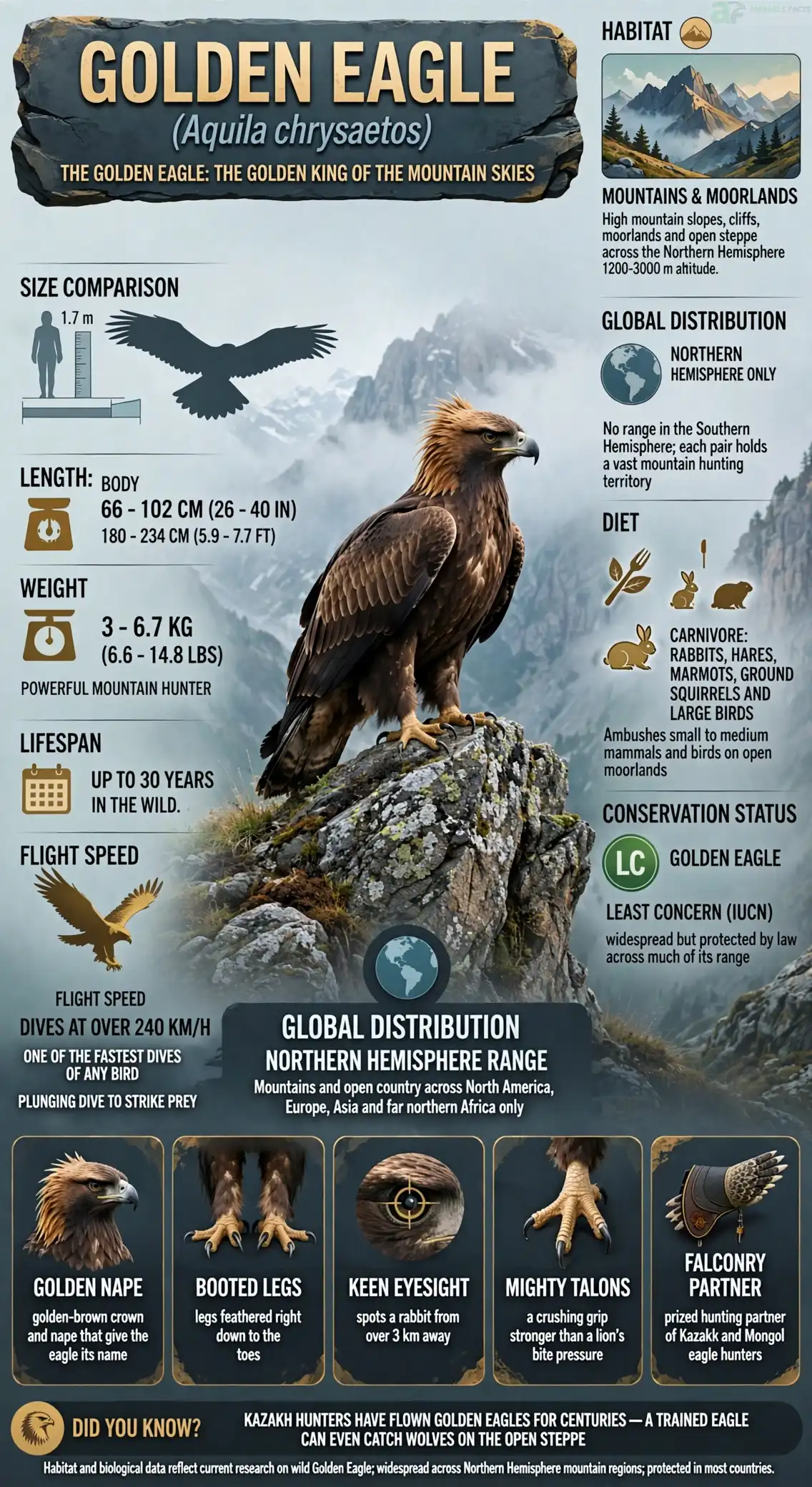
- Most widely distributed eagle on Earth
- Dive speeds of 240–320 km/h
- Used in falconry for 4,000+ years
- Trained eagles can take adult wolves
- National bird of five countries — more than any other eagle
- Same nesting territory for 40+ years
- Detects prey from 3 kilometers
- Prey ranges from beetles to young deer
- 3–12 alternative nests within each territory
- Golden nape — the species’ namesake feature
- Home ranges up to 2,000 km²
- UNESCO recognized traditional eagle hunting
6. Golden eagle Natural Habitat & Geographic Range
Golden eagle habitat is defined by the combination of open or semi-open terrain providing hunting airspace and prey visibility, with cliffs, crags, or large trees providing nest sites — a requirement met by an extraordinary diversity of landscape types across the Northern Hemisphere.
Primary Habitat Types
Mountain and cliff terrain — The golden eagle’s archetypal and most frequently depicted habitat; mountain ranges worldwide support golden eagle populations wherever appropriate prey communities occur. The combination of cliff-face nest sites, thermal uplift from slopes and ridges, and open terrain above the treeline creates ideal golden eagle conditions. Key mountain ranges include:
- Scottish Highlands — the most intensively studied golden eagle population in Europe
- Alps, Pyrenees, Apennines — continental European mountain populations
- Rocky Mountains, Sierra Nevada, Cascades — North American western range
- Himalayas, Hindu Kush, Tian Shan — Central and South Asian mountain populations
- Atlas Mountains — North African population
Moorland and heathland — In Scotland and Scandinavia, golden eagles are significant moorland birds — the open heather moorland providing abundant prey (mountain hares, red grouse, rabbits) and the adjacent crags providing nest sites. Scottish moorland management (grouse moor burning patterns) significantly influences golden eagle habitat quality.
Steppe and semi-arid grassland — Across Central Asia (Kazakhstan, Mongolia, Kyrgyzstan), the golden eagle is primarily a steppe bird — the vast open grassland steppe providing abundant prey (ground squirrels, hares, foxes) and the cliff outcrops within the steppe providing nest sites. The Central Asian steppe population includes the largest subspecies (A. c. daphanea) — the birds used in traditional falconry.
Boreal forest margins — In the boreal forest zone across northern Canada, Scandinavia, and Russia, golden eagles use the forest-tundra transition zone and open bogs within the boreal forest — avoiding closed-canopy forest interior but exploiting open areas within and at the edges of the boreal zone.
Desert and semi-desert — In the arid regions of southwestern North America (Sonoran Desert, Chihuahuan Desert), the Middle East, and parts of Central Asia, golden eagles hunt in semi-desert terrain — the open landscape providing good hunting conditions and the scattered rocky outcrops providing nest sites.
Arctic tundra — At northern range limits, golden eagles breed on arctic tundra — nesting on cliff outcrops or in shrubby tundra vegetation and hunting lemmings, Arctic hares, and various other tundra prey species.
Geographic Distribution
North America
| Region | Status | Key Habitats | Population |
|---|---|---|---|
| Alaska | Abundant | Mountain, tundra, coast | Estimated 13,000+ |
| Western Canada (BC, Alberta, Yukon) | Abundant | Mountain, boreal margin | Significant population |
| Western United States (Rocky Mountain states) | Common | Mountain, semi-arid | Major population |
| California | Common | Coast ranges, Central Valley margins | Important population |
| Great Plains | Wintering primarily | Open grassland | Wintering birds from Canada |
| Eastern United States | Rare and declining | Mountain remnants (Appalachians) | Very small; declining |
| Mexico | Present | Highlands, desert | Moderate population |
Europe
| Region | Status | Key Habitats | Notes |
|---|---|---|---|
| Scotland | Core European population | Highland moorland, mountain | ~500 pairs; intensively monitored |
| Scandinavia (Norway, Sweden, Finland) | Abundant | Mountain, boreal margin | Largest European population |
| Alps | Present | Mountain | Moderate; recovering in some areas |
| Iberia | Present | Mountain, semi-arid | Declining in some areas |
| Balkans | Present | Mountain | Moderate |
| Lowland Europe | Rare or absent | — | Extirpated from most lowland areas by persecution |
Asia
| Region | Status | Key Habitats | Notes |
|---|---|---|---|
| Kazakhstan, Kyrgyzstan, Mongolia | Abundant | Steppe, mountain | Core of traditional falconry |
| Russia (Siberia, Kamchatka) | Abundant | Mountain, tundra, boreal margin | Largest national population |
| China (Tibet, Xinjiang) | Present | Mountain, plateau | Significant population |
| Japan | Uncommon | Mountain | Small, declining |
| Middle East | Declining | Mountain, semi-arid | Persecution significant threat |
The Scottish Population — The Most Intensively Studied
The golden eagle population of Scotland represents the western European stronghold of the species and the most intensively monitored golden eagle population anywhere in the world:
Population size — Approximately 500 pairs — stable overall but with significant regional variation; the western Highlands support higher densities than the eastern, more heavily managed grouse moor areas.
The persecution history — Golden eagles in Scotland were systematically persecuted through the 19th and early 20th centuries — poisoning, trapping, and shooting by gamekeepers protecting grouse moors reduced the population to near-extinction in parts of the Scottish range. The population reached its 20th-century low during the intensification of grouse moor management in the early 1900s.
The recovery — Legal protection from 1954 combined with reduced persecution in some areas has allowed modest recovery — but illegal killing on grouse moors remains the most significant constraint on Scottish golden eagle population recovery and range expansion.
The east-west gradient — The Scottish golden eagle population shows a striking geographic pattern: the western Highlands support higher eagle densities and better breeding success; the eastern Highlands, dominated by grouse moor management, support lower densities and show evidence of suppressed population growth through illegal persecution.
7. Golden Eagles Diet & Feeding Behavior
Golden eagle diet is the most diverse of any large eagle in the Northern Hemisphere — the species consuming prey ranging from invertebrates through small rodents, rabbits, hares, ground squirrels, foxes, various birds, reptiles, and in exceptional circumstances young ungulates (deer, mountain goats, chamois).
Diet Breakdown Table
| Food Type | Estimated % of Diet | Season | Notes |
|---|---|---|---|
| Lagomorphs (rabbits, hares) | ~35–50% | Year-round; primary prey across most of range | Primary prey across most of the range |
| Ground squirrels and prairie dogs | ~15–25% | Spring/Summer — in American West | Important in North American range |
| Corvids and other medium birds | ~10–15% | Year-round | Crows, ravens, gulls, grouse species |
| Foxes and other small carnivores | ~5–10% | Year-round | Red fox most important |
| Young ungulates | ~3–8% | Spring — birth season | Deer fawns, mountain goat kids, chamois kids |
| Carrion | ~5–15% | Winter peak | Deer, sheep, various carcasses |
| Reptiles | ~3–8% | Spring/Summer | Snakes, lizards — important in southern range |
| Small mammals (voles, mice) | ~3–5% | Year-round | Supplementary; more important in poor prey years |
| Invertebrates | ~1–3% | Year-round | Earthworms, beetles; opportunistic |
The Hunting System — Power, Speed, and Precision
The soaring patrol — The fundamental hunting mode; golden eagles soar at altitude over their territory — the visual system scanning the ground surface for prey movement. A hunting eagle may cover 50–100 km of territory in a single soaring patrol lasting several hours, the thermal soaring requiring minimal energy expenditure while covering maximum search area.
Prey detection at distance — Detection of prey from soaring altitude typically occurs at distances of 500 meters to 3 kilometers — the eagle’s visual acuity allowing resolution of prey animal movement, size, and vulnerability assessment at distances far exceeding human visual capability.
The commitment decision — Not every detected prey animal triggers a stoop — the eagle assesses prey vulnerability before committing to a potentially energy-expensive attack. Factors assessed include:
- Prey size relative to eagle capability
- Prey distance from cover (rabbits near burrows are less profitable)
- Prey behavior — animals behaving abnormally (moving erratically, separated from conspecifics) are preferentially targeted
- Weather and wind conditions affecting stoop accuracy
The stoop sequence — Once committed:
- Wings partially fold — the eagle begins accelerating from soaring speed (~65 km/h) toward stoop speed
- Speed builds progressively as the stoop angle steepens — 100, 150, 200, 240+ km/h
- At the moment of contact — talons swing forward; the hallux drives into the prey’s vital region
- The combined impact of kinetic energy and grip force is typically immediately incapacitating for prey up to rabbit size
The ground pursuit — For prey flushed from cover but not caught in the initial stoop, golden eagles perform powerful, low-level ground-following pursuits — flying at high speed close to the ground in terrain-following flight, pursuing the prey animal over distances of up to several hundred meters.
The pair hunting strategy — Mated pairs are documented hunting cooperatively — one bird flying conspicuously to draw the prey’s attention while the second approaches from behind in a low-level attack. This cooperative strategy is particularly effective against prey that has effective anti-eagle behavior (mountain hares that rear up to track an approaching eagle can be ambushed from behind by the second bird of the pair).
The Prey Size Paradox
The golden eagle’s capacity to take prey dramatically larger than itself creates a biological paradox that has been extensively studied:
The physics of large prey capture — A golden eagle cannot take off while gripping prey heavier than approximately 5–6 kg in still air. How then does it regularly take prey of 8–10 kg and occasionally larger? The answer involves several mechanisms:
- Slope exploitation — capturing prey on slopes where the eagle can launch downhill into wind
- The wind factor — strong headwinds allow eagles to take off with heavier prey
- Partial consumption — eating at the kill site until the remaining carcass is light enough to carry
- Cache transport — carrying prey in multiple trips to a nearby feeding site
The stoop’s contribution — The kinetic energy of the stoop is crucial for large prey capture — the impact at 240+ km/h delivers force comparable to a high-velocity projectile, allowing prey to be killed or severely incapacitated at the moment of contact even without sustained grip. This means the limiting factor for prey size is survival of the contact rather than grip strength.
The Falconry Hunting Tradition
In Central Asian traditional falconry, trained golden eagles take prey species not typically considered within the bird’s natural hunting capability:
Fox hunting — The primary quarry in traditional eagle hunting; golden eagles readily learn to target red foxes and are highly effective at catching them in open steppe terrain.
Wolf hunting — The most extreme documented prey; Kazakh berkutchi have documented their trained eagles striking adult wolves in the head and back and either killing them directly or immobilizing them until the hunter arrives. The wolf hunting represents the absolute upper limit of golden eagle prey capability and requires highly trained birds working in close cooperation with mounted hunters.
Corsac fox — A smaller fox species (Vulpes corsac) of the Central Asian steppe; the primary quarry in Mongolian eagle hunting traditions.
8. Golden Eagle Reproduction & Life Cycle
Golden eagle reproduction follows the pattern of long-lived apex predators — slow reproductive rate, high investment per breeding attempt, lifelong pair bonds, and multi-year territory establishment — creating population dynamics driven primarily by adult survival rates rather than breeding output.
Pair Bond and Territory
Lifelong monogamy — Golden eagles maintain documented lifelong pair bonds — the same male and female occupying the same territory for potentially their entire adult lives. Studies using individually marked birds have confirmed pair bonds of 20+ years in Scottish populations.
The multiple nest system — Within each territory, the pair maintains 3–12 alternative eyrie sites — cliff ledges, large tree crowns, or rock outcrops used in rotation across successive breeding seasons. The specific nest used in any year depends on:
- Parasite load — nests accumulate ectoparasites (particularly flies and their larvae) through use; rotating to a different nest reduces infestation
- Disturbance history — nests disturbed in previous years may be abandoned in favor of quieter alternatives
- Structural condition — nests damaged by weather or accumulated weight may be rested for repair
- Prey distribution shifts — different nests within the territory may offer better access to current prey concentrations
Territory size — Golden eagle territories range from approximately 30 km² in areas of high prey density to 200+ km² in low-prey-density environments. The home range — the area actually used during daily movements — may be substantially larger than the defended core territory.
Courtship and Display
Sky-dancing — The primary aerial courtship display of golden eagles; the pair rises together on thermals to altitude over the territory, then performs a series of deep undulating swoops — diving steeply and pulling up sharply, repeatedly, while calling. The sky-dancing display is most intense in late winter and early spring before egg-laying.
Talon-grappling — Pairs occasionally briefly lock talons during courtship — though this behavior is less sustained than the dramatic bald eagle cartwheel display. The talon contact in golden eagle courtship is more typically a brief touch-and-release than a prolonged spiral.
Nest preparation — In late winter before breeding, pairs intensively refurbish the selected nest — both birds carrying fresh green vegetation (particularly fresh conifer or deciduous branches) to the nest. The green vegetation may serve multiple functions — structural reinforcement, parasite suppression, or visual signaling of nest occupation.
Prey presentation — The male demonstrates hunting ability and commitment to the pair bond by delivering prey to the female during the courtship period — the female remaining near the nest while the male hunts and returns with prey items.
Nesting and Incubation
Egg-laying timing — Varies by latitude and elevation:
- Scotland — mid-March to early April
- Central Europe — late February to March
- Alaska and northern Canada — April–May
- Mediterranean — February–March (earliest breeders in European range)
Clutch size — Typically 1–3 eggs, most commonly 2. Clutch size correlates with prey availability in the breeding season — pairs in high-quality territories in good prey years produce larger clutches.
Egg description — White to pale cream, variably marked with brown or reddish-brown blotching. Each egg approximately 74–78 × 57–59 mm.
Incubation period — 43–45 days — one of the longer incubation periods among Northern Hemisphere raptors, reflecting the large egg size and the need for stable incubation conditions in the variable weather of mountain and moorland breeding habitats. Both parents incubate, with the female performing the majority.
Weather protection — In mountainous and northern habitats, late spring snow and rain events can chill eggs and small chicks fatally if the incubating adult is flushed from the nest by disturbance. Human disturbance near active golden eagle nests during early incubation is one of the most significant causes of breeding failure in Scotland and other monitored populations.
Chick Development and Sibling Rivalry
At hatching — Eaglets hatch at approximately 2-day intervals corresponding to the staggered incubation beginning — the first egg typically hatches approximately 2 days before the second. The first-hatched chick therefore has a head start in size.
Sibling aggression — In golden eagle nests, the older, larger chick frequently attacks and kills the younger sibling in a behavior called Cainism (from the biblical Cain who killed his brother Abel). Cainism occurs in 50–75% of golden eagle nests in Scotland — the younger, smaller chick typically dying within 2 weeks of hatching in food-limited years. In years of abundant prey, both chicks survive to fledging; in poor prey years, Cainism ensures that the surviving chick receives all parental resources.
Growth and development — The surviving eaglet grows rapidly:
- Week 1–2 — blind, helpless, covered in white down; thermoregulation entirely parental
- Week 3–4 — eyes open; second down coat develops; first signs of feather quills
- Week 5–7 — primary flight feathers emerging; increasingly mobile within the nest
- Week 8–10 — approaching adult size; wing-flapping exercises begin
- Week 11–13 — first flight (fledging); leaves the nest but remains dependent on parents
Post-fledging dependence — Fledgling golden eagles remain dependent on parental provisioning for 3–6 months after fledging — one of the longest post-fledging dependency periods of any raptor. The young eagle must develop hunting skills from the relatively simple (catching exposed prey) to the highly complex (stoop hunting of mobile prey in challenging terrain) over this extended period.
Dispersal and the pre-breeding years — After achieving independence, young golden eagles enter a 4–5 year nomadic phase — wandering through the landscape, honing hunting skills, and gradually establishing presence at a territory site. Most golden eagles do not breed successfully until their 5th or 6th year, though territorial establishment may begin earlier.
Maximum lifespan — Wild golden eagles are documented living to 32 years in ringed bird studies; captive individuals have reached 50 years — one of the longest lifespans of any raptor.
9. Social Behavior & Communication
Golden eagle social behavior is defined primarily by territorial pair exclusivity during the breeding season and relative social tolerance during winter when birds of different ages and territories may share wintering areas.
Territory and Pair Dynamics
Exclusive breeding territory — During the breeding season, the mated pair vigorously excludes all other golden eagles from the core territory — intruders are pursued, attacked, and driven out through a combination of aerial chasing, display, and direct physical confrontation.
The tolerated non-breeding bird — In some territories, studies have documented the presence of a “third eagle” — typically a young adult bird tolerated on the periphery of the territory by the resident pair. The evolutionary significance of this toleration is debated — possibilities include preparatory territory establishment by a potential replacement breeder, or a relative of the resident pair receiving indirect fitness benefits through territory access.
Winter aggregations — Outside the breeding season, golden eagles from different territories may share productive hunting areas — wintering concentrations at carrion-rich sites (deer carcasses, sheep kills) can bring multiple birds together in relative tolerance, though dominance interactions determine access priority.
Communal roosts — In some areas, non-breeding golden eagles roost communally during winter — particularly in the American West where large numbers of wintering birds from northern populations concentrate in productive hunting areas.
Communication
The sky-dancing call — During territorial sky-dancing display, golden eagles produce a high, yelping bark — repeated in series during the undulating display flight. This call carries considerable distance across mountain terrain and advertises territory occupancy.
The alarm call — A sharp, repeated bark or yelp — produced when humans or other threatening animals approach the nest or territory. The alarm call triggers immediate freeze or escape behavior in prey species that have evolved alongside golden eagle predators.
The contact call — A soft, low chirping or mewing — exchanged between pair members during close interaction, prey delivery, and nest exchanges. This quiet call maintains pair bond communication without advertising the location to competing eagles.
Begging calls — Eaglet and post-fledging juvenile calls — an insistent, carrying keening whistle produced repeatedly when the young eagle is hungry and requesting food from parents. The begging call is distinctive and audible at considerable distances — a practical guide for researchers locating fledged young in mountain terrain.
Wing display — During competitive encounters, golden eagles spread and present the wings in a threat mantling posture — making the bird appear larger and more formidable to rivals. Wing spread at close range during feeding site competition communicates dominance without requiring physical contact.
10. Predators & Defense Mechanisms
Adult golden eagles are the apex predators of their ecosystems — no native animal regularly preys on adult birds. However, eggs, chicks, and juvenile eagles face meaningful predation and competition.
Threats to Eggs and Chicks
Pine marten (Martes martes) and American marten (Martes americana) — Documented nest predators in both European and North American ranges; martens can access cliff ledge nests and consume eggs and small chicks.
Common raven (Corvus corax) — Ravens investigate golden eagle nests for eggs and small chicks when adults are absent — documented nest predation at both cliff and tree nests.
Brown bear (Ursus arctos) — In areas of range overlap, brown bears have been documented climbing trees to golden eagle nests or accessing cliff ledge nests — consuming eggs and chicks.
Wolverine (Gulo gulo) — Documented competitor and occasional threat at northern range nests — wolverines’ climbing ability allows access to tree and some cliff nests.
Threats to Adults
Humans — The primary threat to adult golden eagles across the range:
- Illegal shooting and poisoning — persecution on grouse moors (Scotland), by sheep farmers (various), and by ranchers and poultry farmers (American West and elsewhere)
- Wind energy collisions — documented at multiple wind farm sites; the Altamont Pass Wind Resource Area in California is the site of the highest documented golden eagle wind energy mortality in the United States
- Lead poisoning — from carrion containing lead ammunition fragments; parallel to the bald eagle lead poisoning problem
- Power line electrocution — documented mortality source across the range
White-tailed eagle competition — In areas of European range overlap, the larger and more socially dominant white-tailed eagle occasionally competes with golden eagles for nest sites and feeding areas.
Intraspecific competition — Golden eagles kill other golden eagles — territorial conflicts and competition for prey occasionally escalate to lethal encounters, particularly between established residents and intruding sub-adults.
Defense Mechanisms
Height and remoteness of nest sites — The fundamental nest defense; cliff ledge and remote mountain nests are inaccessible to most terrestrial predators and require significant effort from human persecutors. The golden eagle’s preference for remote terrain reduces most forms of human disturbance.
Active nest defense — Adult golden eagles are among the most vigorous nest defenders of any North American or European raptor — researchers approaching active nests report repeated, close-range stooping attacks by defending adults, with occasional physical contact. Eagles have struck and injured researchers at nest sites.
Crypsis during incubation — The female incubating on the nest shows surprisingly cryptic behavior — remaining extremely still when potential predators approach, relying on the nest’s remote location and the sitting bird’s relatively dark plumage to avoid detection.
The multi-nest strategy — Maintaining multiple alternative nests within the territory provides a form of insurance — if one nest is disturbed, destroyed, or rendered parasitically unusable, the pair can relocate to an alternative site within the same season or in the following year.
Competitive dominance over most species — Despite specific vulnerability to certain predators, the adult golden eagle’s size, weaponry, and aggressive temperament make it dominant over virtually all other predators and competitors it encounters — including larger species like white-tailed eagles, which the golden eagle’s greater agility allows it to outmaneuver in direct competition.
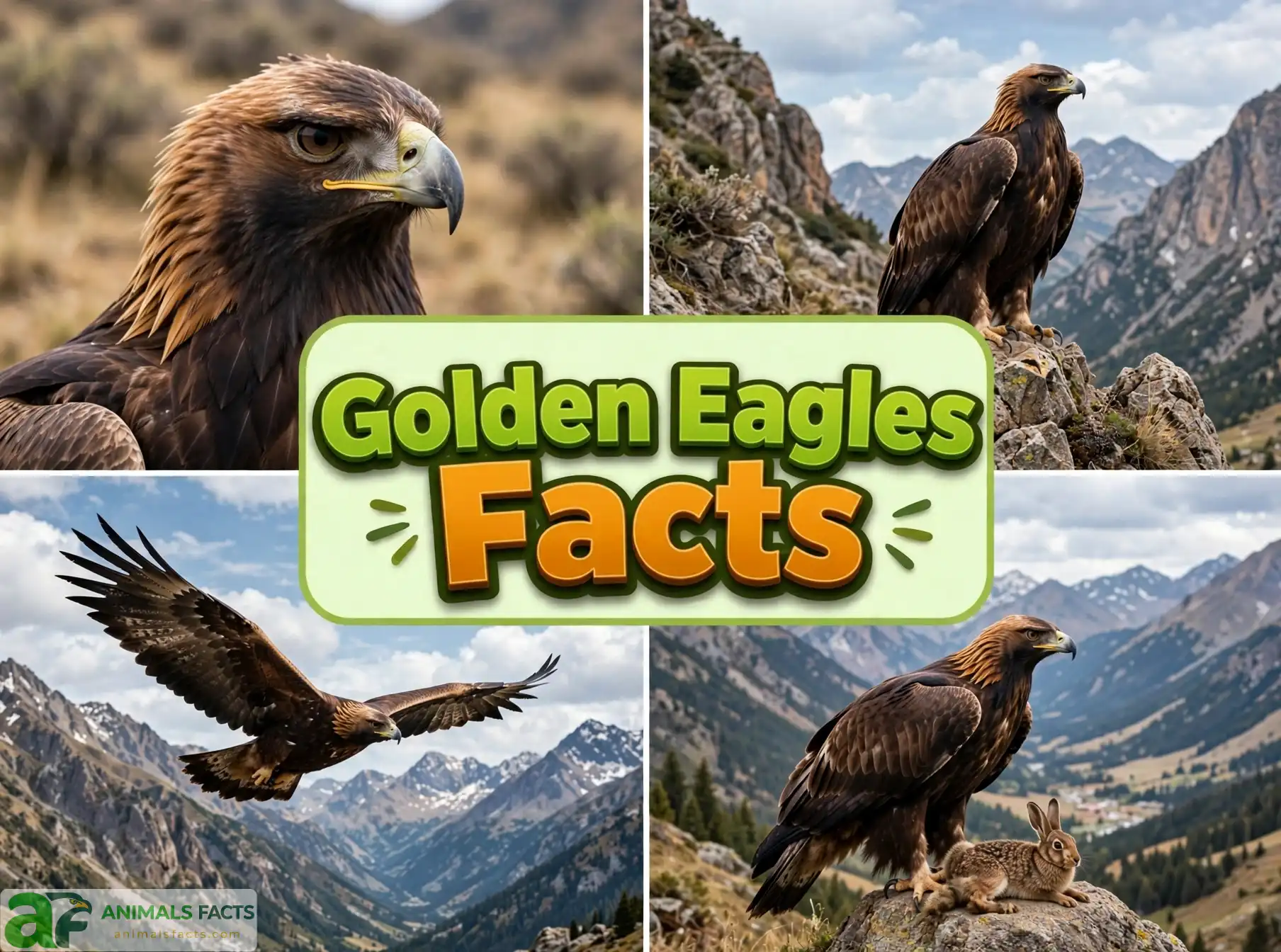
11. Golden Eagle Facts for Kids
Hey amazing young wildlife scientists, raptor enthusiasts, and future conservation heroes! Here are some truly extraordinary golden eagle facts for kids that will make every bird conversation the most fascinating one in the room:
- 🦅 The golden eagle is the most WIDESPREAD eagle in the world! Golden eagles live in North America, Europe, Asia, and North Africa — which means they are found on more continents and in more countries than any other eagle on Earth. While most eagle species are found in just one region, the golden eagle has conquered almost the entire Northern Hemisphere. You could see a golden eagle in Scotland, in the Rocky Mountains, in the Kazakh steppe, or in the mountains of Japan — the same species in all those places!
- 🦅 Golden eagles can dive at over 240 KILOMETERS PER HOUR! When a golden eagle spots a rabbit from 2 or 3 kilometers away, it folds its wings and drops into a stoop — and it can reach speeds faster than a race car on a highway. At that speed, when the talon strikes the prey, it hits with so much force that the prey is knocked out instantly. It is one of the fastest movements of any animal on Earth!
- 🦅 Trained golden eagles can catch WOLVES! In Kazakhstan and Kyrgyzstan, traditional eagle hunters called berkutchi have trained golden eagles to hunt foxes — and sometimes even wolves! A wolf can weigh 30 to 40 kilograms, which is about 8 times heavier than the eagle itself. But when the eagle drops from altitude and strikes the wolf in the back and head, the force of the impact can bring down an animal that powerful. Eagle hunters have practiced this tradition for over 4,000 YEARS, and UNESCO has officially recognized it as an important world cultural heritage!
- 🦅 The same golden eagle pair can use the same nesting territory for FORTY YEARS or more! Golden eagle pairs are incredibly faithful to their home territory — some territories in Scotland have been occupied by a continuous succession of eagle pairs for as long as written records exist. Each year the pair adds new sticks and branches to their nest — so old nests can get enormous, sometimes 3 or 4 meters deep after decades of additions!
- 🦅 Five different countries have chosen the golden eagle as their NATIONAL BIRD! Mexico, Germany, Albania, Austria, and Kazakhstan all use the golden eagle as their national symbol. And the famous eagle on Mexico’s flag — clutching a snake while perched on a cactus — is a golden eagle, based on an ancient Aztec legend! The golden eagle appears on more countries’ national symbols than any other eagle species!
- 🦅 A golden eagle can see a RABBIT from 3 kilometers away! That is like being at one end of a city block and being able to identify something the size of your hand at the other end — while that something is also moving and partially hidden in grass! Golden eagles have two super-powered focusing areas in each eye instead of just one like humans, and their eyes process images faster than any camera. They truly have the most extraordinary eyes of any animal in the mountains!
- 🦅 Golden eagles sometimes get DRUNK — but not on nectar like the lorikeet! Not exactly — but in the winter, golden eagles sometimes eat carrion (dead animals) that have been left by hunters who used lead bullets. The tiny fragments of lead in the carcass can poison the eagles, making them confused and disoriented. This is called lead poisoning, and it is one of the biggest problems for golden eagles today. This is why many hunters are switching to copper bullets that do not leave dangerous fragments!
- 🦅 The older chick usually KILLS its younger sibling in the nest! This sounds shocking, but it is a natural behavior called Cainism. When two golden eagle eggs hatch, the first chick is already a couple of days older and bigger. If there is not enough food, the bigger chick attacks and kills the smaller one — making sure all the food goes to one healthy chick rather than two weak ones. In years when prey is very abundant, both chicks survive. This is nature’s way of making sure the golden eagle family produces the strongest possible offspring!
12. Relationship with Humans
The golden eagle’s relationship with humans spans the most ancient working partnership between a wild bird and a human hunter in history, over two millennia of persecution that brought the species to local extinction across much of its European and North American range, a complex ongoing tension between conservation and agricultural interests, and a growing ecotourism industry that gives the golden eagle increasing economic value as a living wildlife resource.
The Falconry Tradition — 4,000 Years of Partnership
The relationship between golden eagles and Central Asian nomadic peoples represents the oldest and most elaborate human-raptor working relationship in history — a partnership documented in petroglyphs, ancient texts, and oral traditions stretching back more than four millennia:
The berkutchi tradition — The Kazakh and Kyrgyz tradition of eagle hunting (kÅ«s salу in Kazakh, salburun in Kyrgyz) centers on the berkutchi — the eagle hunter — whose craft involves the capture of a juvenile golden eagle from the nest, a 1–2 year training process, and a working relationship of 7–10 hunting seasons before the eagle is traditionally released back to the wild.
The training process — Traditional berkutchi training involves:
- Capturing a juvenile eagle (called a balaban) from the nest at approximately 6–8 weeks of age
- A period of imprinting and habituation — the eagle learning to accept the trainer and the horse
- Progressive introduction to prey — initially dead prey, then increasingly live quarry
- The development of the hunting response — the eagle learning to pursue game on the steppe
The hunting technique — Working from horseback in open steppe terrain, the berkutchi carries the trained eagle on a heavy leather glove. When prey is flushed, the eagle is cast off and pursues the quarry in an aerial stoop. Fox, wolf, and corsac fox are the primary quarry species in Kazakh tradition.
The eagle’s status — Among berkutchi, trained golden eagles are treated with profound respect — fed premium food, given names, and treated more as partners than tools. The relationship between an experienced berkutchi and his eagle is understood as a genuine partnership in which both parties contribute distinct capabilities.
The release tradition — Traditional practice mandates releasing the eagle back to the wild after the working partnership ends — the eagle returning to breed in the wild and contribute to the wild population. This traditional release practice has conservation significance — returning experienced, healthy eagles to the wild population.
UNESCO recognition — In 2016, UNESCO inscribed traditional eagle hunting practiced by Kazakhs and Kyrgyz on the Intangible Cultural Heritage of Humanity list — formal global recognition of the cultural significance of this 4,000-year tradition. Mongolia’s eagle hunting tradition was added subsequently.
The Persecution History
The golden eagle has been systematically persecuted across its range by European and North American agricultural and game management interests — a persecution so intense and so prolonged that it drove the species to local extinction across much of its historical range:
The gamekeeping war in Scotland — The 19th and early 20th centuries saw the most intense persecution of golden eagles in Scotland — gamekeepers employed on grouse shooting estates systematically poisoned, trapped, and shot golden eagles to protect grouse stocks. The combination of grouse moor expansion (following the Highland Clearances and the development of driven grouse shooting as a sporting pursuit) and the Victorian fashion for egg and specimen collecting drove the golden eagle to near-extinction across much of its Scottish range by the early 20th century.
The American rancher conflict — In the American West, golden eagles were persecuted by sheep and cattle ranchers who blamed them for lamb and calf kills. Aerial shooting campaigns in the 1940s and 1950s — using aircraft to pursue and shoot golden eagles — killed thousands of birds. The 1962 amendment to the Bald and Golden Eagle Protection Act explicitly prohibited aerial shooting, ending the most intensive persecution phase.
The sheep/lamb predation question — The conflict between golden eagles and sheep farming persists across Scotland, Norway, and parts of North America — research consistently showing that actual eagle predation on live lambs is substantially lower than farmer perception, and that most eagle-associated lamb losses involve carrion consumption of lambs that died of other causes. Nevertheless, the perception of lamb predation drives ongoing illegal killing of golden eagles in sheep farming areas.
Ongoing illegal killing — Despite legal protection, illegal killing of golden eagles continues across the range:
- In Scotland, poisoning and shooting on grouse moors is the primary cause of non-natural golden eagle mortality — documented through satellite tagging programs that record birds disappearing in known grouse moor areas
- In the American West, poisoning (often targeting coyotes) causes collateral golden eagle mortality
- In the Middle East and parts of Central Asia, direct shooting persists despite legal protection
The Wind Energy Conflict
The rapid expansion of wind energy generation across golden eagle range creates a significant emerging conservation conflict:
The Altamont Pass problem — The Altamont Pass Wind Resource Area in California’s Diablo Range is the site of the highest documented golden eagle wind energy mortality in the world — estimates suggesting 1,000+ golden eagles killed in wind turbine strikes over the facility’s operational history. The site’s location within prime golden eagle hunting habitat, combined with the early generation wind turbine design (smaller turbines with faster blade speed), created conditions for extreme raptor mortality.
The broader collision risk — Wind farms sited in open terrain — particularly ridgeline sites that golden eagles use as soaring corridors — create collision risk across the range. The combination of eagle hunting behavior (focused attention on ground rather than above) and the blade speed of large modern turbines creates a meaningful mortality risk.
The regulatory response — US Fish and Wildlife Service eagle conservation guidelines provide a framework for wind energy siting and operation designed to minimize eagle impacts — including pre-construction eagle use surveys, incidental take permits, and operational modifications during peak eagle activity periods.
13. Golden eagle Conservation Status & Threats
Conservation Status Overview
| Feature | Details |
|---|---|
| IUCN Status | Least Concern (LC) |
| Population Trend | Stable globally — but declining in parts of range |
| Estimated Global Population | ~300,000 individuals |
| North American Population | ~70,000 individuals (US and Canada) |
| European Population | ~12,000–15,000 pairs |
| Most Threatened Region | Middle East, Japan, lowland Europe |
| UK Legal Status | Schedule 1 of Wildlife and Countryside Act — highest protection |
| US Legal Status | Protected under Bald and Golden Eagle Protection Act and Migratory Bird Treaty Act |
Major Threats
| Threat | Description | Impact Level |
|---|---|---|
| Illegal persecution | Poisoning and shooting on grouse moors (UK); rancher persecution (USA) | High — primary threat in Europe and North America |
| Lead poisoning | Carrion containing lead ammunition fragments | High — significant mortality across range |
| Wind energy collision | Strike with wind turbine blades; Altamont Pass type situations | High in specific areas; increasing |
| Power line electrocution | Contact with power infrastructure | Medium-High |
| Habitat degradation | Loss of open hunting habitat; afforestation of moorland | Medium-High in Scotland |
| Human disturbance at nests | Hikers, climbers, photographers near active nests | Medium — specifically managed |
| Prey decline | Rabbit hemorrhagic disease reducing primary prey | Medium — specific areas |
| Climate change | Altered prey availability; vegetation change | Long-term increasing concern |
| Agricultural intensification | Loss of rough grazing supporting rabbit and hare populations | Medium in agricultural areas |
The Scottish Golden Eagle Conservation Challenge
Scotland’s golden eagle population faces a particularly well-documented conservation challenge — the intersection of legal protection, illegal persecution, and land use conflict creating a situation that has been intensively studied and extensively debated for decades:
The grouse moor conflict — Golden eagles kill red grouse — one of the primary quarry species of driven grouse shooting, an economically significant rural industry in Scotland. Grouse moor managers therefore have a financial incentive to reduce eagle numbers on their estates — and despite legal protection, illegal killing (primarily through poisoning and disappearance of satellite-tagged birds in known grouse moor areas) continues to suppress golden eagle populations in the eastern Highlands.
The satellite tagging evidence — Scottish Natural Heritage (now NatureScot) has operated a long-term golden eagle satellite tagging program that has produced compelling evidence of illegal killing — tagged eagles regularly disappearing in active grouse moor areas, with signal loss patterns indicating the birds were killed and the tags removed or destroyed rather than natural death.
The population consequence — The eastern Highlands of Scotland — theoretically capable of supporting significantly more golden eagle pairs than currently nest there — show a population density substantially below the western Highland carrying capacity. The difference is attributed to ongoing illegal killing suppressing population establishment in the eastern region.
The policy response — The Scottish Government has pursued a combination of enforcement (RSPB investigations, police wildlife crime unit prosecutions) and land management incentive (licensing of driven grouse shooting linked to wildlife crime compliance) — though the effectiveness of these approaches remains debated.
The Lead Poisoning Parallel
As with the bald eagle, lead poisoning from ingested ammunition fragments is one of the most significant current mortality causes for golden eagles:
The route — Golden eagles consuming deer and other ungulate carcasses or gut piles left by hunters are exposed to lead bullet fragments. Studies consistently find elevated blood lead levels in golden eagles in hunting areas.
The scale — Multiple studies across the American West and Europe have documented that 20–40% of golden eagles sampled in hunting areas show blood lead levels above the threshold for subclinical lead effects — and a smaller but significant proportion show acutely toxic levels.
The solution — As with bald eagles, transition to non-lead ammunition is the most effective intervention — demonstrated to dramatically reduce lead exposure in raptors at sites where such transitions have occurred.
14. Famous Golden Eagles in History & Pop Culture
Famous Individual Golden Eagles
“Challenger” equivalents in European tradition — Various trained golden eagles in traditional berkutchi practice have achieved legendary status within their communities — though Western documentary naming conventions have not typically applied individual names. The trained eagle of a master berkutchi is understood within the tradition as an individual with distinct personality, capability, and history — celebrated as a partner rather than an implement.
Iñaki and other named research individuals — Long-term golden eagle studies in Scotland, Spain, and North America have individually identified and in some cases named study birds — their documented life histories contributing decades of behavioral and ecological data. Scottish study birds monitored from banding in the 1960s and 1970s through their deaths in the 1980s and 1990s provided foundational data on golden eagle territory use, breeding success, and longevity.
The Mexican flag eagle — While not an individual bird, the golden eagle depicted on the Mexican national flag — clutching a rattlesnake while perched on a prickly pear cactus — is arguably the most widely reproduced golden eagle image in history, appearing on the flag of Mexico (population 130 million) and on all Mexican government documents, currency, and official materials. The image derives from the Aztec legend of Tenochtitlan’s founding — a golden eagle eating a serpent marking the site of the Aztec capital.
The Altamont birds — The golden eagles killed at Altamont Pass Wind Resource Area in California over the facility’s operational history — collectively representing an extraordinary conservation tragedy — are not individually named but collectively constitute a documentation of wind energy’s impact on golden eagle populations that has shaped global wind energy siting policy.
Historical and Cultural Significance
The Roman Aquila — The most historically significant cultural use of the golden eagle: the Roman legion’s standard, the Aquila — a golden eagle standard carried before each Roman legion — was the most sacred object in Roman military tradition. The loss of the Aquila in battle was the supreme dishonor; its recovery the supreme glory. Three lost Aquilae — the standards of the legions destroyed in the Battle of Teutoburg Forest (9 CE) — were the subject of decades of Roman military campaigns to recover them. The Roman Aquila connects the golden eagle to the most powerful military organization of the ancient Western world.
Napoleon’s eagle — Napoleon Bonaparte incorporated the golden eagle into French Imperial symbolism — the Napoleonic eagle appearing on French imperial standards, seals, and military insignia. The Napoleonic use of the eagle directly referenced Roman imperial eagle symbolism.
The double-headed eagle — The heraldic double-headed eagle — appearing in the coats of arms of the Holy Roman Empire, the Byzantine Empire, Russia, Albania, Serbia, and many other states — is conventionally depicted as a golden or imperial eagle. The double-headed eagle symbol, representing power over both East and West, is one of the most widely used heraldic symbols in European and Middle Eastern history.
The Great Seal of the United States — While the bald eagle appears on the US Great Seal, the original 1776 proposals considered by Franklin, Adams, and Jefferson included a golden-eagle-type figure — the final bald eagle choice being a specifically American selection that distinguished the new republic’s symbol from the European golden eagle traditions of the Old World powers.
15. Role in Ecosystem & Food Chain
The Apex Predator Role — Shaping Prey Behavior Across Landscapes
The golden eagle’s most important ecosystem function is as a behavioral modifier of prey communities — the eagle’s presence creating what ecologists call a “landscape of fear” in which prey animals modify their behavior in response to predation risk:
The mountain hare behavioral arms race — In Scotland, mountain hares (Lepus timidus) in areas with established golden eagle pairs show distinctive anti-eagle behavioral adaptations not present in hare populations without eagle predators:
- Rearing up on hind legs to scan the sky before moving in open terrain
- Preferentially using vegetated cover during the eagle’s peak hunting periods (dawn and dusk)
- Freezing motionless when a distant soaring eagle is detected rather than fleeing (since flight movement triggers the eagle’s visual detection)
- Making use of the visual horizon to assess eagle approach trajectory before breaking cover
These behavioral differences between eagle-exposed and eagle-naive hare populations constitute one of the most clearly documented examples of predator-driven behavioral evolution in British wildlife.
The ground squirrel alarm system — In North American range, golden eagle predation pressure has driven the evolution of sophisticated alarm call systems in black-tailed prairie dogs (Cynomys ludovicianus) and various ground squirrel species — the calls encoding information about predator type (aerial vs. terrestrial) and individual predator characteristics (size, color, speed) that allow prey animals to calibrate appropriate escape responses.
Cascade effects on vegetation — By suppressing hare, rabbit, and ground squirrel populations, golden eagles indirectly reduce grazing pressure on vegetation — in some Scottish and American landscapes, golden eagle presence correlates with measurable differences in vegetation structure in areas where the eagle’s prey species are important grazers.
The Carrion Processing Function
Golden eagle consumption of ungulate and other carcasses contributes to nutrient cycling and carcass processing — the eagle’s powerful bill tearing open frozen or tough carcasses that smaller scavengers cannot access, facilitating decomposition and nutrient return to the ecosystem.
The Ecological Indicator Role
Like the bald eagle, the golden eagle functions as a sensitive indicator of open landscape ecological health — its presence and breeding success reflecting the condition of the prey communities, habitat structure, and level of human interference that determine open-terrain ecosystem quality across the Northern Hemisphere.
The prey abundance proxy — Golden eagle breeding success in Scotland is strongly correlated with mountain hare density — the correlation so reliable that eagle breeding productivity has been used as a surrogate measure of hare population status in areas where direct hare counting is impractical.
16. Myths, Folklore & Cultural Significance
Indigenous North American Traditions
The eagle as supreme spiritual power — Across indigenous North American traditions, the golden eagle is often considered the most powerful spiritual being in the avian world — though the specific cultural significance varies significantly between nations:
Lakota and Plains traditions — Eagle feathers — particularly golden eagle tail feathers — are the most spiritually significant objects in Plains warrior culture. The eagle feather warbonnet (a headdress of eagle feathers) marks the highest honors — each feather representing a specific act of courage or accomplishment. The golden eagle is understood as a messenger to the divine realm whose feathers carry divine power.
Pueblo traditions — In Pueblo cultures of the American Southwest, the golden eagle is one of the six directional guardians — associated with the upper world (the sky direction). Eagle feathers appear in Kachina ceremonies, prayer sticks, and various ceremonial objects.
Pacific Northwest — The golden eagle features in the mythology of various Pacific Northwest nations alongside the bald eagle — though the bald eagle is typically more prominent in coastal traditions where it is more regularly encountered.
The eagle as sun messenger — Multiple indigenous traditions connect the golden eagle to the sun — the eagle flies toward the sun, endures solar brightness that blinds other beings, and carries the power of solar energy in its feathers. This sun association makes the golden eagle a symbol of enlightenment, vision, and the highest spiritual achievement.
European and Eurasian Mythology
Zeus/Jupiter’s eagle — In ancient Greek and Roman mythology, the golden eagle is the sacred bird of Zeus (Jupiter) — the king of the gods. The eagle is Zeus’s messenger, his weapon-bearer (carrying his thunderbolts), and his symbol of divine authority. Every Roman legion’s Aquila was therefore not merely a military standard but a divine object — the sacred bird of the supreme deity made physical in gold.
The Norse tradition — In Norse mythology, an enormous eagle sits at the top of Yggdrasil (the world tree) — in perpetual conflict with Nidhogg the dragon at the roots. The eagle represents the powers of the celestial upper world, the dragon the forces of the underworld — their eternal conflict maintaining the balance of the cosmos.
The Kazakh spiritual dimension — In Kazakh traditional belief, the golden eagle occupies a liminal position between the human and divine worlds — capable of ascending to the realm of the supreme deity Tengri (the Sky God) and returning. The berkutchi’s working relationship with a golden eagle is therefore not merely a practical hunting partnership but a spiritual connection to the divine realm through the eagle’s celestial associations.
Heraldic tradition — The golden eagle’s use in European heraldry spans from the Roman Aquila through the Holy Roman Empire, Napoleonic France, and into modern national symbols. The double-headed imperial eagle — used by the Holy Roman Empire, Habsburg Austria, Tsarist Russia, Albania, Serbia, and numerous other states — derives from Byzantine use of the golden eagle as imperial symbol and has persisted as a heraldic motif for over a millennium.
The Mexican Founding Myth
One of the most culturally significant golden eagle narratives in the Americas:
The Aztec legend — According to Aztec founding mythology, the god Huitzilopochtli guided the Aztec people on a long migration from their northern homeland and commanded them to settle where they saw a golden eagle (Aquila chrysaetos or the closely related A. c. canadensis) perched on a prickly pear cactus while eating a snake. The Aztec saw this vision on a small island in Lake Texcoco — founding the city of Tenochtitlan (modern Mexico City) on that site approximately in 1325 CE.
The national symbol — The founding eagle vision is depicted on the Mexican national flag and coat of arms — making it the most widely reproduced golden eagle image in history. The image unites pre-Columbian Aztec identity with modern Mexican national identity in a continuous symbolic tradition.
The snake — The snake in the eagle’s talons in the Mexican heraldic tradition carries multiple interpretations — the eagle and snake as natural predator and prey; the eagle (representing the celestial sky realm) defeating the snake (representing the earthly or underworld realm); and more recently in post-colonial nationalism as the eagle (indigenous Mexico) defeating the serpent (European colonialism).
17. Golden Eagles in Pop Culture
The Mexican flag — The golden eagle’s most widespread pop culture presence; appearing on the national flag of Mexico (population 130 million), on all Mexican government documents, currency, and official materials, the Mexican golden eagle image is seen by billions of people annually — making it arguably the most widely reproduced bird image in the Americas alongside the bald eagle.
“Aquila” imagery in European heraldry — The golden eagle’s heraldic presence across European national and institutional symbols — Germany’s Bundesadler, Albania’s national symbol, Austria’s Bundesadler — places the golden eagle’s stylized image in the visual landscape of European political and cultural life.
The Eagle Huntress (documentary, 2016) — The most significant recent popular cultural treatment of golden eagle falconry: this documentary film following Aisholpan Nurgaiv, a 13-year-old Mongolian girl who becomes her country’s first female eagle hunter, won multiple documentary film awards and introduced traditional eagle hunting to global audiences through an emotionally compelling narrative about gender, tradition, and natural partnership.
BBC and National Geographic documentary coverage — Multiple landmark BBC and National Geographic natural history productions have featured golden eagle content — including “Wild Scotland” (BBC), “Planet Earth II — Mountains” (BBC, David Attenborough, 2016), and various US productions covering the American West. The mountain sequences of Planet Earth II featuring golden eagle hunting stoops are among the most technically accomplished raptor film sequences ever produced.
“Ring of Bright Water” — The 1969 film adaptation of Gavin Maxwell’s memoir of Highland wildlife — while centered on otters — features the Scottish Highland landscape that is the golden eagle’s European stronghold, introducing the species’ habitat to a broad audience.
Roman historical media — The Roman Aquila’s appearance in historical films and television series set in the Roman period — including “Gladiator,” “Rome” (HBO), and “The Eagle” — connects the golden eagle symbol to one of the most popular historical narrative traditions in film and television.
National geographic photography — The golden eagle is one of the most photographed large raptors in wildlife photography — the combination of wide geographic distribution, accessibility in mountainous terrain, and extraordinary visual impact during stoops and soaring creating compelling wildlife photography across multiple continents. Award-winning golden eagle images appear regularly in international wildlife photography competitions.
18. Golden Eagle Facts vs. Common Myths
| Common Myth | The Real Fact |
|---|---|
| “Golden eagles can carry off babies and small children” | False — adult golden eagles can carry prey of approximately 3–5 kg in flight; a baby weighing even 4–5 kg would require the eagle to carry its own body weight, which is not physiologically possible in level flight. The rare documented cases of golden eagles striking children are defensive behaviors near nests, not predatory attacks |
| “Golden eagles only live in wild, unpopulated areas” | Partially false — while golden eagles avoid dense urban areas, they regularly hunt near human habitation — including farmland, suburban edges, and managed moorland. In the American West, wintering eagles regularly use agricultural areas |
| “The eagle on the US flag is a golden eagle” | False — the US Great Seal and flag depict a bald eagle (Haliaeetus leucocephalus) — the US national bird chosen specifically for its distinctively American distribution. The Mexican flag, however, does depict a golden eagle |
| “Golden eagles are the largest eagles in the world” | False — the golden eagle is powerful and large but not the largest eagle by body mass. The harpy eagle (up to 9 kg) and Steller’s sea eagle (up to 9 kg) exceed the golden eagle in maximum recorded body mass, though large female golden eagles (up to 6.7 kg) are among the most massive Northern Hemisphere raptors |
| “Golden eagles and bald eagles are closely related” | Partially false — both are in the family Accipitridae, but they are in different genera and represent different evolutionary lineages. The golden eagle (Aquila chrysaetos) is a “true eagle” in genus Aquila; the bald eagle (Haliaeetus leucocephalus) is a “sea eagle” in genus Haliaeetus — their most recent common ancestor existed approximately 30 million years ago |
| “Golden eagles are endangered” | False globally — the golden eagle is classified as Least Concern globally with an estimated population of 300,000 individuals. However, it faces significant conservation challenges in parts of its range including Scotland, the American West, Japan, and the Middle East |
| “Falconers use golden eagles to fly after small birds” | Partially false — while golden eagles can be and occasionally are flown at birds, they are primarily used in Central Asian falconry for large mammalian prey (foxes, wolves). Flying golden eagles at small birds is not efficient given the eagle’s size and hunting style |
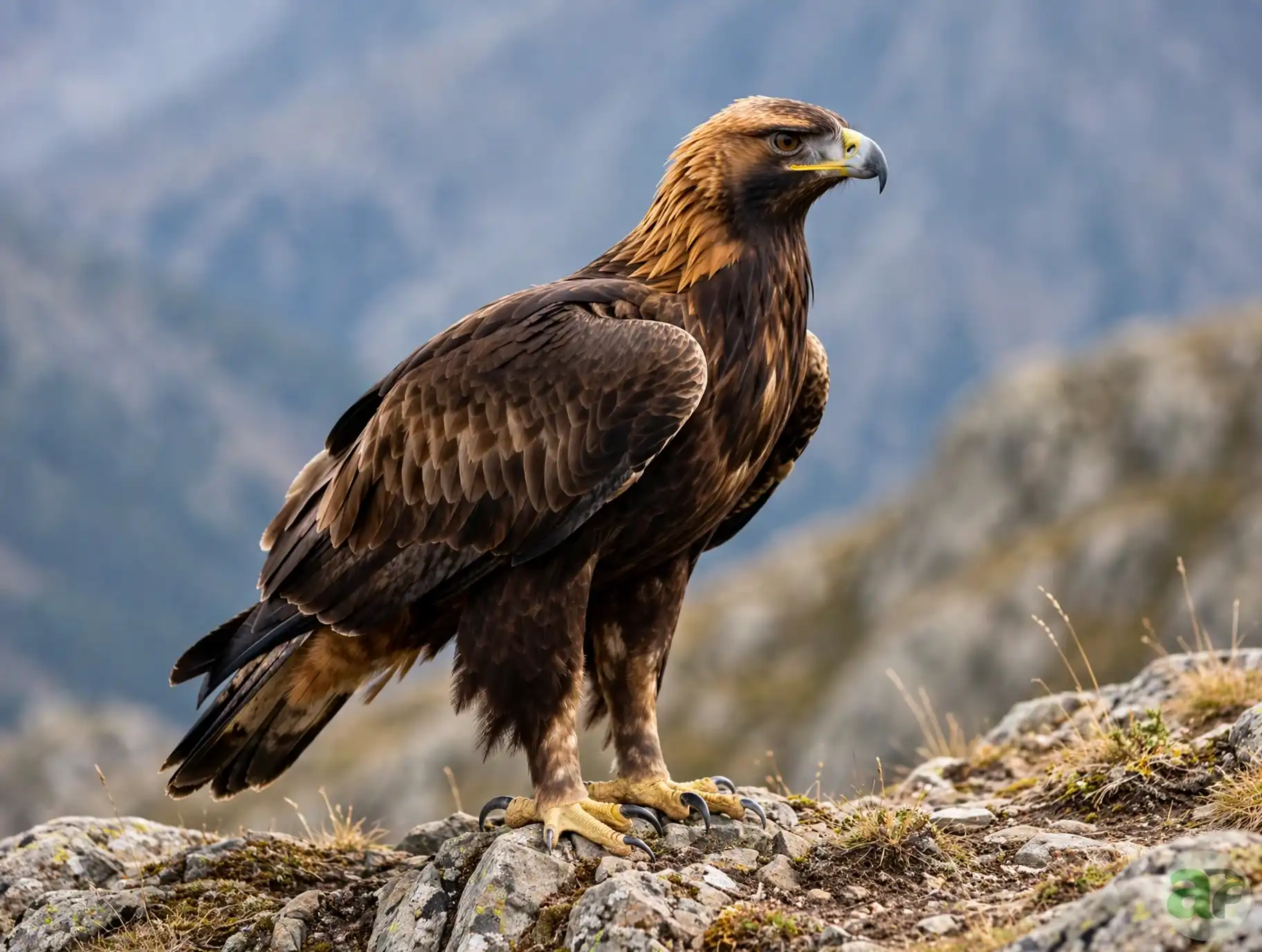
19. Best Places to See Golden Eagles in the Wild
In Scotland — The European Stronghold
1. Isle of Mull, Scotland — Consistently ranked as one of the finest wildlife destinations in Europe for golden eagle observation. The island’s combination of open moorland, mountain landscape, and sea loch settings supports a resident golden eagle population that is relatively habituated to human presence through years of wildlife tourism. The Mull Eagle Watch program — run by RSPB Scotland and Mull’s tourism operators — provides guided viewpoints at known eagle territories with professional interpretive staff. Golden eagle sightings are not guaranteed but are genuinely regular during active morning soaring periods (particularly April–August when birds are most actively hunting to provision chicks).
2. The Cairngorms National Park, Scotland — The UK’s largest national park encompasses substantial golden eagle territory in the eastern Highlands. While the dense grouse moor management in parts of the Cairngorms creates eagle suppression through illegal killing, the western portions of the park and adjacent areas support reliable golden eagle populations visible from various viewpoints accessible from the Speyside and Deeside approaches.
3. Glencoe and the West Highlands, Scotland — The dramatic mountain landscape of Glencoe and surrounding West Highlands supports golden eagle pairs accessible to hillwalkers and vehicle-based observers from the A82 corridor. Eagles are most regularly visible in early morning when they begin thermal soaring after overnight roosting — scanning the ridgelines from lay-bys along the glen roads in good soaring weather produces reliable sightings.
In North America
4. Denali National Park, Alaska — The expansive open tundra and mountain terrain of Denali supports golden eagle breeding pairs visible during the summer season (May–September). The park road — the only access corridor in the vast wilderness — passes through prime golden eagle territory, and road-based wildlife viewing regularly produces eagle sightings.
5. Grand Teton National Park and National Elk Refuge, Wyoming — Winter golden eagles concentrating around the National Elk Refuge (particularly at carcass-rich areas) and hunting in the open sage terrain of Grand Teton provide reliable winter eagle viewing accessible from Jackson, Wyoming.
6. Klamath Basin, Oregon/California — The same area that provides winter bald eagle aggregations also supports significant winter golden eagle concentrations — the open agricultural and refuge landscape providing hunting habitat for eagles from northern breeding populations.
7. San Francisco Bay Area — Altamont Pass area — While the wind farm context is complicated by the conservation concerns, the Altamont Pass and surrounding Diablo Range remains one of the most reliably eagle-rich areas in California for year-round golden eagle observation. The open rolling hills of this area support one of the highest golden eagle densities in the western United States.
In Central Asia — The Falconry Heartland
8. Bayan-Ölgii Province, Mongolia — For visitors specifically seeking the cultural dimension of the human-golden eagle relationship: this remote western Mongolian province is the heartland of Mongolian eagle hunting, and the annual Golden Eagle Festival (held in October) brings berkutchi together for competitions and demonstrations that provide the most concentrated opportunity to observe traditional eagle hunting practices. Various tour operators provide guided access.
9. Almaty region, Kazakhstan — Kazakhstan’s Altai region, accessible from Almaty, is the heartland of Kazakh berkutchi tradition. Various cultural tourism programs provide opportunities to visit active berkutchi families and observe eagle training and hunting practices.
In Continental Europe
10. Pyrenees National Park, France/Spain — The Pyrenees mountain range supports golden eagle populations on both the French and Spanish flanks — the open mountain landscape and accessible viewpoints from various mountain road passes providing reliable soaring eagle observation during good thermal weather (typically midday, April–September).
11. Berchtesgaden National Park, Bavaria, Germany — The Bavarian Alps provide accessible mountain golden eagle habitat within easy reach of Munich — the national park’s protected mountain terrain supporting resident pairs visible from various park viewpoints and hiking routes.
20. How You Can Help
Supporting golden eagle conservation requires differentiated action across different geographic and threat contexts — from illegal persecution advocacy in Scotland to lead ammunition transition in North America to wind farm siting policy globally.
Support these organizations:
- RSPB (Royal Society for the Protection of Birds) — rspb.org.uk — leads golden eagle conservation in the UK; runs Mull Eagle Watch and monitors Scottish populations
- NatureScot — nature.scot — Scotland’s nature agency; manages protected species programs including golden eagle monitoring
- HawkWatch International — hawkwatch.org — North American raptor monitoring and conservation including golden eagle population trends
- American Eagle Foundation — eagles.org — education and conservation including golden eagle programs
- The Peregrine Fund — peregrinefund.org — raptor conservation globally; research contributing to golden eagle conservation
- Earthwatch Institute — earthwatch.org — citizen science programs including golden eagle monitoring in various countries
Critical individual actions:
- Switch to non-lead ammunition — as with bald eagles, this is the most impactful individual action for North American hunters to reduce golden eagle mortality
- Support wind farm siting guidelines — advocating for rigorous pre-construction eagle surveys and appropriate siting of wind energy development reduces collision mortality
- Report illegal persecution — reporting suspected illegal killing or poisoning of golden eagles to appropriate authorities (police wildlife crime units, RSPB investigations, USFWS law enforcement) is the most direct contribution non-professionals can make to persecution reduction
- Support grouse moor reform in Scotland — advocating for licensing of driven grouse shooting linked to wildlife crime compliance addresses the primary conservation problem for Scottish golden eagles
- Responsible wildlife viewing — maintaining appropriate distances from active golden eagle nests (minimum 300–500 meters during the breeding season, following specific site guidance) prevents disturbance-related breeding failure
21. Top Documentaries & Books
Must-Watch Documentaries
- “Planet Earth II — Mountains” (BBC, David Attenborough, 2016) — Features some of the most technically accomplished golden eagle hunting footage ever filmed; the mountain episode is essential viewing
- “The Eagle Huntress” (documentary film, 2016) — The most important recent documentary treatment of traditional eagle hunting; Academy Award shortlisted; universally recommended
- “Wild Scotland” (BBC, various productions) — Multiple BBC treatments of Scottish wildlife include golden eagle content from the Highlands
- “Wild Americas” (various productions) — North American eagle content from multiple wildlife documentary series
- “Eagles: Masters of the Sky” (National Geographic) — Comprehensive treatment of golden eagle ecology and hunting behavior
Must-Read Books
- The Golden Eagle by Jeff Watson (2010) — The definitive scientific monograph on golden eagle biology, ecology, and conservation; the essential reference for anyone seriously interested in the species
- Eagles of the World by William Burnham — Comprehensive treatment of eagle biology and diversity including detailed golden eagle coverage
- The Gyrfalcon by Tom Cade — While focused on a different raptor, provides essential context for understanding northern raptor ecology alongside golden eagles
- Falconry and Hawking by Phillip Glasier — Classic falconry text including detailed golden eagle training information
- The Snow Leopard by Peter Matthiessen — While focused on a mammal, this classic nature writing account of the Himalayas provides the richest literary evocation of the landscape and wildlife community in which the golden eagle operates
- Eagle Dreams by Stephen Bodio — Personal account of the author’s encounter with Kazakh eagle hunting tradition; among the finest popular accounts of the berkutchi practice
22. Comparison with Other Large Eagles
| Feature | Golden Eagle | Bald Eagle | Harpy Eagle | White-tailed Eagle | Wedge-tailed Eagle |
|---|---|---|---|---|---|
| Scientific name | Aquila chrysaetos | Haliaeetus leucocephalus | Harpia harpyja | Haliaeetus albicilla | Aquila audax |
| Max wingspan | 234 cm | 244 cm | 224 cm | 244 cm | 232 cm |
| Max weight (female) | 6.7 kg | 6.3 kg | 9 kg | 7.5 kg | 5.8 kg |
| Primary prey | Medium mammals; rabbits, hares | Fish; waterfowl | Primates; sloths; large mammals | Fish; waterfowl | Rabbits; wallabies; carrion |
| Hunting method | High-speed aerial stoop | Surface fishing; aerial | Slow powered flight; ambush | Surface fishing; aerial | Aerial stoop; ground pursuit |
| Habitat | Open mountain, moorland, steppe | Water margins, forest | Tropical forest | Water margins, wetland | Open country; arid |
| Conservation | Least Concern | Least Concern | Vulnerable | Least Concern | Least Concern |
| Range | Entire Northern Hemisphere | North America | C./S. America | Eurasia | Australia |
| National symbol | 5 countries | USA | — | — | — |
| Falconry | Central — 4,000 years | Not traditionally used | Not used | Occasionally | Not used |
| Famous for | Most powerful NH raptor; falconry | US national symbol; DDT recovery | Largest New World raptor | European conservation recovery | Australian apex raptor |
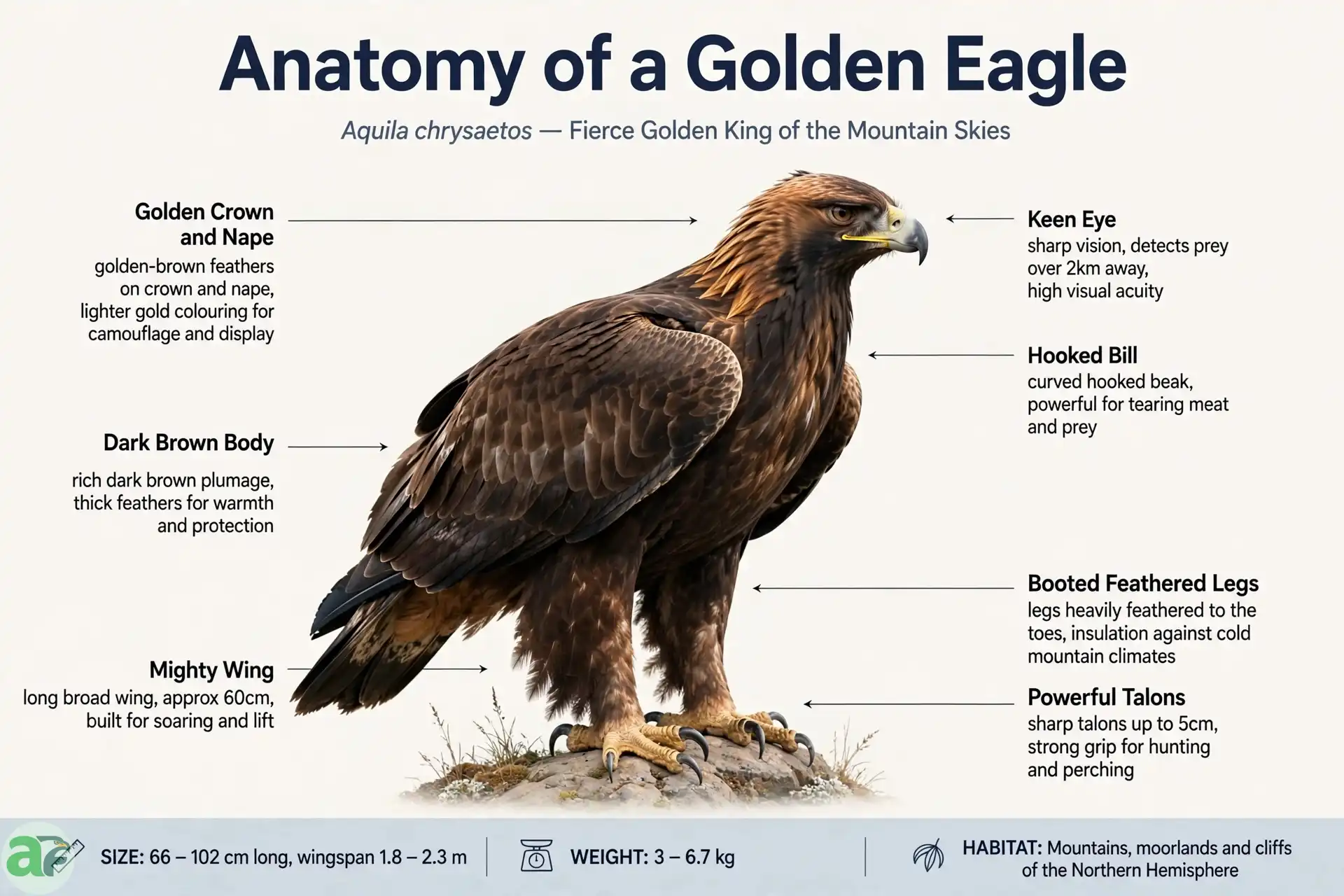
23. Frequently Asked Questions About Golden Eagles
Q. 1What is the scientific name of the golden eagle?
The golden eagle’s scientific name is Aquila chrysaetos (Linnaeus, 1758). The genus name Aquila is the Latin word for “eagle” — the foundational term from which the entire family Accipitridae (hawks, eagles, and allies) draws its cultural and scientific vocabulary in the Latin-derived European languages. The species name chrysaetos is directly Greek — chrysos (gold) and aetos (eagle) — meaning quite simply “golden eagle.” This species name therefore translates the common name into Greek etymology, reflecting that the golden eagle’s distinctive golden nape was so immediately recognizable that it became the defining feature in both the common and the scientific name. The species was formally described by Carl Linnaeus in the 10th edition of Systema Naturae in 1758 — the foundational document of binomial nomenclature — originally placed in the genus Falco and subsequently moved to Aquila. Six subspecies are currently recognized, varying primarily in body size (following Bergmann’s Rule — larger at higher latitudes) and overall coloration from darker forms in humid zones to paler forms in arid regions.
Q2. How fast can a golden eagle fly?
The golden eagle achieves a spectacular range of flight speeds across different behavioral contexts. In level sustained flight, golden eagles typically travel at 56–70 km/h — the speed most commonly recorded during territory patrol and movement between hunting areas. During active pursuit of prey at low altitude, speeds of 80–120 km/h have been recorded — the eagle’s powerful wing-stroke generating the speed needed for ground-following pursuit of agile prey like mountain hares. The most extraordinary speed figures come from hunting stoops — the steep, wings-partially-folded dive toward prey. Documented golden eagle stoop speeds range from 180 to 320 km/h depending on stoop angle, height, and wind conditions — placing the hunting stoop among the fastest movements of any animal on Earth. The fastest credibly documented individual stoop speed for a golden eagle is 320 km/h from a GPS-equipped study bird in Scotland — a speed achieved during a stoop from considerable altitude in favorable conditions. In context, the golden eagle’s maximum stoop speed is similar to a peregrine falcon’s stoop speed (approximately 300 km/h maximum) but achieved in a much heavier body — meaning the golden eagle delivers substantially more kinetic energy at contact.
Q3. Is the golden eagle the largest eagle in the world?
No — the golden eagle is large and among the most massive raptors in the Northern Hemisphere, but it is not the largest eagle in the world by body mass. The title of world’s largest eagle is contested between the harpy eagle (Harpia harpyja) of Central and South America — females reaching up to 9 kg — and the Steller’s sea eagle (Haliaeetus pelagicus) of Russia and Japan — females also reaching approximately 9 kg. The golden eagle’s maximum recorded female body mass is approximately 6.7 kg — which, while substantial, is exceeded by both the harpy eagle and Steller’s sea eagle. By wingspan, the golden eagle (maximum ~234 cm) is similarly surpassed by bald eagles and white-tailed eagles (both reaching ~244 cm) and the Steller’s sea eagle (~250 cm). However, where the golden eagle genuinely exceeds all other Northern Hemisphere eagles is in the ratio of prey mass to predator mass — golden eagles regularly taking prey at 2–4 times their own body weight, with documented exceptional cases of prey at 6–10 times body weight in falconry contexts. No other Northern Hemisphere eagle routinely hunts prey at this size ratio.
Q4. What is a golden eagle’s nest called and how big does it get?
A golden eagle’s nest is called an eyrie (also spelled aerie) — from the Old French aire and ultimately from the Latin area, meaning a flat open space. Golden eagle eyries are typically built on cliff ledges, rocky outcrops, or in the crown of large trees — elevated positions that provide security from terrestrial predators and good visual access to the surrounding hunting territory. A newly built golden eagle eyrie typically measures approximately 1–1.5 meters in diameter and 0.5–1 meter in depth. However, golden eagle pairs return to the same eyrie year after year — or rotate among multiple eyrie sites within their territory — adding fresh material each breeding season. After many years of annual additions, established eyries can reach 3–4 meters in depth and 1.5–2 meters in diameter, accumulating to masses of several hundred kilograms to occasionally over 1 metric ton in the most long-used structures. One exceptional Scottish eyrie documented by the ornithologist Jeff Watson was estimated to have been in active use for over 45 years before the supporting cliff became structurally unstable. Unlike the spectacular Ohio bald eagle nest that reached 6 meters in depth, golden eagle nests typically do not achieve quite such extreme dimensions — partly because cliff ledge nests are constrained by the geometry of the ledge and partly because the accumulation of compacted material on cliff ledges is more constrained than in tree nests. Nonetheless, some of the largest long-used golden eagle eyries rival bald eagle nests in total accumulated volume.
Q5. Where is the best place to see a golden eagle in the wild?
The answer varies significantly by geographic location. For European visitors, the Isle of Mull in Scotland provides the most reliable and most visitor-accessible golden eagle experience available in Europe — the Mull Eagle Watch program and the island’s resident eagle population offering guided viewpoints where sightings are genuinely regular during the breeding season (April–August). For North American visitors, Denali National Park in Alaska provides the best wilderness golden eagle viewing in summer, while the Klamath Basin in Oregon/California and Grand Teton/National Elk Refuge area in Wyoming provide reliable winter viewing of eagles concentrating at prey-rich sites. For visitors specifically seeking the cultural dimension of the human-golden eagle relationship, Bayan-Ölgii Province in western Mongolia — accessible from Ölgii airport via Ulaanbaatar — is the heartland of traditional eagle hunting, and the October Golden Eagle Festival provides the most concentrated opportunity to observe berkutchi and their trained eagles in traditional cultural context. Regardless of location, the optimal viewing conditions for golden eagles are morning hours (first 2–3 hours after sunrise) in fine weather with light wind — conditions promoting thermal development and eagle soaring activity.
24. Sources & References
- Wikipedia — Aquila chrysaetos, Aquila (genus), Accipitridae, Eagle falconry
- IUCN Red List — iucnredlist.org (current Least Concern assessment for Aquila chrysaetos)
- BirdLife International — birdlife.org (species factsheet; European population data)
- Watson, J. (2010). The Golden Eagle (2nd edition). T & AD Poyser — the definitive scientific monograph
- NatureScot — nature.scot (Scottish golden eagle population monitoring data)
- RSPB — rspb.org.uk (Scottish golden eagle conservation documentation)
- US Fish and Wildlife Service — fws.gov (North American golden eagle legal protection and population data)
- UNESCO — ich.unesco.org (Traditional eagle hunting inscription documentation)
- National Geographic — nationalgeographic.com
- Smithsonian National Museum of Natural History — naturalhistory.si.edu
- BBC Wildlife / BBC Earth — bbcearth.com
- Britannica — britannica.com/animal/golden-eagle
- Cornell Lab of Ornithology — allaboutbirds.org (species account; Macaulay Library)
- HawkWatch International — hawkwatch.org (North American raptor monitoring data)