
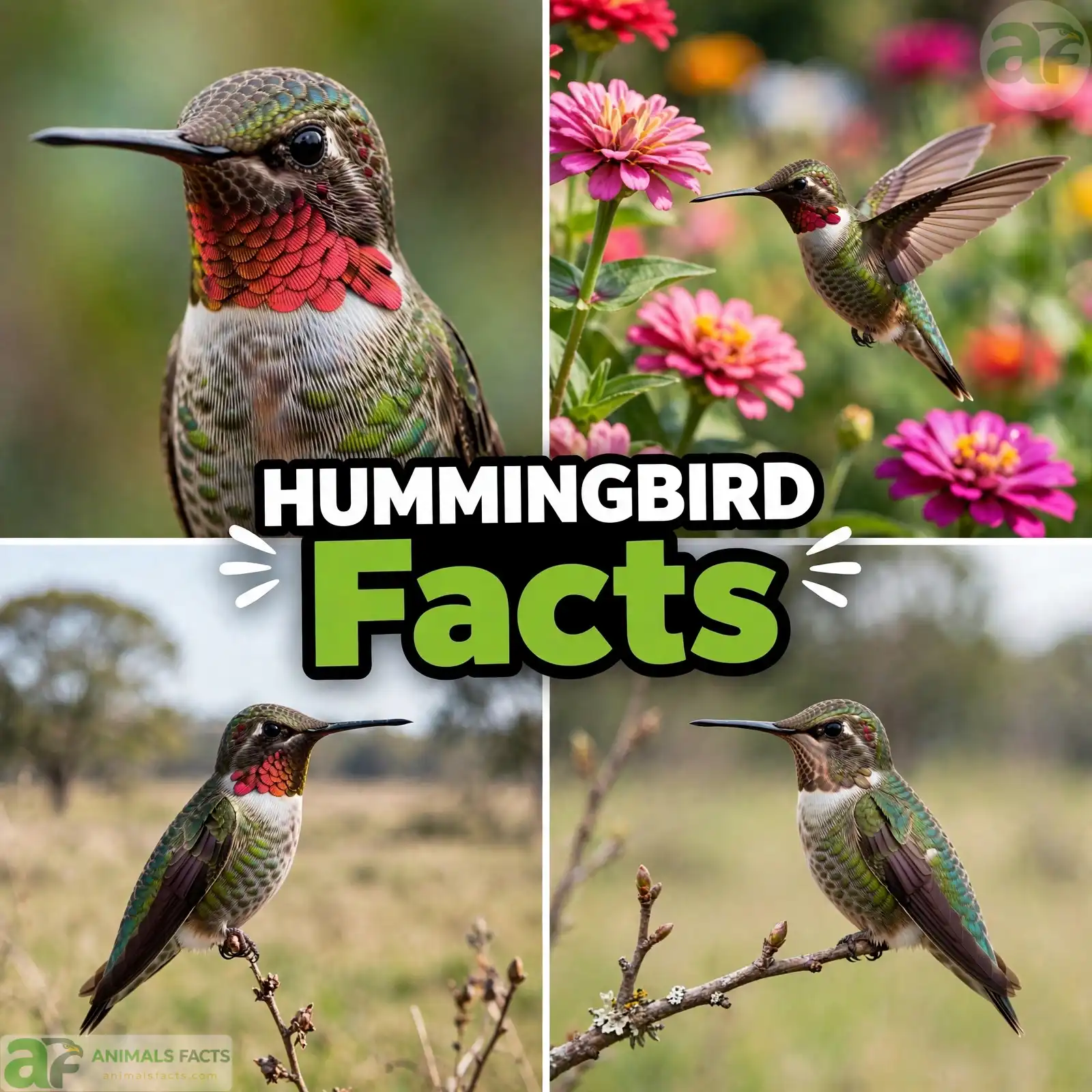
Hummingbird Facts
| Feature | Details |
|---|---|
| Primary Scientific Group | Family Trochilidae; approximately 366 species across 107 genera |
| Kingdom | Animalia |
| Phylum | Chordata |
| Class | Aves |
| Order | Apodiformes |
| Family | Trochilidae (Vigors, 1825) |
| Common Names | Hummingbird; colibrí (Spanish); beija-flor (Portuguese — “flower-kisser”); Kolibri (German); zunzún (Cuba) |
| Native Range | The Americas exclusively — Alaska to Tierra del Fuego; most diverse in the Andes of Ecuador, Colombia, and Peru |
| Habitat | Virtually every American habitat from rainforest to desert to alpine meadow to urban gardens |
| Lifespan | 3–5 years (most species, wild); up to 12 years (documented maximum in ruby-throated hummingbird) |
| Diet | Nectar (~90%); insects and spiders (~10%) — the insect component is nutritionally critical for protein |
| Body Length | 5.7 cm (bee hummingbird — world’s smallest bird) to 23 cm (giant hummingbird) |
| Weight | 1.6 grams (bee hummingbird) to 24 grams (giant hummingbird) |
| Wing Beat Rate | 10–80 beats per second depending on species; ruby-throated hummingbird approximately 53 beats/second |
| Heart Rate | Up to 1,260 beats per minute during flight — the fastest heart rate of any bird |
| Top Flight Speed | 54 km/h (ruby-throated, normal); up to 98 km/h (Anna’s hummingbird in courtship dive) |
| Conservation Status | Most species Least Concern; 60+ species threatened; multiple Critically Endangered |
| Defining Feature | The only birds capable of sustained hovering and true backward flight — achieved through a unique figure-8 wing stroke that generates lift on both the downstroke AND the upstroke, unlike all other birds |
| Most Famous Feature | The iridescent plumage produced entirely by structural coloration (light interference) rather than pigment — the colors changing dramatically with viewing angle and disappearing entirely in certain light conditions |
| Metabolic Record | The highest metabolic rate of any warm-blooded animal relative to body size — a hummingbird’s heart beats faster, its wings move faster, and it consumes more oxygen per gram of body weight than any other vertebrate |
 1. Introduction: What is a Hummingbird?
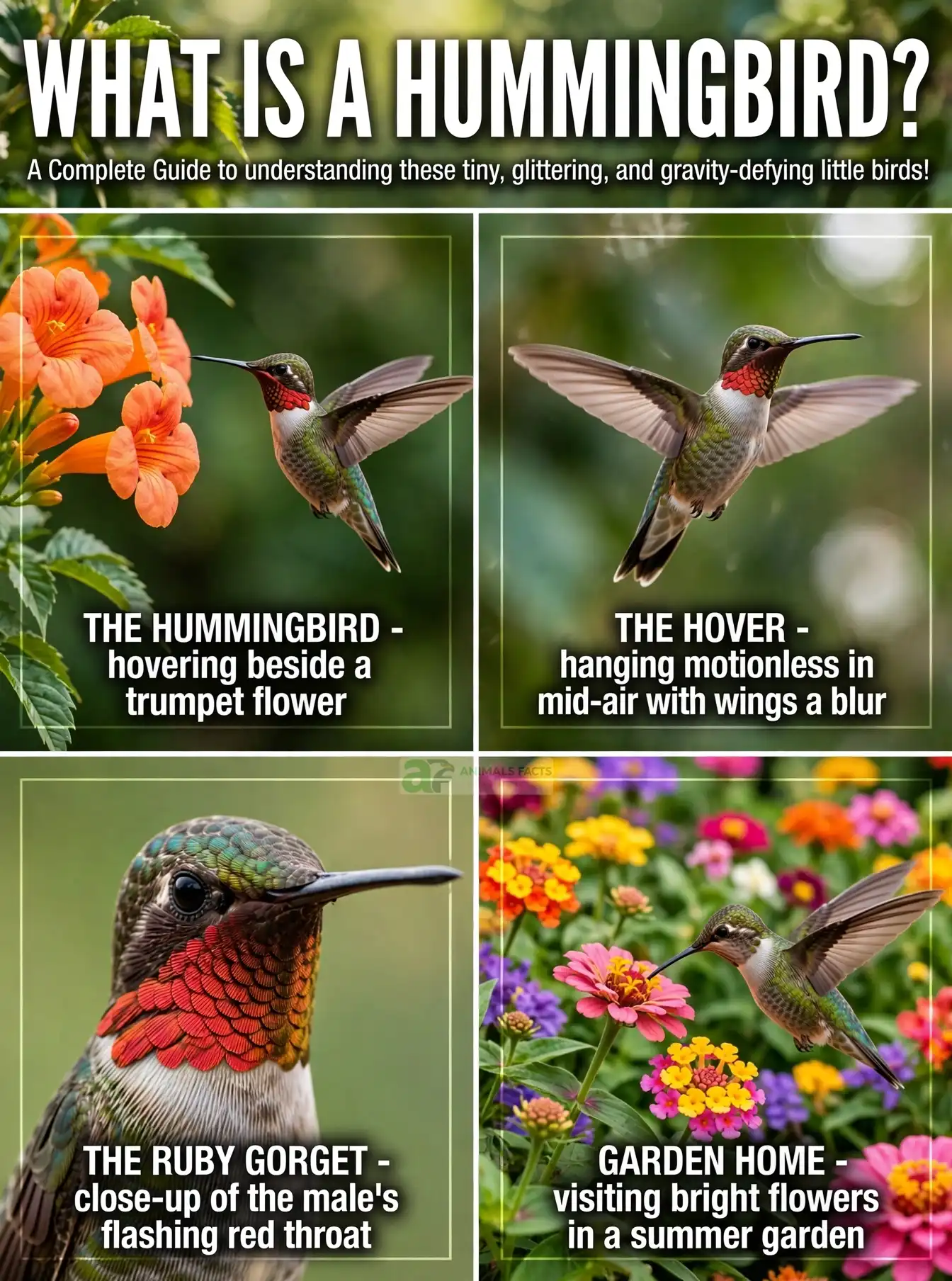
On a cloud forest trail in the Ecuadorian Andes at 2,800 meters elevation, where the tree trunks are draped in moss and the air carries a permanent fine mist, a movement arrests the eye — not a movement through space in the way that most birds move, but a stationary movement, an impossible hovering that violates the intuitive expectations of how a bird-sized body interacts with air. The booted racket-tail hummingbird (Ocreatus underwoodii) holds position in front of an epiphytic flower with a precision that no drone can match — the body perfectly still, the wings a translucent blur moving in a figure-8 pattern at approximately 30 beats per second, the iridescent gorget at the throat catching the filtered cloud forest light and igniting briefly into pure emerald before the bird angles slightly and the color vanishes as completely as if it had never existed. The bird’s bill — perfectly curved to match the geometry of the flower’s corolla — inserts with practiced precision; the tongue extends beyond the bill tip and retracts at 13–17 licks per second, lapping nectar through a mechanism that was definitively understood only in 2011. Then the bird departs — not by turning and flying away in the manner of other birds, but by flying directly backward, away from the flower, maintaining control through backward flight that is unique in the bird world. Hummingbird facts begin at that moment — the hovering, the iridescence, the backward flight, and the tongue mechanism — four biological features that are each individually extraordinary and that collectively make the hummingbird the most aerodynamically and physiologically exceptional bird family in the world.
The hummingbirds — family Trochilidae, approximately 366 species across 107 genera — are found exclusively in the Americas, ranging from Alaska to Tierra del Fuego and from sea level to above 5,000 meters elevation in the Andes. They represent the most extreme metabolic performance of any warm-blooded animal — a hummingbird in active flight has the highest heart rate (up to 1,260 beats per minute), the highest oxygen consumption per gram of body weight, and the highest wingbeat frequency of any bird. The smallest hummingbird — the bee hummingbird of Cuba (Mellisuga helenae) at 5.7 cm and 1.6 grams — is simultaneously the world’s smallest bird, the world’s smallest warm-blooded animal, and the owner of the world’s smallest bird nest (approximately the size of a thimble). At the opposite extreme, the giant hummingbird of the Andes (Patagona gigas) at 24 grams and 23 cm is larger than many swifts and has been documented migrating over the Andes between breeding and wintering grounds — one of the few hummingbirds with documented long-distance migration. Between these extremes lie 364 other species — the sword-billed hummingbird whose bill is longer than its body; the marvelous spatuletail with four feathers and tail plumes that the male waves in display; the ruby-throated hummingbird that crosses the Gulf of Mexico in a single 18–20 hour nonstop flight on fat reserves accumulated before departure; and the calliope hummingbird that migrates between Mexico and Canada despite weighing less than a penny.
Interesting facts about hummingbirds reveal an animal of breathtaking biological complexity — the unique wing anatomy that rotates at the shoulder joint to nearly 180 degrees, generating lift on both the forward and backward stroke in the figure-8 pattern that enables hovering and backward flight; the tongue mechanism that was misunderstood for 200 years (assumed to work by capillary action) until 2011 research demonstrated it works by elastic deformation — the tongue’s grooved tip trapping nectar through rapid shape-change rather than passive absorption; torpor — the nightly near-death metabolic state in which hummingbird body temperature drops from approximately 40°C to near ambient temperature, heart rate drops from 1,200 to 50–180 beats per minute, and breathing becomes almost imperceptible — allowing the bird to survive the night without starving despite having the smallest fat reserves of any bird; the sword-billed hummingbird’s (Ensifera ensifera) 10-cm bill (longer than the bird’s own body) and the correspondingly long-tubed flower (Passiflora mixta) with which it shares a co-evolutionary relationship that Darwin predicted before either the flower or the bird were formally studied together; and the extraordinary Aztec and other Mesoamerican cultural traditions in which hummingbirds were associated with the war god Huitzilopochtli — warriors who died in battle believed to reincarnate as hummingbirds, making the bird a symbol of warrior souls across pre-Columbian Mesoamerica.
2. Hummingbird Species Overview & Classification
The hummingbirds form one of the most species-rich bird families in the Americas — approximately 366 species making the Trochilidae the second or third most species-rich bird family in the Western Hemisphere.
Species Classification Table
| Taxonomic Rank | Classification |
|---|---|
| Kingdom | Animalia |
| Phylum | Chordata |
| Class | Aves |
| Order | Apodiformes |
| Family | Trochilidae (Vigors, 1825) |
| Subfamilies | Polytminae, Florisuginae, Phaethornithinae (hermits), Trochilinae (typical hummingbirds) |
| Genera | ~107 genera |
| Species | ~366 species |
| Etymology | Trochilidae from Greek trochilos — a small bird mentioned by ancient Greek authors (possibly a wren or small migratory bird); applied to hummingbirds by Vigors in 1825. “Hummingbird” derives from the humming sound produced by the rapidly beating wings. Portuguese beija-flor (“flower-kisser”) is perhaps the most poetic common name. Spanish colibrí is of Caribbean indigenous origin — possibly from the Carib word kurukuru |
The Surprising Evolutionary Position
Hummingbirds belong to the order Apodiformes — making them the closest relatives of swifts (family Apodidae), not of sunbirds (Africa’s nectar-feeding birds that superficially resemble hummingbirds):
The swift relationship:
- Swifts and hummingbirds share modified wing anatomy and the most extreme flight capabilities in the bird world
- Both groups have very short legs (the order name Apodiformes means “without feet” — reflecting the reduced leg size)
- Molecular phylogenetics has confirmed the swift-hummingbird relationship — the two families last sharing a common ancestor approximately 42–48 million years ago
The convergence with sunbirds:
- African sunbirds (Nectariniidae) feed on nectar, have long bills, visit flowers, and are vividly iridescent — superficially resembling hummingbirds
- Sunbirds are NOT closely related to hummingbirds — they are oscine passerines (songbirds) belonging to an entirely different lineage
- The sunbird-hummingbird similarity is one of the most striking examples of convergent evolution in the bird world — two completely unrelated lineages independently evolving nectar-feeding, long bills, iridescent plumage, and hovering near flowers
The Two Hummingbird Subfamilies
| Subfamily | Common Name | Species | Key Features |
|---|---|---|---|
| Phaethornithinae | Hermit hummingbirds | ~34 species | Curved bills; forest interior; leks for mating; less colorful |
| Trochilinae | Typical hummingbirds | ~330+ species | The vast majority; extraordinary diversity of bill shape, size, and plumage; most include the iridescent species |
Major Species — The Most Notable Hummingbirds
| Species | Scientific Name | Key Feature | Range | Conservation |
|---|---|---|---|---|
| Bee hummingbird | Mellisuga helenae | World’s smallest bird — 5.7 cm, 1.6 g | Cuba only | Near Threatened |
| Ruby-throated hummingbird | Archilochus colubris | Gulf of Mexico nonstop crossing | E. North America | Least Concern |
| Anna’s hummingbird | Calypte anna | 98 km/h courtship dive — fastest g-force in vertebrates | W. North America | Least Concern |
| Sword-billed hummingbird | Ensifera ensifera | Bill longer than body — only bird with this feature | Andes | Least Concern |
| Giant hummingbird | Patagona gigas | Largest hummingbird — 24 g | Andes | Least Concern |
| Marvelous spatuletail | Loddigesia mirabilis | 4 feathers only; elongated racket tail | Peru only | Endangered |
| Calliope hummingbird | Selasphorus calliope | Smallest bird in North America — 2.3 g | W. North America | Least Concern |
| Booted racket-tail | Ocreatus underwoodii | White leg puffs; racket tail feathers | Andes | Least Concern |
| Koepcke’s hermit | Phaethornis koepckeae | Named for ornithologist Maria Koepcke | Peru | Vulnerable |
| Gorgeted puffleg | Eriocnemis isabellae | Discovered 2007; restricted range | Colombia | Critically Endangered |
Hummingbird Evolution & Discovery Timeline
~42–48 million years ago (Eocene) — The hummingbird lineage diverges from the swift lineage — establishing the Trochilidae family in what is believed to be a South American origin.
~22–35 million years ago (Oligocene-Miocene) — Fossil hummingbirds documented in Europe (Eurotrochilus genus, Germany) — establishing that hummingbirds once existed outside the Americas before the lineage became exclusively American.
~12 million years ago (Miocene) — The major Andean radiation begins — the uplift of the Andes creating new high-altitude habitats that drive the explosive diversification of hummingbird species. The Andes radiation is responsible for the majority of hummingbird species diversity.
~1499–1502 — First European encounters with hummingbirds — Spanish and Portuguese explorers documenting the birds in the Caribbean and mainland Americas with expressions of astonishment; Columbus himself describing “little birds so different from ours it is a marvel.”
1758 — Carl Linnaeus formally describes the ruby-throated hummingbird (Archilochus colubris) and other species in Systema Naturae.
~1700s–1800s — The hummingbird skin trade — dried hummingbird skins become fashion accessories in Victorian Europe and America; millions of birds killed; the trade contributing to early conservation advocacy.
2011 — Research by Alejandro Rico-Guevara establishes that the hummingbird tongue works through elastic trapping rather than capillary action — overturning 200 years of assumed understanding about the tongue mechanism.
2014 — Research documents the Anna’s hummingbird’s courtship dive generating 9 g of centripetal acceleration — the highest g-force experienced by any vertebrate during a voluntary maneuver.
2024 — The hummingbird family continues its extraordinary diversity with new species still being described; the gorgeted puffleg (Eriocnemis isabellae) described in 2007 remains one of the most recently described Critically Endangered bird species.
“Hummingbirds are what happens when biology ignores the engineering constraints that limit everything else. They hover. They fly backward. They maintain the highest metabolic rate of any warm-blooded animal. They migrate across the Gulf of Mexico on fuel reserves equivalent to a few drops of gasoline. Every time we think we understand how they work, the next study shows we were wrong about something. The bee hummingbird is the most extreme warm-blooded animal on Earth.”
— Dr. Christopher Clark, University of California Riverside — leading hummingbird flight biomechanics researcher
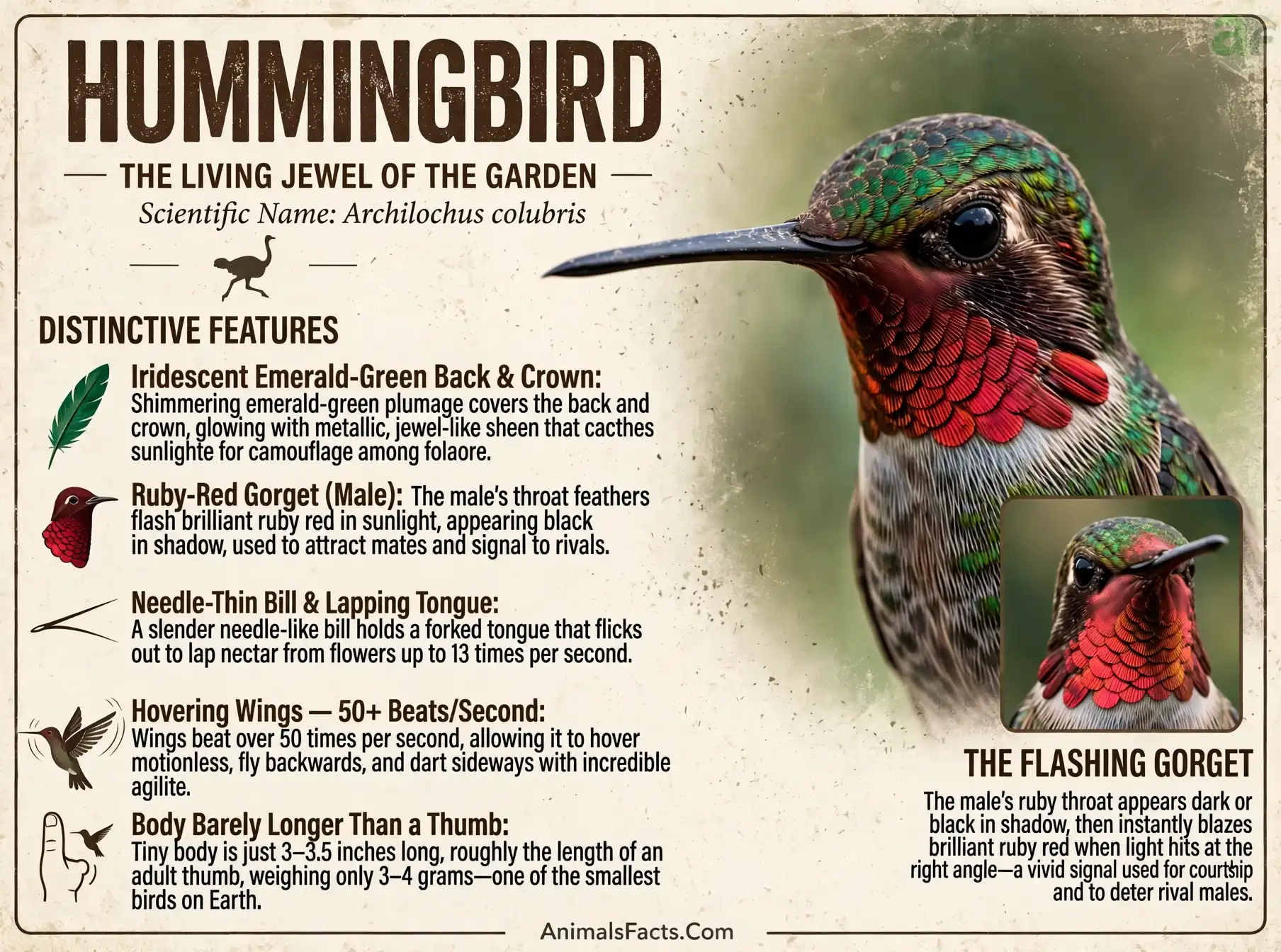
3. Hummingbird Physical Description & Unique Features
The hummingbird’s physical features represent the most extreme specialization for hovering flight of any animal — every anatomical system pushed to the boundary of what biology can achieve.
The Wings — The Aerodynamic Revolution
The fundamental difference from all other birds:
In virtually all birds, lift is generated primarily on the downstroke — the wing pushing down and backward generates the force that supports the bird in the air. The upstroke is primarily a recovery movement that generates minimal lift.
In hummingbirds, the wing generates lift on both the downstroke AND the upstroke — and the mechanism is completely different from any other bird:
The figure-8 stroke:
- The hummingbird’s wing moves in a figure-8 pattern when viewed from the side
- The wing is nearly horizontal during hovering — unlike other birds whose wings sweep through a large vertical arc
- The wing rotates at the shoulder to nearly 180 degrees — the leading edge facing forward on the downstroke and rotating to face backward on the upstroke
- Both strokes generate approximately equal lift — the hovering hummingbird is equally supported during upstroke and downstroke
- This symmetric lift generation is what allows the bird to hover indefinitely without sinking
The wing shape:
- Hummingbird wings are elongated and pointed — the aspect ratio (length-to-width) higher than most other birds
- The wing bones are proportionally shorter than other birds — most of the wing length is composed of the primary feathers
- This short-bone, long-feather wing provides the rotational flexibility at the shoulder that the figure-8 stroke requires
The wingbeat rates:
- Bee hummingbird — approximately 80 beats per second — the highest wingbeat rate of any bird
- Ruby-throated hummingbird — approximately 53 beats per second
- Giant hummingbird — approximately 10–15 beats per second (the slowest hummingbird; still faster than most other birds)
- The wing beat produces the characteristic humming sound — the frequency of the sound varying with wingbeat rate and therefore by species
The backward flight capability:
The figure-8 wing stroke allows hummingbirds to fly in any direction — forward, backward, sideways, up, down, and to hover:
- True backward flight is unique to hummingbirds in the bird world
- Backward flight is achieved by tilting the body and adjusting the figure-8 stroke’s angle to generate a backward thrust component
- Hummingbirds routinely use backward flight to exit flowers after feeding — reversing away from the flower rather than turning around
The Iridescent Plumage — Structural Coloration at Its Most Spectacular
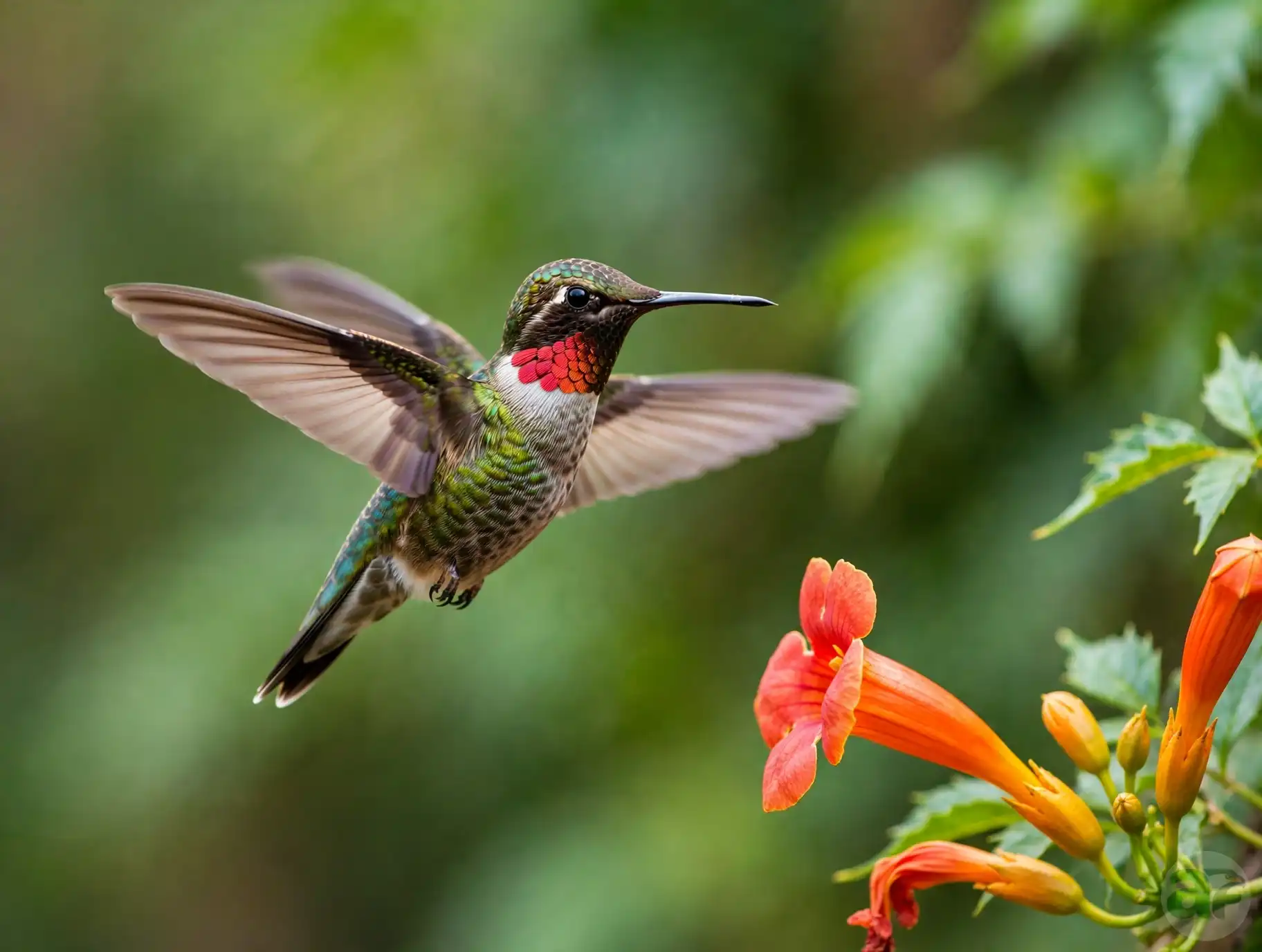
The color paradox — A male ruby-throated hummingbird (Archilochus colubris) viewed from the front appears to have a gorget (throat patch) of pure metallic ruby-red. View it from a slightly different angle and the gorget shifts to deep black. There is no pigment producing either color — the ruby-red and the black are both produced by the same feather structure viewed under different illumination angles.
The mechanism — thin-film interference:
- The hummingbird’s iridescent feathers contain layers of melanin granules embedded in a matrix — structured as thin, flat, air-filled platelets stacked in precise arrays
- When light strikes this structure, it reflects from multiple layers simultaneously
- The reflected light waves interfere with each other — some wavelengths (colors) are amplified by constructive interference and some are cancelled by destructive interference
- The specific wavelength amplified depends on the angle of observation — as the angle changes, the constructive interference shifts to a different wavelength and a different color appears
- This is the same principle that produces the colors of soap bubbles, oil films, and butterfly wings — structural coloration through thin-film interference
The biological sophistication:
- The platelet array dimensions are nanometer-scale — measured in billionths of a meter
- The specific platelet spacing determines the peak color — hummingbirds with different iridescent colors have different platelet spacings
- The spectacular variety of hummingbird iridescent colors (ruby, emerald, sapphire, violet, copper, gold) all arise from the same physical mechanism with different platelet dimensions
- Many hummingbird species have been documented in research to produce colors outside the visible spectrum for humans — including ultraviolet (UV) reflection that is visible to hummingbirds and to the insects and flowers with which they interact
The Tongue — The 200-Year Misunderstanding
The old hypothesis (capillary action):
For approximately 200 years after European naturalists first studied hummingbird feeding, it was assumed that the tongue worked by capillary action — the narrow grooves on the tongue’s forked tip passively drawing nectar up by surface tension, the way a glass tube draws up water.
The 2011 discovery (elastic trapping):
Research by Alejandro Rico-Guevara of the University of California, published in PNAS in 2011, filmed hummingbird tongues at 1,500 frames per second using transparent artificial flowers and established the actual mechanism:
- The tongue tip is a forked, grooved structure — two elongated tubes that run the length of the tongue’s last third
- When the tongue contacts nectar, the grooved tubes flatten elastically — the springy tip deforming as nectar enters
- When the tongue retracts, the tubes spring back to their original shape — trapping the nectar inside as they close
- This elastic trapping mechanism is completely passive — it requires no muscular action — and operates at 13–17 licks per second automatically
Why it matters:
- The correction overturns a textbook assumption that had been repeated for two centuries
- The elastic trapping mechanism is more efficient than capillary action for the thick, viscous nectars that hummingbirds consume
- The mechanism explains why hummingbirds can feed efficiently on nectars of very different viscosities — the elastic trapping works regardless of sugar concentration
Torpor — The Metabolic Off Switch
The nightly near-death:
Every night — or whenever food is scarce — most hummingbirds enter torpor: a state of drastically reduced metabolism that allows them to survive without food:
The torpor parameters:
- Body temperature: drops from approximately 40°C (active body temperature) to 8–18°C — approaching or matching ambient air temperature
- Heart rate: drops from 1,200 beats per minute (active flight) to 50–180 beats per minute
- Breathing: drops from approximately 250 breaths per minute to approximately 4–10 breaths per minute
- Metabolic rate: reduced to approximately 5–10% of the active resting metabolic rate
Why torpor is necessary:
- A hummingbird in active flight consumes oxygen at approximately 10 times the rate of a resting hummingbird
- A hummingbird at rest (but not in torpor) still consumes energy at the highest resting metabolic rate of any bird per gram of body weight
- A hummingbird’s entire fat reserve — the energy stored in its body — would be exhausted in approximately 1 hour if the bird remained active throughout the night
- Torpor reduces energy expenditure sufficiently to allow survival of the 8–12 hour night without starving
The arousal:
- Emerging from torpor is not instantaneous — the bird must shiver to generate the heat needed to raise body temperature to active levels
- Arousal from deep torpor takes 20–60 minutes — the bird shivering intensively, metabolism gradually ramping up
- A hummingbird emerging from torpor appears dead — and has been reported as “dead” by observers who found apparently cold, motionless hummingbirds in torpor and then watched them gradually revive
💡 Did You Know? The Anna’s hummingbird (Calypte anna) male’s courtship dive is one of the most extreme voluntary physical maneuvers performed by any vertebrate animal. During the courtship display, the male climbs to approximately 30 meters altitude above a perching female, then dives straight down toward her at speeds reaching 98 km/h — approximately the speed of a fastball pitch in Major League Baseball. At the bottom of the dive, the male pulls out in a fraction of a second — generating a centripetal acceleration of approximately 9 g (9 times the force of gravity). This 9 g pull-out force is the highest g-force voluntarily experienced by any vertebrate animal during a self-directed behavior. For comparison: fighter jet pilots wearing g-suits lose consciousness at approximately 9 g with the suit’s assistance — the Anna’s hummingbird sustains 9 g without any protection and without apparent difficulty. At the bottom of the dive, the male’s tail feathers vibrate against the airstream, producing a loud mechanical chirp (not a vocal sound) that is one of the primary signals of the courtship display. Research by Christopher Clark at UC Davis documented that the tail feather vibration produces this sound specifically during the 9 g pull-out — the combination of speed, acceleration, and sound production being integrated into a single mechanical display event that represents perhaps the most precisely engineered courtship behavior of any bird.
4. Top 25 Amazing Hummingbird Facts
Here is your definitive collection of the most extraordinary, scientifically verified, and genuinely astonishing hummingbird facts as of 2026:
- The bee hummingbird (Mellisuga helenae) of Cuba — at 5.7 cm long and 1.6 grams — is simultaneously the world’s smallest bird, the world’s smallest warm-blooded animal, and the layer of the world’s smallest bird nest (approximately the size of a thimble, made from cobwebs and plant material). The bee hummingbird weighs less than a paper clip.
- The Anna’s hummingbird’s courtship dive generates approximately 9 g of centripetal acceleration at the dive’s pull-out point — the highest g-force voluntarily experienced by any vertebrate animal during a self-directed behavior. Human fighter pilots with g-suits lose consciousness at equivalent g-forces.
- Hummingbirds are the only birds capable of true backward flight — a capability enabled by the figure-8 wing stroke that generates lift on both the forward and backward stroke, allowing thrust to be directed in any direction including directly backward.
- The ruby-throated hummingbird (Archilochus colubris) crosses the Gulf of Mexico — approximately 800 km of open water — in a single nonstop flight lasting approximately 18–20 hours. The bird doubles its body weight in fat before departure, burning these reserves completely during the crossing.
- Hummingbird iridescent colors are not produced by pigment — the gorget and body colors are produced entirely by structural coloration (thin-film interference) in the feather structure. The same feather that appears brilliant ruby-red from one angle appears completely black from a slightly different angle — because the color exists only at the specific angle where light interference amplifies the red wavelength.
- The hummingbird tongue works through elastic trapping — not capillary action as assumed for 200 years. The tongue’s forked tip deforms elastically when it contacts nectar, and the elastic recoil traps the nectar as the tongue closes — a mechanism documented only in 2011 through high-speed photography at 1,500 frames per second.
- A hummingbird’s heart beats up to 1,260 times per minute during active flight — the fastest heart rate of any bird. In torpor at night, the same heart slows to approximately 50 beats per minute — a 25-fold range within a single individual’s daily physiology.
- Hummingbirds enter a state of torpor every night — body temperature dropping from 40°C to near ambient, heart rate dropping from 1,200 to 50–180 bpm, breathing slowing to 4–10 breaths per minute. A torpid hummingbird has been documented to appear dead — cold, motionless, breathing imperceptibly — before slowly reviving over 20–60 minutes in the morning.
- The sword-billed hummingbird (Ensifera ensifera) of the Andes has a bill approximately 10 cm long — longer than its own body (excluding tail). It is the only bird in the world whose bill is longer than its body. The bird must hold its bill nearly vertical when perched because the bill’s weight would otherwise make balanced perching impossible.
- The calliope hummingbird (Selasphorus calliope) — North America’s smallest bird at approximately 2.3 grams — migrates annually from Mexico to Canada and back, a round trip of approximately 9,000 km, making it the longest migration of any small bird relative to body size in the world.
- Hummingbirds have the highest brain-to-body mass ratio of any bird — and the largest hippocampus relative to body size of any bird studied. The large hippocampus supports the extraordinary spatial memory needed to remember the location and nectar status of hundreds of individual flowers across a territory that the bird visits in a precise rotation.
- The marvelous spatuletail (Loddigesia mirabilis) — found only in a small area of Peru — has the most extraordinary tail of any hummingbird: the male has only four tail feathers total (most birds have 10–12), two of which are enormously elongated wires that end in iridescent violet-blue rackets that the male waves and crosses during courtship display. The species is Endangered with fewer than 1,000 individuals.
- Hummingbirds can see ultraviolet light — their four types of photoreceptors (compared to three in humans) allow perception of UV wavelengths that are invisible to humans. Many hummingbird-pollinated flowers have UV patterns on their petals that guide hummingbirds to the nectar — patterns invisible to any human observer.
- The tongue licking rate of a feeding hummingbird is 13–17 licks per second — so fast that the mechanism cannot be observed with the naked eye and required high-speed photography at 1,500 frames per second to document.
- Hummingbirds have 10 primary feathers per wing — a number that varies in most other birds but is fixed in hummingbirds — and can rotate these feathers independently to fine-tune the aerodynamic forces generated by each portion of the wing during hovering.
- A hummingbird visits 1,000–2,000 flowers per day to meet its nectar caloric needs — and must simultaneously consume hundreds of insects and spiders per day for the protein required for tissue maintenance, feather production, and chick-rearing. The insect component of the diet is nutritionally essential despite being invisible to most casual observers.
- The rufous hummingbird (Selasphorus rufus) — one of the most aggressive of all hummingbirds — defends feeding territories with such intensity that it has been documented displacing larger birds including red-tailed hawks from perches near feeding sites. The rufous hummingbird’s aggression relative to its size (approximately 3.5 grams) makes it pound-for-pound one of the most combative birds in North America.
- Research has documented that hummingbirds can learn the precise timing of nectar replenishment at individual flowers — returning to specific flowers at the interval at which those flowers refill with nectar rather than returning on a fixed schedule. This temporal optimization of foraging represents one of the most sophisticated examples of time-based learning documented in any bird.
- The giant hummingbird (Patagona gigas) — the largest hummingbird species at 24 grams — is the only hummingbird that exhibits regular seasonal migration similar to that of temperate-zone birds, moving between breeding grounds in the high Andes and lower-altitude wintering areas on a predictable annual schedule.
- The Aztec war god Huitzilopochtli was believed to reincarnate fallen warriors as hummingbirds — the birds associated with warrior souls, the sun, and the military power of the Aztec state. The name Huitzilopochtli itself derives from the Nahuatl words for “hummingbird” (huitzilin) and “left” (opochtli) — the god being the “left-handed hummingbird” or “hummingbird of the south.” This association made hummingbirds among the most spiritually significant birds in pre-Columbian Mesoamerica.
- Hummingbirds have the smallest clutch of any North American bird — always exactly 2 eggs in most species (never 1, never 3 in most). The two-egg clutch is so consistent across the family that it is considered a defining characteristic of hummingbird reproduction.
- The Andean hillstar hummingbird (Oreotrochilus estella) breeds at elevations up to 5,200 meters in the Andes — the highest confirmed breeding altitude of any hummingbird and one of the highest breeding altitudes of any bird on Earth. At these altitudes, night temperatures routinely drop to -10°C or below — the hummingbird surviving through deep torpor.
- The long-tailed sylph (Aglaiocercus kingii) — a common Andean hummingbird — has tail feathers that in the male are approximately 3–4 times the length of the body — the bird appearing as a tiny body trailing an impossibly long flowing tail as it hovers.
- Research using miniaturized GPS transmitters attached to ruby-throated hummingbirds has confirmed that the birds do not ride thermals or tailwinds during the Gulf of Mexico crossing — they fly at low altitude (approximately 100–200 meters) under their own power throughout the crossing, burning fat reserves continuously for the entire 18–20 hours.
- As of 2026, approximately 60+ hummingbird species are classified as threatened — with 9 species Critically Endangered and multiple species known from fewer than 50 individuals or from a single location. The primary driver is Andean cloud forest loss — the most species-rich hummingbird habitat in the world is also one of the most rapidly disappearing biomes.
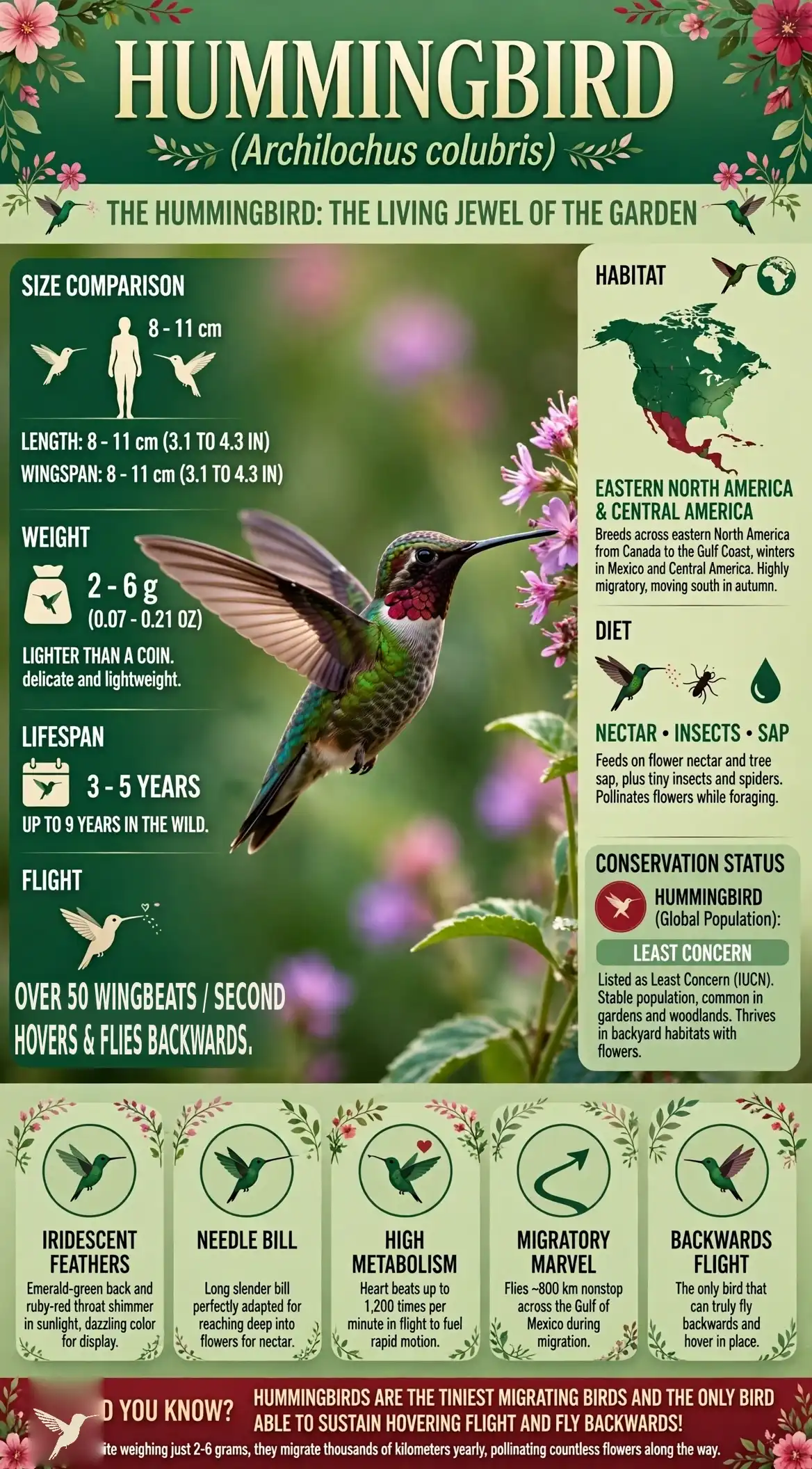
5. Fun Facts On Hummingbirds
- Bee hummingbird — world’s smallest bird at 5.7 cm and 1.6 grams
- Anna’s hummingbird courtship dive — 9 g acceleration — highest in any vertebrate
- Only birds capable of backward flight
- Ruby-throated hummingbird crosses 800 km of Gulf of Mexico nonstop
- Iridescent colors are structural — not pigment; disappear at wrong angle
- Tongue works by elastic trapping — not capillary action (2011 discovery)
- Heart beats up to 1,260 bpm — drops to 50 bpm in torpor
- Enter torpor nightly — temperature drops to near ambient
- Sword-billed hummingbird — only bird with bill longer than its body
- Calliope hummingbird — 9,000 km migration at 2.3 grams
- Largest hippocampus-to-body ratio of any bird — extraordinary spatial memory
- Can see ultraviolet light — flowers have UV patterns guiding them to nectar
6. Hummingbirds Natural Habitat & Geographic Range
Hummingbird habitat spans the full diversity of American ecosystems — the family’s extraordinary ecological flexibility allowing occupation of environments from tropical lowland rainforest to high Arctic tundra margins to hyper-arid desert.
Primary Habitat Types
Andean cloud forest — the center of diversity:
The most species-rich hummingbird habitat on Earth:
- The Andes of Colombia, Ecuador, Peru, and Bolivia support the highest hummingbird species diversity globally — over 160 species documented in Ecuador alone
- The cloud forest’s rich diversity of flowering epiphytic plants provides year-round nectar resources for an extraordinary variety of specialized hummingbird bills
- Different species are specialized for different flower types at different elevations — creating a vertical stratification of hummingbird communities across the elevation gradient
Tropical lowland rainforest:
- The Amazon Basin and adjacent lowland forests support hermit hummingbirds (subfamily Phaethornithinae) and various typical hummingbirds
- Hermit hummingbirds are the primary hummingbird specialists of the forest interior — their curved bills matching the curved heliconias and other forest-floor flowers they pollinate
Arid and semi-arid environments:
- Sonoran Desert (Arizona, Sonora) — multiple species including the Gila woodpecker-neighbored black-chinned, Costa’s, and rufous hummingbirds using desert flowers
- Chilean desert and Peruvian coast — various hummingbirds specialized for desert flowers
- The hummingbird’s nectar diet makes it more drought-tolerant than most insect-eating birds — flowers continue producing nectar even in dry conditions
Temperate North American forest and garden:
- The eastern North American range is dominated by a single breeding species — the ruby-throated hummingbird — whose range extends from Texas to Nova Scotia and west to the Great Plains
- Western North America supports much greater diversity — Allen’s, Anna’s, calliope, rufous, black-chinned, broad-tailed, and Costa’s hummingbirds breeding across different western habitats
High Andean puna:
- The hillstar hummingbirds (Oreotrochilus species) are the world’s highest-altitude hummingbirds — breeding above 5,000 meters in the puna zone where temperatures drop below -10°C nightly
Urban and suburban environments:
- Hummingbirds are among the most successful urban-adapting birds — human garden flowers and hummingbird feeders support dense urban hummingbird populations in many North and South American cities
- The placement of hummingbird feeders has expanded the winter range of Anna’s hummingbirds northward into areas where the species was not historically recorded
Geographic Distribution
| Region | Species Count | Key Species | Trend |
|---|---|---|---|
| Andes (Ecuador, Colombia) | 160+ species | Extraordinary diversity | Declining with cloud forest loss |
| Central America | ~60 species | Ruby-topaz, violet sabrewing | Declining |
| North America (temperate) | ~20 breeding species | Ruby-throated, rufous, Anna’s | Generally stable |
| Amazon Basin | ~90 species | Various hermit hummingbirds | Declining with deforestation |
| Caribbean | ~27 species (mostly endemics) | Bee hummingbird (Cuba) | Several threatened |
| Chile/Argentina (southern) | ~20 species | Giant hummingbird | Some threatened |
| Old World | Zero | None | N/A — exclusively American |
7. Hummingbird Diet & Feeding Behavior
Hummingbird diet is more complex than the popular perception of “flower feeders” suggests — the birds requiring both nectar (for energy) and insects (for protein) in an obligate dietary combination.
Diet Breakdown Table
| Food Type | Proportion | Notes |
|---|---|---|
| Nectar | ~85–90% of calories | The primary energy source; high sugar concentration (20–50% sugar) |
| Insects | ~8–12% | Nutritionally critical for protein; caught in aerial hawking and gleaning |
| Spiders | ~2–5% | Also taken from webs and vegetation |
| Tree sap | Occasional | Particularly at sapsucker wells (see woodpecker article) — important in early spring before flowers |
| Pollen | Incidental | Consumed accidentally while feeding on nectar; provides some protein |
The Nectar Economy
Caloric requirement — The hummingbird’s extraordinary metabolic rate creates an extreme caloric demand:
- A ruby-throated hummingbird requires approximately the caloric equivalent of its own body weight in nectar per day — consuming approximately 5–8 grams of sugar daily in a bird weighing approximately 3 grams
- This requirement necessitates visiting 1,000–2,000 flowers per day — a foraging intensity unmatched by any other bird
The nectar quality — Hummingbirds preferentially select flowers with nectar sugar concentrations between 20–50% — the range providing the optimal balance between energy content and viscosity for the elastic-trapping tongue mechanism.
Territorial feeding strategies:
Some hummingbirds (particularly rufous and ruby-throated in North America) maintain feeding territories — defending patches of flowers against all competitors:
- Territorial defense increases individual nectar access but requires energy for defense behavior
- Non-territorial “trapliners” (particularly hermit hummingbirds in the tropics) maintain fixed routes between widely dispersed flowers — visiting each flower at the interval needed for nectar replenishment
The traplining system:
Hermit hummingbirds (Phaethornithinae) typically use a traplining strategy:
- The bird maintains a fixed circuit of flowers distributed across a large area
- Each flower is visited at the interval at which nectar replenishes — the timing learned and remembered precisely
- Trapliners may visit the same flowers across multiple consecutive years — the circuits maintained with extraordinary fidelity
The Critical Insect Component
Why insects matter:
Nectar provides sugar (energy) but contains minimal protein. Hummingbirds require protein for:
- Tissue maintenance — proteins replace damaged muscle and organ tissue
- Feather production — the annual molt requires substantial protein
- Chick development — nestlings are fed primarily insects rather than nectar, as protein is required for skeletal and muscle growth
How insects are caught:
- Aerial hawking — launching from a perch to catch flying insects in the air (similar to flycatchers)
- Gleaning — picking insects from leaf surfaces and spider webs
- Stealing from spider webs — documented in multiple species; the spider webs are also collected for nest construction
8. Hummingbirds Reproduction & Life Cycle
Hummingbird reproduction is defined by female-only parental care — one of the most complete examples of sex-role reversal to female-only investment in any North American bird — combined with the engineering marvel of the world’s smallest bird nest.
The Female-Only System
No male parental investment:
In virtually all hummingbird species, the male plays no role in nest construction, incubation, or chick-rearing after mating:
- The male mates and then departs — his parental investment ends at fertilization
- The female selects the nest site, constructs the nest entirely alone, incubates the eggs alone, and raises the chicks alone
- This complete female-only care system makes hummingbirds one of the most extreme examples of female-only parental investment in any bird family
The evolutionary driver:
- Male hummingbirds are actively polygynous — mating with multiple females sequentially
- Investment in parental care would reduce the time available for additional matings — the male’s reproductive optimum favors mating effort over parental investment
- Female hummingbirds are capable solo parents — the small nest size and simple feeding requirements (primarily nectar) make solo parental care logistically feasible
Nest Construction — Biological Miniature Engineering
The nest structure:
The hummingbird nest is the most precisely constructed small structure of any North American bird:
- Foundation: constructed from plant down, moss, and lichen — the softest available plant materials
- Binding agent: spider silk — collected from spider webs and used to bind the plant material into a cohesive structure
- Outer surface: lichen flakes attached to the outer surface of the nest — providing camouflage that makes the nest nearly invisible on a lichen-covered branch
- Expandability: the spider silk binding allows the nest to expand as the chicks grow — a biological growth accommodation built into the nest structure
The nest dimensions:
- Bee hummingbird nest: approximately 2.5 cm diameter × 2.5 cm deep — the size of a thimble
- Ruby-throated hummingbird nest: approximately 4–5 cm diameter — the size of a half-walnut shell
- Giant hummingbird nest: approximately 6–8 cm diameter
Nest location:
- Typically on a downward-slanting branch 1–15 meters above the ground
- The downward slant allows the female to approach the nest from below — reducing visibility to predators approaching from above
- Selected for dappled shade — avoiding both full sun (heat) and full shade (cold)
Eggs and Incubation
The invariant two-egg clutch:
- Almost all hummingbird species lay exactly two eggs — the most consistent clutch size of any bird family
- Eggs are white — the smallest white eggs of any bird in species like the bee hummingbird
- Egg dimensions (ruby-throated hummingbird): approximately 13 × 8 mm — smaller than a coffee bean
- Eggs are laid on consecutive days — the second egg laid 1–2 days after the first
Incubation:
- Duration: 14–23 days depending on species (small species shorter; large species longer)
- Female-only incubation — the male never incubates
- The female leaves the nest several times per day to feed — the eggs cooling slightly during her absence
- Research has documented that hummingbird eggs can withstand significant temperature fluctuations during the mother’s feeding absences — a thermal tolerance adaptation
Chick Development
At hatching — Hummingbird chicks are among the most altricial of any bird:
- Hatching weight: approximately 0.6–0.8 grams (ruby-throated hummingbird) — smaller than a kidney bean
- Blind and featherless — the most helpless newborn condition of any bird
- Bill short at hatching — the distinctive long bill develops over the first weeks
Feeding the chicks:
- The mother feeds chicks by regurgitation — inserting her bill into the chick’s bill and pumping a mixture of nectar and partially digested insects into the crop
- Chicks receive predominantly insects in the early nestling stage — the protein needed for rapid growth
- As chicks grow, the proportion of nectar in the feeding mixture increases
Growth and fledging:
- Week 1–2: rapid growth; feather quills emerging
- Week 2–3: feathers erupting; chicks increasingly active in nest
- Day 18–25 (most North American species): fledging — first flight from nest
- Post-fledging: mother continues feeding fledglings for approximately 3–7 weeks before independence
9. Social Behavior & Communication
Hummingbird social behavior is defined primarily by competition — the family’s extreme energetic demands making nectar a fiercely contested resource.
Territorial Aggression
The fiercest competitors their size:
Hummingbirds are, relative to body size, among the most aggressive birds in North America:
- Rufous hummingbirds routinely displace larger birds — including other hummingbird species, house finches, and even small hawks — from feeding territories
- Aerial combat between rival hummingbirds involves high-speed dives, bill-crossing contact, and mutual pursuit flights that can last several minutes
Territory establishment:
- Males of most North American species establish feeding territories in spring upon arrival at breeding grounds
- Territory boundaries are advertised through perch singing (the thin, squeaky vocalizations of most hummingbirds), aerial display flights, and direct chase
- The energy investment in territorial defense must be balanced against the nectar access gained — hummingbirds abandon territorial defense when the cost of defense exceeds the benefit
The Hermit Lek System
The tropical alternative — Hermit hummingbirds (Phaethornithinae) use a completely different social and mating system from the territorial typical hummingbirds:
- Males gather at traditional “lek” sites — fixed locations in the forest interior where groups of males sing and display simultaneously
- Each male defends a small singing perch within the lek — typically a low vine or root 0.5–2 meters above the forest floor
- Males sing continuously throughout the day — the combined display of the lek attracting visiting females
- Females visit the lek, assess the displaying males, select a mate, and depart to nest alone — with no further male involvement
- The same lek sites may be used by consecutive generations of males for decades
Communication
Vocalizations — Most hummingbirds produce thin, squeaky vocalizations:
- The songs of most hummingbird species are relatively simple — the vocal complexity that defines songbirds (Oscines) is largely absent in hummingbirds
- Chip calls — used in contact and alarm
- Songs — used primarily in territorial advertisement; hermit hummingbirds have more complex songs than typical hummingbirds
Mechanical sounds:
- Many hummingbirds produce mechanical sounds with their feathers — the Anna’s hummingbird’s dive chirp, produced by tail feathers vibrating in the airstream, being the most studied
- Various species produce wing buzzes — the specific frequency of the wing beat producing characteristic sounds used in species recognition
10. Predators & Defense Mechanisms
Hummingbirds face a diverse array of predators despite their small size — their speed and agility providing their primary defense in most situations.
Natural Predators
Avian predators:
- Sharp-shinned hawk (Accipiter striatus) — the primary accipiter predator of hummingbirds; documented perching near feeders and ambushing visiting hummingbirds
- Merlins (Falco columbarius) — documented catching hummingbirds in aerial pursuit
- Loggerhead shrike (Lanius ludovicianus) — documented impaling hummingbirds on thorns for later consumption
- Greater roadrunner — in western North America; documented catching hummingbirds visiting low flowers
Unexpected predators:
- Praying mantis — surprisingly documented catching and consuming hummingbirds at feeders; the mantis grabs the hovering bird with its raptorial forelegs
- Bullfrogs — documented catching hummingbirds visiting flowers at pond margins
- Spiders — large orb-weaving spiders (particularly in the tropics) documented catching hummingbirds in webs; the spider webs that hummingbirds collect for nesting material represent the bird entering the spider’s environment with associated risk
Nest predators:
- Various corvids (jays, crows) — consume eggs and chicks
- Tree snakes — access nests and consume eggs
- Gray squirrels — documented nest predation
Defense Mechanisms
The primary defense — speed:
- At 54 km/h in normal flight and 98 km/h in diving, hummingbirds are faster than most small bird predators in straight-line pursuit
- The hummingbird’s hovering capability and multidirectional flight (including backward flight) allow evasion maneuvers unavailable to most predators
- The ability to stop instantly, reverse direction, and re-accelerate in any direction makes hummingbirds extremely difficult to pursue in vegetation
The aggressive response:
- Rather than fleeing, hummingbirds frequently mob potential predators — diving repeatedly at hawks, owls, and other threats near their territories
- The rufous hummingbird has been documented driving away much larger birds in extended aggressive encounters
- This aggressive mobbing behavior reflects the territorial investment in feeding areas and nest sites
Camouflage:
- The female hummingbird’s plumage is typically much duller than the male’s — providing camouflage during the vulnerable period of solo nest incubation
- The nest’s lichen camouflage makes it nearly invisible to visual predators scanning from above
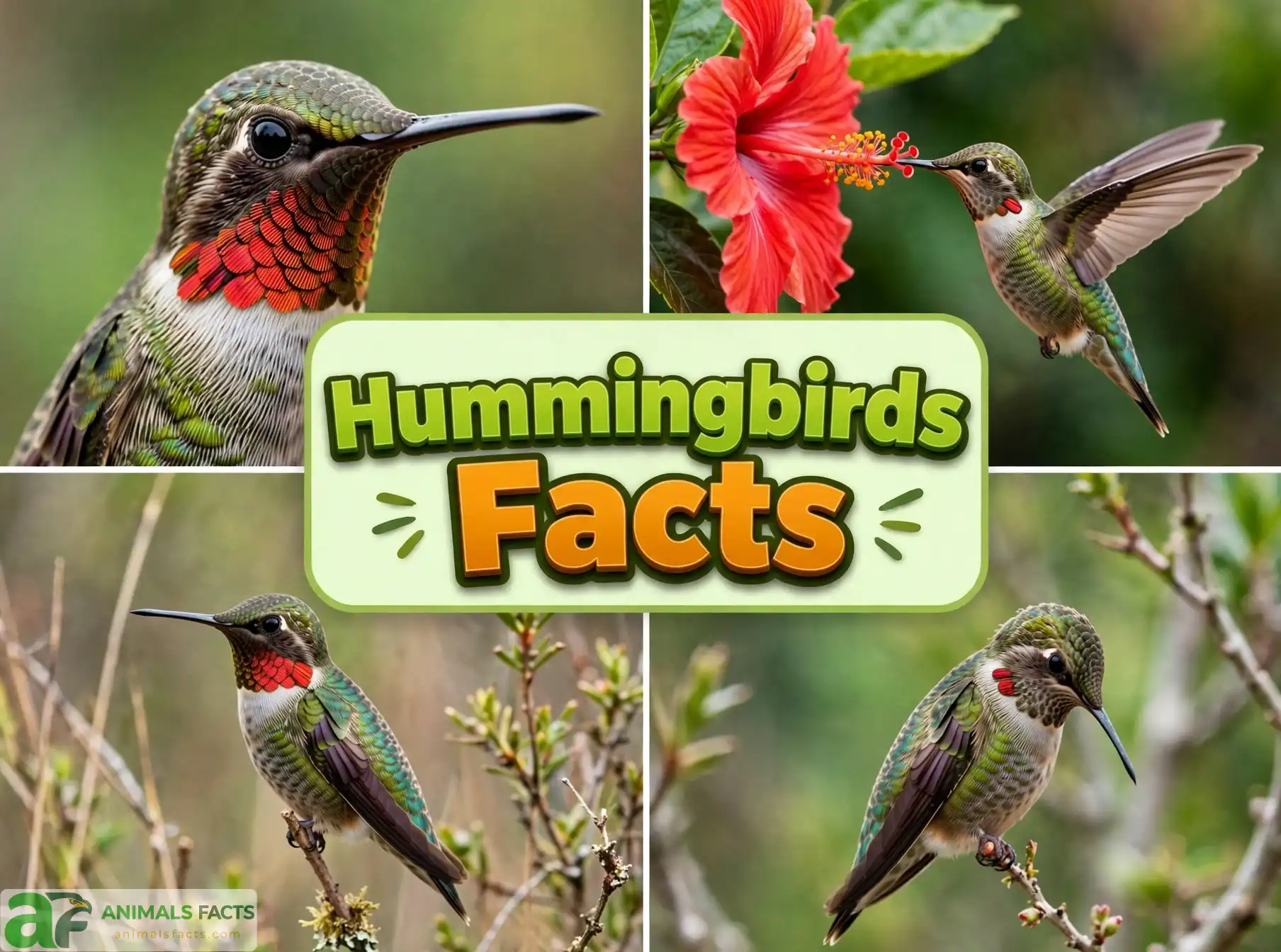
11. Hummingbird Facts for Kids
Hey amazing young wildlife scientists, nature lovers, and tiny bird enthusiasts! Here are some truly extraordinary hummingbird facts for kids that will make you the most fascinating wildlife expert in any conversation:
🌺 The bee hummingbird is so small it could sit on the tip of your FINGER! The bee hummingbird — the world’s smallest bird — is only 5.7 centimeters long and weighs just 1.6 grams. That’s lighter than a paperclip! It lives only in Cuba and builds its nest inside a thimble — one of the smallest nests of any bird in the world. Even though it is incredibly tiny, it beats its wings about 80 times every SECOND!
🌺 Hummingbirds are the ONLY BIRDS that can fly BACKWARD! No other bird in the world can fly backward like a hummingbird. Their wings beat in a special figure-8 pattern — making a loop on each stroke — that lets them push air in any direction. They can hover perfectly still, fly forward, fly backward, fly sideways, and even fly upside down briefly! It’s like having a helicopter that can also go in reverse!
🌺 The Anna’s hummingbird dives faster than a FIGHTER JET PILOT can handle! When a male Anna’s hummingbird dives to impress a female, it reaches 98 kilometers per hour and then pulls up in less than a second. This pull-up generates a force 9 times stronger than gravity — that’s called 9 g-forces! Fighter jet pilots wearing special suits black out at about 9 g-forces. The hummingbird does this with no suit, no problem, just to show off for a girlfriend!
🌺 Hummingbird colors are a MAGIC TRICK — they’re not really there! The stunning ruby-red throat of a male ruby-throated hummingbird doesn’t have any red pigment. The feathers are actually dark. The color appears because the feather structure bends light like a prism — showing red from one angle and turning completely black from another angle. If you moved your head slightly while looking at a hummingbird, the brilliant color would VANISH! It’s structural coloration — the most beautiful optical illusion in the bird world!
🌺 Hummingbirds go to SLEEP every night looking completely DEAD! To survive the night without starving, hummingbirds enter a state called torpor. Their body temperature drops from about 40°C to as low as 8°C — almost as cold as a refrigerator. Their heart slows from 1,200 beats per minute to about 50. Their breathing nearly stops. If you found a hummingbird in torpor, you might think it was dead! But in the morning, it slowly warms up, starts shivering to make heat, and within an hour is back to normal!
🌺 Scientists were WRONG about hummingbird tongues for 200 YEARS! Everyone used to think hummingbird tongues worked like tiny straws — sucking nectar up by capillary action. Then in 2011, a scientist filmed hummingbird tongues with a camera that takes 1,500 pictures per second. The real mechanism was completely different: the tongue tip is like a tiny elastic trap that snaps shut around the nectar when it springs back into shape! The hummingbird can lick 17 times PER SECOND with this elastic tongue!
🌺 The ruby-throated hummingbird FLIES ACROSS THE OCEAN nonstop! Every year, ruby-throated hummingbirds migrate from the eastern United States across the Gulf of Mexico — 800 kilometers of open water — in a single flight that takes 18 to 20 hours without stopping. Before the flight, the bird eats so much that it DOUBLES its body weight in fat! By the time it reaches the other side, almost all the fat is burned. It’s like a tiny airplane flying on a very precise fuel budget!
🌺 The sword-billed hummingbird has a BILL LONGER THAN ITS BODY! The sword-billed hummingbird of the Andes mountains has a bill about 10 centimeters long. Its body (not counting the bill) is only about 9 centimeters! It is the ONLY BIRD IN THE WORLD whose bill is longer than its body. When it sits on a branch, it has to point its bill straight up in the air just to keep its balance. The bill evolved to match a specific flower (Passiflora mixta) that has a very deep tube that only the sword-billed hummingbird can reach!
12. Relationship with Humans
The hummingbird’s relationship with humans spans thousands of years of indigenous spiritual significance — warriors reincarnating as hummingbirds in Aztec cosmology, hummingbird medicine bags carried by Mayan healers — through the Victorian hummingbird skin trade that killed millions of birds for fashion, to the modern era in which hummingbird feeders have made these birds one of the most intimate human-wildlife interactions in North America, and the growing conservation crisis for cloud forest species threatened by habitat loss.
Pre-Columbian Cultural Significance
The Aztec warrior connection — Huitzilopochtli:
The most historically significant human-hummingbird relationship in the Americas — and one of the most unusual bird-deity associations in any mythology:
The mythology:
- The Aztec war god Huitzilopochtli (“left-handed hummingbird” or “hummingbird of the south”) was the supreme deity of the Aztec state — associated with the sun, warfare, and human sacrifice
- Warriors who died in battle were believed to reincarnate as hummingbirds — the birds representing the warriors’ souls, accompanying the sun on its daily journey across the sky
- After four years as a hummingbird, the warrior souls were believed to be reborn again as other creatures
- This belief made hummingbirds sacred birds associated with the highest military honors in Aztec culture
The Aztec capital connection:
- The Aztec capital Tenochtitlán (modern Mexico City) was founded at a location where, according to legend, the priests found the sign they were seeking — an eagle on a cactus, devouring a snake (now on the Mexican flag) — but the name Tenochtitlán itself is associated with the sacred cactus where hummingbirds were believed to feed
- The Huitzilopochtli temple atop the Great Pyramid of Tenochtitlán was the most important religious structure in the Aztec Empire — the connection between the warrior-hummingbird deity and the empire’s religious center embedding the hummingbird in the foundation of the most powerful pre-Columbian civilization in Mesoamerica
The medicine traditions:
- Across multiple Mesoamerican and Andean cultures, hummingbirds were used in love charms and medicine:
- Dried hummingbirds carried as amulets for attraction and romantic success
- Hummingbird parts incorporated into medicine bundles for healing
- The hummingbird’s extraordinary energy and speed associated with vigor and vitality in healing traditions
The Victorian Skin Trade — The Dark Period
The fashion catastrophe:
In the 1860s–1910s, hummingbird skins and stuffed hummingbirds became fashionable accessories in European and North American society:
- Dried hummingbirds attached to women’s hats — the entire bird, with spread wings, used as a hat decoration
- Hummingbird skins sold as decorative items for home display
- The trade was commercialized at extraordinary scale — one London dealer reported selling 400,000 hummingbird skins in a single year in the 1880s
The volume:
- Estimates suggest millions of hummingbirds were killed annually during the peak of the skin trade
- The trade contributed to the decline of multiple Caribbean and South American species
- The trade was eventually ended by the combination of fashion change, import restrictions, and the early bird protection legislation motivated partly by this specific trade
The conservation response:
The hummingbird skin trade was one of the motivating examples for the early American conservation movement:
- George Bird Grinnell and the early Audubon Society campaigns used hummingbird skin examples in their advocacy
- The Lacey Act (1900) and ultimately the Migratory Bird Treaty Act (1918) were partly motivated by the commercial bird trade that the hummingbird skin traffic exemplified
The Hummingbird Feeder Revolution
The modern human-hummingbird relationship:
The introduction of the artificial hummingbird feeder in the mid-20th century has created one of the most intimate and most broadly distributed human-wildlife relationships in North America:
The scale:
- An estimated 15–20 million North American households maintain hummingbird feeders
- The hummingbird feeder market is a multi-hundred-million-dollar industry annually in the United States and Canada alone
- More North Americans feed hummingbirds than participate in any other wildlife feeding activity except general bird feeding
The ecological consequences:
- Feeders have supported significant range expansions — Anna’s hummingbirds have expanded their winter range northward significantly (into British Columbia, Washington, and Oregon where they were not historically resident) supported by winter feeder availability
- Feeders provide critical supplemental food during cold snaps and migration — documented reducing mortality during late cold spells that reduce natural flower availability
- Improperly maintained feeders (moldy nectar, unclean sugar solutions) can spread diseases — particularly Aspergillus fungal infections — emphasizing the importance of feeder hygiene
The citizen science opportunity:
- The concentration of hummingbirds at feeders has enabled extensive citizen science — programs like Project FeederWatch (Cornell Lab of Ornithology) tracking hummingbird distribution and abundance through feeder observations
- Thousands of hummingbird banding stations across North America contribute population monitoring data through captures and recaptures at feeders
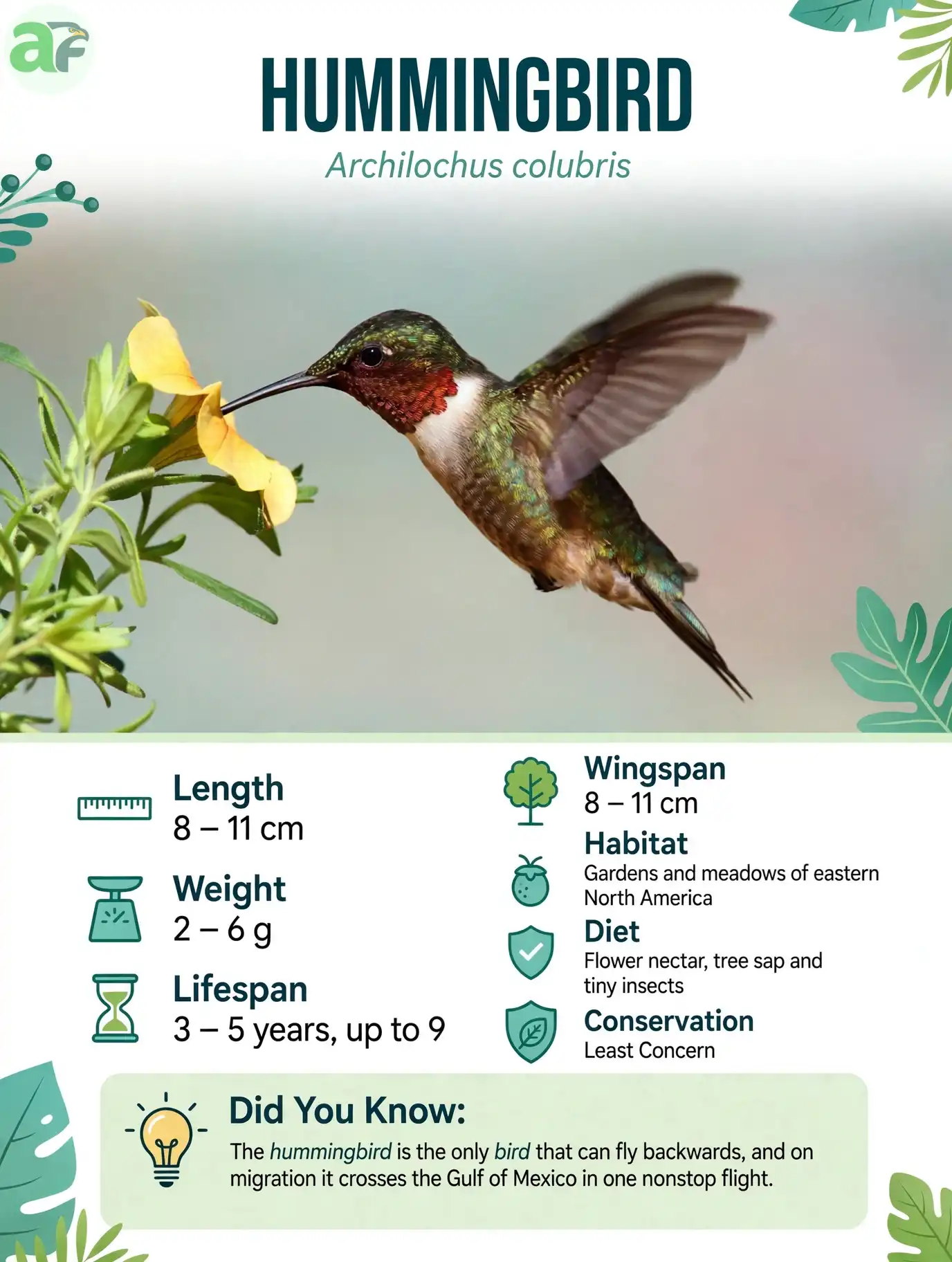
13. Hummingbird Conservation Status & Threats
Conservation Status Overview
| Species | IUCN Status | Population | Primary Threat |
|---|---|---|---|
| Gorgeted puffleg | Critically Endangered | <250 individuals | Cloud forest loss (Colombia) |
| Marvelous spatuletail | Endangered | <1,000 | Cloud forest clearance (Peru) |
| Bee hummingbird | Near Threatened | Unknown — Cuba only | Cuban forest loss; climate change |
| Koepcke’s hermit | Vulnerable | Unknown | Peruvian forest loss |
| Esmeraldas woodstar | Critically Endangered | <250 | Ecuador Pacific slope forest loss |
| Ruby-throated hummingbird | Least Concern | ~34 million | Stable |
| Anna’s hummingbird | Least Concern | ~9.5 million | Expanding range |
| Rufous hummingbird | Near Threatened | ~22 million (declining) | Breeding habitat loss; climate change |
| Calliope hummingbird | Least Concern | ~4.5 million | Stable |
The Andean Cloud Forest Crisis
The primary conservation challenge — The Andes cloud forests of Colombia, Ecuador, Peru, and Bolivia represent both the center of hummingbird diversity and one of the world’s most rapidly disappearing biomes:
- The Andean cloud forest has lost approximately 50–80% of its original extent — varying by country and elevation
- Agricultural expansion (particularly cattle ranching and coffee/coca cultivation) is the primary driver of ongoing loss
- Road construction opening previously inaccessible cloud forest to colonization is accelerating loss in Peru and Bolivia
- Multiple hummingbird species are known from single locations in cloud forest — their entire global populations existing in areas small enough to be cleared in a single logging operation
The gorgeted puffleg (Eriocnemis isabellae):
Described in 2007 — one of the most recently described birds in the Western Hemisphere — and immediately classified as Critically Endangered:
- Known from a single watershed in Serranía del Pinche, Cauca department, Colombia
- Population estimated at fewer than 250 individuals
- The habitat within the known range is actively being deforested for agriculture
- One of the most urgent single-species conservation priorities in South America
The Rufous Hummingbird Decline
A familiar species in trouble:
The rufous hummingbird — the most commonly observed western North American hummingbird and familiar to millions of feeder owners — has declined by approximately 60% since 1970:
- Breeding habitat loss in the Pacific Northwest and British Columbia
- Climate-driven phenological mismatch — the hummingbird arrives on breeding grounds based on photoperiod (day length) cues, but flowers are blooming earlier due to warming temperatures — creating a timing mismatch between the bird’s arrival and the peak nectar availability
Major Threats Across the Family
| Threat | Description | Impact Level |
|---|---|---|
| Cloud forest loss | Andean deforestation | Critical — primary threat |
| Climate change | Shifts in flower phenology; extreme weather | High and increasing |
| Window strikes | Hummingbirds colliding with windows | High — estimated millions annually |
| Pesticide use | Reducing insect prey; nectar contamination | High |
| Feeder disease | Fungal and bacterial contamination of artificial feeders | Medium |
| Pet trade | Illegal capture in some range countries | Medium — localized |
| Island endemics | Caribbean species with tiny ranges | High — several near extinction |
14. Famous Hummingbirds in History & Pop Culture
Historical Significance
Huitzilopochtli and the founding of the Aztec Empire:
As described above — the association of the hummingbird with the Aztec war god Huitzilopochtli makes the hummingbird one of the most historically significant birds in the history of any civilization. The Aztec Empire that its warrior-hummingbird deity presided over was the largest pre-Columbian state in Mesoamerica — making the hummingbird inadvertently present at the founding mythology of one of history’s great civilizations.
Darwin and the hummingbird-flower co-evolution:
Charles Darwin’s observations on orchid pollination (published 1862) included the famous prediction that the star orchid of Madagascar (Angraecum sesquipedale), with its 30-cm nectar spur, must be pollinated by a moth with a 30-cm proboscis. The equivalent hummingbird co-evolution story — the sword-billed hummingbird’s 10-cm bill and the matching 10-cm nectar tube of Passiflora mixta — is a textbook example of co-evolutionary arms race between a plant and its exclusive pollinator. The sword-billed hummingbird’s bill is so long and heavy that the bird must hold it nearly vertical when perched — and the flower’s tube is so deep that only the sword-billed hummingbird can access it. Neither species can reproduce effectively without the other.
John Gould’s hummingbird exhibition (1851):
The Victorian natural history artist and ornithologist John Gould opened an exhibition of 300 mounted hummingbirds at the Regent’s Park Gardens in London in 1851 — one of the first large-scale natural history exhibitions open to the public. The exhibition attracted enormous crowds including a young Charles Darwin and the young Queen Victoria. Gould’s subsequent publication “A Monograph of the Trochilidae” (1849–1861) — with its stunning illustrated plates of hummingbird species — remained the most comprehensive treatment of the family for decades and helped establish hummingbirds as one of the most beloved bird groups in Victorian natural history.
15. Role in Ecosystem & Food Chain
The Pollination Service — The Americas’ Essential Pollinator
The hummingbird pollination syndrome:
Hummingbirds are the primary pollinators of approximately 8,000 flowering plant species in the Americas — more plant species than any other bird family pollinates globally:
Hummingbird-flower characteristics:
Plants pollinated by hummingbirds have evolved a recognizable set of characteristics:
- Red or orange color — hummingbirds see red well; bees (competing pollinators) see red poorly, reducing nectar competition
- Tubular flower shape — matching the bill length and curve of the pollinating hummingbird species
- No landing platform — hummingbirds hover; no landing perch is needed (bee flowers typically have landing platforms)
- High nectar volume — sufficient to reward multiple daily visits
- Daytime flowering — hummingbirds are diurnal (active by day); moth-pollinated flowers open at night
The co-evolutionary arms race:
The extraordinarily diverse bill shapes of different hummingbird species reflect co-evolutionary relationships with specific flower types:
- Curved bills (hermit hummingbirds) → curved heliconias and bromeliads
- Sword bills (sword-billed hummingbird) → deep Passiflora flowers
- Short bills (bee hummingbird) → short-tubed flowers
- Decurved bills (purple-backed thornbill) → curved long flowers
- Each bill-flower pair represents a specific co-evolutionary relationship in which the plant’s exclusive access to one pollinator and the bird’s exclusive access to one nectar source have evolved together
The Seed Dispersal Dimension
While pollination is the primary ecosystem service, hummingbirds incidentally contribute to seed dispersal — their bodies collecting seeds from fruit and flower surfaces and transporting them as they move through habitats.
The Food Web Position
As prey:
- The hummingbird’s small size makes it prey for an unexpectedly diverse predator community including mantises, spiders, large frogs, shrikes, and various small hawks
- Hummingbird eggs and chicks are consumed by corvids, snakes, and squirrels
As consumer:
- Top-down regulation of nectar-producing plants (the plant’s dependence on hummingbird visitation for pollination creates a mutualism rather than a predator-prey relationship)
- Insect consumption provides some regulatory function on flying insect populations
16. Myths, Folklore & Cultural Significance
Mesoamerican Traditions
The Huitzilopochtli cult:
As described throughout this article — the association of hummingbirds with the Aztec war god and with warrior reincarnation represents the most elaborate and most historically significant human-hummingbird cultural relationship in the Americas. The Aztec warrior soul’s journey — death in battle → reincarnation as hummingbird → four years accompanying the sun → rebirth — embedded the hummingbird in the cosmological system of the most powerful Mesoamerican civilization.
The Huichol tradition (Mexico):
The Huichol people of western Mexico maintain traditions in which hummingbirds serve as messengers between humans and the divine — the birds’ speed and their association with flowers and the spiritual realm making them intermediaries in shamanic communication.
Mayan healing traditions:
In various Mayan communities, dried hummingbirds and hummingbird parts are used in folk medicine and love charms — the birds’ extraordinary vitality associated with healing power and romantic attraction. The tradition of carrying a dried hummingbird as a love amulet (chuparosa — “suck-rose” in Spanish, the popular Mexican name for the hummingbird) persists in various forms across Mexican and Central American folk traditions.
Andean Traditions
The Nazca Lines hummingbird:
Among the famous Nazca geoglyphs in the coastal desert of southern Peru — large ground drawings of animals and geometric shapes visible only from the air — is a hummingbird figure approximately 96 meters long, drawn in the distinctive Nazca style. The hummingbird Nazca line is one of the most recognized of the 800+ individual figures and lines in the Nazca system — drawn by the Nazca culture between approximately 500 BCE and 500 CE. The significance of the hummingbird to the Nazca culture — and the reason for the geoglyphs generally — remains a subject of active debate among archaeologists.
Quechua hummingbird traditions:
The Quechua-speaking peoples of the Andean region use hummingbird imagery extensively in textiles, ceramics, and ceremonial contexts — the bird associated with specific seasonal ceremonies related to the flowering of Andean plants.
Caribbean Traditions
The Taíno guaní:
The indigenous Taíno people of the Caribbean — the first people Columbus encountered — had specific traditions around hummingbirds (guaní). The hummingbird was associated with the Taíno sun deity and with the renewal of life — the bird’s appearance at flowers being associated with the sun’s life-giving power.
17. Hummingbirds in Pop Culture
Georgia O’Keeffe and hummingbird art:
American artist Georgia O’Keeffe — famous for her oversized flower paintings — lived in the desert Southwest where hummingbirds were regular visitors to her garden. While not the direct subject of her most famous paintings, the relationship between hummingbirds and the oversized, close-up flower interiors that O’Keeffe painted reflects the same intimacy between hummingbird vision and flower structure that drives co-evolution.
The Pixar “Dory” hummingbird scene:
The hummingbird has appeared in numerous animated productions — the challenge of animating the blur of hummingbird wings while maintaining the visual identity of the bird has made hummingbirds a recurring challenge for animation studios. Various documentaries including BBC’s Planet Earth series have featured hummingbird slow-motion footage as showcase sequences.
National Geographic hummingbird photography:
The hummingbird is one of the most photographed bird subjects in wildlife photography — the combination of iridescent color, hovering capability, and cooperative feeder behavior making hummingbirds among the most accessible and most rewarding wildlife photography subjects available to non-professional photographers. High-speed photography of hummingbirds has revealed details of wing motion, tongue action, and aggressive interactions that were invisible to normal-speed observation.
The hummingbird feeder culture:
The American hummingbird feeder tradition has generated an entire cultural ecosystem — specialized feeders, feeder design innovations, nectar concentrate products, and the communities of feeder enthusiasts who track hummingbird arrivals and departures as seasonal markers. The first spring hummingbird arrival at the feeder has become a cultural event in North American suburban life comparable to the first robin sighting — a personal marker of winter’s end.
18. Hummingbird Facts vs. Common Myths
| Common Myth | The Real Fact |
|---|---|
| “Hummingbirds survive on nectar alone” | False — hummingbirds also require insects and spiders for protein. Without the insect component, they cannot maintain body tissue, produce feathers, or raise chicks. The insect component is essential despite being invisible during typical feeder observation |
| “The hummingbird tongue works like a straw by capillary action” | False — overturned by 2011 research. The tongue works by elastic trapping — the forked tip deforming elastically when it contacts nectar and springing back to trap nectar inside |
| “Hummingbirds are the only birds that can hover” | Partially false — several other birds can hover briefly (kestrels, kingfishers) but only hummingbirds can hover indefinitely — sustained hovering is unique to hummingbirds |
| “Red dye in hummingbird feeders attracts them and is safe” | False — the red color of the feeder itself is sufficient to attract hummingbirds; adding red dye to the nectar solution is unnecessary and potentially harmful. Plain sugar water (4:1 water to white sugar) is the appropriate feeder solution |
| “Hummingbirds migrate on the backs of geese” | False — a completely unfounded folk belief. Hummingbirds migrate independently; the ruby-throated hummingbird’s Gulf of Mexico crossing is one of the most well-documented individual bird migration feats |
| “Iridescent hummingbird colors come from colorful pigments” | False — the iridescent colors are structural (produced by light interference in feather nanostructure), not pigment. The same feather can appear different colors or no color at all depending on viewing angle and light conditions |
| “Hummingbirds are only found in South America” | False — hummingbirds range from Alaska to Tierra del Fuego; ruby-throated hummingbirds breed as far north as Nova Scotia and the ruby-throated hummingbird is the most common summer bird in many eastern North American gardens |
19. Best Places to See Hummingbirds in the Wild
South America — Maximum Diversity
1. Tandayapa Bird Lodge, Pichincha Province, Ecuador
The single most species-rich hummingbird watching location accessible to international visitors — the Tandayapa Valley cloud forest, approximately 60 km from Quito, supports 30+ hummingbird species at the lodge’s extensive feeder array. The lodge’s combination of cloud forest habitat, altitude gradient (1,700–2,200 m), and extensive feeders maintained by dedicated staff produces extraordinary hummingbird diversity including multiple metallically-iridescent species that feed within arm’s reach of the observation deck. The Mindo Valley immediately adjacent provides additional hummingbird diversity in slightly lower cloud forest.
2. Machu Picchu area and Aguas Calientes, Peru
The spectacular Machu Picchu cloud forest zone supports multiple hummingbird species at accessible viewing locations in the town of Aguas Calientes and along the trails within the sanctuary. The Torrent Duck trail along the Urubamba River provides hummingbird viewing in the transition between lowland and cloud forest. The combination of extraordinary archaeological setting and accessible hummingbird viewing makes this one of the finest combined tourism experiences in South America.
3. Wayqecha Cloud Forest Biological Station, Cusco Region, Peru
For the marvelous spatuletail (Loddigesia mirabilis, Endangered) — the most spectacular hummingbird in the Americas — the most reliable viewing location is in the Utcubamba Valley of Amazonas Department, Peru. Access requires a dedicated expedition from Chachapoyas, but the combination of the marvelous spatuletail, other endemic cloud forest species, and the extraordinary Kuelap archaeological site makes this one of the finest wildlife travel experiences in Peru.
Central America — Accessible Hummingbird Experiences
4. Monteverde Cloud Forest Reserve, Costa Rica
The world’s most visited cloud forest — Monteverde supports 30+ hummingbird species in accessible cloud forest where the combination of lodge feeders, guided walks, and the Hummingbird Gallery (a commercial feeding station adjacent to the reserve) provides one of the most reliably productive hummingbird experiences in Central America. The violet sabrewing (Campylopterus hemileucurus) — one of the largest and most spectacular Central American hummingbirds — is regularly observed.
5. La Selva Biological Station, Costa Rica
The world’s best-studied tropical forest research station — La Selva provides extraordinary access to lowland rainforest hummingbirds including hermit hummingbirds along the extensive trail network. The combination of research station infrastructure and accessible lowland forest makes La Selva one of the finest tropical hummingbird watching experiences in Central America.
North America — Accessible and Beloved
6. Ramsey Canyon Preserve, Arizona, USA
The Mile-High Ranch and Ramsey Canyon in the Huachuca Mountains of southern Arizona provide the finest accessible hummingbird watching in North America — up to 14 species of hummingbirds have been documented at this single site, and the canyon’s feeders attract extraordinary densities of rufous, black-chinned, broad-tailed, magnificent, and other species. The combination of hummingbird diversity and the adjacent Mexican border (allowing access to additional Mexican species) makes the Huachuca Mountains the hummingbird destination of choice for North American birders.
7. Hummingbird Monitoring Network Sites, Southwestern USA
The Hummingbird Monitoring Network maintains a system of long-term monitoring stations across the southwestern United States — many at accessible and visitor-friendly locations in Arizona, New Mexico, and Texas. The network’s banding operations allow visitors to observe hummingbirds at extremely close range during capture, banding, and release.
20. How You Can Help
Supporting hummingbird conservation requires action at multiple scales — from individual garden management to international cloud forest protection advocacy.
Support these organizations:
- American Bird Conservancy — abcbirds.org — comprehensive bird conservation including Andean cloud forest protection programs directly benefiting threatened hummingbird species
- The Nature Conservancy — Andes Programs — nature.org — cloud forest land protection in Colombia, Ecuador, and Peru; directly protects hummingbird habitat
- Rainforest Trust — rainforesttrust.org — funds purchase and protection of cloud forest; multiple specific projects protecting Critically Endangered hummingbird species
- ProAves Colombia — proaves.org — Colombia bird conservation; maintains the Loro Coroniazul reserve in Serranía del Pinche specifically protecting the gorgeted puffleg
- Hummingbird Society — hummingbird.org — hummingbird-specific conservation education and research funding
- Hummingbird Monitoring Network — hummonnet.org — long-term population monitoring at banding stations across North America
Critical individual actions:
Maintain clean hummingbird feeders — Improperly maintained feeders kill hummingbirds. The nectar solution must be changed every 2–4 days (more frequently in hot weather), and the feeder must be thoroughly cleaned each time to prevent mold and bacterial growth. Never use honey (ferments rapidly), never add red dye (potentially harmful), and use a 4:1 water-to-white-sugar ratio (no honey, no brown sugar, no artificial sweeteners).
Plant native nectar-producing plants — Native flowering plants provide nectar without the disease risk of feeders and support the insect populations hummingbirds also need. Native plants recommended for hummingbird support vary by region — contact your state’s native plant society or the National Audubon Society’s native plant finder for regionally appropriate species.
Reduce window strike mortality — Hummingbirds are significant window strike victims — the millions of annual bird window strikes in the United States include a substantial hummingbird proportion. Installing window decals, screens, or external film on windows near hummingbird habitat and feeders reduces strikes significantly.
Reduce pesticide use — Insecticides that reduce flying insect populations directly reduce the protein food supply that hummingbirds depend on alongside nectar. Avoiding broad-spectrum insecticide use in gardens where hummingbirds feed maintains the insect communities that are nutritionally essential for hummingbird health.
Support Andean ecotourism — Visiting cloud forest lodges in Ecuador, Colombia, and Peru that protect hummingbird habitat generates economic value for conservation. The Mindo cloud forest, Tandayapa Valley, and equivalent birding lodge destinations in the Andes directly fund habitat protection through ecotourism revenue.
21. Top Documentaries & Books
Must-Watch Documentaries
“The Hummingbird Effect” (various PBS Nature and BBC productions) — Multiple documentary treatments of hummingbird flight biology, ecology, and the co-evolutionary relationships between hummingbirds and flowers; the high-speed photography sequences of hovering, feeding, and courtship behavior are among the most visually spectacular in nature documentary filmmaking.
“Winged Migration” (2001) — While focused on migration broadly, includes exceptional hummingbird migration content — particularly the Gulf of Mexico crossing of the ruby-throated hummingbird — in some of the finest aerial wildlife cinematography produced.
“Planet Earth II — Jungles and Grasslands” (BBC, David Attenborough, 2016) — Includes exceptional hummingbird content in the jungle segments; the slow-motion footage of hummingbird feeding and the Anna’s hummingbird courtship dive sequence are among the most remarkable bird sequences in modern nature documentary.
“Wild Peru” and various Andean wildlife documentary productions — Multiple productions focusing on Andean wildlife include cloud forest hummingbird sequences of extraordinary visual quality — the combination of Andean landscape and iridescent hummingbirds in cloud forest mist producing some of the most beautiful wildlife footage available.
Must-Read Books
The Life of a Hummingbird by Alexander Skutch — The foundational natural history account by one of the 20th century’s most important field ornithologists; decades of observation on Costa Rican hummingbirds compiled into the most detailed behavioral account of the family available.
Hummingbirds: A Life-size Guide to Every Species by Michael Fogden, Marianne Taylor, and Sheri Williamson — The most visually comprehensive treatment of the entire family; life-size photographic plates of all ~366 species; essential identification and natural history reference.
The Glitter in the Green: In Search of Hummingbirds by Jon Dunn (2021) — An elegantly written account of searching for hummingbirds across the Americas; combines natural history, conservation, and personal narrative in one of the most readable recent hummingbird books.
A Folio of Hummingbirds by John Gould (1861, facsimile editions available) — The Victorian masterwork of hummingbird illustration; the original chromolithographic plates of Gould’s hummingbird monograph remain among the finest bird illustrations ever produced.
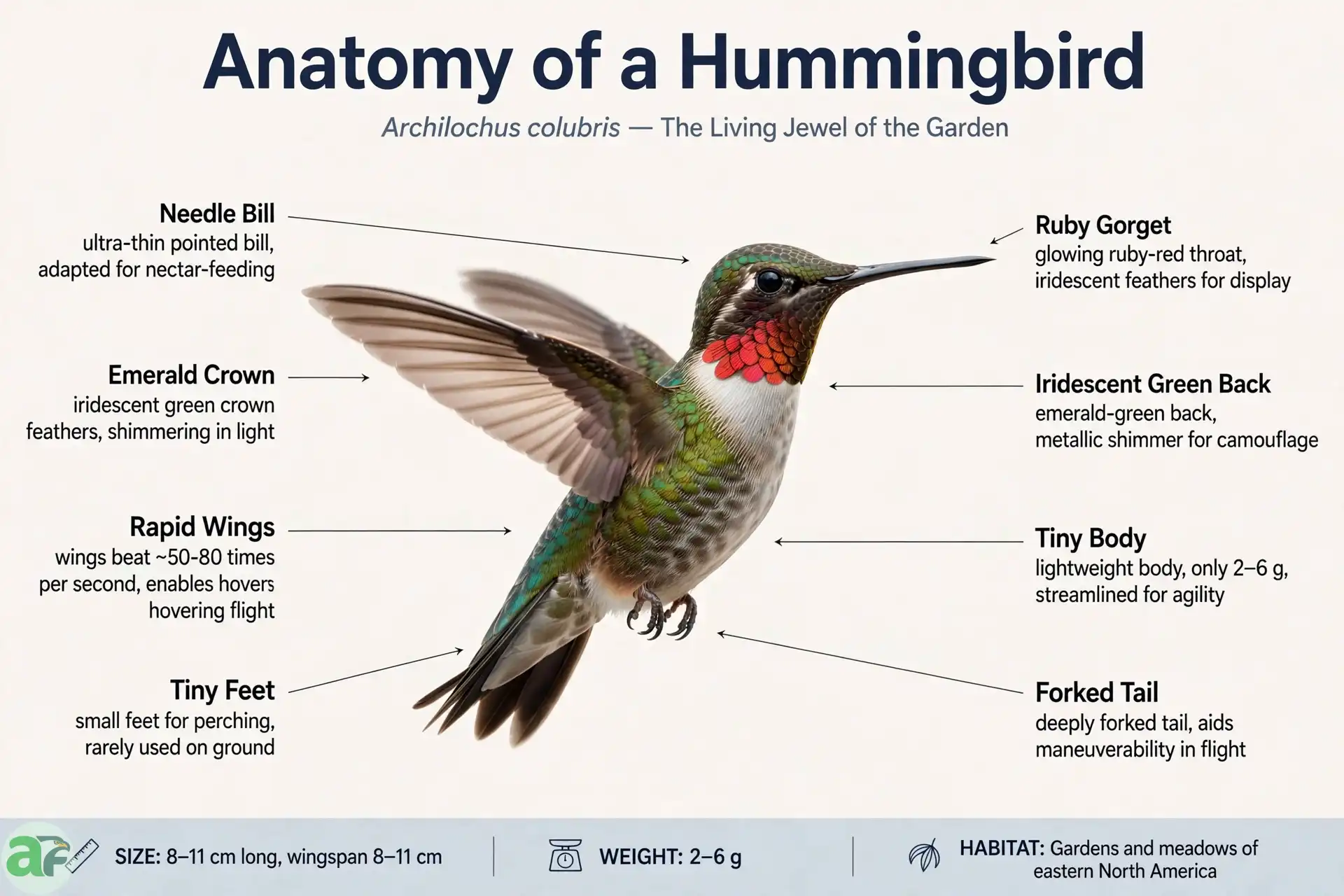
22. Comparison of Major Hummingbird Species
| Feature | Bee Hummingbird | Ruby-throated | Anna’s Hummingbird | Sword-billed | Giant Hummingbird | Calliope Hummingbird |
|---|---|---|---|---|---|---|
| Scientific name | Mellisuga helenae | Archilochus colubris | Calypte anna | Ensifera ensifera | Patagona gigas | Selasphorus calliope |
| Length | 5.7 cm | 8–9 cm | 9–10 cm | 15–20 cm (bill 10 cm) | 23 cm | 7–8 cm |
| Weight | 1.6 g | 2.4–4.5 g | 3.4–6 g | 10–15 g | 18–24 g | 2.3–3.4 g |
| Wingbeat | ~80/sec | ~53/sec | ~40/sec | ~20/sec | ~10–15/sec | ~50/sec |
| Range | Cuba only | E. North America | W. North America | Andes | Andes broadly | W. North America |
| Migration | Limited | Gulf of Mexico crossing | Year-round resident (expanding) | Altitudinal | Altitudinal + some long-distance | 9,000 km annually |
| Famous for | World’s smallest bird | Gulf crossing; ruby gorget | 9 g courtship dive | Bill longer than body | Largest hummingbird | Smallest N. American bird; longest migration by body size |
| Conservation | Near Threatened | Least Concern | Least Concern | Least Concern | Least Concern | Least Concern |
| Nest | Thimble-sized | Walnut half-sized | Walnut half-sized | Expanded for large body | Largest hummingbird nest | Tiny; well-camouflaged |
23. Frequently Asked Questions About Hummingbirds
Q1. What is the scientific name of the hummingbird family and what does it mean?
The hummingbird family is Trochilidae (Vigors, 1825), derived from the type genus Trochilus — a name that comes from the ancient Greek trochilos, referring to a small bird mentioned in ancient Greek texts. The precise identity of the Greek trochilos is debated by classical scholars — various authors have suggested it referred to a wren, a small migratory bird, or a crocodile’s tooth-picking companion (in one account) — but when the naturalist Nicholas Vigors applied the name Trochilidae to the hummingbirds in 1825, he established it in ornithological nomenclature for this family. The common name “hummingbird” is straightforwardly onomatopoeic — derived from the humming sound produced by the rapidly beating wings, first documented in the writings of European naturalists encountering the birds in the 16th–17th centuries. The Portuguese beija-flor (“flower-kisser”) is perhaps the most poetic common name in any language — capturing the bird’s essential ecological relationship with flowers. The Spanish colibrí — used across Latin America — is derived from a Caribbean indigenous language (possibly the Carib kurukuru) and was adopted by Spanish colonizers from the peoples they encountered. The Cuban zunzún is another indigenous-derived Caribbean name. Individual species names span human naming traditions across four centuries — from the sword-billed hummingbird (Ensifera ensifera — “sword-bearer” in both genus and species name) to the bee hummingbird (Mellisuga helenae — “honey-sucker of Helena,” named for the wife of the 19th-century Cuban naturalist Juan Gundlach’s patron).
Q2. How do hummingbirds hover?
Hummingbird hovering is achieved through a figure-8 wing stroke that is fundamentally different from the flight mechanics of all other birds. In typical bird flight, the downstroke generates the majority of lift — the wing pushes down and backward, generating both lift (upward force) and thrust (forward force). The upstroke is primarily a recovery movement with minimal aerodynamic contribution. The hummingbird wing operates completely differently: the wing sweeps nearly horizontally (rather than vertically) and generates lift on both the forward stroke and the backward stroke through a wing rotation mechanism. The wing rotates at the shoulder joint to nearly 180 degrees — pointing forward with the leading edge forward during the first half of the stroke, then rotating so the leading edge points backward during the second half. This rotation means that both strokes push air downward (generating lift) even though they move in opposite horizontal directions. The two strokes generate approximately 25–30% lift on the upstroke and 70–75% on the downstroke in hovering — close to symmetric lift, which is what allows the bird to remain stationary. The figure-8 path that the wing tip traces through space (viewed from the side) gives the stroke its name. The shoulder joint’s extraordinary rotational range — up to 180 degrees — is unique among birds and is what makes this wing mechanics possible. Research using computational fluid dynamics modeling of hummingbird wing stroke patterns has confirmed that the hovering mechanism is more aerodynamically efficient than helicopter hovering because of the wing’s interaction with its own wake vortices.
Q3. What is torpor and why do hummingbirds need it?
Torpor is a state of drastically reduced metabolic rate that hummingbirds enter nightly (and during food scarcity periods) to survive without adequate caloric intake. The necessity of torpor arises directly from the hummingbird’s extraordinary metabolic rate — the same physiological extreme that enables hovering flight and rapid wing beats also creates an energy demand that cannot be sustained through the night without food. A resting (non-flying) hummingbird consumes energy at the highest resting metabolic rate of any bird per gram of body weight — approximately 10 times the metabolic rate of a bird of equivalent size. The hummingbird’s total fat reserves — the energy stored in its body — would be completely exhausted in approximately 1 hour at this resting metabolic rate. Since a typical night lasts 8–12 hours, without torpor a hummingbird would starve every night. During torpor, all body systems are dramatically downregulated: body temperature drops from approximately 40°C to 8–18°C (near ambient); heart rate drops from 1,200 beats per minute to 50–180 beats per minute; breathing rate drops from 250 to 4–10 breaths per minute; and overall metabolic rate drops to approximately 5–10% of the active resting rate. This 90–95% reduction in energy expenditure allows the hummingbird to survive the night on minimal fat reserves. The depth of torpor varies by species and by ambient temperature — in very cold conditions, hummingbirds enter deeper torpor. Arousal from deep torpor is not instantaneous — the bird must shiver to generate heat, gradually raising body temperature over 20–60 minutes before full activity resumes. A hummingbird found in deep torpor — cold, motionless, with barely perceptible breathing — is very much alive but can easily be mistaken for dead.
Q4. Why is the ruby-throated hummingbird’s gorget color sometimes black?
The ruby-throated hummingbird’s gorget (throat patch) appears brilliant ruby-red when viewed from directly in front with direct illumination — and appears completely black when viewed from a slightly different angle or under different lighting conditions. This dramatic color change is not a behavioral or physical change in the bird — it is an optical property of the structural coloration (iridescence) that produces the color. The gorget feathers contain no red pigment — the color is produced by the interference of light reflecting from multiple thin layers of melanin platelets embedded in the feather barbules at the nanometer scale. When light reflects from these layers, waves of specific wavelengths are amplified by constructive interference (the reflected waves reinforce each other) while other wavelengths are cancelled by destructive interference (the reflected waves cancel each other out). The specific wavelength that experiences constructive interference — and therefore the apparent color — depends on the angle at which light strikes the feather and the angle at which the reflected light is observed. At the precise angle where red-wavelength light (approximately 700 nm) experiences constructive interference, the gorget appears brilliant ruby-red. At other angles, either a different color is amplified (sometimes appearing orange or gold) or no wavelength is strongly amplified, and the feather appears dark or black. This is why hummingbird gorgets “flash” as the bird moves — each slight change in the viewing angle changes the interference condition and therefore the apparent color. The phenomenon is identical to the color of soap bubbles, oil films on water, and the wings of morpho butterflies — all produced by thin-film interference rather than pigment.
Q5. Where is the best place to see hummingbirds in the wild?
The answer depends entirely on how many species and what type of hummingbird experience you seek. For maximum species diversity, the Tandayapa Valley and Mindo area of Ecuador — accessible within 2 hours of Quito — provide access to 30+ hummingbird species at lodge feeders and in cloud forest, with expert local guides and outstanding lodge infrastructure. Ecuador’s cloud forests represent the richest hummingbird habitat on Earth, and the accessibility and tourism infrastructure make Ecuador the recommended first destination for anyone seeking a genuine hummingbird diversity experience. For North American accessibility and outstanding species variety, the Huachuca Mountains of southern Arizona — particularly Ramsey Canyon Preserve (owned by The Nature Conservancy) and the feeders at Beatty’s Guest Ranch in Miller Canyon — provide up to 14 species in a spectacular mountain canyon setting easily reached from Tucson or El Paso. For the most intimate feeder experience in North America, virtually any well-maintained hummingbird feeder within the range of the ruby-throated hummingbird (eastern United States and Canada) provides extraordinary close-range encounters during spring migration (late April–May) and late summer staging (late July–early September). For the single most spectacular individual hummingbird species, the marvelous spatuletail (Loddigesia mirabilis) of northern Peru’s Utcubamba Valley requires a dedicated expedition from Chachapoyas but represents one of the most extraordinary wildlife experiences available anywhere — a tiny bird with four feathers waving iridescent blue-violet rackets in a courtship display that has been described as the most beautiful bird display in the Americas.
24. Sources & References
- Wikipedia — Trochilidae, Archilochus colubris, Mellisuga helenae, Ensifera ensifera, Calypte anna, Patagona gigas
- IUCN Red List — iucnredlist.org (current assessments for all major hummingbird species)
- BirdLife International — birdlife.org (species factsheets; population assessments)
- Rico-Guevara, A. and Rubega, M.A. (2011) — “The hummingbird tongue is a fluid trap, not a capillary tube,” PNAS — the landmark tongue mechanism discovery paper
- Clark, C.J. (2009) — “Courtship dives of Anna’s hummingbird offer insights into flight performance limits,” Proceedings of the Royal Society B — the 9 g courtship dive documentation
- Clark, C.J. and colleagues — multiple published papers on hummingbird flight mechanics, feather sounds, and courtship displays
- Warrick, D.R. and colleagues — published research on hummingbird wing aerodynamics and lift generation
- Stiles, F.G. — multiple published papers on hummingbird ecology, pollination, and behavior
- Cornell Lab of Ornithology — allaboutbirds.org (species accounts; eBird data)
- National Geographic — nationalgeographic.com
- BBC Wildlife / BBC Earth — bbcearth.com
- Britannica — britannica.com/animal/hummingbird
- ProAves Colombia — proaves.org (gorgeted puffleg conservation documentation)
- Fogden, M., Taylor, M., and Williamson, S. — Hummingbirds: A Life-size Guide to Every Species