
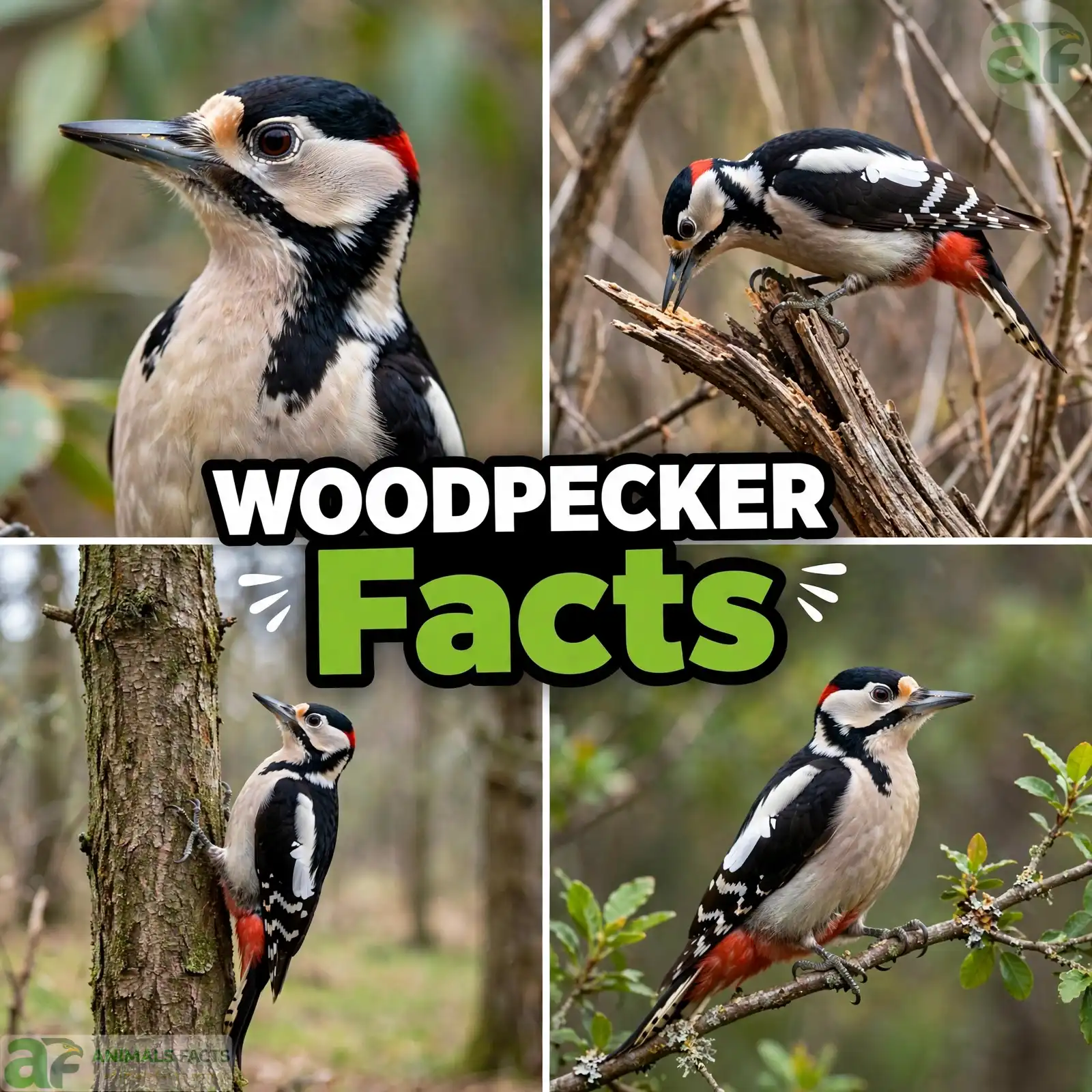
Woodpecker Facts
| Feature | Details |
|---|---|
| Primary Scientific Group | Family Picidae; approximately 240 species across multiple genera |
| Kingdom | Animalia |
| Phylum | Chordata |
| Class | Aves |
| Order | Piciformes |
| Family | Picidae (Leighton, 1837) |
| Common Names | Woodpecker; picus (Latin); specht (German); pic (French); pájaro carpintero (Spanish — “carpenter bird”) |
| Native Range | Every continent except Australia and Antarctica; most diverse in tropical Central and South America |
| Habitat | Primarily forest and woodland; also grassland, savanna, desert edges, and urban parks with mature trees |
| Lifespan | 4–12 years (wild, by species); up to 30 years (some large species in captivity) |
| Diet | Primarily wood-boring insects and larvae; also sap, nuts, berries, seeds, and occasionally eggs of other birds |
| Body Length | 7.5 cm (bar-breasted piculet) to 58 cm (great slaty woodpecker) |
| Weight | 7 grams (smallest piculets) to 500+ grams (great slaty woodpecker) |
| Drumming Rate | Up to 20 strikes per second (pileated woodpecker); bill strikes at 6–7 meters per second |
| Conservation Status | Most species Least Concern; 30+ species threatened; ivory-billed woodpecker possibly Extinct |
| Defining Feature | The shock-absorbing skull anatomy — a biological system of interlocking bones, spongy bone structure, hyoid bone wrap, and brain cushioning that prevents concussion during drumming at 1,200 impacts per day — studied by engineers designing helmets, airbags, and impact-protection systems |
| Most Famous Species | Pileated woodpecker (North America); green woodpecker (Europe); great spotted woodpecker (Europe); acorn woodpecker (Americas); Gila woodpecker (Sonoran Desert) |
| Possible Extinction | Ivory-billed woodpecker (Campephilus principalis) — possibly the most famous bird extinction debate in ornithological history |
 1. Introduction: What is a Woodpecker?
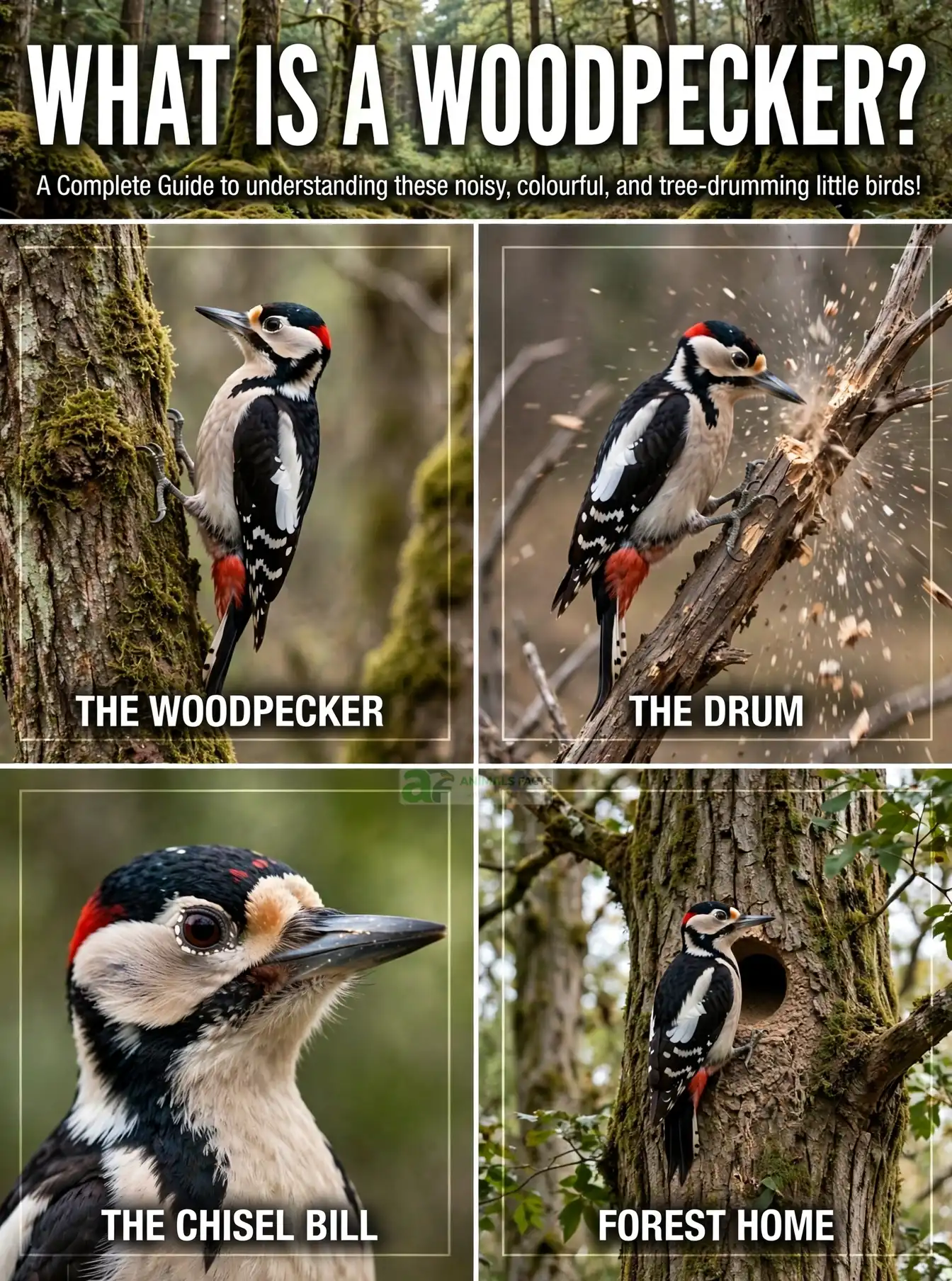
In a mature hardwood forest in the Appalachian Mountains, where the canopy has closed for a century above a forest floor thick with fallen leaves and mushrooms, a sound cuts through the morning stillness with the rhythm of a carpenter’s hammer — except no carpenter works at this speed, this consistency, or this precision. Approximately 20 strikes per second at the base of a dead beech tree, each strike delivered by a bill moving at approximately 6 meters per second, each impact generating a deceleration force equivalent to 1,000 times the force of gravity. The pileated woodpecker (Dryocopus pileatus) is working a dead snag, excavating a rectangular cavity in search of the carpenter ant colony that the bird has detected through some combination of sound, vibration sensing, and possibly smell within the wood. The cavity grows rapidly — wood chips flying in parabolic arcs from each powerful stroke — and within twenty minutes a hole has been excavated that will become a nest cavity used by the woodpecker this season and inherited by owls, ducks, and flying squirrels in subsequent years. Woodpecker facts begin with the physics of that impact — a biological system so sophisticated, so specifically engineered against an injury that kills people and disables athletes, that it has attracted the sustained research attention of mechanical engineers, neurologists, and impact protection designers for decades.
The woodpeckers — family Picidae, approximately 240 species — are one of the most globally distributed, most ecologically essential, and most mechanically extraordinary bird families in the world. They are present on every continent except Australia and Antarctica. They range from the 7.5-centimeter bar-breasted piculet of South America (lighter than a first-class stamp) to the 58-centimeter great slaty woodpecker of Southeast Asia (approaching the size of a crow). They occupy habitats from the Sonoran Desert (the Gila woodpecker nesting in giant saguaro cacti) to the Arctic treeline (the three-toed woodpecker surviving subarctic winters in boreal forest) to the Tokyo suburbs (the Japanese pygmy woodpecker foraging in urban parks). They are simultaneously the forest’s carpenter (excavating the cavities that become homes for dozens of other species), the forest’s pest controller (consuming billions of wood-boring beetles, carpenter ants, and bark beetle larvae annually), and the forest’s early warning system (their drumming and calling being among the most reliable indicators of forest health and maturity that conservation biologists use in field surveys).
Interesting facts about woodpeckers reveal an animal of breathtaking biological complexity — the hyoid bone apparatus that wraps entirely around the woodpecker’s skull like a seatbelt for the brain, absorbing impact energy that would be fatal in any other bird; the barbed, sticky tongue that extends up to 5 cm beyond the bill tip and wraps around the inside of the skull when retracted — looping over the top of the brain case and anchoring to the right nostril; the acorn woodpecker’s communal granary trees containing up to 50,000 individually stored acorns maintained by a cooperative family group over generations; the sap wells drilled by yellow-bellied sapsuckers that are used by hummingbirds, warblers, and dozens of other species that depend on the sapsucker’s drilling without performing any drilling of their own; the ivory-billed woodpecker controversy — the possibly extinct “Lord God Bird” that may or may not still survive in the bottomland hardwood forests of Arkansas and Louisiana, generating one of the most passionate and most scientifically contentious extinction debates in American ornithology; and the drumming communication system through which woodpeckers advertise territory, attract mates, and communicate species identity through specific rhythmic patterns that vary between species as reliably as a fingerprint. This is your comprehensive guide to nature’s master carpenter and one of the most mechanically, ecologically, and culturally significant bird families in the world.
2. Woodpecker Species Overview & Classification
The woodpecker family Picidae is one of the most species-rich families in the order Piciformes — containing approximately 240 species distributed across virtually all forested habitats on Earth.
Species Classification Table
| Taxonomic Rank | Classification |
|---|---|
| Kingdom | Animalia |
| Phylum | Chordata |
| Class | Aves |
| Order | Piciformes |
| Family | Picidae (Leighton, 1837) |
| Subfamilies | Picumninae (piculets); Jynginae (wrynecks); Picinae (true woodpeckers) |
| Genera | Approximately 35 genera |
| Species | Approximately 240 species |
| Etymology | Picidae from the genus Picus — the Latin word for woodpecker, which also appears in Roman mythology as Picus, a forest deity who was transformed into a woodpecker. The word “woodpecker” is descriptively transparent — a bird that pecks wood. Spanish pájaro carpintero (“carpenter bird”) captures the same function more poetically |
The Three Subfamilies
| Subfamily | Members | Species | Key Features |
|---|---|---|---|
| Picumninae | Piculets | ~32 species | Smallest woodpeckers; no stiff tail feathers; some in Old and New World tropics |
| Jynginae | Wrynecks | 2 species | Most unusual woodpeckers; soft tail; do not drill; twist neck dramatically when threatened |
| Picinae | True woodpeckers | ~206 species | The core group; stiff tail feathers; drilling capability; global distribution |
Major Genera and Representative Species
| Genus | Common Group | Species Count | Key Representatives |
|---|---|---|---|
| Picoides / Dryobates | Spotted/hairy woodpeckers | ~20 | Downy, hairy, three-toed, black-backed woodpeckers |
| Melanerpes | Melanerpes woodpeckers | ~22 | Acorn, red-headed, Gila, golden-fronted, Lewis’s woodpeckers |
| Dryocopus | Black woodpeckers | ~6 | Pileated (N. America); black woodpecker (Europe/Asia) |
| Campephilus | Crimson-crested woodpeckers | ~12 | Ivory-billed (possibly extinct); imperial (possibly extinct); Magellanic |
| Picus | Green woodpeckers | ~15 | European green, grey-headed, Scaly-bellied green |
| Colaptes | Flickers | ~12 | Northern flicker, gilded flicker, Andean flicker |
| Sphyrapicus | Sapsuckers | ~4 | Yellow-bellied, red-naped, Williamson’s, red-breasted sapsuckers |
| Dendrocopos | Spotted woodpeckers | ~20 | Great spotted, Syrian, middle spotted, lesser spotted |
The Surprising Evolutionary Position
Woodpeckers belong to the order Piciformes alongside toucans — the two most distinctive-billed bird families sharing an evolutionary heritage:
The Piciformes family tree:
- Picidae — woodpeckers (this article)
- Ramphastidae — toucans (previous article)
- Capitonidae — New World barbets
- Lybiidae — African barbets
- Indicatoridae — honeyguides
- Galbulidae — jacamars
The relationship to toucans — As established in the previous article, toucans and woodpeckers share the zygodactyl foot (two toes forward, two backward), cavity nesting, and various skeletal characters. The woodpecker-toucan relationship helps explain why the toucan’s bill is so different from what most people expect for a fruit-eating bird — the bill’s internal engineering reflects the Piciformes’ shared heritage with woodpecker bill structures.
Evolution & Discovery Timeline
~25–30 million years ago (Oligocene-Miocene) — The Picidae lineage diverges within Piciformes — the woodpecker family establishing in what is likely a South American origin before spreading globally.
~5–10 million years ago — The major woodpecker genera diversify across their current ranges — the radiation that produced the extraordinary diversity of approximately 240 species.
~500 BCE — Roman mythology establishes Picus — the god of the forest transformed into a woodpecker by the sorceress Circe — embedding the woodpecker in the foundational mythology of Western civilization.
1758 — Carl Linnaeus formally describes the green woodpecker (Picus viridis) and several other species in Systema Naturae — establishing the genus name that gives the family its name.
~1800s — Ivory-billed woodpeckers begin declining dramatically as bottomland hardwood forests of the southeastern United States are cleared for agriculture.
1944 — The last confirmed ivory-billed woodpecker sighting in the United States — a female filmed in the Singer Tract, Louisiana.
2004–2005 — A reported sighting and brief video of a possible ivory-billed woodpecker in Arkansas generates one of the most intensive ornithological searches in history — the debate over the bird’s existence continuing to 2026.
2004 — Research published in Nature establishes the specific anti-concussion mechanisms of woodpecker skull anatomy — generating decades of subsequent engineering research applying woodpecker biomechanics to impact protection design.
2022 — The US Fish and Wildlife Service proposes declaring the ivory-billed woodpecker extinct — a proposal met with significant scientific controversy.
2024 — The ivory-billed woodpecker’s extinction status remains formally unresolved — with periodic claimed sightings from the southeastern United States continuing to generate scientific discussion.
“The woodpecker’s skull is one of the most sophisticated impact protection systems that evolution has ever produced. The engineers who designed football helmets would give anything to have developed something half as effective. We are still studying this bird’s anatomy for insights we cannot yet replicate in manufactured materials.”
— Dr. Yubo Fan, Beihang University — leading researcher on woodpecker biomechanics and impact protection engineering
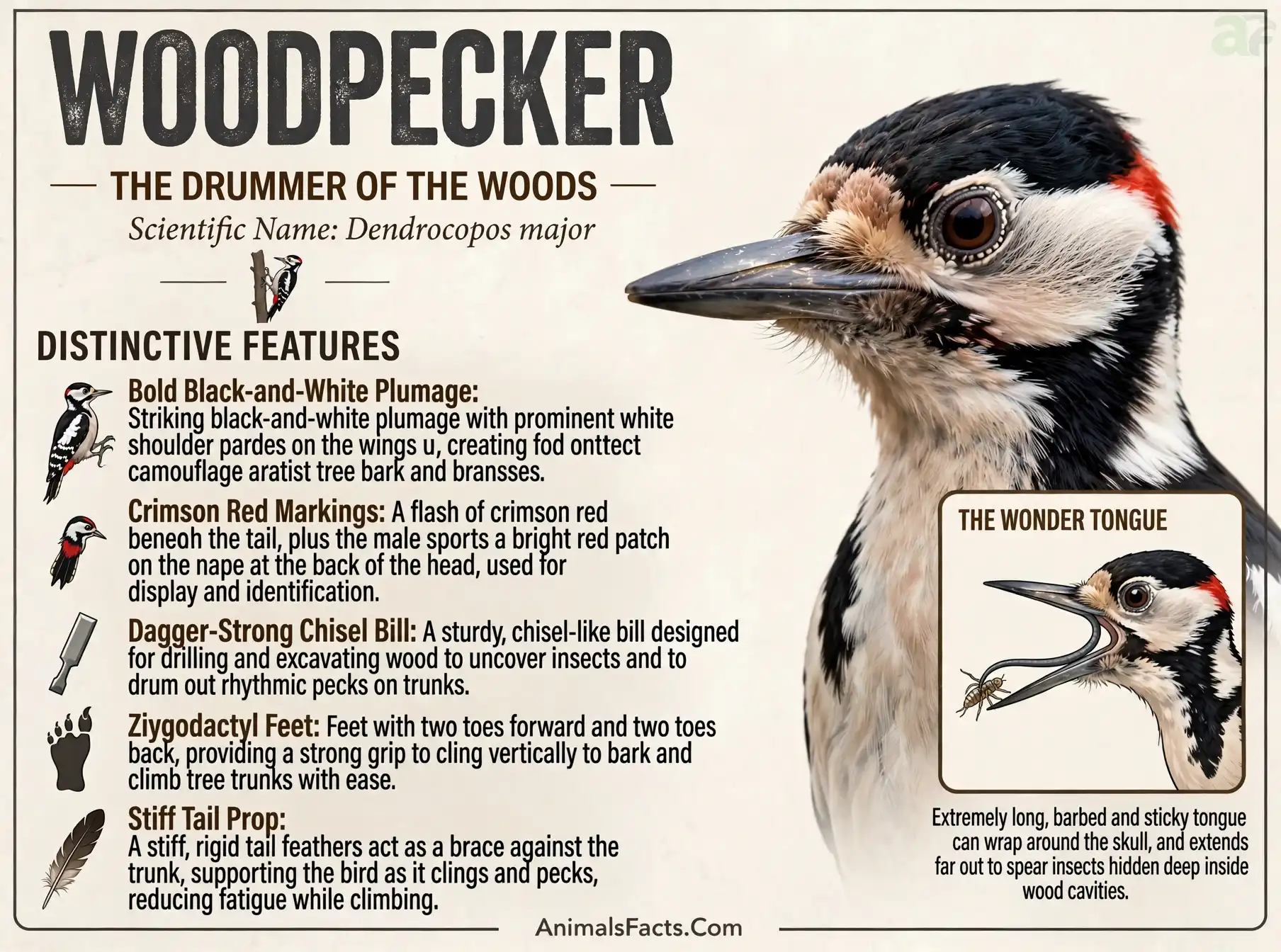
3. Woodpecker Physical Description & Unique Features
The woodpecker’s physical features represent a complete biological engineering solution to the challenge of excavating wood at high speed — every anatomical system modified for impact absorption, grip, and precision that no other bird family approaches.
The Anti-Concussion Skull — The Most Studied Bird Anatomy in Biomechanical Engineering
The problem — A woodpecker strikes a tree at approximately 6–7 meters per second, decelerating from that speed to zero in approximately 1 millisecond — a deceleration of approximately 1,000 g (1,000 times the force of gravity). For comparison: a boxing punch generates approximately 50–100 g of head acceleration. A car crash at moderate speed generates approximately 30–60 g of head acceleration in a belted occupant. The woodpecker experiences 10–20 times the deceleration of a boxing punch, 20 times per second, up to 12,000 times per day. A human experiencing this would be dead within seconds from traumatic brain injury. The woodpecker is not only alive but appears entirely unaffected.
The five-component anti-concussion system:
Component 1 — Unequal bill length:
- The upper and lower mandibles of the woodpecker’s bill are slightly different lengths — the lower mandible extends slightly beyond the upper in most species
- This asymmetry means the bill contacts the wood at a very slight angle rather than perfectly flat
- The angled contact shifts the impact force away from the bill’s central axis — diverting the shock laterally into the skull’s side walls rather than straight backward into the brain
Component 2 — Spongy bone structure:
- The woodpecker’s skull bone is not uniformly dense — it contains a high proportion of spongy (trabecular) bone — a honeycomb-like structure with thin bone walls surrounding air cells
- The spongy bone acts as a distributed crumple zone — deforming slightly under each impact and distributing the force across a large area rather than transmitting it as a concentrated spike
- The distribution of spongy bone is not uniform — it is concentrated in specific regions of the skull where impact forces are greatest
Component 3 — The hyoid bone apparatus:
- The woodpecker’s hyoid bone — the tongue’s attachment structure — has a unique anatomical arrangement found in no other bird
- In most birds, the hyoid bone is a simple U-shaped structure in the throat
- In woodpeckers, the hyoid bone has been dramatically elongated and modified — extending backward from the tongue, splitting into two long strands that curve around the back of the skull, travel over the top of the skull, and wrap around the brain case before anchoring to the right nostril (not symmetrically — the asymmetric anchoring is itself a shock-distribution mechanism)
- This hyoid wrap functions like a biological seatbelt around the brain — constraining the brain’s movement within the skull during impact
- The hyoid simultaneously functions as the muscle attachment for the tongue, which must extend far beyond the bill tip during feeding
Component 4 — Minimized cerebrospinal fluid:
- In humans, the brain floats in cerebrospinal fluid (CSF) — a shock-absorbing buffer. But if the head decelerates sharply, the brain sloshes within the CSF and impacts the skull — causing concussion
- Woodpecker skulls contain significantly less cerebrospinal fluid than equivalent-sized bird skulls — the brain fits more snugly within the skull with less fluid between brain and bone
- The tighter brain-to-skull fit reduces brain movement during impact — eliminating the sloshing mechanism that causes concussion in humans
Component 5 — Thick neck musculature:
- Woodpeckers have exceptionally thick and powerful neck muscles relative to their body size
- These muscles do not merely power the bill strike — they also serve as active shock absorbers during impact, contracting slightly during the strike to cushion deceleration
- The neck muscles and the skull anatomy work together as an integrated system — the muscles reducing the impact force before it reaches the skull
The engineering applications:
The woodpecker’s anti-concussion system has been studied intensively by engineers developing impact protection:
- Football helmets — woodpecker skull geometry has informed new foam and composite structures in next-generation football helmet design
- Aircraft flight data recorders (black boxes) — the woodpecker-inspired composite structure using material density gradients similar to the spongy bone distribution has been proposed for more impact-resistant recorder casings
- Automotive airbag systems — the timing and distribution of woodpecker skull deformation has informed airbag deployment speed and distribution modeling
- Smartphone screens — a 2011 paper proposed applying the woodpecker’s multilayer impact dissipation principle to shock-resistant phone screen design
The Tongue — The Most Extraordinary Tongue of Any Bird
Length — The woodpecker’s tongue extends 4–5 cm beyond the bill tip in many species — and when retracted, loops around inside the skull:
- In total length, the woodpecker’s tongue can be twice the length of the bill itself
- The tongue is controlled by muscles attached to the elongated hyoid bone apparatus
The barbed tip:
- The tongue tip bears backward-pointing barbs — similar in principle to a fish hook
- These barbs spear insect larvae in wood galleries — the barbed tip driving into soft larval tissue and then gripping when retracted, pulling the larva out of its tunnel
- The barbs are strongest in insectivorous woodpeckers; reduced in sap-feeding species (sapsuckers)
The sticky surface:
- The tongue surface produces sticky saliva — the combination of barbs and stickiness ensures that prey impaled on the tongue cannot escape during retraction
- The sticky saliva is also used to collect ants from ant galleries — the tongue licking up multiple ants simultaneously
The skull loop:
- When fully retracted, the tongue’s supporting structure (the hyoid) loops over the top of the skull and anchors to the right nostril — one of the most unusual anatomical arrangements of any bird structure
- This looping allows maximum tongue extension while keeping the hyoid mechanism compact enough to fit within the skull
The Stiff Tail — The Third Leg
The specialized rectrices:
- Woodpecker tail feathers are uniquely modified — the central tail feathers (rectrices) are stiff, spiny, and reinforced compared to other birds
- These stiff tail feathers press against the tree trunk during climbing and drilling, serving as a prop that transfers weight away from the feet
- The tail-as-prop allows the woodpecker to stand vertically on a tree trunk with its body positioned for effective drilling — the feet and tail forming a three-point support system
The molt sequence:
- Because the tail is essential for trunk-climbing support, woodpeckers have a unique molt sequence — the central stiff tail feathers are the last to be replaced during the annual molt, ensuring the bird is never simultaneously lacking its key support structure
The Zygodactyl Foot — The Tree-Climbing Adaptation
Foot arrangement:
- Two toes forward (toes 2 and 3), two toes backward (toes 1 and 4) — the same arrangement as toucans and parrots
- This four-point grip — two in each direction — provides the maximum stability for vertical trunk climbing
- Some woodpeckers (three-toed woodpeckers of the genus Picoides) have modified this to three toes — one forward, two backward — an arrangement found in no other bird except woodpeckers
The grip strength:
- The zygodactyl foot grip, combined with the stiff tail prop and the powerful neck muscles, allows woodpeckers to maintain a stable striking position against vertical tree surfaces during the high-force impacts of drumming and excavation
💡 Did You Know? The acorn woodpecker (Melanerpes formicivorus) of the western United States and Central America has developed one of the most extraordinary food storage systems of any animal on Earth. A family group of acorn woodpeckers collectively maintains a “granary tree” — a single large tree (or utility pole, or barn wall) that has been drilled with thousands of individual holes, each the precise size of one acorn. Individual granary trees have been documented containing up to 50,000 acorns, stored one per hole across the entire surface of the tree. The family group — typically 3–10 individuals including the breeding pair and several “helper” offspring from previous years who assist with acorn collection, granary maintenance, and chick rearing — harvests acorns in autumn, fits each acorn precisely into a hole, and monitors the cache throughout the winter. As acorns dry and shrink, the woodpeckers relocate each acorn to a smaller hole — an extraordinary ongoing maintenance task. The granary tree represents a collective resource maintained and defended by the entire family group — competing acorn woodpecker groups that attempt to steal acorns are repelled by coordinated group defense. Research has documented some granary trees being used continuously by the same family lineage for over 100 years — making the acorn woodpecker’s granary one of the longest continuously maintained food caches of any animal. The cooperative behavior, the precision engineering of the storage holes, and the multi-generational maintenance of the granary make the acorn woodpecker one of the most cognitively sophisticated birds in North America.
4. Top 25 Amazing Woodpecker Facts
Here is your definitive collection of the most extraordinary, scientifically verified, and genuinely astonishing woodpecker facts as of 2026:
- A woodpecker’s bill strikes a tree at approximately 6–7 meters per second, generating a deceleration force of approximately 1,000 g (1,000 times gravity) at each impact — and does this up to 20 times per second for extended periods. A human experiencing the same impact would suffer immediate fatal brain injury.
- The woodpecker’s hyoid bone — the tongue’s support structure — wraps entirely around the outside of the skull like a biological seatbelt, cushioning the brain against impact. This anatomical arrangement is found in no other bird on Earth and has been studied intensively by engineers designing helmets, airbags, and aircraft black box casings.
- A woodpecker’s tongue can extend up to 5 cm beyond the bill tip — and when fully retracted, loops over the top of the skull and anchors to the right nostril. The total extended tongue length is often twice the length of the bill itself.
- The acorn woodpecker maintains granary trees containing up to 50,000 individually stored acorns — each acorn fitted into a precisely drilled hole and relocated to smaller holes as the acorn dries and shrinks. Individual granary trees have been used continuously by the same family lineage for over 100 years.
- The ivory-billed woodpecker (Campephilus principalis) — once the largest woodpecker in the United States, historically called the “Lord God Bird” by those who encountered it for the first time — may or may not be extinct. The last confirmed sighting was in 1944; reported sightings since 2004 have generated one of the most contentious extinction debates in American ornithology.
- Woodpeckers drum on resonant surfaces not only for excavation but for communication — different species have specific drumming rhythms, speeds, and gap patterns that function as species-specific identification codes. A woodpecker can identify the species of a drumming individual from its rhythm alone, without seeing the bird.
- The yellow-bellied sapsucker (Sphyrapicus varius) drills precise rows of small holes in tree bark — called “sap wells” — and returns repeatedly to feed on the oozing sap. Over 250 other species (including hummingbirds, warblers, bats, and squirrels) have been documented feeding at sapsucker wells — the sapsucker effectively providing a food resource for a significant fraction of the forest wildlife community.
- The northern flicker (Colaptes auratus) is one of the few woodpeckers that feeds primarily on the ground — using its bill to excavate ant colonies from soil. Flickers are the most ant-specialized of all North American woodpeckers, consuming enormous quantities of ants and using formic acid from ants in anting — rubbing ants over feathers for parasite control.
- Woodpecker drumming produces sound levels of 85–100 decibels at the source — the equivalent of a motorcycle engine or a lawnmower at close range. The drumming carries clearly through forest for 1–2 kilometers, providing effective long-distance communication in the visually obstructed forest environment.
- The pileated woodpecker (Dryocopus pileatus) excavates rectangular holes in dead trees that can be 15 cm wide × 40 cm deep — the size and shape of which are the primary method of distinguishing pileated woodpecker excavation from any other North American woodpecker. These large cavities are subsequently used as nest sites by wood ducks, owls, pine martens, and flying squirrels.
- Woodpeckers have been documented choosing resonant drumming surfaces — selecting dead branches, metal signs, hollow pipes, and even rain gutters specifically because they produce louder, more carrying sounds than solid wood. The selection of artificial resonant surfaces demonstrates an understanding of sound quality that is unexpected in a bird.
- The three-toed woodpecker (Picoides tridactylus) has only three toes rather than the four found in most birds — losing one of the backward-pointing toes through evolution. Research suggests the three-toed arrangement provides greater lateral stability during the high-force side-to-side bill movement during bark scaling — the three-toed species being disproportionately efficient bark-scalers relative to their body size.
- The green woodpecker (Picus viridis) of Europe has an extraordinary anting behavior — the bird lying flat on an anthill with wings spread, allowing ants to swarm over its feathers. The formic acid secreted by the disturbed ants kills feather lice and other ectoparasites — one of the most sophisticated parasite-control behaviors of any European bird.
- Woodpeckers close their eyes during the millisecond of each bill strike — research has confirmed that a woodpecker blinks in coordination with each impact. The eye closure serves to prevent eye damage from wood chips and to prevent retinal detachment from the impact-generated vibration propagating through the skull.
- The imperial woodpecker (Campephilus imperialis) of Mexico — the world’s largest woodpecker at approximately 58–60 cm (larger than the ivory-billed) — is likely extinct. The last confirmed sighting was in 1956. A remarkable amateur film of an imperial woodpecker was shot in 1956 by dentist William Rhein in Durango, Mexico — possibly the only motion picture footage of this species ever taken.
- Woodpeckers do not sing in the conventional musical sense — their primary acoustic communication is drumming rather than song. The drumming fulfills the same territorial and mate-attraction functions as song in other birds but is produced by mechanical percussion rather than vocal production.
- The Gila woodpecker (Melanerpes uropygialis) excavates nest cavities in saguaro cacti in the Sonoran Desert — the cactus walls growing around the cavity and hardening into a “cactus boot” after the woodpecker departs. These cactus boots are subsequently used by elf owls (the world’s smallest owl), pygmy owls, and various other species — the woodpecker creating nest sites in an environment where tree cavities are unavailable.
- Lewis’s woodpecker (Melanerpes lewis) is one of the most behaviorally unusual woodpeckers — it rarely drills and instead catches insects in aerial sallies like a flycatcher, and stores nuts and seeds in bark crevices rather than drilling individual storage holes. It was named by the Lewis and Clark expedition ornithologist Alexander Wilson, based on specimens collected by Meriwether Lewis during the Corps of Discovery expedition.
- Research has documented that woodpecker drumming rates vary by temperature — woodpeckers drum faster in warmer conditions and slower in cold weather, reflecting the physiological effect of temperature on muscle contraction speed. This temperature-drumming rate relationship is reliable enough that researchers have used drumming rate to estimate ambient temperature in forest studies.
- The wrynecks — the family Picidae’s most unusual members — are the only woodpeckers that cannot excavate wood. Instead, they use pre-existing cavities for nesting and feed primarily on ants. Wrynecks are named for their remarkable defense behavior — when threatened, the bird twists its head and neck in a slow, serpentine movement while hissing, mimicking a snake to deter predators.
- Woodpeckers excavate an estimated 85% of all cavity nest sites in North American forests — the cavities subsequently used by approximately 85 other cavity-nesting species including owls, ducks, nuthatches, bluebirds, and many mammals. Without woodpeckers, the cavity availability in forests would collapse, eliminating or severely reducing the populations of dozens of secondary cavity-nesting species.
- The red-headed woodpecker (Melanerpes erythrocephalus) is one of only four North American woodpecker species that covers stored food — using wood bark, leaves, and other material to conceal cached nuts and insects. This food-covering behavior suggests spatial memory and anticipation capabilities comparable to corvids (crows and jays) in food-caching intelligence.
- Woodpecker excavation is significantly affected by moon phase — studies in multiple forest systems have documented increased woodpecker excavation activity during full moon periods when nighttime luminosity facilitates longer active periods and enhanced predator avoidance.
- The black woodpecker (Dryocopus martius) of Europe and Asia excavates cavities so large (up to 50 cm deep) that the Siberian flying squirrel (Pteromys volans) — a species of significant conservation concern — depends almost exclusively on black woodpecker cavities for nesting. The woodpecker is therefore a keystone species for the flying squirrel’s conservation across the boreal forest.
- As of 2026, the woodpecker family includes approximately 30 threatened species — with multiple species Critically Endangered due to forest loss. The ivory-billed woodpecker’s formal extinction status remains unresolved; the imperial woodpecker of Mexico is almost certainly extinct; and the Okinawa woodpecker (Sapheopipo noguchii) of Japan — restricted to the northern forests of Okinawa Island — remains Endangered with a population of approximately 600 individuals.
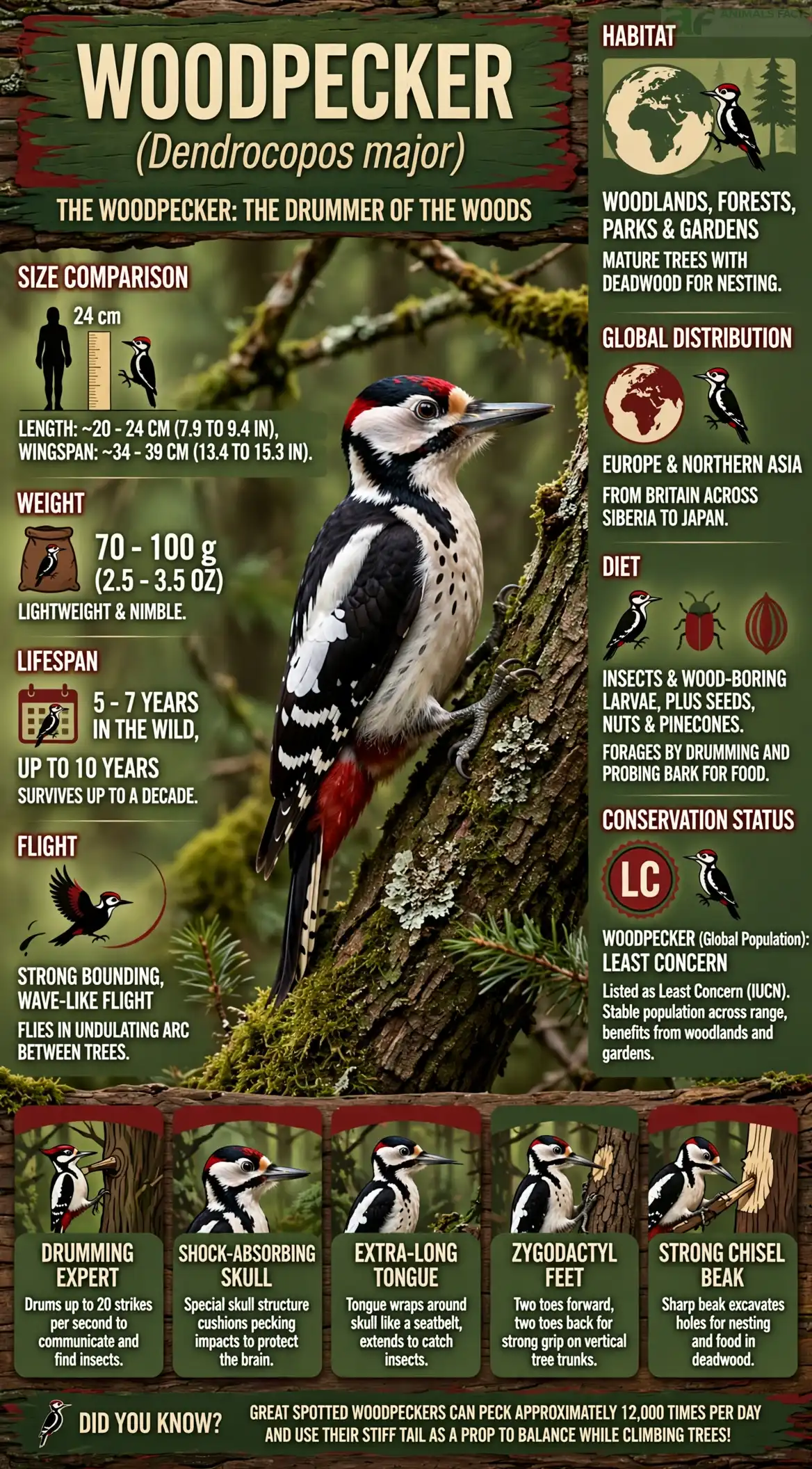
5. Fun Facts About Woodpeckers
- Bill strikes at 6–7 m/s — generating 1,000 g deceleration — up to 20 times per second
- Hyoid bone wraps around skull — biological seatbelt for the brain
- Tongue loops over top of skull — anchors to right nostril
- Acorn woodpecker granary trees hold up to 50,000 acorns
- Ivory-billed woodpecker — possibly extinct; “Lord God Bird”
- Drumming = communication — species-specific rhythmic codes
- Yellow-bellied sapsucker wells used by 250+ other species
- Woodpeckers blink with each bill strike — eye protection
- Excavate 85% of cavity nests in North American forests
- Green woodpecker uses ants for parasite control (anting)
- Gila woodpecker nests in saguaro cacti — creates cactus boots for elf owls
- Three-toed woodpecker — the only other bird (besides ostriches) to reduce toe number through evolution
6. Woodpeckers Habitat & Geographic Range
Woodpecker habitat spans virtually every forested environment on Earth — the family’s global distribution reflecting its extraordinary ecological flexibility and its fundamental dependence on trees as both food source and nesting substrate.
Primary Habitat Types
Temperate hardwood forest:
The most species-rich woodpecker habitat in the Northern Hemisphere:
- Eastern North American deciduous forest — supporting downy, hairy, red-bellied, pileated, and red-headed woodpeckers among others
- European deciduous and mixed forest — supporting great spotted, lesser spotted, middle spotted, green, grey-headed, and black woodpeckers
- The mature tree structure of old-growth deciduous forest provides both dead wood for excavation and diverse invertebrate communities for food
Boreal forest:
The vast coniferous forests of northern North America, Europe, and Asia:
- Three-toed woodpecker — one of the most boreal-specialized woodpeckers; particularly associated with recently burned forest where bark beetle populations irrupt following fire
- Black-backed woodpecker (Picoides arcticus) — one of the most fire-specialist woodpeckers; following forest fires and foraging on fire-killed trees intensively colonized by wood-boring beetles
Tropical forest:
The most species-rich woodpecker zone globally:
- Central and South America — the center of woodpecker diversity; supporting the most genera and the highest species density
- Southeast Asia — supporting the great slaty, heart-spotted, and various other tropical woodpeckers in rich dipterocarp forest
Arid and semi-arid environments:
Woodpeckers have repeatedly adapted to non-forest habitats:
- Sonoran Desert (Gila woodpecker, gilded flicker) — using saguaro cacti and riparian cottonwoods
- African savanna — ground woodpeckers (Geocolaptes olivaceus) that nest in earthen banks and forage on the ground
- Andean grassland (Andean flicker) — one of the highest-altitude woodpeckers, foraging at treeline and above
Urban environments:
Multiple woodpecker species have adapted to suburban and urban settings:
- Great spotted woodpecker — expanding into UK gardens and urban parks
- Pileated woodpecker — increasingly documented in suburban forest patches
- Gila woodpecker — thriving in suburban Sonoran Desert environments with maintained saguaros
Geographic Distribution
| Region | Species Diversity | Key Species | Trend |
|---|---|---|---|
| Central America / Caribbean | Highest | Numerous endemic species | Declining with deforestation |
| South America | Very high | Crimson-crested, Magellanic, many others | Declining in Atlantic Forest |
| North America | High | Pileated, acorn, red-headed, flickers | Stable to declining |
| Europe | Moderate (10–12 species) | Great spotted, green, black | Stable to increasing in some areas |
| Sub-Saharan Africa | Moderate | Ground woodpecker, bearded woodpecker | Variable |
| South/SE Asia | High | Great slaty, heart-spotted, many others | Declining |
| Australia | Zero | None | N/A — no native woodpeckers |
| Antarctica | Zero | None | N/A |
Why Australia Has No Woodpeckers
The Australian gap — One of the most frequently asked biogeographic questions in ornithology: why does Australia — one of the most biodiverse continents — have no native woodpeckers?
The explanation — Australia’s long isolation from other landmasses prevented the colonization by the Picidae family that occurred across the interconnected landmasses of Eurasia, Africa, and the Americas. The ecological role of woodpeckers in Australian forests is partially filled by other species:
- Black-cockatoos (Calyptorhynchus species) excavate wood and consume wood-boring grubs
- Treecreepers (Climacteridae) probe bark for invertebrates
- Striated pardalotes and other small birds exploit bark-insect niches
- However, no Australian bird drills into solid wood at the woodpecker’s scale — the cavity-creation ecosystem service of woodpeckers is largely absent from Australian forests, explaining why many Australian cavity-nesting species must wait for natural tree decay rather than benefit from woodpecker excavation
7. Woodpecker Diet & Feeding Behavior
Woodpecker diet spans a remarkable range of food types — from the precisely drilled sap wells of sapsuckers to the ant-excavation specialization of flickers to the remarkable acorn granaries of acorn woodpeckers — making the family one of the most dietarily diverse in the bird world.
Diet Breakdown Table
| Food Type | Species/Context | Proportion | Notes |
|---|---|---|---|
| Wood-boring beetle larvae | Most true woodpeckers | Primary food for most species | Located by sound/vibration through wood |
| Carpenter ants (Camponotus species) | Pileated, black, other large woodpeckers | High in many species | Pileated may get >70% of calories from carpenter ants |
| Bark beetles (Scolytinae) | Three-toed, black-backed | Very high — post-fire specialists | Key food during beetle irruptions after fire |
| Tree sap | Sapsuckers (Sphyrapicus) | Primary food for sapsuckers | Also consumed by dozens of other species at sapsucker wells |
| Acorns and nuts | Acorn woodpecker, Lewis’s, flickers | Seasonally primary | Stored in granary trees or bark crevices |
| Ants (surface and underground) | Northern flicker and relatives | Primary for flickers | Ground foraging; use long tongue for ant extraction |
| Berries and fruit | Various species | Supplementary | More important in tropical species |
| Insect eggs and pupae | Many species | Supplementary | In bark and wood galleries |
| Eggs and nestlings (other birds) | Lewis’s, red-headed, acorn | Occasional | Documented but uncommon |
The Wood-Boring Insect Detection System
How woodpeckers find hidden larvae:
The woodpecker’s ability to locate wood-boring larvae concealed within solid wood — invisible and inaccessible to any other predator — is one of the most remarkable sensory achievements of any bird:
Sound detection:
- Woodpeckers tap lightly on wood and listen to the acoustic response — hollow or partially hollow areas produce different sounds than solid wood
- The presence of larval tunnels changes the wood’s acoustic properties — experienced woodpeckers can detect the difference between solid wood and wood with larval galleries at surprising depths
Vibration sensing:
- Wood-boring larvae produce vibrations as they chew — the rasping of mandibles against wood creating tiny but detectable vibrations in the surrounding wood
- Woodpeckers have specialized mechanoreceptors in the bill tip that detect vibrations propagating through wood — the bill functioning as a vibration antenna as well as an excavation tool
Possible infrasound detection:
- Some research suggests woodpeckers may detect the infrasound (low-frequency vibration) produced by large larval colonies — though this remains less definitively established than the acoustic and mechanical detection mechanisms
The Sapsucker System — Creating a Shared Resource
The yellow-bellied sapsucker’s ecological role:
The yellow-bellied sapsucker (Sphyrapicus varius) drills two types of holes in tree bark:
- Round “phloem wells” — drilled into the phloem layer to access phloem sap
- Rectangular “xylem wells” — drilled into the sapwood for xylem sap
The sapsucker maintains these wells actively — returning regularly to enlarge them as bark heals over and to consume the oozing sap and any insects attracted to it.
The community benefit:
More than 250 species have been documented using sapsucker wells — including:
- Ruby-throated hummingbird — a species so dependent on sapsucker wells in early spring (before flowers bloom) that its spring migration timing follows the sapsucker’s migration northward
- Yellow-bellied flycatcher, Tennessee warbler, Cape May warbler — multiple warbler and flycatcher species feed at sapsucker wells during spring migration
- Red squirrel, flying squirrel — mammals using sap wells
- Various butterflies and moths — attracted by the sugar-rich sap
The sapsucker thus functions as a keystone species for resource provision — creating a food resource used by a significant fraction of the forest wildlife community that the sapsucker itself drills.
8. Woodpecker Reproduction & Life Cycle
Woodpecker reproduction is defined by the cavity nest — the excavated tree hollow that the woodpecker creates and that subsequently supports dozens of other species — and by the biparental care shared more equally between sexes than in many bird families.
The Pair Bond and Courtship
Pair bond duration — Variable by species:
- Many woodpeckers maintain seasonal monogamy — reforming pairs each breeding season but not necessarily with the same partner
- Some species (acorn woodpecker in its cooperative breeding system) maintain more complex multi-year social bonds
- Drumming is the primary mate attraction and territorial advertisement medium — males drumming intensively in early spring to attract females and repel competing males
Courtship behaviors:
- Mutual drumming — pair members drumming alternately or simultaneously in coordinated sequences
- Mutual excavation — pair members working together on cavity excavation as a courtship activity
- Chasing and display flights — aerial pursuits around tree trunks; exaggerated swooping flights
- Bill touching — contact behavior between established pairs
Cavity Excavation — The Shared Construction Project
The excavation process — Cavity excavation is a major investment shared by both pair members:
- Duration — typically 2–4 weeks for a new cavity; shorter if a previously used cavity is reused or modified
- Technique — the bill is driven into wood with precise horizontal strikes, creating chips that are removed by sideways head movements; the stiff tail provides support throughout
- Depth — cavities range from approximately 20 cm (small species) to 50+ cm (pileated, black woodpecker) in depth
- The cavity is typically excavated in dead or decaying wood — live wood is harder and the bark beetle larvae that are the primary food are concentrated in dead and dying trees
Cavity reuse and the secondary cavity community:
The creation of a woodpecker cavity initiates a cascade of ecological benefit:
- Year 1 — woodpecker breeding cavity
- Year 2+ — cavity used by secondary cavity nesters: owls (screech owls, saw-whet owls), ducks (wood duck, hooded merganser, bufflehead), small mammals (flying squirrels, red squirrels), and numerous small passerines (chickadees, nuthatches, swallows, bluebirds)
- The cavity persists for many years, progressively enlarging through weathering and expanding through the use of larger secondary nesters
Eggs and Incubation
Clutch size — 2–8 eggs depending on species:
- Smaller species typically lay 4–7 eggs; larger species typically 2–4 eggs
- Egg color: white — the cavity’s enclosed environment making camouflage unnecessary
Incubation — 11–14 days (small species) to 18 days (large species):
- Shared incubation — both parents incubate; males typically performing the nighttime incubation shift while females incubate during the day (an unusual reversal from most bird species)
- Male night incubation — the male sleeping in the cavity with the eggs overnight is documented across multiple woodpecker species
Chick Development
Altricial hatchlings — Woodpecker chicks hatch naked, blind, and helpless:
- The bare, blind hatchlings develop specialized heel pads — rough patches on the ankles and wrists that protect against the rough wooden floor of the cavity
Chick growth:
- Week 1–2: Both parents provision with regurgitated insect food; rapid growth
- Week 3: Feathers emerging; chicks increasingly active at the cavity entrance
- Week 3–4: Chicks begin appearing at the cavity entrance — creating one of the most endearing wildlife behaviors as small woodpecker heads peer from tree holes
- Day 26–31 (small species) to Day 28–30 (larger species): Fledging — first flight from cavity
Post-fledging:
- Young woodpeckers remain with parents for 1–3 months post-fledging
- During this period they learn the territory’s food resources, practice excavation, and develop the specific skills needed for adult life
- Sexual maturity at approximately 1 year — most woodpeckers breed in their first year after hatching
9. Social Behavior & Communication
Woodpecker social behavior ranges from the largely solitary lifestyle of most species to the extraordinary cooperative breeding of the acorn woodpecker — one of the most complex social systems of any North American bird.
Solitary Behavior — The Norm
Most woodpeckers are fundamentally territorial and solitary outside the breeding season:
- Individual territories are maintained year-round through drumming advertisement and direct aggressive encounters
- Winter territoriality — unlike many species that abandon territorial behavior in winter, most woodpeckers maintain year-round territories centered on productive food patches
- Cache territories — species that store food (acorn, red-headed, Lewis’s woodpeckers) defend their caches actively against both conspecific rivals and other species
The Acorn Woodpecker — The Exception
The acorn woodpecker’s cooperative breeding system stands as one of the most complex and most studied social systems in North American ornithology:
The group structure:
- Groups of 3–10 individuals (typically 4–6) occupy a joint territory centered on the granary tree
- Groups include a breeding male and female plus multiple “helper” offspring from previous years that assist with acorn collection, granary maintenance, and chick provisioning
- The helpers are typically the breeding pair’s offspring from 1–2 previous seasons who have not yet established their own territories
The cooperative benefits:
- The granary tree’s productivity increases with more individuals maintaining it
- Helpers increase chick survival rates through additional provisioning
- The cooperative defense of the granary against competitors requires group numbers
The mate-sharing complexity:
- In some acorn woodpecker groups, multiple males (brothers) may jointly mate with one or two females (sisters) — a polyandrous arrangement that has been studied extensively as an example of kin-based reproductive cooperation
- This joint mating system has produced some of the most sophisticated tests of kin selection theory in behavioral ecology
Drumming — The Primary Communication System
The function of drumming — Woodpecker drumming serves multiple communication functions that parallel songbird vocalizations:
Territory advertisement:
- Loud, rapid drumming sequences broadcast territorial occupancy to neighboring woodpeckers
- The drumming carries 1–2 km through forest — providing long-range territorial advertisement in an environment where visual signals are limited by vegetation
Species identification:
- Each woodpecker species has a characteristic drumming pattern — varying in rate, duration, and gap structure
- Experienced observers (and the birds themselves) can identify species from drumming pattern alone without visual confirmation
- Common patterns: downy woodpecker — slow, decreasing-rate sequence; hairy woodpecker — rapid, uniform sequence; pileated woodpecker — variable, loud and powerful sequence
Mate attraction:
- Drumming intensity peaks in early spring — the breeding season’s approach triggering intensive drumming activity
- Both sexes drum, though males drum more frequently and for longer sequences in most species
Resonant surface selection:
- Woodpeckers actively select resonant surfaces for drumming — dead branches, hollow sections of trees, metal surfaces, and artificial structures all selected for acoustic properties
- The selection of metal gutters, chimneys, and utility poles for drumming (a common suburban woodpecker behavior) reflects intelligent assessment of resonance properties — these surfaces are chosen because they are louder and carry further than typical wood
10. Predators & Defense Mechanisms
Woodpeckers face predators both at their excavated cavities and in the broader forest environment — their defensive strategies combining the protection of the enclosed nest with individual flight and evasion capabilities.
Natural Predators
Avian predators:
- Cooper’s hawk (Accipiter cooperii) — the primary aerial predator of medium-sized woodpeckers in North America; the accipiter’s short wings and long tail allow pursuit through woodland
- Peregrine falcon — takes woodpeckers in open areas adjacent to forests
- Sharp-shinned hawk (Accipiter striatus) — takes smaller woodpeckers and fledglings
- Great horned owl — nocturnal predation on cavity-roosting woodpeckers; the owl’s large feet allow it to extract roosting woodpeckers from cavities
Arboreal mammal predators:
- American marten (Martes americana) — significant predator of cavity-nesting woodpeckers; can enter many cavity sizes
- Weasels (Mustela species) — enter cavities and consume eggs and chicks
- Squirrels — documented harassing and occasionally killing small woodpeckers at nest cavities
Cavity nest predators:
- Rat snakes (Pantherophis species) — climb trees and enter cavities; documented significant predators of woodpecker nests in the southeastern United States
- Black rat snake — particularly significant cavity nest predator
Defense Mechanisms
The cavity advantage — The woodpecker’s excavated cavity provides substantial protection:
- The entrance hole is typically sized to exclude the most significant predators
- The depth of the cavity (20–50 cm) places eggs and small chicks beyond the reach of most probing predators
- The adult defending the cavity from inside can deliver bill strikes to probing paws or claws
The stiff tail — escape assist:
- During pursuit by a Cooper’s hawk, a woodpecker can press itself against a tree trunk using the stiff tail as a prop — effectively freezing in place and becoming harder to distinguish from the bark
- This trunk-hugging escape behavior is one of the most effective evasion techniques for arboreal birds being pursued by accipiters
The wryneck’s snake display:
The wryneck’s head-twisting, neck-extending, hissing display when cornered — mimicking a snake — is one of the most dramatic anti-predator displays of any bird. The behavior is convincing enough that many predators (including humans encountering the display for the first time) react with startled retreat.
The woodpecker’s flying pattern:
Most woodpeckers fly in a characteristic undulating pattern — alternating wing strokes with brief glides — that is energetically efficient for forest travel but also unpredictable enough to complicate pursuit predator attack patterns.
12. Woodpecker Facts for Kids
Hey amazing young wildlife scientists, nature lovers, and animal architects! Here are some truly extraordinary woodpecker facts for kids that will make you the most fascinating wildlife expert in any conversation:
- 🪵 Woodpeckers have a SEATBELT for their BRAIN! When a woodpecker pecks a tree 20 times per second, the force is so enormous it would kill any other bird instantly. But woodpeckers have a special bone called the hyoid that wraps all the way AROUND the outside of the skull — like a seatbelt for the brain! The same kind of protection inspired engineers designing football helmets, car airbags, and even airplane black boxes. The woodpecker figured out impact protection millions of years before humans did!
- 🪵 A woodpecker’s tongue goes OVER THE TOP OF ITS SKULL! The woodpecker has one of the most amazing tongues in the animal kingdom — it can stretch out 5 centimeters past the tip of the bill to spear insects hidden inside trees! When the woodpecker pulls its tongue back in, it is so long that it has to wrap up and over the top of the skull — and it anchors to the RIGHT NOSTRIL. It is like having a tongue so long it comes out your nose!
- 🪵 The acorn woodpecker stores 50,000 ACORNS in ONE TREE! The acorn woodpecker drills thousands of individual holes in a special “granary tree” and puts exactly one acorn in each hole. As the acorns dry out and shrink, the woodpecker MOVES EACH ACORN to a smaller hole so it stays snugly in place! The same family has been maintaining the same granary trees for MORE THAN 100 YEARS. That is like having a refrigerator that your great-great-great-grandparents built!
- 🪵 Woodpeckers CLOSE THEIR EYES every time they peck! Every single time the woodpecker’s bill hits the tree — and that is up to 20 times per second — the woodpecker blinks! The blink protects the eyes from flying wood chips and from the vibration that could otherwise damage the eyes. The woodpecker blinks so fast that it still seems to peck in a continuous rhythm even though its eyes are closing hundreds of times per minute!
- 🪵 The ivory-billed woodpecker might be a GHOST BIRD — extinct but possibly still out there! The ivory-billed woodpecker — once the largest woodpecker in the United States — was so spectacular that people who saw it for the first time would cry out “LORD GOD!” (which is why it was called the Lord God Bird!). The last confirmed sighting was in 1944. But since 2004, possible sightings in Arkansas have been reported. Scientists still argue about whether it is extinct or hidden in remote swamps. It might be the most mysterious bird in American history!
- 🪵 Woodpeckers drum to TALK to each other — like Morse code! Woodpeckers do not really sing like other birds. Instead, they communicate by drumming on trees in specific RHYTHMS that are different for every species. One woodpecker species drums fast and evenly, another drums in bursts with gaps, and another gets slower toward the end. A woodpecker can tell what species is drumming — and whether it is a neighbor or a stranger — just from the rhythm, without seeing the bird. It is exactly like Morse code!
- 🪵 Woodpeckers build apartment buildings for the entire forest! When a woodpecker excavates a hole in a tree for its nest, it creates a home that dozens of other animals will use in future years. Wood ducks, owls, flying squirrels, pine martens, bluebirds, chickadees, and many other animals move into old woodpecker holes. Scientists estimate that about 85 other species in North America depend on woodpecker holes for their nesting sites. Without woodpeckers, all these animals would have nowhere to live!
- 🪵 The yellow-bellied sapsucker runs a FREE RESTAURANT for 250 other species! The yellow-bellied sapsucker drills neat rows of small holes in tree bark to drink the sap. But more than 250 other animals — including hummingbirds, warblers, butterflies, bats, and squirrels — also visit the sapsucker’s holes to eat the sap! The hummingbird follows the sapsucker north every spring because it needs the sap holes for food before the flowers bloom. The sapsucker is so important to other animals that removing it from a forest removes the food source for hundreds of other species!
12. Relationship with Humans
The woodpecker’s relationship with humans spans thousands of years of cultural mythology embedded in multiple civilizations, a complicated history of conflict with timber and orchard industries, one of the most poignant extinction stories in American natural history (the ivory-billed woodpecker), the biomechanical research boom that has made woodpecker anatomy one of the most studied bird anatomies in engineering science, and the growing appreciation of the woodpecker as a keystone ecological service provider whose value to forest biodiversity far exceeds any agricultural cost it imposes.
The Ancient Cultural Relationship
Roman mythology — Picus:
The woodpecker is one of the few birds with its own named deity in Western mythology:
- Picus — in Roman mythology, a forest god who was transformed into a woodpecker by the sorceress Circe after he rejected her romantic advances
- Picus is the ancestor of the Roman king Faunus and the grandfather of the god Latinus — making the woodpecker a figure in the origin mythology of the Roman people
- The woodpecker (picus) was considered sacred to Mars — the god of war — because of its aggressive drumming and its bold behavior
- Augury (divination from bird behavior) gave the woodpecker significant religious importance in Rome — the direction of a woodpecker’s flight and the frequency of its drumming were interpreted as omens
The Romulus and Remus woodpecker connection:
- In some versions of the founding myth of Rome, a woodpecker assists the she-wolf in feeding the abandoned infants Romulus and Remus — bringing them food as the wolf nurses them
- This mythology made the woodpecker one of the founding animals of Roman civilization
Native American traditions:
- Multiple Native American traditions across North America gave specific cultural significance to woodpeckers — the drumming associated with specific spiritual or ceremonial meanings
- Woodpecker scalps (particularly the vivid red scalps of red-headed woodpeckers) were significant trade items and ceremonial objects across multiple Pacific Coast and Plains cultures
- The Miwok, Maidu, and other California Native peoples used woodpecker scalp bands in the most important ceremonial headdresses
- The Lakota Sioux maintained specific relationships between woodpecker woodworking behavior and ceremonial practices
The Conflict with Orchards and Buildings
The agricultural conflict — Woodpeckers drilling into fruit trees, utility poles, and building siding have generated significant human-wildlife conflict:
Orchard damage:
- Sapsuckers drilling sap wells in apple, cherry, and other fruit trees can girdle young trees if the wells encircle the trunk — killing the tree through interrupted sap flow
- The economic impact on commercial orchards is real but typically modest — focused on specific vulnerable tree species and locations
Building damage:
- Woodpeckers drilling into wood-sided houses, utility poles, and other wooden structures cause direct structural damage and create entry points for moisture and subsequent rot
- The most common damage scenarios: drumming on resonant metal surfaces (chimneys, gutters) — no structural damage but significant noise; excavating in wood siding — structural damage; drilling into fascia boards and window frames — structural damage
The legal complexity:
- All North American woodpecker species are protected under the Migratory Bird Treaty Act — making lethal control illegal without federal permits
- Deterrence options include visual deterrents (reflective tape, plastic owls), exclusion netting, and surface modification — but effectiveness varies significantly
The Ivory-Billed Woodpecker — America’s Most Haunting Ornithological Story
The historical population:
- The ivory-billed woodpecker (Campephilus principalis) was once distributed across the bottomland hardwood forests of the southeastern United States — from Texas to North Carolina and south to Florida and Cuba
- The bird required large areas of old-growth bottomland forest — its dependence on large dead trees for foraging and nesting making it one of the most habitat-specific large birds in North America
The decline:
- The logging of virtually all southeastern bottomland hardwood forest in the late 19th and early 20th centuries eliminated the ivory-billed woodpecker’s habitat
- The Singer Tract — a large tract of old-growth forest in Madison Parish, Louisiana — was the last known stronghold; it was logged in the early 1940s despite appeals from conservationists
- The last confirmed US sighting: a female filmed in the Singer Tract in 1944 — the last undisputed record of the species in the United States
The Cuban population:
- A separate Cuban population (C. p. bairdii) survived longer — last confirmed in 1987 in the Sierra Maestra mountains
- The Cuban subspecies is now also considered effectively extinct
The 2004–2005 Arkansas reports:
- Reports of ivory-billed woodpecker sightings in the Big Woods of Arkansas — the Cache River National Wildlife Refuge — triggered one of the largest ornithological searches in history
- A brief video published in Science (Fitzpatrick et al., 2005) showed a bird that the authors argued was an ivory-billed woodpecker
- The sighting was immediately controversial — many ornithologists argued the video showed a pileated woodpecker (a similar but much more common species)
- Subsequent searches involving hundreds of observer-hours in the area failed to produce additional definitive evidence
The 2022 extinction proposal:
- The US Fish and Wildlife Service proposed formally declaring the ivory-billed woodpecker extinct in 2022 — a proposal met with significant controversy from researchers who argued insufficiently exhaustive searches had been conducted
- As of 2026, the ivory-billed woodpecker remains in a formal extinction limbo — the debate unresolved and periodic claimed sightings continuing
The cultural weight:
- The ivory-billed woodpecker has become one of the most powerful symbols of American conservation failure — the “Lord God Bird” that was driven to likely extinction by the logging of its forest habitat while conservation appeals were ignored
- The bird appears in conservation literature, poetry, music (Sufjan Stevens’ “Lord God Bird”), and film as a symbol of extinction irreversibility
The Biomechanics Research Boom
Engineering applications of woodpecker anatomy:
The 2004 publication of detailed woodpecker skull anatomy research triggered an ongoing research program applying woodpecker biomechanics to engineering design:
Football helmet design:
- Multiple research groups have proposed and tested helmet designs incorporating woodpecker-inspired elements — particularly the gradient density materials mimicking the spongy bone distribution and the outer-to-inner material transition mimicking the bill-to-skull junction
- Some commercial helmet manufacturers have incorporated woodpecker-inspired design elements in premium models
Flight data recorder casings:
- Research at Beihang University (China) has proposed woodpecker-inspired composite casings for aircraft black boxes — the multilayer material gradient dissipating impact energy more effectively than uniform materials
Smartphone screen protection:
- A 2011 paper from the University of California proposed micro-scale structural elements mimicking the woodpecker’s spongy bone for shock-resistant screen materials
The continuing research:
- As of 2026, woodpecker biomechanics remains an active research area — new high-speed imaging and computational modeling techniques continue to reveal previously unknown aspects of the impact protection system
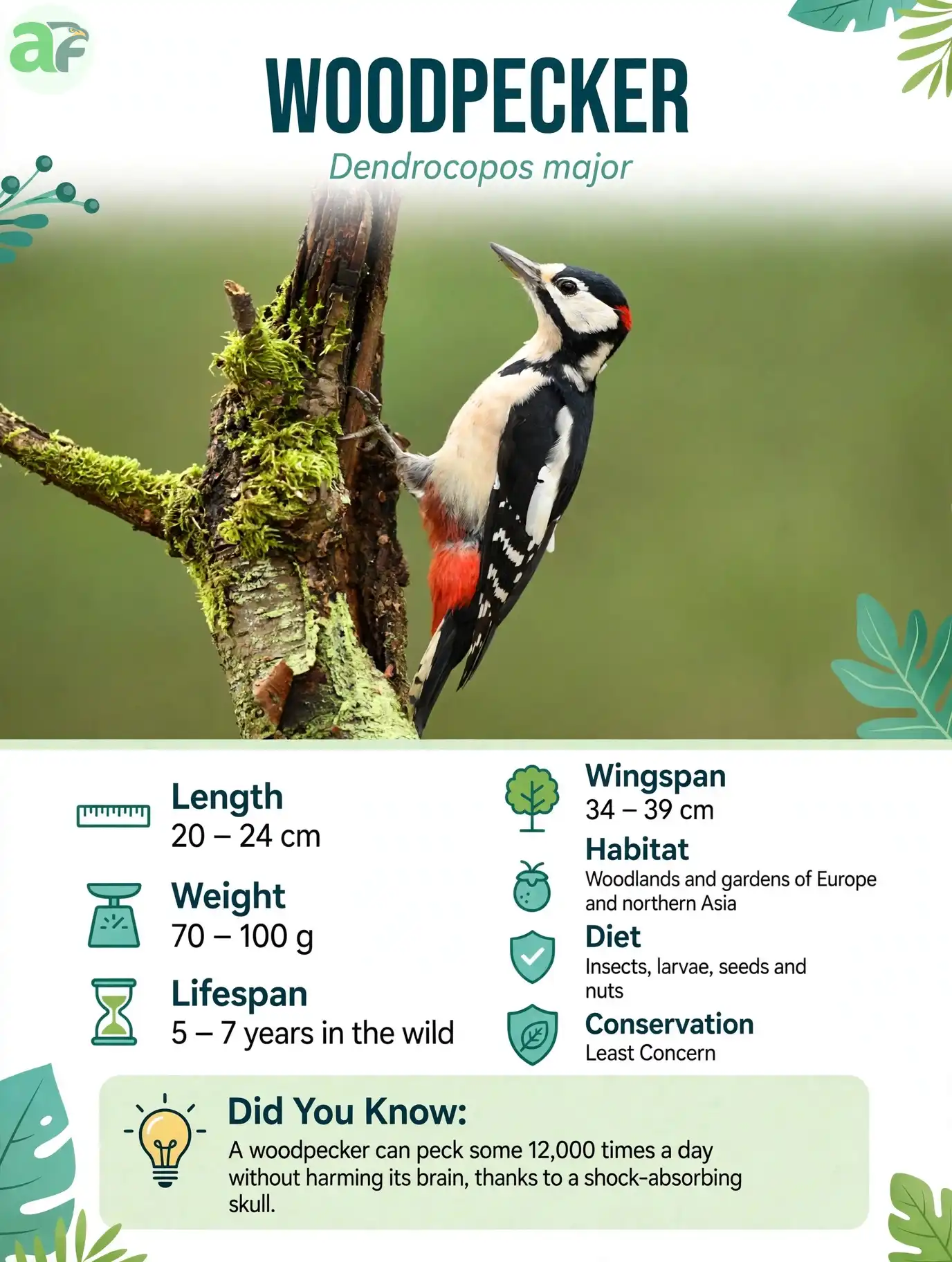
13. Woodpecker Conservation Status & Threats
Conservation Status Overview
| Species | IUCN Status | Population Trend | Primary Threat |
|---|---|---|---|
| Ivory-billed woodpecker | Critically Endangered (possibly extinct) | Unknown — possibly zero | Habitat loss (completed); possibly extinct |
| Imperial woodpecker | Critically Endangered (possibly extinct) | Unknown — possibly zero | Habitat loss; hunting |
| Okinawa woodpecker | Endangered | Decreasing | Forest loss on Okinawa Island |
| Red-cockaded woodpecker | Near Threatened (recovering) | Increasing | Longleaf pine habitat loss; recovery underway |
| Helmeted woodpecker | Vulnerable | Decreasing | Atlantic Forest deforestation |
| Downy woodpecker | Least Concern | Stable | — |
| Pileated woodpecker | Least Concern | Stable/increasing | — |
| Great spotted woodpecker | Least Concern | Increasing | — |
| Great slaty woodpecker | Vulnerable | Decreasing | Southeast Asian forest loss |
The Red-Cockaded Woodpecker — A Conservation Success Story
The situation — The red-cockaded woodpecker (Dryobates borealis) of the southeastern United States is one of the most important American conservation success stories:
The dependence on longleaf pine — The red-cockaded woodpecker requires old-growth longleaf pine forest — one of the most reduced ecosystems in North America. Longleaf pine once covered approximately 90 million acres of the southeastern United States; less than 3% of the original extent remains.
The cavity specialization — The red-cockaded woodpecker excavates cavities exclusively in living longleaf pines — specifically in trees infected with red heart fungus (Phellinus pini) that softens the heartwood while the sapwood remains alive. This hyper-specific cavity substrate requirement made the species extremely vulnerable to forest management practices that removed old, fungus-infected trees.
The recovery program:
- Listed as Endangered under the US Endangered Species Act in 1970
- Recovery programs involving artificial cavity installation, habitat management (prescribed burning to maintain longleaf pine open understory), and population monitoring have produced substantial recovery
- Population increased from approximately 10,000 individuals at the species’ population low to approximately 15,000+ individuals by the mid-2020s
- Reclassified from Endangered to Near Threatened in recent IUCN assessment — one of the most significant delisting trend changes for any listed woodpecker species
Major Threats Across the Family
| Threat | Description | Impact Level |
|---|---|---|
| Deforestation | Loss of primary forest removes both food and nesting habitat | Critical — primary threat globally |
| Loss of old-growth forest | Old trees with dead wood and fungal infections disproportionately valuable | High |
| Forest fragmentation | Isolation of forest patches below minimum territory size | High |
| Bark beetle suppression | Chemical treatment of forest pest outbreaks removes key food source | Medium |
| Snag removal | Dead tree removal in managed forests eliminates nest sites | High in managed forest |
| Climate change | Shifts in insect phenology and forest composition | Increasing concern |
| Collision mortality | Window strikes and vehicle collisions | Medium |
| Nest site competition | European starlings competing for cavity nest sites | High in North America and Europe |
The Snag Management Issue
The dead tree paradox — From a human forest management perspective, dead and dying trees (snags) appear wasteful or hazardous — and are routinely removed from managed forests for timber, for safety, or for aesthetic reasons. From a woodpecker ecology perspective, snags are the most valuable trees in the forest:
- Snags host the highest concentrations of wood-boring insects — the primary food of most woodpeckers
- Snags provide the decayed wood that is easiest to excavate for nest cavities
- Snags provide the acoustic resonance most preferred for drumming communication
The management response:
- Progressive forest management certification standards (FSC, SFI) increasingly require minimum snag retention — leaving a specified number of dead and dying trees per hectare
- The snag retention requirement is one of the most effective management actions for woodpecker conservation in managed forests
14. Famous Woodpeckers in History & Pop Culture
Famous Individual Woodpeckers
The Singer Tract Female (1944) — The last confirmed ivory-billed woodpecker in the United States — a female filmed in the Singer Tract, Louisiana, in 1944 by ornithologist James Tanner, who had studied the species for his landmark monograph on the ivory-billed woodpecker (1942). The footage — a brief film of a bird in old-growth forest — is one of the most historically significant wildlife films ever made, representing what was then the last confirmed image of a species on the precipice of extinction.
The Big Woods Arkansas Bird (2004–2005) — The possible ivory-billed woodpecker filmed briefly in Arkansas’s Cache River National Wildlife Refuge — the most controversial wildlife film in recent American ornithological history. The blurry video, published in Science in 2005, generated the most intensive ornithological debate of the early 21st century — with expert opinion divided on whether the filming showed an ivory-billed woodpecker or a pileated woodpecker, and the debate generating extensive media coverage and Congressional attention to the bird’s possible survival.
The Rhein Film Imperial Woodpecker (1956) — Amateur dentist William Rhein filmed what is believed to be the last motion picture footage of the imperial woodpecker (Campephilus imperialis) — the world’s largest woodpecker — in Durango, Mexico, in 1956. The film, recovered by ornithologist Martjan Lammertink and published in 2011, shows a large female imperial woodpecker working a dead pine in the Sierra Madre Occidental — the only known motion picture footage of this possibly extinct species.
Historical and Cultural Significance
Roman Picus — As described in the human relationship section, the Roman forest deity Picus — the woodpecker-god — is one of the most embedded bird figures in Western mythological tradition. The genus name Picus (applied to the green woodpeckers) perpetuates this mythological connection in modern ornithological nomenclature.
The Migratory Bird Treaty Act woodpeckers — The original Migratory Bird Treaty Act (1918) — the foundational US bird protection legislation — was partly motivated by the commercial hunting of woodpeckers for the red scalp trade (red-headed and pileated woodpecker scalps sold for hat decoration and ceremonial use) and by the extinction of the Carolina parakeet and the near-extinction of the ivory-billed woodpecker that were occurring simultaneously. The woodpecker’s conservation crisis was therefore one of the direct motivations for America’s first comprehensive bird protection legislation.
15. Role in Ecosystem & Food Chain
The Woodpecker as Ecosystem Engineer
The woodpecker is one of the most clearly defined ecosystem engineers in the forest — a species whose physical modification of the environment (cavity excavation) creates habitat used by a dramatically larger number of species than could otherwise exist in that forest:
The cavity creation cascade:
- Woodpeckers excavate approximately 85% of all cavity nest sites in North American forests
- These cavities are subsequently used by approximately 85 species of secondary cavity nesters — species that require cavities but cannot excavate their own:
- Birds: wood duck, hooded merganser, common goldeneye, bufflehead, American kestrel, eastern screech-owl, northern saw-whet owl, American barn owl, tree swallow, violet-green swallow, mountain bluebird, eastern bluebird, brown creeper, white-breasted nuthatch, red-breasted nuthatch, chickadees, titmice
- Mammals: flying squirrel, red squirrel, grey squirrel, pine marten, fisher, mink, raccoon, various bats
- Reptiles: various snake species using woodpecker holes for winter hibernation
The quantified impact:
- Studies in Pacific Northwest old-growth forests documented that the removal of woodpeckers from a study area reduced secondary cavity-nesting bird species richness by approximately 50% over a decade — demonstrating the magnitude of the woodpecker’s engineering impact
The Pest Control Function
Wood-boring beetle suppression:
- Woodpeckers are the primary predators of wood-boring beetle larvae (Buprestidae and Cerambycidae families) — whose adults kill trees when populations irrupt
- Studies of mountain pine beetle (Dendroctonus ponderosae) outbreaks in North American forests have documented that woodpecker predation removes a significant proportion of beetle larvae from infested trees, suppressing outbreak severity
- Three-toed and black-backed woodpeckers specialize in post-fire beetle irruptions — following forest fires to exploit the beetle populations that irrupt in fire-killed trees
Carpenter ant control:
- The pileated woodpecker’s primary food (carpenter ants, Camponotus species) includes species that damage structural wood in dead and living trees — the woodpecker’s consumption controlling ant colony size
The Sapsucker as Resource Provider
As described in the diet section, the yellow-bellied sapsucker’s sap wells function as a shared community resource — providing food for over 250 species including the ruby-throated hummingbird, which times its spring migration to follow sapsucker populations northward.
16. Myths, Folklore & Cultural Significance
Ancient and Classical Traditions
The Roman Picus mythology in full:
In Ovid’s Metamorphoses (8 CE) — the primary classical source for the Picus myth — Picus is described as a beautiful young forest god who was deeply in love with the nymph Canens. The sorceress Circe fell in love with Picus, who rejected her in favor of Canens. Circe, enraged, transformed Picus into a woodpecker — the bird spending eternity drumming on wood as a metaphor for fruitless repetition. The myth encodes a cultural interpretation of woodpecker drumming as something obsessive and repetitive — the ancient world’s answer to why a bird would peck so persistently at wood.
The Sabine woodpecker oracle:
The Italic peoples (Samnites, Sabines, Osci) of pre-Roman Italy regarded the woodpecker as a sacred prophetic bird — a guide and oracle whose behavior directed the migration movements of Italic tribal groups. The Samnite practice of “sacred spring” migration (the ver sacrum) — following a sacred animal to establish new settlements — used woodpeckers as guide animals in some accounts.
The Mars connection:
The woodpecker’s association with Mars (the Roman war god) reflects the bird’s bold, aggressive behavior — the drumming interpreted as martial rather than musical, the bird’s confrontational nest defense seen as reflecting the warrior values Mars represented.
North American Indigenous Traditions
The Pacific Coast woodpecker cultures:
The use of acorn woodpecker scalps and pileated woodpecker scalps in ceremonial headdresses across multiple California Native peoples represents one of the most elaborate bird-human material culture relationships in North America:
Pomo, Miwok, Maidu traditions:
- Red woodpecker scalps — particularly from the acorn woodpecker — were assembled into scalp belts (called ki in Pomo) worn in the most important ceremonies
- The production of a single ceremonial scalp belt required hundreds of woodpecker scalps — accumulated over years of hunting
- Scalp belts were among the most valuable trade items in California’s inter-tribal trade networks — traded across hundreds of kilometers
Karuk traditions (Northern California):
- The pileated woodpecker’s red crest was used in ceremonial regalia for specific healing and renewal ceremonies
- The woodpecker’s drumming was associated with specific ceremonial contexts in which the sound was interpreted as spirit communication
European Folklore
The rain bird:
The green woodpecker (Picus viridis) is called the “rain bird” or “yaffle” in English folk tradition — its call (a series of laughing notes) traditionally interpreted as a prediction of rain:
- The green woodpecker’s call does appear more frequently in certain atmospheric conditions that precede rain — giving the tradition an empirical basis in bird behavior that was observed but not mechanistically understood
- The “yaffle” name is itself onomatopoeic — approximating the sound of the green woodpecker’s call
The Norse woodpecker tradition:
Norse folklore included the woodpecker among birds associated with Odin — the drumming interpreted as Odin’s communication from the world tree Yggdrasil.
17. Woodpeckers in Pop Culture
“Woody Woodpecker” (1940–present) — The most culturally influential fictional woodpecker — and one of the most recognized cartoon characters in American animation history. Created by Walter Lantz and Gracie Stafford (who voiced the character’s laugh), Woody Woodpecker debuted in 1940 and featured in theatrical cartoons until the 1970s, later revived multiple times. The character is loosely based on the acorn woodpecker (in coloration) and the pileated woodpecker (in the prominent red crest). Woody’s signature laugh — “Ha-ha-ha-HA-ha” — is one of the most recognized cartoon sounds in American entertainment history. The character generated feature films, television series, merchandise, and a Hollywood Walk of Fame star (for creator Walter Lantz) — making Woody Woodpecker the most commercially significant bird cartoon character in animation history alongside Tweety Bird and the Road Runner.
“Knock on Wood” expressions — The widespread human habit of knocking on wood for luck — documented across multiple cultures including English, German, Turkish, and various others — has been proposed to derive from various sources, including ancient tree-spirit beliefs. The woodpecker’s drumming behavior may have contributed to the association of wood-knocking with protective or prophetic significance in forest-dwelling cultures.
The ivory-billed woodpecker in conservation media — The ivory-billed woodpecker has generated an extraordinary cultural response disproportionate to the small number of people who ever saw the living bird:
- Sufjan Stevens’ “Lord God Bird” — a song named after the ivory-billed woodpecker
- “The Race to Save the Lord God Bird” by Phillip Hoose (2004) — a widely read children’s conservation book
- Multiple documentary productions including “Ghost Bird” (2009) — a documentary about the 2004 Arkansas sighting and the cultural response it generated
BBC Natural World and David Attenborough woodpecker sequences — Woodpecker footage appears in virtually every major forest wildlife documentary — the drumming, the cavity excavation, and the multi-fish-bill-hold (in the case of acorn woodpecker granaries) providing some of the most visually compelling sequences in nature documentary filmmaking.
18. Woodpecker Facts vs. Common Myths
| Common Myth | The Real Fact |
|---|---|
| “Woodpeckers get headaches from drumming” | False — the five-component anti-concussion system (unequal bill length, spongy bone, hyoid wrap, minimal CSF, thick neck muscles) prevents any concussive injury. Research has found no evidence of traumatic brain injury in woodpecker skulls despite millions of impacts over a lifetime |
| “Woodpeckers damage healthy trees” | Mostly false — most woodpecker excavation targets dead, dying, or heavily insect-infested wood. Sapsucker drilling can damage young orchard trees, but the vast majority of woodpecker foraging occurs in wood that is already dying or dead |
| “Woodpeckers are bad for forests” | False — woodpeckers are among the most ecologically beneficial forest birds, providing pest control (consuming wood-boring beetles and carpenter ants), cavity creation (supporting 85 secondary cavity-nesting species), and ecosystem engineering services whose value far exceeds any damage they cause |
| “You can tell woodpecker species apart by their size alone” | False — some woodpecker species are remarkably similar in size but differ in bill shape, plumage pattern, drumming rhythm, and habitat. The downy woodpecker and hairy woodpecker (North America) are particularly frequently confused — nearly identical in appearance but separated by bill length relative to head size |
| “Woody Woodpecker is a realistic depiction of a real woodpecker species” | False — Woody Woodpecker is a cartoon character not intended as an accurate natural history depiction. The character combines features of multiple species (acorn woodpecker coloration, pileated woodpecker-style crest) in an anthropomorphized cartoon design |
| “The ivory-billed woodpecker is definitely extinct” | Formally uncertain — the US Fish and Wildlife Service proposed an extinction declaration in 2022, but this remains scientifically contested. Claimed sightings continue and exhaustive searches have not definitively ruled out a small surviving population. The ivory-billed woodpecker’s status in 2026 is officially uncertain |
| “Woodpeckers only live in forests” | False — while most woodpeckers are forest-dependent, the family has adapted to remarkably diverse habitats including desert (Gila woodpecker in saguaro cactus), grassland/savanna (northern flicker, ground woodpecker), high mountains (Andean flicker), and urban environments (great spotted woodpecker in city parks) |
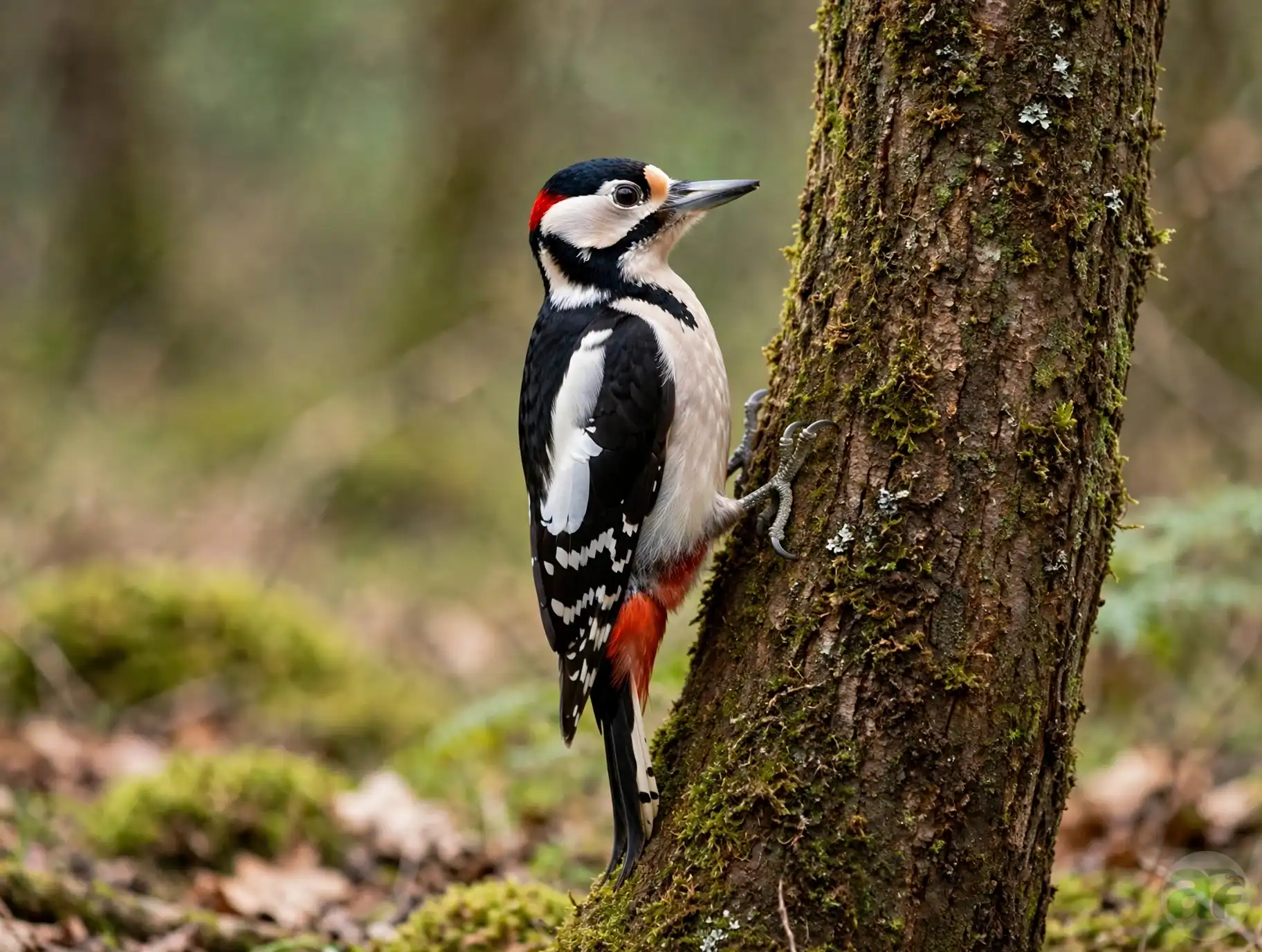
19. Best Places to See Woodpeckers in the Wild
North America
1. Congaree National Park, South Carolina, USA
One of the finest woodpecker watching destinations in the United States — Congaree protects the largest intact expanse of old-growth bottomland hardwood forest in North America. The park supports eight woodpecker species including the red-cockaded woodpecker (Endangered, now recovering in adjacent Francis Marion National Forest), pileated woodpecker, red-headed woodpecker, and brown-headed nuthatch. The park’s elevated boardwalk through the old-growth forest provides exceptional viewing of woodpecker activity in the forest canopy.
2. Francis Marion National Forest, South Carolina, USA
Adjacent to Congaree — Francis Marion is the primary site for red-cockaded woodpecker viewing in the southeastern United States. The forest’s longleaf pine restoration program has produced increasing red-cockaded woodpecker numbers. The active cavity trees are clearly marked with white paint bands, and the birds’ dawn and evening activity at cavity trees provides excellent observation opportunities. Guided bird walks with USFS interpretive staff are available.
3. Acorn Woodpecker Granary Sites, Central California
Multiple accessible locations in central California provide extraordinary acorn woodpecker granary viewing — the best are at Point Reyes National Seashore (Marin County) and at Hastings Natural History Reservation (Monterey County). The granary trees’ visual drama — thousands of individually drilled holes covering entire tree surfaces — and the active family groups maintaining and defending them provide one of the most compelling behavioral wildlife experiences in North America.
4. Olympic National Park, Washington State, USA
The old-growth temperate rainforest of Olympic National Park supports outstanding woodpecker diversity — pileated woodpeckers are reliably observed in the Hoh Rain Forest area; hairy, downy, and black-backed woodpeckers occur across the park’s forest zones. The scale and quality of the old-growth forest create the most ancient, most woodpecker-appropriate atmosphere of any US national park.
Europe
5. Białowieża Forest, Poland/Belarus
The most ancient forest in Europe — Białowieża is the continent’s last large tract of primary temperate forest and supports the most complete European woodpecker community:
- Black woodpecker — the continent’s largest; regularly seen in the old-growth core
- White-backed woodpecker (Dendrocopos leucotos) — Europe’s rarest woodpecker; specialist of old-growth forest; Białowieża is its most reliable European location
- Middle spotted woodpecker, grey-headed woodpecker, green woodpecker — all present
- Three-toed woodpecker — at the southern edge of its European range in the forest’s coniferous sections
6. New Forest National Park, Hampshire, England
One of England’s finest woodpecker-watching sites — New Forest supports all three British woodpecker species (great spotted, lesser spotted, green) in accessible ancient woodland:
- Lesser spotted woodpecker — one of England’s most declining birds; New Forest is one of the most reliable locations for this tiny, scarce species
- Green woodpecker — abundant in the forest’s grassland-woodland mosaic
- Accessible by rail from London; multiple organized wildlife walks available
Asia
7. Doi Inthanon National Park, Thailand
The most accessible Southeast Asian location for woodpecker diversity — Doi Inthanon supports 25+ woodpecker species in the park’s elevation gradient from lowland to highland forest. The combination of extraordinary woodpecker diversity, accessible roads, and excellent birding lodge infrastructure makes Doi Inthanon one of the finest woodpecker birding destinations globally.
8. Kinabatangan River, Sabah, Malaysian Borneo
For the great slaty woodpecker (Vulnerable) and multiple other Southeast Asian woodpecker species — the Kinabatangan riparian forest supports exceptional wildlife density including the magnificent great slaty woodpecker in its riverine forest habitat.
20. How You Can Help
Supporting woodpecker conservation requires action at multiple scales — from individual property management to advocacy for forest protection policies.
Support these organizations:
- American Bird Conservancy — abcbirds.org — comprehensive bird conservation including woodpecker-specific programs; red-cockaded woodpecker and ivory-billed woodpecker conservation research funding
- The Nature Conservancy — nature.org — longleaf pine restoration in the southeastern US directly benefiting red-cockaded woodpeckers; old-growth forest protection globally
- RSPB — rspb.org.uk — UK woodpecker monitoring and lesser spotted woodpecker recovery programs
- Cornell Lab of Ornithology — birds.cornell.edu — woodpecker research, eBird monitoring data, and Project FeederWatch that tracks woodpecker population trends
- National Audubon Society — audubon.org — forest bird conservation advocacy and Important Bird Area programs protecting woodpecker habitat
- Woodpecker Network (Europe) — coordinates woodpecker research and conservation across European range; primarily academic but with accessible conservation resources
Critical individual actions:
Leave dead trees standing — The single most impactful individual action for woodpecker conservation on any property with mature trees is retaining dead and dying trees (snags) rather than removing them for safety or aesthetics. A standing dead tree is the highest-value woodpecker resource in any forest patch. If safety concerns require a dead tree’s removal, consider leaving a stump of maximum height — a stump of 3+ meters provides significant woodpecker foraging habitat.
Install woodpecker nest boxes — Several woodpecker species (including red-bellied woodpecker, downy woodpecker, and northern flicker in North America; great spotted woodpecker in Europe) will use appropriately sized nest boxes in areas where natural cavities are scarce. Nest box specifications by species are available from the Cornell Lab of Ornithology and the RSPB.
Reduce window strike mortality — Woodpeckers are significant victims of window strike mortality — colliding with windows that reflect sky or vegetation and appear transparent. Installing window decals, screens, or external film on large windows near woodland reduces woodpecker window strikes — the most immediately actionable individual mortality reduction available.
Manage your property for native forest — Maintaining native tree species, avoiding pesticide use that reduces insect populations, and allowing natural woodland succession processes increases the woodpecker habitat quality of any property with trees.
Participate in monitoring — Submitting woodpecker sightings to eBird and iNaturalist, and participating in the Christmas Bird Count and Breeding Bird Survey programs, contributes to the population trend monitoring that identifies conservation priorities and documents the impact of habitat management on woodpecker populations.
21. Top Documentaries & Books
Must-Watch Documentaries
“Ghost Bird” (2009, director Scott Crocker) — The definitive documentary about the ivory-billed woodpecker’s 2004 Arkansas sighting and its cultural, scientific, and conservation consequences. The film explores both the ornithological debate and the human dimensions of hope, extinction, and the power of a charismatic bird to mobilize conservation response. Essential viewing for anyone interested in conservation history and the ivory-billed woodpecker story.
“Planet Earth — Forests” (BBC, David Attenborough) — Multiple BBC forest documentary sequences feature woodpecker behavior — the pileated woodpecker’s excavation, the acorn woodpecker’s granary, and the black woodpecker’s European forest ecology appearing across BBC’s extensive natural history archive.
“The Ivory-Billed Woodpecker: Ghost of the Forest” (various PBS and documentary productions) — Multiple American documentary treatments of the ivory-billed woodpecker’s history and conservation search are available through PBS American Experience and various documentary platforms.
Must-Read Books
The Ivory-Billed Woodpecker by James T. Tanner (1942) — The foundational scientific monograph on the ivory-billed woodpecker, written by the ornithologist who studied the last confirmed US population in the Singer Tract. Tanner’s text is simultaneously the most important scientific account of the species and one of the most poignant records in conservation literature — the detailed description of a species whose habitat was being logged as the study was conducted.
The Race to Save the Lord God Bird by Phillip Hoose (2004) — An accessible, compelling account of the ivory-billed woodpecker’s history and the search for its survival; written for young adult audiences but widely read by adults; won the National Book Award for Young People’s Literature.
Woodpeckers of the World by Gerard Gorman (2014) — The most comprehensive guide to the entire woodpecker family; covers all ~240 species with distribution maps, identification information, and natural history accounts; the definitive field and reference guide.
The Genius of Birds by Jennifer Ackerman (2016) — Includes comprehensive treatment of woodpecker cognition, particularly the acorn woodpecker’s spatial memory and cooperative behavior; written for general audiences with scientific rigor.
Woodpeckers: A Guide to the Woodpeckers, Piculets and Wrynecks of the World by Hans Winkler, David Christie, and David Nurney — The standard scientific reference for the complete family; comprehensive taxonomy, behavior, and distribution coverage.
22. Comparison of Major Woodpecker Species
| Feature | Pileated Woodpecker | Acorn Woodpecker | Green Woodpecker | Ivory-billed Woodpecker | Downy Woodpecker |
|---|---|---|---|---|---|
| Scientific name | Dryocopus pileatus | Melanerpes formicivorus | Picus viridis | Campephilus principalis | Dryobates pubescens |
| Length | 40–49 cm | 21–23 cm | 31–33 cm | 48–53 cm | 14–17 cm |
| Weight | 250–350 g | 65–90 g | 150–210 g | ~450–570 g | 21–28 g |
| Range | N. America broadly | W. N. America + C. America | Europe, W. Asia | SE USA (possibly extinct) | N. America broadly |
| Habitat | Mature deciduous/mixed forest | Oak woodland | Open woodland; parkland | Old-growth bottomland hardwood | Forest; suburbs; parks |
| Primary food | Carpenter ants | Acorns (stored) | Ants (ground foraging) | Wood-boring beetles, ants | Insects; seeds |
| Famous for | Largest N. American woodpecker; rectangular excavations | 50,000-acorn granary; cooperative breeding | “Rain bird”; ground ant foraging; yaffle call | “Lord God Bird”; possible extinction | Smallest N. American woodpecker; suburban common |
| Conservation | Least Concern | Least Concern | Least Concern | Critically Endangered/Possibly Extinct | Least Concern |
| Distinctive feature | Large red crest; rectangular holes | Clown-like face; granary tree | Green plumage; red crown; yellow rump | Ivory bill; white wing patches | Small size; tiny bill |
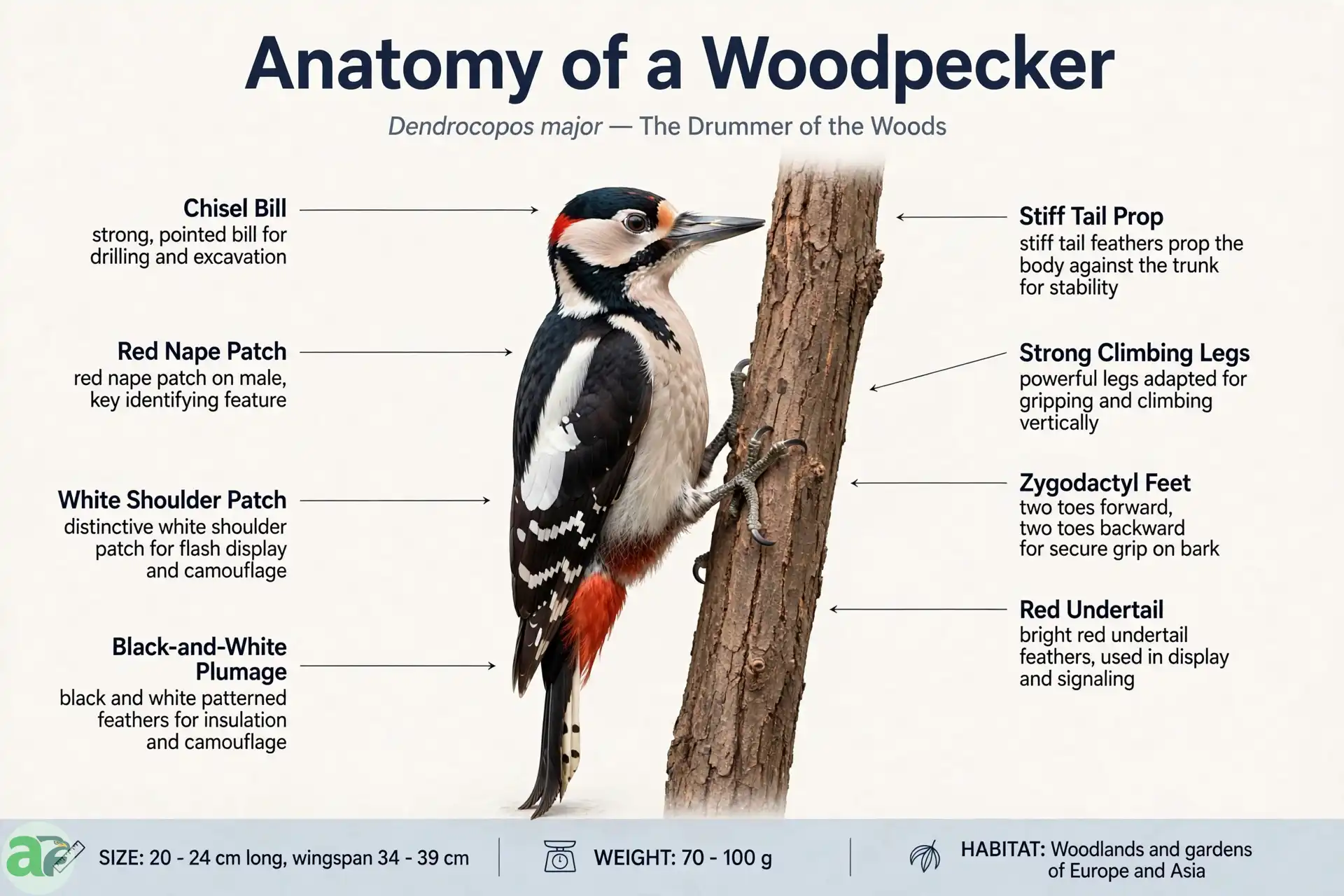
23. Frequently Asked Questions About Woodpeckers
Q1. What is the scientific name of the woodpecker family and what does it mean?
The woodpecker family is Picidae (Leighton, 1837), named after the type genus Picus — the Latin word for woodpecker. Picus derives from Roman mythology — Picus was a forest deity in the religion of ancient Rome, a prophetic god associated with agriculture and forests who, according to Ovid’s Metamorphoses, was transformed into a woodpecker by the sorceress Circe. The mythological Picus was considered an ancestor of the Roman king Faunus and a figure of prophetic power — the woodpecker’s drumming interpreted as oracular communication in Roman augury. The genus name Picus was used by Linnaeus in 1758 to describe the green woodpeckers, and the family name Picidae and order Piciformes both derive from this mythological root. Individual species names reflect physical features (cristatus = crested; viridis = green; major = larger), geographic origins (canadensis = of Canada; japonicus = of Japan), or the names of naturalists who studied them (lewisi — Lewis’s woodpecker, named for Meriwether Lewis). The common name “woodpecker” is straightforwardly descriptive — a bird that pecks wood. The Spanish pájaro carpintero (“carpenter bird”) and French pic (from piquer, to peck) reflect the same functional observation in different languages. The English word “woodpecker” appears in English texts from the early 16th century onward.
Q2. How does the woodpecker avoid getting a concussion?
The woodpecker avoids concussion through a five-component biological impact protection system that works synergistically — each component addressing a different aspect of the impact problem. Component 1 is the bill’s unequal length — the lower mandible extends slightly past the upper, causing the bill to contact wood at a slight angle and diverting impact force laterally rather than straight back into the brain. Component 2 is spongy bone — the woodpecker’s skull contains more spongy (trabecular) bone than other birds, distributed strategically to act as a distributed crumple zone that spreads impact force across a large area. Component 3 — the most dramatic — is the hyoid bone apparatus: the tongue’s support structure has been modified to wrap entirely around the outside of the skull, functioning as a biological seatbelt that constrains brain movement during impact. Component 4 is reduced cerebrospinal fluid (CSF) — unlike humans whose brains float in CSF (which allows the brain to slosh and strike the skull during rapid deceleration, causing concussion), woodpecker brains have less CSF around them and fit more snugly in the skull, reducing brain movement. Component 5 is thick neck musculature that actively absorbs some of the impact force before it reaches the skull — the neck muscles contract slightly during each strike, providing active shock dampening. These five components working together allow the woodpecker to absorb approximately 1,000 g of deceleration per impact, up to 20 times per second, for extended periods, with no apparent neurological damage. The system has been studied intensively by engineers designing football helmets, aircraft black box casings, and automotive safety systems.
Q3. Why is the ivory-billed woodpecker so famous?
The ivory-billed woodpecker (Campephilus principalis) achieved its extraordinary cultural status through the combination of spectacular physical appearance, ecological specialization that made it extraordinarily vulnerable to habitat loss, a poignant extinction story that unfolded in real time during the early conservation movement, and the uncertainty about whether it still survives that has generated one of the most passionate ornithological debates in modern history. Physically, the ivory-billed woodpecker was the largest woodpecker in the United States — nearly 50 cm long, with vivid black-and-white plumage, a bright ivory-white bill, and in males a brilliant red crest. The bird’s size and visual impact caused observers encountering it for the first time to exclaim “Lord God!” — generating the popular name “Lord God Bird” that has attached to it ever since. The ivory-billed woodpecker required vast areas of old-growth bottomland hardwood forest — the very habitat that was being systematically logged across the southeastern United States from the late 19th century onward. James Tanner’s 1942 monograph documented the last known population in the Singer Tract of Louisiana — and watched as the forest was logged despite conservation appeals, the birds disappearing as their habitat disappeared. The last confirmed US sighting was in 1944. The 2004 Arkansas reports — and the subsequent scientific controversy over whether the brief video showed an ivory-billed woodpecker or a pileated woodpecker — generated media coverage, Congressional attention, and significant scientific debate that elevated the ivory-billed woodpecker to the most famous conservation status debate in American ornithology. As of 2026, the species’ status remains formally unresolved — neither confirmed extinct nor confirmed surviving — maintaining the cultural tension that makes it uniquely compelling.
Q4. What is the acorn woodpecker’s granary system?
The acorn woodpecker’s granary system is one of the most sophisticated food storage systems of any animal — rivaling the cache-management behavior of corvids in complexity and exceeding it in scale. A family group of 3–10 acorn woodpeckers collectively maintains a granary tree — a large tree (or occasionally a utility pole, building wall, or other wooden structure) that has been drilled with thousands of individual holes, each precisely sized to hold one acorn. Individual granary trees have been documented containing up to 50,000 acorns — though 10,000–30,000 is more typical. In autumn, the family group harvests acorns from nearby oaks and fits each acorn into a hole that matches its size precisely — the woodpeckers apparently selecting the appropriate hole for each acorn size. As the acorns dry and shrink over winter, the birds relocate each acorn to a smaller hole — an ongoing maintenance task that continues throughout the winter months. The granary is defended vigorously against all competitors — other acorn woodpecker groups, scrub jays, squirrels, and other would-be thieves are driven away by coordinated family group defense. The granary provides a critical winter food reserve that allows the family group to survive the seasons when acorn production falls. Individual granary trees have been documented being maintained by the same family lineage for over 100 years — representing one of the longest continuously maintained food caches of any animal species. The cognitive demands of the system — spatial memory of thousands of individual hole locations, size-matching of acorns to holes, and monitoring of individual acorns’ condition — have made the acorn woodpecker one of the most studied examples of avian cognition and cooperative behavior.
Q5. Where is the best place to see woodpeckers in the wild?
The best location depends significantly on which woodpecker species you want to see and which continent you are on. For North American woodpecker diversity, the southeastern United States — particularly the old-growth bottomland forests of Congaree National Park (South Carolina) and the longleaf pine forests of Francis Marion National Forest — provide the richest woodpecker communities including the recovering red-cockaded woodpecker. For the most spectacular single woodpecker behavior (the acorn granary), the Point Reyes National Seashore (California) and various California oak woodlands provide outstanding acorn woodpecker watching. For European woodpecker diversity, the Białowieża Forest of Poland/Belarus is unmatched — the primary forest contains all European woodpecker species including the rare white-backed woodpecker and the spectacular black woodpecker. For the most accessible British woodpecker experience, the New Forest (Hampshire) provides all three UK species with excellent access, and RSPB reserves throughout England provide great spotted and green woodpecker encounters at supplementary feeding stations. For Southeast Asian diversity, Doi Inthanon National Park (Thailand) provides 25+ woodpecker species. For any location, the most productive woodpecker watching time is early morning — woodpeckers are most active in the first 2–3 hours after sunrise; quiet walking on forest trails produces more encounters than road-based observation; and listening for drumming (spring) or excavation sounds (year-round) is often more productive than visual searching in dense forest.Q.
24. Sources & References
- Wikipedia — Picidae, Dryocopus pileatus, Campephilus principalis, Melanerpes formicivorus, Sphyrapicus varius, Ivory-billed woodpecker controversy
- IUCN Red List — iucnredlist.org (current assessments for all major woodpecker species)
- BirdLife International — birdlife.org (species factsheets; population assessments)
- Tanner, J.T. (1942) — The Ivory-Billed Woodpecker — Cornell Laboratory of Ornithology monograph; the foundational scientific account
- Fitzpatrick, J.W. and colleagues (2005) — “Ivory-billed Woodpecker (Campephilus principalis) Persists in Continental North America,” Science — the controversial 2004 Arkansas sighting paper
- Fan, Y. and colleagues — multiple published papers on woodpecker skull biomechanics and engineering applications (Beihang University research group)
- Bock, W.J. and Miller, W. De W. (1959) — “The scansorial foot of the woodpeckers” — foundational anatomy paper
- Cornell Lab of Ornithology — allaboutbirds.org (species accounts; eBird data; Macaulay Library)
- National Geographic — nationalgeographic.com
- BBC Wildlife / BBC Earth — bbcearth.com
- Britannica — britannica.com/animal/woodpecker
- Gorman, G. (2014) — Woodpeckers of the World — comprehensive family reference
- RSPB — rspb.org.uk (UK woodpecker monitoring and lesser spotted woodpecker conservation)