

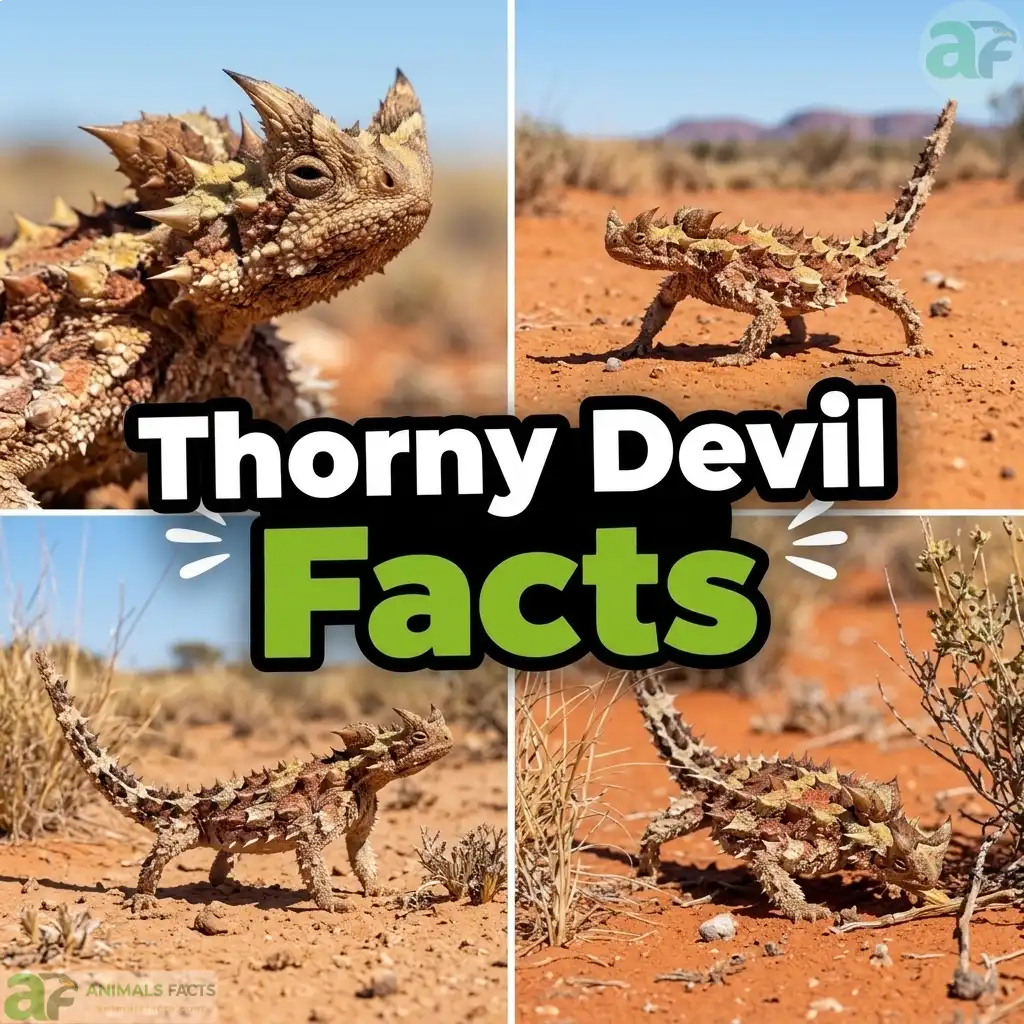
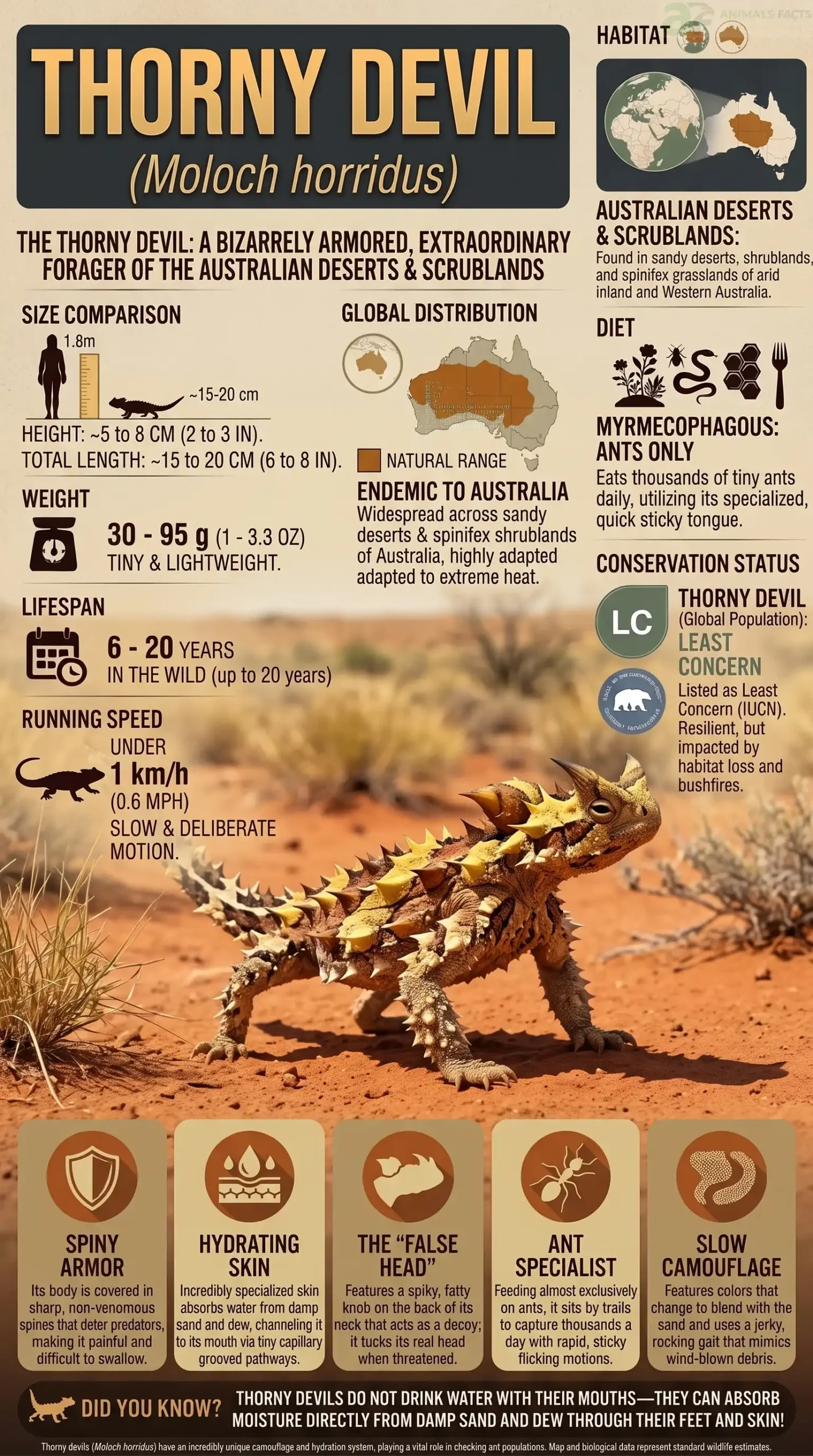
Thorny Devil Facts
| Feature | Details |
|---|---|
| Scientific Name | Moloch horridus (Gray, 1841) |
| Kingdom | Animalia |
| Phylum | Chordata |
| Class | Reptilia |
| Order | Squamata |
| Family | Agamidae |
| Common Names | Thorny devil; thorny dragon; mountain devil; moloch |
| Native Range | Arid and semi-arid Australia — primarily the Western Australian interior, South Australia, Northern Territory, and western Queensland |
| Habitat | Sandy and sandy loam desert, mallee scrubland, spinifex grassland |
| Lifespan | 15–20 years (wild estimate); up to 20 years (captivity) |
| Diet | Exclusively ants — one of the most specialized diets of any vertebrate |
| Body Length | 15–20 cm total length including tail |
| Weight | 30–100 grams — males smaller than females |
| Top Speed | Slow moving — typically less than 1 km/h while foraging |
| Conservation Status | Least Concern (IUCN) — but declining in parts of range |
| Defining Feature | Entire body covered in conical spines of multiple sizes — no two individuals identical |
| Water Collection | Collects water from dew and rain through hygroscopic skin channels that channel moisture directly to the mouth |
| False Head | Has a scaly false head on the back of its neck — presented to predators when threatened |
| Closest Relatives | Frilled-neck lizard, bearded dragon — all Agamidae |
 1. Introduction: What is a Thorny Devil?
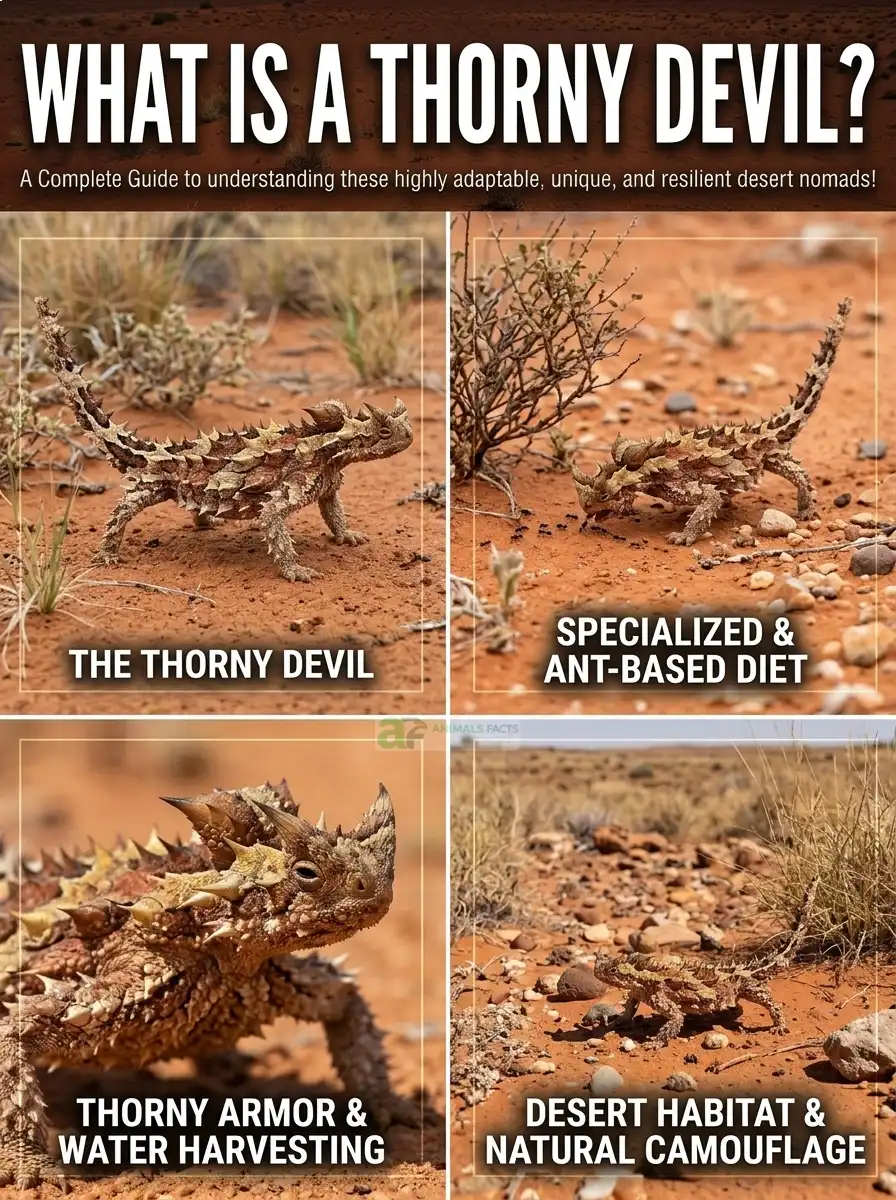
In the red sand of the Western Australian interior, where the temperature climbs past 40°C by mid-morning and a human without water would be in serious trouble within hours, a small lizard moves across the sand with the jerky, stop-start locomotion of a wind-up toy whose mechanism is slightly irregular. It weighs perhaps 60 grams. Its entire body — head, back, legs, tail — is armored with conical spines of varying sizes, no two individuals’ spine arrangement quite identical, the whole assemblage creating an animal that appears simultaneously ancient and improbable, like something a medieval illustrator imagined when asked to design a dragon at one-fiftieth scale. It stops. Its tongue flicks out, touches the sand surface, and in a movement almost too fast to follow, contacts and consumes a single black ant. Then another. Then another. Thorny devil facts begin with this image — one of the most extraordinary animals in Australia, possibly in the world, methodically eating ants one at a time in one of the harshest environments on Earth, armored against every predator in its landscape, drinking water through its own skin from morning dew, and possessed of a false head on the back of its neck for the occasions when the spines alone are insufficient deterrent.
The thorny devil (Moloch horridus) is Australia’s most extraordinary desert lizard — an animal that has solved the problem of surviving in the continent’s most arid interior not through speed or size or venom, but through the most comprehensive physical armoring of any Australian reptile, combined with a set of physiological innovations so remarkable that they continue to generate active research interest across disciplines from herpetology to materials science. Its hygroscopic skin — a network of interconnected microscopic channels between the scales — captures water from dew and wet sand by capillary action and channels it to the corners of the mouth, where it can be swallowed. This passive water collection system, operating without any active drinking behavior, has been so intriguing to engineers that it has directly inspired research into moisture-harvesting surface technologies for desert water collection. Its diet — exclusively ants, typically 45 species consumed but any given individual restricting itself to one or two species at a single feeding site — represents one of the most extreme dietary specializations of any Australian vertebrate, with a single individual consuming up to 1,500–2,500 ants in a single foraging session without eating anything else.
Interesting facts about thorny devils reveal an animal of breathtaking biological precision — the spines performing multiple functions simultaneously (defense, thermoregulation, water channeling); the false head on the back of the neck functioning as both a predator confusion device and a protective structure when the head is buried; the extraordinary cryptic coloration that changes with temperature and background to maintain camouflage across different soil types and lighting conditions; and a behavioral repertoire of remarkable subtlety for an animal most people assume to be little more than an animated armored object. Whether you are searching for thorny devil facts for kids to explore the science of extreme desert adaptation, a wildlife enthusiast wanting to understand this remarkable specialized predator, a materials scientist interested in the water-harvesting skin architecture, or simply someone who encountered a photograph of this improbable animal and needed to understand everything about it immediately — this is your comprehensive guide. Australia’s most extraordinary desert lizard has an extraordinary story to tell.
2. Thorny Devil Species Overview & Classification
The thorny devil belongs to the family Agamidae — sharing its family with the frilled-neck lizard, bearded dragon, and hundreds of other agamid species — but is placed in its own monotypic genus (Moloch), reflecting its unique morphological and ecological specializations.
Species Classification Table
| Taxonomic Rank | Classification |
|---|---|
| Kingdom | Animalia |
| Phylum | Chordata |
| Class | Reptilia |
| Order | Squamata |
| Suborder | Lacertilia |
| Family | Agamidae (Spix, 1825) |
| Genus | Moloch (Gray, 1841) — monotypic |
| Species | M. horridus (Gray, 1841) |
| Common Names | Thorny devil; thorny dragon; mountain devil; moloch |
| Etymology | Moloch — from the ancient Canaanite deity Moloch (associated with fire and fierce sacrifice); horridus = “dreadful, bristling” (Latin) — referring to the spiny appearance |
The Remarkable Naming Story
The genus name Moloch — derived from the ancient Semitic deity associated with sacrifice and fire — reflects the Victorian natural history tradition of naming extraordinary or fearsome-appearing animals after supernatural or mythological figures. John Edward Gray, who formally described the species in 1841, was making a dramatic statement about the animal’s appearance — the multiple conical spines covering every surface creating an impression of bristling ferocity that the Victorian scientific imagination connected to demonic mythology.
The species name horridus — Latin for “dreadful” or “bristling” — reinforces this impression, making Moloch horridus one of the most dramatically named animals in the Australian herpetological record, attached to an animal that is in practice entirely harmless to humans.
Monotypic Genus
The thorny devil is the sole member of its genus — Moloch contains no other species. This taxonomic isolation reflects the thorny devil’s morphological distinctiveness from all other agamids — no other species has independently evolved the combination of thorny armoring, hygroscopic skin water collection, false head, and strict myrmecophagous (ant-eating) diet that characterizes Moloch horridus.
Convergent Evolution — The Texas Horned Lizard Parallel
One of the most scientifically significant aspects of the thorny devil’s biology is its remarkable convergence with the Texas horned lizard (Phrynosoma cornutum) of North America:
| Feature | Thorny Devil (Moloch horridus) | Texas Horned Lizard (Phrynosoma cornutum) |
|---|---|---|
| Family | Agamidae | Phrynosomatidae |
| Continent | Australia | North America |
| Body armor | Conical spines across entire body | Conical spines across entire body |
| Diet | Ants — exclusively | Ants — primarily |
| Foraging | Sit-and-lick ant specialist | Sit-and-lick ant specialist |
| Water collection | Hygroscopic skin channels | Hygroscopic skin channels |
| Camouflage | Color-changing cryptic | Excellent cryptic |
| Relationship | Not related — convergent | Not related — convergent |
This convergence — two unrelated lizards on opposite sides of the world independently evolving virtually identical solutions to the problem of ant-specialist existence in hot, arid environments — is one of the most compelling examples of convergent evolution in reptile biology.
Evolution & Discovery Timeline
~40–50 million years ago — The agamid lizard radiation reaches Australia — establishing the family that will eventually diversify into the thorny devil, frilled-neck lizard, bearded dragon, and other Australian agamids.
~15–20 million years ago — The Moloch lineage diverges within the Australian agamid radiation — coinciding with the progressive aridification of the Australian interior that created the desert and semi-arid environments the species now occupies.
1841 — British zoologist John Edward Gray formally describes the species as Moloch horridus — naming it for the Semitic deity Moloch and the Latin horridus (dreadful, bristling) in recognition of its intimidating appearance.
Late 19th century — Australian naturalists and colonial era natural history collections provide early accounts of thorny devil behavior and ecology — the species’ remarkable appearance generating significant interest in natural history literature reaching European audiences.
1962 — Pioneering researcher Eric Pianka begins systematic ecological research on Australian desert lizards — his work on thorny devil ecology in the Western Australian desert establishing foundational data on diet, thermoregulation, and behavior.
1990s–2000s — Research by Philip Withers, Wade Sherbrooke, and colleagues documents the hygroscopic skin water-collection system in detail — establishing the capillary action mechanism and triggering research into engineering applications.
2000s–2010s — Materials scientists and engineers use the thorny devil’s skin water-harvesting architecture as a model for biomimetic moisture-harvesting surface technologies — one of the most direct applications of animal biology to engineering innovation in herpetology.
2024 — Moloch horridus maintains its Least Concern IUCN global classification — though specific regional population trends are incompletely documented and some areas show evidence of decline.
“The thorny devil is one of the most instructive animals in the world for understanding how evolution solves extreme environmental problems. In one small lizard, you have independent solutions to defense, thermoregulation, dietary specialization, and water acquisition in a desert environment — each solution elegant, each the product of millions of years of selection, and each so well-designed that engineers are still trying to understand and replicate them.”
— Dr. Philip Withers, University of Western Australia, thorny devil physiological ecologist
3. Thorny Devil Physical Description & Unique Features
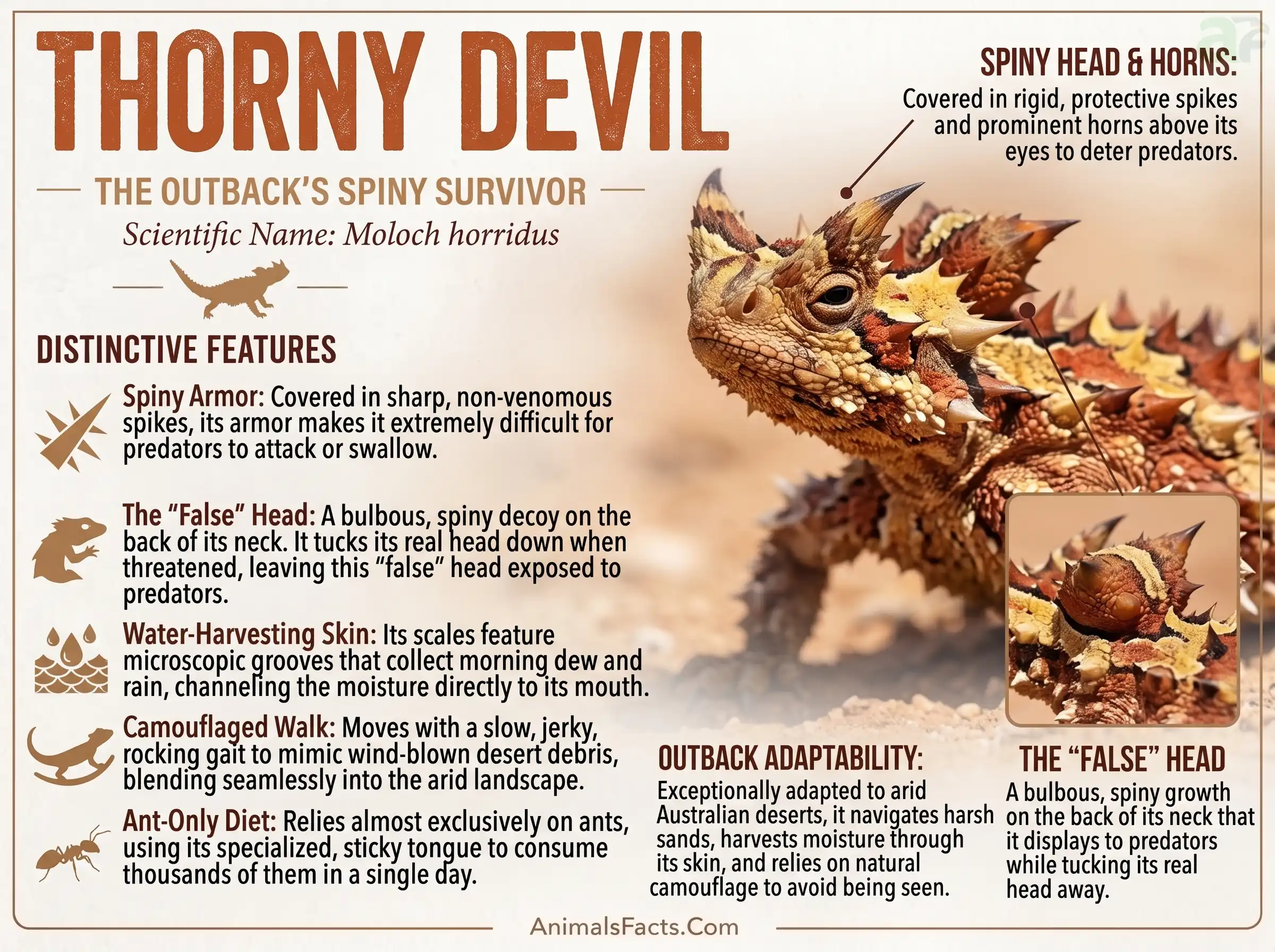
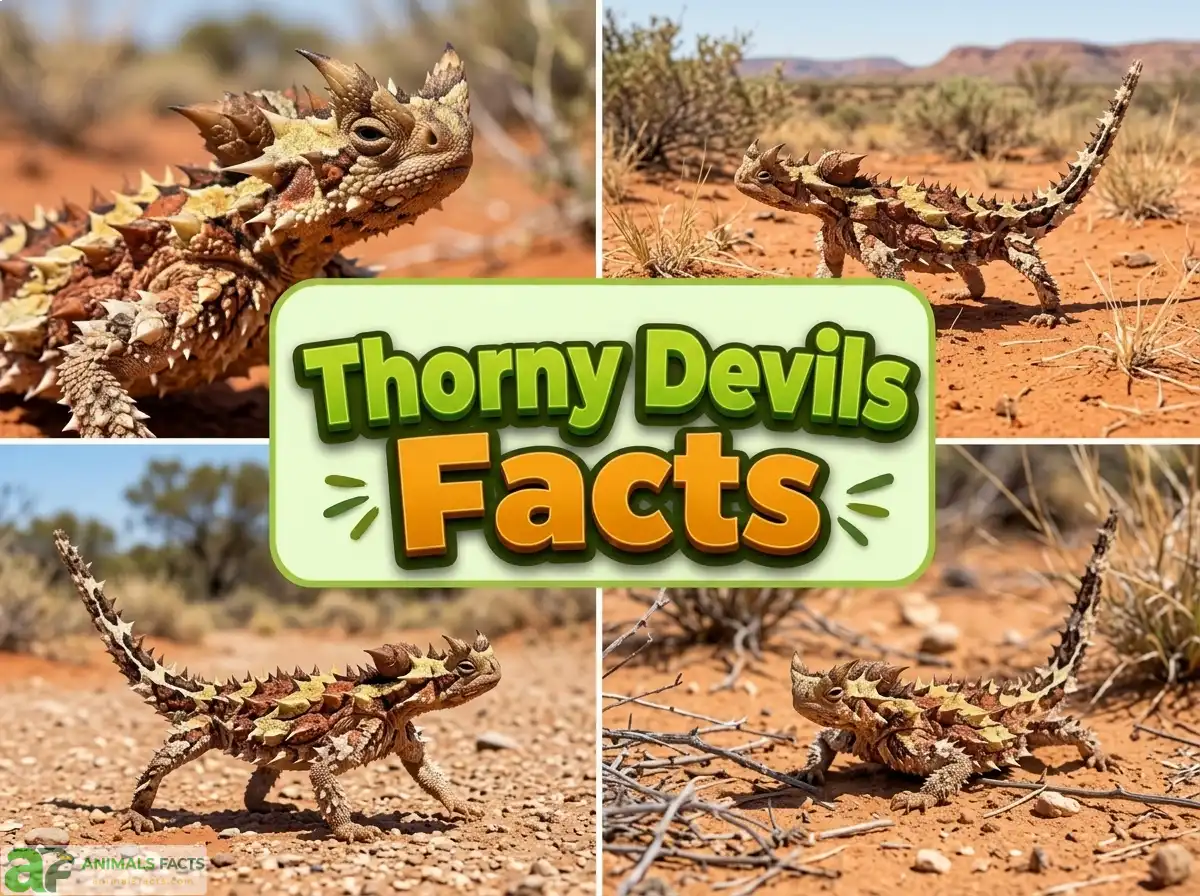
The thorny devil’s physical appearance is unlike that of any other Australian lizard — every surface of the body covered in conical spines of varying sizes, the whole assemblage creating an animal that is simultaneously intimidating in appearance and, at 30–100 grams, completely harmless to humans.
The Spines — Multi-Functional Armor
The thorny devil’s most immediately distinctive feature is the comprehensive covering of conical spines across every exposed surface of the body:
Distribution — Spines cover the head, neck, back, sides, legs, and tail — no surface is unprotected. Even the false head structure on the back of the neck (see below) is armed with spines.
Size variation — The spines range dramatically in size — from large, prominent spines on the head and back (up to 10–12 mm in length in large adults) to much smaller spines on the legs and tail. The arrangement and relative sizes of spines vary between individuals — no two thorny devils have precisely identical spine patterns, making individuals potentially distinguishable in long-term studies.
Spine structure — Each spine is a modified scale — a keratinous conical structure growing from the scale surface. The spines are solid, not hollow, and are firmly attached — they cannot be projected or detached.
Defense function — The primary function is predator deterrence; a thorny devil is extraordinarily difficult to swallow without injury — the spines would penetrate the mouth, throat, and digestive tract of any predator attempting to swallow the lizard whole. Most predators that encounter thorny devils appear to recognize this and avoid attempting predation.
Water channeling function — A critical but less immediately obvious function; the spines and their base grooves form part of the hygroscopic water collection system (see below). Water collected on the body surface must travel to the mouth for swallowing — the spine bases and the channels between scales direct this water flow toward the mouth.
Thermoregulation function — The spines increase the total surface area of the body available for radiative heat exchange — potentially contributing to thermoregulation by increasing the area over which convective and radiative heat transfer occurs.
The Hygroscopic Skin — The Most Extraordinary Feature
The thorny devil’s hygroscopic skin — the water collection and transport system — is arguably the most biologically innovative feature of any Australian lizard:
The discovery — While the thorny devil’s peculiar drinking behavior (appearing to collect water from wet sand by simply pressing its body against it) had been noted by naturalists for decades, the mechanism was not understood until detailed research in the 1990s documented the capillary action system.
The anatomy — The skin surface between the spines contains a network of microscopic channels — grooves approximately 1–10 micrometers wide — that connect across the entire body surface in an integrated network. These channels, combined with the hygroscopic (water-attracting) properties of the scale surface material, create a system that draws water by capillary action from any point of contact toward a single destination: the corners of the mouth.
The collection mechanisms — Water enters the channel network through multiple pathways:
- Morning dew — condensing directly on the skin surface during cool nights
- Wet sand contact — when the lizard presses its body or feet against wet sand after rain
- Rainfall contact — rain landing on the body surface
- Plant moisture contact — the lizard moving through or pressing against dew-covered vegetation
The transport — Once in the channel network, water moves by capillary action — no muscular pumping or active behavior is required. The network is oriented to direct water flow toward the corners of the mouth, where the lizard performs mouth-pumping movements (visually similar to chewing) that move the water from the channel terminus into the oral cavity for swallowing.
The quantity — Research has documented that thorny devils can collect significant quantities of water through this system — in laboratory settings, an individual can collect and drink enough water to increase its body weight by 3–4% through a single dew-collection event. In the desert context, this represents a potentially critical water supplement during periods of no rain.
The engineering inspiration — The thorny devil’s hygroscopic skin has directly inspired research into biomimetic moisture-harvesting surfaces — engineered surfaces that mimic the channel geometry and material properties to harvest water from fog or dew in desert environments. Potential applications include passive water collection systems for desert communities, building materials that harvest atmospheric moisture, and microfluidic devices for laboratory applications.
The False Head — The Deception Organ
The thorny devil’s false head is one of the most remarkable defensive structures in any Australian lizard:
The structure — Between the shoulder blades, the thorny devil has a rounded, knob-like protrusion of soft tissue covered in spines — a structure that resembles the animal’s actual head in overall shape and spine coverage.
The behavior — When threatened by a predator, the thorny devil lowers its actual head between its forelegs — tucking the true head down and forward while presenting the false head as the apparent “head” at the top of the body. Simultaneously, the false head is pushed up and forward by the body posture change — making it more prominent.
The function — The false head presents a predator attacking the “head” with an armored, spine-covered structure rather than the actual head — a lethal bite to the false head is painful and potentially injurious to the predator but survivable for the lizard. The false head misdirects the predator’s attack from the most vulnerable body part to one of the most protected.
The combined defense — The false head works in combination with the spine armor — together they create a situation where no approach angle to the thorny devil offers a predator a clear undefended target. The spines cover the body; the false head covers the most vulnerable surface; the result is a lizard that presents a near-complete surface defense in all directions.
Coloration and Camouflage
The thorny devil’s coloration is as remarkable as its armoring:
Ground colors — The dorsal surface ranges from pale yellowish-brown to reddish-brown to dark brown — typically matching the soil color of the animal’s immediate habitat with remarkable accuracy.
Pattern — The coloration is broken by irregular pale streaks and blotches that follow the line of the spine rows — creating a pattern that disrupts the animal’s outline when viewed against patterned desert soil or sand.
Temperature-dependent color change — The thorny devil changes color with body temperature — becoming darker when cold (increasing heat absorption from solar radiation) and lighter when warm (reducing heat absorption). This physiological color change is metabolically driven rather than neurologically controlled, as in chameleons.
Population variation — Different geographic populations show characteristic coloration matching their local soil types — thorny devils from red-sand desert habitats are more reddish; those from pale sandy soils are more yellowish. This geographic variation in coloration reflects local adaptation through natural selection favoring the best camouflage match.
💡 Did You Know? The thorny devil’s hygroscopic skin water collection system has been studied by materials scientists and aerospace engineers as a model for passive water harvesting from fog and dew. Research teams at universities including the Massachusetts Institute of Technology (MIT) and Arizona State University have published studies on biomimetic surfaces inspired by the thorny devil’s channel architecture — attempting to reproduce the capillary action efficiency of the biological system in engineered materials. The potential applications range from fog-harvesting nets for water collection in dry coastal regions to self-cleaning building surfaces and microfluidic chip designs that manipulate tiny liquid volumes. The thorny devil’s skin has been described in engineering literature as one of the most elegant passive fluid-management systems in the natural world — a biological solution to a fluid mechanics problem that human engineers are still working to match in manufactured systems.
4. Top 25 Amazing Thorny Devil Facts
Here is your definitive collection of the most extraordinary, scientifically verified, and genuinely astonishing thorny devil facts as of 2026:
- The thorny devil eats exclusively ants — making it one of the most dietary specialized vertebrates on Earth. Observations at single feeding sites have recorded individuals consuming up to 45 different ant species over a season — but a single individual at a single foraging bout typically targets one or two ant species only, selecting the species most locally abundant and most nutritionally accessible.
- A single thorny devil can consume 1,500–2,500 individual ants in a single foraging session — consuming them one at a time with individual tongue strikes at a rate of approximately one ant per second during peak foraging activity.
- The thorny devil collects water through hygroscopic skin channels — a network of microscopic grooves between the scales that captures dew, rain, and moisture from wet sand by capillary action and channels it directly to the corners of the mouth. No active drinking behavior is required — the collection is entirely passive.
- The thorny devil has a false head — a rounded, spine-covered protrusion on the back of the neck between the shoulder blades. When threatened, it tucks its real head between its forelegs and presents the false head to the predator — redirecting attack to the most armored region.
- The thorny devil’s coloration is temperature-dependent — the lizard darkens when cold (to absorb more solar radiation and warm faster) and lightens when hot (to reflect more solar radiation and avoid overheating). This physiological color change is independent of neurological control.
- Despite being named after the ancient deity Moloch — associated with fire, sacrifice, and ferocity — the thorny devil is completely harmless to humans and essentially never bites when handled. The scientific name Moloch horridus means roughly “dreadful Moloch” — an extraordinary name for a docile, 60-gram ant-eating lizard.
- The thorny devil shares its ant-eating diet and hygroscopic skin water collection with the Texas horned lizard (Phrynosoma cornutum) of North America — two completely unrelated lizards on opposite sides of the world that independently evolved virtually identical solutions to the problem of ant specialization in hot desert environments.
- Thorny devils are slow and deliberate movers — foraging at typically less than 1 km/h, walking in a characteristic jerky, stop-start fashion with the tail slightly raised. This slow movement, combined with excellent camouflage, makes them difficult for predators to detect through motion detection.
- The thorny devil’s entire body surface — including the false head, legs, and tail — is covered in conical spines of varying sizes, no two individuals with precisely identical spine arrangements. The spines make the lizard effectively impossible for most predators to swallow without severe injury.
- Thorny devils are completely absent from true desert environments where soil moisture is insufficient for ant colony survival — they require sandy soils that support healthy ant colony populations. Their distribution precisely tracks the distribution of suitable ant habitats within the Australian arid zone.
- Despite living in one of the world’s most water-stressed environments, thorny devils maintain body hydration primarily through the hygroscopic skin system and through the moisture content of the ants they consume — direct rainfall drinking is a secondary water source.
- Thorny devil females are larger than males — an unusual sexual dimorphism for Australian lizards and one that reflects the energetic demands of egg production. Females can reach 100 grams while males typically remain under 70 grams.
- Thorny devils are diurnal and strictly seasonal in their surface activity — active on the surface during the cooler months (approximately May–October in most of the range) and retreating underground during the hottest summer months when surface temperatures would be lethal.
- Research using radio-tracking has documented thorny devil home ranges of approximately 1–3 hectares — the animals maintaining and returning to specific foraging sites within this range across multiple years, demonstrating detailed spatial memory of productive ant trail locations.
- The thorny devil’s locomotion is one of its most distinctive features — the characteristic stop-start, body-rocking movement (the body rocking forward and backward with each step) appears to be a behavioral strategy for minimizing heat absorption from the hot sand surface by reducing contact time during each step.
- Individual thorny devils can be recognized by their unique spine patterns — the arrangement of differently-sized spines on the head and back is sufficiently variable between individuals to allow individual identification in field studies without marking. This individual recognition potential has been confirmed in camera trap studies.
- The thorny devil’s skin channels have been measured in laboratory studies to draw water from wet sand at remarkable efficiency — the capillary pressure driving water movement through channels of 1–10 micrometers width is sufficient to transport water against gravity for short distances, confirming that the system functions even when the moisture source is below the level of the mouth.
- Thorny devils lay eggs in burrows excavated specifically for nesting — the female constructing a 30–45 cm deep burrow in well-drained sand, laying a clutch of 3–10 eggs, and then filling the burrow entrance to conceal the nest site. No parental care follows egg deposition.
- The jerky, stop-start locomotion of foraging thorny devils appears to serve multiple functions: reducing heat gain from the substrate, improving predator detection through motion-pause cycles (moving animals detect movement better than stationary ones, so stopping reduces the chance of being seen), and stabilizing the visual targeting system used to strike at individual ants.
- Thorny devils have been documented consuming the same ant species at the same trail locations across multiple years — demonstrating site fidelity to productive foraging areas and long-term memory of specific ant colony locations within their home range.
- The thorny devil’s scientific name has generated more discussion than that of almost any other Australian reptile — naming a harmless, slow-moving ant-eater after both the Semitic deity Moloch and the Latin word for “dreadful” is one of the more dramatic examples of Victorian scientific naming enthusiasm in the Australian fauna.
- Thorny devils practice underground thermoregulation during the hottest parts of summer — retreating into burrows where temperatures are significantly lower than the lethal surface temperatures of Australian midsummer, emerging only on cooler autumn days when surface activity again becomes possible.
- The false head structure of the thorny devil has been studied as an example of defensive mimicry — the knob resembling the real head closely enough in size and spine coverage to potentially confuse predators about the animal’s orientation and the location of its most vulnerable body part.
- Population density studies in Western Australia have documented thorny devil densities of up to 8 individuals per hectare in optimal habitat — a relatively high density for a desert lizard, reflecting the specialist ecological niche the species occupies with minimal competition from other lizard species for the same prey.
- As of 2026, the thorny devil faces increasing pressure from habitat modification through inappropriate fire management and introduced herbivore pressure on the spinifex grasslands that support its primary ant prey — though the species’ overall global conservation status remains Least Concern due to its extensive arid zone range.
5. Fun Facts About Thorny Devils
- Eats exclusively ants — up to 2,500 per session
- Drinks through its skin — water travels through microscopic channels to its mouth
- Has a false head on the back of its neck
- Named after the ancient deity Moloch — one of Australia’s most dramatically named animals
- Independently evolved the same features as the Texas horned lizard on the other side of the world
- Changes color with temperature — darker when cold, lighter when hot
- Females are larger than males
- Forages at less than 1 km/h — one of Australia’s slowest lizards
- Each individual has unique spine patterns — like fingerprints
- No two individuals have identical spine arrangements
- Skin channels have inspired engineering research into water harvesting
- 8 individuals per hectare in optimal habitat — surprisingly dense
6. Thorny Devil Natural Habitat & Geographic Range
Thorny devil habitat is restricted to the arid and semi-arid interior of Australia — the species is one of the most geographically specialized of all Australian lizards, occurring primarily in desert and semi-desert environments dominated by sandy or sandy loam soils.
Habitat Requirements
Sandy or sandy loam soil — The most critical habitat requirement; thorny devil distribution is closely correlated with sandy substrate. This correlation reflects two underlying requirements:
- Sandy soils support the ant colonies that constitute the thorny devil’s exclusive food source
- Sandy soils provide the burrowing substrate needed for nesting and underground thermoregulation
Ant colony abundance — The thorny devil’s entire ecology depends on the presence of abundant, accessible ant colonies. The species tracks the distribution of ant-rich sandy habitats — avoiding areas where soil type, vegetation, or disturbance reduces ant colony density below the threshold needed to support thorny devil populations.
Spinifex and mallee vegetation — The thorny devil is most closely associated with habitats dominated by spinifex grasses (Triodia species) and mallee eucalypts (Eucalyptus species of multi-stemmed growth form) — vegetation types characteristic of Australian sandy desert and semi-arid zones that support rich ant communities.
Avoidance of true desert — Despite its desert reputation, the thorny devil is absent from the most extreme true desert environments — rock-based gibber plains, salt lakes, and sand dune fields with minimal vegetation — where ant colony density is insufficient to support specialist myrmecophages.
Well-drained terrain — The nesting and underground thermoregulation requirements favor well-drained sandy terrain — waterlogged or clay-based soils that do not permit easy excavation or dry burrowing are avoided.
Habitat Types
Spinifex sandplain — The primary habitat; vast expanses of spinifex grassland on sandy soils in the Western Australian interior support the highest thorny devil population densities. The combination of sandy substrate and spinifex-associated ant communities provides both prey and substrate.
Mallee scrubland — Sandy mallee habitats in the southern parts of the range support thorny devil populations — the multi-stemmed eucalypts providing shade refugia and the sandy soil supporting ant colonies.
Desert woodland margins — The margins of mulga (Acacia aneura) woodland on sandy soils are occupied by thorny devils — the woodland-sand ecotone providing productive ant habitat.
Sandy desert proper — Some true sandy desert areas within the range support thorny devil populations where spinifex establishes on sand dunes and stabilized sand sheets.
Geographic Distribution
| Region | Status | Notes |
|---|---|---|
| Western Australia (interior) | Core range — most abundant | Sandy plains of the Great Sandy, Gibson, and Great Victoria Deserts |
| South Australia (northern/central) | Present — common | Sandy habitats of the Lake Eyre Basin and ranges |
| Northern Territory (southern) | Present | Southern NT sandy habitats |
| Queensland (western) | Present — eastern range limit | Channel Country and western Queensland sandy soils |
| New South Wales (northwest) | Marginal | Range limit; sparse |
| Victoria | Absent | Outside range |
💡 Did You Know? The thorny devil’s distribution in Australia precisely tracks the distribution of sandy soil ant communities — which means its range map is simultaneously a map of suitable ant habitat. Researchers have been able to predict thorny devil occurrence in previously unsurveyed areas with high accuracy simply by mapping soil type and vegetation associations — a remarkable example of how a specialist organism’s distribution can be predicted from knowledge of its single food source’s habitat requirements. The thorny devil has essentially become a bioindicator for the health of Australia’s sandy desert ant communities — where thorny devil populations are declining, it reflects changes in ant community composition and density that may be driven by factors including altered fire regimes, introduced herbivore pressure, and climate change impacts on vegetation structure.
7. Thorny Devil Diet & Feeding Behavior
Thorny devil diet is one of the most extreme dietary specializations of any reptile — the species consuming exclusively ants, making it one of the most specialist feeders of any vertebrate outside the truly obligate myrmecophages like aardvarks and pangolins.
The Exclusively Ant Diet
No exceptions documented — Every systematic study of thorny devil diet has confirmed exclusive ant consumption. Unlike most “ant specialist” lizards that consume significant proportions of other invertebrates when available, the thorny devil’s dietary records show ants and nothing else in stomach content analyses across all seasons and populations studied.
Species range — Despite the exclusive ant diet, thorny devils are not restricted to a single ant species — research documents consumption of up to 45 ant species across the range. However, individual animals at individual foraging sessions typically target the one or two ant species most locally abundant and most easily captured.
The species preference hierarchy — When multiple ant species are available, thorny devils show preferences for:
- Small-bodied ants (easier to capture; lower injury risk)
- Slow-moving surface foragers (easier to track and strike)
- Numerically abundant species (higher encounter rate; more efficient foraging)
- Species without strong chemical defenses (avoiding heavily chemically defended species when alternatives exist)
The Foraging System
Sit-and-wait at ant trails — The primary foraging strategy; the thorny devil locates active ant foraging trails — the routes along which worker ants travel between the nest and food sources — and positions itself alongside the trail, consuming individual ants as they pass.
The tongue strike — Individual ants are captured by a rapid tongue extension — the sticky, muscular tongue contacts the ant and retracts within a fraction of a second. Unlike larger lizards that capture prey with a jaw snap, the thorny devil uses tongue adhesion for individual ant capture.
The consumption rate — At productive ant trails, experienced individuals strike at approximately one ant per second during active foraging — the rate limited by the speed of ant passage rather than the lizard’s striking capability.
The session duration — A foraging session at a productive ant trail may last 1–3 hours — the lizard consuming ants continuously for this period before moving to a new trail or retreating underground as temperatures rise.
The total consumption — A single productive foraging session may yield 1,500–2,500 ants — an extraordinary quantity that reflects the small size of individual prey items (worker ants typically weigh 0.5–3 mg each) relative to the lizard’s food requirements.
The Nutritional Economics
Why ants? — Ants are not the most nutritious prey item available in the Australian desert — they are small, and many species have defensive chemicals that reduce digestibility. The thorny devil’s exclusive ant diet reflects the extraordinary abundance of ants in the Australian arid zone — ants may constitute up to 50% of all invertebrate biomass in some Australian desert habitats, making them the most consistently available and most reliably locatable food resource.
The specialist advantage — By specializing exclusively on ants, the thorny devil accesses a food resource with minimal competition from other lizard species — most other Australian desert lizards consume a diverse range of invertebrates and small vertebrates. The thorny devil has, in ecological terms, traded dietary breadth for access to a food resource so abundant that specialization on it alone is entirely sustainable.
Caloric intake — A single session of 2,000 ants at an average weight of 1 mg each provides approximately 2 grams of ant biomass — a modest caloric input for a 60-gram lizard. The low metabolic rate of this ectotherm means that even this modest caloric input, spread across regular foraging sessions, is sufficient to maintain body condition across the active season.
Water from Prey
Moisture content — Worker ants contain approximately 60–70% water by mass — a significant moisture source for a desert animal. The moisture extracted from consumed ants contributes meaningfully to thorny devil water balance, particularly during dry seasons when dew collection opportunities are limited.
8. Thorny Devil Reproduction & Life Cycle
Thorny devil reproduction is characterized by modest clutch sizes, careful nest site selection, extraordinarily long egg incubation, and the complete absence of parental care.
Mating System
Mating season — August–September in most of the range — the spring months when thorny devils become most active after winter dormancy and temperatures begin to rise toward optimal foraging levels.
Male territorial behavior — Males maintain home ranges with overlapping boundaries — encounters between males during the breeding season involve head-bobbing displays and body posturing that assess relative size and condition without typically escalating to physical combat.
Courtship — Male courtship involves following and tongue-flickering contact with females — females signal receptivity through passive posturing or reject males through aggressive displays and retreat.
The size disadvantage — The female’s larger body size creates an unusual mating dynamic — the male, typically significantly smaller than the female, must mount and position himself around a partner that outweighs him. Mating involves the male grasping the female with all four limbs.
Nesting
Nesting season: October–December — female body condition at peak; soil temperatures suitable for egg development
Nest excavation — The female excavates a dedicated nesting burrow — a tunnel 30–45 cm long and descending to 20–30 cm depth in well-drained sandy soil. The excavation takes several hours.
Nest site selection — Female nest site selection shows consistent preferences:
- North-facing slopes — maximizing solar heating of the nest
- Well-drained sandy soil — preventing waterlogging of eggs
- Open, exposed positions — maximizing solar radiation reaching the nest
- Away from dense vegetation — reducing shading that would lower nest temperatures
Clutch size: typically 3–10 eggs — most commonly 5–8; smaller females lay smaller clutches
Egg structure — Eggs are white, soft-shelled (leathery), and approximately 17 × 13 mm — relatively large for the female’s body size, reflecting significant maternal investment per egg
Post-laying behavior — The female fills the burrow entrance with sand after laying — carefully packing and concealing the nest entrance. She then departs and provides no further parental care.
Incubation — The Extraordinary Duration
Incubation period: approximately 90–132 days — one of the longest incubation periods documented for any Australian lizard
The temperature dependence — Development rate is temperature-dependent; nests with higher average temperatures (better-positioned nests or warmer years) produce faster-developing eggs. Eggs in cool, poorly positioned nests may require the full 132 days.
Hatching timing — Hatchlings typically emerge February–April — the late summer to early autumn period when ant activity is still high and temperatures are beginning to moderate from midsummer extremes.
Hatchling Biology
Hatchling size: approximately 6–7 cm total length; 1.5–2 grams — tiny but fully equipped with functional spines and false head
Immediate independence: no parental care; hatchlings disperse immediately upon emergence from the nest burrow
Juvenile diet: identical to adult diet — ants exclusively — from the first day of independent life
Juvenile growth: slow, reflecting the low energy density of the exclusive ant diet; juveniles take approximately 3–4 years to reach sexual maturity
Juvenile mortality: high — the first year of life is the most dangerous, with small body size increasing vulnerability to predation and temperature extremes
Lifespan
- Wild lifespan: estimated 15–20 years — relatively long for a lizard of this size
- Maximum captive lifespan: up to 20 years in well-managed captive conditions
9. Social Behavior & Communication
Thorny devil social behavior is primarily asocial — the species’ slow-moving, cryptic lifestyle and specialist dietary ecology produce a behavioral system based more on avoidance and passive communication than on active social interaction.
Social Organization
Primarily solitary — Adults maintain individual home ranges with overlapping boundaries — they do not form social groups and do not maintain sustained social associations.
Low encounter rates — The slow foraging speed, cryptic coloration, and tendency to remain stationary for extended periods mean that individuals encounter each other infrequently even within overlapping home ranges.
Seasonal proximity — During the breeding season (August–September), male searching behavior increases encounter rates with females — males following female scent trails and visual cues to locate receptive individuals.
Male spacing — During the breeding season, males maintain spacing from other males through head-bobbing displays — avoiding physical combat through visual assessment of relative size and condition.
Communication
Head-bobbing — The primary active social signal; thorny devils produce stereotyped head-bob sequences during territorial and courtship interactions — the timing, amplitude, and pattern of bobs encoding species, sex, and individual status information.
Body posturing — Lateral body compression (making the body appear thinner when viewed from the side, increasing apparent height when viewed frontally) and the false head presentation behavior are visual signals deployed in social and predator contexts.
Chemosensory — Tongue-flickering behavior during foraging and social encounters samples the chemical environment — detecting the scent trails of conspecifics, predators, and ant prey.
Color change — The temperature-dependent color change is not primarily a social signal, but the color state of an individual provides information about its thermal status to observers — darker individuals are cold and may be less responsive; lighter individuals are warm and fully active.
Cognition and Spatial Memory
Despite the apparent simplicity of the thorny devil’s behavioral repertoire, research has documented significant spatial memory capability:
- Individual thorny devils return to specific foraging sites — particular ant trail sections — across multiple years
- The precision of site return implies detailed spatial cognitive maps of the home range
- Foraging efficiency increases with site familiarity — experienced adults exploit known ant trails significantly more efficiently than naive juveniles at novel sites
10. Predators & Defense Mechanisms
The thorny devil faces a range of natural predators and has evolved what is arguably the most comprehensive passive defense system of any Australian lizard.
Natural Predators
Goannas (monitor lizards) — The most significant natural predator; large monitor lizards including the perentie (Varanus giganteus) and sand monitor (Varanus gouldii) are capable of swallowing thorny devils despite the spines — the large gape and muscular throat allowing passage of the spined body if approached from the right angle. However, spine injuries to the predator’s mouth and throat likely make thorny devil predation costly enough that goannas attempt it only when other prey is unavailable.
Raptors — Wedge-tailed eagles, little eagles (Hieraaetus morphnoides), and Australian kestrels (Falco cenchroides) are aerial predators that occasionally take thorny devils — the talons providing a means of capturing the lizard without oral spine contact, though subsequent manipulation for swallowing remains challenging.
Snakes — Mulga snakes (Pseudechis australis) and various other large Australian snakes are potential predators — though the spine armoring makes thorny devils difficult to constrict and swallow.
Feral cats — Introduced feral cats represent a significant predation threat across the thorny devil’s range — though the spines likely deter many individual cat attacks. Documented cat predation on thorny devils has been reported at multiple sites.
Defense Mechanisms — The Comprehensive System
The spine armor — The primary passive defense; the comprehensive spine covering makes the thorny devil extremely difficult for any predator to seize, manipulate, or swallow. The spines penetrate soft tissue on contact — making a bite or talon strike on a thorny devil painful and potentially injurious to the attacker.
The false head — The secondary structural defense; the false head redirects predator attacks from the vulnerable true head to the most armored part of the body — the spine-covered false head structure.
Cryptic coloration — The first line of defense; the excellent camouflage of the thorny devil against desert sand makes it difficult to detect in the first place. Many predation events are prevented by cryptic concealment before they begin.
The freeze response — When a predator approaches, the thorny devil may freeze completely — relying on cryptic coloration and immobility to avoid detection rather than fleeing. The slow-moving lifestyle and cryptic appearance make this a viable strategy.
The body-inflation display — When directly threatened, the thorny devil inflates the body by gulping air — increasing apparent size and making the spines stand more erect and prominent.
Burrowing escape — In loose sandy substrate, a threatened thorny devil can partially or fully submerge itself in sand within seconds — using rapid lateral body-shaking movements to sink below the surface.
The Goanna Problem
The goanna’s ability to occasionally successfully predate thorny devils creates an interesting evolutionary dynamic:
- Spine sizes in thorny devil populations may be calibrated by the trade-off between predation deterrence and metabolic cost — larger spines better deter goannas but are more costly to produce and maintain
- Research suggests that thorny devil spine size variation between populations correlates with goanna abundance — populations in areas with higher goanna density have relatively larger spines
💡 Did You Know? The thorny devil’s burrowing escape behavior in loose sand — the rapid lateral body oscillation that sinks the animal below the surface within seconds — has been studied as an extreme example of granular media locomotion. The movement works by the same physical principles as fluidization — the rapid oscillation momentarily reduces the effective viscosity of the surrounding sand grains, allowing the body to sink. This sand-submersion capability adds a final escape option to the thorny devil’s otherwise passive defense system — when all other defenses fail and direct predator contact is imminent, the ability to disappear below the sand surface within seconds provides a last-resort escape that requires no speed and no physical confrontation. The physics of how relatively rigid-bodied animals move efficiently through granular materials like sand has attracted attention from robotics researchers — sand-swimming animals including thorny devils have informed the design of granular-medium robots for search-and-rescue applications in rubble and sand environments.
11. Thorny Devil Facts for Kids
Hey amazing young wildlife scientists, reptile fans, and future desert explorers! Here are some truly mind-blowing thorny devil facts for kids that will absolutely astonish every science enthusiast you know:
- 🌵 The thorny devil drinks through its SKIN! Instead of bending down to a water source and lapping like a cat or dog, the thorny devil collects water through tiny channels in its skin — like thousands of microscopic straws covering its whole body. When morning dew lands on its scales, or it steps on wet sand, water travels along these channels all the way to the corners of its mouth, where it can be swallowed. No sipping needed — the skin does all the work!
- 🌵 It has a FAKE HEAD on the back of its neck! Between its shoulder blades, the thorny devil has a knob that looks like another head — complete with spine coverage. When a predator gets too close, the thorny devil tucks its REAL head between its front legs and pushes the fake head up for the predator to find. If the predator bites the fake head, it gets a mouthful of spines but the actual lizard survives!
- 🌵 It eats ONLY ANTS — nothing else! The thorny devil is one of the most specialized eaters of any vertebrate animal. It eats ants, and only ants, for its entire life. And it can eat up to 2,500 ants in a single meal — one ant at a time, with individual tongue strikes, at about one per second. That is a lot of ants!
- 🌵 It changes color like a THERMOMETER! When the thorny devil is cold, its skin gets darker — the darker color absorbs more heat from the sun and warms the lizard up faster. When it gets too warm, the skin becomes paler — reflecting more sunlight and keeping the lizard cooler. Its entire body is a color-changing temperature gauge!
- 🌵 Its skin inspired ENGINEERS to design new water collection systems! Scientists studying how the thorny devil’s skin channels water have used the same principles to design surfaces that collect water from dew and fog — potentially providing drinking water to communities in desert areas without needing rainfall or wells. A tiny Australian lizard is helping solve human water problems!
- 🌵 It was named after a TERRIFYING ANCIENT GOD! The scientific name is Moloch horridus — “Moloch” was a fearsome deity worshipped in ancient times, and “horridus” is Latin for “dreadful.” This dramatically scary name belongs to a lizard that moves slower than most people walk, eats only ants, and is completely harmless to humans. It may be the biggest mismatch between a name and an animal’s actual personality in all of science!
- 🌵 Every single thorny devil has a UNIQUE SPINE PATTERN — like fingerprints! No two thorny devils have exactly the same arrangement of spines on their bodies. Scientists have discovered that each individual can be identified by its unique spine pattern — the way the different-sized spines are arranged on the head and back is as unique to each individual as human fingerprints are to us!
- 🌵 It can SINK INTO SAND to escape predators! When a thorny devil is threatened and cannot run away fast enough (which is most of the time — it is very slow), it can rapidly vibrate its body and sink below the sand surface in seconds. It essentially makes itself disappear by burrowing without digging. The sand around it flows like liquid as the body oscillates, and suddenly the thorny devil is underground!
12. Relationship with Humans
The thorny devil’s relationship with humans encompasses ancient Aboriginal traditions of profound ecological knowledge, the European scientific encounter of the 19th century, the species’ growing role in materials science research, and the modern conservation challenges of an increasingly modified arid landscape.
Indigenous Australian Relationships
The thorny devil has been part of the cultural and ecological knowledge framework of Aboriginal Australians across the arid zone for tens of thousands of years:
Traditional food use — Thorny devils have been consumed as food by Aboriginal communities across their range — forming part of the diverse bush tucker food system. Despite the spine armoring, thorny devils can be safely consumed by roasting over coals — the heat softening the spine structure. The modest body mass of thorny devils (30–100 grams) means they are not a primary food source but contribute to the dietary diversity of traditional desert foraging.
Water source knowledge — Traditional ecological knowledge in Aboriginal communities across the thorny devil’s range includes understanding of the lizard’s water-collecting skin behavior — knowledge that may have practical value for surviving desert conditions by following the lizard’s behaviors to locate moisture.
Totemic relationships — The thorny devil is included in the totemic systems of various Aboriginal groups across the arid zone — the specific totemic significance varying by region and cultural tradition.
Traditional ecological knowledge of diet — Aboriginal communities across the range recognized the thorny devil’s ant-eating specialization well before Western science formally documented it — traditional knowledge naming specific ant species associated with thorny devil foraging sites.
Rock and ground art — The thorny devil’s distinctive silhouette appears in some Aboriginal artistic traditions — the instantly recognizable spiny profile being a visually distinctive subject for naturalistic depiction.
The European Scientific Encounter
The thorny devil’s dramatic appearance generated significant scientific and popular interest from the first European encounters:
John Edward Gray’s description (1841) — The formal description by Gray introduced the thorny devil to Western science with the dramatic binomial Moloch horridus — a naming choice that reflected the Victorian natural history tradition’s tendency toward dramatic nomenclature for spectacular-appearing organisms.
19th century natural history accounts — Explorer and naturalist accounts of Australian interior expeditions regularly noted the thorny devil — its extraordinary appearance making it one of the more reliably mentioned reptile species in exploration literature.
Ernst Haeckel’s illustrations — The thorny devil appeared in various 19th century natural history illustration traditions — the combination of comprehensive spining and distinctive body form making it a compelling subject for natural history illustration.
The Materials Science Connection
The most unexpected dimension of the thorny devil’s relationship with humans is its role as a model system for engineering innovation:
Biomimetic research programs — Multiple university research groups across Australia, the USA, Germany, and China have studied thorny devil skin architecture as a model for passive water harvesting surfaces. Published research has documented the capillary channel dimensions, material properties, and transport efficiency of the biological system.
Potential applications:
- Desert water harvesting — surfaces that collect potable water from fog or dew in arid regions without energy input
- Building materials — self-wetting surfaces that resist dust accumulation through moisture-mediated self-cleaning
- Microfluidics — chip-scale fluid management systems for laboratory diagnostics inspired by the channel architecture
- Textile engineering — moisture-managing fabrics inspired by the gradient channel network
The research community’s perspective — The thorny devil’s skin water collection system has been described by materials scientists as one of the most efficient passive fluid transport architectures known from any biological system — the combination of channel geometry, material hydrophilicity, and integrated network design achieving transport efficiency that engineered systems have difficulty matching.
Human Impact Concerns
Despite the absence of direct persecution of thorny devils (the species is widely recognized as harmless and interesting rather than threatening), human activities create significant indirect threats:
Habitat modification — Land clearing for pastoralism and agriculture in areas of semi-arid sandy habitat reduces thorny devil populations by eliminating the vegetation structure and soil conditions that support ant communities.
Fire management — The spinifex grasslands that support thorny devil prey communities require specific fire regimes for maintenance — inappropriate fire management (too frequent, too infrequent, or wrong season burning) can degrade ant community composition in ways that reduce thorny devil food availability.
Introduced herbivores — Cattle, sheep, and rabbits grazing spinifex habitats can degrade the vegetation structure that supports ant communities — indirectly reducing thorny devil prey availability across pastoral areas.
Road mortality — Thorny devils crossing roads are vulnerable to vehicle strikes — the slow movement and tendency to stop in road centers (where warm asphalt provides thermoregulation opportunities) creating significant road mortality in some areas.
13. Thorny Devil Conservation Status & Threats
Conservation Status Overview
| Feature | Details |
|---|---|
| Global IUCN Status | Least Concern (LC) |
| Population Trend | Unknown globally — insufficient systematic monitoring data |
| Regional Status | Declining in some pastoral areas; stable in protected areas |
| Australian Legal Protection | Protected under state and federal wildlife law across range |
| CITES Listing | Appendix II — international trade regulated |
Major Threats
| Threat | Description | Impact Level |
|---|---|---|
| Habitat modification | Pastoral development; land clearing | High in accessible areas |
| Altered fire regimes | Inappropriate burning degrading spinifex ant habitat | High |
| Introduced herbivores | Cattle, sheep, rabbits degrading spinifex | High |
| Feral cats | Predation; expanding impact | Medium-High |
| Road mortality | Vehicles striking slow-moving individuals | Medium |
| Illegal collection | Pet trade despite legal protection | Medium |
| Climate change | Increasing temperature extremes; altered rainfall | Increasing concern |
| Invasive ant species | Introduced yellow crazy ant potentially affecting prey | Emerging concern |
The Monitoring Challenge
One of the most significant conservation challenges for the thorny devil is the near-complete absence of systematic population monitoring data across the species’ vast arid zone range:
- Most thorny devil research has been conducted at a small number of well-studied sites — primarily in Western Australia
- The species’ range extends across enormous areas of inaccessible arid Australia where survey effort is minimal
- Population trend data are therefore based on inference from habitat condition rather than direct population counts
- The Least Concern classification reflects range size and habitat availability rather than confirmed population stability
Conservation Responses
Protected area coverage — Substantial portions of the thorny devil’s range fall within the Western Australian reserve system, South Australian reserve system, and Northern Territory protected areas — including vast national parks and conservation reserves in the arid interior.
Fire management programs — Research-informed fire management in protected areas — aiming to maintain the spinifex mosaic that supports productive ant communities — provides indirect thorny devil conservation benefit.
Feral animal management — Programs to manage feral cat, cattle, and rabbit populations across the arid zone provide broad conservation benefits that include thorny devil habitat improvement.
Research programs — Ongoing ecological research through institutions including the University of Western Australia and Charles Darwin University maintains the scientific knowledge base needed for evidence-based conservation planning.
14. Famous Thorny Devils in History & Pop Culture
Famous Individuals and Cultural Moments
Gray’s type specimen (1841) — The specimen formally described by John Edward Gray in 1841 that established Moloch horridus as a scientific species — held in the collections of the Natural History Museum, London — is the founding record of the thorny devil in Western science.
Eric Pianka’s study population (1960s) — The thorny devil populations studied by Eric Pianka at sites in the Western Australian desert beginning in the 1960s constituted the first systematic ecological research on the species — establishing foundational data on diet, thermoregulation, and behavior that subsequent researchers have built upon.
Philip Withers’ water collection research subjects — The individual thorny devils used in Philip Withers’ laboratory and field research on hygroscopic skin water collection at the University of Western Australia provided the experimental data that established the capillary action mechanism — the research subjects whose biology has inspired international engineering research programs.
Australian television appearances — The thorny devil has been a recurring subject in Australian natural history television — appearing in ABC and National Geographic Australian wildlife productions as a flagship example of arid zone adaptation. The species’ dramatic appearance and extraordinary biology make it consistently compelling television natural history content.
Historical and Scientific Significance
The naming controversy — The choice of Moloch horridus as the scientific name has been a recurring subject of natural history discussion — the dramatic, deity-invoking name for a harmless ant-eater being one of the more discussed examples of Victorian scientific nomenclature enthusiasm in the Australian fauna. Various researchers have noted the irony of the most dramatically named small lizard in Australia being entirely harmless.
The Texas horned lizard convergence — The documented convergence between the thorny devil and the Texas horned lizard — recognized and formalized through detailed comparative research in the 20th century — has become one of the most frequently cited examples of convergent evolution in herpetological teaching and research. The two species’ essentially identical solutions to ant-specialist desert existence, arrived at independently on opposite sides of the world, represent one of the clearest demonstrations available of how similar ecological selective pressures produce similar evolutionary outcomes.
15. Role in Ecosystem & Food Chain
The Predator Role
The thorny devil is an important insectivore in the arid zone ant community — consuming significant ant biomass during the active season:
Ant population regulation — A thorny devil consuming 2,000 ants per foraging session, at multiple sessions per active week, represents a meaningful predation pressure on ant colonies within its home range. Across a population of thorny devils in a suitable habitat patch, the collective ant consumption could regulate ant colony sizes and foraging trail activity.
Selective predation effects — The thorny devil’s tendency to forage at specific ant trails, targeting specific ant species, creates a pattern of selective predation pressure — the most accessible, most abundant surface-foraging ant species experiencing the highest predation pressure. This selective pressure may contribute to ant community composition by reducing the dominance of the most-preyed-upon species.
The Prey Role
Thorny devils are consumed by various predators — contributing to the energy budgets of these higher-trophic-level animals:
Goanna food subsidy — Perentie and sand monitor populations in thorny devil habitat benefit from occasional thorny devil predation — the lizard’s body mass (even at 60–100 grams) representing a significant caloric package for a large monitor that successfully handles the spine defense.
Raptor prey — Wedge-tailed eagles and other raptors that successfully capture thorny devils add a spine-armored prey type to their diet — the talons bypassing the spine deterrent that oral predators face.
The Ecosystem Engineering Role
Burrow creation — Thorny devil nesting burrows (30–45 cm deep) create underground structures that may be used by various invertebrate species after abandonment — contributing to the habitat heterogeneity of the sandy desert ecosystem.
Sand surface modification — The thorny devil’s slow foraging movements across sandy surfaces create minor physical disturbances that may influence the microstructure of the sand surface — affecting the germination sites for desert plant species and the habitat of soil-surface invertebrates.
16. Myths, Folklore & Cultural Significance
Aboriginal Australian Traditions
The thorny devil’s cultural significance in Aboriginal traditions across the arid zone is ancient and multifaceted:
The Dreaming narratives — In various Aboriginal Dreaming traditions of the arid zone, the thorny devil appears as a character in narratives that explain the creation of landscape features and behavioral characteristics. The Dreaming stories encode ecological knowledge about the animal — its habits, habitats, and behaviors — in narrative form that transmits traditional ecological knowledge across generations.
The water wisdom connection — In some Aboriginal traditions, the thorny devil’s ability to drink through its skin is embedded in traditional narratives as wisdom about finding water in the desert — the lizard as a teacher of desert survival knowledge. The observation that the thorny devil presses its body against wet sand and is then able to drink reflects traditional ecological knowledge of the hygroscopic skin system that Western science only formally documented in the 1990s.
Spiritual significance of the spines — The comprehensive spine armoring of the thorny devil connects it in some Aboriginal spiritual frameworks to concepts of protection and invulnerability — the animal’s ability to walk through the desert world armored against all threats resonating with cultural values around protective spiritual power.
The naming traditions — Various Aboriginal language groups across the arid zone have specific names for the thorny devil — names that typically reference the spiny appearance or the ant-eating diet, reflecting the most immediately recognizable aspects of the animal’s biology.
European Cultural Mythology
The “dragon” mythology — The thorny devil’s European common name “mountain devil” (one of several common names) reflects the European cultural tendency to name scary-appearing animals after supernatural beings — the comprehensive spine armoring and dragon-like profile creating an association with mythological dragon imagery that the scientific name (Moloch) reinforces.
The harmlessness paradox — The most culturally interesting aspect of the thorny devil’s human relationship is the extreme disjunction between its fierce appearance (comprehensive spines, dramatic scientific name invoking an ancient deity) and its actual behavior (slow, docile, harmless, eating only ants). This paradox — a lizard that looks like a medieval illustration of a dragon and eats exclusively small insects — has made the thorny devil a recurring subject in natural history writing about the gap between appearances and reality.
17. Thorny Devils in Pop Culture
David Attenborough BBC documentaries — The thorny devil has been featured in multiple BBC natural history productions — including “Life in Cold Blood” (BBC, 2008) and various BBC Natural World productions covering Australian desert wildlife. Attenborough’s narration of the hygroscopic skin water collection behavior — showing the lizard’s mouth-pumping movements as water travels through the skin channels — produced some of the most memorable Australian desert reptile sequences in BBC natural history production history.
“Life” (BBC, 2009) — The reptiles episode of this comprehensive wildlife series includes thorny devil content that has been widely distributed and viewed globally — introducing the species to audiences beyond dedicated natural history enthusiasts.
Australian tourism and wildlife marketing — The thorny devil appears regularly in Australian tourism marketing materials — particularly for Western Australia and the Red Centre — as a flagship example of the extraordinary and unique wildlife of the Australian arid zone. Its striking appearance and fascinating biology make it compelling promotional material for wildlife tourism.
Science journalism — The thorny devil has been the subject of significant science journalism coverage — particularly following the publication of research on hygroscopic skin water collection and its engineering applications. Articles in publications including Scientific American, New Scientist, and National Geographic have introduced the thorny devil’s biology to global science-interested audiences.
Australian natural history books and field guides — The thorny devil is one of the most reliably featured species in comprehensive Australian natural history publications — its extreme specializations and dramatic appearance making it a go-to example for discussions of Australian desert adaptation.
Museum displays — The thorny devil features prominently in natural history museum collections and displays in Australia — the South Australian Museum, Western Australian Museum, and Australian Museum all maintain thorny devil specimens and exhibits that have introduced the species to millions of museum visitors.
18. Thorny Devil Facts vs. Common Myths
| Common Myth | The Real Fact |
|---|---|
| “The thorny devil’s spines are venomous” | False — the spines are solid, unmodified keratin structures with no venom glands; the defense they provide is purely mechanical (making the lizard difficult and painful to swallow) |
| “The thorny devil drinks by putting its mouth in water” | False — the hygroscopic skin water collection system means the thorny devil collects water through its skin surface from dew, wet sand, and rainfall — moisture travels to the corners of the mouth through capillary channels without any active drinking movement |
| “The ‘false head’ is a bluff — it doesn’t actually work” | Partially uncertain — while the effectiveness of the false head in redirecting predator attacks has not been definitively quantified through controlled predator studies, the structure’s morphological similarity to the real head and the behavior of presenting it when threatened are well documented; the most parsimonious explanation is that it functions as designed |
| “The thorny devil eats any small insects it can find” | False — the diet is exclusively ants; no documented exceptions across multiple stomach content studies from multiple populations |
| “The thorny devil is related to the Texas horned lizard” | False — the two species belong to entirely different lizard families (Agamidae vs. Phrynosomatidae) and are not closely related; their similarities are the product of convergent evolution |
| “The thorny devil is endangered due to its specialized diet” | False — globally classified as Least Concern; the specialized diet is a vulnerability in heavily modified habitats but the species’ extensive arid zone range and the abundance of ants in that range maintain generally stable populations |
| “The color change of the thorny devil works like a chameleon” | Partially misleading — thorny devil color change is temperature-driven (a physiological response to body temperature) rather than neurologically controlled background-matching as in chameleons; the mechanisms are entirely different despite both producing color change |
19. Best Places to See Thorny Devils in the Wild
1. Uluru-Kata Tjuta National Park, Northern Territory, Australia — The iconic red sand and spinifex environment of Uluru provides excellent thorny devil habitat — and the species is regularly encountered on sandy tracks and in open spinifex areas around both the resort area and the park’s walking trails. The combination of accessible sandy habitat and high visitor infrastructure makes this one of the more likely locations for thorny devil encounters for casual visitors.
2. Kings Canyon (Watarrka National Park), Northern Territory — The sandy plains and spinifex grasslands surrounding this spectacular canyon support thorny devil populations accessible to visitors walking the park’s trail system. Slow careful walking on sandy tracks in the early morning or late afternoon provides the best sighting opportunities.
3. Shark Bay World Heritage Area, Western Australia — The sandplain and mallee habitats of the Shark Bay hinterland support good thorny devil populations accessible from the main tourist infrastructure of this dual World Heritage site.
4. Nullarbor Plain margins, Western Australia/South Australia — The spinifex sandplain habitats on both sides of the Eyre Highway crossing the Nullarbor support thorny devil populations — slow driving on sandy tracks adjacent to the highway in cooler months can produce roadside sightings of thermoregulating individuals.
5. Sandstone areas near Murchison, Western Australia — The sandplain and mallee habitats of the Murchison region in the mid-west of Western Australia are excellent thorny devil country — accessible from the town of Murchison via outback tracks for visitors with appropriate vehicles.
6. Desert parks of South Australia — The Flinders Ranges and arid zone national parks of South Australia — including Witjira National Park and the Simpson Desert Conservation Park — provide excellent thorny devil habitat accessible to visitors prepared for remote outback travel.
7. Outback Highway verges, Western Australia — Thorny devils are frequently observed on sandy verges of outback roads in Western Australia — the Gunbarrel Highway, Canning Stock Route, and other sandy outback tracks passing through spinifex country regularly yield thorny devil sightings for slow-driving observers.
8. The Honest Assessment — Thorny devil sightings require correct timing (May–October is the primary active season; early mornings and late afternoons when temperatures are moderate), appropriate habitat (sandy spinifex country), and extremely slow driving or walking — the combination of cryptic coloration and slow movement makes thorny devils nearly invisible to observers moving at normal speed. The most reliable approach is driving very slowly (15–20 km/h) on sandy outback tracks in appropriate habitat during the active season, eyes scanning the road surface and immediate verge. Once the search image is established from a first sighting, subsequent individuals become much easier to detect.
20. How You Can Help
Supporting thorny devil conservation requires action focused primarily on Australian arid zone habitat protection, appropriate fire management, introduced herbivore management, and climate change advocacy.
Support these organizations:
- Australian Wildlife Conservancy — awc.org.au — manages private wildlife sanctuaries in the arid zone protecting thorny devil habitat
- Bush Heritage Australia — bushheritage.org.au — protects critical arid zone habitats across thorny devil range
- Nature Foundation South Australia — naturefoundation.org.au — supports conservation in South Australian arid zone
- Department of Biodiversity, Conservation and Attractions WA — dbca.wa.gov.au — manages Western Australian reserves containing thorny devil populations
- Arid Recovery — aridrecovery.org.au — conservation project in South Australia’s arid zone benefiting multiple arid zone species
- The Nature Conservancy Australia — nature.org/australia — arid zone conservation programs
Critical individual actions:
- Report thorny devil sightings to iNaturalist and the Atlas of Living Australia — occurrence records from across the range improve population distribution knowledge for conservation planning
- Never purchase illegally collected thorny devils — the illegal pet trade, while limited, does create collection pressure on wild populations; captive-bred individuals from licensed Australian breeders only
- Drive slowly on outback tracks — reducing vehicle speed in thorny devil habitat during active season (May–October) reduces road mortality for this slow-moving species
- Support appropriate fire management advocacy — organizations working on ecologically appropriate fire management in Australian spinifex country benefit thorny devil prey communities
- Support pastoral land stewardship programs — programs that assist pastoralists to manage livestock pressure on spinifex habitats benefit thorny devil populations across the extensive pastoral areas that overlap with the species’ range
21. Top Documentaries & Books
Must-Watch Documentaries
- “Life in Cold Blood” (BBC, David Attenborough, 2008) — The definitive reptile natural history documentary series; the Australian desert lizard content including thorny devil water collection behavior is exceptional
- “Wild Australia” (various BBC and ABC productions) — Multiple treatments of Australian arid zone wildlife including thorny devil content
- “Australia: First 4 Billion Years” (PBS Nova, 2013) — Comprehensive Australian natural history including arid zone evolution context
- “Life” (BBC, 2009) — The reptiles episode includes thorny devil water collection sequence
- National Geographic Australian desert specials — Multiple productions covering arid zone wildlife including thorny devil content
Must-Read Books
- A Complete Guide to Reptiles of Australia by Steve Wilson and Gerry Swan — The standard comprehensive Australian reptile reference; essential thorny devil coverage
- Lizards of Australia by Harold Cogger — The most comprehensive scientific treatment of Australian lizard biology including the thorny devil
- Australia’s Most Wanted: Remarkable True Stories of Australian Wildlife — Popular natural history accounts of extraordinary Australian species
- Spinifex Country — Various popular natural history accounts of Australian desert ecology providing ecological context for thorny devil biology
- Pianka, E.R. and Vitt, L.J. (2003). Lizards: Windows to the Evolution of Diversity — The comprehensive scientific treatment of lizard biology; excellent thorny devil evolutionary context
22. Comparison with Other Thorny and Armored Lizards
| Feature | Thorny Devil | Texas Horned Lizard | Bearded Dragon | Spiny-tailed Lizard | Armadillo Lizard |
|---|---|---|---|---|---|
| Scientific name | Moloch horridus | Phrynosoma cornutum | Pogona vitticeps | Uromastyx spp. | Ouroborus cataphractus |
| Family | Agamidae | Phrynosomatidae | Agamidae | Agamidae | Cordylidae |
| Weight | 30–100 g | 40–100 g | 300–500 g | 50–500 g | 40–90 g |
| Diet | Ants exclusively | Ants primarily | Omnivore | Primarily plants | Ants and insects |
| Water collection | Hygroscopic skin | Hygroscopic skin | Drinking | Moisture from food | Drinking |
| False head | Yes | No | No | No | No |
| Color change | Temperature-based | Moderate | Mood/temperature | Limited | Limited |
| Spines | Comprehensive | Head/back | Beard area | Tail heavily spined | Body and tail |
| Bipedal running | No | No | Occasionally | No | No |
| Conservation | Least Concern | Least Concern | Least Concern | Various | Vulnerable |
| Range | Arid Australia | Southern USA, Mexico | Central Australia | Africa, Middle East | South Africa |
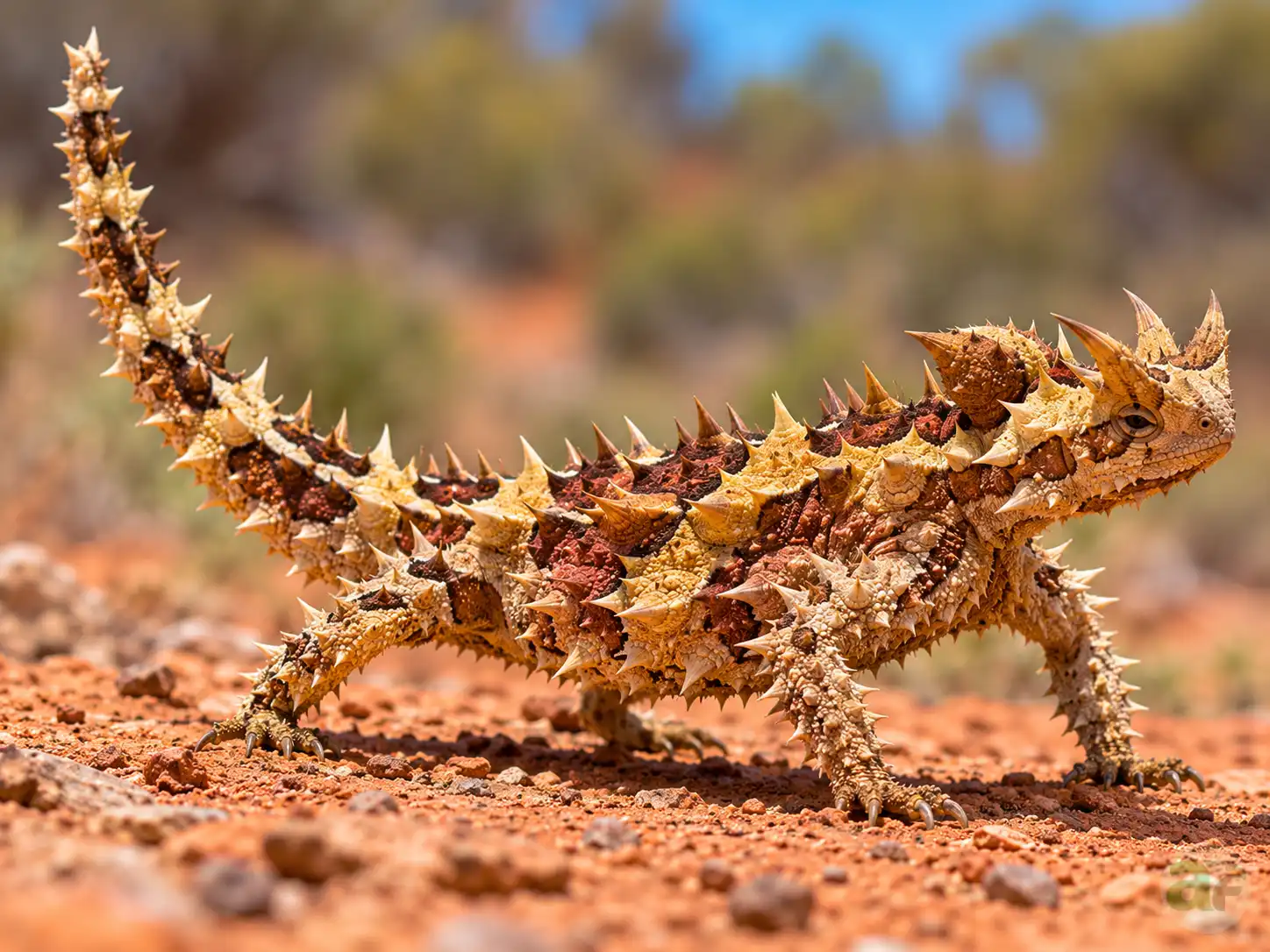
23. Frequently Asked Questions About Thorny Devils
Q1. What is the scientific name of the thorny devil?
The thorny devil’s scientific name is Moloch horridus (Gray, 1841). The genus name Moloch derives from the ancient Semitic deity Moloch — associated in ancient Canaanite religion with fire, sacrifice, and fearsome power — chosen by the Victorian zoologist John Edward Gray in 1841 to convey the lizard’s intimidating appearance. The species name horridus is Latin for “dreadful, bristling, rough” — further emphasizing the spiny, fearsome-looking appearance. The combined scientific name therefore means approximately “dreadful Moloch” — one of the most dramatically named small lizards in the world, attached to an entirely harmless ant-eating lizard that weighs less than 100 grams. The species belongs to the family Agamidae (dragon lizards), within the monotypic genus Moloch — no other species share the genus. The species was formally described by British zoologist John Edward Gray in 1841 based on specimens collected from the Australian interior.
Q2. How does the thorny devil drink water?
The thorny devil collects water through a remarkably sophisticated hygroscopic skin system — one of the most extraordinary water acquisition mechanisms of any vertebrate. The skin surface between the spines contains a network of microscopic channels (approximately 1–10 micrometers wide) that are made of hygroscopic (water-attracting) material. When any part of the body surface contacts water — whether morning dew condensing on the skin, rain falling on the body, or the lizard stepping onto wet sand — water enters these channels by capillary action (the same physical force that draws water up a thin glass tube against gravity). The channel network is oriented so that water traveling by capillary action is directed toward a single destination: the corners of the mouth. Once water reaches the mouth corners, the thorny devil performs visible mouth-pumping movements (opening and closing the jaws in a chewing-like motion) that draw the water from the channel terminus into the oral cavity for swallowing. This entire process requires no active drinking behavior — the lizard simply needs to be in contact with a moisture source, and the skin does all the collection and transport work.
Q3. What does the thorny devil eat?
The thorny devil eats exclusively ants — one of the most extreme dietary specializations of any vertebrate. Despite living in a habitat that contains numerous other invertebrate prey types, every systematic study of thorny devil diet (through stomach content analysis) has confirmed that ants and only ants are consumed. Individual foraging sessions can yield 1,500–2,500 individual ants consumed one at a time through individual tongue strikes at active ant trails. Across the species’ range, thorny devils have been recorded consuming up to 45 different ant species — but at any single foraging site and session, individuals typically target the one or two most locally abundant and most accessible species. The preferred prey are small-bodied, slow-moving, surface-foraging ants without strong chemical defenses. The exclusive ant diet reflects the extraordinary abundance of ants in the Australian arid zone — ants can constitute up to 50% of all invertebrate biomass in some Australian desert habitats, making them the most consistently available food resource for a specialist predator.
Q4. Is the thorny devil related to the Texas horned lizard?
No — the thorny devil and the Texas horned lizard are not closely related. They belong to entirely different lizard families: the thorny devil to the Agamidae (the dragon lizards, native to the Old World) and the Texas horned lizard to the Phrynosomatidae (native to the Americas). Their shared features — comprehensive spine armoring, exclusive or primary ant diet, hygroscopic skin water collection, cryptic coloration, and slow foraging behavior — are the products of convergent evolution: two unrelated lizard lineages independently evolving virtually identical solutions to the problem of ant-specialist existence in hot desert environments. The convergence is so complete that the two species were for a time used as the definitive textbook example of convergent evolution in vertebrates. They demonstrate that the same ecological selective pressures — ant abundance as prey, hot desert environment requiring water conservation, need for defense against predation — produce the same evolutionary solutions regardless of the starting point of the lineage.
Q5. Where does the thorny devil live?
The thorny devil lives in the arid and semi-arid interior of Australia — one of the most geographically restricted ranges of any Australian lizard, confined to the desert and semi-desert environments of the continental interior. The species’ distribution is centered on the vast sandy plains of the Western Australian interior (particularly the Great Sandy, Gibson, and Great Victoria Desert regions) and extends into the sandy arid zones of South Australia, the Northern Territory, and western Queensland. The species is notably absent from the most extreme true desert environments — bare gibber plains, salt lakes, and intensely arid sand dune fields without vegetation — where ant colony density is insufficient to support an exclusive ant-eater. The thorny devil’s distribution precisely tracks the distribution of sandy soils supporting spinifex grassland and mallee vegetation — which in turn track the distribution of the ant communities that constitute its food supply. A small part of the range extends into western New South Wales, but the species is entirely absent from the better-watered coastal and subcoastal areas of Australia.
24. Sources & References
- Wikipedia — Moloch horridus, Agamidae, Phrynosoma cornutum (convergent evolution)
- IUCN Red List — iucnredlist.org (current Least Concern assessment for Moloch horridus)
- Withers, P.C. et al. — published papers on hygroscopic skin water collection in thorny devils; University of Western Australia
- Sherbrooke, W.C. — published research on thorny devil ecology and the Texas horned lizard comparison
- Pianka, E.R. — foundational ecological research on Australian desert lizards including thorny devils
- Cogger, H.G. (2014). Reptiles and Amphibians of Australia (7th ed.). CSIRO Publishing
- National Geographic — nationalgeographic.com
- Australian Museum — australianmuseum.net.au
- BBC Wildlife / BBC Earth — bbcearth.com
- Britannica — britannica.com/animal/thorny-devil
- Western Australian Museum — museum.wa.gov.au
- MIT biomimetic water harvesting research publications
- Atlas of Living Australia — ala.org.au (occurrence data)