

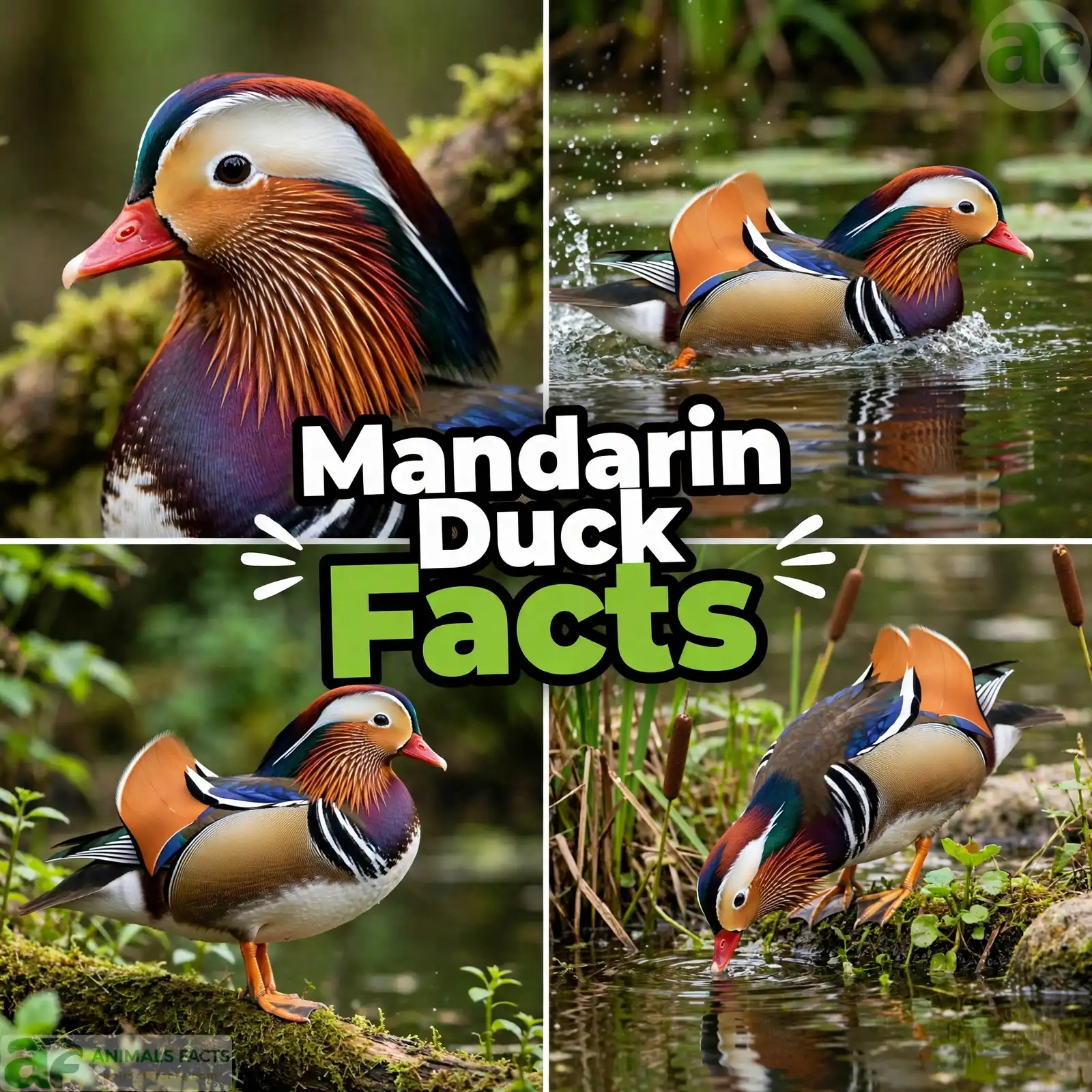
Mandarin Duck Facts
| Feature | Details |
|---|---|
| Scientific Name | Aix galericulata (Linnaeus, 1758) |
| Kingdom | Animalia |
| Phylum | Chordata |
| Class | Aves |
| Order | Anseriformes |
| Family | Anatidae |
| Common Names | Mandarin duck; Yuan-yang (Chinese: 鴛鴦) |
| Native Range | Eastern Asia — China, Japan, Korea, Russian Far East |
| Habitat | Wooded rivers, lakes, and ponds with overhanging trees — lowland to montane forest waterways |
| Lifespan | 6–7 years (wild estimate); up to 12 years (captivity) |
| Diet | Seeds, acorns, aquatic plants, insects, small fish, snails — omnivorous |
| Body Length | 41–49 cm |
| Weight | Males 428–693 grams; females 428–608 grams |
| Conservation Status | Least Concern (IUCN) — but native Asian population declining |
| Defining Feature | Male’s sail feathers — uniquely modified orange inner wing feathers erected vertically above the back; no other duck possesses this structure |
| Closest Relative | North American wood duck (Aix sponsa) — the only other member of genus Aix |
| Cultural Significance | The most important bird symbol of romantic love and marital fidelity in Chinese, Japanese, and Korean culture — appearing in art for over 2,000 years |
| Introduced Range | United Kingdom, Ireland, Germany, and other European countries — with self-sustaining feral populations |
 1. Introduction: What is a Mandarin Duck?
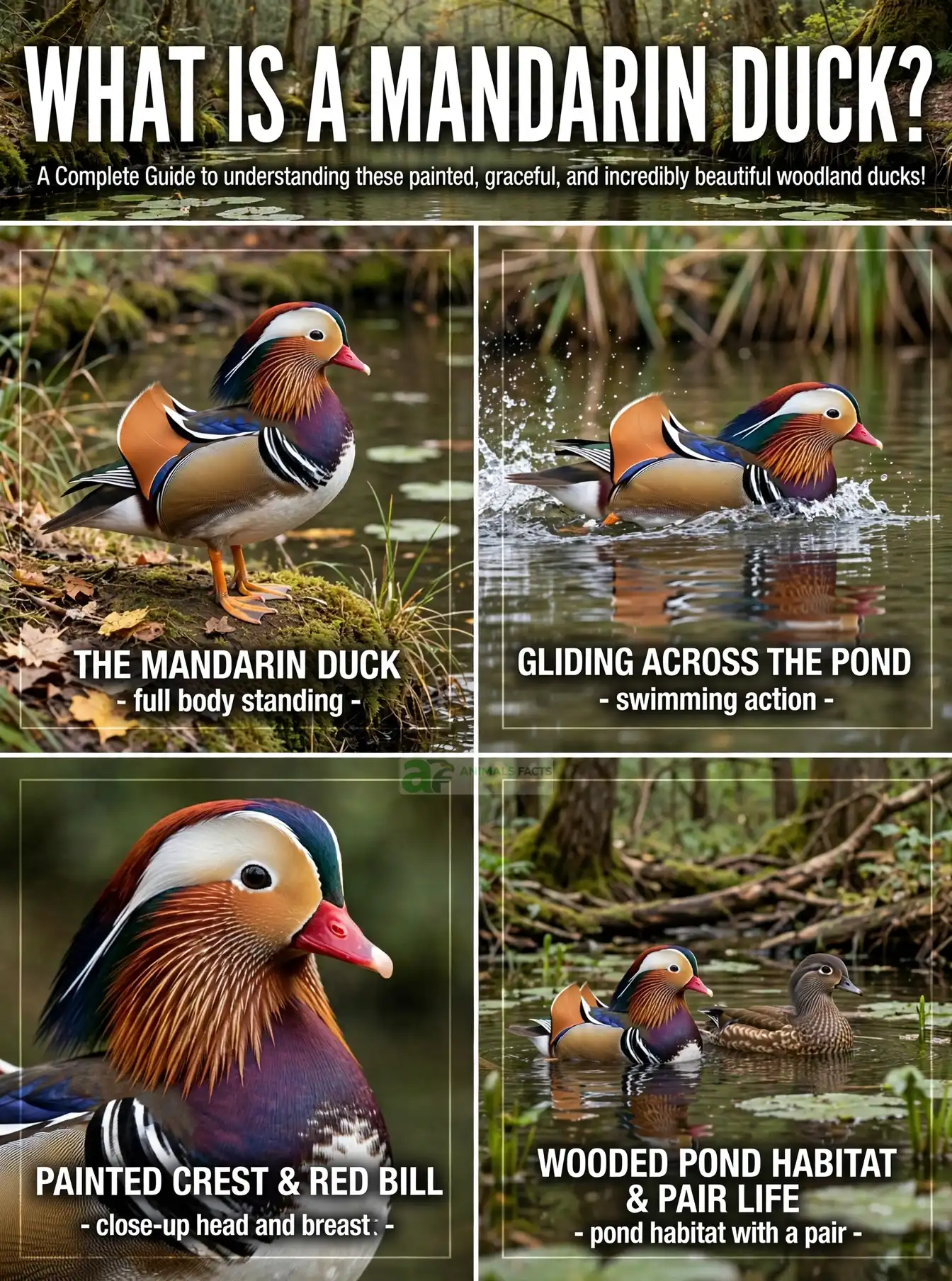
On a quiet wooded river in Japan’s Kyoto Prefecture, where ancient maples arch over still water and their autumn reflections turn the surface into a mirror of orange and gold, a male mandarin duck glides between the fallen leaves with the unhurried confidence of an animal that has been the most celebrated waterfowl in East Asian culture for two thousand years. The plumage is so complex, so deliberately polychromatic, so apparently incompatible with the biological requirements of a swimming bird that the eye initially refuses to parse it as a single coherent animal — the iridescent green and purple of the crested head, the chestnut-orange cheek fans spreading outward like twin sails on either side of the face, the white supercilium arc above the eye, the rust-red breast barred with white, the vivid orange of the unique sail feathers rising above the back in paired vertical fins, and the golden flanks catching the reflected maple light. Beside him, far less vivid but beautifully patterned in her own right, his mate moves with the same quiet ease — the gray-brown female whose subtle beauty has been celebrated in East Asian art precisely because it complements without competing with the male’s spectacular display. Mandarin duck facts begin with this image — the most beautiful duck in the world, the most culturally significant waterfowl in human history, and an animal whose biology is as extraordinary as its appearance.
The mandarin duck (Aix galericulata) occupies a unique position in both natural history and human culture. In zoology, it is one of only two species in the genus Aix — the other being the North American wood duck (Aix sponsa), the only duck in the world considered a close rival for the mandarin duck’s beauty. In East Asian cultural history, the mandarin duck is the supreme symbol of romantic love and marital fidelity — appearing in Chinese poetry, Japanese woodblock prints, Korean wedding traditions, and the decorative arts of three civilizations for over two thousand years. In an extraordinary cross-cultural parallel, Western observers who first encountered the mandarin duck in the 18th century responded with the same aesthetic impact that East Asian traditions had been articulating for millennia — the bird’s plumage being described as the most beautiful in any duck species by virtually every ornithologist who has formally assessed it. And in conservation biology, the mandarin duck presents a paradox — a species whose native Asian population is declining due to habitat loss and hunting, whose global population is sustained substantially by introduced feral populations in the United Kingdom and Europe, and whose extraordinary cultural significance has not prevented the degradation of the river and forest habitats it requires in its native range.
Interesting facts about mandarin ducks reveal an animal of breathtaking biological sophistication beyond the visual impact — the unique sail feathers (modified tertial wing feathers erected vertically during display) that have no parallel in any other duck species; the nesting behavior of a cavity-nesting duck that raises its chicks in tree holes up to 9 meters above the ground and then persuades the day-old ducklings to jump to the forest floor on their first day of life; the extraordinary swimming and diving capability of a duck that also perches in trees and is more closely related in behavior to wood ducks than to typical swimming ducks; the complex social dynamics of wintering flocks in which pair bond formation involves elaborate multi-male competitive display; and the cultural mythology that has made the mandarin duck symbol of love so pervasive across East Asia that no wedding gift, bedroom decoration, or romantic artwork tradition in Chinese, Japanese, or Korean culture is complete without reference to these birds. Whether you are searching for mandarin duck facts for kids to explore the biology and culture of the world’s most beautiful waterfowl, an ornithologist interested in the convergent evolution of spectacular male plumage in Aix, a wildlife tourist planning a visit to see these extraordinary birds, or simply someone who encountered a photograph of a male mandarin duck in autumn maple light and experienced the immediate need to understand everything about this extraordinary animal — this is your comprehensive guide. The world’s most beautiful waterfowl has an extraordinary story to tell.
2. Mandarin Duck Species Overview & Classification
The mandarin duck belongs to the genus Aix — one of the smallest and most distinctive genera in the enormous family Anatidae — and is classified within the tribe Aythyini or, in some taxonomic systems, in a separate position reflecting its perching duck characteristics.
Species Classification Table
| Taxonomic Rank | Classification |
|---|---|
| Kingdom | Animalia |
| Phylum | Chordata |
| Class | Aves |
| Order | Anseriformes |
| Family | Anatidae (Leach, 1820) |
| Tribe | Aythyini (or Cairinini in some systems) |
| Genus | Aix (Boie, 1828) |
| Species | A. galericulata (Linnaeus, 1758) |
| Common Names | Mandarin duck; Yuan-yang (鴛鴦); Oshidori (Japanese: オシドリ) |
| Etymology | Aix = a water bird mentioned by Aristotle (Greek); galericulata = “wearing a small hat or wig” (Latin: galerum = hat/wig) — referring to the elaborate head crest; “mandarin” referring to the brilliantly colored robes of Chinese imperial Mandarin officials |
The Genus Aix — Two Species, Two Continents, One Design Philosophy
The genus Aix contains only two species — separated by the entire Pacific Ocean but sharing a remarkably similar evolutionary solution to the challenge of being a spectacularly beautiful perching duck:
| Feature | Mandarin Duck | Wood Duck |
|---|---|---|
| Scientific name | Aix galericulata | Aix sponsa |
| Range | Eastern Asia | North America |
| Male weight | 428–693 g | 454–862 g |
| Crest | Green-purple iridescent crest | Iridescent green-purple swept-back crest |
| Sail feathers | Yes — orange, uniquely erected vertically | No |
| Cheek fans | Orange-chestnut fans | No cheek fans |
| Conservation | Least Concern (declining native) | Least Concern (recovered from near-extinction) |
| Nest | Tree cavity up to 9 m high | Tree cavity; also nest boxes |
| Cultural significance | Supreme symbol of love in East Asia | American sporting and conservation icon |
| Acorn diet | Yes — important | Yes — important |
The Anatidae Family Context
The mandarin duck belongs to the largest waterfowl family — Anatidae contains approximately 174 species of ducks, geese, and swans distributed globally:
The perching duck classification — The mandarin duck is classified among the perching ducks (sometimes tribe Cairinini) — a group of wood ducks and related species distinguished by their ability to perch in trees, their cavity-nesting behavior, and their generally more elaborate male plumage compared to typical surface-feeding or diving ducks.
The convergent solution — The remarkable visual similarity between mandarin ducks and wood ducks — two species separated by thousands of miles of ocean — represents one of the clearest examples of convergent evolution in waterfowl: two lineages evolving remarkably similar ecological strategies (cavity nesting, arboreal perching, forest waterway habitat, elaborate male plumage) independently in different parts of the world.
Evolution & Discovery Timeline
~20–25 million years ago (Miocene) — The ancestral Anatidae radiation diversifies — the perching duck lineage that will produce both Aix species establishing in forested waterway environments.
~5–10 million years ago — The Aix lineage diverges from related perching ducks — establishing the genus in forested Asian and North American waterways separated by the Pacific.
Pre-Han Dynasty (before 206 BCE) — The mandarin duck is already established as a cultural symbol in Chinese civilization — early references to the Yuan-yang (鴛鴦) as paired love birds appear in classical Chinese literature predating the Han Dynasty.
Han Dynasty (206 BCE–220 CE) — The mandarin duck’s cultural significance as a symbol of marital fidelity becomes formalized in Chinese decorative arts and poetry — the pairing of male and female mandarin ducks becoming a standard motif in wedding gifts and romantic art.
Tang Dynasty (618–907 CE) — The mandarin duck reaches the height of its cultural significance in Chinese art — appearing in paintings, ceramics, silk embroideries, and poetry of the Tang Dynasty’s extraordinary artistic output. The Tang poet Du Fu references the mandarin duck in multiple poems as the supreme image of faithful partnership.
~17th–18th century — Mandarin ducks are introduced to European noble collections — among the first Asian waterfowl to reach European aviaries, their extraordinary appearance generating immediate fascination among European naturalists.
1758 — Carl Linnaeus formally describes the mandarin duck as Anas galericulata in the 10th edition of Systema Naturae — subsequently reclassified to the genus Aix established by Friedrich Boie in 1828.
~1745–1800s — Mandarin ducks begin escaping from European aviaries and establishing feral populations — the UK population beginning from escaped birds in collections at various private estates.
20th century — Systematic population surveys in the native Asian range document significant declines — habitat loss and hunting reducing native populations particularly in China, Korea, and the Russian Far East.
2018 — A male mandarin duck appears in Central Park, New York City — generating extraordinary global media attention and becoming one of the most photographed wild birds in New York City history.
2024 — Aix galericulata maintains its Least Concern IUCN classification globally — but the native Asian population is assessed as declining, with the introduced UK population now representing a significant proportion of the global total.
“The mandarin duck has achieved something remarkable — it has been the supreme symbol of romantic love in three great East Asian civilizations for over two thousand years, and when Western ornithologists finally encountered the living bird in the 18th century, they independently arrived at exactly the same conclusion: this is the most beautiful duck in the world. That cross-cultural consensus, sustained across two millennia and two hemispheres, is one of the most extraordinary facts in the history of human responses to natural beauty.”
— Dr. Janet Kear, Wildfowl and Wetlands Trust — leading authority on waterfowl biology and cultural history
3. Mandarin Duck Physical Description & Unique Features
The mandarin duck’s male plumage is without question the most complex and most polychromatic of any duck in the world — an accumulation of structural coloration, unique anatomical modifications, and vivid pigment-based colors that requires a considerably longer description than most waterfowl plumages.
The Male Plumage — The World’s Most Elaborate Duck
The male mandarin duck’s breeding plumage (worn from approximately September to June, with eclipse plumage in summer) combines at least six distinct color regions into a coherent but extraordinarily complex whole:
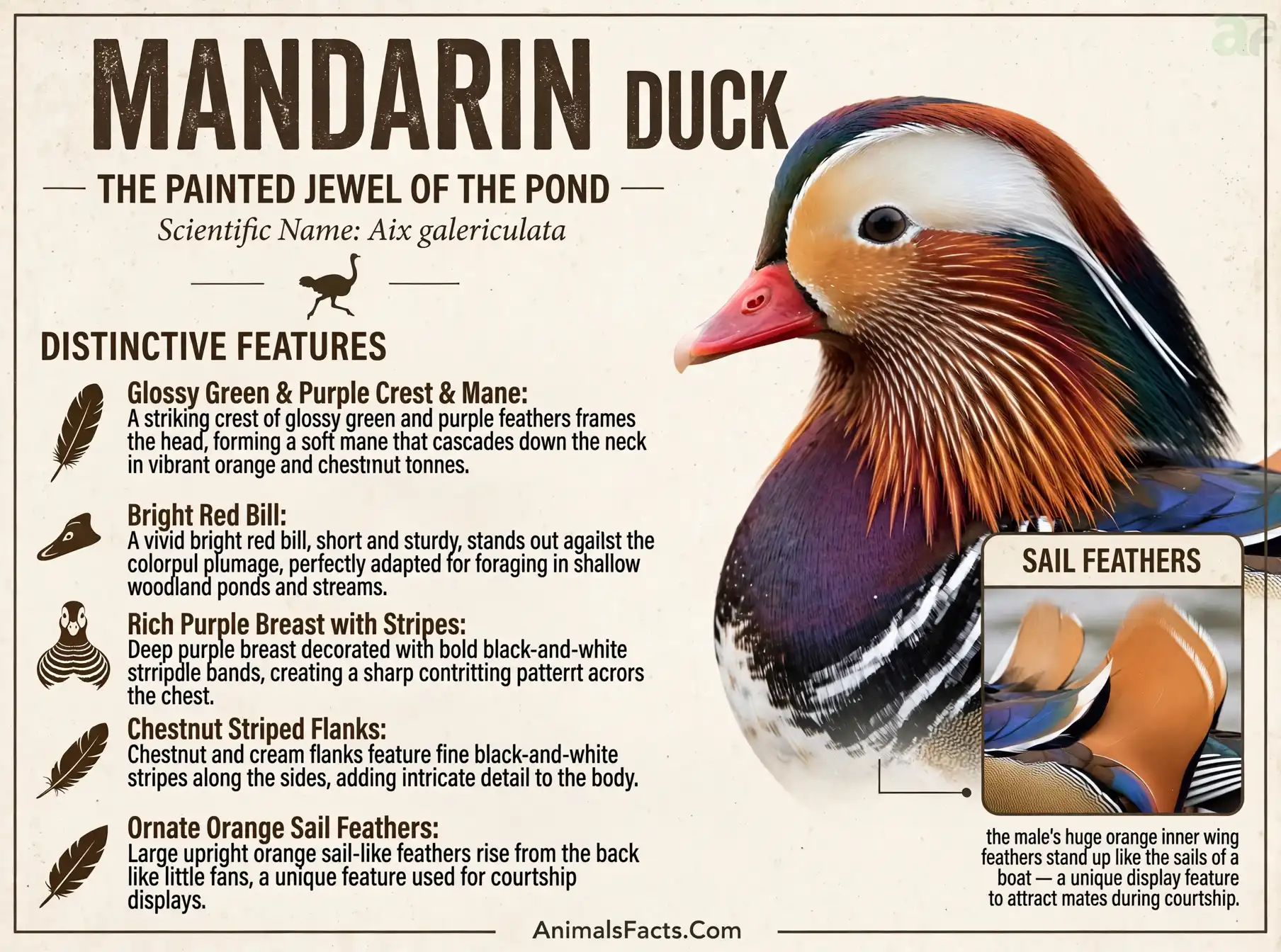
The iridescent crest — The head bears an elaborate crest of iridescent feathers — green and purple metallic feathers projecting backward from the crown, with a broad white supercilium (eyebrow stripe) creating a dramatic arc above the red-orange eye. The crest color shifts between green, purple, and bronze depending on the angle of light — structural coloration producing the iridescence.
The cheek fans — On either side of the face, long chestnut-orange feathers form spectacular spreading fans — unique to the mandarin duck among all ducks, these cheek fans project outward from the face during display, creating the impression of an orange ruff or mane framing the iridescent head.
The breast — A deep purple-chestnut breast bordered by vertical white bars on each side — the bars creating a visual fence between the breast and the flanks.
The sail feathers — The Most Unique Feature — The sail feathers are the mandarin duck’s most extraordinary anatomical feature — and the structure that has no parallel in any other duck species in the world. These are modified tertial wing feathers (inner flight feathers) that have been elongated and modified to stand vertically above the back in a pair of vivid orange-gold vertical panels when erected during display. The sail feathers are raised and lowered through muscle action — during active display they create the appearance of twin sails or paddles mounted on the duck’s back, an appearance so unlike any other duck that early European observers struggled to describe what they were seeing.
The flanks — The flanks are golden-buff to yellow — a warm, rich color that provides maximum contrast with both the purple breast and the orange sail feathers above.
The undertail and rump — The area around the tail features complex patterns of cream, black, and orange-red — the orange-red undertail coverts creating a warm glow beneath the tail.
The Sail Feathers — Anatomy of a Unique Structure
The sail feathers deserve more detailed examination because they represent a genuine anatomical innovation with no parallel elsewhere in the Anatidae family:
What they are — The sail feathers are modified tertials — the innermost flight feathers that in most ducks lie flat along the back when the wings are folded. In the mandarin duck, these feathers have been modified through sexual selection into:
- Dramatically elongated structures
- With the feather vane broadened into a wide, flat paddle shape
- Able to be erected vertically through specialized muscles at the feather base
- In a vivid orange-gold color — the most intense warm color in the male’s entire plumage
The display function — During courtship display, the male erects the sail feathers to their maximum vertical position — the paired orange panels becoming one of the most visually distinctive signals in the entire display. Females are believed to assess the size, color, and symmetry of the sail feathers as part of mate quality evaluation.
The female assessment signal — Like the golden pheasant’s scarlet breast and the paradise tanager’s scarlet rump, the orange color of the sail feathers is produced by carotenoid pigments derived from the diet — the vividness of the orange correlating with the male’s dietary quality and metabolic efficiency. The sail feathers are therefore both a unique anatomical innovation and an honest signal of individual quality.
The Female Plumage — Subtle Beauty Celebrated in East Asian Art
The female mandarin duck’s plumage has received more artistic attention than the female of almost any other duck species — celebrated in East Asian art for its quiet elegance alongside the male’s spectacular display:
Overall appearance — Brown-gray with complex fine speckling and barring — the intricate detailed patterning creating a subtle, sophisticated beauty quite different from the dramatic polychromatic display of the male.
The white eye ring — A distinctive white spectacle ring around each eye — the most immediately recognizable identification feature of the female, creating the impression of the duck wearing small white glasses.
The white chin stripe — A narrow white stripe running from the bill along the throat — a fine, clean marking that gives the face subtle visual structure.
The speculum — The wing shows a green speculum (iridescent wing patch) — similar in position to the specula of many duck species but more vivid in the mandarin duck than in most female ducks.
The eclipse male — During summer (approximately June–August), the male mandarin duck molts into eclipse plumage — a temporary dull plumage resembling the female’s, retained while the flight feathers are also molted and the bird is temporarily flightless. The eclipse plumage can be distinguished from the female by orange-red bill (female’s bill is pale pink-gray) and slightly different face pattern.
The Unique Eye Color
One of the mandarin duck’s most visually striking features is the bright orange-red iris of the adult male — a vivid eye color that contrasts dramatically with the surrounding iridescent head plumage. Female eyes are dark brown. The male’s vivid eye color intensifies with age and condition — potentially functioning as an additional honest signal of individual quality during mate assessment.
💡 Did You Know? The mandarin duck’s sail feathers are so anatomically unique that when the first mandarin duck specimens reached European natural history collections in the 18th century, multiple ornithologists initially debated whether the sail feathers were genuine feathers or some kind of artificial decoration added to the specimens by Asian traders. The erect orange structures positioned above the back were simply without precedent in any known duck species — and European ornithologists, accustomed to the relatively modest wing feathers of familiar European ducks, struggled to accept that evolution had produced an anatomical structure so unlike anything in familiar Anatidae. The debate was resolved by examination of the feather insertion points on live specimens — confirming that the sail feathers are genuine anatomical structures inserted in the tertial position of the wing. The sail feathers’ uniqueness extends to function — no other duck species has independently evolved a tertial modification of this type, making the mandarin duck not merely the most beautiful duck in the world but also the most anatomically distinctive.
4. Top 25 Amazing Mandarin Duck Facts
Here is your definitive collection of the most extraordinary, scientifically verified, and genuinely astonishing mandarin duck facts as of 2026:
- The male mandarin duck possesses sail feathers — uniquely modified orange inner wing feathers that stand vertically above the back during display — a structure with no parallel in any other duck species in the world. No other member of the family Anatidae has independently evolved this type of modified tertial display structure.
- The mandarin duck is the most important symbol of romantic love and marital fidelity in Chinese, Japanese, and Korean culture — known in Chinese as Yuan-yang (鴛鴦), the paired mandarin ducks have appeared in East Asian art, literature, ceramics, and wedding traditions for over 2,000 years.
- Mandarin duck ducklings hatch in tree cavities up to 9 meters (30 feet) above the ground and must jump to the forest floor on their first day of life — before they can fly, swim, or feed independently. The mother calls from below and the day-old ducklings launch themselves from the nest hole, surviving the fall due to their light weight and the cushioning of their downy body.
- The United Kingdom now holds one of the world’s most significant mandarin duck populations — estimated at 2,000–7,000 birds from feral descendants of aviary escapes — a population whose size may represent a substantial fraction of the declining native Asian population.
- A male mandarin duck that appeared in Central Park, New York City in October 2018 became one of the most famous individual birds in recent history — drawing crowds of thousands of visitors daily, generating global media coverage across every major international news outlet, and becoming the subject of an extraordinary sustained public fascination that lasted months.
- The mandarin duck is the only member of genus Aix in Asia — its only genus relative being the North American wood duck (Aix sponsa), separated by the Pacific Ocean. The remarkable visual and behavioral similarities between the two species represent one of the most striking examples of convergent evolution in waterfowl.
- Despite being primarily a swimming and diving duck, the mandarin duck regularly perches in trees — climbing to roosting positions in branches above water and nesting in tree cavities. This arboreal capability is unusual in Anatidae and is shared only with the perching duck tribe members.
- The mandarin duck’s cultural name Yuan-yang (鴛鴦) is so deeply embedded in Chinese romantic tradition that the term is used as a general descriptor for any devoted romantic couple — the phrase “yuan-yang” in Mandarin Chinese meaning a couple bound by deep love and fidelity, with no necessary reference to the birds themselves in modern usage.
- The mandarin duck eats acorns — consuming whole acorns in autumn with the powerful bill, a dietary behavior shared with its close relative the wood duck and unusual among waterfowl. The acorn diet is nutritionally important for building fat reserves before winter.
- A male mandarin duck in full breeding plumage shows a minimum of 15 distinctly different patterns in the plumage — more distinct plumage regions than any other duck species. The German ornithologist Philipp Ludwig Statius Müller described the mandarin duck as “nature’s masterpiece in waterfowl” when he first encountered specimens in the 18th century.
- The mandarin duck practices seasonal monogamy — pairs bond in autumn and winter, breed in spring and early summer, and the pair bond typically dissolves after the breeding season. However, some pairs have been documented reforming the bond in successive years at the same breeding location.
- The mandarin duck featured on a Chinese postage stamp series beginning in 1963 and has appeared on stamps from Japan, Korea, Russia, and multiple other countries — making it one of the most philatelically represented ducks in the world.
- The Chinese custom of gifting pairs of mandarin duck artwork at weddings — ceramics, paintings, embroideries, or carved figures of paired male and female mandarin ducks — is one of the most enduring wedding gift traditions in East Asian culture, practiced continuously for over a thousand years and remaining common in contemporary weddings across China, Japan, and the Korean diaspora worldwide.
- The mandarin duck’s cheek fans — the spreading chestnut-orange facial feathers — have no parallel in any other duck species and cannot be folded flat. They project permanently outward from the face in a semi-extended position, becoming more dramatically spread during active display.
- The native mandarin duck population in China has declined severely — from historical estimates of abundant populations across much of eastern and central China, the native Chinese population has been reduced significantly by habitat loss and hunting, with some estimates suggesting the current Chinese native population may be only a fraction of historical levels.
- The mandarin duck is a strong flier — capable of rapid maneuvering flight through dense forest to its nest cavity, and of sustained migration flights between breeding and wintering areas. The flight speed of approximately 65–75 km/h is faster than most comparable-sized waterfowl.
- In Japan, the mandarin duck is known as Oshidori (オシドリ) — and the Japanese phrase “Oshidori Fūfu” (オシドリ夫婦) meaning “mandarin duck couple” is a common expression for a loving, devoted married couple — parallel to the Chinese Yuan-yang tradition and equally deeply embedded in Japanese cultural language.
- The mandarin duck’s nest cavity is not excavated by the pair — unlike woodpeckers or some other cavity-nesting birds, mandarin ducks depend entirely on pre-existing tree holes created by decay or by primary excavators like large woodpeckers. The availability of suitable cavity trees is therefore a critical habitat requirement and a limiting factor in many areas.
- A pair of mandarin ducks depicted in a Ming Dynasty painting sold at Christie’s auction in 2017 for over £2.6 million — one of the most valuable single bird paintings in auction history, reflecting the extraordinary cultural status of the mandarin duck in Chinese artistic tradition.
- The mandarin duck’s orange-red bill (male) is used in close-range mate assessment — females in experimental studies respond more positively to males with brighter, more vivid bill coloration, suggesting the bill color is an additional honest signal of individual quality alongside the sail feathers and cheek fans.
- Mandarin ducks show remarkable nest site fidelity — females return to the same nest cavity in successive years, sometimes using the same tree hole for 5 or more consecutive breeding seasons. This strong site fidelity creates a dependency on specific cavity trees that makes the loss of individual trees a meaningful conservation concern.
- The wing pattern of the mandarin duck in flight — a combination of white underwing linings against dark body plumage — is distinctive enough to allow identification of flying birds at considerable distance, even without seeing the elaborate head and body plumage.
- Research on mandarin duck population genetics in the UK feral population has documented the expected founder effects from the relatively small founding population — but also surprising genetic diversity maintenance through ongoing introductions from various aviary sources over the past century, creating a genetically diverse UK population.
- The mandarin duck is essentially silent compared to most ducks — the male lacks the loud quacking of many Anatidae and produces instead soft whistling and rising calls. The female’s alarm call is a sharp keck — but outside of alarm situations, mandarin ducks are among the quietest of waterfowl.
- As of 2026, the global mandarin duck population is estimated at approximately 65,000–100,000 individuals — a figure carrying significant uncertainty given the difficulty of surveying native populations in China’s interior forests. The native Asian population trend is declining while the UK introduced population has been growing — creating an unusual conservation situation where an introduced population is helping sustain global numbers for a declining native population.
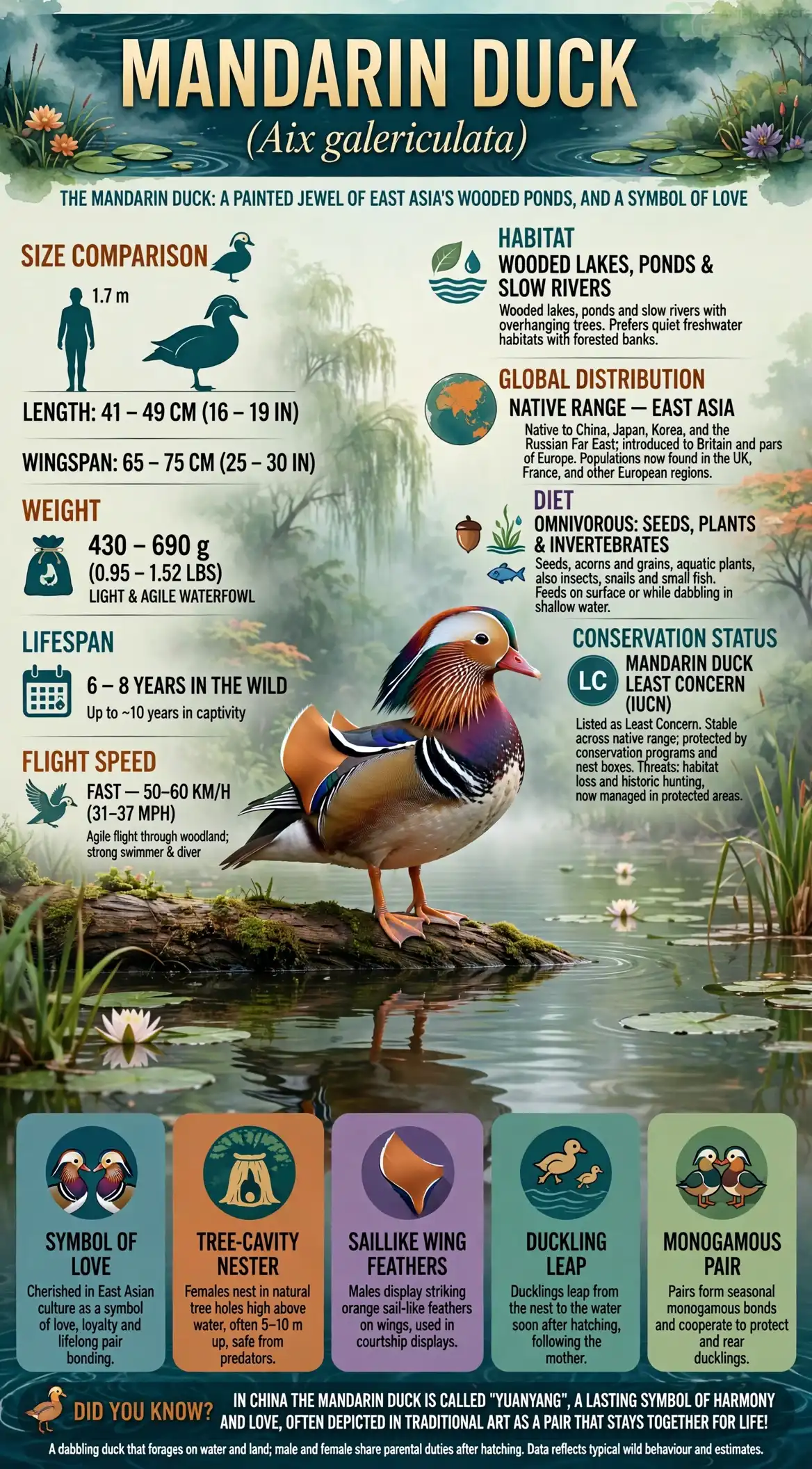
5. Fun Facts About Mandarin Ducks
- Sail feathers found in no other duck species on Earth
- Symbol of love in East Asia for 2,000+ years
- Ducklings jump from 9-meter-high nest on day one
- UK feral population may be a significant fraction of global total
- The Central Park mandarin duck became a global celebrity
- Only Aix species in Asia — relative is North American wood duck
- Regularly perches in trees — unusual for ducks
- “Yuan-yang” now means devoted couple in Chinese language
- Eats whole acorns — unusual among waterfowl
- Male has 15+ distinct plumage regions
- Ming Dynasty mandarin duck painting sold for £2.6 million
- One of the quietest ducks — no loud quacking
6. Mandarin Duck Natural Habitat & Geographic Range
Mandarin duck habitat is defined by the combination of wooded waterways providing both the tree cavities needed for nesting and the sheltered, food-rich water environment that supports year-round survival.
Primary Habitat Requirements
Mature forest adjacent to water — The mandarin duck’s most fundamental habitat requirement is the combination of mature deciduous or mixed woodland close to rivers, lakes, or ponds. The woodland provides:
- Nest cavity trees — large, mature trees with suitable holes created by decay or woodpecker excavation
- Roosting sites — branches overhanging water for resting and predator avoidance
- Acorn and seed production — mature oak, beech, and related trees producing the autumn food resources that build winter fat reserves
Clean, flowing water — Mandarin ducks strongly prefer clean, clear water — rivers, streams, and lakes with good water quality and adequate aquatic invertebrate diversity. Turbid, polluted water with poor invertebrate communities is avoided.
Dense overhanging vegetation — The mandarin duck’s predator avoidance strategy depends substantially on the cover provided by overhanging trees and emergent vegetation at water margins — providing escape cover and shade that reduces the bird’s visibility to aerial predators.
Appropriate water depth — Mandarin ducks feed primarily by dabbling and upending in shallow water — the optimal foraging depth is typically less than 30 cm, making shallow water margins and riparian pools more important than deep open water.
Cavity tree density — The density of suitable nest cavity trees is one of the most important and most frequently limiting habitat factors. Forests with mature trees, abundant dead wood, and active woodpecker populations have higher cavity densities and support higher mandarin duck breeding densities.
Geographic Distribution
Native Range
| Country/Region | Status | Key Areas | Notes |
|---|---|---|---|
| Japan | Most stable native population | Honshu, Kyushu, Shikoku — wooded rivers throughout | Best-documented native population; estimated 5,000–20,000 |
| China | Declining | Northeastern provinces; southeastern mountain rivers; Yangtze tributaries | Historical stronghold now significantly reduced |
| Korea | Present — declining | Mountain rivers; DMZ area | Some protection from low disturbance in border areas |
| Russia (Far East) | Present | Ussuri region; Amur River drainage | Migratory; breeds in summer |
| Taiwan | Rare | Northern mountain rivers | Small wintering population |
| Myanmar (north) | Occasional | Northern highlands | Marginal range limit |
Introduced Range
| Country | Status | Key Areas | Notes |
|---|---|---|---|
| United Kingdom | Self-sustaining — growing | Surrey, Berkshire, London parks, Virginia Water; spreading nationwide | Largest introduced population; estimated 2,000–7,000 birds |
| Ireland | Small feral population | County Wicklow; scattered | Smaller than UK |
| Germany | Local populations | Rhine valley; scattered parks | Less stable than UK |
| Netherlands | Small populations | Various park lakes | Continuing expansion |
| France | Occasional feral birds | Various | Less established |
| United States | Occasional escapes | Central Park fame; various | No stable self-sustaining population confirmed |
The UK Population — A Conservation Paradox
The UK mandarin duck population represents one of the most significant conservation paradoxes in British ornithology:
The establishment history — Mandarin ducks began escaping from British private wildfowl collections in the 19th century — the species’ tolerance for the UK’s temperate climate and the availability of appropriate wooded waterway habitat (particularly in Surrey, Berkshire, and London’s parkland rivers) allowing the establishment of self-sustaining feral populations that have grown steadily over more than a century.
The population significance — At an estimated 2,000–7,000 individuals, the UK feral population now represents a potentially significant portion of the global mandarin duck total — a situation unique among introduced bird populations where an introduced population is helping compensate for native population declines.
The habitat match — The UK’s deciduous woodland rivers — particularly the wooded stretches of the Thames, Wey, and other southern English rivers — provide remarkably good mandarin duck habitat. The combination of mature oak woodland, clean chalk-stream rivers, and relatively low hunting pressure creates conditions in many ways superior to the degraded native-range habitats that the species has lost in China.
Conservation status in the UK — The UK’s mandarin duck population is formally recognized as a Category C species (established introduced bird) in the British List — counted separately from native birds but monitored and subject to the same level of conservation attention as many native species given the global population significance.
7. Mandarin Duck Diet & Feeding Behavior
Mandarin duck diet is broadly omnivorous — the species consuming plant material, invertebrates, and small vertebrates in proportions that shift significantly with season and habitat.
Diet Breakdown Table
| Food Type | Estimated % of Diet | Season | Notes |
|---|---|---|---|
| Aquatic plants and seeds | ~25–35% | Spring/Summer | Aquatic vegetation; emergent plant seeds |
| Acorns | ~20–30% | Autumn peak | Most important autumn food; swallowed whole |
| Aquatic invertebrates (insect larvae, snails) | ~15–20% | Spring/Summer | Important protein source; feeding in shallow water |
| Terrestrial insects and grubs | ~10–15% | Spring/Summer breeding season | Gleaned from forest floor and water margin |
| Small fish | ~5–10% | Year-round | Caught by diving and surface pursuit |
| Beech mast and other nuts | ~5–10% | Autumn | Secondary to acorns; important fat storage food |
| Berries and soft fruit | ~3–5% | Autumn | Opportunistic; various forest fruits |
| Frogs and small amphibians | ~1–3% | Spring | Breeding season protein supplement |
The Acorn Specialization
The mandarin duck’s consumption of whole acorns — swallowed entire and processed in the muscular gizzard — is one of the most characteristic and most ecologically significant aspects of its diet:
The mechanism — The mandarin duck’s powerful, relatively broad bill allows it to pick up and manipulate acorns of substantial size. The strong muscular gizzard then grinds the hard acorn shell and seed material — the high fat content of acorns providing exceptional caloric density for fat storage before winter.
The woodland dependency — The importance of acorns in the autumn diet creates a direct ecological link between mandarin duck population health and oak woodland productivity. In years of mast failure (poor acorn crops), mandarin duck body condition entering winter is reduced — affecting overwinter survival and subsequent breeding success.
The shared strategy — The acorn specialization shared between the mandarin duck and the North American wood duck — both members of genus Aix — represents another element of the remarkable convergent evolution between these sister species.
Foraging Behaviors
Dabbling and upending — The most common foraging behavior in water; the mandarin duck tips forward to submerge the head and neck while the tail is raised, reaching aquatic vegetation and invertebrates at depths of up to 30 cm.
Surface feeding — Picking food items from the water surface — aquatic insects, floating seeds, and small items — without submerging.
Diving — While not as proficient as diving ducks (Aythya species), mandarin ducks can dive to modest depths to capture fish and aquatic invertebrates. Diving is relatively infrequent compared to dabbling.
Forest floor foraging — During autumn acorn collection, mandarin ducks walk on the forest floor beneath oak and beech trees — collecting fallen mast in a terrestrial foraging mode quite unlike typical duck feeding behavior. This forest floor foraging takes the duck significantly away from water.
Nocturnal feeding — Mandarin ducks are partly crepuscular to nocturnal feeders in areas of human disturbance — feeding intensively at dawn and dusk while roosting away from disturbance during the day.
8. Mandarin Duck Reproduction & Life Cycle
Mandarin duck reproduction combines the cavity-nesting strategy shared with wood ducks with the extraordinary duckling jump behavior — one of the most dramatic first-day-of-life events of any bird species.
Pair Bond Formation — The Winter Display Season
Pair bond timing — Unlike most breeding birds that form pairs immediately before breeding, mandarin ducks form their pair bonds in autumn and winter — the elaborate male display behavior beginning as early as September-October, with pairs established well before the March–May breeding season.
The winter display — Male mandarin ducks perform elaborate courtship displays on the water during autumn and winter — creating spectacular visual performances that are among the most celebrated wildlife spectacle events at mandarin duck viewing sites in Japan and the UK:
Display components include:
- Sail feather erection — the orange sail feathers raised to maximum vertical position
- Shaking displays — rapid head shaking that creates flashes of iridescent color
- Bill dipping — repeated dipping of the bill to the water surface in a ritualized movement
- Wing preening — the male reaches with the bill to touch the sail feather while looking toward the female — drawing her attention to the sail feather’s color and structure
- Drinking displays — ritualized drinking movements incorporated into the display sequence
- Chasing — multiple males pursuing a single female, with the female selecting the male whose display she finds most compelling
Female choice — Female mandarin ducks exercise active mate choice — moving between displaying males, approaching some and retreating from others, and ultimately selecting a mate through a process that may involve assessment of multiple display elements including sail feather size and color, crest quality, bill color, and display energy.
Nesting
Nest site selection — The female selects the nest cavity — inspecting multiple potential sites before committing. Key nest site requirements:
- Entrance diameter of approximately 7–10 cm — large enough for the female to enter but small enough to exclude most predators
- Internal depth of at least 20–30 cm — providing a secure interior for the eggs and incubating female
- Height above ground — typically 2–9 meters — high enough to reduce terrestrial predator access but not so high that the duckling jump creates injury risk
- Proximity to water — ideally within a few hundred meters of suitable water
The clutch — The female lays 9–12 eggs (occasionally up to 14) in the bare cavity, lined only with down plucked from the female’s breast. No nest material is carried to the site — the eggs rest directly on the cavity floor or on accumulated debris.
Incubation — 28–30 days — incubated exclusively by the female. The male remains in the vicinity of the nest during early incubation but gradually becomes less attentive and typically abandons the pair bond before hatching to join male flocks in molting areas.
The Duckling Jump — One of the Most Extraordinary Events in Bird Biology
The situation — When the eggs hatch, the ducklings find themselves in a cavity that may be 9 meters above the ground — and they cannot fly. The cavity is too high for the mother to carry them down, and the ducklings cannot survive in the cavity beyond the first day (they have limited yolk reserves and no food in the cavity).
The solution — Within 24 hours of hatching, the female leaves the nest and calls from below. One by one — or in a group — the ducklings launch themselves from the cavity entrance and fall to the ground or water below. The fall may cover 9 meters of vertical distance.
The survival mechanism — The ducklings survive the fall because:
- Their low body weight (a newly hatched mandarin duckling weighs approximately 20–25 grams) means low momentum at impact
- The downy body provides cushioning at impact — the soft, compressible down distributing impact forces
- Behavioral adaptation — the ducklings naturally spread their small wings and position their feet downward during the fall, reducing the impact force
- Landing surface — many nests are positioned above dense leaf litter, moss, or shallow water that cushions the landing
Post-jump — Once all ducklings have jumped, the female leads the brood to the nearest suitable water — sometimes traveling several hundred meters through forest between the nest tree and the water. The ducklings can swim and feed independently within hours of hatching.
The male’s role — The male mandarin duck provides no parental care of ducklings — the female raises the entire brood independently after the pair bond dissolves during incubation.
Duckling Development and Fledging
Growth rate — Mandarin duck ducklings grow rapidly — approaching adult size within approximately 40–45 days of hatching.
Fledging — Ducklings acquire their first flight feathers and fledge at approximately 40–45 days — one of the shorter fledging periods among cavity-nesting waterfowl.
First breeding — Most mandarin ducks breed for the first time at 1 year of age — females typically more successful in first breeding than males, whose elaborate breeding plumage takes one year to fully develop.
9. Social Behavior & Communication
Mandarin duck social behavior shifts dramatically between the breeding season (relatively paired and territorial) and the non-breeding period (increasingly gregarious, with spectacular communal winter display).
Winter Flocking and Display
Wintering flocks — Outside the breeding season, mandarin ducks gather in flocks of 20–300 or more individuals at favored roosting and feeding sites. These winter flocks are among the most spectacular wildlife congregations in East Asian and UK waterways.
The Japanese viewing tradition — At traditional mandarin duck viewing sites in Japan — particularly at the famous Mitake Gorge on the Tama River west of Tokyo — winter mandarin duck flocks of 50–500 birds attract thousands of visitors annually, and the winter display behavior is one of the most celebrated wildlife spectacles in Japanese nature tourism.
Communal display dynamics — Within winter flocks, multiple males simultaneously perform display behaviors toward females — the collective male display creating extraordinary visual spectacles as multiple orange sail feathers rise and fall simultaneously across a group of displaying ducks.
Territory and Breeding Season Behavior
Breeding territory — Breeding pairs defend a loose territory around the nest site — the territory defending not so much a feeding area as the space immediately around the nest cavity from other cavity-competing pairs.
Male behavior during incubation — The male remains in the vicinity of the nest territory during early incubation — perching near the nest tree and occasionally displaying. However, as incubation proceeds, males progressively join male flocks in molting areas and abandon the pair bond before hatching.
The female’s exclusive parental role — After the male’s departure, the female incubates alone, manages the duckling jump alone, leads the brood alone, and protects the ducklings alone until fledging. This exclusive female parental care after initial pair bond dissolution is typical of many duck species but particularly pronounced in the mandarin duck.
Communication
Vocalizations — The mandarin duck is among the quietest members of Anatidae:
- Female alarm call — a sharp, rising keck or keh — the most frequently heard vocalization
- Male display call — a soft, rising whistle produced during courtship display
- Contact calls — soft, low conversational notes between pair members and between female and ducklings
- Flight calls — brief notes produced during takeoff and landing
Visual communication — Visual signals dominate communication, particularly during the display season:
- Sail feather position — fully erected (maximum display intensity) to flat (non-display) continuously variable
- Crest erection — the head crest raised and lowered during social interactions
- Cheek fan angle — the cheek fans spread more widely during display, less spread during resting
- Bill color intensity — the male’s orange-red bill color varies with condition and may function as a close-range quality signal
10. Predators & Defense Mechanisms
The mandarin duck faces predation from a range of aquatic, aerial, and terrestrial predators across its range — and its defense system relies primarily on the cover provided by wooded waterway habitat combined with the tree-nesting strategy that removes eggs and ducklings from most terrestrial predator reach.
Natural Predators
Mink (Neovison vison) — In the UK, introduced American mink are the most significant predator of mandarin ducks and their nests — the mink’s swimming ability, tree-climbing capability, and aggressive predatory behavior making it an effective predator of both incubating females and ducklings. Mink control programs in the UK benefit mandarin duck populations significantly.
Otter (Lutra lutra) — Documented predator of adult mandarin ducks in the UK and native range — the otter’s aquatic predation capability making it effective at catching ducks that enter the water.
Pine marten (Martes martes) — In the native Asian range and in parts of Europe, pine martens climb to tree cavities and predate nesting females and eggs — a significant nest predation pressure in areas where pine martens occur.
Hawks and falcons — Peregrine falcon (Falco peregrinus), sparrowhawk (Accipiter nisus), and in the native range various Asian hawk species are documented mandarin duck predators — the aerial hunting capability of these raptors making the duck vulnerable when flying across open water.
Fox (Vulpes vulpes) — A significant duckling predator — the female-led duckling brood on foot between the nest tree and water, or feeding in shallow marsh, is vulnerable to fox predation in both the native range and UK.
Large owls — Tawny owl and in Asia various large owl species predate roosting mandarin ducks — the duck’s nocturnal roosting in trees creating vulnerability to owl predation.
Nest cavity competitors — Jackdaws, starlings, and in the native range various hole-nesting species compete for suitable tree cavities — reducing nest site availability in areas where cavity competition is high.
Defense Mechanisms
Tree roosting — The most fundamental passive defense — roosting in trees above water removes the duck from the reach of terrestrial predators during the vulnerable overnight period. The height of the roost above water correlates with predator pressure — ducks roost higher when mink or other predators are present.
Cavity nesting height — Nesting in cavities 2–9 meters above ground removes eggs and incubating females from the reach of most terrestrial predators. The narrow cavity entrance prevents most predators of appropriate body size from entering the cavity.
Dense cover flight — Mandarin ducks are remarkably agile fliers for their body size — capable of rapid maneuvering through dense forest and woodland to escape pursuing raptors. The rapid wingbeat and tight turning capability allow escape from aerial predators in the wooded habitat the species prefers.
Cryptic female plumage — The female’s brown-gray patterned plumage provides camouflage when incubating in a cavity interior where only the head might be visible at the cavity entrance.
Alarm response — The female’s alarm call triggers immediate dispersal and hiding behavior in ducklings — ducklings scatter and hide among aquatic vegetation when the mother gives the alarm call, making the brood less vulnerable to predators than if they remained clustered.
Flock vigilance — In winter flocks, the collective vigilance of multiple individuals provides better predator detection than solitary individuals can achieve — each individual spending less time in personal vigilance and more time feeding as flock size increases.
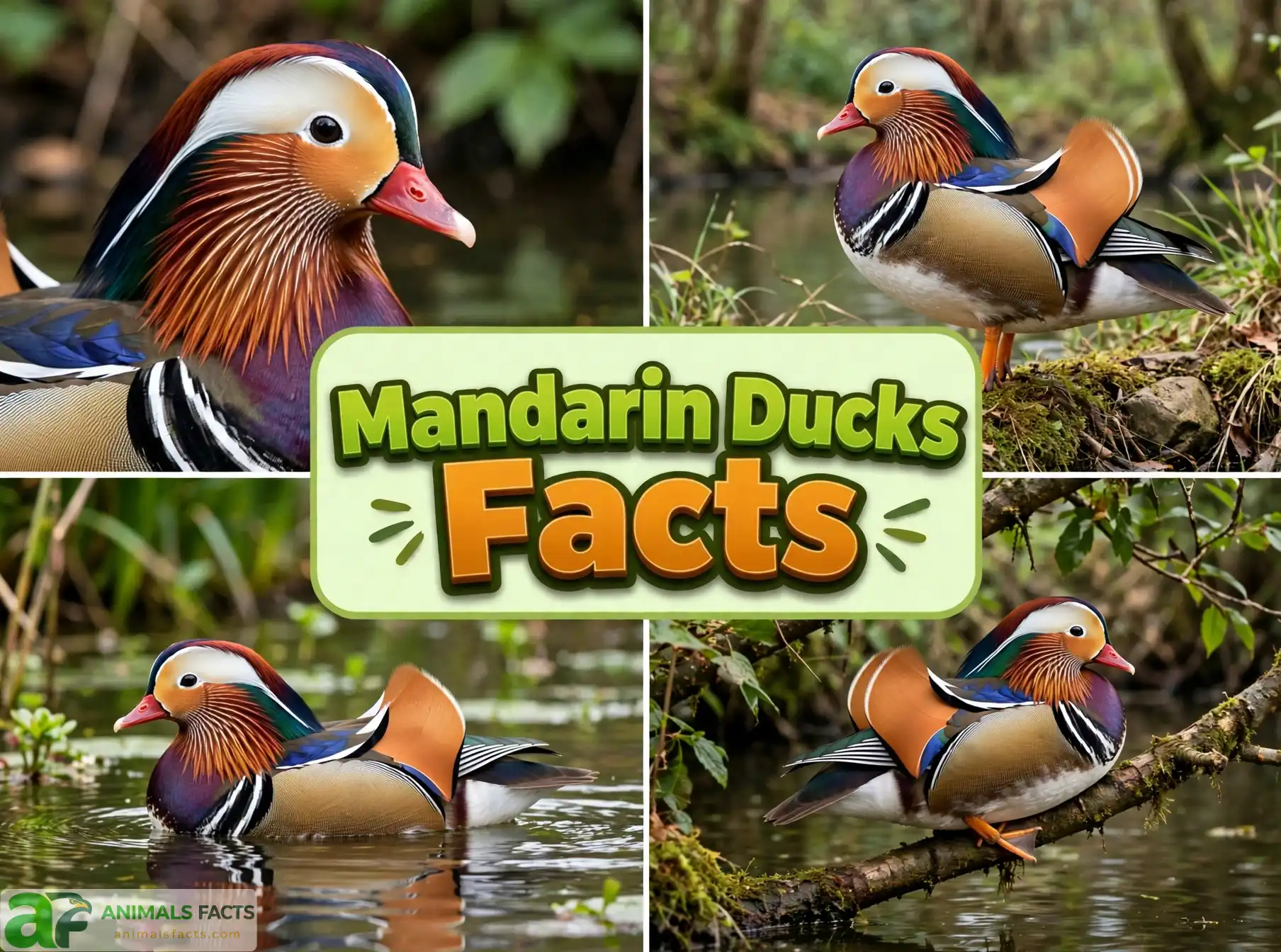
11. Mandarin Duck Facts for Kids
Hey amazing young wildlife scientists, duck enthusiasts, and nature lovers! Here are some truly extraordinary mandarin duck facts for kids that will make every conversation about birds infinitely more exciting:
- 🦆 The mandarin duck has SAILS on its back! No other duck in the world has this. The male mandarin duck has special orange feathers called sail feathers that stand straight up above its back like two tiny golden paddles or sails. They can raise and lower these feathers whenever they want — like little orange wings on top of their real wings. No other duck anywhere on Earth has evolved this amazing feature!
- 🦆 Baby mandarin ducks jump from TREETOP nests on their VERY FIRST DAY of life! The mother mandarin duck nests in a hole high up in a tree — sometimes 9 meters off the ground, as high as a three-story building! When the babies hatch, they have never swum, never walked, and definitely never jumped before. But on their very first day, one by one, they jump out of the hole and fall all the way to the ground below — and survive completely unhurt because they are so tiny and fluffy!
- 🦆 In China and Japan, mandarin ducks mean LOVE — and have for 2,000 years! For over two thousand years, seeing a pair of mandarin ducks together has meant love and marriage in Chinese and Japanese culture. The Chinese even use the word for “mandarin duck couple” (Yuan-yang) to describe any couple who are deeply in love — even if they are talking about people, not birds. It is one of the longest-lasting symbols of love in all of human history!
- 🦆 A mandarin duck became a CELEBRITY in New York City! In 2018, a male mandarin duck appeared in Central Park in New York City. He was so extraordinarily beautiful and so unexpected that people came from all over the world just to see him. News reports from Japan, China, the United Kingdom, and dozens of other countries covered the “Central Park mandarin duck.” Thousands of people lined up to catch a glimpse of him every single day for months!
- 🦆 The male mandarin duck has more than FIFTEEN different plumage patterns on one bird! Count the different colors and patterns on a male mandarin duck: the green and purple crest, the white eye stripe, the orange cheek fans, the purple breast with white bars, the orange sail feathers, the golden flanks, the blue-black back, the white undertail — it goes on and on. No other duck species in the world has as many distinct plumage regions as the mandarin duck!
- 🦆 The mandarin duck eats WHOLE ACORNS! Most animals have to break acorns apart to eat them. The mandarin duck is strong enough to swallow whole acorns — the same kind that fall from oak trees — and grind them up in its powerful gizzard. In autumn, mandarin ducks walk around under oak trees on the forest floor picking up acorns like little feathered pigs! This is very unusual behavior for a duck!
- 🦆 It is the only relative of the North American wood duck, thousands of kilometers away! The mandarin duck has only one close relative in the whole world — the wood duck in North America. These two species are separated by the entire Pacific Ocean, but they look surprisingly similar, both live in trees, both nest in holes, and both eat acorns. They are like cousins who live on opposite sides of the world but independently came up with almost exactly the same survival strategy!
- 🦆 A painting of mandarin ducks sold for OVER £2.6 MILLION! A Ming Dynasty Chinese painting of mandarin ducks sold at Christie’s auction house in 2017 for more than two and a half million British pounds. This makes mandarin duck artwork some of the most valuable bird paintings in the world — reflecting how important and how beloved these birds have been in Chinese culture for hundreds of years!
12. Relationship with Humans
The mandarin duck’s relationship with humans is the most culturally deep and most historically sustained of any duck species in the world — spanning over two thousand years of artistic celebration, religious significance, and romantic symbolism in three of the world’s great civilizations, alongside a modern conservation relationship defined by the paradox of native population decline and introduced population growth.
East Asian Cultural Traditions — Two Thousand Years of Love Symbolism
The Yuan-yang tradition in China — The mandarin duck’s Chinese name Yuan-yang (鴛鴦) — where yuan (鴛) refers to the male and yang (鴦) to the female — is one of the most ancient bird names in the Chinese language, appearing in the Classic of Poetry (Shijing) — one of the earliest collections of Chinese poetry, compiled approximately 600–500 BCE. This early literary appearance documents a cultural relationship already established before the Classical period — the mandarin duck as paired love bird may predate written Chinese literature entirely.
The fidelity mythology — The Yuan-yang tradition rests on the observation that mandarin ducks are commonly seen in pairs — a male and female together — and the cultural interpretation of this pairing as demonstrating exceptional marital fidelity. The mythology holds that when a mandarin duck loses its mate, it pines and refuses to take a new partner — dying of grief rather than accepting another love. This mythology, while not biologically accurate (mandarin ducks practice seasonal monogamy and do re-pair after losing mates), became the cornerstone of one of the most powerful romantic symbols in human cultural history.
Tang Dynasty poetry — The Tang Dynasty (618–907 CE) produced some of the most celebrated Yuan-yang poetry in Chinese literature — poets including Du Fu, Li Bai, and others used the paired mandarin duck as the supreme image of romantic devotion. Du Fu’s poem describing a pair of mandarin ducks swimming together as the perfect image of what human love should aspire to has been quoted and referenced in Chinese romantic literature for over a thousand years.
The wedding gift tradition — The tradition of gifting paired mandarin duck artwork at Chinese weddings — ceramic figures, embroideries, paintings, or carved jade objects depicting the male and female together — is documented from the Han Dynasty (206 BCE–220 CE) and has continued with essentially unbroken cultural momentum to the present day. Contemporary Chinese weddings commonly incorporate Yuan-yang motifs in decorations, gifts, and ceremonial objects.
Japanese Oshidori tradition — Japan developed its own parallel tradition — the Oshidori (オシドリ) mandarin duck as a symbol of conjugal fidelity, with the phrase “Oshidori Fūfu” (オシドリ夫婦) — “mandarin duck couple” — entering Japanese daily language as a description of a devoted married couple. Japanese woodblock prints of the Edo Period (1603–1868) frequently depicted mandarin ducks among maple leaves — a canonical autumn scene in Japanese artistic tradition.
Korean traditions — In Korean wedding tradition, wooden mandarin duck carvings (wedduck) — carved from wood, typically painted in vivid colors — are placed on the wedding table as symbols of fidelity. The groom’s mother gives the carvings to the bride, and the pair of wooden ducks is kept by the couple throughout their marriage as a fidelity talisman.
Imperial Chinese Art Tradition
Song Dynasty painting — The Song Dynasty (960–1279 CE) produced some of the finest bird and flower paintings in Chinese art history — mandarin ducks appearing in the meticulous, naturalistic style of Song academic painting as subjects of extraordinary technical refinement. Song Dynasty mandarin duck paintings are held in the collections of the Palace Museum (Beijing), the National Palace Museum (Taipei), and major international museum collections.
Ming Dynasty decorative arts — Ming Dynasty (1368–1644 CE) porcelain, lacquerwork, silk embroidery, and painting all feature mandarin duck motifs — the Yuan-yang symbol appearing on objects ranging from imperial household items to wedding gifts to private scholar’s studio objects. The famous Ming Dynasty mandarin duck painting that sold for £2.6 million at Christie’s in 2017 represents the financial apex of this tradition in contemporary auction culture.
Qing Dynasty embroidery — The extraordinary embroidery tradition of the Qing Dynasty (1644–1912 CE) produced mandarin duck embroideries of remarkable technical complexity — individual mandarin duck feathers rendered in silk thread of precise color matching, the iridescent quality of the male’s plumage captured through careful thread color selection and directional embroidery technique.
European Avicultural and Ornithological History
18th century European collections — Mandarin ducks reached European noble avicultural collections in the 18th century — among the most prized exotic birds in the collections of aristocratic bird enthusiasts across Britain and the Continent. The Duke of Richmond’s collection at Goodwood (Sussex), the Royal collection at Windsor, and various private estates maintained mandarin ducks as ornamental waterfowl from the mid-18th century onward.
The UK feral population development — The gradual accumulation of aviary escapes from these private collections — accelerating through the 19th and 20th centuries as mandarin duck keeping became more widespread — created the UK’s current self-sustaining feral population. The Virginia Water lake in Surrey — associated with the royal collection at Windsor Great Park — is often cited as one of the original establishment sites for the UK feral population.
Ornithological significance — The mandarin duck’s extraordinary plumage attracted consistent scientific attention from European ornithologists — multiple 18th and 19th century naturalists devoted substantial description to the male’s plumage as one of the most complex and most spectacular examples of sexual selection in waterfowl. The Duke of Argyll’s 1867 paper on the mandarin duck’s plumage in the context of natural selection was an early contribution to the debate about the mechanisms producing elaborate male ornament.
The Central Park Phenomenon — 2018
The appearance of a single male mandarin duck in Central Park, New York City in October 2018 generated one of the most extraordinary public responses to any individual wild bird in living memory:
The discovery — The bird was first noticed and photographed in mid-October 2018, swimming on the Pond at Central Park’s southeast corner (near 59th Street and Fifth Avenue). Initial photographs posted to social media rapidly went viral — the extraordinary visual impact of the male’s breeding plumage set against the autumn foliage of Central Park creating images of overwhelming aesthetic impact.
The media response — Within weeks, the bird had been covered by essentially every major international news outlet — The New York Times, BBC, The Guardian, CNN, NHK Japan, People’s Daily China, and thousands of other publications ran stories about the “Central Park mandarin duck.” The bird trended globally on social media platforms.
The visitor response — Daily crowds of hundreds to thousands of visitors lined the banks of the Pond trying to photograph the bird — wildlife photographers, casual smartphone photographers, tourists, and dedicated birders from across the world visiting specifically for this single duck. The economic impact of the bird’s presence on Central Park and surrounding businesses was estimated by various commentators to be substantial.
The mystery — The bird’s origin was never definitively established — it was most likely an escaped or released captive bird, but no owner claimed it and it was not banded. The bird remained at Central Park for several months before disappearing in early 2019.
The cultural significance — The Central Park mandarin duck’s extraordinary public impact demonstrated in contemporary terms the same aesthetic response that East Asian civilization had been articulating for two thousand years — the mandarin duck’s beauty crosses cultural boundaries and generates immediate, powerful human response regardless of prior cultural familiarity with the species.
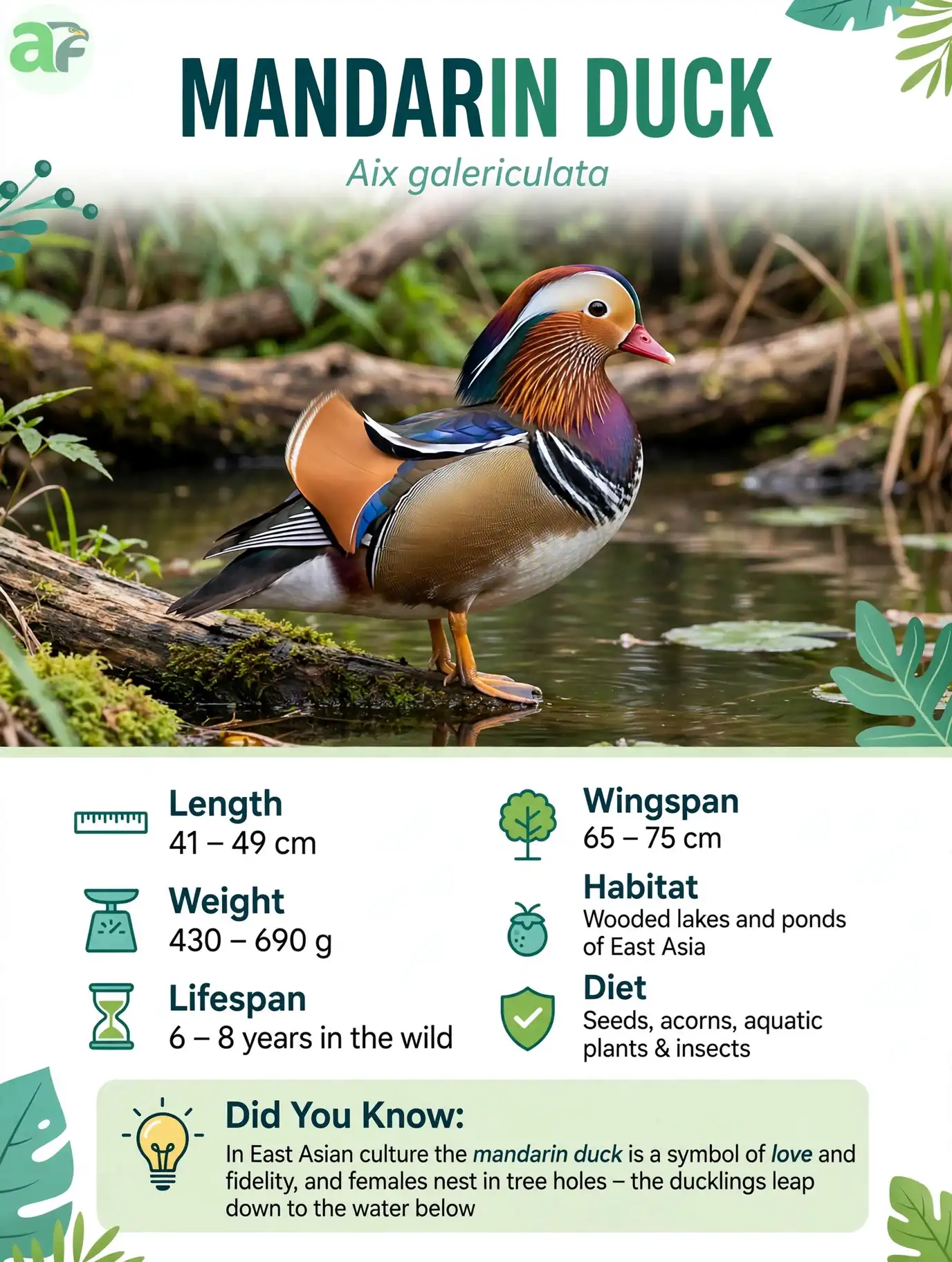
13. Mandarin Duck Conservation Status & Threats
Conservation Status Overview
| Feature | Details |
|---|---|
| IUCN Status | Least Concern (LC) |
| Population Trend | Decreasing (native Asian population) |
| Estimated Global Population | 65,000–100,000 individuals (significant uncertainty) |
| Native Asian Population | Declining — significantly below historical levels |
| UK Introduced Population | 2,000–7,000 birds — growing |
| CITES Listing | Appendix II — international trade regulated |
| Japan Population | Estimated 5,000–20,000 — best monitored native population |
| China Population | Significant decline from historical levels; current estimate highly uncertain |
Major Threats
| Threat | Description | Impact Level |
|---|---|---|
| Habitat loss | Deforestation and river channelization removing nest cavities and riparian woodland | Critical in China — primary threat |
| Hunting | Both legal and illegal hunting across native range | High in China and Russia |
| Nest cavity loss | Removal of mature and dead trees; reduction of woodpecker populations | High throughout range |
| Water pollution | Industrial and agricultural pollution reducing aquatic prey availability | High in China |
| River regulation | Dam construction and channelization destroying riparian habitat | High in China |
| Invasive predators | American mink in UK; introduced predators in various range areas | High in UK |
| Climate change | Altered acorn productivity; changed migration timing | Increasing concern |
| Disturbance | Tourism and recreation pressure at key wintering sites | Medium |
The China Conservation Crisis
The native Chinese mandarin duck population has experienced severe decline from historical levels — a decline driven by the intersection of multiple threats:
The deforestation factor — China’s extraordinary economic development over the past century has been accompanied by substantial deforestation of the riparian woodland habitats that mandarin ducks require. The removal of mature trees eliminates nest cavity availability — without cavities, mandarin ducks cannot breed regardless of how much suitable water remains.
River channelization — China’s extensive river management — channelizing rivers for flood control, irrigation, and navigation — has degraded the natural riparian structure (overhanging trees, shallow margins, complex channel geometry) that mandarin ducks depend on for feeding, cover, and nesting.
Hunting pressure — The mandarin duck has been hunted in China for centuries — both for food and for the feather trade. Despite legal protection, enforcement in remote mountain river areas is challenging.
The cultural protection paradox — Despite the mandarin duck’s extraordinary cultural significance as the supreme symbol of romantic love in Chinese culture, this cultural status has not translated into effective conservation protection. The bird is simultaneously revered as a cultural icon and threatened by the environmental degradation that accompanies economic development — a paradox that illustrates the gap between cultural symbolism and practical conservation action.
Conservation Responses
Nature reserves in the native range — Various Chinese nature reserves protect riparian habitats important for mandarin ducks — including reserves in Jilin, Heilongjiang, and Sichuan provinces where habitat quality is best maintained.
Japanese conservation programs — Japan maintains the most systematic monitoring and the most formal conservation management of any country in the native range — the mandarin duck’s cultural significance in Japan translating into more effective conservation attention than in China. Various Japanese riverside restoration programs specifically benefit mandarin duck habitat.
Nest box programs — Both in the native range (Japan primarily) and in the UK, artificial nest box programs provide cavity nesting opportunities in areas where natural cavity trees are insufficient. Mandarin ducks readily accept appropriately sized and positioned nest boxes — providing a practical management tool that has increased breeding populations at multiple sites.
UK conservation significance — The growing UK feral population has been proposed as a conservation resource for the declining native Asian population — genetic material from the UK population potentially available for supplementation programs if native population declines become critical. The UK Wildfowl and Wetlands Trust (WWT) monitors and manages the UK mandarin duck population with awareness of its global significance.
WWT monitoring programs — The Wildfowl and Wetlands Trust (WWT) at Slimbridge and other UK centers maintains long-term population monitoring of the UK mandarin duck feral population — the most systematic monitoring of any mandarin duck population globally.
14. Famous Mandarin Ducks in History & Pop Culture
Famous Individual Mandarin Ducks
The Central Park Duck (2018–2019) — The most famous individual mandarin duck in history — a male of unknown origin that appeared in Central Park, New York City in October 2018 and generated global media coverage, social media viral spread, and daily crowds of thousands of visitors. The bird’s extraordinary visual impact against the autumn foliage of Central Park produced some of the most widely reproduced wildlife photographs of the decade. The duck’s identity was never established — it disappeared from Central Park in early 2019, its subsequent fate unknown.
Virginia Water Founding Birds (~18th–19th century) — The mandarin ducks that established the founding UK feral population at Virginia Water lake in Surrey — associated with the Royal Windsor Estate collection — are historically significant as the ancestors of much of the UK’s current self-sustaining feral population. While no individual founding bird is historically documented, the Virginia Water connection represents one of the most significant moments in introduced bird population history in the UK.
The Christie’s Ming Dynasty Painting Subjects (2017) — The mandarin ducks depicted in the Ming Dynasty painting that sold at Christie’s London in 2017 for over £2.6 million — while rendered in paint rather than living birds — are among the most financially celebrated mandarin duck images in history. The painting’s extraordinary auction price demonstrated the commercial dimension of the mandarin duck’s cultural significance in the contemporary international art market.
WWT Slimbridge Collection Birds — The mandarin ducks maintained at the Wildfowl and Wetlands Trust’s Slimbridge reserve in Gloucestershire — founded by conservation pioneer Sir Peter Scott and the most important waterfowl conservation center in the world — have contributed to the long-term monitoring and public education programs that have made mandarin duck conservation a prominent concern in UK ornithology.
Historical Cultural Significance
Du Fu’s Tang Dynasty Poems — The Tang Dynasty poet Du Fu (712–770 CE) — one of the greatest poets in Chinese literature — referenced the mandarin duck as the supreme image of devoted partnership in multiple poems. Du Fu’s work is studied by virtually every Chinese student — the mandarin duck’s appearance in his poetry has reinforced the Yuan-yang tradition for over 1,200 years.
The Classic of Poetry (Shijing) — ~600–500 BCE — The earliest appearance of the mandarin duck in Chinese written literature — the Classic of Poetry compiled during the Zhou Dynasty contains references to the Yuan-yang as paired birds representing love and fidelity. This early literary appearance places the mandarin duck’s cultural significance at the very foundation of Chinese literary tradition.
Empress Wu Zetian’s patronage — The only woman to rule China as empress in her own right, Wu Zetian (r. 690–705 CE) commissioned extensive mandarin duck motifs in the decorative arts of her court — the Yuan-yang symbol appearing in the ceremonial objects and architectural decoration of her Tang Dynasty imperial program.
15. Role in Ecosystem & Food Chain
The Seed Dispersal Role
Acorn dispersal — The mandarin duck’s autumn acorn consumption and subsequent movement through the landscape results in occasional seed dispersal — acorns voided in feces at locations away from the parent oak tree. While the mandarin duck is not a primary oak regeneration vector (most acorn seeds are digested rather than deposited intact), the occasional intact seed deposition contributes marginally to forest regeneration.
Aquatic plant dispersal — The mandarin duck’s movement between water bodies carries aquatic plant seeds on its plumage and feet — contributing to the dispersal of aquatic vegetation between isolated water bodies. This hydrochory (water plant dispersal by waterbirds) is a well-documented ecological function of waterfowl generally, and the mandarin duck’s movement between ponds and rivers contributes to aquatic plant community connectivity.
The Aquatic Invertebrate Predator Role
Invertebrate community effects — The mandarin duck’s consumption of aquatic insects, larvae, and snails contributes to the regulation of aquatic invertebrate communities in the woodland rivers and ponds it inhabits. In areas of high mandarin duck density, the collective invertebrate predation may influence the composition and abundance of the aquatic invertebrate community.
Snail consumption — The mandarin duck’s consumption of freshwater snails — potential intermediate hosts for various parasites — may have indirect effects on parasite transmission cycles in its waterway habitats.
The Prey Role
Supporting woodland predators — Mandarin ducks are consumed by multiple predators — contributing to the energy budgets of mink, foxes, otters, and various raptors in both the native Asian range and the UK introduced range. The mandarin duck’s woodland waterway habitat means it contributes to food webs that include both aquatic and terrestrial predators.
Egg and duckling importance — Failed nests — where eggs are consumed by pine martens, jackdaws, or other predators — and duckling predation by foxes and mink provide food subsidies to predator communities. The mandarin duck’s relatively high nest failure rate means substantial nutrient flow from failed breeding attempts to predator populations.
The Habitat Use Indicator Role
Like the secretarybird for savanna grassland and the resplendent quetzal for cloud forest, the mandarin duck functions as an indicator of waterway habitat quality:
- Mandarin duck presence and breeding indicates mature riparian woodland with adequate cavity tree density, clean water with good invertebrate diversity, and low disturbance levels
- Mandarin duck breeding density provides a practical metric for riparian woodland quality assessment
- Mandarin duck population trends at monitored sites reflect broader riparian habitat change through time
16. Myths, Folklore & Cultural Significance
The Fidelity Myth — The Cultural Foundation
The central cultural myth surrounding the mandarin duck — that pairs mate for life and that a mandarin duck that loses its mate will die of grief rather than take a new partner — is the foundation of the entire Yuan-yang symbolic tradition:
The biological reality — Mandarin ducks are seasonally monogamous, not lifelong monogamous. Pairs form in autumn and winter, breed in spring, and the pair bond typically dissolves after breeding — males abandoning the pair bond during incubation. In subsequent years, many individuals re-pair with different partners. The biological reality therefore differs significantly from the cultural mythology.
The cultural persistence — Despite the biological inaccuracy, the fidelity mythology has persisted unchanged for over two thousand years — demonstrating how cultural symbols operate independently of factual accuracy once they are deeply embedded in a civilization’s symbolic system. The mandarin duck’s cultural fidelity is absolute; the duck’s biological fidelity is much more conditional.
The observational basis — The cultural myth almost certainly arose from the observation that mandarin ducks are consistently seen in male-female pairs during the visible winter and early spring period — a pattern that appears to represent devoted partnership even though it reflects seasonal pair bond formation rather than lifelong commitment.
Chinese Feng Shui and the Yuan-yang
In traditional Chinese Feng Shui — the philosophical system governing the arrangement of space and objects to promote positive energy flow — a pair of mandarin duck figures placed in the “relationship corner” (the southwest corner) of a home or bedroom is considered one of the most powerful activators of romantic and marital luck:
The Feng Shui placement — According to traditional Feng Shui practitioners, a pair of mandarin duck figurines — the male and female placed facing each other — in the southwest corner of the home activates the earth energy associated with relationships, romance, and marriage. Single people place them to attract a partner; married couples place them to strengthen the marital bond.
The modern persistence — Mandarin duck Feng Shui practices remain extremely common in contemporary Chinese homes across China, Taiwan, Hong Kong, Singapore, and the Chinese diaspora globally — the tradition persisting in modernized form in homes that otherwise have little connection to traditional Feng Shui practice.
Korean Wedding Duck Tradition
The Korean tradition of wooden mandarin duck wedding gifts (nedducks or wedducks) represents perhaps the most tangible and most practically embedded mandarin duck cultural practice in the contemporary world:
The ceremony — In a traditional Korean wedding, the groom’s mother gives the bride a pair of wooden ducks (traditionally carved from pine or paulownia wood and painted to represent male and female mandarin ducks) during the paebaek ceremony (the traditional post-wedding family ceremony). The ducks symbolize the couple’s wish for a faithful, long-lasting marriage.
The positioning tradition — The wooden ducks are placed with bills touching to symbolize closeness and communication, or bills apart to symbolize independence and personal space — the positioning reflecting what the placing person wishes for the marriage. Different family members may position the ducks differently to express different hopes for the couple.
Contemporary practice — While the tradition is less universally observed than in previous generations, wooden mandarin duck wedding gifts remain a recognizable tradition across Korean culture globally — sold in Korean gift shops, traditional craft markets, and online as wedding gifts for Korean and Korean-diaspora weddings.
Japanese Autumn Viewing Tradition
In Japan, the mandarin duck viewing season (autumn and winter, when the birds are in their most spectacular breeding plumage) has developed into a nature tourism tradition with cultural significance analogous to cherry blossom viewing in spring:
Mitake Gorge tradition — The Mitake Gorge on the Tama River in western Tokyo Prefecture has been a traditional mandarin duck viewing site for generations — the gorge’s combination of rapids, forest, and accessible river walks providing both optimal mandarin duck habitat and excellent viewing conditions. The site attracts thousands of visitors annually during the October–March mandarin duck season.
The autumn maple connection — The visual pairing of mandarin duck plumage with autumn maple leaves (momiji) — both in vivid orange and red — has made the mandarin duck a specific autumn symbol in Japanese aesthetics, appearing in paintings, woodblock prints, and decorative arts in combination with the autumn maple theme.
17. Mandarin Ducks in Pop Culture
The Central Park Media Phenomenon (2018) — Already discussed extensively, the Central Park mandarin duck’s 2018 appearance generated arguably the most significant popular media response to any individual wild bird in the social media era — coverage in essentially every major international news outlet and viral spread across social media platforms in multiple languages.
David Attenborough BBC documentaries — The mandarin duck’s extraordinary appearance and fascinating behavior have made it a recurring subject in BBC natural history productions — including “Planet Earth” (BBC, 2006), “Wild Japan” (BBC Natural World), and various WWT-related wildlife documentary content. The winter display footage of multiple males simultaneously displaying on Japanese rivers is among the most visually spectacular waterfowl footage in documentary history.
Japanese nature photography tradition — The mandarin duck is one of Japan’s most photographed birds — the combination of extraordinary visual impact, accessible viewing sites, and the cultural significance of the Oshidori tradition making it a defining subject in Japanese nature photography. Major Japanese wildlife photography publications and competitions feature mandarin duck images as centerpieces of autumn nature photography.
Chinese decorative arts in international markets — Mandarin duck imagery in Chinese decorative arts — ceramics, paintings, embroideries, jade carvings, and contemporary decorative objects — circulates in international art and antiques markets globally. The Christie’s £2.6 million Ming Dynasty painting sale in 2017 brought mandarin duck artistic significance to international attention beyond specialist collectors.
Korean wedding industry — The mandarin duck’s role in Korean wedding tradition means it appears in the products and services of the global Korean wedding industry — wooden duck carvings sold at Korean gift shops and wedding suppliers worldwide constitute a modest but persistent commercial manifestation of the species’ cultural significance.
WWT and RSPB wildlife media — The Wildfowl and Wetlands Trust (WWT) and Royal Society for the Protection of Birds (RSPB) both use mandarin duck imagery extensively in wildlife appreciation and conservation communication materials — the species’ extraordinary visual impact making it one of the most effective bird subjects in UK wildlife charity marketing.
Social media wildlife photography — The mandarin duck is one of the most shared and most engaged-with bird photographs on wildlife photography social media platforms globally — the combination of extraordinary male plumage, accessible viewing sites in the UK and Japan, and the cultural recognition of the species across multiple cultures creating consistently high social media engagement with mandarin duck imagery.
18. Mandarin Duck Facts vs. Common Myths
| Common Myth | The Real Fact |
|---|---|
| “Mandarin ducks mate for life” | Partially false — mandarin ducks practice seasonal monogamy, not lifelong monogamy. Pairs form in autumn and winter, breed in spring, and the pair bond typically dissolves when the male abandons the female during incubation. Many individuals pair with different partners in successive years |
| “The mandarin duck only lives in China” | False — the native range includes Japan (where the best-monitored population exists), Korea, and the Russian Far East alongside China; additionally, self-sustaining introduced populations exist in the UK and other European countries |
| “The mandarin duck cannot survive outside Asia” | False — the UK feral population has maintained itself for over 150 years, thriving in Surrey, Berkshire, and other parts of England in a climate quite different from the native Asian range |
| “The female mandarin duck is dull and unremarkable” | Partially misleading — while the female is far less spectacular than the male, she has a subtle, intricate beauty — the white eye rings, fine speckling, and elegant proportions have been celebrated in East Asian art for exactly the kind of understated refinement that complements the male’s flamboyance |
| “The sail feathers are part of the tail” | False — the sail feathers are modified tertial wing feathers (inner flight feathers), not tail feathers. They are inserted in the wing and raised through wing muscles, not tail muscles |
| “Mandarin ducks die of grief when they lose a mate” | False — the cultural mythology of pining unto death is not supported by any biological evidence. Mandarin ducks that lose mates do re-pair — the grief mythology is a cultural construction built on the observation of consistent winter pairing behavior, not biological reality |
| “The Central Park mandarin duck was a domestic bird” | Unresolved — the bird’s origin was never definitively established. Most ornithologists believe it was an escaped captive bird, but no owner came forward and it was not banded or microchipped. The possibility of a genuinely vagrant wild Asian bird was considered but deemed unlikely given the species’ rarity as a transatlantic vagrant |
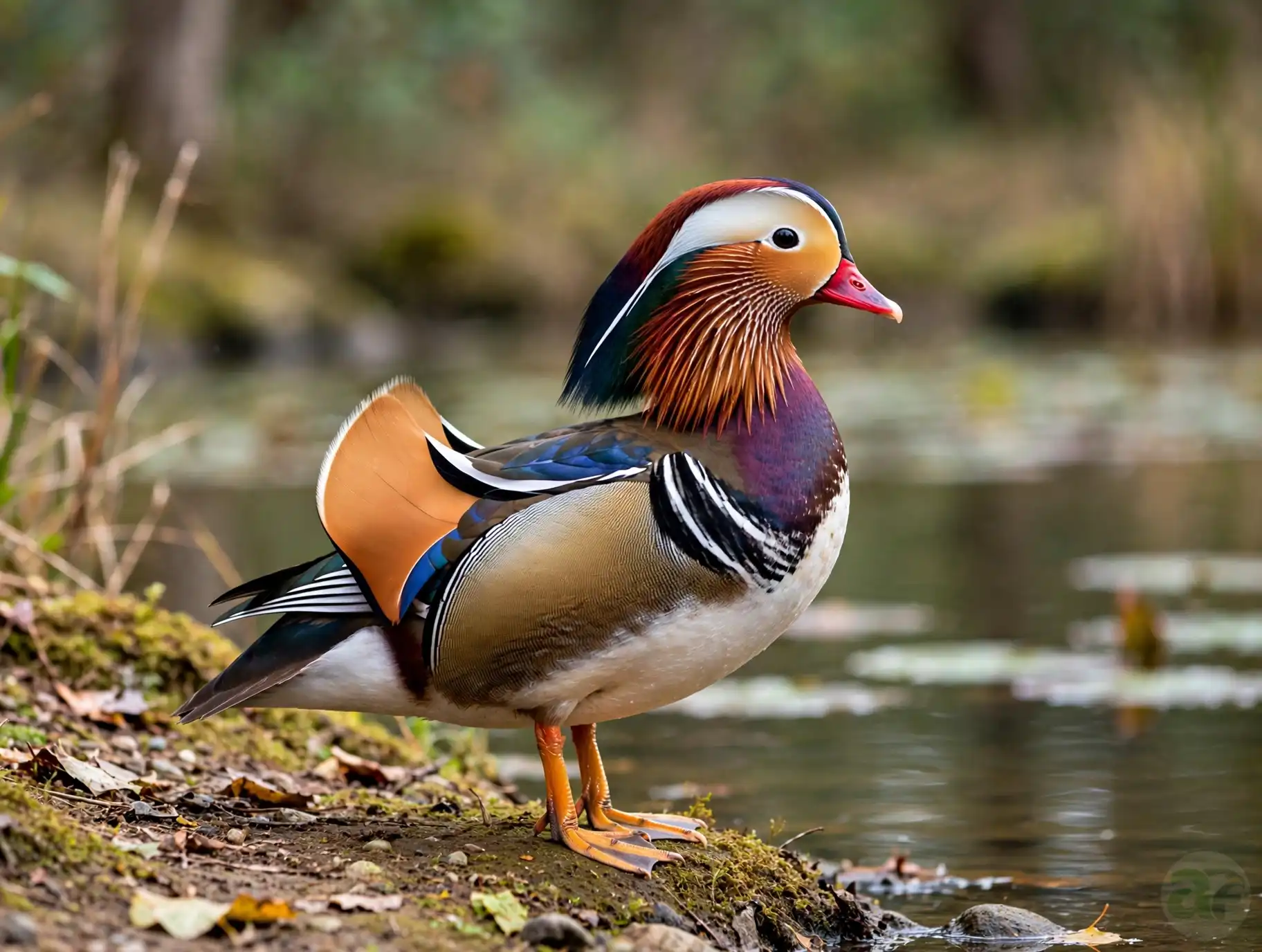
19. Best Places to See Mandarin Ducks in the Wild
In the Native Asian Range
1. Mitake Gorge, Tama River, Tokyo, Japan — The most famous and most consistently reliable mandarin duck viewing site in the world for wild birds in their native range. Located approximately 60 km west of central Tokyo and accessible by train from Shinjuku Station (Ome Line to Mitake Station, then a short walk), the gorge’s rapids and forested banks support a regular wintering flock of 50–300 mandarin ducks from October through March. Multiple viewpoints along the gorge provide excellent close-range observation — the birds are habituated to human presence at the main viewing areas. Early morning visits (7:00–9:00 AM) produce the best viewing when birds are most active and light is best for photography.
2. Kyoto Imperial Palace Park and Higashiyama Area, Japan — Multiple locations in the Kyoto area support winter mandarin duck populations — the combination of authentic Japanese garden ponds, autumn maple viewing, and mandarin duck presence creates the most aesthetically complete mandarin duck viewing experience available. The Okazaki Canal area near Heian Shrine and various Kyoto temple garden ponds host winter birds.
3. Nami Island (Namiseom), South Korea — The island on the North Han River north of Seoul supports wintering mandarin ducks alongside extraordinary autumn foliage — one of the most photographically celebrated mandarin duck viewing locations in Korea.
4. DMZ Area, Korea — The restricted access of the Korean Demilitarized Zone has created paradoxically excellent wildlife habitat — mandarin ducks use rivers and forests in the border area where reduced human disturbance has maintained better habitat than the surrounding countryside.
5. Northeastern China (Jilin Province) — For visitors specifically seeking mandarin ducks in the Chinese native range — protected areas in Jilin Province (particularly around Changbai Mountain National Nature Reserve) support summer breeding populations. Access requires planning and local guide assistance.
In the UK Introduced Range
6. Virginia Water, Windsor Great Park, Surrey — One of the most significant and most historically important UK mandarin duck sites — the lake at Virginia Water regularly hosts 50–150+ mandarin ducks in winter, with breeding pairs present year-round in the surrounding woodland. The site is easily accessible from London by train to Virginia Water station.
7. River Wey, Surrey — The wooded stretches of the River Wey between Guildford and Weybridge support excellent mandarin duck populations year-round — the combination of clean chalk-stream water, mature riparian woodland, and low disturbance creating ideal habitat. Various accessible footpaths along the Wey Navigation towpath provide good viewing opportunities.
8. Home Park, Windsor and various Thames Valley sites — The Thames Valley from Windsor through Berkshire supports good mandarin duck populations — multiple public riverside parks and nature reserves provide viewing access.
9. WWT Slimbridge, Gloucestershire — The Wildfowl and Wetlands Trust’s flagship reserve provides close-range observation of mandarin ducks in naturalistic enclosure settings alongside wild birds attracted to the reserve. Educational context provided by WWT staff enriches the wildlife viewing experience.
10. Scottish Forestry Locations — Various Scottish forest areas — particularly in Perthshire and Argyll — support small but established mandarin duck populations associated with wooded lochs and rivers. Less reliably visited than southern English sites but providing authentic wooded waterway viewing experiences.
The Honest Assessment — For international visitors, Mitake Gorge in Japan provides the most authentic and most spectacular mandarin duck viewing experience available anywhere in the world — large numbers of wild birds in genuine native-range habitat, culturally embedded in the Japanese autumn nature-viewing tradition. For UK-based visitors, Virginia Water and the River Wey in Surrey provide the most reliable all-season viewing of self-sustaining feral mandarin ducks in beautiful wooded surroundings. The optimal season everywhere is October through March when birds are in full breeding plumage and most visible at congregation sites.
20. How You Can Help
Supporting mandarin duck conservation requires differentiated action — protecting native Asian habitat, managing introduced UK populations responsibly, and engaging with the cultural significance that gives this species unusual conservation communication potential.
Support these organizations:
- Wildfowl and Wetlands Trust (WWT) — wwt.org.uk — the primary organization monitoring and managing the UK mandarin duck population; also engages with international waterfowl conservation including native range programs
- BirdLife International — birdlife.org — coordinates international bird conservation planning including Asian waterfowl conservation programs
- Wild Bird Society of Japan (WBSJ) — wbsj.org — the primary Japanese bird conservation organization; monitors and advocates for mandarin duck populations in Japan
- WWF China — wwfchina.org — funds riparian habitat protection in China including habitats relevant to mandarin duck conservation
- American Bird Conservancy — abcbirds.org — funds international bird conservation including programs relevant to Asian waterfowl
Critical individual actions:
- Install nest boxes on wooded waterways — mandarin ducks readily accept appropriately sized nest boxes (entrance hole approximately 10 cm, internal depth 30+ cm) placed 2–5 meters above water on trees overhanging rivers and ponds. WWT provides nest box specifications
- Protect riparian woodland — supporting organizations and policies that protect mature riverside woodland directly benefits mandarin duck populations by maintaining the cavity tree density the species depends on
- Mink control in the UK — American mink are the most significant predator of UK mandarin ducks; supporting mink control programs through the Mink Warriors program (organized by various UK wildlife organizations) directly reduces mandarin duck mortality
- Support Japanese and Chinese river restoration — riparian restoration programs in the native range that restore natural river structure and riparian woodland benefit mandarin duck habitat
- Responsible wildlife tourism — visiting mandarin duck viewing sites in Japan and the UK through responsible tourism generates economic recognition of the species’ value that supports conservation arguments
21. Top Documentaries & Books
Must-Watch Documentaries
- “Wild Japan” (BBC Natural World) — Multiple BBC productions covering Japanese wildlife include mandarin duck winter display footage from Mitake Gorge; some of the finest mandarin duck documentary footage available
- “Planet Earth” (BBC, David Attenborough, 2006) — Freshwater episode includes waterfowl content relevant to mandarin duck ecology
- “Super Cute Animals” (BBC, 2018) — Features mandarin duck duckling jump behavior — one of the most engaging treatments of the first-day duckling jump for a general audience
- WWT Slimbridge visitor media — Various WWT-produced educational videos available online document mandarin duck behavior and conservation context
- Japanese NHK Nature Documentaries — NHK (Japan’s national broadcaster) has produced multiple excellent mandarin duck natural history documentaries — some available with English subtitles — covering both the natural history and the cultural significance of Oshidori in Japanese tradition
Must-Read Books
- Wildfowl: An Identification Guide to the Ducks, Geese and Swans of the World by Steve Madge and Hilary Burn — The comprehensive wildfowl identification and natural history reference; detailed mandarin duck species account
- Ducks, Geese and Swans (two volumes) by Janet Kear (editor) — The comprehensive scientific reference for Anatidae; authoritative mandarin duck species account
- A Field Guide to the Birds of Japan by Takeshi Shimba — The standard field guide for the best-monitored native mandarin duck population
- Waterfowl: An Identification Guide by Paul Johnsgard — The comprehensive North American waterfowl reference that provides comparative context for understanding the mandarin-wood duck Aix relationship
- The Yuan-Yang: Love Symbols in Chinese Art (various authors) — Cultural history treatments of the mandarin duck’s role in Chinese decorative arts and symbolic tradition
22. Mandarin Duck Comparison with Other Spectacular Ducks
| Feature | Mandarin Duck | Wood Duck | Harlequin Duck | King Eider | Smew |
|---|---|---|---|---|---|
| Scientific name | Aix galericulata | Aix sponsa | Histrionicus histrionicus | Somateria spectabilis | Mergellus albellus |
| Weight (male) | 428–693 g | 454–862 g | 500–680 g | 1.4–2.0 kg | 500–935 g |
| Defining male feature | Sail feathers; cheek fans | Green crest; white facial stripes | Multicolored pattern; white spots | Orange knob on bill | Black-and-white; red eye |
| Color mechanism | Structural + carotenoid + melanin | Structural + pigment | Structural + melanin | Structural + pigment | Melanin primarily |
| Sexual dimorphism | Extreme | Extreme | Moderate | Extreme | Extreme |
| Habitat | Wooded rivers; tree nester | Wooded rivers; tree nester | Mountain torrents | Arctic sea coast | Northern forest lakes |
| Range | E. Asia + introduced UK | North America | N. Pacific, N. Atlantic | Arctic | N. Europe, N. Asia |
| Conservation | Least Concern (declining native) | Least Concern (recovered) | Least Concern | Least Concern | Least Concern |
| Nesting | Tree cavity | Tree cavity; nest boxes | Ground near water | Ground | Tree cavity |
| Cultural significance | Supreme East Asian love symbol | North American conservation icon | Limited | Inuit traditional culture | Limited |
| Famous for | World’s most beautiful duck | Most beautiful North American duck | Acrobatic torrent swimmer | King of sea ducks | Elegant winter plumage |
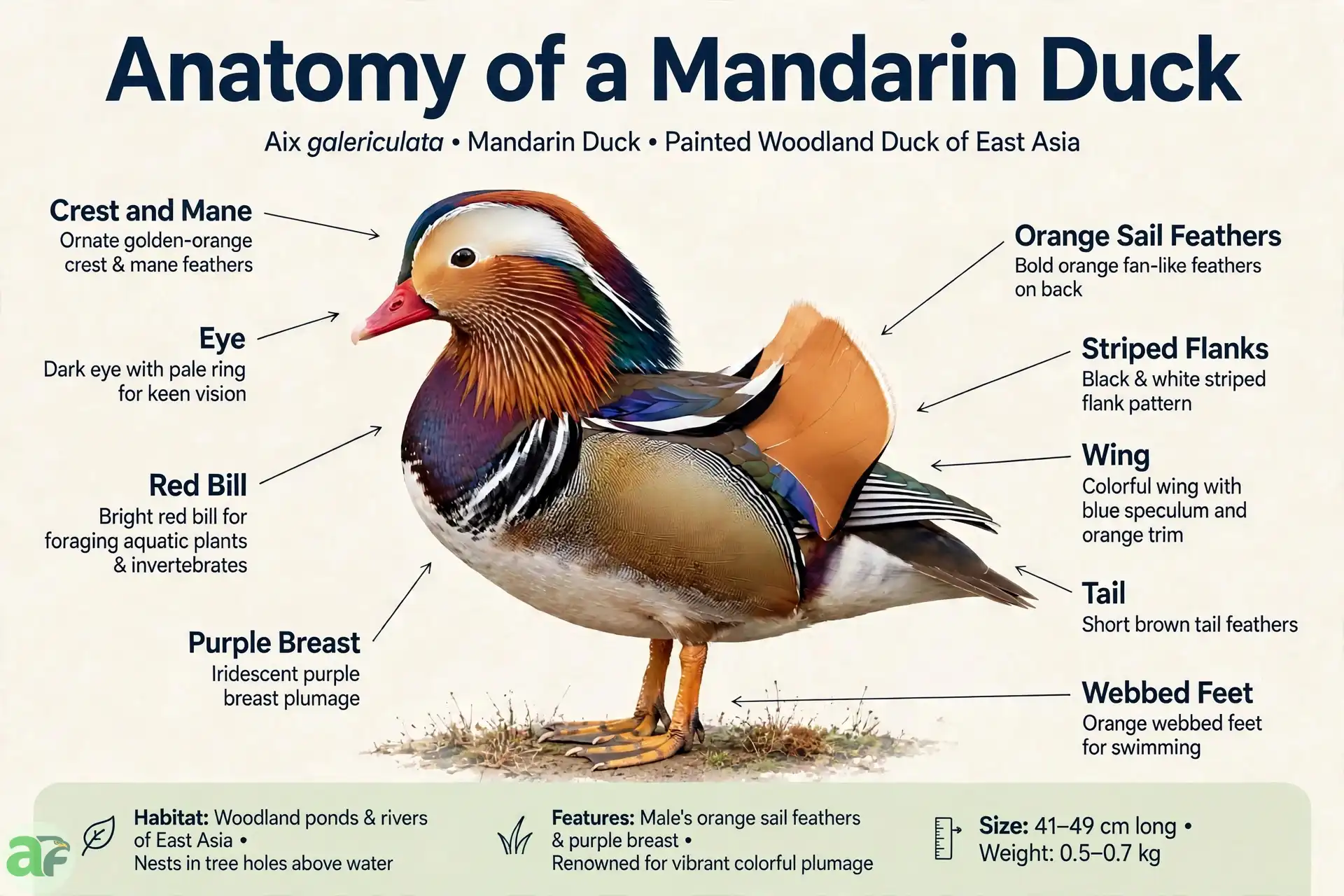
23. Frequently Asked Questions About Mandarin Ducks
Q1. What is the scientific name of the mandarin duck?
The mandarin duck’s scientific name is Aix galericulata (Linnaeus, 1758). The genus name Aix derives from the Greek word used by Aristotle for a water bird — while the specific ancient bird Aristotle referenced cannot be definitively identified, the name was applied by ornithologist Friedrich Boie in 1828 to the genus containing the mandarin and wood ducks. The species name galericulata is Latin for “wearing a small wig or cap” — from galerum (wig/hat), referring to the male’s elaborate iridescent crest. The species was formally described by Carl Linnaeus in the 10th edition of Systema Naturae in 1758 — the foundational document of binomial nomenclature — originally placed in the genus Anas and subsequently moved to Aix. The common name “mandarin” refers to the brilliantly colored robes worn by Chinese imperial Mandarin officials — the male duck’s plumage colorfulness compared to the elaborate official dress of the Qing Dynasty mandarins by early European observers. The Chinese name Yuan-yang (鴛鴦) — where yuan (鴛) specifies the male and yang (鴦) the female — is one of the oldest bird names in the Chinese language, appearing in classical literature from approximately 500 BCE.
Q2. Why is the mandarin duck considered the symbol of love in Asian culture?
The mandarin duck’s status as the supreme symbol of romantic love and marital fidelity in Chinese, Japanese, and Korean culture rests on the consistent observation of paired birds — male and female mandarin ducks are typically seen together during the autumn and winter period when they are most visible, and this consistent pairing was interpreted as evidence of deep, faithful monogamous devotion. The cultural mythology holds that mandarin ducks pair for life and that a duck which loses its mate will pine and refuse to accept a new partner — dying of grief rather than living without its chosen love. While this mythology is not biologically accurate (mandarin ducks practice seasonal monogamy and re-pair after losing mates), the cultural symbol has operated independently of biological reality for over two thousand years. The specific choice of the mandarin duck as the love symbol — rather than any other consistently paired bird — was also influenced by the male’s extraordinary visual spectacle, which made him an effective embodiment of the devotion and beauty that romantic love was believed to deserve. The tradition entered Chinese written literature in the Classic of Poetry (Shijing) approximately 500 BCE and has been continuously reinforced through poetry, ceramics, painting, embroidery, and gift-giving traditions across Chinese, Japanese, and Korean civilization, becoming self-reinforcing through cultural momentum regardless of the underlying biological reality.
Q3. Do mandarin ducks really mate for life?
No — the mandarin duck’s legendary lifelong fidelity is a cultural mythology, not a biological reality. Mandarin ducks practice seasonal monogamy — forming pair bonds in autumn and winter, breeding in spring and early summer, and typically dissolving the pair bond when the male abandons the female during incubation (before the eggs even hatch). In subsequent breeding seasons, most individuals re-pair with different partners — true lifelong monogamy is not the norm. The consistent winter pairing observed by ancient Chinese observers — which formed the basis of the fidelity mythology — reflects the species’ reliable formation of paired bonds during the most visible part of the annual cycle, creating the impression of devoted permanent partnership even though the bond is seasonal. This distinction between biological reality and cultural mythology is one of the most striking examples in natural history of a species becoming culturally defined by a behavioral interpretation that diverges significantly from what the species actually does. The mandarin duck’s cultural fidelity is absolute and unquestioned; its biological fidelity is considerably more pragmatic.
Q4. Why is there a significant mandarin duck population in the United Kingdom?
The UK mandarin duck population developed from escaped aviary birds — a process that began in the 18th and 19th centuries when British aristocrats maintained mandarin ducks in private wildfowl collections on their estates. The species’ extraordinary visual appeal made it one of the most sought-after exotic waterfowl for ornamental collections, and the UK’s network of wooded waterways — particularly in Surrey and Berkshire — provided excellent habitat for escapees. The birds that escaped discovered that the temperate UK climate (milder than the harshest parts of the native Asian range), clean chalk-stream rivers with good food resources, mature riparian oak woodland providing cavity nesting sites, and relatively low hunting pressure (the mandarin duck is not a game species in the UK) created conditions highly suitable for successful establishment. The founding population has grown over more than a century into an estimated 2,000–7,000 birds — a population whose conservation significance has grown as the native Asian population has declined. The UK population is now formally counted in the British bird list as a Category C species (established introduced bird) and is monitored by the WWT and RSPB given its potential global conservation importance.
Q5. What makes the mandarin duck’s sail feathers unique?
The mandarin duck’s sail feathers are unique in the entire family Anatidae — no other duck species in the world has evolved a comparable structure. Anatomically, the sail feathers are modified tertial feathers — the innermost flight feathers that in most ducks lie flat against the body when the wings are folded. In the mandarin duck, these tertials have been modified through sexual selection into dramatically elongated, broad-vaned structures that can be erected vertically above the back through specialized muscles at the feather base. In full display, the pair of sail feathers stand as vivid orange-gold vertical panels rising above the folded wings — creating an appearance utterly unlike any other duck species. The sail feathers are colored vivid orange by carotenoid pigments derived from the diet — making their vividness an honest signal of dietary quality that females can assess during mate choice. The sail feathers are molted annually (as part of the complete summer eclipse molt) and grown fresh each breeding season — males with the most vivid, most symmetrical, and largest sail feathers are believed to be preferentially selected by females. The evolutionary origin of the sail feathers — why the tertials were modified in this particular way rather than any other feather group — remains an interesting question in waterfowl evolutionary biology, with the convergent evolution of elaborate male plumage in the closely related wood duck (Aix sponsa) providing context for understanding the Aix lineage’s general tendency toward elaborate male sexual ornamentation.
24. Sources & References
- Wikipedia — Aix galericulata, Anatidae, Aix (genus), Yuan-yang
- IUCN Red List — iucnredlist.org (current Least Concern assessment for Aix galericulata)
- BirdLife International — birdlife.org (species factsheet for mandarin duck)
- Wildfowl and Wetlands Trust — wwt.org.uk (UK population monitoring data)
- Kear, J. (ed.) (2005). Ducks, Geese and Swans (Bird Families of the World). Oxford University Press
- RSPB — rspb.org.uk (UK population data)
- Cornell Lab of Ornithology — allaboutbirds.org; Macaulay Library
- Wild Bird Society of Japan — wbsj.org
- National Geographic — nationalgeographic.com
- Smithsonian National Museum of Natural History — naturalhistory.si.edu
- BBC Wildlife / BBC Earth — bbcearth.com
- Britannica — britannica.com/animal/mandarin-duck
- New York Times coverage of the Central Park mandarin duck (2018–2019)
- Christie’s auction records — christies.com (2017 Ming Dynasty painting sale)