
Paradise Tanager Facts
| Feature | Details |
|---|---|
| Scientific Name | Tangara chilensis (Vigors, 1832) |
| Kingdom | Animalia |
| Phylum | Chordata |
| Class | Aves |
| Order | Passeriformes |
| Family | Thraupidae |
| Common Names | Paradise tanager; seven-colored tanager |
| Native Range | Amazon Basin — Venezuela, Colombia, Ecuador, Peru, Bolivia, Brazil, Guyana, Suriname, French Guiana |
| Habitat | Tropical rainforest — forest canopy and edges at 100–1,700 meters elevation |
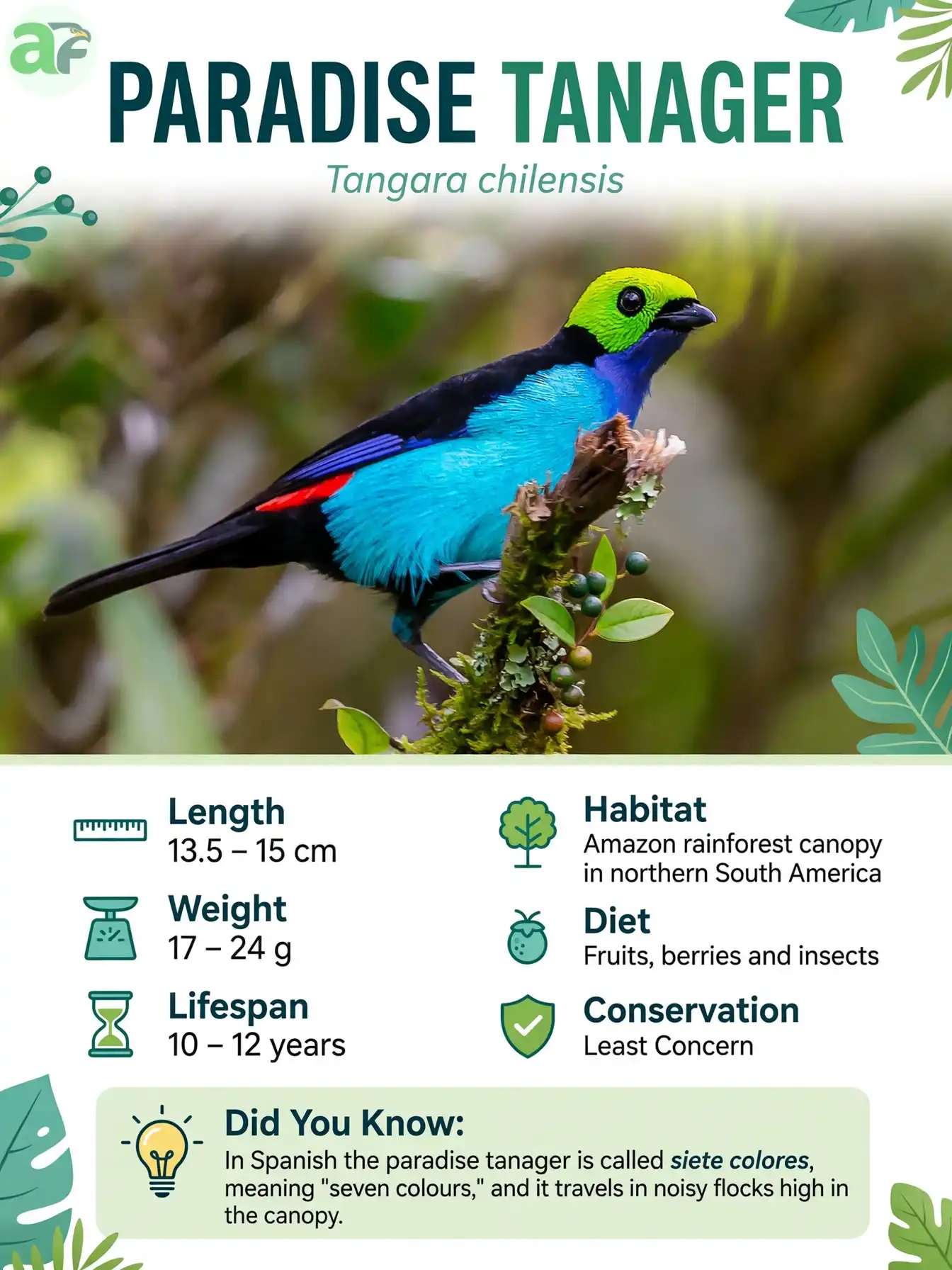
| Lifespan | Estimated 7–10 years (wild); up to 12 years (captivity) |
| Diet | Primarily fruit; insects and arthropods — omnivorous frugivore |
| Body Length | 13.5–15 cm |
| Weight | 18–23 grams |
| Conservation Status | Least Concern (IUCN) — relatively common across a wide Amazonian range |
| Defining Feature | Seven distinct colors on a single small bird — apple green head, turquoise breast, scarlet lower back, black mantle, violet shoulder, blue belly, and red or black bill region — the most polychromatic songbird in the Americas |
| Taxonomic Position | One of approximately 95 species in the genus Tangara — the most species-rich genus of colorful Neotropical songbirds |
| Closest Relatives | Other Tangara species — the tanager genus containing some of the most spectacular small birds in the world |
| Family Context | Thraupidae — the tanager family — is the second largest bird family in the world with approximately 385 species |
 1. Introduction: What is a Paradise Tanager?
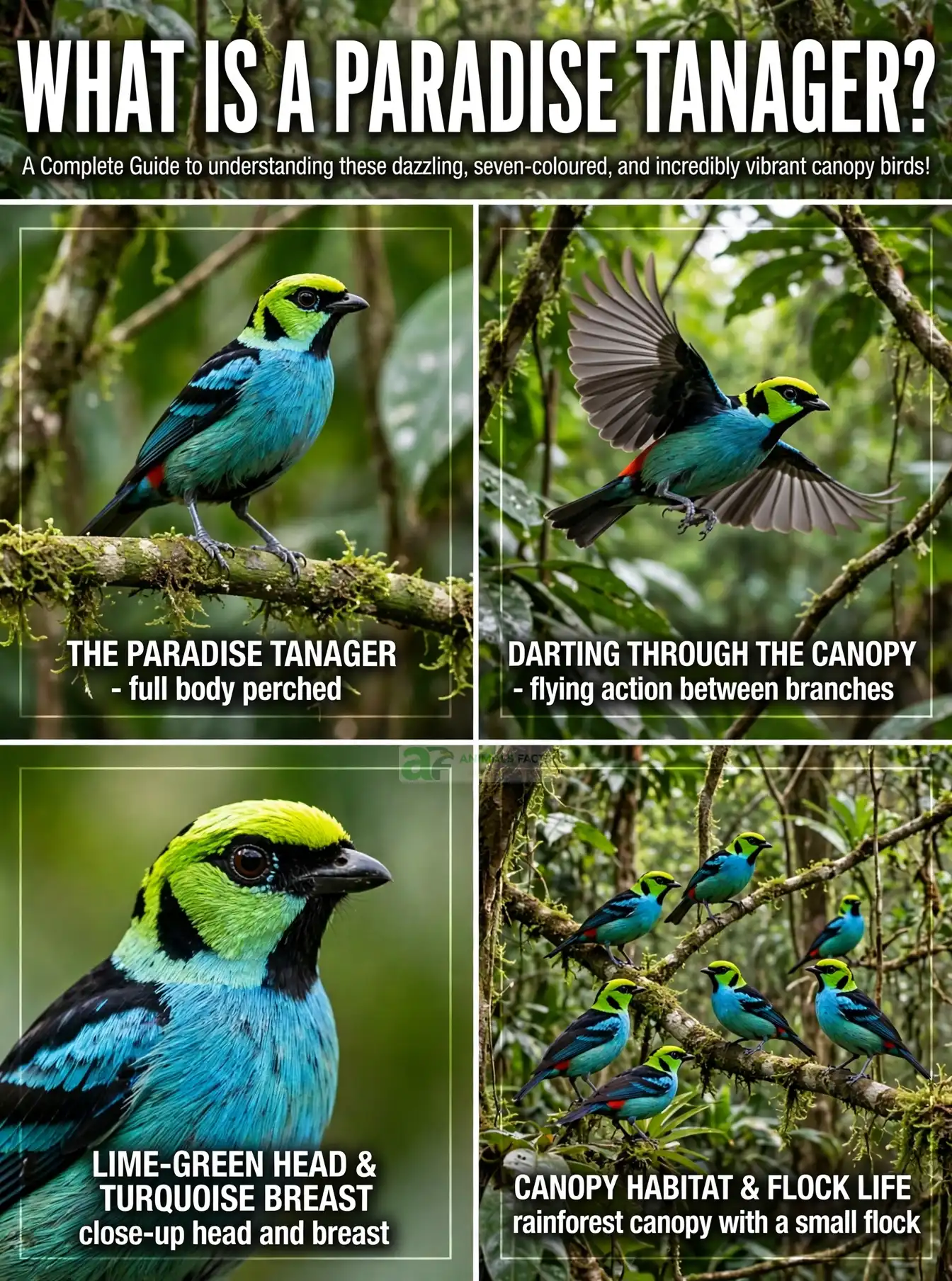
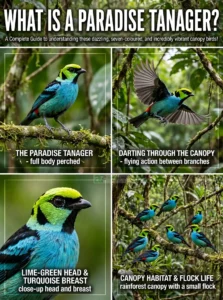
In the humid canopy of the western Amazon, where the forest rises in overlapping layers of green and the morning light filters through gaps in the high canopy in golden shafts, a mixed-species foraging flock works its way through the fruiting trees. There are euphonias, honeycreepers, greenlets, and various warblers — each contributing its own subdued or moderately colorful note to the visual symphony of the Amazonian canopy. And then, moving through the midstory with the quick, restless energy of a bird that has somewhere urgent to be, a paradise tanager appears — and everything else in the flock becomes temporarily invisible. Seven colors on a single bird weighing less than a tablespoon of water: the luminous apple-green of the head and face, the deep black of the mantle and back, the vivid turquoise of the upper breast, the scarlet-red of the lower back and rump, the violet-blue of the shoulder patches, and the cobalt blue of the belly — a combination so extreme, so deliberately polychromatic, so apparently designed to violate every principle of cryptic coloration that it demands the question: how does natural selection produce an animal this conspicuous? Paradise tanager facts begin with this question — and the answer, it turns out, involves the same fundamental principle that produced the golden pheasant’s crimson and the resplendent quetzal’s emerald — female mate choice operating over millions of generations, selecting for the most vivid, most complex, most clearly health-signaling plumage that biology can produce. But in the paradise tanager, this process has been compressed into a bird weighing 20 grams — making it, by almost any measure, the most spectacular small bird in the Western Hemisphere and one of the most extraordinary vertebrates on Earth.
The paradise tanager (Tangara chilensis) belongs to the genus Tangara — a group of approximately 95 species that collectively constitute the most colorful songbird radiation in the Americas and arguably the most color-diverse bird genus on Earth. The tanager family, Thraupidae, is the second largest bird family in the world — approximately 385 species of seed-eaters, frugivores, and insectivores spread across the Neotropics — but within this remarkable family, the genus Tangara stands apart for producing, in relatively small-bodied birds, a concentration of structural and pigment-based color diversity that has no parallel in any other bird genus. Among all the spectacular Tangara species — the green-headed tanager, the golden tanager, the opal-rumped tanager, the paradise tanager — the paradise tanager is the most polychromatic, earning it the common name that the ornithological tradition reserves for birds that genuinely exceed ordinary human expectations of what is visually possible in a living creature.
Interesting facts about paradise tanagers extend well beyond the overwhelming visual impact of the plumage — the species is an important mixed-species flock participant, moving through the Amazon canopy as part of the complex multi-species foraging associations that are one of the defining features of Amazonian bird ecology; the four recognized subspecies show meaningful variation in the color of specific plumage regions across the geographic range — particularly in the bill and throat coloration — providing a living example of geographic differentiation in a broadly distributed species; the species demonstrates the behavioral ecology of canopy frugivory in a forest where fruit availability is seasonal and spatially patchy, requiring sophisticated movement decisions and ecological knowledge; and its common name — the “seven-colored tanager” in several languages — reflects a cross-cultural human recognition of the bird’s exceptional polychromatism that transcends any single ornithological tradition. Whether you are searching for paradise tanager facts for kids to explore the science of bird coloration in the most biodiverse forest on Earth, an Amazonian wildlife enthusiast planning a birding expedition, a conservation researcher interested in the ecology of Neotropical frugivores, or simply someone who encountered a photograph of this extraordinary small bird and experienced the immediate, involuntary need to understand everything about it — this is your comprehensive guide. The most colorful songbird in the Amazon has an extraordinary story to tell.
2. Paradise Tanager Species Overview & Classification
The paradise tanager belongs to the genus Tangara — one of the most species-rich and most colorful bird genera in the world — within the enormous and ecologically diverse family Thraupidae.
Species Classification Table
| Taxonomic Rank | Classification |
|---|---|
| Kingdom | Animalia |
| Phylum | Chordata |
| Class | Aves |
| Order | Passeriformes |
| Family | Thraupidae (Cabanis, 1847) |
| Genus | Tangara (Brisson, 1760) |
| Species | T. chilensis (Vigors, 1832) |
| Common Names | Paradise tanager; seven-colored tanager; cotinga-tangara (Portuguese) |
| Etymology | Tangara from the Tupi word tangará — an indigenous Amazonian name applied to various colorful birds; chilensis = “of Chile” — a misnomer arising from a mislabeled specimen; the species does not occur in Chile |
The Curious Case of chilensis — A Geographic Misnomer
The species name chilensis — “of Chile” — is one of the most celebrated misnomers in Neotropical ornithology:
The origin of the error — When the British ornithologist Nicholas Vigors formally described the paradise tanager in 1832, the specimen he worked from had been mislabeled as originating from Chile — almost certainly an error in the collection records. The paradise tanager does not occur in Chile and has no natural presence in that country.
The nomenclatural consequence — Once formally published, the species name chilensis became fixed under the rules of zoological nomenclature — it cannot be changed merely because it is geographically inaccurate. The paradise tanager therefore carries permanently the name of a country it has never inhabited — a quirk of taxonomic history that ornithologists have noted with amusement for nearly two centuries.
The correction in common names — The common name “paradise tanager” does not reflect the geographic error of the scientific name, and the alternative common name “seven-colored tanager” — used in several languages including Portuguese (sete-cores) and Spanish (tangara del paraíso) — accurately reflects the bird’s defining characteristic.
Four Recognized Subspecies
The paradise tanager is divided into four recognized subspecies distinguished primarily by variation in bill base coloration and throat color — reflecting geographic differentiation across the broad Amazonian range:
| Subspecies | Range | Key Difference |
|---|---|---|
| T. c. chilensis | Much of Brazilian Amazon, Venezuela, Guianas | Black bill base and throat |
| T. c. paradisea | Colombia, Ecuador, Peru (western Amazon) | Red bill base and throat |
| T. c. chlorocorys | Northwestern Colombia, western Venezuela | Intermediate throat coloration |
| T. c. coelicolor | Eastern Peru, northern Bolivia | Brighter turquoise tones |
The Genus Tangara — The World’s Most Colorful Bird Genus
The genus Tangara contains approximately 95 species — making it one of the most species-rich songbird genera in the world and the most spectacularly colorful:
| Species | Common Name | Notable Colors | Range |
|---|---|---|---|
| Tangara chilensis | Paradise tanager | Seven distinct colors | Amazon Basin |
| Tangara seledon | Green-headed tanager | Turquoise, orange, black | Atlantic Forest Brazil |
| Tangara chrysotis | Golden-eared tanager | Gold, rufous, black | Andean foothills |
| Tangara schrankii | Green-and-gold tanager | Green, gold, black | W. Amazon |
| Tangara callophrys | Opal-crowned tanager | Iridescent opal crown | W. Amazon |
| Tangara velia | Opal-rumped tanager | Turquoise, opal rump | Amazon |
| Tangara fastuosa | Seven-colored tanager | Blue, orange, green | NE Brazil — Critically Endangered |
| Tangara gyrola | Bay-headed tanager | Bay head, green body | C. America to W. Amazon |
The Thraupidae Family — The World’s Second Largest Bird Family
Family scale — The tanager family Thraupidae contains approximately 385 species — the second largest bird family in the world (after the tyrant flycatchers, Tyrannidae). The family’s evolutionary success in the Neotropics has produced an extraordinary diversity of body sizes, dietary specializations, and — most visibly — plumage colorations.
Ecological diversity — Thraupidae includes seed-crackers, fruit specialists, nectar feeders, insectivores, and omnivores — the dietary diversity of the family reflecting its exploitation of virtually every food resource available in Neotropical ecosystems.
Taxonomic history — Genetic research has substantially revised the boundaries of Thraupidae in recent decades — multiple groups previously placed in other families (including some seed finches and grassquits) have been moved into Thraupidae based on molecular evidence, while the traditional “tanager” groupings have been largely confirmed as genuinely related.
Evolution & Discovery Timeline
~25–30 million years ago (Oligocene-Miocene) — The ancestral Thraupidae lineage diversifies in South America — the family’s extraordinary species richness reflecting tens of millions of years of evolutionary radiation in the world’s most biodiverse continent.
~10–15 million years ago — The genus Tangara diverges within the broader tanager radiation — establishing the lineage that will produce the most colorful songbird radiation in the Americas.
~2–5 million years ago — The paradise tanager lineage differentiates within Tangara — the geographic isolation of different Amazonian populations during Pleistocene climate oscillations driving the subspecific differentiation visible in modern populations.
Pre-European contact — Indigenous Amazonian peoples develop extensive traditional knowledge of the paradise tanager — the bird known by various names in different indigenous languages reflecting its extraordinary appearance and its role in forest ecosystems.
1832 — Nicholas Vigors formally describes the paradise tanager as Tangara chilensis — the species name being an unfortunate geographic error that becomes permanently fixed in nomenclature. The formal description gives European science its first systematic account of a species that indigenous Amazonian peoples had known for millennia.
19th century — European natural history illustrators and ornithologists produce increasingly accurate and increasingly celebrated depictions of the paradise tanager — the bird’s extraordinary color combination making it a repeatedly featured subject in the great natural history illustration works of the Victorian era.
20th century — Field ornithologists working in the Amazon document the paradise tanager’s mixed-species flock associations, foraging ecology, and geographic variation in increasing detail — the species becoming one of the better-studied Tangara species despite the challenges of canopy observation.
2024 — Tangara chilensis maintains its Least Concern IUCN classification — one of the more broadly distributed and more abundant Tangara species, though deforestation threatens local populations across the Amazon.
“The paradise tanager is the Amazon’s answer to the question of how much color can be packed into twenty grams of living bird. Every time I see one in the canopy, I am reminded that the Amazon has spent fifty million years evolving answers to questions we have not yet thought to ask — and that the answers are always more beautiful and more complex than we expected.”
— Dr. Kevin Burns, San Diego State University — evolutionary biologist specializing in tanager coloration
3. Paradise Tanager Physical Description & Unique Features
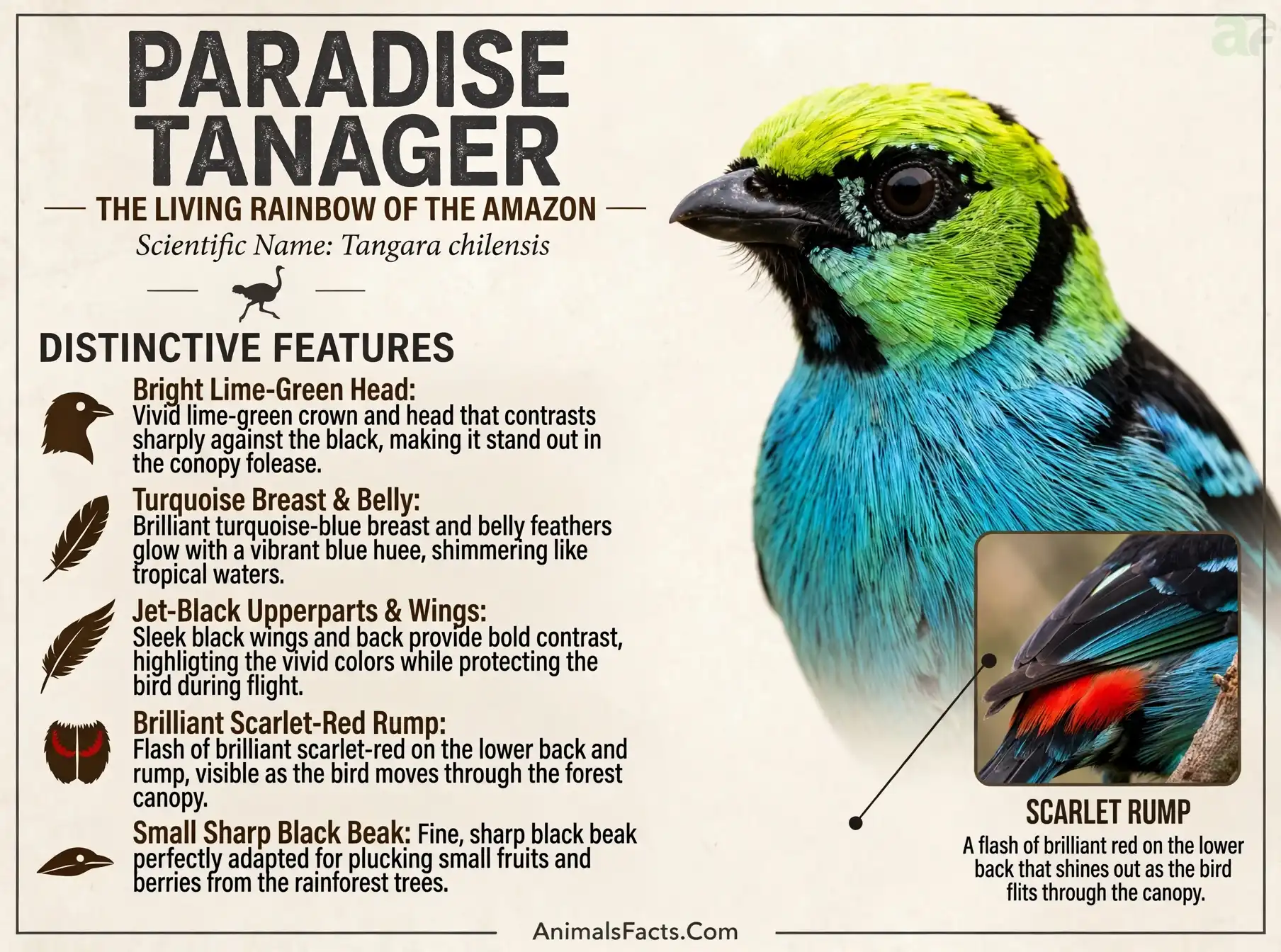
The paradise tanager’s physical appearance is the most polychromatic of any small bird in the Americas — seven distinct, vivid, saturated colors distributed across a bird small enough to sit comfortably in a human palm, creating a visual impression so extreme that virtually everyone who encounters this species for the first time responds with some version of disbelief.
The Seven Colors — A Region-by-Region Description
The paradise tanager’s plumage is organized into seven clearly defined color regions — each a distinct, vivid hue that contrasts sharply with its neighbors rather than blending gradually:
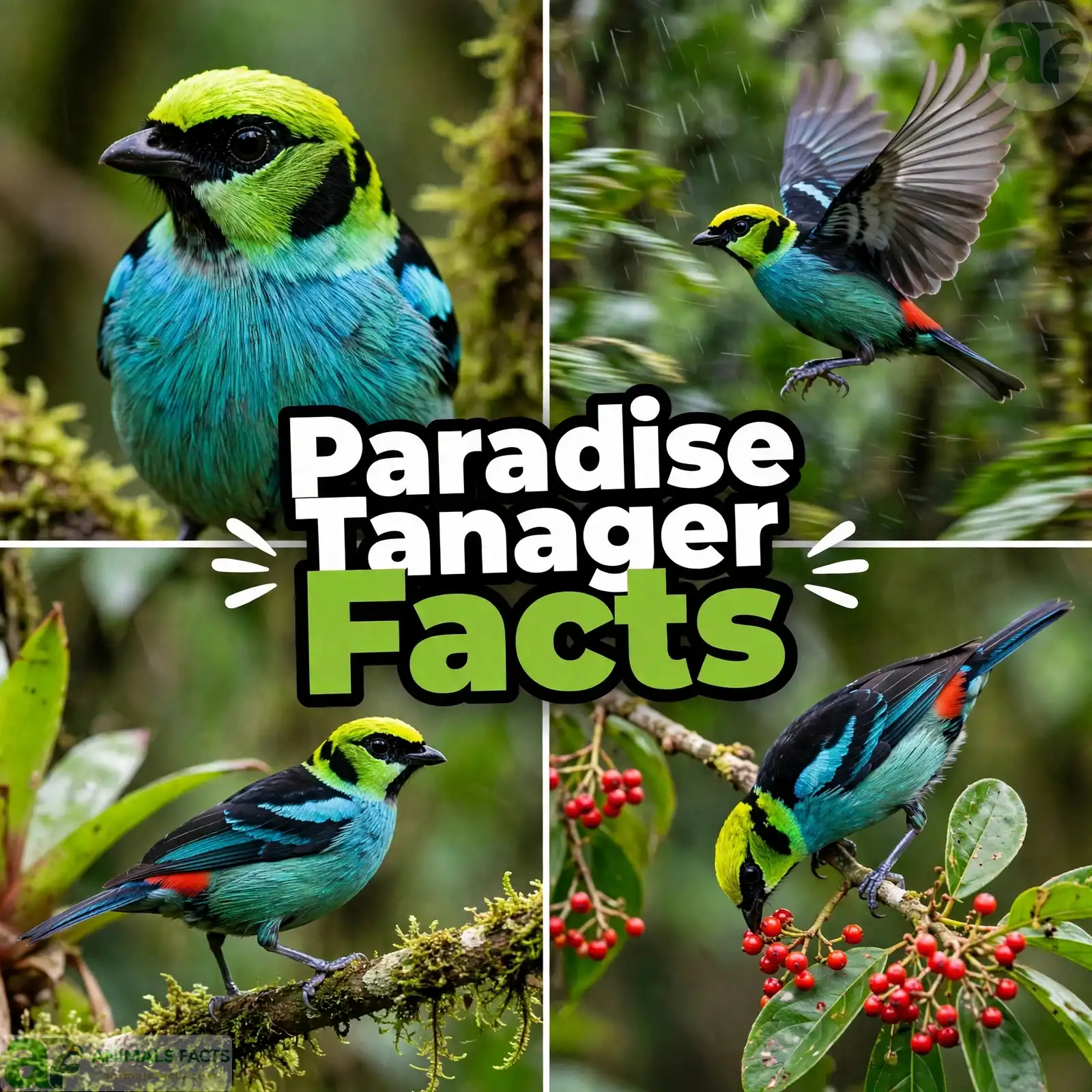
1. The apple-green head — The entire head, face, and upper throat of the paradise tanager is a vivid apple-green — a bright, slightly lime-toned green distinct from the darker greens of the forest canopy. This green creates the most immediately striking feature of the bird’s appearance when seen head-on — the luminous green face surrounded by black appearing like a vivid mask.
2. The black mantle — Immediately behind the green head, the upper back, scapulars, and wing coverts are deep, matte black — creating the sharpest possible contrast with both the apple-green head and the colors that follow below and behind. The black mantle gives the bird a distinctly cloaked or jacketed appearance — as if the green head has been set onto a black-bodied framework.
3. The turquoise upper breast — Below the throat, the upper breast is a vivid turquoise blue-green — intermediate between the green of the head and the blue of the belly, providing a transitional color that bridges the two without simply repeating either.
4. The scarlet rump — Across the lower back and rump — the patch visible when the bird is perched and most dramatically visible in flight — a vivid scarlet to orange-red creates the most unexpected color in the sequence. The scarlet rump, visible as a bright flash when the bird moves through the canopy, is one of the most distinctive identification features of the species in flight.
5. The violet-blue shoulders — The lesser wing coverts bear patches of violet to violet-blue — an iridescent coloration that shifts between blue and purple depending on the viewing angle and light conditions. These shoulder patches contribute the violet component of the seven-color spectrum.
6. The cobalt-blue belly — The lower breast, belly, and flanks are a vivid cobalt blue — brighter and more saturated than the turquoise of the upper breast, providing a second blue tone that enriches the overall color complexity.
7. The black and red bill region — The bill itself is black, but the bill base coloration varies by subspecies — black in the nominate subspecies T. c. chilensis, and red to orange-red in the subspecies T. c. paradisea (the western Amazonian form). This subspecific variation in bill base color is the most significant morphological difference between the recognized subspecies and is the primary basis for their taxonomic separation.
The Color Production Mechanisms
The paradise tanager’s seven colors are produced by a combination of physical mechanisms — not all colors in the plumage are produced the same way:
Structural coloration (iridescent colors) — The turquoise breast, cobalt belly, and violet shoulder patches involve structural coloration — thin-film interference or photonic nanostructure in the feather barbule microstructure producing specific wavelengths through physics rather than pigment. These colors are iridescent — they shift slightly with viewing angle and tend to appear most vivid in direct light.
Melanin-based colors — The black mantle is produced by eumelanin — the standard melanin pigment responsible for black and dark brown coloration in birds. The deep, matte black of the mantle reflects essentially no light — creating the maximum contrast with the vivid structural and carotenoid colors surrounding it.
Carotenoid-based colors — The scarlet rump is produced by carotenoid pigments — the same class of pigments responsible for red, orange, and yellow colors in many bird species. Carotenoids cannot be synthesized by birds and must be obtained from the diet — the vividness of the scarlet rump therefore reflects the bird’s dietary quality and foraging success, making it a potential honest signal of individual quality.
The green head mechanism — The apple-green head is produced by a combination of yellow carotenoid pigment in the feather barbules and structural blue coloration from the feather microstructure — the combination of these two mechanisms producing green through the same additive color mixing principle as mixing yellow and blue paint. This “psittacofulvin-structural” or “carotenoid-structural” green combination is a common mechanism for producing vivid green in birds.
Body Size and Physical Proportions
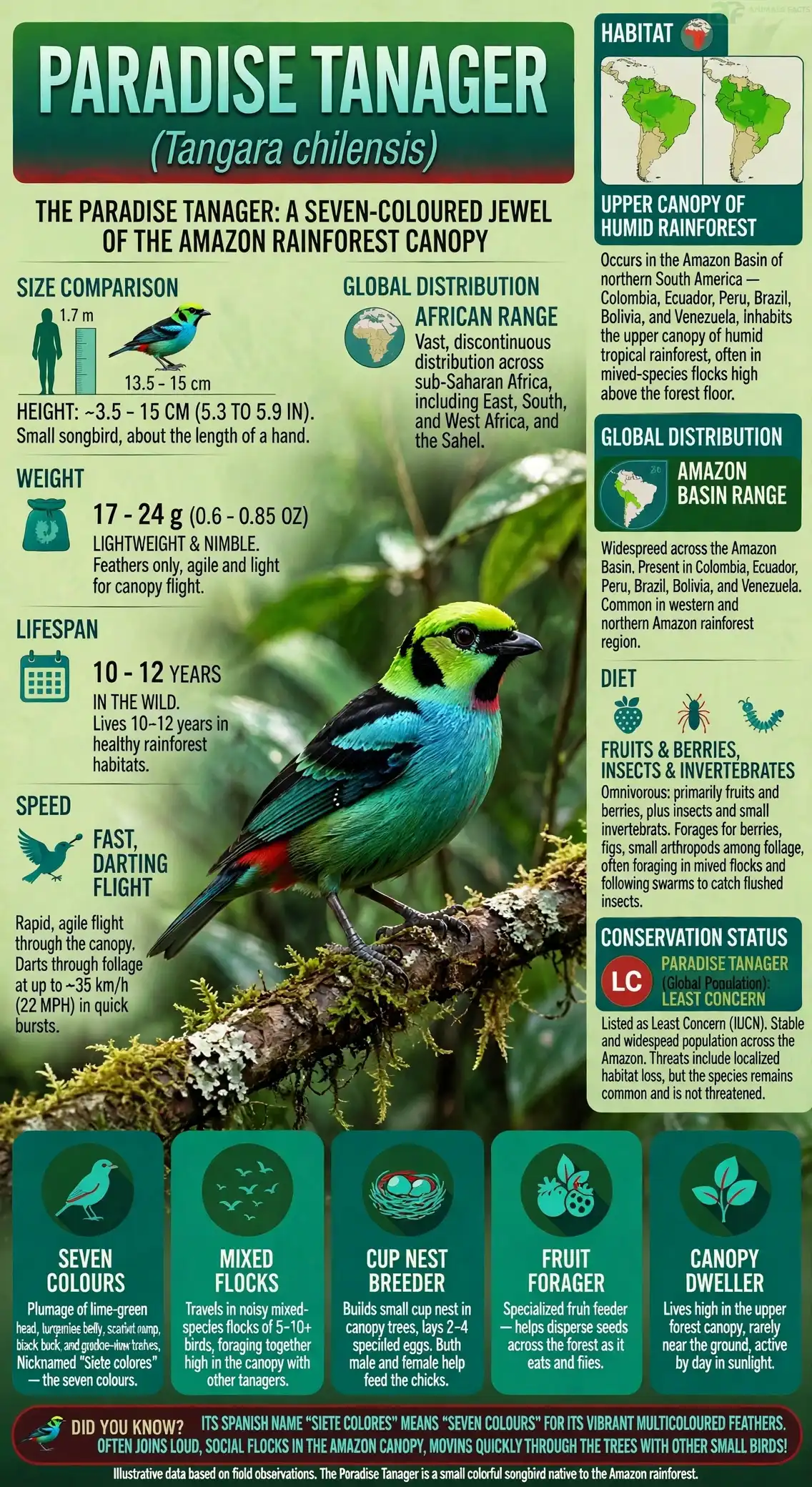
Body length — 13.5–15 cm — a compact, medium-small songbird; smaller than a house sparrow in length but stockier in proportions
Weight — 18–23 grams — approximately the weight of a tablespoon of water
Wingspan — approximately 20–22 cm
Bill — Short, slightly curved, typical frugivore bill — wide enough to manipulate berries but not specialized for seed-cracking or probing
Sexual Dimorphism — Or the Lack Thereof
Unlike the golden pheasant, the resplendent quetzal, and most other spectacularly colored birds discussed in this article series, the paradise tanager shows very limited sexual dimorphism:
Male and female similarity — Both sexes are similarly colored — females are occasionally slightly duller in some color regions but the difference is modest and not reliably apparent in field observation without direct comparison.
The evolutionary implication — The absence of dramatic sexual dimorphism in the paradise tanager suggests that the spectacular coloration may function differently from the purely mate-attraction function of male-only ornaments in polygynous species. Mutual sexual selection — where both sexes use color to assess each other’s quality — or social signaling within the mixed-species flocks the paradise tanager inhabits — may be important functions of the vivid plumage in both sexes.
💡 Did You Know? The paradise tanager is known in several languages as the “seven-colored tanager” — a name that reflects cross-cultural recognition of the bird’s exceptional polychromatism. In Portuguese (sete-cores), in Spanish (tangara sietecolores in some regional traditions), and in various indigenous Amazonian languages, names meaning “seven colors” or “many colors” appear as the primary designation for this species. The number seven has particular cultural resonance across many human traditions — seven colors of the rainbow, seven days of the week, seven notes of the musical scale — and its application to the paradise tanager reflects both the actual color count and the human instinct to frame this bird’s visual impact in terms of the most culturally complete set of colors available. Ornithologists counting the paradise tanager’s colors arrive at different totals depending on whether they count the subspecific bill-base red as a separate color and whether they distinguish the turquoise breast and cobalt belly as two separate blues or a single blue region — but the tradition of “seven colors” captures the essential truth of a bird that somehow manages to be simultaneously all colors at once.
4. Top 25 Amazing Paradise Tanager Facts
Here is your definitive collection of the most extraordinary, scientifically verified, and genuinely astonishing paradise tanager facts as of 2026:
- The paradise tanager displays seven distinct colors on a single bird weighing approximately 20 grams — making it the most polychromatic small bird in the Western Hemisphere and one of the most colorful vertebrates in the world by color count per unit body mass.
- The species name chilensis — meaning “of Chile” — is one of ornithology’s most celebrated misnomers — the paradise tanager does not occur in Chile and has no natural presence in that country. The error arose from a mislabeled specimen in the original collection that Vigors described in 1832.
- The paradise tanager’s scarlet rump is produced by carotenoid pigments that cannot be synthesized by the bird — they must be obtained directly from the diet. The vivid color of the rump therefore functions as an honest signal of foraging quality and nutritional health that other birds can assess.
- The paradise tanager is a mixed-species flock specialist — it is almost always encountered as part of large, multi-species foraging flocks moving through the Amazon canopy. These flocks may contain 10–30 species simultaneously — one of the most complex social foraging associations in the bird world.
- Unlike most spectacularly colored birds — where males are vivid and females cryptic — the paradise tanager shows very little sexual dimorphism — both males and females are similarly brightly colored. This unusual pattern suggests the plumage functions in mutual mate assessment and social signaling rather than purely in male display to females.
- The paradise tanager inhabits four recognized subspecies across its range, distinguished primarily by the color of the bill base — black in the nominate eastern Amazonian form and red to orange-red in the western Amazonian subspecies T. c. paradisea — providing a living example of geographic color differentiation.
- The paradise tanager’s genus Tangara contains approximately 95 species — making it one of the most species-rich colorful bird genera in the world, and the paradise tanager is the most polychromatic member of this already spectacular group.
- The tanager family Thraupidae — to which the paradise tanager belongs — is the second largest bird family in the world with approximately 385 species, and is distributed almost exclusively in the Neotropics where it has radiated into virtually every ecological niche available to small and medium-sized birds.
- The paradise tanager’s apple-green head is produced not by green pigment but by a combination of yellow carotenoid pigment and structural blue from the feather microstructure — the two mechanisms combining to produce green through additive color mixing, the same principle as mixing yellow and blue paint.
- The paradise tanager is found across nine countries — Venezuela, Colombia, Ecuador, Peru, Bolivia, Brazil, Guyana, Suriname, and French Guiana — making it one of the more broadly distributed members of the spectacularly colorful Tangara genus, most of whose members have much more restricted ranges.
- Mixed-species flocks including paradise tanagers in the Amazon canopy can move at speeds of up to 2 kilometers per hour through the forest — the entire multi-species assemblage traveling together as a coherent foraging unit, each species exploiting different microhabitats and food resources as the flock moves.
- The paradise tanager is primarily a canopy and sub-canopy species — typically encountered in the upper levels of primary forest and at forest edges rather than in the forest interior at ground level. This vertical habitat preference means that most wild sightings require looking upward into the tree canopy.
- The cobalt-blue belly and turquoise upper breast of the paradise tanager are both produced by structural coloration — thin-film interference in feather barbule microstructure reflecting specific wavelengths of blue and turquoise light. These structural colors appear most vivid in direct sunlight and may appear dull or even absent in deep shade.
- The paradise tanager, despite its extraordinary appearance, is considered relatively common across its Amazonian range — one of the more frequently encountered spectacularly colored small birds in appropriate forest habitats, a status that contrasts sharply with the rarity of many other spectacular Neotropical birds.
- Research on Tangara species ecology has documented that the paradise tanager selects fruit based on both nutritional content and ease of handling — preferring small fruits that can be swallowed whole over large fruits requiring time-consuming manipulation, and showing preference for fruits with high sugar content when available.
- The paradise tanager participates in the “nuclear species” system of Amazonian mixed-species flocks — following certain “nuclear” species (typically antshrikes or antwrens) whose foraging movements lead the flock toward productive food patches. The paradise tanager is a “attendant species” that joins these flocks rather than leading them.
- The paradise tanager’s vocalizations include a variety of thin, high-pitched chips and buzzy notes typical of Tangara tanagers — not the elaborate musical songs of many other songbirds, but a repertoire of contact calls, alarm notes, and soft social vocalizations that maintain cohesion within the mixed-species flock.
- Deforestation in the Amazon represents the most significant threat to paradise tanager populations — while the species is currently common, the rapid rate of Amazonian deforestation has reduced local populations across the southern and eastern portions of the range, where agricultural conversion of forest land is most intensive.
- The paradise tanager has been painted and illustrated by natural history artists since the late 18th century — the extraordinary color combination making it an irresistible subject for artists attempting to capture the visual character of Amazonian bird life. Early natural history illustrations frequently featured the paradise tanager as a centerpiece of Amazonian bird plates.
- The paradise tanager’s home range within the Amazon is relatively large compared to many small songbirds — the need to follow seasonally fruiting trees across the landscape means individuals and flocks must cover substantial distances to maintain consistent food access.
- In some parts of its range, the paradise tanager is observed at forest edges, second growth, and disturbed habitats as well as primary forest — a degree of habitat flexibility that contributes to its relative abundance compared to more strictly primary-forest-dependent species.
- The seven-colored appearance of the paradise tanager creates an extraordinary optical contrast with the green canopy background — yet research on visual ecology suggests that the combination of colors may actually be less conspicuous to predators than it appears to human observers, because the complex color pattern breaks up the bird’s outline more effectively than a simple, uniform coloration would.
- The paradise tanager’s nest is a compact cup of plant fibers, mosses, and rootlets — typically placed in the fork of a branch in the mid-canopy. The female constructs the nest while the male follows closely and may contribute some material — the nest-building association maintaining the pair bond during the pre-breeding period.
- The paradise tanager’s wing molt pattern — the sequence in which flight feathers are replaced during the annual molt — has been used as a taxonomic character in Tangara phylogenetic studies, contributing to understanding of evolutionary relationships within this species-rich genus.
- As of 2026, the paradise tanager is classified as Least Concern by the IUCN — but local populations across the southern Amazon agricultural frontier are declining in response to deforestation, and the species is recognized as a potential indicator of Amazonian forest health whose population trends deserve monitoring attention.
5. Fun Facts About Paradise Tanagers
- Seven distinct colors on a 20-gram bird
- Scientific name means “of Chile” — but it doesn’t live in Chile
- No sexual dimorphism — male and female equally colorful
- Almost always in mixed-species flocks of 10–30 species
- Scarlet rump is an honest signal of dietary quality
- Apple-green head produced by yellow pigment + structural blue
- Part of Tangara — one of the most colorful bird genera on Earth
- Family Thraupidae is the second largest bird family in the world
- Found across nine Amazonian countries
- Mixed-species flocks travel at 2 km/h through the canopy
- Relatively common despite extraordinary appearance
- Seven-color pattern may help break up body outline from predators
6. Paradise Tanager Habitat & Geographic Range
Paradise tanager habitat is centered on the tropical rainforest of the Amazon Basin — one of the most biodiverse and most ecologically productive ecosystems on Earth, and the evolutionary cradle of the extraordinary Thraupidae radiation to which the paradise tanager belongs.
Primary Habitat Types
Primary tropical rainforest — canopy and sub-canopy — The paradise tanager’s preferred habitat is the upper levels of intact primary rainforest — the canopy and sub-canopy zones at 10–30 meters height where fruiting trees and mixed-species foraging flocks concentrate. This vertical habitat preference means that most encounters with the species occur when looking upward into the forest canopy or when the birds are visible at forest edges.
Forest edges and clearings — Forest edges provide important microhabitats — the increased light at edges stimulates fruiting in various plant species, and edge habitats concentrate mixed-species foraging flocks that include paradise tanagers. Some observers have noted higher paradise tanager detectability at edges than in closed-canopy interior forest precisely because the birds are more visible.
Second growth and disturbed forest — More habitat-flexible than many Amazonian specialists, the paradise tanager uses mature second-growth forest and disturbed habitats at forest margins — a tolerance that contributes to its relative abundance in landscapes with some forest modification.
Elevation range — The paradise tanager occupies a broad elevation range from near sea level in the Amazon floodplain to approximately 1,700 meters in the Andean foothills — the upper elevation limit defined by the transition from lowland Amazonian forest to Andean cloud forest where different Tangara species replace it.
Geographic Distribution
| Country | Status | Key Regions | Notes |
|---|---|---|---|
| Brazil | Core range — abundant | Amazon Basin broadly | Largest geographic extent of any country |
| Peru | Core range — abundant | Loreto, Madre de Dios, Ucayali | Western Amazonian subspecies |
| Colombia | Abundant | Amazonian lowlands, Llanos foothills | Northwestern subspecies present |
| Ecuador | Abundant | Amazonian lowlands (Oriente) | Western subspecies |
| Venezuela | Abundant | Amazonas, Bolívar states | Northern range |
| Bolivia | Present | Northern Amazonian lowlands | Southeastern range limit |
| Guyana | Abundant | Lowland forest throughout | Eastern range |
| Suriname | Abundant | Lowland forest throughout | Eastern range |
| French Guiana | Abundant | Lowland forest throughout | Eastern range; well-documented |
The Amazon Basin — The Most Biodiverse Ecosystem on Earth
The paradise tanager’s home — the Amazon Basin — is the largest tropical rainforest in the world and the most biodiverse terrestrial ecosystem:
Scale — The Amazon Basin covers approximately 5.5 million km² — larger than the contiguous United States. The Amazon River system drains approximately 40% of South America and discharges approximately 20% of all freshwater entering the world’s oceans.
Biodiversity — The Amazon Basin contains:
- Approximately 40,000 plant species
- Approximately 3,000 freshwater fish species
- Approximately 1,300 bird species — including the paradise tanager
- Approximately 430 mammal species
- Approximately 2.5 million insect species (estimated)
The tanager connection — The extraordinary bird diversity of the Amazon — including the extraordinary Tangara radiation — is directly linked to the forest’s ecological complexity. The vertical structure of the forest (ground, understory, sub-canopy, canopy, emergent layers), the extraordinary plant diversity (providing diverse fruiting trees), and the complexity of insect communities (providing protein) collectively create the ecological conditions that allowed birds like the paradise tanager to evolve.
Mixed-Species Flock Ecology — The Paradise Tanager’s Social Habitat
One of the most ecologically significant aspects of paradise tanager habitat use is its participation in mixed-species foraging flocks — a defining feature of Amazonian bird community ecology:
What is a mixed-species flock? — A mixed-species flock is an association of multiple bird species moving together through the forest as a foraging unit. In the Amazon, these flocks may contain 10–30 or more species simultaneously — including tanagers, honeycreepers, woodcreepers, antwrens, greenlets, and various other families all moving together through the same forest area at the same time.
The ecological benefits — Mixed-species flock participation provides several benefits to individual paradise tanagers:
- Enhanced predator detection — the many eyes of a large multi-species flock detect approaching predators more reliably than any single individual
- Information access — flock members benefit from the foraging discoveries of other species — if one species locates a productive fruiting tree, the entire flock benefits
- Reduced individual predation risk — the “dilution effect” of being one of many birds reduces any individual’s probability of being the target of a predator attack
- Social facilitation — flock movement through the forest stimulates insects and other prey into movement, making them more detectable
The paradise tanager’s flock role — The paradise tanager is an attendant species in Amazonian mixed-species flocks — reliably joining flocks led by “nuclear species” (typically certain antshrikes, antwrens, or other socially dominant species) but not itself organizing flock movement. The paradise tanager’s flock participation is so consistent that ornithologists use the presence of mixed-species flocks as a reliable predictor of paradise tanager detectability.
💡 Did You Know? The paradise tanager’s genus Tangara is sometimes called the “painted birds” of South America — a nickname that reflects the group’s extraordinary color diversity but also subtly acknowledges that the colors seem almost deliberately applied rather than naturally evolved. Evolutionary biologists have used Tangara species — including the paradise tanager — as model systems for studying the evolution of structural coloration because the genus contains species with virtually every combination of structural and pigment-based color mechanisms, allowing comparative studies that reveal how different coloration mechanisms evolve independently in closely related species. Research comparing the feather microstructure of different Tangara species has documented that the nanostructure producing structural blues and greens varies significantly between even closely related species — suggesting that structural coloration evolves relatively rapidly in response to selection pressures, rather than being a fixed ancestral feature. The paradise tanager, with its combination of structural turquoise, structural cobalt blue, and structural violet alongside carotenoid scarlet and a green produced by carotenoid-structural combination, effectively demonstrates the full repertoire of avian color mechanisms in a single bird — making it simultaneously the most colorful and the most mechanistically diverse Tangara species.
7. Paradise Tanager Diet & Feeding Behavior
Paradise tanager diet is centered on fruit — the species is primarily a frugivore that supplements the fruit diet with insects and other invertebrates to meet protein requirements, particularly during breeding.
Diet Breakdown Table
| Food Type | Estimated % of Diet | Season | Notes |
|---|---|---|---|
| Small berries and fruits | ~60–70% | Year-round | Primary food; small fruits swallowed whole |
| Medium fruits | ~10–15% | Seasonal — peak fruiting periods | Melastomataceae, Rubiaceae, Moraceae families |
| Insects and arthropods | ~15–20% | Year-round; peak breeding season | Gleaned from foliage and bark surfaces |
| Nectar | ~3–5% | Opportunistic | Visited at flowering trees; less important than in honeycreepers |
| Small spiders | ~2–3% | Year-round | Gleaned from vegetation surfaces |
The Frugivore Foraging System
Berry selection — The paradise tanager forages primarily on small berries and drupes of forest plants — the small bill size limiting the maximum fruit diameter that can be manipulated and swallowed efficiently. Primary food plant families include:
- Melastomataceae — The melastome family provides some of the most important fruit resources in the Amazonian understory and sub-canopy
- Rubiaceae — Coffee family plants produce small berries consumed throughout the year
- Moraceae — Fig family members including small Ficus species
- Piperaceae — Pepper family plants whose small berries are consumed in large quantities
- Myrtaceae — Myrtle family berries
Foraging technique — The paradise tanager forages through a combination of:
- Hover-gleaning — briefly hovering to snatch a berry from a cluster before returning to a perch
- Perch foraging — reaching from a stable perch to pluck berries from adjacent clusters
- Bark foraging — investigating bark surfaces and epiphyte accumulations for hidden insects and arthropods
Flock-mediated fruit discovery — Within the mixed-species flock, fruit discoveries by any species effectively benefit all — when one bird locates a productive fruiting tree, the entire flock converges on the resource. The paradise tanager’s flock participation therefore enhances foraging efficiency beyond what individual searching alone would achieve.
The Insectivore Supplement
Protein acquisition — Fruit provides abundant carbohydrates and some secondary metabolites, but is relatively low in protein. The paradise tanager supplements the fruit diet with insects and arthropods to meet protein requirements — particularly important during the breeding season when chick development demands elevated protein input.
Gleaning behavior — Insect foraging involves careful examination of leaf surfaces, bark crevices, and epiphyte accumulations — the paradise tanager moving slowly through vegetation during insect foraging compared to the more rapid movement during fruit harvesting.
Arthropod diversity — The Amazonian canopy supports extraordinary arthropod diversity — the paradise tanager exploits this diversity opportunistically, consuming beetles, ants, flies, caterpillars, and various other invertebrates encountered during foraging movement.
Foraging Height and Microhabitat
Canopy concentration — The paradise tanager concentrates foraging in the upper canopy and sub-canopy — the forest levels where the greatest concentration of fruiting plants and insect diversity occurs. Ground-level foraging is essentially never documented.
Edge exploitation — Forest edges support higher densities of light-demanding fruiting plants — the paradise tanager exploits this edge fruit concentration, contributing to its relative abundance in partially disturbed landscapes compared to obligate forest-interior species.
8. Paradise Tanager Reproduction & Life Cycle
Paradise tanager reproduction follows the broadly typical passerine breeding pattern — a monogamous pair bond during the breeding season, a small clutch, and biparental care of the nestlings — with the specific timing and ecology calibrated to the fruit and insect availability cycles of the Amazonian forest.
Pair Bond and Breeding Season
Monogamous pairs — Unlike the golden pheasant’s polygynous system, the paradise tanager forms monogamous pair bonds during the breeding season — both parents contributing to nest construction, incubation, and chick provisioning.
Breeding seasonality — The breeding season varies across the extensive geographic range — in most of the Amazonian range, breeding coincides with the late dry season to early wet season (approximately August–December in the southern Amazon, variable across the northern range) — the timing calibrated to match peak insect availability for chick provisioning with the early wet season’s increased invertebrate activity.
Pair bond duration — Whether paradise tanager pairs maintain bonds between breeding seasons (as in many long-lived passerines) is not definitively documented — the species’ lifespan (estimated 7–10 years in the wild) suggests multi-year pair bonds are plausible.
Courtship
Male display — Male paradise tanagers perform courtship displays in which the vivid plumage regions — particularly the scarlet rump and the cobalt belly — are presented to the female through specific postures that maximize the visibility of these color patches.
The mutual assessment dimension — Given the limited sexual dimorphism (both sexes are similarly colored), female paradise tanagers also display their plumage to males during courtship — the mutual display system reflecting the mutual mate assessment that characterizes species without extreme sexual dichromatism.
Singing — The thin, buzzy songs of the paradise tanager accompany courtship interactions — the acoustic signal supplementing the visual display information.
Nesting
Nest construction — The female takes the primary role in nest construction, with the male following closely and occasionally contributing material. The nest is a compact cup of:
- Plant fibers and rootlets forming the structural framework
- Moss and lichens lining the inner cup
- Spider web silk binding the exterior and anchoring the nest to the substrate
Nest placement — The nest is typically placed in the fork of a branch in the mid-to-upper canopy — concealed within leaf clusters or epiphyte growth that provides visual screening from both above and below.
Nest concealment — Despite the extraordinary visibility of the adult birds, nest sites are characteristically well-concealed — the small, cryptically colored nest contrasting with the vivid adults and providing a level of protection from predators that the adults’ own plumage cannot.
Clutch size — Typically 2 eggs — the standard clutch size for the majority of tropical passerines, reflecting the high adult survival rates and the ecological rationale for lower reproductive investment per breeding season in long-lived tropical birds compared to shorter-lived temperate zone species.
Egg description — The eggs are white to pale cream, typically with sparse reddish-brown spotting concentrated at the larger end.
Incubation period — approximately 13–14 days — shared between both parents, though the female typically performs the majority of incubation.
Chick Development
At hatching — Chicks hatch altricial — naked, blind, and completely dependent on parental provisioning and brooding.
Early feeding — Chicks are initially fed primarily insects and arthropods — the high protein content supporting the rapid growth rate of the nestling period. As chicks grow and their energy demands increase, fruit is progressively incorporated into the provisioning diet.
Nestling period — approximately 14–16 days in the nest before fledging — typical for small tropical passerines.
Post-fledging care — Fledglings remain with the parents for 3–5 weeks after leaving the nest — the family group moving together as a unit before the young birds achieve full independence and join mixed-species flock associations independently.
Sexual maturity — Most paradise tanagers reach sexual maturity and attempt first breeding at 1 year of age — typical for small passerines, though breeding success improves with experience in subsequent years.
9. Social Behavior & Communication
Paradise tanager social behavior is organized around the mixed-species foraging flock as the fundamental social unit — a dramatically different social framework from the territorial pair bonds of larger raptors or the display-centered polygyny of Galliformes.
Mixed-Species Flock Dynamics
Flock composition — A typical Amazonian mixed-species flock containing paradise tanagers may include:
- Euphonias (2–3 species)
- Other Tangara tanagers (2–5 species)
- Honeycreepers (1–3 species)
- Woodcreepers (1–2 species)
- Antwrens and antbirds (2–4 species)
- Greenlets and vireos (1–2 species)
- Various small passerines from multiple families
Paradise tanager number per flock — Within a mixed-species flock, paradise tanagers are typically represented by 2–8 individuals — not the entire local population but a subset that joins the traveling flock.
Flock cohesion — The paradisea tanager maintains contact with flock members through frequent chip calls — thin, high-pitched vocalizations that maintain spacing information between individuals moving through canopy vegetation that limits visual contact. These calls allow individuals to maintain flock membership even when they cannot see other members.
Flock movement patterns — Mixed-species flocks including paradise tanagers follow systematic routes through their home range — revisiting productive fruiting trees and foraging patches at intervals calibrated to fruit replenishment rates. Individual birds within the flock appear to retain spatial memory of productive food patches encountered on previous flock movements.
Territory and Home Range
Non-territorial frugivory — The paradise tanager does not maintain a vigorously defended feeding territory — the patchy and seasonally variable nature of fruit resources in the Amazon makes territory defense of food resources impractical. Instead, birds follow the mixed-species flock through a home range of several hectares without defending specific areas against competitors.
Breeding territory — During the breeding season, the pair maintains a loose breeding territory around the nest site — defending the immediate nest vicinity but not excluding other paradise tanagers from the broader home range.
Communication
Contact calls — The most important vocalizations for daily social functioning; thin, high-pitched “chip” notes produced continuously during flock movement, maintaining contact between individuals and communicating basic alarm or location information.
Alarm calls — A distinct alarm call — sharper and more urgent than the contact chip — triggers immediate cover-seeking behavior by all members of the mixed-species flock when a predator is detected.
Song — Male paradise tanagers produce simple, buzzy songs during the breeding season — not the elaborate musical compositions of many temperate-zone songbirds, but a repertoire of ascending and descending buzzy phrases that function in territory advertisement and mate attraction.
Visual communication — The vivid plumage functions as a continuous visual signal — postures that expose the scarlet rump, the cobalt belly, or spread the wings to reveal the violet shoulder patches contribute to social communication within both the pair bond and the mixed-species flock.
10. Predators & Defense Mechanisms
The paradise tanager faces predation from a range of Amazonian predators — and its extraordinary visibility creates the same predation-versus-mate-attraction trade-off seen in other spectacularly colored birds.
Natural Predators
Forest falcons (Micrastur species) — The forest falcons are specialized predators of forest birds — their long tails and rounded wings facilitating pursuit through dense forest vegetation. The collared forest falcon (M. semitorquatus) and lined forest falcon (M. gilvicollis) are documented predators of small canopy birds including tanagers.
Ornate hawk-eagle (Spizaetus ornatus) — Documented canopy bird predator; the hawk-eagle’s forest-interior hunting strategy allows it to intercept mixed-species flocks including paradise tanagers.
Bat falcon (Falco rufigularis) — A small, agile falcon specialized for aerial pursuit of small birds; documented catching tanagers at forest edges.
Bicolored hawk (Accipiter bicolor) — An Accipiter hawk specialized for bird pursuit in forest habitats; documented as a tanager predator.
Snakes — Arboreal snakes including vine snakes (Imantodes species) and tree boas (Corallus species) are nest predators — consuming eggs and altricial nestlings at canopy nest sites.
Monkeys — Capuchins and other opportunistically omnivorous monkeys raid bird nests when discovered — nest predation by capuchin monkeys represents a significant source of nest failure across Amazonian forest birds including tanagers.
Defense Mechanisms
Mixed-species flock predator detection — The most important defense mechanism; the many eyes of a mixed-species flock containing 10–30 species provide dramatically better predator detection than any individual bird could achieve alone. Research has documented that birds in larger mixed-species flocks spend less time in vigilance behavior and more time foraging — demonstrating the detection benefit of flock membership.
Alarm call system — The multi-species alarm call network allows any species in the flock to trigger a collective escape response when a predator is detected. Paradise tanagers respond to the alarm calls of all species in their mixed-species flock, not just calls from other paradise tanagers — the cross-species alarm system extending the detection network.
The color pattern disruption hypothesis — As noted in the Top 25 Facts, research on visual ecology suggests that the paradise tanager’s complex seven-color pattern may function as disruptive coloration — breaking up the bird’s outline against the complex visual background of the forest canopy more effectively than a uniform color would. From a predator’s perspective, the complex pattern of non-matching colors may make it more difficult to identify the bird’s body shape and size at distance.
Canopy concealment — Despite their vivid colors, paradise tanagers in the upper forest canopy can be remarkably difficult to detect — the combination of high elevation, filtered light, leafy background, and constant movement creating conditions where even vivid colors are genuinely hard to track.
Escape flight — When threatened at close range, paradise tanagers make rapid escape flights through the canopy — their intimate familiarity with canopy structure allowing navigation through dense vegetation that pursuing predators may struggle to follow.
11. Paradise Tanager Facts for Kids
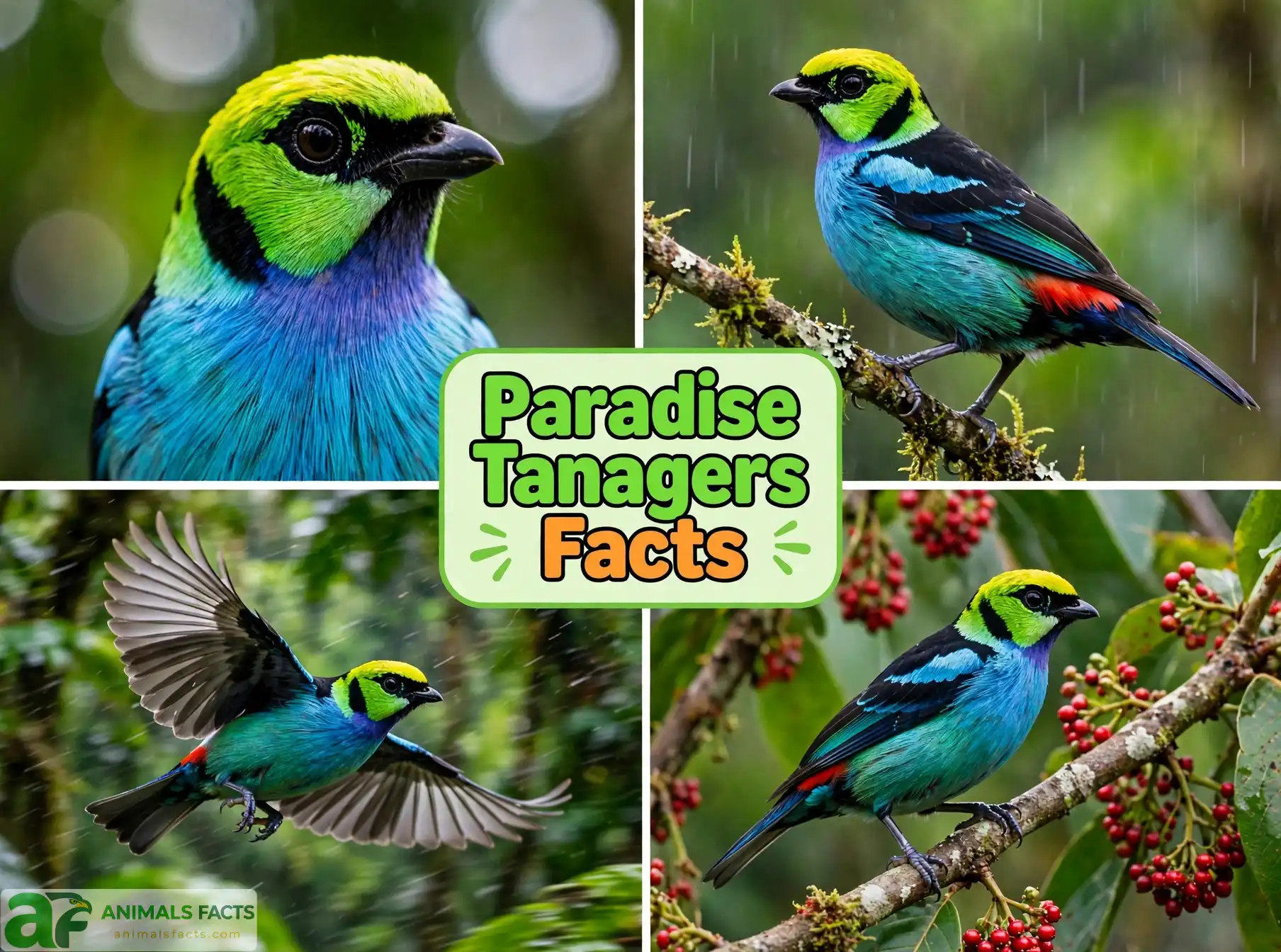
Hey amazing young wildlife scientists and bird enthusiasts! Here are some truly extraordinary paradise tanager facts for kids that will make every bird conversation instantly more colorful and more fascinating:
- The paradise tanager has SEVEN different colors on one tiny bird! Can you name seven colors? Red, orange, yellow, green, blue, indigo, violet — the colors of the rainbow. Now imagine all those colors somehow packed into a bird the size of your hand! The paradise tanager has apple-green, black, turquoise, scarlet, violet, cobalt blue — and the bill region adds another — making it the most colorful small bird in the entire Western Hemisphere!
- It is named after a country it has NEVER visited! The paradise tanager’s scientific name is Tangara chilensis — which means “tanager of Chile.” But paradise tanagers do not live in Chile and never have! When the scientist who formally described the species in 1832 received the specimen, it had a wrong label saying it came from Chile. Because of the rules of scientific naming, the mistake can never be corrected — the paradise tanager is stuck with a name from the wrong country forever!
- The paradise tanager is almost ALWAYS in a big group of other bird species! When you see a paradise tanager, you are almost certainly looking at a mixed-species foraging flock — a group of 10 to 30 DIFFERENT bird species all traveling through the forest together at the same time. Imagine going to school and your entire class was made up of 30 completely different species of birds, all going the same direction through the forest and sharing information about where the food is!
- Its scarlet bottom glows like a tiny red light! The bright scarlet-red patch on the paradise tanager’s lower back and rump is one of the most visible features of the bird in flight — it flashes like a tiny red signal as the bird moves through the green canopy. This color comes from food — carotenoid pigments in the fruit the bird eats turn into the vivid red color. Birds that eat better food have brighter red rumps!
- The male and female look EXACTLY THE SAME! In most brilliantly colored birds — like peacocks, golden pheasants, and resplendent quetzals — the male is spectacular and the female is dull brown. Not the paradise tanager! Both male and female paradise tanagers are equally vivid and colorful. Scientists think this means both birds are carefully choosing each other as partners — not just the female choosing the most spectacular male!
- The apple-green head is made from TWO different color tricks mixed together! There is actually no green pigment in the paradise tanager’s green head feathers. Instead, the feathers contain YELLOW pigment — and also have a microscopic structure that reflects BLUE light. When you combine yellow and blue, you get GREEN! The same basic principle as mixing yellow and blue paint, but happening at the scale of individual molecules in a feather barbule!
- It belongs to the SECOND LARGEST bird family in the world! The paradise tanager belongs to Thraupidae — the tanager family — which contains about 385 species. That makes it the second largest bird family on Earth. And within this already extraordinary family, the paradise tanager belongs to the genus Tangara with about 95 species — which might just be the most colorful collection of related birds anywhere in the world!
- The Amazon forest where it lives is the size of the ENTIRE CONTIGUOUS UNITED STATES! The Amazon Basin — the tropical rainforest home of the paradise tanager — is so enormous that it would cover all of the mainland United States. It contains more tree species in a single square kilometer than exist in the entire continent of Europe. It is the most biodiverse place on Earth — and the paradise tanager is one of its most spectacular inhabitants!
12. Relationship with Humans
The paradise tanager’s relationship with humans spans indigenous Amazonian traditions of ecological knowledge and symbolic significance, the natural history illustration tradition that made the bird famous in European scientific culture, a modest but growing wildlife tourism significance as birding tourism in the Amazon expands, and the urgent backdrop of Amazon deforestation that threatens the bird’s habitat even as the species itself remains relatively common.
Indigenous Amazonian Relationships
Traditional ecological knowledge — Numerous indigenous Amazonian peoples have developed detailed traditional knowledge of the paradise tanager — recognizing the bird’s distinctive appearance, understanding its habitat associations and flock behavior, and incorporating it into the sophisticated ecological knowledge systems that characterize indigenous forest cultures.
Indigenous names — Various indigenous Amazonian languages have their own names for the paradise tanager — typically names that reference the bird’s extraordinary colors. The Tupi origin of the genus name Tangara — from the Tupi word tangará applied to various colorful birds — reflects the deep indigenous linguistic contribution to Neotropical bird nomenclature, with indigenous names providing the foundation for the scientific genus name now used globally.
Feather traditions — The extraordinarily vivid feathers of the paradise tanager — particularly the scarlet rump feathers and the iridescent blue belly feathers — have been used in traditional decorative arts and ceremonial objects by various Amazonian peoples. The use of bird feathers in Amazonian indigenous material culture has deep historical roots, with paradise tanager feathers contributing distinctive colors to featherwork traditions.
Food and subsistence — Historical accounts document that paradise tanagers were occasionally consumed as food by various Amazonian indigenous communities — the birds’ small body mass making them a minor rather than a primary food resource, but their relative abundance and mixed-species flock behavior making them accessible to hunters with blowguns or other traditional hunting implements.
European Natural History Tradition
The illustration legacy — The paradise tanager became one of the most celebrated Neotropical birds in the European natural history illustration tradition of the 18th and 19th centuries:
John Gould’s illustrations — The English ornithologist and artist John Gould — whose illustrated works on Australian, Asian, and American birds defined the pinnacle of Victorian natural history illustration — produced celebrated depictions of the paradise tanager that were widely reproduced and remain among the finest artistic representations of the species.
Jacques Barraband — The French painter Jacques Barraband (1767–1809) — who illustrated multiple major French natural history publications of the Napoleonic era — produced paradise tanager illustrations that were particularly notable for their attempt to capture the iridescent qualities of the structural coloration, a remarkable challenge for pigment-based illustration.
The museum specimen tradition — The paradise tanager’s extraordinary appearance made it a centerpiece of natural history museum bird collections across Europe — specimens in the collections of the Natural History Museum London, Muséum National d’Histoire Naturelle Paris, and American Museum of Natural History New York have been referenced by ornithologists, artists, and taxonomists for nearly two centuries.
Wildlife Tourism Significance
Birding tourism in the Amazon — The growth of wildlife tourism in the Amazon — particularly birding tourism focused on seeing the extraordinary diversity of Amazonian bird species — has given the paradise tanager increasing economic significance as one of the species most sought by visiting birdwatchers:
The “top target” status — The paradise tanager appears on virtually every “top birds to see in the Amazon” list produced by birding tour operators and wildlife travel publications — the extraordinary visual impact of the seven-colored plumage making it one of the most desired sightings for visitors to Amazonian forest.
The mixed-species flock connection — Because the paradise tanager is reliably found in mixed-species flocks, a sighting of this species typically comes alongside sightings of multiple other spectacular Tangara species and other Amazonian birds — making paradise tanager encounters particularly rewarding for wildlife tourists seeking maximum species diversity per outing.
Economic value to local communities — In ecotourism development areas of the Amazon — including the Manu region of Peru, the Napo region of Ecuador, and parts of the Guiana Shield — local guides who can reliably locate paradise tanagers and other spectacular birds generate income for communities that provides economic alternatives to forest clearance.
The Amazon Deforestation Context
The paradise tanager’s relationship with humans is ultimately defined by the Amazon deforestation crisis — the most significant human impact on the species and its ecosystem:
Deforestation scale — The Brazilian Amazon has lost approximately 800,000 km² of forest since 1985 — an area larger than France and Spain combined. Additional deforestation in Peru, Colombia, Ecuador, Bolivia, and other Amazonian countries adds substantially to this total.
Local population impacts — While the paradise tanager’s wide range and relative habitat flexibility make it less immediately vulnerable than many Amazonian specialists, local populations in the most heavily deforested areas (particularly the “arc of deforestation” in southern and eastern Brazil) have experienced significant declines.
The indicator species role — The paradise tanager’s dependence on mixed-species flocks means it functions as an indicator of forest patch quality — its presence indicating forest large enough and intact enough to support the complex bird community needed for mixed-species flock formation.
13. Paradise Tanager Conservation Status & Threats
Conservation Status Overview
| Feature | Details |
|---|---|
| IUCN Status | Least Concern (LC) |
| Population Trend | Decreasing — locally significant declines near deforestation frontier |
| Estimated Population | No precise global estimate — considered abundant across most of range |
| CITES Listing | Appendix II — international trade regulated |
| Brazil Status | Not specially protected; Least Concern |
| Monitoring Adequacy | Moderate — citizen science data good in accessible areas; remote Amazon poorly monitored |
Major Threats
| Threat | Description | Impact Level |
|---|---|---|
| Amazon deforestation | Agricultural conversion; cattle ranching; soy production | High — primary threat across range |
| Forest fragmentation | Small forest patches cannot support mixed-species flocks | High |
| Illegal wildlife trade | Capture for cage bird trade | Medium |
| Climate change | Altered rainfall patterns; altered fruiting phenology | Increasing concern |
| Agricultural pesticides | Reducing invertebrate prey availability | Medium |
| Gold mining | Mercury contamination of forest ecosystems in mining areas | Medium in affected areas |
| Infrastructure development | Road construction opening new deforestation frontiers | Medium-High |
The Deforestation Threat — Why “Least Concern” Does Not Mean “Safe”
The IUCN’s Least Concern classification reflects the paradise tanager’s broad range and relative abundance across the still-intact portions of the Amazon — but the designation should not be misread as indicating the species faces no meaningful threats:
The fragmentation problem — The paradise tanager’s dependence on mixed-species foraging flocks creates a specific vulnerability to forest fragmentation that is not captured by simple measures of forest area loss. A forest fragment that is too small to support the 10–30 species needed for mixed-species flock formation is effectively uninhabitable for paradise tanagers even if it retains adequate fruiting trees — because the flock’s predator detection and food discovery benefits that the species depends on cannot function in a fragment that lacks the species diversity to form a complete flock.
The deforestation rate — The Amazon is being deforested at rates that remain alarmingly high despite conservation efforts and policy interventions. At current deforestation rates, some models project that significant portions of the eastern and southern Amazon — where deforestation is most intense — could become non-viable for mixed-species flock species including the paradise tanager within decades.
The local extinction trajectory — In areas where deforestation has already reduced forest to small fragments, paradise tanagers and other mixed-species flock species have already experienced local extinction even while the global population remains at Least Concern. This pattern of local extinction preceding global threat is precisely the trajectory that leads eventually to species-level conservation concern if deforestation continues.
Conservation Responses
Amazon protected area network — The most important conservation response for the paradise tanager is the maintenance and enforcement of the Amazon protected area network — including national parks, biological reserves, extractive reserves, and indigenous territories that collectively protect substantial portions of the Amazon’s intact forest. Key areas include:
- Amazônia National Park (Brazil) — 9.9 million hectares
- Manu National Park (Peru) — 1.7 million hectares; UNESCO World Heritage Site
- Yasuní National Park (Ecuador) — 9,820 km²
- Tumucumaque Mountains National Park (Brazil) — 3.9 million hectares
Indigenous territory protection — Research consistently demonstrates that indigenous territories in the Amazon have among the lowest deforestation rates of any land category — the combination of indigenous communities’ traditional resource management and the legal recognition of their territorial rights providing effective forest protection that benefits the paradise tanager and all other forest-dependent species.
International conservation funding — Organizations including Amazon Conservation Association, WWF, Wildlife Conservation Society, and various international donors fund forest protection programs across the range.
14. Famous Paradise Tanagers in History & Pop Culture
Famous Individuals and Cultural Moments
Vigors’ Type Specimen (1832) — The mislabeled specimen formally described by Nicholas Vigors in 1832 — the individual that established the species in Western science and whose geographic error produced the permanently fixed but entirely inaccurate name chilensis — is held in the collections of the Natural History Museum, London. This specimen is historically significant as the founding record of the paradise tanager in formal Western ornithology, and its mislabeling has given the species a small but enduring celebrity in the community of ornithological taxonomy historians.
John Gould’s Illustrated Specimens — The paradise tanager illustrated in John Gould’s major natural history works of the mid-19th century — the first widely distributed high-quality illustrations of the species to reach a broad European audience — introduced the paradise tanager to public awareness across the English-speaking world. Gould’s illustrations, in their original hand-colored lithograph form, are now among the most valuable natural history artworks in international auction markets.
Manu Road and Cock-of-the-Rock Lodge Birds (Peru) — The paradise tanagers observed and photographed at the internationally famous Manu Road birding corridor in Peru — one of the world’s premier single-site birding locations — and at the iconic Cock-of-the-Rock Lodge at Wayqecha (Pillahuata) are among the most photographed and most documented wild paradise tanager populations in the world. The Manu Road’s paradise tanager populations have been observed and recorded by thousands of wildlife tourists and researchers, making individual birds from this location among the most viewed wild paradise tanagers globally.
eBird Milestone Records — The paradise tanager has been submitted as a life list record in eBird — the Cornell Lab of Ornithology’s global bird observation database — by thousands of birders visiting the Amazon, making it one of the most frequently recorded “target species” for Amazon birding trips in the eBird dataset.
Historical Natural History Significance
The Tangara radiation as scientific model — The paradise tanager and its genus Tangara have been used as a model system in multiple significant evolutionary biology studies — research on the evolution of structural coloration, the mechanisms of sexual selection in birds without dramatic sexual dimorphism, the ecology of mixed-species flocks, and the biogeography of Amazonian bird diversity have all used Tangara species including the paradise tanager as study subjects. This scientific utility has given the paradise tanager a significance in the research literature that its relatively common status and Least Concern conservation classification might not suggest.
The “painted birds” tradition — The use of Tangara tanagers — and the paradise tanager specifically — as emblematic subjects in Neotropical natural history illustration represents one of the most sustained traditions of any bird group in American natural history art. From the earliest European engravings of Amazon wildlife through the Victorian-era natural history illustration peaks to contemporary wildlife photography, the paradise tanager has been a recurring centerpiece of Amazonian bird depictions.
15. Role in Ecosystem & Food Chain
The Seed Disperser Role — Fruit Forests Maintained by Small Birds
The paradise tanager’s ecological role as a seed disperser is perhaps its most significant contribution to Amazon ecosystem function:
The dispersal mechanism — The paradise tanager swallows small fruits whole, digests the flesh, and deposits intact seeds in its feces at locations typically 50–500 meters from the parent plant. This dispersal distance is critical for the regeneration of many Amazonian plant species — seeds deposited away from the parent tree experience:
- Reduced competition from the parent
- Reduced density-dependent seed predator pressure
- Access to different soil conditions and light environments
Plant families served — The paradise tanager disperses seeds from multiple plant families, with the Melastomataceae, Rubiaceae, Piperaceae, and Myrtaceae being particularly important. Many of these plant families are themselves important components of the forest food web — their fruit provides resources for other frugivores, their flowers provide nectar for pollinators, and their structure provides habitat for the invertebrates that insectivores depend on.
The flock multiplication effect — Because the paradise tanager forages in mixed-species flocks, seed dispersal by individual birds is multiplied across the entire flock — the same fruiting tree visited by a mixed-species flock is effectively dispersed by multiple frugivore species simultaneously, depositing seeds across a wider area and through more diverse gut-processing conditions than any single species could achieve.
The Insectivore Role
Arthropod regulation — The paradise tanager’s consumption of canopy insects and arthropods contributes to the regulation of invertebrate communities across its home range. The cumulative insectivory of a mixed-species flock containing multiple frugivores and insectivores moving through the canopy creates meaningful predation pressure on canopy arthropod communities.
The chick-rearing protein demand — During breeding season, the shift toward more intensive insectivory during chick provisioning creates temporarily elevated predation pressure on specific arthropod groups — particularly soft-bodied larvae and caterpillars that provide high protein-to-handling-time ratios.
The Prey Role
Supporting Amazonian predators — The paradise tanager and other small canopy birds contribute to the energy budgets of Amazonian forest falcons, hawk-eagles, and arboreal snakes. In the Amazon’s extraordinarily complex food web, small frugivorous passerines like the paradise tanager represent an important link between plant productivity (via fruit consumption) and higher trophic levels (via predation).
The Indicator Species Role
The paradise tanager’s mixed-species flock dependence makes it a sensitive indicator of forest health:
- Presence in a forest area indicates sufficient patch size and intact species community to support mixed-species flock formation
- Absence from a forest area that appears structurally intact suggests the species community has been disrupted — potentially indicating previous hunting pressure, edge effects, or other disturbances not visible in vegetation surveys
- Population density correlates with forest patch size and connectivity — declining density with decreasing patch size provides a measurable metric for habitat quality assessment
16. Myths, Folklore & Cultural Significance
Amazonian Indigenous Traditions
The living rainbow — In several Amazonian indigenous traditions, extraordinarily colorful birds — including the paradise tanager — are associated with rainbow mythology — the rainbow being a powerful cosmological symbol across many Amazonian cultures. A bird that carries the colors of the rainbow in its plumage occupies a culturally significant position in traditions where the rainbow is associated with transformation, bridging of worlds, or divine presence.
Featherwork traditions — Amazonian indigenous featherwork — the creation of headdresses, capes, earrings, and other objects from bird feathers — is one of the most sophisticated material arts of Amazonian cultures. The paradise tanager’s vivid feathers, particularly the scarlet rump and iridescent blue belly feathers, appear in featherwork traditions across multiple Amazonian cultural groups, their specific colors contributing to the symbolic color language of these traditions.
The messenger association — In several Amazonian cultural traditions, brilliantly colored birds — including various tanagers — are associated with being messengers between the human and spiritual realms. The extraordinary appearance of the paradise tanager, combining so many vivid colors in such a small body, contributes to its status as a being that seems to originate from somewhere beyond ordinary nature.
Knowledge systems — Various Amazonian indigenous peoples have developed detailed traditional ecological knowledge of the paradise tanager — understanding its flock behavior, seasonal movements, and food plant associations in ways that reflect centuries of careful observation. This knowledge contributes to the broader traditional ecological knowledge base that is increasingly recognized as scientifically valuable for understanding Amazon biodiversity.
Western Cultural Responses
The “paradise” naming tradition — The application of the word “paradise” to the most spectacular representative of a bird genus or family is a recurring tradition in Western ornithology — birds of paradise, paradise flycatcher, paradise tanager. The use of “paradise” reflects the Western tradition of naming extraordinary birds with reference to their apparently supernatural beauty — beauty so extreme it seems to require a supernatural explanation.
The natural history illustration tradition as cultural statement — The repeated appearance of the paradise tanager as a centerpiece of Amazonian bird illustration plates in 18th and 19th century European natural history publications reflects a cultural statement about the Amazon as a place of unimaginable natural abundance and beauty — the paradise tanager functioning as a visual ambassador for the entire concept of Amazonian biodiversity.
The contemporary conservation metaphor — In contemporary Amazon conservation communication, the paradise tanager — alongside macaws, jaguars, and giant otters — functions as a charismatic ambassador species for the conservation urgency of the Amazon. The extraordinary visual impact of the seven-colored plumage makes it highly effective in conservation fundraising materials and public awareness campaigns — a role that gives the bird cultural significance beyond its ecological function.
17. Paradise Tanagers in Pop Culture
Wildlife photography and social media — The paradise tanager is one of the most photographed and most shared Neotropical bird species on wildlife photography social media platforms. Instagram, Facebook birding groups, and Twitter wildlife communities regularly feature paradise tanager photographs that generate exceptional engagement — the seven-color plumage creating images that viewers frequently describe as appearing “photoshopped” or digitally enhanced even when entirely natural and unmodified. The visual impact of these photographs has introduced the paradise tanager to global audiences far beyond the dedicated birding community.
BBC and National Geographic Amazonian documentary content — Multiple BBC natural history productions covering the Amazon — including “Amazon with Tom Hanks” (BBC, 2022) and various BBC Natural World and National Geographic Amazon productions — have featured paradise tanager footage in sequences covering the extraordinary bird diversity of the Amazon canopy. The species’ extraordinary appearance makes it a natural centerpiece of any documentary treatment of Amazonian bird diversity.
Neotropical birding literature — The paradise tanager is a fixture in birding guide literature covering the Amazon — featured in “Birds of Peru” by Schulenberg et al., “Birds of Venezuela” by Hilty, “Birds of Colombia” by Hilty and Brown, and every major national bird guide covering its range. The repeated featured treatment in these references has established the paradise tanager as one of the defining species of Amazonian birding culture.
Cornell Lab of Ornithology — The Cornell Lab’s Macaulay Library holds extensive recordings and photographs of the paradise tanager — accessible through eBird and the Cornell Lab website. These resources have made the paradise tanager one of the most thoroughly documented small Neotropical birds from an audiovisual standpoint, contributing to its cultural presence in the ornithological community.
Natural history museum exhibitions — Major natural history museums including the American Museum of Natural History (New York), the Natural History Museum (London), and the Smithsonian National Museum of Natural History display paradise tanager specimens in their bird collection exhibitions — the extraordinary plumage making museum specimens highly effective at communicating the diversity and beauty of Amazonian bird life to general audiences.
Amazon conservation campaigns — The paradise tanager appears in conservation marketing materials produced by organizations including WWF, Amazon Conservation Association, Rainforest Alliance, and various national conservation bodies — the bird’s extraordinary visual impact making it one of the most effective small-bird images in conservation communication despite its non-threatened status.
18. Paradise Tanager Facts vs. Common Myths
| Common Myth | The Real Fact |
|---|---|
| “The paradise tanager lives in Chile” | False — the species name chilensis is a historic error from a mislabeled specimen; the paradise tanager does not occur in Chile and is endemic to the Amazon Basin |
| “The paradise tanager’s vivid colors make it easy to spot in the forest” | Partially false — while the colors are extraordinary in photographs and at close range, in the forest canopy the complex color pattern is often genuinely difficult to detect at distance; the disruptive coloration may actually reduce detectability compared to uniformly colored birds |
| “Only the male is colorful; the female is drab” | False — unlike most spectacularly colored birds, both male and female paradise tanagers are similarly vivid and colorful, with very limited sexual dimorphism |
| “The paradise tanager is rare and endangered” | False — the species is classified as Least Concern and is considered relatively common across most of its Amazonian range, though locally significant declines occur near deforestation frontiers |
| “The seven colors are all produced by different pigments” | False — the colors are produced by a combination of mechanisms including structural coloration (blue, turquoise, violet), melanin (black), carotenoids (scarlet rump), and a carotenoid-structural combination (green head). Not all colors involve pigment |
| “The paradise tanager is solitary” | False — the paradise tanager is almost always found in mixed-species foraging flocks of 10–30 species; solitary individuals are unusual and may indicate a bird separated from its flock |
| “Paradise tanagers can only survive in pristine primary forest” | Partially false — while primary forest is the preferred habitat, the species uses mature secondary growth and forest edges, making it somewhat more habitat-flexible than many Amazon specialists |
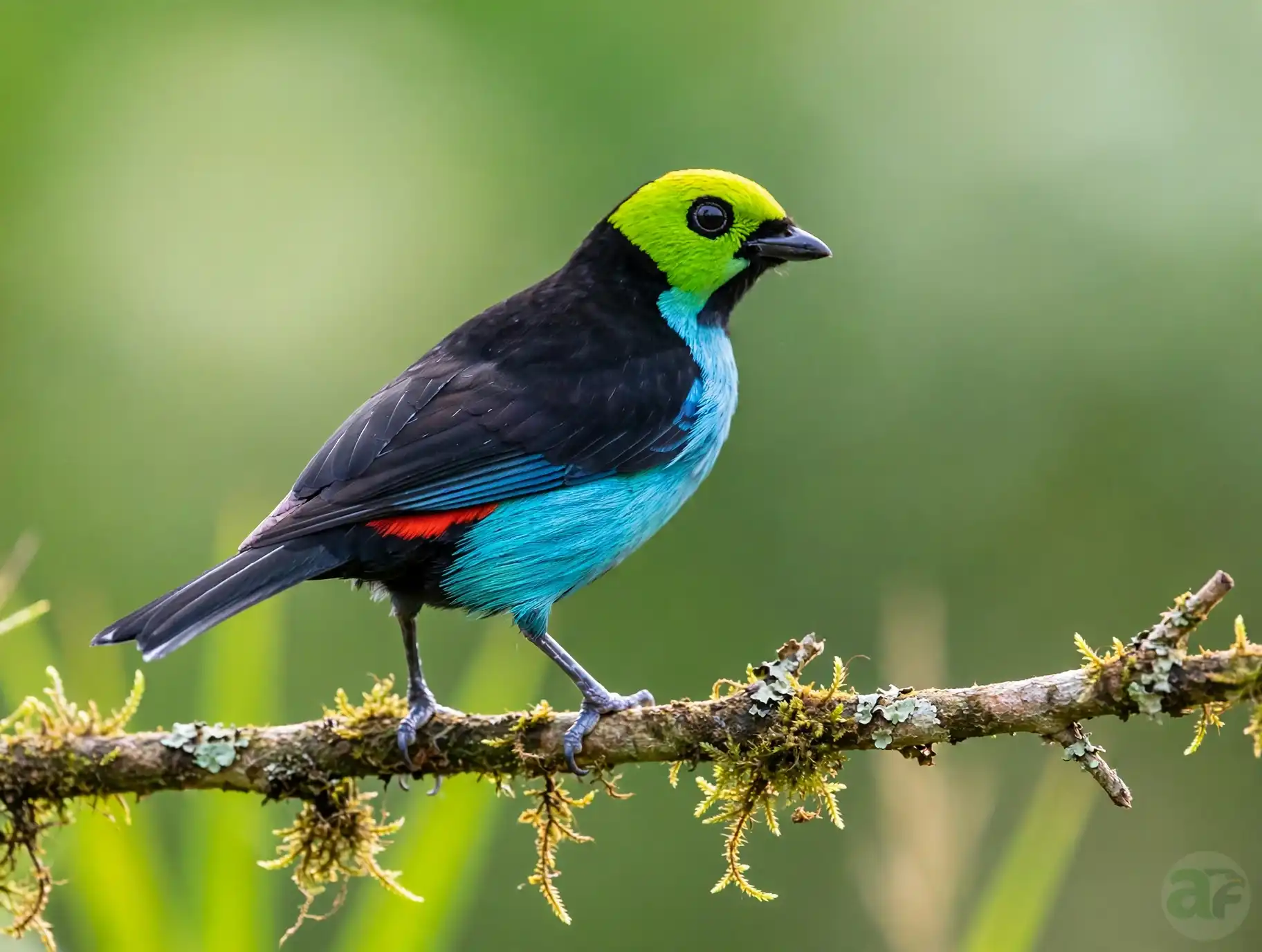
19. Best Places to See Paradise Tanagers in the Wild
1. Manu Road, Madre de Dios, Peru — Consistently ranked as one of the best single birding locations on Earth; the road descending from the Andes to the Amazon lowlands passes through multiple vegetation zones and supports extraordinary bird diversity. Paradise tanagers are regularly encountered in mixed-species flocks at multiple elevations along the road. The Cock-of-the-Rock Lodge and Amazon Research Center (ACCA) provide excellent bases. The combination of reliable paradise tanager sightings with extraordinary overall bird diversity (over 1,000 species documented in the region) makes Manu Road arguably the finest single bird-watching experience available anywhere.
2. Napo Wildlife Center, Yasuni National Park, Ecuador — The Napo Wildlife Center in Ecuador’s Yasuni National Park — one of the world’s most biodiverse places per unit area — provides guided canopy tower access that brings paradise tanagers and other canopy species to eye level. The center’s guided walks and canopy tower produce paradise tanager sightings on most visits during the peak seasons.
3. Cristalino Lodge, Mato Grosso, Brazil — One of the finest wildlife lodges in the Brazilian Amazon; the lodge’s trail network and canopy walkways provide excellent access to Amazonian bird diversity including paradise tanagers in the mixed-species flocks that visit the lodge’s vicinity daily.
4. Tambopata Research Center, Peru — Deep in the Peruvian Amazon, the Tambopata Research Center provides access to some of the most intact primary rainforest in the western Amazon. The extraordinary bird diversity of Tambopata includes paradise tanagers in mixed-species flocks along the trail network.
5. Sacha Lodge, Ecuadorian Amazon — Near Coca in Ecuador’s Napo province; the lodge’s canopy walkway and surrounding forest support excellent mixed-species flock birding including paradise tanagers. The accessible location (helicopter or boat from Coca) makes it one of the more practically accessible Amazon lodge options.
6. Iwokrama Forest, Guyana — The Iwokrama Forest in central Guyana provides access to outstanding Guiana Shield bird diversity including paradise tanagers. The Canopy Walkway near Iwokrama provides above-canopy access that makes observing paradise tanagers dramatically easier than ground-level forest birding.
7. Reserva Nacional Allpahuayo-Mishana, Iquitos, Peru — Near the city of Iquitos in the Peruvian Amazon — one of the most accessible Amazon destinations for international visitors — this reserve provides excellent bird diversity including paradise tanagers in a setting accessible for day trips from the city.
8. The Honest Assessment — Paradise tanager sightings are most reliably achieved at well-established Amazon birding lodges with experienced local guides who know the daily routes of mixed-species flocks. The key to success is:
- Early morning activity (6:00–10:00 AM) when mixed-species flocks are most active
- Looking upward into the canopy — not at ground level
- Following the flock once located — a flock containing paradise tanagers will often stay visible for 10–20 minutes before dispersing
- Experienced local guides who recognize flock vocalizations and know productive areas
20. How You Can Help
Supporting paradise tanager conservation means primarily supporting Amazon conservation broadly — protecting the intact forest habitat that the species and tens of thousands of other Amazonian species depend on.
Support these organizations:
- Amazon Conservation Association — amazonconservation.org — directly funds forest protection and research in the Peruvian Amazon, including areas supporting paradise tanager populations
- Amazon Watch — amazonwatch.org — advocates for Amazon indigenous rights and forest protection; indigenous territories are among the best-protected Amazon forests
- Rainforest Trust — rainforesttrust.org — funds purchase and protection of critical Amazon forest areas
- WWF Amazon Program — wwf.org — comprehensive Amazon conservation programs across multiple countries
- Wildlife Conservation Society (WCS) Latin America — wcs.org — operates conservation programs across the Amazon basin
- SoundBird and Aves Argentinas — for more localized southern Amazon and southern range conservation programs
Critical individual actions:
- Support Amazon-responsible consumer choices — consumer demand for beef and soy products drives the agricultural expansion that is the primary driver of Amazon deforestation. Reducing beef consumption and choosing certified deforestation-free products directly reduces the economic pressure on Amazon forest
- Support ecotourism in the Amazon — visiting the Amazon through responsible ecotourism operators that employ local guides and fund conservation generates economic alternatives to forest clearance for local communities
- Donate to Amazon forest protection — organizations like Rainforest Trust and Amazon Conservation Association fund direct forest protection at relatively low cost per hectare
- Advocate for policy action — supporting government policies that protect the Amazon (including international pressure on Brazilian, Peruvian, and other Amazonian government forest policies) is among the highest-impact actions available to individual advocates
- Submit bird observations to eBird — citizen science observations of paradise tanagers and other Amazon birds contribute to the population monitoring data needed to detect emerging declines before they reach crisis level
21. Top Documentaries & Books
Must-Watch Documentaries
- “Amazon with Tom Hanks” (BBC, 2022) — Comprehensive Amazon natural history series with outstanding bird diversity content including tanager sequences
- “Planet Earth — Jungles” (BBC, David Attenborough, 2006) — The jungles episode covers Amazonian bird diversity; foundational viewing for Amazonian natural history context
- “Our Planet — Jungles” (Netflix, David Attenborough, 2019) — The jungles episode features extraordinary Amazonian forest footage relevant to paradise tanager habitat
- “Life of Birds” (BBC, David Attenborough, 1998) — Comprehensive bird natural history including Neotropical bird diversity; essential background
- Cornell Lab of Ornithology “Macaulay Library” YouTube content — Free, high-quality video of paradise tanager behavior available through Cornell Lab’s online platforms
Must-Read Books
- Birds of Peru by Thomas S. Schulenberg, Douglas F. Stotz, Daniel F. Lane, John P. O’Neill, and Theodore A. Parker III — The definitive field guide for the country with the greatest paradise tanager accessibility from established birding infrastructure; detailed species accounts
- Birds of the Amazon by Andrew Wheatley — Comprehensive illustrated guide to Amazonian bird diversity; paradise tanager treatment with distribution and identification information
- The Tanagers: Natural History, Distribution, and Identification by Morton and Isler — The comprehensive reference for tanager biology; essential reading for anyone seriously interested in paradise tanager natural history
- A Field Guide to the Birds of Colombia by Miles McMullan — Covers the northwestern range of the paradise tanager; useful for the Colombian Amazon population
- Tanagers and Allies in the Handbook of the Birds of the World series — The most comprehensive scientific reference for Thraupidae; detailed paradise tanager species account
22. Paradise Tanager Comparison with Other Spectacular Tanagers
| Feature | Paradise Tanager | Cotinga (Cotinga maynana) | Seven-colored tanager (T. fastuosa) | Green-headed tanager (T. seledon) | Opal-crowned tanager (T. callophrys) |
|---|---|---|---|---|---|
| Scientific name | Tangara chilensis | Cotinga maynana | Tangara fastuosa | Tangara seledon | Tangara callophrys |
| Weight | 18–23 g | 65–90 g | 18–22 g | 17–22 g | 20–24 g |
| Color count | 7 distinct colors | 2 (male — blue/purple) | 6–7 colors | 5–6 colors | 4–5 colors |
| Color mechanism | Structural + carotenoid + melanin | Structural | Structural + carotenoid | Structural + melanin | Iridescent opal |
| Sexual dimorphism | Minimal | Extreme (female brown) | Minimal | Moderate | Minimal |
| Range | Amazon Basin (9 countries) | W. Amazon | NE Brazil (restricted) | Atlantic Forest | W. Amazon |
| Conservation | Least Concern | Least Concern | Critically Endangered | Least Concern | Least Concern |
| Mixed-species flocks | Yes — specialist | Sometimes | Yes | Yes | Yes |
| Primary diet | Fruit + insects | Fruit primarily | Fruit + insects | Fruit + insects | Fruit + insects |
| Famous for | Most colorful Tangara | Brilliant male display | Endangered Atlantic Forest twin | Most colorful Atlantic Forest tanager | Opal crown iridescence |
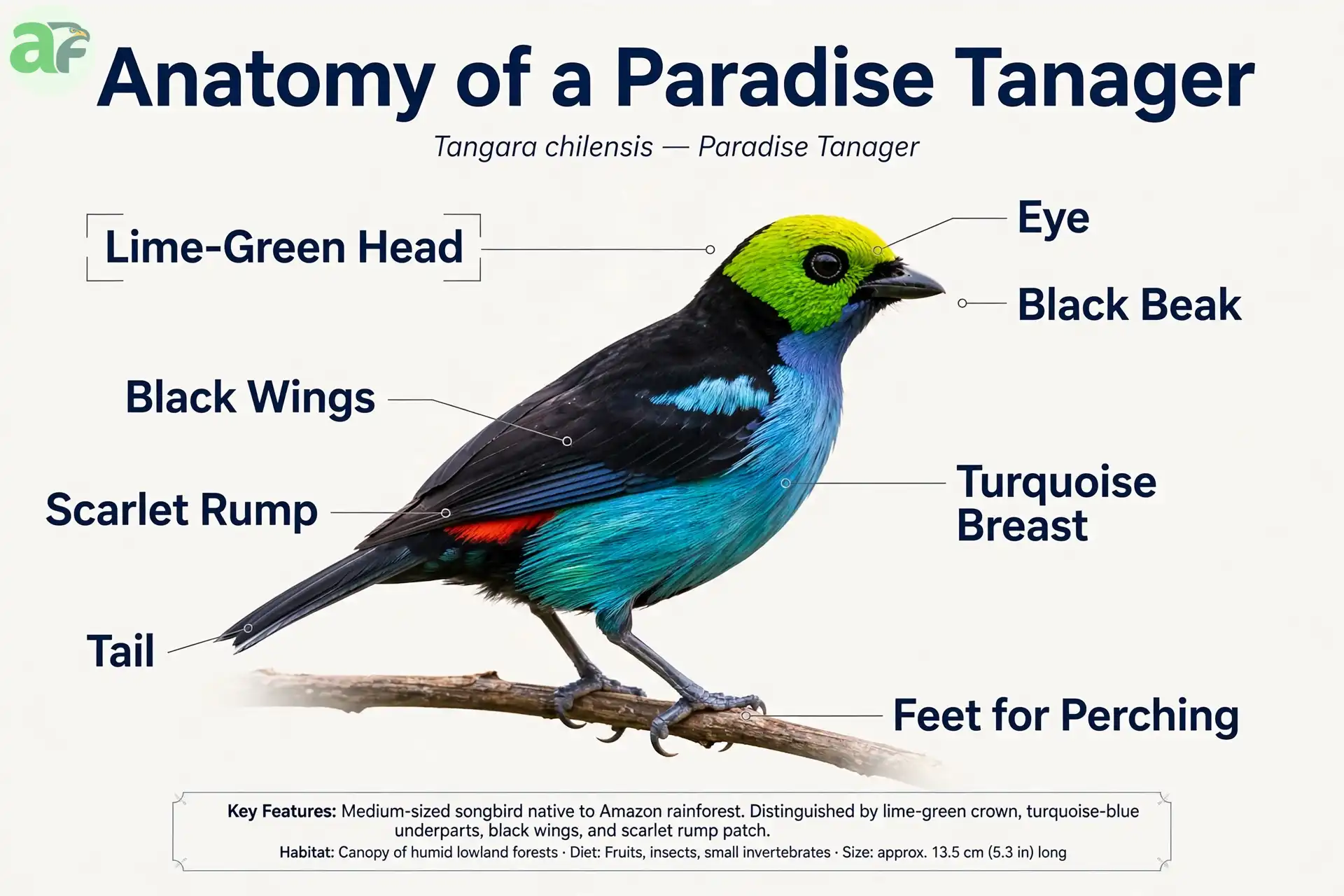
23. Frequently Asked Questions About Paradise Tanagers
Q1. What is the scientific name of the paradise tanager?
The paradise tanager’s scientific name is Tangara chilensis (Vigors, 1832). The genus name Tangara derives from the Tupi indigenous language of the Amazon Basin — the word tangará was used by Tupi-speaking peoples for various colorful birds and was adopted into Portuguese and subsequently into scientific nomenclature by the French ornithologist Mathurin Jacques Brisson when he established the genus in 1760. The species name chilensis — meaning “of Chile” — is one of ornithology’s most celebrated geographic misnomers, arising from a mislabeled collection specimen that British ornithologist Nicholas Vigors worked from when formally describing the species in 1832. The paradise tanager does not occur in Chile and has no natural presence in that country. Under the rules of International Code of Zoological Nomenclature (ICZN), a species name cannot be changed merely because it is geographically inaccurate — the error is therefore permanently fixed. Four subspecies are recognized: the nominate T. c. chilensis of much of the Brazilian Amazon and Guianas, T. c. paradisea of the western Amazon (distinguished by red bill base), T. c. chlorocorys of northwestern Colombia and western Venezuela, and T. c. coelicolor of eastern Peru and northern Bolivia.
Q2. How many colors does a paradise tanager have?
The paradise tanager displays seven distinct colors — which is why it is called the “seven-colored tanager” (sete-cores in Portuguese) in several languages. These colors are: apple-green (head and face), black (mantle and back), turquoise (upper breast), scarlet (lower back/rump), violet-blue (shoulder patches), cobalt blue (belly), and red or black (bill base, depending on subspecies). These seven colors are produced by three different physical mechanisms: structural coloration (the turquoise, cobalt blue, and violet patches, produced by thin-film interference in feather microstructure), carotenoid pigments (the scarlet rump and contributing to the green head), and melanin (the black mantle). The apple-green head is particularly interesting — it is produced not by green pigment but by a combination of yellow carotenoid pigment in the feather barbules and structural blue from the feather microstructure, the combination producing green through additive color mixing analogous to mixing yellow and blue paint. Different ornithologists arrive at slightly different color counts depending on whether they count the turquoise breast and cobalt belly as one or two blue regions, and whether the red bill base of certain subspecies counts as a separate color — but the “seven colors” designation is widely accepted as accurately capturing the bird’s exceptional polychromatism.
Q3. Why is the paradise tanager so colorful if it has no predators to worry about?
The paradise tanager’s extraordinary coloration is the product of sexual selection through mutual mate assessment — both males and females using vivid plumage as a signal of individual quality when selecting mates. The very limited sexual dimorphism (both sexes are similarly vivid) distinguishes the paradise tanager from the more familiar pattern of polygynous birds where only males are spectacular — in the paradise tanager, the mutual mate assessment system means both sexes are under selection to maintain vivid coloration that honestly signals their health, foraging quality, and genetic value as a mate. The scarlet rump, for example, is produced by carotenoid pigments obtained exclusively from the diet — an individual with a more vivid scarlet rump has demonstrably better foraging quality or greater metabolic efficiency at converting dietary carotenoids to feather pigments, providing reliable information for a potential mate assessing the bird’s quality. The structural blue and turquoise colors may signal immune function and general health through the quality of the feather microstructure that produces them. The species does have predators — forest falcons, hawk-eagles, and arboreal snakes are all documented paradise tanager predators — and the mixed-species flock predator detection system partially compensates for the increased detectability that the vivid plumage creates.
Q4. How does the paradise tanager differ from the seven-colored tanager?
The paradise tanager (Tangara chilensis) and the seven-colored tanager (Tangara fastuosa) are two different species that share the same common name in some traditions — a source of confusion that arises because both are extraordinarily colorful Tangara species with similar color counts. The key differences are: Range — the paradise tanager occurs across the Amazon Basin in nine countries; the seven-colored tanager (T. fastuosa) is restricted to a small area of northeastern Brazil’s Atlantic Forest (Pernambuco and adjacent states). Conservation status — the paradise tanager is Least Concern; the seven-colored tanager is Critically Endangered — one of Brazil’s most threatened birds, with a wild population estimated at fewer than 10,000 individuals due to catastrophic Atlantic Forest deforestation. Specific colors — while both species display approximately seven vivid colors, the specific colors and their distribution differ significantly: the seven-colored tanager has a distinctive orange head, bright blue body, and green wing patches — a different but equally spectacular color combination from the paradise tanager’s green head, black mantle, and scarlet rump. When the common name “seven-colored tanager” is used in English, it most commonly refers to T. chilensis (paradise tanager), but in Portuguese-speaking Brazil, sete-cores may refer to either species depending on regional context — making species specification by scientific name important when precision is required.
Q5. Where can I see paradise tanagers in the wild?
The most accessible and most reliable locations for paradise tanager observation are the Amazon birding lodges of Peru and Ecuador — particularly along the Manu Road in Peru (including the Cock-of-the-Rock Lodge area) and at the Napo Wildlife Center in Ecuador’s Yasuni National Park. Both locations combine reliable paradise tanager sightings with extraordinary overall bird diversity and are served by established tourism infrastructure. In Brazil, the Cristalino Lodge in Mato Grosso and various Amazonian lodges accessible from Manaus provide opportunities within the largest national territory of the species’ range. The Iwokrama Forest in Guyana provides outstanding access for the Guiana Shield population. The fundamental strategy for successful paradise tanager observation is joining a mixed-species foraging flock — the species is almost never encountered alone, so finding an active flock (typically by listening for the thin chip notes of multiple species moving together) and following it through the canopy is the most reliable approach. Early morning (6:00–10:00 AM) is the optimal time, and canopy towers or walkways at lodges that provide them dramatically increase success by bringing the observer to the same height as the moving flocks rather than looking upward from ground level.
24. Sources & References
- Wikipedia — Tangara chilensis, Thraupidae, Tangara (genus), Mixed-species foraging flock
- IUCN Red List — iucnredlist.org (current Least Concern assessment for Tangara chilensis)
- BirdLife International — birdlife.org (species factsheet for paradise tanager)
- Cornell Lab of Ornithology — allaboutbirds.org; Macaulay Library documentation
- eBird — ebird.org (range maps and occurrence data)
- Isler, M.L. and Isler, P.R. — The Tanagers: Natural History, Distribution, and Identification
- Schulenberg, T.S. et al. — Birds of Peru
- Shultz, A.J. and Burns, K.J. — published research on Tangara structural coloration and sexual selection
- Tobias, J.A. and colleagues — Amazonian mixed-species flock ecology research
- National Geographic — nationalgeographic.com
- Smithsonian National Museum of Natural History — naturalhistory.si.edu
- BBC Wildlife / BBC Earth — bbcearth.com
- Britannica — britannica.com/animal/paradise-tanager
- Amazon Conservation Association — amazonconservation.org