
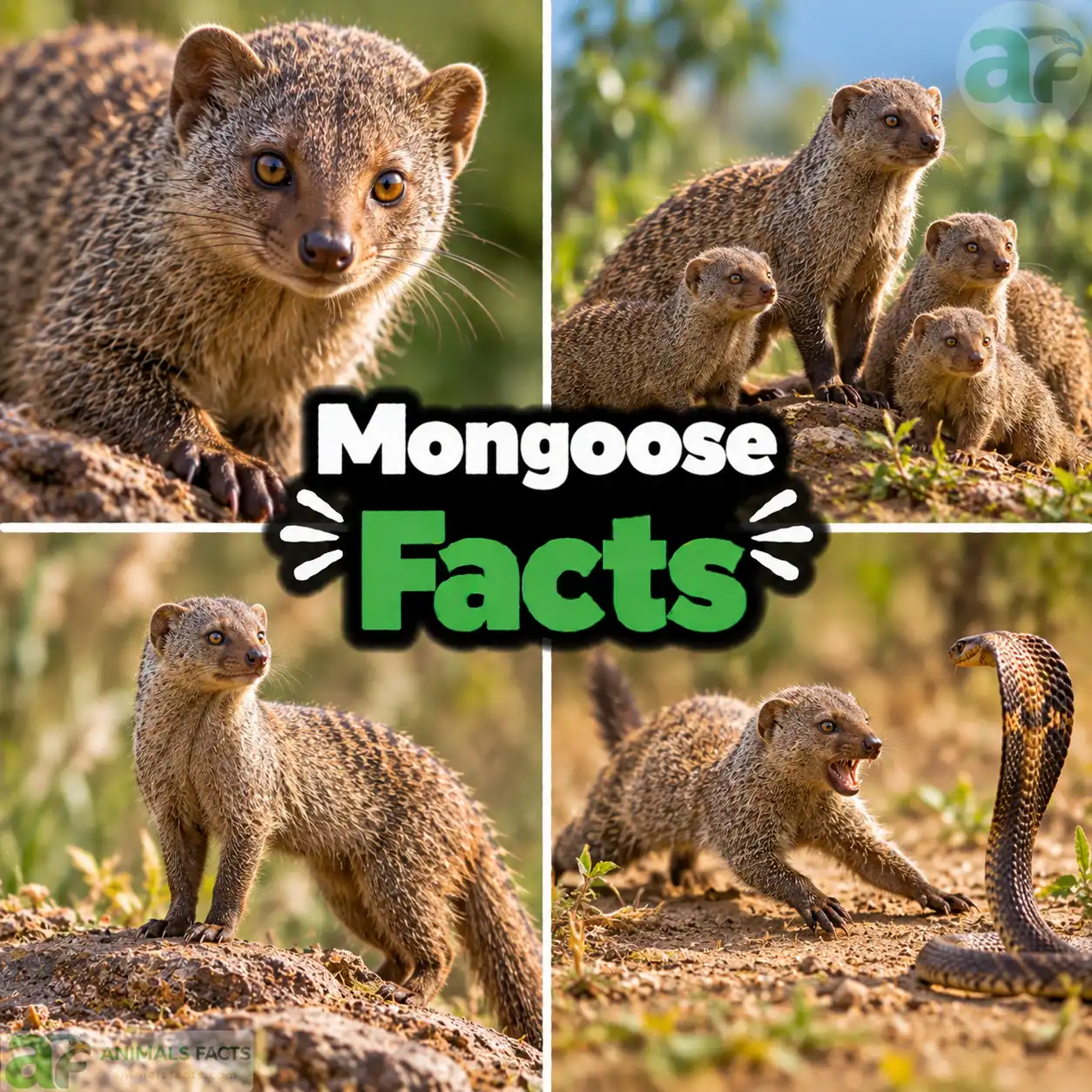
Mongoose Facts
| Feature | Details |
|---|---|
| Scientific Name | Family Herpestidae; ~34 species across 14 genera |
| Kingdom | Animalia |
| Phylum | Chordata |
| Class | Mammalia |
| Order | Carnivora |
| Suborder | Feliformia |
| Family | Herpestidae (Bonaparte, 1845) |
| Common Names | Mongoose; meerkat (one genus); ichneumon (historical) |
| Native Range | Africa, South Asia, Southeast Asia, southern Europe (one species); introduced widely |
| Habitat | Savanna, forest, scrub, desert margins, wetland edges, urban margins |
| Lifespan | 6–20 years depending on species; up to 20 years in captivity |
| Diet | Insects, rodents, snakes, eggs, crabs, fruit — highly varied by species |
| Body Size | 210 grams (dwarf mongoose) to 5 kg (white-tailed mongoose) |
| Conservation Status | Ranges from Least Concern to Endangered depending on species |
| Number of Species | 34 recognized species across 14 genera |
| Defining Feature | Remarkable venom resistance to cobra and other snake venoms |
| Closest Relatives | Civets, genets, Malagasy carnivores (Eupleridae) — all Feliformia |
| Famous For | Snake fighting; extraordinary social structure (meerkats); bold, fearless temperament |
 1. Introduction: What is a Mongoose?
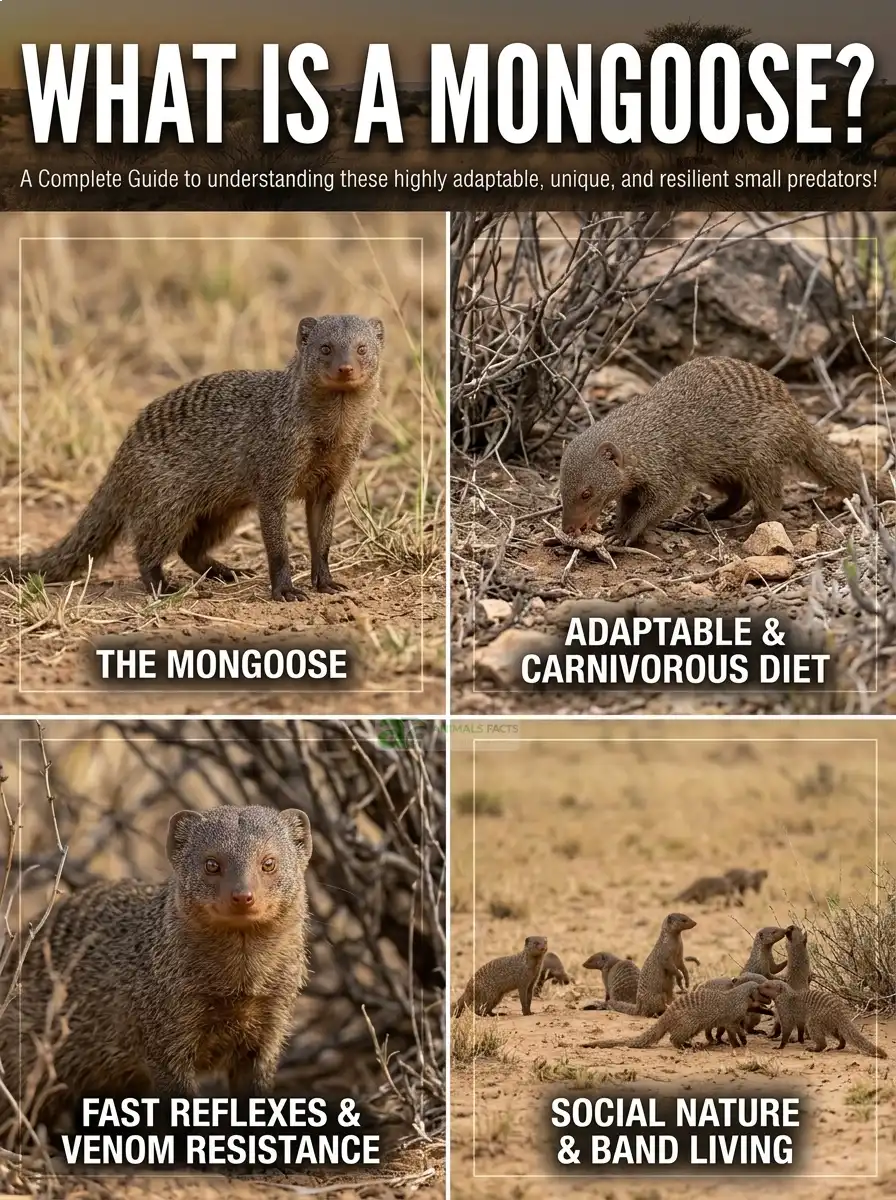
On a sun-baked African savanna, a small brown animal stands upright on its hind legs — alert, scanning, unfazed by the heat or the potential danger of open ground. It weighs perhaps 700 grams. It is the length of a human forearm. And yet, when a cobra raises its hood and spreads its threat display at this animal — a snake capable of killing a full-grown human with a single strike — the mongoose does not flee. It does not freeze. It begins to move, fast and calculated, with the practiced confidence of an animal that has been winning this particular contest for millions of years of evolutionary time. Within seconds, it is over. The mongoose stands over the dead cobra, unhurt, and returns to its foraging with the complete indifference of an animal that has just dispatched a significant threat and considers the matter resolved. Mongoose facts begin with this single, astonishing image — one of the most fearless animals on Earth, compact as a large squirrel, built like a precision tool for survival in some of the world’s most demanding environments.
Mongooses — the family Herpestidae, comprising 34 species across 14 genera — are among the most ecologically diverse and most behaviorally sophisticated small carnivores in the world. They inhabit environments ranging from West African rainforest to Indian dry scrub to Egyptian desert to Hawaiian sugarcane fields (where they were catastrophically introduced in the 19th century). They range in size from the dwarf mongoose (Helogale parvula) at 210–350 grams to the white-tailed mongoose (Ichneumia albicauda) at up to 5 kg. Their social organization spans the complete spectrum from absolute solitude (many Asian species) to the extraordinary cooperative breeding societies of the banded mongoose and the meerkat — one of the most intensively studied social systems in all of behavioral ecology. Interesting facts about mongooses reveal an animal family of breathtaking biological diversity — remarkable acetylcholine receptor mutations that confer genuine resistance to cobra venom; a sentinel warning system in meerkats so sophisticated that it encodes information about predator type, distance, and urgency in distinct call variants; cooperative pup-rearing in which non-breeding helpers carry food, babysit, and teach foraging skills to young that are not their own; and a boldness in confronting predators — including snakes, birds of prey, and even crocodiles — that consistently exceeds what any observer prepared by the animal’s body size would expect.
Whether you are searching for mongoose facts for kids to explore the science of animal behavior and venom resistance, a wildlife enthusiast wanting to understand the ecology of one of Africa and Asia’s most successful small carnivore families, a conservation researcher concerned about specific threatened mongoose species, or simply someone who watched a mongoose-cobra encounter on a wildlife documentary and needed to know everything about this remarkable animal — this is your comprehensive guide. We cover mongoose scientific names, mongoose diet, mongoose size, mongoose behavior, the extraordinary venom resistance biology, conservation status across the family, cultural significance from Kipling’s Rikki-Tikki-Tavi to Egyptian mythology, and the ecological roles these irreplaceable small predators play across three continents. The world’s most fearless small carnivores have an extraordinary story to tell.
2. Mongoose Species Overview & Classification
Mongooses belong to the family Herpestidae — a family within the suborder Feliformia (cat-like carnivores) that includes 34 recognized species across 14 genera distributed across Africa, Asia, and extreme southern Europe.
Species Classification Table
| Taxonomic Rank | Classification |
|---|---|
| Kingdom | Animalia |
| Phylum | Chordata |
| Class | Mammalia |
| Order | Carnivora |
| Suborder | Feliformia |
| Family | Herpestidae (Bonaparte, 1845) |
| Number of Genera | 14 genera |
| Number of Species | 34 recognized species |
| Distribution | Africa (primary), South and Southeast Asia, southern Europe (one species) |
Major Mongoose Genera and Representative Species
Genus Herpestes — Asian and African mongooses:
| Species | Common Name | Weight | Range | IUCN Status |
|---|---|---|---|---|
| Herpestes edwardsii | Indian grey mongoose | 0.9–1.7 kg | Indian subcontinent | Least Concern |
| Herpestes javanicus | Small Asian mongoose | 0.4–0.7 kg | South/SE Asia; introduced widely | Least Concern |
| Herpestes ichneumon | Egyptian mongoose (ichneumon) | 1.7–4 kg | Africa, SW Europe | Least Concern |
| Herpestes smithii | Ruddy mongoose | 1–1.7 kg | India, Sri Lanka | Least Concern |
| Herpestes urva | Crab-eating mongoose | 1.5–2.6 kg | SE Asia | Least Concern |
Genus Mungos — Banded mongoose:
| Species | Common Name | Weight | Range | IUCN Status |
|---|---|---|---|---|
| Mungos mungo | Banded mongoose | 1–1.7 kg | Sub-Saharan Africa | Least Concern |
Genus Suricata — Meerkat:
| Species | Common Name | Weight | Range | IUCN Status |
|---|---|---|---|---|
| Suricata suricatta | Meerkat (suricate) | 0.6–0.97 kg | Southern Africa | Least Concern |
Genus Helogale — Dwarf mongooses:
| Species | Common Name | Weight | Range | IUCN Status |
|---|---|---|---|---|
| Helogale parvula | Common dwarf mongoose | 210–350 g | Sub-Saharan Africa | Least Concern |
Genus Ichneumia — White-tailed mongoose:
| Species | Common Name | Weight | Range | IUCN Status |
|---|---|---|---|---|
| Ichneumia albicauda | White-tailed mongoose | 2.5–5 kg | Sub-Saharan Africa | Least Concern |
Genus Atilax — Marsh mongoose:
| Species | Common Name | Weight | Range | IUCN Status |
|---|---|---|---|---|
| Atilax paludinosus | Marsh mongoose | 2.5–4 kg | Sub-Saharan Africa | Least Concern |
Genus Liberiictis — Liberian mongoose:
| Species | Common Name | Weight | Range | IUCN Status |
|---|---|---|---|---|
| Liberiictis kuhni | Liberian mongoose | 2–2.3 kg | West Africa (Liberia, Côte d’Ivoire) | Endangered |
The Meerkat — A Mongoose in Disguise
The meerkat (Suricata suricatta) is one of the most famous animals in the world — yet many people do not realize it is a mongoose. Meerkats belong to the family Herpestidae and share all the fundamental biological characteristics of mongooses, including the remarkable venom resistance, the small carnivore body plan, and the basic social organization principles — though they have taken social complexity to a level that has made them one of the most intensively studied animal societies in behavioral ecology.
The Relationship Between Herpestidae and Eupleridae
The mongoose family Herpestidae has a close evolutionary relationship with Eupleridae — the Madagascar-endemic carnivore family that includes the fossa:
- Both families belong to the suborder Feliformia
- The ancestral colonist that founded the Eupleridae (the mongoose-like ancestor of the fossa and other Madagascar carnivores) was from the Herpestidae lineage — making Eupleridae essentially Madagascar’s mongoose radiation
- The molecular divergence between Herpestidae and Eupleridae is estimated at approximately 20–26 million years ago — coinciding with the estimated colonization of Madagascar
Evolution & Discovery Timeline
~40–50 million years ago — The ancestral Feliformia diversify from the broader carnivore lineage — establishing the evolutionary framework that will produce cats, civets, hyenas, and mongooses.
~25–35 million years ago — The Herpestidae lineage diverges from other feliforms — establishing the mongoose family as a distinct evolutionary unit.
~20–26 million years ago — A mongoose-like ancestor colonizes Madagascar — founding the Eupleridae radiation that will produce the fossa and other Madagascar-endemic carnivores.
Ancient Egypt — The Egyptian mongoose (Herpestes ichneumon) is depicted in Egyptian art and mythology — the species was known and culturally significant in ancient Egypt under the name “ichneumon.”
1835–1838 — Systematic Western scientific classification of mongoose species begins in earnest through the work of Edward Turner Bennett and other Victorian naturalists.
1894 — Rudyard Kipling publishes “Rikki-Tikki-Tavi” — the story of a mongoose protecting a human family from cobras — becoming the most culturally influential portrayal of mongoose behavior in Western literature.
1974–present — Tim Clutton-Brock and colleagues begin the Kalahari Meerkat Project at the Kuruman River Reserve in South Africa — what becomes the world’s longest-running field study of a wild animal society, producing over 200 published scientific papers and transforming understanding of cooperative breeding, altruism, and social evolution.
19th–20th century — Mongooses are introduced to Hawaii, Caribbean islands, Fiji, and other island systems for rodent and snake control — becoming some of the most ecologically damaging invasive species in island ecosystems globally.
2024 — 34 mongoose species are recognized, with the majority classified as Least Concern but several island-endemic and forest-specialist species facing significant conservation threats.
“The mongoose is perhaps the most instructive small carnivore in the world for understanding the evolution of sociality, cooperation, and anti-predator behavior. No other small carnivore gives us such a complete picture of how evolution solves the problems of survival in dangerous environments — from the meerkat’s sentinel system to the Indian grey mongoose’s cobra-fighting ability.”
— Professor Tim Clutton-Brock, Cambridge University, Director of the Kalahari Meerkat Project
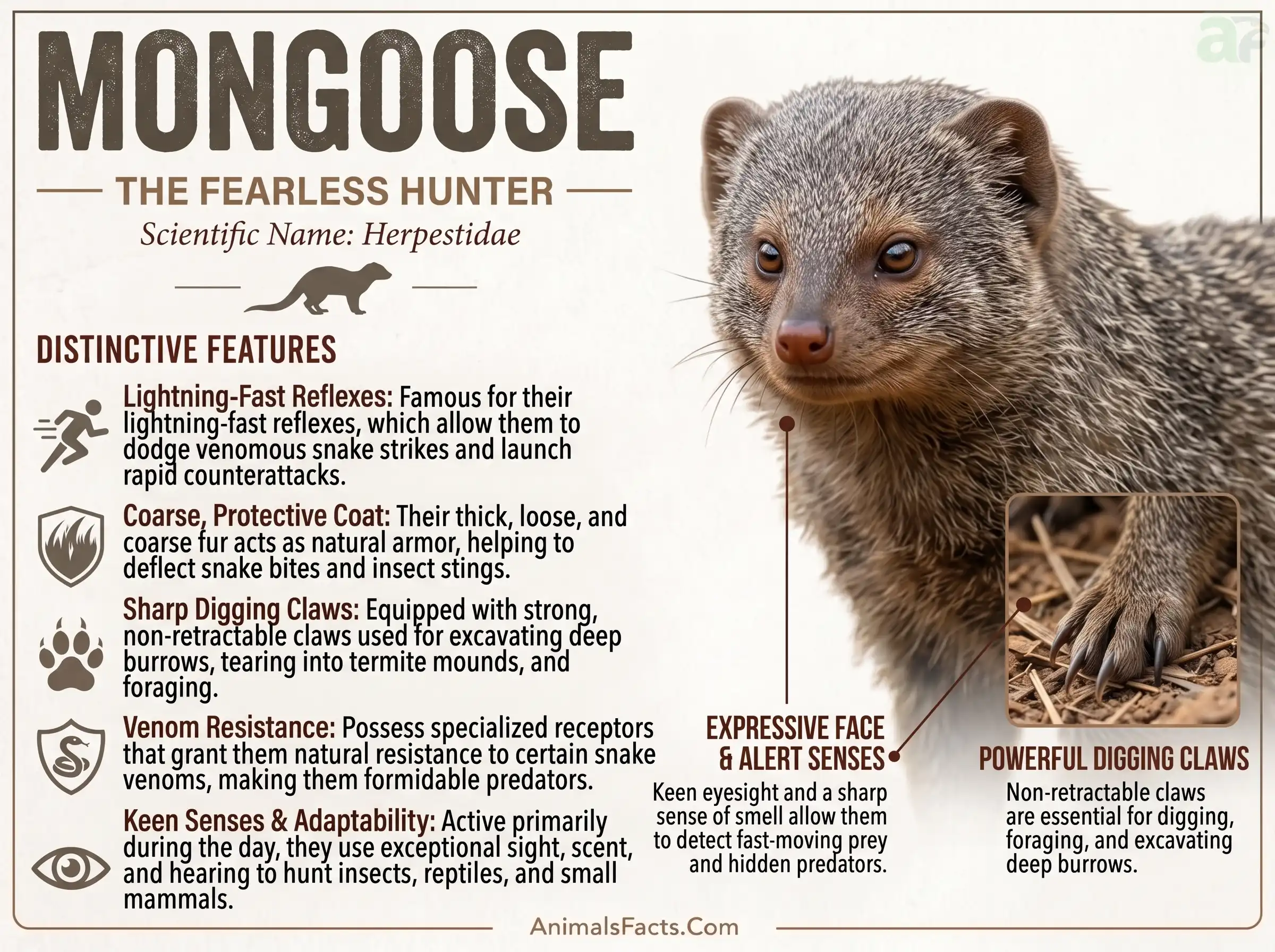
3. Mongoose Physical Description & Unique Features
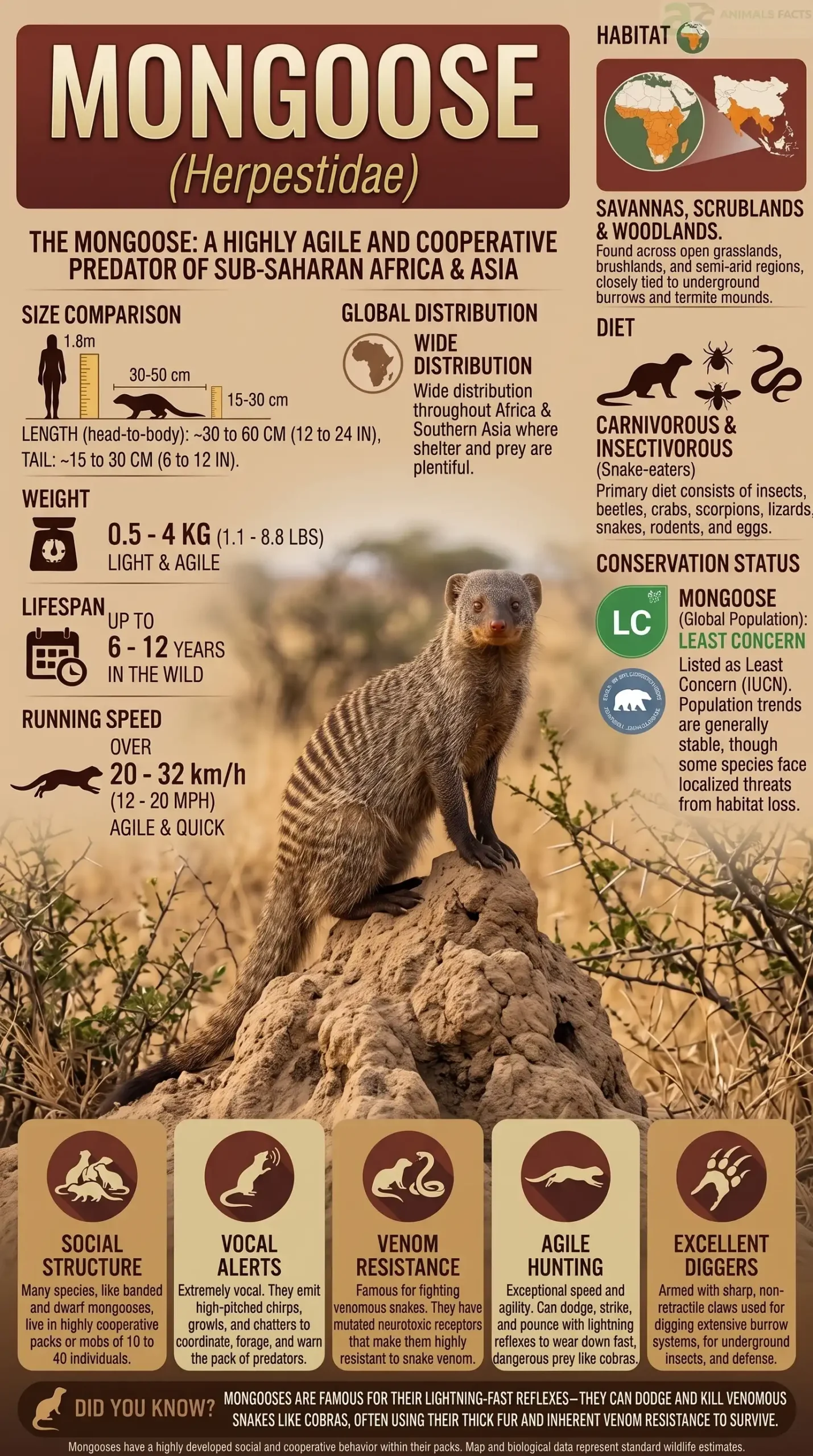
Mongoose size and weight spans an extraordinary range across the family’s 34 species — from the dwarf mongoose at 210–350 grams to the white-tailed mongoose at up to 5 kg — a roughly 20-fold body mass range within a single family.
The Mongoose Body Plan
Across the family’s enormous diversity, several physical features are consistent enough to characterize the “mongoose body plan”:
Elongated, low-slung body — The characteristic mongoose form is long and sinuous — the body length substantially exceeding what the leg length would suggest is necessary for the animal’s movement. This elongated form allows access to burrows, crevices, and dense vegetation where prey hides.
Short legs — Mongooses have relatively short legs — placed under the body in a parasagittal stance — providing stability and ground-clearance efficiency for the rapid, low-to-ground movement that characterizes mongoose locomotion.
Pointed muzzle — The elongated, pointed muzzle with small nostrils is characteristic of most species — housing the olfactory equipment that makes scent such an important sensory channel, and providing the narrow profile needed for probing crevices where insect and small vertebrate prey shelter.
Small, rounded ears — Set close to the head; providing adequate acoustic detection without the vulnerability of large, easily damaged ear pinnae.
Long, tapering tail — The tail is typically more than half the body length — used for balance, communication, and in some species as a visual signal during social interactions.
Coarse, dense fur — Most species have relatively coarse fur — providing protection against thorns, insect bites, and the minor injuries of active predatory life in dense vegetation.
The Acetylcholine Receptor Mutation — The Venom Resistance System
The mongoose’s most biologically extraordinary feature is invisible — a molecular modification to the acetylcholine receptor (nAChR) that confers resistance to the neurotoxic venom of cobras and other elapid snakes:
How cobra venom kills — Cobra venom contains alpha-neurotoxins that bind to the nicotinic acetylcholine receptor (nAChR) at neuromuscular junctions — blocking the transmission of nerve impulses to muscles. The result is progressive muscular paralysis, eventually including the muscles of respiration. Death occurs from respiratory failure.
The mongoose modification — In mongooses, the nAChR has a specific amino acid substitution at the binding site where alpha-neurotoxins attach. This substitution — present in all mongoose species studied — dramatically reduces the affinity of alpha-neurotoxins for the receptor. The toxin cannot bind effectively, cannot block neuromuscular transmission, and cannot cause paralysis.
The extent of resistance — Mongoose resistance is substantial but not absolute — very large venom doses delivered directly into the bloodstream can overcome the resistance. However, in the context of a typical cobra strike (subcutaneous or intramuscular venom delivery), mongoose resistance is sufficient to prevent lethal effects in most encounters.
Independent evolution — The same nAChR modification has evolved independently in hedgehogs, honey badgers, pigs, and ground squirrels — confirming that snake venom resistance through nAChR modification is a repeatedly discovered evolutionary solution to a common ecological problem. The mongoose version of this modification is among the most thoroughly studied.
The speed factor — Mongoose venom resistance is complemented by extraordinary agility and speed — the mongoose rarely allows a cobra to strike effectively, using rapid movement to avoid bites throughout the encounter. The venom resistance provides a safety net against the occasional bite that cannot be avoided; the agility prevents most bites in the first place.
Species-Specific Physical Features
Indian Grey Mongoose (Herpestes edwardsii):
- Body length: 36–45 cm; tail 35–45 cm; weight 0.9–1.7 kg
- Coat: grizzled grey-brown — the “salt and pepper” appearance created by alternating light and dark banding on individual guard hairs
- The most familiar mongoose species in South Asia; the species of Kipling’s Rikki-Tikki-Tavi
Meerkat (Suricata suricatta):
- Body length: 25–35 cm; tail 17–25 cm; weight 0.6–0.97 kg
- Coat: tan to light brown with distinctive dark transverse stripes on the back; dark eye patches
- Characteristic upright sentinel posture on hind legs — the most immediately recognizable mongoose behavior globally
Banded Mongoose (Mungos mungo):
- Body length: 30–45 cm; tail 23–29 cm; weight 1–1.7 kg
- Coat: grey-brown with dark transverse bands across the back — 10–15 visible bands
- The most intensively studied social mongoose after the meerkat
White-Tailed Mongoose (Ichneumia albicauda):
- Body length: 47–71 cm; tail 35–47 cm; weight 2.5–5 kg — the largest mongoose species
- Distinctive white tail contrasting with dark body
- Solitary and primarily nocturnal
Dwarf Mongoose (Helogale parvula):
- Body length: 18–26 cm; weight 210–350 g — the smallest mongoose species
- Coat: uniform dark brown to reddish-brown
- Lives in termite mound-based group territories; uses termite mounds as dens
💡 Did You Know? The mongoose’s venom resistance mutation in the acetylcholine receptor has been found in all mongoose species studied — confirming that this modification was already present in the common ancestor of all mongooses, and has been maintained in every descendant species for tens of millions of years. This universal presence suggests that snake predation pressure has been a consistent and significant selective force on the mongoose lineage throughout its evolutionary history — the modification has been so consistently valuable that no mongoose lineage has lost it through drift or relaxed selection in tens of millions of years of independent evolution. The mongoose venom resistance system is therefore one of the clearest examples available in any carnivore family of sustained evolutionary response to a specific predator-prey interaction over geological timescales.
4. Top 25 Amazing Mongoose Facts
Here is your definitive collection of the most extraordinary, scientifically verified, and genuinely astonishing mongoose facts as of 2026:
- Mongooses have a modified acetylcholine receptor that makes them genuinely resistant to cobra venom — the same neurotoxin that kills humans and most other mammals. This molecular modification evolved in the mongoose ancestor and has been present in all mongoose species for tens of millions of years.
- The meerkat (Suricata suricatta) is a mongoose — one of the most famous animals in the world is a member of the mongoose family Herpestidae, though most people who know meerkats do not realize they are mongooses.
- The Kalahari Meerkat Project at the Kuruman River Reserve in South Africa — established in 1974 by Professor Tim Clutton-Brock — is the world’s longest continuously running field study of a wild animal society, having produced over 200 published scientific papers and more fundamental insights into cooperative behavior, altruism, and social evolution than any comparable study.
- Meerkat sentinel individuals produce distinct alarm calls that encode information about predator type (aerial vs. terrestrial), urgency (how immediately threatening), and distance — a communication system so information-rich that it has been compared to the basic structure of human language in terms of its capacity to encode specific environmental information.
- The dwarf mongoose (Helogale parvula) — the world’s smallest mongoose at 210–350 grams — lives in cooperative family groups of 2–30 individuals based in termite mound territories. The group has a dominant breeding pair; all other group members are non-breeding helpers who assist in raising the dominant pair’s offspring.
- Mongooses were deliberately introduced to Hawaii in 1883 to control rats in sugarcane plantations — and proceeded to devastate Hawaiian ground-nesting bird populations instead, contributing to the extinction of multiple endemic Hawaiian bird species. The Hawaiian mongoose introduction is one of the most catastrophic examples of biological control gone wrong in history.
- The Indian grey mongoose (Herpestes edwardsii) can survive cobra bites that would kill a human — though it typically wins cobra encounters without being bitten at all, through a combination of speed, agility, and learned fighting technique that neutralizes the cobra’s strike before it can be delivered.
- Banded mongooses (Mungos mungo) practice an extraordinary form of cooperative teaching — research published in 2014 in Science by Alex Thornton and colleagues confirmed that adult banded mongooses deliberately teach specific foraging skills to individual pups that they are assigned as “escort” helpers — one of the only documented cases of true active teaching (modifying behavior specifically to facilitate learning in a naive individual) in a non-human animal.
- The Egyptian mongoose (Herpestes ichneumon) — also known as the ichneumon — was considered sacred in ancient Egypt and is depicted in hieroglyphics; it was associated with the sun god Ra and believed to protect against snakes and crocodile eggs.
- Mongoose colonies practice cooperative sentinel behavior — in meerkat groups, specific individuals take designated sentinel duty, climbing elevated positions and scanning for predators while the rest of the group forages below. The sentinel calls continuously to signal “all clear” — and the group relies on this signal to forage with reduced individual vigilance.
- The white-tailed mongoose (Ichneumia albicauda) is the largest mongoose species at up to 5 kg — and is the most solitary, most nocturnal, and least studied of the large mongoose species, making it one of the more cryptic members of an otherwise well-studied family.
- Mongooses have non-retractile claws — unlike cats, mongoose claws cannot be retracted. This limits their ability to climb trees but makes them excellent diggers — a trade-off that reflects the mongoose’s primarily terrestrial and fossorial (burrowing) lifestyle.
- Research on banded mongooses has documented intergroup conflict of extraordinary intensity — opposing banded mongoose groups engage in coordinated group attacks that produce injuries and fatalities, making banded mongooses one of the few non-human animals documented to engage in what researchers describe as organized intergroup warfare.
- The marsh mongoose (Atilax paludinosus) is unique among mongooses in its semi-aquatic lifestyle — regularly entering water to hunt crabs, frogs, fish, and aquatic invertebrates. It lacks the webbed feet of semi-aquatic specialists but is an effective swimmer and underwater forager.
- Meerkat pups are born completely helpless and are cared for by the entire group — non-breeding adults of both sexes babysit pups while the mother forages, bring food to developing pups, and guard burrow entrances against predators. This alloparental care is one of the most elaborate cooperative breeding systems documented in any carnivore.
- The crab-eating mongoose (Herpestes urva) of Southeast Asia has been observed rubbing captured crabs against hard surfaces to remove their claws before eating — a tool-like behavior that reduces the risk of injury during prey processing, documented in wild individuals in India and Southeast Asia.
- Mongooses can run at up to 32 km/h — fast enough to maintain pursuit of most prey species in their range, and to execute the rapid evasive movements needed during cobra encounters.
- The Liberian mongoose (Liberiictis kuhni) — an Endangered species found only in the forests of Liberia and Côte d’Ivoire — is one of the least known carnivores in Africa. Its diet, social behavior, and reproduction remain poorly documented — a significant knowledge gap for a species facing extinction pressure.
- Meerkats have dark skin under their fur on the abdomen and inner sides of the legs — allowing them to thermoregulate by sunbasking each morning. After cold desert nights, meerkats emerge from their burrows and turn their dark bellies toward the sun — rapidly warming their bodies before beginning the day’s foraging.
- In banded mongoose groups, specific adult helpers form one-to-one relationships with individual pups — the same helper consistently accompanying, feeding, and teaching the same pup throughout its development. These escort relationships persist for months and have measurable effects on pup survival and foraging skill development.
- The small Asian mongoose (Herpestes javanicus) — introduced to control snakes on sugar plantations — has been introduced to over 60 islands and countries globally, making it one of the world’s most widely introduced invasive mammals. On many islands it has devastated endemic wildlife while failing to adequately control the snakes it was introduced to address.
- Mongooses produce a range of scent communication signals using anal glands, cheek glands, and urine — marking territories, communicating reproductive status, and maintaining social bond information. In group-living species, all group members carry a common group scent that allows immediate identification of group membership.
- The meerkat’s sentinel system involves a cost — the sentinel individual cannot forage while on duty. Research has shown that sentinels compensate by eating more immediately before taking duty and that well-fed individuals are more likely to volunteer for sentinel duty — a finding with implications for understanding the economics of altruism in animal societies.
- A mongoose group territory in banded mongooses is defended against other groups with extreme vigor — research has documented banded mongoose groups engaging in coordinated attacks on neighboring groups that can last for hours and involve casualties on both sides.
- As of 2026, the majority of mongoose species are classified as Least Concern — but several species face significant conservation threats including the Liberian mongoose (Endangered), Jackson’s mongoose (Vulnerable), and several island populations. The mongoose family’s generally robust conservation status masks significant variation between ecologically versatile generalists and highly specialized forest specialists.
5. Fun Facts About Mongooses
- Mongooses have a real molecular venom resistance to cobra neurotoxin
- The meerkat is a mongoose — most people don’t know this
- The Kalahari Meerkat Project has run for 50+ years — the world’s longest animal study
- Meerkat alarm calls encode predator type, urgency, and distance
- Banded mongooses are documented practicing active teaching of pups
- Hawaiian mongoose introduction caused the extinction of multiple bird species
- The dwarf mongoose weighs just 210 grams — the smallest mongoose
- The white-tailed mongoose weighs up to 5 kg — the largest
- Mongooses can run at 32 km/h
- Non-breeding helpers babysit, feed, and teach other animals’ offspring
- The marsh mongoose is semi-aquatic — hunts crabs and fish
- Over 60 islands have been affected by introduced mongoose populations
6. Mongoose Habitat & Geographic Range
Mongoose habitat is the most geographically and ecologically diverse of any carnivore family of comparable size — the family’s 34 species occupying environments ranging from dense tropical rainforest to open desert margins across three continents and numerous island systems.
Native Geographic Range
Africa — The primary continent of mongoose diversity; approximately 22 species are African, distributed from West African rainforest to Sahel scrub to East African savanna to southern African desert.
South Asia — Several major species including the Indian grey mongoose and ruddy mongoose distributed across the Indian subcontinent; these are the classical cobra-fighting mongooses of Kipling’s era.
Southeast Asia — Multiple species including the small Asian mongoose, crab-eating mongoose, and others distributed across South and Southeast Asia’s diverse forest and agricultural landscapes.
Southern Europe — The Egyptian mongoose (Herpestes ichneumon) has a native range extending into southern Iberia (Spain and Portugal) and extreme southern Europe — the only mongoose native to Europe.
Introduced Populations — A Global Presence
Deliberate introduction for rodent and snake control has given mongoose populations a global presence far beyond their native range:
| Region | Species Introduced | Outcome |
|---|---|---|
| Hawaii (USA) | Herpestes javanicus (1883) | Catastrophic — endemic bird extinctions |
| Caribbean islands | Herpestes javanicus | Highly damaging — endemic wildlife impacts |
| Fiji | Herpestes javanicus | Significant wildlife impacts |
| Okinawa (Japan) | Herpestes javanicus | Invasive; control programs ongoing |
| Puerto Rico | Herpestes javanicus | Significant endemic wildlife impacts |
| Jamaica, Barbados | Herpestes javanicus | Native ground-nesting bird impacts |
The small Asian mongoose (Herpestes javanicus) is listed among the IUCN’s 100 Worst Invasive Species — a distinction earned through its devastating impacts on endemic wildlife across dozens of island systems globally.
Habitat Types by Species
| Species | Primary Habitat | Habitat Notes |
|---|---|---|
| Indian grey mongoose | Scrub, open forest, agricultural margins | Highly adaptable; thrives near humans |
| Meerkat | Kalahari Desert scrub | Specialist desert species |
| Banded mongoose | Savanna, woodland | Requires den sites in termite mounds or rock |
| Dwarf mongoose | Savanna, dry woodland | Termite mound specialist |
| White-tailed mongoose | Woodland, forest margins | Nocturnal; solitary |
| Marsh mongoose | Wetlands, rivers, streams | Semi-aquatic specialist |
| Liberian mongoose | Dense tropical rainforest | Forest specialist; highly threatened |
| Egyptian mongoose | Scrub, forest margins, wetlands | Wide range of Mediterranean habitats |
💡 Did You Know? The Hawaiian mongoose introduction of 1883 represents one of the most consequential and most preventable conservation disasters in island biogeography history. William Hillebrand introduced 76 small Asian mongooses to a Hawaiian plantation in Kingston, Jamaica in 1872 — the Jamaican experiment was considered successful enough to inspire broader introduction. In 1883, mongooses were introduced to Hawaii’s Big Island sugarcane plantations by John Richardson — with the goal of controlling rats that were devastating the sugar crop. The plan had a fundamental flaw that was noted by a biologist at the time but ignored: rats are primarily nocturnal, while the mongooses being introduced were primarily diurnal. The two species would barely interact. Instead, the mongoose rapidly discovered Hawaii’s abundant, ecologically naive ground-nesting birds — species that had evolved in the absence of any mammalian predators and had no behavioral defenses against a fast-moving terrestrial predator. The impacts were catastrophic. Multiple endemic bird species went extinct; others were eliminated from mongoose-occupied areas entirely. The ‘io (Hawaiian hawk), nēnē (Hawaiian goose), and several other species suffered severe declines. A century later, the mongoose remains one of the primary threats to Hawaiian native wildlife. The rats it was introduced to control remain abundant. This introduction is cited in virtually every textbook treatment of invasive species as the paradigmatic example of biological control gone catastrophically wrong.
7. Mongoose Diet & Feeding Behavior
Mongoose diet is the most varied of any comparable small carnivore family — reflecting the extraordinary ecological diversification of 34 species across three continents and multiple habitat types.
Diet Breakdown Table
| Food Type | Species Emphasis | Notes |
|---|---|---|
| Insects and invertebrates | All species — primary for small species | Beetles, ants, termites, grasshoppers — most important by volume |
| Small rodents | Medium-large species | Rats, mice, voles — important prey for Indian grey and related species |
| Snakes | Indian grey, ruddy, Egyptian, others | Cobras preferred; also non-venomous species |
| Eggs | Most species opportunistically | Bird and reptile eggs; meerkats specialist egg consumers |
| Crabs and crustaceans | Marsh mongoose; crab-eating mongoose | Specialist prey for wetland-associated species |
| Frogs and amphibians | Marsh mongoose; various others | Wetland and forest margin species |
| Lizards and geckos | Most species | Widespread and abundant prey across range |
| Scorpions | Meerkats; desert species | Meerkats immune to scorpion venom; highly efficient scorpion hunters |
| Fruit and berries | Most species occasionally | Seasonal supplementary food; some species more frugivorous |
| Bird nestlings | Most species | Significant introduced-range impact on ground-nesting birds |
| Millipedes | Various species | Toxic — some species tolerate or detoxify millipede defensive compounds |
The Snake-Fighting Behavior — Technique and Science
The mongoose’s snake-fighting behavior is the most famous aspect of the family’s feeding ecology — and one of the most studied predator-prey interactions in vertebrate biology:
The approach — The mongoose approaches the snake with hair erect — the raised hair making the animal appear larger and potentially absorbing a strike with less effective venom delivery to the skin beneath. The tail is raised as a counterbalance and potential distraction.
The movement pattern — The mongoose moves with constant, rapid, unpredictable direction changes — making it extremely difficult for the snake to track and strike accurately. The cobra must commit to a strike trajectory before launching — the mongoose times its evasive movement to the moment of strike commitment.
The critical moment — The mongoose watches for the cobra to commit to a strike — and at that moment, the cobra is briefly locked into its trajectory and cannot redirect. The mongoose moves laterally or backward to evade the strike, then immediately launches its own attack toward the back of the cobra’s head.
The killing bite — The mongoose delivers a precise bite to the back of the skull — crushing the brainstem and killing the cobra within seconds. The speed of this killing bite is extraordinary — the time between the mongoose’s movement-initiation and the delivery of the killing bite has been measured in high-speed video at fractions of a second.
Learned technique — Research suggests that the mongoose’s snake-fighting technique is partially learned — young mongooses improve their technique with experience, and individuals raised in captivity without cobra exposure show less efficient fighting behavior than wild adults. This learning component suggests the cobra-fighting system combines innate venom resistance with acquired fighting skill.
The Meerkat’s Scorpion Immunity
One of the lesser-known but equally remarkable mongoose foraging specializations is the meerkat’s ability to handle scorpions — including the highly venomous species of the Kalahari desert:
Adult immunity — Adult meerkats are highly resistant to scorpion venom — the specific mechanism is less well characterized than the cobra venom resistance but appears to involve multiple physiological adaptations.
Teaching scorpion handling — Research documented in 2006 in Science by Alex Thornton and Katherine McAuliffe showed that meerkat adults teach pups how to handle scorpions — bringing progressively more dangerous scorpions as the pup develops. Adults initially bring dead scorpions to very young pups; then disabled scorpions (sting removed) to older pups; then fully intact live scorpions to pups approaching independence. This graded teaching curriculum — matching the danger level of the learning object to the learner’s developing capability — is one of the clearest examples of intentional teaching in any non-human animal.
Tool Use — The Egg-Cracking Behavior
Several mongoose species demonstrate a foraging behavior that qualifies as tool use — using hard objects as anvils to crack eggs and hard-shelled prey:
The behavior — When a mongoose encounters an egg too large to be crushed directly in the jaws, it picks up the egg, turns to face a hard object (rock, tree trunk, brick), and hurls the egg backward between the hindlegs with force sufficient to crack it. The mongoose then turns and consumes the contents.
The physics — The backward-throw technique uses the ground or any hard surface as the anvil — the egg’s momentum at impact sufficient to crack the shell without the mongoose needing to hold the egg against a surface while applying force.
Distribution — This behavior has been documented in Egyptian mongooses, Indian grey mongooses, dwarf mongooses, and several other species — appearing to be widely distributed across the family rather than a single-species innovation.
8. Mongoose Reproduction & Life Cycle
Mongoose reproduction varies as dramatically as every other aspect of the family’s biology — from the solitary territorial breeding of Asian mongooses to the extraordinary cooperative breeding of banded mongooses and meerkats.
Two Reproductive Strategies — Solitary vs. Cooperative
Solitary breeding mongooses (most Asian species, white-tailed mongoose, marsh mongoose):
- Breeding pairs associate only during mating season
- Female raises offspring alone or with minimal male assistance
- Offspring disperse at weaning or shortly after
- Reproductive biology broadly similar to other solitary carnivores
Cooperative breeding mongooses (banded mongoose, dwarf mongoose, meerkat):
- A dominant breeding pair produces offspring
- Non-breeding group members assist in offspring care
- Multiple forms of alloparental care including babysitting, food provision, and teaching
- This cooperative system substantially increases offspring survival relative to pair breeding alone
Meerkat Reproductive Biology in Detail
The meerkat’s reproductive system has been studied more thoroughly than that of any other mongoose — the Kalahari Meerkat Project’s multi-decade dataset providing unprecedented depth of knowledge:
Dominant female reproduction — In a meerkat group, the dominant female produces the majority (approximately 80%) of all pups raised by the group. She breeds with the dominant male — and mate-guards him against subordinate females.
Subordinate female suppression — The dominant female suppresses reproduction in subordinate females through behavioral harassment and hormonal suppression — subordinate females in the presence of a dominant female show suppressed estrogen levels and are less likely to become pregnant. If a subordinate female does become pregnant, the dominant female may kill her pups.
Synchronized reproduction — In banded mongoose groups, multiple females often breed synchronously — giving birth within days of each other to a communal litter. This synchrony prevents any single female from monopolizing helper assistance and creates a shared communal offspring pool.
Meerkat gestation and litter:
- Gestation: approximately 70 days
- Litter size: typically 3–5 pups
- Birth weight: approximately 25–36 grams per pup
- Eyes opening: approximately 10–14 days
- First emergence from burrow: approximately 3 weeks
- Weaning: approximately 7–9 weeks
- Independence: approximately 3 months
- Sexual maturity: approximately 1 year (females); 1.5 years (males)
Indian Grey Mongoose Reproduction
- Gestation: approximately 60–65 days
- Litter size: 2–4 young
- Birth: occurs in burrow or dense vegetation
- Independence: approximately 4–6 months
- Sexual maturity: approximately 1 year
Lifespan Comparison Table
| Species | Wild Lifespan | Max Captive | Litter Size | Breeding System |
|---|---|---|---|---|
| Meerkat | 6–10 years | 13 years | 3–5 pups | Cooperative |
| Banded mongoose | 7–10 years | 15 years | 2–6 pups | Cooperative |
| Dwarf mongoose | 7–11 years | 18 years | 1–3 pups | Cooperative |
| Indian grey mongoose | 7–12 years | 20 years | 2–4 pups | Solitary |
| White-tailed mongoose | 10–15 years | 18 years | 2–3 pups | Solitary |
| Egyptian mongoose | 8–12 years | 20 years | 2–4 pups | Solitary |
9. Social Behavior & Communication
Mongoose social behavior spans one of the widest ranges of any carnivore family — from strict solitude to some of the most complex cooperative societies documented in any non-primate mammal.
The Cooperative Breeding System — How It Works
The cooperative breeding system of banded mongooses, dwarf mongooses, and meerkats is one of the most intensively studied social systems in behavioral ecology:
Why help raise others’ offspring? — The theoretical basis of alloparental care was one of the central questions of sociobiology for decades. In mongooses, the answer involves a combination of factors:
- Kin selection — helpers are typically related to the offspring they help raise; their genetic interests are served by helping relatives survive and reproduce
- Direct benefits — helpers in a group gain protection from predators, access to defended territories, and the opportunity to learn parenting skills before they themselves breed
- Reciprocity — current helpers may become future breeders supported by current pups who become future helpers
Meerkat sentinel behavior — The meerkat’s sentinel system is one of the most elaborately studied altruistic behaviors in animal biology:
- One individual climbs an elevated position (termite mound, bush, rock) while others forage
- The sentinel produces a continuous “watchman’s song” — a repeated low call signaling “I am on guard and all is clear”
- The group forages with reduced individual vigilance when the watchman’s song is heard — allowing more efficient foraging
- When the sentinel detects a predator, specific alarm calls encode the predator type and urgency
- The sentinel descends rapidly and leads the retreat to a burrow
Pup escort in banded mongooses — Each pup in a banded mongoose group is assigned a specific adult helper as an escort:
- The escort accompanies the pup during foraging — defending it from threats, sharing food, and demonstrating foraging techniques
- Escort relationships are consistent — the same adult accompanies the same pup throughout the pup’s development
- Pups with escorts survive better and develop better foraging skills than pups without consistent escorts
Communication Systems
Vocal communication — Mongooses are among the most vocally expressive small carnivores:
- Contact calls — continuous low calls maintaining group cohesion during foraging
- Alarm calls — multiple distinct variants encoding predator type, urgency, and distance (most elaborately documented in meerkats)
- Submission calls — vocalizations signaling non-threatening intent in social interactions
- Recruitment calls — sounds attracting group members to a food source or a threat
- Pup begging calls — distinctive vocalizations by pups soliciting food from adult helpers
Meerkat alarm call complexity — Research by Marta Manser and colleagues has documented that meerkat alarm calls encode at least three independent dimensions of information:
- Predator type: aerial predators produce different calls from terrestrial predators
- Urgency level: three distinct urgency levels encoded in call structure
- Distance/proximity: call structure varies with how immediately threatening the predator is
The combination of these dimensions creates a communication system encoding nine or more distinct information states — the most complex alarm communication system documented in any non-human mammal.
Olfactory communication — Scent marking is the primary long-distance communication channel for most mongoose species:
- Anal gland secretions deposited on objects throughout the home range
- Cheek gland secretions applied during social interactions
- Urine and feces deposited at specific marking sites
- In cooperative species, group scent marking produces a common group odor that distinguishes group members from non-members
Intergroup Conflict in Banded Mongooses
Research published by Michael Cant and colleagues on banded mongoose populations in Uganda has documented the most extreme intergroup aggression of any mongoose species — and one of the most extreme in any non-human mammal:
- Groups encounter each other at territorial boundaries and frequently engage in direct combat
- Conflicts can involve dozens of individuals from each group
- Injuries and fatalities are documented — injuries occur at rates comparable to intergroup violence in chimpanzees (one of the highest in any non-human animal)
- The cause of conflicts is primarily female kidnapping — males from invading groups attempt to acquire females from the defending group, a form of female acquisition through organized violence unique among carnivorans
10. Predators & Defense Mechanisms
Mongooses face a range of predators across their geographic range — and have evolved a sophisticated suite of defense mechanisms that extend well beyond the venom resistance for which they are most famous.
Natural Predators
Birds of prey — Various raptors including martial eagles, tawny eagles, pale chanting goshawks, and lanner falcons are significant aerial predators of small and medium mongoose species. Aerial predation is one of the primary mortality sources in meerkat populations — accounting for a significant proportion of recorded adult mortalities in the Kalahari Meerkat Project dataset.
Snakes — Large constrictors including African rock pythons and various species of large venomous snakes represent significant threats to small mongooses. While adult mongooses are resistant to cobra venom, large pythons present a constriction threat that venom resistance does not address.
Mammalian predators — Caracals, jackals, African wildcats, and honey badgers prey on mongooses of various sizes. In Asia, large cats including leopards and tigers occasionally take mongooses.
Crocodiles — A significant threat to marsh mongooses and other species that forage near water.
Defense Mechanisms
The sentinel warning system — The meerkat’s elaborate sentinel and alarm call system is arguably the most sophisticated anti-predator warning system documented in any non-primate mammal — providing the group with significantly earlier warning of approaching threats than individual vigilance could achieve.
Burrow retreat — Most cooperative mongoose species maintain and use burrow systems as primary refuges from aerial and terrestrial predators. Burrow systems may be self-excavated or appropriated from aardvarks, springhares, or termite mounds. The meerkat group’s rapid retreat to the burrow when an alarm is given is one of the most striking and most reliable anti-predator behaviors documented in any animal.
Mobbing behavior — Mongooses will mob terrestrial predators — multiple group members approaching and harassing a predator with calls, lunges, and coordinated movement. This behavior is effective against snakes and smaller mammalian predators — and meerkats have been documented successfully mob-driving cobras from the vicinity of the burrow.
The “war dance” — When confronting a predator in open ground, multiple mongoose species perform a distinctive arched-back, sideways-hopping display with hair fully erect — making the animal appear as large as possible and communicating willingness to fight if pressed.
Cryptic behavior — Smaller and more solitary mongoose species rely heavily on cryptic behavior — remaining still and concealed in vegetation when predators are detected, relying on camouflage rather than active defense.
Group defense — In banded mongoose and meerkat groups, adults cluster around juveniles when a predator is detected — forming a defensive cluster that presents multiple threats to an approaching predator simultaneously.
11. Mongoose Facts for Kids
Hey amazing young wildlife scientists and nature explorers! Here are some completely extraordinary mongoose facts for kids that will absolutely astonish every wildlife fan you know:
- 🦡 Mongooses can SURVIVE a cobra bite that would kill a human! This is not just bravery — it is science. Mongooses have a special mutation in their body that means cobra venom cannot attach to the right place to cause paralysis. They evolved this resistance millions of years ago and every single mongoose species alive today has it. It is basically a built-in antidote!
- 🦡 A MEERKAT is a mongoose! The meerkat — one of the most famous animals in the world with its cute upright pose — is actually a member of the mongoose family. Most people have no idea! Meerkats are mongooses that live in the Kalahari Desert and have taken the mongoose way of life to extraordinary levels of complexity.
- 🦡 Scientists have been studying the SAME meerkat families since 1974! The Kalahari Meerkat Project in South Africa has been continuously watching and recording meerkat behavior for over 50 years — making it the longest-running wild animal study in history. Scientists know individual meerkats by name and have followed multiple generations of the same families!
- 🦡 Meerkat alarm calls are like a LANGUAGE! When a meerkat spots a predator, it makes different sounds for different situations — one sound for a hawk, another for a snake, another for a jackal — and even different sounds for how close the danger is. The group responds differently to each call with exactly the right behavior. It is the most complex alarm system ever found in a non-human animal!
- 🦡 Mongoose adults TEACH their babies how to fight scorpions — step by step! Adult meerkats start by bringing dead scorpions to very young pups. Then they bring scorpions with the stingers disabled. Finally they bring live scorpions. The lesson gets harder as the pup gets braver and more skilled. This is real teaching — deliberately adjusting the lesson to match the learner’s ability!
- 🦡 Mongooses throw eggs BACKWARD between their legs! When a mongoose finds an egg it cannot crack with its teeth, it picks the egg up, turns away from a rock or hard surface, and throws the egg backward between its back legs with enough force to smash it open. Then it turns around and eats the contents. This special trick has been seen in many different mongoose species!
- 🦡 Introducing mongooses to Hawaii was a HUGE mistake that caused bird extinctions! In 1883, people brought mongooses to Hawaii to eat the rats in sugarcane fields. But they forgot that rats are active at NIGHT and mongooses are active in the DAY — so the mongooses ignored the rats and ate Hawaii’s ground-nesting birds instead, causing some species to go COMPLETELY EXTINCT!
- 🦡 Mongoose babies have BABYSITTERS! In mongoose groups, when the mother goes out to find food, non-breeding adults stay behind to babysit the pups. These helpers are not the parents — they are brothers, sisters, aunts and uncles who give up their own feeding time to protect someone else’s babies. Scientists call this altruism — doing something costly to help others!
12. Relationship with Humans
The relationship between mongooses and humans is one of the longest and most complex in the history of human-wildlife interaction — spanning ancient Egyptian religious reverence, the catastrophic misuse of the species as a biocontrol agent, and the ongoing coexistence challenges of one of the world’s most behaviorally adaptable small carnivores.
Ancient Egypt — The Sacred Ichneumon
The Egyptian mongoose (Herpestes ichneumon) — known to the ancient Egyptians as the ichneumon (from Greek ichneúein, “to track”) — was one of the most culturally significant animals in ancient Egyptian civilization:
Sacred status — The ichneumon was considered sacred in ancient Egypt — associated with the sun god Ra and credited with protecting humans from snakes and from crocodile eggs (which it was believed to seek out and destroy). This protective cultural role reflects the mongoose’s genuine behavior — Egyptian mongooses do kill snakes and do eat crocodile eggs — translated into a religious-cultural framework.
Mummification — Egyptian mongoose mummies have been found at multiple sites — confirming the species’ sacred status and its inclusion in the practice of animal mummification that characterized ancient Egyptian religious life.
Hieroglyphic depiction — The ichneumon is depicted in Egyptian hieroglyphics — confirming its cultural significance across thousands of years of Egyptian civilization.
Practical domestication — Evidence suggests that some ancient Egyptians kept mongooses as semi-domestic animals for snake control — the mongoose functioning as a form of living pest management in Egyptian households, performing the role that domestic cats also filled but specifically targeting snakes.
Colonial-Era Introductions — A Conservation Disaster
The 19th century saw widespread deliberate introduction of mongooses — primarily the small Asian mongoose (Herpestes javanicus) — to island environments for rodent and snake control. The results were almost universally catastrophic:
The theoretical basis — Colonial-era plantation managers saw mongooses as a natural, self-sustaining solution to the rodent and snake problems that damaged sugarcane and other crops. The mongoose’s reputation as a snake killer and its obvious predatory effectiveness on small mammals made it seem like an ideal biocontrol agent.
The critical errors:
- Activity timing mismatch — The introduced mongooses were primarily diurnal; the target rats were primarily nocturnal. Mongoose-rat interaction was minimal.
- Ecological naivety of prey — Island ground-nesting birds, having evolved in the absence of terrestrial mammalian predators, had no behavioral defenses against mongoose predation. Mongoose predation was catastrophically effective.
- Irreversibility — Once established, mongoose populations could not be removed from most island environments without enormous expense and effort.
The Hawaii case — As described above, the 1883 Hawaiian introduction has had lasting impacts on Hawaiian wildlife — multiple bird species were extirpated from mongoose-occupied areas, and the mongoose remains a primary conservation challenge for Hawaiian endemic bird conservation today.
Caribbean impacts — Multiple endemic reptile and bird species on Caribbean islands have been severely impacted or extirpated by introduced mongooses. The St. Lucia racer snake (Erythrolamprus ornatus) — once the world’s rarest snake — survives on a single offshore island inaccessible to the introduced mongooses that extirpated it from mainland St. Lucia.
Current control programs — Multiple island jurisdictions maintain active mongoose control programs — using trapping, rodenticide bait stations, and community engagement to reduce mongoose populations in areas of critical endemic wildlife importance. In Hawaii, mongoose control is a significant ongoing conservation expenditure.
Mongoose as Pest Control in Human-Modified Landscapes
Outside introduced ranges, mongooses in their native habitats provide genuine pest control services:
Rodent control in agriculture — Indian grey mongooses in South Asian agricultural landscapes consume significant quantities of crop-damaging rodents — providing an unquantified but genuine pest control service.
Snake control near settlements — The mongoose’s willingness to kill venomous snakes near human settlements — and the protection this provides from accidental snake envenomation — has contributed to the broadly positive cultural attitude toward mongooses in most of their native range.
The ambivalent pest status — Mongooses in their native ranges are simultaneously pest controllers (eating rodents) and occasional pests (taking poultry) — a dual status that creates complex human-mongoose relationships in agricultural communities across Africa and Asia.
The Pet Trade Issue
Mongooses — particularly the endearing small species and dwarf mongooses — are occasionally traded as exotic pets:
Legal status — Import and sale of mongooses as pets is illegal in most countries including the United States (where federal law prohibits mongoose importation). In native range countries, national wildlife law provides varying levels of protection.
Animal welfare concerns — Mongooses are wild animals with complex social, dietary, and environmental needs incompatible with household keeping. Solitary captivity is particularly stressful for the naturally social cooperative breeding species.
The cultural conflict — In some South Asian countries, the keeping of mongooses for staged cobra-mongoose fights has been a traditional practice — now prohibited in most jurisdictions under animal welfare law but continuing in some areas.
13. Mongoose Conservation Status & Threats
Conservation Status Overview
The majority of mongoose species are classified as Least Concern — reflecting the family’s general ecological flexibility and broad distribution in relatively secure habitats. However, several species face significant threats:
| Species | IUCN Status | Primary Threat |
|---|---|---|
| Liberian mongoose (Liberiictis kuhni) | Endangered | Forest loss in West Africa |
| Jackson’s mongoose (Bdeogale jacksoni) | Vulnerable | Forest loss in East Africa |
| Bushy-tailed mongoose (Bdeogale crassicauda) | Near Threatened | Forest loss; bushmeat |
| Alexander’s mongoose (Crossarchus alexandri) | Near Threatened | Forest loss in DRC |
| Somalian slender mongoose | Data Deficient | Insufficient survey data |
| Most other species | Least Concern | Generally secure |
Major Threats
| Threat | Affected Species | Impact |
|---|---|---|
| Rainforest loss (West and Central Africa) | Liberian mongoose; Alexander’s mongoose; forest specialists | Critical for forest specialists |
| Bushmeat hunting | Multiple African species | High in some regions |
| Habitat fragmentation | Forest-dependent species | Medium-High |
| Persecution (poultry protection) | Species near settlements | Medium |
| Road kills | All species in road-network areas | Medium |
| Invasive impacts | Island endemic wildlife (not the mongoose) | Mongoose IS the threat in introduced ranges |
| Pet trade | Some small species | Low-Medium |
The Conservation Paradox
The mongoose family presents one of conservation biology’s most striking paradoxes:
In native range — Most mongoose species are secure; some forest specialists are threatened by habitat loss; the family is not a conservation crisis.
In introduced range — Mongoose species — particularly the small Asian mongoose — are themselves one of the most significant ongoing threats to island endemic wildlife globally. The mongoose is simultaneously a conservation success story in its native range and a conservation disaster in its introduced range.
This paradox creates complex policy challenges — the same species that deserves protection in India is the target of intensive eradication programs in Hawaii and the Caribbean.
Conservation Responses
Protected area coverage — Most mongoose species in their native ranges benefit from the protected area networks established for larger, more charismatic African and Asian wildlife.
Invasive mongoose control — Multiple programs actively manage introduced mongoose populations:
- Hawaii Department of Agriculture maintains trapping and control programs
- Caribbean island programs — localized control in areas of critical endemic wildlife habitat
- Japan — Okinawa has conducted intensive mongoose eradication programs with partial success in eliminating introduced populations from some areas
Research programs — The Kalahari Meerkat Project and similar programs generate fundamental knowledge about mongoose ecology that informs both conservation planning and broader understanding of social evolution.
14. Famous Mongooses in History & Pop Culture
Famous Individual Mongooses
“Rikki-Tikki-Tavi” — The fictional Indian grey mongoose created by Rudyard Kipling in his 1894 The Jungle Book short story collection is the most culturally significant mongoose character in literature. Rikki-Tikki-Tavi — a young mongoose adopted by an English family in colonial India — defends the household from two cobras (Nag and Nagaina) and their eggs in a narrative that both popularized the mongoose-cobra rivalry as a cultural trope and introduced the mongoose to global audiences who had never encountered one. The story remains one of the most read children’s wildlife tales in English literature, has been adapted into animated films (notably the 1975 Chuck Jones animated version), stage productions, and countless illustrated editions.
“Timon” — The meerkat character in Disney’s The Lion King (1994) — voiced by Nathan Lane — is the most famous animated mongoose character in film history and the most watched fictional meerkat of any medium. Timon’s comedic partnership with Pumbaa the warthog and their “Hakuna Matata” philosophy introduced meerkats as characters to billions of viewers globally, though the film’s biological accuracy is limited.
Meerkats of the Kalahari Meerkat Project — Over 50 years of continuous research have produced dozens of individually named, intensively studied meerkat individuals whose life histories constitute the most detailed dataset on any wild animal society. Individuals including “Flower” — the dominant female of the Whiskers group whose life and death were filmed in the BBC documentary series Meerkat Manor — have become genuinely famous beyond the scientific community.
“Flower” (Kalahari Meerkat Project) — The dominant female meerkat of the Whiskers group at the Kalahari Meerkat Project — featured extensively in the BBC/Animal Planet series Meerkat Manor (2005–2008). Flower’s leadership of the Whiskers group over multiple years, her reproductive success, and the dramatic events surrounding her eventual death from a cobra bite in 2007 made her one of the most famous individual wild animals in television history — her death reportedly prompted thousands of viewer condolences to the production company.
“Rikki” — An Indian grey mongoose maintained at the Smithsonian National Zoo in Washington DC in the early 20th century who was reportedly named in direct reference to Kipling’s character — establishing a tradition of naming captive mongooses after the fictional archetype.
15. Role in Ecosystem & Food Chain
The Mesopredator Ecosystem Function
Mongooses occupy the mesopredator niche across their native range — hunting small vertebrates and invertebrates while being prey for larger carnivores — and perform multiple critical ecosystem functions:
Rodent population regulation — In African savanna and Asian agricultural landscapes, mongooses are among the most important regulators of small rodent populations — consuming quantities of mice and rats that substantially limit rodent population growth. This rodent control cascades through the ecosystem by preventing overgrazing of vegetation by rodent herbivores.
Insect population regulation — In terms of biomass consumed, insects are the most important prey category for most small mongoose species. Mongoose predation on beetle, grasshopper, and ant populations contributes to regulating invertebrate community composition in savanna and forest-margin habitats.
Snake population effects — Mongoose predation on venomous snakes reduces snake population density in areas of high mongoose abundance. This predation pressure may have shaped the evolution of snake defensive behavior and venom composition over millions of years.
Seed dispersal — Mongooses that consume fruit — particularly in forest-margin and woodland habitats — provide incidental seed dispersal services, depositing seeds in their feces across the home range.
The Prey Role — Supporting Larger Predators
Mongooses are themselves significant prey for a range of predators — supporting the population dynamics of eagles, jackals, caracals, and other medium-large predators across their range. The removal of mongoose populations from ecosystems would reduce the food base for these higher-level predators.
The Disease Regulation Role
Mongoose predation on rodents provides a disease regulation service — rodents are reservoir hosts for multiple zoonotic diseases including plague, leptospirosis, and hantavirus. By limiting rodent population density, mongooses may reduce the transmission rate of these diseases in human-adjacent ecosystems — an ecosystem service with direct public health implications.
The rabies complexity — Mongooses are also known to be reservoir hosts for rabies in some African populations — particularly the yellow mongoose (Cynictis penicillata) in southern Africa, where it is the primary reservoir for rabies transmission to humans and livestock in some regions. This creates a complex public health-conservation relationship where the same animal provides disease regulation services in some contexts while serving as a disease vector in others.
16. Myths, Folklore & Cultural Significance
Ancient Egyptian Tradition
As described in the Relationship with Humans section, the Egyptian mongoose held sacred status in ancient Egyptian culture — the most ancient and most elaborate cultural relationship between any human civilization and any mongoose species:
The Ichneumon of Egyptian mythology — The ichneumon (Egyptian mongoose) was associated with multiple aspects of Egyptian religious life — believed to represent the protective aspect of the sun god Ra. Egyptian accounts describe the ichneumon as an enemy of serpents and of the crocodile — both animals associated with chaos and danger in Egyptian mythology. The mongoose’s genuine snake-killing behavior and its reported behavior of hunting crocodile eggs were amplified through cultural tradition into a comprehensive serpent-defeating mythology.
The mongoose as solar protector — In Egyptian cosmology, the sun god Ra traveled through the underworld each night, threatened by the serpent Apep (Apophis) — the embodiment of chaos and darkness. The ichneumon, as a serpent destroyer, was associated with Ra’s solar journey and with the protection of order against chaos.
South Asian Traditions
In South Asian cultures across India, Sri Lanka, and neighboring countries, the mongoose carries complex and varied cultural significance:
Mongoose in Hindu tradition — The mongoose is associated with Kubera — the Hindu god of wealth. Kubera is frequently depicted holding a mongoose that spits gems and riches — the mongoose as a symbol of prosperity. This association is not fully explained by the animal’s behavior but may relate to its role in agricultural pest control (protecting crops representing wealth) or to the mongoose’s perceived value as a protective household companion.
The Nag-Ichneumon enmity — The eternal enmity between the nag (cobra) and the ichneumon (mongoose) is a recurring theme in South Asian folklore — the natural mongoose-cobra predator-prey relationship translated into a cosmic symbolic antagonism between two powerful animals representing opposing natural forces.
Mongoose in Masnavi poetry — Persian and Urdu literary traditions include the mongoose as a symbol of courage and cunning — the animal’s snake-fighting prowess making it a metaphor for the brave individual who confronts powerful adversaries through intelligence and skill rather than brute force.
African Traditions
Across the diverse cultures of sub-Saharan Africa, mongoose species carry various cultural significances — primarily practical rather than religious:
The sentinel’s wisdom — In some southern African traditional cultures, the meerkat’s sentinel behavior is recognized and respected as a model of community responsibility — the individual sacrificing personal benefit for collective safety. This recognition of the sentinel system’s value in human cultural frameworks reflects the intuitive understanding of cooperative behavior that has made meerkats culturally resonant across many communities.
Mongoose as lucky animal — In some East African traditions, the mongoose is considered a good luck symbol — associated with protection from snakes and the removal of vermin from the home. Seeing a mongoose near one’s home is interpreted positively in several cultural traditions.
17. Mongooses in Pop Culture
The Jungle Book — “Rikki-Tikki-Tavi” (Rudyard Kipling, 1894) — The foundational mongoose cultural text; the story of an Indian grey mongoose protecting an English family from cobras has been in continuous print since its publication, adapted into animated films (the 1975 Chuck Jones adaptation is particularly celebrated), stage productions, and illustrated editions worldwide. Kipling’s portrayal of the mongoose’s mongoose-cobra fight — while dramatized — is broadly consistent with the actual behavior, capturing the animal’s speed, fearlessness, and fighting technique in a way that has given readers genuine insight into mongoose biology for over 130 years.
Meerkat Manor (BBC/Animal Planet, 2005–2008) — The landmark wildlife documentary series following named individual meerkats of the Kalahari Meerkat Project’s Whiskers group over multiple series. The series pioneered a narrative documentary approach to wildlife filming — treating individual animals as characters with personalities, relationships, and life histories. The series reached audience numbers unprecedented for a wildlife documentary about small carnivores and made individual meerkats — particularly Flower and her family — internationally famous. The show’s influence on the wildlife documentary genre has been significant.
The Lion King (Disney, 1994 and 2019) — The character Timon — voiced by Nathan Lane in the 1994 original and Billy Eichner in the 2019 remake — is the most famous fictional meerkat in film history. While the character’s depiction as a lazy, comedic sidekick bears little resemblance to actual meerkat ecology and behavior, the film has introduced meerkats to literally billions of viewers globally.
Meerkat Manor: Rise of the Dynasty (BBC, 2021) — A revival of the original series, returning to the Kalahari Meerkat Project with updated documentary techniques and new meerkat families. The series continued the original’s narrative documentary approach with modern filming technology.
Aleksandr Orlov — The animated meerkat character used in the British comparethemarket.com insurance comparison advertising campaign — a fictional Russian aristocrat meerkat whose campaign generated a secondary commercial success including merchandise, books, and social media engagement. The campaign ran from 2009 onward and became one of the most recognized advertising characters in British marketing history.
San Diego Zoo and worldwide zoo meerkat exhibits — Meerkats have become among the most popular zoo exhibit animals globally — their diurnal activity, sentinel behavior, and social group dynamics providing continuous engaging behavior for zoo visitors. Meerkat exhibits are among the most visited enclosures in multiple major zoos worldwide.
18. Mongoose Facts vs. Common Myths
| Common Myth | The Real Fact |
|---|---|
| “Mongooses are immune to all snake venom” | Partially false — mongooses have genuine resistance specifically to alpha-neurotoxins in cobra venom through an nAChR receptor modification; they are NOT immune to all venoms — cytotoxic venoms, hemotoxic venoms, and very large doses of neurotoxins can still harm or kill them |
| “Mongooses win every cobra fight” | False — while mongooses usually win, cobras occasionally successfully bite and kill mongooses, particularly inexperienced young animals or those encountering unusually large cobras |
| “Meerkats are not mongooses” | False — meerkats (Suricata suricatta) are fully members of the mongoose family Herpestidae |
| “Introducing mongooses was a good solution to the rat problem” | False — mongoose introductions have been nearly universally harmful to island ecosystems; they failed to control rats (different activity times) while devastating endemic wildlife |
| “Mongooses are rodents because of their appearance” | False — mongooses are carnivorans (order Carnivora, suborder Feliformia), more closely related to cats and civets than to any rodent |
| “The mongoose fights the cobra purely by speed — the venom doesn’t matter because it moves too fast to be bitten” | Partially false — speed and agility are critical, but the venom resistance is genuine and important; mongooses DO occasionally receive venom and the resistance matters significantly to survival outcomes |
| “All mongooses are social like meerkats” | False — many mongoose species are entirely solitary; the cooperative breeding system of meerkats, banded mongooses, and dwarf mongooses is a derived trait not shared by all members of the family |
19. Best Places to See Mongooses in the Wild
1. Kalahari Transfrontier Park (Kgalagadi), South Africa/Botswana — The best location in the world for wild meerkat observation; the Kalahari’s open terrain and the meerkats’ habituated behavior in tourism areas provides close-range encounters with wild meerkat groups showing natural foraging, sentinel, and social behaviors. The Kuruman River Reserve adjacent to the park is the site of the long-term Kalahari Meerkat Project. Accommodations ranging from basic campsites to luxury lodges are available within the park.
2. Serengeti National Park and Ngorongoro Crater, Tanzania — Excellent banded mongoose viewing in the savanna habitats; groups of banded mongooses are commonly encountered foraging in the open grasslands. The broader wildlife richness of these sites makes them among Africa’s finest wildlife destinations.
3. Chobe National Park, Botswana — Excellent banded mongoose, dwarf mongoose, and slender mongoose observations in the diverse woodland and riverine habitats of the Chobe area.
4. Ranthambore National Park, Rajasthan, India — One of the best locations in India for Indian grey mongoose observation — the open scrub and dry forest habitats of this tiger reserve support visible mongoose populations that can be observed during vehicle safaris.
5. Yala National Park, Sri Lanka — Excellent Indian grey mongoose and ruddy mongoose viewing in the dry scrub habitats; mongooses are among the most commonly seen mammals in Yala’s open-country areas.
6. Kruger National Park, South Africa — Multiple mongoose species visible throughout the park including dwarf mongoose, banded mongoose, slender mongoose, and white-tailed mongoose; the park’s excellent road network provides accessible wildlife viewing across all species.
7. Egyptian Museum and Saqqara, Egypt — For the historically minded, Egyptian mongoose mummies and artistic depictions can be viewed at the Egyptian Museum in Cairo and at various archaeological sites; the living Egyptian mongoose (Herpestes ichneumon) can also be encountered in scrubby habitats along the Nile Valley and in the Sinai Peninsula.
20. How You Can Help
Supporting mongoose conservation requires differentiated approaches — protecting threatened forest-specialist species in their native range while supporting invasive mongoose management in island ecosystems.
Support these organizations:
- African Wildlife Foundation — awf.org — supports African carnivore conservation including forest-dependent mongoose species
- Wildlife Conservation Society — wcs.org — operates programs across Africa and Asia in mongoose habitat
- Mongoose Conservation Consortium — coordinates research and conservation for threatened mongoose species
- Hawaii Department of Land and Natural Resources — dlnr.hawaii.gov — supports native Hawaiian wildlife conservation including mongoose management programs
- Durrell Wildlife Conservation Trust — durrell.org — island wildlife conservation programs addressing invasive species including mongooses in Caribbean island contexts
- Kalahari Meerkat Project (Cambridge University) — supports the long-term research that generates fundamental knowledge of mongoose behavior and ecology
Critical individual actions:
- Never support mongoose-cobra fight events — staged fights where mongooses and cobras are forced to fight for entertainment are illegal under animal welfare law in most countries; reporting suspected events to wildlife authorities is appropriate
- Never attempt to keep a mongoose as a pet — illegal in most countries; harmful to animal welfare; report illegal mongoose trade to wildlife authorities
- Support island wildlife conservation programs — organizations working on Hawaii and Caribbean native bird conservation are working against the ongoing impacts of historical mongoose introductions
- Support African forest conservation — protecting the West and Central African rainforest directly benefits threatened forest mongoose species including the Endangered Liberian mongoose
- Contribute to citizen science — wildlife camera trap programs and occurrence databases in Africa and Asia are improving mongoose distribution knowledge; contributing observations to platforms like iNaturalist helps researchers track mongoose populations
21. Top Documentaries & Books
Must-Watch Documentaries
- Meerkat Manor (BBC/Animal Planet, 2005–2008) — The foundational mongoose wildlife documentary series; required viewing for anyone interested in meerkat (mongoose) social behavior
- Meerkat Manor: Rise of the Dynasty (BBC, 2021) — The successful revival with modern filming; narrated by Stockard Channing
- “Life of Mammals — Insect Hunters” (BBC, David Attenborough, 2002) — Includes excellent small carnivore including mongoose content
- “Africa” (BBC, David Attenborough, 2013) — Features exceptional mongoose behavioral footage in multiple episodes
- “Planet Earth II — Deserts” (BBC, 2016) — Extraordinary meerkat sequences including sentinel behavior and predator encounters
- “Dynasty” (BBC, 2018) — Includes meerkat family dynamics content in the context of broader African wildlife coverage
Must-Read Books
- Mongoose Watch: A Family Observed by Anne Rasa — The foundational popular account of dwarf mongoose behavioral research; beautifully written account of long-term behavioral observation
- Meerkat Manor: Flower of the Kalahari by Tim Clutton-Brock — The popular science account of the Kalahari Meerkat Project and the Whiskers group by the project’s founder
- The Meerkat by Tim Clutton-Brock and colleagues — The comprehensive scientific monograph on meerkat behavioral ecology
- The Jungle Book by Rudyard Kipling (1894) — The cultural foundation; “Rikki-Tikki-Tavi” remains an excellent popular introduction to Indian grey mongoose behavior despite its age
- Carnivores of the World by Luke Hunter — Comprehensive reference including all mongoose species with distribution maps and species accounts
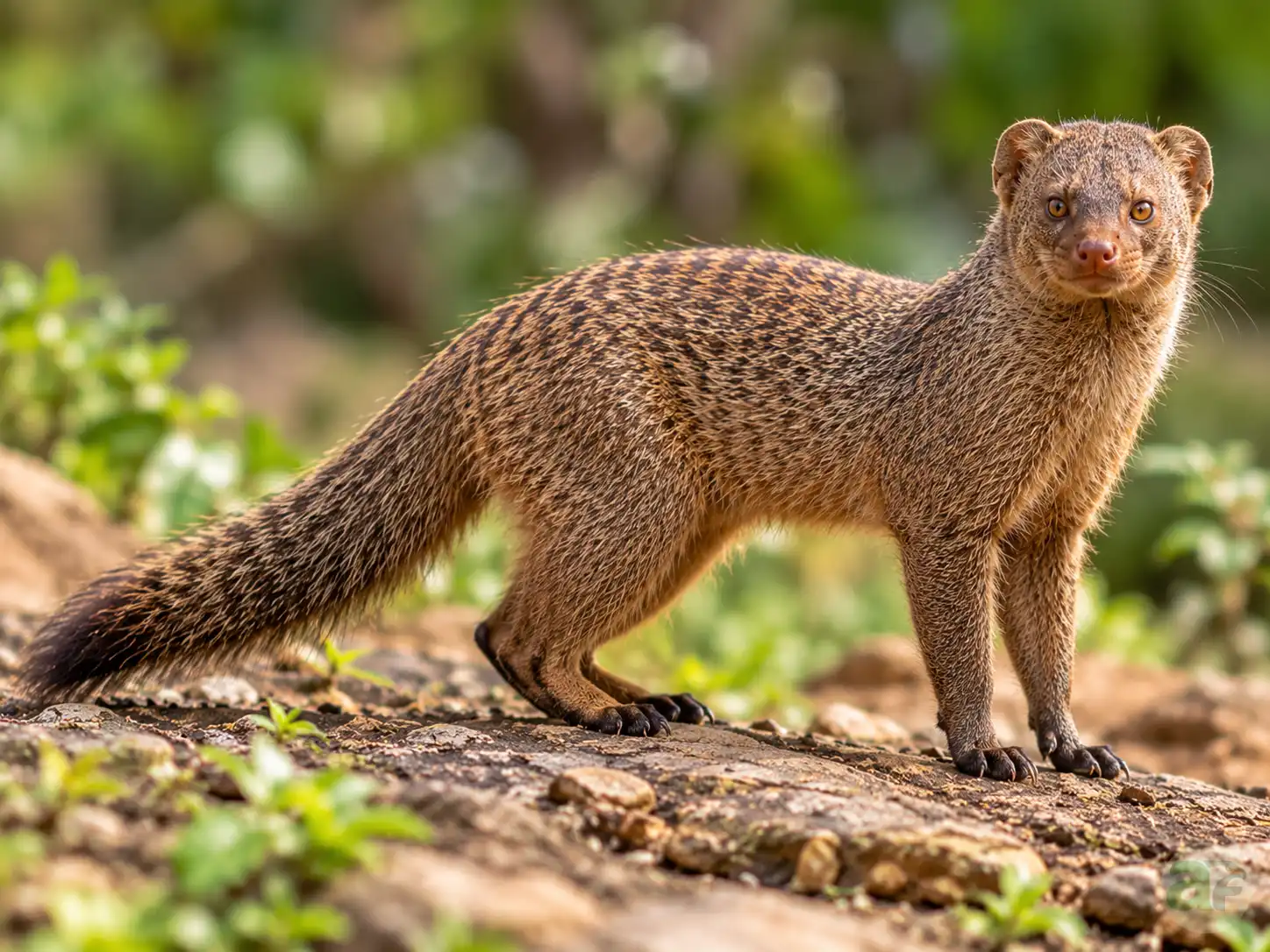
22. Comparison of Major Mongoose Species
| Feature | Indian Grey Mongoose | Meerkat | Banded Mongoose | Dwarf Mongoose | White-tailed Mongoose | Egyptian Mongoose |
|---|---|---|---|---|---|---|
| Scientific name | Herpestes edwardsii | Suricata suricatta | Mungos mungo | Helogale parvula | Ichneumia albicauda | Herpestes ichneumon |
| Weight | 0.9–1.7 kg | 0.6–0.97 kg | 1–1.7 kg | 210–350 g | 2.5–5 kg | 1.7–4 kg |
| Social structure | Solitary | Highly social — cooperative | Highly social — cooperative | Cooperative family groups | Solitary | Solitary/pairs |
| Activity | Diurnal | Diurnal | Diurnal | Diurnal | Nocturnal | Mostly nocturnal |
| Primary habitat | Scrub, dry forest | Kalahari Desert | Savanna, woodland | Savanna | Woodland | Mediterranean scrub, riparian |
| Famous for | Cobra fighting | Sentinel behavior | Teaching; intergroup conflict | Termite mound territories | Largest mongoose | Ancient Egypt; ichneumon |
| IUCN Status | Least Concern | Least Concern | Least Concern | Least Concern | Least Concern | Least Concern |
| Range | Indian subcontinent | Kalahari Desert | Sub-Saharan Africa | Sub-Saharan Africa | Sub-Saharan Africa | Africa, SW Europe |
| Research status | Moderately studied | Most studied | Extensively studied | Well studied | Poorly known | Moderately studied |
| Group size | Solitary | Up to 30 | Up to 40 | Up to 30 | Solitary | 1–2 |
23. Frequently Asked Questions About Mongooses
Q1. What is the scientific name of the mongoose?
Mongooses belong to the family Herpestidae (Bonaparte, 1845) — a family within the suborder Feliformia of the order Carnivora. There is no single species called “the mongoose” — the family contains 34 recognized species across 14 genera. The most familiar species include the Indian grey mongoose (Herpestes edwardsii), the small Asian mongoose (Herpestes javanicus), the Egyptian mongoose (Herpestes ichneumon), the banded mongoose (Mungos mungo), the meerkat (Suricata suricatta), and the dwarf mongoose (Helogale parvula). The family name Herpestidae derives from the Greek herpestēs meaning “creeper” — a reference to the low-slung, ground-hugging movement characteristic of mongoose locomotion.
Q2. Are mongooses immune to snake venom?
Partially yes — with important qualifications. Mongooses have a genuine molecular resistance to cobra alpha-neurotoxins — the specific venom components that cause paralysis by blocking neuromuscular transmission. This resistance is produced by a specific amino acid substitution in the nicotinic acetylcholine receptor (nAChR) that reduces the binding affinity of alpha-neurotoxins. This modification is present in all mongoose species and provides substantial protection against cobra envenomation during typical predator-prey encounters. However, mongoose venom resistance is not absolute — extremely large venom doses, directly injected venoms, or venoms with different mechanisms (cytotoxic, hemotoxic) can still harm or kill mongooses. The resistance is a significant advantage in the context of typical cobra encounters, not a complete invulnerability to all snake venoms.
Q3. Is a meerkat a mongoose?
Yes — the meerkat (Suricata suricatta) is fully a member of the mongoose family Herpestidae. It belongs to its own genus (Suricata) within the family — making it a distinct species rather than a variety of any other mongoose — but it shares the fundamental biological characteristics of all mongooses including the nAChR venom resistance modification, the basic body plan, and the general carnivore ecology. The meerkat’s extraordinary cooperative social behavior has made it one of the most studied and most famous animals in behavioral ecology — but it remains, taxonomically, a mongoose.
Q4. Why is the plural of mongoose not “mongeese”?
The plural of mongoose is mongooses — not “mongeese.” This is one of the most common English language misconceptions about the word. “Mongeese” would be correct if “mongoose” were related to “goose” — but the word has entirely different origins. “Mongoose” derives from the Marathi word mangūs (and related words in other Indian languages) — it was borrowed into English from South Asian languages and has no etymological connection to the Germanic word “goose.” Therefore, English pluralization rules for similar-sounding words like “goose/geese” do not apply, and the standard English plural suffix “-es” is used to produce “mongooses.”
Q5. What do mongooses eat?
Mongoose diet varies significantly across the family’s 34 species and reflects the ecological diversity of the group. Common prey categories include insects and invertebrates (the primary prey by volume for most small species), small rodents (important for medium-large species including the Indian grey mongoose), snakes (particularly for species in snake-rich habitats), lizards and small reptiles, eggs (bird and reptile), crabs and crustaceans (particularly for the marsh mongoose and crab-eating mongoose), frogs and amphibians, scorpions (particularly for meerkats), and seasonal fruit and berries. The meerkat’s specialized scorpion hunting — with resistance to Kalahari scorpion venom — is one of the most remarkable dietary specializations in the family.
Q6. Where do mongooses live?
Mongooses are native to Africa, South Asia, Southeast Asia, and extreme southern Europe (the Egyptian mongoose is native to Iberia and the Mediterranean coast). Within Africa, mongoose species occupy habitats from West African tropical rainforest through East African savanna to southern African desert — with different species specialized for different environments. In Asia, species are distributed from the Indian subcontinent through Southeast Asia’s diverse forest and agricultural landscapes. The small Asian mongoose (Herpestes javanicus) has been introduced to over 60 islands and countries globally — including Hawaii, Caribbean islands, Fiji, and Japan — where it is considered an invasive species with serious impacts on endemic wildlife.
24. Sources & References
- Wikipedia — Herpestidae, Herpestes edwardsii, Suricata suricatta, Mungos mungo, Helogale parvula
- IUCN Red List — iucnredlist.org (current assessments for all mongoose species)
- Kalahari Meerkat Project — manchester.ac.uk/kalagadi (Cambridge University)
- Clutton-Brock, T.H. et al. — multiple published papers from the Kalahari Meerkat Project (1974–2024)
- Thornton, A. and McAuliffe, K. (2006). “Teaching in wild meerkats.” Science — the foundational scorpion-teaching paper
- Thornton, A. and Clutton-Brock, T. (2011). “Social learning and the development of individual and group behaviour in mammal societies.” Philosophical Transactions of the Royal Society B
- Manser, M.B. et al. — multiple published papers on meerkat alarm call structure and information content
- Cant, M.A. et al. — published papers on banded mongoose intergroup conflict
- National Geographic — nationalgeographic.com
- Smithsonian National Museum of Natural History — naturalhistory.si.edu
- BBC Wildlife / BBC Earth — bbcearth.com
- Britannica — britannica.com/animal/mongoose
- Hunter, L. (2011). Carnivores of the World. Princeton University Press
- Rasa, A. (1983). Mongoose Watch: A Family Observed. John Murray Publishers