
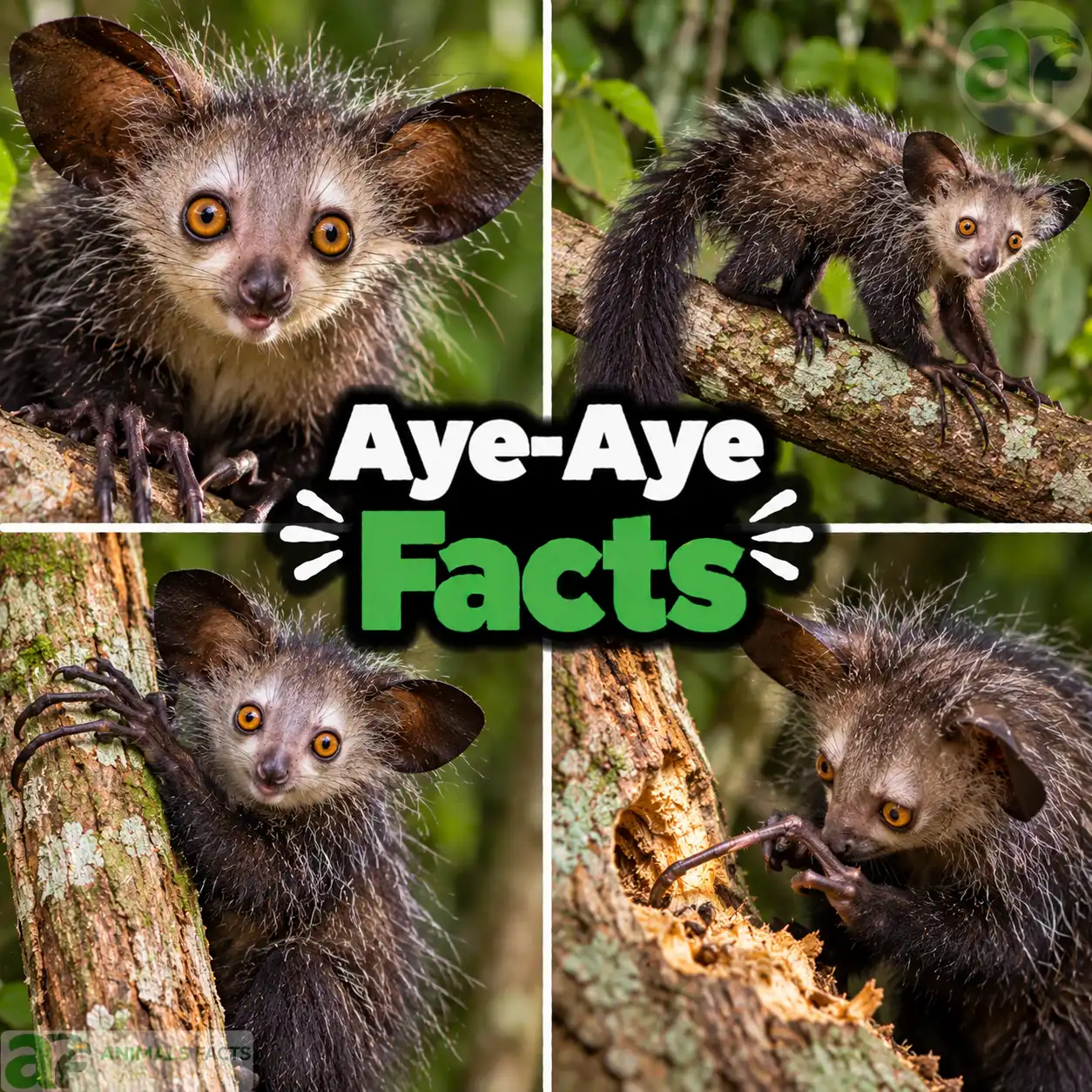
Aye-Aye Facts
| Feature | Details |
|---|---|
| Scientific Name | Daubentonia madagascariensis (Gmelin, 1788) |
| Kingdom | Animalia |
| Phylum | Chordata |
| Class | Mammalia |
| Order | Primates |
| Suborder | Strepsirrhini |
| Infraorder | Lemuriformes |
| Family | Daubentoniidae |
| Common Names | Aye-aye, ahay (Malagasy) |
| Native Range | Madagascar — scattered distribution across most of the island |
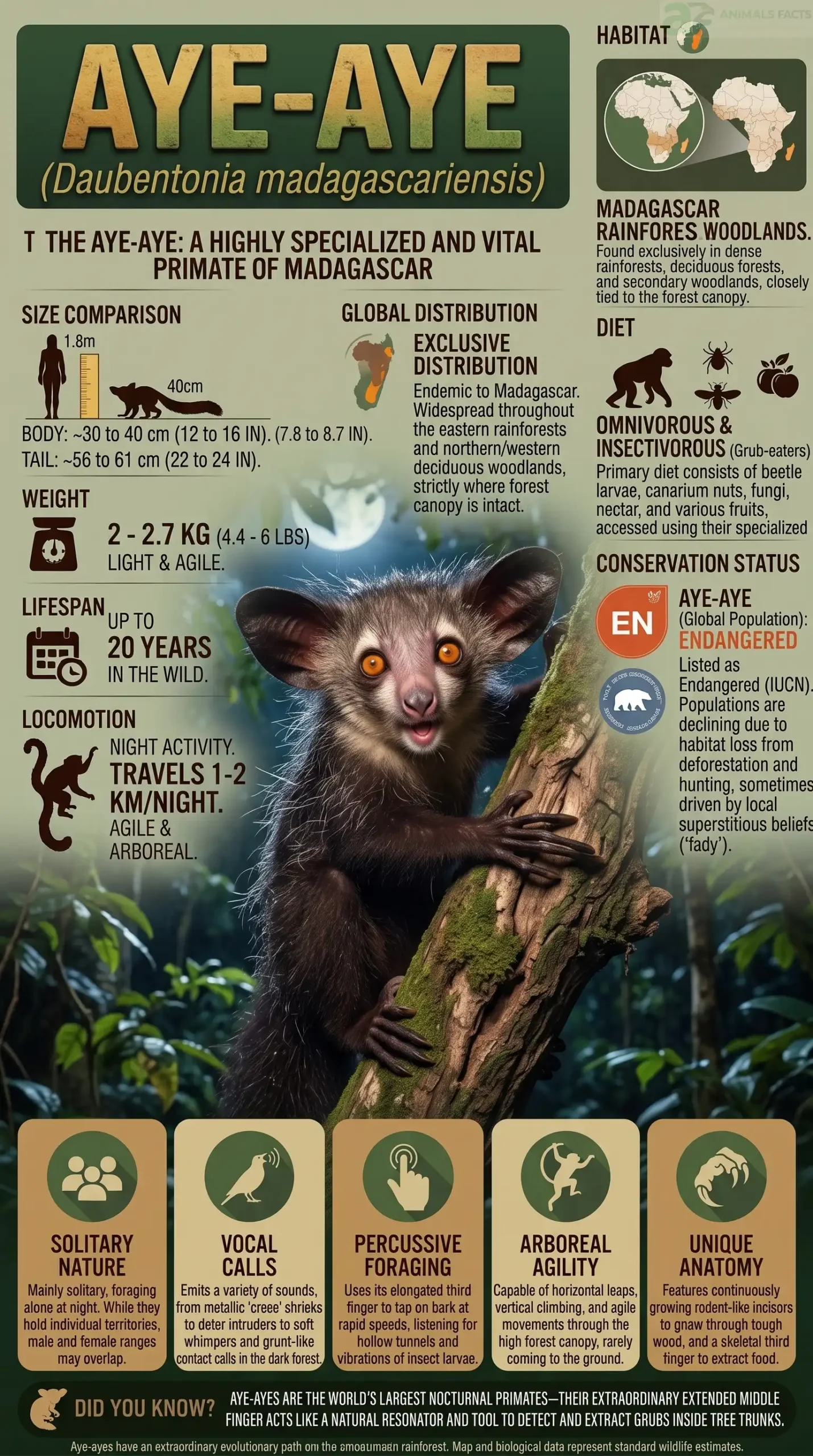
| Habitat | Tropical rainforest, dry deciduous forest, mangrove, secondary forest, plantation margins |
| Lifespan | Estimated 20+ years (wild); up to 23 years (captivity) |
| Diet | Wood-boring larvae, seeds (particularly Canarium), fungi, nectar, fruit, eggs |
| Body Length | 30–37 cm body plus 44–53 cm tail |
| Weight | 2.5–2.7 kg — roughly the size of a large domestic cat |
| Conservation Status | Endangered (IUCN) — declining |
| Defining Feature | Elongated, wire-thin middle finger used for tap-foraging — unique among all primates |
| Taxonomic Status | The only member of family Daubentoniidae — sole survivor of an ancient primate lineage |
| Closest Relative | All other lemurs — but so divergent it requires its own family |
| Ecological Role | Madagascar’s functional equivalent of a woodpecker — unique among primates globally |
 1. Introduction: What is an Aye-Aye?
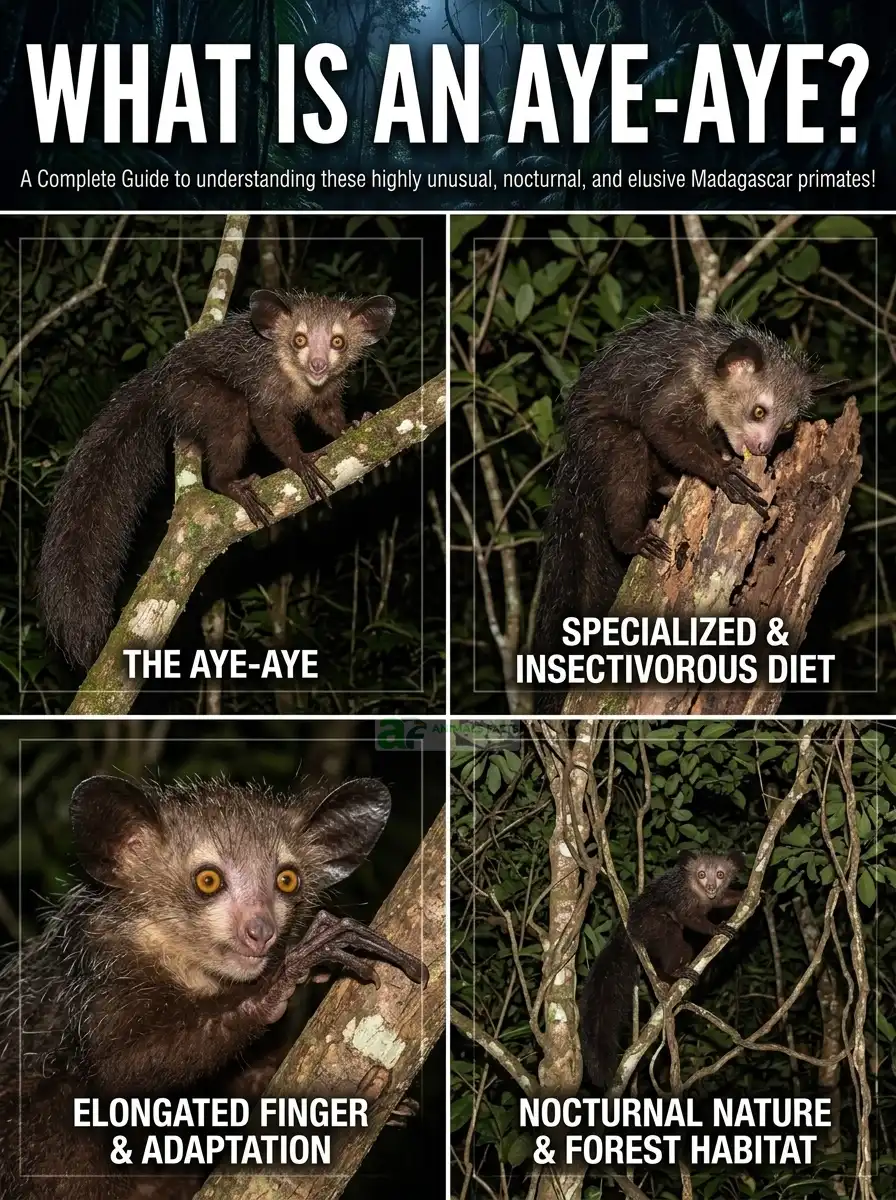
In the darkness of a Madagascar rainforest, something moves through the canopy that defies easy categorization — something that early European naturalists genuinely did not know how to classify, that was initially described as a squirrel, subsequently proposed as a rodent, later recognized as a primate, and that even today represents one of the most morphologically extraordinary and evolutionarily isolated vertebrates on Earth. It has the ears of a bat, the teeth of a rodent, the tail of a fox, the eyes of an owl, and one finger that belongs to no other primate in the world — a middle finger so elongated, so wire-thin, so anatomically specific that it might have been designed by a committee working from the requirements of a very specialized ecological problem and not particularly concerned with aesthetic coherence. Aye-aye facts begin with this single, overwhelming image — the most bizarre primate alive, an animal so morphologically unusual that its own scientific name stands alone in its own taxonomic family, with no living relatives close enough to share even that fundamental classification.
The aye-aye is simultaneously one of the most extraordinary examples of convergent evolution in the mammalian world and one of the most culturally significant and most unjustly persecuted animals in Madagascar. Its feeding system — tapping on wood surfaces with that impossible elongated finger to locate hollow spaces by resonance, gnawing through the wood with continuously growing rodent-like incisors, then extracting the larvae from the hollow with the hooked fingertip — is the precise functional equivalent of the woodpecker’s foraging strategy, arrived at entirely independently in a primate lineage rather than a bird lineage. Madagascar has no woodpeckers. The aye-aye evolved to fill the woodpecker’s ecological niche without ever being related to one — one of the clearest and most dramatic examples of convergent evolution documented in any pair of unrelated organisms. Interesting facts about aye-ayes reveal an animal of breathtaking biological sophistication — the most intelligent forager in Madagascar’s forest; an animal whose tap-foraging system requires the integration of acoustic perception, spatial memory, and manual dexterity that no other primate has independently evolved; a nocturnal specialist whose enormous eyes and rotating ears provide sensory coverage of extraordinary range in near-complete darkness; and a cultural symbol of such powerful negative significance in Malagasy tradition that its appearance near a village has historically triggered its killing and sometimes the burning of nearby structures.
Whether you are searching for aye-aye facts for kids to explore the science of convergent evolution and unusual primate biology, a wildlife enthusiast wanting to understand the extraordinary ecology of Madagascar’s most unique mammal, a conservationist concerned about the complex intersection of cultural belief and wildlife persecution, or simply someone who encountered a photograph of this remarkable animal and needed to understand everything about it immediately — this is your comprehensive guide. We cover aye-aye scientific name, aye-aye diet, aye-aye size and weight, aye-aye behavior, the extraordinary tap-foraging system, the cultural mythology that drives its persecution, conservation status, and the ecological roles this irreplaceable primate plays in Madagascar’s forest ecosystem. The world’s most extraordinary primate has an extraordinary story to tell.
2. Aye-Aye Species Overview & Classification
The aye-aye occupies the most taxonomically isolated position of any living primate — a species so morphologically and genetically distinctive that it is placed in its own monotypic family (Daubentoniidae) within the infraorder Lemuriformes.
Species Classification Table
| Taxonomic Rank | Classification |
|---|---|
| Kingdom | Animalia |
| Phylum | Chordata |
| Class | Mammalia |
| Order | Primates |
| Suborder | Strepsirrhini |
| Infraorder | Lemuriformes |
| Family | Daubentoniidae (Gray, 1870) — monotypic; aye-aye only |
| Genus | Daubentonia (É. Geoffroy, 1795) |
| Species | D. madagascariensis (Gmelin, 1788) |
| Common Names | Aye-aye; ahay (Malagasy) |
| Etymology | Daubentonia — named for French naturalist Louis-Jean-Marie Daubenton; madagascariensis = “of Madagascar” |
The Extinct Giant Aye-Aye
A second species of Daubentonia is known from the subfossil record:
| Species | Common Name | Weight | Status |
|---|---|---|---|
| Daubentonia robusta | Giant aye-aye | ~5 kg (estimated) | Extinct — died out following human arrival ~1,000 years ago |
The giant aye-aye was approximately twice the weight of the living species — its extinction following human arrival in Madagascar represents the loss of a substantial portion of the genus’s known diversity.
The Taxonomic History — A Classification Puzzle
The aye-aye’s classification history is one of the most fascinating in primatology — reflecting how morphologically unusual this animal is:
1780 — French traveler Pierre Sonnerat provides the first formal Western scientific description of the aye-aye in Senegal — noting its extraordinary finger and bat-like ears but not successfully placing it taxonomically.
1788 — Johann Friedrich Gmelin formally names the species Sciurus madagascariensis — classifying it as a squirrel based on its rodent-like teeth and bushy tail. This is the first formal scientific name, though the genus assignment was incorrect.
1795 — Étienne Geoffroy Saint-Hilaire recognizes the aye-aye as a primate and establishes the genus Daubentonia — naming it in honor of the French naturalist Louis-Jean-Marie Daubenton.
1863 — Richard Owen publishes a comprehensive anatomical study of the aye-aye — confirming its primate status and establishing many of the anatomical details that define the species.
19th–20th century — Various taxonomic placements proposed as molecular techniques were not yet available; the aye-aye’s extreme morphological divergence from all other primates makes placement in any existing family impossible.
1990s–2000s — Molecular genetic analysis confirms the aye-aye’s position within the lemur infraorder (Lemuriformes) — as a highly divergent member of the Madagascar primate radiation — while confirming that it diverged so early and so dramatically from other lemurs that its own family remains the appropriate classification.
The Living Fossil Concept
The aye-aye is frequently described as a “living fossil” — not in the strict paleontological sense (its morphology is actually highly derived rather than primitive) but in the sense that it represents an isolated evolutionary lineage with no close living relatives. The Daubentoniidae family diverged from other lemurs earlier than any other extant lemur family — making the aye-aye the most ancient branch of the living lemur radiation.
This evolutionary isolation has profound conservation implications — the aye-aye represents not merely one species but an entire evolutionary lineage with no close relatives. Its extinction would eliminate a branch of the primate family tree that is approximately 50–60 million years old — an irreplaceable evolutionary experiment with no backup copy anywhere in the world.
“The aye-aye is the most extraordinary primate I have encountered in a lifetime of studying these animals. It is not merely unusual — it is a biological impossibility made real. Everything about it should not work, and yet it works with extraordinary efficiency. If evolution is the greatest artist in the history of the universe, the aye-aye is one of its most daring sculptures.”
— Dr. Eleanor Sterling, wildlife biologist and author of the first comprehensive field study of aye-aye behavior
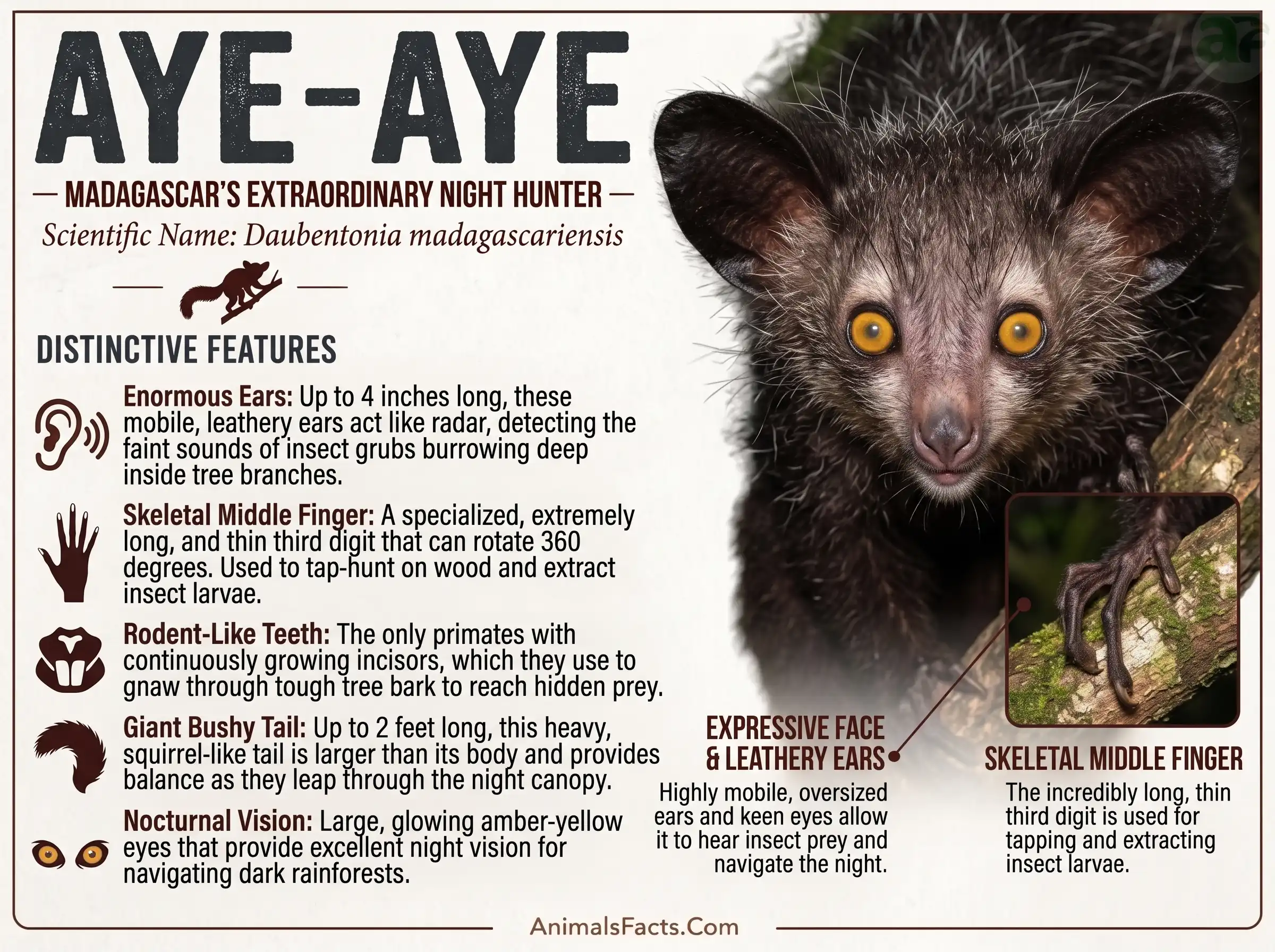
3. Aye-Aye Physical Description & Unique Features
The aye-aye’s physical appearance is an accumulation of extreme morphological specializations — each feature highly derived for a specific function — combined in a single animal in a way that makes accurate description nearly impossible without the accompanying caveat that the combination is even more improbable than any individual feature suggests.
The Middle Finger — The Defining Anatomical Innovation
The aye-aye’s most immediately striking and most biologically significant feature is its third finger (middle finger) — an anatomical structure unique in the entire order Primates:
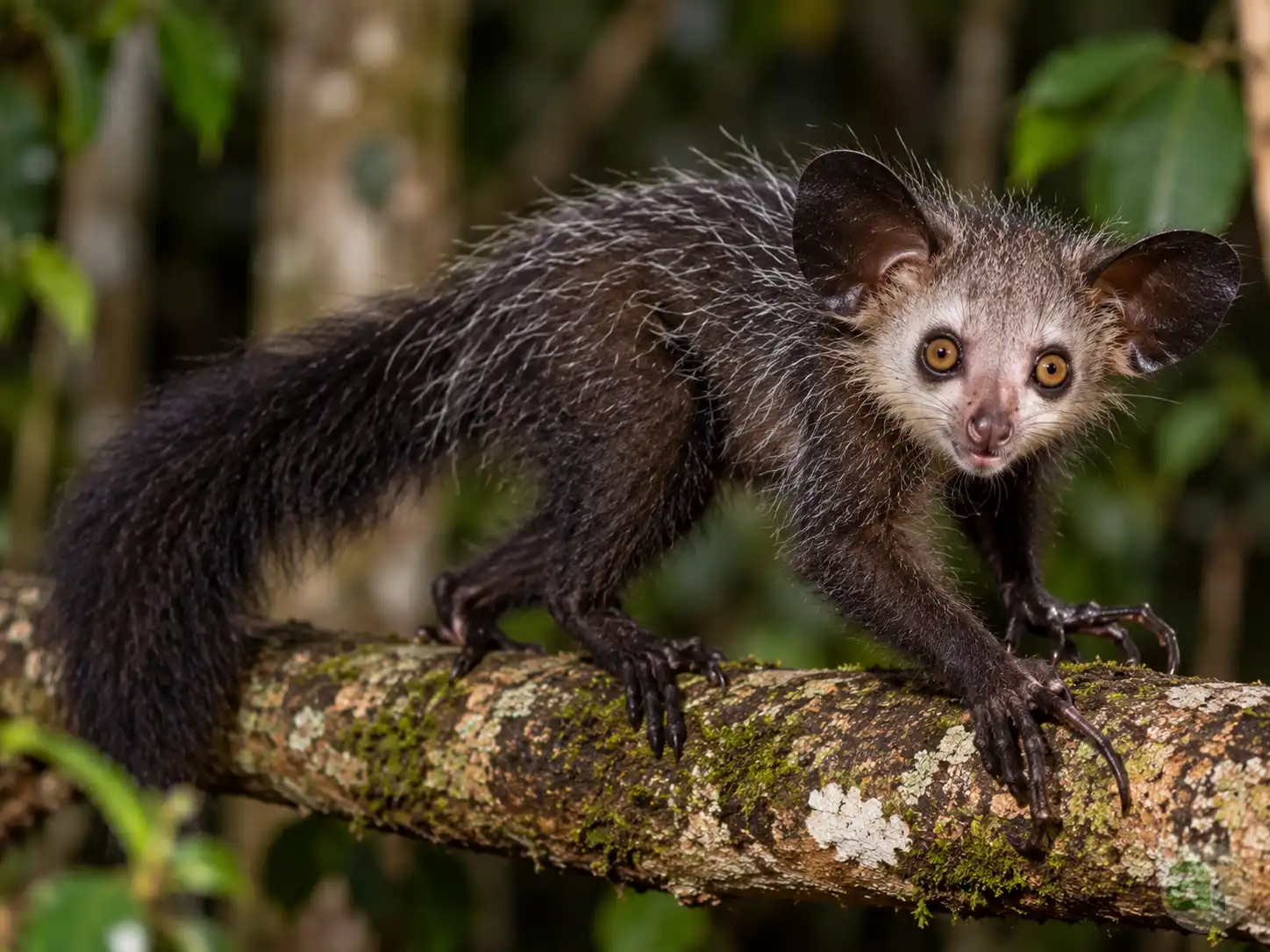
Structure — The third finger is dramatically elongated — approximately 3 times longer than the other fingers — and dramatically reduced in diameter, creating a wire-thin, skeletal appendage that looks more like a probe or tool than a biological digit. The finger is pale-skinned, lacking the fur that covers the other digits, and terminates in a curved, hook-like claw rather than the flat nail or standard claw of the other digits.
Joint specialization — The third finger is equipped with a ball-and-socket metacarpophalangeal joint — unlike the hinge joints of the other fingers — allowing 360-degree rotation in multiple planes. This rotational capability allows the finger to be inserted into irregular holes at any angle and rotated to hook larvae regardless of their orientation within the chamber.
Sensory capability — The third finger is richly supplied with Meissner’s corpuscles — mechanoreceptors sensitive to low-frequency vibrations and pressure changes. This sensory equipment allows the finger to detect vibrations in the wood surface during tapping and to sense the presence of larvae by feeling their movements within cavities.
Blood supply — The third finger has a remarkably enhanced blood supply — maintaining warmth and sensitivity in a digit that experiences considerable mechanical stress during the tapping and probing activities.
The resting posture — When not in use, the aye-aye holds the third finger elevated and curled — keeping it off contact surfaces to protect its sensitivity and structural integrity during normal locomotion. This distinctive resting posture — all fingers normal, third finger raised and curved — is the most reliable behavioral field identification feature of the species.
The Ears — Acoustic Precision Equipment
The aye-aye’s ears are the second most immediately distinctive feature — enormously large, mobile, and bat-like in proportion and character:
Size — The ears are disproportionately large relative to the head — extending well beyond the skull profile and creating the bat-like facial silhouette that gave early European observers such classification difficulty.
Mobility — Each ear can be moved independently — rotated forward, backward, and tilted to direct acoustic reception toward sound sources in different directions. This independent mobility allows binaural sound localization — determining the direction and distance of sounds with extraordinary precision.
Low-frequency sensitivity — The ear anatomy is specifically adapted for detecting the low-frequency sounds produced by wood resonance during tap-foraging — the slightly different resonance of hollow versus solid wood generating sound differences that the aye-aye detects and interprets as foraging information.
Thermal regulation — Like many large-eared mammals, the aye-aye’s ears contain superficial blood vessels that contribute to heat dissipation during periods of high activity.
The Incisors — Continuously Growing Woodcutters
The aye-aye’s incisors are one of the features that initially caused taxonomists to classify it as a rodent — and which remain among its most functionally distinctive anatomical features:
Rodent-like structure — The upper and lower incisors are open-rooted (continuously growing) — like rodent incisors — rather than closed-rooted (fixed length) like the incisors of other primates.
Orange enamel — The front surface of the incisors is coated with orange-pigmented enamel harder than the pale enamel on the rear surface — creating a self-sharpening chisel edge as the softer rear enamel wears away faster than the harder front enamel. This is precisely the same self-sharpening mechanism found in rodent incisors — evolved independently in the aye-aye through convergent evolution.
Gnawing function — The aye-aye uses these incisors to gnaw through wood — creating access holes for its elongated finger. A single foraging session may involve gnawing through several centimeters of hard wood — a task that would rapidly wear down fixed-length teeth.
Dental formula anomaly — The continuously growing incisors replace both the original incisors and the canine teeth of the standard primate dental formula — the aye-aye’s dental formula is fundamentally reorganized relative to other lemurs, and the absence of canine teeth is another feature that initially confused early taxonomists.
The Eyes — Nocturnal Precision
The aye-aye’s eyes provide the complementary sensory system to the acoustic tap-foraging capability:
Large pupils — Enormous pupils that open extremely wide in darkness — maximizing light collection for nocturnal navigation.
Tapetum lucidum — The reflective layer behind the retina that produces the distinctive eye-shine of many nocturnal mammals — in the aye-aye producing a brilliant golden-orange reflection when a light source is directed at the eyes.
Forward positioning — The eyes are positioned more frontally than in many nocturnal lemurs — providing greater binocular overlap and improved depth perception relative to the wide-angle panoramic vision of animals with more laterally positioned eyes. This forward positioning supports the precision manipulation required by the tap-foraging system — the aye-aye needs to accurately direct its elongated finger into specific small holes, requiring depth perception.
The Coat and Tail
Coat — The aye-aye’s fur is coarse, dark brown to black with white-tipped guard hairs that create a shaggy, somewhat unkempt appearance. The guard hairs catch and scatter light — contributing to the ghostly, slightly luminous appearance of an aye-aye in torchlight that has undoubtedly contributed to its supernatural cultural associations.
Tail — The tail is long — typically 44–53 cm, exceeding body length — and bushy, with long, unruly fur creating a fox-like tail profile. The tail is used for balance during foraging and for warmth when the animal curls up to sleep.
💡 Did You Know? The aye-aye’s elongated middle finger is so functionally specialized that it has its own dedicated neural architecture in the brain — the region of the somatosensory cortex processing input from the third finger is disproportionately enlarged relative to what the finger’s physical size would predict. This neural specialization — called cortical magnification — reflects the extraordinary sensory demands placed on the third finger during tap-foraging: the finger must detect subtle vibration differences in wood surfaces, feel the movement of larvae within cavities, and provide the fine-motor control needed for precise insertion and rotation within a narrow hole. The cortical magnification of the aye-aye’s third finger is one of the most dramatic examples of sensory cortical specialization documented in any primate — confirming that the tap-foraging system is not merely a behavioral innovation but a profoundly neurological one.
4. Top 25 Amazing Aye-Aye Facts
Here is your definitive collection of the most extraordinary, scientifically verified, and genuinely astonishing aye-aye facts as of 2026:
- The aye-aye is the only member of its family (Daubentoniidae) — a taxonomic family containing no other living species. It is so morphologically and genetically distinctive from all other primates that no existing family could accommodate it. Its extinction would eliminate an entire primate family.
- The aye-aye is Madagascar’s functional equivalent of a woodpecker — using its elongated third finger to tap on wood surfaces, locate hollow spaces by sound resonance, gnaw through the wood with its continuously growing incisors, and extract wood-boring larvae with its hooked fingertip. This strategy was independently evolved in a primate — making it one of the most dramatic examples of convergent evolution in the mammalian world. Madagascar has no woodpeckers.
- The aye-aye’s middle finger has a ball-and-socket joint at its base — allowing 360-degree rotation — while all other primate fingers have only hinge joints. This rotational capability allows the finger to be inserted into and rotated within irregular foraging holes at any angle.
- The aye-aye’s incisors grow continuously — like rodent teeth — a feature found in no other primate. This rodent-like dental feature was so convincing that the first European naturalists classified the aye-aye as a squirrel before its primate identity was established.
- In many Malagasy communities, the aye-aye is considered a harbinger of death — its appearance near a village triggering the animal’s immediate killing and sometimes the burning of nearby structures to ward off the evil omen. This cultural belief is the most significant direct driver of aye-aye mortality in many parts of its range.
- The aye-aye was believed to be extinct following its formal description — no confirmed sightings occurred for approximately 80 years after Sonnerat’s first description in 1780, leading many naturalists to conclude the species had been lost. Its rediscovery in the late 19th century was a significant event in the history of natural history.
- The aye-aye uses echolocation-like tap-foraging — tapping at approximately 8 taps per second on wood surfaces while moving its ears to receive the resonance returns — the slightly different acoustic signature of hollow spaces allowing it to locate larvae-containing cavities that are invisible on the surface.
- The aye-aye holds the third finger elevated and curled when not in use — keeping it off surfaces to protect its sensitivity and structural integrity. This distinctive posture — all other fingers normally positioned, middle finger raised — is immediately diagnostic and unlike the resting hand posture of any other primate.
- Female aye-ayes have a gestation period of approximately 170 days — among the longest relative to body size of any strepsirrhine primate — and typically produce only one offspring every 2–3 years. This extremely slow reproduction rate makes the species particularly vulnerable to population decline from any mortality pressure.
- The aye-aye was formally described by two names simultaneously in the scientific literature — Gmelin’s 1788 Sciurus madagascariensis (squirrel classification) and subsequent primate reclassifications — creating a taxonomic history of unusual complexity for a species that was genuinely difficult to fit into any existing classification system.
- Research at the Duke Lemur Center has documented that captive aye-ayes demonstrate spontaneous tool use — specifically, using their elongated finger to access food in containers designed to require insertion of a slender probe. The behavior was developed spontaneously without training — suggesting that the tap-foraging system emerges from an innate neural template rather than requiring extended learning.
- The aye-aye has a percussive foraging rate of approximately 8 taps per second — a rhythmic tapping that generates specific acoustic frequencies particularly effective at revealing the resonance differences between solid and hollow wood.
- The aye-aye’s home range is among the largest of any comparably sized strepsirrhine primate — with males maintaining ranges of 40–200 hectares and females maintaining ranges of 30–100 hectares, reflecting the patchy and unpredictable distribution of the larval resources it depends on.
- Aye-ayes have been documented in every major habitat type in Madagascar — from rainforest to dry deciduous forest to mangrove to coastal plantations — making it the most habitat-flexible of any large Malagasy lemur and the species with the broadest geographic potential in Madagascar.
- The aye-aye’s scent glands are unusually complex for a lemur of its size — with secretory glands on the neck and anogenital region producing chemical signals used in territory marking and reproductive communication. Scent marking is the primary mechanism by which aye-ayes communicate territorial occupancy across the large distances of their extensive home ranges.
- Despite being classically nocturnal, aye-ayes have been observed exhibiting crepuscular and occasionally diurnal activity — particularly in habitats where human disturbance has altered the availability of nocturnal foraging time, suggesting behavioral flexibility in activity timing.
- The aye-aye’s nest is one of the most elaborate constructed by any lemur — a large, roughly spherical structure of interwoven leaves, twigs, and vines built in the forest canopy, typically 40–60 cm in diameter and containing a soft inner lining. Multiple nests may be maintained within the home range and rotated through across nights.
- Genetic studies have confirmed that the aye-aye diverged from other lemurs approximately 50–60 million years ago — the deepest split within the living lemur radiation — making the Daubentoniidae the oldest distinct lemur lineage and the aye-aye the most evolutionarily ancient of all living lemurs.
- The aye-aye’s foraging efficiency has been quantified — in terms of caloric return per unit foraging time — as significantly exceeding what would be possible through standard primate foraging strategies in the same habitat. By accessing the high-calorie, high-protein larval resource that no other primate can reach, the aye-aye occupies a nutritional niche effectively unavailable to all other Madagascar primates.
- Male aye-ayes maintain home ranges that overlap with those of multiple females — and have been observed traveling long distances specifically to encounter receptive females during the brief periods when females are in estrus. This mate-searching behavior, requiring navigation across tens of kilometers of forest, reflects the spatial cognitive capability developed through the demands of large-range foraging.
- The aye-aye’s bite force relative to its body size is among the highest of any primate — the powerful jaw musculature required for gnawing through hard wood producing bite forces that substantially exceed those of comparably sized primates that do not gnaw wood.
- Research on aye-aye cognitive mapping has revealed that individuals maintain detailed spatial memories of larval-resource locations across their extensive home ranges — returning to productive foraging trees with high site fidelity and apparently maintaining mental maps of resource locations updated over time.
- The aye-aye was the subject of a dedicated conservation island program — Nosy Mangabe, an island in northeastern Madagascar’s Masoala Bay, was designated as an aye-aye reserve in 1966 following the rediscovery of remaining populations. Several aye-ayes were relocated to this island to establish a protected population — an early example of island refuge conservation.
- Despite the negative cultural associations that drive persecution, some Malagasy communities maintain protective traditions toward the aye-aye — recognizing it as a forest spirit that should be respected rather than killed. These protective cultural frameworks provide informal conservation benefit in areas where they remain strong.
- As of 2026, the aye-aye remains Endangered — with the primary threats being habitat loss through deforestation, direct persecution driven by cultural beliefs, incidental trapping, and road kills as Madagascar’s road network expands into previously inaccessible forest areas.
5. Fun Facts About Aye-Ayes
- The aye-aye is the only member of its entire primate family
- It is Madagascar’s functional woodpecker — evolved independently
- Its middle finger can rotate 360 degrees — no other primate can
- The incisors grow continuously — like a rodent — unique among primates
- It was thought to be extinct for 80 years after discovery
- Aye-ayes tap wood 8 times per second listening for hollow spaces
- They hold the middle finger raised and curled when not using it
- They produce one offspring every 2–3 years — extremely slow reproduction
- They diverged from other lemurs 50–60 million years ago — the oldest lemur lineage
- Their third finger has dedicated enlarged brain regions for sensory processing
- Male home ranges can reach 200 hectares
- They build elaborate spherical nests of woven leaves and twigs
6. Aye-Aye Natural Habitat & Geographic Range
Aye-aye habitat is the most broadly distributed of any large Malagasy lemur — the species documented from virtually every major vegetation zone across Madagascar, though at extremely low population densities throughout its range.
Habitat Types
Eastern Rainforest — The primary and most species-rich aye-aye habitat; the humid forests of the eastern escarpment support the highest known aye-aye densities and the broadest documented larval foraging activity. The high tree species diversity of rainforest supports diverse wood-boring beetle communities — providing abundant larval food resources.
Western Dry Deciduous Forest — Present throughout the western forests — the seasonal deciduous forests of western Madagascar support aye-ayes at lower densities than eastern rainforest but across large areas.
Northern Deciduous Forest — Documented in the complex northern forest zone including the forests around Ankarana and Daraina — some of Madagascar’s most unique northern habitats.
Mangrove and Coastal Forest — Documented in coastal mangrove habitats — an unusual habitat for a primate largely dependent on wood-boring larvae in terrestrial forest trees. The mangrove records suggest the aye-aye can exploit the abundant wood-boring insects of mangrove deadwood.
Secondary Forest and Plantation Margins — The aye-aye’s documented presence in secondary forest, coffee plantations, and coconut plantations represents an important behavioral flexibility — it can exploit wood-boring larvae in plantation trees and fruit resources at agricultural margins. This flexibility potentially allows persistence in landscapes more heavily modified than would support most large lemurs.
Montane Forest — Recorded at elevations up to approximately 1,700 meters in Madagascar’s highland forests — a broader elevation range than most accounts have suggested.
Geographic Distribution
| Region | Status | Notes |
|---|---|---|
| Northeast Madagascar | Present — best studied | Masoala Peninsula; Nosy Mangabe |
| East Madagascar | Present — rainforest zone | Ranomafana area; Andasibe area |
| North Madagascar | Present | Ankarana; Daraina region |
| West Madagascar | Present — dry deciduous forest | Lower densities; less studied |
| South Madagascar | Presence uncertain | Records scattered; habitat marginal |
| Nosy Mangabe Island | Introduced conservation population | Established 1966; well-studied |
The Low-Density Distribution Problem
One of the most significant aspects of aye-aye habitat use is the species’ extremely low population density across its broad range:
- Camera trap studies estimate 0.5–1.5 aye-ayes per km² in good rainforest habitat — one of the lowest densities of any comparable-sized primate in its range
- Large home ranges (40–200 hectares) mean that even where the species is present, individual encounters are rare
- The combination of large home ranges, nocturnal habits, and cryptic behavior makes population estimation extraordinarily difficult
💡 Did You Know? The aye-aye was formally described by Western science in 1788 — but was subsequently not observed by European scientists for approximately 80 years, leading many naturalists to conclude it had gone extinct. The rediscovery of living aye-ayes in the 1860s was treated as a significant natural history event — the resurrection of a species considered lost. This 80-year observation gap reflects both the aye-aye’s extreme nocturnal secrecy and the very limited scientific exploration of Madagascar’s forests during this period — but it created the extraordinary historical narrative of a species “lost” and “found” that prefigures the conservation rediscovery stories that have become common in modern wildlife science.
7. Aye-Aye Diet & Feeding Behavior — The Tap-Foraging System
Aye-aye diet and feeding behavior represent the most complex and most evolutionarily remarkable foraging system of any primate — a multi-stage process integrating acoustic detection, mechanical excavation, and precise manual extraction that has no parallel in the entire primate order.
Diet Breakdown Table
| Food Type | Estimated % of Diet | Season | Notes |
|---|---|---|---|
| Wood-boring larvae (beetles, moths) | ~40–50% | Year-round | Primary protein source; requires tap-foraging |
| Seeds (particularly Canarium species) | ~25–35% | Seasonal | High calorie; gnawed open with incisors |
| Fungi | ~10–15% | Wet season | Found in dead and decaying wood |
| Nectar | ~5–10% | Flowering season | Accessed with elongated finger in tubular flowers |
| Fruit | ~5–10% | Seasonal | Consumed opportunistically |
| Eggs | ~2–5% | Occasional | Bird and reptile eggs documented |
| Other invertebrates | ~2–5% | Opportunistic | Various small invertebrates |
The Complete Tap-Foraging System — Step by Step
The aye-aye’s tap-foraging system is the most behaviorally and neurologically complex foraging behavior documented in any strepsirrhine primate:
Step 1 — Search movement — The aye-aye moves through the forest canopy and along branches, covering its large home range in search of productive foraging trees. Movement is primarily through the canopy but includes frequent descents to examine fallen logs and large exposed roots.
Step 2 — Primary assessment — Upon reaching a potential foraging tree, the aye-aye uses olfactory detection first — sniffing bark surfaces to detect the chemical traces of wood-boring insects within. This olfactory pre-screening identifies trees worth the investment of detailed tapping.
Step 3 — Systematic tapping — On trees passing the olfactory screen, the aye-aye begins a systematic tapping protocol — striking the bark with the elongated third finger at a rate of approximately 8 taps per second while moving the finger across the bark surface in systematic sweeps. The tapping covers branches and trunk sections methodically.
Step 4 — Acoustic analysis — While tapping, the aye-aye holds both enormous ears fully forward and slightly angled — receiving the resonance returns from the tapping with both ears simultaneously. The slightly different resonance of hollow spaces (where larvae excavate galleries) compared to solid wood is detected acoustically — the aye-aye apparently perceiving this difference as clearly as a human might perceive the difference between a solid and hollow knock on a door surface.
Step 5 — Larval confirmation — When a hollow is acoustically identified, the aye-aye may pause and listen more carefully — sometimes detecting the actual movement sounds of larvae within the gallery, providing additional confirmation.
Step 6 — Gnawing access — Once a productive hollow is confirmed, the aye-aye uses its continuously growing incisors to gnaw through the wood surface — creating a circular access hole precisely sized for the elongated third finger. This gnawing may take 30–120 seconds depending on wood hardness.
Step 7 — Extraction — The elongated third finger is inserted into the access hole and rotated — the 360-degree ball-and-socket joint allowing rotation regardless of the hole’s angle or orientation. The curved claw at the fingertip hooks larvae encountered during rotation, pulling them out through the access hole.
Step 8 — Consumption — Extracted larvae are consumed immediately. The aye-aye may then continue investigating the same gallery — inserting the finger multiple times at different angles to extract additional larvae — or move to the next potential foraging site.
The Canarium Seed Foraging
The aye-aye’s feeding on Canarium seeds (Canarium madagascariensis and related species) represents its second major foraging mode — and is equally impressive as the larval foraging:
The target — Canarium fruits contain a hard stone (endocarp) encasing a highly nutritious seed — the stone is so hard that most animals cannot access the seed inside.
The aye-aye’s solution — The aye-aye gnaws through the Canarium endocarp with its powerful, continuously growing incisors — creating a small hole through which the elongated third finger is inserted to scoop out the seed contents.
The ecological significance — The aye-aye is the only mammal in Madagascar capable of gnawing through Canarium endocarps — giving it exclusive access to a high-calorie, year-round food resource that is unavailable to all other Malagasy primates. This dietary exclusivity — combined with the exclusive access to wood-boring larvae — means the aye-aye occupies dietary niches effectively unavailable to all competing primates.
The Nectar Feeding Adaptation
The aye-aye’s elongated finger has a third foraging application — nectar extraction from tubular flowers:
- The finger can be inserted into narrow, tubular flower structures to reach nectar that is inaccessible to most animals
- This nectar feeding potentially makes the aye-aye an incidental pollinator of deep-throated Malagasy flowers
- The behavior has been particularly documented with the traveller’s palm (Ravenala madagascariensis) — whose nectar is accessible to the aye-aye’s finger but not to most other Malagasy wildlife
8. Aye-Aye Reproduction & Life Cycle
Aye-aye reproduction is characterized by the extreme reproductive conservatism typical of large-brained, long-lived primates — small litter sizes, extended parental care, and slow generation time creating a reproductive biology that makes the species particularly vulnerable to elevated mortality from any source.
Mating System
The aye-aye mating system is one of the least documented of any large primate — the combination of extreme nocturnality, low population density, and difficult forest habitat has made systematic observation of mating behavior rare:
Promiscuous mating — Evidence from both field observations and captive studies suggests that aye-ayes have a promiscuous mating system — females mate with multiple males during their brief estrus period, and males compete for mating access through both direct competition and sperm competition.
Large testes — Male aye-ayes have relatively large testes for their body size — a morphological indicator of sperm competition in species where females mate with multiple males. The investment in sperm production reflects selection pressure from competition between the sperm of multiple males following promiscuous mating.
Female estrus — Female aye-ayes appear to have estrus periods of approximately 2–5 days occurring at irregular intervals — with females becoming conspicuously vocal and scent-marking more intensively during estrus to attract males from across their large home ranges.
Long-distance male travel — Males apparently travel long distances specifically to locate estrus females — the large home ranges of both sexes overlapping in ways that allow multiple males to detect and respond to female reproductive signaling.
Gestation and Birth
- Gestation period: approximately 160–170 days — one of the longest for any strepsirrhine primate relative to body size
- Litter size: always 1 — single offspring only; no twins documented
- Birth weight: approximately 90–110 grams — approximately 4% of maternal body weight
- Birth season: births documented in multiple months — suggesting no strict seasonal birth peak, though some evidence of increased births following wet season peak food availability
Infant Development
Aye-aye infant development is extraordinarily protracted — among the slowest development of any comparably sized primate:
0–2 months — Completely dependent on mother; carried constantly or left in nest while mother forages
2–7 months — Beginning to explore environment while remaining closely associated with mother; beginning to observe maternal foraging behavior
7–14 months — Beginning independent foraging attempts; learning tap-foraging behavior through observation and practice
14 months – 2 years — Increasingly independent foraging; still maintaining association with mother and learning productive foraging sites and resource locations within the mother’s home range
2–4 years — Full independence; establishing own home range
3–4 years — Estimated age at sexual maturity
Inter-birth interval — Approximately 2–3 years between successive offspring — one of the lowest reproductive rates of any primate of comparable body size
The Learning Period and Cultural Transmission
The extended juvenile period is critically important for the aye-aye’s foraging development — the tap-foraging system is too complex to be fully innate and requires an extended learning period:
Observation learning — Juvenile aye-ayes observe their mother’s foraging behavior over months — learning which tree species are productive, what acoustic signatures indicate larvae presence, and how to perform the gnawing and extraction steps efficiently.
Spatial learning — Juveniles apparently learn the locations of productive foraging trees within the maternal home range — cultural transmission of resource location information from mother to offspring that reflects genuine social learning of a cognitive map.
Practice development — The fine-motor skills required for efficient larval extraction require extended practice — juvenile aye-ayes show lower extraction efficiency than adults, improving progressively through their juvenile period.
This learning period means that the loss of experienced adult aye-ayes from a population removes not only their reproductive contribution but also the cultural knowledge — of productive foraging trees, efficient foraging techniques, and spatial resource maps — that they would have transmitted to offspring.
Lifespan Comparison Table
| Species | Wild Lifespan | Max Captive | Inter-birth Interval |
|---|---|---|---|
| Aye-aye | 20+ years (estimated) | 23 years | 2–3 years |
| Ring-tailed lemur | 16–19 years | 37 years | 1 year |
| Indri | 15–20 years | Cannot maintain | 2–3 years |
| Black-and-white ruffed lemur | 15–20 years | 30+ years | 1 year |
| Fat-tailed dwarf lemur | 5–8 years | 20+ years | 1 year |
9. Social Behavior & Communication
Aye-aye social behavior is among the least well documented of any large primate — the combination of extreme nocturnality, low population density, large home ranges, and very limited research has produced a behavioral picture that remains incomplete in many important respects.
Social Organization — Solitary but Overlapping
The aye-aye is primarily solitary — adults maintain individual home ranges and spend most of their active time foraging alone. However, “solitary” does not mean “asocial” — the aye-aye has a structured social organization of overlapping home ranges with defined social relationships:
Male-female range overlap — Male home ranges overlap with those of multiple females — with males apparently monitoring female reproductive status across these overlapping areas through scent communication.
Male-male overlap — Male ranges also overlap with each other — suggesting that males tolerate the presence of other males within the landscape (unlike many solitary primates that maintain exclusive male territories).
Female-female overlap — Female ranges show some overlap — suggesting moderate spatial tolerance between females, though the degree of social interaction at overlap points is not well documented.
Sleeping site sharing — Occasional sleeping site sharing between individuals has been documented — providing the most direct social contact outside of mating encounters.
Communication Methods
Olfactory communication — The dominant communication channel for a solitary, large-range animal:
- Anogenital scent marking — rubbing the anogenital region on branches; the most commonly observed marking behavior
- Neck gland marking — rubbing the neck on substrates
- Urine marking — depositing urine at specific locations
- These chemical marks communicate individual identity, sex, reproductive status, and time since last passage — allowing individuals to assess each other’s presence and status without direct contact
Vocalizations — The aye-aye’s vocal repertoire is limited but includes distinctive calls:
- “Ron” call — a repeated, low-pitched call used in social contexts; the most commonly described aye-aye vocalization
- “Hai” call — a higher-pitched call used during agitated or alarmed states
- Antagonistic sounds — hissing, growling during conflict encounters
- Estrus calling — females apparently produce specific calls during estrus that attract males from distances
Stridulation — The aye-aye produces a distinctive clicking sound through tooth stridulation (grinding or clicking the incisors) — a communication signal also used as a threat display.
Intelligence and Cognition
Despite the limited behavioral research, the available evidence strongly suggests that aye-ayes are among the most cognitively sophisticated lemurs:
Spatial cognitive mapping — The maintenance and navigation of home ranges up to 200 hectares requires sophisticated spatial memory and navigation — the aye-aye must maintain detailed mental maps of resource locations updated over extended time periods.
Foraging decision-making — The complex multi-stage tap-foraging system requires moment-to-moment decision-making — integrating acoustic information, spatial memory, and assessment of foraging efficiency to make decisions about whether to continue investigating a site or move on.
Tool-like cognition — The use of the elongated finger as a specialized probe — essentially a biological tool — requires mental representation of the relationship between the probe (finger) and the target (larval gallery) that has been compared to the cognitive demands of actual tool use.
Spontaneous problem-solving — Duke Lemur Center research has documented spontaneous solutions to novel foraging problems by captive aye-ayes — indicating genuine problem-solving flexibility rather than only rigid behavioral programs.
10. Predators & Defense Mechanisms
The aye-aye faces a limited natural predator community in Madagascar — but the threats it faces from both natural and human predators have significant conservation implications given its slow reproductive rate.
Natural Predators
Fossa (Cryptoprocta ferox) — Madagascar’s largest native carnivore; capable of arboreal hunting; represents the most significant natural predation threat to adult aye-ayes. The fossa’s ability to climb trees and pursue prey through the canopy makes it effective against arboreal primates of aye-aye size.
Madagascar ground boa (Acrantophis madagascariensis) — Large constrictors that can ambush arboreal primates; potentially significant predators of aye-ayes, particularly of juveniles in the nest.
Large owls (Tyto and Asio species in Madagascar) — Potential nocturnal predators of juvenile and young adult aye-ayes.
Humans — The most significant current source of aye-aye mortality in many areas — driven by cultural beliefs rather than predation in the biological sense, but producing equivalent mortality outcomes. See the Relationship with Humans section.
Introduced predators — Feral dogs and cats represent increasing predation threats as these animals expand into Madagascar’s forest margins.
Defense Mechanisms
Cryptic nocturnal behavior — The primary defense strategy; the aye-aye’s strictly nocturnal activity pattern, dark coloring, and preference for dense canopy reduces detection probability by most predators.
Elevated nest sites — The large, enclosed nest built in the high canopy provides protection from most terrestrial and semi-arboreal predators. The nest’s enclosed structure prevents detection from outside.
Alarm calls — The aye-aye produces alarm vocalizations when threatened — both warning signals and potentially predator-deterrent sounds.
Cryptic coloration — The dark, shaggy coat provides camouflage against dark wood surfaces in low-light conditions.
Rapid canopy movement — The aye-aye is an agile and rapid mover through the canopy — capable of escaping by rapid movement through complex vegetation structures.
The finger defense paradox — Somewhat ironically, the aye-aye’s most famous feature — the elongated middle finger — has no documented defensive function. The cultural mythology around the aye-aye being a harbinger of death and the “pointing finger of death” is entirely human cultural construction — the finger is a foraging tool, not a weapon.
💡 Did You Know? Research on aye-aye acoustic detection during tap-foraging has been compared to active sonar — the aye-aye essentially generates sound pulses (the tapping) and analyzes the returning acoustic signals (the resonance from the wood) to build a three-dimensional image of the wood’s internal structure. This biological “sonar” is not true echolocation (which involves ultrasonic frequencies and is used by bats and cetaceans) but uses the same fundamental principle of active sound emission and reflected signal analysis. The aye-aye’s tap-foraging system therefore represents an independent evolution of the active acoustic sensing principle in a primate — the same principle that human engineers use in medical ultrasound, sonar systems, and structural testing equipment. Three completely independent evolutionary lineages — bats (true echolocation), dolphins (true echolocation), and aye-ayes (tap-foraging sonar) — have arrived at the same fundamental principle of using emitted sound to generate information about structures that cannot be seen directly.
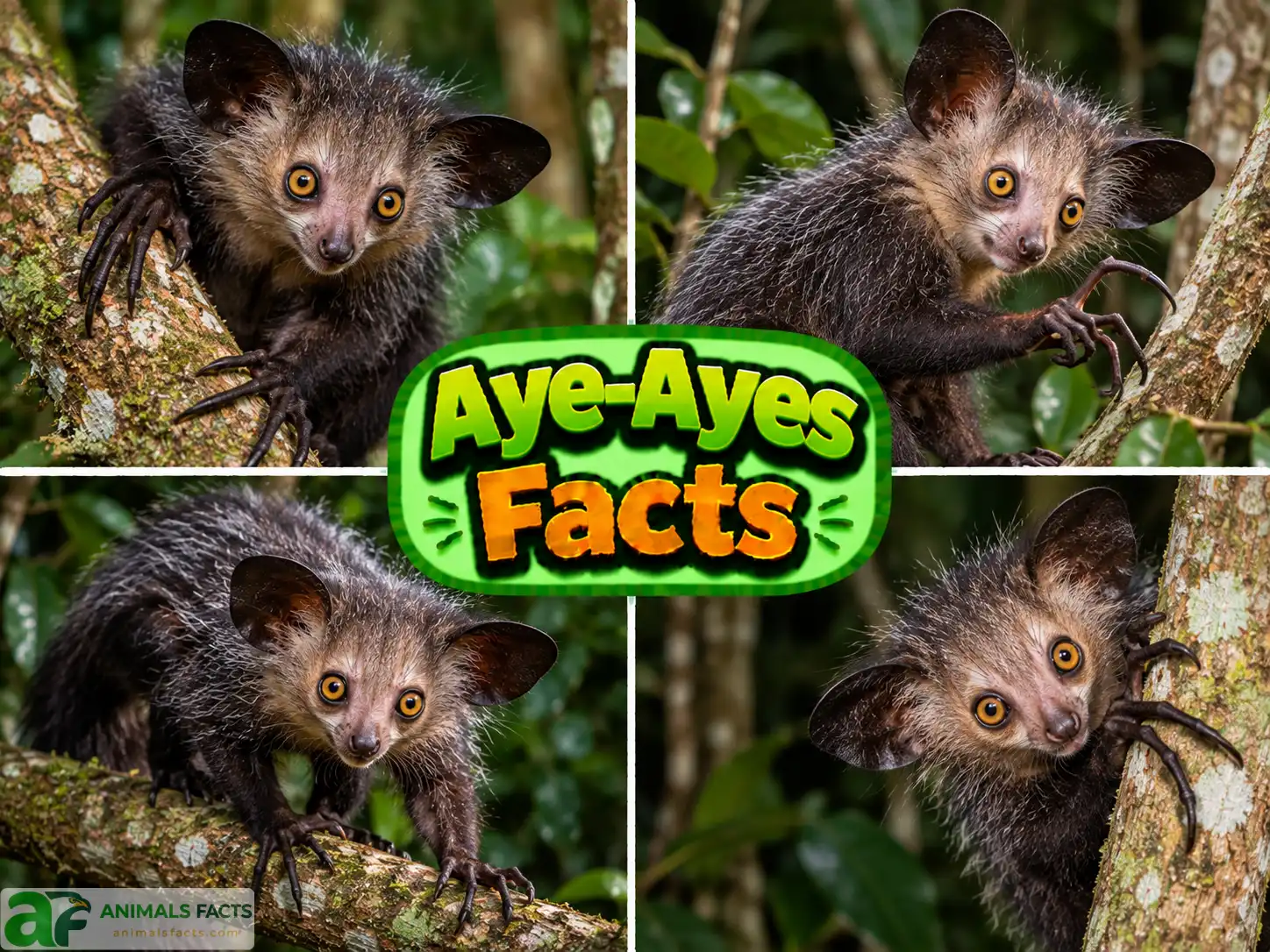
11. Aye-Aye Facts for Kids
Hey amazing young scientists and wildlife explorers! Here are some absolutely incredible aye-aye facts for kids that will make you the most fascinating person at any wildlife conversation:
- 🖐️ The aye-aye has a finger that can spin in a COMPLETE CIRCLE! The aye-aye’s middle finger has a special joint that allows it to rotate 360 degrees — the only primate finger in the world that can do this. No other monkey, ape, or primate has anything like it. The aye-aye uses this amazing spinning finger to scoop out insects from holes in wood!
- 🖐️ It is Madagascar’s answer to a WOODPECKER — but it is a primate! Madagascar has no woodpeckers. So an animal completely unrelated to woodpeckers — a lemur called the aye-aye — independently invented the exact same way of finding food: tap on wood to find hollow spaces, open the wood to reach the insects inside, use a special tool to extract them. Evolution came up with the same brilliant solution twice!
- 🖐️ Scientists first thought it was a SQUIRREL! When European naturalists first saw an aye-aye in the 1780s, they were so confused by its rodent-like teeth, bushy tail, and strange features that they classified it as a squirrel. It took many years and much scientific argument before everyone agreed it was actually a primate — our distant cousin!
- 🖐️ It uses its finger like a STETHOSCOPE! While tapping on wood — at about 8 taps every second — the aye-aye listens to how the wood sounds. Solid wood sounds different from hollow wood containing insect tunnels. The aye-aye’s enormous moveable ears hear this difference perfectly and can even hear insects moving inside the wood!
- 🖐️ It was THOUGHT TO BE EXTINCT for 80 years! After scientists first described the aye-aye in 1788, nobody in Western science confirmed seeing a living one for about 80 years — so many naturalists concluded it had gone extinct. Its rediscovery in the 1860s was treated like finding a lost treasure. The aye-aye had been there all along — it was just very, very good at hiding!
- 🖐️ Its teeth GROW FOREVER — like a rodent! Most primates (including humans) have teeth that stop growing when they are full-sized. The aye-aye’s front teeth grow continuously throughout its whole life — just like rat and mouse teeth — because it gnaws through hard wood every night, which would wear down normal teeth completely.
- 🖐️ It builds a SPHERICAL HOUSE in the tree tops! The aye-aye weaves together leaves, twigs, and vines to build a round nest about the size of a football in the forest canopy. It is fully enclosed — like a tiny house with no windows — providing shelter and concealment from predators. It may maintain several of these nests and switch between them!
- 🖐️ In Madagascar, many people think it is a BAD OMEN! In many traditional Malagasy beliefs, seeing an aye-aye means someone nearby will die. This has led people to kill aye-ayes when they see them — which is very sad, because the aye-aye is actually a completely harmless animal that is important for the forest. Helping change these beliefs is one of the most important conservation challenges today!
12. Relationship with Humans
The relationship between aye-ayes and humans is one of the most tragically complex in primate conservation — an animal of extraordinary biological uniqueness that is simultaneously one of the most feared and most actively persecuted wild animals in its native Madagascar.
The Fady System and the Aye-Aye
The Malagasy cultural system of fady (taboos) — which provides informal protection for many lemur species — operates in precisely the opposite direction for the aye-aye in most communities. Rather than protecting the aye-aye through sacred status, the dominant fady traditions in many parts of Madagascar treat the aye-aye as an evil omen requiring elimination:
The death harbinger belief — The most widespread cultural belief about the aye-aye across multiple Malagasy ethnic groups is that its appearance near a village or home is a portent of death — specifically, that someone in the community will die soon if an aye-aye is seen. This belief is not peripheral or historical — it remains actively held in many rural communities and continues to drive aye-aye persecution.
The response to sighting — Traditional responses to aye-aye encounters in communities holding this belief have historically included:
- Immediate killing of the aye-aye upon sighting
- Mounting the dead aye-aye on a pole at the village entrance to drive away the evil it brought
- Burning structures that the aye-aye was seen near or entering
- In some traditions, abandoning the village temporarily
The “pointing finger” mythology — The aye-aye’s elongated middle finger has been culturally interpreted as a pointing finger of death — the animal pointing at people it intends to curse. This interpretation of a foraging tool as a supernatural weapon has been particularly potent in driving fear and persecution.
The witch doctor connection — In some Malagasy traditions, the aye-aye is associated with sorcerers and witchcraft — the belief that the aye-aye can be sent by an enemy as a supernatural assassin making any sighting potentially threatening.
The Conservation Implications of Cultural Fear
The cultural fear of aye-ayes creates a conservation situation with no simple solution:
Direct mortality — Aye-ayes killed on sight in communities holding the death-harbinger belief represent direct population mortality that is difficult to quantify but clearly significant given the species’ extremely slow reproduction rate.
The paradox of expansion — As Madagascar’s human population grows and agricultural expansion brings communities into previously uninhabited forest areas, human-aye-aye encounters increase — expanding the geographic scope of persecution.
Changing beliefs — Some conservation programs have worked with communities to reframe aye-aye cultural significance — presenting the aye-aye as a forest guardian rather than a death harbinger, or emphasizing its ecological uniqueness and Madagascar’s global responsibility to protect it. These programs have had localized success but face the challenge of deep-rooted, multigenerational belief systems.
The inverse fady — Some Malagasy communities maintain protective traditions toward the aye-aye — recognizing it as a forest spirit deserving respect rather than elimination. These communities provide locally important conservation benefit and demonstrate that positive human-aye-aye coexistence is culturally possible.
Research Relationships
The aye-aye’s extraordinary biology has attracted significant scientific interest since the species’ rediscovery:
Eleanor Sterling’s foundational study — The most important early systematic field study of aye-aye behavior was conducted by Dr. Eleanor Sterling between 1987 and 1989 — the first comprehensive radio-tracking study of the species providing the foundational data on home range, foraging behavior, and social organization that subsequent studies have built on.
Duke Lemur Center programs — The Duke Lemur Center has maintained aye-ayes in captivity since the 1980s — the captive aye-aye population has provided crucial behavioral, reproductive, and cognitive research data that supplements the limited wild population studies.
Ongoing camera trap and radio-tracking programs — Multiple research programs across Madagascar continue to accumulate distribution and behavioral data — progressively improving understanding of the species’ status across its range.
Economic and Ecological Context
The aye-aye’s relationship with humans cannot be understood without the economic context of rural Madagascar — one of the world’s poorest countries where forest clearing for subsistence agriculture is driven by genuine need rather than ignorance or indifference:
Poverty and deforestation — Madagascar ranks consistently among the world’s lowest-income countries; rural communities clearing forest for agriculture are responding to genuine subsistence needs that cannot be addressed by conservation education alone.
Conservation-development integration — The most promising approaches to aye-aye conservation integrate wildlife protection with rural economic development — providing alternative income sources, improving agricultural productivity on existing cleared land, and building community ownership of conservation outcomes.
13. Aye-Aye Conservation Status & Threats
Conservation Status Overview
| Feature | Details |
|---|---|
| IUCN Status | Endangered (EN) |
| Population Trend | Decreasing |
| Population Estimate | Unknown — insufficient data for reliable estimate |
| CITES Listing | Appendix I — highest protection level |
| National Protection | Protected under Malagasy wildlife law |
| Primary Threats | Habitat loss; direct persecution; incidental trapping |
Major Threats
| Threat | Description | Impact Level |
|---|---|---|
| Deforestation | Agricultural clearing; charcoal; logging | Critical — primary long-term threat |
| Direct persecution | Killing based on death-harbinger cultural beliefs | High — direct mortality |
| Habitat fragmentation | Large home ranges require connected forest | High |
| Incidental trapping | Snares set for bushmeat capture aye-ayes | Medium-High |
| Road kills | Expanding road network in forest areas | Medium |
| Introduced predators | Feral dogs and cats | Medium |
| Political instability | Undermines law enforcement; increases illegal logging | High |
| Climate change | Altering forest composition and seasonality | Increasing concern |
| Pet trade | Illegal capture for domestic pets | Low-Medium |
The Population Estimation Problem
One of the most significant challenges in aye-aye conservation is the extreme difficulty of estimating population size:
- The species’ nocturnal behavior, solitary habits, and large home ranges mean that standard primate survey methods are ineffective
- Camera trap studies require enormous effort per individual detected
- The total wild population has been variously estimated at 1,000–10,000+ individuals — an uncertainty range that reflects genuine data limitation rather than conflicting evidence
- This population uncertainty makes it difficult to assess the urgency of specific conservation interventions or to detect population trends through monitoring
The Slow Reproduction Vulnerability
The aye-aye’s reproductive biology creates acute vulnerability to any sustained increase in mortality:
- Single offspring every 2–3 years
- 3–4 years to sexual maturity
- This means that a breeding female can produce at most 4–6 surviving offspring over a 20+ year reproductive lifespan — assuming optimal survival of offspring
- Any mortality source that reduces adult survival by even 10–20% above natural levels can rapidly push a population toward decline
- Recovery from population reduction requires decades of successful reproduction — not the rapid response possible in high-reproducing species
Conservation Responses
Nosy Mangabe Reserve — The designated aye-aye sanctuary established in 1966 on Nosy Mangabe Island in Masoala Bay; provides habitat protection for a known aye-aye population and has been the site of much foundational aye-aye research.
Duke Lemur Center captive program — Maintains the most significant captive aye-aye population outside Madagascar — contributing both conservation insurance and research data.
Community education programs — Programs working with Malagasy communities to reframe aye-aye cultural significance — attempting to reduce persecution by changing the cultural narrative around the species.
Protected area network — Aye-ayes are present in multiple Malagasy national parks and special reserves — including Masoala National Park, Ranomafana National Park, Ankarana Reserve, and others. Protected area coverage provides the most reliable conservation framework.
14. Famous Aye-Ayes in History & Pop Culture
Famous Aye-Aye Individuals
“Smeagol” — A captive aye-aye at the Bristol Zoo in the UK who became one of the most widely photographed zoo animals in Britain — his nocturnal house enclosure providing close-range observation of tap-foraging behavior that introduced thousands of zoo visitors to the species. Smeagol’s name (referencing the Lord of the Rings character) reflected both the aye-aye’s nocturnal, cave-dwelling lifestyle and his appearance that some found unsettling.
“Poe” — An aye-aye at the San Diego Zoo who became one of the first aye-ayes to be successfully maintained in a major North American zoo — contributing to the development of captive management protocols for the species and providing the foundation for subsequent North American breeding programs.
“Merlin” — An aye-aye at the Duke Lemur Center who has been the subject of multiple published research studies on aye-aye cognition, foraging behavior, and social behavior — contributing more published research data than any other individual captive aye-aye. Merlin’s studies on spontaneous tool-use and tap-foraging cognition have been particularly significant.
“Kintana” — An aye-aye at the Denver Zoo who became a significant public education ambassador for the species — her public nocturnal house providing millions of zoo visitors with their first encounter with an aye-aye.
Sonnerat’s specimen (1780) — The individual aye-aye observed and described by French naturalist Pierre Sonnerat in 1780 represents the founding specimen of Western scientific documentation — the first aye-aye to be formally brought to the attention of European science, establishing a record of extraordinary biological novelty that has defined the species’ scientific reputation ever since.
Gerald Durrell’s aye-aye expedition — Gerald Durrell’s 1990 expedition to Madagascar specifically to observe and document aye-ayes — described in his book The Aye-Aye and I (1992) — produced one of the most widely read popular accounts of aye-aye biology and contributed significantly to global public awareness of the species.
Historical Significance
The classification controversy — The aye-aye’s taxonomic odyssey — classified as a squirrel (1788), then a primate (1795), then disputed for decades — represents one of the most entertaining episodes in the history of zoological taxonomy. The fundamental difficulty of classifying an animal with rodent teeth, bat ears, an elongated finger unlike any other primate, and a fox’s tail in any existing taxonomic system frustrated some of the best naturalists of the 18th and 19th centuries and ultimately required creating an entirely new family to accommodate it.
The extinction scare — The 80-year period between the aye-aye’s formal description (1788) and its rediscovery in the 1860s created a conservation narrative of “lost and found” that prefigures modern conservation rediscovery stories and has given the aye-aye a unique historical narrative of near-extinction and recovery.
15. Role in Ecosystem & Food Chain
The Woodpecker Ecological Function
The aye-aye’s most significant ecosystem role is as Madagascar’s functional woodpecker — filling the wood-boring larva extraction niche that woodpeckers fill on every other forested continent:
The woodpecker niche — On continents with woodpeckers (Africa, Asia, Europe, the Americas), woodpeckers are the primary extractors of wood-boring beetle larvae from living and dead wood. These larvae represent a significant energy pathway in forest ecosystems — breaking down wood into simpler organic forms while themselves serving as high-quality protein for their predators.
Madagascar without woodpeckers — Madagascar has never had woodpeckers — the island’s isolation has prevented colonization by this group. Before the evolution of the aye-aye’s tap-foraging system, the wood-boring larva resource in Madagascar’s forests was effectively inaccessible to vertebrate predators.
The aye-aye solution — The aye-aye’s evolution filled this ecological vacancy — accessing the larval resource and creating the trophic pathway that moves energy from wood-boring insects to vertebrate predators in Madagascar’s forests. Without the aye-aye, this significant energy pathway would be absent from Malagasy forest ecosystems.
The Seed Dispersal Role
The aye-aye’s consumption of Canarium seeds raises an interesting question about its potential seed dispersal role — as a seed predator (consuming seeds) rather than a seed disperser (depositing viable seeds). However:
- Some seeds consumed may survive passage and be viable when deposited in feces
- The aye-aye’s foraging behavior moves it through forest patches at distances that could constitute seed dispersal if any seeds survive consumption
The Pollination Role
The aye-aye’s nectar feeding with the elongated finger potentially makes it a pollinator for deep-throated Malagasy flowers — transferring pollen on its face and fur while accessing nectar. This pollination service has not been formally quantified but may be significant for specific plant species.
The Dead Wood Processing Role
The aye-aye’s gnawing of dead wood to access larvae accelerates wood decomposition — creating openings in dead wood that allow fungal and bacterial decomposers to enter more rapidly. The physical disruption of dead wood by aye-aye foraging contributes to the nutrient cycling that is essential for forest soil health.
16. Myths, Folklore & Cultural Significance
The Death Harbinger Complex
The aye-aye’s cultural position in Malagasy society is perhaps the most elaborate and most consequential negative wildlife mythology of any primate in the world — a set of cultural beliefs that directly drive the persecution of an Endangered species:
Origins of the fear — The cultural fear of the aye-aye appears to derive from multiple reinforcing factors:
- Appearance — The aye-aye’s combination of large glowing eyes, enormous bat-like ears, dark shaggy coat, and the elongated finger creates an appearance that many humans find deeply unsettling. The aye-aye violates multiple human aesthetic expectations simultaneously — it does not look like the familiar, predictable mammals that most cultures find comfortable.
- Behavior — The aye-aye’s nocturnal emergence, slow deliberate movement through the canopy, and habit of stopping to tap rhythmically on surfaces creates behavioral patterns that human observers translate through cultural frameworks into supernatural significance.
- The finger — The elongated, raised, pale middle finger — used for probing wood while the other fingers grip the branch — is interpreted through human cultural frameworks as a “pointing” gesture. In many cultures, a pointing finger directed at a person is an ill omen; an animal appearing to “point” with its distinctive appendage carries potent supernatural associations.
- The sound — The aye-aye’s quiet nocturnal movement through forest, punctuated by the rhythmic tapping of foraging, creates acoustic experiences in the forest night that contribute to its uncanny cultural reputation.
The name itself — The name “aye-aye” is frequently said to derive from the Malagasy exclamation of fear — “Ahay! Ahay!” — the sound reportedly made by Malagasy people who unexpectedly encountered the animal in the forest. Whether or not this etymology is precisely accurate, it captures the cultural response that the aye-aye historically provoked.
Regional variation — It is important to note that not all Malagasy communities hold the death-harbinger belief with equal intensity — and some communities have historically held protective rather than persecutory attitudes toward the aye-aye. The ethnic diversity of Madagascar (approximately 18 distinct ethnic groups) produces significant cultural variation in aye-aye beliefs. Conservation programs increasingly work with this cultural diversity — identifying and amplifying protective traditions while gently challenging persecutory ones.
The Conservation-Culture Paradox
The aye-aye’s cultural persecution creates one of the most difficult problems in conservation biology — a situation where the most significant direct mortality threat to an Endangered species is driven by deeply embedded cultural beliefs rather than economic incentives that can be addressed through standard conservation economics:
Standard conservation approaches — Most wildlife conservation focuses on economic drivers — providing alternative livelihoods, compensating for wildlife damage, creating economic incentives for protection. These approaches are partially effective for hunting and habitat destruction but have limited relevance when the driver is supernatural fear.
Cultural change approaches — Programs attempting to change cultural beliefs about the aye-aye face the challenge of working respectfully with deep-rooted traditions while advocating for different relationships with a specific animal. This requires cultural sensitivity, long-term community engagement, and the identification of community members who can advocate for change from within.
The inverse protection opportunity — Where protective aye-aye traditions exist within Malagasy communities, conservation programs can amplify and support these traditions — working with community structures that already hold protective views to strengthen their influence relative to persecutory traditions.
17. Aye-Ayes in Pop Culture
The Aye-Aye and I by Gerald Durrell (1992) — The most significant popular account of aye-aye biology in any medium — Durrell’s account of his 1990 expedition to Madagascar to observe aye-ayes combines natural history, conservation advocacy, and Durrell’s characteristic humor in a book that introduced the aye-aye to a global popular readership larger than any previous documentation. The book directly contributed to increased zoo interest in maintaining aye-ayes and to public awareness of the species’ conservation situation.
BBC “Natural World: Aye-Aye and I” — The BBC Natural World documentary based on Durrell’s expedition provided the first major television treatment of aye-aye behavior and conservation — reaching audiences far beyond the readership of the book and providing visual documentation of tap-foraging behavior that remains among the most widely viewed aye-aye footage.
“Life of Mammals” (BBC, David Attenborough, 2002) — The primate episode features exceptional aye-aye tap-foraging footage with Attenborough narration — reaching a global audience and providing one of the finest popular natural history treatments of aye-aye biology available.
“Madagascar” (BBC, 2011) — The BBC’s comprehensive Madagascar documentary series includes detailed aye-aye natural history content with exceptional nocturnal filming.
Zoo social media — Multiple zoos maintaining aye-ayes — including the Duke Lemur Center, San Diego Zoo, and various European zoos — maintain social media presences featuring aye-aye content that has generated extraordinary public engagement. Aye-aye foraging footage — particularly close-up tap-foraging sequences — consistently generates viral engagement whenever posted.
“Island of Lemurs: Madagascar” (IMAX, 2014) — The IMAX documentary about Madagascar’s lemur conservation includes aye-aye content reaching audiences through one of the highest-impact wildlife film formats available.
18. Aye-Aye Facts vs. Common Myths
| Common Myth | The Real Fact |
|---|---|
| “The aye-aye is a harbinger of death that should be killed on sight” | Cultural belief — not biological fact — the aye-aye poses no threat to humans whatsoever; it is a forest animal foraging for insects; the death-harbinger belief is a cultural construction with no basis in the animal’s actual biology or behavior |
| “The aye-aye is related to rodents because it has rodent-like teeth” | False — the aye-aye is a primate within the lemur infraorder; its continuously growing incisors are an example of convergent evolution — the same solution independently evolved in rodents and in the aye-aye for different reasons |
| “The aye-aye uses echolocation like a bat” | Partially misleading — the aye-aye uses a tap-foraging acoustic system analogous to (but not identical with) echolocation; it emits sounds (tapping) and analyzes acoustic returns, but the frequency range and mechanism differ from true bat echolocation |
| “The aye-aye is the rarest lemur” | Not precisely — several lemur species have smaller estimated populations; the aye-aye is rare but its extremely large home ranges and broad geographic distribution mean that it occurs across more of Madagascar than many rarer species |
| “The aye-aye cannot be seen in captivity” | False — multiple zoos worldwide maintain aye-ayes, including the Duke Lemur Center, San Diego Zoo, Bristol Zoo, and others; however, their nocturnal nature means viewing requires nocturnal houses with red-light viewing conditions |
| “The aye-aye’s elongated finger points at people to curse them” | False — the elongated finger is a foraging tool; the “pointing” posture reflects the natural position of the finger when used for tapping and probing wood surfaces; the cultural interpretation as a pointing curse is a human construction |
| “Female aye-ayes are subordinate to males” | False — like all lemur species, female aye-ayes are dominant over males; females have priority access to food resources and social priority in encounters with males |
19. Best Places to See Aye-Ayes in the Wild
1. Nosy Mangabe Island Reserve, Masoala Bay, Northeastern Madagascar — The designated aye-aye reserve since 1966 and the site of the most sustained aye-aye research; the island’s protected status and research history make it the most reliable location for wild aye-aye encounters. Guided nocturnal walks with experienced local guides produce aye-aye sightings more reliably than any other site. Access is by boat from Maroantsetra.
2. Masoala Peninsula National Park, Northeastern Madagascar — Madagascar’s largest national park and one of its finest rainforest areas; aye-ayes are present throughout and nocturnal guided walks from the park’s lodges regularly produce sightings. The park’s exceptional broader biodiversity makes it one of Madagascar’s premier wildlife destinations regardless of aye-aye encounters.
3. Ranomafana National Park, Southern Highlands — One of Madagascar’s most visited national parks; aye-ayes are present and nocturnal guided walks occasionally produce sightings. The park’s well-developed guide infrastructure makes it one of the most accessible locations for attempting wild aye-aye observation.
4. Ankarana Special Reserve, Northern Madagascar — The dramatic limestone karst landscape of Ankarana supports aye-ayes in its deciduous forest habitats; nocturnal walks in the forest areas adjacent to the park’s famous cave systems occasionally produce sightings.
5. Duke Lemur Center, Durham, North Carolina, USA — For visitors outside Madagascar, the Duke Lemur Center maintains the most significant captive aye-aye collection outside Madagascar — with guided tours providing close-range observation of captive individuals. The nocturnal house exhibits allow observation of tap-foraging behavior under red-light conditions.
6. Bristol Zoo, UK / San Diego Zoo, USA / Denver Zoo, USA — Various European and North American zoos maintain small captive aye-aye populations in specialized nocturnal house exhibits — providing opportunities to observe the species at close range in controlled environments.
7. The Honest Assessment — Wild aye-aye encounters require patience, persistence, and good guides. The species’ extreme nocturnality, large home ranges, and low population density mean that even in the best locations, sightings are not guaranteed. The most productive approach is to spend multiple nights with experienced local guides in areas of known aye-aye presence. When sightings occur, they are typically among the most extraordinary wildlife encounters available anywhere in the world.
20. How You Can Help
Supporting aye-aye conservation requires action across multiple fronts — from habitat protection to cultural engagement to direct research funding.
Support these organizations:
- Duke Lemur Center — lemur.duke.edu — maintains the most significant captive aye-aye program outside Madagascar; directly funds Madagascar field conservation
- Lemur Conservation Network — lemurconservationnetwork.org — coordinates the global network of lemur conservation organizations
- Durrell Wildlife Conservation Trust — durrell.org — long-term Madagascar conservation programs including primate work
- Rainforest Trust — rainforesttrust.org — funds purchase and protection of Madagascar forest including aye-aye habitat
- Madagascar Fauna and Flora Group — madagascarfaunaflora.org — Madagascar-specific conservation
- GERP (Groupe d’Etude et de Recherche sur les Primates de Madagascar) — Madagascar-based primate research and conservation organization
Critical individual actions:
- Donate to Madagascar forest protection — habitat preservation is the single most important conservation intervention for the aye-aye
- Support community education programs — programs working with Malagasy communities to change aye-aye cultural perceptions are among the most important and most under-funded conservation interventions for this species
- Visit Madagascar responsibly — choosing tour operators and lodges that actively support conservation programs and employ local guides
- Never encourage the illegal pet trade — reporting any evidence of live aye-aye trade to wildlife authorities
- Support the Duke Lemur Center — the captive breeding program and research at the Duke Lemur Center directly supports aye-aye conservation and knowledge
21. Top Documentaries & Books
Must-Watch Documentaries
- “Natural World: Aye-Aye and I” (BBC) — Based on Gerald Durrell’s expedition; the foundational documentary treatment of aye-aye biology
- “Life of Mammals — A Winning Design” (BBC, David Attenborough, 2002) — Features exceptional aye-aye tap-foraging sequences
- “Madagascar” (BBC, 2011) — Comprehensive Madagascar wildlife documentary with dedicated aye-aye content
- “Island of Lemurs: Madagascar” (IMAX, 2014) — IMAX treatment of Madagascar conservation including aye-aye content
- Duke Lemur Center YouTube channel — The most current video documentation of aye-aye behavior in controlled settings; freely accessible
Must-Read Books
- The Aye-Aye and I by Gerald Durrell (1992, HarperCollins) — The most readable and most widely influential popular account of aye-aye biology; essential reading for anyone interested in the species
- Lemurs of Madagascar by Russell Mittermeier et al. — The definitive field guide including comprehensive aye-aye species account
- A Field Guide to the Mammals of Madagascar by Nick Garbutt — Practical field reference with aye-aye species account
- Sterling, E.J. published research — Dr. Eleanor Sterling’s foundational aye-aye behavioral ecology papers remain the most important scientific accounts of wild aye-aye behavior
- The Song of the Dodo by David Quammen — Provides essential island biogeography and extinction context for understanding Madagascar’s conservation crisis
22. Comparison with Other Unusual Foraging Specialists
| Feature | Aye-Aye | Woodpecker | Star-nosed Mole | Narwhal | Long-aye Bat |
|---|---|---|---|---|---|
| Class | Mammalia (Primate) | Aves | Mammalia | Mammalia | Mammalia |
| Specialist feature | Elongated 3rd finger | Long bill + barbed tongue | 22 nasal tentacles | Elongated left tusk | Elongated ears |
| Foraging strategy | Tap-foraging sonar | Hammer + tongue | Touch-based prey detection | Echolocation (tusk role debated) | Echolocation |
| Target prey | Wood-boring larvae | Wood-boring larvae | Soil invertebrates | Fish and squid | Moths and insects |
| Convergence with | Woodpecker | Aye-aye | Star-nosed mole (other species) | — | Other bats |
| Geographic range | Madagascar only | Worldwide (not Madagascar) | Eastern North America | Arctic Ocean | Widespread |
| Conservation | Endangered | Various — mostly secure | Least Concern | Near Threatened | Various |
| Research status | Poorly known | Well studied | Well studied | Moderately studied | Well studied |
23. Frequently Asked Questions About Aye-Ayes
Q1. What is the scientific name of the aye-aye?
The aye-aye’s scientific name is Daubentonia madagascariensis (Gmelin, 1788). The genus name Daubentonia was established by French naturalist Étienne Geoffroy Saint-Hilaire in 1795 to honor Louis-Jean-Marie Daubenton — a French naturalist who was one of the founders of comparative anatomy. The species name madagascariensis means “of Madagascar” — correctly identifying the island to which the species is endemic. The species was first formally named by Johann Friedrich Gmelin in 1788 as Sciurus madagascariensis (classifying it incorrectly as a squirrel) — Geoffroy’s subsequent reclassification as a primate in 1795 established the genus and family placement that remains current. The aye-aye is the sole member of the family Daubentoniidae and the genus Daubentonia.
Q2. Why does the aye-aye have such a long middle finger?
The aye-aye’s elongated middle finger is a highly derived foraging adaptation for extracting wood-boring larvae from inside trees — a food source that no other primate can access. The finger is used in a three-stage process: first, the aye-aye taps on wood surfaces with the finger while listening for hollow spaces that indicate larval galleries; second, the aye-aye gnaws through the wood to create an access hole; third, the finger is inserted into the hole and rotated (the finger has a unique ball-and-socket joint allowing 360-degree rotation) — the hooked fingertip extracting larvae from the gallery. The finger is so specialized for this function that it is held elevated and curled when not in use — protecting its sensitivity and structural integrity during normal movement. This system is the functional equivalent of woodpecker foraging, independently evolved in a primate rather than a bird.
Q3. Is the aye-aye really dangerous or a death omen?
No — the aye-aye poses absolutely no danger to humans. It is a forest primate whose diet consists of wood-boring larvae, seeds, fungi, and fruit — it is not aggressive, does not attack humans, carries no dangerous diseases transmissible to humans, and has no capacity to cause the supernatural harm attributed to it in cultural traditions. The death-harbinger belief that drives aye-aye persecution is a cultural construction — based on the animal’s unusual appearance, nocturnal habits, and the elongated finger interpreted as a supernatural “pointing” gesture — with no basis in the aye-aye’s actual biology or behavior. The aye-aye is in fact one of Madagascar’s most ecologically valuable primates — filling the woodpecker ecological niche that no other animal in Madagascar occupies. Its persecution based on supernatural fear represents one of the most tragic intersections of cultural belief and conservation reality in the primate world.
Q4. Where can aye-ayes be seen?
Wild aye-ayes can best be observed in Madagascar during nocturnal guided walks in areas of known presence — with Nosy Mangabe Island Reserve (the designated aye-aye sanctuary in northeastern Madagascar) providing the most reliable sighting probability. Masoala National Park, Ranomafana National Park, and Ankarana Reserve also provide aye-aye observation opportunities with experienced local guides. Wild aye-aye encounters are never guaranteed — the species’ nocturnal habits, low density, and large home ranges make sightings relatively rare even in good habitat. Outside Madagascar, several zoos maintain aye-ayes in nocturnal house exhibits — including the Duke Lemur Center (Durham, NC), San Diego Zoo, Denver Zoo, and various European zoos — providing close-range observation opportunities under red-light conditions.
Q5. How do aye-ayes find larvae inside trees?
The aye-aye’s larval detection system integrates three sensory modalities in a process unique among primates: First, olfactory detection — the aye-aye smells the bark surface to detect chemical traces of wood-boring insects within, pre-screening trees before investing in detailed investigation. Second, acoustic tap-foraging — the elongated middle finger taps the bark surface at approximately 8 taps per second while the enormous, mobile ears receive the resonance returns. Hollow spaces containing larval galleries have a subtly different acoustic resonance than solid wood — the aye-aye detects this difference. The ears can also detect the movement sounds of larvae within their galleries. Third, tactile confirmation — when the finger is inserted after gnawing, the rich sensory nerve supply (Meissner’s corpuscles) in the fingertip provides tactile information about larval presence and location within the gallery. The integration of these three modalities into a coherent foraging decision represents a level of multi-sensory integration that is remarkable for any primate.
Q6. Can the aye-aye really rotate its finger 360 degrees?
Yes — the aye-aye’s third finger (middle finger) has a ball-and-socket metacarpophalangeal joint at its base — unlike the standard hinge joints of all other primate fingers. This joint type allows rotation in multiple planes simultaneously — providing the 360-degree rotational capability documented in behavioral studies. This joint type is found in the shoulder and hip joints of mammals (allowing limb rotation) but not normally in finger joints of any other primate. Its presence in the aye-aye’s third finger represents a remarkable anatomical innovation — the evolution of a hip-like joint in a finger — that enables the extraction of larvae from irregular gallery spaces at any angle without requiring the hand to be repositioned.
24. Sources & References
- Wikipedia — Daubentonia madagascariensis, Daubentoniidae, Lemuriformes
- IUCN Red List — iucnredlist.org (current assessment for Daubentonia madagascariensis)
- Duke Lemur Center — lemur.duke.edu
- Sterling, E.J. (1993). “Behavioral ecology of the aye-aye (Daubentonia madagascariensis) on Nosy Mangabe, Madagascar.” Ph.D. dissertation, Yale University — the foundational behavioral ecology study
- Durrell, G. (1992). The Aye-Aye and I. HarperCollins
- Mittermeier, R.A. et al. (2010). Lemurs of Madagascar (3rd ed.). Conservation International
- National Geographic — nationalgeographic.com
- Smithsonian National Museum of Natural History — naturalhistory.si.edu
- BBC Wildlife / BBC Earth — bbcearth.com
- Britannica — britannica.com/animal/aye-aye
- Live Science — livescience.com
- Iwano, T. and Iwakawa, C. (1988). “Foraging behaviour of the aye-aye.” Folia Primatologica
- Erickson, C.J. — multiple published papers on aye-aye tap-foraging mechanics; Duke University