
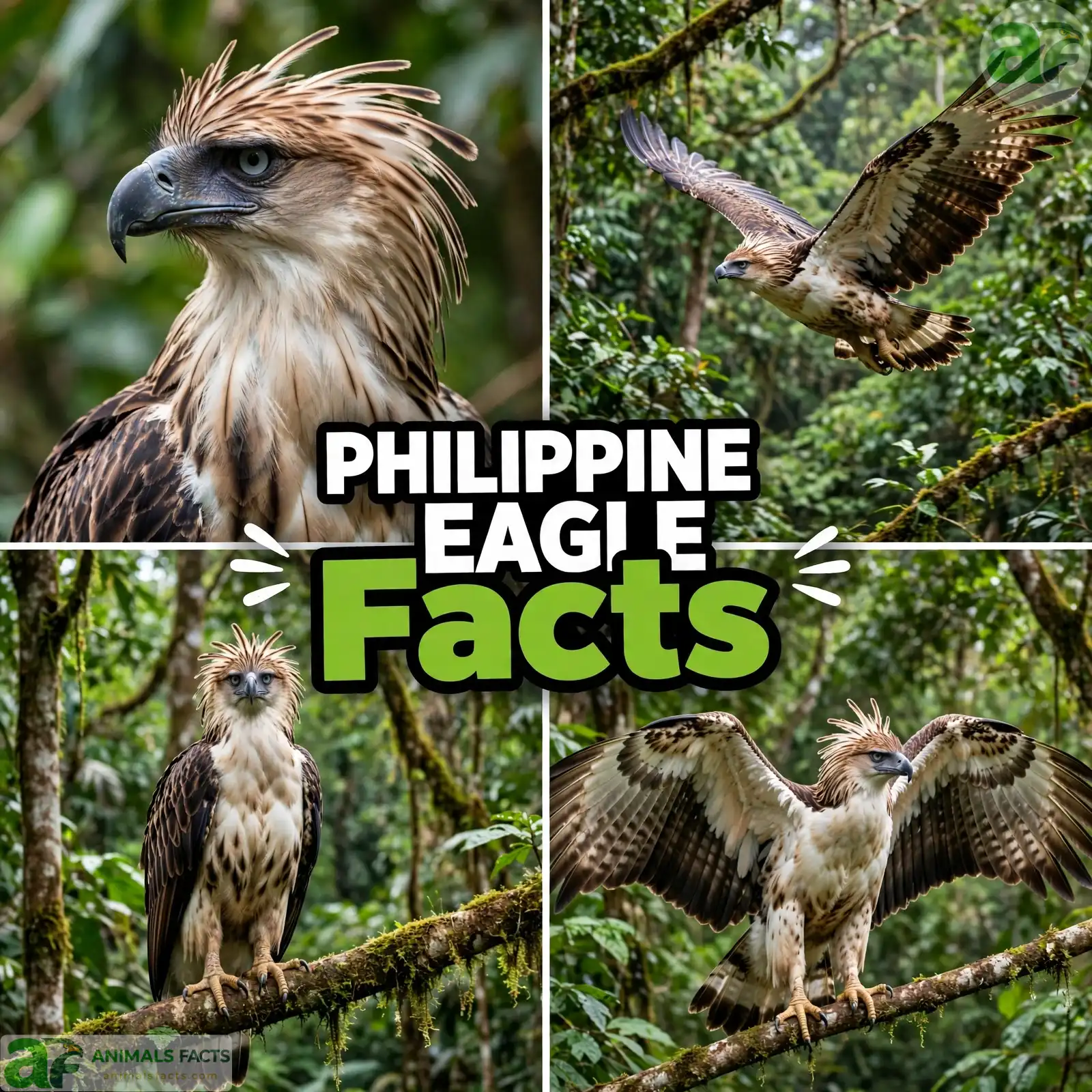
Philippine Eagle Facts
| Feature | Details |
|---|---|
| Scientific Name | Pithecophaga jefferyi (Ogilvie-Grant, 1896) |
| Kingdom | Animalia |
| Phylum | Chordata |
| Class | Aves |
| Order | Accipitriformes |
| Family | Accipitridae |
| Common Names | Philippine eagle; monkey-eating eagle; great Philippine eagle |
| Native Range | Philippine archipelago — primarily Mindanao; also Leyte, Samar, and Luzon |
| Habitat | Primary lowland and montane dipterocarp rainforest — 100–1,800 meters elevation |
| Lifespan | 30–60 years (wild estimate); up to 41 years (captivity documented) |
| Diet | Primarily flying lemurs (Cynocephalus volans); also monkeys, large bats, snakes, monitor lizards, large birds |
| Body Length | 86–102 cm |
| Wingspan | 184–220 cm |
| Weight | Males 4.5–7 kg; females 6–8 kg |
| Conservation Status | Critically Endangered (IUCN) — fewer than 800 individuals remaining in the wild |
| Defining Feature | Shaggy brown-and-white mane of long hackle feathers framing the face — creating the appearance of a lion’s mane; the most visually dramatic head feature of any eagle |
| National Symbol | National bird of the Philippines since 1995 |
| Taxonomic Position | The only member of genus Pithecophaga — a monotypic genus |
| Closest Relatives | Harpy eagle subfamily (Harpiinae); convergent with harpy eagle but not closely related |
| Legal Status | Killing a Philippine eagle carries a 12-year prison sentence and heavy fines under Philippine law |
 1. Introduction: What is a Philippine Eagle?
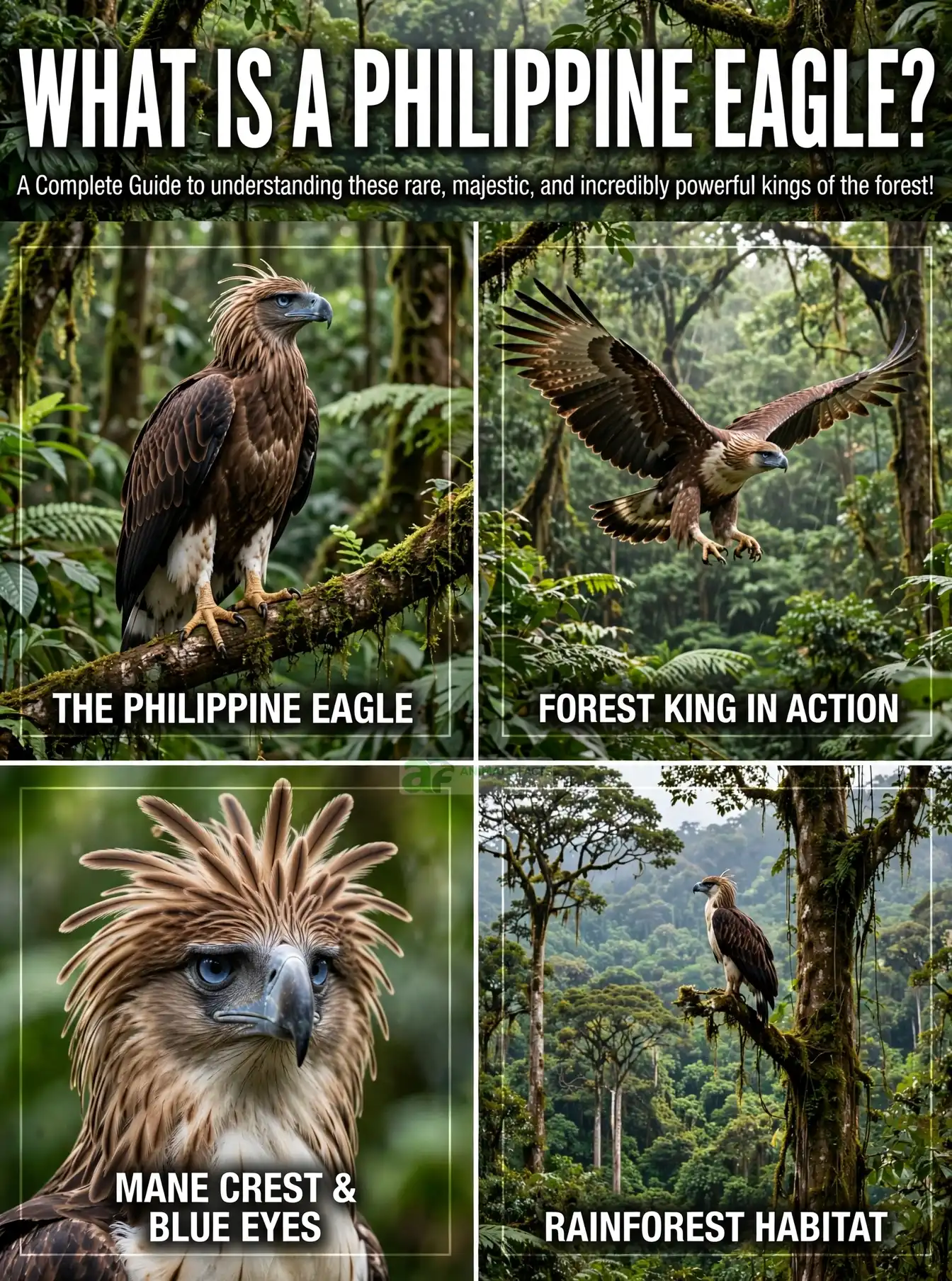
On the steep forested slopes of Mount Apo in Mindanao, the Philippines’ largest and highest mountain, where the primary dipterocarp forest rises from the mountain’s flanks in a canopy of extraordinary density and biological complexity, a pair of Philippine eagles occupies a territory whose boundaries have been maintained continuously since before the first ornithologist documented the species in 1896. The male is perched near the nest tree — a massive Philippine rosewood more than 30 meters tall — waiting while the female hunts across the territory. When she returns, what she carries is a flying lemur — the Sunda colugó (Cynocephalus volans), a gliding mammal the size of a large cat, caught somewhere in the mid-canopy of the forest and now delivered to the nest to feed the eaglet that represents the pair’s entire reproductive output for the next two years. The eaglet, already approaching adult size at four months old, receives the prey with the confident demand of an animal at the top of its ecosystem’s hierarchy. And around the nest tree, the primary forest extends in every direction — or what remains of it. Because in 2026, that primary forest does not extend as far as it did in 1996, and considerably less far than it did in 1946. Philippine eagle facts begin with this scene — the most majestic bird in Asia, the national symbol of one of the most biodiverse nations on Earth, perched in a primary forest that is disappearing faster than any ecosystem on any archipelago in the world.
The Philippine eagle (Pithecophaga jefferyi) simultaneously achieves two superlatives that no other bird combines in quite the same way. It is one of the most physically magnificent birds on Earth — the dramatic brown-and-white mane of long hackle feathers framing the face in a lion’s mane-like display, the enormous size (the largest eagle in Asia by body length), the pale blue-grey eyes, the massive bill, the powerful feet and sharp talons all combining into an appearance that generates the same involuntary recognition of something extraordinary that the harpy eagle produces in the Amazon. And it is one of the most immediately, most urgently threatened large birds in the world — Critically Endangered with fewer than 800 individuals surviving in the wild, dependent on primary rainforest that has been cleared at some of the fastest rates in the world, and protected by laws that are simultaneously among the strongest anywhere (12-year prison sentence for killing one) and among the most inadequately enforced. The Philippine eagle’s situation in 2026 is not merely a conservation concern — it is a conservation emergency, as immediate and as serious as any faced by any eagle species anywhere.
Interesting facts about Philippine eagles reveal an animal of breathtaking biological and cultural significance — the monotypic genus (Pithecophaga) containing only this single species, making the Philippine eagle as evolutionarily unique as the numbat or the secretarybird; the extraordinary lion’s mane of hackle feathers that gave the bird the Filipino name agila and the cultural status of a living embodiment of national identity; the 30–60 year estimated wild lifespan that makes this one of the longest-lived eagles and amplifies the conservation impact of every adult bird lost; the 2-year breeding cycle parallel to the harpy eagle that means population recovery from losses is extraordinarily slow; the extraordinary Philippine cultural tradition around the eagle that makes it simultaneously the most beloved and most legally protected bird in the Philippines — and yet one that continues to be shot, trapped, and deprived of habitat at rates that make its extinction within this century a genuine possibility without dramatic intervention. Whether you are searching for Philippine eagle facts for kids to explore the biology and conservation urgency of Asia’s most magnificent bird, a wildlife enthusiast planning a trip to Mindanao, a conservation researcher concerned about forest raptors in biodiversity hotspots, or simply someone who encountered an image of this extraordinary bird and felt the immediate, involuntary recognition of something unprecedented — this is your comprehensive guide. Asia’s most magnificent eagle — and one of the world’s most urgently threatened birds — has an extraordinary story to tell.
2. Philippine Eagle Species Overview & Classification
The Philippine eagle occupies one of the most taxonomically isolated positions of any living eagle — the sole member of the genus Pithecophaga — a monotypic genus with no close relatives and an evolutionary history that remains incompletely resolved.
Species Classification Table
| Taxonomic Rank | Classification |
|---|---|
| Kingdom | Animalia |
| Phylum | Chordata |
| Class | Aves |
| Order | Accipitriformes |
| Family | Accipitridae (Vigors, 1824) |
| Subfamily | Harpiinae (debated — some authorities) |
| Genus | Pithecophaga (Ogilvie-Grant, 1896) |
| Species | P. jefferyi (Ogilvie-Grant, 1896) |
| Common Names | Philippine eagle; monkey-eating eagle; great Philippine eagle; agila (Filipino); haribon (old name) |
| Etymology | Pithecophaga = “monkey-eater” (Greek: pithekos = monkey + phagein = to eat) — from early accounts emphasizing monkey predation; jefferyi named for Jeffery Whitehead — son of the ornithologist John Whitehead who collected the first specimens; haribon from hari (king) + ibon (bird) = “king of birds” in Filipino |
The Monotypic Genus — An Entire Genus With One Species
The Philippine eagle is the sole member of the genus Pithecophaga — established in 1896 by ornithologist William Robert Ogilvie-Grant when he recognized the species’ distinctiveness as requiring its own genus:
Evolutionary isolation — The Philippine eagle represents an entire genus of eagles with no close relatives — its divergence from related lineages occurring sufficiently long ago that no other living species can be placed in Pithecophaga with confidence. The extinction of the Philippine eagle would therefore eliminate not merely a species but an entire genus — an irreplaceable evolutionary lineage.
Phylogenetic position — The Philippine eagle’s precise phylogenetic position within Accipitridae remains debated:
- Some authorities place it within or near the Harpiinae (harpy eagle subfamily) — the convergent ecological parallels with the harpy eagle suggesting shared evolutionary heritage
- Other molecular analyses suggest the Philippine eagle represents a basal lineage within Accipitridae with uncertain close relatives
- The most recent comprehensive analyses suggest affinities with the snake eagles (Circaetinae) — a surprising phylogenetic placement that, if confirmed, would mean the Philippine eagle’s harpy-eagle-like ecology is even more profoundly convergent than previously recognized
The Name History — From “Monkey-Eating Eagle” to “Philippine Eagle”
The Philippine eagle’s naming history reflects both a scientific misunderstanding and a successful cultural reclamation:
“Monkey-eating eagle” — The original common name given when the species was described in 1896 — based on early accounts by Filipinos who reported the eagle hunting monkeys. While the eagle does take monkeys (Macaca fascicularis — Philippine macaque — is documented prey), the primary prey is actually flying lemurs — the monkey-eating name was both taxonomically inaccurate (flying lemurs are not monkeys) and ecologically misleading.
The 1978 renaming — Philippine President Ferdinand Marcos signed a decree in 1978 officially renaming the species the “Philippine eagle” — replacing the “monkey-eating eagle” name in official Philippine usage. The renaming reflected growing national pride in the species as a specifically Philippine natural heritage symbol.
The scientific name’s irony — Despite the common name change, the scientific genus name Pithecophaga (“monkey-eater”) retains the original characterization — the scientific name reflecting the 1896 understanding that cannot be changed under nomenclatural rules, while the common name has been successfully revised.
Evolution & Discovery Timeline
~20–30 million years ago (Oligocene-Miocene) — The ancestral Pithecophaga lineage diverges within the Accipitridae — establishing the evolutionary trajectory toward the large forest eagle that will eventually produce the Philippine eagle.
Pre-colonial era — The Philippine eagle is deeply embedded in the cultural and spiritual traditions of indigenous Philippine peoples — particularly the Bagobo and other Mindanao indigenous groups who recognize the eagle as a supremely powerful spiritual being.
1895 — English naturalist John Whitehead collects the first specimens from Mindanao during a natural history expedition — the specimens representing the first formal Western documentation of the species.
1896 — William Robert Ogilvie-Grant formally describes the species as Pithecophaga jefferyi — naming the genus for “monkey-eater” and the species for Jeffery Whitehead (John Whitehead’s son). The formal description establishes the Philippine eagle in Western ornithological science.
Early 20th century — The Philippine eagle is shot, collected, and traded by Western naturalists and collectors — the bird’s spectacular appearance making it a prized museum and private collection specimen. This collection pressure, combined with progressive forest clearance, begins the population decline.
1969 — The Philippine government passes initial legislation protecting the Philippine eagle.
1978 — President Marcos officially renames the species the “Philippine eagle” and elevates its cultural and political profile as a national symbol.
1992 — The Philippine Eagle Foundation (PEF) is established in Davao City, Mindanao — the organization that will become the primary institutional home for Philippine eagle captive breeding, research, and conservation education.
1995 — The Philippine eagle is formally designated as the national bird of the Philippines by President Fidel Ramos — giving it official national symbol status alongside the national flower (sampaguita jasmine) and national tree (Philippine mahogany).
2024 — Pithecophaga jefferyi remains Critically Endangered (IUCN) — the estimated wild population has not significantly recovered despite decades of conservation effort, and deforestation continues in key Mindanao eagle habitats.
“The Philippine eagle is the soul of the Philippine forest. Every hectare of primary forest we lose is not just habitat — it is a piece of the Philippine eagle’s future. And the Philippine eagle’s future is inseparable from the future of the Philippines as a biologically diverse nation.”
— Dennis Salvador, Executive Director, Philippine Eagle Foundation — the leading Philippine eagle conservation organization
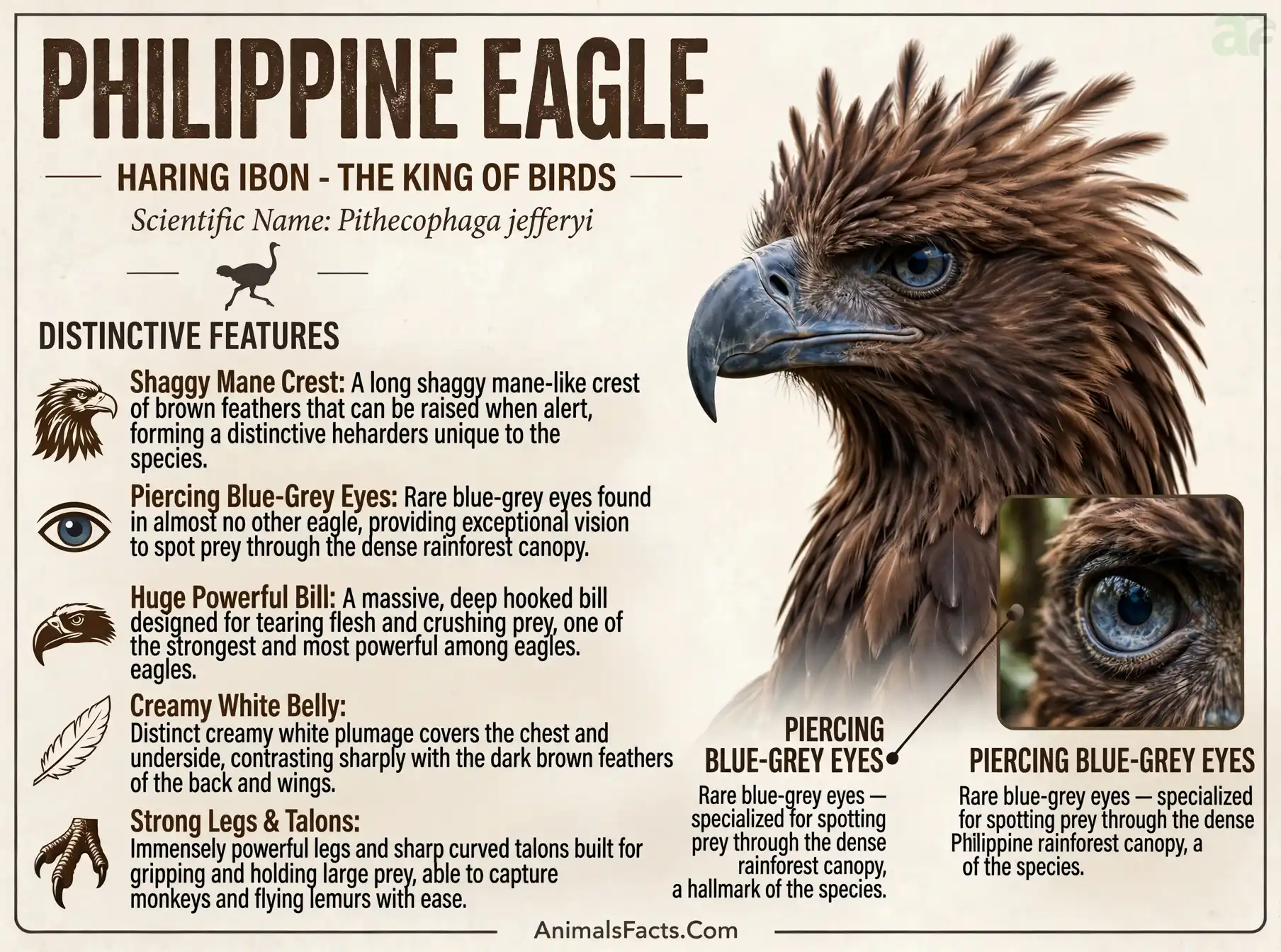
3. Philippine Eagle Physical Description & Unique Features
The Philippine eagle’s physical appearance is unlike any other eagle in Asia — an accumulation of features that, individually, would make any raptor remarkable, but that together create one of the most visually imposing birds on Earth.
The Mane — The Defining Visual Feature
The Philippine eagle’s most immediately distinctive feature is the shaggy brown-and-white mane of long hackle feathers radiating outward from the face and framing the head in a lion’s mane-like halo:
The feather structure — The mane consists of elongated, lance-shaped hackle feathers covering the nape, sides of the neck, and upper breast — each feather streaked brown and white, creating the characteristic alternating pattern. These feathers are structurally different from the body feathers — they are longer, broader, and stiffer, with a distinctive lanceolate shape that creates the radiating, mane-like effect.
The color pattern — The mane feathers are individually dark brown on the central shaft and toward the tip, with white or pale buff on the outer portions of each feather. The overall effect when the feathers are spread is a complex interplay of brown and white that creates depth and texture unique among eagles.
The display function — The hackle feathers can be raised and spread during arousal, display, and alarm — the erect mane dramatically increasing the apparent size of the head and creating an imposing visual display that parallels the harpy eagle’s crest display. When fully erected, the mane gives the Philippine eagle a circular, imposing head appearance that justifies the haribon (“king of birds”) designation in Filipino tradition.
The lion’s mane parallel — The visual parallel between the Philippine eagle’s mane and a lion’s mane is frequently cited in both popular and scientific accounts — the Philippine eagle is sometimes called the “lion of the sky” in Filipino cultural contexts, the mane being the feature that most directly evokes this regal association.
The Eyes — Pale Blue-Grey and Piercing
The Philippine eagle’s pale blue-grey eyes are one of its most striking close-range features — and distinguish it immediately from most other large eagles whose eyes are yellow, brown, or dark:
The color — Adult Philippine eagle eyes are a distinctive pale blue-grey — an unusual iris color for a large eagle that creates an otherworldly, almost reptilian gaze when viewed directly.
The size — The eyes are proportionally large even for an eagle — positioned frontally on the face (contributing to the owl-like impression created by the mane and facial proportions) and providing the binocular overlap needed for precise prey distance estimation in the three-dimensional forest interior.
The expression — The combination of the large, pale eyes, the prominent supraorbital ridge (creating a furrowed, “fierce” brow expression), and the massive bill creates a facial expression of extraordinary intensity and authority that contributes to the Philippine eagle’s powerful visual impact on human observers.
The Bill — Power and Proportion
The massive, deeply curved bill of the Philippine eagle is proportionally one of the largest among all eagles:
Bill dimensions — The bill from base to tip measures approximately 6–7 cm — a substantial structure for a bird of this body size, providing the leverage needed to tear large prey items.
Bill color — Dark blue-grey at the base, becoming black toward the tip — the dark bill color creating contrast with the pale mane feathers surrounding the face.
The bill’s ecological function — The large bill is adapted for tearing through the thick skin and dense muscle of the flying lemurs and monkeys that constitute the primary diet — prey items substantially larger and tougher than the typical prey of smaller forest raptors.
The Overall Plumage Pattern
Upperparts — Dark brown — the wings, back, and top of the head uniformly dark brown, creating the strong contrast with the pale mane and underparts.
Underparts — White — the breast, belly, flanks, and undersurface of the wings predominantly white, with some fine brown streaking on the flanks in some individuals. The white underparts create the high-contrast, two-tone appearance (dark above, white below) that is the most visible plumage feature in flight.
The tail — Brown with darker banding — relatively long and broad, providing the fine directional control needed for forest maneuvering.
The legs — White — covered in white feathering down to the yellow tarsal joint, creating the pale-legged appearance that contrasts with the dark talons.
The Feet and Talons
Foot size — The Philippine eagle’s feet are among the largest of any eagle — the foot span of a large female reaching 18–22 cm.
Talon length — The rear talon (hallux) reaches approximately 8–10 cm in large females — substantial, though slightly shorter than the harpy eagle’s record-breaking 12.5 cm talons.
Grip force — While precise measurements are limited, the Philippine eagle’s grip force is estimated to be comparable to the harpy eagle’s — sufficient to deliver immediate incapacitation to flying lemur-sized prey.
Yellow feet — The feet are vivid yellow — contrasting with the white leg feathering above and the black talons, creating a vivid close-range color accent.
Size Comparison
| Measurement | Male | Female |
|---|---|---|
| Body length | 86–95 cm | 95–102 cm |
| Wingspan | 184–202 cm | 202–220 cm |
| Weight | 4.5–7.0 kg | 6.0–8.0 kg |
The Philippine eagle’s body length (up to 102 cm) makes it the longest eagle in Asia by body length — though it is not the heaviest Asian eagle when compared to some large Steller’s sea eagle individuals.
💡 Did You Know? The Philippine eagle’s distinctive appearance — particularly the lion’s mane — creates such a powerful first impression that virtually everyone who sees one for the first time, whether in a photograph or in person, reports the same response: an involuntary recognition that this is something categorically different from an ordinary eagle. The ornithologist William Beebe — who encountered captive Philippine eagles in the early 20th century — wrote that the bird’s appearance “staggers the imagination” and that “no description can prepare the observer for the overwhelming impression it makes.” More recently, wildlife photographers who have had the opportunity to photograph the Philippine eagle in the wild or in managed settings consistently report it as the most visually impactful bird they have ever photographed. The ornithological consensus — expressed in multiple scientific and popular accounts — is that the Philippine eagle is the most visually impressive eagle in Asia and arguably in the world. This aesthetic power has been essential to conservation efforts — the Philippine eagle’s appearance alone generates a level of public and governmental attention that less visually dramatic endangered species cannot achieve.
4. Top 25 Amazing Philippine Eagle Facts
Here is your definitive collection of the most extraordinary, scientifically verified, and genuinely astonishing Philippine eagle facts as of 2026:
- The Philippine eagle is the sole member of the genus Pithecophaga — making it as taxonomically isolated as a numbat or secretarybird. If the Philippine eagle goes extinct, an entire eagle genus — representing tens of millions of years of independent evolutionary history — disappears permanently.
- Fewer than 800 individuals are estimated to survive in the wild as of 2026 — making the Philippine eagle one of the rarest eagles on Earth and one of the rarest large birds globally. The entire world population of wild Philippine eagles would fit inside a large sports stadium with room to spare.
- Killing a Philippine eagle carries a 12-year prison sentence and a fine of up to 1 million Philippine pesos (approximately $17,000 USD) under Republic Act 9147 (Philippine Wildlife Resources Conservation and Protection Act) — one of the severest legal penalties for harming any bird anywhere in the world.
- The Philippine eagle’s primary prey is the flying lemur (Cynocephalus volans — also called the Sunda colugo) — not monkeys, despite the species’ former common name “monkey-eating eagle.” Flying lemurs are large gliding mammals found only in the Philippines and neighboring Southeast Asian islands.
- The Philippine eagle is the largest eagle in Asia by body length — reaching up to 102 cm, slightly longer than the harpy eagle’s maximum documented body length. In wingspan (up to 220 cm) and weight (up to 8 kg), it is comparable to but slightly smaller than the harpy eagle.
- The Philippine eagle was officially designated the national bird of the Philippines in 1995 — replacing the Maya (Eurasian tree sparrow) which had previously held this status. The designation reflects both the bird’s unique Philippine endemism and its cultural significance as a symbol of national identity.
- Philippine eagles breed only once every 2 years — the combination of a single-egg clutch, a 58–68 day incubation period, a 4–5 month nestling period, and a 12–20 month post-fledging dependency creates a reproductive cycle comparable to the harpy eagle in its extraordinary investment per offspring.
- The Philippine Eagle Foundation (PEF) in Davao City, Mindanao has developed the world’s only successful captive breeding program for this species — hatching the first captive-bred Philippine eagle in 1992. The captive population provides genetic insurance and educational ambassador birds.
- The Philippine eagle’s lion’s mane — the shaggy brown-and-white hackle feathers radiating from the face — is the most visually distinctive head feature of any eagle. The mane inspired the Filipino name haribon (from hari = king + ibon = bird) — “king of birds.”
- Mindanao — the Philippines’ second largest island and its most forested — holds the largest Philippine eagle population and is considered the species’ final stronghold. Leyte, Samar, and Luzon hold much smaller populations.
- The Philippine eagle’s home range is among the largest of any tropical raptor — documented at 40–100 km² per breeding pair in Mindanao studies. In a country with the Philippines’ population density and forest loss rate, maintaining territories of this size is an increasingly difficult conservation challenge.
- The Philippine eagle is named agila in Filipino (Tagalog) — the word for “eagle” generally — but is culturally distinguished as the supreme eagle, the agila ng Pilipinas, in formal national symbolism contexts.
- The pale blue-grey eyes of the adult Philippine eagle are unique among large eagles — creating the piercing, distinctive gaze that contributes significantly to the bird’s extraordinary visual impact and that is one of the most immediately recognizable features distinguishing the Philippine eagle from other large raptors.
- The primary forest of Mindanao has been reduced to approximately 20–25% of its original extent — a deforestation trajectory that directly corresponds to the decline of the Philippine eagle population and that, if continued at historical rates, would eliminate viable Philippine eagle habitat from most of Mindanao within decades.
- The Philippine eagle is documented consuming an extraordinary range of prey beyond flying lemurs and monkeys — including Philippine deer (Rusa marianna) juveniles, large flying foxes (Pteropus species), large snakes (Python reticulatus juveniles have been recorded), and large lizards including water monitors (Varanus salvator).
- A captive Philippine eagle named Pag-asa (“Hope” in Filipino) — hatched at the Philippine Eagle Foundation in 1992 as the first captive-bred individual — lived until 2021, providing nearly three decades of data on captive Philippine eagle husbandry and becoming one of the most beloved conservation ambassador animals in Philippine history.
- The Philippine eagle is the only eagle in the world known to regularly prey on flying lemurs — the colugos (Cynocephalus species) that are themselves among the most distinctive mammals of Southeast Asian forests. The Philippine eagle and flying lemur represent one of the most ecologically specialized predator-prey relationships of any large raptor.
- Deforestation rate in the Philippines is among the highest of any country in Asia — the Philippines has lost approximately 93% of its original forest cover since European colonization, with the most rapid recent losses occurring in Mindanao where most Philippine eagles survive.
- The Philippine eagle’s facial structure — wide face, large forward-facing eyes, and prominent mane — creates a visual impression that many observers describe as more reminiscent of a lion than a bird. This facial impact is one of the most powerful in any bird species and generates extraordinary public engagement when the bird is used in conservation communication.
- Philippine Eagle Foundation research has documented that individual Philippine eagles can live to at least 41 years in captivity — and extrapolating from comparable raptor species, wild lifespans of 30–60 years are plausible. This means each individual represents a multi-decade breeding contribution to the population.
- The Philippine eagle’s wing design — relatively short and broad for its body size — mirrors the harpy eagle’s forest-adapted wing shape, allowing navigation through the complex interior of primary dipterocarp forest at speeds inconsistent with the bird’s size.
- In Philippine indigenous traditions, particularly among the Bagobo people of Mindanao, the Philippine eagle occupies a position of supreme spiritual significance — the eagle understood as a powerful spiritual being whose feathers are among the most sacred ceremonial objects. Traditional Bagobo knowledge of Philippine eagle ecology is detailed and reflects millennia of co-existence.
- The Philippine Eagle Center adjacent to the Philippine Eagle Foundation facility in Davao City receives approximately 100,000 visitors per year — making it one of the most visited wildlife conservation facilities in the Philippines and one of the most significant Philippine eagle public education venues globally.
- Research has documented that Philippine eagles show individual personality differences in captivity and in the wild — some individuals being significantly more bold, more curious, and more interactive with observers than others. This behavioral individuality has practical implications for captive management and for public education programs using ambassador birds.
- As of 2026, the Philippine eagle faces a crisis that most wildlife biologists consider acute — the combination of continued forest loss in Mindanao, ongoing illegal shooting, nest tree felling, and the species’ inherently slow reproductive rate creates a demographic trajectory that multiple models suggest could result in extinction within 30–50 years without dramatic conservation intervention.
5. Fun Facts About Philippine Eagles
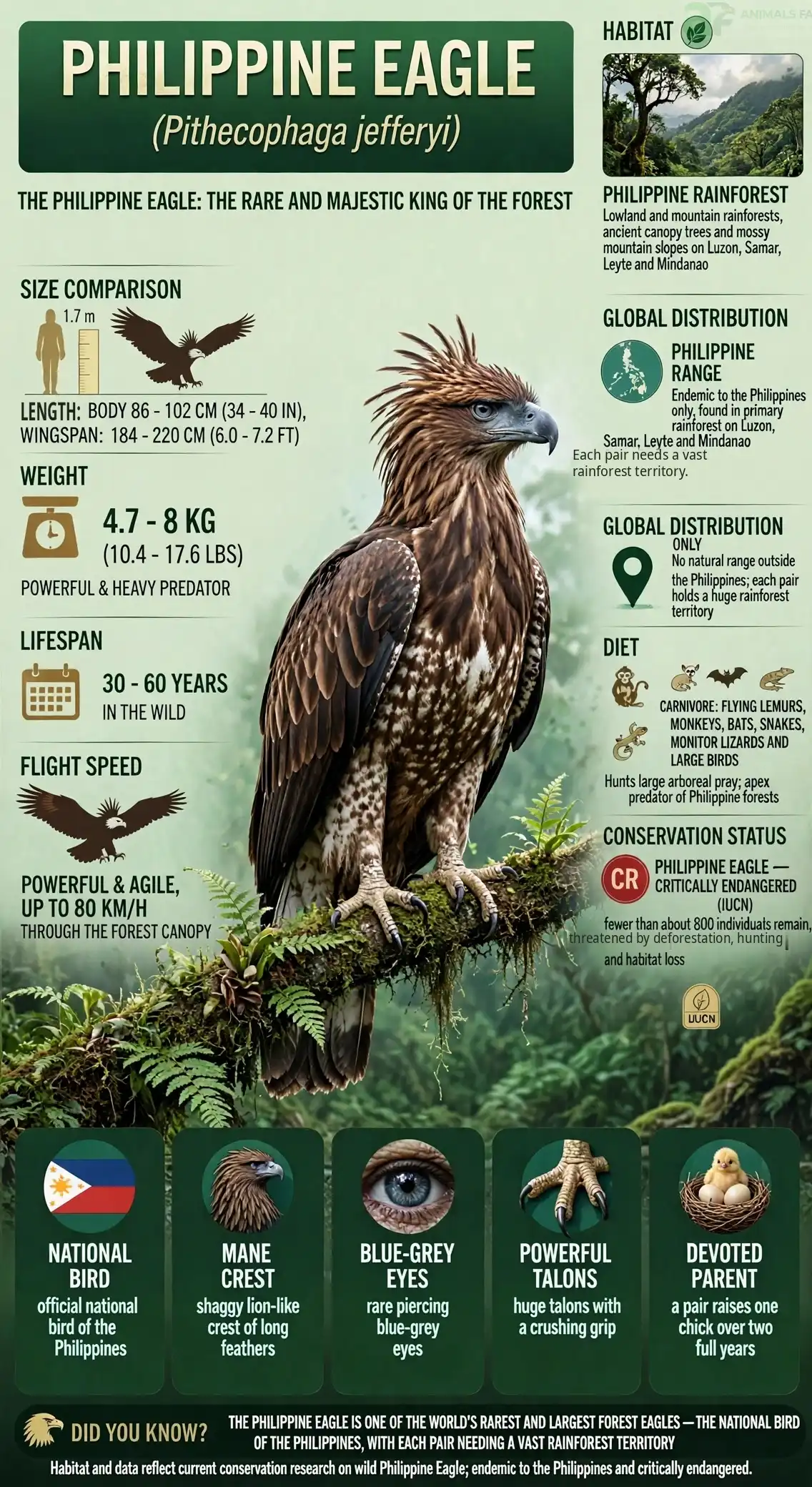
- Fewer than 800 individuals remain in the wild
- Killing one carries a 12-year prison sentence in the Philippines
- Primary prey is flying lemurs — not monkeys
- Largest eagle in Asia by body length (up to 102 cm)
- Breeds only once every 2 years
- First captive-bred individual hatched in 1992
- National bird of the Philippines since 1995
- Only member of monotypic genus Pithecophaga
- Philippines has lost 93% of original forest cover
- Home ranges of 40–100 km² per pair
- Pale blue-grey eyes — unique among large eagles
- Wild lifespan estimated at 30–60 years
6. Philippine Eagle Natural Habitat & Geographic Range
Philippine eagle habitat is defined with even greater specificity than the harpy eagle’s — the species requires intact primary dipterocarp forest at specific elevation ranges on specific Philippine islands, creating one of the most geographically and ecologically constrained large eagle distributions in the world.
The Dipterocarp Forest Dependency
Primary dipterocarp rainforest — The Philippine eagle’s fundamental habitat; the dominant tree family of Philippine lowland and montane forests (Dipterocarpaceae) produces the large, structurally complex forest that supports both the flying lemur prey community and the large trees needed for nesting. Philippine eagle occurrence strongly correlates with primary dipterocarp forest presence — the species essentially absent from secondary forest, logged-over areas, and agricultural land.
Why dipterocarp forest? — The Philippine eagle’s specific dependency on dipterocarp forest reflects multiple ecological links:
- Nest tree size — Philippine eagles nest in the largest dipterocarp trees — species reaching 30–50 meters whose massive crowns and strong branches support the substantial nest structure over multiple breeding attempts
- Flying lemur habitat — Flying lemurs (Cynocephalus volans) are themselves dipterocarp forest specialists — their gliding lifestyle dependent on the tall, densely canopied trees that allow long gliding distances. The loss of dipterocarp forest therefore eliminates the primary prey before affecting the eagle directly
- Forest floor prey — The snakes, large lizards, and other supplementary prey items that the Philippine eagle occasionally takes are also dependent on intact primary forest conditions
The elevation range — Philippine eagles are documented from sea level to approximately 1,800 meters — the primary population concentrated in the 100–1,500 meter montane forest zone where both dipterocarp and montane forest types occur and where flying lemur densities are highest. At higher elevations (above 1,500 meters), the forest transitions to mossy montane forest with different prey communities and reduced flying lemur density.
Geographic Distribution — A Philippine Endemic
The Philippine eagle is one of the most geographically restricted large eagles in the world — confined entirely to four islands within the Philippine archipelago:
| Island | Status | Population Estimate | Notes |
|---|---|---|---|
| Mindanao | Core population | 600–700 individuals | Philippines’ second-largest island; most remaining forest; stronghold |
| Leyte | Small population | 30–50 individuals | Severely deforested; highly fragmented population |
| Samar | Small population | 20–30 individuals | Adjacent to Leyte; small connected forest patches |
| Luzon | Very small population | Fewer than 20 individuals | Philippines’ largest island; most deforested; critically small population |
The Mindanao imperative — Mindanao holds approximately 80% of the wild Philippine eagle population — making the conservation of Mindanao’s primary forests the single most important action for Philippine eagle survival. The mountain ranges of Mindanao — particularly Mount Apo National Park, Mount Kitanglad Range Natural Park, Mount Hamiguitan Range Wildlife Sanctuary, and the Apo Kayan mountains — represent the primary eagle habitats.
The Forest Loss Catastrophe
The Philippines’ forest loss history represents one of the most severe deforestation trajectories of any tropical country:
Historical forest cover — At the time of Spanish colonization (1565), the Philippines was estimated to have approximately 90–95% forest cover — a forested archipelago of extraordinary biodiversity.
Current forest cover — By 2024, the Philippines retains approximately 7–8% primary forest and approximately 20–25% total forest cover — a loss of approximately 93% of original primary forest in 450 years.
Mindanao’s trajectory — Even in Mindanao — the most forested major Philippine island — primary forest has been reduced from an estimated 90%+ cover in 1900 to approximately 20–25% today. The remaining forest is fragmented into patches of varying size separated by agricultural and logged areas.
The forest fragment problem — Philippine eagle home ranges of 40–100 km² require forest patches of at least this size to support a breeding pair. As forest fragmentation progresses, an increasing proportion of remaining forest occurs in patches too small to support a viable eagle territory — creating habitat that appears forested on maps but is functionally unavailable to breeding eagles.
7. Philippine Eagle Diet & Feeding Behavior
Philippine eagle diet centers on the flying lemur (Cynocephalus volans) — an unusual prey specialization that links the Philippine eagle’s survival directly to the conservation of both the flying lemur population and the dipterocarp forest they both require.
Diet Breakdown Table
| Food Type | Estimated % of Diet | Notes |
|---|---|---|
| Flying lemurs (Cynocephalus volans) | ~50–90% | Primary prey; varies by site and season — can approach 90% at some locations |
| Philippine long-tailed macaque (Macaca fascicularis) | ~5–20% | The “monkey” prey that gave the species its former name |
| Large flying foxes (Pteropus species) | ~3–8% | Fruit bats; significant in some areas |
| Large snakes | ~3–7% | Reticulated python juveniles; various colubrids |
| Monitor lizards | ~2–5% | Water monitor (Varanus salvator) and related |
| Large birds | ~2–5% | Hornbills; large pigeons; other large forest birds |
| Juvenile deer | ~1–3% | Philippine deer (Rusa marianna) fawns |
| Large rodents | ~1–3% | Cloud rats and other large Philippine rodents |
| Other mammals | ~2–5% | Civets, flying squirrels, palm civets |
The Flying Lemur Specialization — A Unique Predator-Prey System
The relationship between the Philippine eagle and the flying lemur (Cynocephalus volans) is one of the most specialized predator-prey relationships of any large eagle in the world:
What is a flying lemur? — Despite the name, flying lemurs are neither true lemurs nor true fliers — they are colugos (order Dermoptera), gliding mammals that use a large patagium (gliding membrane) stretching from chin to fingertip to tail tip to glide distances of 100 meters or more between trees. The Philippine flying lemur is found exclusively in the Philippines — making it as geographically restricted as the eagle that primarily eats it.
Why flying lemurs? — The flying lemur is an ideal Philippine eagle prey item for several reasons:
- Large body mass — adult flying lemurs weigh 1–1.75 kg — substantial for a gliding mammal and a nutritious meal
- Arboreal lifestyle — flying lemurs rest clinging to tree trunks and branches in the canopy — accessible to the eagle’s forest-hunting approach
- Distinctive appearance — the flying lemur’s large gliding membrane is highly visible when the animal glides — potentially facilitating detection by the eagle
- High density in primary forest — in intact dipterocarp forest, flying lemur densities are among the highest of any forest mammal
- Limited defensive options — the flying lemur’s primary defense (gliding away) is ineffective against a predator capable of pursuing through the forest
The detection system — Philippine eagles locate flying lemurs through a combination of:
- Visual scanning from high perches — flying lemurs resting on tree trunks during the day are visible as distinctive shapes against the bark
- Glide detection — a gliding flying lemur’s large membrane is highly visible in the forest and represents an exploitable detection opportunity
- Acoustic detection — the facial mane may contribute to acoustic detection of flying lemurs moving in the canopy, analogous to the harpy eagle’s facial disc function
The capture technique — Philippine eagle attacks on flying lemurs typically involve:
- Perch-hunting from a high vantage point with good sightlines through the forest
- A rapid, powerful flight through the forest to intercept the prey
- A strike targeting the prey’s back and shoulder region
- Immediate incapacitation through talon penetration and grip force
The Monkey Predation System
Despite the primary prey being flying lemurs, the Philippine eagle’s predation on Philippine long-tailed macaques (Macaca fascicularis) is ecologically significant and was the basis of the bird’s original common name:
The macaque as prey — Philippine macaques weigh 3–8 kg in adults — prey of substantial size that the Philippine eagle takes primarily as juveniles and subadults. Adult male macaques (up to 8 kg) represent the upper limit of what the eagle can effectively handle.
The macaque response — Philippine macaques have well-developed alarm call systems specifically for Philippine eagle — producing specific eagle alarm calls that are different from terrestrial predator alarms and that trigger specific behavioral responses (moving into dense canopy, tightening group cohesion, freezing in cover).
The Hunting System
The perch-hunt strategy — The Philippine eagle’s primary hunting mode — the bird selects a prominent perch with good canopy visibility and waits, scanning both visually and (potentially) acoustically for prey. Hunting bouts from individual perches may last 1–4 hours.
The pursuit flight — Once prey is detected, the Philippine eagle launches into a powerful pursuit flight through the forest interior — the short, broad wings allowing rapid maneuvering between trees. Flight speeds during pursuit are estimated at 70–100 km/h through the complex forest architecture.
Prey delivery to the nest — During the breeding season, flying lemurs are the primary prey brought to the nest — adults delivering prey at intervals of 1–3 days depending on prey availability and eaglet age and appetite.
8. Philippine Eagle Reproduction & Life Cycle
Philippine eagle reproduction is the most slowly paced of any eagle in Asia — the combination of the single-egg clutch, extended incubation, prolonged nestling period, and extraordinary post-fledging dependency creating a reproductive investment per offspring unmatched among Asian raptors.
Pair Bond and Territory
Lifelong pair bonds — Philippine eagles are documented as maintaining long-term pair bonds — the same individuals returning to the same territory and the same nest tree across multiple breeding attempts. GPS tracking and long-term nest monitoring have confirmed pair fidelity spanning many years.
The territory establishment — Territory establishment is a multi-year process for young Philippine eagles — the period between achieving independence (at approximately 2 years of age) and establishing a successful breeding territory may span several additional years of territorial wandering and eventually permanent settlement.
Territory size — Documented territories range from approximately 40–100 km² per breeding pair — among the largest of any tropical raptor and reflecting both the patchy distribution of prey in Philippine forests and the energetic demands of the species.
Breeding Season
Timing — Philippine eagle breeding in Mindanao shows a pattern influenced by rainfall seasonality:
- Nest building and pair bonding intensification — July–September (late wet season/early dry season)
- Egg laying — September–November
- Incubation — October–February (spanning the dry season)
- Chick rearing — through the wet season (May–September)
- Fledging — approximately May–August
Why this timing? — Breeding timing calibrated to the Philippine dry season appears to reduce rainfall stress during the early nestling period and to align the chick’s maximum energy demand with the period of highest prey availability.
Courtship Displays
Aerial displays — Philippine eagle pairs perform aerial courtship displays above their territory — both birds soaring together, performing undulating flights, and occasionally approaching each other closely in the air.
The mane display — Close-range courtship involves dramatic mane erection — the shaggy hackle feathers raised and spread to create the maximum visual impact of the circular, lion’s-mane display. Mane display in courtship reinforces pair bond and provides mutual assessment of condition.
Nest building — Both members of the pair participate in nest construction and refurbishment — carrying sticks and fresh green leaves to the nest in the weeks before egg-laying.
Vocalizations — Philippine eagle courtship involves repeated calling — the pair producing coordinated vocal sequences that reinforce pair bond and advertise territory occupancy.
Nesting
Nest tree selection — The Philippine eagle selects among the largest available trees — the nest invariably placed in a massive dipterocarp (typically Shorea or related genera reaching 30–50 meters) or in an emergent tree of comparable size. Nest tree availability is a critical habitat constraint — the large dipterocarp trees preferred by Philippine eagles are the same trees most heavily targeted by selective logging operations.
Nest dimensions — Philippine eagle nests are substantial structures:
- New nests: approximately 1–1.5 meters in diameter and 0.5 meters deep
- Established nests (multiple years use): up to 1.5–2 meters in diameter and 1+ meter deep
- Built from large sticks, lined with fresh green leaves
The single egg strategy — Philippine eagles lay one egg per breeding attempt — in rare cases two eggs may be laid but only one chick is ever raised. This single-egg strategy concentrates all parental investment in one offspring — the biological opposite of the “clutch insurance” strategy of many smaller raptors.
Incubation — 58–68 days — among the longest incubation periods of any eagle, reflecting the large egg size and the development complexity of a chick that must emerge prepared for the demands of the Philippine forest environment. Both parents incubate, with the female performing the majority.
Chick Development
At hatching — The chick hatches covered in white down — altricial, helpless, requiring continuous brooding and parental provisioning.
Development progression:
- Weeks 1–4 — continuously brooded; white down; developing thermoregulation
- Weeks 4–8 — secondary grey-white down; eyes fully open; increasingly mobile within nest
- Weeks 8–16 — contour feathers emerging; wing-flapping exercises; approaching adult size
- Months 4–5 — near adult size; flight feathers approaching full length
- Months 5–6 — first flight (fledging); leaves nest but remains nearby
The post-fledging dependency — The most remarkable aspect of Philippine eagle development; the fledged young bird remains associated with the parental territory and dependent on food delivery for 12–20 months after fledging. This extraordinary dependency period — longer than that of any other eagle in Asia — reflects:
- The complexity of hunting flying lemurs effectively in primary forest
- The specific knowledge of territory features (productive hunting areas, flylemur concentrations, alternative prey locations) that must be acquired through observation and practice
- The energetic demands of the species’ large body size
The 2-year cycle consequence — The sum of incubation (2 months) + nestling period (5 months) + post-fledging dependency (12–20 months) = approximately 19–27 months — making the earliest possible re-initiation of the next breeding cycle approximately 2 years after egg-laying. Many pairs require 2–3 years between breeding attempts in practice.
Sexual Maturity and the Long Reproductive Life
Age at first breeding — Philippine eagles do not breed until approximately 5–8 years of age — the combination of juvenile plumage duration, territory establishment time, and pair bond formation requiring many years before first successful breeding.
Lifetime reproductive output — A female Philippine eagle breeding successfully from age 7 through age 45 at the maximum rate of one chick every 2 years would raise approximately 19 chicks in her lifetime. With realistic breeding failure rates and the 2–3 year cycle, the actual lifetime output of a successful female is probably 10–15 fledglings — a number that emphasizes the extraordinary value of each individual breeding adult to population viability.
9. Social Behavior & Communication
Philippine eagle social behavior mirrors the harpy eagle’s pattern of exclusive pair territorial organization and minimal social contact outside the pair bond — the large territory requirements and low population density creating a largely solitary existence punctuated by the intensive social interaction of the pair bond.
Territory Dynamics
Exclusive pair territories — Each breeding pair defends an exclusive territory against other Philippine eagles — the defended area large enough to support the pair and their offspring through the extended breeding cycle.
The role of territory knowledge — The Philippine eagle’s large home range and long occupancy of specific territories means that breeding pairs accumulate detailed knowledge of their territory — productive flying lemur locations, favored hunting perches, alternative prey sites, and the movements of prey populations across seasonal cycles. This accumulated territory knowledge is a resource that cannot be quickly replaced when an experienced breeding adult is lost.
Non-breeding birds — Young, dispersing Philippine eagles and territory-seeking sub-adults move through the landscape outside established territories — these non-breeding birds represent the population’s reserve, capable of filling territory vacancies when breeding adults are lost. As total population declines and forest patches shrink, the pool of available non-breeding birds also shrinks.
Communication
The advertising call — The Philippine eagle’s territorial advertisement call — a high, clear, ringing whistle repeated in series — is one of the most distinctive sounds of Mindanao’s primary forests. The call carries considerable distances through the forest and is used for both territory advertisement and pair bond maintenance.
The “wailing” call — A more complex, multi-note vocalization produced during close pair interactions, during territorial confrontations, and during the post-fledging period when young birds beg for food. The wailing call is one of the most emotionally evocative wildlife vocalizations in the Philippines — described by field researchers as haunting and memorable.
Mane display — The raised, spread mane halo is the primary visual communication signal in close-range interactions — erected during display, alarm, and threat contexts, and providing information about arousal state and dominance to other Philippine eagles and to researchers who have learned to read its significance.
Mutual preening — Established pair members engage in regular mutual preening — the behavior serving both a practical function (cleaning areas of the head and face that cannot be self-preened) and a social bonding function that maintains pair cohesion across the multi-year breeding cycle.
10. Predators & Defense Mechanisms
The adult Philippine eagle is the apex predator of the Philippine dipterocarp forest — no native Philippine predator threatens adult birds. However, eggs, chicks, and juvenile eagles face meaningful threats.
Threats to Eggs and Chicks
Large snakes — The reticulated python (Python reticulatus) and large arboreal colubrids are potential nest predators — large pythons capable of climbing to nest trees and consuming eggs or small chicks. The parents vigorously defend the nest.
Large monitor lizards — Varanus salvator (water monitor) has been documented investigating Philippine eagle nests — the monitors’ climbing ability making them potential nest predators.
Human disturbance — The most significant nest threat in the contemporary Philippines; logging operations near nest trees, human activity around nesting areas, and deliberate nest disturbance cause nest abandonment.
Corvids and large birds — Philippine crows and other corvids investigate unattended nests.
Threats to Adults
Humans — The overwhelming primary threat:
- Shooting — despite the severe legal penalties, Philippine eagles continue to be shot across Mindanao — by farmers who incorrectly perceive the eagle as a livestock threat, by hunters, and occasionally in disputes or accidents
- Trapping — eagles captured in traps set for other animals
- Habitat destruction — indirect mortality through habitat loss that reduces food availability and nesting opportunities
Other large raptors — Competitive interactions with other large raptors are rare given the Philippine eagle’s dominant size.
Defense Mechanisms
Height and remoteness — Nesting in the crowns of the tallest forest trees provides substantial protection from terrestrial predators. However, nest trees within accessible forests are increasingly surrounded by human activity.
Vigorous nest defense — Both parents defend nests aggressively — returning repeatedly to chase away intruders, whether snakes, monitors, or researchers.
Size and dominance — The adult Philippine eagle’s size and weaponry make it the undisputed dominant predator in Philippine forest — no native animal challenges a healthy adult.
Mane threat display — The fully erected mane creates a dramatically imposing visual display that may deter some potential nest disturbers and competing eagles.
11. Philippine Eagle Facts for Kids
Hey amazing young wildlife scientists, conservation heroes, and bird enthusiasts! Here are some truly extraordinary Philippine eagle facts for kids that will make you the most informed wildlife advocate in your class:
- 🦅 The Philippine eagle is SO protected that killing one can send someone to JAIL for 12 YEARS! The Philippines has passed one of the world’s strongest wildlife protection laws specifically for this bird. Anyone who kills, captures, or harms a Philippine eagle faces up to 12 years in prison. This shows how seriously the Filipino people take protecting their national bird — even if, sadly, some people still break the law.
- 🦅 There are fewer than 800 Philippine eagles left in the ENTIRE WORLD! You could fit every wild Philippine eagle in the world into a large sports stadium — and still have empty seats. This makes it one of the rarest eagles on Earth. Every single individual Philippine eagle is precious and irreplaceable, which is why conservation programs work so hard to protect each one.
- 🦅 The Philippine eagle does NOT mainly eat monkeys — it mainly eats FLYING LEMURS! Despite its old name “monkey-eating eagle,” scientists have discovered that the Philippine eagle’s favorite food is the flying lemur — a strange gliding mammal that uses its big wing-like membrane to glide between trees. Flying lemurs are found only in the Philippines and Southeast Asia. The Philippine eagle and the flying lemur evolved together in the Philippine forest, and they depend on each other in extraordinary ways!
- 🦅 The Philippine eagle has a mane like a LION! The long, shaggy brown-and-white feathers around its face look like a lion’s mane — which is why it is sometimes called “the lion of the sky” in the Philippines. When the eagle gets excited or alarmed, it raises these feathers into a spectacular circular halo around its head that makes it look even more enormous and more majestic than it already is!
- 🦅 Philippine eagle babies depend on their parents for up to 20 MONTHS after learning to fly! After spending 5 months growing up in the nest, a young Philippine eagle does not immediately become independent. Its parents continue feeding it for up to another year and a half while it learns to hunt the flying lemurs and monkeys of the Philippine forest! This means a Philippine eagle pair can only have one chick every 2 years — making every baby eagle incredibly precious!
- 🦅 The Philippines has lost 93% of its ORIGINAL FORESTS! When the first Spanish explorers arrived in the Philippines, almost the entire archipelago was covered in magnificent tropical rainforest. Today, only a small fraction of that original forest remains — and most of what is left is in Mindanao, where most Philippine eagles live. This is why protecting the remaining forest is the most important thing we can do for the Philippine eagle!
- 🦅 The Philippine eagle’s EYES are a unique pale blue-grey color! Most large eagles have yellow or brown eyes. The Philippine eagle has distinctive pale blue-grey eyes that give it a unique, piercing expression unlike any other eagle. This eye color is one of the features that makes the Philippine eagle appear so different from other eagles — and so extraordinarily beautiful.
- 🦅 The Philippine eagle is the ONLY MEMBER of its entire eagle genus! Just like the numbat is the only member of the Myrmecobiidae family, the Philippine eagle is the only member of the genus Pithecophaga. If the Philippine eagle goes extinct, an entire evolutionary lineage — millions of years of eagle evolution — disappears forever. There is literally nothing else like it anywhere in the world!
12. Relationship with Humans
The Philippine eagle’s relationship with humans encompasses thousands of years of indigenous reverence across Philippine archipelago cultures, the colonial and post-colonial period of shooting and forest clearance, the modern conservation emergency and institutional response, and the profound cultural dimension of the eagle as a national symbol of Philippine identity — a dimension that both creates extraordinary public support and places a political burden on conservation decisions.
Indigenous Philippine Relationships
The Bagobo tradition — The Bagobo people of Mindanao — one of the principal indigenous groups within the Philippine eagle’s primary range — maintain a traditional relationship with the eagle that is among the most intimate human-raptor relationships documented in Southeast Asia:
The agila in Bagobo cosmology — In Bagobo spiritual tradition, the Philippine eagle (manaul in Bagobo language) occupies a position of supreme spiritual power — understood as a being with extraordinary spiritual force (gaba) whose presence near a community is a significant cosmological event. The eagle’s hunting prowess, size, and visual impact create a natural association with the most powerful spiritual entities in the Bagobo world.
Traditional captive keeping — Like indigenous Amazonian groups with harpy eagles, various Philippine indigenous communities have historically kept captive Philippine eagles — typically young birds taken from nests. These captive eagles were maintained as prestige objects and spiritual symbols — fed by the community and treated with profound respect.
Eagle feathers in ceremony — Philippine eagle feathers — particularly the distinctive mane hackle feathers — are among the most valued ceremonial objects in multiple Philippine indigenous traditions. Their use in headgear, ritual objects, and ceremonial regalia reflects the eagle’s supreme cultural status.
Traditional ecological knowledge — Bagobo and other Mindanao indigenous communities possess detailed traditional ecological knowledge of Philippine eagle behavior, nest sites, seasonal movements, and prey associations — knowledge accumulated over generations of co-existence in the same forest landscape. This knowledge has been increasingly valued by conservation researchers as a complement to scientific monitoring methods.
The Colonial Period — Discovery, Collection, and Decline
The 1895 discovery — English naturalist John Whitehead’s collection of the first specimens from Mindanao in 1895 introduced the Philippine eagle to Western science — but also initiated a period of scientific collection that removed significant numbers of birds from the wild population during the late 19th and early 20th centuries.
Museum collection pressure — The Philippine eagle’s extraordinary appearance made it one of the most sought-after natural history specimens from the Philippines — multiple specimens collected for museum collections across Europe and North America in the early 20th century. Combined with the progressive clearance of Philippine forests for timber and agriculture through the American colonial period (1898–1946), the early 20th century saw the beginning of the population decline that continues today.
Post-colonial deforestation — The post-war Philippine economy drove intensive logging across Mindanao and other forested islands — the timber industry removing millions of hectares of primary dipterocarp forest and eliminating Philippine eagle habitat at extraordinary rates through the 1950s, 1960s, and 1970s.
The Modern Conservation Institution
The Philippine Eagle Foundation (PEF) — Established in 1992 in Davao City, Mindanao, the Philippine Eagle Foundation is the primary institutional home for Philippine eagle conservation — combining captive breeding, public education, field research, and community engagement:
The captive breeding program — The PEF’s captive breeding program has achieved what was once considered impossible — breeding Philippine eagles in captivity. The first captive-born Philippine eagle (Pag-asa) hatched in January 1992 — a milestone event in Philippine conservation history. As of 2026, the captive population provides genetic insurance and produces ambassador birds for public education.
The Philippine Eagle Center — The PEF’s facility in Davao City receives approximately 100,000 visitors per year — making it one of the most visited conservation facilities in the Philippines. The center maintains both educational exhibits and the captive breeding population, with ambassador eagles visible to visitors.
Field research programs — The PEF maintains active field research programs across Mindanao — nesting pair monitoring, GPS tracking, and habitat assessment providing the scientific data needed for conservation planning.
Community engagement — The PEF’s community programs work with Mindanao communities in eagle territories — providing education, supporting alternative livelihoods that reduce forest dependence, and engaging indigenous communities as conservation partners.
The National Symbol Dimension
The 1995 designation — The formal designation of the Philippine eagle as the national bird of the Philippines by President Fidel Ramos on July 4, 1995 transformed the species’ cultural and political profile — elevating it from an important endemic bird to a symbol of national identity:
The cultural consequences — The national bird designation has:
- Generated extraordinary public awareness and emotional investment in the species
- Created political pressure for conservation funding and policy attention
- Made harming a Philippine eagle a politically significant act beyond its legal significance
- Embedded the eagle in Philippine cultural production — appearing in art, literature, television, advertising, and public space
The burden of symbolism — National symbol status also creates complexities:
- Conservation decisions about the Philippine eagle become politically charged in ways that purely scientific decisions about less prominent species do not
- The eagle’s cultural significance sometimes leads to anthropomorphization that complicates objective conservation planning
- Tourism development around eagle sites must balance accessibility with the disturbance sensitivity that the species’ slow breeding rate makes critical to manage
The legal protection — The Philippines has enacted some of the world’s most severe legal penalties for harming Philippine eagles — 12-year prison sentences and 1 million peso fines under Republic Act 9147. The strength of this legal protection reflects the national symbol status; the challenge is enforcement in remote Mindanao communities where awareness of the law and capacity for enforcement are both limited.
13. Philippine Eagle Conservation Status & Threats
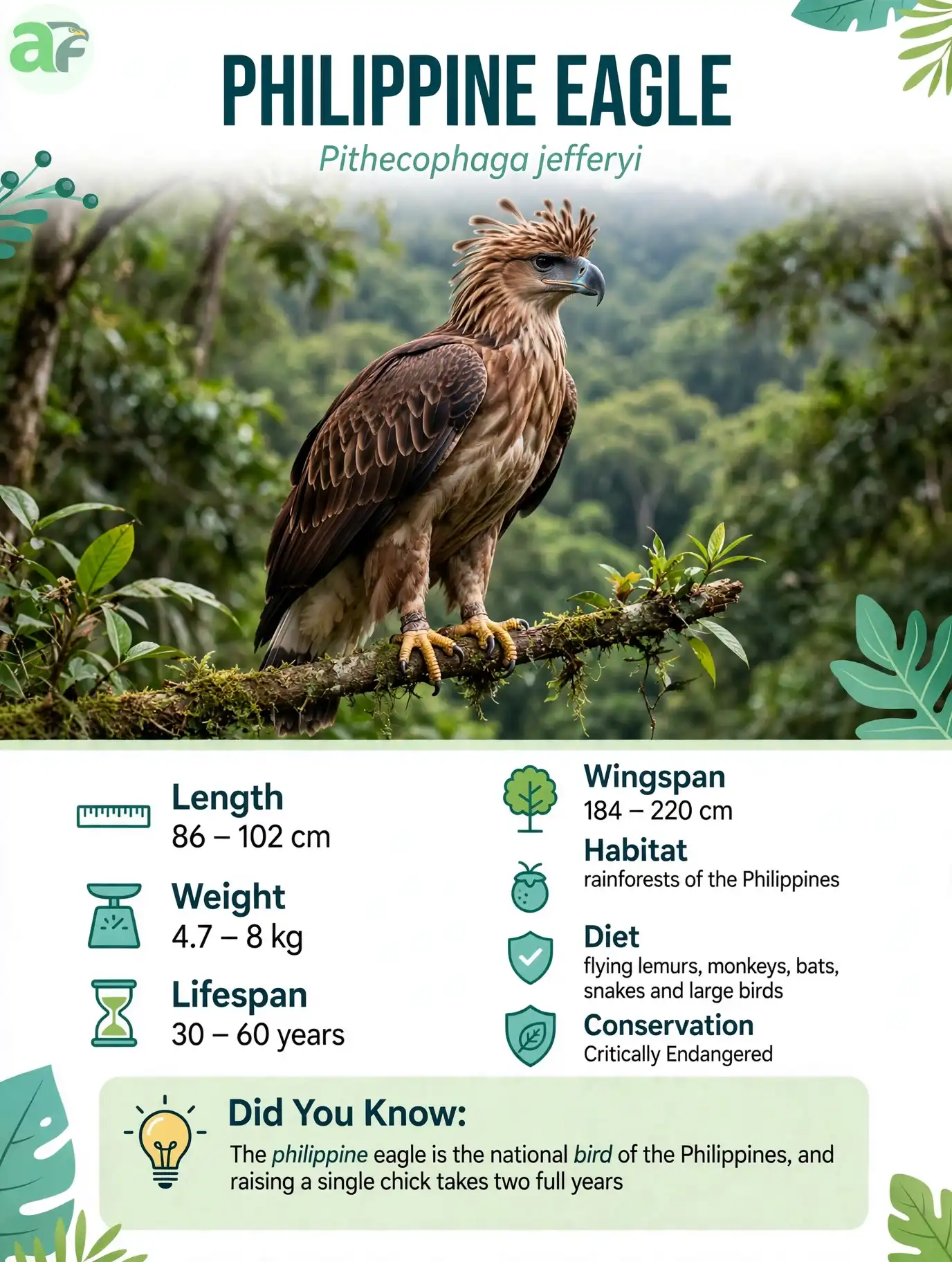
Conservation Status Overview
| Feature | Details |
|---|---|
| IUCN Status | Critically Endangered (CR) |
| Population Trend | Decreasing |
| Estimated Wild Population | Fewer than 800 mature individuals — possibly as few as 600 |
| Range Reduction | Estimated 90%+ of historical habitat now eliminated |
| Most Threatened Population | Luzon (fewer than 20 individuals) and Leyte (30–50 individuals) |
| CITES Listing | Appendix I — international trade absolutely prohibited |
| Philippine Legal Status | Critically Endangered; national bird; 12-year prison sentence for killing |
| Global Ranking | One of the 50 rarest birds in the world |
Major Threats
| Threat | Description | Impact Level |
|---|---|---|
| Deforestation | Logging, agricultural conversion, mining, infrastructure development | Critical — primary threat |
| Hunting and shooting | Direct killing despite legal penalties; perceived livestock threat | High |
| Nest tree felling | Logging of the large dipterocarp trees used for nesting | High |
| Forest fragmentation | Isolation of patches below minimum territory size | High |
| Mining | Open-pit mining in key Mindanao eagle habitats | High |
| Trapping | Accidental or deliberate capture | Medium-High |
| Human disturbance at nests | Nest abandonment near logging and agricultural activity | Medium-High |
| Prey depletion | Overhunting of flying lemurs and monkeys | Medium |
| Captive keeping | Traditional indigenous practice removing juveniles | Low — localized |
| Climate change | Altered forest structure; intensified typhoon damage | Increasing concern |
The Deforestation Emergency
The Philippines’ deforestation history is one of the most severe of any tropical country — and the trajectory continues to threaten the Philippine eagle’s survival:
The Mindanao specific situation — Even within Mindanao, where most eagles survive, the situation is critical:
- Mining concessions — multiple large-scale mining operations in key eagle habitats have been approved or are under consideration, including in areas adjacent to existing protected areas
- Agricultural expansion — conversion of forest margins to palm oil, banana, and other plantation crops continues
- Infrastructure development — road construction into previously remote forest areas creates access that accelerates subsequent logging and agricultural conversion
- Illegal logging — enforcement of logging bans is inconsistent, with illegal logging continuing in protected areas including national parks
The protected area inadequacy — Even within formally protected areas in Mindanao, Philippine eagle habitat is not fully secure:
- Protected area management is chronically underfunded
- Boundary enforcement is inadequate
- Indigenous community rights within protected areas create complex management challenges
- Several key protected areas (including Mount Apo National Park) have experienced significant internal deforestation
The Hunting Problem
Despite the 12-year prison sentence for killing a Philippine eagle, shooting continues:
Motivations for shooting — Philippine eagles are shot for several reasons:
- Perceived livestock threat — farmers who believe (usually incorrectly) that eagles are taking their chickens or small livestock shoot eagles on sight
- Trophy and curiosity — the eagle’s dramatic appearance makes it a target for people who want possession of feathers or other parts
- Traditional use — some communities continue traditional practices of capturing or killing eagles for cultural purposes
- Accidental shooting — eagles shot by hunters targeting other species
Enforcement challenges — The 12-year sentence exists on paper but enforcement in remote Mindanao communities is extremely difficult:
- Reporting incidents requires witnesses willing to testify — rare in communities where the shooter may be a respected community member
- Law enforcement capacity in remote areas is limited
- The cultural context — communities where the eagle has historically been seen as a resource rather than a protected species — means awareness of the law’s severity is often limited
Conservation Responses
Philippine Eagle Foundation programs — PEF’s multi-pronged conservation approach:
- Captive breeding providing genetic insurance
- GPS tracking of breeding pairs providing territory and habitat use data
- Community education in eagle territories
- Nest monitoring and protection
- Advocacy for forest protection policies
Protected area management — Key protected areas requiring strengthened management:
- Mount Apo Natural Park — 65,000 hectares; Philippines’ highest peak; important eagle population
- Mount Kitanglad Range Natural Park — 47,000 hectares; declared UNESCO Biosphere Reserve
- Mount Hamiguitan Range Wildlife Sanctuary — 16,923 hectares; UNESCO World Heritage Site; important eagle habitat
- Northern Sierra Madre Natural Park (Luzon) — largest protected area in Philippines; holds the Luzon eagle population
International conservation support — Organizations including BirdLife International, WWF Philippines, IUCN, and various international donors provide funding and technical support for Philippine eagle conservation programs.
Legal enforcement strengthening — Programs to increase awareness of the eagle protection law and improve enforcement capacity in key communities.
14. Famous Philippine Eagles in History & Pop Culture
Famous Individual Philippine Eagles
Pag-asa (“Hope”) — The most famous Philippine eagle in history — the first captive-bred Philippine eagle, hatched at the Philippine Eagle Foundation on January 8, 1992. Pag-asa’s hatching was a national event in the Philippines — broadcast on national television and celebrated as a conservation milestone. He served as a conservation ambassador for nearly three decades, participating in public education programs and receiving thousands of visitors annually at the Philippine Eagle Center. Pag-asa died in December 2021 at approximately 29 years of age — the news generating national mourning in the Philippines, with major media coverage, official government statements, and widespread public tribute. His life and death represented the most sustained period of Philippine public engagement with any individual wild animal in Philippine history.
Kalinawan (“Clarity”) — A male Philippine eagle hatched in the mid-1990s at the PEF captive breeding program who became one of the most photographed Philippine eagles globally — his particularly dramatic mane and vivid pale eyes generating some of the most widely reproduced Philippine eagle images in international wildlife media.
The Malagos Eagle — A female Philippine eagle kept at the Davao Crocodile Park adjacent to the Philippine Eagle Center — one of the most visited captive Philippine eagles in the Philippines, her participation in public programs reaching hundreds of thousands of Filipino children in organized school visits over multiple decades.
Research Tagged Individuals — Various Philippine eagles fitted with GPS tracking devices through PEF and international research collaborations have provided the most detailed data on Philippine eagle movement patterns, territory size, and hunting behavior. While not named in public communication, these study birds represent the scientific foundation of contemporary Philippine eagle conservation.
Historical Significance
The 1895 Whitehead Specimens — The specimens collected by John Whitehead from Mindanao in 1895 and formally described by Ogilvie-Grant in 1896 are held in the Natural History Museum London — the type specimens that represent the founding records of the Philippine eagle in Western science. These specimens have been examined by every ornithologist who has formally studied the species’ taxonomy and remain scientifically significant.
President Marcos’s 1978 Decree — The official renaming of the species from “monkey-eating eagle” to “Philippine eagle” through presidential decree in 1978 was a significant political-cultural moment — elevating the eagle’s identity as a specifically Philippine natural heritage symbol rather than a zoological curiosity defined by its diet.
President Ramos’s 1995 Designation — The formal designation as national bird in 1995 created the cultural and legal framework within which all subsequent Philippine eagle conservation has operated — the most consequential single administrative action in the species’ conservation history.
15. Role in Ecosystem & Food Chain
The Apex Predator Function in Philippine Forest
The Philippine eagle’s ecological role as the supreme apex predator of the Philippine dipterocarp forest creates cascading effects through the forest’s biological community that extend far beyond the direct predation on flying lemurs and monkeys:
Flying lemur population regulation — The Philippine eagle’s predation on flying lemurs constitutes the primary top-down regulation of flying lemur populations in primary forest areas. Flying lemurs are among the most abundant large-bodied arboreal mammals in Philippine dipterocarp forest — their populations, if unchecked by eagle predation, could grow to levels creating significant browsing pressure on canopy trees.
The flying lemur-forest connection — Flying lemurs feed primarily on leaves, shoots, flowers, and fruits of dipterocarp and other canopy trees. Eagle predation regulating flying lemur density therefore indirectly reduces browsing pressure on the canopy — a trophic cascade in which the apex predator influences forest canopy composition through prey population regulation.
Macaque behavioral effects — The Philippine eagle’s predation on macaques creates a “landscape of fear” in Philippine forests — macaque groups in eagle territories demonstrate distinct anti-eagle behavioral adaptations (specific alarm calls, altered movement patterns, heightened canopy vigilance) that differ from macaque behavior in eagle-free areas.
The indicator function — The Philippine eagle functions as the most sensitive indicator of primary dipterocarp forest integrity in the Philippines:
- Presence indicates intact forest patches with functional prey communities and minimal human disturbance
- Breeding success reflects forest quality across the home range
- Disappearance from a previously occupied territory is among the most reliable indicators of functional forest degradation even before physical deforestation is apparent
- Population density provides a metric of primary forest connectivity and area
The Philippine Biodiversity Dimension
The Philippine eagle’s habitat — primary Philippine dipterocarp forest — is one of the most biodiverse forest types in the world. The Philippine archipelago is one of the world’s 36 biodiversity hotspots — a globally significant concentration of endemic species found nowhere else on Earth. Protecting Philippine eagle habitat therefore simultaneously protects:
- Hundreds of other Philippine endemic bird species
- Unique Philippine mammals including the Visayan warty pig, Philippine deer, cloud rats, and flying squirrels
- The flying lemur itself — a unique mammal order with no close relatives
- Thousands of endemic plant species including the dipterocarp tree species
- Unique Philippine reptiles and amphibians
The Philippine eagle’s role as a flagship and umbrella species for Philippine biodiversity conservation makes protecting the eagle essentially equivalent to protecting the Philippines’ entire remaining primary forest biodiversity legacy.
16. Myths, Folklore & Cultural Significance
Indigenous Philippine Traditions
The Bagobo manaul — In Bagobo tradition, the Philippine eagle (manaul) is understood as a being of extraordinary spiritual power — one of the most powerful presences in the Mindanao forest landscape. The Bagobo recognize the eagle’s hunting prowess as expressing a power (gaba) that transcends ordinary animal behavior and partakes of the spiritual realm.
The haribon tradition — The Filipino name haribon — from hari (king) + ibon (bird) — reflects a pan-Philippine recognition of the eagle as the supreme bird of the archipelago. The name predates European contact and represents the indigenous Filipino synthesis of centuries of observation of the eagle’s dominance in the forest hierarchy.
The Maranao tradition — The Maranao people of Lanao del Sur in Mindanao incorporate eagle imagery into their extraordinary artistic tradition — the intricate geometric designs of Maranao metalwork, weaving, and woodcarving occasionally reference the agila as a motif of power and authority.
The Igorot connection — In the mountain communities of northern Luzon — where a small Philippine eagle population persists — indigenous groups incorporate eagle imagery into ceremonial contexts and recognize the eagle’s presence in their territory as a cosmologically significant fact.
The transformation narrative — Across multiple Philippine indigenous traditions, narratives of human-eagle transformation appear — beings capable of changing between human and eagle form, or powerful humans who become eagles in death or in spiritual projection. The Philippine eagle’s extraordinary physical presence creates a natural association with the most powerful forms of spiritual existence in these traditions.
The National Symbol Cultural Dimension
The Philippine eagle’s designation as national bird in 1995 created a cultural significance that extends throughout Filipino life:
Educational presence — The Philippine eagle appears in school curricula across the Philippines — wildlife education programs from elementary through high school use the eagle as the primary example of Philippine biodiversity and conservation urgency.
Political symbolism — The Philippine eagle is invoked in environmental policy debates, political speeches about national identity, and conservation advocacy — its status as national bird making environmental arguments more politically salient than they would be for less culturally significant species.
Commercial presence — The Philippine eagle appears on Philippine postage stamps, Philippine Centennial commemorative coins, and various commercial products — its image used across the Philippine economy in ways that simultaneously reflect and reinforce its cultural significance.
17. Philippine Eagles in Pop Culture
Philippine national television coverage — No Philippine wildlife event has received more sustained national television coverage than the hatching of captive-bred Philippine eagles at the PEF. Each new hatching is a national news event; the death of ambassador eagles (most recently Pag-asa in 2021) generates national mourning coverage. The Philippine eagle is the only Philippine animal whose life events regularly constitute national news.
“Kaibigan Ko ang Agila” — Various Filipino children’s books, educational materials, and cultural products have been produced about the Philippine eagle — the eagle’s national symbol status making it one of the most prominent subjects in Philippine environmental literature for young people.
Philippine postage stamps — The Philippine eagle has appeared on multiple series of Philippine postage stamps — the most recent comprehensive issue being widely collected internationally as among the most beautiful bird stamps produced anywhere in the world.
ABS-CBN and GMA television coverage — The two major Philippine television networks have produced multiple documentary features and news segments on Philippine eagle conservation — the combined reach of these networks ensuring that Philippine eagle conservation messaging has reached virtually every household in the country with television access.
BBC Natural World and National Geographic coverage — The Philippine eagle has been featured in multiple international natural history documentary productions — providing the species’ first substantial international popular audiences and contributing to the global conservation attention that has generated international funding for PEF programs.
Social media conservation campaigns — The Philippine eagle is consistently among the most effective subjects in wildlife conservation social media across Southeast Asia — the combination of extraordinary visual impact, acute conservation urgency, and strong national symbol resonance creating content that generates extraordinary engagement across Philippine and international social media platforms.
18. Philippine Eagle Facts vs. Common Myths
| Common Myth | The Real Fact |
|---|---|
| “The Philippine eagle primarily eats monkeys” | Misleading — flying lemurs constitute approximately 50–90% of the diet at most studied sites. Monkeys are taken but are secondary prey. The original “monkey-eating eagle” name has been officially replaced with “Philippine eagle” since 1978 |
| “Philippine eagles are the largest eagles in the world” | Partially false — Philippine eagles are the longest eagle in Asia (up to 102 cm body length) but are not the world’s longest or heaviest eagle. Harpy eagles and Steller’s sea eagles are heavier at maximum; wedge-tailed eagles are comparable in wingspan |
| “The 12-year prison sentence means Philippine eagles are now safe” | False — despite the severe legal penalty, shooting of Philippine eagles continues across Mindanao. Enforcement in remote communities is extremely limited, and the law’s existence does not by itself ensure compliance |
| “There are thousands of Philippine eagles in zoos around the world” | False — the Philippine eagle has been successfully bred in captivity only at the Philippine Eagle Foundation in Davao City. The species has proven extraordinarily difficult to breed in captivity; very few individuals are held outside the Philippines |
| “Philippine eagles can adapt to secondary forest if primary forest is lost” | False — research consistently shows that Philippine eagles do not successfully breed in secondary forest. The species requires primary old-growth dipterocarp forest for nesting and for the flying lemur prey that constitutes the primary diet |
| “The Philippine eagle is related to the harpy eagle” | Partially misleading — the Philippine eagle converges ecologically with the harpy eagle but molecular studies suggest they are not closely related. The similar appearance (large size, dramatic head display, forest habitat, large arboreal mammal prey) reflects convergent evolution — two lineages independently evolving similar solutions to similar ecological challenges |
| “Philippine eagles are aggressive toward humans” | False — wild Philippine eagles are typically shy and elusive around humans, avoiding contact rather than exhibiting aggression. The defensive behavior near active nests does not extend to general human aggression |
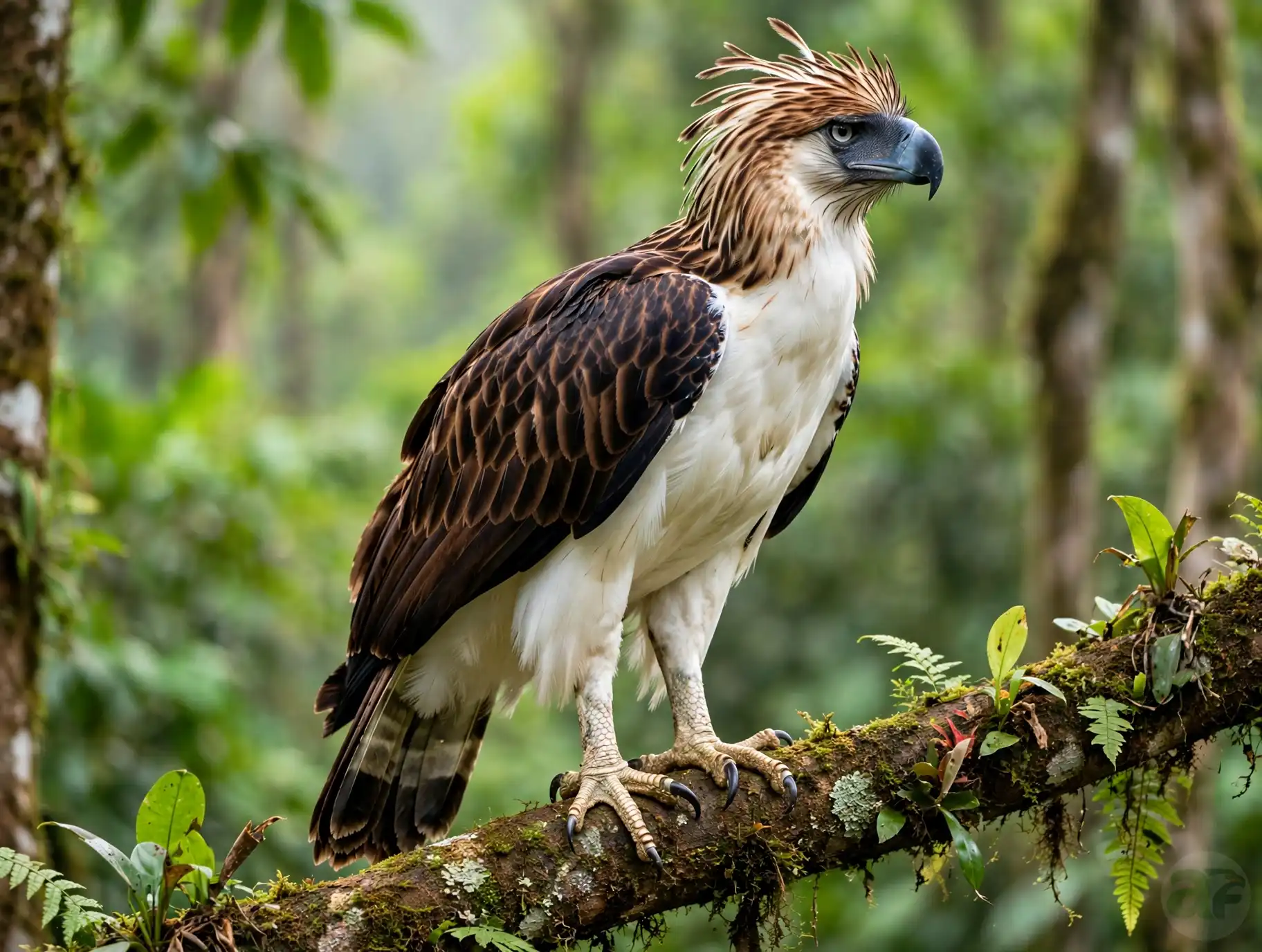
19. Best Places to See Philippine Eagles
Seeing a wild Philippine eagle is one of the most challenging large bird encounters in Southeast Asia — the species’ rarity, large territory requirements, and primary forest habitat making chance encounters genuinely rare even for experienced birders spending weeks in Mindanao.
The Philippine Eagle Center — The Most Reliable Option
Philippine Eagle Center, Malagos, Davao City, Mindanao — For the vast majority of visitors, the Philippine Eagle Center adjacent to the PEF facility in Malagos, Davao City, provides the most reliable and most informative Philippine eagle encounter available. The center maintains captive Philippine eagles in large, naturalistic enclosures — providing close-range views of the mane, the pale eyes, and the imposing bill that no wild encounter can match for proximity and duration. The center is accessible from Davao City (approximately 30–40 minutes by road), open daily to the public, and provides educational interpretation of exceptional quality. For anyone visiting the Philippines who wants to see a Philippine eagle, this is the essential first stop.
Wild Eagle Viewing — Genuinely Challenging
Mount Apo National Park, Davao del Sur and Cotabato, Mindanao — The slopes of the Philippines’ highest mountain hold important Philippine eagle populations within the national park’s 65,000 hectares of forest. Guided birding expeditions from Davao City can access forest areas where Philippine eagle territories are known — but sightings require multiple days of patient forest exploration with experienced local guides, and even dedicated efforts may not produce encounters. The park’s overall biodiversity makes it worthwhile regardless of eagle encounter success.
Mount Kitanglad Range Natural Park, Bukidnon, Mindanao — A UNESCO Biosphere Reserve in north-central Mindanao; important Philippine eagle habitat with known breeding territories. Access through Malaybalay city; guided birding programs available through local operators with knowledge of eagle territory locations.
Mount Hamiguitan Range Wildlife Sanctuary, Davao Oriental, Mindanao — A UNESCO World Heritage Site; important eagle habitat in eastern Mindanao accessible through the municipality of San Isidro. The sanctuary’s protected status and relative inaccessibility provide some of the best remaining undisturbed Philippine eagle habitat in eastern Mindanao.
Northern Sierra Madre Natural Park, Isabela Province, Luzon — For the rare opportunity to seek the critically small Luzon population; the park is the largest protected area in the Philippines (3,600 km²) and holds the remaining Luzon eagle population. Access is logistically challenging from Manila (typically via domestic flight to Cauayan or Tuguegarao), but the park’s exceptional biodiversity makes it one of the finest wilderness experiences in the Philippines.
The Realistic Assessment — Wild Philippine eagle encounters are genuinely rare and require significant planning, local guide expertise, multiple days in appropriate habitat, and realistic expectations. The Philippine Eagle Center provides the most reliable encounter for most visitors. For committed birders seeking wild encounters, engaging local guide services from organizations like Haribon Foundation or local birding groups in Davao City provides the best access to current nest location knowledge and productive habitat areas.
20. How You Can Help
Supporting Philippine eagle conservation requires action focused on Philippine forest protection, hunting reduction, community engagement, and direct support of the Philippine Eagle Foundation and allied conservation organizations.
Support these organizations:
- Philippine Eagle Foundation — philippineeaglefoundation.org — the primary institution for Philippine eagle conservation; captive breeding, field research, community engagement, and public education; the most direct way to support the species
- Haribon Foundation — haribon.org.ph — the Philippines’ oldest conservation organization; comprehensive Philippine biodiversity conservation including forest protection advocacy
- BirdLife International Philippines — birdlife.org — international coordination of Philippine eagle conservation; connects Philippine conservation efforts to global conservation networks
- WWF Philippines — wwf.org.ph — comprehensive Philippine environmental conservation including forest protection advocacy
- Rainforest Trust — rainforesttrust.org — funds forest protection in the Philippines including key Philippine eagle habitat areas
- Critical Ecosystem Partnership Fund (CEPF) — cepf.net — funds biodiversity conservation in the Philippines biodiversity hotspot including Philippine eagle-relevant programs
Critical individual actions:
- Donate directly to the Philippine Eagle Foundation — the PEF is the most important and most direct conservation organization for the species; even small donations fund specific conservation activities
- Adopt a Philippine eagle through PEF — symbolic adoption programs fund eagle care and conservation programs
- Visit the Philippine Eagle Center — visitor revenue supports PEF operations; visiting is a direct conservation contribution
- Support deforestation-free product supply chains — avoiding products associated with Philippine deforestation (certain palm oil, timber, and agricultural products) reduces the commercial pressure driving forest loss
- Spread awareness — the Philippine eagle’s conservation crisis is not widely known outside the Philippines; sharing accurate information about the species and its urgency builds the international attention that generates conservation support
- Support indigenous land rights in the Philippines — indigenous communities with recognized territorial rights are among the most effective forest protectors in Mindanao; supporting indigenous rights advocacy benefits Philippine eagles
- Write to Philippine government representatives — the Philippine eagle’s status as national bird means political advocacy for forest protection policies has particular resonance; international attention to the Philippine eagle’s conservation crisis creates political pressure for protective action
21. Top Documentaries & Books
Must-Watch Documentaries
- “Philippine Eagle: The Last of Its Kind” (ABS-CBN, various years) — Multiple dedicated Philippine national television documentary productions covering Philippine eagle conservation; among the finest treatments of the species’ biology and conservation crisis available
- “Haribon: The Philippine Eagle” (various productions) — Documentary treatments produced by various Philippine filmmakers covering eagle biology and conservation
- “BBC Natural World: Philippine Eagle” (BBC) — International documentary featuring Philippine eagle ecology and conservation; broader international distribution than Philippine national productions
- “Racing Extinction” (Discovery Channel, 2015) — Broader endangered species documentary that references the Philippine eagle in the context of global extinction crisis
- Philippine Eagle Foundation YouTube channel — philippineeaglefoundation.org — The most current video documentation of Philippine eagle captive breeding, behavior, and conservation programs; freely accessible
Must-Read Books
- Philippine Eagles by various Philippine authors — Multiple Philippine-published natural history treatments of the species
- Birds of the Philippines by Robert Kennedy, Pedro Gonzales, Edward Dickinson, Hector Miranda Jr., and Timothy Fisher — The standard comprehensive field guide to Philippine birds; essential for anyone visiting the Philippines for birding
- A Field Guide to the Birds of South-East Asia by Craig Robson — Regional context for Philippine eagle within the broader Southeast Asian avifauna
- The Philippine Eagle: Living Symbol of the Nation (Philippine Eagle Foundation publications) — PEF-produced educational materials on the species
- Critically Endangered Animals (various conservation references) — Multiple treatments of the Philippine eagle within broader threatened species contexts
22. Philippine Eagle Comparison with Other Forest Eagles
| Feature | Philippine Eagle | Harpy Eagle | Crested Eagle | Blyth’s Hawk-Eagle | Wallace’s Hawk-Eagle |
|---|---|---|---|---|---|
| Scientific name | Pithecophaga jefferyi | Harpia harpyja | Morphnus guianensis | Nisaetus alboniger | Nisaetus nanus |
| Max weight (female) | 8 kg | 9 kg | ~1 kg | ~1.3 kg | ~0.7 kg |
| Max wingspan | 220 cm | 224 cm | 120 cm | 100 cm | 90 cm |
| Primary prey | Flying lemurs, monkeys | Sloths, large monkeys | Small mammals, large lizards | Small birds, lizards | Small birds, lizards |
| Diagnostic feature | Lion’s mane; pale blue eyes | Divided crest; largest talons | Smaller; less dramatic crest | Bold head pattern | Small; bold head |
| Conservation | Critically Endangered | Vulnerable | Near Threatened | Least Concern | Least Concern |
| Range | Philippines ONLY | Neotropics | Neotropics | SE Asia | SE Asia |
| Monotypic genus | Yes — Pithecophaga | No | No | No | No |
| Breeding cycle | 2 years | 2–3 years | ~2 years | ~1 year | ~1 year |
| Population | <800 individuals | <50,000 | Unknown | Not threatened | Not threatened |
| Famous for | Rarest eagle in Asia; national bird Philippines | Most powerful eagle Americas | Similar crest; smaller | Bold head pattern | SE Asia specialist |
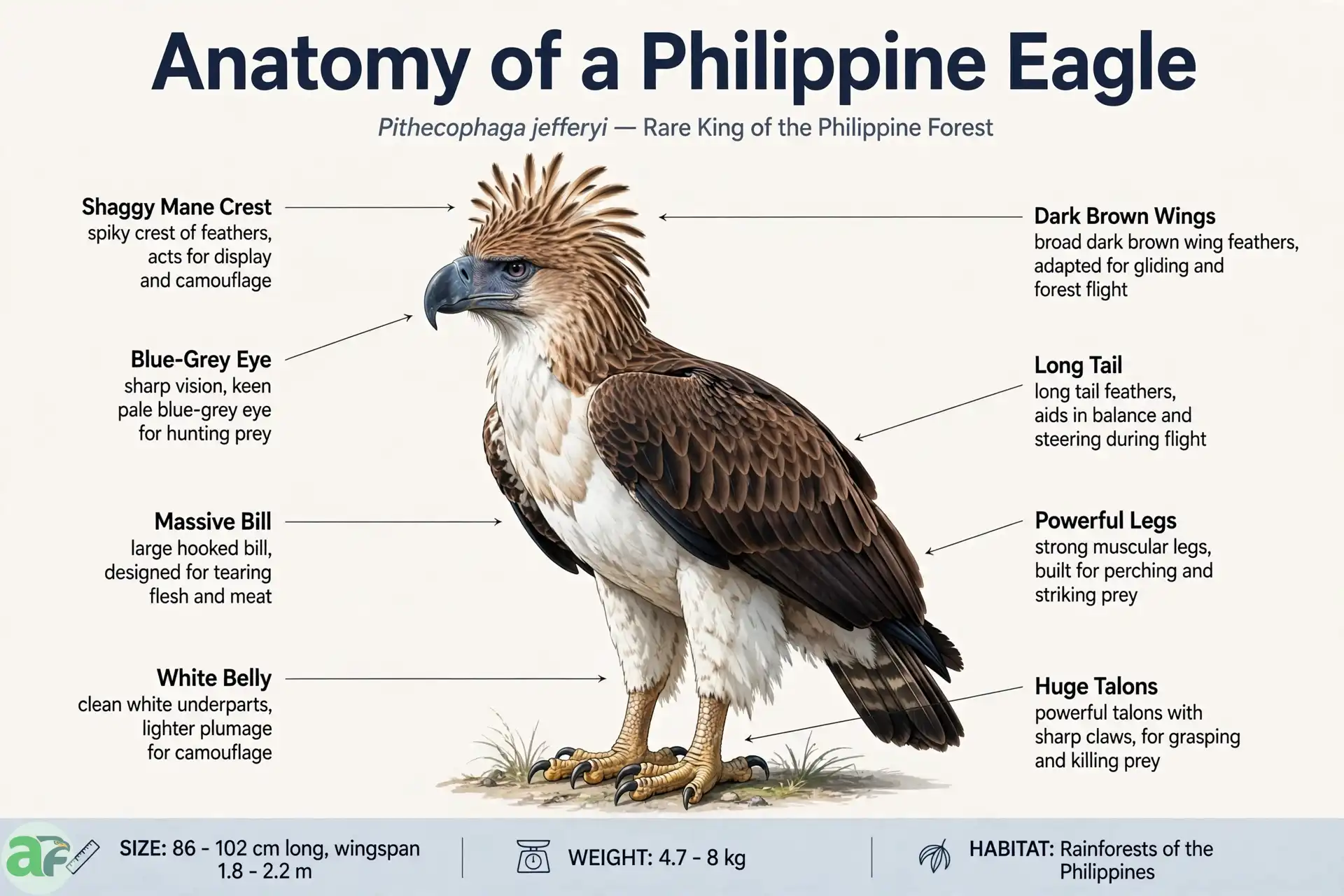
23. Frequently Asked Questions About Philippine Eagles
Q1. What is the scientific name of the Philippine eagle?
The Philippine eagle’s scientific name is Pithecophaga jefferyi (Ogilvie-Grant, 1896). The genus name Pithecophaga derives from the Greek pithekos (monkey) and phagein (to eat) — meaning “monkey-eater” — reflecting the early accounts of the eagle’s predatory behavior that emphasized monkey prey before the dietary dominance of flying lemurs was established. The species name jefferyi honors Jeffery Whitehead, the son of the naturalist John Whitehead who collected the first specimens from Mindanao in 1895. The formal description was published by British ornithologist William Robert Ogilvie-Grant in 1896, simultaneously establishing both the genus Pithecophaga and the species P. jefferyi. The Philippine eagle is the sole member of the genus Pithecophaga — a monotypic genus containing no other species. The species belongs to the family Accipitridae (hawks and eagles) within the order Accipitriformes. Its phylogenetic placement within Accipitridae has been debated — some analyses place it near the harpy eagle subfamily (Harpiinae), while more recent molecular work suggests possible affinities with snake eagles (Circaetinae), a placement that would make its harpy-eagle-like ecological specialization an even more remarkable example of convergent evolution. The common name “Philippine eagle” officially replaced the former name “monkey-eating eagle” through Presidential Decree No. 1596 signed by President Ferdinand Marcos in 1978.
Q3. How many Philippine eagles are left in the world?
As of 2026, the estimated wild population of Philippine eagles is fewer than 800 mature individuals — and some current assessments suggest the true figure may be as low as 600 individuals. This makes the Philippine eagle one of the rarest eagles on Earth and one of the rarest large birds globally. The population is distributed across four Philippine islands: Mindanao (approximately 600–700 individuals — the species’ stronghold), Leyte (approximately 30–50 individuals), Samar (approximately 20–30 individuals), and Luzon (fewer than 20 individuals — this population is considered by many researchers to be functionally non-viable without immediate intervention). The captive population at the Philippine Eagle Foundation adds approximately 30–40 additional individuals, providing genetic insurance but not contributing to wild population numbers. The population trend is decreasing — deforestation and continued hunting are reducing numbers despite conservation efforts. Population modeling by BirdLife International and other organizations suggests that at current rates of habitat loss and adult mortality, the Philippine eagle population could fall below the functional extinction threshold within 30–50 years without dramatic intervention. This timeline makes Philippine eagle conservation one of the most urgent large-bird conservation priorities in Asia.
Q3. Why is the Philippine eagle critically endangered?
The Philippine eagle is Critically Endangered due to the intersection of three reinforcing threats operating simultaneously in a geographically constrained species with inherently slow reproduction. First, deforestation — the Philippines has lost approximately 93% of its original forest cover since European colonization, with the most rapid recent losses occurring in Mindanao where most eagles survive. The Philippine eagle’s absolute requirement for primary old-growth dipterocarp forest — for nesting sites, for flying lemur prey, and for the minimum territory size needed for successful breeding — means that habitat loss translates directly and immediately into population loss. Second, direct persecution — despite a 12-year prison sentence for killing a Philippine eagle, shooting continues across the species’ range. Farmers who incorrectly believe eagles threaten their livestock, hunters, and individuals with traditional use motivations continue to remove breeding adults from the population at rates the species’ slow reproduction cannot compensate for. Third, the species’ inherently slow reproduction — breeding only once every two years, raising a single chick per breeding attempt, and requiring 12–20 months of post-fledging dependency — means that even a relatively small number of adult deaths per year can drive population decline. A breeding female Philippine eagle that dies removes potentially 10–20 future offspring from the population; if deaths exceed the rate at which young birds achieve reproductive maturity, the population declines toward extinction. The combination of these three factors creates a situation where the population is declining despite existing legal protection and conservation programs — requiring a step-change in conservation investment and political commitment to reverse.
Q4. What does the Philippine eagle eat?
Despite being historically called the “monkey-eating eagle,” the Philippine eagle’s primary prey is the Philippine flying lemur (Cynocephalus volans — also called the Sunda colugo) — a gliding mammal that accounts for approximately 50–90% of the diet at most studied sites. Flying lemurs are large (weighing 1–1.75 kg) gliding mammals found in Philippine dipterocarp forest — they glide between trees using a large patagium (gliding membrane) stretching from chin to feet. The Philippine eagle’s predation on flying lemurs is so ecologically significant that it constitutes one of the most important predator-prey relationships in the Philippine forest ecosystem. Secondary prey includes Philippine long-tailed macaques (Macaca fascicularis) — which gave the eagle its former common name but represent a minority of the actual diet; large flying foxes (Pteropus species); large snakes including juvenile reticulated pythons; monitor lizards; juvenile Philippine deer; large birds including hornbills; and various other large vertebrates that the eagle encounters in its extensive territory. The dietary versatility allows the eagle to maintain energy intake during periods when flying lemur density is locally reduced — but the dependence on primary forest habitat for all prey categories means that habitat loss affects all food sources simultaneously.
Q5. Where is the best place to see a Philippine eagle?
The most accessible and most educational Philippine eagle experience is the Philippine Eagle Center in Malagos, Davao City, Mindanao — operated by the Philippine Eagle Foundation. The center maintains captive Philippine eagles in large, naturalistic enclosures, provides exceptional interpretive educational programs, and receives approximately 100,000 visitors per year. For international visitors, Davao City is served by direct flights from Manila (approximately 1.5 hours) and from several international destinations including Singapore. The center is accessible from central Davao City by approximately 30–40 minutes of road travel. For visitors seeking wild Philippine eagle encounters, the most productive approach is to engage local guide services with knowledge of current nest sites in the forests around Mount Apo National Park or Mount Kitanglad Range Natural Park in Mindanao — both accessible from Davao City and Bukidnon respectively. Wild encounters require multiple days in the field, experienced local guides familiar with individual eagle territories, and realistic expectations — even dedicated multi-day efforts do not guarantee sightings. The Philippine Eagle Center is genuinely the recommended first destination; wild encounters should be approached as an extraordinary bonus rather than a primary objective.
24. Sources & References
- Wikipedia — Pithecophaga jefferyi, Harpiinae, Cynocephalus volans, Philippine forests
- IUCN Red List — iucnredlist.org (current Critically Endangered assessment for Pithecophaga jefferyi)
- BirdLife International — birdlife.org (species factsheet; population assessment)
- Philippine Eagle Foundation — philippineeaglefoundation.org (captive breeding documentation; field research data; conservation program information)
- Kennedy, R.S. et al. (2000). A Guide to the Birds of the Philippines. Oxford University Press
- Rabor, D.S. — foundational early research on Philippine eagle ecology
- Salvador, D. and colleagues — Philippine Eagle Foundation published research on breeding ecology, diet, and conservation
- Haribon Foundation — haribon.org.ph
- WWF Philippines — wwf.org.ph
- National Geographic — nationalgeographic.com
- BBC Wildlife / BBC Earth — bbcearth.com
- Britannica — britannica.com/animal/Philippine-eagle
- Cornell Lab of Ornithology — allaboutbirds.org (species account; Macaulay Library)
- Critical Ecosystem Partnership Fund — cepf.net (Philippines biodiversity hotspot documentation)