


Harpy Eagle Facts
| Feature | Details |
|---|---|
| Scientific Name | Harpia harpyja (Linnaeus, 1758) |
| Kingdom | Animalia |
| Phylum | Chordata |
| Class | Aves |
| Order | Accipitriformes |
| Family | Accipitridae |
| Common Names | Harpy eagle; American harpy eagle; royal hawk (Brazil: gavião-real) |
| Native Range | Southern Mexico through Central America and South America to Bolivia, Brazil, and northeastern Argentina |
| Habitat | Lowland tropical rainforest — the largest and most intact primary forest; rarely seen in degraded or fragmented habitat |
| Lifespan | 25–35 years (wild); up to 40 years (captivity) |
| Diet | Primarily arboreal mammals — sloths, monkeys, opossums; also large birds and reptiles |
| Body Length | 86–107 cm |
| Wingspan | 176–224 cm — relatively short and broad for body size |
| Weight | Males 4–4.8 kg; females 6–9 kg — females dramatically larger |
| Talon Size | Female rear talons up to 12.5 cm — larger than a grizzly bear’s claws |
| Conservation Status | Vulnerable (IUCN) — declining due to deforestation and hunting |
| Defining Feature | Divided facial disc — unique among eagles; binocular-lens-like feather arrangement that channels sound; combined with the largest talons of any eagle and extraordinary prey-to-predator mass ratio |
| National Symbol | National bird of Panama |
| Closest Relatives | Papuan eagle (Harpyopsis novaeguineae) — its closest living relative; Philippine eagle (Pithecophaga jefferyi) — convergent but not closely related |
 1. Introduction: What is a Harpy Eagle?
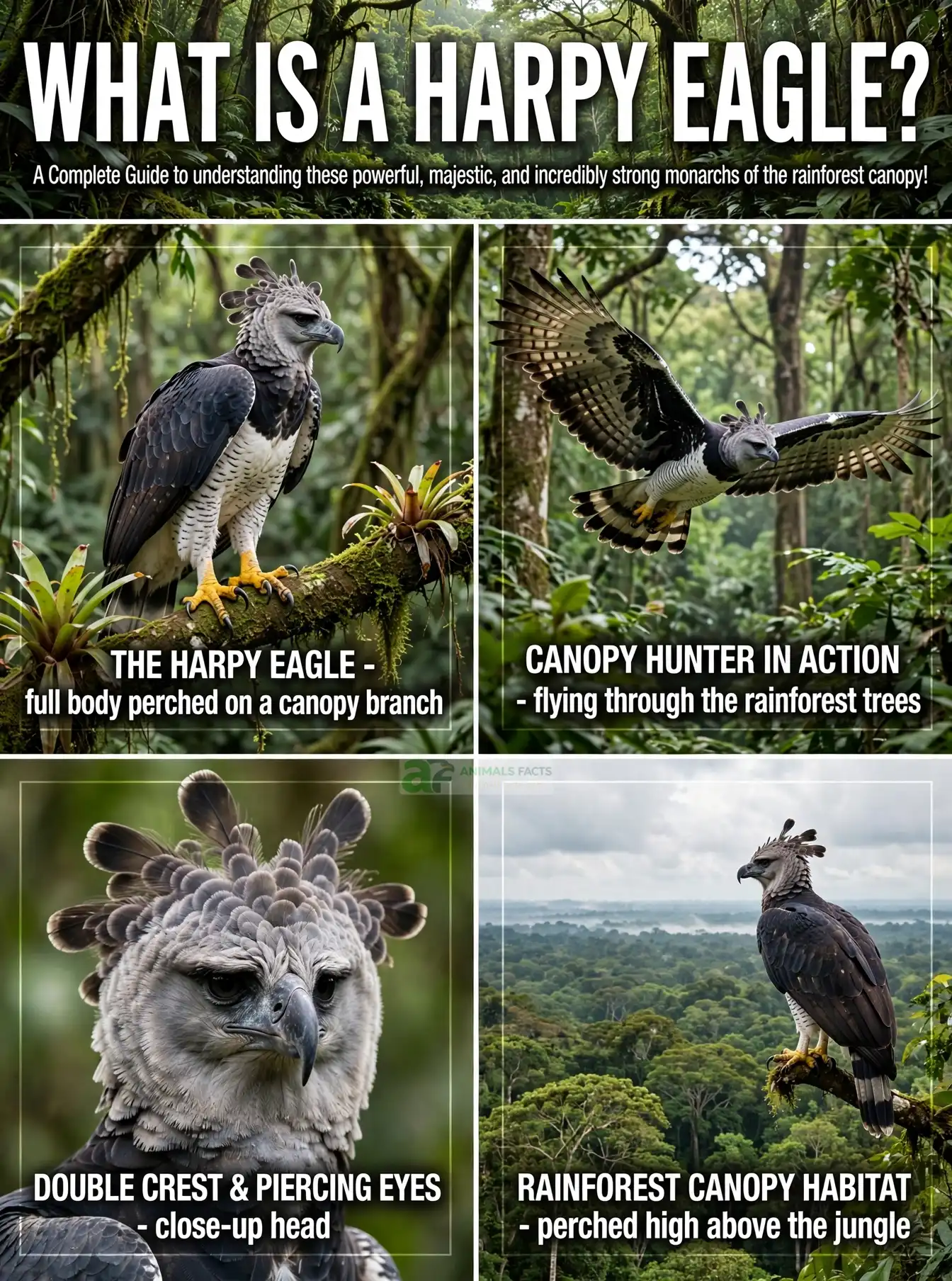
Deep in the primary rainforest of the Amazon Basin, in the tall-canopy forest where the emergent trees rise 50 meters above the forest floor and the air is thick with the calls of howler monkeys and macaws, something moves through the mid-canopy with a silence that seems physically impossible for an animal of its size. There is a shape between the massive trunks — two meters of wingspan maneuvered through gaps between branches with the precision of a smaller bird, navigating obstacles at speed without a single feather touching the surrounding vegetation, the ash-grey and white plumage barely visible against the dappled light of the forest interior. Then the shape resolves — a head, pale grey with a divided black crest that can be raised into a dramatic circular fan; a chest of brilliant white barred with a thick black band; feet that grip the branch with talons whose rear claw is longer than a grizzly bear’s. The harpy eagle perches, entirely unhurried, one hundred and ten percent at the apex of whatever food chain this patch of forest contains, and turns its head toward something that has moved in the canopy forty meters distant — a three-toed sloth, hanging inverted from a cecropia branch, not yet aware that the most powerful bird of prey in the Americas has located it. The harpy eagle launches. Harpy eagle facts begin with this moment — not the moment of the strike, but the moment just before it, in which every element of one of the most perfectly realized predatory systems in the natural world is assembled and about to function.
The harpy eagle (Harpia harpyja) occupies a position in the ecology of the New World tropics that has no precise parallel anywhere in the world’s ecosystems. It is the largest and most powerful eagle in the Americas — and by the measure of talon size, prey-to-predator mass ratio, and the absolute mass of prey routinely taken, arguably the most powerful eagle on Earth. Its rear talons reach 12.5 centimeters in large females — longer than the claws of a grizzly bear and capable of exerting grip forces that compress the spinal columns of adult sloths and large monkeys. It is the only eagle that has evolved a divided facial disc — a binocular-lens-like arrangement of feathers around the face that channels sound toward the ear openings in the same way that the facial discs of owls amplify their hearing — giving the harpy eagle a sensory system in the dense, acoustically complex rainforest that supplements its visual hunting with sound detection capability unique among eagles. And it is a bird so visually extraordinary — the grey face, the divided black crest that fans into a dramatic circular halo during display and alarm, the white breast marked with the single broad black pectoral band, the enormous pale feet bearing those massive black talons — that virtually everyone who encounters one for the first time reports an experience closer to encountering a mythological creature than a living bird.
Interesting facts about harpy eagles reveal an animal of breathtaking biological precision — the proportionally short, broad wings that allow navigation at high speed through the complex three-dimensional architecture of the primary forest interior in a way that long-winged eagles cannot achieve; the extraordinary prey size range from small lizards at the minimum to adult sloths weighing 8–9 kilograms — often heavier than the hunting bird itself — at the maximum; the two-year breeding cycle — the slowest reproduction rate of any eagle in the Americas — that reflects the extraordinary energetic investment of raising a single eaglet to competence; and the conservation crisis driven by the intersection of Amazon deforestation and targeted hunting, that has placed this extraordinary animal in the Vulnerable category while the forest that sustains it continues to shrink. Whether you are searching for harpy eagle facts for kids to explore the biology of the Americas’ most powerful raptor, a wildlife enthusiast planning an expedition to see this extraordinary bird, a conservation researcher concerned about the fate of forest apex predators in the Amazon, or simply someone who encountered an image of this bird and experienced the immediate, absolute conviction that natural selection had produced something beyond ordinary expectation — this is your comprehensive guide. The world’s most powerful forest eagle has an extraordinary story to tell.
2. Harpy Eagle Species Overview & Classification
The harpy eagle belongs to a small, ancient group of large forest-hunting eagles — the subfamily Harpiinae — that represents one of the most ecologically significant raptor lineages in the tropical forest world.
Species Classification Table
| Taxonomic Rank | Classification |
|---|---|
| Kingdom | Animalia |
| Phylum | Chordata |
| Class | Aves |
| Order | Accipitriformes |
| Family | Accipitridae (Vigors, 1824) |
| Subfamily | Harpiinae |
| Genus | Harpia (Vieillot, 1816) |
| Species | H. harpyja (Linnaeus, 1758) |
| Common Names | Harpy eagle; American harpy eagle; royal hawk; gavião-real (Portuguese); águila harpía (Spanish) |
| Etymology | Harpia from the Harpies of Greek mythology — the winged spirits of sudden death that swept victims from the earth; harpyja = the same mythological reference in species name; “harpy” from Greek harpuia = “snatcher” — the mythological beings whose swift, silent seizure of victims perfectly describes the harpy eagle’s ambush hunting style |
The Subfamily Harpiinae — The Forest Giant Eagles
The harpy eagle belongs to a small subfamily of large, forest-specialist eagles — the Harpiinae — whose members represent some of the most ecologically significant raptors in the world’s tropical forests:
| Species | Common Name | Range | Weight | Conservation |
|---|---|---|---|---|
| Harpia harpyja | Harpy eagle | Neotropics | Up to 9 kg | Vulnerable |
| Harpyopsis novaeguineae | Papuan eagle | New Guinea | Up to 2.4 kg | Vulnerable |
| Morphnus guianensis | Crested eagle | Neotropics | Up to 1 kg | Near Threatened |
The Convergent Parallel — Philippine Eagle
While not a close relative, the Philippine eagle (Pithecophaga jefferyi) is frequently compared to the harpy eagle as the closest ecological parallel in the Old World tropics:
| Feature | Harpy Eagle | Philippine Eagle |
|---|---|---|
| Scientific name | Harpia harpyja | Pithecophaga jefferyi |
| Range | Neotropical rainforest | Philippines (Mindanao primarily) |
| Max weight | ~9 kg | ~8 kg |
| Primary prey | Sloths, monkeys | Flying lemurs, monkeys |
| Crest | Divided black crest | Long brown crest |
| Conservation | Vulnerable | Critically Endangered |
| Talons | Largest of any eagle | Very large |
| Relationship | Not closely related | Convergent evolution |
| Facial disc | Yes — unique among eagles | Partial facial disc |
The Aquila Contrast — Different Evolutionary Strategies
The comparison between the harpy eagle and the golden eagle (Aquila chrysaetos) — the most powerful eagle of the open Northern Hemisphere versus the most powerful eagle of the closed-canopy tropics — illustrates two fundamentally different evolutionary solutions to eagle apex predation:
The open-country strategy (golden eagle) — Long wings for soaring efficiency; high-speed stoop from altitude; visual prey detection at long range across open terrain.
The forest-canopy strategy (harpy eagle) — Short, broad wings for maneuverability in complex vegetation; surprise ambush from perches; both visual and auditory prey detection in acoustically complex forest; power and grip force optimized for capturing large, clinging prey.
Evolution & Discovery Timeline
~20–30 million years ago (Oligocene-Miocene) — The ancestral Harpiinae lineage diverges within the Accipitridae radiation — establishing the forest eagle lineage that will produce the harpy eagle and its relatives.
~5–10 million years ago — The Harpia lineage diverges within the Harpiinae — establishing in the Neotropical rainforest as the continent’s primary large arboreal mammal predator.
Pre-Columbian era — The harpy eagle is deeply embedded in the cultural and spiritual life of indigenous Amazonian and Mesoamerican peoples — its feathers among the most valued ceremonial objects across multiple civilizations, and its hunting prowess a subject of reverence and mythology.
1758 — Carl Linnaeus formally describes the harpy eagle as Vultur harpyja in the 10th edition of Systema Naturae — initially placing it in the vulture genus before the species was reclassified to Harpia.
1816 — Louis Jean Pierre Vieillot establishes the genus Harpia — recognizing the harpy eagle’s distinctiveness as requiring its own genus classification.
1960s–present — Systematic research on harpy eagle ecology begins in Panama, Brazil, and other Neotropical countries — establishing the foundational understanding of the species’ biology, prey preferences, and breeding system.
1986 — Panama formally designates the harpy eagle as the national bird — recognizing the species’ cultural and ecological significance to the country.
2020s — The Peregrine Fund’s harpy eagle research and conservation program in Panama, Brazil, and other countries represents the most comprehensive ongoing harpy eagle research effort — combining population monitoring, nest camera documentation, and community-based conservation.
2024 — Harpia harpyja maintains its Vulnerable IUCN classification — the population trend assessed as decreasing, primarily driven by Amazon deforestation and targeted hunting.
“The harpy eagle is the Amazon’s apex predator in every sense — physically, ecologically, and symbolically. It is what happens when evolution has 20 million years and a forest canopy full of large-bodied prey to work with. There is nothing in the Neotropical rainforest that is a more complete biological achievement than a female harpy eagle in her primary forest territory.”
— Dr. Everton Miranda, University of Brasília — leading harpy eagle researcher in Brazil
3. Harpy Eagle Physical Description & Unique Features
The harpy eagle’s physical appearance is unlike any other eagle in the world — an accumulation of features that, individually, would be extraordinary in any raptor, but that together create the most imposing bird of prey in the Americas.
The Overall Body Plan — Power Expressed in Structure
Body dimensions — The harpy eagle is a large, stocky eagle — the body length of 86–107 cm placing it in the same size range as the golden eagle, but the extreme reverse sexual size dimorphism means females are dramatically larger:
| Measurement | Male | Female |
|---|---|---|
| Body length | 86–95 cm | 95–107 cm |
| Wingspan | 176–200 cm | 200–224 cm |
| Weight | 4.0–4.8 kg | 6.0–9.0 kg |
The 9 kg maximum female body mass makes the harpy eagle the heaviest eagle in the Americas and ties it with the Steller’s sea eagle as the heaviest eagle in the world — though the Philippine eagle at maximum also approaches this figure.
The proportionally short wingspan — The harpy eagle’s wingspan of 176–224 cm is relatively modest for its body mass — shorter than might be expected for a bird weighing up to 9 kg. This proportional relationship is a specific adaptation: in the closed-canopy primary rainforest interior where the harpy eagle hunts, a short, broad wing with highly rounded tips provides better maneuverability between tree trunks and branches than the long, narrow wings of open-country eagles. The harpy eagle sacrifices soaring efficiency for the ability to pursue prey through the complex three-dimensional architecture of the forest canopy.
The Head — The Most Distinctive Feature
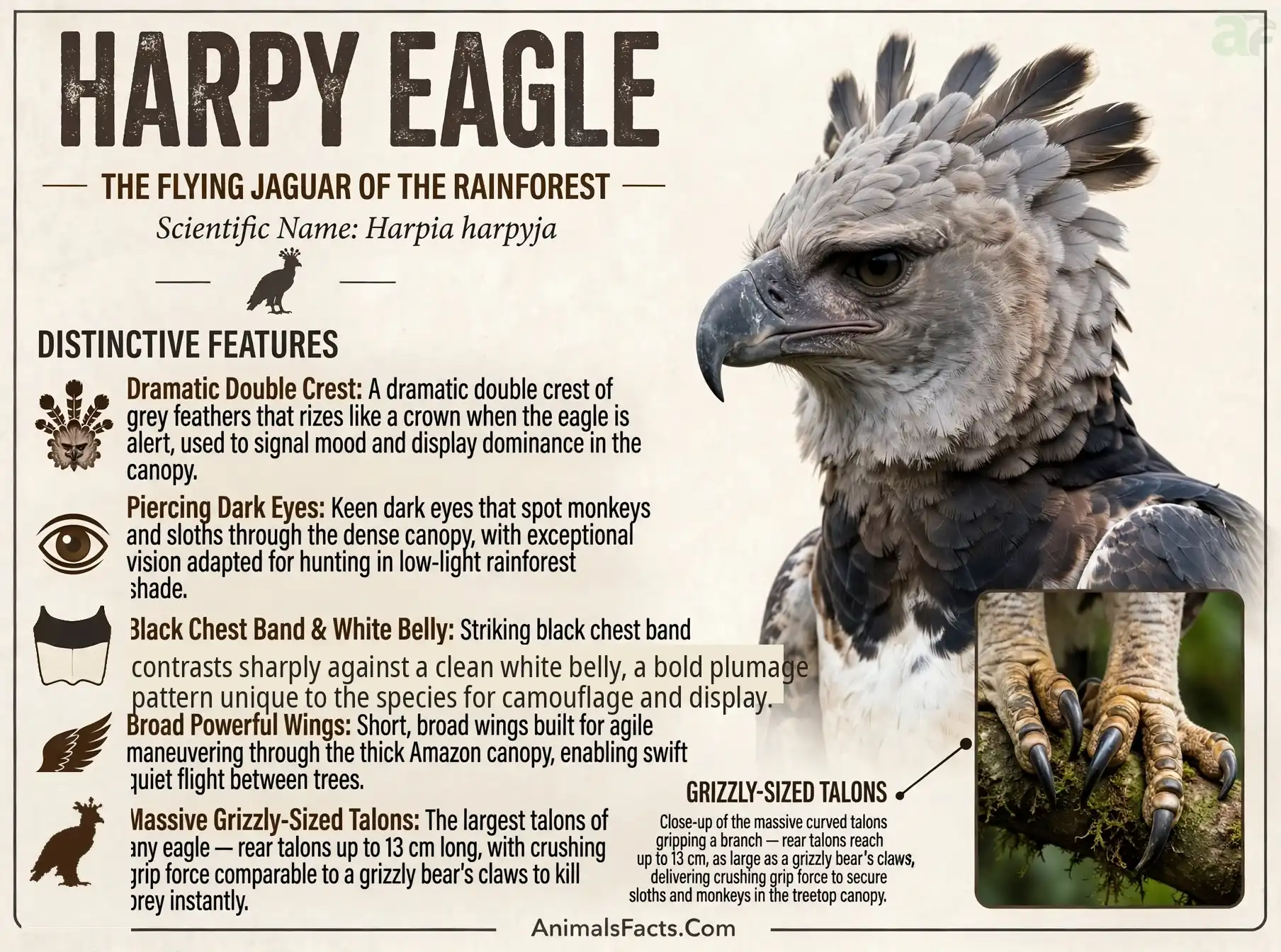
The divided facial disc — The harpy eagle’s most anatomically unique feature — a semicircular arrangement of short, stiff feathers surrounding the face that can be erected into a distinctive disc shape during alarm or display. This facial disc is unique among eagles — while owls are famous for their facial discs that channel sound to their ear openings, no other eagle has evolved a comparable structure. The harpy eagle’s facial disc appears to serve a similar acoustic function — concentrating sound toward the ear openings and enhancing the bird’s ability to detect prey movements in the acoustically complex environment of the forest interior.
The divided crest — The feathers of the crown and nape form a distinctive divided crest — dark grey to black feathers that project backward in two sections when relaxed, creating the characteristic “divided” or “double” appearance. When alarmed or displaying, the crest is raised into a dramatic circular halo of dark feathers framing the pale face — a display that immediately and dramatically increases the apparent size of the head and creates an imposing visual effect that is one of the most striking displays of any raptor.
The facial coloration — The face is pale grey — an unusually pale face color for a large eagle. The pale grey face, surrounded by the dark crest when erected, creates a striking visual contrast that is one of the harpy eagle’s most immediately recognizable characteristics.
The eye color — Adult eyes are dark brown to grey — not the bright yellow of sea eagles or the pale yellow of some other raptors. The eye is large — proportionally larger than might be expected even for a large eagle — and the visual acuity is extraordinary despite the reduced light levels of the forest interior.
The Plumage — Elegant Simplicity
Compared to the complex multi-color plumage of many other spectacular birds in this article series, the harpy eagle’s coloration is relatively simple — but the simplicity creates an impact of dignified, imposing elegance:
The upper parts — Back, wings, and tail are dark slate grey — a cool, neutral grey that contrasts with the white underparts.
The white underparts — The breast, belly, and flanks are brilliant white — creating a striking high-contrast division between the dark upper parts and pale lower parts when the bird is seen in the forest.
The pectoral band — A single broad black band crosses the upper breast at the level of the lower neck — the most distinctive plumage pattern feature. The pectoral band clearly demarcates the white breast from the grey upper parts and creates a visual impression of a bird wearing a collar or gorget.
The tail banding — The tail shows three dark bands on grey — visible when the tail is spread during landing or display, providing a classic hawk-like banded tail pattern.
The leg feathering — The legs are white with fine dark barring — the pale legs and enormous pale yellow feet creating a striking visual contrast with the dark talons.
The Talons — The Biological Record
The harpy eagle’s talons are the defining physical feature of the species from a functional standpoint — and they hold the record for the largest talons of any living eagle:
The rear talon (hallux) — The primary killing weapon; in large females, the hallux talon reaches 12.5 cm in length — longer than the claws of an adult grizzly bear and longer than the talons of any other living eagle species. The hallux talon is the structure that is driven into prey’s vital regions at the moment of capture.
Total foot span — The full spread of the harpy eagle’s foot — from front talon to rear talon in maximum extension — reaches 20–25 cm in large females. This foot span is sufficient to grip and cover the entire back and shoulder region of an adult three-toed sloth.
Grip force — Measured grip force in harpy eagle feet exceeds 400 Newtons in controlled studies — sufficient to fracture the skull of prey animals and compress the spinal column, delivering immediate incapacitation at the moment of capture.
The yellow feet — The feet and legs are vivid yellow — the yellow color providing a striking contrast with the white leg feathering above and the black talons below.
The Wings — Optimized for Forest Maneuvering
Short and broad — The relatively short wingspan (for body size) and broad wing shape are the key adaptations for forest hunting:
The rounded wingtip — Unlike the “fingered” wingtips of soaring eagles, the harpy eagle’s wingtips are relatively bluntly rounded — the primaries not separating into distinct fingers as dramatically. This rounded tip shape reduces air turbulence at the wing tip during slow-speed maneuvering in confined spaces.
The high wing loading — The relatively small wing area supporting a large body mass creates high wing loading — meaning the harpy eagle must fly faster to maintain lift than a long-winged eagle would. In the hunting context, this translates to the powerful, fast flight through the forest interior that makes the harpy eagle such an effective ambush predator.
💡 Did You Know? The harpy eagle’s divided facial disc — the circular arrangement of stiff feathers around the face that can be erected into a halo-like display — appears to function similarly to an owl’s facial disc as an acoustic focusing system. Research by ornithologists working with captive harpy eagles has documented that the erected facial disc redirects sound waves toward the ear openings, potentially amplifying directional sound detection in the acoustically challenging environment of the dense rainforest interior. This acoustic enhancement would complement the visual hunting system — allowing the harpy eagle to detect prey moving in the canopy through sound as well as through sight, particularly valuable in the dim, vegetatively complex environment where visual detection alone would miss prey concealed in dense leaf growth. The facial disc is unique among eagles globally — the only eagle that has evolved this owl-like sound-focusing adaptation. Its presence in the harpy eagle but not in open-country eagles (which rely primarily on long-range visual detection) reflects the specific challenges of primary rainforest hunting, where prey can be heard moving through the canopy at distances where it cannot be seen.
4. Top 25 Amazing Harpy Eagle Facts
Here is your definitive collection of the most extraordinary, scientifically verified, and genuinely astonishing harpy eagle facts as of 2026:
- The harpy eagle’s rear talons reach 12.5 cm in length in large females — longer than the claws of an adult grizzly bear. These talons, combined with a measured grip force exceeding 400 Newtons, make the harpy eagle’s feet the most powerful biological grasping weapons of any bird of prey.
- The harpy eagle is the heaviest eagle in the Americas and ties with the Steller’s sea eagle as the heaviest eagle in the world — large females reaching documented weights of 9 kilograms. The harpy eagle’s extreme reverse sexual size dimorphism means females may be twice the mass of males.
- The harpy eagle hunts prey that frequently exceeds its own body weight — adult three-toed sloths weighing 8–9 kg have been documented as regular prey items, and adult male howler monkeys weighing 6–7 kg are taken. This capacity for prey heavier than the hunting bird is among the most extreme in any avian predator.
- The harpy eagle has a unique facial disc — a circular arrangement of stiff feathers around the face that can be erected into a dramatic halo during display and alarm. No other eagle species has evolved this owl-like acoustic focusing structure, which appears to enhance sound detection in the complex acoustic environment of the rainforest.
- The harpy eagle’s wing design is specifically adapted for forest flight — a proportionally short, broad wing with rounded tips allowing high-speed navigation through the complex three-dimensional architecture of the primary rainforest interior in a way that the long wings of open-country eagles cannot achieve.
- The harpy eagle is the national bird of Panama — chosen in 1986 to represent the country’s natural heritage. Panama has developed significant harpy eagle conservation programs at Soberanía National Park near Panama City, where semi-habituated individuals can be reliably observed.
- Harpy eagles breed at an extraordinary slow rate — raising just one chick every 2–3 years. The combination of one egg per clutch (with the second egg rarely incubated), an incubation period of 56 days, a nestling period of 5–6 months, and a post-fledging dependency of 12–18 months creates a breeding cycle unlike any other eagle in the Americas.
- The harpy eagle requires primary old-growth tropical rainforest for successful breeding — the species essentially absent from secondary forest, degraded habitat, and forest fragments. The requirement for intact primary forest makes the harpy eagle one of the most sensitive indicators of Amazon deforestation impact on apex predators.
- The harpy eagle is named after the Harpies of Greek mythology — the winged spirits of sudden death (harpuia = “snatcher”) that silently and suddenly carried victims from the earth. The name captures the harpy eagle’s hunting style with remarkable accuracy — the bird moving silently through the forest before a sudden, explosive capture strike.
- Harpy eagle home ranges are among the largest of any tropical raptor — documented at 25–100 km² per breeding pair. The large home range reflects both the patchy distribution of prey in the primary forest and the extraordinary energetic demands of the species — a large home range being necessary to support a predator of this mass in a forest ecosystem.
- The harpy eagle’s breeding pair uses the same nest tree for multiple breeding attempts across many years — documented nest trees have been used for 25–30 years continuously. The nest is typically built in the crown of one of the forest’s largest emergent trees — a Brazil nut tree or kapok (Ceiba pentandra) being preferred in many areas.
- The primary prey of the harpy eagle across most of its range is the three-toed sloth (Bradypus species) — accounting for approximately 50% of the diet at most studied sites. The sloth’s slow movement, predictable arboreal habitat use, and large body mass make it the ideal harpy eagle prey item.
- The harpy eagle’s crest — the divided dark feathers of the crown and nape — can be raised into a dramatic circular halo during display and alarm, instantly transforming the bird’s appearance from subtly impressive to spectacularly imposing. The crest erection is one of the most dramatic visual displays of any raptor.
- Research using GPS tracking has documented that individual harpy eagles make very limited movements — often remaining within a core area of 5–10 km² for weeks at a time during the chick-rearing period, with occasional longer movements to hunt at productive sites outside the core territory.
- The harpy eagle’s primary forest requirement creates a direct link between Amazon deforestation rates and harpy eagle population viability — the species has disappeared from approximately 40% of its historical range as deforestation has eliminated primary forest across the southern and eastern Amazon.
- Historically, indigenous Amazonian peoples kept harpy eagles in village captivity after capturing juveniles from nests — maintaining the birds as living symbols of power, prestige, and connection to the spiritual realm. Harpy eagle feathers were among the most valuable ceremonial objects in multiple Amazonian cultures.
- The harpy eagle’s post-fledging dependency period of 12–18 months means that the young eagle is still dependent on parental food delivery for up to a year and a half after leaving the nest — one of the longest dependency periods of any eagle. During this period, the young bird learns hunting technique through observation and progressively independent practice.
- Harpy eagles have been documented killing prey of extraordinary diversity — beyond sloths and monkeys, documented prey includes porcupines, coatimundis, kinkajous, large iguanas, snakes, and various large birds including macaws and young toucans. The prey diversity reflects the harpy eagle’s opportunistic exploitation of whatever large-bodied prey is locally accessible.
- The harpy eagle’s nearest living relative is the Papuan eagle (Harpyopsis novaeguineae) of New Guinea — a much smaller forest eagle of New Guinea’s mountain forests that shares Harpiinae ancestry but evolved in a completely different forest ecosystem with different prey communities.
- At several sites in Panama and Brazil, individual harpy eagles that have become habituated to human presence near their nest trees provide the most reliable wild harpy eagle viewing opportunities available anywhere in the species’ range — contributing significantly to ecotourism economies in areas where the birds are protected.
- The harpy eagle’s sexual size dimorphism is the most extreme of any eagle in the Americas — female body mass up to twice that of males. The ecological implication is that male and female harpy eagles effectively occupy different prey size niches — males hunting smaller prey (monkeys, large lizards) while females handle the largest prey items (adult sloths, large monkeys).
- Research on harpy eagle stomach contents and nest remains has confirmed that individual prey items weighing over 100% of the hunting bird’s body weight are regularly consumed — an adult male harpy eagle weighing 4.5 kg taking a brown-throated three-toed sloth weighing 4.8 kg represents the bird carrying prey heavier than itself.
- The harpy eagle has been listed in the Guinness World Records for the largest talons of any living eagle — a recognition that reflects the species’ unique position at the absolute apex of avian predatory power.
- Several countries with significant harpy eagle populations have developed national conservation programs specifically targeting the species — Brazil’s HARP (Harpy Eagle Research and Protection) program and Panama’s Peregrine Fund program being the most comprehensive, combining nest monitoring, community engagement, and captive breeding for educational ambassador birds.
- As of 2026, the harpy eagle is classified as Vulnerable (IUCN) with a population estimated at fewer than 50,000 mature individuals — down from historical levels and continuing to decline as Amazon deforestation eliminates the primary forest habitat the species requires. The species has been extirpated from El Salvador, has very few records from Mexico and much of Central America, and is declining across the southern Amazon.
5. Fun Facts About Harpy Eagles
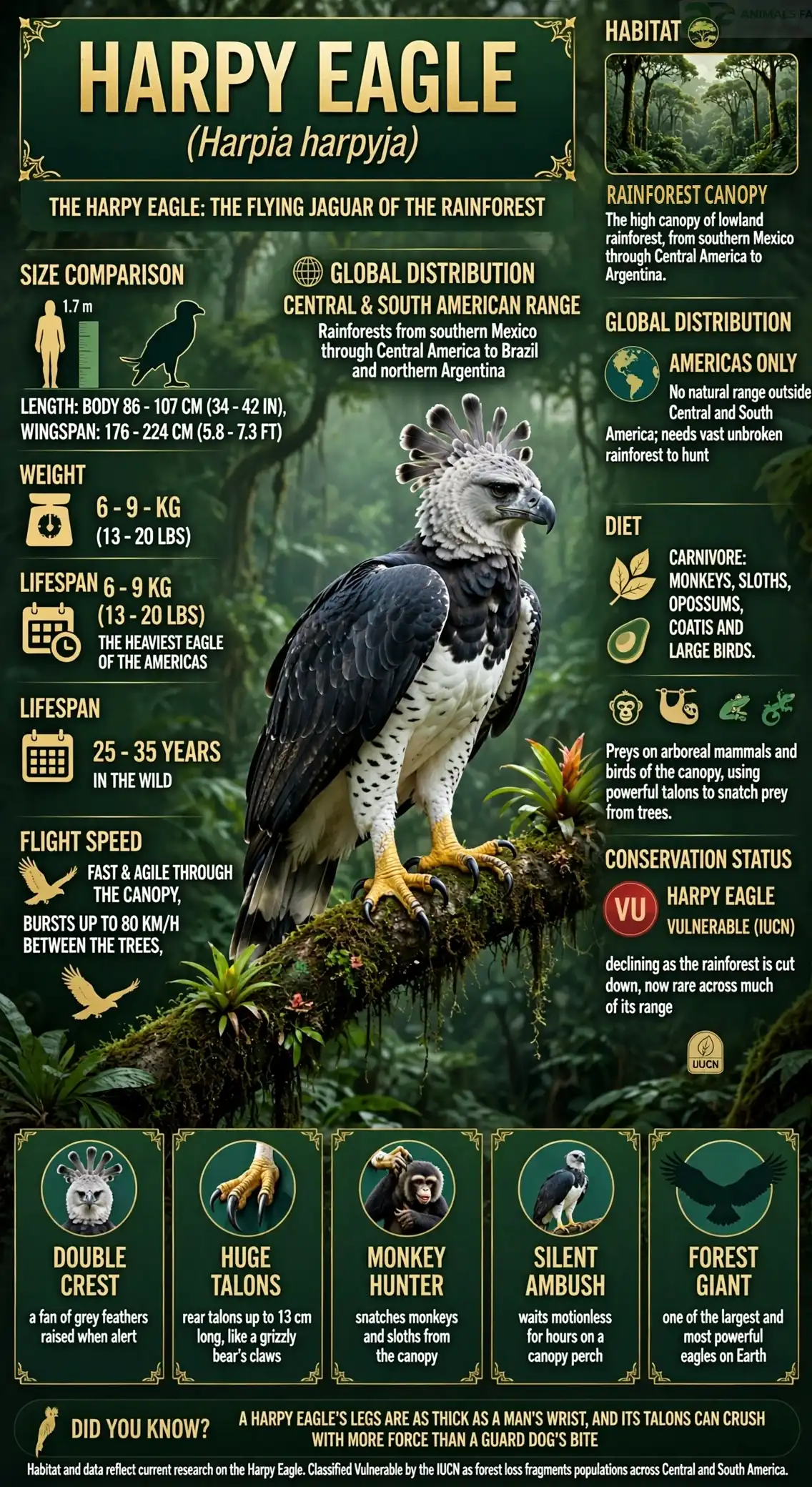
- Rear talons 12.5 cm — longer than grizzly bear claws
- Females weigh up to 9 kg — heaviest eagle in the Americas
- Regularly takes prey heavier than itself
- Only eagle with a facial disc — owl-like acoustic system
- Breeds once every 2–3 years — slowest reproduction of any American eagle
- Named after Greek mythology’s Harpies — “snatchers”
- National bird of Panama
- Requires primary old-growth forest — disappears from degraded habitat
- Same nest tree used for 25–30 years
- Home ranges of 25–100 km² per pair
- 50% of diet is three-toed sloths
- Guinness World Record — largest talons of any living eagle
6. Harpy Eagle Habitat & Geographic Range
Harpy eagle habitat is defined with extraordinary specificity — the species requires intact primary lowland tropical rainforest with a complex vertical structure, abundant large-bodied arboreal prey, and minimal human disturbance. It is one of the most habitat-specific large birds of prey in the world.
The Habitat Requirements — Primary Forest Only
Primary old-growth rainforest — The harpy eagle’s fundamental habitat requirement; the species is documented nesting almost exclusively in primary forest with intact tall-canopy structure. Secondary forest, degraded forest, and forest fragments are occupied only peripherally — harpy eagles may use degraded areas for occasional foraging but do not breed in them.
Why primary forest? — The harpy eagle’s habitat requirement for primary forest reflects several interconnected ecological dependencies:
- Nest tree size — Harpy eagles nest in the crowns of the forest’s largest trees — emergent trees of 30–50 meters height whose crowns are only found in old-growth forest
- Prey availability — The large-bodied arboreal mammals that constitute the harpy eagle’s primary prey (sloths, large monkeys) occur at adequate densities only in intact primary forest where the full canopy food web is functioning
- Hunting space — While the harpy eagle’s short wings allow forest maneuverability, effective hunting requires a minimum forest spatial complexity — the complex multi-layered canopy of primary forest providing both prey substrate and the hunting corridors that allow ambush approach
Elevation — The harpy eagle is primarily a lowland species — most abundant below 900 meters elevation. The species occurs at higher elevations (up to 2,000 meters has been documented) but becomes increasingly scarce above 1,000 meters where forest structure and prey community composition change.
The minimal disturbance requirement — Even in apparently intact primary forest, harpy eagle breeding is suppressed near human settlement — nest abandonment documented in response to hunting, logging access, and general human activity near nest trees. The species requires not merely the physical forest but the relative absence of human disturbance that allows undisturbed breeding over the multi-year breeding cycle.
Geographic Distribution
Central America
| Country | Status | Notes |
|---|---|---|
| Mexico | Extremely rare; near extirpated | Historical breeding in Veracruz and Oaxaca; now very rare |
| Belize | Extremely rare | Occasional records only |
| Guatemala | Rare | Some records in Petén lowland forest |
| Honduras | Rare | Declining |
| Nicaragua | Uncommon | Some intact lowland forest |
| Costa Rica | Uncommon | Rare breeding attempts; better habitat in Caribbean lowlands |
| Panama | Most important Central American population | Darien and Pacific forests; Soberanía viewing site |
| El Salvador | Extirpated | No recent confirmed records |
South America
| Country | Status | Key Areas | Notes |
|---|---|---|---|
| Colombia | Present — declining | Pacific and Amazon lowland forest | Significant forest loss |
| Venezuela | Present | Orinoco basin forest | Some intact areas |
| Guyana | Present — better status | Interior rainforest | Relatively intact habitat |
| Suriname | Present — better status | Interior forest | Relatively intact habitat |
| French Guiana | Present | Interior forest | French protection applies |
| Ecuador | Present — declining | Amazon lowland | Forest loss significant |
| Peru | Present | Amazon lowland | Core range; some intact forest |
| Bolivia | Present | Northern lowland forest | Partially intact |
| Brazil | Core population | Amazon Basin broadly | Most significant remaining population |
| Argentina (NE) | Extremely rare | Misiones province | Near extirpated |
The Amazon — The Global Core
The Brazilian Amazon holds the most significant remaining harpy eagle population — the vast extent of Amazonian forest in Para, Amazonas, Mato Grosso, and other states representing the largest remaining block of primary lowland tropical forest suitable for harpy eagle breeding. However, even within Brazil, the southern and eastern “arc of deforestation” has eliminated harpy eagle populations across enormous areas — the species now primarily restricted to the remaining intact forest of the central and northern Amazon and western Amazonian states.
Panama — The Conservation Window
Despite its small size relative to the Amazon, Panama hosts one of the best-studied and most accessible harpy eagle populations — the combination of Panama’s relatively intact Pacific and Caribbean slope forests, the country’s strong environmental protection framework, and the Peregrine Fund’s long-term research program creating the most comprehensive harpy eagle knowledge base available:
Soberanía National Park — Located just 30 km from Panama City; home to several known harpy eagle nests that have been monitored for decades. The park’s semi-habituated eagles provide the most reliable wild harpy eagle viewing opportunity accessible to international visitors.
Darien — Panama’s most intact and most biodiverse lowland forest; holds the highest harpy eagle density in Central America and arguably the most significant Central American harpy eagle population.
7. Harpy Eagle Diet & Feeding Behavior
Harpy eagle diet is the most prey-size-extreme of any eagle in the Americas — the species regularly taking prey that exceeds its own body weight, with a dietary range spanning from small lizards to adult sloths.
Diet Breakdown Table
| Food Type | Estimated % of Diet | Notes |
|---|---|---|
| Three-toed sloths (Bradypus species) | ~40–55% | Primary prey across most of range; large, slow-moving, highly accessible in canopy |
| Monkeys (various species) | ~20–30% | Howler monkeys, spider monkeys, capuchins; selected by size |
| Two-toed sloths (Choloepus species) | ~5–10% | Larger and more defensive than three-toed; taken less frequently |
| Large arboreal rodents | ~5–8% | Porcupines, spiny rats, agoutis |
| Coatis and similar | ~3–5% | Nasua species; opportunistic |
| Large reptiles | ~3–5% | Tegus, large iguanas, snakes |
| Large birds | ~2–5% | Macaws, parrots, young toucans; mostly opportunistic |
| Opossums | ~2–3% | Various species; opportunistic |
| Kinkajous and olingos | ~1–3% | Arboreal carnivores |
The Sloth Specialization
The harpy eagle’s dietary specialization on three-toed sloths is one of the most significant predator-prey relationships in the Neotropical rainforest ecosystem:
Why sloths? — The three-toed sloth is an almost ideal prey item for the harpy eagle:
- Large body mass — up to 9 kg; providing a substantial meal
- Arboreal lifestyle — living in the forest canopy where the harpy eagle hunts
- Extreme slowness — the sloth’s metabolic strategy involves minimal movement; this makes detection difficult by many predators but does not help against an eagle that detects prey by sight and sound from a perch
- Predictable location — sloths are among the most site-faithful arboreal mammals; individuals use the same trees repeatedly over days and weeks, allowing the harpy eagle to use memorized location information
- Defensive limitation — while sloths have strong grip and long claws, their slow reaction time and inability to move rapidly prevents effective evasive response to the harpy eagle’s sudden attack
The sloth capture technique — Harpy eagle predation on sloths typically involves:
- Detection from a perch — the sloth located either visually (movement in the canopy, or its distinctive white and brown coloration) or acoustically (the sounds of sloth movement through branches)
- Deliberate approach through the forest — the harpy eagle moving through the forest to a launching position with minimal disturbance
- The strike — a sudden, explosive launch from a nearby perch, the bird driving its talons into the sloth’s back and shoulder region
- Incapacitation — grip force sufficient to penetrate the sloth’s thick skin and compress vital structures; the sloth’s grip on the branch eventually releasing as muscle function is lost
- Transport or in-situ consumption — sloths too heavy to carry are eaten at the kill site; lighter individuals are transported to a favorite plucking perch or directly to the nest
The sloth-eagle co-evolution question — Research has debated whether the three-toed sloth’s extreme slowness and the green algae that grow in its fur — creating a form of visual camouflage — represent adaptations to predation specifically including the harpy eagle. The cryptic green coloration of a sloth in a sunlit tree is genuine camouflage that would reduce detection by visual predators; the acoustic detection capability provided by the harpy eagle’s facial disc may partially counter this camouflage.
The Monkey Predation System
The harpy eagle’s predation on monkeys — including some species significantly heavier than the hunting bird — is one of the most remarkable predatory interactions documented in the Neotropics:
Target species — The most important monkey prey species include:
- Mantled howler monkey (Alouatta palliata) — up to 9 kg; the largest monkey prey item; typically taken as subadults or females
- Brown spider monkey (Ateles hybridus) — up to 9 kg; agile but vulnerable in the canopy
- White-faced capuchin (Cebus capucinus) — up to 3.5 kg; the most abundant monkey at many sites
- Squirrel monkey (Saimiri species) — smaller but taken in groups
The monkey response — Unlike sloths, monkeys are aware of harpy eagle danger and show sophisticated anti-predator behaviors:
- Alarm calls specific to harpy eagle (distinguished from other predator alarms)
- Group mobbing of perched eagles — multiple monkeys approaching and calling to drive the eagle from the territory
- Specific movement changes when an eagle is detected — moving into denser vegetation, freezing, or rapidly increasing group cohesion
The hunting response to mobbing — Harpy eagles frequently wait out mobbing behavior — remaining on a perch despite harassment until the mobbing group relaxes, then attempting a sudden strike when attention has diminished. Research has documented harpy eagles being driven from territories by sustained monkey mobbing, but also successfully striking mobbing monkeys that approach too closely.
The Hunting Technique
The perch-hunt approach — The harpy eagle’s primary hunting method; the bird selects a prominent perch with good sightlines through the canopy and waits — scanning both visually and acoustically for prey. The waiting period may last several hours before a suitable prey animal is detected.
The silent approach — Once prey is detected, the harpy eagle moves through the forest toward the target — navigating silently between tree trunks and branches, the short wings allowing passage through gaps that would stop a larger-winged eagle. The approach may cover 100–500 meters of forest before the final strike.
The strike — A sudden, explosive burst of wing-powered speed from a launching perch at close range — typically within 10–30 meters of the prey. The strike speed in the final approach is estimated at 60–80 km/h — not the 240+ km/h of a golden eagle stoop, but in the constrained space of the forest interior, delivering comparable impact force through the mass of the bird’s body and the penetrating force of the talons.
The kill — Death is typically rapid — the talons penetrating to vital structures and the grip force causing immediate incapacitation. For large prey (adult sloths, large monkeys), the harpy eagle grips with both feet and waits for the prey to cease struggling.
8. Harpy Eagle Reproduction & Life Cycle
Harpy eagle reproduction is the most investment-intensive breeding system of any eagle in the Americas — combining the slowest reproductive rate with the longest parental care period to produce what is arguably the most carefully reared raptor chick in the Western Hemisphere.
Pair Bond and Territory
Lifelong monogamy — Harpy eagles form long-term pair bonds — the same individuals occupying the same territory across multiple breeding attempts spanning potentially decades. The pair returns to the same nest tree year after year.
The multi-year cycle — The defining characteristic of harpy eagle reproduction is the 2–3 year breeding cycle — the entire sequence from egg-laying through post-fledging dependency is so extended that the earliest a successful pair can begin the next breeding attempt is 2 years after the previous attempt:
- Incubation: 56 days
- Nestling period: 5–6 months
- Post-fledging dependency: 12–18 months
- Recovery period before next attempt: several months
The ecological implication — The 2–3 year cycle means that a female harpy eagle producing chicks continuously from age 5 through age 30 would raise a maximum of approximately 8–12 successful offspring in her entire lifetime. This extremely low lifetime reproductive output makes adult harpy eagle survival the critical variable in population dynamics — the loss of a single breeding adult removes decades of potential offspring.
Courtship
Aerial display — Harpy eagle courtship involves impressive aerial displays above the forest — both birds soaring together and performing undulating display flights over the territory. The birds are relatively rarely seen in flight and the aerial displays represent the most conspicuous behavior the species shows.
Crest display — Close-range courtship involves prominent crest erection — the dramatic circular crest halo being one of the primary visual signals in pair bond interactions, as well as in territorial and alarm contexts.
Prey presentation — Like golden eagles, male harpy eagles demonstrate hunting capability through prey delivery to the female during courtship — the female remaining at or near the nest while the male hunts and returns with prey items.
Nesting
Nest tree selection — The selection of the nest tree is one of the most critical decisions in the harpy eagle’s breeding system:
- Tree species preference — Brazil nut trees (Bertholletia excelsa) and silk-cotton/kapok trees (Ceiba pentandra) are the most commonly recorded nest trees across the range — both massive trees with large, structurally complex crowns capable of supporting the substantial nest structure
- Crown structure — A large, forked crown with multiple strong horizontal branches is required — the nest placed in the main fork or on a major horizontal branch
- Height — Typically 27–45 meters above the forest floor — the crowns of the tallest emergent trees accessible only to the most accomplished aerial hunters
Nest dimensions — A newly built harpy eagle nest typically measures approximately 1–1.5 meters in diameter and 0.5 meters in depth. The nest grows over successive breeding attempts — established nests reaching 1.8–2 meters in diameter and 1 meter or more in depth after multiple years of use.
Nest lining — The interior of the harpy eagle nest is lined with fresh green leaves brought continuously during incubation and the early nestling period. The fresh leaves are replaced regularly — the fresh leaf lining may serve to reduce nest parasite loads, maintain nest interior temperature, or provide sensory camouflage.
Incubation
Clutch size — The harpy eagle lays 2 eggs — but typically only one egg is incubated from the start. The second egg is a “backup” — incubated only if the first egg fails. This reproductive strategy — sometimes called “obligate brood reduction” — means that in practice, harpy eagles produce only one eaglet per breeding attempt.
Incubation period — 56 days — one of the longest incubation periods of any eagle. Both parents incubate; the female performs the majority.
Temperature maintenance — In the tropical lowland forest where temperatures are relatively constant, maintaining incubation temperature is less challenging than in the northern eagles’ environments — but the long incubation period requires sustained parental commitment.
Eaglet Development
At hatching — The harpy eagle chick hatches covered in white down — altricial and dependent. The initial white down is gradually replaced by a second, thicker grey-white down before the first feathers emerge.
Growth rate — The harpy eagle eaglet grows remarkably rapidly — approaching adult body size by approximately 3 months of age. However, the flight feathers develop more slowly, and the eaglet’s first flights typically occur at 5–6 months (150–180 days) after hatching.
The first flights — The fledgling’s initial flights are short and often include crashes back to the nest branch — the young eagle developing flight coordination over weeks of practice. Unlike some raptors that quickly disperse after fledging, the young harpy eagle remains at or near the nest for months.
Post-fledging dependency — The most remarkable aspect of harpy eagle development; the fledged young bird remains associated with the nest territory and dependent on parental food delivery for 12–18 months after fledging — one of the longest post-fledging dependency periods of any eagle. During this extended period:
- The young bird continues to be fed by the parents
- Progressively longer independent excursions are made
- Hunting skills are developed through observation and practice
- The eventual transition to independence happens gradually rather than abruptly
Independence and the gap before next breeding — When the young bird eventually achieves full independence (typically at 2–2.5 years of age), the parents begin the next breeding cycle. The gap between successful fledglings — the 2–3 year minimum interval — is determined by the duration of post-fledging dependency.
9. Social Behavior & Communication
Harpy eagle social behavior is defined primarily by the territorial exclusive pair bond and the extremely limited social interactions outside the breeding pair — the species’ large home range, low population density, and solitary hunting strategy creating minimal social contact except within the pair.
Territory and Spacing
Exclusive pair territories — Each breeding pair defends an exclusive territory against other harpy eagles — the 25–100 km² home range (varying by prey density and forest quality) providing sufficient resource space for the pair and offspring.
Low population density — The large territory requirement means that harpy eagle population densities are very low — typically 1 pair per 100+ km² in suitable habitat. This low density means that within a given area of forest, individual harpy eagles are rarely in contact with non-pair conspecifics.
Nest tree centrality — Within the large home range, the nest tree serves as the spatial anchor — the harpy eagle pair concentrating activity within the core area around the nest during the breeding season and ranging more widely during the non-breeding period.
Communication
The alarm call — The harpy eagle’s primary vocalization; a high-pitched, mournful wail — sometimes described as a “whistle-scream” that rises and falls in pitch. This call is produced during alarm, territorial confrontation, and during the fledgling period by both adults and young. The call carries considerable distance through the forest and is distinctly different from the harsh calls of many other raptors.
The male advertising call — A repeated, high-pitched two-note whistle — produced by the male throughout the breeding season, apparently advertising territory occupancy to neighboring pairs. The call is produced during soaring flight over the territory.
The food-begging call — The eaglet and young fledgling produce an insistent, piercing whistle-beg — repeated persistently when the young bird is hungry and awaiting parental food delivery. This call, audible from considerable distances in the forest, is one of the most reliable acoustic indicators of harpy eagle breeding activity to researchers monitoring the species.
Crest and facial disc signaling — Close-range communication between pair members and in territorial encounters heavily involves the crest erection — the raised circular crest halo dramatically changing the bird’s apparent size and providing a powerful visual signal of arousal state, dominance, and emotional condition.
Pre-strike silence — Perhaps the most functionally important aspect of harpy eagle communication is what it does not do before a hunt — the harpy eagle hunting approach involves complete acoustic silence, the bird moving through the forest without any vocalizations or significant wing noise that might alert prey to its approach. The structural characteristics of the wing feathers (broader, softer-edged than the stiff feathers of open-country eagles) may contribute to reduced flight noise during the hunting approach.
10. Predators & Defense Mechanisms
The adult harpy eagle is the apex predator of the lowland tropical forest — no other native animal regularly threatens adult birds. However, eggs, chicks, and the nest itself face specific vulnerabilities.
Threats to Eggs and Chicks
Large arboreal snakes — Venomous and non-venomous large arboreal snakes are documented nest predators — boa constrictors (Boa constrictor) and large lanceheads (Bothrops species) have been observed approaching harpy eagle nests. The parents vigorously defend against snakes — documented striking and killing snakes that approach nest trees.
Primates — Large monkey species (particularly spider monkeys and howler monkeys) are occasionally observed approaching harpy eagle nests — particularly if the adults are absent. The ecological irony of the monkey approaching the eagle’s nest — the predator’s home being investigated by its prey — is one of the more remarkable behavioral interactions documented at harpy eagle nests.
Humans — The most significant threat to both eggs and chicks; nest disturbance by humans (loggers, researchers, curious locals) causes nest abandonment — particularly during early incubation and the first weeks of eaglet development when disturbance sensitivity is highest.
Threats to Adults
Humans — The only regular threat to adult harpy eagles:
- Shooting — documented across the range; harpy eagles are shot by farmers who fear livestock predation (rarely justified), by hunters who target the bird for trophies or traditional practice, and by loggers and settlers who encounter the birds near their operations
- Habitat loss — indirect but the most significant population-level threat; deforestation eliminates the primary forest on which harpy eagles depend
Defense Mechanisms
Height and remoteness — The most fundamental nest defense; nesting in the crowns of the tallest emergent trees at 27–45 meters height provides protection from most terrestrial predators and makes the nest difficult to access for most arboreal nest raiders.
Vigorous nest defense — Adult harpy eagles are documented as aggressive nest defenders — both birds actively defending against approaching snakes, monkeys, and researchers. Camera trap footage from nest monitoring programs captures the adults returning to drive away intruders and then brooding the young.
The “sitting tight” strategy — When disturbed while in the forest, harpy eagles typically respond by freezing on a perch — remaining motionless and relying on the complexity of the forest visual background for concealment. In the broken light of the rainforest interior, a stationary harpy eagle is surprisingly difficult to detect despite its size.
Pair cooperation — Both members of the breeding pair participate in nest defense and in responding to threats — the combined defensive capability of two large eagles is substantially greater than either bird alone.
Size and dominance — The adult harpy eagle’s extraordinary size and weaponry place it outside the practical prey range of any native Neotropical predator. A healthy adult harpy eagle has no natural enemies other than humans.

11. Harpy Eagle Facts for Kids
Hey amazing young wildlife scientists, rainforest enthusiasts, and future conservation heroes! Here are some truly extraordinary harpy eagle facts for kids that will make every wildlife conversation the most fascinating one in the room:
- 🦅 The harpy eagle has claws BIGGER THAN A GRIZZLY BEAR’S! The back talons of a female harpy eagle can be 12.5 centimeters long — that is as long as a grizzly bear’s claws! When the harpy eagle grabs its prey, it squeezes with so much force that it can crush the bones of a sloth or a large monkey in an instant. They are literally the most powerful biological claws of any bird on Earth!
- 🦅 Harpy eagles sometimes catch prey that is HEAVIER THAN THEMSELVES! A female harpy eagle can weigh about 7 to 8 kilograms. But adult three-toed sloths also weigh about 7 to 9 kilograms — meaning the eagle is sometimes grabbing something as heavy as or heavier than its own body! Imagine picking up something as heavy as you are and flying away with it. That is what a harpy eagle does!
- 🦅 The harpy eagle has a face like a SATELLITE DISH for hearing! The circle of stiff feathers around the harpy eagle’s face — called a facial disc — works like a sound-collecting dish. It channels sounds from the rainforest toward the eagle’s ears, helping it hear sloths and monkeys moving in the trees. No other eagle in the world has evolved this special feature — the harpy eagle is the only eagle with this owl-like hearing system!
- 🦅 Harpy eagle babies take LONGER to grow up than almost any other eagle! After the egg hatches, the baby harpy eagle stays in the nest for 5 to 6 MONTHS. Then, even after it learns to fly, it is still fed by its parents for another YEAR AND A HALF! By the time a young harpy eagle is truly independent, it might be 2 years old. This means a harpy eagle pair can only have one baby every 2 to 3 years — making each baby incredibly precious!
- 🦅 The harpy eagle is the national bird of PANAMA! Panama chose the harpy eagle as its national symbol in 1986 because it is so powerful, so magnificent, and so uniquely connected to the rainforests of the Americas. You can actually see wild harpy eagles near Panama City in Soberanía National Park — one of the only places in the world where wild harpy eagles are regularly accessible to visitors!
- 🦅 The harpy eagle is named after MONSTERS from ancient Greek mythology! The ancient Greeks told stories about creatures called Harpies — terrifying winged spirits that could suddenly snatch people from the earth and carry them off. When European naturalists encountered this eagle, they named it after the Harpies because of the way it suddenly and silently appears in the rainforest and snatches its prey! The harpy eagle is basically the real-life Harpy from mythology!
- 🦅 Harpy eagles have a secret CROWN they can raise! The dark feathers on top of a harpy eagle’s head look normal when the bird is relaxed. But when it gets alarmed or excited, it raises these feathers into a dramatic circular halo that makes its head look enormous — like suddenly producing a giant dark crown! This display is one of the most impressive transformations of any bird — the eagle goes from impressive to absolutely spectacular in an instant!
- 🦅 The harpy eagle eats mostly SLOTHS — one of the slowest animals on Earth! About half of everything a harpy eagle eats is three-toed sloths. The sloth is so slow that it might not even notice an eagle is approaching until it is too late! The harpy eagle finds sloths by watching for them from a perch and listening for the sounds they make as they slowly move through the trees. The sloth has no way to escape quickly — making it the perfect meal for the forest’s supreme predator!
12. Relationship with Humans
The harpy eagle’s relationship with humans spans thousands of years of indigenous reverence in which the eagle occupied the highest position in indigenous Amazonian spiritual hierarchies, a colonial period of shooting and collection that reduced populations across the accessible range, the modern conservation crisis driven by Amazon deforestation, and a growing ecotourism economy that gives the harpy eagle increasing economic value as a living symbol of rainforest biodiversity.
Indigenous Amazonian Relationships — The Living God Bird
The harpy eagle’s relationship with indigenous Amazonian peoples represents one of the most profound human-raptor relationships in history — the eagle occupying a position of supreme spiritual significance across virtually every indigenous culture within its range:
The supreme sky being — Across the extraordinary diversity of Amazonian indigenous cultures — hundreds of distinct languages, dozens of different ecological adaptations, widely varying cosmological systems — the harpy eagle consistently appears as the supreme representative of the sky realm and the most spiritually powerful living being in the forest. The consistency of this attribution across such diverse cultures reflects the harpy eagle’s genuine uniqueness — an animal so physically extraordinary and so ecologically dominant that independent cultural systems arrived at similar conclusions about its spiritual significance.
Captive harpy eagles in villages — Multiple independent accounts from European explorers, missionaries, and anthropologists across the Amazon document the practice of keeping captive harpy eagles in indigenous villages — typically young birds taken from nests and raised to adulthood. These captive eagles were maintained as living spiritual objects and symbols of prestige — fed by the community, given names, and treated with profound respect.
The feather significance — Harpy eagle feathers — particularly the large crest feathers, the body feathers, and the tail feathers — were among the most valuable ceremonial objects in Amazonian indigenous cultures. In multiple ceremonial traditions, harpy eagle feathers adorned the headdresses of the most powerful and most spiritually significant individuals — chiefs, shamans, and warriors. The feathers were not merely decorative but spiritually active — carrying the eagle’s power and its connection to the sky realm.
The Kayapó connection — Among the Kayapó people of the Brazilian Amazon, the harpy eagle (kôkôi in Kayapó language) holds particular significance — the bird representing one of the most important connections between the human community and the spirit world. Kayapó ceremonies involving eagle feathers are among the most important in the ceremonial calendar, and traditional knowledge about harpy eagle ecology — nest sites, hunting behavior, prey preferences — is detailed and carefully maintained.
The Aztec and Maya significance — In Mesoamerican civilizations, the harpy eagle was revered alongside the golden eagle as one of the supreme sky beings — harpy eagle imagery appears in stone carvings, ceramics, and codices of various pre-Columbian Mesoamerican cultures, though the golden eagle was more prominent in the highland Aztec and Maya ceremonial systems.
The Colonial and Post-Colonial Period
European shooting and collection — From the 16th century onward, European naturalists, collectors, and hunters shot harpy eagles across the accessible range — the birds’ extraordinary appearance making them prized museum specimens and trophies. The loss of breeding adults from shooting created local population crashes particularly in areas of Central America where the total population was small.
Agricultural persecution — As European-style ranching and agriculture expanded across the Neotropics, harpy eagles were targeted as perceived threats to livestock and poultry — a perception largely unsupported by research (harpy eagles very rarely take domestic animals when wild prey is available) but that contributed to sustained persecution across agricultural frontiers.
The deforestation trajectory — The most severe human impact on harpy eagle populations — the progressive clearance of primary forest across the Amazon Basin, Central America, and other parts of the range for cattle ranching, soy production, and timber extraction — has eliminated harpy eagle habitat across enormous areas and continues to reduce the species’ range and population.
The National Bird Status and Conservation Programs
Panama’s national bird — The 1986 designation of the harpy eagle as Panama’s national bird has been followed by meaningful conservation investment:
- Soberanía National Park — established partially in recognition of harpy eagle conservation value; the park hosts multiple known harpy eagle pairs accessible to visitors
- The Peregrine Fund’s Panama program — a long-term research and conservation program operating in Panama since the 1980s; fundamental contributions to harpy eagle ecology understanding
- Ambassador bird programs — captive harpy eagles maintained at conservation facilities and used for public education have been effective ambassadors for the species
Brazil’s HARP program — The Harpy Eagle Research and Protection (HARP) program in Brazil represents the most comprehensive harpy eagle conservation effort in the species’ core range — combining GPS tracking, nest monitoring, community engagement, and advocacy for forest protection policies.
Community-based conservation — Programs engaging local communities in harpy eagle conservation — providing economic alternatives to forest clearance and building community pride in harpy eagle presence — represent the most sustainable long-term approach. In multiple Amazon communities, the harpy eagle has transitioned from a bird that local people shot on sight to a source of community pride and ecotourism income.
The Ecotourism Dimension
The harpy eagle’s extraordinary visual impact and cultural significance make it one of the most compelling ecotourism targets in the Neotropics:
Panama’s viewable pairs — Semi-habituated harpy eagles near Soberanía National Park and other Panama sites provide the most reliable wild harpy eagle viewing in the world — generating tourism revenue that provides economic arguments for forest protection.
The rarity premium — The genuine rarity and difficulty of harpy eagle observation — even at best sites, sightings require patience and cannot be guaranteed — creates a premium for guided harpy eagle experiences. Experienced local guides who know nest locations and individual eagle behavior command substantially higher fees than standard forest guides, creating economic incentives for maintaining forest and eagle populations.
13. Harpy Eagle Conservation Status & Threats
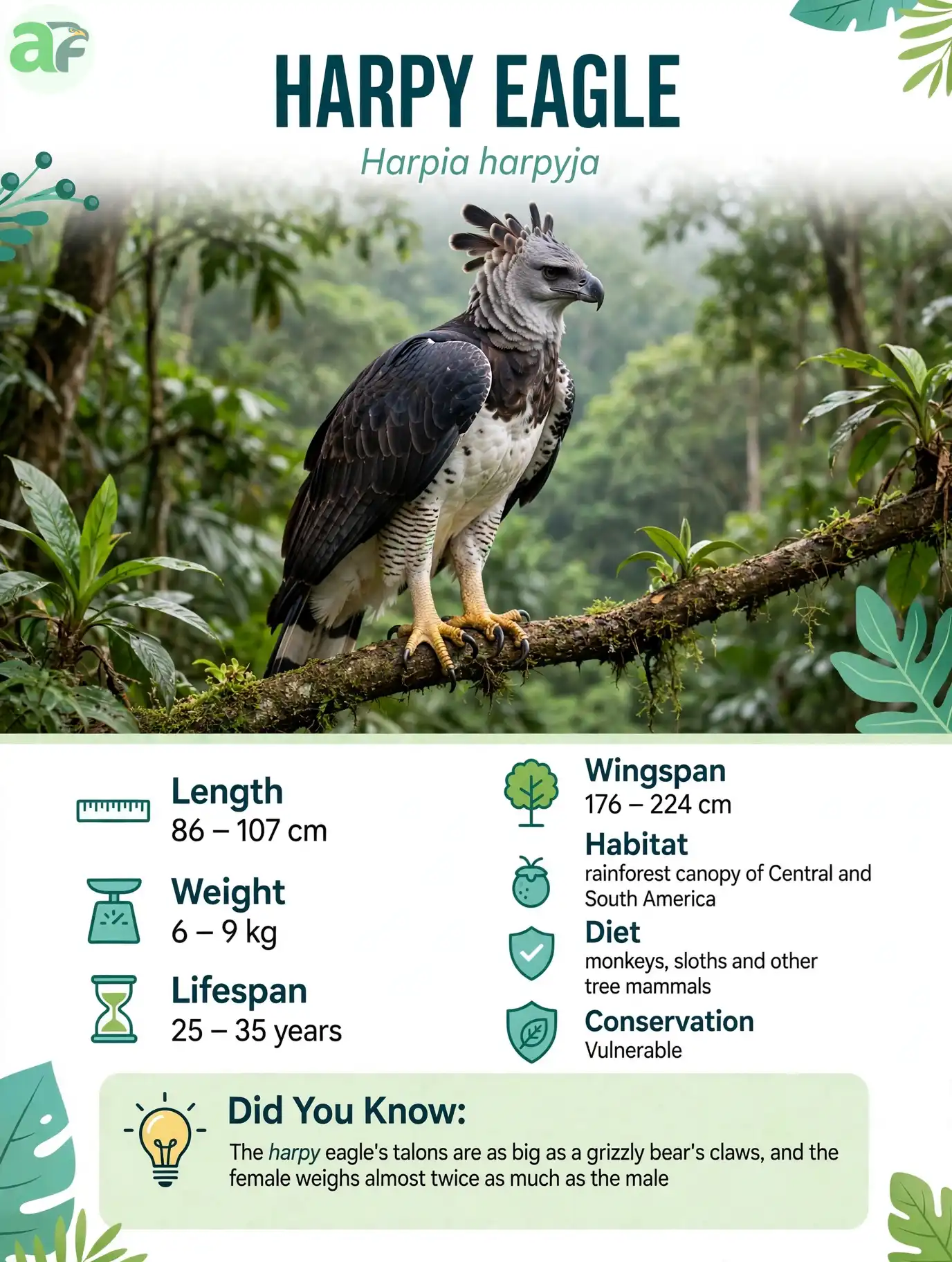
Conservation Status Overview
| Feature | Details |
|---|---|
| IUCN Status | Vulnerable (VU) |
| Population Trend | Decreasing |
| Estimated Mature Individuals | Fewer than 50,000 — possibly substantially fewer |
| Range Reduction | Estimated 40%+ of historical range now unsuitable |
| Extirpated From | El Salvador; most of Mexico; most of Central America |
| Fastest Declining Region | Southern and eastern Brazil; eastern Peru and Bolivia |
| CITES Listing | Appendix I — international trade prohibited |
| Panama Legal Status | National bird; fully protected |
| Brazil Legal Status | Critically Endangered on Brazilian Red List |
Major Threats
| Threat | Description | Impact Level |
|---|---|---|
| Deforestation | Primary forest clearance for cattle, soy, logging | Critical — primary threat across range |
| Targeted hunting | Shooting by farmers, hunters, indigenous practices (some); persecution | High — directly removes breeding adults |
| Forest fragmentation | Isolation of forest patches too small for harpy eagle territories | High |
| Nest tree felling | Logging of the large emergent trees preferred for nesting | High |
| Human disturbance at nests | Abandonment of active nests near human activity | Medium-High |
| Prey depletion | Overhunting of sloths and monkeys reducing prey availability | Medium — specific areas |
| Climate change | Altered forest structure; prey community changes | Long-term increasing concern |
| Indigenous captive keeping | Traditional practice removing juveniles from wild population | Low overall — localized |
The Deforestation Crisis — The Defining Threat
Amazon deforestation represents the existential threat to the harpy eagle — the species’ absolute dependence on primary old-growth forest means that every hectare of forest cleared is potential harpy eagle habitat permanently lost:
The deforestation rate — Brazil’s Amazon has lost approximately 800,000 km² of forest since 1985 — an area larger than France and Spain combined. At historical peak deforestation rates (mid-2000s), approximately 27,000 km² per year was being cleared — enough area to support approximately 270–1,000 harpy eagle pairs lost annually.
The “arc of deforestation” — The southern and eastern Amazon — the region of most intensive deforestation — was historically one of the most productive harpy eagle habitats. This region is now one of the most depleted — the harpy eagle effectively absent from the areas of heaviest forest loss.
The minimum territory problem — Because each harpy eagle pair requires a minimum of 25–100 km² of primary forest, deforestation that creates forest patches below this minimum effectively eliminates the harpy eagle from those patches even when some forest remains. A 10 km² forest remnant in an agricultural landscape cannot sustain a harpy eagle pair regardless of its forest quality.
The nest tree threat — Large emergent Brazil nut trees and kapok trees — the preferred harpy eagle nest trees — are specifically targeted in selective logging operations because of their valuable timber. The loss of potential nest trees from logging is a specific threat within otherwise intact forest.
Hunting — The Second Major Threat
Perceived livestock threat — The most common motivation for shooting harpy eagles is the incorrect belief that they pose significant threats to domestic animals. Research consistently shows that harpy eagles very rarely take domestic animals when wild prey is available — but the perception persists and motivates shooting across agricultural frontiers.
Trophy hunting — The harpy eagle’s extraordinary appearance makes it a trophy target — the eagle shot for mounting or for feathers in some areas. CITES Appendix I listing makes international trade illegal, but domestic use continues in some range countries.
Traditional feather collection — Some indigenous communities continue traditional practices of collecting harpy eagle feathers — creating demand for killing wild birds in areas where traditional practices have not adapted to the species’ declining population.
Conservation Responses
Protected area network — The most important structural conservation response; protected areas including Brazil’s national parks, Amazon conservation units, and indigenous territories provide formal protection for harpy eagle habitat:
- Amazon National Park (Brazil) — 9.9 million hectares
- Yasuni National Park (Ecuador) — 9,820 km²
- Manu National Park (Peru) — 1.7 million hectares
- Darien National Park (Panama) — 579,000 hectares
- Indigenous territories across the Brazilian Amazon — collectively one of the most important harpy eagle habitat protection mechanisms
Nest monitoring programs — GPS tracking of breeding adults and nest camera programs provide the data needed to understand breeding success rates, territory sizes, and threats — the Peregrine Fund’s Panama program and Brazil’s HARP program being the most comprehensive.
Community programs — Engaging local communities in harpy eagle conservation through:
- Economic benefits from ecotourism linked to habituated pairs
- Education programs in communities near nest sites
- Alternative livelihood programs reducing dependence on activities that threaten forest
Captive ambassador birds — Injured or non-releasable harpy eagles maintained at conservation facilities in Panama, Brazil, and other countries serve as public education ambassadors — reaching audiences that would never see a wild harpy eagle.
14. Famous Harpy Eagles in History & Pop Culture
Famous Individual Harpy Eagles
“Panamá” — The most famous individual harpy eagle in Panama’s conservation history — a female harpy eagle maintained at the Summit Municipal Park near Panama City as a conservation ambassador. Panamá (her given name) has participated in public education programs, media appearances, and conservation advocacy for over two decades — the most visible individual harpy eagle in Panama’s extensive conservation communication programs.
The Soberanía Research Pairs — Individual harpy eagle pairs monitored long-term at Soberanía National Park near Panama City — their known nest trees visited by thousands of ecotourists and documented in the Peregrine Fund’s long-running research program. These individuals represent the most extensively documented wild harpy eagles in the world and have contributed fundamental data on breeding ecology, prey selection, and territory use.
The CEMAVE Study Eagles (Brazil) — Individual harpy eagles fitted with GPS tracking devices by the Brazilian Center for Bird Conservation (CEMAVE) and various research institutions — their movement data revealing the first detailed picture of harpy eagle space use, ranging behavior, and territory structure in Amazonian Brazil.
“Wilhelma” — A female harpy eagle maintained at Wilhelma Zoo in Stuttgart, Germany — one of the longest-lived captive harpy eagles documented in Europe, participating in the zoo’s breeding program and public education activities for multiple decades.
Historical and Cultural Significance
The Aztec Cuauhtli — The eagle warrior (cuauhtli) was one of the two elite warrior orders of Aztec society — the eagle and the jaguar warrior representing the supreme martial achievements. While the primary eagle association in Aztec culture was with the golden eagle, harpy eagle imagery appears in Aztec art and codices — the harpy eagle’s extreme power and the specifically tropical forest context making it a distinct cultural reference.
Amazon natural history illustration — The harpy eagle was one of the most celebrated subjects in the natural history illustration tradition covering the Amazon — John James Audubon’s correspondence with South American naturalists, the illustrations of John Gould, and the expedition illustrations produced by Alfred Russel Wallace, Henry Walter Bates, and other Victorian naturalists in the Amazon all featured the harpy eagle as one of the most spectacular of Neotropical birds.
15. Role in Ecosystem & Food Chain
The Apex Predator Regulation of Prey Communities
The harpy eagle’s ecological function as the apex arboreal predator of the Neotropical rainforest creates cascading effects through the entire canopy food web:
Sloth population regulation — The harpy eagle’s predation on three-toed sloths constitutes the primary top-down regulation of sloth populations in primary forest areas where both species occur. Three-toed sloths are among the most abundant large-bodied mammals in the Neotropical forest canopy — their biomass per unit area exceeding that of all other mammals combined in some forest types. Without harpy eagle predation, sloth populations would potentially increase to levels that create significant browsing pressure on the canopy vegetation.
The sloth-vegetation connection — Sloths consume substantial quantities of canopy leaves — primarily the leaves of Cecropia and other canopy tree species. The harpy eagle’s regulation of sloth populations therefore indirectly reduces leaf consumption pressure on canopy trees — a trophic cascade in which the apex predator influences plant community composition through prey population regulation.
Monkey population effects — The harpy eagle’s predation on various monkey species — particularly targeting large-bodied individuals from monkey groups — creates top-down pressure that influences monkey group structure, spatial use, and behavioral repertoire. Research has documented that monkey groups in areas with active harpy eagle pairs show different behavior patterns (more alarm calling, denser grouping, more restricted spatial use) than groups in areas without harpy eagle predation pressure.
The “landscape of fear” in the canopy — Like the golden eagle’s effect on mountain hares in Scotland, the harpy eagle creates a canopy landscape of fear — arboreal mammals in harpy eagle territories spend more time in vigilance, move more cautiously between trees, and preferentially use denser vegetation that provides concealment from aerial predators. This behavioral modification has documented effects on the spatial distribution of monkey groups and the foraging patterns of sloths.
The Carrion and Nutrient Role
Unconsumed prey — Harpy eagles do not always consume the entirety of large prey items — portions of large carcasses left at kill sites or plucking posts contribute to the forest floor nutrient budget, provide food for secondary scavengers (vultures, coatis, various insects), and accelerate nutrient cycling within the forest.
Feather and bone deposition — The harpy eagle’s nest and vicinity accumulate feathers, bones, and prey remains over the many years of nest use — creating localized concentrations of calcium and phosphorus that influence soil chemistry and plant growth in the vicinity of long-used nest trees.
The Indicator Species Function
The harpy eagle functions as the most sensitive indicator of primary forest integrity in the Neotropical region:
- Presence indicates intact primary forest with functional prey communities, adequate nest trees, and low human disturbance
- Breeding success reflects forest quality across the home range — a pair successfully raising chicks indicates sufficient prey, adequate nesting habitat, and acceptable disturbance levels
- Population density provides a sensitive metric of primary forest area and connectivity
- Disappearance from a previously occupied area is among the most reliable indicators of primary forest degradation or human encroachment even before deforestation becomes visible in satellite imagery
The harpy eagle is increasingly used as a flagship and umbrella species for primary forest conservation — protecting the harpy eagle effectively requires protecting the large areas of primary forest that also sustain thousands of other species.
16. Myths, Folklore & Cultural Significance
Indigenous Amazonian Mythology
The sky ruler — Across Amazonian cosmologies, the sky realm is governed by powerful beings — and the harpy eagle is typically the supreme avian representative of this sky power. In multiple traditions, the harpy eagle is understood as either:
- The physical form of a sky deity — the eagle itself as divine being
- The messenger of sky powers — carrying communications between the divine sky realm and the human world
- The guardian of the boundary between sky and earth — controlling access between realms
The Kayapó eagle mythology — Among the Kayapó, the harpy eagle (kôkôi) is associated with the sun and with the concept of mekaron — a Kayapó concept relating to the vital force or spirit that animates living beings. The harpy eagle’s mekaron is considered exceptionally powerful — the most concentrated vital force in the forest — which is why harpy eagle feathers carry such spiritual significance in Kayapó ceremony.
The Yanomami relationship — The Yanomami people of the Amazon-Orinoco watershed maintain a complex relationship with the harpy eagle in their cosmology — the eagle associated with the high forest canopy that represents the upper levels of the Yanomami’s multi-layered cosmological universe.
The transformation mythology — In multiple Amazonian oral traditions, the harpy eagle is associated with transformation — the eagle appearing as an agent of sudden, total change, swooping from the sky to fundamentally alter the situation below. This transformation association parallels the eagle’s ecological function — the sudden appearance of a harpy eagle in a forest patch fundamentally and immediately changes the behavior of every monkey, sloth, and large arboreal animal in the area.
The Greek Mythological Connection
The harpy eagle’s scientific name directly references the Harpies of Greek mythology — winged female spirits of sudden death that swept down from the sky to carry off victims without warning:
The mythological harpies — In Greek mythology, the Harpies (Harpuiai — “snatchers”) were winged spirits, sometimes depicted as beautiful women with wings and sometimes as bird-women, who served as personifications of sudden death and storm winds. Their most famous mythological role is tormenting the blind prophet Phineus — snatching food from his grasp whenever he attempted to eat.
The naming accuracy — When European naturalists encountered the harpy eagle and gave it this name, they chose with unconscious aptness — the harpy eagle’s sudden, silent appearance in the forest and the instantaneous, violent seizure of prey mirrors the mythological Harpies’ snatching behavior so precisely that the name functions as one of the most accurate common names in zoology.
The cultural persistence — The mythological connection embedded in both the common name and the scientific name means that every reference to the harpy eagle simultaneously invokes one of the most ancient mythological traditions of Western civilization — the Greek Harpies linking the modern Neotropical eagle to the same cultural tradition that produced the Roman Aquila and the eagle imagery of Western heraldry.
17. Harpy Eagles in Pop Culture
Avatar: The Way of Water (James Cameron, 2022) — The Ilu creatures (sea-dwelling animals) and various other flying creatures in the Avatar franchise draw on multiple bird of prey inspirations — harpy eagle imagery has been identified by multiple visual effects artists as one of the primary references for the Na’vi’s flying creatures (ikran). The combination of enormous size, dramatic crest display, and forest-interior hunting that defines the harpy eagle’s visual character was directly referenced in creature design.
National Geographic and BBC Amazon documentaries — The harpy eagle features in virtually every significant documentary treatment of Amazonian rainforest biodiversity — including “Amazon: The World’s Greatest River” (various productions), “Planet Earth — Jungles” (BBC, 2006), and multiple National Geographic Amazon productions. The harpy eagle’s status as the Amazon’s apex predator and its extraordinary visual impact make it an essential subject in any comprehensive Amazon natural history treatment.
“The Eagle Huntress” parallel — While focused on Central Asian eagle hunting, this 2016 documentary’s global success increased awareness of eagle hunting traditions that also encompass Neotropical indigenous relationships with harpy eagles — raising the broader cultural profile of human-eagle relationships across all traditions.
Pokémon — Decidueye — The Pokémon character Decidueye — a grass/ghost type starter evolution — incorporates design elements explicitly referencing multiple owl and eagle species including the harpy eagle’s divided crest and dramatic head display. The character’s capacity for silent, precise aerial attacks directly references the harpy eagle’s hunting style.
Panama tourism marketing — Panama’s national bird status has made the harpy eagle central to the country’s international tourism marketing — the bird appearing in Panama Tourism Authority materials, airline advertising, and Panama Canal Zone promotional content reaching global audiences of millions annually.
Conservation social media — The harpy eagle is one of the most effective wildlife conservation subjects in social media — photographs and videos of the bird’s dramatic crest display, enormous talons, and imposing presence consistently generate extraordinary engagement across conservation organization social media platforms globally.
18. Harpy Eagle Facts vs. Common Myths
| Common Myth | The Real Fact |
|---|---|
| “The harpy eagle is the largest eagle in the world” | Partially true — by body mass, female harpy eagles (up to 9 kg) tie with Steller’s sea eagles as the world’s heaviest eagles. By wingspan, the harpy eagle (max ~224 cm) is surpassed by bald eagles, white-tailed eagles, and Steller’s sea eagles (~244–250 cm). The harpy eagle is the largest eagle in the Americas by all measures |
| “Harpy eagles are common throughout the Amazon” | False — harpy eagles are genuinely rare even in intact primary forest, occurring at densities of approximately 1 pair per 100+ km². Even experienced Amazon guides may go years without seeing one |
| “Harpy eagles are named for their shrill call” | False — the name derives from the Harpies of Greek mythology — the winged spirits of sudden death (harpuia = “snatcher”) — not from any vocal characteristic |
| “Harpy eagles are dangerous to humans” | False — harpy eagles very rarely interact aggressively with humans outside of nest defense. Habituated birds near research nests have been watched closely by researchers for decades without incident. The eagle’s prey preferences (sloths, monkeys) do not include humans |
| “The harpy eagle can carry a full-grown human” | Completely false — the maximum prey the harpy eagle can carry in flight is approximately 5–6 kg (within the range of a small sloth or monkey). An adult human weighs 60–90 kg — physically impossible for the eagle to lift |
| “Harpy eagle populations are stable because they are protected” | Partially false — while legal protection exists across most of the range, illegal hunting and deforestation continue to reduce populations. The IUCN classification of Vulnerable with a decreasing population trend reflects continuing decline despite legal protection |
| “The facial disc means the harpy eagle is related to owls” | False — the harpy eagle’s facial disc evolved independently from owl facial discs through convergent evolution. The harpy eagle is a diurnal eagle in the family Accipitridae; owls are in the separate orders Strigiformes and Tytonidae. The similar facial disc structure evolved separately as a solution to the same challenge of hunting in acoustically complex forest environments |
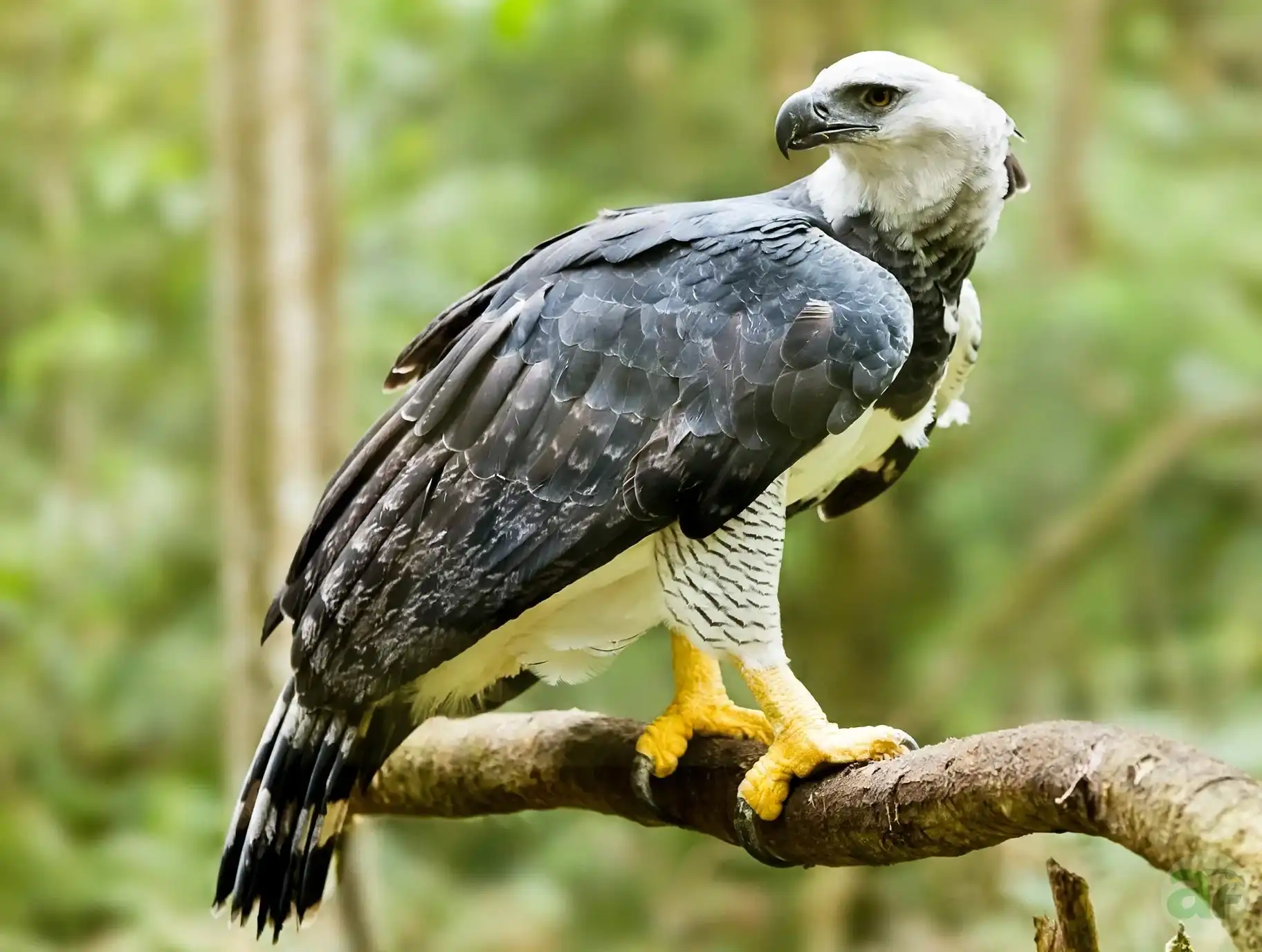
19. Best Places to See Harpy Eagles in the Wild
Seeing a wild harpy eagle is one of the most challenging and most rewarding wildlife experiences in the Neotropics — the combination of the bird’s rarity, its primary forest requirements, and its cryptic behavior in the forest interior making any wild encounter exceptional.
The Most Reliable Locations
1. Soberanía National Park, Panama — The single most reliable location for wild harpy eagle observation in the world — several known nesting pairs in the park have been habituated to human presence through decades of careful monitoring. The park is located just 30 km from Panama City — accessible as a day trip from the capital. The Harpy Eagle Interpretive Center at the park provides educational context, and local guides from the Advantage Panama and Canopy Family operations maintain knowledge of current nest locations and individual eagle behavior. During active nesting (which recurs every 2–3 years per pair), views of the harpy eagle at and near the nest can be extraordinary — the birds allowing close approach from established viewing positions. This is genuinely the best harpy eagle experience available to visiting wildlife tourists.
2. Darien National Park and Darien Province, Panama — Panama’s most intact primary forest; higher harpy eagle density than Soberanía but more logistically challenging access. Specialized wildlife tour operators run multi-day expeditions into the Darien combining harpy eagle search with extraordinary overall biodiversity. The combination of harpy eagle viewing potential and the spectacular general biodiversity of the Darien makes this one of the finest wildlife destinations in the Americas.
3. Manu National Park and Biosphere Reserve, Peru — The extraordinary biodiversity of Manu — one of the world’s most species-rich protected areas — includes harpy eagle populations in the lowland Amazon sector accessible from the Manu River. Lodge-based wildlife programs including Pantiacolla Lodge and Manu Wildlife Center provide naturalist-guided forest excursions where harpy eagles are occasionally encountered. Sightings are not reliable but the overall wildlife experience is unmatched.
4. Tambopata National Reserve, Peru (near Puerto Maldonado) — More accessible than Manu; Tambopata Research Center provides excellent Amazon lodge infrastructure and naturalist guiding. Harpy eagles are occasionally encountered during forest excursions — particularly at clay licks where large birds congregate.
5. Iwokrama Forest, Guyana — The intact primary forest of central Guyana supports excellent harpy eagle habitat — the Iwokrama International Centre for Rain Forest Conservation runs wildlife programs in forest that retains the full suite of Amazonian apex predators including harpy eagles.
6. Corcovado National Park, Costa Rica — One of the most biodiverse places in Central America; harpy eagle sightings are rare but documented in the park’s primary forest. The combination of accessibility from tourism infrastructure and intact forest makes Corcovado worthwhile for harpy eagle search alongside the park’s extraordinary general biodiversity.
7. Asa Wright Nature Centre, Trinidad — While not in the continental harpy eagle range, this exceptional nature center in Trinidad’s Northern Range provides access to various large forest raptors in a spectacularly biodiverse setting — a useful preparation for visiting the mainland harpy eagle range.
Ex-Situ Viewing
8. Summit Municipal Park, Panama — Home to “Panamá” and other ambassador harpy eagles maintained in large naturalistic enclosures — providing close-range observation of harpy eagle behavior in a managed setting with excellent educational interpretation.
9. Peregrine Fund’s World Center for Birds of Prey, Boise, Idaho — Occasionally maintains harpy eagles in the captive collection; education programs provide harpy eagle information of the highest scientific quality.
The Honest Assessment — Wild harpy eagle sightings require patience, appropriate locations, experienced local guides, and realistic expectations. Even at Soberanía National Park — the best site globally — sightings are not guaranteed and depend on whether a pair is actively nesting. The best approach is to book guided visits specifically focused on harpy eagle search through operators with current knowledge of nest sites and individual bird locations. Any wild harpy eagle encounter must be considered extraordinary fortune — the birds’ rarity, cryptic behavior, and primary forest requirements making them genuinely one of the most challenging large birds to observe anywhere in the Neotropics.
20. How You Can Help
Supporting harpy eagle conservation requires action focused on Amazon forest protection, hunting reduction, community-based conservation support, and the organizations working directly at nest sites and in harpy eagle range communities.
Support these organizations:
- The Peregrine Fund — peregrinefund.org — operates harpy eagle research and conservation programs in Panama and other Neotropical countries; among the most important harpy eagle conservation organizations globally
- World Wildlife Fund (WWF) Amazon Program — wwf.org — comprehensive Amazon conservation programs protecting harpy eagle habitat
- Amazon Conservation Association — amazonconservation.org — direct forest protection and research in the Peruvian Amazon
- Rainforest Trust — rainforesttrust.org — funds purchase and protection of primary forest areas critical for harpy eagle conservation
- Wildlife Conservation Society (WCS) Latin America — wcs.org — comprehensive Neotropical conservation programs including harpy eagle research
- Instituto Chico Mendes de Conservação da Biodiversidade (ICMBio, Brazil) — gov.br/icmbio — Brazil’s national biodiversity conservation institute; manages the protected areas that represent the most important harpy eagle habitat in the core range
Critical individual actions:
- Support Amazon forest protection — harpy eagle conservation is fundamentally Amazon conservation. Supporting organizations that fund land protection, community conservation, and forest monitoring directly benefits harpy eagles alongside thousands of other species
- Choose deforestation-free products — avoiding beef and soy products not certified as deforestation-free reduces the agricultural demand that drives Amazon clearance
- Participate in responsible ecotourism — visiting harpy eagle sites through responsible operators generates the economic value for forest that provides the strongest local argument for conservation
- Support indigenous land rights — indigenous territories are among the best-protected areas of Amazon forest; supporting indigenous rights advocacy benefits harpy eagles and the broader Amazon ecosystem
- Spread awareness — the harpy eagle’s extraordinary biology and conservation status are not widely known outside the conservation and birding communities; sharing accurate information about this extraordinary bird and the Amazon’s conservation crisis builds the public awareness that drives political action
21. Top Documentaries & Books
Must-Watch Documentaries
- “Planet Earth — Jungles” (BBC, David Attenborough, 2006) — Features harpy eagle predation footage in the Amazonian forest context; among the finest documentary sequences of harpy eagle hunting behavior available
- “Amazon” (BBC, various productions) — Multiple BBC treatments of the Amazon ecosystem include harpy eagle content
- “The Harpy Eagle: Lord of the Amazon” (various wildlife channel productions) — Dedicated harpy eagle documentaries available through wildlife streaming platforms; the most focused treatments of the species’ biology and conservation
- “The Eagle Huntress” (2016) — While focused on Central Asian eagle hunting, provides the best documentary context for understanding human-eagle relationships broadly
- Peregrine Fund video library — peregrinefund.org — the most scientifically accurate video content on harpy eagle behavior, nesting, and conservation; freely accessible online
Must-Read Books
- Eagles of the Americas by Kent Dunning and various authors — Comprehensive treatment of New World eagle diversity including detailed harpy eagle coverage
- The Harpy Eagle by Everton Miranda — The most comprehensive scientific treatment of harpy eagle ecology and conservation by Brazil’s leading harpy eagle researcher
- Neotropical Birds of Prey by William Bierregaard Jr. — Comprehensive reference for Neotropical raptor biology including harpy eagle
- Birds of Peru by Thomas Schulenberg et al. — The standard reference for Peruvian birds including harpy eagle distribution and identification
- The Amazon (various natural history books) — Multiple popular natural history treatments of the Amazon provide essential context for understanding the harpy eagle’s ecosystem
22. Harpy Eagle Comparison with Other Forest Eagles
| Feature | Harpy Eagle | Philippine Eagle | Crested Eagle | Papuan Eagle | Martial Eagle |
|---|---|---|---|---|---|
| Scientific name | Harpia harpyja | Pithecophaga jefferyi | Morphnus guianensis | Harpyopsis novaeguineae | Polemaetus bellicosus |
| Max weight (female) | 9 kg | ~8 kg | ~1 kg | 2.4 kg | 6.2 kg |
| Max wingspan | 224 cm | 220 cm | 120 cm | 119 cm | 260 cm |
| Primary prey | Sloths, large monkeys | Flying lemurs, large lizards | Small mammals, large lizards | Small mammals, lizards | Monitor lizards, small antelopes |
| Facial disc | Yes — unique among eagles | Partial | No | No | No |
| Habitat | Lowland primary rainforest | Lowland primary rainforest | Neotropical forest | New Guinea mountain forest | African savanna and open woodland |
| Conservation | Vulnerable | Critically Endangered | Near Threatened | Vulnerable | Vulnerable |
| Range | Neotropics | Philippines only | Neotropics | New Guinea | Sub-Saharan Africa |
| Talon size | Largest of any eagle | Very large | Moderate | Moderate | Large |
| Closest relative | Papuan eagle | Distant — convergent | Harpy eagle (near) | Harpy eagle | Various Aquila relatives |
| Famous for | Most powerful eagle Americas; mythological name | Most endangered eagle | Similar but smaller | Small forest harpy | African forest hawk-eagle |
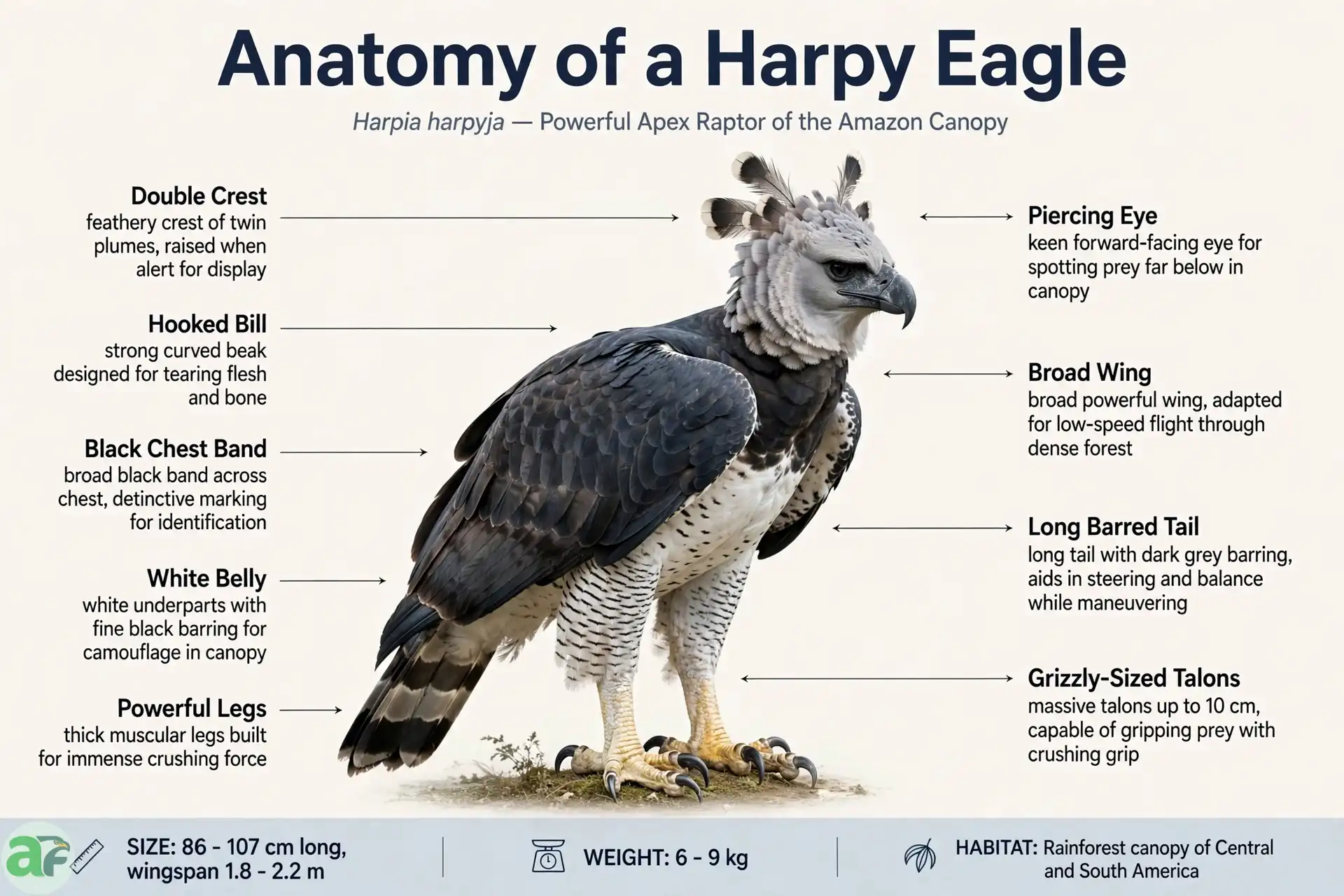
23. Frequently Asked Questions About Harpy Eagles
Q1. What is the scientific name of the harpy eagle?
The harpy eagle’s scientific name is Harpia harpyja (Linnaeus, 1758). Both the genus name Harpia and the species name harpyja derive from the same Greek mythological source — the Harpies (Harpuiai), the winged spirits of sudden death in Greek mythology. Harpuia derives from the Greek verb harpazein — “to snatch” — referring to the Harpies’ characteristic sudden seizure of victims without warning. The naming was established when Louis Jean Pierre Vieillot created the genus Harpia in 1816, consolidating the species’ mythological connection in both the genus and species name. The species was originally described by Carl Linnaeus in the 10th edition of Systema Naturae in 1758 as Vultur harpyja — placed in the vulture genus based on initial assessment of specimens — before being reclassified to the current genus Harpia. The harpy eagle belongs to the subfamily Harpiinae within the family Accipitridae — sharing this subfamily with the closely related Papuan eagle (Harpyopsis novaeguineae) and the crested eagle (Morphnus guianensis). The common name “harpy eagle” directly references the Greek mythological Harpies and is one of the most accurately descriptive common names in raptor nomenclature — the sudden, silent seizure of prey that characterizes the harpy eagle’s hunting technique precisely mirrors the mythological snatching behavior attributed to the Harpies.
Q2. How big are harpy eagle talons compared to other animals?
The harpy eagle’s talons are documented as the largest of any living eagle — the rear talon (hallux) of a large female reaching 12.5 centimeters in length. To place this in biological context: the harpy eagle’s rear talon is longer than the claws of an adult grizzly bear (Ursus arctos horribilis), which typically measure 8–10 cm on the front feet. The harpy eagle’s talon is also longer than the claws of a Bengal tiger (approximately 8–10 cm when fully extended) and comparable in length to the middle claws of a large male lion (approximately 10–12 cm). In absolute force terms, the harpy eagle’s measured grip force exceeds 400 Newtons in controlled studies — comparable to the bite force of a large domestic dog and sufficient to fracture the skull of prey animals and compress the spinal column. The evolutionary context for this extraordinary talon development is the harpy eagle’s prey base — taking adult sloths and large monkeys that grip the forest canopy branches with their own powerful hands and claws requires a predator grip capable of overcoming the prey’s natural defensive grip. The harpy eagle’s talons are therefore specifically scaled to the challenge of detaching large, clinging prey from their arboreal substrate.
Q3. Why does the harpy eagle breed so slowly?
The harpy eagle’s 2–3 year breeding cycle — the slowest reproduction rate of any eagle in the Americas — reflects the extraordinary energetic investment required to successfully raise a single harpy eagle eaglet from egg to independence in the challenging ecological context of the primary Neotropical rainforest. The cycle’s extended duration is the cumulative result of several individually long phases: the 56-day incubation (significantly longer than most raptors of comparable size); the 5–6 month nestling period (the eaglet remaining in the nest through most of the tropical dry season); and most critically, the extraordinary 12–18 month post-fledging dependency during which the fledged young bird remains associated with the nest territory and receives parental food delivery while progressively developing independent hunting capability. This post-fledging dependency — the longest of any eagle in the Americas — reflects both the complexity of the harpy eagle’s hunting skill set (learning to ambush highly variable prey including fast-moving monkeys in complex three-dimensional forest space requires extended practice) and the energetic demands of a large-bodied predator in a forest ecosystem where prey of suitable size is relatively rare per unit area. The biological consequence of this slow breeding rate is that the harpy eagle population is extremely sensitive to adult mortality — a breeding pair removed from the population through hunting or habitat loss cannot be quickly replaced, and the accumulated loss of breeding adults across the range cannot be compensated by the species’ slow reproductive output.
Q4. Is the harpy eagle more powerful than the golden eagle?
Comparing the harpy eagle and the golden eagle as the most powerful eagles of the Neotropics and Northern Hemisphere respectively involves multiple dimensions — and the answer depends on how “powerful” is defined. In terms of absolute body mass, large female harpy eagles (up to 9 kg) exceed large female golden eagles (up to 6.7 kg) — the harpy eagle is heavier. In terms of talon size, the harpy eagle’s rear talons (up to 12.5 cm) significantly exceed the golden eagle’s talons — the harpy eagle has more powerful grasping weapons. In terms of prey-to-predator mass ratio, the harpy eagle regularly takes prey at or exceeding its own body weight (adult sloths, large monkeys at 7–9 kg taken by females weighing 7–9 kg); the golden eagle takes very large prey in exceptional circumstances but more typically takes prey at 30–50% of its own body weight. In terms of hunting speed, the golden eagle’s stoop at 240–320 km/h delivers kinetic energy that exceeds what the harpy eagle’s ambush from perch can achieve. In terms of ecological dominance in their respective environments, both species are unambiguous apex predators — the harpy eagle in the Neotropical primary forest canopy, the golden eagle in the open mountain and steppe landscapes of the Northern Hemisphere. The most accurate summary is that the harpy eagle is the world’s most powerful forest eagle by talon size and maximum prey mass, while the golden eagle is the world’s most powerful open-country eagle by hunting speed and geographic dominance — both representing the apex of avian predatory evolution in their respective ecological contexts.
Q5. Where is the best place to see a harpy eagle in the wild?
The single most reliable location for wild harpy eagle observation is Soberanía National Park in Panama — located just 30 km from Panama City, the park hosts multiple known breeding pairs that have been monitored for decades by the Peregrine Fund’s research program. Semi-habituated individuals near known nest trees allow approach to established viewing positions, and during active nesting years, sustained close-range views are possible. The park’s proximity to Panama City’s international airport (accessible from most North and South American cities and many European cities) makes it the most practically accessible harpy eagle site for international visitors. Specialized wildlife tour operators including Advantage Panama and Canopy Family maintain current knowledge of nest locations and provide guided visits that maximize sighting probability. Outside Panama, the best harpy eagle opportunities are at Iwokrama Forest in Guyana (accessible but remote), the Manu Biosphere Reserve in Peru (possible but not reliable), and in Darien Province, Panama (excellent probability but logistically challenging). Importantly, any visitor to potential harpy eagle sites should maintain realistic expectations — even at Soberanía, sightings cannot be guaranteed, and whether nesting is active in any given year determines access to the most reliable viewing opportunities.
24. Sources & References
- Wikipedia — Harpia harpyja, Harpiinae, Accipitridae, Harpies (mythology)
- IUCN Red List — iucnredlist.org (current Vulnerable assessment for Harpia harpyja)
- BirdLife International — birdlife.org (species factsheet; population assessment)
- The Peregrine Fund — peregrinefund.org (harpy eagle research program documentation)
- Miranda, E.B.P. — multiple published papers on harpy eagle ecology, prey selection, and conservation in Brazil
- Rettig, N.L. (1978). “Breeding behavior of the Harpy Eagle.” The Auk — foundational harpy eagle breeding study in Guyana
- National Geographic — nationalgeographic.com
- Smithsonian National Museum of Natural History — naturalhistory.si.edu
- BBC Wildlife / BBC Earth — bbcearth.com
- Britannica — britannica.com/animal/harpy-eagle
- Cornell Lab of Ornithology — allaboutbirds.org (species account; Macaulay Library)
- Instituto Chico Mendes de Conservação da Biodiversidade — gov.br/icmbio
- Guinness World Records — guinnessworldrecords.com (largest eagle talons documentation)
- Panama Tourism Authority — visitpanama.com (harpy eagle tourism documentation)