
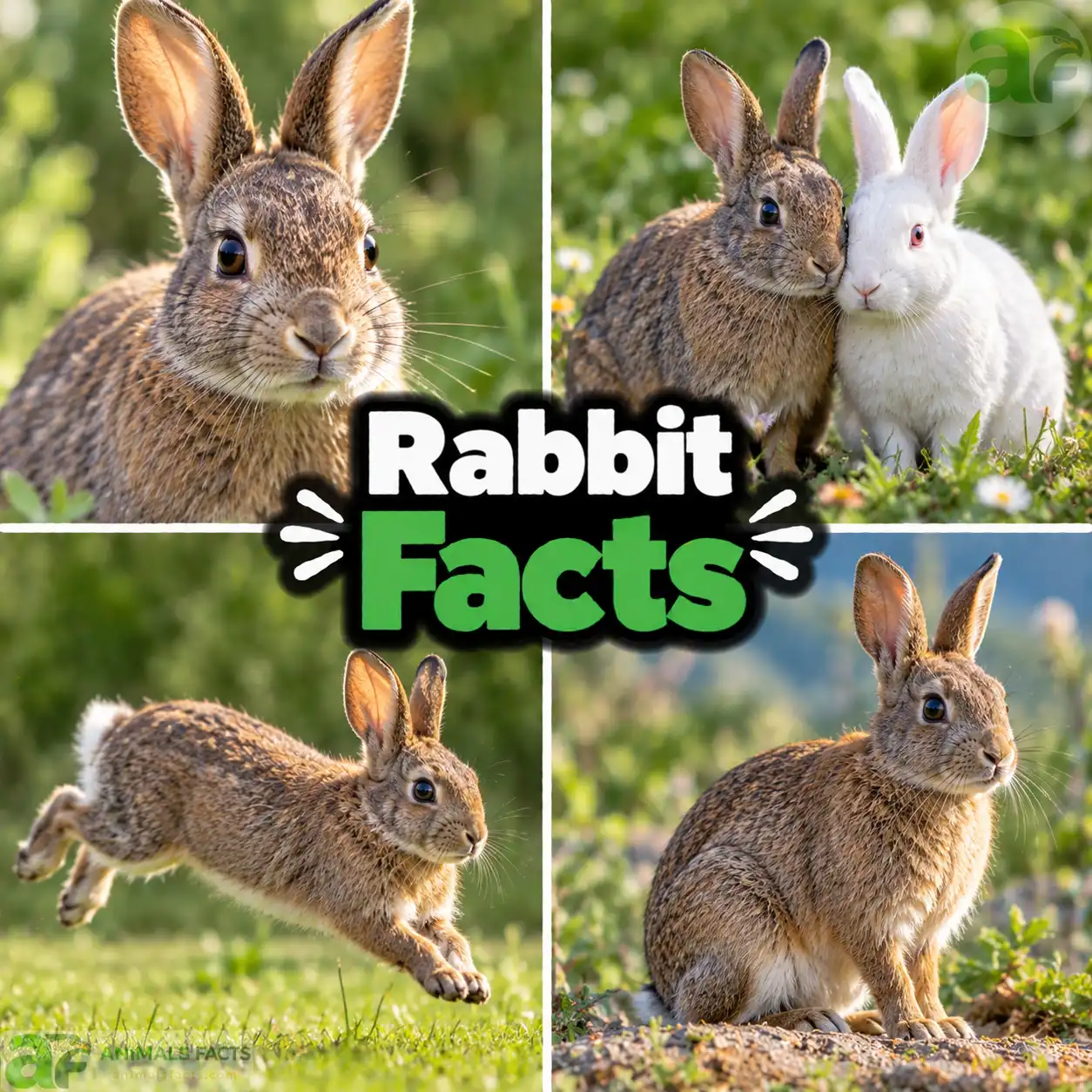
Rabbit Facts
| Feature | Details |
|---|---|
| Scientific Name | Oryctolagus cuniculus (European rabbit — primary domesticated species); Order Lagomorpha; Family Leporidae |
| Kingdom | Animalia |
| Phylum | Chordata |
| Class | Mammalia |
| Order | Lagomorpha |
| Family | Leporidae |
| Common Names | Rabbit, bunny, coney (historical) |
| Native Range | European rabbit native to Iberian Peninsula; introduced globally; wild rabbit species worldwide |
| Habitat | Grassland, woodland edge, farmland, desert, wetland margins, suburban environments |
| Lifespan | 1–3 years (wild European rabbit); 8–12 years (domestic rabbit, well cared for) |
| Diet | Exclusively herbivorous — grasses, hay, leafy plants, bark, vegetables |
| Body Length | 20–50 cm depending on species and breed |
| Weight | 0.4–2 kg (wild); 1–8 kg (domestic breeds); Flemish Giant up to 10+ kg |
| Top Speed | Up to 56 km/h in short bursts |
| Conservation Status | European rabbit: Endangered (IUCN) — despite being invasive in many countries |
| Number of Wild Species | 29 species in family Leporidae (rabbits); plus 30+ hare species |
| Defining Feature | Cecotrophy — eating specialized nutrient-rich fecal pellets; and extraordinary reproductive rate |
| Closest Relatives | Hares (Lepus species) and pikas (Ochotona species) — NOT rodents |
 1. Introduction: What is a Rabbit?
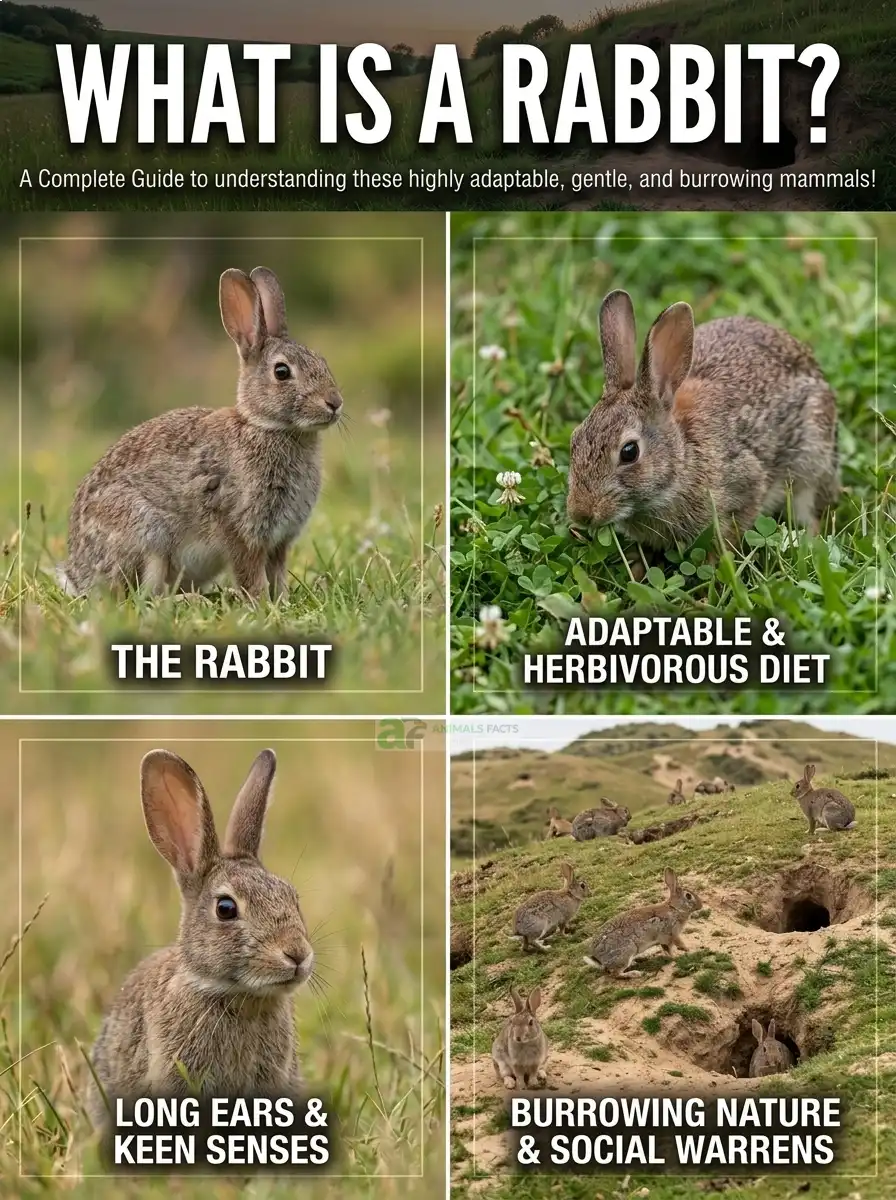
In an English meadow at twilight — when the last light catches the grass at a low angle and the evening calm settles across the landscape — small shapes emerge from holes at the field margins and begin grazing with the methodical purposefulness of animals engaged in urgent, nightly business. They are simultaneously completely familiar and deeply misunderstood — animals so embedded in human culture, mythology, and daily life that most people believe they know everything about them, while actually knowing almost nothing that is accurate. Rabbit facts begin with this single, quietly revolutionary insight: the animal you think you know is not the animal that actually exists.
The rabbit is not a rodent. It does not primarily eat carrots. Its most nutritionally important meal of the day consists of eating its own feces. It is not the gentle, passive creature of popular imagination — it is a prey animal operating under constant threat whose behavioral sophistication, complex social structure, and extraordinary physiological adaptations make it one of the most evolutionarily successful small mammals in the world. The European rabbit — the ancestor of every domestic breed from the tiny Netherland Dwarf to the enormous Flemish Giant — is simultaneously Endangered in its native Iberian Peninsula homeland while being one of the most destructively invasive mammals in Australia, New Zealand, and the Canary Islands. Interesting facts about rabbits reveal an animal of breathtaking biological complexity — a digestive system so sophisticated that it runs its food through the body twice; a reproductive system so efficient that a single female can theoretically produce over 800 offspring in a single year; ears capable of rotating 270 degrees independently and detecting sounds up to 3 km away; and eyes positioned to provide a nearly complete 360-degree field of view with only a small blind spot directly in front of the nose.
Whether you are searching for rabbit facts for kids to explore the science of these beloved animals, a rabbit owner wanting to understand rabbit habitat needs and care requirements more deeply, a wildlife enthusiast fascinated by the ecological impact of rabbits in their native and introduced ranges, or simply someone who grew up loving rabbits in stories and cartoons and has always assumed the real animal matched the fictional one — this is your comprehensive guide. We cover rabbit scientific name, rabbit diet, rabbit size and weight, rabbit behavior, the extraordinary biology of cecotrophy, reproduction, social structure, conservation, cultural significance, and the profound ecological roles rabbits play across the world’s ecosystems. The world’s most familiar small mammal has an extraordinary story to tell — and almost none of it is what you expect.
2. Rabbit Species Overview & Classification
Rabbits belong to the order Lagomorpha — not to the order Rodentia (rodents) — a distinction that reflects a genuinely different evolutionary history and significant anatomical differences despite superficial similarities.
Species Classification Table
| Taxonomic Rank | Classification |
|---|---|
| Kingdom | Animalia |
| Phylum | Chordata |
| Class | Mammalia |
| Order | Lagomorpha (Brandt, 1855) |
| Family | Leporidae (Fischer, 1817) |
| Genera (rabbits) | Oryctolagus, Sylvilagus, Brachylagus, Bunolagus, Poelagus, Pronolagus, Pentalagus, Nesolagus, Romerolagus |
| Number of Rabbit Species | 29 species |
| Number of Hare Species | 30+ species in genus Lepus |
| Sister Order | Rodentia — most closely related mammalian order |
| Other Order Member | Pikas (Ochotona species) — small mountain-dwelling relatives |
Key Species
The European Rabbit (Oryctolagus cuniculus):
| Feature | Details |
|---|---|
| Scientific Name | Oryctolagus cuniculus (Linnaeus, 1758) |
| Common Names | European rabbit, wild rabbit, coney |
| Native Range | Iberian Peninsula (Spain, Portugal) |
| Introduced Range | Australia, New Zealand, Americas, Africa, islands worldwide |
| IUCN Status | Endangered |
| Significance | Ancestor of all domestic rabbit breeds |
| Social Structure | Colonial — lives in warrens with complex social hierarchy |
Cottontail Rabbits (Genus Sylvilagus — North American species):
| Species | Common Name | Range | Notes |
|---|---|---|---|
| Sylvilagus floridanus | Eastern cottontail | Eastern North America | Most common wild rabbit in NA |
| Sylvilagus audubonii | Desert cottontail | Southwestern NA | Desert adapted |
| Sylvilagus palustris | Marsh rabbit | SE United States | Semi-aquatic; swims readily |
| Sylvilagus aquaticus | Swamp rabbit | South-central US | Largest cottontail; aquatic |
Other Notable Species:
| Species | Common Name | Range | Conservation |
|---|---|---|---|
| Brachylagus idahoensis | Pygmy rabbit | Columbia Basin, USA | Vulnerable — smallest rabbit |
| Bunolagus monticularis | Riverine rabbit | Karoo, South Africa | Critically Endangered |
| Pentalagus furnessi | Amami rabbit | Amami Islands, Japan | Endangered — living fossil |
| Romerolagus diazi | Volcano rabbit | Mexico City volcanoes | Endangered |
| Nesolagus netscheri | Sumatran striped rabbit | Sumatra | Vulnerable — rarely seen |
Rabbits vs. Hares — The Critical Distinction
Rabbits and hares are frequently confused — both belong to the family Leporidae but represent distinct evolutionary groups with significant biological differences:
| Feature | Rabbits | Hares |
|---|---|---|
| Birth state | Altricial — born blind, furless, helpless | Precocial — born fully furred, eyes open, mobile |
| Nest | Burrow (usually) | Form — surface depression; no burrow |
| Social structure | Colonial (European rabbit) | Solitary |
| Body size | Generally smaller | Generally larger |
| Ear length | Shorter relative to head | Longer relative to head — black-tipped in many |
| Domesticated? | Yes — O. cuniculus extensively domesticated | No — no domesticated hare species exists |
| Examples | European rabbit, cottontails | Jack rabbit, brown hare, Arctic hare |
Lagomorphs vs. Rodents — Why Rabbits Are Not Rodents
The distinction between Lagomorpha and Rodentia reflects genuine biological differences:
Extra pair of incisors — Lagomorphs have four upper incisors (two large, functional incisors plus two small “peg teeth” directly behind them) — rodents have only two upper incisors. This four-incisor condition is one of the defining anatomical features of the order Lagomorpha.
No canine teeth — Both lagomorphs and rodents lack canines — but the specific dental formula differs between the orders.
Molecular evidence — DNA analysis confirms that Lagomorpha and Rodentia are sister orders (most closely related to each other among mammalian orders) but represent distinct evolutionary lineages that diverged approximately 85 million years ago.
Historical confusion — Rabbits were classified as rodents in some early taxonomic systems — the error persisting in some informal usage — but have been recognized as a separate order since the early 20th century.
Evolution & Discovery Timeline
~85 million years ago — The lagomorph lineage diverges from the ancestor of modern rodents — an ancient split that occurred before the extinction of non-avian dinosaurs.
~55–60 million years ago — The earliest definitive lagomorph fossils appear in the Eocene of Asia — documenting the early diversification of the order.
~10–20 million years ago — The family Leporidae (rabbits and hares) diverges from pikas (Ochotonidae) — the two surviving lagomorph families establishing their distinct ecological roles.
~5 million years ago — The Oryctolagus lineage (European rabbit ancestors) diverges — evolving in the Iberian Peninsula as a distinct from related Mediterranean rabbit species.
**~6th century BCE — The earliest documented human reference to the European rabbit — in records from Phoenician traders who named the Iberian Peninsula I-Shepan-im (“land of the rabbits”) — the name evolving eventually into “España” (Spain).
1st century CE — Roman authors including Pliny the Elder document rabbit husbandry in the ancient world — the Romans maintained rabbits in enclosed leporaria (rabbit enclosures) for food production.
5th–15th century CE — European medieval monasteries develop controlled rabbit breeding — an important food source particularly during religious fasting periods when rabbit meat was sometimes classified as “fish” (aquatic creature) rather than “meat.”
16th century — European colonists begin introducing European rabbits to oceanic islands and subsequently to continental Australia, New Zealand, and the Americas — initiating what will become one of the most destructive biological invasions in history.
1859 — Thomas Austin releases 24 European rabbits on his property in Victoria, Australia — the founding event of the Australian rabbit invasion. Within decades, the population reaches hundreds of millions.
1950 — The myxomatosis virus is deliberately introduced to Australia to control rabbit populations — killing approximately 500 million rabbits (around 99% of the population) within 18 months. The success is dramatic but temporary — rabbit populations subsequently develop resistance.
1995 — Rabbit calicivirus disease (RHD) is deliberately released in Australia for biological control — the second major biological control agent after myxomatosis.
2007 — The IUCN reclassifies the European rabbit as Endangered in its native Iberian Peninsula range — a conservation paradox given the species’ devastating invasiveness elsewhere.
2024 — Updated population surveys in Spain and Portugal confirm continued European rabbit population decline in its native range — with populations at approximately 5% of 1960s levels in some areas of southern Spain.
“The rabbit is simultaneously one of the world’s most studied and most misunderstood animals. We know extraordinary things about rabbit biology, ecology, and behavior — and yet the popular image of the rabbit remains almost entirely mythological. The gap between the scientific rabbit and the cultural rabbit is one of the largest in zoology.”
— Dr. Andrew Hutson, Leporid biologist and chair of the IUCN Lagomorph Specialist Group
3. Rabbit Physical Description & Unique Features
Rabbit size and weight vary enormously across the 29 wild species and hundreds of domestic breeds — from the pygmy rabbit (Brachylagus idahoensis) at approximately 250–400 grams and 23–29 cm to the largest domestic breeds including the Flemish Giant at over 10 kg and 80+ cm in length. But across all species and breeds, rabbits share the defining anatomical features that reflect their evolutionary adaptation as prey animals in open environments.
The Ears — Precision Audio Equipment
The rabbit’s ears are among its most functionally sophisticated anatomical features — and the source of the most obvious visual characteristic associated with the animal:
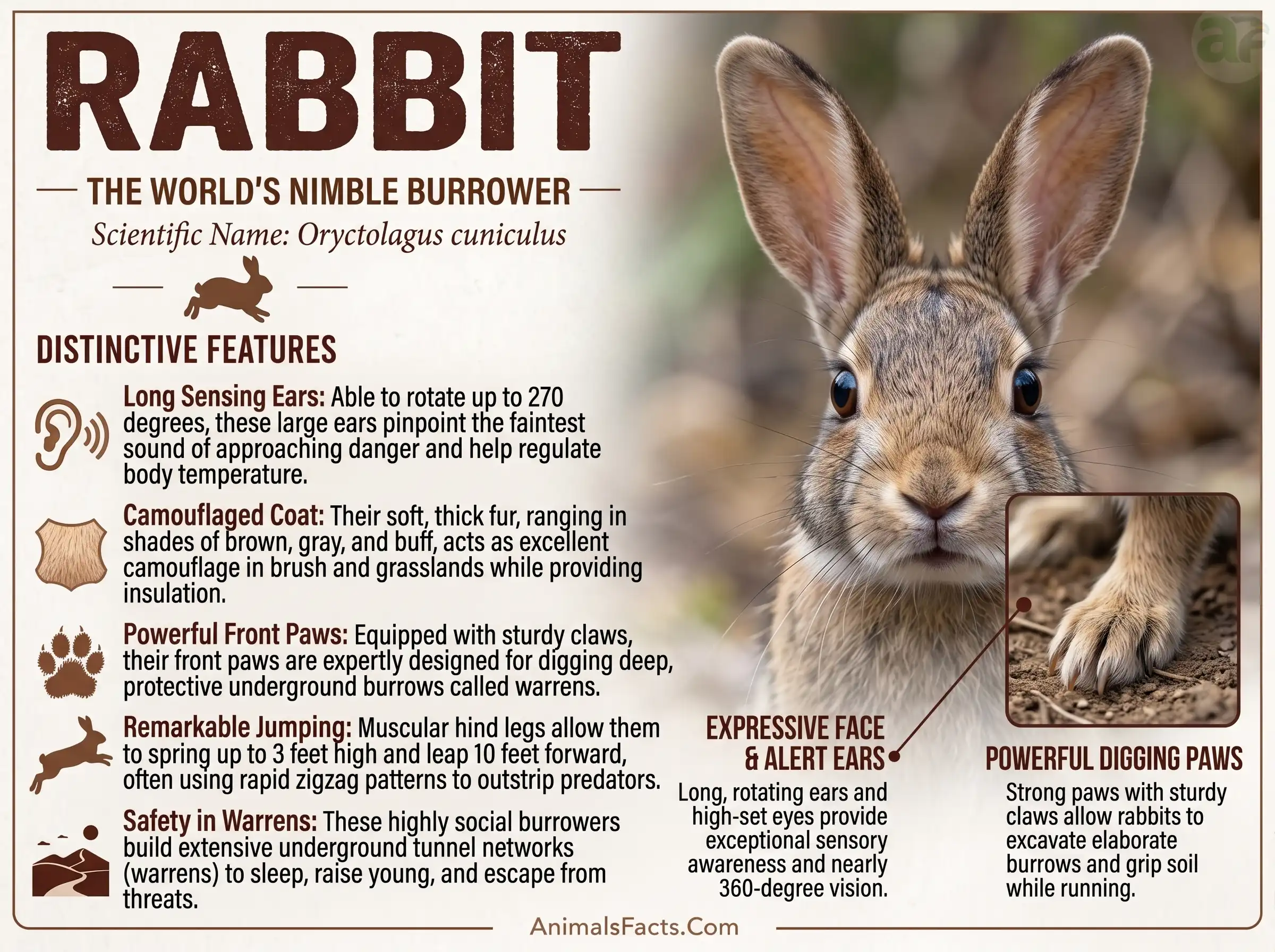
Independent rotation — Each ear can rotate independently through approximately 270 degrees — allowing the rabbit to monitor sounds from almost any direction simultaneously without moving its body. This independent rotation is controlled by a set of specialized muscles that allow each ear to operate as an independent directional microphone.
Detection range — Rabbit ears can detect sounds at distances of up to 3 km — an acoustic range that is critical for detecting approaching predators in open grassland environments where the rabbit evolved.
Thermoregulation function — The ears contain an extensive network of blood vessels close to the surface — allowing them to function as radiators that dissipate excess body heat in warm conditions. The large surface area of the erect ear allows rapid heat exchange with the environment. In cold conditions, blood flow to the ear surface is reduced and the ears may be flattened against the body to minimize heat loss.
Communication function — Ear position is one of the primary elements of rabbit body language — erect ears communicate alert or curious states; flattened ears signal fear, submission, or aggression depending on other behavioral context.
The Eyes — Near-Complete 360-Degree Vision
Rabbit eyes are positioned on the sides of the head rather than the front — a placement that provides the prey-animal visual advantage of an extraordinarily wide field of view:
Visual field — A rabbit’s total visual field covers approximately 360 degrees — with binocular overlap in front providing some depth perception, and monocular fields on both sides and above providing almost complete surround vision. The only visual blind spot is a narrow zone directly in front of the nose and a small zone directly behind the head.
Panoramic awareness — A rabbit can simultaneously watch for predators from above (birds of prey), from both sides (terrestrial predators approaching from flanking positions), and from behind — without moving its head.
Color vision — Rabbits have dichromatic color vision — they can distinguish some colors but not the full spectrum of human trichromatic vision. They are believed to see primarily in blue-green and red-orange wavelengths, with reduced sensitivity to middle-spectrum (green-yellow) colors.
UV sensitivity — Rabbit eyes are sensitive to ultraviolet light — allowing them to detect UV patterns in vegetation and possibly in the urine markings of conspecifics that are invisible to human observers.
Wide pupils — The rabbit’s large, wide pupils are adapted for low-light performance — consistent with the crepuscular and nocturnal activity periods when much rabbit foraging occurs.
The Digestive Anatomy — The Cecum
The rabbit’s most important and most unusual internal anatomical feature is its cecum — an enlarged chamber of the digestive system that functions as the primary site of microbial fermentation:
Size — The rabbit’s cecum is proportionally larger than that of most mammals of equivalent size — containing a complex microbial community that breaks down cellulose and other complex plant compounds that the rabbit’s own digestive enzymes cannot process.
Function — Cellulose-digesting bacteria, protozoa, and other microorganisms in the cecum ferment plant cell walls and produce vitamins, amino acids, and volatile fatty acids that the rabbit absorbs. The cecum is essential for converting the low-quality fibrous plant material that constitutes most of the rabbit’s diet into adequate nutrition.
Cecotropes — The cecum produces cecotropes — specialized fecal pellets that are nutritionally very different from the hard fecal pellets that rabbits normally excrete. See the feeding behavior section for full details.
The Teeth
Rabbits have continuously growing teeth — an adaptation to the abrasive plant diet that would rapidly wear down non-growing teeth:
Incisors — Four upper incisors (the diagnostic lagomorph feature) and two lower incisors — the large front incisors for cutting vegetation, the small peg teeth behind the upper incisors for added grip on plant material.
Cheek teeth — A set of continuously growing premolars and molars for grinding vegetation.
Dental formula — 2/1 incisors; 0/0 canines; 3/2 premolars; 3/3 molars per side — totaling 28 teeth.
Continuous growth — All teeth grow continuously throughout the rabbit’s life — requiring constant wear from chewing to maintain appropriate length. In domestic rabbits, inadequate abrasion from insufficient hay consumption leads to dental overgrowth (malocclusion) — one of the most common and most serious health problems in pet rabbits.
💡 Did You Know? A rabbit’s front teeth (incisors) are not just tools for cutting vegetation — they are anatomically color-coded. Rabbit incisors have yellow or orange enamel on the front surface (from iron compounds in the enamel) and white or pale enamel on the back surface — creating a chisel-like edge where the softer white enamel wears away faster than the harder orange enamel, maintaining the sharp, self-sharpening cutting edge that allows precise vegetation cutting. This self-sharpening incisor system is one of the most elegant anatomical engineering solutions in small mammal dentistry — and the distinctive orange coloration of rabbit incisors is a reliable health indicator: pale white incisors may suggest nutritional deficiency, while very dark orange suggests excessive wear or other issues. The colored enamel is also what gives rabbit teeth their distinctive appearance that is so useful for field identification of rabbit skull material in archaeological and ecological research.
4. Top 25 Amazing Rabbit Facts
Here is your definitive collection of the most extraordinary, scientifically verified, and genuinely astonishing rabbit facts as of 2026:
- Rabbits are not rodents — they belong to the completely separate order Lagomorpha — most closely related to rodents but diverging from that lineage approximately 85 million years ago. The four upper incisors (rather than two) is the single most reliable anatomical distinction.
- Rabbits practice cecotrophy — the deliberate consumption of specialized fecal pellets (cecotropes) directly from the anus. These cecotropes are not ordinary feces — they are nutritionally rich, soft, grape-like clusters produced by the cecum and containing proteins, vitamins (particularly B vitamins), and beneficial gut bacteria that the rabbit would otherwise lose. This practice is essential for rabbit nutrition — a rabbit prevented from cecotrophy will develop severe nutritional deficiencies within days.
- The European rabbit — ancestor of all domestic breeds — is Endangered in its native Iberian Peninsula homeland (IUCN 2007) while simultaneously being one of the most destructively invasive species in Australia and New Zealand. This conservation paradox — a species simultaneously endangered and devastating — is one of the most striking in conservation biology.
- A single female rabbit — a doe — can theoretically produce up to 800 offspring in a single year under ideal conditions — through a combination of the shortest gestation of any placental mammal (approximately 31 days), large litter sizes (4–12 kittens), the ability to conceive again within hours of giving birth, and the breeding of offspring who begin reproducing themselves within a few months.
- Rabbits can run at speeds of up to 56 km/h in short bursts — faster than most domestic dogs and many wild predators. Their explosive speed combined with rapid directional changes (zigzag fleeing — binkying escape patterns) makes them extraordinarily difficult to catch even for specialized predators.
- Rabbit ears can rotate 270 degrees independently — each ear operating as an independent directional microphone that can detect sounds from up to 3 km away. The ears also function as thermoregulators — blood vessels near the surface allowing heat dissipation in hot conditions.
- Rabbits have a nearly 360-degree visual field — their laterally positioned eyes providing essentially panoramic vision with only a small blind spot directly in front of the nose. This visual coverage allows simultaneous monitoring of aerial and terrestrial threats from virtually all directions.
- The binky — the explosive, mid-air twist-and-kick behavior performed by domestic and wild rabbits — is one of the most unambiguously positive behavioral expressions in the animal world. Binkying rabbits are expressing genuine happiness, excitement, or the release of high energy — the behavior has no other documented behavioral function.
- Rabbits are among the few mammals that practice induced ovulation — the female does not ovulate on a regular cycle but rather ovulates in response to the physical stimulation of mating. This adaptation maximizes reproductive efficiency — ensuring that ovulation occurs precisely when sperm are available for fertilization.
- The Australian rabbit invasion — beginning with Thomas Austin’s 1859 release of 24 European rabbits in Victoria — produced what became one of the fastest spread of any invasive species in recorded history. Within 10 years, populations numbered in the millions; within 50 years, rabbits occupied most of the Australian continent; and by the mid-20th century, the Australian rabbit population had reached an estimated 600 million animals — one of the largest single-species mammal population events in modern history.
- Rabbits communicate through thumping — striking the ground with the hind feet to produce a low-frequency vibration that carries through the soil to warn other rabbits of danger. The thumping vibration travels through the ground and can be detected by rabbits in underground burrows where the above-ground sound would not penetrate.
- Rabbits do not naturally eat carrots as a primary food — the association of rabbits with carrots is a cultural myth largely attributable to Bugs Bunny. Wild rabbits encounter carrots very rarely (they are underground root vegetables not commonly available in typical rabbit habitat); in domestic rabbits, carrots are actually high in sugar and should be given only as occasional treats.
- The riverine rabbit (Bunolagus monticularis) of South Africa’s Karoo Desert is the most endangered rabbit in the world — with fewer than 500 individuals remaining in a tiny range along seasonal river floodplains. It is one of the most critically endangered mammals in Africa.
- Rabbits produce two distinct types of feces — the familiar hard, dry pellets that are waste, and the cecotropes — soft, moist, mucus-coated clusters that are produced overnight and immediately consumed from the anus before reaching the ground. If you see your rabbit eating something directly from its hindquarters, it is engaging in normal, essential cecotrophy — not a problematic behavior.
- The Amami rabbit (Pentalagus furnessi) — found only on two small Japanese islands (Amami Ōshima and Tokunoshima) — is considered a living fossil because it retains primitive anatomical features (short ears, small eyes, curved claws for digging) that disappeared from other rabbit lineages millions of years ago.
- Rabbits have a dewlap — a fold of loose skin under the chin — that is present in females and is used to provide fur for lining the nest before giving birth. Does pull fur from the dewlap with their teeth and combine it with other nesting material to create the highly insulated nest that rabbit kittens require.
- European rabbits live in warrens — complex underground tunnel systems that can contain hundreds of meters of tunnels serving dozens to hundreds of rabbits. A well-established warren may have been in continuous use for generations, with the tunnel system expanded and modified over decades.
- In Australia, the rabbit fence (dingo fence variant) — portions of the world’s longest fence originally built to contain rabbit populations — extends for thousands of kilometers across the continent. The commitment of resources to rabbit exclusion reflects the extraordinary economic and ecological damage caused by the invasion.
- Rabbits have a natural fondness for digging — their powerful hind limbs and front paws with strong claws are adapted for excavation. A single rabbit can move up to 2 cubic meters of soil in the construction of a burrow system — demonstrating an ecosystem engineering capability significant at landscape scale.
- The domestic rabbit has an extraordinary range of breed diversity — from the 2 kg Netherland Dwarf to the 10+ kg Flemish Giant — representing one of the most dramatic body size ranges within a single domesticated species. The variety of domestic rabbit coat colors, body types, and ear conformations (erect vs. lop) rivals the domestic dog in phenotypic diversity.
- Rabbits are facultative hyperthermics during extreme heat — they can allow their body temperature to rise several degrees above normal (hyperthermia) rather than spending the metabolic energy required to cool down, entering a state of reduced activity (torpor-like heat conservation). This adaptation allows survival in arid environments that would be challenging for strict homeotherms of equivalent size.
- The rabbit’s skeletal structure reflects its running adaptations — the hindlimb bones are dramatically longer and more massive than the forelimb bones, creating the characteristic back-heavy body proportion that powers the explosive rear-leg launch and the long stride of full-speed fleeing. At high speed, only the hind legs provide propulsive power while the forelimbs primarily manage landing impact.
- Wild European rabbits maintain a dominance hierarchy within warren groups — dominant does occupy the central, deepest burrows (the safest for nesting); subordinate individuals occupy peripheral positions. The hierarchy is maintained through subtle behavioral interactions — posturing, displacement from preferred feeding spots, and occasional physical confrontations.
- Rabbit fur has one of the highest warmth-to-weight ratios of any natural fiber — a fact that drove the extensive rabbit fur trade (particularly Angora rabbit wool) that has made rabbits economically important across multiple industries for centuries.
- The Sumatran striped rabbit (Nesolagus netscheri) is among the world’s least known mammals — camera trap photographs represent the primary documentation of its existence, and basic aspects of its biology remain almost entirely unknown. It has been photographed fewer than 30 times by any method.
5. Fun Facts About Rabbits
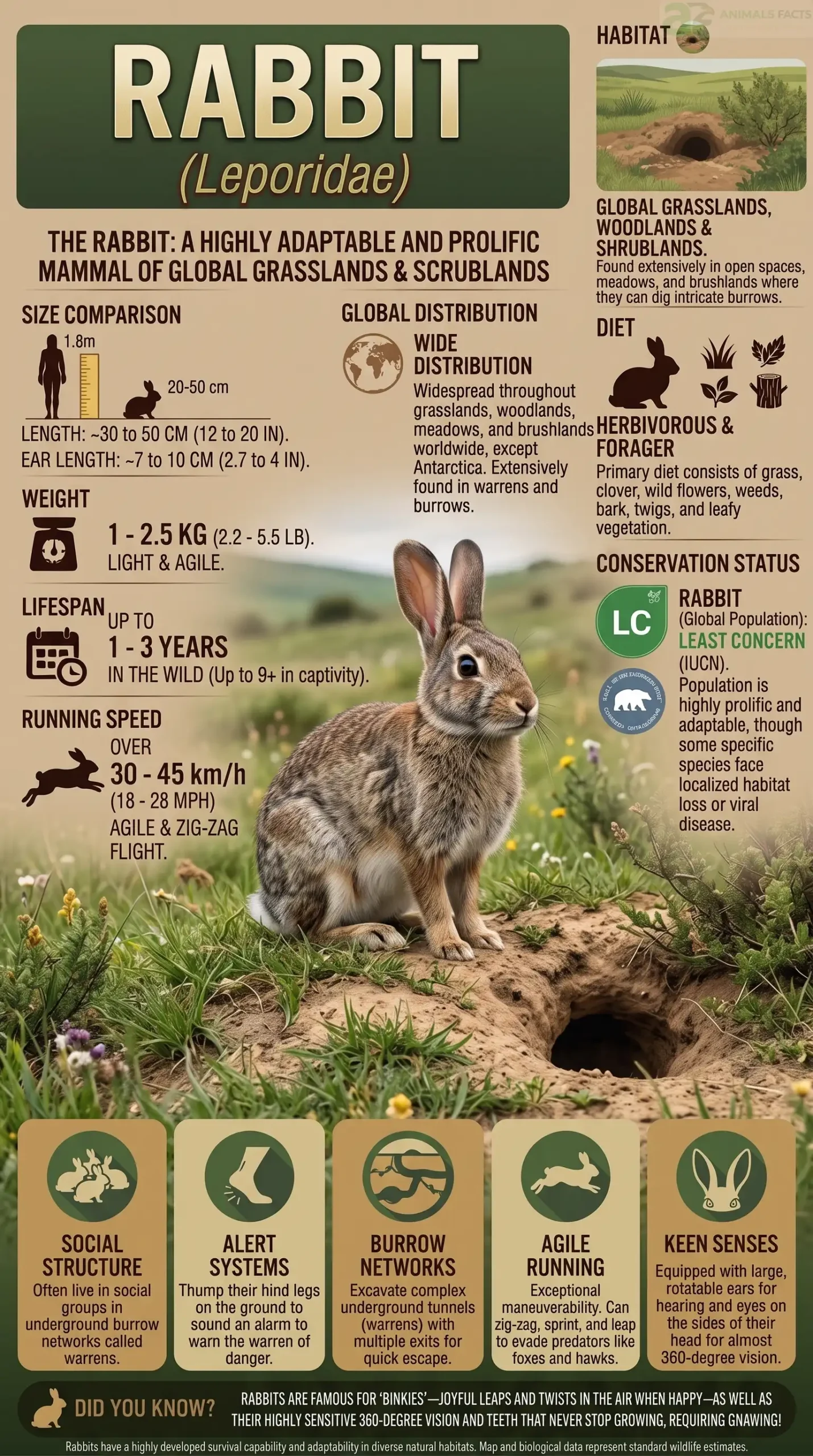
- Rabbits are not rodents — they are lagomorphs with 4 upper incisors
- They eat their own feces — and must do so to survive (cecotrophy)
- One doe can produce 800 offspring per year theoretically
- Rabbits can run at 56 km/h in short bursts
- They see nearly 360 degrees around themselves simultaneously
- The binky — mid-air twist — is a genuine expression of happiness
- Wild rabbits don’t primarily eat carrots — that’s a Bugs Bunny myth
- The riverine rabbit has fewer than 500 individuals left
- Australia’s rabbit invasion grew to 600 million animals
- Rabbit ears can detect sounds up to 3 km away
- Their teeth are self-sharpening and grow continuously
- The Amami rabbit is a living fossil from ancient lagomorph lineages
6. Rabbits Habitat & Geographic Range
Rabbit habitat varies enormously across the 29 wild species — from the Arctic tundra margins to tropical forest edges and from sea-level coastal grassland to high-altitude montane meadows — but the European rabbit (the most ecologically studied and most widely distributed) primarily occupies temperate grassland, scrubland, and woodland-edge habitats.
Habitat Requirements — European Rabbit
The European rabbit requires a specific combination of habitat features that largely determines its distribution:
Friable soil for burrowing — The ability to excavate warren tunnels is essential for the European rabbit’s social and reproductive biology. Sandy, loamy, or chalk soils that can be excavated without excessive effort are strongly preferred. Heavy clay soils or rocky ground that prevents burrowing significantly reduces habitat suitability.
Short vegetation for foraging — European rabbits graze predominantly on short grass — their teeth and foraging posture are adapted for close-cropping of vegetation near the soil surface. Areas of mixed short-grass grazing patches and longer vegetation for cover are optimal.
Cover for escape — Dense scrub, hedgerows, bracken, and other cover vegetation provides escape routes and concealment during predator encounters. Open grassland with no cover nearby is used more cautiously and primarily at night.
Proximity of all requirements — Rabbits typically remain within 150–300 meters of their warren during foraging — the key habitat features (burrow site, foraging patch, escape cover) must all be accessible within this limited range.
Habitat Types
Grassland and meadow — The primary habitat in both native and introduced ranges; short grass provides ideal foraging and long grass/scrub edges provide cover
Coastal dune and cliff — European rabbits in their Iberian native range and on introduced British coasts occupy dune and cliff habitats — the sandy substrate ideal for burrowing
Agricultural land margins — Hedgerow-bounded farmland provides abundant food (crops and grass margins) with burrowing sites in hedgerow banks
Woodland edge — The interface between woodland and open ground is preferred over dense forest interior — the combination of forest shelter and open ground foraging
Urban and suburban parkland — Multiple rabbit species have adapted to urban and suburban environments — English churchyards, city parks, and suburban gardens support rabbit populations in many temperate countries
Desert margins — Cottontail species in North America and the native Iberian range of the European rabbit include semi-arid habitats
High altitude meadow — The volcano rabbit (Romerolagus diazi) occupies mountain grassland above 2,800 meters on the slopes of active volcanoes near Mexico City — one of the most dramatic habitat specialists of any rabbit species
Geographic Range
| Species Group | Range | Habitat | Notes |
|---|---|---|---|
| European rabbit (native) | Iberian Peninsula | Mediterranean scrub, grassland | Endangered in native range |
| European rabbit (introduced) | Australia, NZ, UK, Americas, islands | Any suitable habitat | Invasive; ecological damage |
| Cottontails (Sylvilagus) | Americas (widespread) | Diverse — grassland to swamp | Most common NA wild rabbits |
| Pygmy rabbit | Columbia Basin, USA | Sagebrush steppe | Smallest rabbit; very restricted |
| Riverine rabbit | Karoo, South Africa | Seasonal river floodplain | Critically Endangered |
| Amami rabbit | Two Japanese islands | Subtropical forest | Endangered; living fossil |
| Volcano rabbit | 4 Mexican volcanoes | Alpine grassland (2,800–4,000m) | Endangered; extreme habitat |
| Sumatran striped rabbit | Barisan Mountains, Sumatra | Tropical forest | Vulnerable; barely known |
💡 Did You Know? The European rabbit’s native range — the Iberian Peninsula — is where the species name ultimately gave Spain its name. Phoenician traders who arrived on the Iberian coast around 1100 BCE were struck by the abundance of animals they interpreted as hyraxes (small mammals common in the Middle East and known to them as shaphan) — but which were actually rabbits, an animal the Phoenicians had never encountered before. They called the peninsula I-shapan-im — “land of the hyraxes” — or more precisely, their word for a rabbit-like animal. This name was adopted and modified by subsequent inhabitants — becoming Hispania in Latin and eventually España in Spanish and Spain in English. Every time someone says “Spain,” they are etymologically referencing the rabbits of the Iberian Peninsula — making the rabbit perhaps the only animal to have permanently named a country.
7. Rabbit Diet & Feeding Behavior
Rabbit diet is exclusively herbivorous — and its specific nutritional requirements, the extraordinary cecotrophy behavior, and the digestive physiology that underlies both make rabbit feeding one of the most biologically fascinating aspects of the species.
Diet Breakdown Table
| Food Type | Estimated % of Wild Diet | Notes |
|---|---|---|
| Grasses (various species) | ~60–80% | Primary food throughout the year |
| Herbs and forbs (non-grass flowering plants) | ~10–20% | Varied; selected for palatability and nutrient content |
| Bark and woody material | ~5–10% | Particularly in winter when grass is unavailable |
| Leaves (various species) | ~5–10% | Seasonally important |
| Roots and tubers | ~2–5% | Occasionally excavated; NOT primary food |
| Cecotropes (cecal pellets) | Essential component | Re-ingested directly from anus; nutritionally critical |
Cecotrophy — The Most Misunderstood Behavior
Cecotrophy is the behavior that most surprises first-time rabbit owners and is simultaneously the most nutritionally important aspect of rabbit biology:
What cecotropes are — Cecotropes (also called cecal pellets or night feces) are specialized fecal products produced in the cecum — the large fermentation chamber in the rabbit’s digestive system. They are fundamentally different from the hard, dry fecal pellets that rabbits normally excrete:
- Appearance: soft, moist, mucus-coated, grape-like clusters — not the familiar hard round pellets
- Nutritional content: 28–30% protein; rich in B vitamins (particularly B12); amino acids; volatile fatty acids; and beneficial live gut bacteria
- Production time: produced primarily during night hours or rest periods
- Volume: a rabbit typically produces and re-ingests cecotropes equivalent to approximately 20% of its daily food intake by weight
How cecotrophy works — The rabbit reaches its hindquarters with its mouth and eats the cecotropes directly from the anus as they emerge — the entire process typically completed without the cecotropes ever reaching the ground. The mucus coating protects the contents from stomach acid, allowing the nutritional components to survive passage through the upper digestive tract for absorption in the small intestine.
Why it is essential — Rabbits prevented from performing cecotrophy — by being overweight, having dental problems that prevent them from reaching their hindquarters, or by owners who mistakenly believe the behavior is abnormal and prevent it — develop severe deficiencies within days. Cecotrophy is not optional for rabbit health — it is a mandatory nutritional behavior.
The fiber driving the system — The entire cecotrophy system requires appropriate dietary fiber to function. Long-stem hay provides the indigestible fiber that passes through the cecum, stimulating cecal fermentation and cecotrope production. Insufficient hay = insufficient fiber = inadequate cecotrope production = nutritional deficiency. This is why hay must constitute approximately 80–90% of a rabbit’s diet and is the most important dietary component for both wild and domestic rabbits.
The Hay Imperative
For domestic rabbits, the most important single dietary fact is:
- Hay should constitute 80–90% of the diet — unlimited fresh timothy, orchard grass, or meadow hay
- Hay provides the long-stem fiber that maintains cecal fermentation and prevents gastrointestinal stasis (the dangerous slowdown of the rabbit’s digestive system)
- Hay also provides dental wear — preventing the dental overgrowth that is one of the most common health problems in pet rabbits
- Pellets should be limited and are supplementary to, not a replacement for, hay
- Vegetables (primarily leafy greens) are healthy supplements — not primary foods
- Fruit, carrots, and sugary vegetables are treats only — their high sugar content can cause digestive imbalance
8. Rabbits Reproduction & Life Cycle
Rabbit reproduction is among the most remarkable in the mammalian world — a system so efficient and so rapid that it has made the rabbit both an ecological force of extraordinary power (in the Australian invasion) and one of the world’s most intensively farmed and hunted animals.
The Reproductive System
Induced ovulation — Female rabbits (does) do not ovulate on a fixed cycle — they undergo induced ovulation, releasing eggs only in response to the physical stimulation of mating. This ensures that ovulation occurs precisely when sperm are available, maximizing fertilization probability.
Superfetation — Female European rabbits can become pregnant while already pregnant — a condition called superfetation — allowing the reproductive system to essentially overlap successive pregnancies. A doe can mate and conceive again within hours of giving birth, meaning that reproduction in favorable conditions becomes essentially continuous.
Short gestation — The gestation period of 28–33 days (approximately 31 days for European rabbits) is among the shortest of any placental mammal — reflecting the evolutionary premium on rapid reproduction in a species subject to enormous predation pressure.
Litter Sizes and Reproductive Rate
- Litter size: 1–14 kittens (typical: 4–8 for European rabbit in wild; larger in domestic breeds)
- Litters per year: 3–8 (wild European rabbit); up to 12 in domestic rabbits under optimal conditions
- Age at sexual maturity: 3–8 months depending on species and breed (domestic rabbits often mature at 3–4 months)
- Reproductive lifespan: 3–5 years for does (productivity declining with age)
The theoretical maximum — A single breeding pair of European rabbits left unchecked for one year (assuming 4 litters of 8 surviving offspring, with all surviving females beginning to breed at 4 months) can theoretically produce over 800 individuals. This calculation — which underlies the extraordinary speed of the Australian rabbit invasion — assumes optimal survival rates that are never achieved in practice, but illustrates the fundamental reproductive potential that makes rabbits ecologically formidable.
Altricial Birth and Rapid Development
Rabbit kittens (also called kits or leverets for hares) are born in the most helpless state of any commonly discussed mammal — a stark contrast to the precocial hares:
At birth: blind, deaf, essentially furless, completely helpless — entirely dependent on the mother’s nest for thermoregulation
Day 7–10: eyes and ears begin opening
Day 10–14: fully furred; mobile within the nest
Day 21–25: leaving the nest for first grazing attempts
Day 28–35: weaned and independent
Month 3–4 (domestic) / Month 6–9 (wild): capable of reproduction
This extraordinarily rapid development — from helpless blind newborn to independent, reproductively capable animal in under a year — is the developmental biological foundation of the rabbit’s extraordinary ecological productivity.
Maternal Care
Contrary to popular belief, rabbit does are not neglectful mothers — their apparent absence from the nest is a deliberately evolved behavioral adaptation:
The absence strategy — Does visit their nest only 1–2 times per day — typically briefly at dawn and dusk — for nursing sessions lasting only 3–5 minutes. The rest of the time, the mother stays away from the nest.
Why absence is protective — Predators locate nests partly by following the scent trail of adults. By spending minimal time at the nest, the doe reduces the predator-attracting scent she deposits at the nest location. This minimizes the probability that a predator following her trail will find the kittens.
The nursing efficiency — The few minutes of nursing that the doe provides are extraordinarily nutritionally dense — rabbit milk is among the richest of any mammal, with approximately 12–13% protein and 10–12% fat (compared to cow milk at approximately 3.5% protein and 3.5% fat). This extremely concentrated nutrition allows rapid growth from brief, efficient nursing sessions.
Implication for domestic rabbits — Many domestic rabbit owners mistake the doe’s minimal nest attendance for abandonment and intervene — sometimes fatally, by disturbing the nest or hand-feeding kittens unnecessarily. Unless the kittens are demonstrably cold and crying persistently after nursing time, the appropriate response to apparent maternal absence is to leave the nest alone.
Rabbit Lifespan Comparison Table
| Species | Wild Lifespan | Max Captive | Key Mortality |
|---|---|---|---|
| European rabbit | 1–3 years (average!) | 10+ years | Predation, disease, myxomatosis |
| Eastern cottontail | 1–2 years | 8 years | Predation overwhelming |
| Pygmy rabbit | 1–2 years | 3–4 years | Predation; tiny size |
| Domestic rabbit | 8–12 years (well-cared for) | 18 years | Preventable disease; GI stasis |
| Amami rabbit | ~5–8 years (estimated) | Unknown | Predation; invasive species |
9. Social Behavior & Communication
European rabbit social behavior is considerably more complex than most people assume — the colonial warren-living species maintaining a structured social hierarchy with defined relationships between individuals.
The Warren Social Structure
European rabbits live in warrens — underground burrow systems that house structured social groups called colonies:
Group composition — A typical warren social group consists of 2–25 adults — usually several dominant does, their offspring, subordinate does, and one or more dominant bucks, plus subordinate males.
Female dominance hierarchy — Does maintain a clear dominance hierarchy within the warren — with the most dominant female occupying the central, deepest, most secure nesting sites. Subordinate does may be forced to nest in peripheral, more exposed sites or even in surface scrapes with less protection for their offspring.
Male hierarchy — Bucks establish dominance through combat — direct physical fights involving biting and scratching that can cause serious injuries. Dominant bucks have preferential mating access to receptive does.
Territory defense — Warren groups defend their territory against neighboring groups — with both males and females participating in territorial marking and defense. Scent marking using chin glands, anal glands, and urine is the primary territorial communication method.
Communication Methods
Thumping — The most dramatically effective communication signal; a rapid, powerful strike of the hind foot against the ground produces both an audible sound and a ground vibration that carries through soil. Used as an alarm signal to warn other rabbits — particularly those in underground tunnels where audible sounds from the surface are muffled but ground vibrations conduct effectively.
Scent marking — The primary chemical communication channel:
- Chin gland marking — Rubbing the chin on objects deposits secretions from the submandibular gland — marking objects as familiar or owned
- Anal gland marking — Feces are coated with anal gland secretions that communicate individual identity, health, and reproductive status
- Urine marking — Highly directed urine spraying communicates territorial ownership and reproductive readiness
Vocalizations — Rabbits are mostly silent — but produce a range of vocalizations in specific contexts:
- Growling — Warning vocalization during aggressive encounters
- Screaming — Extreme distress or pain — one of the most startling sounds in nature from such a small animal; an indicator of serious danger or injury
- Tooth grinding (bruxism) — Low-level grinding communicates contentment; loud, harsh grinding communicates pain
- Soft tooth chattering — Associated with contentment during pleasant experiences
Body language — The primary communication channel in close-range interactions:
- Ears erect and forward — Alert, curious
- Ears flat against head — Fear or aggression (context-dependent)
- Nose actively twitching — Processing olfactory information
- Binky — Explosive mid-air twist — joy and excitement
- Flopping — Dramatic sideways collapse to lying position — complete relaxation and contentment (startles new owners)
- Thumping from safety — Warning after threat has passed
The Cottontail Difference
North American cottontail rabbits (Sylvilagus species) are fundamentally different in social organization from European rabbits — being essentially solitary and non-burrowing:
- Cottontails do not dig burrows — they shelter in surface forms (depressions in vegetation)
- They do not live in colonies — they are solitary outside of brief mating encounters
- They rely on camouflage and explosive speed rather than the warren’s underground security
- Their young are born in shallow surface nests covered with fur and vegetation
This social and behavioral difference between the colonial, burrowing European rabbit and the solitary, surface-nesting cottontails reflects a significant evolutionary divergence within the Leporidae family.
10. Predators & Defense Mechanisms
The rabbit’s extraordinary reproductive rate is directly proportional to the extraordinary predation pressure it faces — virtually every carnivore in its range large enough to catch a rabbit will attempt to do so.
Natural Predators
Red fox (Vulpes vulpes) — The most significant rabbit predator across European and introduced-range rabbit populations; foxes are primary nocturnal hunters of rabbits and can have substantial population-regulatory effects.
Stoat/Short-tailed weasel (Mustela erminea) — Among the most effective rabbit predators despite their small size — stoats can pursue rabbits into their burrows and are capable of killing adults and kittens in the nest.
European polecat/Ferret (Mustela putorius) — Before firearms, ferrets were used by human hunters specifically to drive rabbits from their burrows for capture — a practice (ferreting) that reflects the stoat/polecat’s natural adaptation for pursuing rabbits underground.
Buzzard (Buteo buteo) — The most important diurnal avian rabbit predator in Europe; buzzard populations are closely linked to rabbit abundance.
Golden eagle (Aquila chrysaetos) — Significant predator of rabbits in upland areas.
Cats (domestic and feral) — Significant predator of juvenile rabbits and young individuals.
Dogs — Both working dogs (coursing hounds historically) and feral dogs take rabbits across all range areas.
Snakes — In North American cottontail habitat, various snake species take kittens in the nest and occasionally adults.
Humans — Historically and currently one of the most significant rabbit mortality sources globally — through direct hunting, ferreting, trapping, and control programs.
Defense Mechanisms
Speed — The primary defense; 56 km/h in short bursts allows escape from most pursuit predators on open ground.
Zigzag running — During escape from a pursuing predator, rabbits perform rapid, unpredictable direction changes — making aerial pursuit by raptors and ground pursuit by canids extremely difficult.
The binky escape maneuver — In open flight, rabbits perform explosive mid-air jumps and twists that break the visual tracking of pursuing predators — the dramatic, apparently joyful movement actually having a defensive function in wild contexts.
Freezing — In the presence of a predator that has not yet detected the rabbit, freezing in place (relying on camouflage and motionlessness) is the first defensive response — movement attracting predator attention.
Thumping — The alarm thump warns conspecifics to seek shelter — a collective defense measure that benefits the whole social group.
Warren refuge — European rabbits’ ability to rapidly reach a burrow entrance and disappear underground provides a final escape from most terrestrial predators.
Cryptic coloration — Brown-grey fur that matches the color of dried grass and soil provides visual concealment when the rabbit is motionless.
💡 Did You Know? The rabbit’s extraordinary reproductive rate is precisely calibrated to its extraordinary predation pressure — a mathematical equilibrium that ecological modelers call predator-prey dynamics. In a typical English grassland ecosystem, an average rabbit has an annual mortality rate of approximately 50–80% — meaning that in any given year, the majority of the rabbit population dies from predation, disease, or starvation. Yet the population remains stable because the reproductive rate produces enough offspring to replace these losses. When this equilibrium is disrupted — either by removing predators (causing population explosion) or by introducing novel mortality agents like myxomatosis or RHD (causing population collapse) — the ecological consequences cascade through the entire community. This fundamental predator-prey mathematical relationship, worked out with rabbits as a primary study species, provided much of the foundational data for the mathematical ecology theories that underpin modern conservation biology and wildlife management.
11. Rabbit Facts for Kids
Hey amazing young animal explorers! Here are some absolutely incredible rabbit facts for kids that will completely change how you think about these amazing animals:
- 🐰 Rabbits are NOT rodents — and they eat their own poo! Rabbits have FOUR top front teeth (rodents only have two) — so they are actually in their own completely separate animal group called lagomorphs. And they eat a special kind of their own feces every night called cecotropes — which are packed with vitamins and nutrients they need to stay healthy. It might sound gross but it is actually really clever!
- 🐰 One rabbit family could theoretically produce 800 babies in a year! Rabbits are born after only 31 days inside their mother (much faster than humans at 9 months) and litters can have up to 12 babies. Baby rabbits can start having their own babies when they are just 3 months old — which is why rabbit populations can grow so extraordinarily fast!
- 🐰 The “binky” is a rabbit’s happiness dance! When a rabbit suddenly leaps into the air, twists its body, and kicks its feet — this is called a binky, and it means the rabbit is genuinely, overwhelmingly happy! It is one of the most unmistakable expressions of joy in the animal kingdom.
- 🐰 Rabbits can run as fast as 56 km per hour! That is faster than most dogs and many wild predators. They also zigzag when they run, making it even harder for predators to catch them.
- 🐰 They can see almost everything around them at once! A rabbit’s eyes are on the sides of its head and they can see a nearly complete circle around themselves — which means a rabbit eating grass can watch for eagles from above, foxes from both sides, and things sneaking up from behind ALL at the same time!
- 🐰 Spain is named after rabbits! When Phoenician sailors arrived in Spain thousands of years ago, they saw so many rabbits that they named the whole peninsula after them. The word slowly changed over centuries into “España” — which is what Spain is called in Spanish. Every time you say “Spain” you are saying a word that means “Land of the Rabbits”!
- 🐰 There is a rabbit that only lives on the slopes of four volcanoes near Mexico City! The volcano rabbit is one of the world’s smallest and rarest rabbits — and it lives only on high-altitude mountain grasslands on specific Mexican volcanoes, between 2,800 and 4,000 meters above sea level. It even squeaks instead of thumping like other rabbits!
- 🐰 Rabbit mums leave their babies alone on purpose — as a brilliant trick! Mother rabbits visit their babies in the nest for just a few minutes a day — not because they are bad mothers, but because staying away from the nest means predators cannot track her scent to find the babies. Rabbit milk is so nutritious that just a few minutes of feeding gives babies everything they need!
12. Relationship with Humans
The relationship between rabbits and humans is one of the most ancient, most multifaceted, and most globally significant human-animal relationships in existence — encompassing food production, companionship, scientific research, cultural mythology, ecological catastrophe, and conservation crisis simultaneously.
Ancient Human-Rabbit Relationships
Humans and rabbits have coexisted for tens of thousands of years in the Iberian Peninsula — the rabbit’s native range. The relationship has been one of the most consequential in human cultural and economic history:
Prehistoric hunting — Archaeological evidence from Iberian cave sites documents human hunting of rabbits at least 30,000 years ago — with rabbit bones constituting a significant fraction of the faunal remains in many Paleolithic and Mesolithic Iberian sites. Some researchers have proposed that the abundance of rabbits in Iberian ecosystems was one of the factors that enabled Homo sapiens to out-compete Neanderthals in the peninsula — the ability to efficiently exploit rabbit populations providing a reliable protein source that sustained larger human group sizes.
Roman leporaria — The Romans established enclosed leporaria (rabbit enclosures) for maintaining and breeding rabbits as a food source — one of the earliest documented forms of animal husbandry beyond simple livestock domestication.
Medieval monastery breeding — European monasteries of the 5th–15th centuries maintained rabbit warrens both for food production and — exploiting a remarkable theological classification debate — as a source of meat that could be eaten during Lent. In some ecclesiastical traditions, newborn rabbit kittens (born hairless, aquatic-looking) were classified as fish rather than meat — allowing consumption during periods of meat abstinence. The remarkable number of medieval discussions about the precise taxonomic classification of the rabbit for fasting purposes reflects the animal’s importance as a protein source in religious communities.
Domestication — The European Rabbit’s Unique Achievement
The European rabbit (Oryctolagus cuniculus) is the only rabbit species ever successfully domesticated — a process that began in medieval European monasteries and has produced one of the most phenotypically diverse domesticated animals in the world:
The domestication process — Unlike most domesticated animals (dogs, cats, cattle, horses) whose domestication is estimated to have occurred 10,000+ years ago, the domestic rabbit is a relatively recent domestication — most evidence points to the medieval period (approximately 600–1400 CE) as the key domestication phase, making domestic rabbits among the most recently domesticated of all common livestock animals.
Phenotypic diversity — Centuries of selective breeding from the single domesticated O. cuniculus stock have produced an extraordinary range of breeds:
- Size: from 0.9 kg (Netherland Dwarf) to 10+ kg (Flemish Giant)
- Ear conformation: erect (standard) vs. lop (hanging — produced by a mutation affecting cartilage development)
- Coat length: short (rex, castor rex), medium (standard), long (Angora — fiber-producing)
- Coat color: white, black, blue, chocolate, orange, grey, and dozens of pattern variations
- Body type: compact, semi-arch, full arch, commercial, cylindrical (Himalayan)
Uses of domestic rabbits — Domestic rabbits have been and continue to be used for:
- Meat production — Rabbit is a significant protein source globally; China, Italy, Spain, and France are among the largest rabbit meat consumers
- Fur production — Rex rabbit fur and Angora rabbit fiber are commercially valuable
- Scientific research — Domestic rabbits were foundational laboratory animals in immunology, reproductive biology, and pharmaceutical testing
- Companion animals — In the UK, US, and many European countries, rabbits are the third most popular pet after dogs and cats
Rabbits as Pets — The Modern Welfare Crisis
The domestic rabbit has become one of the world’s most popular companion animals — and simultaneously the subject of one of the most significant animal welfare crises in the pet industry:
The welfare problem — Despite being the third most popular pet in many countries, rabbits are among the most poorly understood and most frequently abandoned companion animals. The mismatch between popular perception (gentle, cuddly, low-maintenance) and biological reality (social, behaviorally complex, requiring specialized nutrition and veterinary care, living 8–12 years) produces an epidemic of rabbit welfare problems:
- Incorrect housing — The traditional hutch model (small, isolated, outdoor) is incompatible with rabbit welfare needs for social companionship, space for running and binkying, and mental stimulation
- Incorrect diet — Many rabbit owners provide pellets and vegetables as primary food rather than the unlimited hay that should constitute 80–90% of the diet
- Solitary keeping — Rabbits are highly social animals whose natural state is companionship; solitary confinement produces stress and behavioral abnormalities
- Abandonment — Easter rabbit purchases in particular produce a wave of rabbit surrenders to animal shelters in the weeks following Easter — as owners discover that the real rabbit is not the docile, decorative object they imagined
What rabbits actually need:
- A companion rabbit (neutered pairs are ideal)
- A large, enriched living space — minimum 3 meters × 2 meters floor area, ideally more
- Unlimited hay as primary food
- Regular veterinary care including neutering
- Daily interaction and environmental enrichment
- Protection from extreme temperatures (they are susceptible to both heat stroke and cold)
The Australian Rabbit Catastrophe
The introduction of European rabbits to Australia represents one of the most consequential acts of biological invasion in recorded history — a case study in ecological catastrophe that has shaped global understanding of invasive species:
The scale — Within 70 years of Thomas Austin’s 1859 release of 24 rabbits in Victoria, the Australian rabbit population reached an estimated 600 million animals — one of the fastest and largest mammalian population explosions ever recorded.
The ecological damage:
- Vegetation destruction — Rabbit overgrazing denuded vast areas of Australian native vegetation, preventing regeneration of native plants and fundamentally altering landscape ecology
- Soil erosion — The combination of vegetation removal and burrowing destabilized soils across millions of hectares
- Native animal extinctions — Competition for food and habitat with rabbits contributed to the extinction or severe decline of multiple native Australian mammals — the rabbit is implicated in more Australian mammal extinctions than any other single introduced species
- Economic damage — Estimated annual economic cost of rabbits to Australian agriculture remains in the billions of Australian dollars annually
The control attempts:
- Myxomatosis (1950) — killed ~500 million rabbits initially; resistance developed within years
- Rabbit Calicivirus Disease/RHD (1995) — significant mortality; resistance also developing
- The rabbit-proof fence — thousands of km of fence infrastructure, requiring ongoing maintenance
- Ongoing control — a combination of fumigation, shooting, trapping, and biological control remains a permanent, expensive feature of Australian land management
13. Rabbit Conservation Status & Threats
Conservation Status Overview
| Species | IUCN Status | Population Trend | Primary Threat |
|---|---|---|---|
| European rabbit (O. cuniculus) | Endangered (native range) | Rapidly decreasing in Spain/Portugal | Disease (myxomatosis, RHD); habitat loss |
| Riverine rabbit (B. monticularis) | Critically Endangered | Decreasing | <500 remaining; extreme habitat specificity |
| Amami rabbit (P. furnessi) | Endangered | Decreasing | Predation by introduced mongooses and cats |
| Volcano rabbit (R. diazi) | Endangered | Decreasing | Habitat loss; urban expansion |
| Pygmy rabbit (B. idahoensis) | Vulnerable | Decreasing | Sagebrush habitat loss |
| Sumatran striped rabbit (N. netscheri) | Vulnerable | Decreasing | Deforestation |
| Philippine forest rabbit (N. mindanensis) | Vulnerable | Decreasing | Deforestation |
| Eastern cottontail | Least Concern | Stable | Common; some local declines |
The European Rabbit Conservation Paradox
The most dramatic conservation paradox in rabbit biology is the European rabbit’s simultaneous Endangered status in its native Iberian range and its devastating invasive impact in Australia, New Zealand, and elsewhere:
Native range collapse — In Spain and Portugal, European rabbit populations have declined by approximately 95% since the 1950s — driven by:
- Myxomatosis — initially introduced for Australian control, accidentally spread to Iberian populations in 1952 with devastating effect
- Rabbit Hemorrhagic Disease (RHD/Calicivirus) — arrived in Spain in 1988, causing further catastrophic mortality
- Habitat loss — agricultural intensification removing the scrub-grassland mosaic that rabbits require
- Overhunting — historical overharvesting before legal protections
The ecological cascade — The collapse of Iberian rabbit populations has triggered cascading declines in the predator species that depend on rabbits as their primary prey:
- The Iberian lynx (Lynx pardinus) — the world’s most endangered wild cat — is so dependent on rabbits that its recovery program requires rabbit population management alongside lynx conservation
- The Spanish imperial eagle (Aquila adalberti) similarly depends on rabbit abundance for breeding success
- Approximately 29 vertebrate species in Iberia are considered significantly impacted by rabbit population decline
The conservation priority — In the Iberian Peninsula, the European rabbit has become a conservation priority species — with programs to restore rabbit populations through supplementary feeding, disease management, and habitat improvement for the benefit of the entire rabbit-dependent ecological community.
14. Famous Rabbits in History & Pop Culture
Famous Real Rabbits
“Peter” — Beatrix Potter’s pet rabbit Peter Piper — a Belgian rabbit she kept from 1887 — was the direct inspiration for Peter Rabbit, the most famous fictional rabbit in literary history. Potter’s observations of Peter’s real behavior informed the character’s personality — the adventurousness, the food-seeking behavior, and the relationship with human gardeners. Peter died in 1901 and Potter noted his death in her journal with genuine grief.
“Flopsy” — Another of Beatrix Potter’s pet rabbits — whose name directly became Flopsy Bunny, one of Peter’s siblings in the series.
“Harvey” — The fictional six-foot rabbit companion of Elwood P. Dowd in Mary Chase’s 1944 play Harvey — and the subsequent 1950 film starring James Stewart — representing one of the most beloved invisible rabbit characters in American theater history.
Benjamin Bunny (real inspiration) — Beatrix Potter’s cousin Caroline Hutton’s rabbit — who, combined with observations of her own rabbits, contributed to the character of Benjamin Bunny in the 1904 book.
Historical significance — In 1859, the 24 rabbits released by Thomas Austin on his Barwon Park estate near Geelong, Victoria, Australia — no individual names recorded but collectively representing one of the most consequential animal introductions in history.
Famous Fictional Rabbits
Peter Rabbit (Beatrix Potter, 1902) — The original and most enduring literary rabbit; the blue-coated adventurer whose dangerous trip through Mr. McGregor’s garden has sold over 150 million copies and been translated into over 36 languages. Peter Rabbit is arguably the most successful children’s book character of all time.
Bugs Bunny (Warner Bros., 1940–present) — The wisecracking, carrot-munching animated rabbit who is simultaneously the source of the rabbit-carrot association (not biologically accurate), one of the most recognized cartoon characters globally, and the cultural template for the “clever rabbit outwitting larger adversaries” archetype that appears in folklore worldwide.
The White Rabbit (Lewis Carroll’s Alice’s Adventures in Wonderland, 1865) — The waistcoat-wearing, watch-consulting rabbit whose urgency (“I’m late! I’m late!”) draws Alice into Wonderland — one of the most iconic rabbit characters in English literature and the source of “down the rabbit hole” as a cultural metaphor.
Velveteen Rabbit (Margery Williams, 1922) — Perhaps the most emotionally resonant rabbit in children’s literature — the stuffed rabbit whose longing to become real through a child’s love explores themes of love, loss, and transformation that have made the book enduringly significant.
Watership Down rabbits (Richard Adams, 1972) — The ensemble cast of Hazel, Fiver, Bigwig, and companions in Richard Adams’ extraordinary novel represent the most biologically informed and most emotionally sophisticated fictional rabbit community in literature — Adams based his rabbits’ social behavior on actual European rabbit ecology research.
Thumper (Walt Disney’s Bambi, 1942) — The young rabbit companion of Bambi who gave generations of children their primary rabbit character association — and whose name has become a generic cultural reference for young rabbits.
15. Role in Ecosystem & Food Chain
The Keystone Prey Species Role
In virtually every ecosystem where rabbits occur — both native and introduced ranges — they serve as keystone prey species, structurally important to the food web in ways that exceed what their body size would suggest:
Predator community support — The rabbit’s extraordinary abundance (when not subject to disease or extreme hunting pressure) supports large populations of diverse predators that could not be sustained at the same level on alternative prey alone. In British ecosystems, for example, buzzards, foxes, stoats, weasels, polecats, and red kites all depend significantly on rabbit abundance.
The Iberian Eagle-Lynx-Rabbit triangle — In the Iberian Peninsula, the relationship between rabbits, Iberian lynx (Lynx pardinus), and Spanish imperial eagle (Aquila adalberti) represents one of the clearest documented examples of a trophic cascade driven by a single prey species. The rabbit decline of the last 70 years has driven both predator species to the brink of extinction — confirming the rabbit’s keystone ecological role in Iberian ecosystems.
The Herbivore Ecosystem Engineering Role
Rabbits are significant grazing ecosystem engineers — their intensive, selective grazing shapes vegetation structure in ways that affect the entire ecological community:
Short-turf maintenance — Rabbit grazing creates and maintains short-turf grassland — a habitat of extraordinary biodiversity value in European landscapes. Short-turf downland and chalk grassland maintained by rabbit grazing supports diverse communities of flowering plants, invertebrates, and ground-nesting birds that disappear when rabbit grazing ceases and vegetation grows tall.
The paradox of protection — The collapse of rabbit populations in Britain following myxomatosis in the 1950s caused many areas of botanically rich short-turf downland to be lost under encroaching scrub and rank grass within years — demonstrating that rabbit grazing had been the primary mechanism maintaining these habitats for centuries.
Soil disturbance — Rabbit burrowing creates microsites of disturbed bare soil that are critical germination sites for many plant species — the bare soil patches in rabbit-grazed landscapes are among the most diverse in terms of plant species present per square meter.
The Burrowing Ecosystem Service
European rabbit warrens create extensive underground habitat that is subsequently used by dozens of other species:
- Birds (shelduck, wheatear, puffin) nest in rabbit burrows
- Reptiles (sand lizards, slow worms) use burrows for thermoregulation and hibernation
- Invertebrates (beetles, spiders, flies) inhabit warren soil and rabbit dung
- Small mammals (hedgehogs, weasels, stoats) use abandoned burrow sections for shelter
16. Myths, Folklore & Cultural Significance
The Rabbit in World Mythology
Rabbits appear in the mythological traditions of virtually every civilization that has shared territory with them — with a remarkably consistent set of symbolic associations across widely separated cultures:
Fertility and abundance — The rabbit’s extraordinary reproductive rate has made it a near-universal symbol of fertility, abundance, and regeneration across cultures from ancient China to pre-Christian Europe. This association underlies the rabbit’s connection to spring and Easter in Western Christian tradition — a connection imported from pre-Christian spring fertility symbolism.
The Moon Rabbit — In Chinese, Japanese, Korean, and Aztec traditions, a rabbit is seen in the patterns of the moon’s surface (where Western culture sees a “man in the moon”). In East Asian tradition, the moon rabbit (玉兔 Yùtù in Chinese; 月の兎 Tsuki no usagi in Japanese) pounds the elixir of immortality in a mortar and pestle — a powerful mythological association connecting rabbits to the moon, immortality, and cyclical renewal.
The Trickster Rabbit — Across West African and subsequently African American folklore, the rabbit (particularly Br’er Rabbit) appears as the archetypal trickster — using cleverness rather than strength to defeat more powerful adversaries. This trickster tradition was carried to North America through the slave trade and influenced the characterization of American cartoon rabbits including Bugs Bunny.
Easter rabbit tradition — The association of rabbits with Easter — one of the most commercially significant rabbit-human cultural connections in the modern world — derives from the pre-Christian Germanic spring fertility goddess Eostre whose symbols included the hare. The Easter Bunny tradition was brought to North America by German immigrants in the 1700s and has evolved into the global commercial phenomenon that contributes to the annual wave of rabbit abandonment following Easter.
The Jade Rabbit (嫦娥 and Jade Rabbit mythology) — NASA’s Chang’e lunar missions were named for the Chinese moon goddess, and the lunar rover was named Yutu (Jade Rabbit) — the rabbit’s mythological connection to the moon given new resonance in the space age.
17. Rabbits in Pop Culture
Watership Down (Richard Adams, 1972; film 1978; TV series 2018) — The most biologically informed and most emotionally serious fictional treatment of rabbit life in any medium — Adams’ novel based rabbit social behavior on Ronald Lockley’s 1964 scientific study The Private Life of the Rabbit. The book, film, and TV series have collectively introduced millions of readers and viewers to the genuine complexity of rabbit social life while also being one of the most politically allegorical works in British literature.
Peter Rabbit (Beatrix Potter, 1902; Sony film 2018; sequel 2021) — The original children’s rabbit story; the CGI films updated the character for contemporary audiences while retaining the garden-raiding adventurousness of Potter’s original. The franchise represents the most commercially successful rabbit intellectual property globally.
Alice’s Adventures in Wonderland (Lewis Carroll, 1865; multiple adaptations) — The White Rabbit’s role as narrative catalyst has made rabbit-hole entry into imaginative alternative worlds one of the most durable cultural metaphors in English — “going down the rabbit hole” describing obsessive research, narrative immersion, and reality-departure in contemporary usage across media and internet culture.
Bugs Bunny (Warner Bros., 1940–present) — The character’s catchphrase “What’s up, Doc?” and his carrot-eating behavior have shaped global perception of rabbits — however inaccurately — more than any biological reality. Bugs Bunny is consistently ranked among the most recognizable cartoon characters in history.
Bambi (Walt Disney, 1942) — Thumper the rabbit’s enthusiastic characterization provided many children’s primary rabbit cultural reference — the young, energetic rabbit who lessons in courtesy.
Donnie Darko (2001) — Frank, the disturbing rabbit-suited figure in Richard Kelly’s cult film, represents the dark-psychological end of the rabbit symbolic spectrum — exploiting the uncanny quality that can attach to the rabbit figure in certain contexts.
18. Rabbit Facts vs. Common Myths
| Common Myth | The Real Fact |
|---|---|
| “Rabbits love carrots” | Largely false — carrots are high in sugar and should be given only as occasional treats; wild rabbits rarely encounter carrots, which are underground root vegetables not typically accessible |
| “Rabbits are rodents” | False — rabbits belong to the order Lagomorpha, not Rodentia; they have four upper incisors (rodents have two) and differ significantly in digestive anatomy, reproductive biology, and evolutionary history |
| “Rabbits are easy, low-maintenance pets” | False — rabbits require specialized nutrition (primarily hay), large living spaces, social companionship, regular veterinary care, and significant daily interaction; they are among the most demanding pets |
| “A rabbit eating its own feces is sick or abnormal” | False — cecotrophy is an essential, normal behavior; rabbits that are prevented from eating their cecotropes will develop severe nutritional deficiencies |
| “Mother rabbits abandon their young if humans touch them” | Largely false — does locate their young by scent and will return to nurse them even after human handling in most circumstances; apparent maternal absence is a deliberately evolved predator-avoidance strategy, not abandonment |
| “Rabbits can live happily alone in a hutch” | False — rabbits are social animals that suffer psychologically when isolated; they require companionship (ideally another neutered rabbit) and much more space than a traditional hutch provides |
| “Rabbits are quiet, peaceful pets” | Partially misleading — rabbits can scream when frightened and thump loudly as alarm signals; they can be destructive chewers; and they have complex behavioral needs that make them far from the passive pets they are marketed as |
| “Wild rabbits will breed until they destroy their habitat — rabbits have no natural population control” | False — rabbit populations are regulated by predation, disease, food availability, and social behavior that limits reproduction at high densities; uncontrolled population explosion only occurs in the absence of normal regulatory mechanisms (as in Australia after introduction) |
19. Best Places to See Rabbits in the Wild
1. Doñana National Park, Andalusia, Spain — One of the best remaining locations to see European rabbits in their native Iberian habitat — and the primary stronghold of the Iberian lynx and Spanish imperial eagle that depend on rabbit abundance. The park’s mosaic of scrub and grassland provides ideal rabbit habitat and exceptional wildlife watching more broadly.
2. The South Downs, Sussex and Hampshire, England — The chalk downland of southern England supports excellent European rabbit populations in the short-turf habitat that rabbits both depend on and create. Walking the South Downs Way in the evening provides reliable rabbit encounters against the dramatic chalk landscape backdrop.
3. Breckland, Norfolk and Suffolk, England — The sandy Breckland heathlands support some of England’s densest rabbit populations — the sandy soil ideal for burrowing and the open heathland providing visible, accessible observation opportunities.
4. Minsmere RSPB Reserve, Suffolk, England — Excellent rabbit populations in the heathland and grassland areas of this premier RSPB reserve — with the bonus of exceptional broader wildlife watching.
5. Amami Ōshima Island, Kagoshima Prefecture, Japan — For the committed wildlife traveler, the Amami rabbit — a living fossil and an Endangered species — can be observed on nighttime wildlife walks on Amami Ōshima Island. The island’s subtropical forest and strict protection provide the best remaining habitat for this ancient rabbit lineage.
6. Izta-Popo National Park, Mexico — The primary habitat of the volcano rabbit on the slopes of Popocatépetl and Iztaccíhuatl — accessible from Mexico City for dedicated wildlife observers wanting to see one of the world’s rarest and most unusual rabbits.
7. Karoo National Park and surrounding areas, South Africa — The best area for searching for evidence of the riverine rabbit — though with fewer than 500 individuals remaining, encounters are genuinely rare even for researchers. The broader Karoo landscape provides extraordinary natural history interest.
8. Gardens, parks, and countryside at dusk, UK and Europe — For most people, the most reliable wild rabbit experience is simply watching European rabbits at field margins, in parks, and in gardens throughout the British Isles and across temperate Europe at dusk and dawn.
20. How You Can Help
Supporting rabbit conservation and welfare requires action across several distinct fronts — from domestic welfare advocacy to habitat protection.
Support these organizations:
- Rabbit Welfare Association and Fund (RWAF) — rabbitwelfare.co.uk — the UK’s leading rabbit welfare organization; campaigns for improved understanding and care of domestic rabbits
- House Rabbit Society — rabbit.org — major US rabbit welfare organization; provides rescue, education, and advocacy
- IUCN Lagomorph Specialist Group — ensures that rabbit and hare conservation receives appropriate scientific attention within global biodiversity conservation
- Doñana Biological Reserve — supports the rabbit-dependent ecological community of southern Spain including Iberian lynx and Spanish imperial eagle
- Durrell Wildlife Conservation Trust — durrell.org — works with endangered rabbit and hare species globally
- BirdLife Australia / Australian Wildlife Conservancy — supports native species impacted by invasive rabbit populations in Australia
Domestic rabbit welfare actions:
- Adopt rather than purchase — hundreds of thousands of domestic rabbits are in shelters awaiting adoption; contact your local rabbit rescue before any purchase
- Never buy a rabbit on impulse for Easter — the annual Easter rabbit abandonment crisis is entirely preventable
- Provide a companion rabbit — neutered pairs or groups are the minimum appropriate social environment
- Feed correctly — unlimited hay is the foundation; limit pellets; offer leafy greens; avoid sugary vegetables and fruit except as rare treats
- Provide adequate space — minimum 3m × 2m enclosure; more is always better
- Neuter/spay — reduces health risks (uterine cancer is extremely common in unspayed does), reduces unwanted litters, and improves behavior
Conservation actions:
- Support invasive species management in countries where rabbits are invasive — biosecurity programs prevent further introductions
- Support Iberian rabbit habitat restoration — the rabbit-dependent ecology of Spain and Portugal is one of Europe’s most ecologically significant conservation priorities
21. Top Documentaries & Books
Must-Watch Documentaries
- “Watership Down” (BBC TV series, 2018) — The most biologically informed animated treatment of rabbit social life; while a narrative adaptation, the production team consulted with rabbit behavioral ecologists to ensure behavioral accuracy
- “The Life of Mammals — Digging for Survival” (BBC, David Attenborough) — Covers burrowing mammals including European rabbits; essential natural history content
- “Springwatch / Autumnwatch” (BBC) — Annual BBC wildlife series regularly features English wildlife including rabbit behavior, breeding biology, and predator-prey interactions in remarkable detail
- “Australia — Strange Animal” (various) — Multiple documentary treatments of the Australian rabbit invasion and its ecological consequences
- “The Private Life of the Rabbit” (based on Lockley’s work) — Various BBC natural history treatments of the research that inspired Watership Down
Must-Read Books
- “Watership Down” by Richard Adams (1972) — Not merely fiction but the most emotionally powerful and biologically informed rabbit narrative in English literature; reading it alongside Lockley’s scientific account doubles the illumination of both
- “The Private Life of the Rabbit” by Ronald Lockley (1964) — The scientific study of European rabbit social behavior that directly inspired Watership Down; remarkable in its own right as natural history writing
- “Rabbits and their History” by John Sheail — Comprehensive historical treatment of the rabbit’s relationship with British agriculture and landscape
- “The Leaping Hare” by George Ewart Evans and David Thomson — Beautiful account of the hare and rabbit in British folklore and natural history
- “Story of a New Name” and related works — For conservation context, the IUCN Lagomorph Specialist Group publications provide current scientific status information
22. Comparison of Wild Rabbit Species and Domestic Breeds
Wild Species Comparison
| Feature | European Rabbit | Eastern Cottontail | Pygmy Rabbit | Riverine Rabbit | Amami Rabbit |
|---|---|---|---|---|---|
| Scientific name | Oryctolagus cuniculus | Sylvilagus floridanus | Brachylagus idahoensis | Bunolagus monticularis | Pentalagus furnessi |
| Weight | 1.5–2.5 kg | 0.8–1.5 kg | 0.25–0.45 kg | 1.3–1.9 kg | 2–2.7 kg |
| Social structure | Colonial warren | Solitary | Solitary | Solitary pairs | Solitary |
| Burrowing | Yes — extensive warrens | No — surface nesting | Yes — deep burrows | No | No |
| IUCN Status | Endangered (native range) | Least Concern | Vulnerable | Critically Endangered | Endangered |
| Geographic range | Iberian Peninsula (native); global (introduced) | Eastern North America | Columbia Basin, USA | Karoo, South Africa | 2 Japanese islands |
| Defining feature | Colonial; invasive elsewhere | Most familiar NA wild rabbit | World’s smallest rabbit | World’s rarest rabbit | Living fossil |
Domestic Breed Comparison
| Breed | Weight | Ear Type | Coat | Primary Use | Notable Feature |
|---|---|---|---|---|---|
| Flemish Giant | 6–10+ kg | Erect | Short, dense | Meat/show | World’s largest rabbit breed |
| Netherland Dwarf | 0.9–1.2 kg | Erect | Short | Companion | World’s smallest recognized breed |
| Holland Lop | 1.4–2.5 kg | Lop (hanging) | Medium | Companion | Most popular lop breed |
| Angora (English) | 2.5–3.5 kg | Erect | Very long, wool-like | Fiber production | Produces wool-like fiber |
| Rex | 3.5–4.5 kg | Erect | Short, velvety | Fur/companion | Unique velvety fur texture |
| Mini Rex | 1.5–2 kg | Erect | Short, velvety | Companion | Compact Rex characteristics |
| Lionhead | 1.3–1.7 kg | Erect | Long mane around head | Companion | Distinctive mane pattern |
| Chinchilla | 2.5–6 kg (varies) | Erect | Grey, chinchilla-like | Fur/companion | Named for color resemblance |
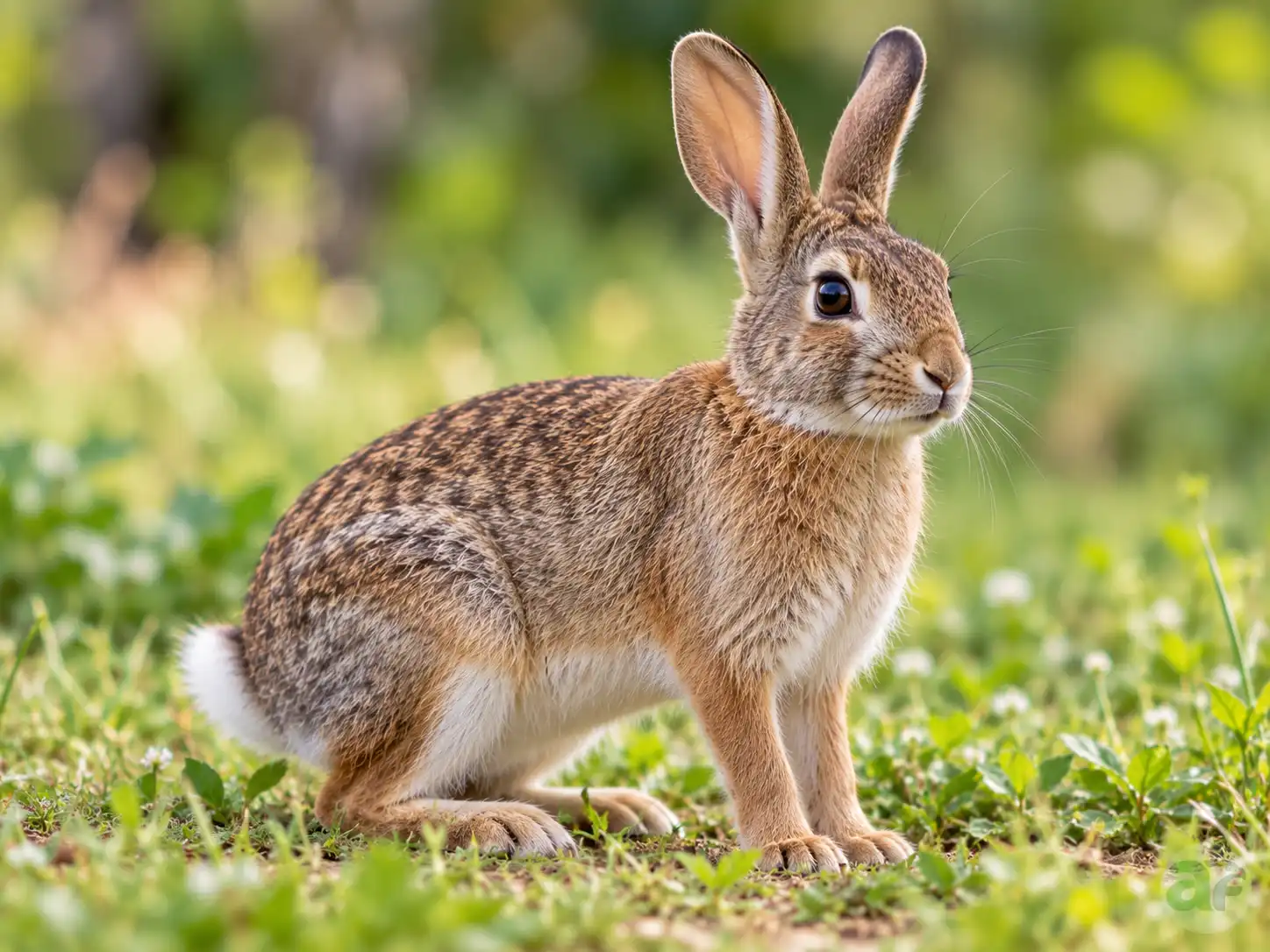
23. Frequently Asked Questions About Rabbits
Q1. What is the scientific name of the rabbit?
The most familiar rabbit species — the European rabbit and ancestor of all domestic breeds — is Oryctolagus cuniculus (Linnaeus, 1758). The genus name Oryctolagus combines the Greek words oryktos (dug, burrowed) and lagos (hare) — meaning essentially “burrowing hare.” The species name cuniculus is the Latin word for rabbit, derived from the Celtiberian language of ancient Iberia. All rabbits belong to the family Leporidae within the order Lagomorpha — with 29 recognized rabbit species across 9 genera (plus approximately 30 hare species in the genus Lepus). The most familiar wild rabbit in North America is the eastern cottontail, Sylvilagus floridanus (Allen, 1890).
Q2. Do rabbits really eat their own poop?
Yes — and it is essential for their health, not a behavioral problem. Rabbits produce two types of fecal material — the familiar hard, dry pellets that are genuine waste, and cecotropes — soft, moist, mucus-coated clusters produced in the cecum (the large fermentation chamber in the rabbit’s digestive system). Cecotropes contain approximately 28–30% protein, substantial quantities of B vitamins (particularly B12), amino acids, and live beneficial gut bacteria that cannot be absorbed during the first pass through the digestive system. Rabbits consume cecotropes directly from the anus as they are produced — typically during nighttime or rest periods — before they reach the ground. This behavior, called cecotrophy, is essential for adequate rabbit nutrition. A rabbit prevented from performing cecotrophy will develop severe deficiencies within days. If you observe your rabbit eating something from its hindquarters, this is normal and should not be discouraged.
Q3. Are rabbits rodents?
No — rabbits are not rodents. This is one of the most common misconceptions about rabbit taxonomy. Rabbits belong to the order Lagomorpha — not to the order Rodentia. The most reliable distinguishing anatomical feature is the number of upper incisors: lagomorphs (rabbits, hares, and pikas) have four upper incisors — two large functional incisors plus two small “peg teeth” directly behind them — while rodents have only two upper incisors. The orders Lagomorpha and Rodentia are each other’s closest relatives — both belonging to the mammalian superorder Euarchontoglires — but they diverged approximately 85 million years ago. The confusion of rabbits with rodents dates to early taxonomic systems but has been corrected in formal taxonomy since the early 20th century.
Q4. How long do rabbits live?
Wild and domestic rabbits differ dramatically in lifespan. Wild European rabbits average only 1–3 years in the wild — with the vast majority of individuals dying within their first year from predation, disease (particularly myxomatosis and rabbit hemorrhagic disease), or starvation. The predation pressure on wild rabbits is so intense that only a small fraction of the population survives to experience “natural” death from aging. Domestic rabbits under appropriate care — proper nutrition, companionship, adequate space, and regular veterinary care — typically live 8–12 years, with well-cared-for individuals regularly reaching 10–12 years and exceptional individuals documented reaching 14–18 years. The difference in lifespan between wild and domestic rabbits reflects the enormous impact of predation and disease on wild survival — the biology of the domestic rabbit is capable of much longer life when these pressures are removed.
Q5. Why is the European rabbit endangered if there are so many rabbits in Australia?
This is the central conservation paradox of the European rabbit — a species that is Endangered in its native Iberian Peninsula homeland while being one of the most devastating invasive species ever introduced to Australia. In Spain and Portugal, rabbit populations have declined by approximately 95% since the 1950s — driven by the accidental introduction of myxomatosis in 1952 and rabbit hemorrhagic disease in 1988, combined with habitat loss from agricultural intensification. These diseases, which were eventually used deliberately in Australia for rabbit control, devastated the native Iberian population before control measures could be implemented. The result is a species that is simultaneously rare in the place where it evolved (and where it plays a critical ecological role supporting Iberian lynx and Spanish imperial eagle) while being ecologically catastrophic in places where it was introduced without its natural predators and diseases. The ecological functioning of a species depends entirely on the context of the ecosystem it inhabits — the European rabbit is neither simply “endangered” nor simply “a pest” but both, in different places simultaneously.
Q6. Can rabbits be kept alone?
No — rabbits should not be kept alone. Rabbits are highly social animals whose natural state involves companionship — European wild rabbits live in complex social groups of up to 25 individuals, and even the more solitary cottontails have regular social interactions. Solitary captive rabbits suffer psychological distress that manifests as depression, aggression, excessive grooming, and stereotypic behaviors. The Rabbit Welfare Association and Fund, the House Rabbit Society, and virtually all rabbit welfare organizations recommend that domestic rabbits be kept in neutered pairs or compatible groups — with another rabbit as the primary companion. This does not diminish the importance of human interaction — but human contact alone cannot substitute for the species-appropriate social companionship that another rabbit provides.
Sources & References
- Wikipedia — Oryctolagus cuniculus, Leporidae, Lagomorpha, Cecotrophy, Sylvilagus floridanus
- IUCN Red List — iucnredlist.org (current assessments for all rabbit species)
- Rabbit Welfare Association and Fund — rabbitwelfare.co.uk
- House Rabbit Society — rabbit.org
- IUCN Lagomorph Specialist Group — published species assessments and conservation priorities
- National Geographic — nationalgeographic.com
- Smithsonian National Museum of Natural History — naturalhistory.si.edu
- BBC Wildlife / BBC Earth — bbcearth.com
- Britannica — britannica.com/animal/rabbit
- Live Science — livescience.com
- Lockley, R.M. (1964). The Private Life of the Rabbit. Andre Deutsch
- Adams, Richard (1972). Watership Down. Rex Collings
- Virgós, E. et al. — published research on European rabbit decline in Spain; various journals
- Australian Government Department of Agriculture — rabbit invasive species documentation