
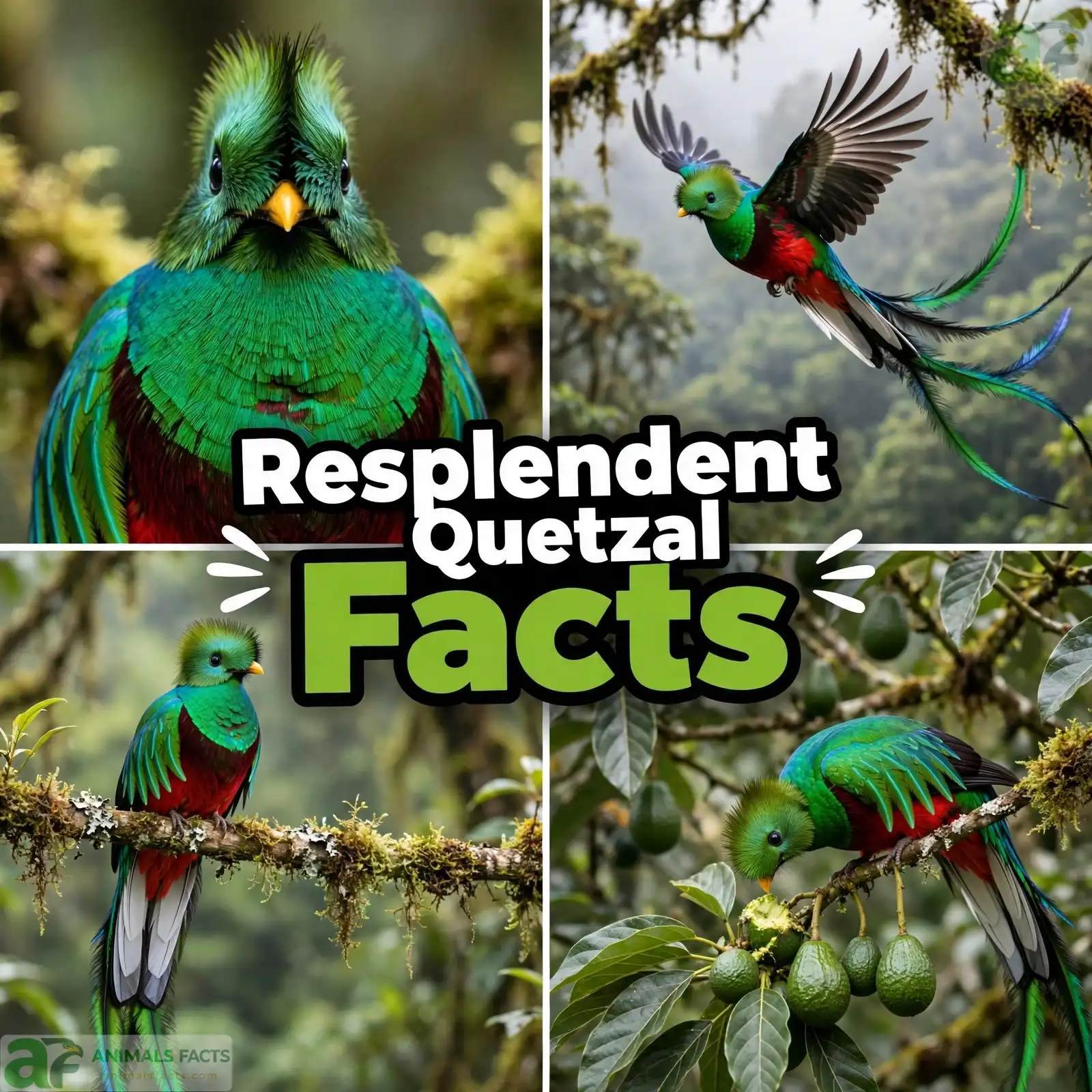
Resplendent Quetzal Facts
| Feature | Details |
|---|---|
| Scientific Name | Pharomachrus mocinno (de la Llave, 1832) |
| Kingdom | Animalia |
| Phylum | Chordata |
| Class | Aves |
| Order | Trogoniformes |
| Family | Trogonidae |
| Common Names | Resplendent quetzal; quetzal; Guatemala quetzal |
| Native Range | Southern Mexico through Central America to western Panama |
| Habitat | Cloud forest — humid montane forest at 1,500–3,000 meters elevation |
| Lifespan | Estimated 20–25 years (wild); up to 25 years (captivity) |
| Diet | Primarily wild avocados (Lauraceae fruits); insects, frogs, lizards, snails |
| Body Length | 36–40 cm body; male tail streamers add up to 65 cm |
| Weight | 180–210 grams |
| Conservation Status | Near Threatened (IUCN) — declining across most of range |
| Defining Feature | Male’s iridescent emerald-green tail streamers — up to 65 cm long; the most spectacular plumage of any New World bird |
| Taxonomic Position | One of six quetzal species within the genus Pharomachrus; the most celebrated member of the trogon family |
| National Symbol | National bird of Guatemala — and the name of Guatemala’s currency |
| Cultural Significance | Sacred to the Maya and Aztec civilizations — the most revered bird in pre-Columbian Mesoamerican culture |
| Closest Relatives | Other trogons — including five other quetzal species; broader Trogonidae family |
 1. Introduction: What is a Resplendent Quetzal?
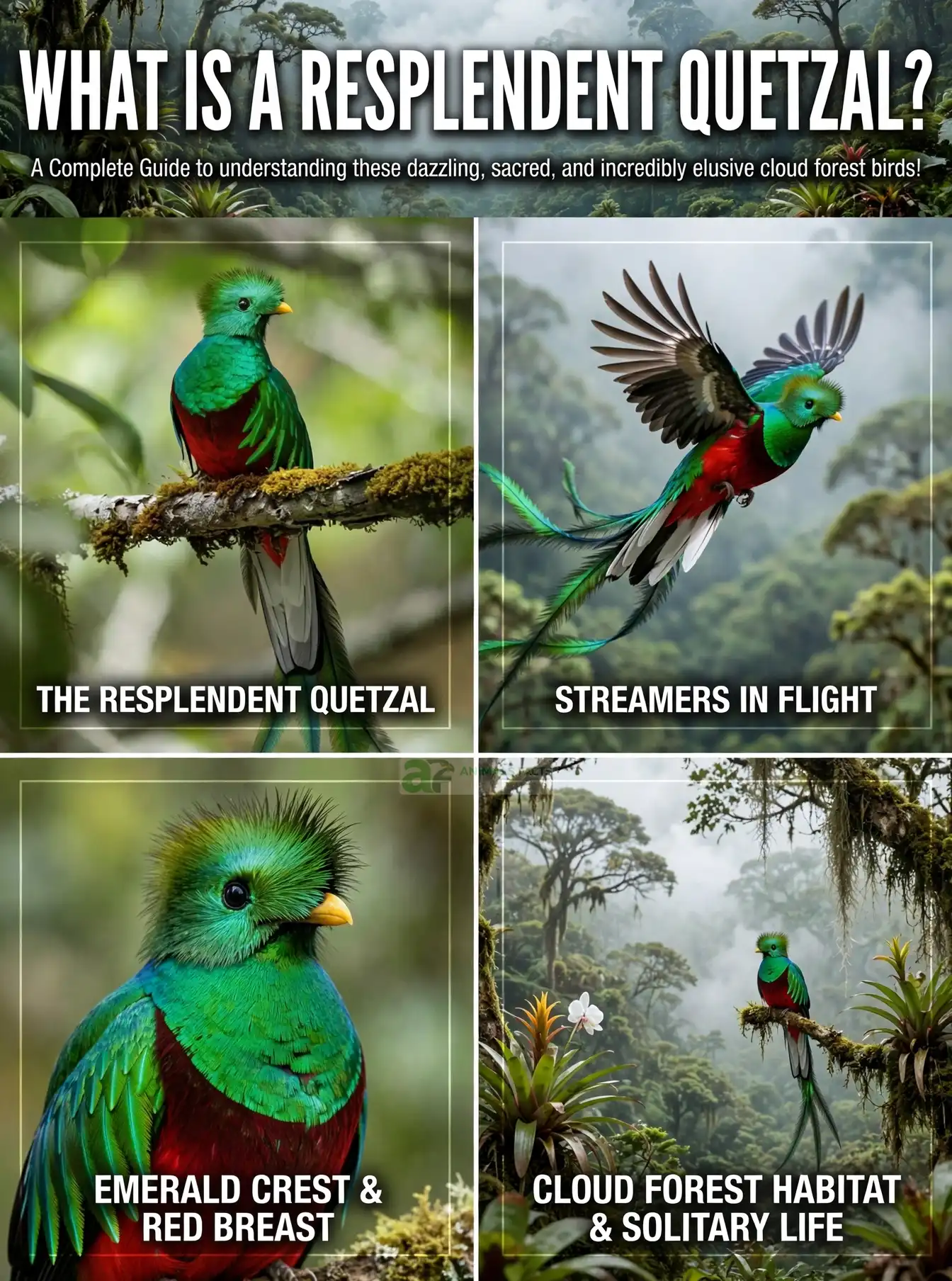
In the misty cloud forest of the Guatemalan highlands, where the ancient oaks and avocado trees disappear into the perpetual white haze of cloud and the air carries the smell of moss and cold water and something ancient and primordial, a male resplendent quetzal launches from a branch with a flash of color so vivid and so unexpected that it stops the human eye and demands total attention. The iridescent emerald-green of the head and back ignites in the brief gap between clouds and forest canopy, the crimson breast blazes like a signal fire, and behind the bird, trailing like the train of some impossibly elaborate ceremonial costume, twin tail streamers of luminous green sweep in long, undulating arcs through the misty air — each streamer up to 65 centimeters long, longer than the bird’s entire body, flowing behind it with the fluid grace of something that evolution produced not for any survival advantage but simply because beauty, in this particular case, became its own advantage. Resplendent quetzal facts begin with this moment — the most visually extraordinary bird in the Western Hemisphere, possibly the most beautiful bird in the world by almost any measure, an animal so spectacular that it was considered divine by two of the greatest civilizations in pre-Columbian history, and so tightly bound to the health of the cloud forest that its presence — or absence — is one of the most reliable indicators of that extraordinary and threatened ecosystem’s ecological integrity.
The resplendent quetzal (Pharomachrus mocinno) is simultaneously one of the most celebrated and one of the most ecologically specialized birds on Earth. It is the national bird of Guatemala — and the name of Guatemala’s currency. It was the sacred bird of the Maya and Aztec civilizations — the living embodiment of the feathered serpent god Quetzalcoatl, whose ritual headdresses required quetzal tail feathers to be complete, and whose cultural power was so absolute that killing a quetzal was a capital offense under Aztec law. It has been called the most beautiful bird in the world by ornithologists, wildlife photographers, and natural history writers from John James Audubon’s era to the present. And it is an animal so ecologically precise in its requirements — dependent on specific fruit-bearing cloud forest trees at specific elevations with specific forest structural characteristics — that it functions as a flagship species and ecological indicator for the entire cloud forest biome, the most endangered forest ecosystem in the Western Hemisphere.
Interesting facts about resplendent quetzals reveal an animal of breathtaking biological and cultural richness — the iridescent plumage produced by a nanostructure of feather barbules that creates structural coloration analogous to chameleon nanocrystals; the extraordinary dietary specialization on wild avocados (Lauraceae fruits) that makes the quetzal both the primary seed disperser for these ancient trees and utterly dependent on the forest structure that supports them; the remarkable nesting biology in which both sexes incubate eggs in tree cavities but the male’s tail streamers must extend outside the nest hole because they are too long to fold within it; and the cultural weight of a bird that has been woven into human civilization, mythology, monetary systems, and national identity for over three thousand years. Whether you are searching for resplendent quetzal facts for kids to explore the science and culture of the most beautiful bird in the Americas, a wildlife enthusiast planning a cloud forest birding trip, a conservation researcher concerned about cloud forest habitat loss, or simply someone who saw a photograph of this spectacular bird and needed to understand everything about it immediately — this is your comprehensive guide. The most beautiful bird in the Western Hemisphere has an extraordinary story to tell.
2. Resplendent Quetzal Species Overview & Classification
The resplendent quetzal belongs to the family Trogonidae — the trogons — one of the most colorful bird families in the world, and is the most spectacular member of the genus Pharomachrus — the quetzals.
Species Classification Table
| Taxonomic Rank | Classification |
|---|---|
| Kingdom | Animalia |
| Phylum | Chordata |
| Class | Aves |
| Order | Trogoniformes |
| Family | Trogonidae (Lesson, 1828) |
| Genus | Pharomachrus (de la Llave, 1832) |
| Species | P. mocinno (de la Llave, 1832) |
| Common Name | Resplendent quetzal |
| Etymology | Pharomachrus = “long cloak” (Greek: pharos = cloak/mantle + makros = long) — referring to the tail streamers; mocinno — named for José Mariano Moziño, a Mexican naturalist; quetzal from Nahuatl quetzalli = “precious tail feather” or “sacred” |
Two Subspecies
Two subspecies of the resplendent quetzal are recognized — distinguished by range and subtle physical differences:
| Subspecies | Common Name | Range | Notes |
|---|---|---|---|
| P. m. mocinno | Northern resplendent quetzal | Southern Mexico (Chiapas) to Honduras and Nicaragua | Nominate subspecies |
| P. m. costaricensis | Costa Rican quetzal | Costa Rica and western Panama | Slightly different tail streamer structure; some authorities treat as full species |
The Genus Pharomachrus — The Six Quetzals
The resplendent quetzal belongs to a genus of six species — all spectacular, all restricted to the cloud forests of the Americas, but none approaching the plumage magnificence of P. mocinno:
| Species | Common Name | Range | IUCN Status |
|---|---|---|---|
| Pharomachrus mocinno | Resplendent quetzal | S. Mexico to W. Panama | Near Threatened |
| Pharomachrus pavoninus | Pavonine quetzal | Amazon basin | Least Concern |
| Pharomachrus auriceps | Golden-headed quetzal | Andes from Colombia to Bolivia | Least Concern |
| Pharomachrus antisianus | Crested quetzal | Northern Andes | Least Concern |
| Pharomachrus fulgidus | White-tipped quetzal | Venezuela, Colombia | Least Concern |
| Pharomachrus neoxenus | Eared quetzal | Mexico, Central America | Least Concern |
The Trogonidae Family — The Most Colorful Bird Family
The trogons are one of the world’s most colorful bird families — approximately 43 species distributed across the tropics of the Americas, Africa, and Asia:
The trogon body plan — All trogons share the distinctive body plan that makes the resplendent quetzal immediately recognizable as a trogon: compact body, small bill, short rounded wings, and brilliantly colored plumage with iridescent upperparts in males. The trogon family’s extraordinary color diversity has made it one of the most celebrated bird families in tropical natural history.
Heterodactyl feet — Trogons have a unique foot structure — heterodactyly — where the first and second toes are reversed relative to the arrangement in most birds (where the first and fourth toes face backward). This unusual arrangement results from the ancestral trogon lineage’s specific evolutionary history and creates a distinctive perching posture.
Evolution & Discovery Timeline
~50–60 million years ago (Eocene) — The ancestral Trogoniformes lineage diverges from other birds — establishing the trogon order early in the diversification of modern bird families. Fossil trogons from European Eocene deposits confirm the order’s ancient origins and formerly broader distribution.
~10–20 million years ago — The Pharomachrus quetzal lineage diversifies within the Neotropical trogon radiation — establishing the genus that will produce the resplendent quetzal and its five relatives.
Pre-Columbian era (3,000+ years ago) — The Maya and earlier Mesoamerican civilizations develop the elaborate cultural and religious significance of the quetzal that will define the bird’s relationship with human culture for millennia.
1832 — Mexican naturalist Pablo de la Llave formally describes the resplendent quetzal as Pharomachrus mocinno — naming the genus for the long tail plumage and the species for the naturalist Moziño. This formal description arrives millennia after the bird’s cultural significance was already firmly established.
Late 19th–early 20th century — European and North American naturalists visiting Central American cloud forests produce the first systematic natural history accounts of the resplendent quetzal in scientific literature — confirming the cultural accounts of the bird’s spectacular appearance and adding ecological observation to the existing cultural documentation.
1970s–1980s — The first systematic ecological research on resplendent quetzal biology — diet, habitat requirements, breeding ecology — provides the scientific foundation for understanding the species’ conservation needs.
1991 — Guatemala’s cloud forest conservation organization FUNDAECO and other conservation bodies begin systematic quetzal monitoring and cloud forest protection programs — recognizing the species’ ecological indicator value.
2020s — Cloud forest protection programs across Guatemala, Costa Rica, Honduras, and Mexico intensify — driven by both the resplendent quetzal’s conservation status and the broader recognition of cloud forests as critically important biodiversity repositories. Continued habitat loss and climate change projections maintain the species at Near Threatened status with a declining population trend.
2024 — Pharomachrus mocinno maintains its Near Threatened IUCN classification — with the population trend assessed as decreasing due to ongoing cloud forest habitat loss across the range.
“To see a male resplendent quetzal in its cloud forest home is one of the most extraordinary wildlife experiences available anywhere in the world. It is not merely beautiful — it is the most perfect expression of what evolution can achieve when spectacular appearance becomes a survival strategy. And it is disappearing with the forests it needs.”
— Dr. Alexander Skutch, Costa Rican ornithologist and author — who spent decades studying quetzal natural history in Costa Rican cloud forest
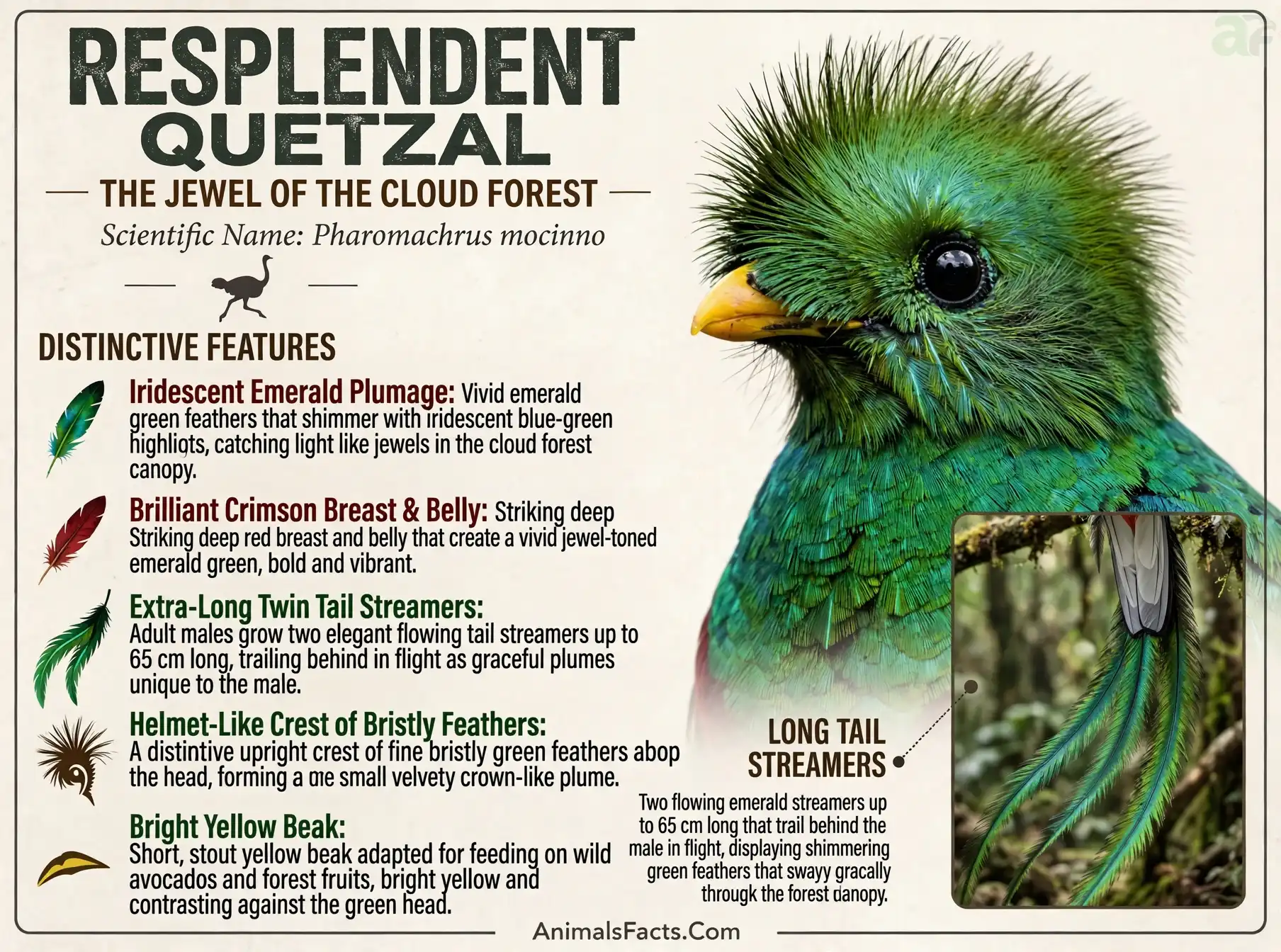
3. Resplendent Quetzal Physical Description & Unique Features
The resplendent quetzal’s physical appearance represents the pinnacle of avian plumage evolution in the Western Hemisphere — an accumulation of structural coloration, elongated ornamental features, and dramatic color contrast that has been consistently described as the most spectacular bird plumage in the Americas.
The Tail Streamers — The Defining Ornament
The male resplendent quetzal’s upper tail covert streamers are the defining visual feature of the species — and the structural element that most dramatically distinguishes the resplendent quetzal from all other birds in its range:
What they actually are — The “tail streamers” are not the actual tail feathers (rectrices) but rather enormously elongated upper tail covert feathers — the feathers that normally cover the base of the tail in most birds. In the male resplendent quetzal, these coverts have been elongated through sexual selection to lengths of 50–65 centimeters — more than twice the body length of the bird itself.
The streamer structure — Each streamer consists of the elongated feather shaft with long, loose, separated barbs that create the characteristic billowing, translucent appearance. The barbs are not interlocked as in most flight feathers — this loose structure gives the streamers their fluid, flowing movement in flight and their distinctive appearance.
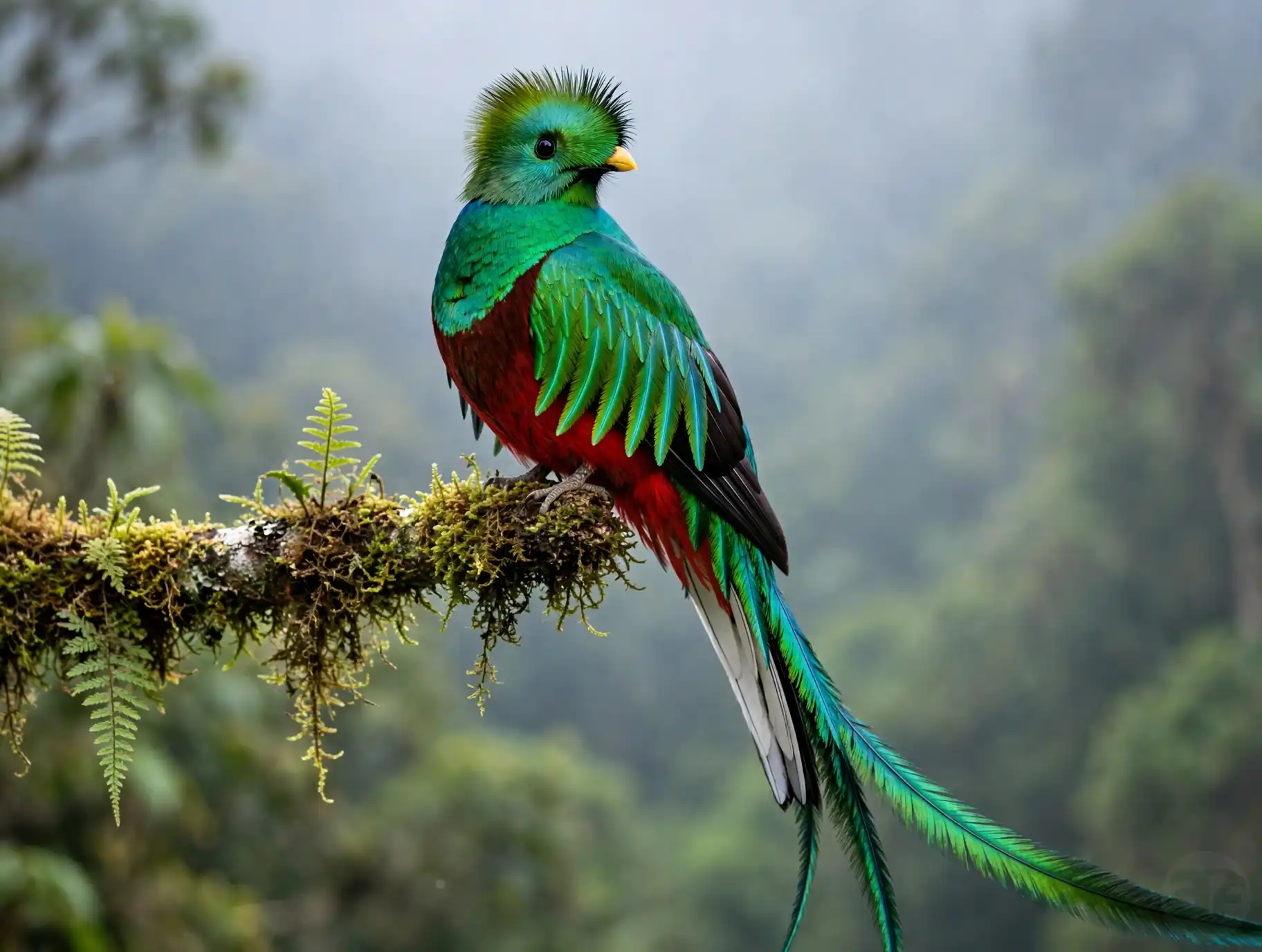
The iridescent color — The streamers are the same iridescent emerald-green as the back and head plumage — the structural coloration system (see below) producing vivid green that shifts to blue or yellow-green depending on the viewing angle and light conditions.
Seasonal variation — The streamers are molted and regrown annually — they are at their longest and most perfect at the beginning of the breeding season (approximately March–April in most of the range) and become progressively worn and broken as the breeding season progresses. By the post-breeding molt period (August–October), the streamers are typically significantly reduced in length and condition before being replaced by fresh streamers for the following breeding season.
The female’s tail — Female resplendent quetzals lack the elongated tail streamers entirely — their shorter upper tail coverts produce a very different appearance. The female’s plumage is significantly more subdued: green head and back with a bronze-green tone, grey-brown breast and belly (rather than the male’s crimson), and a barred tail rather than the male’s green-covered tail.
The Iridescent Plumage — Structural Color Science
The resplendent quetzal’s extraordinary iridescent green is produced by the same fundamental principle as the chameleon’s color change — structural coloration rather than conventional pigmentation:
The feather microstructure — The barbules of the iridescent feathers contain thin-film interference layers — multiple thin layers of melanin granules and keratin separated by precise nanometer-scale air gaps. The interference of light reflected from multiple layers produces specific wavelengths — in the quetzal’s case, the vivid emerald-green that characterizes the iridescent plumage.
Angle-dependent color — As with other structural colorations, the perceived color shifts with viewing angle — the quetzal’s green can appear more blue-green, yellow-green, or gold-green depending on the angle of light and the observer’s position. This angle-dependence creates the visual impression of the plumage changing or glowing as the bird moves.
The crimson breast — In striking contrast to the iridescent green upper parts, the male’s breast and belly are a vivid, flat crimson-red — produced by conventional red pigment (carotenoids derived from food). The contrast between the structural green and the pigment red creates the dramatic color opposition that makes the male’s plumage so visually striking.
Green head crest — The head is adorned with a helmet-like crest of short, erectile, iridescent green feathers — typically described as creating the impression of a green helmet or rounded green cap. The crest can be raised and lowered, contributing to social displays.
The Bill and Feeding Apparatus
The resplendent quetzal’s short, broad bill is characteristic of fruit-eating trogons — designed for manipulating and swallowing relatively large fruit whole:
Bill shape — Slightly hooked, wider than it is deep at the base — the broad gape allowing the bird to manipulate and swallow the large Lauraceae fruits that constitute the primary diet.
Bill color — Yellow in males, black to dark grey in females — providing an additional visual sex differentiation marker beyond the dramatic plumage difference.
Serrated tomia — The edges of the bill (tomia) are serrated — providing grip on slippery fruit surfaces during manipulation.
Size and Physical Proportions
Body length — 36–40 cm (excluding tail streamers)
Total length including streamers — males up to 100 cm or more
Weight — 180–210 grams — modest body mass for a bird with such spectacular display structures
Wingspan — approximately 57–63 cm
The flight silhouette — In flight, the male resplendent quetzal is immediately recognizable from a considerable distance — the long, flowing tail streamers streaming behind the compact body create a distinctive silhouette unlike any other bird in the cloud forest.
💡 Did You Know? The resplendent quetzal cannot walk effectively on the ground — its feet, while excellent for perching on branches, are poorly adapted for terrestrial locomotion. The heterodactyl toe arrangement and the relatively short, curved claws optimized for branch gripping make walking on flat surfaces awkward and ineffective. More importantly, the male’s tail streamers — up to 65 cm long — would drag on the ground and be quickly damaged in any terrestrial movement. The resplendent quetzal is therefore one of the most completely arboreal birds in the Americas — virtually its entire life is spent in the forest canopy and understory, never descending to the ground. This extreme arboreality makes the quetzal especially vulnerable to forest fragmentation — the bird cannot cross open areas between forest fragments by walking, and flying across open clearings exposes it to predation from raptors. A quetzal that cannot reach adjacent forest patches through the canopy is effectively isolated — a biological island prisoner in a fragment of remaining cloud forest.
4. Top 25 Amazing Resplendent Quetzal Facts
Here is your definitive collection of the most extraordinary, scientifically verified, and genuinely astonishing resplendent quetzal facts as of 2026:
- The resplendent quetzal is the national bird of Guatemala — and the national currency of Guatemala is called the “quetzal” (GTQ). This dual national symbol status — as both a living bird and a monetary unit — makes it one of the most deeply embedded animals in any country’s national identity in the world.
- Under the Aztec civilization, killing a resplendent quetzal was punishable by death — the bird was considered so sacred as the living embodiment of the feathered serpent god Quetzalcoatl that harming one was treated as a capital religious offense.
- The male resplendent quetzal’s tail streamers are not tail feathers but enormously elongated upper tail covert feathers — reaching up to 65 centimeters in length, more than twice the bird’s body length. They are molted and regrown completely each year.
- When a male quetzal incubates eggs in a tree cavity nest, his tail streamers are too long to fold inside the cavity — they hang out of the nest entrance or drape over the opening, sometimes appearing to observers as if the nest tree itself has grown a green, feathered tail.
- The resplendent quetzal is one of the very few birds in the world that cannot be successfully maintained in captivity long-term — the species is so psychologically and physiologically dependent on its specific cloud forest environment that captive individuals have historically declined rapidly. The quetzal’s reputation as a bird that “dies in captivity rather than live in a cage” became one of its most powerful cultural symbols — of freedom and the inseparability of the bird from its wild forest home.
- The resplendent quetzal’s diet centers on wild avocados (Lauraceae fruits) — the same plant family as the commercially grown avocado. The quetzal swallows these fruits whole, digests the flesh, and regurgitates or defecates the large seed — making it the primary seed disperser for multiple Lauraceae tree species across the cloud forest.
- The quetzal is the only bird known to regularly disperse the seeds of wild avocado trees (Ocotea, Nectandra, and related genera) through whole-fruit swallowing and seed regurgitation. Without quetzals (and a small number of other large-fruited trogons), these tree species cannot effectively regenerate in cloud forests — linking the quetzal’s survival directly to the regeneration of the forest it inhabits.
- The resplendent quetzal’s iridescent green plumage is produced by structural coloration — thin-film interference in feather barbule microstructure that reflects specific wavelengths — rather than green pigment. The color shifts from emerald green to gold-green to blue-green depending on viewing angle and light.
- The quetzal’s ancient Nahuatl name quetzalli means both “precious tail feather” and “precious” or “sacred” — the bird’s name in the language of the Aztec empire was simultaneously a description of its physical ornament and a statement of its sacred value.
- The resplendent quetzal inhabits cloud forest — one of the world’s most threatened ecosystems, characterized by persistent cloud and mist at elevations of 1,500–3,000 meters. Cloud forests represent less than 1% of the world’s forest area but contain an extraordinary proportion of global biodiversity — the quetzal’s dependence on this specific ecosystem makes its conservation situation uniquely urgent.
- Male resplendent quetzals perform aerial courtship displays above the cloud forest canopy — rising high above the trees in a spiraling ascent before diving back into the forest, the tail streamers creating spectacular visual effects as the bird loops and dives through the misty air.
- Both male and female quetzals incubate eggs and provision chicks — one of the most equal parental partnerships in tropical birds. However, the male tends to incubate during the day and the female at night — reflecting the male’s relative vulnerability to predation during daylight hours due to his spectacular, highly visible plumage.
- The resplendent quetzal is a partial altitudinal migrant — moving to lower elevations (600–1,500 meters) during the non-breeding season in search of fruit resources, and returning to higher-elevation cloud forest (1,500–3,000 meters) for the breeding season. This seasonal movement means the species requires intact forest at multiple elevation bands — further complicating conservation.
- The ancient Maya adorned their most powerful rulers with headdresses incorporating resplendent quetzal tail feathers — the feathers being among the most valuable trade goods in pre-Columbian Mesoamerica. Feathers were reportedly more valuable than gold in some trading contexts.
- The resplendent quetzal swallows fruits whole that are often larger than what appears possible — the gape is disproportionately wide and the throat and esophagus are flexible enough to accommodate fruits of up to 3–4 centimeters in diameter. After digesting the fruit flesh, the bird regurgitates the hard seed — a “pellet” of seed material deposited under the perch.
- Cloud forest loss across the quetzal’s range has been estimated at approximately 75–80% of original extent — primarily through agricultural clearance, logging, and cattle ranching. In Guatemala alone — the country most associated with the quetzal — the cloud forest has been reduced to less than 25% of its pre-colonial extent.
- The breeding season of the resplendent quetzal (approximately March–June in most of the range) coincides precisely with the peak fruiting of Lauraceae trees in cloud forests — the bird’s reproductive timing calibrated to the period of maximum food resource availability.
- The quetzal’s characteristic call — a deep, rolling wooo-wooo repeated in long series — is one of the most evocative sounds of Central American cloud forest. The call carries considerable distance through the misty forest and is described by experienced birders as one of the most unmistakable and most affecting sounds in tropical birding.
- Archaeological evidence of quetzal feathers in burial sites and ceremonial contexts documents the cultural importance of the bird from at least 3,000 years ago — long before the Maya and Aztec civilizations whose quetzal traditions are most historically documented.
- Costa Rica’s Monteverde Cloud Forest Reserve — established in 1972 — was one of the first protected areas in the world established specifically to protect the resplendent quetzal’s habitat, reflecting the species’ role as a flagship conservation symbol for cloud forest protection from the earliest years of the modern conservation movement in Central America.
- The resplendent quetzal’s nest cavity is excavated by the pair in a dead tree trunk — both birds participating in the excavation process over approximately 1–3 weeks. The soft, rotting wood of partially decomposed snag trees is preferred — the birds cannot excavate hard live wood.
- Young quetzals in the nest are fed an unusual mixed diet — the parents initially bring primarily insects and small vertebrates (frogs, lizards) to provide protein for growth, transitioning to the adult fruit-dominated diet only as the chicks approach fledging age.
- The resplendent quetzal is the inspiration for the Pokémon character Ho-Oh — the legendary rainbow-colored phoenix bird that is one of the most iconic Pokémon characters globally — though Ho-Oh incorporates design elements from multiple birds, the resplendent quetzal’s iridescent plumage and legendary cultural status are widely recognized as primary inspiration sources.
- Scientific research has documented that individual male quetzals with longer tail streamers are preferentially selected by females — the streamer length functions as an honest signal of male quality because only males in excellent health and nutritional condition can grow and maintain streamers of maximum length.
- As of 2026, the most significant remaining population of resplendent quetzals in Guatemala is found in the Sierra de las Minas Biosphere Reserve — the largest remaining cloud forest in Guatemala and Central America — protecting approximately 106,000 hectares of critical quetzal habitat. This reserve is the single most important conservation site for the species.
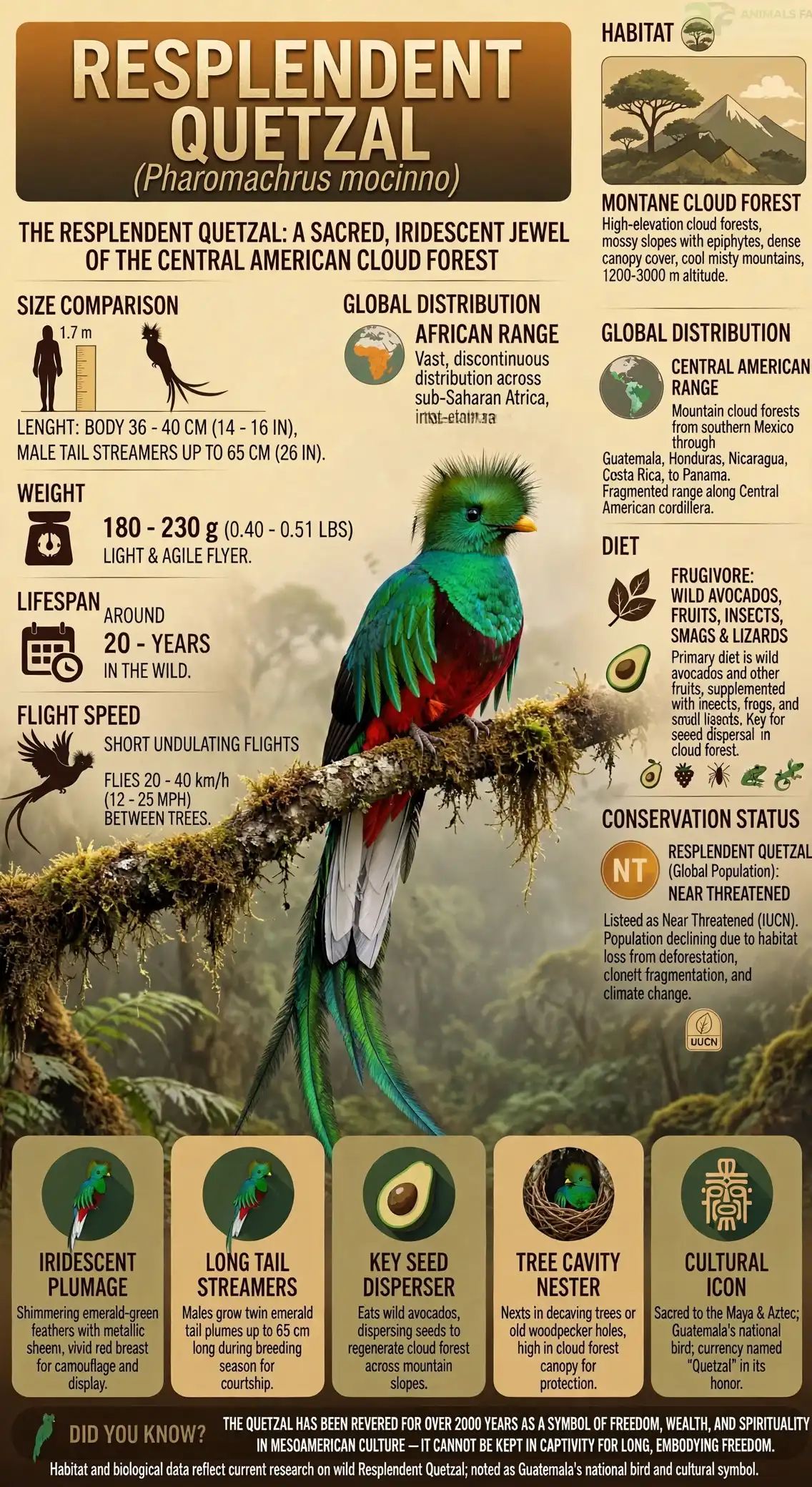
5. Fun Facts About Resplendent Quetzals
- National bird AND national currency of Guatemala
- Killing one was punishable by death under Aztec law
- Tail streamers are twice the bird’s body length
- Tail streamers hang outside the nest during incubation
- One of very few birds that cannot survive in captivity
- Primary seed disperser for wild avocado trees
- Cloud forests are less than 1% of world’s forests
- Both parents share incubation equally
- Call described as one of the most beautiful in tropical birding
- Guatemala has lost 75%+ of its cloud forest
- Tail streamers grown fresh every year
- Inspired Pokémon Ho-Oh character design
6. Resplendent Quetzal Habitat & Geographic Range
Resplendent quetzal habitat is one of the most specific of any bird in the Americas — the species is not merely a cloud forest bird but a specialist of a very specific elevation band within cloud forest, with requirements for specific forest structure, tree species composition, and fruit availability that cannot be met by degraded or fragmented habitat.
Cloud Forest — The Most Extraordinary Ecosystem
What is cloud forest? — Cloud forest (also called montane rainforest, highland rainforest, or bosque nuboso) is a specific forest type occurring at elevations where persistent clouds and mist maintain high humidity throughout the year. This constant moisture creates an extraordinarily lush environment — every surface covered with mosses, ferns, orchids, and bromeliads — that supports extraordinary biodiversity within a globally tiny area.
The elevation parameters — The resplendent quetzal occupies cloud forest primarily between 1,500 and 3,000 meters elevation — the specific range where cloud persistence maintains the moisture and temperature conditions the species requires. Below 1,500 meters, forests are typically too warm and dry; above 3,000 meters, forests become too cold and exposed.
The structural requirements — Within the cloud forest elevation band, the quetzal requires:
- Mature forest with large trees — providing the tall dead snag trees needed for nest cavity excavation
- Abundant Lauraceae trees — the wild avocado family providing the primary food resource
- Dense, continuous canopy — allowing the arboreal movement the quetzal depends on for feeding and predator avoidance
- Limited human disturbance — the quetzal is highly sensitive to disturbance near nesting sites
Geographic Distribution
| Country | Status | Key Sites |
|---|---|---|
| Guatemala | Declining — core cultural range | Sierra de las Minas; Todos Santos; Totonicapán |
| Mexico (Chiapas) | Declining | El Triunfo Biosphere Reserve; Los Altos |
| Honduras | Declining | La Tigra National Park; Cusuco National Park |
| El Salvador | Critically rare | Montecristo National Park (shared with Honduras, Guatemala) |
| Nicaragua | Declining | Northern highlands; Jinotega |
| Costa Rica | Best-monitored population | Monteverde; Chirripó; La Amistad |
| Panama (western) | Southern range limit | Volcán Barú National Park; La Amistad (shared with Costa Rica) |
The Altitudinal Migration
One of the most ecologically significant but practically challenging aspects of quetzal biology is its partial altitudinal migration:
The breeding season movement (March–June) — Birds concentrate at higher elevations (1,500–3,000 m) where breeding cloud forest provides nest sites and the peak Lauraceae fruiting coincides with maximum chick-rearing demands.
The non-breeding movement (July–February) — Birds move to lower elevations (600–1,500 m) following the fruiting phenology of Lauraceae and other fruit-bearing trees across the elevation gradient.
The conservation implication — This migration means that protecting only high-elevation breeding habitat is insufficient — the quetzal requires intact forest corridor connectivity across a vertical elevation range of 1,500–2,500 meters. Agricultural land that cuts across this elevation gradient breaks the migration route and isolates breeding populations from non-breeding foraging habitat.
Cloud Forest — A Globally Tiny but Enormously Important Ecosystem
The area problem — Cloud forests occupy less than 1% of the world’s total forest area — a globally tiny footprint for an ecosystem of extraordinary biodiversity significance.
The biodiversity significance — Despite their tiny global area, cloud forests host:
- Approximately 10% of all plant species on Earth
- Extraordinary concentrations of endemic species found nowhere else
- Disproportionate endemic bird diversity — including the resplendent quetzal and hundreds of other cloud forest specialists
The loss trajectory — Cloud forests have been cleared at rates comparable to lowland tropical forest — the combination of agricultural expansion onto fertile mountain slopes and the demand for firewood and construction timber has eliminated the majority of cloud forest across the quetzal’s range.
💡 Did You Know? The resplendent quetzal has one of the most extraordinary seed dispersal relationships of any bird and plant in the Americas — a mutualism between the quetzal and the wild avocado trees (Ocotea, Nectandra, and related genera) that has been maintained for millions of years. The quetzal swallows wild avocado fruits whole — the hard seed passing through the digestive tract or being regurgitated intact under a perch. Wild avocado seeds are too large for almost any other cloud forest bird to swallow whole, making the quetzal effectively the only viable seed dispersal agent for these trees in most cloud forest locations. Without quetzals, wild avocado seeds fall directly beneath the parent tree — where germination success is very low due to competition with the parent tree and seed predators concentrated near the seed source. Without wild avocado trees providing the primary fruit resource, the quetzal cannot maintain the dietary nutrition needed for successful breeding. This mutual dependence — where the quetzal needs the tree and the tree needs the quetzal — has produced a tight co-evolutionary bond that makes both species simultaneously more ecologically secure (each supports the other’s population) and more conservation-vulnerable (if one declines, the other follows). The loss of quetzals from a cloud forest area progressively reduces wild avocado regeneration; the loss of avocado trees from a cloud forest area progressively reduces the quetzal’s food supply. This feedback loop makes the quetzal both an indicator of cloud forest health and a driver of it.
7. Resplendent Quetzal Diet & Feeding Behavior
Resplendent quetzal diet is centered on the fruits of the laurel family (Lauraceae) — wild avocados and related fruits — with seasonal supplementation by insects and small vertebrates that provide critical protein during breeding.
Diet Breakdown Table
| Food Type | Estimated % of Diet | Season | Notes |
|---|---|---|---|
| Lauraceae fruits (wild avocados, Ocotea, Nectandra) | ~80% | Year-round; peak breeding season | Primary prey; swallowed whole |
| Other fruits (Ericaceae, Myrtaceae, Araliaceae) | ~10% | Seasonal | Supplementary fruit diversity |
| Insects (beetles, wasps, ants) | ~5–8% | Breeding season peak | Critical protein for chick feeding |
| Small vertebrates (frogs, lizards) | ~3–5% | Breeding season | Primarily fed to nestlings |
| Snails and invertebrates | ~1–3% | Opportunistic | Minor contribution |
The Lauraceae Foraging System
The target fruits — The quetzal’s preferred fruits are those of cloud forest Lauraceae — particularly species of the genera Ocotea, Nectandra, Persea, and related genera that produce large, single-seeded drupes (fruits with a fleshy outer layer surrounding a large hard seed). These are the wild relatives of the cultivated avocado (Persea americana).
The swallowing mechanism — The quetzal positions a fruit in the bill, manipulates it to the optimal orientation (typically seed-end first), and then uses a series of bill manipulations and throat muscular contractions to pass the entire fruit into the esophagus and stomach.
Fruit size limits — The quetzal can swallow fruits of up to approximately 3–4 cm in diameter — an extraordinary gape capability for a bird weighing only 200 grams. Fruits larger than this cannot be swallowed whole and are typically avoided.
The seed disposal — After the fruit flesh is digested, the hard Lauraceae seed (ranging from the size of a large cherry pit to a small avocado seed) is regurgitated as a pellet from the crop — deposited under the foraging perch. Seeds are also occasionally voided in feces intact. This seed disposal mechanism creates the seed dispersal service that makes the quetzal so ecologically important.
Foraging behavior — The quetzal forages primarily through hover-gleaning — hovering briefly beside a fruiting branch, snatching a fruit, and returning to a nearby perch to manipulate and swallow it. This foraging style requires the bird to identify fruit clusters from a distance, approach them through the canopy with precision, and execute a brief hover that the long tail streamers complicate but do not prevent.
Seasonal Diet Variation
Breeding season — The breeding season (March–June) coincides with peak Lauraceae fruiting at breeding elevations — fruit availability is highest precisely when the energetic demands of egg incubation and chick provisioning are greatest. This temporal matching of food supply with reproductive demand is the ecological foundation of the quetzal’s breeding system.
Non-breeding season — During the altitudinal migration to lower elevations, the diet shifts toward whatever Lauraceae and other large-fruited trees are fruiting at those lower elevations. The diet remains fruit-dominated throughout the year, though the specific species consumed change as the bird follows the fruiting phenology across the elevation gradient.
Chick provisioning — Nestlings are initially fed insects and small vertebrates rather than fruit — the protein and fat content of animal prey supporting the rapid growth rate needed to bring the chick to fledging condition before the nest tree is detected by predators. The shift toward fruit in the diet begins as chicks approach fledging size.
8. Resplendent Quetzal Reproduction & Life Cycle
Resplendent quetzal reproduction combines the unusually equal parental investment typical of many trogons with the specific ecological requirements of cloud forest nesting that make this one of the most studied and most ecologically significant breeding systems in Neotropical ornithology.
Pair Formation and Courtship
Breeding season — March–June across most of the range — timed to coincide with peak Lauraceae fruiting and with the dry period that reduces nest-flooding risk in the cloud forest.
Male courtship displays — The male resplendent quetzal’s courtship includes some of the most spectacular aerial displays of any bird in the Americas:
The undulating display flight — The male rises above the forest canopy in a spiraling ascent — the tail streamers trailing in sweeping arcs — before diving steeply back into the forest. This display is repeated multiple times in sequence, the loops and dives creating extraordinary visual effects as the iridescent plumage and flowing streamers move through shafts of light between the forest trees.
Perch display — From a prominent perch, the male bobs the head, raises and lowers the green head crest, flares the tail streamers, and produces the characteristic rolling call — a multi-modal display combining visual and acoustic signals.
Female assessment — Females observe male displays over extended periods before selecting a mate. Research confirms that tail streamer length is among the most important assessment criteria — males with longer, less-damaged streamers represent better nutritional condition and therefore better mate quality.
Nest Site Selection and Excavation
Nest site requirements — The quetzal excavates its nest in dead or partially decomposed tree trunks — the soft wood of snag trees allowing the bird to excavate a cavity despite its relatively modest bill. Live trees with hard wood cannot be excavated.
Species preference — Various cloud forest tree species are used, but the key requirement is advanced decay — the wood must be soft enough to excavate within the 1–3 week nest preparation timeline.
Cavity dimensions — The finished cavity is approximately 20–30 cm deep and 12–15 cm wide at the entrance — large enough to accommodate the adult bird during incubation but not so large that temperature regulation is difficult.
The tail streamer problem — The male’s tail streamers — up to 65 cm long — are too long to fold within the nest cavity. During incubation, the tail streamers drape out of the cavity entrance or bend back on themselves above the entrance — creating the distinctive and celebrated appearance of a tree with a living green plume growing from its trunk, visible from considerable distances in the forest.
Egg-Laying and Incubation
- Clutch size: typically 2 eggs (occasionally 1 or 3)
- Egg color: pale blue — one of the most beautiful bird egg colors
- Incubation period: approximately 17–19 days — relatively short for a bird of this ecological significance
- Incubation division: both sexes incubate; the male typically incubates during the day and the female incubates at night — reflecting the male’s greater daytime vulnerability to aerial predators due to his highly visible plumage
Chick Development
At hatching — Chicks are altricial — hatched naked, blind, and completely dependent on parental brooding and provisioning.
Early feeding — Parents initially provision chicks with insects, frogs, and small lizards — the animal protein supporting rapid growth.
Nestling period — Approximately 23–31 days in the nest before fledging — during which the chicks grow rapidly and begin developing the distinctive quetzal plumage.
Post-fledging — Fledglings remain associated with parents for several weeks after leaving the nest — the family group foraging together in the vicinity of the natal territory before juvenile birds begin independent movement.
Sexual maturity — Approximately 2–3 years — young males begin growing the full adult tail streamers only at sexual maturity.
Breeding Success and Population Dynamics
Typical success — Studies at multiple sites in Costa Rica and Guatemala document that most pairs successfully fledge 0–2 chicks per season — nest failure (from predation, abandonment, or weather) is common.
Nest predation — The most common cause of nest failure; weasels, coatis, squirrels, and various snakes penetrate nest cavities and consume eggs or chicks.
The male plumage predation paradox — Research has documented that the male’s highly visible tail streamers, which trail outside the nest during incubation, increase the probability of predator detection of the nest. The spectacular male plumage that increases mating success therefore simultaneously increases breeding mortality risk — a classic sexual selection cost-benefit trade-off in which the ornament’s benefit (mate attraction) must outweigh the cost (increased predation detection).
9. Social Behavior & Communication
Resplendent quetzal social behavior is centered on the pair bond during the breeding season and the relatively solitary foraging behavior during the non-breeding period — the bird’s behavioral repertoire combining spectacular visual and vocal communication with the cryptic and elusive habits of a forest-interior species.
Pair Bond and Breeding Season Sociality
Temporary pair bonds — Unlike the lifelong pair bonds of the secretarybird, resplendent quetzal pairs are typically seasonally monogamous — a pair forms for a breeding season, raises young together, and the pair bond is not necessarily maintained between seasons. However, site fidelity (both sexes returning to the same breeding territory in successive years) means the same pair may re-form across multiple seasons.
Breeding season cooperation — During the breeding season, the pair engages in close cooperation:
- Joint nest excavation
- Coordinated incubation shifts
- Shared chick provisioning
- Mutual territory defense
Post-breeding independence — Once chicks achieve independence, the pair typically disperses — each bird following the fruiting phenology on its individual altitudinal migration route.
Communication
The quetzal call — One of the most celebrated bird calls in the Americas — a deep, rolling wooo-wooo repeated in series of 2–6 notes, sometimes extended into longer calling sequences. The call carries considerable distance through the cloud forest and is described by experienced birders as both unmistakable and profoundly evocative of the cloud forest environment.
Territorial calling — Males call frequently from prominent perches within breeding territories — the call advertising territory ownership to neighboring males and attracting prospecting females.
The “laughing” call — A separate vocalization — described as a cackling or laughing sequence — is produced during flight and in various social interactions. This call is very different from the rolling territorial call and can initially confuse observers expecting the classic quetzal sound.
Visual communication — The male’s plumage is itself a continuous visual communication signal:
- Tail streamer condition — length and freshness encoding individual quality
- Head crest position — raised during excitement, display, and aggression
- Bill color — the yellow bill vivid and visible during close-range interactions
- The aerial display — the most elaborate visual signal produced during courtship
10. Predators & Defense Mechanisms
The resplendent quetzal faces predation from multiple cloud forest predators — and the extraordinary visibility of the male’s plumage creates a continuous tension between the selective pressure for spectacular appearance (from sexual selection) and the selective pressure for cryptic concealment (from predation).
Natural Predators
Ornate hawk-eagle (Spizaetus ornatus) — The most significant aerial predator of adult quetzals; the ornate hawk-eagle is a forest-interior specialist capable of pursuing and capturing birds in dense canopy.
Black hawk-eagle (Spizaetus tyrannus) — Another forest hawk-eagle documented as a quetzal predator.
Barred forest falcon (Micrastur ruficollis) — The forest falcons are specialized at pursuing birds through forest understorey and are documented quetzal predators.
Weasels and martens — Various mustelid species that can climb into nest cavities are major nest predators — tayra (Eira barbara) in particular is a significant threat to quetzal nests.
Coatis (Nasua narica) — Omnivorous mammals documented raiding quetzal nests.
Tree snakes — Various climbing snakes including blunthead tree snake (Imantodes cenchoa) penetrate nest cavities.
Defense Mechanisms
Cryptic female behavior — The female’s subdued plumage — bronze-green above, grey-brown below — provides significantly better camouflage than the male’s spectacular coloration, particularly during the female’s primary incubation period at night.
Alarm calls — Both sexes produce alarm calls when predators approach — the calling behavior alerting the partner and potentially facilitating coordinated escape or nest defense.
Nest concealment behavior — During incubation, when the male’s tail streamers are visible outside the nest, the bird remains remarkably still — relying on the surrounding vegetation to provide partial concealment and on the difficulty of distinguishing a tail streamer from a vine or epiphyte in the visually complex cloud forest environment.
Aerial escape — The quetzal’s aerial agility — despite the tail streamers — allows effective evasion of pursuing raptors within the dense forest canopy. The long tail streamers, while visually conspicuous, do not significantly impair flight maneuverability within the forest interior.
The female incubation advantage — The division of incubation duties — male during the day, female at night — may reflect the female’s better camouflage making her a less detectable incubator during the higher-visibility daytime period. However, the behavioral division is not absolute, and the male does incubate during some daytime periods.
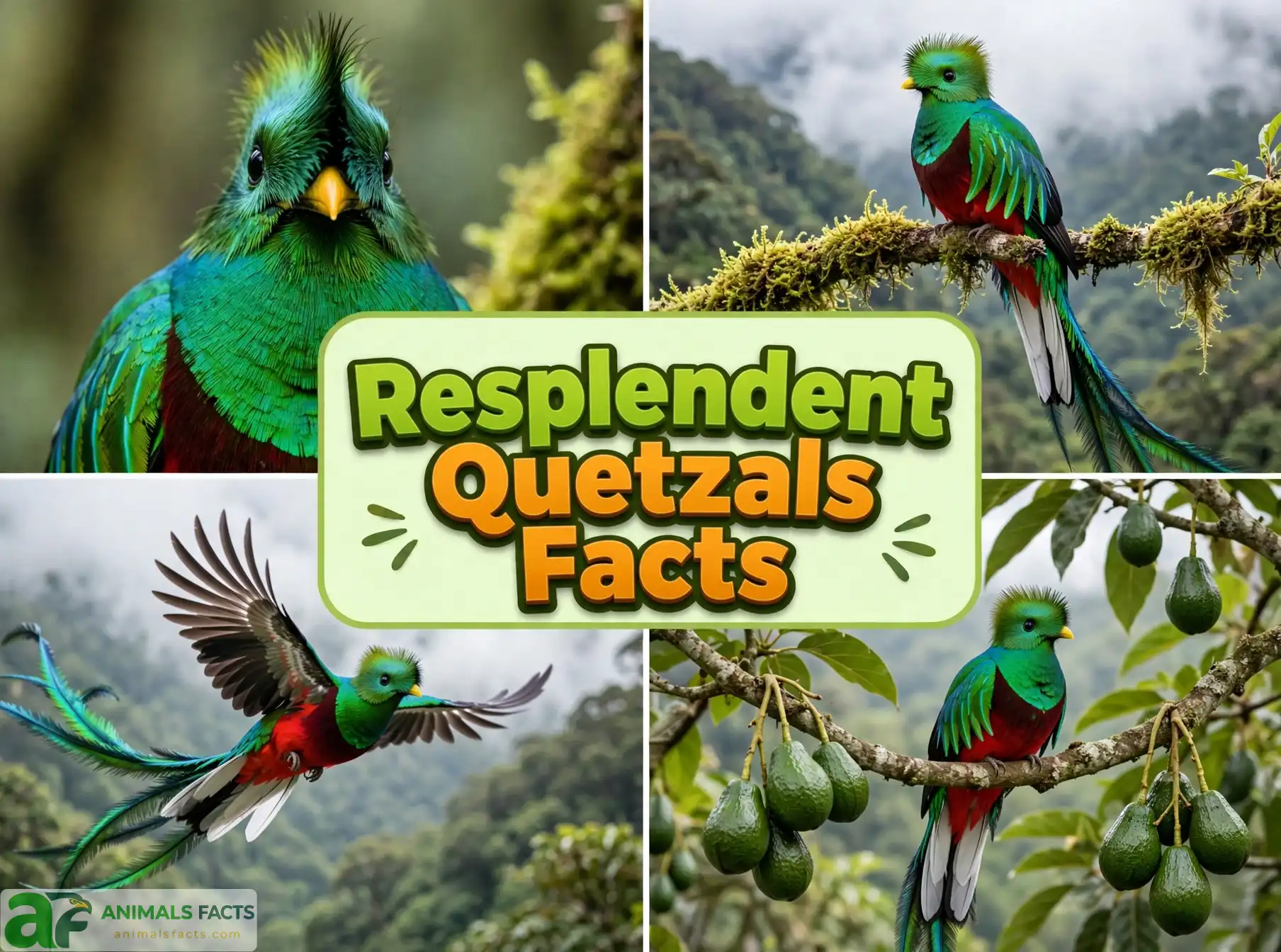
11. Resplendent Quetzal Facts for Kids
Hey amazing young wildlife scientists, bird enthusiasts, and nature lovers! Here are some truly extraordinary resplendent quetzal facts for kids that will make every wildlife conversation instantly more magical:
- 🦜 The quetzal is BOTH the national bird and the national MONEY of Guatemala! Guatemala named its currency the “quetzal” after this magnificent bird — so every time someone pays for something in Guatemala, they are using money named after one of the world’s most beautiful birds. Not many animals are important enough to have a country’s entire currency system named after them!
- 🦜 The Aztecs said you would be EXECUTED for killing a quetzal! The Aztec civilization considered the quetzal so sacred — as the living embodiment of their god Quetzalcoatl — that killing one was a capital crime. The bird was considered divine, its tail feathers more valuable than gold, and its protection was enforced by the highest laws of the empire!
- 🦜 The male’s tail feathers are LONGER THAN HIS ENTIRE BODY! The shimmering green tail streamers of a male quetzal can be 65 centimeters long — and the bird’s body is only about 38 centimeters. That is like a person having hair that grows twice as long as they are tall! The streamers billow and flow behind the bird in flight like the most spectacular cape ever designed by nature!
- 🦜 When the father sits in the nest, his tail hangs OUT OF THE HOLE! The nest is a hole in a dead tree trunk. But the father’s tail is far too long to fit inside the hole with him. So while he sits on the eggs, his gorgeous green tail feathers drape out of the nest entrance or fold back over the top — making it look like the tree has grown a living, feathered tail. Nest watchers can often find the nest simply by looking for the dangling green streamers!
- 🦜 The quetzal cannot survive in a CAGE — it dies of grief! Almost no one has ever kept a resplendent quetzal alive in captivity for long. The bird is so deeply connected to its cloud forest home that being removed from it causes it to refuse food and decline. This extraordinary dependency on freedom became one of the most powerful symbols of the bird in Maya and modern Guatemalan culture — the quetzal as the embodiment of freedom itself!
- 🦜 It is the ONLY bird that can disperse wild avocado seeds! Wild avocados grow in the cloud forest and produce fruits with enormous seeds. The resplendent quetzal is one of the only birds whose throat is wide enough to swallow these fruits whole — it eats the fruit, and then either spits out or passes the large seed, planting it in a new location. Without quetzals, wild avocado trees cannot reproduce properly, and without avocado trees, quetzals cannot get enough food. They NEED each other to survive!
- 🦜 The cloud forest where quetzals live is one of the RAREST ecosystems on Earth! Cloud forests — the misty, moss-covered mountain forests where quetzals live — cover less than one percent of all the forests in the world. They are extraordinary places full of orchids, tree ferns, and hundreds of species found nowhere else. And they are disappearing faster than almost any other ecosystem — which is why every quetzal sighting is so precious!
- 🦜 Scientists think the quetzal inspired POKEMON Ho-Oh! The legendary rainbow phoenix Pokémon Ho-Oh — one of the most iconic and sought-after Pokémon characters — is believed by many fans and wildlife observers to have been inspired by the resplendent quetzal’s iridescent colors, legendary status, and the mythological associations with Quetzalcoatl. The quetzal inspired ancient civilizations AND modern video game designers!
12. Relationship with Humans
The resplendent quetzal’s relationship with humans is one of the deepest and most complex of any bird on Earth — spanning three millennia of religious veneration, the collapse and survival of civilizations whose cosmologies centered on the bird, the establishment of national identity for multiple Central American nations, a conservation crisis driven by the same agricultural expansion that has marginalized indigenous communities, and the growing global wildlife tourism economy that has made the quetzal one of the most sought-after bird species in the world.
Ancient Mesoamerican Civilizations — The Divine Bird
The relationship between the resplendent quetzal and pre-Columbian Mesoamerican civilizations is the deepest and most culturally significant human-bird relationship in the history of the Americas — and one of the most profound human-animal relationships in the history of any civilization:
The Olmec connection — Archaeological evidence suggests quetzal feather use in ceremonial contexts predating even the Maya civilization — the Olmec (approximately 1500–400 BCE) appear to have valued quetzal feathers as prestige goods and may have incorporated the bird into early Mesoamerican cosmological thinking.
The Maya civilization (2000 BCE–1500 CE) — The Maya developed the most elaborate cultural relationship with the quetzal of any pre-Columbian civilization:
- Royal headdresses — The tail feathers of the male resplendent quetzal were essential components of royal regalia — the most powerful Maya rulers wore spectacular headdresses incorporating multiple tail feathers. The most famous example is the headdress associated with Moctezuma II (Aztec emperor) — now housed in the Museum of Ethnology in Vienna — which incorporates approximately 400 resplendent quetzal tail feathers.
- The quetzal-macaw god — Various Maya deities incorporate the quetzal — the combination of quetzal feathers (green, representing vegetation, water, and the sky) with macaw feathers (red, representing fire and the sun) appears in multiple Maya religious contexts.
- Feather trade — Resplendent quetzal tail feathers were among the most valuable trade goods in the pre-Columbian trade networks of Mesoamerica — feathers traveled from the cloud forests of Guatemala and Chiapas to urban centers throughout Mexico and Central America. In some trading contexts, quetzal feathers were reportedly more valuable by weight than jade or gold.
The Aztec civilization (1300–1521 CE) — The Aztec empire developed the most ritually codified relationship with the quetzal:
- Quetzalcoatl — The Feathered Serpent deity — one of the most important gods in the Aztec pantheon — combined the attributes of the quetzal (feathers) and the serpent (earth, water). The quetzal feathers were literally the divine substance of Quetzalcoatl made physical — the bird was not merely a symbol of the god but a living manifestation of divine presence.
- The death penalty for killing a quetzal — Aztec law reportedly made killing a quetzal a capital offense — the bird’s divine status placing it under the same legal protection as sacred spaces and religious objects. This early form of species protection legislation — motivated by religious rather than ecological reasoning — may have contributed to maintaining quetzal populations in areas of dense Aztec settlement.
- Feather workers (amanteca) — The Aztec empire maintained a specialized guild of feather workers who created elaborate feather mosaics, headdresses, shields, and other prestige objects from quetzal and other bird feathers. The amanteca were among the most highly skilled and most economically significant craft workers in Aztec society.
Post-Colonial Period — The Symbol of Freedom
The Spanish conquest and its impact — The Spanish conquest of Mesoamerica from 1519 onward dramatically disrupted the cultural relationship between Mesoamerican peoples and the quetzal — the destruction of indigenous political and religious systems eliminated the institutional protection (including the death penalty for killing quetzals) that had maintained quetzal populations in settled areas.
The freedom symbolism — In the post-conquest period, the quetzal’s cultural significance evolved from divine embodiment to symbol of freedom — the bird’s documented inability to survive in captivity becoming a metaphor for the indigenous peoples’ spirit of independence. The quetzal “dies in a cage” — and so a people whose freedom is taken from them faces the same fate. This symbolism became increasingly powerful during the colonial period and subsequently during Central American independence movements.
Independence and national symbolism — When Guatemala achieved independence in 1821, the resplendent quetzal was incorporated into the national coat of arms — a deliberate choice connecting the new independent nation to both its pre-Columbian cultural heritage and the symbol of inalienable freedom that the quetzal had come to represent. The subsequent adoption of the quetzal as the national currency name (1924) deepened this national identity connection.
Wildlife Tourism — The Economic Value of the Quetzal
The resplendent quetzal’s extraordinary beauty and cultural significance have made it one of the most sought-after bird species in the world for wildlife tourism — and the economic value of quetzal tourism is one of the most powerful arguments for cloud forest conservation:
Birding tourism value — Wildlife birding tourists visiting Guatemala, Costa Rica, and other quetzal range countries specifically to see this species generate significant economic activity. The Quetzal Biotope (Mario Dary Rivera Nature Reserve) near Cobán in Guatemala — the country’s first protected area established specifically for quetzal protection — attracts thousands of visitors annually, generating tourism revenue that funds conservation and provides local economic alternatives to forest clearance.
Costa Rica’s quetzal tourism — The Monteverde and Cerro de la Muerte areas of Costa Rica have developed substantial quetzal-focused tourism economies — lodges, guided tours, and supporting services whose economic existence is directly tied to maintaining the cloud forest habitats quetzals require.
The ecotourism-conservation argument — The economic value of quetzal tourism has been used successfully in multiple contexts to argue for cloud forest conservation — demonstrating to governments and landowners that intact cloud forest with quetzal populations generates greater sustainable economic value than converted agricultural land.
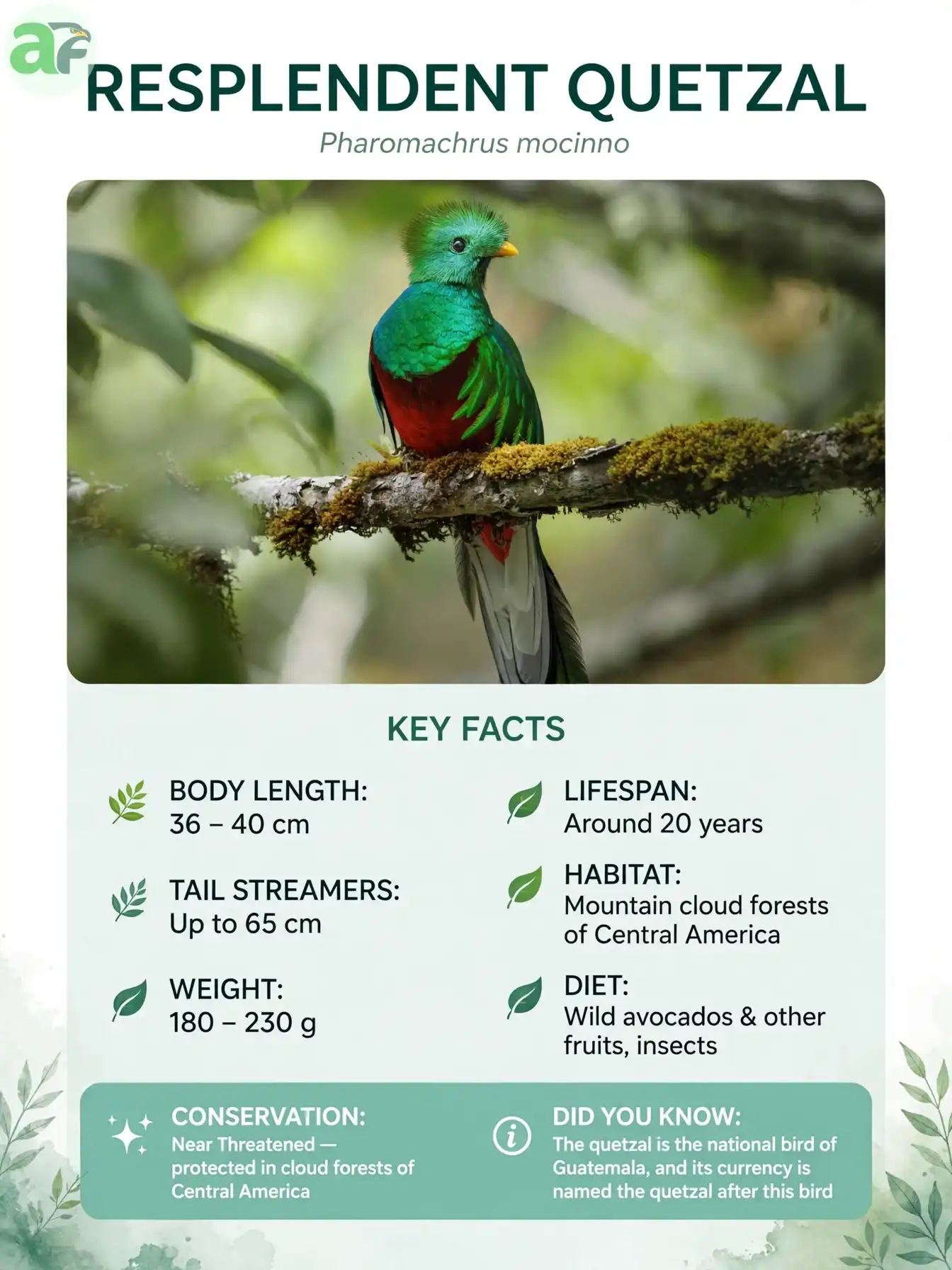
13. Resplendent Quetzal Conservation Status & Threats
Conservation Status Overview
| Feature | Details |
|---|---|
| IUCN Status | Near Threatened (NT) |
| Population Trend | Decreasing |
| Estimated Population | Poorly quantified — estimated 50,000–100,000 individuals but declining |
| CITES Listing | Appendix I — highest protection level; international trade prohibited |
| Guatemala National Status | Protected; national symbol; active conservation programs |
| Costa Rica Status | Protected; actively monitored |
Major Threats
| Threat | Description | Impact Level |
|---|---|---|
| Cloud forest deforestation | Agricultural expansion; logging; cattle ranching | Critical — primary threat |
| Agricultural conversion of mountain slopes | Coffee, maize, and bean farming replacing cloud forest | Critical |
| Fragmentation | Road construction and isolated forest patches preventing altitudinal migration | High |
| Climate change | Upward shift of cloud zone; altered fruiting phenology | High and increasing |
| Nest predation (introduced species) | Introduced rats and predators at cloud forest margins | Medium-High |
| Illegal collection | Capture for zoos, collectors; egg collection | Medium |
| Disturbance at nest sites | Ecotourism without appropriate management | Medium |
| Pesticide use | Agricultural chemicals affecting prey availability | Medium |
| Hunting | Occasional hunting despite legal protection | Low-Medium |
The Cloud Forest Crisis
The single most important driver of quetzal population decline is the loss of cloud forest across the species’ range:
Guatemala — Guatemala has lost approximately 75–80% of its original cloud forest — the remaining cloud forest fragmented into isolated patches separated by agricultural land that quetzals cannot cross. The Sierra de las Minas Biosphere Reserve remains the most significant intact cloud forest block in Guatemala and Central America, but even this reserve faces encroachment pressure.
Mexico (Chiapas) — The cloud forests of the Chiapas highlands, once extensive, have been dramatically reduced by coffee farming, maize cultivation, and cattle ranching. The El Triunfo Biosphere Reserve protects the most important remaining Chiapas quetzal habitat but is surrounded by densely populated agricultural areas.
Honduras and El Salvador — Among the most severely deforested countries in Central America; the quetzal is now extremely rare in both countries, restricted to a few remaining highland forest fragments.
The climate change dimension — Research modeling the impact of climate change on cloud forest distribution predicts significant upward shifts in the cloud zone as temperatures rise — potentially compressing the available cloud forest elevation band and reducing total cloud forest area even where deforestation is halted.
Conservation Responses
Sierra de las Minas Biosphere Reserve — Fundación Defensores de la Naturaleza manages this 106,000-hectare reserve in Guatemala — the most important single protected area for quetzal conservation globally. The reserve’s protection of the largest remaining cloud forest block in Central America provides critical habitat for a substantial quetzal population.
El Triunfo Biosphere Reserve, Mexico — CONANP (Mexico’s National Commission of Natural Protected Areas) manages this reserve in Chiapas — protecting critical quetzal habitat at the northern range limit.
Monteverde Cloud Forest Reserve, Costa Rica — Established in 1972 as one of the world’s first protected areas specifically for quetzal conservation — now a globally recognized ecotourism destination whose tourism economy directly funds conservation.
La Amistad Biosphere Reserve — A transboundary reserve shared between Costa Rica and Panama — one of the largest protected cloud forest areas in Central America protecting significant quetzal populations in both countries.
Community conservation programs — Programs engaging local Guatemalan and Central American communities in cloud forest conservation — providing coffee shade-growing incentives, ecotourism employment, and alternative livelihood options — represent the most sustainable long-term approach to quetzal habitat protection.
Reforestation programs — Various organizations including FUNDAECO in Guatemala and CBTC in Costa Rica maintain cloud forest reforestation programs — planting native cloud forest species (including Lauraceae trees) in degraded areas to restore habitat connectivity for quetzal altitudinal migration.
14. Famous Resplendent Quetzals in History & Pop Culture
Famous Individuals and Cultural Moments
Moctezuma II’s Headdress — The extraordinary feathered headdress associated with the last Aztec emperor Moctezuma II (reigned 1502–1520) — now housed in the Museum of Ethnology in Vienna, Austria — incorporates approximately 400 resplendent quetzal tail feathers and remains the most culturally significant single object incorporating quetzal feathers in existence. The headdress’s location in Vienna rather than Mexico has been a source of ongoing cultural repatriation debate — Mexico has repeatedly requested the return of what it considers an irreplaceable national cultural heritage object.
The Quetzal Biotope study birds — The resplendent quetzals studied and monitored in the Mario Dary Rivera Nature Reserve (Quetzal Biotope) near Cobán, Guatemala — the country’s first protected area established specifically for quetzal protection — have contributed decades of population monitoring data and have been observed by hundreds of thousands of visitors, making them the most viewed wild quetzals in the world.
The de la Llave specimens (1832) — The specimens formally described by Pablo de la Llave in 1832 — establishing the scientific description of Pharomachrus mocinno — represent the founding records of the quetzal in formal Western science, though the bird had been known to indigenous peoples for millennia and to Spanish colonial naturalists for centuries before the formal description.
Alexander Skutch’s Costa Rican study birds — The ornithologist Alexander Skutch — who lived in Costa Rica for most of his adult life and conducted pioneering studies of cloud forest bird biology — documented resplendent quetzal nesting and behavior with a depth and care that remains foundational to the species’ scientific understanding. Skutch’s accounts of individual pairs he monitored over multiple seasons at his Finca Los Cusingos farm in the Chirripó region constitute the most detailed behavioral natural history of the species from the pre-GPS era.
Historical Significance — The Quetzalcoatl Connection
The Feathered Serpent — The Aztec deity Quetzalcoatl (from quetzalli = quetzal feather + coatl = serpent) was one of the most important and most complex deities in the Aztec pantheon — associated with wind, air, learning, arts, crafts, and the morningstar Venus, among other domains. The quetzal component of the name was not merely decorative — quetzal feathers were the literal divine substance of the deity, and the living quetzal was the deity’s physical manifestation on Earth.
The Kukulkan connection — The Maya version of the Feathered Serpent — Kukulkan — similarly incorporated quetzal iconography. The great pyramid of Chichen Itza — El Castillo — was dedicated to Kukulkan, making the quetzal indirectly associated with one of the most visited and most celebrated archaeological monuments in the Americas.
15. Role in Ecosystem & Food Chain
The Seed Disperser Role — The Cloud Forest Engineer
The resplendent quetzal’s most ecologically significant role is as the primary seed disperser for multiple Lauraceae tree species in cloud forest ecosystems — a function that makes the quetzal an ecological engineer of the cloud forest itself:
The dispersal mechanics — The quetzal swallows Lauraceae fruits whole, digests the flesh over approximately 1–2 hours, and then regurgitates the intact seed at a location typically 100–500 meters from the parent tree. Seeds deposited at this distance experience:
- Reduced competition from the parent tree
- Reduced density-dependent seed predator pressure (fewer seed predators concentrate at a distance from the parent)
- Potential access to better light and soil conditions in different microhabitats
The dispersal specificity — Because Lauraceae fruits are too large for most cloud forest birds to swallow whole, the quetzal (and a small number of other large-bodied frugivores) serves as an obligate dispersal vector for these tree species in most cloud forest locations. Remove the quetzal and the Lauraceae trees’ regeneration rate collapses — which in turn removes the primary food resource for quetzals. This mutual dependency makes the quetzal simultaneously a product of the cloud forest and a creator of it.
The keystone species role — Ecologists have proposed that the resplendent quetzal functions as a keystone species in cloud forest ecosystems — a species whose ecological role is disproportionately important relative to its abundance. The loss of quetzals from a cloud forest area sets in motion a progressive deterioration of the Lauraceae component of the tree community, altering the forest’s structural and compositional character over decades.
The Prey Role
Resplendent quetzals are preyed upon by multiple cloud forest predators — contributing to the food webs that support apex predators of the cloud forest:
Raptor food base — Hawk-eagles and other cloud forest raptors depend partly on quetzals as prey — the quetzal’s relatively large body mass (200 grams) representing a significant caloric package for a pursuing predator.
The male plumage visibility cost — The male quetzal’s spectacular plumage significantly increases its detectability to predators — the evolutionary trade-off of sexual selection costs versus benefits in vivid form.
16. Myths, Folklore & Cultural Significance
The Feathered Serpent — The Central American Cosmic Bird
The resplendent quetzal’s cultural significance in Mesoamerican civilization is unmatched by any bird in the history of any civilization in the Western Hemisphere — and rivaled globally only by the Egyptian ibis (associated with Thoth), the Indian peacock (associated with Saraswati), and the Japanese crane (associated with longevity and good fortune):
The cosmic duality of Quetzalcoatl — The Feathered Serpent deity that bears the quetzal’s name embodies a profound cosmic duality — the union of sky (feathered, like the quetzal) and earth (serpentine, like the snake). The quetzal’s tail feathers — the color of sky and vegetation, connecting heaven and earth through their vertical movement in flight — made the bird the perfect living symbol of this cosmic principle.
The quetzal as time marker — In the Maya Long Count calendar — the most sophisticated calendar system ever developed in the pre-Columbian Americas — certain time periods were associated with the quetzal. The bird’s annual appearance in breeding territories and its predictable seasonal movements may have contributed to its role as a living calendar marker for highland Maya communities.
The “dies in a cage” mythology — The cultural narrative that the quetzal cannot survive captivity — and that a caged quetzal dies of grief — whether or not precisely accurate as a biological statement, became one of the most powerful and most enduring cultural messages associated with the bird. This narrative was used by independence leaders, by indigenous rights advocates, and by national identity builders as a metaphor for the inseparability of freedom from the spirit of the Guatemalan people — “like the quetzal, we cannot live without freedom.”
Modern Guatemalan National Identity
The quetzal as national icon — In modern Guatemala, the resplendent quetzal’s national symbol status permeates everyday culture:
- The currency is the quetzal (GTQ)
- The national football team’s colors reference quetzal plumage
- The quetzal appears on the national flag’s coat of arms
- The highest civilian honor awarded by the Guatemalan government is the Order of the Quetzal
- Multiple towns, rivers, mountains, and schools are named for the quetzal
The conservation-identity connection — The depth of the quetzal’s national identity significance has created a powerful conservation narrative — the decline of the quetzal is experienced as a cultural loss as well as an ecological one. This cultural weight has generated political support for cloud forest conservation in Guatemala that purely ecological arguments might not have achieved.
17. Resplendent Quetzals in Pop Culture
“Birdwatcher’s Bible” — The resplendent quetzal appears on virtually every “birds to see before you die” list produced by birding organizations and wildlife travel publishers — consistently ranked among the top five most sought-after birds in the world for wildlife tourists.
David Attenborough BBC documentaries — Multiple BBC natural history productions have featured resplendent quetzal content — including “Life of Birds” (BBC, 1998) and various BBC Earth productions covering Central American cloud forest ecosystems. The quetzal’s extraordinary appearance and cloud forest habitat create compelling wildlife documentary content.
“Planet Earth II — Forests” (BBC, 2016) — Features cloud forest content relevant to the quetzal’s habitat; the extraordinary biodiversity of cloud forest ecosystems has been a recurring subject of BBC landmark documentary series.
National Geographic coverage — The resplendent quetzal has been featured in National Geographic Magazine in multiple issues over several decades — the combination of spectacular appearance, extraordinary cultural significance, and conservation urgency making it ideal magazine cover and feature story material.
Pokémon Ho-Oh — The legendary Pokémon character Ho-Oh — introduced in Pokémon Gold and Silver (1999) and depicted as a rainbow-colored phoenix — is widely recognized by fans and wildlife enthusiasts as incorporating design elements from the resplendent quetzal, including iridescent green and red plumage, legendary cultural status, and the association with mythological fire. The connection between Ho-Oh and the quetzal has introduced millions of young Pokémon players to awareness of the real bird.
Literature and poetry — The resplendent quetzal appears in Central American literature as a recurring symbol of freedom, beauty, and loss — appearing in the work of Guatemalan poets, novelists, and essayists as one of the most powerful natural symbols available to writers working in the Central American cultural tradition.
Wildlife photography — The resplendent quetzal is one of the most photographed birds in the world — the combination of extraordinary beauty, relative accessibility (particularly at key sites in Costa Rica), and the extreme visual reward of a clear sighting making it one of the most compelling subjects in wildlife photography. Award-winning quetzal images regularly appear in international wildlife photography competitions.
18. Resplendent Quetzal Facts vs. Common Myths
| Common Myth | The Real Fact |
|---|---|
| “The quetzal definitely cannot survive in captivity” | Partially true but overstated — the species is genuinely very difficult to maintain in captivity long-term and has almost never been successfully kept; however, the cultural narrative of “certain death in a cage” is somewhat mythologized. The difficulty is real; the absolute certainty is cultural elaboration |
| “Quetzal tail feathers were pulled from living birds for use in Maya headdresses” | Historically debated — some accounts suggest feathers were harvested from living birds that were then released; others suggest the birds were killed. The practice of live harvesting with release is culturally and ecologically plausible but not definitively confirmed |
| “The quetzal is Guatemala’s only national bird” | True — Guatemala’s only official national bird; but the quetzal is also significant to Mexico, Honduras, Costa Rica, and other range countries, though it is formally Guatemala’s national symbol |
| “The quetzal’s tail streamers are its actual tail feathers” | False — the streamers are enormously elongated upper tail covert feathers, not the actual tail rectrices, which are much shorter and invisible beneath the coverts |
| “Quetzals are only found in Guatemala” | False — the species ranges from southern Mexico through Central America to western Panama; while Guatemala is culturally most associated with the species, Costa Rica and other countries have significant populations |
| “The quetzal’s green color comes from green pigment” | False — the iridescent green is produced by structural coloration (thin-film interference in feather microstructure), not green pigment. The color shifts with viewing angle and does not fade in specimens the way pigment-based colors do |
| “The quetzal is sacred to all indigenous Central American cultures” | Overgeneralized — the quetzal held specific sacred significance primarily in Aztec and Maya cultures; other indigenous cultures of Central America held different relationships with the bird, which was not universally sacred across all pre-Columbian cultures |
19. Best Places to See Resplendent Quetzals in the Wild
1. Savegre Valley (San Gerardo de Dota), Costa Rica — Consistently ranked as the most reliable quetzal viewing location in the world — the Savegre Valley on the Cerro de la Muerte road (Pan-American Highway, approximately 3 hours from San José) provides extraordinary quetzal access in an accessible and well-developed tourism infrastructure. During the breeding season (March–May), multiple pairs are typically visible on a single morning walk. The combination of reliable quetzal sightings with excellent general cloud forest birding makes this Costa Rica’s premier birding destination.
2. Monteverde Cloud Forest Reserve, Costa Rica — The world’s most famous cloud forest reserve; quetzals are present year-round though the breeding season provides the best sightings. The reserve’s extensive trail system and experienced guide network facilitate quetzal observation, though the dense forest can make sightings more challenging than the more open Savegre Valley.
3. Mario Dary Rivera Nature Reserve (Quetzal Biotope), Guatemala — Guatemala’s first protected area established specifically for quetzal protection; located near Cobán in Alta Verapaz. The reserve provides genuine wild quetzal viewing in the bird’s core cultural homeland — the combination of conservation significance and cultural context makes this a compelling destination for visitors seeking the full quetzal experience beyond pure birding.
4. Sierra de las Minas Biosphere Reserve, Guatemala — The most important conservation site for quetzals globally; the largest remaining cloud forest block in Central America. Access requires more planning than the tourist-oriented sites but rewards visitors with some of the finest intact cloud forest remaining in Guatemala.
5. El Triunfo Biosphere Reserve, Chiapas, Mexico — The most important quetzal site in Mexico; the reserve’s cloud forest hosts a significant quetzal population at the species’ northern range limit. Access requires advance planning and coordination with reserve management but provides an extraordinary wilderness cloud forest experience.
6. Cerro de la Muerte, Costa Rica — The high-altitude section of the Pan-American Highway near Cartago provides accessible cloud forest birding including quetzal sightings, particularly at dawn when birds are most active. The accessible roadside birding makes this one of the most efficient quetzal locations for time-limited visitors.
7. Volcán Barú National Park, Panama — The westernmost significant quetzal population; the cloud forests of Volcán Barú in western Panama provide the southern range limit opportunity for visitors combining quetzal birding with the spectacular Panamanian cloud forest avifauna.
8. The Honest Assessment — Resplendent quetzal sightings are most reliable during the breeding season (March–May) when males are most vocal and most visible, and at established sites with experienced local guides who know individual birds’ territories and foraging patterns. The Savegre Valley in Costa Rica provides the most reliable experience for visitors with limited time. Patience and appropriate timing — very early morning, when birds are most active — are the most important factors for success at any site.
20. How You Can Help
Supporting resplendent quetzal conservation requires action focused primarily on Central American cloud forest protection, ecotourism that benefits local communities, climate change advocacy, and support for the organizations working directly in quetzal habitat.
Support these organizations:
- Fundación Defensores de la Naturaleza (Guatemala) — defensores.org.gt — manages the Sierra de las Minas Biosphere Reserve; the most important single conservation organization for quetzal protection
- FUNDAECO (Guatemala) — fundaeco.org.gt — cloud forest conservation in Guatemala including quetzal habitat protection and reforestation
- Monteverde Conservation League (Costa Rica) — acmcr.org — manages the Children’s Eternal Rainforest; cloud forest protection in Costa Rica
- American Bird Conservancy — abcbirds.org — funds cloud forest conservation across the quetzal’s range
- BirdLife International — birdlife.org — coordinates international quetzal conservation planning
- Rainforest Trust — rainforesttrust.org — funds cloud forest protection across Central America
Critical individual actions:
- Visit quetzal sites responsibly — wildlife tourism in established quetzal viewing areas directly funds cloud forest conservation; choosing operators that employ local guides and support conservation programs maximizes the conservation benefit
- Support shade-grown coffee — purchasing shade-grown, certified coffee from Guatemala and other Central American countries supports the maintenance of coffee plantations with tree canopy that provides supplementary quetzal habitat
- Advocate for climate action — climate change projections for cloud forest loss make addressing the climate crisis directly relevant to quetzal conservation; supporting climate action organizations contributes to long-term quetzal habitat security
- Donate to cloud forest protection — direct donations to Defensores de la Naturaleza and FUNDAECO fund the land acquisition and management that maintains quetzal habitat
- Spread accurate information — the resplendent quetzal’s conservation status is not widely known outside the birding community; sharing accurate information about the cloud forest loss crisis builds public awareness that drives political and financial support for conservation
21. Top Documentaries & Books
Must-Watch Documentaries
- “Life of Birds” (BBC, David Attenborough, 1998) — The comprehensive bird natural history series; includes cloud forest content relevant to quetzal ecology
- “Planet Earth II — Forests” (BBC, 2016) — Cloud forest sequences among the finest cloud forest footage in BBC production history
- “The Quetzal: Bird of Paradise” (various wildlife productions) — Multiple dedicated quetzal documentary treatments available through wildlife streaming platforms
- “Ecuador and the Cloud Forest” (various BBC and National Geographic productions) — Regional cloud forest natural history with direct relevance to quetzal ecology
- Audubon Society and Cornell Lab of Ornithology media — Multiple quetzal video resources available through these organizations’ online platforms
Must-Read Books
- A Bird Watcher’s Adventures in Tropical America by Alexander Skutch — The foundational popular account of cloud forest bird natural history by the ornithologist who spent decades studying quetzals in Costa Rica; essential reading for anyone seriously interested in quetzal natural history
- Life Ascending: The Ten Great Inventions of Evolution by Nick Lane — Provides essential scientific context for structural coloration and evolutionary trade-offs
- A Guide to the Birds of Mexico and Northern Central America by Steve Howell and Sophie Webb — The standard field guide for the northern portion of the quetzal’s range
- The Birds of Costa Rica by Richard Garrigues and Robert Dean — The standard comprehensive Costa Rican bird guide with detailed quetzal coverage
- Quetzal: Sacred Bird of the Cloud Forest (various authors) — Multiple popular natural history accounts of the quetzal’s biology and cultural significance
22. Resplendent Quetzal Comparison with Other Spectacular Birds
| Feature | Resplendent Quetzal | Bird of Paradise (Paradisaea) | Peacock (Pavo cristatus) | Flamingo (Phoenicopterus) | Scarlet Macaw |
|---|---|---|---|---|---|
| Scientific name | Pharomachrus mocinno | Paradisaea spp. | Pavo cristatus | Phoenicopterus ruber | Ara macao |
| Weight | 180–210 g | 60–430 g | 4–6 kg | 2–4 kg | 900–1,100 g |
| Display structure | Tail streamers (65 cm) | Plumes and wires | Train (150 cm+) | Pink plumage | Red-yellow-blue wings |
| Color mechanism | Structural + pigment | Structural + pigment | Structural | Carotenoid pigment | Pigment |
| Ecology | Cloud forest frugivore | Rainforest frugivore | Grassland omnivore | Alkaline lake filter-feeder | Rainforest frugivore |
| Cultural significance | Maya/Aztec sacred | European collector obsession | Hindu sacred (Saraswati) | Modern elegance symbol | Pan-American symbol |
| Conservation | Near Threatened | Various — some endangered | Least Concern | Least Concern | Least Concern |
| Range | C. America cloud forest | New Guinea and islands | Indian subcontinent | Americas, Africa | C. and S. America |
| Famous for | Most beautiful New World bird | Most elaborate plumage display | Most recognized display bird | Most recognized by color | Most colorful parrot |
| Captivity | Cannot be maintained | Difficult; some species kept | Common in zoos | Common in zoos | Common pet and zoo |
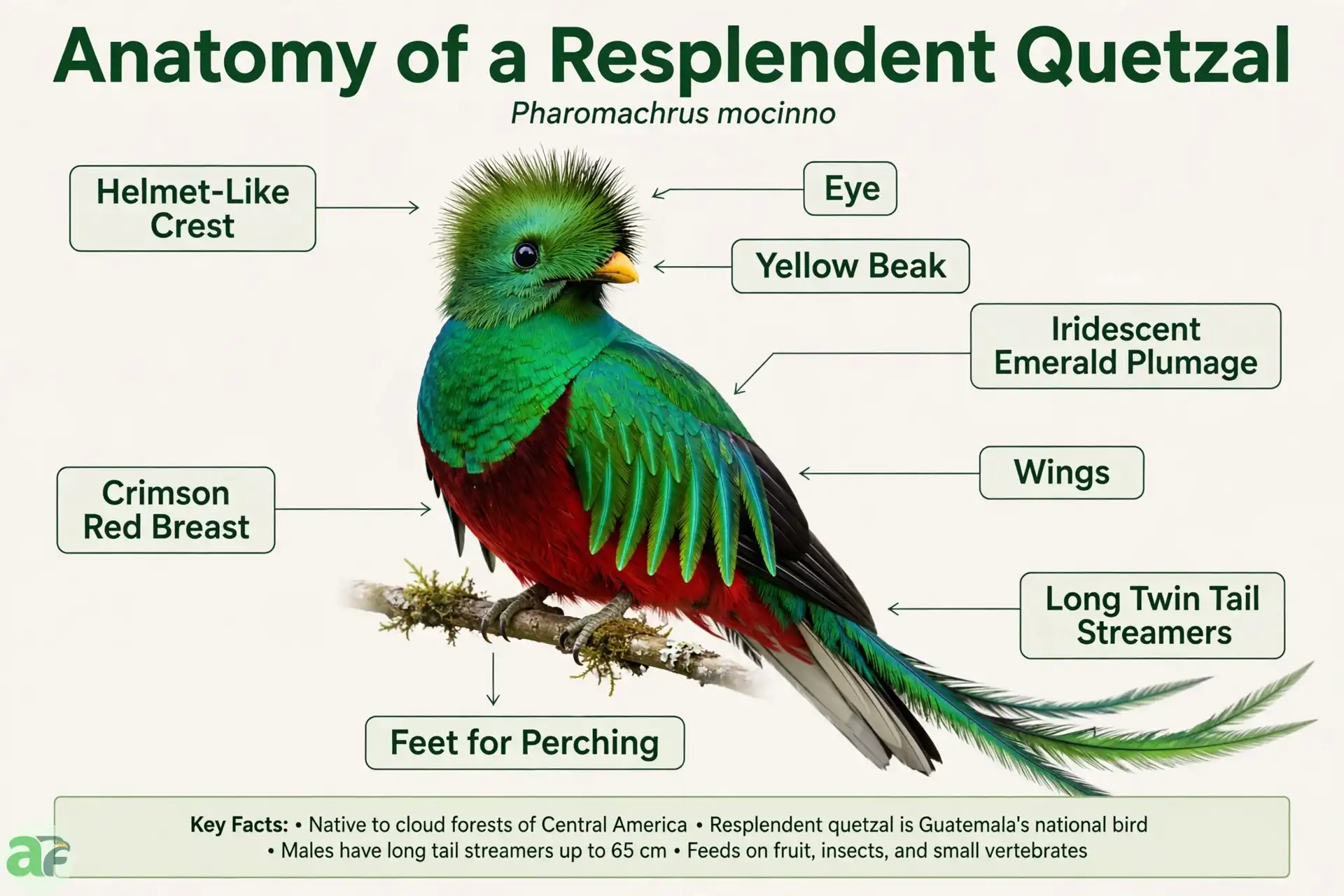
23. Frequently Asked Questions About Resplendent Quetzal Facts
Q1. What is the scientific name of the resplendent quetzal?
The resplendent quetzal’s scientific name is Pharomachrus mocinno (de la Llave, 1832). The genus name Pharomachrus derives from the Greek pharos (long cloak or mantle) and makros (long) — meaning “long-cloaked” — a reference to the male’s extraordinary elongated tail covert feathers. The species name mocinno honors José Mariano Moziño (also spelled Mozino) — a Mexican-born naturalist who conducted important early natural history documentation of Mexican flora and fauna in the late 18th and early 19th centuries. The common name “quetzal” derives from the Nahuatl word quetzalli — meaning both “precious tail feather” and “precious” or “sacred” — reflecting the bird’s central importance in Aztec culture. The species was formally described by the Mexican naturalist Pablo de la Llave in 1832, though the bird had been known to European naturalists through Spanish colonial accounts since the 16th century. Two subspecies are recognized: the nominate P. m. mocinno (southern Mexico to Nicaragua) and P. m. costaricensis (Costa Rica and western Panama).
Q2. Why is the resplendent quetzal the national bird of Guatemala?
The resplendent quetzal was designated as Guatemala’s national bird when the country adopted its current coat of arms and national symbols following independence — reflecting a deliberate connection between the new nation’s identity and both its pre-Columbian cultural heritage and the concept of freedom. The quetzal had been the most sacred bird of the Maya civilization — whose descendants constitute a significant portion of Guatemala’s indigenous population — and its tail feathers were among the most valuable objects in pre-Columbian Mesoamerica. The cultural narrative that the quetzal “dies in captivity rather than live in a cage” made it a powerful symbol of the spirit of freedom that independence movements sought to embody. Subsequently, the adoption of the quetzal as the name of Guatemala’s currency (1924) further deepened this national identity connection — making Guatemala the only country in the world whose national bird and national currency share the same name. The quetzal thus represents an extraordinary three-thousand-year continuum of human cultural relationship with a single bird species.
Q3. What does the resplendent quetzal eat?
The resplendent quetzal’s diet is dominated by the fruits of wild avocado trees and related species of the laurel family (Lauraceae) — particularly the genera Ocotea, Nectandra, and Persea that grow in cloud forest. These fruits — large, single-seeded drupes analogous in structure to commercial avocados — constitute approximately 80% of the adult diet and are swallowed whole, with the hard seed later regurgitated as a pellet. This dietary specialization makes the quetzal both entirely dependent on Lauraceae tree availability and critically important as the primary seed disperser for these trees — creating a mutual dependency that links the bird’s survival directly to the regeneration of the cloud forest it inhabits. The remaining diet includes other large forest fruits, insects (particularly during the breeding season), frogs, lizards, and small invertebrates — animal prey being especially important for provisioning growing chicks whose protein demands exceed what fruit alone can supply.
Q4. Can resplendent quetzals really not survive in captivity?
The resplendent quetzal has an exceptionally poor captive survival record — almost no successful long-term captive maintenance of the species has been documented. Multiple zoological institutions have attempted to maintain quetzals over the past century, and these attempts have almost universally resulted in rapid decline and death of the birds within months of capture. The reasons appear to be multiple and interacting: the quetzal’s extremely specific dietary requirements (ripe Lauraceae fruits that are difficult to replicate in captivity), its sensitivity to the precise temperature and humidity conditions of cloud forest, its high psychological stress response to confinement and handling, and possibly physiological adaptations so finely tuned to cloud forest conditions that departure from those conditions rapidly compromises health. The cultural narrative that quetzals “die in a cage rather than live as captives” represents a somewhat romanticized version of a genuine biological reality — the species’ extraordinary specialization for cloud forest life makes captivity survival genuinely very poor, even if the “certain death from grief” narrative overstates the precision of the biological mechanism.
Q5. Where is the best place to see a resplendent quetzal in the wild?
The Savegre Valley (San Gerardo de Dota) in Costa Rica is consistently identified by experienced birders and wildlife travel professionals as the most reliable location globally for resplendent quetzal observation. Located approximately 3 hours from San José on the Pan-American Highway, the valley’s cloud forest at approximately 2,300 meters elevation supports resident quetzal pairs that are well-habituated to human presence at established lodge and trail areas. During the breeding season (March–May), multiple pairs are typically visible during a single morning walk, and individual birds often forage in the fruiting trees of the valley’s lodges and farms at remarkably close range. For visitors seeking the full cultural and ecological context alongside the sighting, the Mario Dary Rivera Nature Reserve (Quetzal Biotope) in Guatemala provides quetzal observation in the bird’s core cultural homeland. Experienced local guides with knowledge of individual birds’ territories are the single most important factor for success at any site — contacting established birding lodges in advance and booking guided morning excursions substantially improves sighting probability at all locations.
24. Sources & References
- Wikipedia — Pharomachrus mocinno, Trogonidae, Quetzalcoatl, Cloud forest
- IUCN Red List — iucnredlist.org (current Near Threatened assessment for Pharomachrus mocinno)
- BirdLife International — birdlife.org (species factsheet for resplendent quetzal)
- Skutch, A.F. — multiple published papers and books on quetzal natural history; the foundational field studies
- Wheelwright, N.T. — published research on quetzal diet and Lauraceae seed dispersal
- Fundación Defensores de la Naturaleza — defensores.org.gt
- FUNDAECO — fundaeco.org.gt
- National Geographic — nationalgeographic.com
- Smithsonian National Museum of Natural History — naturalhistory.si.edu
- BBC Wildlife / BBC Earth — bbcearth.com
- Britannica — britannica.com/animal/resplendent-quetzal
- Cornell Lab of Ornithology — allaboutbirds.org (species account)
- Museo Nacional de Antropología, Mexico City — collections documentation
- Museum of Ethnology, Vienna — documentation of Moctezuma II featherwork collection