
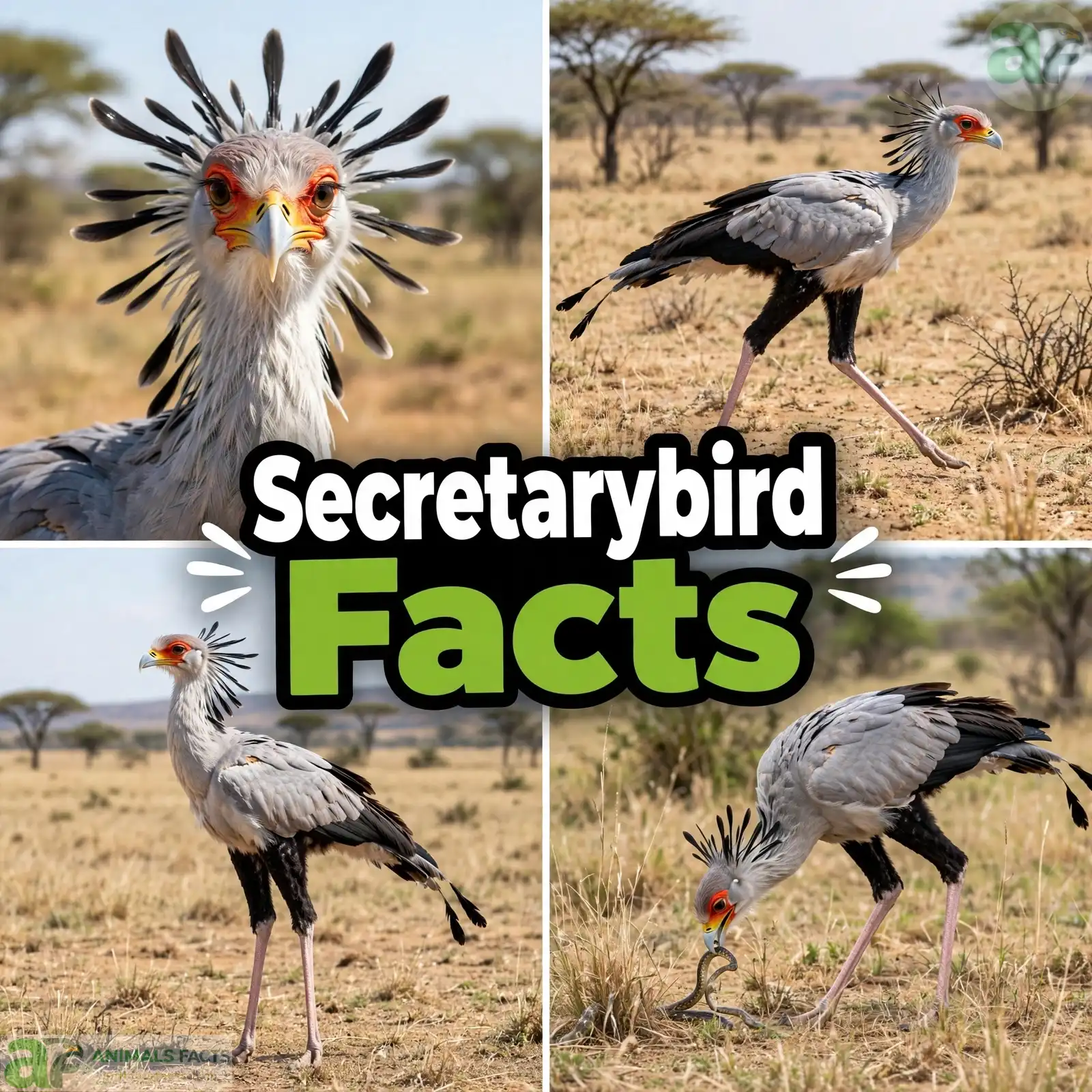
Secretarybird Facts
| Feature | Details |
|---|---|
| Scientific Name | Sagittarius serpentarius (Miller, 1779) |
| Kingdom | Animalia |
| Phylum | Chordata |
| Class | Aves |
| Order | Accipitriformes |
| Family | Sagittariidae |
| Common Names | Secretarybird; secretary bird |
| Native Range | Sub-Saharan Africa — from Senegal to South Africa |
| Habitat | Open savanna, grassland, bushveld, semi-arid scrub — strictly terrestrial hunter |
| Lifespan | 10–15 years (wild estimate); up to 19 years (captivity) |
| Diet | Snakes, lizards, small mammals, frogs, insects — specialist terrestrial predator |
| Body Length | 112–152 cm — standing height approximately 1.2–1.3 meters |
| Wingspan | 191–220 cm |
| Weight | 2.3–4.5 kg |
| Top Speed (Kicking) | Kick delivered in 15 milliseconds — too fast for most prey to react |
| Conservation Status | Endangered (IUCN) — reclassified from Vulnerable in 2020 |
| Defining Feature | Exceptionally long legs; black quill-like crest feathers behind the head; hunts exclusively on foot |
| Taxonomic Status | The only member of family Sagittariidae — a monotypic family with no close living relatives |
| Kicking Force | Delivers kicks of up to 5 times its own body weight — sufficient to kill cobras and puff adders |
| Closest Relatives | Ospreys and New World vultures — distant; no close living relatives |
 1. Introduction: What is a Secretarybird?
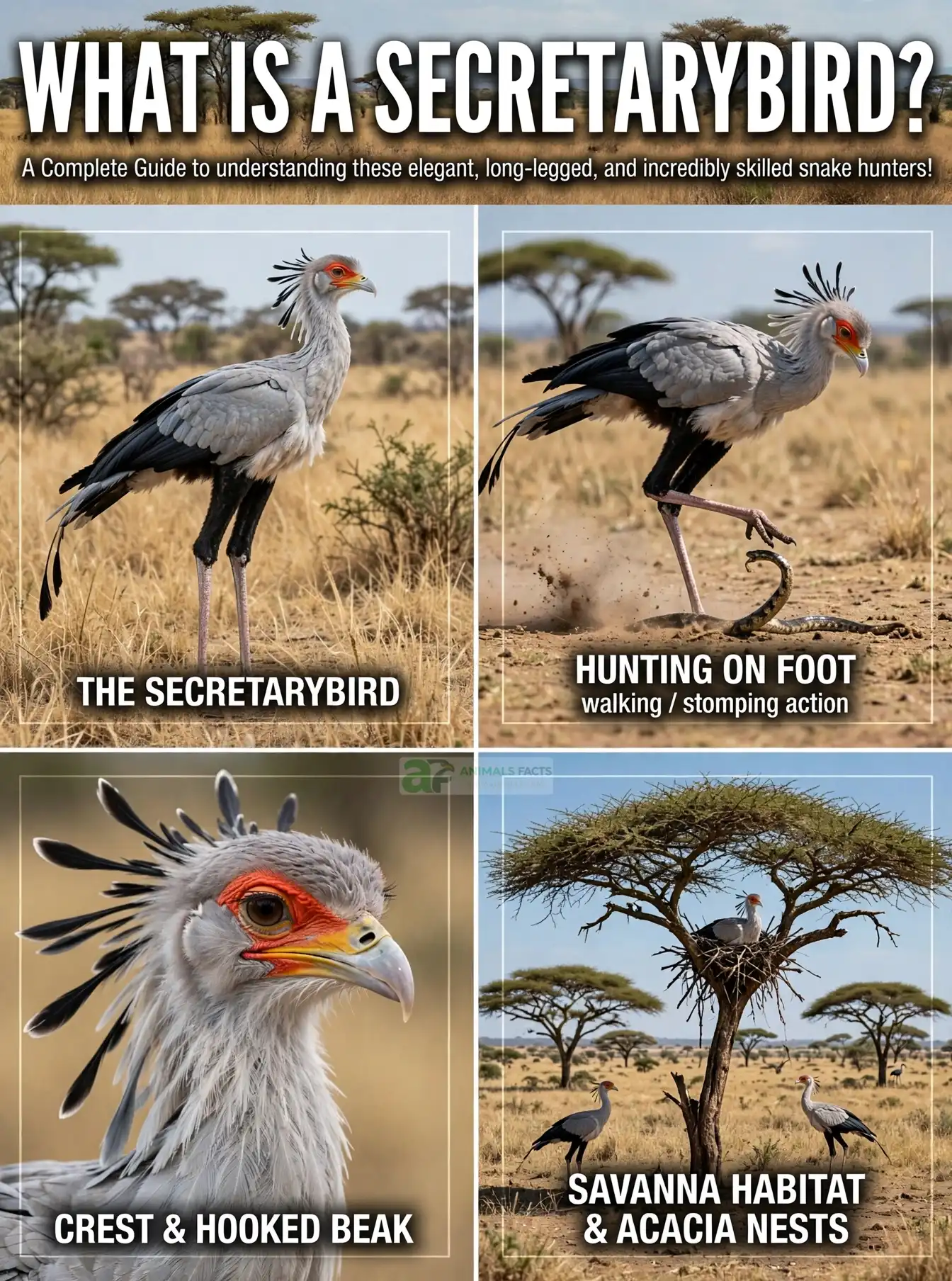
On the vast golden grasslands of the African savanna, a bird unlike any other raptor on Earth walks with the measured, purposeful stride of an animal that has made a fundamental evolutionary decision — that wings are for soaring, but the real work happens on the ground. It stands 1.2 meters tall. Its legs are extraordinarily long, bare below the knee like those of a crane or stork. Its head is adorned with a remarkable crown of black-tipped quill feathers that project backward like a Renaissance scholar’s writing quills — the feature that, according to one of the most popular etymological theories, gave this bird the common name “secretarybird.” And then it finds what it has been walking several kilometers of savanna grassland to locate: a cobra has been detected — not by sight alone, but through the accumulated information of a morning’s systematic patrol of home range territory. The secretarybird does not take to the air. It does not stoop from altitude with closed wings. It walks to the snake, positions itself carefully, and then delivers a strike of such extraordinary speed and force that the cobra — one of Africa’s most dangerous animals — has no meaningful opportunity to respond. Secretarybird facts begin with this moment — the most extraordinary raptor in the world, a bird that hunts like a terrestrial predator, kills like a martial artist, and looks like a creature from a natural history illustrator’s imagination pushed to its most creative limits.
The secretarybird (Sagittarius serpentarius) represents one of the most significant departures from the standard raptor body plan in all of avian evolution. Where all other raptors hunt from the air — soaring, stooping, diving on prey with the speed and force of aerial predation — the secretarybird has committed almost entirely to terrestrial hunting, walking up to 20–30 kilometers per day through African savanna and grassland in search of prey that it subdues with its powerful feet rather than its talons or beak. The result is an animal of astonishing biological specificity — a raptor with the legs of a crane, the hunting strategy of a snake, and a kick so fast and so powerful that research published in 2016 documented individual strikes delivering forces equivalent to five times the bird’s own body weight in 15 milliseconds — a combination of speed and force that leaves even highly venomous snakes with no time to strike in defense before the fatal blow has been delivered.
Interesting facts about secretarybirds reveal an animal of breathtaking biological precision — the long legs not merely for walking but providing the distance from prey that prevents a defensive snake bite from reaching the body; the crest feathers whose exact function remains debated but which are clearly important in social signaling and possibly in prey intimidation; a pair bond maintained for life, with the same pair returning to the same nest for decades; a flight capability that belies the terrestrial reputation, with secretarybirds regularly soaring to remarkable heights on thermals and traveling substantial distances; and a conservation crisis so acute that the species was reclassified from Vulnerable to Endangered in 2020 — one of the most significant downlisting events in African bird conservation of the past decade. Whether you are searching for secretarybird facts for kids to explore the science of this extraordinary bird’s hunting system, a wildlife enthusiast wanting to understand one of Africa’s most iconic savanna species, a conservation researcher concerned about the threats driving this unique bird toward extinction, or simply someone who encountered a photograph of this magnificent, impossibly long-legged raptor and needed to understand everything about it immediately — this is your comprehensive guide. The world’s only walking raptor has an extraordinary story to tell.
2. Secretarybird Species Overview & Classification
The secretarybird occupies one of the most taxonomically isolated positions of any living bird — the sole member of the family Sagittariidae, an ancient raptor lineage with no close living relatives.
Species Classification Table
| Taxonomic Rank | Classification |
|---|---|
| Kingdom | Animalia |
| Phylum | Chordata |
| Class | Aves |
| Order | Accipitriformes |
| Family | Sagittariidae (Vigors, 1824) — monotypic |
| Genus | Sagittarius (Hermann, 1783) |
| Species | S. serpentarius (Miller, 1779) |
| Common Name | Secretarybird |
| Etymology | Sagittarius = “archer” (Latin) — referring to the arrow-like crest feathers; serpentarius = “of serpents” (Latin) — referring to the snake-killing behavior |
The Monotypic Family — An Entire Avian Family With One Species
The secretarybird is the sole living member of the family Sagittariidae — a family containing no other species living or recently extinct. This taxonomic isolation has profound conservation implications:
An entire family at risk — The secretarybird’s Endangered status means that an entire avian family — not merely a single species within a larger group — faces extinction risk. No other member of Sagittariidae exists to carry forward the evolutionary lineage.
Evolutionary uniqueness — The secretarybird represents approximately 60 million years of independent evolutionary history within the raptor lineage — an irreplaceable evolutionary experiment that would be entirely and permanently lost with the species’ extinction.
Closest Living Relatives — A Molecular Surprise
For most of the history of ornithology, the secretarybird’s classification was debated — its unusual morphology making it difficult to place confidently within the raptor lineage. Molecular genetic analysis has progressively resolved the picture, though the secretarybird remains one of the most phylogenetically isolated birds on Earth:
Order Accipitriformes — The secretarybird is currently placed in the order Accipitriformes — the order that also includes hawks, eagles, kites, and Old World vultures.
Closest living relatives — Within the Accipitriformes, the secretarybird’s closest relatives based on molecular analysis are the osprey (Pandion haliaetus) and the New World vultures (Cathartidae) — an unexpected grouping that reflects the deep and complex evolutionary history of the raptor lineage.
The Accipitriformes placement — Despite the superficial resemblance to long-legged wading birds (storks, cranes, herons), the secretarybird’s molecular genetics confirm unambiguous raptor affinity — the long legs evolved convergently in a raptor lineage, not from a wading bird ancestor.
The Fossil Record — Ancient African Raptors
The secretarybird’s fossil relatives document a more diverse ancient Sagittariidae family:
Pelargopappus schlosseri — An extinct Sagittariidae species from Miocene deposits in France — one of the most important fossil discoveries for understanding the family’s evolutionary history. The French occurrence confirms that the Sagittariidae once had a broader geographic distribution beyond Africa.
Amphiserpentarius — Fossil secretarybird relatives from North American Eocene deposits — the discovery that Sagittariidae relatives existed in the Americas adds another dimension to the family’s biogeographic history.
The fossil record confirms that the Sagittariidae was a more diverse family during the Eocene and Miocene — the modern secretarybird being the sole survivor of an ancient lineage that once included multiple species across multiple continents.
Evolution & Discovery Timeline
~60 million years ago (Eocene) — The ancestral Sagittariidae lineage diverges within the early raptor radiation — establishing the long-legged terrestrial hunting strategy that will define the family throughout its evolutionary history.
~30–40 million years ago (Oligocene-Miocene) — Sagittariidae diversity expands — fossil forms in Europe and North America confirm a broader distribution than the modern African endemic.
~5–10 million years ago (Late Miocene-Pliocene) — The Sagittariidae contracts to Africa as global climatic changes alter the distribution of the open savanna and grassland habitats the family requires.
1769 — Philip Miller formally describes the secretarybird based on accounts and illustrations from early naturalists working in southern Africa — establishing the species name serpentarius in recognition of the snake-killing behavior documented in early colonial natural history accounts.
1779 — The secretarybird appears in Johann Müller’s systematic accounts — the current taxonomic authority date for the species name.
1783 — Johann Hermann establishes the genus Sagittarius — naming it for the “archer” crest feathers that project backward from the head like arrows.
1824 — The family Sagittariidae is formally established by Nicholas Vigors — recognizing the secretarybird’s distinctiveness as requiring its own family classification.
2016 — Research by Steve Portugal and colleagues at the Royal Veterinary College publishes the first high-speed video analysis of secretarybird prey-striking technique — revealing the extraordinary speed and force of individual kicks and establishing the biomechanics of the hunting system in scientific detail for the first time.
2020 — The IUCN reclassifies the secretarybird from Vulnerable to Endangered — one of the most significant conservation status downlistings of any African bird in recent decades.
2024 — Continued population monitoring confirms the secretarybird population decline across most of sub-Saharan Africa — the Endangered classification maintained with population trend assessed as decreasing.
“The secretarybird is the most extraordinary bird in the African savanna — an animal that made a different evolutionary bet than every other raptor on Earth and turned out to be right about it for sixty million years. The question now is whether it can survive the next sixty.”
— Dr. Ara Monadjem, University of Swaziland — leading secretarybird researcher
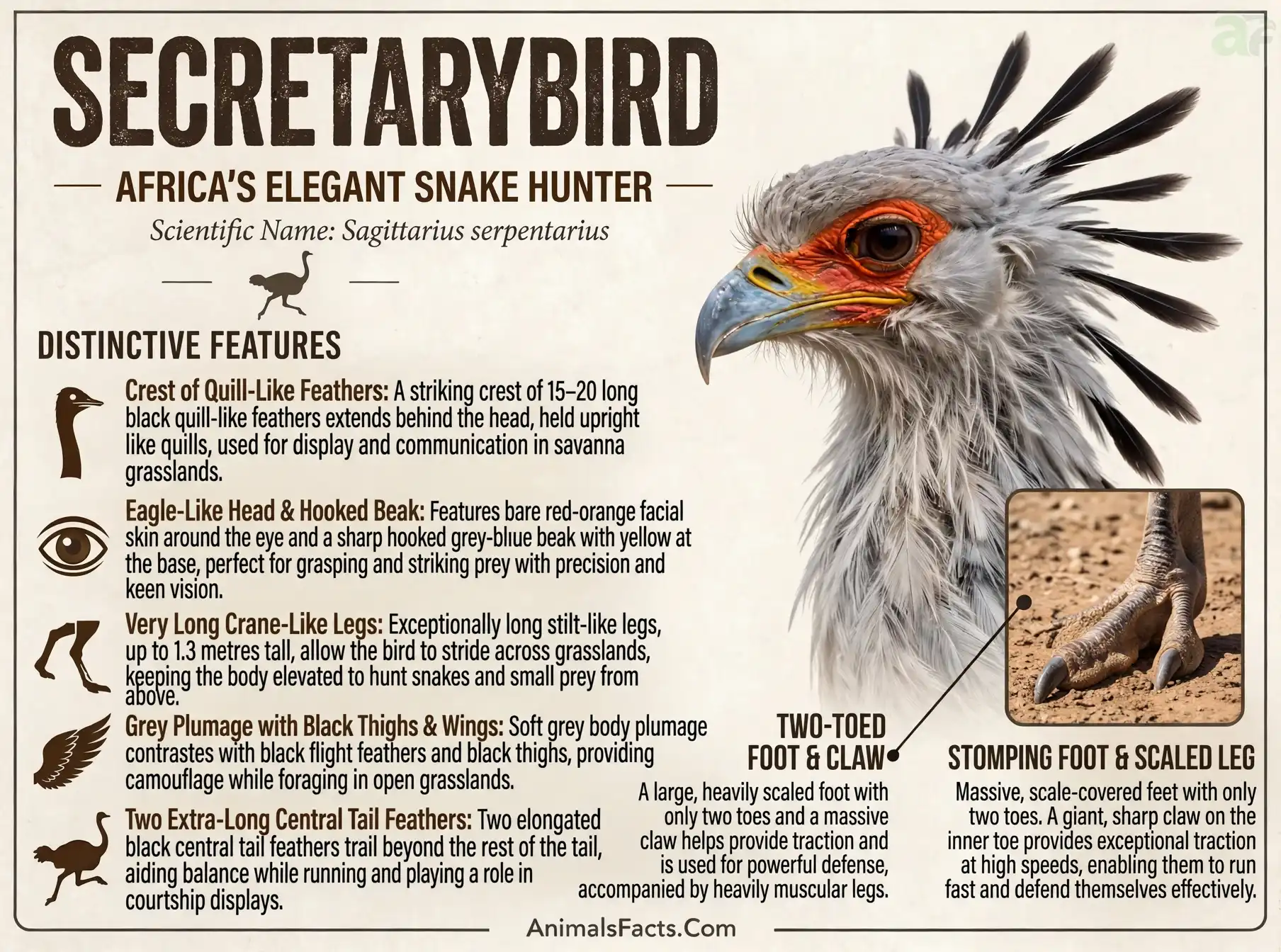
3. Secretary bird Physical Description & Unique Features
The secretarybird’s physical appearance is unlike any other raptor — a combination of features from multiple bird groups assembled into a body plan of extraordinary functional specificity.
The Overall Body Plan — A Raptor Reimagined
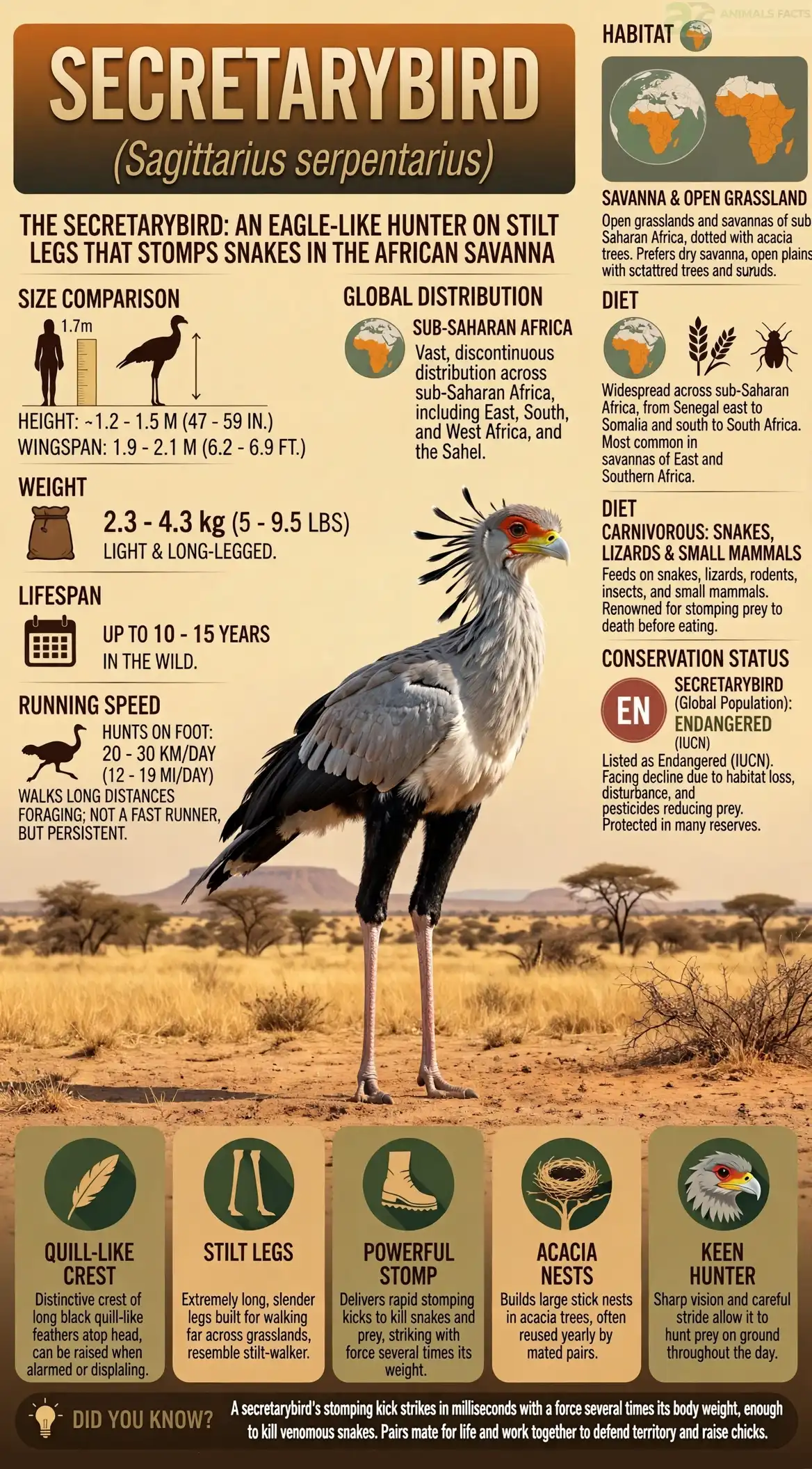
At 1.2–1.3 meters standing height and 112–152 cm in body length (with a wingspan of 191–220 cm), the secretarybird is a large bird — significantly larger than most raptors when standing height is considered, though lighter than the very largest eagles.
The fundamental body plan paradox — The secretarybird looks simultaneously like multiple different birds:
- The head and beak of an eagle — curved, powerful, hooked; unmistakably a raptor’s weapon
- The legs and general proportions of a crane or stork — extraordinarily long, bare below the knee, designed for terrestrial locomotion
- The crest feathers of something unique — long, black-tipped quill feathers projecting backward from the crown in a fan arrangement found in no other bird
- The tail of a large bird of prey — long, with distinctive elongated central tail feathers extending well beyond the tail’s width
This combination of raptor head, wading bird legs, and unique crest makes the secretarybird one of the most immediately recognizable birds in the world.
The Legs — The Defining Adaptation
The secretarybird’s legs are its most functionally significant anatomical feature — and the characteristic that most dramatically distinguishes it from all other raptors:
Proportional length — The legs are extraordinarily long relative to body size — the lower leg (tarsometatarsus) alone is approximately 23–26 cm — longer than in any other comparably sized raptor. The total leg length from hip to toe tip allows the secretarybird to stand 1.2–1.3 meters tall — roughly the standing height of a 7-year-old child.
The bare lower leg — Below the knee (technically below the tibiotarsus-tarsometatarsus junction), the legs are bare of feathers — covered only in tough, scaly skin. This bare skin provides protection against snake bites that might otherwise reach feathered skin — the scales offering significant resistance to fang penetration that soft feathers would not provide.
The short toes — Despite the long legs, the toes are relatively short and blunt compared to most raptors — the tarsometatarsus being disproportionately long relative to the toe length. This ratio — long leg, short toe — is the opposite of other birds of prey that use talons to capture and hold prey. The secretarybird’s foot is designed for stamping and kicking rather than grasping.
The kick biomechanics — Research published by Portugal and colleagues in 2016 documented the biomechanics of secretarybird prey strikes in unprecedented detail:
- Individual kicks are delivered in approximately 15 milliseconds — too fast for a cobra to initiate a defensive strike in response
- Peak forces reach up to 195 Newtons — equivalent to approximately 5 times the bird’s own body weight
- The combination of speed and force means that a secretarybird strike delivers more impact energy per unit time than virtually any other predatory strike documented in a bird
- The accuracy of the strikes is exceptional — secretarybirds direct kicks to the head and neck of prey with targeting precision that maximizes the likelihood of instant incapacitation
The Crest — The Most Distinctive Ornament
The black-tipped crest feathers of the secretarybird are its most immediately distinctive visual feature — and the source of the most debated etymology:
The feathers themselves — Long, lanceolate (spear-shaped) feathers that project backward from the crown and nape of the head — typically 20 or more individual feathers, each black-tipped. When the bird is relaxed, the crest lies loosely back; when aroused (threatened, excited, displaying), the crest is raised and spread into a dramatic fan.
The “secretary” naming theory — The most widely cited popular etymology holds that the crest feathers resemble the quill pens that secretaries in 19th-century offices tucked behind their ears — the bird named for this resemblance to a clerk with multiple writing quills projecting from the head. This etymology appears in virtually every popular account of the species.
Alternative etymology — A competing hypothesis derives the name not from “secretary” in the clerical sense but from the Arabic-French compound saqr et-tair or saher-et-tair — meaning “hunter-bird” or “bird of prey” — corrupted through phonetic similarity into “secretary” in European usage. This etymology, while less visually satisfying than the quill-pen theory, may be philologically more accurate.
The function of the crest — Research on crest function suggests multiple potential roles:
- Social signaling — crest position and erection encode arousal state, dominance status, and emotional condition
- Mate assessment — crest quality (length, symmetry, black-tip coloration) may signal individual quality
- Prey intimidation — the raised, spread crest may make the secretarybird appear larger to prey and to potential competitors
The Wings and Flight Capability
Despite its terrestrial hunting reputation, the secretarybird is a capable flier:
Wingspan — 191–220 cm — a substantial wingspan that generates excellent soaring capability when the bird does take to the air.
Soaring behavior — Secretarybirds regularly use thermal soaring to travel between areas of their home range — rising on thermal columns to heights where they can glide efficiently across distances that would be exhausting to cover on foot. Soaring altitudes of 2,000–3,000 meters have been documented.
Flight frequency — Despite the soaring capability, secretarybirds spend the vast majority of their active hours walking — flight is used primarily for commuting and for accessing the nest (invariably built in a thorny tree above ground level) rather than for hunting.
The nest-to-ground commute — The secretarybird descends from its treetop nest each morning by flying — it does not climb or scramble down the tree but launches directly from the nest into flight before landing on the ground below.
Plumage and Coloration
Overall plumage — Predominantly pale grey on the body and upper wings, contrasting with black flight feathers that produce a distinctive black-and-grey wing pattern in flight. The belly and flanks are pale with some grey barring.
The bare facial skin — An area of bright orange-red bare skin surrounds the eye on each side of the face — a vivid patch of color against the grey plumage that intensifies in color during breeding condition and social interactions, functioning as a status and condition signal.
Sexual dimorphism — Males and females are similar in plumage — sexual dimorphism in this species is limited, with males on average slightly larger than females but the difference being modest and not reliable for field sex determination.
Juvenile plumage — Juvenile secretarybirds are similar to adults but show browner tones, shorter crest feathers, and less vivid facial skin coloration — the adult plumage and full crest development taking approximately 3–4 years to complete.
💡 Did You Know? The secretarybird’s kick force of up to 195 Newtons in 15 milliseconds was documented using high-speed cameras filming at 1,500 frames per second — standard video (25 frames per second) captures only about one frame during the entire duration of a single kick. At this speed, the strike is literally too fast to see with the naked eye — the secretarybird’s foot contacts, strikes, and withdraws before the human visual system can process the initial contact. Research by Steve Portugal and colleagues at the Royal Veterinary College (published in Current Biology in 2016) used these high-speed recordings to calculate that secretarybird kicks are among the most powerful weight-normalized predatory strikes documented in any bird — exceeding even the powerful strikes of martial eagles on large prey. The same research confirmed that the strikes are highly accurate — secretarybirds consistently target the head and cervical spine of snake prey, maximizing the likelihood of immediate neurological incapacitation and minimizing the duration of contact with the dangerous prey.
4. Top 25 Amazing Secretarybird Facts
Here is your definitive collection of the most extraordinary, scientifically verified, and genuinely astonishing secretarybird facts as of 2026:
- The secretarybird is the only raptor on Earth that hunts exclusively on foot — walking up to 20–30 kilometers per day through African savanna and grassland in systematic search of prey rather than using aerial hunting strategies.
- The secretarybird’s kick is delivered in 15 milliseconds — a speed so fast that prey animals have no time to initiate a defensive response before the strike has already been completed. High-speed photography at 1,500 frames per second was required to document the strike mechanics.
- Individual secretarybird kicks generate forces of up to 195 Newtons — equivalent to approximately five times the bird’s own body weight — making individual kicks among the most powerful weight-normalized predatory strikes documented in any bird.
- The secretarybird is the only member of the family Sagittariidae — its extinction would eliminate an entire avian family with no surviving relatives. The family has maintained this single-species structure since approximately the Pliocene.
- The secretarybird’s bare lower legs provide significant protection against snake bites — the tough, scaled skin of the tarsometatarsus resists fang penetration far more effectively than the feathered skin of the upper leg would, allowing the bird to strike at venomous snakes at close range with reduced envenomation risk.
- Secretarybirds maintain lifelong pair bonds — the same male and female returning to the same nest year after year for potentially the entire breeding lifespan of the pair. The same nest is added to annually, eventually reaching substantial dimensions.
- The species name serpentarius — meaning “of serpents” — acknowledges the secretarybird’s remarkable snake-predation capability recognized by early naturalists. The genus name Sagittarius — “archer” — refers to the arrow-like crest feathers.
- Secretarybirds walk with a distinctive gait — a slow, purposeful stride that involves carefully parting the grass ahead with each foot before fully committing the step, both scanning for prey and avoiding unexpected snake encounters.
- Fossil relatives of the secretarybird have been found in France and North America — confirming that the Sagittariidae family once had a much broader geographic distribution before contracting to Africa.
- The secretarybird’s nest — built in a flat-topped thornbush or tree — can reach 2.5 meters in diameter and 30 cm in depth after years of annual addition, becoming one of the most substantial bird nests in Africa.
- Secretarybirds have been documented walking 20–30 km per day during active foraging — a daily terrestrial distance that, accumulated over a year, represents a walking total comparable to completing the entire circumference of the Earth approximately once every 3–4 years.
- Despite being a raptor, the secretarybird uses its beak primarily for consumption of prey already killed by kicking — the kick is the killing weapon; the beak is the eating tool. This separation of killing and eating implements is unusual in the raptor world.
- The orange-red bare facial skin of the secretarybird intensifies in color during breeding condition and during social interactions — functioning as a condition indicator that allows partners and rivals to assess individual quality and reproductive readiness.
- Secretarybirds incubate their eggs for approximately 42–46 days — a relatively long incubation period for a bird of this size, reflecting the energetic investment the pair makes in each breeding attempt given typical clutch sizes of 2–3 eggs.
- The secretarybird’s chicks hatch covered in white down and remain in the nest for approximately 65–106 days before fledging — one of the longest nestling periods of any African raptor, reflecting the complexity of the hunting and locomotion skills that young birds must develop.
- The secretarybird was reclassified from Vulnerable to Endangered by the IUCN in 2020 — the most significant conservation status change for any African raptor in recent decades, reflecting population declines documented across most of the species’ sub-Saharan African range.
- Secretarybirds are facultatively migratory — while most populations are resident year-round, some individuals make significant seasonal movements in response to rainfall, fire, and prey availability changes across the landscape.
- The secretarybird is the national symbol of Sudan — appearing on the coat of arms and national seal of Sudan, reflecting the bird’s historical abundance and cultural significance in northeastern Africa.
- The secretarybird is also featured on the coat of arms of South Africa — appearing alongside the oryx as one of the heraldic supporters of the South African coat of arms, making it one of the few birds to be simultaneously a national symbol of two different countries.
- Secretarybirds regularly use grass fires as hunting opportunities — following the advancing edge of savanna fires and capturing insects, lizards, small mammals, and snakes fleeing the flames. This fire-following behavior allows efficient exploitation of temporarily concentrated prey.
- The crest feathers of the secretarybird are not static — each feather can be individually controlled to some degree, allowing fine-grained adjustment of the crest display from a modest semi-raised position to a fully erect fan. The dynamics of crest presentation during social interactions encode information about arousal state and dominance.
- Secretarybird pairs engage in aerial display flights during courtship — both birds soaring together to substantial heights, performing undulating display flights that reinforce pair bond and signal territory ownership to neighboring pairs.
- Research using GPS tracking has documented secretarybird home ranges of 40–200 km² in South African study populations — large ranges that reflect the bird’s extensive daily walking and the low prey density of the open savanna habitats it occupies.
- The secretarybird’s primary prey varies seasonally and geographically — snakes and lizards are important during warm months when reptiles are active; small mammals and large insects become more important during cooler periods when reptile activity is reduced.
- As of 2026, the secretarybird’s estimated global population has been revised downward through multiple continent-wide surveys — current estimates suggest fewer than 7,000–10,000 pairs remain, a dramatically reduced figure compared to historical population estimates and representing a decline of approximately 50% or more over the past three decades.
5. Fun Facts About Secretary birds
- Hunts exclusively on foot — unique among all raptors
- Kick delivered in 15 milliseconds — faster than a cobra can react
- Kicks with force of 5× its own body weight
- The only member of its entire avian family
- Walks 20–30 km per day searching for prey
- Maintains lifelong pair bonds at the same nest
- National symbol of both Sudan and South Africa
- Reclassified to Endangered in 2020
- Nest can reach 2.5 meters in diameter
- Bare legs provide protection against snake bites
- Follows grass fires to hunt fleeing prey
- Fossil relatives found in France and North America
6. Secretarybird Habitat & Geographic Range
Secretarybird habitat is strictly defined by the bird’s terrestrial hunting lifestyle — the species requires open savanna, grassland, and bushveld that allows unrestricted walking movement and adequate prey visibility.
Habitat Requirements
Open grassland and savanna — The primary and most consistently occupied habitat; the secretarybird requires vegetation short enough to allow visual prey detection and unimpeded walking movement. Areas of tall, dense grass are avoided — the secretarybird cannot hunt effectively where it cannot see prey or move freely.
Short grass maintained by grazing or fire — The most productive secretarybird habitat is grassland maintained at low vegetation height through grazing pressure (cattle, wildebeest, zebra) or regular burning. The relationship between secretarybird occurrence and grazing is well documented — areas heavily grazed by large herbivores typically support higher secretarybird densities than ungrazed areas with the same underlying vegetation type.
Scattered trees and thornbush — While the hunting habitat must be open, secretarybirds require some trees or large thornbushes for nesting — flat-topped acacia and camel-thorn trees being preferred nest sites. Habitat with no trees within the home range cannot support breeding pairs.
Well-drained soil — Secretarybirds avoid waterlogged areas — the extensive walking required for hunting is impractical in soft, wet ground that impedes movement.
Avoidance of dense woodland and forest — The secretarybird is strictly a bird of open country — woodland and forest interiors are never occupied regardless of prey availability, because the dense vegetation prevents the walking foraging strategy.
Habitat Types
Highveld grassland — The high-altitude grasslands of South Africa’s interior plateau support secretarybird populations — though fire suppression and agricultural conversion have dramatically reduced this habitat in recent decades.
Bushveld and thornveld — Open bush with scattered trees and short grass understory — the classic African savanna matrix — supports some of the highest secretarybird densities.
Semi-arid savanna — The drier savanna and bushveld of Namibia, Botswana, and the Karoo support secretarybird populations adapted to the lower prey densities of arid environments.
East African savanna — The Masai Mara, Serengeti, and associated grassland-savanna systems of East Africa support important secretarybird populations — though even in these relatively intact ecosystems, populations are declining.
Sahel zone — The northern limit of the range extends into the Sahel — the transition zone between Sahara desert and savanna — where secretarybirds occur in suitable open habitats during parts of the year.
Geographic Distribution
| Region | Status | Notes |
|---|---|---|
| South Africa | Declining — core population | Highveld and bushveld; best monitored population |
| Namibia | Declining | Semi-arid savanna and farmland |
| Botswana | Declining | Kalahari and mixed savanna |
| Zimbabwe | Declining | Open savanna and farmland margins |
| Kenya and Tanzania | Declining | Masai Mara, Serengeti; still relatively common |
| Ethiopia and Sudan | Declining | Northern range limit; less monitored |
| West Africa (Senegal–Nigeria) | Declining | Sahelian and Sudanian savanna |
| Central Africa | Sparse | Lower population density; patchy habitat |
The Crucial Relationship with Grassland Management
One of the most practically important ecological relationships in secretarybird conservation is the grassland management dependency:
The grazing connection — Research at multiple sites has documented that secretarybird territories often overlap with areas of moderate to heavy grazing by domestic or wild ungulates. The grazing maintains short grass that allows secretarybird hunting — in the absence of grazing (or regular burning), grass height increases beyond the threshold at which secretarybirds can hunt effectively.
The fire connection — Traditional African savanna management involving regular burning maintains the short grass habitat that secretarybirds require. As traditional burning patterns are disrupted — by fire suppression for agricultural protection or by land use changes — grassland structure shifts away from secretarybird-optimal short grass.
The agricultural paradox — Extensive cattle ranching — often criticized for its environmental impacts — actually provides habitat conditions favorable to secretarybirds in some regions. The transition from extensive ranching to intensive agriculture typically eliminates secretarybird habitat — the intensive cultivation of land preventing the walking hunting strategy entirely.
💡 Did You Know? The secretarybird is one of the most site-faithful birds in Africa — pairs not only maintain the same territory for their entire breeding lives but use the same specific walking routes within their territory from year to year. Research using GPS tracking has documented that individual secretarybirds follow the same paths through their home ranges on successive days — the routes apparently optimized for prey encounter rates based on accumulated individual knowledge of where prey is most likely to be found at different seasons and times of day. This learned landscape knowledge means that experienced adult secretarybirds are significantly more efficient foragers than young birds establishing new territories — and suggests that the loss of experienced adults from a population removes not only breeding individuals but accumulated ecological knowledge that cannot be quickly replaced by younger birds.
7. Secretarybird Diet & Feeding Behavior
Secretarybird diet is one of the most diverse of any large African raptor — the species is a generalist terrestrial predator consuming whatever prey it can locate, subdue, and swallow during its extensive daily walking.
Diet Breakdown Table
| Food Type | Estimated % of Diet | Season | Notes |
|---|---|---|---|
| Snakes (venomous and non-venomous) | ~15–25% | Year-round; peak warm months | Most celebrated prey; includes cobras, puff adders, mambas |
| Lizards (various species) | ~15–25% | Year-round; peak warm months | Monitors, agamas, skinks |
| Small mammals (mice, rats, shrews) | ~20–30% | Year-round | Volumetrically important; easy prey |
| Large insects (grasshoppers, beetles, locusts) | ~15–25% | Wet season peak | Numerically most common prey |
| Frogs and toads | ~5–10% | Wet season | Temporarily abundant after rains |
| Small birds and eggs | ~2–5% | Breeding season | Ground-nesting species; eggs |
| Mongooses, hares | ~1–3% | Opportunistic | Larger mammals occasionally taken |
| Carrion | ~1–3% | Opportunistic | Less common than in some raptors |
The Snake Predation System — The Most Famous Feeding Behavior
The secretarybird’s predation on venomous snakes is its most culturally celebrated feeding behavior — and the behavior documented in greatest scientific detail:
Prey selection — Secretarybirds do not exclusively hunt snakes — snakes constitute an important but minority component of the diet by most analyses. However, the secretarybird’s ability to reliably kill highly venomous snakes makes this behavior uniquely significant ecologically and scientifically.
Snake detection — Snakes are located primarily through visual detection during the systematic walking patrol of the home range. The secretarybird’s elevated standing height — 1.2–1.3 meters — provides a visual vantage significantly above the grass surface that most terrestrial predators achieve, allowing detection of movement patterns characteristic of snakes at greater distances.
The approach — When a snake is detected, the secretarybird approaches deliberately — using the grass-parting walking gait to maintain control of its approach trajectory while monitoring the snake’s position and behavior.
The shield technique — One of the most important — and most visually distinctive — aspects of secretarybird snake predation is the use of one wing as a shield. When engaging a snake at close range, the secretarybird spreads one wing low toward the ground between its body and the snake — the wing feathers creating a physical barrier that intercepts defensive strikes from the snake before they can reach the bird’s body or head. This wing shield technique has been documented in both field observations and in high-speed video analysis.
The striking sequence — The actual killing sequence involves rapid alternation of:
- Kicks — delivered to the head and cervical spine of the snake with the foot in a stamping action
- Wing extensions — spreading both wings for balance, intimidation, and protection
- Repositioning — brief retreats to assess the snake’s condition before re-engaging
The 15-millisecond kill — Research has confirmed that individual kicks in the lethal phase of the attack are delivered faster than snake strike reaction times — the secretarybird exploiting a speed advantage that ensures kicks land before defensive strikes can be initiated.
Post-kill processing — After killing or incapacitating the snake, the secretarybird typically:
- Stamps on the body multiple times to confirm the prey is incapacitated
- Grasps the snake in the beak and lifts it, sometimes dropping it onto hard ground to further incapacitate
- Swallows the snake head-first if it can be swallowed whole, or tears it into pieces with the beak if it is too large for whole swallowing
Prey size limits — The secretarybird can swallow snakes of substantial size whole — snakes up to approximately 1 meter in length and moderate girth. Very large snakes are torn apart before consumption.
The Systematic Walking Patrol
The secretarybird’s most distinctive foraging behavior is the systematic walking patrol of its home range:
Daily distances — GPS tracking studies have documented daily walking distances of 20–30 kilometers — maintained consistently throughout the year regardless of season or weather (within the range of conditions in which surface activity is possible).
The search pattern — Walking routes are not random — research confirms that secretarybirds follow systematic search patterns that cover their home range efficiently, returning to productive areas at intervals calibrated to prey recovery rates.
Grass-parting technique — The walking gait involves a characteristic forward-stamping of each foot that parts the grass ahead of the body — this behavior serves dual purposes: flushing hidden prey (small mammals, frogs, insects) from cover and providing a moment to assess the ground ahead before fully committing the step (reducing the risk of accidentally stepping on a snake before it has been properly detected).
Fire-following — The secretarybird’s exploitation of savanna fires as foraging opportunities reflects the same opportunistic efficiency as the systematic walking patrol — fires concentrate fleeing prey temporarily in the burnt area margins and on the fresh burnt surface, allowing higher prey encounter rates than normal.
8. Secretarybird Reproduction & Life Cycle
Secretarybird reproduction is characterized by long-term pair bonds, substantial nest investment, and slow breeding rates — a conservative reproductive strategy typical of large, long-lived birds with high adult survival.
Pair Bond and Territory
Lifelong pair bonds — Secretarybirds are documented to maintain the same breeding partner for their entire reproductive life — pair bonds that may last 10+ years based on the species’ estimated wild lifespan.
Territory establishment — Breeding pairs maintain and defend home ranges of 40–200 km² — the large territory size reflecting both the extensive daily walking and the low prey density of the open savanna habitats the species occupies.
Territory advertisement — The pair advertises territory ownership through:
- Aerial display flights — both birds soaring together over the territory
- Vocalizations — the secretarybird is not highly vocal but produces characteristic calls during territorial and pair interactions
- Physical presence — the consistent patrol of the territory boundary at walking pace
Nesting
Nest site selection — The secretarybird builds its nest in a flat-topped tree or large thornbush — the elevated position (typically 3–5 meters above ground) providing protection from terrestrial predators while still being accessible for the bird’s combination of flight and foot-travel lifestyle.
Preferred nest trees — Umbrella thorn acacia (Acacia tortilis), camel thorn (Acacia erioloba), and shepherd’s tree (Boscia albitrunca) are commonly used in southern African populations — trees with flat crowns that provide a natural platform for the nest structure.
Nest construction — The nest is a flat, open platform of sticks and twigs — not the deep cup nest of many smaller raptors — lined with grass, fur, and feathers. The flat, open construction allows the long-legged bird to move within the nest structure without the constraint of a deep cup.
Nest dimensions — New nests typically measure approximately 1–1.5 meters in diameter and 15–20 cm in depth. However, the same nest is used and added to each year — old, established nests can reach 2–2.5 meters in diameter and 0.5 meters in depth, becoming among the most substantial non-colonial bird nests in Africa.
Nest reuse — The fidelity of breeding pairs to specific nests is remarkable — some nests have been documented in continuous use across multiple decades, accumulating the annual additions of each breeding season into substantial structures.
Egg-laying and Incubation
Breeding season — Variable across the range but generally associated with the dry season in most of sub-Saharan Africa — a timing that coincides with reduced grass height (improving hunting efficiency), increased prey visibility, and the avoidance of nest flooding from heavy rains.
Clutch size — Typically 2–3 eggs, with 3 being most common. Clutch sizes of 4 have been documented but are rare.
Egg description — The eggs are white to pale green, occasionally with brown speckling. They are approximately 75 × 56 mm — a substantial egg size reflecting the precocial development within the egg.
Incubation — 42–46 days — shared between both parents, though the female typically performs the majority of incubation. The male forages during the day while the female incubates, with role exchanges particularly during the cooler morning and evening periods.
Chick Development
At hatching — Chicks hatch covered in white down, essentially helpless and dependent on parental brooding for thermoregulation. They cannot walk effectively for the first several weeks.
Feeding — Parents feed chicks by regurgitating food directly into the nest — the chick picking up food items from the nest floor rather than receiving food beak-to-beak as in many raptors.
Growth rate — Chicks grow rapidly — the long legs developing early, giving juveniles a recognizable secretarybird profile even at young ages.
Nestling period — 65–106 days — the wide range reflecting variation in food availability and parental quality between different breeding pairs and different years. This is one of the longest nestling periods of any African raptor.
Post-fledging dependence — After fledging, young secretarybirds remain associated with their parents and natal territory for several months — learning the hunting techniques and home range knowledge that will be essential for independent survival.
Sexual maturity — Approximately 3–4 years — the time required to develop full adult plumage, hunting proficiency, and the territory-holding capability needed for breeding.
Breeding Success and Population Dynamics
Typical breeding success — Most studies report that successful nests fledge 1–2 young — even where 3 eggs are laid, brood reduction typically leaves 1–2 surviving chicks.
Breeding frequency — Most pairs attempt breeding once per year — though failed attempts may be followed by repeat attempts in the same season.
The slow reproduction constraint — The combination of low annual reproductive output (1–2 chicks per year per pair), long developmental period (3–4 years to breeding), and apparent long adult lifespan creates a population dynamic highly sensitive to adult mortality. Any factor that increases adult mortality above natural levels — road kills, poisoning, persecution — rapidly translates into population decline that the slow reproduction cannot compensate for.
9. Social Behavior & Communication
Secretarybird social behavior is centered on the lifelong pair bond and the territorial defense of the extensive home range — the bird’s communication system reflecting both its visual prominence in open savanna habitats and its suite of aerial and terrestrial display behaviors.
The Pair Bond — The Core Social Unit
Pair bond maintenance — The secretarybird pair engages in several regular behaviors that maintain and reinforce the bond:
- Mutual preening — partners preen each other’s crest and face feathers regularly
- Coordinated walking — pairs sometimes walk together while foraging, particularly in areas of good prey abundance
- Aerial display — shared soaring flights that reinforce pair identity and territorial ownership
- Nest building and maintenance — shared contribution to annual nest additions
The role division — While the pair bond involves substantial coordination, roles during different phases of the breeding cycle are relatively clearly defined:
- Incubation — primarily female, with male involvement
- Nest defense — primarily male, with female involvement
- Hunting for chicks — both parents contribute food; male may hunt more intensively during female incubation
Communication
Visual communication — The primary channel for a visually conspicuous bird of open habitats:
Crest position — The most information-rich visual signal:
- Fully erect, spread fan — maximum arousal; threat display; breeding excitement
- Semi-raised — moderate arousal; monitoring; social interest
- Flat against neck — relaxed; non-threatening; roosting
Wing display — Wings partially or fully spread during:
- Snake confrontation — wing used as shield; also as threat display
- Territorial confrontation — wings spread to maximize apparent size
- Display to mate — wing spreading incorporated into courtship display
Facial skin color — The orange-red bare facial skin changes in intensity:
- Bright red-orange — breeding condition; high arousal
- Pale orange — non-breeding; lower arousal
Vocalizations — The secretarybird is not highly vocal but produces several recognizable sounds:
- A low, croaking call — the primary contact call between pair members
- A repeated cooing or clucking — produced during nest interactions and pair bonding
- Alarm calls — sharp, repeated notes produced when the nest or territory is threatened
Aerial displays — The undulating courtship flight is the most dramatic visual display — both birds soaring together and performing repeated shallow dives and rises in coordinated fashion while calling.
Territorial Behavior
Territory defense — Secretarybirds are vigorous territory defenders — intruding pairs or single birds are confronted with:
- Aerial pursuit and interception
- Ground-level parallel walking at territory boundaries (both residents and intruders walking parallel tracks while displaying)
- Crest-raising displays and calling
Non-aggressive coexistence near boundaries — Despite territorial vigor, neighboring pairs typically develop stable boundary recognition — the extensive parallel-walking displays at boundaries serving more as mutual territorial advertisement than as genuine aggressive confrontation.
10. Predators & Defense Mechanisms
The adult secretarybird occupies the apex predator position in its own ecological niche — no native African predator regularly threatens adult secretarybirds. However, eggs, chicks, and juveniles face predation from several species.
Predators of Eggs and Chicks
Martial eagle (Polemaetus bellicosus) — The most significant aerial predator capable of taking secretarybird chicks from nests; the martial eagle is Africa’s largest eagle and regularly preys on large birds at the nest.
Verreaux’s eagle — Occasionally documented taking secretarybird chicks.
Crows and ravens — Documented egg predators at unattended nests — ravens in particular are capable nest raiders.
Monitor lizards (Varanus species) — Documented climbing to nests in trees and consuming eggs; the lace-like tree-climbing capability of monitor lizards makes them effective nest predators despite the elevated nest site.
Baboons — Documented raiders of raptor nests, including secretarybird nests — the opportunistic omnivory of baboons includes egg and chick predation when nests are accessible.
Humans — Historically, human collection of eggs and chicks represented a meaningful mortality source in some parts of the range.
Predators of Adults
No regular natural predators of adults — Adult secretarybirds are not regularly preyed upon by any native African species. The combination of the bird’s large size, defensive kick capability, and vigilance in open habitat makes predation of healthy adults essentially undocumented from natural predators.
Introduced dogs — Feral and domestic dogs represent a threat to secretarybirds caught on the ground, particularly during terrestrial nesting attempts or when birds are injured.
Human-related mortality — Road kills, wire strikes, and poisoning represent the most significant adult mortality sources in modified landscapes.
Defense Mechanisms
The kick defense — The most powerful active defense; a threatened secretarybird can deliver kicks of sufficient force to deter most potential predators. The speed and force of secretarybird kicks documented against snake prey translate directly to a formidable defense capability against terrestrial threats.
Wing spreading — The large wingspan creates an imposing threat display — a secretarybird with wings fully spread appears substantially larger than its body size would suggest.
Crest erection — Maximum crest erection accompanying other threat displays increases apparent head size.
Flight escape — The secretarybird’s flight capability — despite its terrestrial lifestyle — allows rapid escape from ground-level threats that cannot be effectively fought.
Vigilance — The primary passive defense; the secretarybird’s elevated standing height (1.2–1.3 meters) and open habitat occupancy provide excellent long-range predator detection capability. The bird typically detects approaching threats at distances that allow comfortable flight escape before any predator can approach within attack range.
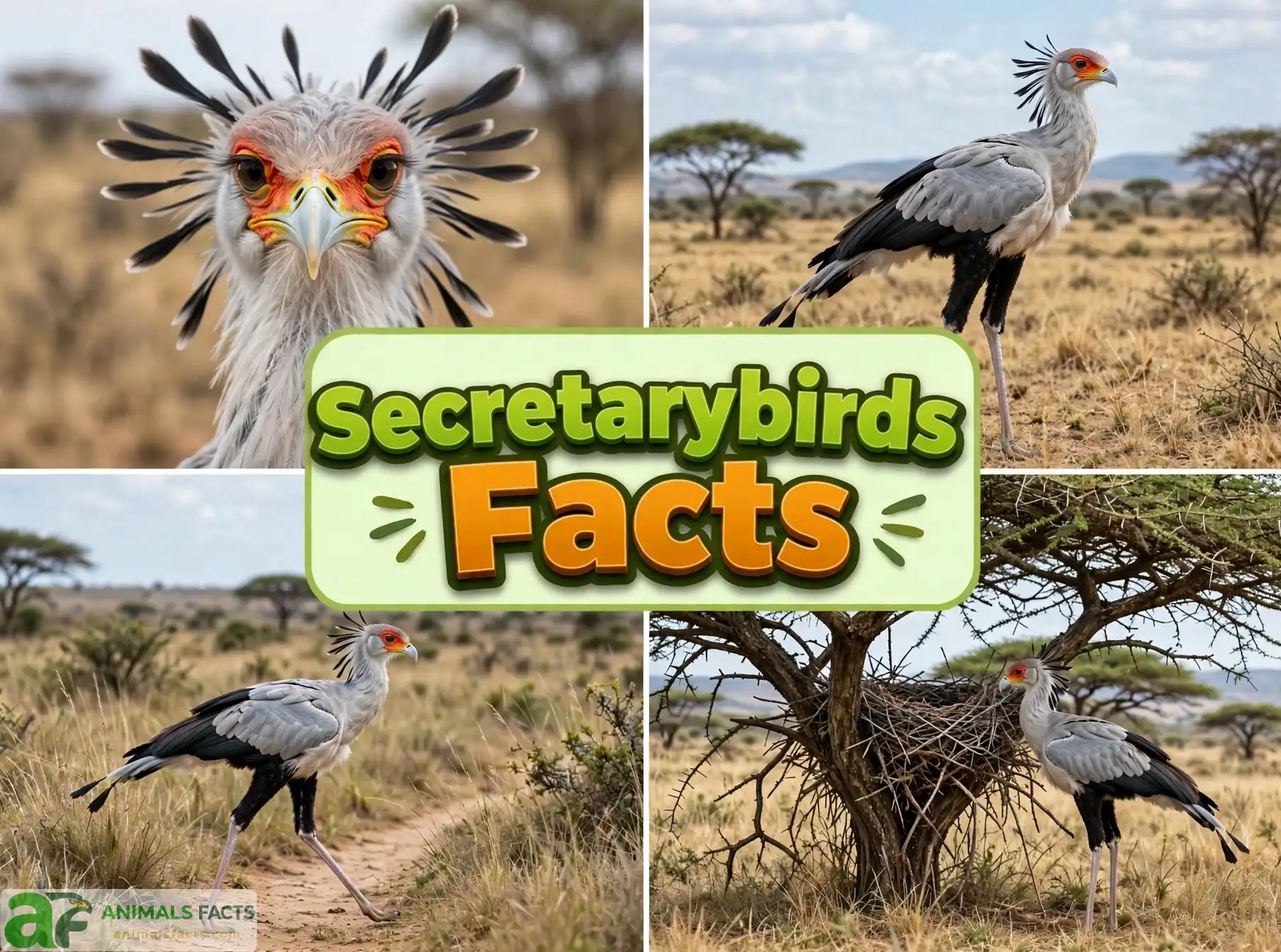
11. Secretarybird Facts for Kids
Hey amazing young wildlife scientists, bird enthusiasts, and future conservation heroes! Here are some truly extraordinary secretarybird facts for kids that will absolutely astonish every wildlife fan you know:
- The secretarybird is the only raptor in the world that hunts by WALKING! Eagles, hawks, falcons, owls — every other bird of prey hunts from the air. The secretarybird decided millions of years ago that walking was the better plan, and it walks up to 30 kilometers EVERY SINGLE DAY through the African savanna searching for food on the ground. That is like walking from one end of a large city to the other — every day!
- Its kick is faster than a cobra can react! When the secretarybird finds a snake, it kicks it — and the kick happens in just 15 milliseconds. Scientists needed cameras filming at 1,500 frames per second just to SEE the kick happening — normal video only shows about one frame during the entire kick. A cobra has absolutely NO TIME to dodge or bite back before the foot has already made contact and withdrawn!
- It kicks with FIVE TIMES its own body weight! If you weighed 50 kilograms and could kick with five times your body weight, your kick would have 250 kilograms of force behind it. That is how powerful each secretarybird kick is relative to its body — one of the most powerful weight-for-weight strikes documented in any bird on Earth!
- It is the ONLY member of its entire bird family! Just like the numbat is the only member of Myrmecobiidae, the secretarybird is the only member of the family Sagittariidae. No brothers, no cousins, no close relatives anywhere. If the secretarybird went extinct, an entire branch of the bird family tree would disappear forever!
- The same pair of secretarybirds uses the SAME NEST for DECADES! Each year the pair adds more sticks and material to the same nest — so old nests can be over 2 meters across and half a meter deep! That is a nest that has been growing for many years, built by the same devoted couple who return to it year after year for their whole lives!🦅 The secretarybird appears on the COATS OF ARMS of TWO DIFFERENT COUNTRIES! It is the national symbol of both Sudan and South Africa — appearing on their official coats of arms. Not many animals get to be the national symbol of one country, let alone two! This shows how important and how impressive this bird is considered across Africa.
- It uses its WING AS A SHIELD when fighting snakes! When a secretarybird confronts a dangerous cobra or puff adder, it spreads one wing low toward the ground between itself and the snake. This wing acts as a physical shield — any defensive strike the snake attempts hits the feathers of the wing rather than the bird’s body. It is basically carrying its own shield into battle!
- Baby secretarybirds spend up to 106 DAYS in the nest! That is over three months — much longer than most other large birds of prey. All that time in the nest, the parents are teaching them everything they need to know, and the chicks are growing those extraordinarily long legs and learning the skills of one of the world’s most unique hunters!
12. Relationship with Humans
The secretarybird’s relationship with humans spans ancient African cultural traditions of respect and symbolic significance, an agricultural pest control function recognized across its range, the conservation crisis driven by modern land use changes, and the growing research interest generated by the bird’s extraordinary biomechanics.
Traditional African Cultural Relationships
Ancient Egyptian symbolism — The secretarybird appears in ancient Egyptian art and hieroglyphics — depicted in scenes and possibly associated with the Egyptian deity Nekhbet (the vulture goddess) in some interpretations. The bird’s presence in ancient Egyptian cultural imagery reflects its historical abundance in the Nile Valley region and its striking appearance that would have captured the attention of ancient observers.
Sub-Saharan African traditions — Across the diverse cultures of sub-Saharan Africa, the secretarybird is generally viewed positively — its snake-killing prowess generating respect and positive associations in cultures where venomous snakes represent a genuine daily safety concern:
The protective bird — In many agricultural communities across the secretarybird’s range, the bird is recognized as a beneficial species that reduces the density of venomous snakes near human settlements — a practical ecological service that translates into positive cultural attitudes. Killing a secretarybird was historically discouraged in many communities because of the protective pest-control service it provided.
The warrior bird — The secretarybird’s upright posture, confident striding gait, and fearless confrontation of dangerous snakes has generated associations with warrior qualities — courage, deliberateness, and power — in multiple African cultural frameworks.
The Agricultural Pest Control Function
The secretarybird’s consumption of small mammals, large insects, and snakes provides genuine agricultural pest control services across its range:
Rodent control — Small mammals constitute a significant component of the secretarybird’s diet — the bird’s daily consumption of mice and rats across its large home range represents meaningful reduction of rodent populations that would otherwise damage grain crops and food stores.
Snake control — Venomous snake bites remain a significant cause of human mortality and morbidity across rural Africa — the secretarybird’s predation on cobra, puff adder, and other venomous species near agricultural areas provides an unquantified but genuine safety service for farming communities.
Locust and grasshopper control — During periods of insect abundance (particularly locust outbreaks), secretarybirds consume large quantities of these agricultural pest insects — the pest control service during such periods potentially significant at the landscape scale.
The diminishing service — As secretarybird populations decline across the continent, the pest control services they provide are progressively reduced — a loss that is invisible in economic statistics but real in terms of increased human-snake conflict and rodent damage to crops.
National Symbol Status — Sudan and South Africa
Sudan — The secretarybird is depicted on the National Seal of Sudan — appearing as the central heraldic figure. This national symbol status reflects the bird’s historical abundance in the region and its association with strength and protection in Sudanese cultural tradition.
South Africa — The secretarybird appears as one of the supporters (flanking figures) on the Coat of Arms of South Africa — adopted in 2000 as part of post-apartheid South African identity and heraldry. The secretarybird’s selection for the South African coat of arms reflects both its endemic significance as an African bird found nowhere else in the world and its cultural associations with vigilance and protection.
Scientific Research Interest
The secretarybird has attracted significant scientific interest in recent decades — particularly following the publication of high-speed analysis of its prey-striking technique:
The 2016 Portugal et al. study — Published in Current Biology, this landmark research using high-speed cameras at 1,500 frames per second established the biomechanics of secretarybird prey striking in detail for the first time. The study’s findings — particularly the 15-millisecond strike speed and the 5× body weight force — generated extraordinary global media coverage and introduced the secretarybird to audiences far beyond the dedicated wildlife enthusiast community.
Biomechanics research implications — The secretarybird’s kick force and speed optimization have attracted interest from biomechanics researchers and robotics engineers — the biological solution of extremely fast, extremely forceful targeted foot strikes has potential applications in the design of robotic striking systems for industrial and search-and-rescue applications.
Conservation research — Growing scientific concern about secretarybird population declines has driven an expansion of field research — GPS tracking, population monitoring, and threat assessment studies across the range providing the data foundation for the 2020 IUCN Endangered reclassification.
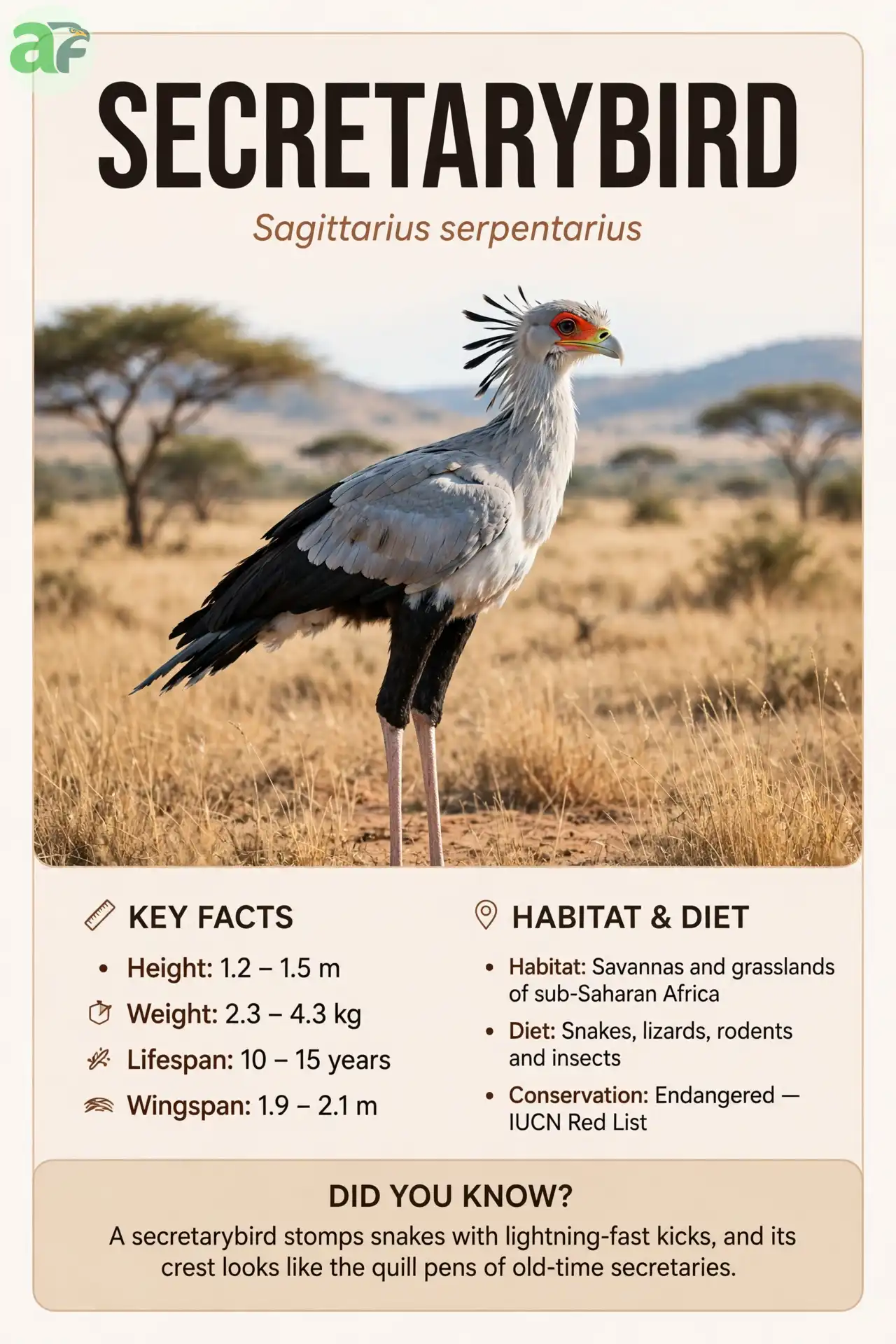
13. Secretarybird Conservation Status & Threats
Conservation Status Overview
| Feature | Details |
|---|---|
| IUCN Status | Endangered (EN) — reclassified from Vulnerable in 2020 |
| Population Trend | Decreasing |
| Estimated Pairs | Approximately 7,000–10,000 pairs globally (revised downward) |
| Population Change | Estimated 50% or greater decline over three generations |
| CITES Listing | Appendix II — international trade regulated |
| South Africa Status | Vulnerable (SANBI Red List) |
The 2020 Endangered Reclassification
The reclassification of the secretarybird from Vulnerable to Endangered in 2020 was based on the accumulation of evidence from multiple continent-wide surveys and long-term monitoring programs documenting population declines significantly greater than previously estimated:
The evidence — The reclassification was triggered by:
- Long-term monitoring data from South Africa showing consistent population declines across the highveld
- Citizen science data (bird atlas surveys) documenting reduced occupancy rates in range squares surveyed in successive atlas periods
- Continent-wide assessment suggesting declines in virtually every part of the range
- Population modeling indicating declines exceeding the 50% threshold over three generations that triggers the Endangered classification
The significance — The secretarybird’s reclassification was one of the most significant conservation status changes for any African raptor in decades — the species had been considered secure enough to rate only Vulnerable (rather than Endangered) in previous assessments, and the shift reflected genuine new understanding of the depth and pace of population decline.
Major Threats
| Threat | Description | Impact Level |
|---|---|---|
| Habitat loss | Conversion of grassland and savanna to intensive agriculture | Critical — primary threat |
| Grassland degradation | Fire suppression increasing grass height beyond hunting threshold | High |
| Road kills | Vehicle strikes on road-crossing birds | High |
| Power line strikes | Collision and electrocution on power infrastructure | High |
| Pesticide poisoning | Secondary poisoning through rodenticide-exposed prey; primary agricultural pesticide exposure | High |
| Persecution | Direct killing by farmers attributing livestock death to secretarybirds | Medium |
| Alien plant invasion | Dense invasive vegetation replacing open grass habitat | Medium-High |
| Climate change | Shifting rainfall and vegetation structure | Increasing concern |
| Disturbance at nest sites | Human activity near nests causing abandonment | Medium |
| Illegal trade | Collection of eggs and chicks for traditional medicine and trade | Medium |
The Grassland Loss Crisis
The single most significant driver of secretarybird decline is the loss and degradation of the open grassland and savanna habitats the species requires:
Agricultural conversion — The conversion of African savanna and grassland to intensive row-crop agriculture eliminates secretarybird habitat entirely — the cultivated fields cannot be walked for hunting, and the elimination of prey communities removes the food base. The rapid expansion of soybean, maize, and wheat production in formerly grassland areas of South Africa, Zimbabwe, and parts of East Africa has directly reduced secretarybird habitat extent.
Fire suppression — As human populations expand into grassland areas and agricultural infrastructure (buildings, crops) requires fire protection, traditional burning regimes are disrupted. Without regular burning, grass grows too tall for secretarybird hunting — grass height above approximately 30–40 cm substantially reduces hunting efficiency, and grass above approximately 60–70 cm essentially prevents effective walking hunting.
Bush encroachment — In areas where grazing pressure has been reduced and burning suppressed, woody vegetation encroachment progressively converts open grassland into closed bush — a process well documented in parts of southern Africa where historical cattle ranching land is being converted to wildlife reserves with reduced grazing. Paradoxically, reducing livestock grazing can reduce secretarybird habitat quality.
Road Kill and Infrastructure Mortality
Road kills constitute a significant source of adult mortality across the range:
Why secretarybirds are road-kill vulnerable — The birds’ terrestrial lifestyle means they frequently cross roads within their home ranges. The habit of following grass fire edges sometimes leads birds to road verges where burnt grass meets the road surface. The birds’ apparent lack of road-awareness (no evolutionary experience with high-speed vehicles) means they often fail to take flight until approaching vehicles are very close.
Power line mortality — Collision and electrocution on power infrastructure represents a documented mortality source — large-wingspan birds are particularly vulnerable to collision with overhead lines, and electrocution on power pole infrastructure is documented across the range.
Pesticide and Rodenticide Exposure
Primary pesticide exposure — Agricultural pesticide use on crops and for locust/grasshopper control represents a direct poisoning threat — secretarybirds consuming pesticide-exposed insects or entering recently sprayed areas are documented as mortality events across the range.
Secondary rodenticide poisoning — Rodenticides (particularly second-generation anticoagulant rodenticides) used in agricultural settings accumulate in the tissues of rodents that survive initial exposure. Secretarybirds consuming these rodents receive sub-lethal or lethal doses of rodenticide — a secondary poisoning mechanism documented across multiple raptor species globally.
Conservation Responses
Protected area coverage — Secretarybirds are present in multiple African national parks and game reserves — Kruger National Park, Serengeti National Park, Masai Mara, and many others provide habitat within formally protected landscapes. However, the species’ large home range requirements mean that even protected area populations depend on the quality of the broader landscape matrix beyond reserve boundaries.
Grassland conservation programs — Organizations including BirdLife South Africa, BirdLife International, and various governmental conservation agencies maintain programs to protect and restore key secretarybird grassland habitats — including fire management programs, invasive plant control, and the protection of critical grassland parcels through purchase or conservation easement.
Power line mitigation — Initiatives to modify power infrastructure to reduce collision and electrocution risk — including marking lines with visibility devices and retrofitting electrocution-risk pole designs — benefit secretarybirds along with other large raptors.
Raptor monitoring programs — Long-term monitoring of secretarybird populations through citizen science (BirdLasser, eBird) and systematic raptor monitoring programs provides the trend data essential for conservation planning.
14. Famous Secretarybirds in History & Pop Culture
Famous Individual Secretarybirds and Cultural Moments
The 2016 Portugal Study Birds — The individual secretarybirds filmed by Steve Portugal and colleagues at a South African research facility using high-speed cameras during the landmark 2016 biomechanics study are the most scientifically significant individual secretarybirds in the species’ research history. The footage obtained — showing individual kick strikes in extraordinary detail at 1,500 frames per second — was the primary source of data for the Current Biology paper that transformed global understanding of secretarybird hunting mechanics and generated worldwide media coverage.
National Coat of Arms individuals — The secretarybirds depicted on the coats of arms of Sudan and South Africa — while stylized heraldic representations rather than individual animals — are arguably the most publicly visible secretarybird images in history. The South African coat of arms, adopted in 2000, features the secretarybird as one of the two supporters (flanking figures), making it one of the most reproduced images of the species globally.
The Masai Mara and Serengeti filmed individuals — Multiple BBC and National Geographic documentary productions have featured secretarybirds filmed in the Masai Mara and Serengeti ecosystems — individual birds habituated to vehicle presence providing the close-range footage that has introduced the species to global wildlife documentary audiences. The sequences of secretarybirds walking their daily routes, engaging snakes, and performing aerial displays at nest sites have been among the most memorable African wildlife documentary sequences of recent decades.
“Flame” and other named research individuals — Long-term secretarybird research programs in South Africa have individually identified and named specific birds monitored over multiple years — these named individuals contributing longitudinal behavioral and ecological data that cannot be obtained from short-term observation alone. The accumulated life histories of individually monitored secretarybirds represent the most detailed natural history information available for the species.
Historical Significance
The 1769 formal description — Philip Miller’s 1769 formal description of the secretarybird — based on accounts and illustrations reaching Europe from early naturalists in southern Africa — was a significant event in the history of natural history, introducing one of Africa’s most distinctive birds to European scientific and public awareness. The description generated immediate interest — the combination of raptor head, crane legs, and quill crest creating an animal so visually extraordinary that early accounts were received with some skepticism by European naturalists who had not seen the species.
The South African coat of arms debate — The selection of the secretarybird (alongside the gemsbok oryx) as a heraldic supporter for the post-apartheid South African coat of arms in 2000 was a deliberate choice reflecting both the bird’s scientific uniqueness (as a monotypic family endemic to Africa) and its cultural associations with vigilance, strength, and deliberate action — qualities the new democratic South Africa wished to embody in its national symbolism.
15. Role in Ecosystem & Food Chain
The Apex Terrestrial Predator Role
The secretarybird occupies the ecological position of apex terrestrial predator in the open savanna grassland system — filling a niche that overlaps with but is distinct from that of mammalian predators:
Reptile population regulation — The secretarybird’s predation on snakes, lizards, and other reptiles constitutes meaningful predation pressure on reptile community composition and density across its home range. In areas of high secretarybird density, the combined predation pressure of the resident pair across their large territory may substantially limit local snake population density and species composition.
Rodent regulation — Small mammal predation by secretarybirds contributes to the broader rodent control services provided by the African savanna predator guild — complementing the efforts of owls, mongoose species, and various mammalian predators targeting the same prey.
Insect population effects — During periods of high insect abundance (grasshopper and locust outbreaks), secretarybird consumption of large quantities of these insects contributes to regulation of invertebrate community dynamics in the savanna ecosystem.
The Pest Control Ecosystem Service
The secretarybird’s pest control services represent an economically significant ecosystem service that has received limited formal quantification but is widely recognized by wildlife managers and rural communities:
Venomous snake control — The reduction of venomous snake density near agricultural areas and human settlements represents a service with direct human health implications — fewer cobra, puff adder, and mamba encounters near settlements and agricultural workers means fewer snakebite incidents with potentially fatal outcomes.
Rodent crop protection — The secretarybird’s rodent predation across its large home range reduces the rodent populations that damage stored grain and crops — a service provided without any human management investment.
Locust control — During locust outbreak years, secretarybirds consuming large quantities of grasshoppers and locusts contribute to limiting the scale of these agricultural disasters — a service whose economic value, though unquantified, may be substantial.
The Prey Role
As an apex predator in its ecological guild, the secretarybird is not regularly preyed upon — but its carcasses (when mortality occurs from road kills, poisoning, or injury) provide food for the scavenger community including vultures, jackals, and various corvids that exploit animal carcasses in the African savanna.
Indicator of Ecosystem Health
The secretarybird functions as an important ecological indicator species for the health of African savanna and grassland ecosystems:
- Secretarybird presence and breeding success reliably indicate open grassland with short vegetation — habitat that supports diverse wildlife communities
- Secretarybird population trends serve as an early warning system for grassland degradation through bush encroachment, fire suppression, or agricultural conversion
- The species’ large home range means that monitoring a small number of pairs provides information about grassland quality across substantial landscape areas
16. Myths, Folklore & Cultural Significance
The Protective Bird — Pan-African Traditions
The secretarybird’s most consistent cultural significance across the diverse societies of sub-Saharan Africa is as a protective animal — associated with the elimination of dangerous snakes and therefore with the safety of human communities:
The snake-killer mythology — In multiple African traditions, the secretarybird’s snake-killing capability has been elevated from a behavioral observation to a cultural significance — the bird representing the triumph of courage and deliberate power over danger. In communities where venomous snake bites remain a genuine daily safety concern, an animal that fearlessly and reliably kills cobras and puff adders acquires cultural significance well beyond simple natural history interest.
Protective talismans — In various traditional practice systems across the range, secretarybird feathers — particularly the distinctive crest quills — have been used in protective talismans, traditional medicine preparations, and ceremonial contexts. The crest feathers, associated with the bird’s extraordinary snake-killing power, are believed in some traditions to transfer protective qualities to their human wearers or users.
The warrior association — The secretarybird’s upright bearing, confident stride, and fearless confrontation of dangerous prey has made it a symbol of warrior virtues in multiple African cultural frameworks — the deliberate, unintimidated approach to a dangerous adversary paralleling the qualities celebrated in warrior traditions across the continent.
The “Secretary” Name — Etymology and Cultural Meaning
The popular etymology of the name “secretarybird” — connecting the crest feathers to the quill pens of Victorian office secretaries — has itself become a cultural narrative that shapes how people think about the species:
The quill pen theory in popular culture — The image of a Victorian secretary with writing quills tucked behind the ear has been reproduced in educational materials, wildlife documentaries, and popular natural history accounts as the explanation for the common name. Whether or not this etymology is correct (see the alternative Arabic-French etymology discussed in the physical description section), the story has become culturally attached to the species and influences how people relate to its distinctive appearance.
The “archer” scientific name — The genus name Sagittarius (archer) — referring to the arrow-like crest feathers — connects the secretarybird to the zodiacal archer in astronomical and astrological tradition. This connection, while presumably unintentional in the species’ formal naming, has generated various cultural associations between the secretarybird and the Sagittarius zodiac sign.
Ancient Egyptian Connections
The presence of secretarybird-like birds in ancient Egyptian art — including possible representations in hieroglyphics — suggests a cultural relationship between the secretarybird and ancient Egyptian civilization that predates European scientific documentation by thousands of years:
The W or nwt hieroglyph — Some Egyptologists have proposed that certain hieroglyphic bird forms that are not definitively identified as other species may represent the secretarybird — the distinctive crest and long-legged profile being theoretically distinctive enough for identification even in stylized hieroglyphic representation.
The Nekhbet association — The Egyptian vulture goddess Nekhbet was the protective deity of Upper Egypt — represented as a white vulture. Some scholars have proposed loose associations between Nekhbet’s protective function (associated with snake-killing mythology in some traditions) and the secretarybird, though the primary Nekhbet representation is clearly a vulture rather than a secretarybird.
17. Secretarybirds in Pop Culture
“Life” (BBC, David Attenborough, 2009) — The BBC landmark documentary series includes secretarybird hunting sequences among the most widely distributed and most viewed wildlife footage of the species — Attenborough’s narration of secretarybird snake predation behavior introduced the species to global audiences.
“Africa” (BBC, David Attenborough, 2013) — The BBC’s dedicated African continent documentary series features secretarybird behavioral sequences in the savanna grassland context — among the finest television natural history footage of the species available.
“Planet Earth” and “Planet Earth II” (BBC) — Various sequences in these landmark productions have featured secretarybird walking patrol and hunting behavior — the open savanna cinematography complementing the species’ distinctive appearance to create memorable wildlife footage.
South African coat of arms — The secretarybird’s heraldic role on the South African coat of arms — adopted in 2000 and visible on all South African government documents, currency, and official materials — makes it one of the most widely reproduced bird images in sub-Saharan Africa.
The 2016 Current Biology paper’s media impact — The publication of Steve Portugal’s high-speed camera analysis of secretarybird kicks generated extraordinary global media coverage — major international news outlets including BBC News, The Guardian, National Geographic, and New Scientist ran stories about the biomechanics findings, introducing the secretarybird to millions of readers who had no previous awareness of the species. The slow-motion footage released alongside the paper became widely shared on social media.
Wildlife photography — The secretarybird is among Africa’s most photographed birds — its distinctive appearance, open habitat occupancy (facilitating photography), and diurnal activity making it a compelling and accessible wildlife photography subject. Images of secretarybirds walking in golden savanna light or confronting snakes have become some of the most recognized African wildlife photographs in nature photography competitions and wildlife photography social media.
“Zambia’s Walking Eagle” and similar wildlife media treatments — Multiple natural history films specifically focused on the secretarybird have been produced for various wildlife television channels — the species’ unique hunting system and striking appearance making it the subject of dedicated documentary treatments that go beyond the brief sequences included in broader African wildlife productions.
18. Secretarybird Facts vs. Common Myths
| Common Myth | The Real Fact |
|---|---|
| “The secretarybird is called that because of its crest feathers resembling quill pens” | Possibly true but debated — this is the most popular etymology but competes with the Arabic-French saqr et-tair (“hunter-bird”) hypothesis; the quill pen etymology is linguistically plausible but the Arabic derivation may be philologically more accurate |
| “The secretarybird eats only snakes” | False — snakes constitute approximately 15–25% of the diet at most; small mammals, lizards, large insects, and frogs are all important prey categories. Snakes are the celebrated prey but not the exclusive or even primary dietary component |
| “The secretarybird is immune to snake venom” | False — secretarybirds are not immune to snake venom; their defense against envenomation is primarily behavioral (the 15ms kick speed prevents snakes from initiating a defensive strike) and structural (the scaled bare legs resist fang penetration). Envenomation events do occur occasionally and can be fatal |
| “The secretarybird cannot fly” | False — secretarybirds are capable fliers and regularly soar to altitudes of 2,000–3,000 meters; they fly between parts of their home range and perform aerial display flights during courtship. Their terrestrial hunting strategy does not reflect any inability to fly |
| “The secretarybird is related to storks or cranes” | False — despite the superficial resemblance due to long legs, the secretarybird is a raptor (order Accipitriformes) most closely related to ospreys and New World vultures on molecular evidence. The long legs evolved independently in a raptor lineage |
| “The secretarybird is common and not at risk” | False — the secretarybird was reclassified to Endangered in 2020 following documentation of population declines exceeding 50% over three generations. It is one of Africa’s most threatened large birds |
| “Secretarybirds are solitary” | Partially misleading — while individual birds typically forage alone, they are socially bonded in lifelong pairs and frequently walk together in areas of good prey abundance. The pair bond is one of the most stable and enduring social relationships of any African raptor |
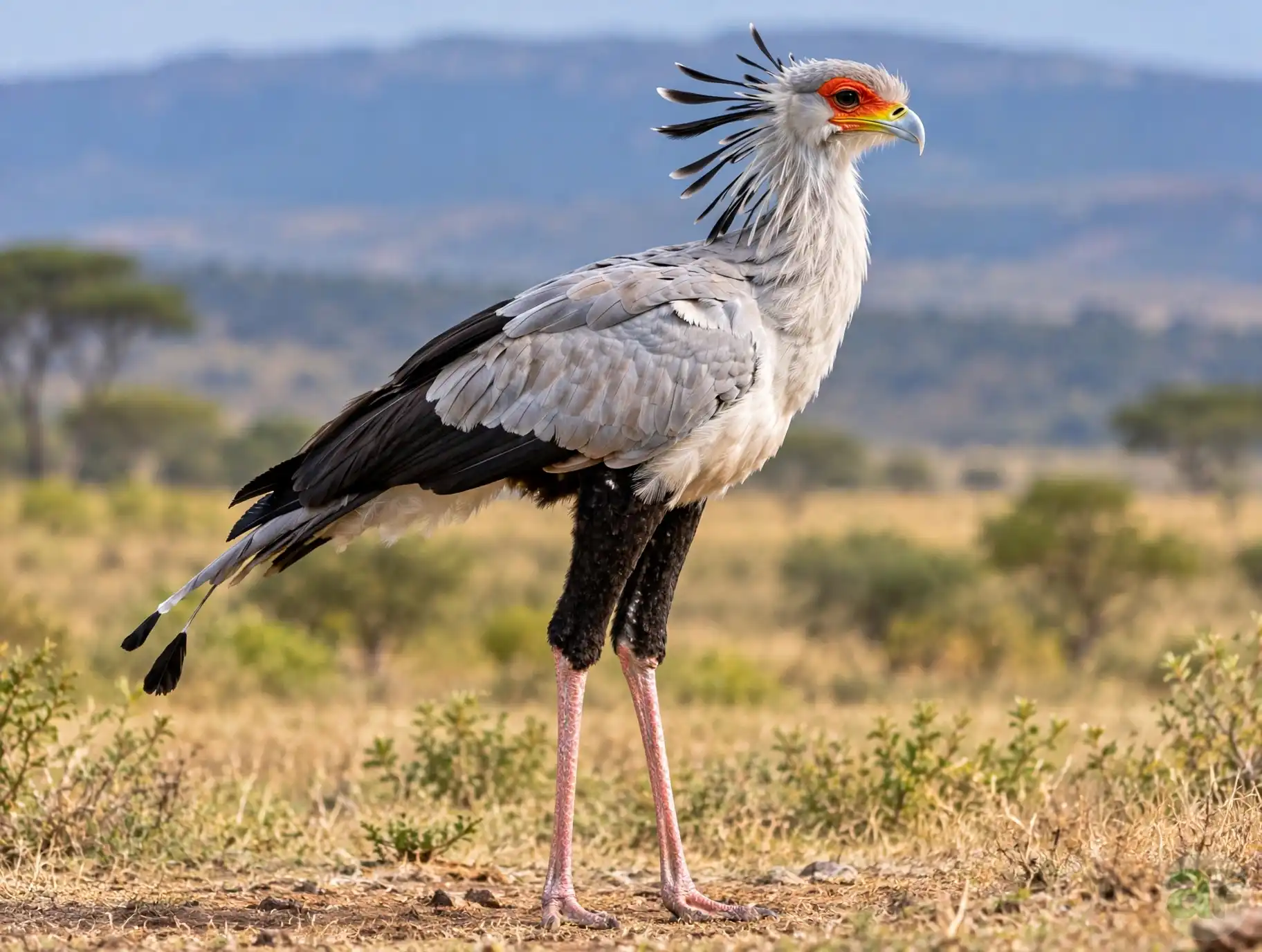
19. Best Places to See Secretarybirds in the Wild
1. Masai Mara National Reserve, Kenya — One of the most reliable locations for secretarybird observation in East Africa; the reserve’s vast open grassland — maintained short by the extraordinary concentrations of wildebeest, zebra, and other grazers — provides ideal habitat. Secretarybirds are regularly observed on game drives throughout the reserve, and the open terrain facilitates close observation from vehicles. The Mara’s excellent safari infrastructure makes it one of the most accessible East African wildlife experiences.
2. Serengeti National Park, Tanzania — The most famous African wildlife destination; the Serengeti’s extraordinary extent of open short grass savanna supports important secretarybird populations. Birds are regularly observed walking their daily patrol routes and are occasionally encountered in active snake predation encounters. The southern Serengeti short grass plains are particularly productive secretarybird habitat during the dry season.
3. Kgalagadi Transfrontier Park, South Africa/Botswana — The Kalahari’s open semi-arid savanna supports secretarybird populations accessible to visitors through the park’s excellent road network. Birds are regularly observed at dawn and dusk when daily walking activity is highest, and the flat, open terrain facilitates long-distance observation.
4. Kruger National Park, South Africa — South Africa’s largest wildlife reserve; secretarybirds are present throughout the open savanna areas of the park, with the central and southern grassland areas being most productive. The park’s enormous extent and excellent road network allow systematic searching of productive habitat.
5. Etosha National Park, Namibia — The vast open pans and surrounding savanna of Etosha provide excellent secretarybird habitat; the pan margins during the dry season concentrate wildlife including secretarybirds, facilitating observation at waterholes and in the open grassland surrounding the pan.
6. Hwange National Park, Zimbabwe — Zimbabwe’s largest national park; open grassland and woodland savanna habitats support secretarybird populations visible on guided game drives. The park’s historically excellent wildlife populations make it one of southern Africa’s finest wildlife destinations.
7. Amboseli National Park, Kenya — The open grassland around Amboseli’s central swamp — maintained short by the park’s famous elephant and buffalo populations — provides excellent secretarybird habitat with spectacular Kilimanjaro backdrop. Birds are regularly observed throughout the park’s open areas.
8. The Honest Assessment — Secretarybird sightings, while not guaranteed, are achievable with correct habitat selection (open short grassland rather than woodland or tall grass), correct timing (dawn and dusk when walking activity is highest), and patience. The key is scanning the open grassland at distance — the secretarybird’s tall, upright profile is distinctive at long range in open habitat. Guided game drives with experienced naturalists familiar with individual birds’ daily routes substantially increase sighting probability at all the above locations.
20. How You Can Help
Supporting secretarybird conservation requires action focused on African grassland protection, power line mitigation, pesticide reform, and long-term population monitoring.
Support these organizations:
- BirdLife International — birdlife.org — the primary international organization for bird conservation globally; coordinates secretarybird conservation planning
- BirdLife South Africa — birdlife.org.za — leads secretarybird monitoring and conservation in South Africa; the most active single-country secretarybird conservation program
- Endangered Wildlife Trust — ewt.org.za — South African conservation organization with raptor conservation programs including secretarybird-relevant work
- African Raptor Centre — africanraptorcentre.com — rehabilitation and conservation programs for African raptors including secretarybirds
- Wildlife Conservation Society Africa — wcs.org — broader African wildlife conservation programs in secretarybird range countries
- Raptor Research Foundation — raptorresearchfoundation.org — scientific research support for raptor conservation globally
Critical individual actions:
- Support African grassland conservation — donating to organizations that protect and restore key grassland habitats directly benefits secretarybird populations
- Advocate for pesticide reform — supporting campaigns for restrictions on second-generation anticoagulant rodenticides and agricultural pesticides that cause secondary poisoning of raptors
- Report secretarybird sightings to eBird, BirdLasser, and other citizen science platforms — occurrence records from across the range contribute to population trend monitoring
- Support power line mitigation programs — organizations working to mark power lines and retrofit electrocution-risk pole designs directly reduce adult secretarybird mortality
- Choose responsible wildlife tourism — visiting African wildlife areas and choosing operators who support conservation programs generates the revenue that funds habitat protection and ranger employment
- Spread awareness — the secretarybird’s Endangered status is not widely known; sharing accurate information about this extraordinary bird and its conservation situation builds the public awareness that drives political support for conservation action
21. Top Documentaries & Books
Must-Watch Documentaries
- “Africa” (BBC, David Attenborough, 2013) — Features excellent secretarybird behavioral sequences in the savanna grassland context; Attenborough’s narration of the hunting behavior is particularly strong
- “Life” (BBC, David Attenborough, 2009) — The birds episode includes secretarybird content; one of the finest general treatments of the species in a major BBC production
- “Planet Earth” (BBC, 2006) — Various African grassland sequences relevant to secretarybird ecology
- “The Secretary Bird” (various wildlife channel productions) — Dedicated secretarybird documentaries have been produced for multiple wildlife television platforms; the most focused treatments of the species’ unique biology
- “Birds of Prey” (various BBC and National Geographic productions) — Comprehensive treatments of raptor diversity including secretarybird content
Must-Read Books
- Birds of Prey of Africa and Its Islands by Alan and Meg Cooke — The most comprehensive field guide to African raptors including detailed secretarybird natural history
- Roberts Bird Guide (various editions) — The standard comprehensive bird guide for southern Africa; detailed secretarybird species account
- African Raptors by Peter Steyn — Classic treatment of African birds of prey including secretarybird ecology and behavior
- Portugal, S.J. et al. (2016). “Rapid predatory strikes could explain the evolution of secretarybird (Sagittarius serpentarius) kicking behaviour.” Current Biology — The landmark biomechanics paper; freely available online
- Raptors of the World by Ferguson-Lees and Christie — The comprehensive global raptor reference with excellent secretarybird treatment
22. Secretarybird Comparison with Other Unusual Raptors
| Feature | Secretarybird | Osprey | Harpy Eagle | Bateleur | Bearded Vulture |
|---|---|---|---|---|---|
| Scientific name | Sagittarius serpentarius | Pandion haliaetus | Harpia harpyja | Terathopius ecaudatus | Gypaetus barbatus |
| Family | Sagittariidae (monotypic) | Pandionidae (monotypic) | Accipitridae | Accipitridae | Accipitridae |
| Wingspan | 191–220 cm | 127–180 cm | 176–224 cm | 168–183 cm | 231–283 cm |
| Weight | 2.3–4.5 kg | 0.9–2.1 kg | 4–9 kg | 1.8–3 kg | 4.5–7.8 kg |
| Hunting method | Walking on ground | Diving into water | Aerial; talons | Aerial; talons | Drop bones from height |
| Primary prey | Snakes, lizards, mammals | Fish | Large mammals, sloths | Small mammals, birds | Bone marrow |
| Leg adaptation | Long — terrestrial locomotion | Spiny pads for fish grip | Largest talons of any eagle | Short; aerial predator | Long; cliff walker |
| Monotypic family | Yes | Yes | No | No | No |
| Conservation | Endangered | Least Concern | Vulnerable | Endangered | Least Concern |
| Range | Sub-Saharan Africa | Worldwide | Central/South America | Sub-Saharan Africa | Africa, Asia, Europe |
| Famous for | Walking; snake killing; kick speed | Fish-catching dive | Largest New World raptor | Distinctive flight | Bone-dropping |
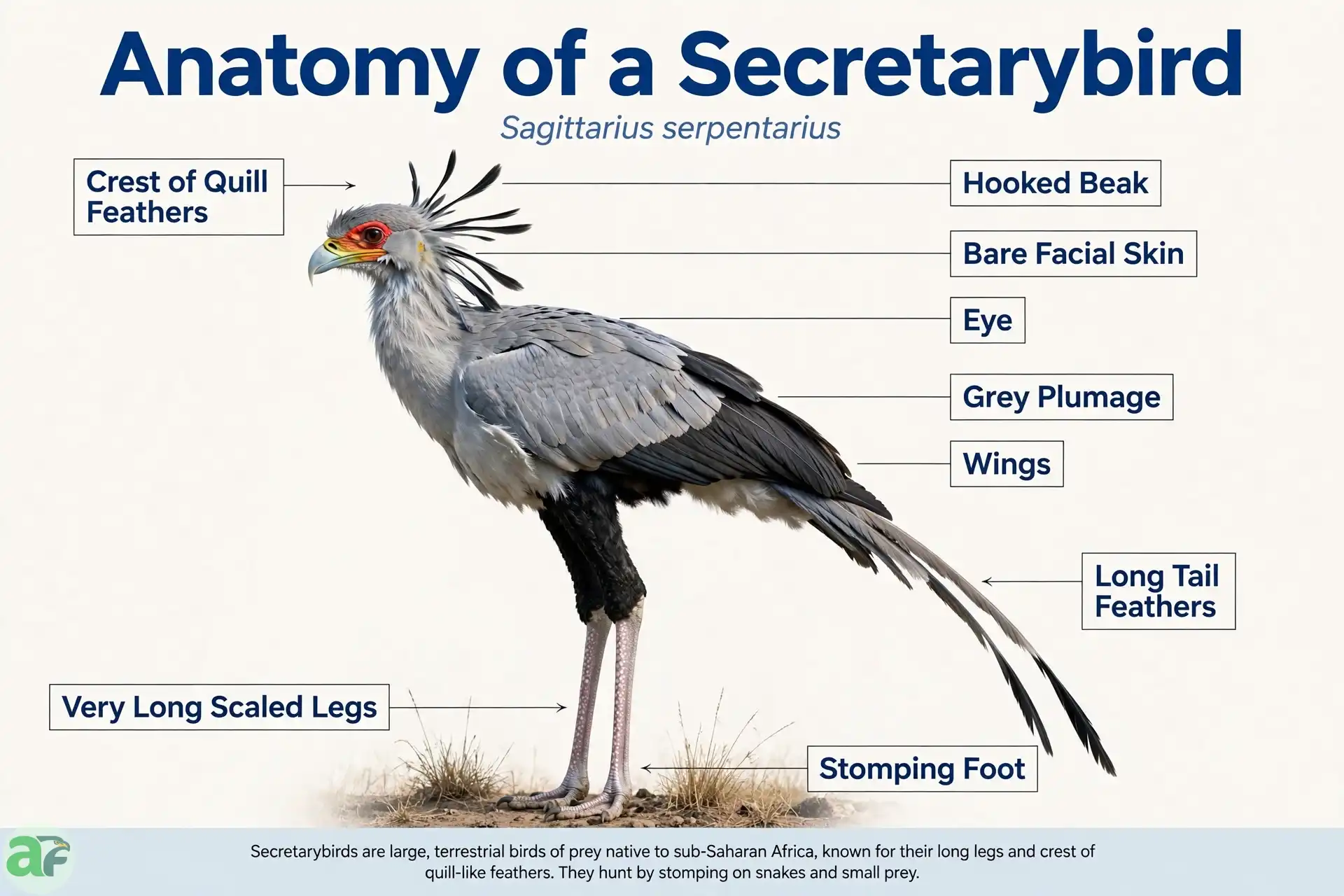
23. Frequently Asked Questions About Secretarybirds
Q1. What is the scientific name of the secretarybird?
The secretarybird’s scientific name is Sagittarius serpentarius (Miller, 1779). The genus name Sagittarius derives from the Latin word for “archer” — chosen by German zoologist Johann Hermann in 1783 in reference to the arrow-like crest feathers that project backward from the head. The species name serpentarius is Latin for “of serpents” or “snake-related” — acknowledging the snake-killing behavior that was recognized by early naturalists as the species’ most distinctive ecological trait. The species was first formally described by Philip Miller in 1769 (with 1779 typically cited as the authoritative date). The secretarybird belongs to the family Sagittariidae — a monotypic family containing only this single species — within the order Accipitriformes (hawks, eagles, and allies). Despite superficial resemblance to storks or cranes due to its long legs, molecular genetic analysis confirms the secretarybird is unambiguously a raptor, most closely related to ospreys and New World vultures within the broader Accipitriformes.
Q2. Why does the secretarybird hunt on the ground instead of flying?
The secretarybird’s terrestrial hunting strategy represents an evolutionary specialization that diverged from the standard raptor aerial hunting approach approximately 60 million years ago — making it the oldest documented lineage of ground-hunting raptors. The terrestrial strategy offers several ecological advantages in the open savanna environment: it allows systematic coverage of a large home range through walking patrol — identifying and capturing prey that aerial hunters would miss; it enables the exploitation of hidden or sheltering prey (snakes, rodents, and lizards that would not be visible from the air but are detected through careful walking); and it allows the development of the powerful kick-based killing system that is uniquely effective against venomous snakes. The secretarybird’s long legs — which provide the distance between its body and prey that reduces envenomation risk during snake predation — could not have been as effective in an aerial hunter. The terrestrial strategy also allows the secretarybird to exploit grass fire following behavior — exploiting temporarily concentrated prey at fire edges — a foraging opportunity unavailable to aerial hunters.
Q3. How fast is the secretarybird’s kick?
Individual secretarybird kicks are delivered in approximately 15 milliseconds — a speed documented by research published by Steve Portugal and colleagues at the Royal Veterinary College in 2016 using high-speed cameras filming at 1,500 frames per second. At this speed, the entire strike — from initial foot movement through contact and withdrawal — is completed before a cobra can initiate a defensive strike response. The neurological reaction time for a snake to begin a strike in response to a stimulus is approximately 20–30 milliseconds — significantly slower than the 15ms secretarybird kick, meaning the predator’s strike is literally completed before the prey’s defensive response can begin. Peak forces generated in individual kicks reach up to 195 Newtons — equivalent to approximately five times the bird’s own body weight. The combination of extreme speed and extreme force makes individual secretarybird kicks among the most powerful weight-normalized predatory strikes documented in any bird. The research also confirmed that strikes are highly accurate — consistently targeting the head and cervical spine of snake prey to maximize the likelihood of immediate neurological incapacitation.
Q4. Why is the secretarybird endangered?
The secretarybird was reclassified from Vulnerable to Endangered by the IUCN in 2020 following accumulation of evidence from multiple continent-wide surveys and long-term monitoring programs documenting population declines exceeding 50% over three generations. The primary driver of decline is loss and degradation of open grassland and savanna habitat — the conversion of African savanna to intensive agriculture eliminates hunting habitat entirely, while fire suppression (required to protect agricultural infrastructure) allows grass to grow too tall for effective walking hunting. Additional significant threats include road kills (the terrestrial lifestyle makes secretarybirds vulnerable to vehicle strikes), power line collision and electrocution (the large wingspan makes collision with overhead infrastructure common), and pesticide and rodenticide poisoning (both primary exposure from agricultural chemical use and secondary poisoning through contaminated prey). The species’ slow reproductive rate — typically 1–2 chicks per breeding pair per year, with 3–4 years to sexual maturity — means that even modest increases in adult mortality translate quickly into population decline that reproduction cannot compensate for.
Q5. Where is the best place to see a secretarybird in the wild?
The best location for reliable wild secretarybird observation is the Masai Mara National Reserve in Kenya or the Serengeti National Park in Tanzania — the vast open short-grass plains of these ecosystems, maintained by the grazing of enormous wildebeest and zebra populations, provide ideal secretarybird habitat and the open terrain facilitates long-distance observation from vehicles. In southern Africa, Kgalagadi Transfrontier Park (South Africa/Botswana) and Kruger National Park (South Africa) offer secretarybird observation in accessible wildlife tourism settings. The critical habitat requirement for observation success is open, short grassland — areas of woodland, tall grass, or agricultural landscape are unproductive. The best observation timing is early morning and late afternoon when walking activity is highest and the golden light enhances both the bird’s visibility and photographic opportunity. The secretarybird’s distinctive tall, upright profile — recognizable at distances of several hundred meters in open habitat — makes scanning the grassland at long range an effective search strategy.
24. Sources & References
- Wikipedia — Sagittarius serpentarius, Sagittariidae, Accipitriformes
- IUCN Red List — iucnredlist.org (2020 Endangered assessment for Sagittarius serpentarius)
- Portugal, S.J. et al. (2016). “Rapid predatory strikes could explain the evolution of secretarybird (Sagittarius serpentarius) kicking behaviour.” Current Biology — the landmark biomechanics paper
- BirdLife International — birdlife.org (species factsheet for secretarybird)
- BirdLife South Africa — birdlife.org.za
- Monadjem, A. and colleagues — published research on secretarybird ecology and population trends
- National Geographic — nationalgeographic.com
- Smithsonian National Museum of Natural History — naturalhistory.si.edu
- BBC Wildlife / BBC Earth — bbcearth.com
- Britannica — britannica.com/animal/secretary-bird
- Roberts Bird Guide (7th edition) — the definitive southern African bird reference
- African Bird Club — africanbirdclub.org (species accounts and range data)
- eBird — ebird.org (occurrence data and population trend analysis)