

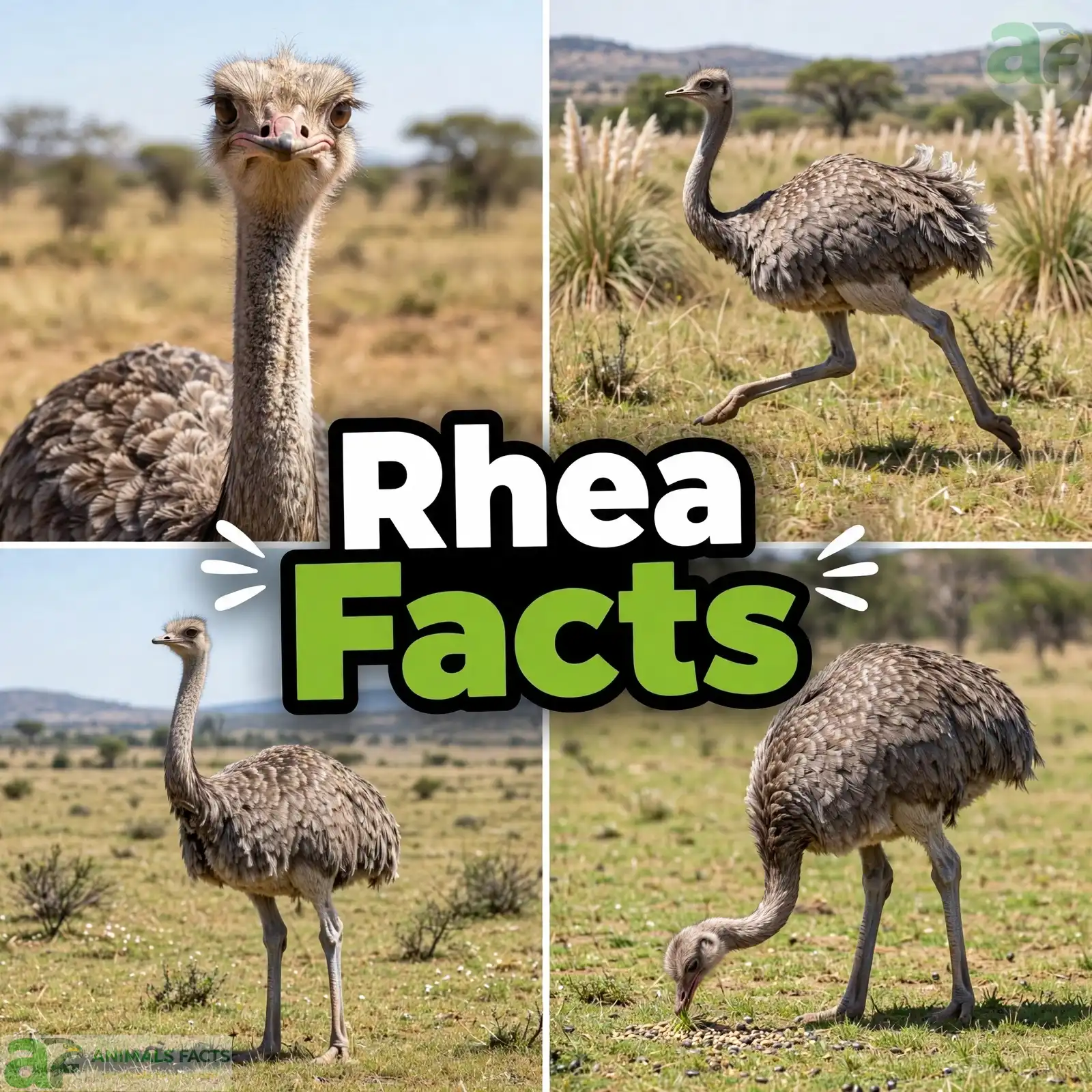
Rhea Facts
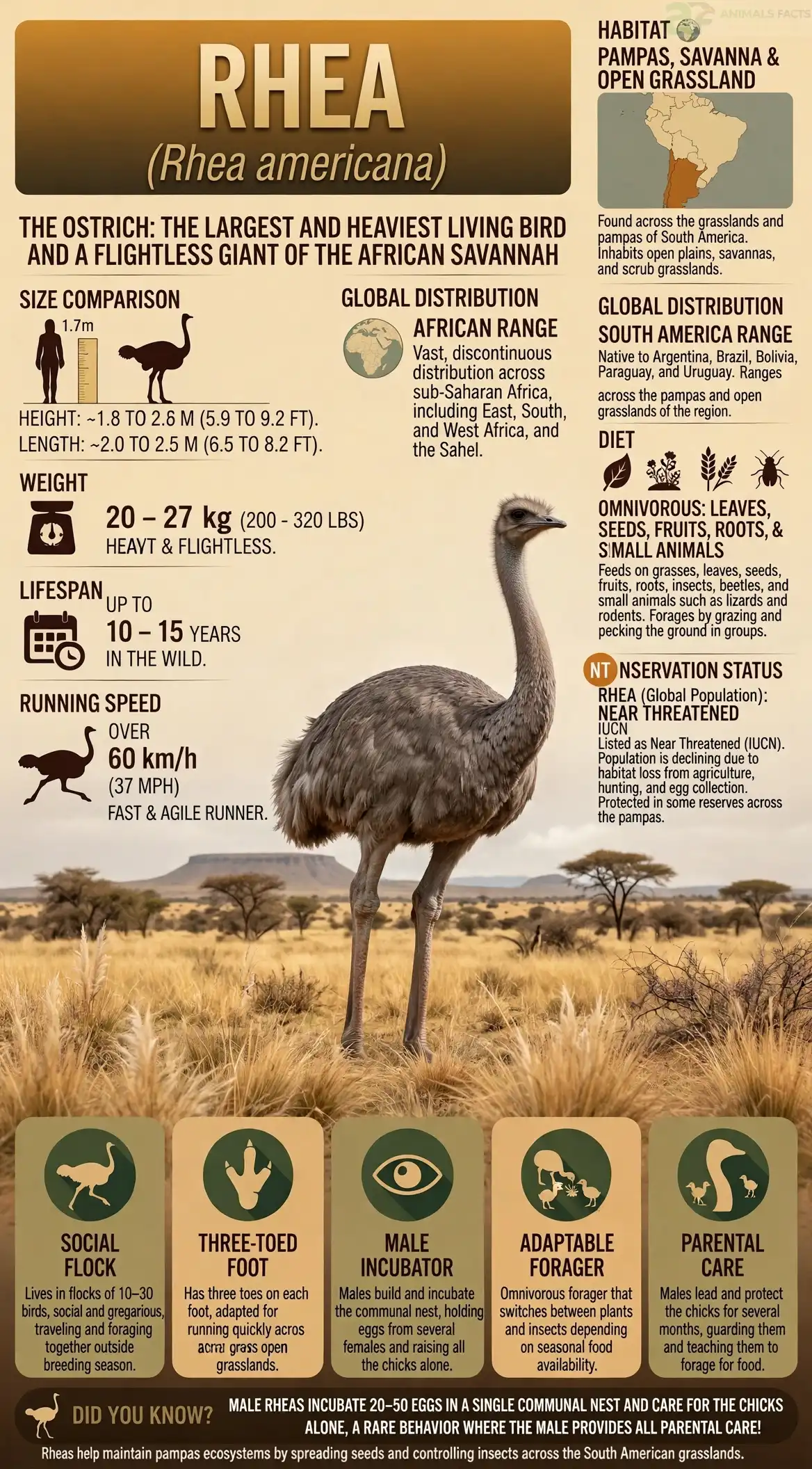
| Feature | Details |
|---|---|
| Scientific Names | Rhea americana (Linnaeus, 1758) — Greater rhea; Rhea pennata (d’Orbigny, 1834) — Lesser rhea (Puna/Darwin’s rhea) |
| Kingdom | Animalia |
| Phylum | Chordata |
| Class | Aves |
| Order | Rheiformes |
| Family | Rheidae |
| Common Names | Rhea; greater rhea; lesser rhea; Darwin’s rhea; ñandú (Greater rhea — Guaraní); suri (Lesser rhea — Quechua); American ostrich |
| Native Range | Greater rhea: Eastern South America — Brazil, Argentina, Uruguay, Paraguay, Bolivia; Lesser rhea: Andes and Patagonia — Argentina, Chile, Bolivia, Peru |
| Habitat | Open grassland, pampas, cerrado, Chaco scrub (greater rhea); high Andean puna, Patagonian steppe (lesser rhea) |
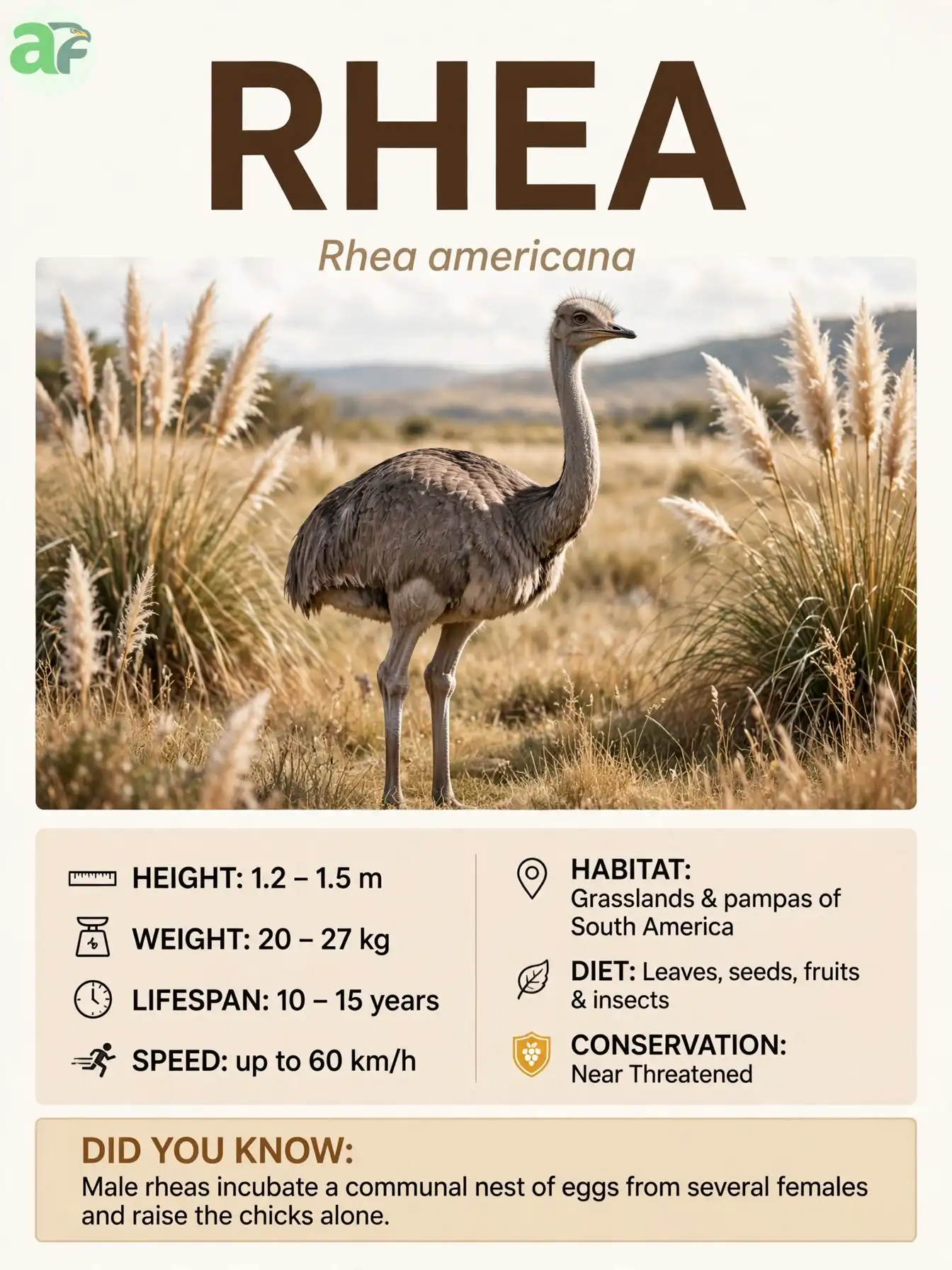
| Lifespan | 10–15 years (wild); up to 40 years (captivity) |
| Diet | Omnivorous — broad leaves, roots, seeds, insects, small vertebrates; remarkably flexible |
| Body Height | Greater rhea: 127–140 cm; Lesser rhea: 90–100 cm |
| Weight | Greater rhea males: 20–27 kg; Females: 15–20 kg; Lesser rhea: 15–25 kg |
| Top Running Speed | 60–64 km/h — faster than both the emu and cassowary |
| Conservation Status | Greater rhea: Near Threatened (IUCN) — declining; Lesser rhea: Least Concern |
| Defining Feature | Three toes (shared with most ratites); the male’s extraordinary communal nesting system where one male incubates eggs from up to 12 females in a single nest; uses wings for balance and turning during high-speed running despite being unable to fly |
| Darwin Connection | Charles Darwin collected and described the lesser rhea during the Beagle voyage — the bird now formally named Rhea darwinii in one subspecies; Darwin almost ate the only specimen of the new species before realizing its scientific significance |
| Coat of Arms | Appears on the national coat of arms of Argentina |
 1. Introduction: What is a Rhea?
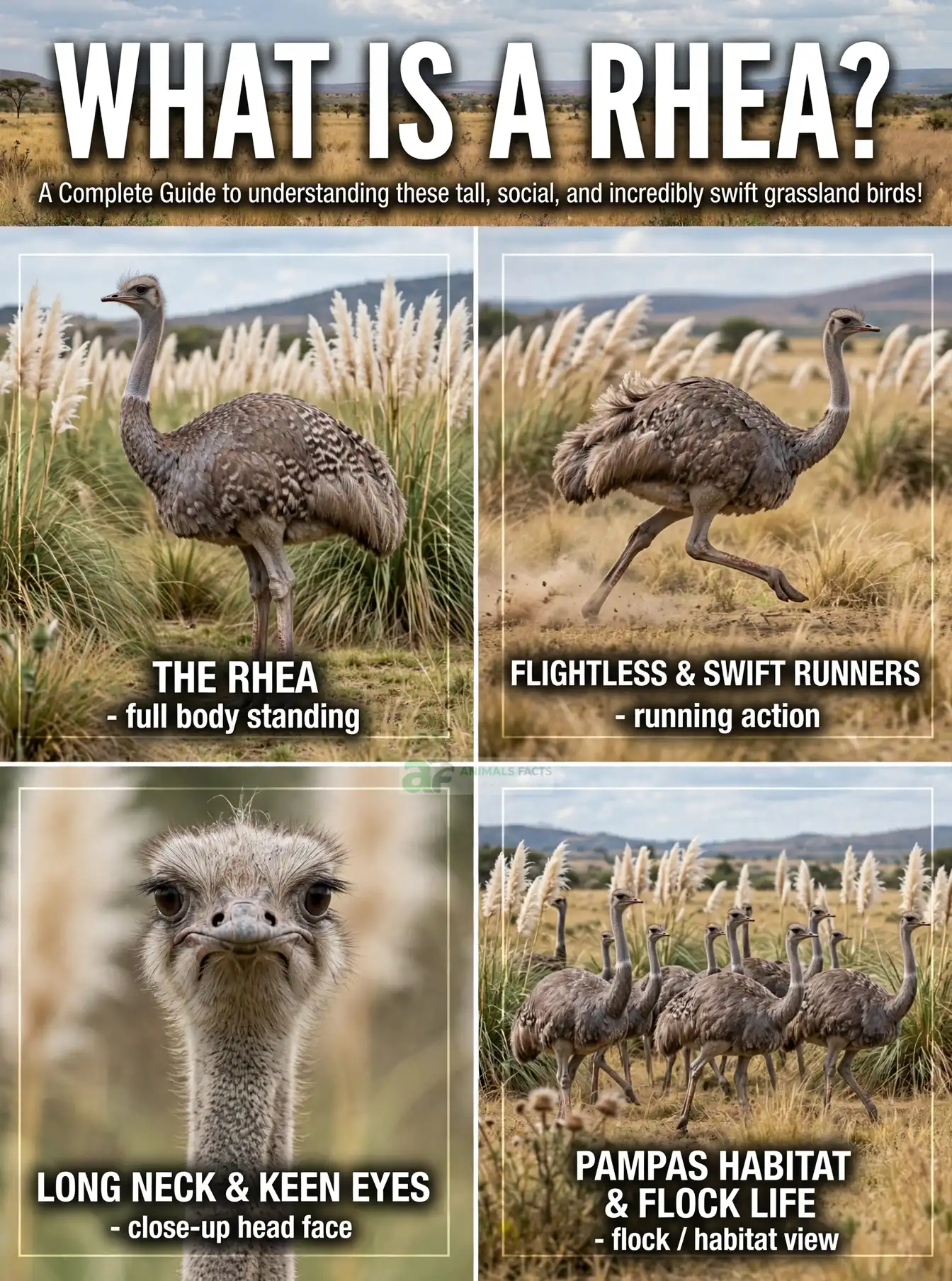
On the vast Argentine pampas in the early morning light, where the grassland extends to every horizon and the only vertical features are the scattered ombú trees and the occasional estancia windmill, a male greater rhea moves through the tall grass with the unhurried purposefulness of a bird that has been the apex flightless runner of this landscape for millions of years. He is approximately 1.3 meters tall and weighs perhaps 25 kilograms. Behind him, in a loose, attentive group, follow eighteen chicks of various ages — some belonging to females from as many as eight different mothers, all incubated in a single nest by this one male, all now under his sole supervision and protection. The chicks are spotted brown and cream — the distinctive juvenile coloring that provides camouflage in the pampas grass. When a crested caracara drops toward the group from a thermal above, the male immediately spreads his wings — not to fly, which he cannot do, but to use the wing surface as a visual barrier, driving the chicks beneath the wing cover while advancing toward the predator with the confidence of a bird that can run at 60 kilometers per hour and kick with legs powerful enough to break a dog’s ribs. The caracara reassesses the encounter and banks away. Rhea facts begin with this scene — the most complex male parental care system of any South American bird, delivered by an animal whose cultural and scientific history is among the richest of any bird in the Western Hemisphere.
The rhea (Rhea species) occupies a position in South American natural and cultural history that no other bird on the continent approaches. It is South America’s largest bird — a counterpart to Africa’s ostrich and Australia’s emu in the Southern Hemisphere’s triumvirate of great flightless runners. It is the bird that Charles Darwin almost ate before realizing he had discovered a new species — the lesser rhea being the subject of one of the most entertainingly described near-misses in the history of natural history collection, when Darwin and his shipmates had partially consumed a specimen of what turned out to be the scientifically undescribed lesser rhea (Rhea pennata) before the naturalist recognized its scientific significance, rescued the remaining parts, and sent them to the Zoological Society of London. It appears on the Argentine national coat of arms — alongside the May Sun and the handshake symbolizing national unity. And it practices one of the most extraordinary male parental investment systems in any bird: a dominant male mating with up to 12 females in sequence, each laying eggs in a single nest that the male alone incubates and from which the male alone raises all resulting chicks — a reproductive system of such complexity and such apparent unfairness to the participating females that it has been a subject of behavioral ecology research for decades.
Interesting facts about rheas reveal an animal of remarkable biological and cultural depth — the crop-destroying migrations across Argentine wheat fields that drove government bounty programs but whose agricultural impact research subsequently showed to be dramatically overstated; the rhea leather industry that supplied the global glove manufacturing trade with soft, flexible leather for decades; the gaucho boleadora tradition in which the Argentine horseman’s hunting weapon — the iconic bolas of braided leather and stone balls — was primarily developed for rhea hunting and remains one of the most culturally significant human-bird hunting technologies in the Americas; the nest-building male behavior that includes a courtship ceremony in which the male constructs the nest while the female watches and assesses — nest quality being a significant component of female mate choice; and the wing-use during running that makes the rhea unique among ratites — the bird using its substantial wings not for flight but as dynamic stabilizers during high-speed running, spreading and angling the wings like a tightrope walker’s pole to maintain balance during rapid directional changes. This is your comprehensive guide to South America’s greatest flightless bird and one of the most biologically extraordinary large birds in the world.
2. Rhea Species Overview & Classification
The rheas form a small, well-defined family — the Rheidae — containing two species that between them occupy most of the open habitats of South America.
Species Classification Table
| Taxonomic Rank | Classification |
|---|---|
| Kingdom | Animalia |
| Phylum | Chordata |
| Class | Aves |
| Order | Rheiformes |
| Family | Rheidae (Bonaparte, 1849) |
| Genus | Rhea (Brisson, 1760) |
| Species 1 | R. americana (Linnaeus, 1758) — Greater rhea |
| Species 2 | R. pennata (d’Orbigny, 1834) — Lesser rhea (Puna rhea; Darwin’s rhea) |
| Etymology | The genus name Rhea derives from the Greek Titaness Rhea — mother of the Olympian gods including Zeus. This mythological naming reflects the rhea’s impression of ancient, primordial power. americana = “of America”; pennata = “feathered” or “winged” (Latin) — referring to the lesser rhea’s distinctively feathered legs |
The Two Rhea Species
| Feature | Greater Rhea (R. americana) | Lesser Rhea (R. pennata) |
|---|---|---|
| Common names | Greater rhea; common rhea; ñandú (Guaraní); ema (Portuguese) | Lesser rhea; Darwin’s rhea; Puna rhea; suri (Quechua); ñandú del norte |
| Range | Eastern South America broadly | Andes and Patagonia |
| Weight | Males 20–27 kg; Females 15–20 kg | 15–25 kg (variable by altitude and subspecies) |
| Height | 127–140 cm | 90–100 cm |
| Habitat | Pampas, cerrado, Chaco — lowland open grassland | High Andean puna (above 3,500 m) + Patagonian steppe |
| Feathered legs | No — bare below the knee | Yes — legs feathered to the foot |
| Conservation | Near Threatened — declining | Least Concern |
| Darwin connection | Indirectly studied by Darwin | Directly described by Darwin — named R. darwinii in some classifications |
| Coat pattern | Grey-brown overall with white underparts | Brown with white-spotted or white-tipped body feathers |
The Darwin’s Rhea Story — The Most Famous Bird Discovery Anecdote
The lesser rhea’s association with Charles Darwin is one of the most entertaining stories in the history of natural history:
The discovery context — During the HMS Beagle voyage (1831–1836), Darwin encountered what he assumed were the already-described greater rheas in Patagonia. He had heard from gauchos about a smaller rhea said to occur in the southern pampas but had been unable to find one.
The near-miss consumption — In January 1834, during a Christmas celebration at Port Desire (Puerto Deseado, Argentina), Darwin and the Beagle crew shot and began consuming a rhea for their meal. Partway through the dinner, Darwin suddenly realized — from the bird’s smaller size, its spotted feather pattern, and other features — that this was not the common greater rhea but the mythical smaller species he had been seeking. He immediately stopped the meal, collected the partially eaten remains (head, neck, legs, wings, and feathers), and preserved them.
The description — Darwin sent the preserved specimen to the Zoological Society of London where the ornithologist John Gould formally described the new species in 1837 as Rhea darwinii — Darwin’s rhea, subsequently reclassified as a subspecies or synonym of R. pennata. The specimen — partially consumed by a famous naturalist before its scientific significance was recognized — is one of the most historically unusual type specimens in ornithology.
Darwin’s own account — Darwin recounted this incident in the Voyage of the Beagle with his characteristic dry humor: “The rhea was cooked and eaten before my mistake was discovered… It was too late; the bird had been almost entirely devoured. However, the head, neck, legs, wings, many of the larger feathers, and a large part of the skin, were preserved.”
Five Subspecies of Greater Rhea
| Subspecies | Range | Notes |
|---|---|---|
| R. a. americana | Eastern Brazil | Nominate; most common |
| R. a. intermedia | Uruguay, southern Brazil | Intermediate features |
| R. a. nobilis | Eastern Paraguay | Slightly larger |
| R. a. araneipes | Western Paraguay; adjacent Bolivia and Brazil | Distinctive pale coloration |
| R. a. albescens | Pampas of Argentina | Palest subspecies |
Three Subspecies of Lesser Rhea
| Subspecies | Common Name | Range | Notes |
|—|—|—|
| R. p. pennata | Puna rhea | Andean puna of Bolivia, Peru, Chile, Argentina | High altitude |
| R. p. garleppi | Puna rhea (northern) | Northern Bolivia and Peru | Higher elevation |
| R. p. tarapacensis | Tarapacá rhea | Northern Chile | Arid coastal puna |
Evolutionary Context
The Rheiformes order — Rheas form their own order (Rheiformes) within the ratites, reflecting their substantial evolutionary divergence from the ostrich (Africa), emu and cassowary (Australia-New Guinea), and kiwi (New Zealand):
The South American isolation — The rhea lineage evolved in isolation in South America following the continent’s separation from Africa and Antarctica approximately 80 million years ago — the South American ratites evolving independently across this period while their counterparts evolved separately on other Gondwana fragments.
The tinamous relationship — Molecular phylogenetics has established that rheas (like other ratites) are closely related to tinamous — small, flying South American birds. This relationship confirms that rheas descended from a flying ancestor that independently lost flight — the same convergent evolution story that produced the emu, ostrich, and cassowary.
Evolution & Discovery Timeline
~80 million years ago — The ancestral Rheiformes lineage establishes in South America.
~50,000 years ago — The first human inhabitants of South America encounter rheas across the pampas and grasslands — the beginning of a human-rhea relationship that will shape both species’ biology and culture for millennia.
1519–1522 — Ferdinand Magellan’s circumnavigation — the first European expedition to encounter rheas extensively; Magellan’s chronicler Antonio Pigafetta describes the birds as “ostriches” in one of the first European accounts of South American wildlife.
1758 — Carl Linnaeus formally describes Rhea americana — establishing the greater rhea in Western science.
1833–1834 — Charles Darwin’s Beagle voyage encounters both rhea species in South America — the near-consumption incident producing the first scientific specimen of the lesser rhea.
1837 — John Gould formally describes Darwin’s rhea (Rhea darwinii) from Darwin’s partially consumed specimen.
1890s–1960s — The rhea leather and feather trade reaches significant commercial scale — millions of rheas harvested for their skins and plumes across Argentina and Brazil.
2024 — Greater rhea classified as Near Threatened with declining populations; lesser rhea remains Least Concern.
“The rhea is the pampas made into a bird — it has the landscape’s combination of apparent simplicity and actual complexity, the pampas’ capacity for both abundance and sudden scarcity, and the gaucho’s characteristic blend of toughness and grace. You cannot understand the Argentine pampas without understanding the rhea, and you cannot understand the rhea without spending time on the pampas.”
— Dr. Pablo Yorio, CONICET (Argentina’s National Scientific and Technical Research Council) — leading Argentine ornithologist
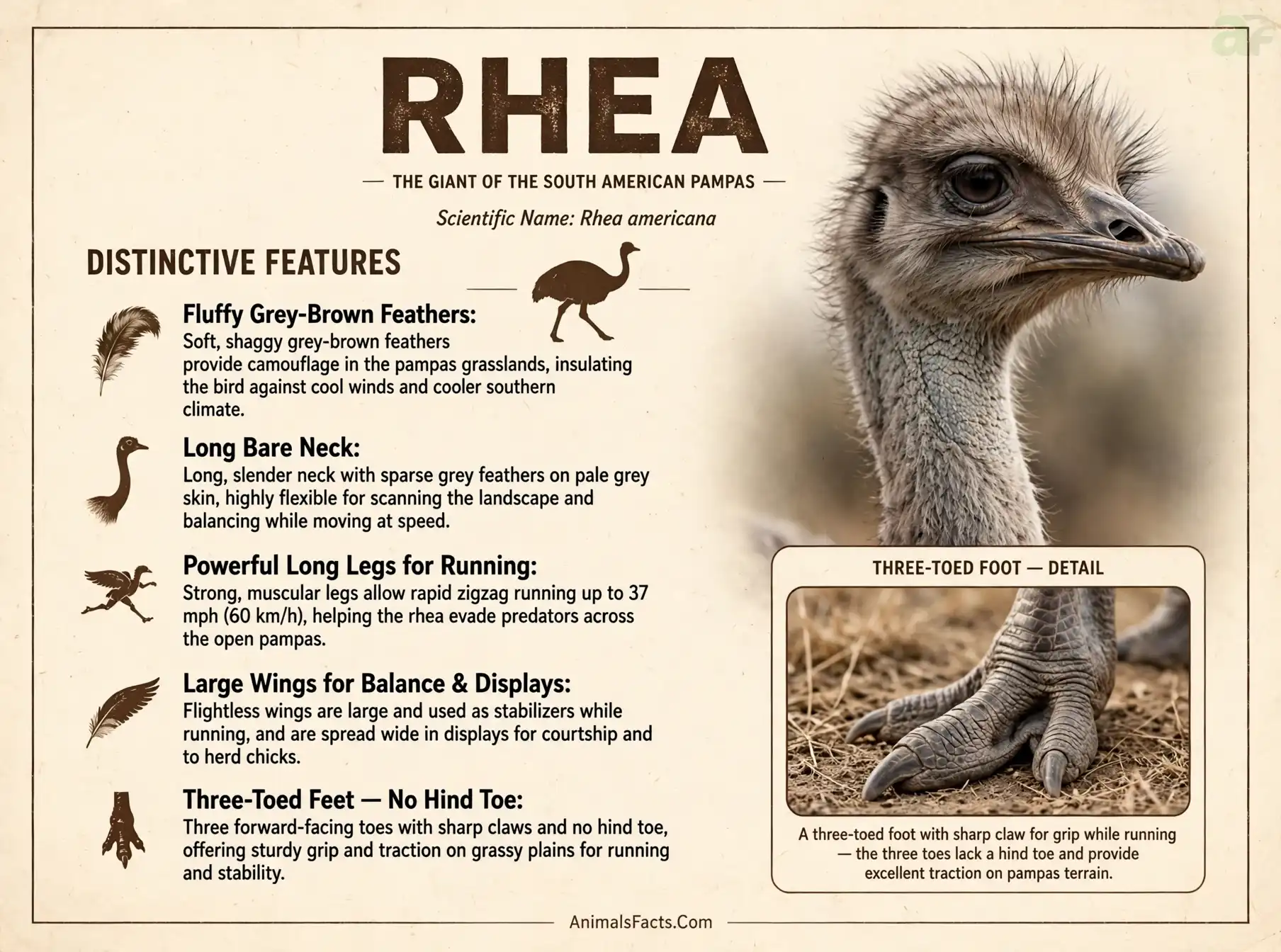
3. Rhea Physical Description & Unique Features
The rhea’s physical design is the South American ratite solution to the open-landscape large-bird challenge — optimizing for speed, visual surveillance, and the complex social demands of the pampas environment.
Body Size and Proportions
Greater rhea dimensions — The greater rhea is South America’s largest bird:
- Height: 127–140 cm at the top of the head
- Weight: Males 20–27 kg (occasionally to 40 kg in exceptionally well-fed individuals); Females 15–20 kg
- Sexual size dimorphism: Males are significantly larger than females — unusual among South American ratites where size differences between sexes are less extreme than in some other ratites
Lesser rhea dimensions:
- Height: 90–100 cm — significantly smaller than the greater rhea
- Weight: 15–25 kg — the variation reflecting the altitude gradient across the species’ range (higher-altitude birds tend to be smaller)
Comparison with other ratites — The greater rhea is the third-largest ratite after the ostrich and emu by weight, and occupies a physical scale between the emu and the cassowary.
The Three-Toed Foot — Speed-Optimized Design
Unlike the ostrich’s unique two-toed foot, the rhea retains three toes — but the foot design is still highly optimized for running:
Toe structure:
- Inner toe — the largest, primary weight-bearing toe; bearing a broad, blunt nail
- Middle toe — the primary propulsive toe; the longest and strongest
- Outer toe — smaller; providing lateral balance
The stride — Rheas achieve running speeds of 60–64 km/h through:
- Long legs providing substantial stride length
- Efficient energy transfer through the leg tendons (the spring-loaded tendon system shared with other ratites)
- The three-toed foot providing good ground contact across diverse terrain including the soft soils of the pampas
The Wings — The Most Functionally Used Vestigial Wings of Any Ratite
Wing size — Rhea wings are substantially larger than emu or cassowary wings — the larger wing surface provides greater functional utility despite complete inability to fly:
The running stabilizer function — The rhea’s most distinctive and most studied wing use:
- During high-speed running, especially during turns and directional changes, rheas spread and angle their wings
- The wings function as aerodynamic stabilizers — generating lift-like forces that help maintain balance during the rapid directional changes needed to evade pursuit predators
- This is the functional equivalent of a sprinter’s arm action — the wings being used as balance poles rather than as flight surfaces
- Research has confirmed that rheas attempting rapid directional changes with their wings held against the body show reduced turning efficiency
The threat display — Wings are spread widely during threat displays — the increase in apparent size being the primary function in confrontational contexts.
The incubation shelter — The incubating male spreads his wings over the nest to shade eggs and chicks from the sun and to shelter them from rain — the wing surface serving as a mobile sun/rain shield.
The chick-protection wing — The male uses his wings as a mobile enclosure for chick groups — spreading the wings to funnel chicks beneath for protection from aerial predators.
The Plumage
Greater rhea plumage:
- Body — grey-brown overall; males somewhat darker than females
- Neck — typically darker than the body, often appearing brownish-black in breeding males
- Underparts — paler, approaching white on the belly
- Breeding male — the male’s neck and upper breast darken significantly during the breeding season — one of the most visible seasonal plumage changes of any ratite
Lesser rhea plumage:
- Body — distinctly different from the greater rhea — brown with white-spotted or white-tipped feathers creating a spotted or marbled appearance unique among ratites
- Legs — feathered down to the feet (unlike the greater rhea’s bare lower legs) — one of the most reliable field identification characters
- The spotted pattern provides camouflage in the high Andean puna and Patagonian steppe
The bare head and neck — Like other ratites, rheas have a largely bare head and upper neck — the sparse feathering allowing thermoregulation through vascular blood flow changes. The skin of the head and neck appears blue-grey.
The Neck — The Information Tower
The rhea’s relatively long neck elevates the bird’s eyes approximately 140 cm above the ground — providing a substantial visual advantage over most pampas predators and allowing detection of threats across the open grassland at distances that make escape possible well before the predator reaches striking distance.
💡 Did You Know? The rhea’s running wings represent one of the most sophisticated examples of vestigial organ repurposing in the animal kingdom. While it might be tempting to describe rhea wings as “useless vestiges” of the ancestor’s flying ability, they are in fact actively functional organs serving multiple important purposes — balance stabilization during high-speed running, heat shade provision during nest incubation, chick shelter and protection, and display surfaces for social communication. Research has demonstrated that rheas use their wings during running turns with measurable effectiveness — effectively using their “useless” wings to become better runners than they would be without them. This example challenges the popular understanding of vestigial organs as inevitably purposeless — in the rhea’s case, evolution has repurposed structures that originally served aerial locomotion for a suite of terrestrial functions that collectively make the rhea a more effective animal than it would be if the wings had been completely resorbed. The same evolutionary creativity — finding new uses for old structures — is documented across the animal world, but the rhea’s wing provides one of the clearest and most functionally diverse examples.
4. Top 25 Amazing Rhea Facts
Here is your definitive collection of the most extraordinary, scientifically verified, and genuinely astonishing rhea facts as of 2026:
- Charles Darwin almost ate the only specimen of the lesser rhea before recognizing it as a new species. During a Christmas feast on the Beagle voyage in January 1834, Darwin and his crew had partially consumed a rhea before Darwin realized it was the scientifically undescribed lesser species he had been seeking. He rescued the remaining parts (head, neck, legs, wings, and some feathers) and sent them to John Gould, who formally described the new species as Rhea darwinii.
- A male greater rhea can mate with up to 12 females in a single breeding season — and then incubates all their eggs together in a single nest. Each female may lay up to 15 eggs in the communal nest, potentially producing a single nest containing 50–60 eggs — the largest clutch of any bird in the Americas.
- The rhea uses its vestigial wings as balance organs during high-speed running — spreading and angling them like a tightrope walker’s pole to maintain stability during rapid directional changes. This makes the rhea’s wings simultaneously unable to fly and actively essential for effective locomotion.
- The greater rhea is the largest bird in the Americas — surpassed only by its relatives the ostrich and emu globally. The male greater rhea can reach 27 kg in body weight and 140 cm in height — the most massive bird on the continent.
- The lesser rhea (Darwin’s rhea) was formally described from a partially consumed specimen — one of the most unusual type specimens in the history of ornithology. The specimen, preserved after Darwin’s Christmas dinner, is held in the Natural History Museum, London.
- Rheas can run at 60–64 km/h — significantly faster than both the emu (50 km/h) and the cassowary (50 km/h), and approaching the cheetah’s speed over the same grassland terrain. The rhea’s three-toed foot, long legs, and spring-loaded tendon system combine to produce the fastest running speed of any South American bird.
- The gaucho boleadora — the iconic South American hunting weapon of braided leather cords with weighted balls — was developed primarily for rhea hunting. The boleadora is thrown to entangle the rhea’s legs mid-run — a hunting technology that requires extraordinary skill and that has been central to gaucho culture for centuries.
- The rhea’s communal nest can contain eggs from multiple females — but the male can recognize his own partner’s eggs and preferentially positions them in the center of the nest (the warmest and best-protected position) while relegating other females’ eggs to the periphery. This selective egg placement parallels the ostrich’s communal nest management system.
- Rheas have been introduced to Germany as escaped farm animals and established a wild breeding population in the state of Mecklenburg-Vorpommern in northern Germany — making the rhea the only ratite with an established wild population in Europe. The population has grown to over 500 individuals and is expanding, creating conservation and management debates about an invasive exotic species.
- The greater rhea appears on the Argentine national coat of arms alongside other national symbols — recognizing the rhea’s deep integration into Argentine cultural and natural identity.
- Rhea feathers were used in the great millinery trade of the 19th and early 20th centuries — the soft, loose-barbed feathers being used in hat decoration and fashion, driving significant commercial hunting. The feather trade contributed to rhea population declines across Argentina and Brazil.
- The lesser rhea is one of the highest-altitude ratites — the Puna rhea subspecies (R. p. pennata) breeds at elevations up to 4,500 meters in the Andes — the highest breeding altitude of any ratite and one of the highest breeding altitudes of any large bird.
- During the breeding season, the male rhea produces a booming call audible from over 1 km — one of the most carrying bird calls in the South American pampas. The call’s low frequency and long range reflect the acoustic demands of communication across the open grassland landscape.
- The rhea egg weighs approximately 600 grams — and the yolk inside is one of the most nutrient-dense natural food items available on the South American pampas. Rhea eggs have been a significant food source for indigenous South Americans and for European settlers for centuries.
- Research has documented that female rheas form coordinated “laying teams” — groups of females that move from male to male across a territory, each laying eggs in multiple males’ nests. This active female mating strategy means females may contribute eggs to several different nests in a single season, maximizing their reproductive output.
- Rheas are documented swimming rivers — the birds entering water readily and using their powerful legs for propulsion, with the large wing surface providing buoyancy assistance. Rheas crossing the Rio de la Plata and other major South American rivers during range movements have been documented.
- The rhea leather industry — particularly from the greater rhea — supplied European glove manufacturers for decades. Rhea leather is fine-grained, flexible, and durable — prized for high-quality leather goods. Commercial rhea farming for leather production has partially replaced wild harvesting.
- Argentine gauchos used rhea feathers in their traditional hats and costume — the feathers being both a decorative element and a marker of the gaucho’s connection to the pampas wildlife.
- Rhea chicks use a unique distraction call when separated from the father — a high-pitched, carrying whistle that allows the father to locate separated chicks across the open pampas. The whistle can be heard by the adult male from distances significantly greater than the chick is visible.
- The German wild rhea population in Mecklenburg-Vorpommern causes documented agricultural damage — the birds consuming sugar beet, corn, and other crops and creating road hazards. The population management debates in Germany have attracted European conservation and invasive species policy attention.
- Research using satellite tracking of greater rheas in Argentina has documented individual home ranges of 7–100 km² — the extraordinary size variation reflecting the pampas’ enormous variation in habitat quality and food availability across different seasons and drought years.
- The male rhea produces pre-incubation nest building behavior as part of courtship — constructing the nest while females observe, and females assessing nest quality as part of mate selection. Better-built nests by more experienced males attract more females and therefore more eggs — making nest construction quality a component of male reproductive success.
- Rheas have been documented consuming toxic plants that cattle and sheep avoid — including plants containing alkaloids and other secondary compounds that affect domestic livestock. The rhea’s ability to detoxify these plant compounds gives it access to food resources unavailable to domestic herbivores sharing the same pampas landscape.
- The International Union for Conservation of Nature upgraded the greater rhea from Least Concern to Near Threatened in the most recent assessment — reflecting documented population declines across the species’ range driven by habitat conversion, hunting, and egg collection.
- As of 2026, the greater rhea population is estimated at approximately 250,000–500,000 individuals — a large population but one showing documented declines as the pampas ecosystem is converted to intensive soybean and grain production. The lesser rhea population in the Andes and Patagonia is more stable but faces specific threats in the northern Andean range.
5. Fun Facts About Rheas
- Darwin almost ate the only specimen of the lesser rhea before recognizing it
- Male mates with up to 12 females — then incubates all their eggs alone
- Single nest can contain 50–60 eggs — largest clutch in the Americas
- Runs at 60–64 km/h — fastest South American bird
- Wings used as balance stabilizers during running — not for flight
- Gaucho boleadora weapon developed primarily for rhea hunting
- Wild rhea population established in Germany — only ratite in Europe
- Appears on the Argentine national coat of arms
- Puna rhea breeds at 4,500 meters — highest altitude ratite
- Male produces a boom call audible from over 1 km
- Rhea egg weighs approximately 600 grams
- Male recognizes his partner’s eggs in communal clutch of 50–60
6. Rhea Habitat & Geographic Range
Rhea habitat is defined by the combination of open terrain providing the long-range visibility essential for predator detection and the unobstructed running space that is the rhea’s primary survival strategy.
Primary Habitat Types
Pampas (Greater Rhea):
The archetypal greater rhea habitat — the vast temperate grassland of the South American interior:
- Natural pampas — the original native grassland of Argentina and Uruguay; dominated by various native grasses and scattered trees
- Modified pampas — the heavily agricultural pampas of the Buenos Aires province and neighboring areas; much natural pampas converted but rheas persist in agricultural margins
- The pampas’ open structure provides ideal rhea habitat — excellent visibility, abundant food, and running space
Cerrado (Greater Rhea):
The Brazilian savanna — a vast area of central Brazil:
- The cerrado’s open woodland and grassland mosaic is important greater rhea habitat in Brazil
- Rheas use the cerrado’s diverse plant communities for both food and nesting
- The cerrado is one of the world’s most biodiverse savannas and one of the most rapidly disappearing — its conversion to soybean agriculture is the primary driver of Brazilian greater rhea population decline
Chaco (Greater Rhea):
The semi-arid thornbush landscape of Paraguay, Argentina, and Bolivia:
- The dry Chaco’s open scrubland supports greater rheas across parts of the western range
- Chaco rheas face particularly intense hunting and habitat pressure
High Andean Puna (Lesser Rhea):
The most dramatic lesser rhea habitat — the high-altitude grassland of the Andes above 3,500 meters:
- Dominated by the tufted grass Festuca, cushion plants, and other high-altitude vegetation
- Extreme climate — cold, dry, subject to frost year-round
- Home to the Puna rhea (R. p. pennata) — the highest-altitude ratite
Patagonian Steppe (Lesser Rhea):
The vast wind-swept semi-arid grassland of southern Argentina and Chile:
- The Patagonian steppe’s combination of grasses, shrubs, and open terrain provides excellent lesser rhea habitat
- Wind is a constant feature — rheas are well-adapted to the strong Patagonian winds
- The southern lesser rhea population (R. p. pennata in southern Argentina and Chile) occupies this habitat
Geographic Distribution
| Species/Subspecies | Countries | Estimated Population | Trend |
|---|---|---|---|
| Greater rhea (all) | Brazil, Argentina, Uruguay, Paraguay, Bolivia | 250,000–500,000 | Declining |
| Greater rhea — Argentina | Pampas, Chaco regions | ~120,000–200,000 | Declining |
| Greater rhea — Brazil | Cerrado, Pantanal margins | ~100,000–200,000 | Rapidly declining |
| Greater rhea — Uruguay | Pampas | Small; fragmented | Declining |
| Lesser rhea (puna) | Bolivia, Peru, Chile, NW Argentina | ~50,000–150,000 | Stable |
| Lesser rhea (Patagonian) | Southern Argentina, Chile | ~50,000–150,000 | Stable |
| Wild rheas (Germany) | Mecklenburg-Vorpommern | >500 and growing | Increasing (invasive) |
The German Wild Rhea Population — The Most Unusual Rhea Range Extension
Origin — The German wild rhea population descends from greater rheas that escaped from a farm in Mecklenburg-Vorpommern in northern Germany in 2000. The initial escapees — fewer than 10 birds — found the agricultural landscape of northern Germany apparently suitable.
Growth — The population has grown from the initial escapees to over 500 individuals by 2024 — the birds breeding successfully in the German agricultural landscape and expanding their range.
The ecological context — Northern Germany’s agricultural landscape — dominated by grain fields, sugar beet, and managed grassland — is surprisingly similar in structure to the modified pampas that greater rheas have adapted to in South America. The absence of large native predators in Germany (wolves are expanding but not yet present in sufficient numbers throughout the rhea’s German range) has facilitated population growth.
The management debate — The German rhea population presents a classic invasive exotic species dilemma:
- The birds cause documented agricultural damage (consuming crops) and create road hazards
- They are not native to Europe and their expansion could affect native wildlife
- However, as an endangered (Near Threatened) species in their native range, the population has potential conservation value as a reservoir population
- German wildlife authorities have debated between culling programs, containment, and tolerance
7. Rhea Diet & Feeding Behavior
Rhea diet is one of the most ecologically flexible of any large bird — the species combining broad-leaf herbivory with opportunistic carnivory across a remarkably wide range of prey types.
Diet Breakdown Table
| Food Type | Proportion | Notes |
|---|---|---|
| Broad leaves and plant shoots | ~35–40% | Primary food for most of year; high water content |
| Seeds and grains | ~20–25% | Critical dry-season food; agricultural grain important |
| Roots and tubers | ~10–15% | Dry season; dug up with bill |
| Fruits and berries | ~10–15% | Seasonal; important in cerrado habitat |
| Insects (grasshoppers, beetles, ants) | ~5–10% | Important protein source; especially during chick-rearing |
| Small vertebrates (lizards, mice, snakes) | ~3–7% | Opportunistic; more important during nesting |
| Agricultural crops | Variable; locally high | Wheat, soybean, corn — source of human-rhea conflict |
| Gastroliths | Continuous | Stones consumed for gizzard grinding |
The Agricultural Conflict
Why rheas eat crops — The rhea’s dietary flexibility means it readily exploits the concentrated, high-quality food resources of agricultural fields:
- Wheat — young wheat shoots in germinating fields are highly attractive to rheas
- Soybeans — a major crop across the South American rhea range; rheas consume both seedlings and mature plants
- Corn — consumed at both seedling and mature stages
- Sunflowers — consumed in agricultural Chaco and Argentina
The historical overstatement of crop damage — Research conducted in Argentina in the late 20th century found that rhea crop damage had been significantly overstated by farmers — the birds’ agricultural impact being real but substantially less economically significant than the bounties and culling programs instituted to address it. The documentation of this overstatement has influenced contemporary rhea management toward more tolerance and less active control.
The Beneficial Pest Control Function
The locust and grasshopper connection — Rheas in the South American pampas are significant consumers of locusts (Schistocerca cancellata and related species) and grasshoppers during insect irruption events:
- A single adult rhea can consume several hundred grasshoppers per day during irruption events
- Rhea population presence has been correlated with reduced locust persistence at the landscape scale
- This pest control service provides direct economic value to farmers sharing the pampas landscape with rheas — a benefit that partially offsets the crop damage concern
The Foraging Method
The active search — Rheas forage with a characteristic combination of deliberate movement and rapid strike:
- The bird moves through grassland at a steady walking pace, with frequent head-lowering to examine vegetation and ground surface
- When prey or food is detected, a rapid bill-strike captures it
- The long neck allows the rhea to examine ground-level items without pausing the body’s forward movement — a continuous foraging motion
The social foraging advantage — Foraging in groups — as rheas typically do outside the breeding season — provides collective predator detection:
- While individual birds spend time foraging with heads down, other group members scan for threats
- The many-eyes benefit allows each individual to spend more time foraging (rather than scanning) in a group than when alone
8. Rhea Reproduction & Life Cycle
Rhea reproduction is the most complex communal nesting system of any South American bird — the dominant male’s management of a nest containing eggs from multiple females, combined with sole parental care of all resulting chicks, creating a reproductive system that has fascinated behavioral ecologists since its documentation.
The Breeding Season
Timing — Greater rhea breeding in the southern part of the range (Argentina) peaks during the austral spring and early summer (August–January):
- The timing aligns chick hatching with the period of maximum insect availability — critical for chick nutrition
- In the Brazilian cerrado, timing shifts slightly toward the dry season when open habitat maximizes visibility
The male’s seasonal transformation — As breeding season approaches, male greater rheas undergo dramatic changes:
- Plumage darkening — the neck and upper breast feathers darken significantly toward black
- Behavioral changes — males become less tolerant of other males; territorial exclusivity increases
- Calling intensification — the booming call increases in frequency and carrying distance
- Nest building — males begin constructing potential nest sites in their territories
The Complex Mating System
The dominant male strategy — Rhea mating follows a sequential polygyny system of remarkable complexity:
Phase 1 — Male competition:
- Dominant males establish territories on the pampas
- Rival males engage in display and combat — the combat involving neck-wrestling, body-slamming, and wing-striking
- Dominant males exclude subordinates from breeding territories
- A single dominant male may control a territory supporting access to multiple females
Phase 2 — Female mate choice:
- Female groups move through the pampas, assessing males and their nest sites
- The male performs elaborate courtship displays — booming calls, wing displays, and running circuits around potential nest sites
- Females assess both the male (size, display quality) and the nest (construction quality, location)
- Females may visit multiple males before deciding where to lay
Phase 3 — Sequential laying:
- Each female lays one egg every other day in the dominant male’s nest over approximately 2–3 weeks
- After laying 7–15 eggs, the female may move on to lay in another male’s nest
- The result is a single nest receiving contributions from multiple females over an extended period
- The male may also mate with subordinate females that he does not allow to contribute eggs to the primary nest — a behavior whose evolutionary logic has been debated
Phase 4 — Male takes over:
- Once sufficient eggs have accumulated, or after a specific time threshold, the male takes sole responsibility for the nest
- The male drives away additional females attempting to lay in the nest
- The male begins incubation and maintains exclusive control of the nest until hatching
The Extraordinary Communal Nest
Egg numbers — The greater rhea communal nest can contain:
- 10–60 eggs — the range reflecting the number of contributing females and their individual clutch sizes
- Most commonly 15–35 eggs in a typical nest
- Maximum documented: over 60 eggs in a single nest — the largest clutch of any bird in the Americas
Egg characteristics:
- Color: Pale yellow to golden — darkening to amber-brown as incubation progresses
- Size: approximately 130 × 90 mm (greater rhea); slightly smaller for lesser rhea
- Weight: approximately 600 grams (greater rhea) — equivalent to approximately 10–12 chicken eggs
The male’s egg recognition — Research has documented that the male can distinguish his primary mate’s eggs from other females’ eggs and positions them preferentially in the nest center — paralleling the ostrich’s communal nest management. The mechanism of egg recognition is believed to involve visual pattern differences in the eggshell surface.
Peripheral egg ejection — Males regularly eject peripheral eggs from the nest — rolling them out of the nest and some distance away. Research suggests this behavior:
- Reduces the total nest size to a manageable incubation area
- Selectively retains eggs likely to be genetically related to the male
- May reflect the eggs’ developmental state (fresher eggs preferentially retained)
Incubation — The Male’s Commitment
Duration — 35–40 days (greater rhea); 36–37 days (lesser rhea)
The incubation fast — The male rhea performs a partial incubation fast less extreme than the emu’s 56-day complete fast but still involving significant reduction in food intake:
- The male rarely leaves the nest during incubation
- Brief foraging excursions occur during the coolest parts of the day when temperature risk to eggs is lowest
- Weight loss of approximately 20–25% during incubation is documented
The incubation posture — The male sits with the eggs distributed beneath his body and wing feathers — his weight providing warmth during cool nights and his wing spreading providing shade during the hottest midday hours.
Temperature regulation — The incubating male actively thermoregulates the nest:
- Cool conditions — wings folded tightly; maximum body contact with eggs
- Hot conditions — wings slightly raised; feathers ruffled; eggs rotated
Chick Development
At hatching — Greater rhea chicks hatch with distinctive brown and cream longitudinal striping — providing excellent pampas-grassland camouflage:
- Chick weight: approximately 300–400 grams
- Multiple chicks from a large clutch often hatch within 24–48 hours of each other
- The male responds to hatching calls with intense protective behavior
Post-hatching — The male immediately begins the chick-protection role:
- He spreads his wings to shelter the newly hatched chicks
- He leads the chick group away from the nest site within hours of hatching
- He produces constant contact calls maintaining group cohesion
The chick group (crèche) — Multiple chick families often merge:
- Males with chick groups occasionally lose individual chicks to neighboring males’ groups
- Large crèches form — sometimes containing 50+ chicks under the supervision of 1–3 males
- Research has shown that males sometimes aggressively appropriate chicks from other males — nest-stealing behavior
Development timeline:
- Week 1–2: fully dependent on male for warmth and protection
- Month 1–2: developing thermoregulation; increasingly independent foraging
- Month 3–4: stripes fading; grey-brown adult plumage beginning
- Month 6: approaching adult size; independent foraging
- Year 2: sexual maturity; first breeding possible in males; slightly earlier in females
9. Social Behavior & Communication
Rhea social behavior is more complex than most ratites — the species maintaining dynamic group structures throughout the year and a sophisticated communication system adapted to the open pampas environment.
Flock Structure and Dynamics
Non-breeding flocks:
- Outside the breeding season, greater rheas form mixed flocks of 5–30 individuals — both sexes, various ages
- Flock size tends to be larger in areas of concentrated food resources
- Flocks provide collective predator detection — the primary survival benefit of group living in the open pampas
The breeding season dispersal:
- As breeding season approaches, flocks break up — dominant males establishing territories and subordinate males and females reorganizing
- Female groups form specifically to assess males and select nesting sites
- After the laying period, females may form separate groups
The male-chick family group:
- The most tightly bonded social unit in rhea society
- The male maintains constant proximity to his chick group for approximately 4–6 months
- Chick groups from different males sometimes merge into crèches supervised by multiple males
Communication
The booming call — The male’s primary long-distance advertisement:
- A deep, resonant boom produced by the inflated esophagus
- Carries over 1 km in open pampas conditions
- Produced most intensely during the breeding season — both as territorial advertisement and as mate attraction
- Distinguishable from individual to individual — rheas apparently recognize conspecifics’ calls
The alarm call — A sharp, high-pitched whistle produced when predators are detected:
- Triggers immediate flight response in all nearby rheas
- Distinguishable from the male-chick contact whistle
The chick contact call — A soft, repeated chirping maintained between the male and chick group:
- Maintains group cohesion while the group forages
- The separated-chick whistle (high-pitched and urgent) alerts the male to a lost chick
Visual displays:
- Wing spreading — territorial threat; male-to-male competition
- Neck darkening — visible breeding season status signal
- Running display — males run in circles around females during courtship, displaying wing and leg action
Dominance and Territory
Male dominance hierarchies — Male rheas establish dominance hierarchies during the breeding season through a combination of display and combat:
- Larger, older males typically dominate smaller, younger rivals
- Combat involves neck-wrestling (the males intertwining necks and pushing), body-charging, and wing-striking
- Serious injuries are relatively uncommon — most competitive interactions are resolved through display
10. Predators & Defense Mechanisms
The rhea occupies the position of large prey animal on the South American pampas — substantial enough that most predators assess its defensive capability carefully before committing to an attack.
Natural Predators
Adult rhea predators:
- Puma (Puma concolor) — the most significant native predator of adult rheas; documented taking adults through patient stalking in pampas and Patagonian steppe
- Jaguar (Panthera onca) — in areas of range overlap (especially cerrado and Chaco); takes adult rheas
- Maned wolf (Chrysocyon brachyurus) — takes rheas opportunistically; more significant predator of eggs and chicks
- Introduced domestic dog (feral) — significant predator in agricultural areas; packs can bring down adult rheas
Egg and chick predators:
- South American gray fox (Lycalopex griseus) — primary egg and small chick predator
- Armadillos — documented nest raiders
- Various hawk and eagle species — take chicks; the Crowned eagle (Buteogallus coronatus) is a significant chick predator
- Snakes — large boas and other snakes take eggs and small chicks
Defense Mechanisms
The primary defense — speed:
- At 60–64 km/h, the adult rhea can outrun all native South American predators except the puma in short-distance pursuit
- The rhea’s endurance at near-maximum speed is a significant advantage over most predators — the rhea can maintain high speed for distances that exhaust most pursuers
The wing-enhanced evasion:
- During pursuit, the rhea uses its wings not for flight but for rapid directional changes — the wing-spread stabilization allowing sharper turns than the predator can match
- The zigzag evasion pattern, enhanced by wing control, makes pursuing rheas extremely difficult even for fast predators
The kick:
- The rhea’s three-toed kick is less specialized as a weapon than the cassowary’s dagger kick but still delivers significant force
- Rheas defending nests and chicks will kick at approaching predators and humans
- The kick is directed forward and downward — capable of injuring dogs and foxes that approach too closely
The chick-shelter wing:
- The male provides physical shelter to chick groups with his wings — chicks instinctively move beneath the male’s outspread wings when an aerial threat is detected
- This shelter behavior protects chicks from aerial predators while allowing the male to simultaneously move toward or away from the threat
The nest defense display:
- Incubating males perform dramatic threat displays toward approaching predators — spreading wings to maximum extent, inflating the neck, and advancing toward the threat
- The male will abandon this display and flee if the predator is sufficiently large and persistent — chick and egg survival balanced against the male’s own survival
11. Rhea Facts for Kids
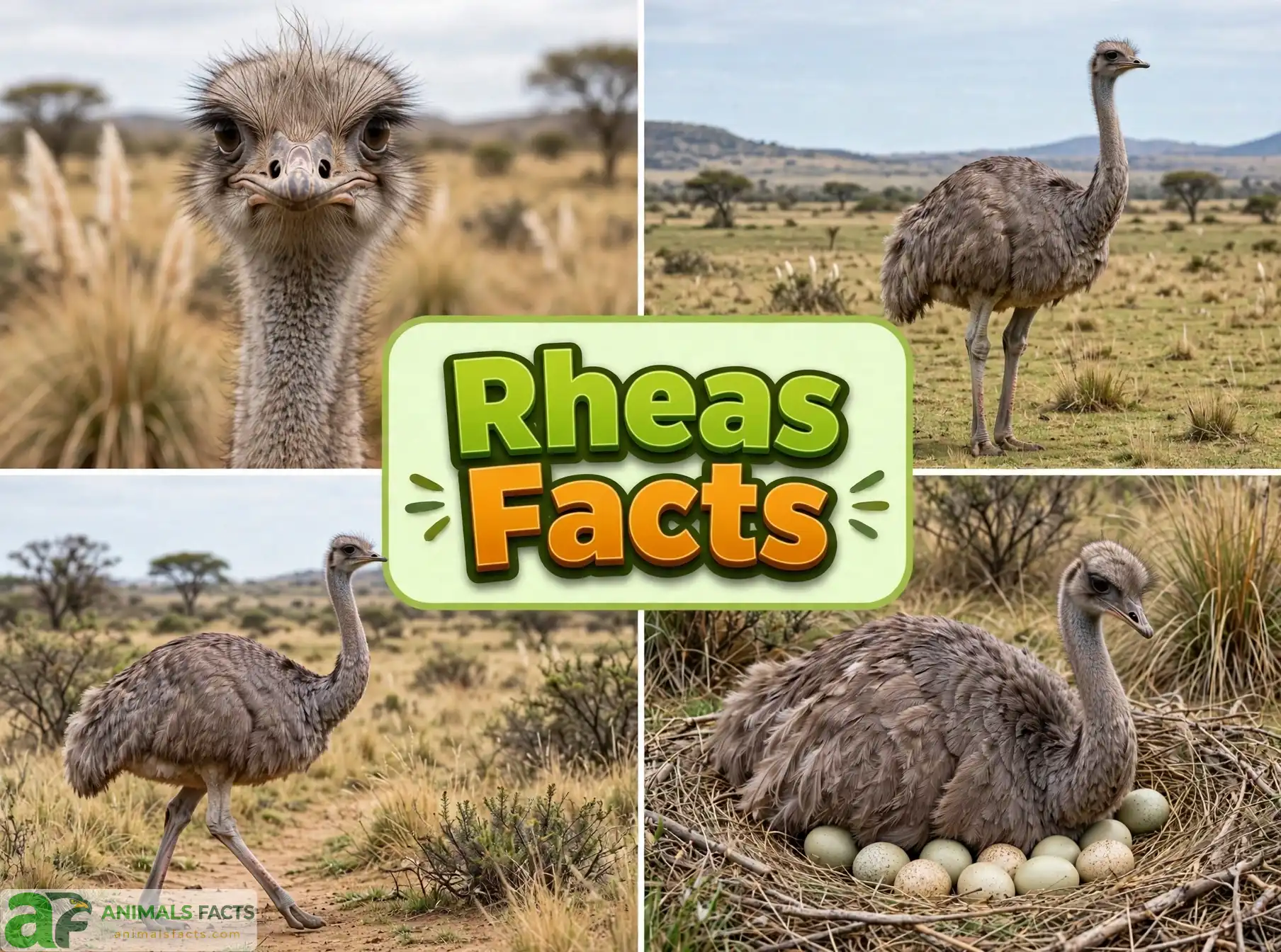
Hey amazing young wildlife scientists, South American wildlife enthusiasts, and bird lovers! Here are some truly extraordinary rhea facts for kids that will make you the most fascinating wildlife expert in any conversation:
- 🪶 Charles Darwin almost COMPLETELY ATE the scientific discovery of the century! When Darwin was on his famous Beagle voyage, he and his crew killed and ate a rhea for a Christmas dinner. Halfway through eating it, Darwin suddenly realized this was a BRAND NEW SPECIES that nobody in science had ever officially described! He had been looking for it for months! He quickly saved whatever was left — the head, neck, legs, and some feathers — and sent the remains back to London where it was officially named as a new species. The “specimen” (the scientific example of the new species) is partially eaten rhea leftovers from Darwin’s Christmas dinner!
- 🪶 One daddy rhea can incubate SIXTY EGGS from TWELVE DIFFERENT MUMS all at once! A single male rhea can mate with up to 12 different female rheas. Each female lays some eggs in his nest. Then ALL the females leave and the male sits on all the eggs by himself! A single rhea nest can have 50 or even 60 eggs in it — the biggest clutch of any bird in North or South America! The dad takes care of ALL the babies after they hatch, even though they came from lots of different mothers!
- 🪶 Rheas use their WINGS to run faster — even though they can’t fly! When a rhea runs at full speed — up to 64 kilometers per hour — it spreads its wings out like a tightrope walker’s arms. The wings help the rhea balance and turn sharply without falling over. This makes the rhea’s wings actually USEFUL for running even though they are completely useless for flying! Scientists who study rheas say that wings that cannot fly can still be very important organs — just for a completely different purpose!
- 🪶 There are wild rheas living in GERMANY! Some rheas escaped from a farm in northern Germany in the year 2000, and instead of being caught, they started breeding. Now there are over 500 wild rheas living in Germany — on the other side of the world from where rheas are supposed to live! The German rheas eat farmers’ crops and cause traffic accidents, so the German government has to manage them, but the birds keep having babies and the population keeps growing!
- 🪶 The Argentine cowboy’s famous hunting weapon was specifically invented to catch RHEAS! The boleadora — the braided leather cords with heavy balls that Argentine gauchos throw to trip animals — was developed mainly for hunting rheas. You throw the boleadora so it wraps around the rhea’s legs while it’s running at 64 km/h! This hunting technique requires extraordinary skill, and practicing with the boleadora was one of the most important skills for a gaucho to develop.
- 🪶 The rhea is South America’s LARGEST BIRD — even bigger than an eagle or a condor when it comes to body weight! A male greater rhea can weigh up to 27 kilograms. Even the Andean condor — South America’s largest flying bird with a wingspan of 340 centimeters — weighs only about 15 kilograms! The rhea is almost twice as heavy. Of course the condor can fly and the rhea cannot, but in terms of body weight, the rhea is South America’s heavyweight champion bird!
- 🪶 Rhea eggs take TWO MONTHS to incubate — and the dad doesn’t eat much the whole time! The male rhea sits on up to 60 eggs for 35 to 40 days. During this time he barely leaves the nest and loses a LOT of weight. The eggs themselves are enormous — each one weighs about 600 grams, which is like 10 or 11 chicken eggs combined! Indigenous South Americans and early settlers valued rhea eggs so much that collecting them was an important seasonal food activity.
- 🪶 Rheas eat GRASSHOPPERS and LOCUSTS and actually help FARMERS! When huge swarms of locusts or grasshoppers appear on the South American pampas, rheas run through them eating as many as they can — sometimes hundreds per day per bird! This is actually helpful for farmers because it reduces the number of insects damaging crops. So rheas can sometimes eat farmers’ crops AND eat the insects that would eat the crops — it is a complicated relationship between rheas and the people who share the pampas with them!
12. Relationship with Humans
The rhea’s relationship with humans in South America spans tens of thousands of years of indigenous hunting, a colonial and post-colonial period of commercial exploitation, the development of the gaucho cultural tradition in which rhea hunting was central, and the modern conservation crisis driven by habitat conversion and continued hunting.
The Indigenous South American Relationship
The pampas hunting tradition — Indigenous peoples of the South American pampas — including the Mapuche, Tehuelche, Guaraní, and many other groups — hunted rheas for food, feathers, and bone tools across the entire rhea’s historical range:
The boleadora tradition — The boleadora (bolas) — the hunting weapon of braided leather cords with weighted balls — was developed and refined by indigenous pampas hunters primarily for rhea hunting:
- The boleadora is thrown to entangle the rhea’s legs mid-run — stopping the bird without killing it
- The weapon requires extraordinary practice to use effectively — throwing accuracy at a running target at speed
- Indigenous pampas peoples developed the boleadora tradition over millennia of rhea hunting
Feathers in ceremony and culture — Rhea feathers featured in the ceremonial traditions of multiple South American cultures:
- Feathers used in headdresses and body decoration
- The rhea’s cultural significance in pampas indigenous cultures reflected in specific hunting protocols and ceremonial acknowledgment of the bird
Eggs as food — Rhea eggs were an important seasonal food source:
- The 600-gram eggs provided significant nutrition
- Indigenous peoples knew rhea nesting areas and timing — part of the ecological knowledge maintained across generations
The Gaucho Tradition — The Most Culturally Significant Human-Rhea Relationship
The Argentine and Uruguayan gaucho — the South American equivalent of the North American cowboy — developed a cultural relationship with the rhea that rivals any other human-bird cultural bond in the Americas:
The gaucho boleadora — The boleadora, adopted by gauchos from indigenous hunting technology, became the defining weapon of gaucho identity:
- Skill with the boleadora was one of the most important marks of gaucho competence
- Rhea hunting with the boleadora from horseback was a central gaucho activity across the 18th and 19th centuries
- The image of the gaucho on horseback swinging boleadoras over rheas became one of the defining images of Argentine cultural identity
Rhea products in gaucho culture:
- Feathers — used in hat decoration and costume
- Meat — rhea jerky (charque) was an important gaucho food
- Eggs — consumed in quantity when encountered
- Leather — rhea skin used for various leather goods
- Quills — the large wing feathers used as writing quills and for other purposes
The cultural embedding — The rhea appears across Argentine gaucho literature, music, and visual art — the bird embedded in the cultural identity of the pampas in ways that parallel the buffalo’s embedding in North American Plains cultures. Martín Fierro (1872) — the foundational poem of Argentine gaucho literature by José Hernández — references the rhea in its descriptions of pampas life.
The Commercial Exploitation Period
The feather trade — As with ostriches in Africa, rhea feathers entered the global millinery trade in the 19th and early 20th centuries:
- Rhea feathers — soft, loose-barbed, and distinctive — were used in European hat fashion
- Commercial feather hunters killed tens of thousands of rheas annually in Argentina and Brazil
- The feather trade contributed significantly to 20th-century population declines
The rhea leather industry — Rhea skin produces fine, flexible leather valued in glove manufacturing:
- European glove manufacturers sourced rhea leather extensively in the 19th and early 20th centuries
- The leather trade created commercial incentives for rhea hunting that persisted after the feather trade declined
- Contemporary rhea farming partially supplies the leather market, reducing (but not eliminating) wild harvest pressure
The egg collection tradition — Commercial and subsistence collection of rhea eggs from wild nests:
- Large-scale egg collection reduces the male’s reproductive investment without producing any surviving chicks
- Egg collection continues in some areas of the range and represents an ongoing, if reduced, pressure
The Agricultural Conflict and Bounty Programs
The crop damage debate — As the South American pampas was converted to agriculture in the 19th and 20th centuries, rheas and wheat/soybean farmers came into conflict:
- Rheas consuming germinating crops caused documented agricultural losses
- Argentine and Brazilian provincial governments instituted bounty programs — paying hunters for rhea heads or feathers
- These programs, combined with habitat conversion, drove significant population declines
The research correction — Later scientific research found that:
- Rhea crop damage had been significantly overstated — farmer perception of damage exceeded measured economic loss
- The pest-control services provided by rheas (insect consumption, especially during locust irruptions) provided economic benefits that partially offset crop losses
- The bounty programs were excessive relative to the actual agricultural threat
Contemporary management — The bounty programs have been largely discontinued; contemporary approaches include:
- Hazing and exclusion of rheas from high-value crop fields
- Community-based conservation programs recognizing rhea ecological value
- Rhea farming as an alternative to wild harvesting
13. Rhea Conservation Status & Threats
Conservation Status Overview
| Feature | Details |
|---|---|
| Greater Rhea IUCN Status | Near Threatened (NT) — upgraded from Least Concern |
| Lesser Rhea IUCN Status | Least Concern (LC) |
| Greater Rhea Population | Estimated 250,000–500,000 — declining |
| Lesser Rhea Population | Estimated 200,000–300,000 — stable |
| Population Trend (Greater) | Decreasing across most of range |
| Population Trend (Lesser) | Stable overall; slight declines in northern Andes |
| CITES Listing | Appendix II — international trade regulated; Argentina lists as regulated under domestic law |
Major Threats
| Threat | Description | Impact Level |
|---|---|---|
| Habitat conversion | Conversion of pampas and cerrado to soybean and grain agriculture | Critical — primary threat |
| Hunting | Subsistence and commercial hunting; egg collection | High — especially in Brazil and Paraguay |
| Road mortality | Vehicle strikes on pampas highways | Medium-High |
| Dog attacks | Feral dogs on pampas and cerrado margins | Medium |
| Agricultural pesticides | Herbicide use reducing insect prey and certain plant foods | Medium |
| Drought and climate variability | Pampas droughts reduce food availability; population movements increase road mortality | Medium |
| Egg collection | Wild nest egg collection reducing recruitment | Medium |
| Fencing | Agricultural fencing restricting rhea movement | Medium |
The Cerrado Crisis
The Brazilian cerrado — one of the most biodiverse savannas in the world and one of the most important greater rhea habitats — is experiencing one of the fastest deforestation rates of any biome globally:
The rate — The cerrado has lost approximately 50% of its original vegetation cover — the conversion to soybean and corn agriculture for Brazilian and global export markets is the primary driver.
The consequence for rheas — As cerrado habitat is converted to intensive agriculture:
- Rhea populations in converted areas are eliminated or severely reduced
- Remaining rheas are concentrated in agricultural margins where hunting pressure is higher
- The genetic connectivity between cerrado rhea populations is reduced as habitat patches shrink and become isolated
The Brazil focus — The greatest conservation concern for the greater rhea is now in Brazil — where cerrado conversion is most rapid and where hunting continues at significant levels. Brazilian rhea populations are declining faster than Argentine populations.
The Argentine Farm Wildlife Model
In contrast to the cerrado crisis, Argentine pampas wildlife management has developed more pragmatic human-wildlife coexistence approaches:
- Some agricultural operators have adopted rhea-friendly practices — maintaining grassland margins, reducing pesticide use
- Rhea farming — legal commercial farming of rheas for meat, leather, and eggs — provides economic alternatives to wild harvesting
- Community conservation programs in some provinces have created economic incentives for rhea protection
14. Famous Rheas in History & Pop Culture
Famous Individual Rheas
The Darwin Specimen — The partially consumed lesser rhea specimen collected by Darwin in January 1834 at Puerto Deseado is arguably the most historically famous individual ratite in the history of science. The specimen — recovered from Darwin’s Christmas dinner — is held in the Natural History Museum, London (the ornithological collection of what was formerly the British Museum of Natural History). The specimen’s identity as a type specimen of the new species was established by John Gould, who described Rhea darwinii based primarily on this material.
Rheas at the Buenos Aires Zoo — Various notable rheas maintained at the Buenos Aires Zoological Garden (now the Eco-Parque) over the institution’s history have been the most publicly visible rheas in Argentine history — the zoo’s rheas educating generations of Argentine children about their national wildlife heritage.
Historical and Cultural Significance
Magellan’s “ostrich” — The first European written description of a rhea is found in Antonio Pigafetta’s account of Magellan’s 1519–1522 circumnavigation. Pigafetta describes the birds encountered in Patagonia as “ostriches” — the comparison to the African bird being the natural reference point for European naturalists encountering their first ratite. This first European description of the rhea connects the bird to the very beginning of European exploration of the South American interior.
The Argentine Coat of Arms rhea — The greater rhea’s appearance on the Argentine national coat of arms makes it one of the few birds in the world whose image is embedded in national constitutional symbolism. The coat of arms — designed during Argentina’s independence period — includes the rhea alongside the condor as representations of Argentine natural heritage.
José Hernández’s Martín Fierro — Argentina’s most celebrated literary work — the 1872 gaucho epic — references the rhea as part of the authentic pampas environment in which the poem’s protagonist lives. The ñandú (the Guaraní name for the greater rhea) appears as a marker of the natural pampas world being transformed by European settlement. The rhea’s appearance in Argentina’s foundational literary text establishes its cultural centrality to Argentine identity.
15. Role in Ecosystem & Food Chain
The Rhea as Seed Disperser
The large-seeded fruit connection — Greater rheas in the cerrado and pampas are significant seed dispersers for large-seeded fruits that most other frugivores cannot consume:
- The rhea’s wide gape allows consumption of fruits up to approximately 6–8 cm in diameter
- Fruits of various cerrado trees pass through the rhea’s digestive system with seeds intact and viable
- The rhea’s large home range (7–100 km² in satellite tracking studies) distributes seeds across wide areas
The grassland plant maintenance — Rhea grazing on specific plant species — particularly broad-leafed forbs and certain grasses — influences the composition and structure of the pampas and cerrado plant communities:
- Selective grazing on palatable species shapes plant community composition
- Soil disturbance through rhea feeding activity creates microsites for plant establishment
The Insect Regulation Function
The pest control value — The rhea’s consumption of grasshoppers, locusts, and other agricultural insects provides a documented economic service:
- During Argentine locust (Schistocerca cancellata) irruption events, rheas consume enormous quantities of insects
- The pest control service has been estimated to have economic value for pampas agriculture
- The irony that the birds consuming crops also consume crop-destroying insects is a central complexity of the human-rhea agricultural relationship
The Food Web Position
As prey:
- Adult rheas are prey for pumas and (historically) jaguars — these large cats’ populations benefit from rhea availability
- Eggs and chicks support a diverse scavenger community — foxes, raptors, and various other predators
As consumer:
- Top-down influence on pampas insect populations
- Competition with domestic livestock for pampas vegetation — documented but debated in significance
16. Myths, Folklore & Cultural Significance
Indigenous South American Traditions
The Guaraní ñandú — The Guaraní people of Paraguay, northeastern Argentina, and southern Brazil maintain a rich cultural relationship with the greater rhea (ñandú in Guaraní — the name meaning “large spider” in reference to the bird’s shape as seen from above during flight display):
The Guaraní creation traditions — The greater rhea appears in Guaraní cosmological narratives as one of the significant beings of the created world — its large size, its distinctive form, and its association with the open grasslands making it a natural cosmological reference point.
The ñandú in Guaraní material culture — Rhea feathers appear in Guaraní traditional headdresses and ceremonial garments — the feathers’ distinctive loose-barbed texture and their associations with the open grassland world making them culturally significant.
The ñandú rupa — The Guaraní traditional concept of the rhea’s “dwelling place” — the areas of pampas where rheas nest and raise chicks — reflected in specific geographic place names across the historical Guaraní territory in Paraguay and northeastern Argentina.
The Tehuelche ñandú tradition — The Tehuelche people of Patagonia maintained specific relationships with the lesser rhea (choique in the Tehuelche tradition):
- Rhea hunting was central to Tehuelche subsistence economy
- Rhea fat was used medicinally and cosmetically
- Rhea feather blankets (quillangos) were important Tehuelche material culture items — the large, soft feathers sewn together providing warm, lightweight blankets adapted to the Patagonian climate
The Gaucho Cultural Mythology
The rhea in gaucho identity — The greater rhea is embedded in Argentine gaucho cultural mythology at a level comparable to the role of the bison in Plains Native American culture:
The boleadora skill — Gaucho skill with the boleadora — evaluated primarily through rhea hunting — was a cultural marker of masculinity, competence, and connection to the pampas. The gaucho who could bring down a running rhea with a boleadora thrown from a galloping horse demonstrated the pinnacle of pampas hunting skill.
The rhea in gaucho song — Traditional Argentine gaucho songs (milongas, vidalas, cifras) frequently reference the rhea — the bird’s presence in the grassland providing a marker of authentic pampas setting and gaucho connection to the natural world.
The Darwin Legacy — A Scientific Cultural Monument
The “Darwin’s rhea” cultural status — The naming of the lesser rhea in honor of Darwin’s famous near-consumption incident has given the bird a unique cultural status in the history of science — the “Darwin’s rhea” is referenced in every treatment of Darwin’s voyage, in science education contexts globally, and in popular culture treatments of natural history:
In popular science writing — The Darwin rhea story is one of the most frequently told anecdotes in popular natural history writing — the combination of Darwin’s scientific alertness (recognizing a new species mid-meal), the humor of the situation (the partially consumed specimen), and the historical significance (the specimen that launched the formal description of a new species) making it irresistible to science communicators.
17. Rheas in Pop Culture
Voyage of the Beagle — Darwin’s own account of his near-consumption of the lesser rhea appears in the published Voyage of the Beagle (1839) — the foundational text of popular natural history writing in English. This account has introduced the rhea to millions of readers across the 185 years since publication and remains one of the most widely read rhea descriptions in any language.
Argentine national imagery — The greater rhea’s appearance on the Argentine national coat of arms places its image in an extraordinary range of official contexts — government documents, currency, official seals, and diplomatic materials. The rhea as a national symbol is reproduced across all contexts where Argentine national identity is expressed.
German wildlife media — The German wild rhea population — escaped farm birds that established a wild breeding population in Mecklenburg-Vorpommern — has received substantial coverage in German wildlife media. The combination of the exotic bird in the European landscape, the invasive species management debate, and the visual contrast of South American ratites in northern German agricultural fields has made the German rhea a reliable media subject in German nature broadcasting.
South American wildlife documentary — The greater rhea is a standard subject in any documentary treatment of South American wildlife — its combination of visual drama, extreme behavior (communal nesting, male parental care), and distinctive appearance making it one of the most photogenic South American large birds. BBC, National Geographic, and various South American public broadcasters have produced rhea documentary content.
Argentine wildlife tourism — The greater rhea is one of the flagship wildlife species in Argentine ecological tourism — appearing in Pampas estancia tourism materials, Iberá Wetlands wildlife viewing programs, and various Argentine national park materials.
18. Rhea Facts vs. Common Myths
| Common Myth | The Real Fact |
|---|---|
| “Rheas are just the South American ostrich” | Partially misleading — while both are large flightless ratites, rheas and ostriches are not closely related, occupy completely different habitats (South American grasslands vs. African savanna), and differ significantly in size, toe number (3 vs. 2), and biology. Calling the rhea the “South American ostrich” reflects geographic parallelism rather than biological relationship |
| “The female rhea does all the parenting” | The opposite is true — in rheas, the MALE performs all incubation and chick-rearing. The female lays the eggs and leaves; the male incubates and raises all chicks alone. This is one of the most complete sex-role reversals in parental care of any South American bird |
| “Darwin discovered the rhea” | Partially false — Darwin collected the first scientific specimen of the LESSER rhea (R. pennata), contributing to its formal description by John Gould. The GREATER rhea had been known to Western science since Magellan’s voyage (1519–1522) and was formally described by Linnaeus in 1758. Darwin’s contribution was to the lesser rhea specifically |
| “Rheas cannot swim” | False — rheas swim readily and have been documented crossing major South American rivers during range movements. They use their legs for propulsion and their wing surfaces provide some buoyancy assistance |
| “The Argentine gaucho boleadora was used primarily to hunt cattle” | False — the boleadora was developed primarily for RHEA hunting and remains most associated with rhea hunting in the gaucho tradition. While it was also used in cattle management, its development and refinement as a hunting weapon was specifically in the context of rhea pursuit |
| “All rheas look like small ostriches” | False — the lesser rhea is distinctly different from the greater rhea in appearance: it has feathered legs (the greater rhea’s legs are bare below the knee), spotted white-tipped body feathers (creating a spotted pattern unlike any other ratite), and significantly smaller overall size |
| “Rheas are endangered” | Partially false — the GREATER rhea is classified as Near Threatened (not endangered) with a declining population; the LESSER rhea remains Least Concern. Neither species is currently endangered at the global level, though the greater rhea’s trajectory is concerning |
19. Best Places to See Rheas in the Wild
South America — The Primary Range
1. Ibera Wetlands (Esteros del Iberá), Corrientes Province, Argentina
One of the finest wildlife destinations in South America — the Iberá Wetlands support abundant greater rhea populations alongside capybara, marsh deer, giant anteaters, and the recently reintroduced jaguar. The open grasslands and wetland margins of Iberá provide excellent rhea viewing — the birds frequently visible from walking trails, horseback, and vehicle tracks across the estancias that provide tourism accommodation. The rewilding programs operating in Iberá have created one of the most wildlife-rich estancia tourism experiences in Argentina.
2. Pampas Estancias, Buenos Aires Province, Argentina
Traditional Argentine estancias (ranches) operating wildlife tourism programs provide excellent pampas greater rhea viewing in authentic gaucho cultural context. Estancia El Ombú de Areco, Estancia La Bamba, and similar operations offer horseback riding, birdwatching, and wildlife observation that regularly produces rhea encounters. The combination of wildlife viewing and gaucho cultural experience makes estancia tourism the most authentic greater rhea encounter available.
3. Emas National Park, Goiás State, Brazil
One of Brazil’s most important protected areas for cerrado biodiversity — Emas National Park supports exceptional greater rhea populations in intact cerrado savanna. The park’s open terrain and well-maintained road network facilitate vehicle-based rhea viewing, and the combination of rheas, giant anteaters, giant armadillos, and extraordinary birdlife makes Emas one of South America’s premier wildlife destinations.
4. Laguna Blanca National Park, Neuquén Province, Argentina
For the lesser rhea in Patagonian steppe — this compact national park near Zapala in Neuquén province supports lesser rheas in spectacular Patagonian landscape. The open terrain facilitates long-range rhea observation and the park’s diverse wildlife (including flamingos on the lagoon, pumas, and Patagonian maras) creates an excellent multi-species wildlife experience.
5. National Reserve Salinas Grandes, Jujuy Province, Argentina
For the Puna rhea at high altitude — the spectacular puna landscapes of northwestern Argentina support lesser rheas at elevations of 3,500–4,500 meters. The Salinas Grandes (a vast white salt flat) and surrounding puna grassland provide otherworldly landscape alongside rhea viewing. This is one of the most dramatic settings in which any ratite can be observed.
6. Área Natural Protegida Bañados del Quirquincho, Argentina
For accessible greater rhea viewing near Buenos Aires — various protected natural areas within 2–3 hours of Buenos Aires support greater rhea populations in pampas grassland. The combination of accessibility from the capital and genuine wild rhea encounters makes these areas excellent options for visitors with limited time.
Europe — The Unusual German Option
7. Mecklenburg-Vorpommern, Germany
For the unusual experience of watching South American rheas in a northern German agricultural landscape — various areas of Mecklenburg-Vorpommern in northeastern Germany support the established wild rhea population. Local birdwatching groups and wildlife tourism operators in the region offer guided encounters with the German rhea population — one of the most unexpected wildlife encounters available in Europe.
20. How You Can Help
Supporting rhea conservation requires differentiated action addressing the primary threats across the species’ range.
Support these organizations:
- Tompkins Conservation — tompkinsconservation.org — land purchase and protection in the Argentine and Chilean pampas and Patagonia; directly protecting rhea habitat including the remarkable Iberá rewilding project
- WCS (Wildlife Conservation Society) South America — wcs.org — comprehensive South American wildlife conservation including rhea monitoring in Argentina and Brazil
- WWF Brazil Cerrado Program — wwf.org.br — cerrado habitat protection; directly benefits greater rheas in their most threatened habitat
- Fundação Grupo Boticário (Brazil) — fundacaogrupoboticario.org.br — Brazilian private conservation foundation funding cerrado protection
- CONICET Argentina — conicet.gov.ar — Argentina’s national scientific agency; funds rhea ecology research informing conservation management
- Rewilding Argentina — rewildingargentina.org — restores native wildlife to Argentine pampas including creating conditions for rhea population recovery
Critical individual actions:
Support Argentine and Brazilian wildlife tourism — Visiting estancias and wildlife areas in Argentina and Brazil that protect pampas and cerrado rhea habitat generates the economic value that makes conservation land management financially viable. Choosing wildlife-oriented tourism over alternatives directly funds habitat protection.
Choose sustainably sourced products — Soybean products sourced from cerrado conversion drive the primary threat to Brazilian greater rhea populations. Choosing soybean products certified to RTRS (Round Table on Responsible Soy) or other deforestation-free standards reduces the market pressure driving cerrado conversion.
Support indigenous land rights — Indigenous territories in Brazil’s cerrado and Paraguay’s Chaco provide some of the most effective habitat protection for greater rheas. Supporting indigenous territorial rights advocacy benefits rheas alongside the broader cerrado and Chaco biodiversity.
Report rhea sightings — Submitting rhea sightings to eBird and iNaturalist during travel in South America contributes to population distribution data that informs conservation management.
Avoid purchasing wild rhea products — Rhea feathers, eggs, and leather from wild-caught birds remain commercially available in some South American markets. Choosing farmed rhea products (legally produced) over wild-sourced products reduces the market pressure driving wild rhea hunting.
21. Top Documentaries & Books
Must-Watch Documentaries
“Wild South America” (BBC, David Attenborough, 2000) — The Grasslands episode features exceptional greater rhea content — including the communal nesting system and male parental care — in the most widely seen international documentary treatment of pampas wildlife.
“South America: Earth’s Mystical Continent” (BBC, various years) — Various BBC productions on South American wildlife include rhea content in pampas and Patagonian contexts.
“Patagonia: Life at the End of the Earth” (various productions) — Multiple documentary treatments of Patagonian wildlife include lesser rhea content in the spectacular southern Andean landscape.
“Argentine Wildlife” (various Argentine public broadcasting productions) — Various productions from Canal Encuentro (Argentina’s public educational broadcaster) cover greater rhea natural history and conservation in Spanish.
Must-Read Books
Voyage of the Beagle by Charles Darwin (1839) — Darwin’s own account of his near-consumption of the lesser rhea; one of the most entertaining passages in the natural history canon and the foundational popular description of the lesser rhea.
Birds of Argentina and Uruguay by Tito Narosky and Dario Yzurieta — The standard comprehensive field guide to Argentine and Uruguayan birds including detailed rhea coverage; essential for visitors to the pampas.
Pampas: Life in the South American Grasslands (various natural history authors) — Various popular natural history treatments of the South American grasslands include comprehensive rhea coverage in ecological context.
A Field Guide to Birds of Brazil by Ber van Perlo — Comprehensive Brazilian bird guide including greater rhea coverage in cerrado context.
The Gaucho Martin Fierro by José Hernández (1872) — Argentina’s foundational literary text; references the ñandú (rhea) as part of the authentic pampas world; essential reading for understanding the cultural context in which the rhea is embedded in Argentine identity.
22. Comparison with Other Ratites and Large Birds
| Feature | Greater Rhea | Lesser Rhea | Ostrich | Emu | Cassowary |
|---|---|---|---|---|---|
| Scientific name | Rhea americana | Rhea pennata | Struthio camelus | Dromaius novaehollandiae | Casuarius casuarius |
| Height | 127–140 cm | 90–100 cm | Up to 280 cm | 150–190 cm | 127–170 cm |
| Weight (female) | 15–20 kg | Up to 25 kg | Up to 156 kg | Up to 60 kg | Up to 76 kg |
| Top speed | 60–64 km/h | ~50 km/h | 70–96 km/h | 48–50 km/h | ~50 km/h |
| Toes | 3 | 3 | 2 (unique) | 3 | 3 |
| Wing use | Balance during running | Balance | Display | Thermoregulation | Display; shelter |
| Parental care | Male sole carer | Male sole carer | Both sexes | Male sole carer | Male sole carer |
| Eggs per nest | Up to 60 | Up to 30 | 15–60 | 5–15 | 3–5 |
| Conservation | Near Threatened | Least Concern | Least Concern | Least Concern | Vulnerable |
| Range | E. South America | Andes + Patagonia | Africa | Australia | New Guinea + NE Australia |
| Famous for | Darwin almost ate specimen; largest Americas bird; gaucho boleadora | Darwin’s species; feathered legs; high altitude | Largest/fastest; head-sand myth | Great Emu War; calf muscle | Most dangerous bird; casque mystery |
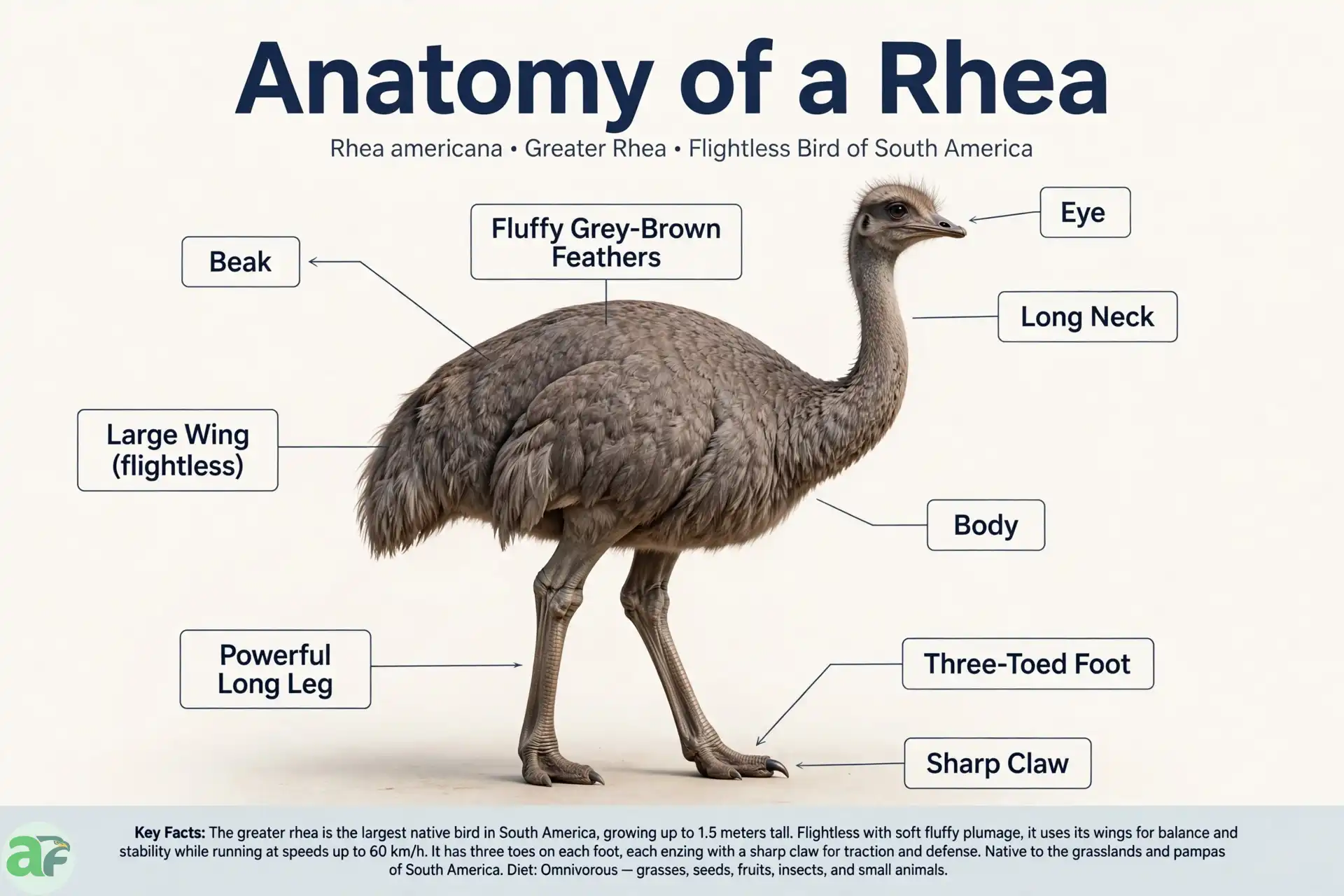
23. Frequently Asked Questions About Rheas
Q1. What is the scientific name of the rhea and what does it mean?
The greater rhea’s scientific name is Rhea americana (Linnaeus, 1758). The genus name Rhea derives from the Greek Titaness Rhea — in Greek mythology, the mother of the Olympian gods including Zeus, Hera, Poseidon, Demeter, Hades, and Hestia. The naming of the genus after this primordial divine figure reflects the impression of ancient, imposing power that the rhea made on European naturalists encountering it. The species name americana is simply the Latin for “of America” — indicating the bird’s origin in the New World. The lesser rhea is Rhea pennata (d’Orbigny, 1834) — the species name pennata from the Latin penna (feather or wing), referring to the lesser rhea’s distinctive feathered legs. The family Rheidae and order Rheiformes both derive from the genus name. The genus Rhea was established by Mathurin Jacques Brisson in 1760 — preceding Linnaeus’s formal species description but based on earlier accounts. The common names reflect the birds’ cultural embeddings: ñandú (Guaraní name for greater rhea — meaning “large spider” in reference to the bird’s shape seen from above); suri or choique (common names for lesser rhea in various Andean and southern cone languages); and the alternative name American ostrich — a misnomer that reflects geographic and functional comparison without biological accuracy.
Q2. What makes the rhea’s nesting system so unusual?
The rhea’s nesting system is the most complex communal nesting system of any South American bird, combining extreme polyandry/polygyny with the most complete sex-role reversal in parental care of any large bird in the Americas. In the greater rhea system: the dominant male mates sequentially with up to 12 females, each laying up to 15 eggs in his nest; the resulting communal nest can contain up to 60 eggs from multiple mothers; the male then drives away additional females and performs all incubation for 35–40 days without female assistance; after hatching, the male performs all chick-rearing for 4–6 months; the females, meanwhile, have moved on to lay eggs in other males’ nests — potentially contributing to 2–4 different males’ nests in a single season. The additional complexity of the system includes: the male’s ability to recognize his primary mate’s eggs and preferentially position them in the nest center; the male’s periodic ejection of peripheral eggs — selectively removing eggs whose position in the nest reduces incubation success; and the occasional formation of large crèches where multiple males’ chick groups merge. The evolutionary logic of this system has been extensively modeled — the males gain by incubating more eggs than they could produce with a single mate; the females gain by allocating parental care to multiple males rather than performing incubation themselves (potentially allowing females to produce more total offspring across the season); and the system is stable because the male’s incubation commitment is honest (he cannot defect once incubating) and the female’s egg production cannot be concentrated in one nest beyond what the male can effectively incubate.
Q3. How fast can a rhea run?
The greater rhea is the fastest runner of any bird in South America — reaching documented speeds of 60–64 km/h in sustained running and capable of short bursts approaching this speed. This places the rhea significantly faster than both the emu (48–50 km/h) and the cassowary (~50 km/h), and approaching the puma’s typical pursuit speed — making the adult rhea effectively immune to predation once flight is initiated at adequate distance. The rhea’s speed is achieved through: long legs providing substantial stride length; a spring-loaded tendon system in the legs that stores and returns energy from each stride (the same mechanism used in the emu and ostrich); the three-toed foot providing good ground contact on pampas soils; and the wing-balance system that allows efficient directional changes during running without loss of speed. The rhea’s wings play a documented role in running performance — research has demonstrated that rheas performing rapid directional changes use their wings as aerodynamic stabilizers, allowing sharper turns than would be possible with the wings folded. The lesser rhea is somewhat slower — estimated at approximately 50 km/h — reflecting the different body proportions of the smaller species and the higher-altitude conditions in which it typically runs.
Q4. What is the connection between rheas and Charles Darwin?
Charles Darwin’s connection to rheas involves two dimensions: the wider context of his observations of South American wildlife during the Beagle voyage (1831–1836) and the specific incident of his near-consumption of the lesser rhea. During the voyage, Darwin encountered greater rheas (already known to science) extensively across the Argentine and Uruguayan pampas — noting their behavior, food preferences, and the gaucho hunting traditions that used boleadoras. He had heard from gauchos of a smaller rhea species occurring in the south but had difficulty finding specimens. In January 1834, during a Christmas celebration at Puerto Deseado in Patagonia, Darwin’s group shot and began eating a rhea for their meal. Partway through the meal, Darwin realized the bird was smaller and differently featured than the greater rheas he had been observing — it was the elusive smaller species. He immediately stopped the consumption, collected the preserved remains (head, neck, legs, wings, and feathers), and sent them to England. John Gould examined the specimen and described the new species in 1837 as Rhea darwinii — now a synonym of or subspecies within Rhea pennata. Darwin himself described the incident in Voyage of the Beagle (1839) with characteristic dry humor — noting that the bird “had been almost entirely devoured” before his mistake was recognized. The partially consumed specimen is preserved in the Natural History Museum, London, making it one of the most historically unusual type specimens in ornithology.
Q5. Where is the best place to see wild rheas?
The most accessible and most reliable greater rhea viewing in South America is at the Iberá Wetlands (Esteros del Iberá) in Corrientes Province, Argentina — one of South America’s finest wildlife destinations where rheas occur at high densities in open grassland alongside extraordinary wildlife including capybara, marsh deer, giant anteaters, and the recently reintroduced jaguar and tapir. The combination of wildlife density, visitor infrastructure, and authentic pampas experience makes Iberá the recommended first destination for rhea viewing in Argentina. Traditional pampas estancias in Buenos Aires Province offering wildlife tourism experiences provide an alternative that combines rhea viewing with gaucho cultural immersion — Estancia visits typically produce reliable morning rhea sightings alongside genuine cultural experiences. For Brazilian cerrado greater rheas, Emas National Park in Goiás is the most important and most accessible protected area — the open cerrado terrain facilitating vehicle-based wildlife observation that reliably produces rhea sightings alongside the park’s extraordinary biodiversity. For lesser rheas in Patagonian steppe, Laguna Blanca National Park in Neuquén Province, Argentina, provides accessible lesser rhea viewing in spectacular southern Andean landscape. For the highest-altitude Puna rhea experience, the puna landscapes of Jujuy and Salta Provinces in northwestern Argentina — including the dramatic Salinas Grandes salt flat — support lesser rheas at 3,500–4,500 meters elevation in some of the most visually dramatic landscapes in South America.
24. Sources & References
- Wikipedia — Rhea americana, Rhea pennata, Rheidae, Rheiformes, Darwin’s rhea, Greater rhea
- IUCN Red List — iucnredlist.org (Near Threatened assessment for R. americana; Least Concern for R. pennata)
- BirdLife International — birdlife.org (species factsheets; population assessments)
- Darwin, C.R. (1839) — Voyage of the Beagle — primary historical source for lesser rhea discovery anecdote
- Gould, J. (1837) — formal description of Rhea darwinii from Darwin’s specimen
- Yorio, P. and colleagues — Argentine rhea ecology and conservation research
- Fernández, G.J. and colleagues — published research on greater rhea mating system and communal nesting
- Codenotti, T.L. and Alvarez, F. — behavioral ecology research on greater rhea reproductive system
- Tompkins Conservation — documentation of Iberá rewilding programs
- National Geographic — nationalgeographic.com
- BBC Wildlife / BBC Earth — bbcearth.com
- Britannica — britannica.com/animal/rhea-bird
- Cornell Lab of Ornithology — allaboutbirds.org (species account; Macaulay Library)
- Narosky, T. and Yzurieta, D. — Birds of Argentina and Uruguay (field reference)