
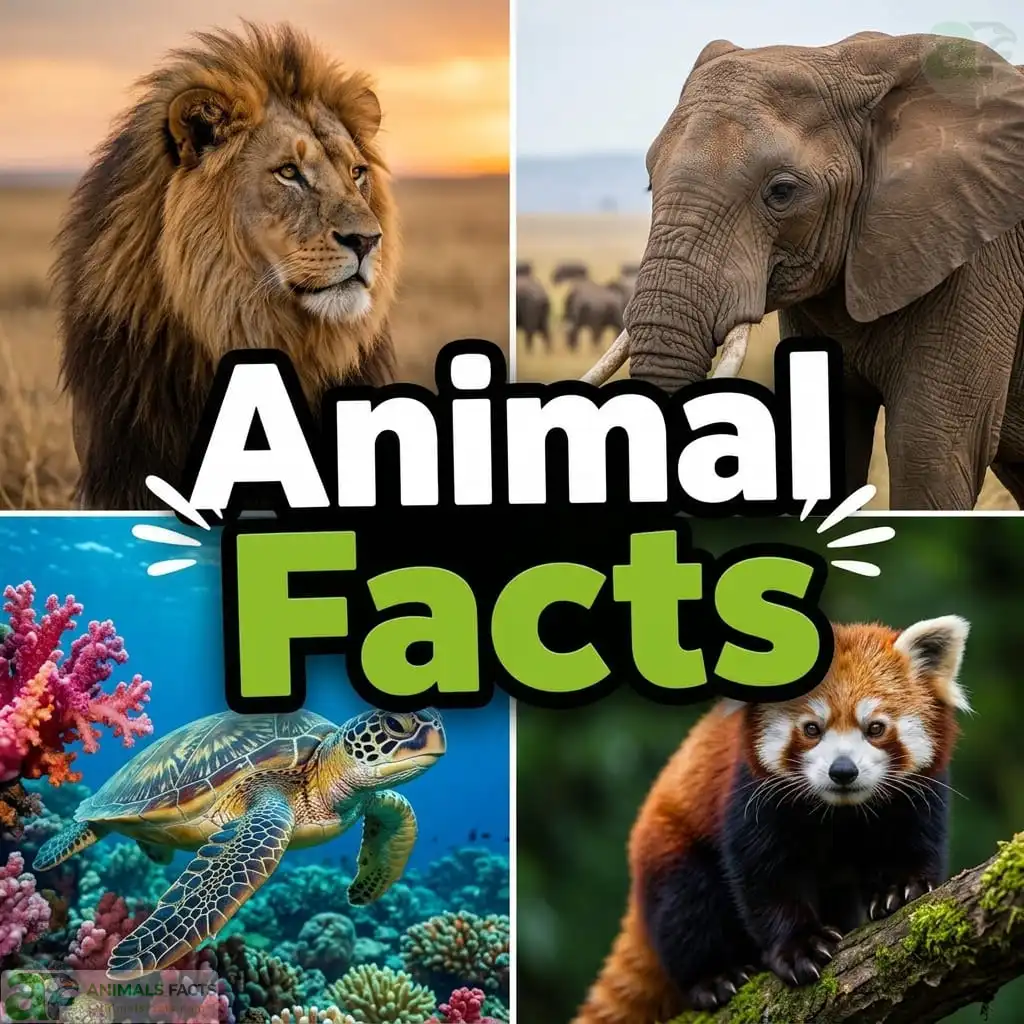
Animal Facts
| Feature | Details |
|---|---|
| Kingdom | Animalia |
| Total Known Species | Approximately 8.7 million species estimated; roughly 1.5 million formally described |
| Oldest Animal Group | Sponges (Porifera) — appeared approximately 700–800 million years ago |
| Habitat | Every environment on Earth — land, freshwater, ocean, sky, deep sea, polar ice, and desert |
| Smallest Animal (Mammal) | Etruscan Shrew (Suncus etruscus) — approximately 3.5 cm, 1.8 grams |
| Smallest Animal (Vertebrate) | Paedophryne amauensis frog — 7.7 mm |
| Largest Animal | Blue Whale (Balaenoptera musculus) — up to 33 meters long and 200 metric tons |
| Fastest Animal on Land | Cheetah (Acinonyx jubatus) — up to 130 km/h (80 mph) |
| Fastest Animal Overall | Peregrine Falcon — over 389 km/h in a dive |
| Longest Lifespan | Ocean Quahog Clam (Arctica islandica) — up to 507 years confirmed; Greenland Shark — estimated 270–500 years |
| Conservation Status | Over 42,000 species currently threatened with extinction (IUCN Red List, 2026) |
| Total Animal Biomass on Earth | Estimated at approximately 2 billion tonnes of carbon across all animal life combined |
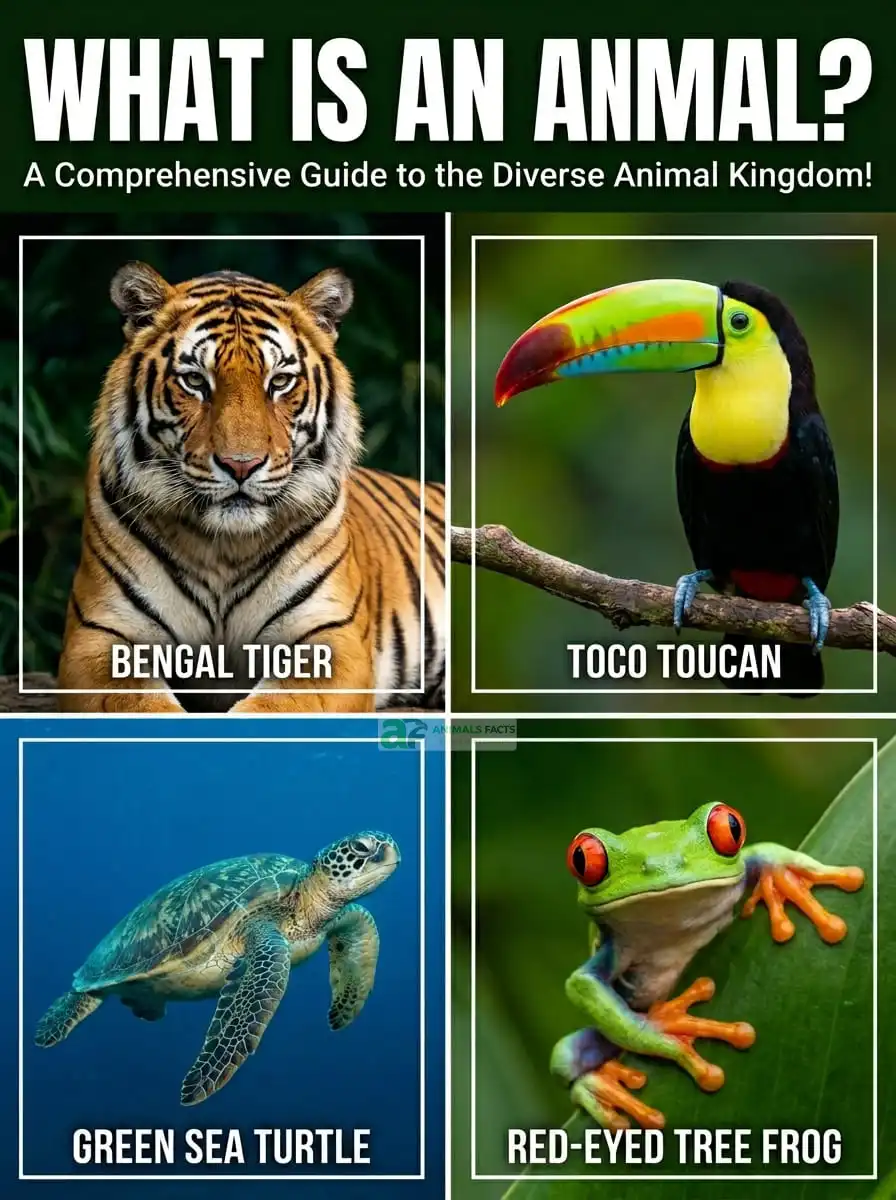
1. Introduction: What is an Animal?
Imagine a world without animals. No birdsong at dawn. No elephants crossing the savanna. No fireflies blinking in summer darkness. No dolphins riding ocean waves. Without animals, Earth would be an entirely different — and far quieter — planet. Animal facts are not just trivia. They are windows into the extraordinary complexity, beauty, and interdependence of all life on Earth.
The animal kingdom — known scientifically as Kingdom Animalia — is the most diverse, widespread, and behaviorally complex grouping of life that has ever existed on this planet. From the microscopic tardigrade that survives in the vacuum of space, to the Blue Whale whose heart is the size of a small car, to the crow that can recognize your face and hold a grudge for years — interesting facts about animals consistently astonish even the most experienced scientists.
This article is your complete, comprehensive guide to the world of animals. Whether you are a student searching for animal facts for kids, a nature documentary enthusiast, a researcher, a teacher building a lesson plan, or simply someone who paused on a nature video and fell down a wonderful rabbit hole of curiosity — you are in exactly the right place. We cover animal habitat, animal diet, animal behavior, conservation, mythology, pop culture, and everything in between. Let us begin.
2. Animal Species Overview & Classification
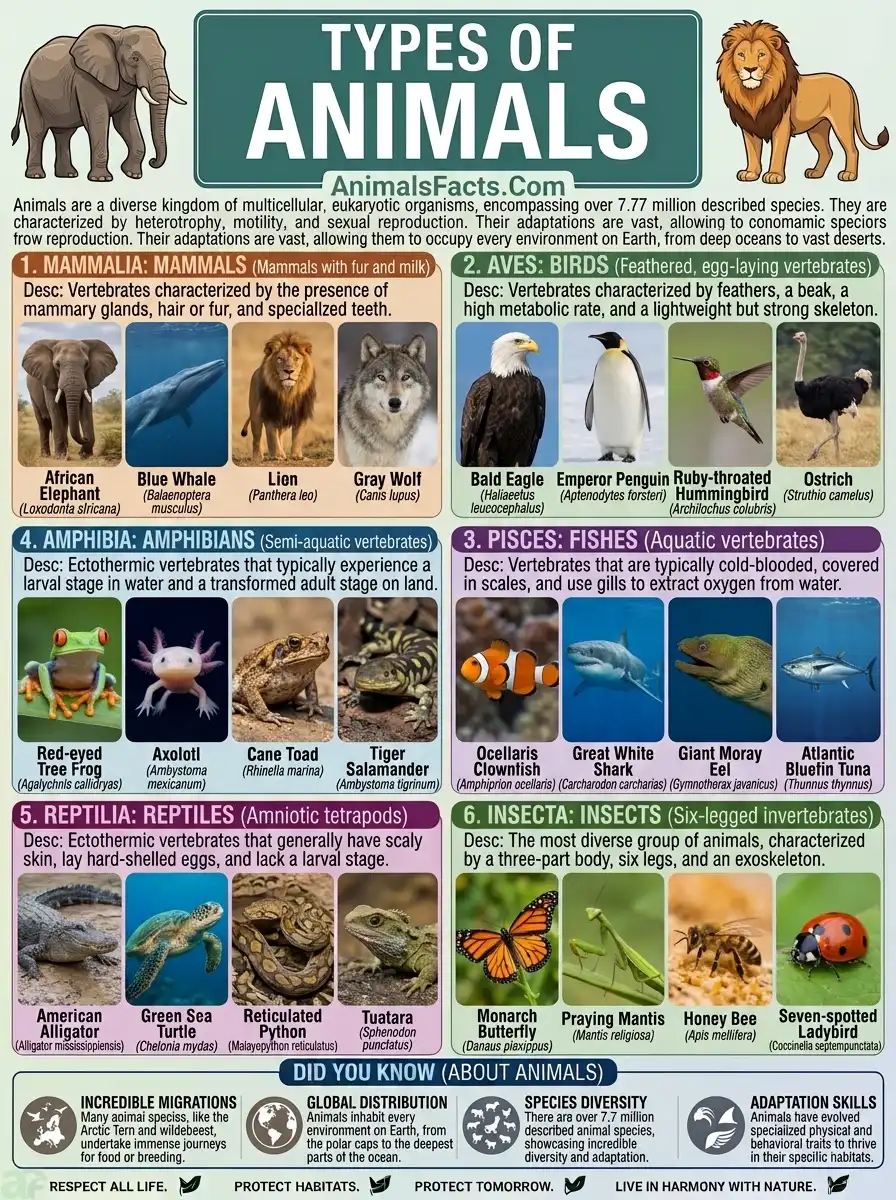
The animal kingdom is one of the five or six major kingdoms of life recognized by modern biology, alongside plants, fungi, bacteria, archaea, and protists. Every animal — from the simplest sponge to the most complex primate — shares a set of fundamental characteristics that define what it means to be an animal.
What Defines an Animal?
All animals share these core characteristics:
- Multicellular: Every animal is made of more than one cell — often billions or trillions of cells working in coordinated systems.
- Eukaryotic: Animal cells contain a true nucleus housing their genetic material.
- Heterotrophic: No animal can produce its own food through photosynthesis. All animals must consume other organisms — plants, fungi, other animals, or microorganisms — to obtain energy.
- Motile: Most animals can move voluntarily at some stage of their life cycle.
- Sexually reproducing: The vast majority of animals reproduce sexually, combining genetic material from two parents.
Major Animal Classification Table
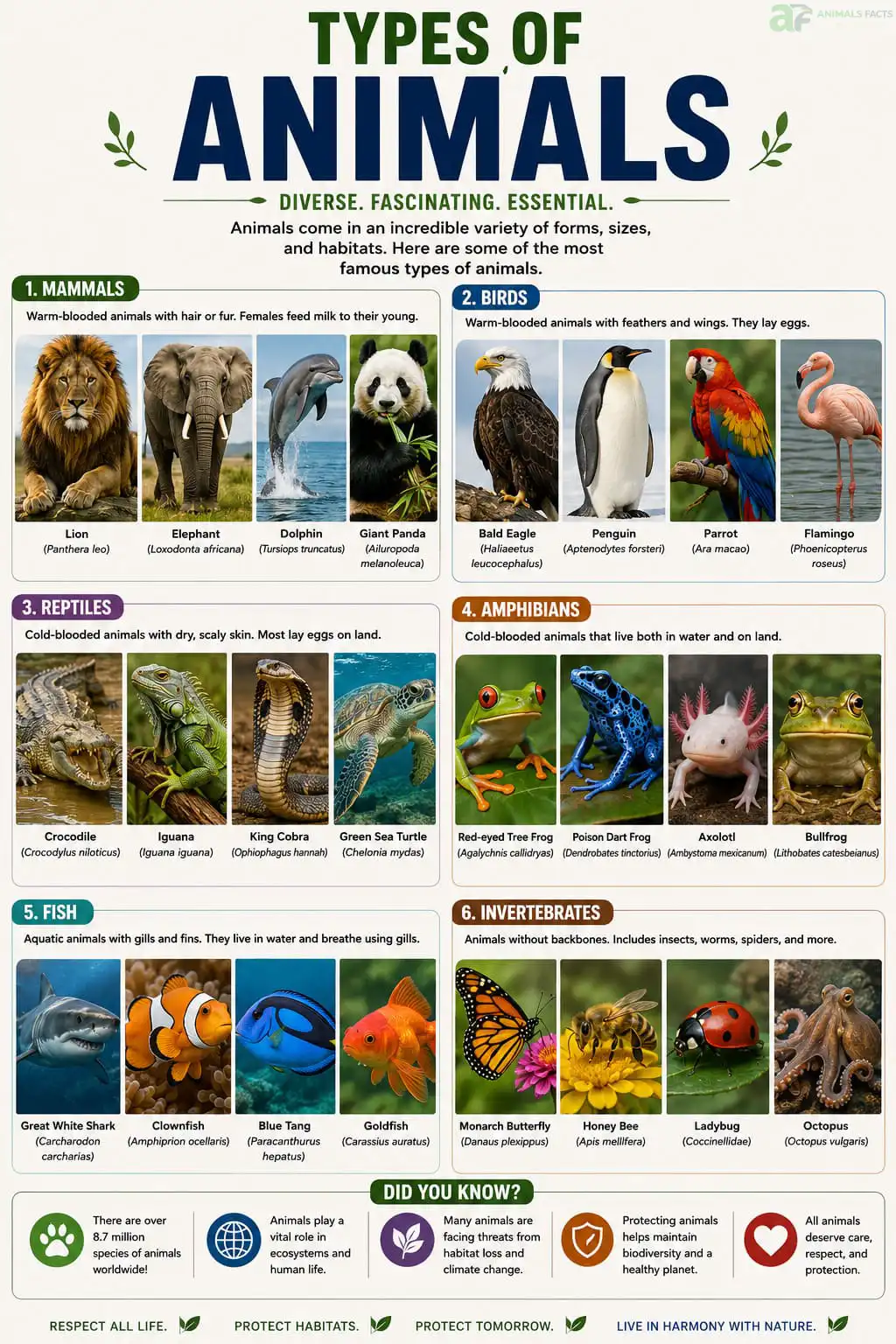
| Group | Scientific Name | Approximate Species | Key Examples |
|---|---|---|---|
| Insects | Class Insecta | ~1,000,000 | Beetles, butterflies, ants, bees |
| Arachnids | Class Arachnida | ~100,000 | Spiders, scorpions, mites, ticks |
| Fish | Superclass Pisces | ~34,000 | Sharks, salmon, clownfish, eels |
| Birds | Class Aves | ~10,000–11,000 | Eagles, penguins, parrots, sparrows |
| Reptiles | Class Reptilia | ~10,000 | Crocodiles, snakes, lizards, turtles |
| Mammals | Class Mammalia | ~6,500 | Whales, elephants, bats, humans |
| Amphibians | Class Amphibia | ~8,000 | Frogs, salamanders, caecilians |
| Mollusks | Phylum Mollusca | ~85,000 | Octopuses, snails, clams, squids |
| Crustaceans | Subphylum Crustacea | ~67,000 | Crabs, lobsters, shrimp, barnacles |
| Worms | Various phyla | ~25,000+ | Earthworms, tapeworms, flatworms |
| Sponges | Phylum Porifera | ~9,000 | Sea sponges (simplest animals) |
| Echinoderms | Phylum Echinodermata | ~7,000 | Starfish, sea urchins, sea cucumbers |
Animal Evolution & Discovery Timeline
~700–800 million years ago: The first multicellular animals — primitive sponge-like organisms — appeared in Earth’s ancient oceans during the Cryogenian Period.
~541 million years ago: The Cambrian Explosion — one of the most significant events in the history of life — saw an extraordinary diversification of animal body plans over a geologically brief period of roughly 20 million years. Nearly every major animal phylum alive today appeared during this period.
~500 million years ago: The first fish — the earliest vertebrates — appeared in the ocean.
~375 million years ago: The first tetrapods — four-limbed vertebrates — crawled from the sea onto land, beginning the conquest of terrestrial environments.
~350 million years ago: Amphibians became the dominant land vertebrates during the Carboniferous Period.
~310 million years ago: Reptiles evolved from amphibian ancestors, developing the amniotic egg that freed vertebrates from dependence on standing water for reproduction.
~230 million years ago: Dinosaurs and the earliest mammals appeared, following the Permian-Triassic mass extinction that wiped out approximately 96% of all marine species.
~150 million years ago: Birds evolved from theropod dinosaurs.
~66 million years ago: The mass extinction event at the end of the Cretaceous period — most likely caused by an asteroid impact combined with volcanic activity — wiped out non-avian dinosaurs and cleared the way for the explosive diversification of mammals.
~6 million years ago: The evolutionary lineage leading to modern humans diverged from that of our closest relatives, the chimpanzees.
1758: Carl Linnaeus published Systema Naturae, establishing the binomial nomenclature system still used today to name and classify all living organisms.
1859: Charles Darwin published On the Origin of Species, establishing natural selection as the mechanism driving the diversity of animal life.
2000s–present: DNA-based genomic analysis is revolutionizing our understanding of animal relationships, regularly revealing new species and overturning long-held assumptions about evolutionary history.
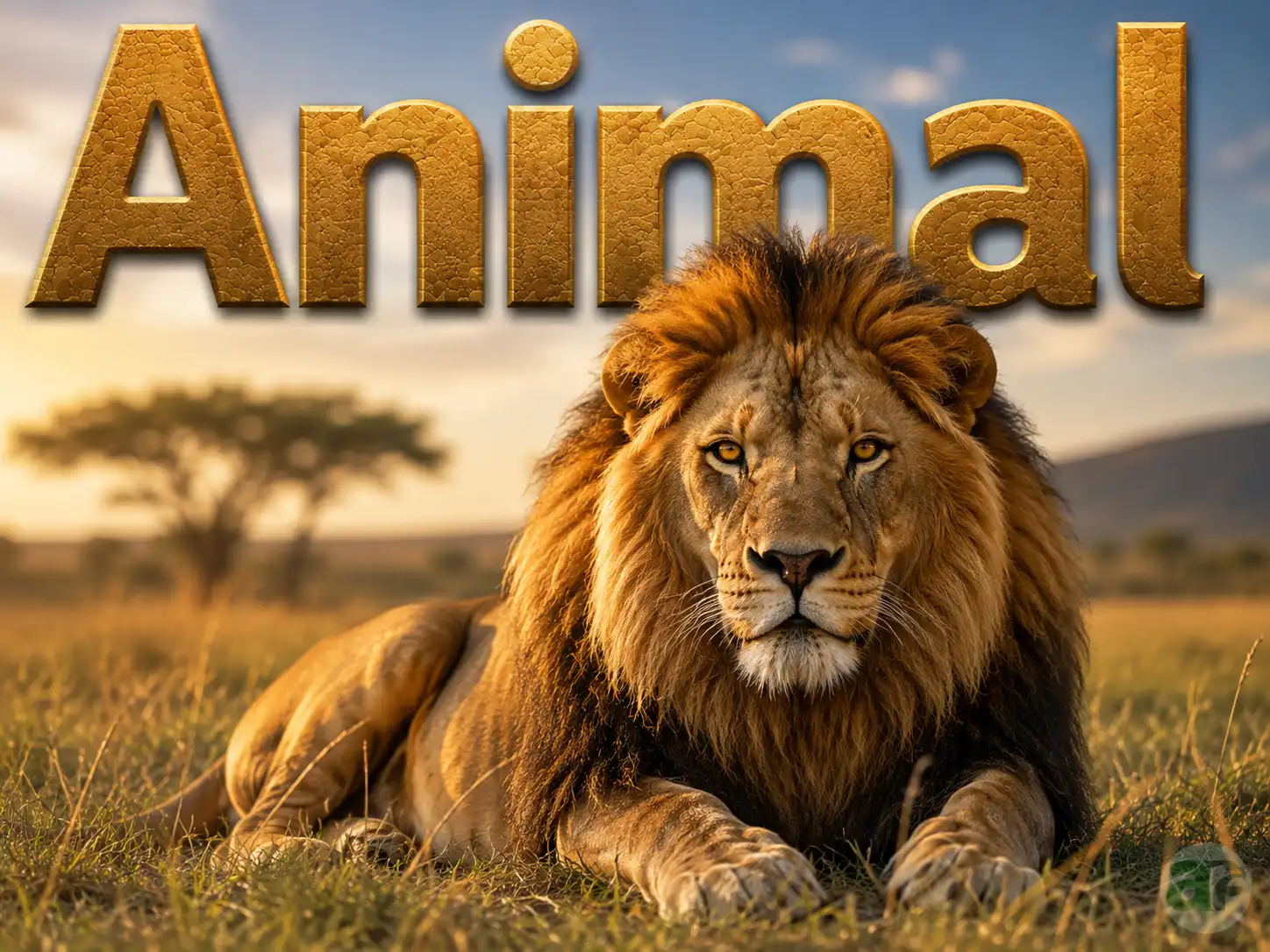
3. Animal Physical Description & Unique Features Across the Animal Kingdom
The physical diversity of animals is so vast that almost any generalization immediately invites exceptions. Yet this very diversity is what makes animal facts so endlessly fascinating.
Size Extremes
Largest animal ever to exist: The Blue Whale — up to 33 meters long and weighing up to 200 metric tons. Its heart alone weighs approximately 180 kilograms and is large enough for a small child to crawl through its aorta.
Smallest vertebrate: Paedophryne amauensis, a frog discovered in Papua New Guinea in 2012, measures just 7.7 millimeters — smaller than a human thumbnail.
Tallest land animal: The Giraffe — up to 6 meters tall, with a neck alone measuring up to 2 meters.
Heaviest land animal: The African Bush Elephant — up to 13,000 kilograms, with tusks that can exceed 3 meters in length.
Strongest animal relative to body size: The Dung Beetle can pull 1,141 times its own body weight — equivalent to a human pulling six fully loaded double-decker buses.
Unique Physical Adaptations
The Mantis Shrimp has 16 types of color receptors in its eyes — humans have only 3. It can strike with the force of a bullet at speeds of 23 meters per second.
The Tardigrade (water bear) is less than 1 millimeter long and can survive the vacuum of space, temperatures from -272°C to +150°C, and radiation levels hundreds of times lethal to humans.
The Electric Eel can generate electrical discharges of up to 860 volts — enough to stun a horse.
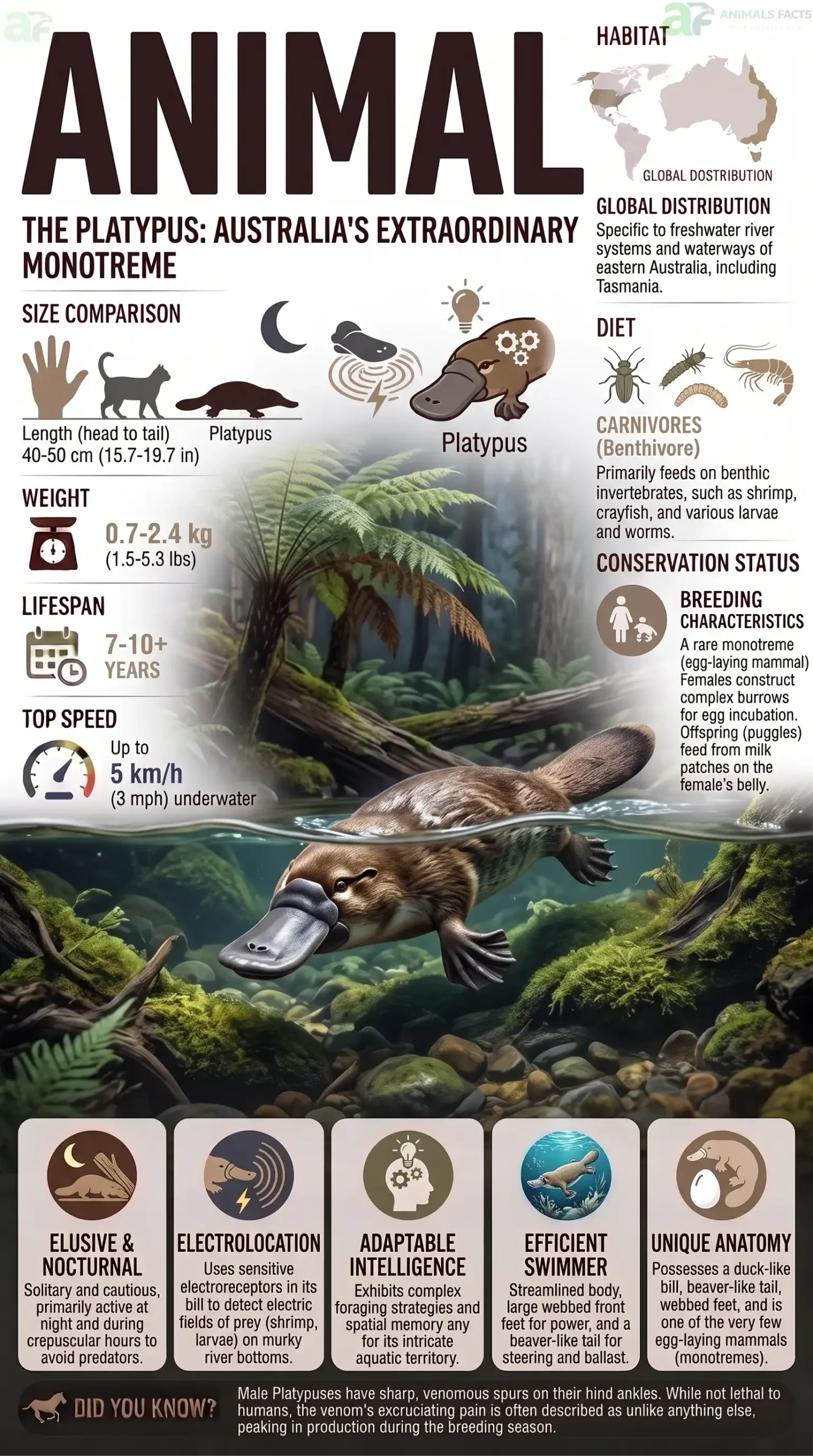
The Platypus is one of only five species of monotreme — egg-laying mammals — and the only mammal known to hunt using electroreception, detecting the electrical fields generated by its prey’s muscle movements.
Did You Know? The Immortal Jellyfish (Turritopsis dohrnii) is the only known animal that can revert to its juvenile polyp state after reaching sexual maturity — theoretically allowing it to cycle through its life indefinitely. Scientists have called it biologically immortal, though it can still die from disease or predation.
4. Top 25 Surprising & Interesting Animal Facts
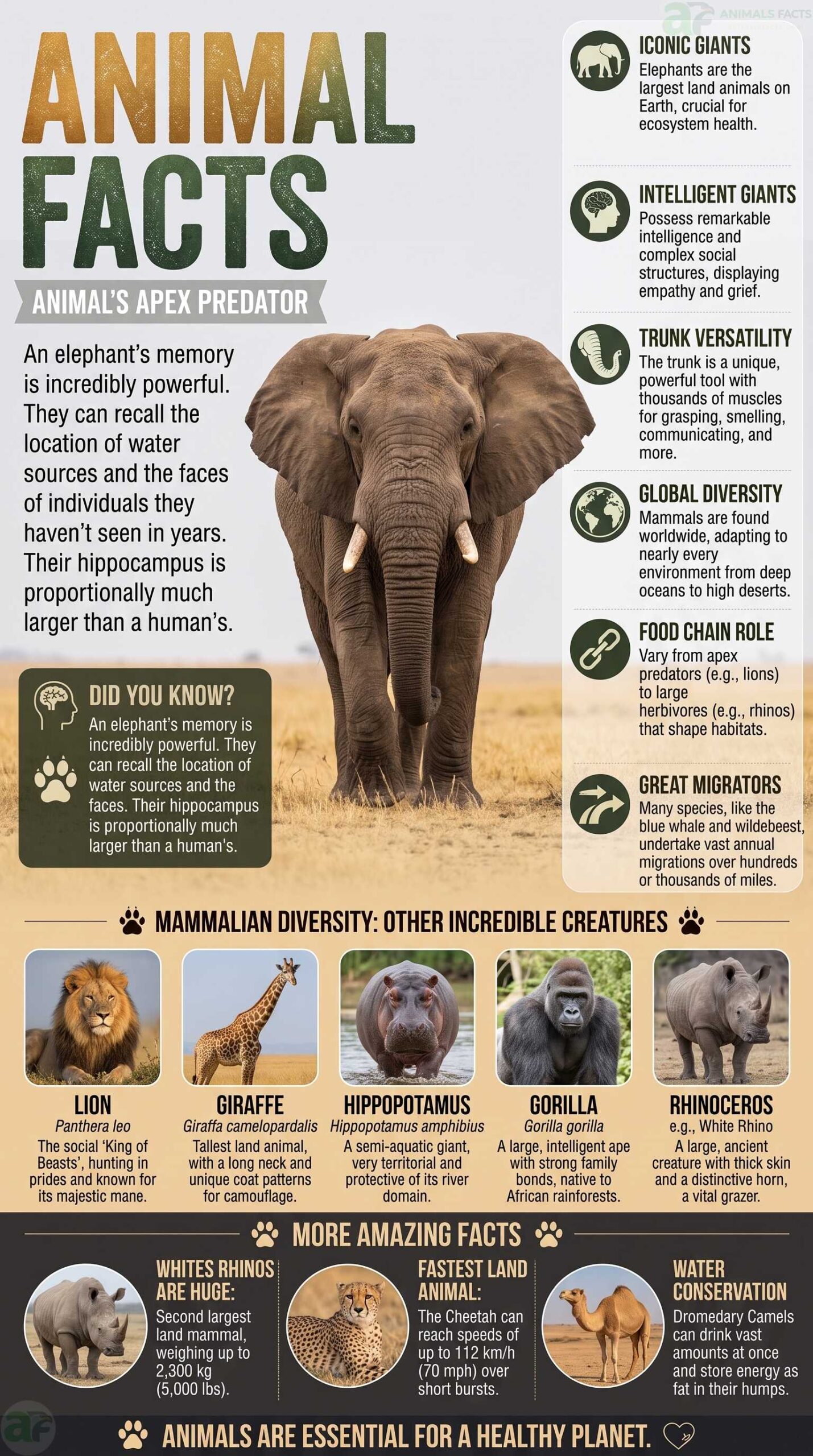
- Octopuses have three hearts, blue blood, and nine brains — one central brain and one in each of their eight arms, allowing each arm to act semi-independently.
- A Blue Whale’s heartbeat can be detected by sensors from a distance of 3.2 kilometers.
- Crows hold grudges. They remember individual human faces and have been documented passing warnings about specific dangerous humans to their offspring and flock members.
- The Mantis Shrimp can punch with the force of a 0.22 caliber bullet — fast enough to boil the water immediately around its punch through cavitation.
- Elephants are the only animals known to have death rituals — they mourn their dead, return to the bones of deceased family members, and have been observed appearing to grieve.
- The Pistol Shrimp snaps its claws so fast it creates a cavitation bubble that briefly reaches 8,000°C — nearly as hot as the surface of the sun — to stun prey.
- Sea Otters hold hands while sleeping to prevent drifting apart from their mate or family group. This behavior is called “rafting.”
- A Cockroach can live for up to one week without its head — it only dies eventually because it cannot drink water.
- The Mimic Octopus can impersonate over 15 different species of dangerous animals, including lionfish, flatfish, and sea snakes, to deter predators.
- Giraffes have no vocal cords in the traditional sense and were long thought to be mute. Research published in 2015 confirmed they communicate through infrasound humming, primarily at night.
- The Arctic Ground Squirrel is the only warm-blooded animal that can allow its body temperature to drop below freezing during hibernation without dying — reaching -2.9°C internally.
- Dolphins give each other individual names — unique signature whistles that they use to address specific individuals throughout their lives.
- The Bowhead Whale can live over 200 years — making it the longest-lived mammal ever confirmed.
- Chimpanzees have been documented making and using tools, engaging in warfare, practicing rudimentary agriculture, and displaying behavior that closely parallels human cultural transmission.
- The Lyrebird of Australia can mimic chainsaws, camera shutters, car alarms, and other bird calls with breathtaking accuracy.
- Sloths are so slow that algae grow on their fur — and they have developed a symbiotic relationship with the algae, which provides camouflage and a supplementary source of nutrients.
- The Greenland Shark grows at approximately 1 centimeter per year and is believed to reach sexual maturity at around 150 years of age — the slowest-maturing vertebrate known to science.
- Cats have a specialized collarbone that allows them to always land on their feet from a fall — a reflex called the “righting reflex” that activates within 0.1 seconds of detecting a fall.
- Honey Badgers are considered by the Guinness World Records as the world’s most fearless animal. They regularly confront and drive away lions, leopards, and venomous snakes from food sources.
- The Bombardier Beetle can fire a boiling, caustic chemical spray from its abdomen at 100°C in rapid pulses — up to 500 times per second — as a defense mechanism.
- Wolves change rivers. The reintroduction of wolves to Yellowstone National Park in 1995 triggered a trophic cascade that altered the behavior of elk, allowed vegetation to recover along riverbanks, stabilized stream banks, and physically changed the course of rivers.
- Ants have been farming fungi for approximately 60 million years — making them the second-oldest known farmers on Earth after termites.
- The Peregrine Falcon was successfully brought back from the brink of extinction caused by the pesticide DDT and now breeds in every continent on Earth except Antarctica — one of conservation’s greatest success stories.
- Platypuses glow blue-green under ultraviolet light — a discovery made in 2020 that shocked the scientific community and led to the investigation of biofluorescence across many other mammal species.
- The Sperm Whale’s click vocalizations — used for echolocation — are the loudest sounds produced by any animal, reaching up to 230 decibels. For comparison, a jet engine at take off produces approximately 140 decibels.
5. Animal Fun Facts
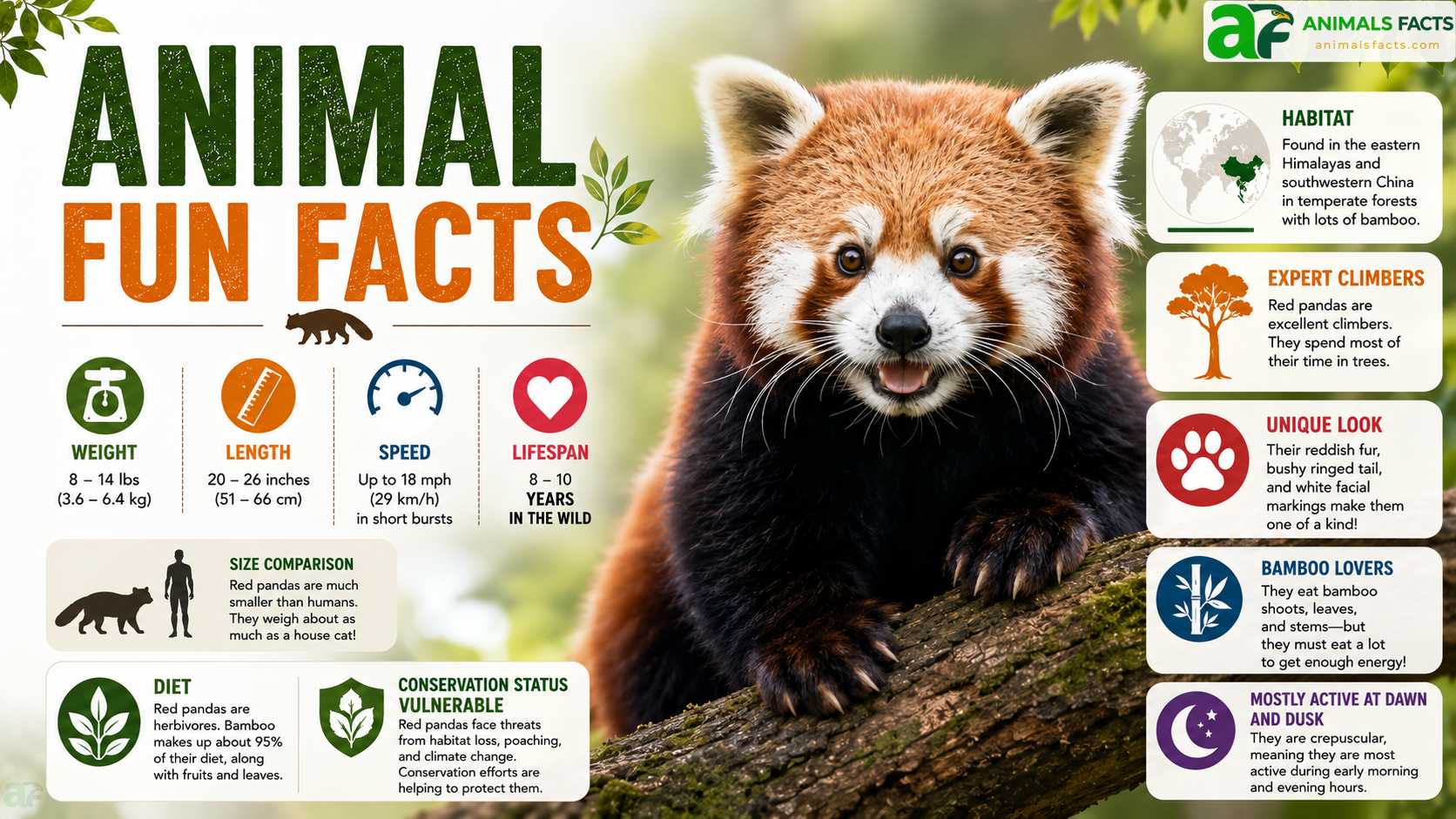
- There are an estimated 10 quintillion (10,000,000,000,000,000,000) individual insects alive on Earth at any given moment.
- The Blue Whale is the largest animal that has ever existed — larger than any dinosaur ever discovered.
- Wombats produce cube-shaped feces — the only animal in the world known to do so.
- A Snail can sleep for up to 3 years during periods of drought or extreme cold.
- Butterflies taste with their feet — they have taste receptors on their tarsi (feet) that activate upon landing on a surface.
- The Giant Pacific Octopus can change the color, texture, and pattern of its skin in under 0.3 seconds — and is completely colorblind.
- Horses and cows can sleep standing up but must lie down to achieve REM (deep) sleep.
- The Pistol Shrimp and the Goby Fish share burrows in a remarkable symbiotic relationship — the nearly blind shrimp digs and maintains the burrow while the sharp-eyed goby serves as a lookout, touching the shrimp with its tail to signal danger.
- Sea cucumbers breathe through their anus — drawing water in and out of their respiratory trees through their hindquarter opening.
- A Humpback Whale’s song can be heard by other whales up to 8,000 kilometers away through deep ocean sound channels.
- Koalas have fingerprints virtually indistinguishable from human fingerprints, even under close forensic examination.
- Wolves can smell prey from a distance of nearly 3 kilometers under favorable wind conditions.
6. Animals Natural Habitat & Geographic Range
Animals have successfully colonized every environment on Earth — from the deepest ocean trenches to the highest mountain peaks, from the driest deserts to the frozen polar regions. This extraordinary adaptability is perhaps the defining characteristic of the animal kingdom.
Major Habitat Types
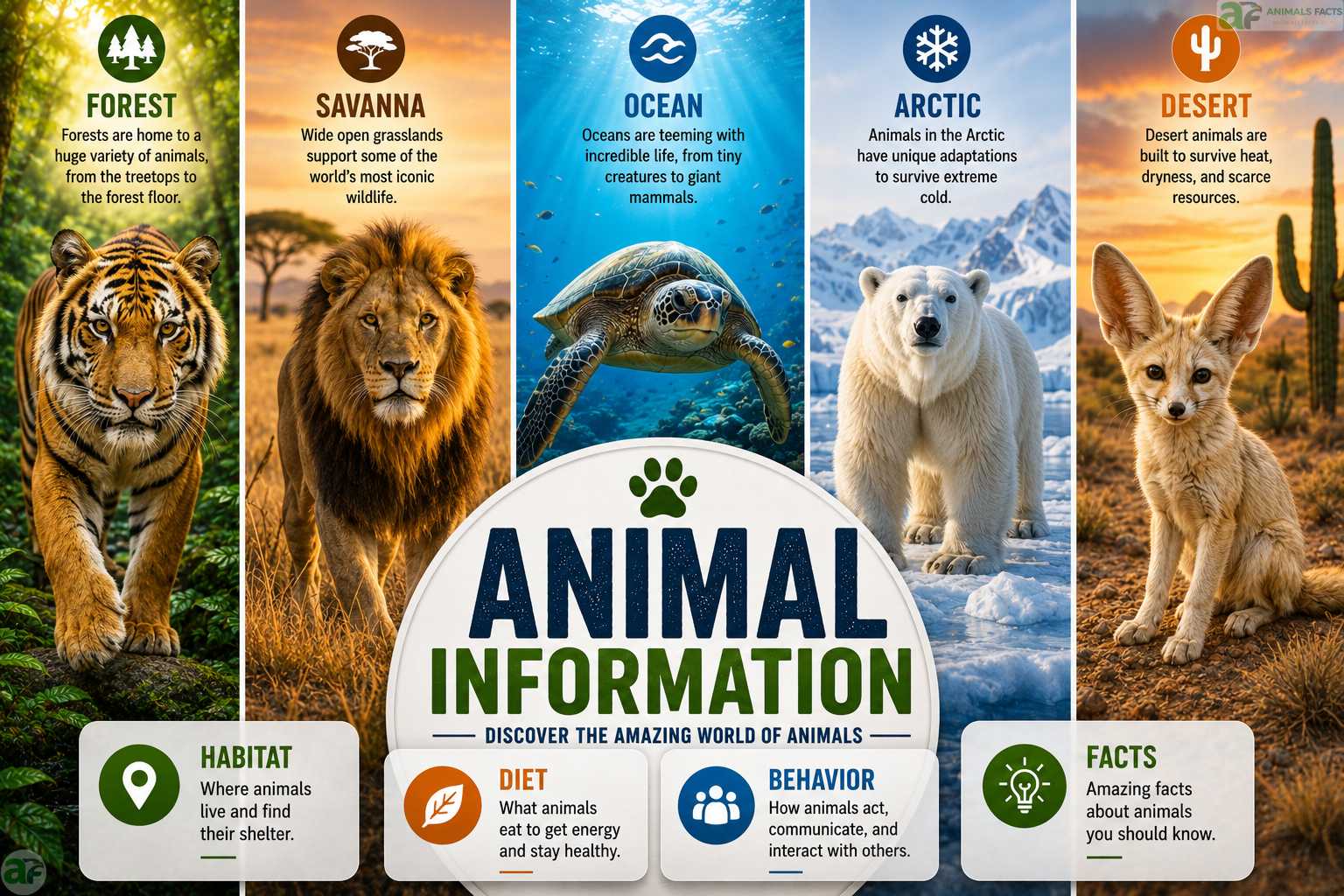
Tropical Rainforests: Cover only 6% of Earth’s land surface but are home to more than 50% of all animal species. The Amazon Basin alone contains an estimated 3 million species. These habitats are under the most severe threat from deforestation and land conversion.
Oceans: Cover 71% of Earth’s surface and contain the largest habitable volume of any environment on the planet. The ocean supports life from surface waters down to the Mariana Trench — approximately 11 kilometers deep — where extraordinary deep-sea creatures survive under crushing pressure, complete darkness, and near-freezing temperatures.
Grasslands & Savannas: Found on every continent except Antarctica, grasslands support some of the most spectacular concentrations of large animals on Earth — including the Great Migration of over 1.5 million wildebeest across the Serengeti ecosystem.
Deserts: Despite appearing lifeless, deserts support remarkable biodiversity. The Namib Desert of southern Africa is home to fog-basking beetles, sidewinder snakes, oryx, and hundreds of specialized species that extract moisture from morning fog and survive temperatures exceeding 60°C at ground level.
Polar Regions: The Arctic and Antarctic support specially adapted species including polar bears, walruses, Arctic foxes, Emperor penguins, and Weddell seals — animals that survive some of the most extreme conditions on the planet.
Freshwater Ecosystems: Rivers, lakes, wetlands, and ponds cover less than 1% of Earth’s surface yet support approximately 10% of all animal species — including over 18,000 species of fish.
Caves: Cave ecosystems host extraordinary specialist animals including blind cavefish, olms (the blind cave salamander of Europe), cave-adapted spiders, and vast colonies of bats — some caves host colonies exceeding 20 million individuals.
Habitat Range by Continent
| Continent | Notable Animal Groups | Approximate Vertebrate Species |
|---|---|---|
| Africa | Lions, elephants, gorillas, flamingos, crocodiles | 5,000+ |
| Asia | Tigers, giant pandas, snow leopards, king cobras, orangutans | 7,000+ |
| South America | Jaguars, anacondas, macaws, poison dart frogs, giant anteaters | 8,000+ |
| North America | Bison, bald eagles, grizzly bears, alligators, monarch butterflies | 4,000+ |
| Europe | Brown bears, wolves, lynx, white storks, Atlantic puffins | 2,500+ |
| Australia | Kangaroos, koalas, platypuses, cassowaries, saltwater crocodiles | 3,500+ |
| Antarctica | Emperor penguins, leopard seals, Weddell seals, Antarctic krill | ~300 |
| Oceans | Blue whales, great white sharks, giant squid, manta rays, clownfish | 34,000+ fish alone |
Did You Know? The deep ocean — below 200 meters — is the largest living space on Earth and remains the least explored. Scientists estimate that 80–91% of deep-sea species have not yet been discovered or formally described by science.
7. Animal’s Diet & Feeding Behavior
Feeding strategies among animals represent one of evolution’s most creative achievements. Over hundreds of millions of years, natural selection has shaped an almost unimaginably diverse array of feeding methods, dietary preferences, and anatomical tools for obtaining food.
Major Dietary Categories
Carnivores: Animals that eat primarily or exclusively other animals. Includes apex predators such as lions, great white sharks, killer whales, and golden eagles, as well as specialist predators like the Aardwolf, which eats almost nothing but termites.
Herbivores: Animals that eat exclusively plant material. Includes grazers like bison, wildebeest, and horses; browsers like giraffes and okapi; frugivores like fruit bats and many primates; and folivores like koalas and three-toed sloths.
Omnivores: Animals that consume both plant and animal material. Includes humans, bears, pigs, raccoons, crows, and most primate species. Omnivory is generally considered an evolutionarily flexible and advantageous dietary strategy.
Insectivores: Animals that specialize in eating insects. Includes anteaters, pangolins, shrews, moles, and many bat species.
Filter Feeders: Animals that extract tiny food particles from water. Includes Blue Whales (which filter krill through baleen plates), Whale Sharks, Flamingos, Clams, and Sponges.
Detritivores & Scavengers: Animals that consume dead organic material or decomposing matter. Includes vultures, hyenas, dung beetles, earthworms, and many marine invertebrates — all performing critical ecosystem services.
Parasites: Animals that live on or within a host organism, drawing nutrition without immediately killing the host. Includes tapeworms, ticks, leeches, and over 40% of all animal species that live as parasites at some stage of their life cycle.
Diet Breakdown by Major Group
| Animal Group | Primary Food Source | Secondary Food Source | Feeding Method |
|---|---|---|---|
| Big Cats | Mammals (80–95%) | Birds, reptiles (5–20%) | Ambush hunting; suffocation |
| Sharks | Fish, marine mammals | Invertebrates, carrion | Active pursuit; ambush |
| Primates | Fruit, leaves | Insects, small animals | Foraging; tool use |
| Baleen Whales | Krill, small fish | Copepods | Filter feeding |
| Eagles | Small mammals, fish | Birds, reptiles | Aerial attack; talons |
| Termites | Wood, fungi, soil | Organic matter | Symbiotic digestion |
| Hummingbirds | Floral nectar (90%) | Small insects (10%) | Hovering; long beak |
| Vampire Bats | Blood (100%) | None | Anticoagulant saliva; lapping |
Did You Know? The Vampire Bat is the only mammal that survives exclusively on blood — a dietary strategy called hematophagy. It can detect the warmth and sound of blood flowing through veins using specialized heat sensors in its nose. Remarkably, vampire bats share blood meals with hungry roost-mates who have failed to feed — a form of reciprocal altruism rarely observed in non-primate mammals.
8. Animals Reproduction & Life Cycle
No single strategy defines animal reproduction — the kingdom Animalia has evolved virtually every conceivable method of producing offspring, from scattering millions of eggs into the open ocean to nursing a single infant for years.
Reproductive Strategies
Sexual Reproduction: The most common strategy across the animal kingdom. Two parents contribute genetic material, creating offspring with unique genetic combinations. Promotes adaptability and disease resistance across populations.
Asexual Reproduction: Some animals reproduce without a partner. Komodo Dragons and certain sharks can reproduce through parthenogenesis — developing eggs without fertilization. Starfish can regenerate entire new individuals from a single severed arm.
Vivipary (Live Birth): All placental mammals, many sharks, some reptiles, and a few fish give birth to live young rather than laying eggs.
Ovipary (Egg-laying): Birds, most reptiles, fish, amphibians, insects, and the egg-laying mammals (monotremes) reproduce by laying eggs.
Ovovivipary: Some animals — including many sharks, some lizards, and certain snakes — retain eggs internally until they hatch, then give birth to live young without a placenta.
Parental Care Extremes
Most devoted parents: Emperor Penguins — males fast for over 60 days in temperatures of -60°C, balancing a single egg on their feet, while the female is at sea feeding.
Least parental care: Pacific Salmon — adults die immediately after spawning; offspring hatch and survive entirely on their own from the first moment of life.
Longest gestation: African Elephant — 22 months — the longest pregnancy of any land animal.
Shortest gestation: Virginia Opossum — just 12–13 days — producing tiny, undeveloped young that continue developing in the mother’s pouch.
Lifespan Comparison Table
| Animal | Average Lifespan | Record/Maximum |
|---|---|---|
| Mayfly | 24 hours (adult) | A few days maximum |
| House Mouse | 1–2 years | Up to 4 years |
| Dog (domestic) | 10–13 years | 29 years (confirmed record) |
| Chimpanzee | 30–40 years | ~60 years |
| African Elephant | 60–70 years | ~86 years |
| Galapagos Tortoise | 100+ years | ~175 years |
| Greenland Shark | 270–400 years | ~500 years (estimated) |
| Ocean Quahog Clam | 100–400 years | 507 years (confirmed) |
| Immortal Jellyfish | Theoretically indefinite | Unknown maximum |
9. Social Behavior & Communication
From the solitary snow leopard to the supercolony of Argentine Ants spanning thousands of kilometers, animals display a spectrum of social structures that rivals human society in its complexity.
Social Structures
Solitary: Many large predators — tigers, leopards, polar bears, most sharks — live and hunt alone, coming together only to mate.
Pair-bonded: Many bird species, gibbons, beavers, and wolves form long-term or lifelong monogamous pair bonds.
Family groups: Elephants live in matriarchal family units of 8–15 individuals led by the oldest female. Lions form prides. Gorillas live in troops led by a dominant silverback male.
Large herds and colonies: Wildebeest form herds of over 1 million individuals during the Great Migration. Army Ant colonies can contain 700,000 individuals moving as a unified superorganism. Some seabird colonies contain millions of nesting pairs.
Communication Methods
Vocalizations: Whales, birds, elephants, primates, and hundreds of other species use complex vocal signals to communicate information about food, danger, territory, and social relationships.
Chemical signals (pheromones): The primary communication channel for insects, many fish, and various mammals. Ants lay chemical trails that direct colony-mates to food sources with extraordinary precision.
Visual signals: Color changes in cephalopods, the color-coded threat displays of Mandrill males, the elaborate tail of the Peacock, and the bioluminescent flashing of Fireflies all transmit visual information between individuals.
Electrical signals: Electric Fish of South America and Africa communicate through species-specific electrical pulses — a communication channel invisible to virtually all other animals.
Seismic communication: Elephants stamp their feet to generate infrasound vibrations that travel through the ground — felt by other elephants through the sensitive pads of their feet — over distances of 16 kilometers or more.
Did You Know? Prairie Dogs — small rodents of the North American grasslands — have one of the most sophisticated animal communication systems ever documented. Their calls contain specific descriptors of approaching predators, including information about size, shape, color, and speed of movement — essentially creating noun-like “words” for different threats. Researcher Dr. Con Slobodikoff spent decades decoding this language and describes it as the most complex animal communication system yet discovered outside of human language.
10. Animal Predators & Defense Mechanisms
Every animal in the natural world is either hunting something or being hunted — and often both simultaneously. The evolutionary arms race between predators and prey has driven some of the most spectacular adaptations in the entire animal kingdom.
Apex Predators of Each Major Habitat
African Savanna: Lion — coordinates group hunts targeting animals many times their individual size.
Ocean: Orca (Killer Whale) — hunts cooperatively in pods, targeting everything from fish to great white sharks and blue whales.
Rainforest: Jaguar — the most powerful bite of any big cat relative to skull size; hunts by crushing prey’s skull through thick forest understory.
Arctic: Polar Bear — the largest land carnivore; can smell seals through 1 meter of snow and from 30 kilometers away.
Rivers: Saltwater Crocodile — unchanged in form for 200 million years; the most powerful bite force of any animal ever measured at 16,460 Newtons.
Sky: Peregrine Falcon — the fastest animal on Earth in a dive; strikes prey with a closed fist at killing speed.
Defense Mechanisms
Camouflage: The Leaf-Tailed Gecko of Madagascar is virtually indistinguishable from dead leaves. The Stick Insect mimics twigs. The Stonefish — the world’s most venomous fish — is almost invisible against rocky seabed.
Chemical Defense: Poison Dart Frogs advertise their toxicity with vivid colors (aposematism). The Hagfish releases extraordinary quantities of suffocating slime when threatened. The Bombardier Beetle fires boiling caustic spray.
Armor: Armadillos, pangolins, turtles, and tortoises rely on physical armor. The Pangolin curls into an impenetrable ball covered in keratin scales so tough that lions cannot bite through them.
Playing dead (Thanatosis): The Virginia Opossum, certain snakes, and various insects feign death convincingly enough to deter predators that only eat live prey.
Mimicry: The Mimic Octopus impersonates dangerous species. The Viceroy Butterfly mimics the toxic Monarch Butterfly. The King Snake mimics the banding pattern of the venomous Coral Snake.
Speed: Many animals rely entirely on outrunning predators. The Pronghorn Antelope of North America — the second-fastest land animal at 88 km/h — is built for sustained high-speed running over long distances, an adaptation that evolved to escape now-extinct American cheetahs.
11. Animal Facts for Kids
Welcome, young explorers! The animal kingdom is the most amazing, strange, and wonderful place you could ever learn about — and the best part is that it is all completely real!
Here are some of the most mind-blowing animal facts for kids:
- A Blue Whale is so big that its tongue weighs as much as an elephant, and its heart is the size of a small car!
- Octopuses have three hearts and their blood is blue — not red like ours!
- Elephants are the only animals that cannot jump. Not even a little bit!
- A group of flamingos is called a “flamboyance.” A group of crows is called a “murder.” A group of owls is called a “parliament.”
- Sloths are so slow that plants grow on their fur — and they use this as camouflage!
- Butterflies taste with their feet — imagine tasting the floor every time you took a step!
- The Mantis Shrimp can punch so fast it creates a flash of light and a mini-explosion in the water!
- Dolphins have names for each other — they each have a special whistle that works like their very own name.
- A baby kangaroo (called a joey) is the size of a jellybean when it is born and then crawls into its mother’s pouch to keep growing!
- Ants have been farming their own food — growing fungi underground — for 60 million years. Humans only started farming about 12,000 years ago!
Did You Know? Some animals can survive in conditions that would kill a human in seconds. The tiny Tardigrade — also called a “water bear” — is only about half a millimeter long, but it can survive in the vacuum of outer space, extreme radiation, and temperatures from nearly absolute zero all the way up to 150°C. Scientists have even found living tardigrades in samples returned from space missions!
12. Relationship of Animals with Humans
Of all the relationships in the natural world, perhaps none is more complex, more consequential, or more layered with contradiction than the relationship between humans and other animals.
Domestication
The domestication of animals is one of the most transformative events in human history. By selectively breeding wild animals for desirable traits over many generations, our ancestors fundamentally altered the trajectory of human civilization.
Dogs — domesticated from wolves approximately 15,000–40,000 years ago — were the first domestic animal and remain the most widespread. Today approximately 900 million dogs live on Earth, the vast majority as free-roaming or semi-feral animals.
Cattle, sheep, goats, and pigs were domesticated in the Middle East approximately 10,000 years ago during the Neolithic Revolution, enabling settled agriculture and the rise of complex civilizations.
Horses were domesticated approximately 5,500 years ago on the Eurasian steppe, transforming warfare, transport, communication, and agriculture across the ancient world.
Chickens — domesticated approximately 8,000 years ago from the Red Junglefowl — are now the most numerous birds on Earth with approximately 33 billion alive at any moment.
Silkworms, honeybees, and camels are among dozens of other species domesticated for specific economic or cultural purposes.
Animals in Science & Medicine
Animals have been indispensable to the development of modern medicine. Insulin for treating diabetes was first isolated from dog and pig pancreases. Horseshoe Crab blood contains a substance called Limulus Amebocyte Lysate (LAL) used to test every single injectable medicine and implanted medical device for bacterial contamination. Without it, modern safe surgery as we know it would not exist.
Venoms from snakes, cone snails, and spiders have yielded life-saving drugs including Captopril (treating hypertension, derived from Brazilian pit viper venom), Ziconotide (a painkiller from cone snail venom), and Tirofiban (preventing blood clots, derived from saw-scaled viper venom).
Animals & Human Wellbeing
Research consistently shows that interaction with animals reduces cortisol (the stress hormone), lowers blood pressure, and reduces symptoms of depression and anxiety. Therapy animals — including dogs, cats, horses, and even rabbits — are now deployed in hospitals, schools, care homes, and disaster relief centers worldwide. The documented health benefits of pet ownership include reduced risk of cardiovascular disease, improved immune function in children, and significantly improved mental health outcomes across all age groups.
13. Animal Conservation Status & Threats
We are living through what scientists are calling the Sixth Mass Extinction — the first extinction event in Earth’s history to be driven primarily by a single species: Homo sapiens.
Global Conservation Data (2026)
| Category | Number of Species |
|---|---|
| Total species assessed by IUCN | 157,000+ |
| Critically Endangered | 8,400+ |
| Endangered | 13,500+ |
| Vulnerable | 16,000+ |
| Near Threatened | 8,000+ |
| Species extinct since 1500 | 900+ confirmed |
| Species lost per day (estimated) | 150–200 |
Major Threats
Habitat Loss & Land Use Change: The single greatest driver of animal extinction worldwide. Over 50% of Earth’s original forests have been cleared, and approximately 70% of the world’s grasslands have been converted to farmland. Habitat loss affects virtually every land-dwelling animal species.
Climate Change: Rising temperatures, shifting seasons, altered precipitation patterns, sea level rise, and ocean acidification are rapidly transforming habitats at a pace many species cannot keep up with through adaptation or migration.
Overexploitation: Overfishing has depleted over 30% of the world’s fish stocks to unsustainable levels. Trophy hunting, bushmeat hunting, and the illegal wildlife trade continue to severely impact populations of large mammals, reptiles, and birds.
Invasive Species: Animals introduced outside their native range — whether deliberately or accidentally — have driven the extinction of more species than any other single cause on islands worldwide. Rats, cats, stoats, snakes, and dozens of other invasives have eliminated entire island faunas.
Pollution: Plastic pollution, chemical contamination, pesticide exposure, light pollution, noise pollution, and agricultural runoff affect animal health, reproduction, behavior, and survival across every ecosystem.
Disease: Emerging infectious diseases — including chytridiomycosis (which has driven over 90 amphibian species to extinction), white-nose syndrome in bats, and various poxviruses affecting island species — represent an accelerating threat, particularly in the context of habitat stress.
Did You Know? The Wildlife Conservation Society estimates that if current trends continue, we could lose up to 50% of all animal species by the end of the 21st century. This would represent the most rapid mass extinction event since the asteroid impact that wiped out the dinosaurs 66 million years ago.
14. Famous Animals
Lonesome George – The Last of His Kind
Lonesome George was a Pinta Island Tortoise (Chelonoidis abingdonii) — the last confirmed individual of his subspecies on Earth. He lived at the Charles Darwin Research Station in the Galápagos Islands from 1972 until his death in June 2012, having never successfully bred despite years of conservation efforts. He became the world’s most famous symbol of extinction and the desperate urgency of conservation action.
Koko – The Gorilla Who Spoke
Koko was a female western lowland gorilla who spent her entire life at the Gorilla Foundation in California, where she was taught American Sign Language by researcher Dr. Francine Patterson. Koko mastered over 1,000 signs and demonstrated the ability to combine them in novel ways, express emotions, discuss her own past and future, and even lie. She died in her sleep in June 2018 at the age of 46 and remains one of the most celebrated and controversial animal subjects in scientific history.
Laika – The First Animal in Earth Orbit
Laika was a stray dog from the streets of Moscow who became the first animal to orbit Earth, launched aboard Sputnik 2 by the Soviet Union on November 3, 1957. Sadly, Laika died within hours of launch from overheating, as the spacecraft was not designed for recovery. Her story transformed the public debate about animal use in scientific experimentation and remains one of the most poignant episodes in the history of space exploration.
Keiko – The Real Free Willy
Keiko was an Orca who rose to global fame as the star of the 1993 film “Free Willy.” Public outcry over his condition in a Mexico City amusement park led to a years-long, multi-million-dollar effort to rehabilitate and eventually release him into Icelandic waters — the most expensive animal conservation project ever undertaken for an individual animal at that time. Keiko died in December 2003, having never fully reintegrated with wild orca pods.
Paul the Octopus — World Cup Prophet
Paul was a common octopus (Octopus vulgaris) housed at the Sea Life Centre in Oberhausen, Germany, who became a global celebrity during the 2010 FIFA World Cup by successfully predicting the outcome of 8 consecutive matches — including Germany’s victories and defeats and Spain’s championship. His remarkable accuracy — the probability of which by chance alone is approximately 1 in 256 — made him briefly the most famous animal on Earth.
15. Role in Ecosystem & Food Chain
Remove any animal from its ecosystem — no matter how small or seemingly insignificant — and the consequences ripple outward in ways that are often impossible to predict and sometimes catastrophic.
Keystone Species
A keystone species is one whose impact on its ecosystem is disproportionately large relative to its population size. Remove it, and the ecosystem changes dramatically or collapses entirely.
Wolves in Yellowstone: The reintroduction of Gray Wolves to Yellowstone National Park in 1995 triggered a trophic cascade — a chain of ecological effects that changed the behavior of elk, allowed riverbank vegetation to recover, stabilized stream banks, altered river courses, increased beaver populations, and ultimately changed the physical geography of the park. This story — known as “How Wolves Change Rivers” — has become the most cited example of trophic cascade in conservation science.
Sea Otters in kelp forests: Sea Otters eat sea urchins. Remove otters and sea urchin populations explode, consuming entire kelp forests — destroying the habitat of hundreds of fish and invertebrate species. Protect otters and kelp forests flourish, sequestering carbon and sheltering extraordinary marine biodiversity.
African Elephants: Called “ecosystem engineers,” elephants shape their environment dramatically — knocking down trees to create clearings, digging water holes in dry riverbeds that other species depend on, dispersing seeds across vast distances in their dung, and creating paths through dense vegetation used by dozens of other species.
Sharks: As apex predators of the ocean, sharks regulate the populations and behavior of fish and marine mammals throughout the food chain. In regions where sharks have been overfished, the resulting population explosions of their prey have devastated coral reef and seagrass ecosystems.
Pollination & Seed Dispersal
Bees — the most important group of animal pollinators on Earth — are responsible for pollinating approximately one-third of all human food crops. The economic value of insect pollination to global agriculture is estimated at $500 billion annually.
Fruit bats, hummingbirds, butterflies, moths, beetles, and even lemurs and lizards contribute to pollination of thousands of plant species. Animals also disperse seeds — through their fur, in their droppings, in cheek pouches — maintaining forest composition and genetic diversity across landscapes.
16. Myths, Folklore & Cultural Significance
Since the very first humans gazed into a fire and tried to make sense of the world around them, animals have occupied the center of our stories, our fears, our gods, and our identities.
Ancient Egypt
Animals were central to Egyptian religious life. Cats were sacred to the goddess Bastet and killing one — even accidentally — was punishable by death. The Ibis was revered as the earthly form of Thoth, god of wisdom. Crocodiles were associated with Sobek, god of the Nile and fertility. The Scarab Beetle represented Khepri, god of the rising sun, and was one of ancient Egypt’s most powerful protective symbols.
Greek & Roman Mythology
The animal kingdom was woven throughout classical mythology. Zeus transformed into a swan, a bull, and an eagle. Artemis was the goddess of wild animals and hunting. The Minotaur, the Sphinx, the Centaur, the Pegasus — half the mythological canon of ancient Greece was composed of extraordinary hybrid animals. The Eagle as a symbol of divine authority and imperial power — adopted by Rome and subsequently by dozens of modern nations — traces its lineage directly to Greek mythology.
Indigenous Traditions Worldwide
Virtually every Indigenous culture on Earth has developed deep and sophisticated relationships with the animals sharing their landscapes. Totem animals in North American Indigenous traditions represent ancestral spirits and clan identities. Dreamtime stories of Australian Aboriginal peoples encode ecological knowledge about animals accumulated over tens of thousands of years. The Jaguar is a deity, a shaman’s spirit, and a symbol of royal power across dozens of Mesoamerican and Amazonian cultures simultaneously.
Modern Cultural Icons
The Giant Panda has become the global symbol of wildlife conservation — the logo of the WWF (World Wide Fund for Nature) since 1961. The Bald Eagle is the national symbol of the United States. The Lion is the symbol of British royalty, used on the royal coat of arms since the 12th century. The Dove is the universal Western symbol of peace. The Butterfly represents transformation and rebirth across cultures from ancient Greece to modern Japan.
17. Animals in Pop Culture
Animals have been woven into human storytelling, entertainment, and art since the earliest cave paintings created over 40,000 years ago — and their place at the center of popular culture has only grown more prominent in the modern era.
Film & Animation
“The Lion King” (Disney, 1994 & 2019) — One of the highest-grossing animated films in history; its depiction of African savanna life and the lion’s royal majesty has shaped popular perceptions of African wildlife for two generations.
“Jaws” (Steven Spielberg, 1975) — The film credited with creating the modern concept of the summer blockbuster; also credited with generating decades of public fear and misunderstanding of sharks that contributed significantly to overhunting of the species.
“Free Willy” (1993) — Sparked the global debate about keeping cetaceans in captivity and directly led to the eventual retirement of Orca from SeaWorld following years of public pressure.
“Planet Earth” (BBC, 2006 & 2016) — Perhaps the most influential wildlife documentary series ever made; credited with transforming global public awareness of biodiversity and conservation on an unprecedented scale.
“Finding Nemo” (Pixar, 2003) — Increased public interest in clownfish and coral reef conservation; unfortunately also caused a dramatic increase in demand for clownfish as pets, pressuring wild populations — an unintended consequence known as the “Nemo Effect.”
Literature
“The Call of the Wild” by Jack London (1903) — One of the most celebrated animal novels ever written; a story of a domesticated dog’s return to wild nature that has remained continuously in print for over 120 years.
“Animal Farm” by George Orwell (1945) — A political allegory using farm animals that has become one of the most widely read and taught novels of the 20th century.
“Watership Down” by Richard Adams (1972) — An epic adventure story told from the perspective of rabbits that became a beloved classic of English literature.
“The Jungle Book” by Rudyard Kipling (1894) — Stories of a boy raised by wolves in the Indian jungle that have inspired films, television series, and theatrical productions across more than a century.
18. Animal Facts vs. Common Myths
Myth: Bulls are enraged by the color red. Fact: Cattle are completely colorblind to red. What enrages a bull in a bullfight is the movement of the cape — not its color. The cape could be any color and the result would be the same.
Myth: Goldfish have a 3-second memory. Fact: Goldfish can remember things for months. They can be trained to navigate mazes, push levers for food at specific times of day, and recognize their owners. This myth has been repeatedly debunked in laboratory studies.
Myth: Bats are blind. Fact: All bat species can see, and many have quite good vision. The phrase “blind as a bat” is entirely misleading — bats use echolocation to navigate and hunt in darkness, but their eyes function normally in daylight.
Myth: Daddy longlegs are the most venomous spiders in the world but cannot bite humans. Fact: This myth is false on both counts. Daddy longlegs (harvestmen) are not spiders at all and have no venom whatsoever. The cellar spider, sometimes also called daddy longlegs, does have venom but it is not particularly potent.
Myth: Lemmings commit mass suicide by jumping off cliffs. Fact: Lemmings do not commit suicide. This myth was popularized — and significantly reinforced — by a 1958 Disney documentary called “White Wilderness” in which filmmakers staged the scene by herding lemmings off a cliff. In reality, lemming populations simply disperse when overcrowded and sometimes drown while crossing bodies of water during migration.
Myth: Touching a frog or toad gives you warts. Fact: Warts are caused by the human papillomavirus (HPV) — a human virus that frogs and toads cannot carry or transmit. You cannot get warts from touching amphibians.
Myth: A mother animal will reject her baby if it has been touched by a human. Fact: Almost entirely false across virtually all mammal and bird species. Most animals have limited or no sense of smell for detecting human scent on their young and will not reject offspring due to human contact.
Myth: Sharks must keep swimming or they will die. Fact: This is true for some shark species (obligate ram ventilators like the Great White) but completely false for many others. Many shark species — including Nurse Sharks and Zebra Sharks — can breathe while stationary by pumping water over their gills using their mouth muscles.
19. Best Places to See Animals in the Wild
Serengeti & Maasai Mara, Tanzania & Kenya
The setting of the greatest wildlife spectacle on Earth — the Great Migration of over 1.5 million wildebeest, 500,000 gazelles, and 200,000 zebras across the Serengeti ecosystem. Also home to Big Five viewing (lion, leopard, elephant, buffalo, rhino), cheetahs, wild dogs, and extraordinary concentrations of predators.
Amazon Basin, Brazil, Peru & Colombia
The most biodiverse region on Earth — home to 10% of all animal species despite covering less than 1% of Earth’s surface. Jaguars, giant river otters, pink river dolphins, anacondas, poison dart frogs, harpy eagles, and millions of insect species share this extraordinary ecosystem.
Galápagos Islands, Ecuador
The laboratory of evolution — where giant tortoises, marine iguanas, flightless cormorants, blue-footed boobies, and Darwin’s finches exist in an ecological isolation so complete that many species show no fear of humans and can be approached within touching distance.
Borneo, Malaysia & Indonesia
Ancient rainforests harboring orangutans, pygmy elephants, clouded leopards, proboscis monkeys, and the Bornean Bay Cat — one of the rarest wildcats on Earth. One of the last places on Earth to observe wild orangutans.
Yellowstone National Park, USA
The world’s first national park is also one of the most remarkable wildlife destinations in the Northern Hemisphere — home to wolves, grizzly bears, bison (the largest land animal in North America), pronghorn, elk, and bald eagles in a fully functioning predator-prey ecosystem.
Raja Ampat, Indonesia
The center of the Coral Triangle — the most biodiverse marine ecosystem on Earth, home to over 1,500 fish species, 700 coral species, manta rays, whale sharks, pygmy seahorses, and extraordinary marine biodiversity found nowhere else.
Churchill, Manitoba, Canada
One of the best places in the world to observe Polar Bears in the wild. Approximately 1,000 polar bears gather near Churchill each October-November waiting for Hudson Bay to freeze, making it the most accessible location for wild polar bear viewing on Earth.
20. Top Documentaries & Books about Animals
Must-Watch Documentaries
“Planet Earth I & II” (BBC, 2006 & 2016) — The definitive television achievement in wildlife filmmaking; narrated by Sir David Attenborough and considered the benchmark against which all other nature documentaries are measured.
“Our Planet” (Netflix, 2019) — Attenborough’s landmark Netflix series, filmed over four years across 50 countries; the first major wildlife series to directly incorporate climate change as a central narrative thread.
“Blue Planet II” (BBC, 2017) — The most-watched television program of 2017 in the UK; its segment on plastic pollution in the oceans is credited with transforming global public attitudes toward single-use plastic in a way that years of campaigning had failed to achieve.
“David Attenborough: A Life on Our Planet” (Netflix, 2020) — Part autobiography, part urgent conservation manifesto; Attenborough’s personal witness statement on the transformation of the natural world over his 93-year lifetime.
“My Octopus Teacher” (Netflix, 2020) — Academy Award winner for Best Documentary Feature; a South African filmmaker’s year-long relationship with a wild common octopus, widely described as one of the most moving wildlife documentaries ever made.
Essential Books
“The Sixth Extinction” by Elizabeth Kolbert (2014, Pulitzer Prize) — The definitive account of the current mass extinction crisis; essential reading for anyone seeking to understand the scale of what humanity is doing to the animal kingdom.
“Are We Smart Enough to Know How Smart Animals Are?” by Frans de Waal (2016) — A landmark reassessment of animal intelligence by one of the world’s leading primatologists; challenges almost every assumption humans have made about the cognitive gap between ourselves and other animals.
“The Soul of an Octopus” by Sy Montgomery (2015) — A beautiful, wonder-filled exploration of the inner lives of giant Pacific octopuses at the New England Aquarium; one of the most beloved popular science books of the 21st century.
“Last Chance to See” by Douglas Adams & Mark Carwardine (1990) — A witty, deeply moving account of a journey to find some of the world’s most critically endangered species. Later revisited by Carwardine and Stephen Fry in the BBC television series of the same name.
“The Serengeti Rules” by Sean B. Carroll (2016) — Explores the discovery of the ecological rules that govern animal populations and ecosystems, centered around stories of keystone species research.
21. Comparison of Major Animal Groups
| Feature | Mammals | Birds | Reptiles | Amphibians | Fish | Insects |
|---|---|---|---|---|---|---|
| Known Species | ~6,500 | ~11,000 | ~10,000 | ~8,000 | ~34,000 | ~1,000,000 |
| Body Temperature | Warm-blooded | Warm-blooded | Cold-blooded | Cold-blooded | Cold-blooded | Cold-blooded |
| Reproduction | Mostly live birth | Eggs | Eggs / live birth | Eggs (water) | Eggs / live birth | Eggs |
| Skin Covering | Hair / fur | Feathers | Scales | Moist skin | Scales | Exoskeleton |
| Largest Species | Blue Whale | Ostrich | Saltwater Crocodile | Chinese Giant Salamander | Whale Shark | Stick Insect (longest) |
| Smallest Species | Etruscan Shrew | Bee Hummingbird | Virgin Islands Dwarf Gecko | Paedophryne frog | Paedocypris fish (8mm) | Fairyfly wasp (0.13mm) |
| Conservation Concern | High | High | High | Very High | High | Increasingly alarming |
| Key Ecological Role | Predator, disperser, pollinator | Pollinator, predator, seed disperser | Predator, prey | Predator, prey, indicator | Food web foundation | Pollinator, decomposer, food base |
22. How You Can Help
The animal kingdom faces its greatest crisis since the age of the dinosaurs — and the decisions made by ordinary people over the next two decades will determine which species survive to the end of this century.
Support These Organizations
WWF (World Wide Fund for Nature) (wwf.org) — The world’s largest conservation organization, working across more than 100 countries to protect species and habitats.
IUCN (International Union for Conservation of Nature) (iucn.org) — Maintains the Red List of Threatened Species — the world’s most comprehensive information source on the global conservation status of animal, fungi, and plant species.
Wildlife Conservation Society (WCS) (wcs.org) — Operates conservation programs in more than 60 countries and manages four major New York zoos and aquariums, with their entrance fees funding field conservation worldwide.
Defenders of Wildlife (defenders.org) — Focused specifically on protecting native wild animals and plants in North America.
Sea Shepherd Conservation Society (seashepherd.org) — Direct-action marine conservation organization focused on protecting ocean wildlife from illegal fishing, whaling, and sealing.
Born Free Foundation (bornfree.org.uk) — Works to ensure wild animals remain wild and campaigns against the keeping of animals in captivity.
Practical Daily Actions
Choose sustainable seafood. Use the Marine Stewardship Council (MSC) label and the Monterey Bay Aquarium Seafood Watch app to make choices that support well-managed, sustainable fisheries and avoid products linked to overfishing or bycatch.
Reduce, reuse, recycle — especially plastics. An estimated 8 million metric tons of plastic enters the ocean annually, killing over 1 million seabirds and 100,000 marine mammals each year through entanglement and ingestion.
Support wildlife-friendly farming. Choose organic, free-range, and wildlife-friendly certified food products where possible. Intensive agriculture is the single greatest driver of habitat loss worldwide.
Never purchase products made from endangered species. Avoid ivory, shark fin, tortoiseshell, certain traditional medicines containing animal parts, and any product that cannot be verified as legally and sustainably sourced.
Engage in citizen science. Platforms such as iNaturalist (inaturalist.org), eBird (ebird.org), and the GBIF (gbif.org) accept animal observations from anyone worldwide — your sightings contribute directly to global biodiversity monitoring.
Vote and advocate. Conservation policies, protected area designations, fishing regulations, and wildlife trade controls are ultimately decided by governments. Supporting politicians and policies that prioritize biodiversity is one of the most impactful actions any individual can take.
Did You Know? The global illegal wildlife trade is estimated to be worth between $7 billion and $23 billion annually, making it the fourth largest criminal trade in the world after drugs, human trafficking, and arms dealing. Every purchase of an illegal wildlife product directly funds criminal networks and drives species toward extinction.
23. Frequently Asked Questions about Animals
Q1: How many animal species exist on Earth?
Scientists have formally described and named approximately 1.5 million animal species, but estimates of the true total number of species — including those not yet discovered — range from 8.7 million to over 1 trillion when microscopic animals are included. The vast majority of undiscovered species are believed to be insects, nematode worms, and deep-sea invertebrates.
Q2: What is the fastest animal in the world?
The Peregrine Falcon is the fastest animal on Earth, reaching diving speeds exceeding 389 km/h (242 mph). The fastest land animal is the Cheetah at up to 130 km/h (80 mph). The fastest marine animal is the Black Marlin, which can reach speeds of approximately 130 km/h in short bursts.
Q3: What is the largest animal that has ever existed?
The Blue Whale (Balaenoptera musculus) holds this title — even larger than any dinosaur we have found evidence of. Modern Blue Whales reach lengths of up to 33 meters and weights of up to 200 metric tons.
Q4: Are humans animals?
Yes — by every scientific definition. Humans are members of the animal kingdom, belonging to the class Mammalia, the order Primates, the family Hominidae, the genus Homo, and the species Homo sapiens. We share 98.7% of our DNA with chimpanzees, our closest living relatives.
Q5: What is the most intelligent animal after humans?
Intelligence is multidimensional and difficult to compare across species. Animals consistently rated highest for cognitive ability include Chimpanzees, Bonobos, Orangutans, Dolphins and Orcas, Elephants, Crows and Ravens, Octopuses, and African Grey Parrots. Different species excel in different cognitive domains — making simple ranking inherently misleading.
Q6: Which animal lives the longest?
The Ocean Quahog Clam (Arctica islandica) holds the confirmed record — one individual named “Ming” was determined to be 507 years old when it was accidentally killed by scientists studying it in 2006. The Greenland Shark is estimated to live between 270 and 500 years, making it likely the longest-lived vertebrate. The Immortal Jellyfish (Turritopsis dohrnii) is theoretically capable of indefinite biological renewal.
Q7: How many animals are endangered?
As of 2026, the IUCN Red List documents over 42,000 species currently threatened with extinction across all animal groups. This includes approximately 8,400 Critically Endangered, 13,500 Endangered, and 16,000 Vulnerable species. The true number — including the vast majority of species that have never been assessed — is likely far higher.
Q8: What animal has no natural predators?
Animals with no natural predators — known as apex predators — include Great White Sharks, Orcas, Lions (adults), Polar Bears, Nile Crocodiles, and Komodo Dragons. Even apex predators, however, can be preyed upon when young or injured, and all are vulnerable to human hunting and habitat destruction.
Q9: Which animal is most dangerous to humans?
By total annual human deaths caused, the ranking is: Mosquitoes (~750,000 deaths per year through disease transmission), Humans (~475,000), Snakes (~50,000–138,000), Dogs (rabies, ~59,000), Freshwater snails (schistosomiasis, ~10,000–20,000), and Tsetse flies (~10,000). Large predators such as lions, crocodiles, and sharks kill far fewer people than popular perception suggests.
Q10: How can I help protect animals?
Key actions include: supporting reputable conservation organizations, choosing sustainable food and consumer products, reducing plastic consumption, never purchasing products made from protected species, participating in citizen science programs like iNaturalist, advocating for strong wildlife protection policies, and — perhaps most importantly — learning about the animals around you and sharing that knowledge with others.
24. Sources & References
- Wikipedia — Kingdom Animalia and individual species articles
- IUCN Red List — iucnredlist.org
- WWF — wwf.org
- National Geographic — nationalgeographic.com
- Smithsonian’s National Zoo — nationalzoo.si.edu
- Encyclopaedia Britannica — britannica.com
- BBC Wildlife — bbc.co.uk/programmes/articles/wildlife
- Live Science — livescience.com
- Animal Diversity Web (University of Michigan) — animaldiversity.org
- Cornell Lab of Ornithology — birds.cornell.edu
- NOAA Fisheries — fisheries.noaa.gov
- iNaturalist — inaturalist.org
- Kolbert, Elizabeth — “The Sixth Extinction” (2014)
- de Waal, Frans — “Are We Smart Enough to Know How Smart Animals Are?” (2016)
- Wilson, E.O. — “The Diversity of Life” (1992)
- Attenborough, David — “Life on Earth” (1979); “A Life on Our Planet” (2020)