
Bird Facts
| Feature | Details |
|---|---|
| Common Name | Birds |
| Scientific Class | Aves |
| Kingdom | Animalia |
| Phylum | Chordata |
| Subclass | Neornithes (Modern Birds) |
| Total Known Species | Approximately 10,000–11,000 species worldwide |
| Habitat | Every continent on Earth, including Antarctica |
| Lifespan Range | 2 years (small songbirds) to 80+ years (parrots and albatrosses) |
| Diet | Omnivores, carnivores, herbivores, and insectivores — varies by species |
| Smallest Species | Bee Hummingbird (Mellisuga helenae) — 5–6 cm, less than 2 grams |
| Largest Species | Ostrich (Struthio camelus) — up to 2.8 meters tall, up to 160 kg |
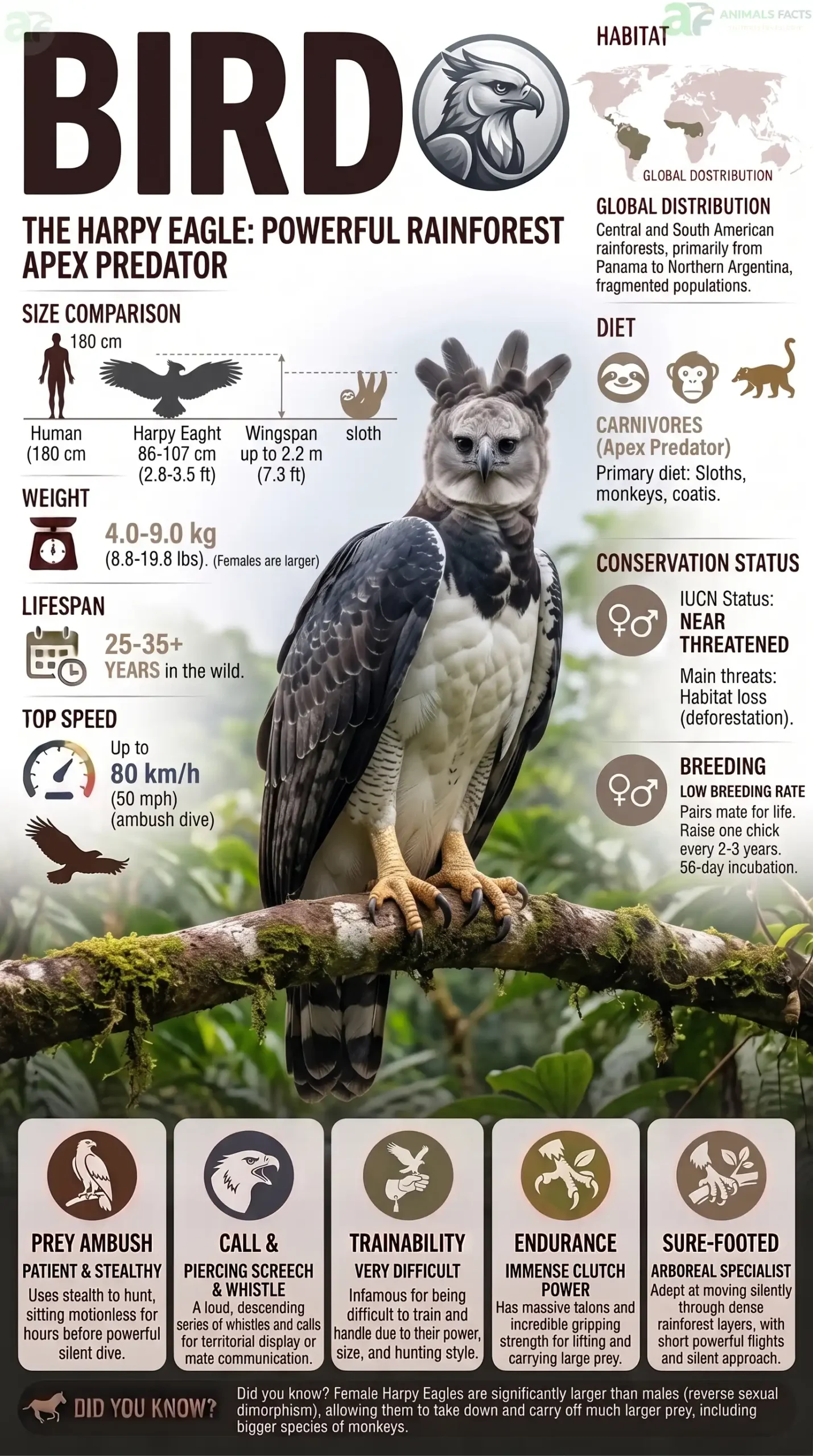
| Fastest Species | Peregrine Falcon — dives at speeds exceeding 389 km/h (242 mph) |
| Conservation Status | Approximately 1,400+ species currently threatened with extinction |
| Global Population Estimate | Estimated 200–400 billion individual birds worldwide |
1. Introduction: What is Bird?
They sing before dawn breaks. They cross entire oceans without a map. They build homes from twigs, mud, and spider silk with no tools but their beaks. Bird facts are among the most astonishing, surprising, and deeply moving in all of the natural world — and yet most of us walk past dozens of birds every single day without pausing to truly appreciate them.
Birds are everywhere. From the frozen tundra of Antarctica to the scorching Sahara Desert, from the deepest tropical rainforests to the rooftops of the world’s busiest cities — the class Aves has conquered every habitat our planet has to offer. With nearly 11,000 known species, birds represent one of the most spectacularly diverse groups of animals ever to have existed on Earth. They are the living descendants of dinosaurs, the masters of flight, and some of the most intelligent creatures in the animal kingdom.
Whether you are a dedicated birdwatcher, a student looking for bird facts for a school project, a parent searching for bird facts for kids, or simply someone who heard a beautiful song outside their window and wanted to know more — this article is your complete guide. We cover everything from bird habitat and bird diet to migration, reproduction, conservation, and the extraordinary role birds play in keeping our planet healthy. Let us take flight.
2. Bird Species Overview & Classification
Birds belong to the class Aves – a group of warm-blooded, feathered vertebrates that evolved from theropod dinosaurs during the Mesozoic Era, approximately 150–160 million years ago. Today they represent the most species-rich class of terrestrial vertebrates on Earth.
Species Classification Table
Kingdom: Animalia Phylum: Chordata Class: Aves Subclass: Neornithes (all modern birds) Orders: Approximately 40 recognized orders Families: Approximately 250 families Genera: Approximately 2,300 genera Species: Approximately 10,000–11,000 known species
Major Bird Orders
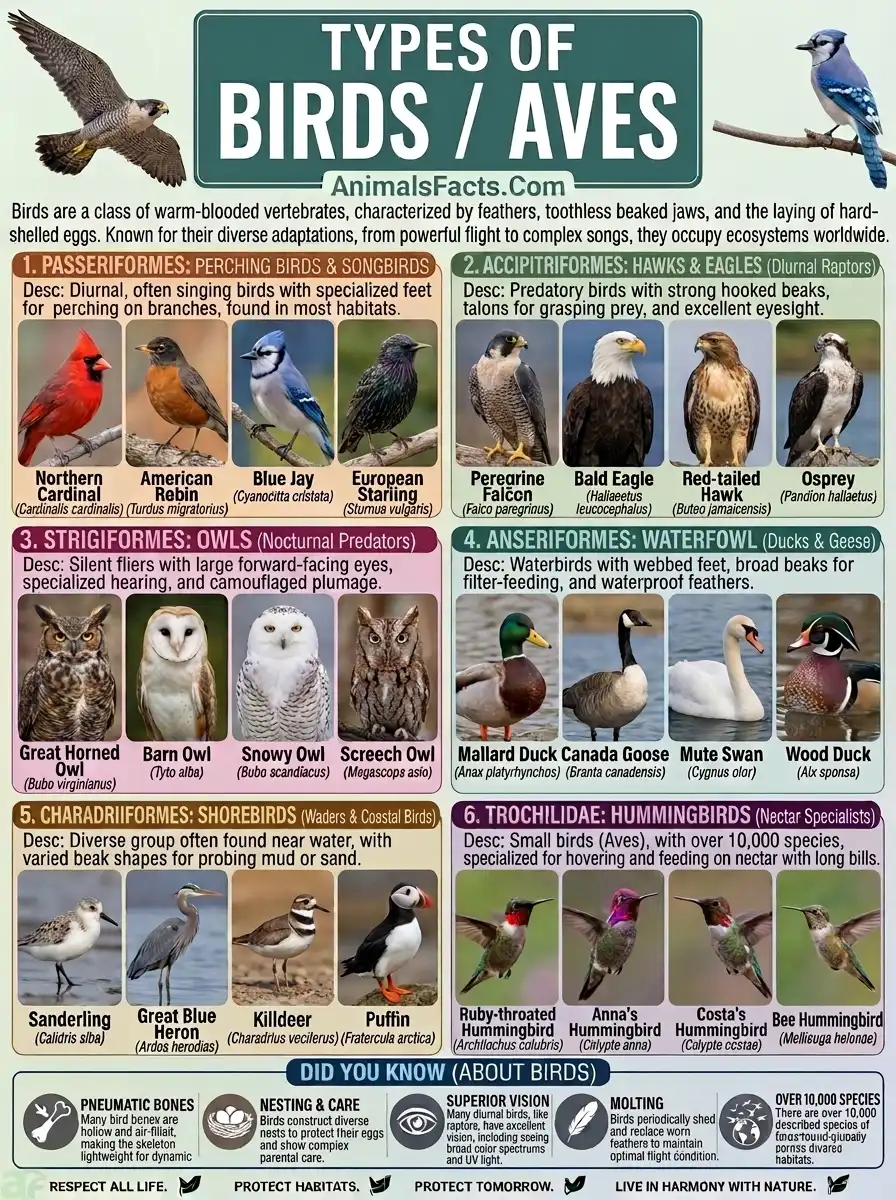
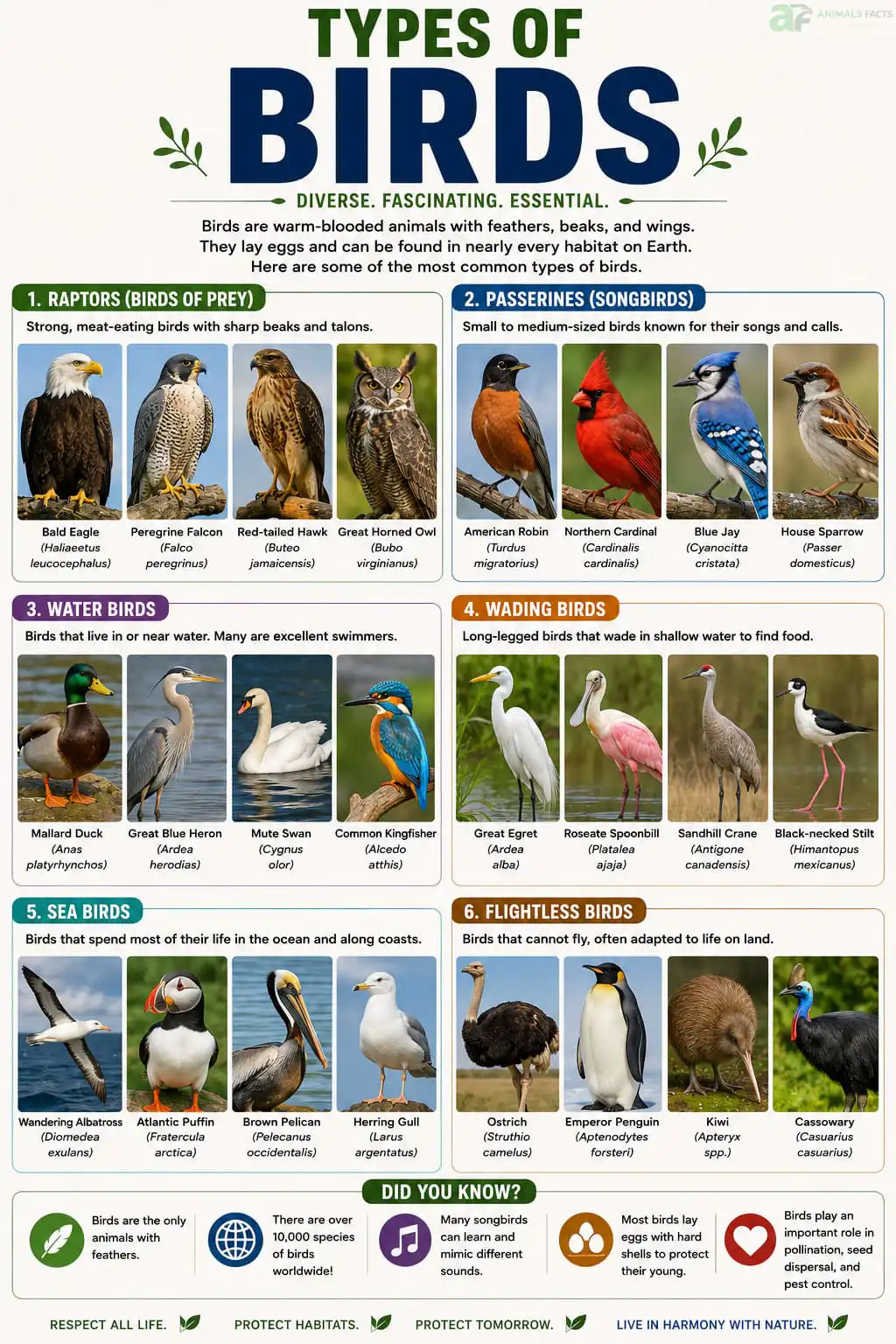
Passeriformes (Perching Birds / Songbirds): The largest order — approximately 6,500 species, including sparrows, crows, warblers, and finches.
Psittaciformes (Parrots): Approximately 400 species of parrots, macaws, cockatoos, and parakeets.
Falconiformes & Accipitriformes (Birds of Prey): Eagles, hawks, falcons, kites, and vultures — approximately 550 species.
Strigiformes (Owls): Approximately 230 species of nocturnal hunters.
Sphenisciformes (Penguins): 18 species of flightless aquatic birds confined to the Southern Hemisphere.
Struthioniformes (Ratites): Flightless giants including ostriches, emus, rheas, cassowaries, and kiwis.
Anseriformes (Waterfowl): Ducks, geese, swans, and relatives — approximately 180 species.
Columbiformes (Pigeons & Doves): Approximately 350 species worldwide.
Species Evolution & Discovery Timeline
~230 million years ago: The earliest archosaurs — ancestors of both dinosaurs and birds — appeared on Earth.
~150 million years ago: Archaeopteryx lithographica, widely considered the earliest known bird, lived during the Late Jurassic period. It had feathers, wings, and claws — a transitional form between dinosaurs and modern birds.
~66 million years ago: The mass extinction event that wiped out non-avian dinosaurs allowed early birds to diversify explosively into the ecological niches left behind.
~60 million years ago: The major modern bird orders began to diverge and establish themselves across the planet.
1758: Carl Linnaeus formally classified birds as a distinct class (Aves) in his landmark work Systema Naturae.
1859: Charles Darwin’s On the Origin of Species helped explain the extraordinary diversity of bird species through natural selection.
1861: The first fossil of Archaeopteryx was discovered in Bavaria, Germany — transforming our understanding of bird evolution.
20th century: Systematic global bird surveys and the establishment of organizations like the International Ornithological Union led to the modern classification of approximately 10,000 species.
2004–present: DNA-based phylogenetic studies continue to revise bird classification, discovering new species and clarifying evolutionary relationships at a remarkable pace.
3. Bird’s Physical Description & Unique Features
If there is one feature that defines birds above all others, it is feathers. Every single bird on Earth — from the tiny bee hummingbird to the towering ostrich — has feathers. No other animal group possesses them.
Key Physical Features
Feathers: Made of keratin (the same protein as human fingernails), feathers serve multiple functions: flight, insulation, waterproofing, camouflage, and attracting mates. A single bird may have between 1,000 and 25,000 individual feathers depending on the species.
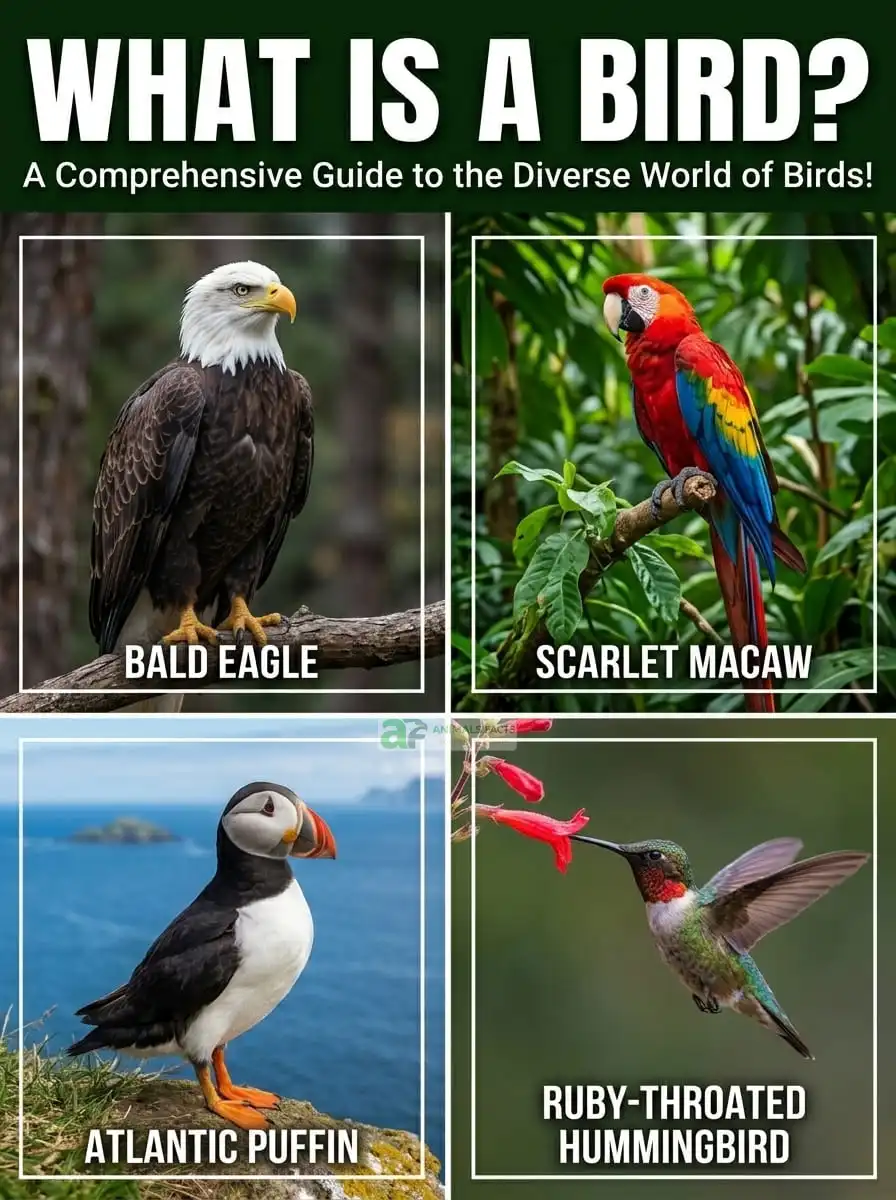
Beaks: Birds have no teeth. Instead, their beaks — also made of keratin — are extraordinarily specialized tools shaped by millions of years of evolution to suit their specific diet. Hummingbirds have long, needle-like beaks for probing flowers. Eagles have hooked beaks for tearing flesh. Pelicans have expandable pouches for scooping fish.
Hollow Bones: Most birds have hollow, air-filled bones that significantly reduce body weight while maintaining structural strength — a critical adaptation for flight.
Four-Chambered Heart: Like mammals, birds have a four-chambered heart that efficiently separates oxygenated and deoxygenated blood — essential for sustaining the high-energy demands of flight.
Warm-Blooded: Birds maintain a constant body temperature regardless of external conditions, typically between 40–44°C (104–111°F) — higher than most mammals.
Exceptional Eyesight: Birds have some of the most advanced visual systems in the animal kingdom. Many species can see ultraviolet light invisible to humans. The eagle can spot a rabbit from 3.2 kilometers away.
Size Range
Smallest: The Bee Hummingbird of Cuba measures just 5–6 cm and weighs less than 2 grams — lighter than a single paperclip.
Largest (living): The Ostrich stands up to 2.8 meters tall and weighs up to 160 kilograms — the tallest and heaviest bird alive today.
Largest wingspan: The Wandering Albatross has a wingspan of up to 3.7 meters — the widest of any living bird.
Fastest in flight: The Peregrine Falcon reaches speeds of over 389 km/h (242 mph) in a hunting dive — the fastest animal movement on Earth.
Did You Know? Birds are the only living descendants of dinosaurs. Technically, from a scientific classification standpoint, birds ARE dinosaurs — specifically avian dinosaurs — making every pigeon on a city street a living, breathing, miniature dinosaur.
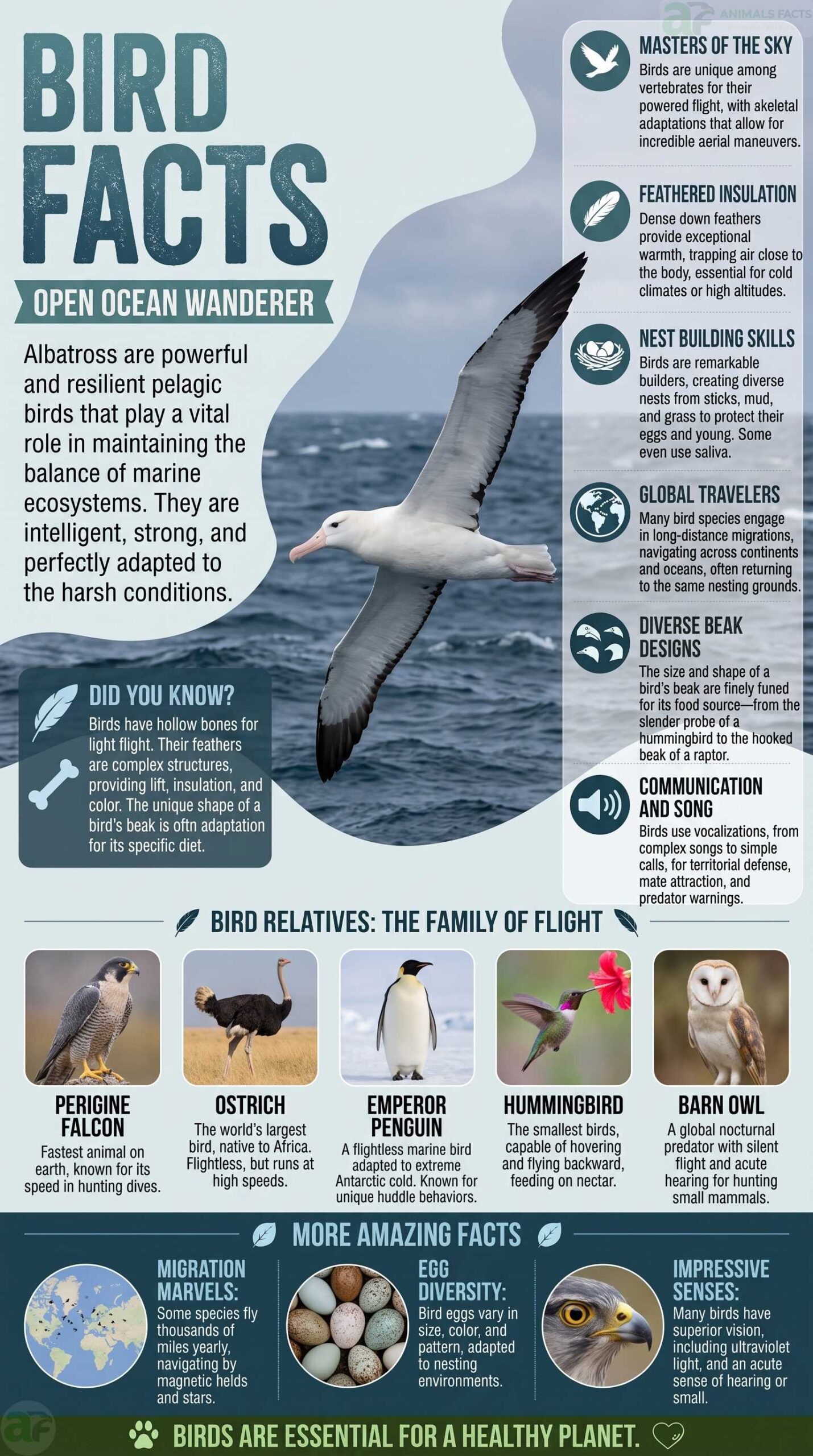
4. Top 25 Surprising & Interesting Bird Facts
- The Peregrine Falcon is the fastest animal on the planet, reaching diving speeds of over 389 km/h.
- Arctic Terns migrate from the Arctic to Antarctica and back every year — a round trip of up to 90,000 kilometers — the longest migration of any animal.
- The Wandering Albatross can fly for years without landing on solid ground, sleeping briefly while gliding on ocean winds.
- Crows and ravens are among the most intelligent animals on Earth — they can solve multi-step puzzles, use tools, and even recognize and remember individual human faces.
- The Ostrich has eyes measuring 5 centimeters in diameter — the largest eyes of any land animal alive today.
- Hummingbirds can fly backwards — the only birds capable of sustained backward flight.
- The Kiwi of New Zealand is the only bird known to have nostrils at the tip of its beak, giving it an extraordinary sense of smell.
- Flamingos are not naturally pink. Their pink color comes entirely from the carotenoid pigments in the algae and shrimp they eat.
- The African Grey Parrot has demonstrated vocabulary and reasoning abilities comparable to those of a 5-year-old human child.
- Emperor Penguins incubate their eggs in Antarctic temperatures as low as -60°C, balancing a single egg on their feet under a warm brood pouch for over two months without eating.
- The Common Swift can spend up to 10 months continuously airborne — eating, sleeping, and even mating in flight without ever landing.
- Birds have no external ears — sound is funneled directly into internal ear openings concealed beneath their feathers.
- The Bee Hummingbird has a heart rate of up to 1,260 beats per minute — the fastest of any bird.
- Pigeons were used to carry military messages during both World War I and World War II and are credited with saving thousands of human lives.
- The Lyrebird of Australia is perhaps the greatest mimic in the natural world — it can replicate chainsaws, camera shutters, car alarms, and other bird calls with astonishing accuracy.
- Some migratory birds navigate using the Earth’s magnetic field, essentially carrying a built-in biological compass.
- The Shoebill Stork of Central Africa can stand completely motionless for hours, earning it the nickname “the statue bird.”
- Roosters have a built-in mechanism that partially muffles their own crow to protect their hearing — they close their outer ear canal when calling.
- The Albatross mates for life and may live over 70 years — one individual named Wisdom at Midway Atoll is the world’s oldest known wild bird, at least 74 years old as of 2026.
- Owls cannot move their eyeballs — instead they can rotate their entire head up to 270 degrees in either direction.
- A group of crows is called a “murder.” A group of flamingos is called a “flamboyance.” A group of owls is an “parliament.”
- The Ostrich can run at speeds up to 70 km/h (43 mph) — the fastest running speed of any bird.
- Woodpeckers peck at wood up to 20 times per second and are protected from brain damage by a combination of thick skull bone, a spongy layer of bone, and a specialized hyoid bone that wraps around the skull like a seatbelt.
- Some species of albatross have not landed on solid ground for five straight years at a stretch.
- The New Caledonian Crow crafts and uses custom tools from materials like leaves and twigs — one of only a handful of non-human animals known to manufacture and use tools systematically.
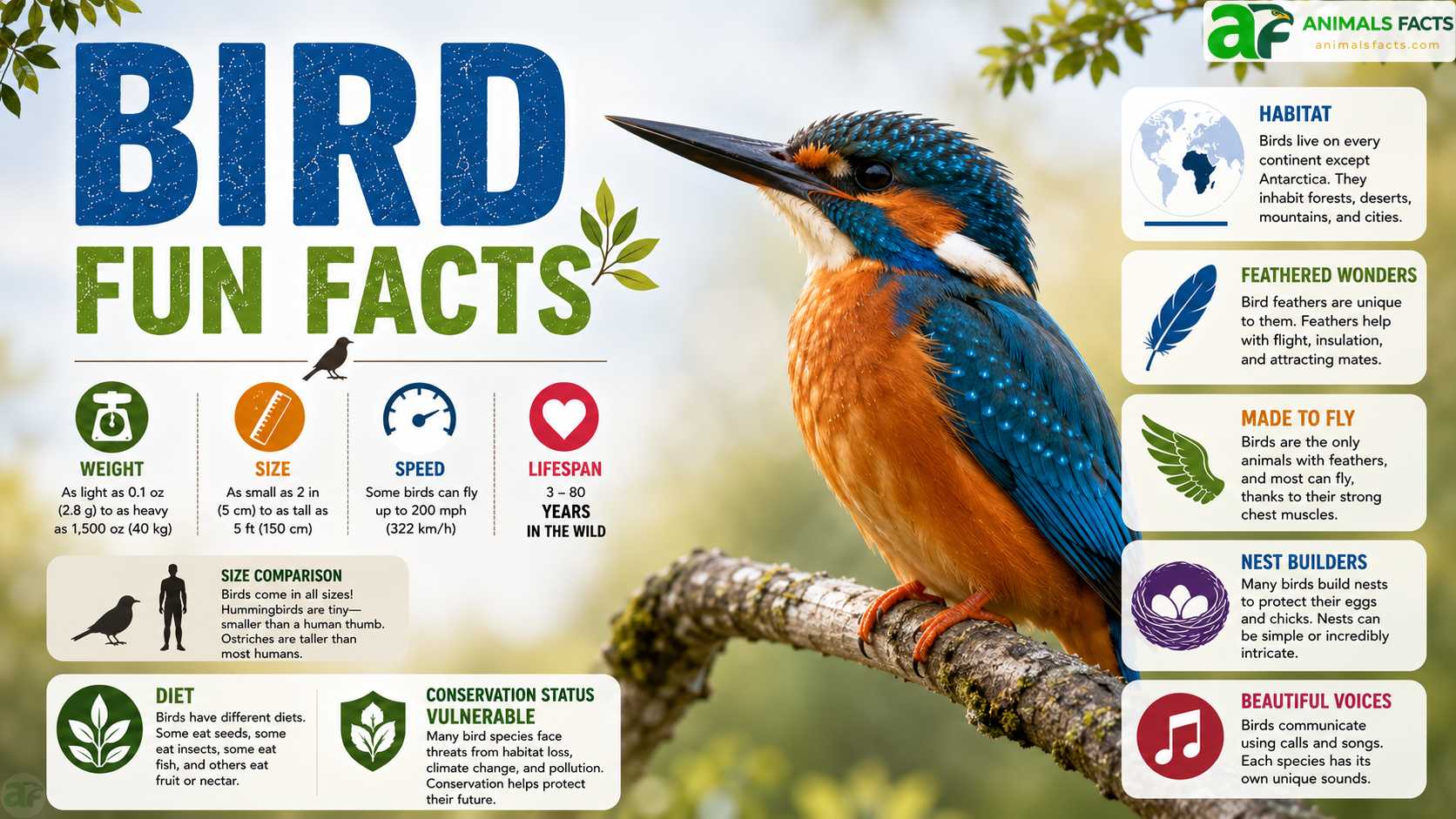
5. Bird Fun Facts
- There are nearly 11,000 known species of birds — more than all mammals, reptiles, and amphibians combined.
- Birds exist on every continent, including Antarctica, where Emperor Penguins breed during the harshest winter on Earth.
- The Sword-billed Hummingbird has a beak longer than its entire body.
- Ostriches do not bury their heads in the sand — that is entirely a myth. They lay flat on the ground to camouflage themselves.
- The total weight of all birds on Earth is estimated at approximately 200 billion kilograms.
- Some birds, including certain parrots and corvids, have demonstrated the ability to plan for the future — a cognitive ability once thought exclusive to humans.
- The Killdeer bird fakes a broken wing to lure predators away from its ground nest.
- Birds molt (shed and replace) their feathers at least once a year, and some species molt multiple times.
- The Sooty Tern can remain continuously airborne for 3–10 years after its first flight.
- A hummingbird’s wings beat between 50 and 80 times per second during hovering flight.
- Birds are the most commonly kept pet animals in the world after dogs and cats.
6. Birds Natural Habitat & Geographic Range
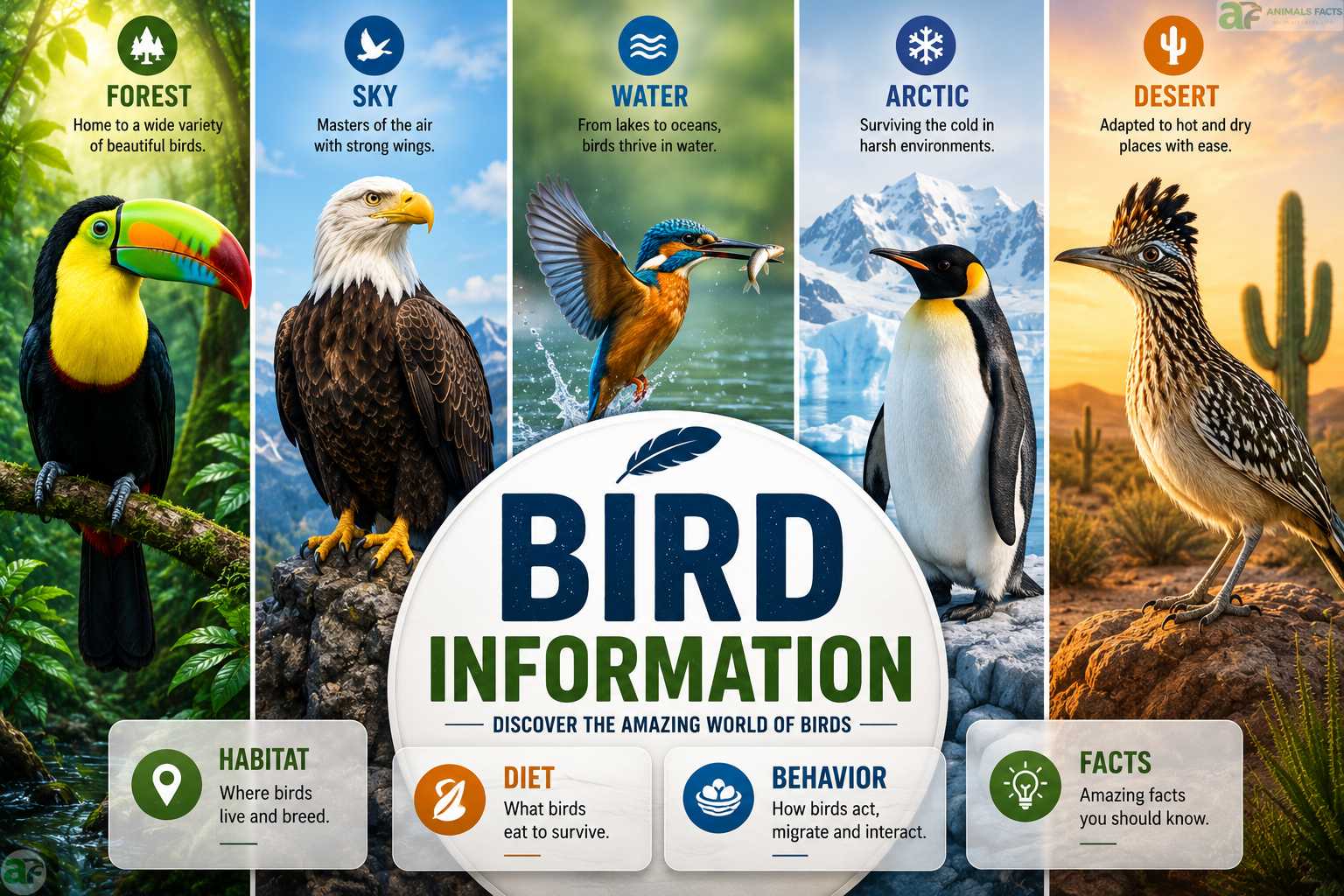
One of the most remarkable aspects of birds is their ability to inhabit virtually every environment on Earth. No other class of vertebrate animals has successfully colonized such a complete range of habitats.
Habitat Types Occupied by Birds
Tropical Rainforests: Home to the greatest bird diversity on Earth. The Amazon Basin alone contains over 1,300 species, and the island of New Guinea hosts extraordinary species found nowhere else.
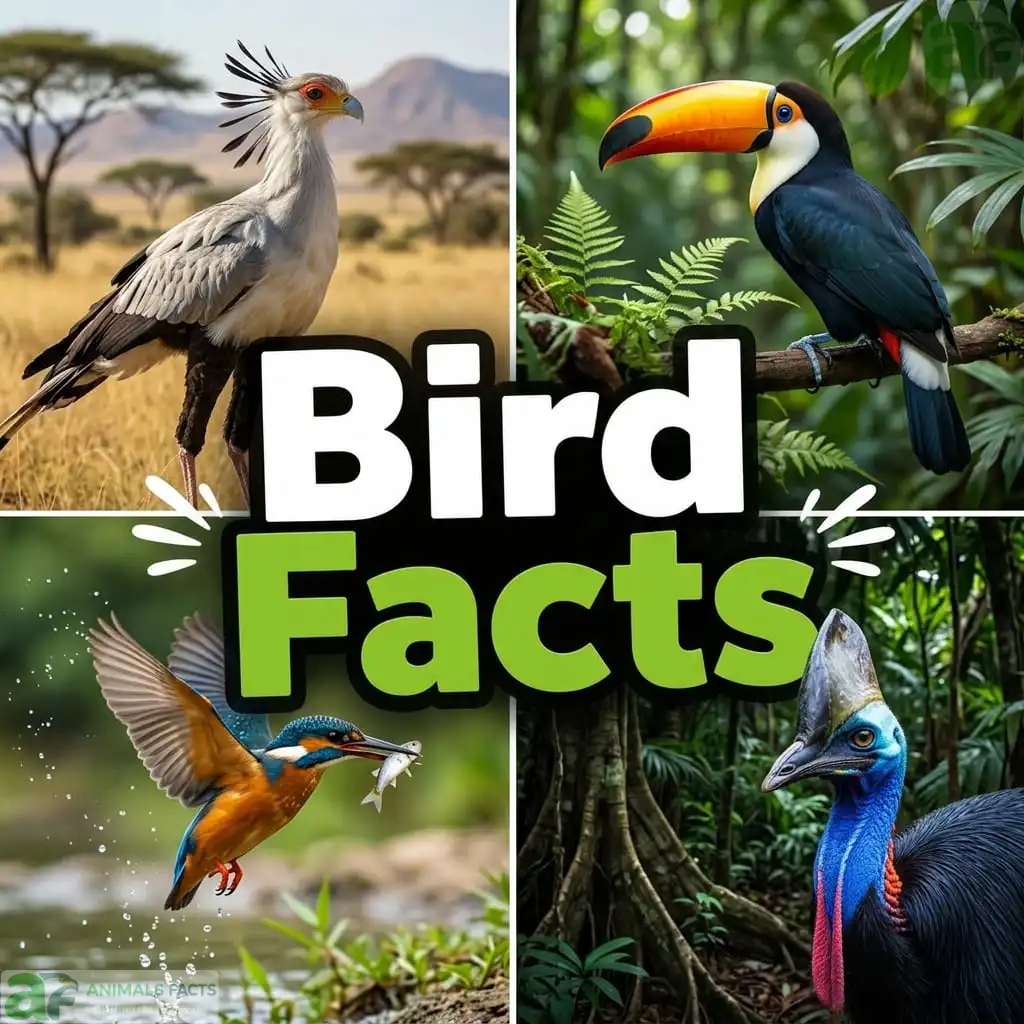
Grasslands & Savannas: African savannas support iconic species such as ostriches, secretary birds, hornbills, and vast flocks of weaver birds.
Wetlands & Coastlines: Herons, storks, ibises, pelicans, and shorebirds depend on coastal and freshwater wetland habitats for feeding and breeding.
Deserts: Roadrunners, sandgrouse, and various owls have adapted to survive extreme heat and minimal water in desert environments worldwide.
Polar Regions: Penguins in Antarctica and snowy owls, ptarmigans, and puffins in the Arctic have evolved extraordinary cold-weather adaptations.
Oceans: Albatrosses, petrels, shearwaters, and frigatebirds spend the vast majority of their lives over open ocean, only returning to land to breed.
Urban Environments: Pigeons, sparrows, starlings, crows, and numerous other species have successfully adapted to live alongside humans in cities worldwide.
Habitat Range by Continent
Africa: Over 2,300 species — one of the richest bird continents on Earth; home to ostriches, flamingos, hornbills, and sunbirds.
Asia: Over 2,700 species — the most species-rich continent; includes peacocks, cranes, pheasants, and a vast diversity of songbirds.
South America: Over 3,200 species — the single most biodiverse continent for birds; home to macaws, toucans, hummingbirds, and condors.
North America: Approximately 1,000 species — includes bald eagles, wild turkeys, pelicans, and the world’s longest-migrating tern.
Europe: Approximately 750 species — including puffins, kingfishers, eagles, and a remarkable diversity of migratory songbirds.
Australia & Oceania: Over 1,600 species — home to lyrebirds, kookaburras, cassowaries, emus, and more parrot species than any other region.
Antarctica: Approximately 50 species — dominated by penguins and seabirds such as petrels and skuas.
Did You Know? The island nation of Colombia holds more bird species than any other country on Earth — over 1,900 species, representing nearly 20% of all bird species worldwide within a single country’s borders.
7. Bird’s Diet & Feeding Behavior
Birds occupy virtually every possible dietary niche in the natural world. The extraordinary diversity of bird diets — and the equally extraordinary diversity of beaks that have evolved to exploit those diets — is one of the most compelling stories in all of evolutionary biology.
Major Dietary Categories
Carnivores (Meat-eaters): Eagles, hawks, falcons, owls, herons, and kingfishers hunt live prey including fish, mammals, reptiles, and other birds.
Herbivores (Plant-eaters): Parrots, geese, finches, and many doves consume seeds, fruits, leaves, flowers, and nectar.
Insectivores (Insect-eaters): Swallows, swifts, warblers, woodpeckers, and flycatchers subsist primarily on insects and their larvae.
Omnivores: Crows, ravens, gulls, starlings, and many other adaptable species eat a wide and flexible variety of food including fruits, insects, small animals, eggs, and human food waste.
Filter Feeders: Flamingos and some ducks filter microscopic organisms, algae, and small crustaceans directly from water using specialized beak structures.
Scavengers: Vultures, condors, and marabou storks perform the critical ecological service of consuming dead animals, preventing the spread of disease.
Diet Breakdown by Major Group
Birds of Prey (Eagles, Hawks, Falcons): Live vertebrate prey (mammals, birds, reptiles) — approximately 90%; carrion — approximately 10%
Owls: Small mammals (primarily) — approximately 70%; birds — approximately 15%; insects and other prey — approximately 15%
Parrots: Seeds and nuts — approximately 50%; fruits — approximately 30%; flowers, leaves, bark — approximately 20%
Songbirds (general): Insects — approximately 50%; seeds and berries — approximately 40%; other plant matter — approximately 10%
Waterfowl (Ducks, Geese): Aquatic plants — approximately 40%; aquatic invertebrates — approximately 35%; seeds — approximately 25%
Hummingbirds: Floral nectar — approximately 90%; small insects — approximately 10%
Did You Know? The Bearded Vulture (Lammergeier) of Europe and Asia has a diet consisting of approximately 85–90% bone. It drops large bones from great heights onto rocky surfaces to shatter them, then swallows the fragments whole. Its stomach acid is so powerful it can dissolve large bone pieces within 24 hours.
8. Reproduction & Life Cycle of Birds
Birds are egg-layers — every single species on Earth, without exception, reproduces by laying hard or leathery-shelled eggs. This single shared characteristic, along with feathers, defines the class Aves above all other traits.
Mating Behavior
Bird courtship is among the most elaborate and visually spectacular behavior in the entire animal kingdom. Mate selection strategies include:
Visual displays: The Peacock fans its magnificent tail of up to 200 iridescent feathers to attract females. The Birds of Paradise of New Guinea perform extraordinarily complex dances involving color, movement, and sound.
Vocal performance: Male songbirds sing complex, learned songs to establish territory and attract mates. The Nightingale can produce over 1,000 different song phrases.
Gift-giving: Male Bowerbirds construct elaborate decorated structures called “bowers” — arranging colored objects, flowers, and even pieces of glass or plastic in artistic patterns to attract females.
Aerial displays: Many raptors and seabirds perform synchronized aerial acrobatics as part of their courtship.
Nesting & Eggs
Birds build an extraordinary variety of nests: from the simple scrape in the ground used by Killdeer, to the towering stick platforms of Bald Eagles (which can weigh over 1,000 kg after decades of use), to the intricately woven hanging nests of Weaver birds, to the saliva-constructed cup nests of swiftlets (used in bird’s nest soup).
Smallest egg: The Bee Hummingbird’s egg is the size of a small pea and weighs less than half a gram. Largest egg: The Ostrich egg can weigh up to 1.5 kg — equivalent to about 24 chicken eggs. Most eggs per clutch: The Grey Partridge can lay up to 22 eggs in a single clutch.
Lifespan Comparison Table
Bee Hummingbird: 2–5 years House Sparrow: 3–5 years European Robin: 2–3 years (wild); up to 11 years (captivity) Bald Eagle: 20–30 years (wild) African Grey Parrot: 40–60 years (captivity) Wandering Albatross: 40–70+ years Wisdom (Laysan Albatross): At least 74 years — oldest known wild bird (as of 2026) Sulphur-crested Cockatoo: Up to 80+ years in captivity
9. Social Behavior & Communication
Birds are among the most socially complex and communicatively sophisticated animals on the planet. Their methods of communication — particularly through song and vocalization — represent one of the most studied and admired phenomena in all of animal behavior.
Vocalizations
Bird songs are not simply pleasant sounds. They are sophisticated communication tools used to:
- Establish and defend territories
- Attract and evaluate potential mates
- Warn flock members of approaching predators
- Coordinate group movements and feeding
- Maintain pair bonds between mated couples
Young songbirds learn their species’ songs by listening to adult males and gradually practicing — a process of vocal learning that parallels how human children learn language. Only three other animal groups are known to learn vocalizations this way: humans, cetaceans (whales and dolphins), and bats.
Group Behaviors
Flocking: Many species form enormous flocks for migration, feeding, and protection from predators. A murmuration of Starlings — in which thousands to millions of birds move in perfectly synchronized, fluid aerial formations — is considered one of the most breathtaking spectacles in all of nature.
Cooperative breeding: In some species, non-breeding individuals — often older siblings — help parents raise chicks. This is well documented in Australian Fairy-wrens, African Bee-eaters, and Florida Scrub-Jays.
Tool use: New Caledonian Crows craft and use custom tools. Egyptian Vultures throw rocks at ostrich eggs to crack them open. Herons have been observed using bread as fishing bait.
Intelligence
Corvids (crows, ravens, jays, magpies) and parrots consistently rank among the most cognitively advanced animals ever studied. Ravens have demonstrated:
- Planning and future thinking
- Understanding of cause and effect
- Empathy toward other ravens
- Complex memory and social learning
Did You Know? The Clark’s Nutcracker, a bird found in western North America, can remember the locations of up to 30,000 individual seed caches it has buried across a wide mountainous territory — recalling them accurately up to nine months later.
10. Bird Predators & Defense Mechanisms
Every bird species faces predation at some stage of its life. The diversity of threats birds face has driven the evolution of an equally remarkable diversity of defensive strategies.
Common Bird Predators
Aerial predators: Other birds of prey — particularly falcons, hawks, eagles, and owls — are the primary natural threat to most bird species.
Ground predators: Foxes, cats (domestic and wild), snakes, rats, and mustelids (weasels, stoats) are major threats, particularly to ground-nesting birds and their eggs.
Aquatic predators: Herons, pike, otters, and large fish prey on water birds and waterside nesters.
Human-introduced threats: Domestic cats are estimated to kill between 1.3 and 4 billion birds in the United States alone every year — one of the single largest human-caused threats to bird populations globally.
Defense Strategies
Camouflage: The Tawny Frogmouth of Australia resembles a broken branch so convincingly that predators walk directly past it. Many ground-nesting birds have brown, mottled plumage that renders them almost invisible against leaf litter.
Mobbing: Small birds frequently mob larger predatory birds — dive-bombing them repeatedly, calling loudly, and recruiting nearby individuals — to drive them away from nesting areas.
Distraction displays: The Killdeer famously drags one wing along the ground, mimicking injury, to lure predators away from its nest.
Warning coloration: The Pitohui of New Guinea is one of the only known poisonous birds in the world — its feathers and skin contain batrachotoxin, the same potent neurotoxin found in poison dart frogs.
Playing dead: Some species, including certain ducks and the Virginia Opossum-mimicking birds of South America, will feign death when captured by a predator.
Speed and flight: For many birds, pure speed is the ultimate defense. The Peregrine Falcon’s prey — other birds — must fly faster than almost any other animal simply to survive regular predation pressure.
11. Bird Facts for Kids
Hey kids — did you know that birds are actually living dinosaurs? It is true! Scientists now know that birds evolved directly from a group of two-legged dinosaurs called theropods, the same group that included the famous Velociraptor. So the next time you see a pigeon on the street, you are looking at a real, living dinosaur!
Here are some totally amazing bird facts for kids:
- There are nearly 11,000 different kinds of birds in the world — that is more than all the mammals, reptiles, and amphibians put together!
- The fastest animal on Earth is a bird — the Peregrine Falcon dives faster than a racing car.
- Hummingbirds are so small that a hawk moth — a type of large insect — looks almost exactly like one when it hovers beside a flower.
- Penguins cannot fly in the air, but they are extraordinary swimmers and can dive deeper than 500 meters underwater.
- The African Grey Parrot can learn to say hundreds of words and even understand what some of them mean!
- Some birds — like crows — are so smart they can solve puzzles that are too difficult for many other animals.
- Flamingos have to put their heads upside down to eat — their beaks are specially shaped to filter food from water in that position.
- The Wandering Albatross has wings so wide that if you stretched your arms out as far as they would go and added another meter on each side, you would just about match its wingspan.
Did You Know? Baby birds of many species hatch with no feathers at all and cannot see or do anything for themselves. They depend entirely on their parents for warmth, food, and protection for the first weeks of their lives. But within a few months, most will be fully grown and ready to take on the world on their own!
12. Relationship with Humans
Of all the animal groups on Earth, perhaps none has had a longer, richer, or more complex relationship with human civilization than birds.
Historical Significance
Birds have been intertwined with human culture, survival, and spirituality since the earliest days of our species. Archaeological evidence shows that humans were observing and depicting birds in cave paintings over 30,000 years ago. Ancient Egyptians revered the Ibis as a manifestation of the god Thoth and the Falcon as the embodiment of the god Horus — one of the most powerful deities in their entire pantheon.
Domestication
Humans domesticated several bird species thousands of years ago, with profound consequences:
Chickens (domesticated approximately 8,000 years ago from the Red Junglefowl of Southeast Asia) are now the most numerous birds on Earth — with an estimated 33 billion alive at any given moment — and the most widely consumed source of animal protein in human history.
Pigeons were domesticated over 5,000 years ago and served as essential message carriers in military campaigns from ancient Persia to both World Wars.
Ducks and Geese have been farmed for meat, eggs, and down feathers for thousands of years across Asia and Europe.
Falconry — the ancient art of training birds of prey for hunting — has been practiced for over 4,000 years and remains a living cultural tradition in over 80 countries. It was recognized by UNESCO as an Intangible Cultural Heritage of Humanity in 2016.
Birds in Modern Science & Medicine
Birds have served as critical early warning systems for environmental health. The catastrophic decline of Peregrine Falcons in the 1950s and 1960s directly led to the discovery of the devastating effects of the pesticide DDT on wildlife — triggering the modern environmental movement and eventually the publication of Rachel Carson’s Silent Spring (1962), arguably the most influential environmental book ever written.
13. Birds Conservation Status & Threats
The state of the world’s birds is one of the most urgent environmental issues of our time. While birds have proven remarkably adaptable over millions of years, the pace and scale of human-driven change is challenging even the most resilient species.
Global Conservation Data
Total bird species: Approximately 10,000–11,000 Species listed as Critically Endangered: Approximately 225 Species listed as Endangered: Approximately 460 Species listed as Vulnerable: Approximately 750 Species extinct since 1500: At least 180 species — the majority driven to extinction by human activity Species with declining populations: Approximately 40% of all bird species show declining population trends
Major Threats
Habitat Loss: The single greatest threat to birds worldwide. Deforestation, wetland drainage, grassland conversion to agriculture, and urban expansion have destroyed or severely degraded billions of hectares of bird habitat over the past century.
Invasive Species: Introduced predators — particularly rats, cats, stoats, and snakes — have driven numerous bird species to extinction, particularly on islands where birds evolved without ground predators.
Climate Change: Shifting seasons, altered rainfall patterns, rising sea levels, and changing insect emergence timing are disrupting bird migration, breeding, and food availability on a global scale.
Window Collisions: An estimated 600 million to 1 billion birds die annually from collisions with glass windows in the United States alone.
Pesticides: Insecticides reduce the insect populations that birds depend on; rodenticides poison birds of prey through secondary poisoning of their prey animals.
Illegal Wildlife Trade: Approximately 2–5 million birds are illegally captured and traded annually, with parrots, songbirds, and birds of prey most heavily targeted.
Did You Know? North America has lost approximately 3 billion birds — nearly 30% of its total bird population — since 1970. This staggering loss, documented in a landmark 2019 study published in the journal Science, is considered one of the most alarming wildlife declines in recorded history.
14. Famous Birds
Wisdom – The World’s Oldest Known Wild Bird
Wisdom is a female Laysan Albatross banded at Midway Atoll National Wildlife Refuge in the Pacific Ocean in 1956. As of 2026, she is at least 74 years old, continues to return to Midway each year to breed, and has raised an estimated 35–40 chicks over her extraordinary lifetime. She is a global symbol of bird longevity and the importance of ocean conservation.
Alex – The African Grey Parrot
Alex (Avian Learning Experiment) was an African Grey Parrot who spent 30 years working with animal psychologist Dr. Irene Pepperberg at Harvard and Brandeis University. He demonstrated the ability to identify objects, colors, shapes, and quantities, and appeared to understand the concept of zero. When Alex died in 2007, his last words to Dr. Pepperberg were reported as “You be good. I love you.” He remains the most studied and celebrated individual bird in scientific history.
Cher Ami – World War I Hero Pigeon
Cher Ami was an American military carrier pigeon who delivered a critical message during the Battle of the Argonne in 1918, saving the lives of approximately 194 American soldiers. She was shot through the breast and leg during the mission but completed her flight. She was awarded the French Croix de Guerre medal and is displayed in the Smithsonian Institution.
Nigel the Gannet
Nigel became internationally famous as the world’s loneliest bird — a Australasian Gannet who spent years on a New Zealand island courting a concrete decoy gannet placed there by conservationists attempting to attract a breeding colony. Nigel died in 2018 without ever finding a real mate, becoming a symbol of conservation efforts and the loneliness of displaced wildlife.
15. Role in Ecosystem & Food Chain
Birds are not merely beautiful — they are ecologically indispensable. The services they provide to ecosystems worldwide are estimated to be worth hundreds of billions of dollars annually in ecological and economic value.
Pollination
Hummingbirds in the Americas, sunbirds in Africa and Asia, and honeyeaters in Australia are critical pollinators of thousands of plant species. Approximately 5% of all plant species worldwide depend on birds for pollination — including many crops of direct economic importance to humans.
Seed Dispersal
Fruit-eating birds disperse seeds across vast distances through their droppings. Toucans, hornbills, parrots, thrushes, and dozens of other species are the primary means by which many tree species colonize new areas and maintain the genetic diversity of forest plant communities.
Pest Control
Insectivorous birds collectively consume hundreds of billions of insects every year. A single pair of nesting Blue Tits can bring back up to 10,000 caterpillars to their chicks during a single breeding season. The economic value of birds as natural pest controllers in agriculture alone is estimated at over $4 billion annually in the United States.
Scavenging
Vultures and other scavengers remove animal carcasses from the environment with extraordinary efficiency. Their stomach acid is powerful enough to destroy anthrax, botulism, and cholera bacteria — preventing these pathogens from entering soil and water systems. The near-extinction of vultures in South Asia during the 1990s (caused by the veterinary drug diclofenac) led to a dramatic increase in rabies cases as feral dog populations exploded to fill the scavenging niche.
Indicator Species
Birds serve as perhaps the most reliable indicators of ecosystem health of any animal group. Their visibility, abundance, and sensitivity to environmental change make them the primary monitoring tool used by ecologists and conservation biologists worldwide.
16. Myths, Folklore & Cultural Significance
Across every human civilization that has ever existed, birds have held a unique and often sacred place in mythology, religion, and cultural identity.
Ancient Egypt
The Ibis was sacred to Thoth, god of wisdom and writing. The Falcon represented Horus, one of the most powerful gods in the Egyptian pantheon — and the Pharaoh himself was considered a living embodiment of Horus on Earth.
Greek & Roman Mythology
The Eagle was the symbol and messenger of Zeus (Jupiter), king of the gods. The Owl was sacred to Athena (Minerva), goddess of wisdom — a association that endures to this day. The mythological Phoenix — a bird that dies in flames and is reborn from its own ashes — symbolized immortality, renewal, and resurrection across Greek, Roman, and later medieval European traditions.
Norse Mythology
Odin, the all-father of Norse gods, had two ravens named Huginn (Thought) and Muninn (Memory) who flew across the world each day reporting back everything they had seen. The raven remains a powerful symbol across Scandinavian, Celtic, and First Nations cultures in North America.
Native American Traditions
The Thunderbird — a vast, powerful bird capable of creating storms with its wingbeats — features in the mythologies of dozens of Indigenous North American peoples. The Eagle is considered a sacred messenger between humans and the divine across many Native American, First Nations, and Aztec traditions.
Chinese & East Asian Culture
The Crane is one of the most revered symbols in Chinese, Japanese, and Korean cultures — representing longevity, good fortune, loyalty, and peace. The tradition of folding 1,000 origami cranes (senbazuru) as a wish for healing or good fortune remains widely practiced across East Asia today.
Modern National Symbols
The Bald Eagle is the national symbol of the United States. The Robin is the unofficial national bird of Great Britain. The Peacock is the national bird of India. The Kiwi is perhaps the most iconic national symbol of New Zealand. Across the world, virtually every nation has chosen a bird as a symbol of its national identity and natural heritage.
17. Birds in Pop Culture
Birds have been woven into human storytelling, art, music, and entertainment across every era of recorded history — and continue to inspire some of the most beloved cultural creations of the modern age.
Film & Animation
“The Birds” (1963, Alfred Hitchcock) — One of the most iconic horror films ever made, featuring a terrifying fictional mass attack by birds on a California town.
“Winged Migration” (2001) — An Academy Award-nominated French documentary that follows migratory birds across continents, filmed using ultralight aircraft and trained birds. Considered one of the most beautiful nature documentaries ever made.
“Happy Feet” (2006) — An animated film centered on Emperor Penguins that became a global hit and raised significant public awareness about Antarctic wildlife conservation.
“Rio” (2011) — An animated adventure featuring Spix’s Macaw — a species that was effectively extinct in the wild at the time of the film’s release — which significantly boosted conservation awareness for the species.
“Angry Birds” (2016 film, based on the 2009 mobile game) — One of the most successful gaming franchises of all time, featuring stylized cartoon birds with over 5 billion downloads worldwide.
Literature
“To Kill a Mockingbird” by Harper Lee (1960) — The mockingbird serves as the novel’s central moral symbol — a creature that does nothing but make music and harm no one.
“Jonathan Livingston Seagull” by Richard Bach (1970) — A philosophical novella about a seagull that became a global bestseller and counterculture classic.
“The Rime of the Ancient Mariner” by Samuel Taylor Coleridge (1798) — The albatross in this poem remains one of the most enduring symbols in English literature — representing both good fortune and terrible guilt.
Music
The dawn chorus — the explosion of birdsong that occurs just before and after sunrise — has inspired composers from Vivaldi and Beethoven to Paul McCartney and countless others. Birdsong has been directly sampled and incorporated into music across every genre and era.
18. Bird Facts vs. Common Myths
Myth: Birds will abandon their chicks if a human touches them. Fact: This is almost entirely false. Most birds have a very limited sense of smell and will not reject chicks due to human scent. If you find a fallen chick, returning it to its nest is usually the best course of action.
Myth: Ostriches bury their heads in the sand when frightened. Fact: Ostriches never do this. They lay their long necks flat on the ground to camouflage themselves against the savanna — which from a distance can look like head-burying. When genuinely threatened, they run or kick with devastating force.
Myth: All birds can fly. Fact: Approximately 60 species of living birds are flightless, including ostriches, emus, cassowaries, penguins, rheas, kiwis, and several island rail species.
Myth: Owls can rotate their heads 360 degrees. Fact: Owls can rotate their heads up to 270 degrees in either direction — impressive, but short of a full revolution. Their skull anatomy and specially adapted neck blood vessels allow this without cutting off blood supply to the brain.
Myth: Bats are birds. Fact: Bats are mammals, not birds. They are warm-blooded, give birth to live young, and nurse their offspring with milk. The only true flying vertebrates besides bats are birds — but the two groups are not closely related.
Myth: Robins are a sign of spring. Fact: In many parts of the world, Robins are year-round residents and do not migrate seasonally. The “first Robin of spring” is typically simply the first one noticed by humans venturing outside more often in warming weather.
Myth: Feeding birds in winter makes them dependent and stops them migrating. Fact: Research consistently shows that supplemental winter feeding helps birds survive harsh weather without disrupting migratory instincts, which are controlled by day length rather than food availability.
19. Best Places to See Birds in the Wild
Pantanal, Brazil & Bolivia
The world’s largest tropical wetland is home to an astonishing 700+ bird species, including Hyacinth Macaws (the world’s largest parrot), Jabiru Storks, Sunbitterns, and enormous concentrations of wading birds and raptors. It is considered by many ornithologists as the single best birdwatching destination on Earth.
Borneo, Malaysia & Indonesia
The ancient rainforests of Borneo host over 650 bird species, including extraordinary Hornbills, Pittas, Broadbills, and the remarkable Wallace’s Standardwing Bird-of-Paradise. Kinabalu National Park is a World Heritage Site renowned for its bird diversity.
Galápagos Islands, Ecuador
The living laboratory of evolution that inspired Charles Darwin, the Galápagos features unique endemic species found nowhere else — including Darwin’s Finches, Flightless Cormorants, Galápagos Penguins, and Waved Albatrosses.
Bharatpur (Keoladeo National Park), India
A UNESCO World Heritage Site and one of Asia’s most important bird sanctuaries, hosting over 370 species including the critically endangered Siberian Crane during winter migration season.
Kakadu National Park, Australia
One of Australia’s premier birdwatching destinations, with over 280 species including extraordinary Brolga Cranes, Jabirus, Rainbow Bee-eaters, and the spectacular Red-tailed Black Cockatoo.
Maasai Mara & Serengeti, Kenya & Tanzania
Africa’s most famous wildlife landscapes are also extraordinary birdwatching destinations, home to over 500 species including Secretary Birds, Lilac-breasted Rollers, Ostriches, Crowned Cranes, and the spectacularly plumaged Superb Starling.
Churchill, Manitoba, Canada
The subarctic tundra around Churchill is one of the best places in North America to see Snowy Owls, Tundra Swans, Smith’s Longspurs, and the extraordinary spectacle of thousands of shorebirds migrating along Hudson Bay.
20. Birds Top Documentaries & Books
Must-Watch Documentaries
“Winged Migration” (2001) — An extraordinary, Academy Award-nominated journey following migratory birds across continents. Cinematic and breathtaking.
“David Attenborough’s Life of Birds” (BBC, 1998) — A landmark ten-part series hosted by Sir David Attenborough; still considered the definitive television documentary on bird biology and behavior.
“The Crimson Wing: Mystery of the Flamingos” (2008, Disney Nature) — A visually stunning documentary following Lesser Flamingos at Tanzania’s Lake Natron.
“Dancing with Birds” (Netflix, 2019) — Focuses on the extraordinary mating displays of Birds of Paradise and other spectacular species.
“Our Planet” (Netflix, 2019) — David Attenborough’s landmark series features extensive and unforgettable bird sequences across multiple episodes.
Essential Books
“The Life of Birds” by David Attenborough (1998) — The companion book to the BBC series; comprehensive, beautifully written, and accessible to all readers.
“The Sibley Guide to Birds” by David Allen Sibley — The definitive North American field guide; an essential reference for any serious birdwatcher.
“Feathers: The Evolution of a Natural Miracle” by Thor Hanson (2011) — A fascinating, deeply researched exploration of feathers — their evolution, structure, and cultural significance.
“H is for Hawk” by Helen Macdonald (2014) — A Costa Award-winning memoir combining falconry, grief, and natural history into one of the most celebrated nature books of the 21st century.
“The Genius of Birds” by Jennifer Ackerman (2016) — A compelling, research-driven exploration of bird intelligence that will permanently change how you think about the birds around you.
21. Comparison of Major Bird Groups
Songbirds (Passeriformes) Size: Tiny to medium (8 cm – 70 cm) Habitat: Worldwide — forests, grasslands, cities Diet: Insects, seeds, fruits, nectar Conservation Status: Mixed — many species declining Unique Trait: Vocal learning; complex song; most species-rich order
Birds of Prey (Raptors) Size: Small to very large (15 cm – 1.2 m; wingspan to 3 m) Habitat: Worldwide — every habitat type Diet: Carnivore — vertebrates and invertebrates Conservation Status: Many recovering; some threatened Unique Trait: Exceptional eyesight; powered flight; talons
Penguins (Sphenisciformes) Size: Small to large (35 cm – 1.2 m) Habitat: Southern Hemisphere — coasts and oceans Diet: Fish, squid, krill Conservation Status: Many threatened by climate change Unique Trait: Flightless; extraordinary swimmers; cold adaptation
Parrots (Psittaciformes) Size: Tiny to very large (8 cm – 1 m) Habitat: Tropics and subtropics worldwide Diet: Seeds, fruits, nuts, flowers Conservation Status: Most heavily traded; many endangered Unique Trait: Zygodactyl feet; vocal learning; extreme longevity; high intelligence
22. How You Can Help
Birds need human help more urgently now than at any time in recorded history. Here is what you can do — wherever you are in the world.
Support These Organizations
BirdLife International (birdlife.org) — The world’s largest nature conservation partnership, with programs protecting birds and habitats across more than 100 countries.
Audubon Society (audubon.org) — Dedicated to the conservation of birds and their habitats across the Americas through science, advocacy, and community action.
Royal Society for the Protection of Birds — RSPB (rspb.org.uk) — The UK’s largest conservation charity, protecting birds and wildlife across Britain and internationally.
American Bird Conservancy (abcbirds.org) — Focused specifically on conserving wild birds and their habitats throughout the Americas.
Cornell Lab of Ornithology (birds.cornell.edu) — A global leader in bird research and citizen science; home to the remarkable eBird platform.
Practical Actions You Can Take Today
Make your windows bird-safe. Apply window tape, external screens, or UV-reflective decals to reduce fatal bird collisions — one of the largest human-caused sources of bird mortality.
Keep cats indoors. Domestic cats are one of the single greatest threats to birds worldwide. Indoor cats live longer, healthier lives and spare billions of birds annually.
Plant native species in your garden. Native trees, shrubs, and flowers support the insects and fruits that birds depend on. Even a small garden or balcony can become a valuable habitat.
Participate in citizen science. Join the Christmas Bird Count, Great Backyard Bird Count, or submit your sightings to eBird — your observations contribute directly to global bird research and conservation.
Reduce pesticide use. Choose organic gardening methods where possible, and avoid broad-spectrum insecticides that remove the insect food base that birds depend on.
Support shade-grown and bird-friendly coffee. Coffee certified as “Bird Friendly” by the Smithsonian Migratory Bird Center is grown under forest canopy that provides crucial habitat for migratory birds during winter.
Did You Know? The eBird platform run by Cornell Lab of Ornithology has collected over 1 billion bird observation records from citizen scientists worldwide — making it the largest biodiversity database in human history and a critical tool for understanding and protecting global bird populations.
23. Frequently Asked Questions about Birds
Q1: How many species of birds exist in the world?
As of 2026, scientists recognize approximately 10,000 to 11,000 species of birds worldwide. New species continue to be discovered — primarily in tropical regions such as the Amazon Basin, New Guinea, and Southeast Asia — through both field exploration and advanced DNA analysis.
Q2: What is the fastest bird in the world?
The Peregrine Falcon is the fastest bird — and the fastest animal — on Earth, reaching diving speeds of over 389 km/h (242 mph) during its hunting stoop. In level flight, the White-throated Needletail Swift is the fastest, reaching speeds of approximately 170 km/h.
Q3: Are birds really descended from dinosaurs?
Yes — absolutely. Birds evolved from a group of two-legged theropod dinosaurs during the Mesozoic Era. Archaeopteryx, discovered in Bavaria in 1861, is widely considered the earliest known bird. Modern scientific consensus classifies birds as avian dinosaurs — meaning they are not merely descended from dinosaurs, they technically are dinosaurs.
Q4: What do birds eat?
Bird diets are extraordinarily diverse. Different species eat insects, seeds, fruit, nectar, fish, small mammals, reptiles, other birds, carrion, algae, and even bones. The specific diet of any given bird species is closely linked to the shape of its beak — one of nature’s most elegant examples of evolutionary adaptation.
Q5: Why do birds sing?
Birds sing primarily to establish territories and attract mates. Song communicates the singer’s fitness, species identity, and geographic location to other birds. Many species also use calls — shorter, simpler vocalizations — to warn of predators, maintain contact with flockmates, and coordinate group movements.
Q6: How far do birds migrate?
Migration distances vary enormously by species. The Arctic Tern holds the record — migrating up to 90,000 kilometers per year between the Arctic and Antarctic. Many songbirds migrate 5,000–10,000 kilometers each spring and fall. Some species, such as many populations of Robin and Blackbird in temperate climates, are year-round residents that do not migrate at all.
Q7: Are birds in danger of extinction?
Yes — this is one of the most pressing conservation issues of our time. Approximately 1,400 species are currently threatened with extinction. North America alone has lost an estimated 3 billion birds since 1970. The primary causes are habitat loss, invasive predators, climate change, window collisions, and pesticide use.
Q8: What is the largest bird in the world?
The Ostrich (Struthio camelus) is the world’s largest living bird, standing up to 2.8 meters tall and weighing up to 160 kilograms. It is also the fastest running bird, reaching speeds of up to 70 km/h. The Wandering Albatross has the largest wingspan of any living bird at up to 3.7 meters.
Q9: How long do birds live?
Lifespan varies tremendously by species. Small songbirds like sparrows and robins may live only 2–5 years in the wild. Medium-sized birds like eagles and herons live 20–30 years. Parrots and albatrosses commonly live 40–70 years, with the oldest confirmed wild bird — Wisdom the Laysan Albatross — reaching at least 74 years of age as of 2026.
Q10: How can I help birds near my home?
The most impactful actions include making windows bird-safe to prevent collisions, keeping cats indoors, planting native plants that support insect populations, reducing pesticide use, providing fresh water and supplementary food during harsh weather, and participating in citizen science programs like eBird or the Great Backyard Bird Count.
24. Sources & References
Research Sources
- Wikipedia — Class Aves; individual species articles
- IUCN Red List — Global bird species assessments
- BirdLife International — birdlife.org
- Cornell Lab of Ornithology — birds.cornell.edu / eBird
- National Geographic — Bird species profiles and features
- Smithsonian’s National Zoo — Bird fact sheets
- Encyclopaedia Britannica — Ornithology and bird species entries
- BBC Wildlife — Bird behavior and conservation features
- WWF — Global bird conservation data
- American Bird Conservancy — abcbirds.org
- Audubon Society — audubon.org
- Live Science — Bird research and science reporting
- Science (Journal) — Rosenberg et al. (2019): “Decline of the North American Avifauna”
- Ackerman, Jennifer — “The Genius of Birds” (2016)
- Attenborough, David — “The Life of Birds” (1998)