
Atta laevigata Facts
| Feature | Details |
|---|---|
| Scientific Name | Atta laevigata (F. Smith, 1858) |
| Kingdom | Animalia |
| Phylum | Arthropoda |
| Class | Insecta |
| Order | Hymenoptera |
| Family | Formicidae |
| Subfamily | Myrmicinae |
| Tribe | Attini |
| Common Names | Giant leaf-cutter ant, saúva limão (Brazil), bachac (Trinidad), curuá (various South American regions) |
| Native Range | South America — Brazil, Venezuela, Colombia, Peru, Bolivia, Trinidad, Guyana, Suriname |
| Habitat | Tropical and subtropical forest, cerrado, grassland — builds nests in well-drained soils |
| Colony Size | Up to 8 million workers — among the largest insect colonies in the world |
| Queen Lifespan | Up to 20 years — among the longest-lived insects |
| Worker Lifespan | 1–3 months |
| Diet | Does NOT eat leaves — cultivates fungus gardens on cut plant material |
| Worker Size Range | 1.5–14 mm — extraordinary size range within one species |
| Queen Size | Up to 22–25 mm — the largest ant queen in the Americas |
| Colony Depth | Nests up to 8 meters deep with 1,000+ chambers |
| Fungus Cultivated | Leucoagaricus gongylophorus — cultivated exclusively; not found outside ant nests |
| Defining Feature | The most complex fungus-agriculture symbiosis in the animal kingdom outside humans |
 1. Introduction: What is a Atta laevigata?
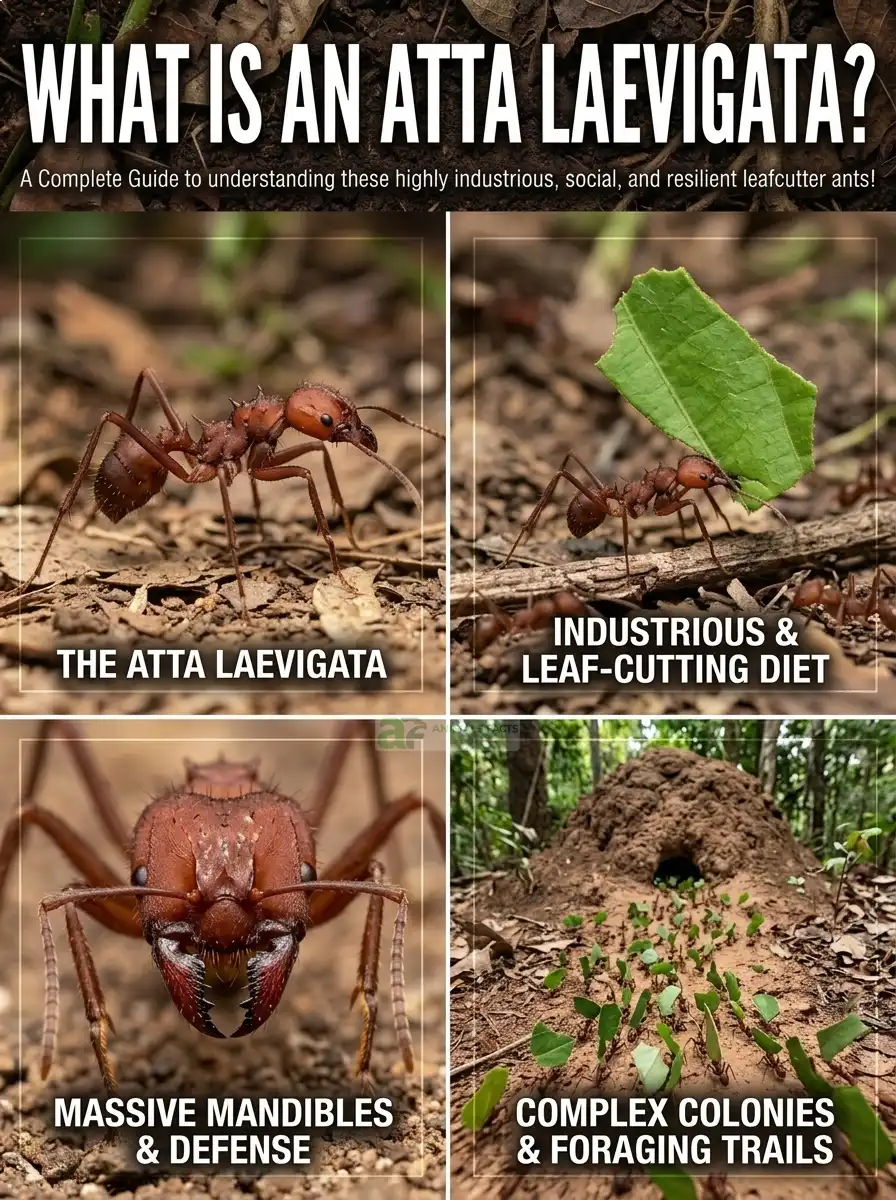
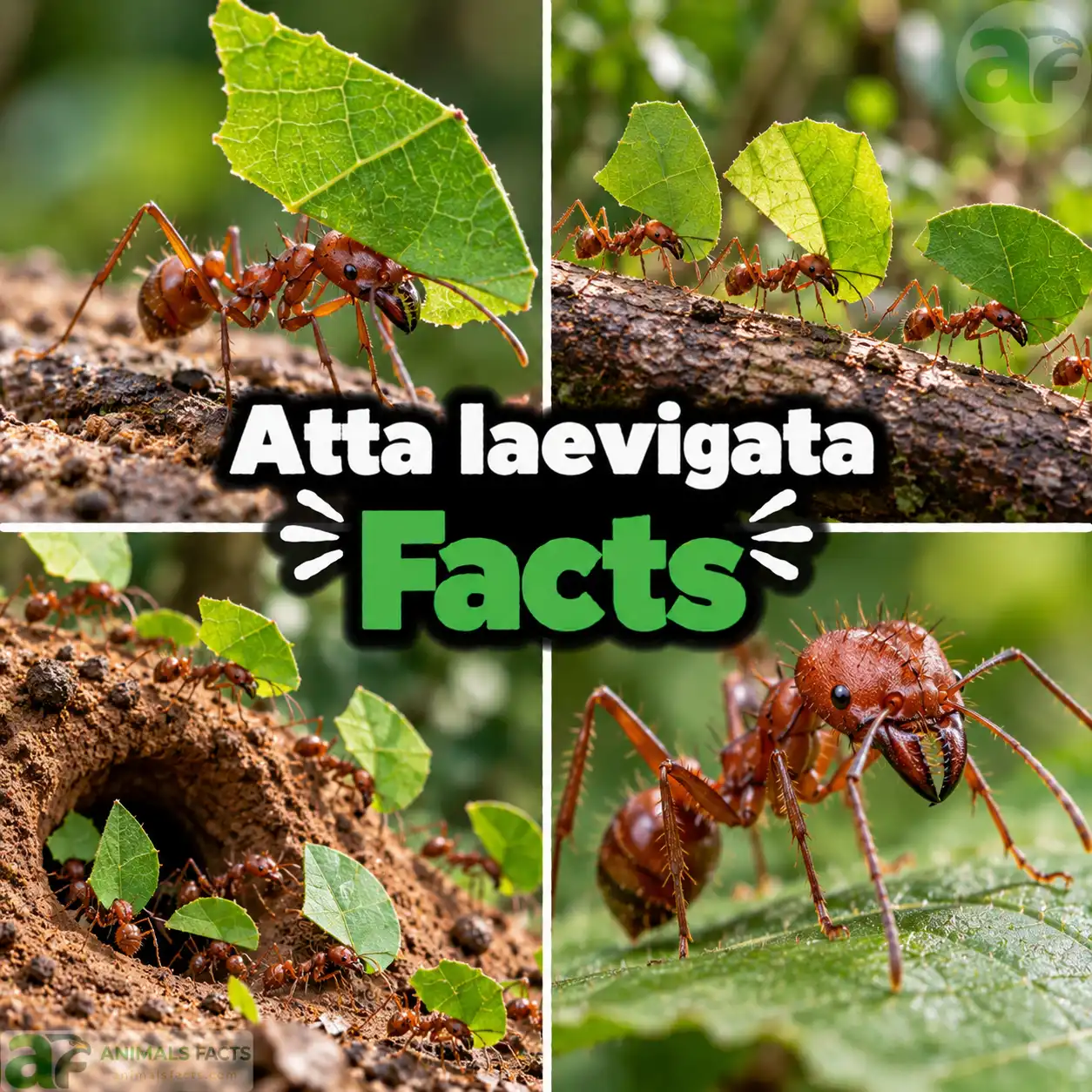
Across a forest floor in the Brazilian cerrado, a highway of movement cuts through the leaf litter — a living conveyor belt of industrious purpose that has operated continuously, day and night, for years. Thousands of small brown ants march in one direction carrying fragments of green leaves, flower petals, and soft stems — each piece cut to a precise size, held aloft at an angle that catches the light, moving toward a destination that lies somewhere underground in a network of tunnels and chambers that collectively represents one of the most architecturally and socially complex structures built by any non-human organism on Earth. In the opposite direction, an equally dense column of empty-jawed ants moves out toward the cutting sites with the purposeful efficiency of a workforce that has been doing exactly this job for millions of years of evolutionary time. Atta laevigata facts begin with this single, overwhelming image — a colony of up to 8 million individuals operating with a coordination and an efficiency that makes the largest human construction projects seem modest by comparison.
Atta laevigata — the giant leaf-cutter ant — is the most spectacular member of a tribe of ants that represents one of the most remarkable evolutionary achievements in the history of life on Earth. These are not ants that eat leaves — they are farmers, practicing a form of fungus agriculture that predates human farming by approximately 50 million years, that involves a cultivated crop species (Leucoagaricus gongylophorus) found nowhere in nature outside of ant nests, and that has developed over evolutionary time into a relationship of such mutual dependence that neither the ant nor the fungus can survive without the other. Interesting facts about Atta laevigata reveal a biological system of staggering complexity — a colony organized into multiple worker castes of dramatically different sizes, each with specific tasks precisely calibrated to its physical capability; a chemical communication system of extraordinary sophistication using dozens of distinct pheromone signals; a fungus garden management practice that involves the chemical suppression of competing fungi, the application of antibiotic-producing bacteria, and the maintenance of precise temperature and humidity conditions; and a queen that can live for 20 years — continuously laying eggs and directing the growth of a colony that collectively weighs as much as a large mammal.
Whether you are searching for Atta laevigata facts for kids to explore the extraordinary science of insect societies and mutualistic biology, an ecologist wanting to understand this species’ profound ecosystem engineering role in South American savanna and forest, a farmer seeking to understand the agricultural impacts of this species, or simply someone who watched a leaf-cutter ant trail in a natural history documentary and needed to understand everything about this extraordinary system — this is your comprehensive guide. We cover Atta laevigata scientific classification, anatomy, diet, social structure, the fungus farming system, reproduction, ecology, cultural significance, and the conservation and agricultural dimensions of living alongside one of the most powerful insect societies on the planet. The greatest non-human farmers in the history of life have an extraordinary story to tell.
2. Atta laevigata Species Overview & Classification
Atta laevigata belongs to the tribe Attini — the fungus-farming ants — within the subfamily Myrmicinae of the family Formicidae. It is the most ecologically dominant and most physically impressive member of the genus Atta across much of South America.
Species Classification Table
| Taxonomic Rank | Classification |
|---|---|
| Kingdom | Animalia |
| Phylum | Arthropoda |
| Class | Insecta |
| Order | Hymenoptera |
| Family | Formicidae (Latreille, 1809) |
| Subfamily | Myrmicinae |
| Tribe | Attini |
| Genus | Atta (Fabricius, 1804) |
| Species | A. laevigata (F. Smith, 1858) |
| Common Names | Giant leaf-cutter ant; saúva limão (Brazil); bachac (Trinidad) |
| Etymology | laevigata = “smooth, polished” (Latin) — referring to the relatively smooth body surface compared to other Atta species |
The Genus Atta — Leaf-Cutter Ants
Atta laevigata is one of 15 recognized species in the genus Atta — all of which are leaf-cutter ants practicing fungus agriculture:
| Species | Range | Notable Feature |
|---|---|---|
| Atta laevigata | South America (widespread) | Largest queen; largest colonies |
| Atta sexdens | South America | Most studied species; very widespread |
| Atta cephalotes | Central America, N. South America | Most studied in Central America |
| Atta colombica | Central America, Colombia | Important research species |
| Atta texana | Texas, Louisiana (USA), Mexico | Northernmost Atta species |
| Atta vollenweideri | Gran Chaco (Argentina, Bolivia) | Grassland specialist |
| Atta bisphaerica | Brazil (cerrado) | Grass-cutting specialist |
The Broader Attini Context
The Attini tribe contains approximately 250 species of fungus-farming ants across 15 genera — ranging from the ancestral, small-scale fungus farmers (Mycocepurus, Cyphomyrmex) to the highly derived, large-scale leaf-cutters (Atta and Acromyrmex). Atta laevigata represents the pinnacle of attine evolution — the most complex, the most productive, and the most ecologically powerful member of this extraordinary evolutionary lineage.
The Cultivated Fungus — Leucoagaricus gongylophorus
The fungus cultivated by Atta laevigata — Leucoagaricus gongylophorus — is one of the most remarkable organisms in the natural world:
- It is found exclusively inside ant nests — it cannot survive in natural environments without ant cultivation
- It produces specialized nutrient-rich structures called gongylidia — swollen hyphal tips that the ants harvest as their primary food source
- It has been maintained in continuous cultivation by ant lineages for approximately 50 million years — the longest continuous agricultural cultivation of any organism
- It is so co-evolved with its ant cultivators that it cannot reproduce sexually in the wild — relying entirely on ant queens who carry fragments of the fungus when founding new colonies
Evolution & Discovery Timeline
~50–60 million years ago — The ancestral Attini transition from hunting to fungus farming — the founding event of one of the most remarkable evolutionary innovations in insect history. Early fungus-farming ants cultivate wild fungi obtained from the environment.
~20–30 million years ago — The higher Attini (including ancestors of Atta) develop the advanced agriculture system using Leucoagaricus — the origin of the obligate mutualism between Atta ants and their specific fungal cultivar.
~8–12 million years ago — The genus Atta diverges from Acromyrmex — the leaf-cutting genera establishing their independent evolutionary trajectories.
1858 — British entomologist Frederick Smith formally describes Atta laevigata — establishing the scientific name still used today.
1874 — British naturalist Henry Walter Bates provides detailed natural history observations of leaf-cutter ants in the Amazon — his accounts in The Naturalist on the River Amazons providing the first substantial popular science account of leaf-cutter ant behavior.
1920s–1950s — Brazilian entomologist Mário Autuori conducts foundational research on Atta sexdens and Atta laevigata colony biology — publishing studies on nest architecture, caste system, and reproductive biology that remain foundational references.
1959–2000s — E.O. Wilson and colleagues at Harvard University develop the modern scientific understanding of leaf-cutter ant social organization, chemical communication, and evolutionary biology — transforming Atta species into the most studied ant system globally.
1977 — E.O. Wilson publishes foundational work on leaf-cutter ant agriculture and the evolutionary relationship between attine ants and their fungal cultivars.
1994 — Cameron Currie and colleagues discover that Atta ants maintain antibiotic-producing bacteria (Pseudonocardia) in their nests — providing biological control of competing fungi. This discovery reveals a three-way mutualism (ant-fungus-bacteria) of extraordinary complexity.
2011 — Complete genome sequencing of the Atta cephalotes colony, and subsequent genomic work on related species, begins providing molecular understanding of leaf-cutter ant caste determination, chemical communication, and co-evolutionary history.
2024 — Updated research on Atta laevigata nest architecture using ground-penetrating radar and 3D reconstruction techniques reveals nest complexities exceeding all previous estimates — with some mature colonies showing nest chambers at depths exceeding 8 meters and lateral tunnel networks spanning over 500 square meters of soil surface.
“The leaf-cutter ants have achieved something that no other animal has achieved in the history of life, except humans — they have domesticated another organism so completely that neither can survive without the other. And they accomplished this 50 million years before we did. If you want to understand what the pinnacle of social evolution looks like in insects, you study Atta.”
— Dr. E.O. Wilson, two-time Pulitzer Prize-winning biologist and the world’s leading authority on ant biology
3. Atta laevigata Physical Description & Unique Features
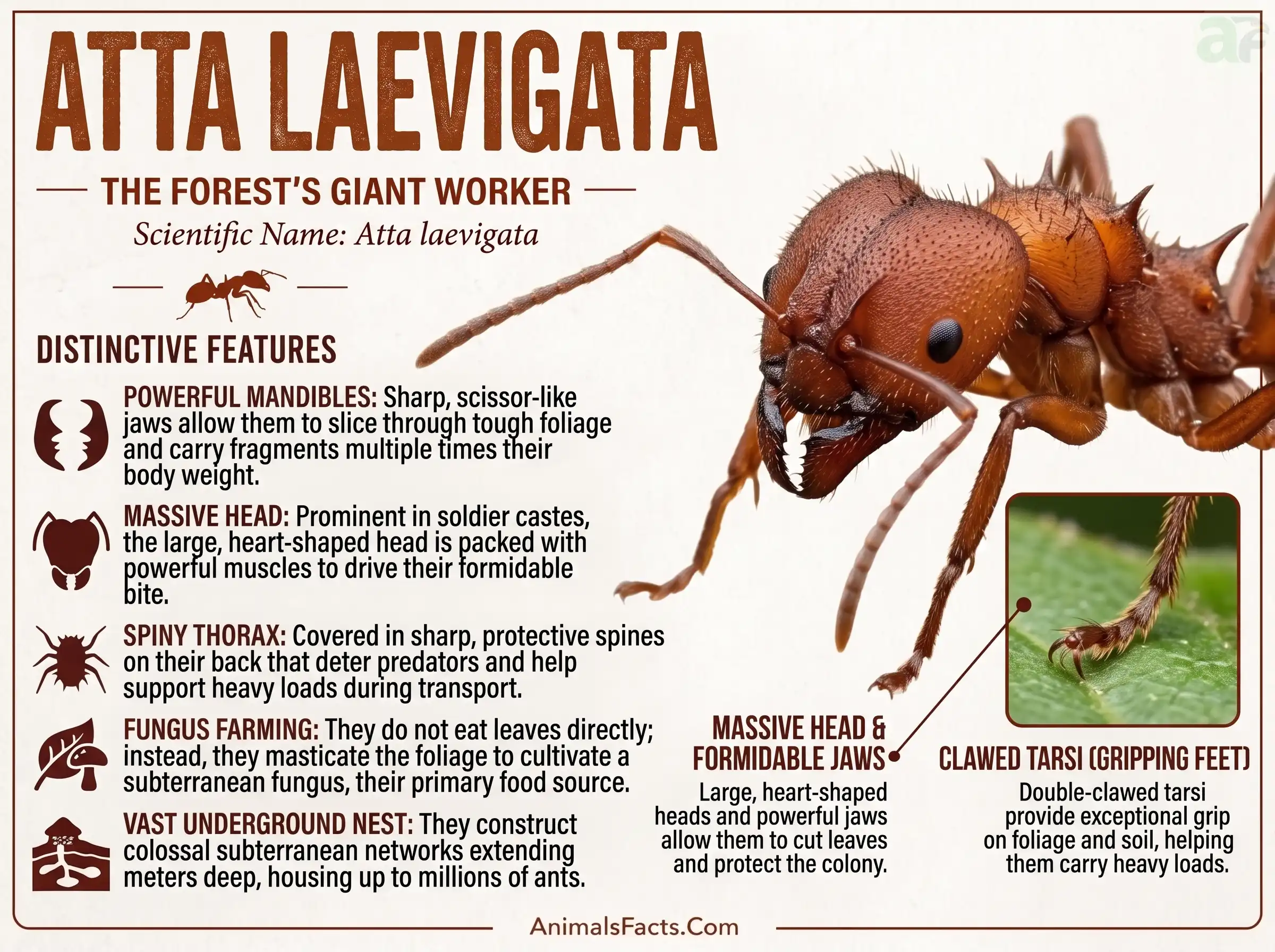
Atta laevigata workers show the most extraordinary range of body sizes of any ant species — a size variation so extreme that the largest and smallest individuals of the same colony look like members of completely different species to an untrained observer.
The Worker Size Range — An Engineering Marvel
The most immediately remarkable physical feature of Atta laevigata is the continuous size variation among workers — from the tiny minims (minimum workers) to the enormous soldiers:
Size range — Worker body length ranges from approximately 1.5 mm (minim workers) to 14 mm (large soldiers) — nearly a 10-fold difference in body length representing approximately a 1,000-fold difference in body volume within the worker caste of a single species.
Why such range? — The size variation reflects a sophisticated division of labor — each size class is physically optimized for a specific task set:
| Caste | Body Length | Head Width | Primary Function |
|---|---|---|---|
| Minim (smallest workers) | 1.5–2 mm | 0.8–1 mm | Fungus garden maintenance; nursing larvae |
| Minor worker | 2–3 mm | 1–1.5 mm | Fungus garden work; some foraging |
| Media worker | 3–7 mm | 1.5–3.5 mm | Primary foragers and leaf cutters |
| Major worker (soldier) | 7–14 mm | 3.5–7 mm | Colony defense; seed processing; trail clearing |
| Super-major (soldier) | 12–14+ mm | 6–7+ mm | Maximum defense; major obstacle clearing |
The Queen — The Americas’ Largest Ant
Atta laevigata queens are the largest of any ant species in the Americas and among the largest queens of any ant globally:
- Body length: 22–25 mm
- Wing span (alate queens before flight): approximately 40–45 mm
- Weight: approximately 300–400 mg at peak reproductive condition
- Lifespan: up to 20 years — among the longest of any insect
The queen’s enormous size reflects the extraordinary egg-laying demands placed on her — she must single-handedly (or with a small founding group) initiate a colony that will eventually number millions of workers, and must continue laying eggs throughout her decades-long lifespan to maintain the colony workforce.
The Head — The Cutting Tool
The head of a Atta laevigata media worker (the primary leaf-cutter caste) is a remarkably engineered structure:
Proportional size — The head is large relative to body size — housing the powerful mandibular muscles that drive the cutting mandibles.
Mandibles — The curved, serrated mandibles are the primary cutting tools — operating like a pair of scissors, with each mandible providing one blade of the cutting pair. The serrations on the mandible edges increase cutting efficiency on fibrous plant material.
The cutting mechanism — Leaf-cutting involves a specific behavioral sequence: the ant straddles the leaf edge, anchors with the hind legs, and vibrates its body at approximately 1,000 Hz — the vibration transmitted through the mandibles to the leaf surface. This sonication or substrate vibration accelerates cutting dramatically — the same principle used in ultrasonic cutting tools in industrial manufacturing. Researcher Flavio Roces and colleagues discovered this vibration cutting mechanism, establishing that leaf-cutter ants independently evolved a cutting technique similar to one of humanity’s more sophisticated industrial innovations.
The Metapleural Gland
One of Atta laevigata‘s most important anatomical features is the metapleural gland — a specialized exocrine gland located on the lower rear portion of the thorax:
Function — The metapleural gland produces a cocktail of antibiotic compounds — including phenylacetic acid and other antimicrobial substances — that the ant spreads through self-grooming and contact with nest surfaces. These compounds suppress the growth of foreign fungal species (particularly Escovopsis — a parasitic fungus that specifically attacks Atta fungus gardens) that could devastate the cultivated fungus crop.
The system — The metapleural gland is found in all ants — but is particularly enlarged and particularly important in Attini species, where its antibiotic production supplements the antibiotic bacteria maintained on the ant’s cuticle to provide the chemical environment that maintains fungal garden purity.
💡 Did You Know? The leaf-cutting mechanism of Atta laevigata workers involves high-frequency vibration of the body at approximately 1,000 Hz transmitted through the mandibles to the plant surface being cut — a technique that reduces the force required for cutting and accelerates the cutting rate by approximately 40% compared to static cutting. This vibration is generated by the stridulatory organ — a specialized file-and-scraper structure on the ant’s abdomen that produces vibrations as the abdomen segments move against each other. The same stridulatory organ also produces alarm signals and other social communications — the same physical structure serving both a mechanical cutting function and a social communication function simultaneously. This dual function of the stridulatory organ is one of the most elegant examples of evolutionary exaptation in insect biology — an organ that evolved for communication being co-opted for an entirely different physical function.
4. Top 25 Amazing Atta laevigata Facts
Here is your definitive collection of the most extraordinary, scientifically verified, and genuinely astonishing Atta laevigata facts as of 2026:
- Atta laevigata practices fungus agriculture that predates human farming by approximately 50 million years — making leaf-cutter ants the oldest known farmers of any domesticated organism in the history of life on Earth.
- A mature Atta laevigata colony can contain up to 8 million individual workers — making it one of the largest insect colonies in the world and creating a superorganism whose combined biomass rivals that of large vertebrate animals.
- The Atta laevigata queen can live for up to 20 years — one of the longest lifespans of any insect — and during that time produces an estimated 150–200 million eggs — one of the highest lifetime reproductive outputs of any animal relative to body mass.
- Atta laevigata ants do not eat leaves — the leaf fragments they cut and carry are substrate for fungus cultivation. The ants eat the gongylidia (specialized nutrient-rich structures) produced by the fungus Leucoagaricus gongylophorus that they cultivate on this plant material.
- The fungus cultivated by Atta laevigata — Leucoagaricus gongylophorus — cannot survive outside ant nests — it has been maintained in continuous cultivation for approximately 50 million years and is so co-evolved with its ant cultivators that it has lost the ability to reproduce sexually in natural environments.
- Atta laevigata nests can extend up to 8 meters deep into the soil and contain over 1,000 individual chambers connected by a network of tunnels — some mature nests having been excavated by researchers to reveal structures containing 40–80 tonnes of excavated soil pushed to the surface over the colony’s lifetime.
- The workers of Atta laevigata show a 10-fold range in body length — from 1.5 mm minim workers to 14+ mm soldiers — representing one of the most extreme size polymorphisms within a single insect species.
- Atta laevigata is one of the most significant agricultural pests in South America — a single large colony can defoliate an entire citrus tree overnight and can remove the leaf canopy of a small plantation within days, causing economic losses estimated at billions of US dollars annually across Brazil alone.
- Leaf-cutter ant trails of Atta laevigata can extend up to 250 meters from the nest to active cutting sites — worn into smooth highways through repeated use by millions of passing workers over months and years.
- Atta laevigata workers practice fungus garden hygiene — removing weeded material (including dead fungus, failed garden sections, and debris) and depositing it in specific refuse chambers that are architecturally distinct from garden chambers and located in the deepest, most remote parts of the nest to minimize contamination risk.
- When a new queen leaves on her nuptial flight, she carries a small fragment of the fungus garden in a special pouch in her mouth (the infrabuccal pocket) — providing the fungal inoculum that will seed the new colony’s garden. This is the primary mechanism by which the domesticated fungus lineage is transmitted across generations of ant colonies.
- Atta laevigata maintains antibiotic-producing bacteria (Pseudonocardia species) on the cuticle of workers — a three-way mutualism (ant-fungus-bacteria) that provides biological suppression of the parasitic fungus Escovopsis, which specifically attacks Atta fungus gardens. This bacterial antibiotic system represents an independent evolution of antibiotic use approximately 50 million years before humans.
- The leaf-cutting action of Atta laevigata workers involves sonication — vibrating the body at ~1,000 Hz to accelerate cutting — a mechanism independently converging on the same principle used in ultrasonic industrial cutting tools.
- Atta laevigata colonies regulate the temperature and humidity of their fungus garden chambers with extraordinary precision — maintaining temperatures within 1–2°C of the optimal range for fungal growth through the architectural design of the nest and behavioral regulation of ventilation.
- A foraging Atta laevigata worker can carry a leaf fragment up to 50 times its own body weight — the equivalent of a human carrying approximately 3,000–4,000 kg across rough terrain.
- Atta laevigata is not a generalist when selecting plant material for the fungus garden — workers demonstrate sophisticated plant material selectivity, preferring certain plant species and rejecting others, and showing sensitivity to the secondary chemical composition of plant material that could inhibit the growth of the cultivated fungus.
- The Atta laevigata supercolony dynamic — in which multiple nests in close proximity may be genetically related and share foraging territories without conflict — represents a level of inter-colony social organization that is among the most complex in the insect world.
- Army ant and Atta interactions — The army ant (Eciton burchellii) is one of the most significant natural predators of Atta laevigata colonies — army ant raids on established Atta nests have been documented removing significant proportions of the worker force and destroying portions of the fungus garden.
- The alarm pheromone system of Atta laevigata involves at least 12 chemically distinct compounds operating at different concentrations to produce graduated responses from alert to recruitment to extreme defense — a chemical communication vocabulary of remarkable sophistication.
- A mature Atta laevigata colony harvests an estimated 50 kg of fresh plant material per day — making the colony the equivalent of a large mammalian herbivore in terms of daily vegetation consumption. Some researchers have estimated that Atta species collectively consume 17% of total leaf production in South American tropical forests.
- Atta laevigata workers engage in trail optimization — the foraging trail system is not a randomly determined path but a progressively optimized route that represents the shortest available path between nest and resource site. The optimization emerges from the pheromone reinforcement of paths used by successful returning foragers — essentially the same algorithm used in modern computational Ant Colony Optimization (ACO) software, which was directly inspired by Atta trail behavior.
- The deepest Atta laevigata nests documented — using excavation, ground-penetrating radar, and 3D reconstruction — represent some of the most structurally complex constructions ever attributed to a non-human organism, with one excavated Brazilian nest revealing a tunnel network connecting 1,920 chambers across a soil volume of approximately 22 cubic meters.
- Atta laevigata queens conduct their nuptial flights — during which mating occurs and new colonies are founded — in massive synchronized events triggered by specific weather conditions (typically the first rains after a dry period). In parts of Brazil, these nuptial flights involve such enormous numbers of winged queens and males that they are detectable on weather radar systems — appearing as anomalous returns interpreted by some radar operators as localized precipitation events.
- The Atta laevigata fungus garden is not a single undifferentiated mass — it is maintained in distinct sections showing different ages and processing stages, with older sections that have depleted their plant substrate being removed and replaced with freshly processed material in a continuous agricultural management cycle.
- Research on Atta laevigata and related leaf-cutter ant species has directly contributed to the development of Ant Colony Optimization algorithms used in logistics, network routing, and operations research — making Atta ants one of the few biological organisms whose behavior has directly inspired a major class of computational problem-solving methods used in human technology.

5. Fun Facts About Atta laevigata
- Atta laevigata invented farming 50 million years before humans
- Colonies can contain 8 million workers — the biomass of a large mammal
- The queen can live 20 years — one of the longest insect lifespans
- They don’t eat leaves — they use them to farm fungus
- Nests reach 8 meters deep with 1,000+ chambers
- Workers carry 50× their own body weight
- The fungus they grow cannot exist outside ant nests
- They use vibration to cut leaves — like ultrasonic cutting tools
- They maintain antibiotic bacteria — 50 million years before humans
- Nuptial flights are so large they appear on weather radar
- They inspired Ant Colony Optimization computer algorithms
- One colony harvests 50 kg of plant material per day
6. Atta laevigata Natural Habitat & Geographic Range
Atta laevigata has one of the widest geographic distributions of any Atta species — occupying a diverse range of South American habitats across a geographic range extending from northern Venezuela and Colombia to central Brazil and into Bolivia and Peru.
Habitat Requirements
Atta laevigata requires specific environmental conditions that determine its distribution across the South American landscape:
Well-drained soil — The most critical requirement for nest establishment; waterlogged or frequently flooded soils cannot support the deep, multi-layered nest architecture that A. laevigata requires. Sandy or loamy soils with good drainage are strongly preferred.
Adequate plant biomass for harvesting — Large, mature colonies require enormous quantities of plant material daily — habitats must support sufficient vegetation productivity to sustain long-term colony presence.
Warm temperatures — A. laevigata is a tropical and subtropical species requiring consistently warm temperatures — the fungus cultivation system requires ambient temperatures within a specific range for optimal fungal growth.
Relatively open foraging paths — While nests may be established in forest interiors, the foraging trail system requires at least partially open ground or predictable path structures between nest and cutting sites.
Habitat Types
Cerrado (Brazilian tropical savanna) — One of the most important habitats; the cerrado’s combination of well-drained soils, abundant grass and forb vegetation, and warm climate provides ideal conditions. A. laevigata is one of the most ecologically significant consumers in cerrado ecosystems.
Tropical rainforest — Present throughout the Amazon and Atlantic Forest zones — the enormous plant biomass of tropical forest providing abundant cutting material for large colonies.
Caatinga (semi-arid thorn scrub of northeastern Brazil) — Documented in the caatinga — demonstrating a drought tolerance unusual for a species requiring constant fungus garden management.
Agricultural landscapes — A. laevigata is abundantly present in agricultural areas — including pastures, plantations, and crop fields — where the simplified vegetation communities and abundant food plants make foraging efficient.
Forest-savanna transition zones — Particularly well-represented in the transition ecotones between Brazilian cerrado and rainforest — the habitat heterogeneity providing diverse plant materials for the fungus gardens.
Geographic Range
| Country | Distribution | Notes |
|---|---|---|
| Brazil | Widespread across most of country | Most abundant and most studied range |
| Venezuela | Widespread | Common in llanos and forest |
| Colombia | Present | Northern and eastern regions |
| Peru | Present | Amazon basin and cerrado margins |
| Bolivia | Present | Eastern lowlands |
| Guyana, Suriname, French Guiana | Present | Forest and savanna |
| Trinidad and Tobago | Present | Island populations; known as “bachac” |
7. Atta laevigata Diet & Feeding Behavior — The Fungus Farming System
The feeding biology of Atta laevigata is simultaneously the most important and the most misunderstood aspect of the species — the ants do not eat leaves, and the full complexity of their agricultural system extends far beyond the simple image of leaf-carrying workers.
What Atta laevigata Actually Eats
The workers of Atta laevigata eat exactly one thing — the gongylidia produced by the cultivated fungus Leucoagaricus gongylophorus:
Gongylidia — Specialized, swollen hyphal tips produced by the cultivated fungus in response to chemical signals from the ants. These structures are uniquely produced in ant-cultivated fungal gardens and are not found in free-living Leucoagaricus populations. They are nutritionally rich — high in carbohydrates, proteins, and lipids — specifically tailored over millions of years of co-evolution to meet ant nutritional requirements.
Larval nutrition — Larvae are fed gongylidia directly — the youngest larvae receiving almost exclusively fungal material; older larvae receiving a mix of fungal material and plant sap extracted during leaf processing.
Worker nutrition — Adult workers consume gongylidia and also feed on liquid plant sap released during the leaf-cutting and leaf-processing stages — the sap providing simple sugars for immediate energy.
The Complete Agricultural System
The leaf-cutting behavior is merely the raw material acquisition stage of a multi-step agricultural process:
Stage 1 — Plant material selection — Workers assess available plants through antennal contact — sensing secondary chemical compounds that indicate plant toxicity, suitability for fungal growth, and freshness. Chemical compounds that inhibit fungal growth are actively avoided.
Stage 2 — Cutting — Using sonication-enhanced mandible action, workers cut plant material into pieces of specific sizes — too large to be easily carried, and cut along specific trajectories that produce pieces of predictable shape. The cutting site is typically at the leaf margin — the worker straddling the edge and cutting toward the midrib.
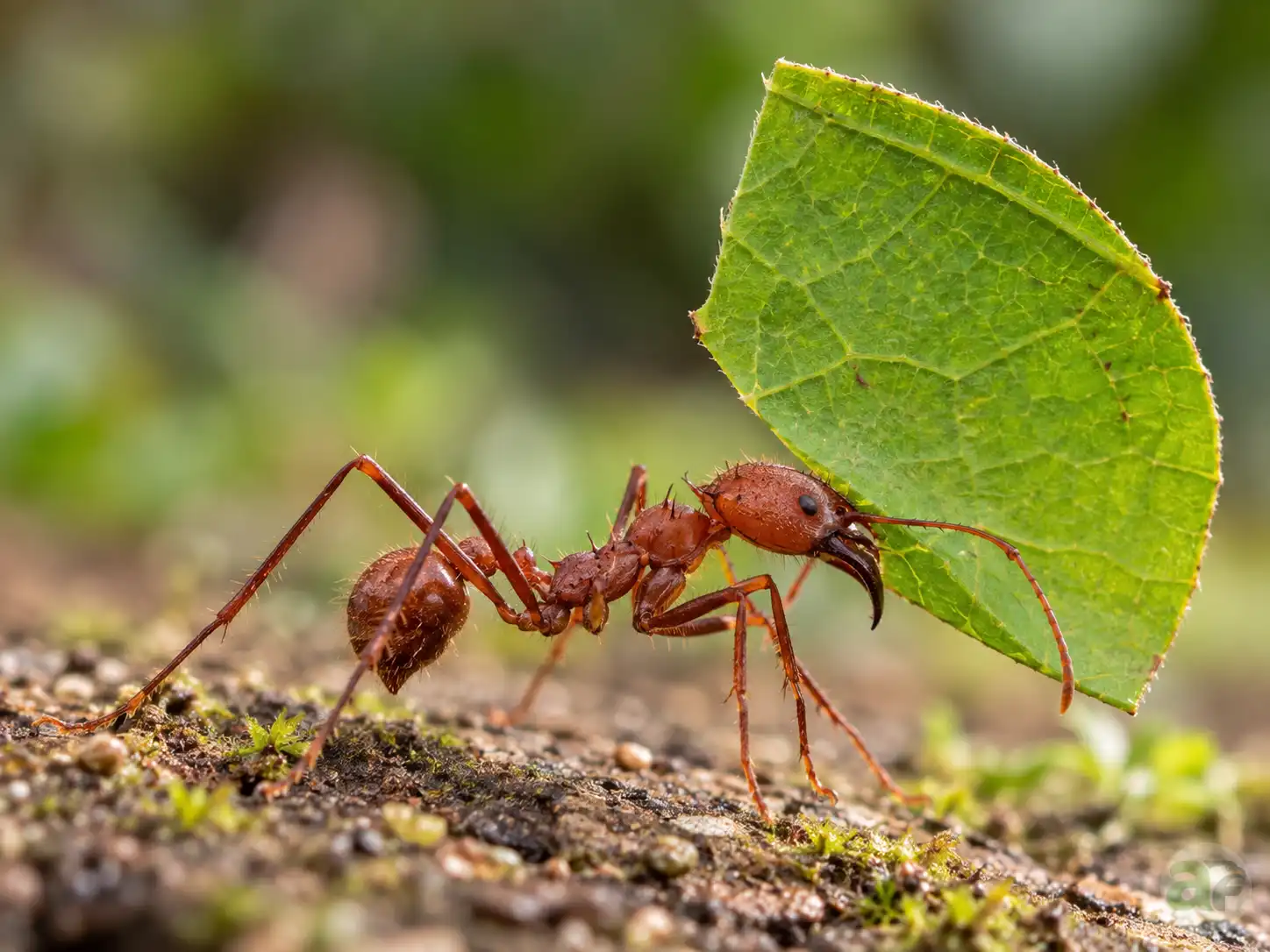
Stage 3 — Transport — Cut pieces are carried along pheromone-marked trails to the nest — the transport involving two distinct worker sizes: larger workers that carry the fragment overhead, and smaller workers (called minims) that ride on the transported fragment, providing protection against parasitic phorid flies (Apocephalus species) that attempt to lay eggs on the load-carrying worker.
Stage 4 — Initial processing — Upon arrival at the nest entrance, fragments may be passed to smaller workers for further size reduction. The material enters a processing chain that moves progressively deeper into the nest.
Stage 5 — Fungus garden incorporation — Workers lick the plant surface clean (removing antimicrobial plant compounds), cut the material into smaller pieces, and incorporate it into the fungus garden matrix — inserting fragments into the spongy garden structure and inoculating them with fungal hyphae from the active garden.
Stage 6 — Garden management — Workers continuously tend the garden — removing dead or failing sections, weeding out competing fungi (detected by chemical differences from the cultivar), and maintaining the structural integrity of the garden matrix.
Stage 7 — Harvest — Workers harvest gongylidia from the active parts of the garden — consuming them directly and carrying them to larvae and the queen.
The Parasitic Threat — Escovopsis
The most significant biological threat to Atta laevigata fungus gardens is the parasitic fungus Escovopsis — a specialist pathogen that attacks Leucoagaricus exclusively:
The threat — Escovopsis grows rapidly in Atta gardens, consuming the cultivated fungus and destroying garden sections within days if left unchecked.
The defense — Atta laevigata has evolved a multi-layered defense against Escovopsis:
- Physical weeding — workers remove Escovopsis-infected material from the garden
- Metapleural gland antibiotic compounds applied through self-grooming
- Pseudonocardia bacteria maintained on the ant cuticle — producing antibiotics that specifically suppress Escovopsis growth
This three-way mutualism (ant-Leucoagaricus–Pseudonocardia) represents one of the most complex biological defense systems discovered in any animal.
Plant Material Selectivity
Atta laevigata is not simply cutting any available leaves — it demonstrates sophisticated plant selection:
- Workers test plant material before cutting — rejecting plants with high concentrations of terpenes, alkaloids, or other antifungal compounds
- The same plant species may be cut heavily in some seasons and avoided in others — reflecting seasonal variation in chemical composition
- Some plant species are systematically avoided entirely — the secondary chemicals they produce inhibiting the cultivated fungus even at low concentrations
- Workers show a preference for younger, softer plant material — which is more easily processed and less likely to contain developed antifungal defenses
8. Atta laevigata Reproduction & Life Cycle
The reproductive biology of Atta laevigata is one of the most extraordinary in the insect world — a system that has produced some of the longest-lived and most reproductively productive individuals of any invertebrate.
The Nuptial Flight — Colony Founding Event
The most dramatic event in the Atta laevigata reproductive cycle is the nuptial flight — the synchronized mass emergence of winged reproductive females (alate queens) and males for mating:
Triggering conditions — Nuptial flights are triggered by specific environmental cues — typically the first substantial rainfall following an extended dry period, combined with appropriate temperature and light conditions. The synchronization of flight across a large geographic area ensures that queens and males from different colonies encounter each other — promoting outbreeding.
The scale — In areas of high Atta laevigata density, nuptial flights involve enormous numbers of reproductive individuals — the simultaneous emergence of queens and males from thousands of colonies creating swarms detectable by weather radar systems as anomalous returns interpreted as localized precipitation.
Mating — Queens mate with multiple males (typically 3–8) during the nuptial flight — storing the sperm in the spermatheca (sperm storage organ) where it will be used to fertilize eggs for the rest of the queen’s life (up to 20 years). This single mating flight provides all the genetic material the queen will ever use.
Colony founding — After mating, queens land, shed their wings, and begin excavating a founding chamber — a small underground space where the new colony will begin. The queen uses fat reserves from the wing muscles (now broken down after flight) and from her body to fuel the energy demands of early colony founding without any worker support.
The fungus inoculation — The founding queen carries a fragment of the parental colony’s fungus garden in her infrabuccal pocket (a specialized mouth chamber). This fragment is the inoculum for the new garden — the domesticated fungal lineage transmitted directly from mother colony to daughter colony through the queen’s body.
Early Colony Development
Week 1–4 — The queen establishes the founding chamber and begins cultivating the fungus fragment with her own feces (which contain nutritional compounds that support early fungal growth). She lays the first eggs.
Week 4–8 — First larvae develop; first workers emerge (tiny minim workers — the smallest caste). The founding queen has been surviving on stored body reserves throughout this period.
Month 2–4 — The first worker cohort begins foraging — initially within the nest complex, later to the surface. The fungus garden expands rapidly with worker support.
Year 1 — Colony size typically reaches thousands of workers with an established, producing fungus garden. The nest begins expanding both laterally and vertically.
Year 3–5 — Colony reaches reproductive maturity — the first production of alate queens and males, which will participate in nuptial flights and found new colonies.
Year 5–20+ — Colony continues expanding to maximum size (potentially 8 million workers). The queen continues laying eggs throughout this period.
Queen Reproduction
The Atta laevigata queen’s reproductive output is among the highest of any animal:
- Egg laying rate: approximately 2,000–4,000 eggs per day at peak production
- Lifetime egg production: estimated 150–200 million eggs over a 20-year lifespan
- Reproductive caste production: sexual reproductives (alate queens and males) produced seasonally; worker eggs produced continuously year-round
Worker Lifespan
Despite the queen’s extraordinary longevity, workers are short-lived:
- Lifespan: approximately 30–60 days for most worker castes
- The constant worker turnover requires continuous egg production by the queen to maintain colony size
- The ant colony itself is effectively immortal as long as the queen survives — individual workers are replaced continuously while the colony persists
9. Social Structure & Caste System
The social organization of Atta laevigata is the most complex of any ant species — representing a level of social sophistication that has been compared to vertebrate societies in its organizational depth.
The Superorganism Concept
Atta laevigata colonies are classic examples of the superorganism — a collection of individuals so integrated in function and so interdependent in biology that the colony itself, rather than the individual ant, is the appropriate unit of biological analysis:
- Individual workers cannot survive alone for extended periods — they are physiologically and behaviorally adapted for colony membership, not independent existence
- The colony collectively maintains homeostasis — regulating nest temperature, humidity, and gas composition through collective behavior
- The colony has a single reproductive individual (the queen) — analogous to the reproductive cells of a multicellular organism
- The division of labor among castes parallels the differentiation of cell types in a multicellular organism
The Caste System in Detail
The Queen — The sole reproductive female in a mature colony; produces all eggs; receives preferential feeding from workers; the biological focus of the entire colony’s organization. The queen’s reproductive output determines colony growth rate; her death initiates colony decline and eventual collapse.
Alate Queens (future queens) — Produced seasonally; fed and protected until nuptial flight conditions are triggered; carry the fungal inoculum for new colony founding.
Males — Produced seasonally; short-lived (typically dying within days to weeks of the nuptial flight); contribute only genetic material to the reproductive process.
Minim Workers — The smallest workers (1.5–2 mm); primary fungus garden maintainers and larval nurses; rarely leave the fungus garden chambers; specialized for the delicate manipulation of fungal hyphae.
Minor Workers — Small foragers and garden workers; supplement garden maintenance and begin participating in foraging activities.
Media Workers — The primary foragers and leaf-cutters; optimized body size for carrying leaf fragments efficiently; constitute the largest proportion of the foraging workforce.
Major Workers (Soldiers) — Large, heavily built individuals with disproportionately large heads; primary defenders against army ants and vertebrate predators; also participate in seed processing and major obstacle clearance on trails.
Super-Major Soldiers — The largest individuals; relatively rare; primary defense against large threats including vertebrate disturbance of the nest.
Chemical Communication — The Language of Pheromones
Atta laevigata communicates almost entirely through pheromone signals — chemical messages that coordinate the behavior of millions of individuals without any centralized control:
Trail pheromones — Workers leaving the nest deposit a chemical trail (primarily methyl 4-methylpyrrole-2-carboxylate) that marks the route to active cutting sites. Successful returning workers reinforce the trail — creating a positive feedback loop where busy trails become stronger and more attractive to new foragers, while abandoned trails fade as no new pheromone is added.
Alarm pheromones — Multiple compounds triggering responses from alert (low concentration) through recruitment of defenders (medium concentration) to flight (very high concentration near the alarm source). The graduated nature of the alarm response allows appropriate colony reactions to threats of different severity.
Queen pheromones — Chemical signals from the queen that suppress reproductive development in workers and coordinate colony-level behavior. The queen’s pheromone blend is the primary signal that maintains the colony’s reproductive organization.
Recruitment signals — Specific pheromone blends used during foraging to recruit additional workers to productive cutting sites — directing labor allocation toward the most productive resource areas.
Recognition pheromones — Colony-specific chemical signatures on the cuticle of each worker that allow immediate identification of colony membership — the basis for the aggressive response to workers from other colonies that encounter each other at foraging sites.
10. Predators & Defense Mechanisms
Atta laevigata faces a range of natural predators despite its defensive capabilities — and has evolved a sophisticated multi-layered defense system calibrated for threats of different types.
Natural Predators
Army ants (Eciton burchellii and related species) — The most significant predator of Atta laevigata colonies; army ant raids involve thousands of coordinated attackers and can overwhelm Atta soldier defenses despite the size difference between species. When army ants approach, Atta colonies initiate a mass retreat — workers carrying eggs, larvae, and fungal material deep into the nest while soldiers attempt to defend the upper tunnel sections.
Giant anteater (Myrmecophaga tridactyla) — The largest anteater in the Americas is a specialized Atta predator — its powerful claws and long tongue adapted for breaking into Atta nests and consuming large numbers of workers, soldiers, and larvae. A single giant anteater may visit multiple Atta nests in its territory.
Tamandua (Tamandua tetradactyla) — The collared anteater; a smaller but similarly specialized ant and termite predator that supplements its diet with Atta workers.
Armadillos — Several armadillo species are documented breaking into Atta nests to consume workers, larvae, and pupae.
Phorid flies (Apocephalus species) — Parasitic flies that hover near Atta foraging trails and attempt to lay eggs on the heads of load-carrying media workers. The eggs hatch into larvae that develop inside the ant’s head, eventually killing the host. This parasitoid pressure drives the remarkable behavior of hitchhiking minim workers — tiny workers that ride on the leaf fragments being carried by larger workers, positioned to detect and deter approaching phorid flies.
Vertebrate insectivores — Various birds, lizards, and small mammals consume Atta workers opportunistically at trail sites.
Defense Mechanisms
Soldier caste — Large, powerfully built major workers with disproportionately large mandibles capable of severing appendages of invertebrate attackers and inflicting significant bites on vertebrate disturbers. The soldiers’ large heads are packed almost entirely with mandibular muscle — sacrificing brain space for cutting power.
Chemical defense — Multiple alarm pheromones coordinating rapid defensive responses; metapleural gland secretions that deter some fungal and bacterial pathogens; and formic acid-based compounds that provide some chemical deterrence to small predators.
The hitchhiker defense — The minim workers riding on leaf fragments provide vigilant monitoring for approaching phorid flies — physically deterring egg-laying attempts by facing and lunging at approaching flies. This is one of the most unusual and most elegant defensive behaviors documented in ants.
Soldier blocking behavior — During army ant raids, large soldiers physically block tunnel entrances with their heads — the large, armor-like head capsule forming a plug that prevents army ant workers from entering the tunnel.
Alarm cascade — The rapid propagation of alarm pheromone through a colony allows coordinated, appropriately scaled responses — the entire colony can shift from normal foraging to full defensive mobilization within minutes of detecting a major threat.
Deep nest architecture — The fungus garden chambers are located in the deepest parts of the nest — protected from most surface-level disturbances and requiring penetration through multiple tunnel sections with defending soldiers before reaching the vital fungal resource.
💡 Did You Know? The phorid fly hitchhiker defense of Atta laevigata is one of the most remarkable examples of behavioral arms race between predator and prey documented in any insect system. The phorid flies (Apocephalus species) that parasitize Atta workers have evolved to target the load-carrying media workers specifically — because carrying a leaf fragment prevents the ant from using its front legs to brush away an approaching fly or to reach the fly with grooming movements. The ants have responded by evolving the minim hitchhiker behavior — tiny workers that serve specifically as fly-deterrents on the carried load. The flies have in turn evolved evasive approach behaviors that attempt to circumvent the minim guard — and the minims have evolved improved detection capabilities. This three-way interaction between Atta media workers, minim workers, and phorid flies represents a continuous evolutionary arms race in which each adaptation by one party drives counter-adaptation by the other — a perfect microcosm of the evolutionary dynamics that produce the extraordinary behavioral complexity observed in attine ant systems.

11. Atta laevigata Facts for Kids
Hey incredible young scientists and nature explorers! Here are some genuinely mind-blowing Atta laevigata facts for kids that will make your science teacher’s jaw drop:
- 🐜 These ants invented FARMING 50 million years before humans did! Long before the first human farmer planted the first seed, these ants were already growing their own food — a special fungus that they cultivate in underground gardens. They did not learn this from anyone — they evolved it over millions of years all by themselves. Humans started farming about 10,000 years ago. These ants started farming about 50 MILLION years ago!
- 🐜 They don’t eat the leaves they carry — they use them like COMPOST! The famous leaf-carrying that everyone associates with leaf-cutter ants is just the raw material for their farms. They chew the leaves into a spongy mulch and use it to grow a special fungus that they then EAT. The leaves are just fertilizer — the actual meal is the fungus!
- 🐜 One colony can have EIGHT MILLION ants in it! If you could count all the ants in one Atta laevigata colony, counting one every second, it would take you over THREE MONTHS to finish counting. Eight million workers all living in one underground city together, doing different jobs, all communicating with chemicals!
- 🐜 The ant queen can live for TWENTY YEARS! While worker ants live for about 30 to 60 days, the queen can keep living and laying eggs for up to twenty years — laying about 3,000 eggs EVERY SINGLE DAY during that time. That is somewhere around 150 million eggs in a lifetime!
- 🐜 Their underground city goes EIGHT METERS deep! The biggest Atta laevigata nests go deeper underground than a two-storey house is tall. Inside there are over a thousand separate rooms connected by tunnels, and some of those rooms are bigger than a football. The ants had to move enough soil to fill a large moving truck to build it!
- 🐜 These tiny ants can carry 50 TIMES their own body weight! If you could do the same thing, you would be able to carry a small car! The ants carry leaf fragments held above their heads while walking along trails that can be 250 meters long — the same as walking around a running track more than half a way around!
- 🐜 These ants appear on WEATHER RADAR during mating season! When the weather is right, millions of winged queen ants all take off at the same time from their nests to find mates. There are SO MANY of them that radar systems used for weather forecasting detect them as if they were rain clouds! Radar operators have to learn to distinguish “ant swarm” from “actual rain.”
- 🐜 These ants were the inspiration for a type of COMPUTER PROGRAM! Scientists watched how these ants find the shortest trail between their nest and food, and invented a computer algorithm called “Ant Colony Optimization” that uses the same principles to solve difficult routing problems in logistics, internet networks, and other engineering challenges. Real ants helping design computer software!
12. Relationship with Humans
The relationship between Atta laevigata and humans across South America is one of the most economically significant human-insect relationships in the Western Hemisphere — combining profound ecological interest, serious agricultural conflict, traditional cultural use, and scientific importance.
Agricultural Impact — Brazil’s Most Significant Insect Pest
Atta laevigata is considered Brazil’s most economically significant agricultural pest and one of the most damaging insect species in South American agriculture:
The damage scale — A mature Atta laevigata colony can:
- Defoliate an entire citrus tree in a single night
- Remove all leaf cover from a small eucalyptus plantation within days
- Cause crop losses in sugarcane, soybeans, pasture grasses, and virtually any other commercial plant species
- Undermine structural integrity of agricultural land through tunnel construction
Economic losses — Estimated annual economic losses to Brazilian agriculture from Atta species (primarily A. laevigata and A. sexdens) are calculated at billions of US dollars — making this one of the most economically costly insect pest situations in the world.
Control approaches — Farmers across the species’ range use multiple control methods:
- Chemical control — Application of sulfluramid-based granular baits that workers carry into the nest; the active compound disrupts energy production in the fungal cultivar, killing the garden and subsequently the colony
- Biological control research — Research into the use of natural enemies including phorid flies and Escovopsis-based biocontrol approaches; results remain experimental
- Physical exclusion — Trenches, sticky barriers, and other physical prevention methods around high-value plants
- Cultural control — Timing of agricultural operations to avoid periods of peak foraging activity
The control paradox — Despite enormous agricultural damage, Atta laevigata also provides significant ecosystem services — soil aeration through nest construction, nutrient cycling through leaf decomposition in the fungus garden, and the ecological function of stimulating plant regrowth through grazing. The species is a keystone ecosystem engineer simultaneously valued ecologically and devastatingly expensive agriculturally.
Traditional and Cultural Uses
Across the range of Atta laevigata, indigenous and traditional communities have long recognized the ants as a food resource:
Tanajuras — In Brazil, the large winged queen ants captured during nuptial flights are called “tanajuras” — and are consumed as a traditional food across multiple Brazilian states. Captured queens are typically roasted or fried — described as having a rich, nutty flavor from their high fat content (the fat reserves stored for colony founding). This tradition is practiced particularly in the states of Minas Gerais, Goiás, and São Paulo.
Protein source — The nutritional content of alate queens is substantial — high in protein (approximately 40–50% of dry weight) and fat (approximately 35–45% of dry weight) — making them nutritionally significant traditional food sources.
Bachac butter (Trinidad) — In Trinidad, where the species is known as bachac, the large alate queens are similarly consumed — traditionally roasted — and the practice is historically associated with indigenous Amerindian communities and subsequently with broader Trinidadian folk food culture.
Medicinal traditional use — In various traditional medicine systems across South America, Atta laevigata workers, soldiers, and queens have been used in various preparations — the specific applications varying by region and cultural tradition.
Scientific Significance
Atta laevigata is one of the most scientifically significant insect species in biological research:
Sociobiology — Atta species were central to E.O. Wilson’s development of sociobiology — the study of the biological basis of social behavior. Wilson’s work on Atta chemical communication and caste systems in the 1960s–1980s was foundational to modern behavioral ecology.
Computational biology — The trail optimization behavior of Atta species directly inspired the development of Ant Colony Optimization (ACO) algorithms — a class of computational methods used in solving complex routing, scheduling, and network optimization problems. ACO algorithms are now used in telecommunications network routing, logistics optimization, and various engineering applications globally.
Agricultural research — Atta laevigata is one of the most intensively studied pest species in South American agricultural research — billions of dollars of research investment have gone into understanding its biology to develop better control methods.
13. Atta laevigata Conservation Status & Ecological Impact
Conservation Status
Atta laevigata has no formal IUCN threatened species classification — it is an abundant species across a broad geographic range with no evidence of population decline. In fact, from a conservation perspective, the primary concern is the opposite — the species is considered an ecological threat (invasive pest) in agricultural landscapes rather than a species requiring protection.
However, the conservation of Atta laevigata in its ecological context is important:
Ecosystem engineering value — In natural cerrado and tropical forest habitats, Atta laevigata plays critical ecosystem engineering roles (see Role in Ecosystem section) that benefit the broader ecological community. Habitat loss in the Brazilian cerrado — one of the world’s most threatened biomes — threatens A. laevigata populations in their natural ecosystem context.
Mutualism web integrity — The A. laevigata — Leucoagaricus — Pseudonocardia three-way mutualism is a unique biological system of extraordinary scientific value. The loss of any component of this system would represent an irreplaceable biological innovation.
Ecological Impact — Keystone Engineering Species
In natural ecosystems, Atta laevigata is a keystone species whose presence fundamentally shapes the ecological community:
Soil engineering — The nest construction of large A. laevigata colonies moves enormous quantities of soil — excavated material pushed to the surface creates mounds of deep soil that differ chemically from the surrounding surface soil. These soil disturbances create specialized habitat patches colonized by distinct plant and invertebrate communities — increasing habitat heterogeneity and biodiversity across the landscape.
Nutrient cycling — The processing of leaf material in the fungus garden produces organic-rich refuse that is deposited in specific nest chambers. When nests are abandoned, these refuse chambers decompose to produce localized patches of exceptionally nutrient-rich soil — patches that support distinctively different plant communities and are visible in aerial imagery as patches of anomalously dense, tall vegetation at abandoned nest sites for years after colony death.
Herbivory effects — The removal of leaf biomass by Atta colonies stimulates plant regrowth — the pruning effect of leaf-cutter ant foraging can increase the productivity of some plant species through compensation growth. Some researchers have proposed that Atta grazing in tropical forests is an important mechanism for stimulating vegetation turnover and diversity.
Estimated vegetation consumption — Atta species collectively are estimated to consume approximately 17% of total leaf production in South American tropical forests — a herbivory level comparable to the total consumption of all mammalian herbivores combined in the same ecosystems.
14. Famous Atta laevigata Colonies and Research Moments
Landmark Research Moments
The 1977 Acromyrmex-Atta excavation study (Brazil) — Early excavation studies of mature Atta laevigata nests in Brazil’s cerrado provided the first comprehensive documentation of nest architecture — revealing the extraordinary depth, complexity, and scale of A. laevigata colonies for the first time in scientific literature. These studies required teams of researchers working for days with shovels and casting materials (typically plaster or aluminum) to document the full tunnel architecture.
The Wilson-Hölldobler synthesis (1990) — The publication of E.O. Wilson and Bert Hölldobler’s landmark book The Ants (which won the Pulitzer Prize in General Non-Fiction in 1991) synthesized decades of research on Atta species including A. laevigata into the most comprehensive treatment of ant biology ever produced. The chapter on leaf-cutter ants remains the most cited introduction to attine biology for non-specialists.
The Currie antibiotics discovery (1999) — Cameron Currie and colleagues at the University of Texas published research in Nature documenting the presence of antibiotic-producing Pseudonocardia bacteria on the cuticle of Atta workers — revealing the three-way mutualism that had been operating for 50 million years before humans discovered antibiotics. The paper was described as one of the most significant discoveries in insect biology of the late 20th century.
The 2003 Aluminum Cast — A Brazilian research team produced the largest aluminum-cast Atta laevigata nest ever documented — requiring several days of continuous aluminum pouring and producing a cast that, when excavated and cleaned, revealed a nest containing 1,920 chambers across a soil volume of approximately 22 cubic meters. The cast is preserved at a Brazilian research institution and has been viewed by millions of people through photographs and documentary footage.
The Radar Nuptial Flight Detection (2010s) — Brazilian meteorologists and entomologists collaborating on rainfall radar interpretation documented that Atta nuptial flights in parts of central Brazil produce distinctive radar signatures that can be distinguished from precipitation — establishing the phenomenon as a regular, predictable occurrence during specific weather conditions following dry periods.
15. Role in Ecosystem & Food Chain
The Herbivore Role
Atta laevigata is the dominant herbivore in many South American savanna and forest ecosystems — its leaf-cutting activities representing the largest single herbivory pressure of any animal in these systems:
Consumption scale — A single large A. laevigata colony consumes approximately 50 kg of fresh plant material per day — the equivalent herbivory impact of a large deer or small cow. Across the landscape, Atta colonies collectively exert a herbivory pressure on vegetation that exceeds that of all vertebrate herbivores combined in many cerrado and forest habitats.
Plant community effects — Selective plant material harvesting by Atta laevigata creates directional pressure on plant community composition — plants that produce secondary compounds inhibiting the ant’s fungal cultivar experience reduced harvesting pressure and may increase in abundance relative to more palatable species. Over long time periods, Atta foraging may contribute to shaping the plant species composition of the surrounding landscape.
The Soil Engineer Role
The nest-building activities of Atta laevigata have profound effects on soil structure and chemistry:
Soil aeration — The tunnel networks created by large A. laevigata nests penetrate to depths of up to 8 meters — creating channels that dramatically increase soil aeration and water infiltration in soils that might otherwise be compacted and impermeable.
Nutrient redistribution — Deep soil material brought to the surface during excavation contains minerals and nutrients from lower soil horizons that are rare in the nutrient-depleted surface soils of tropical cerrado — the mounds of excavated material around A. laevigata nests are significantly enriched in phosphorus, calcium, magnesium, and other nutrients relative to surrounding soil.
The refuse chamber effect — The nutrient-rich organic matter deposited in nest refuse chambers decomposes over years — creating persistent hotspots of soil fertility that support distinct plant communities at abandoned nest sites for decades after colony death.
The Prey and Predator Role
Atta laevigata is both a significant prey species and an indirect ecosystem driver:
Supporting anteater populations — The abundance of A. laevigata across South American cerrado and forest ecosystems is the biological foundation that sustains populations of giant anteaters and tamanduas — specialist ant predators whose population densities are directly linked to Atta colony abundance.
Bird associations — Multiple bird species including ant-following birds exploit the disturbance created by foraging Atta columns — catching insects, lizards, and other small animals flushed from vegetation as the foraging column approaches.
The decomposition role — The fungus garden system processes enormous quantities of plant material — the refuse from depleted gardens represents a significant input of partially decomposed organic matter to the soil, accelerating decomposition rates and nutrient cycling in ways that benefit plant communities.
16. Myths, Folklore & Cultural Significance
Indigenous South American Traditions
Across the indigenous cultures of South America that have coexisted with Atta laevigata for thousands of years, these ants occupy a significant cultural position:
The Tupi and related peoples (Brazil) — The saúva (leaf-cutter ant) appears in the oral literature and traditional ecological knowledge of multiple Tupi-speaking groups across Brazil — recognized as one of the most powerful and most consequential animals of the Brazilian landscape. The famous Brazilian saying “Brasil, país das saúvas” (“Brazil, country of the saúva ants”) attributed to a 19th century naturalist reflects the cultural centrality of the ants in Brazilian consciousness.
The Santarém region (Brazil) — Various indigenous and caboclo communities in the Amazon basin incorporate Atta laevigata into traditional ecological knowledge systems that guide agricultural practices — understanding the ants’ nesting preferences, activity patterns, and plant preferences in ways that inform crop placement and management strategies.
The tanajura tradition — The consumption of alate queens during nuptial flights is one of the most ancient and most widespread traditional practices associated with Atta laevigata across Brazil — pre-Columbian in origin and documented across multiple indigenous traditions before European contact. The flying queens were apparently recognized as an annual seasonal delicacy available only during the brief nuptial flight period — a seasonal food resource incorporated into subsistence patterns over millennia.
Medicinal applications — Various traditional medicine systems across Brazil have attributed medicinal properties to preparations made from Atta laevigata workers and soldiers — including applications for respiratory conditions, wound treatment, and various folk remedies. The scientific validity of these traditional applications has not been systematically evaluated.
The Famous Brazilian Saying
The observation attributed to the 19th century naturalist Louis Agassiz — or alternatively to various Brazilian intellectuals of the 19th century — that “Brazil will be destroyed by the saúva or by politicians” (“O Brasil será destruído pelas saúvas ou pelos políticos”) reflects the extraordinary cultural impact of Atta laevigata on Brazilian agricultural consciousness. The saying acknowledges the ants’ devastating agricultural impact while placing them in company with the country’s most significant political concerns — a testimony to the species’ genuine economic importance in Brazilian culture.
17. Atta laevigata in Pop Culture and Science
“The Ants” (E.O. Wilson and Bert Hölldobler, 1990) — The Pulitzer Prize-winning scientific book that made leaf-cutter ants including Atta laevigata accessible to a global audience — one of the most influential popular science books in natural history publishing history. Wilson’s eloquent account of Atta social organization reached readers far beyond the specialist audience and established the leaf-cutter ant as one of the great examples of evolutionary sophistication in the popular science literature.
“The Superorganism” (Hölldobler and Wilson, 2009) — A follow-up to The Ants focusing specifically on the superorganism concept as exemplified by Atta and other social insects; similarly influential in popularizing the science of leaf-cutter ants.
David Attenborough BBC documentaries — Multiple BBC natural history productions — including “Life in the Undergrowth” (2005) and “Planet Earth” series episodes — have featured Atta leaf-cutter ant sequences of extraordinary quality. The BBC “Life in the Undergrowth” leaf-cutter ant episode remains one of the most widely viewed natural history sequences on invertebrate behavior in television history.
Ant Colony Optimization (ACO) algorithms — The mathematical formalization of Atta trail optimization behavior by Marco Dorigo in 1992 established the ACO algorithm family — now one of the standard computational tools in operations research, logistics, telecommunications routing, and engineering optimization. The intellectual debt of modern routing algorithms to Atta laevigata trail behavior is direct and formally acknowledged in the ACO literature.
“Leafcutter Ants: Civilization by Instinct” (various documentary titles) — Multiple documentary productions specifically focused on leaf-cutter ant biology have been produced by BBC, National Geographic, and various independent producers — the visual spectacle of leaf-cutter ant trails and fungus gardens making them among the most filmed invertebrate subjects in natural history documentary production.
18. Atta laevigata Facts vs. Common Myths
| Common Myth | The Real Fact |
|---|---|
| “Leaf-cutter ants eat leaves” | False — the leaves are substrate for fungus cultivation; the ants eat only the fungus (Leucoagaricus gongylophorus) they cultivate on the leaf material |
| “Atta laevigata is a pest that should be eradicated” | Oversimplified — while a serious agricultural pest, it is simultaneously a keystone ecosystem engineer performing critical ecological functions including soil aeration, nutrient cycling, and herbivore-ecosystem regulation in natural habitats |
| “All the workers in a leaf-cutter ant colony are the same” | False — workers range from 1.5 mm to 14 mm in body length — a 10-fold size difference — with different size classes performing entirely different specialized functions |
| “Leaf-cutter ants find the shortest path by intelligence” | Partially misleading — the trail optimization is not the result of any individual ant’s intelligence; it is an emergent property of the pheromone system — positive feedback reinforcing shorter paths that produce faster round trips |
| “The leaf-cutter ant fungus is a species found in tropical forests” | False — Leucoagaricus gongylophorus exists nowhere in nature outside of ant nests; it has been maintained in continuous cultivation for 50 million years and cannot survive without ant care |
| “Leaf-cutter ant colonies are permanent structures” | Partially misleading — colonies can persist for 20+ years (the queen’s lifespan) but the nest tunnels are continuously modified, expanded, and restructured; and the colony is not permanent beyond the queen’s death |
| “These ants discovered antibiotics — just like humans” | More accurate to say they use antibiotic-producing bacteria — the ants maintain Pseudonocardia bacteria on their cuticle that produce antibiotic compounds; the ants did not “discover” antibiotics in any cognitive sense but evolved a mutualism that exploits bacterial antibiotic production |
19. Best Places to Observe Atta laevigata in the Wild
1. Emas National Park, Goiás, Brazil — One of Brazil’s finest cerrado reserves; Atta laevigata is abundant throughout the park and represents one of the most impressive wildlife observations available in the cerrado biome. Large mound colonies are visible across the savanna grassland, and active foraging trails can be followed from nest entrances to cutting sites during the cooler morning and evening hours.
2. Serra da Canastra National Park, Minas Gerais, Brazil — Exceptional cerrado habitat with high A. laevigata density; the park’s well-maintained infrastructure makes wildlife observation practical. Giant anteater encounters at Atta nest sites are possible in this park — providing the opportunity to observe the predator-prey relationship in action.
3. Pantanal, Mato Grosso and Mato Grosso do Sul, Brazil — The world’s largest tropical wetland; Atta laevigata is abundant in the transition zones between wetland and dry land habitat. Wildlife lodges throughout the Pantanal provide access to excellent ant observation in the context of extraordinary broader wildlife richness.
4. Chapada Diamantina, Bahia, Brazil — Mixed cerrado and caatinga landscape with excellent A. laevigata populations; the dramatic landscape provides a spectacular backdrop for ant trail observation. Trails can commonly be found crossing road surfaces in the area — allowing direct observation of foraging column behavior.
5. Trinidad’s forests — Trinidad has accessible Atta laevigata populations (known locally as bachac) in forest habitats throughout the island — accessible through nature trails at Asa Wright Nature Center and other wildlife tourism sites.
6. Any Brazilian cerrado or forest-agricultural margin — For most visitors to Brazil, active A. laevigata foraging trails are routinely visible crossing walking paths, roads, and forest margins throughout the species’ enormous range. The species is sufficiently abundant that a deliberate search in appropriate habitat is almost always successful within a short time.
20. How You Can Help (and How Farmers Manage Them)
For Conservation and Science
Support these organizations:
- Insect science research institutions in Brazil — UNICAMP, USP, and UNESP all maintain active research programs on Atta laevigata biology and management
- Cerrado conservation organizations — Atta laevigata in its natural cerrado habitat is part of an ecosystem under severe threat from agricultural expansion; cerrado conservation benefits the species’ ecological role
- Instituto Chico Mendes de Conservação da Biodiversidade (ICMBio) — icmbio.gov.br — Brazil’s federal protected area management agency; supports the national park network where A. laevigata functions as a natural ecosystem component
What researchers need:
- Support for ecological research on the ecosystem services of Atta laevigata in natural habitats — quantifying the positive ecological functions of a species too often evaluated only as a pest
- Funding for sustainable agricultural management research — finding approaches that protect crops without eliminating the ecological engineering functions of colonies in natural habitat
For Farmers in the Species’ Range
Integrated pest management approaches:
- Granular sulfluramid bait remains the most effective chemical control — highly specific to Atta species and minimizing impacts on non-target species when used correctly
- Trap crops — planting preferred plant species at field margins to concentrate foraging activity away from commercial crops
- Physical barriers — sticky-banded tree wraps and anti-climbing systems for protecting high-value individual plants
- Biological control research — phorid fly introduction programs and Escovopsis-based biocontrol remain experimental but promising alternatives to chemical control
21. Top Documentaries & Books
Must-Watch Documentaries
- “Life in the Undergrowth” (BBC, David Attenborough, 2005) — The definitive television treatment of invertebrate natural history; the leaf-cutter ant episode features exceptional footage of Atta colonies in Brazil and remains the finest popular introduction to leaf-cutter ant biology available in any medium
- “Planet Earth II — Jungles” (BBC, 2016) — Includes exceptional Atta trail footage in the Amazon context
- “The Ants: Nature’s Secret Power” (ORF/ZDF documentary) — Dedicated ant natural history documentary with substantial leaf-cutter ant content; particularly strong on the chemical communication system
- “Our Planet — Jungles” (Netflix, 2019) — David Attenborough’s Amazon coverage includes leaf-cutter ant content in the context of broader forest ecology
- “Ants: Nature’s Engineers” (various producers) — Multiple documentary treatments of ant ecology with specific Atta content available through streaming platforms
Must-Read Books
- The Ants by Bert Hölldobler and E.O. Wilson (1990, Harvard University Press) — The definitive scientific reference for all ant biology including the most comprehensive treatment of Atta social organization, chemistry, and ecology ever published; Pulitzer Prize winner
- The Superorganism by Bert Hölldobler and E.O. Wilson (2009, W.W. Norton) — Focuses specifically on the superorganism concept; excellent Atta content
- Journey to the Ants by Bert Hölldobler and E.O. Wilson (1994) — Popular science version of the above; more accessible for general audiences
- The Naturalist on the River Amazons by Henry Walter Bates (1863) — The foundational popular natural history account of Amazon wildlife including early observations of leaf-cutter ants; historically important
- Leaf-Cutter Ants: Economy and Society by John Cherrett et al. — Academic but accessible review of leaf-cutter ant economic and ecological biology
22. Comparison with Other Leaf-Cutter Ant Species
| Feature | Atta laevigata | Atta sexdens | Atta cephalotes | Atta texana | Acromyrmex octospinosus |
|---|---|---|---|---|---|
| Colony size | Up to 8 million | Up to 7 million | Up to 3–4 million | Up to 2 million | Up to 3–4 million |
| Queen size | 22–25 mm | 20–22 mm | 18–22 mm | 18–20 mm | 14–18 mm |
| Queen lifespan | Up to 20 years | Up to 15 years | Up to 15 years | Up to 10 years | Up to 5–8 years |
| Worker size range | 1.5–14 mm | 1.5–12 mm | 1.5–12 mm | 1.5–10 mm | 1.5–8 mm |
| Range | South America (wide) | South America | Central/N. South America | Texas/Mexico | Caribbean, S. America |
| Primary habitat | Cerrado, forest, savanna | Forest, agricultural | Tropical forest | Semi-arid scrub | Tropical forest |
| Nest depth | Up to 8 meters | Up to 6 meters | Up to 4 meters | Up to 3 meters | Up to 1–2 meters |
| Agricultural impact | Very high | Very high | High | Moderate | High |
| Research history | Important | Most studied | Most studied (C. America) | Studied (USA) | Well studied |
| Conservation status | Not assessed (abundant) | Not assessed | Not assessed | Not assessed | Not assessed |
23. Frequently Asked Questions About Atta laevigata
Q1. What is the scientific name of the Atta laevigata ant?
The full scientific name of the giant leaf-cutter ant is Atta laevigata (F. Smith, 1858). It belongs to the genus Atta (Fabricius, 1804) — the large leaf-cutter ants — within the tribe Attini (the fungus-farming ants) of the subfamily Myrmicinae of the family Formicidae (ants). The species name laevigata derives from the Latin laevigatus meaning “smooth” or “polished” — referring to the relatively smooth body surface of this species compared to other Atta species that have more pronounced surface texturing. The species was formally described by British entomologist Frederick Smith in 1858 based on specimens from South America.
Q2. Do leaf-cutter ants eat the leaves they cut?
No — this is the most common misconception about Atta laevigata. The leaves are not food — they are agricultural substrate. Workers carry the cut leaf fragments to the nest where they are processed (licked clean of surface compounds, cut into smaller pieces) and incorporated into underground fungus garden chambers. The fungus Leucoagaricus gongylophorus — cultivated exclusively by attine ants and found nowhere in nature outside ant nests — grows on this plant material and produces specialized nutrient-rich structures called gongylidia that the ants eat. The leaf-cutting behavior is therefore not feeding — it is farming raw material acquisition.
Q3. How big is an Atta laevigata colony?
A mature Atta laevigata colony can contain up to 8 million individual workers — making it one of the largest insect colonies on Earth. Colony size depends on the queen’s age and productivity, habitat quality, and available resources. Young colonies (1–3 years old) may have only thousands to tens of thousands of workers. Mid-age colonies (5–10 years) typically have hundreds of thousands to millions. Maximum-size colonies (10–20+ years) can approach the 8 million worker figure. The combined biomass of a large colony — workers, larvae, pupae, the queen, and the fungus garden itself — can equal that of a medium-sized mammal such as a large rabbit or small dog.
Q4. How long does an Atta laevigata queen live?
The Atta laevigata queen can live for up to 20 years — one of the longest lifespans documented for any insect species. During this time, she produces an estimated 150–200 million eggs — at peak production approximately 2,000–4,000 eggs per day. The queen’s extraordinary longevity is supported by remarkable antioxidant systems and immune function — researchers studying the molecular biology of Atta queen longevity are investigating whether insights from these systems might inform understanding of aging biology more broadly. Individual worker ants, by contrast, live only 30–60 days — the colony’s workforce being continuously replaced throughout the queen’s decades-long reign.
Q5. What is the fungus that Atta laevigata cultivates?
The fungus cultivated by Atta laevigata is Leucoagaricus gongylophorus — a member of the family Agaricaceae that is found exclusively inside ant nests and nowhere else in nature. It has been maintained in continuous cultivation by attine ant lineages for approximately 50 million years — making this the longest continuously cultivated organism in the history of life on Earth. The fungus produces specialized structures called gongylidia — swollen hyphal tips that are nutritionally rich in carbohydrates, proteins, and lipids — specifically for the ants to harvest as food. The relationship is so co-evolved that the fungus has lost the ability to reproduce sexually and cannot survive without ant cultivation and protection. When a new Atta queen founds a new colony, she carries a fragment of the fungus garden in her infrabuccal pocket (a specialized mouth chamber) to inoculate the new colony’s garden — the domesticated fungal lineage transmitted directly from generation to generation through the queen’s body.
Q6. Is Atta laevigata dangerous to humans?
Atta laevigata is not dangerous to humans in any direct health sense — the ants do not sting (they lack a functional venom stinger) and do not transmit diseases to humans. They can bite using their powerful mandibles — the large soldier caste can inflict painful bites if directly handled or if the nest is disturbed, but these bites are not venomous and typically cause only local pain and minor tissue damage. The primary human health concern associated with A. laevigata is economic — agricultural damage to crops — rather than any direct physical or medical threat. The traditional consumption of alate queens (tanajuras) during nuptial flights is safe — the queens have been consumed as food by South American communities for thousands of years with no documented health issues.
Q7. How do Atta laevigata ants find the shortest path to food?
Atta laevigata trail optimization is an emergent property of the pheromone system — not the result of any individual ant’s intelligence or planning. The mechanism: initially, workers explore multiple possible routes between nest and food source. Those that happen to use shorter routes complete the round trip faster — and therefore deposit pheromone on their route more frequently per unit time than workers using longer routes. Shorter paths accumulate pheromone faster; more pheromone attracts more workers; more workers reinforce the pheromone more rapidly — creating a positive feedback loop that progressively concentrates traffic on shorter paths while longer paths are abandoned as their pheromone evaporates without reinforcement. The mathematical formalization of this process by Marco Dorigo in 1992 produced the Ant Colony Optimization (ACO) algorithm — now widely used in computational routing and logistics optimization.
24. Sources & References
- Wikipedia — Atta laevigata, Atta, Attini, Leucoagaricus gongylophorus, Pseudonocardia
- Hölldobler, B. and Wilson, E.O. (1990). The Ants. Harvard University Press (Pulitzer Prize winner)
- Hölldobler, B. and Wilson, E.O. (2009). The Superorganism. W.W. Norton
- Currie, C.R. et al. (1999). “Fungus-growing ants use antibiotic-producing bacteria to control garden parasites.” Nature
- Roces, F. and Hölldobler, B. (1995). “Vibrational communication between hitchhikers and carriers in leaf-cutting ants.” Behavioral Ecology and Sociobiology
- Dorigo, M. (1992). Optimization, Learning and Natural Algorithms. PhD thesis, Politecnico di Milano (ACO algorithm)
- Autuori, M. — multiple published papers on Atta laevigata colony biology; Instituto Butantan, Brazil
- National Geographic — nationalgeographic.com
- BBC Wildlife / BBC Earth — bbcearth.com
- Britannica — britannica.com/animal/leaf-cutting-ant
- Live Science — livescience.com
- Fowler, H.G. et al. — multiple published papers on Atta agricultural economics in Brazil
- EMBRAPA — Brazilian agricultural research corporation; extensive Atta pest management research publications