
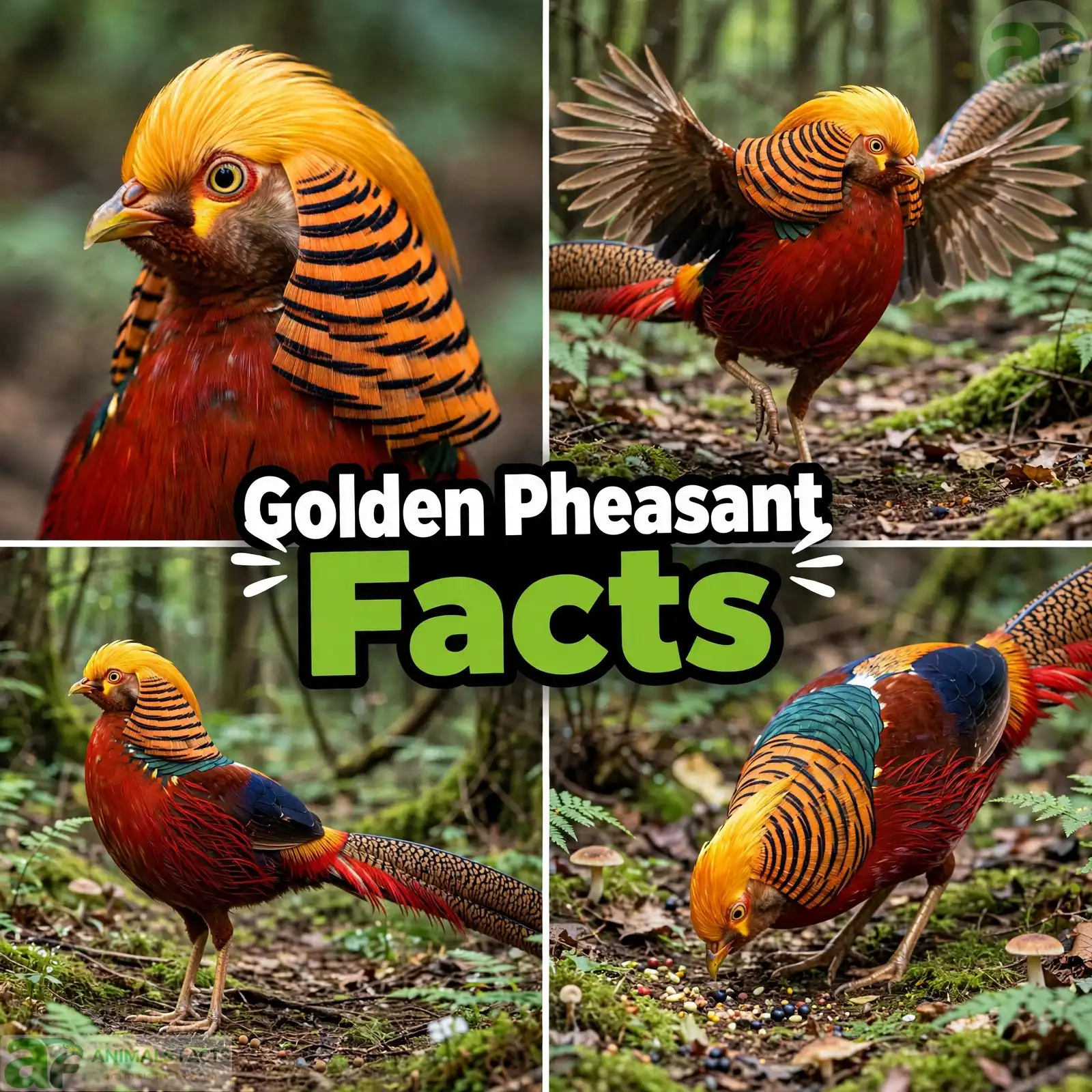
Golden Pheasant Facts
| Feature | Details |
|---|---|
| Scientific Name | Chrysolophus pictus (Linnaeus, 1758) |
| Kingdom | Animalia |
| Phylum | Chordata |
| Class | Aves |
| Order | Galliformes |
| Family | Phasianidae |
| Common Names | Golden pheasant; Chinese pheasant; rainbow pheasant |
| Native Range | Central and western China — mountainous forests of Gansu, Shaanxi, Sichuan, Guizhou, and Yunnan provinces |
| Habitat | Dense mountain forest, bamboo thickets, shrubby hillsides — 1,000–3,000 meters elevation |
| Lifespan | 5–6 years (wild estimate); up to 15 years (captivity) |
| Diet | Berries, seeds, leaves, insects, grubs — omnivorous ground forager |
| Body Length | Males 90–105 cm (including tail); females 60–80 cm |
| Weight | Males 630–700 grams; females 550–650 grams |
| Conservation Status | Least Concern (IUCN) — but wild population poorly monitored |
| Defining Feature | The most brilliantly colored pheasant in the world — male’s golden crest, scarlet body, and iridescent cape unmatched in the Galliformes |
| Introduced Range | United Kingdom, North America, South America, Europe, Australia, New Zealand — one of the most widely introduced pheasants globally |
| Closest Relatives | Lady Amherst’s pheasant (Chrysolophus amherstiae) — the only other species in genus Chrysolophus |
| Cultural Significance | Appears in Chinese art and porcelain for over 1,000 years; symbol of good luck and prosperity |
 1. Introduction: What is a Golden Pheasant?
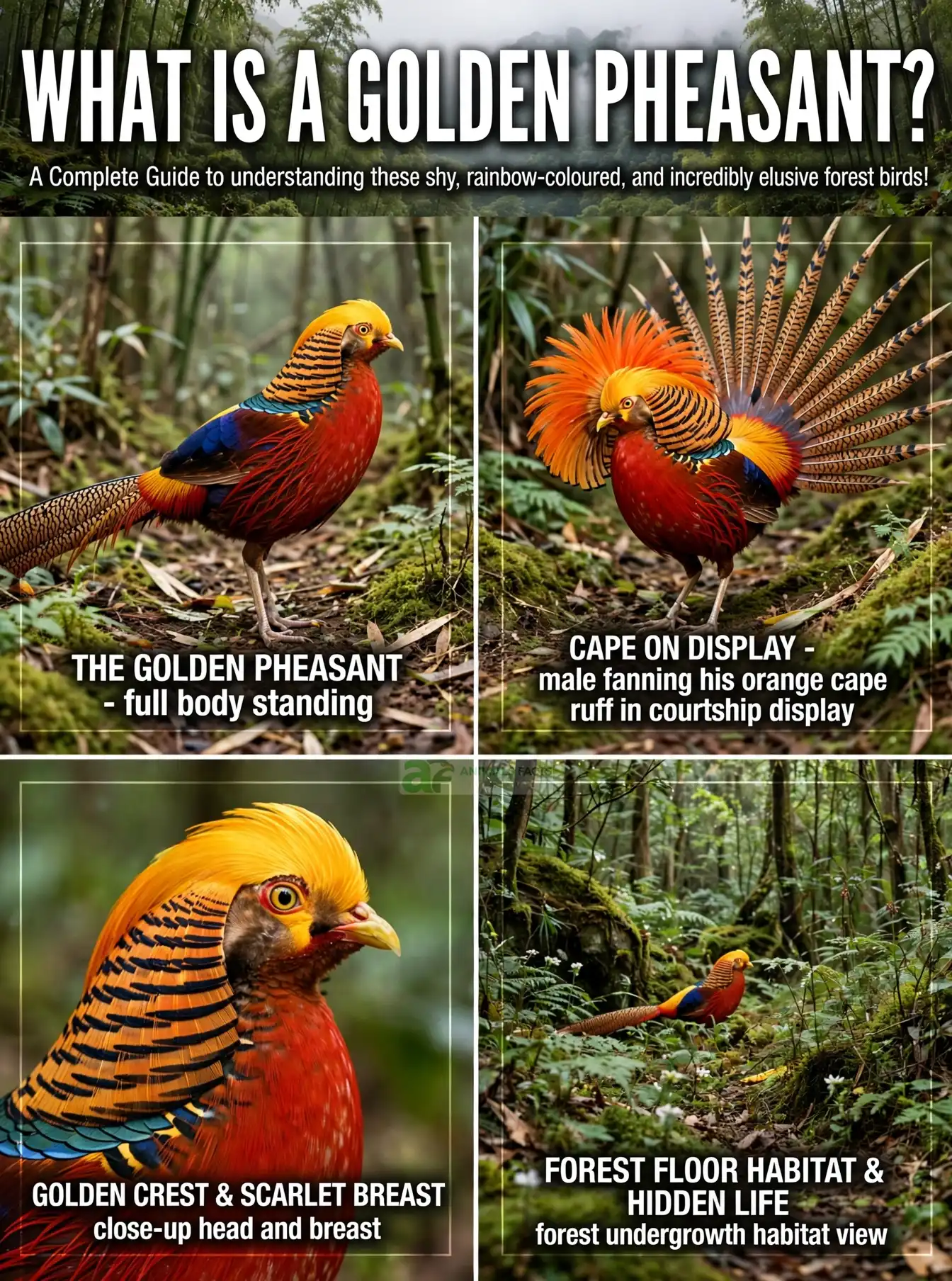
In the dense mountain forests of central China’s Qinling and Minshan ranges, where the ancient bamboo stands thick in the undergrowth and the slopes rise steeply into mist, a bird moves through the shadows with the careful, head-bobbing tread of an animal that has been navigating dense forest undergrowth for millions of years. And then, as it steps from shadow into a brief shaft of mountain light, what was invisible becomes the most spectacular bird most people in the Western world have never seen in the wild — a cascade of golden yellow on the crest and back, the brilliant scarlet of the breast and underparts, the iridescent blue-black and deep orange of the scapular feathers, and draped across the shoulders like the most elaborate ceremonial garment ever produced by sexual selection, the orange-and-black barred cape that can be fanned forward around the face during display until it covers everything except one glittering amber eye, transforming the bird into something that appears more like an animated piece of Ming Dynasty porcelain than a living creature of forest and bamboo. Golden pheasant facts begin with this image — the most brilliantly colored game bird in the world, an animal so spectacular in its male plumage that it has been depicted in Chinese art for over a thousand years, introduced to parks and estates across Europe, America, and the Southern Hemisphere for its extraordinary beauty, and studied by Charles Darwin as one of the clearest examples of sexual selection at work in the natural world.
The golden pheasant (Chrysolophus pictus) is the most vivid member of a bird family already celebrated for extraordinary plumage — the Phasianidae, which includes peacocks, tragopans, argus pheasants, and over 180 other species of pheasant, partridge, and related birds. In this remarkably colorful family, the golden pheasant stands alone — the combination of golden yellow, crimson red, iridescent green and blue, rich orange, and jet black creating a polychromatic display of such intensity that early European naturalists who received specimens from China debated whether the bird’s colors could possibly be accurate in life, and whether the Chinese artisans whose porcelain had depicted such birds for centuries were recording real animals or mythological ones. Interesting facts about golden pheasants reveal an animal of surprising biological depth beyond its spectacular appearance — the remarkable behavioral complexity of the cape display, in which the male fans the orange-and-black cape across one side of the face to present a near-complete barrier of patterned feathers between himself and a female; the hybrid zone between golden and Lady Amherst’s pheasants in parts of their Chinese range, producing extraordinary intermediate plumages; the feral UK populations that have established in several forests and are among the most stable self-sustaining introduced pheasant populations in Europe; and the paradox of a bird so spectacularly visible in its breeding plumage that it is among the most easily detected of all Chinese forest birds — yet whose wild population remains poorly documented because it inhabits some of China’s most inaccessible mountain terrain.
Whether you are searching for golden pheasant facts for kids to explore the science of bird coloration and sexual selection, an aviculturist wanting to understand the natural history behind one of the most popular ornamental birds in the world, a wildlife enthusiast planning a trip to see this species in its native Chinese forests or its established feral UK populations, or simply someone who encountered a photograph of this extraordinary bird and needed to understand everything about it immediately — this is your comprehensive guide. The world’s most brilliantly colored game bird has an extraordinary story to tell.
2. Golden Pheasant Species Overview & Classification
The golden pheasant belongs to the genus Chrysolophus — a small genus of just two species within the enormous Phasianidae family — and is sufficiently distinctive in plumage and behavior to have attracted scientific attention since its formal description by Linnaeus in 1758.
Species Classification Table
| Taxonomic Rank | Classification |
|---|---|
| Kingdom | Animalia |
| Phylum | Chordata |
| Class | Aves |
| Order | Galliformes |
| Family | Phasianidae (Horsfield, 1821) |
| Genus | Chrysolophus (Gray, 1834) |
| Species | C. pictus (Linnaeus, 1758) |
| Common Names | Golden pheasant; Chinese pheasant; rainbow pheasant |
| Etymology | Chrysolophus = “golden crest” (Greek: chrysos = gold + lophos = crest); pictus = “painted” (Latin) — referring to the brilliantly colored plumage; “pheasant” from Greek phasianos — “bird of the Phasis River” (in modern Georgia) |
The Genus Chrysolophus — Two Spectacular Species
The genus Chrysolophus contains only two species — both among the most spectacular pheasants in the world:
| Species | Common Name | Male Plumage | Range | IUCN Status |
|---|---|---|---|---|
| Chrysolophus pictus | Golden pheasant | Gold, crimson, orange-black cape | Central China | Least Concern |
| Chrysolophus amherstiae | Lady Amherst’s pheasant | White, black, red, yellow; longer tail | SW China, Myanmar, Tibet | Least Concern |
The Phasianidae Family Context
The golden pheasant belongs to one of the most species-rich and most ecologically diverse bird families:
| Group | Representative Species | Species Count | Notable Feature |
|---|---|---|---|
| Peacocks | Pavo cristatus | 3 species | Largest train; most recognized display |
| Argus pheasants | Argusianus argus | 2 species | Longest secondary feathers of any bird |
| Tragopans | Tragopan spp. | 5 species | Inflatable facial lappet display |
| Monals | Lophophorus spp. | 3 species | Iridescent mountain pheasants |
| True pheasants | Phasianus spp. | 2 species | Most widely distributed pheasant |
| Chrysolophus pheasants | Golden, Lady Amherst’s | 2 species | Most brilliantly colored |
| Partridges and quail | Alectoris, Coturnix | Multiple | Smaller; less elaborate plumage |
The Hybrid Zone — Where Two Spectacular Species Meet
One of the most fascinating aspects of Chrysolophus biology is the hybrid zone between golden pheasants and Lady Amherst’s pheasants in southwestern Sichuan province and adjacent areas of Tibet and Yunnan:
The overlap — In parts of the range where both species occur, natural hybridization produces intermediate plumages that combine elements of both parents — partial golden crests with white-and-black patterned mantles, orange-and-green mixed capes, and tail patterning combining elements from both species.
The hybrid plumage spectrum — First-generation hybrids (F1) and backcross individuals show an extraordinary range of intermediate plumages — some appearing mostly golden with Lady Amherst’s accents, others appearing mostly Lady Amherst’s with golden highlights. The hybrid spectrum has been a subject of ornithological interest and has occasionally confused field identification in the overlap zone.
Captive hybrids — The two species readily hybridize in captivity, and captive hybrid golden × Lady Amherst’s pheasants have been produced by aviculturists since the 19th century. Some ornate captive color morphs that have entered the avicultural trade are hybrid-derived rather than pure golden pheasant.
Evolution & Discovery Timeline
~10–15 million years ago (Miocene) — The ancestral Chrysolophus lineage diverges within the broader Asian pheasant radiation — the genus establishing in the mountain forest environments of central and southwestern China that remain its core range.
~2–5 million years ago — The divergence between the golden pheasant and Lady Amherst’s pheasant lineages — the two species separating as their ranges differentiated in response to Pleistocene climate oscillations in the Qinling-Minshan mountain systems.
Ancient Chinese history (Tang Dynasty, 618–907 CE and earlier) — The golden pheasant appears in Chinese paintings, embroideries, and decorative arts — its brilliant coloration making it a favored artistic subject for over a millennium before European science described it.
~16th century — First live golden pheasants reach Europe via trade routes from China — the birds entering the collections of wealthy European nobles and creating the first European awareness of the species’ extraordinary appearance.
1758 — Carl Linnaeus formally describes the golden pheasant as Phasianus pictus in his Systema Naturae 10th edition — the name “painted” (pictus) capturing the multi-colored, painted-like appearance of the male plumage.
1834 — John Edward Gray establishes the genus Chrysolophus — separating the golden and Lady Amherst’s pheasants from the broader Phasianus genus based on the distinctive golden crest and cape structure.
~1860s — The first self-sustaining feral golden pheasant population establishes in the Breckland forests of Norfolk and Suffolk, England — the descendants of escaped aviary birds that found the dense forestry plantations of this region to be adequate habitat.
1871 — Charles Darwin uses the golden pheasant as a key example in his landmark work The Descent of Man, and Selection in Relation to Sex — analyzing the male’s elaborate plumage as a product of female mate choice driving sexual selection, and using the golden pheasant’s cape display as evidence of deliberately directed ornamental display toward females.
2024 — Chrysolophus pictus maintains its Least Concern IUCN classification globally — though the wild Chinese population remains incompletely surveyed and local populations face pressure from habitat modification and hunting in parts of the range.
“The golden pheasant is perhaps the most striking evidence for the power of sexual selection that Darwin ever cited — an animal so brilliantly and so elaborately colored that it could not possibly have survived long enough to reproduce if the females had not, over millions of generations, consistently chosen the most spectacular males as their mates. The golden pheasant exists because beauty, in this species, has always been survival.”
— Dr. Richard Prum, Yale University — evolutionary ornithologist and author of The Evolution of Beauty
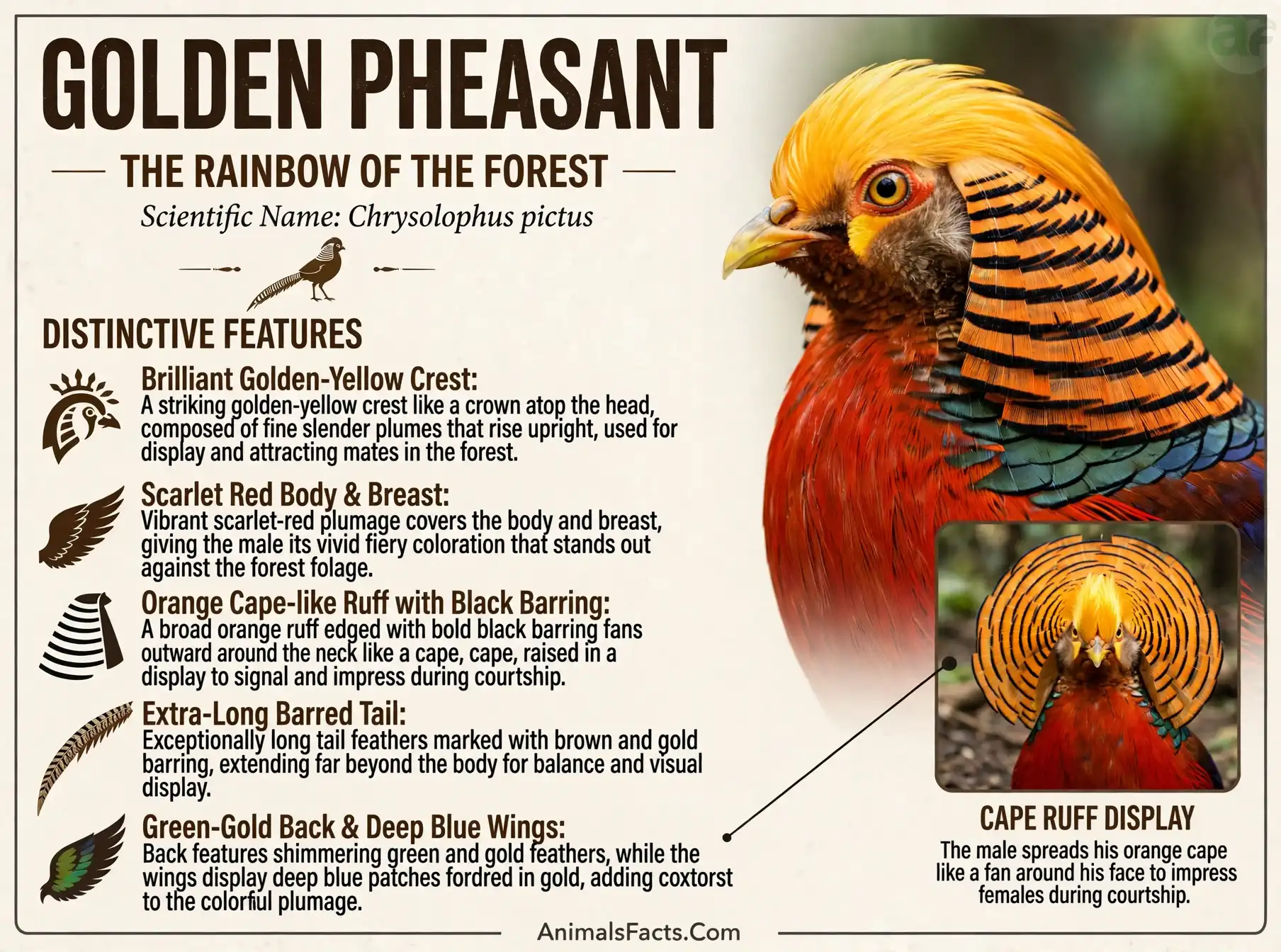
3. Golden Pheasant Physical Description & Unique Features
The golden pheasant’s male plumage is the most polychromatic of any game bird in the world — an accumulation of distinct color regions in vivid, saturated hues that has made the species simultaneously the most celebrated pheasant in art and the most studied in sexual selection biology.
The Male Plumage — A Region-by-Region Description
Unlike most birds whose plumage is a relatively unified color scheme, the male golden pheasant is composed of distinctly different, brilliantly colored regions that produce an effect more like an artist’s deliberately juxtaposed palette than a single integrated design:
The golden crest — The top and back of the head bears a silky golden yellow crest — long, narrow feathers that hang from the crown and nape in a loose, flowing arrangement. The crest can be raised and lowered — fully erect during display, lying flat during relaxed foraging. The crest color is a rich, warm yellow-gold that gives the species its common name.
The ruff or cape — The most distinctive and most behaviorally significant feature; a deep orange cape covers the neck and upper breast, each feather intricately barred with blue-black semicircular markings. The individual feathers have a subtly iridescent quality — the orange-and-black patterning creating a visual effect reminiscent of fish scales or tiled mosaic. The cape can be fanned outward and upward — in full display, one side of the cape fans forward to cover half the face, presenting a near-complete barrier of patterned feathers with only the amber eye visible behind it.
The upper back — Immediately behind the cape, the upper back is iridescent metallic green — a different structural coloration from the yellow crest, producing the deep emerald-blue-green typical of iridescent bird plumage.
The lower back and rump — The lower back transitions into a vivid golden yellow — a broad band of the same color as the crest that wraps around the rump and sides of the tail base.
The breast and underparts — Below the cape, the entire breast, belly, and flanks are vivid scarlet red — a flat, saturated pigment-based red (from carotenoids) that provides the maximum contrast with both the orange cape above and the golden rump behind.
The wings — The wing coverts are deep blue with black edging — an iridescent blue-black that adds further color complexity. The flight feathers are dark brown — the relatively cryptic wing coloration provides contrast with the spectacular body colors.
The tail — The long graduated tail — comprising approximately half to two-thirds of the male’s total body length — is buff-brown with black spotting and barring. Despite the relatively modest tail coloration compared to the body, the length of the tail (up to 75 cm in fine specimens) contributes significantly to the male’s overall spectacular visual impression in flight and display.
The Cape Display — The Most Complex Pheasant Behavior
The golden pheasant’s cape display toward females is one of the most elaborately choreographed courtship behaviors of any game bird — and one of the behaviors that most fascinated Darwin:
The approach — The male approaches the female in a semi-circular path, walking with exaggerated deliberateness while already beginning to fan the cape.
The cape erection — As the male positions himself at an angle to the female, the cape on the near side (the side facing the female) is raised and fanned forward — the individual feathers spreading outward from the neck to cover the lower face and most of the beak, presenting the barred orange-and-black pattern as a visual barrier.
The single-eye display — At maximum display intensity, virtually the entire face is covered by the fanned cape on the female’s side — only the single amber eye visible behind the screen of barred feathers. The male holds this posture while simultaneously calling, wing-rustling, and performing small lateral head movements.
The symmetry — Only the near-side cape is fully fanned — the far-side cape remains partially folded. This asymmetric display concentrates the full visual impact of the patterned cape on the individual female being courted, rather than distributing it broadly in all directions.
Darwin’s analysis — In The Descent of Man, Darwin specifically analyzed this display as evidence that the male’s ornamental plumage evolved for a specific female audience — the asymmetric cape presentation being inexplicable unless it was designed to be viewed from a specific directional perspective by a specific observer. This analysis remains one of the clearest early examples of the argument for mate choice as the driver of elaborate male ornament evolution.
The Female Plumage — Functional Crypticity
The female golden pheasant’s plumage is the polar opposite of the male’s — a masterwork of cryptic coloration designed to minimize detection during the most vulnerable period of the breeding cycle:
Overall appearance — Brown with complex buff and black barring throughout — the detailed intricate patterning of the female plumage creates extraordinary camouflage against the dead leaves, bark, and dappled shade of the forest floor where she nests.
The comparison — The male and female golden pheasant represent one of the most extreme examples of sexual dichromatism in any game bird — the difference between the sexes so dramatic that early European naturalists initially described the male and female as different species.
Female bill color — A yellowish horn color — relatively neutral and contributing to the overall cryptic appearance.
The Iridescent Plumage Mechanism
Like the resplendent quetzal, portions of the golden pheasant’s plumage involve structural coloration:
The green back iridescence — The metallic green of the upper back is produced by thin-film interference in the feather barbule microstructure — the same physical principle as seen in many iridescent bird plumages. The color shifts slightly with viewing angle — appearing more blue or more gold-green depending on the light direction.
The cape coloration — The orange of the cape feathers is primarily pigment-based (carotenoids from the diet) rather than structural — the orange color therefore does not shift with viewing angle, providing a more consistent visual signal to viewing females regardless of their position relative to the displaying male.
💡 Did You Know? Charles Darwin devoted considerable space in The Descent of Man, and Selection in Relation to Sex (1871) to analyzing the golden pheasant’s asymmetric cape display — using it as one of his clearest arguments for the evolution of elaborate male ornaments through female mate choice rather than male-male competition. Darwin noted that the way the male fanned only the near-side cape toward a specific female was inexplicable unless the ornament had evolved specifically to be appreciated by a discriminating observer — proving that the female was actively assessing the display rather than merely tolerating it. This observation anticipated by over a century the formalization of “runaway sexual selection” theory by Ronald Fisher (1930) and “honest signaling” theory by Zahavian handicap models (1975). The golden pheasant became, through Darwin’s analysis, one of the foundational species in the development of sexual selection theory — a central pillar of modern evolutionary biology whose implications extend far beyond ornithology.
4. Top 25 Amazing Golden Pheasant Facts
Here is your definitive collection of the most extraordinary, scientifically verified, and genuinely astonishing golden pheasant facts as of 2026:
- The golden pheasant was used by Charles Darwin as a key example of sexual selection in The Descent of Man (1871) — the male’s asymmetric cape display toward females being one of Darwin’s clearest evidences that elaborate male plumage evolved through female mate choice rather than combat capability.
- The male golden pheasant’s cape display is asymmetric — he fans only the near-side cape toward the specific female he is courting, covering most of his face and presenting the barred orange-and-black pattern with only one amber eye visible behind it. This directional display is inexplicable except as an ornament specifically designed for an appreciating audience.
- The golden pheasant’s scientific name Chrysolophus pictus means “golden-crested and painted” — the genus Chrysolophus from Greek for “golden crest,” and pictus from Latin meaning “painted,” together capturing the essence of the bird’s spectacularly polychromatic appearance.
- The wild golden pheasant’s Chinese population occupies some of the most inaccessible mountain terrain in central China — the Qinling and Minshan ranges of Gansu, Shaanxi, and Sichuan provinces — making the wild population among the least systematically surveyed of any Least Concern bird species globally.
- The golden pheasant has been introduced to the United Kingdom where it maintains self-sustaining feral populations in several forest areas — particularly the Breckland forests of Norfolk and Suffolk and forests in Scotland, Wales, and southwest England. The UK feral population of approximately 1,000–5,000 birds represents one of the most stable introduced pheasant populations in Europe.
- Despite the male’s extraordinary visual spectacle, the golden pheasant spends most of its time in dense bamboo thickets where the brilliant colors are largely invisible — the bird using cover extensively and relying on concealment rather than flight as its primary predator avoidance strategy.
- Female golden pheasants are entirely responsible for incubation and chick-rearing — the male provides no parental care beyond fertilization, devoting his energy instead to defending territories and courting multiple females through an effectively polygynous mating system.
- The golden pheasant has been kept in captivity in China for over 1,000 years — appearing in Tang Dynasty (618–907 CE) paintings and embroideries, making it one of the most long-standing relationships between a wild species and human aesthetic appreciation in ornithological history.
- The golden pheasant is primarily nocturnal in its roosting behavior — spending nights roosting in trees (despite being a predominantly terrestrial forager during daylight hours) to avoid the ground-level predators that represent the greatest threat during vulnerable sleeping periods.
- Natural hybrids between golden pheasants and Lady Amherst’s pheasants (Chrysolophus amherstiae) occur in the overlap zone of their ranges in southwestern Sichuan — the two species being sufficiently closely related to produce viable (though typically infertile) hybrid offspring. These natural hybrids display intermediate plumages of extraordinary visual complexity.
- The male golden pheasant’s tail is disproportionately long — comprising approximately 60–70% of the bird’s total body length of 90–105 cm. In exceptional aviary specimens maintained in optimal conditions, tails of over 75 cm have been documented.
- Golden pheasants are highly terrestrial foragers — spending most of their active day walking the forest floor in search of seeds, berries, insects, and plant material, rarely taking flight except when startled by approaching predators or moving between roost trees.
- The golden pheasant’s introduced range extends to North America, South America (particularly Brazil), Australia, New Zealand, and multiple European countries — making it one of the most globally distributed introduced pheasant species, though self-sustaining feral populations outside the UK are less commonly documented.
- The male golden pheasant’s scarlet breast coloration is carotenoid-based — obtained from the diet and therefore reflecting foraging success and nutritional quality. Males in better nutritional condition maintain more vivid scarlet coloration — making breast color an honest signal of individual quality that females can reliably assess during mate selection.
- The golden pheasant was reportedly a favorite bird of Queen Victoria — maintained in the royal aviaries at Sandringham and Windsor, and sufficiently admired that gifting golden pheasants between monarchs was documented as a diplomatic exchange during the 19th century.
- Golden pheasants in the wild are considered crepuscular to diurnal — most active during the early morning and late afternoon when forest light is low enough to provide some concealment for the brilliantly colored male during foraging movements.
- The golden pheasant’s clutch size of 8–12 eggs is among the larger clutch sizes of any pheasant species — an investment that reflects the high nest predation rates in the species’ forest habitat and the complete absence of male parental assistance in incubation and chick defense.
- Young male golden pheasants take approximately 2 years to develop the full adult plumage — first-year males (sometimes called “cock-birds in eclipse”) showing intermediate plumage with some gold and red but lacking the full cape development and long tail that characterize adults.
- The Breckland feral population of golden pheasants in Norfolk and Suffolk, England, has been established since the 1860s — making it one of the longest-established feral populations of any introduced bird in the United Kingdom, having persisted and reproduced successfully for over 150 years.
- Golden pheasants are documented to make limited seasonal movements in the wild — moving to lower elevations in winter when snow covers the high-altitude feeding grounds, and returning to higher elevation breeding areas in spring. These movements are more limited than the altitudinal migration of the resplendent quetzal.
- The golden pheasant’s diet includes bamboo shoots and bamboo seeds — the bamboo thickets that characterize much of its native habitat providing both food (seeds, shoots) and shelter (dense cover for predator avoidance). The species has a special ecological relationship with bamboo-dominated mountain forests.
- Multiple color morphs of the golden pheasant exist in aviculture — including the “yellow” morph (where scarlet is replaced by yellow), the “dark-throated” morph, the “peach” morph, and various hybrid-derived intermediate forms. These color morphs, while spectacular, are products of captive breeding and genetic combination not found in wild populations.
- The golden pheasant is documented as prey of multiple Chinese mountain predators — including golden eagles (Aquila chrysaetos), goshawks (Accipiter gentilis), leopards (Panthera pardus), and dholes (Cuon alpinus) — the male’s spectacular visibility making him a relatively easily detected target despite the dense cover he typically occupies.
- Research on the golden pheasant’s acoustic communication has documented a diverse vocalization repertoire — including territory advertisement calls, alarm calls, female-contact calls, and the characteristic wing-whirring display sound produced by males during the cape display courtship. The wing-whirring sound is produced by the modified outer primary feathers vibrating against each other during display.
- As of 2026, the wild golden pheasant population in China is estimated at ~\100,000 individuals but this estimate carries significant uncertainty — the inaccessibility of the core range in the Qinling-Minshan mountains and limited systematic survey effort mean the true population size could be substantially higher or lower than this figure.
5. Fun Facts About Golden Pheasants
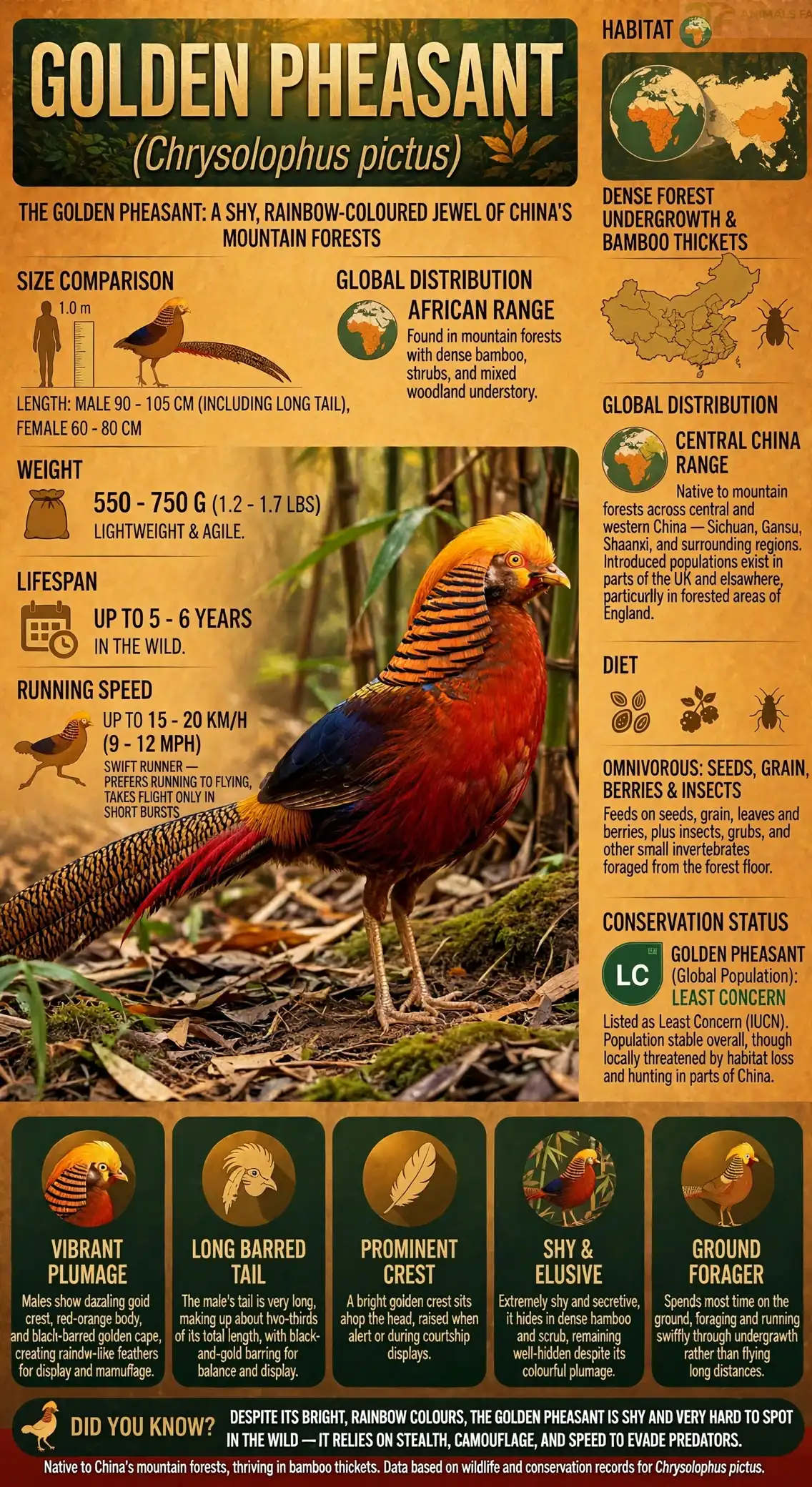
- Used by Charles Darwin as a key sexual selection example
- Cape display covers half the face with one eye visible
- Scientific name means “golden-crested and painted”
- Wild population in some of China’s most inaccessible terrain
- Feral UK population established for 150+ years
- Male spends most time in dense bamboo despite vivid colors
- Female does all incubation — male provides zero parental care
- Kept in Chinese aviaries for 1,000+ years
- Tail comprises 60–70% of total body length
- Breast color is an honest signal of nutritional quality
- Multiple captive color morphs not found in wild
- Natural hybrids with Lady Amherst’s pheasant occur in China
6. Golden Pheasant Habitat & Geographic Range
Golden pheasant habitat is centered on the mountain forests and bamboo thickets of central and western China — a core range that encompasses some of the most ecologically significant and least accessible mountain terrain in the Asia-Pacific region.
Native Habitat Requirements
Dense mountain forest with bamboo understory — The golden pheasant’s most characteristic habitat; the combination of evergreen and deciduous forest with a dense understory of bamboo (Fargesia, Phyllostachys, and related genera) provides both food (bamboo shoots and seeds, plus the insects and small invertebrates that concentrate in bamboo-rich environments) and shelter (the dense bamboo stems providing concealment from aerial and terrestrial predators that the male’s brilliant colors would otherwise make him extremely vulnerable to).
Elevation range — The species primarily occupies 1,000–3,000 meters — the montane zone where deciduous oak-rhododendron forest transitions through bamboo-dominated slopes to the upper limit of forest below the treeline. Lower elevations are occupied in winter when snow drives birds downslope.
South-facing slopes — A strong preference for south-facing slopes has been documented in Chinese field studies — these slopes receiving more solar radiation, maintaining warmer temperatures in winter, and supporting different vegetation communities from north-facing slopes. The temperature differential is particularly important in the winter months when the golden pheasant’s restricted altitudinal movement means it must find food and thermal comfort on the same slopes.
Rocky terrain and gullies — The golden pheasant shows preference for rugged terrain with rock outcrops, gullies, and irregular topography — the complex terrain providing refuge sites and escape routes that the flat terrain of agricultural valleys does not.
Proximity to water — Rivers and streams within the mountain forest are used for drinking and provide the moist forest floor conditions that support higher invertebrate densities.
Geographic Distribution in China
| Province/Region | Status | Elevation Range | Notes |
|---|---|---|---|
| Gansu (southern) | Core range | 1,200–2,800 m | Qinling range northern slope |
| Shaanxi (southern) | Core range | 1,000–2,500 m | Best-documented population |
| Sichuan (central/north) | Core range | 1,500–3,000 m | Minshan range; Giant Panda habitat overlap |
| Guizhou | Present | 800–2,000 m | Lower elevation; less dense |
| Yunnan (north) | Present | 1,200–2,500 m | Hybridization with Lady Amherst’s |
| Hubei (western) | Marginal | 1,000–2,000 m | Eastern range limit |
The Introduced Range
The golden pheasant’s introduced range reflects centuries of avicultural interest — birds kept in captivity across Europe, the Americas, and the Pacific have occasionally escaped or been deliberately released, establishing populations of varying stability:
| Country/Region | Status | Establishment | Notes |
|---|---|---|---|
| United Kingdom | Self-sustaining feral population | ~1860s | Breckland (Norfolk/Suffolk); Scotland; Wales — most stable feral population |
| Germany | Local feral populations | Various | Less stable than UK |
| France | Local populations | Various | Some game estates |
| USA | Local populations | Various | Less stable; small numbers |
| Brazil | Documented populations | 20th century | Rio Grande do Sul; some stability |
| Australia | Occasional escapes | Various | No stable feral populations confirmed |
| New Zealand | Occasional records | Various | No stable population |
The UK Feral Population — A Case Study in Introduction Biology
The Breckland golden pheasant population in Norfolk and Suffolk, England, provides one of the most studied examples of a self-sustaining introduced pheasant population outside its native range:
The habitat match — The Breckland — a distinctive landscape of sandy heathland and forestry plantation in East Anglia — provides conditions remarkably suitable for golden pheasants despite being entirely unlike the Chinese mountain forest of the native range. The dense conifer plantation understory and rhododendron thickets of the Breckland provide the dense cover that golden pheasants depend on, while the relatively mild UK climate allows year-round survival without the deep snow that drives altitudinal movement in China.
The population size — Estimates of the UK golden pheasant feral population vary considerably — from 1,000–2,500 birds in more conservative assessments to 5,000+ birds in some game management literature. The population fluctuates with management practices — forestry operations that remove dense understory temporarily reduce local populations, while regenerating plantations with thick understory support higher densities.
Hybridization concerns — In areas where the feral golden pheasant population overlaps with the much smaller UK feral Lady Amherst’s pheasant population (centered in Woburn and Bedfordshire), hybridization represents a genetic management concern — potentially diluting both pure populations and creating identification confusion.
7. Golden Pheasant Diet & Feeding Behavior
Golden pheasant diet is broadly omnivorous — the species consuming seeds, berries, leaves, shoots, and invertebrates in proportions that vary considerably with season and local availability.
Diet Breakdown Table
| Food Type | Estimated % of Diet | Season | Notes |
|---|---|---|---|
| Seeds and grain | ~30–40% | Year-round; peak autumn/winter | Various grass, bamboo, and forb seeds |
| Berries and small fruits | ~20–30% | Autumn/winter peak | Rosa, Rubus, Berberis, and other forest fruits |
| Leaves and plant material | ~15–20% | Year-round | Bamboo shoots and leaves especially important |
| Insects (beetles, ants, grasshoppers) | ~10–15% | Spring/summer peak | Most important for chick nutrition |
| Earthworms and grubs | ~5–10% | Spring/wet season | Particularly important post-rainfall |
| Snails and other invertebrates | ~3–5% | Year-round | Secondary invertebrate prey |
| Bamboo shoots | ~5–10% | Spring | Seasonally important at shoot emergence |
Foraging Behavior
Terrestrial scratching — The golden pheasant is a classic scratching forager in the Galliformes tradition — using the powerful feet to rake through leaf litter, scrape soil, and excavate the upper soil layer in search of seeds, invertebrates, and buried plant material. This scratching foraging style is shared with chickens, turkeys, and most other pheasants.
The walking patrol — Like the secretarybird but at a vastly different scale and in a vastly different habitat, the golden pheasant covers its home range on foot — systematically moving through forest and bamboo thickets in search of productive foraging patches. Individuals learn the locations of seasonally productive food patches within their home range and revisit them at appropriate times.
Flock foraging in winter — During the winter months when food is more concentrated and scarce, golden pheasants form loose foraging flocks — typically small groups of 5–20 birds including males and females foraging together in areas of concentrated food resources. This winter flocking behavior contrasts with the territorial behavior of breeding males during spring and summer.
Bamboo exploitation — The golden pheasant’s relationship with bamboo extends beyond using it as cover — bamboo shoots in spring represent a seasonally important food resource, particularly at the higher elevations where the emergence of fresh bamboo shoots coincides with the pre-breeding period when males are building the energy reserves needed for the energetic demands of display and territorial defense.
Invertebrate importance for chicks — While adult golden pheasants can subsist on a largely vegetarian diet, chick nutrition depends critically on invertebrate prey during the first weeks of life. Female-led broods spend significantly more time in invertebrate-rich microhabitats during the chick-rearing period, and insect availability at this time has been identified as a key factor influencing chick survival rates.
Drinking and Mineral Acquisition
Water drinking — Golden pheasants drink regularly at streams and seeps within their mountain forest habitat — the species shows high fidelity to regular drinking sites and these sites may serve as focal points for social encounters.
Mineral licking — Like many Galliformes, golden pheasants visit mineral-rich soil exposures and salt licks — consuming mineral-rich soil that supplements the mineral content (particularly calcium and sodium) of the predominantly plant-based diet.
8. Golden Pheasant Reproduction & Life Cycle
Golden pheasant reproduction follows the broadly polygynous system typical of the most spectacular Galliformes — the male investing in elaborate display to attract multiple females while the female assumes exclusive responsibility for incubation and chick-rearing.
Mating System — Polygyny and Display Territories
The polygynous system — Male golden pheasants maintain territories during the breeding season and mate with multiple females — a polygynous system in which the male’s reproductive success is determined by his ability to attract more females through display rather than by pair bond quality.
Territory establishment — Males establish territories in late winter and early spring — advertising territory ownership through frequent calling (the characteristic metallic clucking call), display, and active confrontation of rival males at territory boundaries.
Female territory overlap — Female home ranges typically overlap with the territories of one or more males — females move through the landscape selecting mates based on display quality rather than being geographically constrained to a single male’s territory.
The mate choice dynamic — Research on closely related Galliformes species confirms that female pheasants exercise genuine mate choice — preferring males with more elaborate display structures, more vivid coloration, and higher display intensity. The golden pheasant’s extraordinary male plumage is the product of this female preference operating over millions of generations.
Courtship and Display
The full display sequence — The male’s courtship display toward a female includes several distinct behavioral components performed in sequence:
- Approach — The male approaches the female in a semicircular path, walking with exaggerated deliberateness
- Cape erection — The near-side cape is raised and fanned forward to cover the face
- Wing position — The near-side wing is partially lowered, the far-side wing raised — creating a posture that maximizes the visible area of the body’s brilliant colors from the female’s viewpoint
- Calling — The male produces a series of metallic calls during the display
- Wing-whirring — A distinctive mechanical sound produced by the modified primaries vibrating during the display
- Circling — The male continues a slow circling movement while maintaining the display posture
Duration — A full courtship display sequence may last several minutes — the male maintaining the display posture continuously until the female either accepts (adopting a crouching posture signaling receptivity) or moves away (signaling rejection).
Nesting
Nest site selection — The female selects a ground nest site — typically a shallow scrape in the leaf litter beneath dense bamboo or shrubby vegetation, lined with dead leaves, feathers, and plant material. The dense overhead cover provides protection from aerial predators while the leaf litter background provides camouflage for the incubating female.
Nest concealment — Nest sites are characteristically well-concealed — beneath overhanging vegetation, in dense bamboo, or against a fallen log or rock face that provides additional visual screening. The incubating female’s cryptic brown-barred plumage blends extremely effectively with the leaf litter nest background.
Clutch size — Typically 8–12 eggs — relatively large for a pheasant. The large clutch compensates for the high nest predation rates and the complete absence of male assistance in nest defense.
Egg description — The eggs are pale buff to cream — unmarked and slightly glossy. Each egg is approximately 44 × 32 mm.
Incubation period — 22–23 days — incubated exclusively by the female. The male makes no contribution to incubation.
Chick Development
Precocial hatchlings — Golden pheasant chicks hatch covered in down and are immediately mobile — leaving the nest within hours of hatching and following the female. This precocial strategy allows the brood to disperse from the fixed, detectable nest site immediately, reducing predation risk.
Female-led broods — The female leads the brood through forest and bamboo, brooding the chicks for warmth (they cannot thermoregulate independently for the first 10–14 days) and producing alarm calls when threats are detected.
Growth rate — Rapid growth — chicks develop the first juvenile plumage within 3–4 weeks and are approaching adult size by 10–12 weeks. The juvenile plumage resembles the female’s cryptic brown-barred pattern — both sexes initially appearing similar.
Male plumage development — Young males begin showing the first gold and red feathers at approximately 10–12 weeks — replacing the juvenile plumage in the first partial post-juvenile molt. The full adult plumage — including developed cape and full tail length — is not achieved until the second year (after the complete post-juvenile molt and first complete pre-breeding molt).
Sexual maturity — Females breed at 1 year — often in their first breeding season after hatching. Males may attempt breeding at 1 year but are typically not successful at attracting females until the second year when full adult plumage is acquired.
Lifespan Comparison Table
| Species | Wild Lifespan | Max Captive | Clutch Size | Mating System |
|---|---|---|---|---|
| Golden pheasant | 5–6 years | 15 years | 8–12 | Polygynous |
| Common pheasant | 3–5 years | 12 years | 8–15 | Polygynous |
| Peacock | 10–25 years | 30 years | 4–8 | Polygynous |
| Lady Amherst’s pheasant | 5–8 years | 15 years | 6–12 | Polygynous |
| Wild turkey | 3–5 years | 10 years | 10–14 | Polygynous |
9. Social Behavior & Communication
Golden pheasant social behavior reflects the polygynous mating system and the forest-concealment lifestyle — a behavioral repertoire combining territorial male aggression during breeding with the more tolerant winter flock associations of the non-breeding period.
Territory and Dominance
Male territorial behavior — During the breeding season (approximately March–June in the native range), male golden pheasants maintain individual territories defended against rival males. Territory defense involves:
- Calling — the territory advertisement call is a metallic clucking sound repeated frequently from prominent calling positions
- Visual display — the full cape display directed toward intruding males signals territory ownership through the display of physical quality
- Physical confrontation — when display is insufficient, males engage in physical combat — jumping, wing-striking, and using the feet in the same “spurring” behavior seen in domestic chickens and other pheasants
Dominance hierarchy in winter flocks — Winter flocking provides opportunities for dominance interactions that establish the hierarchy that will influence breeding season territorial success. Dominant males in winter flocks achieve priority access to food resources and are more likely to establish productive breeding territories.
Female social organization — Females maintain overlapping home ranges and show relatively little overt aggression toward each other outside of competition for the best nest sites and foraging areas.
Communication
The territory advertisement call — The primary male vocalization — a distinctive metallic clucking or “pic-ic” call repeated in series. This call carries considerable distance through forest and bamboo habitat and is reliably produced by territorial males throughout the breeding season morning activity period.
Alarm calls — Both sexes produce sharp alarm calls when predators are detected — the calls triggering immediate cover-seeking behavior by other birds within earshot. The alarm call system of golden pheasants is similar to that of related pheasants — distinct calls for aerial versus ground predators trigger different escape responses.
The wing-whirring display sound — During courtship display, the modified outer primary feathers produce a mechanical whirring or rustling sound as the wings are positioned during display. This acoustic signal supplements the visual component of the courtship display and may be important in dense bamboo cover where visual displays have limited range.
Contact calls — Quiet clucking and purring sounds are produced during relaxed foraging — maintaining contact between individuals in the same area during the dense-cover foraging that limits visual contact.
Intelligence and Behavioral Flexibility
Golden pheasants in avicultural settings have demonstrated significant behavioral flexibility and learning capability:
Individual recognition — Captive golden pheasants recognize individual familiar keepers and birds — responding differently to familiar and unfamiliar individuals.
Problem-solving — Various food-access problems have been solved by captive golden pheasants — demonstrating learning and memory capabilities comparable to other galliform species.
Habitat use optimization — Wild golden pheasants show sophisticated habitat selection — using different microhabitats at different times of day and in different seasons in ways that optimize the trade-off between foraging efficiency and predator avoidance.
10. Predators & Defense Mechanisms
The golden pheasant faces predation from a range of terrestrial and aerial predators in its native Chinese mountain forest habitat — and has evolved a defense system that relies primarily on cryptic concealment in dense cover rather than active flight or physical defense.
Natural Predators
Golden eagle (Aquila chrysaetos) — The most significant aerial predator of adult golden pheasants in the Qinling-Minshan mountain systems; the golden eagle’s powerful talons and hunting capability in open terrain and forest edges make it an effective predator of pheasants caught away from dense cover.
Northern goshawk (Accipiter gentilis) — The premier forest bird predator of temperate Asia; goshawks pursue golden pheasants through dense forest with remarkable agility, making the forest interior less safe than it might appear for the brightly colored male.
Eurasian sparrowhawk (Accipiter nisus) — Less significant for adults but a documented predator of juvenile golden pheasants.
Leopard (Panthera pardus) — In the mountainous terrain of central China where leopards persist, the golden pheasant is documented as occasional prey — the leopard’s ability to move silently through dense forest making it an effective ambush predator of ground-dwelling birds.
Dhole (Cuon alpinus) — The Asiatic wild dog; dholes hunt cooperatively and can pursue and capture pheasants in forest and bamboo terrain.
Fox (Vulpes vulpes) — Particularly significant as a nest predator — fox predation on eggs and incubating females represents a major source of nest failure in both the native range and the UK feral population.
Mustelids — Martens (Martes) and other mustelids are documented egg and chick predators — their ability to penetrate dense bamboo and investigate ground nest sites making them significant threats to nesting females.
Raptors in the UK feral range — In the UK, introduced feral golden pheasants face predation from red kite (Milvus milvus), common buzzard (Buteo buteo), and peregrine falcon (Falco peregrinus) — a different predator suite from the native range but one that the feral population has successfully survived within.
Defense Mechanisms
Dense cover concealment — The primary defense strategy; the golden pheasant’s intimate association with dense bamboo thickets and thick forest understory is fundamentally a predator avoidance strategy. Within dense bamboo, the male’s brilliant colors are largely obscured — even bright plumage becomes difficult to detect against the complex visual background of multiple overlapping stems and leaves.
Explosive flight — When threatened at close range, golden pheasants explode from cover in a startling burst of wings — the sudden eruption of noise and movement startling predators and providing a brief window for escape. The flight is typically short — the bird landing in the nearest dense cover rather than sustaining extended flight.
Cryptic female plumage — The female’s brown-barred plumage provides extraordinary camouflage on the nest — a well-incubating female on a leaf litter nest in dense bamboo is essentially invisible until the predator is within touching distance.
Alarm calling and scatter response — The alarm call system allows all birds in an area to simultaneously take cover when a predator is detected by any individual — the collective response providing better predator detection than individual vigilance alone.
Nocturnal tree roosting — The golden pheasant’s habit of roosting in trees at night — despite being a predominantly terrestrial forager — removes the birds from the ground where terrestrial predators are most active during darkness.
The male plumage paradox — The male’s spectacular plumage represents the most significant vulnerability in the species’ predator defense system — the brilliant colors are highly visible to predators in any open habitat. The behavioral response to this vulnerability is to minimize time in open habitats — male golden pheasants are dramatically more cautious about entering open areas than females, and typically cover open ground in rapid movement between dense cover patches rather than foraging in the open.
11. Golden Pheasant Facts for Kids
Hey amazing young wildlife scientists and bird enthusiasts! Here are some truly extraordinary golden pheasant facts for kids that will make every nature conversation instantly more colorful:
- 🐦 The golden pheasant is the most brilliantly colored game bird in the world! With its golden yellow crest, scarlet red breast, iridescent green back, and the extraordinary orange-and-black barred cape, the male golden pheasant looks less like a real bird and more like something an artist painted using every color in the palette at once. Early European naturalists who received specimens from China were not sure if the colors were really accurate — they seemed too spectacular to be real!
- 🐦 Charles Darwin used the golden pheasant to help explain evolution! In his famous book The Descent of Man, Darwin described how the male golden pheasant fans its orange-and-black cape across half its face during courtship, leaving just one golden eye visible. Darwin said this could only have evolved if female golden pheasants were carefully choosing the most spectacular males as their mates — helping him develop the theory of SEXUAL SELECTION, one of the most important ideas in evolutionary biology!
- 🐦 The male golden pheasant’s tail is LONGER THAN HIS BODY! The tail of a male golden pheasant can be up to 75 centimeters long — while his body is only about 35 centimeters. So more than half of the bird’s total length is just tail! This extraordinary long tail evolved through female preference — female pheasants preferring males with longer, more impressive tails over millions of generations.
- 🐦 There are golden pheasants living WILD in England! Birds that escaped from British parks and estates over 150 years ago established wild populations in the forests of Norfolk and Suffolk. These birds have been living and breeding in British forests for over 150 years — making them the longest-established feral population of any introduced pheasant in Europe. You might see one on a forest walk in Thetford Forest!
- 🐦 The male provides ZERO help with raising the chicks! After displaying and mating, the male golden pheasant’s parenting work is completely done. The female builds the nest alone, incubates the eggs alone for three weeks, and raises all the chicks alone for weeks afterward. The male spends that entire time displaying to try to attract more females! This is one of the most complete examples of a bird where ALL parenting falls on the mother.
- 🐦 Despite its incredible colors, the golden pheasant HIDES in dense bamboo! The male golden pheasant is so visible in open habitat that predators can spot him from far away. So he spends almost all his time deep in thick bamboo thickets and dense forest undergrowth where his brilliant colors are actually very hard to see against the complex background. He only reveals himself during display — and then only to the female he is trying to impress!
- 🐦 China has kept golden pheasants in captivity for over 1,000 YEARS! The golden pheasant appears in Chinese paintings and embroideries from the Tang Dynasty (618–907 CE) — meaning people have been keeping and admiring these birds for well over a millennium. It is one of the longest-lasting relationships between humans and any captive bird species in history!
- 🐦 The male golden pheasant sleeps in TREES at night! Despite spending almost all day walking on the ground, male and female golden pheasants fly up into trees at dusk to sleep — sitting on branches well above the ground where foxes and other predators cannot reach them. Every evening they make this journey from ground to tree, and every morning they fly down to start another day of foraging!
12. Relationship with Humans
The golden pheasant’s relationship with humans spans over a millennium of Chinese cultural appreciation, the European avicultural tradition that spread the species across the globe, the scientific legacy of Darwin’s sexual selection analysis, and the modern avicultural and conservation landscape that has made it simultaneously the most widely kept ornamental pheasant and one of the most poorly monitored wild species in its native range.
Chinese Cultural History — A Millennium of Appreciation
Tang Dynasty artwork (618–907 CE) — The golden pheasant appears in Chinese silk paintings, embroideries, and decorative ceramics from the Tang Dynasty — one of the most artistically productive periods in Chinese history. The bird’s brilliant colors made it a natural subject for Chinese decorative arts that celebrated the natural world’s beauty.
Song Dynasty painting (960–1279 CE) — The refined naturalistic painting tradition of the Song Dynasty produced some of the finest depictions of the golden pheasant in Chinese art history — birds depicted with ornithological accuracy that allows species identification from artwork produced over 800 years ago.
Ming Dynasty porcelain — The Wucai (five-color) porcelain tradition of the Ming Dynasty (1368–1644 CE) frequently depicted golden pheasants among flowering plants — the multi-colored porcelain technique paralleling the multi-colored plumage of the bird. Ming Dynasty porcelain with golden pheasant decoration is among the most valuable Chinese ceramics in international auction markets today.
The Feng Huang connection — The Feng Huang — the Chinese phoenix — is one of the most significant mythological birds in Chinese culture, embodying the south, summer, femininity, and prosperity. While the Feng Huang is a composite mythological creature rather than a specific bird, its distinctive depictions in Chinese art have been interpreted by some scholars as incorporating elements from the golden pheasant’s appearance — particularly the colorful plumage and the long tail.
Imperial symbolism — In the Chinese imperial court tradition, the golden pheasant was associated with literary achievement and civil virtue — the bird appearing in the embroidered rank badges (buzi) worn by civil officials of the second rank in the Ming and Qing dynasties. A government official’s uniform incorporating golden pheasant imagery indicated that the wearer had achieved the second highest level of the imperial civil service hierarchy.
European Avicultural History
Arrival in Europe — Live golden pheasants are documented in European noble collections from at least the 16th century — their arrival coinciding with the intensification of trade between Europe and China through Portuguese and Dutch East India Company routes. The birds’ extraordinary appearance made them immediate sensations in aristocratic menageries.
Queen Victoria’s pheasants — Golden pheasants were maintained in the royal aviaries at Sandringham and other royal estates during Queen Victoria’s reign — the birds being considered among the most spectacular ornamental birds in the royal collection.
Darwin’s inspiration — The golden pheasant’s role in Darwin’s The Descent of Man (1871) elevated it from an ornamental curiosity to a scientific object of the highest importance — the asymmetric cape display becoming one of the founding examples of the emerging theory of sexual selection.
The UK feral population — The establishment of self-sustaining feral populations in UK forests — particularly the Breckland of Norfolk and Suffolk — created a situation where a Chinese mountain bird became a component of the British countryside. The Breckland golden pheasants are now considered sufficiently established to be included in British bird atlas surveys.
The avicultural tradition — Golden pheasants have been maintained in European and American aviaries since the 17th century — the long avicultural history producing extensive knowledge of the species’ captive requirements, behavior, and breeding biology that has contributed to the scientific understanding of the wild population.
Avicultural Significance — The Most Popular Ornamental Pheasant
The golden pheasant is arguably the most widely kept ornamental pheasant in the world — maintained in aviaries on every inhabited continent:
The captive population — The global captive golden pheasant population in managed avicultural collections and private aviaries is likely substantially larger than the wild Chinese population — an extraordinary situation in which a species’ captive-held individuals outnumber its wild counterparts.
The color morph industry — The development of captive color morphs (yellow, dark-throated, peach, and various hybrid-derived forms) has created a sub-industry within aviculture — breeders producing and trading color morphs that command premium prices in the ornamental bird market.
The husbandry knowledge base — Centuries of captive management have produced detailed knowledge of golden pheasant dietary requirements, housing needs, breeding behavior, and health management — knowledge that has informed the few wild population management programs that exist.
Conservation Research Significance
The golden pheasant’s status in Chinese conservation research reflects the broader challenges of monitoring secretive forest species in inaccessible terrain:
The survey challenge — The Qinling-Minshan mountain system — the core of the golden pheasant’s native range — is terrain of exceptional ruggedness and limited accessibility. Systematic survey effort has been applied to the giant panda (Ailuropoda melanoleuca) that shares much of the same mountain forest — but the golden pheasant, as a non-flagship species, has received far less systematic attention.
The camera trap contribution — Camera trap networks established for giant panda monitoring in the Qinling-Minshan mountain system have incidentally documented golden pheasant occurrence, behavior, and activity patterns — providing population presence data across a broader area than targeted golden pheasant surveys have achieved.
13. Golden Pheasant Conservation Status & Threats
Conservation Status Overview
| Feature | Details |
|---|---|
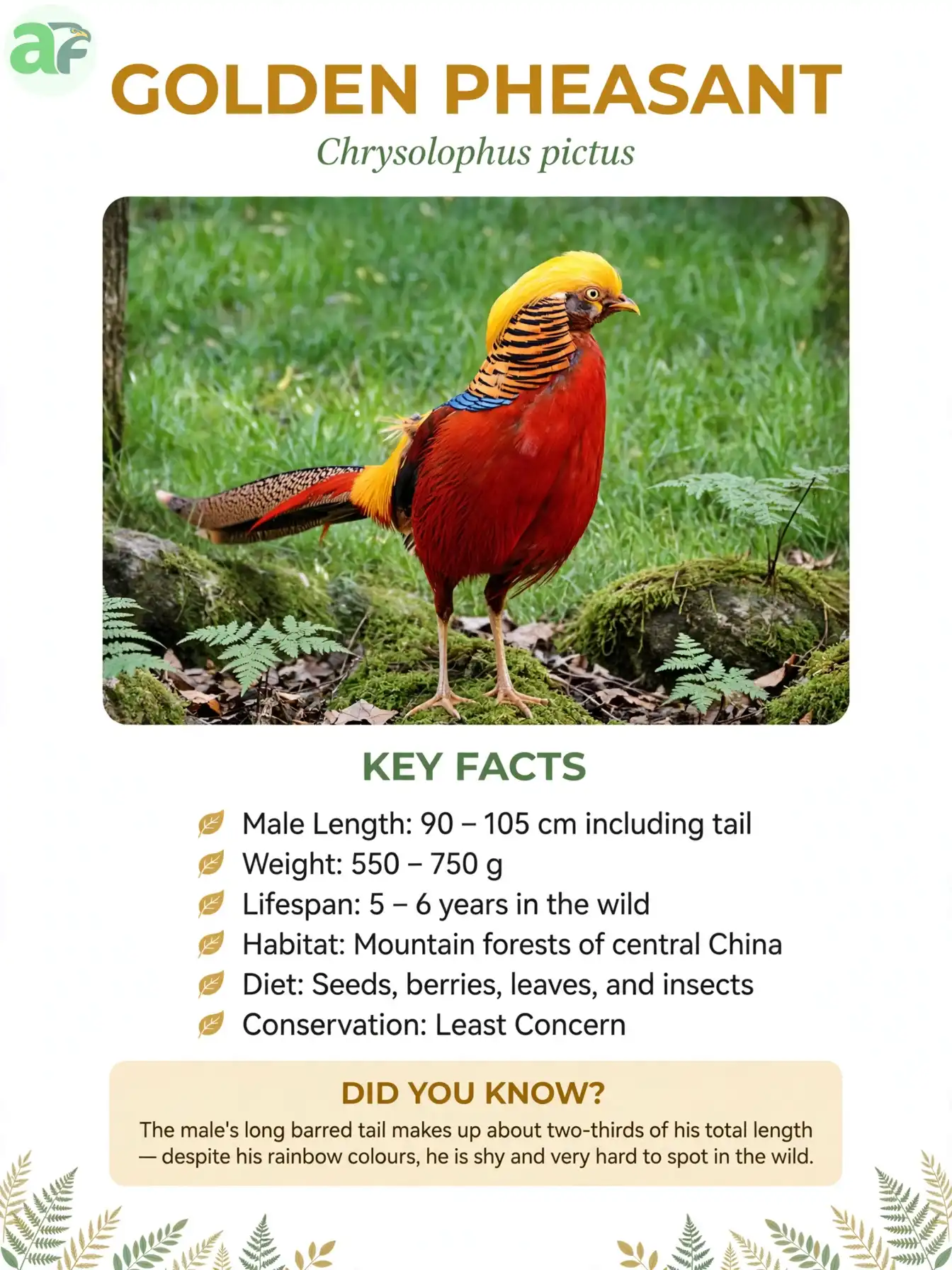
| IUCN Status | Least Concern (LC) |
| Population Trend | Decreasing |
| Estimated Wild Population | ~100,000 individuals (significant uncertainty) |
| Chinese Legal Protection | Protected under Chinese Wildlife Protection Law |
| CITES Listing | Appendix II — international trade regulated |
| Monitoring Adequacy | Poor — among the least systematically monitored Least Concern bird species in Asia |
The Monitoring Gap — A Least Concern Species with Unknown Population Trajectory
One of the most significant conservation research gaps for the golden pheasant is the inadequacy of population monitoring in its native range:
The accessibility problem — The core range in the Qinling-Minshan mountains is among the most rugged and least accessible terrain in China — systematic transect surveys covering adequate area to detect population trends require substantial logistical investment that has not been consistently applied to the golden pheasant.
The flagship species shadow — Conservation research investment in the Qinling-Minshan mountain ecosystem has been dominated by the giant panda — an iconic flagship species whose habitat requirements broadly overlap with the golden pheasant’s range but whose conservation profile attracts resources that non-flagship species do not receive.
The population estimate uncertainty — The commonly cited estimate of approximately 100,000 individuals is based on limited survey data extrapolated across the estimated range area — the actual figure could be two or three times higher or lower without contradicting the available evidence.
Major Threats
| Threat | Description | Impact Level |
|---|---|---|
| Habitat loss | Agricultural expansion into mountain forest; road construction | High in accessible areas |
| Hunting | Subsistence and commercial hunting despite legal protection | High in some areas |
| Habitat degradation | Selective logging; bamboo harvesting reducing cover quality | Medium-High |
| Agricultural pesticides | Reducing invertebrate food availability | Medium |
| Climate change | Upward shift of suitable elevation band | Increasing concern |
| Invasive species | Predator pressure from introduced animals near settlements | Medium |
| Disturbance at breeding sites | Tourism and recreation in core habitat | Low-Medium |
The Hunting Pressure
Historical context — Golden pheasants were historically hunted for food and feathers across their Chinese range — subsistence hunting by mountain communities representing a traditional relationship with the species.
Current status — Despite legal protection under the Chinese Wildlife Protection Law, enforcement in remote mountain areas is challenging — illegal hunting for food and occasional trade in feathers and live birds continues in parts of the range.
The feather trade — The extraordinary beauty of the male’s plumage creates demand for feathers in decorative arts and traditional crafts — the tail and cape feathers being particularly sought for decorative purposes. This demand drives targeted collection pressure in some areas.
Conservation Responses
Giant Panda Reserve network — The most significant incidental conservation benefit for the golden pheasant is the extensive Giant Panda Reserve network in the Qinling-Minshan mountain system — reserves established to protect panda habitat incidentally protect golden pheasant populations across a substantial area of the core range.
Chinese national park system expansion — The development of China’s National Park System — including the Giant Panda National Park established in 2021 — provides enhanced protection for mountain forest habitats within which golden pheasants occur.
Wildlife Protection Law enforcement — Increasing enforcement capacity and public education about wildlife protection laws in China has progressively reduced some hunting pressure on protected species including golden pheasants.
14. Famous Golden Pheasants in History & Pop Culture
Famous Individual Golden Pheasants and Cultural Moments
Darwin’s Display Study Birds (1871) — The male golden pheasants whose display behavior Darwin analyzed in The Descent of Man — whether observed directly or described through accounts of captive birds — are among the most scientifically significant individual golden pheasants in history. Darwin’s analysis of the asymmetric cape display became a foundational example in sexual selection theory that is still cited in evolutionary biology textbooks 150 years later.
The Breckland Founding Birds (~1860s) — The escaped or released golden pheasants that established the founding feral population in the Breckland of Norfolk and Suffolk around the 1860s — whose descendants constitute the UK’s longest-established introduced pheasant population — are historically significant as the founders of one of the most successful introduced pheasant populations in European ornithological history.
Moctezuma II’s Collection — While most famous for quetzal feathers, the Aztec emperor Moctezuma II’s legendary collection of exotic birds in the aviaries of Tenochtitlan included Chinese golden pheasants according to some historical accounts — though the documentation is less clear than for the quetzal. If accurate, this would place the golden pheasant in one of the most famous royal bird collections in human history.
Ming Dynasty Porcelain Birds — The golden pheasants depicted on Wucai porcelain of the Ming Dynasty (15th–17th centuries) — now among the most valuable ceramics in international auction markets — are the most widely seen historical representations of the species globally. A Ming Dynasty Wucai cup decorated with golden pheasants sold at Sotheby’s in 2014 for over £30 million — making the golden pheasant’s artistic representation among the most financially valued bird imagery in human history.
Richard Prum’s Sexual Selection Analysis — The evolutionary ornithologist Dr. Richard Prum of Yale University — whose 2017 book The Evolution of Beauty revitalized the Darwinian “aesthetic selection” theory of ornament evolution — uses the golden pheasant’s asymmetric cape display as one of several key examples demonstrating that female aesthetic preference, not simply honest signaling of male genetic quality, is the primary driver of extraordinary male plumage evolution.
Historical Significance
The rank badge tradition — The use of the golden pheasant (jingji) in Chinese imperial civil official rank badges (buzi) of the second rank created one of the most enduring human-bird symbol associations in administrative history — Chinese government officials wearing golden pheasant imagery for hundreds of years during the Ming and Qing dynasties (1368–1912). The rank badge system encoded the natural world’s most striking species into the fabric of governmental hierarchy — a uniquely Chinese system that has no parallel in other civilizations.
The first European scientific description — Linnaeus’s 1758 formal description of the golden pheasant in the 10th edition of Systema Naturae — the same edition that formally described many of the most familiar species in Western natural history — placed the golden pheasant at the founding moment of binomial nomenclature as a scientific system, giving it historical significance in the history of taxonomy beyond its individual natural history interest.
15. Role in Ecosystem & Food Chain
The Seed Dispersal Role
The golden pheasant contributes to seed dispersal in its mountain forest ecosystem through the consumption and defecation of seeds from the many fruit-producing plants in its diet:
Dispersal distances — Seeds consumed by golden pheasants are deposited in feces at distances of typically 50–300 meters from the parent plant — the bird’s daily movement creating dispersal distances that improve seed germination success compared to seeds falling directly beneath the parent.
Key plant relationships — The golden pheasant’s consumption of berries from species including wild rose (Rosa species), barberry (Berberis species), and various other mountain forest fruiting shrubs contributes to the dispersal of these plant species through the complex mountain terrain of the Qinling-Minshan range.
The Insectivore Role
Invertebrate population regulation — The golden pheasant’s scratching foraging behavior removes significant quantities of insects, larvae, and earthworms from the forest floor — contributing to regulation of invertebrate communities and nutrient cycling through the turnover of leaf litter.
Agricultural pest control — In areas where golden pheasant ranges overlap with mountain agricultural plots, the species’ consumption of crop-damaging insects (beetles, grubs) may provide incidental pest control services — though this benefit is rarely quantified.
The Prey Role
Supporting mountain predators — Golden pheasants constitute prey for multiple mountain forest predators — contributing to the energy budgets of golden eagles, goshawks, leopards, and dholes in the Qinling-Minshan mountain system. The species’ relatively high population density in suitable habitat makes it a significant component of the prey community for these large predators.
Nest predation contribution — Failed nests — where eggs are consumed by foxes, martens, or other predators — contribute to the nutrition of the predator guild even when the pheasant parent escapes. The high nest failure rate typical of precocial birds with large clutches generates a substantial nutrient subsidy to the predator community.
The Ecosystem Engineering Role
Leaf litter disturbance — The golden pheasant’s scratching foraging behavior physically disturbs leaf litter across substantial areas of its home range — creating the soil-aeration and leaf-litter mixing effects associated with ground-feeding birds in temperate forest ecosystems. This disturbance accelerates decomposition and nutrient cycling.
16. Myths, Folklore & Cultural Significance
Chinese Mythology and the Feng Huang
The golden pheasant’s relationship with Chinese mythology is mediated primarily through its connection to the Feng Huang — the mythological Chinese phoenix:
The Feng Huang’s attributes — The Feng Huang is described in classical Chinese texts as combining elements from multiple real birds — the head of a golden pheasant (ji), the body of a mandarin duck, the tail of a peacock, the legs of a crane, the mouth of a parrot, and the wings of a swallow. The golden pheasant’s head features — the golden crest, the iridescent face, and the dramatic coloration — contribute the most immediately recognizable element to this composite mythology.
The masculine-feminine symbolism — In Chinese cosmological tradition, the Feng Huang is paired with the dragon as the symbol of the empress (while the dragon represents the emperor) — the bird representing the feminine principle (Yin) to the dragon’s masculine principle (Yang). The golden pheasant’s extraordinary beauty, associated in Chinese culture with the feminine virtues of elegance and grace, contributed to this association.
Prosperity and good fortune — The golden pheasant is directly associated in Chinese folk tradition with good luck, prosperity, and auspicious beginnings — particularly appropriate for the bird’s appearance in Ming porcelain and embroidery as decorative gifts for weddings and new enterprises. The brilliant gold of the crest symbolizes wealth; the red breast symbolizes good fortune; the green back symbolizes longevity.
The Civil Official Rank Badge Tradition
The use of the golden pheasant in Chinese imperial rank badges (buzi) of the Ming and Qing dynasties represents one of the most elaborate institutional connections between a bird species and human hierarchy in history:
The system — Civil officials in the imperial Chinese government wore square embroidered badges on the front and back of their official robes — the bird species on the badge indicating the wearer’s rank. Nine civil ranks were distinguished by nine different bird species:
- 1st Rank: Crane (he)
- 2nd Rank: Golden pheasant (jingji)
- 3rd Rank: Peacock (kongque)
- And so on through the ranks
The golden pheasant’s position — The golden pheasant as the second rank badge bird placed it immediately below the crane (the highest civil rank) and above the peacock (third rank) — a positioning reflecting its exceptional beauty relative to other birds while acknowledging the crane’s supremacy as a symbol of longevity and wisdom.
The embroidery tradition — The rank badge embroideries depicting golden pheasants were produced by specialized court embroiderers using silk thread of extraordinary quality — gold thread for the crest, crimson thread for the breast, iridescent thread for the green back. The finest Ming rank badge embroideries are now among the most valuable textile artifacts in international museum collections.
Western Folklore and Symbolism
The “most beautiful bird” claim — In Western natural history literature from the 17th century onward, the golden pheasant is frequently described as the most beautiful bird in the world — a claim that appears in numerous 18th and 19th century natural history texts and that has become a persistent cultural attribution even as ornithologists have debated whether the resplendent quetzal, birds of paradise, or other contenders might compete for the title.
The aristocratic symbol — In European history, the golden pheasant was associated with aristocratic wealth and sophistication — the ability to maintain living golden pheasants in a private aviary was a marker of extreme wealth and refined taste. The bird appears in various European aristocratic portraits, game paintings, and decorative arts as a symbol of this elevated status.
17. Golden Pheasants in Pop Culture
Chinese decorative arts tradition — The golden pheasant’s appearance in Chinese painting, porcelain, embroidery, and decorative arts over more than a millennium constitutes the most sustained and most culturally significant pop culture presence of any pheasant species in world history. From Tang Dynasty silk paintings through Ming Wucai porcelain to contemporary Chinese decorative arts, the golden pheasant has been a recurring visual subject that transcends any specific era.
Darwin’s The Descent of Man (1871) — The golden pheasant’s inclusion as a key example in one of the most influential books in the history of science — Darwin’s formal presentation of sexual selection theory — gave the species a permanent place in the intellectual history of biology that continues to be referenced in contemporary evolutionary research.
Richard Prum’s The Evolution of Beauty (2017) — This widely read popular science book — a National Book Award finalist — revived debate about Darwinian aesthetic selection theory using the golden pheasant (among other species) as a central example. The book reached a broad popular science audience and renewed public interest in the golden pheasant’s evolutionary significance.
BBC Wildlife Documentaries — Various BBC natural history productions covering Chinese mountain wildlife and pheasant natural history have featured golden pheasant content — particularly productions covering the Qinling-Minshan mountain ecosystem that highlight the giant panda’s forest associates.
Chinese New Year imagery — The golden pheasant appears in traditional Chinese New Year decorative materials — particularly in regions of central China where the bird is locally familiar. The association with good fortune makes it an appropriate New Year symbol.
Taxidermy and museum collections — The extraordinary male plumage has made the golden pheasant a favored taxidermy subject from the Victorian era onward — specimens appearing in natural history museum collections and private taxidermy displays worldwide. Victorian natural history museums regularly displayed golden pheasant specimens as centerpieces of their bird galleries — the species’ spectacular colors surviving in preserved specimens better than most birds’ more pigment-based plumage.
18. Golden Pheasant Facts vs. Common Myths
| Common Myth | The Real Fact |
|---|---|
| “The golden pheasant is primarily a bird of open habitats — its colors are for open display” | False — the golden pheasant spends most of its time in dense bamboo thickets and forest understory where it is largely concealed. The male’s spectacular colors are revealed primarily during courtship display directed at specific females, not as a general open-habitat advertisement |
| “The golden pheasant is common and easy to see in China” | Partially misleading — while the species is not rare in appropriate habitat, it is extremely secretive and inhabits inaccessible mountain terrain. Wild sightings require significant effort and local knowledge even in areas of good population density |
| “Golden pheasants in UK parks are wild birds” | False — the UK population consists entirely of feral descendants of captive escapes — they are introduced birds, not native British wildlife |
| “The male golden pheasant’s brilliant colors are a disadvantage in the wild” | Partially false — while the colors increase predation detectability in open habitats, the male’s behavior of remaining in dense cover during most activities means the colors are rarely exposed to aerial predators. The benefits (female mate choice) clearly outweigh the costs, or the plumage would not have evolved to this degree |
| “All golden pheasants in captivity are pure golden pheasants” | False — many captive golden pheasants are hybrids with Lady Amherst’s pheasants, or carry genetic traces from past hybridization events. Pure golden pheasants from verified, unmixed lineages are specifically sought and maintained by conservation-minded aviculturists |
| “The golden pheasant cannot fly” | False — golden pheasants can fly adequately and regularly fly to roost trees at night. They prefer not to fly when cover is available but are capable fliers when necessary |
| “The golden pheasant is the national bird of China” | False — China does not have an officially designated national bird, though the crane (Grus grus/G. japonensis) is often informally associated with Chinese national symbolism. The golden pheasant’s association with China is cultural and historical rather than officially national |
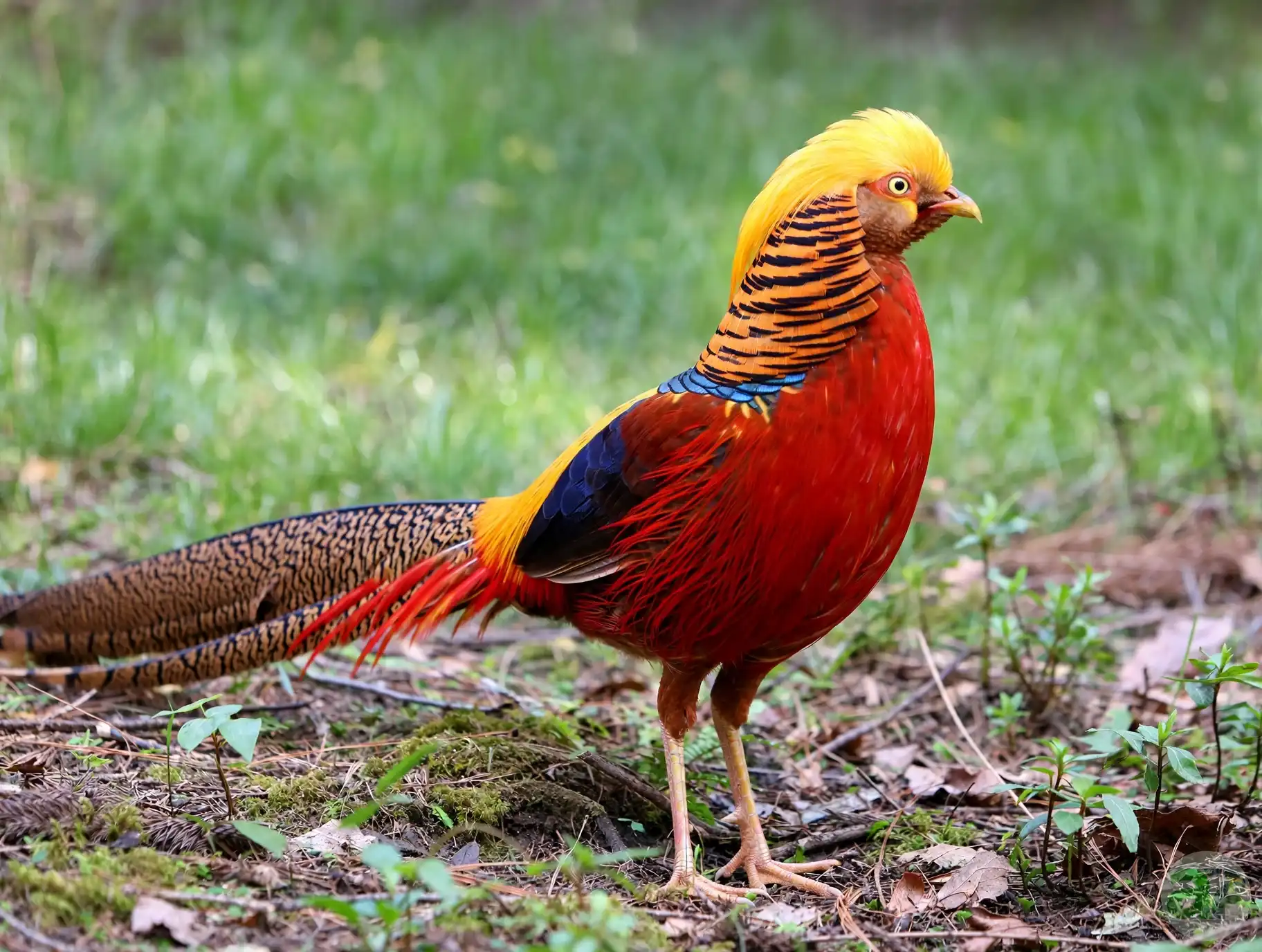
19. Best Places to See Golden Pheasants in the Wild
In the Native Chinese Range
1. Qinling Mountains, Shaanxi Province, China — The Qinling mountain range south of Xi’an represents the most accessible portion of the golden pheasant’s native range for foreign visitors. The Foping National Nature Reserve — established primarily to protect giant pandas — provides formal protection for mountain forest habitat in which golden pheasants are documented. Local guides with experience in both panda and pheasant monitoring can facilitate sightings on multi-day forest excursions.
2. Tangjiahe National Nature Reserve, Sichuan Province — Another panda reserve with documented golden pheasant populations; the reserve’s relatively accessible trail network through mountain forest and bamboo habitat provides the best conditions for attempting wild golden pheasant observation in Sichuan.
3. Wolong National Nature Reserve, Sichuan Province — The most famous giant panda reserve in China; golden pheasants occur throughout the mountain forest habitats. The reserve’s infrastructure for panda tourism provides a platform for broader wildlife observation including pheasants.
In the UK Feral Range
4. Thetford Forest, Norfolk/Suffolk, England — The Breckland’s Thetford Forest — managed by Forestry England — is the most reliable location in the UK and therefore in Europe for golden pheasant observation. The forestry plantations with rhododendron understory provide ideal habitat for the established feral population. Early morning drives or walks along forest tracks — particularly in spring when males are most vocal and most active — provide the best sighting opportunities.
5. Rendlesham Forest, Suffolk, England — Another Breckland forest supporting feral golden pheasants; less visited than Thetford but with a good established population.
6. Various Scottish forests — Golden pheasants occur in several Scottish forest areas including estates in Galloway and the Highland fringe — typically in forestry plantations with rhododendron understory. Local wildlife guides have knowledge of productive locations.
In Specialist Wildlife Collections
7. WWT Slimbridge, Gloucestershire, England — The Wildfowl and Wetlands Trust maintains a collection of golden pheasants alongside the world’s largest collection of waterfowl — providing close-range observation of the species in large, naturalistic enclosures.
8. Various UK pheasantries and wildlife parks — Multiple UK wildlife collections maintain golden pheasants in naturalistic aviaries — providing the opportunity for extended observation of the cape display and other behavioral repertoire elements not easily observed in wild birds.
9. The Honest Assessment — Wild golden pheasant sightings in the native Chinese range require significant planning, local guide connections, and substantial time investment — the secretive habits and inaccessible terrain combine to make this a challenging target even for experienced wildlife observers. In the UK, Thetford Forest provides the most reliable opportunity — early morning (6–9 AM) in spring (March–May) when males are calling and most active, walking or driving slowly along forest tracks. The male’s distinctive metallic call is often heard before the bird is seen — following the call direction into the rhododendron understory is the most productive search strategy.
20. How You Can Help
Supporting golden pheasant conservation requires differentiated action — protecting habitat in the native Chinese range while managing the introduced UK population responsibly.
Support these organizations:
- Wildlife Conservation Society China — wcs.org — operates conservation programs in Chinese mountain ecosystems including giant panda reserves that protect golden pheasant habitat
- Shaanxi Rare Wild Animal Rescue and Research Centre — the primary institution for wildlife research and conservation in the Qinling mountain system
- BirdLife International — birdlife.org — coordinates Asian bird conservation planning including monitoring programs for Chinese pheasant species
- World Pheasant Association — pheasant.org.uk — the primary specialist organization for pheasant conservation globally; funds research and conservation programs for all pheasant family species including golden pheasants
- RSPB (Royal Society for the Protection of Birds) — rspb.org.uk — for UK-based conservation advocacy supporting the habitat management that benefits the UK feral population alongside native species
Critical individual actions:
- Support the World Pheasant Association — the WPA funds the most targeted conservation and research programs for pheasant species including golden pheasant population monitoring in China
- If keeping golden pheasants, maintain genetic purity — responsible aviculturists avoid hybridization with Lady Amherst’s pheasants and maintain documented pure golden pheasant lineages
- Visit Thetford Forest responsibly — wildlife tourism that generates economic activity in communities adjacent to the Breckland forests supports the argument for maintaining the forestry plantation structure that the feral population depends on
- Support Chinese forest conservation programs — donations to organizations working on forest protection in the Qinling-Minshan mountain system directly benefit golden pheasant habitat
- Spread accurate information — correcting the common misconception that golden pheasants are easily seen in China and raising awareness of the monitoring gap that leaves the wild population’s status poorly known contributes to the scientific case for enhanced survey investment
21. Top Documentaries & Books
Must-Watch Documentaries
- “Wild China” (BBC, 2008) — The landmark BBC documentary on Chinese wildlife; includes content on the Qinling-Minshan mountain ecosystem relevant to golden pheasant habitat
- “Planet Earth” (BBC, David Attenborough, 2006) — The forests episode covers Asian mountain forest ecosystems; various BBC productions have included pheasant content
- “The Living Planet” (BBC, David Attenborough, 1984) — Classic Attenborough natural history series with Chinese forest content
- Various World Pheasant Association documentary productions — The WPA has produced specialist documentary content on pheasant species conservation including golden pheasant natural history
- “Birds of Paradise” (BBC/Netflix productions) — While focused on birds of paradise, these productions provide the best comparative context for understanding sexual selection in spectacular male birds
Must-Read Books
- The Descent of Man, and Selection in Relation to Sex by Charles Darwin (1871) — The foundational text; Darwin’s original analysis of the golden pheasant’s cape display remains one of the most important passages in the history of sexual selection theory
- The Evolution of Beauty by Richard O. Prum (2017) — Yale ornithologist Prum’s revival of Darwinian aesthetic selection theory uses pheasants including the golden pheasant as key examples; National Book Award finalist
- Pheasants of the World by Paul Johnsgard — The comprehensive reference for pheasant family natural history and distribution; essential for anyone seriously interested in golden pheasant biology
- Birds of China by John MacKinnon and Karen Phillipps — The standard field guide for Chinese birds; detailed golden pheasant species account with range maps
- The Handbook of the Birds of the World (HBW) — Pheasants and Partridges volume — The comprehensive scientific reference for Phasianidae; the most detailed species account available for the golden pheasant
22. Golden Pheasant Comparison with Other Spectacular Pheasants
| Feature | Golden Pheasant | Lady Amherst’s Pheasant | Peacock | Argus Pheasant | Himalayan Monal |
|---|---|---|---|---|---|
| Scientific name | Chrysolophus pictus | Chrysolophus amherstiae | Pavo cristatus | Argusianus argus | Lophophorus impejanus |
| Male weight | 630–700 g | 640–800 g | 4–6 kg | 2–2.5 kg | 1.9–2.4 kg |
| Display structure | Orange-black cape | White-black collar, longer tail | Train with ocelli | Enormously elongated secondary feathers | Iridescent body plumage |
| Tail length (male) | Up to 75 cm | Up to 150 cm | Up to 160 cm (train) | Up to 105 cm | 35 cm |
| Mating system | Polygynous | Polygynous | Polygynous (lek) | Polygynous | Monogamous |
| Parental care | Female only | Female only | Female only | Female only | Both parents |
| Habitat | Mountain forest/bamboo | Mountain forest | Open forest/grassland | Lowland rainforest | Alpine meadow/forest |
| Range | Central China | SW China, Myanmar | Indian subcontinent | SE Asia | Himalayas |
| Conservation | Least Concern | Least Concern | Least Concern | Least Concern | Least Concern |
| Darwin connection | Key sexual selection example | Related species context | Discussed by Darwin | Discussed by Darwin | Not specifically cited |
| Famous for | Most brilliantly colored | Longest tail among pheasants | Most recognized display globally | Largest secondary feathers of any bird | Most iridescent pheasant |
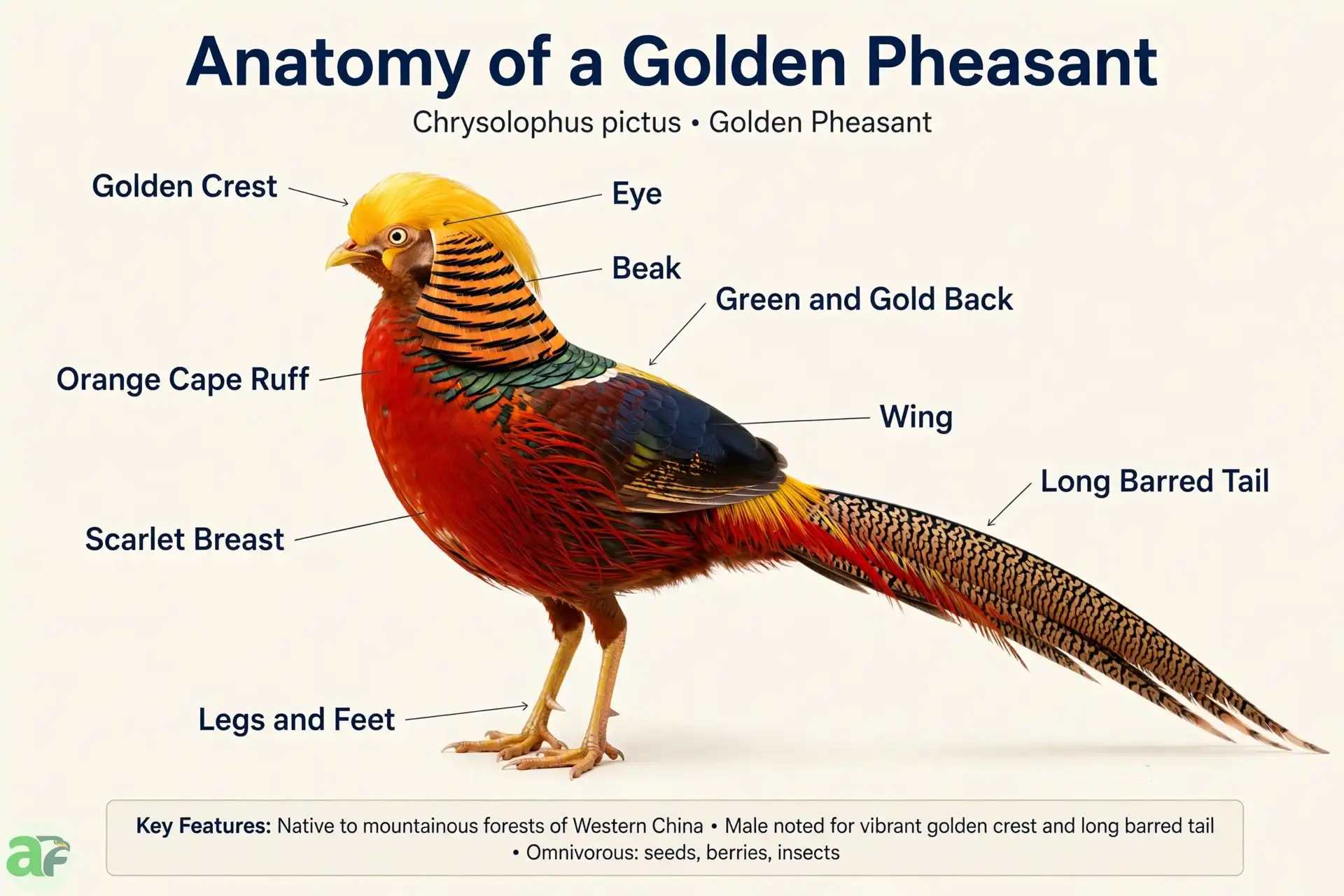
23. Frequently Asked Questions About Golden Pheasant Birds
Q1. What is the scientific name of the golden pheasant?
The golden pheasant’s scientific name is Chrysolophus pictus (Linnaeus, 1758). The genus name Chrysolophus derives from the Greek chrysos (gold) and lophos (crest) — meaning “golden-crested” — a direct reference to the male’s brilliant golden yellow crown feathers. The species name pictus is Latin for “painted” — capturing the extraordinary multi-colored, painted-like quality of the male plumage. The species was formally described by Carl Linnaeus in the 10th edition of Systema Naturae in 1758 — the foundational document of binomial nomenclature as a scientific system — giving the golden pheasant a place in the founding moment of modern taxonomy. The genus Chrysolophus was established by John Edward Gray in 1834, separating the golden and Lady Amherst’s pheasants from the broader Phasianus genus. The species belongs to the family Phasianidae — the largest and most diverse bird family within the order Galliformes.
Q2. Why is the golden pheasant so colorful?
The golden pheasant’s extraordinary male plumage is the product of sexual selection through female mate choice — one of the processes that Charles Darwin identified and analyzed in The Descent of Man (1871), using the golden pheasant as a key example. Over millions of generations, female golden pheasants have preferentially mated with the most spectacularly colored males — males with the most vivid golden crests, most saturated crimson breasts, and the most elaborate orange-and-black capes. Because female preference is heritable (daughters tend to share their mothers’ preferences), and male coloration is partly heritable (sons of vivid males tend to be more vivid), the combination of female preference and male coloration escalates through a process called runaway sexual selection — each generation producing slightly more extreme male plumage than the previous generation because extreme males are more successful at attracting mates. The process is constrained by survival costs — males whose colors become so extreme that predator detection prevents survival cannot pass on their genes — creating an equilibrium where male plumage is as elaborate as survival allows. The specific colors of the golden pheasant — gold, crimson, orange-black — are the particular evolutionary outcome of this process in this specific Chinese mountain forest environment.
Q3. Are there golden pheasants living wild outside China?
Yes — the most significant self-sustaining feral population outside China is in the United Kingdom, particularly in the Breckland forests of Norfolk and Suffolk (Thetford Forest and surrounding areas) and in various forest areas in Scotland, Wales, and southwest England. These birds are descendants of aviary escapes and deliberate releases dating from approximately the 1860s — making the UK population one of the longest-established introduced pheasant populations in Europe, having maintained itself for over 150 years. The UK feral population is estimated at 1,000–5,000 birds depending on the survey methodology and area included. Smaller feral populations exist in parts of Germany, France, Brazil, and other countries, though none are as stable or as well-documented as the UK population. In all cases, these feral birds are descendants of captive birds rather than natural dispersers from the Chinese population.
Q4. How do golden pheasants compare to peacocks?
The golden pheasant and the peacock (Pavo cristatus) are both members of the Phasianidae family and both famous for extraordinarily elaborate male plumage evolved through sexual selection — but they differ significantly in most respects. Body size: peacocks are dramatically larger — adult male peacocks weigh 4–6 kg compared to the golden pheasant’s 630–700 grams. Display structure: the peacock’s celebrated display involves erecting a massive train of upper tail covert feathers bearing iridescent eyespots (ocelli) — a completely different structure from the golden pheasant’s cape display. Display behavior: the peacock erects its train in a broad fan visible from all directions in open habitat; the golden pheasant fans only the near-side cape asymmetrically toward the specific female being courted. Color mechanism: both species use structural coloration — the peacock’s blue-green iridescent eyespots and the golden pheasant’s metallic green back involve thin-film interference. Cultural significance: the peacock is the more globally recognized species and is the national bird of India with deep Hindu religious associations; the golden pheasant has deeper Chinese cultural associations and a specific role in evolutionary biology history through Darwin’s analysis. Darwin’s analysis: Darwin discussed both species extensively, but the golden pheasant’s asymmetric cape display was particularly important for his argument that female mate choice drives ornament evolution.
Q5. Where is the best place to see a golden pheasant?
For most visitors, the most accessible and most reliable location for wild golden pheasant observation is Thetford Forest in the Breckland of Norfolk, England — the established feral population in this managed forest provides sighting opportunities that the inaccessible native Chinese range cannot match for practical wildlife tourism. Early morning visits (6–9 AM) in spring (March–May) when males are most vocal and most active produce the best results — the characteristic metallic clucking call is often heard before the bird is seen, and following the call direction into rhododendron understory frequently produces a sighting. For the native Chinese range, the Qinling Mountains of Shaanxi Province (particularly the Foping National Nature Reserve) and the Tangjiahe National Nature Reserve of Sichuan Province are the most accessible sites with documented golden pheasant populations — but sightings require multi-day excursions with experienced local guides, significant physical effort, and considerable patience. The species’ secretive habits in dense bamboo and mountain forest make even Thetford Forest sightings far from guaranteed, and Chinese wild population encounters genuinely challenging.
24. Sources & Refrences
- Wikipedia — Chrysolophus pictus, Phasianidae, Chrysolophus, Sexual selection
- IUCN Red List — iucnredlist.org (current Least Concern assessment for Chrysolophus pictus)
- Darwin, C. (1871). The Descent of Man, and Selection in Relation to Sex. John Murray — the foundational sexual selection analysis
- Prum, R.O. (2017). The Evolution of Beauty. Doubleday — the contemporary sexual selection analysis including golden pheasant discussion
- World Pheasant Association — pheasant.org.uk
- BirdLife International — birdlife.org (species factsheet)
- Johnsgard, P.A. (1999). The Pheasants of the World. Oxford University Press — the comprehensive pheasant reference
- National Geographic — nationalgeographic.com
- Smithsonian National Museum of Natural History — naturalhistory.si.edu
- BBC Wildlife / BBC Earth — bbcearth.com
- Britannica — britannica.com/animal/golden-pheasant
- MacKinnon, J. and Phillipps, K. (2000). A Field Guide to the Birds of China. Oxford University Press
- Cornell Lab of Ornithology — allaboutbirds.org
- RSPB — rspb.org.uk (UK feral golden pheasant documentation)