
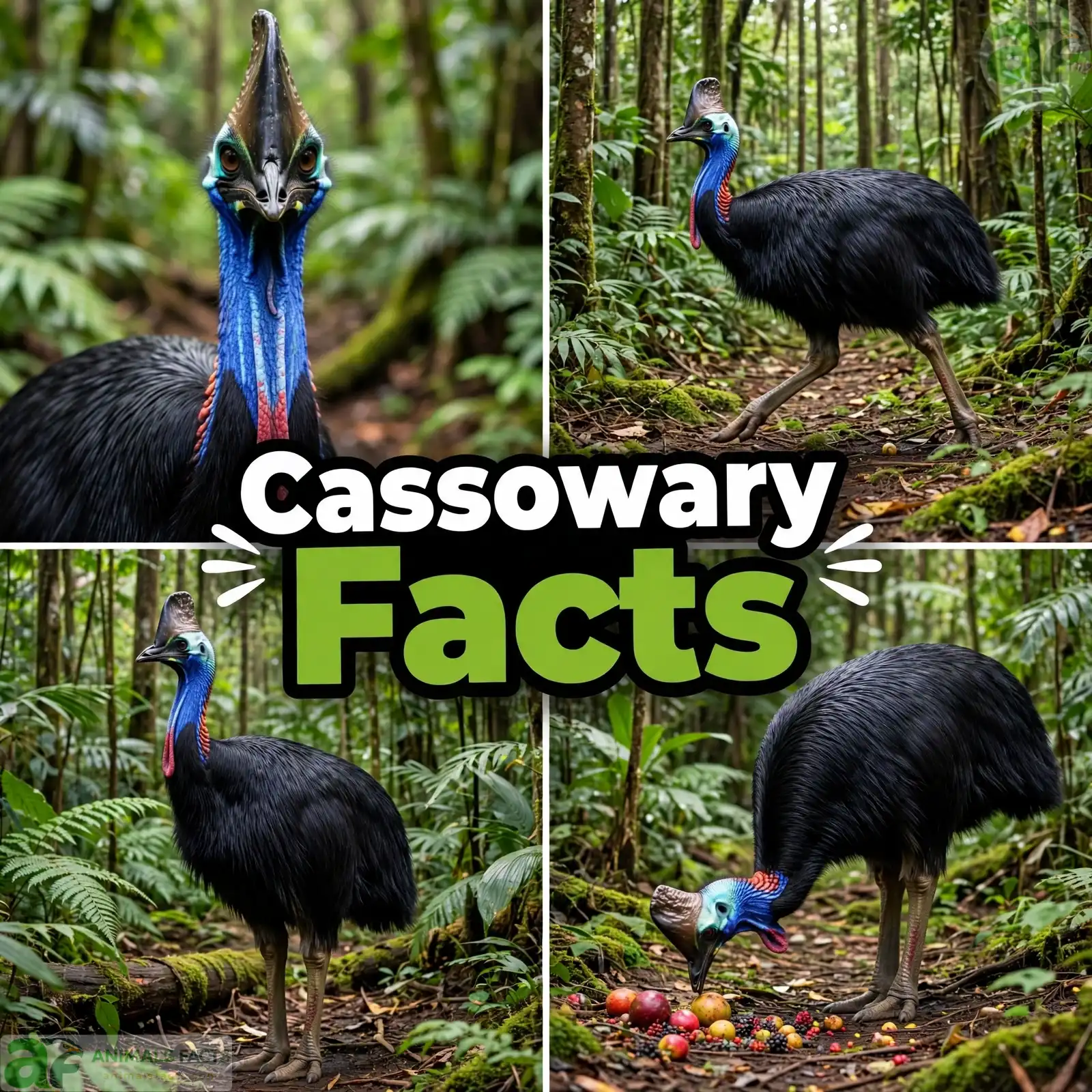
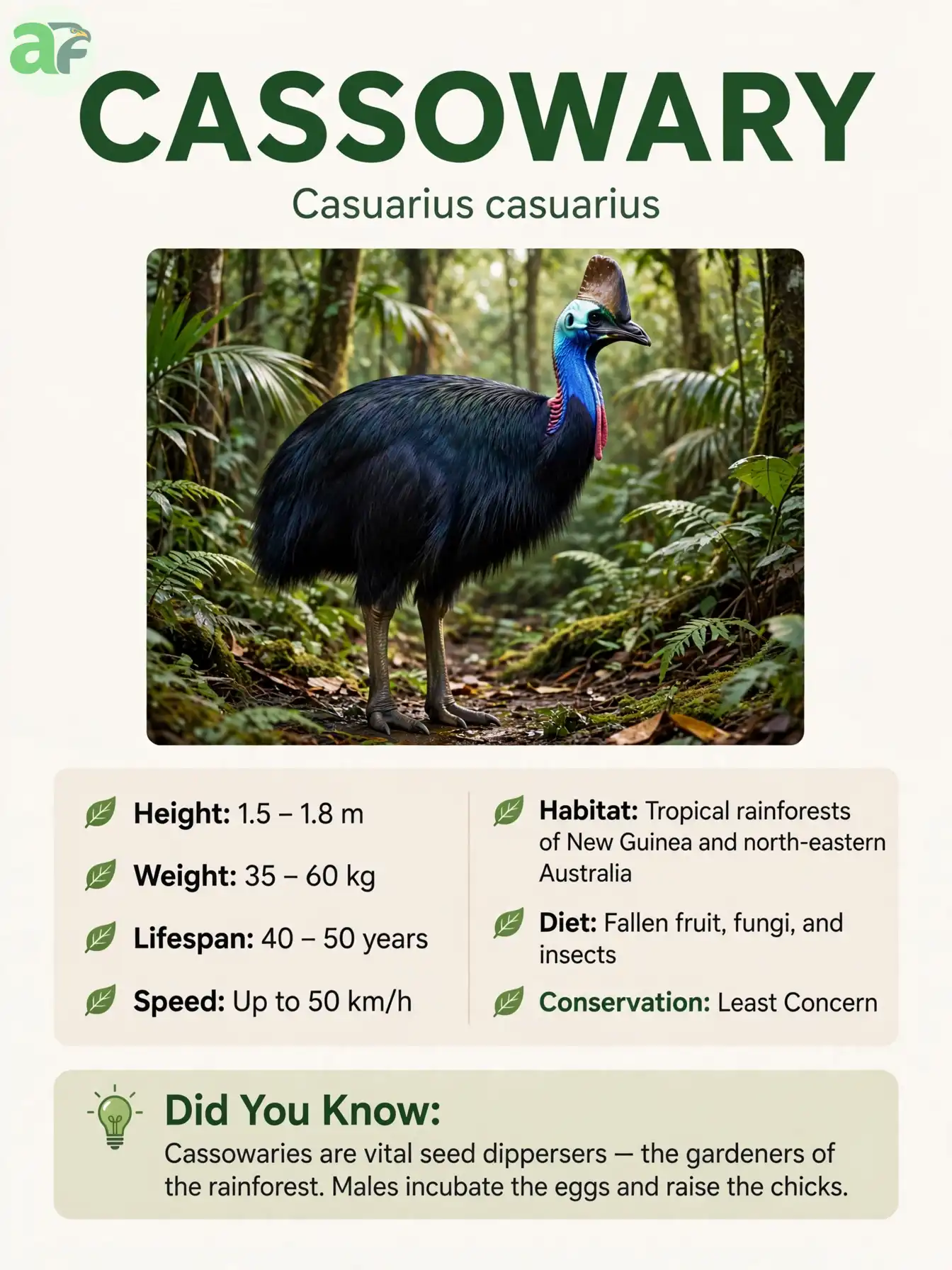
Cassowary Facts
| Feature | Details |
|---|---|
| Scientific Name | Casuarius casuarius (Linnaeus, 1758) — Southern cassowary (primary species); C. unappendiculatus — Northern cassowary; C. bennetti — Dwarf cassowary |
| Kingdom | Animalia |
| Phylum | Chordata |
| Class | Aves |
| Order | Casuariiformes |
| Family | Casuariidae |
| Common Names | Cassowary; southern cassowary; double-wattled cassowary; muruk (New Guinea); genyornis (historical confusion); marup (various New Guinea languages) |
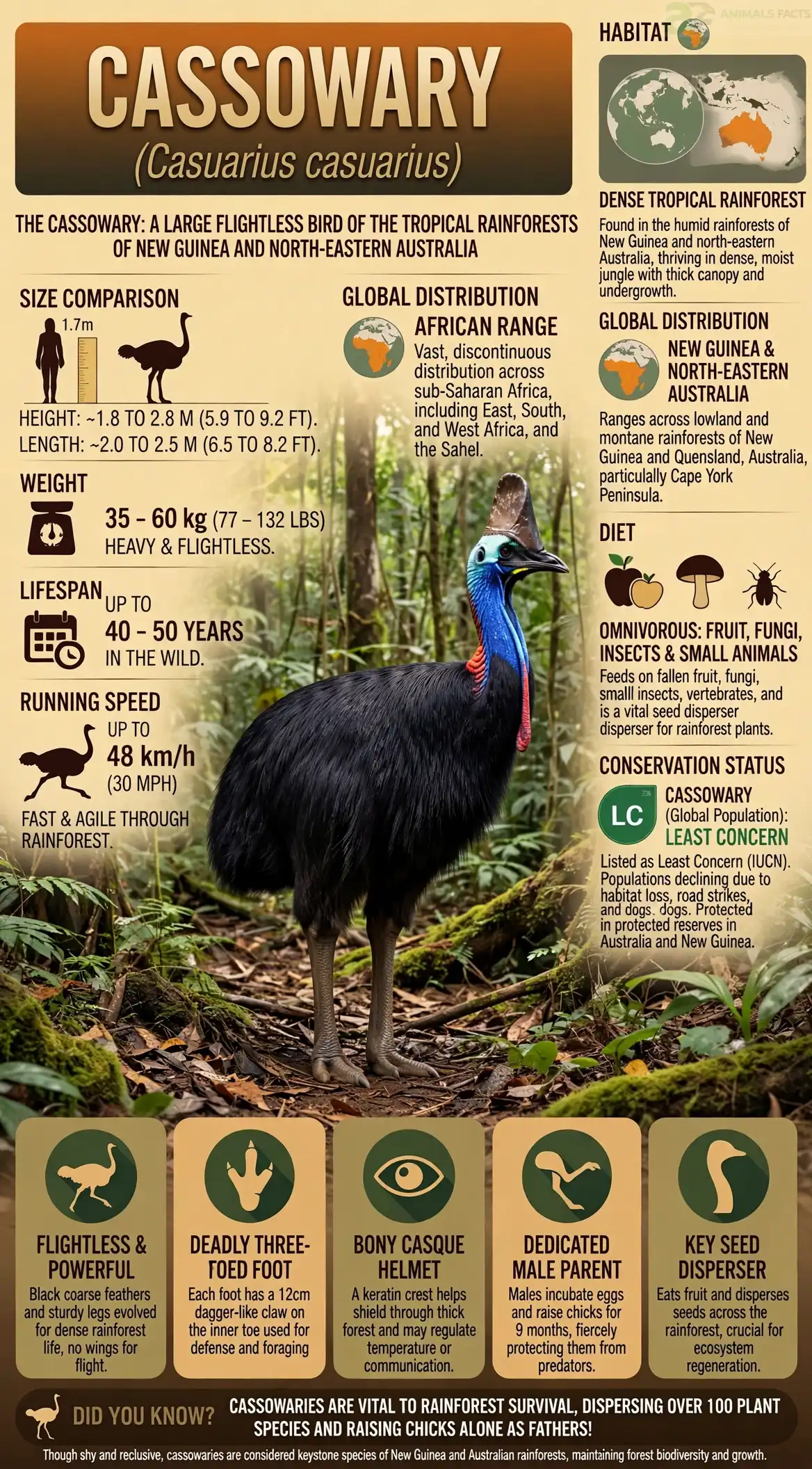
| Native Range | New Guinea (primary range — all three species); Northeastern Queensland, Australia (southern cassowary only) |
| Habitat | Primary tropical rainforest — the most forest-dependent of all ratites; also mangroves and melaleuca swamps at forest margins |
| Lifespan | 18–40 years (wild); up to 50 years (captivity) |
| Diet | Primarily fallen fruit — the most frugivorous of all ratites; also fungi, invertebrates, small vertebrates |
| Body Height | 127–170 cm (southern cassowary) |
| Weight | Males 29–34 kg; Females 58–76 kg — females significantly larger |
| Casque Height | Up to 18 cm — the bony casque on top of the head whose function remains incompletely understood |
| Conservation Status | Southern cassowary: Vulnerable (IUCN); Northern cassowary: Vulnerable; Dwarf cassowary: Least Concern |
| Defining Feature | The bony casque (helmet) on the skull; the dagger-like inner toe claw reaching 12 cm — cited in the Guinness World Records as the world’s most dangerous bird; the essential role as the only disperser of large-seeded rainforest fruits in Australia and New Guinea |
| Guinness Record | “Most dangerous bird in the world” — the only bird documented killing humans through direct attack in the modern era |
| Ecological Role | The southern cassowary is considered a keystone species in Australian and New Guinean rainforests — the removal of cassowaries from a forest system would cause cascading ecosystem collapse affecting hundreds of plant species |
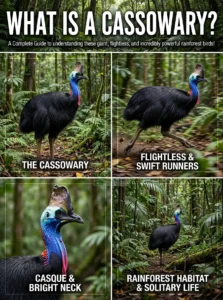 1. Introduction: What is a Cassowary?
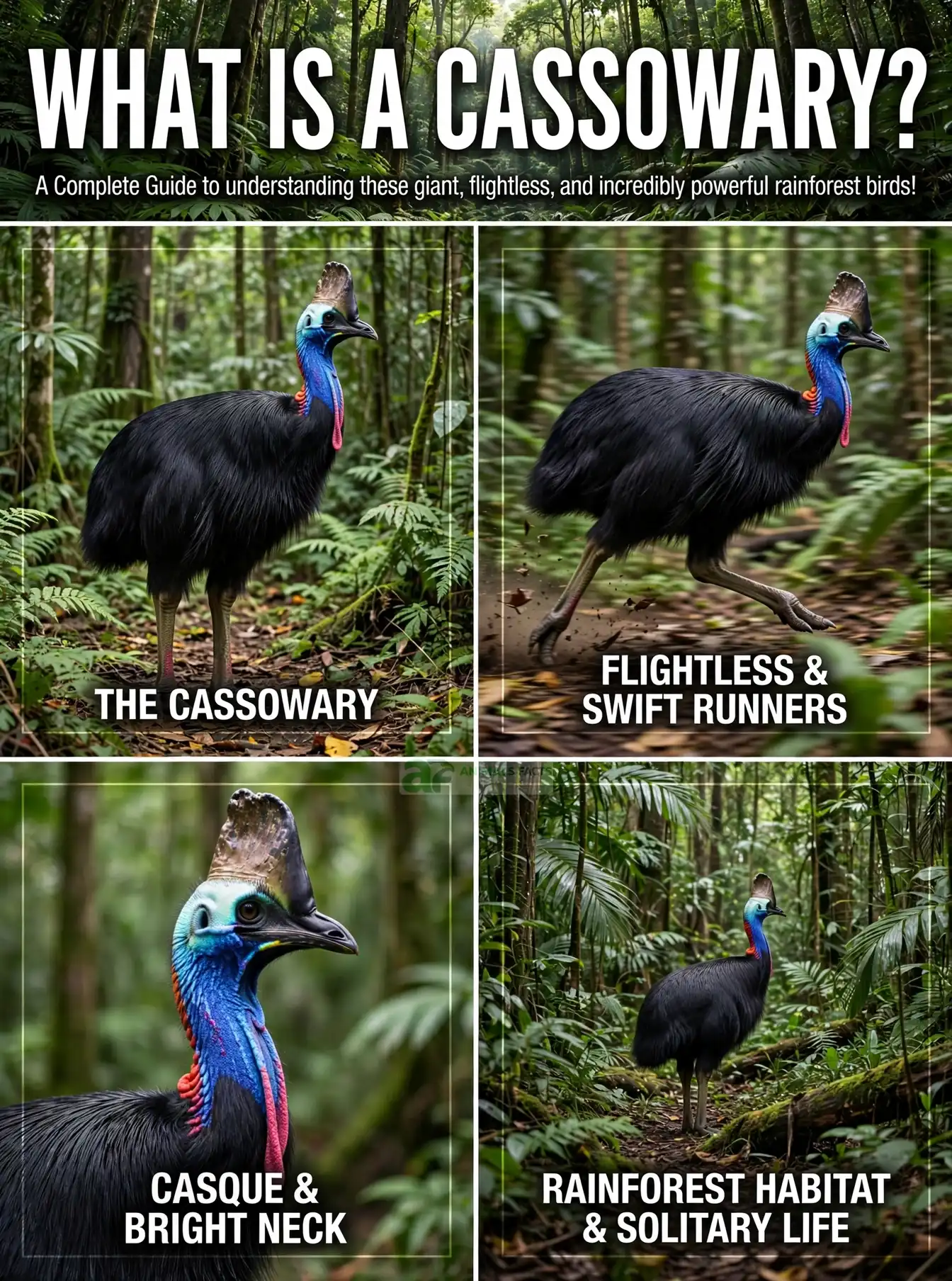
In the primary rainforest of northeastern Queensland, on a trail that winds between the buttress roots of massive trees whose canopy closes 40 meters overhead and whose understory is thick with the broad leaves of wait-a-while palms and lawyer canes, a movement at the edge of vision arrests every thought simultaneously. The movement is wrong — too large, too deliberate, too purposeful for anything that lives at ground level in this forest except for one thing. The cassowary emerges from between two tree trunks with the unhurried authority of an animal that has occupied this forest for 60 million years and has never, in that entire period, needed to hurry away from anything. It is approximately 1.6 meters tall. The casque on its head — the hollow bony structure whose function is still debated — catches the filtered rainforest light. The blue and red neck skin is vivid against the glossy black of the body feathers. The feet, when the bird takes another deliberate step forward, reveal the inner toe — a straight, dagger-like claw approximately 12 centimeters long, capable of delivering the disemboweling kick that has given the cassowary its Guinness World Records designation as the most dangerous bird in the world. The bird stops, turns one of its eyes (each capable of independent movement) toward the trail’s human visitor, assesses the situation for approximately three seconds, and then continues into the forest — leaving behind a silence that somehow seems more complete than it was before. Cassowary facts begin with that three seconds of assessment — the moment when the world’s most dangerous bird decides that the human is not worth the energy of aggression and moves on, demonstrating simultaneously the animal’s power and its fundamental preference for rainforest fruit over confrontation.
The cassowary (Casuarius species) is the most biologically paradoxical large bird in the world. It is simultaneously the most dangerous bird on Earth (the only bird documented killing humans through direct attack in modern times) and one of the most ecologically essential birds in any forest ecosystem — the keystone species of Australian and New Guinean tropical rainforests whose disappearance would trigger a cascade of plant extinctions affecting hundreds of species. It is the only bird whose skull bears a bony casque whose function remains incompletely understood after decades of scientific study — proposals including sound transmission, casque-to-casque combat, heat dissipation, age signaling, and low-frequency infrasound communication having all been proposed and none definitively established. It looks more like a theropod dinosaur than any other living bird — its combination of large body size, vestigial wings, scaly feet, forward-facing eyes, and predatory bearing creating a visual impression that consistently makes observers feel they are looking at something that should be extinct. And it is a bird about which the most fundamental facts — why does it have a casque? what is the full extent of its ecological function? how large is its population? — remain incompletely answered, making it simultaneously one of the most studied and most mysterious large birds in the world.
Interesting facts about cassowaries reveal an animal of breathtaking biological and ecological complexity — the role as the sole disperser of large-seeded rainforest fruits in Australia, creating a one-to-one dependency between the cassowary and more than 70 plant species whose seeds are too large for any other fruit-eating animal to swallow; the male’s sole parental care involving a 49–52 day incubation without the female’s assistance followed by 9 months of chick-rearing; the documented killing of a Florida man in 2019 — the first documented cassowary fatality in approximately 100 years, reminding the world that the cassowary’s dangerous reputation is not merely historical; the casque’s extraordinary acoustic properties that may allow the cassowary to produce and detect infrasound (sound below 20 Hz, inaudible to humans) that travels long distances through dense forest; and the New Guinean cultural tradition of keeping cassowaries as the most prestigious living wealth objects — individuals traded for the equivalent of a bride price in highland cultures where the bird represents the supreme prestige good. This is your comprehensive guide to the world’s most dangerous bird and the rainforest’s most essential ecological partner.
2. Cassowary Species Overview & Classification
The cassowaries form a small, taxonomically well-defined family — the Casuariidae — containing three living species all found in New Guinea and (for one species) northeastern Australia.
Species Classification Table
| Taxonomic Rank | Classification |
|---|---|
| Kingdom | Animalia |
| Phylum | Chordata |
| Class | Aves |
| Order | Casuariiformes |
| Family | Casuariidae (Kaup, 1847) |
| Genus | Casuarius (Brisson, 1760) |
| Species 1 | C. casuarius (Linnaeus, 1758) — Southern cassowary |
| Species 2 | C. unappendiculatus (Blyth, 1860) — Northern cassowary |
| Species 3 | C. bennetti (Gould, 1857) — Dwarf cassowary |
| Etymology | Casuarius from Malay kesuari or kasuari — the local name for the bird in the Malay Archipelago. The Malay term itself may derive from the Papuan name for the bird. “Cassowary” in English directly adopts this Malay root. The species name casuarius simply repeats the genus name — the nominate species sharing the genus designation |
The Three Cassowary Species
| Feature | Southern Cassowary | Northern Cassowary | Dwarf Cassowary |
|---|---|---|---|
| Scientific name | C. casuarius | C. unappendiculatus | C. bennetti |
| Common name | Southern cassowary; double-wattled cassowary | Northern cassowary; single-wattled cassowary | Dwarf cassowary; Bennett’s cassowary; mooruk |
| Range | NE Queensland + New Guinea broadly | New Guinea (north and west) | New Guinea + New Britain; higher elevations |
| Weight (female) | Up to 76 kg | Up to 70 kg | Up to 26 kg |
| Wattles | Two large wattles | One or no wattle | None or vestigial |
| Casque | Prominent — up to 18 cm | Prominent | Smaller and more laterally compressed |
| Neck color | Vivid blue and red | Blue (variable) | Duller — pink and blue |
| Elevation | Lowland — up to 1,100 m | Lowland | Montane — 1,000–3,300 m |
| Conservation | Vulnerable | Vulnerable | Least Concern |
| Australia presence | Yes — NE Queensland | No | No |
| Most dangerous | Yes — responsible for documented human fatalities | Dangerous | Less documented |
The Relationship to the Emu
The cassowary and the emu are each other’s closest living relatives — both in the order Casuariiformes and sharing evolutionary ancestry within the Australian-New Guinean region of the Southern Hemisphere:
Shared characteristics:
- Both are large, flightless ratites
- Both have vestigial wings
- Both have male-only or male-primary parental care
- Both evolved in the Australia-New Guinea landmass system
Key differences:
- Cassowaries are forest specialists; emus are open-country specialists
- Cassowaries have a casque; emus do not
- Cassowaries have 3 toes with a dagger inner claw; emus have 3 toes without this feature
- Cassowaries are primarily frugivorous; emus are omnivorous
- Cassowaries are much more dangerous in direct confrontation
- Cassowaries have vivid blue-red head and neck coloration; emus are brown
The Evolutionary Context
Age of the lineage — Fossil evidence places cassowary-like birds in the Australia-New Guinea region from approximately 60 million years ago — establishing the cassowary as one of the oldest continuously present large bird lineages on any landmass.
The flightlessness evolution — Like emus and other ratites, cassowaries evolved flightlessness independently — molecular genetics establishing that ratites lost flight multiple times rather than inheriting flightlessness from a single common ancestor.
The New Guinea center — All three cassowary species are native to New Guinea — Australia’s connection to the cassowary being a secondary range extension by the southern cassowary across the Torres Strait land bridge during periods of lower sea level. The presence of the southern cassowary in Australia’s Wet Tropics region reflects this relatively recent (in geological time) colonization.
Evolution & Discovery Timeline
~60 million years ago (Paleocene) — The casuariid lineage establishes in the Australia-New Guinea region.
~50,000 years ago — The first New Guinean peoples arrive — beginning one of the most intimate and most sustained human-cassowary relationships in history; cassowaries immediately become the most prestigious large bird in New Guinean culture.
~40,000 years ago — The first Aboriginal Australians in Queensland’s Wet Tropics region encounter the southern cassowary — beginning the Australian human-cassowary relationship.
~1597 — First European documentation of the cassowary — a live bird brought to Amsterdam by Dutch traders from the East Indies. The Amsterdam specimen — kept alive in the menagerie — was the first cassowary seen by European naturalists.
1758 — Carl Linnaeus formally describes Casuarius casuarius in Systema Naturae.
1926 — The most documented cassowary fatality in history: Phillip McLean, a 16-year-old in Queensland, Australia, is killed by a cassowary after he and his brother attempted to kill it with clubs. The cassowary knocked him down and kicked him in the neck, severing the jugular vein.
2019 — A cassowary kills Marvin Hajos in Florida, USA — the first confirmed cassowary fatality in approximately 100 years — when Hajos fell near his captive cassowary and was kicked. The incident reinvigorated global awareness of the cassowary’s genuine danger.
2020 — IUCN maintains Vulnerable classifications for both the southern and northern cassowary — the Australian population of southern cassowaries estimated at approximately 4,000 individuals.
“The cassowary is what a theropod dinosaur would look like if it were alive today. It has the bearing, the weaponry, the forest presence, and the ancient evolutionary history to justify the comparison. And unlike most animals that are called ‘living fossils’ somewhat loosely, the cassowary genuinely earns the designation — a design that has been essentially unchanged for tens of millions of years because nothing about it needed changing.”
— Dr. Andrew Mack, Wildlife Conservation Society — leading cassowary field researcher in New Guinea
3. Cassowary Physical Description & Unique Features
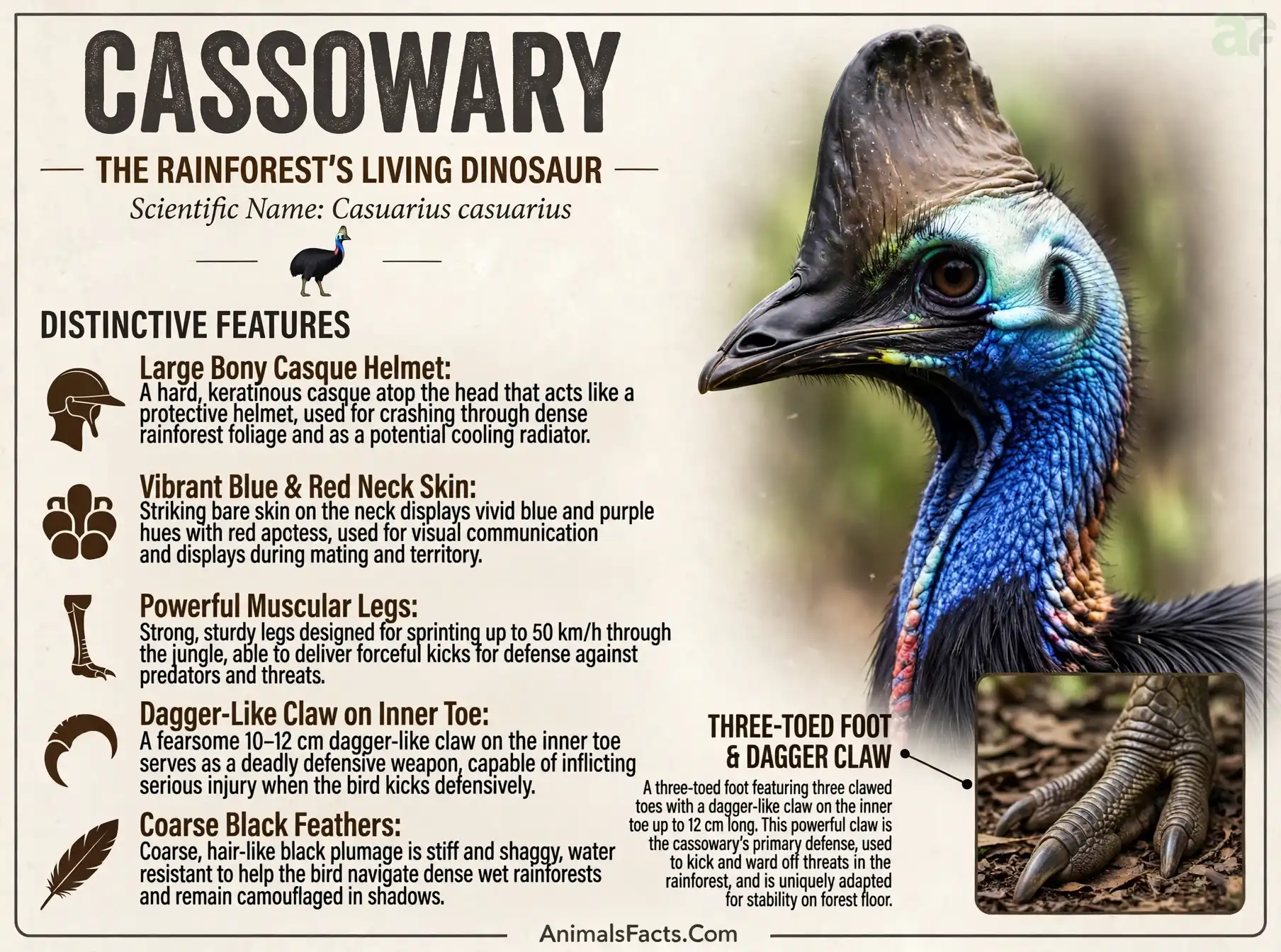
The cassowary’s physical appearance is the most visually dramatic of any ratite — a combination of the bony casque, the vivid blue-red skin, the glossy black plumage, and the dagger claw creating an animal that consistently produces the “dinosaur” response in observers encountering it for the first time.
The Casque — The Most Mysterious Anatomical Feature in the Bird World
The cassowary’s most immediately distinctive feature — and the most scientifically debated structure in any modern bird:
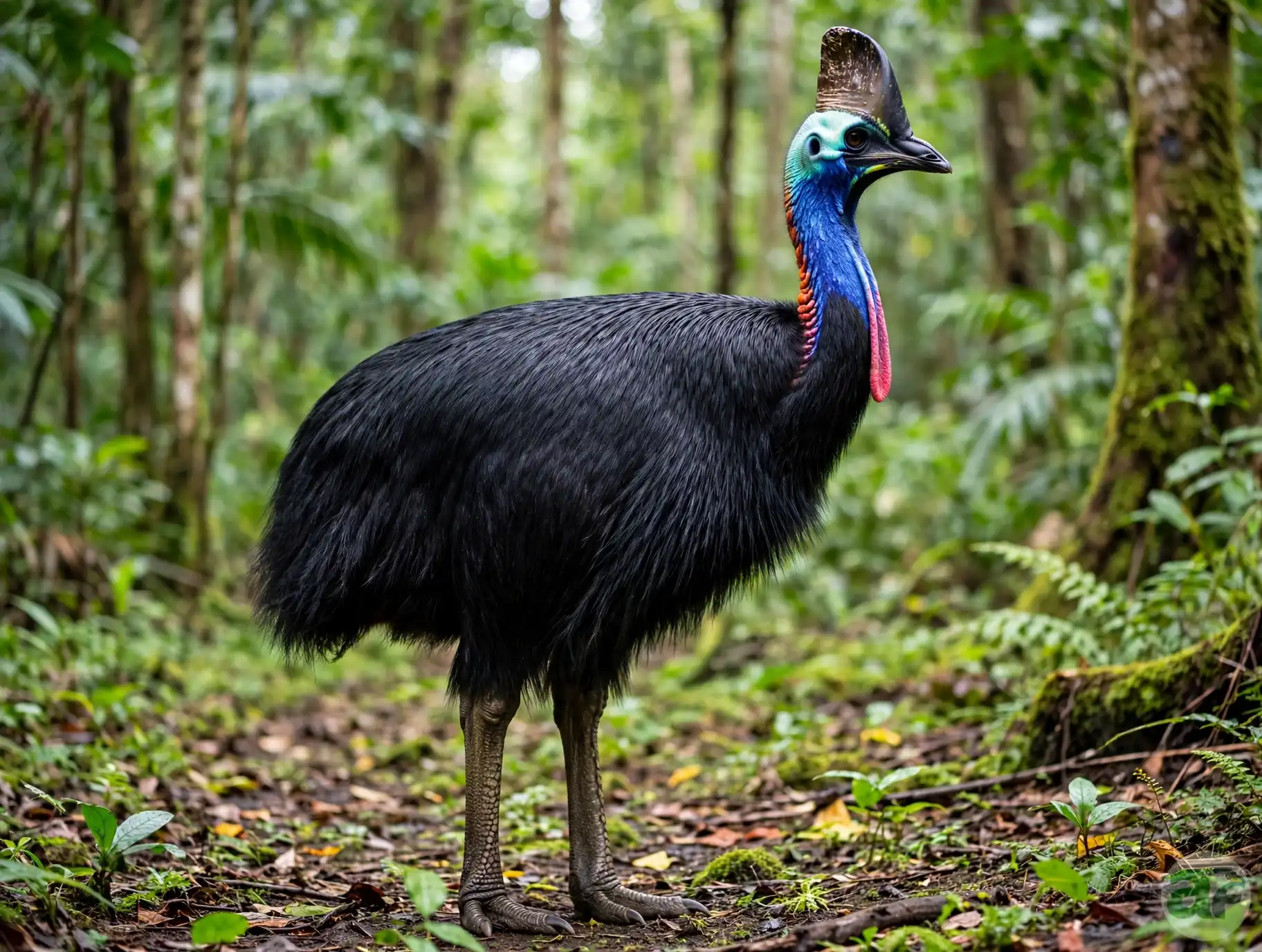
What it is — The casque is a hollow, keratinous and bony protrusion rising from the top of the skull in all three cassowary species. In the southern cassowary, the casque reaches up to 18 cm in height, compressing laterally (narrow side-to-side) and deepening front-to-back.
Internal structure — The casque is not solid bone — it contains a network of trabeculae (interconnected bony strands) surrounding air spaces, creating a lightweight but structurally complex internal architecture. The casque is covered externally by a layer of keratin (the same protein as fingernails, bird beaks, and rhino horns).
The proposed functions — none definitively established:
Sound production and reception hypothesis — The casque may function as a resonating chamber for the low-frequency booming calls that cassowaries produce, and potentially as a receiver for infrasound (frequencies below 20 Hz) that travel long distances through dense forest. The casque’s internal air spaces could theoretically amplify specific frequencies — though experimental confirmation of this function remains elusive.
Combat function hypothesis — The casque may function as a weapon or protection in casque-to-casque combat between rivals. Observations of male cassowaries in combat show head-on confrontations where casques may contact — though whether the casque is specifically adapted for combat rather than combat simply occurring incidentally is debated.
Thermoregulation hypothesis — The casque’s large surface area and position above the body may assist in heat dissipation — the rich blood supply to the casque potentially allowing heat exchange with the surrounding air. This function would be relevant in the hot, humid tropical rainforest environment.
Vegetation-pushing hypothesis — The casque may help the cassowary push through dense rainforest vegetation — the laterally compressed, forward-pointing structure acting as a wedge that parts vegetation as the bird moves. Observers have noted cassowaries using their casques to push aside branches.
Status signaling hypothesis — Casque size and development may signal age and dominance to other cassowaries — larger casques indicating older, more established individuals. If casques grow throughout life (which appears to be the case), casque size would be an honest age indicator.
The honest answer — After decades of research, the casque’s primary function remains genuinely uncertain — most researchers suggest it is likely multifunctional, serving several of the above purposes simultaneously. The persistence of scientific uncertainty about such an obvious and dramatic structure in a well-studied bird is itself one of the most interesting facts about the cassowary.
The Neck Colors — Vivid Bare Skin
The southern cassowary’s colors:
- Neck skin — vivid cobalt blue on the front and sides
- Head skin — similar blue to the neck
- Wattles — two large caruncles (fleshy pendulous structures) hanging from the lower neck, colored vivid red to red-orange
- Casque — darker grey-brown
The color changes — Like many bare-skinned bird facial structures, the cassowary’s neck skin can intensify or fade with emotional state — flushing more deeply blue-red during aggression or excitement, becoming paler during relaxed or submissive states. This color change provides real-time emotional information to other cassowaries.
The function — The vivid blue-red coloration serves:
- Individual recognition — each cassowary’s specific wattle shape and color pattern may be individually distinctive
- Status and emotional signaling — color intensity indicating arousal and emotional state
- Species recognition — allowing cassowaries to identify conspecifics in the dense forest where visibility is limited
The Dagger Claw — The World’s Most Dangerous Bird Weapon
Structure — The inner toe (the equivalent of the human big toe) bears a straight, dagger-like claw reaching 12 cm in the southern cassowary — the longest inner toe claw of any living bird:
- The claw is straight (unlike the curved talons of raptors) — the straight structure facilitating the stabbing, slashing delivery of the cassowary’s kick
- The claw is hardened keratin over a bony core — extremely strong and sharp
- The outer two toes bear shorter, more curved claws that assist in traction and in holding prey
The kick delivery — Unlike the ostrich (forward kick) and emu (multi-directional kick), the cassowary’s primary weapon is a forward-and-downward stabbing and slashing kick delivered with the inner claw:
- The cassowary can jump to deliver the kick at significant height
- The kick involves a rapid forward leg extension that drives the inner claw into the target
- The slashing motion of the retracted leg after the initial stab can create long, deep lacerations
Documented injuries — The cassowary’s kick has produced:
- Disemboweling injuries — the dagger claw penetrating the abdominal cavity
- Arterial cuts — lacerations of major vessels, particularly in the neck and abdomen
- Bone fractures — the impact force sufficient to fracture ribs and limbs
- Fatal injuries — two confirmed human deaths in the historical record
The Plumage — Glossy Black Modified Feathers
Color — Adult cassowary body plumage is uniformly glossy black — the darkest large bird plumage of any ratite, appearing almost iridescent in direct sunlight.
The double feather structure — Like the emu, cassowary feathers have a double shaft structure — each quill bearing two shafts — creating the shaggy, hair-like quality that reinforces the dinosaur visual impression.
The vestigial wings — Cassowary wings are even more reduced than emu wings — reduced to approximately 5–6 quill-like “spines” (the rachises of modified primary feathers) projecting from the wing bones. These spines are keratinous, curved, and pointed — possibly functioning as defensive structures (a cassowary using its wing spines defensively would present several additional sharp projections alongside the dagger claw).
The Physical Size Record
The southern cassowary female is the largest bird in Australia and the second-heaviest bird in Australia’s history (behind only the extinct Genyornis newtoni):
- Female weight: 58–76 kg (maximum approximately 76 kg in wild individuals; up to 85 kg in some captive records)
- Female height: up to 170 cm
- Females are significantly larger than males (29–34 kg) — one of the most extreme female-larger size differences in any ratite
💡 Did You Know? The cassowary is the sole remaining large fruit disperser in the Australian Wet Tropics rainforest — and when ecologists model what would happen to the rainforest ecosystem if cassowaries were removed, the results are alarming. Research by Dr. David Westcott and colleagues has identified more than 70 plant species in the Australian Wet Tropics whose seeds are too large to be swallowed by any other fruit-eating animal in the ecosystem. The seeds of trees including the blue quandong (Elaeocarpus angustifolius), cassowary plum (Cerbera floribunda), and numerous other large-seeded rainforest plants can only be effectively dispersed by the cassowary. Without cassowary dispersal, these plants could only reproduce in the immediate vicinity of the parent tree — eliminating the long-distance seed movement that maintains genetic diversity across forest patches and allows plant populations to track habitat changes. Over decades and centuries, the loss of the cassowary from the Australian Wet Tropics would produce a cascade of plant extinctions — the cassowary-dependent species losing reproductive viability, followed by the loss of the animals and insects that depend on those plants, in a cascade that would fundamentally alter the composition and function of one of the most biodiverse forest systems in Australia. This is the definition of a keystone species — one whose removal produces ecosystem effects disproportionate to its abundance — and the cassowary is one of the clearest examples of this ecological concept in the world.
4. Top 25 Amazing Cassowary Facts
Here is your definitive collection of the most extraordinary, scientifically verified, and genuinely astonishing cassowary facts as of 2026:
- The cassowary holds the Guinness World Records designation as the world’s most dangerous bird — the only bird documented killing humans through direct attack in the modern era, with at least two confirmed human fatalities and numerous serious injuries recorded in historical and contemporary accounts.
- The cassowary’s inner toe claw reaches 12 cm in large individuals — a straight, dagger-like structure that delivers a stabbing and slashing kick capable of disemboweling a human being or a large dog. The claw is the primary weapon in the cassowary’s defensive and offensive repertoire.
- The bony casque on the cassowary’s head remains functionally mysterious — after decades of scientific study, no single function has been definitively established. Current proposals include infrasound communication, combat protection, thermoregulation, status signaling, and vegetation-pushing — and the casque may serve several of these functions simultaneously.
- The cassowary is a keystone species in Australian and New Guinean rainforests — responsible for dispersing the seeds of more than 70 plant species in the Australian Wet Tropics whose seeds are too large for any other fruit-eating animal to swallow. The loss of cassowaries from Australian rainforests would trigger cascading plant extinctions affecting the entire forest ecosystem.
- The cassowary produces infrasound — low-frequency sounds below 20 Hz that are inaudible to human ears but travel long distances through dense forest. The cassowary’s boom call has an infrasound component that may allow individuals to communicate over distances of several kilometers through dense rainforest where visual communication is impossible.
- In New Guinea’s highland cultures, live cassowaries are the most prestigious form of wealth — individual birds traded for the equivalent of bride prices and held as living status symbols. The cassowary represents the apex of the New Guinean prestige economy, and cassowary feathers are used in the most important ceremonial contexts across multiple highland cultures.
- The cassowary’s wattles — the fleshy caruncles hanging from the neck — vary between species: the southern cassowary has two large wattles (giving it the alternative name “double-wattled cassowary”), the northern cassowary typically has one or no wattle, and the dwarf cassowary has none or vestigial wattles. The wattles change color with emotional state.
- A 2019 cassowary fatality in Florida, USA — when Marvin Hajos was killed by his pet cassowary after falling near the bird — was the first confirmed cassowary fatality in approximately 100 years. The incident highlighted the ongoing danger of keeping cassowaries as pets or in unregulated private ownership.
- The male cassowary performs sole parental duties — incubating eggs for approximately 49–52 days and then raising chicks alone for up to 9 months afterward. The female plays no role in incubation or chick-rearing after laying the eggs.
- Cassowary chicks are striped cream and brown at hatching — the striped pattern providing camouflage in the dappled light of the forest floor. The stripes gradually fade as chicks grow into the uniform black adult plumage.
- The cassowary’s digestive system is specialized for rapid fruit processing — the bird passing most seeds through the gut within 6 hours of consumption, minimizing the time needed at each fruit source and maximizing the daily distance over which seeds are dispersed.
- The southern cassowary population in northeastern Queensland, Australia is estimated at approximately 4,000 individuals — a critically small population restricted to the Wet Tropics region. The Australian population is one of the most conservation-concerning large bird populations on the continent.
- Cassowaries have been documented eating toxic fruits — including fruits of the cassowary plum (Cerbera floribunda) that contain toxic compounds lethal to most other vertebrates. The cassowary’s digestive system appears to process these toxins safely — allowing it to exploit food resources unavailable to other fruit eaters.
- The cassowary’s kick force is estimated at approximately 1,500–2,000 Newtons — comparable to the ostrich and sufficient to cause fatal injuries in humans. The difference from the ostrich is the delivery mechanism — the cassowary’s stabbing dagger claw creates penetrating wounds rather than the blunt impact of the ostrich’s kick.
- Vehicle collisions are the leading cause of cassowary death in Australia — responsible for approximately 55% of documented cassowary fatalities in the Australian Wet Tropics. The Mission Beach and Daintree areas are the most dangerous road sections for cassowaries.
- The cassowary’s eyes can move independently — the left and right eyes operating independently to scan different parts of the forest simultaneously. This independent eye movement is shared with other birds but is particularly notable in the cassowary’s context of dense forest hunting where different visual fields provide simultaneous information.
- The dwarf cassowary (C. bennetti) occupies higher elevations than the other two species — occurring primarily at 1,000–3,300 meters in New Guinea’s highland forests. This montane specialist is the smallest cassowary and the only species not classified as Vulnerable.
- Cassowaries have been observed eating fungi, land snails, freshwater snails, insects, frogs, snakes, and even carrion — the diet extending well beyond fruit when fruit availability is low. This dietary flexibility allows the cassowary to survive through periods of poor fruit production in tropical forests that have highly seasonal fruit availability.
- The cassowary’s feather quills — the modified primary feather rachises that form the “wing spines” — are curved and pointed and have been observed used by individual cassowaries in defensive contexts. These wing spines are unique among living birds and add to the cassowary’s formidable defensive armory.
- Research using camera traps and GPS tracking in New Guinea has documented that individual cassowaries maintain home ranges of 1.7–7 km² — moving through these ranges on relatively predictable daily and seasonal patterns that reflect fruit availability across the forest.
- The cassowary’s call system includes at least six distinct vocalizations — ranging from the deep booming infrasound-containing call to hissing threats to chick-contact calls. The complexity of the call system suggests a more sophisticated communication system than is typical of most large ratites.
- New Guinean archaeological evidence documents cassowary bone tools — particularly the long inner toe claw — used as daggers, needles, and pins in cultures across New Guinea going back thousands of years. The cassowary’s claw has been a human tool since prehistoric times.
- The cassowary is primarily a solitary animal outside of breeding — individual birds maintaining exclusive home ranges that overlap minimally with other adults. The solitary lifestyle reflects the distributed, low-density nature of large fruit availability in tropical forests.
- The Australian government’s response to cassowary conservation has included extensive road sign programs, wildlife corridors, and road modification in the Wet Tropics — the most comprehensive infrastructure modification program for a single bird species in Australian history.
- As of 2026, the southern cassowary is classified as Vulnerable with population declines documented in both Australia and New Guinea. The Australian population of approximately 4,000 individuals occupies a restricted range in the Wet Tropics and is threatened by vehicle strikes, habitat loss, dog attacks, and the ongoing challenge of maintaining forest connectivity in a landscape fragmented by agricultural and urban development.
5. Fun Facts About Cassowaries
- Guinness World Records — “most dangerous bird in the world”
- Inner toe claw reaches 12 cm — dagger-like and stabbing
- Casque function unknown — most debated structure in any living bird
- Keystone species — 70+ plant species depend solely on cassowary dispersal
- Produces infrasound — below human hearing range
- Most prestigious wealth item in New Guinea highland cultures
- 2019 Florida fatality — first human death in ~100 years
- Male solo parental care — 49–52 day incubation + 9 months chick care
- Vehicle collisions — 55% of Australian cassowary deaths
- Australian population only ~4,000 individuals
- Can eat toxic fruits lethal to other vertebrates
- Most forest-dependent ratite — requires primary rainforest
6. Cassowary Natural Habitat & Geographic Range
Cassowary habitat is the most specifically defined of any ratite — the birds requiring intact primary tropical rainforest with the diverse fruit production that can sustain their large-bodied frugivorous lifestyle.
The Rainforest Dependency
Primary forest requirement — Cassowaries are among the most forest-dependent of any large bird:
- They are essentially absent from secondary forest less than approximately 30 years old — the fruit production of young secondary forest insufficient to sustain a cassowary’s caloric needs
- They avoid open areas longer than necessary — crossing clearings only briefly to move between forest patches
- They require forest with large-fruiting trees — the species’ massive body is only sustainable in forest with sufficient large-fruited trees producing fruit year-round
Why primary forest? — The cassowary’s body size (up to 76 kg female) requires a daily caloric intake only achievable in high-quality primary tropical rainforest with:
- Diverse, year-round fruit production from dozens of tree species
- Large-bodied fruits that can be swallowed whole and processed efficiently
- Sufficient forest area to support a home range that spans multiple fruit-production areas
- Undisturbed forest floor for efficient movement between fruit sources
The altitude ranges:
- Southern cassowary — lowland to 1,100 m elevation (occasionally to 1,600 m in New Guinea)
- Northern cassowary — lowland to approximately 700 m
- Dwarf cassowary — 1,000–3,300 m — the highland specialist
Geographic Distribution
New Guinea — The Primary Range
All three cassowary species are native to New Guinea — the world’s second-largest island and one of the most biodiverse landmasses:
| Species | Primary New Guinea Range | Notes |
|---|---|---|
| Southern cassowary | Southern lowlands; Aru Islands | Also present in NE Australia |
| Northern cassowary | Northern and western New Guinea | Several subspecies recognized |
| Dwarf cassowary | Throughout New Guinea highlands | Also New Britain island |
Australia — The Secondary Range (Southern Cassowary only)
The Australian population of the southern cassowary is restricted to the Wet Tropics region of northeastern Queensland — one of the most restricted distributions of any large bird in Australia:
| Area | Estimated Population | Key Habitats | Threats |
|---|---|---|---|
| Mission Beach | ~150 individuals | Beach-adjacent rainforest | Highest vehicle strike rate |
| Daintree National Park | ~500–700 individuals | Daintree lowland rainforest | Vehicle strikes; development |
| Atherton Tablelands | ~200–300 individuals | Highland rainforest | Habitat fragmentation |
| Cape Tribulation | ~200–300 individuals | Coastal lowland forest | Cyclone damage; development |
| Cairns region | ~200–300 individuals | Fragmented suburban forest | Dog attacks; habitat loss |
| Total Australia | ~4,000 individuals | Wet Tropics broadly | Multiple threats |
The Cyclone Vulnerability
The Australian cassowary population faces a unique threat from tropical cyclones — the intense cyclones that periodically cross the Wet Tropics region can strip the rainforest canopy, eliminating fruit production and injuring or killing cassowaries directly:
Cyclone Yasi (2011) — One of the most powerful cyclones ever to cross the Australian coast devastated significant portions of cassowary habitat in the Mission Beach and Tully region. Post-cyclone surveys documented significant cassowary weight loss and some mortality as fruit production collapsed in the devastated forest.
Recovery timeline — After major cyclone impact, the rainforest fruit production that cassowaries depend on may take 3–5 years to substantially recover — during which cassowary populations must survive on reduced food availability.
7. Cassowary Diet & Feeding Behavior
Cassowary diet is the most frugivorous of any ratite — the birds consuming fallen fruit as their primary food source with such ecological importance that their feeding behavior constitutes one of the most significant ecological processes in tropical rainforest systems.
Diet Breakdown Table
| Food Type | Proportion | Notes |
|---|---|---|
| Fallen fruit (primary) | ~85–95% | The overwhelming dietary staple; the cassowary actively selects fallen fruit from the forest floor |
| Fungi | ~2–5% | Consumed from forest floor; important mineral source |
| Invertebrates (snails, insects) | ~1–3% | Opportunistic; more important during fruit scarcity |
| Small vertebrates (frogs, snakes, lizards) | ~1–2% | Rare; consumed when encountered |
| Carrion | Rare | Documented occasionally |
| Shoots and flowers | Rare | Consumed occasionally when fruit is scarce |
The Fruit Selection System
Fallen fruit preference — Cassowaries are primarily ground foragers — feeding on fruit that has fallen from the canopy to the forest floor rather than climbing or jumping to reach fruit on trees (which their body mass and vestigial wings would not support):
The search pattern — Cassowaries move through their home range in a systematic pattern, visiting known fruit-producing trees during their expected fruiting seasons. The cassowary’s cognitive map of fruit-producing trees within its home range is one of the most sophisticated spatial memory systems documented in any frugivore.
The swallowing capacity — The cassowary can swallow very large fruit whole — fruits up to approximately 10 cm in diameter have been documented consumed intact. The broad bill and expandable gullet allow fruit swallowing that no bird of smaller body size could achieve.
The toxic fruit specialization — The cassowary’s ability to consume toxic fruits (including Cerbera floribunda — the cassowary plum — whose seeds contain toxic alkaloids) represents a specific adaptation allowing exploitation of fruit resources unavailable to other frugivores. The mechanism by which the cassowary detoxifies these compounds is not fully understood.
The Seed Dispersal Process — The Ecological Masterwork
The cassowary’s seed dispersal function is the most ecologically significant feeding behavior of any Australian bird:
The process:
- Cassowary locates and swallows whole fruit containing seed(s)
- Fruit flesh is digested; seed passes through gut relatively quickly (~6 hours for most seeds)
- Seed is deposited in a fecal pile at a location potentially several kilometers from the parent tree
- The cassowary’s gut processing — chemical scarification of seed coat by digestive acids, physical scarification by gizzard grinding — improves germination rates for many species
- The fecal pile provides a nutrient-rich substrate for seedling establishment
The dispersal distances — Cassowaries travel up to 5 km per day within their home range — seeds consumed at one point may be deposited up to several kilometers away. This long-distance dispersal is essential for maintaining genetic connectivity between plant populations in fragmented forest.
The 70+ obligate species — Research in the Australian Wet Tropics has identified more than 70 plant species whose seeds are primarily or exclusively dispersed by cassowaries — including some of the largest-seeded and largest-bodied trees in the Australian rainforest. For these species, the cassowary is not merely the primary disperser — it is the only effective disperser.
8. Reproduction & Life Cycle
Cassowary reproduction mirrors the emu’s sex-role reversed system — the male performing all incubation and chick-rearing while the female may seek additional males — but differs in several important ways including habitat context and the extraordinary duration of paternal care.
The Breeding Season
Timing — Southern cassowary breeding in Australia is generally concentrated in the cooler months (June–October) — with egg-laying peaking in July–September:
- The timing avoids the most intense tropical wet season heat and rainfall
- Chicks hatching in October–November coincide with the beginning of increased fruit availability
Female Reproductive Strategy
The polygynous female — Like the emu, female cassowaries may be polyandrous — mating with multiple males and laying clutches for different males in the same season:
- After mating with one male and laying a clutch, the female may seek additional males
- The female’s larger body size (up to 76 kg vs male 29–34 kg) reflects her competitive advantage in the unusual sex-role context where females compete for access to males willing to invest in parental care
Courtship — Female cassowaries approach and pursue males — the larger female dominating the smaller male during courtship interactions. The female’s vivid neck colors may intensify during courtship — the visual display communicating reproductive readiness.
Nesting and Egg Laying
Nest construction — The male constructs a simple ground nest — a scrape in the forest floor lined with leaves, ferns, and other plant material, typically situated at the base of a large tree or beneath a dense shrub:
- Nest location is selected for cover — overhead vegetation providing protection from aerial predators and weather
- The nest is in a relatively secluded forest interior position — cassowaries rarely nest near forest edges or disturbed areas
Eggs — The cassowary lays among the most striking eggs of any bird:
- Color: Pale green to emerald green — produced by the biliverdin pigment in the eggshell
- Size: approximately 138 × 95 mm (southern cassowary) — very large relative to the bird’s body
- Clutch size: typically 3–5 eggs per nest
- The female deposits eggs at intervals and then departs — the male may continue adding nest material after the female leaves
The Male’s Incubation — Extended and Solitary
Duration — 49–52 days — one of the longer incubation periods for a ratite outside the ostrich.
The incubation fast — Unlike the emu’s 56-day complete fast, the male cassowary does leave the nest briefly during incubation — but maintains the nest for the majority of the incubation period and loses significant body weight.
Predator defense — The incubating male is one of the most aggressive animals in the Australian rainforest — defending the nest against dingoes, pigs, snakes, and any other perceived threat with the full force of his dagger claw.
Chick Development — The Longest Cassowary Investment
At hatching — Cassowary chicks are among the most visually distinctive of any ratite chick:
- Striped pattern: cream and dark brown longitudinal stripes — effective forest-floor camouflage
- Weight: approximately 500 grams at hatching
- Precocial: mobile and following the father within days
The 9-month paternal care period — The most distinctive aspect of cassowary reproduction compared to the emu:
- The male cassowary raises chicks for approximately 9 months after hatching — significantly longer than the emu’s 7 months
- During this period, the male teaches chicks:
- How to identify and select appropriate fruit
- Which fruit species in the home range are available at which times
- How to navigate the home range between fruit sources
- How to respond appropriately to threats
The father’s aggression — A cassowary father defending his chick group is among the most dangerous wildlife encounters in Australia — the male will attack any perceived threat to his chicks with the full force of his dagger kick, regardless of the threat’s size. Human encounters with cassowary fathers with chicks have produced the most serious cassowary-human injury incidents in Queensland.
Chick dispersal — After approximately 9 months, the father drives away the now-substantial subadult chicks — the chicks dispersing to establish their own home ranges. The dispersal of subadult cassowaries is a critical movement period when young birds crossing roads between forest patches are particularly vulnerable to vehicle strike.
9. Social Behavior & Communication
Cassowary social behavior is the most poorly studied of any ratite — the combination of dense rainforest habitat, solitary lifestyle, and the bird’s extreme danger make close-proximity behavioral observation difficult and data collection slow.
Solitary Lifestyle
Home range exclusivity — Adult cassowaries are primarily solitary outside the breeding season:
- Individual home ranges of 1.7–7 km² are maintained with minimal overlap between adults of the same sex
- Adults tolerate overlap with chick-rearing males less than with other solitary adults
- The solitary lifestyle reflects the distributed nature of large fruit production — the cassowary’s caloric needs require a large exclusive area
The exception — chick groups — The male-chick family group is the only extended social unit in cassowary life, lasting approximately 9 months before the male disperses the subadults.
The Infrasound Communication System
The boom call — The cassowary’s primary long-distance vocalization is a deep, resonant boom that includes components below the human hearing threshold (below 20 Hz). This infrasound component:
- Travels long distances through dense forest — much farther than higher-frequency sounds which are absorbed by vegetation
- Penetrates forest floor level even when produced at ground level — unlike higher-frequency sounds that are blocked by vegetation
- Allows cassowaries to communicate location to other cassowaries across their overlapping or adjacent home ranges without direct visual contact
The call repertoire:
- Booming infrasound calls — long-distance territorial and reproductive advertisement
- Rumbling — close-range communication during breeding interactions
- Hissing — threat vocalization at close range
- Whistling — chick-contact call from father to chick group
- Clicking — produced with the beak in specific contexts
Territory and Dominance
Female dominance over males — The female cassowary’s significantly larger body size gives her physical dominance over males in all direct encounters — a practical requirement of the sex-role reversed mating system where females must be able to choose and potentially coerce male cooperation.
Male tolerance of female intrusion — During breeding season, males tolerate female intrusion into their home ranges — the breeding imperative overriding the typical solitary exclusiveness.
10. Predators & Defense Mechanisms
The adult cassowary is essentially without natural predators in its native range — a position that reflects both its formidable defensive capability and its ancient co-evolution with the New Guinean and Australian faunas in which no sufficiently large predator exists.
Natural Predators
Egg and chick predators:
- Dingo (Canis lupus dingo, Australia) — the most significant native predator of cassowary eggs and very small chicks
- Saltwater crocodile (Crocodylus porosus) — documented cassowary predation in coastal areas where cassowaries come to water
- Amethystine python (Morelia amethistina) — the largest Australian snake; documented attacking cassowary chicks and occasionally subadults
- Introduced dogs (feral and domestic, Australia) — the most significant introduced predator; responsible for approximately 10% of documented Australian cassowary deaths
- Pigs (feral, Australia and New Guinea) — nest predators; disturb nests and consume eggs
- Raptors (various) — take small chicks
Adult cassowary predators:
- Humans — the only regular predator of adult cassowaries in both Australia (vehicle strikes, occasional illegal killing) and New Guinea (hunting for food and ceremony)
- Saltwater crocodile — documented in coastal areas
- No native land predator in Australia or New Guinea is capable of consistently taking healthy adult cassowaries
Defense Mechanisms
The dagger kick — Primary defense:
The cassowary’s kick is the most medically documented bird attack mechanism in history:
The sequence:
- The cassowary turns to face the threat — the independent eye movement allowing simultaneous front and side scanning
- The bird may feint — making rapid head movements to confuse the target
- The cassowary launches into a jump-kick — both feet leaving the ground briefly as the inner toe is driven toward the target
- The initial stab drives the dagger claw into the target
- The retraction slash — pulling the leg back creates a long, deep laceration
The documented medical outcomes of cassowary attacks:
- Lacerations to legs, abdomen, chest, and neck
- Penetrating abdominal wounds — disemboweling injuries
- Arterial lacerations — particularly femoral and carotid
- Bone fractures from the impact force
- Two confirmed fatalities in the historical record
The danger escalation scale:
- Lowest risk — cassowary with no chicks; ample escape route available; not cornered
- Highest risk — male cassowary with chicks; cornered; previously habituated to human food provision
Camouflage and avoidance:
- The cassowary’s glossy black plumage provides excellent camouflage in the dark understory of primary rainforest — the bird’s outline dissolving against the dark forest floor in the dappled light
- Cassowaries typically avoid human contact when escape is possible — the dangerous encounters that produce injuries typically involve cornered cassowaries, cassowaries with chicks, or cassowaries habituated to human food provision
11. Cassowary Facts for Kids
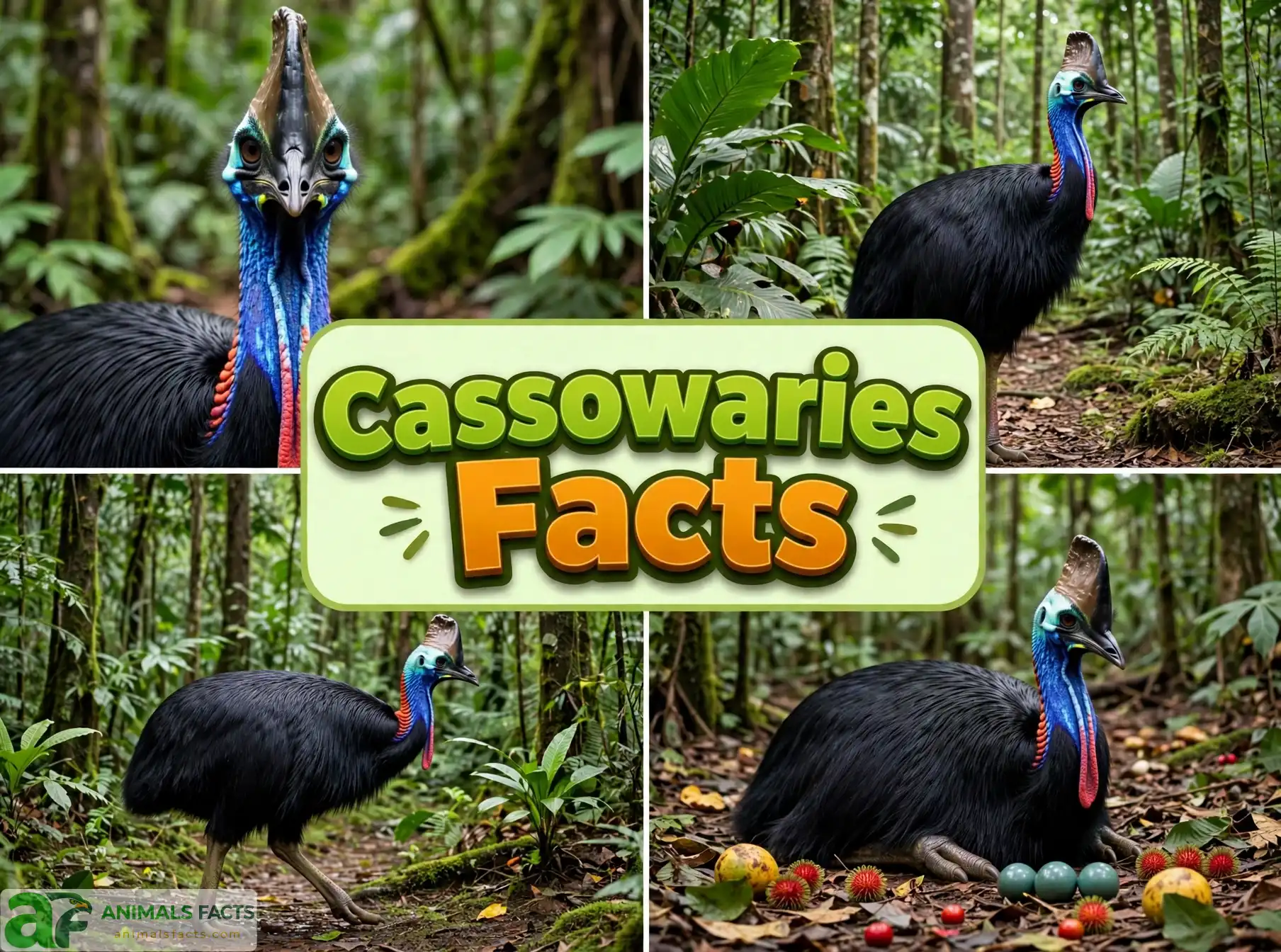
Hey amazing young wildlife scientists, rainforest enthusiasts, and dinosaur fans! Here are some truly extraordinary cassowary facts for kids that will make you the most fascinating wildlife expert in any conversation:
- The cassowary is the MOST DANGEROUS BIRD ON EARTH — officially! The Guinness World Records has officially named the cassowary the world’s most dangerous bird. Its secret weapon is a claw on its inner toe that is 12 centimeters long and completely straight — like a dagger! The cassowary kicks forward with this claw and can cause very serious injuries. It has even killed humans in documented incidents. It looks like what you would get if a velociraptor from Jurassic Park decided to be a bird — which is actually not too far from the truth!
- The cassowary has a HELMET ON ITS HEAD — and nobody knows why! The bony casque on the cassowary’s head has been studied by scientists for decades, but we still do not fully know what it is for. Possible functions include: making special low sound waves to communicate through the forest, protecting the head during fights, helping the animal cool down in the heat, pushing through thick vegetation, or signaling how old the bird is. It might do all of these things at once! The cassowary casque is one of the biggest unsolved mysteries in bird biology.
- Without the cassowary, the RAINFOREST WOULD COLLAPSE! More than 70 types of rainforest trees in northeastern Australia can ONLY spread their seeds by being eaten and pooped out by a cassowary. The seeds are too large for any other animal in the forest to swallow. If all the cassowaries disappeared, these tree species would slowly die out — and then the animals that live in those trees would lose their habitat, and the animals that eat those animals would have less food, and so on. The cassowary is so essential that scientists call it a “keystone species” — like the keystone in an arch that holds everything else together!
- The cassowary makes sounds that HUMANS CANNOT HEAR! The cassowary’s main call includes extremely low frequency sound called infrasound — below the range that human ears can detect. These deep, invisible sound waves travel long distances through the dense rainforest where visual communication is impossible. It is possible that the bony casque on the cassowary’s head helps it produce and receive these special sounds. The cassowary is one of the very few birds known to regularly communicate using infrasound!
- Baby cassowaries look like STRIPED WATERMELONS on legs! When cassowary chicks hatch, they have distinctive cream and dark brown stripes running lengthwise down their whole body — perfect camouflage against the striped light and shadow of the rainforest floor. The dad cassowary (who does ALL the parenting — the mum leaves right after laying the eggs!) takes care of these stripy babies for NINE WHOLE MONTHS, teaching them everything they need to know about surviving in the rainforest.
- In New Guinea, cassowaries are MORE VALUABLE THAN GOLD! In the highland cultures of New Guinea, a live cassowary is the most prestigious gift you can give. Individual cassowaries are traded for the equivalent of a bride price — one of the most important economic transactions in highland culture. Having cassowaries shows you are wealthy and important. Cassowary feathers are used in the most important ceremonial headdresses. The cassowary has been a form of living currency in New Guinea for thousands of years!
- Car crashes kill more cassowaries than ANYTHING ELSE in Australia! In northeastern Queensland, where about 4,000 wild cassowaries live, the biggest killer is not predators, not disease, and not hunting. It is being hit by cars! About 55% of documented cassowary deaths in Australia come from vehicle collisions. The Australian government has put up special warning signs, built cassowary crossing areas, and modified roads specifically to try to reduce cassowary deaths from traffic. The mission beach area has signs that look like cassowary silhouettes warning drivers!
- The cassowary can eat POISONOUS FRUITS that would KILL other animals! The cassowary plum (Cerbera floribunda) is a fruit that contains toxic alkaloids — chemicals poisonous enough to harm or kill most animals. But the cassowary eats it regularly without any problem! Scientists are still studying exactly how the cassowary’s digestive system handles these toxins. This ability gives the cassowary access to food resources that no other large animal can use — making it even more ecologically special!
12. Relationship with Humans
The cassowary’s relationship with humans spans 50,000+ years of New Guinean cultural centrality in which the bird is simultaneously the most prestigious wealth object, a food source, a ceremonial material supplier, and a spiritual being; the long Aboriginal Australian relationship in the Wet Tropics; the colonial period of hunting and habitat modification; and the contemporary conservation crisis driven by vehicle strikes, habitat fragmentation, and dog attacks.
The New Guinean Relationship — The Most Intense Human-Cassowary Bond
The New Guinean cassowary keeping tradition — For tens of thousands of years, New Guinean peoples have kept cassowaries as living prestige objects:
The capture method — Young cassowary chicks are captured in the forest and raised in the village from juvenile age. The raising of a cassowary from chick to adult is a significant community undertaking — the bird requiring substantial food provision and careful management as it grows into a fully dangerous adult.
The prestige economy — A large, healthy adult cassowary is the most valuable portable wealth object in many New Guinean highland cultures:
- Cassowaries are exchanged at major social events — bride prices, compensation payments, alliance ceremonies
- The bird’s value reflects both its scarcity and the difficulty of raising one to adulthood
- A community that can gift cassowaries demonstrates wealth, connections, and capability
The ceremonial use — Cassowary feathers, particularly the long quill-like wing spine feathers and the soft body feathers, are used in the most important ceremonial contexts:
- Headdresses for the highest-status performers at ceremonies
- Decorations for ceremonial shields and weapons
- Body decoration during important ritual events
The cassowary bone tools — The large leg bones and particularly the inner toe claw of the cassowary have been used as tools for thousands of years:
- The inner claw as a dagger, needle, or awl
- Leg bones as musical instrument components
- Rib bones as scrapers and spatulas
The food dimension — Cassowaries are also consumed as food — the meat highly valued for major feasting events. The killing of a cassowary for consumption is a significant event requiring specific protocols in many cultures.
The gender and spiritual dimensions — In various New Guinean cultures, the cassowary is associated with specific gender identities, spiritual powers, and social roles:
- The cassowary’s female dominance and male parental care may reflect in cultural interpretations of gender roles
- The cassowary appears in mythology, initiation ceremonies, and spiritual practice across multiple highland cultures
- The bird’s combination of power (dangerous) and provision (food, feathers, bones) makes it a spiritually complex figure
The Aboriginal Australian Relationship
The Wet Tropics indigenous relationship — Aboriginal Australians of the Wet Tropics region have maintained a relationship with the southern cassowary for approximately 40,000 years — the duration of human presence in northeastern Queensland:
Cassowary as food — The cassowary was an important food source for Wet Tropics Aboriginal communities — providing large quantities of meat when hunted. Specific hunting protocols and seasonal management of cassowary hunting have been documented in various Wet Tropics language groups.
Cassowary in ceremony — Cassowary feathers appear in Wet Tropics Aboriginal ceremonial contexts — the bird’s spiritual significance reflected in ceremonial use of its materials.
The cassowary in ecological knowledge — Wet Tropics Aboriginal ecological knowledge includes detailed understanding of cassowary behavior, habitat use, and ecological function — knowledge accumulated over tens of thousands of years of co-existence.
The Colonial Period and Modern History
The most documented fatality — 1926 — The most comprehensively recorded cassowary-human fatality in history: Phillip McLean, 16 years old, of Mossman district Queensland, was attacked by a cassowary on his family’s property on April 6, 1926. McLean and his brother had been attempting to kill a cassowary with clubs. The cassowary knocked Phillip down and kicked him in the neck — the dagger claw severing his jugular vein. He died shortly afterward. The incident established the cassowary’s lethal potential in the written record and has been cited in virtually every subsequent treatment of the cassowary’s danger.
The 2019 Florida fatality — The first confirmed cassowary fatality in approximately 100 years: Marvin Hajos, 75, was killed at his private farm in Alachua County, Florida, USA, in April 2019. Hajos kept cassowaries as pets — unusual private ownership that is legal in some US states but strongly discouraged by wildlife authorities. After Hajos fell near one of his cassowaries, the bird attacked and killed him. The incident attracted enormous international media attention — reintroducing the cassowary’s genuine danger to a global audience.
The Guinness designation — The Guinness World Records designation of the cassowary as the “world’s most dangerous bird” is based on the documented human fatality record and the nature of cassowary injuries. The designation is sometimes debated — some researchers argue that the African ostrich or even large geese cause more human injuries annually — but the penetrating, disemboweling nature of cassowary injuries and the documented fatalities give the cassowary the most medically severe attack record of any bird.
Contemporary Conservation Management
The Queensland government response — The Queensland government manages the cassowary’s conservation in Australia through:
- Cassowary Conservation and Management Plan — the formal management framework
- Wildlife rehabilitation program — injured cassowaries (primarily vehicle strike victims) treated and rehabilitated through the Garner’s Beach Cassowary Rehabilitation Centre and similar facilities
- Road modification — reduced speed limits, cassowary crossing structures, and signage in key cassowary areas
- Community engagement — programs educating residents and tourists about cassowary behavior and safe interaction
- Wildlife corridor programs — land purchase and management to maintain forest connectivity between cassowary habitat patches
The Mission Beach Cassowary Recovery Plan — The Mission Beach region — with approximately 150 cassowaries and the highest vehicle strike rate in Australia — is the focus of the most intensive cassowary management effort in the country:
- Extensive road signage
- Speed reductions on key roads
- Community monitoring programs where local residents report cassowary sightings and injuries
- Rainforest restoration planting on private land
13. Cassowary Conservation Status & Threats
Conservation Status Overview
| Feature | Details |
|---|---|
| Southern Cassowary IUCN Status | Vulnerable (VU) |
| Northern Cassowary IUCN Status | Vulnerable (VU) |
| Dwarf Cassowary IUCN Status | Least Concern (LC) |
| Australian Population | ~4,000 individuals — Endangered on Australian national list |
| Global Population (Southern) | ~10,000–20,000 (New Guinea + Australia combined) |
| Population Trend | Decreasing |
| Australian Legal Status | Endangered under Environment Protection and Biodiversity Conservation Act |
| CITES Listing | Appendix II — international trade regulated |
Major Threats — Australian Population
| Threat | Proportion of Deaths | Description |
|---|---|---|
| Vehicle strikes | ~55% | Primary threat — road collisions on Wet Tropics roads |
| Dog attacks | ~10% | Domestic and feral dogs; particularly serious for chicks |
| Habitat loss | Ongoing structural threat | Rainforest clearing for agriculture and development |
| Habitat fragmentation | Ongoing structural threat | Roads and cleared areas isolating forest patches |
| Cyclone damage | Episodic high-impact | Destroys fruit production for years |
| Human food provision | Indirect — habituated birds at higher risk | Habituated cassowaries approach roads; more aggressive |
| Disease | Minor — sporadic | Various viral conditions documented |
| Swimming pool drowning | Rare | Cassowaries entering suburban swimming pools |
The Vehicle Strike Crisis
The numbers — In the Mission Beach area, vehicle strikes kill approximately 10–20 cassowaries per year — a significant proportion of the local population of approximately 150 birds. Australia-wide, vehicle strikes are estimated to kill 200+ cassowaries annually — nearly 5% of the total population every year.
Why it happens:
- Cassowaries cross roads to move between forest patches that roads have fragmented
- Mango and other fruit trees planted along roadsides attract cassowaries to road verges
- Dawn and dusk movement peaks coincide with low-visibility driving conditions
- Young cassowaries dispersing from their father’s home range must cross roads between forest patches — the most dangerous period
The road engineering response:
- Cassowary underpasses — culvert modifications under roads that cassowaries can use safely
- Canopy bridges — overhead crossing structures that arboreal species use (less relevant for cassowaries but part of broader wildlife crossing programs)
- Variable speed limits — technology-triggered speed limit reductions when cassowaries are detected near roads using motion sensors
The Habitat Fragmentation Problem
The connectivity imperative — Cassowaries require forest patches large enough to sustain a home range (1.7–7 km²) and connected to other forest patches by corridors that allow:
- Dispersal of juvenile birds from parental territories
- Movement of adult birds tracking seasonal fruit production
- Genetic exchange between cassowary populations in different forest patches
The current situation — The Wet Tropics forest is increasingly fragmented by:
- Sugar cane and banana plantations isolating forest patches
- Urban and peri-urban development (particularly around Cairns and Mission Beach)
- Roads creating barriers to movement
- Exotic vegetation (e.g., invasive weeds) degrading forest patch quality
New Guinea — The Primary Conservation Challenge
While the Australian cassowary conservation challenge is well-documented, the much larger New Guinea population faces less well-documented but potentially more severe threats:
Hunting — Cassowary hunting for food and for feathers in New Guinea is significant — the bird’s high cultural and food value creating hunting pressure that, while traditional, may be unsustainable at current scales in accessible areas.
Deforestation — New Guinea is experiencing significant deforestation — particularly for palm oil, logging, and subsistence agriculture — that is reducing and fragmenting cassowary habitat across the island.
Limited monitoring — The cassowary population in New Guinea is poorly monitored — population size, distribution, and trend data are far less complete than for the Australian population. The Vulnerable classification for the southern and northern cassowary reflects significant uncertainty about the actual New Guinea population status.
14. Famous Cassowaries in History & Pop Culture
Famous Individual Cassowaries
The Amsterdam Menagerie Bird (1597) — The first cassowary documented in European history — a live bird brought to Amsterdam by Dutch traders from the East Indies. This individual — held in the Amsterdam menagerie (the Leyden Museum of Natural History later acquired specimens) — was examined by European naturalists including Carolus Clusius, whose 1605 description of the Amsterdam bird established the first European scientific account of the cassowary. The Amsterdam bird’s survival in captivity and the scientific documentation it enabled made it one of the most historically significant individual birds in the history of European natural history.
The 1926 McLean Cassowary — The individual cassowary responsible for the 1926 death of Phillip McLean in Queensland — the most documented cassowary fatality in history. The bird’s identity and subsequent fate are not recorded, but the incident it was involved in became the defining cassowary-human fatality in the historical record and is cited in virtually every scientific and popular treatment of cassowary danger.
“Peanut” and other Australian rehabilitation birds — Various named cassowaries that have been treated and released through Queensland’s cassowary rehabilitation programs have received local media coverage and public engagement. Rehabilitation center cassowaries that develop public profiles generate significant conservation education value — the named individual providing a face for the species’ conservation challenges.
Cultural Significance
The New Guinean ceremonial cassowary — While no individual New Guinean cassowary has been documented by name in Western sources, the cassowary as a class of culturally significant wealth objects has been documented across hundreds of anthropological accounts of New Guinean highland cultures. The collective cultural significance of cassowaries across highland New Guinea represents the most sustained and most elaborate human-bird prestige economy in the world.
Queensland road signs — The distinctive triangular yellow warning signs featuring a cassowary silhouette along Queensland’s Wet Tropics roads have become cultural icons of the Wet Tropics region — appearing in tourism materials, conservation campaigns, and regional identity contexts. The cassowary warning sign is among the most distinctive wildlife road signs in the world.
15. Role in Ecosystem & Food Chain
The Keystone Species Function
The cassowary’s keystone species designation in Australian and New Guinean rainforests represents the most clearly documented and most ecologically profound role of any large bird in any ecosystem:
The plant dispersal web — The more than 70 plant species in the Australian Wet Tropics that depend on cassowary seed dispersal include some of the largest and most structurally important trees in the rainforest. These plants:
- Provide canopy structure supporting thousands of arboreal species
- Produce fruit consumed by dozens of bird and mammal species
- Create hollow trees used as nesting sites by parrots, possums, and other cavity-dependent wildlife
- Influence soil chemistry and hydrology through leaf litter, root systems, and wood decomposition
The cascade modeling — Computer modeling of the Wet Tropics rainforest ecosystem without cassowaries predicts:
- Immediate decline in seed dispersal for the 70+ obligate species
- Progressive reduction in plant population viability for these species
- Reduction in fruit availability for other frugivores dependent on cassowary-dispersed trees
- Structural simplification of the forest canopy as large-seeded species fail to regenerate
- Cascading losses across the entire food web dependent on these plants
The carbon storage dimension — Many of the large-seeded trees that cassowaries disperse are among the most carbon-dense trees in the rainforest — their large bodies storing significant carbon per individual tree. The loss of these trees through inadequate seed dispersal would reduce the rainforest’s carbon storage capacity — adding a climate dimension to the cassowary conservation argument.
The Food Web Position
As a consumer:
- Top-down influence on fruit production timing and availability (the cassowary’s fruit consumption affects the seed rain available to other frugivores)
- Regulation of small invertebrate and vertebrate populations through opportunistic predation
As prey:
- Cassowary eggs and chicks are important seasonal food sources for dingoes, pigs, pythons, and large raptors
- Adult cassowaries are rarely prey but provide food for saltwater crocodiles in coastal areas
As a nutrient redistributor:
- The cassowary’s large fecal deposits — each containing multiple large seeds in a nutrient-rich medium — create localized nutrient concentrations at deposition sites
- Fecal nutrients accelerate seedling establishment at dispersal sites
16. Myths, Folklore & Cultural Significance
New Guinean Mythology and Spiritual Significance
The cassowary in creation mythology — Multiple New Guinean cultures maintain creation narratives in which the cassowary played a role in establishing the world’s current order:
The Kalam people (Schrader Mountains, Papua New Guinea) — In Kalam tradition, the cassowary (yakt) is understood as an ancestor being — a creature of special spiritual power that occupies the boundary between the human and non-human worlds. The Kalam cassowary mythology has been extensively documented by anthropologist Ralph Bulmer in one of the most detailed analyses of human-animal relationships in any indigenous knowledge system. The Kalam’s specific cultural practices around cassowary — including restrictions on who can hunt it, specific hunting ceremonies, and protocols for consuming cassowary meat — reflect the bird’s cosmologically central position.
The female gender association — In several New Guinean cultures, the cassowary is associated with female spiritual power — possibly reflecting the cassowary’s actual biology (female dominance, female competition for mates, male parental care) interpreted through cultural frameworks that see female dominance as spiritually significant. In some cultures, men going through male initiation ceremonies may not eat cassowary meat — the bird’s female associations making it inappropriate for men in transition between social states.
The cassowary as ancestral being — In various highland New Guinean cultures, the cassowary is understood as either a transformed ancestor or as a being that exists on the boundary between animal and ancestor realms. Killing a cassowary therefore requires specific spiritual protocols — acknowledgment of the being’s ancestral nature, appropriate ritual behavior during the hunt, and specific consumption protocols.
The Velociraptor Connection — More Than a Pop Culture Comparison
The frequent comparison of cassowaries to velociraptors from Jurassic Park has actual scientific content:
The phylogenetic reality — Birds are dinosaurs — specifically the surviving lineage of theropod dinosaurs. The cassowary, like all birds, is descended from theropod dinosaurs. The cassowary’s specific combination of features — bipedal posture, vestigial forelimbs, scaly feet, forward-facing eyes, dagger claw on the inner toe, and large body size — makes it the living bird that most closely resembles the body plan of medium-to-large theropod dinosaurs like Deinonychus (the actual inspiration for Jurassic Park’s velociraptors, which were dramatically scaled up for the films).
The casque connection — Various theropod dinosaurs had bony head crests and casques — structures whose function in dinosaurs was similarly debated and similarly multi-proposed. The cassowary’s casque makes the dinosaur comparison anatomically specific, not merely behavioral.
The scientific significance — Studying the cassowary’s behavior, physiology, and ecology provides genuine insights into how non-avian theropod dinosaurs may have lived — the cassowary being the closest living analog to many medium-large theropods in terms of body plan, frugivorous diet potential (some theropods may have been frugivorous), parental behavior (paternal care is documented in some non-avian dinosaurs), and forest ecology.
Aboriginal Australian Cassowary Traditions
Wet Tropics cultural relationships — The Djabugay, Yidinj, Gunggandji, and other Wet Tropics Aboriginal language group peoples maintain specific cultural relationships with the southern cassowary:
Totem and kinship — The cassowary is a totem animal for specific clans in some Wet Tropics Aboriginal social systems — clan members maintaining specific relationships with cassowaries that include restrictions on hunting, feeding, or harming individual birds.
Seasonal knowledge — The cassowary’s fruit-eating behavior and seasonal movements provided important ecological calendar information for Wet Tropics Aboriginal communities — the cassowary’s presence in specific areas indicating the ripening of specific fruit species.
17. Cassowaries in Pop Culture
“Cassowary” in wildlife documentary — The cassowary appears in multiple landmark wildlife documentary productions as one of the most visually dramatic and most narratively compelling subjects in Australian natural history:
- “David Attenborough’s Australia” (BBC) — features cassowary in the Wet Tropics context
- Various Queensland tourism productions — the cassowary is the flagship wildlife image for Wet Tropics tourism marketing
- Multiple wildlife documentary segments specifically addressing the cassowary’s ecological role and conservation situation
The Jurassic Park/Velociraptor connection in media — The cassowary is frequently referenced in media discussions of dinosaur biology — appearing in articles, social media posts, and educational content about the living dinosaur lineage and the specific resemblance between cassowaries and theropod dinosaurs. The “cassowary is basically a velociraptor” social media genre has introduced the bird to millions of people who might not otherwise have encountered it.
Queensland road sign iconography — The cassowary warning road sign of Queensland’s Wet Tropics has become one of the most photographed road signs in Australia — tourists specifically stopping to photograph themselves beside cassowary warning signs as markers of the Wet Tropics wildlife experience.
“Cassowary vs.” viral content — The cassowary’s status as the world’s most dangerous bird, combined with spectacular footage of cassowary defense behavior, has made cassowary attack videos a reliable viral social media content category. The combination of striking appearance, dramatic danger, and the David-vs-Goliath narrative of a bird attacking animals much larger than itself generates consistent high-engagement social media content.
The 2019 Florida fatality media coverage — The 2019 death of Marvin Hajos in Florida generated extraordinary global media coverage — the story of a man killed by his own pet cassowary in the US state of Florida appearing in essentially every major news outlet globally. The coverage introduced the cassowary’s danger to a global audience that had previously been unfamiliar with the bird.
18. Cassowary Facts vs. Common Myths
| Common Myth | The Real Fact |
|---|---|
| “Cassowaries will attack humans without provocation” | Mostly false — most cassowaries avoid human contact when escape is possible. The majority of serious cassowary-human incidents involve cornered cassowaries, cassowaries with chicks, or cassowaries habituated to human food provision. Unprovoked attacks on people simply walking in cassowary habitat are rare |
| “The cassowary’s casque is solid bone” | False — the casque is a hollow structure containing a network of bony trabeculae surrounding air spaces, covered by keratin. The hollow structure is one of the reasons its function remains debated — a solid bone casque would more clearly indicate a combat function |
| “The cassowary is just a dangerous version of the emu” | Misleading — while emus and cassowaries are closely related, they are dramatically different animals. Cassowaries require primary rainforest; emus require open country. Cassowaries are primarily frugivores; emus are omnivores. Cassowaries have dagger claws; emus do not. The two birds share evolutionary ancestry but have evolved very differently |
| “Cassowary attacks are common in Australia” | False — serious cassowary attacks are rare events. Queensland’s cassowary management programs document approximately 150–200 cassowary-human interactions per year — but the vast majority involve no physical contact. Serious injuries requiring medical treatment occur approximately 5–10 times per year in Australia. Fatal attacks have occurred only twice in documented history |
| “The cassowary is the only bird that has killed a human” | False — while the cassowary’s killing record is the best documented, ostriches, swans, geese, and other large birds have caused human deaths through various mechanisms. The cassowary’s distinction is having the best-documented intentional attack fatality record |
| “Cassowaries are only dangerous when cornered” | Partially true — cornered cassowaries are certainly dangerous, but cassowaries with chicks will actively pursue perceived threats rather than waiting to be cornered. Habituated cassowaries expecting food provision may also become aggressive without being cornered |
| “All cassowary species look the same” | False — the three cassowary species differ significantly in wattle number (two vs one vs none), casque shape, neck coloration, body size, and elevation preference. The southern cassowary’s vivid blue-red double-wattled appearance is dramatically different from the dwarf cassowary’s more muted single-colored profile |
| “The cassowary is primarily carnivorous” | False — the cassowary is approximately 85–95% frugivorous — fallen fruit is the overwhelming dietary staple. While cassowaries do consume insects, small vertebrates, and occasionally carrion, the bird is fundamentally a fruit specialist |
19. Best Places to See Cassowaries in the Wild
Australia — The Most Accessible Southern Cassowary Encounters
1. Mission Beach, Queensland
The single most reliable location for wild southern cassowary encounters in Australia — and therefore in the world for most international visitors. The Mission Beach township and surrounding Wet Tropics rainforest support approximately 150 cassowaries at one of the highest densities in the Australian range. Cassowaries regularly walk through the Mission Beach township, appear at campgrounds and holiday parks, and are seen along forest trails throughout the area.
Practical advice — Morning hours (6–9 AM) produce the most reliable sightings. The Lacey Creek area within the Wet Tropics rainforest accessible from Mission Beach provides forest trail cassowary encounters. The Licuala Fan Palm walking track is one of the most productive for cassowary sightings.
The wildlife interaction caution — Mission Beach’s high cassowary density and the birds’ habituation to humans creates the conditions for the most frequently discussed cassowary-human interactions in Australia. Never feed cassowaries; maintain a respectful distance (minimum 5 meters); never approach a cassowary with chicks; if a cassowary approaches you, back away slowly while maintaining eye contact and do not run.
2. Cape Tribulation, Daintree National Park
The extraordinary landscape where the rainforest meets the reef — Cape Tribulation provides both one of the world’s most spectacular scenery combinations and reliable cassowary encounters. The Daintree lowland rainforest supports a significant cassowary population and the birds are regularly seen along the Cape Tribulation Road, at the Marrdja Boardwalk, and along various trails within the national park.
3. Kuranda, near Cairns
The tourist village of Kuranda — accessible from Cairns by scenic railway or cable car — is surrounded by Wet Tropics rainforest supporting cassowaries. Various forest trails around Kuranda produce cassowary sightings, and the Rainforestation Nature Park at Kuranda maintains ambassador cassowaries that can be observed at closer range than wild individuals.
4. Garner’s Beach Cassowary Rehabilitation Centre, Tully
The primary cassowary rehabilitation facility in Australia — Garner’s Beach accepts injured cassowaries (primarily vehicle strike victims) for treatment and rehabilitation. While not a standard tourism facility, the centre occasionally allows educational visits and provides the most intimate encounter with individual cassowaries in a managed Australian setting.
5. Queensland Wildlife Sanctuaries
Currumbin Wildlife Sanctuary (Gold Coast) and Australia Zoo (Sunshine Coast) both maintain southern cassowaries in large naturalistic enclosures — providing close-range encounters with a species whose wild form requires substantial patience to observe. For visitors unable to travel to the Wet Tropics, these sanctuary encounters provide excellent close-range observation.
New Guinea — For the Adventurous Visitor
6. Varirata National Park, Papua New Guinea (near Port Moresby)
The most accessible Papua New Guinea location for cassowary observation — Varirata National Park supports southern cassowaries in rainforest accessible from Papua New Guinea’s capital. Various guesthouses and tour operators in the Port Moresby area offer guided cassowary walks in Varirata.
7. Tari Valley, Southern Highlands, Papua New Guinea
For the most immersive experience of the New Guinean human-cassowary cultural relationship — the Tari Valley in the Southern Highlands is the heartland of Huli culture, where cassowary feathers are central to ceremonial headdresses and cassowary keeping is actively practiced. Visitors with appropriate guides can observe cassowary keeping within village contexts and experience the extraordinary Huli wigmen ceremonies where cassowary feathers feature prominently.
20. How You Can Help
Supporting cassowary conservation requires differentiated action — from individual behavior change by visitors to the Wet Tropics to policy advocacy for habitat protection and road management.
Support these organizations:
- Rainforest Rescue — rainforestrescue.org.au — purchases and protects rainforest land in the Wet Tropics; direct habitat protection for cassowaries; planting programs restoring habitat corridors
- Terrain NRM — terrain.org.au — natural resource management organization coordinating cassowary conservation programs across the Wet Tropics
- Wildlife Queensland — wildlife.org.au — Queensland wildlife conservation advocacy including cassowary legal protection and habitat management
- WCS (Wildlife Conservation Society) Papua New Guinea — wcs.org — New Guinea cassowary monitoring and conservation
- Australian Government Cassowary Recovery Program — managed through Department of Environment; funding conservation activities under the national Endangered listing
- Garner’s Beach Cassowary Rehabilitation — donations support the primary cassowary rehabilitation facility in Australia
Critical individual actions:
Drive slowly in cassowary country — Vehicle strikes cause approximately 55% of documented Australian cassowary deaths. Reducing speed on Wet Tropics roads — particularly the Mission Beach Road, Cape Tribulation Road, and Daintree Mossman Road — directly reduces the primary cassowary mortality source. The posted cassowary speed limits are conservation measures, not suggestions.
Never feed cassowaries — Feeding cassowaries habituates them to human presence and road-proximate areas, dramatically increasing their vehicle strike risk. Habituated cassowaries also become aggressive when humans don’t provide expected food, creating dangerous human-cassowary conflicts. Enjoying wild cassowaries without feeding them is the single most important individual action for human visitors to the Wet Tropics.
Keep dogs securely confined in cassowary areas — Dog attacks are the second most significant direct cassowary mortality cause in Australia. Ensuring dogs are contained in fenced yards, on leashes, or in vehicles in areas where cassowaries occur eliminates this mortality source. In Mission Beach and other high-density cassowary areas, allowing dogs to roam freely is both irresponsible and potentially illegal.
Support rainforest planting programs — Planting native rainforest species on private land in the Wet Tropics — particularly on properties adjacent to existing forest — creates the habitat corridors that allow cassowaries to move safely between forest patches without crossing roads. Organizations including Rainforest Rescue provide plant species lists and planting guidance for Wet Tropics landholders.
Report cassowary sightings and incidents — The Queensland government’s Cassowary Count citizen science program and similar reporting systems need sighting data to monitor population distribution and identify areas of high vehicle strike risk. Reporting both sightings and incidents (vehicle strikes, dog attacks) through the Cassowary Count app provides essential monitoring data.
21. Top Documentaries & Books
Must-Watch Documentaries
“Wild Australia: Rainforest” (ABC Australia and BBC co-productions) — Various Australian Broadcasting Corporation and BBC collaborative productions on Australian rainforest wildlife feature exceptional cassowary content in the Wet Tropics setting.
“David Attenborough’s Queensland: Wild Encounters” — Various Attenborough-narrated productions covering Queensland’s wildlife provide high-quality cassowary content in the Wet Tropics context.
“Cassowary Country” (various ABC Australia productions) — Australian public broadcasting has produced multiple dedicated cassowary documentaries covering natural history, conservation challenges, and the vehicle strike problem — the ABC’s archive contains the most comprehensive cassowary documentary library available.
“Nature: Cassowary” (PBS/BBC) — International natural history documentary specifically focused on cassowary ecology and conservation; among the most widely distributed English-language cassowary documentary productions.
Must-Read Books
Cassowaries by Clifford Frith — The most comprehensive scientific monograph on cassowary natural history; the definitive single-volume scientific treatment of all three cassowary species.
Wildlife of Tropical North Queensland by Felicity Palfreyman and colleagues — Comprehensive guide to Wet Tropics wildlife including detailed cassowary ecology, behavior, and conservation status; essential for visitors to the Australian cassowary range.
The Birds of New Guinea by Beehler, Pratt, and Zimmerman — The standard comprehensive field guide to New Guinean birds including all three cassowary species; essential for visitors to New Guinea.
Cassowary by various Queensland government publications — The Queensland government’s cassowary management plans and recovery plans are publicly available and provide the most current scientific information on Australian cassowary conservation status and management approaches.
Bulmer’s Birds of My Kalam Country by Ralph Bulmer and Ian Majnep — The extraordinary collaborative work of an anthropologist and a Kalam man documenting Kalam knowledge of birds including the cassowary; one of the finest treatments of indigenous ecological knowledge in the ornithological literature.
22. Cassowary Comparison with Other Ratites and Dangerous Birds
| Feature | Southern Cassowary | Ostrich | Emu | Harpy Eagle | Great Horned Owl |
|---|---|---|---|---|---|
| Scientific name | Casuarius casuarius | Struthio camelus | Dromaius novaehollandiae | Harpia harpyja | Bubo virginianus |
| Weight (female) | Up to 76 kg | Up to 156 kg | Up to 60 kg | Up to 9 kg | Up to 2.5 kg |
| Primary weapon | 12 cm dagger inner toe — stabbing kick | Forward kick — 2,000N blunt force | Multi-directional kick | 12.5 cm talon grip | Talon grip |
| Documented human fatalities | Yes — 2 confirmed | Possible — unconfirmed | No confirmed | No | No |
| Guinness designation | “Most dangerous bird” | Powerful/dangerous | Defeated military | — | — |
| Habitat | Primary rainforest | Open savanna | Open country | Tropical rainforest | Forest/open |
| Diet | ~90% fruit | ~70% plant | Omnivore | Monkeys, sloths | Rabbits, skunks |
| Casque | Yes — function unknown | No | No | No | No |
| Conservation | Vulnerable | Least Concern | Least Concern | Vulnerable | Least Concern |
| Range | New Guinea + NE Australia | Africa | Australia | Neotropics | Americas |
| Keystone role | Yes — 70+ obligate plant species | Seed dispersal | Seed dispersal | Forest apex predator | Rodent regulation |
| Famous for | Most dangerous bird; casque mystery; keystone ecology | Largest/fastest bird; head-sand myth | Great Emu War; can’t walk backward | Largest Americas eagle; 12.5cm talons | Most powerful N. American owl |
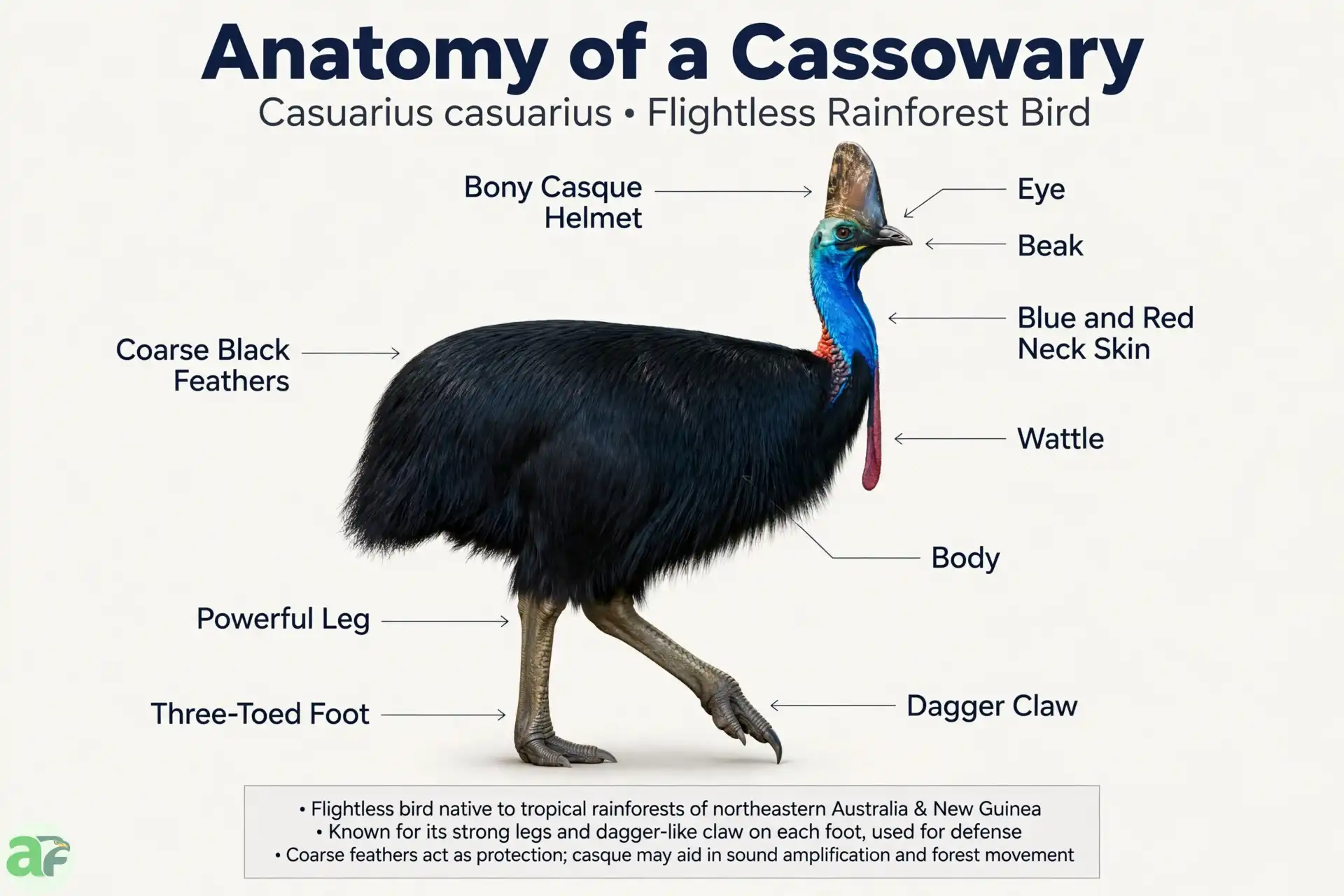
23. Frequently Asked Questions About Cassowaries
Q1. What is the scientific name of the cassowary and what does it mean?
The southern cassowary’s scientific name is Casuarius casuarius (Linnaeus, 1758). Both the genus name Casuarius and the species name casuarius derive from the Malay word kasuari (or kesuari) — the local name for the bird in the Malay Archipelago, which itself may derive from Papuan languages of New Guinea where the bird originates. The repetition of the same word as both genus and species name (Casuarius casuarius) makes this a tautonymous name — a scientific name where genus and species are identical, a construction permitted in zoological nomenclature. The English common name “cassowary” is a direct anglicization of the Malay kasuari, making the common name one of the few English bird names that directly reflects an indigenous word from the bird’s region of origin. The family name Casuariidae and order Casuariiformes both derive from the same root. Linnaeus based his 1758 formal description on earlier accounts of the Amsterdam menagerie cassowary (1597) and on specimens examined at various European collections. The three cassowary species — C. casuarius (southern), C. unappendiculatus (northern — “without appendages,” referring to the reduced or absent wattles), and C. bennetti (dwarf — named for the naturalist George Bennett who described it in 1857) — were described by different naturalists between 1758 and 1860.
Q2. Why is the cassowary considered the world’s most dangerous bird?
The cassowary’s Guinness World Records designation as the “world’s most dangerous bird” is based on the combination of its documented human fatality record and the nature of the injuries it inflicts. Two confirmed human deaths attributable to direct cassowary attack are in the historical record — the 1926 death of Phillip McLean in Queensland (killed by a kick that severed his jugular vein) and the 2019 death of Marvin Hajos in Florida (killed after falling near his captive cassowary). Beyond fatalities, cassowary attacks have produced numerous documented serious injuries including disemboweling wounds (penetrating abdominal injuries from the dagger claw), arterial lacerations, and bone fractures. The mechanism of injury — the 12 cm straight dagger claw delivering a stabbing and slashing kick — creates particularly severe penetrating wounds that differ from the blunt-force injuries produced by most other large birds. Some researchers debate the designation — ostriches and emus also deliver powerful kicks, and geese and swans cause more total annual human injuries than cassowaries — but the penetrating wound mechanism and the documented fatality record give the cassowary the strongest case for the most dangerous bird title. It is important to contextualize the danger: most cassowaries avoid humans when possible, and the conditions that produce serious attacks (cornered birds, cassowaries with chicks, habituated birds) are avoidable with appropriate behavior. The cassowary is dangerous, not aggressive — the distinction being important for visitors to its range.
Q3. What is the function of the cassowary’s casque?
The cassowary’s casque function is genuinely unknown after decades of scientific study — one of the most persistently unresolved questions in avian biology. Multiple hypotheses have been proposed, tested to varying degrees, and not definitively resolved. The sound hypothesis proposes that the casque functions as a resonating chamber for the cassowary’s low-frequency boom calls, potentially amplifying infrasound frequencies that travel long distances through dense forest — the casque’s internal air spaces having appropriate acoustic properties for specific frequency ranges. The combat hypothesis suggests the casque functions as a weapon or protective structure during casque-to-casque confrontations between rival cassowaries — the laterally compressed shape fitting against an opponent’s casque during head-on aggression. The thermoregulation hypothesis proposes that the casque’s large surface area and rich blood supply allow heat dissipation in the hot, humid tropical forest environment — the casque functioning as an external radiator. The vegetation-pushing hypothesis notes that cassowaries have been observed using their casques to push aside dense vegetation during movement — the forward-pointing, laterally compressed structure acting as an effective wedge. The status signaling hypothesis observes that casques appear to grow throughout the bird’s life — potentially making casque size an honest indicator of age and condition. The most likely reality is that the casque is multifunctional — serving several of these purposes simultaneously, which would explain why no single function hypothesis has proven conclusively correct through experimental testing.
Q4. How does the cassowary’s ecological role compare to other keystone species?
The cassowary’s designation as a keystone species in Australian and New Guinean rainforests is based on the principle that its removal from the ecosystem would produce effects disproportionate to its abundance — like removing the keystone from an arch. The specific mechanism is seed dispersal: more than 70 plant species in the Australian Wet Tropics have seeds too large for any other fruit-eating animal in the ecosystem to swallow. For these species, the cassowary provides the only effective long-distance seed dispersal mechanism — without cassowary gut processing and transport, the seeds of these species can only fall directly beneath the parent tree, preventing the long-distance gene flow and habitat colonization that maintain viable plant populations. The removal of the cassowary would therefore progressively eliminate these plant species from the forest — followed by cascading losses of the animals, insects, and fungi that depend on these plants. This mechanism makes the cassowary’s keystone role one of the most clearly defined in any ecosystem. Comparable keystone species in other systems include the sea otter (maintains kelp forest by controlling sea urchin populations), the grey wolf (maintains ecosystem function by regulating deer behavior and numbers in North American forests), and the elephant (maintains African savanna structure through vegetation management). The cassowary’s keystone role is distinctive in being specifically a dispersal mutualism — the bird and the plants having co-evolved an obligate relationship that makes each dependent on the other’s survival.
Q5. Where is the best place to see a wild cassowary?
The best and most reliable location for wild cassowary encounters is Mission Beach in northeastern Queensland, Australia — a coastal township with approximately 150 cassowaries at one of the highest densities in the species’ Australian range. Cassowaries in Mission Beach regularly walk through residential areas, campgrounds, and along forest trails, and morning hours (6–9 AM) produce the most reliable sightings. The Lacey Creek area and the Licuala Fan Palm walking track are the most frequently productive forest trail locations. For visitors based in Cairns, Cape Tribulation in the Daintree National Park provides excellent cassowary sightings in one of Australia’s most spectacular landscapes — the combination of rainforest, reef, and cassowary making this arguably the finest wildlife destination in Queensland. For managed encounters with less walking required, Rainforestation Nature Park at Kuranda (accessible from Cairns by scenic railway or cable car) maintains cassowaries in large naturalistic enclosures. For visitors to New Guinea, Varirata National Park near Port Moresby provides accessible cassowary encounters in the most accessible location in Papua New Guinea, while the Tari Valley in the Southern Highlands provides the richest human-cassowary cultural experience alongside potential wildlife encounters. In all cases, the standard advice applies: never feed wild cassowaries; maintain respectful distances; never approach a male with chicks; move slowly and back away calmly if approached.
24. Sources & References
- Wikipedia — Casuarius casuarius, Casuariidae, Casuariiformes, Cassowary casque function, Great Cassowary, cassowary conservation
- IUCN Red List — iucnredlist.org (Vulnerable assessments for C. casuarius and C. unappendiculatus)
- BirdLife International — birdlife.org (species factsheets; population assessments)
- Westcott, D.A. and colleagues — published research on cassowary seed dispersal ecology and keystone species function in the Australian Wet Tropics
- Mack, A.L. and Jones, J. — published research on cassowary foraging ecology and seed dispersal in New Guinea
- Queensland Government — Queensland Cassowary Conservation Management Plan; Queensland Endangered Species documentation
- Frith, C.B. — cassowary natural history monograph
- Bulmer, R. and Majnep, I.S. — Birds of My Kalam Country — Kalam cassowary cultural knowledge documentation
- Terrain NRM — terrain.org.au (Australian cassowary monitoring and management documentation)
- Rainforest Rescue — rainforestrescue.org.au (Wet Tropics habitat conservation documentation)
- National Geographic — nationalgeographic.com
- BBC Wildlife / BBC Earth — bbcearth.com
- Britannica — britannica.com/animal/cassowary
- Cornell Lab of Ornithology — allaboutbirds.org (species account)