
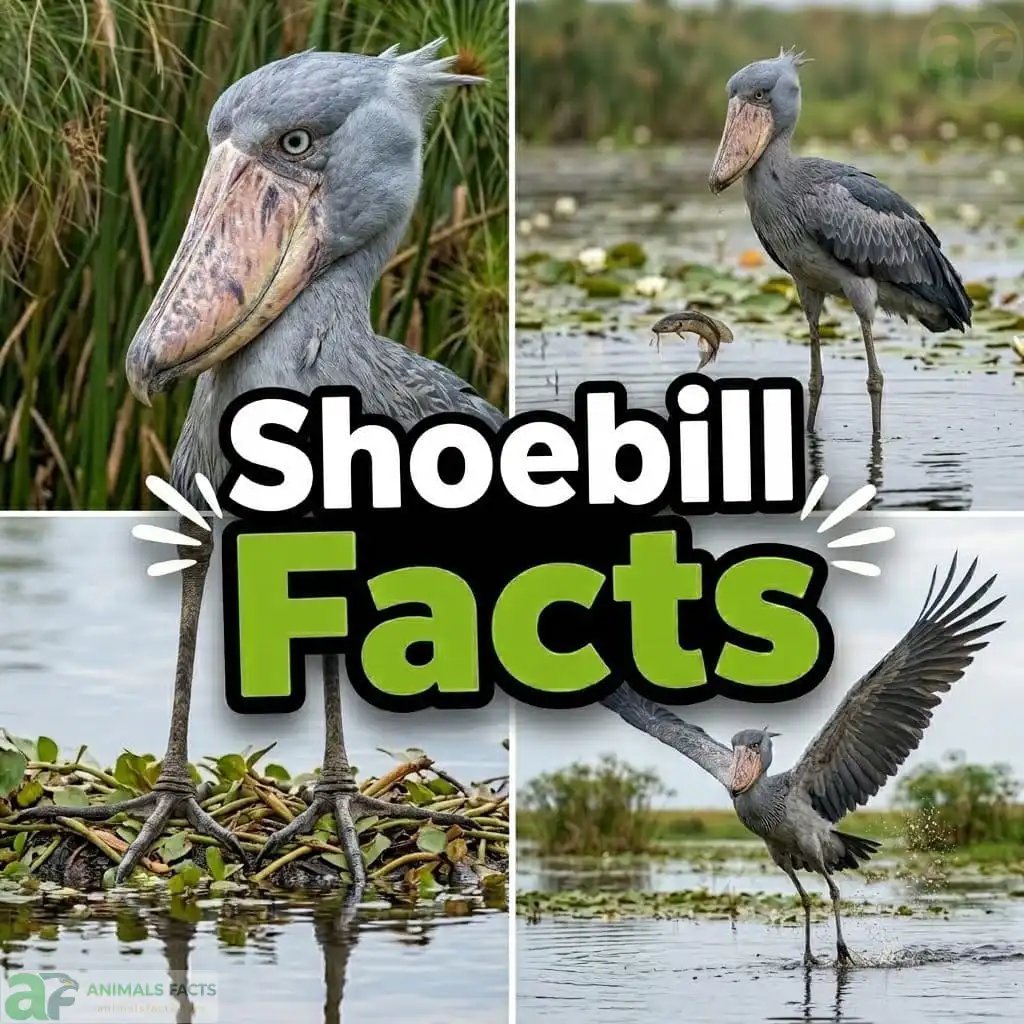
Shoebill Facts
| Feature | Details |
|---|---|
| Scientific Name | Balaeniceps rex (Gould, 1850) |
| Kingdom | Animalia |
| Phylum | Chordata |
| Class | Aves (Birds) |
| Order | Pelecaniformes |
| Family | Balaenicipitidae (monotypic) |
| Genus | Balaeniceps |
| Common Names | Shoebill, shoebill stork, whalehead, whale-headed stork |
| Native Range | East and Central Africa — South Sudan, Uganda, DRC, Tanzania, Zambia |
| Habitat | Freshwater tropical swamps and papyrus marshes |
| Lifespan | Up to 35–50 years in the wild; confirmed 50+ years in captivity |
| Diet | Fish (lungfish, eels, catfish), frogs, water snakes, baby crocodiles, monitor lizards |
| Height | 1.1–1.4 meters (3.6–4.6 feet) |
| Wingspan | 2.3–2.6 meters (7.5–8.5 feet) |
| Weight | 4–7 kg (8.8–15.4 lbs) |
| Bill Length | 18.8–24 cm (7.4–9.4 inches) — widest bird bill on Earth |
| Top Speed (flight) | Approximately 55 km/h |
| Conservation Status | Vulnerable (IUCN Red List) |
| Estimated Population | 3,300–5,300 individuals (wild, as of 2024) |
 1. Introduction: What is Shoebill?
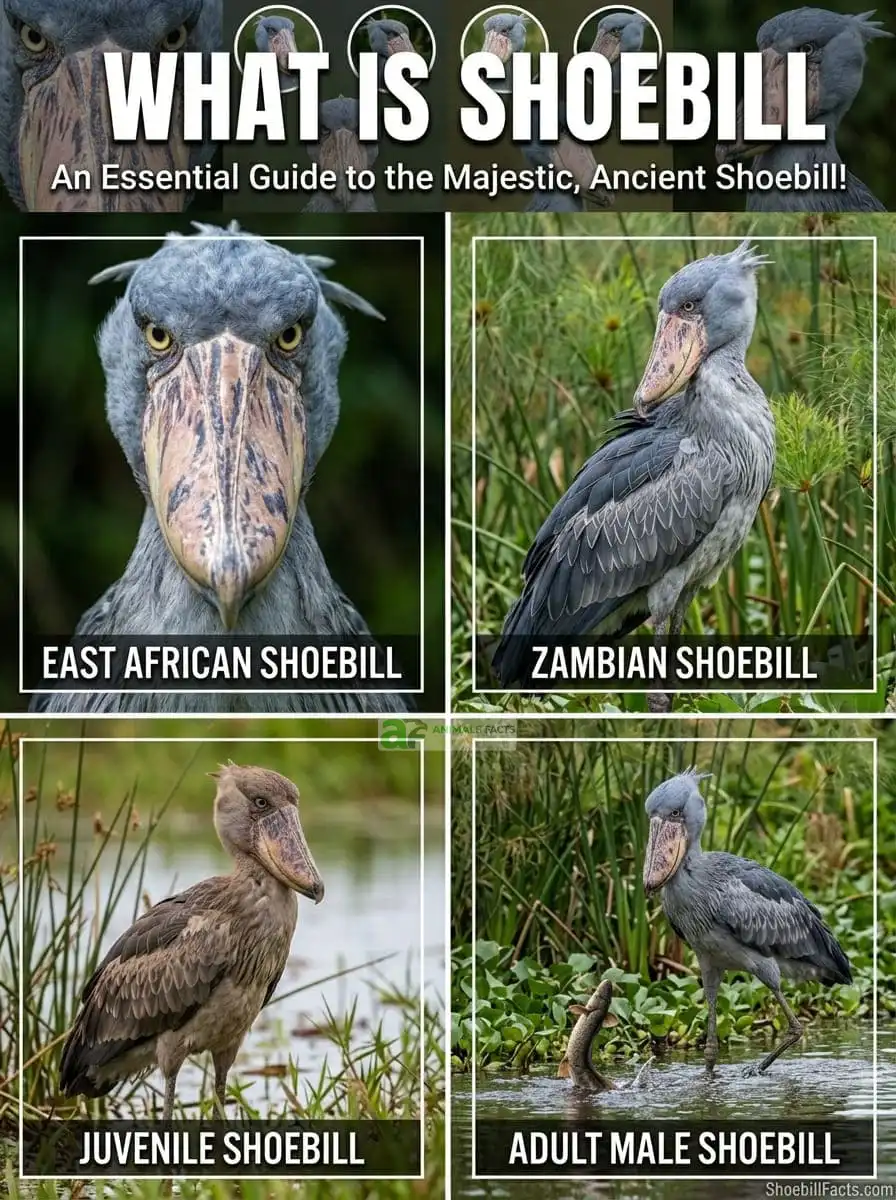
Imagine standing at the edge of a papyrus swamp in Uganda at dawn, when through the mist a shape resolves — enormous, perfectly still, staring at you with eyes of cold amber. It stands nearly 1.4 meters tall, its posture eerily upright, its face dominated by a bill so vast and grotesquely magnificent that it looks less like a bird and more like something from the Cretaceous period that forgot to go extinct. Then, without warning, it bows — a long, slow, deliberate inclination of the massive head — as if acknowledging your presence in its ancient domain. You have just encountered the shoebill. And nothing else in the bird world quite prepares you for it.
Shoebill facts consistently produce the same response from everyone who encounters them for the first time: a combination of disbelief, awe, and a nagging feeling that this bird belongs in a different age. The shoebill (Balaeniceps rex) has changed so little from its ancient ancestors that some ornithologists describe it as a living fossil — a bird whose basic design has remained virtually unchanged for tens of millions of years. It has the widest bill of any bird on Earth, a strike so fast it can decapitate a lungfish or a juvenile crocodile before the animal knows what happened, and a capacity for stillness so absolute that birdwatchers have reported standing within meters of a shoebill for 30 minutes without the bird moving a single muscle.
Whether you’re searching for shoebill facts for kids to ignite a young birder’s passion, a wildlife researcher studying shoebill habitat and ecology, a nature documentarian drawn to the bird’s extraordinary visual presence, or simply someone who saw that famous video of a shoebill bowing to a zookeeper and fell immediately and completely in love — this is your comprehensive guide. We cover shoebill scientific name, shoebill diet, shoebill size and weight, shoebill behavior, conservation threats, and everything in between. The prehistoric king of the swamp awaits.
2. Shoebill Species Overview & Classification
The shoebill occupies one of the most taxonomically unusual positions of any living bird — it is the sole living member of its entire family, Balaenicipitidae, and its evolutionary relationships remained actively debated for much of the 20th century.
Species Classification Table
| Taxonomic Rank | Classification |
|---|---|
| Kingdom | Animalia |
| Phylum | Chordata |
| Class | Aves |
| Order | Pelecaniformes |
| Family | Balaenicipitidae (Bonaparte, 1853) |
| Genus | Balaeniceps (Gould, 1850) |
| Species | B. rex (Gould, 1850) |
| Common Synonyms | Whale-headed stork, whalehead, shoebill stork |
| Number of Subspecies | None — monotypic species |
| Sister Taxon | Hamerkop (Scopus umbretta) — closest living relative |
The Taxonomic Puzzle
The shoebill’s classification has been one of ornithology’s most persistent puzzles. Its enormous bill and overall appearance led early naturalists to associate it with storks (family Ciconiidae). Later anatomical analysis suggested affinities with herons or pelicans. Modern DNA phylogenetics has now firmly placed the shoebill in the order Pelecaniformes — alongside pelicans, herons, ibises, and spoonbills — with its closest living relative being the remarkable hamerkop (Scopus umbretta), a medium-sized brown African bird famous for building the largest nests relative to body size of any bird in the world.
This unlikely pairing — the enormous, prehistoric shoebill and the compact, industrious hamerkop — has been confirmed by multiple molecular studies and is now the established scientific consensus.
No Subspecies
The shoebill is monotypic — it has no recognized subspecies. The entire global wild population represents a single, genetically relatively uniform species distributed across central and eastern Africa.
Evolution & Discovery Timeline
Oligocene/Miocene (~30–15 million years ago) — Fossil relatives of the shoebill appear in the fossil record of North Africa — most significantly the genus Goliathia from Oligocene deposits in Egypt (~30 Ma) and Paludavis from the Early Miocene of Egypt (~20 Ma). These fossils confirm that the Balaenicipitidae lineage is genuinely ancient and has been present in Africa for tens of millions of years.
Pre-1850 — The shoebill is known to Arab traders and explorers through the Nile regions of Sudan for centuries. Arab traders referred to it as abu markub — “father of the shoe” — a reference to its extraordinary bill, long before Western science formally described it.
1849–1850 — British ornithologist and artist John Gould receives specimens from the upper Nile region collected during Egyptian Khedive Said Pasha’s Nile expeditions. He formally describes and names the species Balaeniceps rex (“King Whalehead”) in 1850 — one of the most dramatic new bird descriptions of the Victorian era.
1853 — Charles Lucien Bonaparte formally establishes the family Balaenicipitidae for the shoebill, recognizing its distinctiveness from all other birds.
1860s–1900s — Victorian-era naturalists and museum collectors mount expeditions to the Nile and Central African swamps specifically to obtain shoebill specimens and eggs; the bird becomes a trophy of natural history collections.
1958 — The shoebill is formally listed as a species of conservation concern for the first time as habitat pressure from agricultural drainage and hunting begins to impact populations.
2003 — Molecular phylogenetic studies firmly establish the shoebill’s placement within Pelecaniformes and confirm its sister relationship with the hamerkop.
2010s — Social media — particularly YouTube — transforms the shoebill’s public profile. Videos of shoebills at Japanese zoos bowing to visitors go viral globally, creating a worldwide fanbase and unprecedented conservation awareness for the species.
2023–2024 — The shoebill remains on the IUCN Vulnerable list with an estimated global population of 3,300–5,300 individuals; conservation organizations intensify habitat protection efforts particularly in South Sudan and Uganda.
“The shoebill is one of Africa’s most remarkable birds — a creature that looks like it has stepped directly from the Mesozoic into the present, and seems entirely unimpressed by the fact.” — Sir David Attenborough, in discussion of African wetland wildlife, Africa (BBC, 2013)
3. Shoebill Physical Description & Unique Features
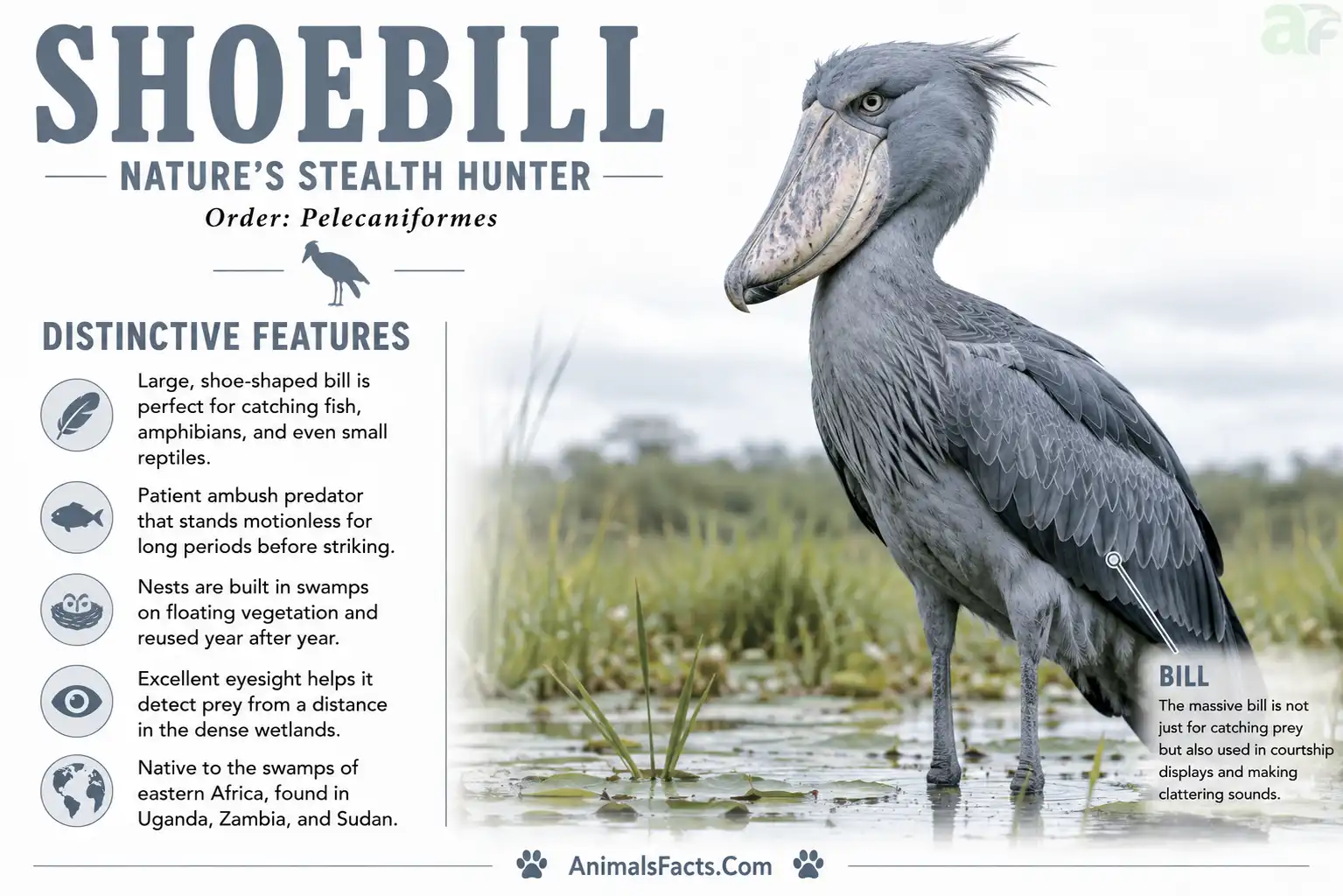
Shoebill size and weight make it one of the most imposing birds in Africa — and its visual impact goes far beyond mere dimensions. Every element of the shoebill’s physical design seems to communicate something ancient, deliberate, and slightly uncanny.
The Bill
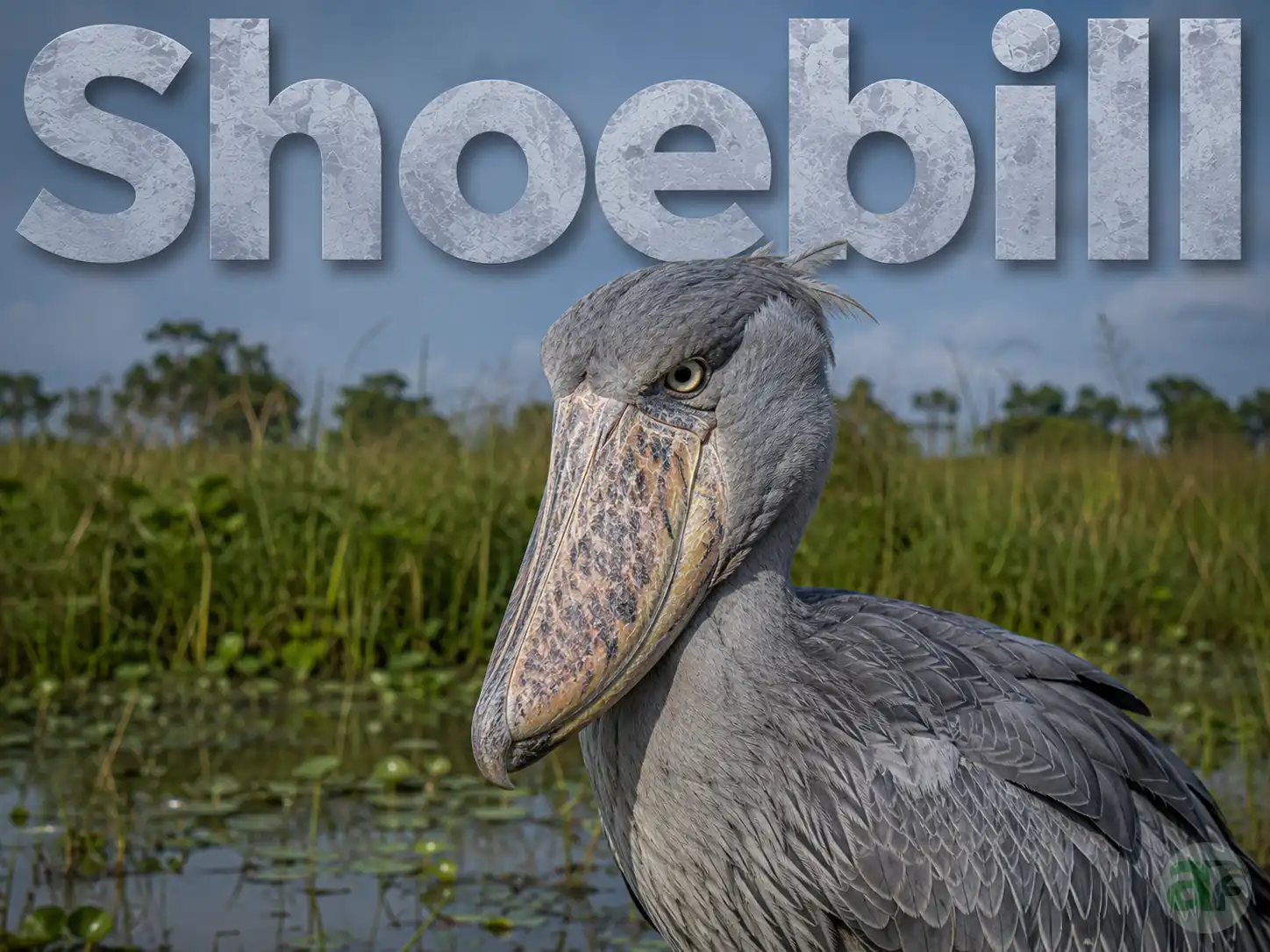
The shoebill possesses the widest bill of any bird on Earth relative to its body and in absolute measurement. The bill is:
- Length: 18.8–24 cm (7.4–9.4 inches)
- Width: up to approximately 10 cm at its broadest point
- Shape: broad, slightly flattened, strongly hooked at the tip with a sharp, curved nail (the terminal hook) on the upper mandible
- Color: yellowish with irregular gray-brown mottling
- Function: a precision weapon designed to grab, hold, and decapitate large, slippery aquatic prey in a single strike
The shoebill’s scientific name — Balaeniceps rex — means literally “King Whalehead”, a reference to the bill’s resemblance in shape and scale to the head of a baleen whale. The Arabic name abu markub (“father of the shoe”) captures the bill’s shape from a different angle — the broad, rounded profile resembles an enormous clog or wooden shoe.
Body & Posture
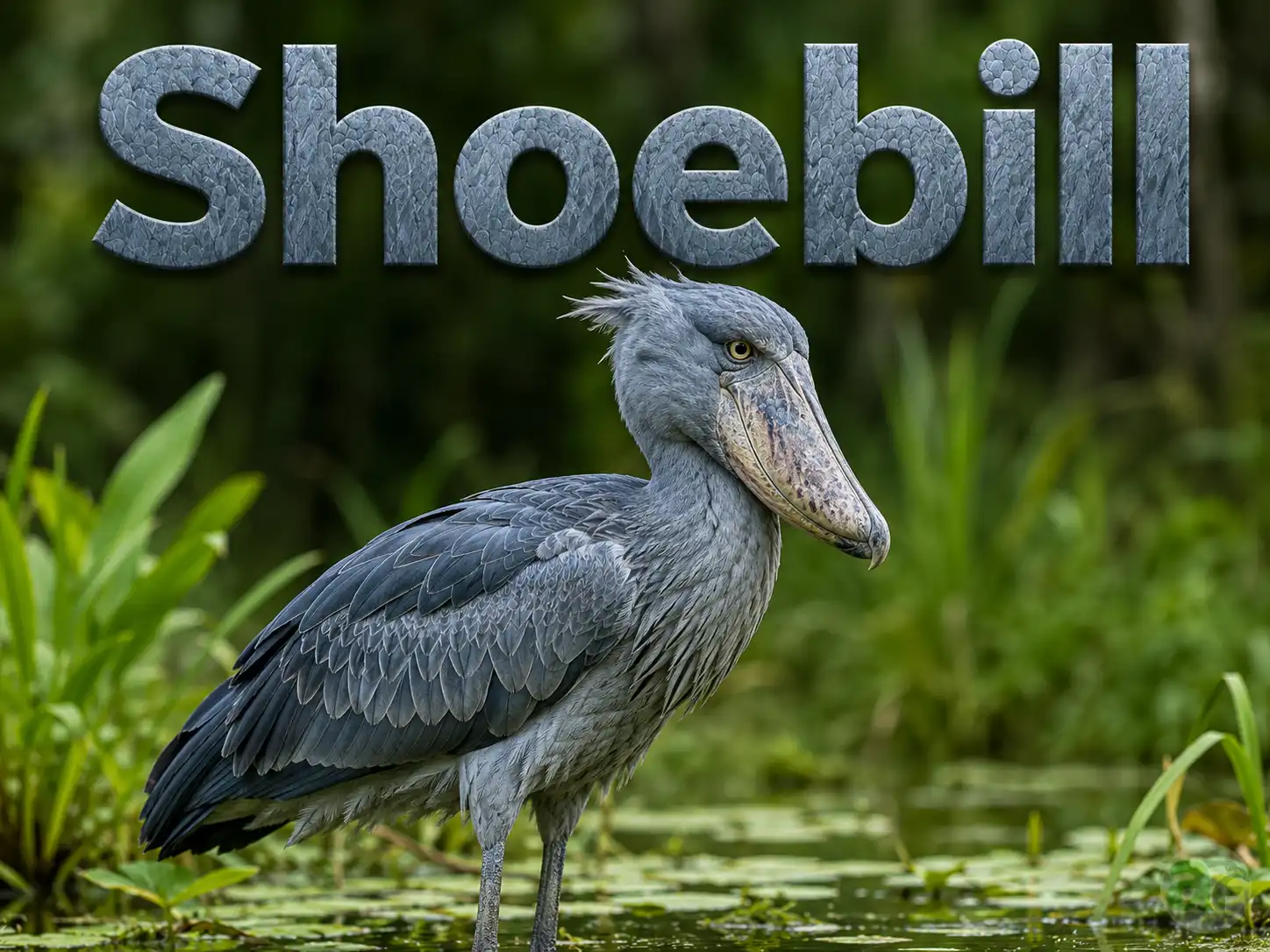
The shoebill’s body is covered in blue-gray plumage — darker on the wings and back, slightly lighter on the underparts — with a small but distinct feathery crest at the back of the head. The wings are broad and powerful, spanning up to 2.6 meters (8.5 feet) — comparable to the wingspan of a large eagle. Despite this impressive wingspan, the shoebill is not an agile flier and tends to cover long distances through gliding rather than active flapping.
The shoebill’s posture is one of its most distinctive features. It typically stands in an upright, hunched position with its enormous bill resting against its chest — giving it a permanently contemplative, slightly menacing appearance that has inspired comparisons to everything from a Roman centurion’s helmet to a very large, very judgmental person.
Eyes
The shoebill’s eyes are striking — large, pale yellow-gray with a distinctive forward-facing orientation that gives it binocular vision unusual in birds (most birds have laterally placed eyes). This forward-facing binocular vision provides excellent depth perception — critical for precisely judging the position of fast-moving, wriggling aquatic prey at the moment of the strike.
Gender & Age Differences
Male and female shoebills are very similar — making sex determination in the field extremely difficult. Males tend to be slightly larger on average (both in overall body size and bill size), but the overlap is significant and size alone is rarely a reliable indicator. In captivity, where individuals can be observed closely over time, behavioral differences (including dominance relationships in paired birds) and physical examination are used for sex determination.
Juvenile shoebills are distinguished by browner-gray plumage compared to the blue-gray of adults, and by a proportionally smaller bill. Adult plumage is typically achieved by approximately 3–4 years of age.
Did You Know? The shoebill’s bill contains a sharp hook at the tip — the nail or dertrum — specifically designed to prevent large, slippery prey from escaping after the initial strike. The bill can snap shut with enough force to decapitate a lungfish, a juvenile Nile crocodile, or a large water snake in a single movement — one of the most powerful strikes of any bird.
4. Top 25 Amazing Shoebill Facts
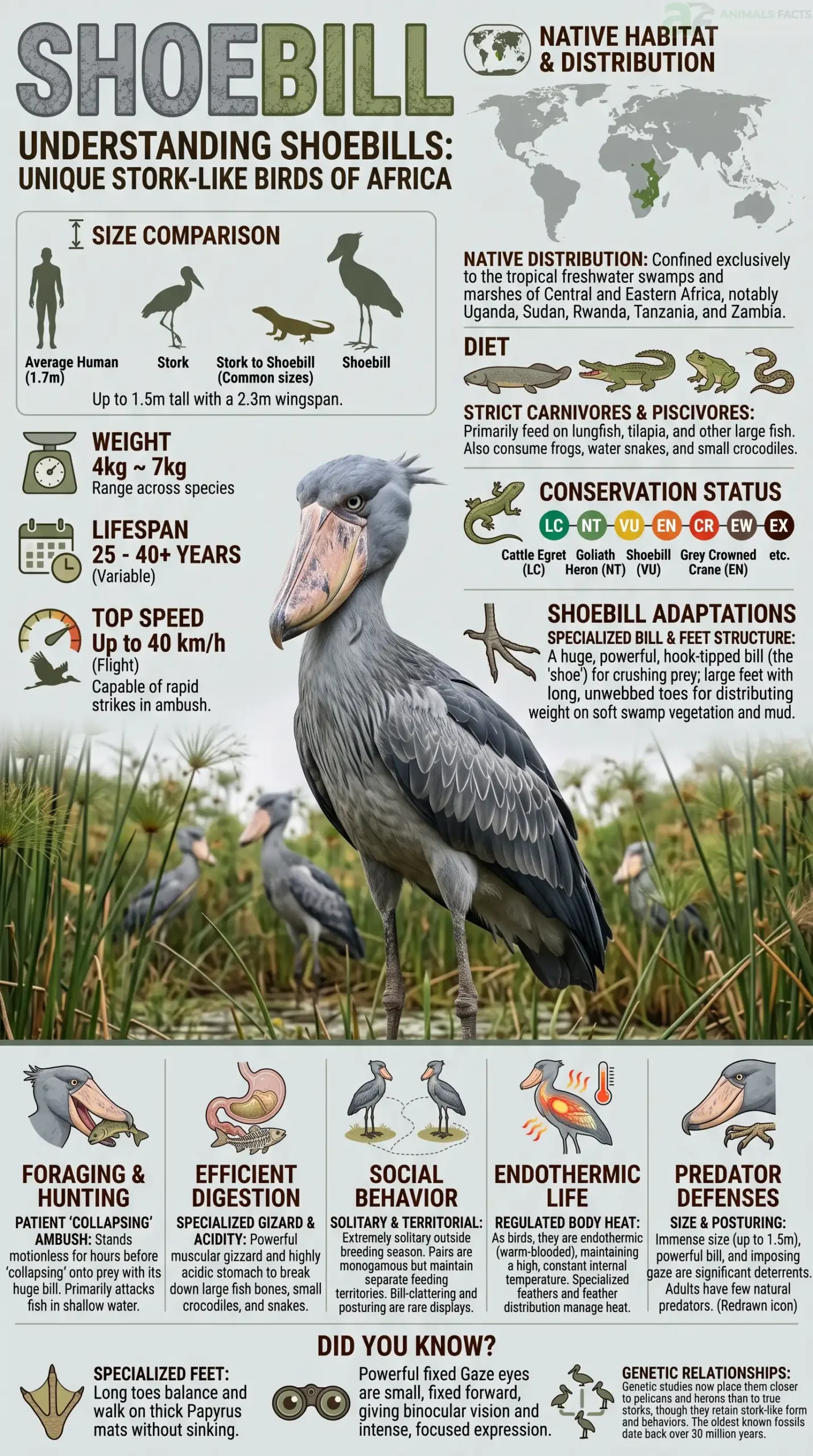
Here is your complete collection of the most extraordinary, scientifically verified, and genuinely astonishing shoebill facts as of 2026:
- The shoebill’s scientific name Balaeniceps rex means “King Whalehead” — a reference to its enormous bill’s resemblance to the head of a baleen whale.
- The shoebill has the widest bill of any bird on Earth — up to 24 cm long and 10 cm wide, capable of capturing and decapitating prey as large as juvenile Nile crocodiles.
- Shoebills can remain perfectly motionless for up to 30 minutes while hunting — waiting with absolute stillness at the edge of the water until prey comes within striking range.
- The shoebill’s strike is one of the fastest movements of any bird — lunging forward with the entire body in a motion called a “collapse strike” that can cover prey in a fraction of a second.
- Shoebills are closely related to hamerkops and pelicans — not storks, despite the common name “shoebill stork.” Modern DNA analysis places them firmly in Pelecaniformes.
- The shoebill is the only living member of its entire family, Balaenicipitidae — making it one of the most phylogenetically isolated birds on Earth.
- At Japanese zoos, shoebills have learned to bow to visitors — a behavior that originated as a natural shoebill greeting display and has made them social media sensations with millions of viral video views.
- Shoebills perform siblicide — the older, larger chick in a nest routinely attacks and sometimes kills its younger sibling to secure all parental care and resources. Parents rarely intervene.
- The global wild shoebill population is estimated at just 3,300–5,300 individuals — making the entire species numerically smaller than many single city parks’ annual visitor numbers.
- Shoebills cool themselves in the African heat by urohidrosis — defecating on their own legs, allowing the evaporation of the liquid to cool the blood in the leg veins. This is the same cooling mechanism used by New World vultures.
- A shoebill’s wing span of up to 2.6 meters is comparable to that of the Andean condor — one of the world’s largest flying birds.
- Fossil relatives of the shoebill have been found in Oligocene deposits of Egypt dating to approximately 30 million years ago, confirming the shoebill lineage as genuinely ancient.
- Shoebills have been documented catching and eating juvenile Nile crocodiles — making them one of the very few birds capable of predating one of Africa’s apex reptile predators.
- The shoebill is almost entirely solitary — adults maintain large individual territories and tolerate other shoebills only during breeding season.
- A shoebill pair will typically raise only one chick to fledging per breeding season — the result of siblicide and the enormous parental investment required for each surviving chick.
- Shoebills produce a remarkable mechanical sound — a bill-clattering called “bill clapping” — that resembles the sound of a machine gun at close range. This is used in greeting displays and territorial signaling.
- A shoebill’s territory can span up to 3 km² of papyrus swamp — an enormous area that it defends aggressively against other shoebills.
- Shoebills swallow their prey whole when possible — or first remove the head and organs of larger prey to make swallowing manageable.
- The shoebill is considered a near-sacred bird in several Central African traditional cultures — particularly among Nilotic peoples of South Sudan who have coexisted with it for millennia.
- Climate change is increasingly recognized as a threat to the shoebill — altering the hydrology of its swamp habitat and affecting the timing and abundance of its lungfish prey.
- A shoebill’s chick is born covered in silver-gray down and begins developing its distinctive bill shape within weeks — juvenile bills are proportionally enormous even in young chicks.
- In Uganda’s Mabamba Bay Wetlands, shoebill ecotourism generates significant income for local communities — making the bird’s conservation directly economically valuable to the people who share its habitat.
- The shoebill has an unusually slow metabolic rate for a bird of its size — it can survive for extended periods on relatively few meals, consistent with its extreme patience as a hunter.
- Adult shoebills have been documented traveling up to 30 km overnight between feeding sites — demonstrating that despite their preference for walking and standing, they are capable of significant sustained flight.
- The shoebill is so disturbingly pterodactyl-like in appearance that it has been used as direct inspiration for fictional prehistoric bird creatures in multiple fantasy novels and video games.
5. Shoebill Fun Facts for Kids
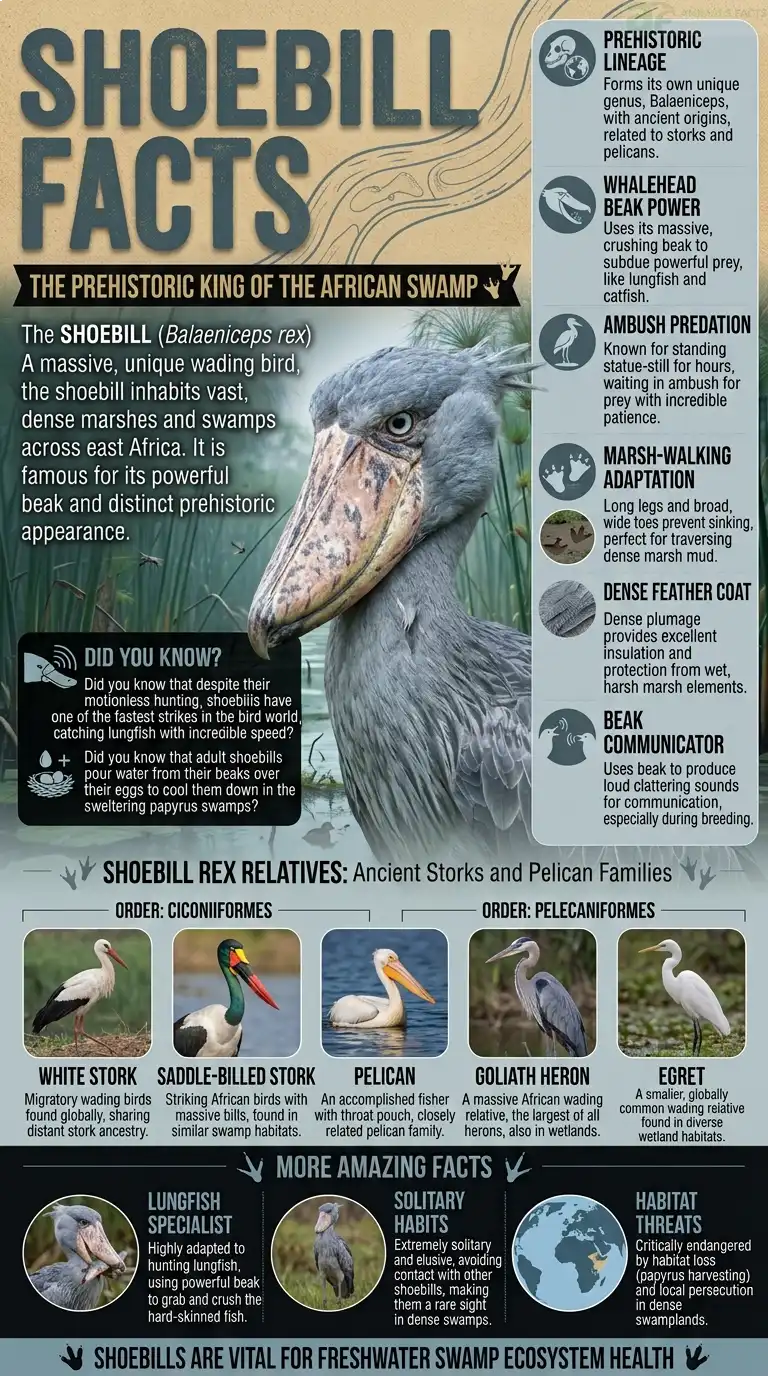
- The shoebill’s bill is so large it can hold an entire juvenile crocodile inside it
- Shoebills are solitary birds — two shoebills sharing the same territory is extremely rare outside breeding season
- The shoebill can turn its head almost 180 degrees — like an owl
- A shoebill bowing to a human is performing a genuine greeting ritual used between mates
- The shoebill hunts primarily at dawn and dusk when oxygen-depleted water forces fish to the surface
- Shoebills can go several days without eating after a large meal
- The shoebill’s clattering call can be heard from considerable distances in a quiet swamp
- Shoebills have been known to stand in exactly the same spot for an entire day while hunting
- The shoebill was formally described only in 1850 — surprisingly recently for such a large, distinctive bird
- Shoebills are listed as Vulnerable — the same threat level as hippos and polar bears
- The word “rex” in Balaeniceps rex means “king” — making its full translation “King Whalehead”
- Shoebill nests are enormous — up to 1.7 meters in diameter — built on floating vegetation
6. Natural Habitat & Geographic Range of Shoebills
Shoebill habitat is one of the most specialized of any large bird — the species is tightly associated with a very specific type of wetland environment found only in limited areas of tropical East and Central Africa.
Habitat Requirements
The shoebill is found almost exclusively in freshwater tropical swamps dominated by papyrus (Cyperus papyrus), phragmites reeds, and ambatch (Aeschynomene elaphroxylon), with water depths typically ranging from 0.3 to 1.0 meters — deep enough to support large fish populations but shallow enough for the shoebill to stand and strike.
Critical habitat characteristics include:
- Dense emergent vegetation — papyrus and phragmites stands providing cover and nesting sites
- Shallow water over a muddy substrate — essential for the shoebill’s wading hunting strategy
- Low dissolved oxygen water (hypoxic zones) — these conditions force fish (particularly lungfish and catfish) to surface regularly to gulp air, making them highly vulnerable to the shoebill’s strike
- Remoteness from human disturbance — the shoebill is highly sensitive to disturbance during nesting
- Floating vegetation mats — used for nest construction and as stable hunting platforms
Habitat Range by Country/Region
| Country | Population Estimate | Key Sites | Habitat Type |
|---|---|---|---|
| South Sudan | ~4,000–6,500 (historically largest population) | Sudd wetlands (largest tropical wetland in Africa) | Papyrus and Nile grass swamp |
| Uganda | ~500–1,000 | Mabamba Bay, Nabajjuzi, Lutembe Bay | Papyrus swamp, lakeside marsh |
| DRC (Congo) | ~500–1,000 | Upemba, Bangweulu Basin (border area) | Central African swamp |
| Zambia | ~100–300 | Bangweulu Wetlands | Floodplain, papyrus |
| Tanzania | ~100–200 | Malagarasi-Muyovozi Ramsar site | Seasonal floodplain |
| Rwanda | ~25–50 | Rugezi Marsh | Papyrus swamp |
| Ethiopia | ~50–100 | Gambella wetlands | Lowland swamp |
| CAR/Sudan | Small numbers | Border region wetlands | Papyrus swamp |
Did You Know? The Sudd — the vast papyrus wetland of South Sudan — is the largest tropical wetland in Africa, covering an area of approximately 30,000–130,000 km² depending on season. It represents the most important single habitat for the global shoebill population and is considered one of Africa’s most important freshwater ecosystems. Its protection is essentially synonymous with the shoebill’s long-term survival.
7. Shoebill Diet & Feeding Behavior
Shoebill diet is dominated by large fish — making it one of the most specialized piscivorous (fish-eating) birds in Africa — and its hunting strategy is among the most remarkable and effective of any bird on Earth.
Diet Breakdown Table
| Prey Type | Estimated % of Diet | Notes |
|---|---|---|
| Lungfish (Protopterus species) | ~40–50% | Primary prey; forced to surface in low-oxygen water |
| Large catfish (Clarias, Synodontis) | ~20–25% | Common prey in Central African swamps |
| Eels | ~10–15% | Slippery but effectively controlled by the hooked bill |
| Water snakes | ~5–10% | Including large, potentially venomous species |
| Frogs and amphibians | ~3–5% | Supplementary prey in some habitats |
| Baby Nile crocodiles | ~2–3% | Documented; requires exceptional strike force |
| Monitor lizards | ~1–2% | Occasional; documented at multiple sites |
| Water turtles | ~1–2% | Documented consumption of small individuals |
| Small mammals | ~1% | Rare; water rodents occasionally taken |
The “Collapse” Hunting Strike
The shoebill’s hunting strategy is among the most distinctive of any bird. Unlike herons that strike from a standing position, the shoebill employs a technique called a “collapse strike” or “plunge” — in which the entire body is launched forward in a full-body lunge, wings spread for balance, bill driving down into the water with the full momentum of the animal behind it.
This technique generates enormous kinetic force — far exceeding what a simple neck strike could achieve — and is necessary because the shoebill’s primary prey (lungfish) are large, powerful, and heavily scaled. A lungfish (Protopterus species) can reach 1 meter in length and requires the full power of the shoebill’s strike to be captured and controlled.
After striking, the shoebill shakes its prey vigorously, using its bill like a pair of shears to decapitate or kill larger items before swallowing them headfirst. Water, vegetation, and debris taken in during the strike are expelled through the sides of the slightly open bill while prey is retained.
Hunting Timing
Shoebills preferentially hunt during early morning and late afternoon — periods when low water temperatures reduce dissolved oxygen, forcing fish to surface regularly to gulp air. During these windows, the shoebill stations itself at the edge of a hypoxic water zone (low-oxygen area) — often where stagnant backwater meets open channel — and simply waits for fish to surface within striking range.
8. Shoebill Reproduction & Life Cycle
Shoebill reproduction is characterized by extraordinary parental investment, a ruthless siblicide dynamic, and a remarkably low reproductive rate — features that collectively make population recovery from decline extremely slow.
Mating & Pair Bonding
Shoebills are monogamous within a breeding season — pairs form at the beginning of the dry season (which varies by location but is typically April–June across much of the range) and maintain their pair bond through the breeding period. Whether pairs maintain long-term or lifetime monogamy is not definitively established, though some long-term field studies suggest site fidelity and possible multi-season pairing in stable habitats.
Courtship displays include mutual bill clattering (both birds producing the characteristic machine-gun rattling sound simultaneously), head bowing (the same bow that has become famous on social media), preening of the partner’s feathers (allopreening), and nest building — which is performed cooperatively.
Nesting
The shoebill’s nest is an extraordinary structure — a massive platform of aquatic vegetation, grasses, and sedges constructed on a floating mat of vegetation or on a small island within the swamp. Nest dimensions are typically:
- Diameter: 1.0–1.7 meters
- Depth: approximately 0.3 meters
- Location: carefully selected to provide access from water on at least one side (for the adult to land) and maximum concealment from above
The shoebill actively maintains nest temperature in the African heat — adults have been observed bringing beakfuls of water to the nest and dripping water over eggs and chicks to prevent overheating, an extraordinary parental behavior documented at multiple sites.
Shoebill Eggs & Incubation
Clutch size: typically 2 eggs (occasionally 1 or 3) Egg color: chalky white, becoming stained brown over incubation Incubation period: approximately 30 days Incubation: shared by both parents; nest is rarely left unattended
Chick Development & Siblicide
After hatching, shoebill chicks develop rapidly — but the nest dynamic is harsh. The first-hatched chick has a size advantage over its sibling(s) from the moment of hatching, and this advantage is typically exploited through active aggression:
The older chick pecks, pushes, and harasses its younger sibling persistently — often pushing it to the edge of the nest or burying it under nest material. Parents do not intervene. The younger chick typically dies within 2–3 weeks from injuries, exposure, or starvation — leaving the parents to focus all resources on the surviving single chick.
This siblicide is not universal — in years of exceptional food abundance, both chicks have occasionally survived to fledging. But it is the typical outcome and appears to be an evolved strategy to guarantee at least one high-quality offspring rather than two poorly-nourished ones.
Fledging occurs at approximately 95–105 days, after which the juvenile remains dependent on parents for an additional ~1 year before independence. Sexual maturity is reached at approximately 3–4 years.
Shoebill Lifespan Comparison Table
| Species | Estimated Lifespan (Wild) | Max Documented (Captivity) | Conservation Status |
|---|---|---|---|
| Shoebill (Balaeniceps rex) | 35–50 years | 54 years (confirmed) | Vulnerable |
| Goliath heron (Ardea goliath) | 15–25 years | ~30 years | Least Concern |
| Saddle-billed stork (Ephippiorhynchus senegalensis) | ~25 years | ~36 years | Least Concern |
| African fish eagle (Haliaeetus vocifer) | ~24 years | ~35 years | Least Concern |
9. Social Behavior & Communication
The shoebill is one of the most solitary large birds in the world — maintaining large individual territories, tolerating conspecifics only during breeding, and communicating primarily through a limited but dramatic repertoire of visual and mechanical signals.
Territorial Behavior
Adult shoebills maintain exclusive territories throughout the non-breeding season, actively driving away other shoebills that enter their area. Territory size varies with habitat quality but typically ranges from 1 to 3 km² of prime swamp. Territorial encounters typically involve:
- Posturing — raising and lowering the head, spreading wings slightly
- Bill clapping — producing the characteristic rapid mechanical clattering sound
- Direct confrontation — approaching and physically displacing the intruder
- Aerial pursuit — rare but documented; one shoebill chasing another in flight
Communication: The Bill Clap
The bill clap (also called bill rattling or bill clattering) is the shoebill’s primary vocal/mechanical communication tool. It is produced by rapidly opening and closing the upper and lower mandibles, creating a sound remarkably similar to rapid machine-gun fire that can be heard from considerable distances across a quiet swamp. The bill clap is used in:
- Greeting between mates — the famous mutual bowing and simultaneous bill-clattering of breeding pairs
- Territorial warning — directed at intruding shoebills
- Begging by chicks — juveniles produce a softer version to solicit food from parents
- Social bonding — pairs bill-clap together in extended mutual displays that reinforce the pair bond
The Bow
The shoebill’s bow — a slow, deliberate forward inclination of the entire head and upper body — is a genuine greeting and submission display used between mated pairs, between parents and chicks, and apparently sometimes when confronted by large, unfamiliar objects (including humans). The bow signals non-aggression and readiness for social interaction — which is why shoebills at Japanese zoos bow to visiting humans who bow to them first. They are following their own social scripts, not simply imitating human behavior.
Intelligence
The shoebill demonstrates several behaviors associated with above-average avian intelligence: long-term memory of productive hunting locations, adaptation of hunting strategy to local prey density and water depth, tolerance of and apparent social recognition of familiar human observers at habituated sites, and the ability to learn new behaviors in captivity (including the famous bowing-to-visitors behavior).
10. Predators & Defense Mechanisms
Adult shoebills have effectively no natural predators — their enormous size, powerful bill, and formidable strike capability make them extremely dangerous to approach. However, eggs, chicks, and weakened adults face genuine threats.
Threats to Eggs and Chicks
- Monitor lizards (Varanus niloticus) — Active predators of eggs and small chicks; their ability to locate and access ground-level and floating nests makes them significant nest predators
- Spotted-necked otters — Documented nest raiders in some areas
- Raptors — Large eagles and herons may occasionally attempt to take very young chicks
- Crocodiles — A potential threat to chicks that fall into the water
Adult Defense
An adult shoebill confronted by a threat deploys a graduated response:
First response — Standing ground with bill raised — the adult faces the threat directly, making itself appear as large as possible. The sight of a shoebill facing you directly with its enormous bill aimed at your face is reportedly extremely effective at deterring most potential threats.
Second response — Bill clapping — a rapid, loud clattering warning display Third response — Direct strike — the shoebill will strike with its bill if a threat approaches within range. A bill capable of decapitating a juvenile crocodile is a formidable weapon against most predators.
Flight — As a last resort, the shoebill will fly, though it generally prefers to stand its ground.
Did You Know? Shoebills have been documented standing completely still for up to 30 minutes at a hunting site — not moving even when approached by researchers within a few meters. This extraordinary capacity for stillness is not submission or fear — it is hunting concentration of the highest order. The shoebill is simply waiting, with absolute patience, for the right moment to strike.
11. Shoebill Facts for Kids
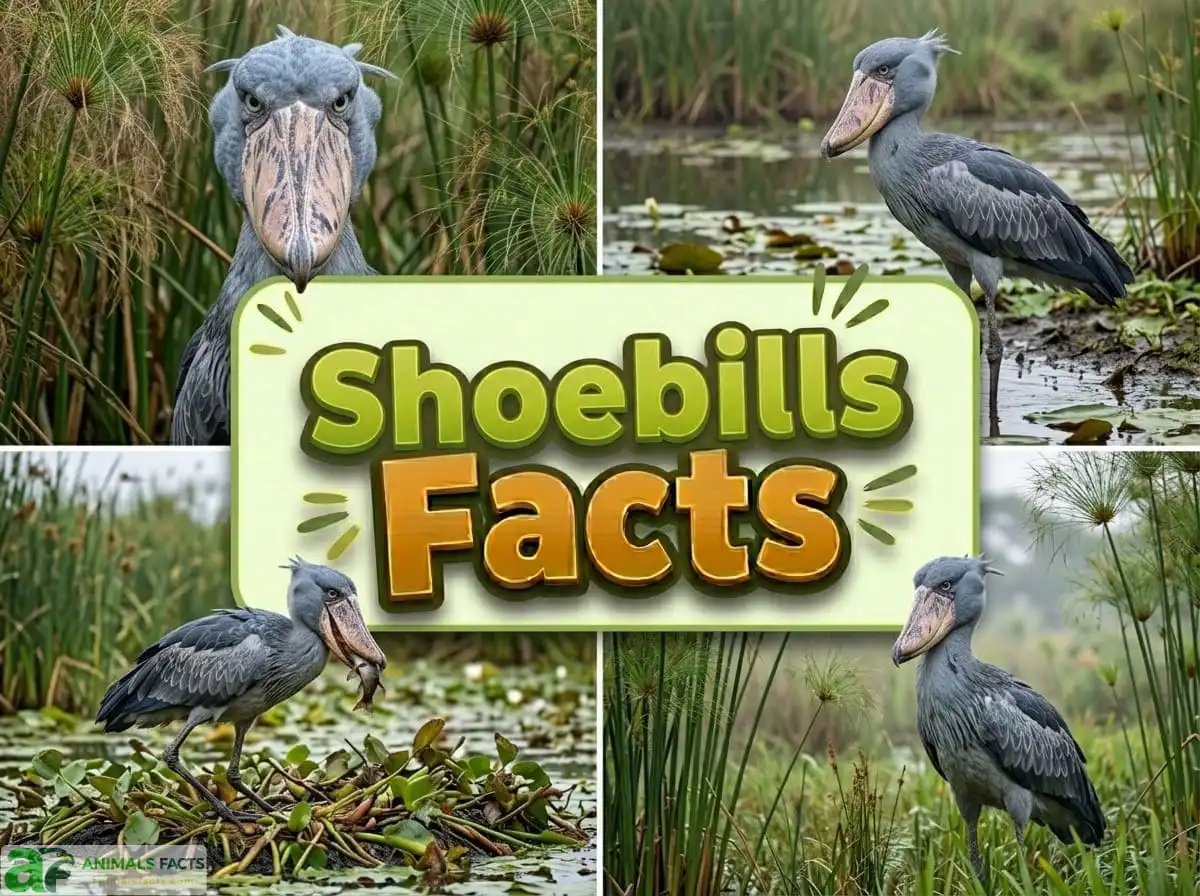
Hey young bird lovers and future wildlife heroes! Here are some totally incredible shoebill facts for kids that will make everyone’s jaw drop:
The shoebill looks like it came from dinosaur times! It’s one of the most ancient-looking birds alive today — and scientists have found its relatives in fossils from 30 MILLION years ago in Egypt!
Its bill is as wide as your head! The shoebill has the widest bill of any bird on Earth — it can fit a whole fish, a water snake, or even a baby crocodile inside it!
Shoebills bow to people who bow to them! At some zoos in Japan, if you bow to a shoebill, it will bow right back. They use bowing as a greeting with their mates, and apparently they’re happy to do it with humans too!
Shoebills can stand completely still for 30 MINUTES! While they’re hunting, shoebills can freeze like statues at the water’s edge, waiting for a fish to swim close enough to catch. They have the patience of a champion!
A shoebill can eat a BABY CROCODILE! Scientists have actually watched shoebills catch and eat juvenile Nile crocodiles — one of Africa’s most feared predators. The shoebill’s bill can snap shut and decapitate prey almost instantly!
Shoebills make a sound like a machine gun! Instead of chirping or singing, shoebills clap their huge bills together super fast, making a rattling sound that echoes across the swamp. CLACKCLACKCLACKCLACK!
There are fewer shoebills than giant pandas! Only about 3,300–5,300 shoebills exist in the wild — that’s fewer than the estimated population of giant pandas. They really need our help!
Baby shoebills are born with a special bill too! Even tiny shoebill chicks have a proportionally large bill that starts to develop that distinctive shape within weeks of hatching.
12. Relationship with Humans
The relationship between humans and the shoebill is multilayered — combining ancient cultural familiarity in the communities where it lives, Victorian-era scientific excitement at its Western “discovery,” the modern challenges of conservation in conflict-affected regions, and the extraordinary contemporary phenomenon of viral social media stardom that has made the shoebill a global icon.
Traditional Cultural Relationship
Indigenous peoples of the Nile basin — particularly the Nilotic peoples of South Sudan (Dinka, Nuer, and others) — have coexisted with the shoebill in the vast Sudd wetlands for millennia. In these communities, the shoebill is generally treated with respect and non-antagonism — it has not historically been hunted for food or feathers, partly because its meat is considered undesirable and partly because of cultural attitudes that imbue large, unusual animals with spiritual significance.
Arab traders and early Islamic scholars knew the shoebill under the name abu markub (“father of the shoe” or “father of the clog”) — a name that appears in medieval Arabic natural history manuscripts well before Western science formally described the species. This Arabic name remains in common use across much of the shoebill’s range.
Scientific Discovery & Victorian Fascination
The Western scientific description of the shoebill in 1850 by John Gould caused a sensation in Victorian ornithological circles. The species was considered so remarkable that the specimen sent to London reportedly generated more public interest than almost any other natural history specimen of the decade. Its extraordinary bill — unlike anything previously described — made it an immediate celebrity of natural history.
Victorian-era collectors subsequently mounted expeditions specifically to obtain shoebill specimens, eggs, and eventually live individuals for European zoos and private menageries. The first live shoebill in a European zoo was housed at London Zoo in the 1860s — drawing enormous crowds.
Shoebill & Ecotourism
In Uganda — where the shoebill is most consistently and reliably accessible to visitors — shoebill-focused birdwatching ecotourism has developed into a significant economic activity, particularly around Mabamba Bay Wetlands near Lake Victoria. Local fishermen and wetland communities have established shoebill boat tour operations that generate direct income for local families, creating an economic incentive for shoebill conservation that complements broader habitat protection efforts.
This model — where local communities directly benefit economically from the shoebill’s presence — is considered one of the most promising frameworks for long-term shoebill conservation.
13. Shoebill Conservation Status & Threats
The shoebill is classified as Vulnerable on the IUCN Red List — a classification that reflects a genuine and significant risk of extinction if current trends continue, though not yet the immediacy of Endangered or Critically Endangered status.
IUCN Status Overview
| Assessment Category | Details |
|---|---|
| IUCN Status | Vulnerable (VU) |
| Population Trend | Decreasing |
| Wild Population Estimate | 3,300–5,300 individuals (2024) |
| Primary Range Countries | South Sudan, Uganda, DRC, Zambia, Tanzania |
| Main Threats | Habitat destruction, human disturbance, hunting, drainage, climate change |
Major Threats
| Threat | Description | Impact Level |
|---|---|---|
| Wetland drainage and conversion | Agricultural expansion drains papyrus swamps | High |
| Human disturbance at nests | Breeding failure from disturbance to incubating pairs | High |
| Hunting and egg collection | Direct mortality; eggs collected for food in some areas | Medium |
| Civil conflict (esp. South Sudan) | Monitoring and protection impossible; displacement of traditional communities | High |
| Fishing net entanglement | Adult mortality from fishing activities in shared habitats | Medium |
| Climate change | Altered hydrology of wetlands; drought impacts | Increasing |
| Charcoal production | Papyrus harvested for charcoal production; destroys habitat | Medium-High |
| Captive trade | Live birds captured for zoos and private collections | Low but significant |
The South Sudan Situation
The most critical conservation situation for the shoebill is in South Sudan — home to the largest known shoebill population within the vast Sudd wetlands. Decades of civil conflict have made systematic monitoring, research, and protection essentially impossible in large areas of the Sudd. Population estimates for South Sudan vary enormously (from a few hundred to several thousand) because comprehensive surveying has simply not been possible in conflict zones. Stabilization of the South Sudan situation is arguably the single most important factor for global shoebill population security.
14. Famous Shoebills in History & Pop Culture
Famous Named Shoebill Individuals
“Sushi” and “Biggie” — Two male shoebills at the Uganda Wildlife Education Centre (UWEC) in Entebbe, Uganda, who became internationally famous through social media videos showing them bowing to visitors. The UWEC is one of the most important facilities for shoebill ambassador work and public education about the species.
The Antwerp Zoo Shoebills — Pairi Daiza and Antwerp Zoo in Belgium maintain some of the most successful captive shoebill groups in the world, with successful breeding recorded. These institutions have contributed significantly to European public awareness of the species.
Frankfurt Zoo Specimen (19th century) — The Frankfurt Zoo held one of the earliest live shoebills in continental Europe in the late 19th century, documented in zoological literature as part of the Victorian-era fascination with the species that followed Gould’s formal description.
Ueno Zoo, Tokyo, Japan — The shoebills at Ueno Zoo in Tokyo are among the most famous in the world — Japanese shoebill mania, largely driven by these birds, has created an extraordinary cultural phenomenon in Japan where shoebills appear on merchandise, in anime, manga, and as national zoo mascots with dedicated fan clubs.
15. Role in Ecosystem & Food Chain
The shoebill occupies a keystone predator role in the freshwater swamp ecosystems of central and eastern Africa — its feeding activity directly regulates fish populations, particularly lungfish, in ways that have measurable effects on the entire ecosystem.
Regulating Lungfish Populations
The African lungfish (Protopterus species) is the shoebill’s primary prey and represents an unusual ecological situation. Lungfish are themselves apex predators within papyrus swamp ecosystems — consuming fish, frogs, and invertebrates with considerable impact. By regulating lungfish populations, the shoebill performs an indirect service to the entire swamp food web — preventing lungfish from overgrazing the fish and amphibian communities that support diverse wetland biodiversity.
Wetland Indicator Species
The shoebill’s extreme specialization to high-quality papyrus swamp habitat makes it an exceptionally sensitive indicator species — its presence indicates a wetland that is intact, productive, and minimally disturbed. Shoebill absence or decline from a wetland is an early warning of broader ecosystem degradation, making it a valuable flagship species for wetland conservation assessment.
Nutrient Cycling
As a large-bodied predator consuming and depositing organic matter across a wide territory, the shoebill contributes to nutrient cycling within its wetland habitat — moving nutrients from water (through consumed fish) to land (through deposited guano and prey remains) in ways that enrich the vegetation of nest sites and favored perching areas.
16. Shoebill Myths, Folklore & Cultural Significance
The shoebill’s remarkable appearance — combining a prehistoric silhouette, unwavering golden eyes, and an air of ancient authority — has naturally inspired rich traditional meanings across the cultures that have lived alongside it.
Nilotic Traditions (South Sudan)
Among the Dinka and Nuer peoples of South Sudan — the human communities most intimately connected to the Sudd wetlands where the shoebill is most abundant — the bird is treated with a respect approaching reverence. It is not hunted for food, its eggs are generally not taken, and its nesting areas are often avoided by fishermen and cattle herders as a matter of cultural practice. Some Dinka oral traditions describe the shoebill as a messenger between the natural and spiritual worlds — its great size, stillness, and apparent age connecting it to forces beyond ordinary animal nature.
Ancient Egypt
The shoebill’s relatives appear in the Oligocene fossil record of Egypt, and some Egyptologists have speculated about connections between the shoebill’s appearance and certain Egyptian hieroglyphic bird symbols — particularly the Bennu bird, which appears in Egyptian mythology as a heron-like creature associated with creation and the sun god Ra. While direct connections are speculative, the shoebill’s territory overlaps with historical Upper Nile regions known to ancient Egyptians, and large, distinctive waterbirds were certainly known and depicted in Egyptian art.
Arab Natural History
The shoebill appears in medieval Arabic natural history literature under the name abu markub — “father of the shoe” — featured in accounts of Nile wildlife compiled by Arab geographers and naturalists of the Islamic Golden Age. These accounts describe a large, distinctive waterbird of the upper Nile with an extraordinary bill, correctly identifying it as a remarkable natural wonder long before European science was aware of it.
Japanese Shoebill Culture
Japan’s extraordinary shoebill fandom — centered on the zoo birds that bow to visitors — represents a contemporary form of cultural significance that has no historical precedent. In Japan, the shoebill has become a cultural icon of dignity, gravity, and quiet wisdom — valued for its appearance of detached contemplation and its willingness to acknowledge humans through bowing. Japanese shoebill merchandise (plush toys, phone cases, stationery, ceramics) generates millions of dollars in annual sales, and shoebill-focused social media accounts have hundreds of thousands of followers.
17. Shoebill in Pop Culture
Japanese Shoebill Viral Videos (2010s–present) — The phenomenon began with YouTube videos from Ueno Zoo and other Japanese zoos showing shoebills bowing elaborately to visitors. These videos have collectively accumulated hundreds of millions of views across platforms, making the shoebill arguably the most internet-famous African bird and triggering a wave of shoebill merchandise, fan art, and media coverage.
BBC’s Africa (2013) — David Attenborough’s landmark documentary series included shoebill footage in its coverage of African wetlands — bringing the bird to a mainstream global audience of tens of millions with Attenborough’s characteristically affecting narration. The resulting surge in public awareness is credited with significantly increasing ecotourism to shoebill sites in Uganda.
Planet Earth III (BBC, 2023) — The shoebill’s extraordinary hunting technique received extended coverage in this landmark series, with slow-motion footage of the collapse strike that represents some of the finest shoebill natural history footage ever produced.
Anime and Manga — The shoebill has appeared as a character in multiple Japanese anime and manga, most notably in Kemono Friends — a popular media franchise featuring anthropomorphized animals as characters, in which the shoebill character (Balaeniceps rex) gained a substantial following for her stoic, dignified personality.
18. Shoebill Facts vs. Common Myths
| Common Myth | The Real Fact |
|---|---|
| “The shoebill is a type of stork” | False — despite the common name “shoebill stork,” it belongs to Pelecaniformes, not Ciconiiformes (storks). It is more closely related to pelicans and hamerkops |
| “Shoebills are aggressive toward humans” | Generally false — habituated shoebills are remarkably tolerant of humans; their stillness is hunting concentration, not aggression |
| “The shoebill is the largest bird in Africa” | False — the ostrich is far larger; the shoebill is among the tallest wading birds but not the tallest African bird overall |
| “Shoebills are related to dinosaurs in a special way” | Misleading — all birds are technically theropod dinosaur descendants; the shoebill is not more closely related to dinosaurs than other birds |
| “Shoebills are nocturnal” | Mostly false — they are primarily crepuscular (dawn and dusk) hunters but can be active at any time of day |
| “Shoebills are mute” | False — while rarely vocal, they produce the dramatic bill-clapping sound and several softer calls |
| “The shoebill swims to hunt” | False — the shoebill is a wading bird that hunts from a standing position in shallow water; it does not swim to hunt |
| “Shoebills are common in East Africa” | False — with only 3,300–5,300 wild individuals, the shoebill is rarer than many people assume; reliable sightings require specific destinations |
19. Best Places to See Shoebills in the Wild
1. Mabamba Bay Wetlands, Uganda — The single most accessible and reliable location for shoebill viewing in the world. Located approximately 45 minutes from Kampala near Lake Victoria, Mabamba offers boat tours through papyrus swamps where shoebills regularly hunt. Local fishermen-guides have exceptional knowledge of individual birds’ territories. Multiple shoebills are routinely seen per visit, making this the go-to destination for shoebill ecotourists worldwide.
2. Nabajjuzi Swamp, Uganda — A second important shoebill site in Uganda, approximately 80 km south of Kampala. Less visited than Mabamba but reliable, with several resident individuals known to local guides.
3. Bangweulu Wetlands, Zambia — The Bangweulu system is one of Africa’s great wetland wilderness areas and holds a significant shoebill population. Remote and requiring more logistical planning than Uganda sites, but offering the possibility of seeing shoebills in a wild, undisturbed setting alongside black lechwe, crowned cranes, and other extraordinary wildlife.
4. Malagarasi-Muyovozi Ramsar Site, Tanzania — Tanzania’s most important shoebill habitat — a remote floodplain system in western Tanzania. Requires significant logistical planning but provides genuinely wild encounters away from any tourism infrastructure.
5. Akagera National Park, Rwanda — While shoebills are uncommon in Rwanda, Akagera’s wetlands hold a small population that can be searched by boat. The combination of Rwanda’s accessibility and conservation success story makes this a worthwhile destination for determined shoebill seekers.
6. Murchison Falls National Park, Uganda — The Nile Delta section of Murchison Falls National Park near Lake Albert holds shoebills in its delta papyrus — an outstanding site that combines shoebill watching with excellent general game viewing.
7. Ueno Zoo & Pairi Daiza (Belgium) — For those unable to travel to Africa, Ueno Zoo in Tokyo and Pairi Daiza in Belgium maintain the world’s most famous captive shoebill populations. While not a substitute for the wild experience, these facilities provide extraordinary close-range observation and have generated more global conservation awareness for the shoebill than any field program.
20. How You Can Help
Shoebill conservation requires support at multiple levels — from international organizations to local community programs.
Support these organizations:
- Wildlife Conservation Society Africa Program — wcs.org — working in South Sudan and DRC on Sudd wetland protection
- BirdLife International — birdlife.org — leading shoebill range-wide assessment and conservation planning
- African Wildlife Foundation — awf.org — wetland and community conservation across the shoebill’s range
- Nature Uganda — natureuganda.org — direct shoebill monitoring and community conservation in Uganda
- Shoebill Project (Zambia) — community-based shoebill research and protection in the Bangweulu Wetlands
What you can do:
- Book shoebill ecotourism through responsible operators — particularly community-based boat tour operators at Mabamba Bay, Uganda, where tourism income directly supports local conservation
- Follow and share shoebill conservation content — public awareness drives funding and policy attention; the viral shoebill videos have done more for awareness than decades of scientific publications
- Support wetland conservation advocacy — shoebill survival is inseparable from the survival of Africa’s tropical freshwater wetlands
- Donate to organizations working in South Sudan — the Sudd wetland’s protection requires sustained support for conservation work in one of the world’s most challenging operating environments
- Report captive shoebills being kept outside registered facilities — live shoebill trade for the private collector market is an ongoing issue that requires public vigilance
21. Top Documentaries & Books
Must-Watch Documentaries
- Africa (BBC, 2013) — David Attenborough’s landmark series includes exceptional shoebill footage in its wetland episodes; the shoebill sequences are among the most widely shared wildlife clips from this series
- Planet Earth III (BBC, 2023) — Contains the finest slow-motion shoebill hunting footage ever produced, along with behavioral and ecological context
- The Life of Birds (BBC, 1998) — David Attenborough’s comprehensive bird series includes shoebill content in its discussion of specialist hunters
- Wild Uganda (various producers) — Multiple documentary productions covering Uganda’s extraordinary wildlife include dedicated shoebill sections; widely available through streaming platforms
- Natural World: Mystery Birds (BBC) — Dedicated natural history documentary covering several mysterious and unusual bird species including the shoebill
Must-Read Books
- Roberts Birds of Southern Africa — The definitive field reference for the southern African portion of the shoebill’s range
- Birds of East Africa by Terry Stevenson & John Fanshawe — The essential field guide for Uganda, Kenya, Tanzania, and surrounding countries; includes detailed shoebill coverage
- The Life of Birds by David Attenborough — The companion book to the BBC series; includes shoebill discussion in the context of specialist hunter ecology
- African Birdwatching by Ber van Perlo — Overview of exceptional African birding destinations and species including the shoebill
- Wetlands of Africa (various academic volumes) — Specialist literature on the ecology of African freshwater systems, with shoebill conservation status covered in detail
22. Comparison with Similar Species
| Feature | Shoebill | Goliath Heron | Saddle-billed Stork | Hamerkop |
|---|---|---|---|---|
| Scientific name | Balaeniceps rex | Ardea goliath | Ephippiorhynchus senegalensis | Scopus umbretta |
| Family | Balaenicipitidae | Ardeidae | Ciconiidae | Scopidae |
| Height | 1.1–1.4 m | 1.2–1.52 m | 1.45–1.5 m | 0.47–0.56 m |
| Weight | 4–7 kg | 4–5 kg | 5–8 kg | 0.4–0.47 kg |
| Wingspan | 2.3–2.6 m | 1.85–2.3 m | 2.4–2.7 m | 0.9–1.0 m |
| Diet | Fish, crocodiles, snakes | Fish, frogs, small mammals | Fish, frogs, small vertebrates | Fish, frogs, invertebrates |
| Habitat | Papyrus swamp | Diverse wetlands | Diverse African wetlands | Near any water |
| Conservation status | Vulnerable | Least Concern | Least Concern | Least Concern |
| Relationship to shoebill | — | Not closely related | Not closely related | Closest living relative |
| Social behavior | Solitary | Solitary/colonial | Solitary pairs | Solitary pairs |
23. Frequently Asked Questions About Shoebills
What is the scientific name of the shoebill?
The shoebill’s scientific name is Balaeniceps rex, formally described by British ornithologist John Gould in 1850. Balaeniceps derives from the Latin balaena (whale) and caput (head) — meaning “whale-headed” — while rex is Latin for “king.” The full translation is therefore “King Whalehead” — a name that captures both the distinctive bill and the bird’s commanding presence. The family Balaenicipitidae (Bonaparte, 1853) was established specifically for this species, of which it remains the sole living member.
How big is a shoebill?
Adult shoebills stand approximately 1.1–1.4 meters (3.6–4.6 feet) tall — comparable to a large human child. Their wingspan extends 2.3–2.6 meters (7.5–8.5 feet). Weight ranges from 4 to 7 kg (8.8–15.4 lbs), with males typically on the higher end. Their most striking measurement is the bill: 18.8–24 cm (7.4–9.4 inches) long and up to 10 cm wide — the widest bill of any bird on Earth. Despite this formidable size, the shoebill is lighter than it appears — its bones, like those of all birds, are hollow and lightweight.
What does the shoebill eat?
The shoebill is a specialist piscivore (fish eater), with African lungfish (Protopterus species) making up an estimated 40–50% of its diet. Other major prey includes large catfish, eels, water snakes, frogs, and — most dramatically — juvenile Nile crocodiles. The shoebill has also been documented eating small monitor lizards and water turtles. It hunts using an extreme patience strategy: standing motionless at the water’s edge in oxygen-depleted swamp water until fish surface to breathe, then launching a full-body “collapse strike” with the entire body weight behind the bill.
Is the shoebill endangered?
The shoebill is currently classified as Vulnerable (VU) on the IUCN Red List — a significant conservation concern though not yet at the Endangered level. The global wild population is estimated at 3,300–5,300 individuals as of 2024, with a decreasing population trend. The primary threats are wetland habitat destruction, human disturbance at nest sites, hunting and egg collection in some areas, and the impact of civil conflict in South Sudan (home to the largest known population) making protection and monitoring effectively impossible in large areas.
Why do shoebills bow to humans?
Shoebills do not bow specifically to humans — they perform a bow as a greeting and social bonding display between mates, between parents and chicks, and toward any individual (including humans) they wish to acknowledge non-aggressively. This behavior, completely natural in shoebill social repertoire, became a viral sensation when filmed at Japanese zoos where habittuated shoebills bow to visitors who bow to them. The birds are following their own social scripts — humans who bow to them are apparently triggering the same recognition of a friendly approach that a mate’s bow would trigger.
How long do shoebills live?
Shoebills are remarkably long-lived for birds of their size. Wild individuals are estimated to live 35–50 years, while the longest confirmed lifespan in captivity is approximately 54 years. This longevity is partly explained by the shoebill’s low metabolic rate, its position as an effective apex predator with few natural enemies as an adult, and its relatively slow reproductive rate — characteristics that collectively make it a K-selected species (investing heavily in few offspring over a long lifespan rather than producing many short-lived offspring).
Where can I see a shoebill?
The most accessible and reliable location for wild shoebill watching is Mabamba Bay Wetlands near Kampala, Uganda, where community-based boat tour operators offer guided excursions into papyrus swamps where multiple individual shoebills are resident. Other reliable sites include Nabajjuzi Swamp (Uganda), Bangweulu Wetlands (Zambia), and Murchison Falls National Park (Uganda). For those unable to travel to Africa, Ueno Zoo in Tokyo and Pairi Daiza in Belgium maintain captive shoebill populations that are among the most reliably viewable and are the source of many of the most famous shoebill social media videos.
Are shoebills dangerous to humans?
Wild shoebills are not aggressive toward humans and have never been recorded attacking a person unprovoked. Habituated individuals at established birdwatching sites in Uganda are remarkably tolerant of close human approach — sometimes allowing observers within 2–3 meters without displaying any alarm. However, like any large bird, a shoebill should not be approached, touched, or harassed — particularly during breeding season, when disturbance can cause nest abandonment. Their bill — capable of decapitating a juvenile crocodile — would obviously be capable of causing serious injury if the bird felt genuinely threatened.
What is the shoebill’s closest living relative?
Despite resembling storks or herons in overall appearance, the shoebill’s closest living relative is the hamerkop (Scopus umbretta) — a medium-sized, brownish African bird famous for building gigantic domed nests. This unlikely relationship was established through DNA phylogenetic analysis in the early 2000s and has been confirmed by multiple subsequent studies. Both the shoebill and hamerkop are now placed in the order Pelecaniformes alongside pelicans, cormorants, herons, ibises, and spoonbills.
24. Sources & References
Research Sources
- Wikipedia — Balaeniceps rex, Balaenicipitidae, Pelecaniformes
- IUCN Red List — iucnredlist.org (2024 assessment for Balaeniceps rex)
- BirdLife International — birdlife.org
- National Geographic — nationalgeographic.com
- Smithsonian Institution — si.edu
- BBC Wildlife / BBC Earth — bbcearth.com
- Britannica — britannica.com/animal/shoebill
- Live Science — livescience.com
- Nature Uganda — natureuganda.org
- Stevenson, Terry & Fanshawe, John (2002). Birds of East Africa. T&AD Poyser
- Hackett, S.J. et al. (2008). “A phylogenomic study of birds reveals their evolutionary history.” Science (includes Pelecaniformes placement confirmation)
- del Hoyo, J., Elliott, A. & Sargatal, J. eds. (1992). Handbook of the Birds of the World, Vol. 1. Lynx Edicions
- Wildlife Conservation Society — wcs.org