
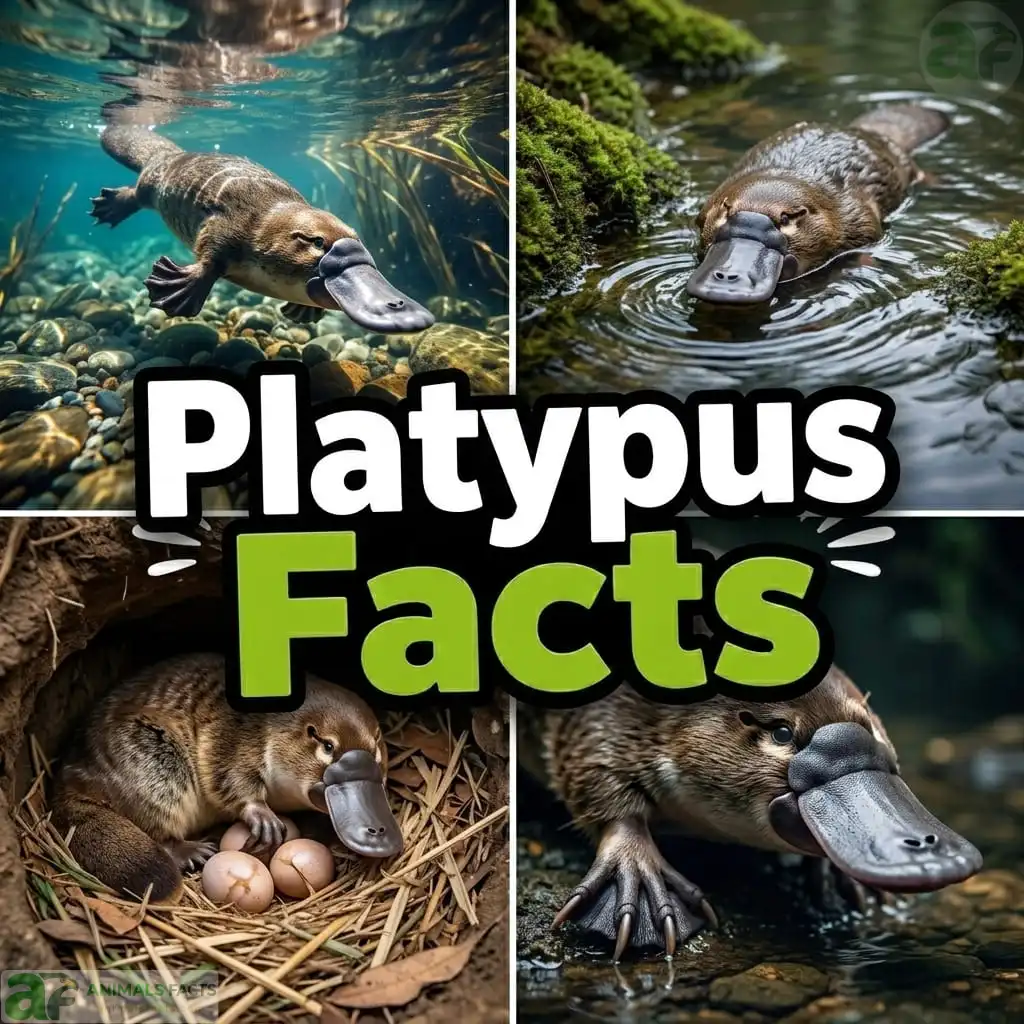
Platypus Facts
| Feature | Details |
|---|---|
| Scientific Name | Ornithorhynchus anatinus |
| Kingdom | Animalia |
| Class | Mammalia |
| Order | Monotremata |
| Family | Ornithorhynchidae |
| Habitat | Eastern Australia and Tasmania; freshwater streams, rivers, lakes |
| Lifespan | 11–17 years (wild); up to 21 years in captivity |
| Diet | Carnivore — invertebrates; insect larvae, worms, crayfish, shrimp |
| Conservation Status | Near Threatened (IUCN, 2016; under review for uplisting) |
| Body Length | 30–63 cm (excluding tail) |
| Weight | 0.7–2.4 kg (males larger than females) |
| Tail Length | 10–15 cm |
| Speed | Up to 9 km/h swimming |
| Population Estimate | Unknown; estimated 30,000–300,000 (wide uncertainty) |
| Electroreceptors | ~40,000 in the bill |
| Venom | Males only; delivered via hind-leg spurs |
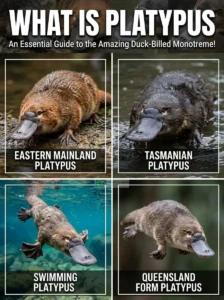 1. Introduction: What is Platypus?
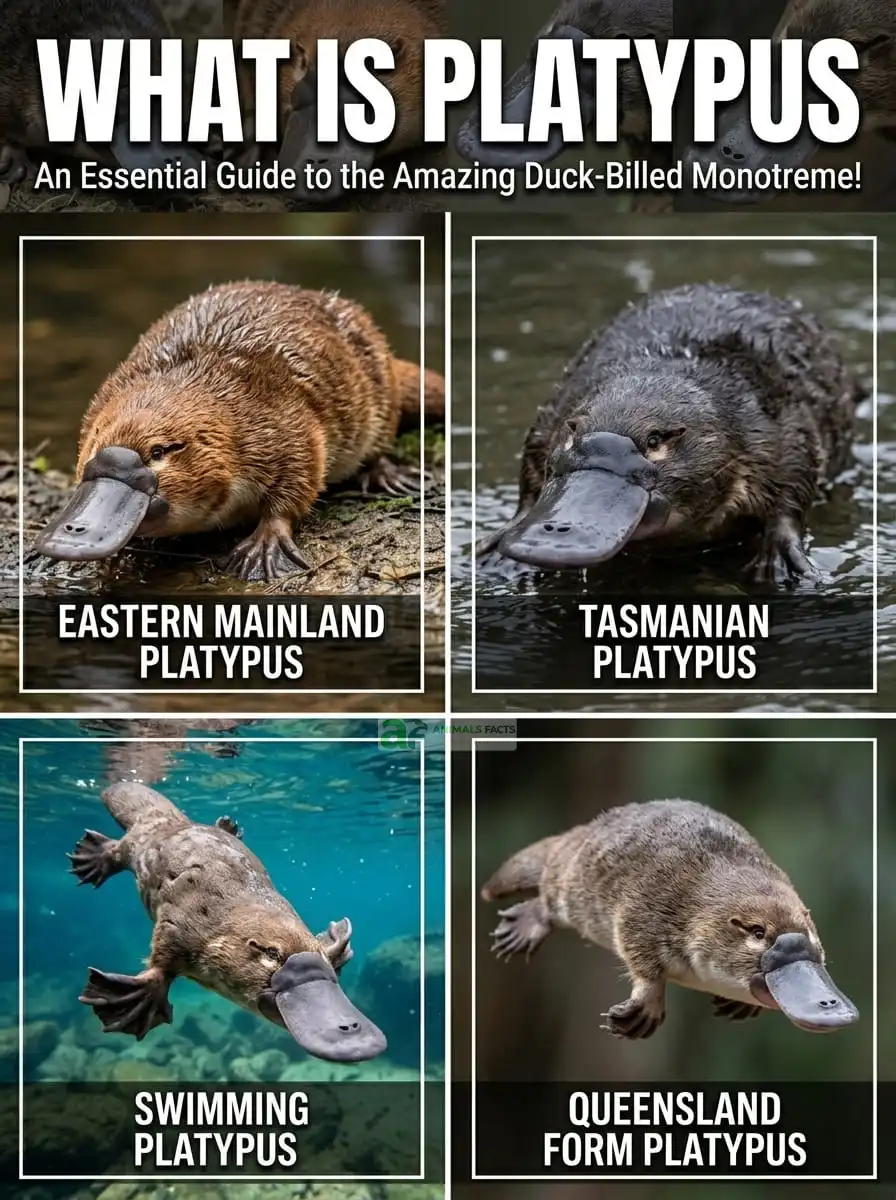
When the first dried platypus specimen arrived in England from Australia in 1799, the scientists who examined it were convinced it was a fraud. George Shaw — the naturalist tasked with its formal examination — reportedly took scissors to the bill and checked the skin for stitches, certain that some clever taxidermist had sewn a duck’s bill onto a beaver-like body as an elaborate hoax. He could not accept that nature had actually produced such a creature. And yet platypus facts have a way of making even the most rigidly skeptical scientist abandon their certainties — because the platypus is not merely strange. It is a living argument that evolution has no rules, no direction, and no obligation to make sense to human observers.
The platypus is simultaneously a mammal that lays eggs, senses its world through electricity, hunts blind with a bill full of more electroreceptors than any other known vertebrate, produces venom from spurs on its hind legs, and glows fluorescent blue-green under ultraviolet light. It feeds without teeth, navigates without vision or hearing underwater, and nurses its young through skin pores rather than nipples. Interesting facts about platypuses seem to arrive in an endless stream because this animal has spent over 170 million years evolving independently from every other mammal lineage — long enough to invent solutions to survival that no other mammal on Earth has ever discovered.
This is your complete, authoritative guide to platypus facts — covering every extraordinary adaptation, every ecological role, every cultural connection, and every conservation challenge facing one of Earth’s most irreplaceable animals. Whether you are a student looking for platypus facts for kids, a teacher building an evolutionary biology lesson, a wildlife enthusiast who watched a documentary and never recovered, or simply someone who has always suspected that the platypus is secretly the most remarkable animal alive — this article will not disappoint you.
2. Platypus Species Overview & Classification
The platypus occupies one of the most ancient and isolated positions in the mammalian family tree — a lineage so old and so distinct that it challenges the very definition of what it means to be a mammal.
Taxonomy Table
| Level | Classification |
|---|---|
| Kingdom | Animalia |
| Phylum | Chordata |
| Class | Mammalia |
| Subclass | Prototheria |
| Order | Monotremata |
| Family | Ornithorhynchidae |
| Genus | Ornithorhynchus |
| Species | Ornithorhynchus anatinus |
| Common Name | Platypus, duck-billed platypus |
| Meaning of name | Greek: ornitho (bird) + rhynkhos (beak) + Latin: anatinus (duck-like) |
Where Does the Platypus Fit in Mammal Evolution?
The platypus is a monotreme — a member of the order Monotremata, the most ancient surviving lineage of mammals. Monotremes diverged from all other mammal lineages approximately 166 million years ago — before the split between marsupials and placental mammals. Today, only five monotreme species survive:
| Monotreme Species | Scientific Name | Range |
|---|---|---|
| Platypus | Ornithorhynchus anatinus | Eastern Australia, Tasmania |
| Short-beaked echidna | Tachyglossus aculeatus | Australia, New Guinea |
| Eastern long-beaked echidna | Zaglossus bartoni | New Guinea |
| Western long-beaked echidna | Zaglossus bruijni | New Guinea |
| Sir David’s long-beaked echidna | Zaglossus attenboroughi | New Guinea (possibly extinct) |
Platypus Species Evolution & Discovery Timeline
- ~166 million years ago — Monotremes diverge from the ancestor of all other mammals; earliest mammal-like egg-layers established
- ~110 million years ago — Earliest platypus-like fossil ancestors documented from Cretaceous Australia
- ~61 million years ago — Monotrematum sudamericanum — platypus relative — found in Patagonia, Argentina; evidence that monotremes once had a broader geographic distribution
- ~25 million years ago — Ancient platypus species (Obdurodon) had functional teeth — modern platypus lost its teeth evolutionarily
- ~5 million years ago — Modern Ornithorhynchus genus established in fossil record; essentially modern body plan complete
- 1799 — George Shaw formally describes Ornithorhynchus anatinus; initially suspected to be a hoax
- 1884 — William Caldwell confirms platypus lays eggs; telegraphs the finding to the British Association with the famous message: “Monotremes oviparous, ovum meroblastic”
- 1986 — First documentation of platypus electroreception in scientific literature
- 1992 — Male platypus venom fully characterized biochemically
- 2008 — Platypus genome fully sequenced; reveals extraordinary mixture of mammalian, reptilian, and bird-like genetic sequences
- 2020 — Discovery that platypus fur fluoresces blue-green under UV light — one of only a handful of fluorescing mammals known
- 2020 — IUCN assessment raises conservation concern; platypus moves closer to threatened status
- 2021 — New research documents significant population declines across eastern Australia
- 2026 — Ongoing monitoring; climate change and drought continue to threaten key populations
3. Physical Description of Platypus
The platypus body plan is a collection of features that, in isolation, would each be remarkable — together, they constitute one of the most extraordinary physical packages in the animal kingdom.
Body Structure
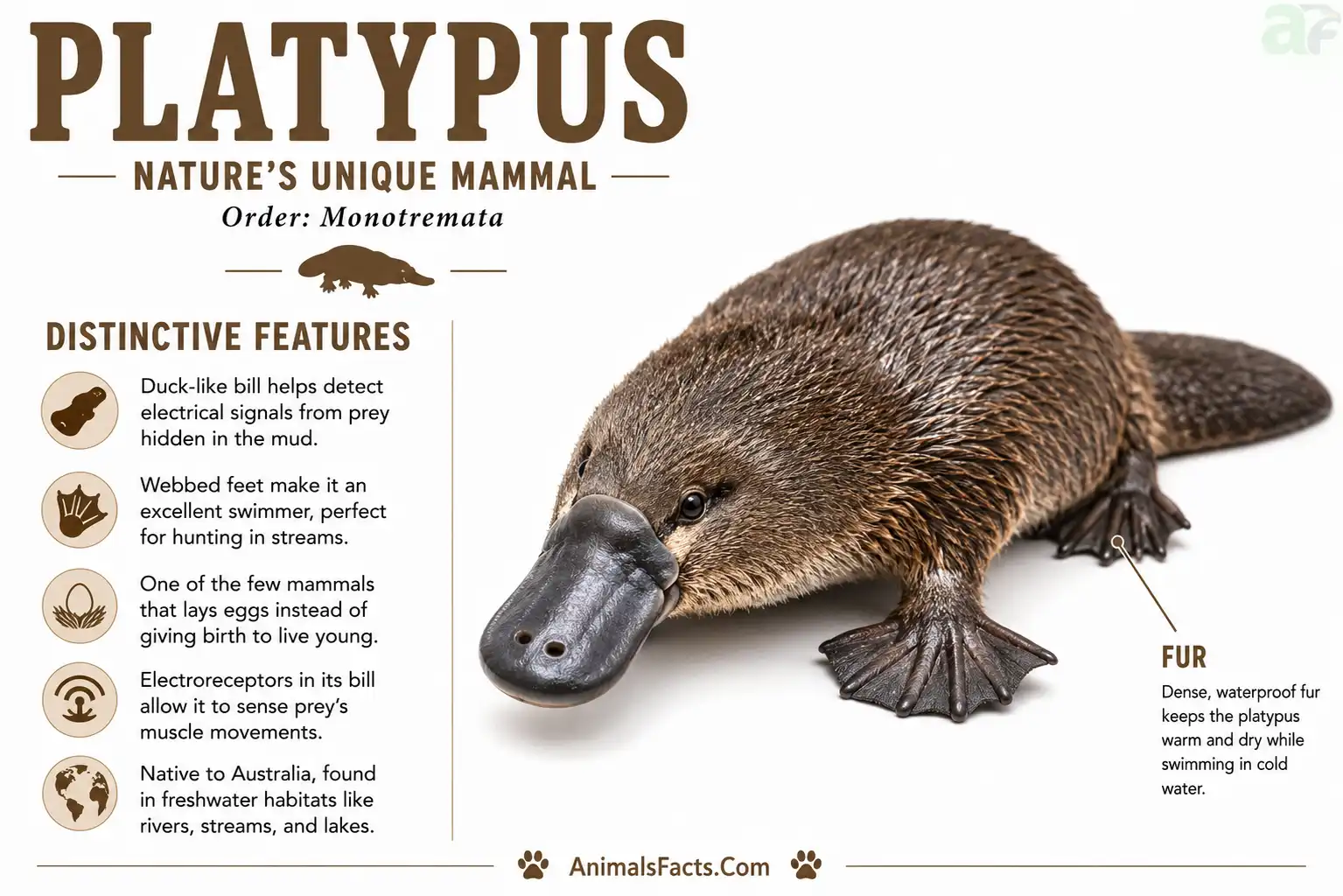
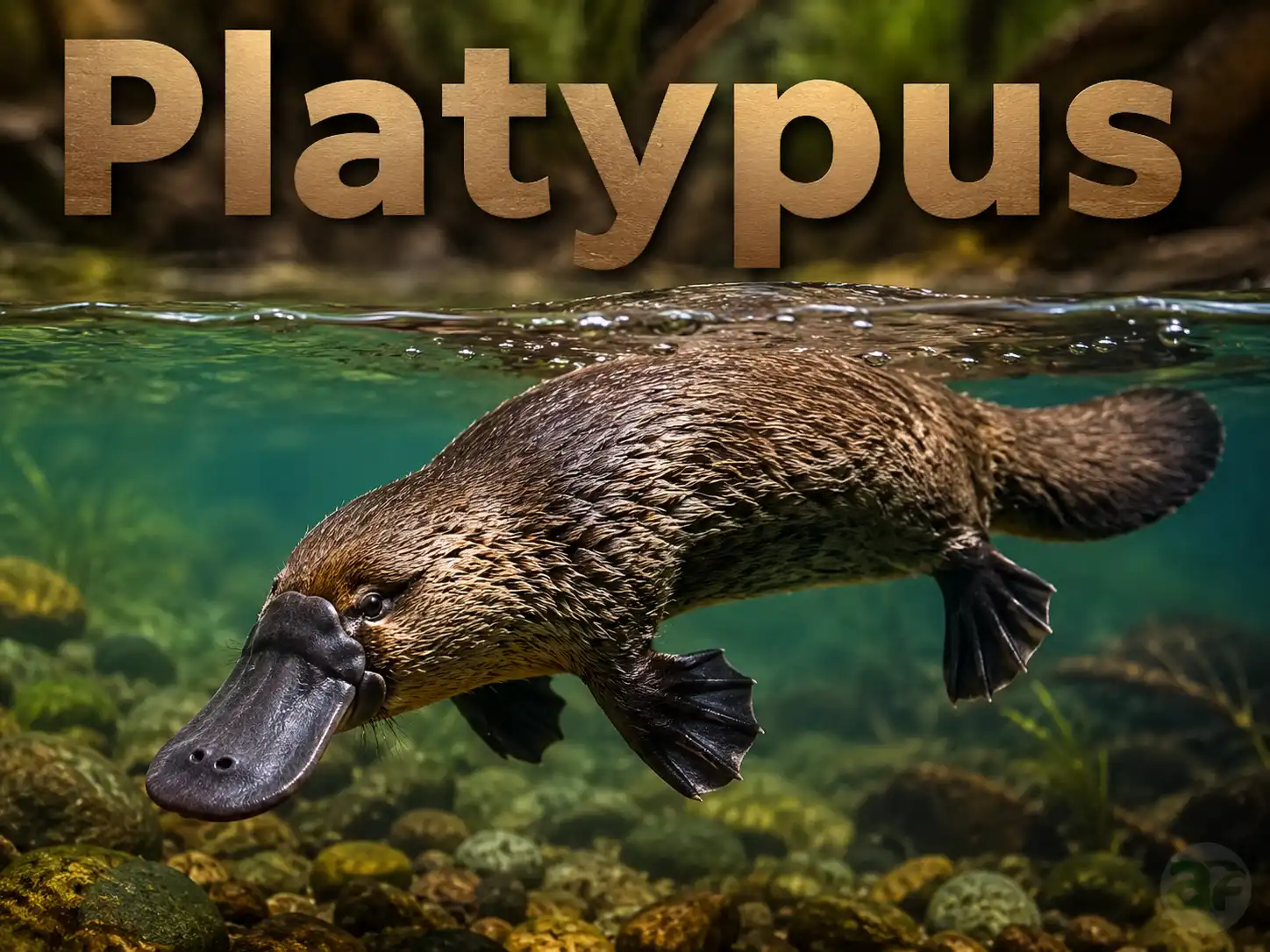
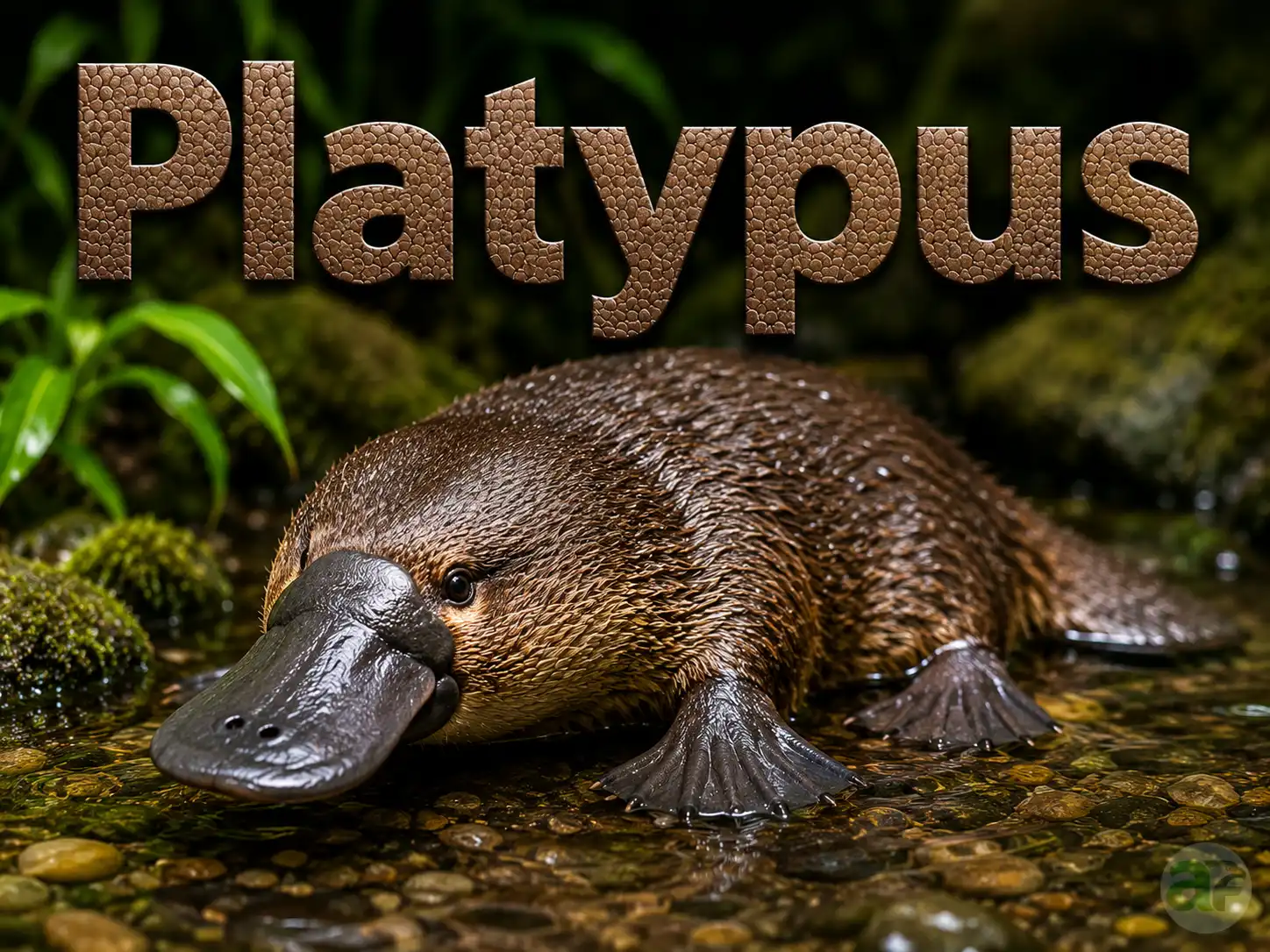
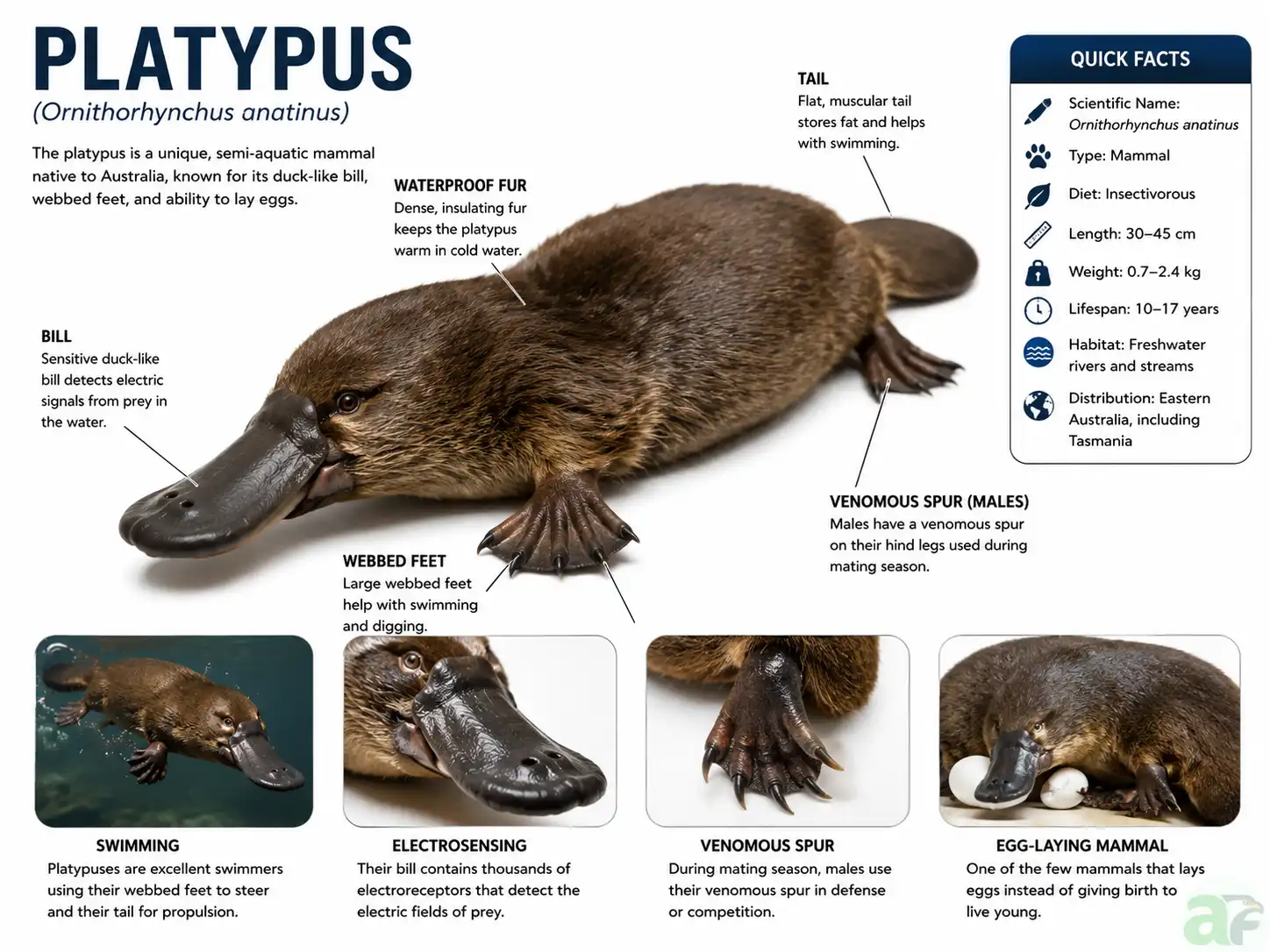
The platypus has a streamlined, torpedo-shaped body covered in dense, waterproof fur — dark brown on the back and silvery-cream on the belly. The fur traps a layer of air for insulation, allowing the platypus to maintain body temperature in cold freshwater streams. Unlike most mammals, platypus fur glows blue-green under ultraviolet light — a phenomenon discovered in 2020 that may help individuals locate each other at night.
The tail is broad and flat — resembling a beaver’s tail — and stores fat reserves that are mobilized during the breeding season and periods of food scarcity. It is NOT used as a rudder during swimming; the platypus steers using its bill and webbed feet.
The Bill — Nature’s Most Sophisticated Sensory Array
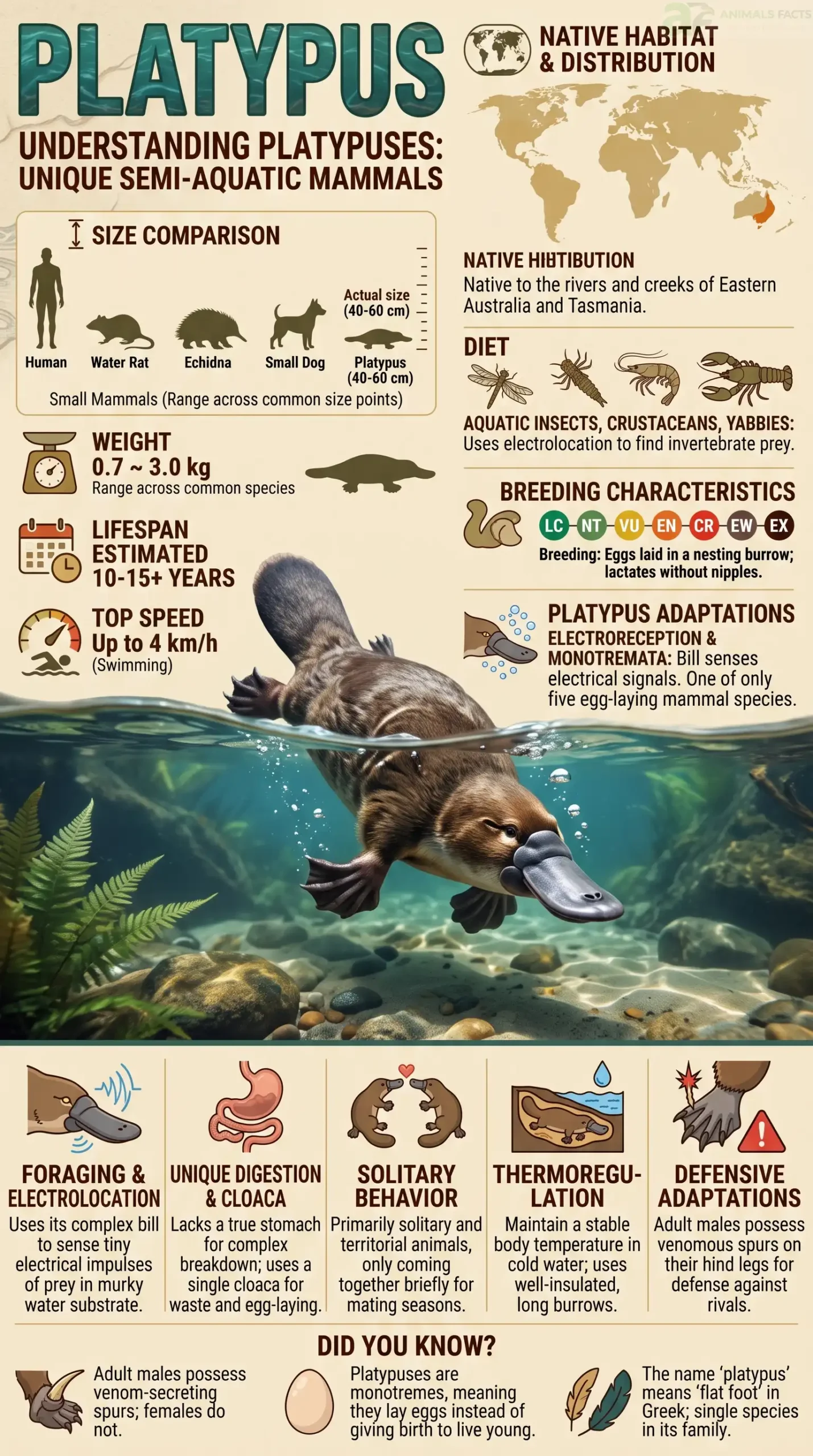
The platypus bill is made of soft, leathery, highly flexible skin — nothing like a duck’s hard keratin bill — and contains up to 40,000 electroreceptors and approximately 60,000 mechanoreceptors. This dual sensory system allows the platypus to:
- Detect the bioelectric fields generated by the muscle contractions of prey animals buried in mud or hidden under rocks — at distances of 20–30 cm
- Detect the pressure waves created by moving prey
- Operate in complete sensory blackout — eyes, ears, and nostrils all shut while diving
The platypus essentially “sees” its world electrically — and has been described by neuroscientists as having one of the most sophisticated passive electroreception systems of any vertebrate on Earth, comparable only to sharks and some weakly electric fish.
The Venom System of Platypus
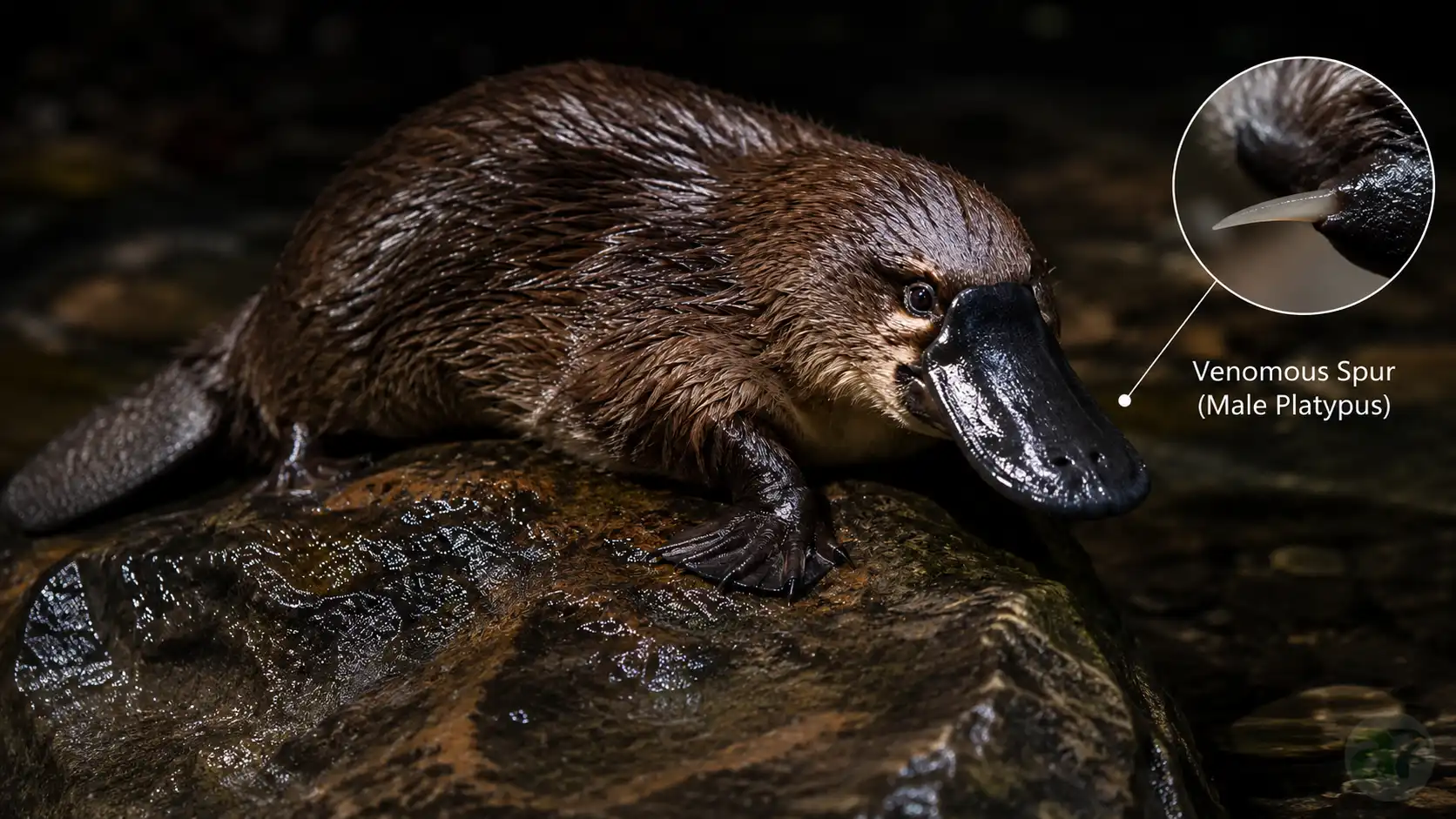
Male platypuses possess a remarkable venom delivery system — a hollow, keratinous spur on each hind ankle connected to a crural gland in the upper leg that produces venom. This makes the platypus one of the very few venomous mammals on Earth.
The venom contains a complex cocktail of over 80 different proteins — including defensin-like proteins found in reptile venom, nerve growth factor relatives, and compounds that cause catastrophic pain, swelling, and potentially temporary paralysis in large animals including humans. Crucially, the platypus venom is not lethal to humans but causes pain described as among the most excruciating known — refractory to standard morphine treatment. The venom’s pain-causing component (OvCLP — Ornithorhynchus venom cysteine-rich secretory protein) appears to activate pain pathways differently from any other known venom compound.
Venom production increases dramatically during breeding season — suggesting its primary function is in competition between males rather than defense or prey capture.
Size Comparison by Sex and Age
| Feature | Adult Male | Adult Female | Juvenile |
|---|---|---|---|
| Body length | 45–63 cm | 30–55 cm | ~1.5 cm at hatching |
| Weight | 1.0–2.4 kg | 0.7–1.6 kg | ~0.5 g at hatching |
| Bill | Larger, broader | Smaller, narrower | Present from hatching |
| Venom spur | Present; functional | Vestigial spur only; non-functional | Absent |
| Tail | Broader; more fat storage | Narrower | Present; proportionally large |
| Fur | Dark brown/cream | Similar | Lighter brown initially |
“The platypus is not an evolutionary mistake or an unfinished experiment. It is a masterpiece — an animal perfectly tuned to its environment in ways that took biologists two centuries to begin understanding. Every feature we once called bizarre turns out to be brilliantly functional.” — Sir David Attenborough, BBC Natural World
4. Top 25 Amazing Platypus Facts
Here are the most extraordinary, conversation-stopping interesting facts about platypuses — each one a window into what makes this animal truly unlike anything else alive:
- The platypus is one of only five species of monotremes — the most ancient surviving mammal lineage on Earth
- When the first platypus specimen reached England in 1799, the examining scientist took scissors to the bill convinced it was a sewn-on hoax
- Male platypuses are venomous — delivering venom through ankle spurs that causes excruciating, morphine-resistant pain in humans
- The platypus bill contains up to 40,000 electroreceptors — the most sophisticated passive electroreception system of any mammal
- Platypuses shut their eyes, ears, and nostrils entirely when diving — hunting by electroreception alone
- They are one of the very few mammals that lay eggs rather than giving birth to live young
- A platypus egg is about the size of a marble — roughly 11 mm in diameter
- Platypuses have no stomach — their esophagus connects directly to their intestine; they lack the acid-secreting gastric region found in virtually all other vertebrates
- They nurse their young through patches of porous skin — they have no nipples; milk seeps through skin and the young lap it from the mother’s fur
- Platypus fur fluoresces blue-green under ultraviolet light — a discovery made in 2020 that astonished the scientific community
- Male platypuses have a four-headed penis — the most complex penile anatomy of any known mammal
- The platypus genome contains sequences resembling those of mammals, reptiles, and birds simultaneously
- Platypuses have 10 sex chromosomes — compared to humans’ 2 (XX/XY); males are XYXYXYXYXY and females XXXXXXXXXX
- They are among the few mammals capable of producing venom — alongside shrews, slow lorises, and Cuban solenodons
- A platypus can store up to days’ worth of food in its cheek pouches while foraging, consuming it at the surface
- The platypus bill can detect the bioelectric fields of prey at distances of up to 30 cm through mud and silt
- They lack the teeth of their ancestors — ancient platypus species like Obdurodon had functional molars; modern platypus grinds food with keratinous pads
- Platypuses close their eyes during orgasm-like torpor states — their brains produce REM-like sleep patterns while their bodies remain motionless in water
- A female platypus does not build a permanent burrow — she constructs a special nesting burrow plugged with leaf plugs for egg incubation
- The female incubates her eggs by curling around them with her tail — she has no brood pouch
- Platypus venom contains defensin-like proteins — compounds found in reptile venom but unknown in other mammals — suggesting ancient shared genetic heritage
- During a dive, the platypus sweeps its bill from side to side in a precise arc — triangulating prey location through electrical field gradients
- Despite being aquatic hunters, platypuses cannot feed underwater — they surface to consume everything stored in their cheek pouches
- The platypus does not drink water — it obtains all moisture from its food
- Platypus populations have declined by an estimated 30% over the past 30 years — making conservation action increasingly urgent
Did You Know? The platypus has no stomach — literally. While virtually every vertebrate on Earth has a stomach with acid-secreting cells that begin chemical digestion, the platypus esophagus connects directly to the small intestine. This means the platypus relies entirely on mechanical processing (grinding with keratinous pads) and intestinal digestion for breaking down food. Scientists believe the stomach was lost evolutionarily when the platypus’s ancestors adopted a diet so consistently protein-rich that acid digestion became unnecessary.
5. Platypus Fun Facts
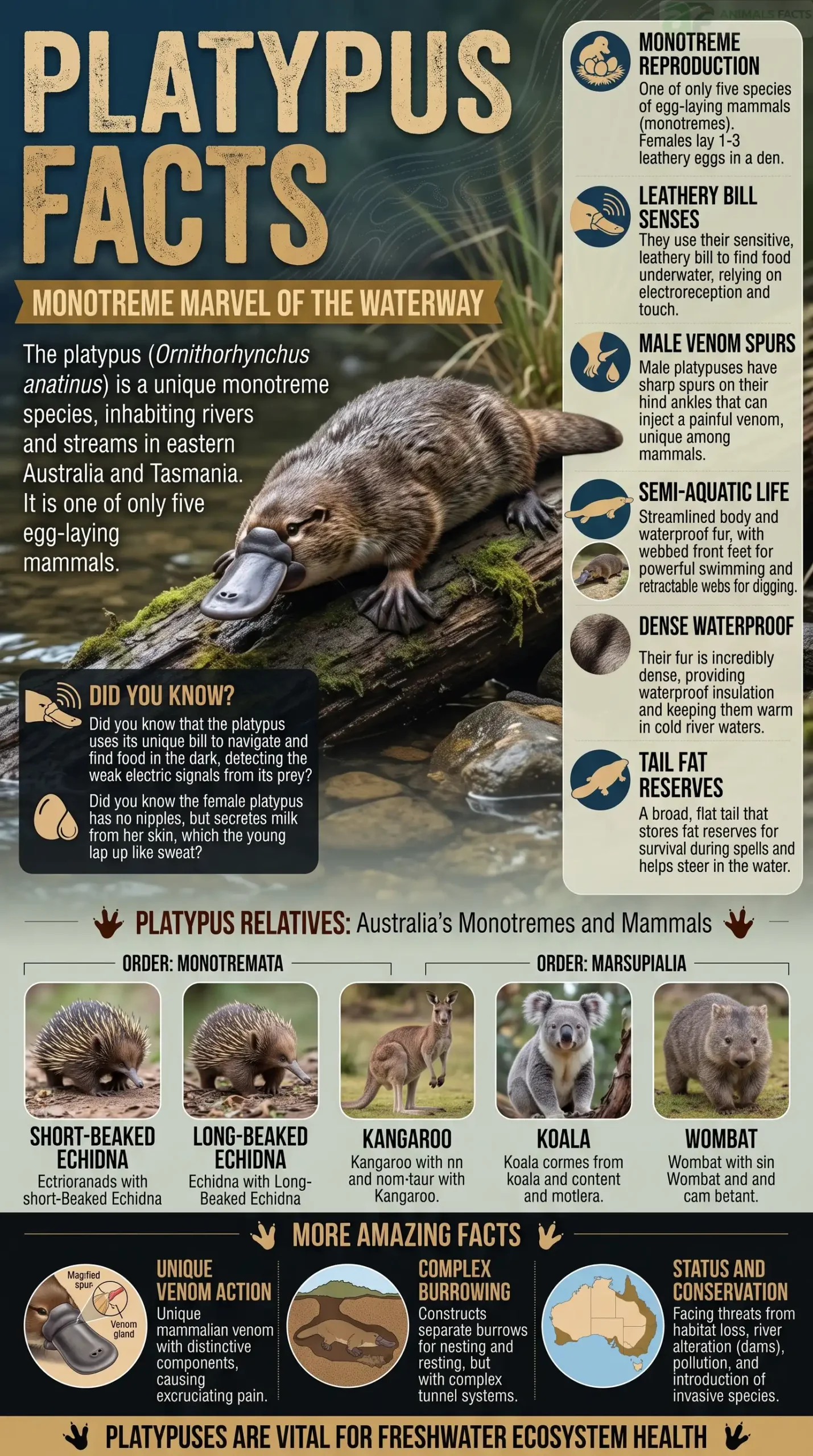
- Platypuses lay eggs — one of only five egg-laying mammal species on Earth
- Their bill has 40,000 electroreceptors — they hunt by detecting electrical fields
- Males are venomous — ankle spurs deliver morphine-resistant pain
- Their fur glows blue-green under UV light — discovered in 2020
- Platypus DNA is a mix of mammal, reptile, and bird genetic sequences
- They have no stomach — food goes straight from esophagus to intestine
- They have no nipples — milk seeps through porous skin
- Males have a four-headed penis — the most complex of any mammal
- Platypuses have 10 sex chromosomes — humans have only 2
- They detect prey by bioelectricity — not sight, sound, or smell while diving
- They are one of few animals showing REM sleep features while seemingly awake
- Modern platypuses have no teeth — ancient ancestors did
- Hatchlings are called puggles — they are the size of a kidney bean
- They can swim up to 9 km/h and dive for up to 30–40 seconds per dive
- 🇦🇺 Platypuses are found only in Australia and Tasmania — nowhere else on Earth
6. Natural Habitat of Platypus
The platypus is one of the world’s most geographically restricted large mammals — confined to the freshwater systems of eastern Australia and Tasmania, a range that has been contracting steadily due to drought, land clearing, and climate change.
Habitat Requirements
Platypuses are obligate freshwater animals — they require clean, well-oxygenated streams, rivers, and lakes with:
- Stable, earthen banks for burrowing
- Abundant aquatic invertebrate prey — typically indicative of healthy, unpolluted water
- Riparian vegetation (streamside plants) that provides bank stability and organic matter fueling invertebrate communities
- Water temperatures of approximately 5–25°C — they cannot survive in tropical or arid environments
- Sufficient water depth for diving and foraging — minimum approximately 30–40 cm
Platypuses spend approximately 12 hours per day in the water, making multiple foraging excursions separated by rest periods in burrows dug into stream banks. They are primarily nocturnal and crepuscular — most active at dawn, dusk, and overnight.
Platypus Habitat Range by Region
| Region | Status | Key Waterways | Notes |
|---|---|---|---|
| Queensland (eastern) | Present; patchy | Brisbane River, Burdekin tributaries | Northern range limit; drought-threatened |
| New South Wales | Present; declining | Murrumbidgee, Shoalhaven, Hunter Rivers | Significant drought and drought-related decline |
| Victoria | Present; stable in some areas | Yarra River, Snowy River, Murray tributaries | Best-studied Victorian populations |
| South Australia | Historical; functionally absent | Murray River (lower reaches) | Essentially extirpated from SA |
| Tasmania | Present; relatively healthy | Mersey, Huon, Derwent Rivers | Strongest remaining populations |
| King Island | Present; isolated | Small streams | Small, isolated population |
| Kangaroo Island | Introduced | Southern rivers | Introduced population for conservation |
Did You Know? Platypuses were once found throughout the Murray-Darling Basin — Australia’s largest river system — across a vast range including South Australia. Today, they have been effectively eliminated from much of this range due to water extraction, irrigation, and catastrophic droughts worsened by climate change. The Lower Murray, once platypus habitat, now rarely supports them.
7. Platypus Diet & Feeding Behavior
The platypus is a specialist invertebrate hunter — and its feeding system is one of the most sophisticated and unusual in the animal kingdom.
Diet Breakdown
| Prey Type | Estimated % of Diet | Notes |
|---|---|---|
| Aquatic insect larvae (mayfly, caddisfly, dragonfly) | ~40–50% | Primary prey in most populations |
| Freshwater shrimp and prawns | ~15–20% | Important in deeper water habitats |
| Freshwater crayfish (Cherax spp.) | ~10–15% | Higher in waterways with abundant yabbies |
| Worms and annelids | ~10–15% | Particularly important in flood periods |
| Small freshwater crustaceans | ~5–10% | Varied by season |
| Freshwater snails and bivalves | ~2–5% | Seasonal; habitat-dependent |
| Small fish (occasional) | ~<1% | Very rarely documented |
Hunting Strategy – Electroreception in Action
Platypus feeding behavior is one of the most remarkable hunting systems ever documented:
- The platypus enters the water and immediately closes its eyes, ears, and nostrils — sealed by muscular flaps
- It sweeps its bill from side to side in a precise, rhythmic arc while swimming
- The 40,000 electroreceptors in the bill detect the bioelectric fields generated by the muscle contractions of any invertebrate within approximately 20–30 cm
- The 60,000 mechanoreceptors detect pressure waves from moving prey simultaneously
- The bill’s two sensory maps overlay — the platypus triangulates exact prey position by comparing signal timing and intensity across the bill surface
- The platypus lunges at the precise location of the detected prey, scoops it up, and stores it in cheek pouches lined with hardened keratinous ridges
- It surfaces and grinds the prey with its keratinous dental pads — having no teeth — before swallowing
A single foraging session typically lasts 10–12 hours (overnight), during which the platypus makes 80 or more individual dives of 30–40 seconds each and may consume up to 20–30% of its body weight in prey.
8. Platypus Reproduction & Life Cycle
Platypus reproduction is among the most extraordinary in the mammalian world — blending features typically associated with reptiles, birds, and mammals in a system unlike anything else in vertebrate biology.
Mating Behavior
Mating occurs between July and October — spring in Australia’s Southern Hemisphere. Males seek females actively, and courtship involves:
- Pursuit swimming — males chase females through extended aquatic chases
- Tail-grasping — a male grips the female’s tail with his bill during pre-copulatory behavior
- No pair bonding — mating is promiscuous; females mate with multiple males and vice versa; males provide no parental care
Male-male competition during breeding season intensifies venom production — the primary adaptive purpose of the venom is believed to be deterring rival males in competition for females.
Egg Laying and Incubation
After mating, the female:
- Constructs a nesting burrow — up to 20 meters long, dug into a stream bank above water level, blocked by leaf plugs she pushes into place behind her as she retreats
- Lays 1–3 eggs (usually 2) approximately 28 days after mating — leathery, marble-sized eggs about 11 mm in diameter
- Incubates the eggs by curling around them with her tail for approximately 10 days — the shortest incubation period of any mammal that lays eggs
- Eggs hatch into puggles — tiny, pink, hairless hatchlings about 1.5 cm long and 0.5 g in weight
Nursing and Development
The female has no nipples — milk is secreted through patches of highly vascularized skin on her abdomen and pools in grooves where the puggles lap it from her fur. The milk is extraordinarily rich — containing proteins and antimicrobial compounds not found in any other mammal’s milk.
Puggles remain in the burrow for approximately 3–4 months, growing rapidly. They emerge from the burrow fully furred and functional at approximately 130–145 days old — already capable of swimming and foraging independently.
Lifespan Comparison
| Species | Wild Lifespan | Notes |
|---|---|---|
| Platypus (Ornithorhynchus anatinus) | 11–17 years | Oldest wild individual ~17 years; captive max ~21 years |
| Short-beaked echidna (Tachyglossus aculeatus) | Up to 45–50 years | Longest-lived monotreme; remarkable longevity |
| Water rat (rakali, Hydromys chrysogaster) | 3–4 years | Australian semi-aquatic rodent; shares some habitat |
| Common wombat (Vombatus ursinus) | Up to 26 years | Native Australian marsupial comparison |
| Quoll (Dasyurus spp.) | 2–5 years | Australian marsupial predator; shares range |
Did You Know? Platypus hatchlings are called puggles — and at birth they are approximately the size of a kidney bean, weighing less than half a gram. Despite this extraordinary start, they grow to full adult size within their first year — fueled by some of the most nutritionally concentrated mammalian milk ever analyzed, containing proteins and immune factors that protect the completely helpless young in their unsterilized burrow environment.
9. Social Behavior & Communication
Platypuses are profoundly solitary animals — among the least social of any mammal. Yet their behavior reveals sophisticated elements of communication and spatial awareness that belie their simple reputation.
Social Structure
Platypuses have overlapping home ranges but minimal direct social interaction. Key behavioral facts:
- Males maintain territories along stream sections — defending access to females during breeding season through venom-spur combat
- Females maintain smaller ranges centered on food-rich areas and nesting sites
- Overlap occurs between individuals without aggression outside breeding season — platypuses tolerate proximity when foraging density is high
- No group living — platypuses do not form pairs, family groups, or any persistent social unit beyond a mother and her puggles
Communication
Platypus communication is subtle and poorly understood — in part because they spend most of their active time underwater where their sensory system is entirely electroreceptive rather than acoustic or visual.
On land:
- Platypuses produce soft, gurgling vocalizations — particularly distressed animals make sounds compared to young puppies
- They leave olfactory marks (scent from cloacal glands) along burrow entrances — communicating identity and reproductive status to other individuals
Underwater:
- Communication may occur partially through electrical field modulation — whether platypuses can deliberately alter their bioelectric signatures to communicate information to other individuals is an active area of research as of 2026
Intelligence
Platypuses are considered moderately intelligent for mammals of their size:
- They demonstrate spatial memory — returning to productive foraging patches and remembering burrow locations across their range
- Captive individuals show problem-solving ability — learning to navigate mazes and unlock food containers in laboratory settings
- Their brains show REM sleep patterns — featuring the extended REM sleep proportions associated with learning and memory consolidation in other mammals; in fact, platypuses have among the highest proportion of REM sleep of any mammal
10. Predators & Defense Mechanisms
Platypuses face a range of natural and introduced predators — and their defense mechanisms reflect the particular vulnerabilities of an animal that must divide its time between aquatic and terrestrial environments.
Natural Predators
| Predator | Threat Level | Hunting Context |
|---|---|---|
| Water python (Liasis mackloti) | Medium | Aquatic ambush in northern range |
| Spotted-tail quoll (Dasyurus maculatus) | Medium | Terrestrial attack on platypus at burrow or on land |
| Wedge-tailed eagle (Aquila audax) | Low–Medium | Aerial attack during surface activity |
| Raptors (various) | Low | Opportunistic attack at water surface |
| Large freshwater eels (Anguilla spp.) | Low | Aquatic; potentially threatening to puggles |
| Fox (Vulpes vulpes, introduced) | High | Major threat; non-native predator; attacks at burrows |
| Dog (Canis lupus familiaris, domestic) | High | Very significant threat near human habitation |
| Cat (Felis catus, feral) | Medium | Attacks platypuses on land, particularly juveniles |
Defense Strategies
- Primary defense — avoidance — platypuses are highly cryptic and primarily nocturnal; most predator encounters are avoided entirely through timing and habitat selection
- Burrow protection — the nesting burrow’s length (up to 20 m) and leaf-plug blocking system provides significant protection for females and young
- Venom (males) — the ankle spur venom is the primary active defense of male platypuses against both predators and rival males; a platypus spur strike to a dog or fox can cause severe pain and disorientation
- Aquatic escape — when threatened on land, platypuses move immediately toward water and dive; their swimming speed (9 km/h) exceeds most terrestrial predators’ swimming ability
- Camouflage — the dark dorsal coloration and pale belly (counter-shading) reduces visibility both from above (aerial predators) and below (aquatic predators) simultaneously
11. Platypus Facts for Kids
Hey young explorers! The platypus is one of the weirdest and most wonderful animals on Earth — and all the truly amazing things about it are REAL, not made up! Here are some brilliant platypus facts just for you:
- The platypus was so strange when scientists first saw it that they thought someone had glued a duck’s bill onto a beaver’s body as a joke!
- Even though the platypus is a mammal like you, it lays eggs — just like a bird or a reptile!
- Baby platypuses are called puggles — and when they hatch, they’re smaller than your little fingernail!
- Instead of teeth, the platypus has rubbery pads in its bill that it uses to grind up food — like built-in kitchen equipment!
- Male platypuses have a secret weapon on their ankles — a sharp spur connected to a venom gland that can cause INCREDIBLE pain!
- Platypuses close their eyes, ears, and nose every time they dive underwater — and yet they can still find food perfectly, because their bill can detect the electricity that all living things produce!
- A platypus’s fur glows blue-green in the dark when you shine a special UV light on it — scientists only discovered this in 2020!
- The platypus has no stomach — food goes straight from its throat into its intestines, skipping the step that almost every other animal uses!
- Mother platypuses have no nipples — their babies drink milk that seeps right through the skin of their belly, like a sponge!
- Platypuses are found only in Australia — they live nowhere else on Earth!
12. Relationship with Humans
The platypus has had a relationship with humans stretching back tens of thousands of years — from the deep cultural significance it holds in Australian Aboriginal traditions, to the scientific revolution it triggered in European natural history, to its current role as a flagship species for Australian freshwater conservation.
Aboriginal Australians and the Platypus
For Aboriginal Australians, the platypus (biladurang in some languages; mallangong in others) has been a cultural and spiritual presence for tens of thousands of years. In some Dreamtime stories:
- The platypus was created when a water rat and a duck mated — combining the features of both animals
- It is associated with water, transition, and the mystery of things that exist between categories — as fitting a creature that seems to belong simultaneously to multiple animal groups
- Platypus was a food source for many Aboriginal communities — though typically hunted ceremonially rather than casually
The Scientific Revolution Platypuses Triggered
The platypus forced a complete reconceptualization of mammalian biology in European science:
- Its discovery challenged the definition of a mammal — an animal that gives birth to live young and nurses with milk. Platypuses do neither in the traditional way
- It helped establish that evolution is not progressive — the platypus is not a “primitive” animal stuck in an earlier evolutionary stage, but a highly specialized organism perfectly adapted to its environment
- In 1884, William Caldwell’s confirmation that platypuses lay eggs was significant enough to interrupt the British Association for the Advancement of Science annual meeting — his telegram was read aloud to the assembly, halting all other business
Modern Human Interactions
Platypuses do not attack humans under normal circumstances. However, male platypus venom spurs can cause envenomation if an animal is handled carelessly — incidents most commonly occur when platypuses are caught in fishing nets or handled by researchers. Venom causes:
- Intense, localized pain
- Severe swelling
- Possible temporary muscle weakness
- No known fatalities — but pain can persist for weeks to months and does not respond to standard pain management including opiates
Platypuses cannot be kept as household pets — they are protected under Australian law and are extremely difficult to maintain in captivity due to their complex dietary and environmental requirements.
13. Platypus Conservation Status & Threats
IUCN Status
The platypus is currently listed as Near Threatened by the IUCN (2016 assessment). However, multiple peer-reviewed studies published between 2019 and 2024 have called for an urgent upgrade to Vulnerable or Endangered — based on documented population declines of approximately 30% over the past 30 years and accelerating threats from climate change and drought.
A formal reassessment process was ongoing as of 2026.
Population Trend
| State / Region | Population Trend | Notes |
|---|---|---|
| Queensland | Declining | Drought, water extraction, warming |
| New South Wales | Declining significantly | Black Summer fires 2019–20; severe drought |
| Victoria | Mixed (stable/declining) | Some well-managed populations; others declining |
| Tasmania | Relatively stable | Cooler, wetter conditions; fewer pressures |
| South Australia | Functionally absent | Historical range; very occasional sightings |
| Australia-wide | ~30% decline since 1990s | Based on occupancy surveys and modeling |
Major Threats
| Threat | Impact Level | Details |
|---|---|---|
| Climate change and drought | Critical | Reduced river flows eliminate habitat and prey; increased frequency of drought events |
| Land clearing / riparian vegetation loss | Critical | Bank destabilization; loss of invertebrate prey base |
| Invasive predators (foxes, cats, dogs) | High | Major cause of adult mortality, particularly near human settlement |
| Water extraction for agriculture | High | Reduces stream flow below viable platypus habitat levels |
| Fishing nets and yabby traps | High | Entanglement and drowning; significant mortality in affected areas |
| Pollution | Medium | Agricultural runoff, sediment, algal blooms reduce prey availability |
| Impoundments and dams | Medium | Block migration; alter thermal and flow regimes |
| Disease | Medium | Fungal disease (Mucor amphibiorum) documented in Tasmanian populations |
| Road mortality | Low–Medium | Platypuses crossing roads near waterways; vehicle strike |
| Wildfires | High (acute events) | 2019–20 Black Summer fires directly impacted major platypus rivers |
14. Famous Platypuses
Dot – Melbourne Zoo’s Long-Term Ambassador
Dot was a female platypus held at Melbourne Zoo who became the subject of extended behavioral research in the 1990s and 2000s. Her long-term captive observation contributed substantially to understanding platypus feeding behavior, dive patterns, and burrow construction. Melbourne Zoo’s platypus enclosure — designed around research conducted with Dot’s cohort — became a model for platypus facilities worldwide.
Splash – The Taronga Pioneer
Splash was a male platypus at Sydney’s Taronga Zoo who survived in captivity for over 15 years — one of the longest-confirmed captive lifespans recorded. His longevity in captivity contributed critical data on platypus nutritional needs and health management, informing improved care protocols for other captive individuals.
Perry the Platypus – The Pop Culture Icon
Perry (Agent P) from the Disney animated series Phineas and Ferb is almost certainly the world’s most famous fictional platypus — a secret government agent who lives a double life as a seemingly ordinary pet. Perry’s extraordinary popularity (the show ran from 2007–2015 and was the highest-rated Disney Channel animated series of its era) introduced platypuses to a generation of children worldwide and sparked genuine interest in the real animal.
The William Caldwell Platypus
In 1884, naturalist William Caldwell killed and dissected platypus specimens near Burnett River, Queensland, to confirm their egg-laying status. His findings — sent by telegram to the British Association — were read aloud to the assembled meeting and immediately recognized as one of the most significant zoological discoveries of the 19th century. The specimens he examined effectively changed biology forever.
15. Role in Ecosystem & Food Chain
Ecological Position
The platypus is a specialist mid-trophic predator in Australian freshwater ecosystems — occupying a unique position as both a significant consumer of aquatic invertebrates and a prey species for several terrestrial and semi-aquatic predators.
Core Ecological Roles
Invertebrate population regulation — Platypuses consume enormous quantities of aquatic insects, crustaceans, and worms. Their intensive foraging (up to 30% of body weight per night) significantly regulates invertebrate community composition in the streams they inhabit. Streams with healthy platypus populations tend to have more diverse and balanced invertebrate communities than those without.
Indicator species — The platypus’s strict habitat requirements — clean water, stable banks, abundant invertebrate prey — make it an exceptional water quality indicator species. Healthy platypus populations signal healthy freshwater ecosystems; their disappearance from a waterway is one of the clearest early signals of ecological degradation. Australian water managers increasingly use platypus occupancy as a metric for river health assessment.
Nutrient cycling — Platypus foraging involves significant bioturbation — physical disturbance of stream-bed sediments while hunting — which releases nutrients and aerates sediment, maintaining the ecological conditions that support healthy invertebrate communities.
Cultural and economic value — Platypus ecotourism in locations like the Eungella National Park in Queensland and various Victorian streams generates significant revenue — providing economic incentive for landowners to maintain riparian vegetation and water quality.
16. Platypus Myths, Folklore & Cultural Significance
Aboriginal Dreamtime – The Animal Between Worlds
In several Aboriginal Australian Dreamtime traditions, the platypus occupies a uniquely important position as an animal that defies categorization — belonging to multiple worlds simultaneously. One widespread story tells of a young duck who was captured by a water rat (rakali) during its time on land. Their offspring became the first platypus — carrying the bill and webbed feet of the duck, the fur and body of the rat, and the ability to live in both worlds.
This origin story carries deep symbolic significance: the platypus represents harmony between separate realms, the acceptance of complexity, and the possibility of belonging to more than one world. In some traditions, the platypus is a totem animal — appearing to individuals at moments of transition, when one identity must be reconciled with another.
European Encounter – The Animal That Broke Science
The platypus’s impact on European natural history was nothing short of intellectually revolutionary. When it was first described in 1799, it forced scientists to confront the uncomfortable reality that their neat categories — mammal, reptile, bird — were human constructs, not natural laws. The platypus existed happily outside all of them.
This philosophical impact resonated beyond science. The platypus became a recurring metaphor in Victorian philosophy and literature for the existence of hybrid, paradoxical, or unclassifiable things — cited in essays on identity, epistemology, and the nature of knowledge.
Platypus National Symbol
The platypus appeared on Australia’s 20-cent coin from 1966 (decimalization) through to the present day — a position reflecting its status as one of the most iconic of Australia’s unique wildlife. It has appeared on postage stamps, banknotes, and logos across Australia and serves as a powerful symbol of the country’s commitment to its extraordinary and unique natural heritage.
17. Platypus in Pop Culture
Film and Television
- Phineas and Ferb (Disney Channel, 2007–2015) — Perry the Platypus (Agent P) is the series’ breakout character; the show won multiple Emmy Awards and introduced platypuses to global audiences on an unprecedented scale
- David Attenborough’s Natural Curiosities (2013, BBC) — Episode “Nature’s Misfits” features extraordinary footage of platypus electroreception and foraging, narrated by Attenborough
- Australia’s Wild Oddities (various, National Geographic) — platypus features in multiple episodes documenting its hunting behavior and reproductive biology
- Platypus (IMAX, 2012) — dedicated IMAX documentary covering platypus biology and conservation in stunning detail
Books
- Platypus: The Extraordinary Story of How a Curious Creature Baffled the World — Ann Moyal (2004) — the definitive popular science account of the platypus’s impact on scientific history
- A Platypus, Perhaps — various children’s authors; multiple illustrated children’s books on the platypus
- The Platypus and Other Animals That Defy Scientific Classification — various natural history compilations
Internet Culture
- The platypus regularly appears in internet meme culture as a symbol of things that defy categorization or expectations — “just like a platypus” became a meme format expressing pleasant surprise at the coexistence of seemingly contradictory features
- “Platypus are basically just ducks with beaver bodies and venom” viral Twitter/X threads regularly resurface, each time introducing platypus facts to a new wave of astonished readers
- Platypuses appear extensively in YouTube natural history content — videos of platypus foraging and electroreception demonstrations routinely accumulate millions of views
18. Platypus Facts vs. Common Myths
| Myth | Fact |
|---|---|
| “The platypus is a primitive, simple animal” | The platypus is extraordinarily specialized — it has the most sophisticated passive electroreception system of any mammal and a venom system of remarkable biochemical complexity |
| “All platypuses have venom spurs” | Only males have functional venom spurs; females have vestigial, non-functional remnants |
| “The platypus bill is like a duck’s bill” | The platypus bill is made of soft, leathery skin packed with electroreceptors — nothing like a duck’s hard keratin bill |
| “Platypuses are endangered” | They are currently Near Threatened — though some researchers argue the status should be upgraded to Vulnerable or Endangered |
| “Platypuses can be kept as pets” | Illegal in Australia; virtually impossible to maintain in captivity due to complex dietary and environmental needs |
| “Platypus venom can kill you” | Platypus venom is not lethal to humans but causes excruciating, long-lasting pain resistant to standard pain management |
| “The platypus doesn’t really lay eggs — that’s a myth” | Completely false — the platypus absolutely lays eggs; this was confirmed definitively in 1884 and is one of its most thoroughly documented features |
| “Platypuses use their bill like a probe to dig” | Platypuses use their bill primarily as a sensory organ, not a digging tool; they use their claws for digging |
| “Baby platypuses are born live” | False — puggles hatch from leathery eggs after approximately 10 days of incubation |
| “The platypus swims with all four legs” | Platypuses propel themselves using only their front legs — the hind legs trail and are used for steering |
19. Best Places to See Platypuses in the Wild
- Eungella National Park, Queensland — The most reliable platypus-watching location in Australia. The Broken River at Eungella has resident platypuses visible year-round from dedicated viewing platforms at dawn and dusk. Widely considered the best platypus spotting destination in the world.
- Yarra River, Melbourne, Victoria — Platypuses have been recorded in the upper Yarra River and its tributaries within striking distance of Melbourne’s city limits. Warrandyte State Park and Healesville Sanctuary (which houses captive platypuses for up to close-up viewing) are both accessible day trips.
- Tidbinbilla Nature Reserve, Australian Capital Territory — A managed reserve with excellent platypus habitat and active monitoring programs. Dawn and dusk walks along Tidbinbilla’s creek systems reliably produce platypus sightings, with ranger-guided tours available seasonally.
- Cradle Mountain–Lake St Clair National Park, Tasmania — Tasmania’s robust platypus populations make this World Heritage wilderness park an excellent location. Platypuses are frequently seen foraging in the park’s rivers and lakes at dawn and dusk year-round.
- Snowy Mountains region, New South Wales — The upper Snowy River and its tributaries in and around Kosciuszko National Park support healthy platypus populations. The clean, cold mountain streams provide ideal habitat, and wildlife walks in the Jindabyne area reliably produce sightings.
- Lamington National Park, Queensland — Old rainforest streams in this subtropical plateau national park support platypus populations accessible on guided wildlife walks. The O’Reilly’s Rainforest Retreat area offers excellent early morning viewing opportunities.
- Grampians National Park (Gariwerd), Victoria — Creek systems in the Grampians support platypuses accessible to patient observers at dawn. The park’s MacKenzie Falls and surroundings are particularly productive sighting locations in spring and summer.
20. How You Can Help
The platypus’s future depends on decisions being made right now — about water management, land use, invasive predator control, and climate action. Here is what you can do:
- Support Australian platypus conservation organizations — Platypus Conservation Initiative (platypusconservation.org) and Australian Platypus Conservancy (platypus.asn.au) fund critical research, citizen science monitoring, and habitat restoration
- Report platypus sightings — Contribute to monitoring through PlatypusSPOT (platypusspot.net) — a citizen science platform that collects platypus occurrence data used directly in conservation planning
- Advocate for yabby trap restrictions — Enclosed funnel-shaped yabby traps (opera house nets) are one of the most significant sources of platypus drowning mortality. Support and advocate for Opera House Net bans in your state — already enacted in Victoria and several other regions
- Support riparian revegetation — Organizations like Landcare Australia (landcareaustralia.com.au) run riverbank revegetation programs that directly improve platypus habitat; volunteer or donate
- Choose water-efficient farming products — Agricultural water extraction is a major threat; supporting sustainable farming practices and water policy reform directly benefits platypus habitat
- Control domestic dogs and cats — Keep dogs on leashes near waterways; support feral cat control programs
- Support climate action — The Australian government’s climate and water policy directly determines the future of the Murray-Darling Basin and hundreds of platypus-inhabited waterways
21. Top Documentaries & Books
Must-Watch Documentaries
- David Attenborough’s Natural Curiosities (2013, BBC Two) — “Nature’s Misfits” episode; Attenborough explores platypus evolution and electroreception with characteristic brilliance
- Wild Australia with Ray Mears (2013) — Features platypus foraging behavior and habitat in Queensland; excellent field sequences
- Australia’s First 4 Billion Years (2013, NOVA/PBS) — Includes extensive coverage of monotreme evolution and platypus biology in evolutionary context
- Untamed Australia (various, National Geographic) — Multiple episodes featuring platypus in the context of Australia’s unique fauna
- The Platypus (2012, IMAX) — Dedicated documentary available in some natural history museum theaters; finest platypus footage ever assembled
Must-Read Books
- Platypus: The Extraordinary Story of How a Curious Creature Baffled the World — Ann Moyal (2004) — the single best popular science book on the platypus; covers history, science, and conservation beautifully
- A Gap in Nature: Discovering the World’s Extinct Animals — Tim Flannery (2001) — includes discussion of threatened Australian monotremes and marsupials
- The Future Eaters — Tim Flannery (1994) — essential reading on Australian ecological history; platypus features prominently in discussions of freshwater ecology
- Furred Animals of Australia — A.S. Troughton — classic reference including detailed platypus accounts
- Australia’s Mammal Heritage — various contributors; comprehensive modern reference including platypus biology and conservation
22. Comparison with Similar Species
| Feature | Platypus | Short-beaked Echidna | Water Rat (Rakali) |
|---|---|---|---|
| Scientific Name | Ornithorhynchus anatinus | Tachyglossus aculeatus | Hydromys chrysogaster |
| Order | Monotremata | Monotremata | Rodentia |
| Length | 30–63 cm | 30–45 cm | 31–39 cm |
| Weight | 0.7–2.4 kg | 2–7 kg | 0.6–1.3 kg |
| Egg-laying | Yes | Yes | No |
| Venom | Males: yes (ankle spur) | No | No |
| Bill / Snout | Soft leathery bill; electroreceptors | Long pointed snout; electroreceptors | Short, blunt snout |
| Habitat | Freshwater streams, rivers | Terrestrial; forests and grasslands | Freshwater streams, estuaries |
| Diet | Aquatic invertebrates | Ants, termites, earthworms | Fish, crustaceans, insects |
| Swimming | Expert swimmer | Poor swimmer; can float | Expert swimmer |
| Conservation | Near Threatened | Least Concern | Least Concern |
| Lifespan | 11–17 years | Up to 45–50 years | 3–4 years |
23. Frequently Asked Questions About Platypus Facts
Q1: What is the platypus’s scientific name?
The platypus’s scientific name is Ornithorhynchus anatinus — from the Greek ornitho (bird) + rhynkhos (beak or snout) and the Latin anatinus (duck-like), meaning “duck-like bird-snout.” It was formally described by the German naturalist George Shaw in 1799 in the publication Naturalist’s Miscellany, based on a specimen sent from New South Wales. The platypus belongs to the order Monotremata and the family Ornithorhynchidae — it is the only living species in its genus.
Q2: Is the platypus venomous?
Yes — but only males. Male platypuses have a hollow, keratinous spur on each hind ankle connected to a crural gland that produces venom. The venom contains over 80 different protein compounds — including defensin-like proteins normally found only in reptile venoms — and causes intense, localized pain, swelling, and potentially temporary muscle weakness in humans. Platypus venom is notably resistant to standard pain management including opiates. It is not lethal to humans but can cause symptoms that persist for weeks to months. Venom production increases during breeding season, suggesting its primary function is in male competition rather than defense or hunting.
Q3: Does the platypus really lay eggs?
Yes — absolutely. The platypus is one of only five monotreme species (egg-laying mammals) alive today. Females lay 1–3 leathery eggs (usually 2) approximately 28 days after mating. Eggs are about 11 mm in diameter — roughly marble-sized — and are incubated by the female curling around them with her tail for approximately 10 days. Hatchlings (called puggles) are about 1.5 cm long at hatching. This was confirmed definitively by naturalist William Caldwell in 1884, whose telegram announcing the discovery interrupted a meeting of the British Association for the Advancement of Science.
Q4: How does the platypus find food?
The platypus hunts using electroreception — the detection of bioelectric fields generated by the muscle contractions of prey animals. Its bill contains approximately 40,000 electroreceptors and 60,000 mechanoreceptors — when diving, the platypus closes its eyes, ears, and nostrils entirely and sweeps its bill from side to side, detecting electrical signals from invertebrates buried in mud or hidden under rocks at distances of up to 30 cm. It is one of the most sophisticated passive electroreception systems of any vertebrate on Earth — more sensitive than that of sharks in some respects.
Q5: Is the platypus endangered?
The platypus is currently listed as Near Threatened by the IUCN. However, populations have declined by an estimated 30% over the past 30 years, and multiple studies published between 2019 and 2024 have recommended upgrading its status to Vulnerable or Endangered. A formal reassessment was underway as of 2026. Key threats include climate change and drought, land clearing, invasive predators (foxes, feral cats, dogs), and fishing net entanglement.
Q6: Do platypuses have teeth?
Modern adult platypuses have no teeth — they grind food with keratinous pads that replace the teeth. Fascinatingly, juvenile platypuses briefly develop vestigial teeth before these are shed and replaced by the keratinous pads. Ancient platypus relatives — such as the 25-million-year-old Obdurodon — had fully functional molar teeth, suggesting platypuses lost their dentition evolutionarily as they specialized in consuming invertebrates that could be efficiently ground without conventional teeth.
Q7: Can platypuses be kept as pets?
No — platypuses cannot legally be kept as pets anywhere in Australia or the world. They are protected under Australian and international law. Beyond legality, platypuses are extraordinarily difficult to maintain in captivity — requiring large volumes of living prey (invertebrates), specific water conditions, complex burrow systems, and extensive space. Most zoos that attempt to house them struggle to do so successfully, and long-term captive survival beyond the wild average is uncommon.
Q8: What is the platypus’s genome like?
The platypus genome, fully sequenced in 2008, is one of the most remarkable ever characterized. It contains approximately 2.2 billion base pairs encoding around 18,500 genes — and includes sequences resembling those of mammals, reptiles, and birds simultaneously. Notably, platypus sex chromosomes (10 of them — males are XYXYXYXYXY; females are XXXXXXXXXX) share homology with bird sex chromosomes, not with those of other mammals. This extraordinary genome reflects the platypus’s ancient, independent evolutionary trajectory — separated from all other mammal lineages for approximately 166 million years.
Q9: How do platypuses nurse their young without nipples?
Female platypuses have no nipples — instead, they have specialized patches of highly vascularized skin on their abdomen through which milk is secreted. The milk seeps through these skin patches and pools in grooves or along fur where the puggles lap it up directly from the mother’s skin. Platypus milk is extraordinarily rich and contains immune factors and antimicrobial proteins not found in the milk of any other mammal — adaptations for protecting completely helpless young in the exposed burrow environment.
Q10: Why does platypus fur glow under UV light?
In 2020, scientists at Northland College in Wisconsin discovered that platypus fur fluoresces blue-green under ultraviolet light — a phenomenon called biofluorescence. Under normal visible light, platypus fur appears dark brown. Under UV illumination, it emits a vivid blue-green glow. The precise biological function of this fluorescence is not yet fully understood — hypotheses include nocturnal communication between individuals, species recognition, or simply a by-product of the chemical composition of platypus fur with no specific adaptive function. The platypus joins a small number of fluorescing mammals including flying squirrels, opossums, and springhares.
24. Sources & References
Research Sources
- Wikipedia — Platypus, Ornithorhynchus anatinus, Monotremata, Platypus venom, Platypus electroreception
- IUCN Red List — iucnredlist.org (platypus Near Threatened assessment; population trend data)
- National Geographic — nationalgeographic.com (platypus biology, electroreception, UV fluorescence)
- Smithsonian Institution — si.edu (monotreme evolutionary history; platypus taxonomy)
- Animal Diversity Web — animaldiversity.org (University of Michigan)
- BBC Wildlife — bbc.co.uk/nature (David Attenborough’s Natural Curiosities; platypus sequences)
- Britannica — britannica.com/animal/platypus
- Live Science — livescience.com (platypus genome; UV fluorescence discovery 2020; venom research)
- Australian Platypus Conservancy — platypus.asn.au (population data; conservation programs)
- PNAS (Proceedings of the National Academy of Sciences) — Warren et al. (2008) platypus genome paper; Helm et al. (2020) UV fluorescence discovery
- CSIRO (Commonwealth Scientific and Industrial Research Organisation) — csiro.au (platypus research programs)
- Gilad Bino et al. — University of New South Wales; population decline studies 2019–2024
- NOAA / international venom research databases — platypus venom biochemistry
- Ann Moyal — Platypus: The Extraordinary Story of How a Curious Creature Baffled the World (2004)