
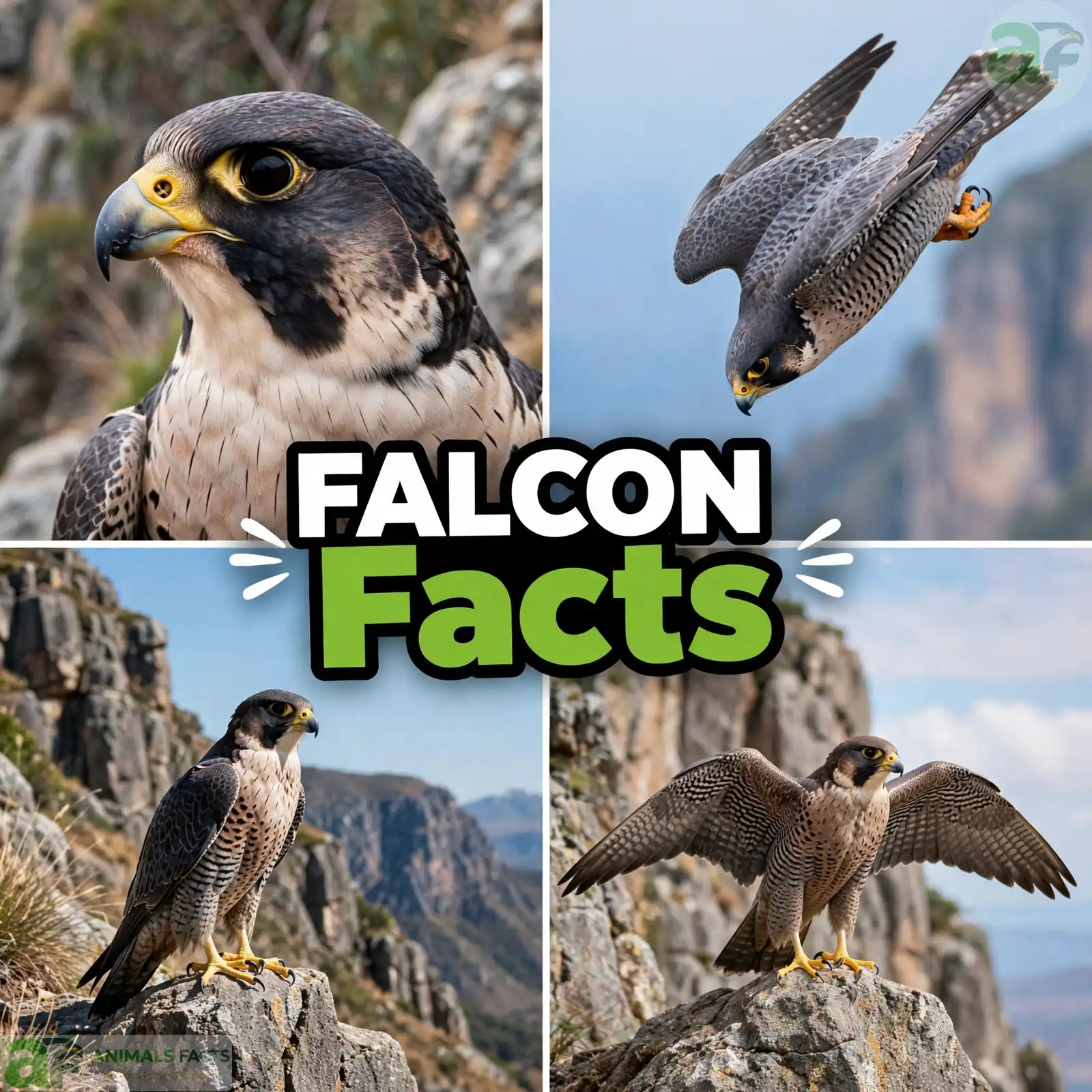
Falcon Facts
| Feature | Details |
|---|---|
| Primary Scientific Group | Family Falconidae; genus Falco (true falcons — approximately 40 species) |
| Kingdom | Animalia |
| Phylum | Chordata |
| Class | Aves |
| Order | Falconiformes |
| Family | Falconidae |
| Common Names | Falcon; peregrine; kestrel; merlin; hobby; prairie falcon; gyrfalcon; saker; lanner |
| Native Range | Every continent except Antarctica — falcons are among the most globally distributed birds |
| Habitat | Open sky above virtually every habitat — coast, city, mountain, tundra, desert, grassland, forest edge |
| Lifespan | 7–25 years (wild, varies by species); up to 25 years (captivity) |
| Diet | Primarily birds (most species); also bats, insects, small mammals — aerial hunters |
| Body Length | 15–65 cm — from the tiny Philippine falconet to the massive gyrfalcon |
| Wingspan | 29–135 cm — dramatic size range across the family |
| Weight | 35 grams (smallest falconets) to 2.1 kg (large female gyrfalcon) |
| Top Speed | Peregrine falcon stoop: 389 km/h — the fastest measured speed of any animal on Earth |
| Conservation Status | Ranges from Least Concern (most species) to Critically Endangered (some island species) |
| Defining Feature | Tomial tooth — a notch on the upper mandible unique to falcons; long, pointed wings producing the characteristic swept-back flight silhouette |
| Most Famous Species | Peregrine falcon (Falco peregrinus) — fastest animal on Earth; global distribution; dramatic DDT recovery |
| Closest Relatives | Parrots and songbirds — falcons are more closely related to parrots than to hawks or eagles |
 1. Introduction: What is a Falcon?
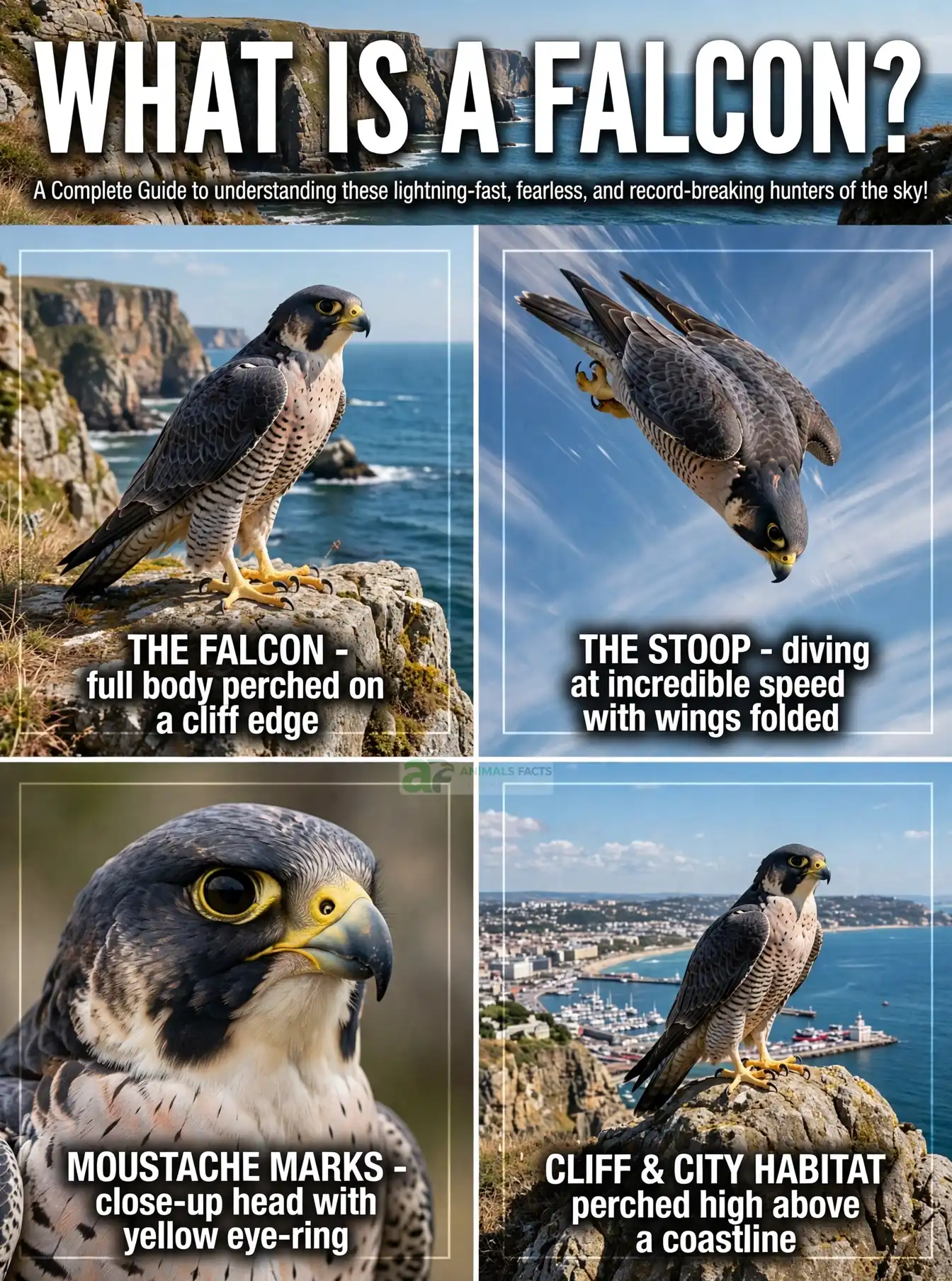
On a cliff face above a Scottish estuary, a female peregrine falcon sits on her nest ledge with the composed authority of an animal that has occupied the apex of this particular ecological niche for 3.5 million years. She weighs approximately one kilogram. Below her, several hundred meters down the estuary, a flock of dunlin — small shorebirds, each weighing approximately 50 grams — feeds along the tideline, performing the tight, synchronized flock maneuvers that are the small bird’s primary defense against aerial predators. The peregrine launches. The first phase of the stoop is deceptively gentle — a soaring bank that builds into a descending glide, the wings folding progressively back as speed accumulates. At the transition from glide to full stoop, something extraordinary happens: the aerodynamics shift, the body tightens into the most streamlined biological package that 3.5 million years of selection for aerial speed could produce, and the falcon begins to fall at speeds that approach — at their measured maximum — 389 kilometers per hour. The dunlin flock explodes in every direction simultaneously. One bird separates from the flock by a fraction of a second. The peregrine’s trajectory has been calculated — not consciously but through neural processing that integrates multiple spatial and temporal streams simultaneously — and the strike is delivered not at where the dunlin currently is but at where it will be when the peregrine’s foot arrives. Falcon facts begin with this calculation, this speed, this extraordinary convergence of biological physics and aerial precision at the intersection of predator trajectory and prey evasion.
The falcons — family Falconidae, comprising approximately 65 species including the true falcons (genus Falco, approximately 40 species), the caracaras, falconets, and forest falcons — represent one of the most biologically extraordinary groups of birds in the world. They are defined by a cluster of characteristics that separate them fundamentally from the hawks and eagles: the tomial tooth (a notch on the upper mandible used to sever prey’s spinal cord — found in no other bird group); the long, pointed wings that produce the characteristic swept-back, anchor-like silhouette in flight; and above all, the aerial hunting system that has been refined over millions of years to a precision and a speed unmatched by any other predatory system on Earth. The peregrine falcon’s 389 km/h measured stoop speed is not merely the fastest bird flight — it is the fastest measured speed of any animal on Earth, period.
Interesting facts about falcons reveal an animal group of breathtaking biological sophistication — the molecular phylogeny result that places falcons closer to parrots than to hawks or eagles (one of the most surprising discoveries in recent ornithological science); the peregrine falcon’s extraordinary DDT recovery story (perhaps even more dramatic than the bald eagle’s, as the bird went from extinction across most of its range to nesting on nearly every major city’s skyscrapers within three decades); the kestrel’s unique hovering behavior — the only European raptor that can truly hover by facing into the wind and matching wind speed with flight speed; the gyrfalcon that can intercept prey at horizontal speeds rather than vertical stoops — the apex predator of the Arctic tundra using a different tactical system from the peregrine’s; the extreme physiological adaptations that allow a peregrine to survive a 389 km/h stoop — from the nasal baffles that prevent lung collapse from hypersonic airflow to the nictitating membrane that protects the eye during the strike; and the 4,000-year falconry tradition that has made the peregrine falcon the most culturally significant bird in the history of human-animal relationships outside of domestic animals. Whether you are searching for falcon facts for kids to explore the physics of the fastest animal on Earth, an ornithologist studying the extraordinary sensory and neurological systems that make aerial predation at 389 km/h possible, a falconer whose partnership with a peregrine or gyrfalcon has opened a window into raptor consciousness, or simply someone who witnessed a peregrine stoop for the first time and experienced the involuntary recognition that you had just seen something that natural selection had been building toward for millions of years — this is your comprehensive guide. The world’s fastest animals have an extraordinary story to tell.
2. Falcon Species Overview & Classification
The falcons occupy one of the most surprising positions in the modern avian evolutionary tree — their closest relatives being not the hawks and eagles they superficially resemble but the parrots and songbirds that share their order in the most recent molecular phylogenetic reconstructions.
Species Classification Table — Peregrine Falcon (Primary Focus Species)
| Taxonomic Rank | Classification |
|---|---|
| Kingdom | Animalia |
| Phylum | Chordata |
| Class | Aves |
| Order | Falconiformes |
| Family | Falconidae (Leach, 1820) |
| Genus | Falco (Linnaeus, 1758) |
| Species | F. peregrinus (Tunstall, 1771) |
| Common Names | Peregrine falcon; duck hawk (historical North American name) |
| Etymology | Falco from Latin falx = “sickle” — referring to the curved claws or the sickle-like wing profile; peregrinus = “wandering” or “pilgrim” (Latin) — the peregrine is one of the most widely distributed birds on Earth |
The Shocking Evolutionary Revelation
One of the most significant discoveries in 20th-century ornithology — confirmed by molecular genetic analysis:
The traditional assumption — For most of ornithological history, falcons were classified alongside hawks and eagles in the order Accipitriformes — the logical placement based on their predatory lifestyle, hooked bills, and raptorial feet.
The molecular revelation — DNA-DNA hybridization studies in the 1980s and subsequent comprehensive molecular phylogenetic analyses in the 2000s–2010s revealed that falcons are not closely related to hawks and eagles at all. The current consensus places the order Falconiformes as the sister group to Psittaciformes (parrots) and Passeriformes (songbirds) — meaning that falcons share a more recent common ancestor with a macaw or a crow than with a red-tailed hawk.
The implication — The raptorial characteristics of falcons and hawks — hooked bills, powerful talons, forward-facing eyes, predatory behavior — evolved independently in two completely separate lineages. The convergent evolution of essentially the same predatory bird body plan in two unrelated groups is one of the most striking examples of evolutionary convergence in the history of vertebrate biology.
The Falconidae Family — All Groups
| Group | Genera | Species Count | Range | Notable |
|---|---|---|---|---|
| True falcons | Falco | ~40 species | Worldwide | Fastest animals on Earth |
| Caracaras | Caracara, Daptrius, others | ~11 species | Americas | Opportunistic omnivores |
| Forest falcons | Micrastur | ~8 species | Neotropics | Forest-interior hunters |
| Falconets | Microhierax, Polihierax | ~8 species | Asia, Africa | World’s smallest raptors |
| Laughing falcon | Herpetotheres | 1 species | Americas | Snake specialist |
Major Falco Species — The True Falcons
| Species | Common Name | Weight | Wingspan | Range | Notable Feature |
|---|---|---|---|---|---|
| Falco peregrinus | Peregrine falcon | 0.5–1.5 kg | 74–120 cm | Worldwide | Fastest animal on Earth — 389 km/h |
| Falco rusticolus | Gyrfalcon | 0.8–2.1 kg | 105–135 cm | Arctic circumpolar | Largest falcon; horizontal speed specialist |
| Falco cherrug | Saker falcon | 0.7–1.3 kg | 97–126 cm | Eurasia, Middle East | Primary falconry bird of the Middle East |
| Falco biarmicus | Lanner falcon | 0.5–0.9 kg | 95–105 cm | Africa, Middle East, S. Europe | Aggressive; cooperative hunting documented |
| Falco mexicanus | Prairie falcon | 0.4–1.1 kg | 88–113 cm | Western North America | Ground mammal specialist |
| Falco tinnunculus | Common kestrel | 0.15–0.25 kg | 65–82 cm | Europe, Asia, Africa | UV detection; wind hovering |
| Falco columbarius | Merlin | 0.15–0.23 kg | 50–73 cm | N. Hemisphere boreal | Fastest small falcon |
| Falco subbuteo | Eurasian hobby | 0.16–0.34 kg | 70–92 cm | Europe, Asia, Africa | Catches dragonflies and swifts in flight |
| Falco sparverius | American kestrel | 0.08–0.16 kg | 51–61 cm | Americas | Smallest North American falcon; declining |
| Falco naumanni | Lesser kestrel | 0.09–0.18 kg | 63–72 cm | Mediterranean, C. Asia | Colonial; insectivore |
19 Recognized Peregrine Subspecies
The peregrine falcon holds the distinction of being one of the most widely distributed bird species on Earth — and this extraordinary global distribution has produced remarkable geographic diversity:
| Subspecies Group | Range | Notable Features |
|---|---|---|
| F. p. peregrinus | Europe, Central Asia | Nominate; medium-sized |
| F. p. anatum | North America | “Duck hawk”; recovering from DDT |
| F. p. tundrius | Arctic Canada, Greenland | Pale; migratory |
| F. p. pealei | Pacific Northwest, Aleutians | Largest; darkest |
| F. p. macropus | Australia | Unique hunting adaptations |
| F. p. calidus | Russian tundra | Pale; long-distance migrant |
| — and 13 more — | Various | Each adapted to local conditions |
Evolution & Discovery Timeline
~65 million years ago (Late Cretaceous/Early Paleocene) — The ancestral Falconidae lineage diverges from the lineage leading to parrots — establishing the evolutionary trajectory that will eventually produce the falcon family.
~30 million years ago (Oligocene) — The Falco genus begins to diversify — establishing across the expanding open landscapes of the Oligocene-Miocene world.
~3.5 million years ago (Pliocene) — The peregrine falcon lineage achieves something close to its modern form — fossil evidence from North America and Europe documenting essentially modern peregrine anatomy.
Earliest human records — Falconry with falcons in Central Asia and the Middle East documented in texts and artifacts from approximately 2000 BCE — the beginning of the 4,000-year human-falcon relationship.
1758 — Linnaeus formally describes the common kestrel and various other falcon species in Systema Naturae.
1771 — The peregrine falcon formally described by Marmaduke Tunstall as Falco peregrinus.
1940s–1960s — DDT causes catastrophic peregrine population collapse across the Northern Hemisphere — the species eliminated from essentially the entire eastern United States and severely reduced across Europe.
1970 — The landmark Peregrine Falcon Survey documents the catastrophic scale of the DDT population collapse — providing the scientific evidence that drives the DDT ban.
1972 — DDT banned in the United States — the essential first step of the peregrine’s recovery.
1974 — The Peregrine Fund established at Cornell University — the organization that will lead captive breeding and reintroduction of the peregrine across North America.
1999 — The peregrine falcon removed from the US Endangered Species List — the most dramatic raptor recovery documented in North American history.
2005 — Molecular phylogenetic analysis confirms falcons are more closely related to parrots than to hawks — one of the most surprising findings in modern ornithology.
2024 — Peregrine falcons breed in every major city in North America and Europe; the global population is estimated at approximately 120,000 pairs; the species is classified as Least Concern.
“The peregrine falcon is the most extraordinary product of natural selection’s 65 million years of work on the problem of aerial predation. Everything about it — the aerodynamics, the visual system, the neurological processing speed, the physiological adaptations to withstanding forces that would destroy most biological structures — is the answer to one question: how fast can a predatory bird go, and still be able to hit something? The answer is 389 kilometers per hour. And even at that speed, the peregrine hits its target.”
— Dr. Tom Cade, founder of The Peregrine Fund — the ornithologist who led the peregrine’s recovery from DDT-driven near-extinction
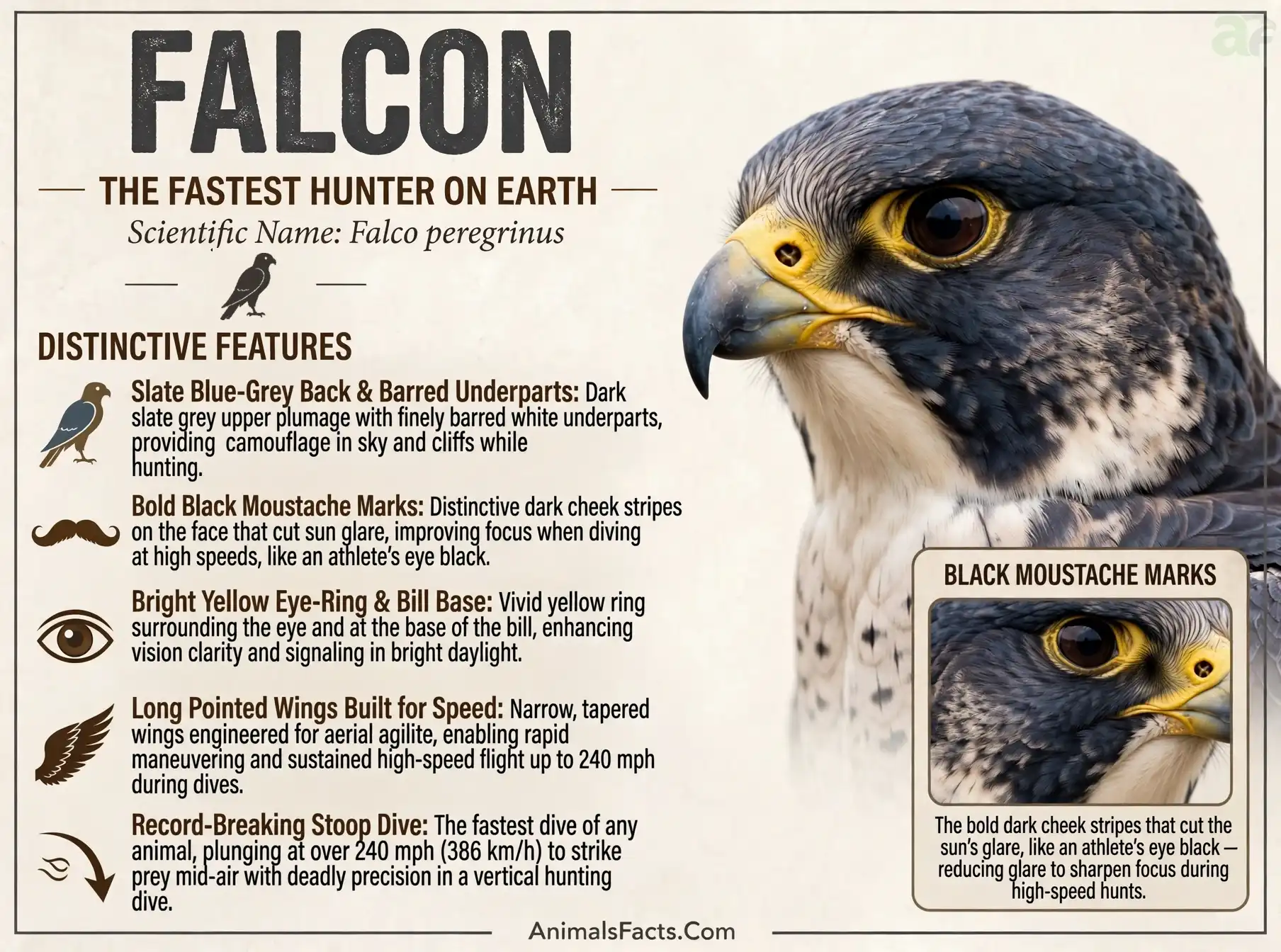
3. Falcon Physical Description & Unique Features
The falcon’s physical design is the most aerodynamically refined of any bird — every structural element contributing to the combination of speed, maneuverability, and strike precision that defines the group’s ecological strategy.
The Tomial Tooth — The Definitive Falcon Structural Feature
The tomial tooth is the single anatomical feature that unambiguously distinguishes all true falcons from all hawks, eagles, and other raptors:
What it is — A notch or projection on the cutting edge (tomium) of the upper mandible — creating a tooth-like structure that fits into a corresponding notch in the lower mandible when the bill is closed. The tomial tooth is present in all Falco species and absent in all Accipitridae (hawks and eagles).
What it does — The tomial tooth is used to sever the cervical vertebrae (neck bones) of prey — a killing bite delivered to the base of the skull or back of the neck after the prey has been struck by the falcon’s feet and is being held. The severing of the cervical spine produces immediate death through spinal cord severance — a rapid kill mechanism absent in hawks and eagles, which rely on grip force and suffocation from their talons.
The evolutionary significance — The tomial tooth is one of the clearest examples of a unique structural adaptation to a specific predatory function — the falcon’s killing bite is categorically different from the hawk’s killing grip, and the anatomical difference between the two groups reflects this functional difference.
The Wings — The Speed Engine
The falcon’s wings are the most aerodynamically specialized flight surfaces of any bird:
Long and pointed — The most immediately visible characteristic; falcon wings in flight create the distinctive swept-back, sickle-shape or anchor-shape silhouette that makes falcons immediately identifiable from below. This pointed wing tip reduces drag at high speed.
High aspect ratio in fast flight — When a peregrine enters the high-speed phase of a stoop, the wings are swept back progressively — reducing the effective wingspan and therefore drag while maintaining control through the high-speed descent. At maximum stoop speed, the wings are swept back so far that they appear almost fused with the body.
The primary feather structure — The outer primary feathers of fast-flying falcons have modified leading-edge structures that reduce turbulence at high speed — a passive aerodynamic feature analogous to engineering solutions in high-speed aircraft design.
Wing loading — Falcons have higher wing loading than most other raptors (more body mass per unit of wing area) — meaning they must fly faster to maintain lift. This characteristic predisposes them toward fast flight rather than slow soaring.
The Eyes — The Targeting System
The falcon eye is the most sophisticated optical and neurological targeting system in the animal kingdom:
Visual acuity — Peregrine falcons have been estimated to have visual acuity of approximately 2.6 times that of humans at the fovea — resolving detail at distances far beyond human capability.
The deep fovea — Unlike the relatively shallow foveal pit of human eyes, falcon foveas are extremely deep — the depth of the pit concentrating light on the photoreceptors and enhancing effective acuity beyond what photoreceptor density alone would produce.
Two foveas — Like other raptors, falcons have two foveas — one for forward binocular vision (prey targeting) and one for lateral monocular vision (wide-field scanning). The interaction between these two foveal systems gives falcons both exceptional long-range detection capability and precision targeting at close range.
The intercept calculation — The most extraordinary visual-neurological achievement of the peregrine; the bird does not simply fly toward the prey’s current position but calculates an intercept trajectory — predicting where the prey will be when the stoop ends and directing the stoop toward that predicted future position. Research by Vance Tucker and colleagues has documented that peregrines follow logarithmic spiral pursuit paths rather than straight lines — a flight path that maintains a constant angle to the prey (like a logarithmic spiral on a nautical chart) that minimizes the visual tracking demand while optimizing intercept probability.
The nictitating membrane — At stoop speeds, wind and debris would damage unprotected eyes. The falcon’s nictitating membrane (a translucent third eyelid) sweeps across the eye approximately every 4 seconds during the stoop, maintaining eye moisture and providing impact protection while maintaining partial visual function through the translucent membrane.
The Nasal Baffles — The Breathing Solution
One of the most extraordinary physiological adaptations to high-speed flight:
The problem — At 389 km/h, the air pressure differential between the outside air and the respiratory system would make breathing essentially impossible — the forced high-pressure air entering the nostrils would prevent normal breathing and could cause lung damage.
The solution — The peregrine’s nostrils contain small, spiraling bony projections (nasal baffles or tubercles) that redirect incoming air into a spiral pattern rather than allowing it to enter the respiratory system directly. The spiraling airflow slows the effective air pressure entering the breathing system — allowing the bird to breathe normally during the stoop.
The engineering parallel — Jet engine designers independently discovered that spiraling airflow prevents engine damage from high-speed airflow — the peregrine’s nasal baffles and the spiral airflow management systems in jet engine air intakes represent convergent solutions to the same physical problem, with the falcon’s solution predating the engineering solution by 65 million years.
The Peregrine’s Speed Record — The Physics
The 389 km/h measured stoop speed of the peregrine falcon deserves detailed examination:
The measurement — The record speed was measured by Ken Franklin in a series of carefully controlled flights in which a trained peregrine stooped alongside a small plane equipped with a GPS-based speed measurement system. The 389 km/h measurement was achieved in a nearly vertical stoop from high altitude.
The physics — The peregrine’s stoop speed is achieved through a combination of:
- Altitude converted to velocity — The stoop begins at substantial altitude; gravitational potential energy converts to kinetic energy during the descent
- Aerodynamic body shape — The tucked-wing stoop position minimizes drag at the cost of some lift — accepting the aerodynamic trade-off that maximizes speed
- Active wing use — The falcon is not merely falling; it uses wing geometry adjustments to maintain directional control and optimize the descent trajectory
The strike — At 389 km/h, physical contact with prey would be lethal to both parties. The peregrine does not strike with the full force of its 389 km/h stoop — instead, it uses a controlled approach to the prey at near-full stoop speed, striking with the hind talon (the rear claw, the longest and most powerful) in a raking blow that either stuns or kills the prey. The bird then performs a wingover — a tight turn that allows it to circle back and collect the falling prey before it hits the ground.
💡 Did You Know? The peregrine falcon’s 389 km/h stoop speed is the fastest measured speed of any animal on Earth — but the level flight speed of the peregrine is much more modest at approximately 65–90 km/h in typical hunting flight. The extraordinary stoop speed is achieved only during the powered gravity-assisted dive, not in sustained horizontal flight. However, even the peregrine’s horizontal pursuit speed — the speed at which it chases birds in level flight — reaches approximately 65–80 km/h, which exceeds the maximum flight speed of most songbird prey by 15–20 km/h, making horizontal pursuit also effective. The combination of vertical stoop capability (for surprise attacks from above) and superior horizontal speed (for level-flight pursuit) gives the peregrine the widest tactical range of any aerial predator — it can attack from altitude with the stoop, or engage in direct pursuit in level flight, or use a combination of both tactical elements depending on the prey’s behavior and the terrain context. No other predator can choose between these strategies with the same effectiveness.
4. Top 25 Amazing Falcon Facts
Here is your definitive collection of the most extraordinary, scientifically verified, and genuinely astonishing falcon facts as of 2026:
- The peregrine falcon holds the verified world record for the fastest measured speed of any animal on Earth — 389 kilometers per hour (242 mph) measured during a controlled stoop by a trained bird alongside a GPS-equipped aircraft.
- Falcons are more closely related to parrots and songbirds than to hawks, eagles, or owls — one of the most surprising discoveries in modern ornithological science, confirmed by molecular phylogenetic analysis. The falcon family (Falconidae) belongs to the order Falconiformes, which is the sister group to Psittaciformes (parrots) and Passeriformes (songbirds).
- The tomial tooth — a notch on the upper mandible that fits into a corresponding notch in the lower mandible — is found in all true falcons (Falco species) and in no other bird. It is used to sever the cervical vertebrae of prey, producing an instant kill that hawks and eagles (which lack this tooth) cannot achieve.
- The peregrine falcon’s nasal baffles — small spiral bony projections inside the nostrils — redirect incoming air during high-speed stoops, preventing the air pressure differential that would otherwise make breathing impossible at 389 km/h. Jet engine designers independently developed the same spiral airflow management principle to prevent engine damage — the peregrine’s solution predates the engineering one by 65 million years.
- The common kestrel (Falco tinnunculus) is the only European raptor capable of true hovering — facing into the wind and precisely matching its airspeed with flight speed to maintain a stationary position while scanning the ground below. The kestrel can also see ultraviolet light — vole urine reflects UV, making active vole runways visible to hovering kestrels from up to 50 meters altitude.
- The peregrine falcon was effectively extinct across the entire eastern United States by the early 1970s due to DDT poisoning — not a single breeding pair remaining east of the Mississippi River. The recovery to the current estimated 3,500+ breeding pairs in the contiguous United States represents the most dramatic raptor recovery in North American history.
- Peregrine falcons now nest on the ledges and window sills of skyscrapers in virtually every major city in North America and Europe — city buildings providing cliff-face nest site analogues, and urban pigeon populations providing abundant prey. The Brooklyn Bridge, the Tate Modern, the Chrysler Building, and hundreds of other iconic urban structures host breeding peregrine pairs.
- The gyrfalcon (Falco rusticolus) — the world’s largest falcon — does not primarily use the vertical stoop for which the peregrine is famous. Instead, the gyrfalcon is a horizontal speed specialist — pursuing prey in level flight at sustained speeds that exceed most prey birds’ maximum flight speed. This horizontal pursuit capability makes the gyrfalcon the supreme apex predator of the treeless Arctic tundra.
- The Eurasian hobby (Falco subbuteo) catches dragonflies and common swifts (Apus apus) in flight — the common swift being itself one of the fastest small birds on Earth (reaching approximately 100 km/h in level flight). The hobby’s ability to catch a bird that can fly at 100 km/h requires the hobby itself to exceed that speed in pursuit.
- Peregrine falcons do not build nests — they lay eggs in a scrape (a shallow depression scratched in substrate) on a cliff ledge, building roof, window sill, or other elevated platform. No nest materials are brought; the eggs are simply laid on the surface of the selected site. In cities, peregrines often use the gravel of rooftop HVAC equipment platforms as nest substrate.
- The American kestrel (Falco sparverius) — the smallest North American falcon at approximately 100 grams — has declined by an estimated 50% across North America over the past 50 years, making it one of the fastest-declining common North American raptors. The causes are not fully understood but likely include prey depletion from agricultural pesticides, competition for nest cavities, and habitat change.
- The lanner falcon (Falco biarmicus) has been documented hunting cooperatively in pairs — two birds coordinating to flush and capture prey that individual birds could not catch alone. This cooperative hunting is rare among falcons (which are typically solitary hunters) and parallels the Harris’s hawk cooperative hunting documented in the hawk family.
- The saker falcon (Falco cherrug) is classified as Endangered by the IUCN — one of the most conservation-concerning falcon species. The primary threat is illegal trapping for the Middle Eastern falconry trade — sakers are the most prized falconry birds in the Gulf states, and the combination of declining wild populations and intensive demand for wild-caught birds has created a serious conservation crisis.
- The peregrine falcon’s stoop trajectory follows a logarithmic spiral — a mathematically precise curve that maintains a constant angle between the falcon and the prey, minimizing the visual tracking challenge while optimizing the intercept probability. This trajectory was not discovered by researchers until the early 2000s, when high-speed photography allowed the stoop path to be analyzed mathematically.
- Merlin falcons (Falco columbarius) have been documented following human activities — particularly autumn plowing and mowing operations that flush small birds from cover. Merlins that learn to follow tractors and mowers can achieve significantly higher prey capture rates than birds hunting unassisted, demonstrating individual learning and behavioral flexibility in hunting strategy.
- The Eleonora’s falcon (Falco eleonorae) of Mediterranean islands has the most extraordinary breeding timing of any falcon — delaying breeding until late summer (July–October) specifically so that its chicks’ maximum food demand coincides with the autumn migration of millions of small passerines crossing the Mediterranean. The falcon catches migrating birds mid-air and caches fresh birds in rock crevices to maintain a fresh food supply for chicks.
- Peregrine falcons in urban environments show significantly different hunting strategies from their wild cliff-nesting counterparts — urban birds use building edges and window ledges to approach prey from unexpected angles, hunt at night (using artificial lighting to illuminate prey), and have developed city-specific hunting techniques not documented in wild populations.
- The prairie falcon (Falco mexicanus) of western North America hunts ground squirrels by horizontal pursuit at low altitude rather than using the peregrine’s vertical stoop — the prairie falcon’s hunting style more closely resembling the gyrfalcon’s horizontal strategy than the peregrine’s stoop, despite the prairie falcon and peregrine being more closely related to each other than either is to the gyrfalcon.
- The falconry tradition in the Arabian Gulf states drives an annual multi-million dollar market for trained falcons — particularly sakers, peregrines, and gyrfalcons. The Abu Dhabi International Hunting and Equestrian Exhibition (ADIHEX) features some of the world’s most expensive falconry equipment, and individual trained falcon sales have been documented at $1 million or more for exceptional gyrfalcons.
- Peregrine falcons have been documented crossing the mid-Atlantic Ocean during migration — satellite-tagged individuals have been tracked making non-stop transoceanic flights of over 3,000 kilometers, demonstrating navigational capability and endurance that belies the bird’s relatively modest body size.
- The lesser kestrel (Falco naumanni) — the European kestrel’s smaller relative — is a colonial breeder that nests in loose colonies of dozens to hundreds of pairs in old buildings, cliff faces, and ruins across the Mediterranean. Unlike the solitary common kestrel, the lesser kestrel’s colonial breeding system creates social information networks that improve foraging efficiency for colony members.
- Falcon eggs are incubated by both parents — unlike most hawks where the female performs the majority of incubation, falcon incubation is typically more equally shared. During incubation, the male delivers prey to the female — prey deliveries at the nest forming the basis of continued pair bond assessment by both parties throughout the incubation period.
- The Philippine falconet (Microhierax erythrogenys) weighs approximately 35 grams — making it one of the world’s smallest raptors. Despite its tiny size, it hunts and kills dragonflies, beetles, and small lizards with the same fundamental falcon predatory system (tomial tooth, pointed wings, aerial attack) scaled to miniature.
- Modern urban peregrine monitoring programs in North America and Europe have generated unprecedented data on peregrine population dynamics, breeding success, pollution exposure, and genetic diversity — making the urban peregrine one of the most intensively studied wild birds on Earth. The nest camera programs at urban peregrine sites have also generated extraordinary public engagement with wild bird conservation.
- As of 2026, the global peregrine population is estimated at approximately 120,000 breeding pairs — the species now classified as Least Concern globally, recovering from its DDT-era near-extinction to become one of the great conservation success stories of the 20th and 21st centuries. Peregrine populations in North America, Europe, and Australia continue to grow.
5. Fun Facts About Falcons
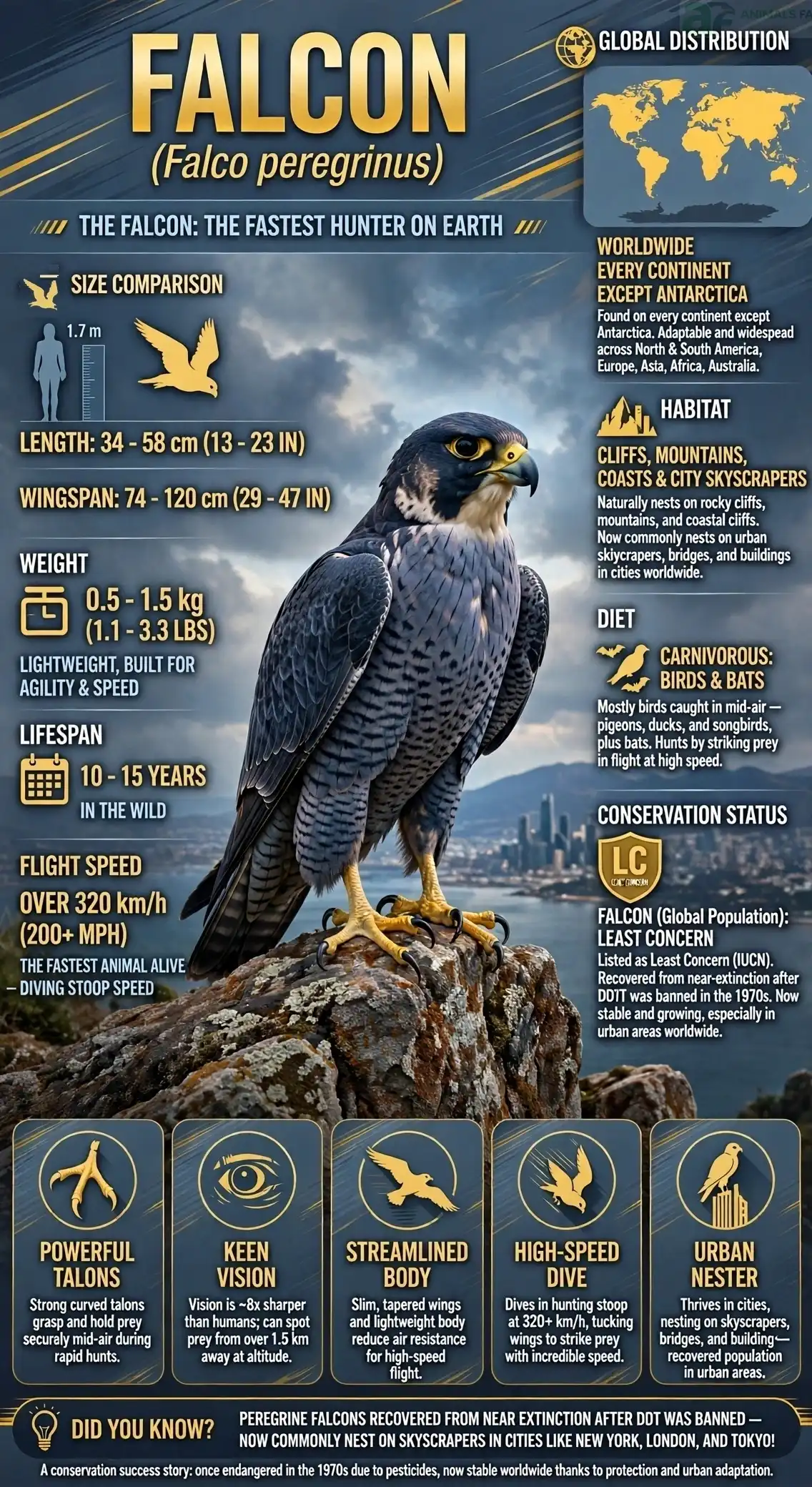
- Peregrine stoop speed: 389 km/h — fastest animal on Earth
- Falcons are more closely related to parrots than to hawks
- Tomial tooth — found in no other bird group
- Nasal baffles that inspired jet engine design
- Kestrel sees UV light — detects invisible vole trails
- Peregrine was extinct east of Mississippi by early 1970s
- Peregrines now nest on skyscrapers in every major city
- Gyrfalcon is a horizontal speed specialist — not a stooper
- Hobby catches swifts doing 100 km/h in level flight
- Peregrine stoop follows a logarithmic spiral trajectory
- American kestrel has declined 50% in 50 years
- Individual gyrfalcon sales documented at $1 million
6. Falcon’s Natural Habitat & Geographic Range
Falcon habitat is defined not by vegetation type or ground-level features but by airspace — falcons hunt in the sky above virtually every habitat type, requiring only open aerial hunting space, elevated nest sites, and sufficient prey density.
The Peregrine’s Global Distribution
The peregrine falcon is one of the most widely distributed bird species on Earth — present on every continent except Antarctica and on most major oceanic island groups:
| Region | Status | Subspecies | Notes |
|---|---|---|---|
| North America | Recovering — abundant | anatum, tundrius, pealei | Post-DDT recovery; now breeds in every state |
| Europe | Stable-increasing | peregrinus | Recovery from DDT; urban population growing |
| Russia and Central Asia | Present | peregrinus, calidus | Tundra breeding; significant migratory |
| Middle East | Present | pelegrinoides, brookei | Some resident; migratory wintering |
| Africa | Present | minor, peregrinus | Both resident and Eurasian migrants |
| South Asia | Present | peregrinus, calidus | Wintering birds; some resident |
| East Asia | Present | japonensis, furuitii | Some endangered island subspecies |
| Australia | Abundant | macropus | Thriving; no DDT crisis equivalent |
| South America | Present | cassini | Both breeding and northern migrants |
| Arctic | Breeding | tundrius, calidus | Summer breeding; long-distance migrants |
Habitat Types by Major Falcon Group
Cliff and coastal (peregrine):
The peregrine’s ancestral habitat — coastal cliffs, inland crags, river gorges, and similar elevated rocky structures — provides the combination of elevated nest ledges and open aerial hunting space that the species evolved to exploit. Key natural peregrine habitats include:
- Sea cliffs (British coast, North American Atlantic coast, Australian coastal cliffs)
- Mountain crags (Alps, Rockies, Scottish Highlands)
- River gorge walls (various European and North American rivers)
- Island cliffs (Canary Islands, Aleutians, various Pacific islands)
Urban (peregrine, kestrel, and others):
The most significant falcon habitat expansion of the past 50 years — urban structures providing cliff-face nest analogues:
- Skyscrapers and tall buildings (peregrine breeding in every major North American and European city)
- Church towers and cathedral spires (kestrel; lesser kestrel in Mediterranean cities)
- Bridges (peregrine — particularly suspension bridge towers)
- Power station cooling towers (peregrine)
Arctic tundra (gyrfalcon):
The gyrfalcon’s exclusive habitat — the treeless arctic and subarctic tundra of the circumpolar north:
- Norwegian fjord cliffs (major European gyrfalcon population)
- Greenlandic coastal cliffs (large breeding population)
- Alaskan and Canadian arctic tundra (breeding population)
- Russian arctic coastline (significant population)
Open grassland and prairie (prairie falcon, kestrel):
The prairie falcon’s primary habitat in the American West — open terrain where horizontal hunting strategies are effective:
- Great Plains grassland (prairie falcon; American kestrel)
- Western sage steppe (prairie falcon primary habitat)
- Agricultural land (common kestrel; American kestrel)
Forest edge and open woodland (merlin, hobby):
Smaller falcons use a variety of more vegetated habitats:
- Boreal forest edge and moorland (merlin breeding)
- African savanna (lanner falcon; African hobby)
- Mediterranean scrub (Eleonora’s falcon on islands)
The Migration Dimension
Falcon migration produces some of the most extraordinary long-distance bird journeys documented:
Arctic peregrine migration — The tundra-breeding peregrine subspecies (F. p. tundrius and F. p. calidus) are long-distance migrants — breeding in the Arctic and wintering in South America and Sub-Saharan Africa. Satellite-tracked individuals have been documented traveling from the Arctic to South America — distances exceeding 15,000 km in a single migration.
Trans-Atlantic peregrine routes — Multiple satellite-tracked peregrines have been documented making non-stop transoceanic flights — crossing the mid-Atlantic without landing, a feat requiring 60–80 hours of continuous flight covering 3,000+ km of open ocean.
Merlin migration — North American merlins are strongly migratory — breeding in the boreal forest of Canada and Alaska and wintering in the southern United States, Mexico, Central America, and northern South America.
Hobby migration — The Eurasian hobby breeds across Europe and Asia and migrates to Sub-Saharan Africa for the winter — one of the longest migrations of any European falcon.
7. Falcon Diet & Feeding Behavior
Falcon diet is centered on aerial prey — the fundamental ecological strategy that differentiates falcons from hawks and that has driven the evolution of every distinctive falcon anatomical feature.
Diet Breakdown by Species
| Species | Primary Prey | Secondary Prey | Hunting Method |
|---|---|---|---|
| Peregrine falcon | Medium birds (pigeons, doves, shorebirds) | Bats, large insects, small mammals | Vertical stoop from altitude |
| Gyrfalcon | Ptarmigan, ducks, shorebirds | Rabbits, lemmings, seabirds | Horizontal level pursuit |
| Prairie falcon | Ground squirrels, Horned larks | Small mammals, large insects | Low horizontal pursuit |
| Saker falcon | Sousliks (ground squirrels), medium birds | Rabbits, lizards | Horizontal pursuit; some stoop |
| Lanner falcon | Medium birds, bats | Large insects, small mammals | Horizontal pursuit; cooperative |
| Common kestrel | Voles, mice, large insects | Small birds, lizards | Hovering; UV-guided |
| American kestrel | Large insects, voles | Small birds, lizards | Hovering; perch hunting |
| Merlin | Small passerines (skylarks, pipits) | Large insects, bats | Level pursuit; fast horizontal |
| Eurasian hobby | Dragonflies, swifts, swallows | Beetles, bats | Aerial pursuit; insect hawking |
| Eleonora’s falcon | Migrating passerines | Insects (non-breeding season) | Aerial pursuit over sea |
| Lesser kestrel | Large insects (grasshoppers, beetles) | Small vertebrates | Hovering; aerial insect hawking |
The Peregrine’s Hunting System in Detail
The peregrine falcon’s hunting system represents the most sophisticated aerial predation strategy of any bird — a multi-phase system that integrates altitude acquisition, visual search, prey assessment, stoop initiation, trajectory calculation, and strike delivery into a seamless behavioral sequence:
Phase 1 — Altitude acquisition — The peregrine gains altitude using thermals, powered climbing, or the elevation advantage of a cliff-top perch. The hunting advantage of altitude is enormous — each meter of altitude represents kinetic energy that can be converted to stoop speed during the descent.
Phase 2 — Visual search — From altitude (typically 100–500 meters above the target area), the peregrine searches for prey using its extraordinary visual acuity. At this range, the peregrine can detect and identify individual birds 3+ km away.
Phase 3 — Prey assessment — The peregrine assesses potential prey for: size (too large = dangerous; too small = unprofitable); behavior (healthy, alert birds are harder to catch than confused, injured, or distracted birds); and position (birds near cover can escape into vegetation; birds in open airspace are more catchable).
Phase 4 — Stoop initiation — The peregrine commits to the stoop — banking into the descending trajectory and beginning to accelerate. At this stage, the outcome is not yet determined — the prey may detect the incoming falcon and take evasive action.
Phase 5 — The logarithmic spiral — Research documents that peregrines follow a constant bearing angle to prey rather than a straight-line descent — maintaining a fixed angular relationship between their line of sight and their direction of travel. This logarithmic spiral path minimizes the visual tracking challenge while maximizing intercept probability.
Phase 6 — The strike — At near-maximum speed, the peregrine delivers a raking blow with the hind talon to the head or back of the prey. This contact at 300+ km/h delivers enormous kinetic energy — stunning or killing the prey on contact.
Phase 7 — Collection — The peregrine performs a wingover — a tight turn — and circles back to collect the falling prey before it hits the ground.
The UV Hunting System (Kestrels)
The common kestrel’s hunting system represents the most sophisticated use of non-visible light spectrum in any European raptor:
The UV mechanism — Vole (Microtus and Arvicola species) urine and feces contain porphyrin compounds that reflect strongly in the ultraviolet (UV) spectrum. These compounds are deposited along the voles’ regularly used runways — pathways between burrow entrances and feeding areas.
The kestrel’s UV vision — The kestrel’s visual system includes UV-sensitive photoreceptors in the retina that allow it to see these UV-reflective pathways as visible contrasting trails against the non-UV-reflecting grass background.
The hunting application — Hovering above a field, the kestrel can see the UV-bright lines of vole runways — lines completely invisible to the human eye. By hovering above an active runway, the kestrel converts a time-intensive search (flying around looking for voles) into a positional hunt (waiting above a known vole pathway for vole emergence).
The kestrel’s hovering — The hovering itself is a physical achievement — the kestrel faces into the wind and precisely matches its airspeed with the wind speed, creating a stationary position in the airframe reference of the earth. This requires continuous fine adjustments of wing angle, tail position, and powered thrust to maintain the hover against wind variation.
8. Falcon Reproduction & Life Cycle
Falcon reproduction follows the fundamental pattern of monogamous pair bonds, elevated nest sites, biparental care, and slower reproduction than most small birds — with the specific adaptations of each species reflecting its particular ecological context.
Pair Formation and Courtship
Pair bond timing — Falcons typically form pair bonds in late winter or early spring — the beginning of this process often visible as aerial courtship displays above the nest territory.
Aerial courtship — Falcon courtship displays are among the most spectacular aerial performances of any bird:
The food pass — One of the most characteristic falcon courtship behaviors; the male catches prey and delivers it to the female in a mid-air transfer — the two birds briefly coming close in flight while the male passes prey from his talons to hers. This behavior demonstrates the male’s hunting capability directly to the female — the food delivery being an honest signal of the male’s ability to provision the female during egg-laying and incubation.
The stoop display — Males perform accelerated stoops near the female — demonstrating flight capability and speed. The female may respond by rolling inverted and presenting her talons to the male during these approaches.
The perch display — Both birds perch near the nest site and call — repeated calling sequences advertising territory occupancy to neighboring pairs and reinforcing the pair bond.
Pair bond duration — Most falcon species are seasonally monogamous with high site fidelity — the same pair often returning to the same nest site in successive years, creating apparent multi-year pair bonds that are maintained through shared territory familiarity rather than necessarily active pair bond maintenance outside the breeding season.
Nest Site Selection — No Nest Required
The nest scrape — True falcons (genus Falco) do not build nests — they lay eggs in a scrape (a shallow depression) on an elevated surface:
- Peregrine — cliff ledges, building ledges, nest boxes, other birds’ old nests (crow, raven nests used)
- Gyrfalcon — cliff ledges; occasionally old raven or rough-legged hawk nests
- Prairie falcon — cliff ledges
- Kestrel — tree holes, cliff crevices, building cavities, nest boxes
- Merlin — old crow nests on moorland; cliff cavities; occasionally ground scrapes
The nest box revolution — The provision of artificial nest boxes has been one of the most effective practical conservation interventions for kestrels and peregrines — dramatically increasing breeding populations in areas where natural nest sites are limiting:
- American kestrel nest box programs have partially offset the general population decline
- Peregrine nest boxes on buildings have facilitated urban breeding across North America and Europe
- Kestrel boxes on farm buildings and poles have increased breeding populations in agricultural landscapes
Egg-Laying and Incubation
Clutch sizes:
| Species | Typical Clutch | Range |
|---|---|---|
| Peregrine | 3–4 eggs | 2–5 |
| Gyrfalcon | 3–4 eggs | 1–7 |
| Prairie falcon | 4–5 eggs | 2–6 |
| Saker falcon | 3–5 eggs | 2–6 |
| Common kestrel | 4–6 eggs | 2–9 |
| Merlin | 4–5 eggs | 3–7 |
| American kestrel | 4–5 eggs | 2–7 |
Incubation periods:
| Species | Incubation Days | Primary Incubator |
|---|---|---|
| Peregrine | 29–33 days | Both parents; female primary |
| Gyrfalcon | 34–36 days | Female primary |
| Common kestrel | 27–29 days | Both parents |
| Merlin | 28–32 days | Female primary; male relieves |
| American kestrel | 29–31 days | Female primary; male relieves |
Chick Development and Fledging
Nestling period varies by species:
- American kestrel — approximately 28–31 days
- Common kestrel — approximately 27–39 days
- Merlin — approximately 28–32 days
- Peregrine — approximately 35–42 days
- Gyrfalcon — approximately 46–51 days
Post-fledging dependency:
- Kestrels — approximately 4 weeks after fledging
- Peregrines — approximately 6–8 weeks after fledging; young birds learning to hunt progressively
- Gyrfalcons — approximately 8–12 weeks after fledging; extended dependency in the prey-sparse Arctic
The training period — Unlike hawks whose hunting skills are primarily innate, falcons require a significant practice period after fledging to develop effective hunting proficiency. Young peregrines practice hunting with increasingly accurate stoops over several weeks — initially missing targets routinely, then progressively improving accuracy as their strike calculation systems develop.
9. Social Behavior & Communication
Falcon social behavior is primarily territorial during breeding and largely solitary outside the breeding season — with the notable exceptions of the lesser kestrel’s colonial breeding and various falcons’ tendency to aggregate at rich prey concentrations.
Territory and Pair Dynamics
Nest territory exclusivity — Breeding falcon pairs defend territories around the nest site against other falcons of the same species. Territory size varies:
- Peregrine — home range approximately 5–100 km² depending on prey density; closer spacing in urban environments where prey is abundant
- Gyrfalcon — home range approximately 50–200 km² in the prey-sparse arctic
- Common kestrel — home range approximately 1–10 km²
Spacing between pairs — Falcon pairs show characteristic minimum spacing from neighbors — urban peregrines may nest less than 1 km apart where building density provides abundant elevated nest sites and pigeon prey; wild cliff peregrines may be 5–20 km apart depending on cliff availability and prey density.
The Lesser Kestrel’s Colonial Exception
The lesser kestrel’s colonial breeding system makes it the most socially complex falcon species — colonies of dozens to hundreds of pairs breeding in close proximity:
Information sharing — Colonial breeding creates opportunities for public information use — birds that return from successful foraging trips are followed to productive hunting areas by colony members. This information sharing may be a primary benefit of colonial breeding in a species that hunts spatially patchy insect prey.
Social alarm systems — Colonial lesser kestrels show coordinated alarm responses — all colony members taking flight simultaneously when a predator approaches, creating a confusing mass of birds that may deter attack.
Communication
The peregrine’s repertoire — Peregrine vocalizations include:
- The “cacking” call — a rapid, harsh kek-kek-kek-kek series used during territorial defense and alarm; one of the most distinctive raptor vocalizations in the British countryside
- The “wailing” call — a longer, more plaintive waiiii produced during pair bond interactions and food delivery at the nest
- Chick calls — an insistent, carrying begging call produced by nestlings and recently fledged young
The kestrel’s call — The common kestrel’s “kee-kee-kee” call is one of the most familiar raptor sounds in European countryside — produced by territorial birds at nest sites and during pair interactions.
Visual displays — Beyond the elaborate aerial displays of courtship, falcons communicate through:
- Wing position — angles and positions signal arousal and intention
- Body orientation — facing toward or away from a rival signals dominance or submission
- Threat postures — lowered head, spread wings signal dominance at the nest
10. Predators & Defense Mechanisms
Adult falcons occupy apex predator positions in their respective aerial hunting niches — but face specific vulnerabilities from larger raptors and from the distinctive risks of the exposed nest sites that define the falcon breeding strategy.
Natural Predators
Large owls — Great horned owl and eagle owl are significant peregrine and gyrfalcon predators — taking perching or roosting falcons at night. The great horned owl is documented as the most significant natural predator of peregrine falcons in North American populations.
Golden eagle — Documented peregrine and gyrfalcon predator — larger eagle taking falcons in aerial encounters or at nest sites.
Gyrfalcon on peregrine — In arctic areas where both species overlap, gyrfalcons (the larger bird) have been documented attacking and killing peregrines.
Great skua — In coastal areas where peregrines and goshawks are absent, great skuas (Stercorarius skua) have been documented taking nesting falcons.
Nest Predators
Raven (Corvus corax) — Ravens and large corvids raid falcon scrapes when adults are absent — consuming eggs and small chicks. The relationship between peregrines and ravens is complex — ravens and peregrines use similar cliff habitats and occasionally compete for nest ledges, while ravens also alert peregrines to potential prey through their own food-finding behavior.
Mink and similar carnivores — In areas where cliff-base access is possible, introduced mink and other small carnivores may reach nest ledges previously considered secure.
Human disturbance — The most significant nest threat in modern contexts — climbing, photography, and drone activity near active falcon nests causes nest abandonment, particularly during early incubation.
Defense Mechanisms
The “cacking” dive — When a potential predator (large eagle, human, drone) approaches the nest, falcons produce the characteristic rapid cacking call and perform repeated dive-bombing attacks — striking and raking the intruder with the talons in close-range attacks. Peregrines have been documented striking and injuring large eagles, humans, and even drones in nest defense.
The speed advantage — The peregrine’s 389 km/h stoop capability is itself a defense against most aerial predators — a pursuing eagle or large owl cannot match the falcon’s stoop acceleration, allowing the peregrine to escape pursuit by stooping away at speeds no predator can follow.
Nest site selection — The choice of elevated, exposed cliff ledges as nest sites is primarily a predator defense mechanism — accessible to the falcon’s aerial approach but not to most terrestrial predators. Urban building ledges serve the same function — the combination of height, exposure, and smooth building faces provides security that ground-level or tree nests could not.
11. Falcon Facts for Kids
Hey amazing young wildlife scientists, speed enthusiasts, and nature lovers! Here are some truly extraordinary falcon facts for kids that will make every conversation about animals instantly more exciting:
- 🦅 The peregrine falcon is the FASTEST ANIMAL ON EARTH! When a peregrine falcon dives to catch a bird — called a stoop — it can reach speeds of 389 kilometers per hour. That is faster than a Formula 1 racing car on a straight! No cheetah, no marlin, no dragonfly, no other animal has been measured moving faster than a diving peregrine falcon. The ENTIRE animal kingdom has one speed record holder — and it is a bird the size of a large crow!
- 🦅 Falcons are more closely related to PARROTS than to hawks and eagles! Scientists were shocked to discover this when they studied falcon DNA. Despite looking similar to hawks — with their hooked bills and sharp talons — falcons actually share a closer ancestor with parrots and songbirds! It is one of the most surprising family tree discoveries in all of bird science. A peregrine falcon and a parrot are more closely related to each other than either is to a red-tailed hawk!
- 🦅 The peregrine falcon designed something that ENGINEERS later put in jet engines! The inside of a peregrine’s nose contains tiny spiral ridges that slow down incoming air so the bird can breathe during its 389 km/h stoop. When engineers designed jet engines for aircraft, they had the same problem with air coming in too fast. They invented spiral airflow systems — exactly like the ones inside the peregrine’s nose. The birds had solved this problem 65 million years before humans even invented engines!
- 🦅 Falcons were almost WIPED OUT in America — but came back stronger than ever! By the early 1970s, a pesticide called DDT had caused peregrine falcons to nearly disappear from the entire eastern United States — not a single breeding pair remained east of the Mississippi River. Scientists worked for decades to breed them in captivity and release them into the wild. Today, peregrine falcons nest on SKYSCRAPERS in New York, Chicago, London, Sydney, and virtually every other major city. One of the greatest wildlife recoveries in history!
- 🦅 Kestrels can see INVISIBLE LIGHT that shows them where mice are! Mouse droppings and urine glow in ultraviolet light — a type of light humans cannot see at all. But kestrels can see UV light! When a kestrel hovers above a field, it can see glowing lines of mouse trails that are completely invisible to everyone else. It is like having a superpower that lets you see secret mouse maps drawn on the grass!
- 🦅 There is a falcon that eats dragonflies and catches SWIFTS in flight! The Eurasian hobby is a small falcon that can catch dragonflies in mid-air and eat them while still flying. Even more impressive — it can catch common swifts, which are some of the fastest small birds in the world. A swift at top speed flies at about 100 kilometers per hour. To catch one, the hobby has to fly FASTER than 100 kilometers per hour while making precise aerial maneuvers. And it does this regularly!
- 🦅 The biggest falcons can be sold for ONE MILLION DOLLARS! In some Middle Eastern countries, falconry — hunting with trained falcons — is one of the most prestigious sports. The most prized falconry bird is the gyrfalcon, the world’s largest falcon. Exceptional trained gyrfalcons have reportedly been sold for more than one million US dollars. That makes a trained gyrfalcon more valuable than most houses, cars, or other luxury items!
- 🦅 Peregrine falcons now live on SKYSCRAPERS and BIG BRIDGES in cities! After their recovery from DDT, peregrine falcons discovered that city buildings make perfect substitutes for the cliff faces they naturally nest on. They now nest on the ledges of skyscrapers, the towers of suspension bridges, the tops of cathedrals, and even on window sills. They hunt city pigeons, which are far more abundant than the wild birds in countryside. In many cities, you can watch live webcam footage of peregrine falcon nests from your home computer!
12. Relationship with Humans
The falcon’s relationship with humans is the deepest, the longest, and the most culturally significant of any bird of prey — the 4,000-year falconry tradition making falcons the most important non-domestic bird in human history, while the peregrine’s DDT recovery story makes it the most powerful single example of conservation science successfully reversing a human-caused wildlife collapse.
Falconry — 4,000 Years of Partnership
The ancient origins — The earliest documented evidence of falconry dates to approximately 2000 BCE in Central Asia — petroglyphs in Mongolia and Kazakhstan depicting falcon hunting; Chinese texts from the 7th century BCE describing falcon training; Egyptian hieroglyphics depicting hawk and falcon hunting. The precise origin of the practice is debated but the Central Asian steppe is the most widely accepted location.
The global spread — Falconry spread from Central Asia to:
- China and Korea — documented from approximately 600 BCE
- Persia (Iran) — major falconry culture by approximately 500 BCE
- Arabia — central to Bedouin culture by the first millennium CE
- Europe — introduced during the Roman period; reaching its European cultural peak in the medieval period (7th–14th centuries CE)
- Japan — introduced from China approximately 300 CE; unique Japanese falconry tradition (takagari) developed
Medieval European falconry — Falconry in medieval Europe was not merely a hunting practice but a central cultural institution — a marker of social status, a military skill, a diplomatic gift exchange mechanism, and a visual embodiment of aristocratic authority. The social hierarchy of falconry birds was rigorously codified (see the mythology section). Holy Roman Emperor Frederick II (1194–1250) was the most significant falconry writer of the medieval period — his De Arte Venandi cum Avibus (“On the Art of Hunting with Birds”) remains the most comprehensive medieval natural history text on birds and falconry.
Middle Eastern falconry — The Arabian falconry tradition represents the most culturally continuous and most economically significant contemporary falconry practice:
- Falconry is central to the cultural identity of Gulf states (UAE, Qatar, Saudi Arabia, Kuwait, Bahrain)
- The Abu Dhabi Falcon Hospital — the world’s largest falcon hospital — treats approximately 11,000 falcons per year
- The International Union for Conservation of Nature (IUCN) estimates the Arabian Gulf falconry market moves $100+ million annually
- Individual gyrfalcons have been sold for documented prices exceeding $1 million
- UNESCO recognized traditional falconry in 2016 as an Intangible Cultural Heritage of Humanity
Harris’s hawk in contemporary falconry — As noted in the hawk article, the Harris’s hawk has become the most popular falconry bird globally in contemporary practice — particularly in the UK and Germany. The peregrine remains the most celebrated falconry bird among experienced practitioners.
Falconry conservation contribution — The falconry community has made essential contributions to raptor conservation:
- Captive breeding of peregrines — the first successful peregrine captive breeding was achieved by falconers at Cornell University (The Peregrine Fund) in 1973; the techniques developed enabled the reintroduction program
- Monitoring of wild populations — falconers’ detailed knowledge of individual falcon territories and behavior contributed significantly to population monitoring programs
- Political advocacy — the organized falconry community successfully advocated for peregrine legal protection and DDT restrictions in multiple countries
The DDT Crisis and Recovery — The Most Important Falcon-Human Story
The peregrine falcon’s DDT crisis and recovery is the most dramatic conservation story in the history of raptor biology — and arguably in the history of wildlife conservation globally:
The collapse timeline — DDT entered widespread use in North America after World War II (1947 onward); peregrine breeding failures documented from approximately 1950; populations in free-fall from 1955; eastern US population essentially extinct as a breeding entity by 1965; western US population severely reduced; UK population crashed from approximately 1,000 pairs to approximately 360 pairs in the same period.
The science — British and American researchers — particularly Derek Ratcliffe in the UK and Joseph Hickey, Daniel Anderson, and colleagues in the USA — documented the population collapse and, crucially, identified the mechanism (DDE-induced eggshell thinning) and the cause (DDT use). The landmark 1968 Madison Conference on Peregrine and Osprey populations assembled the scientific evidence that drove regulatory action.
The Rachel Carson connection — Rachel Carson’s Silent Spring (1962) — which documented DDT’s ecological effects including on raptors — was the public communication vehicle that translated scientific documentation into political action. The peregrine falcon’s plight was one of the most powerful examples in Carson’s argument.
The DDT ban — The US EPA banned DDT in December 1972 — the decision driven substantially by the peregrine and bald eagle population data.
The captive breeding program — Tom Cade at Cornell University established The Peregrine Fund in 1970 — initially as a captive breeding program with the goal of producing peregrines for reintroduction. The first successful captive breeding was achieved in 1973; by 1987, the program had released over 1,000 captive-bred peregrines into the wild across North America.
The urban discovery — An unexpected outcome of the reintroduction program was the discovery that released peregrines were colonizing urban environments — finding that city skyscrapers provided superior nest sites (elevated, with abundant pigeon prey) to many rural areas. The urban adaptation has driven extraordinary population growth in the post-recovery period.
The delisting — The peregrine falcon was removed from the US Endangered Species List on August 25, 1999 — one of the most celebrated conservation delisting events in American history.
Current status — The contiguous US peregrine population stands at approximately 3,500+ breeding pairs as of 2026 — a 700%+ increase from the 417 pair equivalent recorded at the population low. Global population approximately 120,000 pairs.
The Saker Falcon Conservation Crisis
While the peregrine’s story is one of recovery, the saker falcon (Falco cherrug) tells the opposite story — a species in ongoing decline driven by the same falconry demand that has sustained peregrines through cultural attachment:
The Middle Eastern demand — The saker is the most prized falconry bird in the Arabian Gulf states — its size, power, and aggressive hunting style making it superior to other falconry birds for the traditional Houbara bustard hunting practiced in the Gulf. Demand for wild-caught sakers significantly exceeds what sustainable harvesting would allow.
The trapping problem — Despite CITES listing, significant illegal trapping of wild sakers continues across the Central Asian breeding range — trappers exploiting migration routes, using electronic callers to lure birds, and trafficking birds through complex supply chains.
The population consequence — The saker population has declined by approximately 50–80% over the past three decades — the IUCN reclassifying it from Vulnerable to Endangered in 2012.
Conservation responses — Various programs including Captive breeding of sakers for the falconry market (reducing wild-caught bird demand), CITES Appendix II listing, and Central Asian protected area establishment are being implemented — but the fundamental demand-supply mismatch remains unresolved.
13. Falcon Conservation Status & Threats
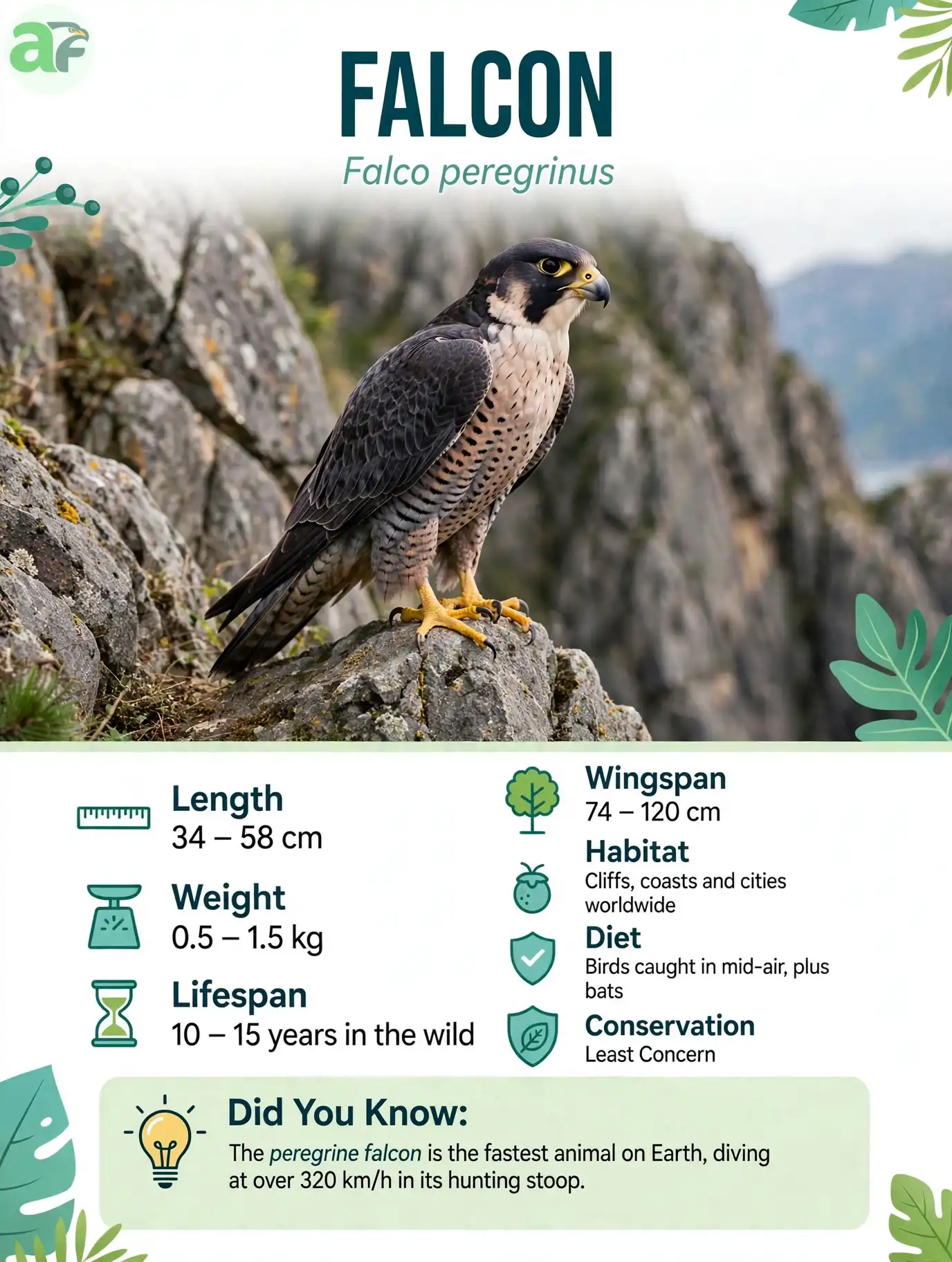
Conservation Status Overview
| Species | IUCN Status | Population Trend | Primary Threat |
|---|---|---|---|
| Peregrine falcon | Least Concern | Increasing | Lead poisoning (remaining concern); window strikes |
| Gyrfalcon | Least Concern | Stable | Climate change; some persecution |
| Saker falcon | Endangered | Decreasing | Illegal trapping for falconry; habitat loss |
| Common kestrel | Least Concern | Decreasing | Agricultural intensification; prey depletion |
| American kestrel | Least Concern | Decreasing significantly | Unknown — multiple suspected causes |
| Merlin | Least Concern | Stable/slight decrease | Moorland habitat loss (UK); persecution (some areas) |
| Eurasian hobby | Least Concern | Stable | Agricultural intensification |
| Lanner falcon | Least Concern | Decreasing | Persecution; falconry trapping in some areas |
| Lesser kestrel | Least Concern | Decreasing | Agricultural intensification; insect prey depletion |
| Eleonora’s falcon | Least Concern | Stable | Island habitat disturbance; migration route threats |
The American Kestrel Decline — The Most Concerning North American Falcon Situation
The American kestrel (Falco sparverius) has declined by approximately 50% across North America over the past 50 years — one of the most significant declines of any common North American raptor. The causes remain incompletely understood but include:
Agricultural intensification — Reduction of the insect prey base through pesticide use and monoculture agriculture has reduced food availability for small insectivorous raptors.
Nest cavity competition — European starlings (Sturnus vulgaris) compete intensively for the tree cavities and building crevices that kestrels need for nesting — the starling’s aggressive cavity defense excluding kestrels from many previously suitable sites.
Grassland loss — The loss of the short, open grassland habitat where kestrels hunt has reduced hunting habitat across large parts of the range.
Unknown factors — Various additional factors including West Nile virus, Cooper’s hawk predation, and migratory route changes have been proposed but not definitively linked to the population decline.
Conservation response — The American Kestrel Partnership — a citizen science program coordinated by The Peregrine Fund — maintains a network of thousands of nest boxes across North America, providing alternative nest sites and generating population monitoring data. Despite the nest box program, the broader population decline continues.
Climate Change and the Gyrfalcon
The gyrfalcon — the largest falcon and the apex predator of the arctic tundra — faces a specific climate change vulnerability:
The ptarmigan connection — Gyrfalcons in the Arctic are approximately 60–80% dependent on ptarmigan (rock ptarmigan and willow ptarmigan) as prey. Ptarmigan populations are closely linked to Arctic vegetation structure.
The warming tundra — As Arctic temperatures rise and the treeline moves northward, the shrub tundra habitat expands while the open tundra habitat that ptarmigan depend on contracts — compressing the ptarmigan’s habitat and potentially reducing gyrfalcon prey availability.
The nest site vulnerability — Gyrfalcons nest on cliff ledges across the Arctic; the specific cliff-face microhabitats preferred show temperature sensitivity. Permafrost thaw may destabilize some nest cliff structures.
14. Famous Falcons in History & Pop Culture
Famous Individual Falcons
“Pale Male” parallel — “Beauty” (Rochester, New York, USA) — While the falcon equivalent of Pale Male, “Beauty” — a female peregrine who began nesting on the Kodak Tower in Rochester, New York in the 1990s — became one of the first and most celebrated urban peregrine success stories in North America. Beauty’s nest was the subject of one of the first urban peregrine webcams — a pioneering use of technology for public wildlife education that generated hundreds of thousands of viewers.
The Peregrine Fund’s Founder Birds (Cornell, 1973) — The first peregrines bred in captivity at Cornell University’s Peregrine Fund program in 1973 — under the supervision of Tom Cade — are the founding individuals of the captive breeding program that saved the peregrine from extinction in North America. These birds, and their immediate descendants, are the ancestors of virtually every peregrine reintroduced to the eastern United States.
Emperor Frederick II’s Falcons (13th century) — The gyrfalcons and peregrines maintained and studied by Holy Roman Emperor Frederick II in the 13th century are the most historically significant falcon individuals in Western cultural history — the subjects of the most comprehensive medieval bird natural history work, De Arte Venandi cum Avibus (completed approximately 1240), which contains remarkably accurate anatomical and behavioral observations. Frederick’s personal falcon collection was celebrated across medieval Europe.
The Peregrine at 55 Water Street, New York City — The peregrine pair that established one of the first confirmed successful urban peregrine nests in New York City at 55 Water Street in 1983 — just 11 years after the species’ near-extinction in the eastern US — represented the most dramatic demonstration that the captive breeding reintroduction program was succeeding. This pair’s successful chick-rearing in the heart of Manhattan generated national media coverage and transformed public perception of urban wildlife conservation possibility.
Historical and Cultural Significance
Frederick II and “De Arte Venandi cum Avibus” — The 13th-century Holy Roman Emperor’s comprehensive falconry text — written over approximately 30 years — remains one of the most extraordinary scientific documents of the medieval period. Frederick’s observations on falcon anatomy, behavior, migration, and training technique were centuries ahead of his time — the text demonstrating systematic observation and empirical reasoning that would not characterize mainstream science for another 400 years.
Anne of Cleves and the diplomatic falcon gift — Throughout medieval and early modern European history, gifts of falcons between monarchs and nobles were one of the most important forms of diplomatic exchange — gyrfalcons from Norway and Iceland being among the most valuable diplomatic gifts available to Scandinavian kings. The Norwegian crown maintained gyrfalcon catching stations specifically to supply the diplomatic bird trade.
Mary, Queen of Scots and her falcons — Mary Queen of Scots was reportedly devoted to her falcons — documented accounts suggest her falcons accompanied her even during her imprisonment. The image of the falcon-carrying royal woman appears across medieval and Renaissance portraiture as a symbol of aristocratic status and refined sensibility.
15. Role in Ecosystem & Food Chain
The Apex Aerial Predator Function
The falcon’s ecological role as the apex aerial predator of open and semi-open landscapes creates effects throughout the bird and small mammal communities of its hunting territory:
Bird community structure — Peregrine falcon predation pressure significantly influences the composition, density, and behavior of the bird communities in its hunting territory:
- Wader and shorebird flocks in peregrine territories show distinctive predator avoidance formations — the tight, synchronized flocking behavior of dunlin and other shorebirds is a direct response to peregrine predation pressure
- Pigeon populations in urban environments are maintained at lower densities by urban peregrine predation than they would be in peregrine-free environments
- The “landscape of fear” created by peregrine presence alters prey bird behavior — increasing time spent in vigilance and reducing time in open areas
Pigeon population management — Urban peregrine populations provide a genuine pest management service — reducing urban feral pigeon (Columba livia) populations and the associated public health concerns. Multiple city authorities have actively encouraged peregrine colonization for this reason.
Shorebird and waterfowl community effects — In coastal and wetland environments, peregrine predation influences the distribution and behavior of the entire shorebird and waterfowl community — creating behavioral adaptations including specific anti-peregrine alarm calls in multiple shorebird species.
The Role of Kestrels in Rodent Regulation
Common kestrel populations provide significant rodent population regulation in European and Asian agricultural landscapes:
Quantified service — Research has estimated that a pair of kestrels consuming approximately 4 voles per day (a moderate consumption estimate) removes approximately 1,460 voles per year from the surrounding agricultural landscape. At typical kestrel densities in productive farmland, the collective vole-suppression service is economically significant for crop protection.
The agricultural landscape link — The common kestrel’s decline in agricultural landscapes — driven by prey depletion from pesticides and habitat change — reduces this rodent regulation service, potentially increasing rodent crop damage in areas where kestrel populations have declined.
16. Myths, Folklore & Cultural Significance
Ancient Egyptian — Horus and the Falcon Deity
Horus — The falcon-headed god of the Egyptian pantheon — was one of the most significant deities in Egyptian religion:
The divine falcon — Horus was depicted as either a falcon or as a human with a falcon’s head — the god of the sky, of kingship, and of divine order. The pharaoh was understood as the living embodiment of Horus — the human king being the earthly manifestation of the celestial falcon.
The Eye of Horus — The left eye of Horus — which the god lost in combat with Set and which was restored by Thoth — became one of the most important Egyptian sacred symbols. The wedjet or “Eye of Horus” was used in protective amulets, medical calculations, and royal insignia across thousands of years of Egyptian civilization.
The Sacred Falcon at Hierakonpolis — Archaeological evidence of falcon cult worship at the Predynastic Egyptian city of Hierakonpolis (nekheb = the falcon city) documents falcon religious significance in Egypt from at least 3500 BCE — one of the earliest documented human-bird religious relationships.
Ra-Horakhty — The merger of the sun god Ra with Horus as Ra-Horakhty — “Horus of the Two Horizons” — depicted as a falcon-headed deity wearing a solar disc, connected the falcon to the fundamental Egyptian solar theology. The peregrine falcon flying toward the sun — the supreme celestial body — made it the natural embodiment of solar divinity.
Medieval European Falconry Hierarchy
The medieval European falconry social hierarchy embedded the falcon in the class structure of medieval civilization:
The codified hierarchy (from the Boke of St Albans, 1486):
- Emperor — golden eagle
- King — gyrfalcon
- Prince — peregrine falcon
- Duke — rock falcon (peregrine subspecies)
- Earl — peregrine tierce (male peregrine)
- Baron — lanner falcon
- Knight — saker falcon
- Squire — lanner
- Lady — merlin
- Young man — hobby
- Yeoman — goshawk
- Poor man — kestrel
This hierarchy embedded specific falcon species into the social identity of different social classes — the peregrine being the definitive falcon of princes and high nobility, the kestrel (“the windhover”) being the bird of common people.
The Peregrine as Freedom Symbol
The peregrine’s DDT recovery story and its urban colonization have given it a new cultural meaning in contemporary conservation — the bird as a symbol of ecological resilience and the possibility of conservation success:
The recovery narrative — The peregrine’s return from near-extinction to breeding in every major North American and European city has become a powerful cultural metaphor — proof that conservation science works, that species can be saved from human-caused collapse, and that wildlife and urban civilization can coexist.
17. Falcons in Pop Culture
The Maltese Falcon — Dashiell Hammett’s 1930 novel and John Huston’s 1941 film adaptation constitute the most famous falcon reference in American literary and cinematic culture. The fictional statue of a golden falcon — originally a gift from the Knights of Malta to the Holy Roman Emperor — drives the plot of the defining American hard-boiled detective novel. The cultural weight of the Maltese Falcon connects the falcon’s associations of rare beauty, lethal potential, and aristocratic value to the gritty world of American crime fiction.
“Kes” — The British Kestrel — Ken Loach’s 1969 film — discussed in the hawk article — features a kestrel (Falco tinnunculus) trained by a working-class Yorkshire boy. The kestrel in Kes has become the most culturally significant individual trained falcon in British popular culture — its name iconic, its story taught in British schools, and its image (boy with kestrel on fist) one of the defining images of 20th-century British cinema.
“The Peregrine” by J.A. Baker (1967) — The most celebrated nature writing book about any falcon — Baker’s account of following a peregrine falcon across the Essex countryside for a winter season is widely considered one of the finest pieces of nature writing in the English language. The book’s extraordinary prose and the intensity of Baker’s observations have made it required reading in British nature writing courses.
The Washington National Cathedral Falcon Webcam — The peregrine falcons nesting on the Washington National Cathedral in Washington DC have been the subject of a live nest webcam watched by millions of viewers annually — one of the most successful urban wildlife webcam programs ever implemented. The cam has generated extraordinary public engagement with raptor conservation, with hundreds of thousands of viewers following nesting pairs through egg-laying, incubation, hatching, and fledging each year.
Multiple city peregrine webcams — Dozens of North American and European cities now maintain public falcon webcams on building nest ledges — generating millions of annual viewers and creating what may be the most watched urban wildlife in history. Cities including New York, Chicago, London, Birmingham, and many others operate these cams, naming individual birds and generating strong public attachment.
Marvel Comics — “Falcon” / Sam Wilson — The Marvel Comics character Sam Wilson (The Falcon / Captain America) takes his superhero identity from the falcon’s qualities of speed, aerial mastery, and precision — the character’s winged flight suit and aerial combat style directly referencing falcon biology. The character’s prominence in the MCU (including his own Disney+ series The Falcon and the Winter Soldier) has made falcon imagery central to contemporary superhero culture.
“Peregrine” as a name in literature and culture — The word “peregrine” — meaning “pilgrim” or “wanderer” — appears across literature as a character name reflecting the qualities associated with falcons: courage, speed, independence, and aristocratic bearing. The Hobbit character Peregrin Took (“Pippin”) carries the name’s associations of adventurous wandering.
18. Falcon Facts vs. Common Myths
| Common Myth | The Real Fact |
|---|---|
| “Falcons are just small hawks” | False — falcons and hawks belong to completely different evolutionary lineages (Falconidae vs. Accipitridae) that last shared a common ancestor approximately 65 million years ago. Falcons are more closely related to parrots than to hawks |
| “The fastest animal on Earth is the cheetah” | Partially false in context — the cheetah is the fastest land animal (approximately 110 km/h). The peregrine falcon is the fastest animal overall at 389 km/h — more than three times the cheetah’s speed |
| “Falcons are illegal to own” | Partially false — falconry (keeping trained falcons for hunting) is legal with appropriate permits in most countries. The purchase, trade, and keeping of wild-caught falcons without permits is illegal; but licensed falconers legally keep trained falcons across North America, Europe, and the Middle East |
| “Peregrine falcons build elaborate nests like hawks” | False — peregrine falcons lay eggs in a bare scrape on a cliff ledge, building roof, or window sill — no nest material is brought. The “nest” is simply the surface of a suitable elevated platform |
| “Falcons kill prey with their talons like hawks” | Partially false — falcons initially stun prey with the strike of the hind talon or fist at high speed, then deliver a killing bite using the tomial tooth to sever the cervical spine. Hawks kill through suffocation from talon grip; falcons kill with a biting blow |
| “Peregrine falcons are still endangered” | False — the peregrine was removed from the US Endangered Species List in 1999 and is now classified as Least Concern globally. The population has recovered dramatically from the DDT-era collapse |
| “Kestrels are just small peregrines” | False — kestrels (genus Falco, subgroup Falco tinnunculus and relatives) have a fundamentally different hunting strategy from peregrines — hovering and UV-guided vole hunting rather than aerial stooping at birds. The two birds use the same body plan (tomial tooth, pointed wings) for completely different ecological purposes |
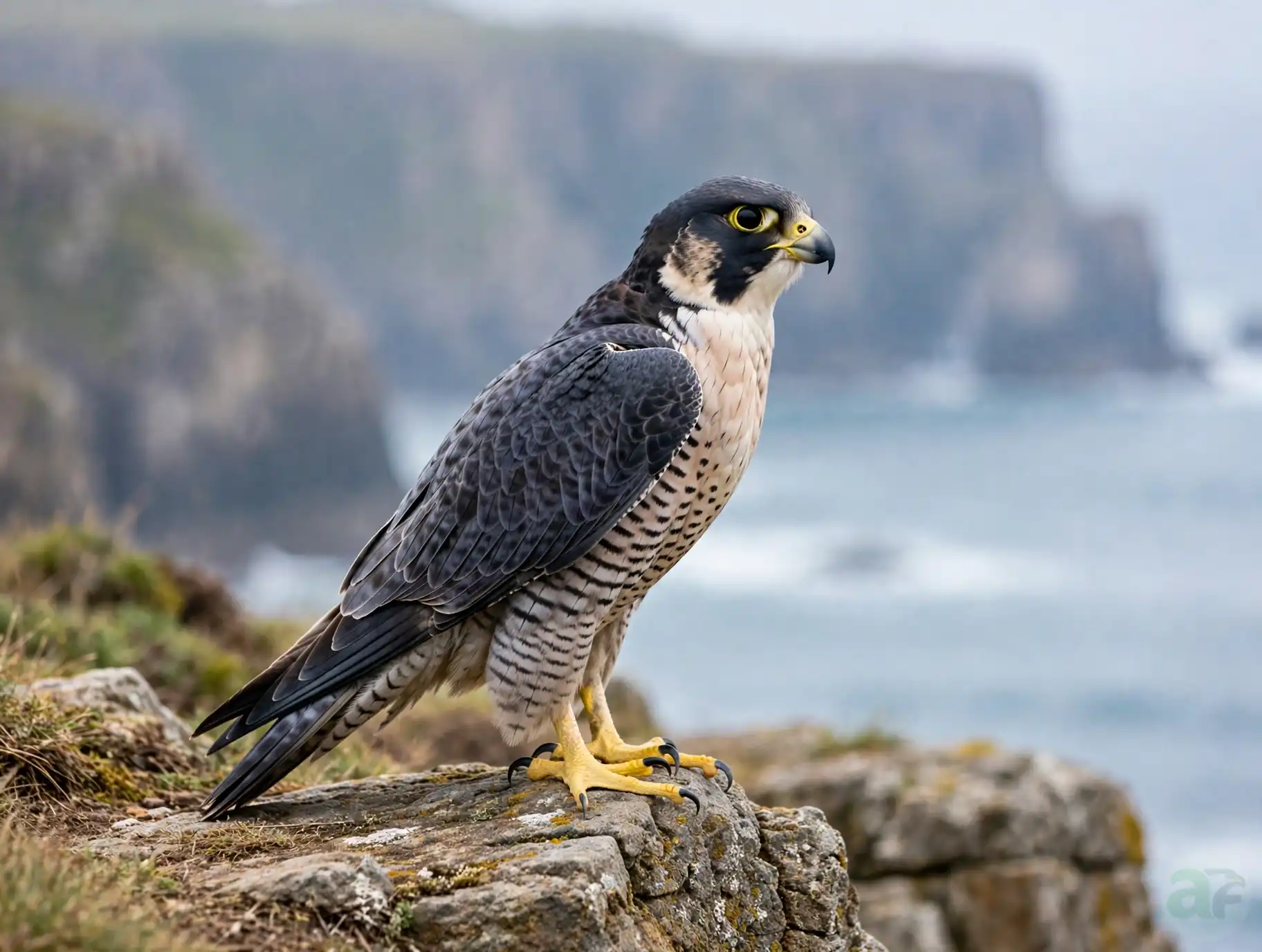
19. Best Places to See Falcons in the Wild
Urban Peregrine Falcon Viewing — The Most Accessible Falcon Experience
1. Any major North American or European city — The most accessible peregrine viewing in the world requires no special travel — virtually every major North American and European city now hosts breeding peregrine pairs on tall buildings. Looking up at the tallest buildings in any major city during the breeding season (March–July) will frequently reveal peregrines perching on building ledges, performing aerial courtship displays, or hunting pigeons in the urban airspace.
2. Washington National Cathedral, Washington DC, USA — The most famous urban peregrine site in the United States; the cathedral’s Gothic towers host breeding peregrines visible from the cathedral grounds. The live nest webcam (operated by the cathedral in partnership with conservation organizations) provides year-round viewing of nest activity accessible globally online.
3. The Brooklyn Bridge, New York City, USA — Peregrine falcons have nested on the Brooklyn Bridge towers for decades — one of the most visually dramatic urban nest sites available anywhere. The bridge’s towers are visible from multiple public viewpoints in Brooklyn and Manhattan, and peregrines are regularly visible perching on the suspension cables and towers.
4. Tate Modern, London, UK — The Tate Modern’s Bankside chimney (the former Bankside Power Station chimney) hosts peregrine falcons — viewable from the Thames riverside walkway and the Millennium Bridge. London’s urban peregrines are among the most watched and best documented in Europe.
Wild Falcon Viewing
5. Morro Rock, California, USA — A famous Pacific Coast peregrine nest site — Morro Rock’s dramatic volcanic plug hosts breeding peregrines visible from the state beach and surrounding area. The site is one of the most consistently productive and most scenic peregrine viewing locations in California.
6. Scottish Highlands, UK — For peregrine falcon on wild coastal and mountain terrain — various RSPB watchpoints in Scotland (including at Lake Vyrnwy in Wales and various Highland viewpoints) provide seasonal peregrine observation at the species’ traditional cliff nest sites.
7. Hawk Mountain Sanctuary, Pennsylvania, USA — Autumn migration hawk watching at Hawk Mountain also produces peregrine and merlin sightings during the autumn raptor migration — the ridge’s position on the main Atlantic migratory route concentrating migrant falcons alongside hawks.
8. Elat, Israel — For the most diverse falcon migration viewing globally; spring migration (March–May) concentrates peregrines, lesser kestrels, red-footed falcons, hobbies, and various other falcon species at this narrow Red Sea corridor.
For Specific Falcon Species
9. Arctic Norway or Iceland — Gyrfalcon — The most accessible gyrfalcon viewing in the world; various Norwegian fjord locations host breeding gyrfalcons on cliff faces visible from the road or by boat. Iceland’s open tundra supports significant gyrfalcon populations accessible through guided wildlife tours.
10. Spanish agricultural plains — Lesser kestrel and common kestrel — The extensive agricultural plains of central Spain (particularly Extremadura and Castilla-La Mancha) support both the declining lesser kestrel in colonial breeding aggregations and the common kestrel in high densities. The combination of open landscapes and abundant prey creates excellent kestrel viewing conditions from roads and walking routes.
20. How You Can Help
Supporting falcon conservation requires differentiated action — the peregrine’s recovery continues and requires habitat protection and toxicant reduction; the saker requires urgent demand-reduction advocacy; the American kestrel requires nest box provision and agricultural reform advocacy; and kestrel species globally require agricultural pesticide reduction.
Support these organizations:
- The Peregrine Fund — peregrinefund.org — the organization that led the peregrine’s recovery and maintains comprehensive raptor conservation programs globally; direct donations fund falcon research and conservation
- American Kestrel Partnership — kestrel.peregrinefund.org — the citizen science program monitoring American kestrel populations and coordinating nest box networks
- HawkWatch International — hawkwatch.org — long-term raptor monitoring data including falcon population trends
- BirdLife International — birdlife.org — coordinates saker falcon conservation and other threatened falcon species programs globally
- TRAFFIC — traffic.org — wildlife trade monitoring including saker falcon illegal trade
- Hawk Mountain Sanctuary — hawkmountain.org — long-term raptor migration count data informing population trends
- RSPB (UK) — rspb.org.uk — kestrel and peregrine conservation monitoring and legal protection advocacy in Britain
Critical individual actions:
- Install American kestrel nest boxes — the most direct individual action for American kestrel conservation; The Peregrine Fund provides specifications and a nest box monitoring program that generates population data
- Make windows safer — window strikes kill significant numbers of urban kestrels and merlins; window markers, external screens, and bird-safe glass reduce this mortality
- Switch to non-lead ammunition — lead-contaminated carrion affects urban peregrines and other falcons that occasionally consume carrion; copper ammunition eliminates this exposure
- Report peregrine sightings to your local monitoring program — urban peregrine monitoring programs in most major cities collect sighting data from the public; sighting reports contribute to population monitoring
- Support agricultural pesticide reform — the American kestrel and common kestrel declines are linked to reduced insect prey from pesticide use; supporting integrated pest management advocacy and reduced pesticide policies directly benefits these species
- Oppose illegal falcon trade — reporting suspected illegal falcon trade to USFWS law enforcement (USA) or national wildlife crime units (UK and elsewhere) contributes to enforcement against the primary threat to saker falcons
21. Top Documentaries & Books
Must-Watch Documentaries
- “The Peregrine Falcon” (BBC Natural World, various years) — Multiple BBC treatments of peregrine ecology and the DDT recovery story; among the finest raptor documentary content available
- “Urban Eyrie” (BBC, various) — Documentary coverage of urban peregrine breeding on British buildings; accessible and emotionally compelling
- “The Gyrfalcon” (various Nordic productions) — Arctic gyrfalcon natural history documentaries from Norwegian and Icelandic broadcasters; the finest treatment of this species’ ecology available
- “Return of the Falcon” (various American productions) — Documentary coverage of the peregrine’s DDT recovery and reintroduction; the most important falcon conservation story in documentary form
- Various city peregrine webcam channels — Live or archived nest camera footage from urban peregrine sites; the most watched falcon content globally and an extraordinary public education resource
Must-Read Books
- The Peregrine by J.A. Baker (1967) — The most celebrated piece of falcon natural history writing in the English language; Baker’s account of following a peregrine across the Essex countryside has been called one of the finest works of British nature writing; absolutely essential
- Peregrine Falcon by Pat Redig — Comprehensive natural history of the peregrine including the DDT crisis and recovery
- Falconry and Hawking by Phillip Glasier — Classic falconry reference including detailed peregrine and gyrfalcon training information
- The Goshawk by T.H. White (1951) — While focused on a hawk rather than a falcon, White’s account of hawk training is so relevant to the broader human-raptor relationship that any falcon enthusiast should read it
- Return of the Peregrine by Joseph Hickey et al. — The scientific account of the peregrine’s DDT crisis documentation and the conservation response
22. Comparison of Major Falcon Species
| Feature | Peregrine | Gyrfalcon | Saker | Common kestrel | Merlin | Eurasian hobby |
|---|---|---|---|---|---|---|
| Scientific name | Falco peregrinus | Falco rusticolus | Falco cherrug | Falco tinnunculus | Falco columbarius | Falco subbuteo |
| Max weight (female) | 1.5 kg | 2.1 kg | 1.3 kg | 0.25 kg | 0.23 kg | 0.34 kg |
| Max wingspan | 120 cm | 135 cm | 126 cm | 82 cm | 73 cm | 92 cm |
| Primary prey | Pigeons, doves, shorebirds | Ptarmigan, ducks | Ground squirrels, birds | Voles, insects | Small passerines | Dragonflies, swifts |
| Hunting method | Vertical stoop from altitude | Horizontal level pursuit | Horizontal pursuit; some stoop | Hovering; UV-guided | Level pursuit | Aerial insect hawking |
| Top speed | 389 km/h (stoop) | ~170 km/h (level) | ~140 km/h | ~35 km/h (hover) | ~65 km/h | ~80 km/h |
| Range | Worldwide | Arctic circumpolar | Eurasia, Middle East | Europe, Asia, Africa | N. Hemisphere | Europe, Asia, Africa |
| Conservation | Least Concern | Least Concern | Endangered | Least Concern (declining) | Least Concern | Least Concern |
| Famous for | Fastest animal on Earth; DDT recovery | Largest falcon; horizontal specialist | Most prized falconry bird; declining | UV hovering hunter | Fastest small falcon | Catches swifts and dragonflies |
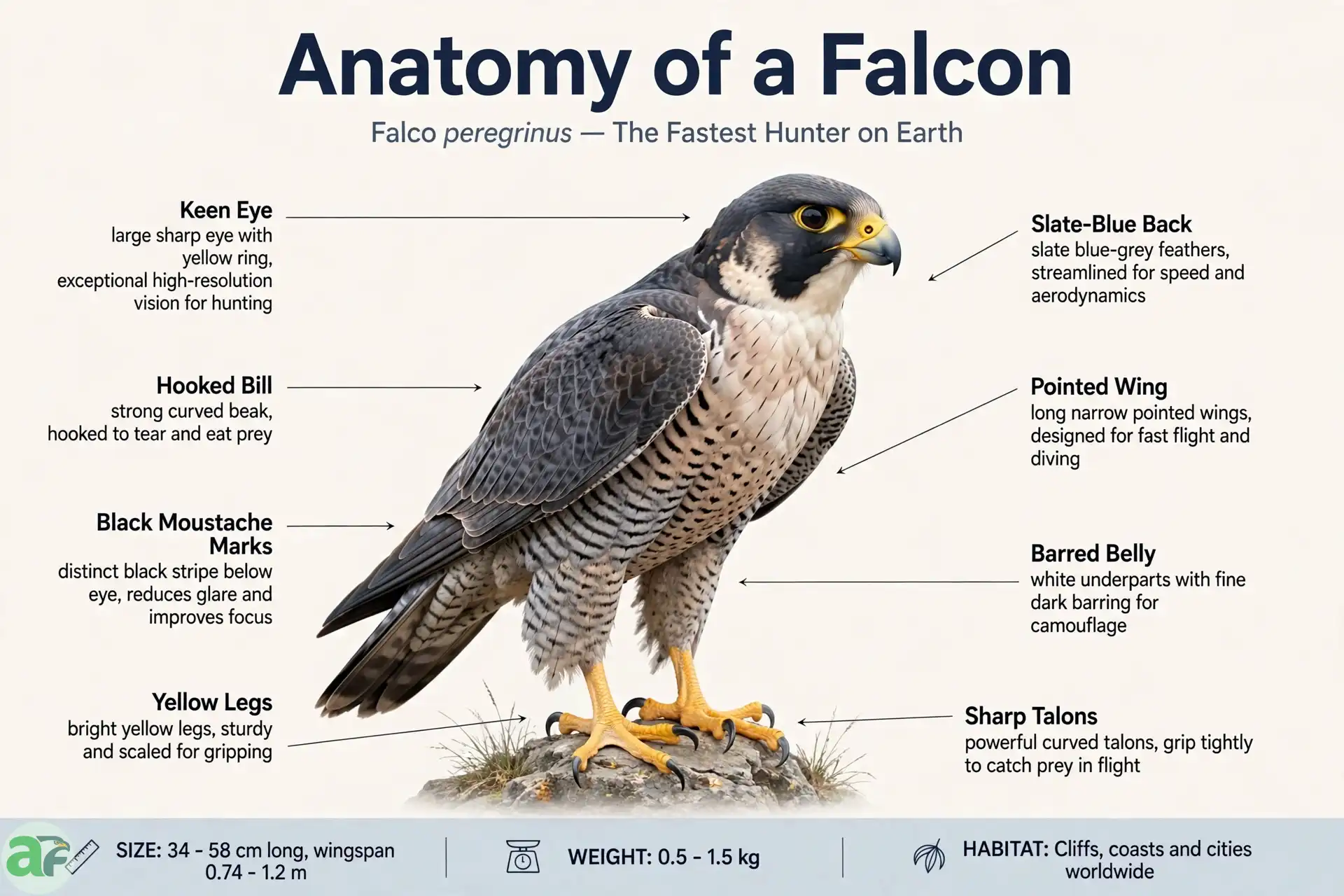
23. Frequently Asked Questions About Falcons
Q1. What is the scientific name of the peregrine falcon?
The peregrine falcon’s scientific name is Falco peregrinus (Tunstall, 1771). The genus name Falco derives from the Latin falx — meaning “sickle” — referring to the curved claws or, in some interpretations, the distinctive sickle-like profile of the falcon’s pointed wings in flight. The species name peregrinus is Latin for “wandering” or “pilgrim” (peregrinus = traveler, stranger, foreigner) — an exceptionally accurate name for the peregrine’s extraordinarily wide global distribution and its migratory behavior. The species was formally described by the English naturalist Marmaduke Tunstall in his 1771 Ornithologia Britannica. The peregrine is classified in the family Falconidae, order Falconiformes — not in the Accipitriformes (hawks and eagles) as formerly believed. Approximately 19 subspecies are recognized across the global range — varying in size, coloration, and migratory behavior. The North American subspecies F. p. anatum (the “duck hawk” of historical American usage) was the primary target of captive breeding and reintroduction programs after DDT caused its near-extinction east of the Mississippi River.
Q2. How fast can a falcon fly?
The maximum speed of any falcon — and of any animal on Earth — is the peregrine falcon’s measured stoop speed of 389 kilometers per hour (242 mph), documented during a carefully controlled series of flights by a trained bird alongside a GPS-equipped aircraft by researcher Ken Franklin. This speed is achieved only during the powered gravity-assisted diving stoop — not in sustained horizontal flight. The peregrine’s typical hunting stoop speed is somewhat lower, typically estimated at 180–320 km/h depending on angle, altitude, and wind conditions. In sustained level flight, peregrines typically travel at 65–90 km/h — fast but not extraordinary by bird standards. During horizontal prey pursuit, peregrines can reach approximately 65–80 km/h — sufficient to overtake most prey birds in level flight. The gyrfalcon — while not achieving the peregrine’s stoop speed — is the superior horizontal flight specialist, sustaining level pursuit speeds of approximately 130–170 km/h over extended distances. The merlin is the fastest small falcon in level flight, capable of approximately 80 km/h in sustained horizontal pursuit. The Eurasian hobby is fast enough to regularly catch common swifts (which fly at approximately 100 km/h) and dragonflies — making it one of the most performance-impressive small falcons.
Q3. What is the difference between a falcon and a hawk?
Falcons and hawks are not closely related despite their superficial similarities — they belong to completely different evolutionary lineages that diverged approximately 65 million years ago. The key differences: Evolutionary relationship — hawks (Accipitridae) are more closely related to eagles, kites, and harriers than to falcons; falcons (Falconidae) are more closely related to parrots and songbirds. The tomial tooth — falcons have a notch on the upper mandible used to sever prey’s cervical vertebrae; hawks entirely lack this structure. Wing shape — falcon wings are long and pointed, producing the swept-back “sickle” or “anchor” profile; hawk wings are typically more rounded with broader tips (particularly in Buteos). Nesting — true falcons lay eggs in scrapes without nest construction; hawks build stick nests. Killing method — falcons kill with a biting blow from the tomial tooth; hawks kill through suffocation from talon grip pressure. Hunting method — falcons primarily stoop at prey from altitude or pursue in level flight; hawks use ambush, soaring surveillance, or low-level quartering. Plumage — falcons typically have more uniform or streaked plumage; hawks show a wider variety of plumage patterns. In North American common usage, “hawk” is sometimes applied to falcons informally — the prairie falcon and peregrine are occasionally called “hawks” colloquially — but this is informal usage that does not reflect biological relationship.
Q4. Why did the peregrine falcon nearly go extinct?
The peregrine falcon nearly went extinct across the Northern Hemisphere in the mid-20th century due to DDT (dichlorodiphenyltrichloroethane) pesticide poisoning — specifically through a process called biomagnification in which DDT concentrated progressively through the food chain. DDT applied to agricultural land entered aquatic ecosystems through runoff; plankton absorbed DDT at low concentrations; small fish eating plankton accumulated higher concentrations; larger fish eating smaller fish accumulated still higher concentrations; pigeons and other birds eating contaminated grain and invertebrates accumulated significant DDT; and peregrines eating contaminated birds accumulated the highest concentrations of all — up to several million times the original water concentration in some measured eagle tissues. DDT’s breakdown product DDE interfered with calcium deposition during eggshell formation — producing shells 25–35% thinner than normal, which collapsed under the weight of incubating adults. The result was near-total reproductive failure across the Northern Hemisphere from the late 1940s through the early 1970s. In the eastern United States, the population fell from approximately 350 breeding pairs in 1940 to essentially zero by the early 1970s — a collapse rate exceeding even the bald eagle’s DDT crisis. The combination of the 1972 US DDT ban, the Endangered Species Act (1973), and The Peregrine Fund’s captive breeding and reintroduction program (1974 onward) drove the extraordinary recovery to the current estimated 3,500+ breeding pairs in the contiguous United States.
Q5. Where is the best place to see a peregrine falcon?
The most accessible peregrine falcon viewing in the world requires no special travel — any major North American or European city hosts resident breeding peregrine pairs that can be observed year-round by looking upward at the city’s tallest buildings. The practical approach: identify the tallest buildings and prominent elevated structures (bridges, cathedrals, power stations) in your nearest city, visit during the breeding season (March–July for active nesting), and scan the building ledges and facades for the distinctive dark-capped, pale-breasted silhouette. Urban peregrines are considerably less shy than rural birds — accustomed to human presence, they tolerate close observation and can be watched at remarkable proximity from public streets. For a guided experience with expert interpretation, the Washington National Cathedral in Washington DC (with its well-documented webcam program), the Brooklyn Bridge in New York City, and the Tate Modern in London all provide exceptional urban peregrine experiences with supporting educational resources. For wild coastal peregrine viewing, the RSPB operates seasonal viewpoints at various Scottish coastal sites. For the most dramatic peregrine hunting, coastal and estuarine sites during autumn shorebird migration (September–November) — where concentrations of waders and wildfowl attract hunting peregrines — provide the best opportunities to witness the full stoop in action.
24. Sources & References
- Wikipedia — Falco peregrinus, Falconidae, Falco rusticolus, Falco tinnunculus, Falco cherrug, Falconiformes
- IUCN Red List — iucnredlist.org (current assessments for all major falcon species)
- BirdLife International — birdlife.org (species factsheets; population assessments)
- The Peregrine Fund — peregrinefund.org (DDT recovery history; captive breeding documentation; American Kestrel Partnership)
- Cornell Lab of Ornithology — allaboutbirds.org (species accounts; Macaulay Library; eBird population data)
- Tucker, V.A. — published research on peregrine stoop trajectory and logarithmic spiral pursuit paths
- Franklin, K. — documentation of 389 km/h stoop speed measurement
- Cade, T.J. — foundational peregrine captive breeding research; Peregrine Fund founding documentation
- National Geographic — nationalgeographic.com
- BBC Wildlife / BBC Earth — bbcearth.com
- Britannica — britannica.com/animal/falcon
- Hawk Mountain Sanctuary — hawkmountain.org
- HawkWatch International — hawkwatch.org
- RSPB — rspb.org.uk (UK peregrine and kestrel population data)