
Puffin Facts
| Feature | Details |
|---|---|
| Primary Scientific Group | Genus Fratercula and related genera; 4 species of puffins; family Alcidae |
| Kingdom | Animalia |
| Phylum | Chordata |
| Class | Aves |
| Order | Charadriiformes |
| Family | Alcidae (the auks) |
| Common Names | Puffin; Atlantic puffin; tufted puffin; horned puffin; rhinoceros auklet; lundi (Icelandic); macareux (French); papagaio-do-mar (Portuguese — “sea parrot”) |
| Native Range | Atlantic puffin: North Atlantic — Iceland, Norway, UK, Canada, USA; Tufted and horned puffins: North Pacific — Alaska, Canada, Russia, Japan |
| Habitat | Open ocean for most of the year; cliff-top colonies on islands and coastal headlands for breeding |
| Lifespan | 20–30 years (wild); documented maximum 38 years |
| Diet | Primarily small fish — sand eels, herring, sprats, capelin; also squid and crustaceans |
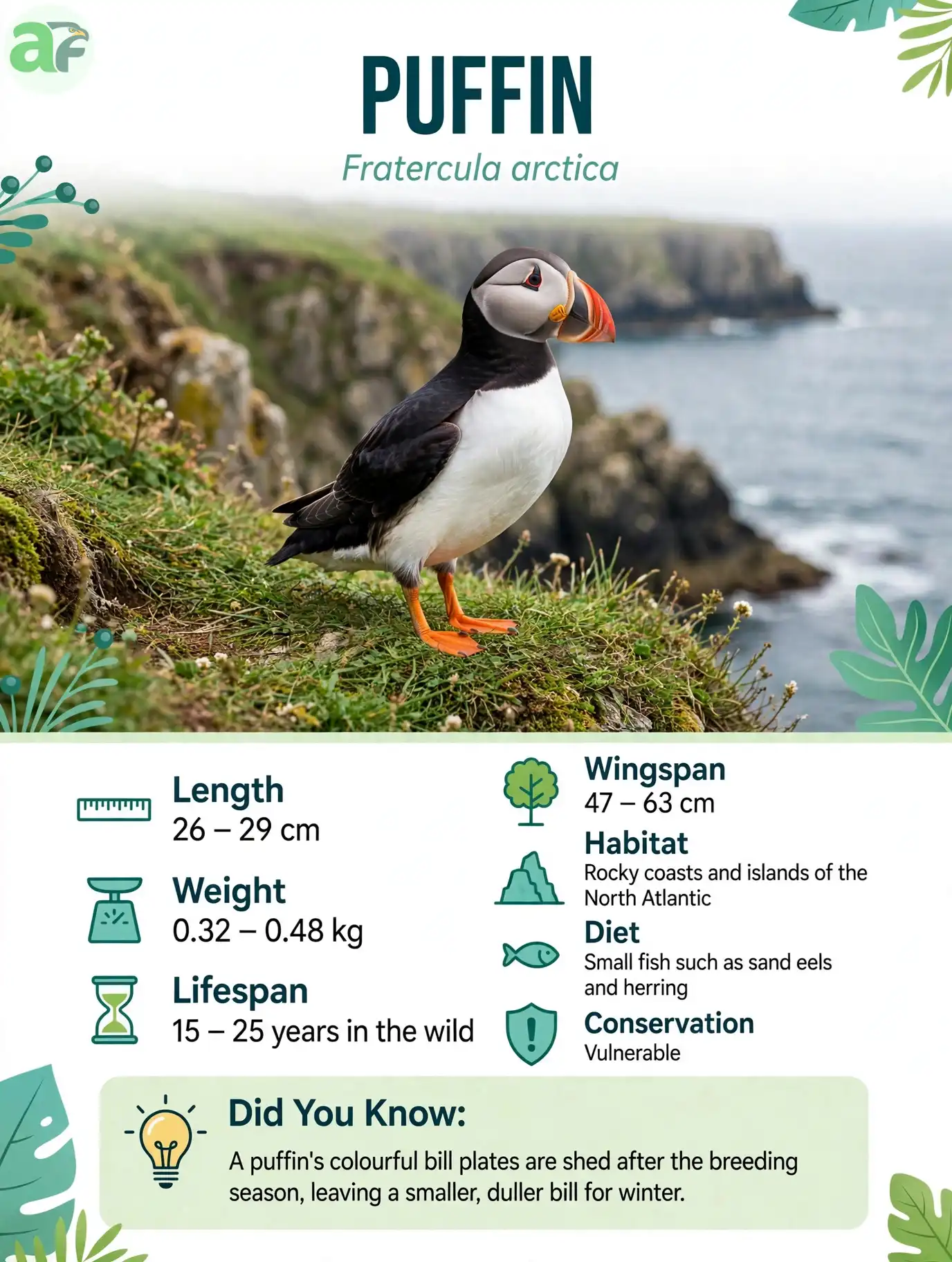
| Body Length | 26–36 cm — the Atlantic puffin approximately 30 cm |
| Weight | 310–600 grams — Atlantic puffin approximately 380–500 grams |
| Wing Use | Underwater flying — the wings used for propulsion underwater just as in flight above water; the puffin effectively “flies” through the water |
| Diving Depth | Up to 68 meters (Atlantic puffin); up to 100 meters (tufted puffin) |
| Fish per Bill Load | Up to 62 small fish held simultaneously — the world record bill load for any seabird |
| Conservation Status | Atlantic puffin: Vulnerable (IUCN) — declining; Tufted puffin: Least Concern; Horned puffin: Least Concern |
| Defining Feature | The dramatically colored breeding bill — larger, more colorful, and more complex in structure than the winter bill, produced fresh each spring; the ability to hold multiple fish in the bill simultaneously through a uniquely hinged jaw mechanism |
| Most Beloved Feature | The upright, penguin-like stance, the tuxedo-like plumage, the clown-like colored bill and brightly orange feet — creating the appearance that inspired the nickname “clown of the sea” or “sea parrot” |
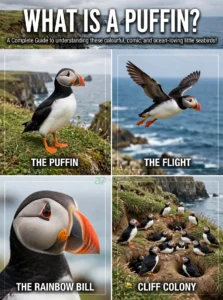 1. Introduction: What is a Puffin?
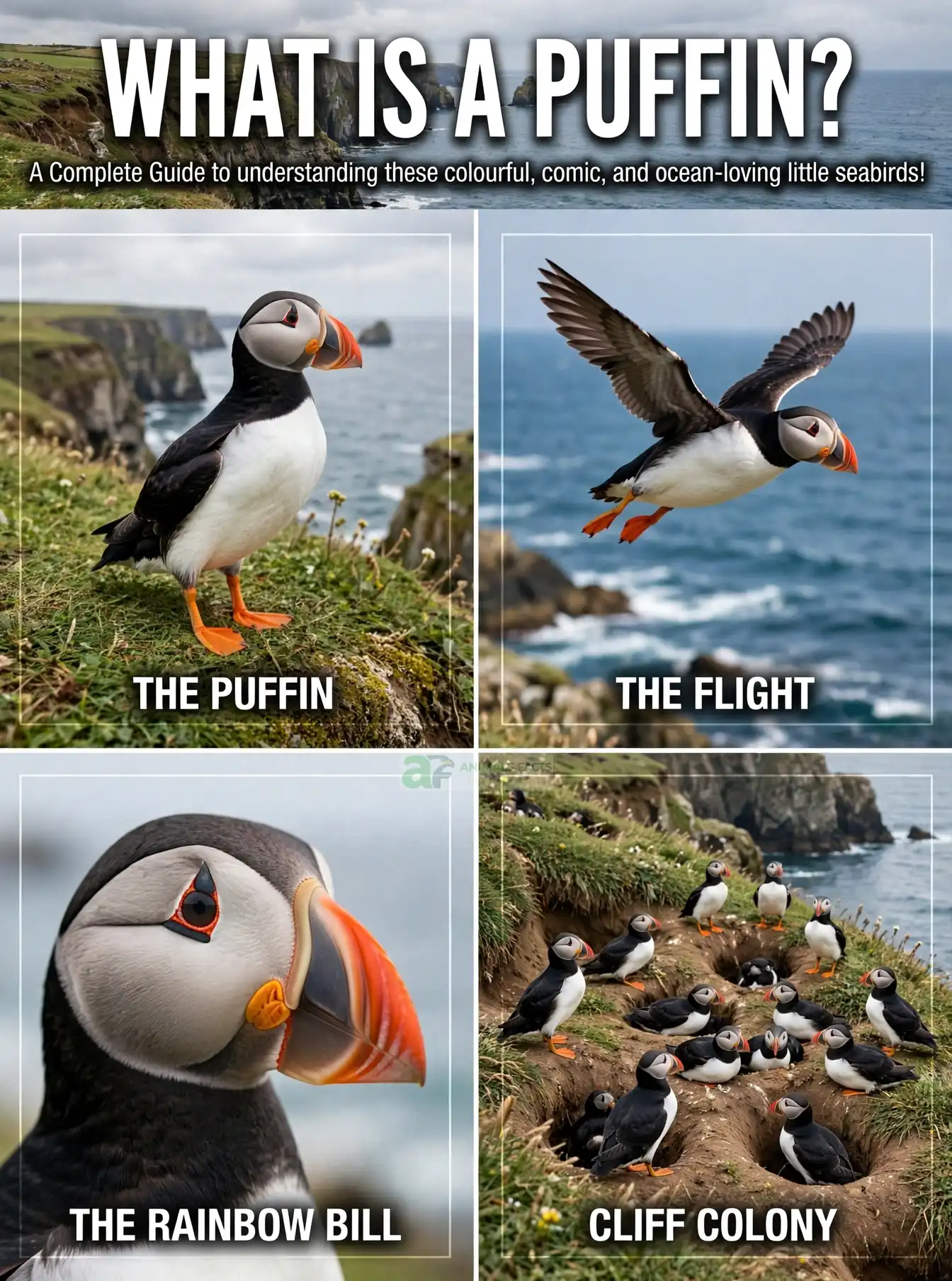
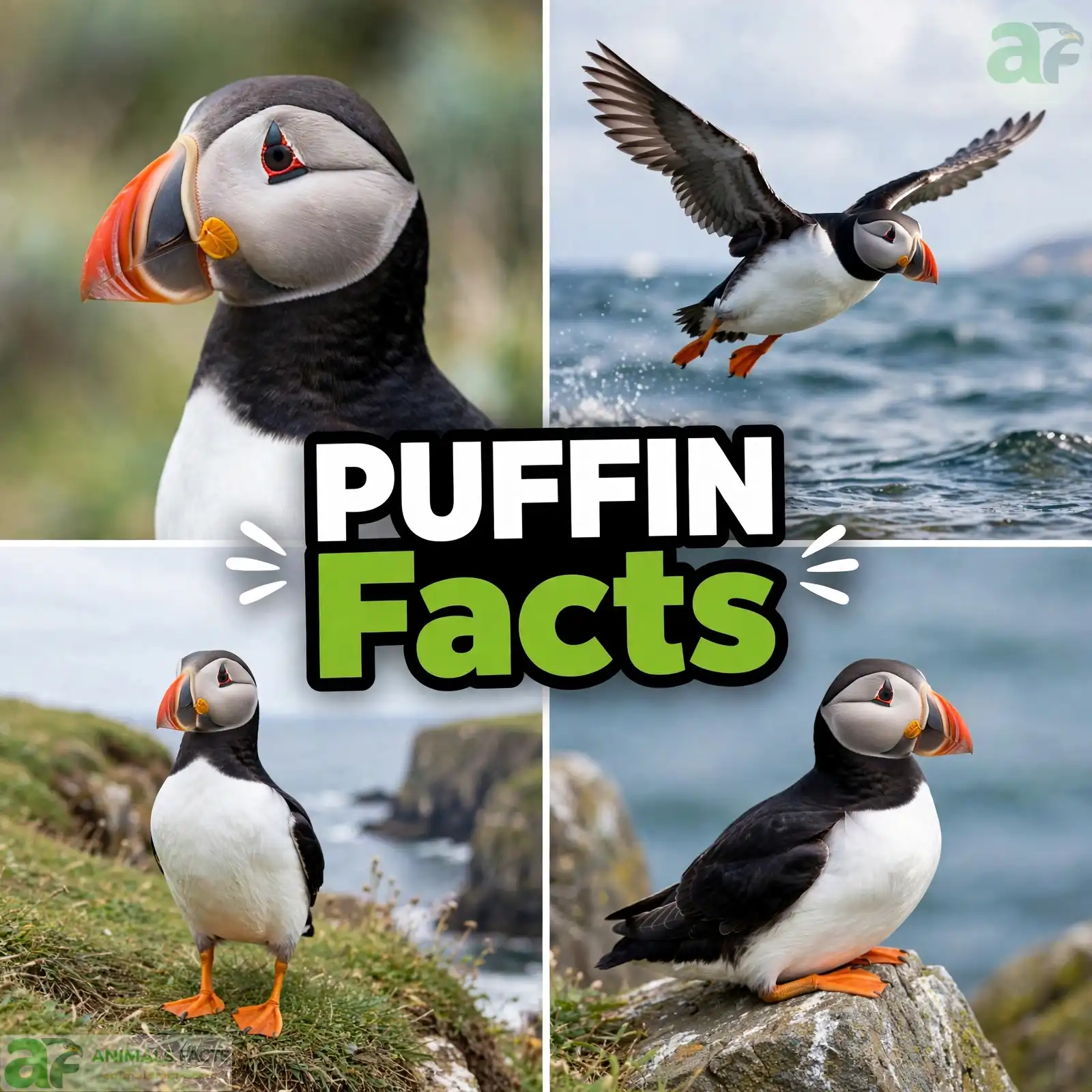
On the sea cliffs of the Westman Islands off the southern coast of Iceland in July, where the basalt columns drop vertically to the North Atlantic surf and the air above the cliff top is thick with the wingbeats of hundreds of thousands of seabirds, a single Atlantic puffin stands at the entrance to its burrow in the turf above the cliff edge. The bird is approximately 30 centimeters tall — roughly the height of a wine bottle. Its body is a precise tuxedo of black and white. Its face is divided between a white cheek patch and a dark cap, the expression created by the combination giving an impression of permanently startled seriousness. The bill — in full breeding regalia — is a layered confection of orange, red, yellow, and blue-grey that is simultaneously the most colorful and the most structurally complex bill of any North Atlantic seabird. The feet are brilliant orange. The overall impression is of a bird assembled from the aesthetic decisions of someone who wanted maximum visual impact from minimum body size. The puffin stands for a moment, turns one small eye toward the approaching observer with an expression that has been variously interpreted as dignified, puzzled, and slightly offended, then disappears backward into the burrow with the practiced efficiency of a commuter entering a subway. Puffin facts begin with that moment — the collision between the bird’s extraordinary physical comedy and the genuine biological sophistication that lies beneath the clown exterior.
The Atlantic puffin (Fratercula arctica) and its three Pacific relatives are among the most biologically extraordinary seabirds in the world — and among the most urgently threatened. A bird that spends eight months of every year on the open ocean — sleeping on the water, never touching land, diving to 68 meters in pursuit of sand eels, navigating thousands of kilometers of open Atlantic and Pacific waters with a magnetic and celestial navigation system that researchers are still working to fully understand — and then returns to the exact burrow it occupied in the previous breeding season, to reunite with the same mate, to raise a single chick that will fledge at night, alone, and fly directly to the open ocean without ever having flown over water before. A bird that can hold 62 small fish simultaneously in its bill — the fish arranged alternately head-to-tail in a stack maintained by a uniquely evolved jaw structure with backward-pointing spines — while catching additional fish underwater in pursuit dives without losing the ones already collected. A bird whose spectacular breeding bill is shed every autumn like a mask removed at the end of a performance — the colorful plates and horny structures falling away to reveal the smaller, drabber winter bill beneath — and then regrown fresh each spring before the return to the breeding colony.
Interesting facts about puffins reveal a bird whose superficial comedy conceals genuine biological complexity — the underground burrow engineering that involves digging tunnels up to 1 meter deep in the cliff-top turf using the bill and feet as combined excavation tools; the fidelity that reunites the same pair at the same burrow year after year with reunion displays of bill-touching and mutual preening that have been documented in pairs together for over 20 years; the single-chick strategy (puffling) that focuses all parental investment into one offspring that will live up to 38 years if it survives the dangerous fledging journey; the documented climate crisis in which warming North Atlantic waters are shifting sand eel distributions away from the puffin colonies that depend on them, producing chick starvation events that have triggered the IUCN’s Vulnerable classification for the Atlantic puffin; and the extraordinary Project Puffin — the landmark conservation program developed by ornithologist Steve Kress in Maine, USA — that used decoy puffins and recorded calls to reestablish breeding colonies on islands from which puffins had been extirpated a century earlier, establishing a conservation methodology now applied globally. This is your comprehensive guide to the ocean’s most beloved and most urgently threatened small seabird.
2. Puffin Species Overview & Classification
The puffins belong to the family Alcidae — the auks — a family of diving seabirds that represents the Northern Hemisphere’s ecological equivalent of the Southern Hemisphere’s penguins.
Species Classification Table
| Taxonomic Rank | Classification |
|---|---|
| Kingdom | Animalia |
| Phylum | Chordata |
| Class | Aves |
| Order | Charadriiformes |
| Family | Alcidae (Leach, 1820) |
| Puffin Genera | Fratercula (Atlantic and horned puffins); Cerorhinca (rhinoceros auklet — often included) |
| True Puffin Species | 3 species in Fratercula; the rhinoceros auklet (Cerorhinca monocerata) is often included as a fourth “puffin” |
| Etymology | Fratercula = “little friar” or “little brother” (Latin) — from frater (friar/brother) — referring to the puffin’s black-and-white plumage resembling a friar’s robes. “Puffin” derives from Middle English poffin — possibly from “puff” referring to the chubby, rounded body shape, or possibly from a Celtic word. The name was originally applied to the cured carcasses of Manx shearwater chicks, which were traded as a food item in medieval Wales, before being transferred to the similar-looking Atlantic puffin |
The Four Puffin Species
| Feature | Atlantic Puffin | Horned Puffin | Tufted Puffin | Rhinoceros Auklet |
|---|---|---|---|---|
| Scientific name | Fratercula arctica | Fratercula corniculata | Fratercula cirrhata | Cerorhinca monocerata |
| Common name | Atlantic puffin; common puffin | Horned puffin | Tufted puffin; crested puffin | Rhinoceros auklet |
| Range | North Atlantic | North Pacific | North Pacific | North Pacific |
| Length | 28–34 cm | 36–41 cm | 35–41 cm | 35–40 cm |
| Weight | 310–500 g | 450–620 g | 500–900 g | 450–600 g |
| Distinctive feature | Multi-colored bill; white face | Fleshy horn above eye; yellow/red bill | Long golden tufts; large orange bill | Horn on bill; nocturnal colony visits |
| Nesting | Burrow in turf | Cliff crevice or burrow | Burrow in turf | Burrow in soil |
| Conservation | Vulnerable | Least Concern | Least Concern | Least Concern |
| Colony size | Up to 10 million (Iceland) | Large Pacific colonies | Large Pacific colonies | Large Pacific colonies |
| Named for | Body shape (“puffed”) | Fleshy horn above eye | Long golden head tufts | Horn-like bill projection |
The Auk Family — The Northern Hemisphere’s Penguin Equivalent
The Alcidae family — approximately 25 species including murres, razorbills, guillemots, and auklets — occupy the same ecological niche in the Northern Hemisphere that penguins occupy in the Southern Hemisphere:
The convergent evolution parallel:
- Both alcids (auks) and penguins are pursuit-diving seabirds that use wings modified for underwater propulsion
- Both groups produce black-and-white “tuxedo” plumage
- Both nest in dense colonies on islands or coastal cliffs
- The critical difference: auks retained flight — their wings serve double duty as both flight surfaces and underwater propellers. Penguins sacrificed flight entirely for maximized underwater capability.
The extinct great auk — The family’s most famous member: the great auk (Pinguinus impennis) was the Northern Hemisphere’s true “penguin equivalent” — a large, completely flightless alcid that was hunted to extinction. The last confirmed great auk individuals were killed at Eldey Island, Iceland, in 1844 — one of the most precisely dated bird extinctions in history. The great auk’s extinction was directly caused by human hunting for food, feathers, and (ironically) as museum specimens as the birds became rare and scientifically valuable.
The Surprising Evolutionary Position
Puffins belong to the Charadriiformes — making them relatives of shorebirds (sandpipers, plovers) and gulls rather than penguins. The puffin-penguin similarity is one of the most striking examples of convergent evolution in the bird world — two completely unrelated lineages independently evolving nearly identical body plans, colors, and ecological strategies.
Evolution & Discovery Timeline
~30–40 million years ago (Oligocene) — The alcid lineage diverges within the Charadriiformes — establishing the auk family in the Northern Hemisphere.
~5–10 million years ago (Miocene-Pliocene) — The Fratercula genus diversifies — the Atlantic and Pacific puffin lineages establishing.
~844 CE — The Westman Islands (Vestmannaeyjar) of Iceland — home to the world’s largest Atlantic puffin colony — are first settled by humans. The puffin relationship with Icelandic culture begins.
~1000 CE — Norse sagas reference puffins as food resources at Icelandic and Faroese colonies — beginning the documented human-puffin consumption relationship.
1758 — Carl Linnaeus formally describes Fratercula arctica in Systema Naturae.
1844 — The great auk (Pinguinus impennis) — the puffin’s flightless alcid relative — is driven to extinction. The last individuals killed at Eldey Island, Iceland.
1900s — Atlantic puffin populations decline dramatically across southern parts of the range (Maine, UK, parts of Norway) due to hunting and egg collection.
1973 — Steve Kress of the Cornell Lab of Ornithology begins Project Puffin — the landmark conservation program using decoy puffins and recorded calls to reestablish colonies in Maine. The program succeeds and becomes one of the most celebrated conservation success stories in American ornithology.
2015 — The IUCN upgrades the Atlantic puffin from Least Concern to Vulnerable — reflecting documented population declines linked to climate-driven changes in food availability. One of the most significant conservation status changes for any iconic European seabird.
2024 — Atlantic puffin remains Vulnerable with declining population trend; Iceland’s Westman Islands colonies showing the most severe recent declines due to sand eel failure linked to ocean warming.
“The puffin is the bird that makes the strongest argument for saving the ocean. When puffin chicks starve because the sand eels have moved to cooler waters that are now too far from the colony for the parents to reach, you are watching climate change in real time, with a face that everyone recognizes and loves. The puffin’s charm is conservation’s most powerful emotional asset.”
— Dr. Steve Kress, Cornell Lab of Ornithology — founder of Project Puffin and the world’s foremost puffin conservation authority
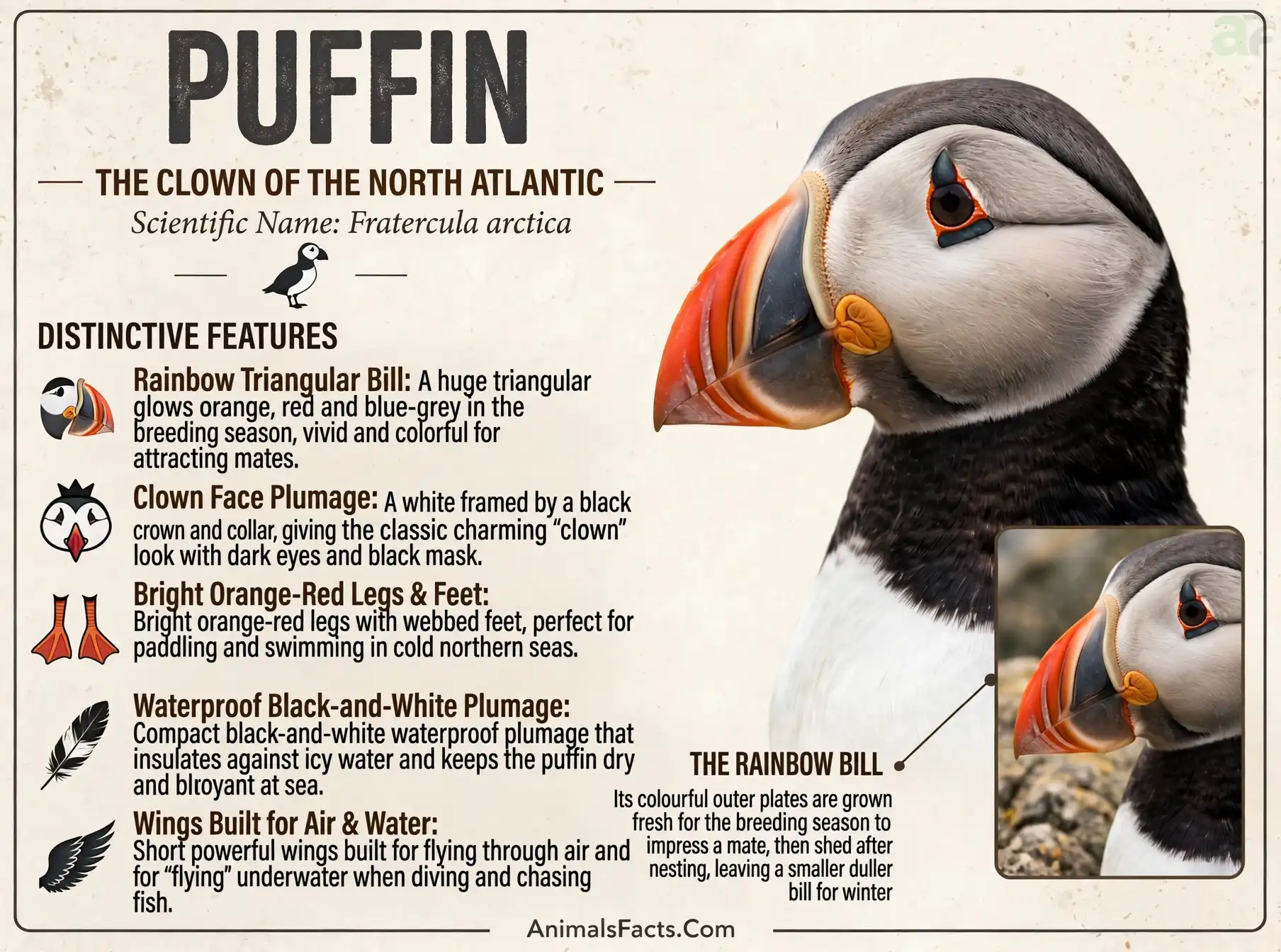
3. Puffin Physical Description & Unique Features
The puffin’s physical features are a catalogue of evolutionary innovations for the dual demands of aerial and underwater locomotion — combined with a breeding display system of extraordinary complexity concentrated in the bill.
The Breeding Bill — The Most Seasonally Complex Bill in Any Seabird
The tuxedo and the mask — The Atlantic puffin’s breeding appearance is defined by two contrasting elements:
- The body — stark black-and-white (“tuxedo”) plumage; white face patch surrounded by dark cap and back
- The bill — a layered, multi-colored structure of orange-red, yellow, and blue-grey that is the most structurally and chromatically complex bill of any North Atlantic bird
The bill colors:
- Tip — bright red-orange
- Middle section — yellow where the upper and lower mandibles meet; blue-grey sheath on the sides
- Base — yellow-orange with pale yellow rosette where bill meets the face
- The colors form distinct zones separated by visible boundaries — creating a bill of extraordinary chromatic complexity
The seasonal transformation — the bill is shed and regrown annually:
This is the puffin’s most surprising physical fact: the spectacular breeding bill is not permanent. Each autumn, after the breeding season ends and the puffins return to the open ocean, the colorful outer bill plates are shed — falling off like a mask removed at the end of a performance:
- The orange tip plates fall first
- The colored side sheaths follow
- The yellow rosette at the base sheds last
- Beneath the shed plates, a smaller, drabber, more pointed winter bill is revealed
- The winter bill is grey-brown — dramatically less colorful and approximately 30% smaller than the breeding bill
- The following spring, before the return to the breeding colony, the colorful plates regrow fresh — the full breeding bill restored within weeks
Why it is shed — The seasonal molt of the bill sheaths likely serves multiple functions:
- The colorful bill is metabolically costly to produce — shedding it when not needed for mate attraction saves resources
- The reduced winter bill may be better adapted for fish-catching during the non-breeding months at sea
- The bill’s coloration serves primarily in mate attraction and social signaling at the colony — these functions are not needed during the solitary winter months at sea
The color function — Bill coloration has been documented to function in:
- Species recognition — preventing mating mistakes between the three similar Fratercula species where ranges overlap
- Mate quality signaling — more colorful bills may indicate better individual condition; research has documented positive correlations between bill color intensity and various measures of individual quality
- Age signaling — bill pattern complexity increases with age — younger birds have simpler, less colorful bills; experienced breeders have the most elaborate coloration
The Multiple Fish Holding Mechanism — The Most Impressive Bill Loading of Any Bird
The record — A 62-fish bill load is the documented record for an Atlantic puffin — 62 small sand eels held simultaneously in a single bill load. More typically, Atlantic puffins carry 10–30 fish per bill load.
The mechanism — why fish don’t fall out:
This is one of the most frequently asked questions in puffin biology — how does the bird catch and hold additional fish without losing the ones already collected?
The backward-pointing spines — The upper palate and tongue of the puffin’s bill bear backward-pointing, tooth-like projections (called denticulations or spines) that grip already-caught fish:
- When the bill opens to catch a new fish, the backward-pointing spines hold the previously caught fish against the upper palate
- The new fish is caught by the bill tip
- The bill closes, trapping the new fish while the spines continue to hold the previously caught ones
- This process can be repeated many times — the number of fish that can be held limited primarily by physical space in the bill rather than by the holding mechanism
The arrangement — Fish in a loaded puffin bill are arranged alternating head-to-tail — the aerodynamically efficient arrangement that minimizes the drag of the tail-hanging fish during the flight back to the burrow. The alternating arrangement is achieved by the puffin rotating each new fish before adding it to the stack — demonstrating a degree of manual dexterity in bill use that is extraordinary for a bird.
The cooperative jaw mechanism — The upper and lower jaws can move semi-independently — the hinge mechanism allowing the bill to flex slightly as new fish are added without displacing the existing catch.
The Wings — The Double-Use Propulsion System
The unique dual function — The puffin’s wings serve two completely different locomotion functions:
- Above water — the wings generate lift for flight — the puffin flies at approximately 55–88 km/h, beating its wings at approximately 400 beats per minute — one of the highest wing-beat rates of any bird
- Underwater — the wings generate thrust for swimming — the puffin “flies” through the water with the same wing action used in air, reaching underwater speeds of approximately 17–19 km/h
The compromise design — The wing’s double duty creates an unavoidable compromise:
- Wings optimized for underwater propulsion are shorter and more rigid than wings optimized for aerial flight
- The puffin’s wing loading (weight per unit wing area) is one of the highest of any flying bird — making takeoff difficult (requiring a running start from a cliff edge or from the water surface) and requiring the extremely rapid wingbeat rate
- The compromise between aerial and underwater flight is the defining physical constraint of all flying alcids — and why the great auk (which gave up flight entirely to optimize underwater performance) eventually evolved the most efficient diving capability of any alcid
Takeoff from water — Puffins taking off from the water surface must run across the water — their wings beating rapidly while the feet provide additional running propulsion against the surface — for several meters before achieving sufficient airspeed to lift off. This ungainly takeoff is one of the most comedic elements of puffin locomotion and one of the most physically demanding — the wing loading requiring substantial speed before lift is generated.
Landing at the colony — Puffins approaching the colony at speed face a landing challenge: their high wing loading means stall speed (the minimum speed for flight) is relatively high, making slow, controlled landings difficult. Puffins typically land by crashing into the colony — belly-flopping onto the turf or scrambling into the burrow entrance at speed. The comedy of a puffin landing is one of the most frequently documented aspects of colony behavior.
The Orange Feet
Color — The bright orange feet — vivid in breeding adults, duller orange in winter — are one of the puffin’s most immediately recognizable features alongside the bill:
- The foot color is produced by carotenoid pigments from the diet — the same class of pigments that produce the orange of carrots and the pink of flamingos
- Foot color may signal individual condition — birds with access to carotenoid-rich food producing more vivid foot coloration
- The orange feet contribute to the overall “clown” visual impression — bright color in an unexpected location
The swimming feet — The orange feet are large and webbed — providing supplementary propulsion during underwater pursuit and serving as rudders during diving:
- During underwater swimming, the feet are typically held flat against the body while the wings provide primary propulsion
- The feet are extended as brakes and rudders during the final approach to a fish
💡 Did You Know? The puffin’s single chick is called a “puffling” — one of the most universally beloved of all bird offspring names. But the puffling’s first journey to the ocean is one of the most dangerous events in any seabird’s life. When the puffling is ready to fledge — after approximately 45 days in the underground burrow, fed exclusively by its parents bringing fish — it must make its way to the sea alone, at night, without any parental guidance. The parents stop bringing fish several days before fledging — the food withdrawal motivating the chick to leave the burrow. On its fledging night, the puffling emerges from the burrow for the first time, faces the darkness, and launches itself toward the sea — navigating by the brightness of the ocean horizon, where starlight reflects off water, against the darker sky over land. It has never flown before. It must reach the ocean — sometimes across several kilometers of island terrain — before daybreak, when aerial predators become active. In Vestmannaeyjar (the Westman Islands) of Iceland, where the world’s largest puffin colony is adjacent to the island’s town, thousands of pufflings are disoriented each year by the town’s artificial lighting — the lights of the town being brighter than the ocean horizon and drawing the pufflings inland rather than seaward. Local children and residents conduct the “Puffling Patrol” each August and September — collecting disoriented pufflings from streets, gardens, and even inside houses, holding them gently, and releasing them from the cliffside toward the ocean. This annual tradition — children rescuing baby puffins from urban confusion — has become one of the most beloved community wildlife events in Iceland and one of the most touching examples of human-wildlife coexistence anywhere in the world.
4. Top 25 Amazing Puffin Facts
Here is your definitive collection of the most extraordinary, scientifically verified, and genuinely astonishing puffin facts as of 2026:
- The Atlantic puffin’s spectacular breeding bill is shed every autumn — the colored outer plates falling away to reveal a smaller, drabber winter bill — and regrown fresh each spring. The breeding bill is effectively a seasonal mask that the bird produces annually for the colony season and discards when it returns to the open ocean.
- A puffin has been documented carrying 62 small sand eels simultaneously in its bill — the world record fish load for any seabird. The bill holds the fish through backward-pointing spines on the upper palate and tongue that grip already-caught fish when the bill opens to catch additional ones.
- Puffins use their wings to “fly” underwater — the same wing motion used for aerial flight propels the bird through the water during diving pursuits. This dual-function wing makes the puffin one of the very few birds that genuinely “flies” in two different media.
- The Atlantic puffin can dive to 68 meters (223 feet) below the ocean surface — the equivalent of diving to the top of a 20-story building measured downward — in pursuit of fish. The tufted puffin dives even deeper — to approximately 100 meters (328 feet).
- Puffins spend approximately eight months of every year on the open ocean — sleeping on the water surface, never touching land, far from any coast. Their winter range at sea is poorly mapped even in 2026 — one of the most significant gaps in seabird knowledge.
- Puffin pairs are remarkably faithful — the same pair returning to the same burrow year after year, sometimes remaining together for over 20 years. Reunion at the burrow involves touching bills and mutual preening — documented pair bond behaviors that have been observed in the same pair across two decades of monitoring.
- The fledgling puffin (a “puffling”) leaves the burrow alone, at night, without any parental guidance, and must navigate to the ocean using only the brightness of the ocean horizon against the darker sky over land. It has never flown before and has never seen the ocean.
- The “Puffling Patrol” in Vestmannaeyjar (Westman Islands), Iceland — where children rescue disoriented pufflings from town streets each August and September — is one of the most beloved annual wildlife events in the world. Pufflings are attracted to the town’s artificial lighting rather than the ocean horizon and must be rescued and launched toward the sea.
- Puffins beat their wings at approximately 400 beats per minute during flight — one of the highest wing-beat rates of any flying bird. The rapid wing beat is necessary because of the puffin’s high wing loading — its compact wings must beat very fast to generate sufficient lift for the heavy body.
- The word “puffin” originally referred to the salted carcasses of Manx shearwater chicks — a medieval Welsh food trade item. The name was transferred to the Atlantic puffin when European traders encountered the similar-looking birds. The Manx shearwater (a completely different bird) was the original “puffin” in the English language.
- The Atlantic puffin’s scientific name is Fratercula arctica — meaning “little friar of the Arctic” — the black-and-white plumage compared to the robes of a medieval friar. The name is one of the most poetic and most appropriate in ornithological Latin.
- Project Puffin — begun by Steve Kress at Egg Rock Island, Maine, in 1973 — used wooden decoy puffins and recorded puffin calls to attract puffins to islands from which they had been extirpated. The project succeeded in establishing new breeding colonies and became the foundational methodology for seabird restoration programs globally.
- Puffin burrows can extend up to 1 meter deep into the cliff-top turf — excavated using the bill as a pickaxe and the feet as shovels. A pair may return to and expand the same burrow across 10–20 breeding seasons, progressively deepening and widening the tunnel.
- The Atlantic puffin was classified as Vulnerable by the IUCN in 2015 — one of the most significant conservation status changes for any iconic European bird in recent decades. The reclassification reflects documented population declines linked to climate-driven shifts in sand eel distribution.
- Puffins can swim faster than many fish — reaching underwater speeds of approximately 17–19 km/h using their wings for propulsion. This underwater speed allows pursuit of fast-swimming fish including sand eels and herring.
- The puffin’s eye structure contains a specialized lens that can adjust for the refractive difference between air and water — allowing the bird to see clearly both above and below the water surface. This dual-medium vision is shared with several other diving birds and is one of the most sophisticated optical adaptations in the bird world.
- Puffins navigate across thousands of kilometers of open ocean during their winter months at sea using a combination of magnetic sensing, stellar navigation, and possibly infrasound detection of ocean currents. The precise mechanisms of their open-ocean navigation remain incompletely understood.
- The Iceland population of Atlantic puffins represents approximately 60% of the global total — making Iceland the single most important country for Atlantic puffin conservation. The Westman Islands colony alone has historically held 8–10 million puffins — the largest single seabird colony in Iceland.
- Puffin chick mortality during heat waves has been documented in multiple European colonies — the underground burrow temperature rising to lethal levels during extreme heat events that are increasing in frequency with climate change. This direct heat mortality pathway adds to the indirect food-availability pathway as a climate-linked threat.
- The tufted puffin (Fratercula cirrhata) of the North Pacific has golden head tufts that can reach 15 cm in length during the breeding season — the most dramatically adorned puffin species, the tufts drooping alongside the face and neck in an appearance that various observers have compared to a 1970s rock musician’s hairstyle.
- Puffins molt all their flight feathers simultaneously after the breeding season — becoming temporarily flightless for approximately 40–50 days while at sea. During this flightless period, the birds dive for food using only their feet since the wings are being replaced.
- Research using geolocator tags attached to Atlantic puffins has revealed that the birds from UK colonies spend the winter primarily in mid-Atlantic waters — between the UK, Iceland, the Faroe Islands, and North America — far from any land and in some of the roughest ocean conditions on Earth.
- Puffin colonies emit a distinctive smell detectable from considerable distance — the accumulated fish oil, guano, and the birds’ own preen gland oil creating a complex odor that predators (and researchers) learn to associate with colony locations. The olfactory signal may actually help puffins locate colonies on return from their winter ocean wandering.
- Climate change is altering puffin bill coloration — research has documented that Atlantic puffins in areas experiencing ocean warming have less colorful bills than those in cooler waters, reflecting reduced access to the carotenoid pigments from prey species whose distribution is shifting with temperature. The puffin’s bill is literally becoming a visible indicator of ocean health.
- As of 2026, the global Atlantic puffin population is estimated at approximately 9–15 million individuals — the Iceland population representing approximately 60% of the total. Despite these large numbers, the population trend is decreasing across virtually all monitoring sites, and several colonies have declined by over 50% in the past 30 years, driving the Vulnerable classification.
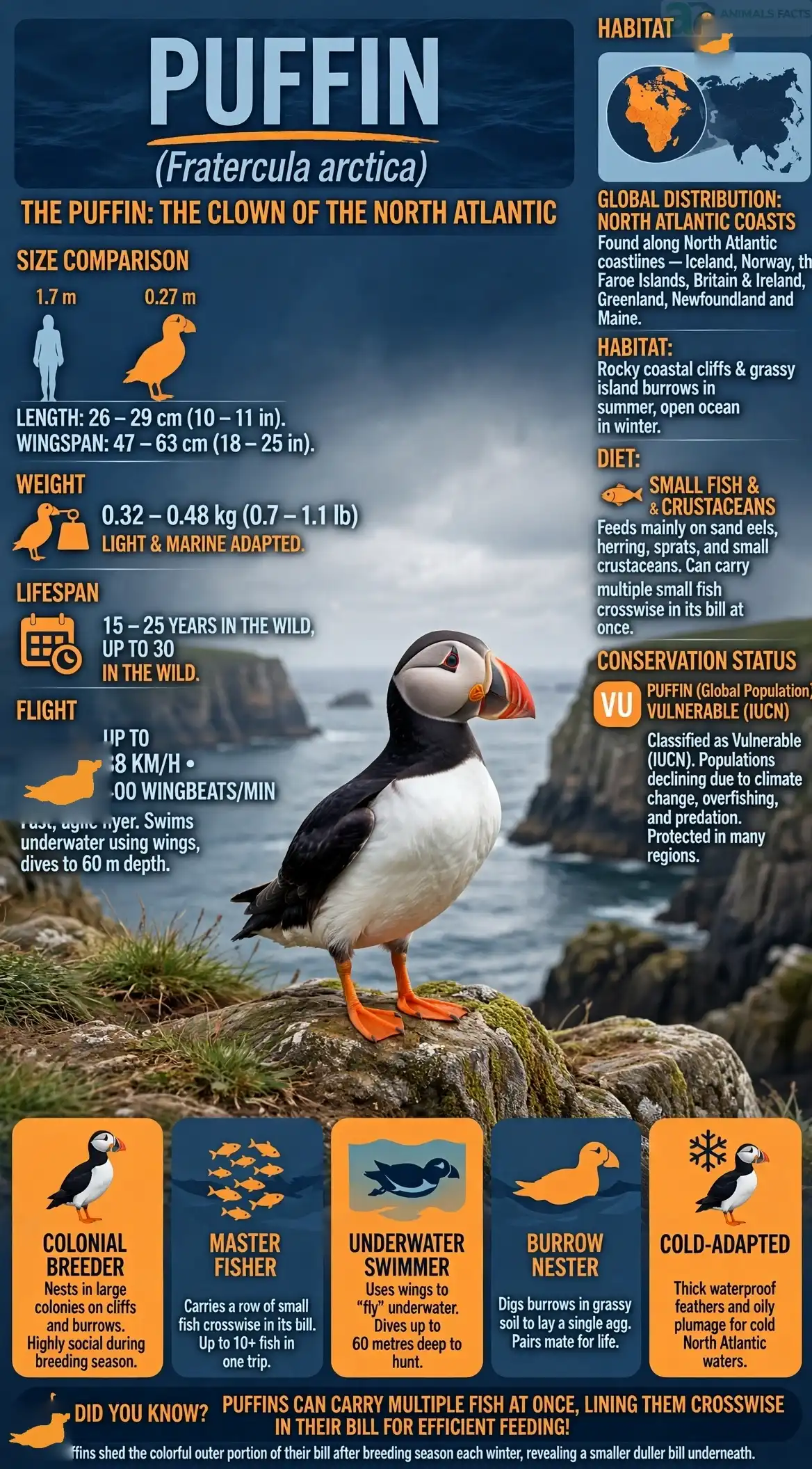
5. Fun Facts About Puffins
- Breeding bill shed every autumn — regrown each spring
- Record 62 fish held in bill simultaneously
- Wings used to “fly” underwater
- Dives to 68 meters deep
- 8 months at sea — sleeping on the ocean
- Same pair, same burrow, up to 20+ years
- Puffling fledges alone, at night — never flown before
- “Puffling Patrol” in Iceland — children rescue disoriented chicks
- 400 wingbeats per minute — one of the highest of any flying bird
- “Puffin” originally meant Manx shearwater chicks — a salted food item
- Name means “little friar of the Arctic” in Latin
- Project Puffin established the global seabird restoration methodology
- Classified Vulnerable 2015 — declining across almost all monitored colonies
6. Puffins Habitat & Geographic Range
Puffin habitat is divided into two completely different environments occupied in strict seasonal sequence — the open ocean for the non-breeding winter months, and the coastal cliffs and islands for the breeding season.
The Breeding Habitat
Cliff-top turf and sea cliffs:
The puffin’s breeding habitat requirements are highly specific:
- Cliff-top turf deep enough for burrow excavation — at least 50–80 cm of stable soil above the underlying rock
- Adjacent cliff faces providing takeoff and landing launch points
- Proximity to productive fishing grounds — ideally within 50–80 km of the colony for fish-carrying parents
- Island or isolated headland location — reducing terrestrial predator access
The colony types:
- Turf colonies — excavated burrows in cliff-top grassland (Atlantic puffin’s primary breeding habitat)
- Cliff crevice colonies — nesting in natural rock crevices (more common in horned puffin)
- Rocky talus colonies — nesting among loose rock piles at cliff bases (some locations)
The colony sizes — Puffin colonies range from a few pairs to millions of birds:
- Westman Islands, Iceland — historically 8–10 million birds — the world’s largest Atlantic puffin colony
- Røst, Norway — approximately 1.5 million birds historically; declining significantly
- Skomer Island, Wales — approximately 40,000 birds — one of the UK’s largest and most visited colonies
The Winter Ocean Habitat
The poorly known winter world — Despite extensive research, the puffin’s winter habitat remains one of the least well-understood aspects of its ecology:
What geolocator research has revealed:
- Atlantic puffins from UK colonies winter primarily in the mid-Atlantic — roughly between 30°N and 55°N latitude
- Some individuals from the same colony winter in completely different ocean areas — individual variation in winter habitat use is substantial
- Puffins from Iceland colonies have been tracked to waters off West Africa and the eastern North American seaboard — extraordinary winter journey distances
The ocean requirements:
- Productive fishing grounds — areas where sand eels, herring, capelin, and other prey fish concentrate near the surface
- Cold, productive ocean currents — puffins are associated with cold-water upwelling zones where prey is abundant
- Puffins avoid the open tropical ocean — their prey is cold-water associated
Geographic Distribution
| Species | Primary Breeding Range | Key Colonies | Winter Range |
|---|---|---|---|
| Atlantic puffin | Iceland, Norway, UK, Canada, Maine USA | Westman Islands (IS); Røst (NO); Skomer (UK) | Mid-Atlantic; some E. Atlantic |
| Horned puffin | Alaska, Russia, Pacific Canada | St. Lawrence Island; Pribilof Islands | North Pacific broadly |
| Tufted puffin | Alaska to California; Russia to Japan | Farallon Islands (CA); Alaska islands | North Pacific broadly |
| Rhinoceros auklet | Alaska to California; Japan | Protection Island (WA); Ano Nuevo (CA) | North Pacific coast |
The Iceland Importance
Iceland hosts approximately 60% of the global Atlantic puffin population — making its conservation situation critical for the species’ global status:
The Westman Islands (Vestmannaeyjar) — The world’s most important Atlantic puffin location:
- 8–10 million puffins historically — the number has declined significantly in recent decades
- The islands are both the world’s most important puffin site and the location of the most visible conservation crisis — the “puffling patrol” tradition being a direct response to the colony’s adjacency to human habitation
The Icelandic culture-puffin relationship — Puffins have been central to Icelandic culture for over 1,000 years:
- Puffin meat has been consumed in Iceland continuously since Norse settlement
- The Westman Islands’ relationship with puffins is so deep that the town’s annual “Pjóðhátíð” (National Holiday) features puffin watching as a cultural activity
- The current conservation crisis — declining Iceland puffin numbers — is therefore both an ecological emergency and a cultural one
7. Puffin Diet & Feeding Behavior
Puffin diet is dominated by small schooling fish — the birds being among the most specialized piscivores (fish-eaters) of any seabird in terms of both hunting technique and dietary composition.
Diet Breakdown Table
| Food Type | Proportion | Notes |
|---|---|---|
| Sand eels (Ammodytes species) | ~50–70% | The primary prey; nutritionally critical; distribution shifting with climate change |
| Herring (Clupea harengus) | ~10–20% | Important in areas where sand eels are less abundant |
| Sprats (Sprattus sprattus) | ~5–10% | Regional importance; UK and Irish Sea populations |
| Capelin (Mallotus villosus) | ~5–15% | Critical in Iceland; highly variable abundance |
| Hake, rockling, and other fish | ~5–10% | Supplementary; taken when primary prey scarce |
| Squid | ~2–5% | Taken opportunistically; important in some areas |
| Crustaceans | ~1–3% | Amphipods, copepods — important for juveniles |
The Diving Technique
The hunting dive sequence:
- The puffin spots prey from the surface — the forward-facing eyes providing binocular vision for depth perception underwater
- The bird dives — using the wings to propel forward and downward; feet provide steering
- Pursuit — the puffin “flies” through the water at 17–19 km/h, pursuing individual fish or working through a school
- Capture — the fish is seized by the bill tip; the backward-pointing spines hold it against the palate
- Additional captures — the bird continues to catch fish, adding them to the collection held in the bill
- Ascent — when the bill is full (or the fish school dispersed), the bird swims upward
- Surface — the bird surfaces, often swallowing small crustaceans caught during the dive but retaining larger fish for transport
Dive duration — Typically 20–60 seconds per dive, with maximum documented dives of approximately 90 seconds
Dive depth — Typically 10–50 meters for most dives; maximum documented 68 meters (Atlantic puffin), 100 meters (tufted puffin)
The Sand Eel Dependency — The Critical Climate Vulnerability
Why sand eels matter — The Atlantic puffin’s dependence on sand eels (Ammodytes marinus and related species) creates the primary climate vulnerability:
Sand eel biology:
- Sand eels are small (typically 10–18 cm), schooling fish that live in the water column above sandy seabeds
- They are critically dependent on cold, productive water — their own primary food (Calanus copepods) requires cold water to breed effectively
- Sand eel distribution is highly temperature-sensitive — as water temperatures rise, sand eel populations shift northward to remain in cooler water
The climate impact pathway:
- Ocean warming in the North Atlantic and North Sea
- Calanus copepod populations decline or shift northward
- Sand eel populations follow their prey northward
- Sand eel schools move to waters too far from established puffin colonies for parents to reach and return within a day
- Puffin chicks receive inadequate food; starvation events occur
- Breeding success declines; colony populations fall
- Long-lived adults maintain numbers for some years, masking the severity
- As adult mortality accumulates, colony populations enter irreversible decline
The documented evidence — This pathway has been documented most severely in Norwegian colonies:
- Røst colony (Norway) — historically one of the largest puffin colonies in the world; declined by over 50% since the 1980s; breeding failures linked to sand eel scarcity documented across multiple breeding seasons
- Westman Islands (Iceland) — declining breeding success documented in years of reduced capelin and sand eel availability
8. Puffins Reproduction & Life Cycle
Puffin reproduction is defined by the single-egg strategy, the long-term pair bond, and the extraordinary logistics of feeding a rapidly growing chick from a hunting base that may be 50–80 km from the fishing grounds.
Return to the Colony
The spring return — Puffins begin arriving at breeding colonies in March–May (depending on latitude — later in the north):
- Birds arrive progressively — first individuals appearing at the colony up to 6–8 weeks before breeding begins
- The return involves a reunion display between established pairs at the burrow — bill-touching (billing), mutual preening, and calling
- First-time breeders (typically 5 years old or older) prospecting for burrow sites engage in prolonged “prospecting” behavior — visiting multiple potential sites and interacting with established pairs
The bill regrowth — The colorful breeding bill has been regrowing since late winter — the full display bill is present by colony arrival.
Pair Bond and Courtship
The long-term pair bond — Puffin pair bonds are among the most durable of any seabird:
- The same pair returns to the same burrow in successive years
- Pair bond duration of 10–20+ years has been documented in color-marked individuals
- The death of one partner leads to the survivor finding a new mate — the “divorce” rate in puffins (pair bond dissolution without partner death) is very low
Courtship behaviors:
- Billing — the pair’s bills touch in a rapid, mutual clashing movement — the most characteristic and most photographed puffin pair behavior
- Mutual preening — each bird preens the other’s head and neck feathers
- Head shaking — rapid head movements performed by both birds simultaneously
- Calling — the puffin’s low, growling call (aarr) produced in the burrow and at the burrow entrance during reunion
Burrow Preparation
Burrow engineering — The burrow is excavated or maintained by both pair members:
- New burrows are dug using the bill as a pickaxe — the bird driving the bill into the soil and levering loose material
- The feet scrape and push loose material backward out of the developing tunnel
- A completed burrow extends typically 50–100 cm into the turf, ending in a nesting chamber approximately 30 cm in diameter
- The nesting chamber is lined with grass, feathers, and other material carried into the burrow
Burrow fidelity — Established pairs use the same burrow across many breeding seasons, progressively deepening and widening it. Long-used burrows may extend considerably deeper than newly excavated ones.
Egg Laying and Incubation
The single egg — Puffins lay one egg per breeding season:
- Egg dimensions: approximately 61 × 42 mm — relatively large for the bird’s size
- Egg color: white to dull white, often becoming stained with soil during incubation
- The single-egg strategy concentrates all parental investment in a single offspring — appropriate for a long-lived species where lifetime reproductive success is accumulated over many years
Incubation — 39–45 days — shared equally between both parents:
- Each parent takes incubation shifts of approximately 1–3 days
- The non-incubating parent is at sea, feeding
- The egg temperature is maintained at approximately 37–38°C through the parent’s brood patch (a bare, vascularized area of belly skin)
Chick Development — The Puffling
At hatching — The puffling hatches covered in dark grey down:
- Puffling weight at hatching: approximately 40–50 grams
- The puffling is semi-precocial — hatching with eyes open and mobile but completely dependent on parents for food
Chick growth:
- Week 1 — Puffling fed small fish and crustaceans; weight doubles within the first week
- Week 2–3 — Both parents fishing intensively; the puffling grows rapidly
- Week 4–5 — Puffling approaching 80–90% of adult weight; down giving way to first feathers
- Day 45 approximately — Puffling reaches fledging weight (typically 200–300 grams)
The food delivery rate — During peak chick-rearing, a puffin parent may make 10–20 fish-delivery trips per day — each trip involving a round journey to fishing grounds (potentially 100 km round trip), a diving session to fill the bill with fish, and a flight back to the burrow. The total energy expenditure of puffin chick-rearing is one of the highest of any seabird relative to body size.
The food withdrawal — Approximately 3–5 days before fledging, parents stop bringing food:
- The food withdrawal motivates the puffling to leave the burrow
- The puffling loses approximately 20–25% of its peak weight during the pre-fledging fast
- The lighter body weight improves flight performance for the first flight
Fledging — The puffling’s departure is one of the most dramatic events in seabird biology:
- Timing: always at night — typically after midnight
- Navigation: using the brightness differential between sky reflected on ocean and the darker sky over land
- Method: walking or stumbling from the burrow, launching off the cliff edge, and flying/gliding toward the ocean
- Parental presence: none — the parents have been at sea for several days; the puffling departs completely unguided
The first years at sea — After fledging, young puffins remain at sea for 2–5 years before returning to prospecting at breeding colonies:
- The young birds are entirely at sea during this period — no land contact at all
- They gradually develop the adult plumage and the breeding bill over successive molts
- Sexual maturity at approximately 5 years old (first breeding attempt)
9. Social Behavior & Communication
Puffin colony life involves a rich social world — the brief breeding season on land compressed with behavioral intensity that contrasts dramatically with the largely solitary winter months at sea.
Colony Social Structure
The “raft” — Before returning to the colony, puffins gather in large groups on the water surface adjacent to the colony — the group called a “raft” or a “circus” in collective noun terminology:
- Rafts may contain thousands of individuals
- Raft behavior involves social interactions, preening, and the gradual movement toward the colony
- The raft is a staging area — birds gathering courage (or assessing safety) before flying up to the cliff-top colony
The colony as social information — Puffins use the colony as a social information exchange:
- Young prospecting birds assess established pairs’ behavior — learning from experienced breeders
- The success of neighboring pairs provides information about local fishing conditions
- The density of the colony provides a collective early-warning network against predators
The Social Behaviors
Billing — The most iconic puffin social behavior — two birds rapidly clashing bills together:
- Most frequently observed between established pair members at the burrow
- Also documented between prospecting birds and established pairs
- Functions as pair bond reinforcement, reunion acknowledgment, and mutual assessment
Head shaking — Both birds in a pair simultaneously shake their heads rapidly — the rapid bilateral head movement performed in synchrony creating a distinctive display:
- Functions in pair bond reinforcement
- May also function in social signaling to neighboring pairs — establishing territorial presence
Wing spreading — Birds arriving at the colony display their wings upon landing — the wing spread functioning both in balance recovery from the undignified landing and in territorial display toward neighbors.
Communication
The puffin call — A low, rhythmic growling or groaning sound (aarr-aarr-aarr) produced primarily within the burrow:
- The call is produced by both sexes
- Carries through the burrow walls — neighboring birds can hear the calling activity in adjacent burrows
- The call’s rhythm and intensity may convey information about the caller’s condition and territorial status
The alarm response — When an aerial predator (skua, great black-backed gull) appears over the colony, puffins respond with a coordinated “dread” — all birds simultaneously flying off the colony in a mass departure that strips the cliff top of birds within seconds:
- The dread response is triggered by a single individual’s alarm flight
- It ripples through the colony in a wave within seconds
- The mass departure reduces individual predation risk through confusion and dilution
The “wheel” — After a dread, returning puffins typically circle the colony repeatedly before landing — the wheeling birds assessing safety before committing to the vulnerable landing approach:
- Wheels of hundreds or thousands of puffins circling a colony are one of the most spectacular colony behaviors
- The circling duration depends on the level of perceived threat — longer circulation after a serious predator alarm
10. Predators & Defense Mechanisms
Puffins face predators both at the breeding colony and at sea — the different threat environments requiring different defensive strategies.
Colony Predators
Aerial predators:
- Great skua (Stercorarius skua) — the most significant predator at most Atlantic puffin colonies; skuas pursue puffins returning to the colony with fish, forcing them to drop their catch (kleptoparasitism) and occasionally taking puffins directly
- Great black-backed gull (Larus marinus) — documented killing adult puffins and pufflings; takes pufflings during the fledging period
- Peregrine falcon — documented predation at some colonies; the puffin’s speed (55–88 km/h) makes successful falcon pursuit challenging
- Herring gull — primarily kleptoparasitism — stealing fish from returning adults
Terrestrial predators (the greatest threat to breeding success):
- American mink (Neovison vison, introduced) — the most devastating introduced predator at UK puffin colonies; mink can enter burrows and kill incubating adults, eggs, and chicks; mink predation has eliminated or severely reduced puffin colonies at multiple UK sites
- Brown rat (Rattus norvegicus, introduced) — consumes eggs and chicks; the reason island colonies are more successful than mainland colonies
- Arctic fox (Vulpes lagopus) — significant predator at some Arctic colonies
- Domestic cat (feral) — locally significant at some island colonies
Ocean Predators
- Great skua — follows puffins returning from fishing grounds and forces bill-load abandonment through aerial pursuit
- Peregrine falcon — occasionally takes puffins over the ocean near colonies
- Various shark species and tuna — documented predation on puffins at sea
Defense Mechanisms
The dread response — Mass simultaneous colony departure triggered by predator detection — the most important collective defense. The predator is denied the opportunity for a focused attack on a specific individual.
Burrow security — The enclosed burrow provides protection for the egg and chick that cliff-face nesting does not:
- The narrow burrow entrance excludes most predators
- The puffin defends the burrow entrance with bill-biting — the strong bill capable of drawing blood from incautious hands
- The deep burrow location (up to 1 meter) places the nest beyond the reach of surface predators
The bill as defensive weapon — The puffin’s bill is a surprisingly effective defensive tool:
- The strong, hooked tip can deliver painful bites to hands or to predators probing the burrow entrance
- Puffins in the burrow actively defend against skuas and gulls approaching the entrance
- The bill strength means that a determined puffin defender at a burrow entrance requires significant persistence to displace
Speed — At 55–88 km/h in flight, adult puffins are difficult for aerial predators to catch in a straight pursuit chase. The puffin’s vulnerability is primarily at the colony (where the landing approach reduces speed) and from ambush predators.
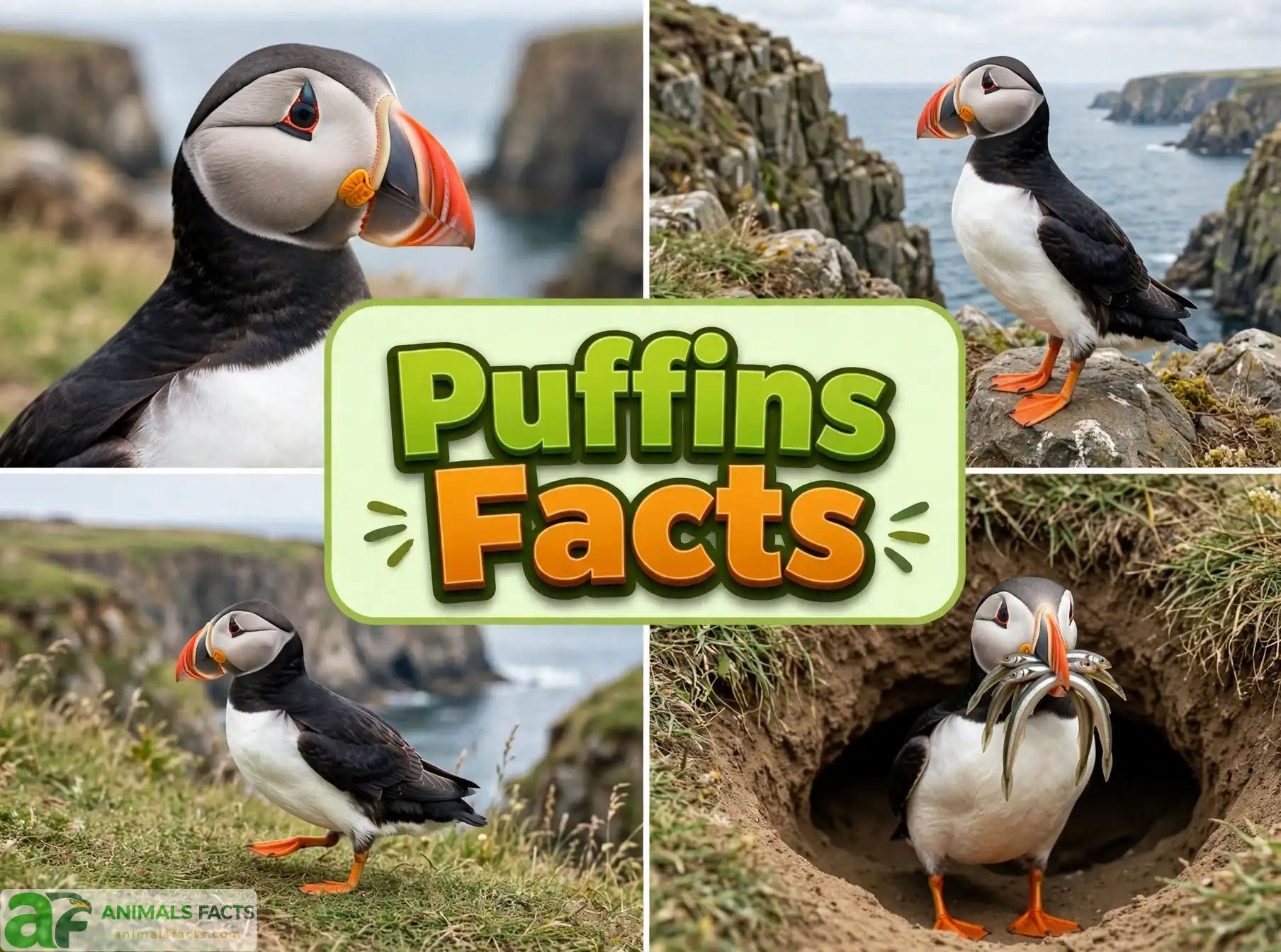
11. Puffin Facts for Kids
Hey amazing young wildlife scientists, seabird enthusiasts, and ocean lovers! Here are some truly extraordinary puffin facts for kids that will make you the most fascinating wildlife expert in any conversation:
- 🐦 The puffin takes off its colorful BEAK every autumn — like removing a costume! The puffin’s spectacular colorful beak is not a permanent part of the bird. Every autumn, after the breeding season, the colored outer parts of the bill fall off — revealing a smaller, much plainer grey bill underneath. Then every spring, before the puffin returns to its colony, the colorful plates grow back fresh! It is one of the most amazing seasonal transformations of any bird — like a bird that changes its costume once a year.
- 🐦 A puffin can hold 62 SMALL FISH in its beak at once! The puffin’s beak has special backward-pointing spines on the inside that hold fish in place while the beak opens to catch more. The fish are stacked alternating head-to-tail like neat little packages. The record is 62 sand eels in one beak-load! Scientists are still amazed that the fish don’t fall out — the spine system is one of the most clever fish-carrying mechanisms in the entire bird world.
- 🐦 Baby puffins are called PUFFLINGS — and they have to fly for the FIRST TIME, ALONE, in the DARK! When it is time for a puffling to leave its underground burrow, it has to do it completely alone — its parents have already gone back to the ocean and aren’t there to help. The puffling leaves the burrow for the first time in its life, in the middle of the night, finds the ocean by looking for the brightest part of the horizon (where starlight reflects off the water), and has to fly there — even though it has NEVER FLOWN BEFORE. It is one of the most adventurous first journeys of any young bird!
- 🐦 Children in Iceland rescue THOUSANDS of lost baby puffins every year! In the Westman Islands of Iceland, baby pufflings trying to find the ocean get confused by the lights of the town — they fly toward the town lights instead of the darker ocean. Every August and September, local children carry flashlights through the town finding lost pufflings on sidewalks, in gardens, and even inside houses! They gently pick them up, carry them to the cliff top, and release them toward the ocean. It is called the Puffling Patrol and is one of the most beloved wildlife events in the whole world!
- 🐦 Puffins fly UNDERWATER using their WINGS as propellers! The same wing movement that a puffin uses to fly through the air also works underwater — the puffin literally “flies” through the ocean chasing fish. It can reach underwater speeds of about 19 kilometers per hour and can dive down to 68 meters deep — that’s as deep as a 20-story building! No other bird in Europe uses its wings this way underwater.
- 🐦 Puffins stay with the SAME PARTNER for their WHOLE LIFE — often 20 years or more! Puffin pairs return to the same burrow every year and use the same beak-touching greeting called “billing.” The same couple can be together for over 20 years! Scientists who study puffins have watched the same pairs greet each other with billing year after year for decades. It is one of the most romantic relationships of any seabird.
- 🐦 The puffin’s name in Latin means “LITTLE FRIAR OF THE ARCTIC!” Because the puffin’s black-and-white coloring looks like the robes worn by medieval monks called friars, the puffin was given the scientific name Fratercula arctica — which means “little friar of the Arctic.” The puffin is dressed in the world’s tiniest habit — and takes it very seriously.
- 🐦 Puffins spend EIGHT MONTHS of every year living on the OPEN OCEAN — sleeping on the water! After the breeding season ends, puffins fly out to the open North Atlantic or North Pacific Ocean and stay there for about eight months. They sleep floating on the water surface, they eat fish they catch by diving, and they never touch land during this entire time. Even in the middle of winter storms in the North Atlantic, puffins are out there on the waves — tougher than they look!
12. Relationship with Humans
The puffin’s relationship with humans spans over 1,000 years of active hunting and egg collection in Iceland, the Faroe Islands, and various North Atlantic island communities; the modern period of scientific study that has revealed the climate crisis threatening the species; the extraordinary conservation success story of Project Puffin; and the contemporary situation in which the puffin has become one of the most recognizable wildlife symbols for ocean conservation globally.
The Icelandic Hunting Tradition
The thousand-year relationship — Norse settlers arriving in Iceland in approximately 874 CE encountered puffin colonies of extraordinary size and immediately incorporated puffin hunting into the subsistence economy:
The catch method — The traditional Icelandic puffin hunting technique uses a “fleyg” — a long-handled net with a wide opening used to catch puffins mid-flight as they approach the colony:
- The hunter stands at the cliff edge with the net extended
- Incoming puffins, focused on landing, are scooped from the air
- The technique requires considerable skill and local knowledge of approach flight paths
The scale — At the peak of puffin harvesting in Iceland and the Faroe Islands, hundreds of thousands of puffins were taken annually:
- The Faroe Islands has a documented sustainable puffin harvesting tradition stretching back centuries
- Iceland’s harvesting has been reduced dramatically in recent decades as population declines have made large-scale harvesting unsustainable
- The ethical debate around continuing puffin harvesting in Iceland and the Faroe Islands in the context of the Vulnerable classification is ongoing
Puffin as food — The meat of Atlantic puffins has been a traditional food across Iceland, the Faroe Islands, and various North Atlantic island communities:
- The smoked puffin heart is a traditional Icelandic delicacy
- Puffin has been described as having a flavor between fish and duck — reflecting the marine diet in a meat-textured bird
- The tradition of eating puffin in Iceland continues at some restaurants, though increasingly controversial given the conservation situation
The Egg Collection History
The great auk context — Before the Atlantic puffin became a target, the great auk’s eggs were collected from colonies across the North Atlantic. After the great auk’s extinction in 1844, puffin eggs became more important as a food resource in areas where the great auk had been the primary seabird egg source.
Maine puffin elimination — The direct human impact on puffin breeding in Maine, USA:
- In the late 19th century, hunters and egg collectors eliminated puffins from the islands off the Maine coast where they had historically bred
- Eastern Egg Rock (Maine) — the primary historical puffin colony — was cleared of puffins by approximately 1900
- The elimination of Maine puffins was the direct motivation for Steve Kress’s Project Puffin restoration effort
Project Puffin — The Conservation Success Story
The foundational conservation story — Project Puffin, begun by Steve Kress of the Cornell Lab of Ornithology in 1973, is one of the most celebrated seabird conservation programs in history:
The challenge — Reestablishing breeding puffins on islands in the Gulf of Maine from which they had been absent for approximately 70 years.
The method — social attraction:
- Wooden decoy puffins were placed on the rocky islands where breeding was desired — the decoys creating a visual stimulus that would attract real puffins prospecting for colony sites
- Recorded puffin calls were played from speakers at the decoy sites — the acoustic stimulus complementing the visual
- Puffin chicks were transplanted from large Newfoundland colonies to the Maine islands at the chick stage — the transplanted chicks imprinted on the Maine islands and returned to breed there as adults
The success — By the early 1980s, wild puffins had begun breeding on Eastern Egg Rock — the first breeding in approximately 80 years. By 2024, multiple Maine islands support active puffin colonies:
- Eastern Egg Rock — approximately 170 pairs
- Seal Island — approximately 600 pairs
- Matinicus Rock — approximately 750 pairs
The global methodology — The social attraction methodology (decoys + recorded calls) developed by Project Puffin has become the standard approach for seabird colony restoration globally:
- Applied to restore Laysan albatrosses in Hawaii
- Applied to restore shearwaters on New Zealand islands
- Applied to restore various seabird species on restored islands around the world
- Project Puffin’s methodology is taught in conservation biology programs worldwide as the foundational social attraction restoration technique
Steve Kress’s legacy — Steve Kress’s development of the social attraction methodology and his 50+ years of sustained commitment to Maine puffin restoration represents one of the most significant individual contributions to seabird conservation in American history.
The Contemporary Puffin as Conservation Symbol
The emotional asset — The puffin’s extraordinary public appeal — its combination of upright posture, tuxedo coloring, comically large bill, and the universally beloved “puffling” narrative — has made it one of the most powerful emotional assets in ocean conservation communication:
The climate indicator — As puffin breeding failures linked to climate-driven sand eel shifts have become documented, the puffin has become a visible, relatable indicator of ocean warming’s impacts:
- The sight of a puffin parent returning to a burrow with an inadequate bill load of inferior-quality prey items (or returning with nothing) communicates climate impact in ways that temperature graphs do not
- The puffin’s Vulnerable classification, and the scale of colony declines documented in Iceland and Norway, provides emotional immediacy to ocean warming’s consequences
The media presence — The puffin’s combination of photogenic qualities and conservation urgency has made it a consistent subject of nature photography and documentary filmmaking:
- The BBC’s various natural history productions have featured puffin content across multiple major series
- National Geographic and other nature publishers consistently feature puffin photography — the billing display, the multi-fish bill load, and the puffling fledging journey being particularly iconic images
13. Conservation Status & Threats
Conservation Status Overview
| Species | IUCN Status | Population Trend | Primary Threat |
|---|---|---|---|
| Atlantic puffin | Vulnerable (upgraded 2015) | Decreasing | Climate-driven food shortage; introduced predators |
| Horned puffin | Least Concern | Stable | Climate change (emerging concern) |
| Tufted puffin | Least Concern | Declining in some areas | Ocean warming; bycatch |
| Rhinoceros auklet | Least Concern | Stable | Introduced predators at some sites |
The Atlantic Puffin’s Vulnerable Status — The Most Significant Threat Assessment
The 2015 upgrade — The IUCN’s decision to upgrade the Atlantic puffin from Least Concern to Vulnerable in 2015 reflected documented population declines across multiple major colonies:
The Iceland situation:
- The Westman Islands colony — historically 8–10 million birds — has declined significantly in recent decades
- Multiple years of complete breeding failure have been documented — years in which virtually no chicks survived to fledging
- The trigger: capelin and sand eel scarcity in waters adjacent to the colony — directly linked to ocean temperature increases
The Norway situation:
- Røst colony (Norway) — historically one of the largest in the world — declined by approximately 50% between 1979 and 2013
- Breeding failure events associated with sand eel scarcity documented across multiple consecutive years
- The Norwegian puffin population is estimated to have declined by approximately 80% since the 1970s in some areas
The UK situation:
- Shetland Islands colonies — declining; sand eel availability reduced in North Sea waters
- Skomer Island (Wales) — relatively stable; the Welsh colony benefits from Atlantic waters where sand eel distribution has shifted less dramatically than in the North Sea
Major Threats
| Threat | Description | Impact Level |
|---|---|---|
| Climate-driven food shortage | Ocean warming shifts sand eel distribution away from colonies | Critical — primary threat |
| Introduced predators | American mink and rats at UK and other island colonies | High — devastating at affected sites |
| Bycatch | Puffins caught in fishing nets (particularly gillnets) during winter at sea | High — poorly quantified |
| Oil pollution | Chronic oil pollution at sea; acute spill events | High — winter mortality |
| Overfishing of prey | Commercial fishing of sand eels, herring, capelin reducing prey availability | Medium-High |
| Light pollution | Disorienting pufflings during fledging | Medium — management underway |
| Invasive species (general) | Rats, cats, mink at breeding colonies | High at affected sites |
| Extreme weather | Increased storm frequency and intensity at sea | Increasing concern |
| Climate: direct | Increased heat events causing burrow temperature rise | Emerging threat |
The Mink Problem — UK’s Most Immediate Breeding Threat
American mink introduction — American mink were introduced to the UK for the fur trade and escaped or were released from farms across the 20th century:
- Mink have colonized most of mainland Britain’s river systems
- At seabird colonies adjacent to or connected to the mainland, mink access has been catastrophic — the predator entering burrows and killing adults, eggs, and chicks
- Multiple UK puffin colonies have been eliminated or severely reduced by mink predation
The mink control response — Conservation organizations including the RSPB and Seabird Recovery Project operate mink control programs at key island colonies:
- Mink trapping programs have successfully reduced mink access at some sites
- Island biosecurity — maintaining rat-free and mink-free island status — is the most effective approach
- The restoration of predator-free island breeding habitat is the most important immediate conservation action for UK puffins
The Bycatch Mortality — The Invisible Winter Threat
The invisible threat — Because puffins spend winter at sea far from human observation, bycatch mortality — puffins drowning in fishing nets set for other species — is poorly quantified but believed to be significant:
- Gillnets set for salmon and demersal fish species catch puffins that dive through the net
- Longlines may also catch puffins attracted to baited hooks
- The total puffin bycatch mortality globally is unknown — one of the most significant gaps in puffin population monitoring
14. Famous Puffins in History & Pop Culture
Famous Individual Puffins
Tammie Norrie — In Scottish dialect, “tammie norrie” is the traditional name for the Atlantic puffin — one of the most evocative regional names for any seabird in British wildlife culture. While not an individual, the collective identity captured by this name represents the deep integration of the puffin into Scottish coastal community culture.
The Project Puffin founding colony — The first puffins that returned to breed on Eastern Egg Rock in Maine following Steve Kress’s social attraction program in the early 1980s are, collectively, the most historically important group of Atlantic puffins in North American conservation history — the individuals whose return established the proof of concept for the social attraction methodology.
“Puffin” the character in various conservation campaigns — Various named individual puffins at publicly accessible UK colonies — particularly on Skomer Island (Wales), the Farne Islands (England), and at various RSPB reserves — have developed public profiles through wildlife photography and social media, generating conservation engagement and tourism supporting local wildlife economies.
Historical and Cultural Significance
The great auk extinction — The great auk (Pinguinus impennis) — the Atlantic puffin’s large, flightless alcid relative — is one of the most culturally significant extinct birds in ornithological history. The last great auks were killed on Eldey Island, Iceland, in June 1844 — making the great auk’s extinction one of the most precisely dated bird extinctions in history. The three men who killed the last great auks did so on behalf of a natural history collector who wanted museum specimens — the ultimate irony of extinction driven by scientific collecting. The great auk’s extinction occurred within living memory of early conservation movements, creating a powerful cultural touchstone for the consequences of human exploitation of wildlife.
The Faroese tradition — Puffin hunting in the Faroe Islands using the traditional fleyg net has been practiced continuously for over 1,000 years — one of the longest continuously documented human-bird hunting relationships in the North Atlantic. The cultural significance of this tradition creates ethical complexity in the conservation debate around puffin hunting in the context of declining populations.
The Icelandic puffin patrol — The Vestmannaeyjar Puffling Patrol has become one of the most internationally recognized annual wildlife conservation events — children rescuing disoriented pufflings from town streets and releasing them to the ocean has been featured in major international media including BBC, National Geographic, and various documentary productions. The tradition captures both the extraordinary intimacy of the human-puffin relationship in Iceland and the specific challenge that human lighting infrastructure poses to puffling navigation.
15. Role in Ecosystem & Food Chain
The Puffin as Ecological Node
The fish-to-land nutrient transfer — Puffins are significant nutrient transporters from the ocean to the terrestrial environment:
- Each adult puffin consumes approximately 1,000 fish per breeding season (between self-feeding and chick provisioning)
- The nutrient content of these fish — nitrogen, phosphorus, and trace elements — is deposited on land through puffin guano
- Puffin colonies are surrounded by unusually nutrient-rich vegetation — the coastal turf near large colonies is fertilized by the accumulated guano of millions of seabirds
- This ocean-to-land nutrient transfer supports terrestrial plant communities and the insects and other invertebrates that depend on them
The island ecosystem function — On the islands where puffins breed, the colony’s nutrient input supports a distinct ecological community:
- Nutrient-enriched turf — the cliff-top vegetation above puffin colonies is distinctively lush and species-rich compared to equivalent un-colonized turf
- The burrowing activity itself creates habitat structure — the network of burrows providing cover and nesting sites for other species
The Food Web Position
As prey:
- Eggs and chicks consumed by skuas, great black-backed gulls, ravens, and introduced predators
- Adults taken by peregrine falcons and great skuas
- The puffin’s role as prey supports predator populations at breeding colonies
As prey at sea:
- Various large fish species (tuna, large gadoids) consume puffins at sea
- Marine mammals (certain whale species, grey seals) documented taking puffins
As consumer:
- The puffin’s consumption of sand eels, herring, and sprats provides top-down regulation of these fish populations at local scales
- The indirect effects of puffin predation on fish schools — dispersing schools and reducing their concentration — affects the foraging efficiency of other seabird species using the same fishing grounds
The Indicator Species Function
The puffin as an ocean health indicator — Perhaps the most important ecological function of the puffin in 2026 is as an indicator species — a species whose population trends and breeding success reliably indicate the condition of the marine ecosystem it inhabits:
- Puffin breeding success is directly linked to sand eel availability, which is linked to water temperature and the copepod communities that sand eels eat
- Monitoring puffin colony breeding success therefore provides an integrated indicator of ocean health across multiple trophic levels
- The puffin’s charismatic appeal makes it one of the most effective “flagship” species for communicating ocean health to the public
16. Myths, Folklore & Cultural Significance
Norse and North Atlantic Folklore
The puffin in Norse culture — The Norse peoples of Iceland, the Faroe Islands, and coastal Norway developed extensive cultural relationships with puffins across more than a millennium of co-habitation of the North Atlantic islands:
The “lundi” (Icelandic name for puffin) — The lundi appears across Icelandic folklore and cultural tradition as a marker of summer’s return:
- The first puffin arrival at the colony in spring is a cultural signal of winter’s end — the birds’ return from the open ocean marking the seasonal transition
- The puffin’s departure in autumn marks the beginning of the North Atlantic winter
- The bird’s dual existence — disappearing to the unknown ocean for eight months and returning punctually each spring — embedded it in seasonal marking traditions
The underground world — The puffin’s burrow-nesting habit — disappearing underground during the day and emerging from burrows in the evening — connected the bird to Norse folk beliefs about underground realms. The puffin’s ability to move between the underground burrow, the cliff-top surface, the aerial world, and the ocean gave it a mythological multi-realm capability that embedded it in folklore traditions of transition and liminality.
The Faroese lundi tradition — In the Faroe Islands, where puffin hunting with the fleyg net has been practiced for over 1,000 years, the puffin is embedded in cultural identity at a depth that makes conservation debates around the hunting tradition genuinely complex:
- The fleyg hunt is embedded in Faroese masculine identity — the skill of catching puffins mid-flight is a mark of ability and local knowledge
- The harvest is integrated into Faroese seasonal food culture — the bird’s meat and preserved form embedded in traditional cuisine
- The tension between this cultural tradition and conservation imperatives is one of the most nuanced human-wildlife value conflicts in North Atlantic wildlife policy
The Welsh “Puffin” Name History
The etymological journey — The word “puffin” itself has a fascinating origin that reveals the complexity of English bird naming history:
The original “puffin” — In medieval Wales, the word puffin (from which the modern English word derives) referred to the salted and cured carcasses of Manx shearwater chicks (Puffinus puffinus) — harvested from the burrow colonies on Welsh and Irish islands as a valuable food trade item. The chicks were “puffed” (fat and chubby) and cured for export.
The transfer — When English-speaking traders and settlers encountered the Atlantic puffin — a bird of similar size, similar burrowing habits, and similar black-and-white coloring — they transferred the word “puffin” to the new bird. The Manx shearwater retained its original specific name (Puffinus puffinus) in scientific nomenclature — making the Manx shearwater the only bird whose scientific name is derived from the common name of a completely different bird.
The consequence — The scientific name of the Manx shearwater (Puffinus puffinus) literally means “puffin puffin” — the genus name and species name both being the Latin form of a word that originally referred to the bird’s cured carcass, not to the bird itself. It is one of the more confusing etymological tangles in ornithological nomenclature.
17. Puffins in Pop Culture
“Puffin Books” (Penguin Books) — The Puffin Books imprint — the children’s division of Penguin Books, established in 1941 — is the most widely recognized puffin cultural reference globally. The Puffin Books logo (a stylized Atlantic puffin silhouette) has appeared on children’s books read by generations of young readers worldwide — including the first UK paperback editions of Roald Dahl, C.S. Lewis, and many of the 20th century’s most beloved children’s authors. The puffin was chosen as the children’s imprint symbol partly for the bird’s association with children’s delight (the amusing appearance) and partly as a visual connection to the parent imprint (Penguin = puffin, also an alcid and a similar-looking bird).
“Project Puffin” books and media — Steve Kress’s Project Puffin has generated multiple popular books, documentary treatments, and educational materials that have introduced puffin conservation to generations of readers:
- Project Puffin: The Improbable Quest to Bring a Beloved Seabird Back to Egg Rock by Steve Kress and Derrick Jackson (2015) — the definitive popular account of the restoration program
- Various BBC and PBS documentary features on Project Puffin
BBC Natural World puffin documentaries — The BBC’s Natural History Unit has produced multiple dedicated puffin documentary features — the combination of dramatic cliff colony footage, the multi-fish bill load imagery, and the puffling fledging story making puffins consistently reliable and popular documentary subjects.
“Puffin” in Icelandic tourism — The Atlantic puffin is the single most marketed wildlife species in Icelandic tourism — appearing on:
- Tourism board promotional materials
- Airline in-flight magazines
- Hotel decor across Reykjavik
- Tourist gift merchandise at extraordinary scale
The puffin’s image is so pervasive in Icelandic tourism that it has become a byword for Icelandic wildlife identity — the puffin playing the same role in Icelandic wildlife imagery that the bald eagle plays in American imagery or the red panda plays in Chinese wildlife marketing.
Social media puffin content — The Atlantic puffin generates extraordinary social media engagement — the combination of the billing display, the multi-fish bill load image, the puffling rescue narrative, and the general visual comedy of puffin behavior producing consistent viral content across Instagram, Twitter/X, and TikTok. The Skomer Island puffin webcam (operated by the Wildlife Trust of South and West Wales) typically attracts hundreds of thousands of viewers annually.
18. Puffin Facts vs. Common Myths
| Common Myth | The Real Fact |
|---|---|
| “Puffins are related to penguins” | False — puffins are Charadriiformes (shorebird relatives); penguins are Sphenisciformes. Their similar appearance and lifestyle reflect convergent evolution — two completely unrelated lineages independently evolving similar body plans for the same ecological role |
| “The puffin’s colorful bill is permanent” | False — the colored outer bill plates are shed every autumn and regrown fresh every spring. The winter bill is significantly smaller and much less colorful |
| “Puffins are clumsy fliers” | Partially true — takeoff and landing are genuinely awkward due to high wing loading; but in sustained flight, puffins are fast and capable, reaching 55–88 km/h |
| “The fish stay in the puffin’s bill by magic” | False — the fish are held by backward-pointing spines (denticulations) on the upper palate and tongue. When the bill opens to catch a new fish, the spines hold the previously caught fish against the palate |
| “Puffins breed for life without exception” | Partially true — puffins have very low divorce rates (pair bond dissolution without partner death) and maintain long-term pair bonds of 10–20+ years. However, if a partner dies or disappears, the survivor will find a new mate |
| “Iceland’s puffin population is safe because it’s so large” | False — despite Iceland hosting ~60% of the global population, the Vulnerable classification reflects Iceland’s puffin population declining significantly due to food shortage events linked to ocean warming. Population size alone does not indicate security when the trend is steeply downward |
| “Puffins can’t swim” | Completely false — puffins are exceptional swimmers and divers, reaching underwater speeds of 17–19 km/h and diving to 68–100 meters. Swimming is their primary hunting method |
| “The great auk is the same species as the puffin” | False — the great auk (Pinguinus impennis, extinct 1844) was a different species — a large, completely flightless alcid. It was related to puffins (both are Alcidae) but was a distinct genus and species |
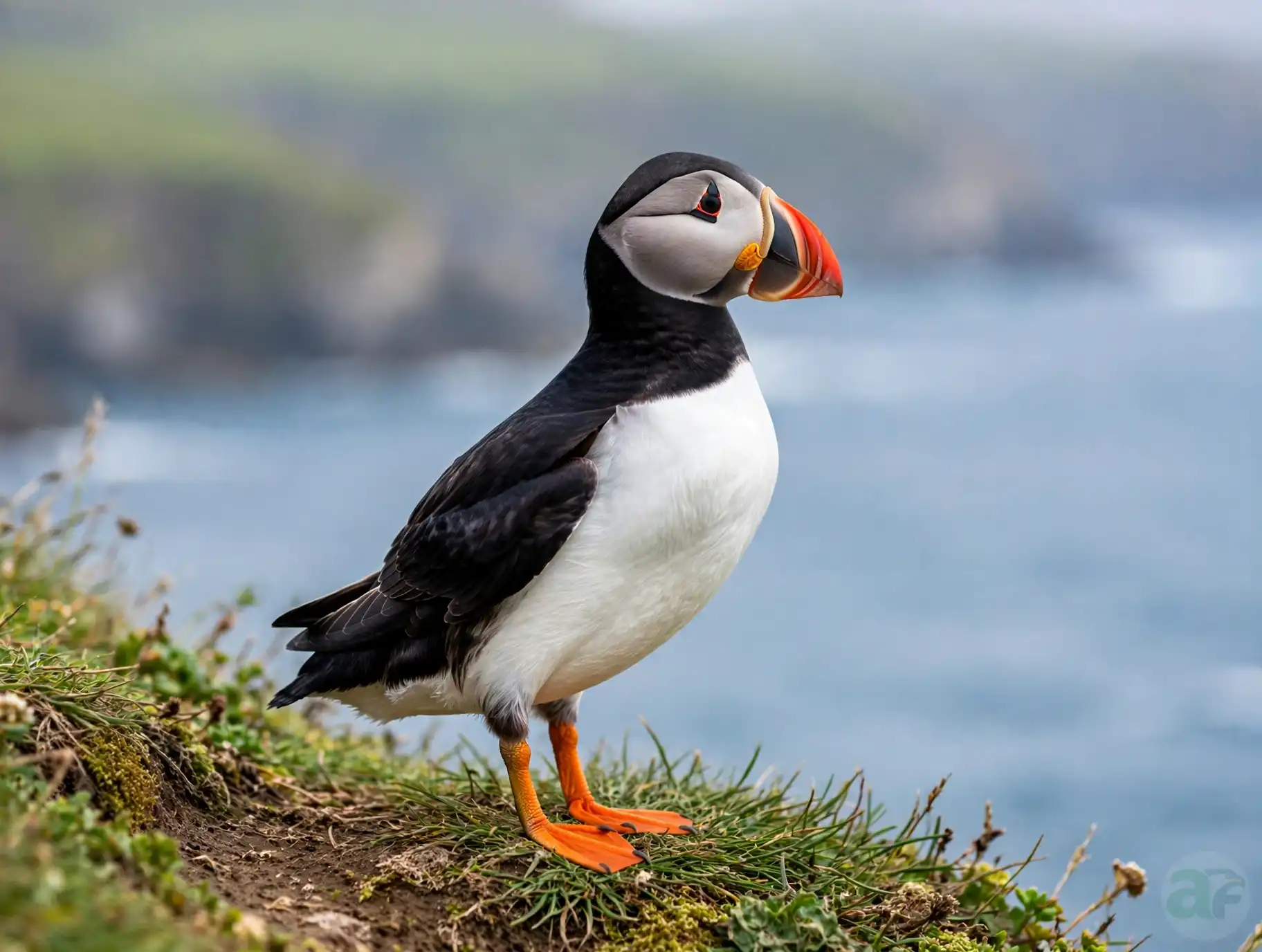
19. Best Places to See Puffins in the Wild
The Atlantic — The Classic Puffin Experience
1. Westman Islands (Vestmannaeyjar), Iceland
The world’s largest Atlantic puffin colony and the most important puffin location on Earth — the Westman Islands support millions of puffins during the breeding season (May–August). The birds are extraordinarily accessible — the cliffs immediately adjacent to the island’s town allow close-range observation without specialist equipment or difficult hiking. The “Puffling Patrol” in August and September offers the unique experience of participating in the tradition of rescuing disoriented fledgling puffins.
Travel advice — Westman Islands are reached by ferry (approximately 45 minutes) or by domestic flight from Reykjavik. Most Iceland tour operators offer day trips. Peak puffin presence is June–July. The Puffling Patrol experience is available in August–September through the local tourism office.
2. Skomer Island, Wales, UK
One of the UK’s premier puffin colonies and the most visitor-friendly puffin site in Britain — Skomer Island supports approximately 40,000 puffins during the breeding season (April–July). Visitor boats run daily from Martin’s Haven on the Pembrokeshire coast (numbers limited by permit — booking essential weeks in advance). The island allows landing and walking among the breeding birds — puffins on Skomer are famously approachable, sometimes sitting within arm’s reach of the walking trails.
Practical advice — Book the Skomer boat trip as far in advance as possible — the limited daily visitor numbers means trips sell out weeks ahead in peak season. May–June provides the best puffin experience — the breeding season at its peak and chick-rearing not yet underway. The Wildlife Trust of South and West Wales operates the reserve and the booking system.
3. Farne Islands, Northumberland, England
The Farne Islands — the site where St. Cuthbert’s 7th-century conservation laws first protected seabirds in England — support approximately 55,000 puffins during the breeding season (April–July). Visitor boats operate from Seahouses on the Northumberland coast — landing is permitted on two of the islands (Inner Farne and Staple Island) with National Trust warden supervision. Puffins on the Farne Islands are renowned for their extraordinarily close approach tolerance — the birds sometimes landing on visitors’ feet or investigating camera equipment within centimeters.
4. Runde Island, Norway
The most accessible Norwegian puffin colony for international visitors — Runde Island on Norway’s west coast supports approximately 100,000 puffins alongside gannet, shag, razorbill, and other seabirds in one of Norway’s most important seabird colonies. The combination of dramatic Norwegian coastal scenery and large seabird colony makes Runde one of northern Europe’s finest wildlife destinations.
5. Látrabjarg, Iceland
Europe’s largest seabird cliff — the extraordinary Látrabjarg in northwestern Iceland extends for approximately 14 km and rises to 440 meters. The cliff supports hundreds of thousands of puffins alongside razorbills, guillemots, fulmars, and other seabirds. The remote location (4–5 hours from Reykjavik) means fewer visitors than the Westman Islands — providing a more wilderness atmosphere alongside the largest seabird cliff in Europe.
The Pacific — Different Species, Equally Spectacular
6. Seal Rocks State Recreation Site, Oregon, USA
Tufted puffins breed on offshore rocks along the Oregon coast — Seal Rocks provides one of the most accessible mainland viewing points for tufted puffins in the lower 48 states. The tufted puffin’s long golden head tufts and large orange bill make it visually even more dramatic than the Atlantic puffin — a spectacular Pacific counterpart.
7. Kenai Fjords National Park, Alaska, USA
One of the finest seabird viewing destinations in North America — Kenai Fjords supports both horned puffins and tufted puffins alongside extraordinary scenery of tidewater glaciers, fjords, and coastal mountains. Boat tours operating from Seward provide access to seabird colonies on offshore rocks and islands. The combination of dramatic Alaskan coastal scenery, diverse seabird life, and marine mammal viewing makes Kenai Fjords one of the world’s premier seabird tourism destinations.
8. Saint Paul Island, Pribilof Islands, Alaska, USA
The most spectacular concentration of seabirds in North America — the Pribilof Islands support millions of alcids including extraordinary numbers of horned and tufted puffins alongside murres, auklets, and fulmars. The Reef Rookery on Saint Paul Island provides ground-level access to fur seal colonies alongside seabird cliffs. Specialist seabird tours operate from Anchorage — one of the finest seabird expeditions accessible to non-expedition travelers in North America.
20. How You Can Help
Supporting puffin conservation requires action on multiple fronts — from the immediate colony-level threats of introduced predators to the global-scale threat of climate-driven ocean change.
Support these organizations:
- Project Puffin / National Audubon Society — projectpuffin.audubon.org — Steve Kress’s ongoing Maine puffin restoration and monitoring program; direct conservation action with documented success
- RSPB (Royal Society for the Protection of Birds) — rspb.org.uk — UK puffin colony monitoring, mink control programs, and seabird conservation advocacy; manages multiple key UK puffin colonies
- BirdLife International — birdlife.org — global seabird conservation advocacy and monitoring; coordinates the Atlantic puffin’s Vulnerable assessment and global conservation planning
- Wildlife Trust of South and West Wales — welshwildlife.org — manages Skomer Island; directly funds the conservation of one of the UK’s most important puffin colonies
- Sea Watch Foundation — seawatchfoundation.org.uk — marine monitoring including seabird at-sea distribution research essential for understanding winter threats
- Seabird Recovery Project — operated through the RSPB and Wildfowl and Wetlands Trust; island biosecurity programs removing rats and mink from key seabird colonies
Critical individual actions:
Choose sustainable seafood — The overfishing of sand eels, herring, and other small schooling fish directly reduces the food available to puffin colonies. Choosing seafood certified by the Marine Stewardship Council (MSC) or avoiding fish species for which stocks are below sustainable levels reduces the fishing pressure on puffin prey species.
Support climate action — The fundamental long-term threat to Atlantic puffins is ocean warming driving sand eel distribution shifts. The most impactful individual action for puffin conservation is reducing personal carbon emissions and supporting political action on climate change. The puffin’s Vulnerable status is ultimately a climate problem that requires climate solutions.
Visit puffin colonies responsibly — Ecotourism revenue at puffin colonies (Skomer Island, Farne Islands, Westman Islands) directly funds conservation management. Visiting these sites, following warden guidance to avoid disturbing birds, booking through organizations whose fees fund conservation (RSPB, Wildlife Trusts), and contributing to the local economies that support colony protection generates positive conservation outcomes.
Participate in the Puffling Patrol — Visitors to the Westman Islands of Iceland in August–September can participate in the Puffling Patrol — one of the most rewarding wildlife conservation experiences available to tourists in Europe. Information available through the Westman Islands tourist office.
Reduce marine pollution — Plastic pollution at sea and chronic oil contamination are significant puffin mortality sources during winter months. Reducing single-use plastic use, supporting marine pollution cleanup organizations, and reporting marine pollution incidents contributes to ocean health that directly benefits puffins during their 8-month ocean residence.
Support island biosecurity — Donating to organizations operating rat and mink removal programs on key puffin colony islands directly addresses one of the most immediately actionable puffin threats. The RSPB’s Saving Seabirds program and the Island Conservation organization operate biosecurity programs whose impact on puffin breeding success has been documented.
21. Top Documentaries & Books
Must-Watch Documentaries
“Puffin Patrol” (various BBC productions) — Multiple BBC documentary features specifically covering the Vestmannaeyjar Puffling Patrol have been produced for BBC One and BBC Two — the combination of the children’s rescue tradition, the scale of the Westman Islands colony, and the conservation urgency of declining Iceland puffins producing emotionally powerful programming. David Attenborough has narrated puffin sequences for multiple BBC series.
“Planet Earth II — Coasts” (BBC, David Attenborough, 2016) — The coastal episode features exceptional Atlantic puffin content including the multi-fish bill load and the colony social behavior — among the finest puffin documentary sequences produced in high definition.
“Five Seasons: The Gardens of Piet Oudolf” — While not a wildlife documentary, this film features the Farne Islands as backdrop for the extraordinary seabird colony where puffins are prominently featured in some of the most beautiful coastal seabird imagery available in contemporary documentary film.
“Project Puffin” (various PBS and documentary productions) — Multiple American documentary treatments of Steve Kress’s Project Puffin restoration program; the National Audubon Society’s own documentary material and the Cornell Lab of Ornithology’s Bird Academy include excellent Project Puffin content.
Must-Read Books
Project Puffin: The Improbable Quest to Bring a Beloved Seabird Back to Egg Rock by Steve Kress and Derrick Jackson (2015) — The definitive popular account of the Project Puffin restoration program; combines natural history, conservation biography, and the drama of long-term ecological restoration. Essential reading for anyone interested in conservation success stories.
Puffins by Mike Harris and Sarah Wanless — The most comprehensive scientific treatment of Atlantic puffin biology; covers breeding biology, feeding ecology, population dynamics, and conservation status in detail accessible to non-specialists.
The Seabird’s Cry by Adam Nicolson (2017) — A beautifully written account of ten seabird species including the puffin; combines natural history with cultural history and conservation urgency in one of the finest pieces of seabird writing in the English language.
Handle with Care: On the Ethics of Conservation by Steph Atkinson — Includes extensive treatment of puffin conservation ethics in the context of competing cultural values (Faroese hunting tradition vs. conservation imperatives); essential for understanding the complexity of seabird conservation where cultural traditions intersect with declining populations.
Seabirds: An Identification Guide by Peter Harrison — The standard comprehensive field guide to seabirds worldwide; essential for identifying all four puffin species in the field.
22. Comparison of the Four Puffin Species and Related Auks
| Feature | Atlantic Puffin | Horned Puffin | Tufted Puffin | Rhinoceros Auklet | Great Auk (Extinct) |
|---|---|---|---|---|---|
| Scientific name | Fratercula arctica | Fratercula corniculata | Fratercula cirrhata | Cerorhinca monocerata | Pinguinus impennis |
| Length | 28–34 cm | 36–41 cm | 35–41 cm | 35–40 cm | 75–85 cm |
| Weight | 310–500 g | 450–620 g | 500–900 g | 450–600 g | ~5 kg |
| Bill | Multi-color; breeding plates shed | Red-yellow; fleshy horn above eye | Large orange; bright | Horn on bill base | Large; black-and-white |
| Head feature | White face; dark cap | White face; fleshy horn | Long golden tufts | White facial stripes | White face patch |
| Flight | Yes — rapid; 400 bpm | Yes | Yes | Yes | No — completely flightless |
| Dive depth | 68 m | ~50 m | ~100 m | ~50 m | Very deep |
| Nest type | Burrow in turf | Cliff crevice/burrow | Burrow in turf | Burrow in soil | Ground/cliff |
| Ocean | North Atlantic | North Pacific | North Pacific | North Pacific | North Atlantic — EXTINCT |
| Conservation | Vulnerable | Least Concern | Least Concern | Least Concern | Extinct (1844) |
| Famous for | Iconic multi-color bill; puffling patrol; Vulnerable status | Pacific counterpart; fleshy horn | Golden tufts; deepest diver | Nocturnal colony; bill horn | Extinction; last N. Hemisphere flightless alcid |
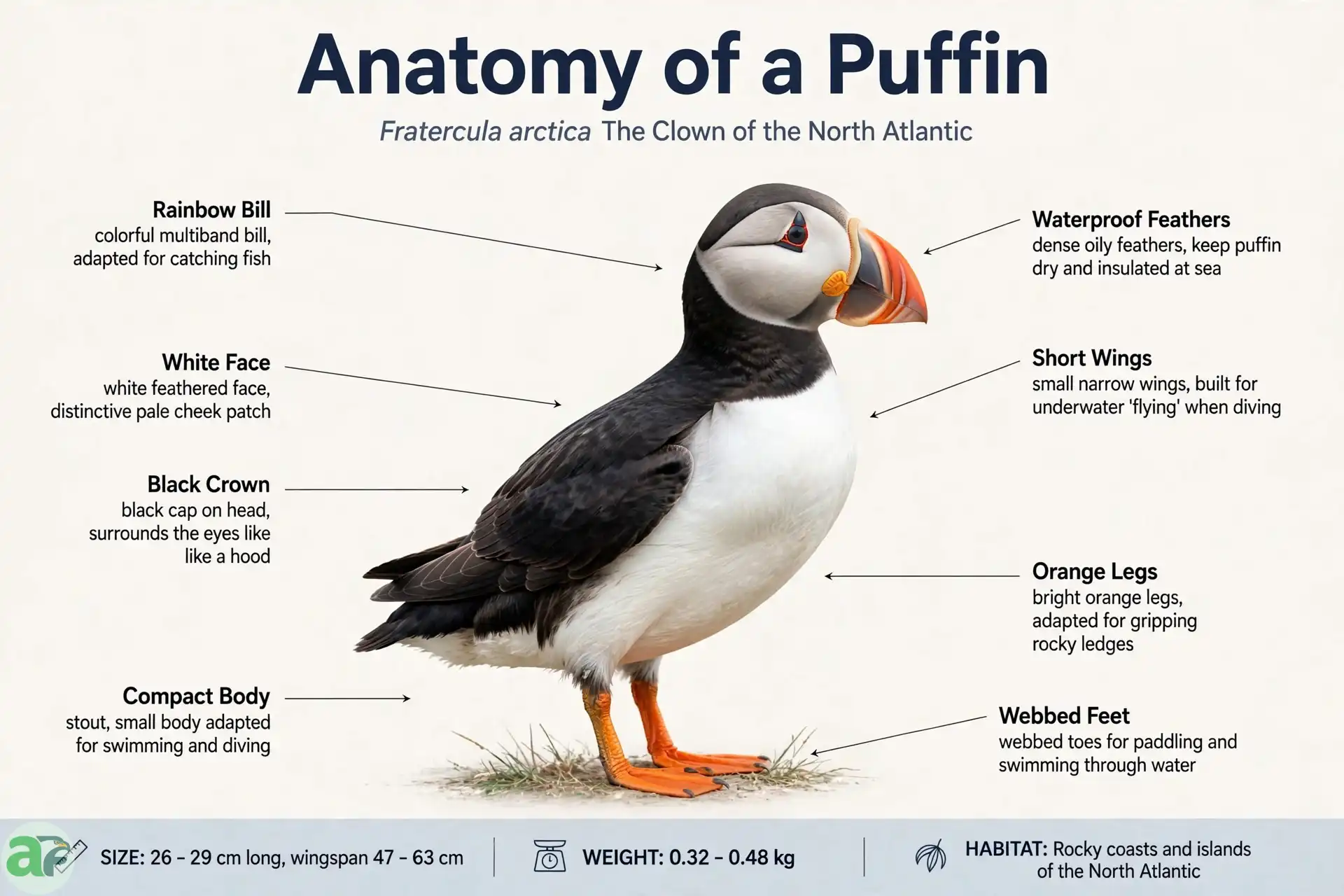
23. Frequently Asked Questions About Puffins
Q1. What is the scientific name of the puffin and what does it mean?
The Atlantic puffin’s scientific name is Fratercula arctica (Linnaeus, 1758). The genus name Fratercula is Latin for “little friar” or “little brother” — derived from frater (friar or brother) with the diminutive suffix -cula. The name refers to the puffin’s black-and-white plumage — the combination of black back and wings with the white underparts and face resembling the robes of a medieval friar. The species name arctica means “of the Arctic” — reflecting the puffin’s northern range. The combined name therefore translates most poetically as “little friar of the Arctic” — widely considered one of the most appropriate and most charming scientific names in ornithology. The horned puffin is Fratercula corniculata (corniculata = “with small horns,” referring to the fleshy projection above the eye), and the tufted puffin is Fratercula cirrhata (cirrhata = “curled” or “tufted,” referring to the golden head tufts). The rhinoceros auklet (Cerorhinca monocerata) has a name meaning “one-horned wax-beak” — from Greek keros (wax or horn) + rhynkhos (beak) + mono (one) + keras (horn). The Alcidae family name derives from the Icelandic or Norse alka for the razorbill auk — the family named for the razorbill rather than the more famous puffin.
Q2. How does a puffin hold so many fish in its bill?
The puffin’s extraordinary fish-holding capacity — up to 62 fish in the documented record — is achieved through an elegant mechanical system that was not fully understood until detailed anatomical study revealed the key structures. The upper palate and tongue of the puffin’s bill are equipped with backward-pointing, tooth-like spines (technically called denticulations) — projections that point toward the throat rather than toward the bill tip. When the bill is closed, these spines have no particular effect on fish already held against the upper palate. But when the bill opens to catch a new fish — the crucial moment when logic suggests the previously caught fish should fall out — the spines come into play: as the lower mandible drops, the upper palate’s backward-pointing spines press against the previously caught fish and hold them against the palate, preventing them from dropping. The new fish is caught at the bill tip, the bill closes, and the already-held fish resume their position in the bill stack. The process can be repeated many times — each opening of the bill for a new catch triggering the spine-mediated retention of the existing catch. The fish are arranged alternating head-to-tail (rather than all heads in one direction) — this arrangement is more aerodynamically compact during the return flight and is achieved by the puffin rotating each new fish before adding it to the stack, demonstrating remarkable bill dexterity. The maximum number of fish that can be held is limited by the physical space inside the bill rather than by the holding mechanism.
Q3. Why is the puffin classified as Vulnerable?
The Atlantic puffin was upgraded from Least Concern to Vulnerable by the IUCN in 2015 — reflecting documented population declines across major colonies that, when projected forward, indicate a meaningful probability of significant further decline over the next few decades. The primary driver of the Vulnerable classification is climate-driven changes in food availability — specifically, the warming of North Atlantic and North Sea waters that is shifting the distribution of sand eels (the puffin’s primary prey) northward and away from established breeding colonies. The pathway from ocean warming to colony decline is well-documented: warmer waters reduce the productivity of the cold-water copepod communities that sand eels eat; sand eel populations decline or shift to cooler waters farther north; puffin colonies in areas where sand eels have become scarce experience chick starvation events and breeding failures; adult survival remains relatively stable (puffins are long-lived birds that can survive years of breeding failure without immediate population collapse), but the absence of chick recruitment eventually produces the population decline already visible in some colonies. The Norwegian colonies (particularly Røst) have declined by approximately 50% since the 1980s. The Westman Islands colonies in Iceland — hosting approximately 60% of the global population — have experienced multiple years of complete or near-complete breeding failure linked to capelin and sand eel scarcity. The scale and trajectory of these declines across the species’ most important sites drove the Vulnerable classification, which reflects a species not yet in immediate danger of extinction but on a trajectory that causes serious conservation concern.
Q4. Do puffins really mate for life?
Puffins maintain long-term pair bonds that are effectively “for life” in practice — though with important nuances. Atlantic puffin pairs typically return to the same burrow year after year and perform reunion behaviors (billing, mutual preening) upon each seasonal return. Long-term monitoring of color-marked birds has documented pairs remaining together for 15–20+ years — effectively the majority of the birds’ adult lifespans. The bond is maintained despite the pair spending 8 months of each year on separate ocean wintering grounds — the birds navigating back to the same burrow and each other independently. However, the bond is not unconditional: if one partner dies or fails to return, the survivor will find a new mate — sometimes pairing with a bird that has lost its own partner, sometimes pairing with a younger bird prospecting for its first mate. The “divorce” rate — pair bond dissolution between living, present partners — is very low in puffins but not zero: occasionally pairs that have failed to raise chicks successfully dissolve the bond and both partners seek new mates, particularly if the bond is relatively new (first-year pairs have higher dissolution rates than long-established pairs). The puffin’s pair fidelity is fundamentally an economic strategy rather than a romantic one: experienced pairs that know each other’s behavioral tendencies, that have established and maintained a proven burrow site, and that have developed a coordinated chick-provisioning routine have significantly higher breeding success than newly paired birds — making fidelity the reproductively optimal strategy for long-lived birds with many breeding seasons ahead.
Q5. Where is the best place to see Atlantic puffins in the wild?
The single most important and most accessible Atlantic puffin location is the Westman Islands (Vestmannaeyjar) of Iceland — home to the world’s largest Atlantic puffin colony and easily reached by ferry or domestic flight from Reykjavik. The combination of extraordinary colony scale, accessibility, and the unique Puffling Patrol tradition (August–September) makes the Westman Islands the recommended first choice for most visitors. For a more intimate experience with exceptionally approachable birds, Skomer Island, Wales (UK) provides close-range encounters with 40,000 puffins from a walking trail that brings visitors within arm’s reach of breeding birds — the island’s limited daily visitor numbers maintaining an experience quality that larger sites cannot match. Book the Skomer boat trip as far in advance as possible (months ahead in peak season) as daily numbers are strictly limited. For dramatic scenery combined with large puffin numbers, Látrabjarg in northwestern Iceland (Europe’s largest seabird cliff) provides a more remote, wilderness-atmosphere alternative to the Westman Islands. For visitors specifically seeking to participate in conservation activity, joining the Project Puffin boat trips operating out of Rockland, Maine (USA), offers the opportunity to visit Eastern Egg Rock and witness the restored colony whose establishment pioneered the social attraction methodology now used globally. May–July is the optimal viewing period across all Atlantic sites — the full breeding season with the complete breeding bill, active courtship, and regular fish-delivery flights providing the full range of puffin behavior. Binoculars (8×42 or 10×42) are strongly recommended at most sites except the few where birds approach very closely (Skomer, Farne Islands).
24. Sources & References
- Wikipedia — Fratercula arctica, Fratercula corniculata, Fratercula cirrhata, Alcidae, Great auk, Project Puffin
- IUCN Red List — iucnredlist.org (Vulnerable assessment for Fratercula arctica; current assessments for all puffin species)
- BirdLife International — birdlife.org (species factsheets; population trend assessments)
- Kress, S.W. and Jackson, D. (2015) — Project Puffin: The Improbable Quest to Bring a Beloved Seabird Back to Egg Rock — primary source for Project Puffin history
- Harris, M.P. and Wanless, S. — comprehensive scientific research on Atlantic puffin biology and population dynamics (multiple published papers)
- Anker-Nilssen, T. and colleagues — Norwegian puffin population monitoring research
- Fayet, A.L. and colleagues — geolocator tracking research revealing Atlantic puffin winter distribution
- Cornell Lab of Ornithology — allaboutbirds.org (species account; Macaulay Library)
- RSPB — rspb.org.uk (UK seabird colony monitoring; mink control program documentation)
- Wildlife Trust of South and West Wales — welshwildlife.org (Skomer Island management documentation)
- National Geographic — nationalgeographic.com
- BBC Wildlife / BBC Earth — bbcearth.com
- Britannica — britannica.com/animal/puffin
- Nicolson, A. (2017) — The Seabird’s Cry — literary natural history reference