
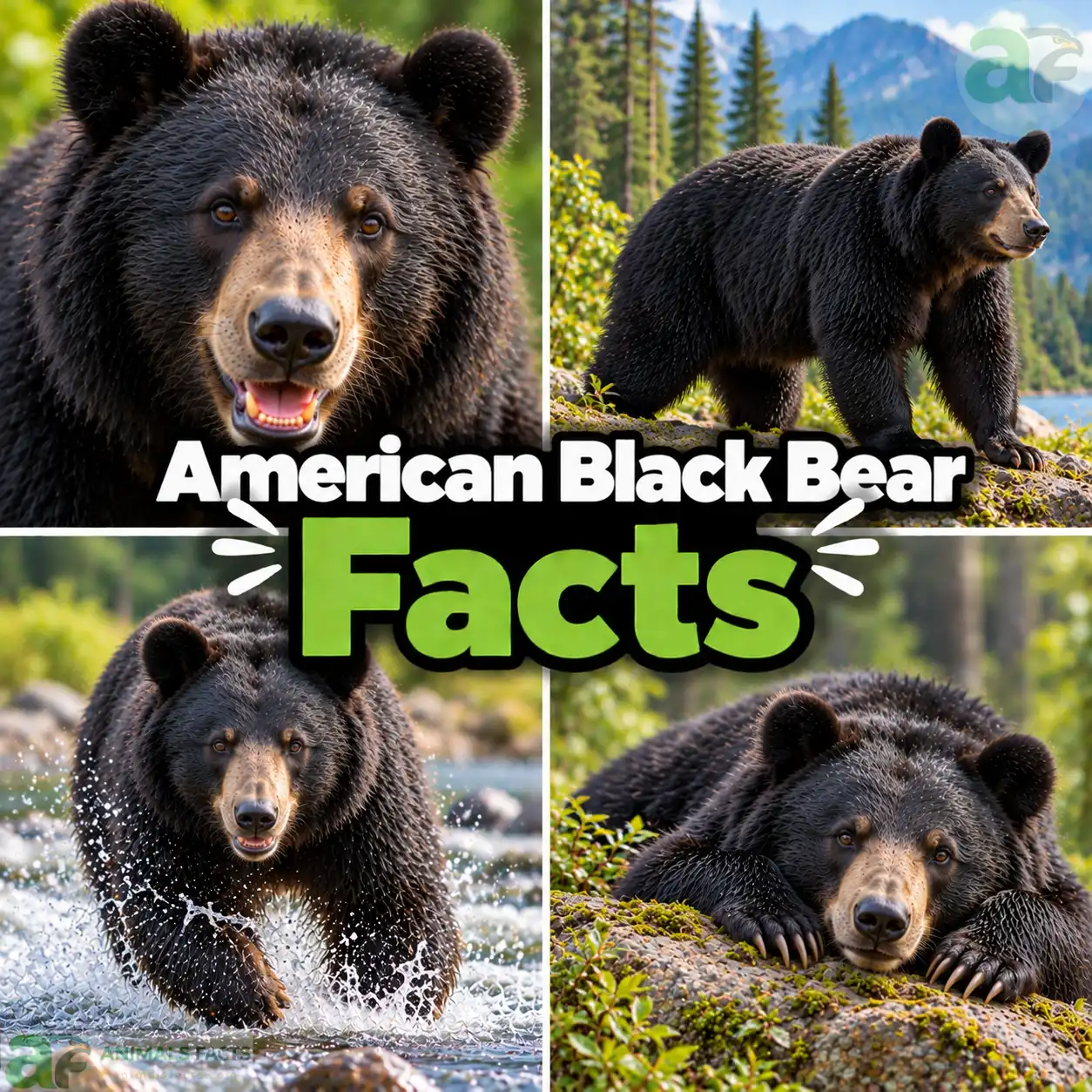
American Black Bear Facts
| Feature | Details |
|---|---|
| Scientific Name | Ursus americanus |
| Common Names | American Black Bear, Black Bear |
| Kingdom | Animalia |
| Phylum | Chordata |
| Class | Mammalia |
| Order | Carnivora |
| Family | Ursidae |
| Genus | Ursus |
| Recognized Subspecies | 16 recognized subspecies — including the Florida Black Bear, Cinnamon Bear, Kermode Bear (“Spirit Bear”), and Glacier Bear |
| Habitat | Forest, woodland, swamp, mountain — across most of North America |
| Lifespan | 18–23 years in the wild; up to 39 years in captivity |
| Diet | Omnivore — berries, nuts, roots, insects, fish, carrion, small mammals |
| Weight | Males: 57–300 kg (exceptionally up to 400 kg); Females: 41–170 kg |
| Body Length | 1.2–2.0 meters |
| Shoulder Height | 60–100 cm |
| Top Speed | Up to 48 km/h (30 mph) |
| Climbing Ability | Expert tree climber at all ages — the only North American bear species that routinely climbs trees as adults |
| Conservation Status | Least Concern (IUCN Red List) |
| North American Population | Estimated 800,000–950,000 individuals — the most numerous bear in North America and one of the most numerous bear species in the world |
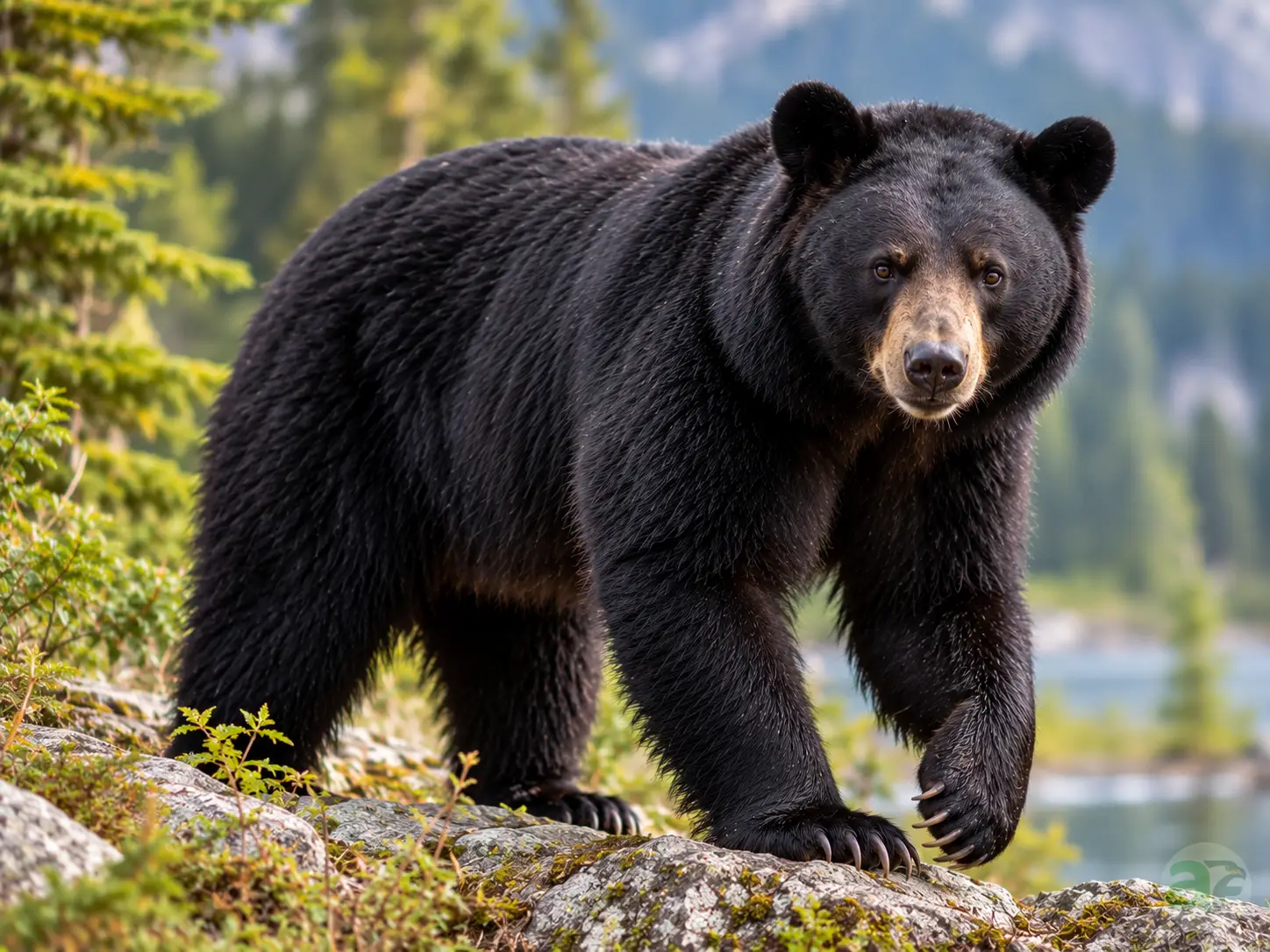
| Unique Feature | No shoulder hump (distinguishing it from grizzly); expert tree climber; remarkable color variation — from jet black to cinnamon, blond, blue-gray, and white |
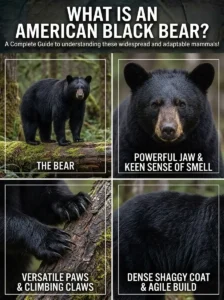 1. Introduction: What is a American Black Bear?
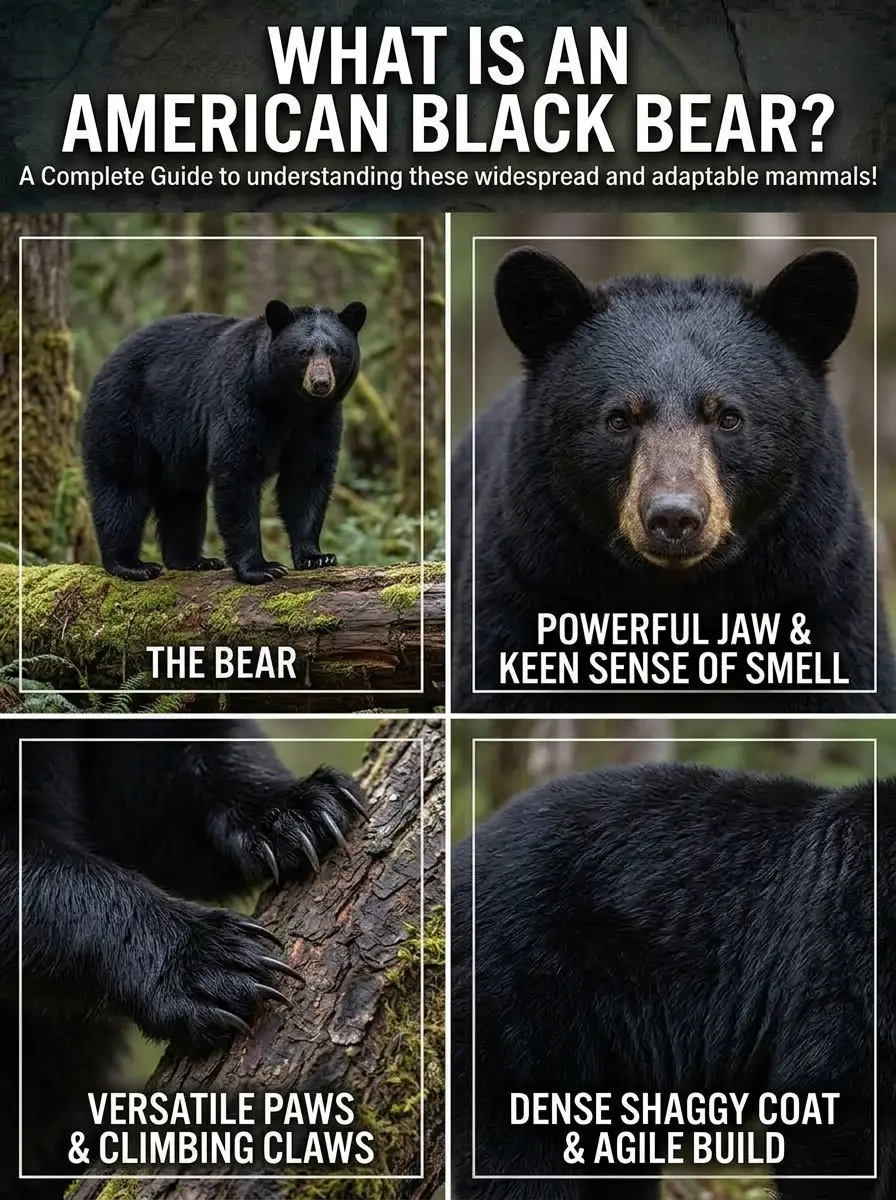
It is North America’s most successful wild bear — with an estimated 800,000 to 950,000 individuals across the continent, more than five times the total of all other North American bear species combined. It has proven so adaptable that it thrives from subtropical Florida swamps to subarctic forests, from Pacific coastal rainforest to eastern Appalachian oak woodland, from remote wilderness to the suburban neighborhoods of Reno, Nevada and Asheville, North Carolina. It can be black, brown, cinnamon, blond, bluish-gray, or white — all within the same species. And it has accomplished something genuinely remarkable: its population has more than doubled since the 1970s, reversing a century of decline through successful conservation management to achieve one of the largest population recoveries of any large mammal in North American history. Black bear facts are full of genuine surprises about an animal most people think they already know.
The American black bear — Ursus americanus — is the smallest of North America’s three bear species, but what it lacks in the grizzly’s dramatic power and the polar bear’s Arctic majesty, it more than compensates for in ecological flexibility, behavioral adaptability, and population success. With 16 recognized subspecies adapted to environments ranging from Florida’s wetlands to British Columbia’s temperate rainforest to the high-altitude forests of the Rocky Mountains, the black bear occupies a broader range of habitats than either of its North American relatives, feeding on a more diverse array of foods, showing greater tolerance for human-modified landscapes, and demonstrating behavioral complexity that has surprised researchers who initially assumed this common, familiar species to be well understood.
Whether you are a hiker learning to identify and safely respond to black bears on a trail, a homeowner dealing with a neighborhood bear, a student researching black bear facts for a school project, a parent looking for black bear facts for kids, or a wildlife enthusiast who wants to understand the remarkable ecology of North America’s most numerous bear — this is the most complete guide to black bear facts you will find anywhere. We cover black bear habitat, black bear diet, black bear behavior, communication, reproduction, color variants, the famous Spirit Bear of British Columbia, conservation success, mythology, and the extraordinary story of North America’s most adaptable bear. Let us begin.
2. American Black Bear Species Overview & Classification
The American black bear belongs to the family Ursidae — the bear family — and is the most widely distributed and most numerous wild bear species on the North American continent, sharing the continent with its larger relatives the grizzly bear and the polar bear while occupying a substantially broader range than either.
Black Bear vs. Brown/Grizzly Bear
A critical and sometimes life-or-death identification distinction:
| Feature | Black Bear | Grizzly/Brown Bear |
|---|---|---|
| Shoulder hump | Absent — the back slopes from shoulders to rump | Present — distinctive muscle hump above shoulders |
| Face profile | Straight or slightly convex — “Roman nose” | Concave “dish” profile |
| Ear size | Relatively tall and upright | Smaller, rounder, more separated |
| Claws | Short, strongly curved — adapted for tree climbing | Long, relatively straight — adapted for digging |
| Body color | Any color from black to white | Typically brown with grizzled tips |
| Rump vs. shoulder | Rump higher than shoulders | Shoulders (with hump) highest point |
Species Classification Table
| Level | Classification |
|---|---|
| Kingdom | Animalia |
| Phylum | Chordata |
| Class | Mammalia |
| Order | Carnivora |
| Family | Ursidae |
| Genus | Ursus |
| Species | U. americanus |
| Closest Relatives | Brown Bear (Ursus arctos); Asian Black Bear (Ursus thibetanus) |
Key Black Bear Subspecies
| Subspecies | Common Name | Range | Notable Feature |
|---|---|---|---|
| U. a. americanus | Eastern Black Bear | Eastern North America | Most widespread; typically black |
| U. a. floridanus | Florida Black Bear | Florida and adjacent states | Medium-sized; isolated; state-managed |
| U. a. kermodei | Kermode Bear / Spirit Bear | Coastal British Columbia (Princess Royal Island area) | White/cream coat due to recessive gene; deeply significant to First Nations |
| U. a. emmonsii | Glacier Bear | Southeast Alaska | Rare blue-gray color phase |
| U. a. cinnamomum | Cinnamon Bear | Rocky Mountain region | Distinctive cinnamon to reddish-brown coat |
| U. a. altifrontalis | Olympic Black Bear | Pacific Northwest | Western rainforest subspecies |
| U. a. californiensis | California Black Bear | California | Western subspecies |
| U. a. luteolus | Louisiana Black Bear | Louisiana/Texas/Mississippi | Threatened subspecies; recovering |
Species Evolution & Discovery Timeline
~5–6 million years ago: The genus Ursus evolved, eventually giving rise to the lineage of bears that includes modern black bears, brown bears, and polar bears.
~3–4 million years ago: The evolutionary lineage leading to the American Black Bear is believed to have crossed from Asia into North America via the Bering Land Bridge — establishing the ancestral population that would diverge and specialize into the modern species across millions of years of North American evolution.
~2–3 million years ago: Black bears evolved into their recognizably modern form in North America — smaller and more forest-adapted than the ancestral bear population, and developing the distinctive climbing-adapted claws and forest-focused ecology that characterize the modern species.
Pre-contact era: Black bears were abundant across virtually all forested regions of North America — estimated total populations of hundreds of thousands of individuals, coexisting with Indigenous peoples who maintained complex cultural, spiritual, and subsistence relationships with the species across diverse traditions.
1800s–early 1900s: Widespread hunting and habitat loss reduced black bear populations across much of the species’ eastern range — with bears extirpated from many states and provinces during the era of intensive forest clearing and unrestricted hunting.
1950s–1970s: Beginning of modern black bear management with harvest regulations, population monitoring, and habitat protection — the foundation of the recovery that followed.
1970s–present: Dramatic population recovery — with the estimated North American black bear population growing from approximately 400,000–500,000 in the 1970s to approximately 800,000–950,000 by the 2020s, representing one of the most successful large mammal population recoveries in North American conservation history.
3. American Black Bear Physical Description & Unique Features
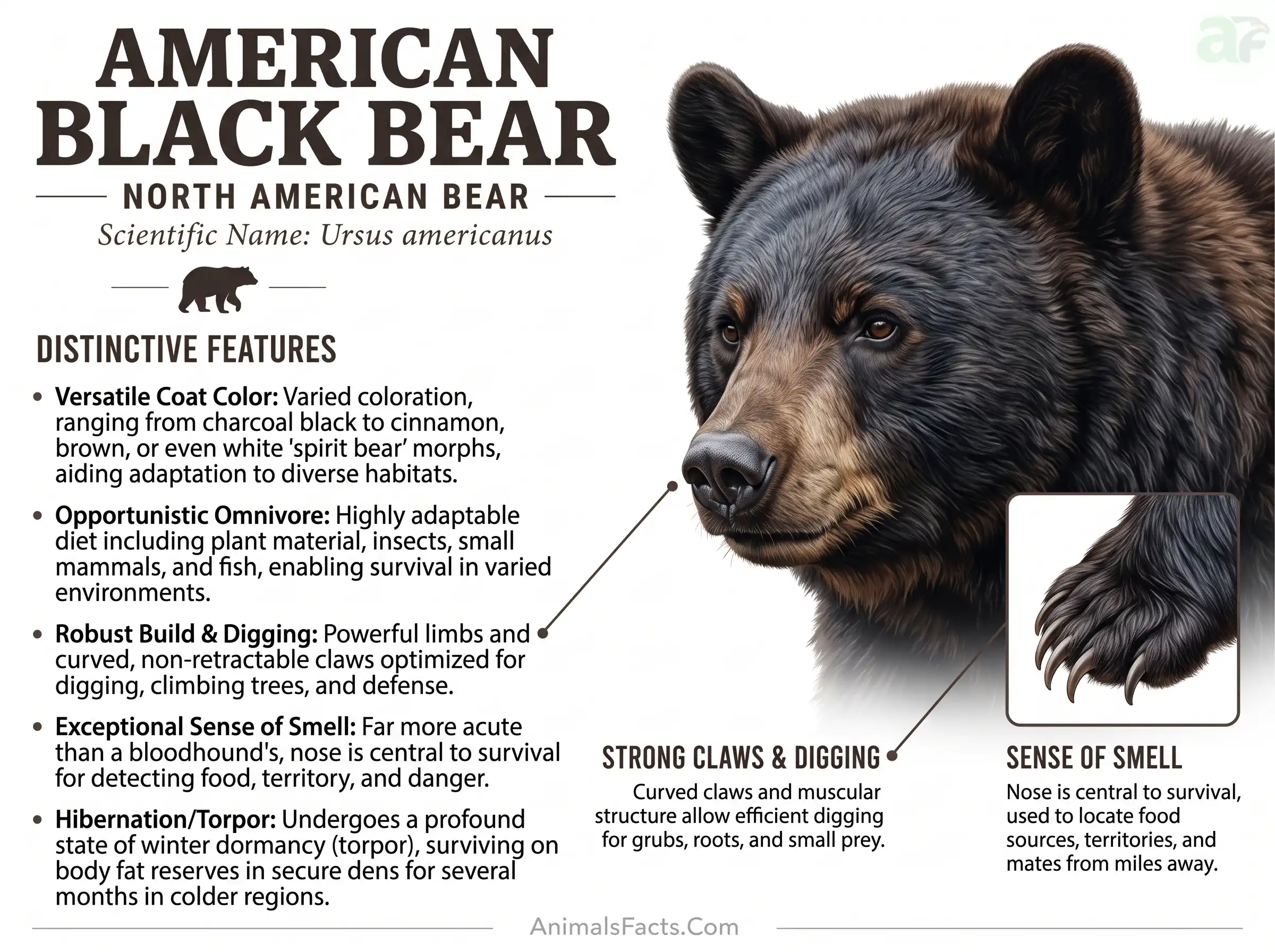
The American black bear’s physical design represents the most generalized and habitat-flexible of the three North American bear species — retaining the ancestral bear body plan without the extreme specializations of the polar bear (hypercarnivory, marine adaptation) or the grizzly bear (shoulder hump, long digging claws), and supplementing this generalist design with specific adaptations for forest life, tree climbing, and dietary flexibility across a remarkably broad range of North American environments.
Size and Variation
Black bears show more geographic variation in body size than almost any other North American large mammal — reflecting the enormous diversity of environmental conditions and food availability across their continent-wide range:
- Smallest populations: Some southeastern US and Mexican subspecies — adult males sometimes averaging only 57–90 kg
- Average eastern black bear: Adult males typically 100–180 kg; females 41–120 kg
- Largest individuals: Great Smoky Mountains and New Jersey/New York populations — large adult males sometimes reaching 270–300 kg, with exceptionally large individuals occasionally documented at nearly 400 kg
- Maximum documented weight: A North Carolina male documented at approximately 400 kg represents one of the largest verified black bears on record
The Extraordinary Color Variation
The single most striking characteristic of the American black bear is its extraordinary coat color variation — unique among the world’s bear species in producing a single species whose individuals span from jet black to creamy white:
Jet black: The most common color, particularly in eastern North America, where black-colored individuals predominate.
Cinnamon: A warm reddish-brown color found primarily in Rocky Mountain populations — so common in some areas that “Cinnamon Bear” was historically used as a name for a separate species before its identity as a color phase of the American black bear was established.
Blond or brown: A lighter, yellowish-brown phase common in parts of the western range.
Blue-gray (Glacier Bear): An extremely rare color phase found in a small number of individuals in southeast Alaska — the Glacier Bear — producing a distinctive steel-blue or blue-gray coloration that is unique in the bear world.
White/cream (Spirit Bear / Kermode Bear): The most celebrated and most culturally significant color variant — white or cream-colored black bears resulting from a recessive gene concentrated in British Columbia’s coastal rainforest, particularly on Princess Royal Island and surrounding areas. Known to First Nations peoples as “Moksgm’ol” and to wildlife biologists as “Kermode Bears,” these animals hold profound spiritual significance for coastal BC First Nations and represent one of the most visually striking wildlife rarities in North America.
Climbing Adaptations
The black bear’s most practically distinctive anatomical feature — compared to its larger relatives — is its short, strongly curved, non-retractable claws adapted specifically for tree climbing. Unlike the longer, straighter claws of the grizzly bear (adapted for digging), black bear claws hook into bark and allow all ages of black bears to ascend trees rapidly and effectively — a capability that serves as both a predator escape strategy and (for cubs) a regular resting behavior.
Did You Know? The Spirit Bear (Kermode Bear) — the white-coated black bear of British Columbia’s Great Bear Rainforest — possesses a research-documented hunting advantage over its black-coated counterparts. Studies have shown that white-coated Kermode Bears catch salmon at a measurably higher rate than black-coated individuals during salmon runs — because fish in the water perceive less contrast between a pale-coated bear and the bright daytime sky overhead, providing the white bear with a genuine fishing stealth advantage during daylight hours. Natural selection may have maintained this otherwise-conspicuous coat color precisely because this salmon-fishing advantage outweighs the camouflage disadvantage in the specific ecological context of the Great Bear Rainforest.
4. Top 25 Surprising & Interesting Black Bear Facts
- American black bears are the most numerous bear species in North America — with an estimated 800,000–950,000 individuals, more than five times the total of all other North American bear species combined.
- Despite the name, black bears can be black, brown, cinnamon, blond, blue-gray, or white — with color phase distribution varying dramatically by region, making color alone an unreliable species identification feature in areas where black bears and grizzly bears overlap.
- Black bears are the only North American bear species that routinely and effectively climbs trees as adults — using short, curved claws that grip bark efficiently, unlike the longer, straighter digging claws of grizzly bears.
- The Kermode Bear (Spirit Bear) of British Columbia — a white-coated American black bear resulting from a recessive gene — catches salmon at a measurably higher rate than its black-coated counterparts because fish perceive less contrast between the pale bear and the bright sky, providing a genuine hunting advantage.
- Black bears have an exceptional sense of smell estimated to be 7 times more sensitive than a bloodhound’s — comparable to the grizzly bear and among the most powerful olfactory systems documented for any land mammal.
- Black bears are not true hibernators in the strictest scientific sense — their body temperature drops only modestly (from 38°C to approximately 31–34°C) during winter denning, they can be roused relatively quickly from this torpor, and their physiological processes continue at a slow rate throughout winter, distinguishing their state from the deeper torpor of true hibernators like ground squirrels.
- Female black bears do not lose significant bone density or muscle mass during winter dormancy — a remarkable physiological achievement studied by researchers for its potential relevance to preventing osteoporosis in humans, with the hormone and mineral management mechanisms involved representing active areas of medical research.
- Black bears have the second largest brain relative to body size among North American carnivores — exceeded only by wolverines — and have been shown in experimental settings to demonstrate problem-solving capabilities, tool use, and memory retention that rivals or exceeds that of great apes in some contexts.
- Black bears consume an astonishing diversity of foods — research has documented individual black bears consuming over 80 different plant species in a single season alongside invertebrates, mammals, and fish, earning a dietary flexibility essentially unmatched among comparable-sized North American omnivores.
- The Louisiana Black Bear — a subspecies historically reduced to approximately 150–200 individuals in the 1980s — is widely believed to have served as the inspiration for the “Teddy Bear” through the famous 1902 incident in which President Theodore Roosevelt refused to shoot a captive black bear during a Mississippi hunting trip, generating the editorial cartoon that inspired the toy.
- Black bears can sprint at up to 48 km/h over short distances — faster than any human runner — and have been documented maintaining pursuit of prey over distances of several hundred meters.
- Individual black bears have been documented maintaining an extraordinary spatial memory — returning to specific berry patches, beehives, and food sources year after year with remarkable precision, sometimes across distances of tens of kilometers.
- The Florida Black Bear has recovered from fewer than 1,000 individuals in the 1970s to approximately 4,000+ individuals today — one of the most successful state-level large mammal recovery programs in US history.
- Black bears have been documented opening screw-top containers, unlocking coolers, and solving multi-step food access puzzles with a sophistication that has significantly challenged the design requirements of bear-resistant containers in campsites and national parks.
- A single adult black bear can consume up to 20,000 calories per day during autumn hyperphagia — and a specific diet of high-sugar berries combined with high-fat pine nuts produces the most rapid weight gain documented for the species, with bears in whitebark pine habitat gaining weight at extraordinary rates during good mast years.
- Black bears demonstrate remarkable behavioral flexibility in response to human presence — with urban-edge and suburban bears showing dramatically reduced flight distance from humans compared to wilderness bears, adapting their activity timing, denning locations, and food sources to coexist with human communities in ways that no other North American bear species has achieved at comparable scale.
- The black bear’s annual hyperphagia period can last up to 20 weeks — significantly longer than the equivalent preparation period in many other temperate-zone hibernators, reflecting the species’ need to accumulate sufficient fat reserves to sustain both itself and potential cubs through 4–7 months of winter denning.
- Black bears are excellent swimmers — documented crossing lakes over 2 kilometers wide in the course of normal territory use, deliberately swimming for cooling purposes in hot weather, and (in coastal areas) swimming between islands as part of seasonal foraging movements.
- Research has documented black bears using rocks and sticks as tools — including individuals using rocks to scratch hard-to-reach areas and sticks to manipulate food items — extending the documented range of tool use in bears beyond the few examples previously recognized.
- The Great Smoky Mountains National Park hosts one of the highest black bear densities of any protected area in eastern North America — with an estimated population of 1,500 bears in a park covering approximately 2,100 km², representing one of the best locations on the eastern seaboard for reliable bear observation.
- Black bears in northeastern states like New Jersey, Connecticut, and New York have established thriving populations within some of the most densely human-populated areas on Earth — New Jersey hosts an estimated 4,000–5,000 bears in a state of approximately 9 million people, representing one of the most intensive human-bear coexistence situations outside Alaska.
- Female black bears have been documented learning human behavioral patterns — including activity timing, vehicle use frequency, and food storage habits — and modifying their own behavior specifically to exploit human food sources while minimizing human encounter risk, demonstrating a form of adaptive behavioral intelligence applied specifically to the human-bear coexistence situation.
- The black bear’s metabolic management during hibernation is so sophisticated that despite months without eating or drinking, bears emerge from winter dens with preserved muscle mass and bone density, maintained immune function, and females who have successfully nursed cubs entirely on stored fat — a physiological achievement with no parallel among similarly-sized mammals.
- Black bear populations have more than doubled since the 1970s across most of their range — from an estimated 400,000–500,000 to approximately 800,000–950,000 individuals — representing the single most successful large mammal population recovery in the history of North American wildlife management.
- Black bears consume enormous quantities of insects during summer months — particularly ants, beetles, and yellow jacket nest contents — tearing apart logs, anthills, and stumps with their forepaws in a behavior that has significant ecological impact on forest dead-wood decomposition and nutrient cycling.
5. Fun Facts About American Black Bear
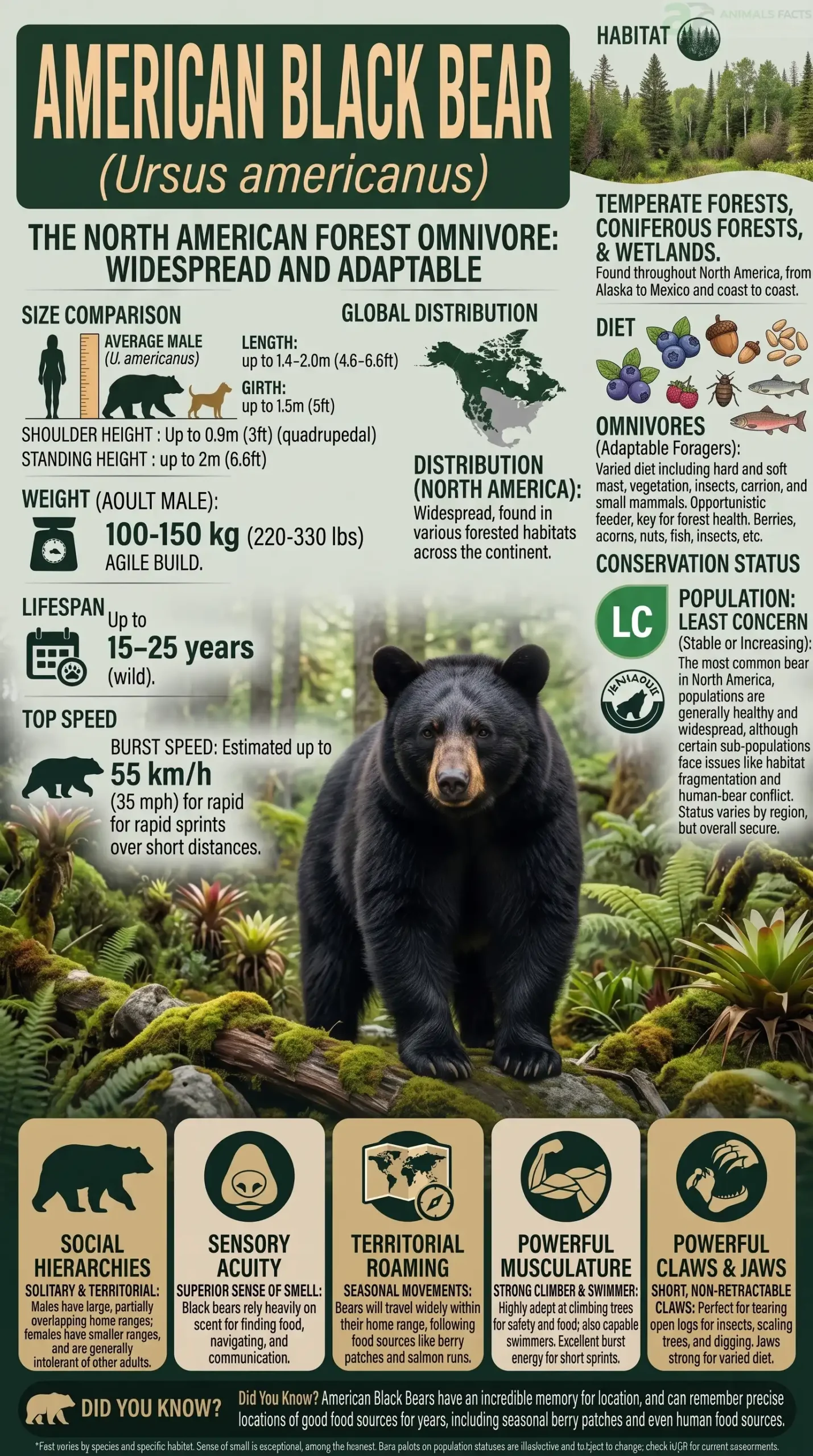
- Black bears are not always black — they can be brown, cinnamon, blond, blue-gray, or even white!
- The Spirit Bear of BC is a white-colored black bear that catches more fish because it’s harder for fish to see.
- Black bears are the only North American bear that routinely climbs trees as adults.
- Their population has more than doubled since the 1970s — one of history’s great wildlife recovery stories.
- They can smell food from over 30 kilometers away.
- A black bear can eat up to 20,000 calories in a single day during hyperphagia.
- Black bears can run up to 48 km/h — faster than any human.
- The Teddy Bear was inspired by President Roosevelt refusing to shoot a black bear.
- Black bears’ amazing winter physiology is studied for human osteoporosis research.
- New Jersey has an estimated 4,000–5,000 black bears — in one of the most densely populated US states!
- The Florida Black Bear recovered from ~1,000 to 4,000+ individuals.
- Black bears can open screw-top containers and coolers — inspiring bear-resistant container design.
6. Black Bears Habitat & Geographic Range
The American black bear occupies one of the broadest habitat ranges of any North American large mammal — a geographic and ecological flexibility that distinguishes it from both the grizzly bear (more specialized for open mountain country and tundra) and the polar bear (entirely dependent on Arctic sea ice), and that has enabled the black bear’s remarkable population recovery across two continents.
Primary Habitat Types
Eastern deciduous and mixed forest: The habitat most associated with the black bear in the popular imagination — the hardwood and mixed forests of New England, the Appalachians, the Southeast, and the Great Lakes region, where bears exploit seasonal mast (acorns, beechnuts, hickory nuts) as critical hyperphagia foods alongside a diverse range of other forest foods.
Boreal and temperate coniferous forest: Across Canada, the Rocky Mountains, and the Pacific Coast ranges, black bears inhabit dense coniferous forest — from the spruce-dominated boreal zone through the Douglas fir forests of the Pacific Northwest and the high-elevation lodgepole pine forests of the Rocky Mountains.
Coastal rainforest: The Pacific coastal temperate rainforest of British Columbia and southeastern Alaska hosts some of the highest black bear densities anywhere — fueled by the extraordinary productivity of the Pacific salmon runs that supplement the bears’ plant-based hyperphagia diet with high-calorie marine protein.
Swamp and wetland: The Florida Black Bear and several southeastern US populations demonstrate remarkable adaptation to subtropical swamp and wetland habitat — inhabiting coastal flatwoods, cypress swamps, and oak scrub in a landscape that would seem inhospitable to a “forest” bear.
Mountain and subalpine: At higher elevations across the Rockies and other western ranges, black bears utilize alpine meadow systems for summer foraging — exploiting berry patches, ground squirrel colonies, and whitebark pine seed caches in high-altitude habitats.
Urban-edge and suburban habitat: The most recently and most controversially occupied black bear habitat — with thriving populations documented in the suburban and urban fringe environments of New Jersey, Nevada, California, Colorado, North Carolina, and numerous other states — representing an ongoing and rapidly evolving human-wildlife coexistence frontier.
Geographic Range
| Region | Estimated Population | Status | Notes |
|---|---|---|---|
| Eastern USA and Canada | ~250,000–300,000 | Expanding in many areas | Recolonizing former range in several states |
| Western USA and Canada | ~150,000–200,000 | Stable to expanding | Strong populations in Pacific Northwest and Rockies |
| Alaska | ~100,000 | Stable | Abundant throughout most of state |
| Ontario and Quebec | ~75,000–100,000 | Stable | Large wilderness populations |
| British Columbia | ~120,000–160,000 | Stable | Includes Spirit Bear subpopulation |
| Florida | ~4,000+ | Recovering | Significant recovery from near-extirpation |
| Mexico | Unknown; reduced | Declining | Poorly monitored; habitat pressure |
Did You Know? The black bear’s range has been actively expanding into formerly occupied territories across multiple northeastern states — with confirmed breeding populations reestablishing in states including Delaware (recently), Ohio, Missouri, and other Midwestern states from which they were extirpated over a century ago. This natural recolonization — driven by forest regeneration following agricultural abandonment and by decades of carefully managed harvest regulations — represents one of the most significant ongoing wildlife range expansions in North American conservation, and is producing the complex coexistence challenges that wildlife management agencies across the Northeast are increasingly grappling with.
7. American Black Bear Diet & Feeding Behavior
The American black bear is the most dietary diverse of North America’s three bear species — a true omnivore whose documented food list includes over 80 plant species in a single season alongside invertebrates, fish, small mammals, carrion, and an expanding category of human-derived foods in many populations. This extraordinary dietary flexibility is arguably the single most important factor explaining the black bear’s greater population success compared to its more specialized relatives.
What Black Bears Eat
Black bear diet follows a predictable seasonal calendar — shifting dramatically by season to exploit whatever food source offers the maximum caloric return at any given time of year:
Diet Breakdown Table by Season
| Season | Primary Foods | Notes |
|---|---|---|
| Spring (post-emergence) | Grasses, sedges, forbs, roots, carrion | Breaking winter fat depletion; high-energy plant material |
| Late spring | Ungulate calves (deer, elk), insects | Active predation during synchronized ungulate birthing |
| Early summer | Insects (ants, bees, beetles), berries (early season) | Insect foraging; ant mound and log tearing |
| Summer | Berries (blueberries, huckleberries), fish (salmon in west/north) | Caloric loading begins |
| Late summer/autumn (hyperphagia) | Hard mast (acorns, beechnuts, pine nuts), berries, insects | Maximum caloric intake; 20,000+ calories/day |
| Year-round (supplementary) | Carrion, small mammals, bird eggs, honey, human food sources | Opportunistic; significant variation by region and individual |
Foraging Behavior
Mast-following: In eastern North America, the single most critical hyperphagia food source is hard mast — acorns, beechnuts, and hickory nuts — whose annual production fluctuates dramatically, creating “mast years” (high production) and “mast failure years” (low production) that significantly influence black bear behavior, denning timing, reproductive success, and human conflict rates across entire regions.
Insect foraging: Black bears tear apart rotting logs, stumps, and ant hills with their forepaws to access insects — providing both protein and fat with high caloric efficiency relative to the energy cost of finding and opening the substrate.
Salmon fishing: In coastal BC, southeastern Alaska, and parts of the Rocky Mountain West, black bears fish for salmon during annual runs — developing individual fishing techniques similar to those documented for grizzly bears, though generally less dramatic and less studied given the greater public attention directed toward grizzly salmon fishing.
Did You Know? Research tracking the autumn diets of black bears in the Appalachian Mountains has documented that bears make remarkably sophisticated real-time adjustments to their foraging decisions in response to daily and weekly changes in food availability — traveling significant distances to newly productive mast sources, abandoning partially consumed patches when higher-quality alternatives become available, and integrating information about food abundance across their home ranges into foraging decisions that optimize caloric intake per unit of foraging time. This dynamic optimization of foraging decisions — requiring continuous environmental assessment, spatial memory of past food locations, and flexible behavioral adjustment — represents a cognitive capability considerably more sophisticated than early researchers assumed of bears.
8. Reproduction & Life Cycle
American black bear reproduction follows the characteristic pattern of North American bears — with delayed implantation, winter denning births, extended maternal dependency, and the slow reproductive rate that makes managing population recovery a multi-decade project but also makes sustainable harvest management particularly important.
Mating Behavior
Black bears mate during late May through July — with adult males ranging widely to find and mate with as many estrous females as possible, and with competition between males for mating access occasionally generating aggressive encounters. Like both North American bear relatives, black bears practice delayed implantation — with fertilized eggs entering diapause and only implanting in the uterine wall in autumn when the female’s fat condition determines whether the pregnancy will continue.
Denning and Birth
Den types: Black bears demonstrate remarkable versatility in denning site selection — using natural sites including hollow trees, rock caves, brushy hillsides, and root tangles, but also human-modified sites including culverts, building crawl spaces, and deck foundations in areas of suburban bear presence.
Gestation: Approximately 220 days total from mating (including diapause) to birth.
Birth: Typically January or February in the den. Cubs weigh approximately 220–340 grams at birth — remarkably tiny relative to maternal size.
Litter size: Typically 1–5 cubs (most commonly 2), with litter size correlated with maternal body condition and food availability the previous autumn.
Key Developmental Stages
| Stage | Age | Key Development |
|---|---|---|
| Birth in den | January/February | ~280 grams; blind, hairless |
| Eyes open | ~6 weeks | Beginning visual awareness in den |
| Den emergence | April/May (~4 months) | ~2–5 kg; first outside experiences |
| First summer | 4–12 months | Learning foraging and food identification |
| First hibernation | Year 1 | Denning with mother |
| Independence | ~16–18 months | Separation following emergence from second-year den |
| Sexual maturity | Female: 3–5 years; Male: 3–5 years | Earlier in productive food areas |
| Physical prime | 5–12 years | Maximum body size and productivity |
American Black Bear’s Lifespan Comparison Table
| Species | Average Wild Lifespan | Maximum Confirmed |
|---|---|---|
| American Black Bear | 18–23 years | ~39 years (captivity) |
| Grizzly Bear | 20–25 years | ~44 years (captivity) |
| Polar Bear | 20–25 years | ~43 years (captivity) |
| Florida Black Bear | 15–20 years | ~30 years |
9. Social Behavior & Communication
The black bear is generally solitary outside of mating encounters and mother-cub family units — but like the grizzly bear, demonstrates considerable social complexity and tolerance when food resources are concentrated in space, and maintains communication networks far more sophisticated than the species’ solitary reputation might suggest.
When Black Bears Are Social
Concentrated food sources: Black bears congregate at concentrated food sources — including salmon streams, berry patches, apple orchards, and (controversially) human garbage sites — with remarkably high tolerance for close proximity between individuals compared to what would be predicted from a species described as “solitary.”
Maternal family groups: The strongest and most enduring black bear social bond — between a mother and her cubs across the 16–18 months of family association, during which the mother teaches cubs foraging locations, food identification, social behaviors, and the specific landscape knowledge critical for the cubs’ independent survival.
Communication
Vocalizations: Black bears produce a range of vocalizations — from the quiet “woof” of alarm or mild stress, through jaw-popping (more serious threat warning), to growls during serious confrontations and the distinctive “bawling” of distressed cubs. Most communication between bears is remarkably quiet — the “silent” black bear reputation has some validity compared to the more vocal grizzly bear.
Scent marking: Black bears rub against trees — leaving hair, scent gland secretions, and claw marks at “rub trees” visited repeatedly by multiple individuals across seasons. These trees serve as information bulletin boards conveying individual identity, reproductive status, and territorial presence.
Bite marking and claw marking on trees: Bears bite and scratch trees at standing height — both as territorial markers and as apparent size advertisements, with larger marks indicating larger bears.
Did You Know? Research at Asheville, North Carolina — a city with a significant urban black bear population — documented that bears had learned to distinguish individual human identities by smell, responding differently to the scent of specific individuals based on whether those individuals had previously had negative (aversive) or neutral interactions with bears. This ability to learn and remember specific individual human olfactory signatures demonstrates a level of social cognition — applied specifically to human-bear relationships — that researchers found striking in a species not traditionally thought of as having complex social memory for non-bear individuals.
10. Predators & Defense Mechanisms
American black bears face more significant natural predation pressure than grizzly or polar bears — their smaller size and wider distribution means they coexist with a broader range of potential predators, and their forest habitat provides less visibility for detecting approaching threats compared to open tundra or sea ice.
Natural Predators
Grizzly Bears: In areas of range overlap — particularly across the Canadian Rockies, parts of the northern US Rockies, and Alaska — grizzly bears are the most significant predator of adult black bears, with grizzlies actively seeking out and killing black bears in territorial encounters. Black bears in grizzly country typically avoid areas of high grizzly activity and are significantly more cryptic in their behavior than black bears in grizzly-free regions.
Wolves: Wolf packs represent a significant predation threat, particularly to cubs and juveniles — with documented wolf predation on black bears in areas where wolf populations have recovered, including parts of the Great Lakes region and Yellowstone ecosystem.
Mountain Lions (Cougars): Documented predators of black bears, particularly in the western US — with cougar predation on subadult and occasionally adult black bears documented in multiple study areas.
Humans: By far the dominant cause of black bear mortality across most of the species’ range — through regulated sport hunting (the largest source of managed mortality), vehicle collisions, and management removals of food-conditioned or conflict-causing bears.
American Alligators: In the southeastern US, large American Alligators are documented opportunistic predators of black bears crossing waterways, particularly in Florida where significant overlap between the two species occurs in swamp habitats.
Defense Mechanisms
Tree climbing: The most distinctive and most effective black bear defensive strategy — all ages of black bears can ascend trees rapidly to escape ground-based predators including wolves, cougars, and even grizzly bears (which cannot climb effectively as adults). Black bear cubs routinely “treeing” in response to maternal alarm is one of the most commonly observed black bear defensive behaviors.
Maternal aggression: Female black bears defending cubs are significantly more aggressive than most solitary encounters would suggest, engaging in active defensive behavior against wolves, cougars, and occasionally humans.
Bluff displays and vocalizations: The characteristic “woof” and jaw-pop sequence serves as a warning display that often deters approaching threats without requiring physical confrontation.
11. Black Bear Facts for Kids
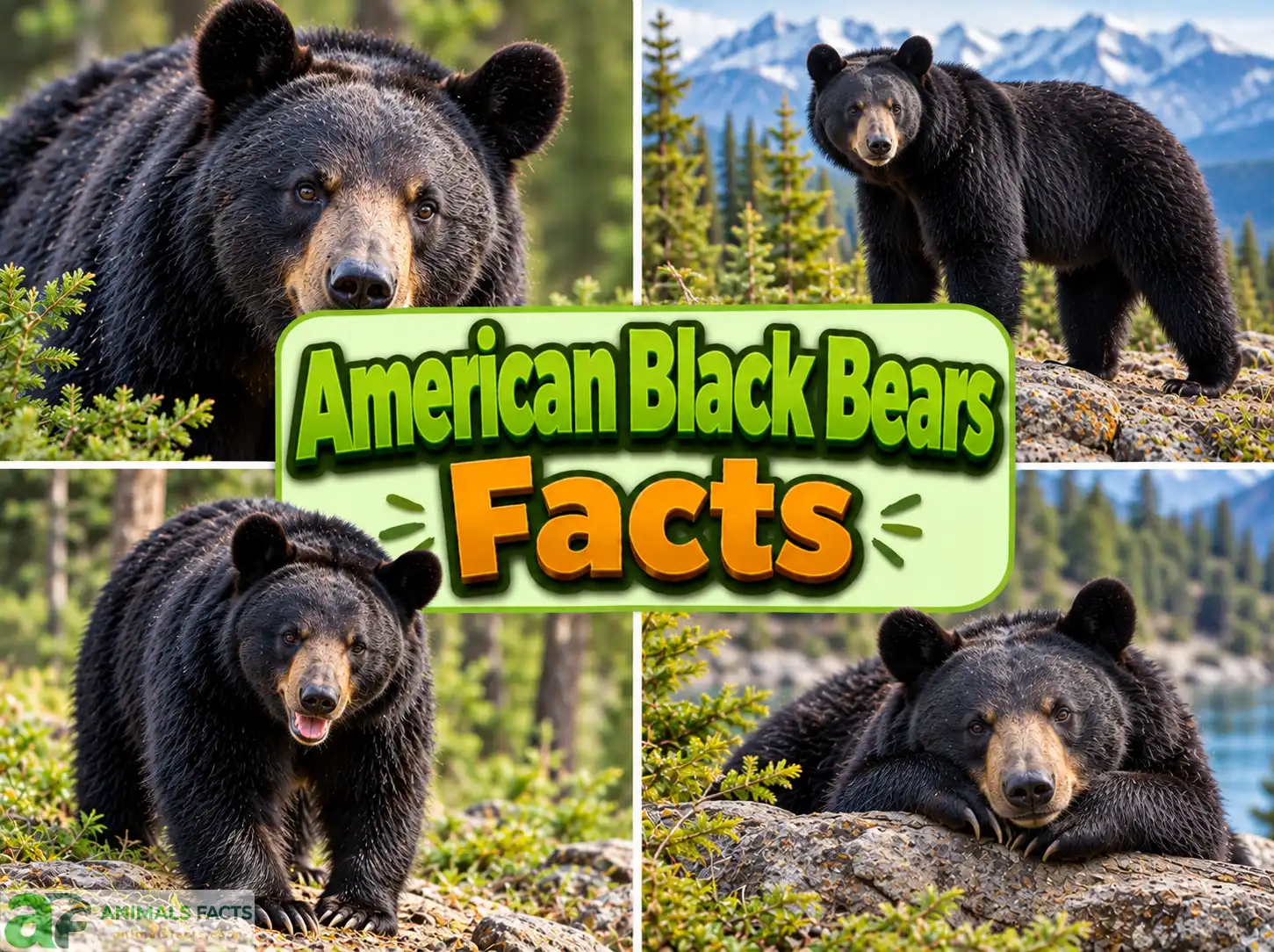
Hey kids — let’s discover why the American black bear is one of North America’s most amazing and most misunderstood animals!
- Black bears aren’t always black! They can be brown, tan, reddish, bluish-gray, and even completely white — and all of these differently colored bears are the same species! Some people see a cinnamon-colored bear in the Rocky Mountains and think it’s a different animal, but it’s the same species as the black bears in the forests of the East!
- There’s a very special white-colored black bear in Canada called the Spirit Bear or Kermode Bear — scientists discovered that these white bears actually catch more fish than the black-colored bears because fish in the water have a harder time seeing them against the bright sky!
- Black bears are the only bears in North America that can climb trees well even as adults! They have short, curved claws that grab onto bark, so they can run up a tree trunk very quickly when they’re scared or want to rest up high.
- There are more than 800,000 black bears across North America — that’s more than five times as many as all the other North American bears put together!
- Black bears have such a powerful sense of smell that they can sniff out food from over 30 kilometers away — that’s like smelling a pizza cooking in a restaurant on the other side of town!
- When a black bear gets ready to sleep through the winter, it eats as much food as it possibly can — sometimes up to 20,000 calories in a single day! That’s like eating about 60 large hamburgers in one day!
- The famous Teddy Bear toy was inspired by a black bear! In 1902, President Theodore Roosevelt refused to shoot a captured black bear during a hunting trip, and a cartoon about his kindness inspired someone to create the stuffed bear toy we know today!
- When bears are sleeping through the winter in their dens, their bodies do something incredible — they don’t lose their bone strength or muscle strength at all, even though they’re not moving for months! Scientists are studying this to help people with bone diseases!
Did You Know? A black bear’s memory is so good that it can remember exactly where it found a delicious berry patch years ago and navigate back to that exact spot from miles away the following autumn! Scientists studying black bears have discovered that individual bears maintain mental maps of their entire home territory, remembering the locations of hundreds of specific food sources — patches of berries, hollow logs with ant colonies, apple trees on old homesteads — and returning to each one at approximately the right time each year when the food will be ready. It’s like having a massive, perfectly remembered mental grocery list covering an area the size of a small town!
12. Relationship with Humans
The American black bear’s relationship with humans across North America is the most extensive, most geographically widespread, and most rapidly evolving large carnivore coexistence story on the continent — involving a combination of deeply rooted Indigenous cultural traditions, the history of systematic persecution and subsequent recovery, and an increasingly intense contemporary negotiation about how humans and bears can share landscapes across a continent.
Indigenous Cultural Relationships
The black bear has held profound spiritual, practical, and cultural significance across virtually every Indigenous nation whose traditional territory included black bear habitat — spanning hundreds of distinct cultures from British Columbia to Florida, from Alaska to the Maritime provinces of Canada. Common themes across diverse traditions include the bear as a healer (many nations associate the bear with knowledge of medicinal plants), the bear as a power animal (the bear’s strength and apparent humanlike qualities make it a frequent spiritual ally or adversary in vision quests and ceremonial practice), and the bear as a respected hunting quarry requiring specific ritual protocols acknowledging the bear’s spirit.
The Theodore Roosevelt Moment — The Teddy Bear’s Origin
One of the most historically significant individual human-black bear encounters in American cultural history occurred in November 1902, when President Theodore Roosevelt participated in a bear hunting trip in Sharkey County, Mississippi. When Roosevelt’s hunting party cornered and tied a black bear to a tree, Roosevelt refused to shoot it, considering it unsportsmanlike. Political cartoonist Clifford Berryman depicted the moment in a Washington Post cartoon, which inspired Brooklyn candy store owners Morris and Rose Michtom to create a stuffed bear toy they called “Teddy’s Bear” — the direct origin of the Teddy Bear, one of the most iconic and globally beloved children’s toys in history.
The Food Conditioning Problem
The most widespread and most consequential contemporary source of human-black bear conflict — food conditioning — occurs when black bears learn to associate human settlements, campsites, vehicles, or homes with reliable caloric rewards. Once a bear has learned that dumpsters, bird feeders, pet food, fruit trees, beehives, or chicken coops represent easy, high-calorie food sources, this conditioning is extremely difficult to reverse — and the vast majority of bears removed from the population as “problem bears” are in fact typically healthy, successful bears that have simply learned a human food association.
Urban Coexistence
The black bear’s remarkable success in urban and suburban environments — documented across dozens of American and Canadian cities — has created a genuinely novel and rapidly expanding human-wildlife coexistence challenge that wildlife managers, community planners, and individual residents are actively grappling with in real time.
13. American Black Bear Conservation Status & Threats
The American black bear’s Least Concern IUCN classification reflects its genuinely healthy and largely stable-to-increasing global population — one of the most positive large carnivore conservation stories in North America — while specific regional populations and subspecies present considerably more complex and in some cases more urgent situations.
Conservation Data (2026)
| Population / Subspecies | Status | Estimate | Trend |
|---|---|---|---|
| North American Black Bear (overall) | Least Concern | ~800,000–950,000 | Increasing or stable |
| Florida Black Bear | State-managed | ~4,000+ | Recovered; stable |
| Louisiana Black Bear | ESA Threatened (recovering) | ~700–1,000 | Recovering; proposed for delisting |
| Spirit Bear (Kermode) | Protected; BC provincial | Unknown; small | Stable in protected areas |
| Glacier Bear (SE Alaska) | No specific protection | Unknown; rare | Data deficient |
| Mexico populations | Threatened nationally | Unknown; declining | Declining |
Major Threats to Black Bears
Habitat loss and fragmentation: Ongoing forest fragmentation through urban development, road construction, and agricultural conversion across the black bear’s range — with road mortality becoming increasingly significant as populations expand into human-modified landscapes.
Vehicle collisions: As black bear populations recover and range expands, road mortality has emerged as one of the most significant non-hunting mortality sources — particularly critical for small, isolated, or recovering populations like the Florida Black Bear.
Food conditioning and conflict mortality: Bears habituated to human food sources typically end up being killed when conflict escalates to a level requiring management response — representing a preventable category of mortality that responsible food storage and waste management by humans can substantially reduce.
Regulated hunting: Legal sport hunting of black bears remains permitted in most US states and Canadian provinces with significant populations, with annual harvest across North America estimated in the range of 40,000–50,000 bears — a level current population sizes can support but which requires careful management to maintain.
Did You Know? The remarkable recovery of black bear populations across North America has been dramatically accelerated by a phenomenon wildlife managers call “forest recovery.” As millions of acres of farmland across the American Southeast and Northeast were abandoned throughout the 20th century — primarily due to economic changes in agriculture — former agricultural land has naturally regenerated into early and mature-stage forest over decades. This forest regeneration has restored significant black bear habitat across states like Pennsylvania, West Virginia, and New England, providing the cover, mast production, and prey that black bear populations need to establish and expand — simultaneously explaining both the species’ remarkable numerical recovery and the growing human-bear conflict in states that hadn’t managed significant bear populations for decades and lacked the institutional knowledge and public awareness needed for effective coexistence.
14. Famous Black Bears
Teddy — The Roosevelt Bear and the Teddy Bear Legacy
As described above, the Mississippi Black Bear that President Roosevelt declined to shoot in 1902 represents the most historically consequential individual black bear in American cultural history, directly inspiring the creation of the Teddy Bear toy that has comforted generations of children worldwide for over a century.
Meatball — California’s Most Famous Urban Bear
Meatball was a large adult male black bear in the Glendale, California area — famous for his size (reportedly up to 200 kg), his habit of raiding swimming pools and hot tubs, and his ability to repeatedly evade relocation attempts over several years of documented urban foraging. His story generated significant media coverage and public debate about urban bear management, and he became a symbol of the growing reality that black bears are learning to coexist with — and in some cases, exploit — suburban California landscapes.
Smokey Bear
Smokey Bear is not a wild individual but is arguably the most culturally significant bear character in American history — the US Forest Service’s wildfire prevention mascot created in 1944, based on a real New Mexico Black Bear cub named Smokey who was rescued from a 1950 wildfire. The subsequent campaign featuring Smokey Bear — with his famous “Only You Can Prevent Forest Fires” message — became one of the longest-running and most successful public service advertising campaigns in American history, and made the black bear the most recognized wildlife animal in US fire prevention and public lands education contexts.
The Great Smoky Mountains Research Bears
Multiple individually identified and GPS-collared research bears in the Great Smoky Mountains National Park — tracked across decades by the park’s bear research program — have generated some of the most detailed individual life-history data available for any wild black bear population, contributing foundational knowledge to bear management across the continent.
15. Role in Ecosystem & Food Chain
The American black bear functions as both a mesopredator and a keystone species across the diverse forest ecosystems it inhabits — with ecological contributions ranging from seed dispersal and insect population regulation to marine-terrestrial nutrient transfer and forest decomposition enhancement.
Seed Dispersal
Black bears consume enormous quantities of berries during late summer and autumn hyperphagia, passing viable seeds in their feces across large areas of their home range — contributing meaningfully to the regeneration and spatial distribution of berry-producing plants including blueberries, huckleberries, serviceberries, and many other species across the forest communities they inhabit. The bear’s large gut capacity and wide-ranging movements make it a particularly effective long-distance seed disperser.
Forest Decomposition Enhancement
Black bears’ intensive log-tearing and stump-ripping behavior during insect foraging — tearing apart rotting wood to access ants, beetles, and other invertebrates — dramatically accelerates the decomposition of dead wood and the release of nutrients locked in rotting logs, contributing to soil nutrient cycling and the habitat complexity that supports dozens of other species.
Marine-Terrestrial Nutrient Transfer (Salmon Regions)
In coastal and riverine habitats where salmon are available, black bears play a role similar to the grizzly bear in transferring marine-derived nutrients into terrestrial forest ecosystems through salmon carcasses carried away from streams and consumed in the surrounding forest — a contribution to forest productivity documented along salmon-bearing streams across British Columbia and Alaska.
Predator of Ungulate Calves
Black bears are significant and often underestimated predators of white-tailed deer fawns and elk calves during spring calving periods — with research documenting black bear predation accounting for 25–30% of fawn mortality in some study areas, making the species an important regulator of ungulate population dynamics even in the absence of wolves or cougars.
16. Myths, Folklore & Cultural Significance
The black bear occupies a position of profound and multi-dimensional cultural significance across North American Indigenous traditions — simultaneously a powerful spiritual being, a source of traditional ecological knowledge, a respected and carefully hunted food source, and an ancestor figure in various cultural traditions.
Indigenous North American Traditions
The black bear figures prominently in the cultural traditions of hundreds of Indigenous nations across North America, with specific cultural expressions varying enormously by nation but sharing certain recurring themes:
Bear as healer: Across many Algonquian, Iroquois, and other eastern nations, the bear is specifically associated with healing and medicinal knowledge — reflecting the observed behavior of bears seeking out and consuming medicinal plants, and generating the tradition of bear-medicine practitioners and bear-clan healer roles in various national traditions.
Bear as clan animal: In the complex clan systems of nations including the Ojibwe, Haudenosaunee, Cherokee, and many others, the Bear Clan typically holds specific governance, healing, or protective roles within the broader community social structure — reflecting the bear’s status as one of the most powerful and respected animal beings.
Bear as sacred quarry: Many nations maintained elaborate ritual protocols around black bear hunting — including the acknowledgment of the bear’s spirit following a kill, the careful treatment of remains, and ceremonies ensuring the bear’s spiritual well-being and the future success of subsequent hunts — reflecting a relationship of respect and reciprocity rather than simple exploitation.
Spirit Bear Cultural Significance
The Spirit Bear (Kermode Bear) of the Great Bear Rainforest holds particularly deep spiritual significance for the Tsimshian, Gitxaała, Kitasoo/Xai’xais, Heiltsuk, and other First Nations of the BC coast — with the white bear (called “Moksgm’ol” in Tsimshian) regarded as a sacred being, kept secret from European colonizers for decades to protect it from hunting, and central to First Nations advocacy for protection of the Great Bear Rainforest ecosystem.
17. Black Bears in Pop Culture
The American black bear has generated one of the most extensive and most culturally embedded presences in American popular culture of any wild animal — driven partly by Smokey Bear’s extraordinary advertising reach, partly by the black bear’s genuine familiarity to millions of Americans with outdoor recreation experience, and partly by a series of memorable fictional bear characters.
Smokey Bear — A Cultural Institution
Smokey Bear — the US Forest Service’s wildfire prevention mascot, based on a rescued New Mexico black bear cub — is arguably the most widely recognized wildlife-based advertising mascot in American history. The campaign, running continuously since 1944, has achieved recognition rates consistently above 95% among American adults and has generated a cultural shorthand for bear imagery, outdoor responsibility, and fire prevention that has permeated American culture across multiple generations.
Yogi Bear and Boo-Boo
Yogi Bear — the fictional bear of Jellystone Park created by Hanna-Barbera in 1958 — is widely understood to represent a generic black bear and generated one of the most beloved and longest-running animated bear characters in American television history. While scientifically inaccurate (Yogi wears a collar and tie, speaks perfect English, and pilfers “picnic baskets”), the character nonetheless contributed significantly to American affection for and familiarity with black bears.
National Park and Wildlife Tourism
Black bears are among the most sought-after and most reliably observed large mammals in US national parks — with bear watching in the Great Smoky Mountains, Shenandoah, Sequoia and Kings Canyon, and Olympic National Parks representing major visitor attractions that generate significant economic value and contribute to public support for black bear conservation.
18. Black Bear Facts vs. Common Myths
Myth: Black bears are black. Fact: The species name “black bear” is a significant misnomer in large parts of the species’ range. American black bears can be black, dark brown, chocolate brown, cinnamon, blond, silvery-gray (Glacier Bear), or white (Spirit Bear) — with non-black color phases common or predominant across much of the western range. In the Rocky Mountains, more than 50% of black bears in some populations may display cinnamon or brown color phases.
Myth: Playing dead works with black bear attacks. Fact: The general safety recommendation for black bear defensive attacks is to fight back actively — not to play dead. This is the opposite of the defensive recommendation for grizzly bear attacks, and the distinction is critically important. Black bears rarely make defensive attacks; most black bear attacks (which are already extremely rare) tend to be predatory in nature, and actively fighting back — particularly targeting the bear’s nose and eyes — is recommended by wildlife agencies.
Myth: Black bears are harmless because they’re smaller than grizzlies. Fact: While black bears are statistically far less dangerous than grizzly bears in human encounters, they are genuine large carnivores capable of inflicting serious or fatal injuries. Black bear attacks — while rare — occur and can be fatal, particularly in the unusual context of predatory attacks by nutritionally stressed individuals. Treating black bears with appropriate respect and maintaining appropriate food storage practices remains important.
Myth: The shoulder hump distinguishes male from female black bears. Fact: Neither sex of black bear has a shoulder hump — the absence of a shoulder hump is a defining characteristic of the entire species, distinguishing black bears from grizzly bears regardless of sex or age. The shoulder hump, when present, always indicates a grizzly or brown bear.
Myth: Black bears seen during the day must be sick or rabid. Fact: Daytime activity is entirely normal for black bears — particularly during hyperphagia when the need to maximize caloric intake drives extended daily activity. Bears are generally most active around dawn and dusk, but daytime sightings are common and expected, especially near food sources or during particularly active foraging seasons.
19. Best Places to See Black Bears in the Wild
Great Smoky Mountains National Park, North Carolina/Tennessee
Hosting an estimated 1,500 black bears in approximately 2,100 km² of protected Appalachian forest — one of the highest black bear densities in eastern North America — the Smokies offer the most reliable black bear viewing available east of the Mississippi, with Cades Cove and Roaring Fork Motor Nature Trail providing particularly productive bear observation drives during early morning and evening hours.
Shenandoah National Park, Virginia
Shenandoah supports an excellent black bear population along the Blue Ridge Mountains — with bears commonly observed from Skyline Drive and along backcountry trails, providing accessible bear viewing in one of the East’s most scenic mountain landscapes.
Great Bear Rainforest, British Columbia
The Great Bear Rainforest of coastal BC — home to the famous Spirit Bear populations on Princess Royal Island and surrounding areas — offers exceptional black bear viewing alongside the rare possibility of encountering white-coated Kermode Bears, though access typically requires guided boat-based expeditions with First Nations tourism operators.
Katmai National Park, Alaska
While Katmai is most famous for its grizzly bears at Brooks Falls, the park also supports an excellent black bear population — providing the possibility of observing both species in the same spectacular landscape.
Sequoia and Kings Canyon National Parks, California
Sequoia and Kings Canyon host a thriving black bear population in the Sierra Nevada — with excellent viewing opportunities in campground and trail areas, and well-developed visitor education programs about bear-safe camping practices.
Olympic National Park, Washington
Olympic National Park’s dense rainforest and diverse ecosystems support significant black bear populations, with the Hoh Rainforest and Hurricane Ridge areas providing particularly productive bear observation contexts in dramatically different habitat types within the same park.
20. Top Documentaries & Books
Must-Watch Documentaries
“Bear Country” (Disney True-Life Adventure, 1953) — A groundbreaking early wildlife documentary that introduced American black bears to mass audiences and contributed to public appreciation for their natural history.
Various PBS Nature and National Geographic productions — Multiple programs have covered black bear ecology, urban bear behavior, and Spirit Bear natural history with excellent scientific accuracy.
“The Bear” (Jean-Jacques Annaud, 1988) — While primarily featuring a brown bear protagonist, this acclaimed film’s depiction of bear behavior drew extensively on black bear behavioral research and contributed significantly to public appreciation of bear intelligence and social complexity.
Spirit Bear documentary productions — Multiple BBC and CBC (Canadian Broadcasting Corporation) productions have covered the Kermode Bear, providing some of the finest wildlife filming of this rare and visually extraordinary color variant.
Essential Books
“Wild Bears of the World” by Dave Taylor — An accessible popular natural history overview of all bear species including a comprehensive black bear chapter.
“Bear Attacks: Their Causes and Avoidance” by Stephen Herrero (1985, revised 2018) — The essential reference for understanding black and grizzly bear attack contexts, prevention, and response — required reading for backcountry travelers in bear country.
“A Shadow and a Song” by Mark Jerome Walters — A conservation story addressing the Louisiana Black Bear’s recovery with accessible narrative style.
21. Comparison of Black Bears with Similar Bear Species
| Feature | American Black Bear | Grizzly Bear | Polar Bear | Sun Bear |
|---|---|---|---|---|
| Scientific Name | Ursus americanus | Ursus arctos horribilis | Ursus maritimus | Helarctos malayanus |
| Weight | 57–300 kg | 180–360 kg | 150–700 kg | 27–65 kg |
| Distribution | North America (widespread) | W. North America | Arctic circumpolar | SE Asia |
| Shoulder Hump | Absent | Present | Absent | Absent |
| Adult Tree Climbing | Excellent | Poor | Rare | Good |
| Claw Type | Short, curved (climbing) | Long, straight (digging) | Long, curved (ice grip) | Very long, curved (climbing) |
| Diet | Omnivore (flexible) | Omnivore (plant-heavy) | Hypercarnivore | Omnivore (insect-heavy) |
| Conservation Status | Least Concern | Least Concern (global)/Threatened (lower 48) | Vulnerable | Vulnerable |
| Population | ~800,000–950,000 | ~55,000–60,000 (N. America) | ~22,000–31,000 | ~10,000–25,000 |
| Color Variation | Extraordinary — black, brown, cinnamon, blond, blue-gray, white | Limited (tawny to dark) | Appears white (translucent) | Black with chest patch |
| Primary Threat | Road mortality; food conditioning; hunting | Habitat loss; human conflict | Climate change | Deforestation; bile trade |
22. How You Can Help
Black bear conservation involves a different set of priorities than most endangered species conservation work — with the primary needs centered on coexistence education, food security practices, and habitat connectivity, rather than the emergency population recovery programs required for threatened species.
Support These Organizations
National Wildlife Federation (nwf.org) — Advocates for black bear habitat connectivity, responsible hunting regulations, and human-bear coexistence education across North America.
Bear Trust International (beartrust.org) — Specifically focused on bear conservation across all species, including black bear population monitoring and management research.
North American Bear Center (bear.org) — Based in Ely, Minnesota, providing extensive black bear educational programs and conducting ongoing research on black bear ecology and behavior.
Wildlife Conservation Society (wcs.org) — Supports black bear research and conservation in specific habitats including the Great Bear Rainforest Spirit Bear programs.
Practical Actions
Practice food security (“Bear Smart” practices). The single most impactful individual action for black bear conservation — removing bird feeders (particularly at night and during non-winter seasons in bear country), securing garbage in bear-resistant containers, not leaving pet food or cooking grills unwashed outdoors, and securing beehives and chicken coops. Every food-conditioned bear created by preventable human behavior represents a bear at elevated mortality risk from management removal.
Use bear canisters or bear boxes when camping. Proper food storage in backcountry settings prevents the food conditioning that drives bears toward campsites and results in management killing of otherwise healthy animals.
Support wildlife crossing infrastructure. Road mortality is a significant black bear mortality source — advocacy for wildlife underpasses and highway crossing structures in areas of documented bear road mortality directly reduces this preventable death category.
Learn to identify black bears vs. grizzly bears. In areas of range overlap (parts of the Rocky Mountains, northern border areas), correct identification of bear species is essential for both appropriate safety response and accurate reporting to wildlife agencies.
Support habitat connectivity. Organizations working on forest corridor protection and land trust acquisition in areas connecting fragmented black bear habitat help maintain the population connectivity essential for long-term genetic health across the species’ enormous range.
Did You Know? The concept of “Bear Smart Communities” — a certification program for municipalities that implement specific standards for garbage management, public education, and conflict response protocols — has been demonstrating measurable success in reducing human-bear conflict across multiple Canadian and US communities since its development in the 1990s. Communities achieving “Bear Smart” certification show significantly lower rates of food-conditioned bear incidents, lower rates of management bear removals, and improved public satisfaction with bear management compared to comparable communities without the program — demonstrating that well-designed community-level behavior change programs can significantly reduce the human-caused factors driving the most preventable category of black bear mortality.
23. Frequently Asked Questions About American Black Bear
Q1: What is the scientific name of the American black bear?
The American black bear’s scientific name is Ursus americanus — placing it in the genus Ursus alongside the brown bear (U. arctos) and polar bear (U. maritimus). The family is Ursidae (bears), order Carnivora, and class Mammalia. There are 16 recognized subspecies across the species’ North American range.
Q2: Are all black bears actually black?
No — despite the name, American black bears display extraordinary color variation, ranging from jet black through dark brown, chocolate, cinnamon, blond, silvery-blue-gray (Glacier Bear of southeast Alaska), and creamy white (Kermode/Spirit Bear of British Columbia). Color phase distribution varies dramatically by region — in the Rocky Mountains, more than 50% of bears in some populations may be cinnamon or brown.
Q3: How many black bears are there in North America?
Current estimates place the total North American American black bear population at approximately 800,000–950,000 individuals — the most numerous bear species in North America, significantly outnumbering grizzly bears (~55,000–60,000) and polar bears (~22,000–31,000). The population has more than doubled since the 1970s through successful management and habitat recovery.
Q4: What is the difference between a black bear and a grizzly bear?
The most reliable field identification features are: shoulder hump (present in grizzlies, absent in black bears); face profile (concave “dish” in grizzlies, straight or convex in black bears); claw length (long straight claws in grizzlies, short curved claws in black bears); and rump vs. shoulder height (grizzlies’ hump makes shoulders their highest point; black bears’ rump is highest). Color alone is unreliable in areas of overlap.
Q5: Do black bears attack humans?
Unprovoked black bear attacks on humans are extremely rare. Unlike grizzly bears, which most commonly attack defensively when surprised or protecting cubs, black bear attacks tend to be predatory when they occur — and the recommended response is to fight back actively (not play dead). Maintaining appropriate food security to prevent food conditioning, making noise in bear country, and giving bears space are the most effective prevention measures.
Q6: What do black bears eat?
Black bears are true omnivores with one of the most diverse diets of any North American large mammal — consuming grasses, berries, roots, nuts, insects, fish, small mammals, ungulate calves, carrion, and (problematically) human-derived foods when available. Diet shifts dramatically by season, with the high-calorie focus of late-summer and autumn hyperphagia preparation being particularly important for winter survival.
Q7: Can black bears climb trees?
Yes — black bears are excellent tree climbers at all ages, using their short, strongly curved claws to grip bark efficiently. This distinguishes them from grizzly bears, whose longer, straighter digging claws make adult tree climbing impractical. Black bear cubs regularly climb trees as a predator-escape and rest behavior, and adult bears climb for food (berries, bird eggs) and safety.
Q8: How long do black bears hibernate?
Black bears enter winter dormancy (not true hibernation in the strictest physiological sense) for approximately 3–7 months depending on geographic location and climate — shorter or eliminated entirely in mild-winter southern populations, longest in northern and high-altitude populations. During dormancy, bears do not eat, drink, urinate, or defecate, sustaining themselves entirely on fat reserves accumulated during autumn hyperphagia.
Q9: What is the Spirit Bear?
The Spirit Bear (also called the Kermode Bear) is a white- or cream-colored American black bear — not a separate species, but an individual carrying a recessive gene that causes pale coat coloration. Found primarily in British Columbia’s Great Bear Rainforest, the Spirit Bear is deeply sacred to coastal First Nations peoples and has been shown to have a measurably higher salmon-catching success rate than black-coated individuals during daylight hours.
Q10: How can I help black bear conservation?
Key actions include: securing all food attractants (garbage, bird feeders, pet food, fruit trees) that create food-conditioned bears; using bear canisters when camping in bear country; supporting wildlife crossing infrastructure to reduce road mortality; learning to distinguish black bears from grizzly bears in overlap zones; and supporting organizations like the National Wildlife Federation, Bear Trust International, and North American Bear Center that fund bear research, management, and coexistence education.
24. Sources & Refrences
Research Sources
- Wikipedia — Ursus americanus and related articles
- IUCN Red List — iucnredlist.org
- National Wildlife Federation — nwf.org
- North American Bear Center — bear.org
- Bear Trust International — beartrust.org
- US Fish and Wildlife Service — fws.gov
- National Geographic — nationalgeographic.com
- Smithsonian’s National Zoo — nationalzoo.si.edu
- Encyclopaedia Britannica — britannica.com
- BBC Wildlife — bbc.co.uk
- Live Science — livescience.com
- Herrero, Stephen — “Bear Attacks: Their Causes and Avoidance” (1985, revised 2018)
- Florida Fish and Wildlife Conservation Commission — myfwc.com