
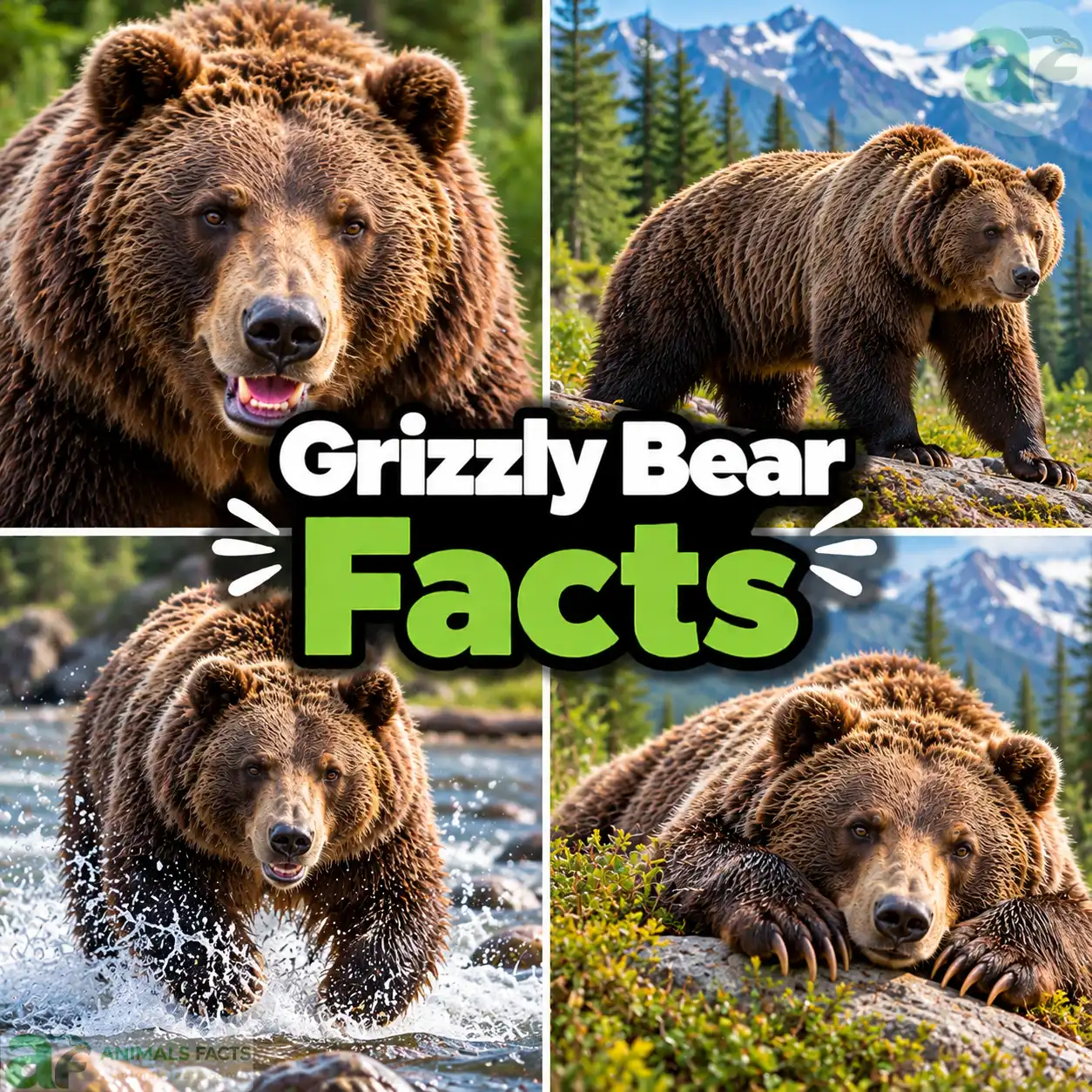
Grizzly Bear Facts
| Feature | Details |
|---|---|
| Scientific Name | Ursus arctos horribilis |
| Common Names | Grizzly Bear, North American Brown Bear, Silvertip (historical) |
| Kingdom | Animalia |
| Phylum | Chordata |
| Class | Mammalia |
| Order | Carnivora |
| Family | Ursidae |
| Genus | Ursus |
| Species / Subspecies | Subspecies of Brown Bear (Ursus arctos); some taxonomists recognize multiple grizzly bear subspecies |
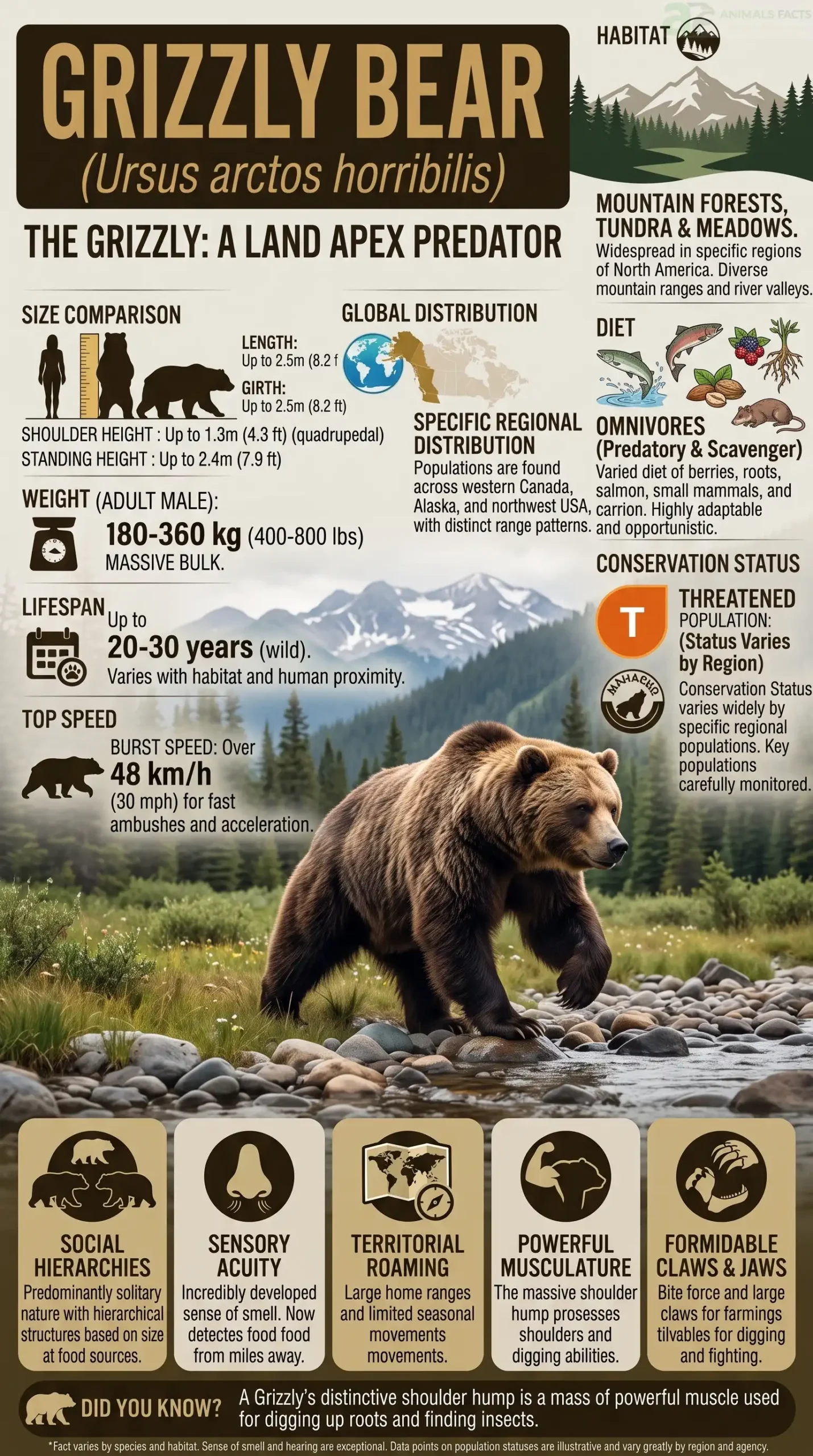
| Habitat | Mountains, forests, meadows, river valleys, tundra — western North America from Alaska through Canada to the northern US Rockies |
| Lifespan | 20–25 years in the wild; up to 44 years in captivity |
| Diet | Omnivore — berries, roots, grasses, fish (salmon), ground squirrels, elk calves, carrion, insects |
| Weight | Males: 180–360 kg (up to 680 kg for Kodiak individuals); Females: 130–180 kg |
| Body Length | 1.5–2.8 meters |
| Shoulder Height | 90–150 cm |
| Top Speed | Up to 56 km/h (35 mph) in short bursts |
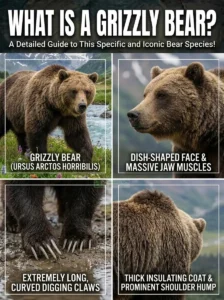
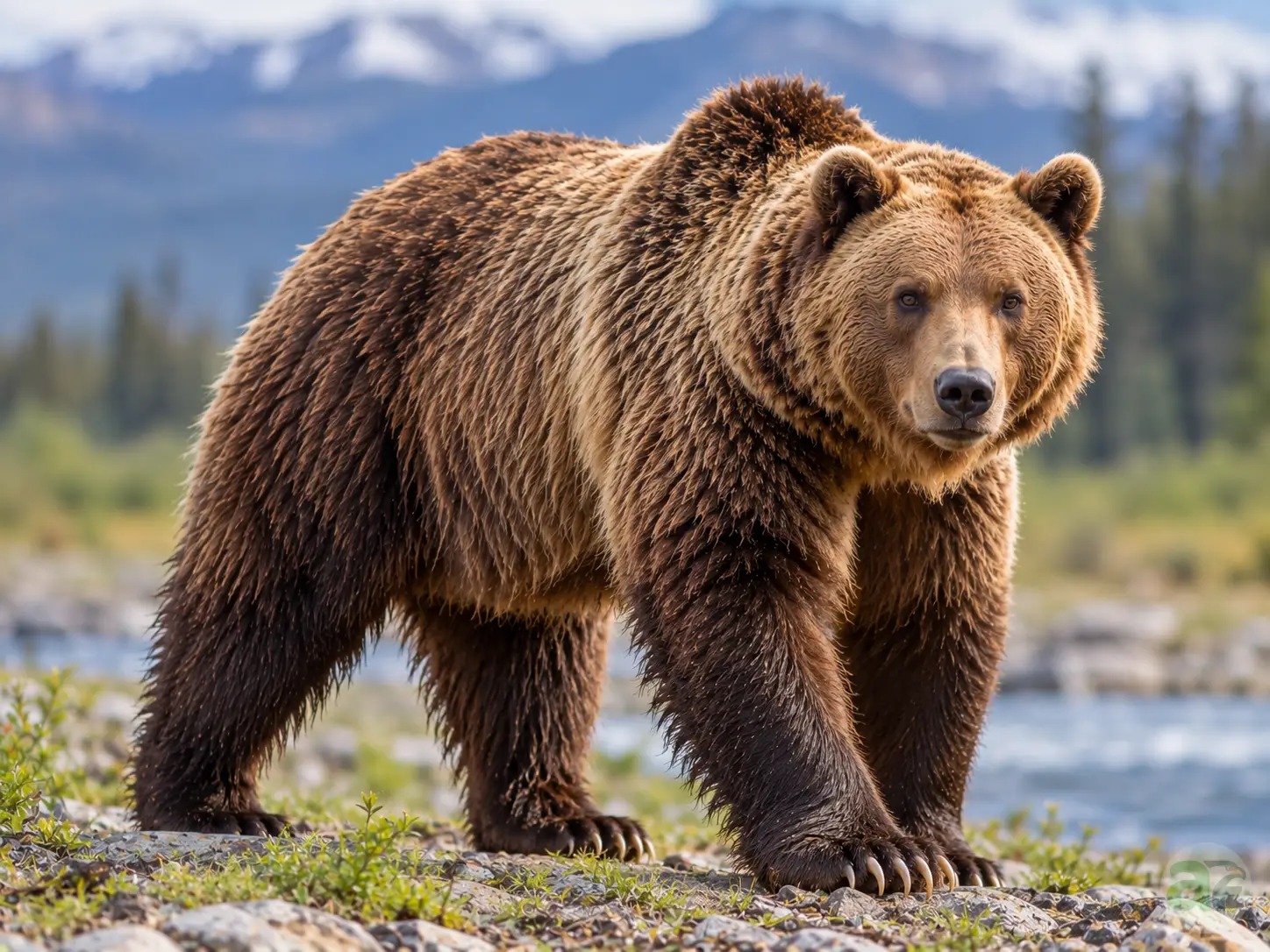
| Shoulder Hump | Distinctive muscular hump — the grizzly bear’s most instantly recognizable feature — unique among North American bears |
| Conservation Status | Least Concern (IUCN global); grizzly bears in lower 48 US states are Threatened under the US Endangered Species Act |
| North American Population | Estimated ~55,000–60,000 total (mostly in Alaska and Canada); approximately ~1,500–1,800 in the contiguous US |
| Unique Feature | Distinctive shoulder muscle hump; claws up to 10 cm long; one of the most powerful land carnivores in North America |
 1. Introduction: What is a Grizzly Bear?
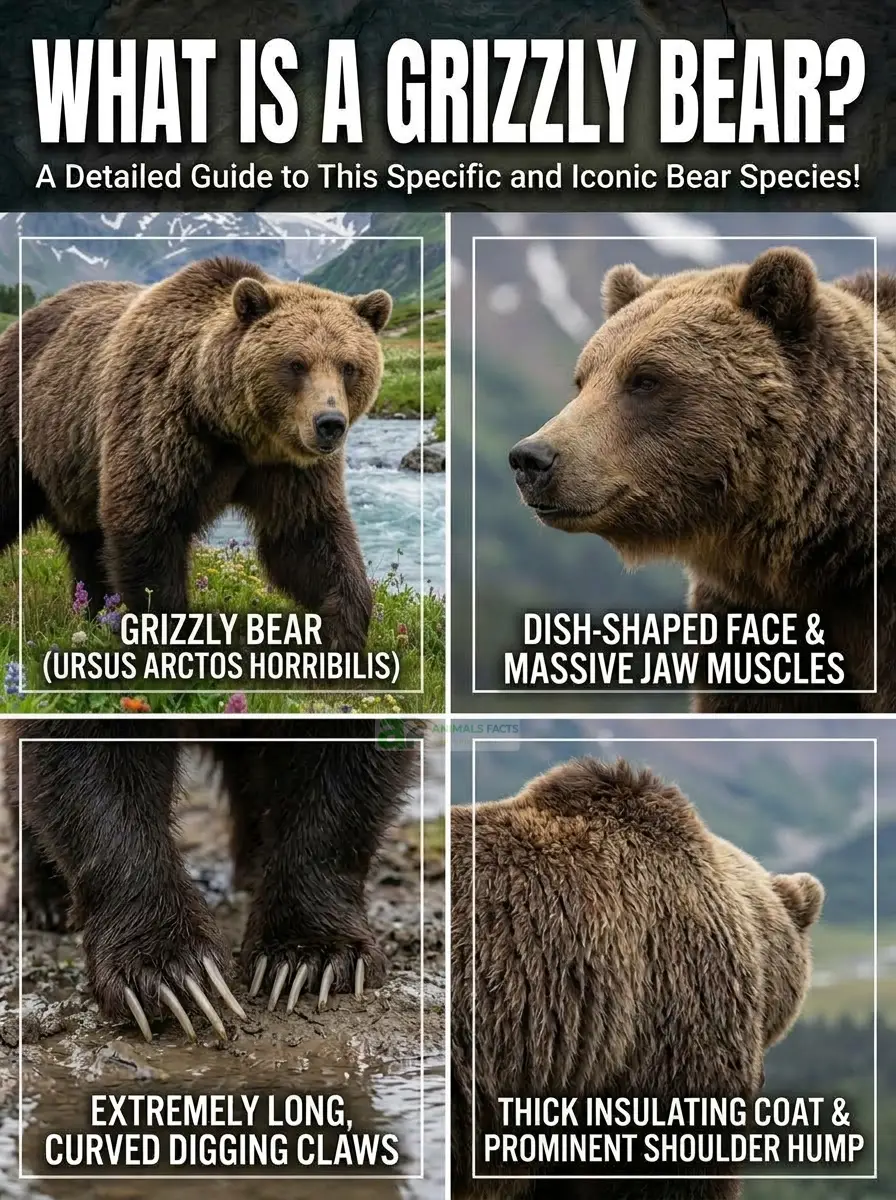
A single swipe of its forepaw can kill a full-grown elk. Its sense of smell is estimated to be seven times more powerful than a bloodhound’s, allowing it to detect food from over 30 kilometers away under favorable wind conditions. It can run as fast as a quarter horse over short distances despite weighing up to 360 kilograms — and it does all of this while supporting one of the most ecologically important and most culturally significant roles of any animal in North American wildlife history. Grizzly bear facts are among the most dramatic and most consequential in the natural world, and yet the animal behind these facts has been pushed to fewer than 2% of its historical range in the contiguous United States.
The grizzly bear — Ursus arctos horribilis — is a subspecies of the brown bear, uniquely adapted to the challenging environments of North America’s western interior mountains, forests, and tundra landscapes. Named for the “grizzled” silver-tipped appearance of its distinctive coat rather than for its disposition (though the species epithet “horribilis” certainly doesn’t help the grizzly’s public relations), the grizzly bear is one of the most complex, intelligent, and ecologically important large mammals on the North American continent — a keystone species whose presence or absence reshapes entire ecosystems, and a cultural symbol of wild nature that has held profound significance for Indigenous peoples of North America for thousands of years.
Whether you are a hiker preparing for backcountry travel in grizzly country, a student researching grizzly bear facts for a school project, a conservation advocate following the ongoing debates about grizzly bear delisting in the United States, a parent looking for grizzly bear facts for kids, or simply someone captivated by the power and majesty of North America’s most iconic large predator — this is the most complete guide to grizzly bear facts you will find anywhere. We cover grizzly bear habitat, grizzly bear diet, grizzly bear behavior, communication, reproduction, the famous hyperphagia feeding phenomenon, conservation, mythology, and the extraordinary story of an animal whose future hangs in a genuinely uncertain balance between successful recovery and renewed political threat. Let us begin.
2. Grizzly Bear Species Overview & Classification
The grizzly bear is a subspecies of the brown bear (Ursus arctos) — one of the most widely distributed bear species on Earth — specifically adapted to the interior of North America, where it diverged from coastal brown bear populations through thousands of years of evolutionary pressure in a somewhat different ecological and dietary context.
Understanding the Grizzly-Brown Bear Relationship
The classification of North American grizzly bears as a subspecies (or multiple subspecies) of the broader brown bear species represents an ongoing area of taxonomic discussion — with different authorities recognizing different numbers of subspecies based on geographic location, body size, genetic differentiation, and historical name conventions:
- Ursus arctos horribilis: The classic “grizzly bear” of the Rocky Mountains, Cascade Range, and northern US/Canada interior
- Ursus arctos middendorffi: The Kodiak Bear of Alaska’s Kodiak Archipelago — the largest brown bear subspecies, sometimes recognized as a separate subspecies from the mainland grizzly
- Various other North American brown bear populations in Alaska, which may be considered either grizzlies or coastal brown bears depending on the authority
Species Classification Table
| Level | Classification |
|---|---|
| Kingdom | Animalia |
| Phylum | Chordata |
| Class | Mammalia |
| Order | Carnivora |
| Family | Ursidae |
| Genus | Ursus |
| Species | Ursus arctos (Brown Bear) |
| Subspecies | Ursus arctos horribilis (Grizzly Bear) |
| Closest Relatives | Polar Bear (Ursus maritimus); American Black Bear (Ursus americanus); Asiatic Black Bear (Ursus thibetanus) |
Subspecies/Regional Populations
| Common Name | Range | Average Weight (Male) | Notable Feature |
|---|---|---|---|
| Interior Grizzly | Rocky Mountains, Canada interior | 180–270 kg | Classic “grizzly” with hump and long claws |
| Kodiak Bear | Kodiak Archipelago, Alaska | 250–480 kg | Largest brown bear subspecies; island-isolated |
| Alaska Peninsula Brown Bear | Alaska Peninsula | 250–400 kg | Intermediate between interior grizzly and Kodiak |
| Yellowstone Grizzly | Greater Yellowstone Ecosystem | 150–250 kg | Most-studied inland grizzly population |
| Selkirk/Cabinet Mountain Grizzly | Northern Idaho/NW Montana | 180–250 kg | Critically small recovering US populations |
Species Evolution & Discovery Timeline
~5.3–5.9 million years ago: The bear family (Ursidae) began diversifying from other Carnivora during the Miocene Epoch, with early bear ancestors evolving across Eurasia.
~1.2–1.6 million years ago: The polar bear lineage diverged from brown bear ancestors — a surprisingly recent evolutionary split that means polar bears and grizzly bears can still interbreed and produce fertile offspring (“grolar bears” or “pizzly bears”).
~50,000–100,000 years ago: Brown bears crossed from Siberia into North America via the Bering Land Bridge during the Pleistocene, establishing the ancestral populations that would eventually give rise to modern North American grizzly bears through thousands of years of adaptation to the continent’s interior environments.
~13,000 years ago: As the Ice Age ended, grizzly bear populations expanded and diversified across North America — ranging as far south as central Mexico and as far east as the Great Plains and Kansas.
Pre-European contact: An estimated 50,000–100,000 grizzly bears inhabited North America, ranging across a vast area from Alaska to Mexico and from the Pacific Coast to the eastern Great Plains edge, coexisting with the diverse Indigenous nations of North America over thousands of years.
1691: The first written European account of North American grizzly bears by Henry Kelsey, a Hudson’s Bay Company explorer — one of the earliest documented Western encounters with the species.
1804–1806: Lewis and Clark’s Corps of Discovery provided the first extensive written observations of grizzly bears to Western science, describing multiple encounters — many of them dramatic and dangerous — with what they called “White Bears” across the Rocky Mountain interior.
1815: George Ord formally classified the grizzly bear as Ursus arctos horribilis based on the accounts of Lewis and Clark’s expedition.
1850–1920s: Systematic extermination of grizzly bears across the American West through hunting, trapping, and government predator control programs — reducing the estimated US grizzly population from 50,000+ to fewer than 1,000 individuals.
1975: The grizzly bear was listed as Threatened in the contiguous United States under the Endangered Species Act — the critical turning point that began the protected recovery program.
2026: The contiguous US grizzly bear population has recovered to approximately 1,500–1,800 individuals in several distinct ecosystem recovery areas, representing one of North America’s most significant large carnivore conservation successes — though ongoing political debates about delisting continue.
3. Grizzly Bear Physical Description & Unique Features
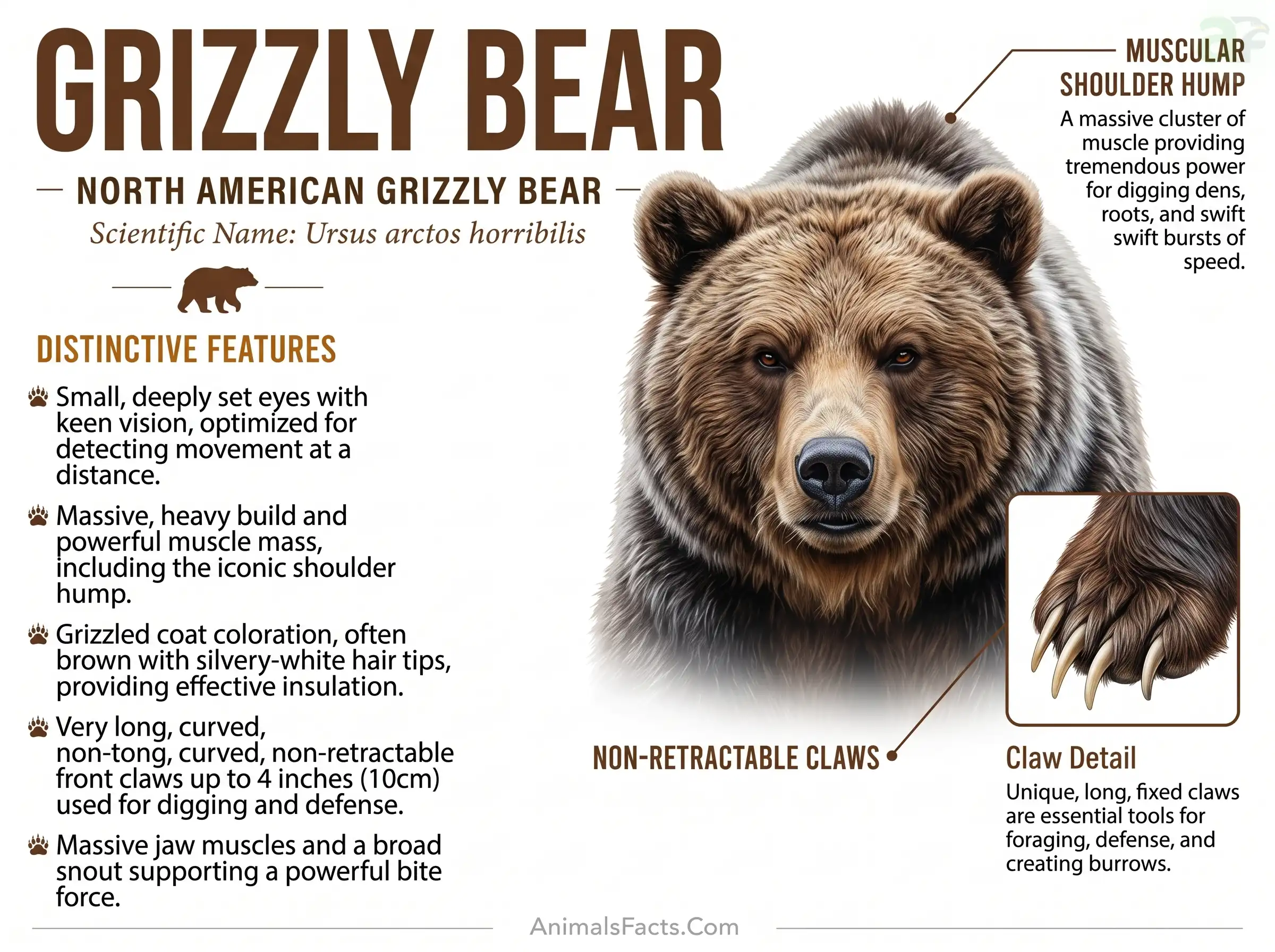
The grizzly bear’s physical design is dominated by powerful build, distinctive anatomical features, and specialized adaptations for its demanding combination of ecological roles as both a powerful predator and an omnivorous forager across the challenging mountain and tundra environments of North America’s interior.
The Shoulder Hump
The grizzly bear’s most immediately recognizable and distinctive physical feature — the prominent muscular hump over its shoulders — provides both a field identification marker distinguishing it from the American black bear (which lacks this hump) and a functional anatomy explanation for its extraordinary digging power. The hump is composed primarily of muscle mass rather than fat or bone, directly powering the grizzly’s forelimb excavation capability — used to dig out ground squirrels, roots, tubers, and other subsurface food resources with a force that can move hundreds of kilograms of soil and rock in a single feeding session.
Claws and Forelimb Power
Grizzly bear claws are among the most powerful digging tools in the North American mammal world — reaching 5–10 centimeters in length, relatively straight compared to the curved, shorter, tree-climbing claws of black bears, and powerful enough to excavate burrow systems in hard-packed soil or overturn large boulders weighing hundreds of kilograms in search of prey or insects beneath. These same claws can deliver devastating defensive blows — a single forepaw strike from a large grizzly can generate forces capable of killing large prey animals.
Size Variation
The grizzly bear demonstrates enormous geographic size variation across its North American range — reflecting the different prey availability, caloric density, and ecological demands of different habitats:
- Smallest grizzlies: Interior mountain populations in some high-elevation areas where prey is scarce — adult males sometimes averaging only 130–180 kg
- Average Rocky Mountain grizzly: Adult males 180–270 kg; females 130–180 kg
- Kodiak Brown Bears: Adult males regularly exceeding 400 kg, with exceptional individuals documented at close to 680 kg — the heaviest confirmed wild bears on Earth
The Grizzled Coat
The grizzly bear’s name derives from the characteristic grizzled appearance of the coat in many individuals — dark brown base fur overlaid with paler, silver-tipped guard hairs that create a distinctive silvery-golden sheen, particularly on the shoulders and back. This frosted appearance varies considerably between individuals — with some grizzlies appearing nearly blond, others dark brown or even near-black — making coat color alone unreliable as a species identification criterion in areas where grizzlies and black bears overlap.
Did You Know? A grizzly bear’s sense of smell is estimated to be approximately 7 times more sensitive than a bloodhound’s and roughly 2,100 times more sensitive than a human’s — making it one of the most powerful olfactory systems of any land mammal on Earth. Grizzly bears can detect the scent of food, other bears, or potential threats from distances of over 30 kilometers under favorable wind conditions, and can smell a prey animal carcass through several meters of snow cover. This extraordinary nose underpins virtually every aspect of grizzly ecology — from locating food sources to assessing territorial rivals to identifying the reproductive status of potential mates.
4. Top 25 Surprising & Interesting Grizzly Bear Facts
- A grizzly bear can run at speeds of up to 56 km/h (35 mph) over short distances — faster than the fastest human sprinter and capable of briefly matching a quarter horse.
- The grizzly bear’s sense of smell is estimated to be 2,100 times more powerful than a human’s, allowing it to detect food sources from over 30 kilometers away under favorable conditions.
- Before hibernation, grizzly bears enter a state called hyperphagia — a period of near-constant eating in which a single bear can consume up to 20,000 calories per day and gain 180 kilograms of body weight in preparation for winter dormancy.
- During hibernation, a grizzly bear’s heart rate drops from approximately 40 beats per minute to just 8–10 beats per minute, while its body temperature decreases only moderately compared to true hibernators — maintaining sufficient metabolic activity to rouse relatively quickly in response to serious threats.
- A female grizzly bear does not fully awaken during the winter denning period when she gives birth — cubs are born in the warmth of the den while the mother remains in a semi-dormant state, emerging in spring already several months old.
- Grizzly bears and polar bears can interbreed and produce fertile offspring — called “grolar bears” or “pizzly bears” — confirming that the two species diverged from a common ancestor relatively recently in evolutionary terms.
- The grizzly bear was once distributed across virtually the entire North American continent — from Alaska south to central Mexico and from the Pacific Coast east to the Great Plains and Kansas. Today, the contiguous US population survives in fewer than 2% of its historical range.
- Grizzly bears have one of the largest home range requirements of any North American land mammal — male grizzlies in some ecosystems maintaining territories exceeding 1,500 km².
- A grizzly bear’s bite force can exceed 1,200 psi — powerful enough to crush a bowling ball or bite through a cast-iron skillet, making it one of the strongest bites documented for any land carnivore.
- Despite being classified in the order Carnivora, grizzly bears derive the majority of their annual caloric intake from plant material — berries, roots, nuts, and grasses often comprising 70–90% of the total diet in non-coastal populations.
- The famous “Fat Bear Week” public voting event at Katmai National Park in Alaska — celebrating the year’s most successfully fattened individual bears preparing for hibernation — has become one of the most popular wildlife engagement events in American conservation communication, attracting millions of online votes annually.
- Grizzly bears in the Greater Yellowstone Ecosystem have been documented preying on bison calves and occasionally challenging and killing adult bison — prey that can weigh over 900 kg, nearly four times the grizzly’s own body weight.
- Female grizzly bears delay implantation of fertilized eggs following mating in summer — with the embryo entering a dormant state and only implanting in the uterine wall in autumn if the female has accumulated sufficient fat reserves to sustain herself and cubs through hibernation.
- A grizzly bear cub’s mortality rate in the first 2–3 years of life can approach 50% in some populations — with infanticide by adult males representing one of the most significant mortality sources for young cubs.
- Grizzly bears demonstrate remarkable individual personalities — research has documented consistently distinct behavioral styles between individual bears that persist across multiple years of observation, with some individuals consistently bolder, more curious, or more aggressive than others of similar age and sex.
- The grizzly bear’s muscular shoulder hump is composed primarily of muscle mass rather than fat — directly powering the forelimb digging force that allows grizzlies to excavate burrow systems and move large boulders in search of prey and food.
- Alaska’s Katmai National Park — home to the famous Brooks Falls salmon-viewing area — hosts one of the highest concentrations of wild grizzly bears anywhere on Earth, with dozens of individual bears documented fishing at the falls during the peak salmon run each summer.
- Research has documented grizzly bears using tools in simple contexts — including individuals repeatedly using specific rocks to scratch difficult-to-reach areas of their body, one of the few documented cases of tool use among bears.
- The Greater Yellowstone Ecosystem grizzly population has recovered from approximately 136 bears in 1975 to approximately ~1,000 individuals by 2026 — one of the most celebrated large carnivore recovery successes in North American conservation history.
- Grizzly bears can smell a prey carcass through several meters of compacted snow — making them important winter carrion consumers and scavengers in deep-snow mountain ecosystems.
- A grizzly bear’s stomach capacity is extraordinary — a single large male can consume over 40 kilograms of food in a single day during hyperphagia, equivalent to approximately 10% of its own body weight.
- The famous “predator-prey dance” between grizzly bears and wolves at Yellowstone — in which the two apex predators regularly steal each other’s kills, challenge each other’s territorial claims, and occasionally kill each other’s young — represents one of the most intensively studied large-carnivore interspecific competition dynamics anywhere in the world.
- Grizzly bears are remarkable swimmers — regularly crossing rivers, lakes, and even coastal channels several kilometers wide in the course of normal territory use, and deliberately swimming in hot summer weather as a cooling strategy.
- Individual grizzly bears have been documented returning to the same specific food sources across multiple years with extraordinary precision — returning to the exact same berry patches, salmon pools, and ground squirrel colonies that they used in previous summers, demonstrating exceptional spatial memory.
- The Inland Temperate Rainforest of British Columbia hosts a significant grizzly bear population critically important to the forest ecosystem — with bear-deposited salmon nutrient subsidies (from salmon bodies carried into the forest during feeding) significantly accelerating tree growth across broad areas of rainforest adjacent to salmon-bearing streams.
5. Fun Facts About Grizzly Bears
- Grizzly bears can run up to 56 km/h — faster than most horses over short distances.
- A grizzly can eat up to 20,000 calories per day during hyperphagia before hibernation.
- Their sense of smell is 2,100 times more powerful than a human’s.
- The distinctive shoulder hump is solid muscle — powering their extraordinary digging force.
- Grizzlies once ranged from Alaska to Mexico — now confined to ~2% of their US range.
- A grizzly’s bite force exceeds 1,200 psi — powerful enough to crush a bowling ball.
- Grizzlies and polar bears can interbreed — producing “pizzly” or “grolar” hybrids.
- During hibernation, grizzly heart rate drops to just 8–10 beats per minute.
- Female grizzlies give birth during hibernation while in a semi-dormant state.
- The Yellowstone grizzly population recovered from 136 bears (1975) to ~1,000 by 2026.
- A single male grizzly may maintain a territory of over 1,500 km².
- Fat Bear Week at Katmai National Park attracts millions of public votes annually.
6. Natural Habitat & Geographic Range
The grizzly bear’s current geographic distribution represents a dramatically reduced shadow of its historical range — a pattern of range contraction comparable in scale to the great extirpations of bison, wolves, and other large North American wildlife during the 18th and 19th centuries.
Primary Habitat Types
Mountain and subalpine meadows: The iconic “grizzly country” of the Rocky Mountains — alpine and subalpine meadow systems supporting abundant ground squirrel populations (critical spring prey), diverse berry patches (critical summer and autumn hyperphagia food), and access to lower elevation riparian areas.
Boreal and temperate forest: Across Canada and Alaska, grizzly bears inhabit a vast sweep of boreal coniferous forest and temperate rainforest — the British Columbia interior forest, the Pacific coastal rainforest, and the spruce-dominated boreal zone provide habitat for large and relatively stable grizzly populations.
River valleys and riparian zones: Critical habitat concentrated particularly around salmon-bearing rivers and streams — the annual Pacific salmon runs represent the highest-density, highest-caloric-value food source available to grizzly bears anywhere in their range, and the riparian corridors supporting these runs represent some of the most productive grizzly habitat on the continent.
Arctic and subarctic tundra: Across northern Alaska and the Yukon, grizzly bears inhabit open tundra environments — often called “barren ground grizzlies” — adapting to a diet focused more heavily on ground squirrels, caribou calves, and tundra berries given the absence of forest cover and salmon runs in much of their tundra range.
Coastal habitat (Kodiak and Alaska Peninsula): The Kodiak Archipelago and Alaska Peninsula support the largest-bodied grizzly/brown bear populations on Earth, directly fueled by the extraordinary caloric density of Pacific salmon runs — a coastal food environment dramatically different from the inland mountain habitats of the Rocky Mountain grizzly.
Habitat Range
| Region | Population Estimate | Status |
|---|---|---|
| Alaska | ~30,000–31,000 | Stable; abundant |
| Canada (British Columbia, Yukon, Alberta, NWT) | ~25,000–30,000 | Stable; BC population declining in some areas |
| Greater Yellowstone Ecosystem (WY, ID, MT) | ~1,000 | Recovered; ESA Threatened |
| Northern Continental Divide (MT/ID) | ~1,100 | Recovering |
| Selkirk Mountains (ID/WA/BC border) | ~80–90 | Critically small |
| North Cascades (WA) | Possibly extirpated (~0–5 individuals) | Critical; possible functional extinction |
| Cabinet-Yaak Ecosystem (MT/ID) | ~55–60 | Critically small |
Did You Know? In the early 19th century, grizzly bears were documented in California in substantial numbers — with the state’s state flag and state animal (the California Grizzly Bear, Ursus arctos californicus) honoring a subspecies that was completely exterminated by 1922, when the last California grizzly bear was killed. The extinction of the California Grizzly — in a state that had hosted one of the largest regional grizzly bear populations in the contiguous US — represents one of the most sobering and consequential wildlife extirpations in American history, and the California Grizzly on the state flag has served as a permanent reminder of a regional extinction that occurred within living memory of people alive today.
7. Grizzly Bear Diet & Feeding Behavior
The grizzly bear is one of North America’s most complex dietary omnivores — consuming a diet that spans the spectrum from insects and berries to large ungulates and spawning salmon, shifting its dietary composition dramatically by season, by geographic location, and by year-to-year variation in specific food source availability.
What Grizzly Bears Eat
Grizzly bear diet is fundamentally opportunistic and seasonally variable — with bears following an almost precisely timed annual dietary calendar that maximizes caloric intake through each season, building toward the critical pre-hibernation hyperphagia period in which bears must accumulate sufficient fat reserves to survive 5–7 months of winter dormancy.
Diet Breakdown Table
| Food Type | Approximate Percentage | Season / Notes |
|---|---|---|
| Berries (huckleberry, serviceberry, whitebark pine nuts, etc.) | 25–40% (varies by region) | Late summer and autumn — critical hyperphagia food |
| Roots, bulbs, and grasses | 15–30% | Spring and early summer — post-emergence staple |
| Ground squirrels and small mammals | 10–20% | Spring through autumn; particularly spring |
| Salmon (Pacific salmon, various species) | 10–40% (coastal/riparian populations) | Late summer and autumn salmon runs — extremely calorie-dense |
| Ungulate calves (elk, moose, bison) | 5–15% | Spring — synchronized ungulate birthing period |
| Carrion | 5–15% | Variable; particularly important in spring and when available |
| Insects (especially moth aggregations, yellow jacket nests) | 2–10% | Summer; moth aggregations at high altitude particularly important |
| Other plant material (clover, sedges, forbs) | 10–20% | Spring and summer |
Hyperphagia — The Annual Eating Marathon
The most dramatically documented grizzly bear feeding phenomenon — hyperphagia — is the period of near-constant, intensive eating that begins in late summer and continues through autumn until denning. During this period, grizzlies completely abandon their more measured feeding patterns and shift to a state of near-continuous food consumption:
- Daily caloric intake: Up to 20,000 calories (compared to approximately 2,500 for an average adult human)
- Daily weight gain: Up to 1–2 kg per day during peak hyperphagia
- Total weight gain: Bears may increase their body weight by 40–60% during hyperphagia
- Daily feeding time: Up to 20 hours per day spent actively foraging and feeding
Salmon Fishing
Perhaps the most celebrated grizzly bear feeding behavior — the annual salmon fishing spectacle visible at locations like Brooks Falls in Katmai National Park — demonstrates remarkable individual variation in technique, with experienced bears developing highly specialized and effective salmon-catching strategies over years of practice:
Standing fishing: Stationary positioning at the top of waterfalls or rapids, catching salmon attempting to jump upstream.
Snorkeling: Submerging the face completely in water pools to locate and grab salmon resting on the bottom.
Diving: Full submersion to chase and catch salmon in deeper pools.
Pirating: Stealing freshly caught salmon from younger or less dominant bears — a behavioral strategy concentrated among large, dominant males.
Did You Know? During the Pacific salmon runs, grizzly bears in coastal Alaska and British Columbia demonstrate remarkably selective feeding behavior — consuming primarily the skin, brain, and eggs of freshly caught salmon while often discarding the muscle meat, particularly early in the salmon run when fish are abundant. This highly selective behavior maximizes caloric and nutritional density per fish consumed — the skin, brain, and eggs contain the highest concentrations of the fat-soluble vitamins, omega-3 fatty acids, and calories that the bear’s hyperphagia needs. Only toward the end of the run, when fish become scarcer and bear competition for carcasses increases, do bears begin consuming the full salmon more thoroughly.
8. Grizzly Bear Reproduction & Life Cycle
Grizzly bear reproduction is characterized by one of the most complex and unusual reproductive strategies of any North American mammal — involving delayed implantation, birth during hibernation, one of the longest maternal dependency periods of any bear species, and a reproductive rate so low that population recovery from decline is necessarily slow even under ideal conditions.
Mating Behavior
Grizzly bears mate during late spring and early summer (typically May through July) — a period when adult males and females have emerged from hibernation and established seasonal territories. Mating is promiscuous — females may mate with multiple males during a single estrus period, and males seek out and compete aggressively for mating access to receptive females.
Male competition: Encounters between competing males during mating season can be highly aggressive — involving sustained physical confrontation, biting, and wrestling that can result in serious injury. Larger, older males typically maintain mating priority through size dominance.
Delayed Implantation
One of the grizzly bear’s most remarkable reproductive adaptations — the fertilized egg enters a state of suspended development (embryonic diapause) following mating, not implanting in the uterine wall until autumn, when the female’s fat reserves and overall body condition determine whether the pregnancy will continue. If a female has not accumulated sufficient fat reserves to sustain herself and cubs through winter, the embryo may fail to implant and the pregnancy is naturally terminated — an evolutionary mechanism that prevents resource-limited females from attempting reproduction they cannot successfully sustain.
Birth During Hibernation
Gestation: Approximately 6–8 weeks of actual embryonic development following autumn implantation (though the total time from mating to birth is 6–8 months including diapause).
Birth: Typically January or February — while the mother remains in semi-dormant hibernation.
Litter size: Typically 1–3 cubs (most commonly 2), weighing only 340–680 grams at birth — remarkably small relative to the mother’s body weight.
Cub Development and Maternal Care
Grizzly bear cubs remain with their mother for 2–3 years — one of the longest maternal dependency periods of any bear species. During this time, the mother provides nearly all food, protection from predators and infanticidal adult males, and, critically, the accumulated knowledge of food sources, denning sites, and seasonal patterns that represent the bulk of what cubs need to know to survive independently.
Key Developmental Stages
| Stage | Age | Key Development |
|---|---|---|
| Birth (in den) | January/February | ~450 grams; blind, helpless; nursing in den |
| Den emergence | April/May (~4–5 months) | ~5–8 kg; first experiences outside den |
| First summer | 4–12 months | Learning foraging behavior with mother |
| First hibernation | Year 1 | Denning with mother and siblings |
| Second summer | 1–2 years | Developing independence while still with mother |
| Dispersal | 2–3 years | Separation from mother; high-risk period |
| Sexual maturity | Female: 4–6 years; Male: 5–7 years | First breeding |
| Physical prime | 8–15 years | Maximum body size and reproductive success |
Grizzly Bear Lifespan Comparison Table
| Species | Average Wild Lifespan | Maximum Confirmed |
|---|---|---|
| Grizzly Bear | 20–25 years | ~44 years (captivity) |
| American Black Bear | 18–23 years | ~39 years (captivity) |
| Polar Bear | 15–18 years | ~43 years (captivity) |
| Brown Bear (general) | 20–30 years | ~47 years (captivity) |
9. Social Behavior & Communication
The grizzly bear is commonly described as solitary — an accurate general characterization of adult bears in non-resource-concentrated environments — but this description significantly understates the genuine social complexity that grizzly bears demonstrate in specific contexts and the sophisticated communication systems they use to navigate a world of competing territorial claims and seasonal resource competition.
When Grizzly Bears Are Social
In environments where food resources are concentrated in space and time — particularly the salmon runs at Brooks Falls and similar sites in coastal Alaska — grizzly bears are forced into close proximity and demonstrate remarkable tolerance for social aggregation, developing what researchers describe as a dominance hierarchy that allows dozens of bears to share a limited fishing area with relatively low rates of serious injury. The most dominant bears — typically large, experienced adult males — claim the most productive fishing positions, while less dominant individuals develop alternative strategies ranging from specialized fishing techniques to “satellite fishing” positions that exploit the prey that escape dominant bears.
Communication
Vocalizations: Grizzly bears produce a diverse range of vocalizations including huffing (mild alarm or stress), jaw popping (more serious agitation warning), growls (threat signals), roars (extreme agitation or defense), moans and whines (submissive signals from subordinate bears), and nursing vocalizations (mother-cub context).
Scent marking: Bears rub themselves against prominent trees — “rub trees” visited repeatedly by multiple individuals — depositing scent from glands while simultaneously leaving claw marks and hair that communicate individual identity, size, reproductive status, and recent presence to other bears monitoring the same site.
Body language: Bear posture and movement convey sophisticated social information — including direct vs. averted gaze (dominance vs. submission), lowered head and hunched posture (submission or stress), piloerection (threat or alarm), and the complex negotiation signals used by bears approaching a dominant individual’s position at a fishing site.
Did You Know? Research on individually identified grizzly bears at Katmai National Park’s Brooks Falls has revealed that individual bears develop remarkably consistent “fishing personalities” that persist across multiple salmon seasons — with some individuals reliably pursuing high-risk, high-reward strategies (stationary position at the most productive falls location, which requires confronting the most dominant bears) while others consistently adopt lower-risk, lower-reward strategies (downstream positions with less competition). These individual behavioral styles remain consistent even as bears’ relative social ranks change over years — suggesting genuine individual behavioral personalities rather than simply different strategies based on current social rank.
10. Predators & Defense Mechanisms
Adult grizzly bears in good health are effectively the apex predator in every North American terrestrial ecosystem they inhabit — facing essentially no natural predation risk from other species. Cubs and juveniles, however, face genuine predation threats, and even adult grizzlies can be killed in specific circumstances.
Natural Threats
Adult male grizzly bears: Infanticide — the killing of cubs by adult males, typically encountered during territorial or competitive interactions — represents one of the most significant natural mortality sources for grizzly bear cubs in many populations. Adult males kill cubs both to bring females back into reproductive readiness (females with cubs do not enter estrus) and as a direct food resource.
Wolves: Wolf packs represent a genuine competitive and predatory threat to grizzly bears — particularly to cubs and juveniles. At Yellowstone, the complex competitive relationship between wolves and grizzly bears following wolf reintroduction in 1995 has generated extraordinary research demonstrating both species competing for elk kills and occasionally directly confronting each other. While large adult grizzlies are generally dominant over wolf packs in direct confrontations, wolves can harass, injure, and occasionally kill smaller or isolated grizzlies.
Humans: The dominant cause of grizzly bear mortality across virtually the entire range — through hunting (legal in Alaska and Canada; prohibited in the contiguous US), vehicle collisions, self-defense killings during human-bear encounters, and management removals of “problem bears” habituated to human food sources.
Defense Mechanisms
Raw physical capability: For adult grizzly bears, physical size, strength, and the deterrent effect of their demonstrated capability represent the primary and essentially adequate defense against most natural threats.
Maternal defense: Female grizzlies with cubs are among the most dangerous defensive situations encountered by any large predator in North America — willing to charge, confront, and physically engage threats dramatically larger than themselves (including wolves, other bears, and humans) in defense of offspring.
Bluff charging: Grizzly bears frequently respond to perceived threats with bluff charges — running directly toward the threat before stopping short, a behavior designed to assess and deter potential threats without committing to actual physical contact unless the threat fails to retreat.
11. Grizzly Bear Facts for Kids
Hey kids — get ready to discover why the grizzly bear is one of the most amazing and powerful animals in North America!
- Grizzly bears have a special muscle hump on their shoulders — you can see it sticking up above their head when they’re standing on all four legs. This hump is full of strong muscles that they use to dig up roots and burrowing animals!
- A grizzly bear can run as fast as 56 kilometers per hour — faster than most cars are allowed to go in your neighborhood, and faster than any human being who has ever lived!
- Before the cold winter comes, grizzly bears spend weeks eating as much food as they can — sometimes eating for 20 hours a day! This special eating time is called “hyperphagia” and it helps them get fat enough to sleep through the whole winter!
- When a grizzly bear hibernates in the winter, its heart only beats 8–10 times per minute — compare that to your heart, which beats about 60–100 times per minute just sitting still!
- Baby grizzly bears are born in the winter while their mommy is still sleeping in her den — they’re incredibly tiny when they’re born, about the size of a large rat, even though their mom weighs over 180 kilograms!
- Grizzly bears love to catch fish — especially salmon! In Alaska, you can see dozens of grizzly bears standing in rivers trying to catch fish as they jump upstream, sometimes snagging them right out of the air!
- A grizzly bear’s nose is so powerful that it can smell food from over 30 kilometers away — that’s the distance of a long car trip, just by smelling!
- Grizzly bears and polar bears can have babies together — these hybrid bears are called “pizzly bears” or “grolar bears” and have been found living in the wild in Canada!
Did You Know? Every autumn, people all over the world vote in the “Fat Bear Week” contest at Alaska’s Katmai National Park! Researchers take photos of specific grizzly bears at the start and end of summer to show how much weight they’ve gained eating salmon. Then people online vote on which bear gained the most weight and looks the most impressively fat! The bears who are the “fattest” have the best chance of surviving hibernation, so it’s actually a celebration of healthy, successful bears preparing for winter!
12. Relationship with Humans
The grizzly bear’s relationship with North American human communities is one of the most historically complex, most politically contentious, and most culturally significant of any large carnivore relationship on the continent — spanning thousands of years of reverence and coexistence in Indigenous traditions, systematic extermination during European settlement, and a complex contemporary negotiation between conservation success and the politics of predator management.
Indigenous Relationships
The grizzly bear has held profound cultural, spiritual, and practical significance for dozens of Indigenous nations across its North American range for thousands of years. Many First Nations and Native American peoples regard the grizzly bear as a powerful spiritual being — associated with healing, courage, strength, and the connection between the human world and the sacred — with specific cultural protocols governing human-bear relationships, hunting practices (in cultures that hunted bears), and the ritual use of bear materials.
The Blackfoot, Salish, Nez Perce, Tlingit, Haida, Haida, and many other nations maintain specific cultural traditions involving grizzly bears — from the Pacific Coast nations that share salmon runs with bears and recognize the bear as a spiritual guardian of the salmon, to the plains and mountain nations that engaged bears as powerful spiritual adversaries in vision quests and ceremonial practice.
The Extermination Era
Beginning with European settlement and accelerating dramatically during the 19th-century settlement of the American West, grizzly bears were subjected to one of the most intensive and systematic wildlife extermination campaigns in American history — driven by genuine human safety concerns in areas of new settlement, livestock protection interests, government bounty programs, professional predator control operations using strychnine poison, and an ideology that viewed large predators as inherently incompatible with the agricultural civilization being established across the continent.
The results were catastrophic — with an estimated US population of 50,000+ grizzly bears reduced to fewer than 1,000 individuals by the early 20th century, confined to a tiny fraction of the species’ historical range concentrated primarily in the remote mountain systems of Idaho, Montana, Wyoming, and Washington.
Human-Bear Conflict Today
Contemporary human-grizzly conflict involves several categories of increasing frequency as recovering populations expand into areas of human activity:
Livestock depredation: Grizzly bears killing cattle, sheep, and horses — the most widespread and economically significant conflict, driving significant landowner opposition to grizzly bear recovery in some regions.
Human safety encounters: Hiker, camper, and backcountry user encounters with grizzlies — generating both genuine safety concerns and significant public attention that shapes conservation politics.
Property damage: Bears raiding beehives, chicken coops, orchards, and other food sources on private property — common in areas where expanding grizzly populations are encountering new human communities.
13. Grizzly Bear Conservation Status & Threats
The grizzly bear’s conservation situation in North America represents one of the most complex and politically charged large carnivore management situations in the world — combining genuine conservation success in recovering previously extirpated populations with ongoing political battles over the pace and extent of further recovery and the protections that should govern the species.
Conservation Data (2026)
| Population | Status | Population | Trend |
|---|---|---|---|
| Alaska | Least Concern | ~30,000–31,000 | Stable |
| Canada | Least Concern (federal) | ~25,000–30,000 | Stable; BC some areas declining |
| Greater Yellowstone | ESA Threatened | ~1,000 | Recovered; recovering further |
| Northern Continental Divide | ESA Threatened | ~1,100 | Recovering |
| Cabinet-Yaak | ESA Threatened | ~55–60 | Critically small; stable |
| Selkirk Mountains | ESA Threatened | ~80–90 | Recovering slowly |
| North Cascades | ESA Threatened | ~0–5 (possible extirpation) | Critical |
Major Threats to Grizzly Bears
Habitat loss and fragmentation: Roads, development, and agricultural conversion continue to fragment grizzly habitat across the Canadian and US range, reducing connectivity between populations and limiting the natural dispersal essential for long-term genetic health.
Whitebark pine decline: In the Greater Yellowstone Ecosystem, the whitebark pine (Pinus albicaulis) — whose energy-dense seeds represent a critical late-summer and autumn hyperphagia food source — is being devastated by white pine blister rust (an introduced disease) and by mountain pine beetle outbreaks exacerbated by climate change. The decline of whitebark pine has been documented to correlate directly with increased grizzly bear conflicts with humans, as bears shift their foraging patterns in response to reduced pine seed availability.
Hunting mortality: Legal hunting of grizzly bears in Alaska and Canada represents a managed mortality source, with ongoing political pressure in some US states to resume hunting of the recovering lower-48 population.
Human-caused mortality: Vehicle collisions, management removals of food-conditioned bears, and retaliatory killing for livestock depredation represent the dominant non-hunting human-caused mortality sources across the contiguous US range.
Climate change: Beyond whitebark pine impacts, climate change is altering the timing of critical grizzly food sources — including salmon run timing, berry crop variability, and ground squirrel hibernation patterns — in ways that create significant management challenges for recovering grizzly populations.
Did You Know? The North Cascades ecosystem of Washington State — the southwesternmost portion of the grizzly bear’s historical range in the contiguous US — may now be entirely without grizzly bears, with the last confirmed sighting in 1996 and no confirmed evidence of surviving individuals despite periodic search surveys. Plans for a grizzly bear reintroduction to the North Cascades — which would restore the species to a biologically suitable landscape large enough to support a recovering population — have faced decades of political obstacles, with the most recent federal recovery planning process canceled in 2020 before being revived under subsequent administrations. As of 2026, the question of whether grizzly bears will ever return to the Washington Cascades remains genuinely unresolved.
14. Famous Grizzly Bears
Monarch — The Last California Grizzly
Monarch was a California Grizzly Bear captured in 1889 and exhibited in Golden Gate Park’s San Francisco zoo — becoming one of the most famous individual bears in California history and serving as the physical inspiration for the grizzly bear depicted on the California State Flag. His life in captivity, ending with his death in 1911, symbolized the beginning of the end for the California grizzly population — with the last wild California grizzly killed approximately a decade later, in 1922.
Bear 399 — The World’s Most Famous Wild Grizzly
Bear 399 — a female grizzly bear in Wyoming’s Grand Teton National Park — became arguably the most famous individual wild grizzly in American history through decades of public visibility along the park’s roadsides, extraordinary productivity as a mother (raising at least 24 cubs across 8 litters), and an unmistakable personality that charmed millions of visitors. Her death at approximately 28 years of age in October 2024 — struck by a vehicle on a Wyoming highway while moving through her territory — generated an outpouring of public grief that demonstrated the extraordinary emotional connection that had developed between the conservation-minded public and this individual animal across nearly three decades of documented life.
The Grizzly Bears of Fat Bear Week
The individually named and numbered bears of Katmai National Park’s Brooks River — including celebrity individuals like Bear 747 (nicknamed “Bear Force One”) and multiple others identified by researchers and park rangers — have achieved extraordinary public recognition through the annual Fat Bear Week event, which has introduced millions of Americans and international viewers to grizzly bear conservation and individual bear personalities.
Timothy Treadwell’s Bears
The grizzly bears documented by bear enthusiast Timothy Treadwell during his 13 summers of close association with Alaskan grizzlies — and his death at the hands of a bear in 2003 — became the subject of Werner Herzog’s landmark 2005 documentary “Grizzly Man,” one of the most widely seen and most extensively discussed wildlife-related documentary films ever made, fundamentally shaping public conversation about appropriate human-grizzly bear relationships and the ethics of wildlife anthropomorphization.
15. Role in Ecosystem & Food Chain
The grizzly bear functions as a keystone species across every ecosystem it inhabits — one of the clearest and most extensively documented examples of a species whose ecological impact extends far beyond what its population numbers alone would predict, reshaping vegetation, prey populations, and nutrient cycling across entire landscapes.
Marine Nutrient Transfer
One of the most striking and well-documented grizzly bear ecological contributions is the transfer of marine-derived nutrients from salmon to terrestrial forest ecosystems. Bears catching salmon and carrying carcasses away from streams to eat in the surrounding forest deposit marine-derived nitrogen and phosphorus throughout the forest floor — research has documented that trees in the vicinity of bear-active salmon streams grow significantly faster than comparable trees outside salmon range, directly attributable to this bear-mediated nutrient subsidy. Some researchers have estimated that grizzly bears and other salmon consumers transfer thousands of kilograms of marine-derived nutrients per kilometer of stream into surrounding forest ecosystems annually — a contribution that fundamentally subsidizes the productivity of the entire riparian forest community.
Prey Population Regulation
Grizzly bear predation on elk calves, moose calves, and bison calves — particularly during spring calving periods — represents a significant and direct regulatory influence on ungulate populations, complementing wolf predation and contributing to the prey population dynamics that drive overall ecosystem structure in large wilderness areas.
Vegetation and Seed Dispersal
Grizzly bears are important seed dispersers across their range — consuming enormous quantities of berries and other fruits and depositing the seeds, along with a substantial fertilizing substrate, throughout their extensive territories. Berry-producing plants in grizzly habitat benefit significantly from this seed dispersal service, maintaining plant community diversity and regeneration capacity across areas that might otherwise see reduced berry plant diversity in the absence of grizzly seed dispersal activity.
16. Myths, Folklore & Cultural Significance
The grizzly bear occupies a position of profound and multi-dimensional cultural significance across North American human civilization — alternately reverenced as a spiritual guardian and power animal, feared as an embodiment of wild danger, celebrated as a symbol of raw wilderness, and pursued for sport, profit, and self-defense across dramatically different cultural traditions and historical periods.
Indigenous North American Traditions
As noted in the Relationship with Humans section, dozens of Indigenous nations across North America maintain deep and complex cultural traditions involving the grizzly bear — widely regarded as one of the most spiritually powerful animals recognized by cultures across the continent. Common themes across diverse traditions include:
Bear as healer: Many nations associate the bear with healing and medicinal knowledge, reflecting the observed behavior of bears seeking out and consuming specific plants that have documented medicinal properties — a folk observation that has generated significant scientific interest in “zoopharmacognosy” (animal self-medication).
Bear as warrior: The grizzly bear’s raw physical power, aggression when threatened, and the extraordinary courage required to approach or hunt it made it a natural symbol of warrior strength and ferocity across many plains and mountain nations.
Bear as ancestor: Several nations, including the Haida of the Pacific Northwest, maintain specific clan relationships with the bear that express a form of spiritual kinship or descent — the Bear Clan traditions of various Pacific Coast and Interior nations reflect an acknowledgment of shared territory and ecological relationship expressed in spiritual-genealogical terms.
European and American Frontier Mythology
The grizzly bear occupied a central position in the frontier mythology of European-American westward expansion — the “awful, grisly bear” of early traveler accounts became a symbol simultaneously of the terrifying danger and the exciting wildness of the unexplored West, generating both genuine fear that drove extermination campaigns and romantic admiration that contributed to early conservation sentiment.
John Muir and early conservation writers frequently invoked the grizzly bear as a symbol of pure, uncompromised wild nature — its presence signifying a landscape that retained its primal character, and its absence (as extirpation progressed) marking the irreversible transformation of wilderness into civilized landscape.
17. Grizzly Bears in Pop Culture
The grizzly bear has generated one of the most sustained and culturally diverse presences in American popular culture of any wild animal — from state symbols and sports mascots to some of the most critically discussed wildlife documentary films ever made.
Film and Television
“Grizzly Man” (Werner Herzog, 2005) — Perhaps the most discussed wildlife-related documentary in American film history, using Timothy Treadwell’s extensive self-filmed footage from 13 summers with Alaskan grizzlies alongside Herzog’s commentary to create a profound and controversial meditation on human-animal relationships, wilderness romanticism, and the genuine danger of naive anthropomorphization.
“The Revenant” (Alejandro González Iñárritu, 2015) — A major studio feature film whose celebrated grizzly bear attack sequence — depicting frontiersman Hugh Glass’s survival of a mauling by a mother grizzly — generated enormous public discussion about grizzly bear behavior and significantly influenced public perception of the species.
“Bears” (Disneynature, 2014) — A family-oriented documentary following a mother grizzly and her cubs through their first year, generating excellent public engagement with grizzly conservation in an accessible format.
BBC and National Geographic grizzly bear productions — Multiple major wildlife documentary series including “Planet Earth” and dedicated Yellowstone-focused productions have featured some of the most acclaimed grizzly bear footage ever filmed.
Sports and State Symbols
The California State Flag — featuring the California Grizzly Bear, Ursus arctos californicus — serves as the most prominent memorial to the extirpated California grizzly population, with “Bear Republic” associations dating to California’s brief pre-statehood independence period.
University of California Bears, Montana Grizzlies, Cal Bears — Multiple major US university athletic programs use grizzly or bear imagery as primary mascot identities, with the Montana Grizzlies among the most prominent.
18. Grizzly Bear Facts vs. Common Myths
Myth: Grizzly bears are always aggressive and will attack any human they encounter. Fact: The vast majority of grizzly bear-human encounters end without attack — bears typically avoid humans when given the option, and most observed encounters involve bears retreating from human contact. Attacks are exceptional events typically triggered by surprise encounters, defensive situations (particularly mother with cubs), or in very rare cases, predatory behavior by hungry or food-conditioned individuals. Appropriate backcountry safety practices (making noise, carrying bear spray, proper food storage) dramatically reduce already-low attack risk.
Myth: Playing dead works in all grizzly bear attacks. Fact: Playing dead is specifically recommended for defensive grizzly attacks — situations where a surprised or startled bear charges in self-defense or to protect cubs. In predatory attacks — which are rare but distinguishable by a bear that continues to engage even after the person is motionless — fighting back actively is recommended. The distinction between defensive and predatory attacks, though sometimes difficult to assess in the moment, is critical to determining the appropriate response.
Myth: Grizzly bears can’t climb trees. Fact: Adult grizzly bears generally do not climb trees because their large body size, straight claws, and body weight make tree climbing impractical. However, young grizzly bear cubs can climb trees quite effectively — and adults have occasionally been documented climbing shallow-angled trees or scrambling up short distances. By contrast, American black bears of all ages are accomplished tree climbers.
Myth: Grizzly bears can’t run fast because they’re so big. Fact: Grizzly bears can sprint at speeds of up to 56 km/h (35 mph) — considerably faster than any human runner and faster than most people’s intuition about a 250+ kg animal would suggest. The common wilderness safety advice to “never outrun a grizzly bear” is accurate — it is physically impossible for any human to outrun a motivated grizzly on open terrain.
Myth: Grizzly bear attacks always result in fatalities. Fact: The survival rate in grizzly bear attacks varies considerably, but the majority of attacks — particularly defensive attacks by surprised or protective bears — do not result in fatalities. Appropriate defensive actions, including deploying bear spray (significantly more effective than firearms in most research studies for reducing injury severity) and playing dead for defensive attacks, substantially improve survival outcomes.
19. Best Places to See Grizzly Bears in the Wild
Brooks Falls, Katmai National Park, Alaska
The world’s premier destination for observing grizzly bears in peak activity — Brooks Falls supports dozens of individually identified grizzly bears during the July and September salmon runs, with viewing platforms positioned close enough to the falls to provide extraordinary close-range observation of bears fishing at the falls, resting on the banks, and interacting with each other. The area also hosts the National Park Service’s live webcam program and the annual Fat Bear Week event.
Denali National Park, Alaska
Denali’s vast, roadless wilderness and its singular road-accessible corridor provide excellent grizzly bear viewing — with bus-based touring along the park road offering opportunities to observe bears at distance in spectacular mountain tundra habitat, and the park’s extensive research program providing context for understanding the bears in their ecological setting.
Glacier National Park, Montana
Glacier is one of the best locations in the contiguous US for grizzly bear viewing, with a healthy and recovering population in the spectacular Going-to-the-Sun Road corridor and many hiking areas. Grizzly viewing in Glacier is best during early morning and evening hours along the park’s open meadow systems.
Grand Teton National Park, Wyoming
Grand Teton hosts one of the most readily accessible grizzly bear viewing opportunities in the contiguous US — with specific bears regularly observed along the park’s main road systems, particularly around Oxbow Bend, Willow Flats, and the sagebrush flats between Moose and Jackson.
Yellowstone National Park, Wyoming
The Lamar Valley of Yellowstone — “America’s Serengeti” — provides exceptional grizzly bear viewing during early morning and evening hours, with dedicated wolf and grizzly watching enthusiasts using high-powered spotting scopes from road pullouts to observe bears at considerable distances in this extraordinarily productive wildlife observation landscape.
Khutzeymateen Grizzly Bear Sanctuary, British Columbia
Canada’s first protected area established specifically for grizzly bears — the Khutzeymateen (also known as K’tzim-a-deen) Inlet north of Prince Rupert, BC, provides extraordinary boat-based grizzly bear viewing in a pristine coastal environment, with bears observed on the estuary feeding on sedges and salmon. Access requires organized, permitted guided tours.
20. Top Documentaries & Books
Must-Watch Documentaries
“Grizzly Man” (Werner Herzog, 2005) — The definitive grizzly bear-focused documentary — simultaneously a portrait of a remarkable but fatally flawed man, a meditation on human-wildlife relationships, and a genuinely affecting wildlife film using extraordinary close-range footage.
“Bears” (Disneynature, 2014) — Narrated by John C. Reilly, follows a mother grizzly and her two cubs through their first year — an accessible family documentary providing excellent coverage of grizzly annual ecology.
“Wild Things: Grizzly Bears” and various National Geographic productions — Multiple NatGeo documentary productions have followed specific identified grizzly populations in Yellowstone, Alaska, and coastal BC.
“Planet Earth” — North America episodes (BBC, 2006 and 2022) — David Attenborough-narrated sequences covering grizzly bear behavior and ecology in spectacular cinematic form.
“Fat Bear Week” (National Park Service, annual online event) — Not a traditional documentary but the annual public engagement event that has arguably generated more American public interest in grizzly bears than any single documentary.
Essential Books
“Track of the Grizzly” by Frank C. Craighead Jr. (1979) — A foundational account of the pioneering radio-tracking research on Yellowstone grizzlies conducted by Frank and John Craighead in the 1950s–1970s — essential reading for understanding the scientific foundation of modern grizzly bear conservation.
“The Grizzly Maze: Timothy Treadwell’s Fatal Obsession with Alaskan Bears” by Nick Jans (2005) — A nuanced companion to the “Grizzly Man” documentary, providing the broader context of Treadwell’s life and the wilderness culture that shaped it.
“American Bear: A Natural History and Ecology of the Grizzly Bear” by various scientific authors — Multiple scientific and semi-popular texts covering grizzly bear ecology in specific ecosystem contexts provide essential technical context for serious students of the species.
21. Comparison of Grizzly Bears with Similar Bear Species
| Feature | Grizzly Bear | Polar Bear | American Black Bear | Kodiak Bear |
|---|---|---|---|---|
| Scientific Name | Ursus arctos horribilis | Ursus maritimus | Ursus americanus | Ursus arctos middendorffi |
| Weight | 180–360 kg (up to 680 Kodiak) | 300–800 kg | 60–300 kg | 250–480 kg |
| Distribution | Western North America | Arctic Circle | North America (widespread) | Kodiak Archipelago, Alaska |
| Habitat | Mountain, forest, tundra | Arctic sea ice | Forest, scrubland | Island ecosystem (primarily) |
| Diet | Omnivore (plant-heavy) | Hypercarnivore (seals) | Omnivore | Omnivore (salmon-heavy) |
| Shoulder Hump | Prominent (defining feature) | Absent | Absent | Prominent |
| Claws | Long, straight (digging) | Long, curved (ice grip) | Short, curved (climbing) | Long, straight (digging) |
| Conservation Status | Least Concern (globally); Threatened (US lower 48) | Vulnerable | Least Concern | Least Concern |
| Hibernation | True hibernation-like torpor | Variable (females with cubs) | True hibernation-like torpor | True hibernation-like torpor |
| Unique Feature | Shoulder hump; most powerful digger | Marine mammal status; widest swimmer | Most numerous North American bear | Largest bear subspecies |
22. How You Can Help
Grizzly bear conservation operates across multiple fronts — from habitat connectivity and recovery area management in the contiguous US to population monitoring and conflict mitigation across the broader North American range.
Support These Organizations
Defenders of Wildlife (defenders.org) — One of the leading US advocacy organizations for grizzly bear recovery, running active programs to maintain ESA protections, support conflict mitigation, and advocate for expanded recovery areas.
Greater Yellowstone Coalition (greateryellowstone.org) — Focused specifically on protecting the ecological integrity of the Greater Yellowstone Ecosystem, including grizzly bear habitat connectivity and the whitebark pine recovery essential to GYE bear food security.
National Wildlife Federation (nwf.org) — Runs comprehensive grizzly bear conservation programs including conflict mitigation support for ranching communities and advocacy for scientifically grounded recovery planning.
Grizzly Times (grizzlytimes.org) — A research-based advocacy organization providing accessible, scientifically grounded information about grizzly bear conservation across North America.
Wildlife Defense League and Yellowstone to Yukon Conservation Initiative — Support large-scale habitat connectivity conservation specifically relevant to grizzly bear population recovery and genetic exchange between populations.
Practical Actions
Carry and know how to use bear spray when in grizzly country — research consistently demonstrates bear spray is significantly more effective than firearms for reducing injury severity in bear encounters. Proper carrying and use technique significantly affects effectiveness.
Practice bear-aware camping and backcountry travel — proper food storage, cooking, and camp hygiene dramatically reduces food conditioning risk for individual bears that, once habituated to human food sources, typically require management removal.
Support conflict mitigation programs — organizations funding livestock guardian animals, non-lethal deterrent systems, and compensation programs for verified livestock losses by grizzly bears directly address the primary driver of anti-grizzly sentiment among ranching communities, creating space for conservation policy progress.
Advocate for grizzly bear recovery — engage with public comment processes for grizzly bear management decisions, support organizations advocating for science-based recovery planning, and contact elected representatives about grizzly bear conservation priorities.
Visit responsibly — supporting responsibly operated wildlife tourism operations in grizzly bear habitat generates economic value for local communities from living, wild bears — creating tangible economic incentives for coexistence-based wildlife management rather than extermination-based approaches.
Did You Know? Research by the National Park Service and cooperating researchers has conclusively demonstrated that bear spray is significantly more effective than firearms for reducing injury severity in grizzly bear encounters — with studies documenting that individuals who deployed bear spray experienced significantly lower rates of serious injury than those who used firearms for defense. This counterintuitive finding reflects the practical realities of grizzly bear attack dynamics — charging bears approach so rapidly that accurate defensive shooting is extremely difficult, while the broad-dispersal cloud of capsaicin from bear spray creates a deterrent effect that functions even with imperfect aim. Yet bear spray remains significantly underutilized by backcountry travelers, representing one of the most impactful simple safety improvements available to anyone traveling in grizzly bear country.
23. Frequently Asked Questions About Grizzly Bears
Q1: What is the scientific name of the grizzly bear?
The grizzly bear’s scientific name is Ursus arctos horribilis — classifying it as a subspecies of the brown bear (Ursus arctos). The genus is Ursus, the family Ursidae (bears), the order Carnivora, and the class Mammalia. The name “horribilis” (meaning “horrible” or “dreadful”) was assigned based on George Ord’s reading of Lewis and Clark’s dramatic accounts of encounters with the species.
Q2: How many grizzly bears are left in the world?
Total North American grizzly/brown bear population is estimated at approximately 55,000–60,000 individuals, with the majority in Alaska (~30,000–31,000) and Canada (~25,000–30,000). The contiguous US (lower 48 states) holds approximately 1,500–1,800 individuals across several distinct recovery populations, primarily in the Greater Yellowstone Ecosystem (~1,000) and the Northern Continental Divide Ecosystem (~1,100).
Q3: Are grizzly bears dangerous to humans?
Grizzly bears are potentially dangerous to humans, and human fatalities from grizzly attacks — while rare statistically — do occur. However, the vast majority of grizzly-human encounters end without attack. Appropriate safety practices — making noise while hiking, carrying and knowing how to use bear spray, proper food storage, and understanding bear behavior — dramatically reduce already-low risk levels. Bear spray has been scientifically demonstrated to be more effective than firearms for reducing attack injury severity.
Q4: What is the difference between a grizzly bear and a brown bear?
The grizzly bear (Ursus arctos horribilis) is a subspecies of the brown bear (Ursus arctos) — all grizzly bears are brown bears, but not all brown bears are grizzlies. “Grizzly bear” typically refers to the North American interior brown bear populations, while “brown bear” can refer to any population of the species globally, including the Kodiak Bear, the European Brown Bear, and the numerous Eurasian and Russian populations.
Q5: What do grizzly bears eat?
Grizzly bears are omnivores with a diet heavily dominated by plant material — berries, roots, grasses, and nuts comprising 70–90% of the diet in inland populations. Supplementary animal foods include ground squirrels, elk calves, carrion, insects, and salmon (extremely important in coastal and river-adjacent populations). Diet composition varies dramatically by season and geographic location.
Q6: How long do grizzly bears hibernate?
Grizzly bears den and hibernate for approximately 5–7 months (typically November or December through March or April) depending on geographic location and local conditions. During this period, they do not eat, drink, urinate, or defecate — sustaining themselves entirely on the fat reserves accumulated during the autumn hyperphagia period.
Q7: Are grizzly bears endangered?
Grizzly bears are classified as Least Concern globally (IUCN), given their overall population across Alaska, Canada, and Russia. However, the US lower-48 grizzly bear population is listed as Threatened under the US Endangered Species Act, reflecting the species’ severely reduced range and numbers within the contiguous United States and the ongoing vulnerability of recovering populations to habitat loss and human-caused mortality.
Q8: How fast can a grizzly bear run?
Grizzly bears can sprint at speeds of up to 56 km/h (35 mph) over short distances — faster than any human runner and approximately the speed of a galloping horse over short distances. This speed is sustained for short distances only; over longer distances, bears slow considerably, but the brief sprint speed exceeds what any human can achieve on foot.
Q9: What is “hyperphagia” in grizzly bears?
Hyperphagia is the period of near-continuous, intensive eating that grizzly bears engage in during late summer and autumn, prior to hibernation. During hyperphagia, bears may eat for up to 20 hours per day, consuming up to 20,000 calories daily and gaining as much as 1–2 kilograms per day. The goal is to accumulate sufficient fat reserves to sustain themselves (and, for pregnant females, their unborn cubs) through 5–7 months of winter denning without eating.
Q10: How can I help grizzly bear conservation?
Key actions include: carrying and learning to use bear spray when in grizzly country; practicing bear-aware camping and food storage; supporting Defenders of Wildlife, Greater Yellowstone Coalition, and National Wildlife Federation grizzly programs financially; advocating for maintaining Endangered Species Act protections; supporting conflict mitigation programs that help ranching communities coexist with bears; and visiting grizzly bear habitat responsibly to support the wildlife tourism economy that creates financial incentives for coexistence.
24. Sources & References
Research Sources
- Wikipedia — Ursus arctos horribilis and related articles
- IUCN Red List — iucnredlist.org
- National Park Service (Yellowstone and Katmai) — nps.gov
- Defenders of Wildlife — defenders.org
- Greater Yellowstone Coalition — greateryellowstone.org
- National Wildlife Federation — nwf.org
- National Geographic — nationalgeographic.com
- Smithsonian’s National Zoo — nationalzoo.si.edu
- Encyclopaedia Britannica — britannica.com
- BBC Wildlife — bbc.co.uk
- Live Science — livescience.com
- US Fish and Wildlife Service — fws.gov
- Craighead, Frank C. Jr. — “Track of the Grizzly” (1979)
- Servheen, Christopher et al. — IUCN Species Survival Commission Bear Specialist Group publications