
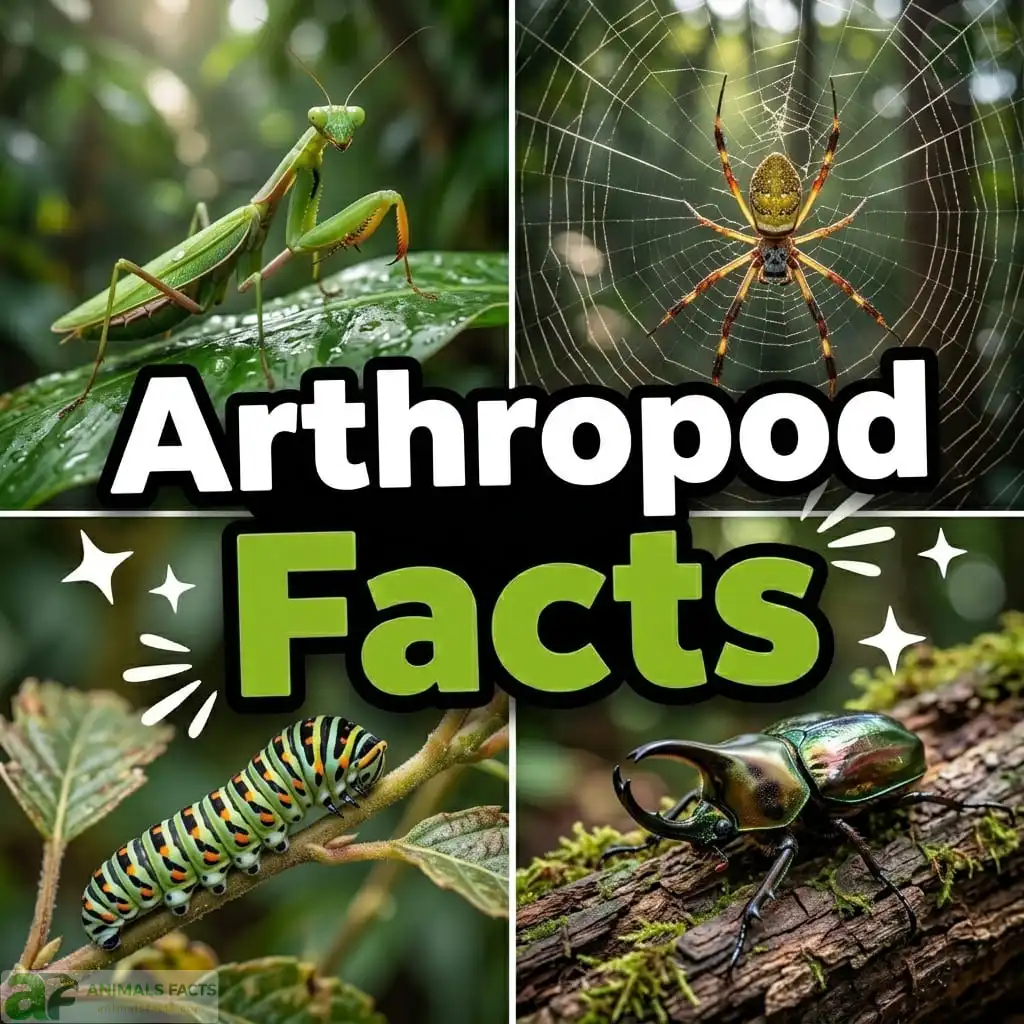
Arthropod Facts
| Feature | Details |
|---|---|
| Scientific Name (Phylum) | Arthropoda |
| Kingdom | Animalia |
| Meaning of Name | Greek: arthron (joint) + pous (foot) — “jointed foot” |
| Number of Species | Over 1.1 million described; estimated 5–10 million total |
| % of All Animal Species | Over 80% of all known animal species on Earth |
| Habitat | Every habitat on Earth — land, sea, freshwater, air, caves, deep sea, Arctic ice |
| Lifespan | 1 day (mayfly adult) to 100+ years (some lobsters and tarantulas) |
| Diet | Everything — herbivores, carnivores, omnivores, decomposers, parasites, filter feeders |
| Conservation Status | Varies — thousands of species threatened; many undescribed and unassessed |
| Size Range | 0.1 mm (Stygotantulus stocki, smallest) to 3.7 m leg span (Japanese spider crab) |
| Weight Range | Microscopic to over 4 kg (coconut crab) |
| Oldest Fossil | ~540 million years ago (Cambrian explosion) |
| Population | Estimated 10 quintillion (10¹⁹) individual arthropods alive at any moment |
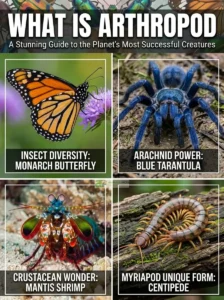 1. Introduction: What is an Arthropod?
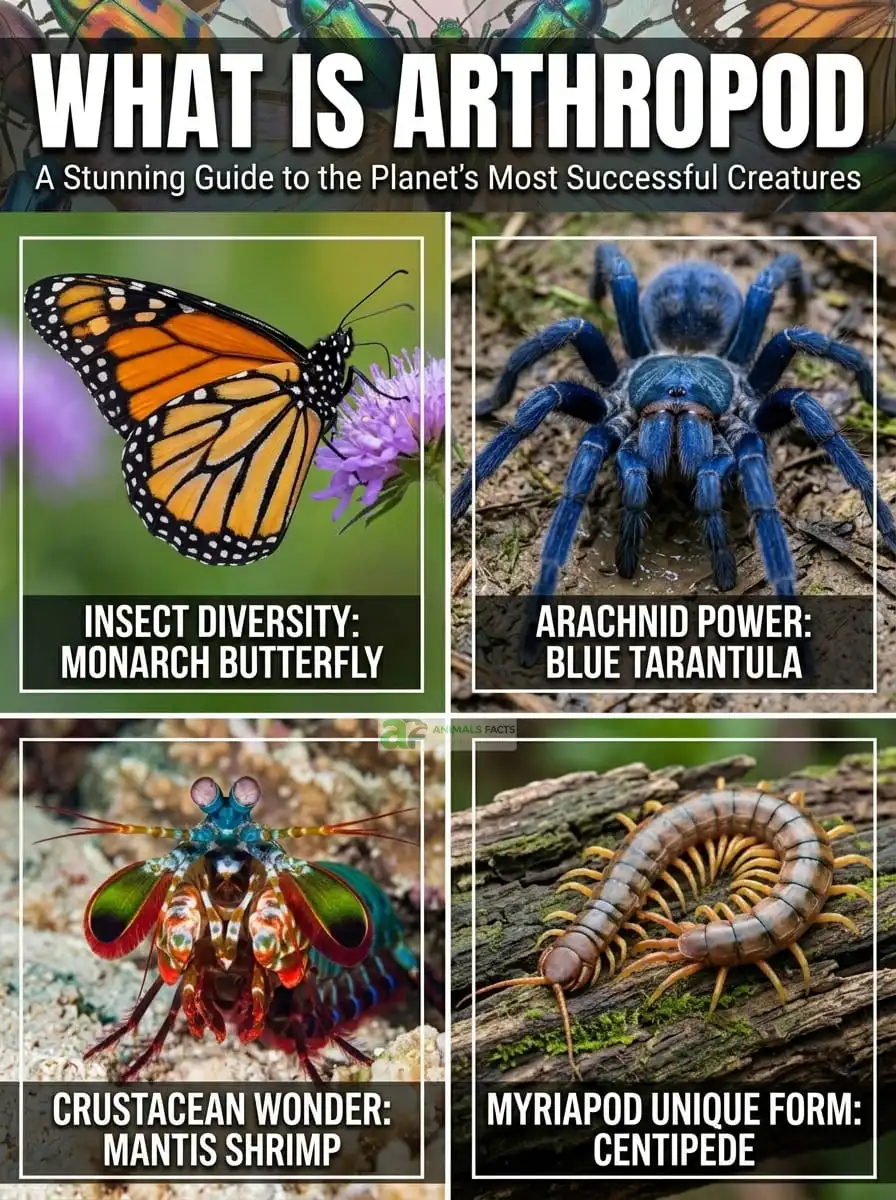
There is a statistic that stops most people cold when they first encounter it: of all the animal species ever described by science, more than 80% are arthropods. Not 20%. Not 50%. Eighty percent. The beetles alone — just one order within one class of arthropods — outnumber all vertebrate species combined. When the great biologist J.B.S. Haldane was asked what his study of nature had revealed about the mind of God, he reportedly replied that the Creator must have had “an inordinate fondness for beetles.” And beetles are just a fraction of the story.
Arthropod facts are facts about the dominant life form on this planet — the animals that run every terrestrial ecosystem, pollinate the crops that feed humanity, decompose the dead matter that would otherwise choke the world, and represent the single greatest experiment in biological diversification that evolution has ever attempted. From the jumping spider that hunts with eyes sharper than a hawk’s, to the mantis shrimp that punches with the force of a bullet, to the monarch butterfly navigating 5,000 kilometers by starlight — interesting facts about arthropods are really facts about what life is capable of when given 540 million years and an exoskeleton to work with.
This is your complete guide to arthropod facts — covering every major group, every extraordinary adaptation, and every critical role these animals play in keeping Earth alive. Whether you are a student searching for arthropod facts for kids, a teacher preparing a lesson, a researcher looking for precise data, or simply someone who noticed something with too many legs and got curious — this article was written for you.
2. Arthropod Species Overview & Classification
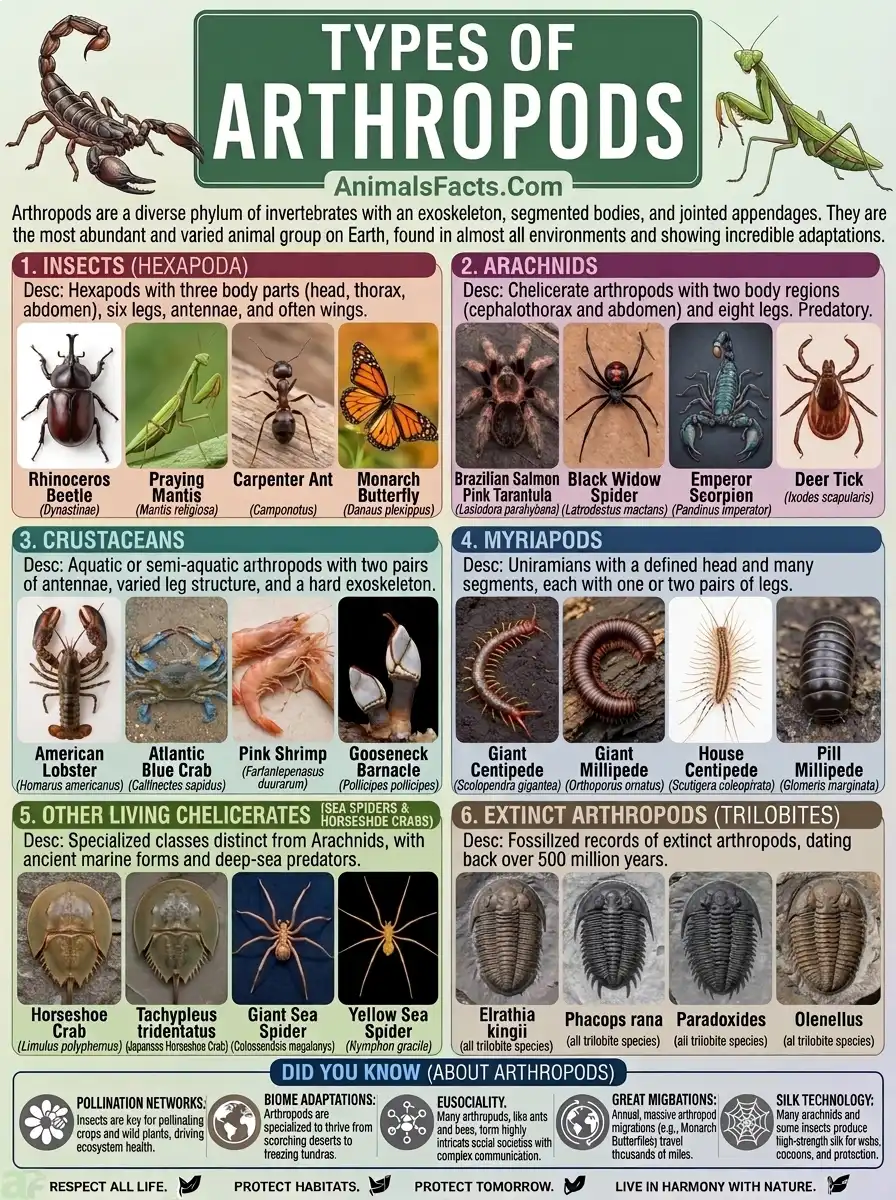
The phylum Arthropoda is the largest, most species-rich, and most ecologically diverse phylum in the animal kingdom. It encompasses four major living subphyla, each representing a distinct evolutionary lineage with hundreds of millions of years of independent history.
Taxonomy Table
| Level | Classification |
|---|---|
| Kingdom | Animalia |
| Phylum | Arthropoda |
| Subphyla | Chelicerata, Crustacea, Hexapoda, Myriapoda |
| Classes | 16+ recognized classes |
| Orders | Hundreds |
| Families | Thousands |
| Genera | Tens of thousands |
| Species (described) | Over 1.1 million |
| Species (estimated total) | 5–10 million |
The Four Major Subphyla
| Subphylum | Common Groups | # of Species | Key Features |
|---|---|---|---|
| Hexapoda | Insects, springtails | ~1,000,000+ | 6 legs, 3 body segments, wings (most) |
| Crustacea | Crabs, shrimp, lobsters, barnacles, copepods | ~67,000 | Mostly aquatic, 2 pairs of antennae |
| Chelicerata | Spiders, scorpions, mites, horseshoe crabs | ~115,000 | No antennae, chelicerae (fang-like mouthparts) |
| Myriapoda | Centipedes, millipedes | ~16,000 | Many legs, elongated body, single pair of antennae |
Notable Classes Within Arthropoda
| Class | Examples | Approximate Species Count |
|---|---|---|
| Insecta | Beetles, butterflies, ants, bees, flies, dragonflies | ~1,000,000 |
| Arachnida | Spiders, scorpions, ticks, mites | ~115,000 |
| Malacostraca | Crabs, lobsters, shrimp, krill | ~40,000 |
| Chilopoda | Centipedes | ~3,300 |
| Diplopoda | Millipedes | ~12,000 |
| Branchiopoda | Water fleas, brine shrimp | ~1,000 |
| Maxillopoda | Barnacles, copepods | ~13,000 |
Arthropods Species Evolution & Discovery Timeline
- ~540 million years ago — Arthropods explode into the fossil record during the Cambrian explosion; Anomalocaris and early trilobites dominate
- ~430 million years ago — Scorpions become first arthropods to colonize land
- ~400 million years ago — Insects appear; earliest fossils from Devonian period
- ~350 million years ago — Winged insects evolve — the first flying animals on Earth
- ~300 million years ago — Giant Carboniferous arthropods reach peak size; Arthropleura (giant millipede) reaches 2.5 meters
- ~250 million years ago — Trilobites go extinct in the Permian mass extinction
- ~130 million years ago — Flowering plants diversify; insect pollinator diversity explodes in response
- 1735 — Carl Linnaeus begins systematic classification of arthropod species
- 1825 — Pierre André Latreille formally defines Arthropoda as a phylum
- 1960s–present — Molecular phylogenetics revolutionizes arthropod family tree; crustaceans and insects shown to share common ancestry
- 2000–2026 — DNA barcoding and environmental sequencing reveal that arthropod diversity may be 3–10 times greater than previously estimated
3. Arthropods Physical Description
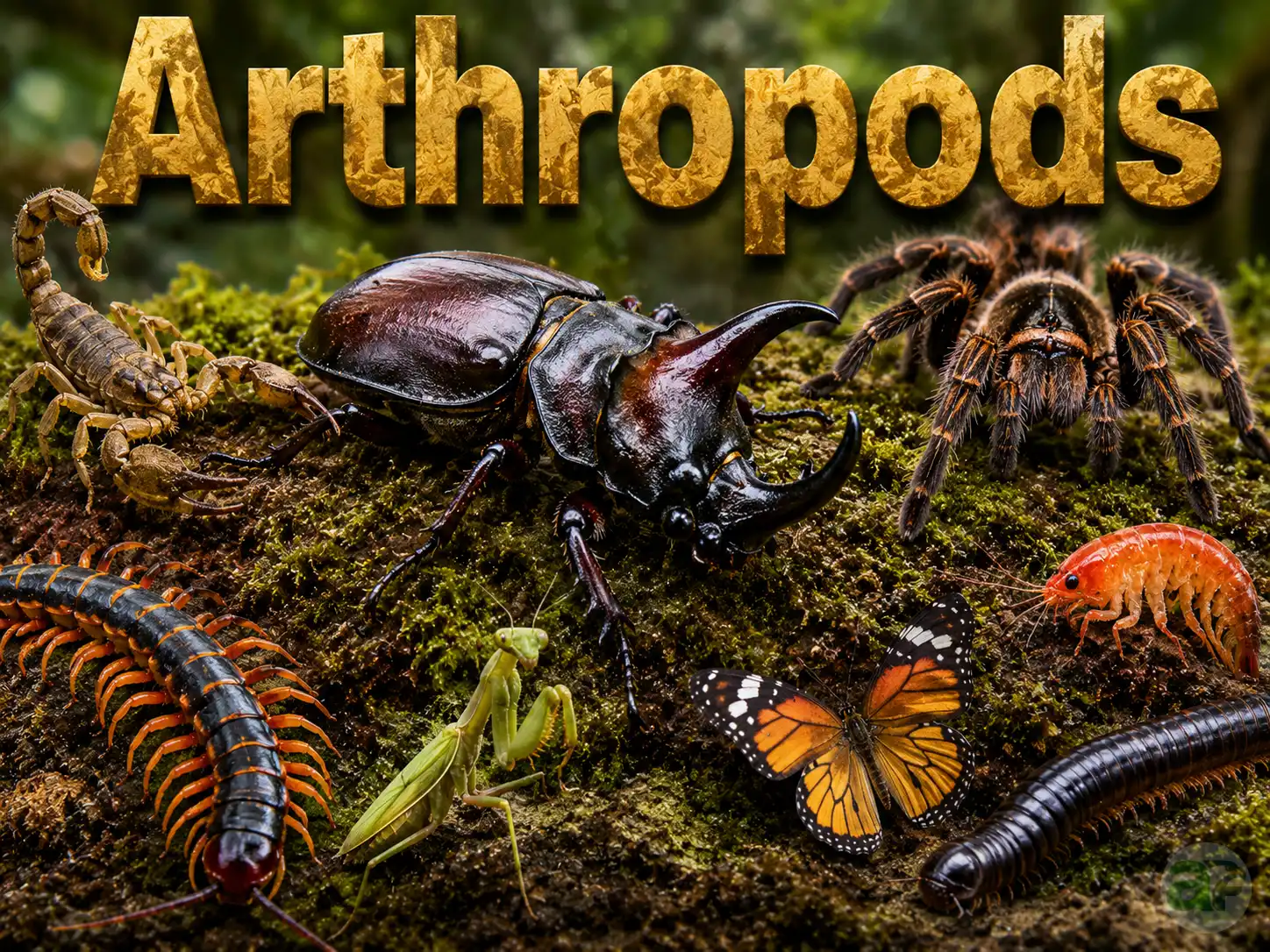
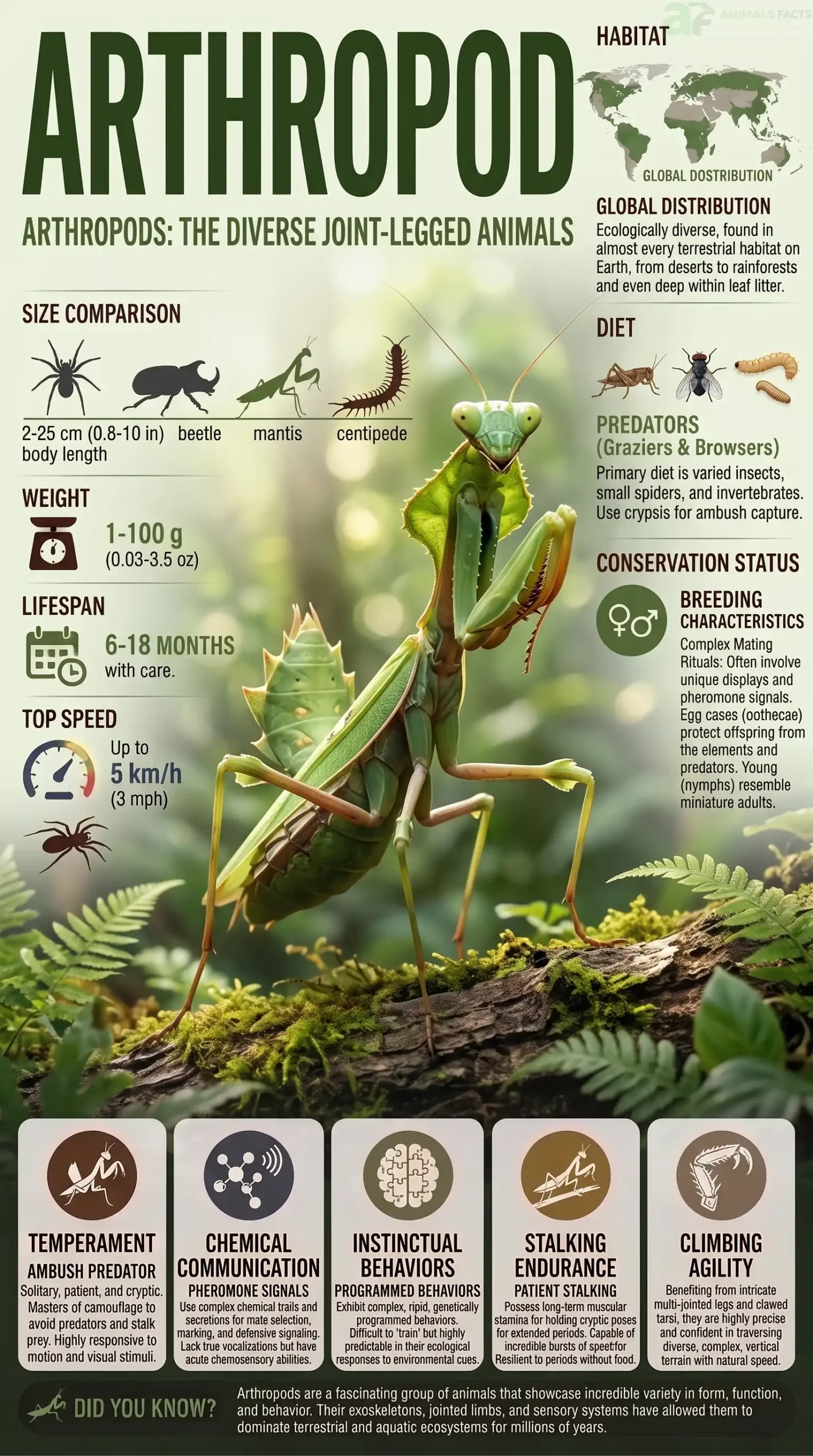
Despite the enormous diversity of arthropods — from a 0.1 mm parasitic mite to a Japanese spider crab with a 3.7-meter leg span — all members of the phylum share a core set of defining physical characteristics that unite them across half a billion years of evolution.
The Four Defining Features of All Arthropods
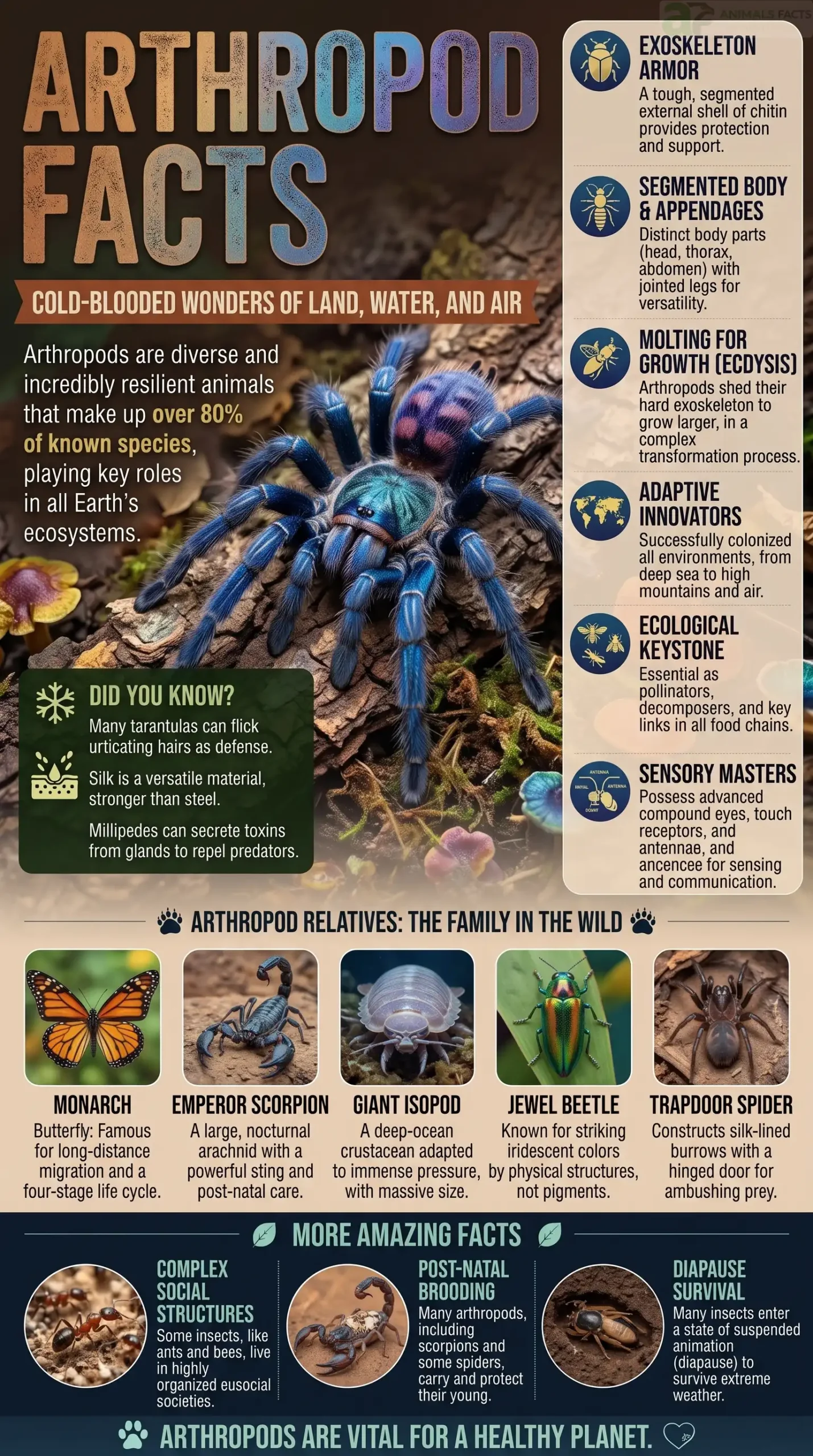
1. Exoskeleton (Cuticle) — Every arthropod has a hard outer shell made of chitin — a lightweight, flexible polysaccharide that can be hardened with calcium carbonate (as in crab shells) or left flexible (as in caterpillar skin). The exoskeleton provides structural support, protects against predators and desiccation, and serves as an attachment point for muscles.
2. Jointed Appendages — The phylum name literally means “jointed foot.” Every pair of legs, mouthparts, antennae, and claws is built from jointed segments connected by flexible membranes — allowing extraordinary range of motion and precision.
3. Segmented Body — The arthropod body is built from repeating segments, each of which may bear a pair of appendages. Over evolutionary time, segments have fused into functional units — head, thorax, and abdomen in insects; cephalothorax and abdomen in spiders.
4. Molting (Ecdysis) — Because the exoskeleton cannot grow, arthropods must periodically shed it entirely in a process called molting or ecdysis. During this brief, vulnerable period, the animal expands its soft new body before the fresh exoskeleton hardens.
Size Extremes
| Record | Species | Measurement |
|---|---|---|
| Smallest arthropod | Stygotantulus stocki (parasitic crustacean) | 0.1 mm |
| Largest leg span | Japanese spider crab (Macrocheira kaempferi) | 3.7 m |
| Heaviest arthropod | Coconut crab (Birgus latro) | Up to 4.1 kg |
| Longest insect | Chan’s megastick (Phobaeticus chani) | 56.7 cm (with legs extended) |
| Longest millipede | Archispirostreptus gigas | Up to 33 cm |
| Most legs | Illacme plenipes (millipede) | Up to 750 legs |
“If we were to weigh all the animals on Earth, arthropods — particularly insects — would account for the vast majority of animal biomass. They are not the background to the story of life. They are the story.” — Sir David Attenborough, BBC Natural World series
4. Top 25 Amazing Arthropod Facts
Here are the most astonishing, conversation-stopping interesting facts about arthropods — each one a window into just how extraordinary this phylum truly is:
- Arthropods make up over 80% of all known animal species on Earth
- There are an estimated 10 quintillion (10,000,000,000,000,000,000) individual insects alive at any moment — roughly 1.4 billion insects for every human
- The mantis shrimp (Odontodactylus scyllarus) punches with the acceleration of a 22-caliber bullet — generating cavitation bubbles that implode with enough force to stun prey even if the punch misses
- Mantis shrimp also have 16 types of photoreceptors — humans have only 3; they perceive colors completely invisible to us, including ultraviolet and infrared
- The bombardier beetle sprays boiling chemical jets from its abdomen — a two-chemical reaction that reaches 100°C (212°F) with an audible pop
- Horseshoe crabs (Limulus polyphemus) have blue blood containing a compound called LAL (Limulus Amebocyte Lysate) — used to test every injectable medical drug and vaccine for bacterial contamination; without horseshoe crabs, modern medicine as we know it could not function
- A colony of leafcutter ants can contain up to 8 million individuals and moves more soil per year than an earthworm population covering the same area
- The flea can jump 200 times its own body length — the equivalent of a human jumping over a 35-story building
- Tardigrades (water bears) — microscopic arthropod relatives — can survive in outer space, near total vacuum, and temperatures from −272°C to 150°C
- The Goliath birdeater spider (Theraphosa blondi) has a leg span of up to 30 cm and can be heard walking across leaves
- Dragonflies have a hunting success rate of 95% — the highest of any predator on Earth, including lions (25%) and great white sharks (50%)
- Ants have colonized every landmass on Earth except Antarctica, Greenland, Iceland, and a few remote islands
- The pistol shrimp (Alpheus spp.) snaps its claw so fast it creates a cavitation bubble that briefly reaches 8,000°C — hotter than the surface of the Sun — for a microsecond
- Honeybees (Apis mellifera) communicate the exact distance, direction, and quality of food sources through a waggle dance — one of the most sophisticated communication systems of any non-human animal
- The monarch butterfly navigates 4,800 km to a forest it has never visited, using a time-compensated sun compass and Earth’s magnetic field
- Copepods — tiny crustaceans — are the most abundant multicellular animals on Earth and form the base of virtually every marine food chain
- The silk of a spider (technically a chelicerate arthropod) is weight-for-weight 5 times stronger than steel and more elastic than nylon
- Some all-female species of whiptail lizard parasites (mites) reproduce entirely through parthenogenesis — no males have ever been found
- The Japanese spider crab can live for up to 100 years
- Arthropods were the first animals to fly — winged insects evolved approximately 350 million years ago, around 150 million years before pterosaurs and birds
- Krill (Euphausia superba) form swarms so dense they can be seen from space — one swarm can weigh over 2 million tons
- The mimic octopus is not an arthropod — but the animals it most frequently mimics (lionfish, flatfish, sea snakes) are all arthropod predators or prey
- Millipedes of the genus Motyxia bioluminesce — glowing blue-green at night — using the light to warn predators of their cyanide defenses
- The water flea (Daphnia) can change its own DNA expression in response to predator chemical signals — growing defensive helmets and spines within a single generation
- Horseshoe crabs have been virtually unchanged for 450 million years — they are among the oldest living animal lineages on Earth, predating dinosaurs by over 200 million years
Did You Know? The total weight of all ants on Earth was estimated in a 2022 study published in PNAS to be approximately 20 million tons of dry carbon — roughly equivalent to the combined weight of all wild birds and mammals on Earth. Ants alone outweigh humanity by a significant margin.
5. Arthropod Fun Facts for Kids
- Arthropods make up 80%+ of all animal species on Earth
- Copepods are the most abundant multicellular animals alive
- The Japanese spider crab lives up to 100 years
- The mantis shrimp punches with bullet-like acceleration
- Horseshoe crab blood saves millions of human lives every year
- Ants have been on Earth for 140 million years — and colonized almost every landmass
- Spider silk is 5x stronger than steel by weight
- Monarch butterflies navigate 4,800 km by sun and magnetic compass
- The flea jumps 200x its own body length
- Krill swarms can weigh over 2 million tons and be seen from space
- Scorpions have existed for 435 million years — older than trees
- Honeybees communicate food location through a mathematical dance
- Pistol shrimp claws create heat briefly hotter than the Sun’s surface
- Some millipedes bioluminesce using cyanide-laced glow
- There are an estimated 10 quintillion arthropods alive right now
6. Natural Habitat of Arthropods
No other animal phylum occupies as broad a range of habitats as Arthropoda. From the deepest ocean trenches to the highest mountain peaks, from scalding hydrothermal vents to polar sea ice — arthropods have colonized virtually every environment on Earth.
Habitat Range by Region and Major Group
| Habitat Type | Dominant Arthropod Groups | Notable Species |
|---|---|---|
| Tropical rainforest | Insects (beetles, butterflies, ants), spiders, millipedes | Goliath birdeater, leafcutter ants, morpho butterflies |
| Temperate forest | Beetles, moths, woodlice, centipedes | Stag beetle, silkworm moth, giant centipede |
| Desert / arid scrub | Scorpions, darkling beetles, camel spiders, ants | Deathstalker, Namib fog beetle, harvester ant |
| Grassland / prairie | Grasshoppers, beetles, bees, burrowing spiders | Monarch butterfly, bumblebee, tarantula hawk |
| Freshwater | Mayflies, dragonfly larvae, freshwater shrimp, water fleas | Giant water bug, caddisfly, Daphnia |
| Marine coastal | Crabs, barnacles, shrimp, horseshoe crabs | Fiddler crab, goose barnacle, spiny lobster |
| Open ocean (pelagic) | Copepods, krill, sea spiders | Antarctic krill, Calanus finmarchicus |
| Deep sea | Isopods, amphipods, sea spiders | Giant isopod, Mariana Trench amphipods |
| Caves | Blind cave beetles, cave crickets, cave spiders | Leptodirus hochenwart (first cave beetle described) |
| Arctic / polar | Snow fleas, ice mites, Arctic krill | Collembola spp., Euphausia superba |
| High altitude | Jumping spiders, springtails, glacier midges | Euophrys omnisuperstes — highest-dwelling spider (6,700m) |
The highest-altitude arthropod ever recorded is the jumping spider Euophrys omnisuperstes, found living on the slopes of Mount Everest at 6,700 meters above sea level — feeding on wind-blown insects and springtails in one of Earth’s most extreme environments.
Did You Know? The Mariana Trench — the deepest point on Earth at nearly 11,000 meters — is not lifeless. Amphipods (small crustaceans) thrive in the crushing darkness of the trench floor, feeding on marine snow (organic particles that drift down from above). These deep-sea arthropods have been found to contain microplastics in their tissues — a sobering testament to the reach of human pollution.
7. Arthropod Diet & Feeding Behavior
The arthropod phylum contains virtually every feeding strategy known to the animal kingdom — herbivory, carnivory, omnivory, parasitism, filter feeding, detritivory, and even agriculture.
Diet Breakdown Across Major Groups
| Group | Primary Diet | Feeding Strategy | Notable Example |
|---|---|---|---|
| Beetles (Coleoptera) | Varies widely — wood, dung, other insects | Chewing mouthparts | Dung beetle (detritivore); tiger beetle (predator) |
| Butterflies & Moths | Nectar (adults); leaves, wood, fruit (larvae) | Proboscis (adults); chewing (larvae) | Monarch (nectar); silkworm (leaves) |
| Ants | Omnivore — seeds, fungi, insects, honeydew | Foraging, farming, hunting | Leafcutter ants (fungus farmers) |
| Bees | Nectar and pollen exclusively | Proboscis; pollen baskets | Honeybee, bumblebee |
| Spiders | Carnivore — insects, small vertebrates | Web trapping or active hunting | Orb weaver (web); jumping spider (active) |
| Scorpions | Carnivore — insects, lizards, rodents | Ambush predation | Deathstalker, emperor scorpion |
| Crabs & Lobsters | Omnivore — algae, mollusks, carrion, fish | Crushing claws; scavenging | Blue crab, spiny lobster |
| Copepods | Filter feeding — phytoplankton | Suspension feeding | Calanus finmarchicus |
| Krill | Phytoplankton, zooplankton | Filter feeding | Antarctic krill |
| Centipedes | Strict carnivore — insects, worms, small vertebrates | Venomous forcipules | Giant Amazonian centipede |
| Millipedes | Detritivore — dead leaves, rotting wood | Chewing mouthparts | Archispirostreptus gigas |
| Ticks & Mites | Blood (ticks); varied (mites) | Parasitic (ticks); diverse (mites) | Deer tick; dust mite |
8. Arthropod Reproduction & Life Cycle
Arthropods exhibit the broadest range of reproductive strategies of any animal phylum — from sexual reproduction with complex courtship, to parthenogenesis (females only), to eusocial colony reproduction involving queens and sterile workers.
Metamorphosis Types
Complete metamorphosis (holometabolism) — Four distinct stages: egg → larva → pupa → adult. The larva and adult occupy completely different ecological niches. Used by beetles, butterflies, flies, bees, and ants — the most species-rich insect orders. The pupal stage involves radical reorganization of body tissues.
Incomplete metamorphosis (hemimetabolism) — Three stages: egg → nymph → adult. Nymphs resemble small adults. Used by grasshoppers, dragonflies, cockroaches, and true bugs.
Direct development — Young hatch resembling miniature adults; no metamorphosis. Used by spiders, scorpions, millipedes, and crustaceans (some).
Lifespan Comparison Across Arthropods
| Species | Lifespan | Notes |
|---|---|---|
| Mayfly (adult) | 1 day – a few hours | Shortest adult lifespan of any arthropod |
| Honeybee (worker) | 6 weeks (summer) | Queen lives up to 5 years |
| Monarch butterfly (migratory) | Up to 9 months | |
| Common spider | 1–3 years | |
| Tarantula (female) | Up to 30 years | Among the longest-lived spiders |
| American lobster | Up to 100+ years | Arguably biologically non-aging |
| Japanese spider crab | Up to 100 years | Largest arthropod by leg span |
| Scorpion (Hadogenes) | Up to 25 years | Longest-lived scorpion species |
| Coconut crab | Up to 60 years | Heaviest terrestrial arthropod |
Did You Know? The American lobster (Homarus americanus) may be functionally biologically immortal — it does not show the typical cellular signs of aging and continues growing and reproducing until it dies from external causes (disease, predation, or the physical exhaustion of molting a shell that grows increasingly large and metabolically costly). The oldest verified lobster was estimated to be 140 years old.
9. Social Behavior & Communication
Arthropods include both the most solitary and the most intensely social animals on Earth.
Eusociality — The Pinnacle of Arthropod Social Evolution
Certain insect groups — ants, bees, wasps, and termites — have evolved eusociality: the most complex social system in the animal kingdom, characterized by cooperative brood care, overlapping generations in a colony, and division of labor between reproductive and non-reproductive castes.
A leafcutter ant colony functions as a superorganism — a colony of up to 8 million individuals that collectively farms fungus, maintains underground gardens, runs ventilation systems, disposes of waste, and defends territory — all without any central command authority. Each ant follows simple local rules; the colony-level intelligence emerges from their collective behavior.
Communication Methods Across Arthropods
| Method | Group | Example |
|---|---|---|
| Waggle dance | Honeybees | Communicates distance, direction, and quality of food sources |
| Pheromone trails | Ants, moths | Chemical signals guide foraging, alarm, mate attraction |
| Stridulation | Crickets, grasshoppers, some beetles | Sound produced by rubbing body parts |
| Bioluminescence | Fireflies, some millipedes | Light signals for mate attraction; chemical defense |
| Vibration | Scorpions, spiders | Substrate-borne signals for prey detection and communication |
| Color display | Butterflies, mantis shrimp | Visual signals for mate selection, species recognition, warning |
| Web tension signals | Spiders | Vibration patterns through silk threads communicate prey capture, mate presence |
“The social insects — ants, bees, and termites — have solved problems of collective organization, infrastructure, and communication that human engineers are only beginning to approach. We built cities 10,000 years ago. Ants have been building them for 140 million years.” — Dr. E.O. Wilson, two-time Pulitzer Prize winner and father of sociobiology
10. Predators & Defense Mechanisms
Natural Predators of Arthropods
Arthropods are prey to virtually every carnivorous animal group on Earth — birds, fish, amphibians, reptiles, mammals, and other arthropods. In fact, the largest predator class of arthropods is other arthropods — spiders, centipedes, mantises, and predatory beetles collectively consume more arthropod biomass than all vertebrate predators combined.
Defense Strategies Across the Phylum
| Strategy | Group | Example |
|---|---|---|
| Chemical defense | Beetles, millipedes, ants | Bombardier beetle (boiling spray); millipedes (cyanide/quinones) |
| Venom | Spiders, scorpions, centipedes, bees | Black widow, deathstalker, giant centipede |
| Camouflage | Stick insects, leaf insects, crab spiders | Walking stick (Phasmatodea); orchid mantis |
| Aposematism | Monarch butterfly, poison dart beetles | Warning coloration signals toxicity |
| Mimicry | Hoverflies, clearwing moths | Mimic bee/wasp appearance without being venomous |
| Armor | Pill bugs, crabs | Roll into ball; hard carapace |
| Speed and agility | Dragonflies, tiger beetles | Tiger beetle: fastest running insect at 9 km/h |
| Autotomy | Crabs, some spiders | Shed a limb to escape; regenerate later |
| Mass attack | Bees, army ants | Colony-level defense overwhelms any individual predator |
11. Arthropod Facts for Kids
Hey young explorers! Here are the most mind-blowing arthropod facts written just for you:
- There are more kinds of arthropods than all other animals combined — by far!
- A flea can jump so high that if YOU could jump the same way, you’d leap over a 35-story skyscraper!
- Dragonflies catch 95 out of every 100 prey they hunt — they’re the best hunters on Earth!
- Honeybees do a special dance to tell their friends exactly where to find flowers — like giving GPS directions with their bodies!
- The pistol shrimp snaps its claw so fast it creates a tiny bubble hotter than the surface of the Sun — for just a split second!
- Some ants farm their own food — they grow mushrooms underground, just like human farmers!
- The silk of a spider web is stronger than steel wire the same thickness!
- There are so many ants on Earth that if you weighed them all, they’d outweigh all the humans on the planet!
- The Japanese spider crab has legs that stretch over 3 meters — as wide as a small car!
- Fireflies (which are actually beetles!) make their own light using a chemical reaction in their bodies — real-life living flashlights!
12. Relationship with Humans
No animal group has shaped human civilization more profoundly — or more invisibly — than arthropods.
Pollination: The Foundation of Food
Over 75% of the world’s flowering crop species depend on animal pollinators — and the vast majority of those pollinators are arthropods. Bees, butterflies, beetles, flies, and moths collectively pollinate crops worth an estimated $577 billion annually in global food production. Without arthropod pollinators, human agriculture as currently practiced would collapse within years.
Medicine and Science
- Horseshoe crab blood (LAL) — Used to test every injectable drug and vaccine for bacterial contamination; saves millions of human lives annually
- Silk production — The silkworm moth (Bombyx mori) has been domesticated for over 5,000 years; silk remains a multi-billion-dollar global industry
- Honey and beeswax — Products of the honeybee, used in food, medicine, and cosmetics for millennia
- Venom research — Arthropod venoms are active sources of drug candidates for cancer, pain, epilepsy, and infectious disease
- Forensic entomology — Insects colonize bodies in predictable sequences; forensic entomologists use arthropod evidence to determine time of death in criminal investigations
Disease Vectors
Arthropods are also the world’s most significant disease vectors:
| Arthropod | Disease Transmitted | Annual Deaths |
|---|---|---|
| Mosquito (Anopheles, Aedes) | Malaria, dengue, Zika, yellow fever | 700,000+ per year |
| Tick | Lyme disease, Rocky Mountain spotted fever | Thousands annually |
| Sand fly | Leishmaniasis | ~20,000–30,000 per year |
| Tsetse fly | Sleeping sickness | Thousands annually |
| Flea | Bubonic plague (historically); typhus | Historically catastrophic |
The mosquito, a member of order Diptera and entirely an arthropod, is responsible for more human deaths throughout history than any other animal — including other humans.
13. Arthropod Conservation Status & Threats
The Insect Apocalypse
The scientific community has issued increasingly urgent warnings about a global collapse in arthropod populations — particularly insects. Key findings include:
- A 2017 study in Germany found a 75% decline in flying insect biomass over 27 years in protected nature reserves
- A 2019 global review in Biological Conservation found that 40% of insect species are declining, and one-third face extinction within decades
- Monarch butterfly populations have declined by 70–97% since the 1980s, depending on population
- Bee diversity has declined dramatically across North America and Europe
- Freshwater arthropods (mayflies, stoneflies, caddisflies) have experienced some of the steepest declines of any animal group globally
Major Threats
| Threat | Impact Level | Arthropods Most Affected |
|---|---|---|
| Habitat loss | Critical | All terrestrial arthropods; forest and grassland specialists |
| Pesticides | Critical | Bees, butterflies, beetles; neonicotinoids particularly devastating |
| Climate change | High | Migratory species, polar and alpine arthropods, coral reef crustaceans |
| Light pollution | High | Moths, fireflies, nocturnal beetles; disrupts mating and navigation |
| Invasive species | High | Island arthropods; specialist species with no evolutionary defense |
| Ocean acidification | High | Crustaceans, copepods; carbonate shells dissolve in acidified water |
| Overexploitation | Medium | Horseshoe crabs, lobsters, shrimp, emperor scorpions |
IUCN Status of Selected Species
| Species | IUCN Status |
|---|---|
| Migratory monarch butterfly | Endangered (2022) |
| Rusty patched bumblebee | Critically Endangered |
| Horseshoe crab (Limulus polyphemus) | Vulnerable |
| American lobster | Vulnerable |
| Emperor scorpion | CITES Appendix II |
| Franklin’s bumblebee | Critically Endangered (possibly extinct) |
14. Famous Arthropods
The Honeybee – Civilization’s Partner
Apis mellifera has been managed by humans for at least 9,000 years — cave paintings in Spain dating to 7,000 BCE depict honey harvesting. Today, the honeybee is the single most economically important insect on Earth, with managed colonies valued in the tens of billions of dollars globally.
Jiminy Cricket – Cultural Ambassador
The cricket (Gryllus spp.) has served as a cultural symbol of luck, good fortune, and domestic harmony across East Asian, European, and Indigenous American traditions for millennia — and was immortalized as Jiminy Cricket in Walt Disney’s Pinocchio (1940).
The Horseshoe Crab – Medicine’s Unsung Hero
Limulus polyphemus — unchanged for 450 million years — is arguably the most medically important animal alive. Its blue blood LAL test has been mandatory for pharmaceutical testing since 1970 and has prevented countless deaths from contaminated injections and implants.
Dave the Mantis Shrimp
A peacock mantis shrimp named “Dave” housed at the Monterey Bay Aquarium became internet-famous in the 2010s when videos of him shattering aquarium glass with his strike — and looking impossibly colorful — went globally viral, introducing millions of people to the extraordinary biology of stomatopods.
15. Role in Ecosystem & Food Chain
Arthropods do not merely participate in ecosystems. In most terrestrial and aquatic systems, they are the ecosystem — the structural foundation upon which everything else depends.
Core Ecological Roles
Pollination — Without bee, butterfly, moth, beetle, and fly pollination, the reproductive cycle of the majority of Earth’s 350,000 flowering plant species would fail. Entire forest structures, grassland communities, and agricultural systems depend on arthropod pollination.
Decomposition — Beetles, flies, millipedes, mites, woodlice, and springtails collectively break down dead organic matter — leaves, wood, carcasses — recycling nutrients back into the soil at a rate and scale no other animal group approaches. Without arthropod decomposers, dead organic matter would accumulate, nutrient cycles would stall, and plant growth would cease.
Food web foundation — Copepods and krill are the primary link between marine phytoplankton (the ocean’s primary producers) and every large marine animal — fish, seabirds, whales. The collapse of copepod or krill populations would cascade upward, destabilizing entire ocean food webs.
Soil health — Burrowing arthropods (ants, beetles, millipedes, mites) aerate soil, improve water infiltration, and distribute organic matter through the soil profile — functions collectively worth trillions of dollars in agricultural productivity annually.
16. Arthropod Myths, Folklore & Cultural Significance
Ancient Egypt
The scarab beetle (Scarabaeus sacer) was one of the most sacred symbols in ancient Egyptian religion — representing the god Khepri (the rising sun) and the cycle of rebirth. Scarab amulets were placed over the hearts of mummies to protect the dead during their journey to the afterlife. The beetle’s habit of rolling dung balls across the sand — mirroring the sun’s movement across the sky — made it a living theological symbol.
Ancient Greece and Rome
The cicada was deeply revered in ancient Greece — associated with Apollo (god of music) and immortality. Plato mentions that cicadas were once humans who loved music so much they forgot to eat and drink, eventually transforming into the singing insects. In ancient Rome, locust swarms were interpreted as divine punishment — a tradition that persisted through the biblical plagues of Egypt.
Chinese Culture
The cricket has been kept as a pet and symbol of luck in China for over 2,000 years. Cricket fighting was a formalized sport during the Tang Dynasty (618–907 CE). The silkworm moth — whose cocoon silk is one of the foundations of Chinese civilization — is venerated in Chinese mythology through the goddess Leizu, who legendarily discovered silk when a cocoon fell into her tea.
Native American Traditions
The spider — particularly the figure of Spider Woman (Spider Grandmother) — appears across the cosmologies of dozens of Native American nations including the Hopi, Navajo, and Pueblo peoples as a creator deity who wove the world into existence. The dragonfly is a symbol of transformation, speed, and the connection between the physical and spirit worlds across many Indigenous North American traditions.
Hinduism and Buddhism
The bee (madhu in Sanskrit) is deeply embedded in Hindu sacred literature — associated with Krishna, Vishnu, and divine sweetness. Buddhist texts use the bee as a metaphor for the monk who extracts wisdom without harming the source. In some traditions, the sound of bees (brahmara) is associated with the cosmic hum of Om.
17. Arthropods in Pop Culture
Film and Television
- A Bug’s Life (1998, Pixar) — Anthropomorphized ant colony; introduced millions of children to arthropod social behavior
- Antz (1998, DreamWorks) — Explores ant colony social hierarchy through the lens of individual identity
- James and the Giant Peach (1996) — Arthropod characters (grasshopper, centipede, earthworm, spider) drive the narrative
- Microcosmos (1996) — French documentary capturing arthropod behavior at macro scale; groundbreaking cinematography
- The Blue Planet and Blue Planet II (BBC) — Extraordinary crustacean and marine arthropod sequences
- Minuscule: Valley of the Lost Ants (2013) — Photo-realistic CGI insects in a live-action environment
Video Games
- Anthill (mobile), Ant Simulator, Creeper World — ant colony and arthropod-themed strategy games
- Arthropods appear as enemies, companions, or central characters in virtually every major RPG franchise — from the Zelda series to Dark Souls to Hollow Knight (an entire game set in an arthropod civilization)
Books and Literature
- The Selfish Gene — Richard Dawkins (1976); uses social insects extensively to explain kin selection and evolutionary theory
- The Ants — E.O. Wilson & Bert Hölldobler (1990); Pulitzer Prize-winning scientific masterwork
- The Soul of the Bee — Maurice Maeterlinck (1901); poetic exploration of hive life
- Last Chance to See — Douglas Adams (1990); includes arthropod conservation discussions
18. Arthropod Facts vs. Common Myths
| Myth | Fact |
|---|---|
| “Spiders are insects” | Spiders are arachnids — they have 8 legs, 2 body parts, no antennae, and no wings. Insects have 6 legs and 3 body parts |
| “Daddy long-legs are the most venomous spider” | False — daddy long-legs (harvestmen) are not spiders at all; they have no venom glands whatsoever |
| “Centipedes have 100 legs” | Centipedes always have an odd number of leg pairs — never exactly 100 legs; species range from 30 to 354 legs |
| “Millipedes have 1,000 legs” | The record is 750 legs (Illacme plenipes); most species have 40–400 legs |
| “Bees die after stinging” | Only honeybee workers die after stinging (their barbed stinger embeds in mammal skin); bumblebees, wasps, and hornets can sting repeatedly |
| “Tarantulas are deadly to humans” | Tarantula venom is generally no more dangerous than a bee sting to healthy adults; their reputation far exceeds their actual danger |
| “All mosquitoes bite humans” | Only female mosquitoes bite (for egg development); male mosquitoes feed exclusively on nectar |
| “Arthropods are simple, primitive animals” | Arthropods include animals with some of the most sophisticated sensory systems, navigation abilities, and social structures of any life form on Earth |
19. Best Places to See Arthropods in the Wild
- Amazon Rainforest, Brazil/Peru — The single greatest arthropod diversity hotspot on Earth. A single tree in the Amazon may harbor more beetle species than the entire British Isles. Guided night walks reveal tarantulas, giant centipedes, bullet ants, and hundreds of beetle species.
- Monarch Butterfly Biosphere Reserve, Michoacán, Mexico — Witness tens of millions of monarch butterflies blanketing oyamel fir forests from November to March. A UNESCO World Heritage Site and one of the most spectacular wildlife events on the planet.
- Coral Triangle, Indonesia/Philippines/Papua New Guinea — The global center of marine arthropod diversity. Mantis shrimp, decorator crabs, cleaner shrimp, and dozens of crab species on virtually every dive.
- Sonoran Desert, Arizona, USA — Night walks with UV flashlights reveal scorpions, giant hairy spiders, and predatory beetles. The diversity of desert arthropods in this region is extraordinary and largely overlooked.
- Borneo Rainforest, Malaysia/Indonesia — Home to the world’s largest stick insect (Phobaeticus chani, 56.7 cm), atlas moths (wingspans up to 30 cm), and extraordinary diversity of beetles, hornets, and bees.
- Pantanal, Brazil — The world’s largest tropical wetland; extraordinary dragonfly, water beetle, and freshwater crustacean diversity accessible by boat.
- Great Barrier Reef, Australia — Mantis shrimp, spiny lobsters, coral crabs, Christmas Island red crabs — the marine arthropod diversity of the GBR and surrounding Australian waters is among the world’s richest.
20. How You Can Help
The arthropod crisis is real — but so is the power of individual and collective action. Here is what you can do starting today:
- Plant native wildflowers — Native flowering plants support native bee, butterfly, and beetle communities far better than ornamental exotic species; contact your local native plant society for regional guidance
- Eliminate or reduce pesticide use — Neonicotinoid insecticides are systemic — they persist in soil and plant tissue and kill non-target arthropods, including pollinators; look for alternatives at xerces.org
- Turn off outdoor lights at night — Light pollution kills moths, disrupts firefly mating, and disorients migrating insects; motion-sensor lights or red-spectrum bulbs significantly reduce harm
- Create arthropod habitat — Leave leaf litter in your garden (overwintering insects), maintain bare soil patches (ground-nesting bees), install bee hotels, and tolerate hollow stems over winter
- Support conservation organizations — The Xerces Society (xerces.org), Buglife (buglife.org.uk), Butterfly Conservation (butterfly-conservation.org), and Bumblebee Conservation Trust (bumblebeeconservation.org) all fund critical arthropod research and habitat restoration
- Participate in citizen science — iNaturalist (inaturalist.org), BugGuide (bugguide.net), Bumble Bee Watch, and Firefly Watch (Museum of Science, Boston) all collect arthropod observation data that directly informs conservation decisions
- Advocate for policy — Support the listing of endangered arthropods under the Endangered Species Act; contact representatives about pesticide reform and habitat protection legislation
21. Top Documentaries & Books
Must-Watch Documentaries
- Microcosmos (1996, France) — The definitive arthropod documentary; macro-scale cinematography that transforms insects into giants; a masterpiece of nature filmmaking
- Blue Planet II (2017, BBC) — Episodes 2 and 3 feature extraordinary crustacean behavior including mantis shrimp and decorator crab sequences
- Planet Earth II (2016, BBC) — Desert and jungle episodes feature scorpions, insects, and spiders in stunning detail
- The Hidden Kingdom (BBC, 2014) — Explores arthropod-scale perspectives on survival
- Dancing with Bees (2021, Netflix Germany) — Follows a beekeeper’s rediscovery of the insect world; a gentle, beautiful documentary on arthropod ecology
- Fantastic Fungi (2019) — Explores the fungal-arthropod relationship in decomposition and soil ecology
Must-Read Books
- The Ants — E.O. Wilson & Bert Hölldobler (1990) — Pulitzer Prize winner; the definitive scientific work on ant biology and society
- The Soul of an Octopus — Sy Montgomery (2015) — Explores the minds of cephalopods (close relatives of arthropods’ marine neighbors)
- The Insect Crisis — Oliver Milman (2022) — Journalistic account of the global insect decline crisis
- Entangled Life — Merlin Sheldrake (2020) — Explores arthropod-fungal relationships in ecosystem function
- A Field Guide to Insects of America North of Mexico — Borror, Triplehorn & Johnson — The classic reference
- Other Minds — Peter Godfrey-Smith (2016) — Philosophical exploration of intelligence in non-vertebrate animals, including arthropods
22. Comparison of Major Arthropod Groups
| Feature | Insects (Hexapoda) | Spiders (Arachnida) | Crabs/Lobsters (Crustacea) |
|---|---|---|---|
| Legs | 6 | 8 | 10 (decapods) |
| Body sections | 3 (head, thorax, abdomen) | 2 (cephalothorax, abdomen) | 2 (cephalothorax, abdomen) |
| Antennae | 1 pair | None | 2 pairs |
| Wings | Most have wings | None | None |
| Habitat | Primarily terrestrial/freshwater | Terrestrial/some aquatic | Primarily aquatic/marine |
| # of species | ~1,000,000 | ~50,000 | ~67,000 |
| Venom | Some (bees, wasps, ants) | Most species | None (most) |
| Social behavior | High (ants, bees, termites) | Mostly solitary | Mostly solitary; some aggregating |
| Economic importance | Enormous (pollination, pest control) | High (pest control) | High (fisheries) |
| Conservation concern | Critical — widespread decline | Moderate | High — overfishing |
23. Frequently Asked Questions About Arthropod Facts
Q1: What is an arthropod?
An arthropod is any member of the phylum Arthropoda — the largest animal phylum on Earth. All arthropods share four key features: a hard exoskeleton made of chitin, jointed appendages (legs, claws, antennae), a segmented body, and the ability to molt (shed and replace their exoskeleton as they grow). The phylum includes insects, spiders, scorpions, crabs, lobsters, shrimp, centipedes, millipedes, and many more.
Q2: What is the arthropod scientific name?
The phylum is formally named Arthropoda — from the Greek arthron (joint) and pous/podos (foot), meaning “jointed foot.” It was formally defined as a phylum by the French zoologist Pierre André Latreille in the early 19th century.
Q3: How many arthropod species are there?
Over 1.1 million species of arthropods have been formally described by science — representing more than 80% of all known animal species on Earth. The true total, including undescribed species (particularly in tropical rainforests and deep ocean), is estimated at between 5 and 10 million species.
Q4: Are spiders and insects both arthropods?
Yes — both are arthropods, but they belong to different classes. Insects belong to class Insecta (subphylum Hexapoda) and have 6 legs, 3 body segments, and usually wings. Spiders belong to class Arachnida (subphylum Chelicerata) and have 8 legs, 2 body segments, no wings, and no antennae.
Q5: What is the largest arthropod?
By leg span, the largest is the Japanese spider crab (Macrocheira kaempferi) with a leg span of up to 3.7 meters. By weight, the heaviest is the coconut crab (Birgus latro) at up to 4.1 kg. The longest insect is Chan’s megastick (Phobaeticus chani) at 56.7 cm with legs extended.
Q6: Are arthropods endangered?
Many are. The migratory monarch butterfly is officially Endangered (IUCN, 2022). The rusty patched bumblebee is Critically Endangered. The horseshoe crab is Vulnerable. Globally, an estimated 40% of insect species are in decline, and one-third may face extinction within decades if current trends continue.
Q7: What do arthropods eat?
Arthropods eat virtually everything. The phylum contains herbivores (caterpillars, grasshoppers), carnivores (spiders, scorpions, dragonflies), omnivores (ants, crabs), detritivores (millipedes, woodlice), parasites (ticks, mites), filter feeders (barnacles, copepods), and even farmers (leafcutter ants that cultivate fungus). No other animal phylum approaches this dietary diversity.
Q8: How do arthropods breathe?
Different arthropod groups have evolved different respiratory systems. Insects breathe through tracheae — a network of air tubes that deliver oxygen directly to cells without using blood. Spiders and scorpions use book lungs — layered internal structures with a large surface area for gas exchange. Aquatic crustaceans breathe through gills. Some small arthropods absorb oxygen directly through their exoskeleton surface.
Q9: Why are arthropods important to humans?
Arthropods are essential to human survival in multiple ways. They pollinate over 75% of food crops. Their decomposition activity recycles nutrients that make soil fertile. Copepods and krill are the base of marine food chains that support fisheries feeding billions. Horseshoe crab blood tests every injectable medicine and vaccine. Arthropod silk (silkworm) is a major global industry. And arthropod venom compounds are being developed into cancer treatments and pain medications.
Q10: What is the fastest arthropod?
By running speed, the tiger beetle (Cicindela hudsoni) is the fastest running insect at approximately 9 km/h relative to body size — so fast that it briefly goes blind while sprinting because its eyes cannot process images quickly enough. By absolute speed, the Australian dragonfly (Austrophlebia costalis) has been clocked at speeds approaching 97 km/h in short aerial bursts — making it the fastest flying insect on Earth.
24. Sources & References
Research Sources
- Wikipedia — Arthropoda, Insecta, Arachnida, Crustacea, Myriapoda, Arthropod evolution
- IUCN Red List — iucnredlist.org (species threat assessments, monarch butterfly, horseshoe crab)
- National Geographic — nationalgeographic.com (arthropod biology, insect decline, mantis shrimp)
- Smithsonian Institution — si.edu (arthropod fossil record, evolutionary history)
- Animal Diversity Web — animaldiversity.org (University of Michigan; species-level accounts)
- BBC Wildlife — bbc.co.uk/nature
- Britannica — britannica.com/animal/arthropod
- Live Science — livescience.com (insect decline studies, arthropod records)
- PNAS — pnas.org (2022 ant biomass study; insect population decline studies)
- Biological Conservation — 2019 global insect decline review
- Xerces Society — xerces.org (invertebrate conservation data)
- WWF — worldwildlife.org (ecosystem services valuation)
- WHO — who.int (arthropod-borne disease mortality statistics)
- E.O. Wilson & Bert Hölldobler — The Ants, Harvard University Press (1990)
- Oliver Milman — The Insect Crisis, W.W. Norton (2022)