
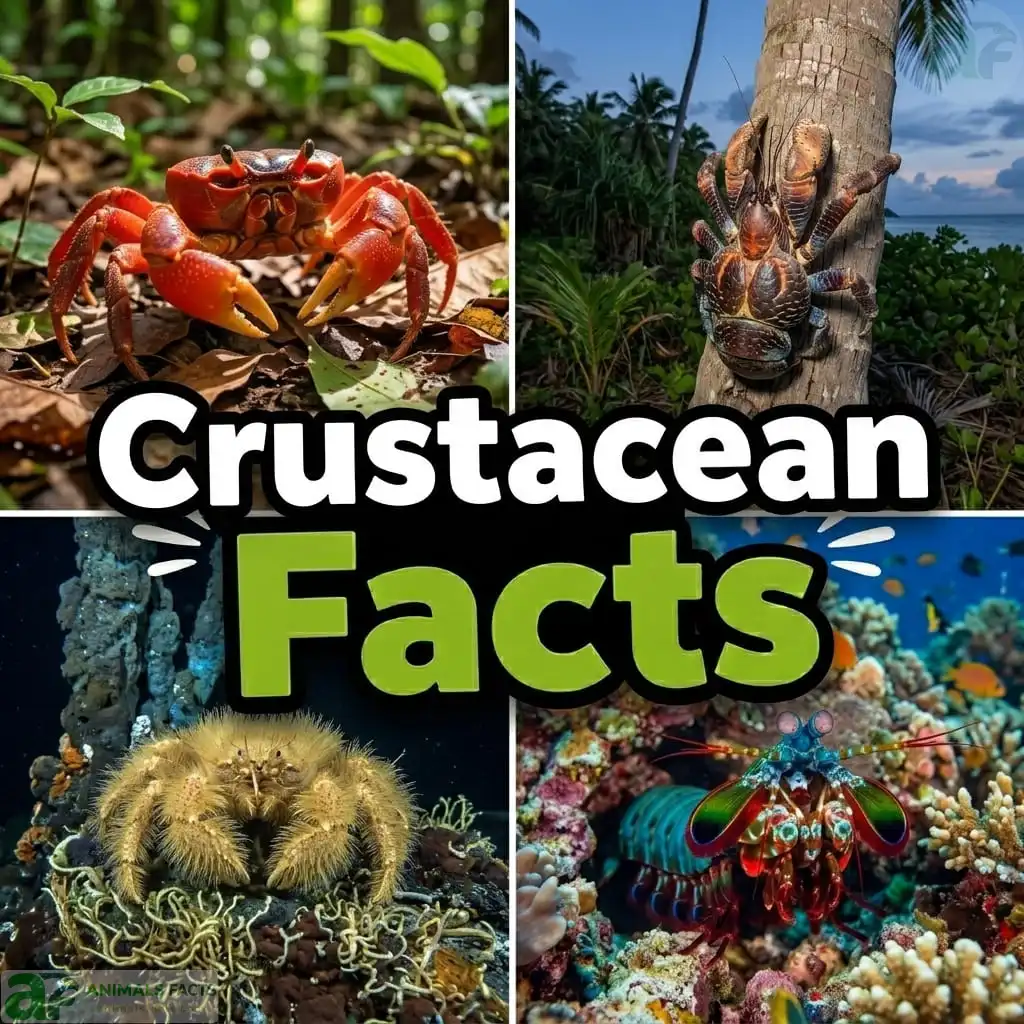
Crustacean Facts
| Feature | Details |
|---|---|
| Scientific Name (Subphylum) | Crustacea |
| Kingdom | Animalia |
| Phylum | Arthropoda |
| Subphylum | Crustacea |
| Meaning of Name | Latin: crusta — “shell” or “crust” |
| Number of Species | Over 67,000 described; estimated 100,000+ total |
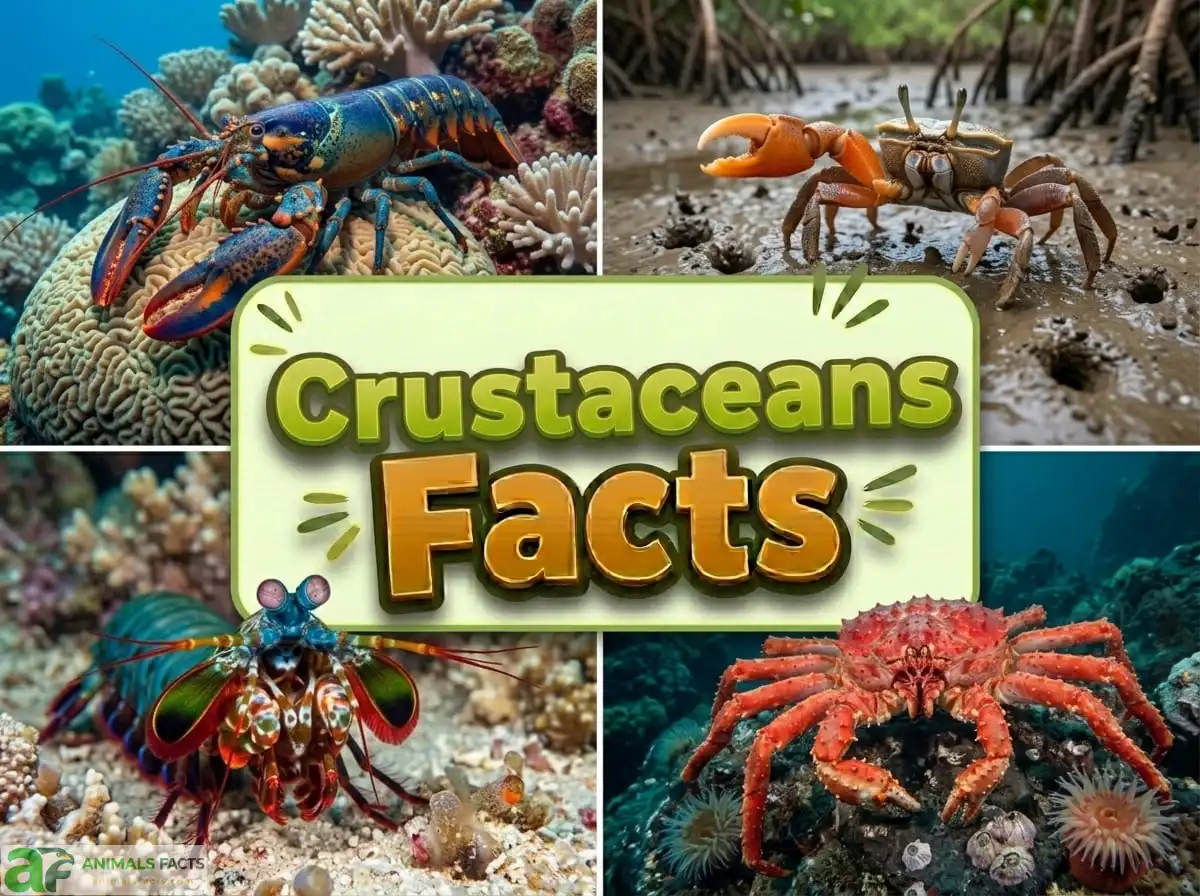
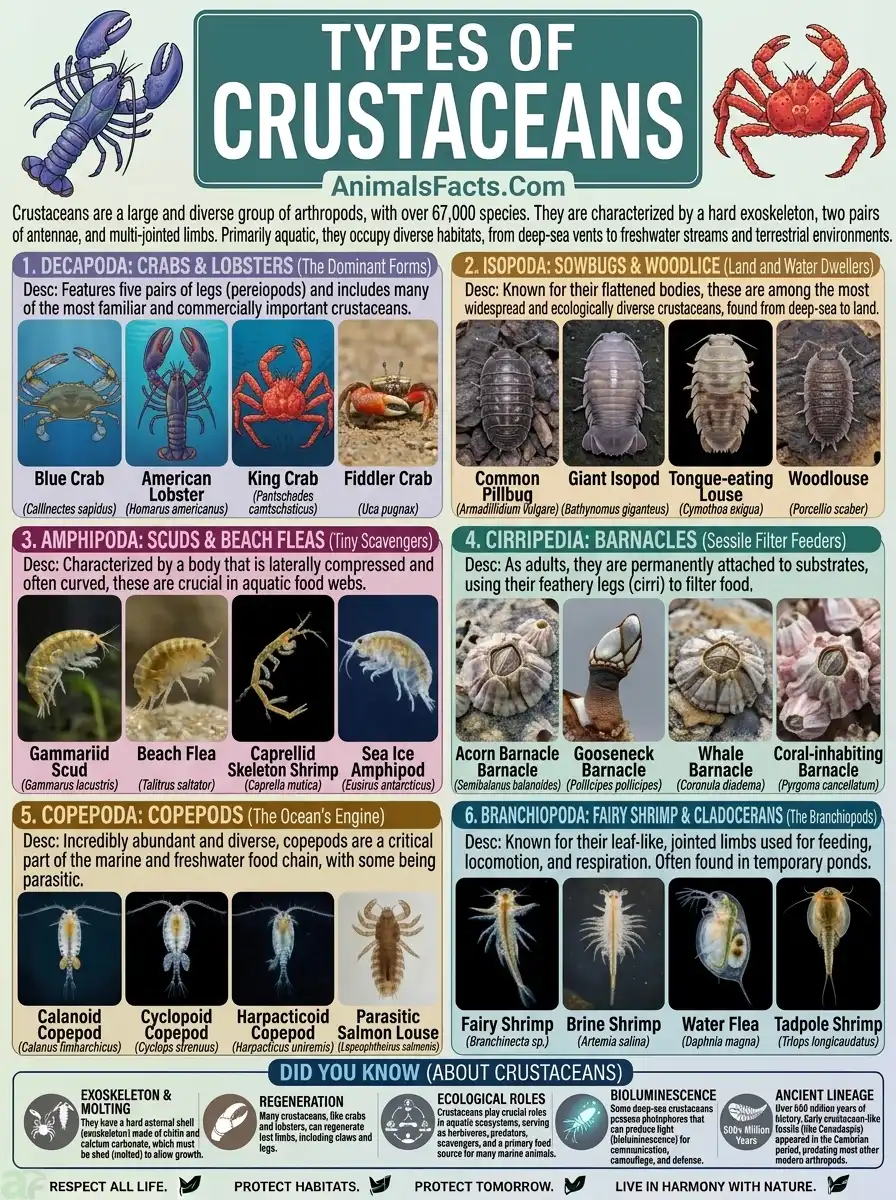
| Major Groups | Decapoda (crabs, lobsters, shrimp), Copepoda, Cirripedia (barnacles), Isopoda, Amphipoda, Branchiopoda, Ostracoda |
| Habitat | Oceans, freshwater, land — every aquatic environment on Earth; some terrestrial |
| Lifespan Range | A few weeks (some copepods) to 140+ years (American lobster) |
| Size Range | 0.1 mm (Stygotantulus stocki) to 3.7 m leg span (Japanese spider crab) |
| Diet | Filter feeders, carnivores, herbivores, omnivores, detritivores, parasites |
| Conservation Status | Varies — many species threatened; horseshoe shrimp Triops essentially unchanged for 200 million years |
| Oldest Fossil | ~512 million years ago (Cambrian period) |
| Population Estimate | Quadrillions — copepods alone are the most abundant multicellular animals on Earth |
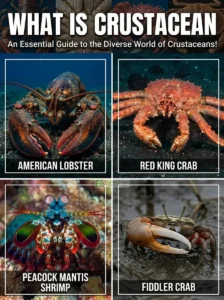 1. Introduction: What is a Crustacean?
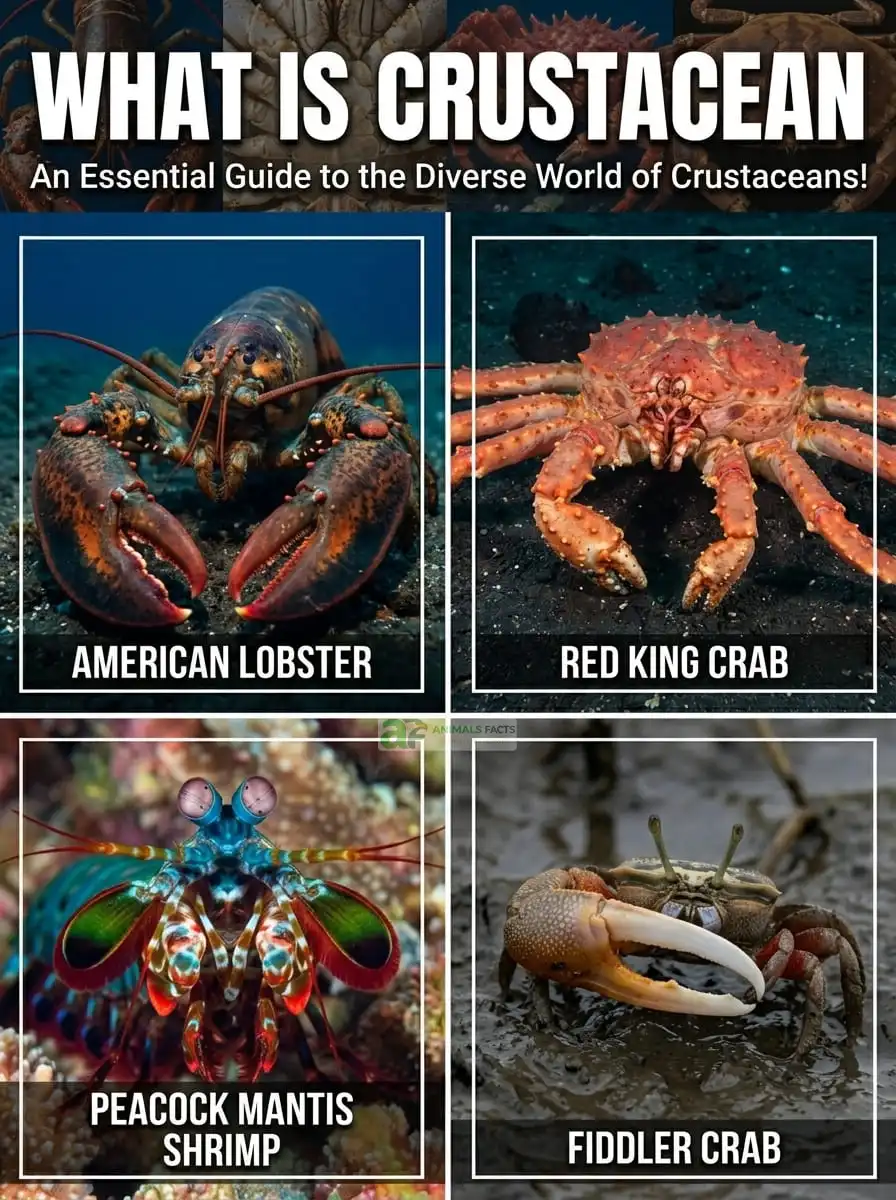
Picture the scene: a diver descends through shimmering blue water off the coast of Japan, and there — moving with ancient, unhurried grace across the ocean floor — is a creature with a leg span wider than a small car. It is a Japanese spider crab, and it may well be older than many of the humans watching footage of it online. Now shift the lens entirely: high above the Pacific, in the darkness of a plankton tow hauled aboard a research vessel, a scientist peers through a microscope at copepods so small they are almost invisible — yet so numerous that if you weighed all the copepods in the ocean, they would collectively outweigh every human being on Earth. Welcome to the world of crustacean facts — a world so vast, so ancient, and so biologically astonishing that most people have barely scratched its surface.
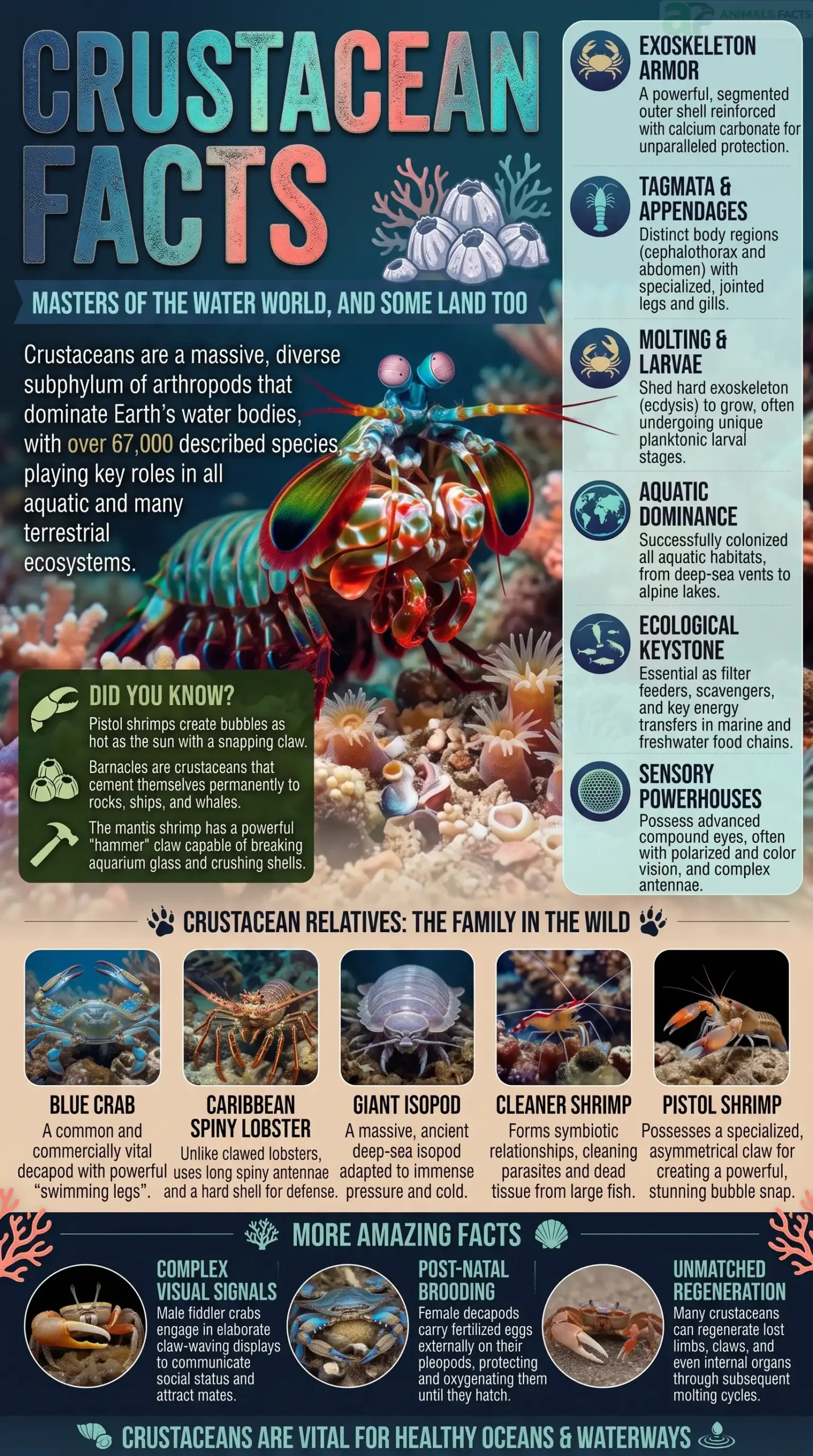
Crustaceans are the masters of aquatic life. With over 67,000 known species and an estimated 100,000 or more still undiscovered, the subphylum Crustacea represents one of the most spectacularly diverse lineages in the history of animal life. They range from the microscopic to the massive, from the familiar — crabs, lobsters, shrimp — to the bizarre: barnacles that glue themselves to surfaces for life, parasitic isopods that replace fish tongues, and mantis shrimp that punch with the acceleration of a bullet and see colors invisible to human eyes. Interesting facts about crustaceans arrive faster than most people expect, because the diversity of this group defies the comfortable assumptions we make about what a crustacean can be.
This is your complete, authoritative guide to crustacean facts — covering every major group, every record-breaking adaptation, and every vital ecological role these extraordinary animals play. Whether you are a student seeking crustacean facts for kids, a marine biologist cross-checking data, a teacher building a lesson plan, or simply someone who ordered lobster last night and suddenly wants to understand exactly what they were eating — this article was written for you.
2. Crustacean Species Overview & Classification
Crustaceans are members of the phylum Arthropoda — the largest animal phylum on Earth — and form the subphylum Crustacea. Within that subphylum, the diversity of body plans, lifestyles, sizes, and ecological roles is extraordinary enough to fill multiple encyclopedias.
Taxonomy Table
| Level | Classification |
|---|---|
| Kingdom | Animalia |
| Phylum | Arthropoda |
| Subphylum | Crustacea |
| Classes | ~42 recognized classes (historically); modern molecular classification reorganizes into fewer |
| Major Classes | Malacostraca, Maxillopoda, Branchiopoda, Ostracoda, Remipedia, Cephalocarida |
| Orders | Hundreds |
| Families | Thousands |
| Genera | Tens of thousands |
| Species (described) | Over 67,000 |
| Estimated total species | 100,000–150,000 |
Major Crustacean Classes and Groups
| Class / Group | Common Examples | Approx. Species | Defining Feature |
|---|---|---|---|
| Malacostraca | Crabs, lobsters, shrimp, krill, isopods, amphipods | ~40,000 | Most diverse class; 8 thoracic segments |
| Maxillopoda | Barnacles, copepods, fish lice | ~13,000 | Reduced abdomen; highly modified |
| Branchiopoda | Water fleas (Daphnia), brine shrimp, tadpole shrimp | ~1,100 | Leaf-like legs; mostly freshwater |
| Ostracoda | Seed shrimp | ~8,000 | Bivalved shell enclosing entire body |
| Remipedia | Cave-dwelling crustaceans | ~30 | Venomous; possibly closest to insects |
| Cephalocarida | Horseshoe shrimp | ~13 | Considered most primitive living crustaceans |
Key Orders Within Malacostraca
| Order | Common Name | Notable Members |
|---|---|---|
| Decapoda | True crabs, lobsters, shrimp | Blue crab, American lobster, mantis shrimp |
| Isopoda | Isopods, pill bugs, sea lice | Giant isopod, common woodlouse, tongue-eating louse |
| Amphipoda | Amphipods, sand hoppers | Deep Mariana Trench amphipods, freshwater shrimp |
| Euphausiacea | Krill | Antarctic krill (Euphausia superba) |
| Stomatopoda | Mantis shrimp | Peacock mantis shrimp (Odontodactylus scyllarus) |
Crustaceans Species Evolution & Discovery Timeline
- ~540 million years ago — Early arthropod body plans appear in the Cambrian explosion; crustacean-like animals among the earliest animals in the fossil record
- ~512 million years ago — Earliest unambiguous crustacean fossils documented; Cambropachycope and relatives established
- ~500 million years ago — Ostracods (seed shrimp) appear; one of the most continuously successful crustacean lineages in fossil history
- ~350 million years ago — Modern crustacean orders begin diversifying through the Carboniferous period
- ~250 million years ago — Permian extinction devastates marine life; crustaceans recover and diversify through the Triassic
- ~100 million years ago — True crabs (Brachyura) appear in fossil record; begin diversifying rapidly
- 1758 — Carl Linnaeus classifies major crustacean species in Systema Naturae
- 1829 — Pierre André Latreille formally establishes Crustacea as a systematic grouping
- 1970 — Horseshoe crab blood LAL testing standardized for pharmaceutical safety; the compound comes from a crustacean relative
- 1978 — Giant isopod (Bathynomus giganteus) photographed alive in the deep sea for the first time in modern science
- 1996 — Deep-sea thermal vent crustacean communities documented; yeti crabs and vent shrimp described
- 2006 — Kiwa hirsuta (yeti crab) discovered at hydrothermal vents in the Pacific — an entirely new family of crustaceans
- 2011 — Molecular phylogenetics confirms crustaceans are paraphyletic — insects evolved from within the crustacean lineage, making crustaceans and insects more closely related than previously understood
- 2020–2026 — Deep-sea submersible expeditions continue discovering new crustacean species annually; Mariana Trench amphipods and cave-adapted species particularly active areas of new discovery
3. Crustacean Physical Description & Features
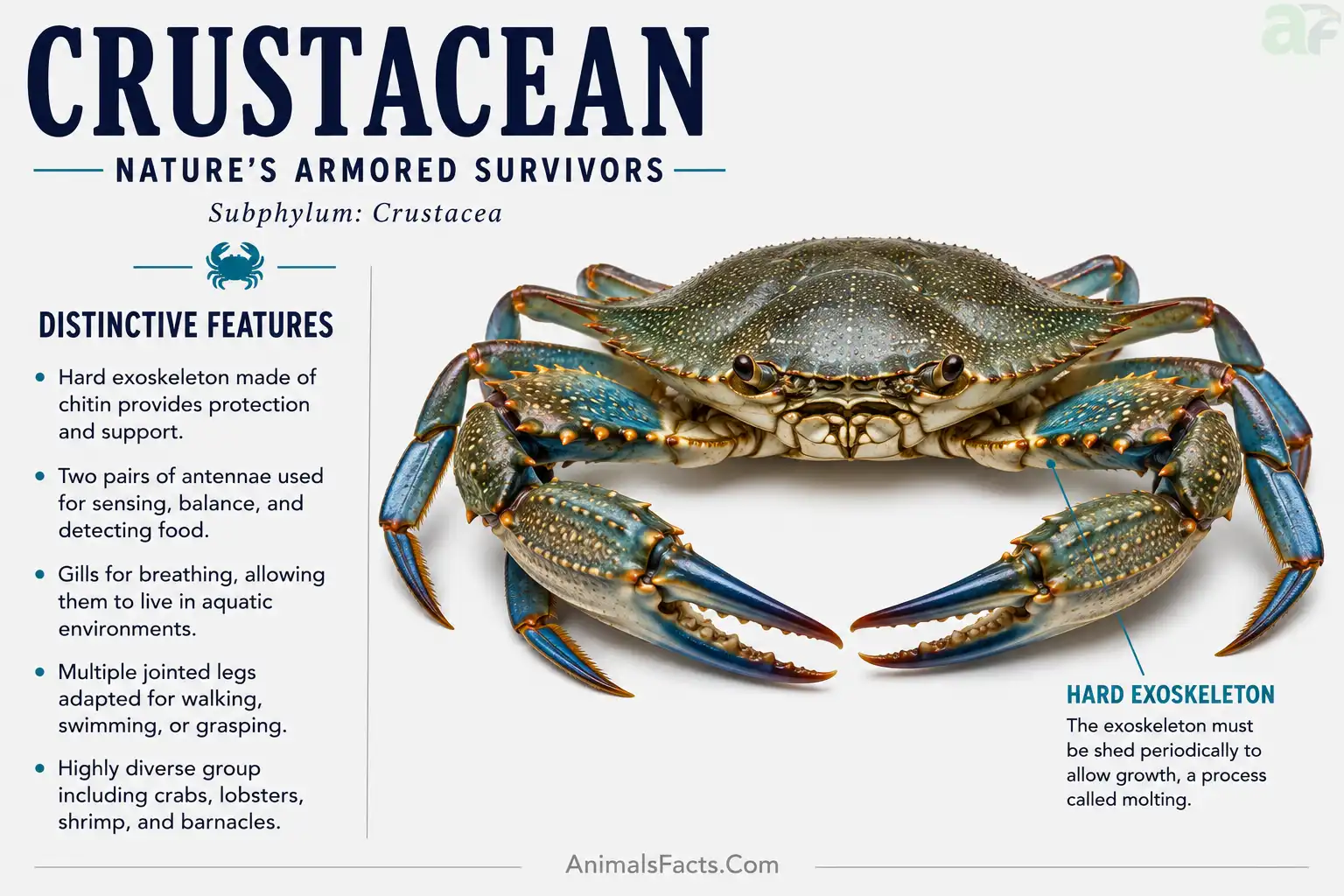
Despite the enormous diversity of crustaceans, all members of the subphylum share a foundational set of physical characteristics that define them as a group and distinguish them from other arthropods.
The Four Defining Physical Features of Crustaceans
1. Two pairs of antennae — The single most reliable distinguishing feature between crustaceans and other arthropods. Insects have one pair; spiders have none. Crustaceans always have two pairs — one pair of antennules (shorter) and one pair of antennae (longer) — serving as sensory organs for chemical detection, touch, and water current sensing.
2. Biramous appendages — Crustacean limbs are fundamentally two-branched (biramous) — each limb has an inner branch (endopod) and outer branch (exopod). Over evolutionary time, different branches have been modified for walking, swimming, feeding, reproduction, and respiration.
3. Exoskeleton (often calcified) — Like all arthropods, crustaceans have a hard outer shell made of chitin. Unlike insects, most crustaceans reinforce this with calcium carbonate — making their shells harder, heavier, and more crush-resistant. This is the “crust” their name references.
4. Nauplius larva — The majority of crustaceans pass through a distinctive early larval stage called the nauplius — a tiny, unsegmented larva with three pairs of limbs and a single eye. This shared larval form is one of the strongest pieces of evidence for the common ancestry of all crustaceans.
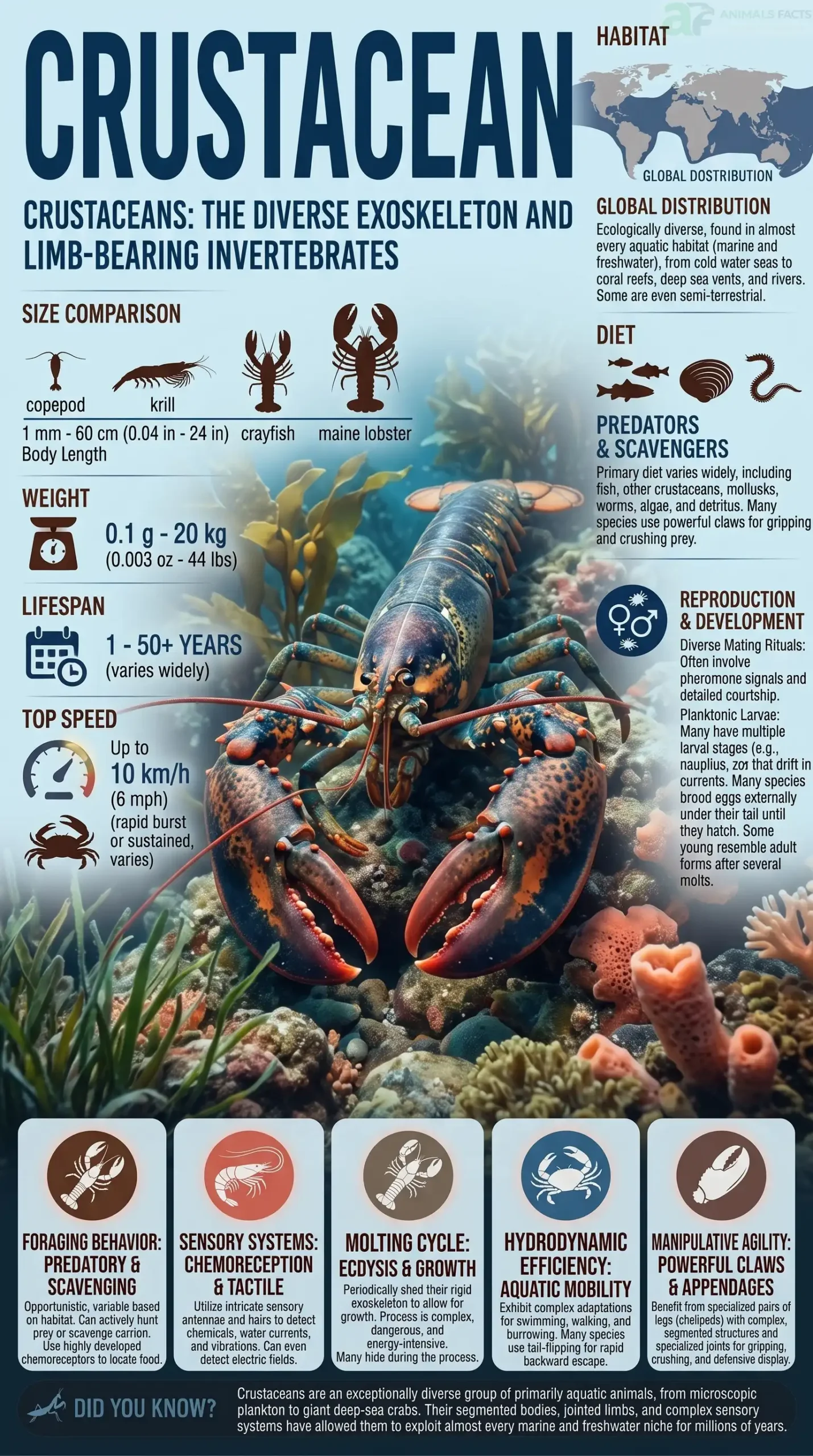
Crustacean Size Records Across Crustaceans
| Record | Species | Measurement |
|---|---|---|
| Smallest crustacean | Stygotantulus stocki (parasitic copepod) | 0.1 mm |
| Largest leg span | Japanese spider crab (Macrocheira kaempferi) | 3.7 m |
| Heaviest crustacean | American lobster (Homarus americanus); coconut crab (Birgus latro) | Lobster: 20 kg; Coconut crab: 4.1 kg terrestrially |
| Largest isopod | Giant isopod (Bathynomus giganteus) | Up to 76 cm length |
| Fastest punch | Peacock mantis shrimp (Odontodactylus scyllarus) | 23 m/s strike speed; 1,500 Newtons force |
| Deepest-living | Mariana Trench amphipods (Hirondellea gigas) | Found at 10,924 m depth |
| Most abundant | Antarctic krill (Euphausia superba) | Estimated 500 million tons total biomass |
Male vs. Female Differences Across Major Groups
| Group | Male | Female | Notable Difference |
|---|---|---|---|
| Crabs (Decapoda) | Narrow, triangular abdomen | Broad, rounded abdomen (for egg brooding) | Abdomen shape diagnostic |
| Lobsters | Narrower tail; first pleopods hardened | Broader tail; softer first pleopods | Females carry eggs under tail |
| Barnacles | None — all barnacles hermaphroditic | None — all hermaphroditic | Have world’s longest penis relative to body size |
| Copepods | Smaller; often modified antennae for grasping | Larger; carry egg sacs | Females easily identified by egg sacs |
| Mantis shrimp | More colorful (some species) | Carry eggs in forelimbs | Females actively brood egg masses |
“The mantis shrimp alone should cause us to fundamentally reconsider what we mean by perception. They see the world through 16 color receptors — compared to our 3 — and process color information in a way so different from vertebrates that it challenges our entire framework for understanding vision.” — Dr. Roy Caldwell, University of California Berkeley, mantis shrimp researcher
4. Top 25 Amazing Crustacean Facts
Here are the most extraordinary, conversation-stopping interesting facts about crustaceans — each one more astonishing than the last:
- Crustaceans are so closely related to insects that molecular biology now considers insects to have evolved from within the crustacean lineage — making “crustaceans” technically a paraphyletic group
- The peacock mantis shrimp punches with the acceleration of a 22-caliber bullet — generating 1,500 Newtons of force from an animal smaller than a human hand
- Mantis shrimp possess 16 types of photoreceptors — compared to humans’ 3 — allowing them to perceive ultraviolet, infrared, and polarized light simultaneously
- Copepods are the most abundant multicellular animals on Earth — there may be more copepods in the ocean than stars in the observable universe
- The American lobster may be biologically immortal — it does not show standard cellular signs of aging and continues growing and reproducing until it dies from external causes; the oldest verified specimen was estimated at 140 years
- Barnacles have the longest penis relative to body size of any known animal — up to 8 times their body length — necessary because they are sessile and cannot move to find a mate
- The coconut crab (Birgus latro) is the world’s largest land invertebrate — it can climb palm trees, crack open coconuts with its claws, and has been documented scavenging seabirds
- Antarctic krill form swarms so massive they can be seen from space — a single swarm can weigh over 2 million tons
- The giant isopod (Bathynomus giganteus) can survive 5 years without food — a specimen in a Japanese aquarium went on a documented 5-year hunger strike before dying
- Horseshoe shrimp (Triops spp.) are essentially unchanged from fossils 200 million years old — making them among the oldest living animal forms on Earth
- The pistol shrimp (Alpheus spp.) snaps its claw so fast it creates a cavitation bubble reaching 8,000°C — briefly hotter than the surface of the Sun — to stun prey
- Some deep-sea crabs have been found living beside hydrothermal vents at temperatures exceeding 80°C — among the most extreme environments where complex animals survive
- Remipedia — a tiny cave-dwelling crustacean order — is now considered the closest living relative of insects based on molecular evidence
- A female American lobster can carry up to 100,000 eggs under her tail for 9–11 months before they hatch
- Krill produce a bioluminescent glow — they can emit blue-green light from photophores along their body in coordinated patterns
- The woodlouse (also called pill bug or roly-poly) is the only crustacean that has fully colonized land and breathes entirely with modified gill-like structures called pseudotracheae
- Copepods can accelerate at 500 body lengths per second — the highest acceleration of any animal relative to body size ever recorded
- The yeti crab (Kiwa hirsuta), discovered in 2006, farms bacteria on its own hairy claws and waves them near hydrothermal vents to cultivate its food
- Barnacle larvae (nauplii) can detect the chemical signatures of surfaces where other barnacles are already attached — choosing their permanent settlement site with sophisticated chemical discrimination
- Some ostracod crustaceans produce the brightest bioluminescence of any marine animal — their flashing light patterns in Caribbean waters have been documented since the 16th century
- The tongue-eating louse (Cymothoa exigua) — a parasitic isopod — severs a fish’s tongue, attaches to the stub, and becomes a functional replacement tongue for the host — one of the most disturbing parasitic relationships in nature
- Crayfish are used extensively in neuroscience research because their neural circuits for defensive behavior are among the most thoroughly understood of any animal
- The mantis shrimp uses two distinct hunting weapons — spearers (with sharp spines for impaling soft prey) and smashers (with club-like appendages for shattering hard shells) — two entirely different tools in the same order
- Some amphipods in the Mariana Trench have been found to contain persistent organic pollutants (PCBs) at concentrations 50 times higher than crabs in heavily polluted Chinese rivers — demonstrating how human pollution reaches the deepest point on Earth
- Daphnia (water fleas) can change their own gene expression within a single generation in response to predator chemical signals — growing defensive spines and helmets that make them harder to eat, without any change to their underlying DNA sequence
Did You Know? The mantis shrimp’s strike is so fast that it creates two separate impacts on its prey — first the physical blow of the club itself, then a second wave of force from the implosion of the cavitation bubble formed in the water. Even if the physical strike misses, the shockwave from the collapsing bubble can stun or kill nearby prey.
5. Crustacean Fun Facts for Kids
- Crustaceans include over 67,000 known species — from microscopic to massive
- Copepods are the most abundant multicellular animals on Earth
- The American lobster may live to 140+ years and may not biologically age
- The Japanese spider crab has a 3.7 m leg span — wider than a car
- Mantis shrimp punch with bullet-like acceleration — shattering aquarium glass
- Mantis shrimp have 16 types of color receptors — humans have only 3
- Antarctic krill swarms can weigh over 2 million tons
- Pistol shrimp claws create heat hotter than the Sun momentarily
- Coconut crabs climb palm trees and crack open coconuts with their claws
- Barnacles have the longest penis relative to body size of any known animal
- The giant isopod survived 5 years without eating in captivity
- Insects evolved from within the crustacean lineage — they are essentially land crustaceans
- Yeti crabs farm bacteria on their hairy claws near hydrothermal vents
- Krill glow blue-green through bioluminescent photophores
- The tongue-eating louse replaces a fish’s tongue and lives inside its mouth
6. Natural Habitat & Geographic Range of Crustaceans
Crustaceans have conquered nearly every aquatic environment on Earth — and a surprising number of terrestrial ones. Their success across such wildly different habitats is a testament to the remarkable adaptability of the crustacean body plan.
Habitat Range by Environment
| Habitat Type | Dominant Crustacean Groups | Notable Species |
|---|---|---|
| Deep ocean (>1,000 m) | Giant isopods, amphipods, deep-sea shrimp, crabs | Giant isopod, Mariana amphipod, dumbo shrimp |
| Hydrothermal vents | Vent shrimp, yeti crabs, specialized crabs | Rimicaris exoculata, yeti crab (Kiwa hirsuta) |
| Coral reef | Reef shrimp, mantis shrimp, decorator crabs, porcelain crabs | Peacock mantis shrimp, cleaner shrimp, boxer crab |
| Intertidal zone | Barnacles, shore crabs, hermit crabs, isopods | Acorn barnacle, shore crab, common hermit crab |
| Open ocean (pelagic) | Copepods, krill, hyperiid amphipods | Antarctic krill, Calanus finmarchicus |
| Freshwater | Crayfish, freshwater crabs, water fleas, freshwater shrimp | Red swamp crayfish, Daphnia, Gammarus |
| Brackish water | Fiddler crabs, mud crabs, shore shrimp | Fiddler crab, blue crab |
| Terrestrial | Coconut crabs, robber crabs, woodlice, land hermit crabs | Coconut crab (Birgus latro), common woodlouse |
| Caves (anchialine) | Remipedia, blind cave crayfish, cave shrimp | Speleonectes, Orconectes pellucidus |
| Polar (Arctic/Antarctic) | Krill, ice amphipods, Arctic copepods | Euphausia superba, Gammarus wilkitzkii |
| Parasitic (on hosts) | Fish lice, tongue-eating lice, whale barnacles | Cymothoa exigua, Coronula diadema |
Continent-by-Continent Crustacean Highlights
| Region | Crustacean Highlights | Notable Record |
|---|---|---|
| Asia (Pacific) | Japanese spider crab, mantis shrimp, tiger shrimp | Japanese spider crab: largest leg span of any arthropod |
| North America | American lobster, blue crab, crayfish diversity | Eastern U.S. has the world’s greatest freshwater crayfish diversity |
| South America | Amazon river shrimp, fiddler crabs, mitten crabs | Amazon basin hosts extraordinary endemic crayfish |
| Europe | Common shore crab, barnacles, freshwater crayfish | White-clawed crayfish critically threatened by invasive signal crayfish |
| Africa | Ghost crabs, freshwater crabs, mantis shrimp | Hundreds of endemic freshwater crab species |
| Australia | Giant mud crab, balmain bug, mantis shrimp | Saltwater crocodile regions host giant mud crab |
| Antarctica | Antarctic krill, deep-sea isopods | Krill: cornerstone of entire Southern Ocean food web |
| Ocean (global) | Copepods, barnacles on whales, deep-sea shrimp | Copepods found in every ocean body on Earth |
Did You Know? Whale barnacles (Coronula diadema and relatives) are crustaceans that permanently cement themselves onto the skin of humpback and right whales. A single large humpback whale may carry 450 kg of barnacles — nearly half a ton — hitching a global ride while filter-feeding in the whale’s wake. Scientists use barnacle chemical signatures to track whale migration routes long after the whales have moved on.
7. Crustacean Diet & Feeding Behavior
Crustaceans collectively practice virtually every feeding strategy in the animal kingdom — from the elegant filter-feeding architecture of the barnacle, to the explosive violence of the mantis shrimp’s predatory strike, to the peculiar farming behavior of the yeti crab.
Diet Breakdown Across Major Groups
| Group | Diet Type | Primary Food Source | Feeding Method |
|---|---|---|---|
| Copepods | Filter feeder | Phytoplankton, bacteria | Suspension feeding with specialized appendages |
| Krill | Filter feeder | Phytoplankton, ice algae, zooplankton | Filtering basket formed by thoracic limbs |
| Barnacles | Filter feeder | Plankton, organic particles | Feathery cirri sweep water rhythmically |
| Crabs (most) | Omnivore | Algae, mollusks, carrion, fish, detritus | Crushing claws; scavenging |
| Lobsters | Omnivore / Carnivore | Clams, mussels, urchins, fish, carrion | Heavy claws; nocturnal scavenging |
| Mantis shrimp | Strict carnivore | Fish, shrimp, crabs, mollusks, worms | Spearing or smashing with raptorial appendages |
| Crayfish | Omnivore | Algae, aquatic plants, insects, worms, carrion | Chelipeds; bottom foraging |
| Isopods (giant) | Scavenger | Carrion, dead fish, whale falls | Biting mouthparts; opportunistic |
| Water fleas (Daphnia) | Filter feeder | Algae, bacteria | Thoracic limb filtration |
| Pistol shrimp | Carnivore | Small fish, invertebrates | Cavitation bubble stun + claw strike |
| Yeti crab | Farmer / omnivore | Bacteria cultivated on claws | Wave claws near vent to grow bacteria; scrape and eat |
| Tongue-eating louse | Parasite | Fish blood and mucus | Suck fluids from fish host; replace tongue |
| Coconut crab | Omnivore | Coconuts, carrion, fruits, seabirds | Powerful claws; tree climbing; scavenging |
One of the most remarkable feeding behaviors in the entire subphylum belongs to the cleaner shrimp — species like Lysmata amboinensis that establish cleaning stations on coral reefs where fish queue up and hold still while the shrimp crawls over their bodies, into their gills, and even inside their open mouths — removing parasites, dead tissue, and food debris. It is a mutual arrangement, and predatory fish that would normally eat shrimp recognize and honor the cleaning station as a neutral zone.
8. Crustacean Reproduction & Life Cycle
Crustaceans display a stunning diversity of reproductive strategies — united by the shared nauplius larval stage in most groups, but diverging dramatically in mating behavior, egg care, larval development, and lifespan.
Reproductive Strategies Across Groups
Broadcast spawning — Many marine crustaceans (barnacles, copepods, some shrimp) release eggs and sperm into open water, where fertilization occurs externally. Larvae drift as plankton before settling.
Egg brooding — Female crabs, lobsters, and crayfish carry fertilized eggs attached to specialized abdominal appendages (pleopods) until hatching — aerating and cleaning eggs continuously for weeks to months.
Hermaphroditism — All barnacles are simultaneously hermaphroditic — possessing both male and female reproductive organs. Because they are permanently attached to surfaces, they extend their extraordinarily long penis to reach neighboring barnacles.
Parthenogenesis — Some crustaceans — particularly water fleas (Daphnia) — reproduce asexually for multiple generations, producing genetically identical female offspring, before switching to sexual reproduction when environmental conditions deteriorate.
Sperm storage — Female blue crabs mate only once in their lifetime, storing sperm from that single mating in specialized receptacles and using it to fertilize two separate batches of eggs.
Life Stages of a Typical Decapod Crustacean
- Egg — Attached to female’s abdomen; incubation 2 weeks to 11 months depending on species and temperature
- Nauplius larva — Tiny, free-swimming; 3 pairs of appendages; single eye — characteristic of most crustaceans
- Zoea larva — More developed; begins to resemble adult body plan; drifts as plankton
- Megalopa / Mysis larva — Transitional stage; settles from open water toward habitat
- Juvenile — Small adult; all segments present; continues molting and growing
- Adult — Sexually mature; continues molting throughout life in most species
Crustacean Lifespan Comparison
| Species | Lifespan | Notes |
|---|---|---|
| Copepod (Calanus finmarchicus) | 1–2 years | One of the world’s most abundant animals |
| Common shore crab (Carcinus maenas) | 3–5 years | Highly invasive worldwide |
| Blue crab (Callinectes sapidus) | 3–4 years | Major commercial fishery species |
| American lobster (Homarus americanus) | Up to 140 years | May not biologically senesce |
| Japanese spider crab (Macrocheira kaempferi) | Up to 100 years | Longest-lived decapod after lobster |
| Coconut crab (Birgus latro) | Up to 60 years | Slowest-growing land invertebrate |
| Giant isopod (Bathynomus giganteus) | Unknown; estimated decades | Little studied in wild |
| Water flea (Daphnia) | A few weeks to months | Asexual reproduction in summer |
Did You Know? When a lobster molts its exoskeleton, it is completely vulnerable for several hours — its new shell is soft, and it hides in crevices during this period. Remarkably, it consumes its own shed shell immediately after molting — reclaiming the calcium carbonate to harden the new shell as quickly as possible. A lobster may molt over 25 times in its first 5–7 years of life alone.
9. Social Behavior & Communication
Crustaceans range from completely asocial to surprisingly complex in their social arrangements, with some species displaying communication systems and collective behaviors that challenge simple assumptions about invertebrate intelligence.
Social Structures
Solitary species — Most large decapods (lobsters, most crabs) are essentially solitary outside mating season, maintaining individual territories that they actively defend.
Aggregating species — Christmas Island red crabs (Gecarcoidea natalis) form one of nature’s most spectacular mass movements — over 50 million individuals migrate from forest to coast simultaneously to breed and release eggs, covering roads, cliffs, and beaches in a living red carpet.
Colonial species — Barnacles cannot survive without neighbors, as their cross-fertilizing reproduction requires proximity. They actively select settlement sites based on the chemical signatures of existing barnacle communities.
Cleaning stations — Cleaner shrimp maintain complex social arrangements with fish clients — defending territory, signaling availability, and maintaining behavioral protocols with dozens of client species.
Communication Methods
| Method | Group | Purpose |
|---|---|---|
| Chemical (pheromones) | Lobsters, crabs, shrimp | Mate attraction; territorial marking; alarm signals |
| Stridulation (sound) | Crabs, pistol shrimp, mantis shrimp | Territory defense; mate attraction; warning |
| Visual display | Fiddler crabs, mantis shrimp, hermit crabs | Mate competition; threat display; species recognition |
| Antennal contact | Lobsters, crayfish | Individual recognition; dominance hierarchy establishment |
| Urine signaling | Lobsters | Dominant lobsters release urine containing chemical signals that establish and reinforce social hierarchy |
| Vibration | Pistol shrimp pairs | Alpheus spp. communicate with goby fish partners through burrow vibrations |
Intelligence Facts
Research has revealed that crustacean cognition is considerably more sophisticated than previously assumed:
- Mantis shrimp recognize individual neighbors through complex visual signals and adjust their aggressive behavior based on whether the opponent is a known individual or a stranger
- Hermit crabs engage in complex chains of cooperative shell exchange — a larger crab evicts a smaller crab from its shell, which moves to another shell, which triggers a cascade of simultaneous shell exchanges among dozens of individuals — a form of cooperative resource allocation
- Crayfish demonstrate both long-term memory and exhibit anxiety-like states that respond to anti-anxiety drugs — one of the lines of evidence suggesting crustacean sentience
10. Predators & Defense Mechanisms
Natural Predators of Crustaceans
- Fish (grouper, cod, halibut, triggerfish) — Major predators of reef and benthic crustaceans
- Octopuses and squid — Active hunters of crabs and shrimp on reef and rocky substrate
- Sea otters — Crack open crabs, clams, and urchins; keystone predators of Pacific crustacean communities
- Seabirds (gulls, herons, oystercatchers) — Intertidal and coastal crustaceans
- Marine mammals (whales, seals, dolphins) — Feed heavily on krill and small crustaceans
- Other crustaceans — Cannibalism is widespread; larger crabs regularly prey on smaller ones during their soft-shell molting stage
Defense Strategies
| Strategy | Group | Description |
|---|---|---|
| Hard exoskeleton | All decapods | Calcium carbonate shell resists crushing and biting |
| Autotomy | Crabs, lobsters | Voluntarily shed a claw or limb to escape; fully regenerate at next molt |
| Burrowing | Shrimp, sand crabs, ghost crabs | Disappear into substrate at remarkable speed |
| Camouflage | Decorator crabs, sargassum crabs, ghost shrimp | Cover body in algae, sponges, debris; transparent bodies |
| Chemical defense | Some shore crabs, mantis shrimp | Noxious secretions; venomous spines (some species) |
| Speed and agility | Ghost crabs, mantis shrimp | Ghost crab: fastest running crustacean at 16 km/h |
| Weaponized strike | Mantis shrimp | Offensive capability so powerful it doubles as defense |
| Symbiotic association | Boxer crab | Carries sea anemones in claws — using their stinging tentacles as weapons and shields simultaneously |
| Warning coloration | Blue-ringed octopus (crustacean prey) | Vivid patterns warn of toxicity; adopted defensively by toxic shrimp species too |
Did You Know? The boxer crab (Lybia tessellata) carries a small sea anemone in each claw — using the anemones’ stinging tentacles both to capture food and to deter predators. When a boxer crab loses one of its anemones, it has been documented tearing the remaining anemone in half to create two smaller anemones — ensuring it remains armed on both claws. This is one of the most remarkable examples of tool use in any invertebrate.
11. Crustacean Facts for Kids
Hey young explorers! Crustaceans are some of the most amazing animals on Earth — and most people don’t realize just how extraordinary they are! Here are some fantastic crustacean facts just for you:
- There are over 67,000 kinds of crustaceans — from tiny water fleas to crabs with legs wider than your whole body!
- The mantis shrimp can punch so fast it breaks aquarium glass — with arms smaller than your finger!
- Barnacles — those crusty things stuck on rocks at the beach — are actually crustaceans, related to crabs and lobsters!
- A lobster can live for over 100 years and just keeps growing bigger and bigger!
- Krill are tiny shrimp-like creatures that glow in the dark in the deep ocean!
- The coconut crab can climb tall palm trees and crack open coconuts with its claws — the world’s strongest land invertebrate!
- When a crab loses a claw, it grows a brand new one at its next molt — like a superpower!
- Water fleas (Daphnia) — tiny crustaceans in ponds — can grow defensive spines and helmets when they sense a predator is nearby!
- The tongue-eating louse is a crustacean that replaces a fish’s tongue and lives inside its mouth — one of nature’s creepiest facts!
- Some tiny crustaceans called copepods are so numerous that if you counted them all, there would be more copepods than stars in the sky!
12. Relationship with Humans
No invertebrate group has a more economically significant relationship with humanity than crustaceans — feeding billions, protecting medicine, building industries, and threatening ecosystems all at once.
Crustaceans as Food
Crustaceans represent one of the most commercially valuable categories in global fisheries. Key figures for 2024–2025:
- Global crustacean aquaculture and wild capture: approximately 16 million metric tons annually
- Commercial value: estimated $70–90 billion USD per year globally
- Shrimp and prawns account for the largest share by both volume and value — the world’s most traded seafood commodity
- Lobsters (American and spiny) generate billions in premium seafood markets, particularly in North America, Europe, and East Asia
- Crabs (blue, snow, king, Dungeness) are major fisheries in North America, Russia, and East Asia
- Krill — harvested primarily in Antarctic waters — is processed into omega-3 supplements, aquaculture feed, and pharmaceutical products
Medical and Scientific Contributions
Horseshoe crab LAL — Though technically a chelicerate (not a true crustacean), the medical precedent established here parallels crustacean pharmaceutical potential enormously. Crustacean-derived compounds are actively researched for antibiotic, anti-inflammatory, and anti-cancer applications.
Chitin — The primary structural component of crustacean shells, chitin is one of the most abundantly produced natural polymers on Earth. After crustacean processing, the shells are processed into chitosan — used in wound healing, drug delivery, water purification, agricultural films, and food preservation. The global chitosan market exceeds $1 billion annually.
Neuroscience — Crayfish and lobster nervous systems have been foundational models in neuroscience research for decades — their relatively simple and large neurons allow direct observation of neural circuit function.
Astaxanthin — The carotenoid pigment that gives shrimp and lobster their characteristic red color when cooked is derived from crustacean processing waste and is one of the most powerful antioxidants known — used extensively in human nutrition supplements and aquaculture feed.
Crustaceans as Pests and Invaders
- The Chinese mitten crab (Eriocheir sinensis) has invaded European and North American rivers through ballast water, burrowing into riverbanks and outcompeting native species — causing millions in infrastructure damage
- The red swamp crayfish (Procambarus clarkii) has invaded European and African freshwater systems, devastating native invertebrate and amphibian communities
- Barnacles biofoul ship hulls globally, adding billions of dollars in fuel costs annually through increased drag — the global antifouling market generated to combat barnacle growth exceeds $7 billion per year
13. Crustacean Conservation Status & Threats
The Crustacean Conservation Crisis
Crustaceans face a multifaceted conservation crisis — particularly in freshwater systems and coral reef environments — that is largely invisible to the general public:
- Freshwater crabs and crayfish are among the most threatened animal groups globally — over 30% of freshwater crayfish species are threatened with extinction in North America alone
- The European white-clawed crayfish (Austropotamobius pallipes) is Endangered and disappearing rapidly from rivers across the UK and mainland Europe, displaced by the invasive North American signal crayfish
- Coral reef crustacean communities are severely impacted by coral bleaching — when corals die, the complex habitat structure that dozens of specialist crab, shrimp, and mantis shrimp species depend on is destroyed
- Horseshoe crabs (chelicerates closely associated with crustaceans in medical testing) are Vulnerable — overharvested for pharmaceutical blood extraction and as bait in eel and whelk fisheries
IUCN Status of Selected Crustaceans
| Species | IUCN Status |
|---|---|
| White-clawed crayfish (Austropotamobius pallipes) | Endangered |
| Horseshoe crab (Limulus polyphemus) | Vulnerable |
| American lobster (Homarus americanus) | Vulnerable |
| Christmas Island red crab (Gecarcoidea natalis) | Not assessed (threatened by invasive yellow crazy ant) |
| Freshwater pearl crayfish (multiple Austropotamobius spp.) | Critically Endangered |
| Antarctic krill (Euphausia superba) | Least Concern (but population monitored closely) |
| Giant isopod (Bathynomus giganteus) | Data Deficient |
Major Threats
| Threat | Impact Level | Crustaceans Most Affected |
|---|---|---|
| Ocean warming and acidification | Critical | Coral reef crustaceans; calcified shells dissolve in acidified water |
| Overfishing | Critical | Lobsters, crabs, shrimp; many stocks at or beyond sustainable limits |
| Habitat destruction | High | Freshwater crabs/crayfish (riparian destruction); reef shrimp (coral loss) |
| Invasive species | High | Native crayfish displaced by invasive species across 3 continents |
| Pesticides and runoff | High | Freshwater crustaceans; neonicotinoids toxic to aquatic invertebrates |
| Microplastic pollution | High | Filter feeders (copepods, krill, barnacles) ingest microplastics; biomagnifies up food chain |
| Climate change (polar) | High | Antarctic krill depend on sea ice algae; sea ice loss threatens food supply |
| Deep-sea mining | Emerging | Deep-sea crustacean communities poorly studied but potentially catastrophic |
14. Famous Crustaceans
Larry the Lobster – The Survivor
In 2012, a 132-year-old American lobster named Larry — estimated from his weight of 10 kg (lobsters grow continuously) — was caught off the coast of Newfoundland and famously returned to the sea after public outcry, becoming a symbol of lobster longevity and the growing conversation around crustacean welfare.
Sebastian – The Cultural Ambassador
The red Sebastian from Disney’s The Little Mermaid (1989) is almost certainly the most famous crustacean in popular culture history — a Jamaican-accented crab who conducts undersea musical orchestras and worries about a mermaid’s life choices. Despite being portrayed as a crab, Sebastian is officially called a “court composer and musician” in the film — his species not specified by Disney.
The Mantis Shrimp “Peacock” – Internet Royalty
An unnamed peacock mantis shrimp (Odontodactylus scyllarus) became an internet sensation in 2012 when the webcomic The Oatmeal published an illustrated tribute to mantis shrimp biology that received over 1 million shares in its first week — introducing the mantis shrimp’s extraordinary vision and striking power to a generation of internet users who had never previously considered crustaceans exciting.
Christmas Island Red Crabs – Nature’s Greatest Spectacle
The 50+ million Christmas Island red crabs (Gecarcoidea natalis) that migrate from forest to ocean each November–December collectively represent one of the most spectacular wildlife events on Earth — roads are closed, bridges specially constructed, and park rangers hand-redirect individual crabs for weeks to protect the migration. David Attenborough featured the event in Life (BBC, 2009) in one of the most-viewed nature sequences of the past decade.
The Yeti Crab – The Discovery of the Century
When researchers aboard the research vessel Atlantis descended to the hydrothermal vents of the East Pacific Rise in 2005 and photographed Kiwa hirsuta — a snow-white crab covered in silky blond “fur” — it represented not just a new species but an entirely new crustacean family. The yeti crab became one of the most iconic deep-sea discoveries ever made and sparked worldwide media coverage of hydrothermal vent ecosystems.
15. Role in Ecosystem & Food Chain
Crustaceans are not merely participants in marine and freshwater ecosystems — they are structural components without which those ecosystems would fundamentally collapse.
Core Ecological Roles
Foundation of marine food chains — Copepods and krill are the critical link between phytoplankton (microscopic marine plants) and every large marine animal on Earth. Whales, penguins, seals, tuna, salmon, seabirds — all ultimately depend on crustacean zooplankton to convert ocean plant matter into accessible animal protein. The collapse of copepod or krill populations would cascade upward through every marine food web on Earth.
Reef cleaning and maintenance — Cleaner shrimp on coral reefs perform a service equivalent to a medical sanitation system — removing parasites, dead tissue, and bacterial growth from fish hosts, preventing disease outbreaks that could devastate reef fish populations.
Bioturbation and sediment health — Burrowing crustaceans — fiddler crabs, ghost shrimp, mud shrimp — aerate and turn over marine sediments, releasing nutrients, oxygenating the seafloor, and maintaining the chemical balance that allows benthic communities to function. The loss of burrowing crustaceans from an estuary measurably degrades water quality within years.
Decomposition at depth — Deep-sea crustaceans — isopods, amphipods — are critical scavengers at depth, consuming whale falls, fish carcasses, and organic debris that sinks from the surface. They process and recycle biological material in environments where almost nothing else could perform this function.
Prey base for charismatic megafauna — Blue whales eat almost nothing but krill. Whale sharks filter copepods. Sea otters depend on crabs and sea urchins. The conservation of charismatic marine megafauna is inextricably linked to the health of crustacean populations.
16. Crustacean Myths, Folklore & Cultural Significance
Cancer – The Celestial Crab
The zodiac sign Cancer (June 21 – July 22) is represented by a crab — derived from ancient Greek mythology in which the goddess Hera sent a crab to distract Hercules during his battle with the Lernaean Hydra. The crab pinched Hercules’s toe, was crushed for its trouble, and was immortalized in the night sky as a constellation. The Greek word karkinos (crab) also gave its name to the disease cancer — ancient physicians likened the appearance of tumor blood vessels spreading through tissue to the legs of a crab.
Chinese Culture – The Crab as Autumn Luxury
In China, the hairy crab (Eriocheir sinensis, the Chinese mitten crab) has been a symbol of autumn luxury and scholarly enjoyment for over 1,000 years. During the Tang Dynasty, poets wrote extensively about eating hairy crabs with warm rice wine under autumn moonlight. Today, authentic Yangcheng Lake hairy crabs are one of China’s most expensive seasonal delicacies — a single crab can command the equivalent of $150 USD in premium markets.
Japanese Culture – Heikegani (Samurai Crab)
The Heikegani crab (Heikeopsis japonica) bears a natural pattern on its shell that resembles a human face — specifically, the tortured face of a samurai warrior. Japanese folklore holds that these crabs are the reincarnated souls of samurai warriors of the Heike clan who drowned in the Battle of Dan-no-ura (1185 CE). The crab appeared in Carl Sagan’s Cosmos (1980) as a famous example of artificial selection — fishermen returning crabs that “looked like samurai” to the sea while eating plainer ones, gradually reinforcing the facial pattern.
Caribbean – The Land Crab Migration
In many Caribbean cultures, the annual migration of land crabs from hills to sea for spawning is a deeply embedded seasonal event — a marker of time, a food source, and a subject of folklore about cyclical return. In Trinidad, Tobago, and Haiti, crab-catching festivals coincide with migration seasons.
Norse and Celtic Traditions
Large marine crustaceans were sometimes conflated with the legendary Kraken — the world-encircling sea monster of Norse mythology. Accounts of giant lobsters and crabs from medieval Scandinavian and Celtic sailors contributed to a tradition of enormous crustacean-like sea monsters in Northern European folklore.
17. Crustaceans in Pop Culture
Film and Television
- The Little Mermaid (1989, Disney) — Sebastian the crab is one of Disney’s most beloved supporting characters; performed “Under the Sea,” which won the Academy Award for Best Original Song
- SpongeBob SquarePants (1999–present) — Mr. Krabs, the red crab owner of the Krusty Krab, is one of the most recognizable crustacean characters in animated television history
- **Finding Nemo (2003) — Pearl the flapjack octopus and various crustacean characters; tank-cleaning shrimp Jacques is a cleaner shrimp
- Life (BBC, 2009) — David Attenborough narrates the Christmas Island red crab migration in one of the most spectacular sequences in television natural history
- Blue Planet II (2017, BBC) — Extraordinary mantis shrimp hunting sequences; yeti crab footage; deep-sea crustacean behavior
Internet Culture
- The mantis shrimp became a genuine internet phenomenon in 2012 through The Oatmeal’s illustrated tribute — generating millions of shares and coining the phrase “the most metal animal on Earth”
- Hermit crab housing crises — videos of hermit crabs forming chains of shell exchanges went viral multiple times between 2019 and 2024, garnering hundreds of millions of views collectively
- “Sebastian for President” memes and crab-rave videos (featuring Noidoi the crab from a 1993 educational CD-ROM) became major internet meme formats in the late 2010s
Books and Literature
- The Soul of the Crab — Gavin Maxwell (1966)
- Crustacea: The Fascinating World of Crabs, Lobsters, Crayfish, Shrimps and Barnacles — various scientific authors
- Eye of the Needle, Shell of the Snail: Life on the Ocean Floor — Various natural history authors
- Carl Sagan’s Cosmos: A Personal Voyage (1980) — famous Heikegani crab artificial selection episode
18. Crustacean Facts vs. Common Myths
| Myth | Fact |
|---|---|
| “Crabs walk sideways because they can’t go forward” | Most crabs can walk forward and backward; they walk sideways because their leg joint orientation makes it faster and more efficient |
| “Lobsters scream when boiled” | Lobsters have no vocal cords — the sound is steam escaping from the shell. Whether they feel pain is a separate scientific and ethical question |
| “Shrimp are not real crustaceans” | Shrimp are fully legitimate decapod crustaceans — they share all defining crustacean features |
| “Crustaceans don’t feel pain” | Current scientific evidence, including a landmark 2021 EU ruling, recognizes that decapod crustaceans (crabs, lobsters, shrimp) likely experience pain and should be afforded legal protections accordingly |
| “Barnacles are mollusks” | Barnacles are crustaceans — their larvae are unmistakably nauplius larvae; they were misclassified as mollusks until the 19th century |
| “The largest crustacean is the lobster” | The Japanese spider crab has a leg span of 3.7 meters — far larger than any lobster; the giant isopod also exceeds lobster size |
| “Crabs live only in saltwater” | Hundreds of freshwater crab species exist globally; the coconut crab is fully terrestrial; woodlice are land-living crustaceans |
| “Krill are just fish food” | Krill are the foundation of marine food chains sustaining whales, penguins, seals, and major global fisheries — dismissing them as “just fish food” dangerously underestimates their ecological importance |
19. Best Places to See Crustaceans in the Wild
- Christmas Island, Indian Ocean (Australia) — Witness the annual migration of 50+ million red crabs from forest to sea every November–December. One of the greatest wildlife spectacles on Earth, now expanded by National Park boardwalks and protective road closures. Accessible by flight from Perth, Australia.
- Lembeh Strait, North Sulawesi, Indonesia — World capital of macro marine photography. Mantis shrimp, decorator crabs, boxer crabs, porcelain crabs, harlequin shrimp, and dozens of specialty crustacean species on every dive. Accessible year-round with calm, shallow conditions.
- Maine Coast, USA — The spiritual and commercial home of the American lobster. Lobster boat tours from Rockland and Bar Harbor offer direct observation of trap hauling; tidal pools along the rocky coast reveal barnacles, hermit crabs, and shore crabs at every low tide.
- Monterey Bay, California, USA — The world-class Monterey Bay Aquarium showcases extraordinary crustacean diversity including mantis shrimp displays. The surrounding kelp forest and submarine canyon host spiny lobsters, Dungeness crabs, and dense copepod communities visible during whale-watching tours.
- South Georgia Island, Antarctic — Observe Antarctic krill swarms feeding at the surface — and the extraordinary biomass of penguins, seals, and whales that depend on them. Accessible only by expedition ship; one of the world’s most pristine marine environments.
- Great Barrier Reef, Australia — Snorkeling and diving reveals extraordinary reef crustacean diversity — banded coral shrimp, mantis shrimp, spider crabs, nudibranchs sharing habitat with porcelain crabs tucked inside anemones, and the spectacular painted spiny lobster emerging at dusk.
- Chesapeake Bay, Maryland/Virginia, USA — The historic heart of the blue crab fishery; crabbing trips accessible from dozens of waterfront communities; the annual crab harvest is a cultural institution, and interpretation centers document the crustacean ecology of North America’s largest estuary.
20. How You Can Help
Crustaceans face growing threats from overfishing, climate change, pollution, and habitat destruction — yet they remain among the most poorly represented animals in mainstream conservation advocacy. Here is what you can do:
- Choose sustainable seafood — Look for MSC (Marine Stewardship Council) certification when purchasing shrimp, crab, and lobster; avoid products from fisheries with known sustainability issues; use the Monterey Bay Aquarium Seafood Watch app for real-time guidance
- Reduce plastic and microplastic pollution — Filter feeders like copepods and krill ingest microplastics; every reduction in single-use plastic reduces the load entering marine food chains
- Support marine protected areas — Organizations including the Marine Conservation Institute (marine-conservation.org) and Oceana (oceana.org) advocate for ocean sanctuaries that protect crustacean habitat
- Advocate for crustacean welfare — Support legislation extending animal welfare protections to decapod crustaceans (crabs, lobsters, shrimp) — already enacted in Switzerland, Norway, and the EU; pending in the UK and USA
- Protect freshwater habitats — Freshwater crayfish and crabs are among the most endangered invertebrates globally; support riparian buffer programs, oppose channelization of rivers, and report invasive crayfish sightings to local wildlife agencies
- Participate in citizen science — Log crustacean sightings on iNaturalist (inaturalist.org); participate in CoralWatch (coralwatch.org) reef monitoring; contribute to intertidal surveys through local marine biology programs
- Support research into krill conservation — Donate to the Antarctic and Southern Ocean Coalition (asoc.org) and advocate for sustainable krill harvest quotas in Antarctic waters, where climate change is already affecting sea ice and krill food supply
21. Top Documentaries & Books
Must-Watch Documentaries
- Life (2009, BBC) — David Attenborough narrates the Christmas Island red crab migration in one of the most spectacular sequences in natural history television; also features mantis shrimp behavior
- Blue Planet II (2017, BBC) — Episode 2 (“The Deep”) features yeti crabs and deep-sea crustacean communities; Episode 3 (“Coral Reefs”) includes stunning mantis shrimp, cleaner shrimp, and decorator crab sequences
- The Blue Planet (2001, BBC) — Classic series with foundational crustacean behavior sequences including pistol shrimp and deep-sea communities
- Oceans (2009, Disneynature) — Sweeping ocean documentary featuring crustacean diversity from horseshoe crabs to krill swarms
- Antarctica: A Year on Ice (2013) — Documents krill-dependent ecosystems and Southern Ocean crustacean ecology through a year of immersive filming
Must-Read Books
- The World Beneath: The Life and Times of Unknown Sea Creatures and Coral Reefs — Richard Smith (2018)
- The Secret Life of Lobsters — Trevor Corson (2004) — Highly readable account of lobster biology, ecology, and the fishing communities that depend on them
- Eating Creatures: Shellfish, Sustainability and Society — Various authors; examines crustacean fisheries through ecological and ethical lenses
- Crustacea — J. Green (1961) — Classic scientific overview still referenced in taxonomy literature
- Smithsonian Book of the Ocean — Includes dedicated crustacean sections covering deep-sea and reef species
22. Comparison of Major Crustacean Groups
| Feature | Decapoda (Crabs, Lobsters, Shrimp) | Copepoda | Cirripedia (Barnacles) |
|---|---|---|---|
| Legs | 10 walking/swimming legs | 4–6 pairs of swimming legs | 6 pairs of cirri (filter-feeding “legs”) |
| Body plan | Cephalothorax + abdomen; carapace | Cylindrical; no carapace | Enclosed in calcified plates; sessile |
| Habitat | Marine, freshwater, terrestrial | Marine and freshwater plankton | Marine; attach to rocks, ships, whales |
| Feeding | Omnivore, carnivore, filter feeder | Filter feeder (phytoplankton) | Filter feeder (plankton and particles) |
| Reproduction | Sexual; female broods eggs | Sexual; females carry egg sacs | Hermaphroditic; cross-fertilize with neighbors |
| Size range | 1 cm – 3.7 m leg span | 0.2 mm – 10 mm | 1 mm – 70 cm (giant barnacle) |
| # of species | ~15,000 | ~13,000 | ~1,220 |
| Ecological role | Predator, scavenger, prey, bioturbation | Primary zooplankton; marine food chain base | Biofouling; filter feeding; whale-rider |
| Commercial importance | Enormous — global seafood industry | Omega-3 source; fish feed ingredient | Antifouling industry; minimal direct harvest |
| Conservation concern | High — overfishing; habitat loss | Medium — ocean acidification threat | Low — highly abundant |
23. Frequently Asked Questions About Crustaceans
Q1: What is a crustacean?
A crustacean is any member of the subphylum Crustacea within the phylum Arthropoda. All crustaceans share four key features: two pairs of antennae, biramous (two-branched) appendages, a chitinous exoskeleton (usually calcified), and a characteristic larval stage called the nauplius. The subphylum includes crabs, lobsters, shrimp, krill, barnacles, copepods, isopods, amphipods, water fleas, and many more — over 67,000 known species in total.
Q2: What is the crustacean scientific name?
The subphylum is formally named Crustacea — from the Latin crusta, meaning “shell” or “crust.” It was formally established as a systematic grouping by the French zoologist Pierre André Latreille in 1829. Individual species each have their own binomial scientific names — the American lobster is Homarus americanus, the blue crab is Callinectes sapidus, and the peacock mantis shrimp is Odontodactylus scyllarus.
Q3: Are crustaceans insects?
No — but they are more closely related to insects than any other arthropod group. Modern molecular biology has established that insects evolved from within the crustacean lineage — specifically from a group related to today’s Remipedia. This means that technically, “crustaceans” as a group are paraphyletic (they do not include all descendants of a common ancestor, because insects evolved from them). Practically speaking, insects and crustaceans are classified separately, but they share a deeper evolutionary relationship than was understood even 30 years ago.
Q4: How many species of crustaceans are there?
Over 67,000 species of crustaceans have been formally described by science. The total number including undescribed species — particularly in deep-sea environments, cave systems, and tropical freshwater habitats — is estimated at 100,000–150,000 species. New species are formally described every year, particularly from deep-sea submersible expeditions and molecular analyses of previously known specimens.
Q5: What is the largest crustacean?
By leg span, the Japanese spider crab (Macrocheira kaempferi) is the largest — reaching up to 3.7 meters from claw tip to claw tip. By body mass, the American lobster (Homarus americanus) can reach 20 kg — the heaviest recorded specimen weighed 20.15 kg and was caught off Nova Scotia in 1977. By length of body alone, the giant isopod (Bathynomus giganteus) reaches up to 76 cm.
Q6: Do crustaceans feel pain?
This is one of the most actively debated questions in animal welfare science. A growing body of evidence — including research on crab wound-guarding behavior, crayfish anxiety-like states, and the neurochemical responses of lobsters to noxious stimuli — supports the conclusion that decapod crustaceans (crabs, lobsters, shrimp) likely experience functional pain. The European Union recognized decapod crustacean sentience in 2021, extending them legal welfare protections. Switzerland and Norway have enacted similar laws requiring crustaceans to be killed humanely before cooking.
Q7: What do crustaceans eat?
Crustaceans collectively practice virtually every feeding strategy: filter feeding (barnacles, copepods, krill — sweeping plankton from water), carnivory (mantis shrimp, pistol shrimp — attacking prey with explosive appendages), omnivory (crabs, lobsters — opportunistically eating almost anything), detritivory (isopods, amphipods — scavenging dead organic matter), parasitism (tongue-eating lice, fish lice — feeding on host tissue), and even farming (yeti crabs — cultivating bacteria on their claws near hydrothermal vents).
Q8: How long do crustaceans live?
Lifespans range enormously across the subphylum. Copepods live weeks to a couple of years. Blue crabs live 3–4 years. American lobsters may live to 140 years or more — making them among the longest-lived animals known. The Japanese spider crab lives up to 100 years, and the coconut crab up to 60 years. The giant isopod’s lifespan in the wild is poorly known but likely measured in decades.
Q9: Are any crustaceans endangered?
Yes — many are. The white-clawed crayfish is Endangered across Europe. The American lobster is now Vulnerable due to climate-driven range shifts and fishing pressure. Multiple freshwater crab species are Critically Endangered on islands where habitat has been destroyed. Antarctic krill populations are being monitored closely due to sea ice loss. Globally, over 30% of freshwater crayfish species in North America face extinction threats.
Q10: What is the most dangerous crustacean?
The peacock mantis shrimp (Odontodactylus scyllarus) is the most physically dangerous to handle — its strike delivers 1,500 Newtons of force and can lacerate a human hand or shatter aquarium glass. Experienced marine biologists handle them with thick gloves or specialized equipment. In terms of ecological danger to humans, venomous crabs and parasitic isopods pose indirect risks, and certain shrimp carry bacteria dangerous to immunocompromised individuals when consumed raw.
24. Sources & References
Research Sources
- Wikipedia — Crustacea, Decapoda, Copepoda, Cirripedia, Isopoda, Malacostraca, Mantis shrimp, Krill
- IUCN Red List — iucnredlist.org (species threat assessments; American lobster, white-clawed crayfish)
- National Geographic — nationalgeographic.com (crustacean biology, mantis shrimp, krill ecology)
- Smithsonian Institution — si.edu (crustacean evolutionary history; fossil record)
- Animal Diversity Web — animaldiversity.org (University of Michigan; species-level accounts)
- BBC Wildlife — bbc.co.uk/nature
- Britannica — britannica.com/animal/crustacean
- Live Science — livescience.com (crustacean records, conservation news)
- Monterey Bay Aquarium Seafood Watch — seafoodwatch.org (sustainable fisheries data)
- FAO — fao.org (global crustacean fishery production statistics)
- NOAA — noaa.gov (American lobster and blue crab stock assessments)
- WWF — worldwildlife.org (Antarctic krill and marine conservation)
- Oceana — oceana.org (crustacean overfishing and marine habitat data)
- Journal of Experimental Marine Biology — peer-reviewed crustacean behavior and physiology research
- European Union — eu.int (2021 decapod sentience recognition and welfare legislation)