

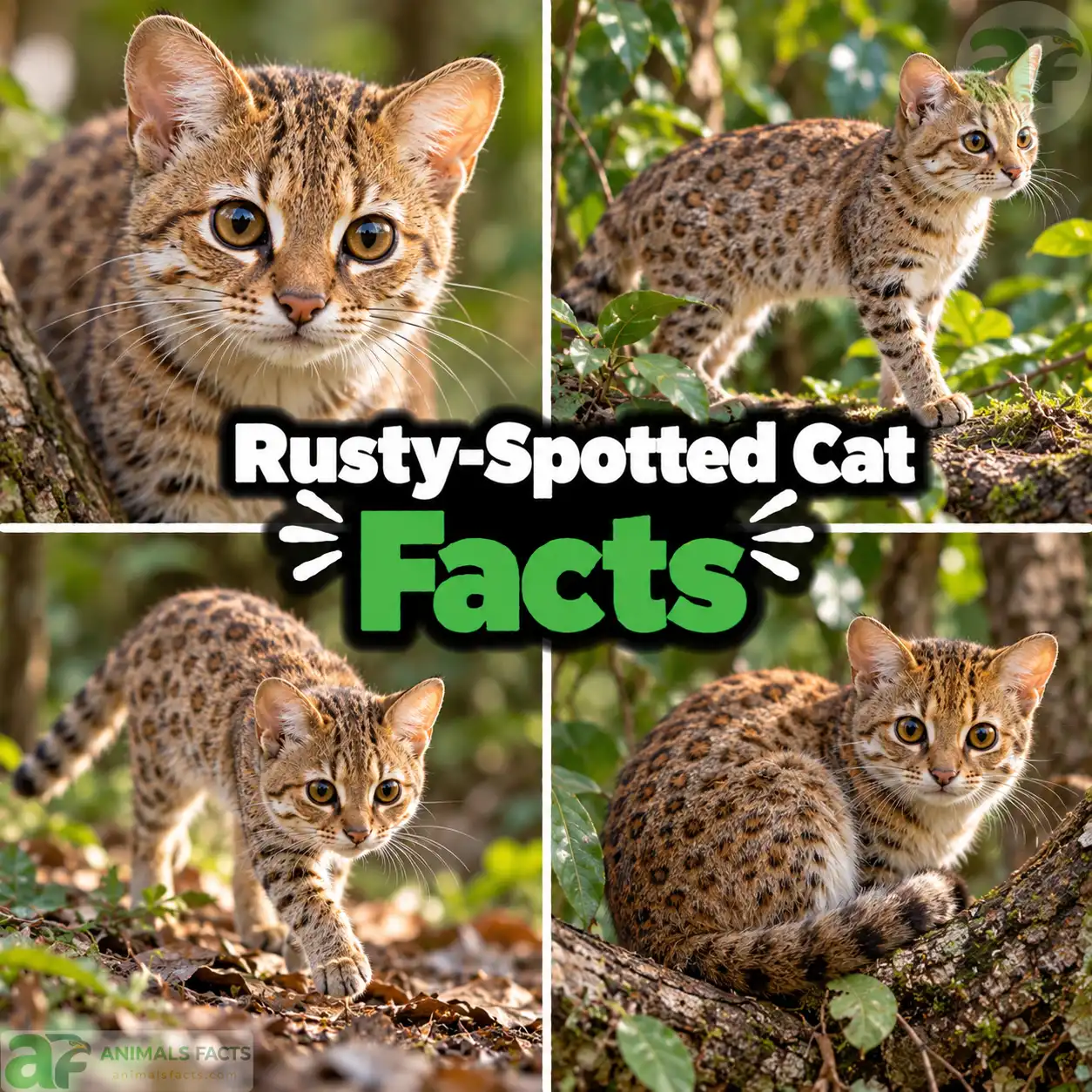
Rusty-Spotted Cat Facts
| Feature | Details |
|---|---|
| Scientific Name | Prionailurus rubiginosus (I. Geoffroy Saint-Hilaire, 1831) |
| Kingdom | Animalia |
| Phylum | Chordata |
| Class | Mammalia |
| Order | Carnivora |
| Family | Felidae |
| Subfamily | Felinae |
| Common Names | Rusty-spotted cat |
| Native Range | India, Sri Lanka; possible presence in Nepal and Pakistan margins |
| Habitat | Moist deciduous forest, dry scrub, grassland, rocky areas, forest-agricultural margins |
| Lifespan | Estimated 7–12 years (wild); up to 18 years (captivity) |
| Diet | Small rodents, birds, lizards, frogs, insects — highly varied |
| Body Length | 35–48 cm body plus 15–30 cm tail |
| Height | 15–20 cm at shoulder |
| Weight | 0.9–1.6 kg — approximately half the weight of a domestic cat |
| Top Speed | Estimated 48 km/h in short bursts |
| Conservation Status | Near Threatened (IUCN) — declining |
| Defining Feature | World’s smallest wild cat — rivals the black-footed cat for this title |
| Research Status | Among the least studied wild cats on Earth — most knowledge from camera traps |
| Closest Relative | Fishing cat (Prionailurus viverrinus) and leopard cat (Prionailurus bengalensis) |
 1. Introduction: What is a Rusty-Spotted Cat?
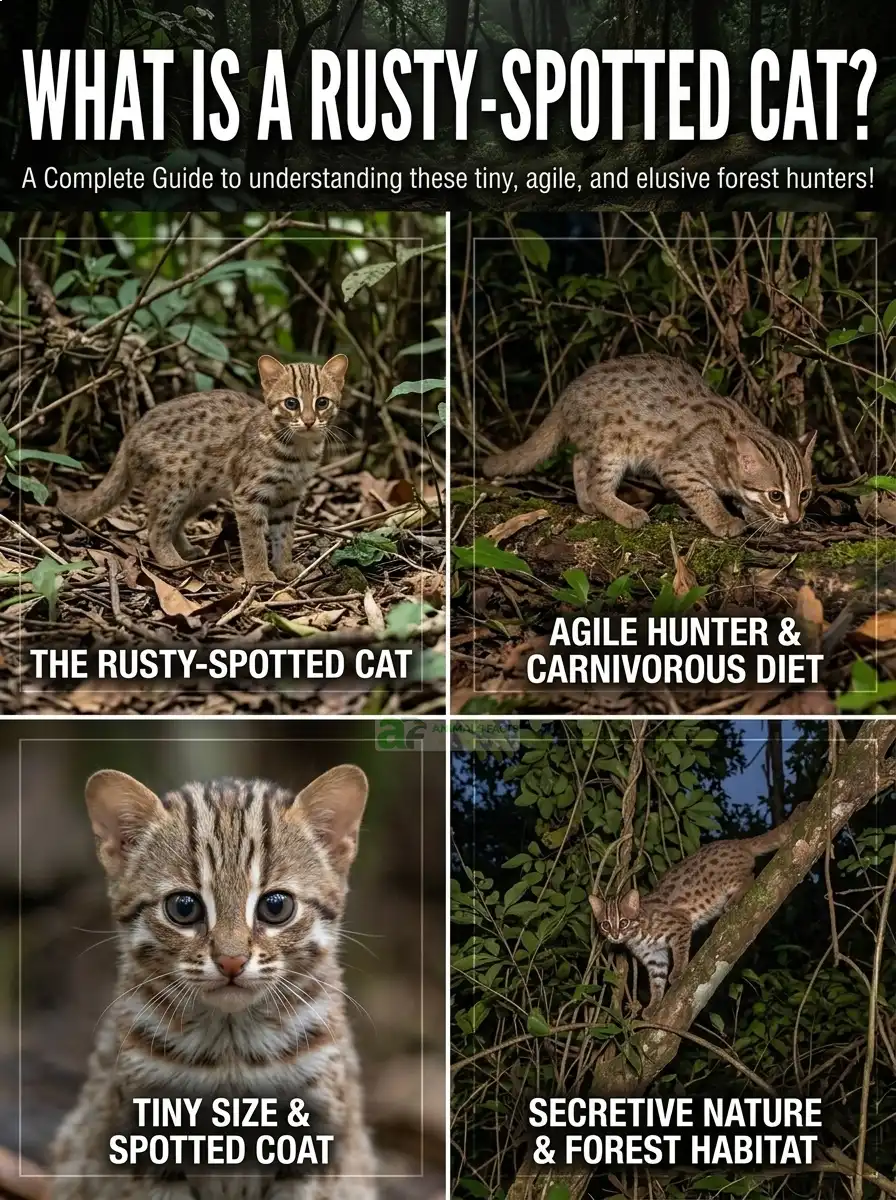
In the dry scrub forest of northern Sri Lanka, a camera trap triggers in the darkness — and the image it captures requires a moment of disbelief before the brain accepts what the eyes are seeing. On a fallen log, regarding the camera with an expression of intense, amber-eyed scrutiny, sits what appears to be a kitten — a tiny, spotted cat that looks young enough to be someone’s escaped house pet, impossibly small against the forest backdrop, with eyes so disproportionately large relative to its face that it seems almost cartoonishly designed for cuteness. But this animal is not a kitten, and it is not someone’s pet. It is a fully grown adult of one of the most ancient and most biologically remarkable carnivore lineages in South Asia. Rusty-spotted cat facts begin with this single, astonishing image — the world’s smallest wild cat, an apex predator at its own scale, possessed of hunting ambition that dramatically exceeds what its body size would suggest, living its entire life at the intersection of forest and farmland across the Indian subcontinent with a secrecy so complete that most people who live within a kilometer of a rusty-spotted cat have never seen one.
The rusty-spotted cat is simultaneously one of the world’s most captivating and most poorly understood wild mammals — a species so small that it weighs approximately half as much as a domestic cat, yet so complete a wild felid that it hunts with the efficiency, the patience, and the explosive ambush capability of its much larger cousins. Interesting facts about rusty-spotted cats reveal an animal of breathtaking biological precision — enormous eyes adapted for hunting in near-total darkness that provide a light-gathering capability among the highest of any cat; a body plan so perfectly scaled for navigating the complex three-dimensional environments of scrub forest that it can pursue prey into spaces that larger predators cannot access; a vocal repertoire that includes sounds not documented in any other small felid; and a behavioral flexibility that allows it to persist in fragments of scrub and grassland within landscapes heavily modified by human agricultural expansion.
Whether you are searching for rusty-spotted cat facts for kids to explore the extraordinary science of the world’s smallest wild cat, a wildlife enthusiast fascinated by South Asian small carnivore ecology, a conservation researcher wanting to understand the threats and knowledge gaps that define this Near Threatened species, or simply someone who encountered a photograph of this magnificently tiny cat and needed to understand everything about it immediately — this is your comprehensive guide. We cover rusty-spotted cat scientific name, rusty-spotted cat diet, rusty-spotted cat size and weight, rusty-spotted cat behavior, the extraordinary eye biology, conservation status, cultural significance, and the ecological roles these remarkable miniature predators play. The world’s smallest wild cat has an extraordinary story to tell — and it is one that almost nobody knows.
2. Rusty-Spotted Cat Species Overview & Classification
The rusty-spotted cat belongs to the genus Prionailurus — a group of small Asian cats that includes some of the most ecologically diverse and least studied felids in the world.
Species Classification Table
| Taxonomic Rank | Classification |
|---|---|
| Kingdom | Animalia |
| Phylum | Chordata |
| Class | Mammalia |
| Order | Carnivora |
| Family | Felidae |
| Subfamily | Felinae |
| Genus | Prionailurus (Severtzov, 1858) |
| Species | P. rubiginosus (I. Geoffroy Saint-Hilaire, 1831) |
| Common Name | Rusty-spotted cat |
| Etymology | rubiginosus = “rusty” (Latin) — referring to the rufous-brown coat |
| Sister Species | Fishing cat (P. viverrinus); Leopard cat (P. bengalensis) |
The Genus Prionailurus — Asian Small Cats
The rusty-spotted cat belongs to a genus of five small Asian wild cats, all remarkably different in ecology and appearance despite their shared ancestry:
| Species | Common Name | Weight | IUCN Status | Habitat |
|---|---|---|---|---|
| Prionailurus rubiginosus | Rusty-spotted cat | 0.9–1.6 kg | Near Threatened | Scrub, dry forest, grassland |
| Prionailurus bengalensis | Leopard cat | 2–8 kg | Least Concern | Forest, scrub — wide range |
| Prionailurus viverrinus | Fishing cat | 5–16 kg | Vulnerable | Wetlands, mangroves |
| Prionailurus planiceps | Flat-headed cat | 1.5–2.5 kg | Endangered | Rivers, streams |
| Prionailurus javanensis | Sunda leopard cat | 2–4 kg | Least Concern | Sunda Islands forest |
Two Subspecies
Two subspecies of the rusty-spotted cat are currently recognized — distinguished primarily by geographic range and subtle physical differences:
| Subspecies | Range | Notes |
|---|---|---|
| P. r. rubiginosus | Indian mainland | Slightly larger; more widespread |
| P. r. phillipsi | Sri Lanka | Island subspecies; slightly different coloration |
Evolution & Discovery Timeline
~8–10 million years ago — The Prionailurus lineage diverges from other Asian felids during the Miocene — establishing the small Asian cat clade that includes the rusty-spotted cat’s ancestors.
~3–5 million years ago — The rusty-spotted cat lineage is estimated to have diverged from the leopard cat lineage — the two species separating as the Indian subcontinent’s forest and scrub ecosystems diversified.
1831 — French zoologist Isidore Geoffroy Saint-Hilaire formally describes the rusty-spotted cat as Felis rubiginosa — based on specimens from India. This is the first formal Western scientific description of the species.
19th century — Colonial-era natural history collections accumulate specimens from India and Sri Lanka — but systematic field study of the living animal remains essentially absent.
1990s — The first camera trap photographs of wild rusty-spotted cats begin to be obtained — providing the first systematic photographic documentation of the species in its natural habitat.
2000s — A small number of field studies — primarily in Sri Lanka and India’s Protected Area network — begin providing basic data on rusty-spotted cat occurrence, habitat use, and diet.
2012 — The IUCN reclassifies the rusty-spotted cat from Least Concern to Near Threatened — reflecting growing evidence of population decline driven by habitat loss and hunting pressure.
2018 — BBC’s “Big Cats” series features exceptional footage of a wild rusty-spotted cat kitten exploring its forest habitat — reaching a global audience of tens of millions and introducing the species to worldwide public attention for the first time.
2020–2024 — Camera trap networks across Sri Lanka’s protected areas and India’s tiger reserves accumulate the most comprehensive rusty-spotted cat detection data yet assembled — though the species remains among the least studied of all wild cats globally.
2024 — The IUCN maintains the Near Threatened assessment for the species — with the population trend assessed as decreasing due to ongoing habitat loss and hunting across the Indian subcontinent.
“The rusty-spotted cat is the smallest wild cat in the world — and it is possibly the least known vertebrate predator of comparable ecological importance anywhere in Asia. We know less about the basic biology of this animal than we know about some deep-sea fish. Every camera trap image of a rusty-spotted cat is a genuine scientific event.”
— Dr. Luke Hunter, President Emeritus, Panthera, and author of Wild Cats of the World
3. Rusty-Spotted Cat Physical Description & Unique Features
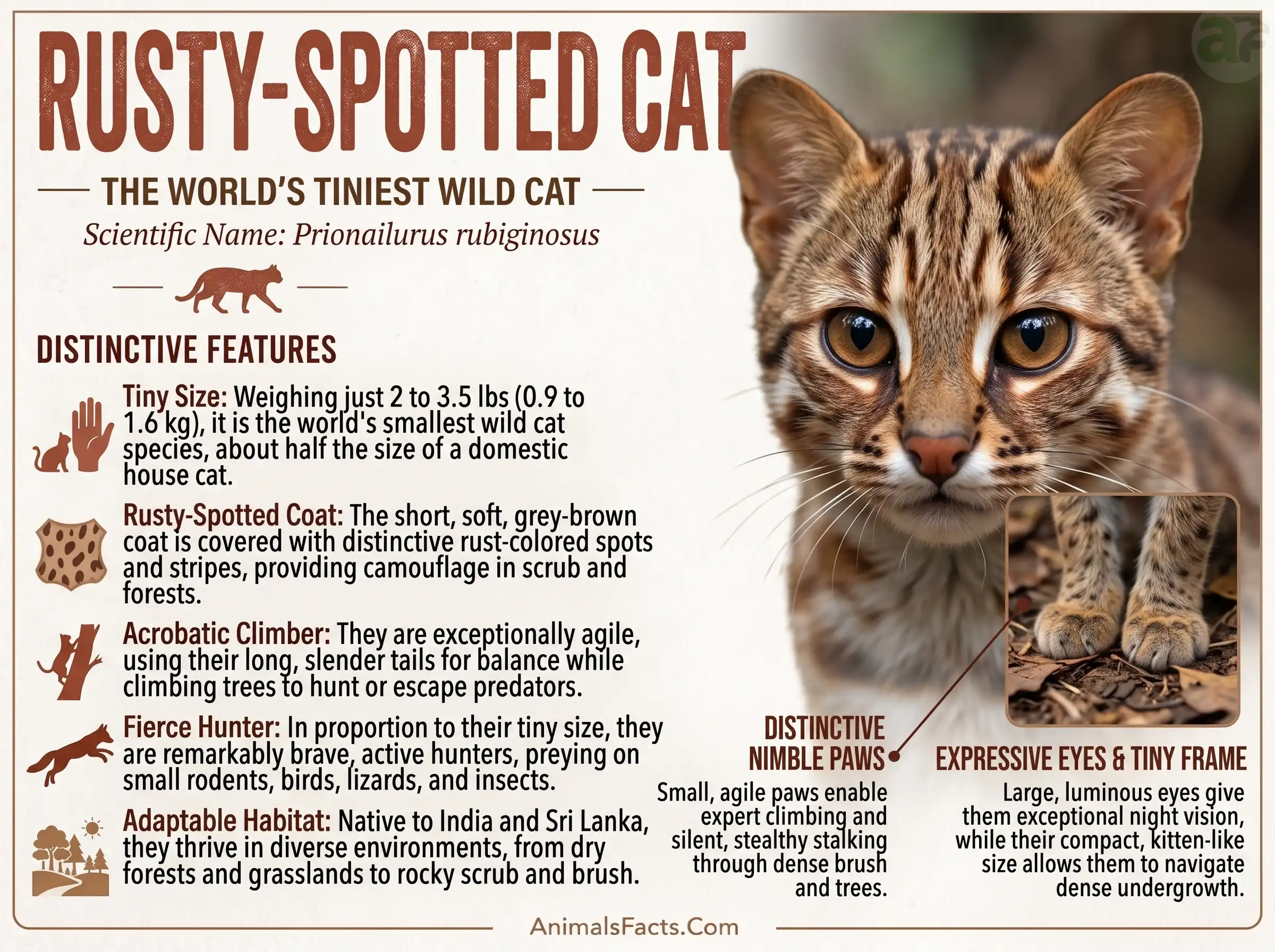
Rusty-spotted cat size and weight make it either the world’s smallest wild cat or very close to it — at 0.9–1.6 kg and 35–48 cm in body length, it rivals the black-footed cat (Felis nigripes) of southern Africa for the title of world’s smallest wild cat. The title technically depends on measurement method — the rusty-spotted cat is typically slightly lighter, while the black-footed cat may be slightly shorter in body length in some populations.
Scale — The Reality of the Rusty-Spotted Cat’s Size
Understanding the rusty-spotted cat requires a genuine reckoning with its scale — not the abstract acknowledgment that it is “small” but the visceral comprehension of what this scale means:
Compared to a domestic cat — At 0.9–1.6 kg, the rusty-spotted cat weighs approximately half what a typical adult domestic cat weighs (3–5 kg). If you have held a domestic cat, you have a rough sense of what a rusty-spotted cat might feel like — but less than half the weight, fitting in one cupped hand of an adult human.
Compared to other wild cats — The rusty-spotted cat is approximately:
- Half the size of the domestic cat’s ancestor, the African wildcat
- One-tenth the size of a leopard
- One-thirtieth the size of a lion or tiger
The predator in miniature — Despite this scale, the rusty-spotted cat is a complete, fully functional apex predator in its own ecological context — with all the hunting capability, territorial behavior, and biological sophistication of a large wild cat, compressed into a body that fits in a human hand.
The Eyes — The Rusty-Spotted Cat’s Most Remarkable Feature
The rusty-spotted cat’s eyes are its most immediately striking physical feature and its most biologically extraordinary anatomical structure:
Proportional size — The rusty-spotted cat’s eyes are disproportionately enormous relative to its head size — larger in proportion to face area than virtually any other wild cat species. When viewed frontally, the eyes dominate the face to a degree that appears almost artificial — as if drawn by a cartoonist deliberately maximizing the cuteness of a cat character.
Light gathering capability — The large eye diameter provides a large pupil area that gathers more light per unit of visual field than smaller eyes. The rusty-spotted cat’s eyes are estimated to provide light-gathering capability approximately 6 times greater than that of human eyes — allowing functional vision in near-total darkness at light levels imperceptible to human observers.
Vertical slit pupil — Like most small felids, the rusty-spotted cat has a vertical slit pupil that can close almost completely in bright light (protecting the sensitive retina) while opening extremely wide in darkness (maximizing light gathering). The vertical slit pupil allows a much greater range of pupil area adjustment than the round pupil of large cats — providing both excellent daytime and exceptional nocturnal vision in the same eye.
Tapetum lucidum — Behind the retina, a reflective layer called the tapetum lucidum reflects incoming light back through the photoreceptors a second time — effectively doubling the light available for vision. This is what causes the bright eye-shine (typically golden-green in the rusty-spotted cat) when a light source is directed at a cat’s eyes in the dark.
Implication for hunting — These optical adaptations make the rusty-spotted cat an extraordinarily capable nocturnal predator — able to hunt in conditions that would leave human hunters completely blind. The precision of strike required to catch small, fast prey like rodents and lizards in near-darkness requires the extraordinary visual acuity that the rusty-spotted cat’s eyes provide.
The Coat — Rusty Spots on Warm Brown
The rusty-spotted cat’s coat is its most visually distinctive feature after its eyes:
Ground color — The dorsal (upper) surface is warm grey-brown to tawny grey — providing excellent camouflage against the leaf litter, dry grass, and rocky surfaces of the cat’s preferred habitats.
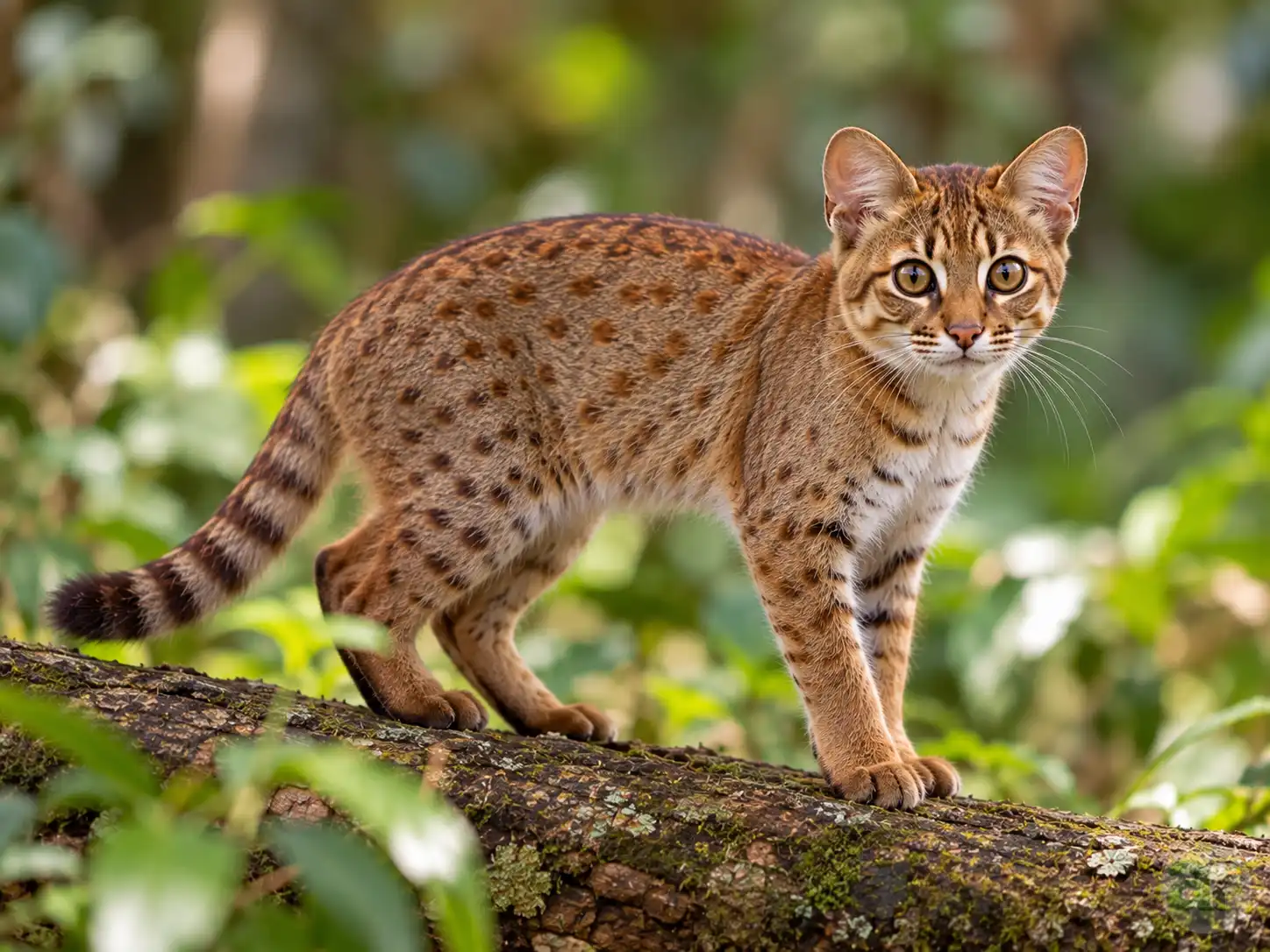
The rusty markings — The coat is marked with rusty-brown to chestnut spots and streaks — arranged in irregular rows that are more prominent on the flanks and less distinct on the back. These markings give the species its common name and are the primary visual field identification feature.
Underside — The ventral (lower) surface is white with large dark brown spots — bold, clearly defined spots on the chest, belly, and inner limbs that contrast sharply with the white background.
Facial markings — Two characteristic rusty-brown streaks run along each cheek from the inner corner of the eye toward the ear — and two additional streaks run from the inner corner of the eye toward the center of the forehead. These facial streaks are consistent between individuals and provide a reliable field identification feature.
Tail — The tail is relatively short — typically 50–60% of body length — and is faintly ringed near the tip, with a dark tip.
Body Form
The rusty-spotted cat’s body form reflects its hunting ecology in dense scrub and forest:
Compact and agile — Despite its tiny size, the body is muscular and proportionally built for active hunting — the hindlimbs slightly longer than the forelimbs (as in most felids), providing the explosive launch capability for ambush strikes.
Large feet relative to body — The paws are proportionally large — providing grip on tree bark and stability on the uneven surfaces of rocky and scrub habitat.
Rounded head — A broad, rounded head relative to body size gives the rusty-spotted cat its kitten-like facial profile that has made it the subject of some of the most-shared wildlife photographs in South Asian natural history.
💡 Did You Know? The rusty-spotted cat’s eye size relative to body dimensions has attracted the attention of optical physicists and visual neuroscientists — the eye represents a near-optimal solution to the engineering problem of maximizing light collection and image resolution within a minimum structural volume. The ratio of eye diameter to skull length in the rusty-spotted cat exceeds that of virtually every other felid species — and the visual sensitivity this provides per unit of metabolic maintenance cost is extraordinary. Research on the rusty-spotted cat’s visual system has contributed to understanding of the evolutionary economics of eye development — the trade-offs between the metabolic cost of maintaining large, energetically expensive eyes and the survival benefits of exceptional nocturnal visual capability in a small predator competing for prey in environments where many other, larger predators are also active.
4. Top 25 Amazing Rusty-Spotted Cat Facts
Here is your definitive collection of the most extraordinary, scientifically verified, and genuinely astonishing rusty-spotted cat facts as of 2026:
- The rusty-spotted cat is the world’s smallest wild cat — at 0.9–1.6 kg and 35–48 cm in body length, it is smaller than most domestic cat breeds and rivals the black-footed cat of southern Africa for this record. A fully grown adult can sit comfortably in a human hand.
- Despite being the world’s smallest wild cat, the rusty-spotted cat has been documented attempting to hunt prey larger than itself — including small deer fawns — demonstrating a predatory ambition that dramatically exceeds what its body size would predict. This behavior is called surplus killing tendency and reflects the complete wild cat hunting instinct compressed into a miniature package.
- The rusty-spotted cat’s eyes are estimated to provide light-gathering capability approximately 6 times greater than human eyes — allowing functional hunting in near-total darkness at light levels imperceptible to human observers.
- The rusty-spotted cat is the only member of its genus (Prionailurus) found outside of forested habitats — it is documented in dry scrub, open grassland, and agricultural margins that its close relatives the leopard cat and fishing cat do not typically use. This habitat flexibility makes it the most ecologically versatile small Asian felid.
- A rusty-spotted cat kitten featured in the BBC documentary “Big Cats” (2018) — filmed in India exploring its forest habitat at approximately 8 weeks of age — generated what was described by wildlife media as the most-shared wild cat footage of the decade, introducing the species to global audiences who had never previously heard of it.
- The rusty-spotted cat is so poorly studied that basic aspects of its wild biology — including exact home range sizes, typical litter sizes, and specific mating behavior — remain either unknown or extremely poorly documented. It is among the top five least studied wild cat species globally.
- Rusty-spotted cats have been documented in camera trap surveys inside active agricultural landscapes — including paddy fields, sugarcane plantations, and tea gardens — in both India and Sri Lanka, demonstrating a remarkable tolerance of human-modified environments that allows persistence in landscapes where most other small wild cats cannot survive.
- The species has been recorded at elevations up to 2,100 meters in Sri Lanka’s hill country — well above the lowland scrub and grassland that was previously considered its primary habitat, demonstrating an elevation range far broader than early naturalists assumed.
- Rusty-spotted cats are highly arboreal — far more so than their small size might suggest. Camera trap data from multiple sites documents individuals climbing trees regularly — using arboreal pathways for both hunting (accessing roosting birds) and escape from terrestrial threats.
- The rusty-spotted cat’s scientific name rubiginosus means “rusty” in Latin — an unusually accurate common-name-to-scientific-name correspondence that reflects the coat’s distinctive rufous-brown markings that give the species its most immediately recognizable field characteristic.
- Wild rusty-spotted cats are exceptionally rarely observed directly by humans — their small size, nocturnal habits, preference for dense vegetation, and naturally shy behavior combine to make direct encounters essentially non-existent outside of deliberate research efforts using camera traps.
- The rusty-spotted cat’s tail is proportionally short compared to most felids — typically 50–60% of body length rather than the 75–100%+ tail-to-body ratios seen in many other wild cats. The shortened tail is consistent with the arboreal agility hypothesis — longer tails assist balance in rapid ground pursuit while shorter tails may be advantageous in dense scrub navigation.
- Only India and Sri Lanka have confirmed breeding populations — with possible but unconfirmed records from Nepal’s Terai region and the extreme western margins of Pakistan suggesting the range may be slightly larger than currently documented.
- In Sri Lanka, the rusty-spotted cat has been recorded in all major habitat types across the island — from lowland dry zone scrub to highland wet zone forest, making it one of the most habitat-tolerant small mammals on the island.
- The rusty-spotted cat’s vocalizations include sounds not documented in any other small felid — including a distinctive churring call that has been described by researchers who have heard captive individuals as uniquely complex for a cat of its size. Full vocalization documentation of the species remains incomplete.
- Despite its extremely small size, the rusty-spotted cat is considered a complete ecological analog of larger felid predators in its habitat — it regulates small mammal and bird populations in scrub ecosystems in ways that parallel the ecological role of leopards and tigers in larger-scale systems.
- The rusty-spotted cat’s stomach contents — analyzed in the small number of specimens available to researchers — have revealed a remarkably diverse prey list including rodents, shrews, small birds, lizards, frogs, and large insects — reflecting dietary opportunism consistent with its scrub and forest-edge habitat.
- Rusty-spotted cats in Sri Lanka have been documented sharing habitat with leopards — a co-occurrence that is possible because the dramatic body size difference (0.9–1.6 kg vs. 30–70 kg for leopards) means the two species occupy entirely different prey size niches and do not compete for food.
- The species was historically distributed across much of peninsular India — including areas where it is now absent or extremely rare — and the current fragmented distribution likely represents a significantly contracted range driven by habitat loss over the past century.
- In captivity, rusty-spotted cats have been maintained at Howletts Wild Animal Park in the UK and a small number of other facilities — where they have bred successfully, providing behavioral and reproductive data that supplements the extremely limited wild population research.
- The rusty-spotted cat’s population in Sri Lanka is believed to be more stable and better monitored than the Indian mainland population — Sri Lanka’s extensive protected area network and smaller geographic scale allowing more comprehensive survey coverage.
- The rusty-spotted cat’s size makes it susceptible to predation by a wider range of predators than most wild cat species — including large raptors, mongoose species, larger snakes, and even large domestic cats — creating a predation pressure environment that likely drives the strongly nocturnal behavior of the species.
- Early taxonomists who examined only museum specimens occasionally mistook rusty-spotted cats for juvenile leopard cats — the similar spotted pattern but dramatically different size creating identification confusion that persisted in some taxonomic literature until fresh adult specimens were available for comparison.
- Camera trap studies in Sri Lanka’s Wilpattu National Park and Yala National Park have provided the most consistent and most documented rusty-spotted cat records from any single location — with multiple individuals identified through coat pattern recognition in these parks’ long-term camera trap datasets.
- As of 2026, the rusty-spotted cat remains classified as Near Threatened — with the population continuing to decrease due to ongoing habitat loss, hunting, and the complex pressures of living in one of the world’s most densely human-populated regions. Research needs for the species remain extraordinary — basic biology questions that have been answered for most wild cat species decades ago remain entirely open for the rusty-spotted cat.
5. Fun Facts About Rusty-Spotted Cats
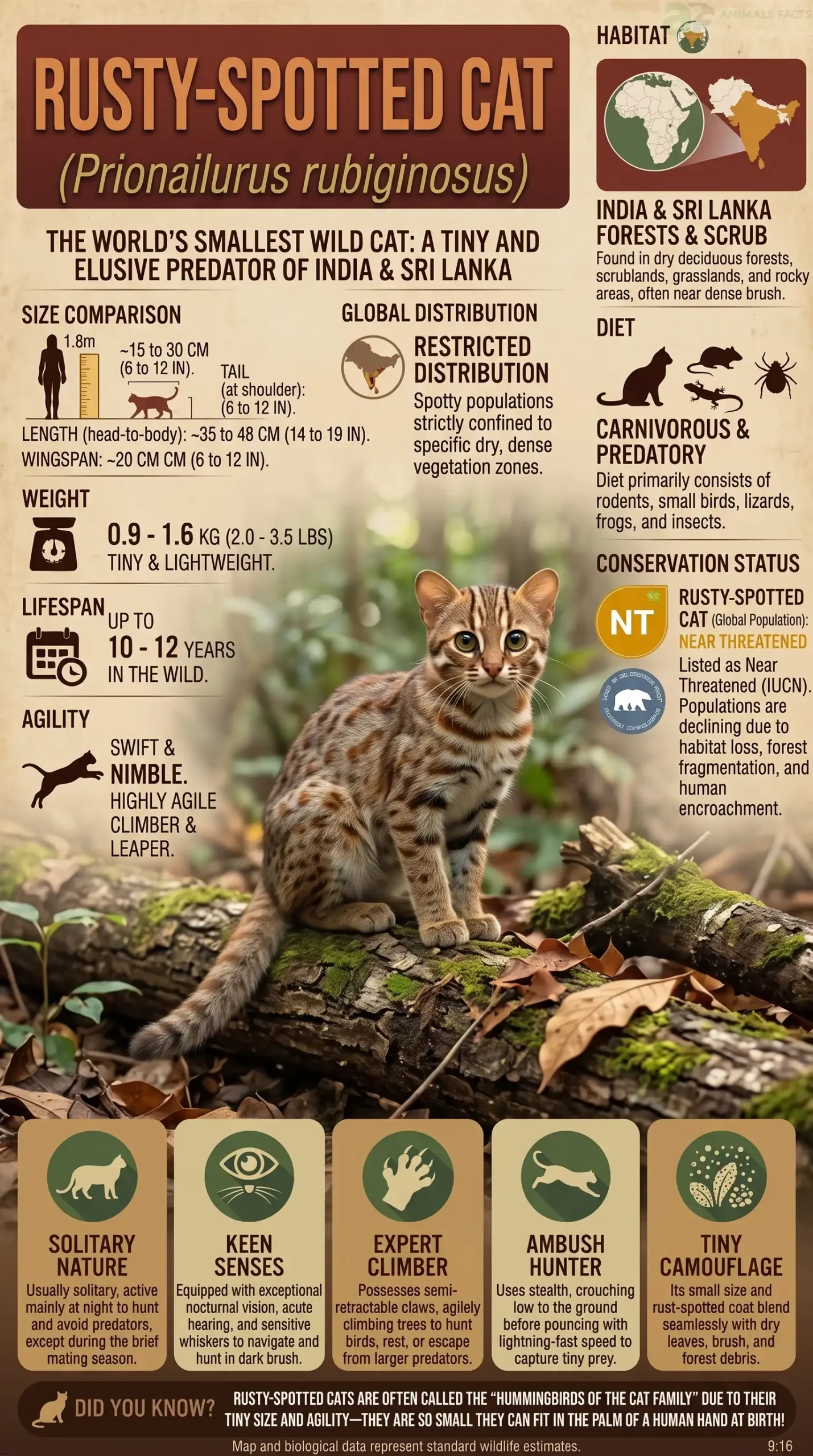
- The rusty-spotted cat is the world’s smallest wild cat — weighing 0.9–1.6 kg
- A fully grown adult fits in a human hand
- Its eyes gather 6 times more light than human eyes
- It has been recorded hunting prey larger than itself
- BBC “Big Cats” footage of a rusty-spotted kitten went globally viral in 2018
- It lives in agricultural fields and tea gardens as well as forests
- Found at elevations up to 2,100 meters in Sri Lanka
- It is highly arboreal — climbing trees regularly
- Basic biology including home range size remains unknown from wild data
- Only confirmed in India and Sri Lanka with breeding populations
- It shares habitat with leopards — 100× heavier
- One of the top 5 least studied wild cats in the world
6. Rusty-Spotted Cat Habitat & Geographic Range
Rusty-spotted cat habitat is one of the most diverse of any small Asian felid — the species occupying a remarkable range of environments across the Indian subcontinent that reflects a habitat flexibility unusual among the typically forest-dependent small wild cats.
Habitat Requirements
The rusty-spotted cat requires a combination of habitat features that can be found in multiple vegetation communities across its range:
Dense ground cover — The most consistent habitat requirement across all population contexts; dense low vegetation — whether natural scrub, tall grass, or agricultural crops — provides the concealment that this small, vulnerable predator requires for both hunting and predator avoidance.
Prey availability — Small rodent populations must be adequate to sustain the cat’s caloric needs. Rusty-spotted cats are documented in a remarkable range of habitats because rodent populations (particularly commensal rodents associated with human agriculture) are distributed across almost all South Asian landscapes.
Some tree access — Arboreal behavior documented in camera trap surveys suggests that trees for climbing, roosting, and escape are important habitat components — even if the surrounding matrix is open scrub or grassland.
Proximity to water — Like most small felids, rusty-spotted cats appear to prefer habitat with water access — though in dry zone Sri Lanka they persist in habitats with very limited surface water availability.
Tolerance of human proximity — The rusty-spotted cat’s documentation in active agricultural landscapes suggests a level of tolerance for indirect human proximity that is unusual for a wild cat — making it more habitat-flexible than most small felid competitors.
Habitat Types
Dry deciduous scrub forest — The primary habitat in both India and Sri Lanka; sparse to moderate tree cover with dense shrubby understorey, abundant fallen wood, and rocky outcrops providing hunting habitat and cover
Dry grassland and scrub mosaic — Open grassland interspersed with scrub patches; documented across the dry zone of Sri Lanka and central India
Moist deciduous forest — Present in less arid forested areas of India; documented in forest blocks associated with tiger reserves
Agricultural margins and plantation edges — One of the most surprising documented habitats; paddy field margins, sugarcane edges, and tea garden boundaries supporting rusty-spotted cats that exploit the abundant commensal rodent populations of agricultural landscapes
Rocky hillsides and boulder country — Documented in rocky habitats in both peninsular India and Sri Lanka’s hill country; rocky habitats providing den sites and prey-rich crevice systems
Montane forest — Documented up to 2,100 meters in Sri Lanka’s central highlands; the elevation range substantially greater than early accounts suggested
Geographic Range
| Region | Country | Status | Notes |
|---|---|---|---|
| Western Ghats | India | Present — moderate | Patchy; associated with forest reserves |
| Eastern Ghats | India | Present | Less documented |
| Central India | India | Present | Tiger reserve records |
| Rajasthan | India | Present | Surprising dry zone records |
| Gujarat | India | Present | Gir National Park area records |
| Bihar and Terai margin | India/Nepal | Possibly present | Unconfirmed Nepal records |
| Dry zone | Sri Lanka | Present — most records | Yala, Wilpattu NPs core records |
| Wet zone | Sri Lanka | Present | Less common; highland records |
💡 Did You Know? The rusty-spotted cat’s presence in Rajasthan — India’s most arid state, dominated by the Thar Desert — was considered extremely unlikely until camera trap records confirmed it in the 2010s. This desert-edge population is one of the most surprising distribution extensions of any South Asian small mammal documented in recent years — suggesting that the rusty-spotted cat’s actual geographic range and habitat flexibility are both considerably greater than earlier assessments recognized. The Rajasthan records were obtained in areas of thorny scrub associated with the Aravalli hill range — a habitat type fundamentally different from the moist forest environments that older natural history literature described as the species’ primary habitat. These records contributed significantly to the current understanding of the species as a habitat generalist rather than a forest specialist.
7. Rusty-Spotted Cat Diet & Feeding Behavior
Rusty-spotted cat diet is among the most diverse relative to body size of any wild felid — reflecting the dietary opportunism that characterizes small predators operating across heterogeneous scrub and forest-edge landscapes.
Diet Breakdown Table
| Food Type | Estimated % of Diet | Notes |
|---|---|---|
| Small rodents (mice, rats, shrews) | ~40–55% | Primary prey category; commensal species near agriculture important |
| Birds (small ground and roosting birds) | ~15–20% | Both ground-foraging and roosting species taken |
| Lizards and small reptiles | ~10–15% | Important in dry zone and rocky habitats |
| Frogs and amphibians | ~8–12% | Seasonally important; post-monsoon abundance |
| Large insects and invertebrates | ~5–8% | Beetles, grasshoppers, crickets — supplementary prey |
| Small bats | ~2–5% | Aerial ambush documented; requires exceptional athletic performance |
| Young hares and small rabbits | ~2–5% | Opportunistic; near maximum prey size |
| Carrion | ~1–3% | Opportunistic |
The Hunting Ambition Gap
One of the most remarkable aspects of rusty-spotted cat feeding biology is the disproportion between body size and hunting ambition — these tiny cats have been documented attempting prey that approaches or exceeds their own body weight:
Small deer fawn predation attempts — Observed in captive situations and reported in some field accounts — the behavior of a cat that weighs under 1.6 kg attempting to kill a prey item that may outweigh it represents an extraordinary expression of the wild felid hunting instinct unconstrained by the caution that might be expected from an animal of this size.
Bat capture — The capture of small bats in flight requires an aerial strike of extraordinary timing and athleticism — the rusty-spotted cat’s small size and agile build potentially providing the rapid acceleration and precise limb control needed for this demanding prey type.
Agricultural rodent exploitation — The remarkable willingness to exploit commensal rodents in active agricultural fields — rats and house mice associated with grain storage and paddy cultivation — represents one of the most practically significant aspects of rusty-spotted cat diet from a human-wildlife coexistence perspective. By consuming the rodent pests of agricultural landscapes, rusty-spotted cats provide a genuine pest control service to farming communities.
Hunting Strategy
The rusty-spotted cat’s primary hunting strategy is the classic felid stalk-and-ambush — executed with modifications appropriate to its small size:
Crepuscular and nocturnal activity — Activity peaks at dawn, dusk, and through the night — when prey activity is high and when the cat’s exceptional low-light vision provides maximum advantage over both prey and competing predators.
Dense vegetation stalking — The small body size allows approach through vegetation too dense for larger predators — reaching close-range ambush positions that larger cats cannot access.
Explosive short sprint — Final strikes covering typically 0.5–3 meters — the ratio of strike distance to body length in the rusty-spotted cat’s ambush is comparable to that of tigers and leopards, reflecting the universality of the felid ambush pattern across body sizes.
Arboreal hunting — Camera trap evidence and limited behavioral observations suggest regular use of elevated positions — the cat ambushing prey from above in a strategy that uses gravity to assist the strike.
8. Reproduction & Life Cycle
Rusty-spotted cat reproduction is one of the least documented aspects of this poorly known species — what is known comes primarily from a small number of captive individuals and limited field observations.
Mating System
The rusty-spotted cat’s mating system in the wild is essentially undocumented — no systematic study of wild mating behavior has been conducted. Based on general small felid biology and the limited captive observations:
Presumed solitary and territorial — Like most small felids, rusty-spotted cats are presumed to maintain individual home ranges with brief mating associations.
Scent communication — Urine spraying and scratching on objects are presumed communication mechanisms — the small cat’s olfactory landscape communicating reproductive status and territorial occupancy across its range.
Seasonal breeding — In Sri Lanka, births appear to peak in the period following the northeast monsoon (January–March) — when prey abundance is highest and environmental conditions most favorable for kitten survival. Indian populations may show different seasonal patterns corresponding to different monsoon timing.
What Captive Studies Have Revealed
The small number of rusty-spotted cats maintained at zoos — including Howletts Wild Animal Park in the UK — have provided limited but important reproductive data:
- Gestation period: approximately 65–70 days — comparable to other small felids
- Litter size: typically 1–3 kittens — most commonly 2
- Birth weight: approximately 60–90 grams per kitten
- Eyes opening: approximately Day 15–20
- Weaning: approximately 6–8 weeks
- Independence: estimated 3–4 months
- Sexual maturity: approximately 10–12 months in captive females
Kitten Development
The 2018 BBC “Big Cats” footage of a rusty-spotted cat kitten provided the first widely viewed documentation of young rusty-spotted cat behavior in a natural habitat setting:
The footage showed a kitten of approximately 8 weeks of age — fully mobile, wide-eyed, already showing the explosive activity and climbing behavior characteristic of the species — exploring its forest habitat with the fearless intensity of a young predator learning its environment. The footage was filmed in India with extraordinary patience and skill over an extended period — the mother’s den located and the kitten filmed as it explored within the mother’s range.
Rusty-Spotted Cat Lifespan Comparison Table
| Species | Wild Lifespan | Max Captive | Notes |
|---|---|---|---|
| Rusty-spotted cat | 7–12 years (estimated) | 18 years | Poor wild data; captive maximum well documented |
| Black-footed cat | 4–6 years (wild) | 16 years | Comparable size; better studied |
| Leopard cat | 4–8 years | 15 years | Closely related; more studied |
| Fishing cat | 10–12 years | 15 years | Larger relative |
| Domestic cat | 12–15 years | 30 years | Reference comparison |
9. Social Behavior & Communication
Rusty-spotted cat social behavior is among the least documented of any wild cat species — the combination of extreme elusiveness, tiny body size making radio-collar studies technically challenging, and very limited research effort means that virtually all knowledge is either inferred from camera trap data or extrapolated from closely related species.
Presumed Solitary Organization
Based on camera trap data and general small felid biology, the rusty-spotted cat is presumed to be largely solitary outside of mating and mother-kitten associations:
Home range — Essentially unknown from systematic wild data. Camera trap recapture rates suggest that individuals maintain relatively consistent area use over monitoring periods — but actual home range sizes have not been calculated from systematic tracking data. Given the body size of the species, home ranges are expected to be small compared to larger cats but adequate to encompass sufficient prey to meet energy requirements.
Scent marking — The presumed primary communication mechanism — marking substrates with urine, feces, and secretions from glands. The exact glands used and the specific information content of marks have not been studied in this species.
Temporal niche partitioning — Camera trap studies that have detected multiple individual rusty-spotted cats at the same location at different times suggest that individuals may partition time of activity at shared resources — a behavioral mechanism that allows multiple individuals to use the same area without direct confrontation.
Activity Patterns
Camera trap data provides the most reliable information about rusty-spotted cat activity timing:
Predominantly nocturnal — Camera trap records are overwhelmingly from nighttime — consistent with the hypothesis that the species’ exceptional low-light vision provides a competitive advantage during nocturnal hunting that is sufficient to drive strong nocturnal activity specialization.
Crepuscular peaks — Some camera trap datasets show elevated activity at dawn and dusk — the transitional light periods when the cat’s visual advantage over diurnal prey species is at its maximum while solar heat stress is reduced.
Minimal diurnal activity — Direct sightings and daytime camera trap records are exceptional — though the species appears to rest in dense vegetation, hollow trees, or rock crevices during daylight hours rather than being completely inactive.
The Arboreal Dimension
Camera trap evidence of regular tree climbing adds a significant behavioral dimension that early accounts of the species did not recognize:
- Tree-mounted camera traps have recorded rusty-spotted cats at heights of 3–5 meters above ground
- The motivation appears to include both foraging (accessing roosting birds and arboreal prey) and resting (elevated positions providing safety from terrestrial predators)
- The climbing ability — impressive for any cat, but particularly remarkable given the tiny body size — involves the same muscular dynamics as larger climbing felids
10. Predators & Defense Mechanisms
The rusty-spotted cat’s tiny size creates a predation vulnerability profile unique among wild cats — it faces potential predation from a much wider range of predators than any other felid species.
Natural Predators
Birds of prey — Large raptors including Indian eagle-owl (Bubo bengalensis), changeable hawk-eagle (Nisaetus cirrhatus), and various other large owls and eagles represent genuine aerial predation threats to a cat weighing under 1.6 kg. The rusty-spotted cat’s size — comparable to a large rat — places it within the prey size range of multiple large raptors.
Indian rock python (Python molurus) — Large pythons in South Asian forests represent a significant ambush threat to small mammals including rusty-spotted cats — a prey item that would be swallowed whole by a large python.
Mongoose species — Indian grey mongoose (Urva edwardsii) and other mongoose species are sufficiently large and aggressive to threaten rusty-spotted cats — particularly kittens and juveniles.
Leopard (Panthera pardus) — The leopard, which shares habitat with the rusty-spotted cat across much of its Indian range, is a significant intraguild predation threat — larger felids regularly kill smaller felids when opportunities arise.
Feral and domestic dogs — An increasing threat in landscapes with high human populations — aggressive dogs can pursue and kill cats significantly larger than the rusty-spotted cat.
Feral cats — In areas with feral domestic cat populations, intraguild competition and potentially predation from large feral toms represents a novel threat.
Humans — Deliberate killing (for perceived threat to poultry, for fur) and accidental mortality (road kills, snares set for other species) represent significant human-related mortality sources.
Defense Mechanisms
Cryptic behavior — The primary defense; secretive movement behavior combined with the cryptic coat pattern provides excellent concealment in the species’ preferred dense vegetation habitat.
Nocturnal timing — The strong nocturnal activity pattern reduces the rusty-spotted cat’s exposure to the diurnal predators (particularly raptors) that represent the greatest aerial threat.
Arboreal escape — Rapid tree climbing provides refuge from most terrestrial predators — the rusty-spotted cat’s small size allowing it to reach elevated positions inaccessible to larger pursuers.
Speed and agility — The small, muscular body capable of rapid directional changes provides escape capability from pursuing predators in dense vegetation.
Freezing and cryptic posture — When direct flight is not possible, the rusty-spotted cat can freeze in a low crouch — the spotted coat pattern providing reasonable camouflage against typical forest floor backgrounds.
💡 Did You Know? The rusty-spotted cat’s position in the food web creates what ecologists call a “mesopredator paradox” — at its own scale, it is a top predator consuming rodents, birds, and lizards with the efficiency of a large carnivore; but at the ecosystem scale, it is simultaneously prey for almost everything larger than itself. This dual position — simultaneously predator and prey — creates a behavioral ecology of extraordinary tension: the same habitats that provide good hunting opportunities (dense vegetation with abundant small prey) also provide the concealment that potentially approaching larger predators use. Every hunting move is simultaneously a predation risk calculation. The rusty-spotted cat navigates this tension through the combination of exceptional sensory capability (particularly the low-light vision that allows hunting in periods when many aerial predators are less active) and the behavioral flexibility to alter activity timing and habitat use in response to the presence of larger predators. This ecological tension is one of the most fascinating aspects of small predator biology and makes the rusty-spotted cat a compelling subject for theoretical ecology as well as natural history.
11. Rusty-Spotted Cat Facts for Kids
Hey amazing young wildlife detectives and future wild cat scientists! Here are some absolutely mind-blowing rusty-spotted cat facts for kids that will make everyone who hears them say “No way — that cannot be real!”:
- 🐱 The rusty-spotted cat is the world’s SMALLEST wild cat — and it is absolutely real! A fully grown adult rusty-spotted cat weighs less than a bag of sugar. You could hold a full-grown wild cat in your cupped hands! It is roughly half the size of a typical house cat — and yet it is completely wild, completely fierce, and a deadly hunter in its own tiny world!
- 🐱 Its eyes can see in darkness SIX TIMES better than human eyes! The rusty-spotted cat has enormous eyes relative to its tiny head — they look almost too big for its face! These gigantic eyes gather so much light that this cat can hunt in almost complete darkness — seeing clearly in conditions where you or I would see absolutely nothing at all.
- 🐱 It tries to hunt animals BIGGER than itself! Even though it weighs less than 1.6 kilograms, the rusty-spotted cat has been recorded trying to hunt small deer fawns that are bigger and heavier than it is. It has all the wild cat ambition and courage of a lion packed into a body the size of a kitten!
- 🐱 Nobody knew it lived in the desert until cameras caught it! Scientists thought the rusty-spotted cat only lived in forests. Then camera traps started finding it in Rajasthan — India’s most famous desert state. Nobody expected a tiny forest cat to be living in desert scrub! Every year, cameras are still discovering this cat in surprising new places.
- 🐱 It can climb trees brilliantly — which is extra impressive for something so tiny! Camera traps have photographed rusty-spotted cats three to five meters up in trees — using tree routes to hunt roosting birds and to escape from predators. For a cat that weighs less than most house cats, this is extraordinary climbing!
- 🐱 Most people who live next to them have never seen one! The rusty-spotted cat is so secretive, so nocturnal, and so perfectly camouflaged that people can live within a kilometer of one their whole lives without ever catching a glimpse. The first time most people ever see one is in a camera trap photograph!
- 🐱 Scientists still do not know some of the most basic things about it! Even in 2026, scientists have not been able to figure out the exact home range size of wild rusty-spotted cats. We know more about some deep ocean fish than we know about this cat that lives in people’s gardens in India and Sri Lanka. Every camera trap photograph is genuinely a scientific discovery!
- 🐱 A BBC documentary made the rusty-spotted cat GLOBALLY FAMOUS! In 2018, the BBC filmed a rusty-spotted cat kitten in India for their “Big Cats” documentary. The footage of this tiny wild kitten exploring a forest went viral around the entire world — making one of the least known cats in the world briefly one of the most famous!
12. Relationship with Humans
The relationship between rusty-spotted cats and humans is shaped by three distinct dynamics — the ancient coexistence with agricultural communities across India and Sri Lanka, the modern conservation challenges of protecting a species in some of the world’s most densely populated countries, and the extraordinarily limited scientific engagement with a species that remains almost entirely unknown despite occupying one of Asia’s most ecologically studied regions.
Indigenous and Agricultural Community Relationships
Across the rusty-spotted cat’s range — which encompasses some of the most densely human-populated landscapes in the world — rural communities have coexisted with this tiny cat for centuries without most residents being aware of its existence:
Awareness in rural communities — In Sri Lanka’s dry zone and India’s rural agricultural landscapes, some farming communities are aware of the rusty-spotted cat — typically knowing it by local names that may overlap with names for other small cats or mongooses. The cat’s extreme secretiveness means that even in areas of confirmed presence, direct community encounters are rare.
Poultry predation conflict — The rusty-spotted cat’s willingness to enter agricultural areas creates the potential for conflict with poultry keepers — a small cat capable of taking chicks, young poultry, and eggs from inadequately protected coops. This conflict, while the incidents are small-scale compared to leopard-livestock conflicts, can generate retaliatory killing that is disproportionately impactful given the species’ small population size.
Pest control benefit — The rusty-spotted cat’s documented consumption of commensal rodents in agricultural landscapes provides a genuine pest control service to farming communities — reducing rodent damage to stored grain and crops. This service remains almost entirely unrecognized by either the farming communities who benefit from it or by conservation advocates who could use it as a coexistence-building message.
Traditional use and hunting — In some areas of the range, rusty-spotted cats have been hunted for their fur and meat. The small pelt has limited commercial value compared to larger cats, but local hunting pressure adds to the cumulative mortality that threatens small populations.
The Scientific Knowledge Gap
The rusty-spotted cat represents one of the most extreme examples of a well-named, recognized species for which fundamental biological data is almost entirely lacking:
Why so little is known:
- The species’ extreme elusiveness makes direct observation essentially impossible
- Its small size makes radio-collar studies technically challenging — standard wildlife collars are too heavy for an animal weighing under 1.6 kg, and miniaturized GPS collars suitable for this size only became available in the 2010s
- Research funding for small, cryptic, non-charismatic carnivores in developing countries is extremely limited
- The species’ presence in human-modified landscapes makes it less likely to be encountered in the formal protected area contexts where most wildlife research is conducted
The camera trap revolution — Miniaturized camera trap technology has transformed knowledge of the species since the 2000s — providing detection records from habitats where traditional survey methods produced no data. The systematic analysis of camera trap datasets from Sri Lanka’s protected areas and India’s tiger reserve networks has generated most of the population-level knowledge currently available.
Priority research needs:
- Home range and habitat use — using miniaturized GPS collars now technically possible
- Population density estimation using camera trap occupancy models
- Reproductive ecology — breeding season, litter size, and kitten survival in wild populations
- Diet characterization through scat analysis
- Response to habitat modification and agricultural landscapes
The BBC Documentary Effect
The 2018 BBC “Big Cats” episode featuring the rusty-spotted cat kitten represented a watershed moment in public awareness of this species:
- Prior to the broadcast, the rusty-spotted cat was essentially unknown outside of specialist wildlife circles
- The footage — showing a kitten of approximately 8 weeks exploring its forest environment — generated extraordinary global media coverage and social media engagement
- Multiple major international news outlets ran stories about the species following the broadcast
- The footage is widely credited with generating more public awareness of the rusty-spotted cat than all previous natural history documentation combined
13. Rusty-Spotted Cat Conservation Status & Threats
Conservation Status Overview
| Feature | Details |
|---|---|
| IUCN Status | Near Threatened (NT) |
| Previous Status | Least Concern (pre-2012) |
| Population Trend | Decreasing |
| Population Estimate | Unknown — insufficient data |
| CITES Listing | Appendix I — highest protection level |
| National Protection | Protected under Wildlife Protection Act in India; Fauna and Flora Protection Ordinance in Sri Lanka |
Major Threats
| Threat | Description | Impact Level |
|---|---|---|
| Habitat loss | Agricultural expansion; urban growth; deforestation | Critical — primary long-term threat |
| Habitat degradation | Overgrazing; firewood collection; livestock pressure | High |
| Hunting and trapping | Deliberate killing; incidental snare capture | High |
| Human-wildlife conflict | Poultry predation leading to retaliatory killing | Medium |
| Prey depletion | Bushmeat hunting reducing small mammal populations | Medium-High |
| Road kills | Vehicle strikes in fragmented landscapes | Medium |
| Introduced predators | Feral dogs and cats in agricultural areas | Medium |
| Climate change | Altered monsoon patterns affecting habitat quality | Increasing concern |
| Research gap | Insufficient knowledge to design targeted interventions | Medium |
The Indian Subcontinent Context
The rusty-spotted cat’s range encompasses some of the world’s most human-dominated landscapes — India and Sri Lanka together supporting populations of approximately 1.5 billion people across territories that have been extensively modified for agriculture, urban development, and infrastructure. Conservation of a small, secretive wild cat in this context requires approaches fundamentally different from those used for charismatic megafauna in large protected areas:
Protected area coverage — While tiger reserves and national parks provide some rusty-spotted cat habitat, the species’ documented presence in agricultural landscapes means that a significant proportion of the population exists outside formal protected areas — in landscapes where standard wildlife protection frameworks are difficult to apply.
Community coexistence — Given the species’ presence in agricultural and human-modified landscapes, community-based conservation approaches — building awareness of the species’ presence and its pest control benefits — may be more relevant than large-scale protected area expansion for rusty-spotted cat conservation.
Threat multiplicity — The combination of habitat loss, hunting, road kills, and prey depletion creates a multi-threat environment where addressing any single threat provides only partial conservation benefit.
Conservation Responses
Protected area populations — The confirmed presence of rusty-spotted cats in India’s tiger reserve network (including Tadoba-Andhari, Nagarhole, Bandipur, and other reserves) and Sri Lanka’s national parks (particularly Yala and Wilpattu) means that tiger conservation infrastructure provides incidental protection to rusty-spotted cat populations — a co-benefit of large protected area management.
Research programs — Small Cat Action Fund grants and individual researcher projects in Sri Lanka and India are accumulating camera trap data that is progressively improving understanding of distribution and habitat use.
Community awareness — Local education programs in areas of known rusty-spotted cat presence — particularly highlighting the pest control services the cat provides — represent the most promising approach to reducing retaliatory killing and building community tolerance.
14. Famous Rusty-Spotted Cats in History & Pop Culture
Famous Individuals and Cultural Moments
The BBC “Big Cats” Kitten (2018) — The rusty-spotted cat kitten filmed in India for the BBC “Big Cats” documentary series — broadcast in January 2018 — represents the most culturally significant rusty-spotted cat individual in the species’ documented history. The footage, filmed in India’s forest with extraordinary technical skill over an extended period, showed a kitten of approximately 8 weeks exploring its forest environment — its enormous eyes, tiny body, and wild cat behavioral completeness creating a visual contrast so compelling that the footage went globally viral within days of broadcast. The clip was described by wildlife media as “the most-shared wild cat footage of the decade” and introduced the rusty-spotted cat to global audiences numbering in the tens of millions who had previously never heard of the species.
Early Museum Specimens (19th century) — The original specimens that enabled Isidore Geoffroy Saint-Hilaire’s 1831 formal description — collected in India during the early colonial period — represent the historical foundation of rusty-spotted cat science. These specimens, held in the Natural History Museum collections of Paris, established the species’ scientific identity and provided the basis for all subsequent taxonomic work on the species.
Howletts Wild Animal Park Breeding Program — The small number of rusty-spotted cats maintained and bred at Howletts Wild Animal Park in Kent, UK — part of the Aspinall Foundation — have provided the most sustained captive behavioral and reproductive documentation of the species available. Individual cats maintained at Howletts have contributed research data published in the scientific literature and have been subjects of veterinary studies informing captive management of the species.
Camera trap individuals at Yala and Wilpattu — Multiple individually identified rusty-spotted cats at Sri Lanka’s premier national parks — identified through coat pattern analysis in long-term camera trap datasets — represent the most continuously monitored wild individuals of the species. These individuals, while unnamed in most research publications, constitute the primary scientific record of wild rusty-spotted cat behavior.
15. Role in Ecosystem & Food Chain
The Small Predator Ecological Role
Despite its tiny size, the rusty-spotted cat plays an ecologically significant role as a small predator in the scrub and forest ecosystems it inhabits:
Rodent population regulation — The rusty-spotted cat’s primary prey — small rodents — are themselves important ecological actors whose populations shape vegetation communities through seed predation, soil disturbance, and invertebrate consumption. By regulating rodent population density, the rusty-spotted cat participates in top-down control of the small mammal community that cascades through the scrub and forest ecosystem.
Bird and lizard population effects — Predation on small ground birds and lizards contributes to regulating these populations — with effects that cascade through the invertebrate and plant communities that birds and lizards themselves regulate.
Agricultural pest control — The rusty-spotted cat’s documented consumption of commensal rodents (Rattus rattus, Mus musculus, and related species) in agricultural landscapes provides a measurable pest control service of direct economic value to farming communities. Small mammal pest control services provided by predators are estimated to be worth billions of dollars annually globally — and the rusty-spotted cat’s contribution to this service in South Asian agricultural landscapes is entirely unquantified but potentially significant.
The Mesopredator Position
The rusty-spotted cat occupies the mesopredator niche in its ecosystem — hunting smaller prey than the leopards and dholes that share its range, and being potentially vulnerable to predation by those larger carnivores. This position creates complex ecological dynamics:
Mesopredator release — In areas where larger predators (particularly leopards) have been reduced or extirpated, the removal of intraguild predation and competition pressure on rusty-spotted cats may allow their populations to increase — a mesopredator release effect documented for various mid-level carnivores globally.
Ecological linkage — The rusty-spotted cat creates ecological connections between the rodent, bird, and lizard communities of scrub and forest ecosystems and the larger predators that occasionally prey on the cat itself — serving as an energy transfer pathway from small prey to larger predators.
16. Myths, Folklore & Cultural Significance
Limited Cultural Documentation
Unlike the tiger, leopard, and lion — whose cultural significance across South Asian traditions is ancient, deep, and extensively documented — the rusty-spotted cat has minimal documented cultural significance in the traditions of its range countries. This reflects primarily the species’ extreme elusiveness and small size — animals that are almost never seen by ordinary people rarely accumulate the mythological and cultural significance of more visible, more impressive species.
Local names across the range — The rusty-spotted cat is known by various local names in India and Sri Lanka:
- In Sinhala (Sri Lanka): Kola diviya (rust-colored leopard/cat)
- In Tamil (India/Sri Lanka): Nalla pilli (good cat) in some areas
- In Hindi and various Indian regional languages: various local names often shared with other small cats, reflecting the difficulty of distinguishing species in forest environments without close examination
Agricultural folklore — In some Sri Lankan farming communities, small spotted cats seen near fields are associated with good fortune for the harvest — the cat’s predation on crop-damaging rodents creating a positive cultural association that may be an ancient intuitive recognition of the pest control benefit the cat provides.
Absence of specific mythology — The rusty-spotted cat does not appear as a named character in any known South Asian mythological tradition — a reflection of its invisibility to most human observers throughout the history of its range. The tiger and leopard feature prominently in Hindu mythology, Buddhist art, and folk traditions across India and Sri Lanka; the rusty-spotted cat is simply too small and too rarely seen to have generated the cultural weight that larger predators have accumulated.
The Emerging Scientific Cultural Significance
Since the 2018 BBC documentary, the rusty-spotted cat has begun to acquire a new kind of cultural significance — as the subject of global wildlife affection and conservation concern generated through wildlife media:
The combination of its extraordinary smallness, its complete wild cat behavioral repertoire, and its genuinely endangered status in its native landscape creates a conservation narrative with strong public appeal — the “world’s smallest wild cat” framing providing the kind of superlative hook that generates media attention and public interest that more obscure conservation stories cannot achieve.
This emerging cultural significance — while recent and entirely media-generated rather than traditional — has begun to create the global public awareness that may ultimately be important for generating the conservation funding and political will needed to protect this species.
17. Rusty-Spotted Cats in Pop Culture
BBC “Big Cats” Series (2018) — The most significant popular cultural representation of the rusty-spotted cat — the episode featuring the kitten reached audiences of tens of millions across BBC television, BBC iPlayer streaming, and subsequent YouTube distribution. The footage became one of the most shared wildlife video clips of 2018 — appearing in social media feeds across every continent and generating coverage in major international news outlets from The Guardian and BBC News to National Geographic and Time magazine.
Wildlife photography social media — Following the BBC documentary, rusty-spotted cat camera trap images from India and Sri Lanka — particularly from Yala and Wilpattu National Parks — became widely shared on wildlife photography platforms. Individual camera trap images of rusty-spotted cats now regularly accumulate hundreds of thousands of interactions on Instagram and Facebook wildlife photography accounts — providing a steady stream of public exposure that is gradually building awareness of the species.
Conservation organization campaigns — Panthera, the Small Cat Action Fund, and various India-focused wildlife conservation organizations have used rusty-spotted cat imagery in fundraising and awareness campaigns — the species’ photogenic quality and superlative status (world’s smallest) making it effective content for conservation communication.
“Big Cats” Wikipedia and educational resource explosion — Following the BBC documentary, the rusty-spotted cat’s Wikipedia page became one of the most actively edited small wild cat pages — reflecting a dramatic increase in public interest that drove thousands of people to research the species. Educational resources about the species proliferated in the months following the broadcast in a way that had not previously occurred for any coverage of this species.
18. Rusty-Spotted Cat Facts vs. Common Myths
| Common Myth | The Real Fact |
|---|---|
| “The rusty-spotted cat is a baby leopard cat or domestic cat kitten” | False — it is a fully distinct species (Prionailurus rubiginosus) that represents a separate evolutionary lineage; the kitten-like appearance of adults reflects the species’ genuinely small adult size, not juvenile status |
| “The rusty-spotted cat only lives in forest” | False — it has been documented in dry scrub, grassland, agricultural margins, tea gardens, paddy field edges, and rocky habitats — it is one of the most habitat-flexible small Asian cats |
| “Being the world’s smallest cat, it only eats very small prey” | Partially false — while the primary diet consists of small rodents and birds, the rusty-spotted cat has been documented attempting to take prey approaching or exceeding its own body weight, reflecting the full wild cat predatory ambition regardless of body size |
| “The rusty-spotted cat is harmless because of its size” | Partially misleading — while it poses no threat to humans, it is a fully competent wild predator capable of killing prey with the efficiency of any wild felid; captive individuals that are improperly handled can inflict significant bites and scratches |
| “The rusty-spotted cat is well-studied because it lives near human settlements” | False — it remains among the five least studied wild cat species globally; its presence near human settlements has not translated into research opportunities because its extreme nocturnal and secretive behavior makes direct observation essentially impossible even in agricultural landscapes |
| “Its population is stable because it adapts to agricultural areas” | False — the IUCN assessment confirms a decreasing population trend; while agricultural landscape use provides some resilience, it does not compensate for the overall habitat loss and hunting pressure driving decline |
| “The rusty-spotted cat cannot be found in protected areas” | False — camera trap records from numerous Indian tiger reserves and Sri Lankan national parks confirm its presence in formal protected areas across the range |
19. Best Places to See Rusty-Spotted Cats in the Wild
1. Yala National Park, Sri Lanka — The most reliable location globally for rusty-spotted cat detection — camera trap programs have produced the most extensive individual identification dataset for the species from any single location. Night safaris in Yala’s scrub zone offer the best realistic probability of a wild rusty-spotted cat encounter available anywhere, though the probability of any single visit producing a sighting remains low.
2. Wilpattu National Park, Sri Lanka — Sri Lanka’s largest national park; extensive camera trap coverage has documented consistent rusty-spotted cat presence in the dry zone scrub and villus (natural lakes) margins. The park’s less-visited status compared to Yala means lower vehicle disturbance — potentially important for this extremely shy species.
3. Nagarhole Tiger Reserve (Kabini region), Karnataka, India — One of the most intensively wildlife-watched forest areas in India — camera trap programs have documented rusty-spotted cats in the reserve’s dry deciduous forest habitats. The reserve’s excellent infrastructure and high wildlife density make it the most accessible Indian location for rusty-spotted cat searches.
4. Tadoba-Andhari Tiger Reserve, Maharashtra, India — Camera trap records confirm rusty-spotted cat presence; the reserve’s scrub-forest mosaic provides typical rusty-spotted cat habitat. Night safaris in buffer zone areas offer potential encounter opportunities.
5. Gir National Park and Wildlife Sanctuary, Gujarat, India — Famous for the Asiatic lion; camera traps have also documented rusty-spotted cats in the dry teak forest and scrub habitats of the reserve — a multi-species encounter opportunity combining lions with the world’s smallest wild cat in the same landscape.
6. The Honest Assessment — The rusty-spotted cat is among the most genuinely difficult wild mammals to observe in the world — even researchers specifically targeting the species with intensive camera trap effort require extended periods to accumulate consistent records. Wildlife tourists visiting the above locations should treat any rusty-spotted cat encounter as a profound bonus rather than a realistic expectation. Camera trap demonstration programs at some Sri Lankan parks provide visitors with access to camera trap footage — the most likely form of “encounter” for most visitors.
20. How You Can Help
Supporting rusty-spotted cat conservation requires action focused primarily on research funding, habitat protection, and community coexistence programs in India and Sri Lanka.
Support these organizations:
- Panthera — panthera.org — the world’s leading wild cat conservation organization; supports small cat research programs including species in the rusty-spotted cat’s range
- Small Cat Action Fund (SCAF) — smallcats.org — specifically funds research and conservation of small wild cat species globally; rusty-spotted cat projects have received SCAF funding
- Wildlife Conservation Society India — wcs.org — operates comprehensive wildlife programs in India including small carnivore research
- Wilderness and Wildlife Conservation Trust (WWCT), Sri Lanka — wwct.lk — Sri Lanka-focused wildlife conservation including small carnivore research in Yala and Wilpattu
- Nature Conservation Foundation (NCF), India — ncfindia.org — India-based wildlife research organization working across carnivore ecology
- Aspinall Foundation / Howletts Wild Animal Park — aspinallfoundation.org — operates captive rusty-spotted cat population contributing to ex-situ knowledge
Critical individual actions:
- Donate to small wild cat research — Small Cat Action Fund grants are the primary mechanism through which rusty-spotted cat field research is funded; even small donations directly fund camera trap surveys and field work
- Spread awareness — The rusty-spotted cat’s extreme obscurity means that most people who could care about it have never heard of it; sharing accurate information about the species builds the public awareness needed for conservation advocacy
- Support responsible wildlife tourism — Visiting Yala, Wilpattu, and Indian tiger reserves contributes to the tourism revenue that funds conservation infrastructure; choosing responsible operators that prioritize wildlife welfare over sighting guarantees supports ethical wildlife tourism
- Advocate for small cat conservation funding — Most conservation funding goes to charismatic megafauna; advocacy for equitable funding of small cat research helps address the knowledge gaps that limit rusty-spotted cat conservation effectiveness
21. Top Documentaries & Books
Must-Watch Documentaries
- “Big Cats” (BBC, 2018) — The landmark documentary featuring rusty-spotted cat kitten footage; essential viewing; available on BBC iPlayer and YouTube
- “Wild Karnataka” (2019) — Indian wildlife documentary covering the biodiversity of Karnataka including small carnivore species in habitat shared with rusty-spotted cats
- “Sri Lanka: Island of the Leopard” (BBC Natural World) — Coverage of Sri Lanka’s wildlife in the landscape shared with rusty-spotted cats; provides excellent habitat context
- “Wild Sri Lanka” (various) — Multiple documentary treatments of Sri Lankan wildlife provide important context for the rusty-spotted cat’s island habitat
- Panthera and WCS small cat camera trap releases — Both organizations maintain YouTube channels and social media with camera trap footage; the best available video documentation of wild rusty-spotted cats
Must-Read Books
- “Wild Cats of the World” by Luke Hunter — The definitive popular reference for all wild cat species; the most comprehensive and scientifically accurate account of rusty-spotted cat biology available for general readers
- “Cats of Asia” — Various popular natural history accounts covering Asian small felids including the rusty-spotted cat
- “The Wild Cats of India” by various authors — Regional natural history publications covering Indian felid diversity
- IUCN Cat Specialist Group publications — The primary scientific literature on rusty-spotted cat ecology; available through the IUCN website
- “Small Wild Cats: The Animal Answer Guide” by James G. Sanderson and Patrick Watson — The most accessible scientific reference for small wild cat species including the rusty-spotted cat
22. Comparison with Other Small Wild Cat Species
| Feature | Rusty-Spotted Cat | Black-Footed Cat | Leopard Cat | Sand Cat | Kodkod |
|---|---|---|---|---|---|
| Scientific name | Prionailurus rubiginosus | Felis nigripes | Prionailurus bengalensis | Felis margarita | Leopardus guigna |
| Weight | 0.9–1.6 kg | 1.0–2.1 kg | 2–8 kg | 1.5–3.4 kg | 1.5–2.8 kg |
| Range | India, Sri Lanka | Southern Africa | S/SE Asia (wide) | North Africa, Middle East, Central Asia | Chile, Argentina |
| Habitat | Scrub, dry forest, agricultural | Semi-arid grassland | Forest, scrub | Desert | Temperate forest |
| IUCN Status | Near Threatened | Vulnerable | Least Concern | Least Concern | Vulnerable |
| Eyes | Extremely large | Large | Medium-large | Very large | Medium |
| Primary prey | Rodents, birds, lizards | Rodents, birds | Rodents, birds | Rodents, lizards, insects | Rodents, small birds |
| Hunting time | Nocturnal | Predominantly nocturnal | Crepuscular/nocturnal | Nocturnal | Crepuscular |
| Research status | Very poorly known | Moderately studied | Well studied | Moderately studied | Poorly known |
| Famous for | World’s smallest wild cat | Deadliest cat (proportional kill rate) | Most widespread small Asian cat | Desert specialist; sand paw pads | Smallest American wild cat |
23. Frequently Asked Questions About Rusty-Spotted Cat Facts
Q1. What is the scientific name of the rusty-spotted cat?
The rusty-spotted cat’s scientific name is Prionailurus rubiginosus (I. Geoffroy Saint-Hilaire, 1831). The genus name Prionailurus combines the Greek words prion (saw) and ailouros (cat) — referring to the serrated tooth structure characteristic of the genus. The species name rubiginosus derives from the Latin rubigo (rust) — meaning “rusty” — accurately describing the rufous-brown markings that give the species its common name. The species was formally described by French zoologist Isidore Geoffroy Saint-Hilaire in 1831 based on specimens from India. Two subspecies are recognized: P. r. rubiginosus (Indian mainland) and P. r. phillipsi (Sri Lanka). The species belongs to the genus Prionailurus alongside the leopard cat, fishing cat, flat-headed cat, and Sunda leopard cat.
Q2. Is the rusty-spotted cat really the world’s smallest wild cat?
Yes — with a small qualification. The rusty-spotted cat and the black-footed cat (Felis nigripes) of southern Africa compete for the title of world’s smallest wild cat. The rusty-spotted cat is typically cited as the record holder because at 0.9–1.6 kg, the smallest individuals are lighter than the lightest black-footed cats (which weigh approximately 1.0–2.1 kg). However, body weight comparisons depend on whether maximum or minimum values are used, and measurement conditions affect results. Both species are dramatically smaller than any other wild cat — and the “smallest wild cat” title for the rusty-spotted cat is used consistently in the scientific literature, including in authoritative references like Luke Hunter’s Wild Cats of the World.
Q3. Where does the rusty-spotted cat live?
The rusty-spotted cat is confirmed from India and Sri Lanka — with possible but unconfirmed records from Nepal’s Terai lowlands and the extreme margins of Pakistan. Within India, it is documented across a wide range of the subcontinent — from the Western Ghats through central India to Rajasthan and Gujarat in the west, and through various tiger reserves and protected areas in the east and south. In Sri Lanka, it is found across the island from lowland dry zone scrub to highland wet zone forest up to 2,100 meters elevation. Critically, the species is documented in both protected areas and human-modified agricultural landscapes — including paddy field margins, sugarcane edges, and tea garden borders — making it one of the most habitat-flexible small Asian cats.
Q4. What does the rusty-spotted cat eat?
The rusty-spotted cat is a highly opportunistic predator whose diet is more diverse than its small size might suggest. Primary prey includes small rodents (mice, rats, shrews) constituting approximately 40–55% of the diet, supplemented by small birds (15–20%), lizards (10–15%), frogs (8–12%), large insects (5–8%), and smaller amounts of bats, small rabbits, and carrion. The species has been documented attempting to hunt prey approaching its own body weight — including small deer fawns — demonstrating a predatory ambition typical of wild felids regardless of body size. In agricultural landscapes, commensal rodents (Rattus rattus, house mice) associated with grain storage and paddy cultivation provide an important food source that makes agricultural margin habitats viable for the species.
Q5. Why is the rusty-spotted cat so poorly studied?
The rusty-spotted cat is among the five least studied wild cat species globally — a status reflecting several reinforcing factors. Its extreme elusiveness makes direct observation essentially impossible — even researchers specifically targeting the species rarely achieve direct visual encounters. Its small size makes traditional wildlife research methods (radio-collaring) technically challenging — standard wildlife collars are too heavy for an animal under 1.6 kg, and miniaturized GPS collars suitable for this size only became technically adequate in the 2010s. Research funding for small, cryptic, non-charismatic carnivores in developing countries is extremely limited — the tiger and leopard attract vastly more research resources despite sharing range with the rusty-spotted cat. And the species’ presence in human-modified agricultural landscapes means it is less likely to be encountered in the formal protected area contexts where most wildlife research is concentrated. The result is that basic biological questions — home range size, mating system, wild litter size, survival rates — that have been answered for most wild cat species decades ago remain entirely open for the rusty-spotted cat.
Q6. Can the rusty-spotted cat be kept as a pet?
No — and this point cannot be overemphasized. The rusty-spotted cat is protected by CITES Appendix I — the highest level of international trade protection — and by national legislation in both India and Sri Lanka that strictly prohibits capture, possession, and trade. Beyond legality, the rusty-spotted cat is entirely unsuitable as a pet — it is a wild animal with complete wild predator behavior, extreme stress responses to captivity and human proximity, specialized dietary needs that cannot be met with conventional cat food, and a vulnerability to the diseases and environmental conditions of human households. Footage of rusty-spotted cats being handled or kept as pets occasionally circulates on social media — this invariably represents illegal possession of a protected species causing significant animal welfare harm. Anyone who encounters evidence of rusty-spotted cat capture or trade should report it to national wildlife law enforcement authorities.
Q7. How can I help conserve rusty-spotted cats?
The most impactful actions for rusty-spotted cat conservation are: financial donation to organizations including the Small Cat Action Fund, Panthera, and Sri Lanka-focused conservation organizations; spreading awareness — the rusty-spotted cat’s obscurity means that most people who could care about it have never heard of it; supporting responsible wildlife tourism in India’s tiger reserves and Sri Lanka’s national parks — tourism revenue funds the conservation infrastructure that benefits all wildlife including rusty-spotted cats; never engaging with or supporting illegal wildlife trade — reporting any evidence of captive rusty-spotted cats to wildlife authorities; and advocating for research funding — the fundamental knowledge gaps about this species can only be addressed through field research that requires sustained financial support.
24. Sources & References
- Wikipedia — Prionailurus rubiginosus, Prionailurus, Felidae, Felinae
- IUCN Red List — iucnredlist.org (2016 assessment for Prionailurus rubiginosus)
- Panthera — panthera.org (small cat conservation programs)
- Small Cat Action Fund — smallcats.org
- Wilderness and Wildlife Conservation Trust, Sri Lanka — wwct.lk
- National Geographic — nationalgeographic.com
- Smithsonian National Museum of Natural History — naturalhistory.si.edu
- BBC Wildlife / BBC Earth — bbcearth.com
- Britannica — britannica.com/animal/rusty-spotted-cat
- Live Science — livescience.com
- Hunter, Luke (2015). Wild Cats of the World. Bloomsbury Publishing
- Sanderson, J. and Watson, P. (2011). Small Wild Cats: The Animal Answer Guide. Johns Hopkins University Press
- Patel, K. et al. — published camera trap studies of rusty-spotted cat distribution in India
- Sri Lanka Wildlife Conservation Society — various published field reports on rusty-spotted cat presence