
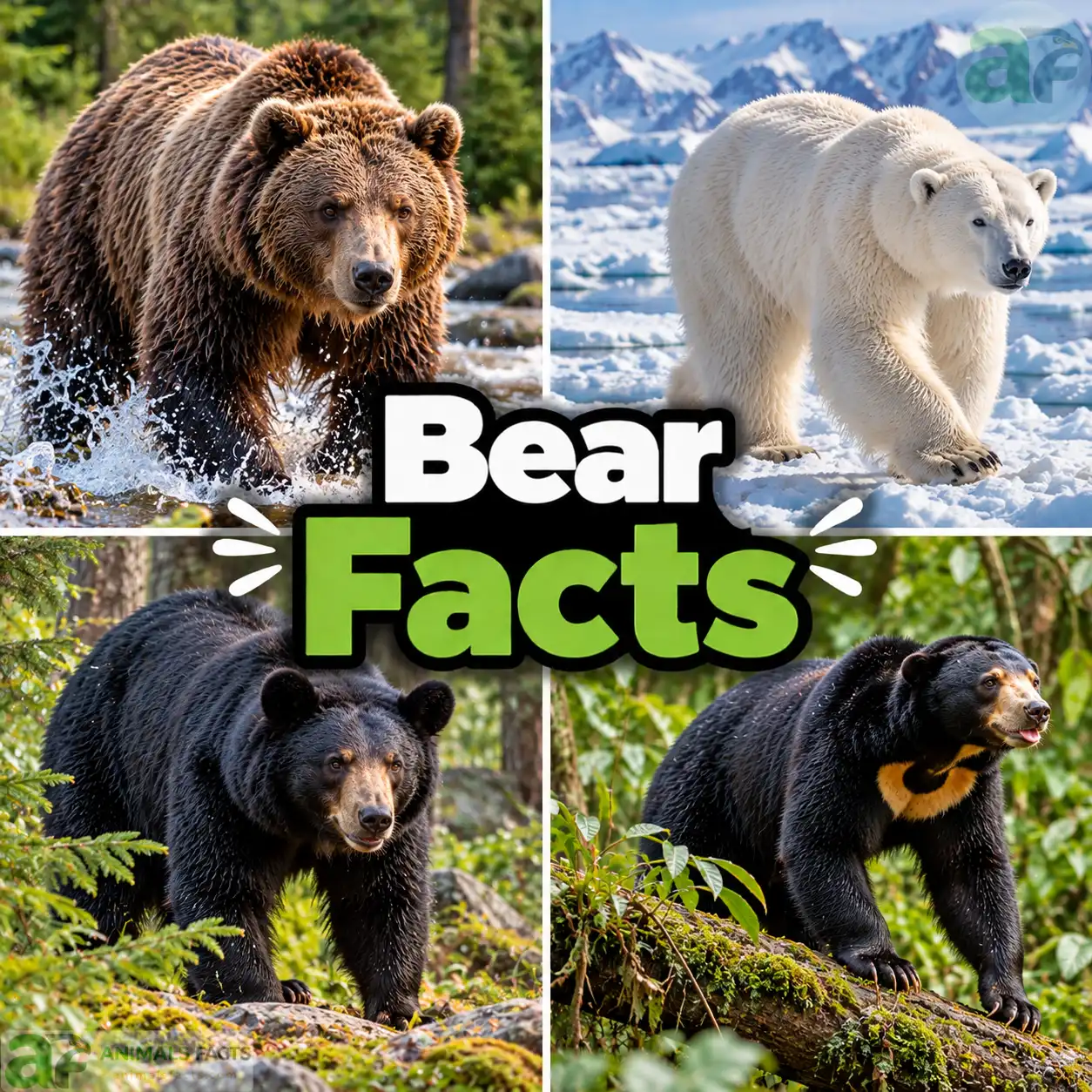
Bear Facts
| Feature | Details |
|---|---|
| Scientific Family | Ursidae |
| Kingdom | Animalia |
| Phylum | Chordata |
| Class | Mammalia |
| Order | Carnivora |
| Total Living Species | 8 species worldwide |
| Habitat | North America, South America, Europe, Asia; absent from Africa (except Atlas Bear, extinct), Australia, Antarctica |
| Lifespan | 20–30 years in the wild on average; up to 40+ years in captivity |
| Diet | Omnivores (most species); Polar Bear is almost exclusively carnivorous; Giant Panda is almost exclusively herbivorous |
| Smallest Species | Sun Bear (Helarctos malayanus) — as small as 27 kg and 1.2 meters |
| Largest Species | Polar Bear (Ursus maritimus) — up to 800 kg and 3 meters; Kodiak Brown Bear rivals it in weight |
| Fastest Species | Grizzly Bear — sprint speeds up to 56 km/h (35 mph) |
| Most Endangered Species | Gobi Bear (subspecies of Brown Bear) — fewer than 40 individuals remaining in the wild |
| Conservation Status (varies by species) | Ranges from Least Concern (American Black Bear) to Vulnerable (Polar Bear, Sun Bear, Sloth Bear) and Endangered (Giant Panda recovering; Gobi Bear critically low) |
| Global Population (all species combined) | Estimated 750,000–900,000+ individuals across all 8 bear species |
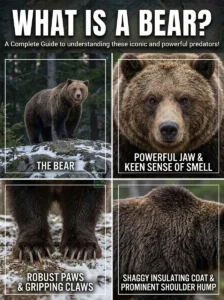 1. Introduction: What is a Bear?
They can smell food from over 30 kilometers away. They can outrun a racehorse over short distances despite weighing as much as a small car. They can sleep for up to seven months without eating, drinking, urinating, or defecating — and emerge from that sleep having barely lost any muscle mass. Bear facts read less like biology and more like a list of superpowers, and yet every single one of these abilities belongs to real, living animals that share our planet today. Few animal families on Earth combine raw physical power with such surprising intelligence, behavioral complexity, and ecological importance as the bears.
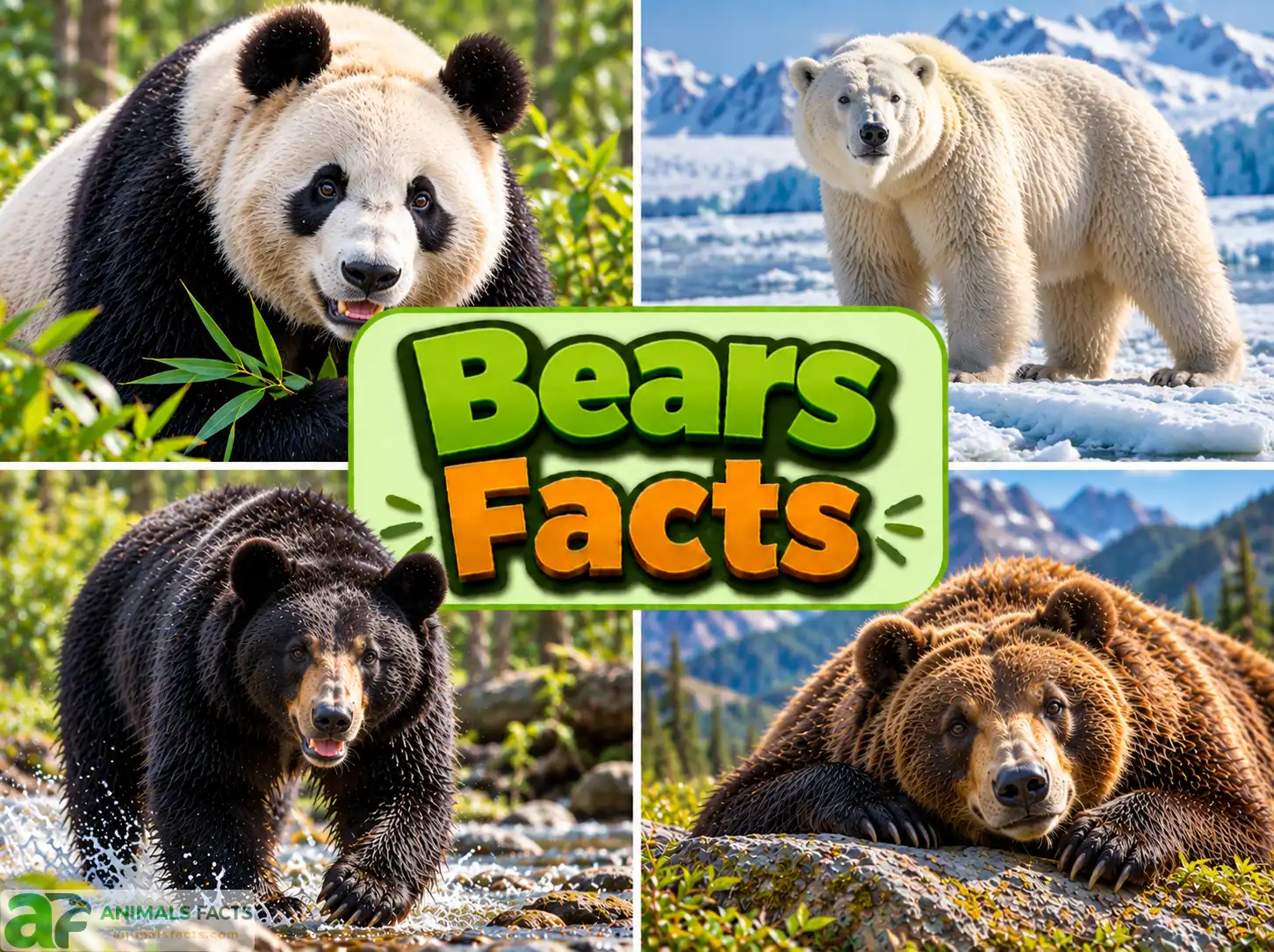
The family Ursidae contains just eight living species — a remarkably small number compared to other major mammal families — yet these eight species have achieved one of the most successful and geographically widespread distributions of any large carnivore group on Earth. From the sea-ice hunting Polar Bear of the high Arctic to the bamboo-specialist Giant Panda of central China, from the tiny, honey-loving Sun Bear of Southeast Asian rainforests to the powerful Grizzly Bear of North American mountains, bears have adapted to an extraordinary range of environments while retaining the unmistakable bear body plan: a large head, small eyes, a heavy body, and immense physical strength.
Whether you are a student researching bear facts for a school project, a hiker wanting to understand the animals you might encounter in bear country, a parent searching for bear facts for kids, a wildlife photographer planning a trip to see bears in the wild, or simply someone who has always been fascinated by these powerful, intelligent animals — this is the most complete guide to bear facts you will find anywhere. We cover bear habitat, bear diet, bear behavior, hibernation, reproduction, conservation, mythology, and the extraordinary cultural significance bears hold across human civilization. Let us begin.
2. Bear Species Overview & Classification
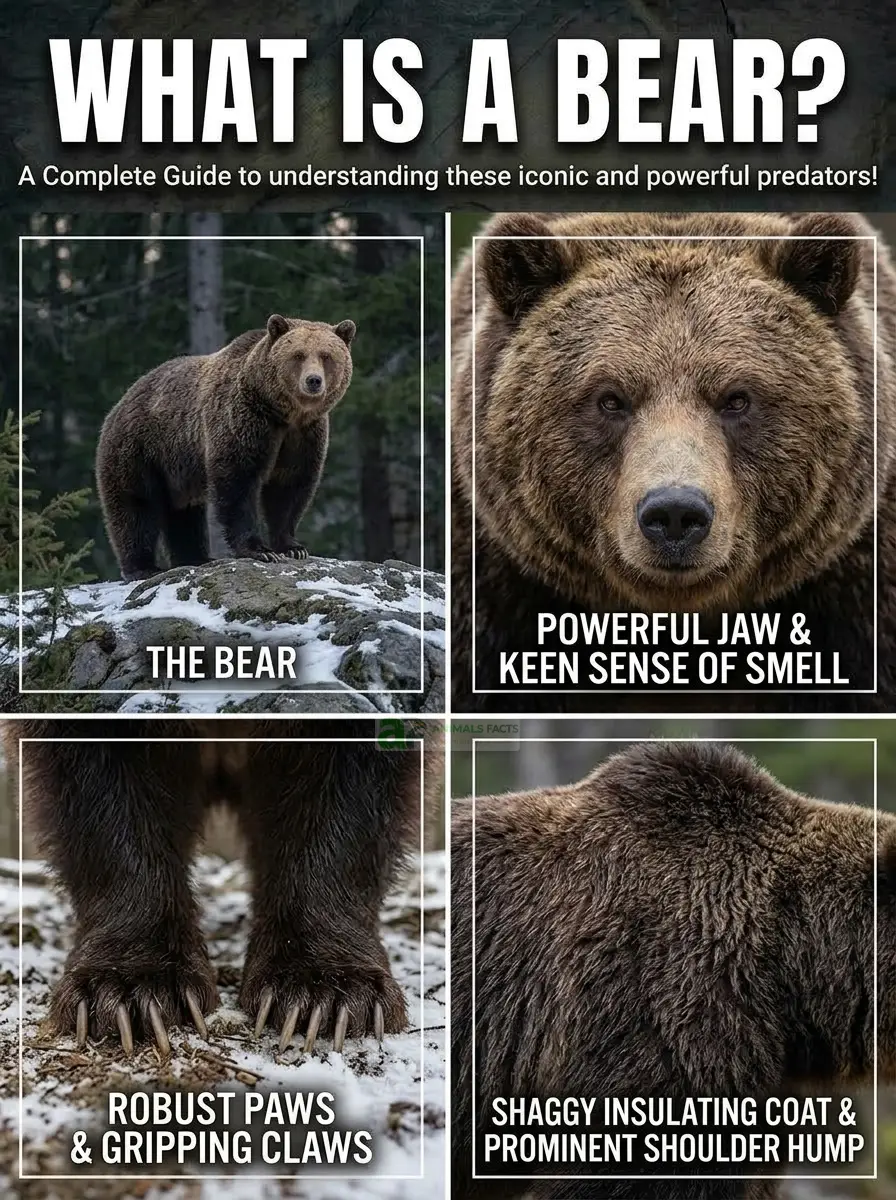
Bears belong to the family Ursidae within the order Carnivora — though, as we will see, most bear species are far from strict carnivores. Bears are characterized by their large body size, plantigrade locomotion (walking on the soles of their feet, like humans), short tails, and powerful, non-retractable claws.
What Defines a Bear?
All members of family Ursidae share these defining characteristics:
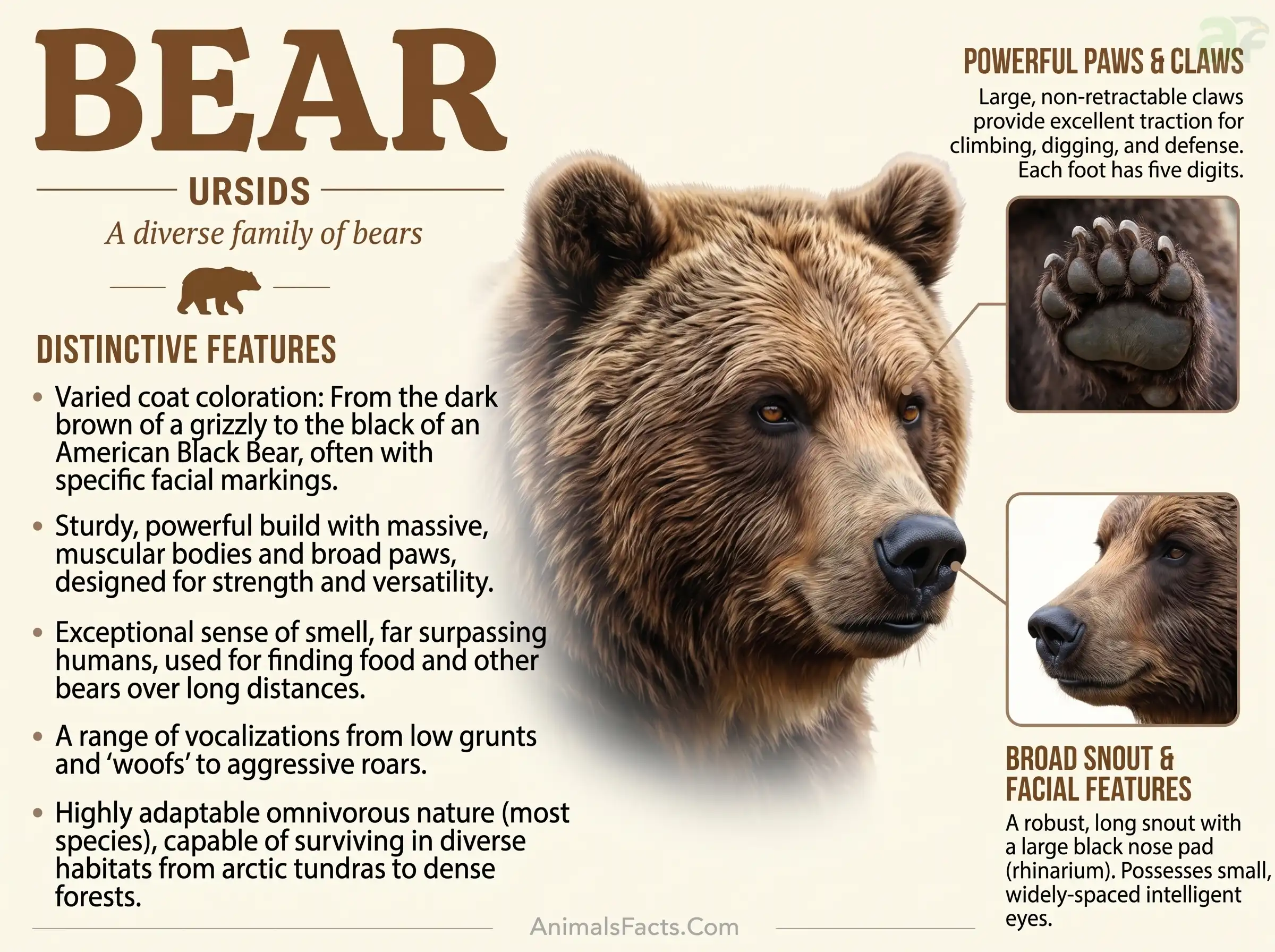
- Large, robust body: Even the smallest bear species are powerfully built, with dense muscle mass concentrated in the shoulders and forelimbs
- Plantigrade stance: Bears walk flat-footed on the soles of their feet — like humans and unlike most other carnivores, which walk on their toes (digitigrade)
- Non-retractable claws: Used for digging, climbing, and tearing — bear claws cannot be sheathed like a cat’s
- Excellent sense of smell: Bears possess one of the most sensitive olfactory systems of any land mammal — far exceeding even that of dogs in several species
- Short tails: Almost vestigial in most species, a sharp contrast to many other carnivores
- Dietary flexibility: Most bear species are omnivorous generalists, though several have evolved toward dietary extremes
The 8 Living Bear Species
| Species | Scientific Name | Approx. Wild Population | Native Range |
|---|---|---|---|
| American Black Bear | Ursus americanus | ~800,000–900,000 | North America |
| Brown Bear | Ursus arctos | ~200,000 | North America, Europe, Asia |
| Polar Bear | Ursus maritimus | ~22,000–31,000 | Arctic Circle |
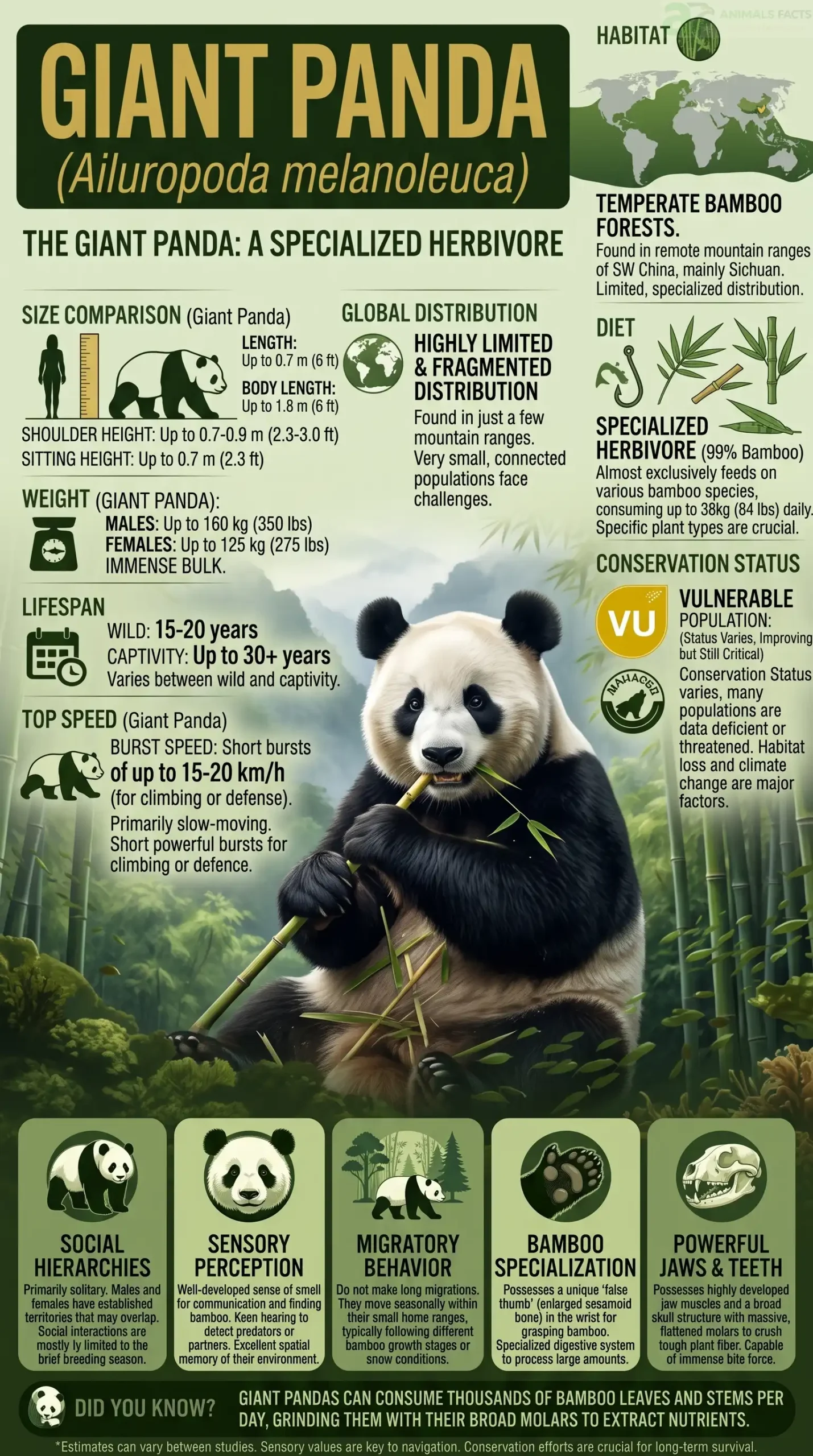
| Giant Panda | Ailuropoda melanoleuca | ~1,860+ | Central China |
| Asian Black Bear | Ursus thibetanus | ~25,000–50,000 | South & East Asia |
| Sloth Bear | Melursus ursinus | ~10,000–20,000 | Indian Subcontinent |
| Sun Bear | Helarctos malayanus | ~10,000–30,000 (estimated) | Southeast Asia |
| Spectacled Bear | Tremarctos ornatus | ~10,000–20,000 | South America (Andes) |
Species Evolution & Discovery Timeline
~38 million years ago: The earliest ancestors of modern bears — small, dog-like carnivores in the genus Ursavus (“dawn bear”) — appeared in the forests of what is now Europe and Asia.
~20 million years ago: Ursavus elmensis, often cited as the common ancestor of all modern bear species, lived during the Miocene Epoch — a fox-sized animal that bears little resemblance to its massive modern descendants.
~5–6 million years ago: The lineage leading to the Giant Panda diverged from other bears — making it the earliest-diverging branch of the modern bear family tree, explaining many of its unique anatomical features.
~3.5–4 million years ago: The Spectacled Bear lineage (Tremarctinae, “short-faced bears”) diverged — this subfamily once included the enormous Giant Short-faced Bear (Arctodus simus) of Ice Age North America, among the largest land predators ever known.
~1.2–1.6 million years ago: The Polar Bear lineage diverged from Brown Bears — making polar bears, in evolutionary terms, a remarkably recent and rapidly adapted offshoot of the brown bear family, specialized for life on Arctic sea ice.
~11,000 years ago: The Giant Short-faced Bear and other Ice Age megafauna bears went extinct at the end of the last glacial period, alongside mammoths, saber-toothed cats, and other Pleistocene giants.
1758: Carl Linnaeus formally classified the Brown Bear (Ursus arctos) in Systema Naturae, establishing the foundational scientific name still used today.
1869: French missionary and naturalist Armand David became the first Westerner to formally document the Giant Panda, sending a specimen to Paris and introducing the species to Western science.
2008: Genomic research provided robust confirmation of the bear family tree, definitively placing the Giant Panda and Spectacled Bear as the earliest-diverging lineages within Ursidae.
2016: The IUCN reclassified the Giant Panda from Endangered to Vulnerable — one of the most celebrated conservation success stories of the 21st century — though the species’ status was later affected by reassessment debates regarding climate change projections.
3. Bear Physical Description & Unique Features
Bears are among the most physically powerful land mammals on Earth — their combination of massive muscle mass, dense bone structure, and formidable natural weaponry makes them capable of feats of strength that few other animals can match.
Size Extremes
Smallest bear species: The Sun Bear (Helarctos malayanus) of Southeast Asia — adults weigh as little as 27–50 kg and stand only 1.1–1.4 meters in length, making it roughly the size of a large dog. Its small size and short claws are adaptations for climbing trees in dense rainforest.
Largest bear species: The Polar Bear (Ursus maritimus) — males can weigh up to 800 kg and exceed 3 meters in length when standing on hind legs. The Kodiak Brown Bear (Ursus arctos middendorffi), a subspecies confined to Alaska’s Kodiak Archipelago, rivals the Polar Bear in size, with the largest confirmed individuals exceeding 750 kg.
Tallest when standing: Both Polar Bears and large Brown Bears can stand over 3 meters tall on their hind legs — a behavior used primarily to gain a better vantage point or to assess a potential threat, not as an attack posture as is commonly assumed.
Remarkable Physical Adaptations
The Bear’s Nose: A bear’s sense of smell is one of the most sensitive in the entire animal kingdom — estimated to be seven times more sensitive than a bloodhound’s and up to 2,100 times more sensitive than a human’s. Polar Bears can detect the scent of a seal’s breathing hole through a meter of compacted snow and ice from over a kilometer away. Black Bears have been documented detecting food sources from over 30 kilometers away under favorable wind conditions.
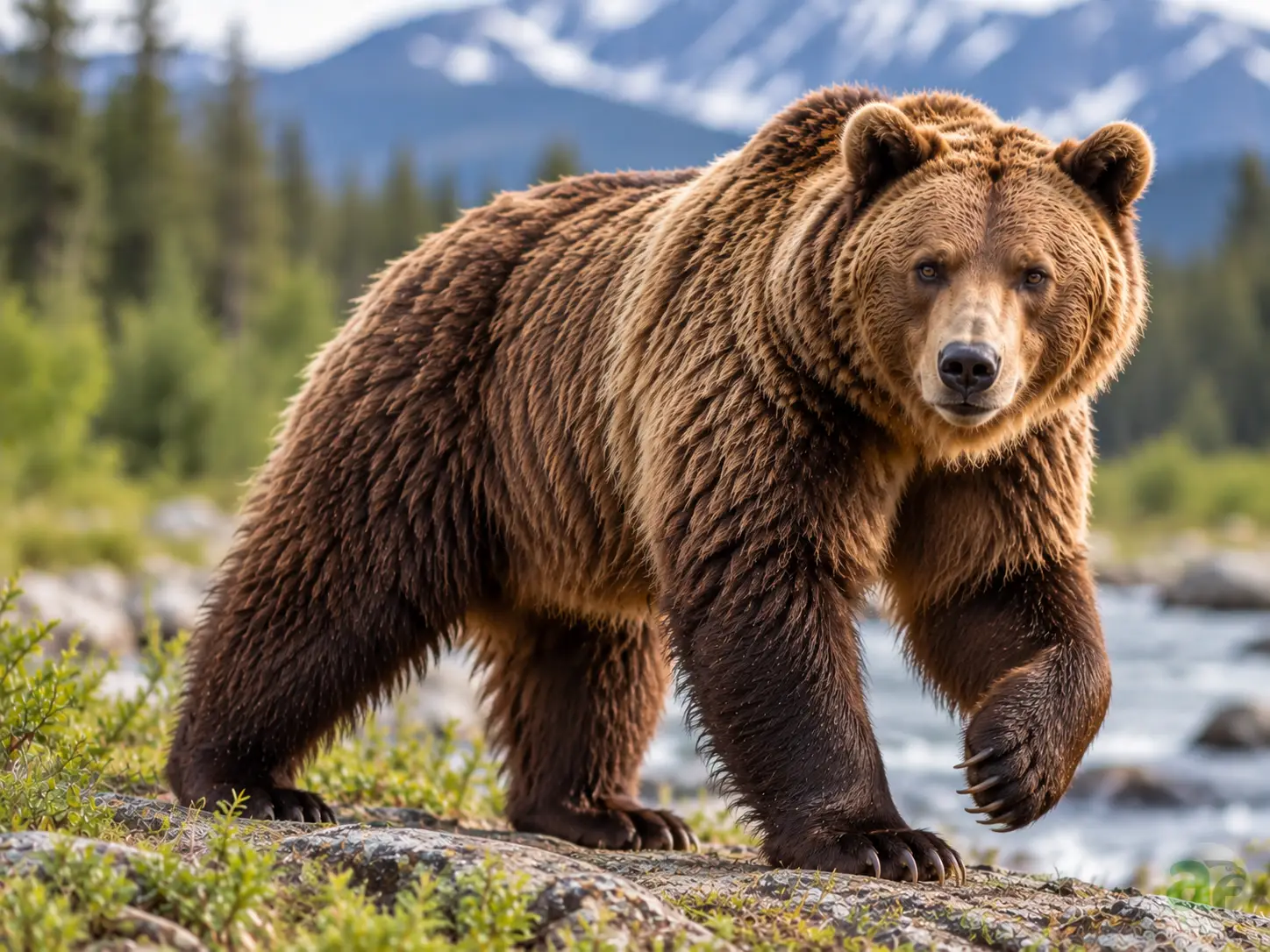
Claws: Bear claws vary dramatically by species and ecological niche. The Sloth Bear has the longest claws relative to body size of any bear — up to 10 cm long — adapted for tearing open termite mounds. The Grizzly Bear’s claws, which can reach 10 cm as well, are adapted primarily for digging roots, tubers, and ground squirrels rather than climbing — which is why grizzlies are comparatively poor tree climbers compared to Black Bears, whose shorter, more curved claws are better suited to climbing.
Hump Muscle: Brown Bears and Grizzly Bears possess a distinctive muscular hump over their shoulders — a feature absent in Black Bears — which powers the immense digging strength used to excavate burrows, dig out ground squirrels, and unearth roots. This hump is one of the most reliable visual features for distinguishing Grizzly Bears from Black Bears in the wild.
Polar Bear Adaptations: Polar Bears possess a suite of adaptations unmatched by any other bear species for Arctic survival: a layer of blubber up to 11 cm thick, water-repellent guard hairs over a dense undercoat, black skin beneath translucent (not white) fur that helps absorb solar heat, and partially webbed paws up to 30 cm in diameter that function as natural snowshoes and swimming paddles.
Did You Know? Polar Bear fur is not actually white — each individual hair is translucent and hollow, scattering and reflecting visible light in a way that makes the fur appear white, similar to how ice and snow appear white despite being made of clear material. Beneath this translucent fur, Polar Bear skin is jet black — an adaptation that helps absorb and retain solar heat in the brutally cold Arctic environment.
4. Top 25 Surprising & Interesting Bear Facts
- Polar Bears are technically classified as marine mammals by the US Marine Mammal Protection Act — because they depend on the ocean and sea ice for their primary food source and spend the majority of their lives on or near sea ice.
- The Giant Panda spends up to 14 hours a day eating, consuming between 12 and 38 kilograms of bamboo daily — necessary because bamboo is extremely low in nutritional value and pandas retain a largely carnivorous digestive system despite their herbivorous diet.
- Grizzly Bears can run at speeds of up to 56 km/h (35 mph) in short bursts — faster than the fastest human sprinters and capable of briefly outrunning a racehorse over short distances.
- Bears in hibernation can go up to 7 months without eating, drinking, urinating, or defecating — and their bodies recycle waste products into usable protein, a metabolic feat unmatched by almost any other mammal.
- The Sun Bear has the longest tongue relative to body size of any bear — up to 25 centimeters — used to extract honey and insects from narrow crevices, earning it the nickname “honey bear.”
- Polar Bears can smell a seal’s breathing hole in the ice from over a kilometer away, even through compacted snow and ice layers.
- A bear’s bite force varies enormously by species, but the Grizzly Bear’s bite has been measured at over 8,000 Newtons — powerful enough to crush a bowling ball.
- The Spectacled Bear is the only bear species native to South America and the last surviving member of the short-faced bear subfamily (Tremarctinae), which once included some of the largest land carnivores in history.
- Black Bears are excellent swimmers and have been documented swimming distances of over 15 kilometers across open water.
- The Sloth Bear has a unique ability to close its nostrils at will — an adaptation that allows it to suck up termites and ants from mounds without inhaling dust and insect parts.
- Polar Bear cubs are born blind, hairless, and weighing just 450–700 grams — roughly the size of a guinea pig — despite their mothers weighing up to 300 kg.
- The Giant Panda’s distinctive “thumb” is not a true thumb at all but an enlarged wrist bone (the radial sesamoid) that has evolved to help the panda grip bamboo stalks — one of the most celebrated examples of evolutionary adaptation in any mammal.
- Brown Bears have been documented using tools — including using rocks to scratch hard-to-reach areas of their bodies, one of relatively few documented cases of tool use among bears.
- A bear’s sense of smell is estimated to be up to 2,100 times more sensitive than a human’s — among the most powerful olfactory systems of any land mammal on Earth.
- The Kodiak Brown Bear, found only on Alaska’s Kodiak Archipelago, is among the largest bears on Earth, with males regularly exceeding 600 kg and standing over 3 meters tall on hind legs.
- Polar Bears are powerful swimmers capable of sustained swims of over 100 kilometers and have been recorded swimming continuously for more than 9 days without resting on land or ice.
- The Asian Black Bear (also called the Moon Bear due to the crescent-shaped marking on its chest) is capable of standing and walking upright on its hind legs for extended distances — more so than most other bear species.
- Giant Pandas, despite their bamboo-dominated diet, retain the digestive system of a carnivore and can only extract about 17% of the nutritional value from the bamboo they eat — necessitating their extraordinary daily intake.
- The American Black Bear population has more than doubled since the 1980s due to successful conservation management, now numbering between 800,000 and 900,000 individuals — making it by far the most numerous bear species on Earth.
- Bears possess excellent memory for food source locations, returning to productive berry patches, salmon streams, and feeding sites across multiple years and even recalling locations after periods of hibernation.
- The Sun Bear has the shortest fur of any bear species — an adaptation to the hot, humid tropical rainforest climates of Southeast Asia where it lives.
- Polar Bears have been documented hunting and killing beluga whales by ambushing them when the whales surface to breathe in small openings in sea ice — one of the most dramatic predatory behaviors of any land carnivore.
- The Gobi Bear, a critically endangered subspecies of the Brown Bear found only in the Gobi Desert of Mongolia, survives in one of the most extreme and food-scarce environments inhabited by any bear, with a wild population estimated at fewer than 40 individuals.
- Bears can walk on their hind legs for considerable distances — not just briefly to investigate threats — and this bipedal capability has contributed significantly to their cultural association with humans across numerous traditions.
- The extinct Giant Short-faced Bear (Arctodus simus) of Ice Age North America was one of the largest land predators ever to exist, standing an estimated 3.4 meters tall on its hind legs and weighing up to 900 kg — significantly larger than any bear alive today.
5. Fun Facts About Bears
- There are only 8 living bear species in the entire world — a remarkably small number for such a widely recognized and ecologically successful mammal family.
- A bear’s sense of smell is so powerful that Polar Bears can detect a seal carcass from over 30 kilometers away under good wind conditions.
- Giant Pandas are technically carnivores by digestive classification but eat an almost entirely herbivorous, bamboo-based diet — one of the most unusual dietary mismatches in the mammal kingdom.
- During hibernation, a bear’s heart rate can drop from a normal 40–50 beats per minute to as low as 8–19 beats per minute.
- Grizzly Bears can detect food odors from over a mile away, and their sense of smell is considered one of the most acute of any land mammal.
- The Sloth Bear gets its name from early European naturalists who mistakenly classified it as a type of sloth due to its long claws and shaggy fur — it is, in fact, fully a bear.
- Polar Bears have black skin beneath their translucent fur — an adaptation to absorb and retain heat in the Arctic environment.
- A single Brown Bear can consume up to 40,000 calories per day during the pre-hibernation feeding period known as hyperphagia.
- The Spectacled Bear gets its name from the distinctive cream-colored markings around its eyes that resemble eyeglasses — each individual’s pattern is unique.
- Bears have excellent color vision — contrary to the popular belief that they are colorblind, research has confirmed bears can distinguish colors, which likely helps them locate ripe berries and fruit.
- Sun Bears have such loose skin around their necks that they can turn around and bite an attacker even while being held by the scruff of the neck — a highly effective defensive adaptation.
- The American Black Bear comes in a remarkable range of colors despite its name — including black, brown, cinnamon, blonde, and even rare blue-grey (“glacier bear”) and white (“spirit bear” or Kermode bear) variants.
6. Bear Habitat & Geographic Range
Bears occupy an extraordinarily diverse range of habitats — from the frozen Arctic sea ice to tropical rainforests, from high-altitude cloud forests to temperate mountain ranges — making the family Ursidae one of the most habitat-adaptable large carnivore groups on Earth.
Major Bear Habitat Types
Arctic Sea Ice: The exclusive domain of the Polar Bear, which depends almost entirely on sea ice as a platform for hunting seals. As sea ice diminishes due to climate change, this habitat represents the most rapidly disappearing bear habitat on Earth.
Boreal & Temperate Forests: Brown Bears, Black Bears, and Asian Black Bears inhabit vast stretches of forest across North America, Europe, and Asia — from dense coniferous taiga to mixed deciduous woodlands, often in close proximity to rivers and salmon-spawning streams.
Mountain Ecosystems: The Spectacled Bear is uniquely adapted to the high-altitude cloud forests and páramo grasslands of the Andes Mountains, ranging from sea level up to elevations exceeding 4,750 meters — one of the widest altitudinal ranges of any bear species.
Tropical Rainforests: The Sun Bear is the only bear species fully adapted to tropical rainforest life, inhabiting the dense lowland forests of Southeast Asia, where its small size and climbing ability allow it to exploit canopy resources unavailable to larger bear species.
Savanna & Dry Forest: The Sloth Bear inhabits the dry deciduous forests, grasslands, and scrublands of the Indian subcontinent, an environment quite different from the temperate forests favored by most other bear species.
Bamboo Forests: The Giant Panda is restricted almost entirely to the temperate bamboo forests of a handful of mountain ranges in central China, at elevations typically between 1,200 and 3,400 meters — one of the most habitat-restricted large mammals on Earth.
Habitat Range by Continent
| Continent | Notable Bear Species | Approximate Range |
|---|---|---|
| North America | Polar Bear, Grizzly/Brown Bear, American Black Bear | Arctic Circle to Mexico |
| Asia | Brown Bear, Asian Black Bear, Sloth Bear, Sun Bear, Giant Panda | Siberia to Southeast Asia |
| Europe | Brown Bear | Scandinavia to the Balkans and Carpathians |
| South America | Spectacled Bear | Andes Mountains (Venezuela to Bolivia) |
| Africa | None native (Atlas Bear, extinct ~1870s) | — |
| Australia & Oceania | None native | — |
| Antarctica | None | — |
Did You Know? The Brown Bear has the largest natural geographic range of any bear species and one of the widest of any land mammal on Earth — found across North America, Europe, and Asia, from the coastal rainforests of Alaska to the steppes of Central Asia to the mountains of Scandinavia, spanning an enormous diversity of climates and ecosystems.
7. Bear Diet & Feeding Behavior
Bears display one of the widest dietary ranges of any mammal family — spanning from the almost entirely meat-based diet of the Polar Bear to the almost entirely plant-based diet of the Giant Panda, with most species falling somewhere in between as opportunistic, flexible omnivores.
Major Dietary Categories
Hypercarnivores: The Polar Bear is the only bear species considered a true hypercarnivore — its diet consists of more than 90% seal meat and blubber, primarily from ringed seals and bearded seals, reflecting its specialized adaptation to Arctic marine ecosystems where plant food is scarce or absent for much of the year.
Hypoherbivores: The Giant Panda sits at the opposite dietary extreme — approximately 99% of its diet consists of bamboo, despite retaining the short digestive tract characteristic of a carnivore, forcing it to eat enormous quantities to meet its nutritional needs.
Generalist Omnivores: The remaining six bear species — Brown Bears, Black Bears, Asian Black Bears, Sloth Bears, Sun Bears, and Spectacled Bears — are highly adaptable omnivores, consuming a flexible mix of vegetation, fruit, insects, fish, and meat depending on seasonal availability.
Diet Breakdown Table
| Bear Species | Primary Food | Secondary Food | Feeding Method |
|---|---|---|---|
| Polar Bear | Ringed & bearded seals (90%+) | Walrus, beluga, carrion (10%) | Ambush hunting at breathing holes |
| Giant Panda | Bamboo (99%) | Occasional small animals, eggs (1%) | Selective foraging; specialized grip |
| Brown/Grizzly Bear | Berries, roots, salmon (60%) | Ungulates, ground squirrels, carrion (40%) | Foraging, digging, fishing |
| American Black Bear | Vegetation, berries, nuts (75%) | Insects, fish, small mammals, carrion (25%) | Opportunistic foraging |
| Sloth Bear | Termites & ants (50%) | Fruit, honey, vegetation (50%) | Suction feeding from mounds |
| Sun Bear | Insects, honey (50%) | Fruit, small vertebrates (50%) | Tree climbing; long-tongue extraction |
| Asian Black Bear | Fruit, nuts, vegetation (65%) | Insects, small mammals, carrion (35%) | Foraging; occasional climbing |
| Spectacled Bear | Fruit, bromeliads, bark (80%) | Insects, small mammals (20%) | Tree climbing; platform building |
Did You Know? Before hibernation, Brown Bears enter a state called hyperphagia — a period of intense, almost continuous eating during which a single bear can consume up to 40,000 calories and gain over 1.4 kg of body weight per day, building the fat reserves necessary to survive months of winter dormancy without eating. During peak salmon runs in Alaska, bears have been documented eating dozens of salmon in a single day, often consuming only the calorie-rich skin, brain, and eggs while discarding the rest of the carcass — a behavior that, in turn, provides crucial nutrients to surrounding forest ecosystems.
8. Bears Reproduction & Life Cycle
Bear reproduction is closely tied to one of the family’s most distinctive biological adaptations: hibernation. The timing of mating, gestation, and birth in most bear species is intricately synchronized with seasonal food availability and winter dormancy.
Delayed Implantation
Most bear species exhibit a remarkable reproductive adaptation called embryonic diapause or delayed implantation. Mating typically occurs in spring or early summer, but the fertilized egg does not immediately implant in the uterine wall. Instead, it remains dormant for several months, only implanting in autumn if the female has accumulated sufficient fat reserves to survive hibernation and successfully raise cubs. If a female has not gained adequate weight, the embryo may fail to implant at all, and the pregnancy is naturally terminated — an evolutionary mechanism that prevents reproduction in years of poor food availability.
Birth During Hibernation
In most temperate and Arctic bear species, cubs are born during hibernation — typically in January or February — while the mother is in a state of reduced metabolic activity but not true deep sleep (female bears rouse periodically to give birth and nurse). Cubs are born remarkably underdeveloped compared to most mammals of similar adult size: blind, nearly hairless, and weighing as little as 0.5% of the mother’s body weight.
Key Reproductive Facts by Species
| Species | Gestation (incl. delay) | Litter Size | Birth Weight |
|---|---|---|---|
| Polar Bear | ~195–265 days (with diapause) | 1–3 cubs | 450–700 grams |
| Brown/Grizzly Bear | ~180–266 days (with diapause) | 1–4 cubs | 340–680 grams |
| American Black Bear | ~220 days (with diapause) | 1–6 cubs | 200–450 grams |
| Giant Panda | ~95–160 days (variable diapause) | 1–2 cubs (typically only 1 survives) | 100–200 grams |
| Sloth Bear | ~210 days | 1–3 cubs | 400–500 grams |
| Sun Bear | ~95–174 days | 1–2 cubs | 300–400 grams |
Growth & Maturation
Cubs typically remain with their mother for 1.5 to 3.5 years, depending on species, learning critical survival skills including foraging techniques, hunting (in Polar Bears), and avoiding danger. Sexual maturity is generally reached between 3 and 6 years, though full physical maturity and maximum body size are often not achieved until 8 to 10 years of age in larger species.
Bear Lifespan Comparison Table
| Species | Average Lifespan (Wild) | Record / Maximum (Captivity) |
|---|---|---|
| Sun Bear | 20–25 years | ~30 years |
| American Black Bear | 18–23 years | ~39 years |
| Brown/Grizzly Bear | 20–25 years | ~44 years |
| Polar Bear | 15–18 years | ~43 years |
| Giant Panda | 18–20 years | 38 years (Jia Jia, Hong Kong — oldest panda ever recorded) |
| Spectacled Bear | 20–25 years | ~36 years |
9. Social Behavior & Communication
Bears are generally considered solitary animals — a characterization that holds true for most species outside of breeding season and mother-cub relationships, though bear social behavior is considerably more nuanced and context-dependent than this simple label suggests.
Social Structures
Predominantly solitary: Most bear species, including Black Bears, Sun Bears, and Spectacled Bears, live largely solitary lives outside of mating season, with adults actively avoiding direct contact with one another except when resources or mating opportunities bring them together.
Seasonal aggregation: Several bear species display remarkable tolerance for close proximity to other bears when concentrated food resources demand it. Brown Bears congregating at Alaska’s Brooks Falls during the annual salmon run will fish within meters of one another, establishing temporary dominance hierarchies based largely on size and age rather than engaging in constant conflict.
Mother-cub bonds: The strongest and most enduring social bond in bear society is between a mother and her cubs, which can last from 18 months to over 3 years depending on species — among the longest periods of maternal dependency of any solitary carnivore.
Communication Methods
Vocalizations: Bears produce a surprisingly diverse range of sounds. Grunts, woofs, and huffs typically indicate mild stress or warning. Jaw popping and teeth clacking signal more serious agitation. Roars and bellows are used in serious confrontations, particularly between males during mating season. Cub vocalizations include distinctive humming sounds produced while nursing, believed to communicate contentment to the mother.
Body language: Bears communicate extensively through posture and movement. Standing on hind legs is most commonly a means of gaining a better view or scent rather than an aggressive display, despite popular belief. Bluff charges — rapid charges that stop well short of contact — are a common warning behavior intended to assess and deter a perceived threat without actual physical confrontation. Ears pinned back and lowered head typically indicate aggression or extreme stress.
Scent marking: Bears communicate extensively through scent — rubbing against trees, scratching bark, and depositing scent from glands located on their back, neck, and feet. These “bear trees” serve as long-term communication posts, conveying information about identity, sex, reproductive status, and size to other bears that may pass the same location days, weeks, or even months later.
Did You Know? Research conducted at Brooks Falls in Katmai National Park, Alaska — where dozens of Brown Bears gather annually to fish for salmon — has documented a clearly recognizable dominance hierarchy among individual bears, with researchers and park rangers able to identify and track specific bears by name across multiple years through the annual “Fat Bear Week” public engagement event, which has become an internationally popular celebration of bear conservation and individual bear personalities.
10. Predators & Defense Mechanisms
Adult bears, owing to their large size and formidable physical capabilities, face remarkably few natural predators — a position shared by very few other land mammals. However, cubs and subadult bears remain vulnerable to a range of threats.
Natural Predators and Threats
Other bears: The most significant predatory threat to bear cubs comes from adult male bears of the same or related species, which will kill cubs in certain circumstances — a behavior called infanticide, sometimes linked to males seeking to bring females back into reproductive readiness more quickly.
Large carnivores: In regions of overlap, wolves and tigers have been documented preying on bear cubs and, in rare cases, smaller adult bears, particularly Sloth Bears and Sun Bears in parts of their Asian range.
Humans: By an overwhelming margin, the primary cause of bear mortality across nearly all eight species is human activity — including hunting, vehicle collisions, habitat destruction, and human-wildlife conflict resulting in defensive or retaliatory killing.
Defense Mechanisms
Sheer physical size and strength: For adult bears of most species, raw physical power represents the primary deterrent against potential threats — few animals are willing to risk direct confrontation with an animal capable of the bite force and striking power of an adult bear.
Tree climbing: Sun Bears, Asian Black Bears, Spectacled Bears, and young Black Bears are accomplished climbers, often retreating into trees to escape ground-based threats — a strategy less available to Grizzly and Polar Bears, whose claws and body proportions are less suited to climbing.
Loose skin (Sun Bear): As noted earlier, the Sun Bear’s notably loose neck and shoulder skin allows it to twist and bite an attacker even when seized by the scruff — an unusual and highly effective anti-predator adaptation rare among mammals of its size.
Bluff displays: Rather than immediately resorting to physical confrontation, bears frequently rely on intimidating displays — standing upright, vocalizing, jaw popping, and bluff charging — to deter threats before any physical contact occurs, conserving energy and avoiding unnecessary injury.
Maternal aggression: Female bears with cubs represent one of the most formidable defensive forces in the animal kingdom, willing to engage in genuinely dangerous direct confrontation with threats — including humans, wolves, and male bears — that they would otherwise avoid when alone.
11. Bear Facts for Kids
Hey kids — get ready to learn why bears are some of the most incredible animals on planet Earth!
- There are only 8 kinds of bears in the whole world — from the giant Polar Bear that lives on Arctic ice to the tiny Sun Bear that is barely bigger than a large dog!
- A bear’s nose is incredibly powerful — a Polar Bear can smell a seal through a meter of solid ice and snow from over a kilometer away!
- Giant Pandas spend almost their whole day eating — up to 14 hours chewing bamboo, because bamboo doesn’t have very much nutrition in it!
- Bears can sleep for up to 7 months during hibernation without eating, drinking, or even going to the bathroom — and they barely lose any muscle while doing it!
- Polar Bear fur isn’t actually white — each hair is clear and hollow like a tiny glass tube, and underneath all that fur, a Polar Bear’s skin is actually jet black!
- Grizzly Bears can run as fast as 56 kilometers per hour — that’s faster than the fastest human who has ever lived!
- Baby Polar Bear cubs are born so tiny that they weigh about the same as a guinea pig — even though their moms can weigh as much as 300 kilograms!
- The Sun Bear has the longest tongue of any bear — almost 25 centimeters long — perfect for slurping honey out of tiny holes in trees!
Did You Know? Bears are way smarter than most people realize! Scientists have discovered that bears have excellent memories and can remember exactly where the best berry bushes and fishing spots are — sometimes returning to the very same locations year after year, even after sleeping through an entire winter of hibernation in between! Some researchers believe bears may be just as intelligent as primates when it comes to solving certain kinds of problems.
12. Relationship with Humans
The relationship between humans and bears is one of the longest and most culturally significant in human history — stretching back to prehistoric times and encompassing reverence, conflict, exploitation, and, increasingly, dedicated conservation effort.
Ancient Coexistence and Conflict
Archaeological evidence demonstrates that humans and bears have interacted, competed for resources, and occasionally hunted one another for tens of thousands of years. Cave bear remains found alongside early human artifacts across Europe suggest that ancient humans both hunted bears and, in some interpretations, may have held early forms of ritual reverence toward them — a practice some researchers term “the bear cult,” though this remains a debated area of archaeological interpretation.
Bears and Human Settlement
As human populations expanded into bear habitat across North America, Europe, and Asia, conflict over land, livestock, and resources increased substantially. Brown Bears were historically hunted to extinction or near-extinction across vast portions of their former range — eliminated entirely from most of the contiguous United States outside of the northern Rocky Mountains and Alaska by the early 20th century, and significantly reduced across much of Western Europe.
Bears in Modern Tourism
Bear-related ecotourism has become a substantial economic driver in numerous regions. Brown Bear viewing in Alaska, Black Bear viewing across North America, and Polar Bear tourism centered around towns like Churchill, Manitoba, generate significant revenue while fostering public appreciation for bear conservation, demonstrating that live bears can hold substantial and sustainable economic value to local communities.
Conflict and Coexistence Today
Human-bear conflict remains an active management challenge across bear range countries, particularly involving food-conditioned bears that have learned to associate human settlements, campgrounds, and agricultural areas with easily accessible food. Wildlife management agencies across bear range countries have developed extensive bear-aware education programs, bear-resistant food storage requirements, and non-lethal deterrent methods aimed at reducing conflict while preserving bear populations.
13. Bear Conservation Status & Threats
Of the eight living bear species, conservation status varies dramatically — ranging from genuinely successful recovery stories to species standing at the very edge of extinction.
Global Bear Conservation Data (2026)
| Species | IUCN Status | Estimated Wild Population | Primary Threat |
|---|---|---|---|
| Polar Bear | Vulnerable | 22,000–31,000 | Climate change; sea ice loss |
| Giant Panda | Vulnerable (recovering) | ~1,860+ | Habitat fragmentation; bamboo flowering cycles |
| Sun Bear | Vulnerable | 10,000–30,000 (estimated) | Deforestation; poaching for bile trade |
| Sloth Bear | Vulnerable | 10,000–20,000 | Habitat loss; human conflict; poaching |
| Asian Black Bear | Vulnerable | 25,000–50,000 | Habitat loss; bile farming; poaching |
| Spectacled Bear | Vulnerable | 10,000–20,000 | Deforestation; human conflict |
| Brown Bear (overall) | Least Concern | ~200,000 | Regionally threatened; Gobi Bear critically low |
| American Black Bear | Least Concern | 800,000–900,000 | Localized habitat loss; hunting pressure |
Major Threats to Bears
Climate Change: The single greatest existential threat facing the Polar Bear, whose entire hunting strategy depends on stable sea ice. Arctic sea ice has declined by approximately 13% per decade since satellite measurements began in 1979, with some projections suggesting significant portions of the Polar Bear’s range could become ice-free for extended summer periods within decades — directly threatening the species’ ability to hunt seals.
Bile Farming: A particularly severe threat to Asian Black Bears and Sun Bears, in which bears are kept in captivity — often in extremely poor conditions — to extract bile from their gallbladders for use in traditional medicine across parts of Asia. Despite significant legal restrictions in several countries, bile farming continues in parts of the region, and conservation organizations continue active campaigns to end the practice entirely.
Habitat Loss and Fragmentation: Deforestation, agricultural expansion, and infrastructure development threaten nearly every bear species to varying degrees, with particularly severe impacts on the Giant Panda (restricted to fragmented bamboo forest patches), Sun Bear, and Spectacled Bear.
Human-Wildlife Conflict: As human populations and bear ranges increasingly overlap, conflict over livestock, crops, and human safety results in significant bear mortality through retaliatory or defensive killing across most bear range countries.
Poaching: Bears across Asia face significant poaching pressure for their gallbladders, paws, and other body parts used in traditional medicine and as luxury food items, alongside the targeted threat from bile farming.
Did You Know? The Giant Panda’s reclassification from Endangered to Vulnerable by the IUCN in 2016 represents one of the most celebrated conservation achievements of recent decades, driven by decades of intensive habitat protection, captive breeding research, and reintroduction programs led primarily by Chinese conservation authorities. The wild population grew from approximately 1,114 individuals in the 1980s to over 1,860 by the most recent comprehensive surveys — demonstrating that even species facing severe historical decline can recover with sustained, well-funded conservation commitment.
14. Famous Bears
Knut — The Berlin Zoo Polar Bear
Knut was a Polar Bear born at the Berlin Zoo in December 2006 who became an international media sensation after being rejected by his mother and hand-raised by zookeepers — an unusual and controversial intervention at the time. His public appearances drew enormous crowds and significant media attention worldwide, generating substantial revenue for the zoo and raising significant public awareness of Polar Bear conservation issues before his unexpected death in 2011 at just four years old, caused by a previously undetected autoimmune brain condition.
Wojtek — The Soldier Bear
Wojtek was a Syrian Brown Bear adopted as a cub by Polish soldiers during World War II, who traveled with the 22nd Artillery Supply Company of the Polish II Corps, was officially enlisted as a soldier with his own rank and serial number, and reportedly helped carry ammunition crates during the Battle of Monte Cassino in 1944. After the war, Wojtek lived out his life at the Edinburgh Zoo in Scotland, becoming a beloved historical figure with multiple statues erected in his honor in both Poland and Scotland.
Jia Jia — The Oldest Giant Panda Ever Recorded
Jia Jia was a female Giant Panda who lived at Ocean Park Hong Kong, recognized by Guinness World Records as both the oldest Giant Panda ever recorded in captivity and the oldest ever documented, living to the age of 38 years before her death in 2016 — equivalent to over 100 human years by panda aging standards. Her remarkable longevity provided valuable scientific insight into Giant Panda lifespan and aging.
Winnie — The Real Bear Behind Winnie the Pooh
Winnie was a Black Bear cub purchased by Canadian veterinarian Harry Colebourn in 1914 and later donated to London Zoo, where she became a favorite of young visitors — including Christopher Robin Milne, son of author A.A. Milne. The young boy’s affection for the bear directly inspired the creation of Winnie the Pooh, one of the most beloved and commercially successful fictional characters in publishing history.
747 — “Bear Force One”
747, affectionately nicknamed “Bear Force One” by fans due to his enormous size, is a dominant male Brown Bear residing at Katmai National Park’s Brooks River in Alaska, who became the 2020 and 2024 “Fat Bear Week” champion — an annual public vote celebrating the heaviest, most successful bears preparing for hibernation. His massive size, estimated at over 600 kg at peak weight, and his dominant position among the river’s bear population have made him one of the most recognized individual wild bears in the world through the National Park Service’s webcam program.
15. Role in Ecosystem & Food Chain
Bears occupy critically important ecological roles across the diverse ecosystems they inhabit — functioning as both apex predators and as crucial agents of seed dispersal, nutrient transport, and ecosystem engineering.
Salmon and Nutrient Transport
In coastal North American and Russian ecosystems, Brown Bears play an extraordinarily important role in transporting marine nutrients into terrestrial forest ecosystems. By catching salmon from rivers and streams and carrying their carcasses into surrounding forest to feed, bears distribute marine-derived nitrogen and phosphorus throughout the forest floor — research has documented that trees growing near salmon streams frequented by feeding bears can grow significantly faster than comparable trees in areas without this nutrient subsidy, demonstrating a direct ecological link between healthy salmon populations, bear populations, and overall forest productivity.
Seed Dispersal
Omnivorous bear species, particularly Black Bears, Brown Bears, and Spectacled Bears, consume enormous quantities of fruit and berries during peak summer and autumn feeding periods, dispersing seeds across considerable distances through their droppings — a process that significantly contributes to forest regeneration and plant community diversity across their range.
Polar Bears and Arctic Food Webs
As the apex predator of the Arctic marine ecosystem, Polar Bears play a critical regulatory role in seal populations, influencing seal behavior and distribution patterns throughout the circumpolar Arctic. Their predation pressure helps maintain balance within an ecosystem that supports the broader marine food web, from fish populations to other Arctic predators.
Ecosystem Engineering
Grizzly and Brown Bears significantly disturb soil through their extensive digging behavior — searching for roots, tubers, and ground squirrels — which has been shown to aerate soil, redistribute nutrients, and influence plant community composition across the landscapes they inhabit, functioning in some respects similarly to the ecological role played by large grazing mammals in other ecosystems.
16. Myths, Folklore & Cultural Significance
Bears hold a position of profound cultural and spiritual significance across an extraordinary range of human civilizations — frequently regarded as among the most powerful and revered animals in mythology, second perhaps only to certain apex predators like lions and wolves in their symbolic importance.
Indigenous North American Traditions
Bears occupy a central position in the cosmology and spiritual traditions of numerous Indigenous North American peoples. Many traditions regard the bear as a powerful spiritual guide associated with strength, healing, introspection, and the connection between the physical and spiritual worlds — partly inspired by the bear’s remarkable hibernation cycle, interpreted by many traditions as a form of death and rebirth. The bear features prominently in clan systems, origin stories, and ceremonial practices across dozens of distinct Indigenous nations.
European Folklore and the “Bear Cult”
Archaeological evidence from Paleolithic Europe — including cave bear skulls found arranged in apparently deliberate configurations at sites including Drachenloch Cave in Switzerland — has led some researchers to propose that early European humans may have practiced forms of bear veneration or ritual, though this interpretation remains a subject of ongoing scientific debate. In later European folklore, bears frequently appear as powerful, semi-human figures, reflecting their unusual capacity for bipedal movement and their formidable physical presence.
Ancient Greek and Roman Mythology
In Greek mythology, the goddess Artemis was closely associated with bears, and the constellations Ursa Major and Ursa Minor (“Great Bear” and “Little Bear”) derive directly from Greek mythological tradition, recounting the transformation of the nymph Callisto and her son Arcas into bears before being placed among the stars by Zeus.
East Asian Traditions
In Japanese Ainu culture, the bear holds profound spiritual significance through the Iyomante ceremony, a ritual sending of a bear’s spirit back to the realm of the gods, reflecting deep reverence for the animal as a divine messenger. In Korean founding mythology, a bear transforms into a woman who becomes the mother of Dangun, the legendary founder of the first Korean kingdom — making the bear a foundational figure in Korean national origin mythology.
Modern Symbolic Significance
The bear remains a powerful national and political symbol in the modern era — most notably as the long-standing symbol of Russia, appearing in political cartoons, national imagery, and cultural references for centuries, reflecting the country’s vast geography and the historical abundance of Brown Bears across its territory.
17. Bears in Pop Culture
Few animals have achieved the sustained, multi-generational presence in human entertainment and commercial culture that bears have enjoyed, from beloved children’s characters to powerful corporate and national symbols.
Literature and Children’s Media
“Winnie the Pooh” by A.A. Milne (1926) — Inspired by the real bear Winnie (detailed above), this gentle, philosophically inclined fictional bear has become one of the most commercially successful and beloved characters in publishing history, with Disney’s subsequent adaptations extending the character’s reach to billions of people worldwide across nearly a century.
“Paddington Bear” by Michael Bond (1958) — The marmalade-loving Peruvian bear found at London’s Paddington Station has become one of Britain’s most beloved literary exports, with the character’s recent film adaptations achieving exceptional critical and commercial success and widespread cultural affection well beyond children’s audiences.
“The Jungle Book” by Rudyard Kipling (1894) — Baloo, the wise and good-natured bear who serves as mentor to the human child Mowgli, remains one of the most enduringly popular characters across the novel’s numerous film and television adaptations, including Disney’s 1967 and 2016 versions.
Smokey Bear (US Forest Service, since 1944) — One of the most recognized and longest-running advertising mascots in American history, created to promote wildfire prevention awareness, with the iconic slogan “Only You Can Prevent Forest Fires” (later updated to “Wildfires”) becoming deeply embedded in American popular culture across multiple generations.
Film and Television
“The Bear” (1988, Jean-Jacques Annaud) — A critically acclaimed French film notable for its remarkably authentic, largely dialogue-free portrayal of bear behavior, filmed using extensively trained Brown Bears and praised for its unusually accurate depiction of bear biology and behavior compared to most fictional bear media.
“Grizzly Man” (2005, Werner Herzog) — A documentary examining the life and death of bear enthusiast Timothy Treadwell, who lived among wild Grizzly Bears in Alaska for thirteen summers before being killed by one in 2003, presenting a complex and widely discussed examination of human-wildlife relationships and the genuine dangers of close bear contact.
“Fat Bear Week” (Katmai National Park, annual online event since 2014) — A hugely popular annual public bracket-style competition celebrating the bears of Brooks River as they prepare for hibernation, which has grown into a major viral cultural phenomenon, attracting millions of votes and significant mainstream media coverage while raising substantial public awareness of bear conservation.
Corporate and National Symbols
The bear features prominently as a national symbol, most notably representing Russia in political cartoons and national branding, and appears as the symbol of the US state of California (on its state flag, reflecting the now-extinct California Grizzly Bear population) and numerous sports team mascots worldwide, including the Chicago Bears of the NFL.
18. Bear Facts vs. Common Myths
Myth: Bears that stand on their hind legs are preparing to attack. Fact: Bears most commonly stand upright to gain a better view, catch a scent more effectively, or assess a potential threat — not as a precursor to attack. An attacking bear typically remains on all four legs to maximize speed and stability.
Myth: If a bear charges you, it is definitely going to attack. Fact: The vast majority of bear charges are “bluff charges” — rapid charges that stop well short of contact, intended to assess and deter a perceived threat. Genuine attacks are comparatively rare, though all bear charges should be treated with extreme caution and appropriate safety response.
Myth: Black bears are always black in color. Fact: American Black Bears display remarkable color variation, including black, brown, cinnamon, blonde, and rare blue-grey (“glacier bear”) and white (“spirit bear” or Kermode bear) color phases — color alone is not a reliable method for distinguishing Black Bears from Brown/Grizzly Bears.
Myth: You should play dead during any bear encounter. Fact: Appropriate response varies significantly by bear species and the nature of the encounter. Playing dead is generally recommended specifically for defensive Brown/Grizzly Bear attacks, but wildlife agencies recommend fighting back during a Black Bear attack or any attack that appears predatory rather than defensive in nature — making accurate species identification and threat assessment critically important.
Myth: Giant Pandas are a type of raccoon, not a true bear. Fact: Extensive genetic research has definitively confirmed the Giant Panda is a true bear, belonging firmly within family Ursidae, despite its unusual bamboo-based diet and certain distinctive anatomical features that led to historical taxonomic uncertainty.
Myth: Polar Bears are the largest land carnivores currently alive. Fact: While the Polar Bear is among the largest, the Kodiak Brown Bear rivals it closely in maximum recorded weight, and some authorities consider the two species roughly comparable in size, making definitive “largest” rankings dependent on specific measurement criteria and individual specimens.
Myth: Bears hibernate in a state of unbroken, unconscious deep sleep throughout winter. Fact: Bear hibernation (more precisely termed torpor by many researchers, given that body temperature drops only moderately compared to true hibernators like ground squirrels) involves significant metabolic suppression, but bears can and do rouse periodically, and female bears specifically wake to give birth and nurse cubs during this period.
19. Best Places to See Bears in the Wild
Katmai National Park, Alaska, USA
Home to the famous Brooks Falls, where dozens of Brown Bears gather annually during the salmon run (typically July through September) to fish in one of the most spectacular and reliable large-mammal wildlife viewing experiences anywhere on Earth, made globally famous through the National Park Service’s live webcams and the annual Fat Bear Week event.
Churchill, Manitoba, Canada
Known as the “Polar Bear Capital of the World,” Churchill offers exceptional opportunities to observe wild Polar Bears, particularly during October and November, when bears congregate along the shores of Hudson Bay awaiting the formation of sea ice, accessible via specialized tundra vehicles operated by experienced local guides.
Khutzeymateen Grizzly Bear Sanctuary, British Columbia, Canada
A protected coastal estuary specifically established to protect critical Grizzly Bear habitat, offering boat-based viewing of bears foraging on sedges and salmon in pristine wilderness, with strict access controls ensuring minimal disturbance to the resident bear population.
Wolong National Nature Reserve & Surrounding Areas, Sichuan, China
A premier destination for observing Giant Pandas, including the renowned Chengdu Research Base of Giant Panda Breeding, offering visitors close access to both captive breeding programs and educational reintroduction initiatives central to the species’ celebrated conservation recovery.
Periyar Tiger Reserve, Kerala, India
One of the more reliable locations within the Sloth Bear’s range for observing this distinctive species, alongside significant tiger and elephant populations, within the unique dry deciduous forest ecosystem characteristic of the Western Ghats region.
Danum Valley Conservation Area, Borneo, Malaysia
Among the best remaining locations to observe the elusive Sun Bear in genuine primary rainforest habitat, alongside extraordinary broader biodiversity, though sightings of this notably shy species require patience and experienced local guiding.
Chocó-Andean Corridor, Ecuador
A premier destination for observing the Spectacled Bear in its native high-altitude cloud forest habitat, with several dedicated conservation reserves offering guided wildlife viewing opportunities focused specifically on South America’s only native bear species.
20. Top Documentaries & Books
Must-Watch Documentaries
“Grizzly Man” (2005, Werner Herzog) — A profound and widely discussed documentary examining the complex relationship between humans and wild Grizzly Bears, using extensive footage filmed by Timothy Treadwell himself during his years living among Alaska’s bear population.
“Disneynature Bears” (2014) — Follows a Brown Bear mother and her two cubs through their first year of life in Alaska, offering an accessible, visually stunning, and family-friendly introduction to bear biology and behavior.
“Pandas: The Journey Home” (2014) — Documents China’s intensive Giant Panda reintroduction efforts, providing insight into one of conservation’s most celebrated and methodologically sophisticated species recovery programs.
“Polar Bear” (Disneynature, 2022) — A visually extraordinary documentary following the life journey of a Polar Bear, offering powerful insight into the species’ Arctic environment and the mounting challenges posed by climate change.
“David Attenborough’s Frozen Planet” (BBC, 2011 & 2022) — Includes exceptional sequences depicting Polar Bear hunting behavior and Arctic ecosystem dynamics, narrated by Sir David Attenborough with the BBC Natural History Unit’s characteristic production excellence.
Essential Books
“Bears: A Brief History” by Bernd Brunner (2007) — An engaging and accessible exploration of the cultural, historical, and biological relationship between bears and humans across centuries of shared history.
“Track of the Grizzly” by Frank C. Craighead Jr. (1979) — A foundational scientific account from one of the pioneering researchers in Grizzly Bear conservation biology, documenting decades of groundbreaking field research in Yellowstone National Park.
“The Bears of Brooks Falls” by Michael Fitz (2021) — Written by a former Katmai National Park ranger, offering detailed insight into the individual bears, behaviors, and conservation significance of the famous Brooks River bear population.
“Pandas and People” by various Chinese conservation researchers and international collaborators — Several volumes examine the remarkable Giant Panda conservation success story, detailing the science and policy decisions behind one of the most celebrated species recovery efforts in modern conservation history.
21. Bear Comparison of Major Bear Species
| Feature | Polar Bear | Giant Panda | Brown/Grizzly Bear | American Black Bear | Sun Bear |
|---|---|---|---|---|---|
| Scientific Name | Ursus maritimus | Ailuropoda melanoleuca | Ursus arctos | Ursus americanus | Helarctos malayanus |
| Max Weight | 800 kg | 125 kg | 680+ kg (Kodiak) | 300 kg | 50 kg |
| Habitat | Arctic sea ice | Bamboo forests, China | Forests, tundra, mountains (N. Hemisphere) | Forests, North America | Tropical rainforest, SE Asia |
| Diet | Carnivore (seals) | Herbivore (bamboo) | Omnivore | Omnivore | Omnivore (insects, honey) |
| Lifespan (wild) | 15–18 years | 18–20 years | 20–25 years | 18–23 years | 20–25 years |
| Conservation Status | Vulnerable | Vulnerable (recovering) | Least Concern (regional variation) | Least Concern | Vulnerable |
| Population | 22,000–31,000 | ~1,860+ | ~200,000 | 800,000–900,000 | 10,000–30,000 (est.) |
| Unique Feature | Marine mammal classification; black skin | Pseudo-thumb; near-exclusive bamboo diet | Shoulder hump; widest range of any bear | Most numerous bear; remarkable color variation | Longest tongue; loosest skin |
22. How You Can Help
Bear conservation needs continue to vary dramatically by species and region — from the urgent climate-driven crisis facing Polar Bears to the ongoing fight against bile farming affecting Asian bear species. Every individual can contribute meaningfully to bear conservation efforts.
Support These Organizations
Polar Bears International (polarbearsinternational.org) — The leading organization focused exclusively on Polar Bear research, conservation, and public education regarding the species’ climate change-driven crisis.
World Wildlife Fund (WWF) (worldwildlife.org) — Runs extensive bear conservation programs across multiple species, including significant ongoing support for Giant Panda habitat protection and Polar Bear research.
Animals Asia (animalsasia.org) — Dedicated specifically to ending bear bile farming and rescuing bears from bile farms across Asia, operating dedicated sanctuaries for rescued Asian Black Bears and Sun Bears.
Vital Ground Foundation (vitalground.org) — Focuses on protecting and connecting Grizzly Bear habitat across North America through strategic land conservation and habitat corridor protection.
Bear Conservation (bearconservation.org.uk) — A UK-based organization supporting bear conservation projects across multiple species and regions worldwide, including significant Sun Bear and Spectacled Bear initiatives.
Practical Actions You Can Take Today
Reduce your carbon footprint. Given that climate change represents the single greatest threat to Polar Bears, individual actions that reduce greenhouse gas emissions — from energy-efficient choices to reduced consumption and sustainable transportation — contribute directly, if incrementally, to addressing the species’ primary conservation challenge.
Practice responsible food storage in bear country. If hiking, camping, or living in bear habitat, properly storing food and waste using bear-resistant containers prevents bears from becoming food-conditioned, a behavior change that frequently results in the bear’s eventual destruction by wildlife managers.
Avoid products containing bear bile. Despite legal restrictions in many countries, products claiming to contain bear bile or derived bear parts continue to circulate in some traditional medicine markets — avoiding these products and supporting legitimate alternative treatments helps reduce ongoing demand driving bile farming.
Support sustainable palm oil and paper products. Habitat loss driving Sun Bear and Spectacled Bear decline is closely linked to unsustainable agricultural expansion — choosing certified sustainable products reduces this pressure.
Participate in citizen science. Programs such as eMammal and various regional bear monitoring initiatives welcome public wildlife camera trap data and sighting reports, contributing valuable information to ongoing bear population research.
Visit responsibly. Choosing ethical, well-regulated bear viewing tourism operators that prioritize bear welfare and maintain appropriate viewing distances supports conservation-focused tourism economies while minimizing additional stress on wild bear populations.
Did You Know? Polar Bears International and partner research organizations have documented that some Polar Bear populations are already showing measurable declines in body condition and reproductive success linked directly to reduced sea ice availability, with certain southern populations — including those in Canada’s Western Hudson Bay — experiencing population declines of over 30% since the 1980s, providing some of the clearest documented evidence of climate change’s direct impact on a major wildlife species.
23. Frequently Asked Questions About Bears
Q1: How many species of bears exist in the world?
There are 8 living bear species recognized by scientists today: the Polar Bear, Brown Bear, American Black Bear, Asian Black Bear, Sloth Bear, Sun Bear, Spectacled Bear, and Giant Panda. This is a remarkably small number compared to many other major mammal families, reflecting bears’ relatively recent and specialized evolutionary diversification.
Q2: What is the largest bear species in the world?
The Polar Bear is generally considered the largest bear species, with males reaching up to 800 kg, though the Kodiak Brown Bear subspecies, found exclusively on Alaska’s Kodiak Archipelago, rivals it closely in maximum recorded weight, with some authorities considering the two species roughly comparable depending on specific measurement criteria.
Q3: Do all bears hibernate?
No — hibernation patterns vary significantly by species and climate. Polar Bears, Brown Bears, and American Black Bears in temperate and Arctic regions typically undergo extended winter dormancy, while species in consistently warm, food-rich tropical environments — including the Sun Bear and Sloth Bear — generally do not hibernate at all, as stable year-round food availability removes the evolutionary pressure driving this adaptation.
Q4: Is the Giant Panda really a bear?
Yes — extensive genetic research has definitively confirmed the Giant Panda’s place within family Ursidae as a true bear species, despite historical taxonomic debate stemming from its unusual bamboo-dominated diet and certain distinctive anatomical features. The Giant Panda represents the earliest-diverging lineage within the modern bear family tree.
Q5: How dangerous are bears to humans?
Bear attacks on humans are statistically rare relative to the frequency of human-bear encounters across bear range countries, though they can be serious or fatal when they occur. Most bear-human interactions end without incident, and the vast majority of close encounters involve bears actively avoiding humans rather than approaching them. Appropriate bear safety practices significantly reduce already low risk levels.
Q6: How long do bears live?
Average wild lifespan varies by species but generally ranges from 15 to 25 years, with captive bears frequently living considerably longer due to consistent food availability and veterinary care — the Giant Panda Jia Jia lived to a record-confirmed 38 years in captivity, while wild lifespans across most species rarely approach this maximum.
Q7: What do bears eat? Diet varies dramatically by species. Polar Bears are almost exclusively carnivorous, feeding primarily on seals. The Giant Panda is almost exclusively herbivorous, consuming nearly its entire diet from bamboo. The remaining six species are flexible omnivores, consuming a seasonally variable combination of vegetation, fruit, insects, fish, and meat depending on availability.
Q8: Are bears endangered?
Conservation status varies considerably by species. The American Black Bear and overall global Brown Bear population are classified as Least Concern, with healthy and in some cases growing populations. However, the Polar Bear, Giant Panda (recovering), Sun Bear, Sloth Bear, Asian Black Bear, and Spectacled Bear are all classified as Vulnerable, facing varying combinations of habitat loss, climate change, and human conflict threats.
Q9: Can bears really smell better than dogs?
Yes — research suggests bears possess an even more sensitive sense of smell than dogs, estimated at roughly seven times more sensitive than a bloodhound, itself widely regarded as among the most olfactorily capable domestic animals. This extraordinary sense of smell is critical to bear foraging success across nearly all species.
Q10: How can I help bear conservation?
Key actions include: reducing your carbon footprint to address Polar Bear climate threats; supporting reputable conservation organizations focused on specific bear species and regions; practicing proper food storage in bear habitat to prevent dangerous human-bear conflict; avoiding products containing bear bile or other bear-derived materials; and supporting sustainable agricultural and forestry products that reduce habitat pressure on bear populations across Asia and South America.
26. Sources & References
Research Sources
- Wikipedia — Family Ursidae and individual species articles
- IUCN Red List — iucnredlist.org
- Polar Bears International — polarbearsinternational.org
- WWF — worldwildlife.org
- Animals Asia — animalsasia.org
- National Geographic — nationalgeographic.com
- Smithsonian’s National Zoo — nationalzoo.si.edu
- Encyclopaedia Britannica — britannica.com
- BBC Wildlife — bbc.co.uk
- Live Science — livescience.com
- National Park Service, Katmai National Park — nps.gov/katm
- IUCN Bear Specialist Group — bearspecialistgroup.org
- Brunner, Bernd — “Bears: A Brief History” (2007)
- Craighead, Frank C. Jr. — “Track of the Grizzly” (1979)
- Fitz, Michael — “The Bears of Brooks Falls” (2021)