

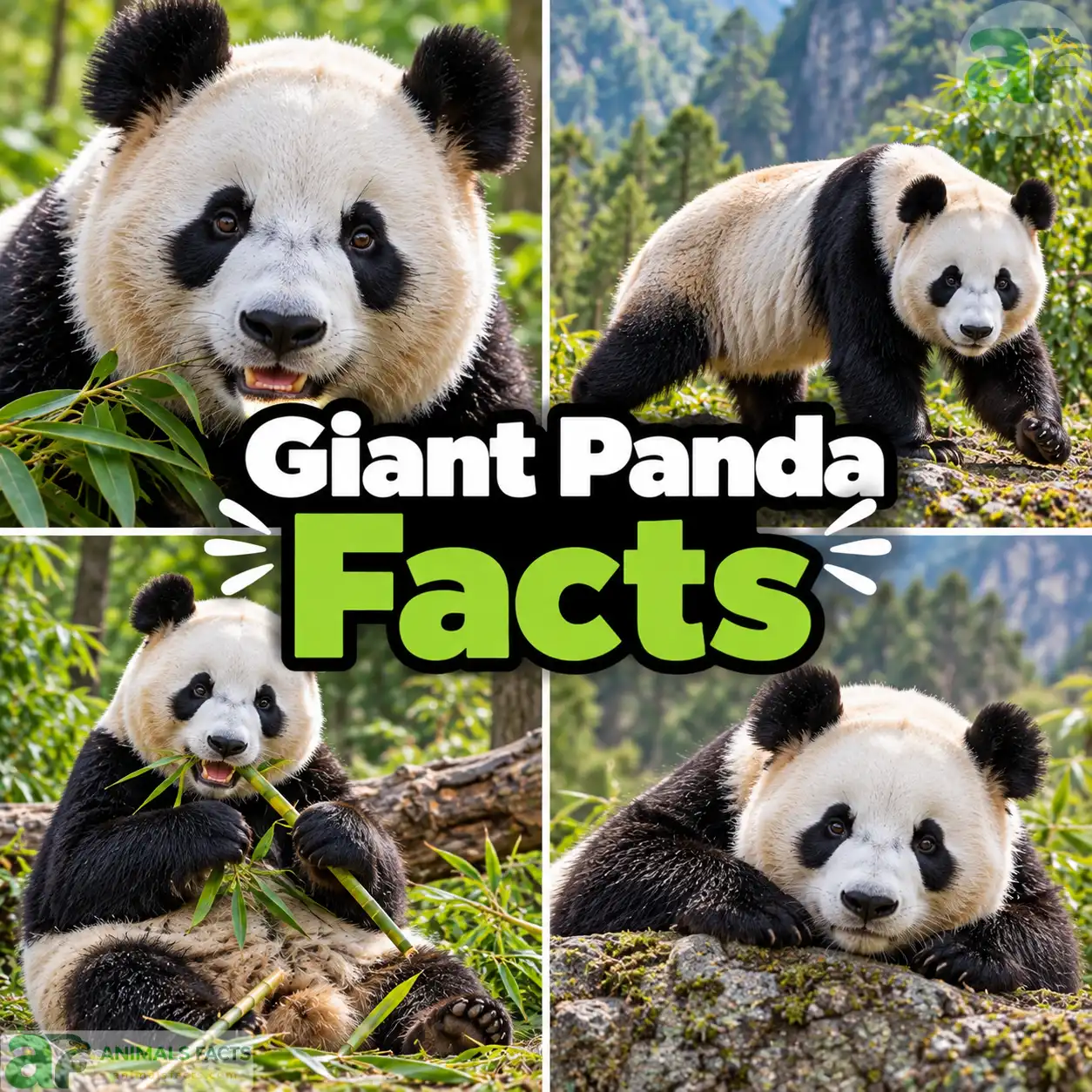
Giant Panda Facts
| Feature | Details |
|---|---|
| Scientific Name | Ailuropoda melanoleuca |
| Common Names | Giant Panda, Panda Bear, Panda |
| Kingdom | Animalia |
| Phylum | Chordata |
| Class | Mammalia |
| Order | Carnivora |
| Family | Ursidae |
| Genus | Ailuropoda |
| Recognized Subspecies | 2 subspecies — Ailuropoda melanoleuca melanoleuca (Sichuan Giant Panda) and Ailuropoda melanoleuca qinlingensis (Qinling Giant Panda) |
| Habitat | Temperate montane bamboo forest — Sichuan, Shaanxi, and Gansu provinces of central China |
| Lifespan | 15–20 years in the wild; up to 38 years in captivity |
| Diet | 99% bamboo — one of the most specialized diets of any large mammal; occasionally fish, eggs, and small animals |
| Weight | Males: 85–125 kg; Females: 70–100 kg |
| Body Length | 120–180 cm |
| Shoulder Height | 60–90 cm |
| Top Speed | Up to 32 km/h (20 mph) — faster than most people expect |
| Daily Bamboo Intake | 12–38 kilograms per day — up to 40% of body weight daily |
| Conservation Status | Vulnerable (IUCN 2016) — downlisted from Endangered following successful conservation |
| Global Wild Population | ~1,864 individuals (2021 survey — most recent comprehensive census) |
| Captive Population | ~673 individuals (2024) in zoos and breeding centers worldwide |
| Unique Feature | Most bamboo-specialized carnivore; false thumb (modified wrist bone); iconic black-and-white coloration; China’s national symbol |
 1. Introduction: What is a Giant Panda?
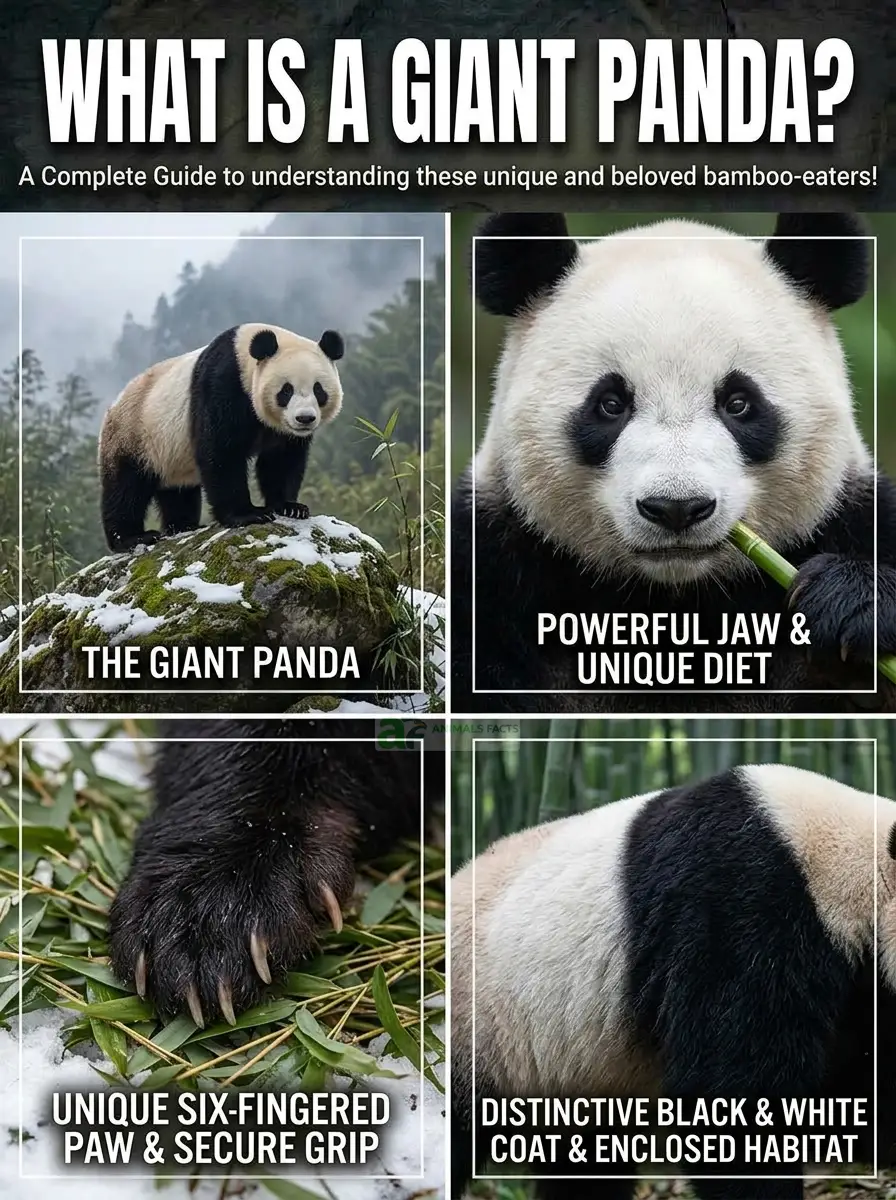
It is one of the most instantly recognized animals on Earth — a round, black-and-white bear that has become the global symbol of wildlife conservation, the emblem of the World Wildlife Fund, and the subject of such intense international affection that individual animals have made international diplomatic headlines and their births have been celebrated as national news events in multiple countries simultaneously. It eats almost nothing but bamboo — a grass so nutritionally sparse that the panda must consume up to 38 kilograms of it every single day, spending up to 14 hours eating, to extract barely adequate nutrition from a food source that its digestive system was never evolutionarily designed for. And it has pulled back from the brink of extinction in a conservation program so successful that its IUCN status was downlisted from Endangered to Vulnerable in 2016 — one of the most celebrated wildlife recovery achievements in modern conservation history. Giant panda facts are, from the very beginning, a story of extraordinary paradoxes.
The giant panda — Ailuropoda melanoleuca — is a bear, despite centuries of scientific debate about its classification. Its closest relative is the spectacled bear of South America, with which it shares membership in the family Ursidae — though the panda’s uniquely specialized bamboo diet, its unusual black-and-white coloration, and its famous modified “false thumb” set it apart from all other living bears in ways that initially confused the Western naturalists who first encountered it. Found exclusively in the temperate mountain bamboo forests of central China — primarily in Sichuan, Shaanxi, and Gansu provinces — the giant panda occupies one of the most restricted natural ranges of any large mammal, confined to fragmented mountain forest patches in a country of 1.4 billion people.
Whether you are a student researching giant panda facts for a school project, a visitor planning a trip to China’s panda sanctuaries, a conservation advocate interested in what makes the panda recovery program one of history’s most successful wildlife conservation efforts, a parent looking for giant panda facts for kids, or simply someone who has been charmed by these extraordinary black-and-white bears since childhood — this is the most complete guide to giant panda facts you will find anywhere. We cover giant panda habitat, giant panda diet, giant panda behavior, communication, the famous false thumb, reproduction, conservation, mythology, and the extraordinary story of how one of Earth’s most beloved animals was pulled back from the edge of extinction.
2. Giant Panda Species Overview & Classification
The giant panda’s taxonomic history is one of the most debated in modern zoology — with the question of whether pandas are bears, raccoons, or an entirely separate lineage generating decades of scientific controversy before modern genetic analysis definitively resolved the question in the 1990s.
The Bear Classification Debate — Resolved
For much of the 20th century, scientists debated whether the giant panda belonged with the bears (Ursidae), with the raccoons (Procyonidae — the family that also contains the red panda), or in its own independent family. The debate was resolved by comprehensive genetic analysis in the 1990s, which confirmed that the giant panda is unambiguously a member of the family Ursidae (bears) — with the spectacled bear of South America (Tremarctos ornatus) as its closest living bear relative, reflecting the ancient divergence of the panda lineage from the other bear subfamilies.
Species Classification Table
| Level | Classification |
|---|---|
| Kingdom | Animalia |
| Phylum | Chordata |
| Class | Mammalia |
| Order | Carnivora |
| Family | Ursidae (Bears) |
| Subfamily | Ailuropodinae (sole living genus and species) |
| Genus | Ailuropoda |
| Species | A. melanoleuca |
| Closest Living Relative | Spectacled Bear (Tremarctos ornatus, South America) |
The Two Giant Panda Subspecies
| Subspecies | Scientific Name | Range | Population | Distinguishing Features |
|---|---|---|---|---|
| Sichuan Giant Panda | A. m. melanoleuca | Sichuan, Gansu, Shaanxi provinces | ~1,700+ | Larger; more common; standard black-and-white coloration |
| Qinling Giant Panda | A. m. qinlingensis | Qinling Mountains, Shaanxi province | ~200–300 | Brown and white rather than black and white; smaller skull; discovered 1985 |
The Qinling Giant Panda — the rarer, brown-and-white subspecies — represents one of the most fascinating wildlife discoveries of the late 20th century. First recognized as a distinct subspecies in 2005 based on genetic and morphological analysis of specimens collected from 1985, the Qinling panda’s brown-and-white coloration represents a genuinely different appearance from the familiar black-and-white of the Sichuan panda, and its restricted population in the Qinling Mountain range makes it the most endangered panda subspecies.
Species Evolution & Discovery Timeline
~5.5–8 million years ago: The Ailuropodinae subfamily diverged from other bear lineages during the late Miocene — establishing the independent evolutionary trajectory that would eventually produce the modern giant panda.
~2 million years ago: Early Ailuropoda species (Pygmy Giant Pandas — Ailuropoda microta) appeared across a much wider range of China and surrounding countries than the modern species — demonstrating that the giant panda lineage once occupied far more geographic territory than its current restricted range suggests.
~500,000 years ago: The modern giant panda (Ailuropoda melanoleuca) reached something close to its current form — with the bamboo dietary specialization already established and the distinctive coloration presumably present.
227 CE: The earliest clearly documented historical reference to the giant panda in Chinese records — appearing as the “mo” or “pixiu” in classical Chinese texts describing an animal of supernatural power and unusual appearance associated with the mountain forests of central China.
1869: The giant panda was formally introduced to Western science — French missionary and naturalist Père Armand David sent a giant panda skin and bones to the Natural History Museum in Paris, the first physical specimen of the species to reach Western scientific institutions.
1936: American socialite and fashion designer Ruth Harkness brought the first live giant panda to the West — a cub named Su Lin transported to the Chicago’s Brookfield Zoo, generating extraordinary public interest in the species across North America and Europe.
1958: China’s Beijing Zoo sent the first giant pandas as diplomatic gifts to the Soviet Union — beginning the practice of Panda Diplomacy that would eventually see pandas loaned to zoos in more than 20 countries as symbols of Chinese friendship.
1961: WWF was founded — adopting the giant panda as its logo, establishing the species as the permanent global symbol of wildlife conservation.
2016: The IUCN downlisted the giant panda from Endangered to Vulnerable — reflecting the recovery of the wild population from approximately 1,000 in the 1970s to approximately 1,864 in the 2021 census.
3. Giant Panda Physical Description & Unique Features
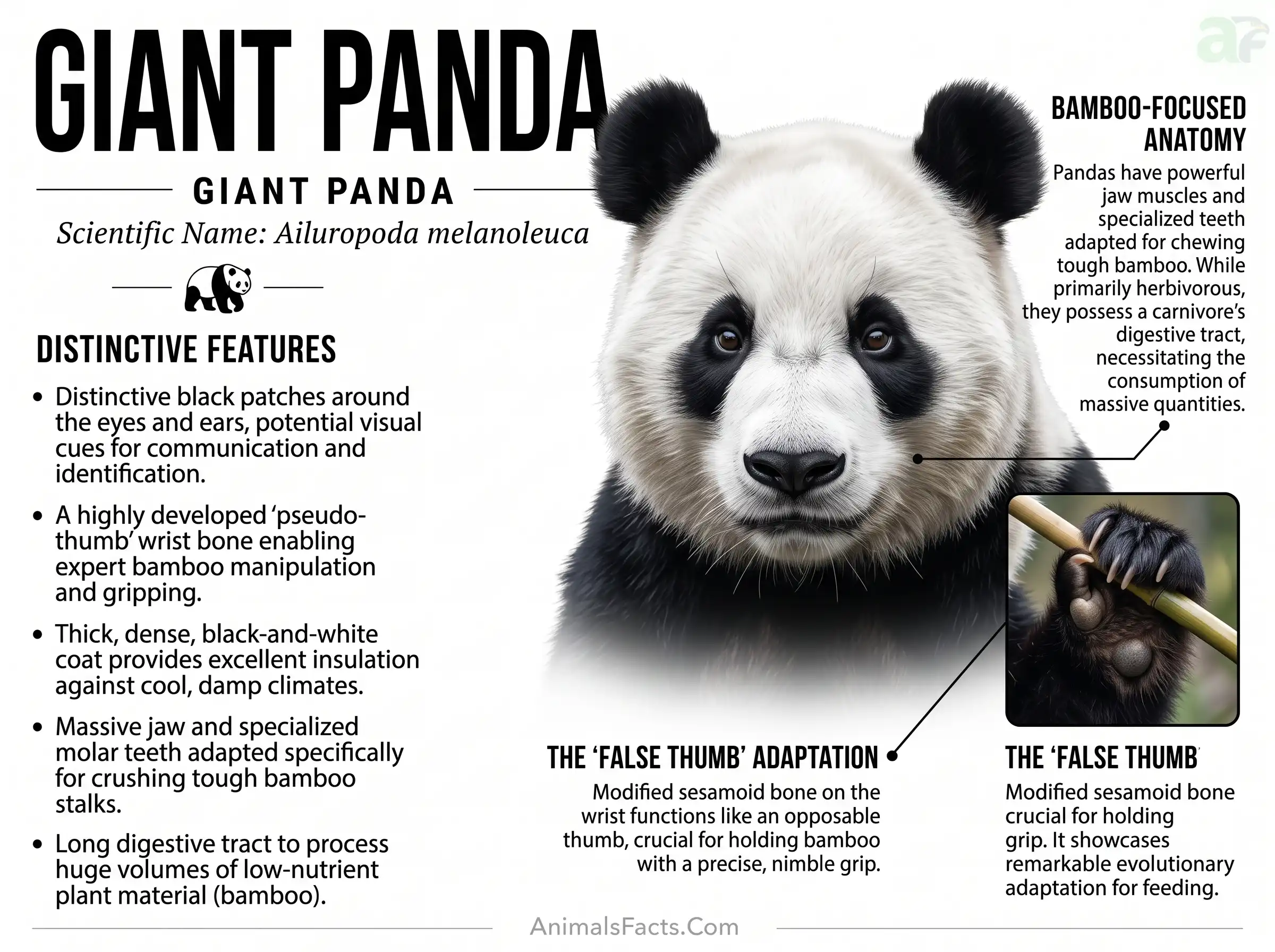
The giant panda’s physical design is simultaneously the most instantly recognizable and the most scientifically puzzling of any large mammal — with iconic coloration whose function remains debated, specialized feeding adaptations without parallel in other bears, and a body plan that reflects millions of years of evolutionary commitment to a single extraordinary dietary specialization.
The Iconic Black-and-White Coloration
The giant panda’s black-and-white coloration is the species’ most immediately recognizable feature — and the subject of ongoing scientific debate about its function. Research published in 2017 proposed that the coloration serves multiple functions simultaneously:
Camouflage in snowy habitat: The white body regions provide camouflage against snow-covered backgrounds in the panda’s mountainous winter habitat.
Disruptive coloration: The bold black-and-white pattern breaks up the body outline in dappled light conditions, providing camouflage in the mixed light-and-shadow environment of bamboo forest.
Social communication: The distinctive black eye patches and ears may serve as visual communication signals — with the bold markings making facial expressions more readable during the relatively rare close-range encounters between normally solitary adults.
Thermoregulation: The black regions (legs, ears, eye patches, shoulders) may absorb solar heat more efficiently than white regions, providing thermoregulatory benefits in the cool mountain forest environment.
The “False Thumb” — Evolution’s Most Celebrated Improvisation
The giant panda’s most celebrated anatomical feature — and one of the most famous examples of convergent evolution in all of biology — is the modified radial sesamoid bone of the wrist that functions as an opposable sixth “thumb,” enabling the panda to grip bamboo stems with extraordinary precision.
This “false thumb” is not a true thumb — it is a modified wrist bone (the radial sesamoid) that has been enlarged through evolutionary modification into a functional appendage. The panda uses it in conjunction with the five true digits of its forepaw to grip bamboo stems between the false thumb and forepaw, hold them steady, and strip individual bamboo leaves with remarkable precision and speed. This convergent solution to the bamboo-gripping problem — independently evolving a functional equivalent of a thumb from a different anatomical structure than the true thumb — is considered one of evolution’s most elegant and most frequently cited examples of adaptive anatomy.
Size and Sexual Dimorphism
- Males: Typically 85–125 kg and 120–180 cm in body length
- Females: Typically 70–100 kg — somewhat smaller than males
- Cubs at birth: Only 90–130 grams — one of the smallest birth weights relative to adult size of any placental mammal (cubs weigh approximately 1/900th of their mother’s weight at birth)
Did You Know? Giant panda cubs are born approximately 900 times smaller relative to their mother’s weight than a human baby — a human baby is typically about 1/25th to 1/20th of its mother’s weight, while a panda cub is approximately 1/900th. This extraordinary birth size disparity means that a panda cub born to a 100 kg mother weighs only about 110 grams at birth — approximately the weight of a stick of butter. This remarkable altriciality at birth is believed to be an evolutionary adaptation to the panda’s bamboo diet — bamboo provides insufficient nutrition to sustain a full-term pregnancy producing a large, well-developed fetus, so the energetically cheaper strategy of producing a very small, undeveloped cub has evolved as the more efficient reproductive approach.
4. Top 25 Surprising & Interesting Giant Panda Facts
- Giant pandas are classified as carnivores (order Carnivora) — yet 99% of their diet consists of bamboo, a grass. They possess the digestive system of a meat-eater but have committed almost entirely to a plant diet.
- A giant panda must eat 12–38 kilograms of bamboo every day — spending up to 14 hours daily eating — because bamboo is so nutritionally sparse and their carnivore digestive system extracts it so inefficiently.
- The giant panda’s “false thumb” — a modified wrist bone enlarged into a functional sixth digit — is one of the most famous examples of convergent evolution in biology, providing bamboo-gripping capability without a true opposable thumb.
- Giant panda cubs are born essentially hairless and blind, weighing only 90–130 grams — making them proportionally the smallest newborns relative to adult size of any placental mammal.
- The IUCN downlisted the giant panda from Endangered to Vulnerable in 2016 — one of the most celebrated conservation status improvements in wildlife history, following population growth from approximately 1,000 bears in the 1970s to ~1,864 in the 2021 census.
- Despite their bamboo diet, giant pandas retain all the teeth of a carnivore — including canines and a carnivore digestive system that processes bamboo at extremely low efficiency compared to the digestive systems of herbivorous mammals of comparable size.
- Giant pandas have no fixed denning or hibernation season — they do not hibernate, remaining active year-round, because bamboo provides insufficient caloric density to build the fat reserves needed for extended winter dormancy.
- The Qinling Giant Panda — a subspecies confined to the Qinling Mountains of Shaanxi — is brown and white rather than black and white, one of the most striking color variants documented in any large mammal subspecies.
- Giant pandas communicate through scent marking — with anal glands, urine, and secretions from specialized skin glands deposited on trees, rocks, and vegetation throughout their territories — and can detect the age, sex, and reproductive status of other pandas from these marks.
- A giant panda can peel and eat a bamboo shoot in approximately 40 seconds — demonstrating the remarkable dexterity and speed of their false-thumb bamboo manipulation despite appearances of clumsiness.
- The giant panda is the sole member of the subfamily Ailuropodinae within the bear family — a taxonomic isolation reflecting its ancient evolutionary divergence from other bear lineages approximately 5–8 million years ago.
- China practices “Panda Diplomacy” — the loan of giant pandas to foreign zoos as symbols of diplomatic friendship — with pandas currently residing in zoos in more than 20 countries under lease agreements that generate substantial revenue for Chinese conservation programs.
- Giant pandas consume 25 different species of bamboo across their range — but in any specific location, individual pandas typically rely on only 2–4 bamboo species that are locally most abundant.
- The giant panda’s gut bacteria — its microbiome — resembles that of a carnivore rather than a herbivore, lacking the specialized microbial communities that ruminant animals use to efficiently process cellulose, explaining why pandas must consume such enormous quantities of bamboo to extract adequate nutrition.
- Giant pandas are surprisingly good swimmers — readily crossing rivers and streams during seasonal movements, and occasionally entering water voluntarily during hot weather.
- The WWF panda logo — one of the world’s most recognized brand symbols — was designed based on Chi Chi, a giant panda at the London Zoo in the early 1960s, making an individual bear the inadvertent inspiration for one of the most powerful conservation organization brand identities in history.
- Giant pandas are essentially solitary outside of the mating season — with overlapping home ranges that bears monitor through scent marks but rarely visit simultaneously, maintaining a communication network that allows territorial awareness without frequent direct encounters.
- A giant panda’s colorful black-and-white markings may partially function as a form of social communication — research has suggested that the bold black eye patches make the eyes appear larger, potentially serving as a visual signal during the relatively rare face-to-face social encounters between adults.
- Giant pandas are powerful enough to injure humans severely — with documented zoo injuries from pandas that appeared docile, reflecting the misleading impression created by their generally slow, bamboo-focused behavior and their teddy-bear visual appearance.
- The Chengdu Research Base of Giant Panda Breeding in Sichuan has become one of China’s most visited tourist attractions — with annual visitor numbers sometimes exceeding 2 million, generating enormous economic value from the species and creating powerful financial incentives for continued conservation investment.
- Giant pandas defecate up to 40 times per day — a consequence of the enormous volume of bamboo they consume (up to 38 kg daily) passing through a digestive system that processes it at low efficiency, requiring rapid throughput to maintain adequate nutrition.
- The reproductive window of female giant pandas is remarkably narrow — females are fertile for only 2–3 days per year, making successful breeding a significant challenge for both wild and captive populations.
- Research has demonstrated that giant panda cubs born in captivity grow significantly faster than wild cubs during their first years of life — reflecting the caloric advantage of supplementary food provided to captive mothers compared to wild bears dependent entirely on bamboo.
- Giant pandas have been documented descending from high-altitude summer habitat to lower-elevation winter habitat in seasonal vertical migrations that can cover elevation differences of over 1,000 meters — following the seasonal availability of the most nutritious bamboo species at different elevations.
- The giant panda’s conservation success has generated a significant financial return on the global investment in its protection — with research by economists estimating that the ecosystem services provided by panda habitat (watershed protection, carbon storage, biodiversity maintenance) significantly exceed the total cost of panda conservation programs, making panda conservation economically as well as ecologically justified.
5. Fun Facts About Giant Pandas
- Giant pandas are bears — despite decades of scientific debate about their classification.
- They eat 99% bamboo but have a carnivore’s digestive system.
- A panda must eat up to 38 kg of bamboo daily — spending 14 hours eating.
- The famous “false thumb” is actually a modified wrist bone — not a real finger.
- Panda cubs are born weighing just 90–130 grams — among the smallest newborns of any mammal.
- The giant panda does not hibernate — bamboo gives too few calories to build fat reserves.
- The WWF panda logo was inspired by a real London Zoo panda named Chi Chi.
- China loans pandas to foreign zoos through Panda Diplomacy.
- Giant pandas can peel a bamboo shoot in just 40 seconds.
- The Qinling Giant Panda is brown and white — not black and white!
- There are only ~1,864 giant pandas left in the wild (2021 census).
- Giant pandas poop up to 40 times a day — all that bamboo has to go somewhere!
6. Giant Panda Habitat & Geographic Range
The giant panda’s current geographic range is among the most restricted of any large mammal on Earth — confined to six isolated mountain ranges in central China, in a habitat that represents a tiny fraction of the species’ historical range and that faces ongoing pressure from the human infrastructure of the world’s most populous country.
Historical vs. Current Range
Giant pandas once ranged across a vastly larger area — including much of southern and eastern China, northern Vietnam, and northern Myanmar — as recently as a few thousand years ago. The dramatic range contraction to the current fragmented mountain forest patches of central China reflects millennia of human pressure through forest clearance, agriculture, and hunting, compressing the species into the most remote and least agriculturally productive terrain remaining within its historical range.
Current Range — Six Mountain Ranges
The current wild giant panda population is distributed across six mountain ranges in three Chinese provinces:
| Mountain Range | Province | Bear Population | Status |
|---|---|---|---|
| Minshan Mountains | Sichuan, Gansu | Largest single population (~500+) | Core range; best connected |
| Qinling Mountains | Shaanxi | ~200–300 (including Qinling subspecies) | Isolated; different subspecies |
| Qionglai Mountains | Sichuan | ~300+ | Important; partially fragmented |
| Liangshan Mountains | Sichuan | ~100+ | Fragmented; small populations |
| Daxiangling Mountains | Sichuan | ~50–70 | Isolated; conservation concern |
| Xiaoxiangling Mountains | Sichuan | ~30–40 | Most isolated; smallest population |
Primary Habitat Characteristics
Temperate bamboo forest: The giant panda’s defining habitat — characterized by dense bamboo understory beneath mixed deciduous and coniferous forest canopy, typically at elevations of 1,200–3,100 meters, in areas of high rainfall and moderate temperatures.
Elevation migration: Giant pandas undertake seasonal altitudinal migrations — ascending to higher elevations (up to 3,900 meters) during summer when high-altitude bamboo species are most nutritious, and descending to lower elevations (as low as 800 meters) in winter when lower-elevation bamboo species are more accessible under snow cover.
Habitat connectivity challenges: One of the most critical conservation issues for wild pandas is the fragmentation of habitat — with roads, agricultural land, and settlements creating barriers between panda subpopulations that reduce genetic exchange and increase local extinction risk.
Did You Know? The bamboo species that giant pandas depend on are not always available year-round — bamboo plants undergo periodic mass flowering and die-off events (mast seeding) that can eliminate the primary food source for all pandas in an area simultaneously. The most dramatic recent example was the 1983–1984 arrow bamboo die-off in the Minshan Mountains, which contributed to widespread panda starvation and galvanized international conservation attention and funding for China’s panda program. Modern panda conservation management explicitly addresses bamboo die-off risk through habitat connectivity programs that allow pandas to move between areas when local bamboo populations crash — making landscape connectivity not merely an ecological nicety but a survival necessity.
7. Giant Panda Diet & Feeding Behavior
The giant panda’s dietary commitment to bamboo represents one of the most extreme and most paradoxical dietary specializations in the animal kingdom — a carnivore so thoroughly committed to a plant diet that it has evolved specialized anatomy to eat it, yet retained the digestive system of a meat-eater that processes it with such poor efficiency that the panda must compensate through the sheer volume of its daily intake.
What Giant Pandas Eat
Diet Breakdown Table
| Food Type | Percentage of Diet | Notes |
|---|---|---|
| Bamboo (shoots, leaves, stems) | ~99% | Primary dietary foundation — the most bamboo-specialized diet of any large mammal |
| Bamboo shoots (spring) | Most preferred seasonal component | Highest protein/fat content; most nutritious bamboo component |
| Bamboo leaves | Second priority | Consumed in large quantities throughout year |
| Bamboo stems | Least preferred component | Consumed when shoots and leaves are less available |
| Small vertebrates (rodents, birds) | <1% | Occasionally; reflecting carnivore instincts despite bamboo dominance |
| Eggs | <1% | Occasionally documented |
| Honey | Rare | Occasionally sought |
| Mineral licks | Supplement | Salt and mineral supplementation |
The Bamboo Paradox — Eating Like a Carnivore, Living Like a Herbivore
The giant panda’s commitment to bamboo represents one of the most extraordinary evolutionary compromises in mammalian history. The animal possesses:
- A carnivore’s digestive system: Short, simple gut without the specialized fermentation chambers that ruminants and other herbivores use to efficiently extract energy from plant material
- A carnivore’s gut bacteria: Microbiome dominated by bacteria typical of meat-eaters, not herbivores
- A carnivore’s metabolic rate: Lower ability to extract energy from cellulose than would be expected for a herbivore of its size
The result of this mismatch between digestive design and dietary choice is that giant pandas extract only approximately 17–21% of the energy from bamboo that would be typical for a specialized herbivore consuming the same material. To compensate, they must consume enormous volumes of bamboo daily — up to 38 kilograms in a single day — and spend up to 14 hours of every 24-hour day eating.
The Bamboo Species Preference Hierarchy
Giant pandas are not indiscriminate bamboo eaters — they show strong seasonal preferences for specific bamboo components and specific bamboo species:
Bamboo shoots (spring): The highest-priority bamboo component — containing 15–17% protein and 3–5% fat (compared to 3–6% protein and 0.5–1% fat in bamboo leaves and stems) — consumed exclusively when available in spring.
Bamboo leaves: The primary year-round dietary component — consumed in the largest quantities due to their year-round availability.
Bamboo stems: The lowest-priority component — consumed primarily in winter when shoots and fresh leaves are less available, despite the stems’ lower nutritional value.
Did You Know? Research published in scientific journals has documented that giant pandas’ commitment to bamboo may have been partly driven by evolutionary dietary flexibility becoming entrenched during periods when the rich meat-based food resources that other Asian carnivores exploit were unavailable in the panda’s historical range. Genetic analysis has found that pandas lack the specific taste receptor (T1R1) that allows carnivores to detect the savory taste of amino acids (the “umami” flavor) — effectively making meat unappealing to pandas on a neurological level, potentially reinforcing the bamboo dietary commitment through a feedback between digestive anatomy, gut microbiome, and sensory perception that has made bamboo not just the panda’s only practical food source but effectively its only appetizing one.
8. Giant Panda Reproduction & Life Cycle
Giant panda reproduction is one of the most challenging and most extensively managed reproductive programs in conservation biology — with a combination of biological constraints including extremely narrow fertility windows, low natural reproductive rates, and the historically poor success of captive breeding creating a situation requiring intensive scientific intervention and management.
The Fertility Challenge
Female giant pandas are fertile for an extraordinarily brief annual window — only 2–3 days per year during which conception is possible. This narrow fertility window, combined with the difficulties of detecting exactly when a specific female is fertile, the challenges of bringing males and females into contact in the wild, and the historical difficulties of successfully breeding pandas in captivity, has made giant panda reproduction one of the most studied and most intensively managed reproductive processes in any endangered species program.
Mating Behavior
In the wild, mating typically occurs between March and May — with female fertility detectable through behavioral changes, scent marking alterations, and vocalizations that males detect and respond to. Wild pandas come together briefly for mating and then separate — with females raising cubs entirely alone without paternal involvement.
Delayed implantation: Like other bears, giant pandas practice embryonic diapause — with the fertilized egg entering a dormant state before implanting in the uterine wall, allowing variable total gestation lengths that range from 72 to 324 days (though actual embryonic development after implantation is only 45–60 days).
Birth — The Smallest Newborn Paradox
Litter size: Typically 1–2 cubs — though in captivity, twins are more common than in the wild.
Twin management: In the wild, females typically cannot raise two cubs simultaneously given the demands of bamboo foraging, and will abandon the smaller twin — focusing all maternal investment on the strongest cub. Captive breeding programs address this by rotating twins between the mother and incubators, allowing both cubs to receive maternal care while preventing the mother from caring for both simultaneously.
Birth weight: 90–130 grams — the extraordinary disparity between birth weight and adult weight discussed in the Physical Description section.
Key Developmental Stages
| Stage | Age | Key Development |
|---|---|---|
| Birth | 0 | 90–130 grams; pink, hairless, blind |
| Eyes open | ~6–8 weeks | Beginning visual awareness |
| First crawling | ~3 months | Beginning to move independently |
| First bamboo tasting | ~6 months | Beginning to sample bamboo |
| Weaning | ~8–12 months | Gradual transition to solid food |
| Independence | 1.5–2 years | Separation from mother |
| Sexual maturity | 4–8 years (female); 5–8 years (male) | First breeding possible |
Giant Panda Lifespan Comparison Table
| Species | Average Wild Lifespan | Maximum Confirmed |
|---|---|---|
| Giant Panda | 15–20 years | 38 years (Jia Jia, captivity) |
| Spectacled Bear | 20–25 years | ~36 years (captivity) |
| Sloth Bear | 20–25 years | ~40 years (captivity) |
| American Black Bear | 18–23 years | ~39 years (captivity) |
9. Social Behavior & Communication
The giant panda is one of the most completely solitary of bear species — with adult bears maintaining individual territories that they monitor through scent marking but rarely share with other adults outside of the brief mating season.
Solitary Lifestyle and Territory
Giant panda territories vary considerably by sex and habitat quality:
- Female territories: Typically 4–6 km² — relatively small, reflecting the concentrated bamboo resources that allow females to meet their nutritional needs within a compact area
- Male territories: Typically 10–15 km² — larger, overlapping the ranges of multiple females, consistent with the general bear pattern in which males maximize reproductive access by maintaining ranges that encompass multiple female territories
Territories are monitored through a complex and sophisticated scent marking system — with pandas depositing scent from specialized anal glands, urine, and secretions from glands on the soles of their feet at marking stations throughout their territories. Research has demonstrated that pandas can extract detailed information from these scent deposits — including the age, sex, reproductive status, individual identity, and visit timing of the depositing animal — making the scent marking network a rich communication channel that allows territorial coordination without direct encounters.
Vocalizations
Giant pandas produce a remarkable range of vocalizations — approximately 11 distinct calls have been documented, including:
Bleating/Moaning: A gentle, sheep-like bleating used during friendly encounters and in mother-cub communication. Chirping: Contact calls between mothers and cubs — with cubs producing chirping calls when separated from their mother. Roaring and barking: Threat vocalizations used during encounters between adults and during defensive situations. Squealing: Produced during courtship encounters — with researchers noting the panda’s courtship vocalizations bear an amusing resemblance to a combination of sheep bleating and human baby crying.
Did You Know? Giant pandas are one of the few bear species that produce a distinctive “chirp-squeak” contact call between mothers and cubs that has been described by researchers as sounding remarkably like a bird call — a vocalization so unexpected from a large bear that early Western observers sometimes attributed the sounds to birds before identifying the actual source. This maternal-cub chirping communication likely evolved as a low-amplitude, specific signal that reduces the risk of attracting predators to vulnerable cubs while maintaining contact between the mother and her young during the prolonged period of maternal dependency.
10. Predators & Defense Mechanisms
Adult giant pandas occupy the position of apex herbivore-omnivore in their mountain forest ecosystems — facing relatively limited natural predation pressure as healthy adults, while cubs and juveniles face several genuine threats.
Natural Predators
Snow Leopards: The most documented natural predator of giant pandas in the wild — with snow leopards documented as predators of panda cubs and potentially of weaker adults in the high-altitude portions of the panda’s range. The snow leopard’s mountain habitat overlaps extensively with panda range, making it the most consistently present large predator in panda territory.
Asian Wild Dogs (Dholes): Pack-hunting dholes represent a coordinated predation threat — documented as predators of panda cubs through multiple field observations, with pack coordination providing a numerical advantage that allows successful predation on cubs that might successfully resist individual predators.
Yellow-throated Martens: Significant predators of very young panda cubs — martens have been documented raiding panda dens to kill neonatal cubs during the earliest, most vulnerable period before cubs are mobile enough to escape or fight back.
Humans: The dominant historical cause of panda mortality outside of natural predation — through hunting (for panda skins, which were historically valued in traditional medicine and as decorative items), accidental snaring (panda injuries from traps set for other animals), habitat destruction, and bamboo harvest reducing food availability.
Defense Mechanisms
Intimidating size and strength: Despite their bamboo-focused, apparently peaceful lifestyle, adult giant pandas are powerful animals — capable of delivering serious bites and claw swipes that have injured human caretakers at even the most visitor-friendly facilities, and that would deter most natural predators from attacking a healthy adult.
Tree climbing: Adult giant pandas are capable climbers — ascending trees to escape threats, including potential predators, with facility that often surprises observers expecting the bears’ bamboo-focused behavior to extend to physical clumsiness.
Maternal defense: Female pandas defending cubs demonstrate the same aggressive maternal protection documented in other bear species — willing to confront threats significantly larger than themselves in defense of offspring.
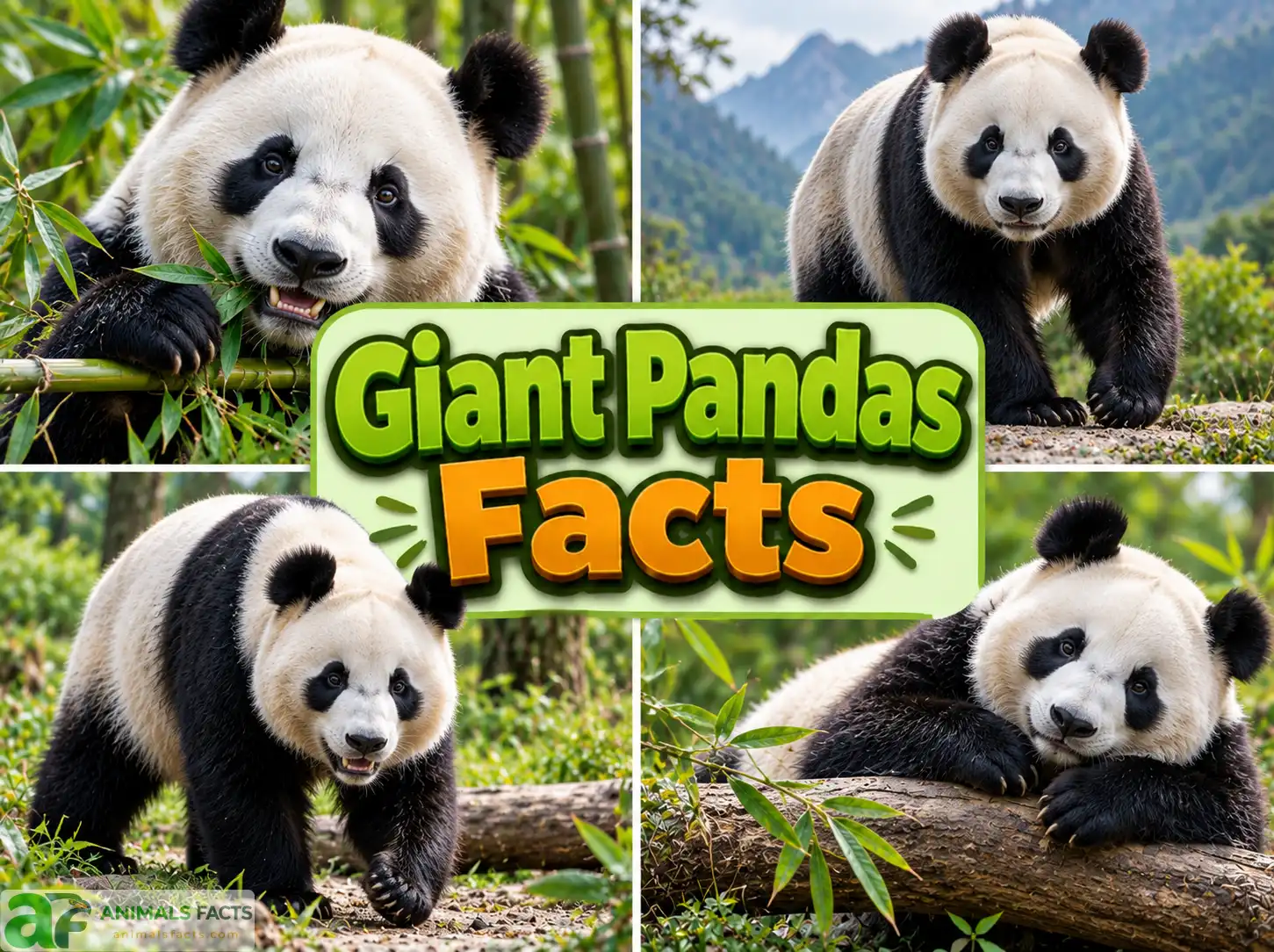
11. Giant Panda Facts for Kids
Hey kids — get ready to discover the most amazing things about the world’s most famous bear!
- Giant pandas are actually bears — they belong to the same family as grizzly bears, polar bears, and black bears! For a long time, scientists debated whether they were bears or raccoons, but genetic studies proved they’re definitely bears!
- Even though giant pandas are bears — which are carnivores (meat-eaters) — they eat almost nothing but bamboo! It’s like being born with a meat-eater’s body but deciding you only want to eat salad, every single day, for every meal, for your whole life!
- Giant pandas have a special “false thumb” — it’s not a real thumb like yours, but a special wrist bone that grew bigger over thousands of years to help them hold bamboo stems. Evolution basically invented a new kind of thumb for them!
- Baby giant pandas are born incredibly tiny — weighing only about as much as a stick of butter (around 100 grams), even though their mom weighs about 100 kilograms. That’s like a human baby weighing only 70 grams at birth!
- Giant pandas don’t hibernate like most other bears — because bamboo doesn’t give them enough energy to build up the fat reserves they’d need to sleep all winter!
- A giant panda has to eat up to 38 kilograms of bamboo every day to get enough energy — that’s like a person eating about 300 bowls of cereal a day, every day, for their whole life!
- There is a special kind of giant panda called the Qinling Giant Panda that lives in the Qinling Mountains of China — and it is brown and white instead of black and white! There are only about 200–300 of these rare pandas in the world!
- The WWF — one of the world’s biggest wildlife conservation organizations — uses the giant panda as its logo, which is why you see pandas on so much conservation merchandise. The logo was inspired by a real panda named Chi Chi who lived at the London Zoo!
Did You Know? Giant pandas poop a lot — up to 40 times per day! That’s because they eat so much bamboo (up to 38 kg a day!) that it passes through their digestive system very quickly since they can’t digest it very well. Scientists studying wild pandas actually use panda poop — called “scat” — to learn about where pandas go, what they eat, and even to get DNA samples that help count how many pandas live in an area without ever having to catch or disturb the bears!
12. Relationship with Humans
The giant panda’s relationship with human civilization spans thousands of years of Chinese cultural history — from its appearance in ancient imperial courts and classical poetry through to the contemporary phenomenon of “Panda Diplomacy” that has made individual bears instruments of international relations.
Ancient Chinese Cultural History
The giant panda appears in Chinese historical records dating back at least 2,200 years — with references in the Han Dynasty (206 BCE–220 CE) imperial court records describing “white bears” kept in the royal menagerie, and classical Chinese poets referencing the “mo” (an animal widely interpreted as the giant panda) in verse celebrating the wild creatures of the southern mountains. Tang Dynasty (618–907 CE) records describe the Chinese emperor sending giant pandas as diplomatic gifts to Japan — establishing what may be the earliest documented instance of panda diplomacy in history.
Western Discovery and the Zoo Era
The 1869 scientific description of the giant panda by Père Armand David, followed by the 1936 arrival of the first live panda in a Western zoo, generated extraordinary international public fascination — with the Beijing Zoo’s subsequent gift of pandas to international zoos in the 1950s and 1960s establishing the pattern of “Panda Diplomacy” that continues to structure China’s panda-international relations approach today.
Panda Diplomacy — Bears as Foreign Policy
China’s practice of Panda Diplomacy — the loan of giant pandas to foreign zoos as symbols of diplomatic friendship — has made individual bears instruments of geopolitical relationships at the highest levels. Pandas have been loaned to countries including the United States, United Kingdom, France, Germany, Japan, Australia, Canada, and many others, with each loan generating both significant public relations value and substantial financial return for Chinese conservation programs (loan fees typically amount to $1 million per panda per year).
The political dimensions of panda loans have occasionally generated significant media coverage — with the return of specific pandas to China sometimes interpreted as diplomatic signals, and the birth of pandas at foreign zoos celebrated as joint diplomatic occasions between host country and China governments.
13. Giant Panda Conservation Status & Threats
The giant panda’s conservation trajectory is one of the most celebrated success stories in modern wildlife conservation — moving from a population crisis that seemed potentially terminal in the 1970s to a 2016 IUCN status improvement that recognized genuine, measurable recovery.
Conservation Data (2026)
| Parameter | Data |
|---|---|
| IUCN Status | Vulnerable (downlisted from Endangered 2016) |
| Wild Population (2021 census) | ~1,864 individuals |
| Captive Population (2024) | ~673 individuals |
| Protected Area Coverage | 67 nature reserves covering most of remaining panda habitat |
| Population Trend | Increasing in most subpopulations |
| Historical Low | ~1,000 individuals (estimated, 1970s–1980s) |
Major Threats
Habitat loss and fragmentation: Despite significant progress in habitat protection, the giant panda’s range remains fragmented into multiple isolated subpopulations separated by roads, agricultural land, and human settlements. This fragmentation reduces genetic exchange between populations and creates local extinction risk for the smallest, most isolated subpopulations.
Bamboo die-offs: Periodic mass flowering and die-off events in bamboo populations — a natural bamboo reproductive strategy — can eliminate primary food sources for local panda populations simultaneously. With fragmented habitat reducing the ability of pandas to move to areas with alternative bamboo species, these events represent a genuine extinction risk for isolated subpopulations.
Climate change: Projected warming of the Sichuan and Shaanxi mountains is expected to progressively reduce the area of suitable cool, moist bamboo forest in the panda’s range — with models suggesting that climate change could eliminate up to 35% of the panda’s current bamboo habitat by 2080 under high-emission scenarios.
Low reproductive rate: The inherently slow reproductive rate of the species — combined with the narrow annual fertility window, the challenge of raising cubs to independence, and the historically poor success of captive breeding — means that the panda population recovers slowly even under ideal conditions.
Did You Know? The Chinese government has invested over $10 billion in giant panda conservation infrastructure since the 1990s — including the creation of 67 nature reserves, the construction of bamboo corridors connecting fragmented habitat patches, an extensive captive breeding program, and stringent anti-poaching enforcement. This level of state conservation investment for a single species is virtually unprecedented in wildlife conservation history and reflects both the Chinese government’s genuine commitment to panda conservation and the extraordinary economic and diplomatic value that the giant panda’s global symbolic significance generates for China as a nation.
14. Famous Giant Pandas
Chi Chi — The WWF Logo Bear
Chi Chi — a female giant panda acquired by the London Zoo in 1958 through a complex international transaction — became the most influential individual panda in conservation history. When WWF was being founded in 1961, Chi Chi was the only giant panda in the Western world, and her distinctive black-and-white appearance directly inspired the design of the WWF panda logo — making this individual bear the inadvertent inspiration for the most recognized conservation organization brand symbol in the world.
Jia Jia — The World’s Oldest Captive Panda
Jia Jia — a female giant panda who lived at Ocean Park Hong Kong — died in 2016 at the documented age of 38 years, making her the longest-lived giant panda ever recorded in captivity and establishing the current longevity record for the species. Jia Jia’s extraordinary longevity — exceeding the average wild panda lifespan by approximately 15–20 years — reflected the advantages of veterinary care, consistent nutrition, and absence of predation available in high-quality captive facilities.
Hua Mei — The Breeding Success Story
Hua Mei — born in 1999 at the San Diego Zoo in the United States, the first giant panda cub born in the US to survive to adulthood — became an international celebrity through media coverage of her birth and early development, before being transferred to China where she became an extraordinarily productive breeding female — producing twins and triplets in multiple litters and contributing significantly to the genetic diversity of China’s captive panda population.
Lin Wang and other Diplomatic Pandas
Multiple pandas loaned to international zoos through Panda Diplomacy have achieved celebrity status in their host countries — with births of panda cubs at zoos in France, Japan, the Netherlands, and other countries generating national media events and significant diplomatic attention between host countries and China. In some cases, individual pandas have become sufficiently famous in their host countries to generate genuine public mourning when they return to China at the end of loan periods.
15. Role in Ecosystem & Food Chain
The giant panda functions as a keystone species, umbrella species, and seed disperser across the mountain bamboo forest ecosystems of central China — with its ecological contributions extending far beyond its own survival to encompass the protection of an entire mountain ecosystem community.
The Umbrella Species Effect
The giant panda’s most powerful ecological contribution is arguably its function as an umbrella species for the conservation of the Sichuan mountain forest ecosystem — with the protection of panda habitat simultaneously protecting the full biodiversity community of one of the world’s most species-rich temperate forest ecosystems.
Research has documented that the areas protected for giant panda conservation in the Qinling and Sichuan mountains harbor extraordinary biodiversity — including 5,000+ plant species, 200+ bird species, 100+ mammal species, and thousands of invertebrate species. The protection of this entire ecosystem community under the banner of panda conservation represents one of the most effective examples of umbrella species conservation in practice.
Bamboo Ecosystem Engineering
Giant pandas’ intensive consumption of bamboo — eating up to 38 kg daily and cycling through extensive areas of their territories — likely influences bamboo community structure and bamboo forest composition in ways that have been studied primarily in the context of conservation management but that also represent genuine ecological effects on the plant community.
Seed Dispersal
Despite their bamboo dominance, giant pandas do consume some fruit and other plant material — contributing to seed dispersal of those species within their territories. This dispersal function is less ecologically prominent than in fully frugivorous bear species like the spectacled bear but is not entirely absent.
16. Myths, Folklore & Cultural Significance
The giant panda occupies a unique position in Chinese cultural tradition — simultaneously a sacred animal with deep mythological roots in classical Chinese culture, a modern national symbol of extraordinary power, and the world’s most universally recognized wildlife conservation icon.
Ancient Chinese Mythology
In classical Chinese mythology, the giant panda is associated with peaceful power, good fortune, and harmony between opposing forces. The panda’s black-and-white coloration has been culturally linked to the yin-yang symbol — the fundamental Chinese philosophical representation of complementary opposites in dynamic balance — with the panda’s distinctive bicolor pattern serving as a natural embodiment of this ancient philosophical concept.
Ancient Chinese texts reference “pei” or “mo” — animals widely interpreted as giant pandas — in contexts associating them with supernatural power, protection from evil spirits, and healing properties. The bones, skin, and other parts of pandas were historically attributed medicinal properties in traditional Chinese medicine, contributing to the hunting pressure that reduced the species to critical levels before the modern conservation era.
The Panda as National Symbol
In contemporary China, the giant panda has achieved the status of one of the country’s most powerful national symbols — representing the combination of Chinese uniqueness (the panda exists nowhere else in the world), peaceful coexistence (reflecting the yin-yang symbolism of its coloration), and conservation responsibility (the Chinese government’s demonstrated commitment to protecting the species).
The panda appears on Chinese currency, stamps, official government publications, and official communications — serving as China’s most internationally recognized wildlife ambassador and a powerful element of China’s national cultural brand globally.
17. Giant Pandas in Pop Culture
The giant panda has generated one of the most extensive, most global, and most commercially valuable wildlife-based popular culture presences of any animal species — driven by the combination of extraordinary visual appeal, universal recognition, cultural significance in China, and the extraordinary emotional engagement that individual zoo pandas generate in their host countries.
Film and Entertainment
“Kung Fu Panda” (DreamWorks Animation, 2008) and its sequels — The most commercially successful panda-themed entertainment franchise in history, with global box office revenues exceeding $1.8 billion across the three main films. Po, the loveable panda protagonist, became one of the most recognized animated animal characters of the 21st century and generated enormous positive public association with giant pandas worldwide.
Various BBC, CCTV, and National Geographic documentary productions — Multiple acclaimed wildlife documentary productions have featured giant pandas, with BBC productions including “Planet Earth” and dedicated panda documentaries providing some of the finest wildlife photography of the species available.
Live panda cam phenomena — Multiple zoos with giant pandas — including the Smithsonian’s National Zoo (Washington DC), San Diego Zoo, and various Chinese facilities — have operated live panda webcams that have generated hundreds of millions of online views, making individual captive pandas genuine internet celebrities.
The WWF Connection
The WWF panda logo — appearing on billions of conservation-related products, communications, and materials worldwide — represents the most extensive brand use of any single wildlife species in history, making the giant panda the most widely distributed wildlife image on Earth across multiple decades of conservation communication.
18. Giant Panda Facts vs. Common Myths
Myth: Giant pandas are not really bears. Fact: Giant pandas are definitively classified as bears (family Ursidae) — with comprehensive genetic analysis conducted in the 1990s resolving the decades-long taxonomic debate conclusively. The panda’s closest living relative is the spectacled bear of South America, and all other physical and genetic evidence confirms unambiguous membership in the bear family.
Myth: Giant pandas are lazy animals that barely move. Fact: Giant pandas’ bamboo-focused behavior creates an impression of lethargy, but the reality reflects energetic constraint rather than temperament. Because bamboo provides so few calories, pandas must conserve energy between feeding bouts — but research tracking panda movement has documented individuals regularly covering 3–5 kilometers daily, climbing trees when threatened, swimming rivers, and making seasonal elevational migrations of hundreds of meters — behaviors inconsistent with genuine lethargy.
Myth: Giant pandas are useless from an evolutionary perspective. Fact: This claim — popularized in some media — misrepresents both evolution and ecology. The giant panda’s bamboo dietary specialization is an extraordinary evolutionary achievement that has allowed this lineage to persist for millions of years in the specific ecological niche it occupies. The panda’s bamboo diet represents a genuinely viable evolutionary strategy — not a evolutionary “mistake” — and its ecological role as seed disperser, bamboo community modifier, and umbrella species for entire mountain ecosystems demonstrates genuine functional importance in its native environment.
Myth: Pandas never eat anything but bamboo. Fact: While bamboo constitutes approximately 99% of the giant panda’s diet, pandas are documented occasionally consuming small animals including rodents and birds, eggs, honey, and other plant material — reflecting the species’ carnivore ancestry and behavioral flexibility that emerges when bamboo resources are temporarily scarce.
Myth: Female giant pandas deliberately abandon twin cubs. Fact: Female pandas raising twins in the wild typically focus care on the stronger cub not out of deliberate abandonment but because of the energetic impossibility of adequately nursing two rapidly growing cubs while simultaneously consuming enough bamboo to sustain their own body. The mother’s behavior reflects physiological constraint rather than preference — a distinction important for understanding natural selection’s role in shaping panda reproductive strategy.
19. Best Places to See Giant Pandas in the Wild
Wolong National Nature Reserve, Sichuan, China
Wolong — in the Qionglai Mountains approximately 130 km from Chengdu — is both one of China’s most important giant panda nature reserves and home to the Wolong Giant Panda Research Center, one of the world’s premier captive panda breeding and research facilities. Wildlife walks and organized research programs provide opportunities to observe giant pandas in the reserve’s forest while the research center provides guaranteed close-range panda encounters.
Tangjiahe National Nature Reserve, Sichuan, China
Tangjiahe — considered by many wildlife researchers as one of the finest preserved examples of the mountain ecosystem that giant pandas inhabit — supports a significant wild panda population and offers organized wildlife observation programs with experienced local guides. The reserve’s intact forest and extensive wildlife diversity make it one of the finest wild panda observation destinations in China.
Foping National Nature Reserve, Shaanxi, China
Foping in the Qinling Mountains supports populations of both panda subspecies — including the rare Qinling Giant Panda (brown and white) — making it the only location on Earth where the chance of encountering the extraordinary brown-and-white panda subspecies exists. Organized research programs associated with Foping have generated some of the finest wild panda behavioral documentation available.
Wanglang National Nature Reserve, Sichuan, China
Wanglang — in the Minshan Mountains of northern Sichuan — supports one of the higher-density wild panda populations in China and has hosted some of the most productive research programs on wild panda behavior and ecology. Wildlife tracking programs with local guides provide limited but genuine opportunities for wild panda observation.
Bifengxia Giant Panda Base, Ya’an, Sichuan, China
The Bifengxia Base — operated by the Chengdu Research Base of Giant Panda Breeding in the hills above Ya’an — houses a significant captive panda population in extensive naturalistic enclosures, providing visitor-accessible panda viewing that combines genuine proximity with relatively natural behavioral conditions. For visitors who cannot access the more remote wild panda habitats, Bifengxia provides one of the most authentic captive panda encounters available.
20. Top Documentaries & Books
Must-Watch Documentaries
“Giant Panda” (BBC Natural World, various editions) — Multiple BBC Natural World productions specifically dedicated to the giant panda have generated some of the finest wildlife photography of the species available, with exceptional sequences documenting wild panda behavior, breeding center operations, and the extraordinary mother-cub relationship.
“Pandas” (IMAX, 2018) — Narrated by Kristen Bell, this IMAX documentary focused specifically on giant panda conservation and captive breeding provides an accessible and visually stunning introduction to the Chinese conservation program for general audiences.
“Planet Earth” (BBC, 2006) and “Planet Earth III” (BBC, 2023) — David Attenborough-narrated BBC productions featuring giant panda sequences among their broader coverage of global wildlife, with exceptional production quality.
“The Last Panda” (various productions) — Multiple documentary productions have examined the conservation crisis facing the species and the conservation programs addressing it, providing essential context for understanding both the historical threat and the contemporary recovery.
Essential Books
“The Last Panda” by George Schaller (1993) — Written by one of the world’s most respected wildlife researchers, who conducted foundational research on wild giant pandas in the 1980s, this book provides both scientific rigor and personal narrative in one of the finest accounts of wild panda biology and conservation ever published.
“Panda Nation” by E. Elena Songster (2018) — An accessible historical account of the giant panda’s role in Chinese national identity and international diplomacy, providing essential cultural and political context for understanding the species beyond its biological characteristics.
21. Comparison of Giant Pandas with Similar Animals
| Feature | Giant Panda | Spectacled Bear | Sun Bear | Red Panda | Grizzly Bear |
|---|---|---|---|---|---|
| Scientific Name | Ailuropoda melanoleuca | Tremarctos ornatus | Helarctos malayanus | Ailurus fulgens | Ursus arctos horribilis |
| Weight | 70–125 kg | 35–200 kg | 27–65 kg | 3–6 kg | 180–360 kg |
| Distribution | Central China (3 provinces) | Andes, South America | SE Asia | Himalayas, SW China | W. North America |
| Primary Diet | Bamboo (99%) | Fruit, bromeliads (80–95% plant) | Insects, honey, fruit | Bamboo, fruit, insects | Berries, salmon, roots |
| Taxonomic Family | Ursidae (bears) | Ursidae (bears) | Ursidae (bears) | Ailuridae (not a bear!) | Ursidae (bears) |
| Subfamiliy | Ailuropodinae (sole living species) | Tremarctinae (sole living species) | Ursinae | N/A | Ursinae |
| Conservation Status | Vulnerable (recovering) | Vulnerable | Vulnerable | Endangered | Least Concern |
| Hibernation | No | No | No | Partial torpor | Yes |
| Unique Feature | False thumb; 99% bamboo diet; iconic bicolor | Only South American bear; short-faced bear lineage | World’s smallest bear; tree nests | Not actually a bear — closest relative is the red panda family | Shoulder hump; largest North American carnivore |
22. How You Can Help
Giant panda conservation is one of the best-funded and best-organized single-species conservation programs in the world — but individual support through financial contributions, responsible behavior, and advocacy remains meaningful and impactful.
Support These Organizations
WWF Giant Panda Program (worldwildlife.org/species/giant-panda) — The largest international conservation organization specifically engaged with giant panda conservation, running habitat protection and connectivity programs across the panda’s Sichuan and Shaanxi range.
Pandas International (pandasinternational.org) — A dedicated organization specifically focused on giant panda conservation, supporting captive breeding programs, habitat protection, and research through international fundraising.
Chengdu Research Base of Giant Panda Breeding (panda.org.cn) — The world’s most extensive panda captive breeding and research facility — direct support to Chengdu through donation programs funds the captive breeding work that has been critical to the species’ population recovery.
Wildlife Conservation Society China Program (wcs.org) — Runs research and conservation programs relevant to giant panda habitat protection alongside broader Southwest China biodiversity conservation.
Practical Actions
Support climate policy. Climate change represents one of the most significant projected future threats to giant panda bamboo habitat — supporting climate legislation and policy that limits warming directly benefits panda habitat conservation.
Choose sustainable products. Products manufactured with deforestation-free supply chains from China help reduce the economic incentives for forest conversion in and around panda habitat.
Visit pandas responsibly. If visiting China or a zoo with giant pandas, choosing tourism operators and facilities with demonstrated conservation commitments, following appropriate panda encounter protocols, and supporting institutions that contribute financially to conservation programs generates economic value from panda conservation.
Raise awareness. Sharing accurate giant panda conservation information — particularly highlighting both the genuine conservation success of the recovery program and the ongoing threats that make continued conservation investment essential — helps maintain the public attention and advocacy support that the species needs.
Did You Know? Research by economists at WWF and partner academic institutions has documented that the ecosystem services provided by the mountain forests protected for giant panda conservation — including watershed protection for hundreds of millions of downstream Chinese citizens, carbon storage, soil erosion prevention, and flood control — generate economic value estimated to be 10–27 times greater than the total cost of the entire panda conservation program annually. This finding — that protecting pandas pays for itself many times over through the ecosystem services that panda habitat provides — represents one of the most compelling economic justifications for single-species conservation investment in the literature, transforming the narrative of panda conservation from “expensive charity for a cute animal” to “highly rational economic investment in natural infrastructure.”
23. Frequently Asked Questions About Giant Pandas
Q1: What is the scientific name of the giant panda?
The giant panda’s scientific name is Ailuropoda melanoleuca — placing it as the sole living species in the genus Ailuropoda and the sole living member of the subfamily Ailuropodinae within the bear family (Ursidae). The species name “melanoleuca” derives from the Greek words for “black” (melano) and “white” (leuca), directly referencing the species’ most distinctive visual characteristic.
Q2: Are giant pandas really bears?
Yes — giant pandas are definitively classified as bears (family Ursidae), with comprehensive genetic analysis in the 1990s resolving decades of scientific debate conclusively. The giant panda’s closest living relative is the spectacled bear of South America.
Q3: How many giant pandas are left in the wild?
The most recent comprehensive census (2021) documented approximately 1,864 wild giant pandas across their range in China’s Sichuan, Shaanxi, and Gansu provinces. This represents a significant recovery from the estimated 1,000 individuals of the 1970s-1980s, and contributed to the 2016 IUCN downlisting from Endangered to Vulnerable.
Q4: Why do giant pandas eat bamboo if they’re carnivores?
Giant pandas are classified as carnivores based on their taxonomic membership in the order Carnivora and their carnivore-type digestive system, but have evolved an almost exclusive bamboo diet over millions of years. They lack the specific taste receptors that make meat appealing, possess a modified wrist bone functioning as a “false thumb” for gripping bamboo, and have gut bacteria adapted to bamboo processing — making bamboo their effective only dietary option despite their carnivore ancestry.
Q5: What is Panda Diplomacy?
Panda Diplomacy is China’s practice of loaning giant pandas to foreign zoos as symbols of diplomatic friendship — with pandas currently residing in zoos in more than 20 countries under lease agreements typically generating approximately $1 million per panda per year in fees directed toward Chinese conservation programs. The practice has roots in Tang Dynasty history and was formalized in the modern era beginning in the 1950s.
Q6: Are giant pandas endangered?
Giant pandas are currently classified as Vulnerable — downlisted from Endangered by the IUCN in 2016 following population recovery. However, ongoing threats including habitat fragmentation, bamboo die-offs, and climate change mean that continued conservation investment is essential to maintain and extend the recovery achieved.
Q7: What is a Qinling Giant Panda?
The Qinling Giant Panda (Ailuropoda melanoleuca qinlingensis) is a subspecies of giant panda confined to the Qinling Mountains of Shaanxi province — distinctive for its brown-and-white coloration (rather than the typical black and white), slightly smaller skull, and isolation from the main Sichuan panda population. Only approximately 200–300 Qinling pandas exist.
Q8: How long do giant pandas live?
Wild giant pandas typically live 15–20 years, while captive pandas with veterinary care and consistent nutrition can live significantly longer — with the record held by Jia Jia, who lived to 38 years at Ocean Park Hong Kong.
Q9: What is the giant panda’s “false thumb”?
The giant panda’s “false thumb” is an enlarged radial sesamoid bone — a wrist bone that has been evolutionarily modified into a functional sixth digit that the panda uses to grip bamboo stems. It is not a true anatomical thumb but functions as one, and is considered one of the most famous examples of convergent evolution in biology.
Q10: How can I help giant panda conservation?
Key actions include: supporting WWF, Pandas International, and the Chengdu Research Base financially; supporting climate policy that limits warming threatening bamboo habitat; visiting pandas responsibly at accredited facilities contributing to conservation; and raising awareness about both the conservation success story and the ongoing threats that make continued support essential.
26. Sources & References
Research Sources
- Wikipedia — Ailuropoda melanoleuca and related articles
- IUCN Red List — iucnredlist.org
- WWF — worldwildlife.org/species/giant-panda
- Pandas International — pandasinternational.org
- Chengdu Research Base of Giant Panda Breeding — panda.org.cn
- National Geographic — nationalgeographic.com
- Smithsonian’s National Zoo — nationalzoo.si.edu
- Encyclopaedia Britannica — britannica.com
- BBC Wildlife — bbc.co.uk
- Live Science — livescience.com
- Schaller, George — “The Last Panda” (1993)
- Songster, E. Elena — “Panda Nation” (2018)
- China’s National Forestry and Grassland Administration — official panda census data