
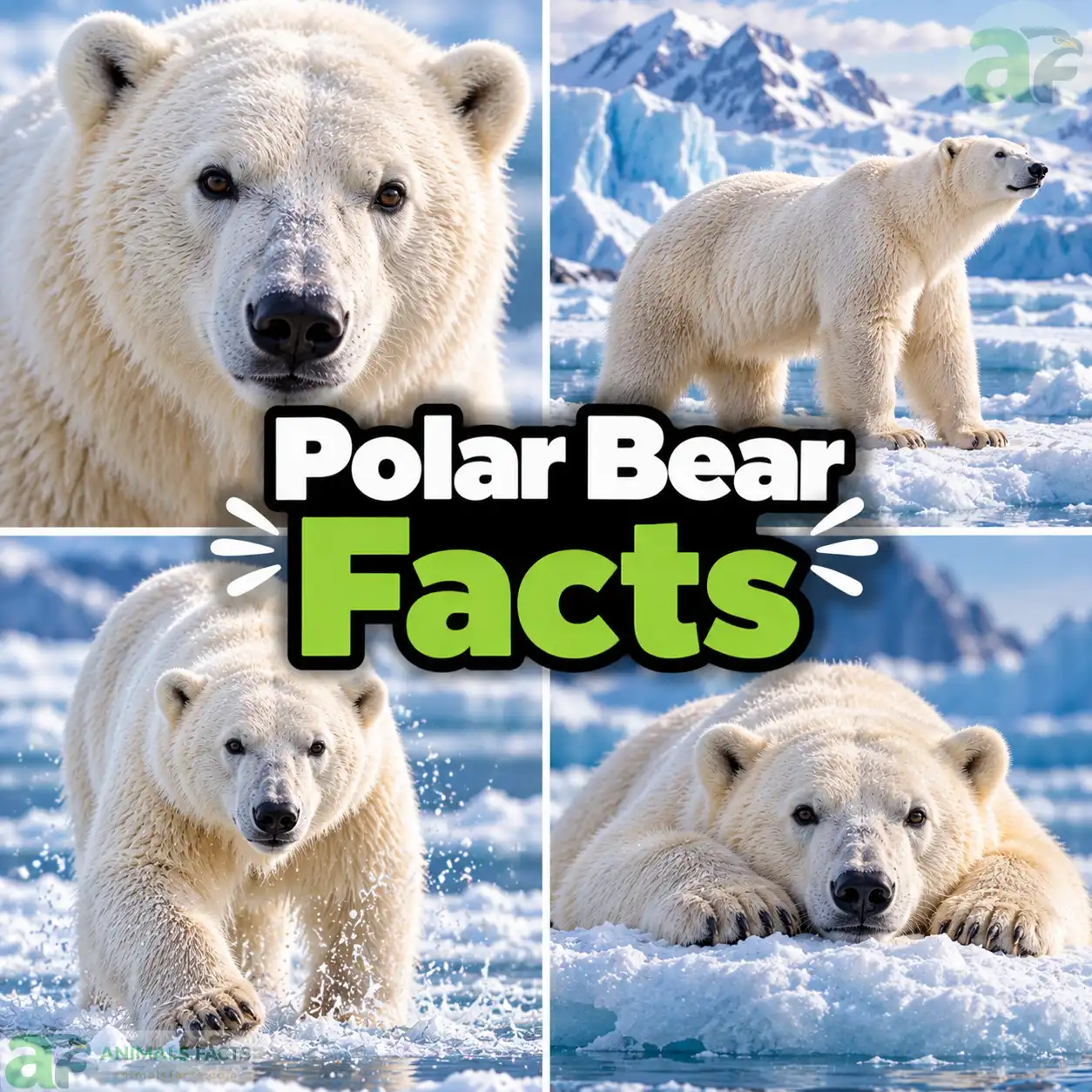
Polar Bear Facts
| Feature | Details |
|---|---|
| Scientific Name | Ursus maritimus |
| Common Name | Polar Bear |
| Kingdom | Animalia |
| Phylum | Chordata |
| Class | Mammalia |
| Order | Carnivora |
| Family | Ursidae |
| Genus | Ursus |
| Habitat | Arctic sea ice, open tundra, coastal areas — circumpolar Arctic Ocean region |
| Lifespan | 20–25 years in the wild; up to 43 years in captivity |
| Diet | Hypercarnivore — ringed seals and bearded seals (primary); walrus, beluga whale, narwhal (occasional) |
| Weight | Males: 350–700 kg; Females: 150–250 kg |
| Body Length | Males: 2.4–3.0 meters; Females: 1.8–2.4 meters |
| Shoulder Height | 1.3–1.5 meters |
| Top Speed | Up to 40 km/h (25 mph) on ice; sustained swimming of 9.6 km/h |
| Swimming Endurance | Documented continuous swims of over 685 kilometers over 9+ days |
| Conservation Status | Vulnerable (IUCN Red List) |
| Global Wild Population | Estimated ~22,000–31,000 individuals across 19 recognized subpopulations |
| Unique Feature | Classified as a marine mammal under US law; translucent (not white) fur; black skin; largest land carnivore on Earth (shared with Kodiak Bear) |
 1. Introduction: What is a Polar Bear?
It is the world’s largest land carnivore — a creature that can weigh as much as 700 kilograms and stand over 3 meters tall when rearing on its hind legs, yet moves across Arctic sea ice with an eerie, fluid grace that belies its enormous mass. It has been clocked swimming continuously for over nine days without rest across open Arctic Ocean. Its sense of smell can detect a seal’s breathing hole beneath a meter of compacted ice and snow from over a kilometer away. And it exists entirely at the mercy of a habitat — Arctic sea ice — that is disappearing faster than even the most pessimistic climate models predicted two decades ago. Polar bear facts are simultaneously among the most extraordinary in the natural world and among the most urgently important in contemporary conservation.
The polar bear — Ursus maritimus — is not simply a large bear that happens to live in a cold place. It is a genuinely unique evolutionary achievement: a marine mammal (legally classified as such under US law) that evolved from brown bear ancestors within the past 1.2–1.6 million years — an evolutionary timeframe so brief in geological terms that polar bears and grizzly bears can still interbreed and produce fertile offspring — yet has developed an extraordinarily specialized suite of physical and behavioral adaptations that make it unlike any other bear species on Earth. Translucent hollow fur over jet-black skin, webbed front paws for swimming, a metabolism capable of sustaining days-long marine fasts interrupted by explosive predatory strikes, and a navigational capability that allows lone individuals to return to specific coastal locations across hundreds of kilometers of featureless sea ice — these are not the features of a generalist bear adapted to cold. They are the features of an animal that has committed fully to one of Earth’s most demanding and most rapidly changing environments.
Whether you are a student researching polar bear facts for a school project, a climate advocate wanting to understand the specific mechanisms by which climate change threatens this iconic species, a parent looking for polar bear facts for kids, a wildlife tourist planning a Churchill expedition, or simply someone who has been captivated by photographs of this magnificent white bear — this is the most complete guide to polar bear facts you will find anywhere. We cover polar bear habitat, polar bear diet, polar bear behavior, communication, reproduction, all 19 subpopulations, conservation, mythology, and the urgent, magnificent, and deeply uncertain story of the bear that has become the face of the climate crisis. Let us begin.
2. Polar Bear Species Overview & Classification
The polar bear belongs to the family Ursidae — the bear family — and is the most recently evolved and most specialized member of the genus Ursus. Its extraordinarily close genetic relationship with the brown bear (Ursus arctos) — including the capacity for hybridization producing fertile offspring — makes the polar bear a remarkable example of rapid evolutionary divergence, with the two species having developed dramatically different ecological specializations from a common ancestor within the past two million years.
The Polar Bear-Brown Bear Relationship
Modern genetic research has confirmed that the polar bear diverged from a brown bear population — most likely an Irish or Siberian brown bear population — between approximately 1.2 and 1.6 million years ago, a relatively recent split that explains why:
- Polar bears and grizzly/brown bears can interbreed and produce fertile offspring (“pizzly bears” or “grolar bears”)
- Polar bears share virtually all of their genome with brown bears except for a small number of key genes under strong selection for Arctic adaptation
- The two species look dramatically different and occupy completely different ecological niches despite being genetically very similar
Species Classification Table
| Level | Classification |
|---|---|
| Kingdom | Animalia |
| Phylum | Chordata |
| Class | Mammalia |
| Order | Carnivora |
| Family | Ursidae |
| Genus | Ursus |
| Species | U. maritimus |
| Marine Mammal Status | Classified as a marine mammal under the US Marine Mammal Protection Act (1972) |
| Closest Relative | Brown Bear / Grizzly Bear (Ursus arctos) — hybridization possible |
The 19 Polar Bear Subpopulations
The global polar bear population is managed as 19 distinct subpopulations across the circumpolar Arctic, each associated with specific sea ice regions and showing different population trends:
| Subpopulation | Range | Population Estimate | Trend |
|---|---|---|---|
| Western Hudson Bay | Manitoba/Ontario, Canada | ~842 | Declining |
| Southern Hudson Bay | Ontario/Quebec, Canada | ~780 | Data deficient |
| Davis Strait | Labrador/Baffin Island | ~2,158 | Likely stable/increasing |
| Baffin Bay | Baffin Island/Greenland | ~2,826 | Declining |
| Norwegian Bay | Nunavut, Canada | ~203 | Data deficient |
| Lancaster Sound | Nunavut, Canada | ~2,541 | Data deficient |
| M’Clintock Channel | Nunavut, Canada | ~716 | Likely increasing |
| Gulf of Boothia | Nunavut, Canada | ~1,592 | Data deficient |
| Foxe Basin | Nunavut, Canada | ~2,197 | Data deficient |
| Viscount Melville Sound | Nunavut, Canada | ~161 | Likely stable |
| Southern Beaufort Sea | Alaska/Yukon | ~900 | Declining |
| Northern Beaufort Sea | Alaska/Northwest Territories | ~980 | Data deficient |
| Chukchi Sea | Alaska/Russia | ~2,937 | Likely increasing |
| Laptev Sea | Russia | ~800–1,000 | Data deficient |
| Kara Sea | Russia | ~800–1,200 | Data deficient |
| Barents Sea | Norway/Russia | ~2,650 | Likely stable |
| East Greenland | Greenland | Unknown | Data deficient |
| Arctic Basin | Central Arctic | Unknown | Data deficient |
| Kane Basin | Nunavut/Greenland | ~357 | Likely increasing |
Species Evolution & Discovery Timeline
~5–6 million years ago: The genus Ursus appeared, eventually giving rise to the full diversity of modern bear species including the evolutionary lineage that would produce the polar bear.
~1.2–1.6 million years ago: The polar bear lineage diverged from a brown bear ancestor — establishing the evolutionary trajectory toward the extraordinary Arctic specialization of the modern polar bear across a geological timeframe surprisingly brief for the development of such extensive morphological and ecological differentiation.
~100,000 years ago: Evidence suggests polar bears may have survived previous Arctic warm periods — potentially in refugia of remaining sea ice — though population dynamics during these historical warm periods remain subject to ongoing scientific research and debate.
Ancient Inuit and Circumpolar Peoples (thousands of years): Indigenous peoples of the Arctic maintained extensive knowledge systems and cultural traditions involving polar bears long before Western scientific documentation, representing the deepest and most nuanced understanding of the species accumulated by any human group.
1596: The Dutch explorer Willem Barentsz led the first Western expedition that extensively documented and described polar bears on Novaya Zemlya during his attempted Northeast Passage expedition — one of the earliest European written accounts of encounters with the species.
1774: German naturalist Phipps formally described the polar bear as a distinct species, giving it the scientific name Ursus maritimus — “sea bear” in Latin.
20th century: Commercial hunting, including unrestricted sport hunting by wealthy international hunters, drove significant polar bear population declines before the 1973 Agreement on the Conservation of Polar Bears was signed by the five polar bear range nations (USA, Canada, Norway, Denmark/Greenland, USSR).
2008: The US Fish and Wildlife Service listed the polar bear as Threatened under the Endangered Species Act — the first species listed specifically due to projected climate change impacts on its habitat.
2026: Ongoing monitoring of all 19 subpopulations continues against a backdrop of accelerating Arctic ice loss, with projections suggesting significant further population declines as Arctic warming continues.
3. Polar Bear Physical Description & Unique Features
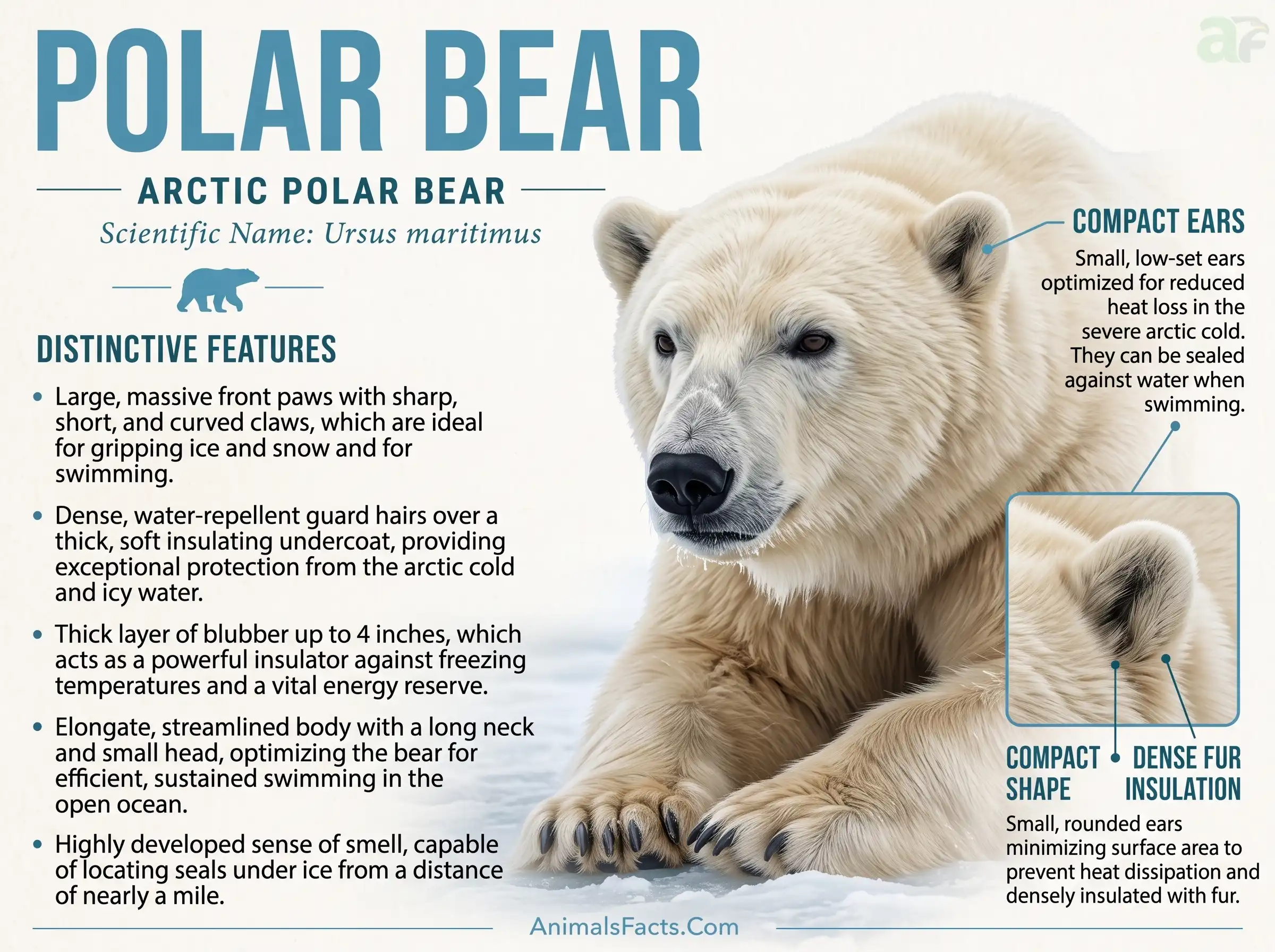
The polar bear’s physical design is the most comprehensive suite of Arctic adaptations found in any single land mammal — virtually every major physical feature has been modified from the ancestral brown bear body plan specifically to enable survival and hunting success in the extreme cold, minimal sunlight, and sea-ice hunting environment of the circumpolar Arctic.
Size — The World’s Largest Land Carnivore
Adult male polar bears are the largest land carnivores on Earth — sharing this distinction with the Kodiak Brown Bear, with which the largest individuals are roughly comparable in maximum recorded weight:
- Males: Typically 350–700 kg, with the largest confirmed individuals approaching 800 kg
- Females: Typically 150–250 kg — approximately half the weight of males
- Standing height: Up to 3.4 meters on hind legs
The “White” Coat — A Fascinating Deception
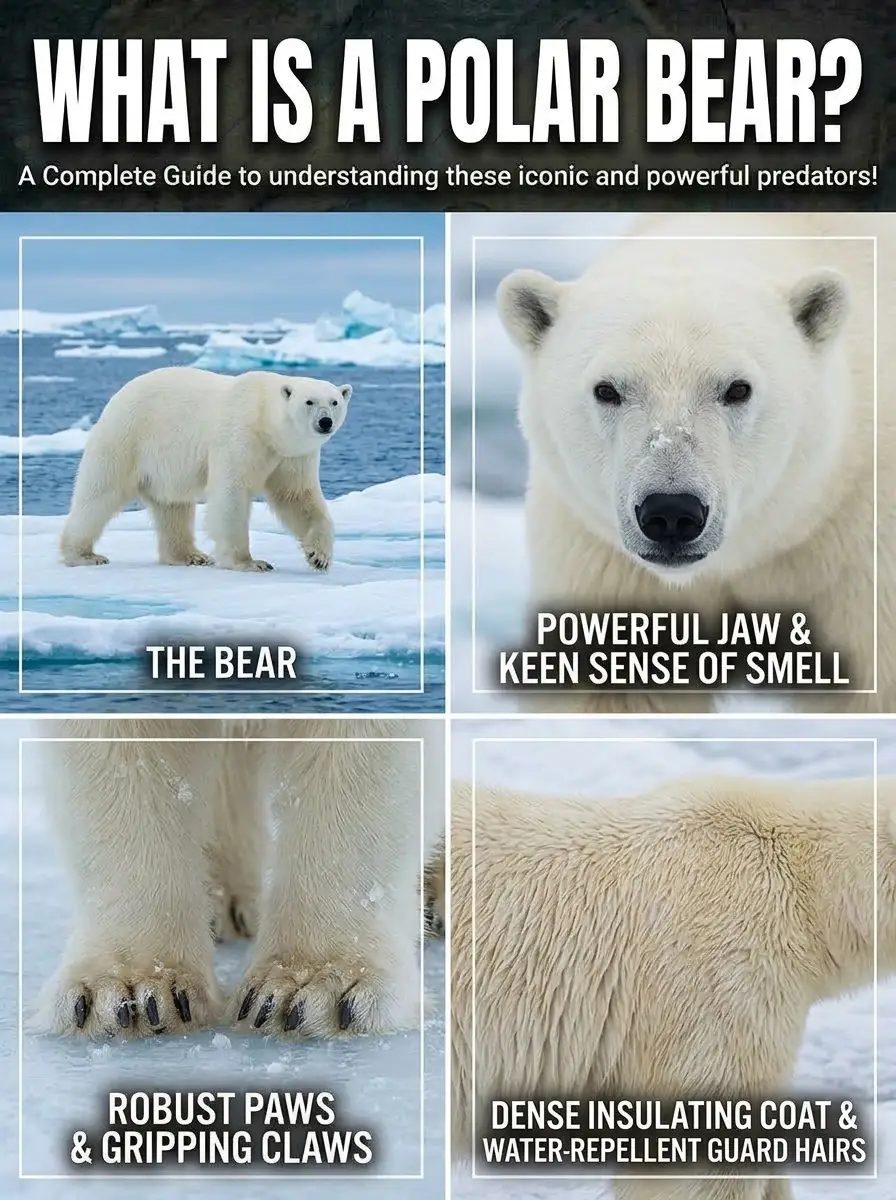
One of the most widely cited polar bear facts — and one of the most frequently misrepresented — concerns the nature of the polar bear’s coat. Individual polar bear hairs are not white — they are translucent and hollow, scattering and reflecting visible light in a way that creates the appearance of white, similar to the optical properties of snow and ice. Beneath this translucent coat lies jet-black skin — the darkest skin of any bear species, maximizing absorption of solar radiation to help maintain body temperature in the Arctic environment.
This combination of translucent outer hair and black skin represents one of the most elegant physical adaptations in the mammalian world — providing visual camouflage suited to a snow-and-ice environment while simultaneously maximizing solar heat absorption at the skin level.
Blubber and Insulation
Polar bears maintain a layer of sub-dermal blubber up to 11.4 centimeters thick — the thickest blubber layer of any bear species and comparable to the blubber maintained by marine mammals like seals. This blubber serves triple purpose: thermal insulation against Arctic cold and cold-water immersion, energy storage for periods between successful hunts, and buoyancy during the long-distance swimming for which the species is remarkable.
Paws
Polar bear paws are highly adapted for their aquatic and sea-ice hunting lifestyle:
- Front paws: Partially webbed — functioning as paddles during swimming, and as platforms of enormous surface area (up to 30 cm diameter) that distribute weight on thin or weak ice and provide traction during movement
- Non-retractable claws: Slightly curved and deeply grooved, functioning as ice hooks during prey capture and for grip on slippery sea ice
- Papillae on paw pads: Small “bumps” on the bottom of each paw that increase friction on ice — functioning similarly to the tread on a snow tire
Did You Know? Polar bears are classified as marine mammals under the United States Marine Mammal Protection Act of 1972 — a classification shared with seals, walruses, whales, and dolphins, but not with any other bear species. This classification reflects the polar bear’s fundamental dependence on the marine ecosystem — its primary prey (ringed and bearded seals) are fully marine, its primary habitat (sea ice) is a component of the marine environment, and its long-distance swimming capability is genuinely comparable to that of many recognized marine mammals. Polar bears have been documented swimming continuously for over 9 days and across distances exceeding 685 kilometers in open Arctic Ocean.
4. Top 25 Surprising & Interesting Polar Bear Facts
- Polar bear fur is translucent and hollow — not white — creating the appearance of white through light scattering while the skin beneath is jet black to maximize solar heat absorption.
- A polar bear’s sense of smell can detect a ringed seal’s breathing hole beneath a meter of compacted ice and snow from over 1 kilometer away.
- Polar bears have been documented swimming continuously for over 9 days across distances exceeding 685 kilometers of open Arctic Ocean — extraordinary swimming endurance for a land mammal.
- The polar bear holds the title of world’s largest land carnivore — shared with the Kodiak Brown Bear — with adult males regularly exceeding 500 kg and occasional individuals approaching 800 kg.
- Polar bears are classified as marine mammals under US law — the only bear species to receive this classification, reflecting their fundamental dependence on the marine ecosystem for both habitat (sea ice) and prey.
- Polar bears and grizzly/brown bears are so closely related that they can interbreed and produce fully fertile offspring — called “pizzly bears” or “grolar bears” — with confirmed wild hybrids documented in Canada’s Northwest Territories.
- A polar bear’s body temperature is maintained at approximately 37°C even in air temperatures as low as -40°C — achieved through the combination of blubber insulation, translucent fur, and black skin without requiring significantly elevated metabolic rate.
- Polar bears can go without eating for 8 months — subsisting on stored fat reserves during the summer period when sea ice melts and seal hunting becomes impractical for many individuals, a physiological feat that rivals true hibernation in its metabolic demands.
- Pregnant female polar bears enter a state of “walking hibernation” during denning — dramatically reducing heart rate and metabolic activity without losing bone density or muscle mass, a remarkable physiological capability that medical researchers have studied for potential applications in human bone loss prevention.
- Unlike most bears, male polar bears do not hibernate — remaining active year-round across the sea ice, with the physiological challenges this creates addressed through dietary fat stores built during productive hunting periods.
- Polar bear paws can reach 30 centimeters in diameter — functioning simultaneously as snowshoes on thin ice, paddles during swimming, and formidable weapons capable of killing adult ringed seals with a single strike.
- The entire global polar bear population is concentrated in just 5 Arctic nations — Canada (home to approximately 60% of the global population), Russia, Norway, Greenland (Denmark), and the United States (Alaska).
- Polar bears’ swimming style is unique among bears — using their massive front paws as primary paddles while the hind legs trail and act as rudders, rather than the dogpaddle style used by other swimming bears.
- A mother polar bear loses approximately one-third of her body weight during the ~4-month denning period — entering the den typically weighing around 200+ kg and emerging significantly lighter while having nursed two cubs through their most critical developmental period.
- The oldest confirmed wild polar bear was documented at approximately 32 years of age — substantially older than the average wild lifespan of 20–25 years, demonstrating significant individual variation in longevity.
- Polar bears have been documented covering over 700 kilometers in a single month during sea ice travel — an extraordinary long-distance movement capability that has allowed the species to exploit productive hunting areas across enormous areas of circumpolar Arctic sea ice.
- Unlike most predators, polar bears often consume only the fat (blubber and skin) of seal kills — leaving the muscle meat for Arctic foxes, ravens, and other scavengers, reflecting the extremely high caloric density of seal blubber relative to protein.
- Polar bears have an extraordinary liver that efficiently metabolizes the extremely high-fat diet of ringed seal blubber — a metabolic capability that would be toxic for humans, who cannot safely process such concentrated quantities of vitamin A and fat without health consequences.
- Climate scientists have projected that if current warming trends continue, polar bears could be functionally extinct in most of their current range by 2100, making the species one of the most clearly and directly threatened by climate change of any large mammal on Earth.
- Churchill, Manitoba, Canada — the “Polar Bear Capital of the World” — hosts one of the most predictable polar bear concentrations anywhere, as bears gather along the Hudson Bay coast in October and November waiting for sea ice to form, generating a significant wildlife tourism economy.
- Polar bears demonstrate cache-and-return behavior with large prey — covering partially consumed whale or walrus carcasses with snow or ice and returning over multiple days, exhibiting forward-planning behavior documented in only the most cognitively sophisticated animals.
- A polar bear’s digestive system is specifically adapted for extracting maximum caloric value from a hypercarnivorous, high-fat diet — with a relatively short digestive tract and high digestive efficiency for fat that distinguishes it from other bears, which have longer tracts adapted for plant material processing.
- Polar bears have been documented playing extensively — both cubs play-wrestling with each other and adults engaging in sustained play sessions with each other or with available objects, suggesting cognitive complexity and behavioral engagement beyond basic survival needs.
- The satellite tagging programs tracking polar bear movements have documented extraordinary navigation precision — with bears returning to specific coastal denning areas, specific seal-hunting locations, or specific coastal staging areas across distances of hundreds of kilometers and through featureless sea ice landscapes without landmarks visible to human observers.
- A polar bear’s bite force exceeds 1,200 psi — sufficient to crush the skull of a ringed seal with a single bite, explaining why ringed seals experience near-instantaneous death during successful polar bear predation events.
5. Fun Facts About Polar Bears
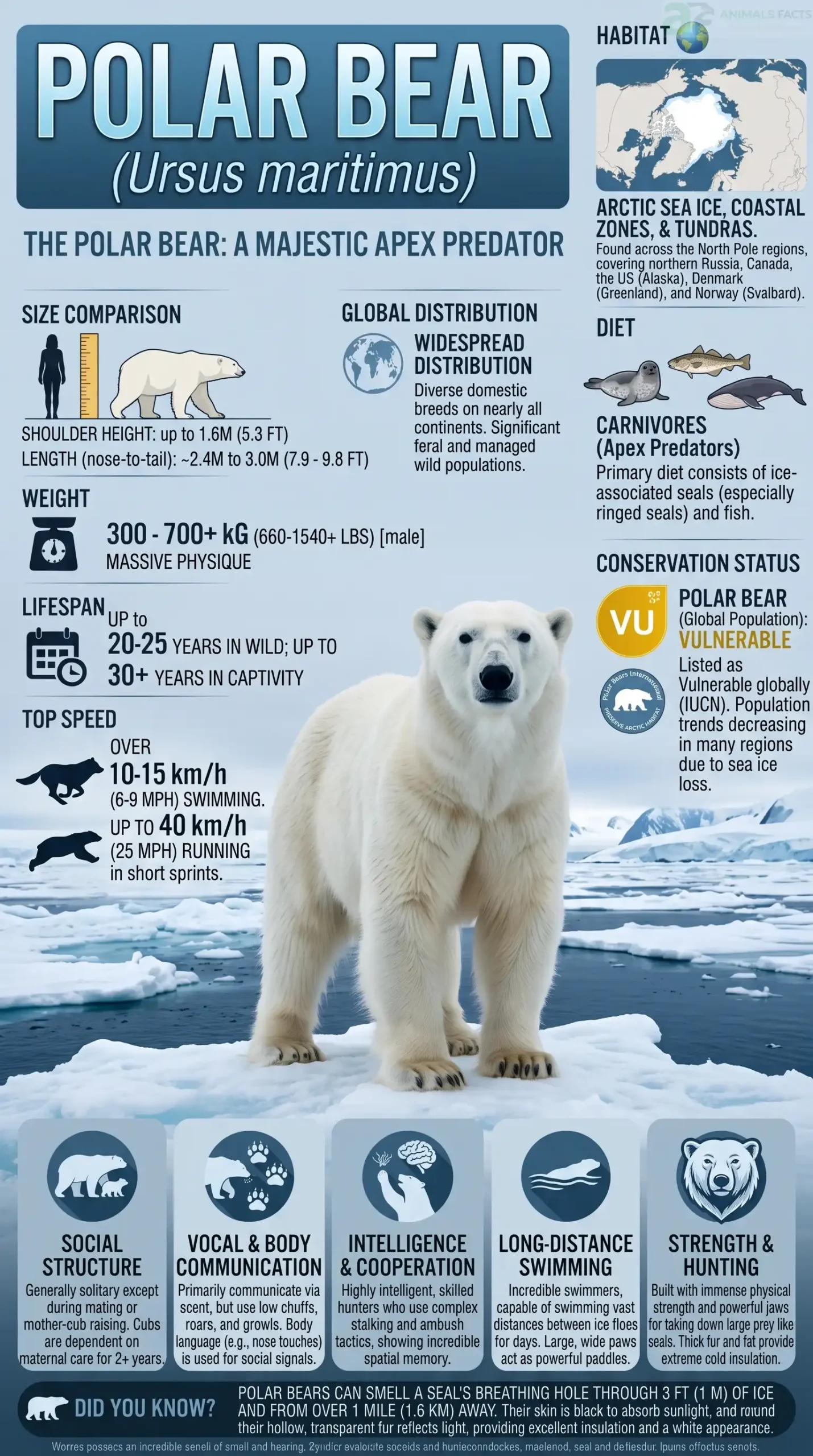
- Polar bear fur is translucent, not white — and their skin is jet black.
- Polar bears are classified as marine mammals under US law.
- Adult males weigh up to 700 kg — the world’s largest land carnivore.
- Polar bears can swim continuously for over 9 days across hundreds of miles of open ocean.
- They can smell seals through a meter of solid ice from a kilometer away.
- Only pregnant females typically hibernate — males stay active year-round.
- Polar bears and grizzly bears can interbreed — wild hybrids exist in Canada.
- Polar bears may go 8 months without eating during ice-free summers.
- Their paws reach 30 cm in diameter — functioning as snowshoes and paddles.
- 60% of all polar bears live in Canada.
- Churchill, Manitoba is the “Polar Bear Capital of the World.”
- Climate projections suggest possible functional extinction in most range areas by 2100.
6. Polar Bear Habitat & Geographic Range
The polar bear’s habitat is perhaps the most extreme and most rapidly changing of any large mammal on Earth — a world of frozen ocean, permanent twilight, temperatures plunging to -40°C, and summer periods of virtually continuous daylight that must be navigated without the forest, grassland, or mountain cover that structures the habitat of most large predators.
Primary Habitat — Sea Ice
Sea ice is not simply where polar bears happen to live — it is the literal platform upon which their entire predatory ecology is built. Without sea ice, polar bears cannot access their primary prey (ringed and bearded seals use sea ice as pupping platforms and resting surfaces, making them accessible to polar bear predation in ways they would not be in open water). As sea ice extent and duration decrease due to Arctic warming, polar bears are losing not just living space but the fundamental infrastructure of their food supply.
Key sea ice types used by polar bears:
Annual ice over continental shelves: The most productive polar bear hunting habitat — relatively shallow-water sea ice over continental shelf areas produces the highest ringed seal densities and therefore the most productive polar bear hunting conditions.
Multiyear ice: Some polar bear subpopulations depend on multiyear ice (ice that persists through multiple summers) for year-round habitat, though this ice type is declining in extent more rapidly than annual ice in many regions.
Coastal sea ice: The transition zone between sea ice and land provides critical seasonal habitat, particularly for denning females and for bears waiting at coastal locations for sea ice formation or breakup.
Habitat Range by Region
| Region | Countries | Subpopulations | Population Notes |
|---|---|---|---|
| Hudson Bay | Canada | Western HB, Southern HB, Foxe Basin | Best-studied; most visible climate change impacts |
| Canadian Arctic Archipelago | Canada | 6 subpopulations | Core of Canadian range; varying trends |
| Chukchi and Beaufort Seas | USA/Russia/Canada | 2 subpopulations | Some declining (S. Beaufort); some increasing (Chukchi) |
| Norwegian and Barents Seas | Norway/Russia | Barents Sea | Relatively stable; well-managed |
| Greenland/Baffin | Denmark/Canada | 3 subpopulations | Mixed trends |
| Russian Arctic | Russia | 3–4 subpopulations | Poorly monitored |
Did You Know? The Hudson Bay polar bear subpopulations — particularly the Western Hudson Bay subpopulation around Churchill, Manitoba — are among the most extensively studied and most publicly visible polar bear populations in the world, and have provided some of the most concerning early evidence of climate change impacts on polar bears. Research has documented that sea ice in Hudson Bay now forms approximately 2–3 weeks later in autumn and breaks up 1–2 weeks earlier in spring than historical averages from the 1970s — reducing the annual sea-ice hunting season by up to a month and directly reducing the amount of seal blubber bears can accumulate before being forced ashore during the ice-free summer period.
7. Polar Bear Diet & Feeding Behavior
The polar bear’s diet is the most dramatically simplified and most carnivorous of any bear species — a dietary strategy representing one of the most extreme adaptations to a hypercarnivorous lifestyle documented for any large mammal in the order Carnivora.
What Polar Bears Eat
Unlike their omnivorous grizzly bear relatives — who obtain 70–90% of their calories from plant material in many populations — polar bears are obligate hypercarnivores, deriving the overwhelming majority of their caloric intake from marine mammal prey, primarily fat (blubber) rather than protein (muscle meat).
Diet Breakdown Table
| Prey Type | Approximate Percentage | Notes |
|---|---|---|
| Ringed seals (Pusa hispida) | 70–80% | Primary prey; primary target of “still hunting” technique |
| Bearded seals (Erignathus barbatus) | 10–20% | Larger; higher caloric value; secondary primary prey |
| Walrus (Odobenus rosmarus) | 2–5% | Taken primarily as calves; adults dangerous to hunt |
| Beluga whale (Delphinapterus leucas) | 1–3% | Opportunistic; stranded or trapped in polynyas |
| Narwhal (Monodon monoceros) | 1–2% | Similar to beluga; opportunistic |
| Carrion (whale, other marine mammals) | 2–5% | Important in some areas and seasons |
| Land-based foods (berries, kelp, birds, eggs) | <5% | Supplementary; suboptimal caloric value during ice-free periods |
Hunting Strategies
Still hunting (primary technique): The polar bear’s most characteristic and most widely used hunting technique — the bear locates a ringed seal’s breathing hole (aglu) by smell, then waits motionlessly for minutes to hours near the hole, striking with explosive speed when the seal surfaces to breathe. This technique requires exceptional patience and sensory precision — the seal’s surfacing lasts only 1–3 seconds, during which the bear must deliver a lethal strike.
Stalking over ice: Approaching seals resting on sea ice through careful, patient low-profile movement — often using ice ridges and pressure ridges for concealment during approach, sometimes pausing motionless for extended periods when the seal is alert.
Aquatic ambush: Underwater approaches to seals hauled out on ice floes — swimming beneath the ice edge and surfacing rapidly to ambush seals on the ice above.
Raid-breathing (warthog): Breaking into ringed seal birth lairs (snow caves built by seals over their breathing holes for pupping) using the massive forepaw in a single explosive strike that collapses the snow cave.
Did You Know? Polar bears have an extraordinary ability to selectively consume only the fat-rich blubber and skin of seal prey — leaving the protein-rich muscle meat for scavengers — a selective consumption strategy that maximizes caloric density per kg of prey consumed and reflects the extraordinary efficiency of the polar bear digestive system for processing high-fat marine mammal blubber. During times of seal abundance in spring (when seals are at maximum fat content following winter), a single adult male polar bear can consume approximately 8 kg of seal blubber in a sitting — enough caloric density to sustain the bear for multiple days of ice travel.
8. Polar Bear Reproduction & Life Cycle
Polar bear reproduction is characterized by one of the most physically demanding maternal investments of any large mammal — the combination of prolonged fasting through denning, nursing of small but energy-demanding cubs, and the critical need to rebuild body condition before the next reproductive cycle creates a reproductive strategy uniquely calibrated to the extreme energetic demands of the Arctic marine environment.
Mating Behavior
Polar bears mate on the sea ice during late March through May — adult males tracking receptive females by following scent trails across the sea ice over considerable distances, with competition between males for mating access generating aggressive encounters between rival bulls.
Delayed implantation: Like grizzly bears, polar bears practice embryonic diapause — fertilized eggs remain dormant and do not implant in the uterine wall until autumn, when the female’s accumulated fat reserves determine whether she is in sufficient condition to sustain pregnancy and nursing through denning. If a female has not accumulated adequate reserves, implantation fails and pregnancy is naturally terminated.
Denning and Birth
Only pregnant females den: A critical distinction from bears like grizzly bears where both sexes hibernate — among polar bears, only pregnant females typically den for extended periods, while males and non-pregnant females remain active year-round.
Den construction: Pregnant females excavate maternity dens in snowdrifts — typically in coastal areas near the sea, though some populations show strong site fidelity to specific denning areas across multiple breeding events. Dens consist of a tunnel leading to one or more chambers, providing insulation from external cold while the female’s body heat and metabolism warm the interior.
Gestation: Approximately 195–265 days (including the diapause period) from mating to birth.
Birth: Typically November to January while the female is in her den. Cubs are born weighing only 450–700 grams — remarkably small given adult polar bear size — blind, hairless, and entirely dependent on the mother’s warmth and milk.
Litter size: Typically 1–3 cubs, with 2 being most common.
Key Developmental Stages
| Stage | Age | Key Development |
|---|---|---|
| Birth (in den) | November–January | 450–700 grams; blind, hairless |
| Early den life | 0–3 months | Eyes open ~30 days; rapid growth on mother’s milk |
| Den emergence | March–April (~4 months) | 10–12 kg; first experiences on sea ice |
| First hunting experiences | 4–12 months | Learning to observe and attempt seal hunting |
| Second winter | 1–2 years | Continuing maternal guidance |
| Independence | 2–2.5 years | Separation from mother |
| Sexual maturity | Female: 4–6 years; Male: 6–10 years | First breeding |
| Physical prime | 8–15 years | Maximum body size and reproductive success |
Lifespan Comparison Table
| Species | Average Wild Lifespan | Maximum Confirmed |
|---|---|---|
| Polar Bear | 20–25 years | ~32 years (wild); 43 years (captivity) |
| Grizzly Bear | 20–25 years | ~44 years (captivity) |
| American Black Bear | 18–23 years | ~39 years (captivity) |
| Brown Bear (general) | 20–30 years | ~47 years (captivity) |
9. Social Behavior & Communication
Polar bears are predominantly solitary — a consequence of the distributed, unpredictable nature of their primary prey source across vast expanses of sea ice, where food resources are insufficient to support the kind of group living that benefits bears in ecosystems with more concentrated or predictable food availability.
When Polar Bears Are Social
Despite their primarily solitary lifestyle, polar bears demonstrate genuine social tolerance and even playful social engagement in specific contexts:
Churchill’s autumn congregation: As Hudson Bay sea ice melts and bears are forced ashore for the summer, bears congregate in large numbers along the coast of the Hudson Bay near Churchill, Manitoba — the most visible polar bear social aggregation in the world, where dozens of bears must wait in relatively close proximity for sea ice to reform. During this period, bears demonstrate remarkable social complexity — with young males engaging in extended wrestling and sparring sessions that appear to be simultaneously play and genuine competitive skill development.
Subadult male play: Young male polar bears between independence and full adulthood engage in extended periods of play wrestling — sessions that can last hours and that represent some of the most sustained play behavior documented for any large carnivore, demonstrating both the species’ high cognitive complexity and the apparent importance of these interactions for developing the physical and social capabilities needed for adult competition over mates and resources.
Communication
Vocalizations: Polar bears produce hisses, growls, snorts, and roars — along with a distinctive “chuffing” sound used in stress situations — and mothers and cubs maintain contact through chirping vocalizations. Polar bears are generally considered less vocally expressive than brown bears in most contexts.
Body language: A rich vocabulary of postural and movement signals governs interactions between bears in the Churchill congregation and other social contexts — with lowered head, averted gaze, and crouched posture indicating submission, while direct eye contact, raised head, and forward-oriented body posture communicate dominance or challenge.
Scent: Polar bear foot glands leave chemical information in footprints across the sea ice, allowing bears to follow the trails of other individuals and assess their sex and reproductive status — a critical communication channel in an environment where visual contact across sea ice may extend many kilometers in clear conditions.
Did You Know? Research on polar bear cognitive capabilities has documented that individual bears demonstrate remarkable problem-solving intelligence — including persistent, creative attempts to access food in novel container types, behavioral flexibility in adapting hunting strategies to different ice and seal density conditions, and what researchers have described as apparent forward planning in cache-and-return feeding behavior. Several studies have compared polar bear problem-solving capabilities favorably to those of great apes in specific task contexts, contributing to a growing scientific understanding of bear intelligence that exceeds earlier assumptions.
10. Predators & Defense Mechanisms
Adult polar bears are the undisputed apex predator of the circumpolar Arctic — the most powerful land predator in the region, facing no natural predation risk from any other species as healthy adults. Cubs and juveniles, however, face genuine and significant predation risk.
Natural Threats
Adult male polar bears: Infanticide by adult males is the most significant natural mortality source for polar bear cubs — adult males encountering cubs not their own will kill and in some cases consume them. This behavior, comparable to that documented in lions and grizzly bears, drives the strong avoidance behavior that mother polar bears show toward adult males, including retreating from valuable hunting areas and maintaining extreme vigilance.
Walruses: In the unusual context of a polar bear attempting to prey on a walrus hauled out in a large herd, the danger is reversed — alarmed walrus herds can and do trample or gore polar bears attempting predation, with adult walruses’ massive size (up to 1,700 kg) and long tusks representing a genuine predatory hazard. Polar bears attempting walrus prey typically target isolated calves rather than engaging adult herds directly.
Killer Whales (Orcas): In open water, killer whales represent a genuine predation risk to polar bears swimming between ice floes — documented orca predation on polar bears in open Arctic water, though the frequency of this interaction remains uncertain and likely rare compared to land-based threat categories.
Humans: The dominant cause of human-caused polar bear mortality across their range — through legal hunting (subsistence hunting by Indigenous communities and, in some jurisdictions, sport hunting), accidental vehicle collisions, and management killing of polar bears approaching human communities.
Defense Mechanisms
Raw physical power: An adult polar bear’s combination of size (up to 700 kg), forepaw strike force, jaw strength (1,200+ psi bite), and speed (40 km/h on ice) makes it effectively unthreatened by any natural predator in its environment.
Maternal aggression: Female polar bears defending cubs demonstrate extraordinary and dangerous aggression toward perceived threats — including humans, adult male bears, and dogs — willing to engage threats far larger than themselves in defense of dependent offspring.
Sea ice escape: For bears encountering a threat on land or sea ice, entry into the water provides effective separation from many land-based threats, with a swimming polar bear significantly more difficult for most predators to pursue.
11. Polar Bear Facts for Kids
Hey kids — get ready to discover why the polar bear is one of the most amazing and mysterious animals in the whole world!
- Polar bear fur looks white, but it’s not really white at all — each hair is actually see-through (transparent), like a tiny piece of glass! The light bounces around inside the hairs in a way that makes them look white. And underneath all that fur, the polar bear’s skin is actually completely black!
- Polar bears are the biggest meat-eating animals that live on land — a big male polar bear can weigh as much as 700 kilograms, which is heavier than a small car!
- Polar bears are amazing swimmers — scientists tracked one polar bear swimming for over 9 days straight across more than 685 kilometers of freezing ocean water! That’s like swimming from one end of a big country to the other, without stopping!
- A polar bear can smell a seal hiding under the snow from over a kilometer away! That’s because polar bears have one of the most powerful noses of any animal on Earth.
- Polar bear babies are born while their mom is sleeping in a snow cave — the babies are only about as big as a guinea pig when they’re born, even though their mom weighs hundreds of kilograms!
- Polar bears are so good at staying warm that they can be comfortable in temperatures of -40°C — that’s incredibly cold, colder than your freezer at home has ever been!
- Scientists call polar bears “marine mammals” — the same category as dolphins and whales — because they depend so much on the ocean for their food and their icy home.
- Polar bears mostly eat the fat (blubber) of seals — leaving the rest for other animals. Seal fat is so full of energy that eating just a small amount gives the polar bear lots of calories to keep warm!
Did You Know? Polar bears are so good at staying warm that they sometimes overheat from running! Even in freezing Arctic temperatures, if a polar bear runs for too long, it can actually get too hot because its insulation works so well. This is one reason why polar bears usually walk or trot slowly rather than running — they’re conserving their body temperature as much as their energy!
12. Relationship with Humans
The polar bear’s relationship with humanity encompasses one of the most ancient and most geographically specific human-large carnivore coexistences in the world, combined with one of the most urgent and most globally publicized contemporary conservation challenges facing any wildlife species.
Indigenous Circumpolar Relationships
The peoples of the circumpolar Arctic — including the Inuit, Inupiat, Yupik, Iñupiat, Chukchi, and related cultures — have maintained complex, deeply integrated relationships with polar bears across thousands of years of Arctic cohabitation. Polar bears represent simultaneously a critical subsistence food source (providing meat, fat for fuel, and hides for clothing and bedding), a genuine physical danger requiring sophisticated behavioral and safety knowledge, and a profoundly sacred spiritual presence in the cosmologies and ceremonial traditions of Arctic peoples.
Subsistence hunting: Indigenous subsistence hunting of polar bears — conducted within the quotas established by international agreements and governed by traditional ecological knowledge developed across generations — remains legally protected under both Canadian and international law as a culturally and nutritionally significant Indigenous right.
The Churchill Human-Bear Interface
The town of Churchill, Manitoba — located along the polar bears’ autumn migration route to Hudson Bay sea ice — has developed one of the world’s most extensively managed human-polar bear coexistence systems, including:
The Polar Bear Alert Program: A 24-hour monitoring and response system managing polar bears entering the community — with “problem bears” captured in specialized holding facilities (“bear jail”) and relocated by helicopter before escalating intervention is required.
Tundra Buggy tourism: A major wildlife tourism industry built around observing the Churchill bear congregation from specialized large-wheeled vehicles — generating significant revenue for the community and creating economic incentives for humane bear management rather than lethal control.
Human Safety and Polar Bear Attacks
Polar bears are genuinely dangerous to humans — and critically, polar bear attacks are more likely to be predatory than defensive in motivation, distinguishing them from the more typically defensive attacks of grizzly bears. Unlike grizzly bears, which are most likely to attack when surprised or protective of cubs, polar bears — particularly nutritionally stressed individuals or young males — may approach and attack humans as a genuine prey species, making polar bear encounters in the field among the most dangerous wildlife encounters anywhere in the world.
13. Polar Bear Conservation Status & Threats
The polar bear’s Vulnerable classification under the IUCN Red List — and its Threatened status under the US Endangered Species Act — reflects one of the most direct and most well-documented cases of climate change threatening a species’ entire ecological foundation.
Global Polar Bear Conservation Data (2026)
| Status Category | Details |
|---|---|
| IUCN Red List Status | Vulnerable |
| US ESA Status | Threatened (since 2008) |
| Total Population | ~22,000–31,000 |
| Declining subpopulations | 3 of 19 (confirmed declining) |
| Increasing subpopulations | 3 of 19 (likely increasing) |
| Data deficient subpopulations | 9 of 19 (insufficient data for trend assessment) |
| Stable subpopulations | 4 of 19 (likely stable) |
Major Threats to Polar Bears
Sea ice loss — the primary and existential threat: Arctic sea ice is declining at approximately 13% per decade since satellite monitoring began in 1979, with some summer months now showing record low sea ice extent. Research using climate models projects that under current greenhouse gas emission trajectories, much of the Arctic could experience ice-free summers by 2050–2080 — eliminating the primary hunting platform for polar bears across most of their current range.
Reduced hunting season: As sea ice forms later in autumn and breaks up earlier in spring, bears have less time each year to hunt seals and accumulate the fat reserves needed to sustain themselves and raise cubs through the summer fasting period. Research has documented measurable declines in body condition and reproductive success in subpopulations experiencing the longest ice-free periods, particularly Western Hudson Bay.
Reduced survival and reproduction: Studies of the Western Hudson Bay subpopulation have documented declining cub survival rates, declining body condition in adult females, and declining overall subpopulation size — all statistically correlated with the lengthening ice-free season resulting from Arctic warming.
Pollution: Polar bears accumulate significant concentrations of persistent organic pollutants (POPs) — including PCBs, DDT, and various industrial chemicals — through the marine food chain, with documented impacts on immune function, hormone levels, and reproductive success in some populations.
Hunting and conflict mortality: Legal subsistence hunting by Indigenous communities, management removals of problem bears, and rare but documented illegal hunting represent additional mortality sources that, while managed, contribute to overall population pressure.
Did You Know? Research published in the journal Nature Climate Change modeling polar bear population responses to Arctic sea ice loss under different greenhouse gas emission scenarios found dramatically different outcomes depending on whether humanity achieves significant emissions reductions: Under high-emission scenarios, populations across most of the polar bear’s current range could collapse to near-extinction levels by 2100; under aggressive emission reduction scenarios (consistent with the Paris Agreement targets), viable polar bear populations could persist across substantial portions of their current range through the end of the century. This finding makes polar bear conservation uniquely dependent on global climate policy — distinguishing the species’ conservation challenge fundamentally from other endangered species whose threats can be addressed through habitat protection and direct management alone.
14. Famous Polar Bears
Knut — The Berlin Zoo Celebrity
Knut was a polar bear cub born at the Berlin Zoo in December 2006, who became an international media sensation after being rejected by his mother and subsequently hand-raised by keeper Thomas Dörflein. His early public appearances generated enormous media coverage and public affection worldwide, with his image appearing on magazine covers (including Vanity Fair and Stern), generating significant revenue for the Berlin Zoo, and raising public awareness of polar bear conservation. His unexpected death in March 2011 at just four years old — caused by autoimmune encephalitis — generated an extraordinary public response, demonstrating the profound emotional connection that had developed between the global public and this individual bear.
Nanuq, Bärle, and Manitoba Zoo / Various Major Captive Facilities
Multiple major wildlife facilities in North America and Europe maintain polar bear populations as important ambassadors for the species and for Arctic ecosystem conservation awareness, with individual bears at these institutions often achieving significant local fame and serving important educational roles introducing urban populations to a species they would otherwise never encounter.
The Churchill Bears — A Community of Wild Celebrities
The individually photographed and camera-tracked polar bears of the Churchill, Manitoba congregation — many individually recognizable to researchers and experienced local guides through physical features — represent the most publicly observed wild polar bear population in the world, with specific individuals followed across multiple autumn seasons and featured in countless documentary productions, magazine articles, and wildlife tourism experiences.
15. Role in Ecosystem & Food Chain
The polar bear functions as an apex predator and keystone species in the Arctic marine ecosystem — its predation on ringed seals and other marine mammals fundamentally shaping prey behavior, population dynamics, and the broader structure of Arctic marine ecosystem function.
Ringed Seal Population Regulation
Polar bear predation represents the primary top-down regulatory pressure on ringed seal populations across the circumpolar Arctic — with documented impacts on both seal population size and seal behavior (the “ecology of fear” dynamic in which seals significantly modify their pupping, resting, and breathing hole use patterns in response to polar bear predation risk). The removal of polar bears from an area would likely generate significant ringed seal population increases with cascading effects on Arctic cod and other fish populations that ringed seals consume.
Nutrient Transfer
Polar bears regularly carry seal prey away from kill sites and consume it partially, leaving carcasses that provide critical nutrient and caloric subsidies to a diverse community of Arctic scavengers — Arctic foxes (which follow polar bears across sea ice specifically to access scavenging opportunities), ravens, glaucous gulls, and other species that represent important components of the Arctic food web.
Sea Ice Ecosystem Engineers
The polar bear’s extensive movement across sea ice and along coastlines, combined with their denning excavation and feeding activities, contributes in minor ways to the physical modification of the Arctic coastal environment — not to the dramatic degree of, say, beaver dam construction, but representing a modest physical ecosystem modification function consistent with the species’ large size and extensive movement.
16. Myths, Folklore & Cultural Significance
The polar bear occupies a position of profound and deeply nuanced spiritual, cultural, and practical significance across the circumpolar Indigenous cultures that have shared Arctic landscapes with this species for thousands of years — representing one of the most extensive and most sophisticated human-large carnivore cultural relationships on Earth.
Inuit Spiritual Traditions
In Inuit cosmology, the polar bear — called “Nanuq” — holds one of the most revered positions of any animal, regarded as a powerful spiritual being whose respect and proper treatment by human hunters is essential to both the physical success of future hunts and the spiritual well-being of the community. Traditional Inuit beliefs hold that the polar bear is the supreme Arctic spirit animal — possessing supernatural intelligence and power, capable of communicating with and influencing human affairs, and deserving of ritual acknowledgment and respect following a successful hunt.
The traditional “sharing the kill” customs, the careful treatment of polar bear remains (particularly the skull), and the ceremonial acknowledgment of the bear’s spirit following a hunt reflect an elaborate cultural protocol designed to maintain the respectful relationship between Inuit hunters and polar bears across generations — a relationship grounded in thousands of years of intimate knowledge of polar bear behavior, ecology, and the spiritual dimensions of the human-bear encounter.
Circumpolar Arctic Traditions
Related traditions regarding polar bears as supreme spiritual entities, power animals, and symbols of Arctic wisdom appear across virtually all circumpolar Arctic cultures — including the Yupik, Iñupiat, Chukchi, Greenlandic Inuit, and Siberian Arctic peoples — reflecting the convergent recognition across cultures of the polar bear’s uniquely dominant presence in the Arctic environment they all shared.
Western Cultural Representations
In Western cultural tradition, the polar bear has acquired its most prominent modern symbolic role as the face of climate change — the emotionally resonant image of a starving polar bear on a melting ice floe having become perhaps the single most widely recognized visual symbol of climate change impacts in environmental communication and advocacy. This symbolic role — while sometimes criticized for oversimplifying the complexity of climate change impacts — has genuinely effective in engaging emotional public attention with abstract and complex climate science in ways that statistics and graphs cannot achieve.
17. Polar Bears in Pop Culture
The polar bear has generated one of the most distinctive and culturally diverse popular culture presences of any wild animal — driven by its combination of magnificent visual presence, its powerful symbolism as the flagship climate change species, and a series of iconic commercial and entertainment portrayals.
Advertising and Commerce
Coca-Cola Polar Bears (since 1993) — The Coca-Cola Company’s use of animated polar bears in holiday advertising campaigns, beginning with the “Always Coca-Cola” campaign in 1993, created one of the most recognized and longest-running corporate animal mascot associations in advertising history. The campaigns — depicting polar bears watching aurora displays and sharing Coca-Cola bottles in a friendly social context — introduced polar bears as symbols of warmth, holiday spirit, and social connection to global audiences, simultaneously contributing significantly to mainstream polar bear recognition.
Film and Television
“His Dark Materials” (Philip Pullman novels, 1995–2000; BBC/HBO series 2019–2022) — The armored bear Iorek Byrnison — a sentient, armor-wearing polar bear warrior — became one of the most celebrated animal characters in contemporary fantasy literature and television, capturing the combination of power, intelligence, and dignity that makes polar bears such compelling animal subjects across cultural contexts.
“Polar Bear” (Disneynature, 2022) — Narrated by Catherine Keener, this documentary following a polar bear mother and her cubs in the Canadian Arctic generated significant public engagement with polar bear conservation in an accessible family format.
“Frozen Planet” (BBC, 2011 and 2022 sequel) — David Attenborough-narrated BBC productions featuring extraordinary polar bear footage have generated some of the most powerful wildlife television content ever produced, including sequences of sea ice hunting, maternal behavior, and the Churchill congregation that introduced global audiences to polar bear natural history in unprecedented detail.
Literature
Multiple children’s books, adult novels, and popular science works have used polar bears as central subjects — from “On Thin Ice: The Changing World of the Polar Bear” by Richard Ellis to numerous children’s polar bear characters across multiple publishing traditions, reflecting the species’ unique combination of visual appeal and conservation relevance.
18. Polar Bear Facts vs. Common Myths
Myth: Polar bear fur is white. Fact: Polar bear hair is translucent (clear) and hollow, not white. The appearance of whiteness results from light scattering within the hair shafts — similar to how snow appears white despite being made of transparent ice crystals. Polar bear skin is jet black, maximizing solar heat absorption beneath the translucent fur.
Myth: Polar bears and penguins live in the same places. Fact: Polar bears inhabit the Arctic (the North Pole region), while penguins are found exclusively in the Southern Hemisphere — primarily Antarctica and surrounding subantarctic islands. The two species have never coexisted in nature and do not share any natural habitat — their frequent pairing in popular media and children’s books reflects commercial and aesthetic appeal rather than any geographic or ecological reality.
Myth: All polar bears hibernate during winter. Fact: Only pregnant female polar bears undergo an extended denning period comparable to hibernation — entering maternity dens in autumn and emerging with cubs in spring. Adult males and non-pregnant females remain active year-round, traveling across sea ice throughout the winter months.
Myth: Polar bears will be fine because they can just eat other food when seals are unavailable. Fact: While polar bears do consume land-based foods including berries, birds, and kelp during ice-free periods, these foods provide dramatically lower caloric density than marine mammal blubber — research has documented that polar bears lose body condition steadily while consuming land-based foods in summer, with the energy balance of these alternative diets insufficient to maintain the body weight required for survival and reproduction.
Myth: Polar bears are solitary and never interact socially. Fact: While polar bears are predominantly solitary hunters, they demonstrate genuine and extensive social behavior in contexts of congregated bears — including the Churchill autumn congregation, where young males engage in hours-long wrestling and play sessions, and bears of various social standings navigate complex dominance hierarchies with sophisticated behavioral repertoires.
Myth: Polar bear populations are stable or increasing globally. Fact: Of the 19 recognized polar bear subpopulations, at least 3 are confirmed declining, and multiple others are declining or data-deficient. The overall global population trend is considered downward in the context of ongoing Arctic sea ice loss, with the most comprehensive scientific projections suggesting continued and accelerating decline under current climate trajectories.
19. Best Places to See Polar Bears in the Wild
Churchill, Manitoba, Canada — The World’s Polar Bear Capital
The undisputed global destination for polar bear wildlife tourism — Churchill hosts the world’s most accessible and most predictable polar bear congregation each October and November, as bears gather along the Hudson Bay coast waiting for sea ice to form. The combination of exceptional bear density, extensive tourism infrastructure (including specialized Tundra Buggies that allow safe close-range viewing), and a well-developed guide and interpretation community make Churchill an irreplaceable polar bear viewing destination.
Svalbard Archipelago, Norway
The Norwegian high-Arctic archipelago of Svalbard — located between the Norwegian mainland and the North Pole — supports a significant polar bear population across an accessible and spectacular Arctic landscape. Boat-based expeditions around Svalbard’s fjords and coastal habitats offer excellent polar bear viewing opportunities in authentic Arctic wilderness, with the combination of midnight sun in summer and dramatic landscapes making this one of the world’s premier Arctic wildlife experiences.
Wapusk National Park, Manitoba, Canada
Wapusk — adjacent to Churchill and protecting critical polar bear denning habitat — offers the extraordinary opportunity to observe polar bear dens and emerging cubs in late winter and early spring (typically February–March), with specialized guided expeditions on tracked vehicles providing controlled access to one of the world’s most important polar bear maternity denning areas.
Franz Josef Land Archipelago, Russia
The remote Russian Arctic archipelago of Franz Josef Land supports one of Russia’s most significant polar bear populations, with occasional specialist expedition cruises providing access to extraordinary polar bear viewing in one of the most remote and pristine Arctic environments accessible to visitors.
Baffin Island, Nunavut, Canada
The enormous Canadian Arctic island of Baffin Island — spanning multiple polar bear subpopulations — offers both community-based tourism centered on Inuit ecological knowledge and specialist expedition opportunities for viewing polar bears in a landscape of extraordinary Arctic beauty.
Ryrkaypiy Village Area, Chukchi Sea, Russia
The Ryrkaypiy area on Russia’s Chukchi Sea coast has become internationally known as a polar bear congregation site — with bears gathering in large numbers when sea ice conditions force them ashore — though access remains challenging and requires specialized expedition planning.
20. Top Documentaries & Books
Must-Watch Documentaries
“Frozen Planet” (BBC, 2011) and “Frozen Planet II” (BBC, 2022) — David Attenborough-narrated BBC productions representing the definitive polar bear natural history documentary content — with extraordinary camera work capturing sea ice hunting, maternal denning, and the Churchill congregation in unprecedented detail.
“Polar Bear” (Disneynature, 2022) — Narrated by Catherine Keener, following a polar bear mother and cubs through the increasing challenges of life in a warming Arctic, providing emotionally engaging and visually stunning conservation documentary content.
“White Bear: Polar Bears in a Warming World” and various National Geographic productions — Multiple NatGeo documentary productions have covered specific subpopulations and individual bears across the circumpolar Arctic.
Polar Bears International webinar and educational content — Available through the PBI website, an extensive library of researcher-presented content on polar bear biology, conservation, and climate science represents some of the most scientifically accurate polar bear educational media available.
Essential Books
“The Great White Bear: A Natural and Unnatural History of the Polar Bear” by Kieran Mulvaney (2011) — A comprehensive and beautifully written popular natural history of the polar bear incorporating both ecological science and cultural history.
“Polar Bears: A Complete Guide to Their Biology and Behavior” by Andrew Derocher (2012) — Written by one of the world’s leading polar bear researchers, this is the most scientifically authoritative and accessible overview of polar bear biology and conservation available to general readers.
“The Fate of the Polar Bear” — Multiple popular science accounts of polar bear conservation and climate change research provide essential reading for understanding the species’ conservation situation in full scientific context.
21. Polar Bear Comparison of Polar Bears with Similar Bear Species
| Feature | Polar Bear | Grizzly Bear | American Black Bear | Kodiak Bear |
|---|---|---|---|---|
| Scientific Name | Ursus maritimus | Ursus arctos horribilis | Ursus americanus | Ursus arctos middendorffi |
| Weight | 150–700 kg | 180–360 kg | 60–300 kg | 250–480 kg |
| Distribution | Circumpolar Arctic | W. North America | North America (widespread) | Kodiak Archipelago |
| Diet | Hypercarnivore (seals) | Omnivore (plant-heavy) | Omnivore | Omnivore (salmon-heavy) |
| Marine Mammal Classification | Yes (US law) | No | No | No |
| Male Hibernation | No (males active year-round) | Yes | Yes | Yes |
| Fur Color | Translucent/appears white | Brown to blond/dark | Black/brown/cinnamon | Brown |
| Blubber | Up to 11 cm thick | Moderate seasonal fat | Seasonal fat | Seasonal fat (heavy near coast) |
| Conservation Status | Vulnerable | Least Concern (globally)/Threatened (lower 48 US) | Least Concern | Least Concern |
| Primary Threat | Climate change/sea ice loss | Habitat loss/human conflict | Localized habitat loss | Stable |
| Hybridization | Possible with Brown/Grizzly Bear | Possible with Polar Bear | No known hybrids with Ursus | Possible with other Brown Bears |
22. How You Can Help
Polar bear conservation is uniquely linked to global climate policy — making personal and collective climate action as important as direct wildlife conservation support in addressing the species’ primary existential threat.
Support These Organizations
Polar Bears International (polarbearsinternational.org) — The world’s leading polar bear conservation organization, funding research across multiple subpopulations, running extensive public education programs, and advocating for climate policy informed by polar bear science.
WWF Arctic Programme (worldwildlife.org/places/arctic) — World Wildlife Fund runs extensive Arctic ecosystem conservation programs, including polar bear population monitoring, sea ice research, and advocacy for reduced greenhouse gas emissions and sustainable Arctic development.
Natural Resources Defense Council (nrdc.org) — Runs active legal and policy advocacy for polar bear protections under the Endangered Species Act and for climate policies directly relevant to polar bear habitat preservation.
Defenders of Wildlife (defenders.org/polar-bear) — Advocates for maintaining and strengthening polar bear protections and for the climate policies essential to long-term polar bear survival.
Practical Actions
Reduce personal carbon footprint. Given that sea ice loss — driven by greenhouse gas emissions — is the primary polar bear threat, individual actions that meaningfully reduce carbon footprint have genuine aggregate conservation relevance for polar bears in a way that individual consumer actions rarely do for wildlife conservation. Transportation choices, energy consumption, dietary shifts, and support for clean energy policy all contribute to this aggregate effect.
Support climate legislation. Engaging with climate policy at every level — supporting political candidates committed to science-based climate action, commenting on environmental regulations, and advocating for international climate agreements — represents the most impactful individual conservation action for polar bears.
Choose responsible Arctic tourism. If visiting polar bear habitat, selecting operators with demonstrated commitment to bear welfare and habitat protection — including adherence to minimum approach distances and avoiding habituation behaviors — supports ethical polar bear tourism.
Donate to Polar Bears International (polarbearsinternational.org) and partner organizations — funding the research, public education, and policy advocacy programs that represent the most direct organizational investment in polar bear conservation.
Participate in citizen science — PBI’s Tundra Connections program and related initiatives provide opportunities to engage with live Churchill bear observations and contribute to public awareness of bear condition and behavior during the critical pre-ice-formation period.
Did You Know? Polar Bears International runs an innovative annual program called Tundra Connections — a live video link and educational program connecting classrooms and public audiences worldwide with Churchill, Manitoba’s polar bear congregation each autumn. The program has reached millions of students and general audience members across multiple countries since its inception, providing direct, emotionally engaging connection with wild polar bears and the conservation challenges they face — demonstrating the power of real-time wildlife connection for building conservation awareness and support among audiences that would never otherwise have direct access to the Arctic.
23. Frequently Asked Questions About Polar Bears
Q1: What is the scientific name of the polar bear?
The polar bear’s scientific name is Ursus maritimus — literally “sea bear” in Latin — reflecting the species’ fundamental dependence on the marine environment. It belongs to the genus Ursus, the family Ursidae (bears), the order Carnivora, and the class Mammalia.
Q2: How many polar bears are left in the world?
The global polar bear population is estimated at approximately 22,000–31,000 individuals across 19 recognized subpopulations. Population trends vary by subpopulation — at least 3 are confirmed declining, while 3 are considered likely increasing or stable, and 9 lack sufficient data for trend assessment. The overall global trajectory is considered downward in the context of ongoing Arctic warming and sea ice loss.
Q3: Are polar bears white?
No — polar bear fur is translucent (clear) and hollow, not white. The white appearance results from light scattering within the hair shafts, similar to how snow appears white despite being made of clear ice. Polar bear skin is jet black, maximizing solar heat absorption. The translucent fur provides visual camouflage suited to snow and ice environments while the black skin absorbs heat.
Q4: Are polar bears endangered?
Polar bears are classified as Vulnerable by the IUCN Red List and as Threatened under the US Endangered Species Act (since 2008). The species’ primary threat — the ongoing loss of Arctic sea ice due to climate change — is projected to drive continued and potentially severe population declines across most of the species’ current range under high-emissions climate scenarios.
Q5: What do polar bears eat?
Polar bears are hypercarnivores (obligate meat-eaters), deriving the vast majority of their caloric intake from marine mammals — primarily ringed seals and bearded seals. They typically consume only the calorie-dense blubber and skin of seals, leaving muscle meat for scavengers. Occasional prey includes walrus calves, beluga whales, and narwhals.
Q6: How long can polar bears swim?
Polar bears are extraordinary swimmers — the longest continuous swim documented by GPS-tagged researchers involved a female polar bear swimming 685 kilometers over approximately 9 days in the Beaufort Sea without rest, using stored fat reserves for energy. Such long swims are associated with significant energy cost and can reduce cub survival rates.
Q7: Do polar bears hibernate?
Only pregnant female polar bears den for extended periods comparable to hibernation — entering maternity dens in autumn and emerging with cubs in spring. Adult males and non-pregnant females remain active year-round across the sea ice, representing a significant behavioral difference from other bear species where all adults typically hibernate.
Q8: Can polar bears and grizzly bears breed together?
Yes — polar bears and grizzly bears (brown bears) are genetically close enough to interbreed and produce fertile offspring, called “pizzly bears” or “grolar bears.” Wild hybrid individuals have been documented in Canada’s Northwest Territories through genetic analysis, and the frequency of such encounters may increase as grizzly bear range expands northward into former polar bear territory due to Arctic warming.
Q9: How big do polar bears get?
Adult male polar bears typically weigh 350–700 kg and measure 2.4–3.0 meters in body length, with the largest individuals approaching 800 kg — making them co-holders of the title of world’s largest land carnivore alongside Kodiak Brown Bears. Adult females are significantly smaller, typically weighing 150–250 kg.
Q10: How can I help polar bear conservation?
The most impactful actions include: reducing personal carbon footprint (since climate change is the primary polar bear threat); supporting climate legislation and policies consistent with Paris Agreement goals; supporting Polar Bears International, WWF Arctic Programme, and Defenders of Wildlife financially; choosing responsible Arctic tourism if visiting polar bear habitat; and participating in citizen science programs like PBI’s Tundra Connections that build conservation awareness.
26. Sources & References
Research Sources
- Wikipedia — Ursus maritimus and related articles
- IUCN Red List — iucnredlist.org
- Polar Bears International — polarbearsinternational.org
- WWF Arctic Programme — worldwildlife.org
- US Fish and Wildlife Service — fws.gov
- National Geographic — nationalgeographic.com
- Smithsonian’s National Zoo — nationalzoo.si.edu
- Encyclopaedia Britannica — britannica.com
- BBC Wildlife — bbc.co.uk
- Live Science — livescience.com
- Derocher, Andrew — “Polar Bears: A Complete Guide to Their Biology and Behavior” (2012)
- Mulvaney, Kieran — “The Great White Bear: A Natural and Unnatural History of the Polar Bear” (2011)
- Pagano, Anthony M. et al. — Various polar bear swimming and energetics research publications