

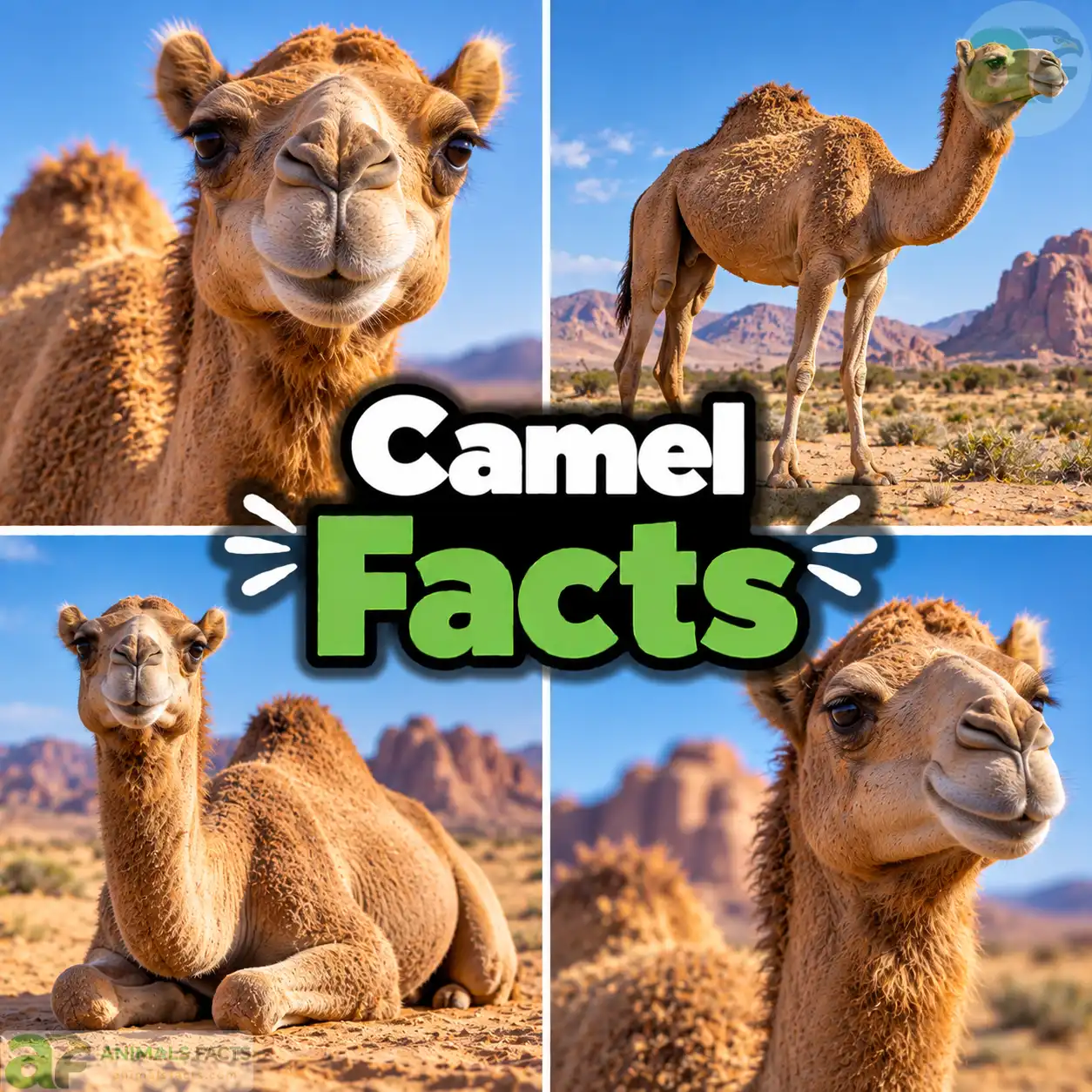
Camel Facts
| Feature | Details |
|---|---|
| Scientific Names | Dromedary Camel: Camelus dromedarius; Bactrian Camel: Camelus bactrianus; Wild Bactrian Camel: Camelus ferus |
| Common Names | Camel, Arabian Camel, One-Humped Camel, Two-Humped Camel, Ship of the Desert |
| Kingdom | Animalia |
| Phylum | Chordata |
| Class | Mammalia |
| Order | Artiodactyla |
| Family | Camelidae |
| Habitat | Hot deserts, semi-arid steppe, and cold continental desert across North Africa, the Middle East, South Asia, and Central Asia |
| Lifespan | 40–50 years in domesticated conditions; wild Bactrian camels typically live 20–40 years |
| Diet | Herbivore — thorny shrubs, dry grasses, salty vegetation, leaves |
| Weight | 300–600 kg (dromedary); 300–1,000 kg (Bactrian) |
| Height | 1.85–2.15 meters at the shoulder (hump can add up to 30 cm more) |
| Speed | Up to 65 km/h (40 mph) in short bursts; sustainable trotting speed of 40 km/h |
| Conservation Status | Domesticated dromedary: not assessed (no longer exists in the wild); Wild Bactrian Camel: Critically Endangered |
| Global Population | Dromedary: approximately 35–40 million (domesticated); Wild Bactrian Camel: fewer than 1,000 individuals remaining |
| Unique Feature | The only large mammal capable of losing up to 25% of its body water through dehydration and surviving; humps store fat, not water; can drink up to 200 liters of water in under 3 minutes |
 1. Introduction: What is a Camel?

It can go without a single drop of water for over two weeks, survive a body temperature swing of 6 degrees Celsius that would kill most mammals, and then, when it finally reaches an oasis, drink enough water in ten minutes to refill an entire bathtub. Camel facts reveal one of the most extraordinary examples of evolutionary adaptation in the entire animal kingdom — a creature so thoroughly engineered for survival in Earth’s harshest, driest environments that it has earned the enduring nickname “the ship of the desert.” For thousands of years before the invention of the automobile, the camel was the single most important mode of long-distance transportation across the deserts of Africa, the Middle East, and Central Asia, carrying goods, people, and entire civilizations across trade routes that would have been utterly impassable without it.
The camel — comprising three living species within the family Camelidae — the dromedary (Camelus dromedarius), the domestic Bactrian camel (Camelus bactrianus), and the critically endangered wild Bactrian camel (Camelus ferus) — represents one of the most successful examples of domestication in human history. While the dromedary camel no longer exists in any truly wild form anywhere on Earth, having been fully domesticated for thousands of years, the wild Bactrian camel survives today in only the most remote and inhospitable corners of the Gobi and Taklamakan deserts, clinging to existence as one of the rarest large mammals on the planet. This dramatic contrast — between the camel’s status as one of humanity’s most successful domesticated animals and the desperate rarity of its last truly wild relative — makes camel facts a genuinely fascinating subject spanning biology, history, culture, and modern conservation.
Whether you are a student researching camel facts for a school project, a traveler planning a desert trek and curious about the animal that will carry you across the dunes, a conservation advocate interested in the plight of the critically endangered wild Bactrian camel, a parent looking for camel facts for kids, or simply someone who has always been fascinated by the camel’s astonishing physiological adaptations, this is the most complete guide to camel facts you will find anywhere. We cover camel habitat, camel diet, the extraordinary biology behind desert survival, reproduction, the deep and ancient relationship between camels and humans, mythology, and the full story of one of the animal kingdom’s most remarkable survivors.
2. Camel Species Overview & Classification
The camel belongs to the order Artiodactyla (even-toed ungulates) and the family Camelidae, a family that also includes the South American llamas, alpacas, guanacos, and vicuñas — all of which share a distant common ancestor with the camels of Africa and Asia despite their vastly different modern ranges. The family Camelidae is genuinely ancient, with a fossil record stretching back tens of millions of years, and remarkably, the family’s evolutionary origins actually trace back to North America, not the deserts most people associate with camels today.
Three Living Camel Species — Not Interchangeable
Despite the common tendency to speak of “the camel” as a single animal, there are three genetically and physically distinct living camel species:
Dromedary Camel (Camelus dromedarius): The single-humped camel, native historically to the Arabian Peninsula and North Africa, now found as a domesticated animal across the Middle East, North Africa, and notably as a feral population in the Australian outback.
Domestic Bactrian Camel (Camelus bactrianus): The two-humped camel, domesticated thousands of years ago across the steppes of Central Asia, adapted to far colder climates than the dromedary.
Wild Bactrian Camel (Camelus ferus): A genetically distinct wild species — not simply a feral population of the domestic Bactrian camel — surviving only in isolated pockets of the Gobi and Taklamakan deserts across Mongolia and China, and classified as one of the most critically endangered large mammals on Earth.
These three species diverged genetically long enough ago that the wild Bactrian camel is now recognized as a fully separate species from its domesticated Bactrian cousin, a distinction confirmed through genetic research showing the two lineages split roughly 1 million years ago — meaning the wild Bactrian camel was never simply the “ancestor” of the domestic Bactrian camel in the way many people assume, but rather a parallel wild lineage that has persisted independently.
Species Classification Table
| Level | Classification |
|---|---|
| Kingdom | Animalia |
| Phylum | Chordata |
| Class | Mammalia |
| Order | Artiodactyla |
| Family | Camelidae |
| Genus | Camelus |
| Species 1 | C. dromedarius (Dromedary Camel) |
| Species 2 | C. bactrianus (Domestic Bactrian Camel) |
| Species 3 | C. ferus (Wild Bactrian Camel) |
| Closest Living Relatives | South American camelids — llama, alpaca, guanaco, vicuña (all within family Camelidae) |
Camel Hybrid — The “Cama” and Beyond
Camel breeders have successfully produced hybrids between dromedary and Bactrian camels, known as “bukhts” or hybrid camels, which are typically larger and stronger than either parent species and have been specifically bred in parts of Kazakhstan and Central Asia for their superior load-carrying capacity and cold tolerance combined with dromedary speed traits. More unusually, scientists at the Camel Reproduction Centre in Dubai successfully produced a “cama” — a hybrid between a dromedary camel and a llama, achieved through artificial insemination since natural mating between the two vastly different-sized species is not possible — a scientific curiosity that demonstrated the close genetic relationship between Old World and New World camelids despite millions of years of geographic separation.
Species Evolution & Discovery Timeline
~45 million years ago: The earliest camelid ancestors, small rabbit-sized forest-dwelling animals, appeared in North America during the Eocene epoch — an origin point that surprises most people, since North America has no native wild camels today.
~3–5 million years ago: Ancient camelids migrated out of North America via the Bering land bridge into Asia, eventually giving rise to the modern camel lineages of Africa and Asia, while a separate southward migration across the Isthmus of Panama produced the ancestors of modern llamas, alpacas, and vicuñas in South America.
~1 million years ago: The genetic split between the wild Bactrian camel lineage and what would become the domestic Bactrian camel lineage is estimated to have occurred, according to modern genetic research.
~10,000 years ago: North American camelids, including the species that had remained on the continent, went extinct at the end of the last Ice Age, alongside numerous other North American megafauna — meaning the camel family’s birthplace continent lost all of its native camel species entirely.
~3,000–4,000 years ago: Domestication of the dromedary camel began across the Arabian Peninsula, with archaeological and genetic evidence suggesting domestication occurred independently or through concentrated breeding programs in the southeastern Arabian Peninsula.
~2,500–3,000 years ago: Domestication of the Bactrian camel occurred separately across the steppes of Central Asia, adapted specifically to the region’s far harsher winters and higher elevations compared to the Arabian dromedary’s hot desert environment.
7th–15th centuries CE: The domesticated camel became the essential backbone of trans-Saharan and Silk Road trade routes, fundamentally reshaping trade, culture, and the spread of religion and ideas across North Africa, the Middle East, and Central Asia.
19th century: Dromedary camels were introduced to Australia by British colonial authorities for use in exploring and developing the country’s vast arid interior, a population that would later be released and become feral.
2006: Genetic research formally confirmed the wild Bactrian camel as a distinct species (Camelus ferus) separate from the domestic Bactrian camel, rather than merely a feral population — a landmark taxonomic reclassification.
2026: The wild Bactrian camel remains critically endangered, with fewer than 1,000 individuals surviving across fragmented desert habitat in Mongolia and China, while feral dromedary populations in Australia have grown to over 1 million individuals, representing the largest wild dromedary population on Earth despite the species having no native wild range remaining anywhere else.

3. Camel Physical Description & Unique Features
The camel’s body is arguably one of the most thoroughly and precisely adapted mammalian body plans for extreme environmental survival found anywhere in nature — with nearly every anatomical feature serving a specific function in managing heat, water, and the physical demands of traveling across sand, gravel, and rock.
Size — Built for Endurance, Not Speed
Camels are large mammals, though size varies meaningfully between species and individual animals:
Weight: 300–600 kg for dromedary camels; Bactrian camels can range from 300 kg up to 1,000 kg in the largest individuals.
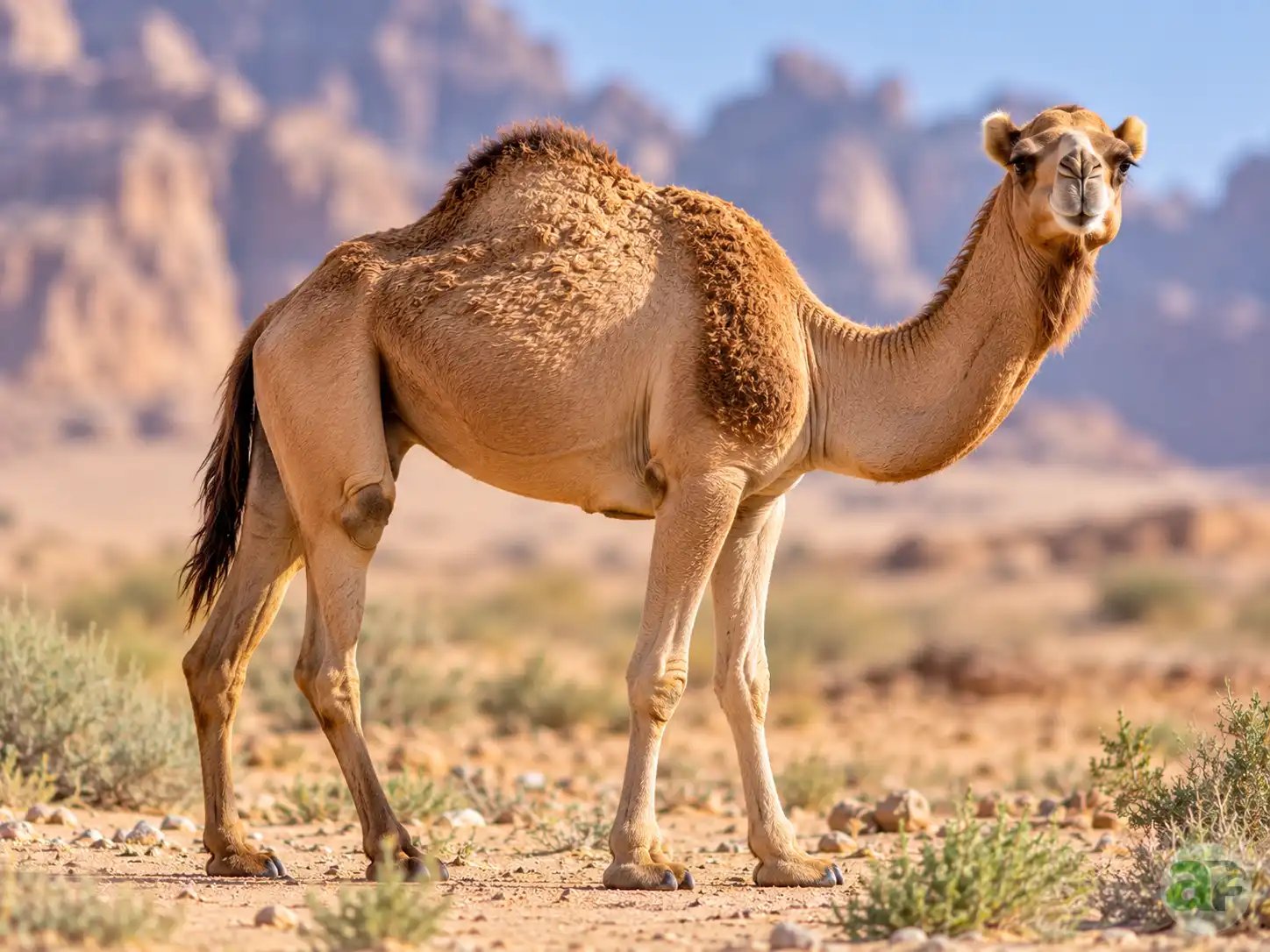
Height: 1.85–2.15 meters at the shoulder, with the hump adding additional height.
Body length: Approximately 2.2–3.4 meters from nose to tail.
The Famous Hump — Fat, Not Water
Perhaps the single most persistent misconception about camels, addressed in detail throughout this article, is the belief that the hump stores water. In reality, the camel’s hump stores fat — a concentrated energy reserve that can weigh up to 36 kg in a well-fed dromedary and provide sustained energy across weeks of travel without food.
Fat storage function: By concentrating fat storage in a single hump rather than distributing it evenly across the body (as most mammals do), camels avoid the insulating effect that widespread body fat would otherwise create — a critical adaptation, since insulating fat spread across the whole body would trap dangerous heat in the desert environment.
Hump shape as health indicator: A camel’s hump shape provides a visible indicator of its nutritional condition — a well-fed camel has a firm, upright hump, while a malnourished or dehydrated camel’s hump becomes soft and may lean noticeably to one side, since the fat reserve is being metabolized faster than it’s replenished.
Dromedary vs. Bactrian humps: The single-humped dromedary and the double-humped Bactrian camel represent the two distinct hump configurations found in the genus, with the Bactrian camel’s two smaller humps believed to be an adaptation providing slightly more even weight distribution for carrying heavy loads across mountainous Central Asian terrain.
Extraordinary Water Conservation Adaptations
The camel’s true water-survival secret lies not in the hump but in an extraordinary suite of physiological adaptations distributed throughout the entire body:
Oval-shaped red blood cells: Unlike the round red blood cells of virtually all other mammals, camel red blood cells are oval-shaped — an adaptation that allows blood to continue flowing smoothly even when the animal becomes severely dehydrated and blood viscosity increases dramatically, preventing the blood clots and circulatory failure that would kill most other mammals under similar dehydration stress.
Extreme dehydration tolerance: Camels can survive losing up to 25% of their body water through dehydration — a level of fluid loss that would be fatal to almost any other mammal, including humans, who typically experience organ failure and death at around 12–15% body water loss.
Rapid rehydration capacity: When water finally becomes available, a severely dehydrated camel can drink up to 200 liters in a single session lasting under three minutes, rapidly restoring blood volume without the dangerous swelling of red blood cells (hemolysis) that would occur in most other mammals attempting to rehydrate that quickly.
Body temperature fluctuation: Camels are able to allow their core body temperature to fluctuate by roughly 6 degrees Celsius across the day — dropping to around 34°C overnight and rising to as high as 40°C during peak daytime heat — a strategy that dramatically reduces the need for water-costly sweating to maintain a constant body temperature, unlike most mammals that must sweat continuously to prevent dangerous overheating.
Nasal moisture recapture: Specialized nasal passages allow camels to recapture and reabsorb moisture from exhaled air before it’s lost, significantly reducing water loss through breathing — a critical adaptation given how much moisture mammals typically lose simply through the act of exhaling in dry desert air.
Concentrated urine and dry feces: Camel kidneys are exceptionally efficient at conserving water, producing extremely concentrated urine, while their feces are so dry that they have historically been used as fuel for fires in desert regions, since the material contains so little residual moisture.
Eyes, Nostrils & Adaptations Against Sand
Beyond water conservation, camels possess a remarkable suite of adaptations specifically for surviving sandstorms and blowing desert sand:
Double row of eyelashes: Camels have an unusually long, dense double row of eyelashes that provides effective protection against blowing sand and intense sun glare.
Closable nostrils: Camel nostrils can close almost completely during sandstorms, preventing sand inhalation while still allowing minimal necessary airflow.
Third eyelid: A thin, translucent third eyelid (nictitating membrane) can sweep across the eye like a windshield wiper, clearing away sand and dust while still allowing some vision.
Feet Built for Sand
Camel feet are broad, tough, and leathery, with two toes connected by a wide, cushioned pad that spreads under the animal’s weight — functioning much like a natural snowshoe adapted for sand rather than snow, preventing the camel from sinking into soft desert terrain that would trap most other large mammals.
Did You Know? A dehydrated camel’s blood can lose up to 25% of its total body water without becoming dangerously thick or sluggish, largely thanks to those unusual oval-shaped red blood cells — a design so effective that medical researchers have studied camel blood cell structure for potential insights into treating human blood disorders and improving blood storage and transfusion techniques.
4. Top 25 Surprising & Interesting Camel Facts
- A camel’s hump stores fat, not water — a concentrated energy reserve that can weigh up to 36 kg.
- Camels can lose up to 25% of their body water through dehydration and survive — a level that would kill most other mammals.
- A severely dehydrated camel can drink up to 200 liters of water in under three minutes.
- Camel red blood cells are oval-shaped rather than round, allowing blood to flow smoothly even during extreme dehydration.
- Camels can go without drinking water for over two weeks, depending on temperature, activity level, and available food moisture.
- A camel’s body temperature can naturally fluctuate by about 6°C across the day, reducing the need for water-costly sweating.
- There are three living camel species: the dromedary, the domestic Bactrian camel, and the critically endangered wild Bactrian camel.
- The wild Bactrian camel is one of the most endangered large mammals on Earth, with fewer than 1,000 individuals remaining in the wild.
- Camels originally evolved in North America roughly 45 million years ago, not in the deserts they’re associated with today.
- Australia has the largest population of wild dromedary camels in the world — over 1 million feral individuals — despite camels having no native range on the continent.
- Camels have a double row of eyelashes and a translucent third eyelid to protect their eyes from blowing sand.
- A camel’s nostrils can close almost completely during sandstorms.
- Camels can run at speeds of up to 65 km/h in short bursts.
- Camel feet are broad, cushioned pads that prevent them from sinking into soft sand.
- Camel milk is significantly richer in vitamin C and lower in fat than cow’s milk, and has been consumed by desert peoples for thousands of years.
- Scientists successfully bred a hybrid between a dromedary camel and a llama, called a “cama,” using artificial insemination.
- Camel dung is so dry it has traditionally been used as fuel for fires across desert regions.
- A camel’s gestation period lasts approximately 13 months, one of the longest of any land mammal.
- Camels typically give birth to a single calf, which can stand and walk within hours of birth.
- The word “camel” is believed to derive from the Semitic root word “gamal,” referring to the animal’s role as a carrier or bearer of loads.
- Domesticated camels have been used for transportation, milk, meat, wool, and even racing for thousands of years across Africa and Asia.
- Camel wrestling and camel racing remain popular traditional sports in parts of the Middle East and Central Asia today.
- Bactrian camels can survive temperatures ranging from -40°C in winter to over 40°C in summer — one of the widest temperature tolerance ranges of any large mammal.
- Camels are ruminant-like animals with a three-chambered stomach (rather than the four chambers found in cattle and deer), allowing efficient digestion of extremely tough, thorny desert vegetation.
- Some racing camels in the Gulf states are worth millions of dollars, with camel beauty pageants also serving as a significant cultural and economic tradition in the region.

5. Fun Facts About Camels
- A camel’s hump stores fat, not water.
- Camels can survive losing 25% of their body water.
- They can drink 200 liters of water in under 3 minutes.
- Camel blood cells are oval-shaped, not round.
- Camels evolved originally in North America.
- Australia has over 1 million wild dromedary camels.
- There are 3 living camel species.
- Wild Bactrian camels are critically endangered.
- Camels have double eyelashes for sand protection.
- A camel’s body temperature can swing by 6°C daily.
- Camel gestation lasts about 13 months.
- Camel milk is richer in vitamin C than cow’s milk.
6. Camel Habitat & Geographic Range
Camels are supremely adapted to some of the most extreme and inhospitable terrestrial environments on Earth — from the scorching sand dunes of the Sahara and Arabian deserts to the frigid, wind-scoured plains of the Gobi Desert, where winter temperatures plunge far below freezing.
Primary Habitat Types
Hot sandy desert: The classic dromedary habitat — vast stretches of sand dunes and rocky desert across North Africa, the Arabian Peninsula, and parts of South Asia, characterized by extreme daytime heat, minimal rainfall, and sparse vegetation.
Cold continental desert and steppe: The Bactrian camel’s specialized habitat — the Gobi and surrounding regions of Mongolia and northern China, where camels must contend with both scorching summer heat and brutally cold winters, along with rocky, mountainous terrain quite different from the soft dune landscapes associated with dromedaries.
Semi-arid grassland and scrubland: Both species utilize semi-arid transitional habitat where sparse grasses and thorny shrubs provide grazing opportunities beyond the most extreme desert core.
Geographic Range Table
| Region | Species | Status | Notes |
|---|---|---|---|
| Arabian Peninsula | Dromedary | Domesticated | Historical center of dromedary domestication |
| North Africa (Sahara) | Dromedary | Domesticated | Extensive traditional pastoral use |
| Horn of Africa | Dromedary | Domesticated | Major population, particularly Somalia and Ethiopia |
| South Asia (India, Pakistan) | Dromedary | Domesticated | Significant traditional working populations |
| Australia | Dromedary | Feral/wild | Largest wild dromedary population globally, over 1 million |
| Mongolia | Wild & Domestic Bactrian | Critically Endangered (wild) | Core range of remaining wild Bactrian camels |
| Northern China (Gobi/Taklamakan) | Wild & Domestic Bactrian | Critically Endangered (wild) | Remaining fragmented wild populations |
| Central Asia (Kazakhstan, etc.) | Domestic Bactrian | Domesticated | Significant traditional herding populations |
Did You Know? Australia is home to the world’s largest population of wild dromedary camels — despite the fact that camels have absolutely no native range on the Australian continent. Camels were introduced by British colonists in the 19th century to assist with exploration and transport across Australia’s vast arid interior, and following the rise of motorized transport, many were released into the wild, where they thrived with no natural predators, eventually growing to a feral population exceeding 1 million animals — so successful that Australia has, at times, exported camels back to the Middle East.
7. Camels Diet & Feeding Behavior
Camels are herbivores with a remarkable ability to thrive on vegetation so tough, thorny, and nutritionally sparse that it would be inadequate or even inedible for most other large herbivores.
Diet Breakdown Table
| Food Type | Approximate Percentage | Notes |
|---|---|---|
| Thorny shrubs and desert bushes | 40–60% | Primary food source in arid habitats |
| Dry grasses | 20–30% | Seasonal and regional supplement |
| Salt-tolerant plants (halophytes) | 10–20% | Camels can tolerate salt levels toxic to most herbivores |
| Leaves and foliage | 10–15% | Where available, particularly near oases |
| Dates and cultivated fodder | Variable | Common supplement in domesticated settings |
Adaptations for Extreme Diets
Tough mouth structures: Camels possess a leathery, highly resistant mouth lining and specialized papillae that allow them to eat thorny plants that would injure the mouths of most other herbivores.
Salt tolerance: Camels can consume and process salt-tolerant desert plants (halophytes) that contain salt concentrations toxic to many other animals, an adaptation supported by highly efficient kidneys capable of processing and excreting excess salt.
Three-chambered stomach: Unlike cattle, deer, and other true ruminants with four stomach chambers, camels possess a three-chambered digestive system that, while functioning similarly through microbial fermentation, is technically distinct — camels are sometimes called “pseudo-ruminants” for this reason.
Extended fasting capacity: Camels can survive extended periods — sometimes several weeks — without any food at all, relying on their fat reserves stored in the hump, making them exceptionally well-suited to the boom-and-bust vegetation cycles of desert environments.
Did You Know? Camels are one of the very few large mammals capable of safely consuming plants containing high salt concentrations that would be toxic or severely harmful to most other herbivores — an adaptation that gives camels access to an entire category of desert vegetation unavailable to most competing species.
8. Camel Reproduction & Life Cycle
Camel reproduction is characterized by an unusually long gestation period, single births, and calves that develop remarkable independence relatively quickly after birth.
Mating and Breeding Behavior
Breeding season: Typically occurs during the cooler winter months, when temperatures are more favorable and food resources may be more predictable.
Male competition: Male camels, known as bulls, compete for breeding access to females and can display significant aggression during the rutting season, including neck wrestling and biting.
Vocal and physical displays: Male camels produce distinctive gurgling and roaring vocalizations during the breeding season, along with inflating a specialized soft palate structure called a “dulla,” a pink, balloon-like organ that protrudes from the mouth as part of the mating display — one of the more visually unusual courtship adaptations in the mammal world.
Gestation and Birth
Gestation: Approximately 13 months (390–410 days) — one of the longest gestation periods of any land mammal.
Litter size: Almost always a single calf; twins are extremely rare and often do not both survive.
Birth condition: Calves are born with their eyes open and are able to stand and walk within just a few hours of birth — an important adaptation given the mobile, migratory nature of camel herds.
Birth weight: Approximately 30–40 kg at birth.
Growth Stages Table
| Stage | Age | Key Development |
|---|---|---|
| Birth | — | ~30–40 kg; can stand within hours |
| Weaning | ~1–2 years | Gradual transition to solid vegetation |
| Independence from mother | ~1–3 years | Young camel joins broader herd social structure |
| Sexual maturity (females) | ~3–4 years | First breeding typically slightly later |
| Sexual maturity (males) | ~5–6 years | Full physical/social maturity for breeding competition |
| Full adult size | ~7–8 years | Complete physical maturity |
Camel Lifespan Comparison Table
| Species | Average Lifespan | Maximum Recorded |
|---|---|---|
| Dromedary Camel | 40–50 years | ~50 years |
| Bactrian Camel (domestic) | 40–50 years | ~50 years |
| Wild Bactrian Camel | ~20–40 years | Data limited due to rarity |
| Llama (comparison) | 15–25 years | ~30 years |
| Alpaca (comparison) | 15–20 years | ~25 years |
9. Social Behavior & Communication
Camels are genuinely social animals, typically living in herds structured around dominant males, breeding females, and their offspring, with complex social hierarchies and communication systems.
Herd Structure
Wild and semi-wild camel herds are typically led by a dominant bull, with a group of females and their young forming the core social unit — a structure broadly similar to that seen in many other large ungulate species, though camel herd size and cohesion can vary considerably between the more social dromedary and the more independent-ranging wild Bactrian camel.
Vocalizations and Communication
Camels communicate through an extensive vocal repertoire including grunts, groans, bellows, and the distinctive roaring and gurgling sounds produced by males during the breeding season, alongside significant body language communication — including ear position, neck posture, and the aggressive spitting behavior camels are famously (if somewhat unfairly) known for.
The Truth About Camel Spitting
Contrary to popular belief, camels do not typically spit saliva as their primary defensive or aggressive display — what looks like spitting is usually the forceful ejection of stomach contents, a genuinely unpleasant but relatively rare behavior reserved for situations of significant stress, threat, or irritation, rather than a routine or casual behavior.
Did You Know? Camels are capable of recognizing their handlers and forming long-term bonds with the humans who care for them, with some working camels documented showing genuine distress when separated from familiar handlers after years of partnership — a level of social recognition that reflects genuine cognitive sophistication.
10. Predators & Defense Mechanisms
Adult camels, owing to their large size, face relatively limited natural predation pressure, though young calves and, in some regions, adult camels remain vulnerable to specific predators.
Natural Predators
Wolves: The primary natural predator of wild Bactrian camels across the Gobi Desert, particularly targeting calves and weakened individuals.
Snow Leopards: Documented as occasional predators in areas of range overlap with wild Bactrian camel populations.
Humans: Historically and currently, the dominant influence on camel populations, both through domestication and, in the case of the wild Bactrian camel, through habitat competition and, historically, hunting.
Defense Mechanisms
Powerful kicks: Camels are capable of delivering forceful kicks with both front and hind legs, a significant deterrent against predators and a notable safety consideration for handlers.
Biting: Camels possess strong jaws and can deliver painful, occasionally serious bites when threatened or agitated.
Size and herd vigilance: An adult camel’s sheer size, combined with herd-based vigilance, provides significant baseline protection against most potential predators.
Speed: Despite their size, camels can reach speeds of up to 65 km/h in short bursts, providing an effective escape option against pursuing predators.

11. Camel Facts for Kids
Hey kids — get ready to learn about one of the toughest and most amazing animals in the whole world!
Camels are sometimes called “ships of the desert” because they can carry people and cargo across huge, sandy deserts, just like ships carry things across the ocean! A camel’s hump doesn’t store water like a lot of people think — it actually stores fat, kind of like a built-in lunchbox that the camel can use for energy when food is hard to find! Camels can go for over two weeks without drinking any water at all — that’s longer than most people could go without water in a whole month! When a camel finally does find water, it can drink enough to fill almost 3 whole bathtubs in less than 3 minutes! Camels have two rows of super long eyelashes to keep sand out of their eyes during windy desert storms! A baby camel, called a calf, can stand up and start walking on wobbly legs just a few hours after it’s born! Camel feet are big and wide, like natural snowshoes, so they don’t sink into soft sand while they walk!
Did You Know? Even though camels are famous for hot, sandy deserts, one kind of camel — the Bactrian camel — actually lives in a desert that gets incredibly cold in winter, sometimes dropping to temperatures way below freezing! That means some camels have to survive both blazing hot summers and freezing cold winters in the very same year.
12. Relationship with Humans
The camel’s relationship with human civilization is one of the oldest, deepest, and most consequential domestication stories in human history, fundamentally shaping trade, culture, warfare, and survival across vast stretches of Africa and Asia for thousands of years.
Domestication and the Trade Routes
Camel domestication transformed human civilization across the Arabian Peninsula, North Africa, and Central Asia, enabling the establishment of trans-Saharan trade routes and forming an essential component of the Silk Road trading network connecting East Asia with the Mediterranean world — a role so central that the camel is sometimes credited with enabling entire economic and cultural exchanges that would have been impossible without its unique ability to traverse vast, waterless desert stretches carrying substantial cargo.
Camels in Traditional and Modern Society
Transportation: For millennia, camels served as the primary long-distance transportation method across desert regions, carrying both goods and passengers across distances impossible for horses or on foot.
Milk and food: Camel milk remains a dietary staple across many desert and pastoral communities, valued for its nutritional properties, including notably high vitamin C content compared to cow’s milk — historically significant in regions where fresh fruit was scarce.
Wool and hide: Camel hair and hide have traditionally been used for clothing, tents, and rope across numerous desert cultures.
Racing and sport: Camel racing remains an enormously popular and economically significant sport across the Gulf states, with elite racing camels sometimes valued at millions of dollars, alongside traditional camel wrestling practiced in parts of Turkey and Central Asia.
Camel beauty pageants: In parts of the Middle East, particularly Saudi Arabia, camel beauty contests have become significant cultural and economic events, with substantial prize money awarded for camels judged on traits including hump shape, neck length, and lip characteristics.
Modern Threats and Conflicts
In Australia, feral dromedary camels have become a significant environmental management concern, with the large feral population competing with native wildlife for scarce water and vegetation resources, occasionally damaging infrastructure, and periodically subject to culling programs aimed at population control.
13. Camel Conservation Status & Threats
The conservation reality facing the world’s camel species represents one of the most striking contrasts in the entire animal kingdom — a domesticated species numbering in the tens of millions existing alongside a wild relative teetering on the very edge of extinction.
Conservation Data (2026)
| Species | IUCN Status | Population | Key Notes |
|---|---|---|---|
| Dromedary Camel | Not Assessed (fully domesticated) | ~35–40 million | No wild populations remain; Australian feral population exceeds 1 million |
| Domestic Bactrian Camel | Not Assessed (domesticated) | ~2 million | Primarily across Mongolia, China, and Central Asia |
| Wild Bactrian Camel | Critically Endangered | Fewer than 1,000 | Fragmented populations across Gobi and Taklamakan deserts |
Major Threats to the Wild Bactrian Camel
Habitat loss and fragmentation: Mining operations, industrial development, and infrastructure expansion across the Gobi Desert region continue to fragment and degrade the wild Bactrian camel’s already extremely limited remaining range.
Hybridization with domestic camels: Interbreeding between wild Bactrian camels and domestic Bactrian camels represents a genuine genetic conservation threat, potentially diluting the distinct wild gene pool.
Competition for water: Wild Bactrian camels compete with domestic livestock and human settlements for extremely scarce desert water sources.
Historic hunting: While now largely prohibited, historic hunting significantly contributed to the population’s decline before conservation protections were established.
Did You Know? The wild Bactrian camel is now considered rarer in the wild than the giant panda, with fewer than 1,000 individuals estimated to remain across their fragmented Gobi and Taklamakan desert range — making it one of the most critically endangered large mammals on Earth, despite the domesticated camel’s status as one of humanity’s most numerous and widespread livestock species.
14. Famous Camels
Joe Camel — the controversial cartoon mascot used in American cigarette advertising during the late 20th century, eventually withdrawn following public health concerns regarding its appeal to younger audiences, representing one of the most recognizable — if controversial — camel figures in modern popular culture.
Racing camels of the Gulf states — individual champion racing camels in the United Arab Emirates, Qatar, and Saudi Arabia can achieve celebrity status within regional camel racing culture, with top animals fetching multi-million dollar valuations and extensive media coverage during major racing events.
15. Role in Ecosystem & Food Chain
As one of the few large herbivores capable of thriving in Earth’s most extreme desert environments, camels play a distinctive ecological role within the sparse ecosystems they inhabit.
Seed dispersal: Camel consumption and digestion of desert vegetation contributes to seed dispersal across vast desert distances, aiding plant distribution in environments where few other large animals can travel comparable ranges.
Vegetation management: Camel grazing on tough, thorny desert vegetation that few other herbivores can process helps manage plant distribution within fragile desert ecosystems, though in the case of Australia’s feral population, this same grazing pressure has become an ecological concern given the introduced species’ impact on native vegetation.
Prey base: In their limited wild range, camels — particularly young or weakened individuals — represent an important, if occasional, prey source for wolves and other desert predators.
16. Myths, Folklore & Cultural Significance
The camel occupies an extraordinarily prominent position in the cultural, religious, and folkloric traditions of the desert regions it has inhabited alongside humans for thousands of years.
Religious and Cultural Significance
The camel holds particular significance within Islamic tradition, referenced numerous times throughout the Quran, and historically central to the daily life, transportation, and subsistence of communities across the Arabian Peninsula during the early development of Islam. Camels also appear throughout Biblical texts, reflecting their central role in the pastoral and trading economies of the ancient Near East.
Bedouin and Desert Culture
Among Bedouin and other traditional desert-dwelling peoples across the Arabian Peninsula and North Africa, the camel has historically held a status extending far beyond mere livestock — regarded as a source of wealth, social status, and even poetic and artistic inspiration, with camel-related vocabulary and imagery deeply embedded in traditional Arabic poetry and oral storytelling traditions.
Central Asian Traditions
Across the steppes of Mongolia and Central Asia, the Bactrian camel holds significant cultural importance among traditionally nomadic pastoral communities, valued for its resilience against the region’s extreme climate and its role in traditional transportation and trade networks predating and paralleling the historical Silk Road.
17. Camels in Pop Culture
“Joe Camel” — the cartoon camel mascot used in Camel cigarette advertising from 1987 to 1997, becoming one of the most recognized (and controversial) camel images in American popular culture before being discontinued amid public health concerns.
Camel imagery in film and literature — camels frequently appear in films and literature set in desert environments, particularly those depicting the Arabian Peninsula, North Africa, or the historical Silk Road trading routes, often symbolizing endurance, desert travel, and traditional ways of life.
“The Hump Day Camel” — a modern internet and advertising phenomenon (notably a well-known insurance company commercial campaign) that popularized the camel as a lighthearted symbol of the midweek “hump day,” introducing camel imagery to an entirely new, largely Western pop-cultural context disconnected from the animal’s traditional desert associations.
18. Camel Facts vs. Common Myths
Myth: A camel’s hump stores water. Fact: The hump stores fat, not water. Camels’ remarkable water conservation abilities come from a combination of other adaptations, including oval-shaped red blood cells, efficient kidneys, and the ability to tolerate significant body temperature fluctuation.
Myth: Camels spit saliva when annoyed. Fact: What appears to be spitting is typically the forceful ejection of stomach contents, a relatively uncommon behavior reserved for significant stress or threat, not routine saliva spitting.
Myth: All camels are wild desert animals. Fact: The dromedary camel exists as a wild animal nowhere on Earth today — it is fully domesticated, with even Australia’s large feral population descended from domesticated stock released in the 19th and 20th centuries.
Myth: Camels never need to drink water. Fact: Camels absolutely need water and will drink large quantities when available; their adaptation is an extraordinary tolerance for extended periods without water, not a lack of need for it.
Myth: Bactrian camels only live in hot deserts. Fact: Bactrian camels are specifically adapted to some of the coldest desert conditions on Earth, tolerating winter temperatures far below freezing across the Gobi Desert region.
19. Best Places to See Camels in the Wild
Gobi Desert, Mongolia — the best remaining opportunity to potentially observe critically endangered wild Bactrian camels, alongside significant populations of domesticated Bactrian camels maintained by traditional herding communities.
Wahiba Sands, Oman — a classic Arabian desert landscape offering opportunities to see traditionally managed dromedary herds within a stunning dune environment.
Thar Desert, India/Pakistan border region — significant traditional dromedary populations maintained by pastoral communities across this South Asian desert landscape.
Australian Outback, Central Australia — the best location globally to observe wild (feral) dromedary camels roaming freely across vast desert terrain, with populations concentrated across South Australia, Western Australia, and the Northern Territory.
Sahara Desert, Morocco and surrounding regions — traditional dromedary caravans and herding communities offer opportunities to observe camels within their historically significant North African desert habitat.
20. Top Documentaries & Books
“Wild Camels of the Gobi”-style wildlife documentaries covering the critically endangered wild Bactrian camel provide rare insight into one of the world’s least-documented large mammals.
“The Camel’s Nose: Memoirs of a Curious Scientist” by Knut Schmidt-Nielsen — a foundational scientific text exploring desert physiology, including extensive and highly influential research into camel water conservation and thermoregulation.
John Hare’s writings on the wild Bactrian camel — the founder of the Wild Camel Protection Foundation has published extensively on his decades of fieldwork studying and advocating for the critically endangered wild Bactrian camel population.
21. Comparison of Camels with Similar Animals
| Feature | Dromedary Camel | Bactrian Camel | Llama | Alpaca |
|---|---|---|---|---|
| Scientific Name | Camelus dromedarius | Camelus bactrianus | Lama glama | Vicugna pacos |
| Humps | 1 | 2 | 0 | 0 |
| Weight | 300–600 kg | 300–1,000 kg | 130–200 kg | 55–90 kg |
| Native Range | Arabian Peninsula/North Africa (historically) | Central Asia | South America (Andes) | South America (Andes) |
| Climate Adaptation | Hot desert | Hot & cold extremes | Cold mountain | Cold mountain |
| Domestication Status | Fully domesticated | Domestic & wild forms exist | Fully domesticated | Fully domesticated |
22. How You Can Help
Support organizations directly involved in wild Bactrian camel conservation, particularly the Wild Camel Protection Foundation, founded by naturalist John Hare, which works to protect the species’ remaining habitat across the Gobi and Taklamakan deserts through reserve establishment, anti-poaching efforts, and breeding programs.
Practical actions:
Support conservation organizations funding wild Bactrian camel habitat protection and research across Mongolia and China.
Raise awareness about the critically endangered status of wild Bactrian camels, a species far less publicly known than its conservation urgency warrants.
If traveling to camel-populated regions, choose responsible tourism operators who prioritize animal welfare in their camel trekking and interaction offerings.
Support responsible management approaches to Australia’s feral camel population that balance ecological concerns with humane treatment standards.
23. Frequently Asked Questions About Camels
Q1: Does a camel’s hump store water?
No — the hump stores fat, which the camel can metabolize for energy over extended periods. The camel’s water conservation abilities come from other adaptations, including its unique oval-shaped red blood cells and highly efficient kidneys.
Q2: How long can a camel go without water?
Camels can survive over two weeks without drinking water, depending on temperature, activity level, and the moisture content of available food, and can safely lose up to 25% of their body water through dehydration.
Q3: How many humps does a camel have?
It depends on the species — the dromedary camel has one hump, while the Bactrian camel (both domestic and wild) has two humps.
Q4: Are camels endangered?
Domesticated dromedary and Bactrian camels are not endangered, with tens of millions existing worldwide. However, the wild Bactrian camel is Critically Endangered, with fewer than 1,000 individuals remaining in the wild.
Q5: How fast can a camel run?
Camels can reach speeds of up to 65 km/h (40 mph) in short bursts, with a sustainable trotting speed of around 40 km/h.
Q6: What do camels eat?
Camels are herbivores, eating thorny shrubs, dry grasses, salt-tolerant plants, and leaves, with an exceptional ability to digest tough, thorny vegetation that few other herbivores can process.
Q7: How long do camels live?
Domesticated camels typically live 40–50 years, making them one of the longest-lived large domesticated mammals.
Q8: Do camels really spit at people?
What looks like spitting is usually the forceful ejection of stomach contents rather than routine saliva, and it’s typically reserved for situations of significant stress or threat rather than casual annoyance.
Q9: Where did camels originally come from?
Camels originally evolved in North America roughly 45 million years ago, before migrating to Asia and Africa via ancient land bridges; North American camelids later went extinct at the end of the last Ice Age.
Q10: Why does Australia have so many wild camels?
Camels were introduced to Australia in the 19th century by British colonists for exploration and transport across the arid interior. Following the rise of motorized transport, many were released and became feral, growing into a population now exceeding 1 million — the largest wild dromedary population on Earth.
24. Sources & References
Research Sources
Wikipedia — Camel, Dromedary, Bactrian Camel, Wild Bactrian Camel: https://en.wikipedia.org/wiki/Camel
IUCN Red List — Wild Bactrian Camel Assessment: https://www.iucnredlist.org/species/63543/206265520
Wildlife Fund: https://www.worldwildlife.org/
National Geographic — Camel: https://www.nationalgeographic.com/animals/mammals/facts/camel
Smithsonian’s National Zoo: https://nationalzoo.si.edu/
Encyclopaedia Britannica — Camel: https://www.britannica.com/animal/camel
Live Science: https://www.livescience.com/
Wild Camel Protection Foundation: https://wildcamels.com/

