
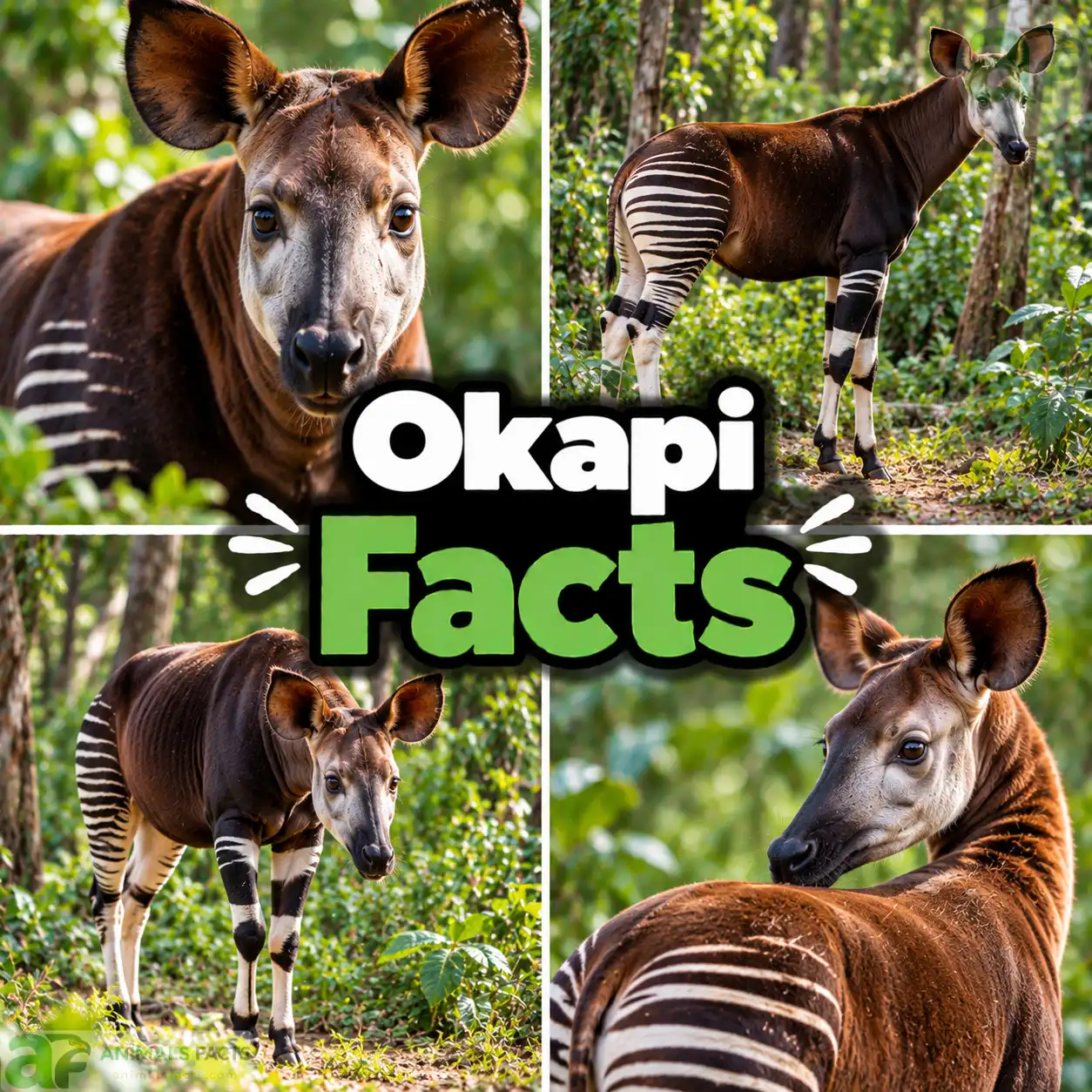
Okapi Facts
| Feature | Details |
|---|---|
| Scientific Name | Okapia johnstoni |
| Common Names | Okapi, Forest Giraffe, Zebra Giraffe |
| Kingdom | Animalia |
| Phylum | Chordata |
| Class | Mammalia |
| Order | Artiodactyla |
| Family | Giraffidae |
| Habitat | Dense, high-canopy tropical rainforest of the Ituri Forest region |
| Lifespan | 20–30 years in the wild; up to 33 years in captivity |
| Diet | Herbivore — leaves, buds, fruit, fungi, ferns |
| Weight | 200–350 kg |
| Height | 1.5–2.1 meters at the shoulder |
| Speed | Capable bursts of speed through dense forest; precise figures poorly documented due to extreme elusiveness |
| Conservation Status | Endangered (IUCN) |
| Population Estimate | Estimated 10,000–20,000 individuals remaining in the wild, with ongoing decline |
| Unique Feature | The closest living relative of the giraffe, despite its zebra-striped legs; not formally described by Western science until 1901, making it one of the last large mammals discovered |
 1. Introduction: What is an Okapi?
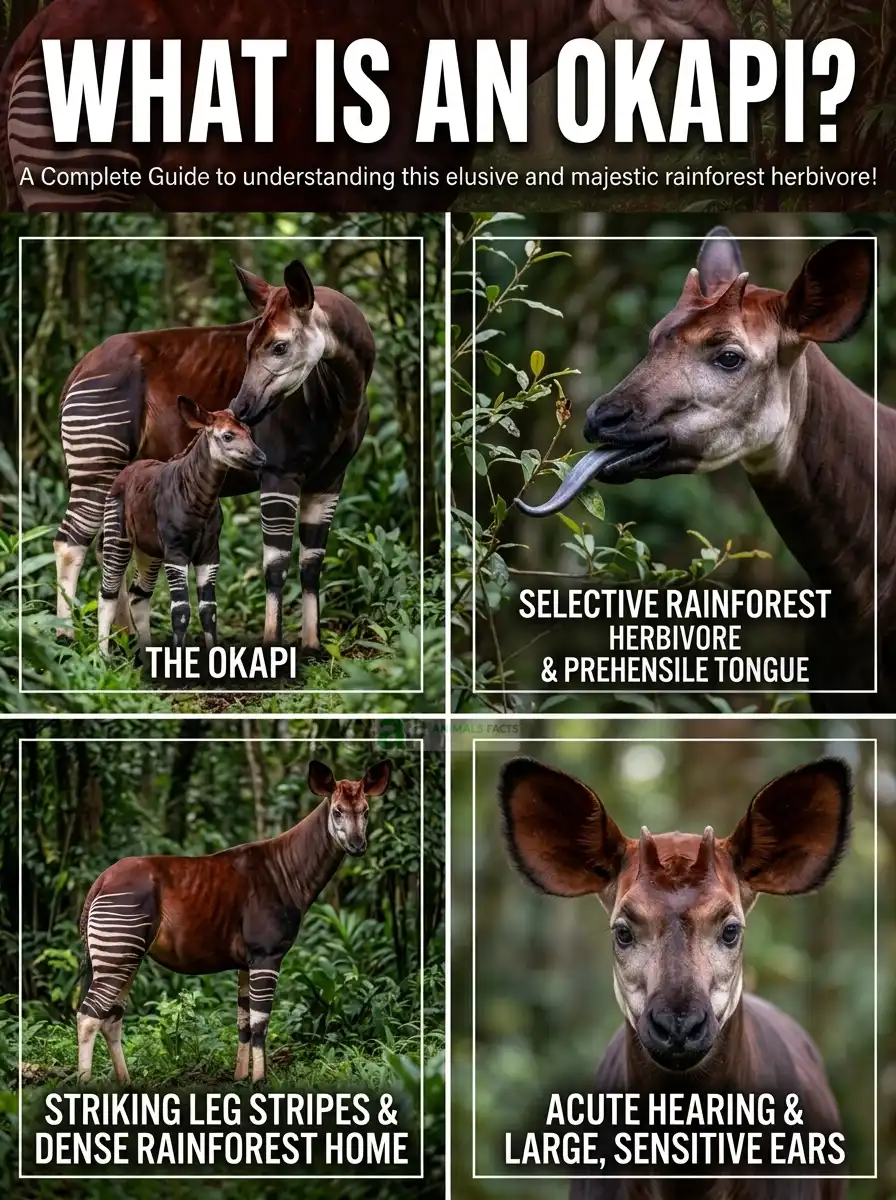
Deep within the dense, near-impenetrable rainforest canopy of the Democratic Republic of the Congo lives an animal so elusive, so rarely observed even by the scientists who study it, that Western science did not formally confirm its existence until 1901 — making it one of the very last large mammals on Earth to be scientifically described. Okapi facts introduce readers to a creature that looks, at first glance, like an almost impossible combination of animals: a body shaped like a small horse, legs striped like a zebra, and a face and long, dark blue-purple tongue unmistakably belonging to its closest living relative — the giraffe. Local Congolese communities, particularly the Mbuti people of the Ituri Forest, had known of the okapi for generations, but its existence remained essentially a rumor and a mystery to the outside world well into the 20th century, giving rise to the animal’s enduring reputation as one of nature’s most captivating “hidden” species.
The okapi (Okapia johnstoni) is the sole living species within its own genus, Okapia, and belongs to the family Giraffidae — making it, remarkably, the closest living relative of the giraffe despite bearing almost no visual resemblance to its towering savanna cousin at first glance. Where the giraffe evolved an extraordinarily long neck to browse the open canopy of the African savanna, the okapi remained a forest specialist, evolving instead for stealth, camouflage, and efficient movement through dense, low-visibility rainforest understory — a striking example of how two closely related species can diverge so dramatically in appearance while retaining deep underlying anatomical and genetic connections, including a shared elongated, prehensile tongue used for stripping leaves from branches.
Today, the okapi occupies a genuinely precarious position in the modern conservation landscape. Confined entirely to the dense rainforests of the northeastern Democratic Republic of the Congo — the only country on Earth where the species exists in the wild — the okapi faces mounting pressure from deforestation, illegal mining, poaching, and the destabilizing effects of decades of regional armed conflict, all of which have contributed to its classification as Endangered by the IUCN. Understanding okapi facts today means understanding not just a biologically fascinating animal, but a genuine conservation priority whose survival remains far from secure.
Whether you’re a student researching okapi facts for a school project, a wildlife enthusiast fascinated by one of the last large mammals discovered by Western science, a conservation advocate concerned about Central African rainforest biodiversity, a parent looking for okapi facts for kids, or simply someone captivated by an animal that looks like it was assembled from spare parts of a zebra, a horse, and a giraffe, this guide covers everything — okapi habitat, okapi diet, its extraordinary camouflage and anatomy, reproduction, social behavior, the fascinating story of its scientific discovery, conservation challenges, and much more. This is the most complete guide to okapi facts you will find anywhere.
2. Okapi Species Overview & Classification
The okapi belongs to the family Giraffidae, a family that today contains only two living genera — Giraffa (the giraffes) and Okapia (the okapi) — representing the last surviving remnants of a once far more diverse and widespread giraffid family that included dozens of species across Africa, Europe, and Asia during the Miocene and Pliocene epochs.
Classification Table
| Level | Classification |
|---|---|
| Kingdom | Animalia |
| Phylum | Chordata |
| Class | Mammalia |
| Order | Artiodactyla |
| Family | Giraffidae |
| Genus | Okapia |
| Species | O. johnstoni |
| Closest Living Relative | The giraffe (Giraffa camelopardalis and related species) — the okapi’s only living relative within family Giraffidae |
A Family Reduced to Two Survivors
The family Giraffidae was once considerably more diverse, with fossil evidence documenting numerous extinct genera spread across Africa, Europe, and Asia. Today, however, the entire family has been reduced to just two surviving lineages — the various giraffe species of the African savanna, and the solitary, forest-dwelling okapi. This makes the okapi an extraordinarily important living link to the broader evolutionary history of the giraffid family, offering researchers valuable insight into what earlier, more ancestral giraffids may have looked like and how they may have behaved, since the okapi retains a number of anatomically conservative or “primitive” features compared to the highly derived modern giraffe.
No Recognized Subspecies
Unlike many widely distributed large mammals, the okapi has no formally recognized subspecies, reflecting both its relatively restricted geographic range confined almost entirely to the Ituri Forest region of the Democratic Republic of the Congo, and the practical difficulty of conducting the kind of detailed population-level genetic and morphological research across such dense, remote, and often politically unstable rainforest terrain that would be needed to identify meaningful subspecies distinctions, if any exist.
The Late Scientific Discovery of the Okapi
One of the most remarkable okapi facts concerns the animal’s genuinely late formal scientific discovery — a story that has become a celebrated example in the history of zoology.
Early rumors and misidentification: Throughout the late 19th century, European explorers in Central Africa, including the famous journalist and explorer Henry Morton Stanley, recorded rumors among local peoples of a mysterious forest-dwelling animal, sometimes described using terms that were misinterpreted by outsiders as referring to a forest-dwelling type of horse or donkey.
Sir Harry Johnston’s investigation: British colonial administrator and naturalist Sir Harry Johnston, serving in Uganda, took a particular interest in these accounts and worked with local Mbuti guides to investigate. Local communities were already entirely familiar with the animal, referring to it by regional names — the confusion belonged entirely to the outside scientific world, not to the people who had lived alongside okapis for generations.
First specimens: In 1901, Johnston obtained a skull and a strip of striped skin from local sources, which were sent to the Zoological Society of London for formal scientific examination.
Formal scientific description (1901): Based on this material, the species was formally described and named Okapia johnstoni in honor of Johnston’s role in bringing the animal to Western scientific attention — making the okapi, remarkably, one of the very last large mammal species to be formally described by Western science, at a point in history when many assumed nearly all of the world’s large land mammals had already been documented.
Species Evolution & Discovery Timeline
~54 million years ago: The broader lineage that would eventually give rise to modern giraffids began diverging within the even-toed ungulate order during the Eocene epoch.
~20 million years ago: The family Giraffidae diversified substantially during the Miocene, with numerous now-extinct genera spreading across Africa, Europe, and Asia, including some species with far more modest neck lengths than the modern giraffe, more closely resembling the okapi’s body plan.
~11–16 million years ago: Genetic and fossil evidence suggests the lineage that would become the modern okapi diverged from the lineage leading to the modern giraffe, with the okapi retaining a body plan and ecological niche believed to more closely resemble that of ancestral giraffids than the highly specialized modern giraffe does.
Pre-colonial era: Local Central African communities, particularly the Mbuti and other Ituri Forest peoples, maintained deep traditional knowledge of the okapi for many generations, entirely unaware that the species remained “undiscovered” by the outside world.
Late 19th century: European explorers, including Henry Morton Stanley, recorded secondhand and often garbled rumors of a mysterious forest animal, sparking Western curiosity but yielding no confirmed scientific specimens.
1901: Sir Harry Johnston obtained skull and skin specimens with the assistance of local guides, leading to the formal scientific description of Okapia johnstoni — a landmark moment often cited as one of the final major large-mammal discoveries in the history of Western zoology.
1919: The first live okapi was successfully brought to a European zoo (Antwerp Zoo, Belgium), marking a major milestone in okapi study and public awareness, though the individual survived only a short time given the significant challenges of the era’s captive care standards.
1992: The Okapi Wildlife Reserve was established in the Democratic Republic of the Congo specifically to protect core okapi habitat within the Ituri Forest, later recognized as a UNESCO World Heritage Site.
1997: The okapi was officially designated the national symbol of the Democratic Republic of the Congo, appearing on the logo of the country’s national wildlife conservation authority.
2013–2016: Armed militia activity, including a violent 2012 attack on the headquarters of the Okapi Wildlife Reserve itself, significantly disrupted conservation operations and contributed to documented population decline across parts of the species’ range.
2015: The IUCN uplisted the okapi’s conservation status to Endangered, reflecting mounting evidence of population decline linked to habitat loss, poaching, and regional instability.
2026: The okapi remains classified as Endangered, with ongoing conservation efforts across the Okapi Wildlife Reserve and surrounding areas working to stabilize the species amid continued pressure from mining, logging, and bushmeat poaching across its extremely limited global range.
3. Okapi Physical Description & Unique Features
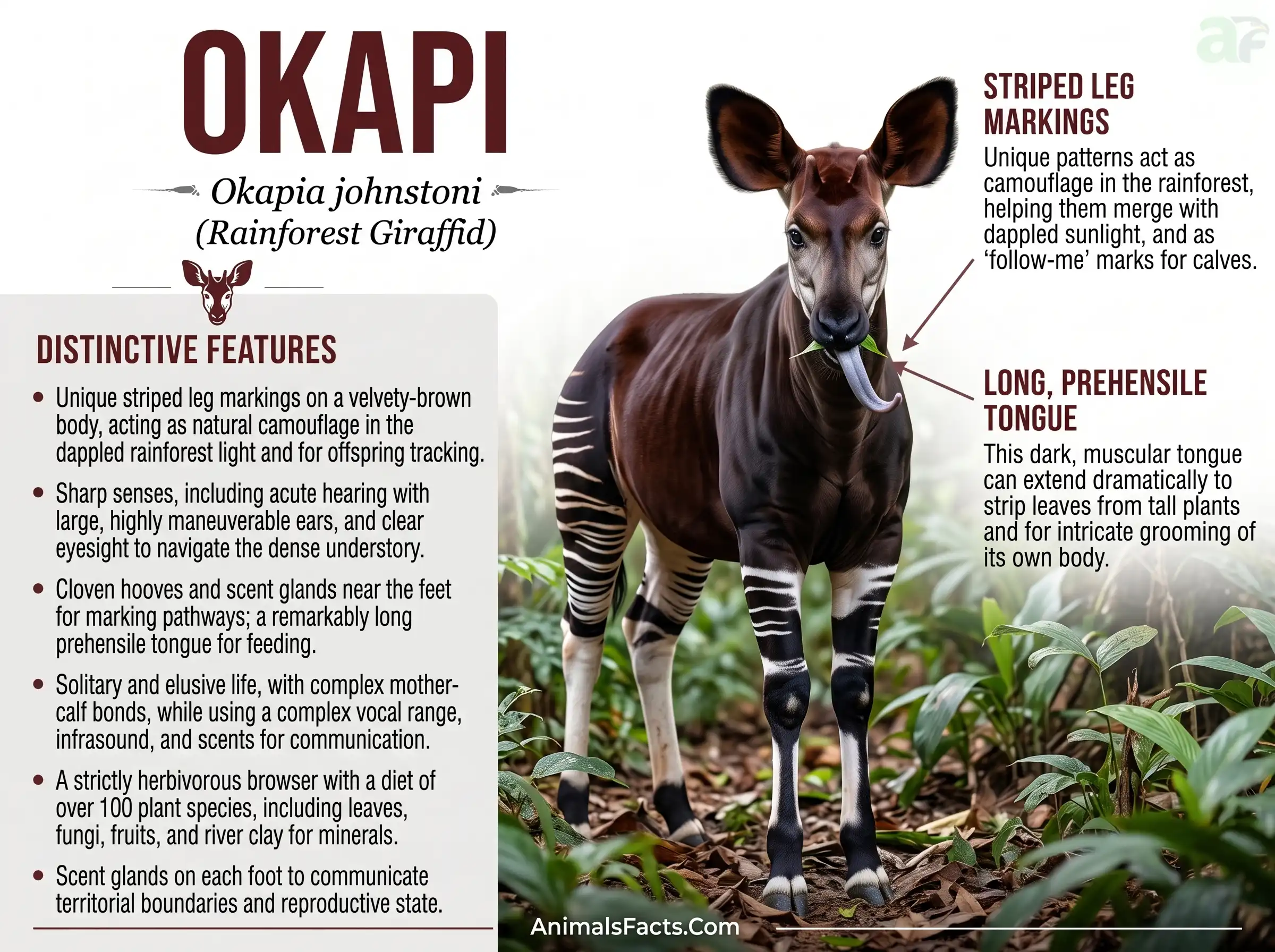
The okapi possesses one of the most visually distinctive and, to first-time observers, genuinely surprising body plans of any large mammal — a combination of features that seem almost deliberately mismatched until understood in the context of its close evolutionary relationship to the giraffe and its specialized adaptation to dense forest life.
Size and Build
- Weight: Typically 200–350 kg.
- Shoulder height: 1.5–2.1 meters.
- Body length: Approximately 2–2.5 meters, not including the tail.
- Build: A relatively compact, horse-like or antelope-like body shape, dramatically different from the giraffe’s extreme height and elongated proportions, reflecting the okapi’s adaptation to moving efficiently through dense, low-canopy forest rather than browsing tall, open savanna vegetation.
The Zebra-Striped Legs — A Case of Mistaken Identity
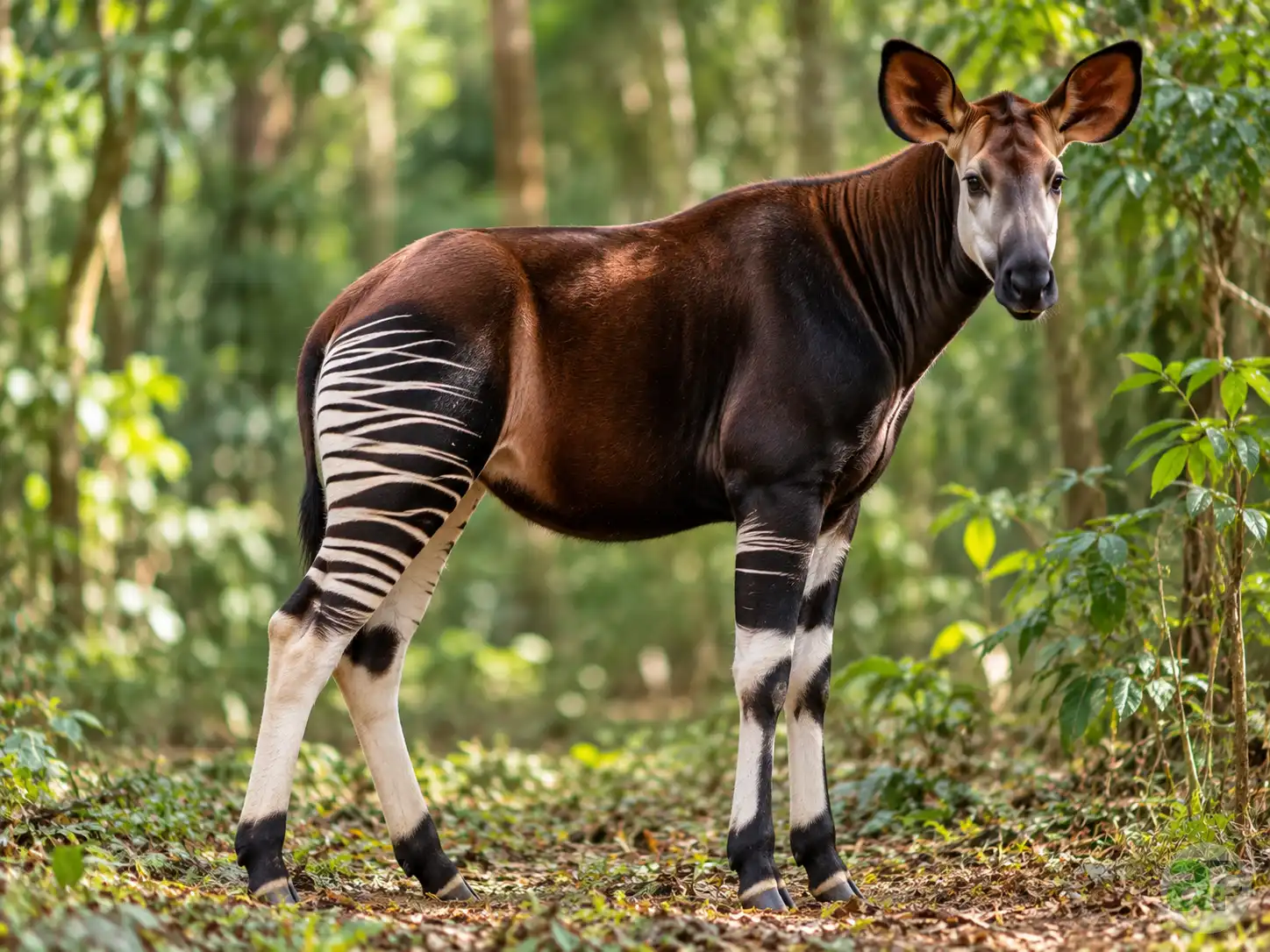
The okapi’s most visually striking and immediately recognizable feature is the bold, zebra-like striping found on its upper legs and hindquarters — a pattern so distinctive that early accounts and even some subsequent popular reporting mistakenly described the okapi as being closely related to zebras, despite the two species belonging to entirely different mammalian families with no close evolutionary relationship.
Camouflage function: Far from being related to zebras, the okapi’s leg striping is now understood to serve a similar camouflage function to zebra stripes — breaking up the animal’s outline against the dappled, constantly shifting light and shadow patterns of the dense rainforest floor, making a standing or moving okapi remarkably difficult to spot even at relatively close range.
Calf-following function: Researchers have also proposed that the striping pattern may assist okapi calves in visually following their mother through dense vegetation, particularly in low-light forest conditions, functioning as a kind of natural visual guide.
Unique to each individual: Similar to the stripe patterns of zebras, each okapi’s leg striping is believed to be unique to the individual animal, a detail sometimes used by researchers and camera-trap studies attempting to identify and track specific individuals within the extremely difficult-to-survey Ituri Forest habitat.
The Giraffe Connection — Shared Features
Despite its dramatically different overall body shape, the okapi shares several unmistakable anatomical features with its giraffe relatives that confirm the close evolutionary relationship:
The tongue: The okapi possesses an extraordinarily long, dark blue-purple, prehensile tongue — capable of extending far enough to clean its own eyes and ears — closely mirroring the giraffe’s famous tongue, and used similarly for stripping leaves from branches with remarkable dexterity.
Ossicones: Male okapis possess small, skin-covered horn-like structures called ossicones on top of the head, structurally identical in type (though considerably smaller) to the more prominent ossicones found on both male and female giraffes — a direct anatomical signature of the shared Giraffidae lineage. Female okapis typically lack ossicones or possess only small bony knobs.
Facial structure: The okapi’s overall facial structure, including its large, expressive eyes and elongated muzzle, bears a clear resemblance to the giraffe’s face, despite the dramatic difference in neck length between the two species.
Coat Coloration
Beyond the striking leg striping, the okapi’s body coat is a rich, dark chocolate-brown to reddish-brown color, providing effective camouflage against the dark, shadowed understory of the dense rainforest — a stark contrast to the more open, sun-dappled savanna habitat favored by the giraffe, and a clear reflection of the two species’ divergent ecological niches despite their close relationship.
Sensory Adaptations
Large, mobile ears: The okapi possesses notably large, satellite-dish-like ears capable of rotating independently, providing excellent directional hearing — a critical adaptation for detecting approaching predators in dense forest habitat where visibility is often severely limited.
Scent glands: Okapis possess scent glands on their feet, leaving a distinctive tar-like scent trail as they move through the forest — a communication and territorial marking adaptation particularly valuable for a largely solitary species living in dense habitat where visual contact between individuals is often limited.
Did You Know? Naturalist and broadcaster David Attenborough has described the okapi as one of the animal kingdom’s most striking examples of an animal that seems to defy easy categorization at first glance — a fitting description for a species so visually unusual that early Western explorers initially assumed it must be some kind of forest-dwelling zebra or horse relative, when it is in fact the closest living cousin of the towering savanna giraffe.
4. Top 25 Surprising & Interesting Okapi Facts
- The okapi is the closest living relative of the giraffe, despite looking almost nothing like it at first glance.
- Okapis were not formally confirmed by Western science until 1901, making them one of the last large mammals discovered.
- The okapi’s zebra-like leg stripes are believed to help with camouflage and may help calves follow their mothers through dense forest.
- Okapis have an extraordinarily long, dark blue-purple tongue — long enough to clean their own eyes and ears.
- Male okapis have small, skin-covered horn-like structures called ossicones, just like giraffes.
- Each okapi’s stripe pattern is believed to be unique to the individual, similar to a fingerprint.
- Okapis live exclusively in the wild in one country: the Democratic Republic of the Congo.
- The okapi is the national symbol of the Democratic Republic of the Congo.
- Okapis have scent glands on their feet that leave a tar-like scent trail as they walk.
- Okapis are almost entirely solitary animals, rarely seen in groups outside of mother-calf pairs.
- Okapis are so elusive that researchers still know relatively little about many aspects of their wild behavior.
- The Okapi Wildlife Reserve, established in 1992, is a UNESCO World Heritage Site.
- Okapi calves can go for extended periods hidden and motionless in vegetation while their mother forages nearby — a behavior called “hiding.”
- The okapi belongs to the family Giraffidae, which today contains only two living genera: giraffes and okapis.
- Okapis have exceptionally large, rotating ears that provide excellent directional hearing in dense forest.
- Okapi mothers may leave their calves hidden for up to 80% of the day during the calf’s early weeks of life.
- The okapi’s coat is naturally water-resistant, an adaptation to the frequently wet rainforest environment.
- Okapis are herbivores that eat over 100 different plant species, including some known to be toxic to humans.
- Okapis have been observed eating charcoal from burnt trees, believed to help neutralize toxins from their diverse diet.
- In 2012, armed militia attacked the headquarters of the Okapi Wildlife Reserve, killing staff and reserve okapis — a stark illustration of the conservation challenges facing the species.
- Okapis are classified as Endangered, with an estimated 10,000–20,000 individuals remaining in the wild.
- The okapi’s name is derived from a Lese Karo (Congolese) term describing the animal.
- Okapis were once mistakenly believed by some early European sources to be a type of forest-dwelling zebra.
- Wild okapi behavior remains so poorly documented that many details of their social and reproductive habits have only been studied in captivity.
- Okapis can rotate their large ears almost completely independently of one another, allowing them to monitor sound from multiple directions simultaneously.

5. Fun Facts About Okapi Animal
- The okapi is the giraffe’s closest living relative.
- It wasn’t discovered by Western science until 1901.
- Okapis have zebra-striped legs for camouflage.
- Their tongue is long enough to clean their own ears!
- Male okapis have small horn-like bumps called ossicones.
- Okapis live wild in only one country: the DRC.
- They’re the national symbol of the Congo.
- Okapis are mostly solitary forest dwellers.
- Baby okapis hide quietly for most of the day.
- Okapis eat over 100 plant species.
- They sometimes eat charcoal to neutralize plant toxins.
- Okapis are classified as Endangered.
6. Okapi Habitat & Geographic Range
The okapi occupies one of the most geographically restricted ranges of any large mammal on Earth, found in the wild exclusively within a specific region of dense tropical rainforest in Central Africa.
Primary Habitat Requirements
Dense, high-canopy rainforest: Okapis are specialists of undisturbed, mature tropical rainforest with a closed canopy, providing both the dense understory vegetation the species relies on for food and the visual cover essential to its predator-avoidance and camouflage strategy.
Proximity to water: Okapis favor habitat near rivers and streams, both for drinking water and for the mineral-rich soil often found in such areas, which the animals visit to supplement their diet.
Elevation range: The species is generally found at elevations between roughly 500 and 1,500 meters, within the specific ecological conditions of the Ituri Forest region.
Geographic Range Table
| Region | Population Status | Notes |
|---|---|---|
| Ituri Forest, northeastern DRC | Core range | The vast majority of the global wild okapi population |
| Maiko National Park, DRC | Present, less studied | Southwestern portion of okapi range |
| Wamba region, DRC | Present, historically studied | Site of significant early field research |
| Okapi Wildlife Reserve (Réserve de Faune à Okapis) | Protected core habitat | UNESCO World Heritage Site, approximately 13,700 square kilometers |
| Rest of Africa | Absent | No confirmed wild okapi populations exist outside the DRC |
A Single-Country Species
One of the most striking okapi facts is that the species exists in the wild in exactly one country on Earth — the Democratic Republic of the Congo. This extraordinarily narrow geographic range, confined almost entirely to the dense rainforest of the Ituri Forest region and a handful of surrounding protected areas, makes the okapi particularly vulnerable to any single significant disruption within that limited range, whether from habitat loss, political instability, or armed conflict — a stark contrast to more widely distributed large mammals whose populations are spread across multiple countries and can better withstand localized threats.
Did You Know? The Okapi Wildlife Reserve, established in 1992 and covering approximately 13,700 square kilometers of the Ituri Forest, was designated a UNESCO World Heritage Site specifically in recognition of its role in protecting core okapi habitat, alongside significant populations of forest elephants, chimpanzees, and numerous other Central African rainforest species — though the reserve has, tragically, also been the site of significant conservation setbacks, including a violent 2012 militia attack on reserve headquarters.
7. Diet & Feeding Behavior
The okapi is a herbivorous browser with a remarkably broad and varied diet, reflecting the biodiversity of the rainforest ecosystem it inhabits.
Diet Breakdown Table
| Food Type | Approximate Percentage | Notes |
|---|---|---|
| Leaves and shoots | 50–70% | Primary dietary component, drawn from over 100 plant species |
| Fruit | 10–20% | Seasonally significant supplement |
| Fungi | 5–10% | A notable and somewhat unusual dietary component for a large herbivore |
| Ferns and grasses | 5–15% | Supplementary vegetation |
| Clay and charcoal | Variable, small quantity | Believed to assist in neutralizing plant toxins and providing mineral supplementation |
An Extraordinarily Varied Diet
Okapis have been documented consuming over 100 different plant species across their range, an unusually broad dietary spectrum for a large herbivore, including a number of plant species known to be toxic to humans and many other animals — a dietary flexibility that likely reflects both the extraordinary biodiversity of the Ituri Forest ecosystem and specific physiological adaptations allowing okapis to process a wider range of plant toxins than many other herbivores.
The Charcoal-Eating Behavior
One of the more genuinely unusual okapi facts is the documented behavior of okapis deliberately consuming charcoal from burnt trees within their forest habitat. Researchers believe this behavior may serve to help neutralize toxins or alkaloids present in certain plants within the okapi’s broad diet, functioning similarly to activated charcoal’s detoxifying properties — though the full extent and precise function of this behavior remains an area of ongoing scientific interest given the general difficulty of conducting detailed field research on such an elusive species.
Feeding Technique
Like giraffes, okapis use their long, dexterous, prehensile tongue to strip leaves from branches with remarkable precision, wrapping the tongue around foliage and pulling it into the mouth — an efficient feeding technique well-suited to the dense, leaf-rich understory vegetation that makes up the bulk of the species’ diet.
Did You Know? The okapi’s tongue is so long and flexible that the animal can use it not only to strip leaves from branches but also to clean its own eyes and ears — a feature directly inherited from its close giraffe relatives and one of the clearest visible confirmations of the two species’ shared evolutionary lineage.
8. Okapi Reproduction & Life Cycle
Okapi reproduction remains, like much of the species’ wild behavior, only partially understood from direct field observation, with a significant portion of available reproductive data drawn from captive breeding programs at accredited zoos worldwide.
Mating and Breeding Behavior
Breeding season: Unlike many temperate-zone mammals, okapis do not appear to follow a strict seasonal breeding pattern, with mating and births documented across various times of year, likely reflecting the relatively stable, non-seasonal climate of their equatorial rainforest habitat.
Courtship behavior: Male and female okapis, otherwise largely solitary, come together briefly for courtship and mating, involving circling behavior, sniffing, and vocalizations, before separating again.
Gestation and Birth
Gestation: Approximately 440–450 days (roughly 14.5–15 months) — one of the longest gestation periods of any land mammal, comparable to that of the giraffe.
Litter size: Almost always a single calf.
Birth weight: Approximately 14–30 kg.
Birth condition: Calves are relatively well-developed at birth and capable of standing within a relatively short period, though they remain highly dependent on maternal care and protection during their vulnerable early weeks.
The Remarkable “Hiding” Behavior of Okapi Calves
One of the most distinctive aspects of okapi reproduction is the calf’s extended “hiding” phase during its first weeks of life:
Extended concealment: Okapi calves may remain hidden, motionless, and largely inactive for as much as 80% of the day during their first several weeks of life, tucked away in dense vegetation while their mother forages nearby, returning periodically to nurse.
Minimal defecation: Remarkably, okapi calves during this hiding period defecate only very infrequently — a behavioral adaptation believed to help minimize scent traces that could attract predators to the calf’s hiding location, an extraordinary example of predator-avoidance behavior evolved specifically to protect the most vulnerable stage of the animal’s life cycle.
Gradual increase in activity: As the calf grows stronger and more capable of fleeing potential threats, this hiding behavior gradually decreases, with the calf beginning to accompany its mother more actively.
Growth Stages Table
| Stage | Age | Development |
|---|---|---|
| Birth | — | 14–30 kg; can stand within hours |
| Hiding phase | First several weeks | Spends up to 80% of day hidden and motionless |
| Increased mobility | ~2–3 months | Begins accompanying mother more actively |
| Weaning | ~6 months | Transition to independent foraging |
| Independence | ~1 year | Reduced maternal association |
| Sexual maturity | ~2 years (females); slightly later for males | Variable by individual |
Okapi Lifespan Comparison Table
| Species | Average Lifespan | Maximum Recorded |
|---|---|---|
| Okapi | 20–30 years | ~33 years (captivity) |
| Giraffe | 20–25 years | ~28 years |
| Bongo (forest antelope, comparison) | 12–19 years | ~21 years |
| African Forest Elephant (comparison) | 60–70 years | ~80 years |
9. Social Behavior & Communication
Okapis are predominantly solitary animals, a behavioral pattern that stands in notable contrast to the more herd-oriented social structure of many other large herbivores, including their giraffe relatives.
Solitary Lifestyle
Adult okapis, outside of brief mating encounters and the extended mother-calf bond, generally live and forage alone, maintaining individual home ranges that may overlap to some degree with neighboring individuals but without forming any cohesive social group structure. This solitary tendency is believed to reflect the dense, resource-patchy nature of rainforest habitat, where the cost of group foraging competition may outweigh any predator-detection benefits that group living provides in more open habitats.
Territorial Behavior and Scent Marking
Okapis use scent marking extensively to communicate territorial information and individual presence to other okapis without requiring direct visual or physical contact — a particularly valuable communication strategy in dense forest habitat where visual contact between individuals is often limited or impossible. The tar-like secretion from glands on the okapi’s feet leaves scent trails as the animal moves through its home range, providing information to other okapis that may pass through the same area at a different time.
Vocalizations
Okapis are generally quiet animals, but do produce a range of vocalizations, including soft chuffs, moans, and, notably, infrasonic (below the range of human hearing) vocalizations similar to those documented in giraffes and elephants — low-frequency sounds that can travel effectively through dense forest vegetation over greater distances than higher-frequency calls would carry, potentially allowing communication between individuals separated by significant distances of dense forest.
Did You Know? Researchers studying okapis have documented the use of infrasonic communication — extremely low-frequency sounds below the threshold of human hearing — a communication strategy shared with the okapi’s giraffe relatives and with elephants, and one particularly well-suited to transmitting information across the dense, sound-muffling vegetation of tropical rainforest habitat where higher-frequency vocalizations would be rapidly absorbed and lost.
10. Predators & Defense Mechanisms
Adult okapis face predation primarily from one significant natural predator within their rainforest habitat, alongside the ever-present and increasingly significant threat posed by human activity.
Natural Predators
Leopards: The primary and most significant natural predator of okapis, capable of taking down adult individuals through ambush-style hunting well-suited to the dense forest environment both species inhabit.
Other potential threats: Young or vulnerable okapi calves may face additional predation risk from a range of smaller forest predators, though leopards represent the dominant documented natural threat to the species across its range.
Defense Mechanisms
Camouflage: The okapi’s dark coat and distinctive leg striping provide highly effective camouflage against the dappled light and shadow of the dense rainforest floor, often the animal’s first and most effective line of defense — simply avoiding detection in the first place.
Acute hearing: The okapi’s large, independently rotating ears provide excellent early-warning detection of approaching predators, allowing the animal time to flee before a predator draws close enough to attack.
Speed and agility: Despite their relatively modest overall visibility in scientific literature regarding precise speed figures, okapis are capable of rapid, agile movement through dense forest terrain when fleeing a threat, an ability aided by their compact, efficient body structure.
Powerful kicks: Okapis, like giraffes, are capable of delivering forceful kicks with their legs, a significant defensive capability against smaller predators or in defense of a calf.
Solitary, low-density living: The okapi’s solitary lifestyle and generally low population density across its habitat may itself function as an indirect defense strategy, reducing the likelihood of a predator regularly encountering okapi individuals compared to species that congregate in more visible or predictable groups.

11. Okapi Facts for Kids
Hey kids — get ready to meet one of the most surprising animals in the whole world!
The okapi looks like it’s made from parts of THREE different animals — it has a body kind of like a horse, legs striped like a zebra, and a face like a giraffe! The okapi is actually the giraffe’s closest cousin, even though it doesn’t have a long neck like a giraffe does! An okapi’s tongue is SO long that it can use it to clean its own eyes and ears — just like giraffes do! Scientists didn’t even know okapis existed until the year 1901 — that’s less than 130 years ago! Baby okapis are really good at hiding — they can stay hidden and still for most of the day while their mom looks for food nearby! Okapis live wild in only ONE country in the whole world: the Democratic Republic of the Congo, in Africa! Okapis mostly live alone, unlike some animals that travel in big groups. Every okapi has its own special stripe pattern, kind of like how every zebra’s stripes are different!
Did You Know? Even though okapis look like they might be related to zebras because of their striped legs, they’re actually not related to zebras at all! Their real family is the giraffe family — and scientists believe the stripes evolved separately just to help okapis hide in the shadowy forest, completely different from why zebras have their stripes!
12. Relationship with Humans
The okapi’s relationship with humans spans deep traditional knowledge among Congolese forest communities, a genuinely remarkable story of late scientific discovery by the Western world, and — in the modern era — a complex conservation relationship shaped by both dedicated protection efforts and significant ongoing threats.
Traditional Knowledge Among Congolese Communities
Long before Western science formally documented the okapi in 1901, the Mbuti people and other communities of the Ituri Forest region possessed deep traditional knowledge of the animal, including its behavior, habitat, and appearance — knowledge that proved essential to Sir Harry Johnston’s efforts to obtain the first scientific specimens. This history stands as a notable example of how “scientific discovery” often means formal documentation by outside institutions of knowledge that Indigenous and local communities had long possessed.
National Symbolism
In 1997, the okapi was officially designated as the national symbol of the Democratic Republic of the Congo, appearing prominently in the logo of the country’s national conservation authority, the Institut Congolais pour la Conservation de la Nature (ICCN) — reflecting the species’ significance as a uniquely Congolese natural treasure found nowhere else on Earth in the wild.
Conservation Challenges Linked to Regional Instability
The okapi’s conservation story has been significantly shaped, and at times severely disrupted, by the broader political and security instability affecting parts of the Democratic Republic of the Congo. Most notably, in 2012, armed militia forces attacked the headquarters of the Okapi Wildlife Reserve, killing several staff members and reserve rangers, along with all of the reserve’s captive okapis maintained for research and conservation breeding purposes — a devastating event that significantly set back conservation operations in the region and starkly illustrated the genuine human and conservation costs of operating protected areas within zones of ongoing armed conflict.
Zoo Populations and Conservation Breeding
Beyond their native range, okapis are maintained in a limited number of accredited zoos worldwide as part of coordinated conservation breeding programs, providing both a genetic safety-net population and a valuable public education opportunity, given how vanishingly unlikely most people are to ever encounter a wild okapi given the species’ extreme rarity and restricted range.
13. Okapi Conservation Status & Threats
| Category | Status |
|---|---|
| IUCN Status | Endangered |
| Population Trend | Decreasing |
| Estimated Population | 10,000–20,000 individuals |
| Range | Restricted entirely to the Democratic Republic of the Congo |
Major Threats
Habitat loss and deforestation: Logging, agricultural expansion, and human settlement continue to reduce and fragment the dense, mature rainforest habitat okapis depend on across parts of their range.
Illegal mining: Artisanal and illegal mining operations, including for gold and coltan (a mineral used in electronics manufacturing), have expanded significantly within and around okapi habitat, bringing associated deforestation, human settlement, and disturbance to previously remote forest areas.
Poaching: Okapis are hunted for bushmeat and, to a lesser extent, for their distinctively striped skin, representing a direct and ongoing threat to wild populations.
Armed conflict and regional instability: Decades of periodic armed conflict and militia activity across parts of the eastern DRC have repeatedly disrupted conservation operations, endangered park rangers and researchers, and, in some documented cases, directly resulted in the deaths of both conservation personnel and okapis themselves.
Snaring: Wire snares set for other bushmeat species frequently and unintentionally injure or kill okapis as bycatch, representing a significant and difficult-to-address indirect threat.
Regional Conservation Efforts
The Okapi Wildlife Reserve, alongside coordinated efforts by organizations including the Okapi Conservation Project, works to protect core okapi habitat through ranger patrols, community engagement programs, and research initiatives, despite the significant operational challenges posed by the region’s remoteness and periodic instability.
Did You Know? The 2012 attack on the Okapi Wildlife Reserve headquarters, which resulted in the deaths of reserve staff and the reserve’s entire captive okapi population, stands as one of the starkest illustrations in modern conservation history of how armed conflict and political instability can directly and immediately threaten endangered species conservation efforts — a sobering reminder that protecting a species like the okapi requires addressing not only ecological threats but also complex regional security challenges.
14. Famous Okapis
The first live okapi in captivity — brought to Antwerp Zoo, Belgium, in 1919, representing a landmark moment in the public and scientific understanding of the species outside its native range, though the animal survived only briefly given the limited captive husbandry knowledge available at the time.
Zoo conservation breeding program okapis — individual okapis maintained across accredited zoos participating in coordinated international breeding programs, such as those managed through Species Survival Plan frameworks in North America and equivalent European programs, serve as important genetic reservoir animals and public education ambassadors for the species.
15. Role in Ecosystem & Food Chain
As a significant herbivore within the Ituri Forest ecosystem, the okapi plays a meaningful ecological role within one of Central Africa’s most biodiverse rainforest environments.
Seed dispersal: Okapi consumption of fruit contributes to seed dispersal across the forest, aiding in the distribution and regeneration of various plant species within their habitat.
Vegetation dynamics: Okapi browsing on leaves and shoots from over 100 plant species contributes to shaping forest understory vegetation structure, though the species’ relatively low population density limits the scale of this ecological influence compared to more numerous herbivore species elsewhere in Africa.
Prey base: Okapis represent an important prey species for leopards within the Ituri Forest ecosystem, forming part of the broader predator-prey dynamics of this rainforest environment.
Indicator species value: Because okapis require large areas of intact, mature rainforest habitat, their continued presence — or documented decline — within a given forest area serves as a valuable indicator of overall ecosystem health, making the species ecologically significant beyond its direct role in the food web.
16. Myths, Folklore & Cultural Significance
The okapi holds meaningful cultural significance among the Indigenous communities of the Ituri Forest region, alongside its more recently established significance as a national symbol of the Democratic Republic of the Congo.
Traditional Knowledge and Local Significance
Among the Mbuti and other Ituri Forest peoples, the okapi has long been a familiar, well-understood part of the forest environment, appearing in local traditional knowledge and, historically, occasionally hunted as a food source prior to modern conservation protections — a relationship reflecting deep, generations-long familiarity rather than the mystery and rarity with which the species has been regarded by the outside world.
The Western “Mystery Animal” Narrative
In Western popular culture and early 20th-century scientific and popular writing, the okapi became something of a symbol for the idea that large, undiscovered animals might still exist in the world’s remaining unexplored wilderness — a narrative that fueled considerable public fascination with the species following its formal scientific description and that continues to be referenced in discussions of cryptozoology and the history of zoological discovery, even though the okapi itself was, of course, never actually “mysterious” to the people who had always lived alongside it.
17. Okapis in Pop Culture
The okapi, owing to its relative obscurity compared to more famous African megafauna such as elephants, lions, and giraffes, appears less frequently in mainstream popular culture, though it has become an increasingly popular subject of nature documentaries and educational content specifically highlighting unusual or lesser-known animal species.
Zoo ambassador animals — okapis housed at accredited zoos worldwide frequently serve as popular public education attractions, often specifically marketed as an unusual “giraffe relative you’ve never heard of,” introducing many visitors to the species for the first time.
Wildlife documentary features — the okapi’s dramatic discovery story and its status as one of the last major mammals formally described by Western science have made it a recurring subject in documentaries and articles focused on the history of zoological exploration and discovery.
18. Okapi Facts vs. Common Myths
Myth: The okapi is closely related to zebras. Fact: The okapi is not related to zebras at all — it belongs to the giraffe family (Giraffidae) and is the giraffe’s closest living relative. The striped legs are a case of convergent evolution serving a similar camouflage function, not evidence of shared ancestry.
Myth: Okapis are a type of forest-dwelling horse. Fact: Okapis are not related to horses; early explorer accounts that suggested this connection were based on secondhand, garbled descriptions rather than direct scientific observation.
Myth: Okapis were “mysterious” and unknown to everyone before 1901. Fact: Local Congolese communities, including the Mbuti people, had long-standing traditional knowledge of the okapi; 1901 marks the date of formal Western scientific description, not the animal’s actual discovery.
Myth: Okapis live throughout Central Africa. Fact: Wild okapis exist in only one country — the Democratic Republic of the Congo — making their range one of the most geographically restricted of any large mammal.
19. Best Places to See Okapis in the Wild
Okapi Wildlife Reserve, Democratic Republic of the Congo — the primary protected habitat for wild okapis, though the species’ extreme elusiveness means even dedicated visits rarely result in direct sightings; the reserve is more realistically valuable for supporting conservation efforts than guaranteed wildlife viewing given current regional access and security considerations.
Accredited zoos with okapi conservation programs — for the overwhelming majority of people worldwide, zoos participating in international okapi conservation breeding programs offer the only realistic opportunity to observe this species directly, given the extraordinary difficulty and rarity of wild okapi sightings even within their native habitat.
20. Top Documentaries & Books
Wildlife documentaries focused on Central African rainforest biodiversity frequently feature segments on the okapi, often emphasizing both its unusual appearance and its remarkable, relatively recent scientific discovery story.
Sir Harry Johnston’s historical accounts and correspondence regarding the species’ formal scientific description remain a valuable historical resource for understanding the story of the okapi’s introduction to Western science.
Okapi Conservation Project publications — provide some of the most current and scientifically grounded information available on wild okapi ecology, behavior, and ongoing conservation challenges.
21. Okapi Comparison of Okapis with Similar Animals
| Feature | Okapi | Giraffe | Bongo (Forest Antelope) |
|---|---|---|---|
| Scientific Name | Okapia johnstoni | Giraffa camelopardalis (and related species) | Tragelaphus eurycerus |
| Weight | 200–350 kg | 800–1,930 kg | 150–405 kg |
| Family | Giraffidae | Giraffidae | Bovidae |
| Habitat | Dense rainforest | Open savanna | Dense rainforest |
| Neck Length | Short/moderate | Extremely long | Short |
| Social Structure | Solitary | Loosely social/herding | Semi-social |
| Conservation Status | Endangered | Vulnerable (varies by species) | Near Threatened |
22. How You Can Help
Support organizations directly involved in okapi conservation, particularly the Okapi Conservation Project, which works alongside the Institut Congolais pour la Conservation de la Nature to fund ranger patrols, community engagement, and habitat protection efforts across the Okapi Wildlife Reserve and surrounding areas.
Practical actions:
Support accredited zoo conservation breeding programs, which contribute both to genetic diversity preservation and public education about the species.
Raise awareness about the okapi’s Endangered status and its extremely limited single-country range, a conservation story that remains far less publicly known than its urgency warrants.
Support organizations working on sustainable livelihood and community engagement programs in the Ituri Forest region, which help reduce local economic pressure driving poaching and illegal mining.
Advocate for responsible sourcing of minerals such as coltan, given the documented link between illegal mining expansion and okapi habitat destruction.
23. Frequently Asked Questions About Okapis
Q1: What is an okapi’s scientific name?
The okapi’s scientific name is Okapia johnstoni, named in honor of Sir Harry Johnston, who helped bring the species to Western scientific attention in 1901.
Q2: Is the okapi related to a zebra?
No — despite its zebra-striped legs, the okapi is not related to zebras at all. It is the closest living relative of the giraffe, belonging to the family Giraffidae. The striping is a case of convergent evolution for camouflage, not shared ancestry.
Q3: When was the okapi discovered?
The okapi was formally described by Western science in 1901, though local Congolese communities, particularly the Mbuti people, had long-standing traditional knowledge of the species well before this date.
Q4: Where do okapis live?
Okapis exist in the wild in only one country: the Democratic Republic of the Congo, primarily within the dense rainforest of the Ituri Forest region.
Q5: Are okapis endangered?
Yes — okapis are classified as Endangered by the IUCN, with an estimated 10,000–20,000 individuals remaining in the wild and a documented declining population trend.
Q6: What do okapis eat?
Okapis are herbivores, eating leaves, shoots, fruit, fungi, and ferns from over 100 different plant species, and have also been observed eating charcoal, believed to help neutralize plant toxins.
Q7: How big is an okapi?
Okapis typically weigh between 200 and 350 kg and stand approximately 1.5 to 2.1 meters tall at the shoulder.
Q8: Do okapis live in groups?
No — okapis are predominantly solitary animals, generally living and foraging alone outside of brief mating encounters and the mother-calf bond.
Q9: What is the okapi’s main predator?
The leopard is the primary natural predator of adult okapis within their rainforest habitat.
Q10: Why is the okapi important to the Democratic Republic of the Congo?
The okapi was officially designated the national symbol of the Democratic Republic of the Congo in 1997 and appears on the logo of the country’s national wildlife conservation authority, reflecting its status as a uniquely Congolese species found nowhere else in the wild.
24. Sources & References
Research Sources
Wikipedia — Okapi: https://en.wikipedia.org/wiki/Okapi
IUCN Red List — Okapi Assessment: https://www.iucnredlist.org/species/15188/51140517
World Wildlife Fund: https://www.worldwildlife.org/
National Geographic — Okapi: https://www.nationalgeographic.com/animals/mammals/facts/okapi
Smithsonian’s National Zoo: https://nationalzoo.si.edu/animals/okapi
Encyclopaedia Britannica — Okapi: https://www.britannica.com/animal/okapi
Live Science: https://www.livescience.com/
Okapi Conservation Project: https://okapiconservation.org/