
Emu Facts
| Feature | Details |
|---|---|
| Scientific Name | Dromaius novaehollandiae (Latham, 1790) |
| Kingdom | Animalia |
| Phylum | Chordata |
| Class | Aves |
| Order | Casuariiformes |
| Family | Dromaiidae |
| Common Names | Emu; barrimal (Dharug language, Sydney region); murawung (various Aboriginal Australian languages) |
| Native Range | Australia — continent-wide except dense forest and extreme desert; also historically King Island and Kangaroo Island (extinct subspecies) |
| Habitat | Open savanna, mulga scrubland, mallee woodland, grassland, semi-arid interior — virtually every open Australian habitat |
| Lifespan | 10–20 years (wild); up to 35 years (captivity) |
| Diet | Omnivorous — seeds, fruits, flowers, insects, small animals; seasonal dietary flexibility |
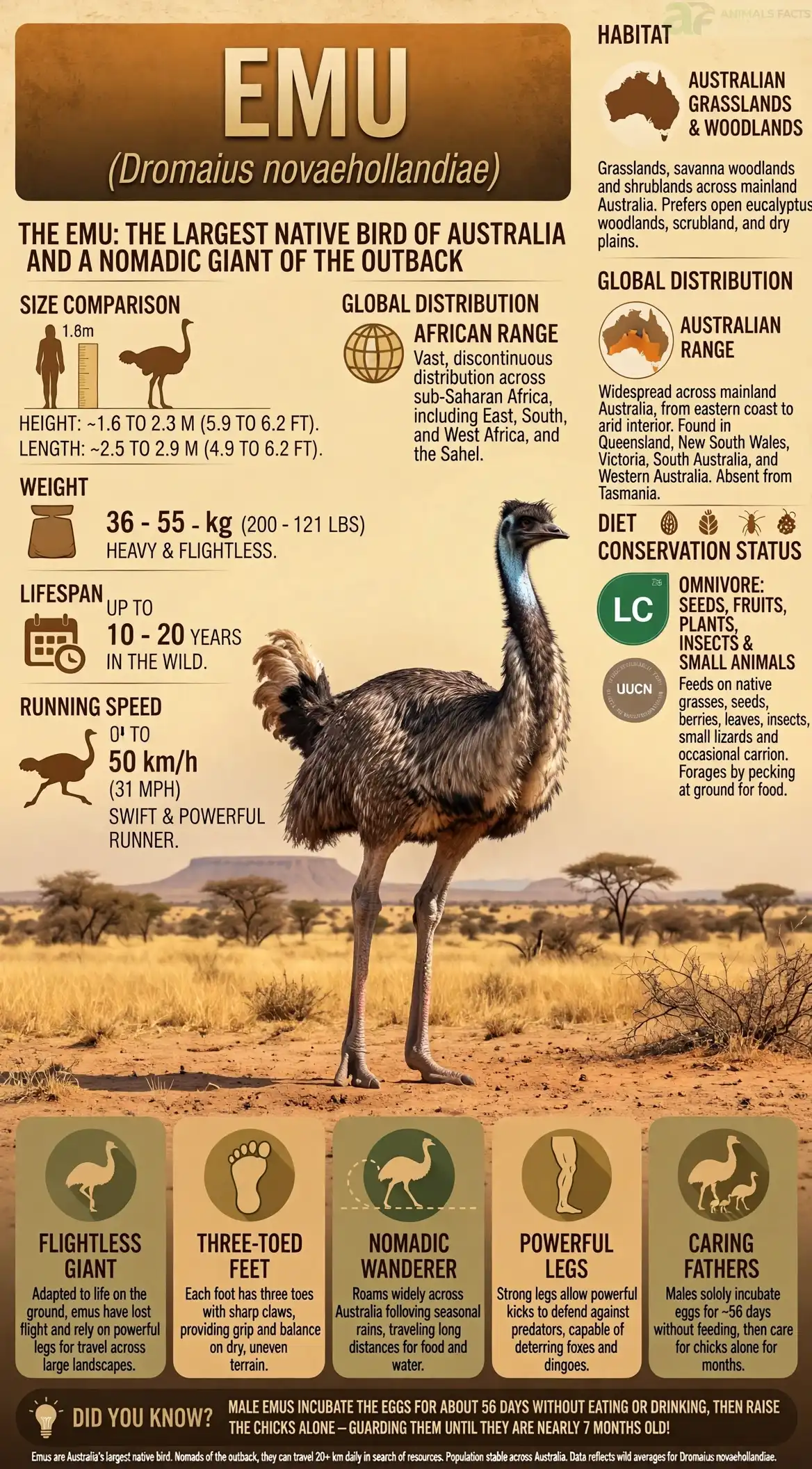
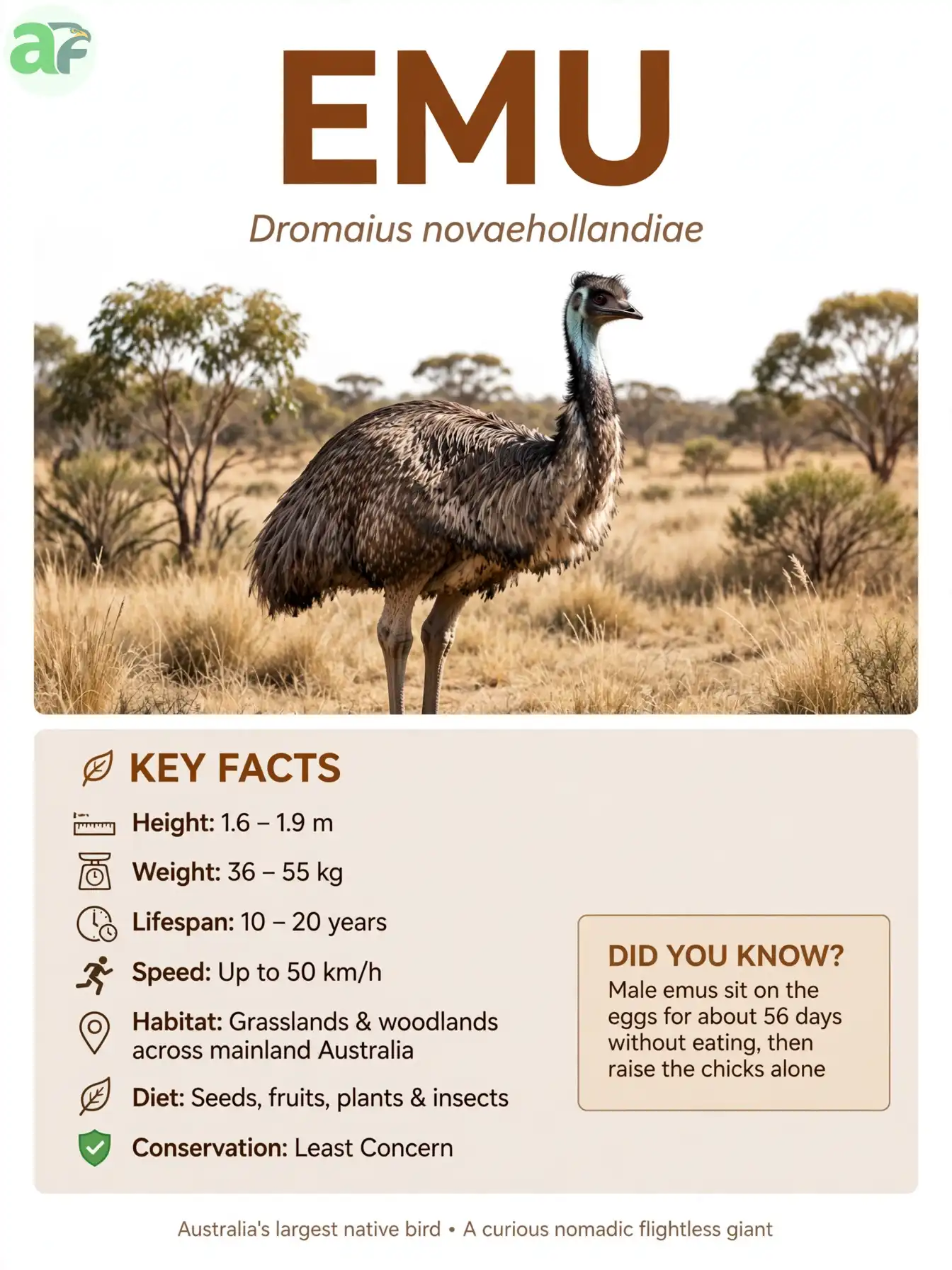
| Body Height | 150–190 cm — second tallest bird on Earth after the ostrich |
| Weight | 18–60 kg — typically 30–45 kg in wild adults; females slightly heavier than males |
| Top Running Speed | 48–50 km/h sustained; up to 50 km/h short bursts |
| Conservation Status | Least Concern (IUCN) — estimated 625,000–725,000 individuals in Australia |
| Defining Feature | The only bird with calf muscles (gastrocnemius); the only bird capable of movement in the two-directional swimming stroke; the male’s extraordinary sole parental care — incubating eggs and raising chicks without eating or drinking for 56 days |
| Historical Fame | The Great Emu War of 1932 — the Australian government deployed soldiers with machine guns against emus; the emus won |
| Coat of Arms | Appears on the Australian Coat of Arms alongside the kangaroo — specifically because neither animal can walk backward, symbolizing Australia moving forward |
 1. Introduction: What is an Emu?
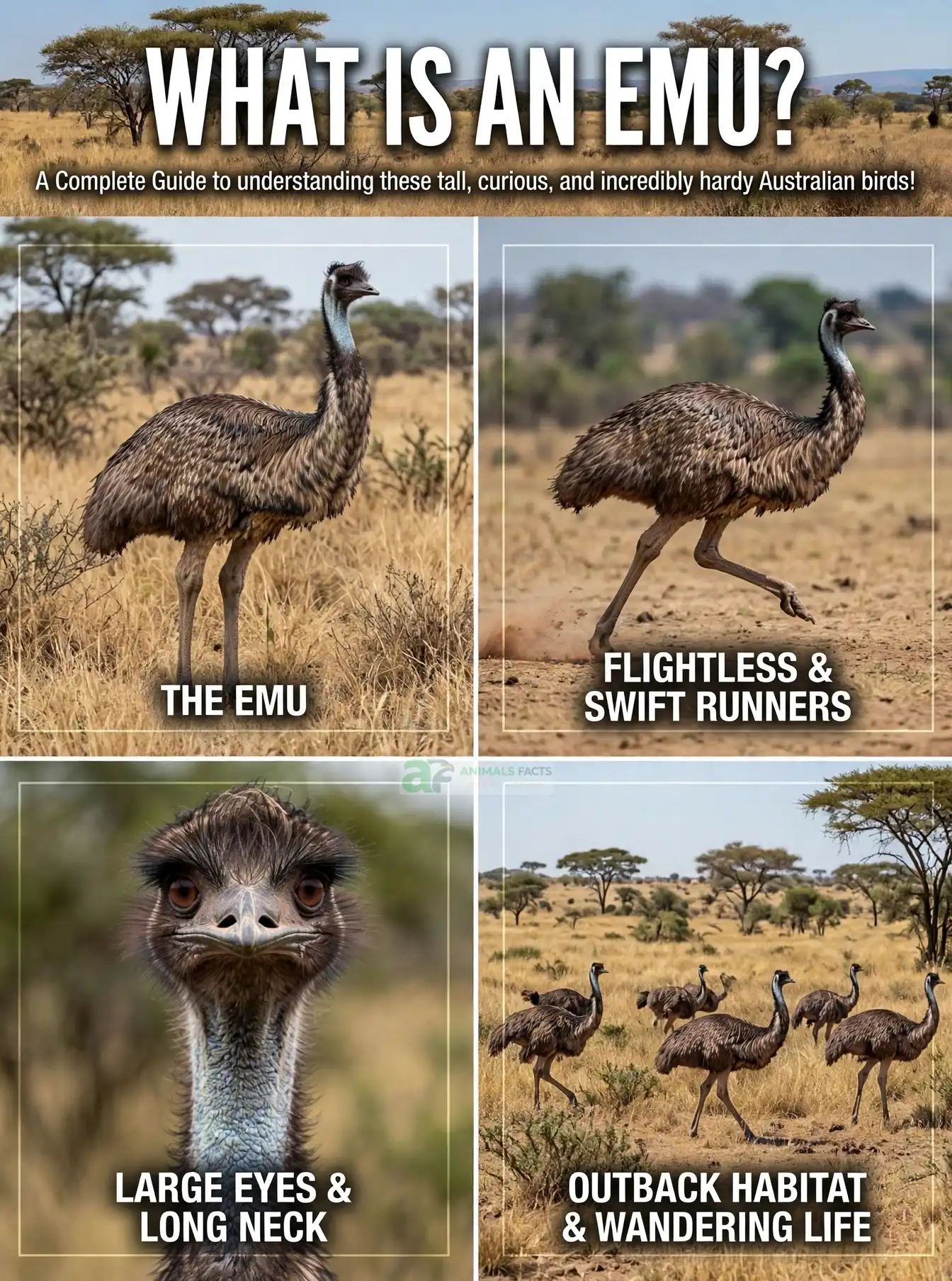
In the Wheatbelt region of Western Australia in November 1932, a scene unfolded that would become one of the most improbable episodes in the history of wildlife conflict between humans and animals. Major G.P.W. Meredith of the Royal Australian Artillery, commanding two soldiers and two Lewis machine guns, had been deployed under orders from the Australian Minister of Defence to cull a mob of approximately 20,000 emus that had migrated into the wheat-farming districts following a drought inland. The operation was observed by the Sydney media, who had been assured by the Defence Minister that the soldiers would collect feathers for their hats and that the exercise would resemble a military expedition against a manageable pest problem. What actually happened was something different. The emus, it emerged, were extraordinarily difficult to kill, extraordinarily difficult to herd toward the guns, and apparently unconcerned by military authority. After several weeks of operations, the official military report documented approximately 986 emus killed against approximately 9,860 rounds of ammunition expended — a ratio of approximately 10 bullets per emu. Major Meredith, with some admiration, reported that the emus “could face machine guns with the invulnerability of tanks” and that when a mob was fired upon, the animals split into small groups and disappeared into the scrub with tactical efficiency. The House of Representatives debated the campaign’s failure. The Minister of Defence withdrew the military. The emus continued their migration. Emu facts begin with this episode — not because it defines the emu, but because it so perfectly captures what the emu actually is: a tough, adaptive, continent-spanning Australian survivor that has been successfully occupying this continent for millions of years and that was not going to be significantly inconvenienced by Lewis machine guns in 1932 or by anything equivalent since.
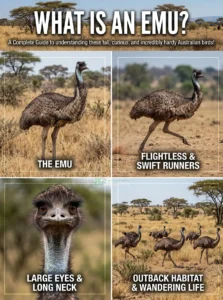
The emu (Dromaius novaehollandiae) is Australia’s largest bird and the world’s second-tallest bird — surpassed only by the ostrich. It is the only bird with calf muscles (a gastrocnemius muscle), the only bird to use a bidirectional swimming stroke, the bird in which the male does all the parenting — sitting on the eggs for 56 days without eating, drinking, or defecating in one of the most extreme parental investment events documented in any bird. It is the national bird symbol of Australia, appearing on the Australian Coat of Arms alongside the kangaroo specifically because it cannot walk backward — making it a symbol of Australia’s forward progress. It has been the subject of one of history’s most entertainingly unsuccessful military operations. It migrates thousands of kilometers across the Australian interior in response to rainfall patterns and food availability, its movements tracked by Aboriginal Australians for tens of thousands of years as a seasonal ecological calendar. It is killed by the thousands annually by farmers protecting wheat crops — and yet its population remains robust at 625,000–725,000 individuals — the species thriving in the same Western Australian landscape where the military attempted to reduce its numbers with machine guns 90 years ago.
Interesting facts about emus reveal an animal of breathtaking biological and cultural complexity — the male’s sound production through an inflatable neck sac that creates a booming drum sound; the female’s polygynous departure after laying eggs, potentially seeking additional mates while the male incubates alone; the emu’s ability to enter a state of torpor (energy conservation resembling sleep but with dramatically reduced metabolic rate) during food scarcity; the extraordinary seeds that only germinate after passing through an emu’s gut — creating an obligate seed-dispersal relationship between the emu and specific Australian plant species; the Aboriginal astronomical tradition in which the emu is represented in the night sky not by stars but by the dark nebulae of the Milky Way’s “Emu in the Sky” — one of the most sophisticated astronomical traditions ever documented; and the emu oil derived from the bird’s body fat that has been used in Aboriginal medicine for tens of thousands of years and is now a global cosmetic ingredient. This is your comprehensive guide to Australia’s most emblematic, most resilient, and most historically entertaining large bird.
2. Emu Species Overview & Classification
The emu belongs to a taxonomically isolated position within the ratite group — the second-largest surviving ratite and the only living member of its family.
Species Classification Table
| Taxonomic Rank | Classification |
|---|---|
| Kingdom | Animalia |
| Phylum | Chordata |
| Class | Aves |
| Order | Casuariiformes |
| Family | Dromaiidae (Gray, 1840) |
| Genus | Dromaius (Vieillot, 1816) |
| Species | D. novaehollandiae (Latham, 1790) |
| Common Names | Emu; barrimal (Dharug/Sydney region Aboriginal); various Aboriginal language names |
| Etymology | Dromaius = “fast-running” (Greek dromos = running + maios = diminutive suffix — “the running one”); novaehollandiae = “of New Holland” (Latin) — New Holland being the historical European name for Australia before British colonization standardized the current name. “Emu” itself is of uncertain origin — possibly from Arabic na’amu (ostrich) via Portuguese ema (large bird), or from an Aboriginal language term |
The Emu’s Unique Taxonomic Position
The emu is the sole surviving member of the family Dromaiidae — a monotypic family containing only one living species:
The extinct relatives — Until relatively recently in geological time, Australia supported multiple Dromaiidae species:
- Dwarf emu of King Island (Dromaius novaehollandiae minor) — extinct approximately 1822 — killed by sealers and settlers within decades of European contact
- Dwarf emu of Kangaroo Island (Dromaius novaehollandiae baudinianus) — extinct approximately 1827 — similarly eliminated by European settlers
- Tasmanian emu (Dromaius novaehollandiae diemenensis) — extinct approximately 1865
- Various extinct prehistoric emu species including Dromaius parvulus — smaller than the modern emu
The cassowary relationship — The emu’s closest living relative is the cassowary (family Casuariidae) — the two families together forming the order Casuariiformes. The emu and cassowary share:
- Similar body structure and ratite characteristics
- Three-toed feet (unlike the ostrich’s two toes)
- Vestigial wings
- Flightlessness
- Australian/New Guinean geographic distribution
Three Recognized Subspecies of Living Emu
| Subspecies | Common Name | Range | Notes |
|---|---|---|---|
| D. n. novaehollandiae | Common emu | Southeastern Australia broadly | Nominate subspecies; most studied |
| D. n. woodwardi | Northern emu | Northern Queensland | Smaller; paler than nominate |
| D. n. rothschildi | Southwestern emu | Southwestern Western Australia | Darker than nominate |
The Ratite Evolutionary Context
The emu’s position within the ratites reflects the extraordinary evolutionary history of flightless birds:
The convergent evolution revelation — As discussed in the ostrich and vulture articles, molecular genetics has established that ratites lost flight independently multiple times rather than descending from a single flightless ancestor. The emu’s specific evolutionary path:
- The Australian continent’s separation from Gondwana brought bird populations that independently lost flight
- The emu’s relationship to the cassowary (New Guinea/Australia) contrasts with the ostrich (Africa) and rhea (South America) — all representing separate independent losses of flight
The emu’s evolutionary age — Fossil evidence of emu-like birds in Australia extends back approximately 80 million years — establishing the emu lineage as one of the oldest continuous bird lineages on any continent.
Evolution & Discovery Timeline
~80 million years ago (Cretaceous) — Proto-emu lineage establishing in what will become Australia.
~55,000 years ago — The first Aboriginal Australians arrive on the continent — beginning one of the longest and most intimate human-bird relationships in history. The emu becomes immediately significant in Aboriginal food culture, spiritual tradition, and astronomical knowledge.
~1696 — First European encounter with emus — Dutch sailors on the west Australian coast document the bird in ship logs.
1788 — British colonization of Australia begins; the emu immediately enters European natural history documentation.
1790 — John Latham formally describes Dromaius novaehollandiae — establishing the emu’s scientific name based on specimens.
1820s — The King Island and Kangaroo Island dwarf emus go extinct — the first emu extinctions of the colonial era, driven by hunting and habitat modification.
1932 — The Great Emu War — arguably the most famous event in emu history; Australian military deployment against emus in Western Australia; the military operation fails; the emus win.
1953–1960 — The State Barrier Fence (rabbit-proof fence) modifications and various emu culling programs in Western Australia attempt to manage emu populations affecting wheat farming.
2024 — Common emu population estimated at 625,000–725,000 individuals; classified as Least Concern globally; emu farming established on every inhabited continent.
“The emu is Australia in bird form — tough, adaptable, occasionally bizarre, impossible to push around, and capable of surviving conditions that would defeat most other animals. The Great Emu War didn’t just fail because soldiers miscounted. It failed because the emu is genuinely one of the most resilient large animals on Earth, and machine guns are the wrong tool for dealing with an ecological phenomenon.”
— Dr. Peter Menkhorst, Museum Victoria — Australian ornithology and wildlife management authority
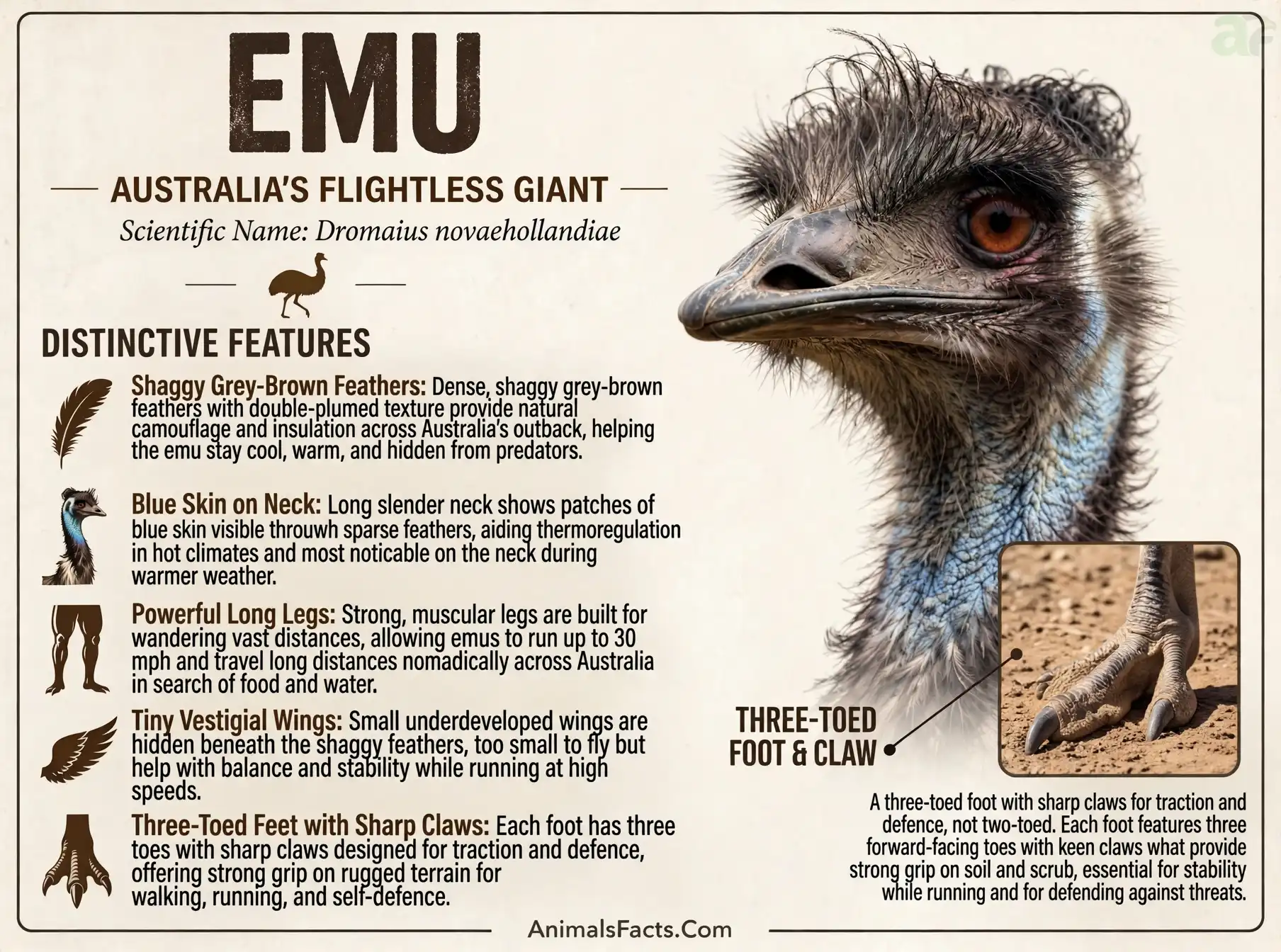
3. Emu Physical Description & Unique Features
The emu’s physical design is the product of millions of years of adaptation to the specific demands of the Australian continent — a body plan optimized for long-distance movement across vast, unpredictable landscapes with extreme seasonal variation in food and water availability.
Body Size and Proportions
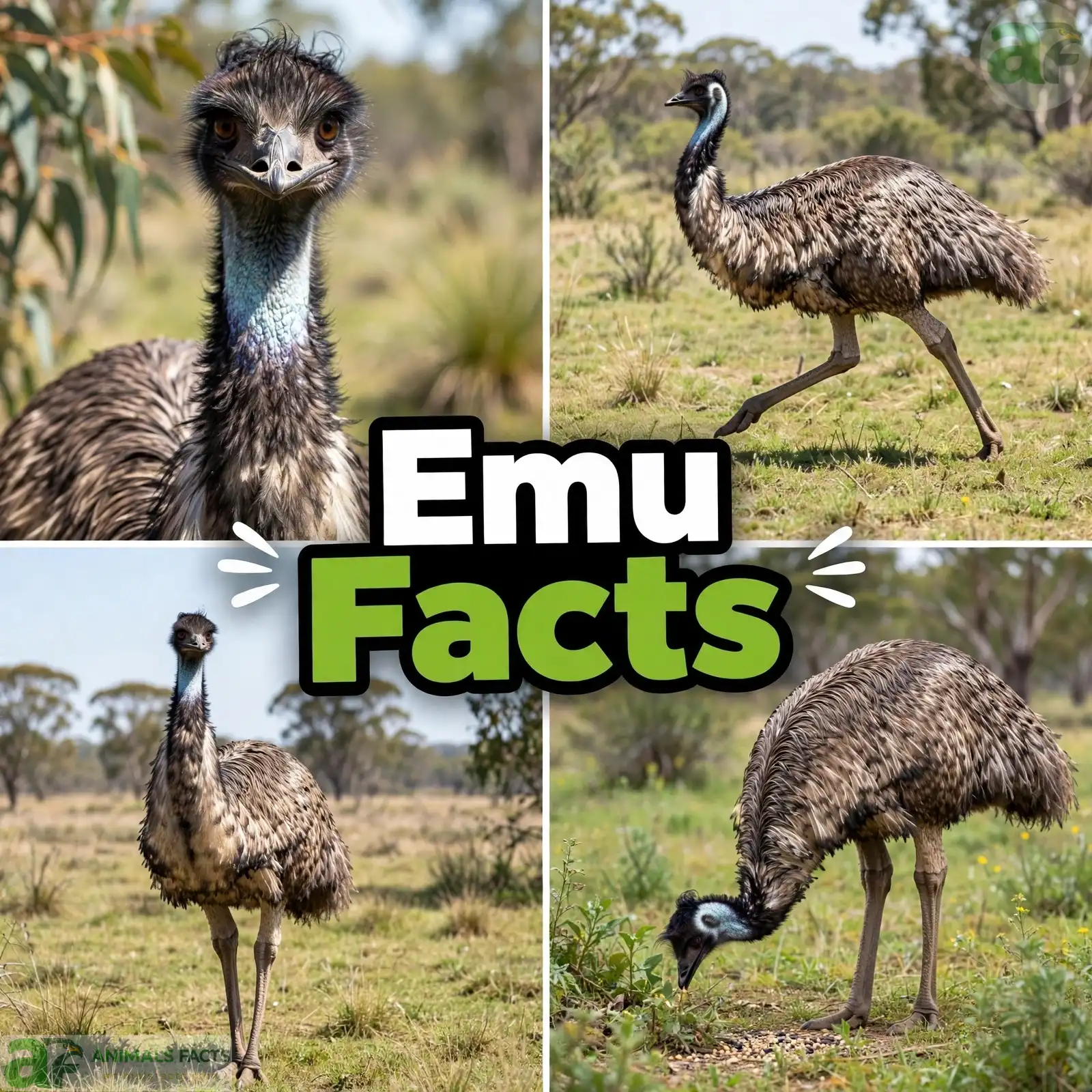
Height — Adult emus stand 150–190 cm at the top of the head — the second tallest bird on Earth after the ostrich. The height is achieved through long legs and a long neck, with the body carried approximately 100–120 cm off the ground.
Weight — Wild adult emus typically weigh 30–45 kg, though weights ranging from 18–60 kg have been documented. Females are typically slightly heavier than males — a reversal of the male-heavier pattern seen in most birds and a reflection of the energy investment in egg production. The weight variation across the range reflects the feast-or-famine ecology of the Australian interior — emus in productive southern areas during good seasons are significantly heavier than emus in semi-arid northern areas.
Sexual size dimorphism — Unlike the ostrich (where males are significantly larger) or most other birds (where males are typically larger), female emus are slightly heavier than males in most populations — reflecting the metabolic investment in producing the large eggs rather than male-male competition driving male size.
The Plumage — The Unusual Feather Structure
Dual feather structure — One of the emu’s most anatomically distinctive features: each feather shaft bears two separate feather shafts emerging from the same quill — creating a double-feather appearance unique among living birds:
- The inner shaft — a primary feather
- The outer shaft — a secondary feather emerging alongside
- Together, these create a shaggy, hair-like overall texture to the emu’s plumage that is completely different from the smooth, interlocked feather surface of flying birds
Color — Emu plumage is brown to grey-brown overall — the color varying with regional subspecies (northern birds paler; southwestern birds darker) and with seasonal condition. The plumage provides reasonable camouflage against the Australian scrubland background.
UV radiation protection — The brown emu feathers contain melanin pigments that absorb UV radiation — protecting the skin beneath from the intense Australian sunlight. The feather structure (loosely interlocked rather than tightly zipped) allows air circulation against the skin, providing some insulation while still allowing ventilation in heat.
The bare neck and face — Like the ostrich, the emu has a largely bare, blue-grey-skinned neck and face — the bare skin facilitating thermoregulation through vascular heat exchange. The skin can appear bluer (due to increased blood flow) or more grey depending on temperature and emotional state.
The Only Bird With Calf Muscles
The emu’s most surprising anatomical distinction for most people:
The gastrocnemius — The emu possesses a gastrocnemius muscle — the equivalent of the human calf muscle, connecting the knee to the ankle — that is absent in all other birds. This muscle provides additional leg power and is one of the contributing factors to the emu’s sustained running ability over long distances.
The broader implication — The emu’s unique leg musculature makes it biomechanically different from other birds — the additional leg muscle contributing to both its running performance and its unusual ability to kick in multiple directions.
The Three-Toed Foot
Unlike the ostrich’s unique two-toed structure, the emu retains three toes on each foot:
- The three-toed foot provides good ground contact across the diverse terrain types the emu crosses during its vast migrations
- The inner toe is the primary weight-bearing structure
- The outer toes provide lateral stability on soft ground
- The foot lacks the dewclaw (hind toe, vestigial in many birds) that is present in cassowaries
The Vestigial Wings
Wing size — Emu wings are among the most reduced of any ratite — approximately 20 cm in length when folded, bearing small vestigial claws at the tip. The wings are so reduced that they are typically invisible when the bird is standing calmly, hidden by the body plumage.
Retained functions — Despite complete inability to fly, emu wings retain several functional uses:
- Thermoregulation — in heat, emus hold wings away from the body to allow air circulation against the bare skin of the underwing and adjacent body
- Balance — used during high-speed running to assist directional changes
- Social signal — wing posture changes during aggressive and courtship encounters
The Inflatable Neck Sac — The Sound Production System
The air sac — The emu possesses an inflatable tracheal pouch (a thin-walled air sac along the lower neck) that can be inflated and rapidly deflated to produce the characteristic emu boom:
The sound — The emu’s primary vocalization — a deep, resonant drum or boom — is produced by rapidly inflating and deflating this tracheal pouch, creating low-frequency air pressure waves that generate the sound. The boom is audible from over 2 km in appropriate conditions.
The female produces the boom — Counterintuitively, it is the female emu — not the male — that produces the most powerful and most frequent booming calls. This vocalization reversal (females calling more actively than males) reflects the emu’s unusual mating system in which females compete for mates rather than males competing for females.
💡 Did You Know? The male emu undertakes one of the most extreme acts of parental sacrifice of any bird on Earth. After the female lays the clutch of eggs (typically 5–15 eggs over a 2–3 week period), the male settles onto the nest and begins incubation — and then does not eat, drink, or defecate for the entire 56-day incubation period. During this time, the male loses approximately one-third of his body weight — dropping from perhaps 45 kg to 30 kg entirely through metabolic consumption of his own fat reserves and muscle tissue. He sustains himself on the dew and moisture on surrounding vegetation that he occasionally licks (providing minimal hydration), on metabolic water produced by burning fat reserves, and on the extraordinary metabolic efficiency of a bird that has evolved specifically for extended fasting. The male does not leave the nest even when threatened — defending the eggs against predators while simultaneously starving. After the eggs hatch (at approximately 56 days), the male continues to care for the chicks — leading them, protecting them, and teaching them to find food — for an additional 5–7 months while continuing to eat relatively little. The female, meanwhile, has typically already paired with another male and laid another clutch. This extreme sexual role reversal — in which the female competes for males, lays the eggs, and departs while the male performs all parental duties for 7+ months while effectively fasting — is one of the most complete role reversals in any vertebrate and makes the emu the definitive example of avian sex-role reversal in parental care.
4. Top 25 Amazing Emu Facts
Here is your definitive collection of the most extraordinary, scientifically verified, and genuinely astonishing emu facts as of 2026:
- The Great Emu War of 1932 — in which the Australian government deployed soldiers with machine guns against emus in Western Australia — is one of the most entertainingly documented failures in military history. After expending approximately 9,860 rounds of ammunition, the military reported killing approximately 986 emus — a rate of approximately 10 bullets per emu — before withdrawing. The emus were officially declared the winners.
- The male emu does not eat, drink, or defecate for 56 days during incubation — losing approximately one-third of his body weight while sitting on the eggs. He survives entirely on previously stored fat reserves and metabolic water, in one of the most extreme parental fasting events documented in any bird.
- The emu is the only bird with a gastrocnemius muscle (the equivalent of a human calf muscle) — this unique leg anatomy is absent in all other approximately 10,000 bird species and contributes to the emu’s sustained running ability.
- The emu appears on the Australian Coat of Arms alongside the kangaroo specifically because both animals are physically incapable of walking backward — their leg anatomy preventing backward movement. This characteristic was chosen to symbolize Australia’s national philosophy of moving only forward, never retreating.
- Female emus are polygynous — after laying a clutch of eggs and leaving the male to incubate alone, the female may find a new mate, lay another clutch for another male to incubate, and potentially produce eggs for 2–3 different males in a single season. The female produces the eggs; the males do all the parenting.
- The Aboriginal Australians of the Sydney region have maintained a tradition of the “Emu in the Sky” — a constellation not defined by stars but by the dark nebulae and dust clouds of the Milky Way that create the shape of an emu. This “dark constellation” is one of the most sophisticated astronomical traditions ever documented — the emu’s orientation in the night sky indicating the season for emu egg collection.
- Emu seeds — specific Australian plant seeds — have evolved to require passage through an emu’s digestive system before they will germinate. The seeds’ hard coats are chemically or physically modified by the emu’s digestive acids and processes in ways that trigger germination. The emu and these plants have co-evolved an obligate seed dispersal relationship across millions of years.
- Emus can enter a state of torpor — a reduced-metabolism dormancy resembling deep sleep — during periods of food scarcity. During torpor, the emu’s metabolic rate drops significantly, reducing energy requirements and allowing survival during extended food-free periods beyond what normal sleep provides.
- The emu is documented migrating up to 500 km in response to rainfall patterns and food availability — moving across vast sections of the Australian interior in nomadic patterns that follow the irregular pulse of rainfall-driven vegetation growth. Aboriginal Australians tracked these migration routes as ecological calendars for tens of thousands of years.
- Emu oil — derived from the fat of the emu’s subcutaneous fat layer — has been used in Aboriginal medicine for an estimated 40,000+ years and is now a globally marketed cosmetic ingredient claimed to have anti-inflammatory and skin-penetrating properties. It is one of the oldest documented human uses of an animal product for medicinal purposes.
- The emu’s three-toe kick — delivered forward and downward — is documented killing dogs and injuring humans. Unlike the ostrich’s primarily forward kick, emus can kick in multiple directions and have been documented kicking to the side and backward (using their leg anatomy) in ways that make them more tactically flexible in close-quarters defense.
- A group of emus is called a “mob” — the same collective noun used for kangaroos, reflecting the Australian ecological parallel between the two most iconic Australian animals that move in large, unstructured social groups.
- Emu eggs are deep green in color — one of the most distinctively colored large bird eggs. The dark green pigmentation (from the combination of the blue-green base shell color and brown pigment overlays) makes emu eggs immediately identifiable and has made them prized objects in Aboriginal art and in contemporary decorative carving.
- The emu feather has a unique double-shaft structure — each feather shaft bearing two separate shafts from a single quill — a structure found in no other living bird and that gives the emu’s plumage its characteristically shaggy, hair-like appearance.
- In periods of high food availability, emus accumulate subcutaneous fat at extraordinary rates — gaining up to 5 kg of fat that serves as energy reserve for migration and for the male’s incubation fast. This fat accumulation and depletion cycle reflects the feast-or-famine ecology of the Australian interior.
- Emus swim readily — entering water willingly and swimming with a competent bidirectional stroke when crossing rivers or flooded areas during migration. The emu uses its vestigial wings alongside its legs during swimming — creating a combined limb stroke not documented in any other bird.
- Emu chicks are striped — newly hatched emu chicks have distinctive cream and dark brown or black longitudinal stripes running the length of the body, providing camouflage against the patterned light-and-shadow of the Australian scrubland. The stripes fade as the chick matures.
- The emu’s running maintains sustained speeds of 48–50 km/h — and unlike sprinting animals that exhaust quickly, emus can maintain near-maximum speeds for several kilometers before slowing. This combination of speed and endurance made military pursuit impractical in 1932.
- Emus are documented eating charcoal after bushfires — the charcoal providing minerals and potentially serving a digestive function. The post-fire landscape also provides high protein food in the form of insects and small animals displaced or killed by the fire.
- The King Island emu (Dromaius novaehollandiae minor) — a dwarf subspecies of the emu — was hunted to extinction by 1822, within approximately 30 years of European contact with King Island. The Kangaroo Island emu was extinct by 1827. These extinctions represent the first documented emu extinctions of the colonial period.
- Emu courtship behavior involves the female actively pursuing the male — boom-calling to attract attention, fighting rival females, and approaching selected males while performing display behaviors. This female-initiates-pursuit pattern (reversed from most bird species) reflects the fundamental sex-role reversal in emu reproductive biology.
- The emu has been documented destroying crops at scales sufficient to motivate government intervention — during the 1932 breeding season, approximately 20,000 emus descended on the Campion district of Western Australia, consuming and trampling wheat crops and breaking down rabbit-proof fencing. This event motivated the military intervention of the Great Emu War.
- Emu farming is practiced in Australia, North America, Europe, China, and other countries — producing emu oil (the primary commercial product), emu leather, emu meat, and emu eggs. The global farmed emu population is estimated at several hundred thousand birds.
- Emus are documented following thunderstorms — the birds can hear or sense the low-frequency infrasound produced by distant storms and move toward them in anticipation of the post-storm vegetation growth that will follow rainfall. This storm-following behavior is one of the most sophisticated weather-response behaviors documented in any bird.
- As of 2026, the common emu population is estimated at 625,000–725,000 individuals — the species classified as Least Concern globally and thriving across most of its mainland Australian range, with local declines in areas of agricultural intensification and range reduction at the margins.
5. Fun Facts About Emus
- The Great Emu War of 1932 — military deployed against emus; emus won
- Male doesn’t eat, drink, or defecate for 56 days during incubation
- Only bird with a calf muscle (gastrocnemius)
- On the Australian Coat of Arms because it can’t walk backward
- Female is polygynous — lays eggs for multiple males
- The “Emu in the Sky” is defined by dark nebulae, not stars
- Some seeds only germinate after passing through an emu
- Can enter torpor (reduced metabolism) during food scarcity
- Migrates up to 500 km following rainfall
- Emu oil used medicinally for 40,000+ years
- Green eggs — most distinctively colored large bird eggs
- Swims using a unique bidirectional stroke with wings and legs
6. Emu Habitat & Geographic Range
Emu habitat across mainland Australia is defined primarily by the bird’s need for open or semi-open terrain with adequate food resources — the emu’s height and vision requiring visibility to detect predators, and its nutritional needs requiring diverse vegetation and invertebrate resources.
Primary Habitat Types
Open savanna and woodland:
The emu’s most characteristic habitat — the vast eucalyptus woodland and savanna covering much of Australia’s interior:
- Mulga (Acacia aneura) woodland — the dry interior woodland dominant of much of outback Australia; key emu habitat where rainfall is highly variable
- Mallee eucalyptus scrubland — the dense, multi-stemmed eucalyptus scrub of southern Australia; important emu habitat
- Tropical savanna — the northern Australian seasonal tropical savanna; important for the northern emu subspecies
Semi-arid interior:
The vast semi-arid and arid interior of Australia — the “Red Centre”:
- Emus penetrate surprisingly deep into arid zones during favorable rainfall years when ephemeral vegetation provides food
- Semi-arid shrubland dominated by saltbush, bluebush, and other chenopods provides important dry-season refuge
- The irregular rainfall pulses of the arid interior drive the nomadic migrations that make emu distribution so dynamic
Agricultural land:
Following European settlement, the wheat-farming regions of southwestern and southeastern Australia have become important emu habitat:
- Post-harvest wheat fields provide concentrated grain resources
- The open agricultural landscape provides good visibility
- This is the conflict zone — agricultural land emu use creates the crop damage that has driven various culling and management programs including the 1932 Emu War
Grassland and plains:
- Mitchell grass (Astrebla species) plains of Queensland and northwestern New South Wales
- Native grassland systems in all states
- Post-fire regeneration areas provide high-quality temporary habitat
Geographic Distribution
| Region | Subspecies | Status | Notes |
|---|---|---|---|
| Southeastern Australia (NSW, VIC, SA) | novaehollandiae (nominate) | Common | Core population |
| Southwestern Australia (WA) | rothschildi | Common — but conflict with farming | Great Emu War country |
| Northern Australia (QLD, NT) | woodwardi | Common | Smaller, paler; tropical savanna |
| Tasmania | Extinct subspecies | Extinct (~1865) | Tasmanian emu extinct within 80 years of European contact |
| King Island (Bass Strait) | Extinct dwarf subspecies | Extinct (~1822) | Dwarf island emu extinct |
| Kangaroo Island (SA) | Extinct dwarf subspecies | Extinct (~1827) | Dwarf island emu extinct |
The Nomadic Migration Pattern
The emu’s movement pattern across Australia is one of the most dynamic of any large bird:
Not true seasonal migration — Unlike the predictable seasonal migration of geese or shorebirds, emu movement is opportunistic and irregular — driven by the patchy, unpredictable rainfall distribution of the Australian interior:
The mechanism — Emus move toward areas of recent rainfall and associated fresh vegetation growth. The timing and direction of these movements varies from year to year depending on where rain falls. In drought years, emus may undertake extraordinary long-distance movements of 400–500 km to reach productive areas.
The Western Australia movement — The most studied emu migration in Australia — the movement of western Australian emus from the semi-arid interior toward the southwestern wheat-farming districts when inland conditions deteriorate. This movement, occurring roughly every few years, brings emus into the agricultural zone where the crop conflict documented in the Great Emu War occurs.
The State Barrier Fence — Western Australia’s State Barrier Fence (a network of fencing originally designed to keep rabbits from the southwest) was extended and modified specifically to redirect emu migrations away from wheat-farming areas. The fence system — sometimes called the “emu fence” — is one of Australia’s most unusual infrastructure items: a continental-scale fencing system designed specifically to manage emu movement.
7. Emu Diet & Feeding Behavior
Emu diet is one of the most seasonally flexible and ecologically opportunistic of any large bird — the species’ survival across the unpredictable Australian interior depending on the ability to exploit whatever food is available rather than specializing on a narrow range of prey.
Diet Breakdown Table
| Food Type | Season | Proportion | Notes |
|---|---|---|---|
| Seeds (various native and introduced plants) | Year-round; peak dry season | ~30–40% | The most reliable year-round food source |
| Fruits and berries | Wet season/summer | ~20–30% | Preferred when available; major seed dispersal opportunity |
| New plant growth (shoots, flowers, leaves) | Post-rain | ~20–25% | Eaten intensively during growth flushes after rain |
| Insects and other invertebrates | Year-round | ~10–15% | Grasshoppers, caterpillars, beetles — important protein |
| Small vertebrates (lizards, mice) | Opportunistic | ~2–5% | Taken when encountered |
| Agricultural grain (wheat, barley) | Harvest season | Locally high | Source of farming conflict; highly preferred when available |
| Charcoal | Post-fire | Occasional | Mineral supplementation; documented behavior |
| Gastroliths (stones) | Continuous | Consumed but not food | Gizzard grinding function — same as ostrich system |
The Seasonal Dietary Strategy
The boom-bust response — Emu feeding strategy is fundamentally calibrated to the boom-bust ecology of Australian rainfall:
Post-rain flush — When rain falls after a dry period, the resulting vegetation flush — new plant growth, flowering, seeding — provides an extraordinary concentrated food resource. Emus respond immediately, consuming the new growth intensively and simultaneously accumulating fat reserves for the next dry period.
Dry season strategy — When fresh vegetation is scarce, emus shift to:
- Seed harvesting — seeds of diverse plant species stored in the soil persist through dry periods
- Invertebrate hunting — insects become the primary protein source
- Reduced activity — conserving energy by reducing movement
- Torpor — entering reduced-metabolism states during peak heat and food scarcity
The Seed Dispersal System
The relationship between emus and specific Australian plant seeds is one of the most ecologically significant feeding relationships in Australian ecology:
The obligate dispersal relationship — Research has identified multiple Australian plant species whose seeds germinate at significantly higher rates after passing through an emu’s digestive system than they do without emu processing:
- The emu’s digestive acids and physical seed coat scarification by the gizzard remove inhibitors and physically damage seed coats in ways that promote germination
- Some seeds require enzymatic processing of the seed coat that only occurs in emu digestion
- The emu’s wide-ranging movements distribute seeds across vast areas, linking plant populations that would otherwise be genetically isolated
The ecological consequence of emu loss — Research has documented that in areas where emus have been excluded or reduced in number, populations of specific plant species have declined — establishing the emu as an obligate dispersal agent for certain Australian flora. This finding has significant implications for conservation management of both emus and Australian native plant communities.
The Agricultural Grain Problem
The wheat preference — Emus feeding in Western Australian wheat-farming areas show a strong preference for wheat grain over most natural foods:
- Wheat provides high-calorie, easy-to-consume food in concentrated quantities
- Post-harvest fields with grain spillage are particularly attractive
- The preference creates the crop conflict that has driven the various culling and fencing programs
The damage pathway — Emu crop damage in wheat-farming areas occurs through:
- Direct grain consumption — significant in post-harvest fields and in crops where seed has been exposed
- Trampling — emus moving through standing crop cause physical damage
- Fence damage — emus pushing through or under rabbit-proof fencing create gaps that also allow rabbit entry
8. Emus Reproduction & Life Cycle
Emu reproduction represents the most complete sex-role reversal in parental care documented in any large bird — a system in which the female’s primary biological function is producing and distributing eggs while the male performs all incubation and chick-rearing duties.
The Breeding Season
Timing — Emu breeding season in Australia peaks during the cooler months — approximately April–June in southern Australia:
- Cool season breeding allows the male to maintain body temperature during the 56-day incubation without the metabolic cost of heat stress
- The chick-rearing period extends through the warmer months when food availability increases
- In northern Australia (tropical regions), breeding timing shifts toward the dry season
The female’s sexual initiative — One of the most unusual aspects of emu mating biology: female emus actively compete for male mates:
- Females boom-call to attract male attention
- Females fight rival females that approach their selected male
- Females perform display behaviors — raising feathers, circling males, head-bobbing
- Males assess females and may reject unsuitable partners
The reason for sex-role reversal — The fundamental driver of the emu’s sex-role reversal is the relative parental investment calculation:
- Producing eggs is energetically costly for the female — but releasing eggs and finding a new male to incubate them is less costly than performing the 56-day fast required for incubation
- Males that incubate and raise chicks successfully have higher chick survival rates than any alternative arrangement would provide
- The system has been shaped by the fact that male parental investment (the 56-day fast + 7-month chick rearing) is more limiting than female egg production in determining population reproductive output
The Communal Courtship and Pair Formation
The courting aggregations — In areas where emus concentrate during the breeding season, male-female interactions produce complex multi-individual interactions:
- Multiple females may compete for the attention of a single high-quality male
- A male may reject multiple female advances before pairing
- Once paired, the female and male associate closely for several weeks before egg-laying
Pair bond duration — Emu pairs are typically seasonally monogamous — maintaining the pair bond through the laying period but not beyond. After the male begins incubation and the female departs, the pair bond is effectively dissolved.
Nest and Egg Laying
The nest — The male constructs a simple ground nest — a depression lined with leaves, grass, bark, and other plant material in a relatively sheltered position among scrub or low vegetation:
- Nest diameter approximately 1–1.5 meters
- Located in a position where the incubating male has reasonable visibility of approaching threats
- The male begins nest preparation during courtship
Egg laying — The female lays eggs every 2–3 days over a period of approximately 2–3 weeks:
- Typical clutch: 5–15 eggs — the variability reflecting the female’s body condition and food availability
- Each egg weighs approximately 700–900 grams — very large relative to the female’s body (each egg approximately 1.5–2% of female body weight)
- Egg color: dark emerald green to dark green-black — one of the most distinctively colored large bird eggs in the world
After the last egg — The female departs and the male begins incubating:
- In some cases, the female may remain nearby briefly before leaving
- The female typically seeks additional male partners to lay additional clutches with other males in the same season
The Male’s Extraordinary Incubation Fast
Duration — 54–56 days — among the longest incubation periods of any ratite
The fasting physiology — The male’s ability to sustain incubation without eating or drinking for 56 days involves extraordinary physiological adaptations:
- Pre-incubation fat deposition — males actively accumulate fat reserves before incubating begins
- Reduced metabolic rate — the incubating male’s metabolic rate drops significantly — reducing energy requirements
- Muscle protein catabolism — after fat reserves are depleted, the male begins metabolizing muscle protein for energy — contributing to the dramatic weight loss
- Uric acid management — not defecating for 56 days requires the kidneys to manage uric acid buildup without the usual elimination route; the male’s kidneys show specific adaptations to this extended retention
The weight loss — Males typically lose approximately 30–35% of body weight during incubation — a 45 kg male finishing incubation at approximately 29–31 kg.
Thermoregulation of eggs — The male maintains the nest temperature at approximately 33–36°C — using body contact for warmth in cool nights and occasionally standing to shade eggs during peak heat.
Chick Development
At hatching — Emu chicks hatch with striking longitudinal black-and-cream stripes running the length of the body — the camouflage pattern effective in the broken light-and-shadow of Australian scrubland:
- Chick height approximately 12 cm at hatching
- Chick weight approximately 500 grams
- The chick is precocial — mobile and following the father within days of hatching
The male’s post-hatching role:
- The male leads the chick group (typically 5–15 chicks from the nest)
- He defends chicks aggressively from predators — documented attacking dingoes and humans approaching his chick group
- He teaches chicks to find and recognize food
- He provides warmth for chicks during cold nights for the first weeks
Chick growth rate:
- Week 1–4 — rapid growth; still dependent on father for warmth and protection
- Month 2–3 — approaching 50% of adult height; increasingly independent in food finding
- Month 5–7 — approaching adult size; striped plumage fading
- Month 7 — father-chick group typically disperses; young emus become independent
Sexual maturity — Emus reach sexual maturity at approximately 18–24 months of age — breeding first in their second year if conditions are suitable.
9. Social Behavior & Communication
Emu social behavior is more complex outside the breeding season than the solitary incubating male might suggest — the species forming dynamic aggregations that track resources across the Australian landscape.
Group Structure
Non-breeding aggregations — Outside the breeding season, emus form variable-sized groups from pairs to aggregations of thousands:
- During food-resource concentrations (post-rain vegetation flushes, agricultural harvests) — large aggregations of hundreds to thousands form at the resource
- During low-food dry-season periods — smaller groups or solitary individuals are more typical
- The 1932 20,000-emu aggregation in the Campion district represents an extreme case of drought-driven concentration at an accessible food resource
The mob dynamics — Emu “mobs” (the Australian collective noun) lack the structured dominance hierarchies seen in some other large bird groups:
- Individual emus within mobs show relatively limited within-species aggression outside the breeding season
- Food resource monopolization by dominant individuals is limited — the open foraging style of emus and the large area of resources means competition is typically dispersed
- The mob provides collective predator detection — the many-eyes benefit that allows individual birds to allocate more time to feeding
Communication System
The boom call — As noted above, the female produces the primary territorial and courtship vocalization — the deep resonating boom from the inflatable tracheal pouch:
- Audible at over 2 km in still conditions
- Produced primarily during the breeding season and during territorial disputes between females
- A series of 3–7 booms in rapid succession is the typical pattern
The male’s grunt — The male’s primary vocalization is a quieter, lower-pitched grunt — used during courtship response to female booming and during chick-rearing when communicating with the chick group.
The alarm “boom” — Both sexes produce an urgent rapid boom series when alarmed — triggering flight responses in nearby emus. The alarm boom is higher-pitched and more rapidly delivered than the courtship boom.
Threat display — During aggressive encounters, emus perform distinctive threat displays:
- Ruffling the feathers — making the body appear larger
- Raising the neck feathers — puffing the neck upward
- Direct approach — walking directly toward the intruder
- Kick threat — raising one foot toward a threatening individual
The “emu chuckle” — A quiet, low-pitched throaty chuckle produced during relaxed feeding and social interactions — one of the most charming and least-documented emu vocalizations; audible only at very close range.
10. Predators & Defense Mechanisms
The modern emu’s predator community is a combination of native Australian predators that have co-evolved with emus over millions of years and introduced predators whose impact was dramatically amplified by European colonization.
Natural Predators
Egg and chick predators:
- Wedge-tailed eagle (Aquila audax) — the most important avian predator of emu chicks; documented taking chicks up to several weeks old; the eagle’s large size (up to 5.8 kg) and powerful talons make it capable of taking surprisingly large chicks
- Dingo (Canis lupus dingo) — significant predator of both chicks and occasionally adult emus; the dingo co-evolved with emus in Australia and is the primary native mammalian predator of emus
- Introduced red fox (Vulpes vulpes) — significant egg and chick predator across southern Australia; the fox’s introduction from Europe has dramatically increased predation pressure on emu nests
- Introduced domestic pig (feral) — documented nest predator and egg consumer in areas of feral pig presence
- Monitor lizards (goannas) (Varanus species) — documented egg predators; larger goanna species will break emu eggs given the opportunity
Adult emu predators:
- Dingo — the only native land predator regularly capable of taking healthy adult emus; pack hunting allows dingoes to bring down adult emus through coordinated pursuit and attack
- Wedge-tailed eagle — documented taking adult emus in exceptional cases — typically injured, sick, or young adults; the eagle’s hunting team approach (multiple birds harrying a single emu) has been documented
- Introduced domestic dog (feral) — significant predator of adult emus in areas with feral dog populations
Defense Mechanisms
The primary defense — speed and endurance:
- 48–50 km/h sustained speed — sufficient to outrun dingoes over distances of more than a few hundred meters
- Extraordinary endurance at near-maximum speed — the emu can maintain 40+ km/h for periods that exhaust pursuing dingoes
- The combination of speed and endurance makes the healthy adult emu essentially immune to single-predator pursuit across open terrain
The kick — multi-directional:
- The emu’s kick differs from the ostrich’s purely forward kick — the emu can deliver kicks forward, to the side, and with some backward capability due to its unique leg muscle structure
- The three-toed foot creates a broader striking surface than the ostrich’s two-toed foot
- Kick force sufficient to cause serious injury to dingoes and to kill domestic dogs
- The male defending his chick group is documented kicking attacking dingoes with sufficient force to injure them severely
The father’s chick defense:
- The male emu defending his chick group is one of the most aggressive defensive behaviors of any ratite
- Documented attacks on: dingoes, wedge-tailed eagles, foxes, sheep dogs, and humans
- The male will not retreat from a threat to his chick group even when significantly smaller than the threat
Camouflage:
- Adult emu plumage blends into the brown-grey Australian scrubland at rest
- Chick stripes are effective camouflage in the broken light of Australian vegetation
- Emus freeze when approached cautiously — relying on camouflage before resorting to flight
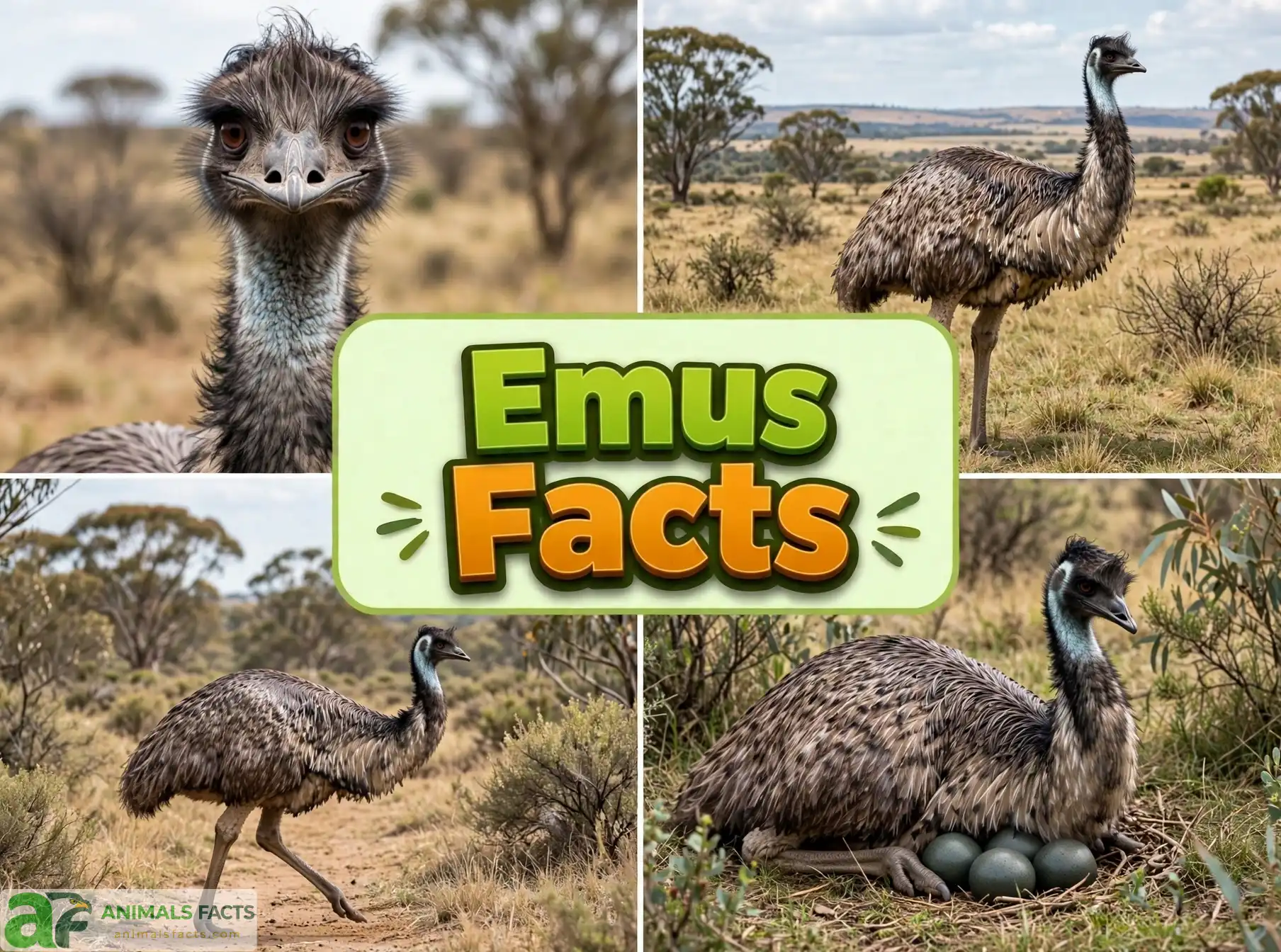
11. Emu Facts for Kids
Hey amazing young wildlife scientists, Australian wildlife enthusiasts, and nature lovers! Here are some truly extraordinary emu facts for kids that will make you the most knowledgeable emu expert in any conversation:
- The Australian Army tried to fight emus with MACHINE GUNS — and LOST! In 1932, the Australian government sent soldiers with machine guns to kill emus that were eating farmers’ wheat crops. The soldiers fired nearly 10,000 bullets but only killed about 1,000 emus! The emus kept splitting into small groups and running away, and they couldn’t be herded toward the guns. The military eventually gave up and went home. People still call this the “Great Emu War” and the emus are officially the winners!
- The daddy emu doesn’t eat, drink, or go to the bathroom for 56 DAYS! After the mother emu lays her eggs, the daddy emu sits on them — and he stays there for 56 DAYS without eating, drinking, or leaving the nest! He loses about a third of his body weight just from sitting there. Meanwhile, the mum has left to find another mate and have more babies with a different dad! The emu dad is one of the most dedicated and most self-sacrificing fathers in the entire bird world!
- Emus are on the Australian COAT OF ARMS because they can’t walk BACKWARD! The emu and the kangaroo both appear on Australia’s official national symbol — but not just because they look cool. They were specifically chosen because NEITHER ANIMAL CAN PHYSICALLY WALK BACKWARD! Their leg anatomy prevents them from reversing. This was chosen to symbolize Australia always moving forward, never back. It is one of the most specific and most practical reasons any animal has ever been on a national symbol!
- The emu is the ONLY BIRD with calf muscles! You have calf muscles on the back of your leg — that is the large muscle that helps you push up onto your toes. The emu is the only bird on Earth that has this same type of muscle (called a gastrocnemius). All other 10,000 bird species lack it. This unique muscle gives the emu extra leg power for running and for defending itself with kicks!
- Indigenous Australians can read EMU CONSTELLATIONS made of DARKNESS not stars! Aboriginal Australians have an incredible astronomical tradition where the “Emu in the Sky” is a constellation made of the DARK PATCHES in the Milky Way — the dark nebulae and dust clouds between the stars — rather than the stars themselves! When the emu’s “head” (a specific dark patch) appears low on the horizon at dawn, it signals the right season to collect emu eggs. It is one of the most sophisticated and most unique astronomical traditions ever documented!
- Emu eggs are DARK GREEN — and ancient humans used the SHELLS as water bottles! Emu eggs are an extraordinary deep green color — much darker than any other common bird egg. When the egg is blown out, the thick, waterproof shell makes a perfect natural container. Ancient Aboriginal Australians used emu eggshells as water bottles, and some of these decorated eggshell water vessels found in archaeological sites are over 40,000 years old — some of the oldest human art objects ever discovered!
- Some Australian plants can ONLY grow after being eaten by an EMU! Certain Australian plant seeds are specifically designed to pass through an emu’s stomach before they will germinate. The emu’s digestive acids and the grinding action of the stomach stones create chemical changes in the seed coat that allow it to sprout. Without emus carrying and digesting these seeds, the plants cannot reproduce! Emus and these plants evolved together over millions of years and now need each other to survive!
- Emus can hear THUNDERSTORMS from hundreds of kilometers away and walk TOWARD THEM! Thunderstorms produce extremely low frequency sound called infrasound that travels very long distances. Emus can detect this infrasound and actually WALK TOWARD distant storms — because they know that where it rains, there will soon be fresh plants and food. An emu might walk hundreds of kilometers toward a storm it heard but cannot yet see! This makes emus some of the best weather forecasters in the animal world!
12. Relationship with Humans
The emu’s relationship with humans encompasses 40,000+ years of Aboriginal Australian co-existence in which the emu was simultaneously food, medicine, seasonal calendar, and spiritual being; a colonial period of hunting, extinction of island subspecies, and crop conflict; the extraordinary Great Emu War of 1932; and a modern relationship in which the emu is simultaneously a national symbol, a farming industry, and an occasional agricultural pest.
The Aboriginal Australian Relationship — 40,000 Years of Co-existence
The emu’s relationship with Aboriginal Australians is the most sustained and most comprehensive human-bird relationship in Australian history — potentially one of the oldest and most sophisticated human-bird relationships on Earth:
The emu as food — Wild emus were a significant food source for Aboriginal Australians across the continental range:
- Emu eggs — collected at specific times guided by the “Emu in the Sky” astronomical tradition
- Adult emu meat — taken through various hunting techniques
- Emu fat — the subcutaneous fat rendered for both food and medicinal application (emu oil)
- The emu hunting season was carefully managed through ecological knowledge and spiritual protocols — sustainable use governed by deep understanding of emu population dynamics
The emu as ecological calendar — Aboriginal Australians across the continent developed sophisticated knowledge of emu reproductive timing as an ecological calendar:
- The “Emu in the Sky” dark constellation’s position in the night sky indicating egg-laying season
- Emu behavioral changes (increased calling, pair formation, male incubation) providing season indicators
- Emu migration patterns indicating rainfall distribution and food availability across vast landscapes
Emu oil in Aboriginal medicine — The rendering of emu fat into oil for medicinal and cosmetic application is documented in Aboriginal Australian practice for an estimated 40,000+ years — one of the oldest documented continuous human uses of any animal product for therapeutic purposes:
- Used topically for skin conditions, joint pain, and wound healing
- Applied as a skin moisturizer and sun protection in the harsh Australian climate
- Used in traditional ceremonies and body decoration
The Emu in the Sky — Dark Constellation Astronomy — One of the most sophisticated and most culturally significant human-bird astronomical relationships documented:
What it is — The “Emu in the Sky” (Gugurr in some languages) is an astronomical figure defined by the dark nebulae of the Milky Way — the dark dust clouds that block the stars behind them creating the silhouette of a running emu visible against the brighter Milky Way star field. The emu’s head corresponds to the Coalsack Nebula (adjacent to the Southern Cross); the neck extends to the Centaurus region; the body and legs extend toward Scorpius and Sagittarius.
The seasonal calendar function — The position of the emu figure in the night sky changes with the seasons (as Earth orbits the Sun, different parts of the Milky Way are visible at different times of year):
- When the emu’s “head” (the Coalsack) is on the horizon at dusk — April–June in southeastern Australia — this corresponds to the period when emus are laying eggs. Aboriginal communities knew to begin egg collection.
- As the season progresses and the emu appears to “stand up” more vertically in the sky, the incubation period is indicated
- The orientation of the emu figure therefore encoded a sophisticated seasonal ecological calendar
Cultural significance — The “Emu in the Sky” tradition represents:
- The world’s most clearly documented dark constellation astronomy system — a tradition of reading dark patches rather than stars that may be unique to Australian Aboriginal cultures
- A demonstration of the depth of ecological integration between Aboriginal Australians and the emu — the bird’s reproductive cycle embedded in the cosmological system
- A knowledge system maintained continuously for tens of thousands of years — the equivalent duration of the entire span of Western civilization many times over
The Yarragadee Emu — An Aboriginal rock art site in Western Australia features one of the most ancient emu depictions in Australian rock art — emus appearing in rock engravings across Australia that may be among the oldest representational art records of any specific bird species.
The Colonial Period — Hunting and Extinction
The immediate colonial impact — European settlement of Australia from 1788 onward brought dramatic changes to emu populations:
Island subspecies extinctions:
- King Island emu (dwarf) — extinct ~1822: British and American sealers who used King Island as a base hunted the small, flightless, and apparently fearless island emu to extinction within approximately 30 years of discovery. An animal that had survived millions of years on the island was gone within a single human generation.
- Kangaroo Island emu (dwarf) — extinct ~1827: French and British explorers and early settlers eliminated this subspecies within approximately 30 years of discovery.
- Tasmanian emu — extinct ~1865: The larger Tasmanian population lasted longer but was eliminated by hunting and habitat modification by the 1860s.
Mainland hunting — Wild emus were hunted extensively across mainland Australia for meat, oil, and feathers during the 19th century. The mainland population, however, was large enough to withstand this pressure — the open continent’s vast area providing refugia that island subspecies lacked.
The Great Emu War — The Most Famous Emu-Human Conflict in History
The Great Emu War deserves comprehensive treatment as one of the most extraordinary human-wildlife management episodes ever documented:
Background — In the years following World War I, the Australian government encouraged military veterans to settle in the wheat-farming districts of Western Australia’s Campion district. These ex-soldiers faced multiple agricultural challenges, including recurring droughts and (starting in the late 1920s) large numbers of emus from the interior migrating into the farming districts in search of water and food.
The 1932 situation — A particularly severe drought in the interior drove an estimated 20,000 emus into the Campion district wheat-farming area. The emus consumed crops, broke down rabbit-proof fencing, and occupied the water sources that farmers needed for livestock. The Western Australian farmers appealed to the federal government for assistance.
The military response — The Australian Minister of Defence, Sir George Pearce, authorized the deployment of:
- Major G.P.W. Meredith of the Royal Australian Artillery
- Two soldiers as assistants
- Two Lewis light machine guns
- 10,000 rounds of ammunition
The media portrayed the operation as straightforward — soldiers would dispatch emus efficiently, collect feathers for their hats, and the farmers would be relieved. The operation was scheduled for November 2–12, 1932.
The operational failures:
Day 1 (November 2) — The operation was delayed by rain that dispersed the emus before the guns could be positioned.
Day 2 (November 4) — Major Meredith’s force engaged approximately 50 emus with machine gun fire. The emus scattered into small groups before the guns could achieve sustained fire. The Lewis guns jammed repeatedly. Result: estimated 12 emus killed.
Subsequent days — Multiple operations produced similar results. The emus consistently:
- Split into small groups when fired upon — preventing the mass casualties that concentrated fire on a dense mob would achieve
- Did not fall easily — emus absorb extraordinary gunfire damage before collapsing; multiple witnesses described emus continuing to run after being hit by multiple bullets
- Dispersed into scrub — the Australian mallee scrubland provided cover that made pursuit impossible
- Reformed elsewhere — emus that dispersed from one engagement simply reconcentrated at a different location
The newspaper observations — By mid-November, the operation had attracted unfavorable press coverage. The ornithologist Dominic Serventy observed that the emus “moved like zulus whom neither artillery nor machine guns could stop.” The Sydney newspapers, initially expectant of a story about military efficiency, found themselves covering a story of military frustration.
The political withdrawal — The House of Representatives debated the campaign’s conduct. Questions were asked about whether the military engagement was appropriate for wildlife management. Major Meredith was recalled on November 18, 1932, after approximately 2,500 rounds of ammunition had been expended for approximately 50 confirmed emu casualties.
The second attempt — Farmers continued to petition for military assistance. In November–December 1932, a second military operation was mounted. This time Major Meredith adopted different tactics — mobile gun positions mounted on vehicles — and achieved greater efficiency. The second operation was considered partially successful, with higher kill rates, but the emu population was not significantly reduced.
The official accounting — The final official report recorded:
- Approximately 9,860 rounds expended
- Approximately 986 emus confirmed killed (some estimates suggest higher numbers; 986 is the most frequently cited figure)
- ~2,500 emus wounded (estimated; most survived)
- ~10 bullets per confirmed emu kill — the ratio that became the defining statistic of the campaign’s failure
Major Meredith’s assessment — Perhaps the most remarkable aspect of the episode was the military commander’s own evaluation. Major Meredith reportedly stated: “If we had a military division with the bullet-carrying capacity of these birds, it would face any army in the world… They could face machine guns with the invulnerability of tanks. They are like Zulus whom even dum-dum bullets could not stop.”
The cultural aftermath — The Great Emu War became:
- A standard reference in discussions of wildlife management gone wrong
- A celebration of emu resilience in Australian popular culture
- The defining event in the emu’s cultural history in Australia — the moment when the emu’s toughness became nationally famous
- A subject of academic historical study, journalistic retrospectives, and occasional parliamentary references
The genuine management response — The practical resolution of the emu-farmer conflict was eventually achieved not through military culling but through:
- State Barrier Fence extensions — redirecting emu migrations away from farming districts
- Local culling programs managed by state wildlife authorities rather than the military
- Agricultural adaptation — farmers learning to co-exist with periodic emu presence through fencing improvements and crop timing adjustments
Modern Human-Emu Relationships
Emu farming — The global emu farming industry produces emu oil (the primary commercial product), emu leather, emu meat, and emu eggs:
- Australia — approximately 600,000 farmed emus annually
- United States — significant farming industry primarily in Texas, Oklahoma, and other states
- China — growing farming industry
- Various European countries — small-scale production
- The total global farmed emu population is estimated at several million birds
Emu oil industry — Emu oil derived from the subcutaneous fat layer has become a significant global cosmetic and wellness product:
- Major cosmetic companies incorporate emu oil into moisturizers, anti-aging products, and hair care
- Traditional and alternative medicine uses include topical anti-inflammatory applications
- Global emu oil market estimated at hundreds of millions of dollars annually
Tourism — Emus are a significant wildlife tourism attraction at:
- Kangaroo Island (now reintroduced mainland emus) — wildlife tourism
- Various wildlife parks and sanctuaries across Australia
- Roadside encounters in rural and outback Australia — the emu’s fearlessness toward vehicles makes roadside encounters common
13. Emu Conservation Status & Threats
Conservation Status Overview
| Feature | Details |
|---|---|
| IUCN Status | Least Concern |
| Population Trend | Stable overall — local fluctuations |
| Estimated Wild Population | 625,000–725,000 individuals |
| Population Trend | Stable; some local declines |
| Extinct Populations | King Island, Kangaroo Island, and Tasmanian subspecies all extinct |
| Legal Status (Australia) | Protected under state and federal wildlife legislation; culling permits required |
| Hunting Status | Legal hunting only with licenses in some states; major annual culls conducted by farmers under permit |
| Annual Cull (Western Australia) | Approximately 200,000 emus culled annually under permit in agricultural zones |
Major Threats
| Threat | Description | Impact Level |
|---|---|---|
| Agricultural culling | Legal permitted culling in farming zones | High locally — major annual mortality source |
| Habitat loss | Clearing of mulga woodland and mallee scrub for agriculture | Medium-High |
| Drought and climate change | Extended droughts reduce carrying capacity | Medium — episodic major impact |
| Vehicle collisions | Significant roadkill mortality on outback roads | Medium |
| Feral predator impact on nests | Fox and feral pig predation on eggs and chicks | Medium |
| Fence mortality | Emus killed at fence lines during migration | Medium — specific areas |
| Introduced disease | Various viral and parasitic diseases | Low-Medium |
The Western Australian Culling Program
The ongoing culling of emus in Western Australia represents the largest annual legal bird kill of any non-game species in Australia — and one of the largest legal wildlife culls of any bird species globally:
The scale — Approximately 200,000 emus are legally culled annually in Western Australia under permit by farmers and licensed pest controllers. This number — equivalent to approximately 25–30% of the estimated wild emu population — represents an extraordinary ongoing human pressure on the wild population.
The population sustainability question — The emu population has remained broadly stable despite this culling — the species’ high reproductive rate (potentially 15+ eggs per female per season across multiple males), broad habitat flexibility, and the vast unculled interior Australian population providing demographic resilience.
The management debate — Australian wildlife managers and agricultural interests continue to debate the most effective and most humane approaches to emu management in farming areas:
- Some advocate for non-lethal management (improved fencing, deterrents)
- Others maintain that culling is necessary to protect agricultural viability
- The tension between agricultural interests and wildlife values is one of the defining wildlife management debates in Australia
Climate Change Implications
The rainfall dependence — The emu’s nomadic lifestyle is fundamentally driven by rainfall distribution. Climate change projections for Australia consistently project:
- Increased frequency and severity of drought across the interior
- More variable and less predictable rainfall across the range
- Increased temperatures affecting water availability
The potential consequences — For the emu population, increased drought frequency and severity could:
- Increase the frequency of large-scale emu movements into agricultural areas (as interior food sources fail)
- Reduce interior carrying capacity during extended drought periods
- Increase the human-emu conflict that drives culling programs
14. Famous Emus in History & Pop Culture
Famous Individual Emus
“Pete and Repeat” — Two emus at the National Zoo in Washington DC who became famous in the early 20th century for their ability to intimidate zookeepers and their general indifference to human authority — establishing a tradition of the emu-as-unpredictable-character that continues in zoo contexts globally.
The Campion District Emus (1932) — The approximately 20,000 unnamed emus of the Campion district whose collective resistance to machine gun fire became the defining event in emu cultural history — their “victory” in the Great Emu War making them the most famous bird-versus-military confrontation in history.
“Emu” (Rod Hull’s puppet) — The most famous fictional emu in British cultural history — the large, aggressive bird puppet used by Australian comedian Rod Hull from the 1970s through 1990s in British television performances. The puppet was famous for attacking other performers, hosts (including Michael Parkinson and Johnny Carson), and audience members in unpredictable and physically aggressive sequences that reflected the real emu’s behavioral reputation for fearlessness and occasional aggression.
“Kevin” in Up (Pixar, 2009) — The bird character Kevin in the Pixar animated film Up was designed with significant emu influence — the long-necked, tall, colorful flightless bird character drew on emu proportions and behavior for character design, though the fictional bird is more colorful than a real emu.
Historical and Cultural Significance
The Australian Coat of Arms — The emu’s appearance alongside the kangaroo on the Australian Coat of Arms (established 1912) makes it one of the two most officially significant animals in Australian national symbolism. The specific rationale — that neither animal can walk backward, symbolizing Australia moving only forward — makes the emu’s appearance on the coat of arms one of the most logically specific uses of any animal in national symbolism.
The “Emu in the Sky” Astronomical Tradition — As described above, the Aboriginal Australian dark constellation tradition of the Emu in the Sky represents one of the most culturally significant human-bird astronomical relationships ever documented — the emu embedded in Australian cosmological knowledge for tens of thousands of years.
The Great Emu War Documentary Record — The 1932 Emu War is one of the best-documented wildlife management episodes in history — the involvement of military personnel and the media interest generated written records, photographic documentation, and official parliamentary debate that have made it one of the most historically available wildlife conflict records from any period.
15. Role in Ecosystem & Food Chain
The Emu as Ecosystem Engineer
Seed dispersal — The critical ecological function:
The emu’s role as a seed disperser across the vast Australian landscape is one of the most important ecological functions of any large bird in Australia:
Scale of dispersal — An emu consuming seeds during feeding and then traveling 200–500 km during migration distributes seeds across a distance that no wind, water, or smaller animal dispersal agent could achieve. The emu connects plant populations across vast landscapes that would otherwise be genetically isolated by distance.
Obligate relationships — As noted above, specific Australian plant species depend exclusively on emu gut processing for germination — the loss of the emu from areas of its historical range has produced documented declines in these plant species.
The extinction aftermath — Research following the extinction of the King Island and Kangaroo Island emu subspecies has documented changes in plant community composition on these islands — establishing that the island emus were serving critical seed dispersal functions that no other remaining animal species could replace.
Vegetation structure influence:
- Emu grazing pressure on specific plant species influences vegetation structure and composition
- Post-fire emu foraging on insects and regenerating vegetation affects the rate and pattern of post-fire recovery
- Emu digging for roots and tubers creates soil disturbance that affects plant establishment and invertebrate community structure
The Food Web Position
As prey (primarily eggs and chicks):
- Wedge-tailed eagle, dingo, fox, and various other predators
- Emu eggs are important seasonal food resources for many predator species
As dispersal agent:
- Seeds of numerous Australian plant species
- Spores of fungi consumed with food items
As consumer:
- Top-down regulation of insects (particularly locusts and grasshoppers during irruptions)
- Direct consumption of small vertebrates providing prey-population regulation effects
The Interspecies Associations
The mixed-species grazing association — In pastoral areas, emus are frequently seen in loose association with kangaroos and wallabies — the combination providing complementary predator detection (the emu’s height and vision + the kangaroo’s smell and hearing) paralleling the ostrich-ungulate mutualism in Africa.
The relationship with wedge-tailed eagles — The wedge-tailed eagle (Aquila audax) is the emu’s primary avian predator and in turn depends on emu eggs and chicks as a significant seasonal food source. The eagle-emu relationship is one of Australia’s most important large predator-prey interactions.
16. Myths, Folklore & Cultural Significance
Aboriginal Australian Traditions
The Emu Creation Stories — Multiple Aboriginal Australian language groups maintain creation narratives involving the emu:
The Dreamtime emu — In various Dreamtime traditions, the emu is one of the beings of the creation period — the emu’s distinctive tracks, calls, and movements embedded in the landscape features of specific country as part of the creation narrative.
The emu-Brolga rivalry — In some Aboriginal narratives, the emu and the brolga (a large crane) are in conflict — the most widespread version involving the brolga pushing the emu’s chick into a fire, which is why the emu lost its wings and can no longer fly. The narrative explains the emu’s flightlessness through a relational conflict story rather than through evolutionary mechanism.
The why the emu doesn’t fly — Multiple Aboriginal oral traditions across Australia include a story explaining why the emu cannot fly. These stories typically involve either:
- A deliberate choice by the emu to give up flying for a terrestrial advantage
- A deception or conflict that resulted in the emu’s wings being removed or rendered useless
- A creation-period event that permanently grounded the emu
The Emu in the Sky — Detailed Cultural Account
The “Emu in the Sky” (Gugurr in the Kamilaroi language; various names across different language groups) represents one of the most sophisticated intersections of ecological knowledge, astronomical observation, and cultural tradition documented in any indigenous knowledge system:
The seasonal trigger system:
- March–April: The Coalsack Nebula (emu’s “head”) rises on the eastern horizon — time to prepare for egg collection
- April–May: The emu figure “stands up” on the horizon at dusk — peak egg-laying period; prime collection time
- June: The emu appears “running” across the sky — chick-hatching season; eggs no longer collectible
- August–September: The emu “sits down” — approaching the next breeding season
This seasonal astronomical calendar, maintained across diverse Aboriginal Australian language groups, represents:
- Sophisticated naked-eye astronomy specifically calibrated to the emu’s biology
- A practical ecological management tool guiding sustainable egg harvesting
- A cosmological framework that embedded the emu in the fundamental structure of the universe
The pedagogical system — The Emu in the Sky tradition was transmitted across generations as part of broader ecological knowledge education — young people learning to read the dark emu figure simultaneously learning about emu reproductive biology, seasonal ecology, and sustainable harvesting practice.
Contemporary Aboriginal Emu Significance
The emu continues as a significant cultural presence in contemporary Aboriginal Australian life:
- Emu imagery in art — the distinctive emu track (three-toed footprint) is one of the most commonly used motifs in contemporary Aboriginal visual art
- Emu in ceremony — various ceremonial contexts across language groups continue to include emu feathers, emu eggs, and emu-related ritual elements
- Emu tracking knowledge — traditional knowledge of reading emu tracks, behavior, and ecological indicators is maintained as both practical ecological knowledge and cultural heritage
17. Emus in Pop Culture
“Emu” — Rod Hull’s puppet — As noted above, Rod Hull’s emu puppet character was one of the most memorable and most alarming comic creations in British television history. The puppet — operated by Hull’s arm inserted through the puppet’s body — was known for completely unpredictable physical attacks on everyone it encountered. The emu character’s appearances on British chat shows (particularly the famous Michael Parkinson interview in which the emu puppet attacked Parkinson and prevented all normal conversation for several minutes) created the most widely known fictional emu image in British popular culture.
The Great Emu War in media — The 1932 Great Emu War has been the subject of:
- Multiple documentary treatments for Australian television and international outlets
- Extensive Wikipedia coverage cited by millions of users as one of the most entertaining wildlife articles
- A standard reference in wildlife management academic literature as an example of failed intervention
- Multiple journalistic retrospectives timed to various anniversaries
- Numerous references in Australian political speeches and cultural commentary as a symbol of emu resilience
“Emu in the Sky” in contemporary science — The Aboriginal astronomical tradition of the dark emu constellation has attracted significant attention from astronomers and anthropologists:
- Research papers published in academic journals documenting the tradition
- A children’s book by Ghillar Michael Anderson titled “Emu Dreaming” introduces the tradition to young Australian readers
- The tradition has been incorporated into Australian school curricula as an example of indigenous astronomical knowledge
“Dave the Emu” — A popular YouTube character and social media presence featuring a captive emu named Dave whose interactions with other animals and with humans have accumulated millions of views. The emu’s combination of physical comedy, apparent confidence, and occasionally alarming behavior toward the camera has made emu videos a reliable viral content category.
Emu in Australian tourism marketing — The emu appears in Australian tourism promotional materials alongside the kangaroo as one of the two most recognized Australian wildlife symbols — its distinctive silhouette immediately signaling “Australia” to international audiences.
18. Emu Facts vs. Common Myths
| Common Myth | The Real Fact |
|---|---|
| “Emus are basically the Australian ostrich” | Partially misleading — while both are large ratites, emus and ostriches are not closely related. The emu is in the order Casuariiformes (related to cassowaries); the ostrich is in Struthioniformes. They evolved large body size and flightlessness independently. Key differences: emus have 3 toes (ostriches have 2); emus have calf muscles (ostriches don’t); ostriches run faster (70+ km/h vs 50 km/h); ostriches are significantly heavier (up to 156 kg vs up to 60 kg) |
| “The Australian army defeated the emus in 1932” | False — the Australian military campaign against emus in 1932 is officially considered a failure. The military withdrew after expending approximately 9,860 rounds for ~986 confirmed kills. The emus continued their migration. Multiple sources — including official military assessments — describe the operation as unsuccessful |
| “Emus can’t swim” | False — emus swim readily and have been documented crossing rivers and flooded areas during migration using a competent bidirectional stroke with wings and legs |
| “Emus are related to cassowaries but not ostriches” | True — emus and cassowaries are both in the order Casuariiformes and are each other’s closest relatives. Ostriches are in a different order (Struthioniformes) and are not close relatives despite superficial similarities |
| “Emu chicks are cared for by both parents” | False — the male emu is the sole caregiver for eggs and chicks. The female lays the eggs and departs; the male incubates for 56 days and cares for chicks for 5–7 months |
| “Emus only live in Australia” | True for wild populations — emus are endemic to Australia (and were historically present on nearby islands before extinction). However, farmed emus now exist on every inhabited continent |
| “The Australian coat of arms uses emus because they’re native to Australia” | Partially misleading — while the emu’s endemism to Australia is relevant, the specific reason given for the emu’s selection alongside the kangaroo is that neither animal can walk backward — symbolizing Australia’s forward progress. The selection was therefore for a specific behavioral characteristic, not merely geographic origin |
| “Emus bury their heads like ostriches” | False — emus no more bury their heads in sand than ostriches do. The head-in-sand myth applies to neither species |
| “Emu meat is like chicken” | False — emu meat is a red meat (not poultry), nutritionally similar to lean beef with a distinctive flavor. It has lower fat and cholesterol content than most beef and significantly more omega-3 fatty acids |
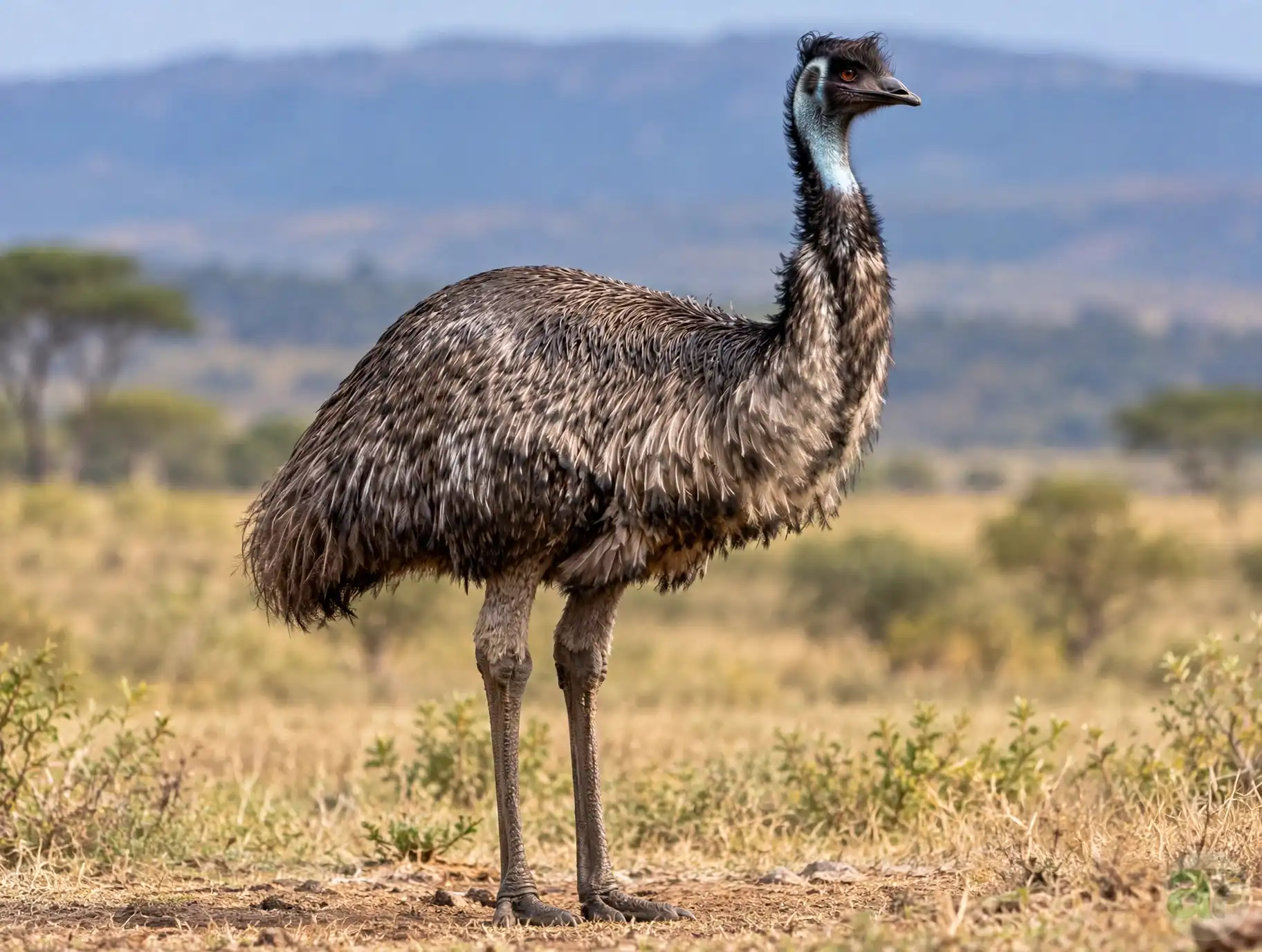
19. Best Places to See Emus in the Wild
Most Reliable Wild Emu Viewing
1. Kangaroo Island, South Australia
Despite the original Kangaroo Island emu subspecies being extinct since the 1820s, mainland emus have been introduced to Kangaroo Island and are now established as a wild population. The island’s wildlife-focused tourism infrastructure and the emus’ relatively habituated behavior around visitors makes this one of the most accessible emu viewing experiences in Australia.
2. Flinders Ranges National Park, South Australia
The spectacular red rock landscape of the Flinders Ranges supports wild emus that are regularly seen from park roads and walking tracks. The combination of dramatic scenery, accessible roads, and regular emu presence makes this one of the finest Australian outback wildlife destinations. Emus are most reliably seen at Wilpena Pound and along the road networks throughout the ranges.
3. Sturt National Park, New South Wales (Corner Country)
The vast semi-arid landscapes of far western New South Wales’ “Corner Country” — accessible from Tibooburra — support significant wild emu populations that move through this remote outback area in large mobs. This is genuine outback emu watching — large groups of emus in remote, spectacular landscape.
4. Western Australian Wheatbelt
The agricultural region of western Australia’s wheatbelt — the setting of the Great Emu War — continues to receive large emu aggregations during movement years. Merredin, Narrogin, Northam, and surrounding districts see large emu mobs periodically. For visitors interested in the historical context of the Great Emu War, this region provides both the wildlife encounter and the historical setting simultaneously.
5. Outback Roads of South Australia, New South Wales, and Queensland
The simplest and most accessible emu viewing in Australia — driving the Strzelecki Track, Oodnadatta Track, Birdsville Track, and other outback highways consistently produces roadside emu encounters. Emus show relatively little fear of slow-moving vehicles and often approach the roadside closely. This roadside emu encounter is one of the most characteristic Australian outback experiences.
Wildlife Parks and Sanctuaries
6. Cleland Wildlife Park, Adelaide Hills, South Australia
One of Australia’s finest wildlife parks — Cleland maintains walk-through areas where emus move freely among visitors, allowing extraordinary close-range observation of emu behavior, feeding, and social interaction. The park’s emu encounters are among the most intimate large bird wildlife experiences available to Australian visitors.
7. Featherdale Wildlife Park, Doonside, New South Wales (near Sydney)
Accessible from Sydney — Featherdale maintains emus in walk-through areas allowing visitor interaction. The most accessible emu encounter for the millions of visitors to the Sydney region annually.
8. Healesville Sanctuary, Victoria
The premier wildlife sanctuary of Victoria — Healesville maintains excellent emu exhibits in naturalistic enclosures with exceptional interpretive information about emu ecology, behavior, and conservation.
20. How You Can Help
Supporting emu conservation and promoting ethical human-emu interaction requires differentiated action across different contexts.
Support these organizations:
- BirdLife Australia — birdlife.org.au — Australia’s primary bird conservation organization; monitoring emu populations, advocating for wildlife-friendly agricultural practices, maintaining bird distribution databases
- Australian Wildlife Conservancy (AWC) — australianwildlife.org — private land conservation including habitat management beneficial to emus; removing feral predators from large conservation properties
- NSW National Parks and Wildlife Service — npws.dpie.nsw.gov.au — manages NSW national parks supporting wild emu populations
- Birds Australia — various bird monitoring programs including emu population surveys using citizen science
- Kangaroo Island Land for Wildlife — supporting native habitat restoration on Kangaroo Island where emu populations have been reestablished
- Indigenous Ranger Programs — supporting Aboriginal and Torres Strait Islander ranger programs that incorporate traditional emu ecological knowledge into conservation management
Critical individual actions:
Drive carefully in emu country — Road collisions are a significant emu mortality source across the outback road network. Reducing speed at dawn and dusk (when emus are most active near roads), using high beams on outback roads at night, and being prepared for emus to cross unexpectedly prevents the vehicle strikes that kill thousands of emus annually.
Support ethically certified emu products — If purchasing emu oil or other emu products, choosing products from farms with strong animal welfare standards reduces the demand that can drive irresponsible farming. Look for Australian emu farm certification and animal welfare certification.
Participate in citizen science — Submitting emu sightings to eBird and iNaturalist during travel in Australia contributes to population distribution monitoring that informs conservation management.
Support feral predator control — Fox and feral cat predation on emu eggs and chicks is a significant population pressure in southern Australia. Supporting organizations that conduct ethical feral predator control (baiting, trapping) in areas overlapping with emu breeding habitat directly improves emu nest success rates.
Engage with Aboriginal astronomical traditions — Supporting programs that preserve and share the Aboriginal “Emu in the Sky” astronomical tradition — including school programs, public lectures, and cultural events — maintains one of the world’s most unique and most sophisticated human-bird knowledge systems.
Avoid feeding wild emus — While the temptation to feed roadside emus is understandable, human food provision habituates emus to approaching vehicles and people — increasing their vulnerability to vehicle strike, agricultural conflict, and general loss of natural fear responses. Enjoy emus from a respectful distance without feeding.
21. Top Documentaries & Books
Must-Watch Documentaries
“Australia” (BBC, David Attenborough, 2024) — The most recent comprehensive BBC treatment of Australian wildlife includes emu content in spectacular Australian landscape footage; essential viewing for anyone interested in Australian wildlife broadly.
“Wild Australia” (various ABC Australia and BBC productions) — Multiple Australian Broadcasting Corporation productions covering Australian wildlife include comprehensive emu content — the ABC’s archive contains some of the finest emu natural history footage available.
“The Great Emu War” (various documentary productions) — Multiple dedicated documentary treatments of the 1932 Great Emu War have been produced for Australian television — providing historical recreation, expert commentary, and archival material from the military operation. The ABC’s archive includes historical audio and documentary content from the period.
“Emu in the Sky” (various documentary and educational productions) — Several Australian educational documentary productions specifically address the Aboriginal astronomical tradition of the dark emu constellation — providing both astronomical and cultural context for this unique knowledge system.
“David Attenborough’s Australia” — Multiple Attenborough-narrated productions covering Australian wildlife provide high-quality emu content in the context of broader Australian natural history.
Must-Read Books
The Emu: Australia’s Largest Bird (various Australian natural history authors) — Several comprehensive popular natural history treatments of the emu exist from Australian publishers; current editions from CSIRO Publishing provide the most scientifically current popular accounts.
Emu Dreaming: An Introduction to Australian Aboriginal Astronomy by Duane Hamacher — The most accessible popular account of Aboriginal Australian astronomical traditions including the Emu in the Sky; essential reading for understanding the intersection of emu biology and indigenous knowledge systems.
The Great Emu War (various journalistic and historical accounts) — Multiple readable historical accounts of the 1932 military operation are available; Andrew Ure’s detailed account in the Australian Geographic and various academic historical papers provide the most thoroughly documented treatments.
A Complete Guide to Antarctic Wildlife by Hadoram Shirihai — While focused on Antarctic birds, provides essential context for ratite evolution and biology that illuminates the emu’s place in the broader flightless bird story.
The Life of Birds by David Attenborough — Classic popular ornithology providing essential context for understanding emu behavior within the broader framework of avian reproduction and parental care.
22. Emu Comparison with Other Ratites and Large Birds
| Feature | Emu | Ostrich | Cassowary | Rhea | Kiwi | Wedge-tailed Eagle |
|---|---|---|---|---|---|---|
| Scientific name | Dromaius novaehollandiae | Struthio camelus | Casuarius casuarius | Rhea americana | Apteryx australis | Aquila audax |
| Height | 150–190 cm | Up to 280 cm | Up to 170 cm | Up to 140 cm | 25–65 cm | N/A (flier) |
| Weight | 18–60 kg | Up to 156 kg | Up to 85 kg | Up to 40 kg | Up to 3.5 kg | Up to 5.8 kg |
| Top speed | 48–50 km/h | 70–96 km/h | ~50 km/h | ~60 km/h | ~20 km/h | N/A (flier) |
| Toes | 3 | 2 | 3 + casque | 3 | 4 | 4 |
| Unique anatomy | Only bird with calf muscle | Only bird with 2 toes | Head casque | — | Nostril at bill tip | — |
| Parental care | Male sole carer; 56-day fast | Both sexes share | Male sole carer | Male sole carer | Both share | Both share |
| Flight | No | No | No | No | No | Yes — apex flier |
| Range | Australia | Africa | New Guinea, NE Australia | South America | New Zealand | Australia broadly |
| Conservation | Least Concern | Least Concern | Vulnerable | Near Threatened | Endangered | Least Concern |
| Famous for | Great Emu War; Coat of Arms; calf muscle | Largest/fastest; eye-brain; head-sand myth | Most dangerous bird; casque | South American ratite | Nocturnal; smell-navigation | Australia’s largest raptor; emu predator |
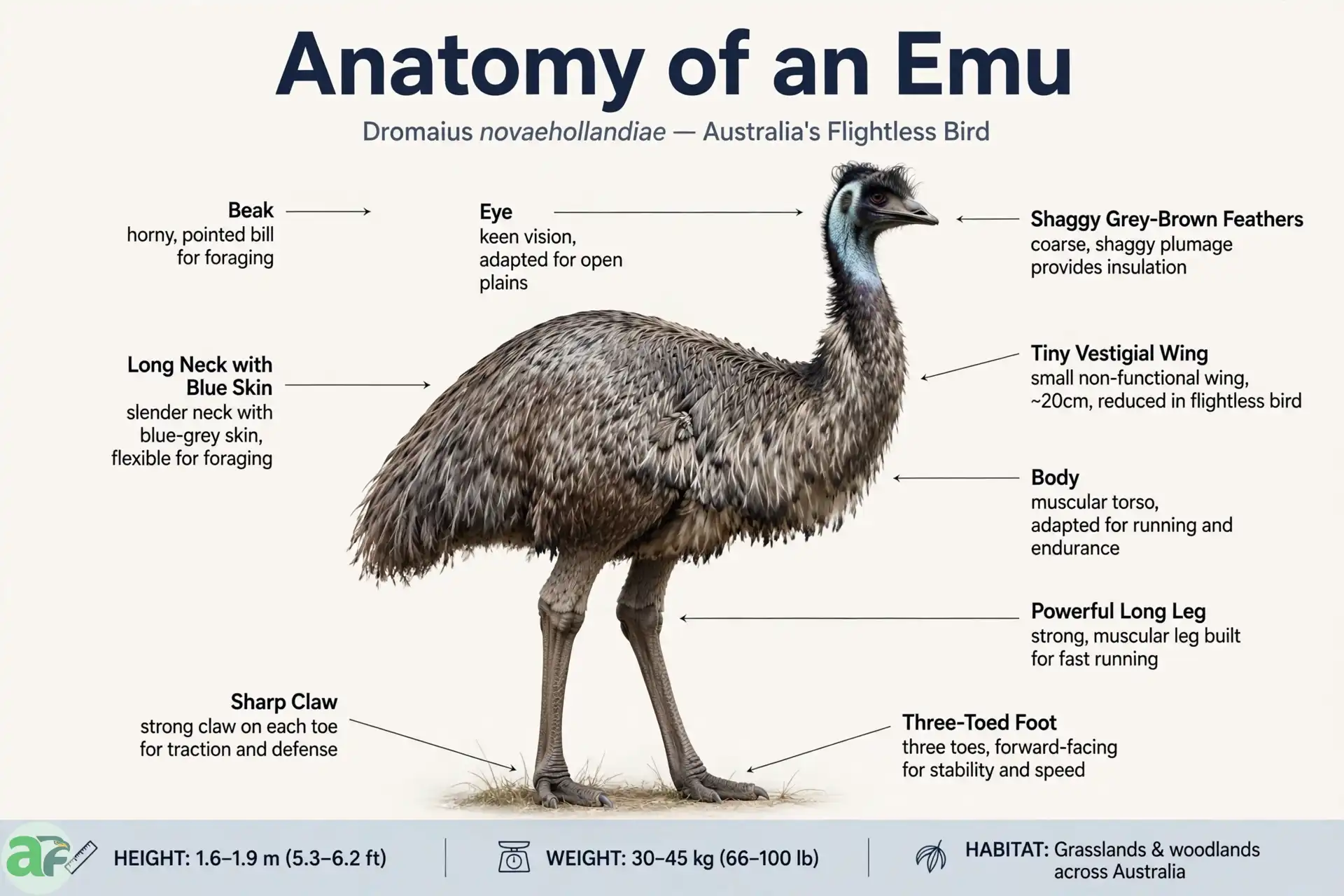
23. Frequently Asked Questions About Emus
Q1. What is the scientific name of the emu and what does it mean?
The emu’s scientific name is Dromaius novaehollandiae (Latham, 1790). The genus name Dromaius derives from the ancient Greek dromos (a running or race course) — essentially meaning “fast-running” or “the runner,” a reference to the emu’s notable terrestrial speed capability. The species name novaehollandiae is Latin for “of New Holland” — New Holland being the historical European name for Australia used before the name “Australia” was standardized by the explorer Matthew Flinders following his circumnavigation of the continent in 1803. The formal scientific description was provided by English ornithologist John Latham in 1790, based on specimens collected during the early years of British colonization of New South Wales. The family name Dromaiidae and the genus Dromaius both reference the same running characteristic. The common name “emu” is of uncertain etymology — the most widely accepted origins are either from the Arabic na’amu (large bird, specifically ostrich) via Portuguese ema (a general term for a large bird), or from an Aboriginal Australian language term for the bird. The Arabic-Portuguese pathway would mean the emu shares its common name origin with the Arabic word for ostrich — a remarkable etymological connection between Australia’s largest bird and Africa’s largest bird.
Q2. What actually happened in the Great Emu War of 1932?
The Great Emu War was a wildlife management operation conducted by the Australian military in the Campion district of Western Australia in November–December 1932. The context: ex-soldier wheat farmers in Western Australia were experiencing significant crop damage from emus — approximately 20,000 birds had migrated from the drought-affected interior into the farming districts following a particularly severe dry period. The farmers petitioned the federal government, which authorized a military response. Major G.P.W. Meredith of the Royal Australian Artillery, two soldiers, and two Lewis light machine guns were deployed with approximately 10,000 rounds of ammunition. The operation failed for several reasons: emus moved in small, dispersed groups rather than concentrated masses; the birds absorbed gunfire remarkably well (multiple witnesses reported emus continuing to run after being hit by multiple bullets); the Lewis guns jammed repeatedly in the dusty conditions; the birds retreated into scrub before concentrated fire could be brought to bear; and the open, irregular terrain prevented effective herding of large numbers toward the guns. After the first operational phase (November 2–12, 1932) produced approximately 50 confirmed kills from 2,500 rounds, Major Meredith was recalled amid parliamentary debate. A second operation achieved somewhat better results but did not significantly reduce the emu population in the farming area. The total documented outcome: approximately 9,860 rounds expended for approximately 986 confirmed emu kills — a rate of approximately 10 bullets per confirmed kill. Major Meredith himself reportedly praised the emus’ resilience with expressions of professional admiration. The term “Great Emu War” was applied retrospectively and has become the standard description of the episode in both popular and historical accounts.
Q3. How does the male emu survive without eating for 56 days?
The male emu’s 56-day incubation fast is one of the most extreme parental investment events in the bird world, sustained through a combination of preparatory fat deposition, metabolic rate reduction, and muscle protein catabolism. Before settling on the nest, the male actively feeds to build substantial subcutaneous fat reserves — these fat stores are the primary energy source during the early and middle phases of the incubation fast. The male’s resting metabolic rate decreases significantly during incubation — reducing energy requirements through a combination of behavioral changes (reduced activity, lower body temperature maintenance requirements) and physiological adaptations. After fat reserves are substantially depleted (typically in the final 2–3 weeks of incubation), the male begins catabolizing muscle protein — breaking down his own muscle tissue to release amino acids that are converted to glucose for brain function. The male sustains minimal hydration through licking dew from surrounding vegetation — providing trace water without requiring him to leave the nest. By the end of the 56-day fast, a male that began at approximately 45 kg may weigh as little as 29–31 kg — having lost approximately 30–35% of his total body mass. The physiological mechanisms that allow this level of sustained catabolism without organ failure represent specific adaptations that have evolved alongside the emu’s unusual parental care system — the male’s physiology having been shaped by millions of years of selection pressure for individuals that could complete the incubation fast and still survive to care for the resulting chicks.
Q4. Are emus dangerous to humans?
Emus can pose genuine physical danger to humans in specific contexts, though unprovoked attacks on people simply walking in the landscape are uncommon. The primary danger situations: Males defending chick groups are among the most aggressive large birds documented in Australia — a male emu defending his chick group will actively attack approaching humans, dogs, or other potential threats regardless of size. These attacks involve the emu’s three-toed kick, which can deliver significant force sufficient to cause bruising, lacerations, broken bones, or internal injury in extreme cases. Wild emus that have been habituated to human food provision may become aggressive in anticipation of being fed — approaching and kicking or pushing people who do not provide food. Captive or farm emus can be dangerous to handlers unfamiliar with their behavior — emus are faster than humans and can deliver unexpected kicks. The physical danger from emus is not comparable to the threat from large carnivores, and fatalities from emu attacks are not documented in Australia, but serious injuries requiring medical treatment are recorded. The appropriate response to an approaching emu displaying threat behavior (puffed feathers, raised neck feathers, direct approach) is to back away slowly, maintain eye contact, and avoid turning away or running.
Q5. Where is the best place to see wild emus in Australia?
The most reliable wild emu viewing in Australia is available across a range of settings. For the most accessible experience, walk-through wildlife parks including Cleland Wildlife Park (Adelaide) and Featherdale Wildlife Park (Sydney) provide extraordinary close-range encounters with emus in naturalistic settings. For wild encounters in natural landscape, the Flinders Ranges National Park in South Australia combines spectacular scenery with reliable wild emu populations visible from park roads — the combination of impressive landscape and regular wildlife encounters making this one of Australia’s finest wildlife destinations. For genuine outback emu encounters, driving the Strzelecki Track, Oodnadatta Track, or Birdsville Track in South Australia and Queensland consistently produces roadside emu encounters in spectacular remote landscape. For visitors interested in the Great Emu War historical context, the Campion district of Western Australia (accessible from Merredin or Northam) provides the geographical setting where the military operations occurred — and where emus continue to be present in agricultural areas during movement years. For the most dramatically scenic setting, the combination of wild emus in the vast red-rock landscape of Sturt National Park in far western New South Wales provides one of the most atmospherically impressive Australian wildlife encounters available.
24. Sources & References
- Wikipedia — Dromaius novaehollandiae, Dromaiidae, Casuariiformes, Great Emu War, Emu in the Sky, Aboriginal Australian astronomy
- IUCN Red List — iucnredlist.org (Least Concern assessment for Dromaius novaehollandiae)
- BirdLife International — birdlife.org (species factsheet; population assessment)
- BirdLife Australia — birdlife.org.au (Australian emu population monitoring)
- Gould, J. — historical documentation of Australian emu subspecies
- Hamacher, D.W. and Frew, D. — published research on Aboriginal Australian “Emu in the Sky” astronomical tradition
- Meredith, G.P.W. — official military reports of the 1932 emu operations (National Archives of Australia)
- Australian Parliament — Hansard records of 1932 parliamentary debates on the emu operations
- National Geographic — nationalgeographic.com
- ABC Australia — abc.net.au (Australian natural history documentation)
- Britannica — britannica.com/animal/emu
- Cornell Lab of Ornithology — allaboutbirds.org (species account)
- Museum Victoria — museumsvictoria.com.au (Australian ornithology resources)