
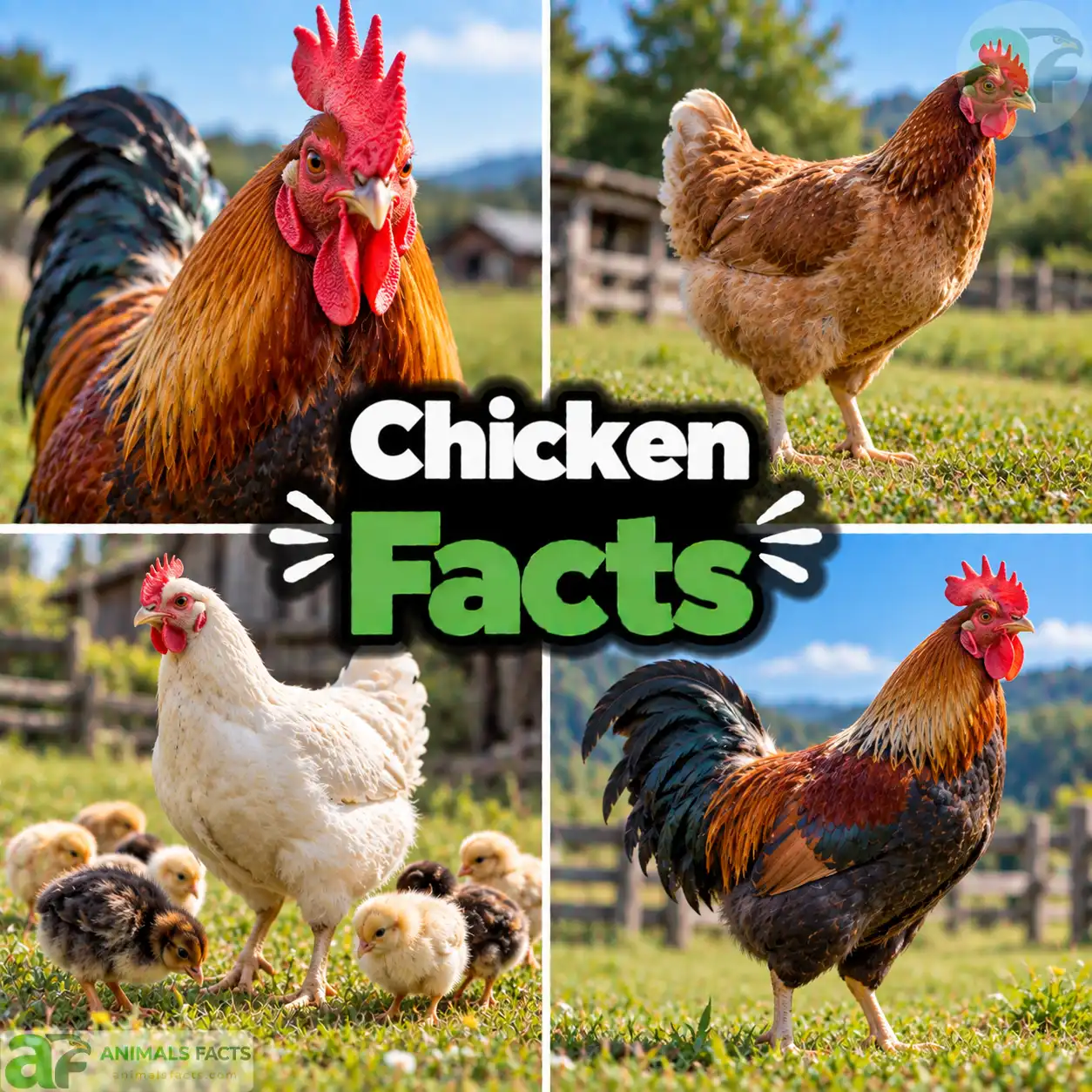
Chicken Facts
| Feature | Details |
|---|---|
| Scientific Name | Gallus gallus domesticus (domestic chicken); wild ancestor Gallus gallus (red junglefowl) |
| Common Names | Chicken, Hen (female), Rooster/Cock (male), Chick (young), Pullet (young female), Cockerel (young male) |
| Kingdom | Animalia |
| Phylum | Chordata |
| Class | Aves |
| Order | Galliformes |
| Family | Phasianidae |
| Habitat | Domesticated globally; wild ancestor inhabits forest and forest-edge habitat across South and Southeast Asia |
| Lifespan | 5–10 years for domestic chickens; up to 15 years for some backyard/heritage breeds |
| Diet | Omnivore — grains, seeds, insects, worms, small vertebrates on occasion |
| Weight | 1–4.5 kg, varying enormously by breed |
| Height | 0.3–0.7 meters, varying by breed |
| Speed | Can run up to 14 km/h (9 mph); capable of brief low flight |
| Conservation Status | Domestic chicken: Domesticated (not assessed); wild ancestor (red junglefowl): Least Concern |
| Global Population | Approximately 26 billion — the most numerous bird on Earth by a substantial margin |
| Unique Feature | Outnumbers every other bird species on the planet combined at any given time; retains genetic and behavioral traits directly traceable to Tyrannosaurus rex and other theropod dinosaurs through its avian lineage |
 1. Introduction: What is a Chicken?
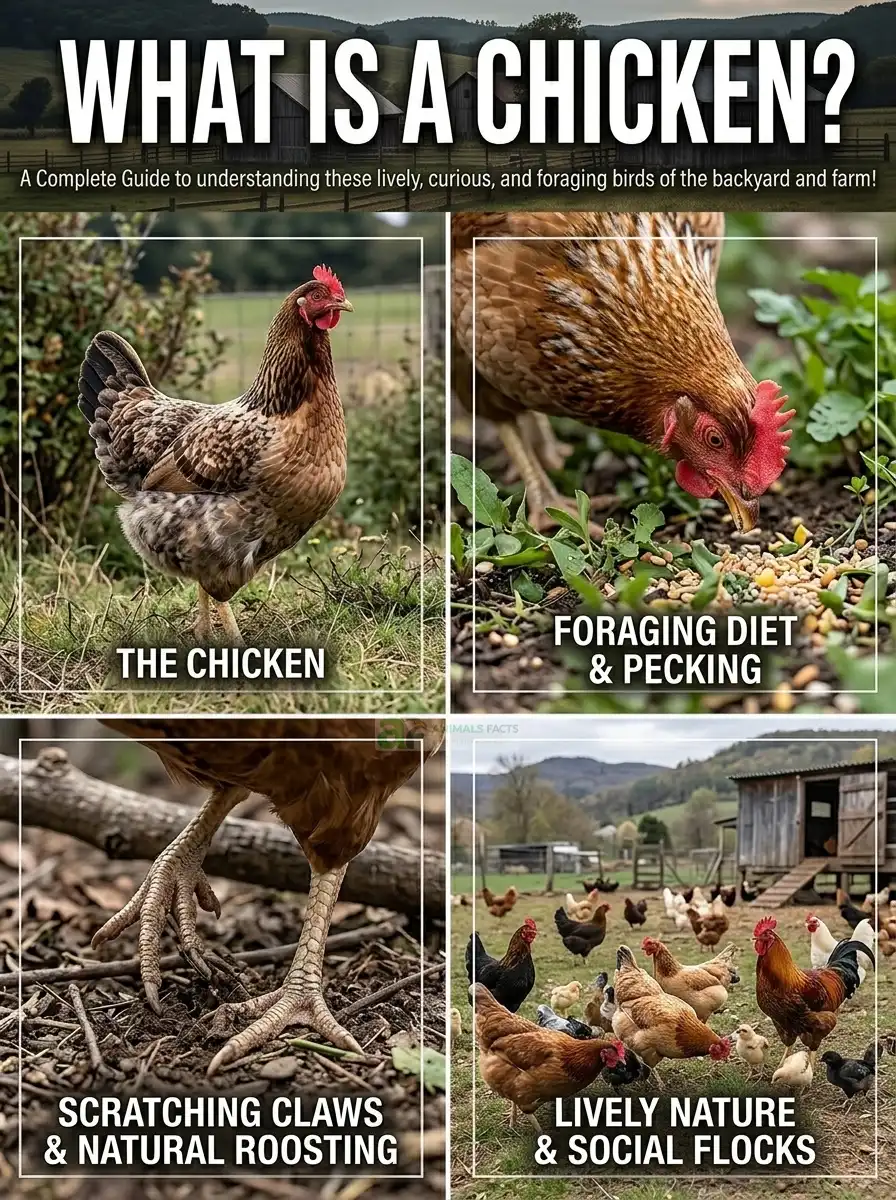
At any single moment, there are more of them alive on Earth than there are humans — roughly 26 billion, spread across virtually every country on the planet, making the chicken not merely a common bird but, by a wide margin, the single most numerous bird species that has ever existed in the history of the planet. Chicken facts introduce readers to an animal so thoroughly woven into the fabric of daily human life across nearly every culture that its true biological complexity, intelligence, and remarkable evolutionary history are almost entirely overlooked — hiding in plain sight behind one of the most familiar and unassuming faces in the entire animal kingdom.
The domestic chicken (Gallus gallus domesticus) descends from the red junglefowl (Gallus gallus), a wild pheasant-family bird still found today across the forests of South and Southeast Asia. Chicken domestication ranks among the most consequential and geographically successful animal domestication events in human history, beginning at least 8,000 years ago in Southeast Asia and subsequently spreading to become the single most widely distributed domesticated bird species on Earth — a domestication story whose scale and global reach is arguably unmatched by any other animal, wild or domesticated, in the modern world.
Beyond their sheer numerical dominance, chickens have increasingly become the subject of serious scientific research into avian cognition, revealing a level of intelligence, social complexity, and even emotional sophistication that stands in sharp contrast to the chicken’s long-standing cultural reputation as an unintelligent, unremarkable farmyard bird. From documented numerical reasoning abilities to complex vocal communication systems with dozens of distinct meaningful calls, to genuine problem-solving capacity, modern research paints a picture of an animal far more cognitively capable than popular stereotype suggests — and, remarkably, an animal whose evolutionary lineage traces directly back through the dinosaurs, making the humble chicken one of the closest living relatives of Tyrannosaurus rex according to genetic and paleontological research.
Whether you’re a student researching chicken facts for a school project, a backyard poultry keeper wanting to better understand chicken behavior and welfare, someone fascinated by the genuine scientific surprises behind chicken intelligence and dinosaur ancestry, a parent looking for chicken facts for kids, or simply someone who has always wondered exactly how the chicken and the egg question really works, this guide covers everything — chicken habitat, chicken diet, the extraordinary biology and dinosaur connection, reproduction, social intelligence, domestication history, mythology, and much more. This is the most complete guide to chicken facts you will find anywhere.
2. Chicken Species Overview & Classification
The domestic chicken belongs to the family Phasianidae, which includes pheasants, partridges, quail, and peafowl, and more specifically to the genus Gallus, a small genus containing the domestic chicken’s wild ancestor and several closely related wild junglefowl species found across South and Southeast Asia.
Classification Table
| Level | Classification |
|---|---|
| Kingdom | Animalia |
| Phylum | Chordata |
| Class | Aves |
| Order | Galliformes |
| Family | Phasianidae |
| Genus | Gallus |
| Species | G. gallus |
| Subspecies (Domestic) | G. g. domesticus (domestic chicken) |
| Wild Ancestor | Red Junglefowl (Gallus gallus), with documented genetic contributions from other Gallus species |
| Closest Living Relatives | Grey junglefowl, Ceylon junglefowl, green junglefowl (all genus Gallus) |
The Genus Gallus — Wild Junglefowl Species
| Species | Scientific Name | Range | Conservation Status |
|---|---|---|---|
| Red Junglefowl | Gallus gallus | South/Southeast Asia | Least Concern |
| Grey Junglefowl | Gallus sonneratii | Southern India | Least Concern |
| Ceylon Junglefowl | Gallus lafayettii | Sri Lanka (national bird) | Least Concern |
| Green Junglefowl | Gallus varius | Indonesia (Java and nearby islands) | Least Concern |
An Estimated 500+ Recognized Domestic Chicken Breeds
Domestic chickens have been selectively bred into an extraordinary array of distinct breeds worldwide, with estimates suggesting well over 500 recognized breeds and varieties, developed for egg production, meat production, ornamental purposes, and increasingly for backyard and hobby keeping — a breed diversity reflecting the chicken’s status as one of the most extensively and purposefully bred domesticated animals in human history.
Species Evolution & Discovery Timeline
~66 million years ago: Following the mass extinction event that eliminated non-avian dinosaurs, the surviving avian dinosaur lineage — the direct ancestors of all modern birds, including the eventual ancestors of the genus Gallus — began the evolutionary radiation that would give rise to the roughly 10,000+ bird species alive today.
~58 million years ago: The order Galliformes, which includes chickens, pheasants, turkeys, and related “game birds,” is estimated to have diverged as a distinct evolutionary lineage.
Multiple genetic studies (2020s): Genetic and paleontological research has confirmed that birds, including chickens, are the closest living relatives of the theropod dinosaur lineage that includes Tyrannosaurus rex, based on both fossil evidence and, notably, preserved protein sequences recovered from T. rex fossil remains showing closer molecular similarity to chickens than to most other living animals tested.
~8,000 years ago: Chicken domestication began in Southeast Asia, likely in the region spanning modern-day Thailand, Vietnam, and southern China, from the wild red junglefowl — though the precise timing, location, and number of independent domestication events remains an active area of ongoing genetic research and some scientific debate.
~3,000–2,000 years ago: Domesticated chickens spread substantially across Asia, the Middle East, Africa, and Europe, becoming increasingly integrated into agricultural economies, religious practice, and, notably, early cockfighting traditions across numerous ancient civilizations.
Ancient Egyptian, Greek, and Roman civilizations: Chickens became firmly established figures within agricultural life, religious symbolism, and — significantly — the practice of “reading” chicken behavior for omens and divination purposes (a practice called “alectryomancy”) across numerous ancient Mediterranean cultures.
15th–19th centuries CE: European colonization and global maritime trade spread domestic chickens to virtually every inhabited continent, including the Americas, Australia, and remote oceanic islands, cementing the species’ status as the most globally distributed domesticated bird.
19th–20th centuries: Significant breed specialization occurred, giving rise to highly specialized modern egg-laying and meat-production breeds, alongside the establishment of formal breed standards and registries across major poultry-producing nations.
Mid-20th century onward: The rise of large-scale industrial poultry farming dramatically transformed chicken production, with selective breeding for rapid growth and high egg production fundamentally reshaping the physical characteristics and growth rates of commercial chicken breeds compared to their heritage and wild ancestors.
2026: The global chicken population stands at approximately 26 billion, making the domestic chicken by far the most numerous bird species on the planet — outnumbering the combined populations of all wild bird species on Earth — while the wild red junglefowl ancestor remains classified as Least Concern, though facing localized threats from habitat loss and genetic dilution through hybridization with free-ranging domestic and feral chickens across parts of its native range.
3. Chicken Physical Description & Unique Features
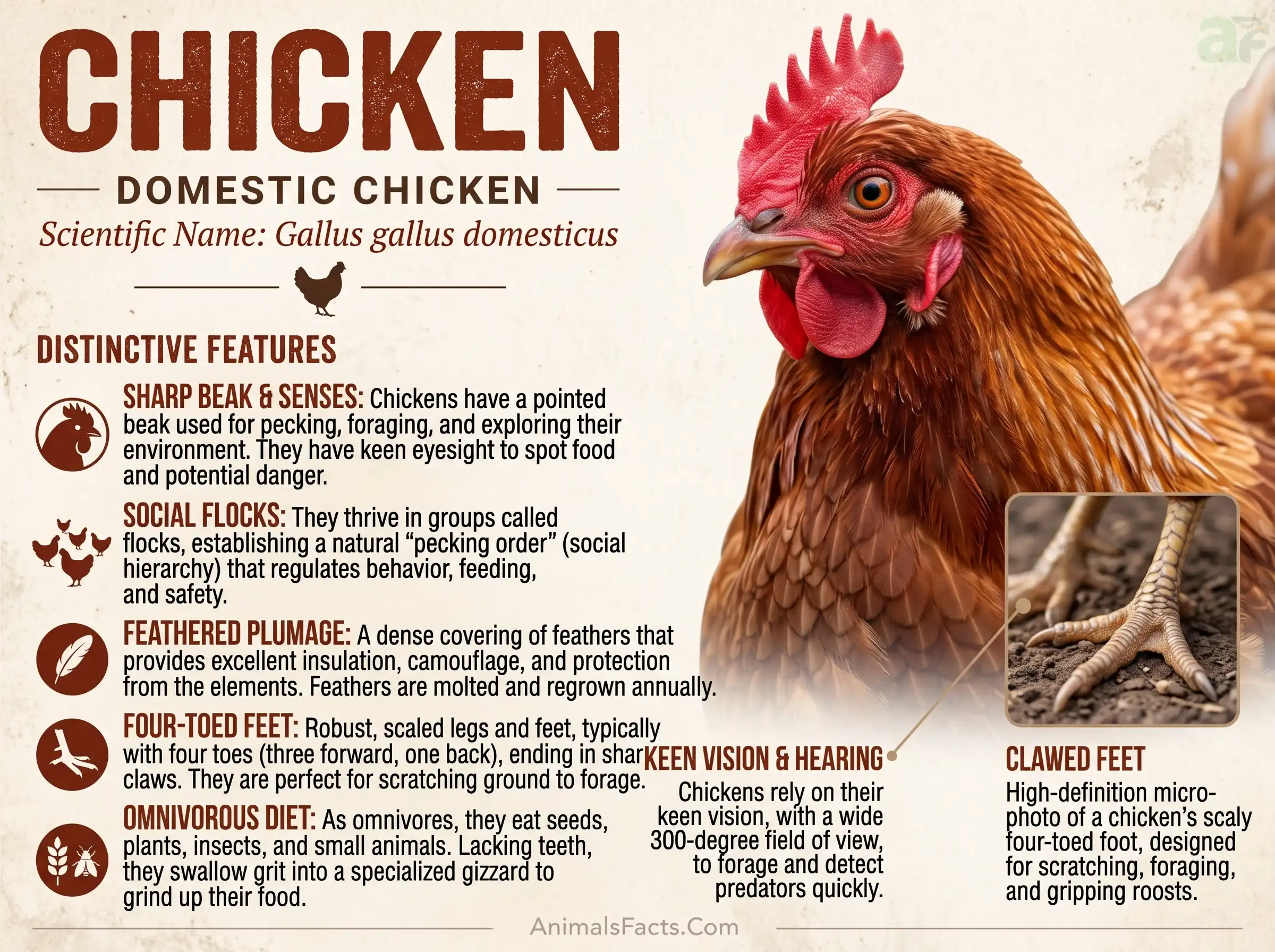
Domestic chickens display enormous physical variation across their hundreds of breeds, yet share a core anatomical structure inherited from their wild junglefowl ancestor, along with several genuinely remarkable biological features often overlooked given the species’ extreme familiarity.
Size and Build
- Weight: Ranges dramatically from under 1 kg in small bantam breeds to over 4.5 kg in large commercial meat breeds, with roosters (males) generally larger than hens (females).
- Height: 0.3–0.7 meters, varying considerably by breed.
- Build: A compact, ground-adapted body structure with relatively short, rounded wings poorly suited to sustained flight, reflecting the species’ predominantly ground-dwelling lifestyle.
The Remarkable Dinosaur Connection
Perhaps the single most scientifically fascinating chicken fact is the species’ documented close evolutionary relationship to dinosaurs — a connection that has moved from theoretical paleontological inference to direct molecular evidence in recent decades.
Molecular evidence: In a landmark series of studies, researchers successfully recovered and analyzed preserved collagen protein sequences from Tyrannosaurus rex fossil remains, finding that the recovered protein sequences showed closer molecular similarity to chicken proteins than to those of most other tested animals, including alligators — providing direct molecular support for the long-established paleontological understanding that birds represent the surviving lineage of theropod dinosaurs.
Shared anatomical features: Chickens and their bird relatives retain a number of skeletal and developmental features directly traceable to their theropod dinosaur ancestry, including hollow bones, a wishbone (furcula) structure, and scaled legs and feet that represent a direct evolutionary holdover from reptilian ancestry.
Ongoing “chickenosaurus” research: Some paleontologists and developmental biologists have pursued research exploring whether latent ancestral genetic pathways within chicken embryonic development could theoretically be manipulated to express more dinosaur-like features (such as a bony tail or teeth) — a genuinely serious area of evolutionary developmental biology research sometimes informally referred to as the “chickenosaurus” project, though no such experiment has resulted in a living modified animal.
The Comb and Wattles
Chickens possess distinctive fleshy structures on the head — the comb (on top of the head) and wattles (hanging beneath the beak) — which serve several important biological functions:
Thermoregulation: The comb and wattles are richly supplied with blood vessels, allowing chickens to dissipate excess body heat efficiently, particularly important given that chickens, like other birds, lack sweat glands.
Social and reproductive signaling: Comb size, color, and condition serve as visible indicators of a chicken’s health, hormonal status, and social rank, playing a significant role in both hen mate-selection preferences and rooster-to-rooster dominance signaling.
Breed variation: Comb shape varies considerably across different chicken breeds, including the classic single comb, rose comb, pea comb, and several other distinct forms, each resulting from specific genetic variations selected for over generations of breeding.
Vision and Color Perception
Chickens possess notably sophisticated color vision, with research suggesting chickens can perceive a broader range of color, including some ultraviolet wavelengths invisible to human vision, than most mammals — a visual capability that likely plays an important role in foraging efficiency, mate selection, and social recognition among flock members.
Nearly panoramic field of view: With eyes positioned on the sides of the head, chickens possess a wide field of view approaching 300 degrees, an important predator-detection adaptation for a ground-dwelling bird historically subject to significant predation pressure.
Feathers and Molting
Chickens undergo an annual molt, during which old feathers are shed and replaced with new ones, typically triggered by seasonal changes in day length; egg production commonly decreases significantly or stops entirely during the molting period as the hen’s body redirects nutritional resources toward feather regrowth rather than egg production.
Did You Know? Chickens are considered by many paleontologists and evolutionary biologists to be among the closest living relatives of Tyrannosaurus rex — a genuinely startling fact given the chicken’s small size and unassuming reputation, but one grounded in solid molecular and paleontological evidence establishing birds as the direct evolutionary descendants of theropod dinosaurs, making every backyard chicken coop, in a very real sense, home to living dinosaurs.
4. Top 25 Surprising & Interesting Chicken Facts
- There are approximately 26 billion chickens alive on Earth at any given time — more than any other bird species by a wide margin.
- Chickens are considered among the closest living relatives of Tyrannosaurus rex, based on molecular protein evidence recovered from T. rex fossils.
- The domestic chicken descends from the wild red junglefowl (Gallus gallus) of South and Southeast Asia.
- Chicken domestication began roughly 8,000 years ago in Southeast Asia.
- There are over 500 recognized chicken breeds and varieties worldwide.
- Chickens can perceive a broader color range than most mammals, including some ultraviolet wavelengths.
- Chickens have a nearly 300-degree field of view, thanks to eyes positioned on the sides of the head.
- Hens can lay eggs without a rooster present — a rooster is only needed for the eggs to be fertilized.
- A hen’s egg-laying cycle takes approximately 24–26 hours to produce a single egg.
- Chickens are capable of complex numerical reasoning, with research showing chicks can perform basic arithmetic-like tasks.
- Chickens use over 24 distinct vocalizations, each with specific meanings related to food, danger, and social contact.
- A mother hen begins communicating with her chicks through vocalizations before they even hatch, while still inside the egg.
- Chickens establish a social ranking system known as the “pecking order” — the original source of this now-common English idiom.
- Chickens can run at speeds of up to 14 km/h.
- The record for the longest-lived chicken, verified by Guinness World Records, exceeded 20 years.
- Roosters have an internal biological clock and will crow at consistent times regardless of light conditions, even in constant darkness or constant light.
- Chickens practice a form of deception, with subordinate roosters sometimes suppressing food calls to avoid alerting dominant rivals to a food source.
- A chicken’s heart beats approximately 250–300 times per minute.
- Chickens dream, exhibiting brain activity patterns during sleep similar to REM sleep documented in mammals.
- The world’s largest chicken egg on record weighed nearly 454 grams (1 pound) and contained a double yolk and shell-within-shell anomaly.
- Chickens can recognize and remember over 100 individual faces, both chicken and human.
- Ancient Romans and Greeks practiced “alectryomancy” — divination based on observing chicken pecking behavior.
- The Ceylon junglefowl, a wild relative of the domestic chicken, is the national bird of Sri Lanka.
- Chickens have been sent to space as part of biological research related to avian development in microgravity.
- Despite popular belief, chickens are not entirely flightless — they can achieve brief, low bursts of flight, generally covering short distances.

5. Fun Facts About Chickens
- There are about 26 billion chickens on Earth.
- Chickens are close relatives of T. rex!
- They descend from the wild red junglefowl.
- Domestication began about 8,000 years ago.
- There are over 500 chicken breeds.
- Chickens see ultraviolet light.
- Their vision covers almost 300 degrees.
- A hen doesn’t need a rooster to lay eggs.
- Chicks “talk” to their mom before hatching.
- The “pecking order” comes from real chicken behavior.
- Chickens can run up to 14 km/h.
- A chicken’s heart beats 250–300 times/minute.
- Chickens have been shown to dream.
- The longest-lived chicken lived over 20 years.
6. Chicken Habitat & Geographic Range
While the domestic chicken’s range today is almost entirely determined by human agricultural distribution, understanding chicken habitat requires examining the wild red junglefowl ancestor’s natural range, alongside the enormous global distribution domestic chickens now occupy.
Wild Red Junglefowl Habitat
The wild red junglefowl, ancestor to all domestic chickens, favors:
Tropical and subtropical forest: Dense forest and forest-edge habitat across South and Southeast Asia, providing cover from predators and access to the seeds, insects, and other food sources making up its natural diet.
Bamboo forest and scrubland: Particularly favored habitat types within the junglefowl’s native range, offering dense ground cover.
Agricultural forest edges: Red junglefowl frequently utilize habitat at the boundary between forest and human agricultural land, a behavioral tendency believed to have significantly facilitated the species’ initial domestication.
Domestic Chicken Global Distribution
Geographic Range Table
| Region | Chicken Population Status | Notes |
|---|---|---|
| Asia (particularly China) | Very high | World’s largest chicken populations by a significant margin |
| North America (USA) | Very high | Major global poultry production center |
| South America (Brazil) | Very high | Leading global poultry meat exporter |
| Europe | High | Long-established egg and meat production traditions |
| Africa | High, growing | Both traditional smallholder and increasing commercial production |
| Southeast Asia | High | Wild red junglefowl native range, alongside extensive domestic populations |
Did You Know? China and the United States together account for a substantial proportion of the world’s total chicken population, with China alone home to well over 5 billion chickens at any given time — reflecting both countries’ status as major global centers of both egg and meat poultry production within the modern industrial agricultural system.
7. Chickens Diet & Feeding Behavior
Chickens are omnivores with a naturally broad and opportunistic diet, reflecting their wild junglefowl ancestor’s forest-floor foraging lifestyle.
Diet Breakdown Table
| Food Type | Approximate Percentage | Notes |
|---|---|---|
| Grains and seeds | 40–60% | Primary component of most commercial and backyard diets |
| Insects and invertebrates | 15–25% | Actively foraged when free-ranging; important protein source |
| Greens and vegetation | 15–20% | Grasses, weeds, and garden plants |
| Small vertebrates (occasional) | Small quantity | Chickens will opportunistically eat small lizards, mice, or frogs when encountered |
| Commercial feed supplements | Variable | Standard in most modern managed flocks |
Foraging Behavior
Free-ranging chickens display active, energetic foraging behavior, using their feet to scratch at ground litter and soil to expose insects, seeds, and other food items — a deeply ingrained natural behavior inherited directly from the wild junglefowl’s forest-floor foraging lifestyle, and one that remains strongly present even in chickens with many generations of domestic breeding behind them.
Omnivorous Opportunism
Despite their popular image as primarily grain-eating birds, chickens are genuinely opportunistic omnivores, readily consuming insects, worms, and even occasionally small vertebrates such as mice, frogs, or lizards when the opportunity arises — a dietary flexibility directly reflecting their wild ancestor’s adaptable forest-floor foraging strategy.
Did You Know? Chickens possess a specialized digestive organ called the gizzard, a muscular part of the stomach that grinds food using small stones or grit the bird has deliberately swallowed — since chickens, like other birds, lack teeth, this grit-based mechanical grinding process is essential for breaking down tough seeds and grains before further digestion, a genuinely elegant evolutionary solution to processing food without teeth.
8. Chicken Reproduction & Life Cycle
Chicken reproduction is extensively documented both through commercial poultry industry research and backyard chicken-keeping observation, given the species’ enormous economic and cultural significance.
Egg-Laying Biology
No rooster required for eggs: One of the most commonly misunderstood chicken facts is that hens do not require a rooster present to lay eggs regularly — a rooster is necessary only for the eggs to be fertilized and potentially develop into chicks; unfertilized eggs, the type most commonly sold and consumed commercially, are laid by hens regardless of rooster presence.
Laying cycle: A hen’s egg production cycle takes approximately 24–26 hours to produce a single egg, meaning a highly productive laying hen may not lay at exactly the same time each day, with the cycle gradually shifting later as it exceeds 24 hours.
Egg-laying rate: High-production commercial laying breeds can produce upward of 300 eggs per year, while heritage and backyard breeds typically produce fewer, often in the range of 150–250 eggs annually, with production naturally declining with the hen’s age.
Mating and Fertilization
Breeding age: Hens typically begin laying eggs around 18–22 weeks of age, while roosters generally reach sexual maturity slightly later.
Mating behavior: Rooster mating behavior includes characteristic courtship displays, and a fertile mating results in sperm storage within the hen’s reproductive tract, allowing eggs to remain fertile for one to two weeks following a single successful mating.
Incubation and Hatching
Incubation period: Fertilized chicken eggs require approximately 21 days of incubation, whether under a broody hen or in an artificial incubator, before hatching.
Pre-hatching communication: Remarkably, chicks begin vocalizing and can hear their mother hen’s vocalizations while still inside the egg during the final days before hatching, with documented evidence that this pre-hatching communication helps coordinate hatching timing among a clutch of eggs and begins the mother-chick vocal recognition bond even before birth.
Hatching process: Chicks use a specialized, temporary structure called an “egg tooth” — a small, sharp projection on the beak — to break through the eggshell during hatching, a structure that falls off naturally within a few days after hatching, having served its singular purpose.
Growth Stages Table
| Stage | Age | Development |
|---|---|---|
| Hatching | Day 21 (incubation) | Fully covered in down feathers; able to walk within hours |
| Chick stage | 0–8 weeks | Rapid growth; developing juvenile feathers |
| Pullet/Cockerel stage | 8 weeks–~5 months | Continued growth toward sexual maturity |
| Point of lay | ~18–22 weeks | Hens begin egg production |
| Full maturity | ~1 year | Complete physical development |
Chicken Lifespan Comparison Table
| Species/Type | Average Lifespan | Maximum Recorded |
|---|---|---|
| Domestic Chicken (backyard/heritage) | 5–10 years | 20+ years (record-verified) |
| Commercial Layer Hen | Often culled at 1.5–2 years commercially | — |
| Red Junglefowl (wild) | 5–8 years | ~15 years (captivity) |
| Turkey (comparison) | 3–5 years | ~10 years |
9. Social Behavior & Communication
Chickens are genuinely social flock animals with well-documented cognitive complexity, sophisticated vocal communication, and established social structures that have made them an increasingly significant subject of formal avian cognition research.
The Pecking Order
Perhaps the most famous chicken social behavior — and the direct origin of a now-universal English idiom — is the “pecking order,” a linear social dominance hierarchy that chickens establish within any flock, determining priority access to food, favored roosting spots, and other resources. This hierarchy is established and maintained through a combination of direct physical assertions (including actual pecking) and more subtle social signaling, with individual chickens generally able to recognize and remember their position relative to other specific flock members without needing to repeatedly re-establish rank through conflict.
Vocal Communication
Research has documented that chickens use more than 24 distinct vocalizations, each associated with specific meanings and contexts, including:
Alarm calls: Chickens produce distinct alarm vocalizations that vary depending on the type of threat detected — notably, research has found that chickens use different alarm calls for aerial predators (such as hawks) versus ground-based predators, allowing other flock members to respond with the most appropriate evasive behavior for the specific threat type.
Food calls: Distinct vocalizations associated with food discovery, which roosters in particular use to alert hens to a food source — research has also documented that subordinate roosters will sometimes suppress this food call when a dominant rooster is nearby, avoiding drawing attention to a food discovery they might otherwise lose access to, a genuinely sophisticated example of strategic vocal behavior.
Contact and distress calls: Ongoing vocalizations that help maintain flock cohesion and allow mother hens and chicks to maintain contact and recognize each other’s specific calls.
Cognitive Research Findings
Numerical reasoning: Research has demonstrated that chicks, even at just a few days old, can perform basic numerical discrimination tasks, including some evidence of simple arithmetic-like reasoning regarding quantities of objects.
Facial and individual recognition: Chickens have been documented recognizing and remembering over 100 individual faces, both chicken and human, reflecting genuinely sophisticated individual recognition capacity.
Sleep and dreaming: Research monitoring chicken brain activity during sleep has identified patterns consistent with REM (rapid eye movement) sleep similar to that documented in mammals, suggesting chickens may genuinely dream, though the specific content of any such dreams remains, naturally, entirely unknowable.
Did You Know? Researchers studying chicken vocal communication have documented that mother hens begin a specific, gentle vocalization directed at their eggs during the final days before hatching, and that chicks respond to and learn to recognize this specific maternal call while still inside the egg — meaning the mother-offspring bonding and recognition process in chickens genuinely begins before birth, a level of prenatal auditory learning that continues to surprise researchers studying avian cognition and development.
10. Predators & Defense Mechanisms
Chickens, both the wild red junglefowl ancestor and domestic breeds, face predation pressure from a wide range of terrestrial and aerial predators, and have developed both physical and behavioral defenses suited to their ground-dwelling lifestyle.
Natural Predators
Foxes: A globally significant predator of both wild junglefowl and domestic chickens, particularly across Europe and North America.
Hawks and Birds of Prey: Significant aerial predators, particularly targeting free-ranging chickens and chicks, with chickens displaying a specific, distinct alarm call reserved for aerial predator threats.
Snakes: Significant predators of eggs and young chicks, particularly across the wild junglefowl’s native tropical Asian range.
Raccoons, Weasels, and Similar Mammalian Predators: Common predators of domestic chickens across North America and elsewhere, often specifically targeting coops with inadequate security.
Domestic and Feral Dogs and Cats: A notable predation threat to domestic chickens in various settings worldwide.
Defense Mechanisms
Alarm vocalizations: As detailed in the social behavior section, chickens produce distinct, threat-specific alarm calls that alert other flock members and prompt appropriate evasive behavior depending on whether the threat is aerial or ground-based.
Flock vigilance: Group living provides collective predator detection benefits, with multiple flock members increasing overall threat-detection likelihood.
Roosting behavior: Chickens naturally seek elevated roosting positions at night, an instinctive behavior directly inherited from the wild junglefowl’s forest tree-roosting habits, providing some protection from ground-based nocturnal predators.
Brief flight capability: While not strong sustained fliers, chickens retain the ability to achieve short bursts of low flight, sufficient to escape to an elevated perch or clear a low obstacle when fleeing a ground predator.
Human and coop protection: For domestic chickens, secure coop housing, fencing, and active flock management represent the dominant modern defense against predation.
11. Chicken Facts for Kids
Hey kids — get ready to learn some seriously surprising things about one of the most common animals in the whole world!
Did you know there are about 26 BILLION chickens in the world right now? That’s way more chickens than there are people! Chickens are actually close relatives of dinosaurs — specifically, scientists think chickens are one of the closest living relatives of the mighty Tyrannosaurus rex! Hens don’t need a rooster around just to lay eggs — the eggs we eat for breakfast are usually just regular eggs, not ones that would ever hatch into a baby chick! Baby chicks can actually hear and even “talk” to their mommy hen while they’re still inside the egg, before they even hatch! Chickens can see colors that humans can’t even see, including a special kind of light called ultraviolet light! Chickens have their own version of “who’s the boss” — it’s called the pecking order, and it’s actually where that famous saying comes from! A chicken’s heart beats super fast — somewhere between 250 and 300 times every single minute! Chickens use different warning sounds depending on what kind of danger they see — one special call means “watch out, there’s a hawk in the sky!” and a different call means “watch out, something’s on the ground!”
Did You Know? Scientists have actually found chicken brain activity patterns during sleep that look a lot like the brain patterns humans have when we’re dreaming — which means chickens might actually dream too, just like we do, even though nobody will ever really know exactly what a chicken dreams about!
12. Relationship with Humans
The relationship between chickens and humanity represents one of the most extensive, economically significant, and globally pervasive domestication partnerships in human history, spanning at least 8,000 years of agriculture, cultural symbolism, and modern industrial food production.
Early Domestication
Chicken domestication, beginning at least 8,000 years ago in Southeast Asia from the wild red junglefowl, represents one of the most successful and geographically expansive livestock domestication events in human history — while sheep and goats may claim earlier domestication dates, no domesticated animal has achieved the sheer global population scale and near-universal geographic distribution that chickens have.
Early Cultural and Religious Uses
Interestingly, historical and archaeological evidence suggests that early domesticated chickens were, in many regions, initially valued more significantly for cockfighting, religious ceremony, and status symbolism than for the egg and meat production purposes that dominate their modern economic role — with chicken domestication’s initial spread across many parts of the ancient world closely tied to the widespread ancient practice of cockfighting, which remained a globally significant cultural and, in some regions, gambling-related activity for millennia, and continues in various legal and illegal forms in certain regions today.
Modern Industrial Poultry Production
Today, the chicken industry represents an enormous global agricultural sector, encompassing both egg production (layer hens) and meat production (broiler chickens), with modern commercial breeding programs having dramatically transformed the physical growth rates and production characteristics of industrial breeds compared to heritage breeds and the wild junglefowl ancestor — commercial broiler chickens today reach market weight in a small fraction of the time required by traditional breeds just decades ago, a transformation achieved through intensive selective breeding programs.
The Rise of Backyard and Urban Chicken Keeping
In recent decades, particularly across North America, Europe, and Australia, keeping a small backyard flock of chickens has experienced a significant resurgence in popularity, driven by growing interest in sustainable food production, animal welfare concerns regarding industrial poultry practices, and simple enjoyment of chicken-keeping as a hobby — a trend that has meaningfully increased public awareness and appreciation of chicken behavior, individuality, and cognitive complexity beyond the species’ industrial agricultural context.
Animal Welfare Considerations
Growing scientific understanding of chicken cognition, social complexity, and capacity for stress — as detailed throughout this article — has increasingly informed evolving animal welfare standards and regulations within the modern poultry industry, including ongoing debate and shifting practices regarding housing systems, such as the transition away from conventional battery cage systems toward cage-free and free-range production methods in various markets worldwide.
13. Chicken Conservation Status & Threats
| Category | Status |
|---|---|
| Domestic Chicken Status | Domesticated (not formally assessed by IUCN) |
| Red Junglefowl (wild ancestor) | Least Concern |
| Global Domestic Population | Approximately 26 billion |
| Genetic Diversity Concern | Wild red junglefowl genetic purity threatened by hybridization |
Threats to the Wild Red Junglefowl
While domestic chickens face no conservation concern whatsoever given their staggering global population, the wild red junglefowl ancestor faces a genuinely interesting and somewhat unusual conservation challenge:
Genetic dilution through hybridization: One of the most significant threats to the wild red junglefowl’s genetic integrity is not habitat loss or direct predation, but rather widespread hybridization with free-ranging domestic and feral chickens across much of its native range, a phenomenon that has led some researchers to suggest that genetically “pure” wild red junglefowl populations, entirely free from domestic chicken genetic influence, may be increasingly rare or even largely absent across significant portions of the species’ historical range.
Habitat loss: Deforestation and habitat conversion across parts of South and Southeast Asia continue to reduce available forest habitat for wild junglefowl populations, though the species’ overall adaptability has helped it remain broadly classified as Least Concern.
Genetic Diversity in Commercial Breeds
A separate but related conservation concern involves the narrowing genetic diversity among commercial chicken breeds, as global industrial poultry production increasingly concentrates around a relatively small number of highly specialized commercial breeding lines, raising longer-term concerns about genetic resilience, disease resistance, and adaptability that heritage breed conservation efforts aim to help preserve.
Did You Know? Researchers studying the genetic purity of wild red junglefowl populations have found that extensive interbreeding with domestic and feral chickens over centuries has left genetic traces of domestication in many wild junglefowl populations across their native range — meaning the “wild” ancestor of the domestic chicken has, in a certain sense, itself been genetically reshaped by its own domesticated descendants, an unusual and somewhat ironic conservation genetics finding.
14. Famous Chickens
Mike the Headless Chicken — a genuinely remarkable chicken that survived for approximately 18 months after a 1945 farm accident in Colorado left him without most of his head, becoming an internationally famous sideshow attraction and a case still occasionally referenced in discussions of avian brain stem function and resilience.
Various Guinness World Record holder chickens — including record holders for longest-lived chicken (over 20 years), most eggs laid in a single day, and largest chicken breed specimens, each representing notable individual achievements within the broader chicken world.
“Camilla” and other celebrity therapy/emotional support chickens — individual chickens that have gained social media recognition as therapy or emotional support animals, reflecting the species’ growing recognition as capable of genuine companionship and emotional bonding with humans.
15. Role in Ecosystem & Food Chain
While domestic chickens exist primarily within human-managed agricultural systems, both wild junglefowl and free-ranging domestic chickens play meaningful ecological roles within the environments they inhabit.
Insect population control: Active foraging behavior, including vigorous ground-scratching to expose insects and invertebrates, allows chickens to play a genuine role in local insect population management within the areas they range across.
Seed dispersal: Chicken foraging and subsequent digestion contributes modestly to seed dispersal within their foraging range.
Nutrient cycling: Chicken droppings provide valuable nutrient input to soil, a benefit increasingly recognized and deliberately utilized within regenerative and pasture-based agricultural systems that incorporate chickens as part of integrated land management approaches.
Prey base: Chickens, particularly free-ranging and wild junglefowl populations, represent a significant prey species for numerous predators across their range, forming an important link within local food web dynamics.
16. Myths, Folklore & Cultural Significance
Chickens hold an extraordinarily deep and pervasive position within human folklore, religious tradition, and cultural symbolism across virtually every civilization that has practiced chicken keeping throughout history.
Ancient Divination Practices
Chickens held significant religious and superstitious significance within ancient Roman culture specifically through the practice of “alectryomancy” — a form of divination based on observing the pecking behavior of sacred chickens, historically used by Roman military and political leaders to help determine favorable timing for significant decisions, including military campaigns, reflecting the surprisingly significant historical weight placed on chicken behavior within certain ancient decision-making practices.
The Rooster as a Symbol
The rooster holds particularly widespread symbolic significance across numerous cultures, commonly associated with the sunrise, vigilance, and courage, given the rooster’s characteristic dawn crowing behavior — a symbolism reflected in the rooster’s continued use as a national or cultural symbol in various countries, including its significant status within French national symbolism (the “Gallic Rooster”).
The Chinese Zodiac
The rooster represents one of the twelve animals of the Chinese zodiac, associated with specific personality traits including honesty, confidence, and hard work within traditional Chinese astrological belief.
The “Chicken and Egg” Philosophical Question
The famous “chicken or the egg” causality dilemma — questioning which came first — represents one of the most globally recognized philosophical thought experiments in popular culture, referenced across countless discussions of causality and origin questions entirely unrelated to actual poultry biology (the scientifically grounded answer, incidentally, favors the egg, since the evolutionary predecessor species to the modern chicken would have laid eggs containing the genetic mutations that first produced a true chicken).
17. Chickens in Pop Culture
“Chicken Run” (2000) — the highly successful British claymation animated film, one of the most commercially successful and culturally significant chicken-centered films in cinema history.
Foghorn Leghorn — the classic Looney Tunes rooster character, one of American animation’s most enduring and recognizable chicken-based cartoon figures since his introduction in the late 1940s.
KFC’s Colonel Sanders branding — while representing a chicken-based food product rather than a chicken character itself, the Kentucky Fried Chicken brand and its founder mascot represent one of the most globally recognized commercial associations with chicken in the world.
“Chicken Little” — the Disney animated film and broader “the sky is falling” cultural idiom derived from the traditional folk tale, representing one of the most widely recognized chicken-related cultural references in Western storytelling tradition.
18. Chicken Facts vs. Common Myths
Myth: Hens need a rooster present to lay eggs. Fact: Hens lay eggs regularly regardless of whether a rooster is present; a rooster is only necessary for the eggs to be fertilized.
Myth: Chickens are unintelligent, simple animals. Fact: Research has documented sophisticated numerical reasoning, individual facial recognition of over 100 faces, complex threat-specific vocal communication, and even evidence of dreaming during sleep.
Myth: Brown eggs are healthier than white eggs. Fact: Eggshell color is determined entirely by the hen’s breed, not the egg’s nutritional content; brown and white eggs from similarly raised and fed hens are nutritionally equivalent.
Myth: Chickens are completely flightless. Fact: While not strong sustained fliers, chickens are capable of brief, low bursts of flight sufficient to reach elevated perches or clear low obstacles.
Myth: A chicken with its head cut off can’t survive even briefly. Fact: While extremely rare and dependent on very specific circumstances, the documented case of “Mike the Headless Chicken,” who survived approximately 18 months after losing most of his head, demonstrates that limited post-injury survival is, in exceptional cases, biologically possible due to how much of a chicken’s basic reflexive brain stem function can remain intact.
19. Best Places to See Chickens in the Wild
Corbett National Park, India — offers opportunities to observe wild red junglefowl within their native South Asian forest habitat.
Khao Yai National Park, Thailand — a significant location for observing red junglefowl in Southeast Asian forest habitat close to the species’ original center of domestication.
Sri Lanka’s national parks (Yala, Sinharaja) — home to the distinctive Ceylon junglefowl, Sri Lanka’s national bird and a close wild relative of the domestic chicken.
Kauai, Hawaii, USA — notably home to a large, well-established population of feral chickens descended from domestic and red junglefowl stock, offering an unusually accessible (if non-native) opportunity to observe junglefowl-descended chickens roaming freely.
Backyard and small-scale farms globally — for the vast majority of people worldwide, backyard chicken-keeping operations and small farms offer by far the most realistic and accessible opportunity to directly observe chicken behavior and individual personality.
20. Top Documentaries & Books
“Chicken People” (2016) — a documentary exploring the competitive world of show chicken breeding and exhibition, offering genuine insight into the depth of dedication within chicken breeding communities.
“What Came First: Chicken or Egg” and various scientific documentaries exploring chicken evolutionary biology and the species’ remarkable dinosaur connection.
“The Chicken Chick’s Guide to Backyard Chickens” and similar practical guides — numerous popular books cater to the substantial and growing community of backyard chicken keepers worldwide.
21. Comparison of Chickens with Similar Birds
| Feature | Domestic Chicken | Red Junglefowl | Turkey | Guinea Fowl |
|---|---|---|---|---|
| Scientific Name | Gallus gallus domesticus | Gallus gallus | Meleagris gallopavo | Numida meleagris |
| Weight | 1–4.5 kg | 0.7–1.5 kg | 2.5–14 kg (domestic) | 1–1.6 kg |
| Domestication Status | Fully domesticated | Wild | Domesticated (also wild populations) | Semi-domesticated |
| Diet | Omnivore | Omnivore | Omnivore | Omnivore |
| Conservation Status | Domesticated | Least Concern | Least Concern (wild) | Least Concern |
22. How You Can Help
Support organizations and researchers working on wild red junglefowl genetic conservation, and consider supporting heritage chicken breed conservation organizations working to preserve genetic diversity threatened by commercial poultry industry consolidation around a small number of highly specialized breeding lines.
Practical actions:
Support heritage and rare chicken breed conservation organizations, such as The Livestock Conservancy, working to preserve genetically diverse chicken breeds facing decline.
If purchasing eggs or poultry products, consider researching and supporting producers with strong documented animal welfare practices, including cage-free and pasture-raised systems.
Consider backyard chicken keeping, where local regulations allow, as a way to directly engage with and better understand chicken behavior and welfare.
Raise awareness about chicken cognitive research and welfare considerations, helping challenge outdated perceptions of chickens as simple, unintelligent animals.
23. Frequently Asked Questions About Chickens
Q1: What is a chicken’s scientific name?
The domestic chicken’s scientific name is Gallus gallus domesticus, descending from the wild red junglefowl (Gallus gallus).
Q2: Are chickens really related to dinosaurs?
Yes — molecular protein evidence recovered from Tyrannosaurus rex fossils has shown closer similarity to chicken proteins than to most other tested animals, supporting the established scientific understanding that birds are the direct evolutionary descendants of theropod dinosaurs.
Q3: Does a hen need a rooster to lay eggs?
No — hens lay eggs regularly regardless of whether a rooster is present. A rooster is only necessary for the eggs to become fertilized.
Q4: How many chickens are there in the world?
There are approximately 26 billion chickens alive at any given time, making them the most numerous bird species on Earth by a wide margin.
Q5: Are chickens intelligent?
Yes — research has documented numerical reasoning abilities, recognition of over 100 individual faces, sophisticated threat-specific alarm calls, and even evidence of dreaming during sleep.
Q6: How long do chickens live?
Domestic chickens typically live 5–10 years, with some record-verified individuals living over 20 years, though commercial layer hens are often culled much earlier for production purposes.
Q7: How many chicken breeds are there?
There are over 500 recognized chicken breeds and varieties worldwide.
Q8: What do chickens eat?
Chickens are omnivores, eating grains, seeds, insects, worms, greens, and occasionally small vertebrates when foraging freely.
Q9: Where did chickens originally come from?
Chickens were domesticated from the wild red junglefowl at least 8,000 years ago in Southeast Asia.
Q10: How long does it take for a chicken egg to hatch?
Fertilized chicken eggs require approximately 21 days of incubation before hatching.
26. Sources & References
Research Sources
- Wikipedia — Chicken: https://en.wikipedia.org/wiki
- Chicken IUCN Red List — Red Junglefowl: https://www.iucnredlist.org/species/22679199/154043457
- World Wildlife Fund: https://www.worldwildlife.org/
- National Geographic — Chicken: https://www.nationalgeographic.com/animals/birds/facts/domestic-chicken
- Smithsonian’s National Zoo: https://nationalzoo.si.edu/
- Encyclopaedia Britannica — Chicken: https://www.britannica.com/animal/chicken-bird
- Live Science: https://www.livescience.com/
- Smithsonian Magazine — T. rex and Chicken Protein Research: https://www.smithsonianmag.com/science-nature/tyrannosaurus-rex-related-chickens-180955730/