
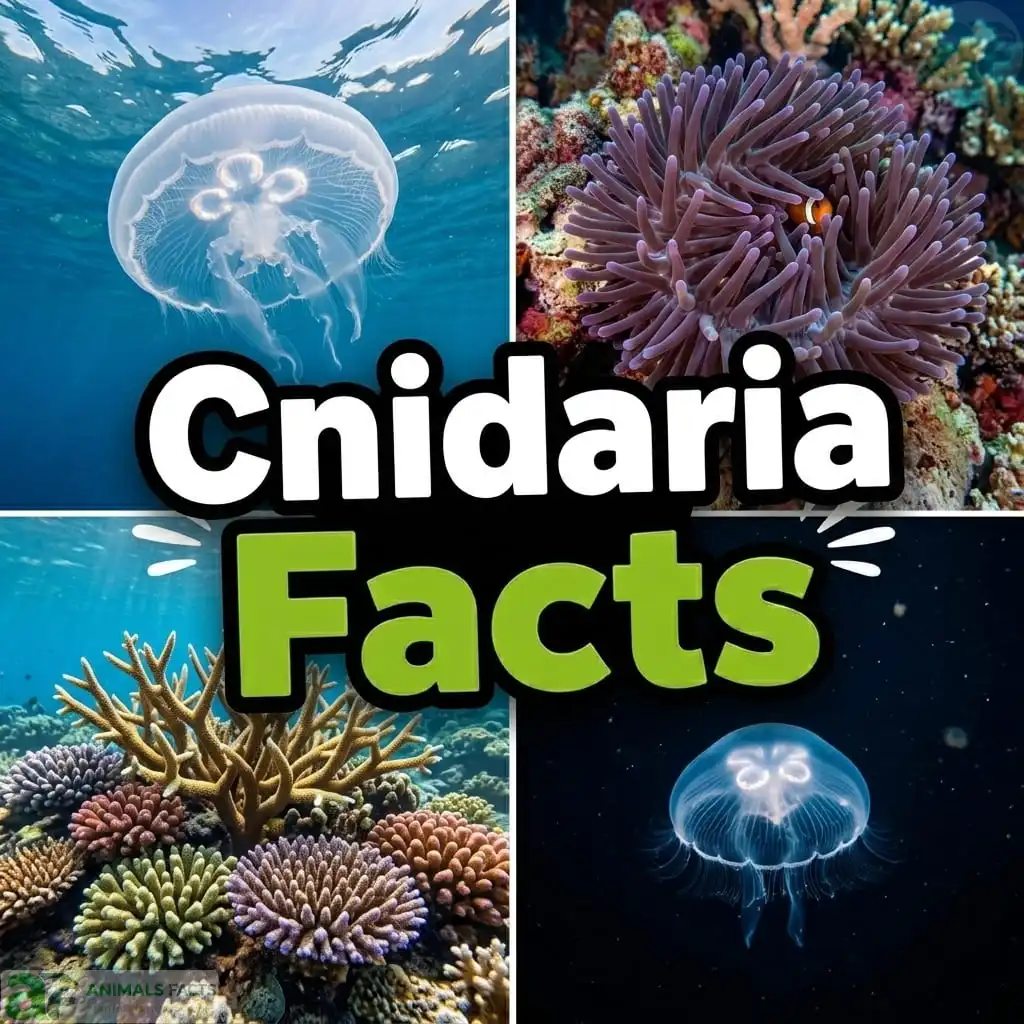
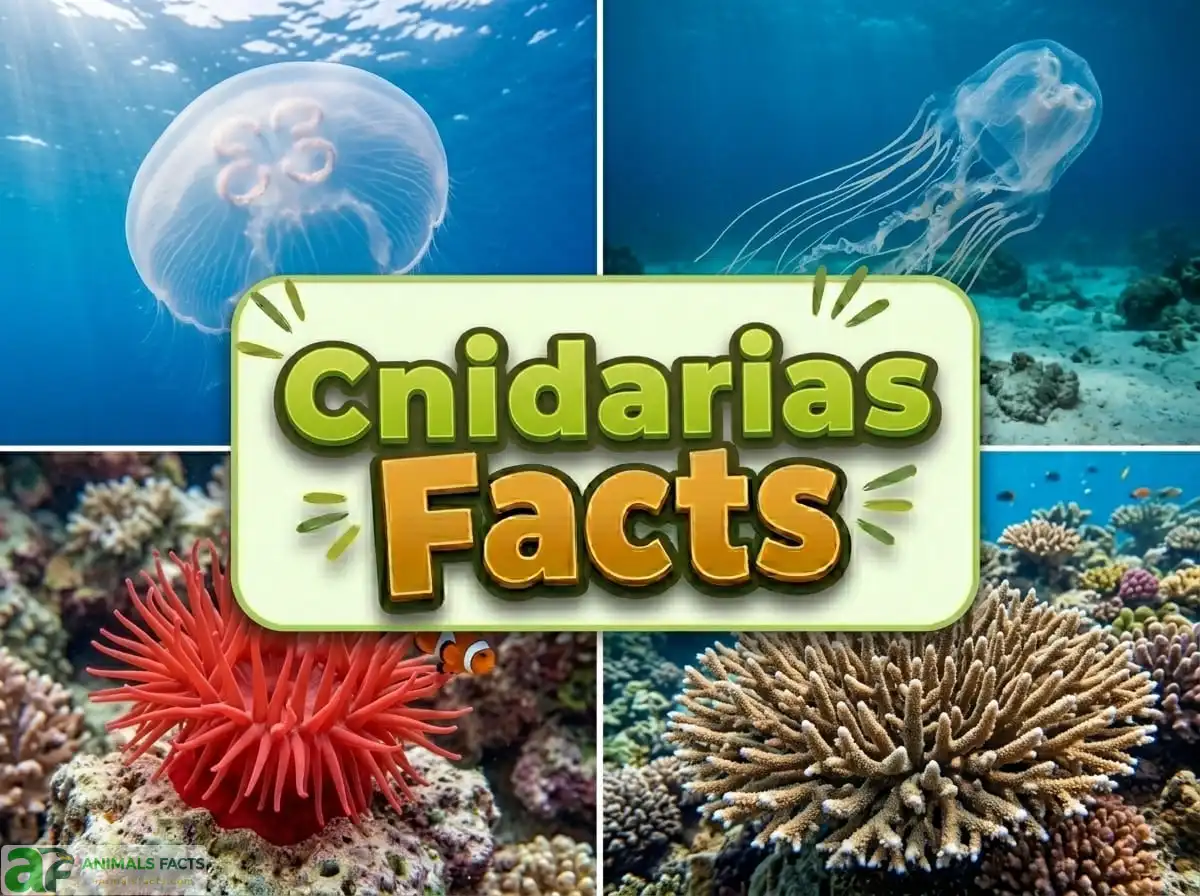
Cnidaria Facts
| Feature | Details |
|---|---|
| Scientific Name (Phylum) | Cnidaria |
| Kingdom | Animalia |
| Meaning of Name | Greek: knide — “nettle” (referring to stinging cells) |
| Number of Species | Over 11,000 described species |
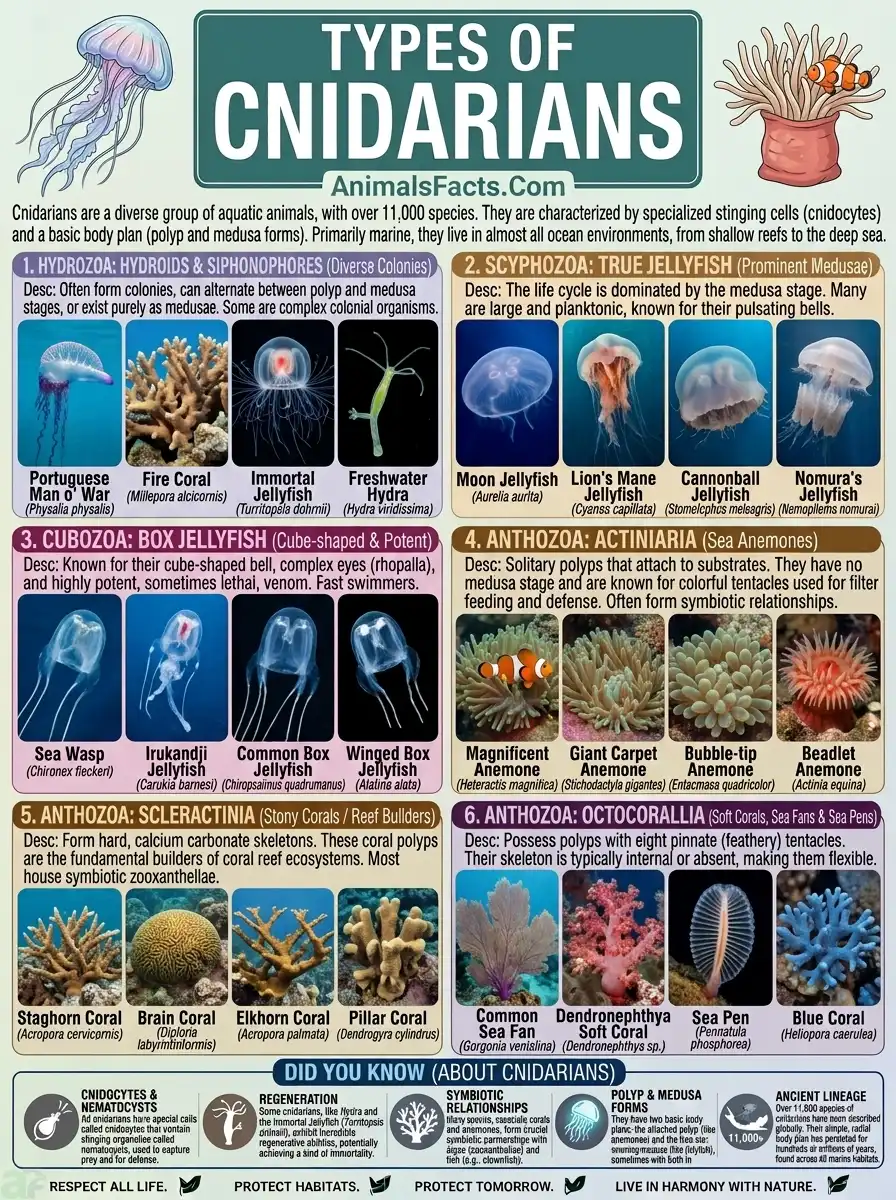
| Major Classes | Scyphozoa (jellyfish), Anthozoa (corals, anemones), Hydrozoa (hydroids, siphonophores), Cubozoa (box jellyfish), Staurozoa (stalked jellyfish) |
| Habitat | Exclusively marine (almost all); some freshwater species |
| Lifespan Range | A few hours (some medusae) to potentially immortal (Turritopsis dohrnii) |
| Diet | Carnivores — plankton, fish, crustaceans, other invertebrates |
| Conservation Status | Varies; corals Critically Endangered; jellyfish generally increasing |
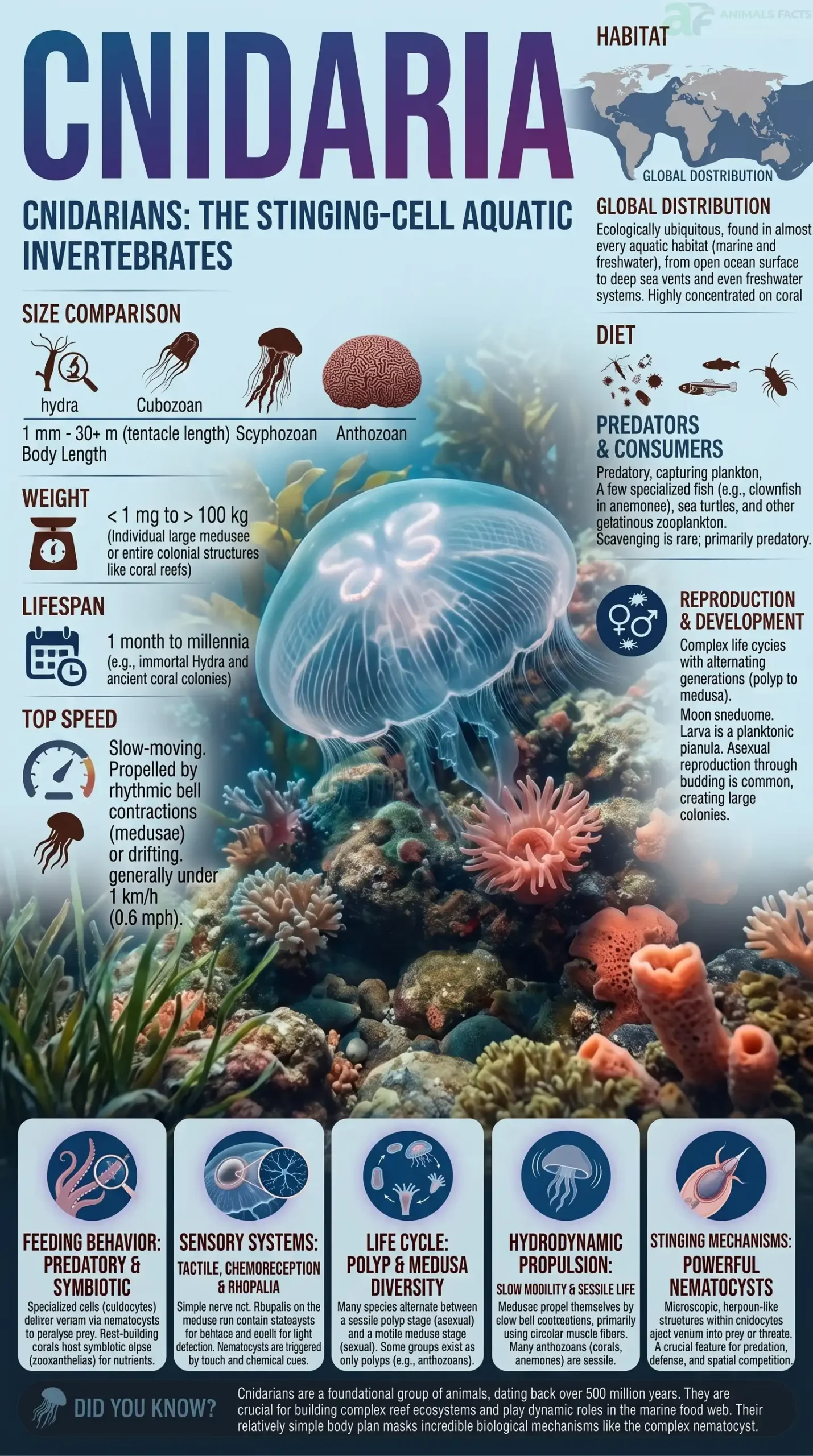
| Size Range | 1 mm (some hydroids) to 37 m tentacle span (lion’s mane jellyfish) |
| Weight Range | Microscopic to 200 kg+ (large jellyfish) |
| Speed | Box jellyfish: up to 8 km/h (fastest cnidarian) |
| Defining Feature | Cnidocytes — specialized stinging cells found in no other animal phylum |
| Oldest Fossil | ~580 million years ago (Ediacaran period) |
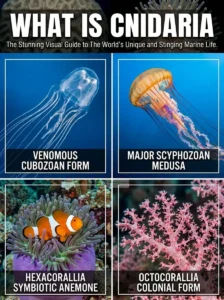 1. Introduction: What is Cnidaria?
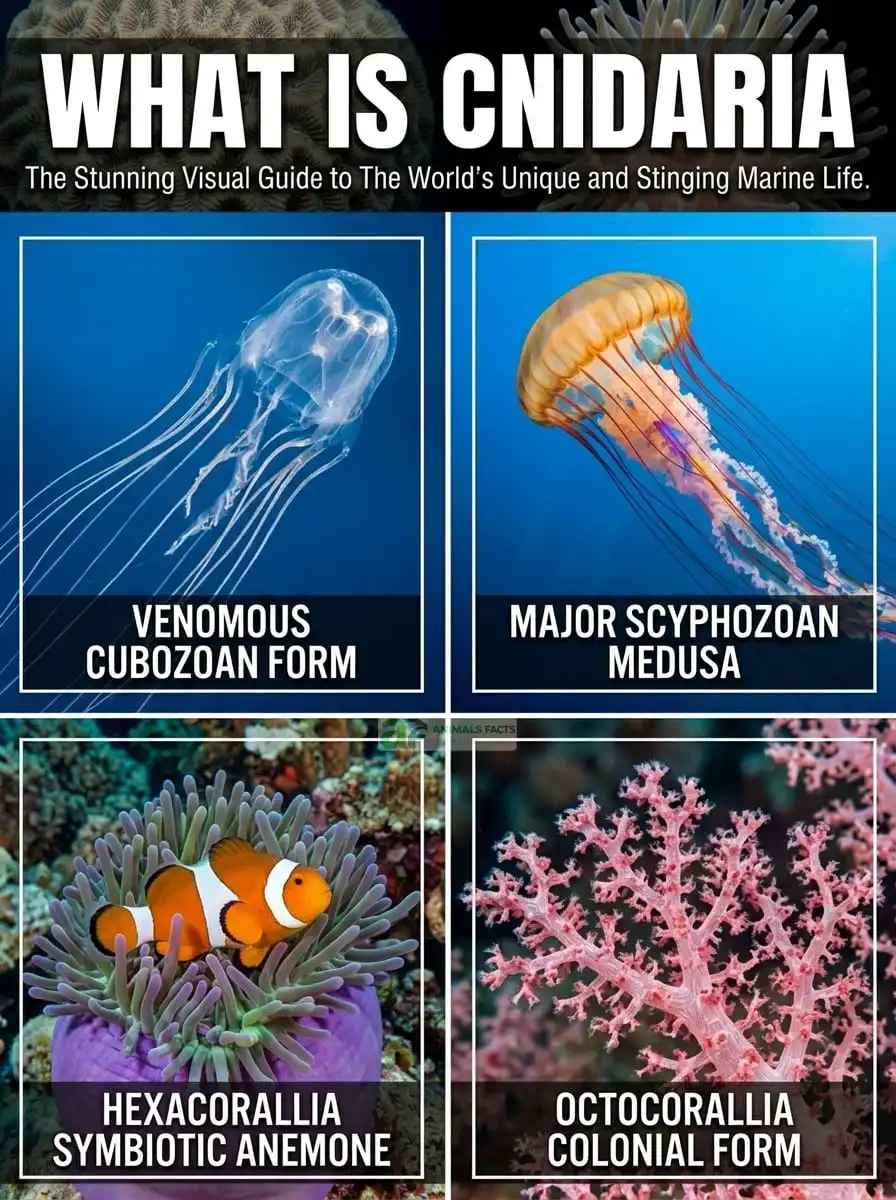
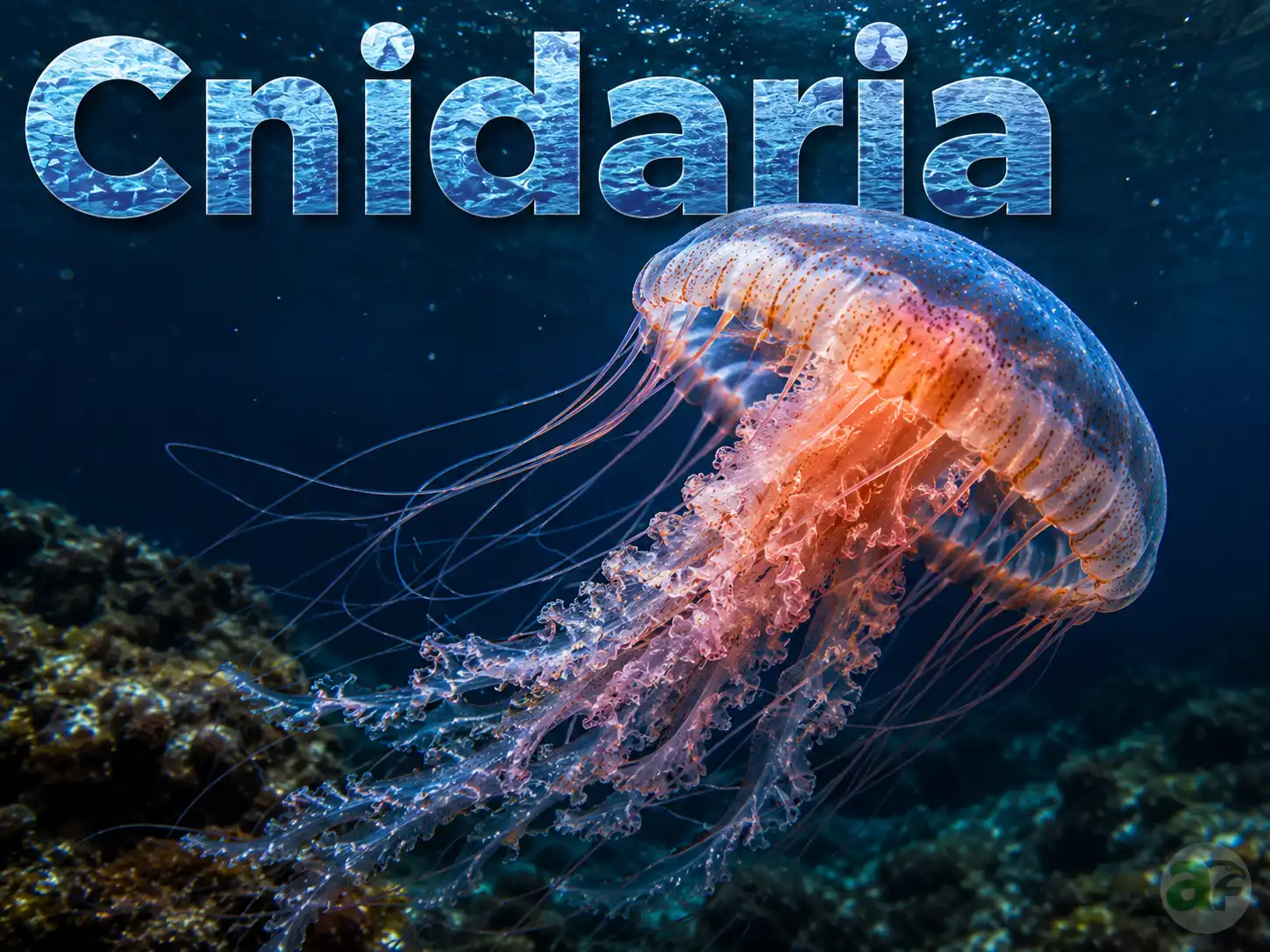
Somewhere in the warm waters of the Caribbean right now, a coral polyp the size of a pinhead is secreting calcium carbonate — adding one microscopic layer to a reef structure that has been growing for 10,000 years. In the Arctic Ocean, a lion’s mane jellyfish trails tentacles 37 meters long through freezing water, longer than a blue whale. In the Pacific, a Portuguese man o’ war drifts at the surface — not a single animal but a colony of thousands of specialized individuals so integrated they function as one organism. And somewhere in the Mediterranean, an immortal jellyfish quietly reverses its own aging process and starts its life over. Cnidaria facts are facts about a phylum so ancient, so diverse, and so biologically extraordinary that even after 580 million years, scientists are still discovering things that stop them mid-sentence.
The phylum Cnidaria encompasses over 11,000 known species of exclusively aquatic animals — the vast majority marine — that range from the familiar orange clownfish-hosting sea anemone of tropical reefs to the terrifying box jellyfish whose venom can kill a human in 2–5 minutes. From the reef-building coral polyps that create the most biodiverse marine ecosystems on Earth, to the luminescent hydroids of the deep sea, to the stalked jellyfish that attach themselves to seagrass blades and look more like flowers than animals — interesting facts about Cnidaria are simultaneously facts about the ocean’s architecture, its most ancient animal lineages, and some of the most sophisticated killing tools evolution has ever produced.
This is your complete, authoritative guide to Cnidaria facts — covering every major class, every extraordinary adaptation, every ecological role, and every cultural significance tied to this remarkable phylum. Whether you are a student searching for Cnidaria facts for kids, a marine biologist cross-referencing data, a teacher building an ocean curriculum, or simply someone who has ever been stung by a jellyfish at the beach and wondered exactly what just happened to them — this article has everything you need.
2. Cnidaria Species Overview & Classification
Cnidarians are members of the kingdom Animalia and represent one of the most ancient animal lineages with an unbroken fossil record stretching back nearly 600 million years. They are defined by a single, utterly unique feature found in no other animal on Earth: the cnidocyte — a specialized cell containing a coiled, spring-loaded harpoon-like structure called a nematocyst that fires at explosive speeds when triggered.
Taxonomy Table
| Level | Classification |
|---|---|
| Kingdom | Animalia |
| Phylum | Cnidaria |
| Subphyla | Medusozoa (jellyfish and relatives) and Anthozoa (corals and anemones) |
| Classes | 5 living classes |
| Orders | ~100+ recognized orders |
| Families | ~300+ families |
| Genera | ~3,000 genera |
| Species (described) | Over 11,000 |
The Five Living Classes
| Class | Common Name | Approx. Species | Key Feature |
|---|---|---|---|
| Anthozoa | Corals, sea anemones, sea fans | ~6,100 | No medusa stage; entirely polyp-based |
| Scyphozoa | True jellyfish | ~200 | Large medusa stage; small polyp stage |
| Hydrozoa | Hydroids, siphonophores, fire corals | ~3,700 | Both polyp and medusa stages; colonial forms |
| Cubozoa | Box jellyfish | ~50 | Cube-shaped bell; most venomous; complex eyes |
| Staurozoa | Stalked jellyfish | ~50 | Attached to substrate; funnel-shaped; rarely seen |
Cnidaria Species Evolution & Discovery Timeline
- ~580 million years ago — Earliest cnidarian-like fossils appear in the Ediacaran period; Aspidella and related forms suggest colonial polyp-like organisms
- ~540 million years ago — Cambrian explosion; cnidarians diversify rapidly; coral-like forms established
- ~450 million years ago — First true reef-building coral systems appear in the Ordovician period
- ~250 million years ago — Permian mass extinction devastates coral reef systems; recovery takes millions of years
- ~240 million years ago — Modern scleractinian (stony) corals first appear; ancestors of today’s reef-building species
- ~200 million years ago — Scyphozoan jellyfish recognizable in fossil form
- 1758 — Carl Linnaeus begins classifying cnidarian species; anemones and corals categorized as “zoophytes”
- 1828 — Henri Milne-Edwards coins the term “Cnidaria” from the Greek for nettle
- 1858 — Discovery of nematocyst firing mechanism; its explosive speed begins to be characterized
- 1988 — Turritopsis dohrnii (immortal jellyfish) first described; biological immortality recognized in 1996
- 2016 — Box jellyfish (Tripedalia cystophora) shown to learn and remember — a first for cnidarians
- 2023 — Research confirms box jellyfish have 24 eyes of four different types including lens eyes structurally similar to vertebrate eyes
- 2024–2026 — Accelerating coral bleaching events drive renewed research urgency; new deep-sea cnidarian species described annually
3. Cnidarian Physical Description & Features
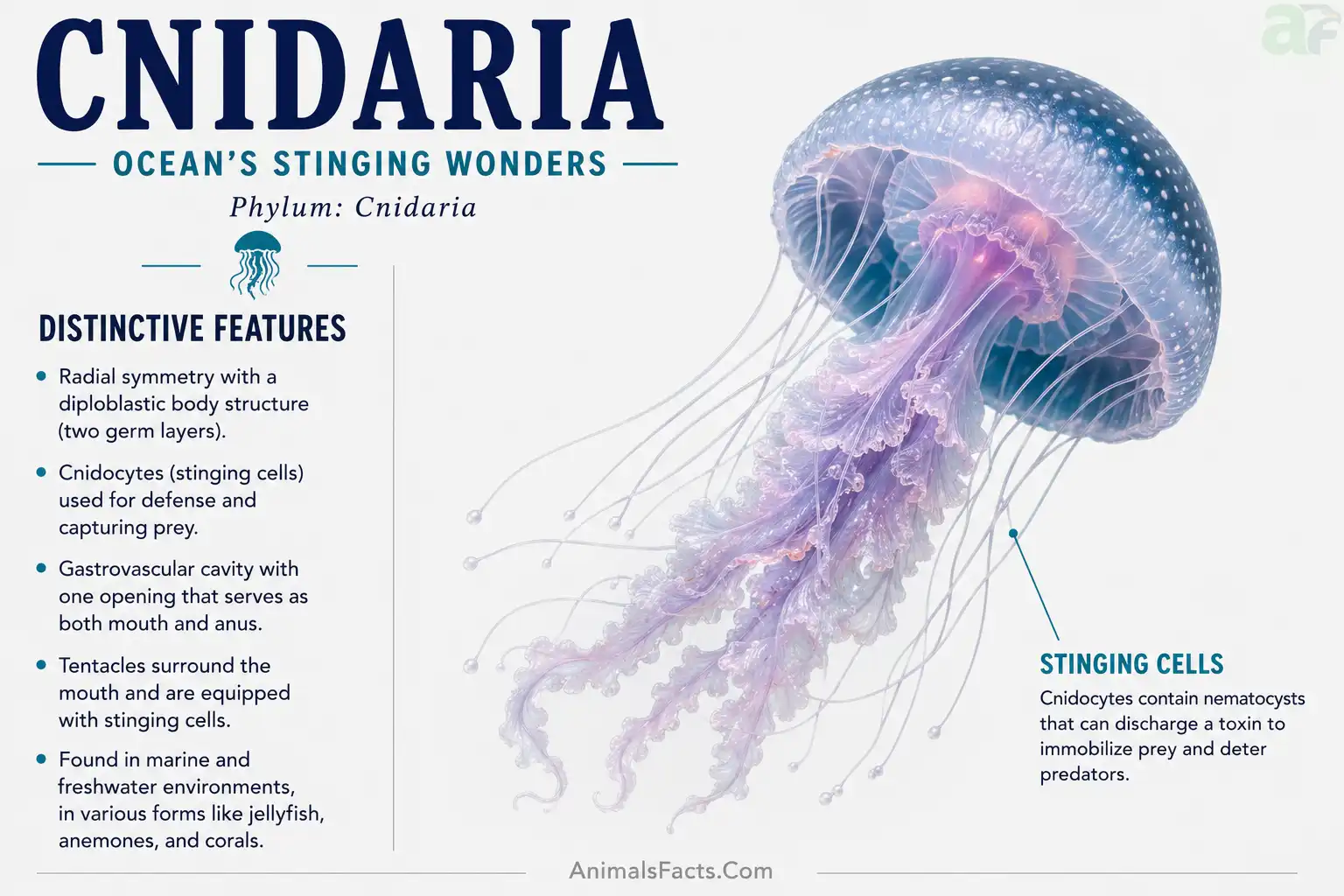
Despite extraordinary diversity across 11,000 species, all cnidarians share a fundamental body plan — and one utterly unique weapon.
The Two Body Plans
All cnidarians exist in one or both of two fundamental body forms:
The Polyp — A cylinder with a mouth at the top surrounded by tentacles, attached to a substrate at the base. Think sea anemone, coral polyp, or hydroid. The mouth faces upward; the column extends downward to a basal disc.
The Medusa — A bell-shaped, free-swimming form with a mouth facing downward and tentacles trailing below or around the margin. Think jellyfish. The medusa is the sexual stage in most species.
Some cnidarians (Scyphozoa — true jellyfish) alternate between both forms. Anthozoa (corals and anemones) exist only as polyps — they have no medusa stage.
The Cnidocyte – The Most Extraordinary Weapon in Invertebrate Biology
The defining feature of the entire phylum is the cnidocyte (also called a cnidoblast) — a highly specialized cell that contains a coiled, venom-loaded capsule called a nematocyst. When triggered by chemical or mechanical stimulation, the nematocyst fires at:
- Acceleration of 5,410,000 g — the most powerful biological acceleration ever measured
- Discharge speed under 700 nanoseconds — faster than virtually any other biological movement known
- Force sufficient to penetrate the cuticle of crustaceans and the skin of fish and humans
A single cnidarian tentacle may contain hundreds of thousands of cnidocytes. Different species possess different nematocyst types — penetrating, entangling, or adhesive — tuned to specific prey and defensive functions.
Cnidaria Size Records Across Cnidarian Classes
| Record | Species | Measurement |
|---|---|---|
| Largest cnidarian | Lion’s mane jellyfish (Cyanea capillata) | Bell: 2.3 m; tentacles: 37 m |
| Largest coral colony | Great Barrier Reef system | Over 2,300 km of connected structure |
| Most venomous | Box jellyfish (Chironex fleckeri) | Kills in 2–5 minutes |
| Smallest cnidarian | Some hydroid polyps | Under 1 mm |
| Most complex eyes | Box jellyfish | 24 eyes of 4 types; 4 with true cornea, lens, retina |
| Longest tentacles | Lion’s mane jellyfish | Up to 37 m |
| Potentially immortal | Immortal jellyfish (Turritopsis dohrnii) | Biological immortality under stress |
Physical Comparison Across Classes
| Feature | Anthozoa (Corals/Anemones) | Scyphozoa (True Jellyfish) | Cubozoa (Box Jellyfish) |
|---|---|---|---|
| Body form | Polyp only | Polyp + medusa | Polyp + medusa |
| Skeleton | Calcium carbonate (corals) or none | None | None |
| Tentacles | Present; around oral disc | Present; trailing below bell | Present; from corner pedaliums |
| Eyes | None | Simple eyespots only | 24 complex eyes |
| Swimming | Sessile (attached) | Pulsing bell; largely passive | Active swimmer; 8 km/h |
| Venom | Mild (most anemones) | Mild to moderate | Lethal (Chironex) |
| Size | Polyps 1 mm–1 m (anemones) | 2 cm–2.3 m bell diameter | 2–30 cm bell |
“Cnidarians are the universe’s first experiment in predatory animal life — and after 580 million years, the experiment shows no signs of being discontinued. Every nematocyst, every reef structure, every bioluminescent display is evolution saying: this works.” — Dr. Allen Collins, Smithsonian Institution, cnidarian systematist
4. Top 25 Amazing Cnidaria Facts
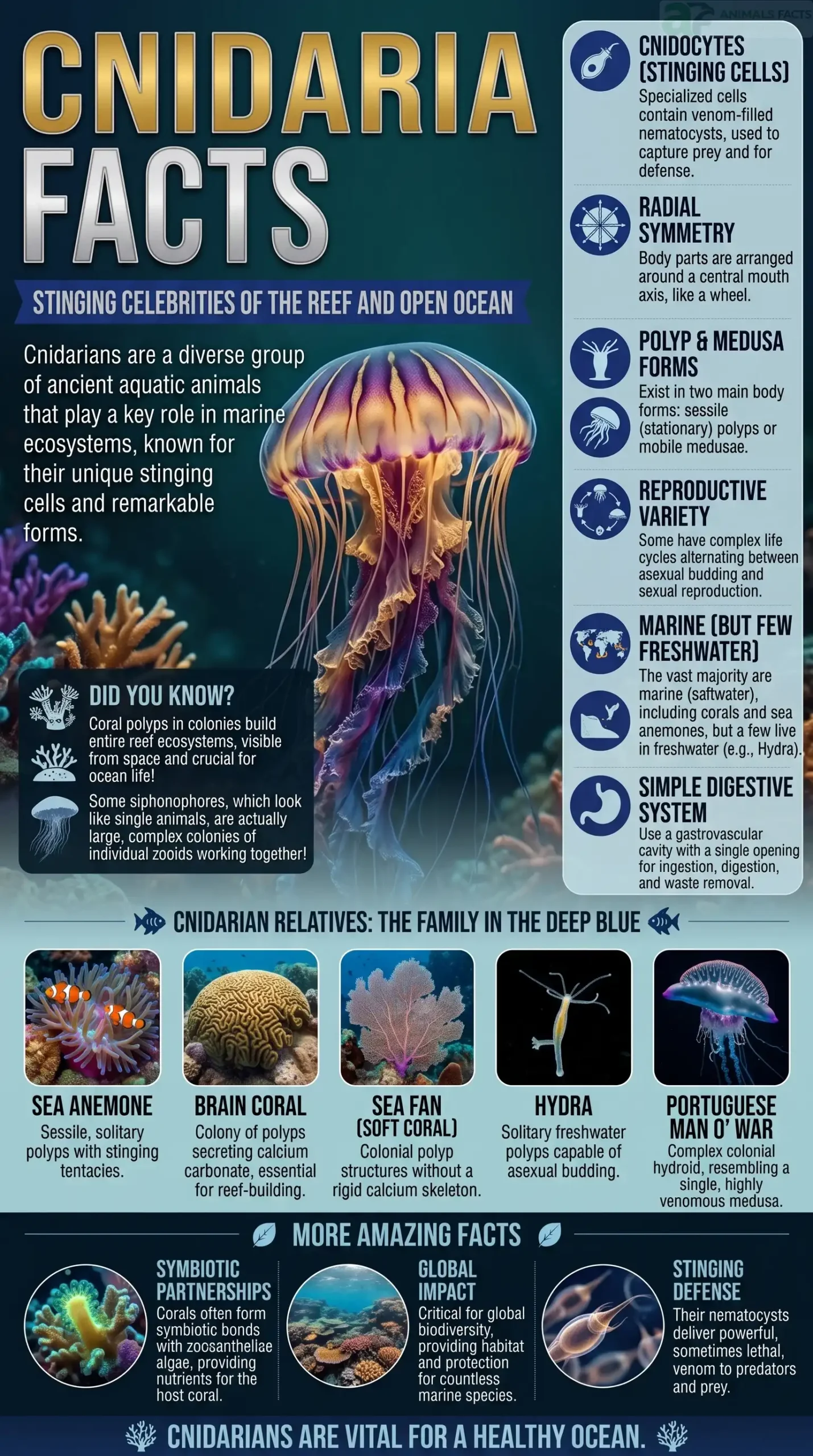
Here are the most extraordinary, share-worthy interesting facts about Cnidaria — each one more astonishing than the last:
- All cnidarians possess cnidocytes — stinging cells found in no other animal phylum on Earth
- The nematocyst fires with an acceleration of 5,410,000 g — the fastest biological movement ever recorded
- The immortal jellyfish (Turritopsis dohrnii) can reverse its entire life cycle — reverting from adult medusa back to juvenile polyp stage — and is considered biologically immortal
- Box jellyfish (Chironex fleckeri) can kill a healthy adult human in 2–5 minutes — making it the most venomous animal on Earth
- The lion’s mane jellyfish has tentacles up to 37 meters long — longer than a blue whale
- Coral reefs — built entirely by cnidarian polyps — cover less than 0.1% of the ocean floor but support approximately 25% of all marine species
- Box jellyfish have 24 eyes of four distinct types — including eyes with a true cornea, lens, and retina structurally similar to human eyes
- The Portuguese man o’ war (Physalia physalis) — often called a jellyfish — is actually a siphonophore (Hydrozoa): a colony of thousands of genetically identical but functionally specialized individuals
- Cnidarians are diploblastic — they have only two tissue layers (ectoderm and endoderm) compared to the three of all other complex animals — making them the simplest animals with true tissues
- Most corals have a symbiotic relationship with microscopic algae called zooxanthellae that live inside their tissues and provide up to 90% of the coral’s energy through photosynthesis
- Some Hydra species (freshwater cnidarians) are considered biologically non-aging — they show no measurable increase in mortality rate with age
- The box jellyfish can learn and remember — a 2016 study showed it could be conditioned to avoid obstacles, a cognitive feat unprecedented in an animal without a centralized brain
- Fire coral (Millepora spp.) is not a true coral — it is a hydrozoan that secretes a calcified skeleton and delivers significantly more painful stings than most true corals
- The by-the-wind-sailor (Velella velella) is a colonial hydrozoan that uses a built-in sail to drift across ocean surfaces — the direction of the sail determines whether it drifts toward or away from shore
- Some sea anemones live for over 100 years — the beadlet anemone has been documented in aquaria for over 80 years without significant aging
- Jellyfish blooms (swarms) can contain hundreds of millions of individuals — large enough to be visible from satellites and capable of clogging industrial cooling water intakes
- Cnidarians have no brain, no heart, no blood, and no respiratory system — yet they hunt, digest, reproduce, and in some cases learn
- The deep-sea siphonophore Praya dubia can reach lengths of up to 40–50 meters — potentially the longest animal ever recorded
- Coral bleaching — the breakdown of the coral-zooxanthellae symbiosis due to ocean warming — has affected over 50% of the Great Barrier Reef’s coral cover since the 1990s
- Some sea anemones engage in clonal wars — colonies of genetically identical individuals fight neighboring colonies using specialized fighting tentacles called acrorhagi
- Cnidarians were the first animals to evolve true muscle tissue — their simple but functional muscle fibers represent the evolutionary origin of all animal muscle
- The upside-down jellyfish (Cassiopeia spp.) lies on the seafloor with its bell downward and tentacles facing up — pulsing water over its symbiotic algae to photosynthesize
- Some corals glow under ultraviolet light — producing fluorescent proteins that protect zooxanthellae from excess light and serve as underwater signaling mechanisms
- Jellyfish have existed for at least 500 million years — they predate dinosaurs by over 300 million years and have survived every mass extinction event in Earth’s history
- The Caribbean coral Orbicella franksi can live for over 2,000 years — making individual coral colonies among the longest-lived animals ever documented
Did You Know? The box jellyfish (Tripedalia cystophora) was demonstrated in 2016 to be capable of associative learning — forming memories that modify its behavior. This was the first documented instance of learning in an animal without a centralized brain — achieved through a diffuse nerve net distributed across the entire body. Scientists believe the box jellyfish’s 24 eyes and distributed nervous system may represent an entirely different evolutionary solution to visual processing and memory formation.
5. Cnidaria Fun Facts for Kids
- Over 11,000 species of cnidarians found across Earth’s oceans
- Nematocysts fire at 5,410,000 g acceleration — fastest biological movement known
- The immortal jellyfish can reverse its own aging and start life over
- Box jellyfish venom kills in 2–5 minutes — most venomous animal on Earth
- Jellyfish have survived every mass extinction for 500+ million years
- Coral reefs support 25% of all marine species on just 0.1% of ocean floor
- Box jellyfish have 24 eyes including lens eyes similar to humans
- Cnidarians have no brain, heart, blood, or lungs
- Corals get 90% of their energy from symbiotic algae inside their cells
- Some sea anemones live for 100+ years without visible aging
- Portuguese man o’ war is a colony of thousands of individuals — not one animal
- Lion’s mane jellyfish tentacles reach 37 meters — longer than a blue whale
- Hydra shows no measurable aging — considered biologically immortal
- Some deep-sea cnidarians bioluminesce — producing their own light
- 50%+ of Great Barrier Reef coral has bleached since the 1990s
6. Natural Habitat of Cnidaria
Cnidarians are found in virtually every marine environment on Earth — from sun-drenched tropical shallows to lightless abyssal plains, from polar seas to hydrothermal vents, from turbulent surf zones to the calm interior of mangrove lagoons. A tiny minority of species (primarily freshwater Hydra and a few others) have colonized freshwater.
Habitat Range by Environment
| Habitat Type | Dominant Cnidarian Groups | Notable Species |
|---|---|---|
| Tropical coral reef | Reef-building corals (Scleractinia), anemones, fire coral, colonial hydroids | Acropora corals, clownfish anemones, Millepora fire coral |
| Temperate rocky reef | Anemones, soft corals, hydroids, scyphozoan jellyfish | Beadlet anemone, dead man’s fingers, moon jellyfish |
| Open ocean (pelagic) | Jellyfish, siphonophores, Velella, Physalia | Lion’s mane, Portuguese man o’ war, by-the-wind sailor |
| Deep sea (>1,000 m) | Deep-sea corals, stalked anemones, siphonophores, hydroids | Black coral, Lophelia pertusa, Praya dubia |
| Arctic/Antarctic | Lion’s mane jellyfish, polar anemones, some hydroids | Cyanea capillata, Antarctic anemones |
| Intertidal zone | Anemones, hydroids, some corals | Beadlet anemone, snakelock anemone |
| Mangrove/Brackish | Upside-down jellyfish, some hydroids | Cassiopeia spp. |
| Freshwater | Hydra, freshwater jellyfish (Craspedacusta) | Green hydra, freshwater jellyfish |
| Seagrass beds | Stalked jellyfish (Staurozoa), Cassiopeia | Haliclystus, Stylocoronella |
| Sandy seafloor | Burrowing anemones, some scyphozoans | Cerianthus tube anemones |
Habitat Range by Continent/Region
| Region | Cnidarian Highlights | Notable Fact |
|---|---|---|
| Indo-Pacific | Greatest reef coral diversity; box jellyfish | Global center of coral species richness |
| Caribbean | Threatened reef systems; sea fans; Physalia | Staghorn coral Critically Endangered |
| North Pacific | Giant lion’s mane jellyfish; kelp-associated anemones | Largest lion’s mane specimens from Arctic Pacific |
| Mediterranean | Cotylorhiza tuberculata jellyfish; Paracentrotus reefs | Jellyfish blooms increase with warming |
| Arctic/Antarctic | Cold-water corals; large scyphozoan blooms | Deep-water Lophelia reefs at unexpected latitudes |
| Atlantic (East/West) | Siphonophores; offshore deep-water corals | Portuguese man o’ war driven by wind currents |
| Indian Ocean | Box jellyfish; diverse reef systems | Chironex in northern Australian/Southeast Asian waters |
| Freshwater (global) | Hydra; freshwater jellyfish | Craspedacusta sowerbii spread globally via aquarium trade |
Did You Know? Deep-water corals (primarily the cold-water coral Lophelia pertusa) form reef structures at depths of 200–1,000 meters in complete darkness — with no dependency on sunlight or photosynthetic symbionts. These cold-water reef systems have been discovered throughout the North Atlantic, Norwegian fjords, and Mediterranean — and some structures are estimated to be over 8,000 years old.
7. Cnidaria Diet & Feeding Behavior
All cnidarians are carnivores — every species in the phylum obtains energy by capturing and consuming other animals. The method of capture, however, varies from passive drift-and-sting to surprisingly active pursuit.
Diet Breakdown Across Major Groups
| Group | Primary Diet | Secondary / Supplemental | Feeding Method | Approx. % Animal Matter |
|---|---|---|---|---|
| Reef corals | Zooplankton (at night) | 90%+ from zooxanthellae photosynthesis | Nematocyst capture; mucus trapping | ~10% active hunting; ~90% photosynthesis |
| Sea anemones | Small fish, crustaceans, worms | Plankton, organic particles | Nematocyst tentacles; muscular oral disc | ~100% |
| Moon jellyfish (Aurelia) | Plankton, copepods, fish larvae | Organic particles | Passive mucus-trapping on oral arms | ~100% |
| Lion’s mane jellyfish | Small fish, crustaceans, other jellyfish | Zooplankton | Active drift-hunting; 37 m tentacle net | ~100% |
| Box jellyfish | Small fish, shrimp, prawns | Other invertebrates | Active pursuit; highly mobile | ~100% |
| Portuguese man o’ war | Fish, crustaceans, plankton | Anything in tentacle range | Passive drift; 50 m tentacle curtain | ~100% |
| Siphonophores | Fish, crustaceans, other jellies | Zooplankton | Colony of specialized dactylozooids with nematocysts | ~100% |
| Hydra | Water fleas (Daphnia), copepods, small larvae | Anything smaller than itself | Nematocyst tentacles; oral disc | ~100% |
| Fire coral | Plankton, organic detritus | Photosynthesis (some zooxanthellae) | Nematocysts; mucus | Mixed |
The Coral Feeding System
The relationship between corals and their food is among the most sophisticated in the animal kingdom. During the day, coral polyps are largely retracted, deriving energy from the zooxanthellae (symbiotic dinoflagellate algae) living within their gastrodermal tissues — which photosynthesize using sunlight filtered through shallow tropical water. At night, coral polyps extend their tentacles and actively capture zooplankton, fish larvae, and organic particles drifting in the water column.
This dual energy strategy — simultaneous photosynthesis and active hunting — is why coral reefs can maintain such extraordinary productivity in the nutrient-poor “blue desert” of tropical ocean water.
9. Cnidaria Reproduction & Life Cycle
Cnidarians display an extraordinary range of reproductive strategies — including one that is unique in the entire animal kingdom: complete life-cycle reversal.
The Alternation of Generations
Most cnidarians alternate between two body forms in their life cycle — the sessile polyp and the free-swimming medusa — in a process called metagenesis or alternation of generations:
Polyp stage — Sessile, attached form; reproduces asexually by budding, cloning, or fission; can be solitary or colonial.
Medusa stage — Free-swimming form; reproduces sexually — releasing eggs and sperm into the water column; fertilized eggs develop into a planula larva that settles and becomes a new polyp.
Exceptions — Anthozoa (corals and anemones) have no medusa stage — they reproduce both sexually (releasing gametes) and asexually (budding, fragmentation, clonal division). Cubozoa have both stages but the polyp is tiny and short-lived.
The Immortal Jellyfish Life Cycle
Turritopsis dohrnii is the only known animal capable of complete life-cycle reversal. When stressed, starved, or injured, the adult medusa reabsorbs its own tissues through a process called transdifferentiation — converting its specialized cells back into stem cells — and reverts to the polyp stage, where it can develop into a new medusa again. This cycle can theoretically repeat indefinitely — making the immortal jellyfish the only known biologically immortal animal.
Lifespan Comparison
| Species | Lifespan | Notes |
|---|---|---|
| Moon jellyfish (Aurelia aurita) | 1–2 years (medusa) | Polyp stage may persist longer |
| Box jellyfish (Chironex fleckeri) | < 1 year (medusa) | Short adult life; highly active |
| Sea anemone (Actinia equina) | 60–100 years | Documented in long-term aquaria |
| Immortal jellyfish (Turritopsis dohrnii) | Potentially indefinite | Life-cycle reversal documented |
| Orbicella franksi coral | Up to 2,000+ years | Based on growth band analysis |
| Hydra (freshwater) | Effectively immortal | No measurable senescence detected |
Did You Know? Coral reefs grow extraordinarily slowly — massive corals (Porites species) grow approximately 1 centimeter per year in diameter. A coral colony the size of a basketball may be 50–100 years old. The branching staghorn coral (Acropora cervicornis) grows faster — up to 10 cm per year — but is far more fragile and easily broken by storms or human disturbance.
9. Social Behavior & Communication
Cnidarians lack brains, centralized nervous systems, and the cognitive architecture we associate with animal behavior — yet they display coordination, communication, and in the case of colonial species, division of labor so sophisticated it challenges our definitions of the individual animal.
Colonial Life – The Siphonophore as Superorganism
The siphonophores (Hydrozoa) represent the most extreme expression of social organization in the phylum — and arguably in the entire animal kingdom. A Portuguese man o’ war, for example, is not a single organism but a colony of thousands of zooids — genetically identical individuals that have specialized so completely into different functions (float, feeding, reproduction, defense) that none can survive independently. The colony as a whole is the functional organism:
- Pneumatophore — the gas-filled float that keeps the colony at the surface
- Dactylozooids — long tentacle-bearing individuals armed with nematocysts for capturing prey
- Gastrozooids — individuals specialized for digestion; have no tentacles; process prey captured by dactylozooids
- Gonozooids — individuals specialized for reproduction
Communication in Cnidarians
Communication in cnidarians is fundamentally chemical and mechanical — mediated through their diffuse nerve nets rather than any centralized system:
- Chemical gradients — spawn-triggering pheromones released by one individual trigger mass spawning in coral colonies across entire reefs
- Electrical propagation — action potentials travel through the nerve net — a diffuse network of neurons spread across the entire body surface — coordinating muscular contractions for swimming, feeding, and escape
- Light sensitivity — most cnidarians have photoreceptors; box jellyfish have true camera-type eyes; some medusae respond to light by swimming downward during daylight
- Contact responses — the oral disc of sea anemones integrates mechanical signals from multiple tentacles to coordinate prey capture and swallowing
Coral Spawning – The Ocean’s Greatest Synchronized Event
One of the most spectacular collective behaviors in nature is mass coral spawning — when an entire reef system releases eggs and sperm simultaneously in a single night, typically triggered by the full moon in late spring or early summer. The chemical signals that coordinate this synchronization travel through the water, triggering spawning in coral colonies that have no direct physical connection to each other.
During the Great Barrier Reef’s annual mass spawning, the surface water turns pink with the density of released gametes — one of the most extraordinary biological events on Earth.
10. Predators & Defense Mechanisms
Natural Predators of Cnidarians
| Predator | Cnidarian Prey | Hunting Method |
|---|---|---|
| Sea turtle (green, leatherback) | Jellyfish, siphonophores | Direct consumption; resistant to nematocysts |
| Sunfish (Mola mola) | Jellyfish exclusively | Consume enormous quantities of jellyfish daily |
| Albatross and seabirds | Siphonophores, surface jellyfish | Surface feeding |
| Nudibranchs | Hydroids, anemones, corals | Sequester nematocysts for own defense |
| Crown-of-thorns starfish | Coral polyps | Major reef predator; consumes 6 m² per year |
| Harlequin shrimp | Coral polyps | Specialized coral predator |
| Butterflyfishes | Coral polyps | Obligate corallivores |
| Some fish (Amphiprioninae — clownfish) | None — they are symbiotic | Live within anemones; immune through mucus |
| Hawksbill turtle | Coral, sponges, anemones | Primary predator of reef invertebrates |
| Spadefish, triggerfish | Jellyfish, anemones | Opportunistic cnidarian consumers |
Defense Strategies
| Strategy | Group | Description |
|---|---|---|
| Nematocysts | All cnidarians | Primary offense and defense; explosive venom injection |
| Retraction | Anemones, corals | Polyps retract entirely into skeletal cup or column when disturbed |
| Autotomy | Some anemones | Shed tentacles to distract predators; regenerate |
| Zooxanthellae camouflage | Corals | Coloration from algae provides some substrate matching |
| Bioluminescence | Deep-sea cnidarians | May deter predators or attract prey |
| Acrorhagi fighting | Colonial anemones | Specialized fighting tentacles for colony defense against neighboring anemones |
| Chemical deterrents | Sea fans, some corals | Secondary metabolites (terpenoids) toxic to fish |
| Colony aggregation | Siphonophores | Coordinated tentacle deployment creates a barrier |
11. Cnidaria Facts for Kids
Hey young ocean explorers! Cnidarians are some of the most amazing and surprising animals in the sea — and many of them are things you’ve already seen! Here are some incredible Cnidaria facts just for you:
- Jellyfish are NOT fish — they are cnidarians, and they don’t even have a brain, heart, or bones!
- The coral reef — the colorful underwater city you see in ocean documentaries — is built by tiny animals called coral polyps that are related to jellyfish!
- There is a jellyfish called the immortal jellyfish that can turn itself back into a baby when it gets old — and start its whole life over again!
- A box jellyfish is the most venomous animal on Earth — even more dangerous than a cobra or a blue-ringed octopus!
- Jellyfish have survived on Earth for over 500 million years — they were here long before the dinosaurs!
- The lion’s mane jellyfish has tentacles longer than a blue whale — up to 37 meters!
- A jellyfish’s body is made up of about 95% water — almost nothing else!
- The Portuguese man o’ war — which looks like one big jellyfish — is actually thousands of tiny animals all living together as one!
- Sea anemones are the homes of clownfish — just like Nemo! The anemone’s stinging cells don’t hurt clownfish because they have special protective mucus!
- Coral polyps are so tiny you need a magnifying glass to see them clearly — yet together they build reefs so large they are visible from space!
12. Relationship with Humans
Cnidarian Stings — A Major Public Health Issue
Jellyfish stings affect an estimated 150 million people annually worldwide — making them among the most common marine animal injuries. The severity ranges from mild irritation (moon jellyfish) to potentially fatal (box jellyfish):
- Box jellyfish (Chironex fleckeri) — Causes severe cardiovascular collapse, respiratory failure, and skin necrosis; responsible for dozens of deaths annually in Australia and Southeast Asia; no widely available antivenom
- Portuguese man o’ war — Delivers excruciatingly painful stings; severe cases cause fever, shock, and cardiac effects; not typically fatal to healthy adults
- Irukandji jellyfish (Carukia barnesi) — Thumbnail-sized box jellyfish of Australian waters; causes Irukandji syndrome — severe systemic pain, hypertension, and psychological doom sensation
- Lion’s mane jellyfish — Painful but rarely fatal; long tentacles increase contact probability significantly
Cnidarians in Food Culture
- Jellyfish have been consumed in East Asian cuisine (China, Japan, Korea) for over 1,700 years — dried and salted jellyfish is a delicacy consumed in vast quantities annually
- Sea urchin roe (technically echinoderm but sharing reef ecosystems with cnidarians) accompanies the cultural context of cnidarian-supported reef fisheries
- Sea anemones are eaten in Spain (ortiguillas — battered and deep-fried) and various Mediterranean cultures
- Global annual harvest of edible jellyfish exceeds 500,000 metric tons
Cnidarian-Derived Medicine
- Aequorin — a bioluminescent protein from the jellyfish Aequorea victoria — was the basis for Green Fluorescent Protein (GFP) research; the discovery and application of GFP won the 2008 Nobel Prize in Chemistry and revolutionized cell biology research
- Cnidarian toxins are actively studied for cardiovascular drugs, pain management compounds, and cancer therapies
- Coral skeleton calcium carbonate structure is studied as a model for bone graft materials
13. Cnidarian Conservation Status & Threats
The Coral Crisis
The most urgent cnidarian conservation story is the global crisis of coral reef decline — one of the most severe ecological emergencies facing the ocean:
- Over 50% of coral cover has been lost globally since the 1950s
- The Great Barrier Reef experienced mass bleaching events in 2016, 2017, 2020, 2022, and 2024 — the most frequent in recorded history
- At 1.5°C of global warming above pre-industrial levels (projected by some models to occur by 2030), 70–90% of coral reefs could be functionally destroyed
- At 2°C, over 99% of coral reefs are projected to be lost
IUCN Status of Key Cnidarian Species
| Species | Class | IUCN Status |
|---|---|---|
| Staghorn coral (Acropora cervicornis) | Anthozoa | Critically Endangered |
| Elkhorn coral (Acropora palmata) | Anthozoa | Critically Endangered |
| Boulder star coral (Orbicella franksi) | Anthozoa | Endangered |
| Pillar coral (Dendrogyra cylindrus) | Anthozoa | Critically Endangered |
| Box jellyfish (Chironex fleckeri) | Cubozoa | Not assessed (abundant) |
| Moon jellyfish (Aurelia aurita) | Scyphozoa | Not assessed (increasing) |
| Immortal jellyfish (Turritopsis dohrnii) | Hydrozoa | Not assessed |
Major Threats
| Threat | Impact Level | Cnidarians Affected |
|---|---|---|
| Ocean warming / bleaching | Critical | All reef-building corals globally |
| Ocean acidification | Critical | Calcifying corals; shells dissolve in acidified water |
| Crown-of-thorns outbreaks | High | Indo-Pacific coral reefs; linked to agricultural runoff |
| Coastal development | High | Nearshore corals and anemones; sediment and pollution |
| Overfishing | High | Coral ecosystems; removes herbivores that control algae |
| Jellyfish blooms (opposite threat) | Growing | Jellyfish populations increasing as oceans warm |
| Pollution (sunscreen chemicals) | Medium | Oxybenzone in sunscreen toxic to coral larvae |
| Tourism damage | Medium | Physical contact, anchoring, irresponsible diving |
| Deep-sea trawling | Medium | Cold-water coral reefs destroyed by bottom trawling |
14. Famous Cnidarians
The Immortal Jellyfish — Biology’s Most Famous Enigma
Turritopsis dohrnii — first described from the Mediterranean in 1883 but not recognized as biologically immortal until 1996 by Italian researcher Ferdinando Boero — has become arguably the most discussed animal in aging research globally. Its ability to reverse its life cycle through transdifferentiation has implications for regenerative medicine and cancer biology that scientists are still only beginning to explore. Its fame has grown exponentially since going viral in multiple media cycles between 2012 and 2025.
Aequorea victoria — The Jellyfish That Changed Science
The crystal jellyfish (Aequorea victoria) from the Pacific Northwest is responsible for one of the most impactful discoveries in the history of biology. The Green Fluorescent Protein (GFP) isolated from this species and developed as a research tool by Osamu Shimomura, Martin Chalfie, and Roger Tsien won the 2008 Nobel Prize in Chemistry. GFP is now used in virtually every cell biology and molecular biology laboratory on Earth to visualize cellular processes in living organisms — a tool that has transformed medicine, genetics, and our understanding of life itself.
The Great Barrier Reef Coral System
No individual animal, but the Great Barrier Reef — the world’s largest coral reef system and largest structure built by living organisms — is arguably the most famous cnidarian-built object on Earth. Visible from space, stretching 2,300 km along the Australian coast, supporting over 1,500 fish species and 4,000 mollusk species, and listed as a UNESCO World Heritage Site in 1981 — the Great Barrier Reef is simultaneously the greatest achievement of cnidarian biology and the subject of the most urgent coral conservation crisis in history.
The Portuguese Man o’ War – Ocean’s Most Misidentified Animal
Physalia physalis is perhaps the most famous cnidarian in popular culture — endlessly photographed, routinely misidentified as a jellyfish, and responsible for hundreds of thousands of stings annually. Its vivid blue-purple color, sail-like pneumatophore, and trailing curtain of tentacles make it one of the most visually striking organisms in the ocean — and its biology (a supercolony of thousands of functionally specialized zooids) makes it one of the most conceptually challenging.
15. Role in Ecosystem & Food Chain
Coral Reefs – The Ocean’s Most Biodiverse Ecosystem
The ecological role of reef-building cnidarians is almost impossible to overstate. Coral polyps — animals measuring just a few millimeters each — collectively build the physical architecture of the most biodiverse marine habitat on Earth:
- Coral reefs support approximately 25% of all described marine species despite covering less than 0.1% of the ocean floor
- They are the nursery grounds for approximately 25% of all commercial fish species in the tropics
- They protect coastal communities from storm surge and wave erosion — providing protection valued at $9 billion annually to coastal populations
- Reef-based tourism and fisheries support the livelihoods of approximately 500 million people worldwide
Jellyfish – Both Prey and Predator
Jellyfish are simultaneously important predators of plankton and fish larvae, and important prey for sunfish, sea turtles, albatross, tuna, and other pelagic species. Their role in ocean nutrient cycling — through the “jellyfish pump” — redistributes carbon and nutrients between the surface and deep ocean as their carcasses sink rapidly after death.
Siphonophores and the Deep-Sea Carbon Cycle
The giant siphonophores of the deep ocean are among the most significant predators of the mesopelagic zone — consuming vast quantities of fish and crustaceans at depths of 200–1,000 meters. Their role in the ocean’s biological carbon pump — sequestering surface carbon to depth — makes them ecologically important far beyond their individual visibility.
16. Cnidaria Myths, Folklore & Cultural Significance
Japanese Culture – Kurage and the Ocean’s Soul
In Japanese culture, jellyfish (kurage) hold a poetic, almost spiritual significance — representing the fragility, transience, and luminous beauty of things without substance or permanence. They feature extensively in classical Japanese poetry (haiku), art (ukiyo-e woodblock prints), and literature as symbols of drifting, formlessness, and the aesthetic concept of mono no aware (the poignant beauty of impermanence). The famous Kuroshio jellyfish displays in Japanese aquariums draw millions of visitors annually — treated as meditative, aesthetic experiences rather than purely scientific ones.
Hawaiian Mythology – The Coral as Foundation of the World
In some Hawaiian creation accounts, the first life on Earth was coral — the primordial polyp that built the foundation upon which all other life could eventually exist. This places cnidarians literally at the origin of the universe in Hawaiian cosmological thinking — a remarkably accurate metaphor for their ecological role as reef-builders.
Mediterranean Folk Medicine
Throughout the Mediterranean coast, dried jellyfish tentacles and crushed coral have appeared in folk medical traditions for centuries — used as topical treatments, fertilizers, and in some traditions as protective talismans. The toxicity of jellyfish stings paradoxically gave them an association with both danger and healing power in coastal cultures.
Australian Aboriginal and Torres Strait Islander Cultures
For the Yolŋu and other Aboriginal peoples of northern Australia, the box jellyfish (Chironex fleckeri) is embedded in ecological knowledge systems that recognized its seasonal appearance — associated with specific environmental indicators that warned communities of dangerous waters. This traditional ecological knowledge predated Western scientific documentation of box jellyfish seasonality by centuries.
17. Cnidaria in Pop Culture
Film and Television
- Finding Nemo (2003, Pixar) — The jellyfish field sequence — where Dory and Marlin bounce through jellyfish bells — is one of the most visually celebrated sequences in animation history, introducing a generation to cnidarian biology in spectacular fashion
- Blue Planet and Blue Planet II (BBC) — David Attenborough narrates extraordinary cnidarian sequences: coral spawning, siphonophore hunting, jellyfish blooms, and deep-sea hydroids
- Chasing Coral (2017, Netflix) — Oscar-winning documentary following coral bleaching in real time; widely credited with raising global awareness of coral reef crisis
- SpongeBob SquarePants — Jellyfish Fields is a recurring location in the series; jellyfish are central to Bikini Bottom’s ecology as portrayed in the show
Scientific Pop Culture
- The immortal jellyfish has been the subject of dozens of viral articles and social media posts between 2012 and 2026 — regularly introduced to new audiences as the “animal that can live forever”
- GFP (Green Fluorescent Protein) from Aequorea victoria has become a cultural symbol of biotechnology — fluorescent green laboratory mice, fish, and cells are now standard imagery in popular science media
- Coral bleaching time-lapse photography — particularly footage from the Great Barrier Reef’s 2016 and 2022 bleaching events — has become some of the most-shared climate change visual content globally
18. Cnidaria Facts vs. Common Myths
| Myth | Fact |
|---|---|
| “Jellyfish are fish” | Jellyfish are cnidarians — not fish; they have no backbone, gills, or any fish characteristics |
| “Urinating on a jellyfish sting helps” | False — urine can trigger unfired nematocysts; rinse with seawater and apply heat |
| “Coral is a rock or plant” | Coral is built by living animals (polyps) — cnidarians closely related to jellyfish |
| “The Portuguese man o’ war is a jellyfish” | It is a colonial siphonophore (Hydrozoa) — not a true jellyfish (Scyphozoa) |
| “Dead jellyfish on the beach can’t sting” | False — nematocysts can fire for hours after death; avoid touching beached jellyfish |
| “All jellyfish stings are dangerous” | Most jellyfish stings cause only mild irritation; serious envenomation is limited to specific species |
| “Jellyfish are simple, brainless creatures with no behavior” | Box jellyfish have 24 complex eyes and have demonstrated associative learning — remarkable for animals without centralized brains |
| “Coral bleaching means the coral is dead” | Bleaching means coral has expelled its zooxanthellae under stress — corals can recover if conditions improve promptly |
| “Freshwater jellyfish are common” | Only one freshwater jellyfish species (Craspedacusta sowerbii) is widely distributed; the vast majority of cnidarians are exclusively marine |
| “Fire coral is a true coral” | Fire coral (Millepora) is a hydrozoan — not a true coral (Scleractinian) — despite its coral-like calcified structure |
19. Best Places to See Cnidarians in the Wild
- Great Barrier Reef, Queensland, Australia — The single greatest cnidarian spectacle on Earth. World-class snorkeling and diving reveals extraordinary coral diversity, giant sea anemones hosting clownfish, fire coral, sea fans, and — seasonally — extraordinary jellyfish. The annual mass coral spawning (typically November) is one of the most spectacular natural events anywhere. Accessible from Cairns and the Whitsundays.
- Palau, Micronesia — Jellyfish Lake — A landlocked saltwater lake containing millions of golden jellyfish (Mastigias papua) that migrate daily following the sun across the lake. Snorkeling here is a once-in-a-lifetime experience — swimming through curtains of jellyfish whose nematocysts are too weak to sting human skin. A UNESCO World Heritage Site.
- Monterey Bay, California, USA — The Monterey Bay Aquarium’s jellyfish displays are among the finest in the world for education and inspiration. The surrounding kelp forest and submarine canyon offer excellent opportunities to see moon jellyfish, siphonophores, and deep-sea cnidarians on ROV dives.
- Norwegian Fjords — Cold, deep Norwegian fjords shelter some of the world’s most extraordinary cold-water coral reef systems (Lophelia pertusa) — accessible on specialized diving and submersible expeditions from Bergen and Tromsø. Giant lion’s mane jellyfish (Cyanea capillata) are also regularly encountered.
- Coral Triangle, Indonesia/Philippines/Malaysia — The global center of marine biodiversity; the highest cnidarian species richness on Earth. Diverse coral, anemone, hydroid, and jellyfish communities on every dive site in Raja Ampat, Komodo, and the Tubbataha Reefs.
- Red Sea, Egypt — Some of the healthiest and most accessible coral reefs outside the Indo-Pacific. Extraordinary diversity of hard and soft corals, sea fans, and anemones in warm, clear water. Ras Mohammed National Park is particularly exceptional.
- Monterey to Big Sur Coast, California, USA — Intertidal zone rock pools along this coast host extraordinary anemone diversity — giant green anemones, aggregating anemones, and various hydroids — accessible at low tide without any diving equipment.
20. How You Can Help
Cnidarian conservation is coral reef conservation — and the actions that help corals also benefit the broader marine ecosystems that all cnidarians depend upon. Here is what you can do:
- Support coral reef conservation organizations — Coral Restoration Foundation (coralrestoration.org) actively grows and transplants coral fragments onto degraded reefs; Reef Check (reefcheck.org) runs global reef monitoring; Australian Marine Conservation Society (marineconservation.org.au) advocates for Great Barrier Reef protection
- Choose reef-safe sunscreen — Oxybenzone and octinoxate in conventional sunscreens are toxic to coral larvae; choose mineral sunscreens (zinc oxide or titanium dioxide-based) when swimming near reefs
- Support aggressive climate action — Ocean warming is the single greatest threat to coral reefs; supporting ambitious carbon reduction policy at national and international levels is the most impactful action for coral conservation
- Be a responsible diver and snorkeler — Never touch coral; maintain proper buoyancy to avoid contact; do not anchor boats on reefs; choose dive operators committed to reef-safe practices
- Participate in citizen science — CoralWatch (coralwatch.org) trains snorkelers to assess coral health using a simple color card; iNaturalist accepts cnidarian observation data from anywhere in the world
- Avoid irresponsible seafood choices — Destructive fishing practices (bottom trawling, dynamite fishing, cyanide fishing) devastate reef ecosystems; choose MSC-certified sustainable seafood
- Reduce plastic consumption — Plastic pollution degrades reef environments and is ingested by jellyfish and other cnidarians throughout the food web
21. Top Documentaries & Books
Must-Watch Documentaries
- Chasing Coral (2017, Netflix) — The single most important cnidarian documentary ever made; follows coral bleaching events in real time with heartbreaking and urgent footage; won the Sundance Audience Award and inspired global conservation action
- Blue Planet II (2017, BBC) — Episodes 1, 2, and 4 feature extraordinary cnidarian sequences narrated by David Attenborough; coral spawning, siphonophore hunting, and jellyfish bloom sequences are highlights
- The Blue Planet (2001, BBC) — Classic foundational sequences of deep-sea cnidarians, jellyfish blooms, and coral reef life
- Seaspiracy (2021, Netflix) — While focused on fishing, covers coral reef destruction from overfishing and bottom trawling in depth
- Our Planet (2019, Netflix) — Coral bleaching and reef degradation sequences narrated by Attenborough; coral reef episode among the most viewed in the series
Must-Read Books
- Spineless: The Science of Jellyfish and the Art of Growing a Backbone — Juli Berwald (2017) — the definitive popular science account of jellyfish biology, culture, and conservation; beautifully written and comprehensive
- The Soul of an Octopus — Sy Montgomery (2015) — while focused on octopuses, extensively covers reef ecosystems and cnidarian communities
- A Reef in Time: The Great Barrier Reef from Beginning to End — J.E.N. Veron (2008) — by Australia’s foremost coral scientist; definitive account of coral reef ecology and the coming crisis
- Coral: A Pessimist in Paradise — Steve Jones (2007) — explores coral biology through the lens of evolution and genetics
- The Brilliant Abyss — Helen Scales (2021) — covers deep-sea cnidarians including siphonophores, cold-water corals, and bioluminescent hydroids
22. Comparison of Major Cnidarian Groups
| Feature | Anthozoa (Corals/Anemones) | Scyphozoa (True Jellyfish) | Hydrozoa (Siphonophores/Hydroids) | Cubozoa (Box Jellyfish) |
|---|---|---|---|---|
| Body plan | Polyp only | Polyp + medusa | Polyp + medusa (or colonial) | Polyp + medusa |
| Medusa present? | No | Yes — dominant stage | Yes — minor stage in many | Yes — dominant stage |
| Eyes | None | Simple photoreceptors | None (most) | 24 complex eyes |
| Skeleton | Calcium carbonate (corals) | None | None (most); calcified (Millepora) | None |
| Venom | Mild (most) | Mild–moderate | Varies; Physalia very painful | Lethal (Chironex) |
| Swimming | Sessile | Pulsing (weak) | Passive drift (colonial) | Active; 8 km/h |
| # of species | ~6,100 | ~200 | ~3,700 | ~50 |
| Conservation concern | Critical — corals Critically Endangered | Low — jellyfish increasing | Mixed | Low — increasing |
| Key ecological role | Reef building; reef ecosystem | Plankton predator; carbon cycle | Colony predators; Physalia major stinger | Active predator; Australian waters |
| Human interaction | Tourism; fisheries; bleaching crisis | Stings; edible; aquarium | Stings (Physalia); GFP research | Lethal stings; deaths annually |
23. Frequently Asked Questions About Cnidaria Facts
Q1: What is Cnidaria?
Cnidaria is a phylum of aquatic animals — almost entirely marine — defined by the possession of cnidocytes: specialized stinging cells containing explosive, venom-loaded capsules called nematocysts found in no other animal phylum. The phylum includes jellyfish, corals, sea anemones, hydroids, siphonophores, and box jellyfish — over 11,000 known species spanning every ocean from the surface to the deepest trenches.
Q2: What is the scientific name for Cnidaria?
The phylum is formally named Cnidaria — from the Greek knide meaning “nettle,” referencing the stinging sensation of nematocysts. It was established as a formal phylum in the 19th century by Henri Milne-Edwards. The five living classes are Anthozoa, Scyphozoa, Hydrozoa, Cubozoa, and Staurozoa. Individual species each have their own binomial names — Chironex fleckeri (box jellyfish), Aurelia aurita (moon jellyfish), Acropora cervicornis (staghorn coral).
Q3: Are corals animals?
Yes — absolutely. Coral polyps are tiny animals (cnidarians) — related to jellyfish and anemones — that secrete calcium carbonate skeletons and often live in colonies of thousands of genetically identical individuals. Each polyp has a mouth surrounded by tentacles armed with nematocysts. The visible colored structure of a coral reef is the accumulated skeletal output of billions of these small animals, supplemented by the color of their symbiotic algae (zooxanthellae).
Q4: What makes cnidarians unique?
Cnidarians are unique in several ways: they are the only animals that possess cnidocytes (stinging cells with nematocysts); they are diploblastic (having only two tissue layers, compared to three in all other complex animals); they were the first animals to evolve true muscle tissue; and one species (Turritopsis dohrnii) can reverse its own life cycle — a capability unique in all of animal biology.
Q5: Are jellyfish dangerous?
Most jellyfish are not seriously dangerous to humans — causing only mild stings. However, the box jellyfish (Chironex fleckeri) of Australian and Southeast Asian waters is the world’s most venomous animal, capable of killing a healthy adult human in 2–5 minutes. The Irukandji jellyfish is thumbnail-sized but causes severe systemic illness. The Portuguese man o’ war delivers extremely painful stings. Globally, jellyfish stings affect an estimated 150 million people per year.
Q6: What is coral bleaching?
Coral bleaching occurs when elevated ocean temperatures (even 0.5–1°C above normal summer maximum) cause coral polyps to expel their symbiotic algae (zooxanthellae) — which provide up to 90% of the coral’s energy through photosynthesis. Without zooxanthellae, the coral’s white calcium carbonate skeleton becomes visible, giving the characteristic “bleached” appearance. If conditions return to normal within weeks, coral can recover. If bleaching persists, the coral starves and dies. Climate change-driven ocean warming has caused mass bleaching events of unprecedented frequency and scale since 2016.
Q7: How do jellyfish sting?
Jellyfish sting using nematocysts — coiled, harpoon-like structures housed in cnidocyte cells on their tentacles. When a nematocyst is triggered by chemical or mechanical contact, it fires with an acceleration of 5,410,000 g — injecting venom directly through the victim’s skin. The entire discharge takes under 700 nanoseconds — one of the fastest biological movements ever recorded. A single jellyfish tentacle may contain hundreds of thousands of cnidocytes.
Q8: Is the immortal jellyfish actually immortal?
The immortal jellyfish (Turritopsis dohrnii) is considered biologically immortal in the sense that it can reverse its life cycle — reverting from adult medusa back to juvenile polyp stage through transdifferentiation — and theoretically repeat this cycle indefinitely. However, immortal jellyfish can still be killed by predators, disease, pollution, or unfavorable environmental conditions. Their “immortality” refers specifically to the absence of programmed aging — not invulnerability to external causes of death.
Q9: What is the most dangerous cnidarian?
The box jellyfish (Chironex fleckeri) is the most dangerous cnidarian and the most venomous animal on Earth. Its venom affects the cardiovascular system, skin, and nervous system simultaneously — causing death in as little as 2–5 minutes in severe cases. There is no widely available antivenom. Box jellyfish are found primarily in the coastal waters of northern Australia and Southeast Asia, with peak activity during the wet season (October–May).
Q10: Are jellyfish increasing due to climate change?
Yes — there is substantial evidence that jellyfish populations are increasing globally as ocean conditions change. Warmer temperatures, reduced predator populations (from overfishing), reduced competition (from collapsed fish stocks), increased coastal eutrophication (which supports plankton that jellyfish eat), and ocean acidification (which affects fish but not jellyfish) all favor jellyfish population growth. Major jellyfish blooms have become more frequent and more massive across the Mediterranean, Black Sea, Norwegian Sea, and Pacific — with significant economic impacts on fisheries and coastal industries.
24. Sources & References
Research Sources
- Wikipedia — Cnidaria, Anthozoa, Scyphozoa, Hydrozoa, Cubozoa, Coral bleaching, Turritopsis dohrnii
- IUCN Red List — iucnredlist.org (staghorn coral, elkhorn coral, and reef coral assessments)
- National Geographic — nationalgeographic.com (coral reef crisis, jellyfish biology, box jellyfish)
- Smithsonian Institution — si.edu (cnidarian taxonomy, evolutionary history)
- Animal Diversity Web — animaldiversity.org (University of Michigan)
- BBC Wildlife — bbc.co.uk/nature (Blue Planet II; Chasing Coral sequences)
- Britannica — britannica.com/animal/cnidarian
- Live Science — livescience.com (nematocyst mechanics; jellyfish bloom data; GFP Nobel Prize)
- NOAA Coral Reef Watch — coralreefwatch.noaa.gov (bleaching event data)
- Coral Restoration Foundation — coralrestoration.org (reef restoration programs)
- WWF — worldwildlife.org (coral reef conservation data)
- PNAS / Current Biology / Science — peer-reviewed cnidarian research including box jellyfish learning study (2016), coral genome research
- Juli Berwald — Spineless: The Science of Jellyfish and the Art of Growing a Backbone (2017)
- J.E.N. Veron — A Reef in Time: The Great Barrier Reef from Beginning to End (2008)
- Australian Institute of Marine Science — aims.gov.au (Great Barrier Reef bleaching monitoring data)