
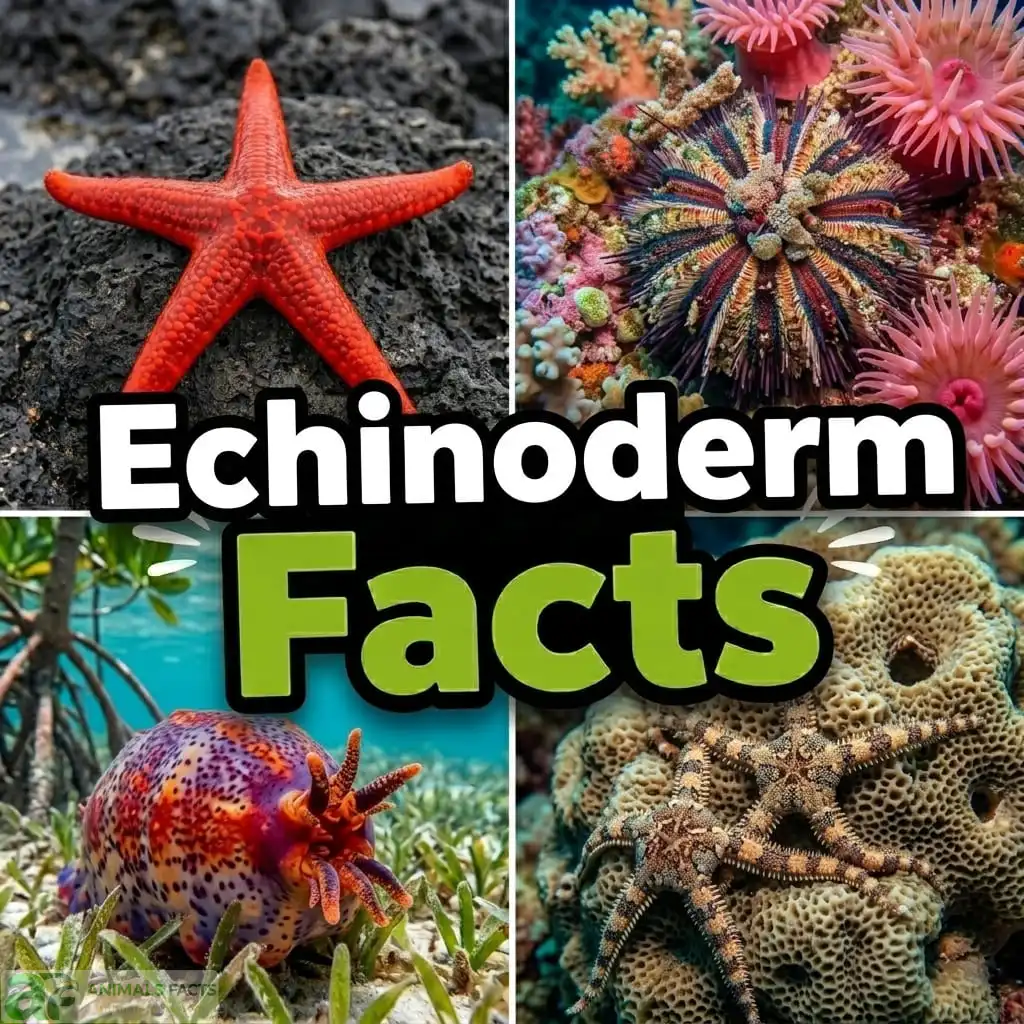
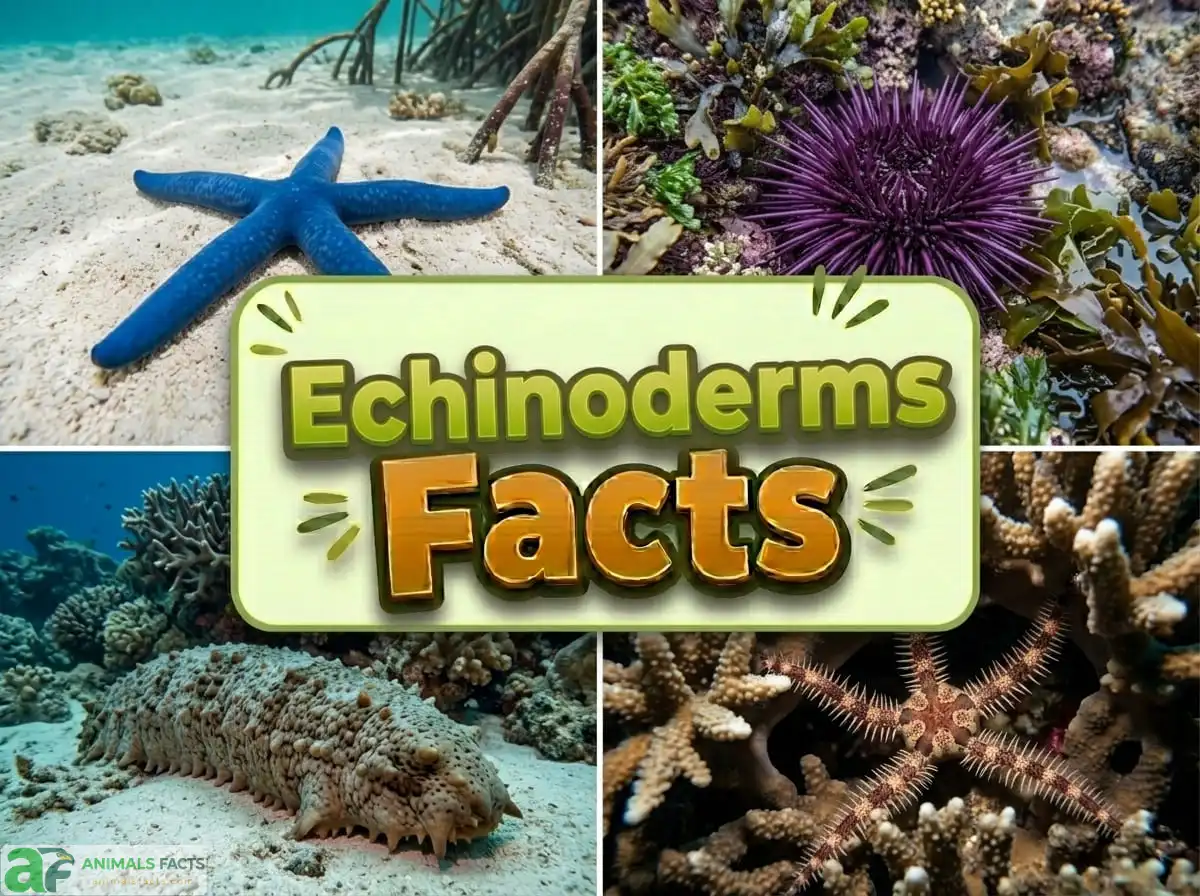
Echinoderm Facts
| Feature | Details |
|---|---|
| Scientific Name (Phylum) | Echinodermata |
| Kingdom | Animalia |
| Meaning of Name | Greek: echinos (spiny) + derma (skin) — “spiny skin” |
| Number of Species | Over 7,500 described; estimated 13,000+ including fossil species |
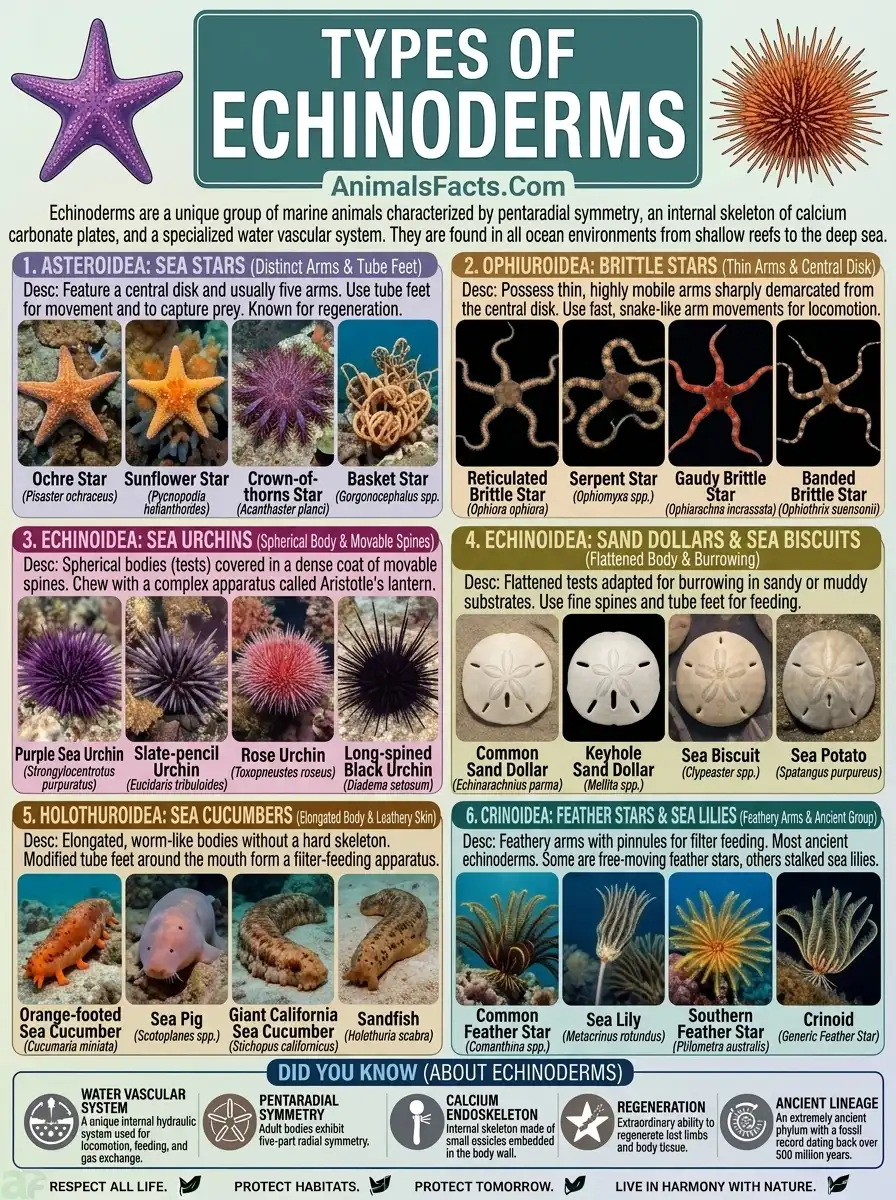
| Major Classes | Asteroidea (sea stars), Echinoidea (sea urchins), Holothuroidea (sea cucumbers), Ophiuroidea (brittle stars), Crinoidea (sea lilies and feather stars) |
| Habitat | Exclusively marine — every ocean on Earth from intertidal zone to hadal depths |
| Lifespan Range | 2 years (some brittle stars) to 200+ years (some sea urchins) |
| Size Range | 1 mm (some brittle stars) to 1 m+ across (some sea stars); sea cucumbers up to 1.8 m |
| Diet | Algae, detritus, plankton, coral polyps, mollusks, carrion — varies enormously by class |
| Conservation Status | Multiple classes threatened; sea urchins, sea cucumbers commercially overexploited |
| Oldest Fossil | ~540 million years ago (Cambrian period) |
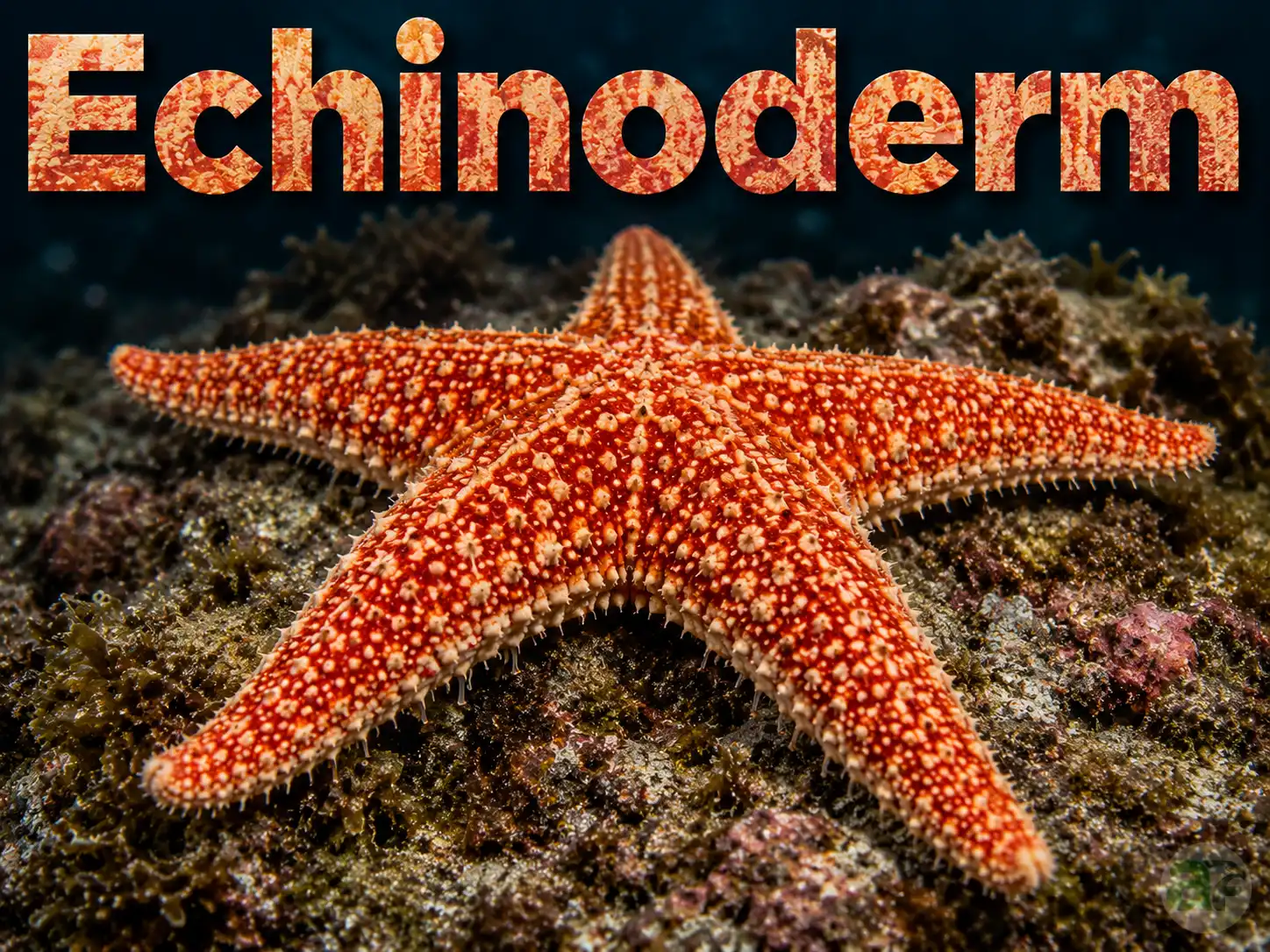
| Defining Feature | Pentaradial (five-fold) symmetry; water vascular system; calcium carbonate endoskeleton |
| Distribution | 100% marine — found in every ocean, at every depth, on every continental shelf |
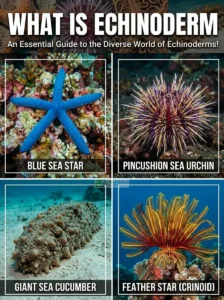 1. Introduction: What is an Echinoderm?
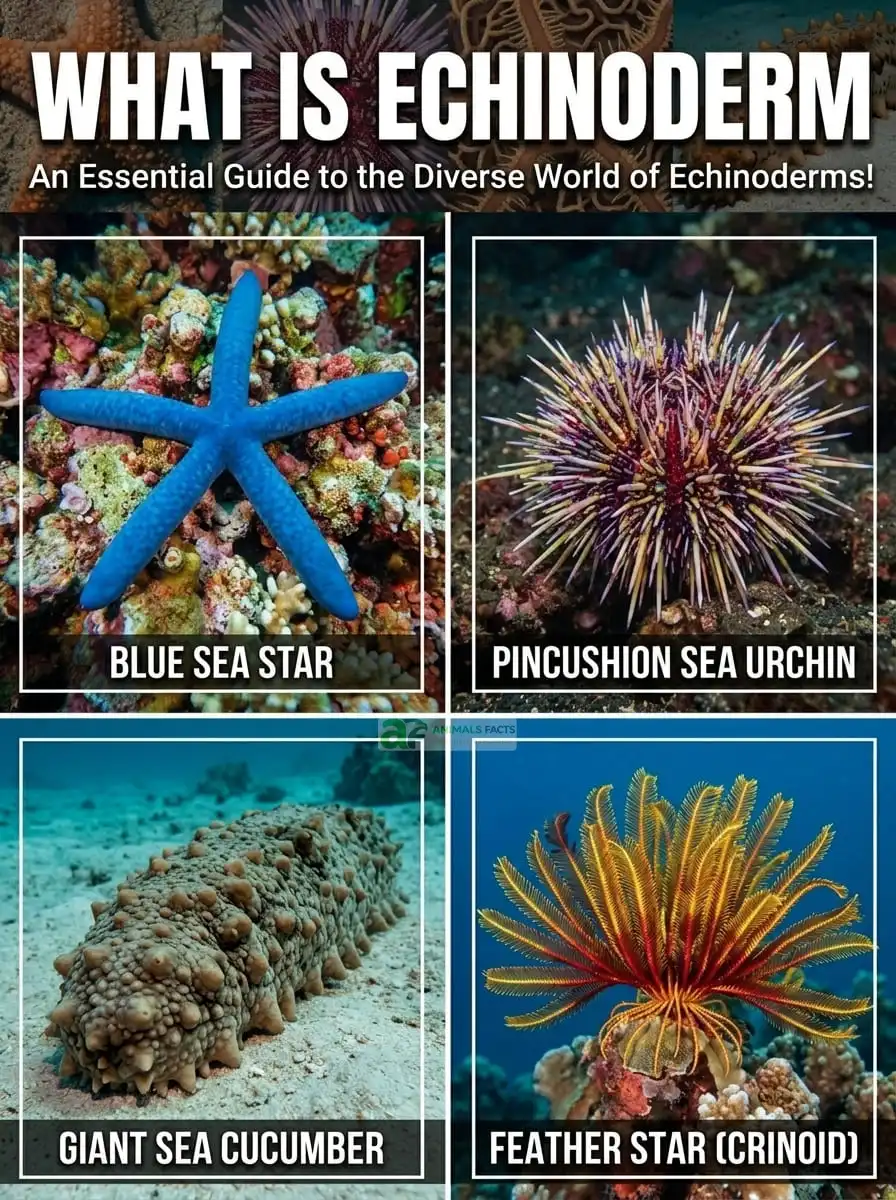
Reach into a tide pool anywhere on Earth’s coastlines, and you are almost certain to touch an animal that belongs to one of biology’s most extraordinary phyla — a group so ancient, so anatomically unique, and so ecologically essential that its removal from any marine ecosystem would trigger a cascade of collapse unmatched by the loss of almost any other animal group. Echinoderm facts are the kind of facts that fundamentally reframe how you look at the ocean. These are animals with no head, no brain, no left or right side, and a body built around the number five — and yet they are among the most successful marine animals in the history of complex life, with a fossil record stretching back 540 million years.
The phylum Echinodermata — whose name means “spiny skin” in Greek — encompasses five living classes of animals so visually different from one another that early naturalists classified them as separate phyla entirely. The sea star that everts its stomach outside its body to digest mussels still in their shells. The sea urchin that can live for over 200 years. The sea cucumber that expels its own internal organs as a defense mechanism and then regenerates them within weeks. The brittle star that can shed and regrow its arms faster than any other animal. The crinoid (feather star) that looks more like an alien plant than an animal and feeds by spreading delicate arms into ocean currents. Every one of these is an echinoderm — and every one of them is extraordinary.
This is your complete, authoritative guide to echinoderm facts — covering every class, every record-breaking adaptation, every ecological role, and every cultural connection that makes this phylum one of the most fascinating in all of animal biology. Whether you are a student searching for echinoderm facts for kids, a marine biologist cross-checking data, a teacher building an ocean curriculum, or simply someone who picked up a sea star at a beach and wondered what exactly they were holding — this article was written for you.
2. Echinoderm Species Overview & Classification
Echinoderms are a phylum of exclusively marine invertebrates that represent one of the most ancient and distinctive animal lineages on Earth. Crucially, they are the closest invertebrate relatives of vertebrates — both echinoderms and vertebrates belong to the deuterostome branch of the animal family tree, making a sea urchin more closely related to a human being than to an insect or a snail.
Taxonomy Table
| Level | Classification |
|---|---|
| Kingdom | Animalia |
| Superphylum | Deuterostomia |
| Phylum | Echinodermata |
| Subphyla | Eleutherozoa (free-moving) and Pelmatozoa (attached; crinoids) |
| Living Classes | 5 |
| Fossil Classes | ~20 additional extinct classes |
| Orders | ~36 living orders |
| Families | ~150+ families |
| Genera | ~1,100 genera |
| Species (described) | Over 7,500 |
The Five Living Classes of Echinoderms
| Class | Common Name | Approx. Species | Key Feature |
|---|---|---|---|
| Asteroidea | Sea stars (starfish) | ~2,000 | Tube feet on underside; arm-based locomotion; evert stomach to feed |
| Echinoidea | Sea urchins, sand dollars, heart urchins | ~1,000 | Globular or flattened body; moveable spines; Aristotle’s lantern (jaw) |
| Holothuroidea | Sea cucumbers | ~1,700 | Elongated, soft-bodied; Cuvierian tubules; evisceration defense |
| Ophiuroidea | Brittle stars, basket stars | ~2,100 | Most species-rich class; arms sharply distinct from central disc; fastest-moving |
| Crinoidea | Sea lilies, feather stars | ~700 | Most ancient class; filter feeders; arms with pinnules; some stalked |
Echinoderm Species Evolution & Discovery Timeline
- ~540 million years ago — Echinoderms appear at the beginning of the Cambrian explosion; early forms include bizarre asymmetrical and bilateral ancestors unlike any living species
- ~500 million years ago — All five major living echinoderm body plans are established in the fossil record; also the peak diversity of now-extinct classes like blastoids and cystoids
- ~250 million years ago — Permian mass extinction devastates echinoderm diversity; many classes go extinct entirely; recovery takes millions of years
- ~100 million years ago — Modern echinoderm families diversify through the Cretaceous; irregular sea urchins (sand dollars, heart urchins) evolve and begin exploiting sediment habitats
- 1758 — Carl Linnaeus classifies major echinoderm species in Systema Naturae, though the phylum is not yet recognized as such
- 1825 — The French zoologist Henri Marie Ducrotay de Blainville establishes Echinodermata as a formal phylum
- 1840s — Johannes Müller publishes foundational work on echinoderm larval development, recognizing the bilateral larvae and their transformation to pentaradial adults
- 1977 — Deep-sea thermal vent communities discovered; novel echinoderm species identified in extreme habitats
- 1983 — Sea star wasting syndrome first documented; later becomes a catastrophic outbreak
- 2013–2014 — Sea Star Wasting Disease (SSWD) devastates sea star populations along the entire North American Pacific coast — the largest marine wildlife disease event ever recorded
- 2020–2026 — Continued deep-sea expeditions discovering new echinoderm species annually; genomic studies reshaping understanding of echinoderm evolution and their relationship to vertebrates
3. Echinoderm Physical Description & Unique Features
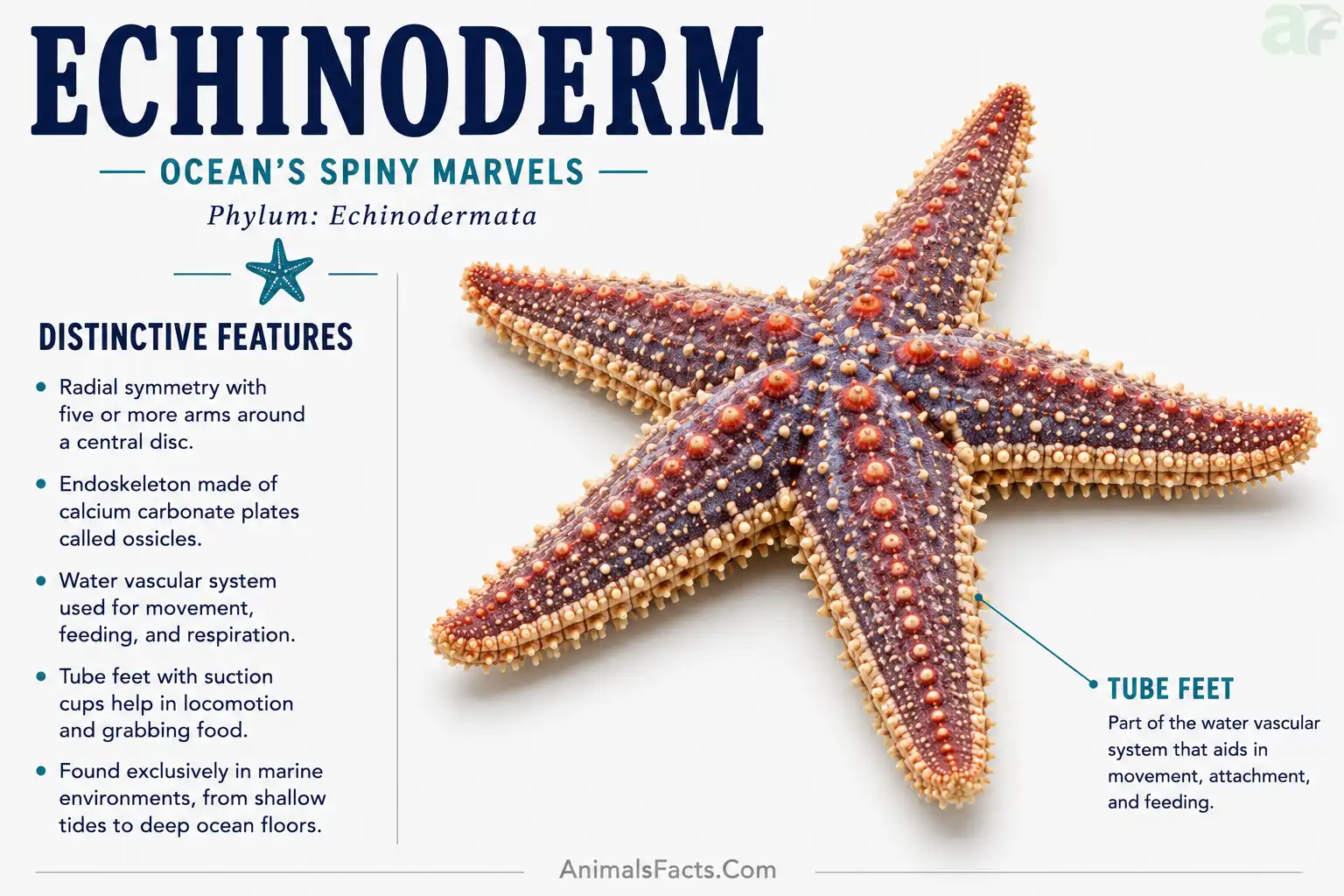
The most immediately recognizable feature of any echinoderm is its pentaradial symmetry — the body organized around five axes radiating from a central point, like the five arms of a sea star or the five rows of tube feet on a sea urchin. This five-fold symmetry is unique among complex animals and is considered one of the phylum’s most defining evolutionary innovations.
The Three Core Features of All Echinoderms
1. Pentaradial (Five-Fold) Symmetry — All adult echinoderms are built around a five-fold radial plan. Even sea cucumbers, which appear bilaterally symmetrical, have five rows of tube feet arranged pentaradially. This symmetry evolved from a bilaterally symmetrical ancestor — echinoderm larvae are still bilaterally symmetrical, and the pentaradial body plan develops during metamorphosis.
2. Water Vascular System — One of the most extraordinary inventions in animal biology. Echinoderms pump seawater through an internal network of canals connected to hundreds or thousands of tube feet — hydraulic extensions that the animal controls precisely for locomotion, feeding, respiration, and sensory perception. The system is entirely unique to echinoderms — no other animal phylum uses hydraulic seawater as a musculoskeletal substitute.
3. Calcium Carbonate Endoskeleton (Stereom) — Rather than an external shell, echinoderms have an internal skeleton made of calcite plates (ossicles) embedded in the body wall — often extended outward as spines, tubercles, or surface textures. This latticed microstructure, called stereom, is found in no other animal and is mechanically sophisticated enough to inspire materials engineers studying lightweight structural design.
Size Records Across Echinoderm Classes
| Record | Species | Measurement |
|---|---|---|
| Largest sea star | Sunflower sea star (Pycnopodia helianthoides) | Up to 1 m across; up to 24 arms |
| Largest sea urchin | Red sea urchin (Mesocentrotus franciscanus) | Up to 19 cm test diameter |
| Largest sea cucumber | Synapta maculata | Body length up to 3 m |
| Largest crinoid | Stalked sea lily Metacrinus rotundus | Stalk + arms up to 1 m total |
| Largest brittle star | Basket star (Gorgonocephalus spp.) | Arm spread up to 70 cm |
| Smallest echinoderms | Some brittle star species | Central disc under 1 mm diameter |
| Longest-lived echinoderm | Red sea urchin (Mesocentrotus franciscanus) | Verified at 200+ years |
| Deepest-living | Various holothurians (sea cucumbers) | Recorded at 10,000+ m in hadal trenches |
Physical Comparison Across Classes
| Feature | Sea Stars | Sea Urchins | Sea Cucumbers | Brittle Stars | Crinoids |
|---|---|---|---|---|---|
| Body shape | Flattened star | Globular/flattened | Elongated cylinder | Disc with thin arms | Cup with feathery arms |
| Arms/Projections | 5–24 arms | None (globular) | None (elongated) | 5 slender arms | 5–200+ pinnuled arms |
| Movement | Tube feet | Tube feet + spines | Tube feet + muscular body | Arm movement | Mostly sessile; some crawl |
| Skeleton | Ossicle plates | Rigid test | Reduced ossicles (soft) | Ossicle plates in arms | Ossicle stalk and arms |
| Spines | Small (most spp.) | Prominent | Absent (most spp.) | Absent | Absent |
“Echinoderms are the universe’s reminder that evolution does not follow a single path. To build a successful, complex, long-lived animal — you do not need a brain, a backbone, or even a consistent front and back. You need water, calcium carbonate, and half a billion years.” — Dr. Richard Mooi, California Academy of Sciences, echinoderm systematist
4. Top 25 Amazing Echinoderm Facts
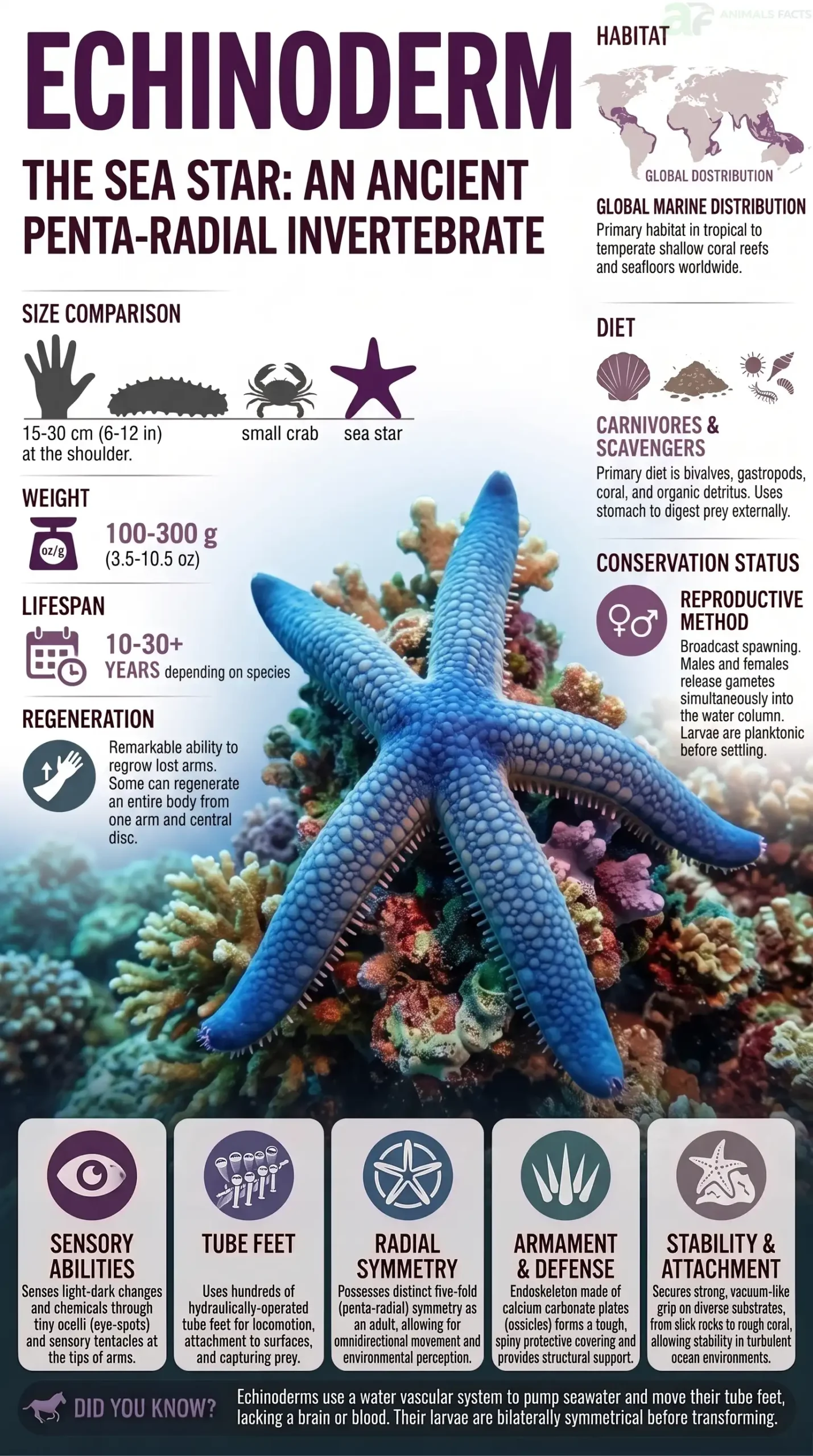
Here are the most extraordinary, conversation-stopping interesting facts about echinoderms — each one a window into the biological wonders of this phylum:
- Echinoderms are the closest invertebrate relatives of vertebrates — you are more closely related to a sea urchin than a sea urchin is to a crab or insect
- All echinoderms are exclusively marine — not a single freshwater or terrestrial echinoderm species has ever existed
- Sea stars evert their stomachs outside their bodies through their mouths — pushing the stomach into a mussel shell through a gap as small as 0.1 mm to digest prey externally
- The red sea urchin (Mesocentrotus franciscanus) can live for over 200 years — one of the longest lifespans of any animal on Earth
- Sea cucumbers expel their own internal organs (Cuvierian tubules or viscera) as a defense mechanism — then fully regenerate them within weeks
- The sunflower sea star (Pycnopodia helianthoides) can move at 1 m per minute — extraordinarily fast for a sea star — and has up to 24 arms
- Echinoderms have no brain and no centralized nervous system — only a nerve ring and radial nerves; yet they coordinate complex behaviors across their entire body
- Brittle stars are the fastest-moving echinoderms, using their arms in a rowing motion; some species can regenerate a completely severed arm in weeks
- Sea urchin jaws — called Aristotle’s lantern after the ancient Greek philosopher who first described them — are among the most sophisticated grinding tools in the invertebrate world, capable of scraping through rock
- The crown-of-thorns sea star (Acanthaster planci) can single-handedly devastate coral reefs — a single individual consumes up to 6 m² of coral per year, and population outbreaks have destroyed vast sections of the Great Barrier Reef
- Some sea cucumbers found in the Mariana Trench and similar hadal environments make up over 90% of the total animal biomass at extreme depths — they dominate the deepest environments on Earth
- Crinoids (feather stars and sea lilies) are considered the most ancient echinoderm class — some stalked sea lily genera are virtually unchanged from Paleozoic fossils 450 million years old
- Echinoderms possess mutable connective tissue — they can switch their body tissues between a liquid-like and solid state within seconds, allowing arms to be voluntarily detached or bodies to squeeze through tiny gaps
- Sea urchin eggs divide in a pattern so predictable and well-studied that they have been used as the primary model organism for understanding cell division and embryology for over 150 years
- The basket star (Gorgonocephalus spp.) — a type of brittle star — branches its arms repeatedly until it resembles a living coral tree, with hundreds of tips simultaneously trapping plankton
- Sea star larvae are bilaterally symmetrical — they look nothing like the adults; the five-fold symmetry develops only during metamorphosis, effectively remodeling the entire body plan
- Some sea cucumbers of the family Synaptidae have no tube feet at all — they move by muscular peristalsis, gripping the substrate with sticky anchor-like spicules in their skin
- The purple sea urchin (Strongylocentrotus purpuratus) has a genome containing 23,000 genes — close to the human genome — and shares approximately 70% of its genes with humans, including many immune system genes
- Sea stars can regenerate an entire body from a single severed arm — as long as a portion of the central disc remains attached to the arm
- Feather stars (comatulid crinoids) can swim — undulating their arms in a coordinated wave pattern to relocate when disturbed — making them the only echinoderms capable of true swimming
- The long-spined sea urchin (Diadema antillarum) collapsed catastrophically in the Caribbean in 1983–84 — over 93% of the population died from a pathogen in a single year — triggering massive coral reef degradation that persists today
- Some deep-sea sea cucumbers walk on the seafloor on their Cuvierian tubules (modified internal organs) that extend through the body wall — an extraordinary evolutionary repurposing of internal anatomy
- Sand dollars are echinoderms — flattened sea urchins (irregular echinoids) that live buried in sand; the “petals” on their surface are respiratory tube feet
- The sea star wasting disease (SSWD) outbreak of 2013–2015 killed an estimated billions of sea stars along the entire North American Pacific coast — the largest marine wildlife disease event in recorded history
- Echinoderm tube feet are not just for movement — they also function as gills (for gas exchange), sensory organs (detecting light, chemicals, and touch), and feeding appendages simultaneously
Did You Know? The Aristotle’s lantern — the complex five-toothed jaw apparatus of sea urchins — is named after the ancient Greek philosopher Aristotle, who described it in his Historia Animalium around 350 BCE, comparing the whole sea urchin to a lantern with the sides removed. Despite being 2,400 years old, his description of the jaw’s structure and function was remarkably accurate — and the name has stuck ever since.
5. Echinoderm Fun Facts for Kids
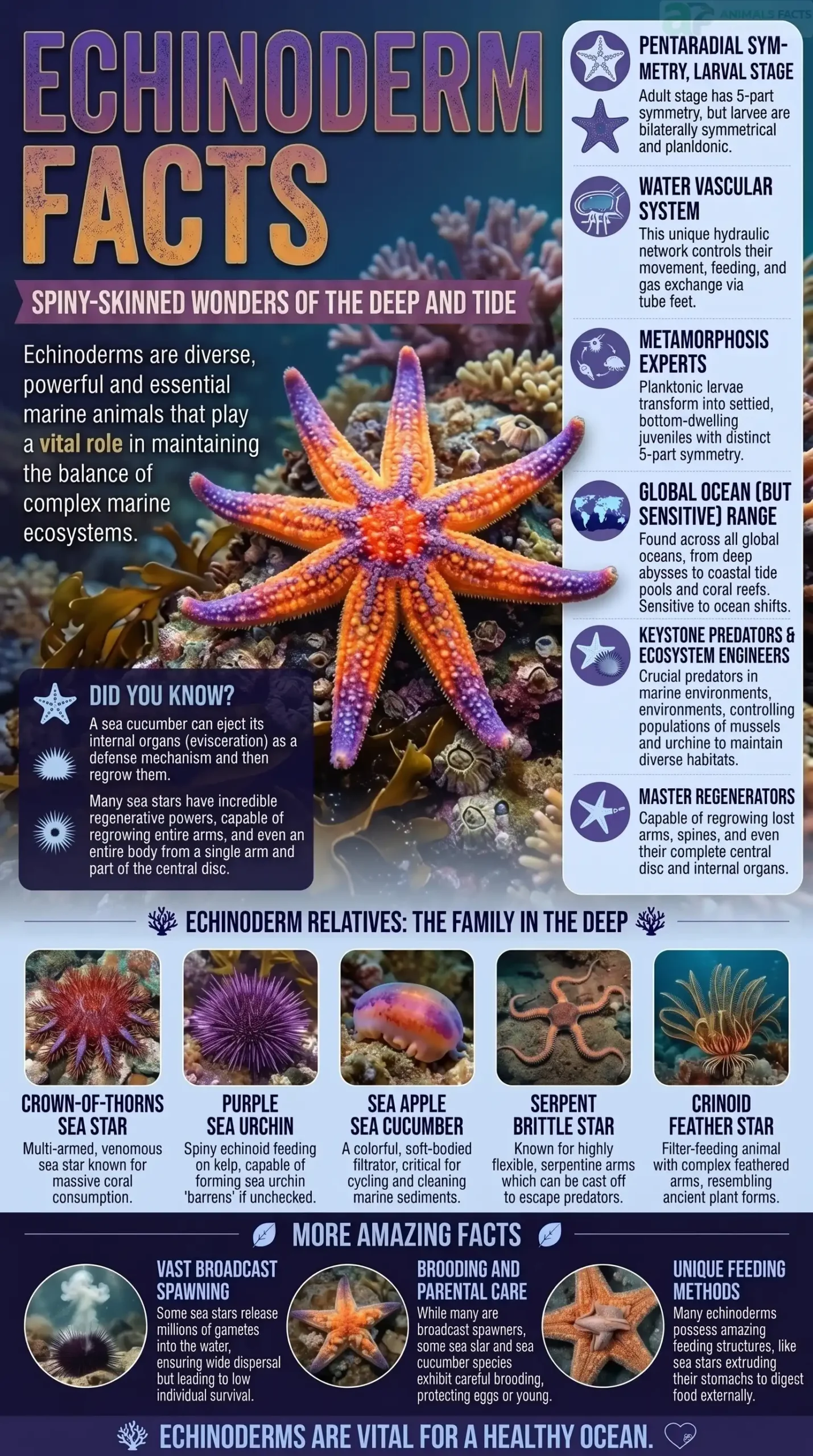
- Echinoderms are 100% marine — no freshwater or land species has ever existed
- They have no brain — yet coordinate complex behavior across their entire body
- All adults have five-fold (pentaradial) symmetry — even sea cucumbers
- Sea urchin jaws are called “Aristotle’s lantern” — described 2,400 years ago
- Sea cucumbers expel and regenerate their own organs as a defense
- Sea urchin DNA shares ~70% of genes with humans
- Crinoids are virtually unchanged from fossils 450 million years old
- Sea stars can regrow a whole body from a single arm
- Red sea urchins can live for over 200 years
- Feather stars are the only echinoderms that can swim
- The water vascular system — unique to echinoderms — uses seawater as hydraulic fluid for movement
- Crown-of-thorns sea stars devour 6 m² of coral per year
- Sea cucumbers dominate 90%+ of animal biomass in the deepest ocean trenches
- Echinoderms are more closely related to you than to crabs or insects
- Over 7,500 species found across every ocean on Earth
6. Echinoderms Natural Habitat & Geographic Range
Echinoderms are found in every ocean on Earth, at every depth, on every type of substrate — from sun-drenched tropical tide pools to lightless abyssal plains at 10,000 meters, from polar seas choked with ice to warm coral reef lagoons. The phylum’s exclusive restriction to marine environments is one of its most distinctive characteristics — echinoderms have never successfully colonized freshwater or terrestrial habitats in their 540-million-year history.
Habitat Range by Environment
| Habitat Type | Dominant Echinoderm Groups | Notable Species |
|---|---|---|
| Intertidal zone | Sea stars, sea urchins, brittle stars | Purple sea urchin, ochre sea star, common brittle star |
| Subtidal rocky reef | Sea stars, urchins, crinoids, brittle stars | Crown-of-thorns sea star, red sea urchin, stalked crinoid |
| Coral reef | Crown-of-thorns sea stars, reef urchins, crinoids, brittle stars | Acanthaster planci, Diadema urchins, feather stars |
| Sandy/muddy seafloor | Sand dollars, heart urchins, sea cucumbers, brittle stars | Common sand dollar, Holothuria sea cucumbers |
| Kelp forest | Sea urchins, sea stars, brittle stars | Purple urchin, sunflower sea star |
| Deep sea (200–6,000 m) | Sea cucumbers, brittle stars, crinoids, sea stars | Elpidia sea cucumbers, glass sea stars |
| Hadal zone (>6,000 m) | Sea cucumbers (dominant) | Myriotrochus and Elpidia — 90%+ of hadal biomass |
| Polar seas | Sea stars, urchins, brittle stars, sea cucumbers | Antarctic Odontaster sea stars; Arctic urchins |
| Hydrothermal vents | Brittle stars, sea cucumbers, some sea stars | Vent-associated holothurians and ophiuroids |
| Seagrass beds | Sea urchins, sea cucumbers, brittle stars | Lytechinus, Holothuria in tropical seagrass |
Continent and Ocean Region Breakdown
| Region | Echinoderm Highlights | Notable Record |
|---|---|---|
| Indo-Pacific | Greatest sea star and crinoid diversity; crown-of-thorns outbreaks | Highest global echinoderm species richness |
| North Pacific | Sunflower sea star; red sea urchin; purple urchin; kelp forest dynamics | Sea star wasting disease epicenter (2013–2015) |
| Caribbean | Diadema urchins (collapsed 1983); brittle star beds | Historic Diadema mass mortality — 93% population loss |
| Mediterranean | Paracentrotus lividus (edible urchin); common sea star; brittle stars | Major edible urchin commercial fishery |
| Arctic/Antarctic | Dense brittle star mats; Odontaster sea stars; polar sea cucumbers | Antarctic brittle star beds among densest in world |
| Atlantic (deep sea) | Stalked crinoids; abundant sea cucumbers; glass sea stars | Stalked crinoids photographed at 5,000+ m depth |
| Indian Ocean | Feather stars; sea cucumbers; tropical sea stars | Sea cucumber heavily overexploited for beche-de-mer trade |
Did You Know? In the Mariana Trench and other hadal zones deeper than 6,000 meters, sea cucumbers (holothurians) are not merely present — they are dominant. In some deep-sea camera surveys at 10,000+ meters, sea cucumbers account for over 90% of all visible animal biomass. They consume the organic debris that rains down from the surface ocean — processing and recycling nutrients at the most extreme depths any complex animal inhabits.
7. Diet & Feeding Behavior
The five echinoderm classes have evolved five remarkably different feeding strategies — from the explosive stomach-eversion of sea stars, to the rock-scraping jaw apparatus of sea urchins, to the passive filter-feeding elegance of crinoid arms spread into ocean currents.
Diet Breakdown Across Major Groups
| Group | Diet Type | Primary Food | Feeding Method | Approx. % Composition |
|---|---|---|---|---|
| Sea stars (Asteroidea) | Carnivore / Omnivore | Mussels, clams, oysters, barnacles, snails, carrion | Evert stomach over or into prey; external digestion | Mollusks ~60%; echinoderms ~15%; other ~25% |
| Sea urchins (Echinoidea) | Herbivore / Omnivore | Algae, kelp, encrusting organisms, organic detritus | Aristotle’s lantern scrapes substrate | Algae ~70%; detritus ~20%; invertebrates ~10% |
| Sand dollars (Echinoidea) | Detritivore / Filter feeder | Organic particles, diatoms, bacteria in sediment | Tube feet and spines move particles to mouth | Organic particles ~80%; diatoms ~20% |
| Sea cucumbers (Holothuroidea) | Detritivore / Suspension feeder | Organic detritus, sediment bacteria, suspended particles | Oral tentacles sweep sediment or water | Sediment organics ~85%; suspended particles ~15% |
| Brittle stars (Ophiuroidea) | Omnivore / Scavenger | Detritus, plankton, small invertebrates, carrion | Arm tips capture; tube feet manipulate food toward mouth | Detritus ~50%; plankton ~30%; invertebrates ~20% |
| Crinoids (Crinoidea) | Suspension feeder | Zooplankton, phytoplankton, organic particles | Outstretched pinnuled arms trap particles in mucus; tube feet pass food to groove toward mouth | Plankton ~90%; particles ~10% |
| Crown-of-thorns sea star | Coral predator | Coral polyps almost exclusively | Evert stomach over coral; digest polyp tissue | Coral ~95%; other organisms ~5% |
The feeding behavior of the crown-of-thorns sea star (Acanthaster planci) deserves special attention — it is among the most ecologically consequential feeding behaviors of any invertebrate on Earth. When populations bloom, a single adult can consume up to 6 square meters of living coral per year. During major outbreak events on the Great Barrier Reef — documented in 1960s, 1980s, and 2010s — crown-of-thorns aggregations have destroyed vast areas of reef structure over periods of months, leaving behind bleached calcium carbonate skeletons where thriving coral communities once existed.
8. Echinoderm Reproduction & Life Cycle
Echinoderms display a remarkable diversity of reproductive strategies — many can reproduce both sexually and asexually — and their larval development has been fundamental to the science of embryology for over 150 years.
Reproductive Strategies
Broadcast spawning — The dominant reproductive strategy across all five classes. Males and females release eggs and sperm simultaneously into the open water, where fertilization occurs externally. Synchronization is triggered by environmental cues — water temperature, lunar cycles, and chemical signals released by nearby spawning individuals.
Brooding — Some sea stars, brittle stars, and sea cucumbers brood eggs directly on or inside their bodies — particularly in polar species where planktonic food for larvae is seasonally scarce.
Asexual reproduction (fission) — Many sea stars and brittle stars can reproduce by splitting their body in two, with each half regenerating the missing portion. In some sea star species, this is a primary reproductive strategy, not just an emergency response.
Cloning from fragments — Sea stars can regenerate an entire individual from a single arm with a fragment of central disc. This is not just a defense response — in some species, arms are voluntarily autotomized and grow into new individuals.
Life Stages of a Typical Echinoderm (Sea Star Example)
- Fertilized egg — Transparent, rapidly dividing; first divisions visible within 2–4 hours
- Blastula — Hollow ball of cells; begins swimming with cilia
- Gastrula — Three-layered embryo; gut begins forming
- Bipinnaria larva — Bilaterally symmetrical; free-swimming; bears no resemblance to adult
- Brachiolaria larva — Develops adhesive arms; settles onto substrate
- Metamorphosis — Dramatic reorganization; bilateral symmetry replaced by pentaradial body plan
- Juvenile sea star — Tiny but recognizable; all five arms present; begins feeding
- Adult — Sexually mature; continues growing throughout life
Lifespan Comparison Across Echinoderm Classes
| Species | Class | Lifespan | Notes |
|---|---|---|---|
| Common brittle star (Ophiothrix fragilis) | Ophiuroidea | 2–5 years | One of the shorter-lived echinoderms |
| Common sea star (Asterias rubens) | Asteroidea | 5–10 years | Typical temperate sea star lifespan |
| Green sea urchin (Strongylocentrotus droebachiensis) | Echinoidea | 7–10 years | Common subarctic species |
| Purple sea urchin (Strongylocentrotus purpuratus) | Echinoidea | Up to 50 years | Extensively studied model organism |
| Red sea urchin (Mesocentrotus franciscanus) | Echinoidea | Over 200 years | Longest-lived echinoderm confirmed |
| Japanese sea cucumber (Apostichopus japonicus) | Holothuroidea | Up to 10 years | Most commercially important holothurian |
| Feather star (Comatula spp.) | Crinoidea | Unknown; estimated 5–10 years | Poorly studied in wild |
| Stalked sea lily (Metacrinus spp.) | Crinoidea | Unknown; estimated decades | Extremely slow-growing |
Did You Know? The larvae of echinoderms are bilaterally symmetrical — they look nothing like their parents and bear a closer resemblance to the larvae of vertebrates than to the adults they will become. This shared larval symmetry is one of the key pieces of evidence that echinoderms and vertebrates share a common ancestor — the great deuterostome ancestor from which all backbone animals ultimately descended.
9. Social Behavior & Communication
Echinoderms lack the brains, vocal cords, and complex nervous systems of vertebrates — yet they display coordinated behaviors, chemical communication, and collective ecological effects that challenge simplistic assumptions about animal cognition and social life.
Chemical Communication
The most important communication channel for echinoderms is chemical signaling — dissolved compounds in the water column that trigger spawning synchronization, alarm responses, aggregation, and habitat selection:
- Spawning pheromones — When one sea urchin or sea star begins releasing gametes, chemical signals in the water trigger synchronous spawning in nearby individuals — a critical coordination mechanism for broadcast spawners in open water
- Alarm substances — Some sea stars release chemical alarm signals when injured, triggering escape responses in nearby prey animals (such as mussels closing their shells more tightly or limpets moving away)
- Settlement cues — Echinoderm larvae detect chemical signatures of suitable substrates before permanently settling — including compounds released by conspecific adults, encrusting coralline algae, and specific bacterial biofilms
Behavioral Coordination
Despite having no centralized brain, echinoderms coordinate complex behaviors:
- Righting response — All echinoderms can right themselves when overturned, through coordinated tube foot activity across the entire body — without any central coordination point
- Predator avoidance — Sea urchins aggregate in crevices during daylight hours when visual predators are active, dispersing to feed at night — a rhythmic behavioral pattern controlled by distributed photoreceptors in the skin
- Crown-of-thorns aggregation — During feeding outbreaks, crown-of-thorns sea stars aggregate in groups of hundreds on reefs — a collective feeding behavior potentially triggered by chemical cues from damaged coral
Intelligence and Sensory Abilities
Echinoderms have no eyes in the traditional sense — yet sea stars have been shown to possess photoreceptors distributed across their entire body surface and in some species, concentrated at arm tips. A 2023 study in PNAS demonstrated that the blue sea star (Linckia laevigata) has compound eyes at its arm tips that can perceive coarse images — allowing it to visually navigate back toward coral reef structures from a distance of several meters.
“The echinoderm has solved the problem of living without a brain by distributing the task of coordination across every cell, every arm, every tube foot. It is not a lesser solution than having a brain — it is a completely different solution, and for half a billion years, it has worked magnificently.” — Dr. Mah Christopher, Smithsonian Institution, sea star systematist
10. Predators & Defense Mechanisms
Natural Predators of Echinoderms
| Predator | Echinoderm Prey | Hunting Method |
|---|---|---|
| Sea otters | Sea urchins, sea stars | Crack shells with rocks; keystone predators |
| Sunflower sea star | Other sea stars, urchins, sea cucumbers | Active pursuit; chemical intimidation |
| Harlequin shrimp | Sea stars | Capture and feed on arms and tube feet |
| Triggerfish, pufferfish | Sea urchins | Bite off spines; flip urchins; bite soft underside |
| Wolfish | Sea urchins | Powerful jaws crush urchin tests |
| Seagulls and crows | Intertidal sea stars, sea urchins | Drop animals on rocks to shatter them |
| Napoleon wrasse | Crown-of-thorns sea stars | One of few fish that eat this venomous species |
| Humpback whales | Krill and associated brittle star communities | Incidental consumption in dense benthic aggregations |
| Humans | Sea urchins, sea cucumbers | Commercial harvest for food and medicine |
Defense Strategies
| Strategy | Group | Description |
|---|---|---|
| Spines | Sea urchins | Long, sharp, sometimes venomous; deter most predators |
| Evisceration | Sea cucumbers | Expel internal organs; some contain holothurin toxins that paralyze fish |
| Cuvierian tubules | Sea cucumbers | Sticky toxic threads expelled through body wall; entangle predators |
| Autotomy | Sea stars, brittle stars | Voluntarily shed arms to distract predators; regenerate |
| Mutable connective tissue | All echinoderms | Switch body rigidity in milliseconds; arms can be dropped or squeezed through gaps |
| Toxic skin compounds | Sea stars (some), sea cucumbers | Saponins and other toxins render flesh distasteful or toxic |
| Aggregation in crevices | Sea urchins | Hide in rock crevices; orient spines outward |
| Camouflage | Some sea cucumbers, brittle stars | Match substrate color and texture; bury in sediment |
| Crown-of-thorns venomous spines | Crown-of-thorns sea star | Venomous spines cause intense pain; deter most predators |
Did You Know? The sea cucumber (Holothuria scabra and related species) defends itself by expelling sticky, toxic threads called Cuvierian tubules through its body wall — threads that can entangle a fish or crab and remain sticky for hours. But this is not all — some sea cucumbers also expel their stomach, intestines, and respiratory organs entirely through their mouth or body wall when severely threatened. The predator is left with a confusing mass of viscera while the sea cucumber slowly crawls away — and regenerates its organs completely within 1–5 weeks.
11. Echinoderm Facts for Kids
Hey young ocean explorers! Echinoderms are some of the weirdest and most wonderful animals in the sea — and here are some facts that will absolutely blow your mind:
- Sea stars are not fish! Their real name is “sea star” — and they belong to a totally different animal group from fish
- A sea star can push its stomach outside its own body to eat a mussel — imagine eating with your tummy outside you!
- Sea urchins have a special jaw called “Aristotle’s lantern” — named after a scientist who lived over 2,000 years ago!
- If a sea star loses an arm, it grows a brand new one — and the old arm can sometimes grow into a whole new sea star!
- Sea cucumbers protect themselves by shooting their own guts out at predators — then they grow new ones!
- The red sea urchin can live for over 200 years — it was already old when your great-great-great-grandparents were born!
- Echinoderms have no brain at all — but they can still move, hunt, and escape from danger!
- Feather stars can actually swim — they wave their feathery arms like wings to glide through the water!
- Sea urchins share about 70% of their DNA with humans — more similar to us than they look!
- Sand dollars are actually urchins — flattened sea urchins that live buried in the sand!
12. Relationship with Humans
Echinoderms as Food
Echinoderms have been consumed by humans for thousands of years — and today represent significant global seafood industries:
Sea urchin roe (uni) — The gonads of sea urchins are considered a prized delicacy in Japanese cuisine (uni) as well as in Mediterranean cultures. Japan alone consumes the majority of the world’s sea urchin harvest — with premium uni commanding $150–$300+ USD per kilogram in Tokyo’s Tsukiji and Toyosu fish markets. Major producing regions include Japan, Chile, Russia, the United States (Maine and California), and the Mediterranean.
Sea cucumbers (beche-de-mer / trepang) — Dried sea cucumbers are one of the most valuable seafood commodities in East and Southeast Asian markets — serving as a luxury food ingredient and traditional medicine. A single dried sea cucumber of premium species can sell for over $3,000 per kilogram in Hong Kong markets. Global trade in sea cucumbers exceeds $1 billion annually and has driven catastrophic overharvesting across the Indo-Pacific.
Sea urchin fisheries — Red, purple, and green sea urchins are commercially harvested across the Pacific and Atlantic. Sea urchin aquaculture is a growing industry in Japan, Norway, and Ireland.
Medical and Scientific Contributions
Embryology model organism — Sea urchin eggs have been the primary model organism for the study of fertilization and cell division for over 150 years — from the discovery of the fertilization membrane in the 1870s to contemporary genomic research. The transparency of sea urchin eggs and the precision of their cell divisions made them invaluable tools long before advanced microscopy existed.
Drug discovery — Echinoderm-derived compounds are active areas of pharmaceutical research:
- Trabectedin (ET-743) — derived from the sea squirt Ecteinascidia (a tunic relative of echinoderms) — is an approved cancer chemotherapy drug used for soft tissue sarcoma and ovarian cancer
- Sea cucumber saponins (holothurins) are studied for antifungal, antitumor, and immune-modulating properties
- Sea urchin spine regeneration mechanisms are studied for potential applications in human bone repair and regenerative medicine
Echinoderms and Ecological Services for Humans
Coral reef protection — Sea urchins, particularly Diadema species, graze algae that would otherwise overgrow coral reefs, allowing coral larvae to settle and grow. The catastrophic collapse of Caribbean Diadema populations in 1983 directly contributed to the shift from coral-dominated to algae-dominated Caribbean reef systems — a transformation with enormous economic implications for Caribbean tourism and fisheries.
13. Echinoderm Conservation Status & Threats
The Echinoderm Conservation Crisis
Echinoderms face threats across all five classes — ranging from catastrophic disease outbreaks to commercial overexploitation to climate-driven habitat destruction:
IUCN Status of Selected Echinoderms
| Species | Class | IUCN Status |
|---|---|---|
| Sunflower sea star (Pycnopodia helianthoides) | Asteroidea | Critically Endangered (2020) |
| Long-spined sea urchin (Diadema antillarum) | Echinoidea | Vulnerable |
| American common sea star (Asterias forbesi) | Asteroidea | Not assessed (significant SSWD decline) |
| Sandfish sea cucumber (Holothuria scabra) | Holothuroidea | Endangered in many regional assessments |
| White teatfish (Holothuria fuscogilva) | Holothuroidea | Endangered — severe commercial overexploitation |
| Stalked sea lilies (several Metacrinus spp.) | Crinoidea | Data Deficient — poorly monitored |
| Red sea urchin (Mesocentrotus franciscanus) | Echinoidea | Near Threatened in some regions |
Major Threats
| Threat | Impact Level | Echinoderms Most Affected |
|---|---|---|
| Sea star wasting disease (SSWD) | Critical | Sunflower sea star; multiple Pacific sea star species |
| Sea cucumber overexploitation | Critical | Multiple Holothuria and Stichopus species |
| Climate change / ocean warming | High | All classes; wasting disease linked to warming water |
| Ocean acidification | High | Calcium carbonate skeletons dissolve in acidified water |
| Crown-of-thorns outbreaks | High | Coral reef ecosystems; linked to agricultural nutrient runoff |
| Sea urchin overexploitation | High | Diadema, Paracentrotus, Mesocentrotus species |
| Invasive species | Medium | Pacific sea stars introduced to Australia; disrupting native communities |
| Trawling | Medium | Destroys brittle star beds, stalked crinoid communities |
| Pollution (agricultural runoff) | Medium | Triggers crown-of-thorns outbreaks; Diadema disease linked to water quality |
The Sea Star Wasting Disease Crisis
The Sea Star Wasting Disease (SSWD) outbreak that began along the North American Pacific coast in 2013 was the largest marine wildlife disease event ever recorded. Caused by a densovirus (SSaDV) — potentially exacerbated by anomalously warm sea surface temperatures — the disease caused sea stars to develop lesions, lose arm coordination, and literally disintegrate within days of showing symptoms. Billions of sea stars across over 20 species died from Alaska to Mexico. The sunflower sea star (Pycnopodia helianthoides) lost an estimated 90%+ of its total population and was declared Critically Endangered by the IUCN in 2020. Recovery has been slow and partial through 2026.
14. Famous Echinoderms
Patrick Star – The Cultural Ambassador
The pink sea star Patrick Star from the animated series SpongeBob SquarePants (1999–present) is without question the most famous echinoderm in popular culture history — a lovable, perpetually confused sea star living under a rock who has become one of the most merchandised fictional animals on Earth. While Patrick’s behavior is thoroughly fictional, his basic appearance (five arms, bumpy surface, oral side facing down) is biologically accurate for a sea star.
The Sunflower Sea Star – IUCN’s Poster Echinoderm
The sunflower sea star (Pycnopodia helianthoides) — the largest sea star in the world, with up to 24 arms and a span of 1 meter — became the most visible symbol of the sea star wasting disease crisis when its catastrophic collapse was documented between 2013 and 2016. Its IUCN Critically Endangered listing in 2020 brought unprecedented public attention to echinoderm conservation.
The Crown-of-Thorns – The Reef’s Most Feared Echinoderm
The crown-of-thorns sea star (Acanthaster planci) achieved global notoriety when its population outbreaks on the Great Barrier Reef were documented extensively in the 1960s and subsequent decades. David Attenborough discussed the threat in multiple BBC productions; the crown-of-thorns became the public face of the human-driven nutrient pollution problem degrading tropical reef ecosystems worldwide.
Peach – Finding Nemo‘s Resident Echinoderm Expert
The orange and pink sea star “Peach” in Pixar’s Finding Nemo (2003) and Finding Dory (2016) — voiced by actress Allison Janney — lives in the dentist’s aquarium glass and narrates events in the waiting room with deadpan commentary. Peach represents one of the rare instances of a biologically realistic echinoderm character in mainstream animation — she adheres to glass via suction (tube feet) exactly as real sea stars do.
15. Role in Ecosystem & Food Chain
Echinoderms are not background players in marine ecosystems — they are architects, engineers, and regulators without whom the communities around them would fundamentally transform.
Core Ecological Roles
Keystone predators (sea stars) — The sea star’s role as a keystone predator was classically demonstrated in the landmark 1966 experiment by ecologist Robert Paine on the coast of Washington State, USA. When Paine removed ochre sea stars (Pisaster ochraceus) from a section of intertidal rock, mussels rapidly outcompeted all other species — collapsing the multi-species community to a monoculture within months. Reinstate the sea stars, and diversity recovered. This experiment effectively invented the keystone species concept in ecology, and the sea star was its defining example.
Algae control (sea urchins) — In kelp forests and coral reefs globally, sea urchins graze the algae that would otherwise smother hard substrates and prevent coral and kelp from growing. Without urchin grazing pressure, coral reefs shift to algae-dominated systems — a transition that has occurred catastrophically in the Caribbean following the Diadema collapse of 1983.
Sediment processing (sea cucumbers) — Sea cucumbers are the ocean’s living vacuum cleaners — ingesting sediment, extracting organic matter and bacteria, and excreting cleaned, aerated sediment. A single large sea cucumber can process 1,000 kg of sediment per year. At hadal depths where they dominate animal biomass, they are the primary mechanism by which organic matter reaching the seafloor is recycled into the water column.
Structural habitat (crinoids and brittle stars) — Dense crinoid meadows and brittle star beds on seamounts and deep reef slopes provide structural complexity that shelters hundreds of associated species — fish, shrimp, worms, small crustaceans — creating biodiversity hotspots in otherwise monotonous deep-sea environments.
16. Echinoderm Myths, Folklore & Cultural Significance
The Star of the Sea – Christian and Maritime Symbolism
The sea star has been a symbol of navigation, hope, and divine guidance in European maritime cultures for centuries. In Christian tradition, the Virgin Mary is often called “Stella Maris” (Star of the Sea) — a title visually associated with the sea star’s five-pointed form echoing the five wounds of Christ. Medieval sailors wore sea star amulets and carved them into ship prows as protection on ocean voyages.
Pacific Island Traditions – Sea Cucumbers and Spiritual Power
In many Pacific Island cultures — Melanesian, Polynesian, and Micronesian — the sea cucumber (trepang) is associated with fertility, regeneration, and the life-giving properties of the ocean. Its ability to expel and regenerate its organs is cited in some oral traditions as a symbol of death and rebirth — the same creative power that the ocean exercises over island life. Traditional harvesting of sea cucumbers involved ritual protocols governing when, where, and how collection could occur.
Ancient Chinese Medicine – The Immortal Sea Cucumber
In traditional Chinese medicine, sea cucumbers (hai shen, literally “sea ginseng”) have been valued for over 1,000 years as a tonic for longevity, kidney function, libido, and vitality. The earliest written records of sea cucumber consumption date to the Ming Dynasty (1368–1644 CE). Today, the traditional medicinal market for sea cucumber in China, Hong Kong, Taiwan, and Southeast Asia drives the global trade that threatens wild populations across the Indo-Pacific.
Japanese Culture – Uni and Seasonal Ritual
Sea urchin roe (uni) holds a culturally elevated position in Japanese cuisine beyond simple food preference. The consumption of fresh uni — particularly from Hokkaido in summer — is a seasonal ritual, a marker of culinary sophistication, and a connection to the ocean’s generosity. Premium uni appears on special occasion menus, in gift-giving culture, and in poetry about the Japanese relationship with the sea.
Native American Traditions – Sea Stars and Tide Pool Knowledge
Multiple Pacific Northwest Indigenous nations — including the Haida, Tlingit, and Coast Salish peoples — incorporate sea stars, sea urchins, and sea cucumbers into traditional ecological knowledge systems that governed sustainable harvesting of intertidal resources for thousands of years. Sea stars appear in totem art and oral traditions as symbols of the productive power of the intertidal zone.
17. Echinoderms in Pop Culture
Film and Television
- Finding Nemo (2003, Pixar) — Peach the sea star; Finding Dory (2016) — Hank the septopus features alongside the returning Peach; echinoderms are recurring characters
- SpongeBob SquarePants (1999–present, Nickelodeon) — Patrick Star; one of the most iconic animated characters globally
- Blue Planet II (2017, BBC) — Extraordinary sequences of feather star behavior, brittle star aggregations, and crown-of-thorns feeding
- Life (2009, BBC) — David Attenborough narrates sea star predation sequences and sea cucumber evisceration defense in detail
- Aliens of the Deep (2005, Disney/IMAX) — Deep-sea echinoderm communities at hydrothermal vents; sea cucumbers and brittle stars featured
- The Blue Planet (2001, BBC) — Classic sequences establishing public awareness of deep-sea echinoderm diversity
Books
- Starfish, Urchins and Allies — Gordon Hendler et al. (1995) — Classic field guide to Caribbean echinoderms
- The World of Sea Urchins — various authors; comprehensive biology reference
- Between Pacific Tides — Edward Ricketts & Jack Calvin (1939; multiple editions) — Classic Pacific intertidal guide featuring echinoderms prominently; inspired John Steinbeck’s Cannery Row
Science and Internet Culture
- The “Patrick Star is actually a sea star” educational correction became a minor internet phenomenon as SpongeBob’s cultural dominance prompted marine biologists to explain the echinoderm phylum to millions of social media users
- Sea urchin uni became a major food trend on social media platforms between 2018 and 2024 — generating enormous viral content around Japanese fish markets and high-end sushi culture globally
18. Echinoderm Facts vs. Common Myths
| Myth | Fact |
|---|---|
| “Starfish are fish” | Sea stars are echinoderms — they are not fish; they have no fins, no gills, no backbone, and no relationship to the fish lineage whatsoever |
| “Sea urchins are plants or rocks” | Sea urchins are fully mobile animals — they move using tube feet and spines, actively feed, reproduce sexually, and have complex physiology |
| “Sand dollars are shells” | Sand dollars are the dried tests (skeletons) of living animals — the echinoid Dendraster excentricus and relatives; fresh living sand dollars are covered in tiny moving spines and are violet or brown, not white |
| “Sea cucumbers are plants” | Sea cucumbers are animals — holothurian echinoderms that actively feed, breathe, and reproduce; they can move, eviscerate, and regenerate |
| “You can keep echinoderms in any aquarium” | Most echinoderms have highly specific water quality requirements — precise salinity, temperature, and chemistry; improper conditions kill them quickly |
| “Starfish regenerate from any piece” | Most sea star species can only regenerate if a portion of the central disc remains attached to the arm; a bare arm tip alone cannot grow a new sea star in the majority of species |
| “Echinoderms are simple, primitive animals” | Echinoderms share ~70% of their genome with humans, possess sophisticated water vascular systems unique in the animal kingdom, and have been evolutionarily successful for 540 million years |
| “Sea urchin spines are all the same” | Echinoid spine structure, length, toxicity, and function vary enormously between species — from tiny blunt nubs to long venomous needles to club-shaped spatulate spines used for digging |
19. Best Places to See Echinoderms in the Wild
- Great Barrier Reef, Queensland, Australia — The world’s largest coral reef system hosts extraordinary echinoderm diversity: feather stars clinging to coral heads, brittle stars emerging at night, sea cucumbers processing sediment across sandy lagoons, and — during outbreak years — crown-of-thorns sea stars feeding in visible aggregations. Accessible from Cairns and the Whitsundays year-round.
- Pacific Coast Tide Pools, Oregon and Washington, USA — The rocky intertidal zones of the Pacific Northwest are among the most echinoderm-rich accessible habitats in the world. Ochre sea stars (Pisaster ochraceus), purple sea urchins, and multiple brittle star species are visible at every low tide. Cannon Beach, Cape Perpetua, and Olympic National Park coastlines are excellent starting points.
- Lembeh Strait, North Sulawesi, Indonesia — World capital of macro marine photography; extraordinary variety of sea cucumbers, brittle stars, and ornate sea stars visible on every night dive in this black-sand volcanic habitat.
- Okinawa and Hokkaido, Japan — Japanese waters support exceptional echinoderm diversity — from crown-of-thorns sea stars on southern coral reefs to red and green sea urchins harvested for uni in Hokkaido’s cold kelp forests. Sea urchin farming operations offer unique educational access in Hokkaido.
- Galapagos Islands, Ecuador — The Galapagos hosts endemic echinoderm species found nowhere else on Earth, including the remarkable Galapagos sea cucumber (Isostichopus fuscus) — highly threatened by overexploitation — and several unique sea star species. Marine iguana habitats in the intertidal zone host dense echinoderm communities.
- Antarctic Peninsula and South Georgia — Diving in Antarctic waters reveals echinoderm communities of extraordinary density — dense brittle star mats covering every square meter of seafloor at certain depths, massive multi-armed sea stars patrolling the substrate, and abundant sea cucumbers. Accessible via expedition cruise ships from Ushuaia, Argentina.
- Monterey Bay, California, USA — The Monterey Bay Aquarium offers world-class echinoderm exhibits including living sea star displays, sea urchin tanks, and sea cucumber demonstrations. The adjacent marine sanctuary features rich intertidal and subtidal echinoderm communities accessible by kayak and snorkeling.
20. How You Can Help
The echinoderm conservation crisis — particularly for sea stars, sea cucumbers, and coral-associated species — requires both policy-level action and individual commitment. Here is what you can do:
- Support sea star recovery research — The Sunflower Sea Star Recovery Project (funded in part by the Oregon Department of Fish and Wildlife) and MARINe (Multi-Agency Rocky Intertidal Network) are monitoring SSWD recovery and sea star population trends; donate at their respective organization websites
- Choose sustainable seafood — When purchasing sea urchin (uni) or sea cucumber (beche-de-mer), verify it comes from certified sustainable sources; use the Monterey Bay Aquarium Seafood Watch (seafoodwatch.org) for up-to-date sustainability ratings
- Report echinoderm sightings — Log sea star, sea urchin, sea cucumber, and brittle star observations on iNaturalist (inaturalist.org) — citizen science data is directly used by researchers tracking SSWD spread and echinoderm population recovery
- Support coral reef protection — Crown-of-thorns outbreaks are linked to agricultural runoff; support Australian Marine Conservation Society (marineconservation.org.au) and Coral Triangle Initiative (coraltriangleinitiative.org) in their efforts to reduce nutrient pollution reaching reef systems
- Advocate against deep-sea trawling — Bottom trawling devastates brittle star beds and stalked crinoid communities that take decades to centuries to develop; support Oceana’s (oceana.org) campaigns for trawling reform
- Never remove live echinoderms from tide pools — Even brief air exposure damages sea stars significantly; observe without touching, and always return overturned animals gently to their resting position
- Participate in beach and tide pool monitoring — Many coastal national parks and marine reserves run volunteer intertidal monitoring programs; contact your local national park or marine reserve authority to participate
21. Top Documentaries & Books
Must-Watch Documentaries
- Blue Planet II (2017, BBC) — Episodes 3 and 4 feature extraordinary echinoderm sequences including feather star behavior, brittle star beds, and sea cucumber feeding at depth; David Attenborough narrates
- Life (2009, BBC) — Episode 1 (“Challenges of Life”) features sea star predation on mussels; sea cucumber evisceration defense; spectacular natural history sequences
- The Blue Planet (2001, BBC) — Classic foundational sequences of deep-sea echinoderms; brittle star and sea cucumber communities at depth
- Aliens of the Deep (2005, Disney/IMAX) — James Cameron directed; features extraordinary deep-sea echinoderm footage at hydrothermal vents
- Seaspiracy (2021, Netflix) — Explores overfishing including sea cucumber overexploitation in the context of global seafood industry sustainability
- Chasing Coral (2017, Netflix) — Documents coral reef decline; crown-of-thorns sea star outbreaks covered in the context of broader reef stress
Must-Read Books
- Echinoderms — Andrew Campbell (1983) — Classic natural history overview still widely referenced
- Between Pacific Tides — Edward Ricketts & Jack Calvin (originally 1939; 5th edition 1985) — The foundational Pacific intertidal guide; echinoderms featured throughout
- A Field Guide to Sea Stars and Other Echinoderms of Puget Sound — Eugene Kozloff — Pacific Northwest echinoderm reference
- The Living Reef: The Wonders of Coral Gardens — Douglas Faulkner & Richard Chesher (1979) — Features crown-of-thorns ecology
- Sea Stars: Echinoderms of the Genus Pycnopodia — Various USGS and NOAA technical publications on sunflower sea star ecology and SSWD
22. Comparison of Major Echinoderm Groups
| Feature | Asteroidea (Sea Stars) | Echinoidea (Sea Urchins, Sand Dollars) | Holothuroidea (Sea Cucumbers) |
|---|---|---|---|
| Body shape | Flattened star; 5–24 arms | Globular (urchin) or flattened disc (sand dollar) | Elongated cylinder; leathery |
| Symmetry | Pentaradial | Pentaradial | Pentaradial (5 rows tube feet) |
| Skeleton | Ossicle plates; flexible arms | Rigid fused test (calcium carbonate) | Greatly reduced; microscopic ossicles |
| Spines | Small (most species) | Prominent; sometimes venomous | Absent (most species) |
| Tube feet | Underside of arms | 5 rows on test | 5 rows + oral tentacles |
| Feeding | Carnivore; evert stomach | Herbivore; Aristotle’s lantern scrapes algae | Detritivore; oral tentacles sweep sediment |
| Defense | Autotomy; toxic skin | Spines; flee into crevices | Evisceration; Cuvierian tubules; toxins |
| Longevity | 5–10 years (most species) | Up to 200+ years (red sea urchin) | 5–15 years (most species) |
| # of species | ~2,000 | ~1,000 | ~1,700 |
| Conservation concern | Critical — SSWD devastated populations | High — overexploited for uni | Critical — beche-de-mer overexploitation |
| Ecological role | Keystone predator | Algae grazer; reef health regulator | Sediment processor; deep-sea recycler |
23. Frequently Asked Questions About Echinoderm Facts
Q1: What is an echinoderm?
An echinoderm is any member of the phylum Echinodermata — a group of exclusively marine invertebrates defined by three unique features: pentaradial (five-fold) body symmetry in adults, a water vascular system (a hydraulic network using seawater to power tube feet), and an internal calcium carbonate skeleton (endoskeleton). The phylum includes sea stars, sea urchins, sea cucumbers, brittle stars, and crinoids — over 7,500 known species found in every ocean on Earth.
Q2: What is the echinoderm scientific name?
The phylum is formally named Echinodermata — from the Greek echinos (spiny) and derma (skin), meaning “spiny skin.” It was formally established as a phylum by the French zoologist Henri Marie Ducrotay de Blainville in 1825. Individual species each have their own binomial scientific names — the common sea star is Asterias rubens, the purple sea urchin is Strongylocentrotus purpuratus, and the crown-of-thorns sea star is Acanthaster planci.
Q3: How many echinoderm species are there?
Over 7,500 species of echinoderms have been formally described — with an estimated 13,000+ including fossil species from the extensive Paleozoic record. New living species continue to be described, particularly from deep-sea submersible expeditions. The five living classes are Asteroidea (~2,000 spp.), Ophiuroidea (~2,100 spp.), Holothuroidea (~1,700 spp.), Echinoidea (~1,000 spp.), and Crinoidea (~700 spp.).
Q4: Are echinoderms related to vertebrates?
Yes — surprisingly closely. Echinoderms and vertebrates both belong to the deuterostome branch of the animal family tree — sharing a common ancestor that lived over 500 million years ago. This relationship means a sea urchin is more closely related to a human than it is to an insect, a crab, or a snail. The purple sea urchin genome shares approximately 70% of its genes with humans, including many immune system genes. Echinoderm larvae also share developmental features with vertebrate embryos that reflect this deep shared ancestry.
Q5: What do echinoderms eat?
Different echinoderm classes have evolved completely different diets. Sea stars are carnivores that evert their stomachs outside their bodies to digest prey (mussels, clams, barnacles) externally. Sea urchins scrape algae and encrusting organisms from rock surfaces using their Aristotle’s lantern jaw apparatus. Sea cucumbers are detritivores that ingest sediment, extract bacteria and organic matter, and excrete cleaned sand. Brittle stars are omnivorous scavengers. Crinoids are suspension feeders that trap zooplankton and organic particles drifting in ocean currents.
Q6: Can echinoderms regenerate?
Yes — and regeneration is one of the most extraordinary capabilities of the echinoderm phylum. Sea stars can regenerate lost arms — and in many species, a severed arm with a fragment of central disc can regenerate an entirely new individual. Brittle stars can regenerate arms within weeks. Sea cucumbers can regenerate internal organs expelled during evisceration within 1–5 weeks. Crinoids readily regenerate lost arms. This regenerative capacity is linked to echinoderms’ mutable connective tissue — a unique biological material that can shift between liquid-like and solid states.
Q7: Are any echinoderms endangered?
Yes — several significantly so. The sunflower sea star (Pycnopodia helianthoides) was listed as Critically Endangered by the IUCN in 2020 after losing over 90% of its population to sea star wasting disease. Multiple sea cucumber species are Endangered due to severe commercial overexploitation for the beche-de-mer trade. The long-spined Caribbean sea urchin (Diadema antillarum) is Vulnerable and has never fully recovered from its 1983 mass mortality event. Many other species are Data Deficient — not assessed despite significant habitat loss.
Q8: What is the water vascular system?
The water vascular system is the most distinctive anatomical feature of echinoderms — and it is unique in the animal kingdom. It is a network of fluid-filled canals connected to hundreds or thousands of tube feet — small hydraulic extensions on the body surface. By pumping seawater through this network, the echinoderm can extend, retract, and apply suction with each tube foot independently, enabling locomotion, prey capture, respiration (gas exchange through tube foot walls), and sensory perception. There is nothing like it in any other animal phylum.
Q9: What caused the sea star wasting disease?
Sea Star Wasting Disease (SSWD) is caused by a densovirus (Sea Star-Associated Densovirus, SSaDV) — though the precise causation is still being refined by researchers. What is clear is that abnormally warm sea surface temperatures — linked to climate change and the 2013–2016 Pacific marine heat wave — dramatically accelerated viral replication and disease progression, converting what may have been an endemic low-level infection into a catastrophic epidemic. The disease causes sea stars to develop white lesions, lose coordination of their arms, and literally disintegrate within days. The sunflower sea star was the most severely impacted species, losing over 90% of its entire population.
Q10: How long do echinoderms live?
Lifespans vary enormously across the phylum. Common brittle stars live just 2–5 years. Most sea stars live 5–10 years. Purple sea urchins can live up to 50 years. The red sea urchin (Mesocentrotus franciscanus) holds the echinoderm longevity record at over 200 years — verified through growth ring analysis in its test — making it one of the longest-lived animals known. Stalked crinoids are believed to live for decades but remain poorly studied in deep-water habitats.
24. Sources & References
Research Sources
- Wikipedia — Echinodermata, Asteroidea, Echinoidea, Holothuroidea, Ophiuroidea, Crinoidea, Sea Star Wasting Disease
- IUCN Red List — iucnredlist.org (sunflower sea star, Diadema, sea cucumber species assessments)
- National Geographic — nationalgeographic.com (echinoderm biology, SSWD, crown-of-thorns coverage)
- Smithsonian Institution — si.edu (echinoderm evolutionary history; fossil record; taxonomy)
- Animal Diversity Web — animaldiversity.org (University of Michigan; species-level accounts)
- BBC Wildlife — bbc.co.uk/nature
- Britannica — britannica.com/animal/echinoderm
- Live Science — livescience.com (SSWD research updates; echinoderm records)
- PNAS — pnas.org (2023 sea star vision study; purple sea urchin genome publication)
- MARINe (Multi-Agency Rocky Intertidal Network) — marine.ucsc.edu (SSWD monitoring data)
- WWF — worldwildlife.org (coral reef and marine ecosystem data)
- NOAA — noaa.gov (Pacific sea star wasting disease; coral reef management)
- Monterey Bay Aquarium Seafood Watch — seafoodwatch.org (sea urchin and sea cucumber sustainability ratings)
- FAO — fao.org (global sea cucumber trade statistics; beche-de-mer market data)
- Gordon Hendler et al. — Starfish, Urchins and Allies, Smithsonian Institution Press (1995)