
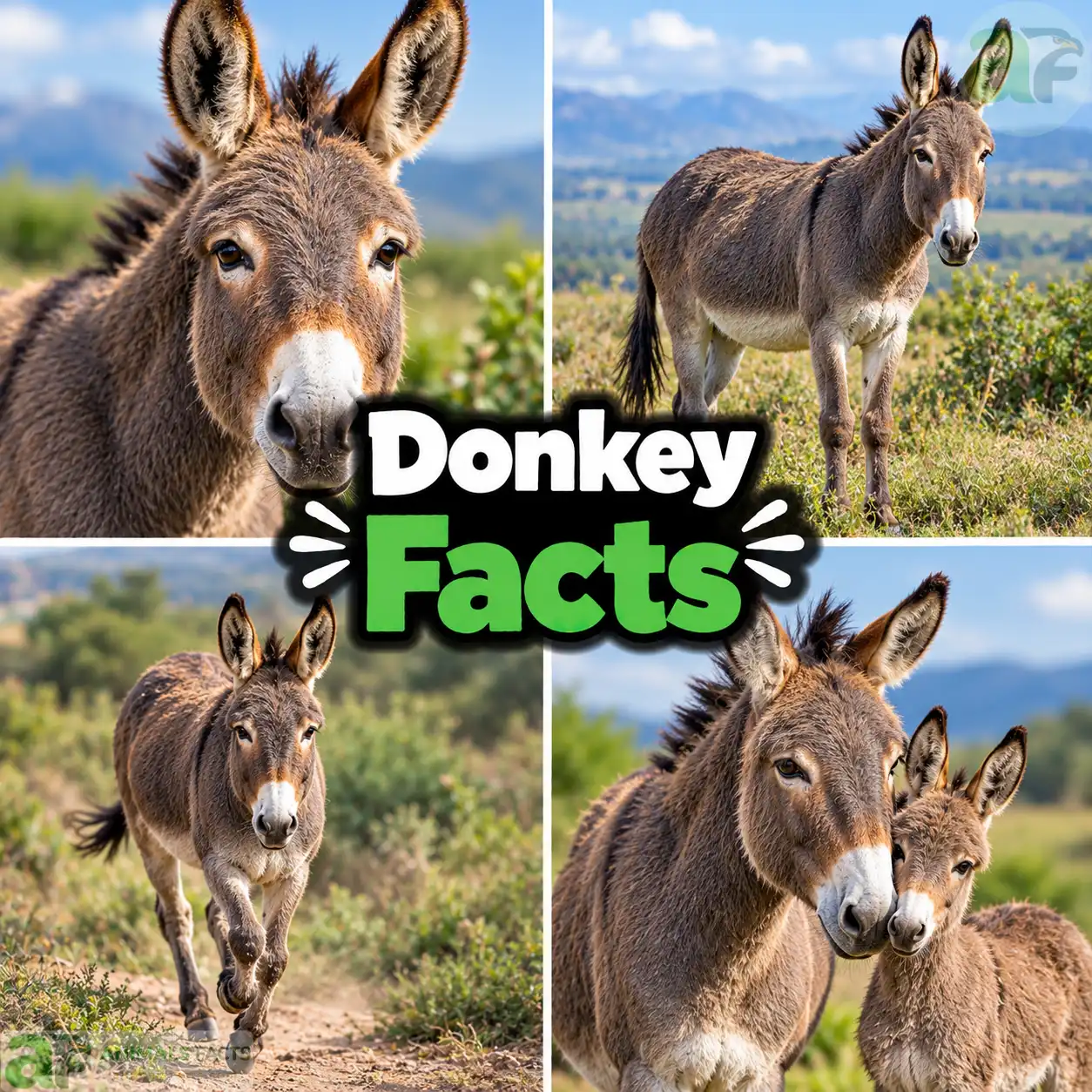
Donkey Facts
| Feature | Details |
|---|---|
| Scientific Name | Equus africanus asinus (domestic donkey); wild ancestor Equus africanus (African wild ass) |
| Common Names | Donkey, Ass, Burro, Jack (male), Jenny/Jennet (female), Foal (young) |
| Kingdom | Animalia |
| Phylum | Chordata |
| Class | Mammalia |
| Order | Perissodactyla |
| Family | Equidae |
| Habitat | Domesticated globally; wild ancestor inhabits arid desert and semi-desert terrain across Northeast Africa |
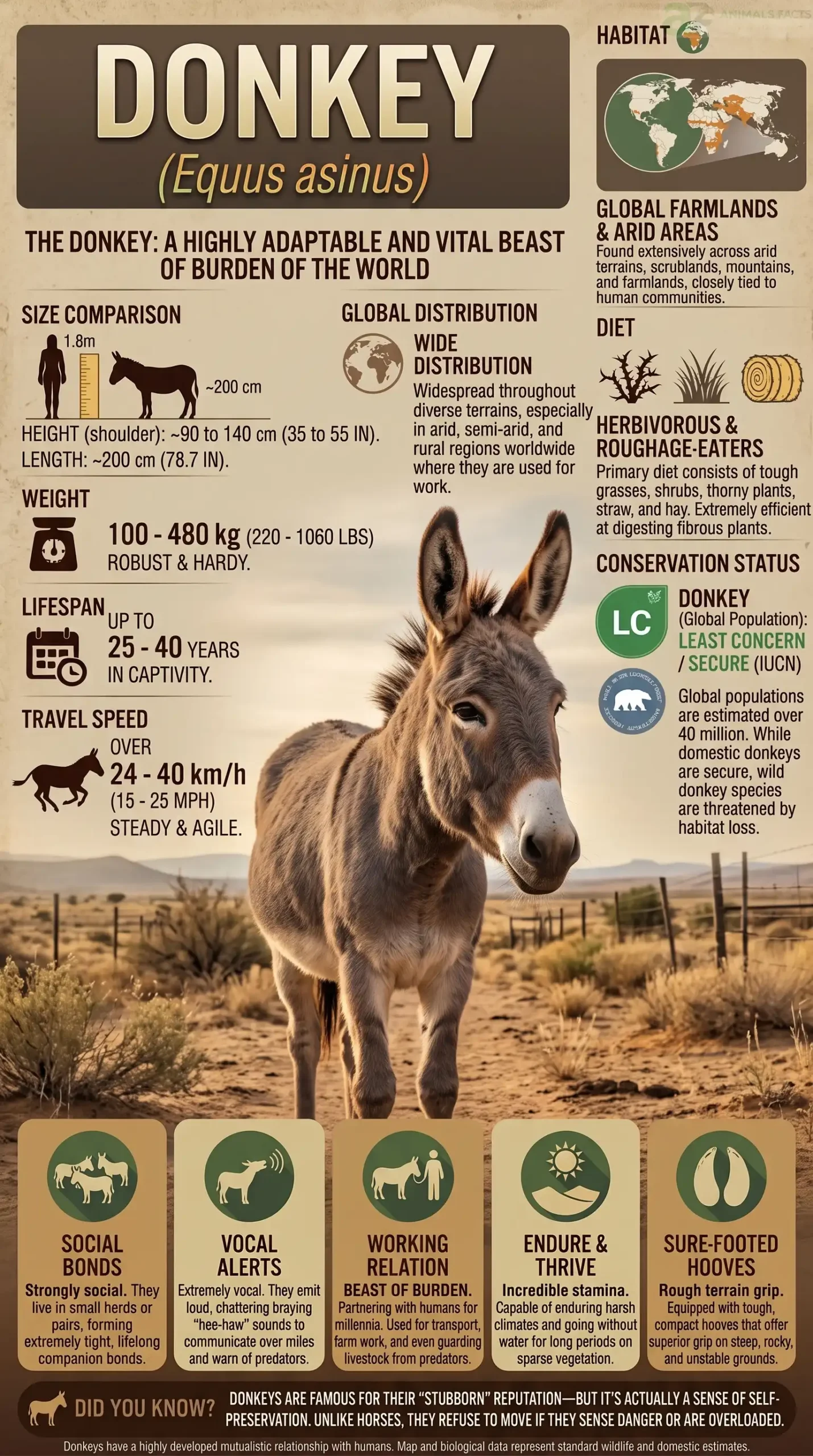
| Lifespan | 25–35 years for domestic donkeys; among the longest-lived common domesticated mammals |
| Diet | Herbivore — grasses, shrubs, hay, straw |
| Weight | 80–480 kg, varying enormously by breed, from miniature to mammoth types |
| Height | 0.9–1.6 meters at the shoulder, depending on breed |
| Speed | Up to 25–30 km/h (15–19 mph) |
| Conservation Status | Domestic donkey: Domesticated (not assessed); wild ancestor (African wild ass): Critically Endangered |
| Global Population | Approximately 53 million domestic donkeys worldwide; fewer than 200 African wild asses remain |
| Unique Feature | Possesses a documented photographic-level spatial memory allowing recall of specific locations and other donkeys for up to 25 years; capable of hearing other donkeys from up to 60 miles (97 km) away under ideal desert conditions |
 1. Introduction: What is a Donkey?
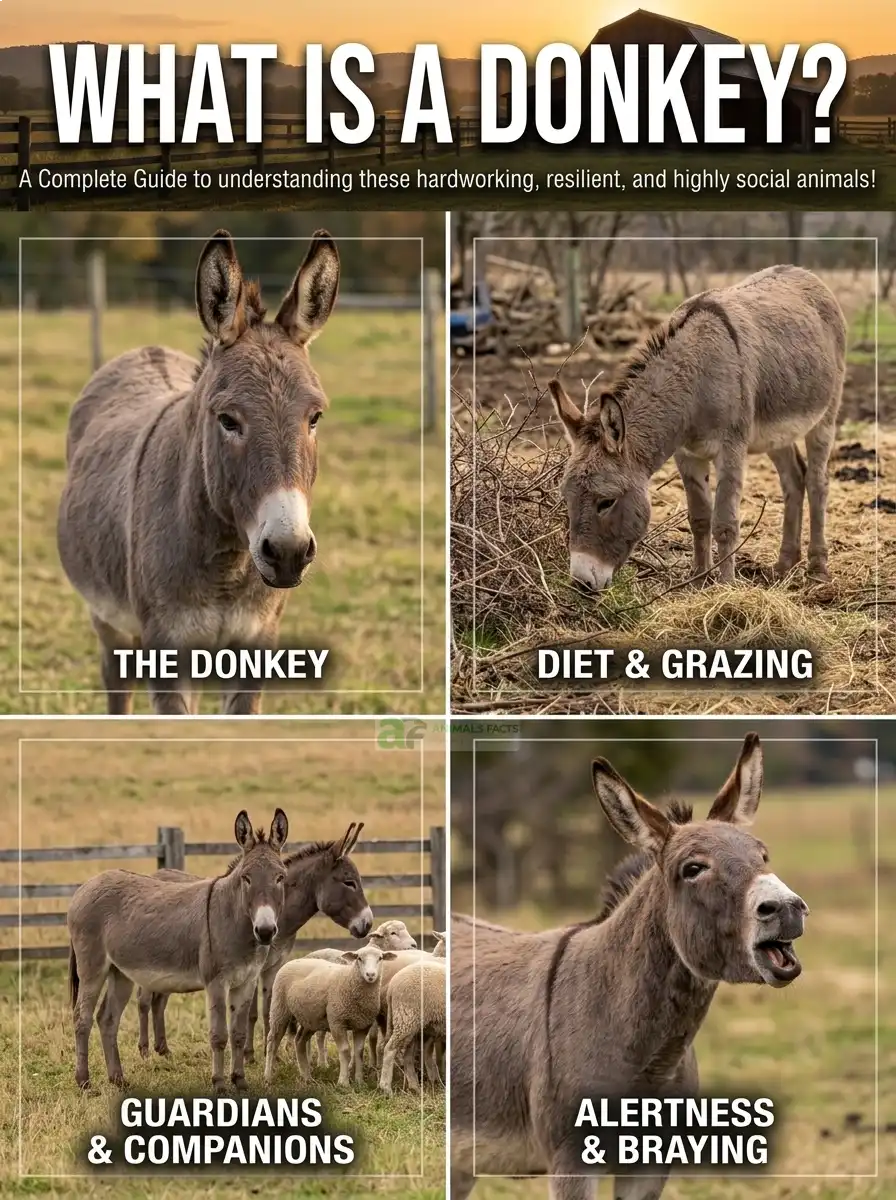
For thousands of years, it has carried water, grain, building materials, and entire families across some of the most punishing terrain on Earth, quietly enabling trade, agriculture, and survival across deserts, mountains, and rural communities on nearly every continent — and yet it remains one of the most persistently underestimated and misunderstood animals in the world. Donkey facts reveal a creature far more intelligent, socially sophisticated, and physically remarkable than the tired “stubborn ass” stereotype that has followed it through centuries of folklore, idiom, and popular culture. Far from being simple or unintelligent, donkeys possess a documented memory so precise that researchers have recorded individuals recalling specific locations and other donkeys they encountered decades earlier, and what humans often interpret as stubbornness is, according to modern animal behavior research, actually a highly developed sense of self-preservation and careful risk assessment — the donkey’s version of caution rather than defiance.
The domestic donkey (Equus africanus asinus) descends from the African wild ass (Equus africanus), a critically endangered wild equid today confined to only the most remote and inhospitable pockets of desert terrain in Northeast Africa, primarily across Eritrea, Ethiopia, and parts of Somalia. Donkey domestication ranks among the most significant and consequential livestock domestication events in human history, beginning approximately 5,000–7,000 years ago in Northeast Africa — a domestication that fundamentally transformed human transportation, trade, and agriculture across arid and semi-arid regions where horses often struggled to thrive, and that continues to underpin the livelihoods of tens of millions of people, particularly across the developing world, today.
Beyond their historical and continued practical importance, donkeys hold a genuinely fascinating and often surprising biological profile — from extraordinary heat and drought tolerance rivaling that of camels, to sophisticated long-distance vocal communication capable of carrying for miles across open desert terrain, to documented cognitive and emotional complexity that has increasingly positioned the donkey as a subject of serious scientific and animal welfare research. Understanding donkey facts today means recognizing not just an ancient beast of burden, but a genuinely remarkable animal whose contributions to human civilization remain deeply underappreciated even as the wild ancestor species teeters on the very edge of extinction.
Whether you’re a student researching donkey facts for a school project, a smallholder farmer or donkey owner wanting to better understand donkey behavior and welfare, someone curious about the critically endangered wild ancestor species, a parent looking for donkey facts for kids, or simply someone who has always wondered why donkeys have such an enduring reputation for stubbornness, this guide covers everything — donkey habitat, donkey diet, the extraordinary desert-survival biology, reproduction, social intelligence, domestication history, mythology, and much more. This is the most complete guide to donkey facts you will find anywhere.
2. Donkey Species Overview & Classification
The domestic donkey belongs to the family Equidae, the same family that includes horses and zebras, and more specifically to the genus Equus, placing donkeys among a relatively small group of surviving wild and domesticated equid species distributed across Africa, Asia, and, through domestication, virtually every inhabited continent on Earth.
Classification Table
| Level | Classification |
|---|---|
| Kingdom | Animalia |
| Phylum | Chordata |
| Class | Mammalia |
| Order | Perissodactyla |
| Family | Equidae |
| Genus | Equus |
| Species | E. africanus |
| Subspecies (Domestic) | E. a. asinus (domestic donkey) |
| Wild Ancestor Subspecies | E. a. africanus (Nubian wild ass) and E. a. somaliensis (Somali wild ass) |
| Closest Living Relatives | Horses (Equus caballus), zebras (several Equus species), Asiatic wild asses/onagers (Equus hemionus) |
The Genus Equus — Donkeys’ Wild Relatives
| Species/Subspecies | Scientific Name | Range | Conservation Status |
|---|---|---|---|
| African Wild Ass (Somali) | Equus africanus somaliensis | Horn of Africa | Critically Endangered |
| African Wild Ass (Nubian) | Equus africanus africanus | Northeast Africa | Possibly Extinct in the Wild |
| Asiatic Wild Ass (Onager) | Equus hemionus | Central/South Asia | Near Threatened |
| Kiang (Tibetan Wild Ass) | Equus kiang | Tibetan Plateau | Least Concern |
| Plains Zebra (comparison) | Equus quagga | East/Southern Africa | Near Threatened |
An Estimated 180+ Recognized Donkey Breeds
Domestic donkeys have been bred into a wide array of distinct breeds and types worldwide, with estimates suggesting well over 180 recognized breeds, ranging dramatically in size from tiny miniature donkeys standing under a meter tall to massive Mammoth Jackstock donkeys, developed specifically for mule breeding, that can exceed 1.6 meters at the shoulder — reflecting thousands of years of regional adaptation and selective breeding for vastly different working purposes and climates.
Species Evolution & Discovery Timeline
~4 million years ago: The genus Equus began diverging within the broader horse family lineage, eventually giving rise to the various wild horse, zebra, and wild ass species distributed across Africa and Eurasia.
~1 million years ago: The lineage leading to the African wild ass, the direct wild ancestor of the domestic donkey, became established as a distinct species across the arid regions of Northeast Africa.
~5,000–7,000 years ago: Donkey domestication began in Northeast Africa, likely in the region encompassing modern-day Egypt, Sudan, or the broader Horn of Africa, making the donkey one of the earliest domesticated working animals in human history, alongside cattle, sheep, and goats.
~5,000 years ago: Domesticated donkeys became firmly established as essential pack and working animals across ancient Egyptian civilization, playing a critical role in trade, agriculture, and construction — including significant use in transporting building materials during the construction of major ancient Egyptian monuments.
~4,000 years ago: Donkey domestication and use spread extensively across the Middle East, the Mediterranean world, and eventually into Europe and Asia, becoming deeply integrated into trade networks, agriculture, and daily transportation across numerous ancient civilizations.
Biblical and classical antiquity: Donkeys became firmly established figures within religious texts, mythology, and everyday cultural life across the ancient Near East, the Greco-Roman world, and beyond, appearing prominently in religious narratives and classical literature.
15th–19th centuries CE: European colonization spread domestic donkeys to the Americas and other regions worldwide, where they became particularly significant working animals in mining, agriculture, and transportation across arid and mountainous terrain, including the American Southwest, where feral donkey populations (sometimes called “burros”) became established.
20th–21st centuries: While donkey use declined significantly in many industrialized nations following the rise of motorized transportation, donkeys have remained critically important working animals across much of the developing world, while simultaneously experiencing a significant modern resurgence in wealthier nations as companion animals, therapy animals, and specialty livestock.
2016–2020s: A dramatic and alarming global surge in demand for donkey hide, driven primarily by demand for the traditional Chinese medicinal product ejiao, triggered a significant international donkey welfare and conservation crisis, resulting in sharp population declines across parts of Africa and prompting export bans and international advocacy efforts in numerous countries.
2026: The global domestic donkey population stands at approximately 53 million, while the wild ancestor African wild ass remains one of the most critically endangered large mammals on Earth, with fewer than 200 individuals estimated to survive in fragmented desert habitat, and the Nubian wild ass subspecies possibly already extinct in the wild.
3. Donkey Physical Description & Unique Features
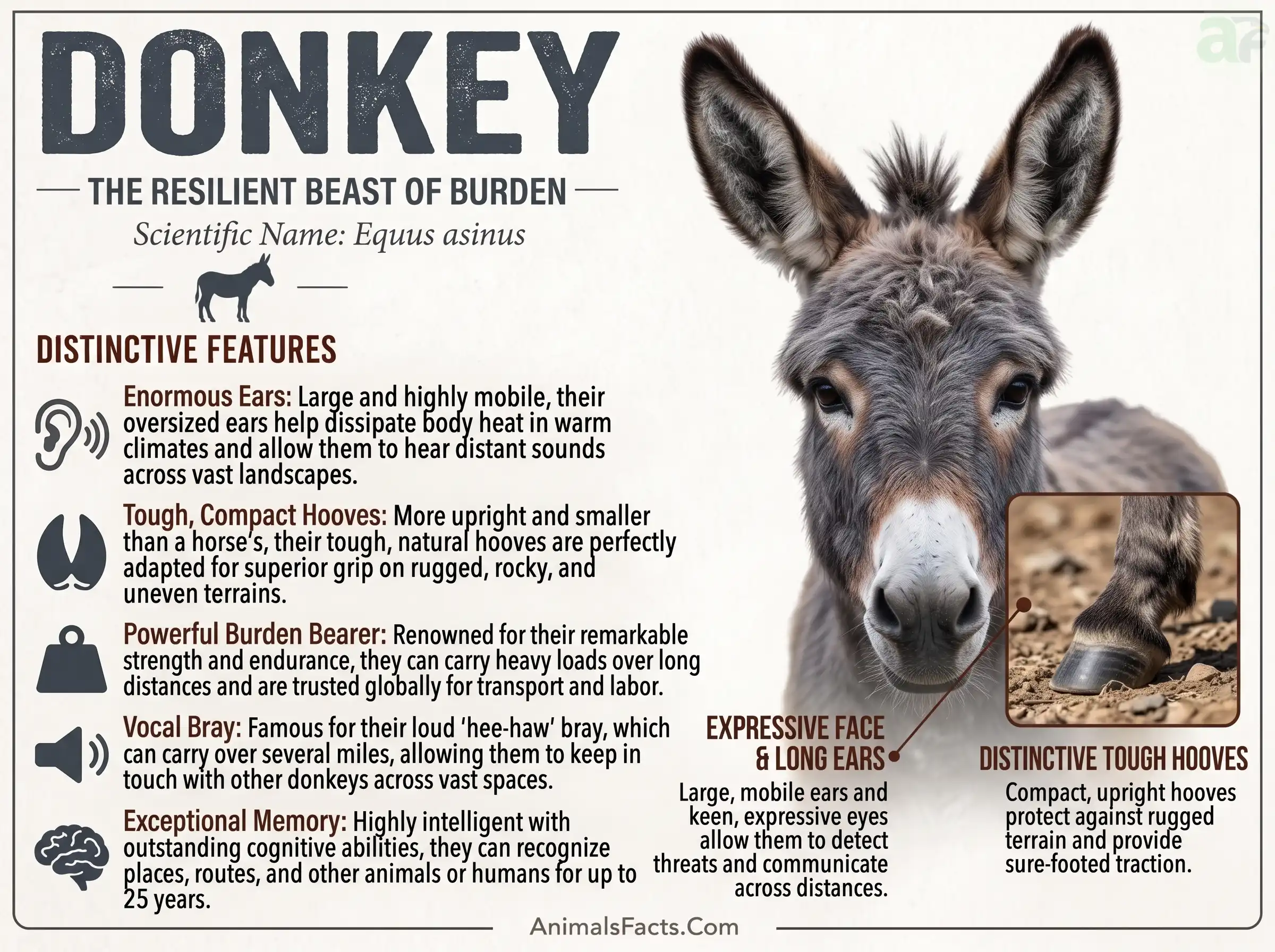
Donkeys possess a distinctive body plan and suite of physiological adaptations clearly reflecting their evolutionary origin as a desert-adapted equid, setting them apart meaningfully from their close horse relatives despite the two species’ shared ancestry.
Size and Build
- Weight: Ranges enormously from as little as 80 kg in miniature donkey breeds to over 480 kg in the largest Mammoth Jackstock individuals.
- Height: 0.9–1.6 meters at the shoulder, depending dramatically on breed type.
- Build: A generally more compact, sturdy body structure compared to horses, with proportionally larger ears, a straighter back profile, and a notably different overall silhouette reflecting distinct evolutionary and functional adaptations from horses despite belonging to the same genus.
The Famous Ears — Function Beyond Appearance
The donkey’s large, distinctive ears represent far more than a simple visual identifier — they serve genuinely important biological functions directly connected to the species’ desert-adapted ancestry:
Thermoregulation: A donkey’s large ears, richly supplied with blood vessels, provide significant surface area for dissipating excess body heat, an important adaptation for an animal whose wild ancestor evolved in the extreme heat of Northeast African desert terrain.
Exceptional hearing range: The donkey’s large ear structure contributes to remarkably acute hearing, with some sources suggesting donkeys can hear other donkeys’ vocalizations from as far away as 60 miles (97 km) under ideal open desert conditions — an extraordinary long-distance communication capability that would have provided a significant survival advantage for a species whose wild ancestor lived in a sparse, low-population-density desert environment where locating other members of the species across vast distances was a genuine ecological challenge.
Extraordinary Desert Survival Adaptations
The donkey’s wild ancestry as a desert specialist has endowed the species with remarkable physiological resilience:
Water conservation: Donkeys can tolerate significant dehydration — losing up to approximately 30% of their body weight in water — and subsequently rehydrate rapidly without the dangerous physiological complications this level of fluid loss would cause in most other mammals, an adaptation broadly comparable, though somewhat less extreme, to the water-conservation capabilities documented in camels.
Heat tolerance: Donkeys demonstrate notably superior heat tolerance compared to horses, generally requiring less water and coping more effectively with high ambient temperatures — a key reason donkeys have historically been favored as working animals across hot, arid regions of Africa, the Middle East, and similar climates worldwide.
Efficient digestion of poor-quality forage: Donkeys possess a digestive system notably more efficient than horses at extracting nutrition from tough, fibrous, low-quality vegetation, allowing them to thrive on forage that would be nutritionally inadequate for horses — another direct adaptation to the sparse vegetation of their wild desert ancestral habitat.
Coat Coloration and the Distinctive “Cross”
Donkey coat coloration typically ranges across various shades of grey, brown, and black, though white and spotted variations also occur in certain breeds. Many donkeys display a distinctive dark stripe running along the spine intersected by a second stripe across the shoulders, forming a visible “cross” pattern — a marking that has held particular symbolic and religious significance within certain cultural and religious traditions, discussed further in the folklore section of this article.
The Bray — A Distinctive Vocalization
The donkey’s characteristic vocalization, known as a “bray,” is among the most distinctive and far-carrying vocal sounds of any domesticated mammal, produced through a combination of both inhaled and exhaled vocal components, resulting in the sound’s unusual two-part structure and remarkable carrying distance across open terrain.
Did You Know? Research and long-term observational studies of donkey behavior have documented remarkably precise long-term spatial and social memory, with some studies suggesting donkeys can remember specific locations, including the whereabouts of good grazing or water sources, along with other individual donkeys and even humans they have previously encountered, for periods of up to 25 years or more — a memory capacity that, if accurate, would place donkeys among the most cognitively impressive long-term memory performers of any domesticated mammal studied to date.
4. Top 25 Surprising & Interesting Donkey Facts
- Donkeys can reportedly hear other donkeys’ vocalizations from up to 60 miles (97 km) away under ideal desert conditions.
- Donkeys possess documented long-term memory capable of recalling specific locations and individuals for up to 25 years.
- The wild ancestor of the domestic donkey, the African wild ass, is Critically Endangered, with fewer than 200 individuals remaining in the wild.
- Donkey domestication began roughly 5,000–7,000 years ago in Northeast Africa.
- There are over 180 recognized donkey breeds worldwide, ranging from miniature to mammoth-sized types.
- Donkeys can tolerate losing up to 30% of their body weight in water and rehydrate safely afterward.
- A donkey’s characteristic vocalization, the “bray,” combines both inhaled and exhaled sound components.
- What is often labeled “stubbornness” in donkeys is now understood by animal behaviorists as a highly developed sense of caution and self-preservation.
- Donkeys demonstrate notably superior heat tolerance and drought resistance compared to horses.
- Many donkeys display a distinctive dark “cross” marking across their shoulders and spine.
- Donkey gestation lasts approximately 12–14 months — longer than horse pregnancy.
- A mule (the offspring of a male donkey and female horse) is typically sterile due to the differing chromosome counts of its parent species.
- The global domestic donkey population is estimated at approximately 53 million.
- Donkeys were extensively used in ancient Egypt, including in the transportation of building materials for major monuments.
- Ancient Egyptian pharaohs were sometimes buried alongside donkeys, reflecting the animal’s significant status in ancient Egyptian society.
- A significant surge in demand for donkey hide for traditional Chinese medicine (ejiao) has triggered a global donkey population crisis in the 2010s and 2020s.
- Donkeys are highly social animals that can form deep, lasting bonds and may show visible signs of grief when separated from a bonded companion.
- Donkeys are used effectively as livestock guardian animals, particularly to protect sheep and goats from predators such as coyotes.
- The Mammoth Jackstock donkey breed, developed in the United States, can stand over 1.6 meters at the shoulder.
- Donkeys are believed to have significantly better long-term spatial memory than horses.
- A group of donkeys is sometimes called a “drove” or a “pace.”
- Donkeys have been used throughout history in mining operations, particularly in narrow underground tunnels inaccessible to larger animals.
- Donkey milk has historically been valued for its nutritional properties and, according to legend, was used by Cleopatra in beauty regimens.
- Wild African wild asses can survive in some of the hottest, driest terrestrial environments inhabited by any large mammal.
- Donkeys typically live significantly longer than horses on average, with many living well into their 30s.
5. Fun Facts About Donkeys
- Donkeys can hear other donkeys from 60 miles away.
- Their memory can last up to 25 years.
- The wild African wild ass is Critically Endangered.
- Domestication began 5,000–7,000 years ago.
- There are over 180 donkey breeds.
- Donkeys can lose 30% body water and survive.
- Their bray combines inhaled and exhaled sound.
- “Stubbornness” is really careful caution.
- Donkeys tolerate heat better than horses.
- Many have a “cross” marking on their back.
- Donkey pregnancy lasts 12–14 months.
- Mules born from donkeys are usually sterile.
- The global donkey population is about 53 million.
- Donkeys can live well into their 30s.
6. Donkey Habitat & Geographic Range
While the domestic donkey’s range today spans virtually every inhabited continent through human agricultural distribution, understanding donkey habitat requires examining the critically endangered wild African wild ass’s extremely restricted native range alongside the enormous global distribution domestic donkeys now occupy.
Wild African Wild Ass Habitat
The African wild ass, direct ancestor of all domestic donkeys, is adapted to some of the harshest terrestrial environments inhabited by any large mammal:
Extreme desert terrain: Wild African wild asses favor extremely arid, rocky desert and semi-desert habitat across the Horn of Africa, tolerating conditions of extreme heat and minimal water availability that few other large mammals could survive.
Mountainous desert terrain: Populations, particularly the critically endangered Somali wild ass, favor rugged, mountainous desert terrain offering some protection from human disturbance and predation.
Domestic Donkey Global Distribution
Geographic Range Table
| Region | Donkey Population Status | Notes |
|---|---|---|
| Africa (particularly Ethiopia, Sudan, Nigeria) | Very high | World’s largest domestic donkey populations |
| Asia (particularly China, Pakistan) | High | Significant working and, controversially, hide-trade populations |
| Middle East | High | Long-established working animal traditions |
| Latin America | High | Significant rural and agricultural working populations |
| Europe | Moderate | Both working and companion/heritage breed populations |
| North America | Moderate | Working, companion, and notable feral “burro” populations |
Did You Know? Ethiopia is home to one of the largest domestic donkey populations of any country on Earth, with donkeys remaining absolutely essential to rural transportation, water collection, and agricultural labor across much of the country — reflecting the donkey’s continued indispensable economic and practical role across large parts of the developing world, even as the animal has become comparatively rare as a working animal within wealthier, more mechanized nations.
7. Donkey Diet & Feeding Behavior
Donkeys are herbivores with a digestive system and feeding strategy specifically adapted to extracting maximum nutrition from the sparse, tough, and often nutritionally poor vegetation characteristic of their wild desert ancestral habitat.
Diet Breakdown Table
| Food Type | Approximate Percentage | Notes |
|---|---|---|
| Grasses | 40–60% | Primary food source, though donkeys will consume coarser grass than horses typically prefer |
| Shrubs and browse | 15–25% | Reflecting some browsing tendency inherited from desert-adapted ancestry |
| Hay and straw | Variable | Common component of managed domestic diets, particularly in non-grazing seasons |
| Bark and woody material | Small quantity | Consumed particularly when other forage is scarce |
| Weeds and rough vegetation | Variable | Donkeys readily consume vegetation types many other livestock avoid |
Highly Efficient Digestion
One of the most significant donkey facts regarding diet is the species’ notably superior digestive efficiency compared to horses when processing tough, fibrous, low-quality forage — an adaptation directly reflecting the sparse vegetation available within the African wild ass’s harsh desert ancestral habitat. This efficiency means domestic donkeys are particularly susceptible to obesity and related health complications, including a serious metabolic condition called laminitis, when kept on the same rich, high-quality pasture appropriate for horses, since a donkey’s digestive system extracts more usable nutrition from the same volume of forage than a horse’s would.
Water Requirements
Reflecting their desert-adapted ancestry, donkeys generally require notably less water relative to their body size compared to horses, and can tolerate longer intervals between water access — though, like all animals, they absolutely require regular access to clean water for basic health and welfare, and should never be deliberately deprived of water based on this comparative tolerance.
Did You Know? Because domestic donkeys retain their wild ancestor’s highly efficient desert-adapted digestive system, modern donkey welfare organizations frequently emphasize that donkeys kept as companion animals or on rich pastureland require significantly more careful dietary management than horses to prevent obesity and associated serious health complications — a genuine welfare consideration that surprises many new donkey owners accustomed to horse-care standards.
8. Donkey Reproduction & Life Cycle
Donkey reproduction has been documented both through traditional agricultural practice across numerous cultures and, increasingly, through formal veterinary and animal behavior research, given the species’ continued global working significance.
Mating and Breeding
Breeding age: Female donkeys (jennies) typically reach sexual maturity around 12–18 months of age, though breeding is generally delayed until physical maturity is more fully achieved, often around 2–3 years.
Estrus cycle: Jennies cycle approximately every 23–30 days when not pregnant, with a notably longer and less predictable fertile window compared to horses.
Breeding behavior: Male donkeys (jacks) display characteristic breeding behaviors including vocalizations, scent marking, and, particularly among wild and feral populations, territorial defense behaviors.
Gestation and Birth
Gestation: Approximately 12–14 months (350–370 days) — notably longer than the horse’s roughly 11-month gestation period.
Litter size: Almost always a single foal; twins are extremely rare and present significant health risks.
Birth weight: Typically 8–14 kg, varying by breed.
Birth condition: Foals are precocial, generally able to stand and attempt walking within approximately 30–60 minutes of birth.
The Mule and Hinny — Donkey-Horse Hybrids
One of the most genuinely interesting donkey facts concerns the well-known hybrid offspring produced through cross-breeding between donkeys and horses:
Mule: The offspring of a male donkey (jack) and a female horse (mare), widely valued throughout history for combining desirable traits from both parent species — generally inheriting the donkey’s endurance, sure-footedness, and disease resistance alongside the horse’s size and speed.
Hinny: The less common offspring of a male horse (stallion) and a female donkey (jenny), generally less frequently bred than mules due to greater breeding difficulty and typically resulting in smaller offspring.
Sterility: Because donkeys (62 chromosomes) and horses (64 chromosomes) possess different chromosome numbers, their hybrid offspring — both mules and hinnies — possess an odd, mismatched number of chromosomes (63) that almost always renders them sterile, unable to reproduce, though extraordinarily rare documented exceptions involving fertile female mules have occurred throughout history.
Growth Stages Table
| Stage | Age | Development |
|---|---|---|
| Birth | — | 8–14 kg; standing within 30–60 minutes |
| Weaning | ~4–6 months | Transition to solid forage diet |
| Sexual maturity | 12–18 months | Breeding typically delayed to 2–3 years |
| Full physical maturity | ~3–5 years | Complete skeletal and muscular development |
Donkey Lifespan Comparison Table
| Species/Type | Average Lifespan | Maximum Recorded |
|---|---|---|
| Domestic Donkey | 25–35 years | ~50 years (rare, exceptional cases) |
| Domestic Horse (comparison) | 25–30 years | ~40+ years |
| Mule (comparison) | 30–40 years | ~50 years |
| African Wild Ass (wild) | Estimated 20–25 years | Data limited due to rarity |
9. Social Behavior & Communication
Donkeys are genuinely social animals with documented complex social bonding, communication systems, and emotional responses that have significantly reshaped scientific and welfare-focused understanding of the species in recent decades.
Social Bonding and Companionship
Donkeys form close, often lifelong social bonds with companion animals — whether other donkeys, horses, or even different species entirely — and research and extensive anecdotal veterinary observation has documented that donkeys can display visible signs of significant distress and even grief-like behavior when separated from a long-term bonded companion, including reduced appetite, lethargy, and vocal distress calls, findings that have meaningfully informed modern donkey welfare standards, particularly regarding companion animal separation during sale, rehoming, or veterinary treatment.
The “Stubbornness” Reassessment
Perhaps the single most significant reassessment within modern donkey behavioral science concerns the species’ longstanding reputation for stubbornness. Animal behaviorists now widely understand that a donkey’s apparent reluctance to move forward into a perceived risky or unfamiliar situation — historically interpreted simply as obstinate defiance — actually reflects a highly developed, evolutionarily adaptive sense of caution and careful risk assessment, a behavioral trait directly inherited from the species’ wild ancestry as a prey animal in an unforgiving desert environment where a single miscalculated risk (such as stepping onto unstable terrain or into a predator ambush) could prove fatal. Unlike horses, which as a flight-response species will often bolt first and assess danger later, donkeys are more likely to pause, assess, and only proceed once genuinely convinced a situation is safe — a fundamentally different, and arguably more sophisticated, survival strategy rather than simple stubbornness.
Vocalizations and Long-Distance Communication
As detailed earlier, the donkey’s distinctive bray represents a remarkably far-carrying vocalization, with some sources suggesting audibility across distances of several miles under ideal open terrain conditions — an adaptation believed to have evolved specifically to allow the wild African wild ass to locate other members of its species across the vast, sparsely populated desert landscapes that constitute its native range.
Did You Know? Donkeys are increasingly employed as effective livestock guardian animals, particularly for protecting sheep and goat flocks from predators such as coyotes — donkeys display a natural, instinctive wariness and even active aggression toward canine predators, a behavior believed to stem from ancestral defensive responses to wild dog and jackal predation risk faced by their wild ancestors, making a well-suited guardian donkey a genuinely effective, low-cost predator deterrent for many livestock operations.
10. Predators & Defense Mechanisms
Adult donkeys, owing to their significant size and notably effective defensive capabilities, face relatively limited direct predation pressure in most contexts, though foals and, in the wild African wild ass’s case, adults in areas of significant predator overlap remain vulnerable.
Natural Predators
Lions and Hyenas: Historically significant predators of wild African wild ass populations across their native Horn of Africa range, particularly targeting foals and vulnerable individuals.
Wolves and Coyotes: Documented predators of domestic donkeys in various regions, particularly targeting foals, though adult donkeys’ notable defensive capabilities often deter these smaller canid predators.
Defense Mechanisms
Powerful kicks: Donkeys are capable of delivering extremely forceful kicks with both front and hind legs, a significant deterrent against most potential predators and a notable safety consideration for handlers.
Biting: Donkeys possess strong jaws and can deliver painful, defensively significant bites when threatened.
Active aggression toward canine predators: As noted in the guardian animal discussion above, donkeys display notable instinctive aggression specifically toward dog-like predators, actively charging, chasing, or attacking rather than fleeing — a genuinely unusual and effective defensive strategy compared to the flight-first response typical of horses and many other prey animals.
Careful risk assessment (the “stubbornness” trait): The donkey’s characteristic caution and reluctance to proceed into uncertain situations, discussed in the social behavior section, itself functions as a genuine defense mechanism, reducing the likelihood of the animal wandering into predator ambush situations or hazardous terrain.
Herd vigilance: Group living, where present, provides additional collective predator detection benefits.
11. Donkey Facts for Kids
Hey kids — get ready to learn about one of the most misunderstood animals in the whole world!
Donkeys have super big ears, and those ears aren’t just for looks — they help donkeys stay cool in hot weather AND hear other donkeys from really, really far away! People always say donkeys are “stubborn,” but scientists now think donkeys are actually just being extra careful! When a donkey doesn’t want to walk somewhere, it’s usually just making sure it’s safe first! Donkeys have amazing memories — some donkeys can remember places and other animals they met up to 25 YEARS ago! A baby donkey, called a foal, can stand up and start walking less than an hour after it’s born! Donkeys are actually really brave when it comes to protecting their animal friends — farmers sometimes use donkeys to guard sheep and goats because donkeys will chase away sneaky predators like coyotes! The wild donkey’s cousin, called the African wild ass, is one of the rarest animals on Earth — there are fewer than 200 left in the whole wild world! Some donkeys are tiny, like mini-donkeys, and some are absolutely huge — the biggest donkeys can be taller than a grown-up! Donkeys can live to be really, really old — some donkeys live past 30 years old!
Did You Know? A donkey’s loud “hee-haw” sound, called a bray, is actually made of two different parts — one part when the donkey breathes in, and another part when it breathes out — and in the wide open desert, that sound can travel for miles and miles, helping donkeys find each other across huge distances!
12. Relationship with Humans
The relationship between donkeys and humanity represents one of the oldest, most practically significant, and most persistently underappreciated domestication partnerships in human history, spanning at least 5,000 years of agriculture, trade, transportation, and culture.
Ancient Egyptian Significance
Donkeys held profound practical and even ceremonial significance within ancient Egyptian civilization, serving as essential pack and working animals throughout Egyptian society and economy, including documented use in transporting building materials during significant construction projects. Archaeological evidence has revealed instances of donkeys being ceremonially buried alongside high-status individuals in ancient Egypt, a practice reflecting the genuine value and status the animal held within this influential ancient civilization.
The Global Working Donkey
Across much of the developing world today, donkeys remain absolutely essential working animals, providing critical transportation for water, agricultural goods, and people across terrain and circumstances where motorized transportation remains impractical, unaffordable, or unavailable — a role of continued practical significance to tens of millions of people, particularly across rural Africa, Asia, and Latin America, that stands in sharp contrast to the donkey’s largely ceremonial or companion-animal status within wealthier, more mechanized nations.
The Modern Donkey Hide Crisis
One of the most significant and troubling recent developments in the human-donkey relationship has been the dramatic global surge in demand for donkey hide, driven primarily by demand for ejiao, a traditional Chinese medicinal gelatin product derived from boiled donkey skin. This demand surge, intensifying particularly from the 2010s onward, has driven a significant and, in some regions, devastating increase in donkey slaughter across parts of Africa and elsewhere, contributing to sharp population declines, price inflation that has priced working donkeys beyond the reach of many smallholder farmers who depend on them, and, in several cases, significant animal welfare concerns regarding the conditions of donkey transport and slaughter associated with this trade — prompting export bans in several African nations and significant international advocacy efforts from donkey welfare organizations.
Donkeys as Companion and Therapy Animals
In parts of the wealthier, industrialized world, donkeys have experienced a meaningful resurgence in popularity as companion animals, and are increasingly utilized in animal-assisted therapy programs, given their notably calm demeanor, patience, and documented capacity for gentle interaction with humans, including children and individuals with disabilities.
13. Donkey Conservation Status & Threats
| Category | Status |
|---|---|
| Domestic Donkey Status | Domesticated (not formally assessed by IUCN) |
| African Wild Ass (Somali subspecies) | Critically Endangered |
| African Wild Ass (Nubian subspecies) | Possibly Extinct in the Wild |
| Global Domestic Population | Approximately 53 million |
| Wild Population | Fewer than 200 individuals |
Major Threats to the Wild African Wild Ass
Habitat loss: Human settlement expansion, infrastructure development, and competition with domestic livestock continue to reduce the already extremely limited remaining habitat available to wild African wild ass populations.
Hybridization with domestic donkeys: Interbreeding between wild African wild asses and free-ranging domestic donkeys represents a genuine genetic conservation threat, potentially diluting the increasingly rare pure wild gene pool.
Poaching: Historic and, in some areas, ongoing illegal hunting has significantly contributed to the species’ population collapse.
Regional instability: Much of the wild African wild ass’s remaining range spans politically unstable regions of the Horn of Africa, significantly complicating conservation research, monitoring, and protection efforts.
The Donkey Hide Trade Crisis
As detailed in the previous section, the modern surge in global demand for donkey hide for ejiao production represents an urgent and rapidly developing conservation and welfare concern affecting domestic donkey populations across Africa and beyond, with several countries — including Burkina Faso, Niger, Senegal, and others — implementing export bans in response to sharp, unsustainable population declines and significant animal welfare concerns documented within the trade’s supply chains.
Did You Know? The African wild ass is now considered one of the most critically endangered large mammals on Earth, with a global wild population estimated at fewer than 200 individuals — making it rarer in the wild than giant pandas, mountain gorillas, and numerous other far more publicly recognized endangered species, despite receiving considerably less international conservation attention and funding relative to the severity of its extinction risk.
14. Famous Donkeys
Eeyore — the beloved, famously gloomy donkey character from A.A. Milne’s Winnie-the-Pooh stories, arguably the single most globally recognized fictional donkey in modern popular culture.
Donkey (from “Shrek”) — the enormously popular, talkative donkey character voiced by Eddie Murphy in the “Shrek” film franchise, representing one of the most commercially successful and widely recognized animated donkey characters in film history.
Modestine — the donkey companion documented by author Robert Louis Stevenson in his travel memoir “Travels with a Donkey in the Cévennes,” an influential early work of travel literature centered significantly around the author’s relationship with his donkey companion.
15. Role in Ecosystem & Food Chain
While domestic donkeys exist primarily within human-managed agricultural and working contexts, both wild African wild asses and free-ranging domestic donkey populations play meaningful ecological roles within the environments they inhabit.
Seed dispersal: Donkey grazing and subsequent digestion contributes to seed dispersal across the landscapes donkeys range across, aiding plant distribution, particularly across arid and semi-arid environments.
Vegetation management: Donkey grazing on tough, fibrous vegetation that many other herbivores would avoid contributes to vegetation management within their habitat, though feral donkey populations in some regions, such as parts of Australia and the American Southwest, have generated ecological concern regarding overgrazing impacts on fragile native desert ecosystems.
Prey base: In their limited remaining wild range, African wild asses represent an occasional prey source for lions, hyenas, and other predators sharing their Horn of Africa habitat.
16. Myths, Folklore & Cultural Significance
Donkeys hold an extraordinarily deep and pervasive position within human religious tradition, mythology, and folklore, appearing across the sacred texts, literature, and cultural symbolism of numerous civilizations throughout recorded history.
Religious Significance
Donkeys carry profound symbolic significance within Christianity, most notably through the widely recognized narrative of Jesus riding a donkey into Jerusalem, an event commemorated annually as Palm Sunday, and through the traditional nativity narrative depicting a donkey accompanying Mary’s journey to Bethlehem — imagery that has become deeply embedded within Christian religious art, tradition, and cultural symbolism for nearly two millennia. The distinctive dark “cross” marking found on many donkeys’ backs, described earlier in this article, has been popularly associated within Christian folklore with this donkey’s role in these significant religious narratives, though this remains a folkloric rather than scientifically established connection.
Ancient Greek and Roman Mythology
Donkeys appear throughout ancient Greek and Roman mythology and literature, including their association with the god Dionysus (Bacchus) and their prominent role in various classical literary works, most notably featuring centrally in the ancient Roman novel “The Golden Ass” by Apuleius, one of the earliest surviving complete novels in Western literature, centered around a protagonist transformed into a donkey.
Folk Wisdom and the “Stubborn” Stereotype
The donkey’s enduring folkloric reputation for stubbornness has become deeply embedded within numerous languages and cultures worldwide, giving rise to countless idioms, sayings, and cultural references — a reputation that, as detailed earlier in this article, modern animal behavior science has significantly reassessed and reframed as reflecting careful caution rather than genuine obstinance.
17. Donkeys in Pop Culture
“Shrek” franchise’s Donkey — the enormously popular talkative sidekick character, one of the most commercially successful and globally recognized fictional donkeys in modern film history.
Eeyore from Winnie-the-Pooh — a beloved, culturally enduring fictional donkey character recognized across generations of children’s literature and media worldwide.
The Democratic Party donkey symbol — the donkey has served as the recognized political mascot of the United States Democratic Party since the 19th century, representing one of the most significant and enduring political-symbolic uses of the animal in modern history.
Travel literature featuring donkeys — works including Robert Louis Stevenson’s “Travels with a Donkey in the Cévennes” represent an enduring literary tradition of donkey-companion travel narratives.
18. Donkey Facts vs. Common Myths
Myth: Donkeys are simply stubborn and unintelligent. Fact: Modern animal behavior research understands donkey “stubbornness” as a highly developed sense of caution and careful risk assessment, reflecting sophisticated evolutionary adaptation rather than a lack of intelligence.
Myth: Donkeys and mules are the same animal. Fact: A donkey is a distinct species (Equus africanus asinus); a mule is a hybrid offspring produced by crossing a male donkey with a female horse.
Myth: Donkeys don’t need much water or care. Fact: While donkeys are notably drought-tolerant compared to horses, they absolutely require regular access to clean water and appropriate veterinary and dietary care; their efficient digestion actually makes them prone to obesity-related health problems if improperly managed.
Myth: All donkeys are small. Fact: Donkey size varies enormously by breed, from miniature donkeys under a meter tall to Mammoth Jackstock donkeys exceeding 1.6 meters at the shoulder.
19. Best Places to See Donkeys in the Wild
Eritrea and the Danakil Depression region — among the last remaining strongholds for the critically endangered wild African wild ass, though sightings remain extremely rare given the species’ critical rarity and the region’s challenging accessibility.
American Southwest (Death Valley National Park, USA) — home to notable feral “burro” populations descended from historic mining-era working donkeys, offering a more accessible opportunity to observe free-ranging donkeys, albeit not the true wild ancestor species.
Working donkey sanctuaries worldwide — organizations including The Donkey Sanctuary operate visitor-accessible facilities across multiple countries, offering meaningful opportunities to observe and learn about rescued and rehabilitated donkeys.
20. Top Documentaries & Books
“Travels with a Donkey in the Cévennes” by Robert Louis Stevenson — a classic work of travel literature centered around the author’s journey with his donkey companion, Modestine.
Documentaries and reports covering the global donkey hide (ejiao) trade crisis — provide critical, current insight into one of the most significant modern challenges facing global donkey welfare and population sustainability.
The Donkey Sanctuary’s research publications — offer some of the most comprehensive and scientifically grounded information available on donkey behavior, cognition, and welfare.
21. Comparison of Donkeys with Similar Animals
| Feature | Domestic Donkey | Domestic Horse | Mule | African Wild Ass |
|---|---|---|---|---|
| Scientific Name | Equus africanus asinus | Equus caballus | Hybrid (donkey x horse) | Equus africanus |
| Weight | 80–480 kg | 380–1,000 kg | 370–650 kg | 200–275 kg |
| Chromosome Count | 62 | 64 | 63 (typically sterile) | 62 |
| Domestication Status | Fully domesticated | Fully domesticated | Bred, not a true species | Critically Endangered (wild) |
| Lifespan | 25–35 years | 25–30 years | 30–40 years | ~20–25 years |
| Heat/Drought Tolerance | Excellent | Moderate | Good | Excellent |
22. How You Can Help
Support organizations directly involved in donkey welfare and wild African wild ass conservation, particularly The Donkey Sanctuary, a leading global organization working on both domestic donkey welfare issues, including the donkey hide trade crisis, and broader donkey-focused veterinary and community education programs worldwide.
Practical actions:
Support organizations addressing the donkey hide (ejiao) trade crisis and advocating for sustainable, welfare-focused policy responses across affected countries.
Raise awareness about the critically endangered status of the wild African wild ass, a species facing extinction risk far less publicly recognized than its severity warrants.
If you own or are considering owning a donkey, seek guidance from reputable donkey welfare organizations to ensure appropriate care, given the species’ distinct dietary and social needs compared to horses.
Support community-based programs in the developing world that help protect and sustain access to working donkeys for smallholder farmers whose livelihoods depend on them.
23. Frequently Asked Questions About Donkeys
Q1: What is a donkey’s scientific name?
The domestic donkey’s scientific name is Equus africanus asinus, descending from the critically endangered wild African wild ass (Equus africanus).
Q2: Are donkeys really stubborn?
Not exactly — modern animal behavior research suggests what appears to be stubbornness is actually a highly developed sense of caution and careful risk assessment, an evolutionary trait inherited from the species’ wild desert ancestry.
Q3: What’s the difference between a donkey and a mule?
A donkey is a distinct species; a mule is a hybrid animal produced by breeding a male donkey with a female horse, and mules are typically sterile.
Q4: How long do donkeys live?
Domestic donkeys typically live 25–35 years, significantly longer than the average domestic horse lifespan, with some individuals living into their 40s or even 50s.
Q5: Are donkeys endangered?
Domestic donkeys are not endangered, with a global population of approximately 53 million. However, the wild ancestor species, the African wild ass, is Critically Endangered, with fewer than 200 individuals remaining.
Q6: How far can a donkey’s bray be heard?
Under ideal open desert conditions, a donkey’s bray has been reported to carry as far as 60 miles (97 km), though this represents an extreme maximum rather than typical everyday communication distance.
Q7: What do donkeys eat?
Donkeys are herbivores, eating grasses, shrubs, hay, and straw, with a digestive system notably efficient at extracting nutrition from tough, low-quality forage.
Q8: How long is a donkey pregnant?
Donkey gestation lasts approximately 12–14 months, notably longer than the roughly 11-month gestation period of horses.
Q9: Why are donkeys in danger from the ejiao trade?
Rising demand for ejiao, a traditional Chinese medicinal gelatin made from boiled donkey skin, has driven a significant surge in donkey slaughter globally, contributing to sharp population declines in parts of Africa and prompting export bans in several countries.
Q10: Can donkeys protect other farm animals?
Yes — donkeys are increasingly used as effective livestock guardian animals, particularly for sheep and goats, due to their natural wariness and aggression toward canine predators like coyotes.
24. Sources & References
Research Sources
- Wikipedia — Donkey: https://en.wikipedia.org/wiki/Donkey
- IUCN Red List — African Wild Ass: https://www.iucnredlist.org/species/7949/45170994
- World Wildlife Fund: https://www.worldwildlife.org/
- National Geographic — Donkey: https://www.nationalgeographic.com/animals/mammals/facts/donkey
- Smithsonian’s National Zoo: https://nationalzoo.si.edu/
- Encyclopaedia Britannica — Donkey: https://www.britannica.com/animal/donkey
- Live Science: https://www.livescience.com/
- The Donkey Sanctuary: https://www.thedonkeysanctuary.org.uk/