

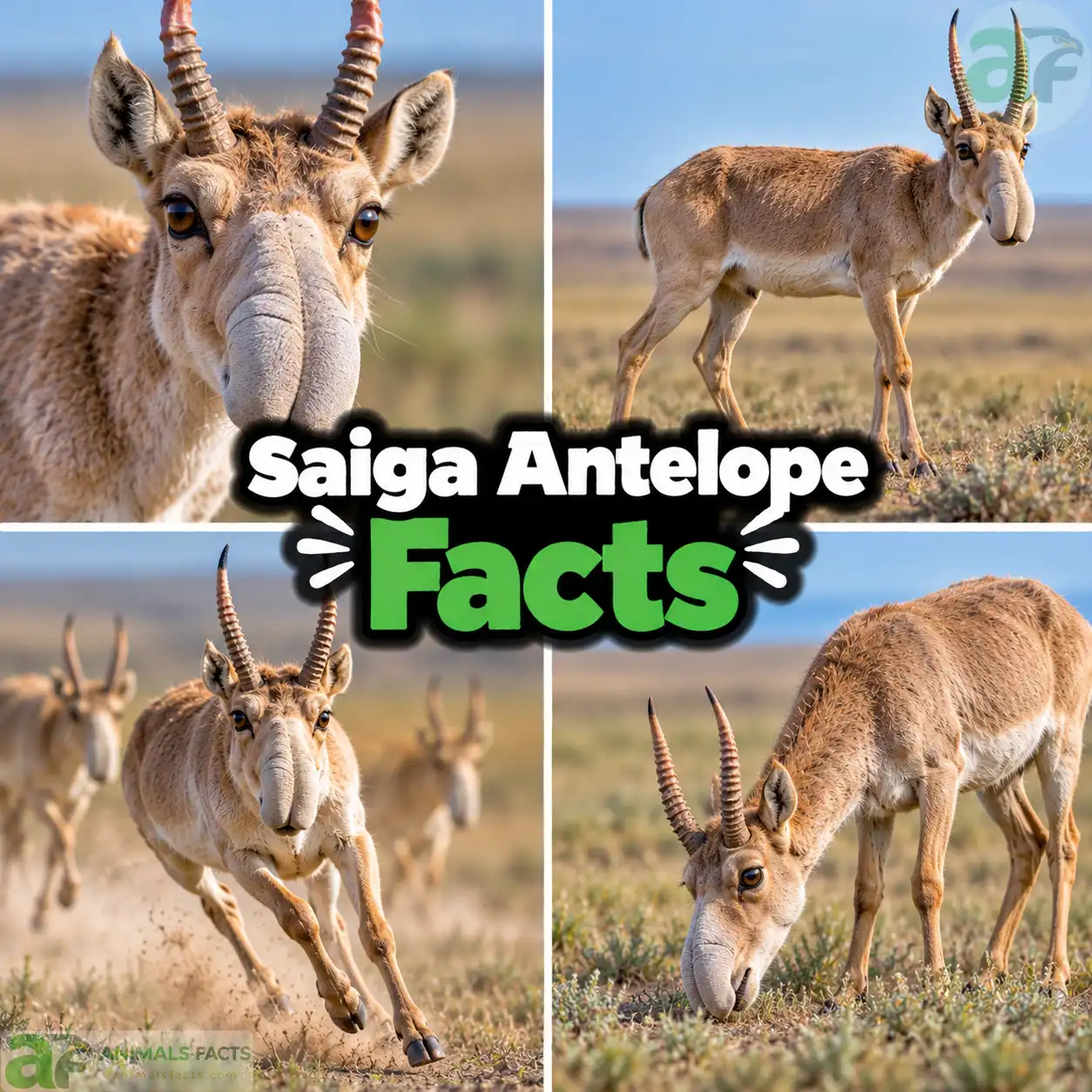
Saiga Antelope Facts
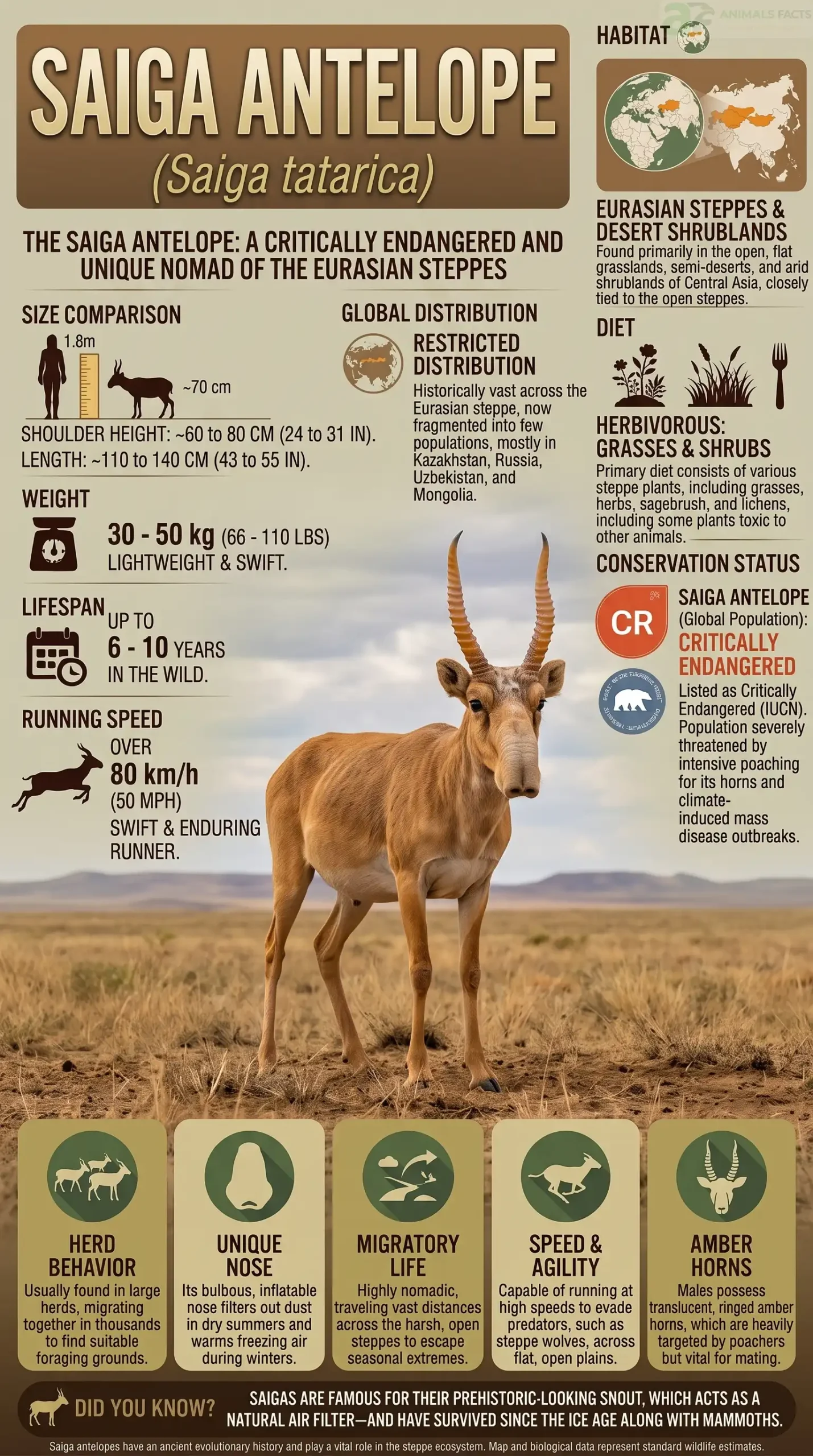
| Feature | Details |
|---|---|
| Scientific Name | Saiga tatarica (Linnaeus, 1766) — two subspecies recognized |
| Kingdom | Animalia |
| Phylum | Chordata |
| Class | Mammalia |
| Order | Artiodactyla |
| Family | Bovidae |
| Subfamily | Antilopinae |
| Common Names | Saiga antelope, saiga |
| Native Range | Central Asian steppe — Kazakhstan, Russia, Uzbekistan, Mongolia, China |
| Habitat | Open steppe, semi-desert, dry grassland — vast flat plains |
| Lifespan | 3–4 years (males, wild); 6–10 years (females, wild); up to 12 years (captivity) |
| Diet | Grasses, herbs, lichens, shrubs — exclusively herbivorous |
| Body Length | 100–145 cm |
| Height | 60–79 cm at shoulder |
| Weight | 26–69 kg (males significantly larger than females) |
| Top Speed | Up to 80 km/h — one of the fastest antelopes in the world |
| Conservation Status | Near Threatened (IUCN 2023) — recovering but precarious |
| Defining Feature | Enormous, bulbous, inflatable nose — the most distinctive nasal structure of any hoofed animal |
| Migration | Travels up to 1,000 km seasonally — one of the longest land animal migrations |
| Catastrophic Event | 200,000 died in 3 weeks in 2015 — one of the most dramatic wildlife die-offs ever recorded |
 1. Introduction: What is a Saiga Antelope?
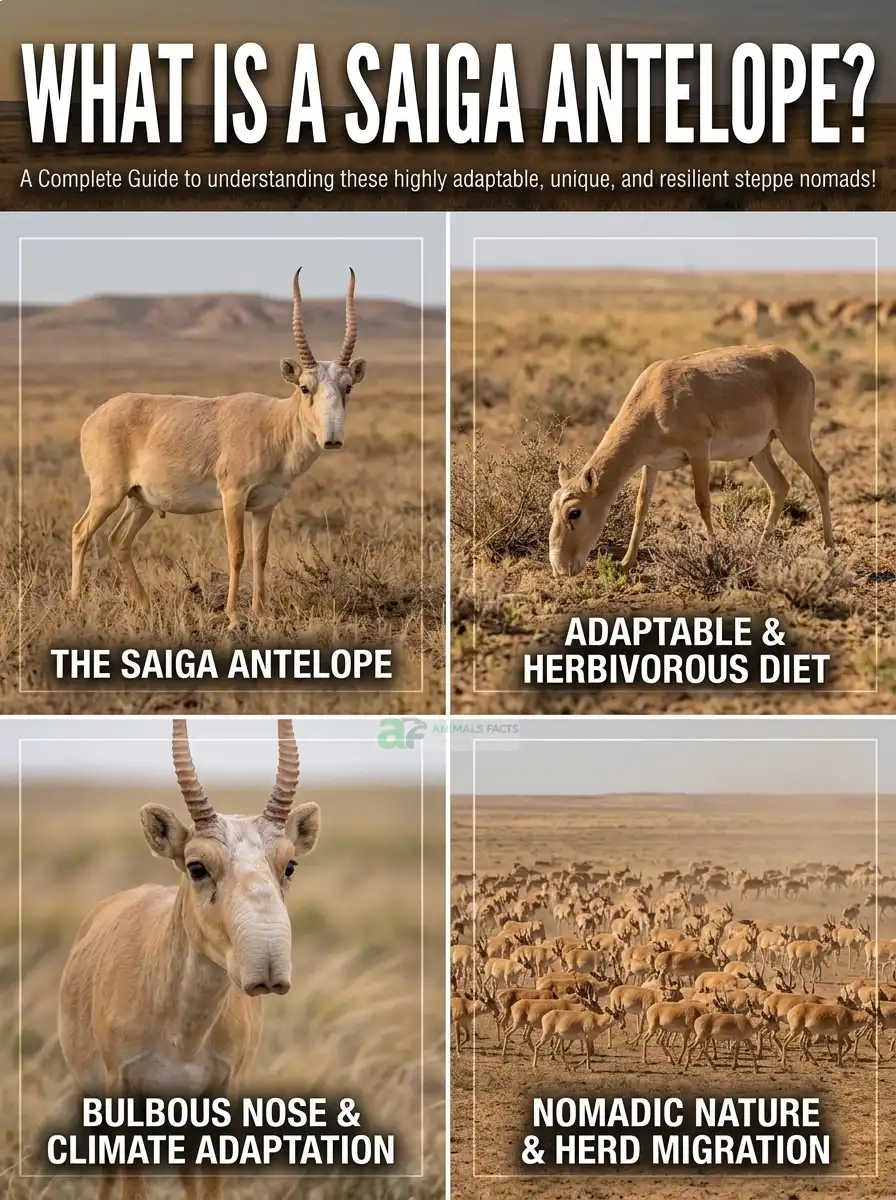
Across the vast, windswept steppe of Central Asia — in a landscape of such immensity and such emptiness that the sky seems to press down on the earth — a herd of animals moves with the rolling, fluid gait of creatures that have been crossing these plains since before the last Ice Age. They are medium-sized, sandy-coloured, and from a distance might be mistaken for ordinary antelopes. But look closer, and something extraordinary becomes visible — a face dominated by a nose so enormous, so bulbous, so improbably inflatable, that it seems to belong to a creature from a different evolutionary universe. This nose — this extraordinary, overinflated, proboscis-like nasal structure — is the defining feature of one of the world’s most ancient, most resilient, and most catastrophically imperiled mammals. Saiga antelope facts begin with this single, astonishing image — an animal that coexisted with woolly mammoths and saber-toothed cats across the Ice Age steppes, that has survived every extinction event and every climatic upheaval for the past 250,000 years, and that nearly went extinct in the span of a single human lifetime through a combination of poaching, habitat fragmentation, and one of the most dramatic mass mortality events ever recorded in wildlife history.
The saiga’s story is one of extraordinary extremes — a species that can run at 80 km/h across vast open steppe, that undertakes migrations of 1,000 kilometers with the irresistible momentum of a continental tide, that gives birth in such synchronized, explosive abundance that calving grounds temporarily support the highest density of newborn ungulates anywhere on Earth, and that in May 2015 experienced a mortality event so sudden and so total that 200,000 animals — more than half the global population — died in three weeks from a bacterial infection triggered by anomalous weather conditions, leaving researchers who witnessed it in a state of traumatized disbelief. Interesting facts about saiga antelopes reveal an animal that is simultaneously one of the most Ice Age-looking creatures alive today — the nose that seems designed for filtering frigid air, the compact body built for surviving steppe winters that reach -40°C — and one of the most ecologically and scientifically fascinating mammals in the world.
Whether you are searching for saiga antelope facts for kids to explore the extraordinary science of ancient mammals and mass wildlife events, a wildlife enthusiast fascinated by the Central Asian steppe ecosystem, a conservationist wanting to understand the complex story of a species that has swung from catastrophic decline to cautious recovery, or simply someone who encountered a photograph of the saiga’s extraordinary nose and needed to understand this animal completely — this is your comprehensive guide. We cover saiga antelope scientific name, saiga antelope diet, saiga antelope size and weight, saiga antelope behavior, the extraordinary biology of the nose, the 2015 mass mortality event, conservation status, cultural significance, and the profound ecological roles these ancient animals play. The Ice Age survivor of the Central Asian steppe has an extraordinary story to tell.
2. Saiga Antelope Species Overview & Classification
The saiga antelope belongs to the family Bovidae — the even-toed ungulates that include cattle, sheep, goats, and antelopes — and occupies a taxonomically distinctive position as one of the most morphologically unusual members of the subfamily Antilopinae.
Species Classification Table
| Taxonomic Rank | Classification |
|---|---|
| Kingdom | Animalia |
| Phylum | Chordata |
| Class | Mammalia |
| Order | Artiodactyla |
| Family | Bovidae |
| Subfamily | Antilopinae |
| Genus | Saiga (Gray, 1843) |
| Species | S. tatarica (Linnaeus, 1766) |
| Common Names | Saiga antelope, saiga |
| Sister Genera | Procapra (Tibetan gazelles) — most closely related living genus |
| Temporal Range | ~250,000 years to present (modern species) |
The Two Subspecies
The saiga antelope has two recognized subspecies with distinct geographic ranges and conservation statuses:
| Subspecies | Common Name | Range | IUCN Status | Population |
|---|---|---|---|---|
| S. t. tatarica | Saiga tatarica tatarica | Kazakhstan, Russia, Uzbekistan | Near Threatened | ~1,000,000+ (2024) |
| S. t. mongolica | Mongolian saiga | Western Mongolia (Shargyn Gobi) | Critically Endangered | ~20,000 (2024) |
The Mongolian saiga (S. t. mongolica) is geographically, genetically, and morphologically distinct enough that some authorities advocate for its recognition as a separate species — a taxonomic elevation that would immediately make it one of the world’s most Critically Endangered large mammals.
Evolutionary Relationships
The saiga’s closest living relatives within the Antilopinae are the Tibetan gazelles (Procapra species) of the Tibetan Plateau — a relationship that reflects the shared evolutionary origins of the two groups in the high-altitude and steppe environments of central Asia during the Miocene and Pliocene.
The saiga lineage is estimated to have diverged from its Procapra relatives approximately 5–8 million years ago — during the period when the Central Asian steppe environment was developing into the vast grassland system that would eventually define the saiga’s ecological world.
Evolution & Discovery Timeline
~250,000 years ago — The modern saiga species (Saiga tatarica) appears in the fossil record — with a geographic range that extended from the British Isles across all of Eurasia to Alaska and Canada, coexisting with woolly mammoths, woolly rhinoceroses, cave lions, and the full complement of Ice Age megafauna.
~12,000–10,000 years ago — The end of the last Ice Age causes dramatic range contraction — the saiga retreats from its vast circumpolar distribution to the Central Asian steppe as temperatures rise and habitat changes. The species that once roamed from Britain to British Columbia becomes confined to the Eurasian interior.
1766 — Carl Linnaeus formally describes the saiga as Capra tatarica in Systema Naturae — the first formal Western scientific description of the species.
1843 — John Edward Gray establishes the genus Saiga — recognizing the saiga’s morphological distinctiveness from other antelopes and gazelles.
~1900 — Saiga populations are driven to near-extinction across their range by intensive hunting during the late 19th and early 20th centuries — the species is reduced to a small remnant population in Kazakhstan.
1919 — The Soviet Union implements comprehensive legal protection of saiga antelopes — banning hunting across the species’ range. This protection, combined with intensive conservation management, initiates one of the most remarkable wildlife recoveries in history.
1950s–1970s — The Soviet saiga recovery program achieves extraordinary success — populations increase from near-extinction levels in 1900 to over 1 million animals by the 1950s and peak at an estimated 1.2 million in the 1970s. The saiga becomes a celebrated example of Soviet conservation achievement.
1991 — The collapse of the Soviet Union ends the conservation infrastructure that had sustained the recovery — the dissolution of the USSR’s coordinated management program, combined with economic crisis that drives intensive poaching for male horns, initiates a devastating new population decline.
1990s — Saiga populations collapse from over 1 million to approximately 50,000 in less than a decade — one of the most dramatic population collapses of any large mammal in the modern era. The species is listed as Critically Endangered.
2010 — Populations begin recovering — reaching approximately 250,000 animals following coordinated international conservation interventions and reduced poaching pressure.
May 2015 — The most catastrophic single wildlife event in modern conservation history — approximately 200,000 saiga die in three weeks across Kazakhstan, representing over 50% of the global population at that time. The cause is eventually identified as a bacterial infection by Pasteurella multocida triggered by anomalously warm, humid weather conditions. The event shocks the conservation world and leaves field researchers deeply traumatized.
2016–2024 — Recovery from the 2015 event proceeds remarkably rapidly — the saiga’s extraordinary reproductive rate allowing populations to rebuild at a pace that surprises conservationists. By 2024, the total saiga population exceeds 1 million animals for the first time since the Soviet era — prompting a downlisting from Critically Endangered to Near Threatened by the IUCN in 2023.
“I have worked with endangered species my entire career. I have seen bad things happen to wildlife. But I have never seen anything like what happened in Kazakhstan in May 2015. In three weeks, we lost more than half the global population of an entire species — and we didn’t know why. It was one of the most devastating experiences of my scientific life.”
— Dr. E.J. Milner-Gulland, Professor of Biodiversity, University of Oxford, and leading saiga conservation scientist

3. Saiga Antelope Physical Description & Unique Features
Saiga antelope size and weight make it a medium-sized ungulate — but the saiga’s physical appearance is so distinctive, so immediately recognizable, and so unlike any other living hoofed animal that size measurements alone give an entirely inadequate picture of this animal’s extraordinary morphology.
The Nose — The Saiga’s Most Defining Feature
The saiga’s most immediately striking — and most biologically remarkable — feature is its extraordinary nose — a structure so enlarged, so flexible, and so functionally specialized that it has no parallel among any other living hoofed mammal:
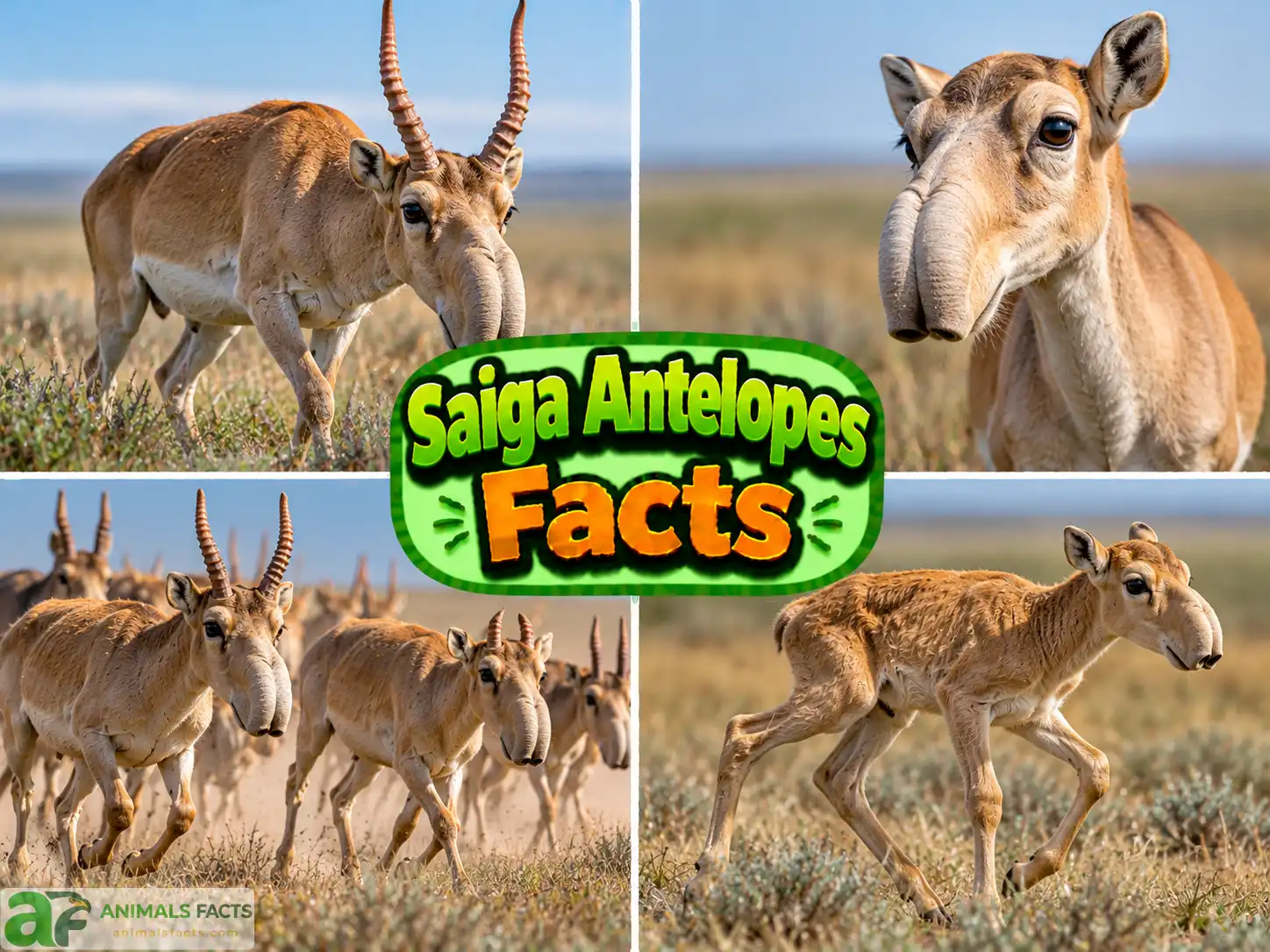
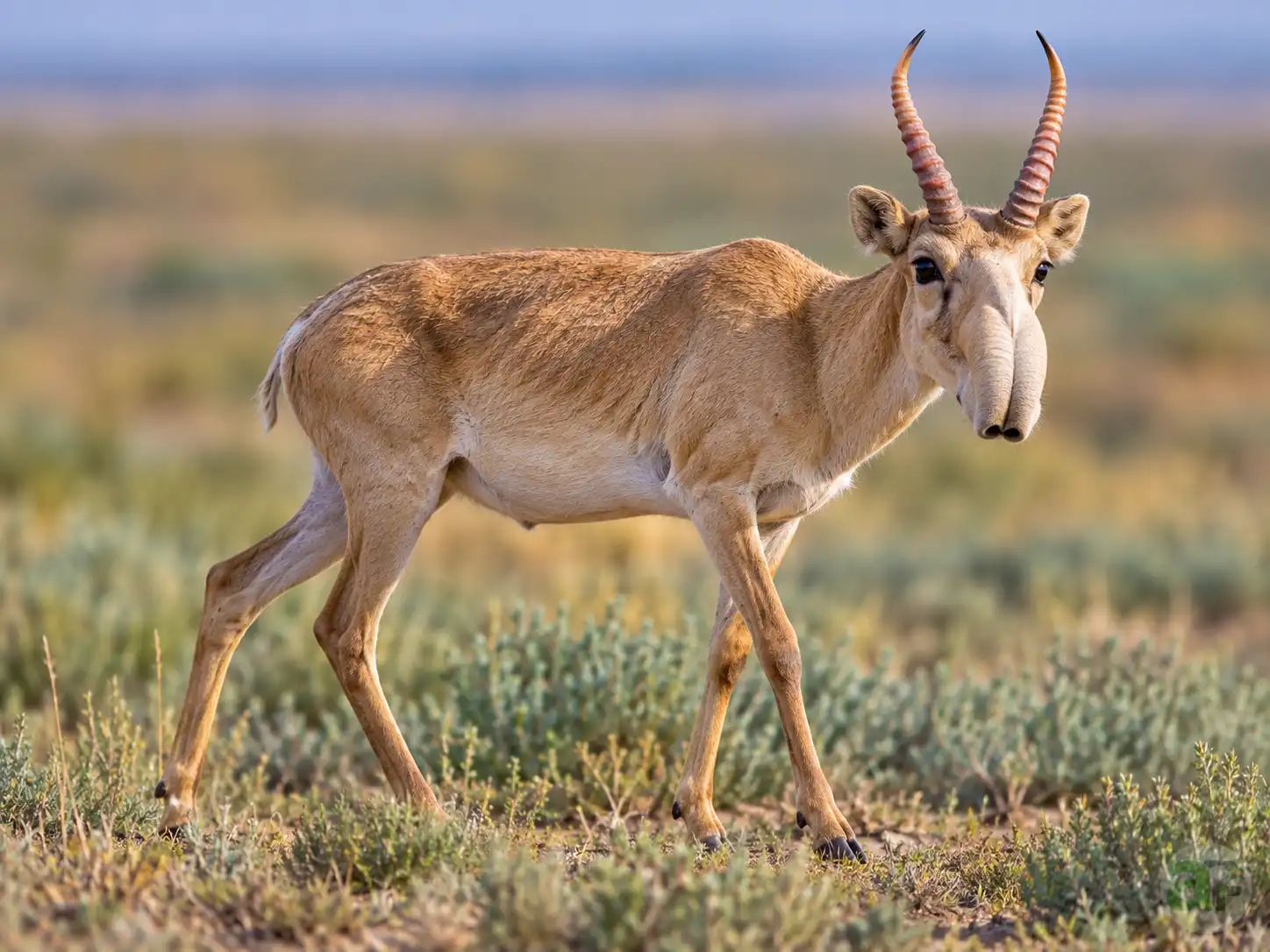
Structure — The saiga’s nose is not merely a large nose — it is a complete proboscis-like organ in which the nasal passages have been dramatically enlarged and the soft tissue of the nose has been extended well beyond the standard ungulate snout profile. The nose droops noticeably in front of the mouth, creating a distinctively downward-hanging profile that gives the face its characteristic appearance of having been designed by a committee working from a description of a very different animal.
Inflatable quality — The nose is not rigidly fixed in its enlarged shape — it can be inflated and deflated through muscular control, becoming more prominent during high arousal states including running, alarm, and male combat display. Males have substantially larger noses than females — the difference in nasal size being the most reliable field sexing characteristic.
Internal structure — Inside the enormous nose, the nasal passages are highly convoluted — with elaborate scrolled turbinate bones increasing the surface area of the nasal cavity to several times that of a standard ungulate of equivalent body size. This increased surface area is lined with mucous membranes richly supplied with blood vessels.
The functional explanations — The extraordinary nose serves at least three documented functions:
- Winter air heating — The convoluted nasal passages warm frigid winter air before it reaches the lungs — critical for maintaining pulmonary function in the -40°C winters of the Central Asian steppe. The nose is essentially a biological heat exchanger that allows the saiga to breathe air that would otherwise cause bronchial damage.
- Dust filtration — During the saiga’s massive seasonal migrations across the dry steppe, enormous dust clouds are generated by thousands of hooves. The convoluted nasal passages and abundant mucus production filter dust particles from the inhaled air with remarkable efficiency — the nose as a biological air purifier for an animal that lives in some of the world’s most dust-exposed environments.
- Male display — The nose of male saigas becomes particularly prominent during the rut — inflating and becoming reddened as a display signal. Research suggests nose size correlates with male fitness and is used by females in mate assessment.
Horns — Males Only
Only male saigas have horns — a characteristic they share with many Antilopinae species. The horns are:
- Lyrate (lyre-shaped) — curving gently outward then upward and inward
- Semi-translucent — amber-yellow to pale yellow in color; sometimes described as wax-like
- Ridged — with prominent transverse ridges across most of the horn length
- Length: typically 25–35 cm in fully developed males
- Composition: keratin over a bone core — the standard bovid horn structure
These horns are the primary target of poachers — their resemblance in Traditional Chinese Medicine applications to rhinoceros horn has made them a sought-after wildlife product despite being scientifically indistinguishable in composition from other bovid horns.
Body Form
The saiga’s body form reflects its steppe ecology — compact, efficient, built for speed and endurance across vast, open terrain:
Compact body — Moderately stocky relative to leg length; males significantly heavier than females (up to 69 kg vs. typically 26–40 kg for females)
Long legs — The legs are proportionally long — providing the stride length needed for the saiga’s extraordinarily fast, energy-efficient ground-covering gait at speeds up to 80 km/h
Sheep-like quality — From a distance and without the nose visible, saigas can resemble large, pale sheep — the overall body form and proportions having a somewhat ovine quality
Coat — The summer coat is short, reddish-brown to cinnamon — providing minimal thermal insulation in the warm season. The winter coat is dramatically different — thick, woolly, pale grey to buff — with underfur growth that dramatically increases coat thickness for survival at extreme winter temperatures
💡 Did You Know? The saiga’s extraordinary nose is so functionally sophisticated that it has attracted the attention of industrial engineers studying biological solutions to air filtration and heat exchange problems. The internal architecture of the saiga’s nasal turbinates — with their elaborate scrolling that maximizes mucous membrane surface area in a compact space — has been studied as a model for air conditioning and filtration systems in which maximizing heat exchange or particle capture within a constrained volume is the engineering challenge. The saiga’s nose has essentially independently solved the same problem that human engineers address in counter-flow heat exchangers and industrial air filters — and has been doing so for 250,000 years.
4. Top 25 Amazing Saiga Antelope Facts
Here is your definitive collection of the most extraordinary, scientifically verified, and genuinely astonishing saiga antelope facts as of 2026:
- The saiga antelope coexisted with woolly mammoths and woolly rhinoceroses during the last Ice Age — its geographic range once extending from Britain to British Columbia before climate change at the end of the Ice Age compressed it to the Central Asian steppe.
- In May 2015, approximately 200,000 saiga antelopes died in just three weeks — representing over 50% of the global population at the time — in one of the most dramatic wildlife mass mortality events ever recorded. The cause was eventually identified as a bacterial infection by Pasteurella multocida triggered by anomalously warm and humid weather conditions.
- The saiga’s extraordinary bulbous, inflatable nose serves as a biological air conditioner and dust filter — warming frigid winter air (temperatures as low as -40°C) before it reaches the lungs and filtering dust from the massive clouds generated by migrating herds.
- Saiga antelopes undertake one of the longest land animal migrations of any species in Eurasia — traveling up to 1,000 km seasonally between summer and winter ranges.
- The saiga population underwent one of the most dramatic wildlife recovery stories in history — rebounding from near-extinction (~1,000 animals) in 1900 to over 1 million by the 1950s following Soviet-era protection — then collapsing from 1 million to 50,000 in the 1990s following the Soviet Union’s collapse, and recovering again to over 1 million by 2024.
- Female saigas give birth in an extraordinarily synchronized mass calving event — virtually all females in a population giving birth within a 2–3 day window in May. The resulting density of newborn calves on calving grounds temporarily represents the highest density of newborn ungulates anywhere on Earth.
- The saiga can run at speeds up to 80 km/h — making it one of the fastest antelopes in the world and one of the fastest land animals in Central Asia.
- Male saigas have a dramatically shorter lifespan than females — typically living only 3–4 years compared to 6–10 years for females. This extreme sexual dimorphism in lifespan results from the enormous energetic costs of the breeding season rut and the physical toll of male-male competition.
- The saiga’s horns are used in Traditional Chinese Medicine — prescribed for conditions including fever, liver disease, and headache — despite containing no unique pharmacological compounds not found in other bovid horns. This demand has driven intensive poaching that has been the primary conservation threat since the 1990s.
- Saiga herds during migration can number in the hundreds of thousands — moving across the steppe in a dense, flowing mass that has been described as resembling a living river. These aggregations represent one of the last great terrestrial wildlife migrations in the temperate world.
- The bacterium responsible for the 2015 mass mortality — Pasteurella multocida — lives in the nasal passages of healthy saiga as normal flora without causing disease under standard conditions. The anomalous warm, humid weather of May 2015 triggered a rapid transition from benign colonization to lethal septicemia — the mechanism still being investigated as of 2026.
- Female saigas are among the most reproductively productive of any large ungulate — typically giving birth to twins (approximately 70% of births), with some females producing triplets. Combined with early sexual maturity, this extraordinary birth rate is what allows saiga populations to recover from catastrophic losses.
- The saiga was classified as Critically Endangered from 2002 to 2023 — a period during which the IUCN assessed the species as facing imminent extinction risk. The 2023 downlisting to Near Threatened represents one of the most significant conservation status improvements of any large mammal in recent history.
- During the rut, male saigas fight intensely for harem access — with combat involving horn locking and pushing that can result in serious injury and sometimes death. The breeding season’s physical demands contribute significantly to the extreme male mortality that produces the dramatically skewed sex ratios in saiga populations.
- The saiga’s seasonal coat is one of the most dramatic color and texture changes of any ungulate — switching from a short, reddish-brown summer coat to a thick, woolly, pale-grey winter coat that provides insulation against -40°C winter temperatures.
- Saiga populations show one of the most severe skews in adult sex ratios of any large mammal — poaching of males for their horns has created populations in some areas with sex ratios as skewed as 1 male per 800 females — a distortion so extreme that reproduction is significantly impaired even when female numbers are high.
- The Mongolian saiga subspecies (S. t. mongolica) — restricted to the Shargyn Gobi of western Mongolia — numbers approximately 20,000 individuals and represents a genetically distinct population of such conservation importance that some authorities advocate elevating it to full species status.
- Saiga antelopes use a distinctive stotting behavior during flight from predators — a bouncing, high-leaping gait that may signal physical fitness to predators and conspecifics simultaneously.
- The saiga’s population ecology has been called a “boom and bust” system — the species’ extraordinary reproductive capacity allowing rapid population growth during favorable periods, but making it equally capable of catastrophic rapid decline when mortality rates spike.
- Scientific monitoring of the 2015 mass mortality event involved researchers from multiple countries working simultaneously in the field — the international response to the crisis providing a model for cooperative emergency response to wildlife catastrophes that has informed global conservation practice.
- The saiga horn trade has been driven partly by its marketing as a substitute for rhinoceros horn in TCM — with saiga horn occasionally explicitly substituted for rhino horn in prescriptions. Like rhino horn, saiga horn has no proven clinical efficacy beyond placebo for any condition.
- Saiga antelopes have been documented crossing major rivers during migration — including the Volga, Ural, and various Central Asian rivers — in mass crossings that can involve tens of thousands of animals simultaneously and that represent some of the most spectacular wildlife spectacles in Asia.
- The saiga’s nasal glands produce a secretion that is used in scent marking — with the nose playing a role in chemical communication as well as respiration and display, making it one of the most multifunctional anatomical structures of any ungulate.
- Female saigas select calving sites with extraordinary consistency — returning to the same calving grounds in successive years with a site fidelity that suggests learned cultural transmission of calving location across generations.
- As of 2026, the recovery of the saiga antelope population represents one of the most remarkable conservation achievements of the 21st century — the species having recovered from the 2015 catastrophe to exceed 1 million animals through a combination of reduced poaching pressure, international conservation cooperation, and the saiga’s own extraordinary reproductive biology.
5. Fun Facts About Saiga Antelopes
- Saigas lived alongside woolly mammoths on Ice Age steppes
- Their range once stretched from Britain to Canada
- 200,000 died in 3 weeks in 2015 — one of history’s greatest wildlife die-offs
- The nose works as a biological air conditioner and dust filter
- They can run at 80 km/h — one of the fastest antelopes
- Seasonal migrations can cover 1,000 km
- Female saigas usually give birth to twins — unusual for antelopes
- Males live only 3–4 years — females live 6–10 years
- Some populations had 1 male per 800 females due to poaching
- Population went from 1 million to 50,000 in the 1990s — then recovered
- The 2023 downlisting from Critically Endangered to Near Threatened was historic
- The nose has inspired research into industrial air filtration systems
6. Saiga Antelope Habitat & Geographic Range
Saiga antelope habitat is defined by the vast open steppe and semi-desert ecosystems of Central Asia — some of the largest remaining temperate grassland systems on Earth, characterized by extreme seasonal temperature variation, sparse vegetation, minimal tree cover, and the endless flat or gently rolling landscape that allows both the saiga’s extraordinary speed and its epic migrations.
Habitat Requirements
Saiga antelopes are specialists of open, flat terrain — their biology, behavior, and ecology are intimately adapted to landscapes with specific characteristics:
Flat to gently rolling topography — The saiga’s primary locomotion is the sustained, high-speed run across open ground. They are poorly adapted to broken, hilly, or heavily vegetated terrain. Their migrations follow the flattest available routes — and habitat fragmentation by terrain features, infrastructure, or vegetation changes represents a significant population barrier.
Low vegetation — Saiga graze on short steppe grasses and herbs — they are not adapted for dense tall grass vegetation. Overgrazing or vegetation change that eliminates short grass steppe reduces habitat quality.
Adequate soil drainage — Saiga avoid waterlogged or excessively moist terrain — they require the well-drained steppe soils that characterize their primary habitat.
Winter calving and summer grazing areas — Saigas require a seasonal mosaic of habitats — areas with minimal snow accumulation for winter survival, and productive spring calving grounds near water sources.
Connectivity — Perhaps the most critical habitat requirement — unobstructed migration corridors between seasonal ranges. Fences, roads, pipelines, and other linear infrastructure crossing the steppe represent barriers that fragment populations and disrupt migrations with catastrophic consequences.
Habitat Types
Temperate steppe — The primary habitat; vast flat grassland dominated by various grass species (Stipa, Festuca, Poa) with sparse herb layer; the classic “sea of grass” of the Eurasian interior
Semi-desert steppe — More arid grassland transitioning toward desert; dominated by xerophytic (drought-adapted) grass and shrub species; important winter habitat for some populations
Salt desert margins — Saiga use the margins of salt flat (solonchak) habitats — particularly during winter when these areas may have snow-free vegetation accessible for grazing
Riparian corridors — River margins provide water and more diverse vegetation — important summer habitat and migration waypoints
Geographic Range by Population
| Population | Range | Country | Estimated Size (2024) |
|---|---|---|---|
| Ural population | North Caspian steppe; Ural River basin | Kazakhstan, Russia | ~450,000 |
| Ustyurt population | Ustyurt Plateau between Caspian and Aral | Kazakhstan, Uzbekistan | ~175,000 |
| Betpak-Dala population | Central Kazakhstan steppe | Kazakhstan | ~450,000 |
| Kalmykia-Dzhangara population | Russian steppe north of Caspian | Russia | ~35,000 |
| Mongolian population | Shargyn Gobi desert steppe | Mongolia | ~20,000 |
💡 Did You Know? The saiga’s historical range — during the Last Glacial Maximum approximately 20,000 years ago — was one of the largest of any large mammal on Earth, extending from the British Isles across all of Eurasia to Siberia, Alaska, and even into central Canada. The “mammoth steppe” — the vast grassland ecosystem that dominated the northern hemisphere during glacial periods — was the saiga’s ancestral homeland. The saiga shared this world with woolly mammoths, woolly rhinoceroses, cave lions, cave hyenas, and the full Ice Age megafauna. As the Ice Age ended and temperatures rose, most of this megafauna went extinct — but the saiga survived, retreating to the remaining steppe of Central Asia where its extraordinarily specialized nose continues to perform the same functions it evolved for in the -40°C winters of the Ice Age grassland. The saiga is therefore not merely an endangered antelope — it is a living Ice Age relic, the sole surviving large mammal of the mammoth steppe ecosystem.
7. Saiga Antelope Diet & Feeding Behavior
Saiga antelope diet is exclusively herbivorous — the species consuming a diverse range of steppe plants that vary significantly by season, reflecting the dramatic seasonal changes in plant availability across the Central Asian steppe.
Diet Breakdown Table
| Food Type | Estimated % of Diet | Season | Notes |
|---|---|---|---|
| Grasses (Stipa, Festuca, Bromus species) | ~45–60% | Year-round | Primary food across all seasons |
| Herbs and forbs (various steppe herbs) | ~20–30% | Spring and summer | Nutritionally important; peak spring |
| Ephemerals (short-lived spring plants) | ~10–20% | Spring only | Critical nutritional pulse; calving season |
| Shrubs and dwarf shrubs (Artemisia, Kochia) | ~10–15% | Winter dominant | Important when grasses are snow-covered |
| Lichens and mosses | ~3–5% | Winter | Supplementary winter food |
| Saltbush and halophytes | ~3–5% | Summer | Important mineral source |
| Agricultural crops (where available) | ~1–5% | Variable | Causes human-wildlife conflict |
The Seasonal Feeding Strategy
Saiga feeding ecology is driven by the extreme seasonality of the Central Asian steppe — with dramatic differences between seasons in both food availability and nutritional quality:
Spring — The most nutritionally critical period — the emergence of ephemeral plants (short-lived, highly nutritious early-spring species) provides a pulse of high-quality protein and energy that fuels the approach to calving and the intense physiological demands of lactation. Saiga migration to spring ranges is timed to capture this nutritional pulse.
Summer — The growing season provides diverse, nutritious grasses and herbs — summer ranges must provide adequate food for body condition maintenance and fat accumulation for the coming winter.
Autumn — The rut period — males expend enormous energy in competition and mating while eating relatively little. Post-rut males are often severely depleted in body condition. Females must continue building fat reserves for winter and early pregnancy.
Winter — The most challenging period — snow cover may render grasses inaccessible, requiring saiga to paw through snow to reach vegetation or to shift to shrub species that protrude above the snowpack. Winter is the primary mortality season for weakened individuals.
The Water Relationship
Saiga antelopes can extract metabolic water from vegetation during periods when surface water is unavailable — an adaptation to the semi-arid conditions of much of their range. However, they regularly drink when surface water is accessible — and the location of water sources is an important factor in determining summer range distribution.
During the calving period, lactating females have elevated water requirements — calving grounds are typically located near water sources that support this elevated demand.
Feeding Behavior
Selective grazing — Saiga are not undiscriminating grazers — they show systematic preferences for specific plant species and plant parts (preferring young leaves and shoots with higher protein and lower fiber content) and systematically avoid plants with high toxin content.
Daily movement — Saiga typically move 10–40 km per day during active feeding periods — the combination of foraging movement and long daily distances reflecting both the low plant density of steppe ecosystems and the saiga’s need to visit multiple plant communities within a day.
8. Saiga Antelope Reproduction & Life Cycle
Saiga antelope reproduction is the biological foundation of the species’ extraordinary capacity for both catastrophic population collapse and remarkable recovery — featuring some of the most extreme reproductive characteristics of any large ungulate.
The Rut — Male Mortality Season
The saiga rut occurs in November to January — a timing that places the most energetically demanding period of male life in the depths of the Central Asian winter:
Harem defense — Male saigas are polygynous — dominant males attempt to establish and defend harems of 5–50 females during the rut. This harem-defense system requires intensive monitoring, active herding to keep females together, and aggressive combat against rival males — activities that continue for the entire 1–2 month rut period with minimal feeding.
Male combat — Rival males fight by locking horns and pushing — bouts that can last 10–30 minutes and that are physiologically exhausting. Serious injuries occur — broken horns, eye injuries, and exhaustion-related collapse are documented. Male fatalities during the rut are not uncommon.
The male mortality cost — The combination of rut exertion in extreme winter cold, minimal feeding during the rut period, and the physical toll of combat produces the dramatic sex-specific lifespan difference — males dying at average ages of 3–4 years (often in their second or third rut) while females survive to 6–10 years. In some populations, adult males effectively live only through 2–3 breeding seasons before succumbing to rut-related exhaustion and winter stress.
The poaching amplification — The already short male lifespan is dramatically further reduced by the poaching of adult males for their horns — producing the extreme sex ratio distortions documented in some populations (as extreme as 1 male per 800 females). At these ratios, reproduction is genuinely impaired — there are simply not enough males to fertilize all available females.
The Calving Event — One of Nature’s Most Spectacular
The saiga calving event — occurring in May with extraordinary synchrony — is one of the most remarkable wildlife events in the temperate world:
Synchrony — Virtually all pregnant females in a population give birth within a 2–3 day window — a degree of reproductive synchrony rarely seen in any mammal. The evolutionary driver is likely predator saturation — by having all calves born simultaneously, the total predator kill is minimized relative to the enormous number of calves available. No predator population can process the sudden availability of hundreds of thousands of calves simultaneously.
Twins — Approximately 70% of births produce twins — an exceptional twinning rate for an antelope species. Some females produce triplets. This high birth rate per individual is the biological foundation of the saiga’s extraordinary population recovery capacity.
Calving grounds — Female saigas converge on traditional calving grounds — flat, open areas near water sources — that have been used for generations. The density of newborn calves on these grounds during the 2–3 day peak is extraordinary — sometimes representing the highest density of newborn ungulates anywhere on Earth.
Rapid development — Saiga calves develop extremely rapidly — capable of running within hours of birth, reaching speeds adequate for predator escape within 2–3 days, and transitioning to grazing within 2–3 weeks.
Lifespan Comparison Table
| Species | Male Lifespan (Wild) | Female Lifespan (Wild) | Key Factor |
|---|---|---|---|
| Saiga antelope | 3–4 years | 6–10 years | Extreme rut cost + poaching |
| Springbok (Antidorcas marsupialis) | 7–10 years | 10–13 years | Less extreme dimorphism |
| Pronghorn (Antilocapra americana) | 7–10 years | 10–12 years | Comparable ecology |
| Tibetan antelope (Chiru) | 5–8 years | 8–12 years | Comparable environment |
| Impala (Aepyceros melampus) | 12–15 years | 15–17 years | Less extreme dimorphism |
9. Social Behavior & Communication
Saiga antelope social behavior is structured around the extraordinary scale of migratory herd formation that characterizes the species — with individual social relationships operating within the context of mass movement that can involve hundreds of thousands of animals.
Seasonal Social Structure
Saiga social organization shifts dramatically across the annual cycle:
Breeding season (November–January) — Males establish harem groups and aggressively exclude rival males. The landscape is temporarily organized around male territories centered on groups of females. This is the period of maximum male-male competition and highest male mortality.
Post-breeding (January–March) — Males and females tend to segregate into separate groups — females conserving energy for the approaching calving period while depleted males attempt to recover condition.
Calving period (May) — Females aggregate in dense calving groups on traditional calving grounds — providing collective vigilance against predators during the vulnerable calving period. Males are largely absent from calving areas.
Summer — Mixed groups of varying sizes — from tens to thousands of individuals — move across summer ranges, with the largest aggregations forming along migration routes and at water sources.
Migration — The formation of enormous mixed-sex migratory herds — the most spectacular social formation in saiga behavior — is primarily driven by parallel individual movement responses to environmental cues (temperature, photoperiod, vegetation conditions) rather than coordinated social decision-making.
Communication
Visual signals — Postural signals communicate alarm, submission, and reproductive readiness. The stotting (bouncing leap) behavior is used during alarm — communicating physical fitness to predators and providing a contagious signal to other herd members.
Acoustic signals — Saiga produce a range of vocalizations:
- Alarm snort — a sharp nasal exhalation warning herd members of detected threats
- Male rutting calls — deep grunting and low bellowing during the breeding season
- Mother-calf bleating — critical for maintaining contact between mothers and calves in the dense calving herds
Chemical signals — Scent secretions from the pre-orbital gland (in front of the eye) and from the nose itself are used in territory marking and reproductive signaling.
The nose as communication tool — The male’s enlarged, inflatable nose is itself a visual signal — its size and coloration during the rut communicating male condition and competitive status to both female mates and rival males.
Intelligence and Collective Behavior
Saiga show sophisticated collective behavior in large herds — the complex, fluid movement of thousands of animals responding to predator detection and terrain features demonstrating the emergent intelligence of mass animal movement. Individual saiga appear to use information cascades — a single animal’s alarm response triggering responses in neighbors, which trigger further responses, propagating through the herd in waves that allow rapid collective reaction to threats that only a fraction of the herd has directly detected.
10. Predators & Defense Mechanisms
The saiga faces a natural predator community across its Central Asian steppe habitat that has driven the evolution of its remarkable speed, its extraordinary reproductive rate, and the synchronized calving behavior that provides collective defense against predation.
Natural Predators
Wolf (Canis lupus) — The most important saiga predator across their current range; wolves follow saiga migrations and represent the primary year-round predation pressure. Wolf-saiga dynamics are a central theme in saiga population ecology.
Snow leopard (Panthera uncia) — Occasional predator at the mountain margins of saiga range — where steppe transitions to mountain terrain, snow leopards may take saigas.
Corsac fox (Vulpes corsac) — Takes saiga calves during the calving period — the dense, synchronized calving event likely evolved partly as a defense against this predator.
Golden eagle (Aquila chrysaetos) — Takes newborn calves during the calving period — golden eagles are attracted to calving grounds in significant numbers.
Historical predators (now rare/absent) — In the Ice Age ecosystem, the saiga faced a much more diverse predator community including cave lions (Panthera spelaea), cave hyenas (Crocuta crocuta spelaea), and ultimately human hunters. The saiga’s extraordinary speed (80 km/h) was likely calibrated against this much more formidable predator guild.
Defense Strategies
Speed — The primary defense; at 80 km/h, adult saigas can outpace virtually all cursorial predators except cheetahs (which do not share their range). Wolves — which cannot match this speed individually — rely on persistent pursuit that eventually exhausts the prey.
The synchronized calving defense — The explosive synchrony of the calving event is believed to function as a predator saturation strategy — producing such an overwhelming abundance of calves simultaneously that predators cannot consume more than a small fraction of the available prey regardless of their population size or hunting efficiency.
Stotting — The bouncing, high-leaping flight behavior signals fitness to pursuing predators — conveying the message that the stotting individual is too fit to be worth pursuing, potentially causing predators to redirect toward weaker individuals.
Herd vigilance — Large aggregations provide collective predator detection — the probability of any individual in a large herd missing an approaching predator is dramatically lower than for a solitary individual.
Unpredictable direction changes — Saiga fleeing predators use rapid, unpredictable direction changes that make aerial interception by eagles more difficult and disrupt coordinated wolf pursuit strategies.
💡 Did You Know? The 2015 mass mortality event that killed 200,000 saiga in three weeks was not caused by a predator, a poacher, or a known pathogen — it was caused by a bacterium called Pasteurella multocida that normally lives harmlessly in the nasal passages of healthy saiga. The key to the disaster was the saiga’s extraordinary nose — the same enlarged, convoluted nasal passages that protect the lungs from freezing air and filter dust from migration clouds apparently created ideal conditions for the bacterium to multiply explosively when the ambient air became abnormally warm and humid during an unusual May weather event. The Pasteurella transitioned from harmless passenger to lethal bloodstream invader within days — killing entire herds before the cause was understood. The 2015 event raised the terrifying prospect that climate change — making anomalously warm and humid May weather events more frequent — could trigger similar die-offs in the future, potentially preventing the saiga from sustaining the population recovery that conservation interventions have otherwise enabled.
11. Saiga Antelope Facts for Kids
Hey amazing young wildlife explorers! Here are some genuinely incredible saiga antelope facts for kids that will make you the most interesting person in your whole class:
- 🦌 Saiga antelopes have the WEIRDEST nose in the animal kingdom! Their nose is so big and so inflatable that it droops down in front of their mouth. But it is not weird for no reason — the nose works like a built-in air conditioning system, warming the freezing cold steppe air before it gets to the lungs. It is one of nature’s most brilliant engineering solutions!
- 🦌 They lived alongside WOOLLY MAMMOTHS! Saiga antelopes have been on Earth for at least 250,000 years. When woolly mammoths were roaming the Ice Age steppes, saiga were right there with them. When the mammoths went extinct at the end of the Ice Age, the saiga survived — making them one of the last surviving members of the mammoth’s world!
- 🦌 200,000 of them died in just THREE WEEKS in 2015! This is one of the most shocking things that has ever happened to any wild animal. In May 2015, more than half of all the saigas in the world died incredibly quickly from a bacterial infection. Scientists who were there described it as one of the most devastating things they had ever seen.
- 🦌 They can run at 80 km/h! That is as fast as a car on a motorway! The saiga is one of the fastest antelopes in the world — which makes sense when you think about the flat, open steppe they live on, where there is nowhere to hide from predators except to run faster than them.
- 🦌 Saiga mums almost always have TWINS! While most antelopes have one baby at a time, about 70% of saiga mothers have twin calves. All the mothers in a herd give birth within just a few days of each other — so suddenly there are an enormous number of babies everywhere, which confuses and overwhelms predators.
- 🦌 Their range once included BRITAIN and CANADA! During the Ice Age, saiga antelopes ranged across the entire northern hemisphere — from Britain across Europe and Asia to Siberia, and even across into North America. Climate change at the end of the Ice Age reduced their home to Central Asia.
- 🦌 Their population went from a MILLION to 50,000 and back to a MILLION! The saiga has experienced one of the most extreme population roller-coasters of any animal in history — nearly extinct in 1900, then recovering to a million, then crashing to 50,000 in the 1990s, and recovering to over a million again by 2024. What an extraordinary survival story!
- 🦌 Male saigas usually only live to be 3 or 4 years old — because the breeding season is so hard on them. They fight so much and eat so little during the breeding season that many males simply wear themselves out. Female saigas can live twice as long!
12. Relationship with Humans
The relationship between saiga antelopes and humans spans from ancient coexistence and sustainable traditional hunting, through imperial-era near-extinction, remarkable Soviet-era recovery, catastrophic post-Soviet collapse, and the cautious international conservation cooperation of the 21st century that has produced the most recent population recovery.
Ancient Human-Saiga Coexistence
Humans have hunted saiga antelopes across the Eurasian steppe for at least 50,000 years — the species features prominently in prehistoric cave art across Europe and Central Asia, and saiga bones appear consistently in archaeological sites across the species’ former range. For most of human history, this hunting was sustainable — traditional hunting techniques using bow, spear, and pit traps provided important protein for steppe pastoral communities without approaching the harvest rates that would threaten population viability.
Indigenous steppe peoples — The Kazakh, Kalmyk, and other steppe pastoralist communities of Central Asia maintained traditional relationships with saiga that combined opportunistic hunting for meat with a general ecological awareness of the animal’s seasonal movements and habitat requirements. Traditional ecological knowledge of saiga behavior — accumulated over centuries of coexistence — represents a significant supplement to modern scientific understanding that conservation programs are increasingly working to incorporate.
The Imperial and Soviet Era
European contact with Central Asia — particularly through the expansion of Russian imperial control across the steppe in the 18th and 19th centuries — brought new hunting technologies and commercial hunting pressure that began to seriously damage saiga populations:
Commercial hunting — The expansion of European firearms technology and access to Central Asian steppe environments enabled commercial hunting at scales far exceeding traditional subsistence use. By the early 20th century, saiga were severely depleted across their range.
Soviet protection and recovery — The Soviet Union’s 1919 hunting ban on saiga — followed by comprehensive conservation management including anti-poaching enforcement, wildlife surveys, and population monitoring — produced what was at the time considered the greatest wildlife recovery in history. The saiga went from near-extinction in 1900 to over 1 million animals by the 1950s.
Soviet sustainable use — The later Soviet period allowed controlled, sustainable hunting of saiga — annual harvest quotas were set based on population surveys, and saiga became an important source of meat, leather, and horn for Soviet-era commerce. This managed harvest was controversial but is widely regarded by conservation ecologists as a sustainable use model that maintained large, healthy populations.
The Post-Soviet Collapse
The dissolution of the Soviet Union in 1991 removed the conservation infrastructure that had sustained the saiga recovery — with devastating consequences:
Poaching collapse — The simultaneous removal of anti-poaching enforcement, the economic collapse that drove desperate people toward illegal wildlife hunting, and the explosion of commercial demand for saiga horns in TCM markets (which expanded into former Soviet territories after 1991) produced an uncontrolled poaching wave that reduced the saiga population from approximately 1 million in 1990 to approximately 50,000 by 2003 — a 95% population collapse in 13 years.
Horn-driven poaching — The primary driver was demand for male saiga horns in Traditional Chinese Medicine — where they are used as a substitute for rhinoceros horn in preparations for fever, liver disease, and headache. The targeting of males for their horns produced the extreme sex ratio distortions (up to 1 male per 800 females) that further impaired reproduction.
Contemporary Conservation
The catastrophic 1990s decline prompted international conservation action — including the establishment of the Saiga Conservation Alliance and enhanced international cooperation between Kazakhstan, Russia, Mongolia, Uzbekistan, and international conservation organizations:
Anti-poaching programs — Improved law enforcement in Kazakhstan — with international support from WWF and other organizations — reduced poaching rates from the catastrophic 1990s levels.
Demand reduction — Work to reduce TCM demand for saiga horns — through education, advocacy, and promotion of laboratory-produced alternatives.
Population monitoring — Regular aerial surveys across the species’ range provide the population data needed for adaptive management.
Community engagement — Engagement with local communities across the steppe — providing livelihood alternatives to poaching and generating community support for saiga conservation.
13. Saiga Antelope Conservation Status & Threats
Conservation Status Overview
| Subspecies/Population | IUCN Status | 2024 Population | Trend |
|---|---|---|---|
| S. t. tatarica (combined) | Near Threatened | ~1,000,000+ | Increasing |
| Ural population | Near Threatened | ~450,000 | Increasing |
| Betpak-Dala population | Near Threatened | ~450,000 | Increasing |
| Ustyurt population | Near Threatened | ~175,000 | Increasing |
| Kalmykia-Dzhangara (Russia) | Near Threatened | ~35,000 | Increasing |
| S. t. mongolica (Mongolia) | Critically Endangered | ~20,000 | Increasing slowly |
Major Threats
| Threat | Description | Impact Level |
|---|---|---|
| Poaching for horns (males) | TCM demand drives targeted male killing | High — primary historical threat; reduced but ongoing |
| Disease die-offs | Pasteurella multocida and other pathogens | Critical — 2015 event killed 200,000; risk ongoing |
| Infrastructure barriers | Fences, pipelines, roads blocking migration | High |
| Climate change | Altered weather increasing die-off triggers | High and increasing |
| Habitat degradation | Overgrazing by livestock; agricultural expansion | Medium-High |
| Drought | Increasing drought frequency reducing vegetation | Medium-High; increasing |
| Sex ratio distortion | Male-selective poaching impairs reproduction | High historically; improving |
| Agricultural conflict | Crop raiding generates persecution | Medium |
| Disease from livestock | Pathogen transmission at livestock-saiga interface | Medium |
The Mass Mortality Threat
The 2015 mass mortality event has fundamentally changed how saiga conservationists think about the species’ future — introducing a category of threat with no clear mitigation:
The triggering mechanism — anomalous warm, humid weather causing Pasteurella multocida to transition from normal nasal flora to lethal pathogen — is directly linked to climate change. As Central Asian climate becomes more variable, with more frequent anomalous weather events during the critical May calving period, the probability of future die-offs equivalent to 2015 increases.
Research following 2015 confirmed that the saiga’s own extraordinary nose — the biological marvel that protects it from Ice Age cold and steppe dust — may paradoxically create vulnerability to die-offs when the weather is anomalously warm and humid rather than cold and dry. The same convoluted nasal passages that provide such effective air conditioning may create ideal bacterial growth conditions during unusual weather events.
This inversion — where the saiga’s most extraordinary adaptation may also be its greatest vulnerability to climate change — is one of the most haunting findings in recent conservation biology.
The Recovery Story
Despite these threats, the 2024 population exceeding 1 million represents a genuine conservation triumph — one of the most significant large mammal population recoveries of the 21st century:
- The 2023 IUCN downlisting from Critically Endangered to Near Threatened was the most significant positive conservation status change for any large mammal in recent history
- The recovery was driven by reduced poaching, international conservation coordination, and the saiga’s own extraordinary reproductive biology
- The recovery demonstrates that conservation intervention works — the species that was declared effectively doomed by many in 2003 has recovered to population levels not seen since the Soviet era
14. Famous Saiga Antelopes in History & Pop Culture
Famous Saiga Individuals and Events
The Soviet Recovery Program (1919–1991) — While no individual saiga became famous, the Soviet-era recovery from near-extinction to over 1 million animals represents one of the most celebrated conservation achievements in 20th century wildlife management. The recovery was cited for decades as evidence that even severely depleted species could be successfully rebuilt with adequate protection and management — a legacy that continued to inspire conservation action when the post-Soviet collapse began.
“Female 4028” — A GPS-tracked female saiga in Kazakhstan who became one of the most studied individuals in the species’ conservation research — her multi-year tracking data providing crucial information about female habitat selection, migration routes, and calving site fidelity that informed conservation planning for the Betpak-Dala population.
The 2015 Die-Off Documentation — The work of researchers including Richard Kock of the Royal Veterinary College, Steffen Zuther of the Frankfurt Zoological Society, and E.J. Milner-Gulland of the University of Oxford in documenting, investigating, and ultimately explaining the 2015 mass mortality event created the most significant body of saiga research of the decade. Their work — including identifying the Pasteurella multocida cause and linking it to anomalous weather conditions — has been cited globally as a model for emergency scientific response to wildlife catastrophes.
World Saiga Day — Established by the Saiga Conservation Alliance — held annually on the third Saturday of March — generating media coverage and public engagement with saiga conservation globally.
15. Role in Ecosystem & Food Chain
The Steppe Ecosystem Engineering Role
Saiga antelopes are keystone herbivores of the Central Asian steppe — their migratory grazing behavior shaping the vegetation structure, nutrient cycling, and ecological community composition of one of the world’s largest remaining temperate grassland ecosystems:
Grazing effects — The passage of hundreds of thousands of saiga across steppe vegetation has complex effects on grass community structure — intensive grazing followed by extended rest periods allows the rapid regrowth of preferred grass species. Saiga grazing maintains the short-grass steppe structure that characterizes their habitat — preventing the encroachment of taller-growing grasses and shrubs that would reduce habitat quality for saiga themselves and for the diverse ground-nesting bird and small mammal communities associated with short-grass steppe.
Nutrient cycling — Saiga deposit enormous quantities of feces and urine across their migratory routes and seasonal ranges — recycling plant nutrients into the soil in patterns that reflect their movement paths. The “fertlization corridors” created along major migration routes may maintain higher vegetation productivity than surrounding areas.
Soil disturbance — The physical action of hundreds of thousands of hooves moving across steppe soil aerates compacted surfaces and creates micro-disturbances that facilitate the germination of annual grasses and herbs — an ecosystem engineering effect that maintains steppe vegetation diversity.
The Prey Role
Saiga are the dominant large prey species of the Central Asian steppe — supporting wolf populations that are themselves important ecosystem regulators:
Wolf population support — The presence of large, migratory saiga herds maintains wolf populations at levels that could not be supported by alternative prey — and wolf predation, in turn, exerts behavioral pressure on saiga that influences their movement patterns and habitat use.
Scavenger community support — Saiga carcasses — from wolf kills, disease die-offs, and winter starvation — represent significant nutrient subsidies for the scavenger community of the steppe: golden eagles, griffon vultures, ravens, and various smaller scavengers are all supported by saiga mortality.
The trophic cascade — The loss of saiga from steppe ecosystems — as occurred during the 1990s population collapse — was associated with significant changes in steppe vegetation structure (taller vegetation growth without intensive grazing pressure) and wolf population decline (reduced prey availability). The recovery of saiga populations has been associated with recovery of these trophic relationships.
16. Myths, Folklore & Cultural Significance
Central Asian Nomadic Traditions
The saiga has been a significant animal in the cultural and subsistence traditions of Central Asian nomadic peoples — the Kazakhs, Kalmyks, Mongols, and other steppe communities — for thousands of years:
Subsistence significance — Saiga meat was an important protein source for steppe pastoralists — particularly during the pre-agricultural period when the saiga’s abundance across the steppe made it the dominant large game animal. Traditional hunting of saiga using horses, falcons, and pit traps was a skilled practice that required deep knowledge of the animal’s behavior and migration patterns.
Symbolic significance — The saiga’s extraordinary nose, its remarkable speed, and its vast migratory herds made it a significant symbolic animal across steppe cultures. In Kazakh tradition, the saiga is associated with the vast freedom of the open steppe — its ability to cover enormous distances symbolizing the nomadic ideal of unrestrained movement across a limitless landscape.
Shamanic traditions — In both Mongolian and Kazakh shamanic traditions, the saiga appears as a spiritual animal associated with the steppe landscape and with the forces of the natural world that shape nomadic life. The appearance of large saiga herds was interpreted as a significant omen — the direction and behavior of the herd read for guidance about migration, weather, and fortune.
The Ice Age Cultural Legacy
The saiga’s extraordinary antiquity — its presence alongside Ice Age megafauna — is reflected in the oldest artistic representations of the species:
Cave art — Saiga antelopes appear in Paleolithic cave art across Europe and Central Asia — represented in cave paintings alongside mammoths, woolly rhinoceroses, and cave lions in several European cave art sites. These representations — created by humans 20,000–30,000 years ago — document the ancient human awareness of and relationship with the saiga during its period of greatest geographic abundance.
Archaeological evidence — Saiga bones appear in archaeological sites across Eurasia from the Paleolithic through the early historical period — documenting the species’ importance as a human food resource across the full extent of its historical geographic range.
17. Saiga Antelopes in Pop Culture
David Attenborough and BBC Wildlife Coverage — The saiga has appeared in multiple BBC wildlife documentaries narrated by David Attenborough — including sequences in “Our Planet” (Netflix, 2019) and various BBC Natural World episodes. These documentaries brought the saiga’s extraordinary nose and its remarkable migration to mainstream international audiences who had never previously heard of the species.
The 2015 Die-Off Media Coverage — The 2015 mass mortality event generated unprecedented global media coverage of the saiga — with stories in The Guardian, New York Times, BBC, National Geographic, and hundreds of other outlets worldwide covering the mass die-off and the scientific investigation into its causes. This coverage introduced saiga antelopes to global audiences as a conservation story of extraordinary urgency.
“Our Planet” (Netflix, 2019) — David Attenborough’s landmark series included a saiga migration sequence that reached the largest wildlife documentary audience in history — the footage of thousands of saiga moving across the Kazakh steppe providing many viewers with their first awareness of this species and its extraordinary ecological role.
Conservation organization campaigns — WWF, the Saiga Conservation Alliance, and multiple national conservation organizations have used saiga imagery in conservation campaigns — the species’ extraordinary appearance (particularly the nose) making it a visually distinctive conservation ambassador that stands out in wildlife advocacy content.
18. Saiga Antelope Facts vs. Common Myths
| Common Myth | The Real Fact |
|---|---|
| “The saiga’s nose is diseased or deformed” | False — the enlarged, bulbous nose is a highly functional adaptation for warming cold air and filtering dust; it is entirely normal anatomy |
| “Saiga are going extinct” | Partially outdated — while still threatened and classified as Near Threatened, saiga populations have recovered to over 1 million animals as of 2024, a remarkable conservation success |
| “Saiga horn has medicinal properties like rhinoceros horn” | False — saiga horn is pure keratin with no proven pharmacological activity; it has no clinical evidence of efficacy for any condition |
| “The 2015 die-off was caused by a toxin or poaching” | False — the 2015 event was caused by a bacterial infection (Pasteurella multocida) triggered by anomalous weather conditions; it was not caused by poisoning or human hunting |
| “Saiga live only in deserts” | False — saiga primarily inhabit temperate steppe (grassland), not desert; they also use semi-desert margins but their core habitat is grass-dominated steppe |
| “Saiga and antelopes from Africa are closely related” | Partially misleading — while all antelopes are in the family Bovidae, saiga are more closely related to Tibetan gazelles than to African antelopes |
| “Male saigas have longer lifespans because of their horns” | False — males actually have dramatically shorter lifespans (3–4 years vs. 6–10 years for females) because of rut exhaustion and poaching; the horns are a vulnerability, not a protection |
| “Saiga are solitary animals” | False — saiga are highly social, forming some of the largest migratory herds of any terrestrial mammal in Eurasia |
19. Best Places to See Saiga Antelopes in the Wild
1. Betpak-Dala Steppe, Central Kazakhstan — The largest saiga population in the world — the Betpak-Dala population of central Kazakhstan — provides the most accessible major saiga viewing opportunity. The Altyn Dala Conservation Initiative supports conservation work in this region and can provide guidance on viewing opportunities for serious wildlife travelers.
2. Ustyurt Plateau, Kazakhstan/Uzbekistan — The dramatic landscape of the Ustyurt Plateau — a vast, flat tableland between the Caspian and Aral Seas — supports the Ustyurt saiga population. Wildlife safaris organized through Kazakh and Uzbek eco-tourism operators occasionally include saiga observation.
3. Kalmykia, Russia — The European saiga population in the Republic of Kalmykia — the only saiga population in Europe — is accessible through the relatively developed tourist infrastructure of southern Russia. The Chyornye Zemli (Black Lands) Biosphere Reserve maintains the Kalmykian population and occasionally accepts wildlife tourism visits.
4. Shargyn Gobi, Mongolia — The most remote saiga viewing destination — the Mongolian saiga subspecies in the Shargyn Gobi of western Mongolia can be observed during dedicated wildlife expeditions organized through Mongolian conservation organizations. The extreme remoteness makes this one of the world’s most challenging wildlife tourism experiences — and one of the most rewarding for committed wildlife enthusiasts.
5. Saiga Conservation Alliance Partner Sites — The Saiga Conservation Alliance coordinates conservation work across multiple range countries and can provide current guidance on viewing opportunities, research programs that accept wildlife enthusiast participants, and responsible tourism options that support conservation.
6. The May Calving Season — For the most spectacular saiga viewing experience, the May calving period in Kazakhstan — when tens of thousands of females converge on traditional calving grounds and give birth within a few days — represents one of the most remarkable wildlife events in the temperate world. Access to calving grounds is strictly managed to prevent disturbance, but conservation-focused wildlife tour operators work within these constraints.
20. How You Can Help
Saiga conservation requires sustained action across multiple levels — from individual consumer choices to international policy advocacy.
Support these organizations:
- Saiga Conservation Alliance — saiga-conservation.org — the primary international coalition for saiga conservation; coordinates research, anti-poaching, and policy across range countries
- WWF Central Asia — wwf.org — operates saiga conservation programs in Kazakhstan and Russia
- Frankfurt Zoological Society — fzs.org — supports the Altyn Dala Conservation Initiative in Kazakhstan
- Wildlife Conservation Society — wcs.org — operates saiga programs in Mongolia and Central Asia
- TRAFFIC — traffic.org — monitors and combats illegal trade in saiga horns
Critical individual actions:
- Never purchase saiga horn products — Traditional Chinese Medicine preparations using saiga horn represent the demand that drives poaching; demand reduction is the most important long-term conservation action
- Spread accurate information — Most people have never heard of the saiga; sharing accurate information about the species and the horn trade helps build the global awareness needed for effective advocacy
- Support fence-free steppe advocacy — Fences, pipelines, and roads that fragment saiga migration routes represent serious conservation threats; support policies that maintain migration corridor connectivity
- Advocate for climate action — The link between climate change and the 2015 mass mortality mechanism means that climate policy is directly saiga conservation policy
- Donate to range country conservation — Conservation organizations working in Kazakhstan, Russia, and Mongolia on saiga protection need sustained financial support
21. Top Documentaries & Books
Must-Watch Documentaries
- “Our Planet — Grasslands” (Netflix, 2019) — David Attenborough’s landmark series includes saiga migration sequences reaching global audiences; the most widely viewed saiga footage ever produced
- “The Saiga Antelope: Coming Back from the Brink” (BBC Natural World) — Dedicated saiga conservation documentary covering the population collapse and recovery; highly recommended
- “Steppe: Sea of Grass” (various producers) — Multiple documentary treatments of the Central Asian steppe ecosystem include saiga ecology in the context of the broader grassland community
- “Mass Extinction: The Die-Off” (National Geographic) — Covers multiple mass mortality events including the 2015 saiga die-off; provides context for understanding the event in the broader framework of wildlife mass mortalities
- WWF and Saiga Conservation Alliance YouTube content — Both organizations maintain channels with documentary-quality content on saiga conservation; freely accessible and continuously updated
Must-Read Books
- “Saigas: Mysterious Nomads of the Steppe” — Various popular natural history accounts available through conservation organization publications and natural history publishers
- “A World on the Wing” by Scott Weidensaul — While focused primarily on bird migration, provides essential context for understanding the ecology and conservation challenges of long-distance animal migration relevant to saiga ecology
- “The Ends of the World” by Peter Brannen — Provides geological and evolutionary context for understanding mass extinction events including the framework within which saiga population collapses can be understood
- IUCN Saiga Antelope Specialist Group publications — The primary scientific literature on saiga ecology and conservation; available through the IUCN website
- “Grasslands of the World” by various authors — Ecological reference providing essential context for understanding the steppe ecosystems that define saiga habitat
22. Comparison with Similar Grassland Ungulate Species
| Feature | Saiga | Tibetan Antelope (Chiru) | Pronghorn | Mongolian Gazelle | Springbok |
|---|---|---|---|---|---|
| Scientific name | Saiga tatarica | Pantholops hodgsonii | Antilocapra americana | Procapra gutturosa | Antidorcas marsupialis |
| Weight | 26–69 kg | 20–40 kg | 35–65 kg | 20–35 kg | 15–48 kg |
| Range | Central Asian steppe | Tibetan Plateau | North American prairie | Mongolian steppe | Southern African savanna |
| Defining feature | Enormous bulbous nose | Semi-translucent horns | Pronged horns; pronghorn shed sheaths | Speed and mass migrations | Stotting behavior |
| Migration | Up to 1,000 km | Up to 500 km | Up to 150 km | 1,000+ km | Nomadic; variable |
| Speed | 80 km/h | 80 km/h | 88 km/h (fastest in W hemisphere) | 65 km/h | 88 km/h |
| Twinning rate | ~70% | Low | ~50% | Low | Low |
| Conservation | Near Threatened | Near Threatened | Least Concern | Least Concern | Least Concern |
| Primary threat | Poaching, disease | Poaching (for fleece) | Habitat loss | Habitat fragmentation | Habitat loss |
| Population (2024) | ~1,000,000+ | ~150,000 | ~700,000 | ~800,000 | ~2,000,000 |
23. Frequently Asked Questions About Saiga Antelopes
What is the scientific name of the saiga antelope?
The saiga antelope’s scientific name is Saiga tatarica (Linnaeus, 1766). The genus name Saiga was established by John Edward Gray in 1843, derived from the Russian word for the animal (сайгак — saygak). The species name tatarica refers to Tartary — the historical European name for the Central Asian steppe region. Two subspecies are recognized: S. t. tatarica (the main Central Asian subspecies) and S. t. mongolica (the Mongolian saiga, sometimes advocated for elevation to full species status). The species belongs to the family Bovidae and subfamily Antilopinae — placing it within the true antelopes and gazelles rather than among cattle, sheep, or goats.
Why do saiga antelopes have such large noses?
The saiga’s extraordinarily enlarged, bulbous nose serves three primary functions. First, it functions as a biological heat exchanger — the highly convoluted internal nasal passages warm frigid winter air (temperatures reaching -40°C on the Central Asian steppe) before it reaches the lungs, preventing pulmonary damage from cold air inhalation. Second, it acts as a dust filter — the abundant mucous membranes of the enlarged nasal passages capture the enormous quantities of dust generated by hundreds of thousands of hooves during seasonal migrations. Third, in males, the enlarged nose serves as a secondary sexual signal — inflating and becoming reddened during the breeding season as a visual display of male condition. The nose represents one of the most functionally sophisticated and beautifully adapted structures in any ungulate.
What caused the 2015 saiga mass mortality?
The 2015 mass mortality — which killed approximately 200,000 saiga in three weeks — was eventually determined to be caused by a bacterial infection by Pasteurella multocida. This bacterium normally lives harmlessly in the nasal passages of healthy saiga — it is part of their normal microbiome without causing disease under standard conditions. The trigger was anomalously warm and humid weather during May 2015 — conditions outside the normal range for the Central Asian steppe in that season. This anomalous weather apparently changed the conditions within the saiga’s nasal passages in ways that allowed P. multocida to multiply explosively and transition from harmless passenger to lethal systemic pathogen — causing a massive, rapidly fatal septicemia. The link to anomalous weather conditions has raised concerns that climate change — making such weather anomalies more frequent — could trigger similar die-offs in future years.
How many saiga antelopes are left?
As of 2024, the total global saiga antelope population exceeds 1 million animals — with the largest concentrations in Kazakhstan (Betpak-Dala and Ural populations) and smaller populations in Russia, Uzbekistan, and Mongolia. This represents a remarkable recovery from the population low of approximately 50,000 animals in 2003, and from the post-2015 low when the mass mortality event killed approximately 200,000 individuals. The Mongolian saiga subspecies (S. t. mongolica) remains at approximately 20,000 individuals — still Critically Endangered despite modest recovery. The overall population recovery prompted the IUCN to downlist the species from Critically Endangered to Near Threatened in 2023 — one of the most significant positive conservation status changes for any large mammal in recent conservation history.
Why are saiga horns used in Traditional Chinese Medicine?
Saiga horns have been listed in Traditional Chinese Medicine texts for over 2,000 years — prescribed for conditions including fever, inflammation, liver disease, and nervous disorders. The horns are ground into powder and used as a TCM ingredient. However, pharmacological analysis confirms that saiga horn is pure keratin — with no unique compounds that would justify any clinical efficacy claim. No controlled clinical trials have demonstrated any efficacy of saiga horn beyond placebo for any condition. The demand for saiga horn in TCM markets — which expanded dramatically after 1991 with the opening of former Soviet territories to Chinese commercial networks — drove the poaching wave that collapsed saiga populations from 1 million to 50,000 in the 1990s. China has taken some steps to reduce sanctioned TCM use of saiga horn, but demand and informal use persist.
Do saiga really migrate 1,000 km?
Yes — the longest saiga migrations involve seasonal movements of approximately 1,000 km between summer and winter ranges. The specific distance varies by population, with some populations undertaking shorter migrations and others making the full 1,000 km journey. These migrations are among the longest terrestrial animal migrations in the temperate world — comparable to caribou migrations in North America and wildebeest migrations in Africa. The migrations are driven by seasonal changes in vegetation quality and availability, and by temperature — saigas moving south and to lower elevations in autumn to reach areas with lighter snow cover and accessible winter vegetation, then returning north in spring to capture the nutritional pulse of spring vegetation growth. Infrastructure — particularly fences and pipelines crossing the steppe — represent serious barriers to these migrations and are a significant contemporary threat to population connectivity.
Can saiga antelopes survive in captivity?
Saiga antelopes do not thrive in standard captive conditions. They are extreme stress-reactive animals — their high-flight response physiology, evolved for life on open, predator-rich steppe, makes confinement acutely stressful. In addition, providing adequate quantities of the diverse steppe grasses and herbs they require is logistically challenging in zoo or rescue center settings. Some wildlife facilities in Kazakhstan and Russia maintain small research populations with reasonable success — but captive breeding of saiga for conservation purposes has not been developed as a significant program, and zoos outside Central Asia rarely maintain the species. The saiga’s conservation therefore depends almost entirely on in-situ (wild population) conservation rather than the ex-situ (captive) approaches that supplement conservation programs for some other species.
24. Sources & References
- Wikipedia — Saiga tatarica, Saiga, Antilopinae, Pasteurella multocida, 2015 saiga antelope die-off
- IUCN Red List — iucnredlist.org (2023 assessment for Saiga tatarica)
- Saiga Conservation Alliance — saiga-conservation.org
- WWF Central Asia — wwf.org
- Frankfurt Zoological Society / Altyn Dala Conservation Initiative — fzs.org
- National Geographic — nationalgeographic.com
- Smithsonian National Museum of Natural History — naturalhistory.si.edu
- BBC Wildlife / BBC Earth — bbcearth.com
- Britannica — britannica.com/animal/saiga
- Live Science — livescience.com
- Milner-Gulland, E.J. — multiple published papers on saiga conservation; University of Oxford
- Kock, R.A. et al. (2018). “Saigas on the brink: Multidisciplinary analysis of the factors influencing mass mortality events.” Science Advances
- Zuther, S. — Frankfurt Zoological Society; multiple published reports on Betpak-Dala saiga conservation
- Joly, D.O. & Messier, F. — published research on wolf-saiga predator-prey dynamics