
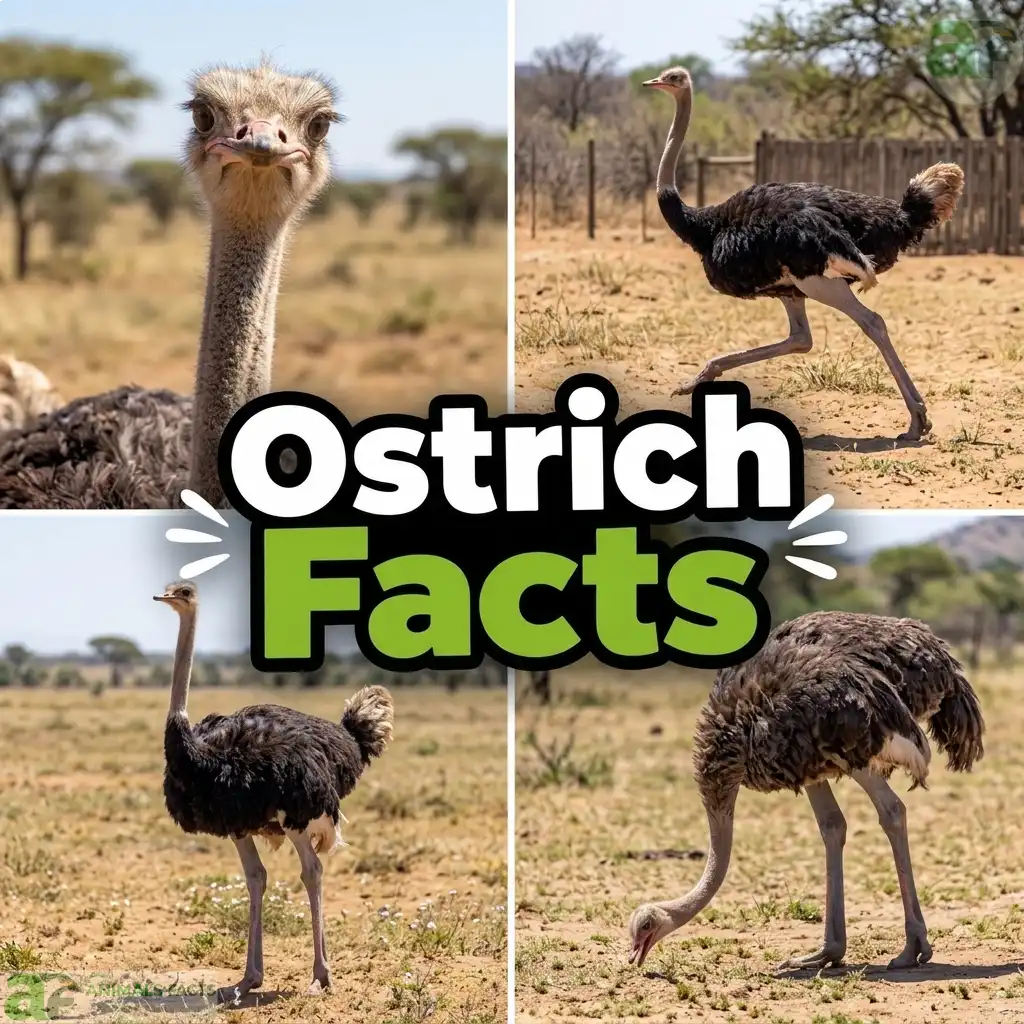
Ostrich Facts
| Feature | Details |
|---|---|
| Scientific Name | Struthio camelus (Linnaeus, 1758) — Common ostrich; Struthio molybdophanes (Reichenow, 1883) — Somali ostrich |
| Kingdom | Animalia |
| Phylum | Chordata |
| Class | Aves |
| Order | Struthioniformes |
| Family | Struthionidae |
| Common Names | Ostrich; common ostrich; naamah (Hebrew); straus (Afrikaans); mbuni (Swahili) |
| Native Range | Sub-Saharan Africa (common ostrich); Horn of Africa (Somali ostrich); formerly North Africa and Arabian Peninsula |
| Habitat | Open savanna, semi-arid grassland, Sahel, shrubland — open terrain with good visibility |
| Lifespan | 40–45 years (wild); up to 75 years (captivity) |
| Diet | Primarily plants — roots, seeds, leaves, flowers; also insects, lizards, small tortoises |
| Body Height | Males: 210–280 cm (up to 9 feet); Females: 175–190 cm |
| Weight | Males: 100–156 kg; Females: 90–110 kg — heaviest living bird on Earth |
| Top Running Speed | 70–72 km/h (45 mph) sustained; up to 96 km/h (60 mph) in short bursts — fastest running bird and fastest two-legged animal on Earth |
| Egg Size | 15 cm × 13 cm; weight 1–2 kg — largest egg of any living bird |
| Conservation Status | Least Concern (IUCN) — but declining; Somali ostrich now classified separately as Vulnerable |
| Defining Feature | Largest and heaviest bird on Earth; only bird with two toes (all other birds have 3–4); eyes 5 cm in diameter — largest eyes of any land animal |
| Kick Force | A single ostrich kick delivers approximately 2,000 Newtons of force — sufficient to kill a lion |
| Brain vs. Eye | The ostrich’s eye is larger than its brain — the most frequently cited fact about this species |
 1. Introduction: What is an Ostrich?
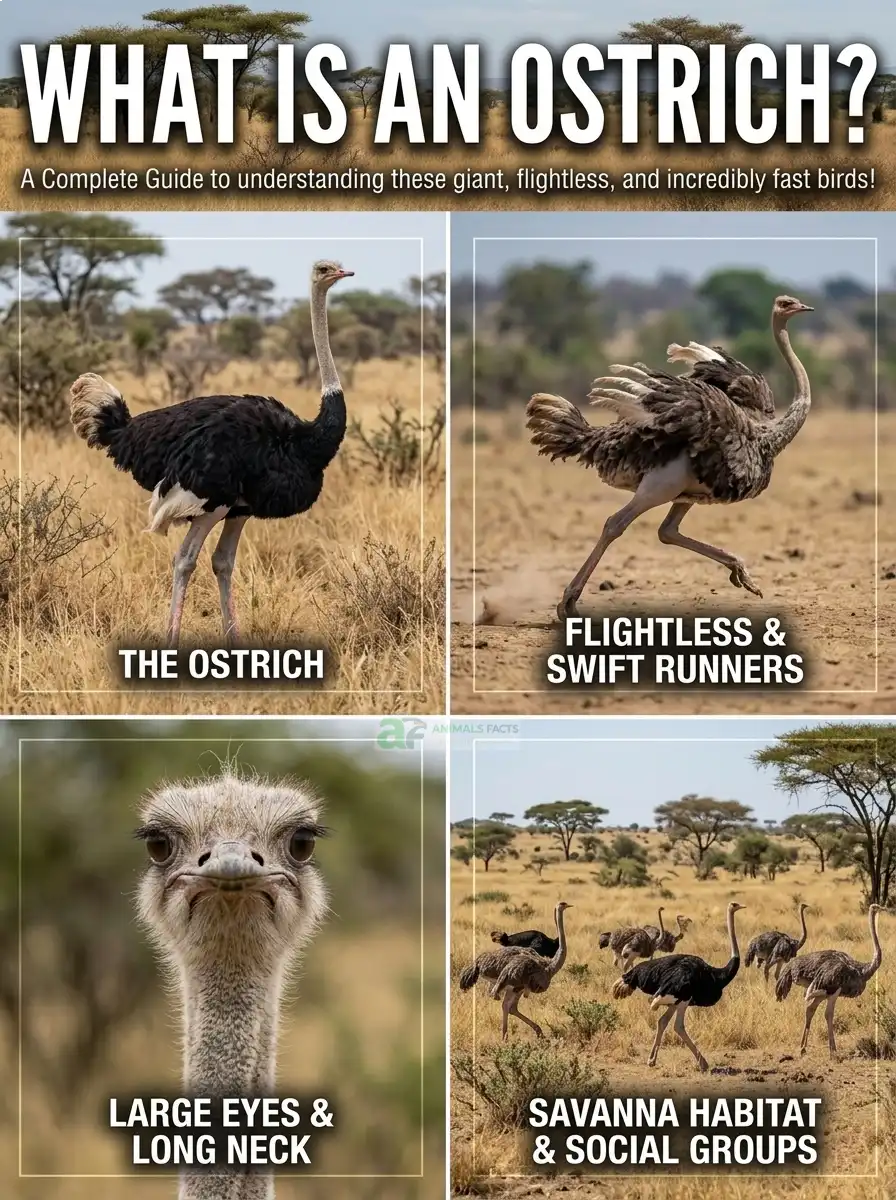
On the open savanna of the Serengeti at sunrise, where the acacia trees cast long shadows across the golden grass and a herd of wildebeest moves in the middle distance, a male ostrich stands in full display — his black-and-white plumage catching the first direct light, his extraordinary two-meter height giving him a visibility advantage over every other animal on the plain. He is swaying from side to side — the remarkable “kantling” display — his wings spread and waved alternately while his neck undulates in an S-curve against his inflated chest. From nearly a kilometer away, in a landscape where a lion or a leopard would be invisible at fifty meters, the ostrich is visible and identifiable. This is by design. The ostrich does not hide from the predators that share its savanna. The ostrich can outrun them. Ostrich facts begin with this fundamental departure from the avian norm — a bird so large, so fast, and so physically powerful that it has abandoned the ancestral bird strategies of flight and concealment in favor of the terrestrial strategies of speed, sight, and lethal defensive capability.
The ostrich (Struthio camelus) occupies a position among living birds that has no parallel. It is simultaneously the heaviest bird (up to 156 kg — more than twice the weight of the next heaviest flying bird), the tallest bird (up to 2.8 meters — taller than most humans), the owner of the largest eyes of any land animal (5 cm diameter), the layer of the largest eggs of any living bird (each egg equivalent in volume to approximately 24 chicken eggs), and the fastest two-legged animal on Earth (sustained speeds of 70–72 km/h; short-burst speeds approaching 96 km/h). Each of these superlatives would distinguish any animal; the ostrich holds all of them simultaneously in a single bird. It is also, famously, the source of one of the most persistent myths in natural history — the “head in the sand” behavior that every ornithologist, every zoo keeper, and every wildlife biologist spends part of their career correcting and that never, despite correction, goes away.
Interesting facts about ostriches reveal an animal of breathtaking biological complexity — the two-toed foot that is the only such structure in the entire class Aves and that contributes directly to the ostrich’s speed record; the communal nesting system in which a dominant female (the “major hen”) manages a nest shared by multiple females but performs most of the incubation, creating one of the most complex avian social nesting arrangements documented; the stomach stones (gastroliths) that the ostrich swallows — sometimes weighing up to 1 kg total — to grind up the plant material that its toothless bill cannot otherwise process; the panting thermoregulation system that allows the ostrich to maintain body temperature in desert heat through a countercurrent heat exchange system in the nasal passages; and the kick force of approximately 2,000 Newtons that makes a defensive ostrich kick one of the most dangerous impacts that any terrestrial predator can experience — the kick capable of killing a lion and documented killing humans in various incidents. Whether you are searching for ostrich facts for kids to explore the biology of the world’s largest bird, a traveler planning a safari to East or South Africa, a farmer considering ostrich farming as an agricultural enterprise, or simply someone who wants to know whether ostriches really bury their heads in the sand (they don’t) — this is your comprehensive guide. The world’s largest bird has an extraordinary story to tell.
2. Ostrich Species Overview & Classification
The ostrich belongs to an ancient and evolutionarily isolated bird group — the ratites — whose members have independently lost the ability to fly across multiple lineages and whose evolutionary history is one of the most fascinating stories in modern ornithology.
Species Classification Table
| Taxonomic Rank | Classification |
|---|---|
| Kingdom | Animalia |
| Phylum | Chordata |
| Class | Aves |
| Order | Struthioniformes |
| Family | Struthionidae (Gray, 1840) |
| Genus | Struthio (Linnaeus, 1758) |
| Species 1 | S. camelus (Linnaeus, 1758) — Common ostrich |
| Species 2 | S. molybdophanes (Reichenow, 1883) — Somali ostrich |
| Etymology | Struthio = “sparrow” or “ostrich” (Greek strouthos); camelus = “camel” (Latin) — the species name literally means “camel-sparrow” or “camel-bird,” reflecting the ostrich’s desert habitat association and its long neck (camel-like) combined with its classification as a bird (sparrow being the generic bird term in ancient Greek). Molybdophanes = “lead-colored” (Greek) — referring to the Somali ostrich’s blue-grey neck skin |
The Two Ostrich Species — A Recent Split
For most of ornithological history, all ostriches were considered a single species (Struthio camelus). The recognition of the Somali ostrich as a separate species (elevated from subspecies status in the 2010s based on molecular genetic analysis) is one of the most significant recent taxonomic changes in African ornithology:
| Feature | Common Ostrich (S. camelus) | Somali Ostrich (S. molybdophanes) |
|---|---|---|
| Range | Sub-Saharan Africa broadly | Horn of Africa — Somalia, Ethiopia, Kenya |
| Male neck color | Pink-red | Blue-grey |
| Female neck color | Grey-brown | Blue-grey (distinctive — more similar to male than in common ostrich) |
| Conservation | Least Concern | Vulnerable — declining |
| Behavior | Often in mixed-species herds | More consistently in same-species groups |
| Hybridization | Possible where ranges overlap | Possible where ranges overlap |
| Recognition date | Long established | Elevated to full species ~2014 |
Four Subspecies of Common Ostrich
| Subspecies | Common Name | Range | Notes |
|---|---|---|---|
| S. c. camelus | North African ostrich | Sahel belt, West/Central Africa | Most endangered subspecies — Near Threatened |
| S. c. massaicus | Masai ostrich | East Africa — Kenya, Tanzania | Most commonly seen in classic East African safari settings |
| S. c. australis | South African ostrich | Southern Africa | Primary farmed subspecies; Karoo population |
| S. c. syriacus | Arabian ostrich | Arabian Peninsula, Middle East | Extinct — last wild individuals killed in 1966 |
The Ratite Connection — Ancient Flightless Birds
The ostrich belongs to the ratites — a group of large, flightless birds distributed across the Southern Hemisphere:
| Species | Range | Weight | IUCN Status |
|---|---|---|---|
| Common ostrich | Africa | Up to 156 kg | Least Concern |
| Somali ostrich | Horn of Africa | Up to 130 kg | Vulnerable |
| Emu | Australia | Up to 60 kg | Least Concern |
| Cassowary (Southern) | New Guinea, Australia | Up to 85 kg | Vulnerable |
| Rhea (Greater) | South America | Up to 40 kg | Near Threatened |
| Kiwi | New Zealand | Up to 3.5 kg | Endangered (some species) |
| Extinct moa | New Zealand | Up to 250 kg | Extinct |
| Extinct elephant bird | Madagascar | Up to 860 kg | Extinct |
The Shocking Ratite Evolution Story
For most of the 20th century, ornithologists assumed that ratites descended from a common flightless ancestor on the ancient supercontinent Gondwana — the different ratite groups separating as Gondwana broke apart 80–100 million years ago, each lineage evolving independently on its separating landmass.
The molecular genetics revolution — DNA analysis in the 2000s–2010s overturned this assumption with a finding as surprising as the falcon-parrot relationship: ratites lost the ability to fly independently, multiple times, in different lineages. The molecular evidence shows that ratites are not a monophyletic group descended from a single flightless ancestor — instead, different ratite lineages descend from different flying bird ancestors that each independently lost flight after colonizing their respective landmasses. The ostrich’s closest relatives may be tinamous (small flying South American birds) rather than other ratites — making the ratite condition a remarkable example of convergent evolution in which flight loss evolved independently across multiple lineages.
Evolution & Discovery Timeline
~100 million years ago (Cretaceous) — The ancestral Struthioniformes lineage diverges — the ostrich family’s evolutionary origins established.
~50–60 million years ago (Eocene) — Fossil ostrich-like birds documented across Eurasia — the family’s historical range far broader than its current African distribution.
~10,000 years ago — Ostriches present across North Africa, the Arabian Peninsula, and into India — far more widely distributed than today.
~5,000–7,000 years ago — Ostrich eggs documented as human art objects and water storage vessels in archaeological sites across North Africa and the Middle East — among the earliest human-bird material culture relationships documented.
~1000 BCE — Ostriches used in displays and ceremonies in ancient Egypt, Assyria, and other Middle Eastern civilizations — the feathers among the most valuable luxury trade goods of the ancient Mediterranean.
~1500 CE — Arabian ostrich (S. c. syriacus) population begins declining under hunting pressure across the Arabian Peninsula.
1758 — Carl Linnaeus formally describes Struthio camelus in Systema Naturae.
~1850–1900 — The Victorian ostrich feather fashion boom — ostrich plumes become the most fashionable hat decoration in Europe and North America; the industry drives wild ostrich hunting to near-extinction across North Africa and motivates the development of ostrich farming in South Africa’s Karoo region.
1966 — The last confirmed wild Arabian ostrich killed in Saudi Arabia — the extinction of a subspecies driven by motor vehicle hunting.
~2000–2010 — The Somali ostrich elevated from subspecies to full species status based on molecular genetic analysis.
2014 — IUCN formally recognizes Struthio molybdophanes as a separate Vulnerable species — the most recent significant taxonomic change in African ornithology.
2024 — Common ostrich remains Least Concern globally; Somali ostrich classified Vulnerable with declining population; the North African ostrich subspecies at Near Threatened level in its reduced Sahel range.
“The ostrich is what happens when a bird gives up flying and goes all-in on being the fastest and largest land animal it can possibly become. Every feature of the ostrich — the two-toed foot, the enormous eye, the vestigial wing, the 70-kilometer running speed — is the result of trading one extreme capability (flight) for another (terrestrial performance). It is a bird that chose to become something else entirely.”
— Dr. Richard Estes, wildlife biologist — The Safari Companion: A Guide to Watching African Mammals
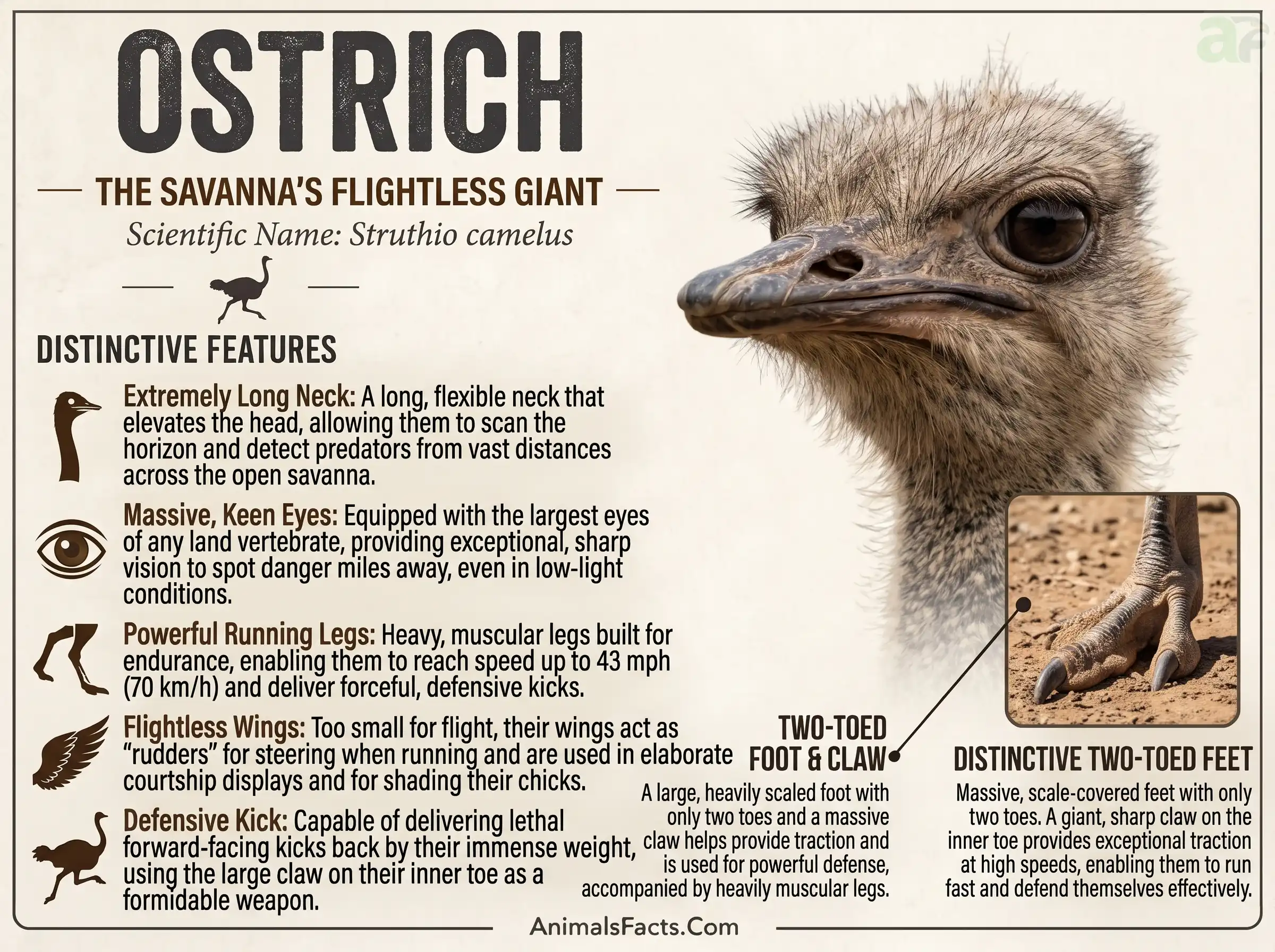
3. Ostrich Physical Description & Unique Features
The ostrich’s physical features are a catalogue of biological records — the largest, the heaviest, the biggest, the fastest — assembled into a single bird whose body plan is as far from the typical bird template as any living avian species.
Body Size — The Records
Height — Adult males stand 210–280 cm (approximately 7–9 feet) at the top of the head — taller than any other bird, taller than most doorframes, and taller than virtually all adult humans. The height is distributed across a long, nearly bare neck (approximately 100–120 cm) and a body that stands on extraordinarily long legs.
Weight — Males weigh 100–156 kg (220–344 pounds) — the heaviest recorded individual birds exceeding 156 kg in managed populations. Females are lighter at 90–110 kg. For comparison:
- The next heaviest flying bird — the Kori bustard — reaches approximately 19 kg
- The heaviest non-ratite birds (large pelicans, Andean condors) reach approximately 15 kg
- The ostrich is therefore approximately 8–10 times heavier than the heaviest flying bird
The weight and flight connection — The ostrich’s body mass exceeds the physical upper limit for flight — estimated at approximately 40–50 kg based on aerodynamic modeling of the largest possible flying bird. The ostrich did not lose flight despite being able to fly; it evolved body mass far beyond the flight threshold as a consequence of its terrestrial lifestyle — the weight gain itself being a product of no longer needing to maintain the minimum mass required for flight.
The Eyes — The Largest of Any Land Animal
Diameter — Ostrich eyes measure approximately 5 centimeters in diameter — the largest eyes of any land animal on Earth. For comparison:
- Human eye diameter: approximately 2.4 cm
- Blue whale eye diameter: approximately 15 cm (largest of any animal)
- Horse eye diameter: approximately 4.4 cm
- Among living animals, only the giant squid (Architeuthis dux) has larger eyes than the ostrich — at approximately 30 cm diameter in large individuals
The brain comparison — The frequently cited fact that “an ostrich’s eye is larger than its brain” is accurate — the ostrich’s brain volume is approximately 26–40 cm³ while each eye is approximately 65 cm³ in volume — the eye volume exceeding the entire brain volume by approximately 1.5–2 times.
Visual capability — The enormous eyes provide exceptional visual acuity across the open landscapes the ostrich inhabits:
- Visual detection range — ostriches have been documented detecting large predators at distances exceeding 3.5 kilometers — the combination of eye size, high photoreceptor density, and elevated head height (the ostrich’s head height advantage over most grassland predators) creating one of the most effective long-range visual systems of any terrestrial animal
- Color vision — ostriches have 5 types of photoreceptors (humans have 3) — the most complex color vision of any land animal, allowing detection of color differences invisible to most other vertebrates
The Two-Toed Foot — Unique in the Bird World
The singular anatomical distinction — The ostrich is the only living bird with two toes — all other 9,999+ bird species have three or four toes. The ostrich’s foot has:
- One large, primary toe (the inner toe, equivalent to the human big toe) — bearing a large, blunt nail approximately 7–10 cm long; the primary weight-bearing and striking structure
- One small, outer toe — much smaller than the inner toe; bearing no nail; providing lateral balance support during high-speed running
The speed advantage — The two-toed foot contributes directly to the ostrich’s speed record. By reducing the foot to two elements, the ostrich has:
- Reduced the distal limb mass — lower mass at the end of the leg reduces the energy cost of swinging the leg forward during each stride
- Simplified the foot-ground contact mechanics — the single large toe creates a more efficient push-off surface
- Increased the stride length — ostrich strides at full speed reach 3–5 meters per stride, among the longest stride lengths of any two-legged animal
The kicking weapon — The large inner toe’s blunt nail is the primary weapon in the ostrich’s defensive kick — a structure capable of delivering 2,000 Newtons of force.
The Plumage — Sexual Dimorphism in Black and White
Adult male plumage:
- Body feathers — black overall with white wing and tail plumes
- Neck and upper leg skin — pinkish-red to bright red, intensifying during breeding season and display
- Wings — the large white plumes that were the primary target of the Victorian feather trade
Adult female plumage:
- Body feathers — grey-brown overall — cryptic coloration providing camouflage during incubation
- Juveniles — brown and striped; transitioning to adult plumage at approximately 3–4 years
The wing feathers (plumes) — Despite being functionally useless for flight, ostrich wing feathers are structurally extraordinary:
- The individual feather barbs are not interlocked — the feather lacks the hooklets that zip feather barbs together in flying birds, creating the soft, fluffy texture that made ostrich plumes the supreme luxury feather of the Victorian era
- Male ostriches use their wing plumes in display and thermoregulation — spreading the wings to shade the body during heat, or waving them during courtship display
The Vestigial Wings
Size — Ostrich wings are approximately 20 cm in length when folded — tiny relative to the body but substantially larger than the completely vestigial wings of kiwis and some other ratites.
Function — The ostrich’s vestigial wings retain functional uses despite being incapable of flight:
- Thermoregulation — spreading the wings exposes the largely feather-free inner surface of the wings and the adjacent body skin to air movement, facilitating heat loss
- Balance — the wings are used as balance organs during high-speed running — extended and used like the arms of a human sprinter to counterbalance the body during rapid directional changes
- Courtship display — males wave and droop wings as components of the elaborate courtship display
- Shade and brooding — wings spread over nest and chicks during incubation and early brooding to provide shade
The Neck — A Third of the Total Height
Length — The ostrich’s bare or sparsely feathered neck reaches approximately 100–120 cm in length — approximately one-third of the bird’s total height.
Thermoregulation — The largely bare neck skin is richly vascularized and functions in thermoregulation — blood flowing close to the surface dissipates heat in hot environments. The ostrich can regulate blood flow to the neck skin to either maximize heat loss (in heat) or minimize it (in cold).
The nasal countercurrent system — Perhaps the ostrich’s most extraordinary thermal adaptation; the nasal passages contain a countercurrent heat exchange system — warm exhaled air from the lungs heats and humidifies the incoming cool, dry desert air while simultaneously being cooled by the incoming air stream. This system:
- Recovers water from exhaled breath (reducing water loss in arid environments)
- Pre-cools the blood flowing to the brain during heat exposure
- Allows the ostrich to maintain a viable brain temperature even when body core temperature is elevated by the desert heat
💡 Did You Know? The ostrich’s stride length at maximum running speed reaches an astonishing 3–5 meters per stride — the longest stride length of any two-legged animal by a significant margin. For comparison, the world record human sprinters have a stride length of approximately 2.7 meters at maximum speed. An ostrich’s stride is 30–85% longer than the fastest human runners’ strides, and the ostrich maintains near-maximum stride frequency simultaneously — the combination of maximum stride length AND maximum stride frequency generating the 70–96 km/h top speed. The ostrich’s running is achieved through a spring-loaded tendon system in the leg — much of the energy stored in compressed tendons during foot-ground contact is returned as elastic recoil during push-off, making the running energetically more efficient than pure muscle-powered locomotion would be. This spring-loaded running system is the same mechanical principle used in running prosthetics designed for human athletes — the ostrich’s tendon system was a direct inspiration for the Össur Cheetah prosthetic running blades that have enabled Paralympic athletes to approach the performance of non-disabled sprinters. The ostrich’s leg mechanics have therefore contributed directly to human athletic technology — one of the most unexpected applications of ostrich biology to human innovation.
4. Top 25 Amazing Ostrich Facts
Here is your definitive collection of the most extraordinary, scientifically verified, and genuinely astonishing ostrich facts as of 2026:
- The ostrich is the heaviest and tallest bird on Earth — males reaching 156 kg body weight and 2.8 meters height. These figures represent the absolute upper boundary of avian body size for a living species — no other bird comes close.
- The ostrich can run at sustained speeds of 70–72 km/h (45 mph) and short-burst speeds approaching 96 km/h (60 mph) — making it the fastest running bird on Earth and the fastest two-legged animal in the world. For reference, the Olympic 100-meter record translates to approximately 37 km/h — the ostrich runs nearly twice as fast.
- An ostrich’s eye is larger than its brain — each eye measures approximately 5 centimeters in diameter (larger than a golf ball) while the entire brain volume is approximately 26–40 cm³. The 5 cm eye diameter makes the ostrich the owner of the largest eyes of any land animal on Earth.
- The ostrich is the only living bird with two toes — all other approximately 10,000 bird species have three or four toes. This two-toed structure contributes directly to the ostrich’s speed record by reducing distal leg mass and enabling efficient stride mechanics.
- Ostrich eggs are the largest eggs of any living bird — measuring approximately 15 × 13 cm and weighing 1–2 kg. Each egg is equivalent in volume to approximately 24 chicken eggs and requires approximately 90 minutes to hard-boil.
- The ostrich’s defensive kick delivers approximately 2,000 Newtons of force — sufficient to kill a lion. The kick is delivered forward with the large inner toe functioning as a blunt-nailed striking weapon. Lions and other large predators that miscalculate the engagement distance with an ostrich have been killed by defensive kicks.
- Ostriches do NOT bury their heads in the sand — this is one of the most persistent myths in natural history. When ostriches lower their heads to the ground level, they are either feeding, turning eggs in the nest (using the bill to rotate eggs in the shallow ground nest), or lying flat as a predator-avoidance strategy. The sand-head behavior has never been documented in any scientific study of wild ostriches.
- The ostrich swallows gastroliths (stomach stones) — sometimes carrying up to 1 kg of stones in its gizzard at any one time. These stones grind plant material that the ostrich’s toothless bill cannot otherwise process — making the gizzard stone collection the ostrich’s substitute for teeth.
- Ostrich egg incubation is performed by both sexes in a carefully coordinated schedule — the dominant female and the male share incubation in a system where the female sits during the day (her brown coloration providing camouflage in daylight) and the male sits at night (his black coloration providing camouflage in darkness). This complementary camouflage-based schedule is unique among large birds.
- The ostrich can survive without drinking water for several days by metabolizing water from the plant material it consumes. However, when water is available, ostriches drink substantial quantities and are known to travel considerable distances to water sources.
- Ostrich vision extends to approximately 3.5 kilometers detection distance for large objects — the combination of the 5 cm eye, elevated head height (2+ meters above the ground), and five types of photoreceptors (compared to three in humans) creating one of the most effective long-range visual detection systems of any land animal.
- The Victorian ostrich feather trade was so lucrative that ostrich feathers were, at their peak in the early 1900s, the fourth most valuable export product of South Africa — behind only gold, diamonds, and wool. The feather trade drove the development of ostrich farming in South Africa’s Little Karoo region, which remains one of the world’s primary ostrich production areas.
- Ostrich chicks grow at an extraordinary rate — reaching adult height within one year of hatching. A newly hatched ostrich chick weighs approximately 1 kg (roughly equivalent to the egg it came from) and grows to full adult height (200+ cm) within 12 months — one of the fastest height growth rates of any bird.
- The ostrich’s communal nesting system is one of the most sophisticated in the bird world — a dominant “major hen” manages a nest shared by multiple “minor hens,” but recognizes her own eggs and positions them preferentially in the center of the clutch where incubation is most successful. The major hen can distinguish her eggs from others’ eggs within a clutch of up to 60 eggs through subtle shell pattern recognition.
- Ostriches have been clocked completing a full 5 km run at an average speed of 55 km/h — faster than any horse has maintained over the same distance. The combination of aerobic capacity, spring-loaded tendon mechanics, and two-toed foot structure makes the ostrich a genuinely superior endurance runner to any other large animal.
- The ostrich’s wing feathers are structurally unique — unlike the interlocked feather barbs of flying birds, ostrich feathers have unzipped barbs that create the characteristically fluffy, soft texture. This structural difference is what made ostrich plumes so desirable as fashion accessories — the soft, flowing texture that feathers of other birds cannot replicate.
- Ostrich farming is practiced on every inhabited continent — with the global farmed ostrich population estimated at several million birds. The industry produces leather (one of the most durable and most premium leathers available), meat (lower in fat and cholesterol than beef), feathers (still used in dusters and fashion), and eggs (the largest edible eggs available).
- The ostrich’s running prosthetic inspiration — the spring-loaded tendon mechanics of the ostrich’s leg are the biological model that inspired the development of the Össur Cheetah running prosthetic blade used by Paralympic athletes. The ostrich’s leg represents one of the most directly applied examples of biomimetics (engineering inspired by biological systems) in sports technology.
- Ostriches produce a unique booming call — a deep, resonant sound that can be heard from over 3 km away. The call, produced primarily by males during territorial defense and courtship, uses the esophagus and trachea as resonating chambers in a way that produces one of the lowest-pitched calls of any bird.
- The ostrich’s body temperature during the hottest part of the African day can rise to 40–41°C — and the bird allows this elevation rather than spending energy on maintaining lower temperatures. This controlled hyperthermia strategy reduces the temperature gradient between the body and the environment, reducing the rate of heat gain from the environment and conserving water that would otherwise be lost through cooling mechanisms.
- Archaeological evidence suggests that ostrich eggs were used as water containers by early Homo sapiens in southern Africa — decorated ostrich eggshells found at sites dated to approximately 60,000–70,000 years ago represent some of the earliest known examples of human artistic expression and material culture production.
- The male ostrich performs a remarkable “nest scraping” courtship display in addition to the kantling display — dropping to the ground and rapidly kicking up dust with alternating feet while spreading wings, creating a dramatic visual display. This nest scraping behavior transitions into actual nest preparation as the breeding season advances.
- A group of ostriches can maintain long-distance running at speeds of 50+ km/h for periods exceeding 30 minutes — an aerobic endurance capacity that exceeds that of any other large running animal at equivalent speeds. The combination of the spring-loaded leg mechanics (recovering energy from each stride), efficient respiratory system, and heat tolerance allows this extraordinary sustained performance.
- Ostriches are capable swimmers — despite never being specifically aquatic, ostriches can and do swim across rivers and bodies of water when necessary, using their powerful legs for propulsion and their wings for balance. This capability has occasionally surprised observers who assume the large flightless bird would be helpless in water.
- As of 2026, the global wild ostrich population is estimated at approximately 150,000–250,000 individuals, with the common ostrich classified as Least Concern but showing declining trends due to habitat loss and hunting. The Somali ostrich (S. molybdophanes) — recently elevated to full species status — is classified as Vulnerable with fewer than 135,000 mature individuals estimated in the wild and a decreasing population trend.
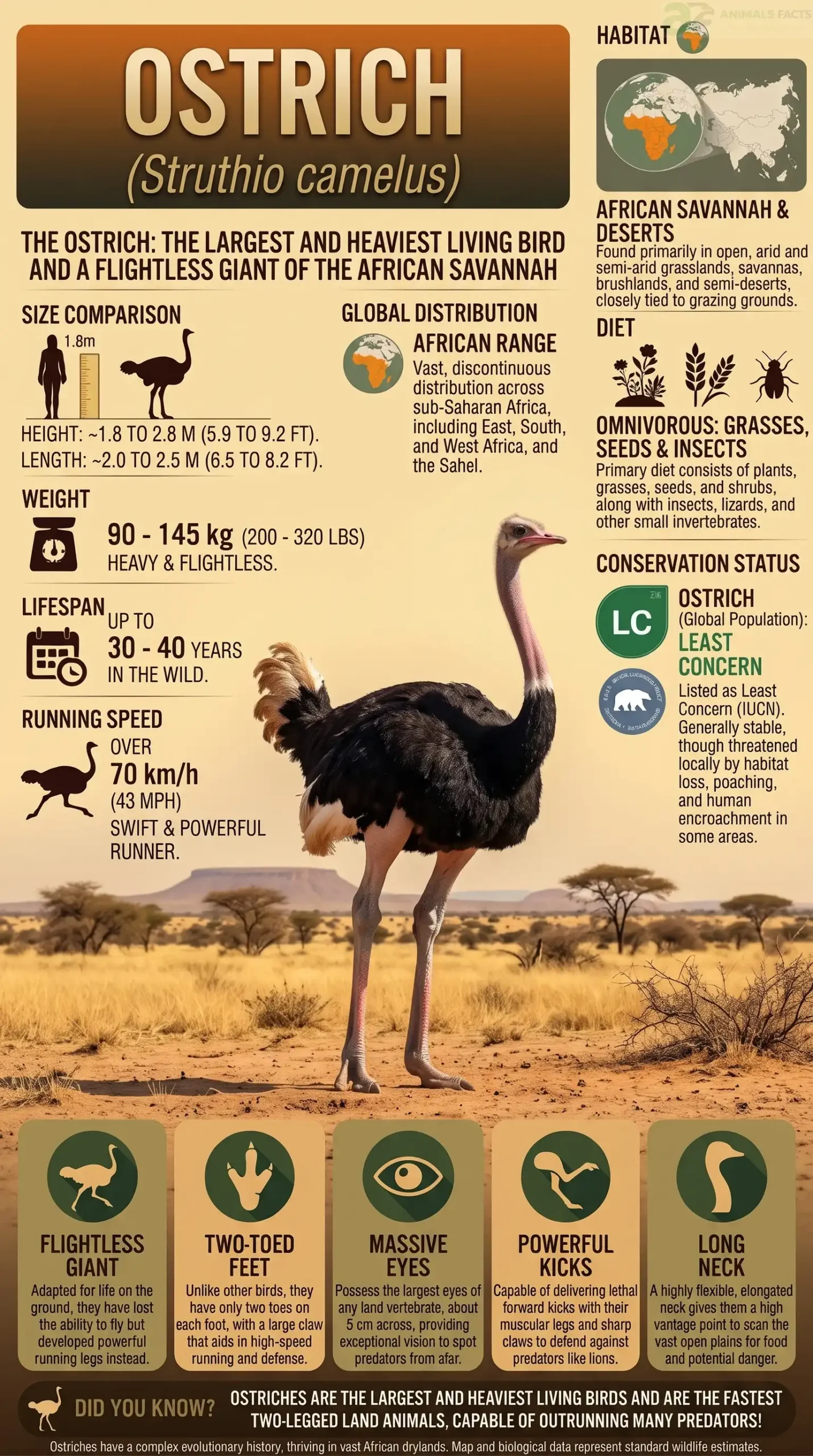
5. Fun Facts About Ostriches
- Weighs up to 156 kg — heaviest bird alive
- Runs at 70–72 km/h — fastest two-legged animal on Earth
- Eye is 5 cm — larger than its brain
- Only bird with two toes
- Eggs weigh 1–2 kg — take 90 minutes to hard-boil
- Kick delivers 2,000 Newtons — can kill a lion
- Does NOT bury head in sand — the most famous bird myth
- Carries up to 1 kg of stomach stones
- Incubation shared by sex — female by day, male by night, for camouflage
- Stride length 3–5 meters — longer than Olympic sprinters
- Inspired the Össur Cheetah running prosthetic
- Ostrich eggs used as human art objects 60,000–70,000 years ago
6. Ostrich Natural Habitat & Geographic Range
Ostrich habitat is defined by the combination of open terrain providing long-range visibility (essential for the visual predator detection system that is the ostrich’s primary defense) and semi-arid to arid conditions where the ostrich’s water-efficient physiology provides competitive advantage over species requiring more water.
Primary Habitat Types
Open savanna:
The classic ostrich habitat — the vast open grasslands and lightly wooded savannas of sub-Saharan Africa:
- East African savanna (Serengeti, Masai Mara, Amboseli) — the setting of most wildlife documentary ostrich footage; Masai ostrich subspecies
- Kalahari savanna — open thornbush savanna of Botswana, Namibia, and South Africa; South African ostrich subspecies
- The critical requirement is good visibility — ostriches generally avoid dense woodland where predator detection distances are reduced
Semi-arid grassland and shrubland:
- Karoo region, South Africa — the driest habitat where wild ostriches are naturally abundant; the center of the ostrich farming industry
- Sahel belt — the semi-arid zone south of the Sahara across West and Central Africa; North African ostrich subspecies
- Namibian desert margins — the Namib desert edge supports ostriches that exploit the productivity pulses of ephemeral desert grassland
Dry woodland and bush:
- In some parts of the range, ostriches use more wooded terrain — particularly during nesting when cover for the nest is beneficial
- The miombo woodland of southern Africa supports ostriches at lower density than open savanna
Geographic Distribution
| Region | Status | Subspecies | Population Trend |
|---|---|---|---|
| East Africa (Kenya, Tanzania) | Relatively stable | massaicus (Masai) | Stable in protected areas |
| Southern Africa (South Africa, Namibia, Botswana) | Stable (many farmed) | australis (South African) | Stable; farmed population large |
| West/Central Africa (Sahel) | Declining | camelus (North African) | Declining — habitat loss |
| Horn of Africa | Declining | molybdophanes (Somali) | Declining — Vulnerable |
| North Africa (historical) | Extirpated from most | camelus | Essentially gone from North Africa |
| Arabian Peninsula | Extinct (S. c. syriacus) | Arabian | Last wild individual 1966 |
The Historical Range Loss
The ostrich’s current range represents a fraction of its historical distribution:
Prehistoric range — Ostrich fossils are found across North Africa, the Middle East, Central Asia, India, and even parts of Eastern Europe — the species’ historical range encompassing most of the Old World’s semi-arid zones.
The Arabian extinction — The Arabian ostrich (S. c. syriacus) once ranged across the entire Arabian Peninsula, the Levant, and into Mesopotamia. The introduction of motor vehicles to the region in the early 20th century allowed hunters to pursue ostriches at speeds the birds could not outrun, driving the subspecies to extinction by 1966. The last documented wild individual was killed in Saudi Arabia — one of the most precisely documented subspecies extinctions in modern ornithological history.
The North African decline — The North African ostrich subspecies (S. c. camelus) once ranged across the entire Sahel belt from Mauritania to Somalia. This subspecies has been eliminated from approximately 90% of its historical range — the Sahel’s human population growth, agricultural expansion, and persistent hunting pressure reducing the population to small, isolated fragments primarily in protected areas.
7. Ostrich Diet & Feeding Behavior
Ostrich diet is primarily herbivorous — the bird consuming plant material across an extraordinary range of types — with opportunistic omnivory supplementing the plant base when animal protein is accessible.
Diet Breakdown Table
| Food Type | Proportion | Season | Notes |
|---|---|---|---|
| Seeds and grains | ~30–40% | Year-round | Primary food in open savanna |
| Plant leaves, shoots, flowers | ~25–35% | Year-round; peak wet season | New growth preferred |
| Roots and tubers | ~10–15% | Dry season especially | Dug out with the bill |
| Fruits and berries | ~10–15% | Seasonal | Concentrated energy source |
| Insects (locusts, grasshoppers, beetles) | ~5–10% | Year-round | Important protein supplement |
| Small vertebrates (lizards, small tortoises, rodents) | ~2–5% | Opportunistic | Consumed when available |
| Carrion | Rare | Opportunistic | Occasionally documented |
| Sand and small stones (gastroliths) | Continuous | Year-round | Essential for digestion — not food but consumed constantly |
The Gastrolith System — Substituting for Teeth
The ostrich’s most distinctive dietary adaptation — and the answer to the question of how a toothless bird digests tough plant material:
What gastroliths are — Small stones, pebbles, and sand particles deliberately swallowed by the ostrich and retained in the muscular gizzard (the second stomach chamber). An adult ostrich may carry up to 1 kilogram of gastrolith material at any one time — a substantial investment of mass that the bird must carry continuously.
How they work — The gizzard’s powerful muscular walls contract rhythmically, grinding the gastroliths against each other and against the tough plant material the ostrich has swallowed. This mechanical grinding process:
- Breaks down tough seeds and seed coats that the stomach acid cannot efficiently dissolve
- Fragments fibrous plant material (stems, leaves, bark) into smaller pieces that increase the surface area available for enzymatic digestion
- Crushes small bones of consumed vertebrates and insect exoskeletons
The continuous replacement — Gastroliths are gradually worn smooth and lose their grinding effectiveness — the ostrich continuously swallows new stones to replace worn-down material. In areas where appropriate-sized stones are scarce, ostrich access to suitable gastrolith material can be a genuine resource constraint.
The parallel with dinosaurs — The gastrolith system has been documented in multiple theropod dinosaurs — the same mechanical digestion technique used by the ostrich’s distant dinosaurian ancestors. Examining ostrich gastrolith use is one of the most direct windows into the digestive biology of large non-avian dinosaurs.
The Water Relationship
Water independence — The ostrich can survive extended periods (several days to a week) without drinking water by:
- Metabolic water production — the chemical breakdown of food produces water as a byproduct; the ostrich’s efficient metabolism extracts metabolic water from food with high efficiency
- Nasal countercurrent system — recovering water from exhaled breath before it leaves the body
- Controlled hyperthermia — allowing body temperature to rise during peak heat (rather than spending water on cooling) reduces overall water expenditure
Water dependency — Despite these adaptations, ostriches are not truly water-independent in the long term — they seek water regularly when available and are attracted to water holes across their range. Ostrich movements in arid areas often track the availability of water sources.
The Foraging Method
The head-down scan — Ostriches forage with a characteristic pattern of head-down feeding interspersed with head-up scanning — the bird feeding for a few seconds, then raising the head to visually scan the surrounding landscape before resuming feeding. This intermittent vigilance allows the bird to maintain predator detection while feeding.
Group foraging advantage — Ostriches foraging in groups can spend more time with heads down feeding because the collective vigilance of multiple birds reduces the individual vigilance time required — a classic many-eyes benefit that allows individual birds to allocate more time to food intake.
Bill feeding mechanics — The broad, flat bill is efficient at cropping low vegetation, picking up seeds, and rooting in loose soil for buried roots and tubers. The bill’s structure is not suitable for tearing prey — the ostrich’s consumption of small vertebrates involves swallowing them whole rather than dismembering them.
8. Ostrich Reproduction & Life Cycle
Ostrich reproduction is one of the most complex social breeding systems documented in any bird — the communal nest managed by a dominant female who simultaneously excludes most competitors while accepting contributions from specific subordinate females creating a reproductive system that has fascinated ornithologists for decades.
The Breeding Season
Timing — Ostrich breeding season varies by latitude and local conditions:
- East Africa — peaks in March–September but variable; linked to rainfall patterns
- Southern Africa — typically July–February — peaks in the dry season when vegetation is open and visibility at its best for predator detection
Breeding system — The ostrich maintains a polygamous mating system in which dominant males mate with multiple females:
- The dominant male defends a territory and mates with the dominant (“major”) hen — his primary mate
- Additional subordinate (“minor”) hens also lay eggs in the same nest
- The result is a communal nest potentially containing eggs from multiple females
The Extraordinary Communal Nest System
The communal nesting system of the ostrich is the most sophisticated egg-management behavior documented in any bird:
Nest preparation — The dominant male prepares the nest — a shallow scrape in sandy soil approximately 3 meters in diameter, created by the male sitting and spinning to scrape out the depression with his legs and bill.
Egg laying — Multiple hens lay eggs in the nest:
- The major hen lays 7–10 eggs in the nest
- Minor hens also lay eggs — potentially bringing the total to 15–60 eggs in a single nest (though nests containing all these eggs simultaneously are exceptional)
- The major hen lays eggs over a 2–3 week period before settling into full incubation
The major hen’s egg recognition — The most extraordinary cognitive aspect of the system: before settling into full incubation, the major hen rolls eggs she recognizes as her own to the center of the nest — the warmest and most protected position — while leaving minor hens’ eggs at the periphery where incubation success is lower. This selective egg placement has been confirmed through egg-marking experiments.
The recognition mechanism — Research confirms that the major hen recognizes her own eggs through visual pattern recognition of the eggshell surface — the characteristic pattern of small pits and bumps on ostrich eggshells being sufficiently individual-specific that the major hen can reliably distinguish her eggs from others even in a clutch of 60 eggs. This level of individual egg recognition is one of the most sophisticated visual discrimination tasks documented in any bird.
The evolutionary logic — The communal system allows minor hens to have some reproductive success (some of their eggs will be incubated) while the major hen maximizes her own success (by centering her eggs). The minor hens benefit from having the major hen perform most of the incubation work, and the major hen benefits because a larger clutch provides predator dilution — with more eggs present, each of her eggs has a lower probability of being the one consumed by a predator.
Incubation — Complementary Camouflage
The day-night schedule:
- Daytime incubation — performed by the major hen (and occasionally minor hens): the brown-grey female plumage blends into the surrounding savanna terrain during the daytime hours when visual predators are most active
- Nighttime incubation — performed by the dominant male: the black male plumage is effectively invisible in the darkness of the African night when hyenas and other nocturnal predators primarily operate
This complementary camouflage schedule — using different sexes’ different plumage for different threat contexts — is unique among large birds and represents an elegant evolutionary solution to the problem of providing continuous incubation while maximizing nest concealment across a 24-hour cycle.
Incubation period — 42–46 days — one of the longer incubation periods of any bird, reflecting the large egg size and the developmental complexity of the ostrich chick.
Incubation temperature — Maintained at approximately 36–38°C — the adult’s body weight distributed over the eggs provides warmth in cool nights, and the wings can be spread to shade the eggs during the heat of the day.
Chick Development
At hatching — Ostrich chicks hatch covered in golden-brown and black striped down — the striped pattern providing camouflage. A newly hatched chick weighs approximately 1 kg and stands approximately 30 cm tall.
Growth rate — The most remarkable aspect of ostrich chick development:
- Month 1 — Growing approximately 25–30 cm per month
- Month 6 — Approaching adult height in leg length; not yet adult weight
- Month 12 — Full adult height achieved — the most rapid height growth rate of any bird
- Year 2–3 — Adult weight achieved; adult plumage developing
- Year 3–4 — Sexual maturity in females; Year 4–5 in males
Family group dynamics — Ostrich chicks from multiple nests often merge into crèches — large groups of juveniles supervised by a small number of adults:
- Crèches may contain 10–100+ chicks of varying ages from different parents
- Adult supervision provides predator detection and protection
- The largest chicks in a crèche tend to be from the nest where they hatched; smaller chicks from peripheral nests may be tolerated in the crèche but receive less parental protection
Survival rates — Ostrich chick mortality is extremely high in the first year:
- Approximately 75–85% of chicks die before reaching one year of age
- Primary mortality causes: predation, heat stress, cold overnight temperatures in the first weeks
- Chicks that survive the first year have dramatically improved survival prospects
9. Social Behavior & Communication
Wild ostrich social behavior is more complex than the solitary or simple-flock social systems of many large birds — the species maintaining dynamic group structures that shift with season, sex, and breeding status.
Group Structure
Non-breeding season flocks:
- Ostriches form mixed-sex flocks of typically 5–50 individuals during the non-breeding season
- Flocks provide collective predator detection — the most critical function of group living in open terrain
- Group size tends to be larger in areas of higher predator density — the many-eyes benefit being more valuable where predation risk is higher
Breeding season structure:
- Territorial males establish and defend breeding territories during the breeding season
- Harem groups form around territorial males — typically one dominant hen and several minor hens associated with a single male’s territory
- Non-territorial males form bachelor groups — smaller, often nomadic groups of subordinate males
The mixed-species association — One of the most ecologically significant ostrich social behaviors: wild ostriches regularly associate with zebras, wildebeest, impalas, and other large ungulates in mixed-species groups:
- The ostrich’s elevated head height (2+ meters) and exceptional long-range vision (3.5 km detection distance) provides early warning of approaching predators to the shorter-statured ungulates
- The ungulates’ acute olfactory sense (smell) complements the ostrich’s visual system — detecting predators by scent that the ostrich cannot smell at long range
- This visual-olfactory complementarity makes the mixed-species association mutually beneficial for both parties — a classic example of interspecies mutualism based on sensory complementarity
Communication
The booming call — The dominant male’s territorial and courtship vocalization — a deep, resonant “booom-booom-booom” produced by inflating the esophagus and forcing air through the resonating chamber of the trachea:
- Audible at distances exceeding 3 km under appropriate atmospheric conditions
- Produced primarily at dawn and dusk — the times when territorial advertisement is most effective
- One of the lowest-pitched calls produced by any bird — the fundamental frequency in the range of 20–50 Hz
The hissing threat — The ostrich’s primary defensive vocalization — a loud hiss produced during aggressive encounters with rivals or approaching threats. The hiss can be surprisingly loud at close range.
The display components — Male ostrich communication during courtship involves coordinated visual displays:
- Kantling — the characteristic swaying display in which the male sways from side to side while spreading and alternately waving his wings
- Neck inflation — the male inflates his neck and produces the booming call simultaneously
- Nest scraping — dropping to the ground and scraping with feet as a display of territory ownership and nest site quality
Alarm behavior — Rather than a specific alarm call, ostriches communicate alarm primarily through behavior — the head-up alert posture of one individual immediately triggers alert behavior in all nearby ostriches and in associated ungulate species.
10. Predators & Defense Mechanisms
The adult ostrich occupies the apex of prey vulnerability in African ecosystems — large enough that most predators avoid confronting healthy adults, but vulnerable enough that lion prides and spotted hyena groups take adults in specific circumstances.
Natural Predators
Chick and egg predators (the most important mortality sources):
- Egyptian vulture — documented using rocks to break ostrich eggs (tool use)
- Jackal (black-backed and side-striped) — primary nest predators; consume eggs when adults are absent
- Mongoose species — consume eggs opportunistically
- Spotted hyena — both eggs and small chicks; adult hyenas have crushed ostrich eggs by sitting on them
- Raven and crow — documented prying at nest edges when adults are distracted
Small chick predators:
- Martial eagle, tawny eagle, bateleur — documented taking small chicks from crèches
- Jackal and fox species — opportunistic chick predation
- Cheetah — takes chicks and occasionally small subadults
Adult ostrich predators:
- Lion (Panthera leo) — the primary adult ostrich predator; lion prides coordinate attacks; individuals are sometimes kicked to death attempting solo attacks
- Spotted hyena (Crocuta crocuta) — group hunting allows hyenas to take adult ostriches; the hyena’s crushing bite can process ostrich bones
- Leopard — occasional adult ostrich predation, primarily of isolated or injured individuals
- Wild dog (Lycaon pictus) — documented taking adult ostriches through coordinated pack pursuit
- Nile crocodile — takes ostriches at water holes
Defense Mechanisms
The kick — Primary adult defense:
The ostrich’s forward-directed kick is one of the most powerful defensive strikes of any bird — and one of the most dangerous defensive capabilities of any prey animal:
The mechanics — Unlike most birds that kick backward (like chickens) or sideways, the ostrich kicks forward — the same direction as running, allowing the kick to be delivered while the bird continues to move away from the threat:
- The inner toe’s large, blunt nail concentrates the impact
- A large tom’s body weight (100+ kg) transferred through the leg provides the impact energy
- Measured kick force of approximately 2,000 Newtons — comparable to the kick force of a horse, delivered more accurately
- The kick can disembowel a lion, break the spine of a pursuing wild dog, or fracture a human femur
The run — Primary flight response:
Before a kick is required, the ostrich’s primary defense is outrunning the predator — which it can do against every African predator except the cheetah in short-distance sprints:
- At 70+ km/h sustained, the ostrich can outdistance lions (max ~60 km/h, unsustained), hyenas (~60 km/h, unsustained), and virtually all other African predators over distances exceeding several hundred meters
- The ostrich’s extraordinary endurance at high speed — maintaining 50+ km/h for 30+ minutes — means that even predators that achieve initial speed parity cannot sustain pursuit
Nest defense — Distraction display:
When a predator approaches the nest, the incubating adult (male or female) may perform a distraction display — moving away from the nest while dragging a wing as if injured, drawing the predator away from eggs or chicks. This injury-feigning display is one of the most elaborate nest defense behaviors documented in any large bird.
The flat-out posture:
When a predator is very close and running is not possible (defending eggs, protecting chicks), ostriches may lie flat on the ground — extending the neck along the ground surface and reducing their visual profile dramatically. This is the behavior that, observed from a distance, appears to show the ostrich “burying its head in the sand” — the neck lying along the ground surface appearing to disappear below ground level from certain viewing angles.
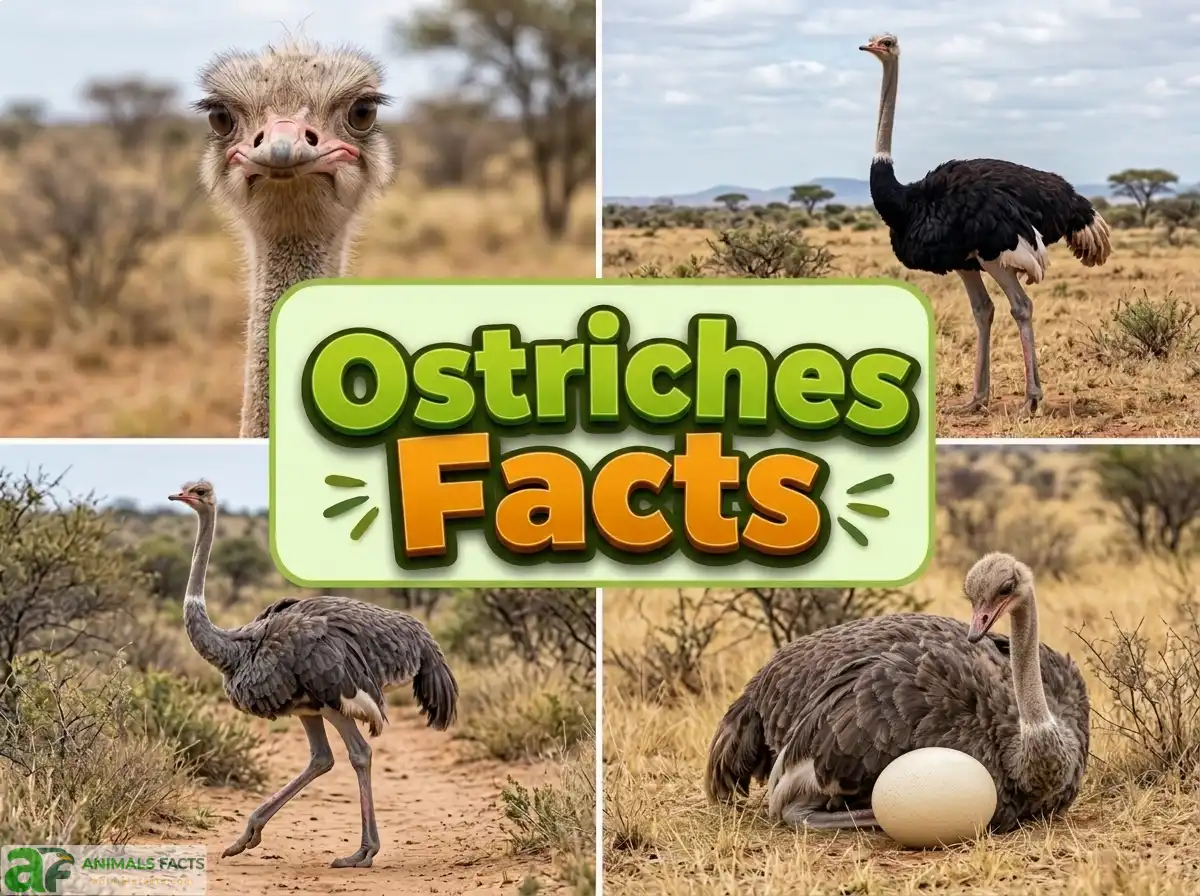
11. Ostrich Facts for Kids
Hey amazing young wildlife scientists, record-breaker enthusiasts, and bird lovers! Here are some truly extraordinary ostrich facts for kids that will make you the most fascinating wildlife expert in any conversation:
- The ostrich runs TWICE AS FAST as the fastest human sprinter! The world’s fastest human runners can reach about 37 kilometers per hour in a sprint. An ostrich can reach 70 to 96 kilometers per hour! That means an ostrich running at its fastest would beat even Usain Bolt by so much that by the time Bolt crossed the finish line of a 100-meter race, the ostrich would already be over halfway back to the start! The ostrich is the fastest animal in the world that runs on two legs!
- An ostrich’s eye is BIGGER THAN ITS BRAIN! Each ostrich eye measures about 5 centimeters across — bigger than a golf ball, and bigger than any other land animal’s eye on Earth. The entire ostrich brain is smaller than each individual eye! The enormous eyes help the ostrich spot predators from 3.5 kilometers away — that is like seeing something clearly from one end of 35 football fields to the other!
- Ostriches NEVER bury their heads in the sand! This is one of the most famous animal myths ever. Ostriches never bury their heads in sand — not once, ever, under any circumstances. What sometimes looks like head-burying from far away is the ostrich turning its eggs in the nest (which is a shallow hole in the ground) using its bill. From a distance, the lowered head appears to disappear below the ground, but there is no head-burying happening at all!
- An ostrich can KICK HARD ENOUGH TO KILL A LION! The ostrich’s leg kick delivers about 2,000 Newtons of force — enough to seriously injure or kill a lion. Lions have actually been killed by ostrich kicks when they made the mistake of getting too close. The kick goes FORWARD (not backward like most birds) with the large toe acting like a powerful striking tool. A human being kicked by an ostrich could have bones broken or worse!
- An ostrich egg takes 90 MINUTES TO HARD BOIL! Each ostrich egg weighs up to 2 kilograms — that is the same as about 24 chicken eggs combined into one enormous egg! These are the largest eggs of any bird alive today. To boil one completely hard, you would need to leave it in boiling water for an hour and a half! Ancient humans used empty ostrich eggshells as water bottles — decorated eggshells found in Africa are 60,000 to 70,000 years old, making them among the oldest human art objects ever found!
- The ostrich is the ONLY bird on Earth with just TWO TOES! Every other bird — eagles, penguins, hummingbirds, all 10,000 species — has either three or four toes. Only the ostrich has just two. One very large toe for running and kicking, and one small toe for balance. This two-toed structure helps the ostrich run faster by making its foot lighter and more efficient — the same principle engineers used when designing the running blade prosthetics used by Paralympic athletes!
- Male and female ostriches take turns sitting on eggs to match their CAMOUFLAGE to the time of day! The female ostrich is brown, which blends into the landscape during the day. The male ostrich is black, which is nearly invisible at night. So the FEMALE sits on the eggs during the day (when daytime predators are looking), and the MALE sits on the eggs at night (when nighttime predators are hunting)! It is one of the most clever natural camouflage systems of any nesting bird!
- Ostriches swallow ROCKS ON PURPOSE to help digest their food! Because ostriches have no teeth, they swallow small stones — called gastroliths — that sit in their gizzard (a special stomach) and grind up the tough plants they eat. An adult ostrich might carry nearly a kilogram of stones inside its stomach at any time! This is the same technique that many dinosaurs used — swallowing stones to grind up their food — so watching an ostrich is actually seeing a very ancient digestive strategy in action!
12. Relationship with Humans
The ostrich’s relationship with humans spans 60,000–70,000 years of material culture use (the decorated eggshell water bottles of early modern humans in southern Africa), through the ancient civilizations of Egypt and Mesopotamia, the Victorian feather trade frenzy that nearly drove the species extinct in accessible areas, the development of a global ostrich farming industry, and the complex modern relationship between expanding human populations and declining wild ostrich range.
Ancient Human-Ostrich Relationships
The earliest decorated objects — Among the earliest known examples of human artistic expression and material culture are decorated ostrich eggshells found at sites in southern Africa dated to approximately 60,000–70,000 years ago:
- These eggshells were used as water storage vessels — the thick, watertight shell providing a practical water container that early modern humans could carry
- The decorations applied to some of these shells represent some of the earliest examples of symbolic visual art produced by any human population
- The decorated eggshell water vessels represent one of the oldest documented human-bird material relationships in history — predating most other documented human uses of animal products for art or technology
Ancient Egyptian relationship — Ostriches were significant in ancient Egyptian culture across multiple dimensions:
- The ostrich feather was the symbol of the goddess Ma’at — the divine principle of truth, justice, and cosmic order. In the Egyptian afterlife judgment scene (the “Weighing of the Heart”), the deceased person’s heart was weighed against the feather of Ma’at — the feather representing perfect lightness and truth
- Ostrich eggs were used as decorative objects in Egyptian temples and tombs — imported from sub-Saharan Africa and treated as exotic luxury items
- Ostriches themselves were occasionally kept in Egyptian court collections — one of the earliest examples of large bird keeping in human history
Mesopotamian and Middle Eastern traditions — Ostrich eggs decorated with gold, silver, and precious stones have been found in royal tombs and court treasuries across the ancient Middle East — indicating the ostrich egg’s status as a luxury item of the highest order in these civilizations. The Arabian ostrich was hunted for both feathers and eggs across the Middle East from ancient times.
The Victorian Feather Trade — The Most Economically Significant Bird Fashion Moment in History
The fashion context — In the 1880s–1910s, ostrich feathers became the dominant fashion accessory in Europe and North America:
- Large ostrich plumes were attached to women’s hats in elaborate displays that required enormous quantities of feathers
- At peak demand, a single high-quality ostrich plume could sell for the equivalent of several hundred dollars in contemporary value
- Ostrich feathers became the fourth most valuable export product from South Africa — behind only gold, diamonds, and wool
The farming response — The extraordinary economic value of ostrich plumes motivated the development of ostrich farming in South Africa’s Little Karoo region beginning approximately in the 1860s:
- Farmers discovered that live ostriches could be plucked every 8–9 months (the feathers regrowing after each plucking) — making a live farmed bird more economically valuable than a dead wild bird
- By 1913 — the peak of the feather trade — approximately 750,000 domesticated ostriches were maintained on South African farms
- The town of Oudtshoorn in the Little Karoo became the world capital of ostrich production — the extraordinary wealth generated by the trade funding lavishly ornate “feather palaces” (the spectacular historic mansions still visible in the town today)
The sudden collapse — The ostrich feather trade collapsed almost overnight in 1914–1918:
- World War I eliminated the fashion market for elaborate hat decorations
- The automobile made large-brimmed feathered hats impractical (feathers blew away in open cars)
- Fashion tastes changed radically — the Edwardian elaborate hat gave way to simpler styles
- The Oudtshoorn farming economy collapsed; farms were abandoned; the industry contracted to a fraction of its peak size
The modern ostrich farming legacy — From the remnants of the Victorian feather farming industry, a diversified modern ostrich farming industry has developed:
- Ostrich leather — one of the most durable and most distinctive leathers produced; the characteristic quill pattern making it immediately identifiable; priced at premium levels
- Ostrich meat — lean red meat with lower fat and cholesterol than beef; popular in South Africa, Europe, and increasingly globally
- Ostrich eggs — the largest available edible eggs; used in restaurants and sold to consumers
- Feathers — still produced for industrial dusting (the static-holding properties of ostrich feathers make them particularly effective industrial dusters), fashion, and entertainment
The “Great Emu War” Parallel — South Africa’s Ostrich Problem
The livestock damage conflict — Farmed ostriches that escape from enclosures in South Africa’s Karoo region occasionally damage crops and fencing on neighboring properties — a livestock-crop farmer conflict with some parallels to the famous Australian “Emu War” (1932). While no formal military engagement has been required, the management of both escaped domestic and wild ostriches in agricultural areas represents an ongoing human-wildlife conflict in ostrich range countries.
Ostrich Riding and Racing
One of the most unusual human-ostrich relationships — and one of the most controversial from an animal welfare perspective:
Oudtshoorn ostrich farms — Several ostrich farms in the Oudtshoorn area offer ostrich riding to tourists — a practice in which visitors sit astride an ostrich (holding onto the wings) while the bird is guided across an enclosure. The practice is controversial among animal welfare advocates who consider it stressful for the birds.
Ostrich racing — In the Karoo and in Chandler, Arizona (USA), ostrich racing events have been held as tourist attractions — jockeys riding or running beside ostriches in competitive events. The Chandler Ostrich Festival in Arizona has featured ostrich races as a major attraction.
Animal welfare concerns — Conservation and animal welfare organizations have raised concerns about the physical stress of carrying human riders (the ostrich’s spine is not adapted for weight-bearing on the back) and the general stress of the racing and riding context.
13. Ostrich Conservation Status & Threats
Conservation Status Overview
| Feature | Details |
|---|---|
| Common Ostrich IUCN Status | Least Concern — but declining |
| Somali Ostrich IUCN Status | Vulnerable — S. molybdophanes |
| Wild Common Ostrich Population | Estimated 150,000–250,000 individuals |
| Somali Ostrich Population | Estimated fewer than 135,000 mature individuals |
| North African subspecies | Near Threatened — severely reduced range |
| Arabian subspecies | Extinct — last wild individual 1966 |
| Farmed Ostrich Population | Several million individuals globally |
| CITES Listing | S. camelus — Appendix I (wild populations); farmed birds commercially traded |
Major Threats
| Threat | Description | Impact Level |
|---|---|---|
| Hunting | Bushmeat hunting; egg collection; sport hunting | High in West Africa and Horn of Africa |
| Habitat loss | Agricultural expansion; pastoralist encroachment | High across the range |
| Habitat degradation | Overgrazing reducing vegetation cover; desertification | High in Sahel and Horn of Africa |
| Human population growth | Increasing competition for land and resources | High across range |
| Hybridization with farmed ostriches | Escaped farmed birds interbreeding with wild populations | Medium — specific areas |
| Climate change | Increased aridity in Sahel; shifting rainfall patterns | Increasing long-term concern |
| Persecution | Perceived crop damage; occasional killing near farms | Medium |
| Egg collection | Eggs collected for food and trade | Medium — specific areas |
| Disease | Various viral and bacterial diseases affecting wild populations | Medium |
The Somali Ostrich Conservation Crisis
The elevation of the Somali ostrich to full species status has highlighted a conservation situation that was previously obscured by being lumped with the more abundant common ostrich:
Range restriction — Limited to the Horn of Africa — Somalia, Ethiopia, and northern Kenya — a region experiencing:
- Political instability and conflict (particularly in Somalia) limiting conservation enforcement
- High and growing human population with significant resource pressure
- Severe drought cycles exacerbated by climate change
Hunting pressure — Subsistence hunting for eggs and meat; skin trade for leather
Population trend — Decreasing — the Vulnerable classification reflects a genuine and ongoing population decline
Conservation gap — Because the Somali ostrich was so recently elevated to species status, conservation management plans, monitoring programs, and funding specifically for this species are less developed than for longer-established threatened species
The Farmed-Wild Hybridization Concern
In South Africa and other areas where both wild and farmed ostriches occur, escaped farm birds can potentially hybridize with wild populations — introducing domestic genetics into wild gene pools:
The concern — Domesticated ostriches have been selectively bred for maximum size, fast growth, docility, and feather and leather production. These traits may be maladaptive in wild conditions — larger body size requiring more food, reduced predator wariness reducing survival, and other domestication-associated trait changes affecting wild population fitness.
The South African situation — The Little Karoo farming area overlaps with areas supporting wild South African ostrich populations — and escaped farm birds have been documented in wild populations. The extent of hybridization and its population genetic consequences are ongoing research questions.
14. Famous Ostriches in History & Pop Culture
Famous Individual Ostriches
“Sam” — The World Record Egg Layer — Various documented individual ostriches at managed facilities have set records for egg production; ostrich farms maintain records of exceptional egg-laying individuals whose productivity significantly exceeds the typical 40–60 eggs per year achieved by most farmed hens.
The Oudtshoorn “Feather Palace” Birds — The ostriches maintained by the extraordinarily wealthy Karoo ostrich farmers of the 1880s–1913 period — while not individually famous — collectively represent the most economically significant individual animals in South African economic history. The wealth generated by these birds built the architectural legacy of Oudtshoorn and permanently shaped the economic landscape of the Western Cape.
“Big Bird’s” Ostrich Inspiration — The Sesame Street character Big Bird — an 8-foot-2-inch yellow bird character created by puppeteer Caroll Spinney — is widely understood to have been inspired at least partly by the ostrich’s physical proportions. The character’s extreme height, long neck, and bipedal movement draw directly on the ostrich’s unique physical profile.
Historical and Cultural Significance
The Ma’at Feather — The most historically significant use of the ostrich in any civilization: the feather of Ma’at — the ancient Egyptian symbol of truth, justice, and cosmic order — was specifically an ostrich feather. The ostrich feather’s perfect symmetry (both halves of the feather being equal in size — unlike the asymmetric feathers of flying birds whose leading edge is narrower for aerodynamic efficiency) made it a natural symbol of perfect balance and justice in Egyptian cosmological thinking. This association made the ostrich symbolically present in one of the most fundamental Egyptian religious concepts — the judgment of the dead in the Hall of Two Truths.
Roman arena ostriches — The Roman Colosseum and other Roman arenas featured live ostriches in spectacles — the birds used both in hunts (venationes) and in various displays. The Roman Emperor Commodus (who reigned 180–192 CE) was documented personally killing ostriches in the arena with crescent-shaped arrows designed to decapitate the birds — one of the most specific historical records of ostrich killing in ancient spectacle.
The Caliph’s ostrich — Various Islamic caliphs maintained ostriches in their courts as exotic animals — the ostrich’s extreme physical distinctiveness making it a prestigious addition to royal menageries across the medieval Middle East.
15. Role in Ecosystem & Food Chain
The Ostrich as Ecosystem Engineer
Seed dispersal — The ostrich’s wide-ranging foraging and the intact passage of many seeds through its digestive system makes it a significant seed disperser across open African landscapes:
- Large seeds that most other birds cannot consume are consumed and dispersed by ostriches
- The ostrich’s large home range (typically 20–200 km² for a breeding pair) distributes seeds across wide areas
Vegetation management — The ostrich’s heavy grazing pressure on specific plant species influences the composition of open grassland communities — the ostrich preferentially consuming specific plant species and avoiding others, creating selective grazing pressure that shapes vegetation structure.
Egg contribution to ecosystem — Failed ostrich eggs — broken eggs from abandoned nests or predated nests — provide significant food resources to scavengers. The 2 kg of nutrient-rich yolk and albumin in each failed egg represents a substantial food energy input to the scavenger community.
The Ostrich’s Symbiotic Relationships
The zebra-wildebeest partnership — As noted in the social behavior section, the association between ostriches and large ungulates provides mutual predator detection benefits. This interspecies association is one of the most clearly documented examples of multispecies vigilance cooperation in African ecosystems.
The oxpecker relationship — Oxpecker birds (Buphagus species) occasionally associate with ostriches — removing ectoparasites from the ostrich’s neck and body. While the ostrich’s largely bare skin reduces the parasite-hosting surface compared to large-bodied mammals, the relationship has been documented.
The Food Web Position
As prey — The ostrich provides food for a diverse predator community at different life stages:
- Eggs — primary food for jackals, Egyptian vultures, mongooses, and various other small predators
- Chicks — consumed by eagles, jackals, cheetahs, and other medium predators
- Adults — consumed by lions, spotted hyenas, and (rarely) leopards and wild dogs
As predator — The ostrich consumes:
- Insects — providing top-down regulation of locust and grasshopper populations; ostriches following locust swarms and consuming enormous quantities during irruption events
- Small vertebrates — occasional consumption of lizards, small tortoises, and rodents
- Vegetation — competing with large herbivores for plant resources in areas of overlap
16. Myths, Folklore & Cultural Significance
The Head-in-Sand Myth — The Most Famous Animal Myth
The ostrich “burying its head in the sand” when frightened is the most widely repeated and most thoroughly debunked animal myth in popular natural history. Understanding its origin and persistence is worth detailed examination:
Origin of the myth — The myth likely derives from multiple misinterpreted real behaviors:
- Nest tending — When ostriches tend their ground nests, they lower their heads to the ground level to turn eggs with the bill. Observed from a distance, the head appears to disappear below ground level — creating the impression of head-burying
- The flat-out defensive posture — When predators are very close, ostriches sometimes flatten themselves on the ground with the neck extended along the ground surface — reducing their visual profile. The neck against the sand from a distance can appear to be buried
- Swallowing sand and stones — Ostriches regularly pick up sand and pebbles (gastroliths), lowering their heads repeatedly to the ground
Ancient sources — The myth appears in ancient Greek and Roman sources — Pliny the Elder in his Natural History (77 CE) writes that ostriches hide their heads in bushes believing themselves concealed, and criticizes the behavior as stupidity. The ancient attribution of “stupidity” to the ostrich based on this myth may represent the earliest example of a wildlife behavioral misinterpretation being culturally embedded.
The persistence problem — Despite being conclusively disproven — not a single scientific study in centuries of ostrich research has documented head-burying behavior — the myth continues to appear in mainstream media, everyday conversation, and even some educational materials. The myth’s persistence in the face of evidence demonstrates the extraordinary cultural durability of compelling animal stories.
The metaphorical use — The “ostrich with its head in the sand” has become a standard English metaphor for willful ignorance of obvious threats — used in political commentary, business writing, and everyday speech. This metaphorical use is so deeply embedded that the correction of the underlying myth often surprises people who have used the phrase for years without questioning its biological basis.
Ancient Egyptian — The Ma’at Feather
As discussed above, the ostrich feather as the symbol of Ma’at — truth, justice, and cosmic order — placed the ostrich at the center of one of the most important Egyptian cosmological concepts. The Weighing of the Heart ceremony (the Psychostasia) — depicted in the Egyptian Book of the Dead and on countless tomb walls and papyri — shows the deceased person’s heart being weighed against the ostrich feather of Ma’at on a scale balanced by the god Anubis. If the heart balanced perfectly with the feather, the person was judged righteous and admitted to the afterlife; if heavier than the feather, the heart was consumed by the demoness Ammit.
The ostrich feather’s symbolic use as the measure of cosmic justice made it one of the most important single feathers — from any animal — in human cultural history.
African Folklore
San (Bushmen) traditions — The San peoples of southern Africa, who share the landscape with ostriches for tens of thousands of years, maintain rich ostrich traditions:
- The San creation mythology includes ostrich as one of the early beings of the world
- San hunters used ostrich eggshell water containers as essential equipment — the hollow eggshells carried water across vast semi-arid landscapes
- San oral traditions include stories of ostriches as teachers of specific knowledge — the ostrich’s extraordinary vision making it a figure of far-sightedness in folklore
East African traditions — Various East African cultural traditions include the ostrich in folklore contexts — the bird’s speed and power making it a figure of strength and evasiveness in narrative traditions across the Maasai, Samburu, and other pastoral communities.
17. Ostriches in Pop Culture
“The Ostrich” as a comedy trope — The ostrich has been a reliable comedy subject in Western popular culture for centuries — the head-in-sand myth, the extreme physical proportions, and the visual absurdity of the world’s largest bird being unable to fly have made ostriches recurring subjects in cartoons, comedy sketches, and humor writing.
Looney Tunes — Various Looney Tunes and Merrie Melodies cartoons feature ostrich characters — the bird’s extreme physical comedy potential (long neck, tiny head, enormous body, comically small wings) making it a natural animation subject. The 1942 Fantasia segment “Dance of the Hours” (Disney) features hippos and ostriches in tutus performing ballet — one of the most iconic animated ostrich appearances in film history.
“Mia and the White Lion” and other African wildlife films — Ostriches appear in virtually every major African wildlife documentary and in many African-set feature films — their visual distinctiveness and behavioral drama (particularly male display) making them reliable documentary subjects.
Olympic Running References — The ostrich’s speed record is a standard reference point in discussions of animal speed and athletic performance — appearing regularly in sports journalism as a comparison point for human athletic achievement (“the fastest human is still only half the ostrich’s speed”).
“Ostrich pillow” — Various products including the Ostrich Pillow (a head-enclosing travel pillow that literally puts the user’s head inside a cushioned enclosure) directly reference the ostrich head-in-sand myth as a marketing concept — one of the most commercially successful uses of the myth.
Ostrich farming in media — The South African ostrich farming industry has been the subject of documentary and journalistic coverage; the town of Oudtshoorn’s “feather palace” mansions are a standard South African tourism and architectural history feature.
Video games — Ostriches appear in multiple video game contexts; most famously in “Joust” (1982, Williams Electronics) — an arcade game in which players ride ostriches (and storks) in jousting combat — one of the earliest video game appearances of a bird as a rideable character.
18. Ostrich Facts vs. Common Myths
| Common Myth | The Real Fact |
|---|---|
| “Ostriches bury their heads in the sand” | Completely false — no scientific study has ever documented this behavior. The myth derives from misinterpretation of nest-tending (head lowered to ground level to turn eggs), the flat-out defensive posture (neck extended along ground), and gastrolith collection (picking up sand and pebbles). The myth appears in ancient Roman texts but has no factual basis |
| “Ostriches are stupid birds” | False — ostriches demonstrate sophisticated behavioral flexibility including complex nest management, individual egg recognition in communal clutches, learned predator avoidance, and the long-range visual assessment of predator behavior that is one of the most complex threat evaluation systems of any large prey animal |
| “Ostriches cannot hurt humans” | Dangerously false — ostrich kicks deliver approximately 2,000 Newtons of force and have caused serious injuries and fatalities in humans. Zoo workers, farm workers, and wild animal encounters have all produced documented cases of significant ostrich-inflicted injuries. Ostriches should be treated with the same caution as any large, powerful wild animal |
| “Ostriches are Australian” | False — ostriches are native to Africa. Emus are the large flightless ratites of Australia. The confusion between ostriches and emus is among the most common large-bird species confusions in popular culture |
| “The ostrich has the largest eggs of any bird ever” | False historically — the extinct elephant bird (Vorombe titan) of Madagascar laid eggs measuring approximately 30 × 24 cm and weighing approximately 10 kg — significantly larger than ostrich eggs. The ostrich lays the largest eggs of any living bird, but not of any bird in history |
| “Ostriches can’t swim” | False — ostriches can and do swim when necessary, using their powerful legs for propulsion. They are not aquatic birds but can cross rivers and bodies of water by swimming |
| “Benjamin Franklin preferred the ostrich as the US national bird” | Completely false — this is a confusion and extension of the Franklin turkey myth. Franklin’s private letter referred to a turkey, not an ostrich, and was not a formal national symbol proposal |
| “Ostriches kick backward like horses” | False — ostriches kick forward — the kick directed in the same forward direction as running. This is opposite to how horses kick and means the ostrich can deliver a kick while simultaneously moving away from a threat |
| “The ostrich is the only flightless bird” | False — there are approximately 60 flightless bird species including emus, rheas, cassowaries, kiwis, penguins, and many others. The ostrich is merely the largest and heaviest of the flightless birds |
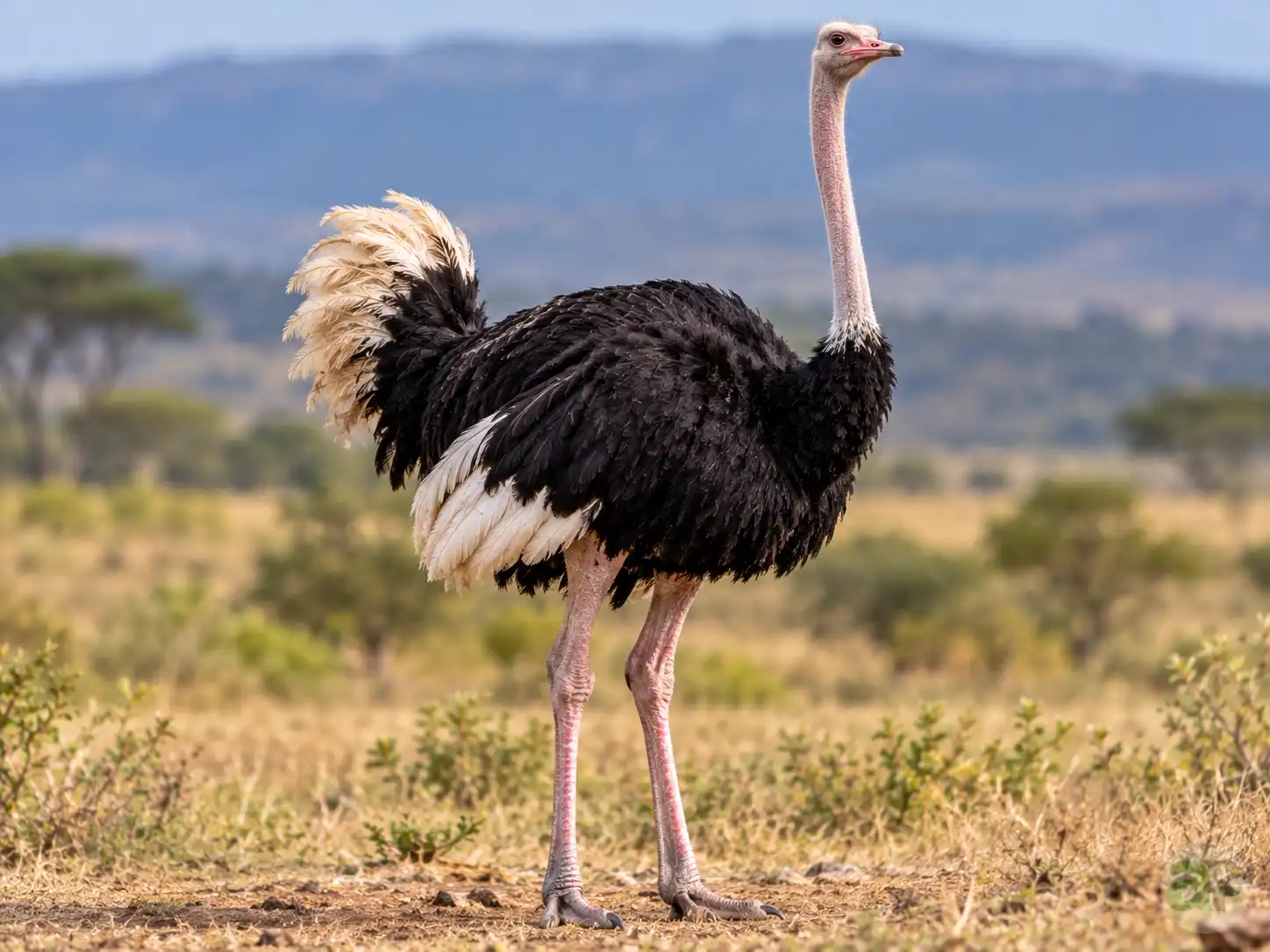
19. Best Places to See Ostriches in the Wild
East Africa — The Classic Safari Experience
1. Serengeti National Park, Tanzania
The Serengeti’s vast open plains — particularly the central Serengeti and the Ndutu area in the southern Serengeti — support Masai ostriches (S. c. massaicus) year-round. The open terrain makes ostriches one of the most consistently visible large birds on the classic Serengeti safari circuit. During the breeding season (March–September), male ostriches in full display — the kantling display visible from several hundred meters in the open savanna — are among the most dramatic wildlife encounters available on the Serengeti circuit.
Best timing — During the calving season (January–March), when the Ndutu area attracts the wildebeest calving concentration, ostrich families with chicks are often visible alongside the spectacular predator activity.
2. Amboseli National Park, Kenya
The open, flat terrain of Amboseli — with Mount Kilimanjaro as the backdrop — provides exceptional ostrich viewing in one of the most photogenic settings in Africa. Ostriches are abundant throughout the park and frequently seen in close proximity to other large mammals (elephants, buffalo, zebra) that use the same open areas.
3. Masai Mara National Reserve, Kenya
The rolling grasslands of the Mara support resident ostrich populations visible year-round from game drive vehicles. During the Great Migration (July–October), the concentration of wildlife including ostriches alongside the spectacular wildebeest and zebra migration creates one of the most comprehensive African wildlife experiences available.
Southern Africa
4. Etosha National Park, Namibia
Etosha’s salt pans and surrounding savanna support both South African ostriches (S. c. australis) and the unusual experience of watching ostriches at waterholes — one of the few settings where wild ostriches approach close to a fixed viewing point. The Okaukuejo waterhole (floodlit at night) and other permanent waterholes in Etosha attract ostriches for drinking, providing extended close-range viewing opportunities.
5. Kgalagadi Transfrontier Park, Botswana/South Africa
The red sand dunes and sparse vegetation of the Kgalagadi support ostriches in a visually spectacular semi-arid landscape. The open terrain provides exceptional long-range viewing and photography opportunities.
6. Oudtshoorn Ostrich Farms, Western Cape, South Africa
For close-up viewing, education, and the cultural history of the Victorian feather trade — the ostrich farms around Oudtshoorn in South Africa’s Little Karoo offer the most accessible and most educational ostrich experience available. Major farm attractions include the Cango Wildlife Ranch, Safari Ostrich Farm, and Highgate Ostrich Show Farm — providing opportunities to observe ostrich behavior, learn about the farming industry, and understand the bird’s domestication history. The “feather palace” mansions of Oudtshoorn are also worth visiting as architectural monuments to the Victorian feather trade.
Horn of Africa — The Somali Ostrich
7. Samburu National Reserve, Kenya
The dry, semi-arid landscape of Samburu in northern Kenya is the most accessible location for viewing the Somali ostrich (S. molybdophanes) — distinguishable from the Masai ostrich by the male’s blue-grey (rather than red-pink) neck. The “special five” animals of Samburu include the Somali ostrich as one of the region’s distinctive endemic species. Viewing here provides the rare opportunity to compare the two species’ physical differences in the field.
20. How You Can Help
Supporting ostrich conservation requires differentiated action across different threats and geographic contexts.
Support these organizations:
- African Wildlife Foundation (AWF) — awf.org — comprehensive African wildlife conservation including ostrich habitat protection and community programs in ostrich range countries
- Wildlife Conservation Society (WCS) Africa Programs — wcs.org — field conservation in ostrich range countries including Horn of Africa programs relevant to Somali ostrich
- BirdLife International Africa — birdlife.org — coordinating African bird conservation including ostrich population monitoring and advocacy
- Etosha Ecological Institute (Namibia) — monitors and studies Namibian wildlife populations including ostriches; supporting Namibian National Parks is an indirect funding mechanism
- Somali Ostrich-specific programs — various academic and NGO research programs focusing specifically on the newly-recognized Somali ostrich species require increased funding given its Vulnerable status
- Kenya Wildlife Service — kws.go.ke — manages Kenya’s national parks protecting Masai and Somali ostrich populations
Critical individual actions:
Support responsibly certified ostrich products — If purchasing ostrich leather, meat, or eggs, choosing products from farms with strong animal welfare and environmental standards reduces the demand that can drive irresponsible farming practices. In South Africa, the Little Karoo ostrich farming region has developed certification programs for responsible production.
Choose ethical wildlife tourism — When visiting ostrich-related tourism experiences, choose operators that prioritize animal welfare over entertainment value. Avoid ostrich riding experiences that place human weight on the birds’ backs; choose walking tours and observation experiences instead.
Support anti-poaching programs — Bushmeat hunting and egg collection from wild ostrich populations remains a significant threat in West Africa and the Horn of Africa. Supporting anti-poaching programs in these regions through established conservation organizations directly reduces this mortality source.
Participate in citizen science — Submitting ostrich sightings to eBird and iNaturalist during African travel contributes to population distribution monitoring; these data are used by researchers tracking ostrich range changes and population trends.
Advocate for habitat protection — The Sahel belt’s habitat degradation from overgrazing and agricultural expansion is the primary threat to the North African ostrich subspecies. Supporting organizations that advocate for Sahel land management reform and desertification prevention benefits ostriches alongside the entire Sahel biodiversity community.
21. Top Documentaries & Books
Must-Watch Documentaries
“Africa” (BBC, David Attenborough, 2013) — The Kalahari episode features exceptional ostrich content — including courtship display sequences and predator-avoidance behavior — in the most cinematically accomplished African wildlife documentary series produced to date. Essential viewing for anyone interested in ostrich natural history.
“Serengeti” (BBC, 2019 and 2022) — The narrative-driven Serengeti documentary series features ostrich families as recurring characters across multiple episodes — providing some of the most intimate and emotionally engaging ostrich documentary content ever produced.
“Planet Earth” (BBC, David Attenborough, 2006) — Various “Desert” and “Grasslands” sequences feature ostrich content in spectacular African landscape photography.
“Ostrich: The World’s Largest Bird” (various wildlife channel productions) — Multiple dedicated ostrich natural history documentaries are available through wildlife streaming platforms; searching “ostrich documentary” on major platforms will locate current available productions.
Oudtshoorn documentary productions — Various South African television productions have documented the history of the Oudtshoorn ostrich farming industry and the Victorian feather trade — providing excellent historical context for the human-ostrich relationship.
Must-Read Books
The Ostrich Communal Nesting System by Brian Bertram (1992) — The definitive scientific study of ostrich nesting behavior; Bertram’s fieldwork in the Serengeti established the foundational understanding of the communal nest, egg recognition, and incubation schedule that defines ostrich reproductive biology.
Ratites and Tinamous by Cabot, del Hoyo, and Collar — Comprehensive scientific treatment of the ratite group including detailed ostrich coverage; essential for anyone interested in the comparative biology of flightless birds.
The Safari Companion by Richard Estes — While covering all African wildlife, this essential field reference includes comprehensive behavioral descriptions of wild ostriches; the gold standard for understanding African wildlife behavior in the field.
Feather Fashions and Bird Preservation by Robin Doughty — The definitive history of the Victorian feather trade including the ostrich feather boom and its conservation consequences; essential reading for understanding the human-ostrich economic relationship.
Oudtshoorn: The Story of the Ostrich (various South African authors) — Multiple popular histories of the Oudtshoorn ostrich farming boom are available from South African publishers; these local histories provide essential context for the most significant human-ostrich commercial relationship in history.
22. Comparison with Other Ratites and Large Birds
| Feature | Ostrich | Emu | Cassowary | Rhea | Kiwi | Andean Condor |
|---|---|---|---|---|---|---|
| Scientific name | Struthio camelus | Dromaius novaehollandiae | Casuarius casuarius | Rhea americana | Apteryx spp. | Vultur gryphus |
| Height | Up to 280 cm | Up to 190 cm | Up to 170 cm | Up to 140 cm | 25–65 cm | N/A (bird, not bipedal) |
| Weight | Up to 156 kg | Up to 60 kg | Up to 85 kg | Up to 40 kg | Up to 3.5 kg | Up to 15 kg |
| Top speed | 70–96 km/h | ~50 km/h | ~50 km/h | ~60 km/h | ~20 km/h | N/A (flier) |
| Toes | 2 | 3 | 3 + casque | 3 | 4 | 4 |
| Flight | No | No | No | No | No | Yes |
| Egg size | Largest living bird egg | Large | Large | Moderate | Largest egg relative to body | Moderate |
| Conservation | Least Concern | Least Concern | Vulnerable | Near Threatened | Endangered (some) | Vulnerable |
| Range | Africa | Australia | New Guinea, N. Australia | South America | New Zealand | Andes, South America |
| Primary defense | Forward kick; running | Running; hindkick | Dagger casque kick | Running | — | — |
| Famous for | Largest/heaviest/fastest bird; largest land eye | Emu War 1932; 3rd largest bird | Most dangerous bird | South American ratite | Nocturnal; smell-based hunting | Largest wingspan New World |
23. Frequently Asked Questions About Ostriches
Q1. What is the scientific name of the ostrich and what does it mean?
The common ostrich’s scientific name is Struthio camelus (Linnaeus, 1758). The genus name Struthio derives from the ancient Greek strouthos — a word that could mean either “sparrow” (the generic small bird) or “ostrich” in different contexts, reflecting the ancient Greek usage of the same root for both the most familiar small bird and the most extreme large bird. The species name camelus is the Latin word for “camel” — making the compound name roughly translatable as “camel-sparrow” or “camel-bird.” The camel reference captures the ostrich’s association with semi-arid desert landscapes (shared with camels) and possibly the ostrich’s long neck (somewhat camel-like in its curve and length). Linnaeus formally described the species in the 10th edition of Systema Naturae in 1758 — the foundational document of binomial nomenclature. The Somali ostrich, recently elevated to full species status, bears the name Struthio molybdophanes — molybdophanes from the Greek molybdos (lead) and phanes (appearing), meaning “lead-colored” — accurately describing the Somali ostrich male’s distinctive blue-grey neck skin that contrasts with the common ostrich’s pink-red neck. The family name Struthionidae and order Struthioniformes both derive from the same Struthio root, making the ostrich the taxonomic namesake of its entire evolutionary lineage.
Q2. How fast can an ostrich run?
The ostrich is the fastest two-legged animal on Earth — a title supported by multiple independent measurements using different methodologies. Sustained running speed — maintained over distances of several kilometers — has been documented at 70–72 km/h (approximately 45 mph). Short-burst maximum speeds — maintained for distances of 100–200 meters — approach 96 km/h (approximately 60 mph) in exceptional individuals in prime condition. For context: the current world record human 100-meter sprint (Usain Bolt, 9.58 seconds, 2009) represents an average speed of approximately 37.6 km/h — the ostrich’s sustained speed exceeds this by approximately 90%, and the ostrich’s maximum burst speed nearly triples the fastest human’s average 100-meter speed. The ostrich’s speed advantage over predators is further enhanced by extraordinary endurance — the bird can maintain speeds above 50 km/h for periods exceeding 30 minutes, while lion and cheetah pursuit speeds are sustainable for only seconds to a few minutes. The mechanics enabling ostrich speed include: the two-toed foot (reduced distal leg mass), a spring-loaded tendon system that stores and returns energy from each stride (similar to running prosthetics), extraordinarily long legs (each leg approximately 100 cm in length in adult males), and the longest stride length of any two-legged animal (3–5 meters per stride at full speed).
Q3. Why don’t ostriches bury their heads in the sand?
This question deserves a definitive answer because the myth is so persistent: ostriches never bury their heads in the sand, for any reason, ever. This has been confirmed by every scientific study of ostrich behavior conducted since systematic observations began — no documented instance of voluntary head-burying in sand exists in the scientific literature. The behaviors that probably gave rise to the myth include: nest tending (when ostriches tend their ground-level nests, they lower their heads to ground level to turn eggs with the bill — from a distance, the head appears to disappear below the surface); the flat-out defensive posture (when threatened by a close predator near a nest, ostriches sometimes stretch the neck along the ground surface, reducing their visual profile — the pale neck against the sand can appear to be buried when observed from certain angles); and gastrolith collection (ostriches regularly pick up sand and small stones for their gizzard, repeatedly lowering heads to the ground). The myth appears in ancient sources — Pliny the Elder (77 CE) writes of ostriches hiding their heads in bushes — suggesting the misinterpretation is over 2,000 years old. Despite being conclusively disproven, the myth persists because it is a vivid and memorable image, because it has been repeated so many times that it has acquired the authority of established fact, and because it serves as a useful metaphor for willful ignorance that has made “ostrich with its head in the sand” a standard English idiom.
Q4. What is the largest egg ever laid by any bird?
The largest egg of any living bird is the ostrich egg — measuring approximately 15 × 13 cm and weighing 1–2 kg (equivalent in volume to approximately 24 chicken eggs). However, the largest bird egg ever laid belongs to the elephant bird (Vorombe titan) of Madagascar — a now-extinct ratite that lived until approximately 1000 CE. Elephant bird eggs measured approximately 30 × 24 cm and weighed approximately 10 kg — roughly 5–10 times the mass of an ostrich egg. Individual elephant bird eggs are among the rarest and most valuable natural history objects — complete examples have sold at auction for over $100,000. The elephant bird itself was the heaviest bird in the fossil record at approximately 860 kg — nearly six times the weight of a large ostrich. The distinction between “largest egg of any living bird” (ostrich) and “largest egg ever laid” (elephant bird) is important and frequently confused. Within the living bird world, the ostrich egg’s claim to the record is uncontested — the next-largest eggs belonging to emus and cassowaries at roughly half the ostrich egg’s mass. Proportionally, the most extreme egg-layer relative to body size is the kiwi (Apteryx species) — laying an egg that constitutes approximately 15–20% of the female’s body weight, compared to the ostrich egg representing approximately 1–2% of the female’s body weight.
Q5. Where is the best place to see ostriches in the wild?
The most reliable wild ostrich viewing available to international visitors is in East African national parks — particularly Amboseli National Park (Kenya), Etosha National Park (Namibia), and the Serengeti National Park (Tanzania). In these open-terrain reserves, ostriches are year-round residents visible from game drive vehicles across the open grassland and savanna. For maximum spectacle — watching male ostriches in full courtship display — the East African breeding season (March–September) provides the most active display behavior, with males performing the dramatic kantling display visible from several hundred meters in the open terrain. For those interested in the cultural and historical human-ostrich relationship, Oudtshoorn in South Africa’s Little Karoo provides the most accessible and most educational experience — the ostrich farm visits, historical “feather palace” architecture, and interpretation of the Victorian feather trade providing essential context for the most economically significant human-ostrich relationship in history. For viewing the recently recognized Somali ostrich (S. molybdophanes) — distinguished by the male’s blue-grey neck — Samburu National Reserve in northern Kenya provides the most accessible encounter with this now-separately-classified species in its natural semi-arid habitat alongside the other “northern specials” of the region.
24. Sources & References
- Wikipedia — Struthio camelus, Struthio molybdophanes, Struthionidae, Struthioniformes, Ratite evolution, Ostrich farming history
- IUCN Red List — iucnredlist.org (Least Concern assessment for S. camelus; Vulnerable for S. molybdophanes)
- BirdLife International — birdlife.org (species factsheets; population assessments)
- Bertram, B.C.R. (1992) — The Ostrich Communal Nesting System. Princeton University Press — definitive scientific study of ostrich reproductive behavior
- Alexander, R.McN. — published biomechanics research on ostrich locomotion and the spring-loaded tendon system
- Doughty, R.W. (1975) — Feather Fashions and Bird Preservation — historical treatment of the Victorian feather trade
- National Geographic — nationalgeographic.com
- Smithsonian National Museum of Natural History — naturalhistory.si.edu
- BBC Wildlife / BBC Earth — bbcearth.com
- Britannica — britannica.com/animal/ostrich
- Cornell Lab of Ornithology — allaboutbirds.org (species account)
- Estes, R.D. — The Safari Companion — African wildlife behavioral ecology reference
- South African National Biodiversity Institute — sanbi.org (South African ostrich population data)